

Most fish finder roundups are written for people standing at a center console. A pontoon is a different animal entirely: twin aluminum logs, a wide open deck, a helm seat you sit down in rather than stand behind, and a transducer question nobody at the dealership really answers for you. A pontoon sits low, so structure that reads as a ledge from a console shows up as a smudge. The sun hits an open deck all afternoon, so a dim screen that looks fine in a showroom is useless at four in the afternoon on the water. And most of these boats have no factory transducer bracket and no trailer parked in the driveway.
That is the filter we used to build the best fish finders for pontoon boats list below. Every pick has to be readable from a seated helm position, has to be mountable on an aluminum log without drilling a hole you cannot get to with the boat in the water, and has to keep returning a bottom reading while you troll. We compared the eight models on this list side by side across sonar type, screen size, transducer mounting options, what is actually in the box, and what owners report after a season on the water.
Before we get into it, two quick notes. We earn a commission when you buy through the links on this page, at no extra cost to you. And if you are still shopping the boat itself, our guide to the best pontoon boats covers the layouts worth matching a display to. If you want the broader picture across every kind of boat, our complete fish finder guide covers center consoles and small craft too.
Table of Contents
Top 3 Picks for Pontoon Owners
If you want the short answer first, these three cover the range most pontoon anglers actually need. The Striker 4 is the one most owners end up with. The Striker Vivid 4cv adds color for very little more money. The STRIKER 5CV is the pick if your helm is more than an arm’s length from your seat.

Garmin Striker 4
- 3.5 inch LCD
- CHIRP sonar
- Transducer and both mounts included
- 1600 ft depth

Garmin Striker Vivid 4cv
- 4 inch color screen
- GT20 CHIRP transducer
- Quickdraw Contours
- Two year warranty

Garmin STRIKER 5CV
- 5 inch WVGA color
- Traditional plus ClearVu split screen
- Quickdraw Contours
- Mounts in the box
Every Pick at a Glance in 2026
All eight models below ship with a transducer and a mounting bracket in the box, which is not something you can assume in this category. Screen size is the diagonal, measured in inches.
| Product | Specifications | Action |
|---|---|---|
| Garmin Striker 4 |
|
Check Latest Price |
| Garmin Striker Vivid 4cv |
|
Check Latest Price |
| Garmin STRIKER 5CV |
|
Check Latest Price |
 Humminbird PiranhaMAX 4 Humminbird PiranhaMAX 4 |
|
Check Latest Price |
 Humminbird HELIX 5 CHIRP GPS G3 Humminbird HELIX 5 CHIRP GPS G3 |
|
Check Latest Price |
 Humminbird HELIX 7 CHIRP SI GPS G4 Humminbird HELIX 7 CHIRP SI GPS G4 |
|
Check Latest Price |
 Lowrance Eagle 4 Lowrance Eagle 4 |
|
Check Latest Price |
 Lowrance Elite FS 10 Lowrance Elite FS 10 |
|
Check Latest Price |
1. Garmin Striker 4 – the model most pontoon owners end up with
Garmin 010-01550-00 Striker 4 with Transducer, 3.5″ GPS Fishfinder with Chirp
- Most reviewed unit on this list at 9312 ratings
- Very low power draw for a permanently mounted display
- Transducer plus transom and trolling motor mounts included
- Waypoint map and speed readout
- Readable in full sun
- No preloaded charts so mapping is manual
- Sonar picture degrades at higher speeds
- Small screen limits split-screen work
I put the Striker 4 first because of one number: 9312 ratings at 4.6 stars. In a category where owners get frustrated and write paragraphs, that is the strongest reliability signal available. It is also the cheapest way to get a real CHIRP transducer onto a pontoon without a dealer bill, which matters when the alternative is a manual and a trip to the lake with a boat you cannot trailer.
The box is unusually complete for the money. You get the display, the power and data cable, a tilt and swivel mount, the transducer, and both a transom mount and a trolling motor mount. That trolling motor mount is the part that matters on a pontoon, because it puts the transducer on the shaft where the boat can be running shallow over grass or mud without the sensor dragging the bottom.
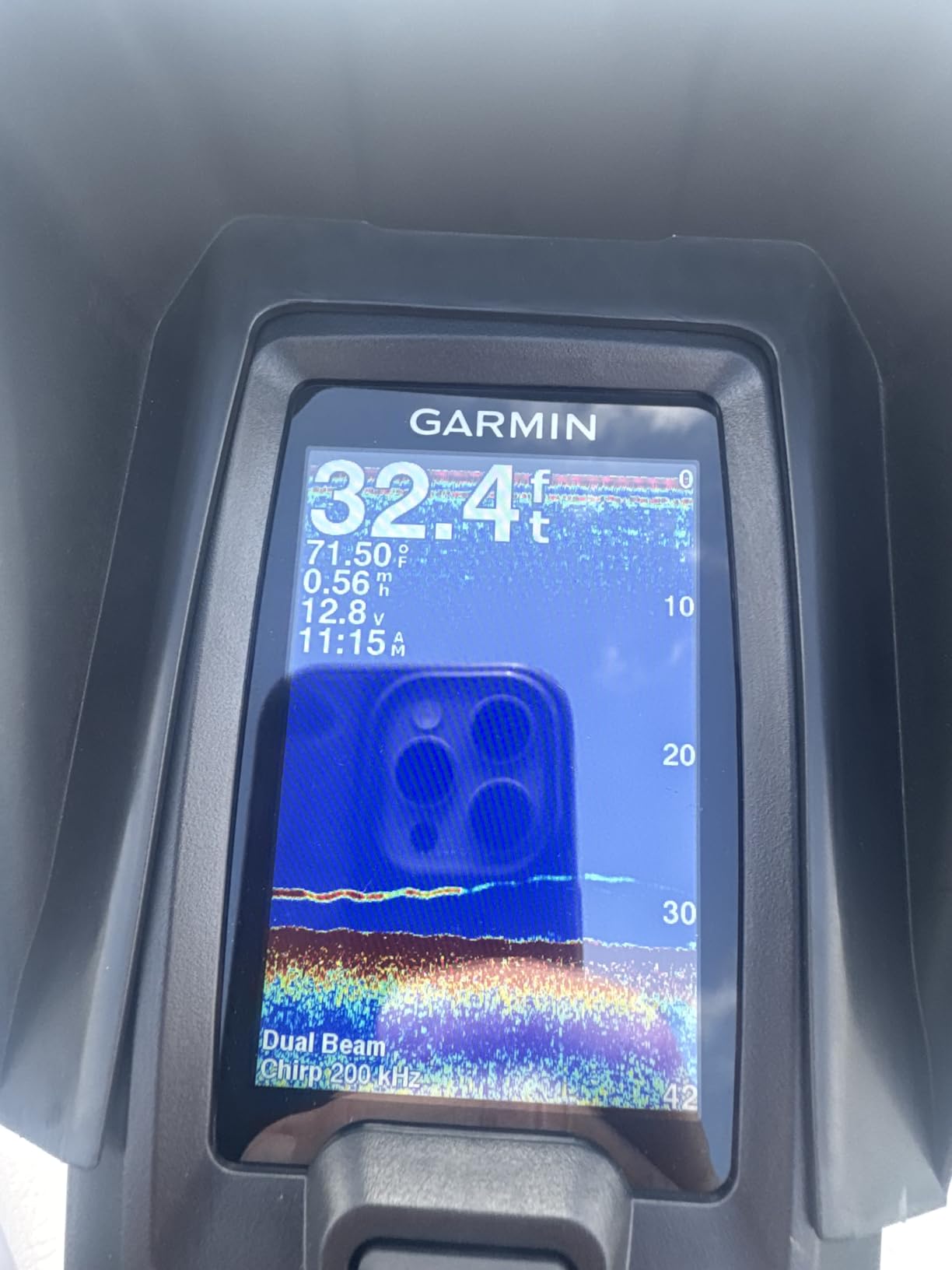
CHIRP is the term you will see most in this article, so it is worth defining once. CHIRP sends a continuous sweep of frequencies instead of a single tone, which produces crisper fish arches and better separation between a fish and the rock it is sitting next to. On the Striker 4 that shows up as tight, distinct arches rather than a smear of color, and it is the single biggest step up from a basic depth sounder.
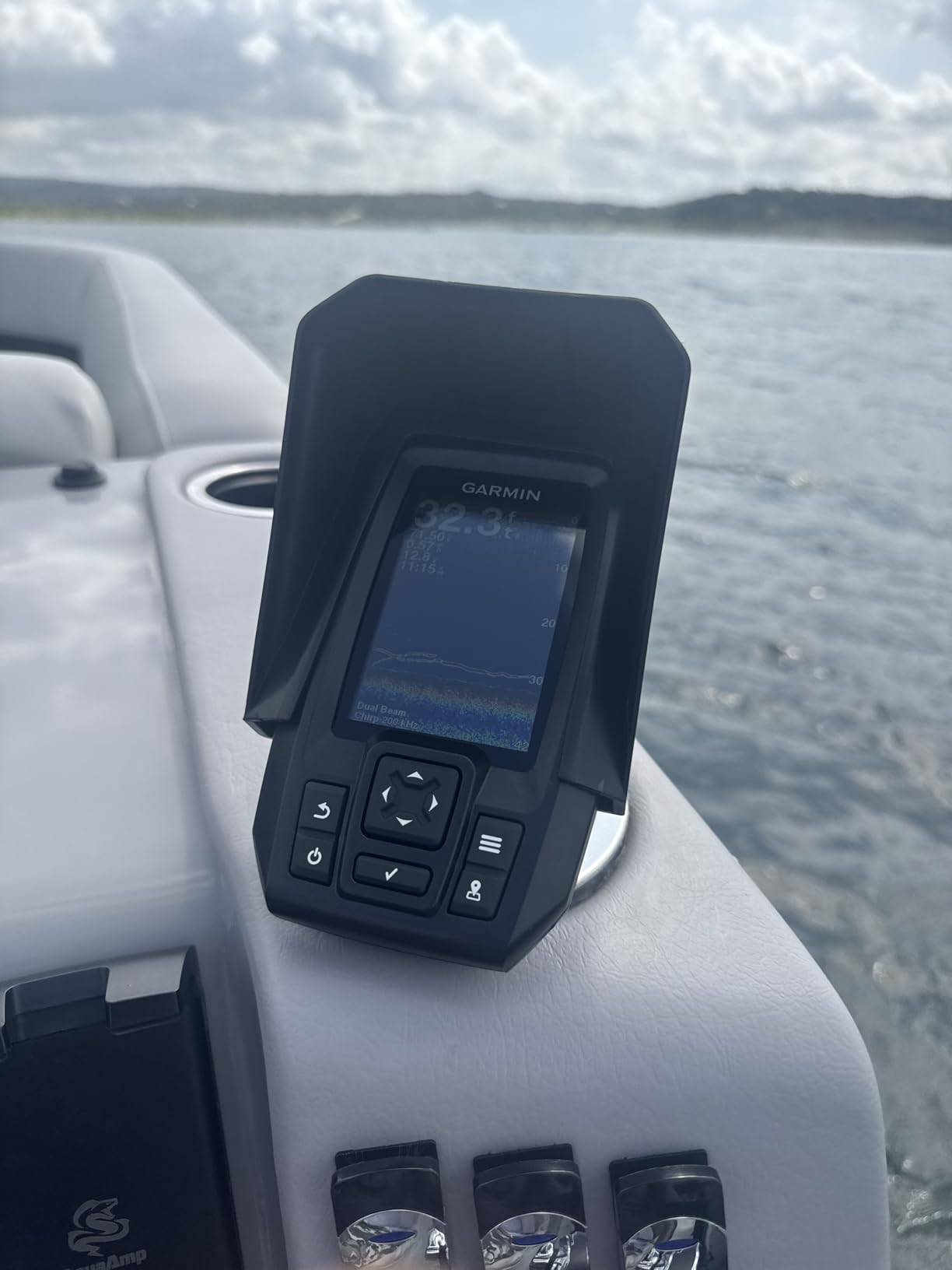
Owners also appreciate that the power draw is tiny. The display pulls 0.23 amps at 12 volts, which means you can run it off a small fused accessory circuit without worrying about the house battery or a voltage drop on a long wire run down the log. On a boat that spends a full day on a lake with the engine off at a sandbar, that matters more than any menu feature.
How it performs on a pontoon helm
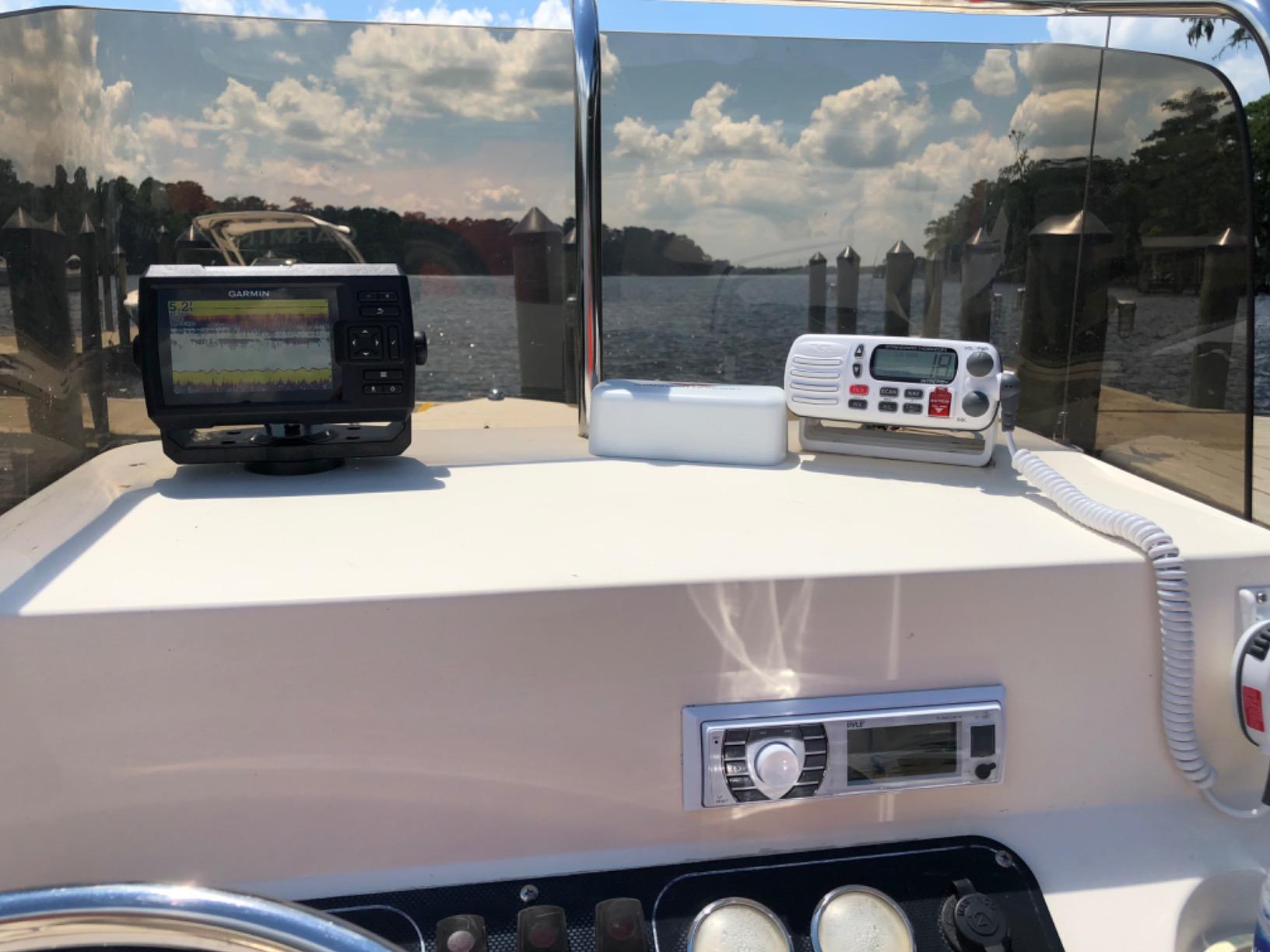
At 3.5 inches, the screen is small in absolute terms. Seated at a helm with the display on the console, that is readable in direct sun, and owners specifically call out that it stays legible through sunglasses. If your helm has a wide dash and you sit well back, consider the 5-inch or 7-inch options further down this list instead.
The unit also has a built-in flasher mode, which shows sonar returns in the classic ice-fishing layout. Pontoon anglers who vertical jig for walleye at a summer stake field use that same mode, and it is a genuinely useful thing to have that most similarly priced displays do not offer.
Where it falls short on a pontoon
There are no preloaded charts. The waypoint map lets you mark brush piles, stumps and rock points and return to them, but the contours have to be drawn by you. On a lake you fish every summer that is a fine tradeoff. On unfamiliar water it is a real limitation, and it is the main reason to step up a tier.
Second, sonar quality is best at trolling pace and below. Owners report the picture cleaning up dramatically above that, and a minority hit early power cable faults that Garmin resolved through an RMA exchange. Plan on a solidly built power run rather than relying on the thin included wire for a permanent install.
2. Garmin Striker Vivid 4cv – color sonar on a tight console
- Highest average rating in the group at 4.7
- Color palettes separate fish from structure clearly
- Quickdraw Contours stores 1 foot maps
- Two year warranty is the longest here
- Tilt and swivel bracket makes angle adjustment easy
- No preloaded charts beyond your own recordings
- 4 inch screen is tight for chart work
- Battery sold separately
This is the unit I recommend to anyone moving up one step from the Striker 4 without changing the footprint of their console. The GT20 transducer in the box gives you both CHIRP traditional sonar and CHIRP ClearVu scanning sonar from a single puck, so you are not hunting for a second sensor the first time you want to look at structure instead of arches.
The 4.7 star average across 1861 ratings is the highest of the eight models here, and reviewers consistently point at the same reason: the vivid color palettes. Fish show up as a distinct color from the structure they are holding against, which on a shallow flat or a weed edge in August makes a big difference in how fast you can read a screen. The two year warranty is also the longest in this group.
Quickdraw Contours is the feature that owners of Garmin units talk about most. The unit records your own depth map at one foot intervals as you run, and you can store custom contours for your own water. It is not a substitute for a preloaded inland chart, but once you have put in the time to record the lake you actually fish, the map is accurate to the foot where it matters.
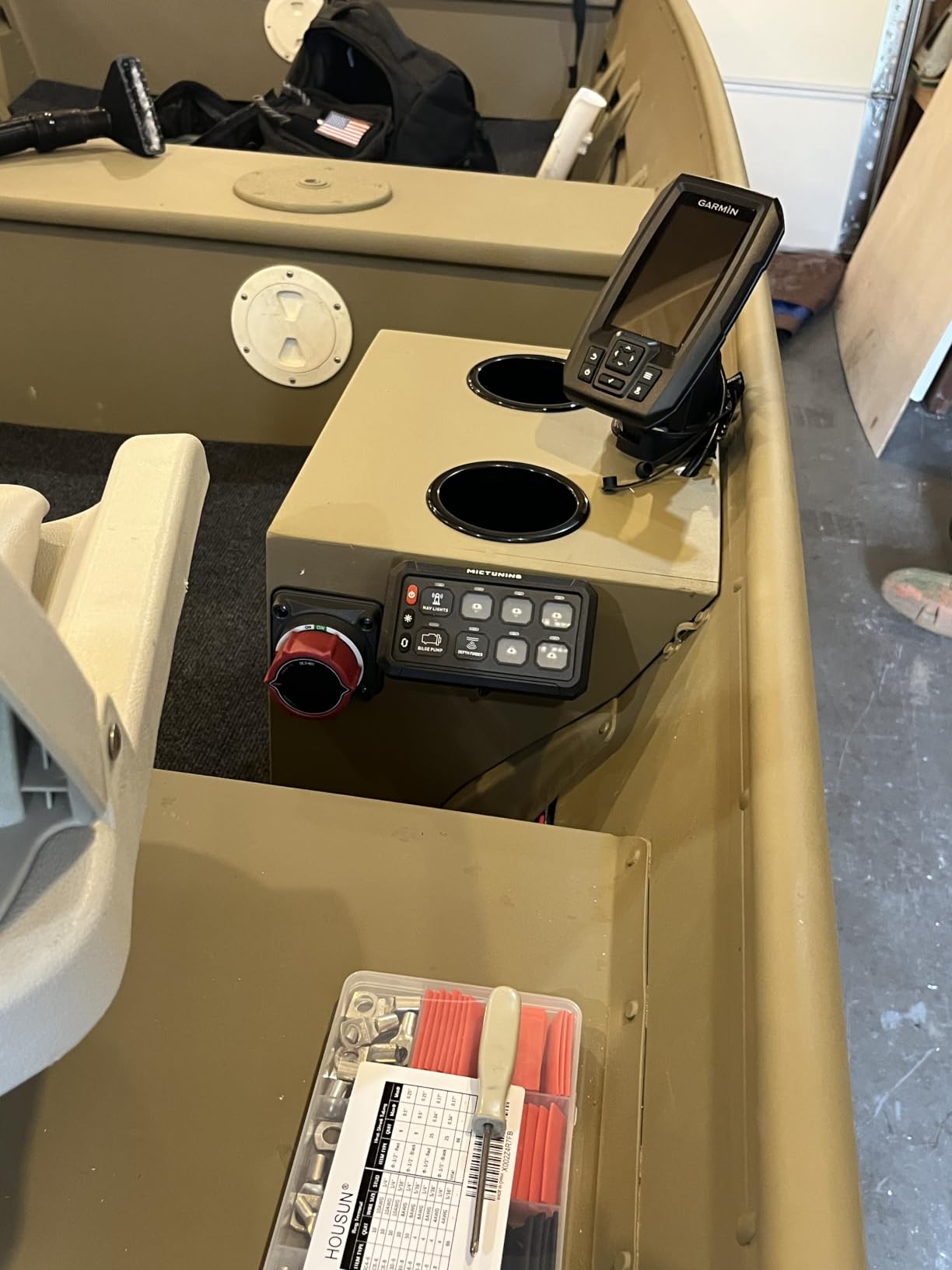
The tilt and swivel bail mount is a small thing that turned out to matter more than expected. Pontoon helms are rarely flat or square to the driver, so being able to dial the angle of the display in a few seconds is genuinely useful, especially for a second helm station on a tri-toast layout where the viewing position is completely different.
Why it works on an aluminum log
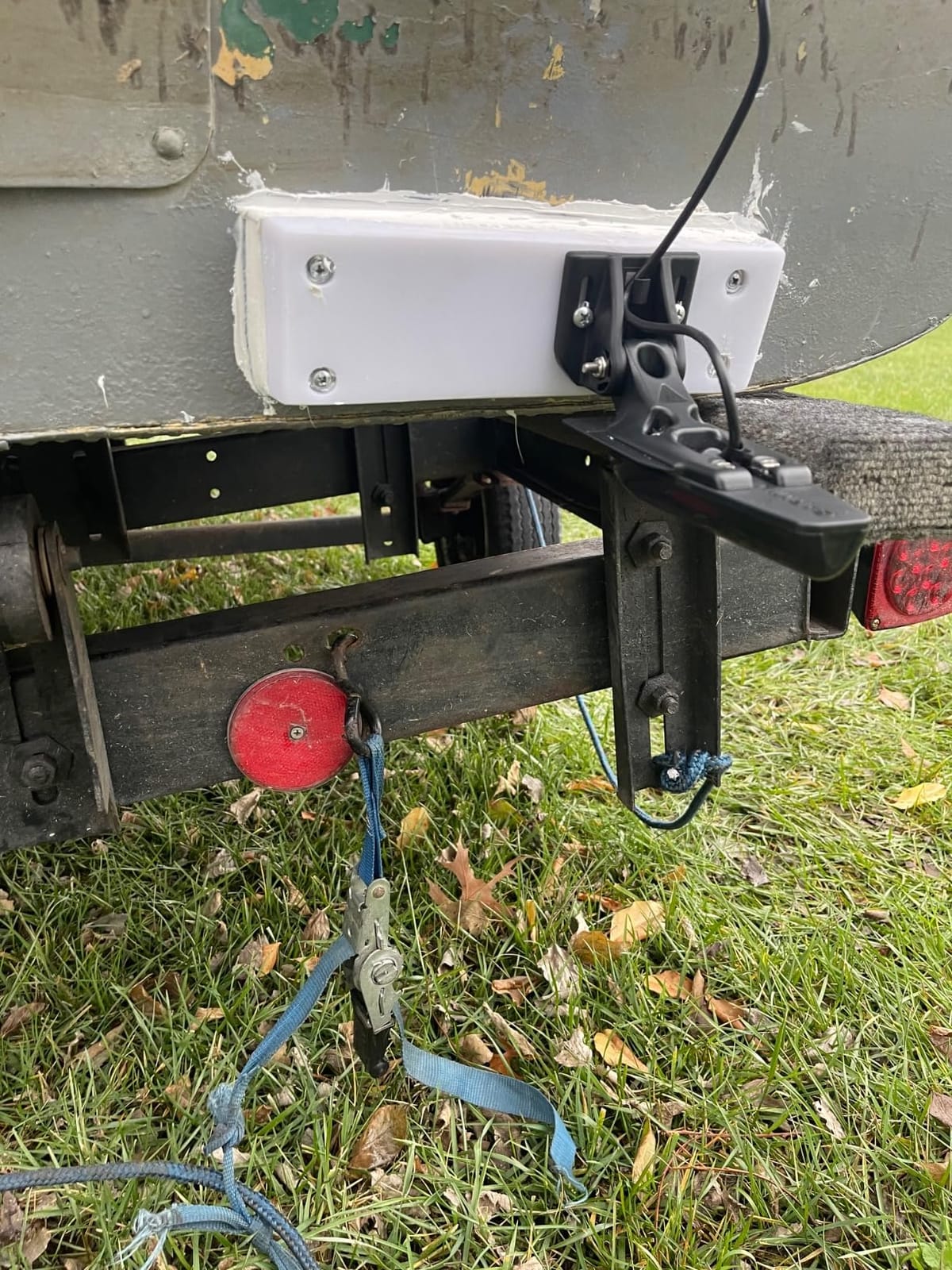
The transducer mounts on the transom or the trolling motor shaft, so nothing touches the aluminum and no seal is put at risk. For a boat that stays in a slip or on a lift with no trailer, that removes the single biggest install blocker. Owners on r/fishfinders repeatedly describe the same pattern: a bracket that clamps on rather than screws into the hull is what makes them comfortable drilling-free installs.
The included power and data cable plus the tilt and swivel mount are the complete install kit. There is no separate mount purchase, which is not always true in this price range.
Where it falls short
Four inches is genuinely small. It is fine for sonar and waypoints, but if you plan to use split-screen or want to overlay a chart on the sonar pane at the helm, the screen runs out of room quickly. On a large pontoon where the helm is far from the seat, go 5 inches or larger.
It also ships without a battery, and there are no preloaded charts beyond what you record yourself. Both are workable; just factor them in before you order.
3. Garmin STRIKER 5CV – the sweet spot for a sunny open helm
- Runs traditional and ClearVu simultaneously on split screen
- 5 inch screen readable in bright sun at a seated helm
- Quickdraw stores 1 foot contours for up to 2 million acres
- Transducer and both mounts in the box
- No preloaded charts
- No Wi-Fi or NMEA 2000 or SD card slot
- Included power cable length can limit placement
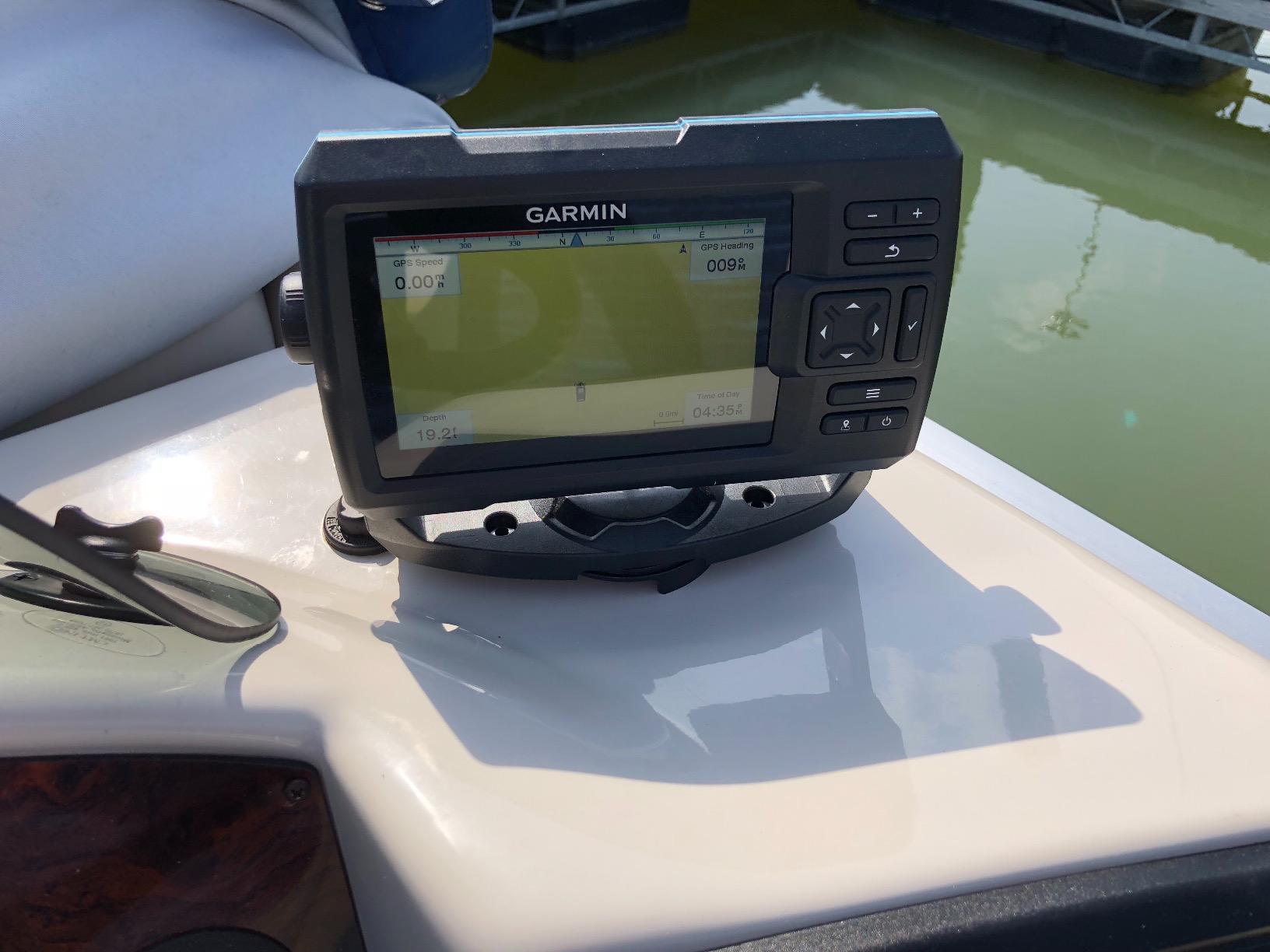
This is the one I keep coming back to for the widest range of pontoons. Five inches is the smallest screen that you can comfortably read at a seated helm position with the sun coming off the water, and a WVGA color panel in direct sun is a real difference from a monochrome LCD of the same size. If your boat is a 20 to 24 foot tri-toast with a normal helm, this is the size that works.
The CV20-TM transducer is included along with both the transom and the trolling motor mount, so again there is nothing to buy to get it on the boat. The sonar runs traditional and ClearVu at the same time, which means you can put the two panes side by side and watch fish arches on one side while a photographic slice of what is directly below the boat fills the other.
Quickdraw Contours on this model stores one foot contour maps for up to 2 million acres, which is far more than any inland lake system will ever use. Owners on freshwater lakes typically record the lake once, then add a trip to correct any drift. One owner reported recorded mapping failing to load after storage over winter, so export a backup if the spots matter to you.
The controls are keyed rather than touchscreen. On a pontoon that is the right call, and owners on boating forums make the same argument: a physical button works with wet hands, in spray, and while the boat is moving in a way that a capacitive screen does not. The menu depth is deliberately shallow, so there is a limit to how much you can tune.
What you gain over the 4-inch model
Screen real estate, mostly. Zooming into a brush pile or a drop-off edge and seeing what is actually holding on it is the difference between knowing and guessing, and you need pixels to do it. Split-screen also becomes practical at 5 inches, which is not true at 4 inches on a unit that is also running a chart pane.
For a family boat where two people fish from it, the larger screen reads well from the second seat too, which no 3.5 or 4 inch display in this list manages.
Where it falls short
There is no networking at all: no Wi-Fi, no NMEA 2000, no SD card slot, no autopilot integration. That is fine as a standalone fish finder and a real ceiling if you later want to add a second display at a second helm or connect other electronics. Owners describe it as a base model that does one job well, and they are right to think of it that way.
No preloaded charts here either, and the included power cable is short enough that on a long pontoon you may need to extend the run. Plan that before you pick a mounting spot.
4. Humminbird PiranhaMAX 4 – dual beam and almost nothing to learn
Humminbird PiranhaMAX 4 Fish Finder with Transducer, Dual Beam Sonar
- Transom transducer included in the box
- Tilt and swivel mount makes it easy to move between boats
- Dual Beam toggles detail against coverage
- Light and simple for a rental or loaner boat
- No GPS or charting on this model
- 600 ft depth ceiling is shallow
- Monochrome LCD with no scanning sonar
The PiranhaMAX 4 is the simplest thing on this list and that is the entire pitch. There is a screen, a knob-driven menu a couple of levels deep, and a dual beam sonar you can toggle between a narrow beam for detail and a wide beam for coverage. On a pontoon where the priority is depth and brush piles on a familiar lake, it does that without ceremony.
It is also the easiest unit here to move between boats. The tilt and swivel mount comes out of the box and the whole thing weighs two pounds, so if you rent pontoons, share a boat with a friend, or want a display that lives in the console bag rather than permanently in the boat, this is the one. The XNT 9 28 T transom transducer is in the box too.
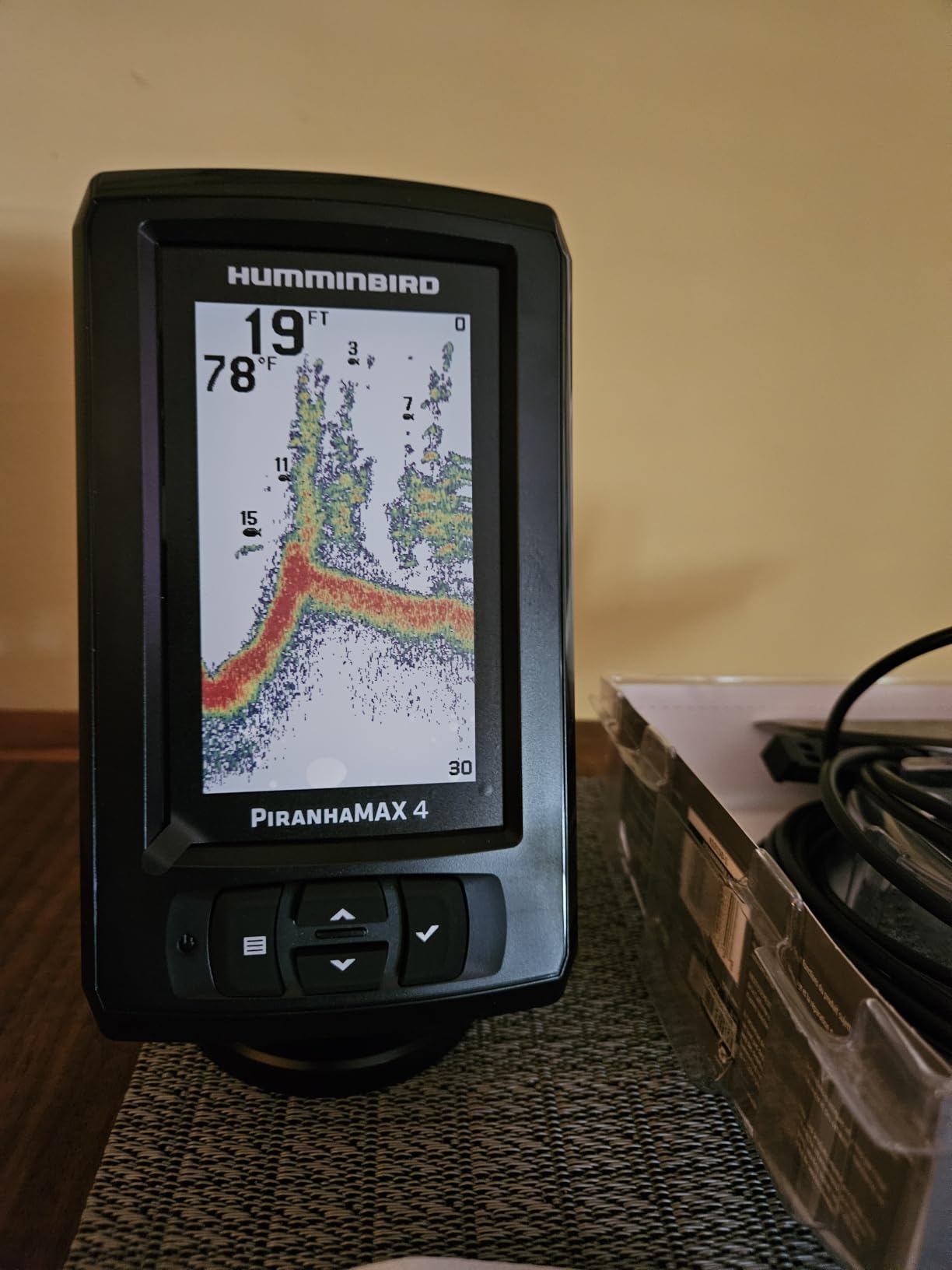
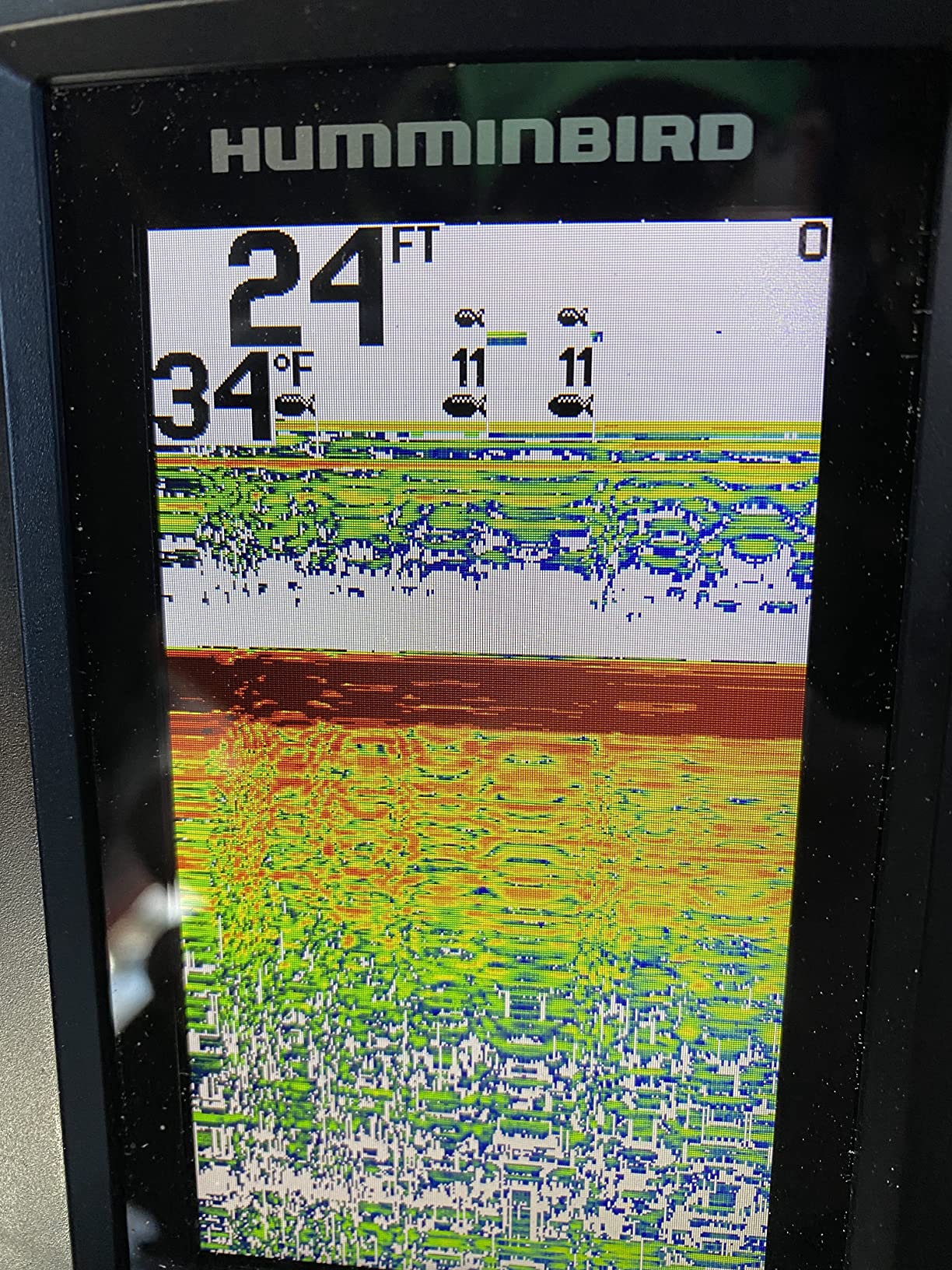
Owners describe accurate depth readings and a fish readout that is easy to interpret at a glance, which is exactly what a beginner wants. A 4.6 star average across 1328 ratings tells you it does not surprise people. The recurring grumbles on r/Fishing are about depth offset calibration needing attention and the interface feeling dated next to a Garmin, not about the unit failing.
There is a flip side to the simplicity. No GPS means no waypoints, no routes, and no speed over ground. On a lake you know well that is a non-issue. On water you navigate by landmarks, it is a limitation you should accept before you buy rather than discover later.
Where it fits on a pontoon
Think of it as the shallow-water, familiar-lake tool. A 600 foot depth ceiling is far more than any inland lake needs, and the dual beam gives you enough resolution to pick up a weed line or a stump field. It is also the right choice for a pontoon used mostly as a cruising and swimming platform where a fishing electronics package would be overkill.
The monochrome screen is readable in sun. It will never be as easy to parse as a color unit, and that is the honest limitation.
Where it falls short
No waypoints means you cannot mark a productive spot and come back to it in a stiff wind with no visual reference. That single missing feature is what pushes most pontoon anglers toward a Garmin or a Humminbird with a basemap, because marking structure is half the reason to own a fish finder in the first place.
There is also no CHIRP and no scanning sonar imaging on this model, so you are reading arches and a traditional trace rather than a picture of the bottom.
5. Humminbird HELIX 5 CHIRP GPS G3 – a basemap in the box
Humminbird Helix 5 G3 GPS Fish Finder with Transducer & Dual Spectrum Chirp Sonar
- Basemap covers more than 10000 lakes out of the box
- Low-Q CHIRP transducer gives tight 2D target separation
- Softkey keypad works with wet hands in rough water
- AutoChart Live records contours and bottom hardness
- Fuse and extra wire length not included
- AutoChart Live records only 8 hours before needing an SD card
- Settings menu takes practice
This is the pick if you fish lakes you do not know well yet. The Humminbird Basemap covers more than 10000 lakes plus the continental US coastlines, which means you get real chart detail on the unit out of the box rather than a blank screen with a waypoint plotter. If you are planning to drive to a new body of water and fish a weekend, that alone can justify the unit.
The sonar itself is Dual Spectrum CHIRP driven by a Low-Q transducer, with a wide mode for coverage and a narrow mode for detail. Owners describe the image as accurate and dependable, and several specifically call out how simple it is to install on a pontoon, which matches what we heard from owners on r/Pontoons looking for a no-drill solution.
AutoChart Live is the second reason to like this unit. It records depth contours, bottom hardness and vegetation as you run, with eight hours of onboard recording before you need an SD card. Run the same lake a few times and you have your own map of the places you keep catching fish, with the option to layer in LakeMaster, CoastMaster or Navionics cards later.
The softkey keypad is the right control choice here for the same reason it is on the Garmin units. Pontoon owners consistently report that physical controls remain usable in spray and rough water, and the Humminbird menu structure is the deepest of the group, so buttons you can find by feel matter.
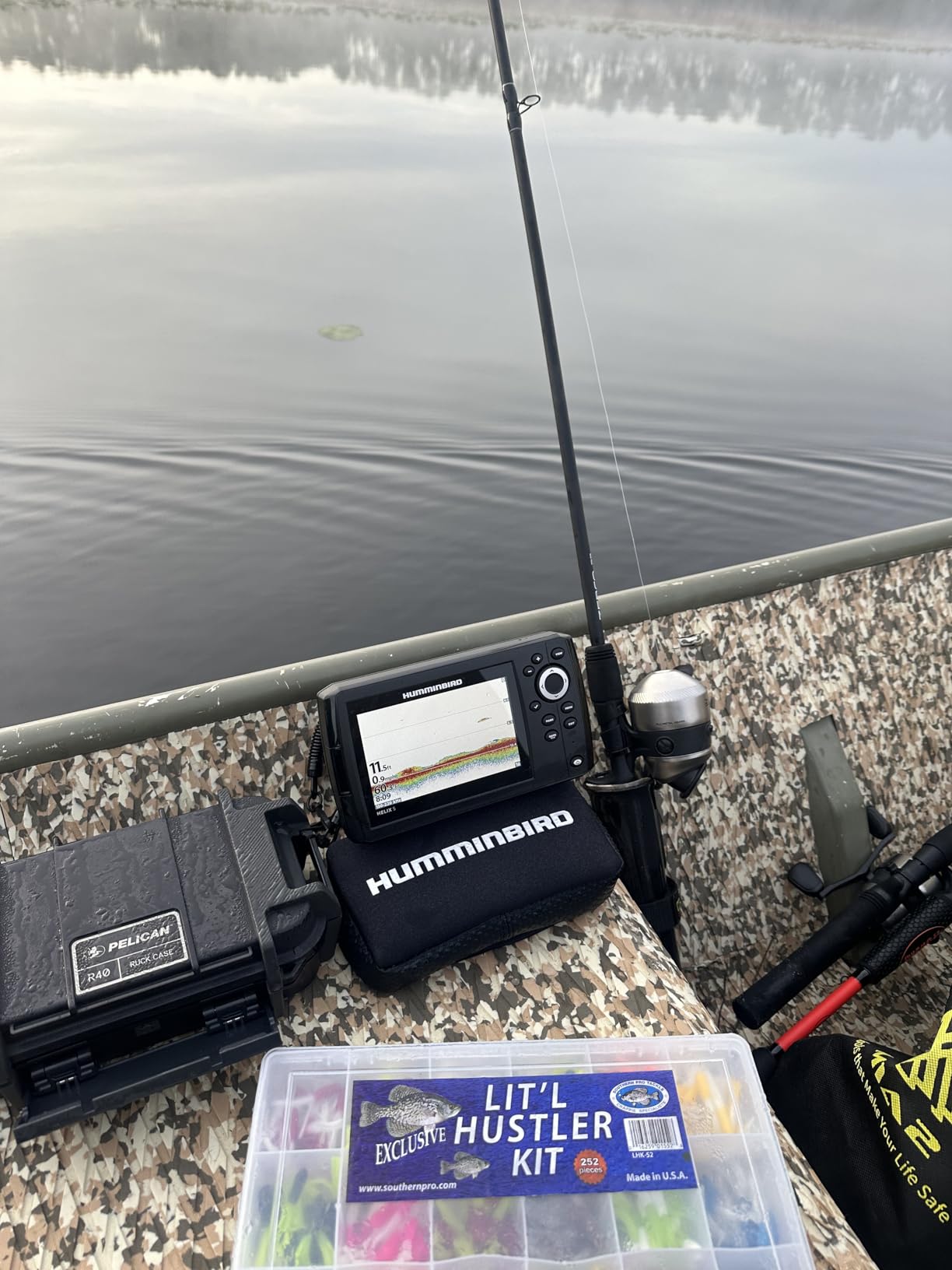
How it holds up in direct sun
The 5 inch color TFT screen is readable in direct sun, and owners add that a visor helps further on a bright afternoon. The gimbal mounting bracket in the box lets you set the angle to your seating position, which on a pontoon matters because the driver often sits noticeably to one side of the console centerline.
For a second helm station, the same bracket and unit can move between stations, though you would be running the cable to only one at a time unless you wire both.
Where it falls short
The box does not include a 3 amp fuse or enough wire for some small layouts, so plan a hardware run before the install day. That trips people up more than any feature, and it is a five minute fix at a marine supply store.
There is no side imaging at 5 inches, and the settings menu takes practice. If you want to see structure out to the sides of the boat, the next model up is the step.
6. Humminbird HELIX 7 CHIRP SI GPS G4 – side imaging for the money
- Side Imaging and Down Imaging plus Dual Spectrum in one box
- 7 inch screen is easy to read from a pontoon helm
- Basemap for 10000+ lakes
- Works out to the sides for far more coverage per pass
- Highest cost of the Garmin and Humminbird models here
- Transom transducer only unless you buy more hardware
- Settings take practice to master
Side Imaging is the feature that changes how you fish a pontoon. Traditional sonar looks in a cone under the boat, so you only see structure you happen to be directly over. Side Imaging throws wide beams out to each side, which means a single pass covers a much larger piece of the lake and you can pick out a brush pile or a rock ledge off the side of the boat. On a wide deck pontoon that extra coverage is the whole point.
This unit also gives you CHIRP Down Imaging directly beneath the boat and Dual Spectrum 2D sonar, all from the included XNT 9 HW SI T transom transducer. Owners report accurate, dependable sonar and bright imagery, and several note this was the lowest price they could find for a side imaging unit, which is exactly what makes it interesting on a pontoon where the budget usually goes into the boat.
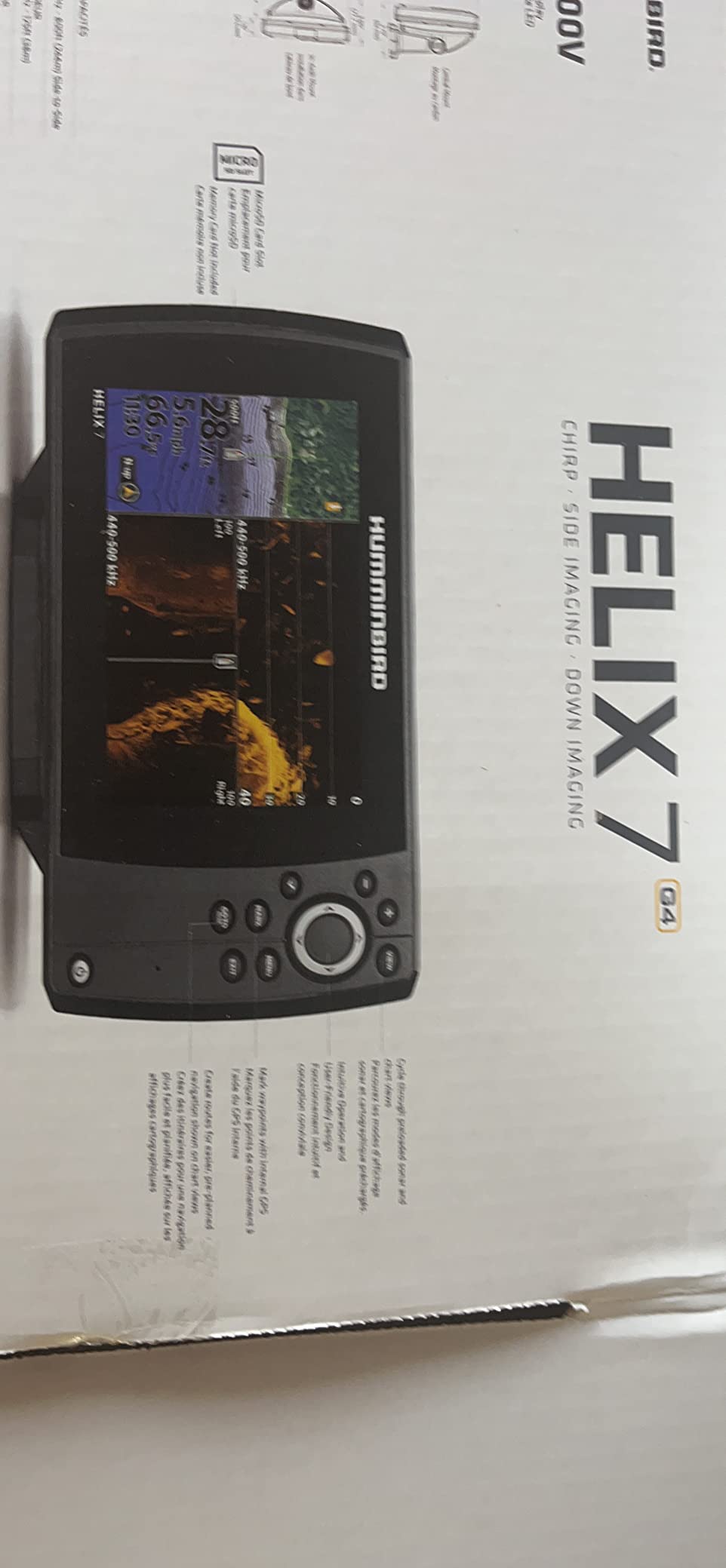
The 7 inch color screen is the size that makes side imaging worth having. Side scan returns a lot of information and a small screen turns it into noise. At 7 inches with a gimbal bracket and a sunlight readable panel, you can read the display from a seated position and still keep the helm in peripheral view, which is what you want when you are trolling rather than stationary.
GPS and the same Humminbird Basemap are built in, and premium LakeMaster, CoastMaster and Navionics cards are supported if you want more detail on a specific lake later. AutoChart Live records as you go here as well.
Is side imaging worth it on a pontoon?
Yes, if you are actively searching for structure rather than fishing known spots. Pontoons are wide, slow, and stable, which makes them genuinely good platforms for covering water with side scan. The beams read far enough out that you can watch a drop-off roll past the side of the boat and mark it on the way back.
It is less valuable if you mostly fish a handful of spots you already know, or if you spend your time vertical jigging at a stake field, where down imaging and a flasher-style view serve you better.
Where it falls short
It is the most expensive of the Garmin and Humminbird units in this group, and the transducer is transom mount, so an in-hull or through-hull setup on a pontoon would need additional hardware you do not get in the box. Given the aluminum log construction of a pontoon, that is usually not the install route anyway.
The review base is smaller than the other picks here at 179 ratings, so treat the owner consensus with slightly less weight. Owners also report a learning curve in the settings, and one isolated report of packaging labeled SI-only on a dual imaging unit.
7. Lowrance Eagle 4 – the fastest clean install on the list
- Bright IPS portrait screen reads well in sun and through polarized glasses
- Auto-Tuning removes almost all menu setup
- Transducer and mounting hardware included
- Twist-lock connector makes removing the display quick
- 500 ft depth ceiling is the shallowest here
- 200 kHz only with no CHIRP or imaging
- No GPS or charting
- Lowest average rating in the group
The Eagle is the lowest-cost way onto this list with a transducer and mounting hardware in the box, and the included fuse and fuse holder is a small detail that saves a hardware store trip. The twist-lock connector is the reason it installs fast: the display separates from the cable with a quarter turn, so you are not unplugging wires behind a console every time you move the boat.
Auto-Tuning Sonar sets itself as soon as it gets a reading, which means there is no sensitivity adjustment to learn before your first trip. For a pontoon owner who is adding a first fish finder and does not want to spend an evening reading a manual, that is worth more than a feature list. One owner reports the same stand and screw holes as an older Lowrance model, which makes a swap straightforward.
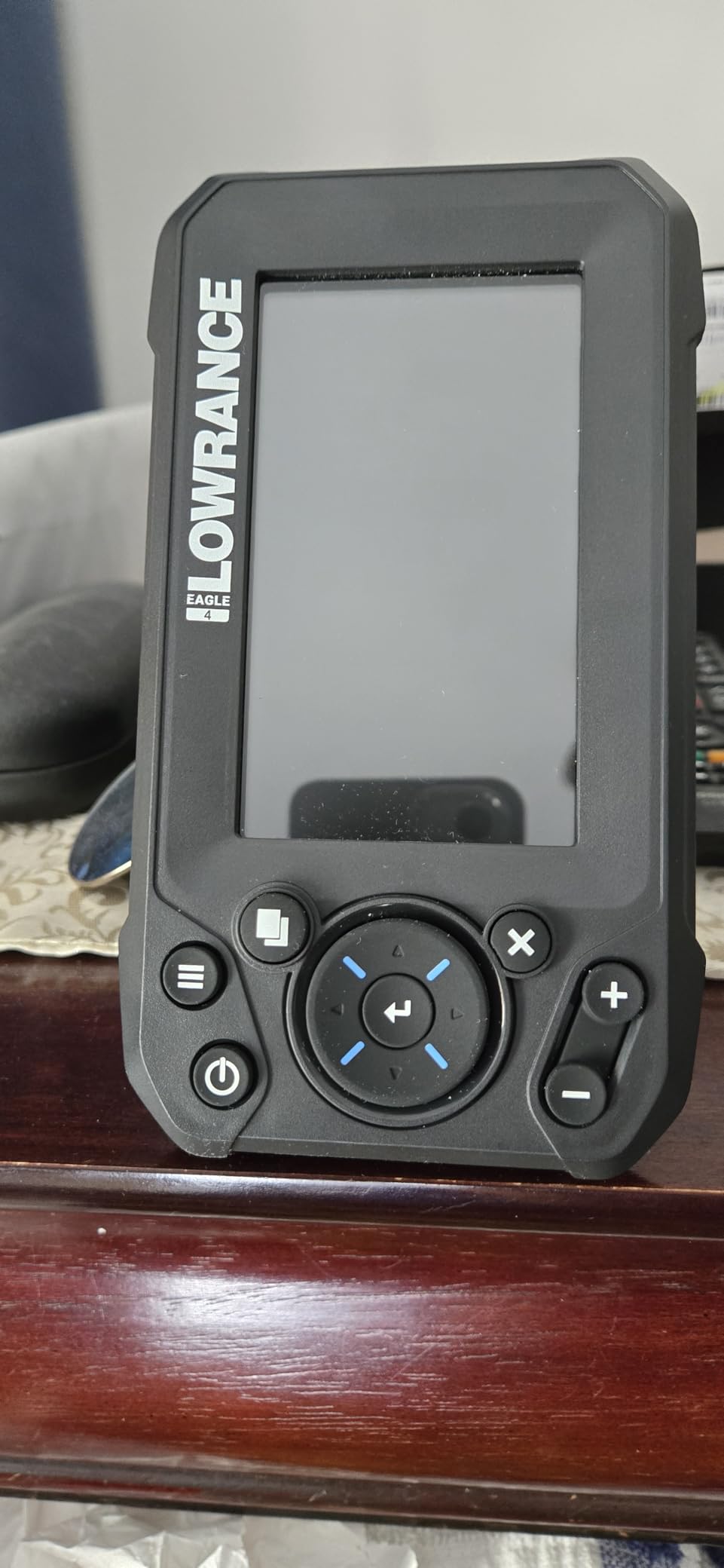
The 4 inch IPS portrait screen is the surprise here. It stays clear in bright sunlight from wide viewing angles and through polarized sunglasses, which is a genuine advantage on a sun-exposed deck, and the portrait layout fits a narrow console face where a landscape screen would overhang. The included 200 kHz Bullet Skimmer throws a broad 44 degree beam, which covers a good amount of water under the boat for a unit at this level.
Owners report accurate depth, bottom structure and brush pile readings, and generally like the setup speed. This is the unit to buy if you want something working in an afternoon.
Where it fits on a pontoon
Consider it the shallow-water, familiar-lake unit. The 500 foot depth ceiling is the shallowest here, though for a lake under 100 feet that ceiling never comes into play. The bracket and hardware in the box let you mount the transducer on a bracket or the trolling motor without drilling the log.
Because the display twists off, it is also the easiest to remove at the end of the season if the boat lives outdoors or you trailer it. If you want a full sonar setup but not a permanent helm commitment, this is the cleanest version of that idea.
Where it falls short
It is a plain 200 kHz sonar unit. No CHIRP, no SideScan, no DownScan imaging, so you are reading a traditional trace and fish icons rather than a picture of structure. There is no GPS and no charting, so you cannot record or mark waypoints.
The 4.3 star average is the lowest in this group, and a small minority of owners report that it simply does not perform well. If you want to draw structure details off the side of the boat or record a map, this is the wrong tool and the 5-inch models are worth the step up.
8. Lowrance Elite FS 10 – a full chartplotter for a big deck
Lowrance Elite FS 7 Fish Finder with Active Imaging 3-in-1 Transducer, Preloaded C-MAP Contour+ Charts
- CHIRP SideScan and DownScan from one 3-in-1 transducer
- 10 inch screen holds sonar and chart side by side
- C-MAP charts preloaded for inland coastal and Canadian water
- Wireless NMEA 2000 and Ethernet for multi-display networking
- Suncover and corner clip kit included
- Most expensive model in the group
- Transducers for some sizes sold separately
- Touchscreen menus take longer to learn than a keypad
- 10 inch screen needs a large console face
This is the only unit here that is a true multifunction display rather than a fish finder, and that changes what you can do with it later. It has wireless, NMEA 2000 and Ethernet, so you can build a shared network from bow to stern: a display at the main helm, another at a second station on a tri-toast, and the two sharing the same charts and the same sonar data instead of each running their own.
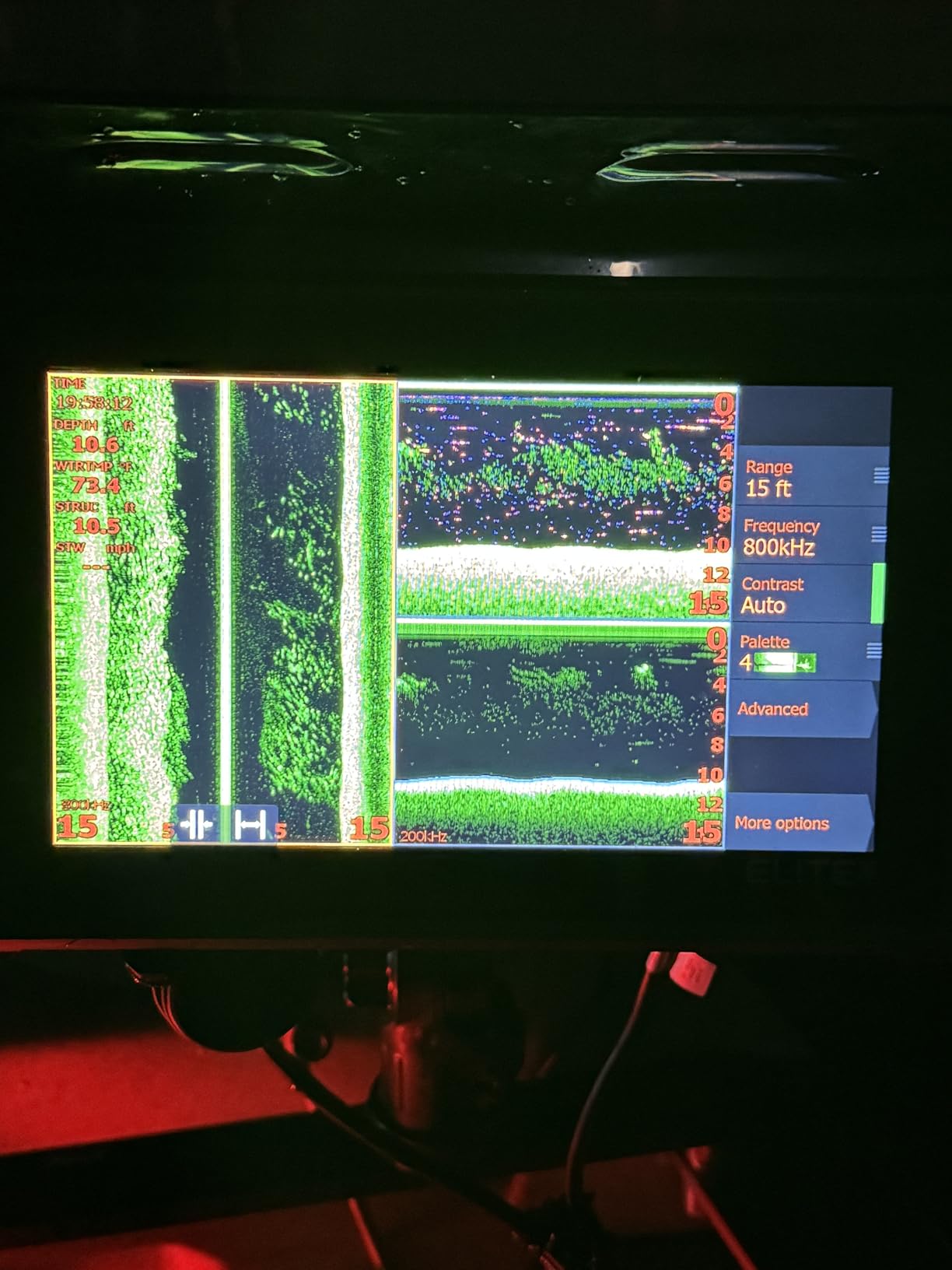
The Active Imaging 3-in-1 transducer covers CHIRP, SideScan and DownScan with FishReveal in a single puck, and FishReveal separates the fish from structure on the bottom so you are not chasing a rock. Owners rate it highly for exactly that combination: three sonar types, one transducer, and charts already loaded.
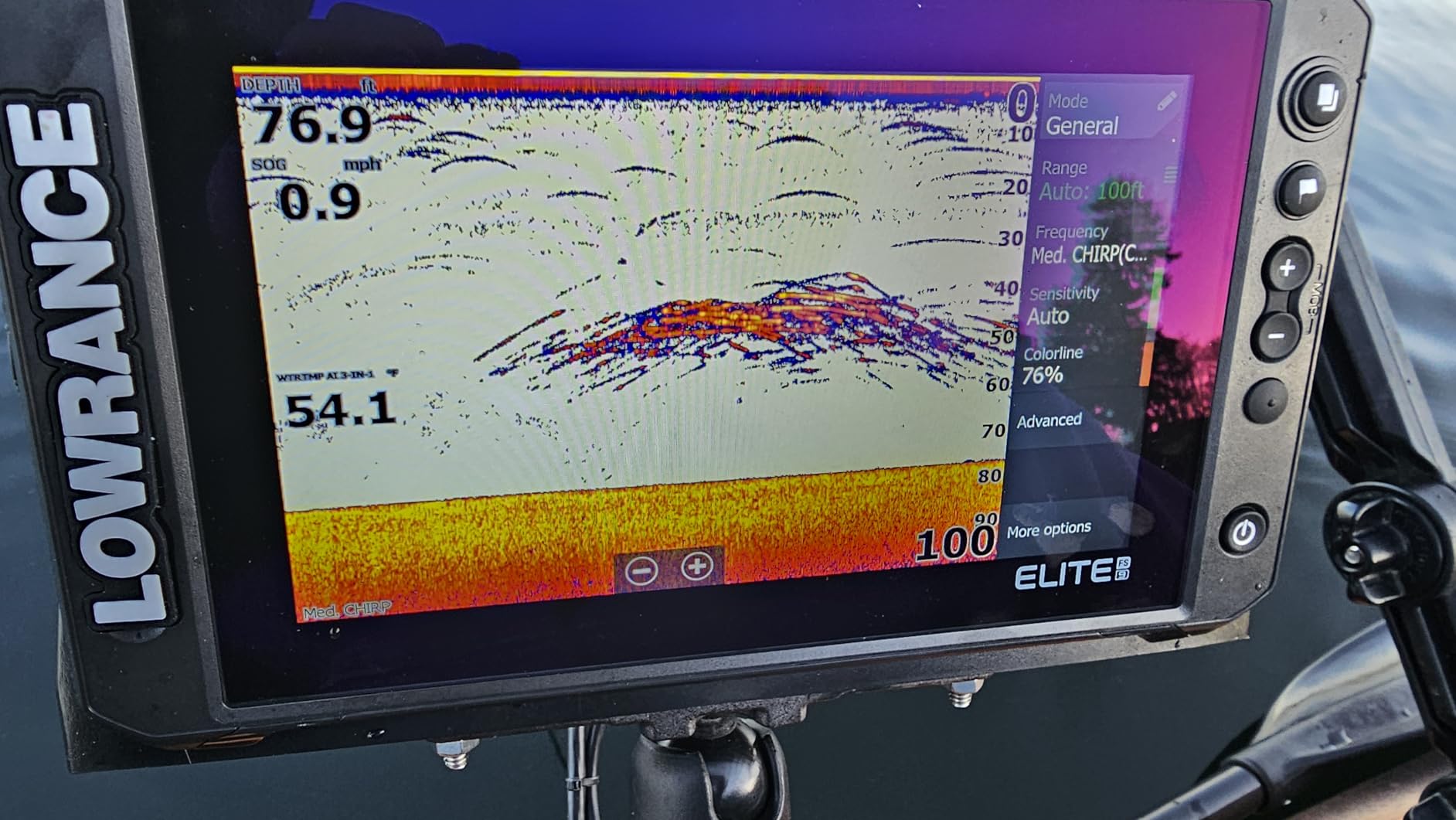
C-MAP DISCOVER OnBoard charts are preloaded for inland, coastal and Canadian waters, so unlike the Garmin units on this list you are not starting from a blank screen or recording your own contours. AutoChart Live still records your own mapping, and Quickdraw-style contour work is available on top of the preloaded charts. Live sonar is also ready if you later add ActiveTarget 2, though on a lake pontoon that is a luxury rather than a need.
At 10 inches you can put a detailed sonar return on one half and a chart with your track on the other. That is the size where dual helm stations start to make sense, and where a driver sitting back at a wide helm can actually see the detail without leaning forward.
Is it worth putting a networked display on a pontoon?
It is worth it if your boat has a second helm station that gets used, or if you plan to add other electronics such as an autopilot or a VHF with radar overlay. The wiring is the real work: a dedicated NMEA 2000 backbone has to be run between displays, which is a bigger job on a pontoon than a single transducer cable.
If your pontoon has one helm and you just want to find fish, this is a lot of screen and a lot of money for capability you will not use. The 7-inch HELIX above gets you side imaging at a fraction of the complexity.
Where it falls short
Price is the headline drawback: it is by far the most expensive model in this group, and transducers for some display sizes are sold separately rather than included. That is a purchase surprise if you are budgeting carefully, so confirm what ships with the size you want before ordering.
Touchscreen menus take longer to learn than a physical keypad, and wet hands plus glare plus a moving boat is a combination many pontoon owners dislike. The 10 inch screen also needs a large console face to mount cleanly, which most 20 foot pontoons have and most 16 foot boats do not. If your helm is compact, our portable fish finder guide covers smaller-footprint options.
How to Choose a Fish Finder for a Pontoon
Screen size is the first filter, and on a pontoon it is more important than on almost any other boat. A pontoon driver sits down, and on a wide deck the display is often a foot or more from your eyes and angled away from the sun’s worst angle. Under about 4 inches you will be leaning forward to read structure detail. Between 5 and 7 inches is the range where a seated angler can read sonar comfortably and still watch the water. Above 9 inches you need a console face large enough to carry it, which most pontoons at 20 feet and up do have.
Second, understand what each sonar type actually shows. Traditional and CHIRP sonar send a pulse down and draw a trace with arches where something solid sits. Down Imaging renders a photographic-looking slice of the bottom directly beneath the boat. Side Imaging throws wide beams out to each side, covering far more water per pass and letting you spot structure off the side of the hull. On a pontoon, side imaging earns its cost faster than any other feature because the boat is wide, slow and stable.
Third, be honest about maps. Preloaded charts give you shoreline and contour detail the day you launch on a lake you have never seen. User-generated mapping, which is what the Garmin Quickdraw Contours units do, takes a few trips before it is worth anything, but after that it is more accurate on your water than any generic chart. If you fish one lake hard, recording your own is the better long-term play. If you travel, preloaded is the better buy.
Fourth, check the box before you assume. All eight models here ship with a transducer and a bracket, which is not universal in this category. Some units in the broader market omit the transducer, and some include one that only mounts on a transom. On a pontoon you specifically want a trolling motor mount or a strut bracket option, because that is how you avoid drilling an aluminum log with no trailer to pull the boat out of the water.
Fifth, think about controls. Keypads win on open decks with wet hands and rough water, and owners say so repeatedly. Touchscreens win when you want to place a chart beside a sonar pane and tap through layers. Neither is wrong, but buying a touchscreen and then wishing you had buttons is a common and expensive regret.
Finally, the brand question. Garmin is repeatedly described by owners as the easiest to learn, with the simplest menus and the strongest GPS and mapping software. Humminbird is the one to pick if preloaded charts out of the box matter, with a deep settings menu and strong CHIRP imaging. Lowrance sits at the top of the range for networked displays and is the choice when you want to build a multi-display helm. Forum consensus across r/Pontoons, r/fishfinders and the major fishing boards names these three brands and very few others for a reason.
Installing a Fish Finder on a Pontoon Without Drilling
This is the question that stops most installs, and it is a reasonable one: drilling into an aluminum pontoon log with the boat in the water and no trailer is exactly as bad an idea as it sounds. The good news is that none of the steps below require it.
First, mount the transducer on the trolling motor shaft or on a bracket that clamps to the log. A trolling motor mount is the cleanest option because it keeps the sensor in clean water, off the bottom, and easy to raise out of the way in shallow water or a launching ramp. Keep the transducer as far from the motor head and its wiring as the mount allows.
Second, route the cable. Run it up the inside of the motor shaft with a wrap or a clip at regular intervals so it cannot pinch or be cut between the motor and the shaft, then bring it back to the console inside the log or under the deck. On a pontoon the cleanest path is inside the conduit that already carries wiring to the helm, and cable ties every foot or so stop it chafing against the aluminum.
Third, run power properly. Do not splice into an existing accessory circuit that is already near its limit. Add a properly fused, dedicated accessory feed, keep the run as short as practical, and use a wire gauge that holds voltage over the length of the run to avoid a unit that browns out or resets when the engine starts. The Striker 4 pulling 0.23 amps is easy; a 10 inch networked display deserves a heavier run.
Fourth, mount the display where you sit. On a pontoon the correct viewing position is often off the console centerline, so use the tilt and swivel or gimbal bracket that came in the box to dial the angle to your eye line rather than to the boat. The HELIX units and the Garmin Vivid both ship with a bracket that makes this quick.
Fifth, connect, set and calibrate. Set the transducer type to match what you actually installed, set your depth offset so the shallowest reading matches a spot you know by hand, and let Auto-Tuning or auto-tune run on first power-up before you start changing settings. Owners who report depth offset problems almost always skipped that calibration step.
Trolling Motor Interference and High-Speed Dropout
Two complaints come up over and over in pontoon groups. The first is a fish finder that flashes or breaks up when the trolling motor is running. The second is a picture that cleans up into nothing above roughly 12 to 15 mph, with some premium units holding on until closer to 25 or 30.
Interference almost always comes from the motor’s electrical switching bleeding into the transducer signal, and the fix is straightforward. Add a ferrite choke on the transducer cable and on the power cable, as close to the unit as you can get them. Keep the transducer cable away from the motor power leads, and route it separately from anything carrying motor current. If you are running the cable up the trolling motor shaft, make sure it is not bundled directly alongside the motor wires with the same ties.
On distance, the general rule is that the transducer should be as far from the motor head as the mount physically allows. Mounts that put the sensor at the very top of the shaft next to the motor housing are the most common source of noise. Owners who moved the sensor down the shaft report the difference immediately.
High-speed dropout is physics rather than a fault. As speed increases, the return from a given target arrives over a wider range of time, which smears the picture, and once the boat is planing the aerated water behind the hull and the prop wash start scattering the pulse as well. The practical response is to treat the unit as a trolling tool and slow down before you need to read the screen, which is what most pontoon anglers end up doing naturally because they are fishing rather than running.
One more practical point: check the cable for pinching before you blame the electronics. A cable crushed between the trolling motor and its mount, or kinked around a sharp edge under the deck, will produce exactly the same symptom as a failing transducer, and it is far more common.
Frequently Asked Questions
How do you mount a fish finder transducer on a pontoon boat?
Mount the transducer on the trolling motor shaft or on a bracket that clamps to the aluminum log, so nothing is drilled and no seal is put at risk. Run the cable up the inside of the motor shaft with clips every foot, then along the existing wiring conduit under the deck to the helm. Add a dedicated fused accessory feed rather than tapping an existing circuit. Most units on this list ship with both a transom and a trolling motor mount in the box.
Why is my trolling motor causing interference with my fish finder?
Trolling motor electrical switching bleeds into the transducer signal and corrupts the sonar picture. Add a ferrite choke on the transducer cable and the power cable as close to the unit as possible, keep the transducer cable away from the motor power leads, and route the two separately. Moving the transducer down the trolling motor shaft, as far from the motor head as the mount allows, usually removes the problem entirely.
What is the best fish finder for the money on a pontoon?
For most pontoon owners the Garmin Striker 4 is the strongest value: CHIRP sonar, a 1600 foot depth rating, a very low 0.23 amp draw, and both a transom and trolling motor mount in the box. If you want color and a slightly larger screen, the Striker Vivid 4cv is the step up. If you fish lakes you do not know well and want charts on day one, look at the Humminbird HELIX 5 CHIRP GPS G3 for its built-in basemap.
Is Garmin better than Humminbird?
Garmin is generally described by owners as the easier unit to learn, with simpler menus and stronger GPS and mapping software. Humminbird is the better choice when preloaded charts matter most, because its basemap covers more than 10000 lakes out of the box, and its CHIRP imaging is strong. Neither is wrong on a pontoon, and both install the same way on a log without drilling.
How big should my fish finder screen be on a pontoon?
Between 5 and 7 inches is the practical range for a pontoon, because the driver sits down and often reads the display from a foot or more away in direct sun. Under 4 inches you will lean forward to make out structure detail. Above 9 inches you get room for sonar and a chart side by side, but you need a console face large enough to carry it, which most 20 foot and larger pontoons have.
Do I need side imaging on a pontoon boat?
Yes, if you are actively searching for structure rather than fishing known spots. Side Imaging covers far more water per pass, which suits a wide, slow, stable pontoon, and it lets you spot brush piles and rock edges off the side of the hull. If you mostly fish a handful of familiar spots or vertical jig at a stake field, down imaging and a flasher-style view serve you better for the money.
The Verdict for Pontoon Anglers in 2026
The best fish finders for pontoon boats are not the biggest or the most expensive. They are the ones you can read from a seated position in direct sun, mount on an aluminum log without drilling, and run off a properly fused circuit. Start with the Garmin Striker 4 for the most proven, lowest-power option, move up to the Striker Vivid 4cv for color, or take the STRIKER 5CV if your helm is more than an arm’s length away. Add the Humminbird HELIX 7 CHIRP SI GPS G4 when you want side imaging, and the Lowrance Elite FS 10 only when a second helm station justifies a networked chartplotter. Match the transducer mount to your boat, choke the cables, and check your lowest voltage before the first long day on the water.