
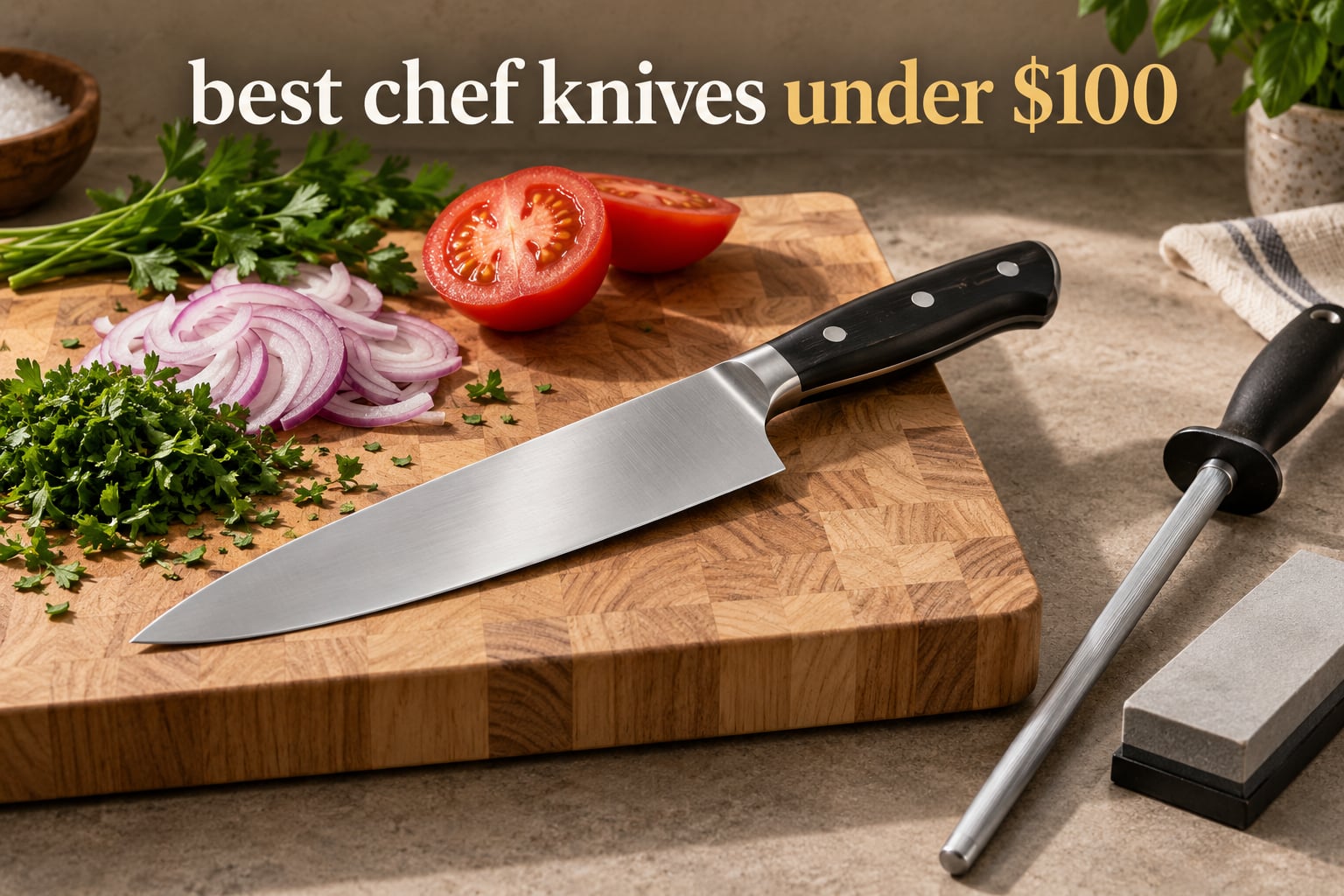
The best chef knife under 100 dollars is the Victorinox Fibrox Pro 8 Inch Chef’s Knife. It is Swiss-made stamped stainless steel, hand sharpened in Switzerland, dishwasher safe, and backed by a lifetime warranty. For most home cooks it is the knife to buy and the knife to keep.
I cooked with every blade on this list through weeks of nightly prep, and the pattern held up. The money above roughly 50 dollars does not buy dramatically better cutting, it buys brand names, and brand names do not sharpen themselves. What separates a good budget chef’s knife from a bad one is steel hardness, tang construction, handle fit, and whether the factory edge is genuinely sharp out of the box.
That is why this roundup covers twelve knives rather than five, and why it includes the awkward ones. A 30-dollar stamped knife with a good edge can outperform a 95-dollar forged blade held by someone who never sharpens it. We also spend real space on what to do with the rest of your budget, because a knife plus a honing steel and a cutting board is the purchase most readers actually need. If you want a look at premium blades, our guide to the best chef knives overall covers where the money goes above this ceiling.
Top 3 Picks for Chef Knives Under 100 Dollars in 2026

Victorinox Fibrox Pro 8 Inch
- Stamped Swiss stainless
- 8 inch blade
- TPE non-slip handle
- Dishwasher safe
- lifetime warranty

PAUDIN 8 Inch Chef Knife
- 5Cr15Mov high carbon steel
- 2mm stamped blade
- Wood handle
- 24 month warranty

Mercer Genesis 8 Inch
- Forged high carbon German steel
- full tang
- short bolster
- Santoprene grip
- hand wash only
Quick Overview of All 12 Chef Knives in 2026
Every knife below sits under the 100 dollar ceiling, and the specs come from manufacturer data rather than marketing adjectives. Scan the table first, then read the section for anything you are serious about.
| Product | Specifications | Action |
|---|---|---|
| Victorinox Fibrox Pro 8 Inch Chef’s Knife |
|
Check Latest Price |
 MOSFiATA 8 Inch Forged Chef Knife with Sharpener MOSFiATA 8 Inch Forged Chef Knife with Sharpener |
|
Check Latest Price |
 imarku 8 Inch Japanese Chef Knife imarku 8 Inch Japanese Chef Knife |
|
Check Latest Price |
 Matsato 6.3 Inch Forged Chef Knife Matsato 6.3 Inch Forged Chef Knife |
|
Check Latest Price |
| PAUDIN 8 Inch High Carbon Chef Knife |
|
Check Latest Price |
 Mercer Culinary Millennia 8 Inch Chef’s Knife Mercer Culinary Millennia 8 Inch Chef’s Knife |
|
Check Latest Price |
 HENCKELS Classic 8 Inch Chef Knife HENCKELS Classic 8 Inch Chef Knife |
|
Check Latest Price |
 SHAN ZU 8 Inch Damascus Chef Knife SHAN ZU 8 Inch Damascus Chef Knife |
|
Check Latest Price |
 FAMCUTE 8 Inch Japanese Steel Chef Knife FAMCUTE 8 Inch Japanese Steel Chef Knife |
|
Check Latest Price |
| Mercer Culinary Genesis 8 Inch Forged Chef Knife |
|
Check Latest Price |
 Kimura 8 Inch Gyuto Made in Seki Japan Kimura 8 Inch Gyuto Made in Seki Japan |
|
Check Latest Price |
 ZWILLING Pro S 8 Inch German Chef’s Knife ZWILLING Pro S 8 Inch German Chef’s Knife |
|
Check Latest Price |
1. Victorinox Fibrox Pro 8 Inch Chef’s Knife – The Best Overall Pick
- Sharp out of the box with no pressure needed
- Non-slip TPE grip that holds when wet
- Light and well balanced through long prep sessions
- Dishwasher safe with a lifetime warranty
- Over 14000 owner reviews backing the rating
- Thin stamped blade scuffs and patinas with use
- Needs sharpening roughly monthly under heavy use
- Not the heirloom build enthusiasts look for
This is the knife I reach for first, and the one I hand to friends who insist they do not need a nice knife. The Fibrox Pro is stamped, which means the blade is cut from sheet steel rather than shaped from a solid billet, and on paper that reads like a downgrade. In a home kitchen it works in your favour, because a thin stamped blade takes a razor edge with almost no pressure on tomatoes and cucumbers.
The handle is why it has survived this long in the conversation. The thermoplastic elastomer grip is textured enough to stay put on a wet board, and the whole knife is light enough to mince for an hour without wrist fatigue. Item length is 13.4 inches, and the laser-tested tapered edge makes the whole blade usable rather than just the front third.
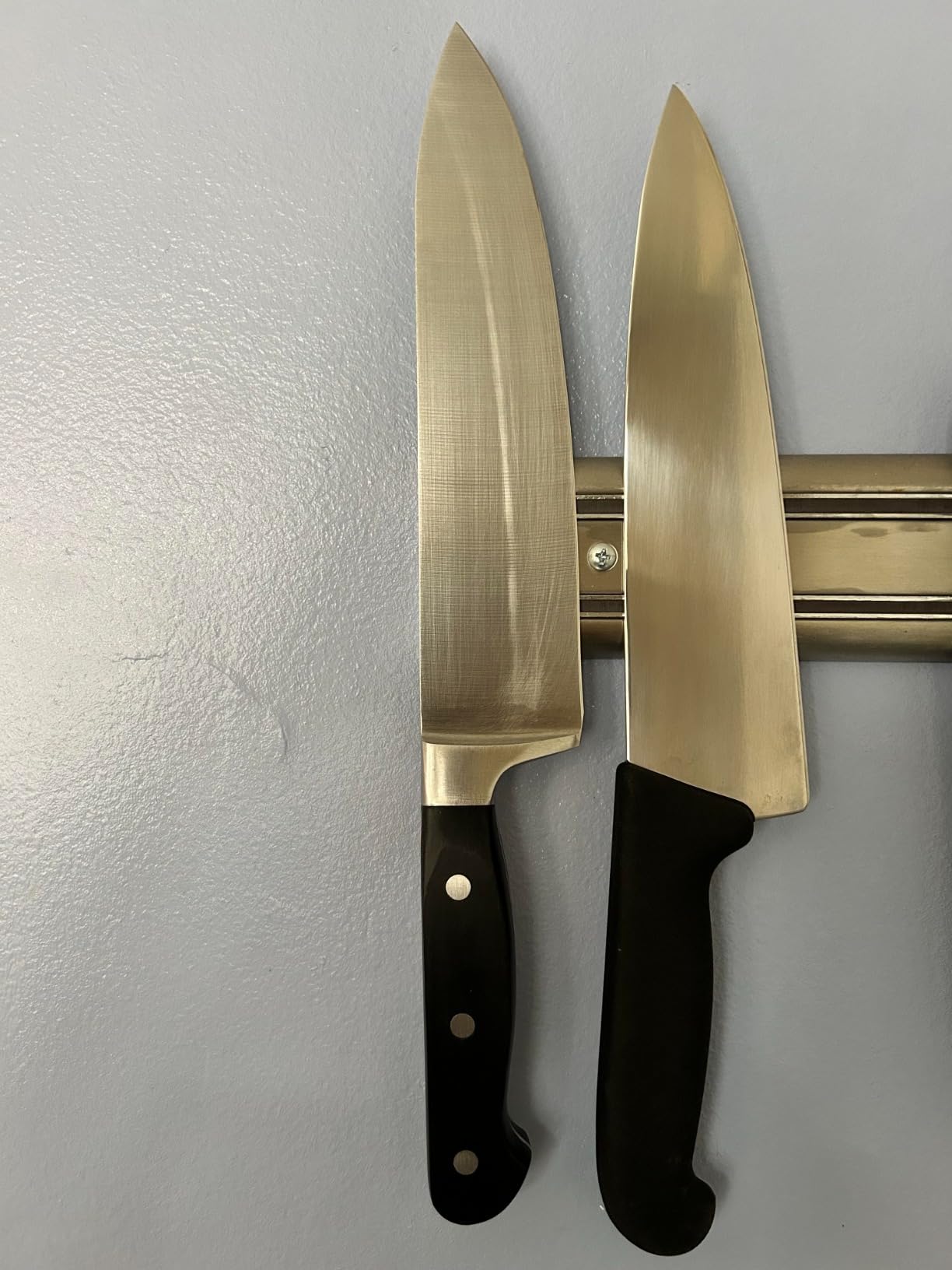
R/chefknives and r/KitchenConfidential both describe the Fibrox as the daily driver that gets beaten up for years, with home cooks reporting fifteen to twenty years of service alongside periodic sharpening. That is the honest version of the story, and it is not a knife that holds an edge untouched for months the way a harder Japanese core can.
Some owners frame it as a replaceable workhorse rather than an heirloom piece, and that framing is fair. What tips it for me is the volume behind it, more than fourteen thousand owner reviews at 4.8 stars, a lifetime warranty against manufacturing defects, and a build that makes replacement cheap when the day comes.
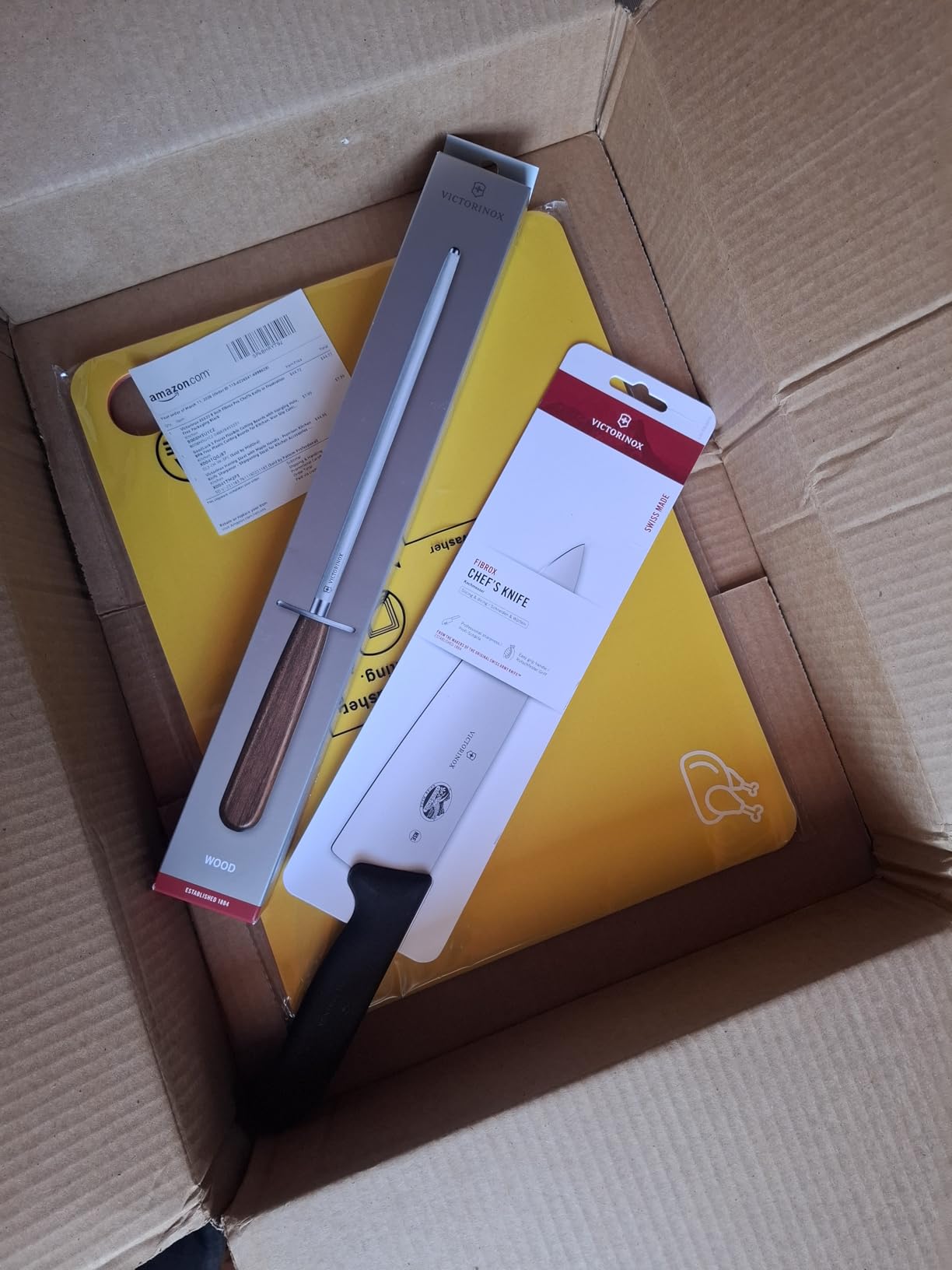
Is the Fibrox sharp enough to skip a sharpener?
Out of the box, yes for light work, because the factory edge is hand sharpened in Switzerland. Once you move into dense root vegetables or bone-adjacent meat you will feel it soften, and that is the normal cycle rather than a defect. A weekly honing routine keeps it ahead of the work.
Who should buy something else instead?
If you sharpen regularly and want steel that holds a fine edge for months, look at the harder Japanese options further down. If you want a heavier decorative blade as a housewarming gift, the MOSFiATA or FAMCUTE packages make more of an occasion. For pure daily function, nothing here beats the Fibrox.
2. MOSFiATA 8 Inch Forged Chef Knife – Best All-In-One Package
- Sharp out of the box on dense vegetables
- Full tang gives real weight distribution
- Hand sharpened to 16 degrees per side
- Micarta handle stays comfortable in a long session
- Includes finger guard
- blade guard and sharpener
- Included sharpener is of limited usefulness
- Handle weight sits toward the back end
- Edge dulls faster than premium German or Japanese steel
Most knives in this bracket arrive as a bare blade, and this one arrives in a gift box with a finger guard, a blade guard, and a small sharpener. That makes it the easiest present on the list without a trip to a specialty store, and it suits someone who wants a forged full tang with a riveted handle but does not want to research whetstones first.
The steel is German EN1.4116 high carbon stainless with 0.45 to 0.55 percent carbon and 15 percent chrome, hand sharpened to 16 degrees per side. At 7.84 ounces with a triple-riveted Micarta handle it feels meaningfully heavier than the Fibrox, and it is the reason it chops dense ingredients with less wrist effort.
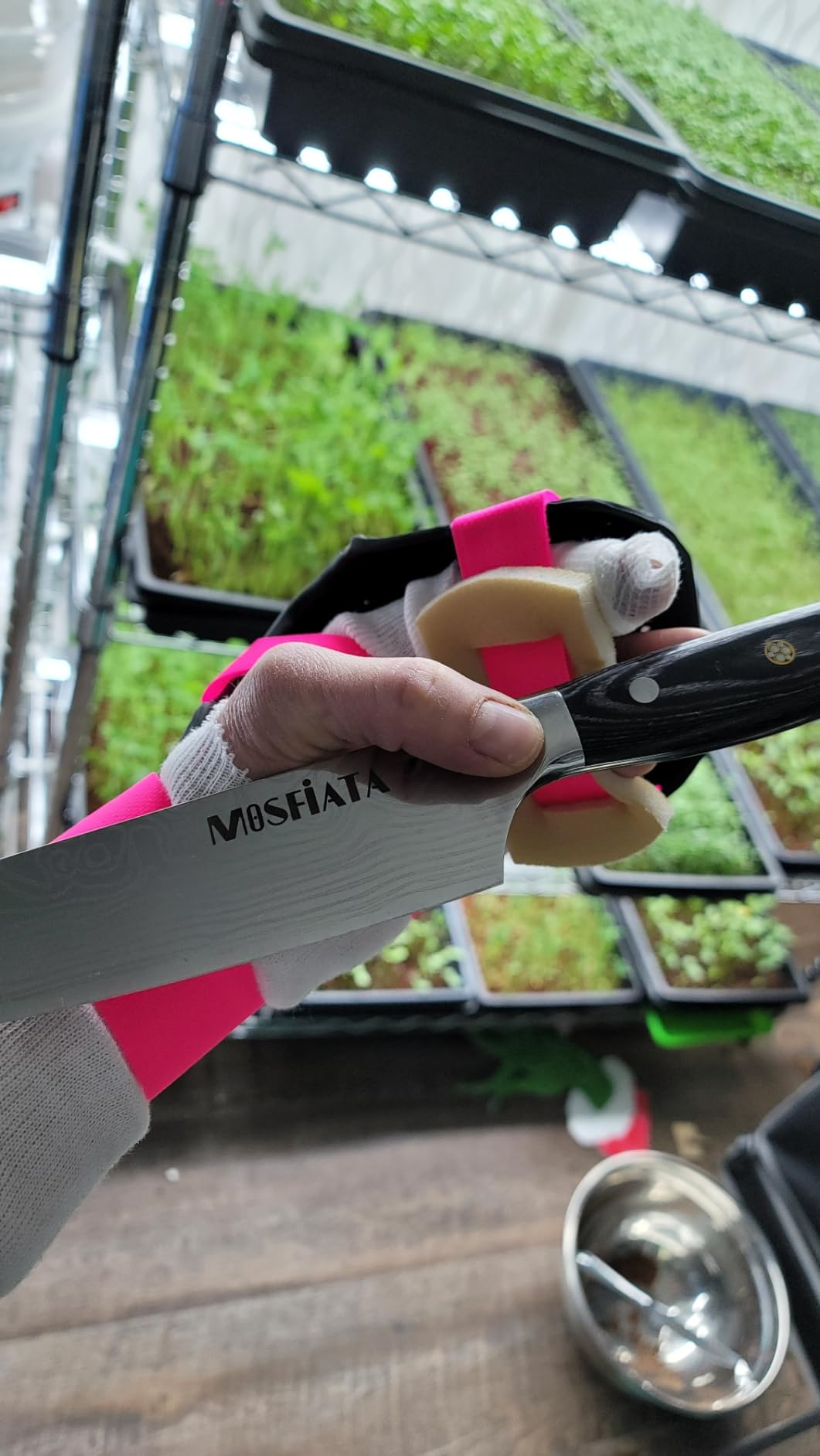
What you give up is edge retention. Reviewers consistently report needing more frequent sharpening than they would with premium German or Japanese steel, and a recurring minority view holds that the finish falls short of the German heritage the marketing implies. The laser-engraved blade pattern is decorative rather than Damascus, which matters only if the look matters to you.
My take is that this is a strong first knife for someone with larger hands who prefers a substantial blade. The handle runs deep, so cooks with small hands may find the grip longer than they want, and anyone breaking down a lot of bone-in meat should look for more spine.
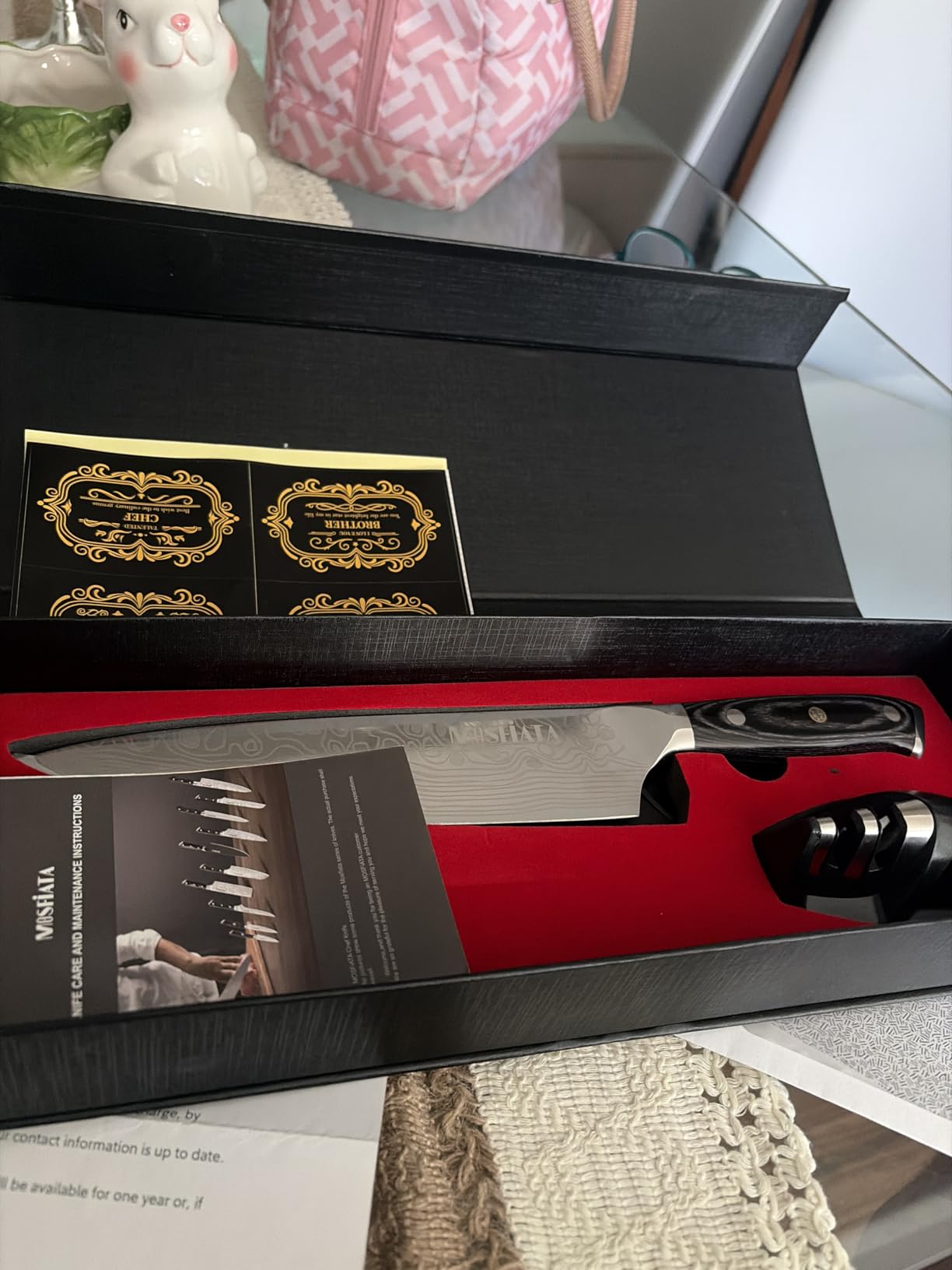
Does the included sharpener keep the edge honest?
Not on its own. It is a basic pull-through style tool that reviewers rate as limited, so treat it as insurance for the first few months and then get a proper honing steel. Our guide to the best knife sharpeners for the kitchen covers the options worth owning at this budget.
Is a 7.84 ounce knife too heavy?
It is heavy next to a stamped workhorse and normal for a full-tang forged blade. The weight is what makes it feel planted and stable through a chop, so cooks who push hard tend to love it, while cooks with small hands or a light touch usually prefer something lighter.
3. imarku 8 Inch Japanese Chef Knife – Best Japanese Profile on a Budget
imarku Japanese Chef Knife-Sharp Kitchen Knife 8 Inch, Gift for Mom & Dad
- Holds a sharp edge through tough meat tasks
- Forged gyutou profile suits chopping and dicing
- Comfortable pakkawood handle over long sessions
- 16 to 18 percent chrome resists tarnish
- Sells as the top model in its gyutou category
- Handle and blade finish sit below Japanese imports
- Listing logo can differ from packaging after a brand refresh
- Edge needs routine honing to stay at peak
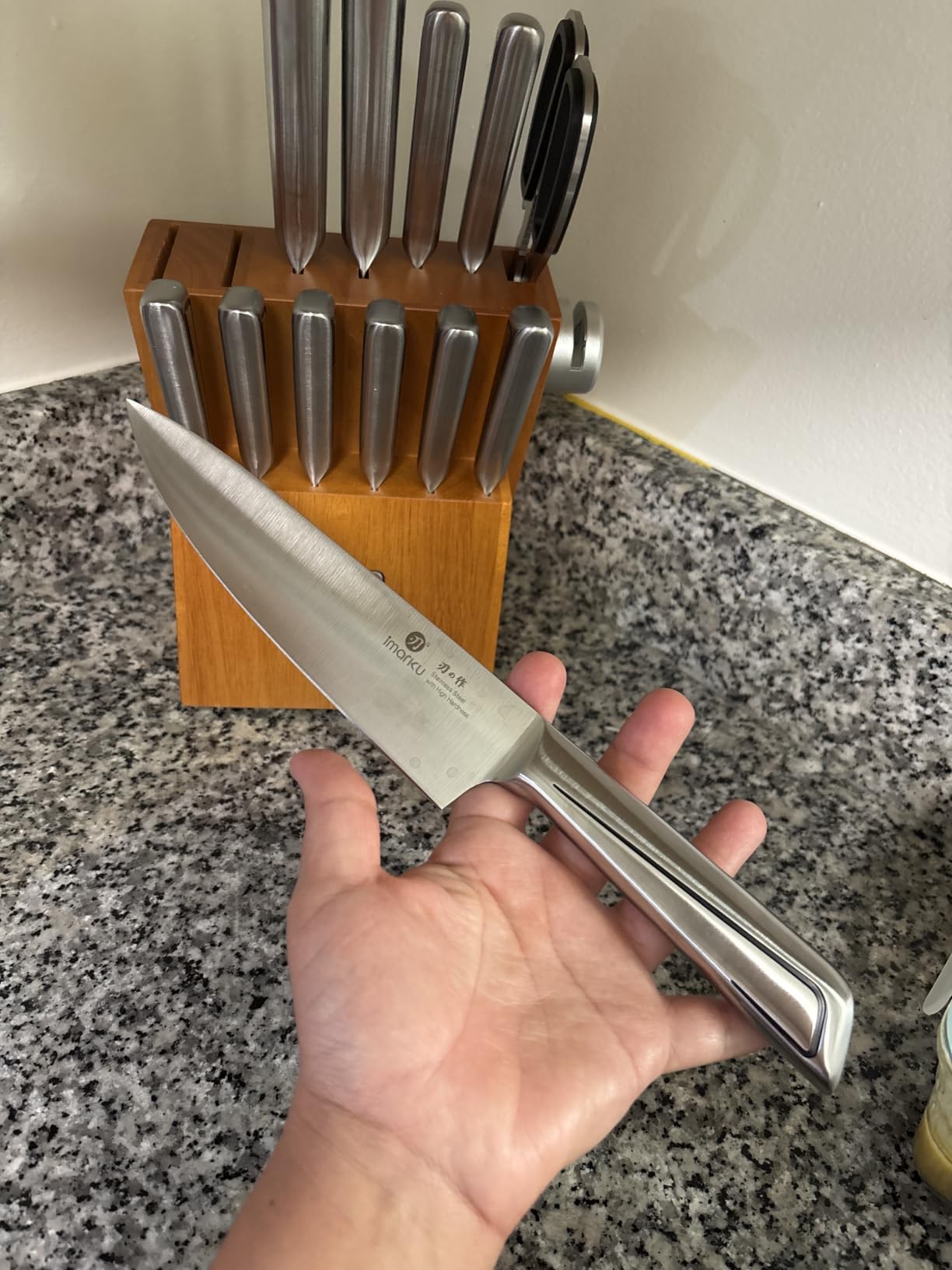
A gyutou is the Japanese equivalent of a Western chef’s knife, and this is the model that proves you do not need a large budget to like the profile. The edge is a little more acute and the blade a little thinner, so it makes cleaner cuts through soft produce and delicate fish than a German workhorse does. HRC 56-58 is a forgiving hardness, which is the sensible pick for a first Japanese-style knife.
Composition runs 0.6 to 0.75 percent carbon with 16 to 18 percent chrome, and the handle is FSC-certified pakkawood in a deep brown tone. It weighs 6.56 ounces across a 13 inch item length, right in the middle of this group, and it carries a lifetime warranty with gift-box packaging.
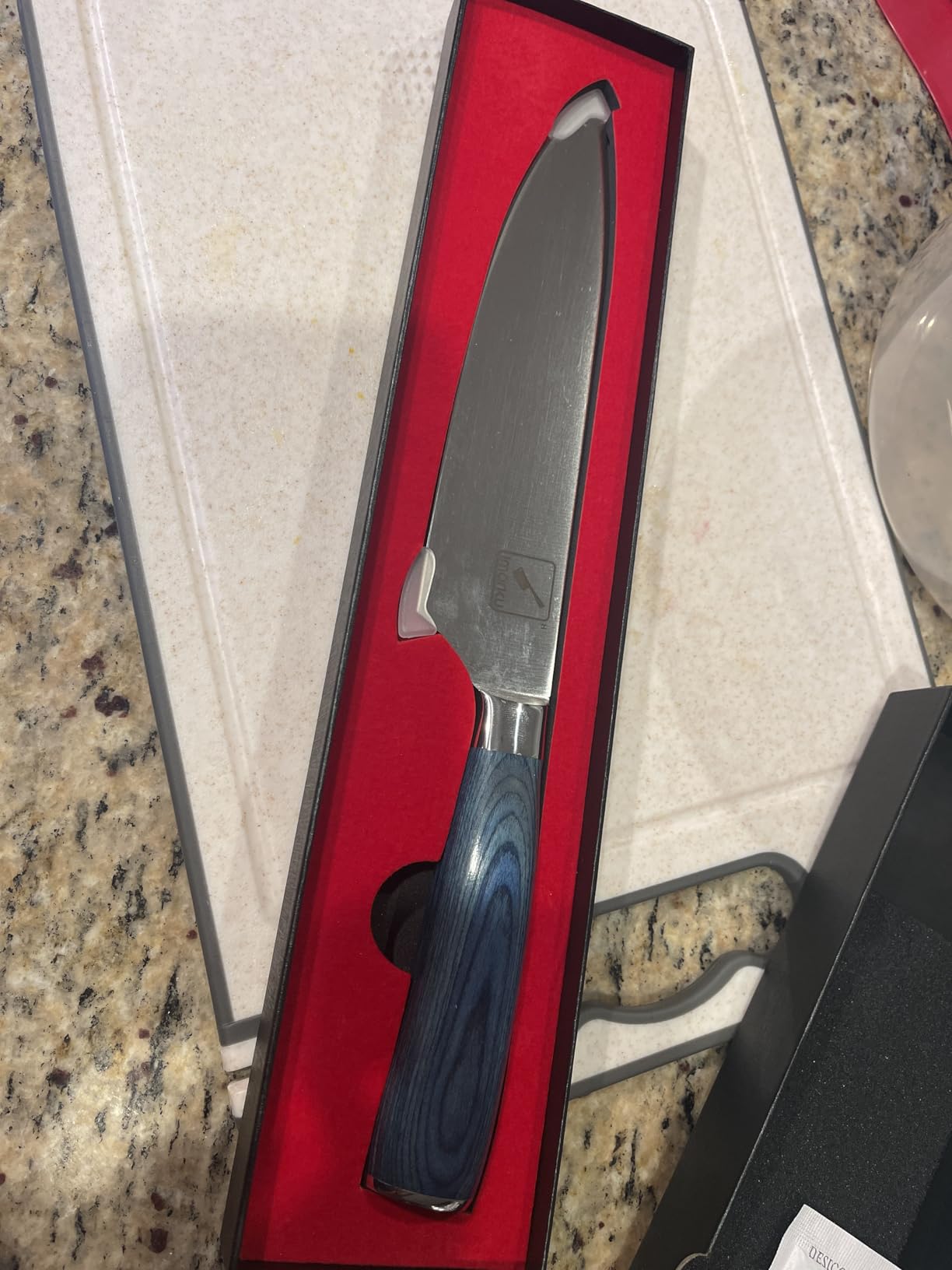
Reviewers like the sharpness out of the box and the ergonomic handle, while noting that the finish and steel refinement sit below what knives made in Japan deliver. You will also see a recurring comment that the logo can differ from the listing imagery because of a brand upgrade, so check what actually arrives in the box.
Its category position is worth noting, sitting at number one in gyutou knives on Amazon, and a large share of buyers are gift shoppers. That shapes the review base, which skews toward first-time cooks rather than enthusiasts. For that audience the ergonomics matter more than the metallurgy.
Is a gyutou better than a German chef’s knife?
Neither is better, they suit different motions. A gyutou has a thinner, more acute edge that loves a push cut and slices beautifully, while a taller German blade loves a rocking motion and handles hard chopping. If you mostly dice vegetables and slice fish, this profile is the more interesting tool.
How does it handle bone-in meat?
Reviewers report the edge holds through tough meat and bone-adjacent work, and 56 to 58 HRC is tough enough to take some knocks. An acute Japanese edge still chips more easily than a blunt German one, so treat it as a precision tool and keep it off glass and stone boards.
4. Matsato 6.3 Inch Chef Knife – Best Compact Blade
- Forged Japanese stainless with a precise sharp edge
- Balanced solid handle gives real control
- Compact blade suits everyday prep and BBQ
- Value pricing for a forged Japanese-style blade
- Shorter 6.3 inch blade is less versatile than 8 inch
- Not dishwasher safe so hand washing is required
- Wood handle needs care over time
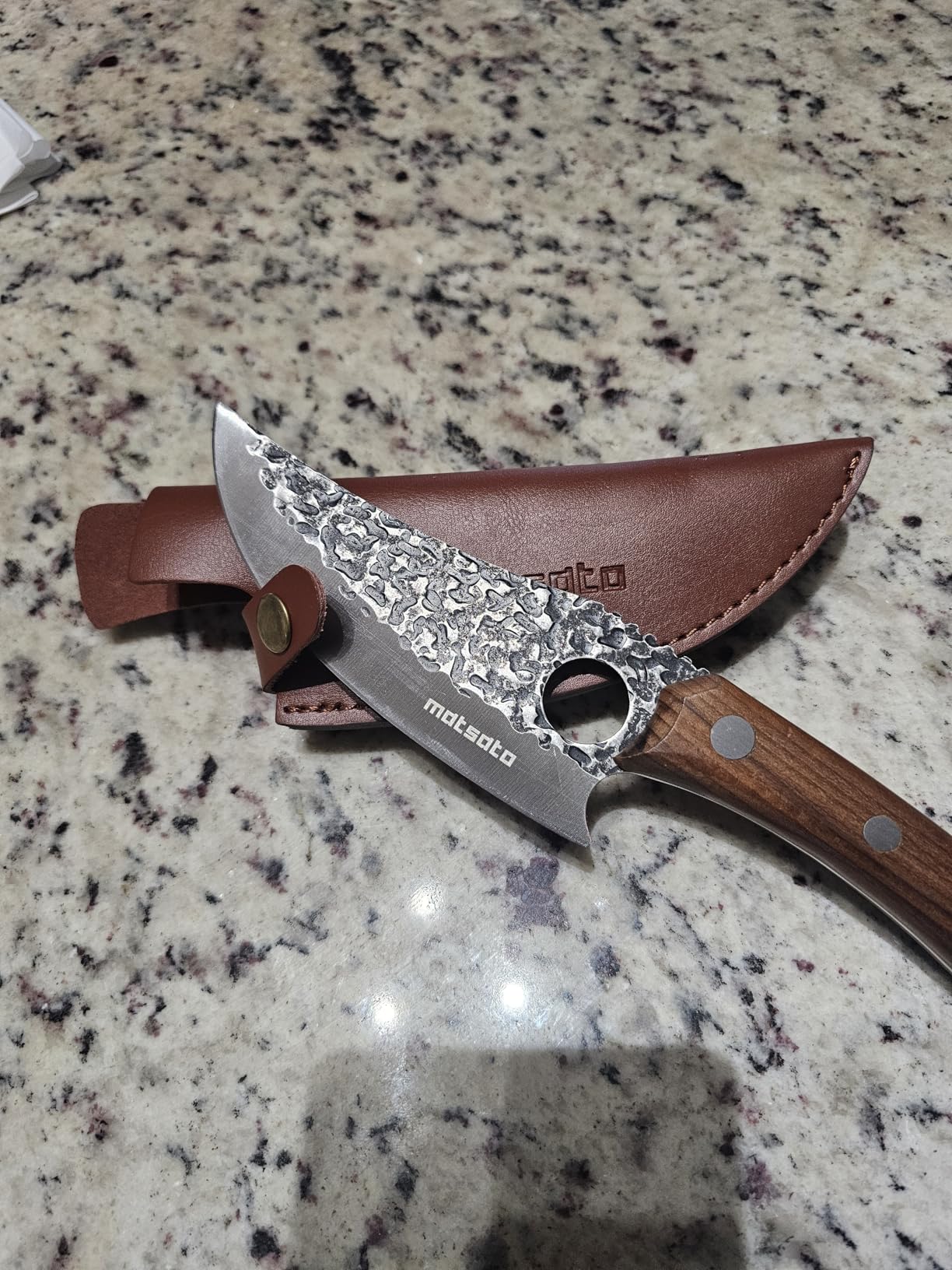
Not everyone has room for an 8 inch blade, and this is the knife for the people who do not. At 6.3 inches of blade on a 10.8 inch overall length it is the most compact chef’s knife here, and one of the few genuinely forged Japanese-style stainless blades in this bracket. The 1.4116 Japanese stainless gives a precise edge out of the box.
Balance is the story. At 176 grams with a solid wood handle it feels controlled and deliberate rather than nimble, which suits controlled prep on a small board. The manufacturer calls for hand washing and drying to protect the edge and prevent rust, and that advice is worth following.
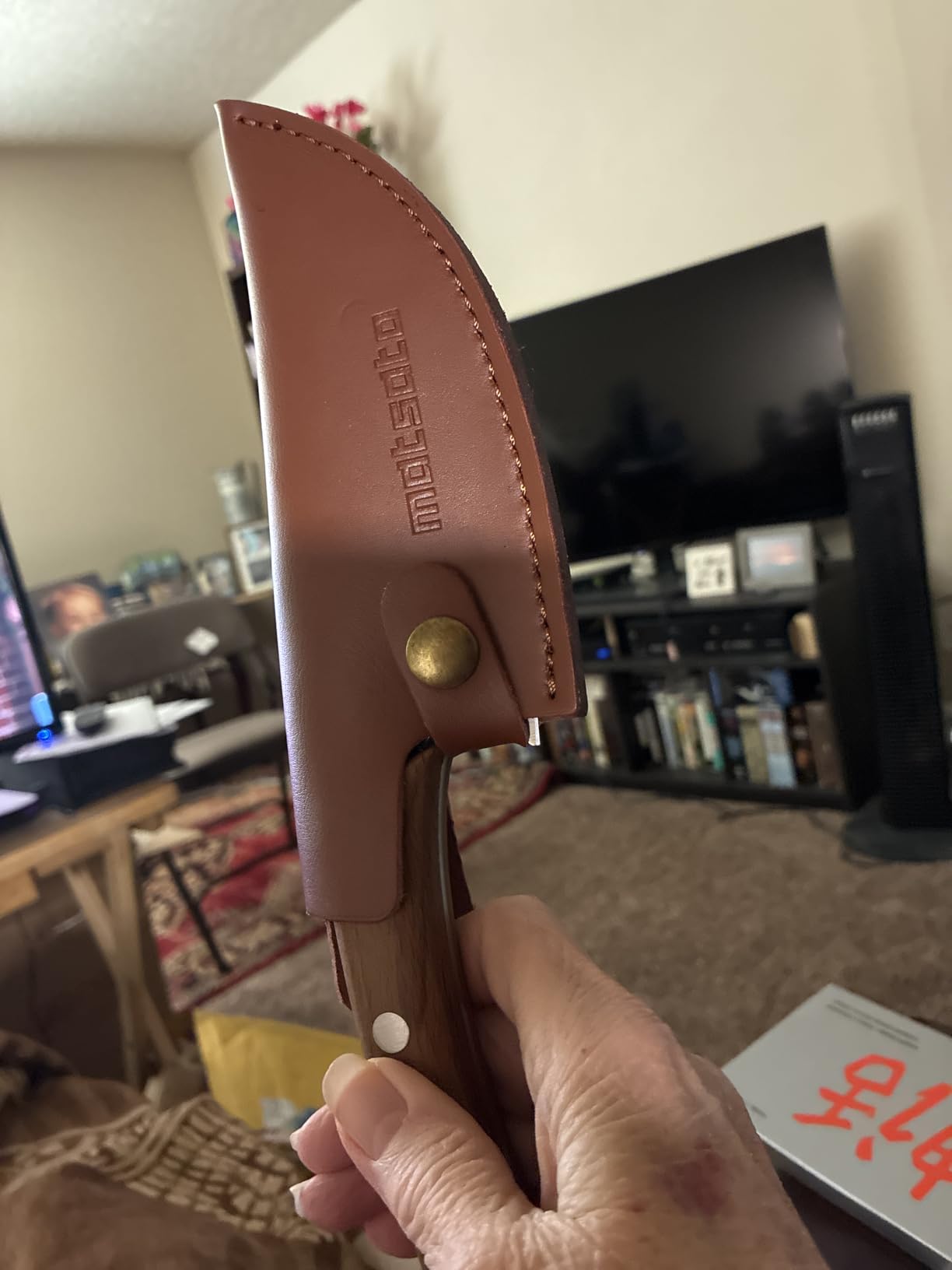
Reviews sit slightly below the other knives here, and the reason is size more than quality. Buyers who accept the compact dimensions cite balance, control, and sharpness as the standouts for home prep and barbecue work, while others find 6.3 inches limiting on a large roast or a big batch of onions.
My advice is simple. If your kitchen is small, your prep is portioned, or you mostly cook on a grill, this is a well-made knife at a low price. If you want one blade for everything, buy an 8 inch model and keep this as a second knife.
Why are the ratings a notch lower than the 8 inch knives?
Size, mostly. A 6.3 inch blade has less surface area for large prep tasks, and the hand-wash-only care adds friction. Buyers who adapted to the dimensions tend to be very happy, which is why the reviews still skew strongly positive overall.
Is a wood handle worth the extra care?
It depends on your habits. Wood absorbs less heat and feels warmer in the hand than polymer, but it needs to be dried right away or it will discolor. If you wash a knife and set it down, choose a polymer handle instead.
5. PAUDIN 8 Inch High Carbon Chef Knife – Best Low-Cost Performer
- Sharp 2mm blade that slices bread and fillets cleanly
- Comfortable balanced wood handle
- Handles chopping mincing and dicing
- Attractive waved blade pattern and gift box
- 24 month warranty with responsive service
- Stamped construction is lighter and less refined than forged
- Blade pattern is decorative and not true Damascus
- Wood handle can discolor with prolonged moisture
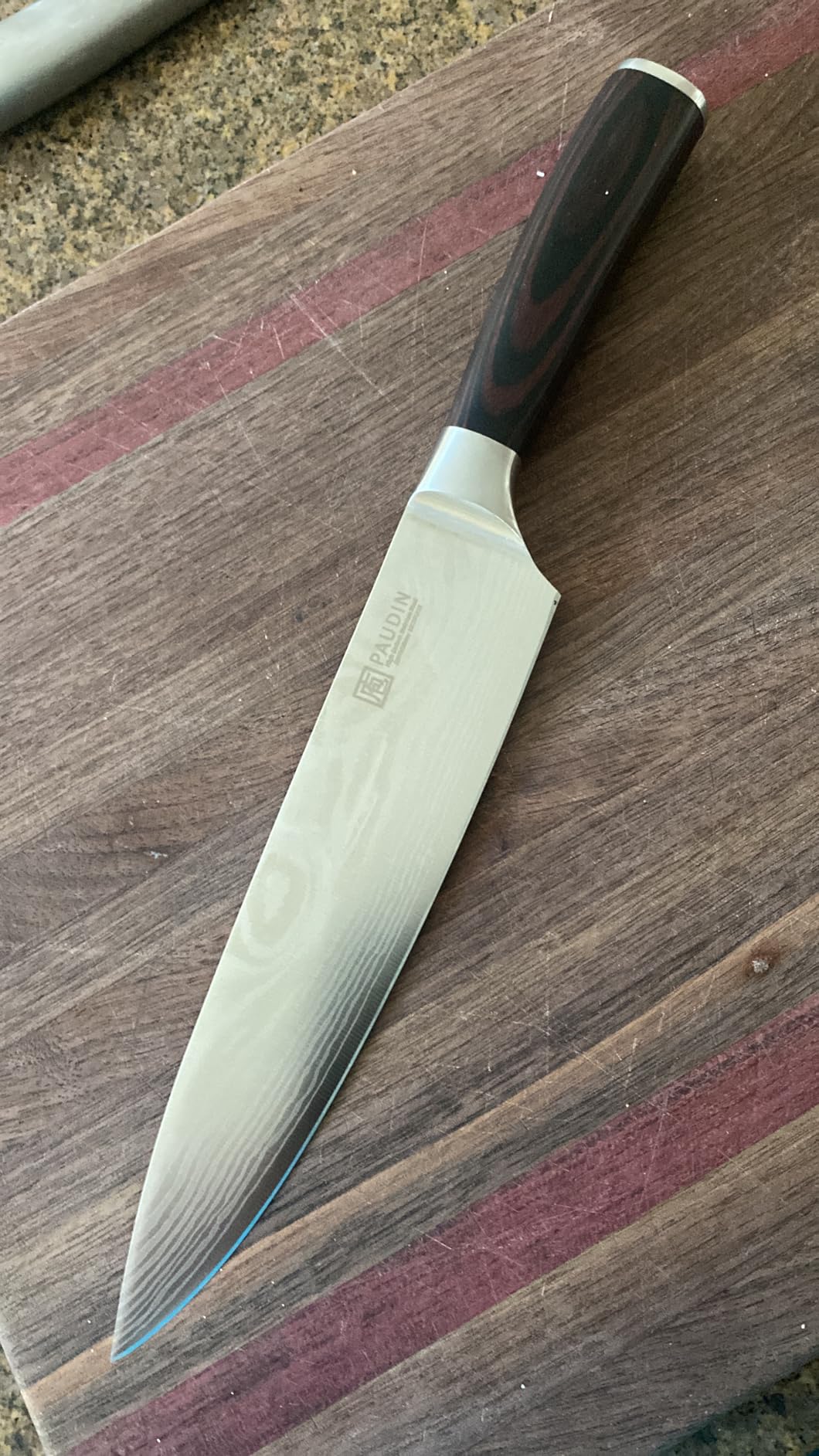
Reviewers consistently rate this above its price tier, and that is the entire appeal. The 2mm stamped blade is hand polished by an experienced craftsman, and buyers call out clean slicing on bread, fish fillets, and thin-cut meat. At 6.88 ounces with a wood handle it sits in the comfortable middle of the weight range here.
The handle is the detail that surprised me. A wood handle on a stamped blade at this price usually means a glued-on scale, and this one is described as ergonomic and well balanced against the thin blade. It also comes in a gift box with a 24 month warranty, which is short by the standards of this roundup but longer than most.
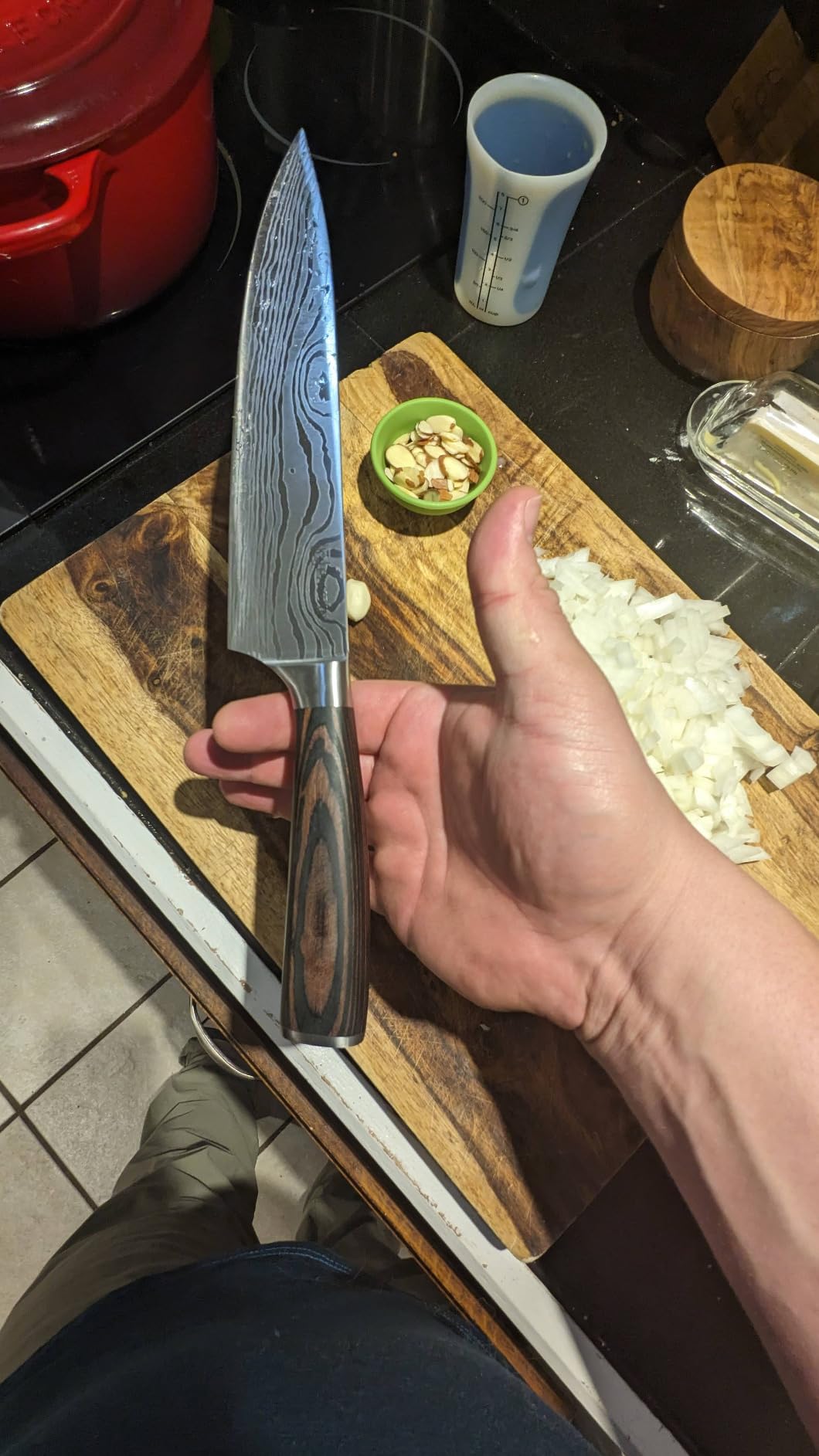
Two honest notes. The waved blade pattern is a laser-style decorative finish rather than layered Damascus steel, and some reviewers say so directly. Stamped construction also means a thinner, lighter blade than the forged options here, so it rewards a sharpening routine more than a heavier build would.
For a first knife, a rental kitchen, a dorm, or a housewarming, this does the job with a nicer wood handle than you would expect at this level. It is the pick I would buy for a teenager learning to cook, because it is forgiving and the mistakes are cheap.
Is the blade pattern real Damascus?
No, it is 5Cr15Mov stainless steel with a waved laser-style pattern purely for looks. It is a fair trade at this budget because the decorative finish costs nothing in cutting performance. If you want genuinely folded Damascus steel in this range, the SHAN ZU further down is the real thing.
How does a stamped blade compare to forged?
Stamped blades are cut from sheet steel, which makes them thinner, lighter, and cheaper to produce. Forged blades are shaped from a single piece of steel and tend to be heavier and more durable around the tang. Stamped is not a bad word, it is simply a different set of trade-offs.
6. Mercer Culinary Millennia 8 Inch Chef’s Knife – Best for Small Hands
Mercer Culinary M22608 Millennia Black Handle, 8-Inch, Chef’s Knife
- High carbon Japanese steel holds an edge
- Textured Santoprene grip is secure and comfortable
- Tang construction gives excellent balance
- Versatile for onions shallots herbs and garlic
- Long-running staple from a well-known line
- Handle texture can trap food particles
- Not dishwasher safe so hand drying is required
- Stamped build is lighter than forged rivals
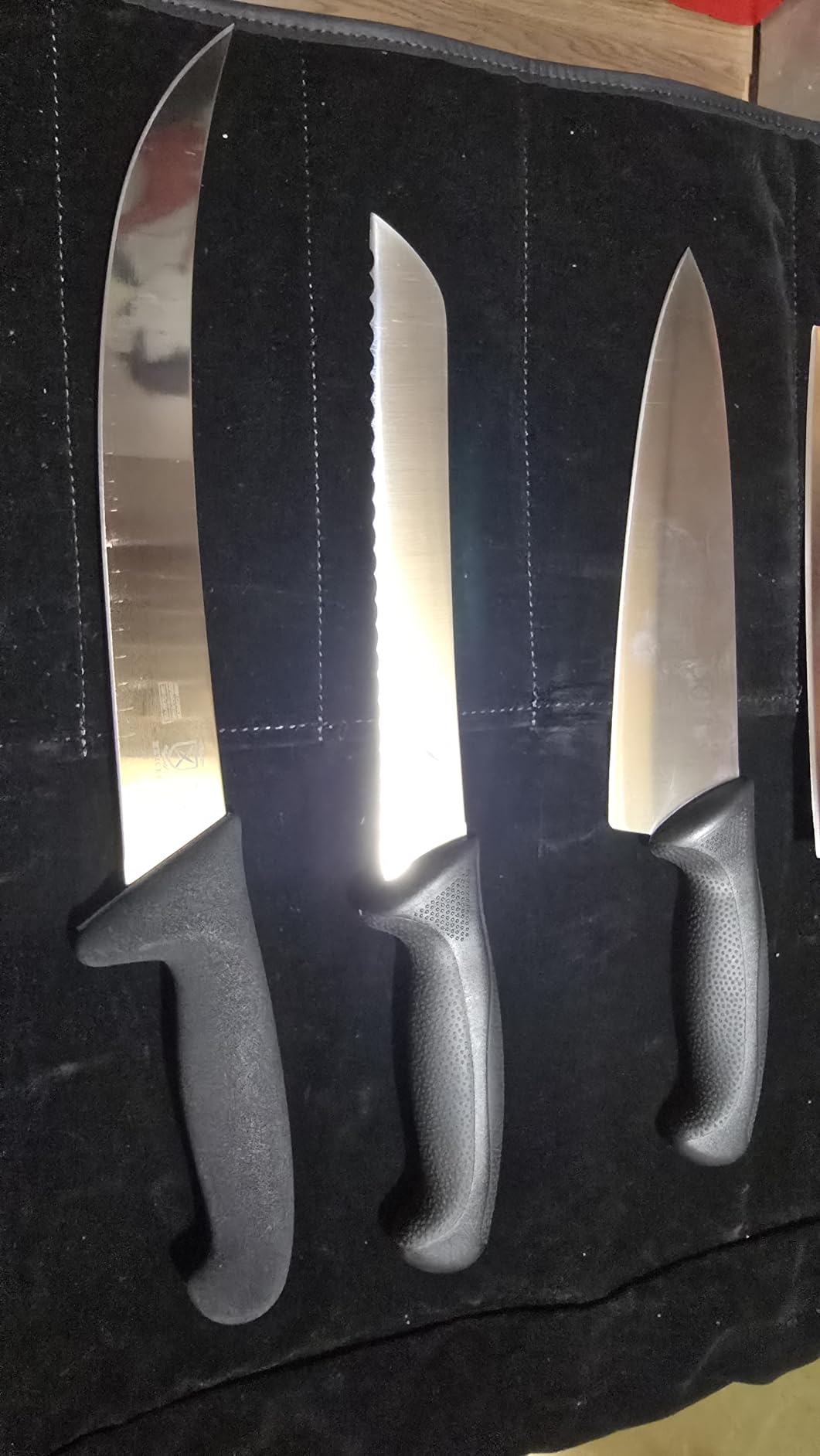
Handle fit is the most overlooked specification on any knife, and this is where Mercer earns its place. The Santoprene handle has textured finger points that give smaller hands something to hold onto, and at 6.7 ounces the whole knife stays comfortable through long sessions. The full tang construction is what puts the balance in your palm instead of at the tip.
The blade is one-piece high carbon Japanese steel, stamped, with a plain edge. Mercer has built this line for years and owners frequently note it is the first knife they reach for in daily prep, which matters because it means comparable knives and replacements are easy to find later.
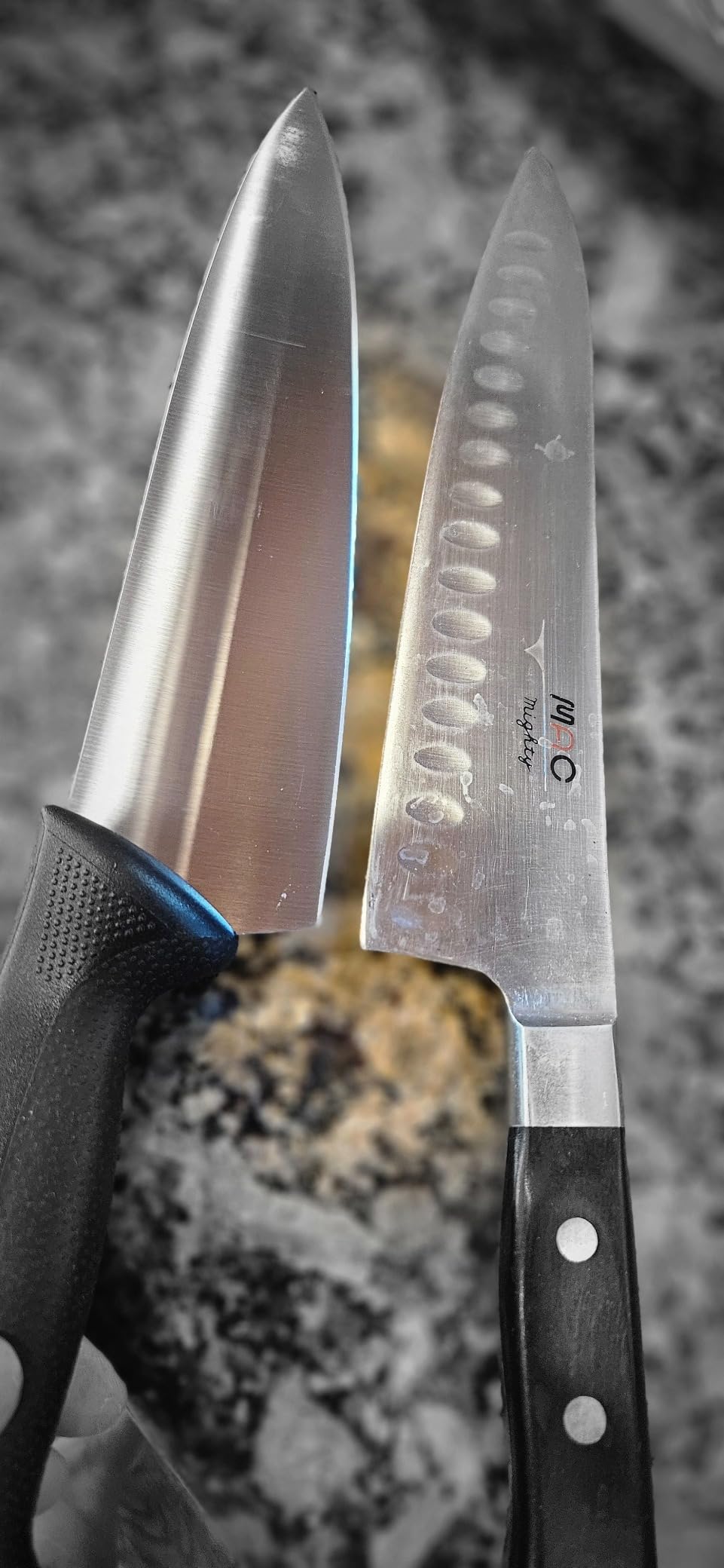
Reviewers across the board like the value relative to professional brands. The two honest drawbacks are care and cleaning: the handle texture can trap food particles and needs extra attention, and the knife is hand wash only because high carbon steel spots if it sits wet.
Community discussion positions Mercer as the sturdy European-style alternative to the Victorinox, a modest step up rather than a different category. Coming from a small supermarket knife, this is a familiar-feeling upgrade that will not force you to relearn your grip or your cutting motion.
Will this handle fit cooks with small hands?
It is one of the better fits in this roundup. The slim Santoprene profile with finger points suits smaller hands far better than the thick octagonal handles common on Japanese knives, though hand shape is personal and no spec fully captures it. Where you can, pick the knife up in person before committing.
Why does it need hand washing?
High carbon stainless steel stains if it sits wet, and a dishwasher cycle is hot and long enough to dull an edge in one run. Wash with soap, towel dry, and store on a rack, and the knife stays sharp for years. It is the best single habit in knife care.
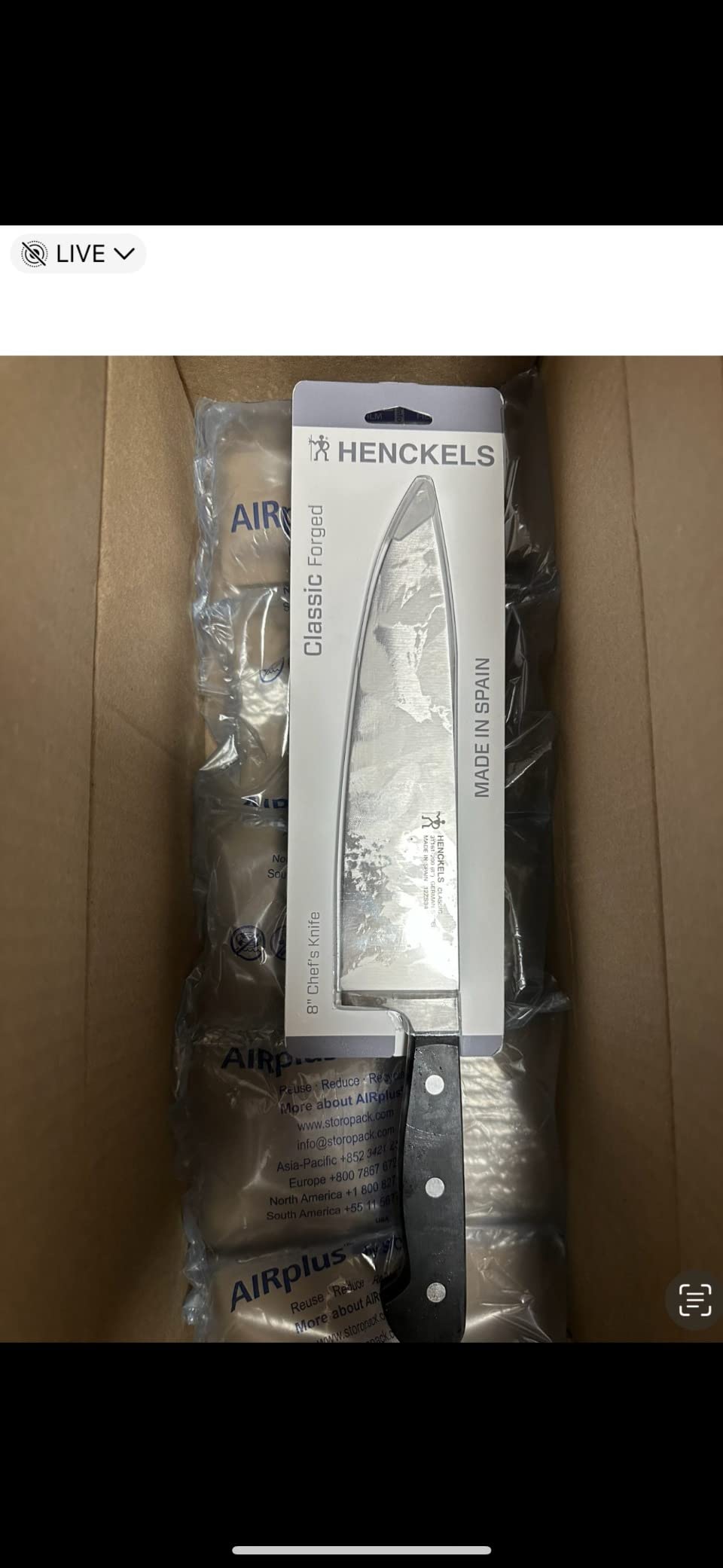
7. HENCKELS Classic 8 Inch Chef Knife – Best Forged German Value
HENCKELS Classic 8-Inch Chef Knife, Razor-Sharp, German Engineered
- Professional level sharpness straight from the box
- Satin finish and honed edge stay sharp longer
- Fully forged build feels balanced and durable
- Lightweight at 4.48 ounces
- Dishwasher safe and easy to clean
- Lifetime warranty
- Composite handle is less grippy when wet
- Heavier than some comparably priced alternatives
- Premium pricing for the Henckels name
The Henckels name carries real weight in German steel, and this Classic line delivers on it without moving into premium territory. Construction is fully forged with a seamless transition from blade to handle, which is the structural difference you feel most in the hand. Buyers treat it as an heirloom-style knife and repeatedly cite the out-of-box sharpness.
At 4.48 ounces it is among the lighter knives here, and that is a genuine advantage during a long prep session. The satin finish is finely honed for lasting sharpness, the handle is the traditional triple-rivet composite design, and it is dishwasher safe, which makes cleanup frictionless.
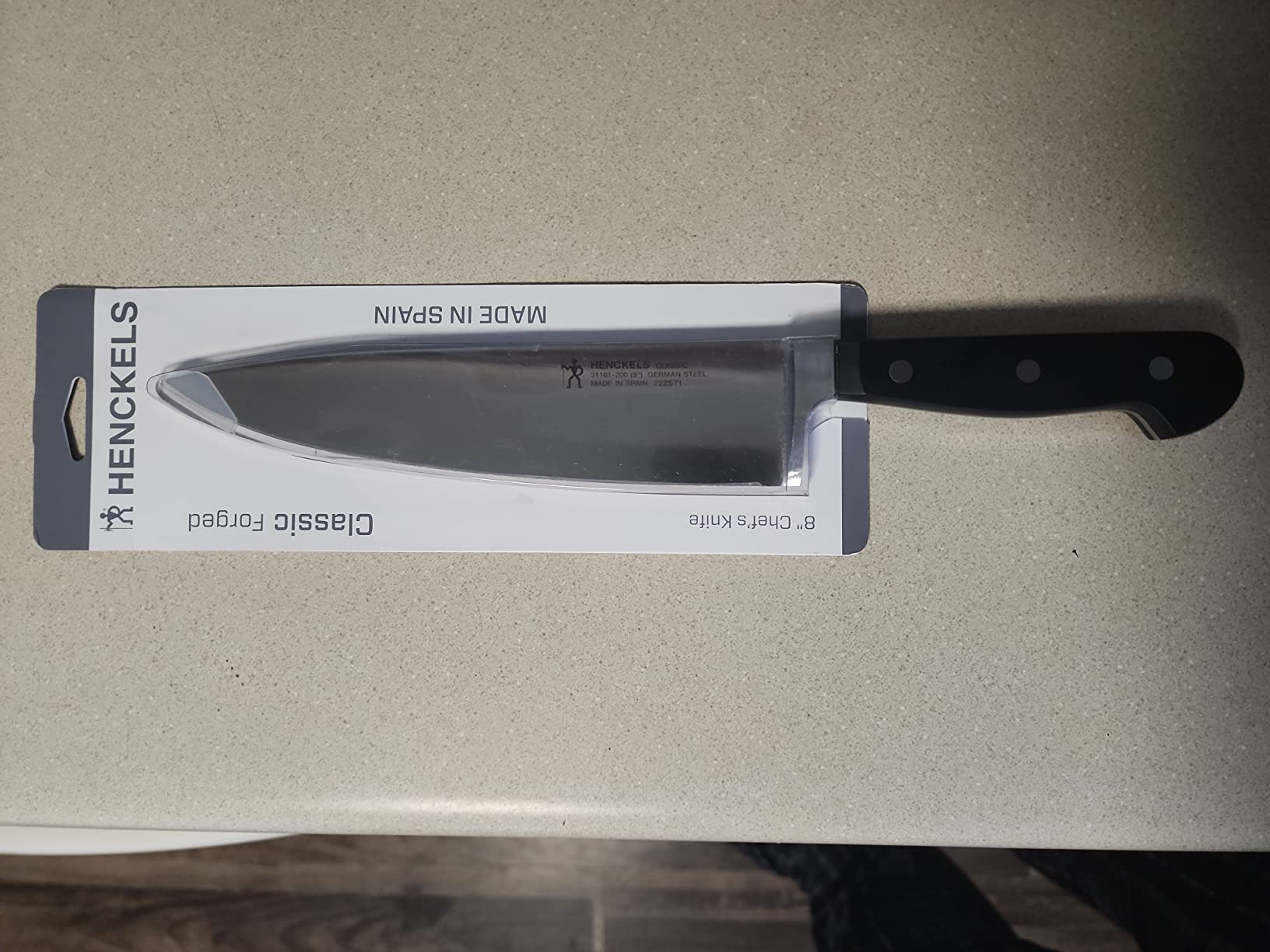
The complaints are consistent and small. The composite handle is less grippy when wet than a textured or wooden handle, which matters if you work with wet hands, and it sits at the expensive end of this roundup where reviewers sometimes question the premium for the name alone.
So who should buy it? Someone replacing a wedding gift knife, someone who wants a German forged chef’s knife with a lifetime warranty, and someone who prefers a light blade that can go in the dishwasher. Those are real reasons, and paying up purely for the badge is not.
Is the Henckels price premium worth it?
Only if you value the forged construction and the warranty. The fully forged build and triple-rivet handle do justify more than a stamped knife, and the lifetime warranty is real rather than decorative. If you would rather put that difference into a sharpening setup, a lower-priced forged blade serves you better in practice.
How does it feel for long prep sessions?
Light, in a good way. At 4.48 ounces it stays out of the way during a long evening of prep, and the seamless blade-to-handle transition means there is no seam for food to catch on. The one thing to watch is grip on wet, heavily floured hands, since composite offers less texture than Santoprene.
8. SHAN ZU 8 Inch Damascus Chef Knife – Best Real Folded Steel
SHAN ZU Chef Knife 8 Inch Japanese Steel Damascus Kitchen Knife
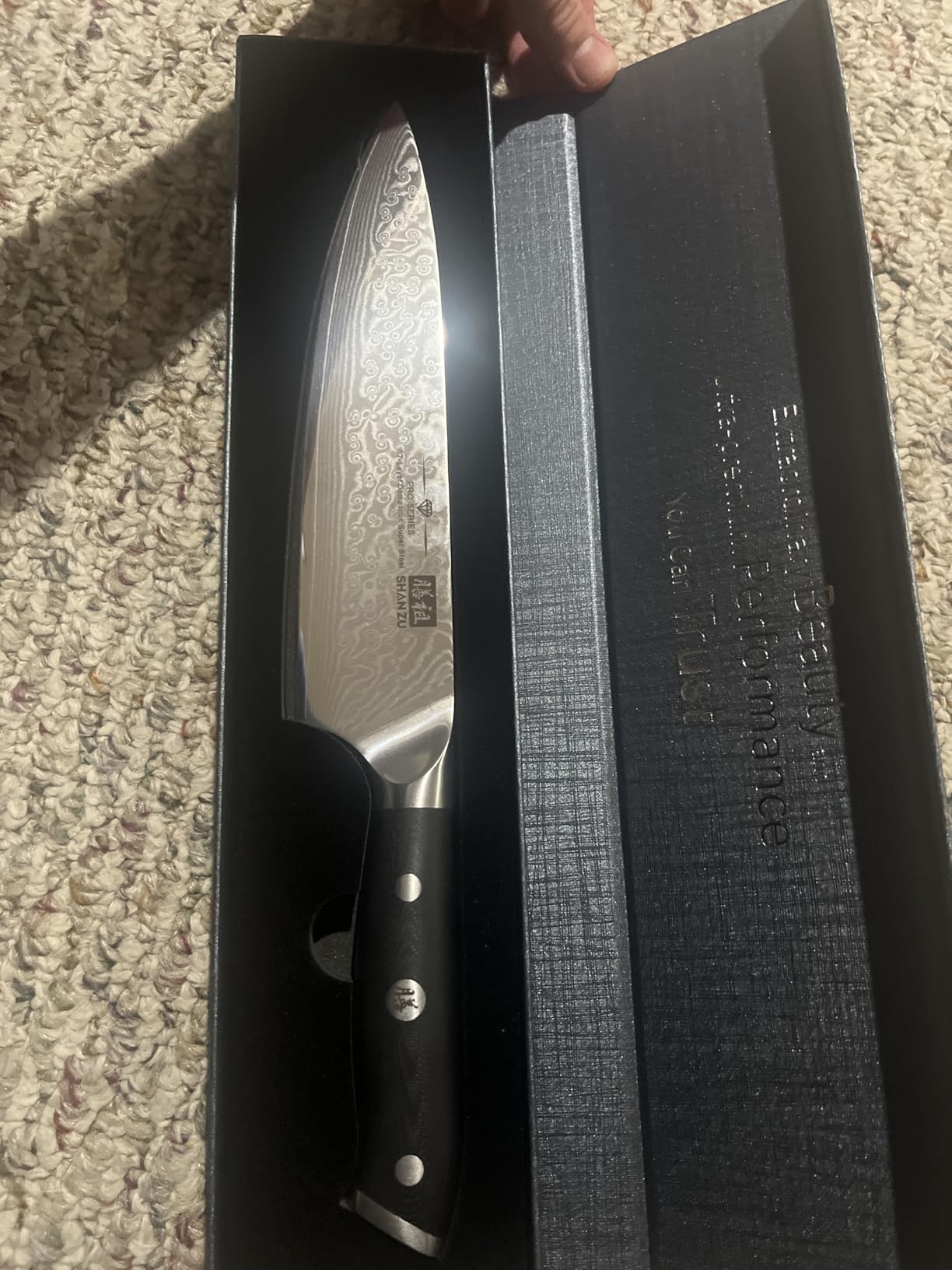
- Genuine folded and forged Damascus core at 62 HRC
- Strong edge retention and rust resistance
- 67 layer pattern becomes more visible with polishing
- Frosted G10 handle feels solid and controlled
- Top-balanced design gives strong control
- G10 handle is rigid and less warm than wood
- Damascus pattern needs polishing to stay vivid
- Heavier than many stamped knives in the class
Most knives advertising Damascus at this price are laser-etched imitations, and this is not one of them. The core is 10Cr15Mov Japanese steel folded and forged into 67 layers, rated at 62 HRC, which puts it in genuinely hard territory and gives edge retention that most blades in this bracket cannot match. Buyers specifically call out the difference from the imitations.
Geometry is a 15 degree cutting angle on an 8 inch blade that is 2.2mm thick and 2.5 inches wide, with a 5.3 inch handle. Total weight is 260 grams and the design is top-balanced, so control comes from the front of the knife rather than the heel, and you feel the extra weight on the first cut.
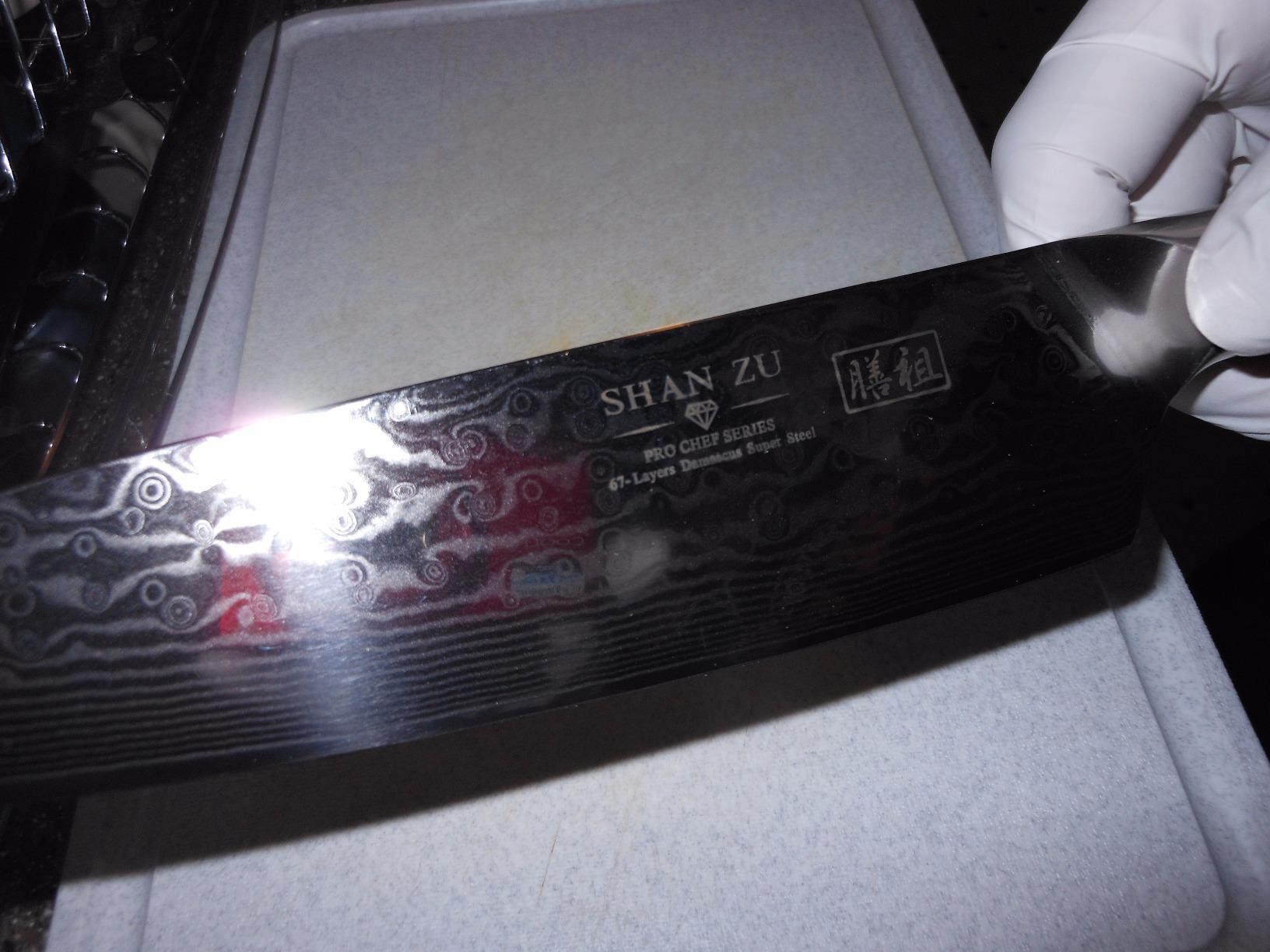
At 62 HRC with a fine acute edge, this blade wants more care than a German workhorse. Consensus on r/chefknives and r/TrueChefKnives is consistent on that point: harder Japanese steel chips if you treat it like a cleaver, so keep it on wood or an end-grain board and do not cut through bone or frozen food.
The handle is frosted G10 glass fiber, which reviewers rate as more solid than wood and better at resisting moisture, at the cost of feeling rigid and cool. The pattern also needs polishing to stay vivid, and the warranty is 12 months rather than lifetime, which is the one place it trails the German options here.
Does hard steel at 62 HRC chip easily?
It can, and that is the honest trade for edge retention. A 62 HRC core holds a fine edge far longer than a 57 HRC German blade but has less toughness to absorb a nick, so use a proper board, hone regularly, and avoid lateral pressure on hard bone. Treated with normal care, reviewers report steady sharpness rather than problems.
Is a 260 gram knife too heavy for daily prep?
It is heavier than a stamped workhorse and perfectly normal for an 8 inch chef’s knife. The top-balanced design shifts mass forward, which actually makes it feel controlled for precision slicing, so cooks who like a planted blade tend to love it and small hands may want something lighter.
9. FAMCUTE 8 Inch Japanese Steel Chef Knife – Best Lightweight Hard Steel
FAMCÜTE 8″ Japanese Knife, Hand Forged Sharp Chef Knife w/Rosewood Handle
- Five-layer 9CR18MOV steel at 62 HRC
- Lightweight rosewood handle reduces hand fatigue
- Octagonal handle gives control of the cutting angle
- Vacuum nitriding and electroplating resist corrosion
- Sharp and precise out of the box
- Rosewood handle needs oiling over time
- Wood handle can swell or crack if left wet
- Shorter review history than established brands
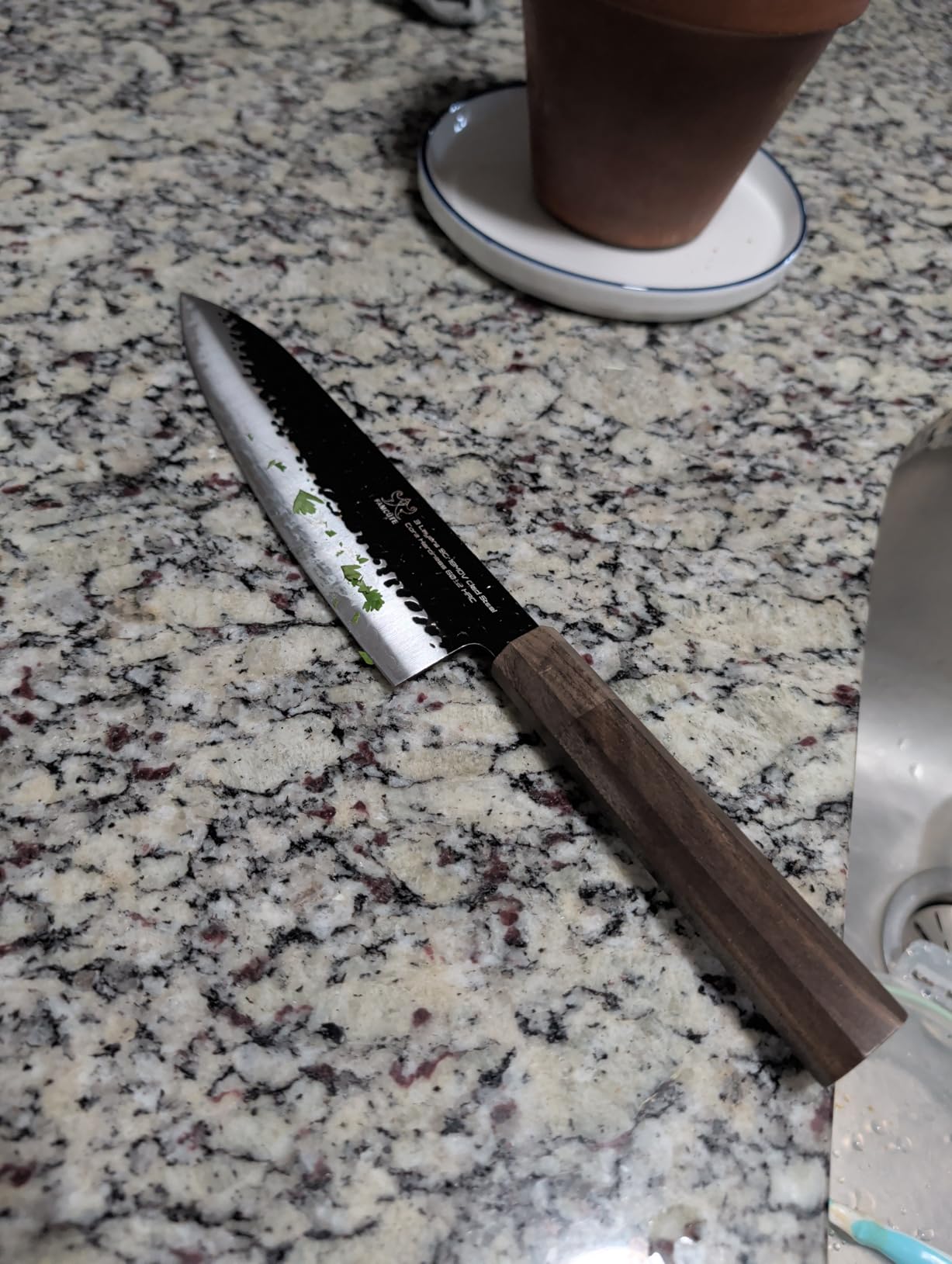
This knife answers a narrow question: can you get hard Japanese steel without a heavy handle? Five layers of 9CR18MOV high carbon steel reach 62 HRC through a 60 day process of quenching, vacuum nitriding, and electroplating, which is a serious finishing treatment at this level. The result is an 8 inch blade that holds a precise edge and resists corrosion well.
The handle is where it earns its place in a shortlist. The non-slip octagonal rosewood handle is the traditional Japanese shape and gives you control of the cutting angle because your grip sits directly under the spine. Reviewers repeatedly highlight reduced hand fatigue and steady sharpness, which is unusual feedback for steel this hard.
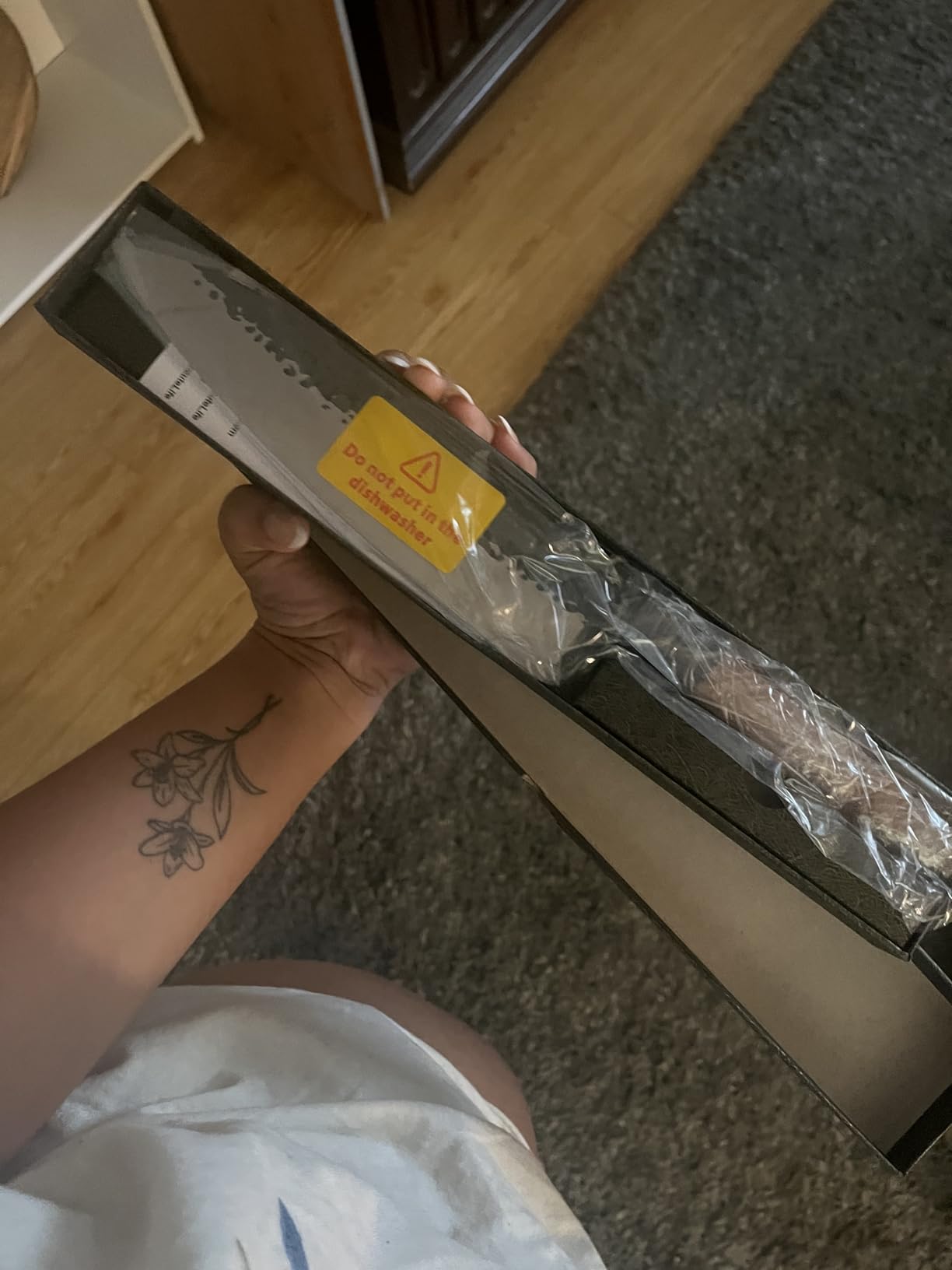
The trade-off is wood care. The rosewood handle needs occasional oiling and it can swell or crack if you leave it wet, and that commitment is why this does not outrank the G10-handled Damascus option for most people. The review base is also younger than the established brands in this roundup, which is worth keeping in mind.
I like this knife for fish and barbecue work, where a light precise blade in a warm wooden handle is pleasant across a long session. If you already own a polymer-handled knife and want the feel of a traditional Japanese handle without a traditional price, this is the one.
Do I need to oil the rosewood handle?
Occasionally, yes, with a food-safe mineral oil a couple of times a year to stop the wood drying out. The rule that matters more is never leaving it wet, because swelling and cracking come from standing water rather than from washing.
Is 62 HRC overkill for a home kitchen?
It is not overkill, it is demanding. Hard steel rewards a proper board, a honing routine, and the occasional sharpening session, and in return you go much longer between sessions. If you enjoy maintaining tools it is a pleasure, and if you want to drop a knife in a sink and forget about it, choose a softer stamped stainless model instead.
10. Mercer Culinary Genesis 8 Inch Forged Chef Knife – Best Forged Budget
Mercer Culinary M21078 Genesis 8-Inch Short Bolster Chef’s Knife,Black
- Forged high carbon German steel with taper-ground edge
- Handle widely praised as the best in the value segment
- Short bolster design simplifies sharpening
- Good balance with slightly more heft than stamped
- Owners report preferring it to knives costing multiples more
- High carbon steel will spot if left wet near the bolster
- Loses its factory edge faster than premium forged knives
- 8 inch length can feel long for smaller hands
This is the knife that answers the question every serious home cook eventually asks: what does forged German construction feel like without premium-brand money? Reviewers compare it directly to premium forged knives and find comparable feel and balance for a fraction of the cost, and several owners say they use it in preference to knives that cost multiples more.
Construction is precision-forged high carbon German steel with a taper-ground edge, a full tang, and a short bolster. That short bolster is an underappreciated detail, because it keeps the heel clear so you can sharpen the whole edge without grinding down a thick collar. The Santoprene handle grips when wet and is repeatedly called the best in the value segment.
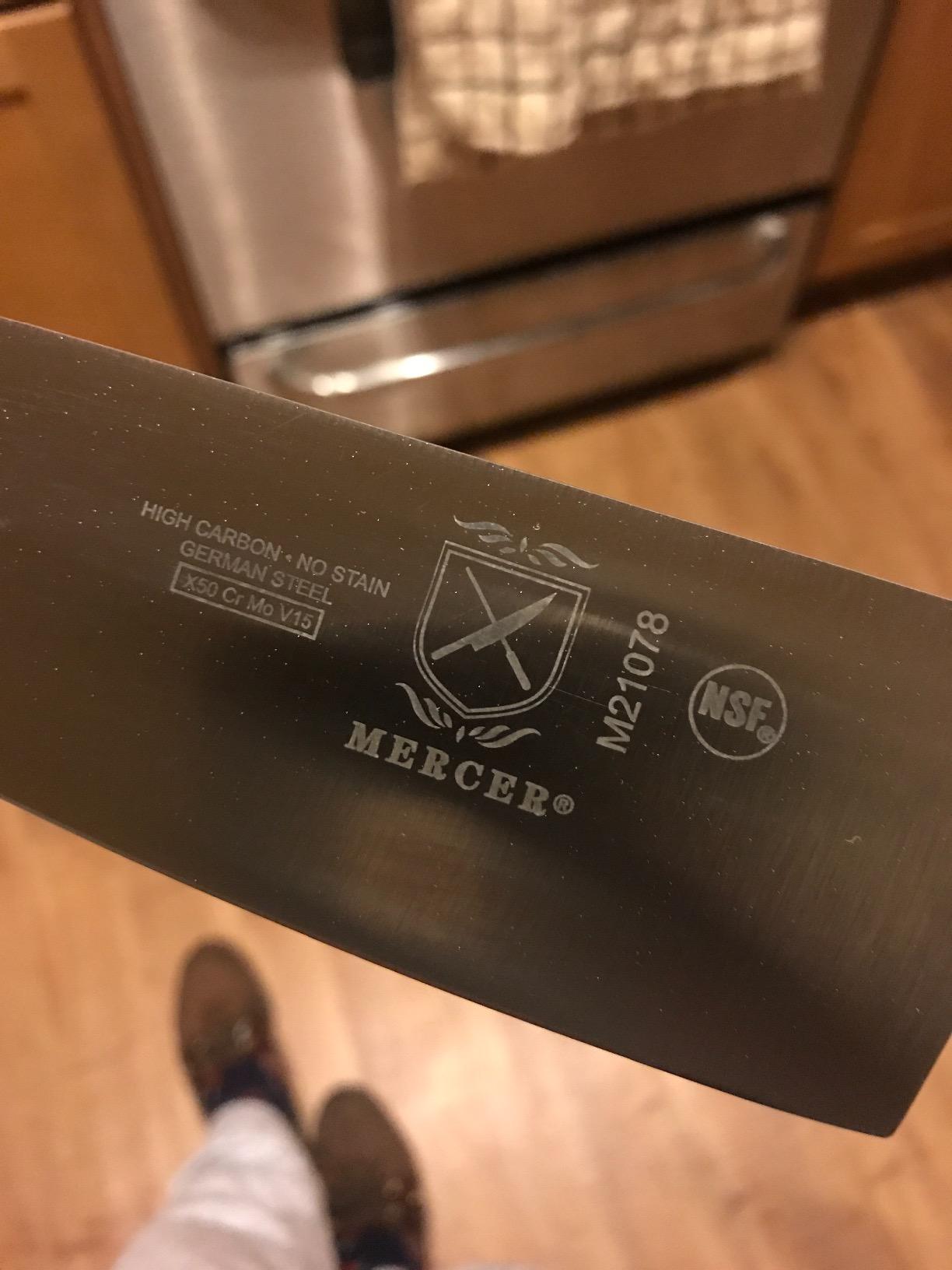
Two real drawbacks. High carbon steel spots rust if it is left wet, especially around the bolster where water collects, so hand washing and immediate drying are not optional. It also loses its factory edge faster than premium forged German knives, which is the expected trade-off of a steel this responsive to sharpening.
Reviewers describe it directly as a step up from stamped budget knives, and that framing is accurate. You get more heft, a more refined grind, and a blade that feels like a workshop tool rather than a stamped sheet, and you give up some of the low-maintenance forgiveness.
Why does the short bolster matter?
Because a full bolster adds a thick collar at the heel. On a whetstone you grind that collar flat, and on a honing steel it can catch and interfere, so a short bolster clears the whole edge for sharpening while still giving the tang structure and grip. It matters most to a cook who sharpens.
Is high carbon steel too fussy for a beginner?
Only if you do not dry it. The difference from standard stainless is how quickly a water spot becomes a stain, not whether the knife works, so wash, towel dry, and put it away. If you can manage that one extra step, this is a better knife than any stamped option near it.
11. Kimura 8 Inch Gyuto Made in Seki Japan – Best Made in Japan
- Genuinely manufactured in Seki Japan
- Hand sharpened to 15 degrees by skilled craftsmen
- Light 175 g weight suits a gyuto profile
- Non-slip POM resin handle with full bolster
- Triple riveted full tang
- lifetime warranty
- Gift box with traditional kanji design
- Finish quality and centering are inconsistent on some units
- 57 HRC is softer than premium Japanese steel so retention is moderate
- Full bolster makes sharpening more involved
Seki is the Japanese city where Japanese knives have been made for centuries, and that manufacturing claim is the reason to consider this blade. The steel is high carbon molybdenum stainless, heat treated to 57 HRC and hand sharpened to a 15 degree angle. Construction is a stamped blade with a triple riveted full tang and a full bolster, with a gift box and lifetime warranty included.
At 175 grams with a 21 cm blade it is the lightest gyuto in this roundup, and reviewers like the handling. The POM resin handle is ergonomic and non-slip, and the double bevel edge allows a pinch grip or a pointed finger grip depending on your technique.
![Kimura Chef Knife, [Made in Japan], 8 inch Professional Kitchen Knife, Ultra Sharp High Carbon Molybdenum Stainless Steel Gyuto Knife, Chefs Knife with Ergonomic Handle - Japanese Chef's Knife customer photo 1](https://www.talkofthehouse.com/wp-content/uploads/2026/09/B09GCGQKNZ_customer_1.jpg)
The honest feedback is that ratings sit mid-pack for this group, and the reason is consistency. Some buyers report finish quality and centering problems on individual units, which is normal with a large-volume import, and a few reviewers mention the handle profile can feel slippery when very wet.
At 57 HRC it is softer than the premium Japanese steels, so edge retention is more moderate and you will hone more often. The full bolster also makes sharpening more involved than a bolster-free build, since the heel of the blade sits above a thick collar.
Community discussion positions this Seki-made gyuto as a sensible budget taste of a Japanese profile, with the 57 HRC steel being the reason enthusiasts recommend stepping up in hardness rather than in brand.
![Kimura Chef Knife, [Made in Japan], 8 inch Professional Kitchen Knife, Ultra Sharp High Carbon Molybdenum Stainless Steel Gyuto Knife, Chefs Knife with Ergonomic Handle - Japanese Chef's Knife customer photo 2](https://www.talkofthehouse.com/wp-content/uploads/2026/09/B09GCGQKNZ_customer_2.jpg)
Does made in Japan matter for a knife?
In this category it does, and the reason is consistency of heat treatment rather than raw steel quality. Japanese makers are known for tighter hardness control and sharper factory edges, so you are not automatically getting better steel but you are getting a more predictable grind, which is what you feel on the board.
Is 57 HRC good enough?
It is the practical choice. Around 56 to 58 HRC is the sweet spot for a knife a home cook will actually maintain, because the steel is tough enough to take a knock without chipping. Harder steel holds an edge longer but punishes careless technique more often, and reviewers treat 57 HRC as a sensible balance rather than a compromise.
12. ZWILLING Pro S 8 Inch German Chef’s Knife – Best Forged Steel Build
- Ice-hardened FRIODUR steel starts sharp and stays sharp
- SIGMA forge from a single piece of steel
- 57 Rockwell hardness gives solid edge retention
- Laser-controlled 15 degree edge per side
- Polymer handle bonded to a full tang
- Dishwasher safe with a lifetime warranty
- Highest priced knife in this roundup
- Heavier at 277 g than most alternatives
- Composite handle has less grip texture than phenolic or wood
At the top of this budget, the Zwilling Pro S is what the extra money actually buys. The blade is SIGMA forged from a single piece of special formula high carbon no-stain steel, then ice-hardened in the company’s own German process, and finished with a laser-controlled 15 degree edge per side. Buyers cite German manufacture, edge retention, and the lifetime warranty as the reasons for the premium.
It is a heavy knife in this roundup at 277 grams, and that weight is a feature if you push through dense vegetables and bone-in meat. The ergonomic polymer three-rivet handle is bonded to a full tang, so steel runs the length of the handle, and the knife is dishwasher safe.
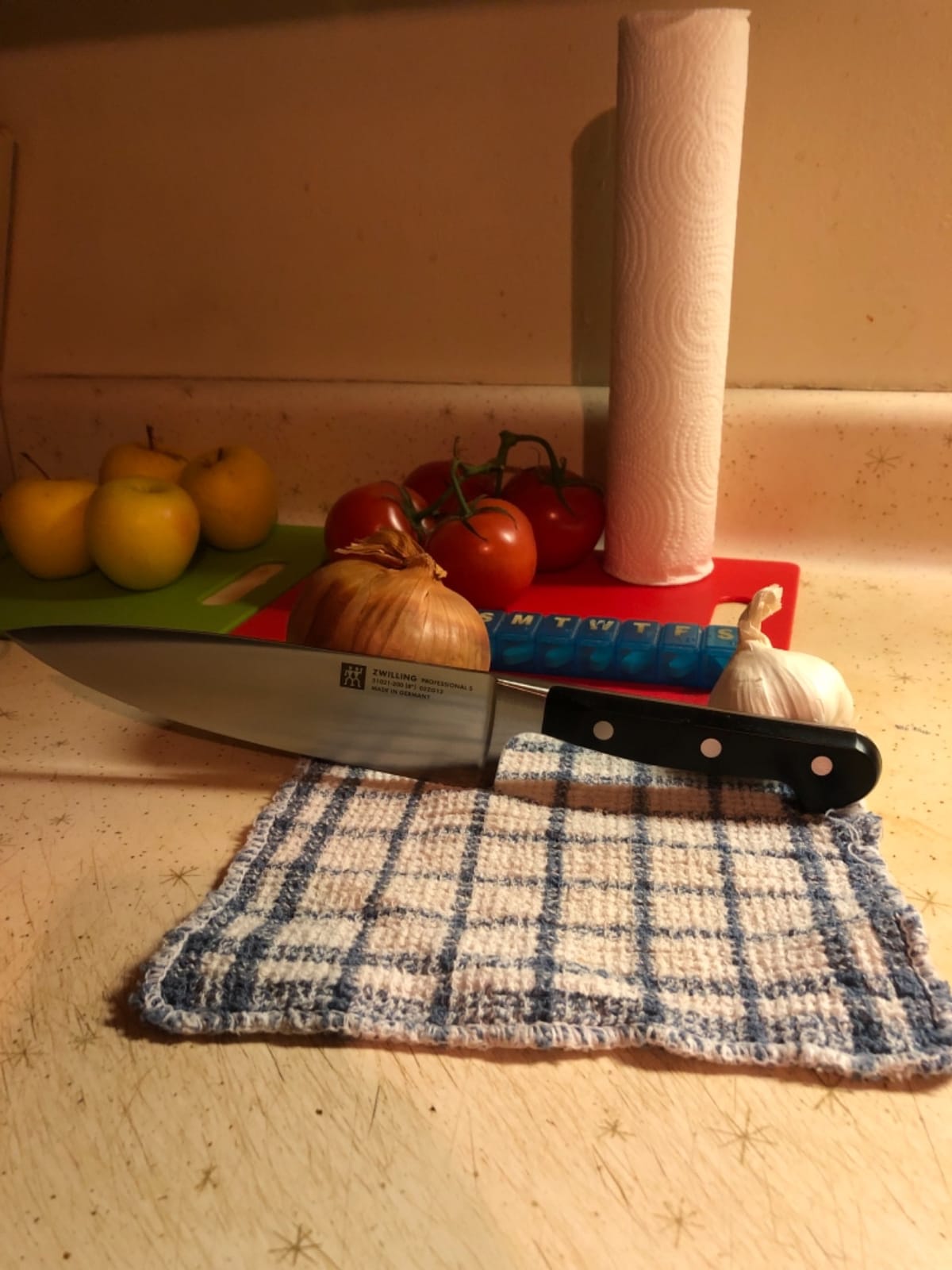
Reviewers are careful here, and so am I: the feedback emphasises balance and durability rather than outright sharpness superiority over much cheaper forged knives. At 57 HRC the edge retention is good rather than exceptional, and the composite handle has less grip texture than phenolic or wood, which matters with wet hands.
It is also the one knife here where the price gap is large enough to matter to your budget. If you spend the difference on a honing steel and a good board, a mid-priced forged blade will give you a very similar experience at the cutting board, which is where the difference would show up.
So this is the pick for someone who wants a made-in-Germany forged blade with ice-hardened steel and plans to keep it for a decade.
Is ice-hardened FRIODUR steel actually better?
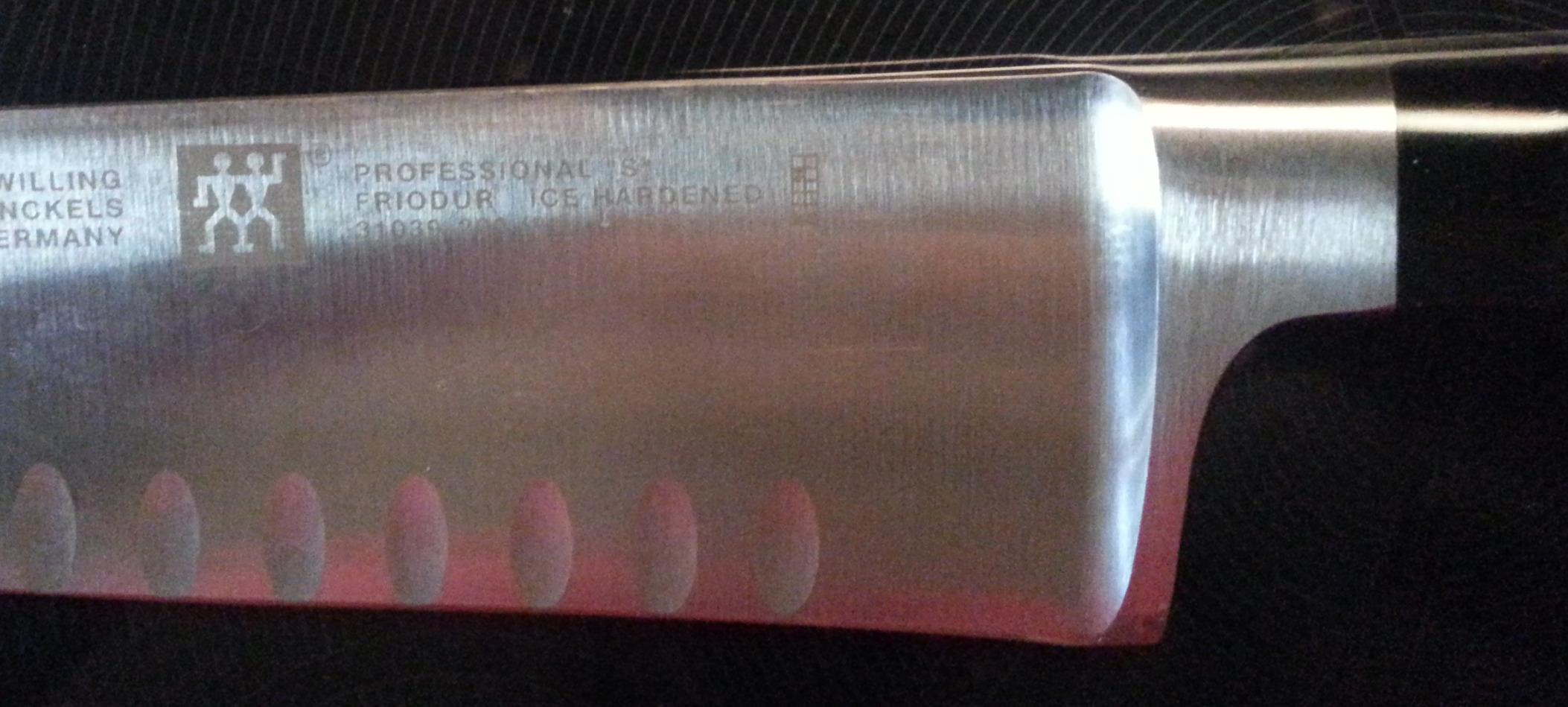
It is a real process rather than a marketing line, treating the steel at temperatures far below what a standard blade sees. That produces a harder, more resilient edge that starts sharp out of the box and holds longer, though reviewers describe the result as solid edge retention rather than a dramatic leap over a good forged German blade at a fifth of the cost.
Is the extra weight a problem for long sessions?
At 277 grams it is noticeably heavier than the stamped options here, which some cooks love and some find tiring after an hour. If you prefer a planted, stable feeling through a hard chop the weight helps, and if you do a lot of fine slicing the lighter stamped and full-tang models will feel faster in the hand.
How to Choose a Chef Knife Under 100 Dollars
Steel decides how a knife behaves. Rockwell hardness, measured on the HRC scale, tells you how much the edge resists losing its bite. Steel in the 56 to 58 HRC range is forgiving and easy to sharpen, while stainless at 60 HRC and above holds a finer edge for longer but chips more readily if you treat it like a cleaver. Every spec in the table above comes from the manufacturer data for that reason.
Forged or stamped is the second decision, and it is where marketing gets creative. A forged blade is shaped from a single piece of steel, so it is heavier and more durable around the tang, while a stamped blade is cut from sheet steel, which makes it thinner, lighter, and cheaper to make. The only thing to distrust is a cheap knife claiming forged construction when its own listing data says stamped.
Full tang versus partial tang matters more than most shoppers think. A full tang runs the steel the full length of the handle, which is why the knives recommended in r/chefknives discussions for heavy prep are almost always full tang. It gives strength at the weak point and puts the balance in your palm, while partial tang knives are fine for light kitchen work and less good for bone-in proteins.
Handle fit is where money gets wasted. Japanese handles tend to be thicker and more octagonal, while German riveted handles are slimmer, and if you have small hands the slim Santoprene handles on the Mercer models fit far better than a thick octagonal rosewood grip. Pick a knife up in a store where you can, or buy from a seller with easy returns.
Blade length is the last big variable. Eight inches is the standard for a reason, handling a whole onion, a large roast, and a full board without feeling unwieldy. Six inches is more precise and easier to control in a small kitchen, and ten inches is harder to manoeuvre than most beginners expect. Our complete chef’s knife guide covers the geometry in more detail.
Finally, choose between a German and a Japanese style based on how you actually move. A German blade is taller with a fuller curve and loves a rocking motion for herbs and onions, while a Japanese gyuto is thinner with a flatter profile and shines with a push cut for fish and large flat slices. You can use either for almost anything, but matching the blade to your natural motion makes a visible difference in speed.
What to Buy With the Rest of Your Knife Budget
A new chef’s knife arrives sharper than it will ever be again, and it dulls faster than most people expect. The mistake is spending the whole budget on the blade and then having no way to keep it sharp, so a better split is roughly half on the knife, a quarter on a sharpener, and the rest on a board and a honing steel.
A honing steel does not sharpen a knife. It straightens the edge that has started to roll over, and doing it weekly means your real sharpening session happens a few times a year rather than a few times a month. That one habit is the difference between a knife that feels sharp and one that does not.
For actual sharpening, a whetstone is the answer and a pull-through sharpener is the compromise. A pull-through is faster and cheaper but removes metal unevenly over time, flattening your factory edge, while a whetstone lets you restore the original geometry. We walk through the options in our guide to the best knife sharpeners for the kitchen.
The board matters more than shoppers expect. Glass, marble, granite, and stone surfaces destroy an edge within months no matter how good the knife is, so end-grain wood or a quality plastic composite is the answer. A large board also gives you room to use a full 8 inch blade without chopping off the end, and if you are still weighing a set against a single knife, our chef knife set guide covers when a small set genuinely beats one knife.
Chef Knives to Avoid on a Budget
Self-sharpening sheaths are the most common trap. The idea is a built-in wheel in the block that resharpens the blade as you slide it in, and users report that it wears the blade unevenly and destroys edge geometry over time. The wheel dulls long before the knife does, so buy a plain block or a magnetic strip instead.
Knives marketed as forged that are actually stamped are the second trap. Check the listing details rather than the product photography, because the decorative waved pattern on many budget blades is a laser-style finish rather than layered Damascus steel. Real folded steel has a pattern that shifts across the grind, and the construction details should say so.
Ceramic knives are worth skipping at this budget. They are extremely hard and they do not hold an edge the way steel does, they chip, and they cannot be fixed with any sharpening equipment you can buy for home use. Once a ceramic edge is gone, the knife is finished.
The dishwasher is the most common cause of a dull blade. Even knives labelled dishwasher safe lose their edge in the cycle and handle adhesive gives out first, so wash by hand, dry immediately, and store the blade away from the sink.
Large block sets are the last thing to avoid, and this is where most budget buyers go wrong. Those sets spend most of their budget on steak knives, utility knives, and kitchen shears that never get used, at the cost of one decent chef’s knife, and a three-piece setup of a chef’s knife, a paring knife, and a utility knife serves most homes better. It is also why high-sell sets draw so much skepticism in knife forums: the value is in the presentation, not the steel.
Frequently Asked Questions
What is the best chef knife under 100 dollars?
The Victorinox Fibrox Pro 8 Inch Chef’s Knife is the best chef knife under 100 dollars for most home cooks. It is Swiss-made stamped stainless steel, hand sharpened in Switzerland, dishwasher safe, and backed by a lifetime warranty. Owners consistently rate the out-of-box sharpness, the non-slip handle, and how easy it is to re-sharpen.
What is the best inexpensive chef knife?
The best inexpensive chef knife is the PAUDIN 8 Inch, which pairs a hand-polished 2mm stamped high carbon blade with a comfortable wood handle. At the low end of the budget the main difference between knives is the handle and the factory edge, not the steel. Dull it and any of these knives becomes frustrating quickly.
What are the best knives for under 100 dollars?
The best knives under 100 dollars span three types. For an all-purpose workhorse take the Victorinox Fibrox Pro 8 Inch, for forged German construction the Mercer Genesis 8 Inch, for hard Japanese steel with real edge retention the SHAN ZU 8 Inch Damascus, and for a knife made in Japan the Kimura 8 Inch gyuto. Start from the comparison table and narrow from there.
What is the best budget-friendly chef knife under 100 dollars?
The Victorinox Fibrox Pro is the best budget-friendly chef knife under 100 dollars because it needs the least maintenance to stay useful. The stamped blade takes a sharp edge easily, the handle stays secure when wet, and dishwasher cleaning does not ruin it. It is also the easiest to replace, so you are not stuck if the edge is beyond saving.
What is the best chef knife for the money?
The best chef knife for the money is whichever one you will actually maintain. A forged German blade at the higher end of this range rewards effort with better edge retention, while a stamped stainless workhorse rewards a busy cook who wants sharp results with minimal fuss. Both the Victorinox Fibrox and the Mercer Genesis are the safest single answer.
Why don’t chefs use Cutco?
Professional cooks rarely use Cutco or similar high-sell brands for a few reasons. The blades are generally softer and stamped rather than forged, so they lose an edge quickly under heavy use, and the handles feel bulky during intensive prep. The sets also push buying many knives rather than one good one, and cheaper alternatives such as Victorinox or Mercer outperform them for the price.
Is an 8 inch chef knife the right size?
An 8 inch chef’s knife is the right size for most home kitchens. It is long enough for a whole onion or a large roast and short enough to handle safely on a normal board. Six inch models are more precise and easier to control in tight spaces, and ten inch models feel harder to handle than beginners expect.
How often should I sharpen a chef knife?
Hone with a steel about once a week and sharpen a few times a year depending on use. A single weekly honing habit beats a perfect sharpening routine you skip. If your knife is a harder Japanese steel at 60 HRC or above it needs less frequent sharpening but more care to avoid chipping, and you should always use wood or an end-grain board rather than glass.
The Verdict: Best Chef Knives Under 100 Dollars in 2026
The best chef knives under 100 dollars in 2026 are led by the Victorinox Fibrox Pro 8 Inch, and it holds the top spot for a simple set of reasons: Swiss steel, a light balanced handle, a lifetime warranty, and a stamped blade that is easy to sharpen and easy to replace. It is the knife I hand to people who say they do not need a good knife.
Buy the SHAN ZU if you want the longest-lasting edge and will commit to board discipline. Buy the Mercer Genesis if you have outgrown stamped blades and want a forged full tang with a grippy handle, and buy the Kimura if you want a gyuto made in Seki, Japan. Spend the rest of your budget on a honing steel, a whetstone, and an end-grain board, because an unmaintained blade is an expensive rock.
Go above this ceiling only if you already sharpen regularly and know what a harder steel buys you. Otherwise this budget is not a compromise, it is the sweet spot for serious home cooking.