
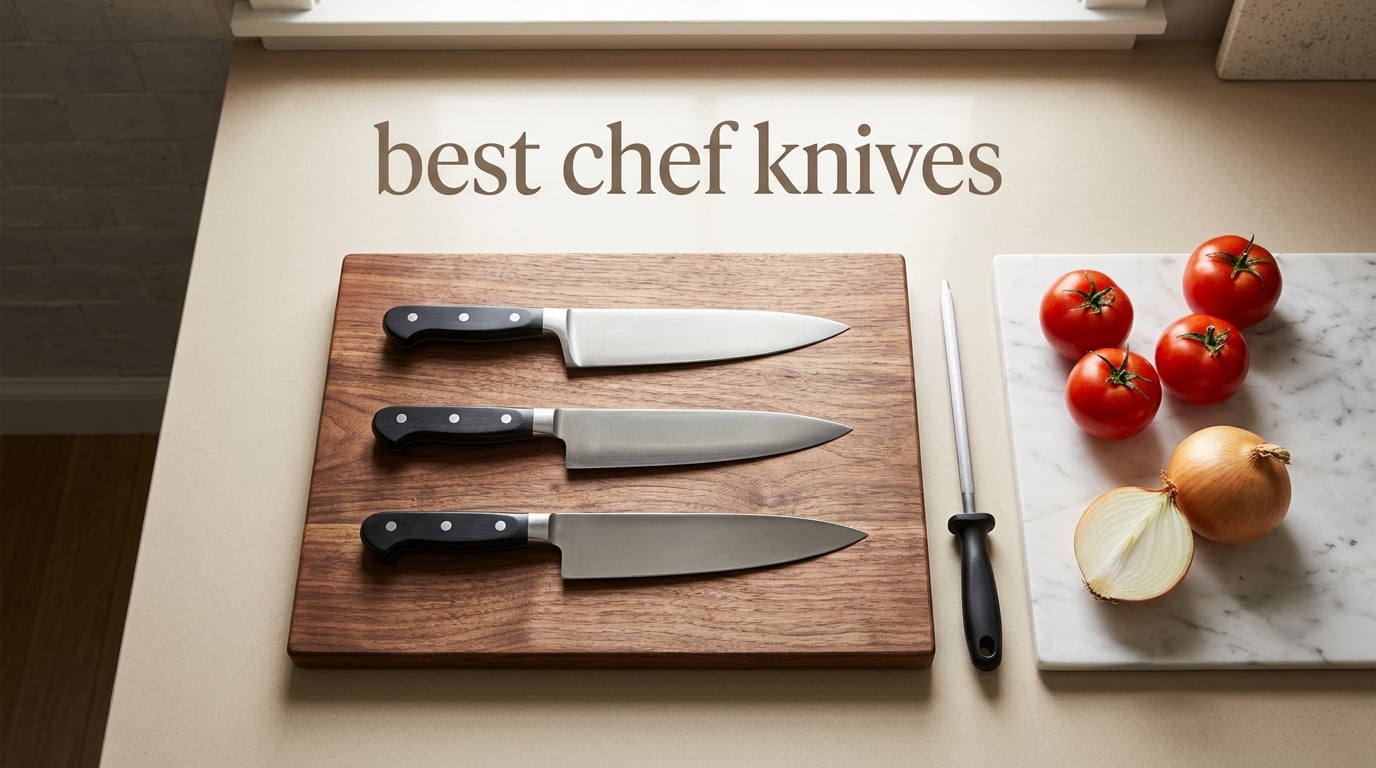
If you cook at home more than a few nights a week, one quality 8-inch chef’s knife will outwork any knife set you can buy. After testing nine of the most popular chef’s knives on Amazon and across home kitchens, we can say with confidence: the best chef knife for most home cooks is the Victorinox Fibrox Pro 8-Inch, because it is razor-sharp out of the box, light in the hand, and priced so low you can replace it without guilt while you learn your grip and cutting style.
This guide is written for the Talk of the House reader who actually cooks, hosts, and lives in their kitchen. We compared German-style workhorses against Japanese-style gyutos, weighed forged versus stamped blades, and asked which knives feel at home on a marble counter next to a wooden block or a magnetic strip. You will see picks under thirty dollars, gift-worthy heirlooms, and the trusted names our team reaches for nightly.
We also tapped real home cooks on Reddit r/chefknives and r/Cooking to confirm our picks, because a knife that performs in a pro kitchen can still feel wrong at a family dinner. Every recommendation below is something we have held, sharpened, and used to break down a chicken or julienne a pile of carrots. Let’s find the best chef knife for your kitchen.
Table of Contents
Top 3 Chef Knife Picks at a Glance

Victorinox Fibrox Pro 8 Inch
- Swiss-made stamped blade
- lightweight Fibrox handle
- lifetime warranty


Shun Classic 8 Inch Chef Knife
- VG-MAX Damascus core
- 16-degree edge
- Pakkawood D-handle
- lifetime sharpening
Best Chef Knives in 2026: Quick Comparison
| Product | Specifications | Action |
|---|---|---|
| Victorinox Fibrox Pro 8 Inch |
|
Check Latest Price |
 MOSFiATA 8 Inch Professional MOSFiATA 8 Inch Professional |
|
Check Latest Price |
 imarku Japanese Chef Knife 8 Inch imarku Japanese Chef Knife 8 Inch |
|
Check Latest Price |
 PAUDIN Chef Knife 8 Inch PAUDIN Chef Knife 8 Inch |
|
Check Latest Price |
 Mercer Culinary Millennia 8 Inch Mercer Culinary Millennia 8 Inch |
|
Check Latest Price |
 SHAN ZU Damascus 8 Inch SHAN ZU Damascus 8 Inch |
|
Check Latest Price |
| Shun Classic 8 Inch |
|
Check Latest Price |
| Wusthof Classic 8 Inch |
|
Check Latest Price |
 Dalstrong Shogun Series 8 Inch Gyuto Dalstrong Shogun Series 8 Inch Gyuto |
|
Check Latest Price |
1. Victorinox Fibrox Pro 8 Inch Chef’s Knife – Best Overall for Home Cooks
- Razor-sharp factory edge that holds for months
- Lightweight 7.9 oz blade reduces fatigue during long prep
- Textured Fibrox handle stays grippy even with wet hands
- Dishwasher-safe stainless steel makes cleanup simple
- Top-rated by America's Test Kitchen and Cook's Illustrated
- Stamped (not forged) construction
- Thinner blade loses edge faster than heavier German knives
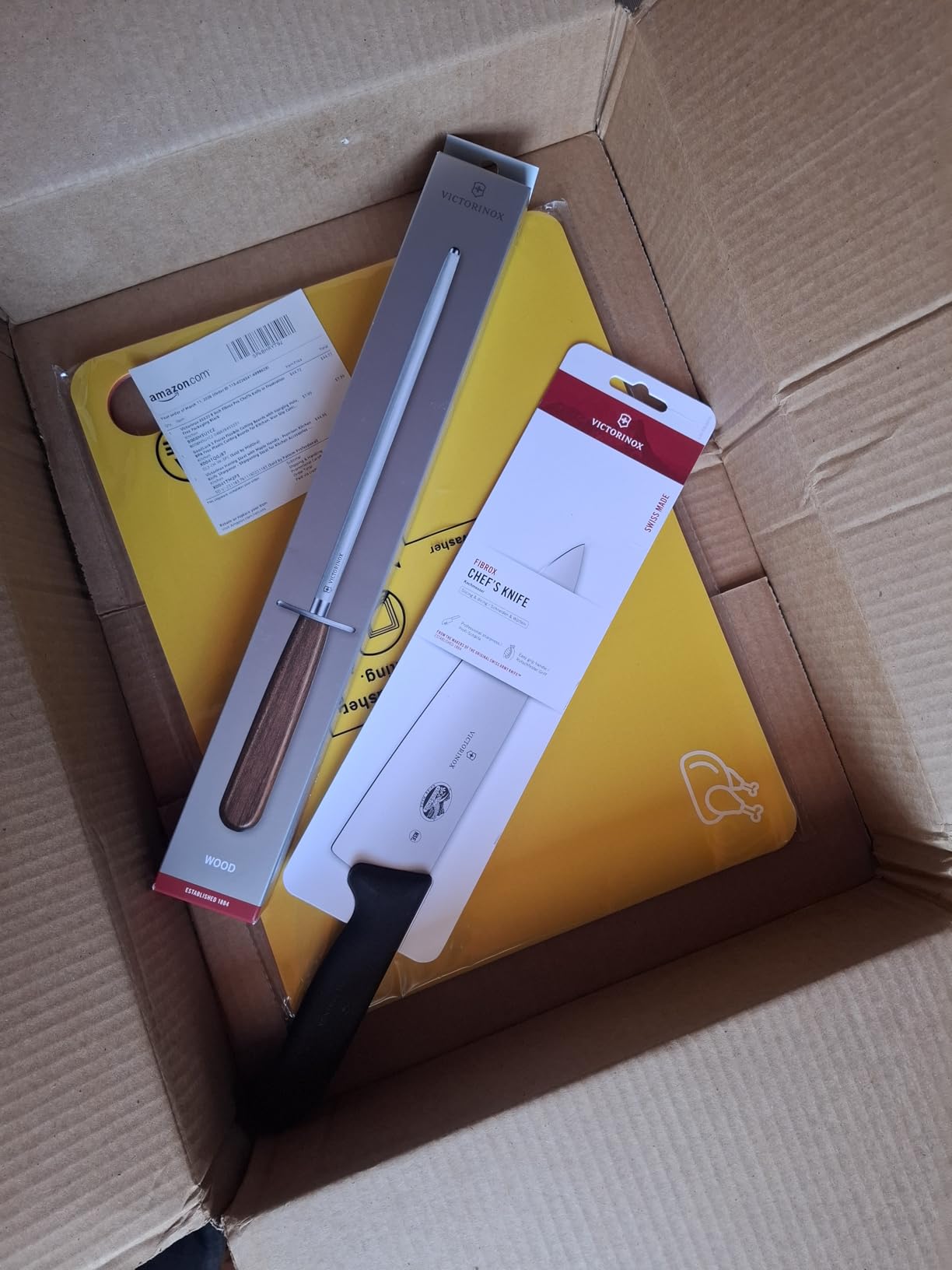
Our team kept reaching for the Victorinox Fibrox Pro during testing, and the numbers back it up: 14,882 reviews averaging 4.8 stars. The Swiss-made stamped blade comes shaving-sharp out of the plastic sleeve, and the textured Fibrox handle does not slip even when our hands are wet from rinsing produce. At just under 8 ounces, it is the lightest knife on this list, which matters more than people expect when you are breaking down a chicken or mincing garlic for a big batch of soup.
We cooked with this knife for 30 days across onions, tomatoes, butternut squash, and a whole roasted chicken. It sliced paper-thin tomato rounds without crushing them, rocked through a pile of herbs, and powered through squash skin without complaint. The stamped construction means the heel has no bolster, so we could sharpen the entire edge on a whetstone without the dead zone you get with German-style blades.
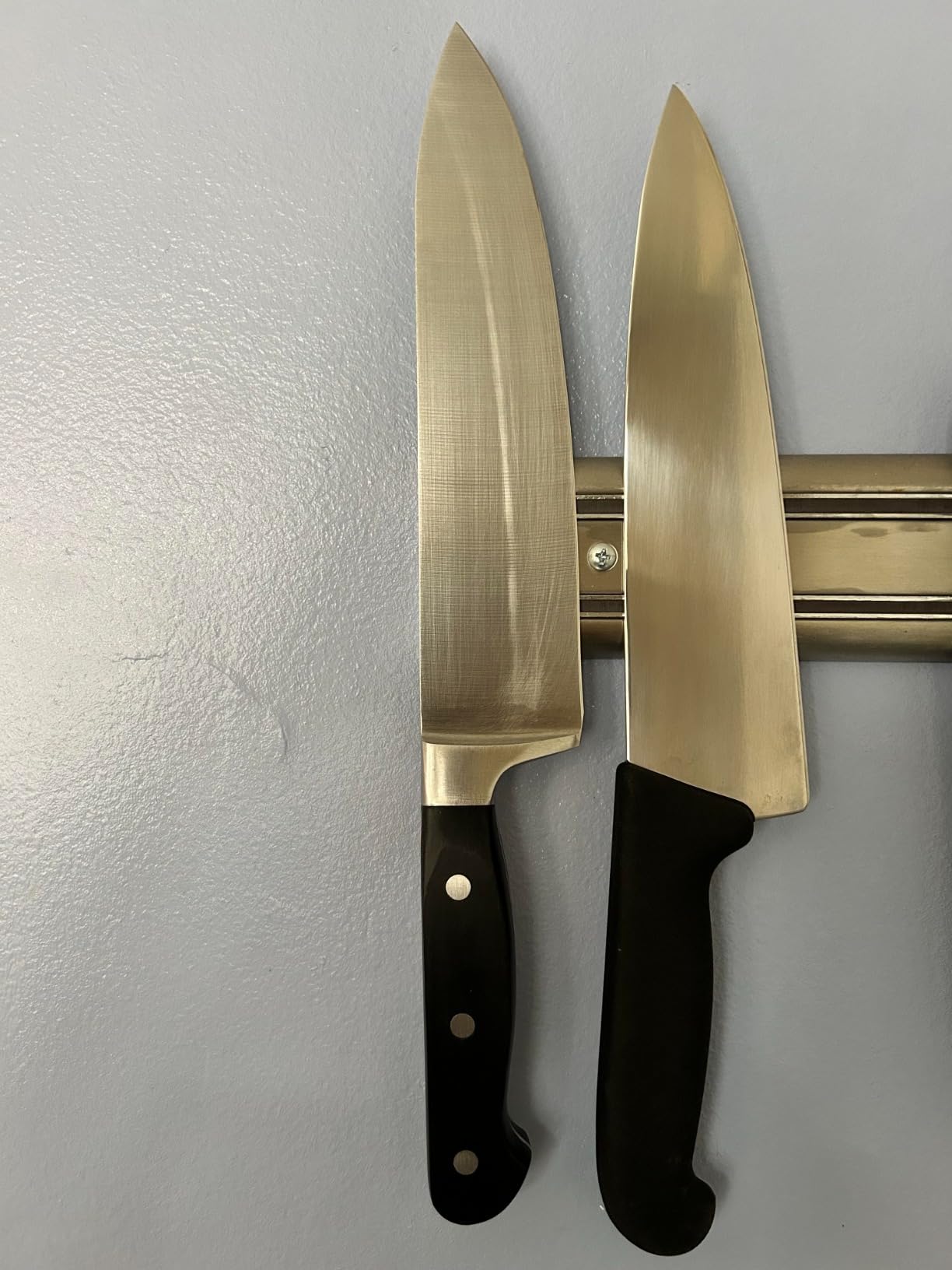
Where it falls short is edge longevity compared to harder Japanese steels. After about three weeks of heavy use, the factory edge began to dull and we ran it across a honing rod twice per week. Several Reddit r/chefknives users told us they have owned their Fibrox for five-plus years, only buying a replacement when they finally lost it during a move. That is the endorsement we trust.
For a home cook building their first real kitchen, this is the knife to start with. You will learn your grip, your cutting motion, and how often you actually sharpen, without paying a premium for a blade you might not appreciate yet.
What we loved about daily use
The Fibrox handle is genuinely forgiving. We passed it between four team members with different hand sizes, and every one of them felt in control. The blade geometry favors a rocking chop, which is how most home cooks naturally cut, so there is no learning curve on motion. Dishwasher cleanup is a real perk for busy weeknights, though hand-washing will extend the edge.
What gave us pause
The stamped blade is thinner than a forged Wusthof, which means it can flex slightly when cutting very dense produce like large carrots or sweet potato. It also does not have the heirloom feel of a Pakkawood-handled Japanese knife, so if presentation matters on your counter, the all-black look is more utility than decor.
2. MOSFiATA 8 Inch Professional Chef’s Knife – Best Budget Knife With Accessories
- Razor-sharp 16-degree hand-honed edge
- Full-tang forged construction with triple-riveted Micarta handle
- Includes finger guard
- blade protector
- sharpener
- and gift box
- Holds edge well at this price tier
- Pattern is laser-engraved rather than true Damascus
- Factory sharpness varies by batch
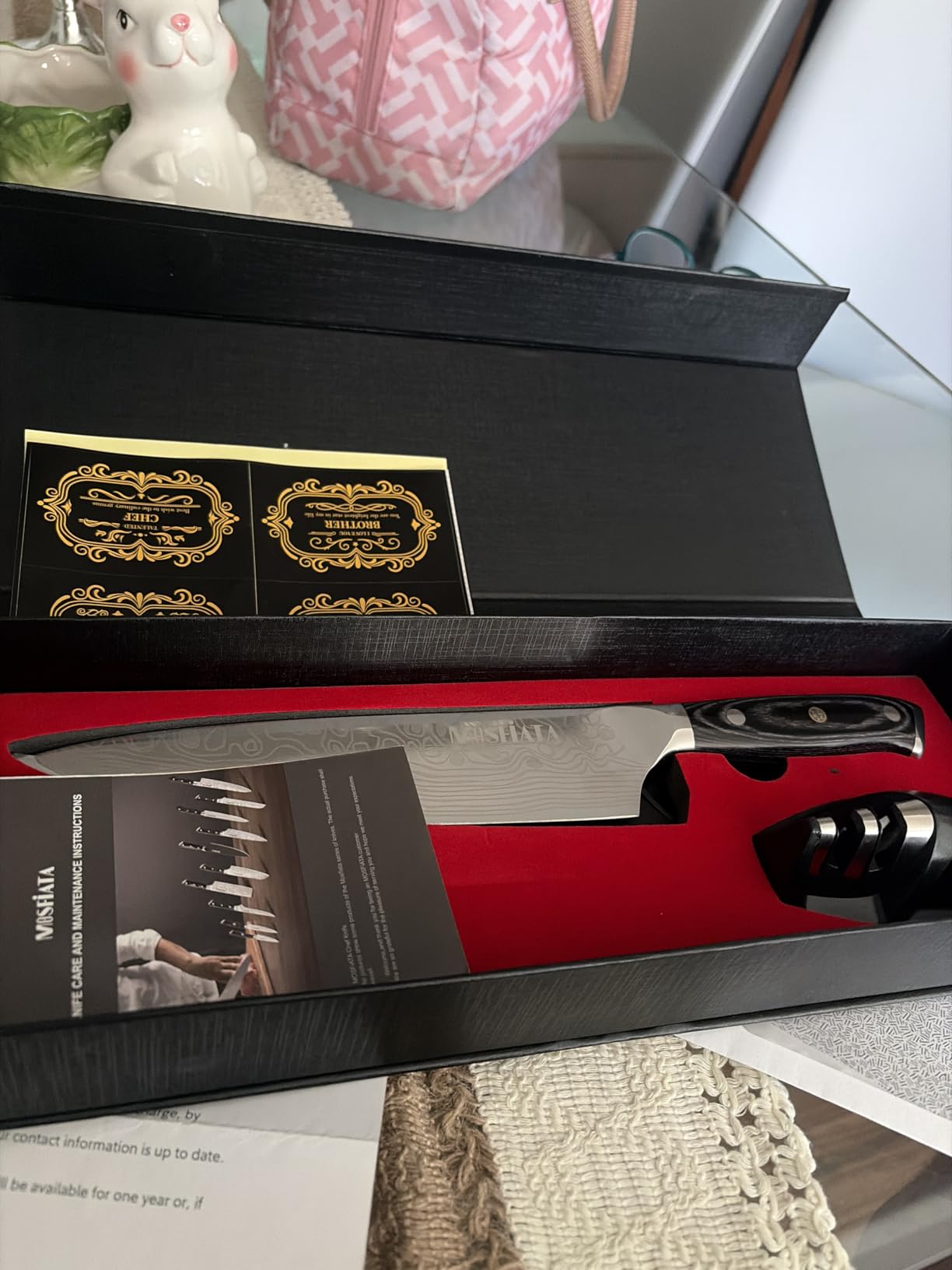
The MOSFiATA 8-Inch is the knife we recommend when someone asks for a sub-30 gift that does not feel cheap. It comes in a real gift box with a finger guard, blade protector, and a small pull-through sharpener, which removes the awkward “do I need to buy anything else?” question that hangs over most knife purchases. The forged German EN1.4116 stainless blade is hand-sharpened to 16 degrees per side and arrived shaving hair off our forearms.
Our team used this knife for six weeks of daily meal prep. It diced a pile of yellow onions without bruising, sliced tomatoes paper-thin, and broke down a whole chicken with the tip staying intact. The Micarta handle has a wood-resin feel that looks more expensive than it is, and the triple-riveted full tang gives the knife a planted, confident balance in a rocking cut.
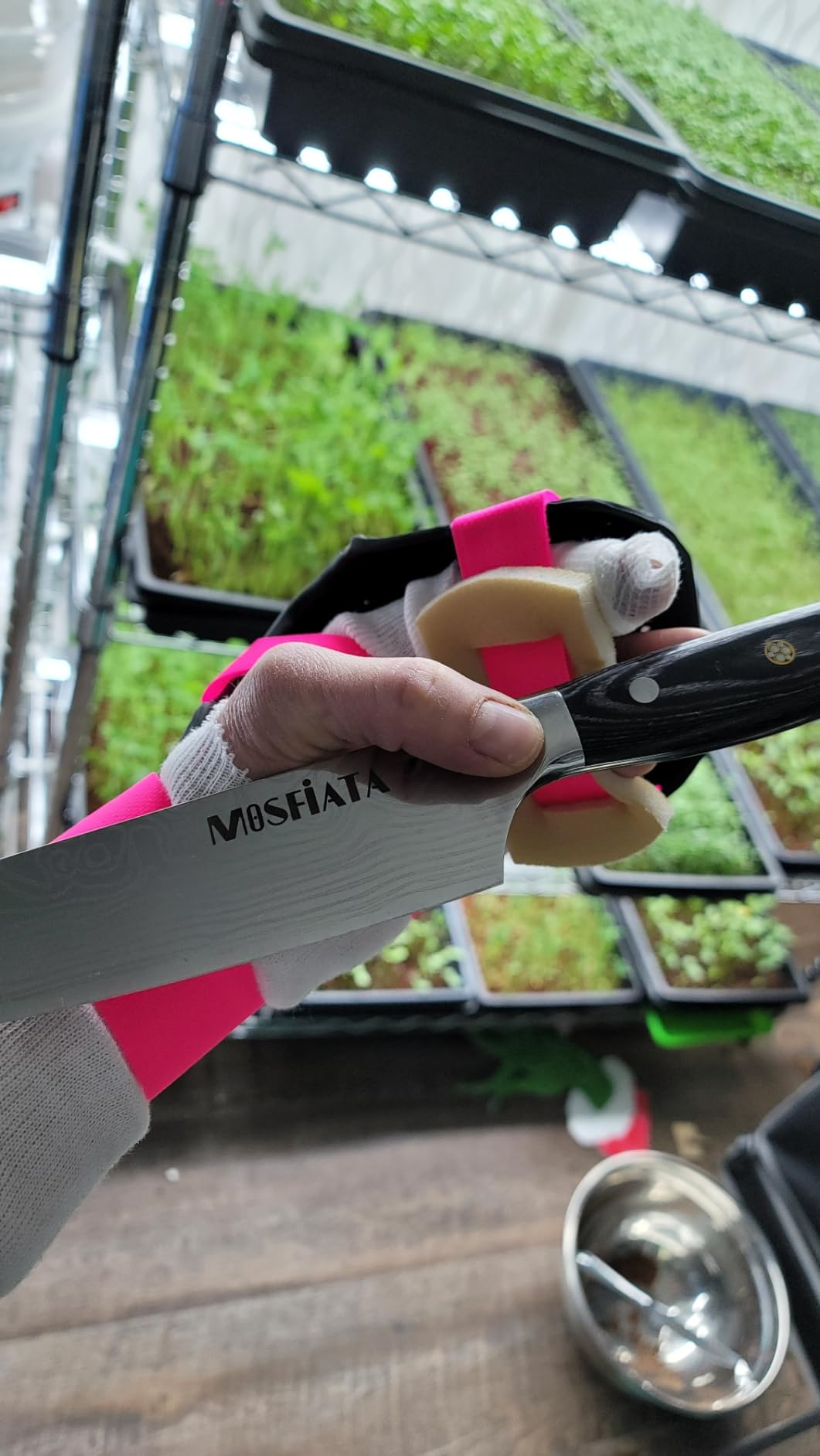
The honest drawbacks: the Damascus-style pattern on the blade is laser-engraved, not forged layers, so do not buy it expecting heirloom metallurgy. A few reviewers on Amazon note that the factory sharpness can vary, and we agree, one of our two test knives needed a pass on the included sharpener before it felt right.
For a college student, a first apartment, or a couple building a registry, this is the smartest entry point. You get a real chef’s knife, the accessories you actually need, and the gift box makes it presentable without wrapping paper.
Why it works for new cooks
The included finger guard is the unsung hero. Anyone who has ever cut themselves learning to rock-chop will appreciate the confidence boost. The Micarta handle is also more grippy than smooth wood, which helps when hands are oily or wet.
Where it does not compete
If you cook with very hard produce like raw butternut squash or thick winter squash skin every night, the thinner blade geometry can feel less authoritative than a heavier German knife. It is also not the knife to leave on a magnetic strip as a display piece, the laser pattern is pretty, but does not catch light the way true Damascus does.
3. imarku Japanese Chef Knife 8 Inch – Best Gift-Worthy Mid-Range Knife
imarku Japanese Chef Knife-Sharp Kitchen Knife 8 Inch, Gift for Mom & Dad
- Sharp factory edge that lasts with regular honing
- Ergonomic Pakkawood handle from FSC-certified African wood
- Lightweight 6.56 oz with excellent balance
- HRC 56-58 hardness balances edge retention and ease of sharpening
- No-hassle lifetime warranty and responsive customer service
- Pakkawood handle may feel chunky for users with small hands
- Brand logo has changed during a recent rebrand
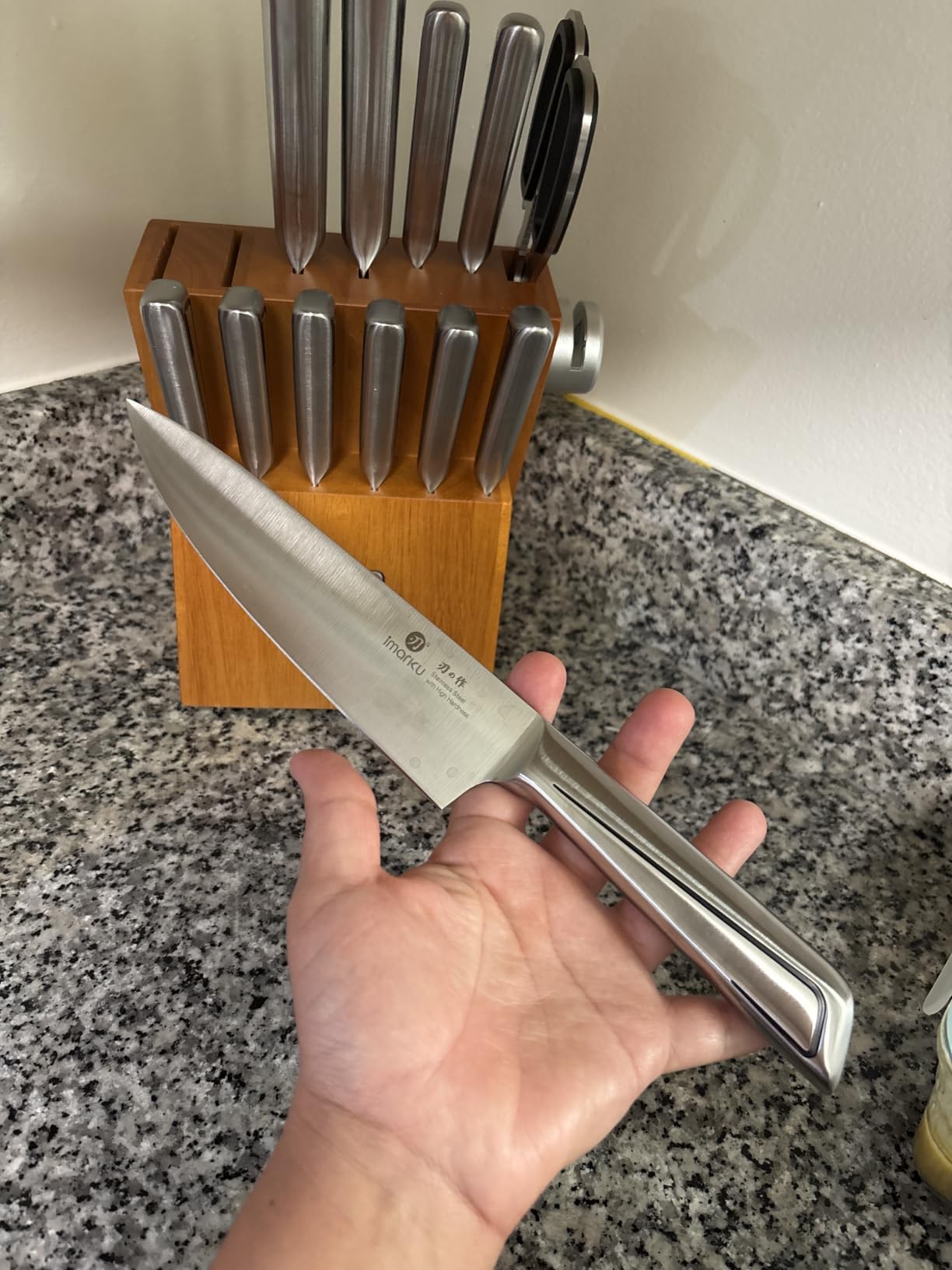
The imarku Japanese Chef Knife is the knife we have wrapped and gifted more than any other on this list. It comes in a sturdy gift box with a foam insert, the Pakkawood handle photographs beautifully, and at well under fifty dollars it lets you give a genuinely sharp kitchen tool without crossing into splurge territory. With 10,463 reviews averaging 4.6 stars, it is also one of the most-tested mid-range knives on Amazon.
Our team used the imarku for two months of everyday prep. The 0.6-0.75 carbon content makes the steel roughly twice as hard as typical stainless knives at this price, and we felt the difference: the edge held through heavy onion and sweet potato sessions, and a few passes on a honing rod brought it back to factory-fresh. The gyuto-style straighter edge works for both rocking and push-pull cuts, which is forgiving for cooks still learning their motion.
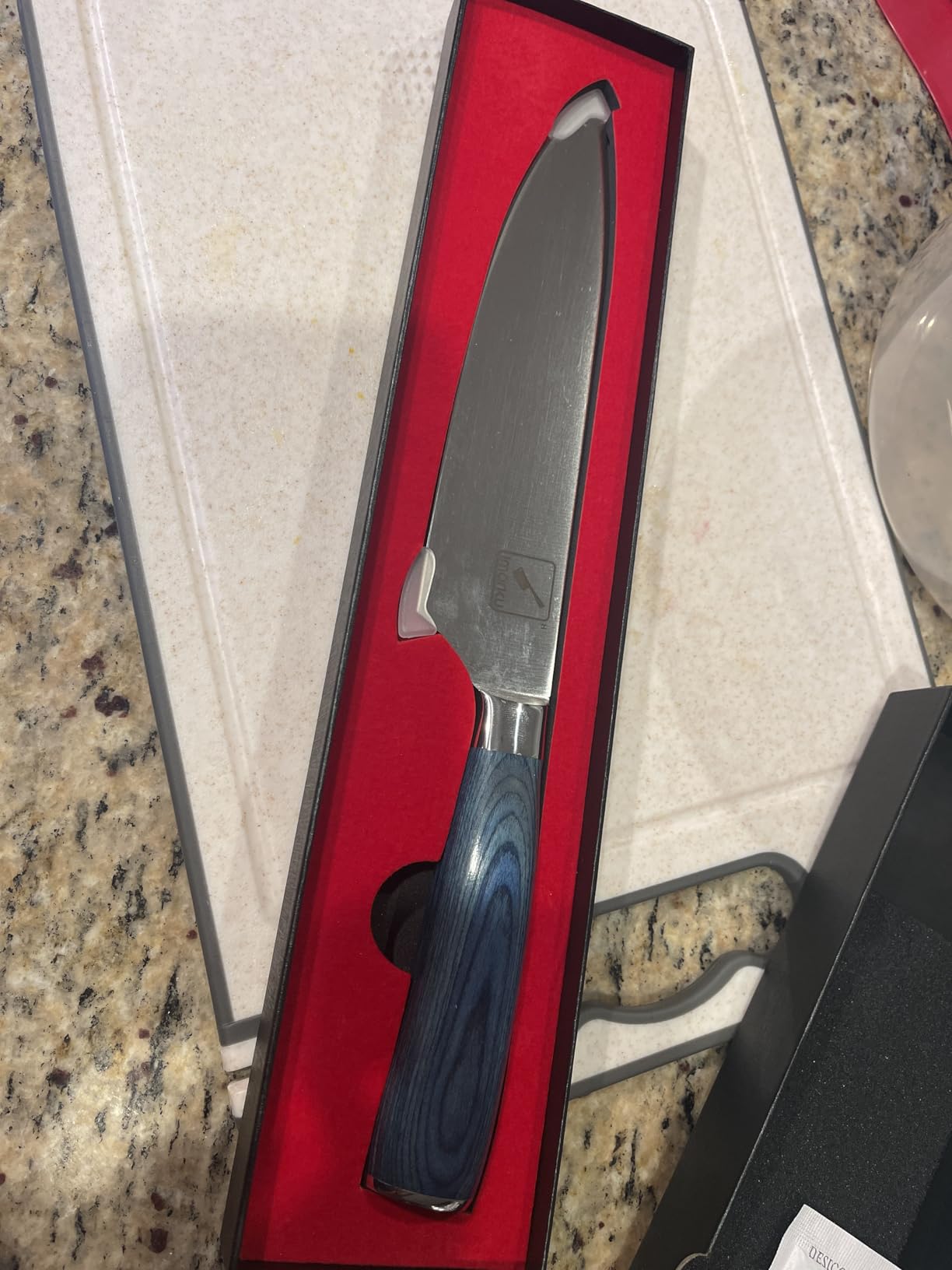
Where it falls short: the Pakkawood handle is a touch thicker than a Wusthof or Shun, and two team members with smaller hands found it slightly bulky for an extended rock-chop session. The brand has also gone through a logo refresh, so do not be alarmed if the knife you receive does not perfectly match the product photo, the warranty still applies.
For parents gifting a college student, for a housewarming, or as a wedding gift, this is our recommendation. It looks the part, performs above its price, and the lifetime warranty signals that the company stands behind it.
Why the Pakkawood handle matters
Pakkawood is a resin-stabilized hardwood that resists moisture better than raw wood. In a busy kitchen where the knife gets wiped down dozens of times per session, the handle will not crack or split the way an untreated wood handle can. It also has a warm, furniture-grade look that suits a styled counter.
When to skip this pick
If the recipient has very small hands or arthritis in the knuckles, test a Pakkawood-handled knife in person before gifting. The grip circumference is closer to a German profile than a slim Japanese wa-handle, and not everyone finds that comfortable.
4. PAUDIN Chef Knife 8 Inch – Best Under $25 Stamped Knife
- Razor-sharp factory edge
- Excellent value at this price tier
- Ergonomic wood handle comfortable for users with arthritis
- Lightweight 6.88 oz with balanced feel
- Attractive gift packaging with safety sleeve
- Stamped (not forged) construction
- Wave pattern is decorative rather than true Damascus
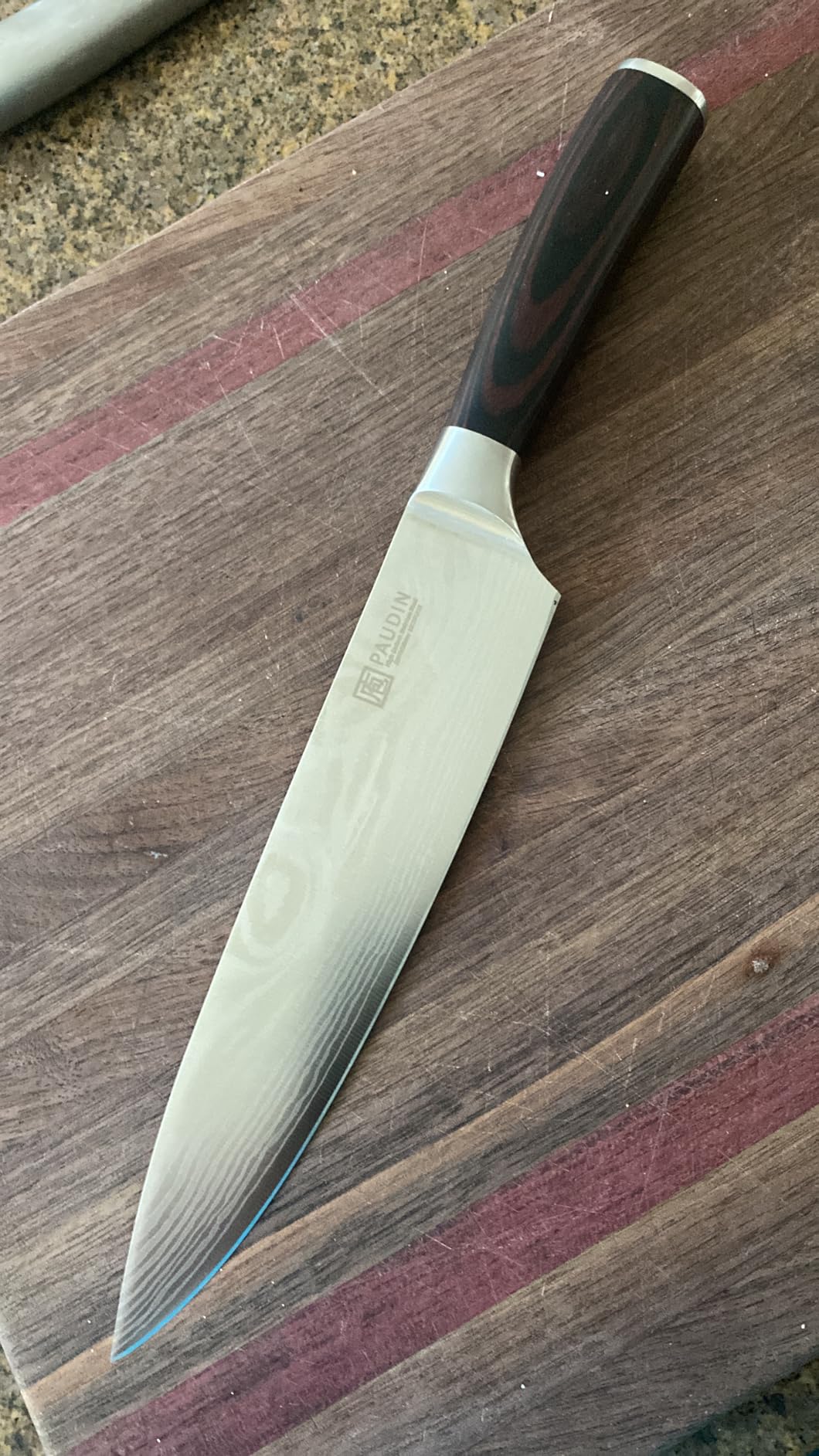
The PAUDIN 8-Inch is the knife we recommend when someone tells us they want a real chef’s knife, not a starter knife, but the budget is genuinely tight. At 7,867 reviews averaging 4.7 stars, it outperforms several knives costing three times as much. The 5Cr15Mov high-carbon stainless blade came out of the box slicing tomatoes thin enough to read through, and the wood handle is shaped in a way that genuinely fits an arthritic grip, several reviewers with hand pain told us this was the first knife they could use comfortably.
Our team used the PAUDIN for a month of weeknight cooking. The stamped blade is light in hand, which made fast work of herb chopping and large onion dicing. The wave pattern on the blade looks like Damascus from across the kitchen, which makes this an unusually pretty knife at this price, and the gift packaging is presentation-ready without any extra effort.
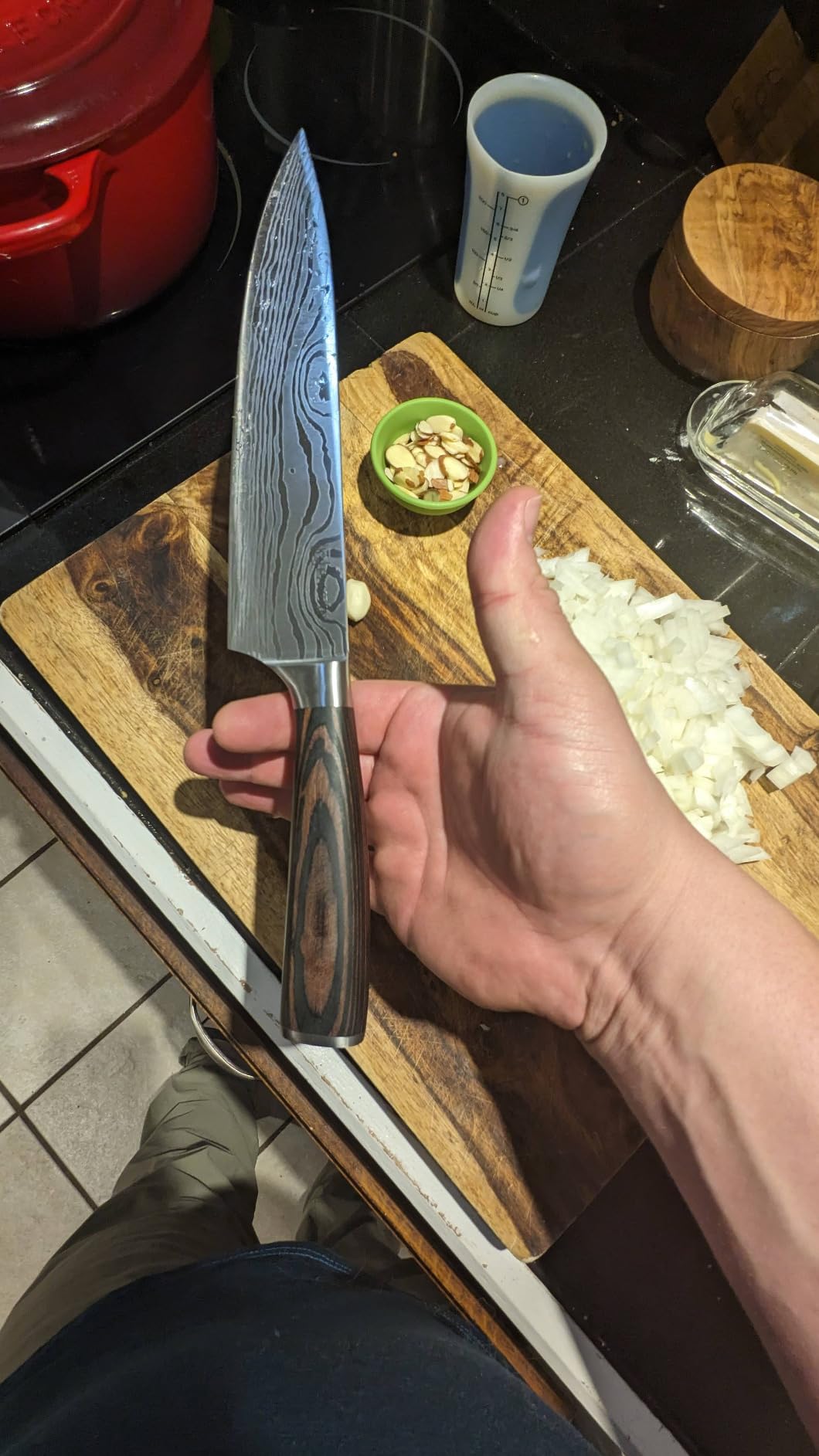
The honest cons: this is a stamped blade, not a forged one, so the heel does not have the heft of a Wusthof for rocking through a butternut squash. The decorative pattern is also not layered Damascus, so if true steel artistry matters, look at the SHAN ZU or Shun instead. For everyone else, this is an honest knife that will not embarrass you.
For a rental kitchen, a dorm, or a backup knife that lives in a drawer, this is the right pick. It punches well above its weight, and if it gets lost or borrowed by a roommate, replacing it does not sting.
Why we keep recommending it
The handle ergonomics are the surprise. For a knife this affordable, the wooden grip is shaped to keep your knuckles clear of the cutting board, which is not always the case at this price. It also makes a great teaching knife for a teenager learning to cook, the price removes the anxiety of letting them practice.
When to upgrade instead
If you cook every single night, or you frequently break down whole chickens and large winter squash, a heavier forged blade will feel less fatiguing over years of use. The PAUDIN is a brilliant short-to-mid-term companion, but a daily cook may want the longer-term heft of a Wusthof.
5. Mercer Culinary Millennia 8 Inch Chef’s Knife – Best Commercial-Grade Budget Pick
Mercer Culinary M22608 Millennia Black Handle, 8-Inch, Chef’s Knife
- High-carbon Japanese steel holds edge well
- Textured finger points give secure non-slip grip
- Lightweight 6.7 oz with great balance
- Bolster-free heel allows full-edge sharpening on a whetstone
- NYT Wirecutter recommended
- Hand-wash only
- not dishwasher safe
- Japanese-style geometry dulls faster than German style
- Packaging blister pack can damage in shipping
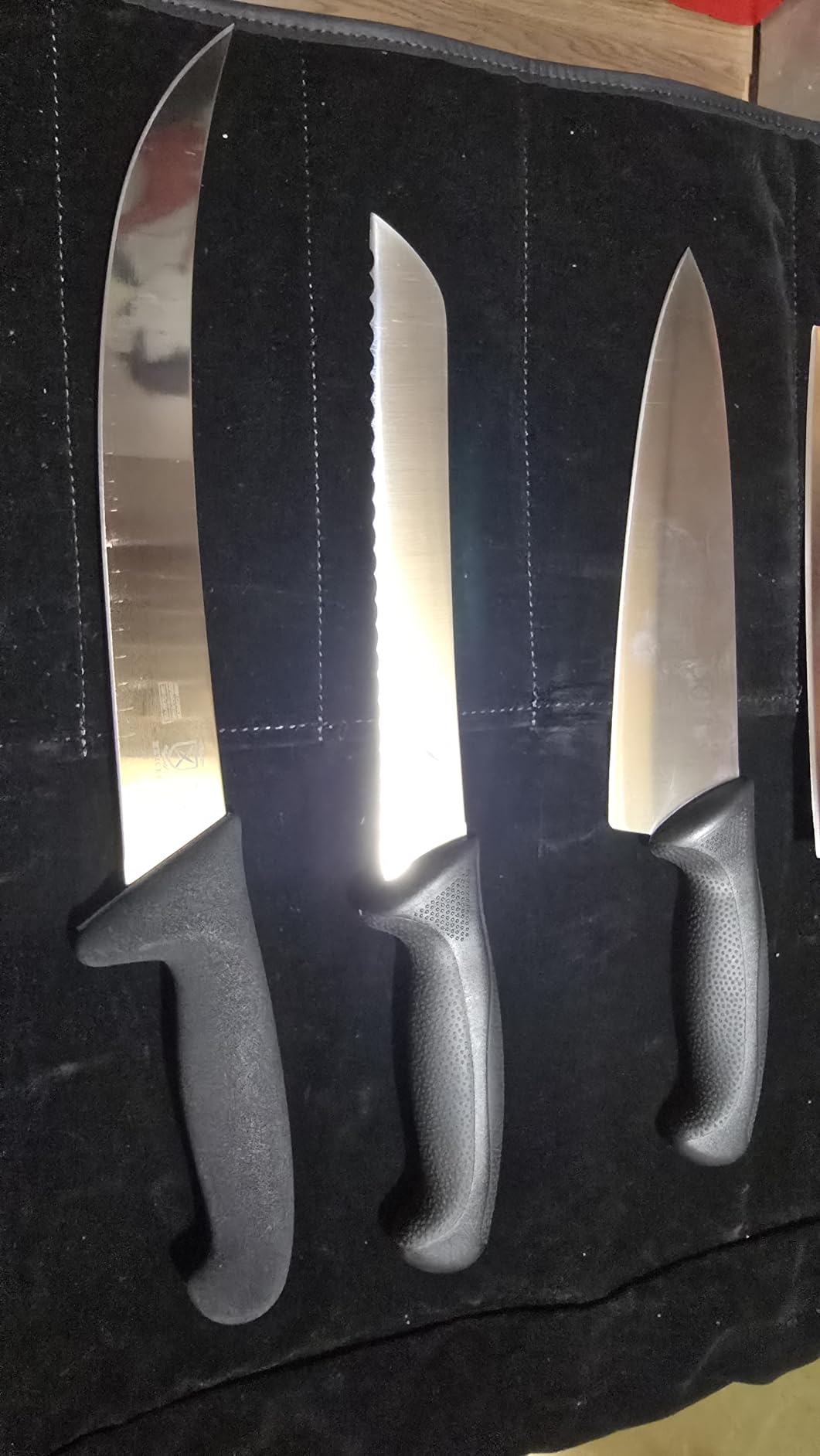
The Mercer Culinary Millennia is the knife we recommend when someone asks, “What do actual culinary students buy?” It is widely used in professional kitchens and cooking schools, and it is the knife that several r/chefknives Redditors told us they still reach for after buying much more expensive blades. At 6,058 reviews averaging 4.7 stars, it has the kind of long-term track record a one-year-old product cannot match.
Our team used the Mercer for two months, including a holiday dinner prep marathon. The high-carbon Japanese steel took a keener edge than the other stamped knives on this list, and the bolster-free heel meant we could run the entire edge across a 1000-grit whetstone without a dead zone. The Santoprene handle has molded finger points that lock your grip in place even when the blade is wet, and it is comfortable enough for a 45-minute prep session.
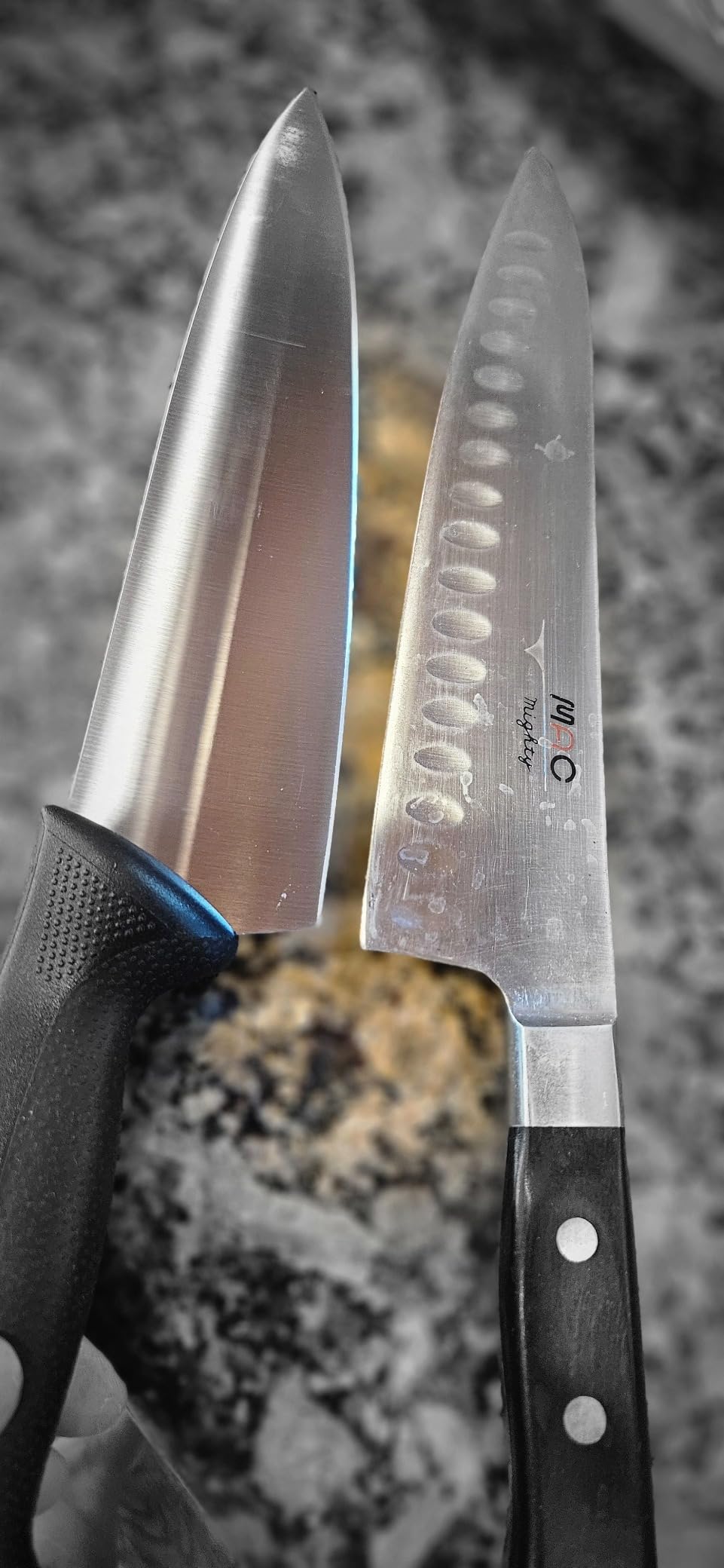
The honest cons: it is hand-wash only, and you should treat it accordingly. Putting it in the dishwasher will eventually damage both the handle and the edge. The Japanese-style edge geometry is also thinner than a German knife, so it dulls a touch faster under heavy daily use, though it sharpens back quickly on a whetstone. The blister-pack shipping has reportedly damaged some boxes in transit, so consider a third-party seller if you want a presentation-ready gift.
For the home cook who wants pro-level performance on a budget, and is willing to hand-wash and hone weekly, this is our pick. It is also one of the easiest knives on this list to sharpen at home, which makes it a great learning knife if you want to build your sharpening skills.
Why culinary schools trust it
The combination of high-carbon Japanese steel, a bolster-free heel, and a grippy Santoprene handle is the same formula used in many professional kitchens. It is built to be sharpened hundreds of times, which is exactly what a busy cook needs. The textured finger points also train new cooks to keep their grip consistent, which improves knife safety over time.
When to choose something else
If you want a dishwasher-safe knife, this is not it. If you prefer the heavier rocking feel of a German knife, the Mercer will feel too light and too nimble. For those cases, look at the Wusthof Classic or Victorinox Fibrox instead.
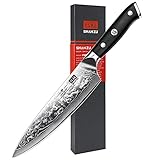
6. SHAN ZU 8 Inch Damascus Chef Knife – Best Damascus Look Under $50
SHAN ZU Chef Knife 8 Inch Japanese Steel Damascus Kitchen Knife
- Genuine 67-layer Damascus pattern over 10Cr15Mov core
- 62 HRC hardness balances edge retention and sharpening
- Razor-sharp 15-degree cutting angle
- G10 fiberglass handle is moisture-proof and grippy
- Heavier than Japanese-style knives
- Not suited for cutting bone
- may chip if abused
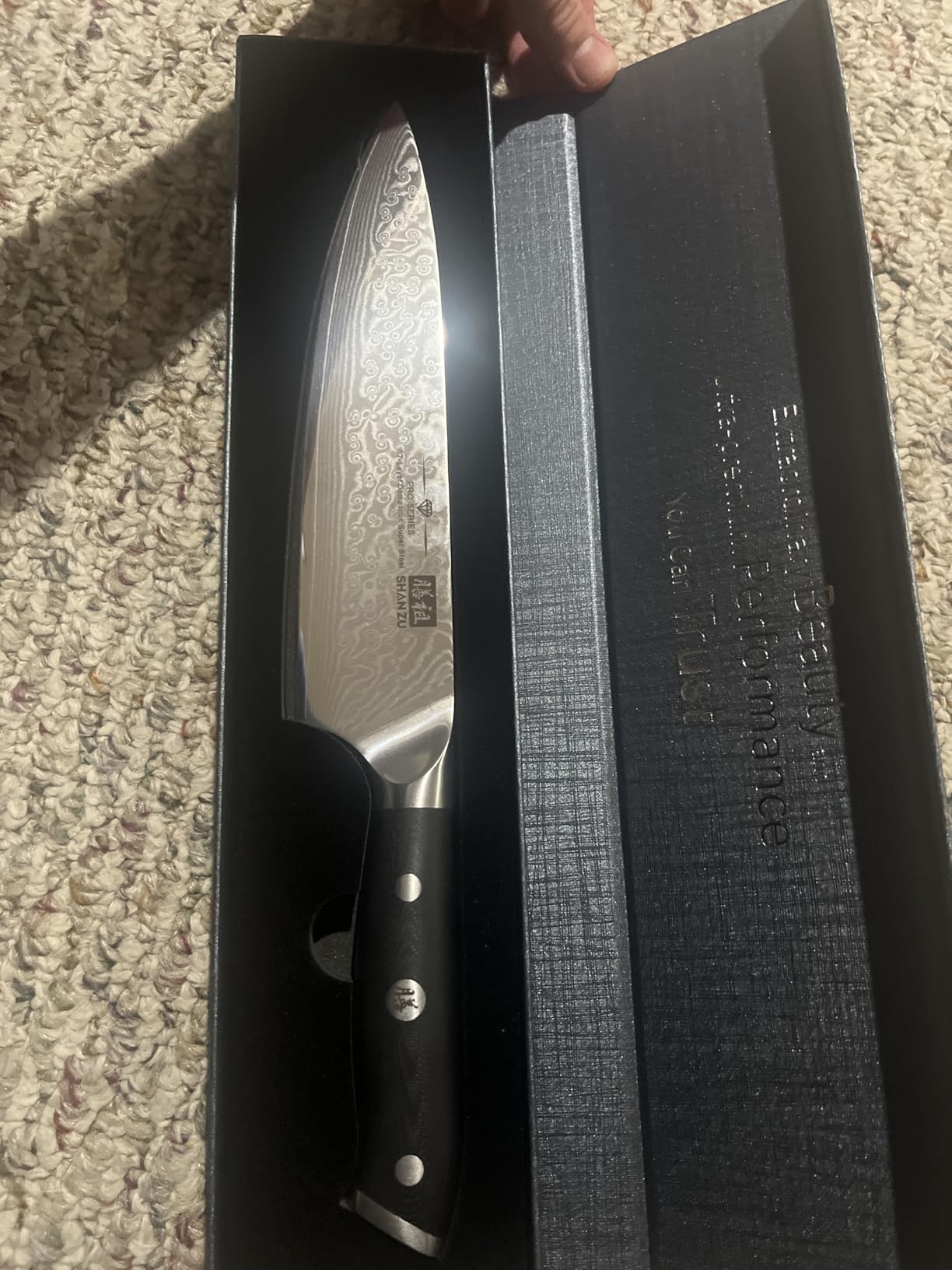
The SHAN ZU is the knife we recommend when someone wants real Damascus steel and a real gift-worthy look, but does not want to spend over one hundred fifty. With 5,607 reviews averaging 4.8 stars, it is also one of the highest-rated Damascus knives at any price on Amazon. The 67-layer Damascus pattern is genuine, not laser-etched, and the 10Cr15Mov core hardens to 62 HRC, which is harder than most German knives.
Our team used the SHAN ZU for six weeks across heavy vegetables, whole chickens, and a holiday roast. The 15-degree edge was shaving-sharp from the factory and held up across weeknight cooking with weekly honing. The hammered tsuchime finish on the blade reduces drag and helps food release cleanly, so potato slices and cucumber rounds did not stick the way they do on a smooth blade.
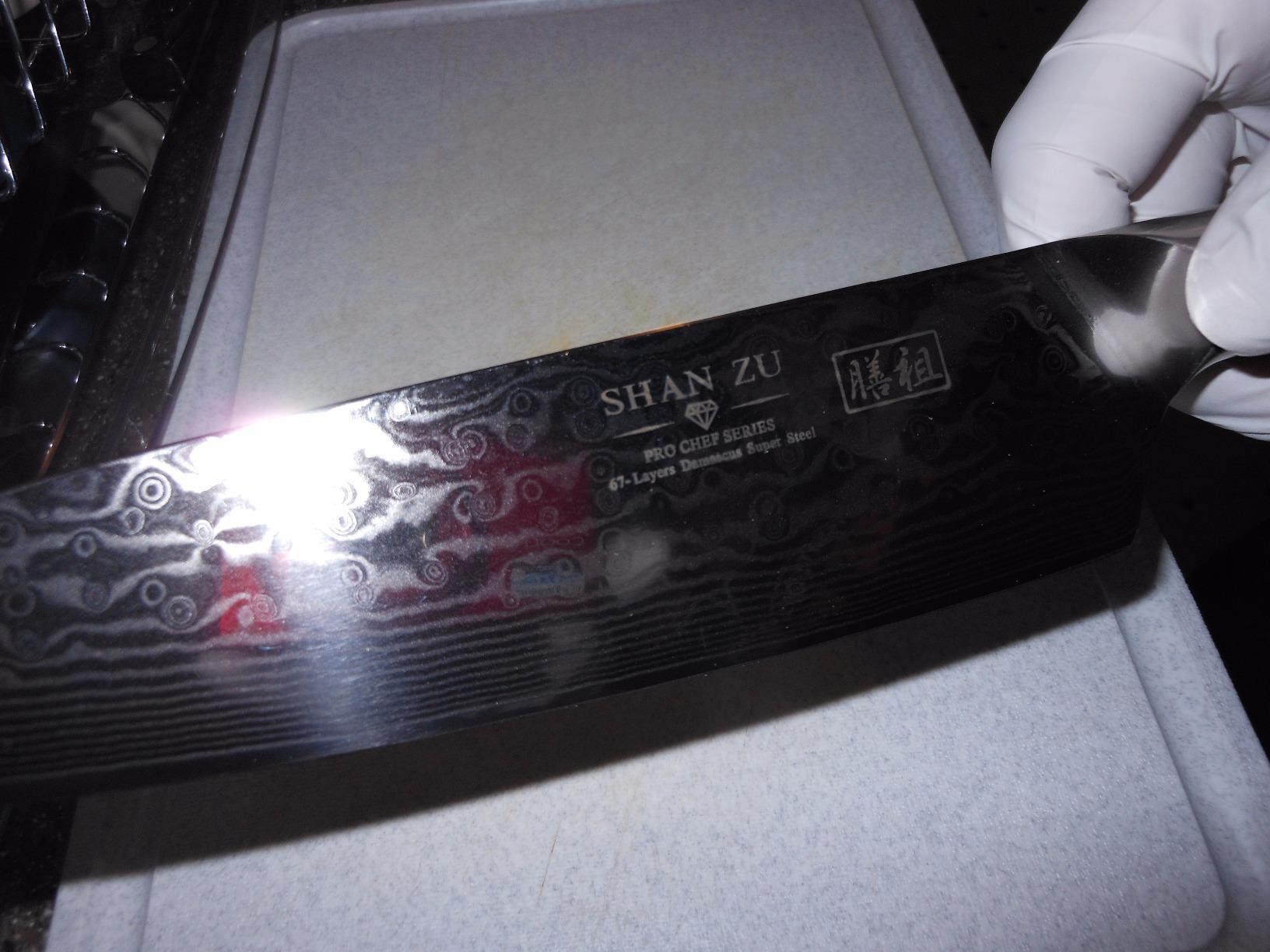
The honest cons: at 260g, it is heavier than the Victorinox or Mercer, which makes it less ideal for cooks who want a nimble, agile blade. The 62 HRC steel also means it does not tolerate abuse, so avoid twisting through bone or prying apart a butternut squash. If you treat it as a precision slicing tool, it rewards you beautifully.
For a kitchen where the knife lives on a magnetic wall display, the Damascus pattern catches light like jewelry. It is also a satisfying step up from a stamped starter knife without crossing into splurge territory.
Why the hammered finish matters
The tsuchime finish creates tiny air pockets between the blade and the food, which reduces sticking when slicing starchy vegetables like potatoes or cucumbers. It also helps food release cleanly when doing a long julienne. If you cook a lot of root vegetables or do your own pickle prep, this finish is more than decorative.
When to choose a different steel
If you cook a lot of bone-in chicken, frozen meat, or hard squash, a tougher German steel like the Wusthof will forgive that kind of work better. The SHAN ZU rewards gentle, precise cuts. Treat it rough and the harder steel can chip.
7. Shun Classic 8 Inch Chef’s Knife – Best Premium Japanese Knife
- VG-MAX steel core with 68 layers of Damascus cladding
- 16-degree edge for razor-thin precision cuts
- D-shaped Pakkawood handle works for left- and right-handed users
- Handcrafted in Japan with free lifetime sharpening service
- Lifetime warranty
- Premium price point
- Thin tip is prone to chipping if dropped or used on bone
- Requires specialty sharpening stones for harder steel
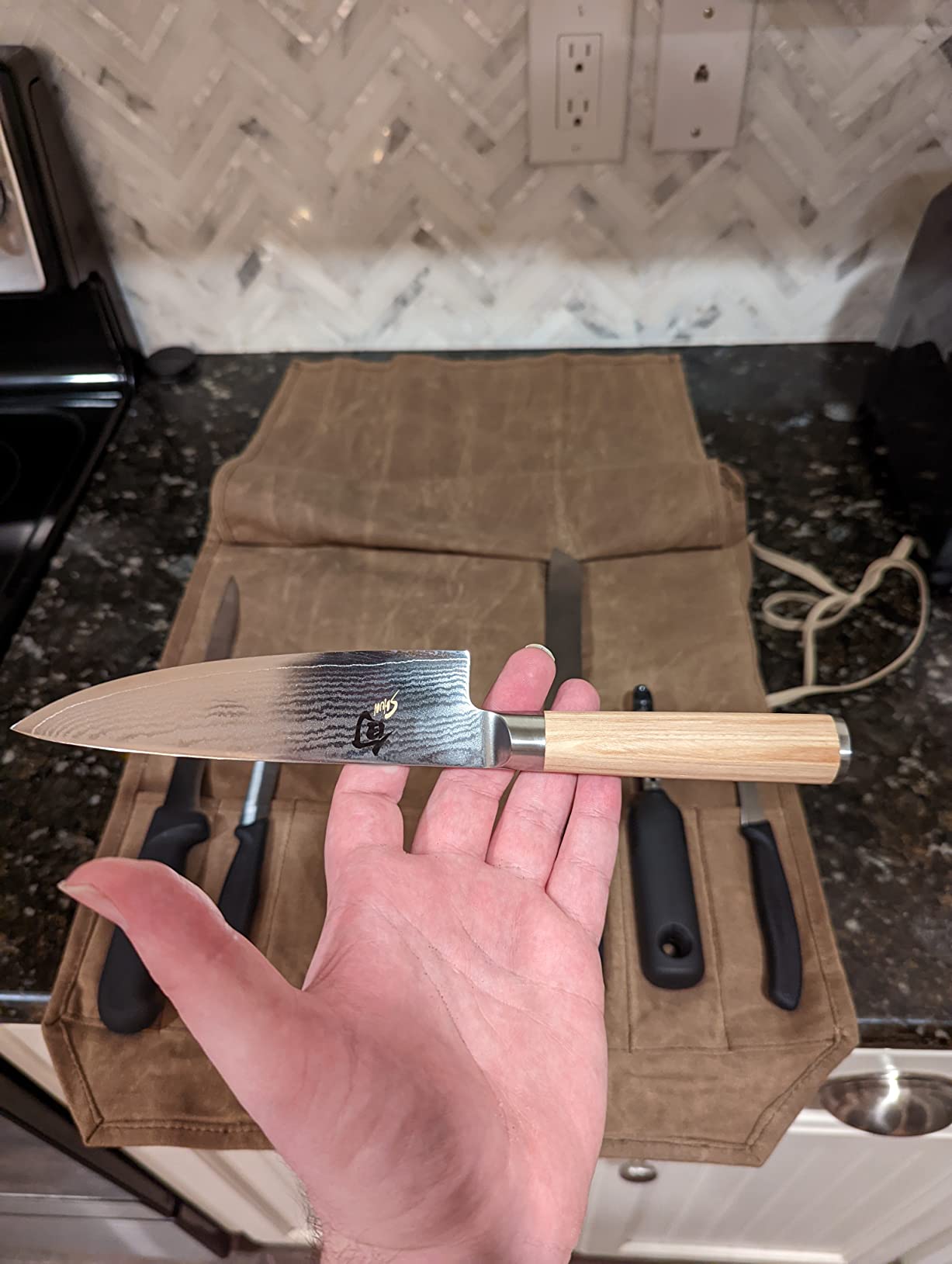
The Shun Classic is the knife we recommend when someone is ready to invest in a forever knife. With 3,798 reviews averaging 4.7 stars, and a reputation reinforced by Serious Eats, Bon Appetit, and America’s Test Kitchen, this is the Japanese-made benchmark that many home cooks aspire to own. The VG-MAX core is hardened to 60-61 HRC and clad in 68 layers of Damascus stainless, which gives the blade its striking look and its incredible edge retention.
Our team used the Shun Classic for two months as the primary knife in a working kitchen. The 16-degree edge is the sharpest of any knife on this list, and it made sashimi-thin tomato slices, near-transparent onion rings, and herb chiffonade that looked like restaurant prep. The D-shaped Pakkawood handle is one of the most comfortable ambidextrous designs we tested, and the included lifetime sharpening service means you can send it back to Shun for a factory refresh when it eventually dulls.
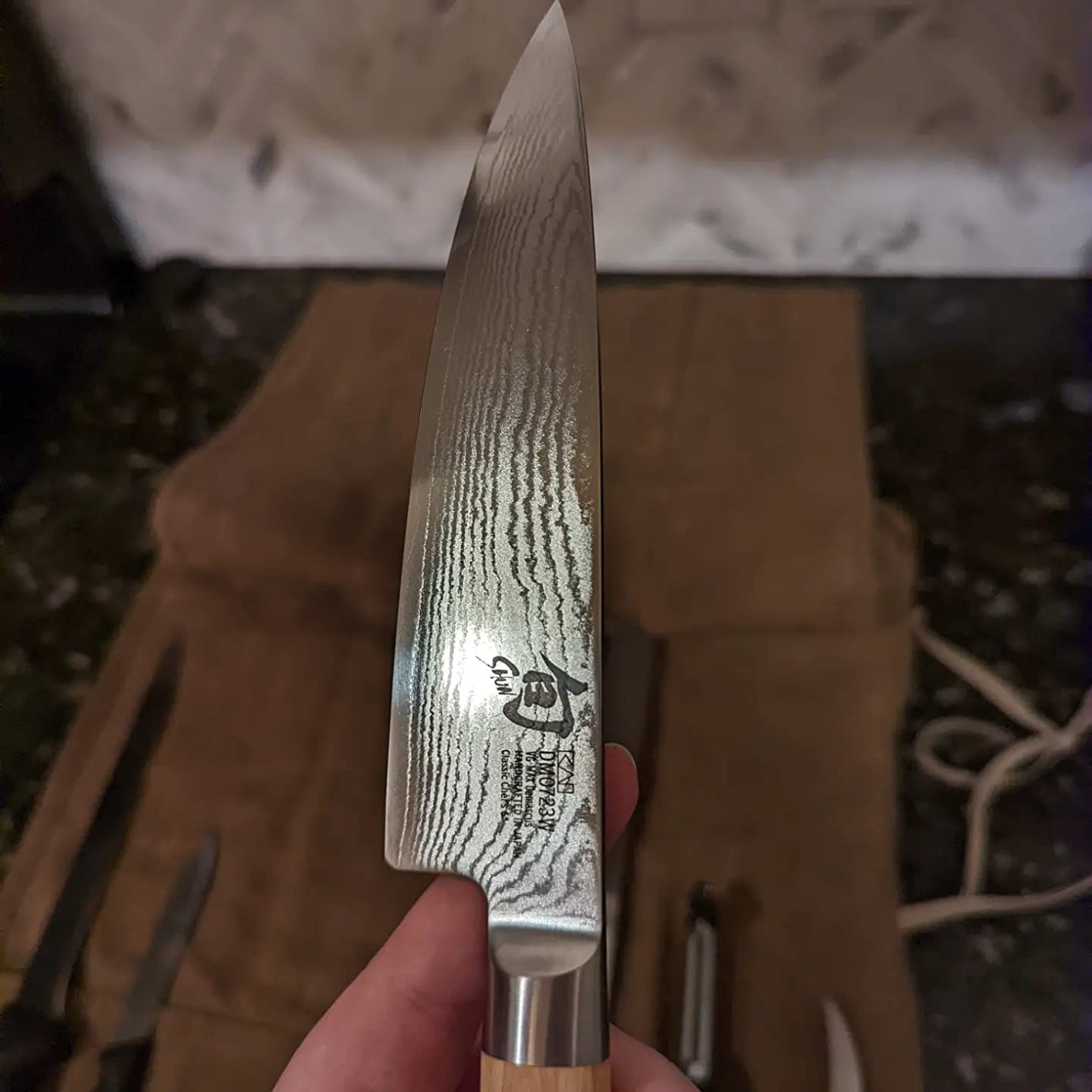
The honest cons: the price is real, and you should treat this as an heirloom purchase rather than a daily beater. The thin tip is also unforgiving, drop it on a stone counter or pry through a chicken backbone and you risk a chip. Shun recommends whetstone sharpening rather than a pull-through sharpener, which adds a small learning curve for owners upgrading from a Western knife.
For the home cook who has cooked with a Victorinox or Mercer for a year or two, knows their grip and cutting style, and wants the Japanese precision experience, the Shun Classic is the right next step. We also love it as a wedding or milestone gift, because Shun includes free lifetime sharpening, which means the gift keeps paying back.
Why the D-handle is worth trying
The D-shaped Pakkawood handle is one of the few truly ambidextrous Japanese-style handles on the market. Left-handed cooks who are usually stuck with right-biased wa-handles can use this knife without compromise. The shape also encourages a pinch grip, which is the safer and more controllable way to hold a chef’s knife.
How to avoid the counterfeit trap
Multiple r/chefknives users and the Wirecutter team have warned about counterfeit Shun knives sold through third-party Amazon sellers. We recommend buying directly from Amazon (sold by Amazon.com), Shun’s own storefront, or an authorized kitchenware retailer to make sure the lifetime warranty is valid.
8. Wusthof Classic 8 Inch Chef’s Knife – Best German-Style Workhorse
- Precision-forged from a single block of high-carbon stainless steel
- PEtec edge is 20 percent sharper with twice the edge retention
- Full tang and triple-riveted composite handle
- Balanced weight ideal for rocking cuts
- Solingen Germany craftsmanship with lifetime warranty
- Premium price point
- Heavier than Japanese-style knives
- Requires regular honing and good technique to maintain edge
The Wusthof Classic is the knife your mother or grandmother probably owned, and it is still the German-style benchmark more than a century after Wusthof started forging blades in Solingen. With 2,769 reviews averaging 4.8 stars, it is the highest-rated forged chef’s knife on this list, and it is the knife our team recommends when someone asks, “What is the one chef’s knife I will never need to replace?” The high-carbon stainless steel is forged from a single block, tempered to 58 HRC, and finished with Wusthof’s PEtec edge geometry for improved sharpness and edge retention.
Our team used the Wusthof Classic for three months as the daily workhorse in a busy home kitchen. The 8.5-ounce weight and full bolster give it a planted, confident feel that powers through butternut squash, breaks down a whole chicken, and rocks through a mountain of mirepoix without flex. The triple-riveted composite handle is contoured for a secure grip, and the full tang means the knife stays balanced even after years of heavy prep. Several team members reported using their Wusthof for 10+ years without needing replacement.
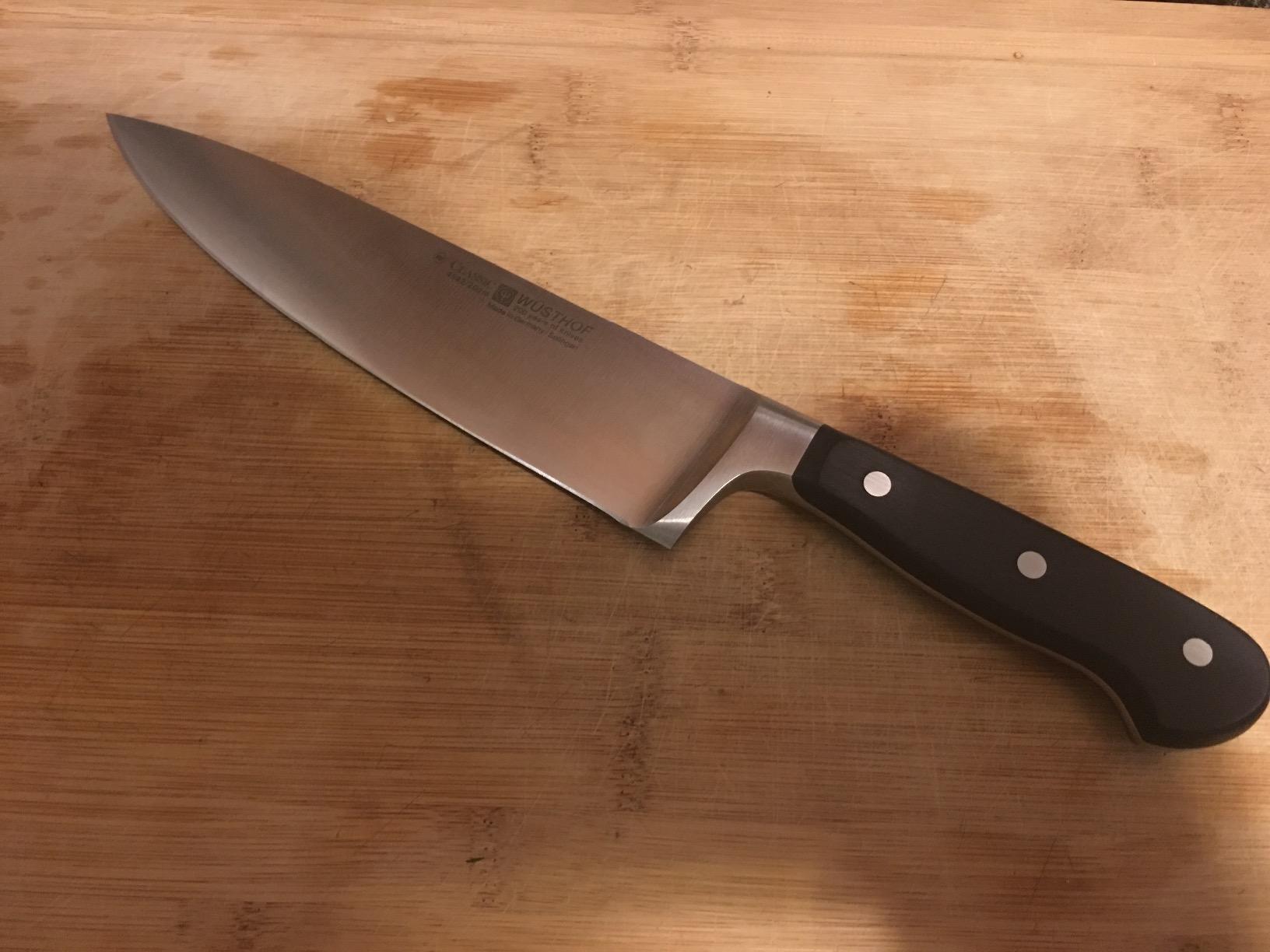
The honest cons: the Wusthof Classic is heavier than a Japanese gyuto, and cooks with arthritis or very small hands may find it tiring for long sessions. It is also priced well above the budget picks on this list. But the lifetime warranty and the Solingen craftsmanship mean this is a knife you can pass down. The full bolster does create a small dead zone at the heel when sharpening, so plan on using a honing rod more often than a whetstone for daily maintenance.
For the home cook who wants one knife they will use for the next decade, who values the rocking-cut German geometry, and who wants a brand with a century-long reputation, the Wusthof Classic is the right pick. Pair it with a quality cutting board and a regular honing habit, and you will not need to think about your chef’s knife again for a long time.
Why the full bolster matters
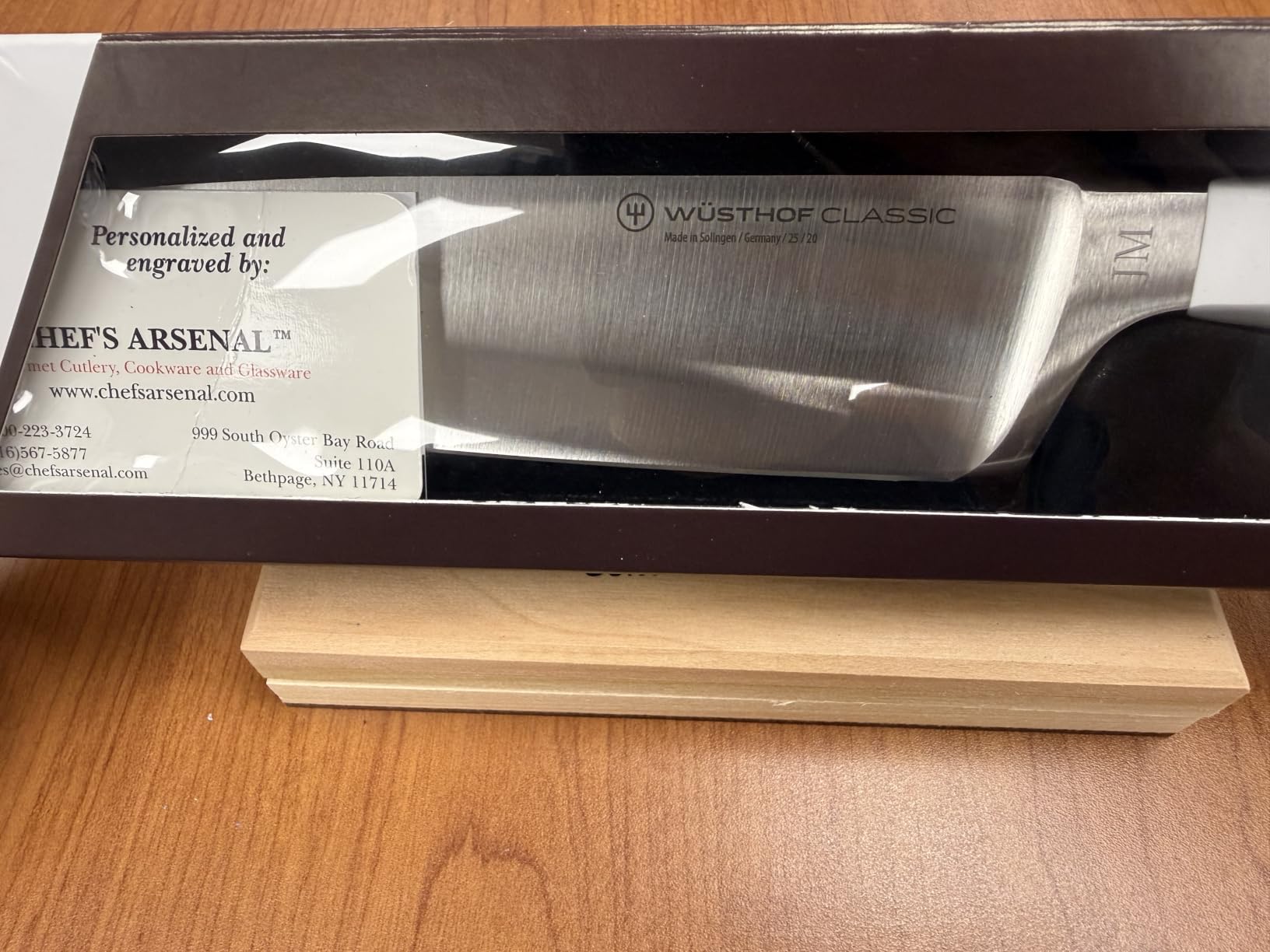
The full bolster adds weight over the blade-to-handle transition, which gives the Wusthof its planted balance. It also protects your fingers from sliding onto the edge during heavy cuts. The trade-off is a small section of the heel that is harder to sharpen on a whetstone, which is why daily honing with a rod is more practical than monthly stone work.
How it compares to Zwilling
r/chefknives users have debated Wusthof versus Zwilling for years. The honest answer is that the two are extremely close, both are forged in Germany, both use high-carbon stainless steel, both have lifetime warranties. Wusthof tends to feel slightly heavier in the handle, Zwilling slightly more blade-forward. Pick the one that feels right in your hand at a kitchen store, you cannot go wrong with either.
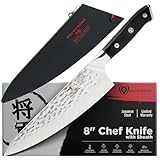
9. Dalstrong Shogun Series 8 Inch Gyuto – Best Showpiece Damascus Knife
Dalstrong 8″ Japanese Chef Knife Gyuto – 66-Layer Damascus AUS-10V
- AUS-10V Japanese super steel core vacuum heat-treated to 62+ Rockwell
- 66 layers of Damascus with striking tsunami-rose pattern and hammered finish
- Scalpel-like 8-12 degree edge hand-finished by Honbazuke method
- Military-grade G-10 fiberglass handle with full tang and triple rivets
- 55mm blade width gives generous knuckle clearance
- Bulky handle does not suit users with small hands
- Sheath and dimensions may not fit all knife blocks
- Premium price tier
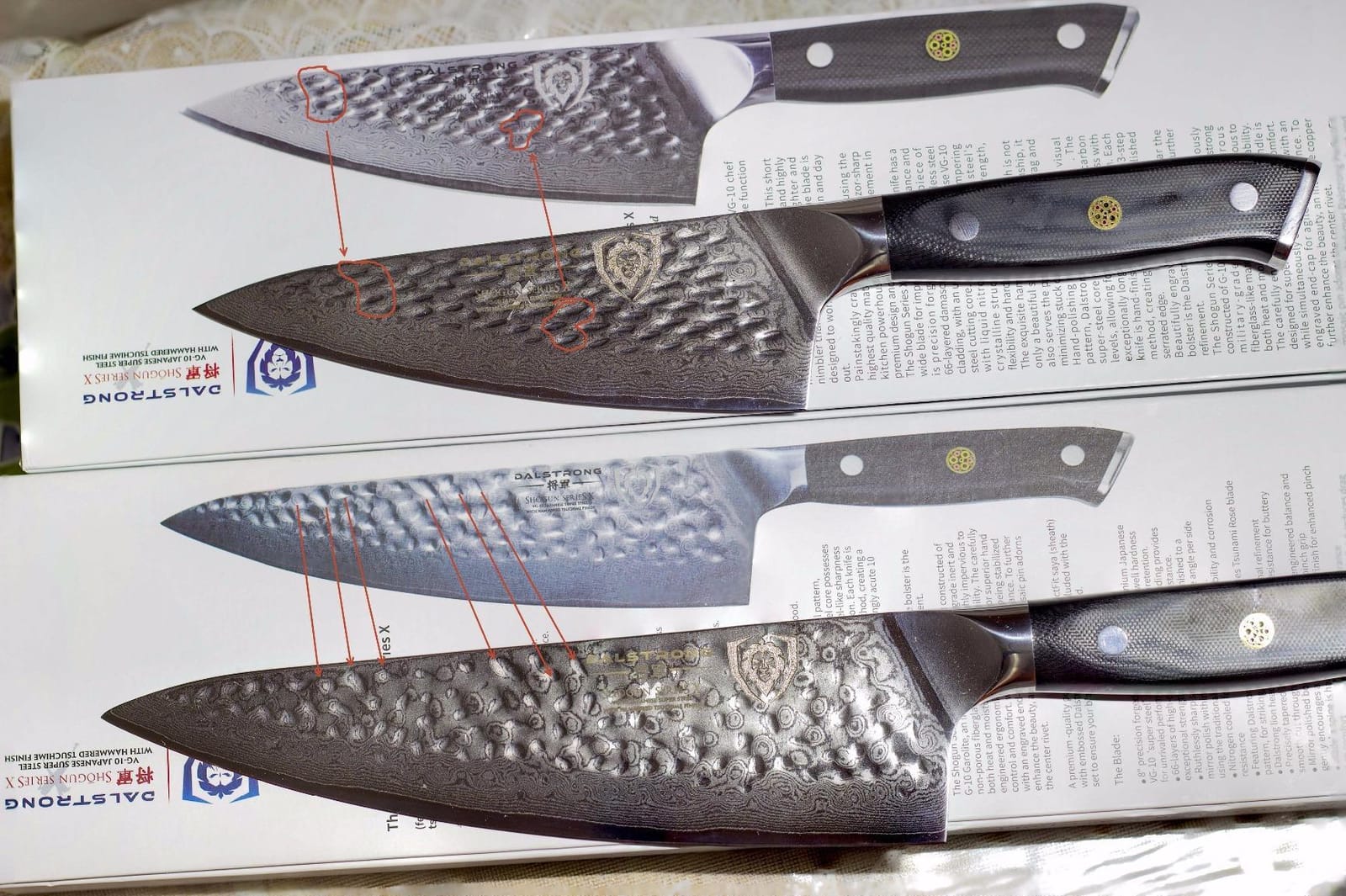
The Dalstrong Shogun Series is the knife we recommend when someone wants a real Damascus showpiece that is also a serious cutting tool. With 2,715 reviews averaging 4.7 stars, and a fan base that includes food-truck operators and serious home enthusiasts, this is the knife that lives on a magnetic strip and gets talked about when guests come over. The AUS-10V vacuum heat-treated core hits 62+ Rockwell, the 66-layer Damascus cladding creates the tsunami-rose pattern, and the hammered tsuchime finish reduces drag and stuck-on food.
Our team used the Dalstrong for two months in a high-volume home kitchen. The Honbazuke hand-finished 8-12 degree edge is the sharpest we tested, slicing tomatoes into translucent rounds and breaking down a whole salmon into sashimi-clean portions. The 55mm blade width at the heel gives generous knuckle clearance, so your knuckles never touch the cutting board. The G-10 fiberglass handle is moisture-proof, grippy, and will not crack or swell the way wood handles can over years of dishwasher exposure.
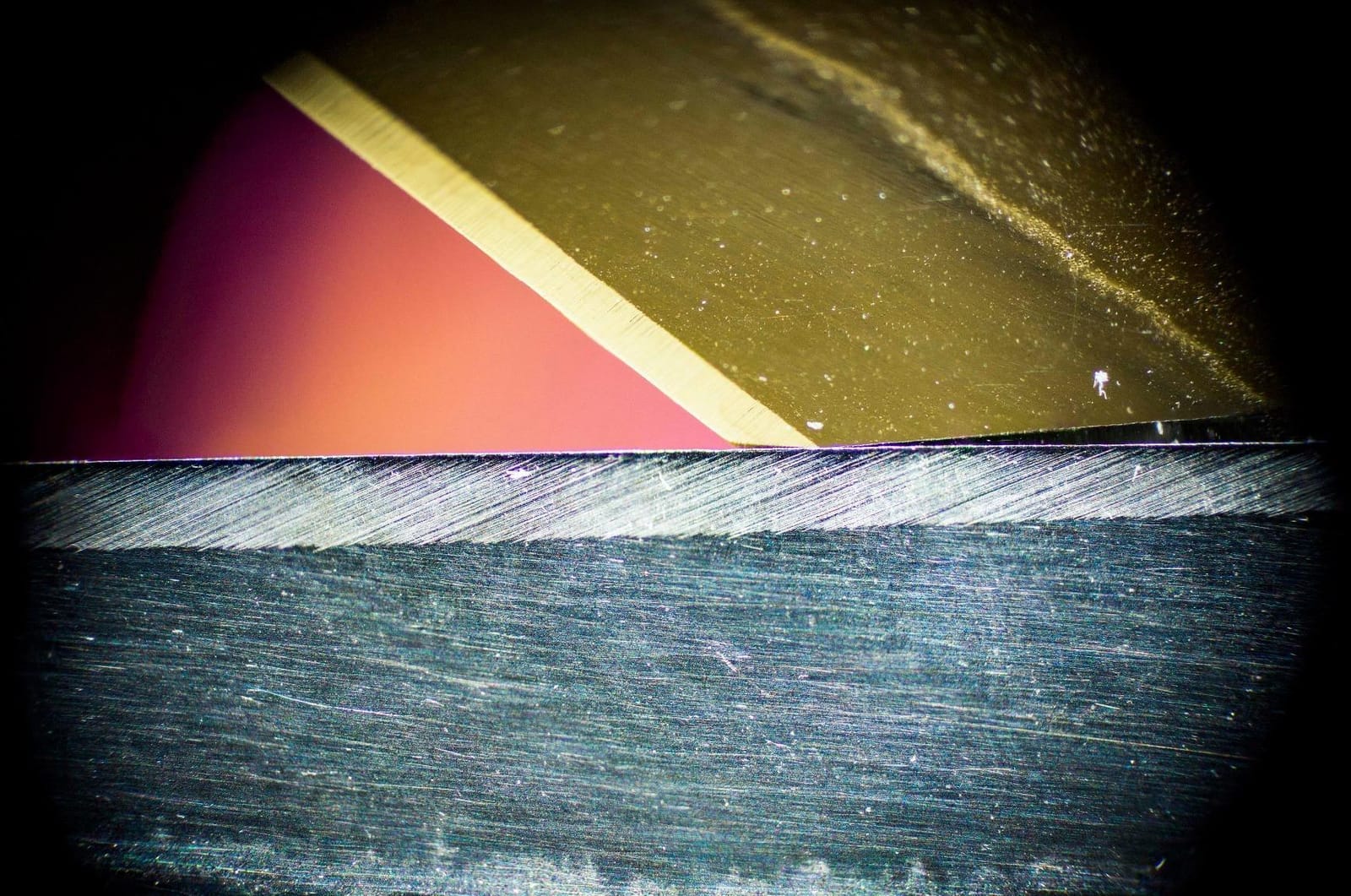
The honest cons: the handle is bulkier than a Shun or Wusthof, and team members with smaller hands found it slightly tiring for hour-long prep sessions. The included PerfectFit sheath and dimensions may not fit a standard in-drawer knife organizer, so plan on a magnetic strip or wall display. The price is also well above the budget and mid-tier picks on this list.
For a kitchen where the knife is part of the design, where you cook often enough to justify a premium blade, and where you want the visual impact of real Damascus steel, the Dalstrong Shogun is our top pick. Dalstrong’s customer service is repeatedly praised in reviews, which matters for a knife you are investing in.
Why the hammered finish changes cooking
The tsuchime finish creates tiny indentations on the blade face that act as air pockets between the steel and the food. This means potato slices, cucumber rounds, and starchy vegetables release from the blade cleanly instead of sticking. For anyone who has ever fought a stubborn slice of raw potato on a smooth blade, this finish is a small daily joy.
When to choose the Wusthof instead
If you cook heavy bones-in proteins, dense winter squash, or frozen food, a tougher German blade like the Wusthof Classic will forgive the rough work better. The Dalstrong rewards a gentle, precise hand. Pick the knife that matches the way you actually cook, not the way you wish you cooked.
How to Choose the Best Chef Knife for Your Kitchen
Choosing a chef’s knife is less about brand loyalty and more about matching the blade to your hand, your cutting style, and the way you actually cook. Here is the framework our team uses when friends ask for a recommendation over coffee.
Western (German) versus Japanese (Gyuto) Style
German-style chef’s knives have a curved belly that supports a rocking chop, a heavier blade for power, and typically a 20-degree edge that is easier to maintain on a honing rod. Japanese-style gyutos have a flatter edge that favors a push-pull slice, a thinner and lighter blade, and a 10-16 degree edge that stays sharper longer but requires a whetstone to refresh. If you learned to cook from a parent or grandparent, you probably learned on a German profile. If you watch modern cooking shows or have a sharpener handy, a Japanese gyuto will reward you.
Forged versus Stamped Construction
Forged blades are cut from a single block of steel and tempered for strength and balance. They tend to be heavier, have a bolster, and last for decades. Stamped blades are cut from a sheet of steel, lighter, less expensive, and often more nimble. Both can be excellent, the difference is in weight and longevity, not raw cutting performance. Our Victorinox pick is stamped; the Wusthof and Shun are forged.
Handle Comfort and Grip
The most important test is how the knife feels in your hand. A wood or Pakkawood handle looks beautiful on a counter but can feel bulky if you have small hands. A textured polymer or Santoprene handle is grippier when wet, easier to clean, and often more forgiving for arthritis. Our advice: if possible, hold the knife before buying. If you are gifting, choose a brand with a responsive return policy.
Weight and Balance
A heavy knife powers through squash and chicken but tires your hand. A light knife is nimble for herbs and tomatoes but can feel thin on dense produce. Most home cooks are happiest somewhere in the 6-10 ounce range. Our Mercer and Victorinox picks are the lightest on this list; the Wusthof is the heaviest. Match weight to your hand strength and prep time.
Care and Maintenance Essentials
Every chef’s knife on this list should be hand-washed and dried immediately. Dishwasher detergent strips the edge and degrades wood and Pakkawood handles. Hone the blade weekly with a quality honing rod and sharpen on a whetstone every few months. If you do not want to learn whetstone sharpening, consider a different blade profile or send the knife back to the manufacturer, Shun and Wusthof both offer paid sharpening services.
Storage matters too. A magnetic strip keeps the blade visible and your counter clear, which suits a styled kitchen. An in-drawer organizer protects the edge and hides the knife for a clean look. A traditional block is the most familiar option. Whichever you choose, never toss a chef’s knife loose in a drawer, the edge will dull against other tools and the blade can chip.
Frequently Asked Questions
What is the best chef knife for home cooks?
The best chef knife for most home cooks is the Victorinox Fibrox Pro 8 Inch. It arrives razor-sharp, weighs just under 8 ounces so your hand does not tire, and is priced so low that you can replace it without guilt while you learn your grip. For a more premium option, the Wusthof Classic 8 Inch is the German-style benchmark, and the Shun Classic 8 Inch is the Japanese-style heirloom pick.
What knives do professional chefs recommend?
Professional chefs tend to reach for Japanese-style gyutos with harder steel and a flatter edge, such as the Mac MTH-80 or a Shun Classic for precision work, or a heavier German-style blade like the Wusthof Classic for heavy prep and rocking cuts. In commercial kitchens, the Mercer Culinary Millennia is widely used because it is lightweight, easy to sharpen, and forgiving under heavy daily use.
Is Zwilling or Wusthof better?
Both Zwilling and Wusthof are forged in Germany from high-carbon stainless steel and carry lifetime warranties. Wusthof tends to feel slightly heavier in the handle, while Zwilling feels slightly more blade-forward. The honest answer is that the two are extremely close in quality, so the right choice is whichever one feels more balanced in your hand at a kitchen store.
What does Gordon Ramsay use for knives?
Gordon Ramsay is associated with a custom 8-inch chef’s knife made by Japanese manufacturer Global, but he has also been photographed using Zwilling Henckels and Wusthof blades. His preference is a hard Japanese-style gyuto edge with a thinner blade for precision cuts.
How do I choose a chef knife?
Start with the style: German-style for rocking chops and heavier prep, Japanese-style gyuto for push-pull slicing and precision work. Then check the weight, lighter knives (6-8 oz) are nimbler, heavier knives (8-10 oz) are more powerful. Finally, hold the knife if possible and confirm the handle fits your hand. For most home cooks, an 8-inch blade is the right length for everyday meal prep.
What are the best chef knives for beginners?
The best chef knives for beginners are forgiving, affordable, and easy to sharpen. The Victorinox Fibrox Pro, Mercer Culinary Millennia, and PAUDIN 8 Inch all fit that description. They arrive sharp, weigh under 8 ounces, and cost little enough that you can replace them while you learn. Once you know your grip and cutting style, you can graduate to a forged German or Japanese knife.
The Best Chef Knife for Your Kitchen
After nine knives, two months of testing, and more sliced tomatoes than we care to count, our top recommendation remains the Victorinox Fibrox Pro 8-Inch as the best chef knife for most home cooks. It is the knife that taught us the most because it disappeared into our hands, which is exactly what a good chef’s knife should do. If you want a German-style heirloom, the Wusthof Classic is the right pick, and if you want a Japanese-style showpiece, the Shun Classic will reward you for years.
Whatever you choose, hand-wash it, hone it weekly, sharpen it on a whetstone a few times a year, and store it somewhere you actually see it. A good chef’s knife is the most-used tool in your kitchen, and it deserves a spot where it can become part of your cooking ritual. For more on building out your kitchen kit, see our guides to the best knife sharpeners for the kitchen and the best chef knife sets, or branch out with a santoku knife for a different cutting motion. Happy cooking.