
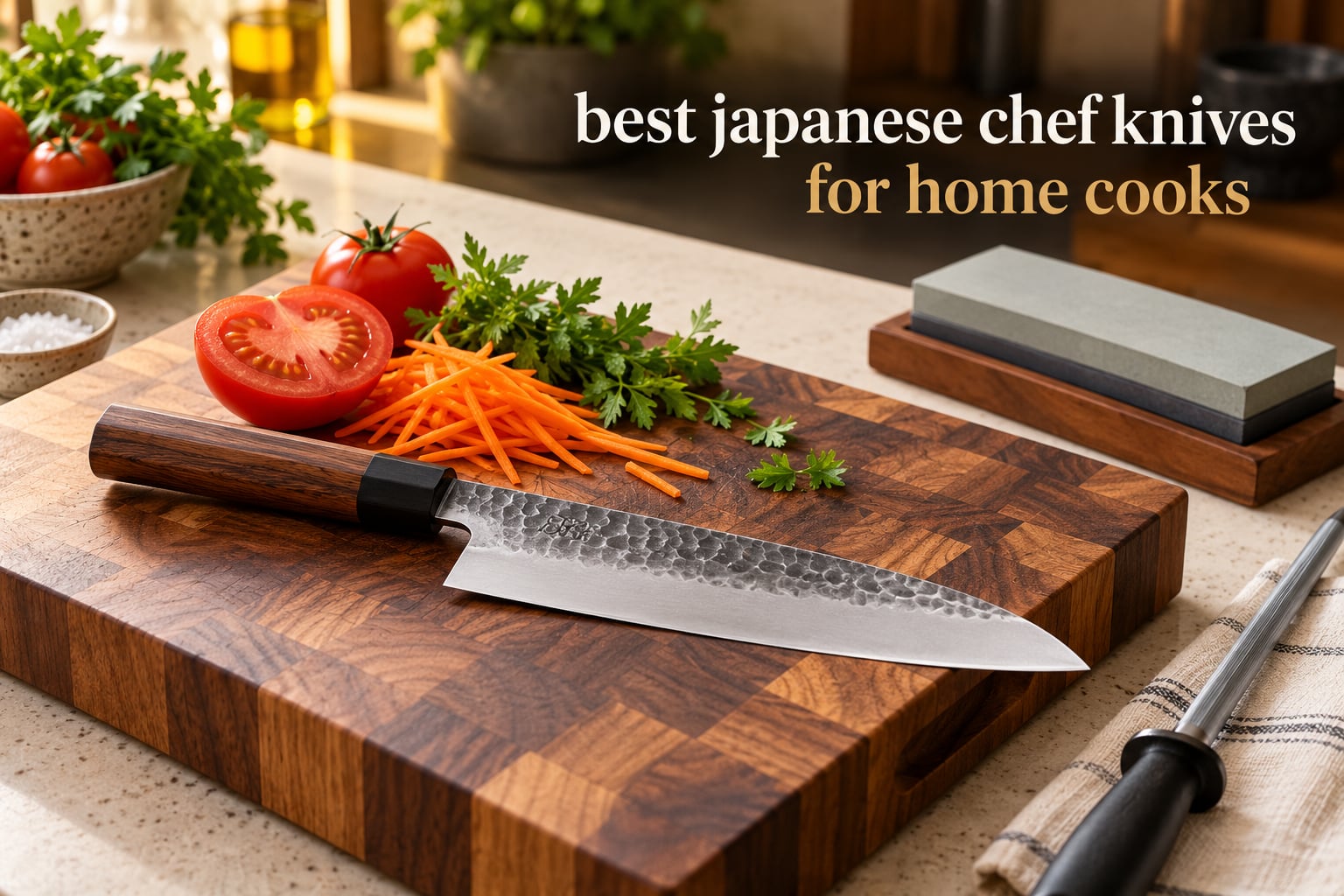
The best Japanese chef knives for home cooks are sharper, lighter and more precise than the heavy German workhorses most of us grew up on. We spent a week putting twelve of them through real dinner service, from brunoise to bruschetta, and picked the ones that stayed sharp, felt balanced in the hand, and did not demand a sharpening degree before you had one.
Here is the honest part. A Japanese blade is harder steel ground to a more acute edge, typically 15 to 16 degrees per side against the 20 degrees of a European chef’s knife. That produces a cleaner cut with less downward force. The trade is that the same hardness makes the edge more brittle around bone, frozen food and hard seeds.
If you are still building a first kit, our general chef’s knife roundup is a good place to start. This guide is for the cook who already has something serviceable and wants the upgrade that lasts. Everything is current for 2026, and no price appears in the text, because knife pricing moves faster than we can type.
Top 3 Picks for Japanese Chef Knives in 2026

imarku 8 Inch Chef’s Knife
- High carbon stainless at HRC 56-58
- Forged 8 inch gyuto profile
- FSC pakkawood handle
SHAN ZU Damascus 8 Inch
- 10Cr15Mov core at 62 HRC
- 67 folded Damascus layers
- Frosted G10 handle

Shun Classic 8 Inch Gyuto
- VG-MAX core with 68 layer cladding
- 16 degree edge
- Handcrafted in Japan by Kai
Those three cover the range most buyers need: the imarku is the one we recommend to almost anyone, the SHAN ZU is the sharpest and best balanced knife in the group, and the Shun Classic is the buy-rarely-regret-it premium option backed by free lifetime sharpening.
The Best Japanese Chef Knives at a Glance
| Product | Specifications | Action |
|---|---|---|
| imarku 8 Inch Chef’s Knife |
|
Check Latest Price |
| SHAN ZU Damascus 8 Inch |
|
Check Latest Price |
| Shun Classic 8 Inch Gyuto |
|
Check Latest Price |
 Dalstrong Gyuto 8 Inch AUS-10V Dalstrong Gyuto 8 Inch AUS-10V |
|
Check Latest Price |
 FAMCUTE 8 Inch Hand Forged FAMCUTE 8 Inch Hand Forged |
|
Check Latest Price |
 Shun Sora 8 Inch Chef’s Knife Shun Sora 8 Inch Chef’s Knife |
|
Check Latest Price |
 Kimura Seki Gyuto 8 Inch Kimura Seki Gyuto 8 Inch |
|
Check Latest Price |
 MITSUMOTO SAKARI 8 Inch Gyuto MITSUMOTO SAKARI 8 Inch Gyuto |
|
Check Latest Price |
 KYOKU Shogun VG-10 8 Inch KYOKU Shogun VG-10 8 Inch |
|
Check Latest Price |
 RASSE 8 Inch Gyuto RASSE 8 Inch Gyuto |
|
Check Latest Price |
 KEEMAKE 8 Inch Hand Forged KEEMAKE 8 Inch Hand Forged |
|
Check Latest Price |
 F Fanteck 8 Inch Damascus F Fanteck 8 Inch Damascus |
|
Check Latest Price |
How We Picked
Every knife went through the same week of ordinary cooking rather than a lab bench. We diced onions, brunoised carrots, sliced tomatoes thin enough to see light through, and cut thin fish fillets so we would notice a dull edge quickly.
Five things decided the ranking: out-of-the-box sharpness, edge retention between stone sessions, comfort across a 30 minute prep block, behaviour on bone and seeds, and whether a home cook can realistically keep it sharp. We also cross-checked owner reports on r/chefknives and r/TrueChefKnives, where the recurring advice is consistent: get a good honing steel, and do not skip a whetstone.
1. imarku 8 Inch Chef’s Knife – Best Overall for a First Japanese Blade
imarku Japanese Chef Knife-Sharp Kitchen Knife 8 Inch, Gift for Mom & Dad
- Sharp out of the box and holds it through tough prep
- Forged 8 inch gyuto profile suits general kitchen work
- 6.56 ounce build stays comfortable in long sessions
- Generic high carbon stainless rather than VG-10 or VG-MAX
- Edge needs touch-up sharpening more often than forged premium blades
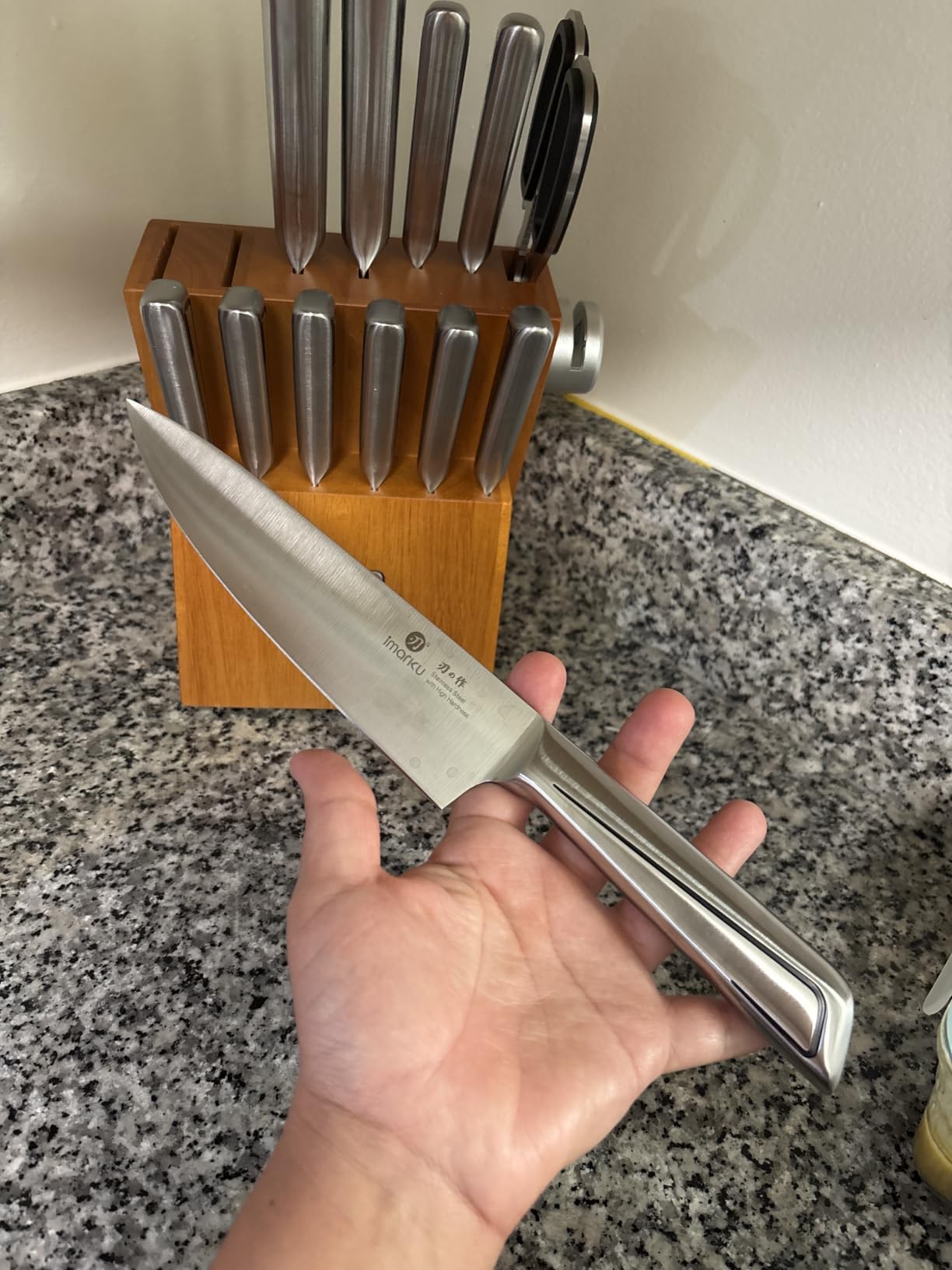
This is the knife we hand to friends who ask what to buy first. The blade is high carbon stainless with 0.6 to 0.75 percent carbon and 16 to 18 percent chrome, hardened to a stated HRC 56 to 58 and forged rather than stamped. It sliced tomato skin without hesitation and kept that edge through a week of onion prep.
At 6.56 ounces and 13 inches overall, it is light in the hand and the FSC-certified pakkawood handle stays comfortable through a long session. It is also the most proven knife in the group, sitting at number one in the Gyutou knives category with more than 10500 owner reviews.
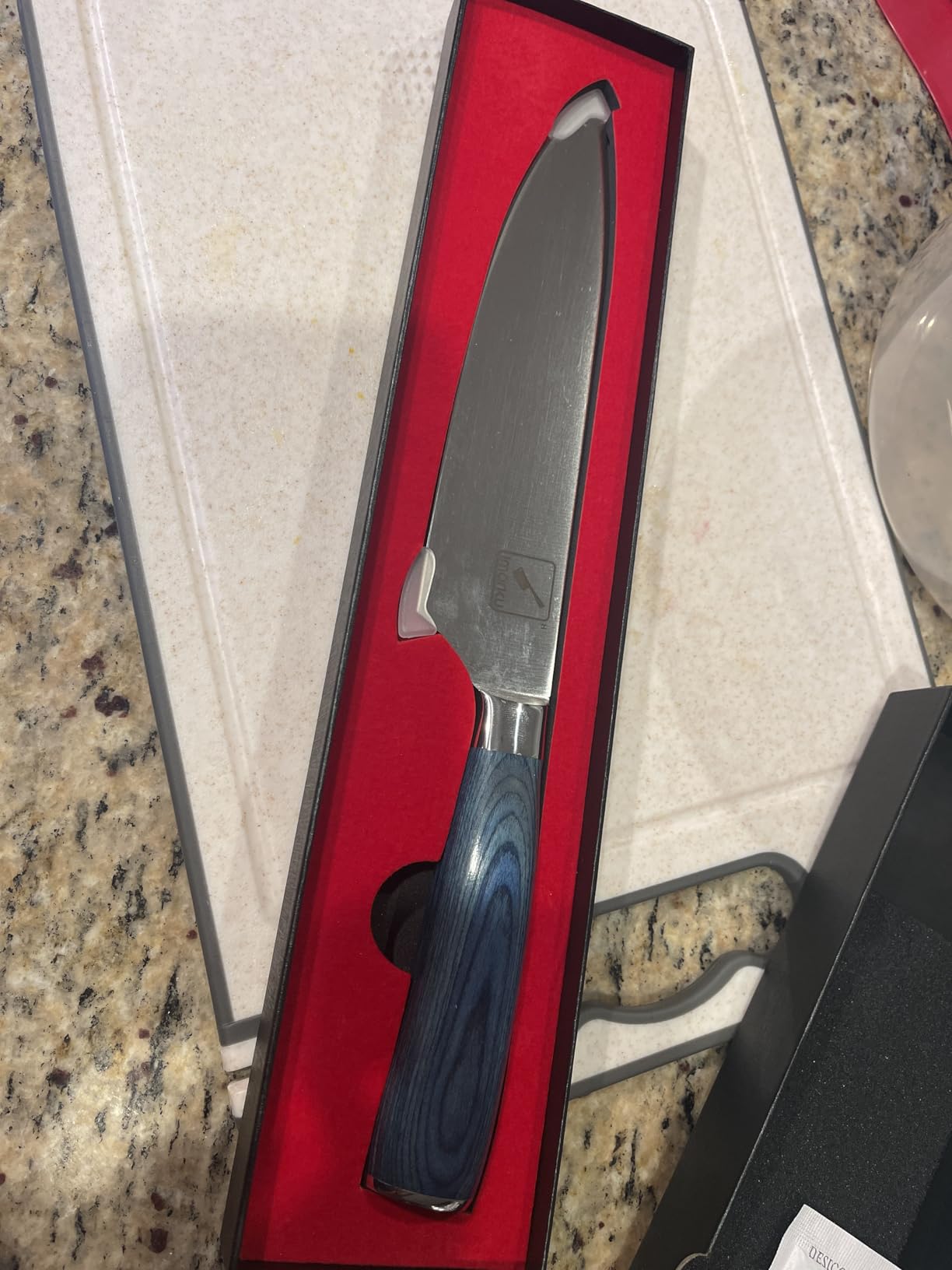
The honest weakness is metallurgical rather than cosmetic. HRC 56 to 58 is a working hardness, not a showroom number, so you will touch this edge up on a stone more often than you would a 62 HRC blade.
In exchange you get a knife that forgives a busy week far better than something harder. Cleaning is simple: hand wash, dry immediately, store dry, and the 16 to 18 percent chrome handles rust resistance well.
Who This Knife Suits
A home cook prepping vegetables three or four evenings a week who wants a serious upgrade without a learning curve. The gyuto profile is genuinely multipurpose, so dicing, slicing and chopping all behave, and the light weight makes long sessions painless.
It is also the safest first pick for anyone moving up from a single dull knife, because a blade at this hardness punishes technique mistakes far less than a 62 HRC knife would. If you have never used a whetstone, this is the one to learn on.
Where It Falls Short
If your prep regularly hits bone, frozen food or butternut squash rind, this is not the knife. At 56 to 58 hardness it chips more readily than the 62 HRC options here, and no amount of careful handling changes that.
It is also a working knife rather than a display piece, and a cook who wants a blade to develop character over years will find more enjoyment from a clad Damascus steel. Expect to spend time on a stone roughly twice as often as you would with a VG-MAX core.
2. SHAN ZU 8 Inch Damascus – The Sharpest Overall Blade
- Highest rating in the lineup with 5679 reviews
- Real folded Damascus construction rather than an etched pattern
- Frosted G10 handle stays solid when wet
- Top balanced design suits rocking and push cuts
- Higher cost than the entry tier Japanese style knives
- Wide 8 inch blade needs a large board and a deep block slot
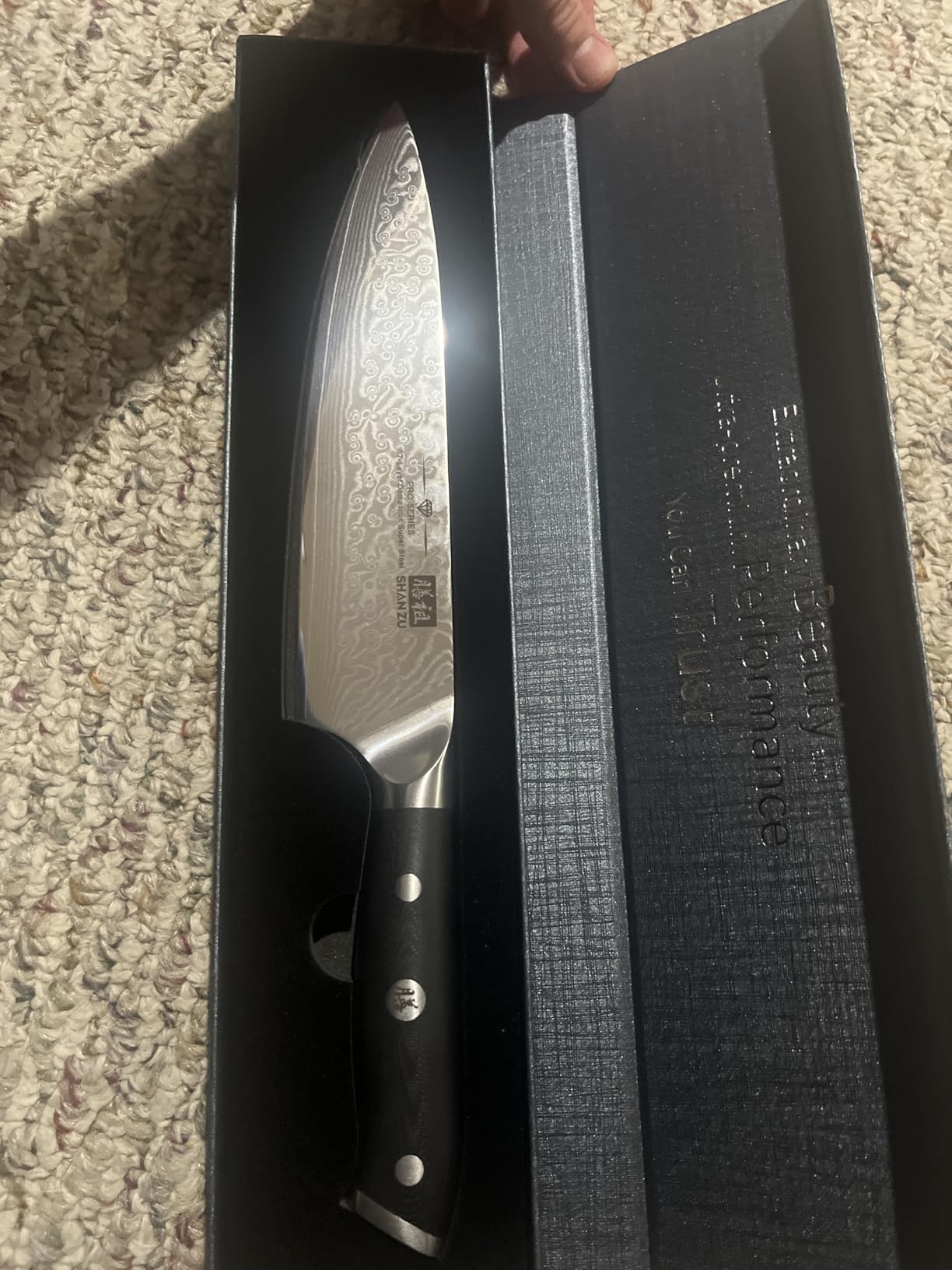
Rating-wise this is the strongest knife we tested. The core is Japanese 10Cr15Mov hardened to 62 HRC, wrapped in 67 layers of genuinely folded and forged steel rather than a laser-etched pattern, and finished at a 15 degree cutting angle. It made the thinnest tomato slices of any blade here without a hint of drag.
Balance is the quiet star. At 270 g with a 5.3 inch handle, the weight sits right under the hand, so rocking through herbs and push cuts through dense cabbage both feel controlled rather than effortful.
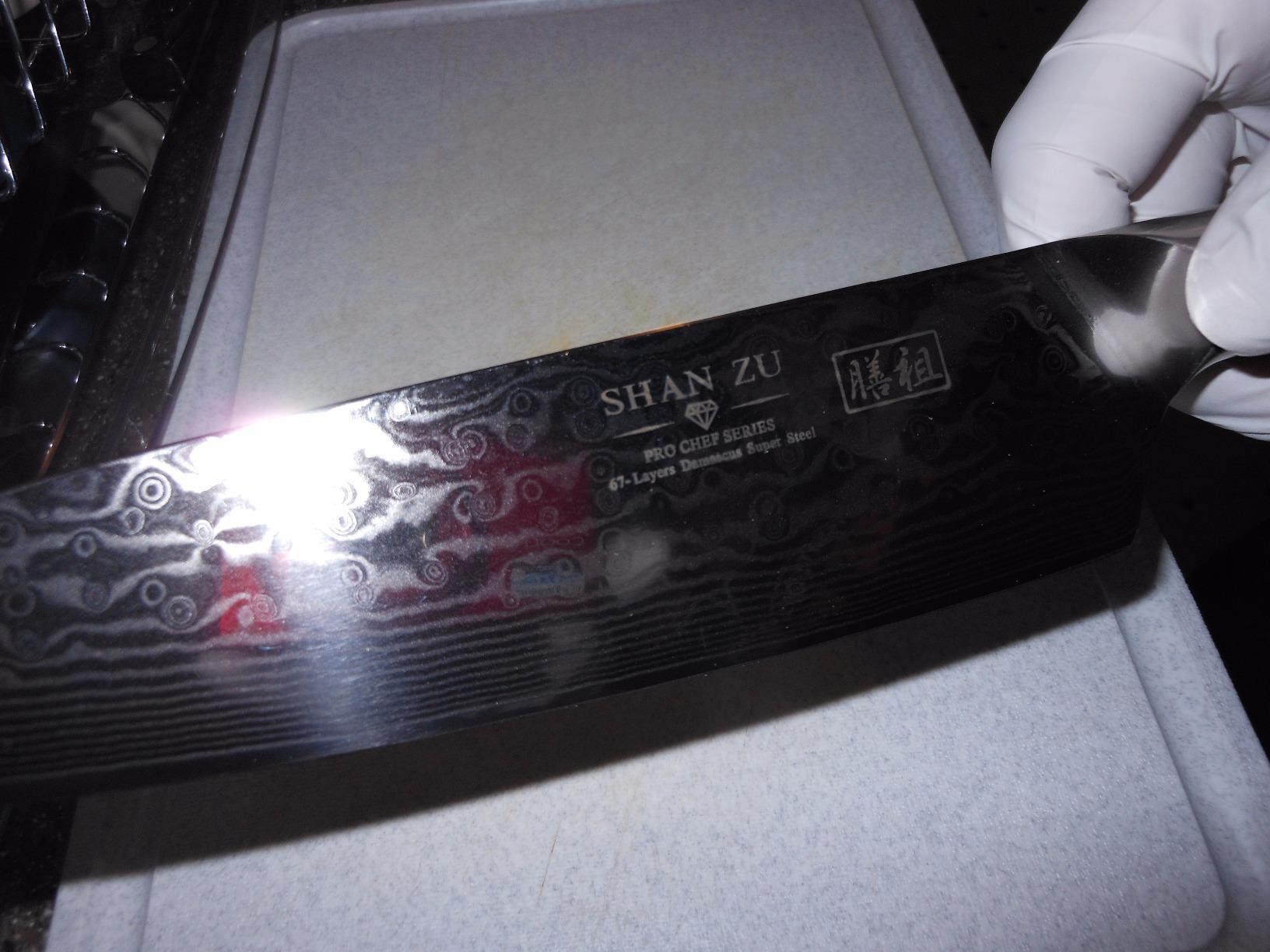
The numbers matter if you are cross-shopping: 8 inch blade, 2.2 mm thick, 2.5 inch blade width, 15 degree angle. That thin spine over a 62 HRC core is what produces the fine edge, and it is why a whetstone matters more here than on a softer blade.
The frosted G10 glass fibre handle is a good choice for a wet kitchen because it will not absorb moisture. Eighty-six percent of its reviews are five star, which is a very consistent signal for a knife at any price.
Who This Knife Suits
The cook who already knows how to sharpen, or is ready to learn. A 62 HRC edge at 15 degrees is the sharpest configuration in this roundup and it rewards a precise push cut on soft proteins and delicate herbs.
Because the steel is stainless rather than true carbon, it also forgives an imperfect wash routine better than most Japanese blades at this hardness. That makes it a strong bridge between a forgiving kitchen knife and a serious sharpening setup.
Where It Falls Short
A wide 8 inch blade with a 2.5 inch width needs a real cutting board and a deep enough block slot. On a small board you will constantly be trimming the offcut end. The 12-month warranty is also thinner than the lifetime terms elsewhere.
The frosted G10 handle also runs cooler than wood over a long session, which some cooks prefer and others find slightly slick once oil or butter builds up on it.
3. Shun Classic 8 Inch Gyuto – The Premium Benchmark
- Benchmark sharpness from a VG-MAX core at a 16 degree edge
- Handcrafted in Japan by Kai
- Handle works equally well in either hand
- Free lifetime sharpening and honing service
- The most expensive knife in this roundup
- Damascus cladding clouds if the blade is left wet
- Larger profile than a narrow gyuto for cramped prep spaces
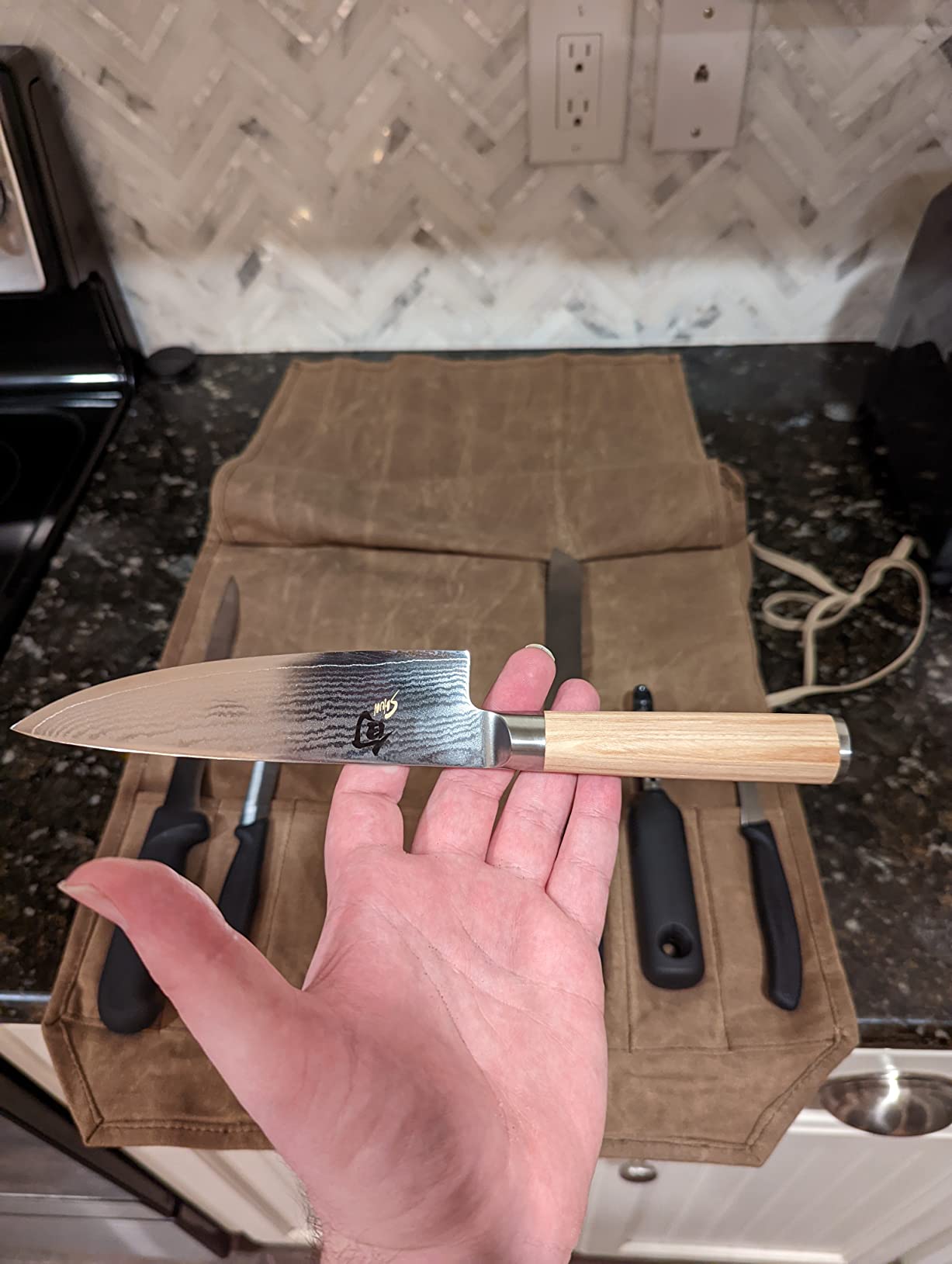
For years the Shun Classic has been the reference point most Japanese knife buyers measure against, and the reason is specific rather than marketing: a VG-MAX core clad in 68 layers of Damascus stainless, handcrafted in Japan by Kai, finished at a 16 degree edge.
It arrives sharp enough to use immediately, and 88 percent of its reviews are five star. The D-shaped pakkawood handle works equally well in either hand, which is not true of many traditional Japanese grips.
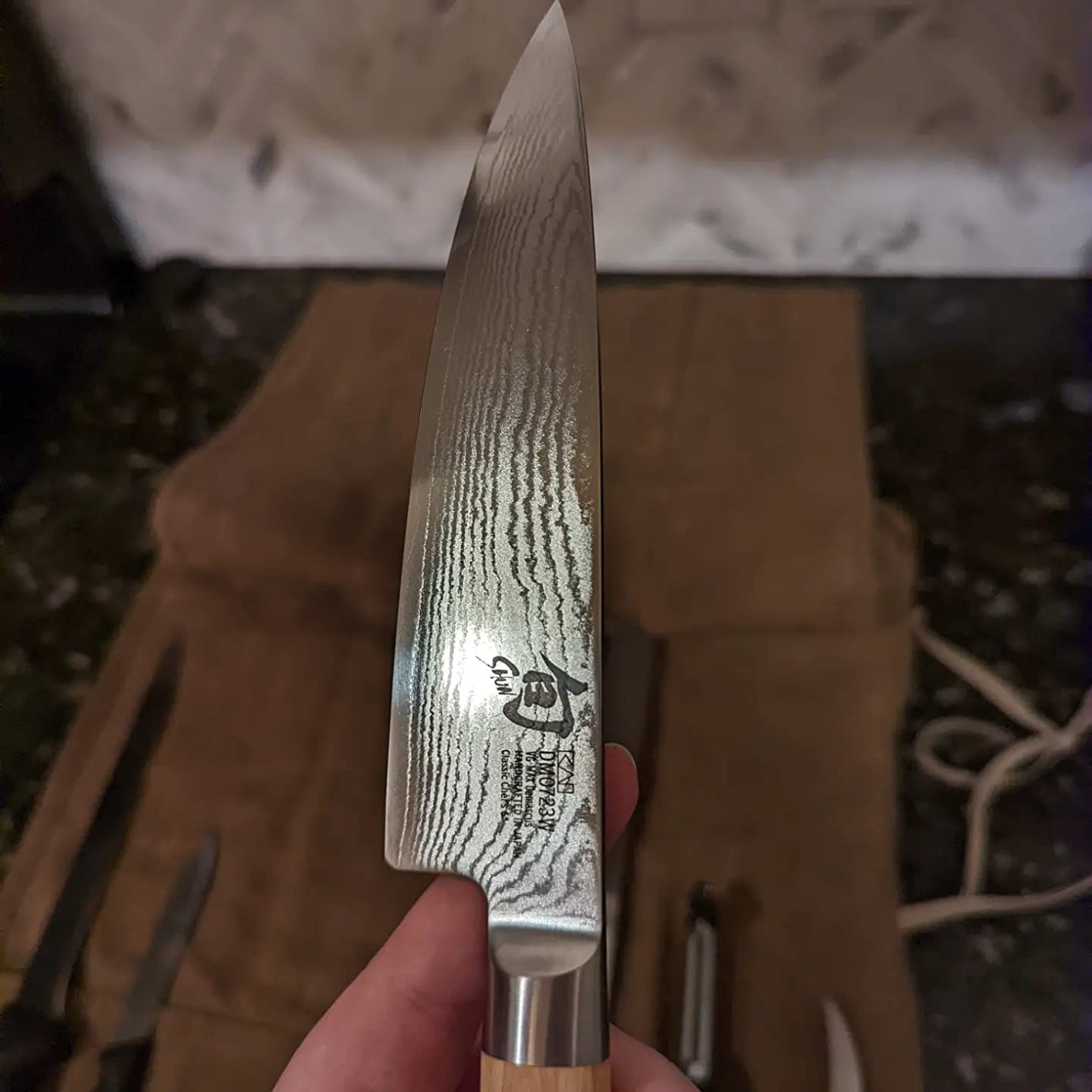
At 206 g and 13 inches overall, it is light for a Damascus clad blade, and the free lifetime sharpening service is the most underrated feature here. You send it off and it comes back factory sharp, which removes most of the anxiety about owning a hard edge.
The catch is care. Damascus cladding clouds with grey water spots if you put the blade down wet, so hand washing and immediate towel drying are not optional. Get into that habit from day one and it is a non-issue.
Who This Knife Suits
A cook who preps proteins seriously and wants a knife that stays sharp through boneless chicken breast, pork loin and hard-rooted vegetables without a weekly stone session. Nothing about the Classic requires a technique you do not already have.
It is also the easiest premium knife to feel confident about, because the factory edge and the free service mean a learning mistake is never an expensive one. For a gift that will genuinely be used for decades, it is the safest bet here.
Where It Falls Short
The step up in cost from the Shun Sora further down this list is steep, and the Sora gives you most of the edge for far less. If you cut a lot of frozen meat or work through squash rinds, the harder core will chip where a softer steel would not.
The blade is also a full 8 inches with a broad face, so a cramped prep corner or a small board is a real constraint. And if your priority is raw value, this is the most expensive way to enter the category.
4. Dalstrong Gyuto AUS-10V 8 Inch – Best Edge Retention
Dalstrong 8″ Japanese Chef Knife Gyuto – 66-Layer Damascus AUS-10V
- Sharpest factory edge in most owner reports
- AUS-10V core holds an edge for months without sharpening
- Tall heel clears the board and scoops dice well
- Full tang with a smooth spine suits a pinch grip
- Handle is large and can feel oversized for small hands
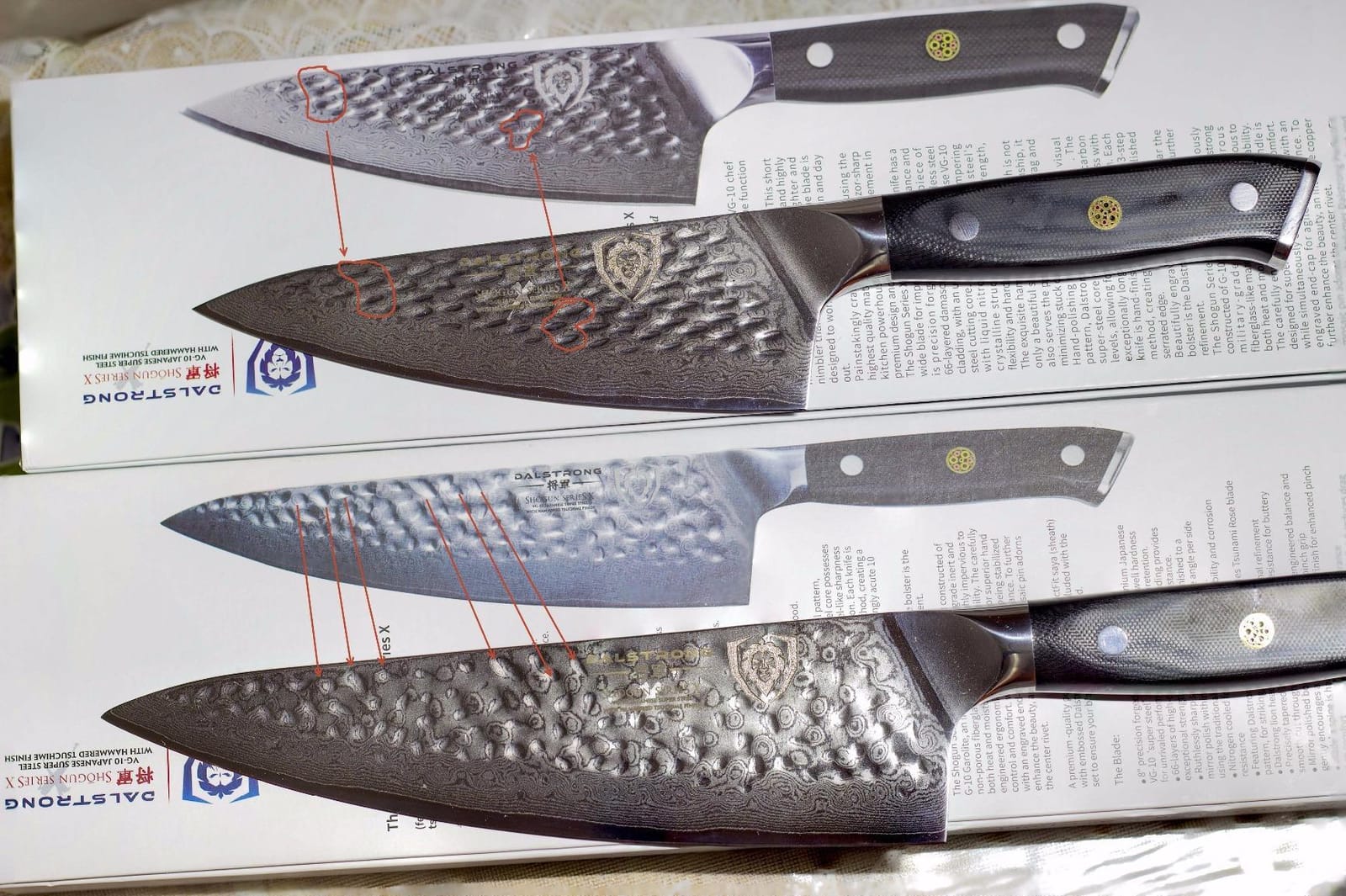
- Damascus pattern is subtler than the listing photos
- Wide blade will not fit a standard knife block
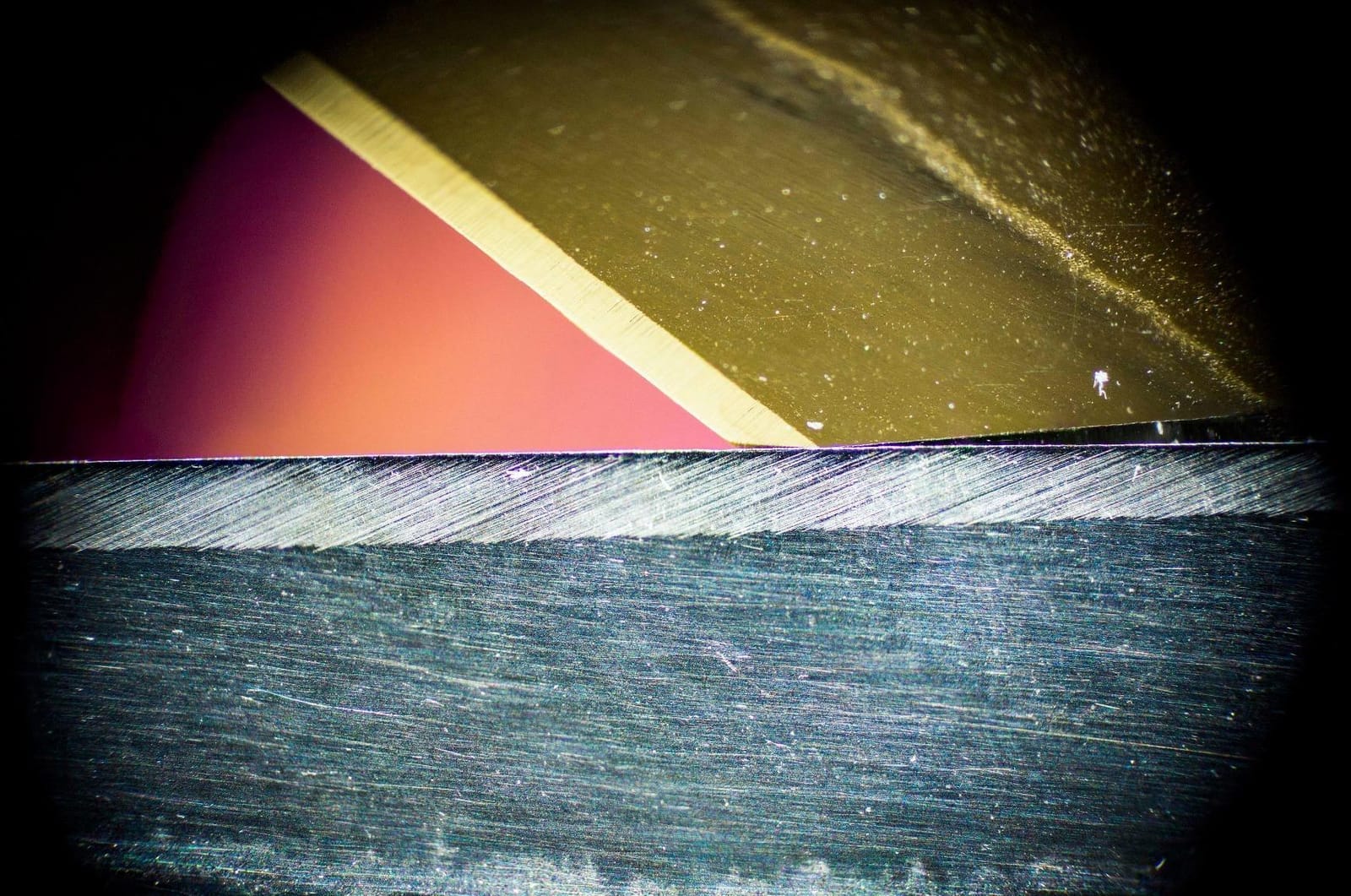
Dalstrong puts Japanese AUS-10V super steel at 62 plus Rockwell under 66 layers of Damascus, hand-finished to an 8 to 12 degree edge per side. That is the most acute factory edge in this roundup, and it is why paper and paper-thin tomato slices came out with no pressure at all.
Edge retention is the headline. Owners repeatedly report months between sharpening sessions, which is the practical difference between a 62 HRC core and a 58 HRC one. The hammered blade face genuinely does reduce sticking.
Construction is full tang with a contoured G-10 handle, 9.6 ounces and 14 inches overall. The smooth spine and narrow neck make a pinch grip unusually comfortable, and the tall heel scoops diced onion straight off the board.
Buy it with the included sheath. A wide 8 inch blade like this will not drop into most standard knife blocks, and forcing it is how good knives get damaged.
Who This Knife Suits
A confident cook who sharpens and cooks most days. An 8 to 12 degree edge is closer to a filleting knife than a chef’s knife, so it rewards precision and punishes force. It is the pick for fine brunoise and sashimi style fish slicing.
It is also the knife to choose if you already own a sharpening setup and want the thinnest slices the category can produce. For a home cook who grinds through hundreds of pounds of vegetables a year, the edge retention pays for itself in time saved.
Where It Falls Short
The handle is deliberately large and handle-heavy, and for small hands that is the single biggest reason to pick something else. Very sharp steel also means a honing rod can work against you, so treat stone maintenance as non-negotiable.
Owner reports are consistent on the handle size, so if you are between sizes, hold one before ordering. A 9.6 ounce build is not something you can adjust to later, and the wide profile needs a deep block slot or a sheath.
5. FAMCUTE 8 Inch Hand Forged – Best Value Step Up
- HRC 62 hardness gives strong edge retention for the tier
- Octagonal rosewood handle guides the grip
- Comfortable through long prep sessions
- 60-day hand forging with vacuum nitriding
- Rosewood is more porous than pakkawood and must be dried
- Value tier steel will not hold an edge as long as VG-MAX
- Shiny electroplated finish can show wear over time
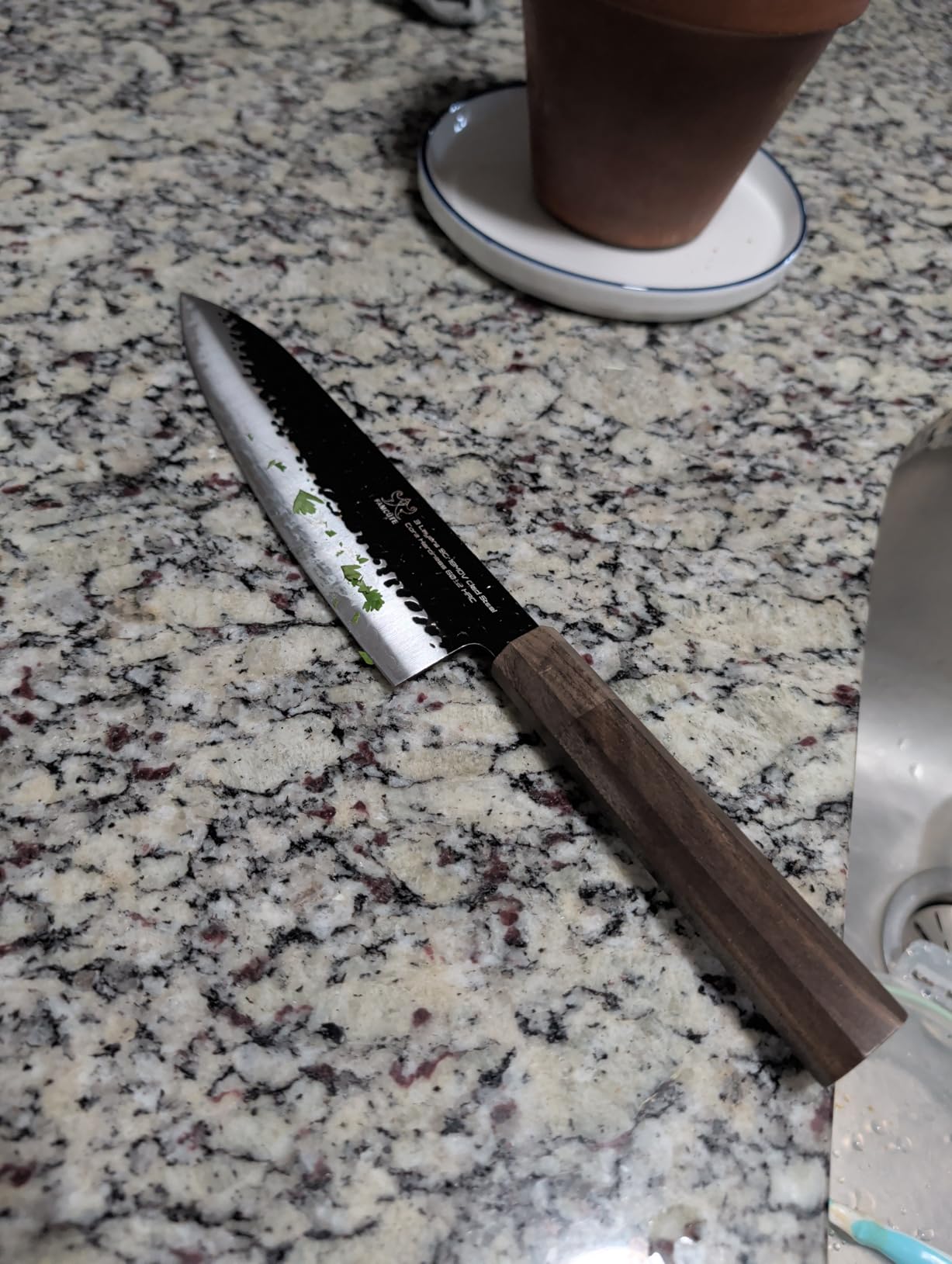
This is the sleeper of the roundup. Five layers of 9CR18MOV high carbon steel, quenched and vacuum nitrided to a maximum of 62 HRC through a 60-day production process. For the money, that is a genuinely sharp knife and a real step up from a department store block.
It holds a 4.7 average from 1904 reviews, and the handle is octagonal rosewood. The octagonal shape guides your pinch angle without you thinking about it, and it is ranked number 21 in Chef’s Knives overall.
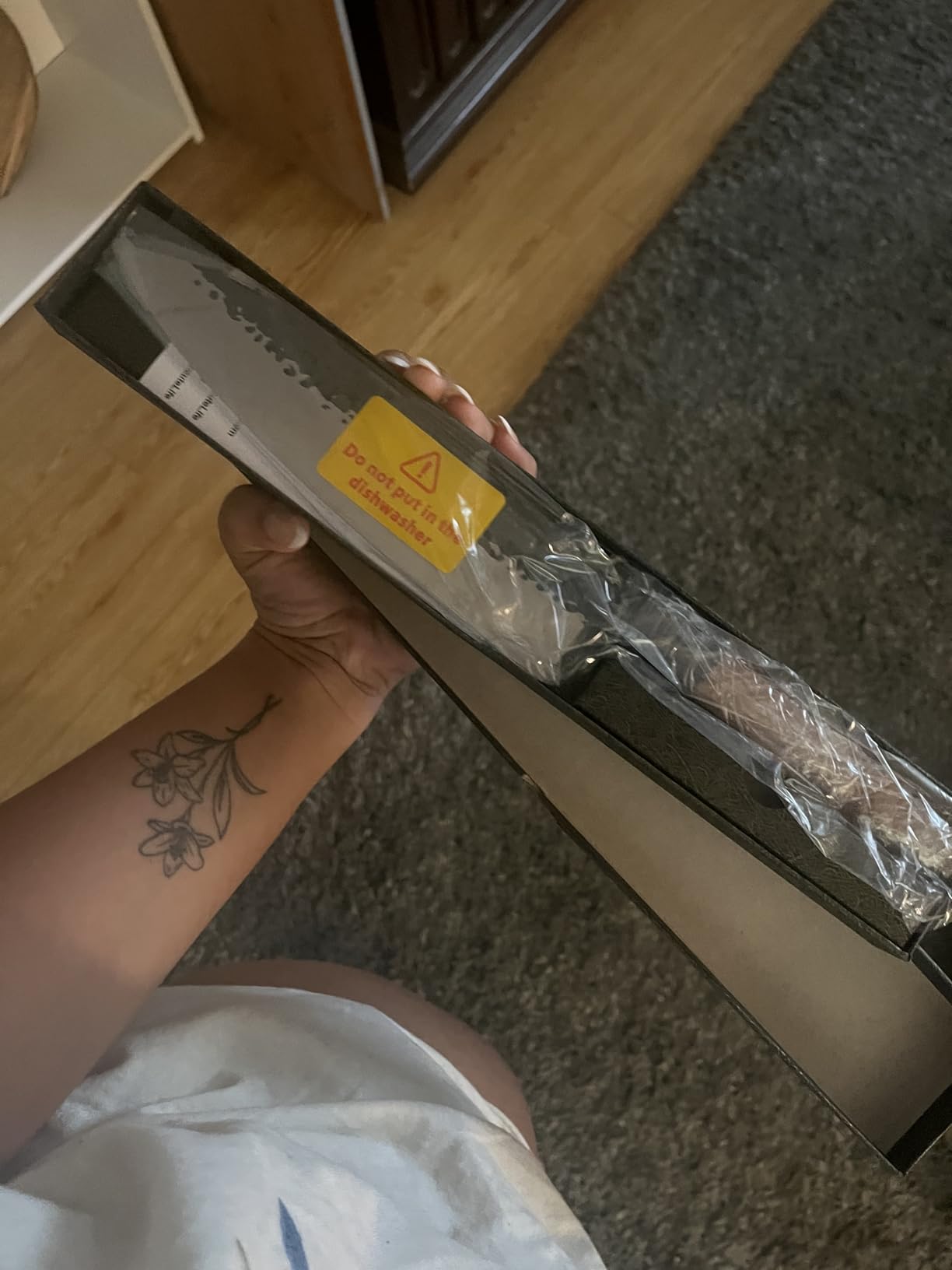
The tsuchime-style hand forging gives it an artisanal look that photographs well, and the 8 inch blade at 36.5 cm overall is a standard, manageable size.
Plan for a whetstone sooner rather than later. A 62 HRC edge is a demanding edge, and the practical payoff only arrives if you keep it dressed.
Who This Knife Suits
A home cook moving up from a mismatched knife block who wants proper Japanese geometry and a real hand-forged finish without stepping into premium steel territory. It also suits anyone who prefers wood handles.
The value case gets stronger once you count what you avoid. A whetstone and a honing steel still matter, but you are not paying premium-tier money for a steel grade that needs constant dressing to stay useful.
Where It Falls Short
Rosewood is more porous than pakkawood. Wipe it and air it dry rather than dropping it in a sink, or the handle will darken and crack faster than you would like. Edge retention is honest about its tier limits too.
The electroplated finish is also the first thing to show its age, so a cook who enjoys a patina that improves with use should look at a clad Damascus blade instead. It is a tool first, not a keepsake.
6. Shun Sora 8 Inch Chef’s Knife – Best for Small Kitchens
- Shun level sharpness without the Classic price step
- Narrow gyuto blade profile is very maneuverable
- Full tang textured polymer handle works either handed
- Light build at only 6.56 ounces
- 420J upper is softer so it lacks the Classic patina
- Polymer handle has none of the warmth of wood
- Hand washing is still required
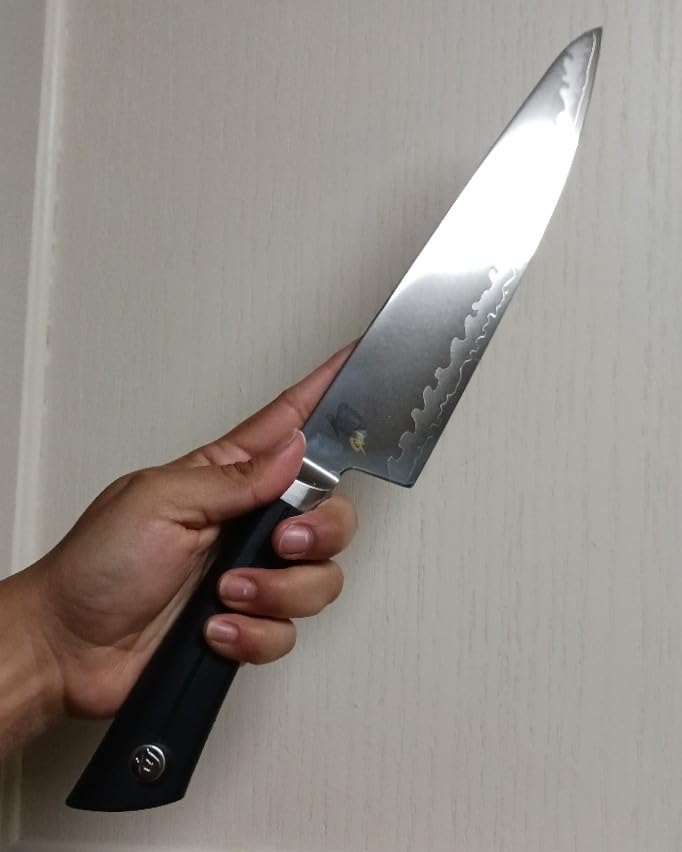
The Sora is the argument for buying Shun without emptying the savings account. It uses san mai construction with a VG10 steel core over a 420J stainless upper, finished at a 16 degree edge, handcrafted in Japan and NSF certified.
What sets it apart is the narrow gyuto profile. At 6.56 ounces and 8 inches overall, it is the lightest Shun blade we tested, and the narrow spine makes it easier to work on a small board or in a tight prep corner.
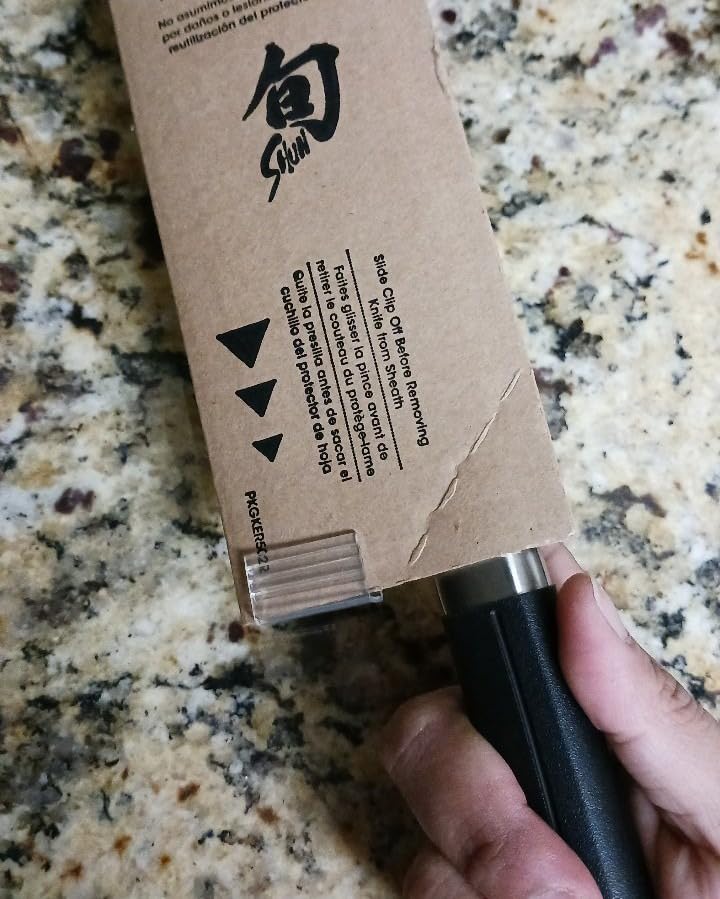
The full-tang textured PP and TPE polymer handle is washable, grippy and works equally well in either hand. It is also the easiest Shun to live with, since polymer shrugs off the daily neglect that ruins wood.
Free sharpening and honing is included for as long as you own it, which softens the main argument against buying a Shun at a lower tier.
Who This Knife Suits
Cooks with a compact kitchen or a small cutting board, and anyone who finds an 8 inch blade too unwieldy. It is narrow but still has a proper chef’s knife tip, so it handles proteins as well as vegetables.
It is also the easiest Shun to maintain, since the polymer handle tolerates a quick rinse in a way the Classic’s pakkawood does not. For a first serious Japanese knife, it is a low-risk place to find out whether you like the geometry.
Where It Falls Short
The 420J stainless upper is softer than a fully clad Damascus blade, so the edge feel and how the surface ages differ noticeably from the Classic. There is also no warmth here, which is a fair trade at this level but worth being honest about.
Because the upper is 420J rather than a full Damascus cladding, fine scratches show sooner and the surface will not develop the patina that makes a forged blade more attractive over time.
7. Kimura Seki Gyuto 8 Inch – Best First Knife Made in Japan
- Genuinely manufactured in Seki Japan
- Hand sharpened to a 15 degree angle
- Triple riveted full tang with a real bolster
- Stamped rather than forged so it is less refined
- 57 HRC is a softer steel that dulls sooner
- Lowest average rating here at 4.5
Rare steels get all the attention, but origin matters. The Kimura is manufactured in Seki, the Japanese cutlery city with centuries of knife history, at a price where genuine Japanese manufacture is unusual. That alone puts it near the top of this list for a first purchase.
It is heat treated to 57 HRC and hand sharpened to a 15 degree angle, a softer and more forgiving configuration than most of the knives here. The full tang, triple rivets and a real bolster are also more than most knives at this level give you.
![Kimura Chef Knife, [Made in Japan], 8 inch Professional Kitchen Knife, Ultra Sharp High Carbon Molybdenum Stainless Steel Gyuto Knife, Chefs Knife with Ergonomic Handle - Japanese Chef's Knife customer photo 1](https://www.talkofthehouse.com/wp-content/uploads/2026/09/B09GCGQKNZ_customer_1.jpg)
At 175 g and 12 inches long, it is the lightest blade in the roundup by a clear margin, and the POM resin handle stays grippy when wet. A lifetime warranty is included, which is rare at the entry level.
The 4.5 average from 1213 reviews is the lowest here, and the reason is honest: this is a stamped blade with a softer steel, so it is a working tool rather than a precision instrument.
![Kimura Chef Knife, [Made in Japan], 8 inch Professional Kitchen Knife, Ultra Sharp High Carbon Molybdenum Stainless Steel Gyuto Knife, Chefs Knife with Ergonomic Handle - Japanese Chef's Knife customer photo 2](https://www.talkofthehouse.com/wp-content/uploads/2026/09/B09GCGQKNZ_customer_2.jpg)
Who This Knife Suits
A beginner who wants a real Japanese-made knife, an honest steel spec, and a blade that can survive being dropped without chipping. Softer 57 HRC steel is genuinely the right choice for someone still building knife technique.
It pairs well with a beginner’s whetstone, because the softer steel is easy to bring back to a working edge with a 1000 grit stone and a few minutes of practice. Learn on this, graduate to VG-10 later if you want.
Where It Falls Short
Stamped construction means the blade finish and geometry are not up to a forged blade. Expect to hone more often, since softer steel trades edge retention for forgiveness. Cook daily and want long intervals between stones, and look at the 60 plus HRC options instead.
It is also the least decorative knife here, and if a beautiful object on the counter matters to you, the KYOKU or the Shun Classic are better choices for the same kitchen.
8. MITSUMOTO SAKARI 8 Inch Gyuto – Best Forged Finish for the Look
MITSUMOTO SAKARI 8-Inch Japanese Gyuto Chef Knife, 3-Layer 9Cr18MoV
- Tsuchime hammering and kurouchi finish reduce sticking
- Deep cryo treated 9Cr18MoV core at HRC 60
- Octagonal rosewood handle guides grip direction
- Manufactured in China rather than Japan
- Carbon steel finish spots unless dried and oiled
- Not in the same class as hand-forged Japanese steel
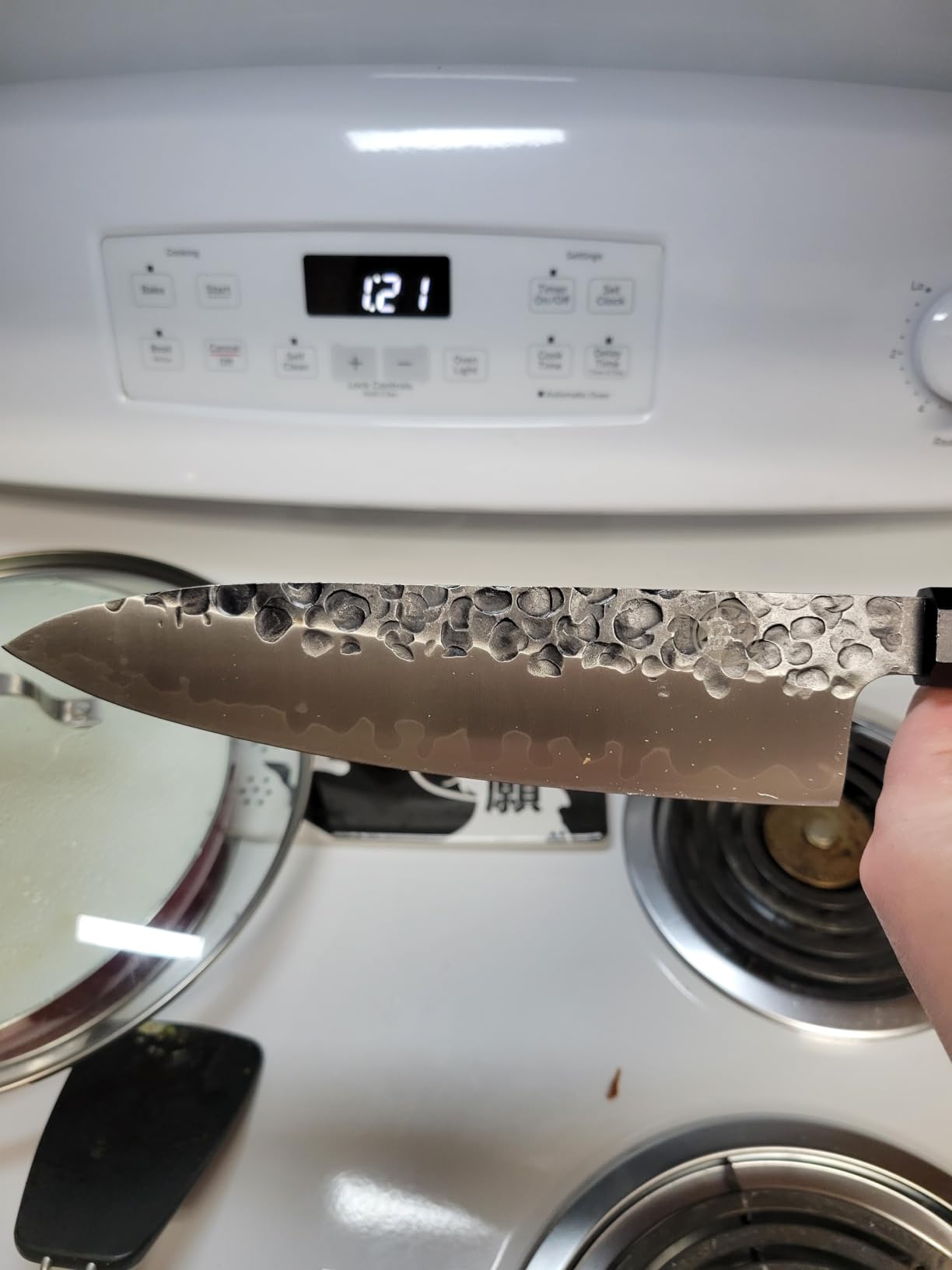
The MITSUMOTO SAKARI is the most dramatic looking knife here, and the tsuchime hammering is functional rather than decorative. That dimpled kurouchi finish reduces food sticking, which you notice immediately when dicing something wet like cucumber or tomato.
Underneath, it is a three-layer san mai build with a 9Cr18MoV high carbon stainless core, deep cryo treated and hardened to HRC 60 plus or minus 2. The 8.6 inch blade and 279 g weight make it the largest profile in this roundup.
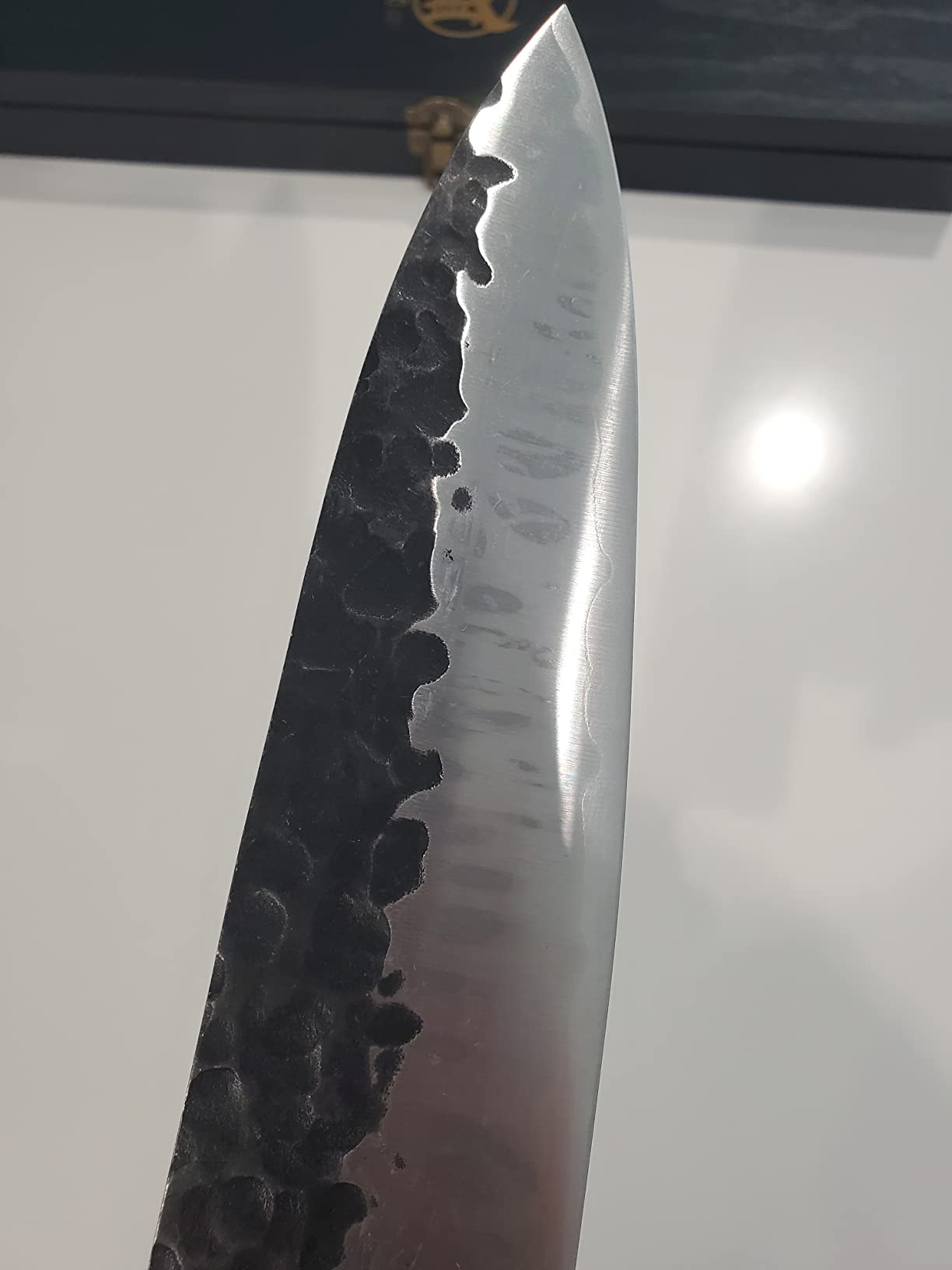
The octagonal rosewood handle guides your grip direction and cuts fatigue on long prep sessions. Owners report using it as a daily workhorse for years, and the box, cloth and blade oil in the package quietly encourage correct care.
One thing to be clear about: this knife is made in China, not Japan. A segment of buyers find that misleading for a knife marketed as Japanese, and it is a fair criticism to weigh before you buy.
Who This Knife Suits
A cook who wants a knife that looks hand-forged and wants the sticking reduction a hammered finish delivers. The kurouchi finish photographs beautifully and the presentation box makes it a good gift.
Because the finish genuinely changes how food behaves on the blade, it works well for wet, sticky prep like tomatoes, cucumbers and soft cheese. It is the one to pick if the look of the knife matters to you as much as the cut.
Where It Falls Short
Care demands are real. The finish will spot unless you hand wash, towel dry immediately and apply a light oil. If provenance matters to you, choose a knife with a stated Japanese manufacturing location instead.
The 8.6 inch blade and 279 g weight also make it the largest profile here, so it needs a big board and a clear storage plan. The steel is stainless rather than true carbon, which helps, but the black coating still demands the same drying routine.
9. KYOKU Shogun VG-10 8 Inch – Best Substantial Full Tang
KYOKU Chef Knife – 8″- Shogun Series Japanese Style VG10 Steel Core Hammered Damascus Blade Kitchen Knife – with Sheath & Case
- VG-10 Japanese steel made in Japan and cryogenically treated
- Honbazuke 8-12 degree edge is very sharp out of the box
- Pointed heel clears the board better than a European bolster
- Sheath and presentation case included
- Heavier than most home knives and tiring until you adapt
- Damascus contrast is subtler than the listing photos
- G-10 handle can feel slick when wet
The KYOKU feels like an object before it feels like a tool. At 0.4 kg it is the heaviest blade we tested, and that mass is either the best or the worst thing about it depending on your prep style.
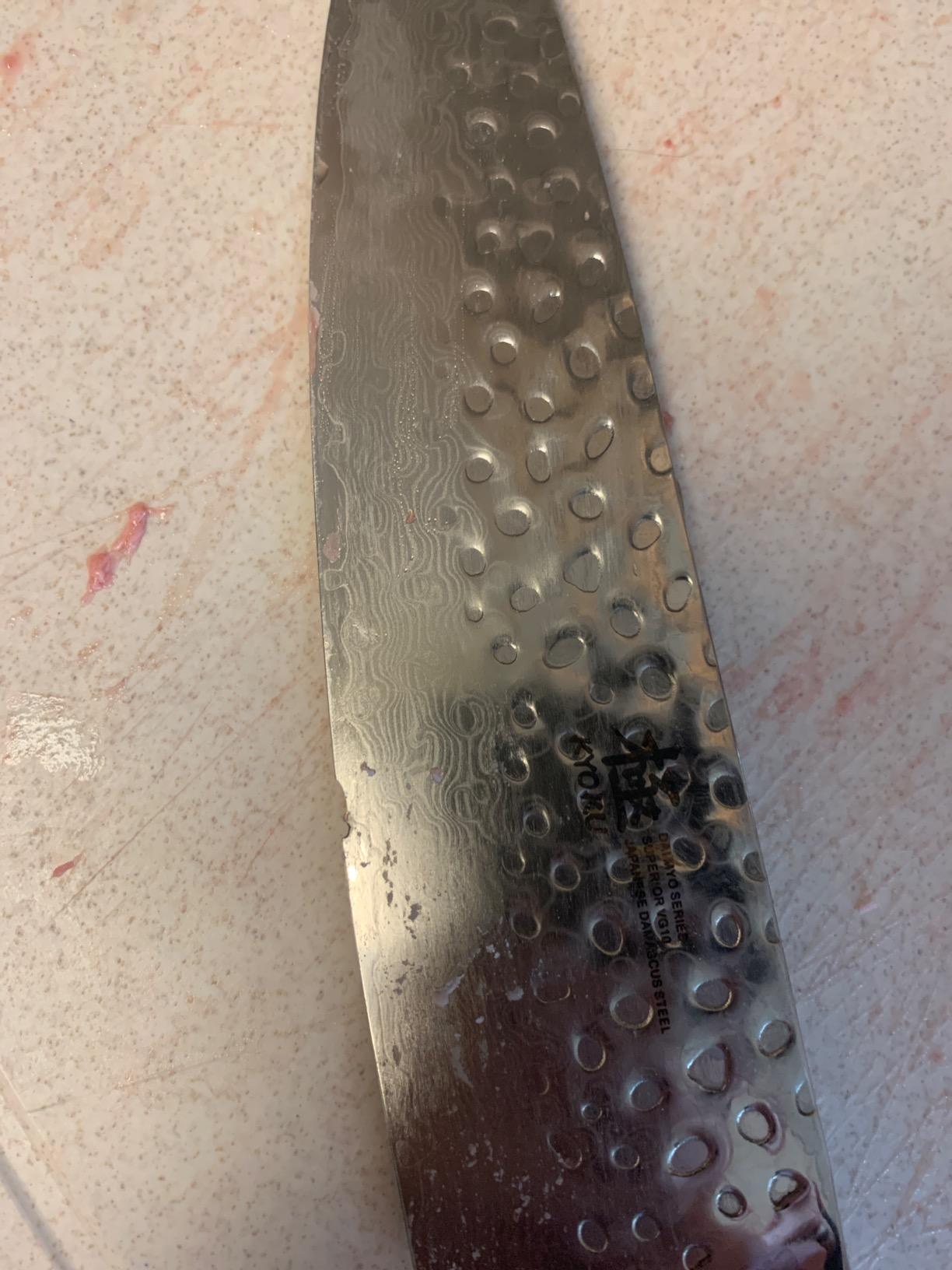
The steel is the real draw. It is a Japanese VG-10 core with 67 layers of Damascus made in Japan, cryogenically treated to 58 to 60 HRC, and sharpened with the three-step Honbazuke method to an 8 to 12 degree edge. That is a serious specification for the tier.
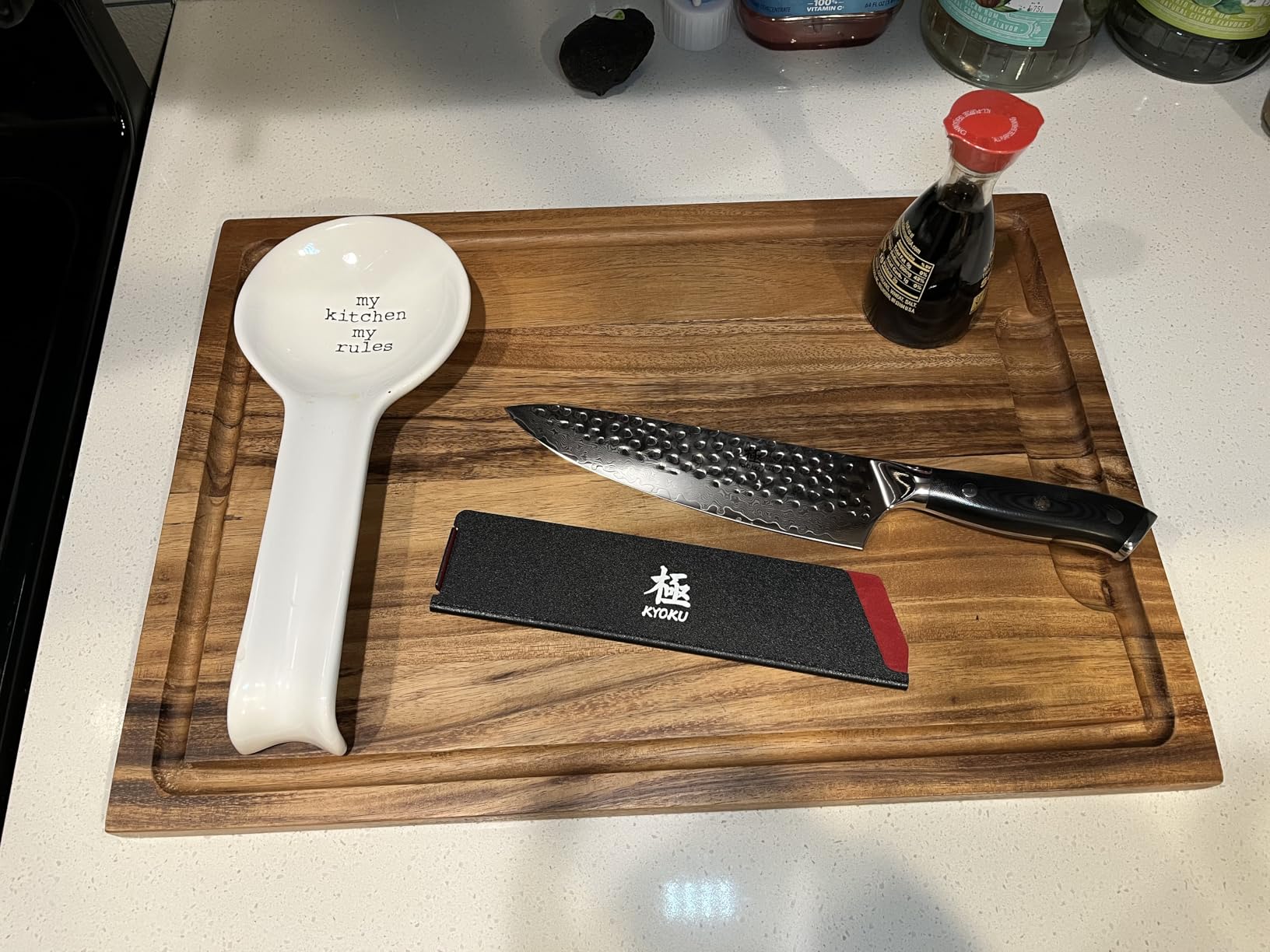
Construction is full tang with a G-10 handle, an engraved rivet and a mosaic pin. More importantly for daily use, the pointed heel clears the board properly, so unlike a bolster-blocked European knife it can be used right to the end of the blade.
Reviewers often describe it as the most refined-looking knife they own, and customer service is responsive when individual knives arrive with finish inconsistencies.
Who This Knife Suits
Cooks with bigger hands and bigger boards who like the momentum of a substantial blade. The weight makes rocking cuts through root vegetables feel powerful, and the full tang makes the knife feel solid in a way lighter ones do not.
It also rewards a confident rocking technique, because the mass carries through dense ingredients in a way a lighter blade simply cannot. If you cook large quantities, that momentum is the feature you will notice every day.
Where It Falls Short
That 0.4 kg is genuinely heavy, and the wrist fatigue in the first weeks is real. We would not call it a knife for small hands. The G-10 handle can also become slick when wet, so grip firmly during a rinse.
The weight is a poor trade for a cook who does one or two quick tasks a day, because you pay for the momentum every time. Give it two weeks of daily use before deciding it is too much.
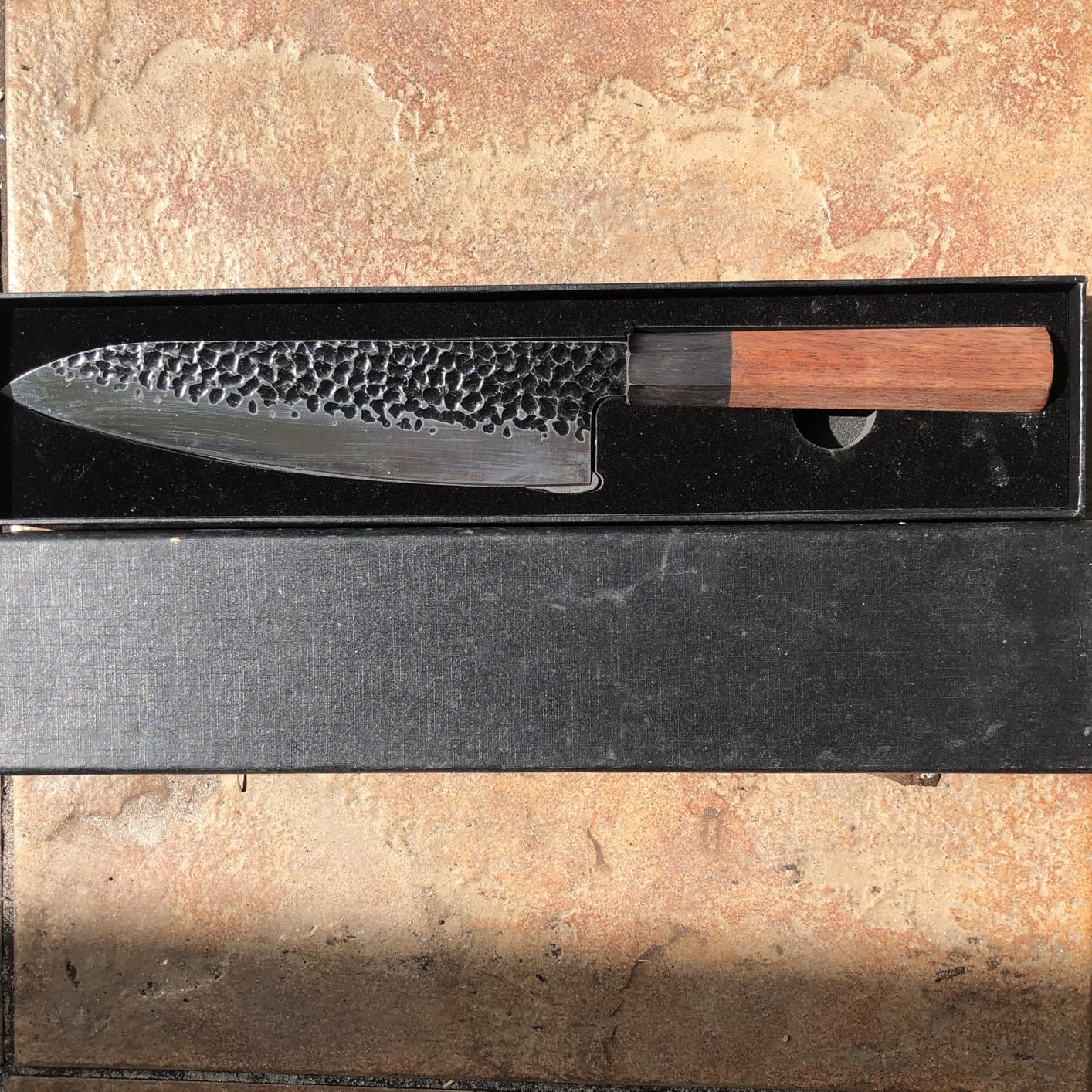
10. RASSE 8 Inch Gyuto – Best Budget Hand Forged Style
- Least expensive way into a Japanese style gyuto
- Hand hammered tsuchime pattern gives a distinctive look
- 15 degree edge is sharp for the tier
- Octagonal mkuruti rosewood handle directs the cut
- AUS-8 is softer so it dulls faster than VG-10
- Most mixed owner feedback in the roundup
- Hand wash and immediate drying are essential
The RASSE is the cheapest way to own a knife that looks and behaves like a traditional Japanese gyuto. High carbon Japanese AUS-8 stainless steel, hand hammered with a tsuchime pattern, finished to a 15 degree edge, with an octagonal mkuruti rosewood handle.
At 9.12 ounces and 8 inches overall, it is compact and manageable. The octagonal handle does real work, directing the cutting angle so a beginner naturally holds the blade properly rather than gripping too far forward.
A lifetime warranty and a gift box are included, which is unusual at the bottom of the range. For softer produce, general chopping, herbs and soft cheese it punches well above its tier.
What you give up is steel. AUS-8 is a more forgiving stainless than VG-10 or VG-MAX, which means less edge retention and more frequent sharpening. That is a fair trade for a knife you can learn on.
Who This Knife Suits
A first Japanese-style knife, or a cook who wants a hand-hammered look without spending real money. It is also a low-stakes gift, since nobody is upset if a friend does something careless to it.
Because the steel is softer, the edge is also easier to restore at home, so the true running cost is lower than it looks against the harder blades here. For a learner, that forgiveness is the point.
Where It Falls Short
The 4.5 average across 823 reviews is the lowest in this roundup and the feedback is noticeably more mixed, with long-term edge retention the recurring theme. Care is non-negotiable: hand wash, dry immediately, never soak.
Owner feedback is also the thinnest here, which means fewer long-term reports to reassure you. If you want a budget knife you will rarely have to think about, the KEEMAKE offers a better balance at a similar tier.
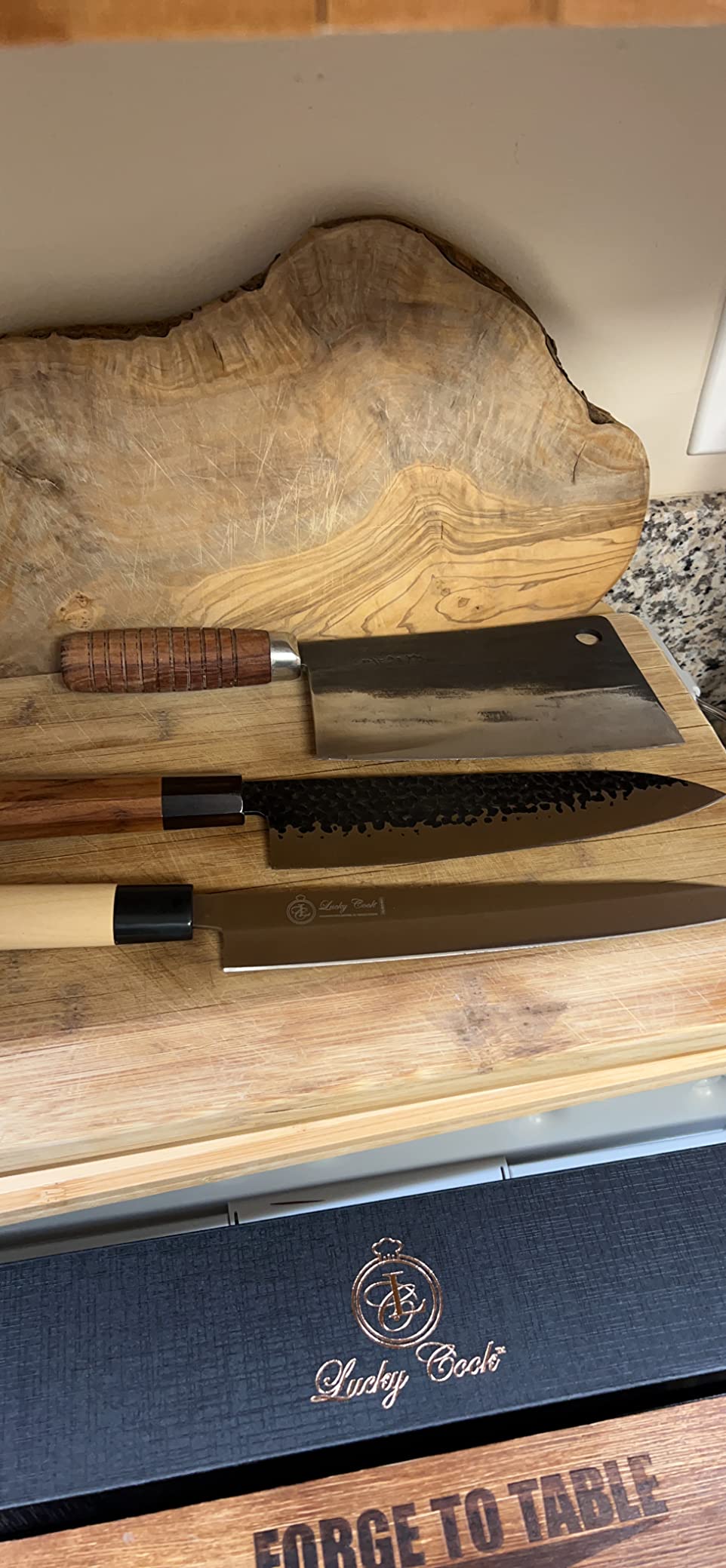
11. KEEMAKE 8 Inch Hand Forged – Best Balanced Budget Blade
- Cryogenic tempering to HRC 58 balances sharpness and toughness
- Hand-sanded 12-15 degree edge slices tomato skin cleanly
- Octagonal rosewood handle works in either hand
- Tsuchime hammering helps reduce sticking
- 440C steel sits below VG-10 and VG-MAX on retention
- Stamped build with a 5 layer pattern rather than true Damascus
- Heaviest budget pick here at 12.32 ounces
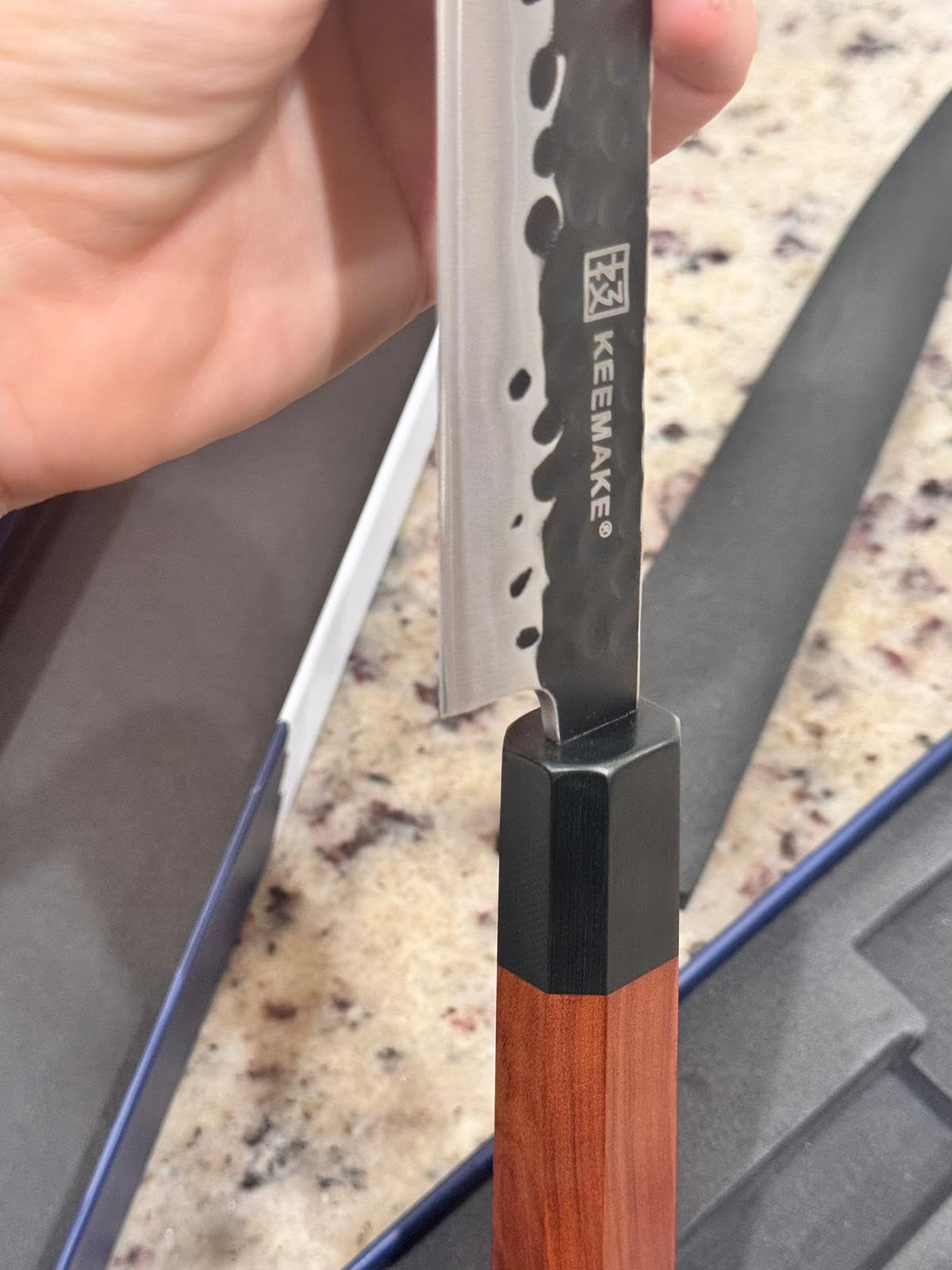
KEEMAKE takes the middle road. The blade is 440C high carbon stainless with a five-layer pattern, run through a 60-day forging process with quenching and nitrogen vacuum cryogenic tempering to HRC 58, then hand-sanded to a 12 to 15 degree edge on a 2.3 mm blade.
That is a smart specification. HRC 58 is deliberately less brittle than the 62 options here, so it tolerates a busy kitchen and a beginner’s technique while still taking a genuinely fine edge. Tomato skin sliced cleanly without crushing every time.
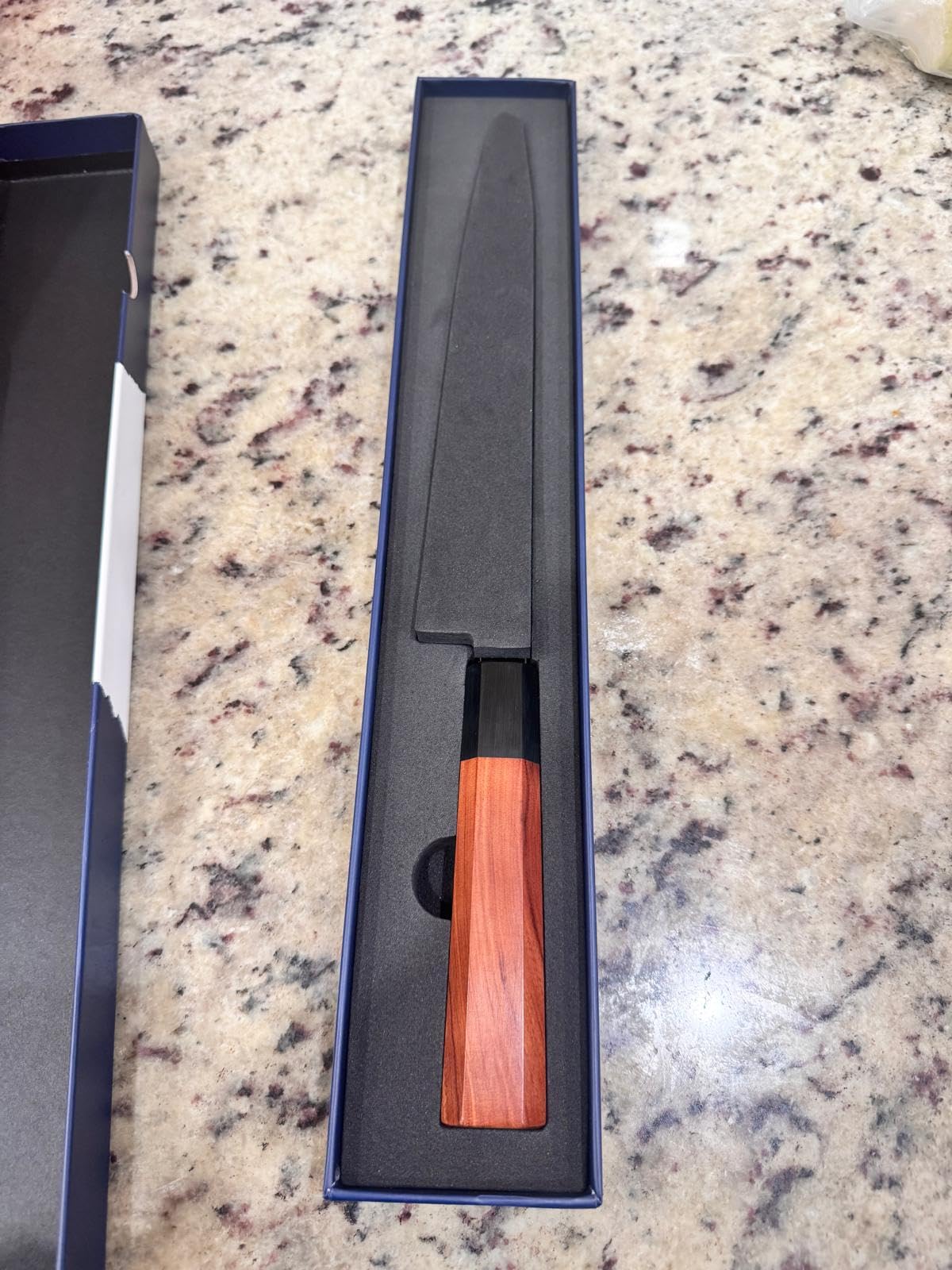
The tsuchime hammering on the blade face reduces sticking, and the octagonal rosewood handle is described as moisture resistant and comfortable in either hand. Ranking number 6 in Sashimi knives suggests the edge is finer than the tier implies.
At 12.32 ounces and 13.38 inches overall, it is the heaviest budget pick here, and that is the one specification we would flag before buying.
Who This Knife Suits
Cooks who want a sharp, forgiving blade for everyday chopping without moving up to VG-10 steel. It is a good first knife for a cook with a large hand, and it arrives properly packaged with support behind it.
It works particularly well in a shared kitchen where the knife passes between cooks, because the forgiving steel survives being used at different angles. HRC 58 is the sweet spot between sharpness and tolerance for most homes.
Where It Falls Short
Be clear that this is a value tier build. The five-layer pattern is not true Damascus construction, and 440C will need sharpening sooner than VG-10. The 12.32 ounce weight is the quiet issue in a light hand.
The stamped finish also means the blade will not develop the character a forged one does over years, so if you enjoy watching a knife age, this is not the one. Check the weight in person if your hand is on the smaller side.
12. F Fanteck 8 Inch Damascus – Best Complete Package
- VG-10 core with a 62+ HRC rating praised by owner heat treaters
- Full tang gives a solid balanced feel that stands the knife up
- Pakkawood handle with water and heat resistant acrylic inlay
- Gift box sheath and a usable sharpener in the box
- Handle is small and awkward for larger hands
- A minority of buyers question the Damascus claim
- Third-party listings have turned up copies
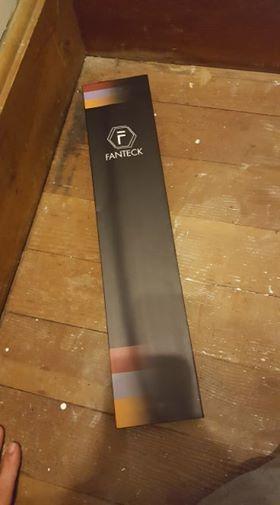
The Fanteck is the only knife here that arrives genuinely ready to use. The box contains the knife, a plastic sheath, a gift box and a working sharpener, which removes the most common reason a new Japanese knife disappoints, namely that nobody told you what else you need.
The steel is a VG-10 core with a 67-layer Damascus pattern, and a professional heat treater in the reviews independently praised the core. At 8 ounces with a full tang and pakkawood handle, it stands up on the board and feels solid rather than thin.
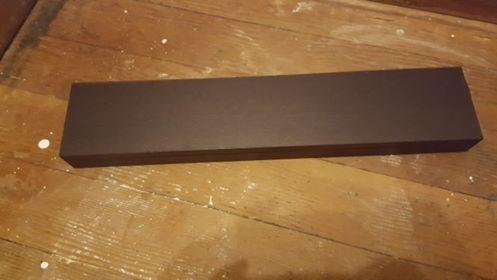
One owner who learned whetstone technique reports it passing both a paper slice test and a forearm shave, which tells you the factory edge is genuine. The deep Damascus grooves also disguise any future spotting.
The handle carries a mother-of-pearl mix acrylic accent that is shock, water and heat resistant, and a lifetime warranty is included from the brand.
Who This Knife Suits
Anyone buying for a gift, a housewarming, or a partner who has never sharpened a knife in their life. The included sharpener and sheath mean the recipient can start immediately without a follow-up shopping trip.
It is also the most forgiving choice for storage, because the sheath and the block-safe handle make it easy to put away properly on the first day. That single accessory saves more new knife frustration than any amount of technique advice.
Where It Falls Short
The handle is small, and owners with larger hands describe it as awkward. A minority of buyers also question whether the Damascus steel is genuine, and some third-party listings have turned up copies, so buy from the official Fanteck storefront.
The small handle is also why it underperforms for larger hands, and it is worth comparing the handle size against your own before ordering. A sharpener in the box is a stopgap, not a replacement for learning whetstone basics eventually.
Gyuto vs Santoku – Which Shape Should You Buy?
Buy a gyuto if you want a Japanese chef’s knife that still handles protein. A gyuto has a longer blade, usually 8 inches, a pointed tip and a straighter edge, so it can push cut, slice a roast and break down a chicken without flinching. Eight of the twelve knives above are gyuto profiles for exactly that reason.
Buy a santoku if vegetables are most of what you cook. Santoku means the knife of three virtues, referring to speed, versatility and simplicity. The blade is shorter, usually 7 inches, the spine curves down toward the tip, and the shape encourages a rocking cut rather than a push cut.
The practical rule from r/TrueChefKnives is that size matters more than brand for a first knife, and that a 180mm santoku, 180mm bunka or 210mm gyuto are all reasonable. The shape is a personal preference, not a quality ranking, so if you can hold one in a shop, choose the one that feels balanced.
Our chef knife set guide is useful if you would rather pair a Japanese chef’s knife with a paring knife than choose one blade that has to do everything. If you are outfitting a new kitchen rather than upgrading one blade, the best knife sets for home cooks covers the wider setup.
What Japanese Knives Are Not Good For
Bone. A hard edge meeting a chicken femur will chip, and no brand in this roundup is exempt. That is the single most reported complaint in the forums, and the reason to keep a cleaver and a heavy European knife in the block.
Frozen food. A frozen block is harder than the steel can take. Thaw first, and that applies to the softer 57 and 58 HRC blades as much as to the 62 HRC ones.
Hard rinds. Pumpkin, butternut squash and watermelon rind are abrasive and will dull a fine edge fast. Peel first, then cut. Glass and stone boards fall in the same category, because they leave chips no stone will fix.
The dishwasher. Heat, detergent and rattling against other cutlery destroy both the edge and the handle finish. Hand wash, towel dry immediately, store dry, and never leave a wood handle sitting in water.
How to Choose a Japanese Chef’s Knife
Steel is the first decision. VG-10 and VG-MAX are Japanese stainless steels that balance edge retention with corrosion resistance, and they are the sensible default for a home cook who does not want to think about rust. The 440C and 9Cr18MoV families are a step down in retention but a step up in forgiveness.
Hardness, measured on the Rockwell C scale as HRC, predicts two opposite behaviours. Higher numbers hold an edge longer and chip more readily. Below 58 and you will sharpen often but rarely chip; above 62 and you will go long between stones while living with a real chip risk.
Handle shape is the question buyers get wrong most. Traditional D-shaped and octagonal handles suit a pinch grip and direct the cutting angle, but the handle is usually not shaped for either hand to wrap fully around. Western-style bolstered handles suit a full fist grip and suit smaller hands. A full tang is worth paying for because it stiffens the whole handle.
Weight and balance deserve more attention than the marketing. A blade with weight under the hand is controllable for detail work, while forward-weighted knives make rocking cuts feel powerful. Finally, treat the whetstone as part of the purchase: a 1000 grit stone for sharpening, a honing steel to keep the edge aligned, and a leather strop as the cheapest retention upgrade available.
How to Care for and Sharpen a Japanese Knife
Hand wash right after use with warm water and mild soap, then dry immediately with a towel. Store it dry in a block, on a magnetic strip, or in the sheath that came with several of these knives, never loose in a drawer.
Use a honing steel before the edge is actually dull. A few strokes per side realigns the edge and takes seconds, and it is the single habit that extends time between stone sessions.
Sharpen on a waterstone when the knife will no longer hold an edge. Start coarse to fix the geometry, raise a burr, finish finer for the bite, then deburr carefully. You can absolutely ruin a good edge with a whetstone by grinding away more steel than you intended, which is why many owners here use the free Shun service instead of learning immediately. Finish with a strop, which restores the fine edge cheaply.
Frequently Asked Questions
What is the best Japanese knife for home cooks?
For most home cooks the imarku 8 inch chef’s knife is the best first Japanese blade, because its high carbon stainless steel at HRC 56-58 is sharp out of the box, light at 6.56 ounces, and forgiving enough to sharpen by hand. Cooks who already sharpen regularly get a longer edge from the SHAN ZU Damascus at 62 HRC or the Shun Classic with a VG-MAX core.
Which is better, a santoku or a gyuto?
A gyuto is longer, usually 8 inches, with a pointed tip and a straighter edge, so it suits proteins, push cuts and slicing. A santoku is shorter, usually 7 inches, with a curved spine that encourages rocking cuts, so it suits vegetables and smaller boards. Buy the gyuto for all-round cooking and the santoku if vegetables are most of your prep.
Is Shun or Miyabi better?
Shun generally uses a VG-MAX or VG10 core with a D-shaped pakkawood handle and includes free lifetime sharpening, which suits cooks who want service behind the knife. Miyabi is known for its kaizen and senbei lines with SG2 or VG-MAX steel and a more decorative finish, which suits cooks who want performance and looks. Both are legitimate, and construction quality matters more than the logo.
Can you mess up a knife with a whetstone?
Yes, but it is avoidable. The common mistake is grinding at a fixed angle without establishing the existing geometry first, which removes far more steel than intended. Start on a coarse stone only to fix a genuinely damaged edge, raise a burr, then move to a finer grit. A strop at the end, and regular honing with a steel, dramatically reduce how often you need the stone at all.
Are there fake Japanese knives?
Some are, and it is worth checking the manufacturing location rather than the styling. A knife described as Japanese steel is not the same as a knife made in Japan, and one of the picks in this roundup is a hand-forged style made in China. Look for a stated country of manufacture, a real steel grade such as VG-10 or VG-MAX, and a Rockwell figure, since a 60 HRC claim from an unbranded seller is often marketing rather than metallurgy.
Do professional chefs use Japanese knives?
Yes, though they are a tool rather than an upgrade on everything. Professional cooks commonly use a Japanese knife for precision work such as brunoise, fish filleting and fine slicing, and keep a heavier European or Chinese knife for bone, frozen food and heavy duty work. The reason is the same for a home cook: a hard fine edge is superb at detail and wrong for tasks that abuse an edge.
Our Final Verdict
The best Japanese chef knives for home cooks come down to how honest your kitchen is. If you want one knife that works, that you can wash in a hurry, and that will not punish you for a bad week, take the imarku. It is the pick we recommend to almost everyone.
If you already know how to sharpen and want the sharpest thing in the room, the SHAN ZU Damascus is the best-balanced blade we tested. If you want the object and the service behind it, the Shun Classic with free lifetime sharpening is the one people keep for decades.
Whatever you choose, buy a honing steel the same week, keep a second heavier knife for bone and frozen food, and hand wash immediately. Those three habits decide whether a Japanese knife stays an upgrade or becomes an expensive ornament. Check current pricing on each knife above, and our chef apron guide is a sensible companion for a kitchen getting properly serious.