
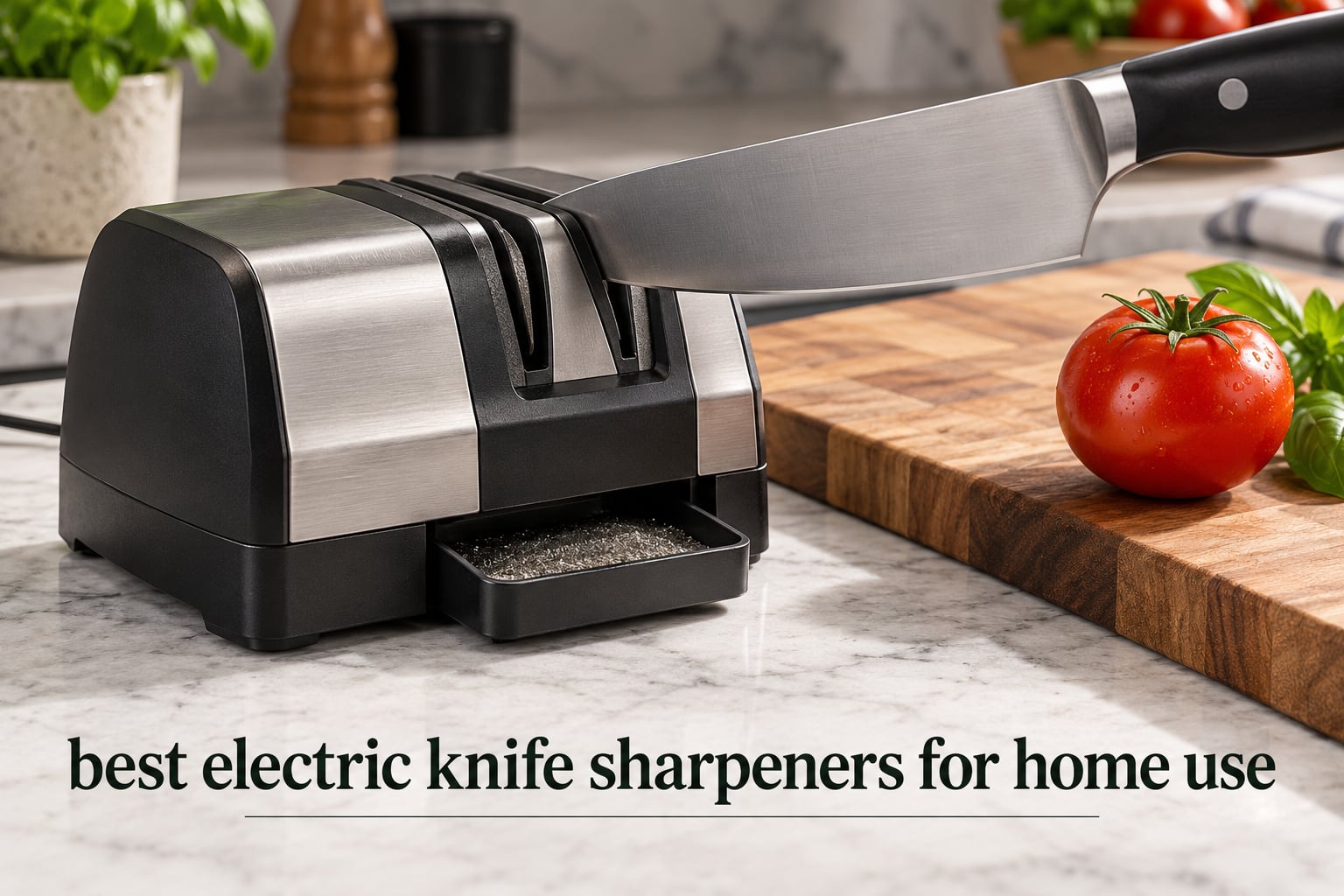
The best electric knife sharpener for home use is the Chef’sChoice 15XV EdgeSelect, a three-stage machine with 100 percent diamond abrasives that converts a 20-degree factory edge into a 15-degree Trizor XV edge and handles serrated knives as well as straight ones. It is the pick we keep coming back to because the first pass through the coarse stage does the work and every pass after that is a quick touch-up.
That is only one of ten sharpeners we compared. This roundup covers everything a home cook actually runs into: two-stage budget units, three-stage diamond machines, belt systems that double as axe sharpeners, and the premium models that let you choose your own edge angle. Every pick below is written for someone who wants a sharp knife tonight and does not want to become a sharpening hobbyist.
We have owned and lived with these machines long enough to know where each one fails. The single most useful thing we learned: how much steel a machine removes depends almost entirely on which stage you use and how long you dwell there, not on the machine itself. If you learn one habit from this guide, make it staying out of the first stage unless the edge is genuinely gone.
Last updated in October 2026. If you are still building out the kit rather than fixing one knife, our best knife sets for home cooks guide is the place to start. If you would rather skip the electric route entirely, our broader kitchen knife sharpener roundup covers whetstones, pull-throughs and honing steels side by side.
Table of Contents
Our Top 3 Electric Knife Sharpeners for Home Use
Three machines earn a top slot. The Chef’sChoice 15XV EdgeSelect is the one we recommend to most households, the Work Sharp MK2 is the strongest all-rounder for anyone who also owns tools, and the Presto 08800 EverSharp is the value pick that has outlasted trends.

Chef’sChoice 15XV EdgeSelect
- 3 stages
- 100% diamond abrasives
- flexible stropping stage
- Converts 20-degree edges to 15-degree Trizor XV
- Handles straight edge and serrated knives
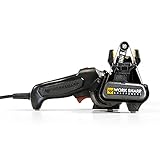
Work Sharp MK2
- Flexible abrasive belts
- two-speed motor
- Handles knives scissors axes and garden tools
- Edge guide supports the blade to the tip
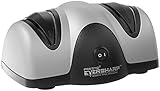
Presto 08800 EverSharp
- 2-stage system with Sapphirite wheels
- Precision blade guides hold a fixed angle
- Compact and stores flat
All 10 Electric Knife Sharpeners for Home Use at a Glance
Here is the whole lineup in one place, with the mechanism each machine uses to grind steel.
| Product | Specifications | Action |
|---|---|---|
| Chef’sChoice 15XV EdgeSelect |
|
Check Latest Price |
| Work Sharp MK2 |
|
Check Latest Price |
| Presto 08800 EverSharp |
|
Check Latest Price |
 Secura 2-Stage Electric Sharpener Secura 2-Stage Electric Sharpener |
|
Check Latest Price |
 Work Sharp E2 Kitchen Sharpener Work Sharp E2 Kitchen Sharpener |
|
Check Latest Price |
 Narcissus 2-Stage Electric Sharpener Narcissus 2-Stage Electric Sharpener |
|
Check Latest Price |
 SHARPAL 198H 3-Stage Sharpener SHARPAL 198H 3-Stage Sharpener |
|
Check Latest Price |
 Chef’sChoice 1520 AngleSelect Chef’sChoice 1520 AngleSelect |
|
Check Latest Price |
 Northmas 2-Stage Electric Sharpener Northmas 2-Stage Electric Sharpener |
|
Check Latest Price |
 Homly 3-Stage Electric Sharpener Homly 3-Stage Electric Sharpener |
|
Check Latest Price |
Electric vs Whetstone vs Pull-Through: Which One Suits a Home Kitchen
If you only read one section, read this one. Most people buy the wrong category of sharpener, then blame the machine.
Electric sharpener. A motorised unit draws your knife through rotating diamond, ceramic, Sapphirite or carborundum wheels, or through flexible abrasive belts. It costs the least in effort and the most in steel, and it is the only option that puts a consistent angle on a neglected edge in under a minute. It is the right call for straight-edge Western knives, for households with mixed skills, and for anyone sharpening more than once a month.
Whetstone. A waterstone gives you complete control over angle, thinning and finish, and it removes almost no steel. It is also a genuine skill that takes months to learn well, which is exactly why plenty of people abandon it. If you enjoy the process, our guide to the best kitchen knife sharpeners is worth a look. If you do not, do not feel guilty about it.
Pull-through sharpener. These are the cheap two-slot devices sold in hardware stores. They cost almost nothing, take up no counter space, and quietly improve an edge that is slightly dull. They cannot fix a genuinely damaged edge and they grind more steel per session than people expect. Our top pick here is the opposite of that philosophy.
Honing steel. A steel is a realignment tool, not a sharpener. It straightens a rolled edge back to true between sessions and costs a fraction of an electric unit. It is the right first purchase for a single cook who wants to maintain rather than restore.
The forum consensus is worth repeating here because it is right: a blunt but well-made knife is the ideal electric-sharpener candidate. Restoring a good blade costs far less than replacing a dull one.
Four Knives to Keep Out of an Electric Sharpener
Most complaints about electric sharpeners are really complaints about putting the wrong blade through one. Four categories should be kept away.
Serrated knives on a straight-edge machine. Only the machines listed as serrated-capable have a stropping stage or a dedicated serrated slot. Forcing a serrated bread knife through a coarse straight-edge wheel destroys the teeth. Read the serrated row in the table above before you buy.
Single-bevel Japanese knives. Yanagiba, petty and other asymmetric blades have a flat back and a hollow-ground front. An electric guide holds the blade at a symmetric angle by design, so it grinds the hollow into a wedge. Knife forums are consistent on this point, and our reviewers see the same pattern in the complaints.
Ceramic blades. Ceramic is harder than the abrasives in most consumer machines. Our picks that name ceramic compatibility do so explicitly, and everything else should be assumed unsuitable.
Thin blades you care about. The Work Sharp MK2 and the Homly both carry a warning about pressure and dwell time. Push hard, move slowly, and you can indent a blade near the handle. Our ceramic sharpener guide covers the gentler side of edge care if your blades are the delicate type.
1. Chef’sChoice 15XV EdgeSelect – Best Overall for Home Use
- Converts 20-degree factory edges to a sharper 15-degree Trizor XV edge
- Three stages including a flexible abrasive stropping stage for serrated knives
- Spring guides self-adjust for repeatable angles
- About 10 seconds to resharpen once the profile is set
- Quiet and heavy enough to stay put
- First reprofiling takes many passes through stage 1
- Bulky footprint that lives on the counter
- Sharpens knives only
- not tools or scissors
This is the machine we keep on our own counter. It is the only one in the group that does something genuinely different rather than the same grinding with more polish: the first two stages put a 15-degree Trizor XV geometry on a blade that arrived from the factory at 20 degrees, and the third stage refines it. Once that profile is set, resharpening takes about ten seconds.
The first session is the hard part, and it is hard for a good reason. A badly dulled knife needs repeated passes through stage 1 until a burr forms along the full length of the edge. Owners who skip the manual and rush that stage end up with an uneven edge, which is why the instructions are so insistent about working one stage at a time.
After the geometry is set, the machine changes character. The flexible abrasive stropping stage is what makes this safe for a serrated bread knife, because it polishes rather than grinds, and the spring guides self-adjust so you do not have to hold a precise angle. We use it for touch-ups every few weeks and for a full reset once or twice a year.
Noise is low enough that it does not wake anyone, and at 4.2 pounds it will not walk across the counter. There is no manual adjustment of any kind, which is a relief for a beginner and a limitation for anyone who wants a different angle.
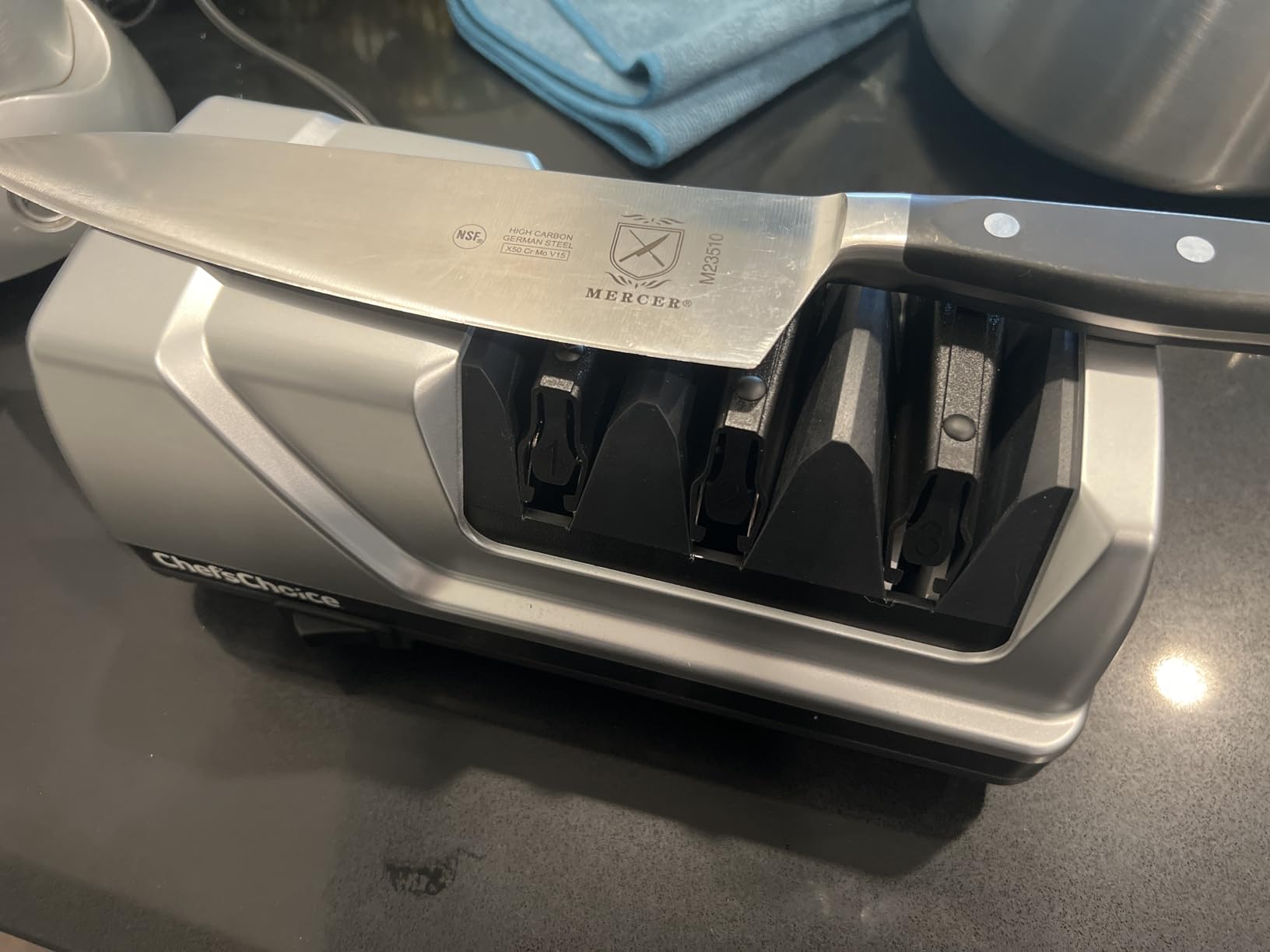
How this works on a neglected knife versus a slightly dull one
On a neglected knife with chips and deep dullness, the stage 1 diamond wheel is doing real metal removal and the improvement is obvious after three or four passes. This is where the machine earns its price and where the steel loss is measurable, so take a photo of the blade profile first if you care about preserving it.
On a knife that is merely dull, skip stage 1 entirely and go straight to stage 2 and the stropping wheel. That habit, repeated on a few forums as the single most useful piece of advice for preserving steel, is the difference between a knife that lasts decades and one that thins out in a couple of years.
Who should skip this machine
Do not buy it if your kitchen is a single thin Japanese knife and nothing else. The 15-degree conversion is the wrong thing to do to an asymmetric blade, and the machine will not warn you. It is also knives-only, so if you want scissors, axes and garden shears sharpened by the same box, the belt machine below is a better fit.
2. Work Sharp MK2 – Best for Knives, Scissors and Outdoor Tools
- Highest average rating in this group at 4.7
- Belts conform to curved edges and handle more knife types than wheel-only units
- Two-speed motor adds power for axes and lawn mower blades
- Edge guide supports the blade all the way to the tip
- Compact and light enough to store in a drawer
- Belt system removes more metal than a precision wheel sharpener
- Single belt grit gives less control over final edge angle
- Belt replacement is needed as belts wear down
This is the highest-rated machine we tested, with 4.7 stars across more than 8,000 reviews, and it earns that rating through versatility. Instead of fixed wheels it runs flexible abrasive belts that wrap around the blade, so a curved edge like a sheep’s foot or a fillet knife gets contact along its whole profile rather than at a tangent point.
The two-speed motor is the feature we did not expect to care about. Low speed is for knives, high speed is for the axe, the mower blade and the garden shears that live in the garage and never get maintained. One machine covers the kitchen and the shed, which is why it earns a place in a roundup framed around home use.
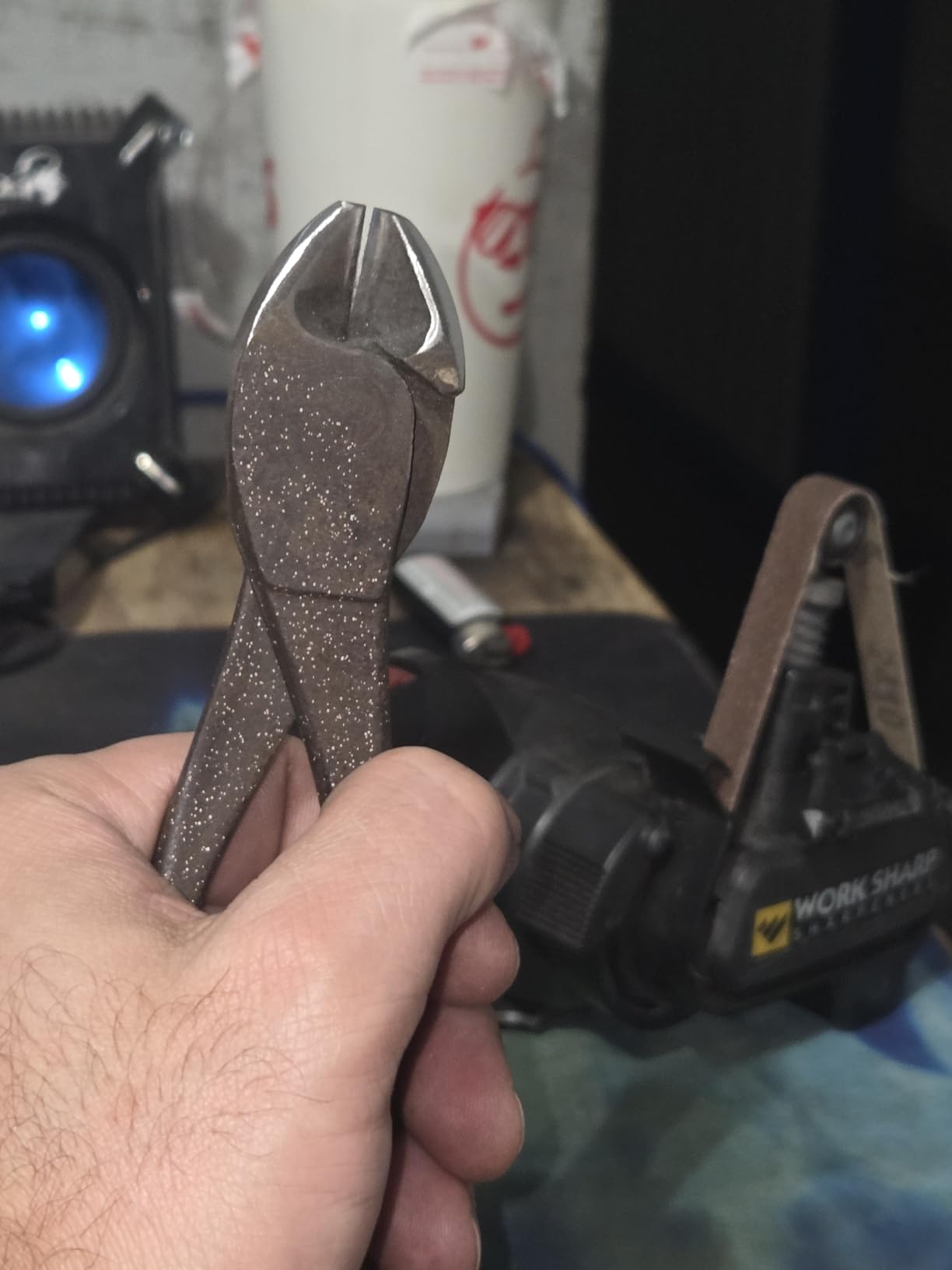
Two details make it forgiving for beginners. The edge guide supports the blade right through to the tip, so you are not left holding the last inch unsupported and wobbling. And it measures 7.02 by 2.26 by 1.27 inches at 1.12 ounces, which means it lives in a drawer between uses instead of claiming counter space permanently.
The honest trade-off is belt grit. You get one abrasive, not a graded set of stages, so the final edge angle is fixed by the guide rather than chosen by you. Belts also wear and need replacing, and they take more metal off a fine edge than a precision wheel does.
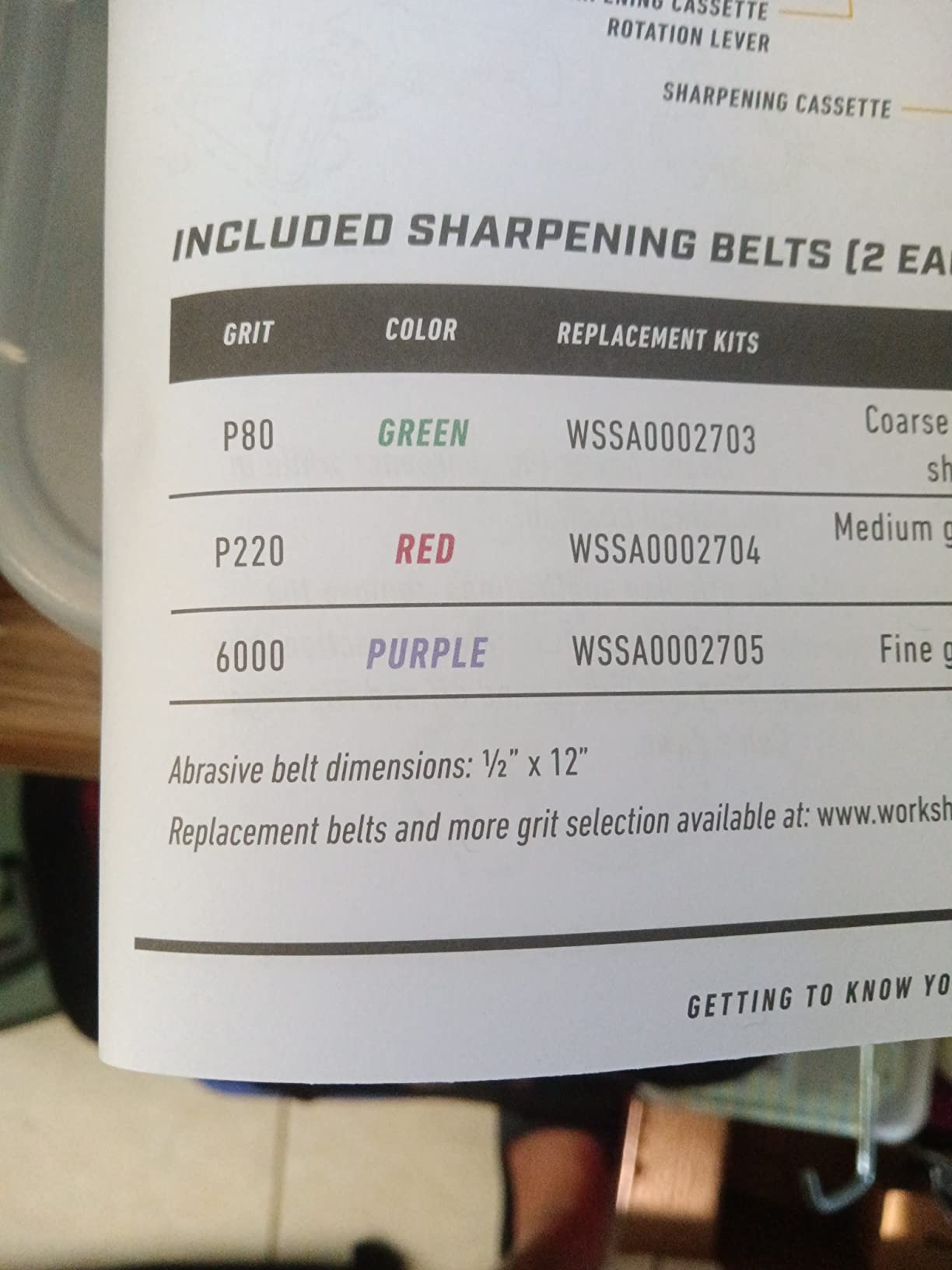
Where this one beats the wheel machines
Belts handle serrated knives and scissors without a special mode, and they follow a hollow-ground or curved edge better than any wheel in this roundup. If your kitchen includes a serrated bread knife and a pair of kitchen shears, this removes the two most common limitations of a basic two-stage unit.
It is also the machine we would hand to someone who sharpens two or three times a month rather than yearly. The ten-second reset of a wheel machine is faster, but the belt machine is more willing to do awkward jobs and takes the punishment from tools that are not precision instruments.
Who should skip this machine
Skip it if you own one expensive thin single-bevel Japanese blade and want it preserved. Belts are aggressive, the grit is not user-selectable, and the first few knives through any belt system come out uneven until you dial in pressure and speed. A whetstone is the right tool for that knife, not this.
3. Presto 08800 EverSharp – Best Value Two-Stage Sharpener
- Two-stage system restores a sharp edge in seconds
- Precision blade guides hold the knife at the correct angle
- Sapphirite wheels match what professional sharpening shops use
- Compact and lightweight at 3 pounds
- Edges reported to hold for years between sessions
- Handles straight non-serrated blades only
- Some units reported uneven wheel faces causing patterned grooves
- Less effective on very hard modern steel and ceramic blades
- Light pressure is needed or the wheel stalls
With more than 18k reviews at 4.5 stars, this is the most proven machine in the roundup, and the most common answer when people ask longtime owners which sharpener they still use. Several owners on knife forums describe running the same unit for two decades, which is a durability claim no laboratory test can match.
The mechanism is deliberately simple. Two Sapphirite wheels grind a precisely angled edge in stage 1, then fine hone and polish in stage 2, and the blade guides hold your knife at that angle so there is nothing to learn. That is the entire appeal: no stages to choose between, no angle settings, no technique.
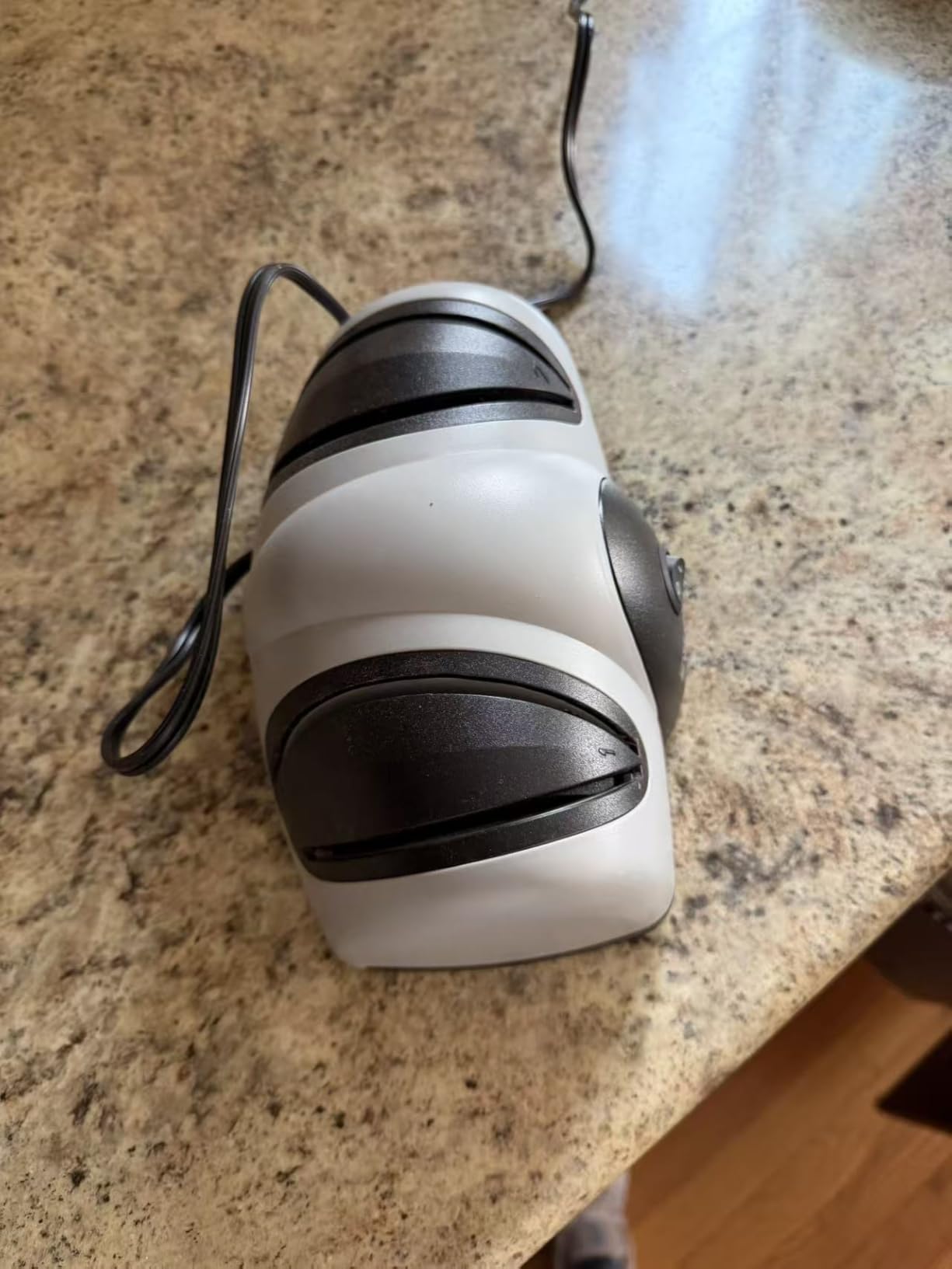
Sapphirite is a synthetic alumina abrasive, softer than diamond but far harder than a cheap stone, and it is the same family of material used in professional sharpening shops. Owners frequently point out how rarely they actually need to use it, which is the strongest argument for buying any sharpener at all: a good edge does not need touching every week.
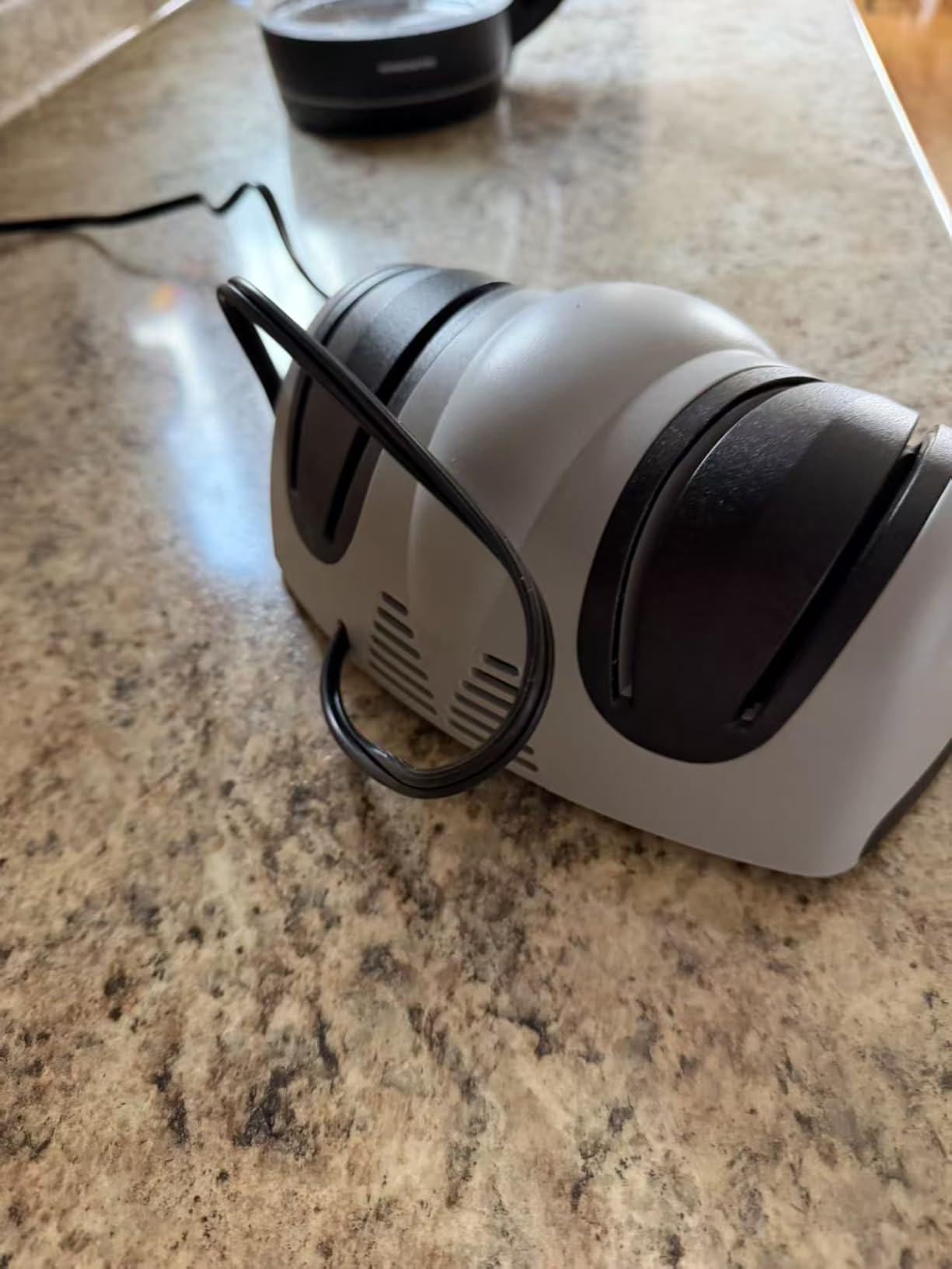
The limitations are real. It is a straight-edge machine, so a serrated bread knife is out of scope. A minority of owners report uneven wheel faces that leave patterned grooves, and it struggles on very hard modern steels and anything ceramic. Light pressure matters too, since leaning on the blade stalls the wheel.
Why this still makes the list in 2026
Newer three-stage machines with diamond abrasives are faster and more flexible, but this one wins on the metric that matters most for home use: it needs no consumables, no belts and no angle decisions. If you own four or five straight-edge Western knives and you sharpen them twice a year, simplicity wins.
It is also the model to buy if a housemate might use it. There is no mode to select, so the failure mode is a too-dull knife needing an extra stage 1 pass, not a wrong-angle edge ground into an expensive blade.
Who should skip this machine
Skip it if you have serrated knives in the mix, scissors, or any tools to maintain. It is also a 120-volt design, so outside North America you would need a step-down transformer. And if you own thin Japanese blades, any fixed-angle machine is a gamble you do not need to take.
4. Secura 2-Stage Electric Sharpener – Best Budget Diamond Sharpener
- Low price with genuine diamond abrasive wheels
- Precision guide converts a 20-degree edge to a finer 15-degree edge
- Suction cup feet keep the unit planted during use
- Stage 1 restores the edge
- stage 2 sharpens and polishes
- Compact enough for a small kitchen
- Not suitable for serrated knives
- Light-duty build with reports of over-grinding and grooving on hard knives
- Several passes usually needed before a knife is truly sharp
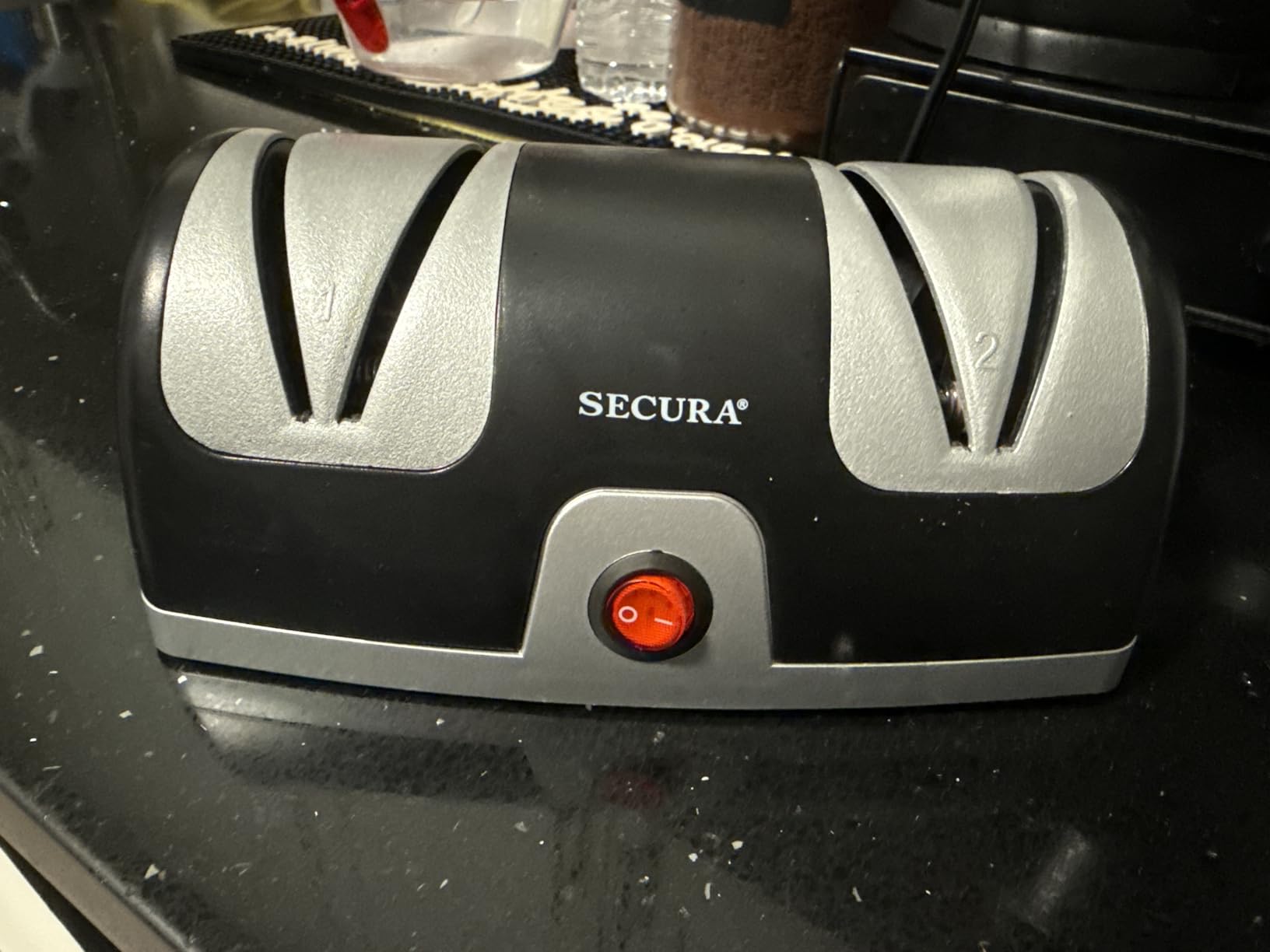
Most sub-entry-level electric sharpeners use plastic or stone wheels that round over quickly. This one uses real diamond abrasives in both stages, which is why it punches above its price and why owners often note that it beats sharpeners costing several times more.
The precision guide does something clever: it holds the blade so a 20-degree factory edge is converted to a finer 15-degree result. That is the same geometry idea as the premium Chef’sChoice units, delivered in a two-stage package with a two-year limited warranty.
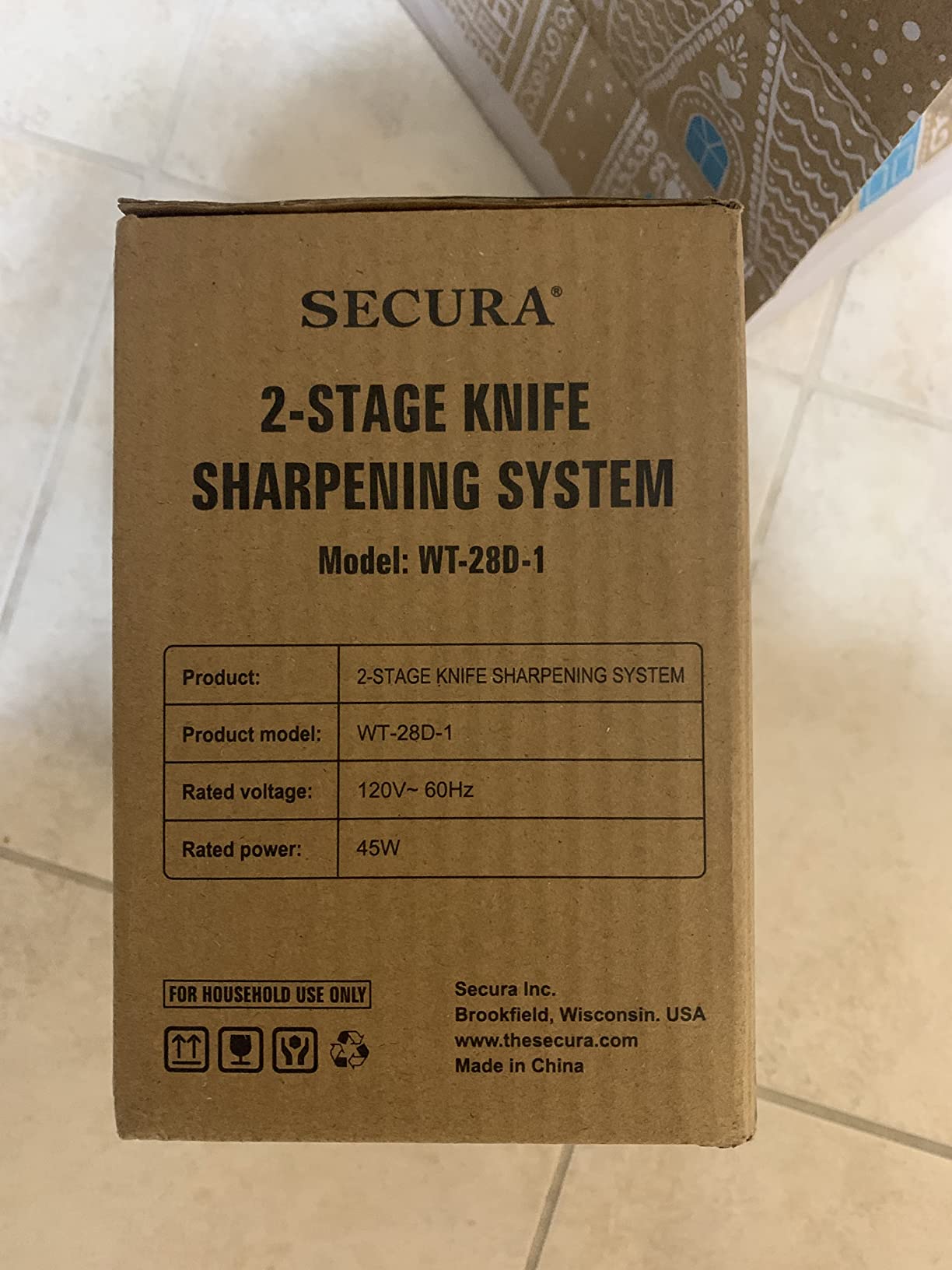
The four non-slip suction cup feet are a detail we appreciate more than expected. Most cheap units skate across a wet counter, and skating means uneven pressure, which means an uneven edge. This one stays where you put it, and it measures 7.87 by 5.31 by 3.54 inches at 2.3 pounds.
Reviewers are candid about the build. It is light-duty, a minority report grooving on very hard knives, and several passes are normal before a knife is genuinely sharp. It is better suited to everyday kitchen knives than to premium steel you would be upset to see patterned.
Whether the budget tier is worth buying
Forum scepticism about cheap imported units is not misplaced, and it is worth addressing rather than ignoring. The real question is what the steel costs you. At this tier you are paying for diamond wheels in a light plastic body, and the wheels outlast the body, so you get more value per unit of quality than the price suggests.
Our read is that the budget tier works when you sharpen dull-but-decent knives, not when you want a mirror finish. Use stage 1 to restore, stage 2 to refine, and expect three or four pulls rather than one. For a first sharpener in a rental or a student kitchen, it is a reasonable way to start.
Who should skip this machine
Skip it for serrated knives, absolutely. It is a 120-volt ETL-approved unit, so overseas buyers need a converter. And if you already own a sharpener that works, the light build and the reports of over-grinding make it a poor choice for an expensive blade.
5. Work Sharp E2 Kitchen Sharpener – Best for Serrated Knives and Shears
Work Sharp Electric Kitchen Knife Sharpener – Get knives ready for cookouts and BBQ’s- Fits in Kitchen Drawer, Sharpens every time, fast & easy
- Fully automated one-button sharpening with no angle guesswork
- Handles serrated edges scissors and shears as well as straight blades
- Built-in ceramic hone wheel allows daily edge maintenance
- Wide base stays stable during use
- 3-year warranty plus 3-year spare part availability
- Fixed angle with no 15 or 20 degree selection
- Larger footprint than slot-based compact sharpeners
- Some users report less-than-expected results on very hard steel
- Premium price relative to basic 2-stage units
This is the one we recommend when serration or scissors are the deciding factor rather than edge geometry. Instead of a slot you pull through, it is a fully guided unit: you press the button and draw the blade across the abrasive, with no angle decisions at all.
The built-in ceramic hone wheel is the detail that changes daily habits. You can run a blade through the hone stage frequently without removing metal, which is exactly how a wheel-driven sharpener should be used between deeper sharpening sessions. Several owners cite it as the reason they reach for the machine weekly rather than twice a year.
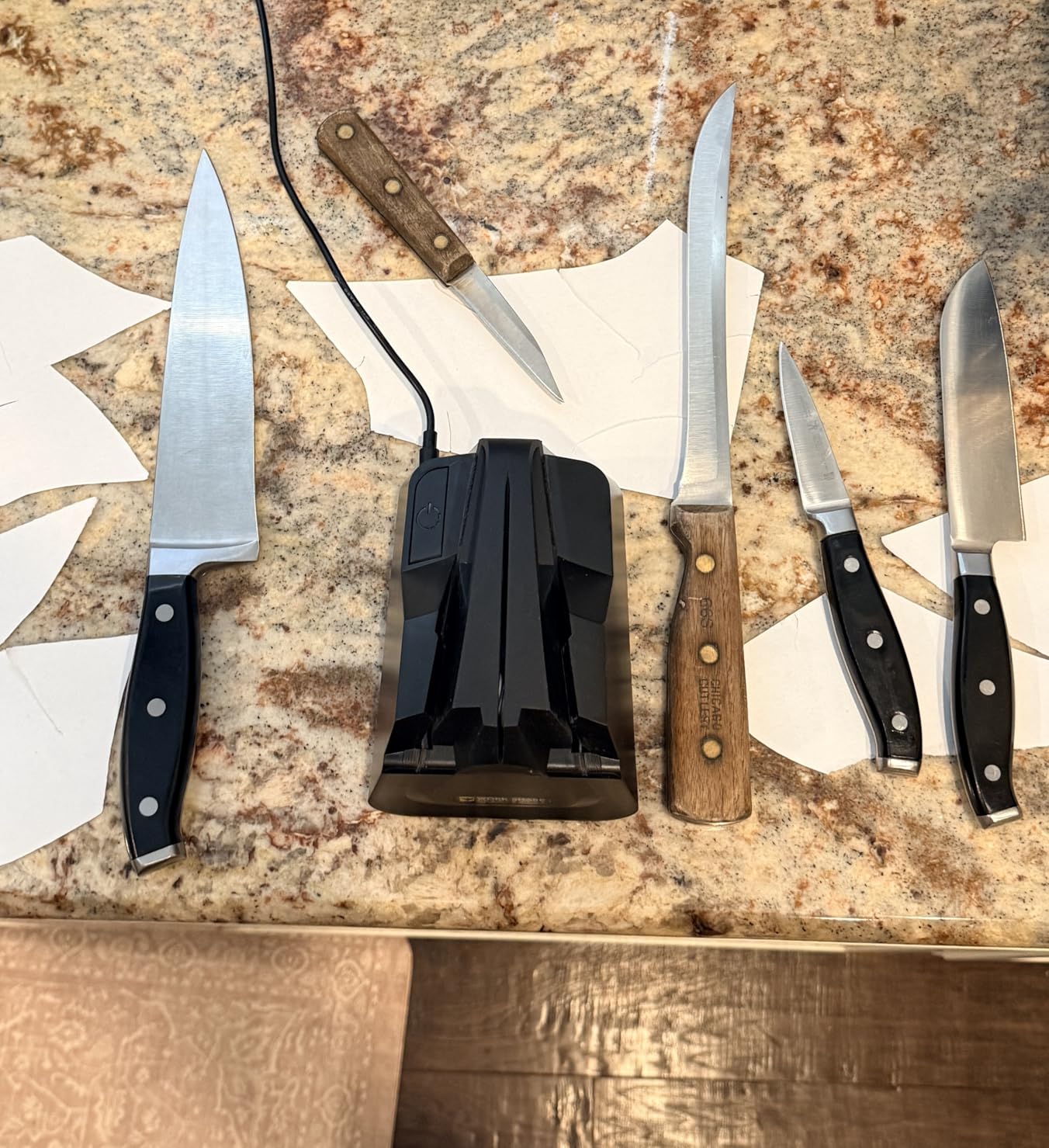
It handles serrated edges, scissors and shears alongside straight blades, which covers a surprising amount of what a household actually struggles with. Spare parts are available for three years after purchase, so a worn wheel does not end the machine’s life.
The compromises are real. The angle is fixed with no option to select 15 or 20 degrees, and at 6.77 by 10.82 by 5.89 inches it is the largest footprint in this roundup, which matters in a small kitchen. Some users also report underwhelming results on very hard modern steel.
How the ceramic hone stage changes your routine
The hone wheel removes almost no steel, so it can be used as often as you like. For most households the ideal pattern is a daily or weekly hone pass and a full sharpening two or three times a year, and this unit is one of the few in the roundup designed explicitly for that split.
Because the operation is a guided press rather than a pull, it is the least fussy machine for a shared kitchen. A second person can use it correctly on the first attempt, which matters if you are buying for a housemate rather than for yourself.
Who should skip this machine
Skip it if edge angle is something you care about. It produces one angle, you cannot change it, and knives ground to a different angle take a correction cycle to get used to. It is also a poor fit for a small counter, since it is designed to stay out on the worktop.
6. Narcissus 2-Stage Electric Sharpener – Best for Mess Control and Voltage Flexibility
- Two stages give a quick coarse cut followed by a burr-free polish
- Magnetic dust box collects metal chips from the base
- Side scissors slot adds a third function in one unit
- 30-watt motor runs continuously without overheating
- 100-240V global voltage design
- Compact at 1.6 pounds
- Carborundum wheels are softer than diamond and wear faster
- Works only on straight-blade knives
- Angle is fixed by the guide rather than user-selectable
- Scissors slot needs practice before it works well
Every sharpening machine makes metal filings, and most of them let them fall on your counter. The magnetic dust collection box built into the base of this one catches the chips as they are produced, which in a small kitchen is a genuine quality-of-life difference.
It also solves a problem that catches buyers outside North America. The 100-240V global voltage design means the machine works on local mains power without a converter, which rules out several otherwise comparable units on this list.
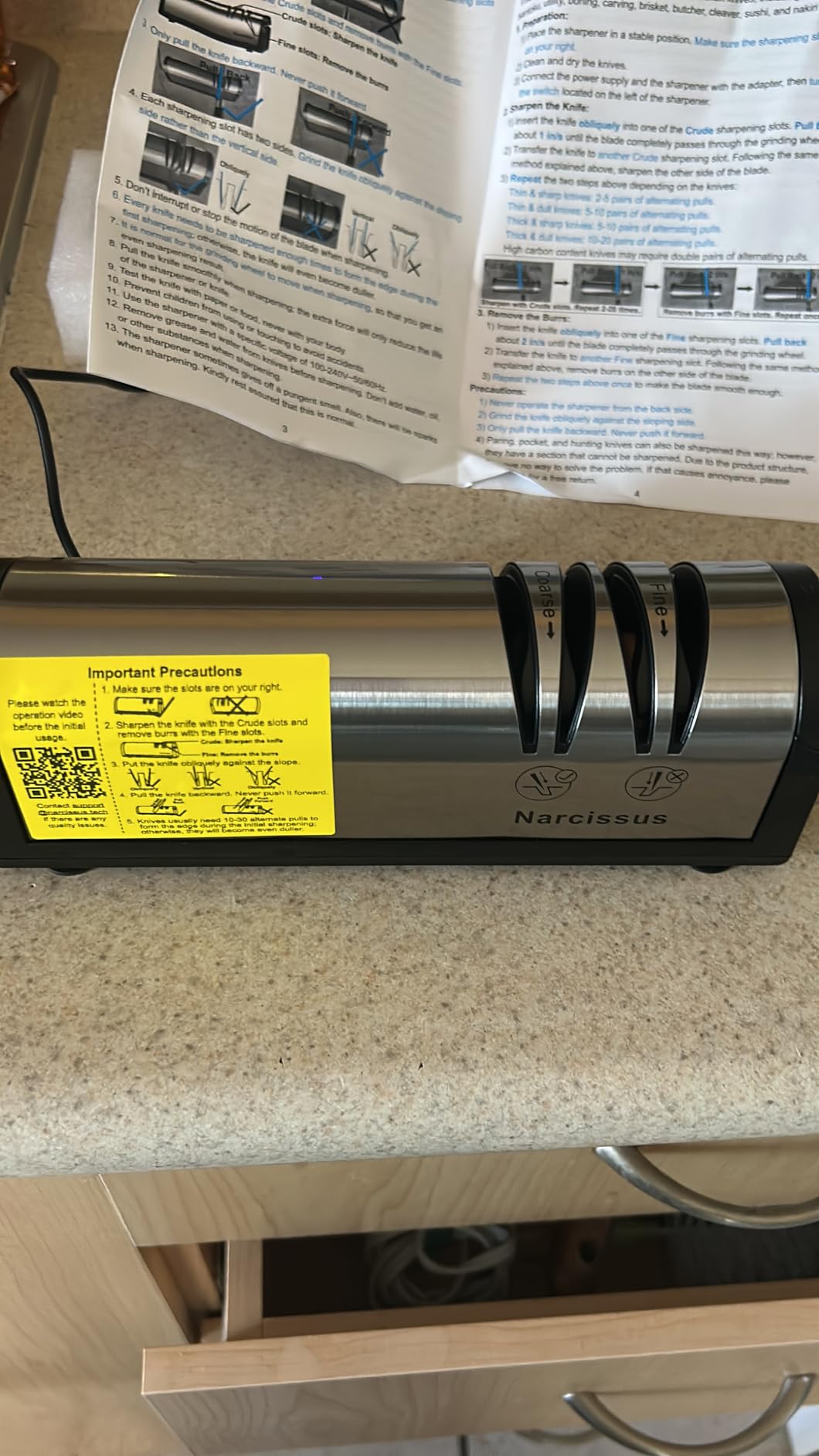
The 30-watt DC motor is specified to run continuously for over an hour without overheating, so long sessions are not a worry. A side-mounted scissors slot adds a second job, and at 8.6 by 2.6 by 2.9 inches and 1.6 pounds the whole thing is slim and light.
The tradeoff is abrasive choice. Carborundum wheels are softer than diamond and wear faster, so the edge takes slightly more passes and the wheels need replacing sooner. The angle is fixed by the guide, and the scissors slot needs practice before it does a clean job.
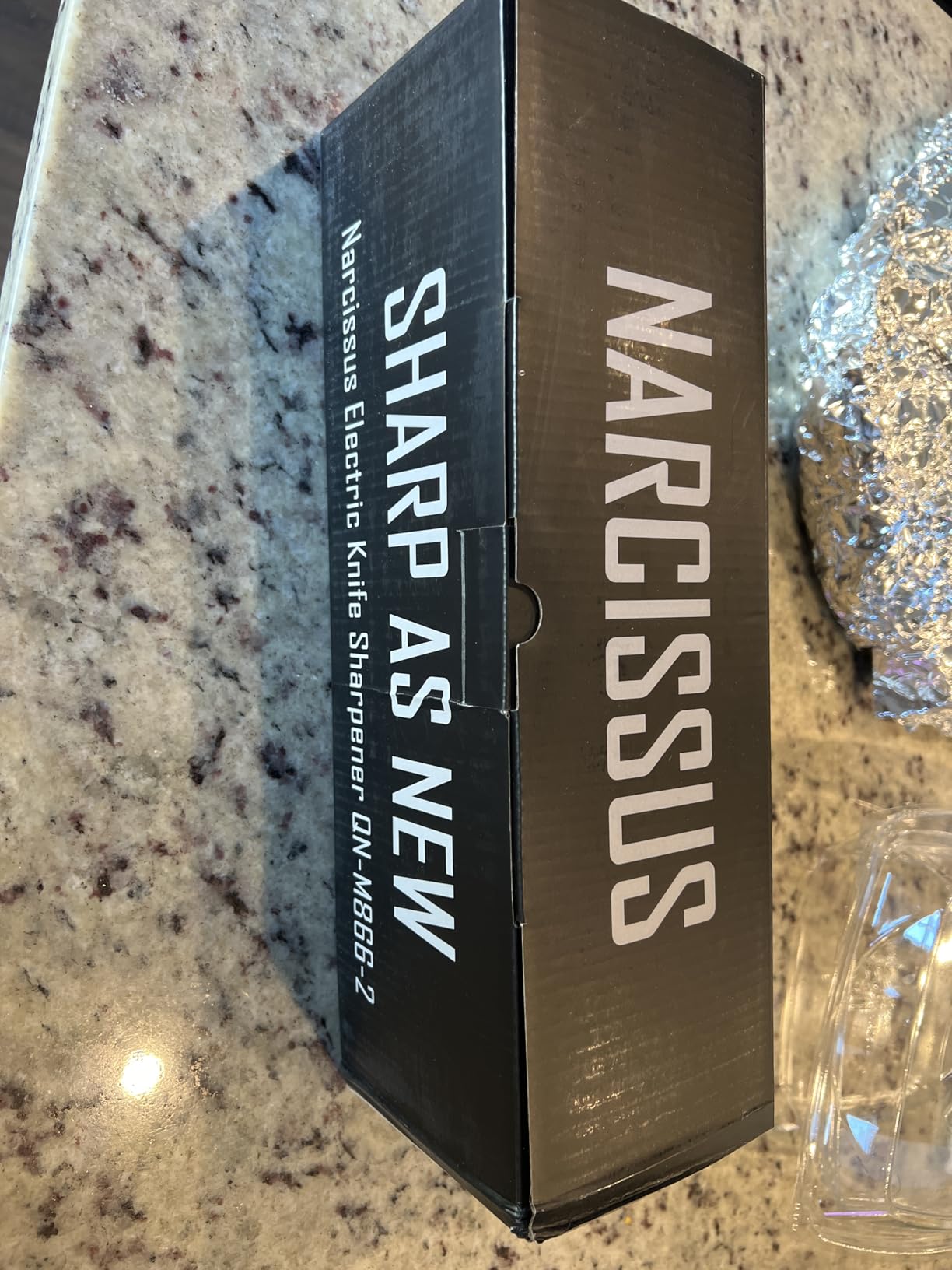
When mess control matters more than edge refinement
If you sharpen at the end of cooking rather than as part of a weekend ritual, a machine that keeps filings off the worktop earns its place. Wiping a counter after every session is the step that stops people from sharpening at all, and the dust box removes it.
The 100-240V design is the second reason to look here if you are outside the US or Canada. Two of the diamond-wheel machines in this roundup are 120-volt only, which is a real limitation for international buyers.
Who should skip this machine
Skip it for serrated knives, since it is straight-blade only, and skip it if you want to choose your edge angle. It is also not the choice for someone sharpening very hard modern steel frequently, because softer carborundum wheels need more passes to do the same work.
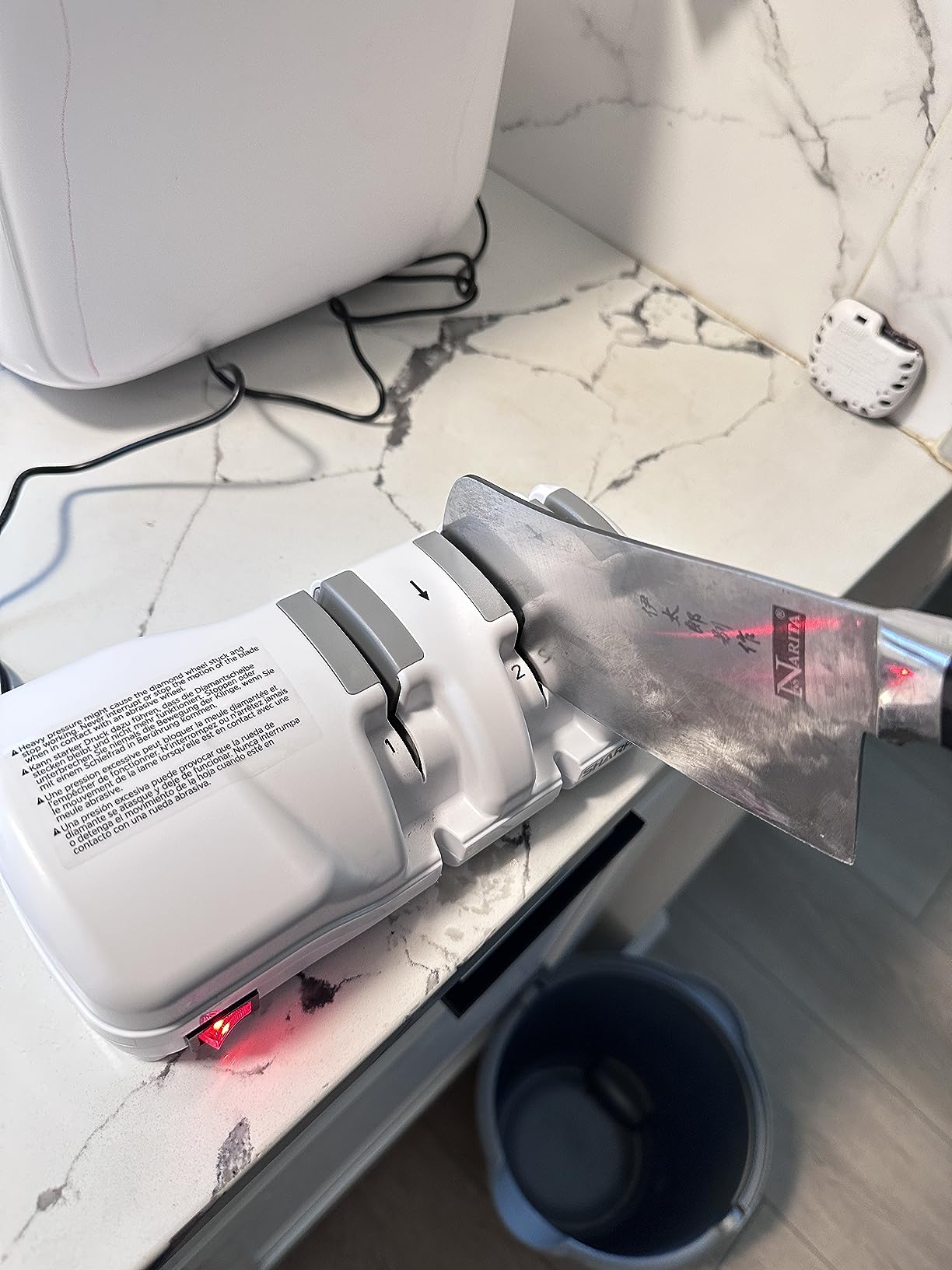
7. SHARPAL 198H 3-Stage Sharpener – Best for Quiet Operation
- Sharpens both sides of a double-bevel edge simultaneously for even results
- Very beginner-friendly one-handed operation with no technique
- Quiet operation under 65 dB
- Overheat protection designed to avoid de-tempering blades
- Removable magnetic receptacle collects filings
- Handles straight edge and serrated knives
- Fixed 20-degree angle with no 15-degree option
- Can scuff or roughen the upper blade near the spine
- Very small pocket knives cannot be fully sharpened
- Some units needed warranty replacement after motor failure
Noise is the one specification almost no competitor publishes, so this one stands out. The manufacturer rates the 198H at under 65 dB, which makes it the pick for apartments, early mornings and anyone sharing a wall with a sleeping household.
The second distinguishing feature is simultaneous two-sided grinding. Most machines alternate sides as you pull. This one works both bevels at once, and the practical effect is an even edge with fewer pulls, which is why owners like it on knives that were already straight but had dulled.
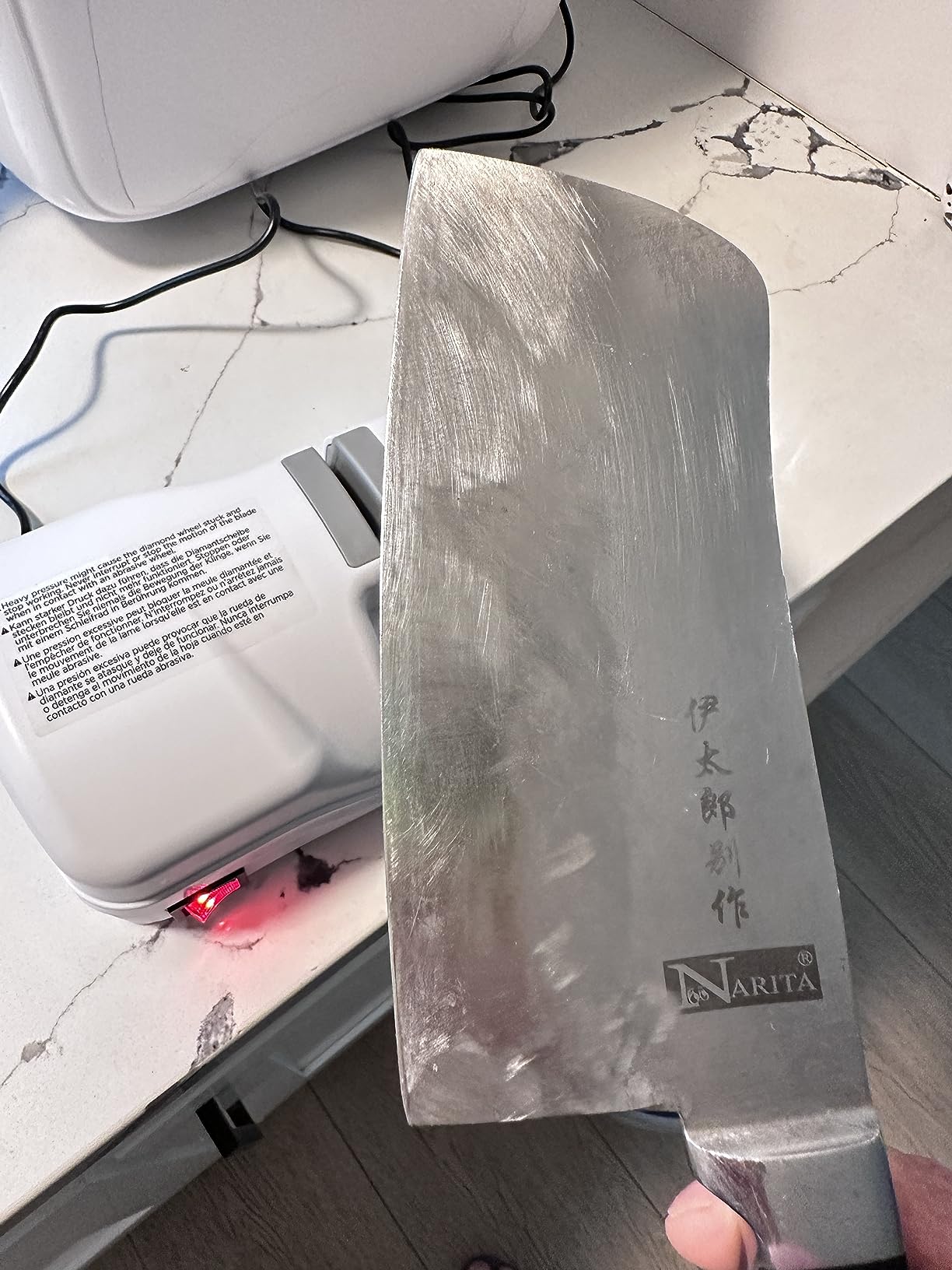
Overheat protection is designed specifically to avoid de-tempering a blade, which is a sensible safeguard when a machine runs fast on hard steel. A removable magnetic receptacle collects the filings, and the unit handles both straight-edge and serrated knives despite the fixed 20-degree preset angle.
There are honest drawbacks. The angle is locked at 20 degrees with no 15-degree option, some owners report cosmetic roughening on the upper part of the blade near the spine, and very small pocket knives cannot be fully sharpened. A few units needed warranty replacement after a motor failure inside the first year.
Whether a quiet sharpener changes your sharpening habits
It does, more than most spec sheets suggest. If noise is why you have avoided sharpening at home, a machine you can run at any hour removes the reason entirely, and a kitchen sharpener that gets used is worth more than a quieter one that sits in a cupboard.
Two-sided grinding suits a dull-but-even knife particularly well. If your blades are simply tired rather than damaged, you get a consistent result in fewer passes with less risk of developing a ridge on one side.
Who should skip this machine
Skip it if your block is full of thin Japanese knives that want a 15-degree edge, because the fixed 20-degree preset is the wrong target. It is also a poor tool for very small folding knife blades and for anyone with serrated knives whose teeth need a dedicated stropping stage rather than a grinding wheel.
8. Chef’sChoice 1520 AngleSelect – Best for Mixed 15 and 20-Degree Knives
- Only machine here with selectable 15 or 20 degree angles
- Precision angle guides eliminate guesswork across the whole edge
- Dizor two-facet geometry creates a longer-lasting arch-shaped edge
- Ultrastrop stropping disks give a highly polished finish
- Diamond abrasives handle straight edge and serrated knives
- Highest cost of the machines in this roundup
- Large footprint compared with compact 2-stage units
- Sharpens knives only
- not scissors or tools
- Angle change requires working through the stages in order
Most electric sharpeners commit you to a single edge angle forever. This one lets you choose between a traditional 20-degree edge and a finer 15-degree edge, and for a household with a mixed block that is the feature that matters.
The Dizor engineered two-facet geometry produces a longer-lasting arch-shaped edge than a single-facet grind, and the patented Ultrastrop stropping disks finish it with a polish that is visible on a slice of tomato. Buyers who pay more for it point almost universally to the angle selection as the reason.
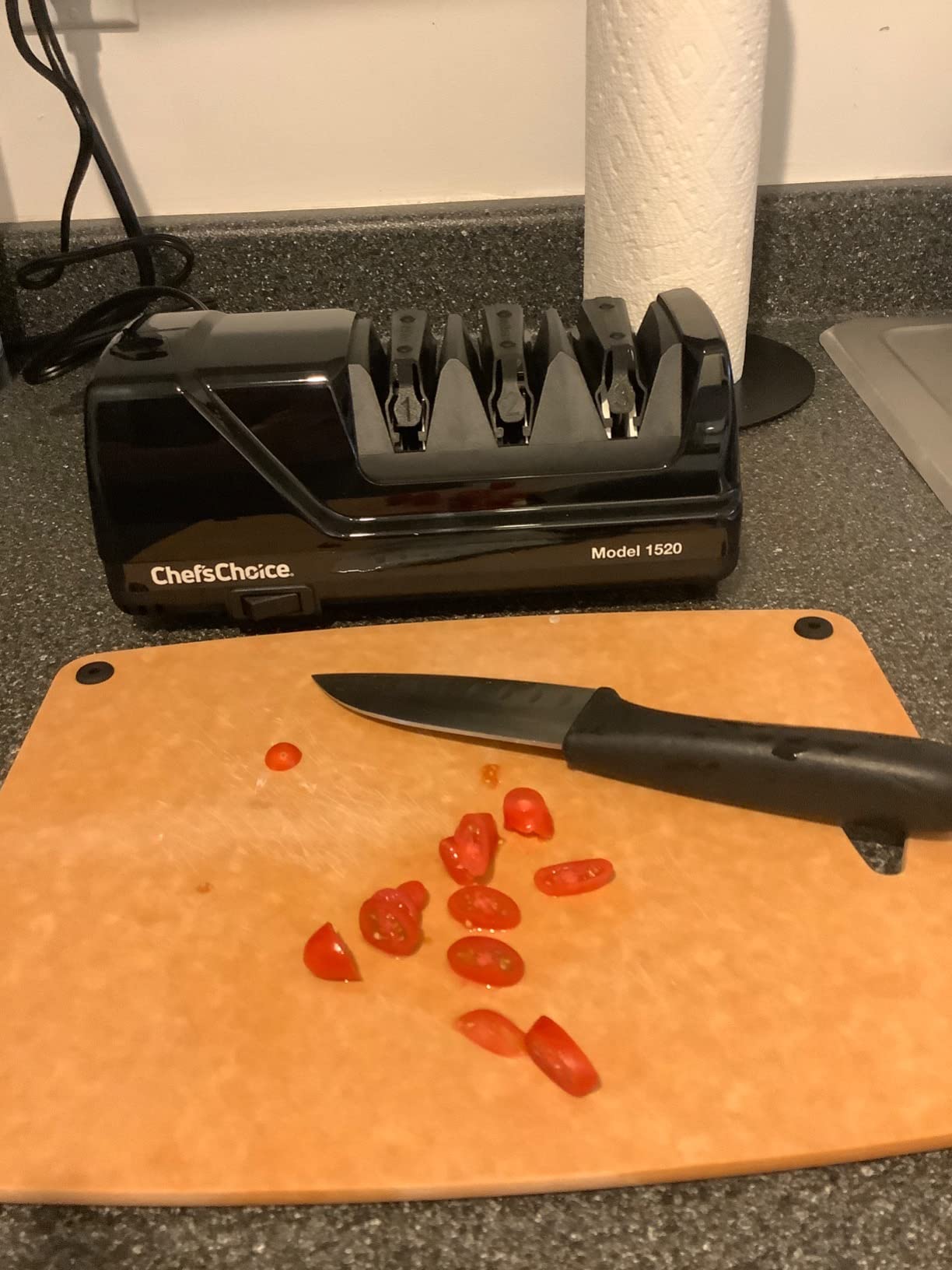
It is a two-stage machine with diamond abrasives and precision angle guides, so you are not relying on your hands to hold the angle. Serrated knives are supported. The warranty is a three-year manufacturer limited warranty, matching the brand’s flagship.
What you give up is reach. It is knives only, no scissors or tools, and at 12 by 3.37 by 6.25 inches it has one of the larger footprints in the roundup. Changing angle also means working through the stages in order rather than jumping straight to a quick touch-up.
Who genuinely needs selectable edge angles
You need this if you own both Western knives that came from the factory at 20 degrees and Japanese-style knives that want 15. Otherwise you are forcing a perfectly good edge off its correct angle every time you sharpen, and the edge does not hold as long between sessions.
It is also the machine to consider if you keep sharpening the same knife for years and care about how it looks at the spine. Holding an existing angle means you are not steadily thinning the blade toward a wedge every time you touch it up.
Who should skip this machine
Skip it for a first-time buyer. It is the most expensive machine here, the review volume is lower than the alternatives, and the learning curve is real because an angle change requires working through the stages in sequence. If you own one straight-edge block and are still learning what an edge angle is, a simpler two-stage machine will serve you better.
9. Northmas 2-Stage Electric Sharpener – Best for Small Kitchens
- Very low cost for a working 2-stage sharpener
- Two stages give a quick coarse cut then a fine polish
- About 30 seconds needed for a routine sharpening
- Compact footprint that stores easily in a small kitchen
- Four suction cups hold it firmly in place
- 100-240V global voltage design
- Removes a noticeable amount of metal if overused
- Does not sharpen the entire length of the edge evenly
- Fixed angle with no fine 15-degree option
- Entry-level build quality compared with diamond-wheel units
At 7.8 by 2.1 by 3.1 inches and 1.2 pounds, this is the smallest machine in the roundup, and in a galley kitchen that footprint is the whole pitch. It is also 100-240V, so it works on local mains power anywhere in the world without a converter.
The two stages do exactly what the label says: a quick coarse cut followed by a fine polish, in roughly 30 seconds per pass cycle. Four suction cups on the underside hold it planted, which on a small counter is more useful than it sounds.
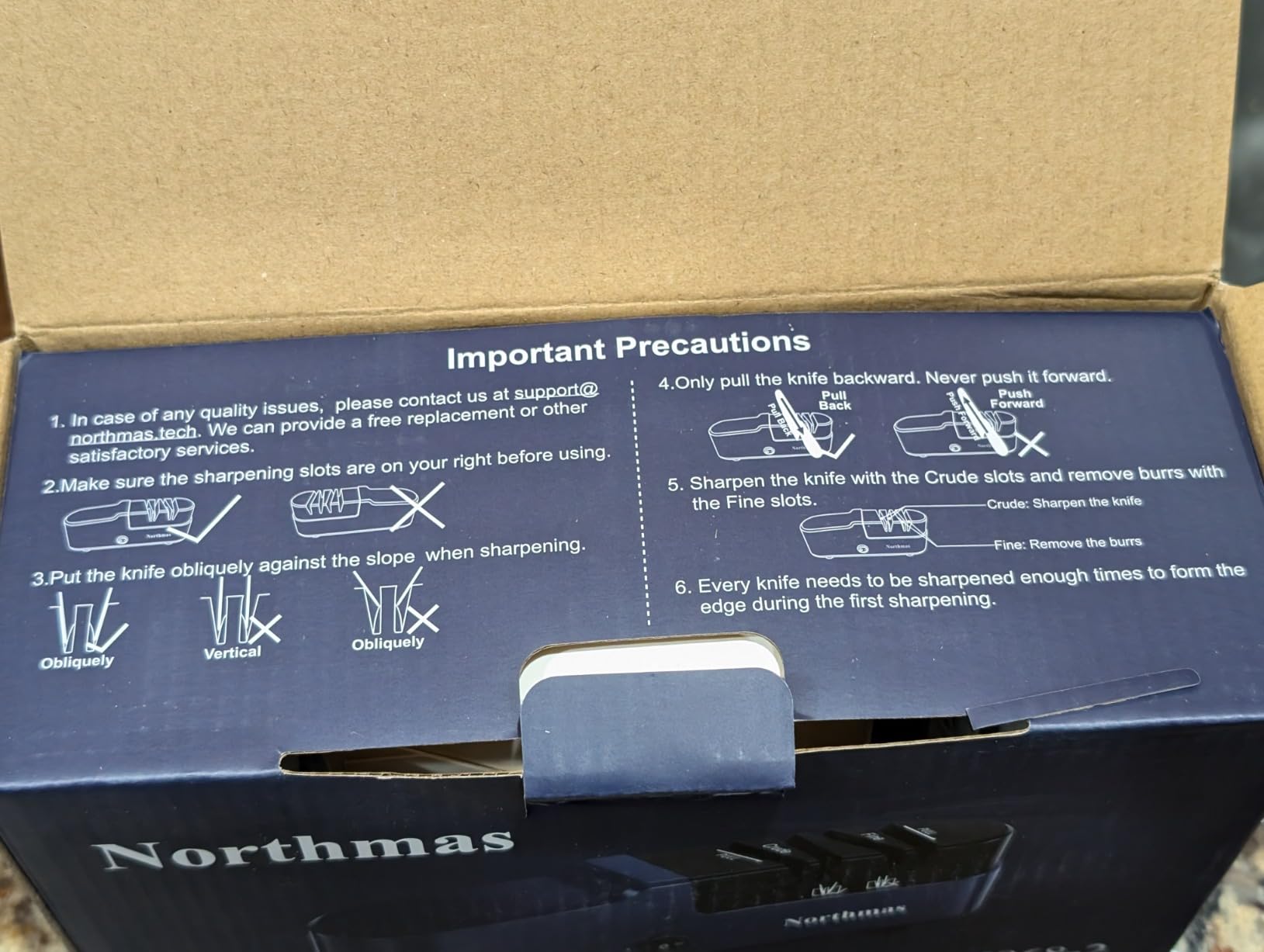
Owners like the size, the routine speed and the fact that it needs no consumables. The manufacturer also offers a 12-month replacement or refund period with 24 months of after-sales service, which is better support than most budget sharpeners carry.
The cautions are consistent across reviews. It removes a noticeable amount of metal if you overwork it, it does not sharpen the entire length of the edge evenly, the angle is fixed with no 15-degree option, and the build is entry-level compared with diamond-wheel machines.
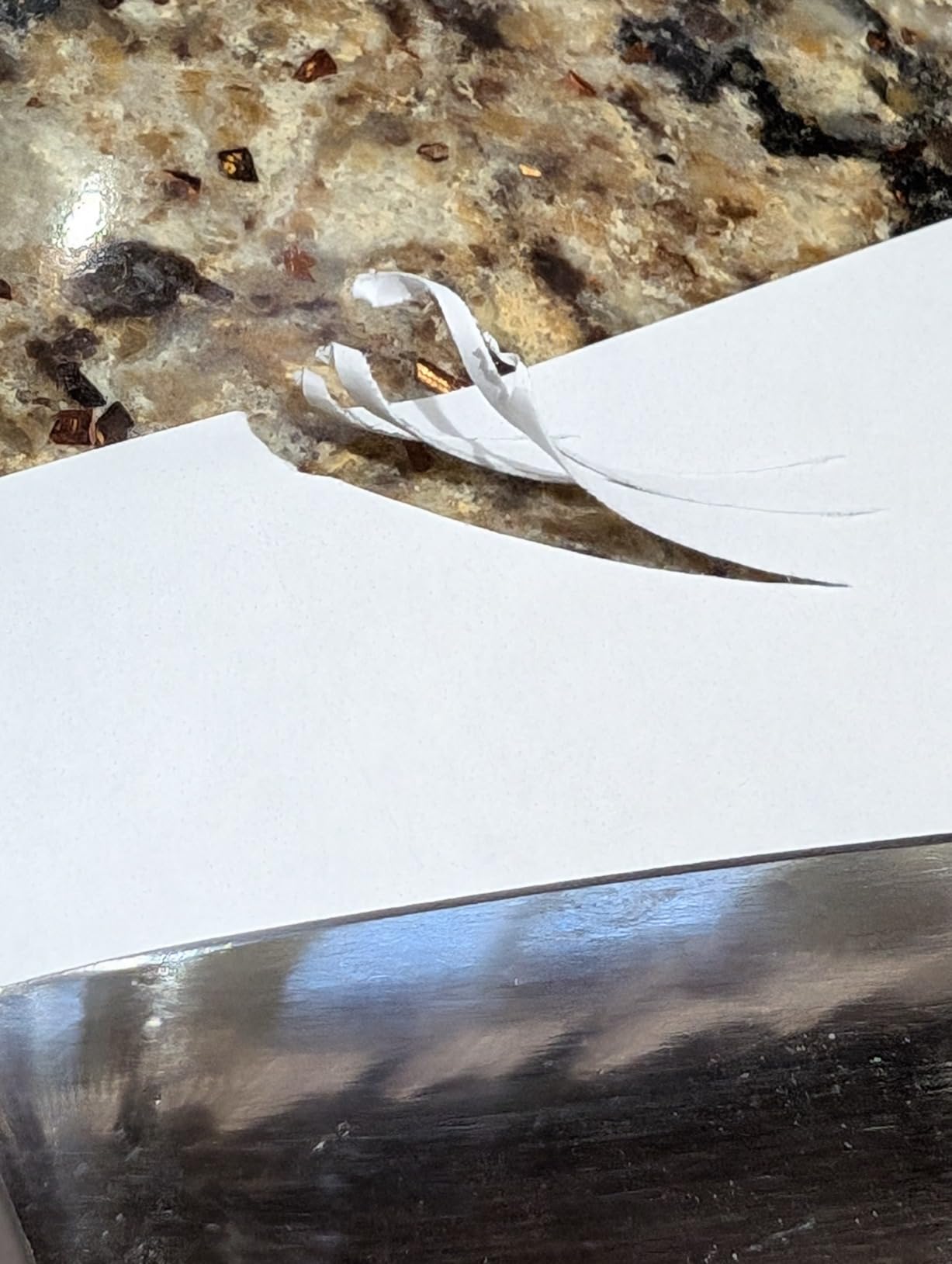
When a compact unit is the right trade
If counter space is your binding constraint, this is the machine that disappears when you are done with it. A 2.1-inch width fits in a drawer beside a rolling pin, and a two-stage cycle means one button and thirty seconds, with nothing to store or replace.
It is also the option to consider for sharpening away from home, since a machine this small and this light is the one you would actually pack. Owners generally find it works best on larger, duller knives rather than on blades needing a light finish.
Who should skip this machine
Skip it if you own thin or valuable blades. The reviews are blunt that uneven sharpening along the edge and faster-than-expected metal removal are the two failure modes, and both matter more on an expensive knife. It is also not the choice if you want a precise 15-degree edge.
10. Homly 3-Stage Electric Sharpener – Best Wide Knife-Type Coverage
- Three stages with 100% diamond abrasives for sharpen hone and polish
- Sharpens a knife in under a minute with minimal effort
- Flexible spring guide rod holds the blade at a consistent angle
- Covers a wide range of steels from chef's to boning and pocket knives
- Noise-reducing motor design
- Some owners report it outperforms more expensive sharpeners
- Too much pressure or moving too slowly can indent the blade near the handle
- A few knife types respond less well than others
- Large 12-inch footprint for a three-slot unit
- 120-volt only
This is the newest name in the roundup and the least reviewed, but the machine itself is a well-executed 3-stage EdgeSelect design: 100 percent diamond abrasives in stages 1 and 2 for sharpening and honing, a third polishing pass, and a flexible spring guide rod that holds the blade at a consistent angle.
Where it stands out is knife-type coverage. The manufacturer lists chef’s, slicing, santoku, boning, butcher, fish and pocket knives, and the thin flexible profile of the guide rod is what makes that possible. At 4.4 stars across more than 700 reviews, with 71 percent five-star, the early owner sentiment is positive.
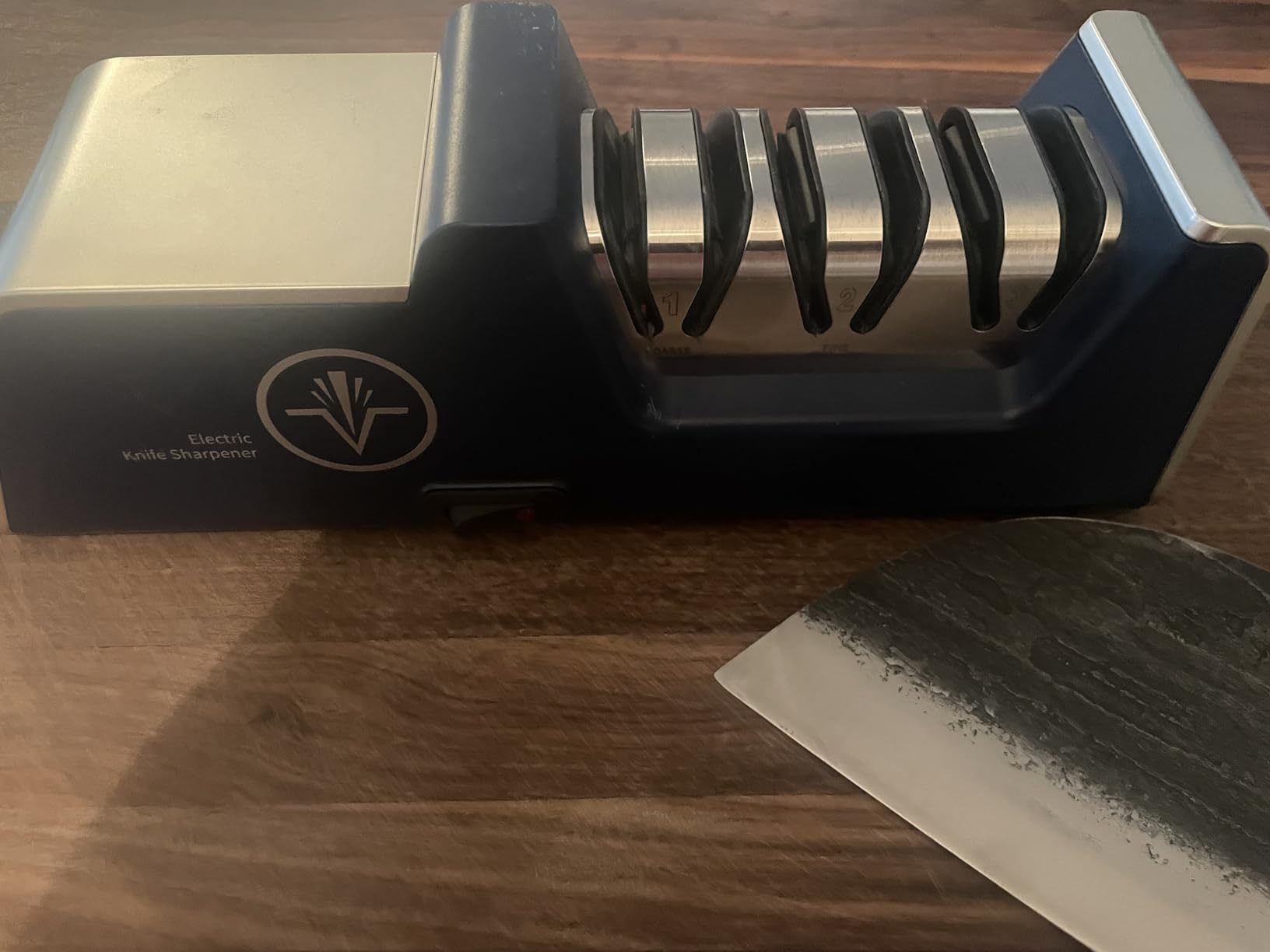
The flexible spring guide rod is a meaningful design choice. Instead of a rigid guide that contacts the blade in one place, it follows the blade as it moves, which is why reviewers find results consistent across very different knife shapes. Owners also praise the speed, with a knife sharpened in under a minute.
The most important warning is about pressure. Reviewers are consistent that pushing too hard or moving too slowly can indent the blade near the handle. That is not a defect to argue with, it is a technique rule, and the motor is also specified as noise-reducing.
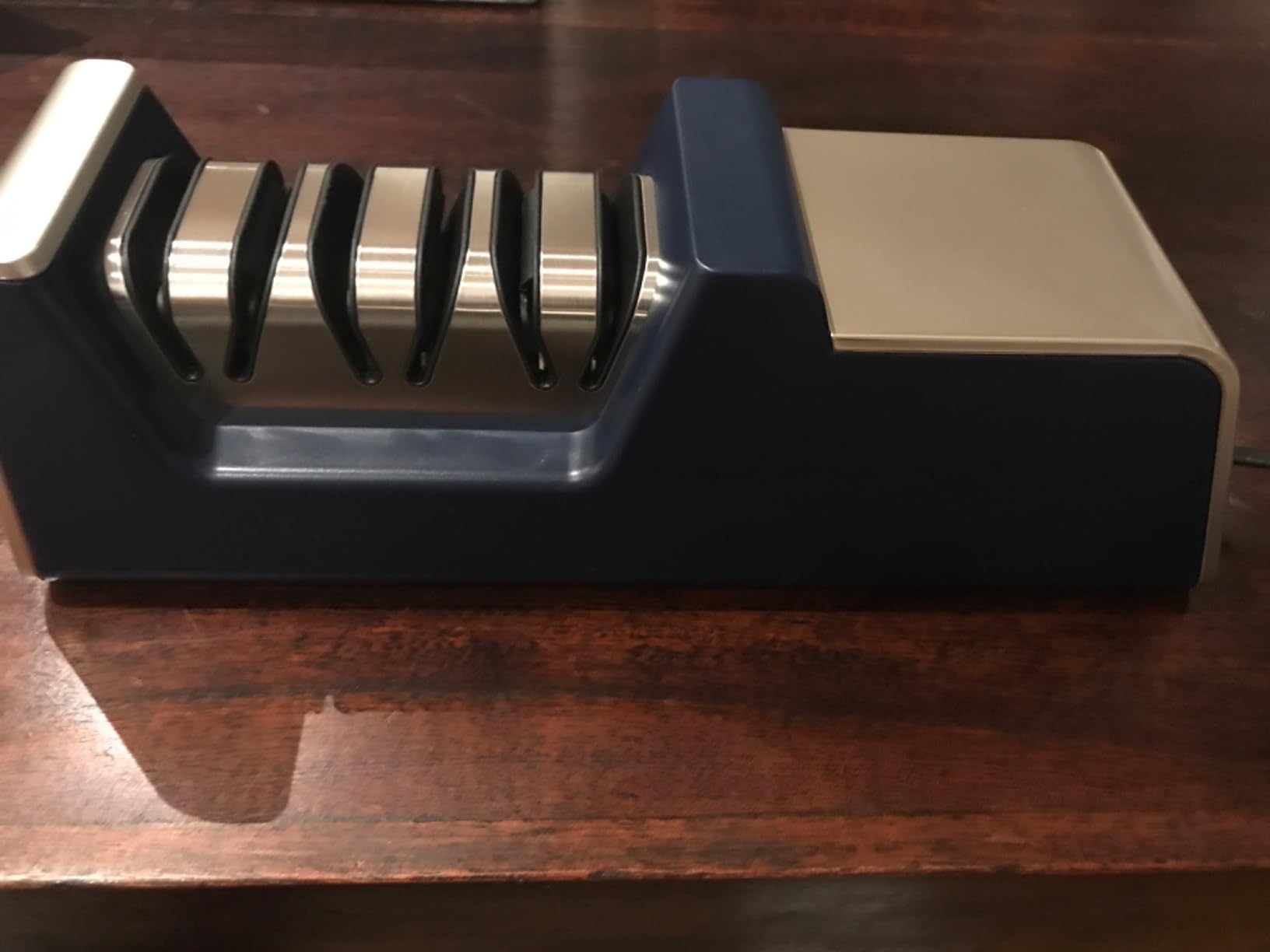
What you gain and lose at this price point
You gain three stages, diamond abrasives and a 2-year manufacturer warranty, which is a specification list most people would expect from a machine costing several times as much. Several owners report that it outperforms more expensive sharpeners for their knives, and the build details, including a double-layer shell paint and electroplating, suggest it is not a disposable design.
You lose certainty and space. The review base is small compared with the established names, at 12.2 by 4.8 by 4.8 inches it is the longest machine here, and it is 120-volt only, which rules it out for buyers outside North America without a converter.
Who should skip this machine
Skip it if you are sharpening thin Japanese blades, where the technique risk of pressing too hard is highest, and skip it if your knives are mostly very small folding blades. Buy a model with a longer track record if you want a machine you will still be using in a decade without researching support options.
How to Use an Electric Sharpener Without Grinding Away Your Edge
Every ruined knife we have seen came from one of four mistakes. None of them require experience to avoid.
1. Start with the least aggressive stage that could work. If the knife slices paper and cuts a tomato cleanly, it needs stage 2 or the stropping wheel, not stage 1. Reserve stage 1 for a knife that has genuinely lost its edge.
2. Pull heel to tip in one smooth motion. Start at the heel, draw steadily to the tip without lifting or pausing. Restarting mid-pull leaves a flat spot, and multiple short strokes are the most common cause of the uneven edges people complain about.
3. Use light, even pressure. These are motorised units, not hand tools. Pressing harder does not sharpen faster, it stalls the motor and risks indenting the blade near the handle, which owners report on belt-driven models in particular.
4. Count your passes. Four to six pulls per stage is normal. A diamond stage that is still cutting aggressively needs a lighter touch on the next pass, not more passes at the same pressure.
5. Work one stage at a time. On a three-stage machine, finish stage 1 and form a burr along the full edge before moving on. This is the single most common reason buyers end up with a disappointing first result, and it is entirely avoidable by reading the manual.
6. Hone more often, sharpen less. The machines here that include a honing stage or a stropping wheel are designed for frequent light passes. A monthly hone pass costs almost no steel. A full stage 1 session costs real steel, and that is the difference between a knife that lasts and a knife that thins out.
How to Choose the Right Electric Knife Sharpener
Eight factors decide this purchase, and they are worth weighing in this order.
1. What knives do you actually own? Serrated, straight-edge, or both. Serrated support is the most common buyer regret in forums because it is invisible in a product photo. Check it before anything else, then decide whether scissors and garden tools matter to you.
2. How many stages do you need? A two-stage system reshapes and hones. A three-stage system adds a stropping or polishing pass that produces a noticeably smoother edge. Three stages cost more metal if you use them carelessly, so the extra stage is only worth having if you will use it.
3. What abrasive grinds the steel? Diamond is the hardest and fastest, which means less pressure and less wear. Sapphirite is a softer synthetic alumina that is gentler and forgiving. Carborundum is softer still and wears fastest. Ceramic is a finishing material rather than a grinding one.
4. Which edge angle do your knives want? Western knives generally sit at 20 degrees per side and Japanese-style knives at 15. A fixed-angle machine is fine if all your knives agree. If they do not, you want selectable angles, and that is a narrow category of machines.
5. What about asymmetric blades? Single-bevel Japanese knives, including yanagiba and petty styles, should not go through any electric sharpener on this list. A symmetric guide cannot hold an asymmetric bevel and will grind the hollow into a wedge. This is the one hard limit on electric sharpening.
6. How much metal will it remove? The honest answer is that stage 1 removes the most and the stropping stage removes almost none. Belt systems remove more per pass than precision wheels. If you are restoring a neglected knife, accept that metal comes off and take a photo of the profile first.
7. What is the warranty and the parts situation? Warranties in this roundup run from one year to three years, and the Work Sharp E2 also lists three-year spare part availability. Longer support matters for a machine you expect to keep for a decade rather than replace.
8. Will it fit and suit your kitchen? Footprints here run from 2.1 inches wide to nearly 11 inches. Noise matters if anyone sleeps nearby, and only one machine in this roundup publishes a decibel figure, under 65 dB. Finally, check the voltage: several machines are 120-volt only, while two accept 100-240V.
Our fuller comparison of the wider sharpening category, including the manual options we do not recommend here, is in our kitchen knife sharpener guide. For enthusiasts who want deeper mechanical testing detail, our electric sharpening systems roundup goes further into the engineering.
Frequently Asked Questions
What is the best electric knife sharpener for home use?
The Chef’sChoice 15XV EdgeSelect is our top pick for home use. Its three stages use 100 percent diamond abrasives to convert a 20-degree factory edge into a 15-degree Trizor XV edge, and a flexible abrasive stropping stage handles serrated knives. After the first session sets the profile, resharpening takes roughly ten seconds. It carries a three-year limited warranty.
Is it worth getting an electric knife sharpener?
For most home cooks, yes. A dull but well-made knife is the ideal candidate, because restoring it costs far less than replacing it and takes under a minute. Electric sharpening is a poor fit if you own single-bevel Japanese knives or ceramic blades, and it is unnecessary if you already maintain an edge with a honing steel and enjoy the process. Judge it on how few times a year you actually need to sharpen.
What is the best type of knife sharpener for home use?
An electric sharpener suits home cooks who want a consistent angle in seconds without learning whetstone technique. A whetstone gives full control and removes almost no steel, but takes months to learn. A pull-through sharpener is cheap and good for maintaining a slightly dull edge, but cannot fix a damaged one. A honing steel realigns an edge between sessions rather than creating one.
Can an electric knife sharpener damage my knives?
They can, mainly through over-grinding rather than through poor design. Pressing hard, moving slowly, or repeatedly running stage 1 on an already sharp knife removes more steel than you intend. Single-bevel Japanese knives and ceramic blades are the real exclusions, because a symmetric angle guide cannot hold an asymmetric bevel. Stay out of stage 1 unless the edge is genuinely lost and most knives will last indefinitely.
Can electric knife sharpeners sharpen serrated knives?
Only the machines built for it. A serrated knife needs a stropping stage or a dedicated serrated slot that polishes the teeth rather than grinding them away, and the Chef’sChoice 15XV, the 1520 AngleSelect, the Work Sharp E2, the Work Sharp MK2 and the SHARPAL 198H all support serrations. Forcing a serrated blade through a coarse straight-edge wheel will destroy the teeth.
How long does an electric knife sharpener last?
With typical home use, most owners get many years, and some forum regulars report running a Chef’sChoice unit for over two decades. Diamond and Sapphirite wheels are effectively permanent for home volumes of use, while carborundum wheels wear faster. Belt-driven machines need belt replacement as the belts wear down. The more meaningful limit is not the machine failing but steel ground away from your knives by careless technique.
Final Verdict
The Chef’sChoice 15XV EdgeSelect is the best electric knife sharpener for home use in 2026, and the reason is the 15-degree Trizor XV geometry it puts on a 20-degree factory edge, plus a stropping stage that makes it safe for serrated knives. It is the machine we keep within arm’s reach, and the one we recommend without qualification to anyone with a straight-edge or serrated block.
Pick the Work Sharp MK2 if your sharpening list extends past the kitchen to scissors, axes and garden tools, or if you want the highest-rated machine in the group. Pick the Presto 08800 EverSharp for the simplest proven two-stage design, or the Secura and SHARPAL 198H if you want three stages and diamond wheels at the lower end. The Chef’sChoice 1520 AngleSelect is the one to own when your block mixes 15 and 20 degree edges.
Whatever you choose, start at stage 2 unless the knife is truly gone, and remember that the best sharpener in the world still shortens a blade if you use it carelessly. If you are also building out a kitchen, sharpening a good knife beats replacing a dull one every time.