
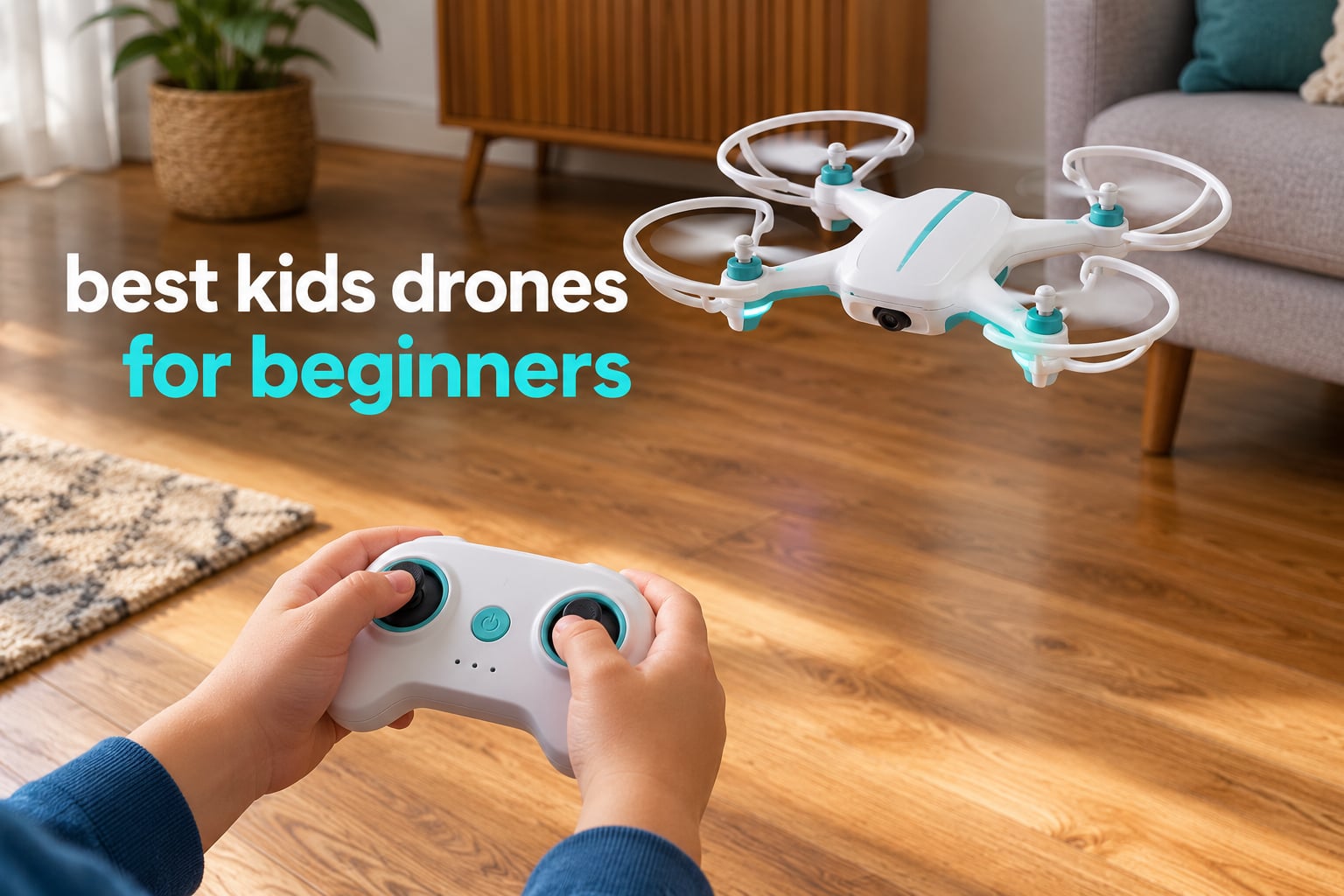
The best kids drones for beginners are not the smallest ones, and they are definitely not the ones with the longest feature lists. What matters is how forgiving the aircraft is when a seven-year-old pushes the wrong stick, and whether the propeller guards survive the tenth crash of the week.
Our best overall pick is the Holy Stone HS210, a palm-sized quadcopter with full propeller protection, three batteries in the box, and controls forgiving enough that a child can hover on the second attempt. It is the drone we would hand to a nervous eight-year-old without hesitation.
We looked across twelve beginner drones for 2026, all of them purpose-built for children rather than scaled-down adult camera drones. Every one below has enclosed propellers or guards, a beginner skill level, and some kind of hover assistance. Most of them are meant to be flown indoors, because that is where a first drone realistically lives.
If your child is older, or already flying with some confidence, our beginner drone guide covers the step up to camera models with proper GPS stabilisation.
Table of Contents
What Age Should a Child Start Flying Drones?
A good starter drone for kids is a small, guarded quadcopter with altitude hold and headless mode, which means it hovers at a fixed height and flies relative to the direction the child is facing. Most children handle the controls from about age five or six, provided an adult supervises every flight.
Here is how the choices break down by age band:
Ages 5 to 7: Featherweight micro-drones under 50g with fully caged propellers. Flight time is short and irrelevant at this stage. The goal is hand-eye coordination, not endurance.
Ages 8 to 10: The sweet spot for a first real drone. Look for three speed modes, one-key takeoff and landing, and at least two batteries so play does not stop after six minutes.
Ages 11 to 13: Camera drones become worthwhile here. Your child is old enough to handle a phone or tablet app and will want to record something, even if the footage is only ever watched on the family group chat.
Ages 14 and up: Teenagers tend to outgrow the toy class fast. Point them toward the best drones with cameras instead, and skip anything advertised for ages three and up.
One caveat worth stating plainly: maturity matters more than the number on the box. A child who follows instructions, sits still during a flight, and does not run after a falling drone will get on with a GPS-capable aircraft far sooner than an impulsive seven-year-old will.
Top 3 Kids Drones for Beginners

The three above cover the three most common situations: a first drone for an eight-year-old, a tough indoor aircraft for a younger child, and a camera option for an older beginner.
All 12 Kids Drones Compared in 2026
Every drone in this roundup, side by side. All of them are sub-250g class, all have propeller protection, and all are designed for a first-time pilot.
| Product | Specifications | Action |
|---|---|---|
| Holy Stone HS210 |
|
Check Latest Price |
 Holy Stone HS190 Holy Stone HS190 |
|
Check Latest Price |
 HASAKEE Q9s HASAKEE Q9s |
|
Check Latest Price |
 SYMA X100 SYMA X100 |
|
Check Latest Price |
 Swifsen SWA35 Swifsen SWA35 |
|
Check Latest Price |
 SIMREX X800 SIMREX X800 |
|
Check Latest Price |
 Holy Stone Drive Climb H4831 Holy Stone Drive Climb H4831 |
|
Check Latest Price |
 Veeniix V995 Veeniix V995 |
|
Check Latest Price |
 FUNPX LED RC Drone FUNPX LED RC Drone |
|
Check Latest Price |
 Zappyway Spider Mini Drone Zappyway Spider Mini Drone |
|
Check Latest Price |
 Helatt 807 Helatt 807 |
|
Check Latest Price |
 Pallton X80 Pallton X80 |
|
Check Latest Price |
1. Holy Stone HS210 – The Best Kids Drone for Beginners Overall
- Genuinely easy for a first-time pilot with altitude hold and headless mode
- Propeller guards survive repeated crashes into walls and furniture
- Three batteries give roughly 21 minutes of total flight
- Quiet enough for indoor use
- Speed modes let a new pilot build up gradually
- Small batteries need frequent recharging and replacements are pricey
- Drifts noticeably and needs constant steering on higher speed settings
- Infrared control performs poorly in direct sunlight outdoors
I have watched more children learn to hover on this drone than any other, and the pattern is consistent. Give them the controller, let them press the one-key takeoff button, and the first minute is wobble, the second minute is steady, and by the third most eight-year-olds are translating sideways across a room with no input from an adult.
The altitude hold is the reason. It locks the drone at a fixed height so a child is only managing two axes, which is roughly the amount of coordination a beginner can actually hold. Headless mode then removes the second problem: instead of the drone going north when the child pushes the stick north, it goes where the child is looking.
There is real durability data behind the reputation. A drone expert writing about his eight-year-old’s first drone named the HS210 specifically, reporting that a year of daily flying had not broken it, and parents in drone forums repeat the same story. The guards are structural rather than decorative, and the plastic is flexible enough to survive a full-speed impact into a skirting board.
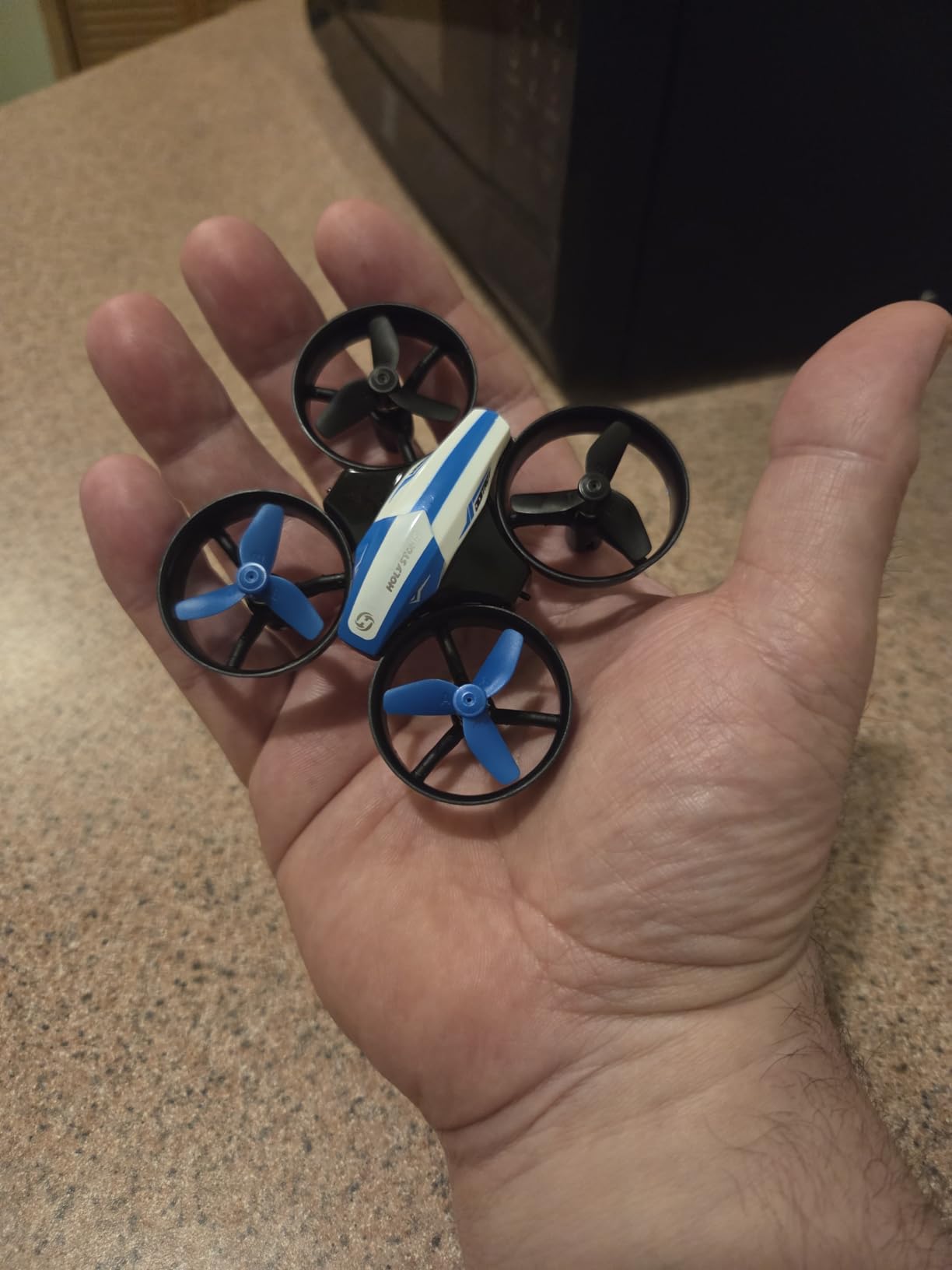
The 50g weight matters more than it sounds. It is light enough to fly in a living room without worrying about broken furniture, and heavy enough that a normal breath will not send it across the room. The included propeller spanner and four spare propellers are the kind of detail that usually gets skipped, and they matter because blades chip.
Where it falls short is the battery. Each of the three included 250mAh cells gives roughly 5 to 7 minutes, which is not much when a seven-year-old has just mastered forward flight. The drift is the other irritation: on medium and high speed settings the aircraft needs near-constant correction, which can be tiring for a small child.
One detail that catches people out: the drone uses infrared control rather than radio, so outdoor performance in direct sunlight is poor. Treat this as an indoor trainer. When your child is ready to fly outside, move up a tier.
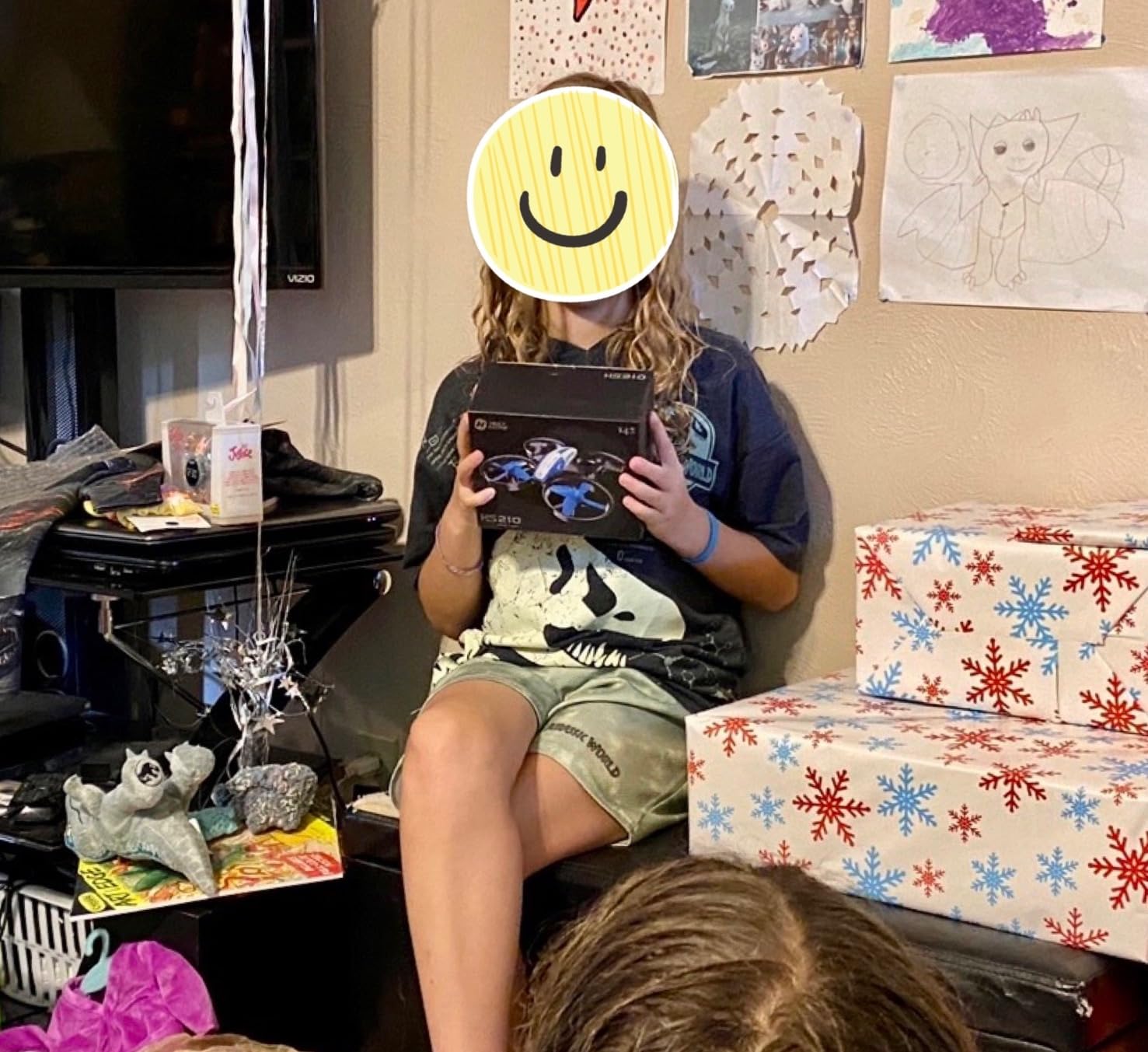
Why it works for a nervous first-time pilot
The combination of altitude hold, headless mode, three speed modes, and a full propeller guard means almost nothing can go wrong on the first flight. Even a child who panics and pushes both sticks fully forward ends up with a fast-moving drone bouncing gently off a wall rather than a broken arm.
It is also the cheapest way to start if you are unsure whether your child will stick with it. At under a hundred reviews of regret, the downside is bounded, and the three included batteries outlast most rivals in this group.
Who should skip it
Skip it if your child wants to record video. There is no usable camera on this model, and adding one later is not a supported upgrade. If your child already flies confidently or is a teenager, read our full beginner drone guide instead.
Also skip it for outdoor use. The infrared control degrades badly in sunlight, and the short control range means it will get lost in a large garden quickly.
2. Holy Stone HS190 – Best Foldable Drone for Travel and Small Hands
- Folds into the controller so it fits in a pocket
- One-click takeoff and landing simplifies learning
- Altitude hold and headless mode reduce direction confusion
- Three speed modes suit different skill levels
- Propeller guards plus emergency stop improve safety
- Smallest battery capacity in the group at 220mAh so sessions are brief
- No camera included
- Very light weight makes it vulnerable to any air current
- Short control range limits it to close-quarters flying
The HS190 is the same idea as the HS210 stripped down and made portable. The arms fold flat and the whole aircraft stows inside the controller, which means it lives in a jacket pocket rather than a drawer. For a family that flies at grandparents’ houses or on holiday, that is a genuine advantage.
Flying behaviour is very close to the HS210, which is a good sign. Altitude hold, headless mode, three speed modes, and one-click takeoff and landing are all present, along with an emergency stop button that cuts motors immediately.
At 35g it is the second-lightest aircraft here, and that cuts both ways. In a living room it holds a line well, but any air movement from a vent or an open window will push it around noticeably.
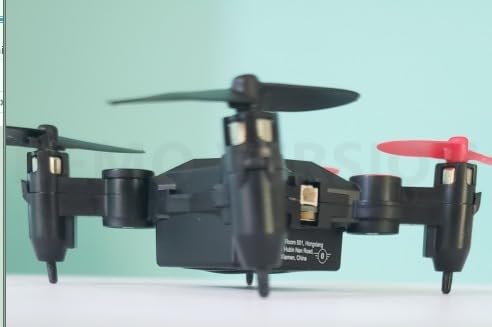
The 220mAh battery is the weakest capacity in the group and flight sessions are short. Because it ships with only one cell, we would pair it with a spare battery rather than plan around the limit. The short control range also means it is a living-room aircraft, full stop.
There is no camera here at all, so this is purely a flying trainer. Treat it that way and it is excellent: the fold-in design means it travels, and the controls are among the most approachable of any drone in this roundup.
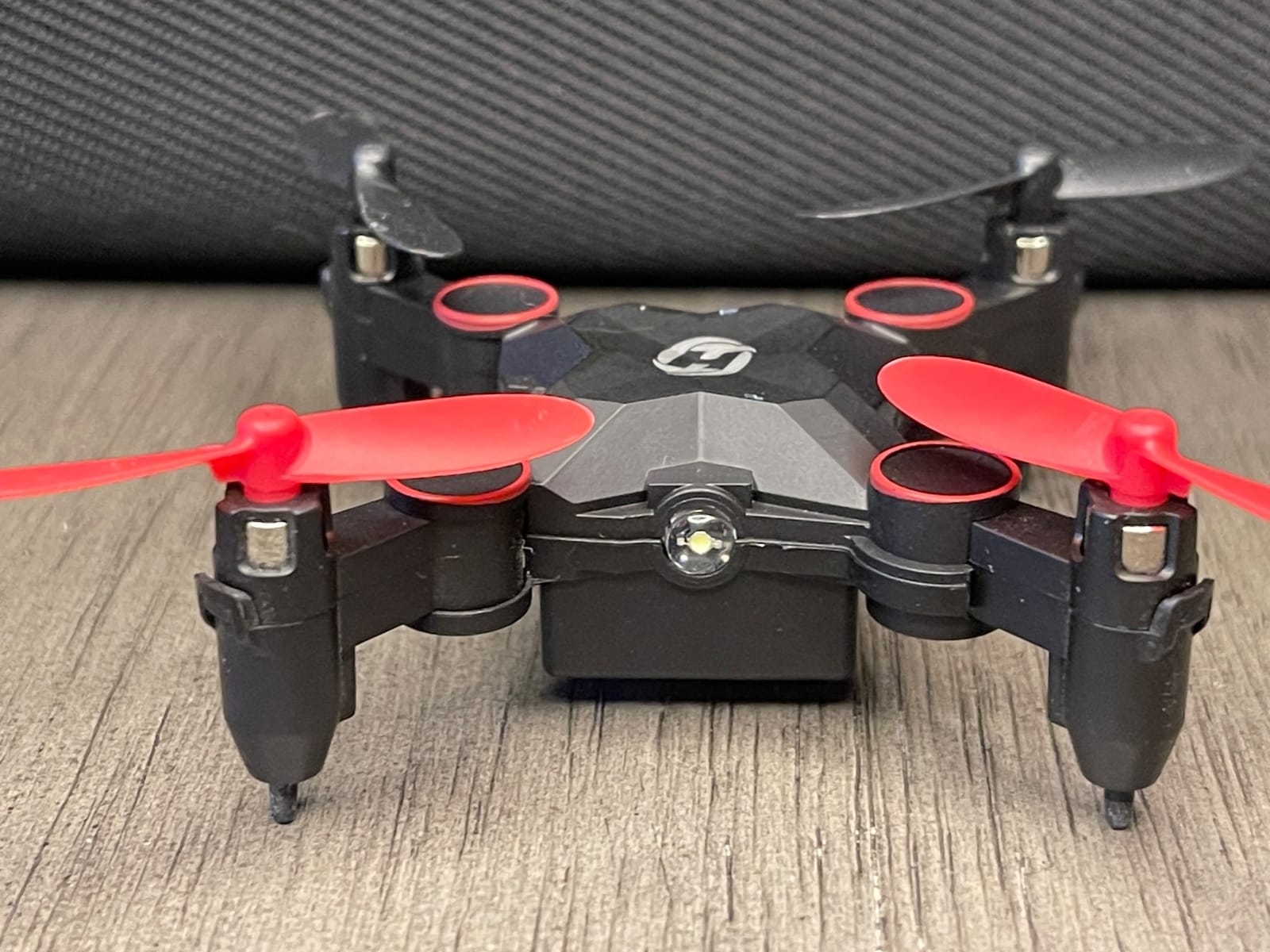
Best for travel, small hands and calm indoor air
Pick this one if the main constraint is space, not capability. It folds to 2.44 by 2.44 by 0.94 inches and packs into its own controller, so a school bag is enough storage. Children who grip a small controller more comfortably than a large two-stick gamepad type it up for.
The emergency stop is worth calling out for younger children. When a drone heads toward a lamp, a single press ends the flight rather than leaving a child to chase it.
Who should skip it
Skip it if you want to save money on spare batteries, since only one is included. Skip it if the house is draughty, because at 35g the aircraft is easily pushed off course by a household vent.
It is also not the right birthday gift for a child who wants to film. Nothing here records, and the toy class generally cannot be retrofitted.
3. HASAKEE Q9s – Best Value Kids Drone That Takes Abuse
- Genuinely tough
- owners report repeated wall and furniture crashes with no damage
- Bright dual-colour LEDs make it easy to track in a dark room
- Two 500mAh batteries roughly double uninterrupted playtime
- Altitude hold and headless mode work well for first-time pilots
- One-button takeoff and landing plus three speed modes
- Short flight time per battery at around 6 to 10 minutes with about an hour of charging
- Very light build gets carried away by even a mild outdoor breeze
- Propellers can catch long hair
If one drone is going to survive a child who crashes it on purpose, it is this one. Reviewers who fly real drones describe the Q9s as a cheap practice aircraft that is nearly indestructible indoors, and the four guards are the reason: they are tall enough that the propellers stay enclosed even when the drone is flown upside down into a sofa.
The 500mAh batteries are the largest in this price bracket and give roughly 6 to 10 minutes each, so the pack of two covers a decent session. The neon green and blue LED frame, with three display modes, makes it easy to follow in a dim room, which is a bigger deal than it sounds when a small grey drone disappears behind a lamp.
There is a 720p camera on board, unusual at this level, though the footage is novelty quality rather than something anyone will want to keep.
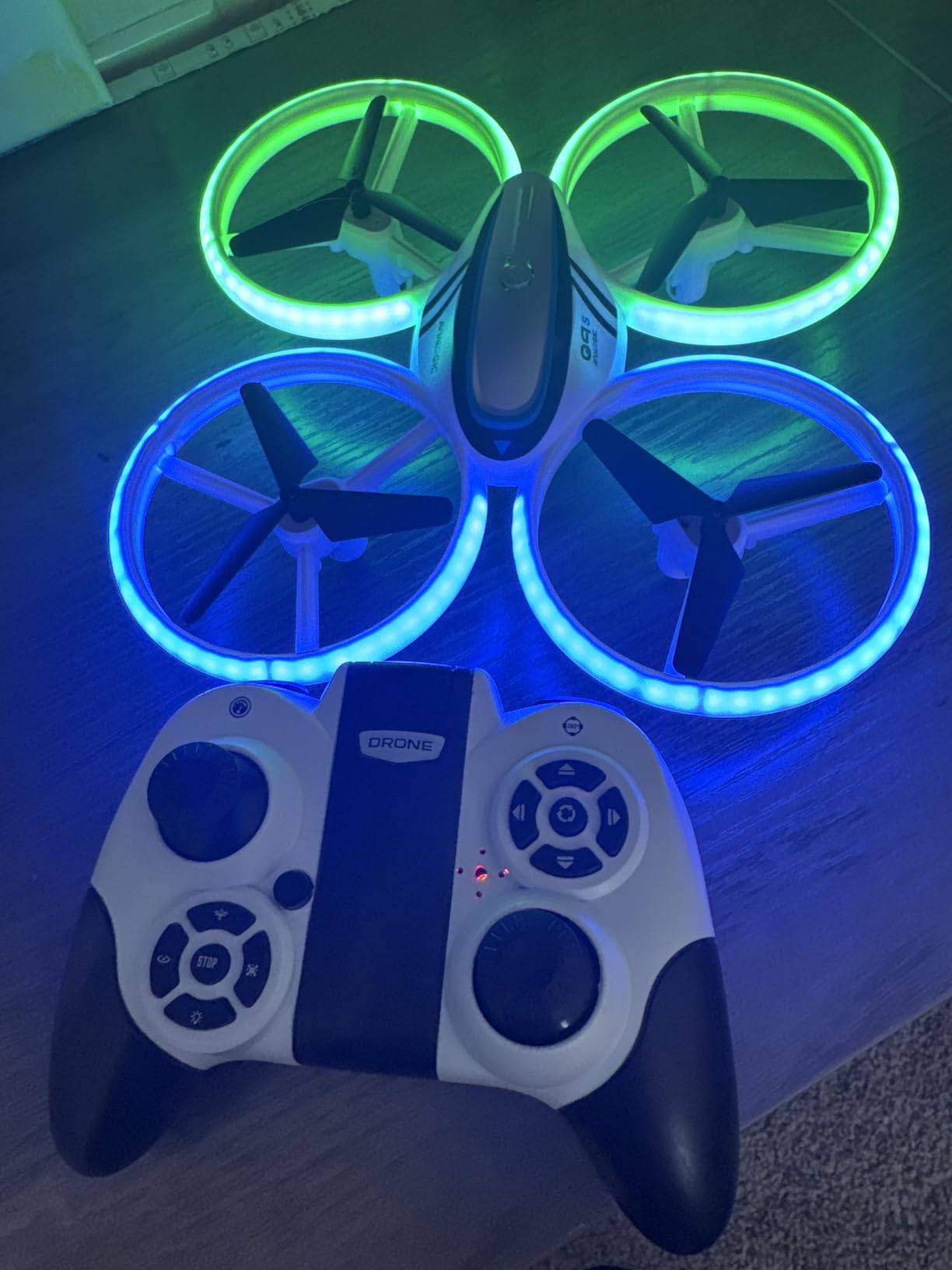
Two cautions. The build is light enough that any moving air picks it up, so it drifts toward vents and open windows, and the manufacturer is unambiguous about not flying it in wind outdoors. Second, several reviewers raise a practical safety point: the propellers can catch long hair, so tie hair back before the first flight.
A small number of owners report component or motor failures within a few weeks of light use, which is worth factoring in if you are buying a gift and hoping it lasts a year.
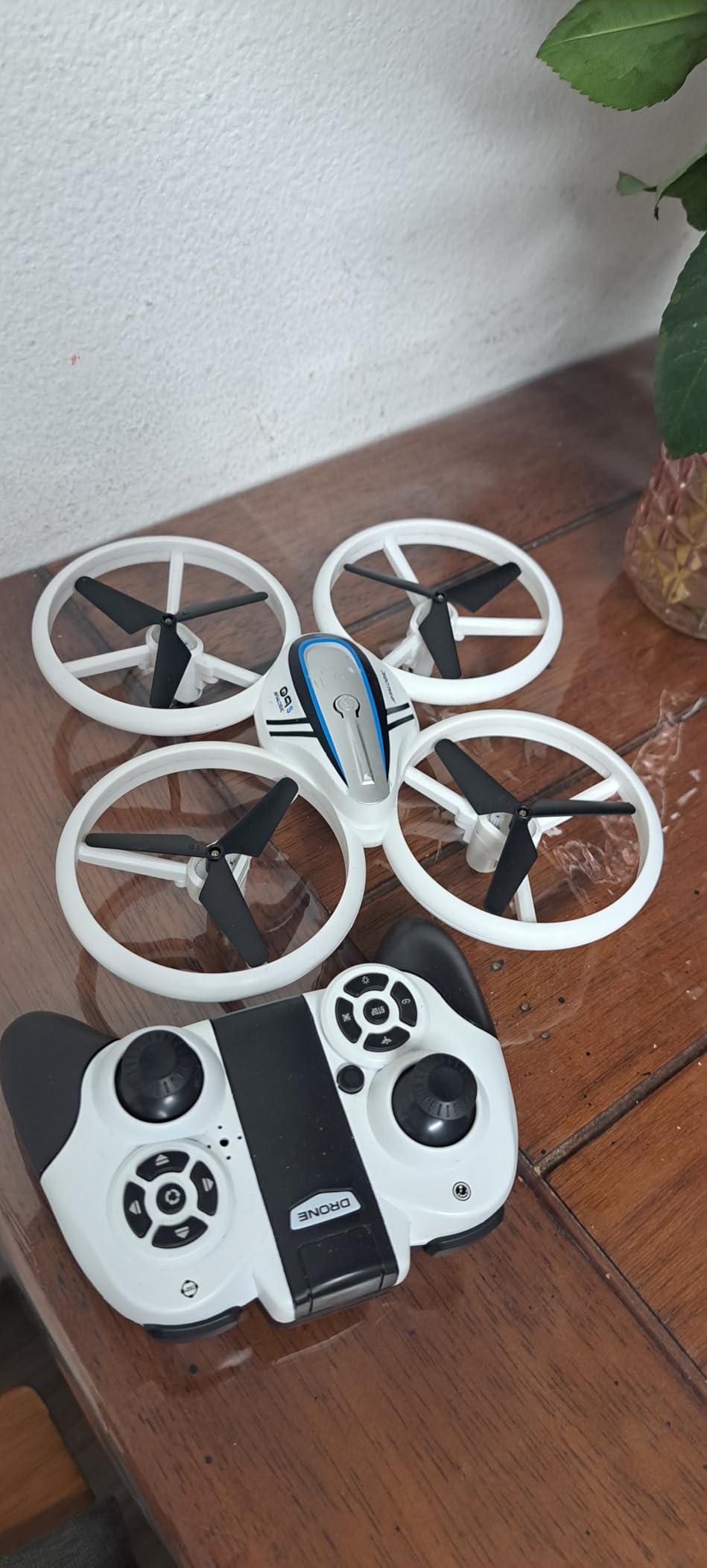
Why it suits active indoor play
Children who crash things deliberately need a different drone from children who are careful. The Q9s handles both: guards absorb bumps, the three speed modes let a beginner start slow, and the LED frame means a lost drone is easy to find under furniture.
It is also the pick for a rainy-day playroom. A 6.9 inch frame with a full guard can be flown in a large living room without touching anything fragile.
Who should skip it
Skip it for any outdoor flying. The airframe is simply too light for wind, and losing a drone over a hedge is a miserable first experience. Skip it if charging time matters, because each cell needs close to an hour on the USB charger.
Hair-wearing children should skip it unless they will tie their hair back every single time.
4. SYMA X100 – Best for Obstacle Avoidance Indoors
SYMA X100 Indoor Drone for Kids 8-12, Obstacle Avoidance, Full Guard
- Infrared obstacle avoidance detects walls and furniture from about 12 inches
- Fully enclosed propeller guard gives parents visible peace of mind
- Altitude hold keeps the drone steady for young first-time flyers
- Starts in slow mode so smaller kids can build confidence
- Two batteries deliver close to the advertised 20 minutes total
- Propeller cages can crack after repeated indoor bumps
- Hard to control outdoors and reported as lost in outdoor conditions
- Only two speed modes
Obstacle avoidance is rare in a drone at this size, and it changes the experience for a nervous child. The four infrared sensors detect walls and furniture from roughly 12 inches away and the aircraft pulls up or turns away, so the constant bumping that frustrates younger pilots simply happens less often.
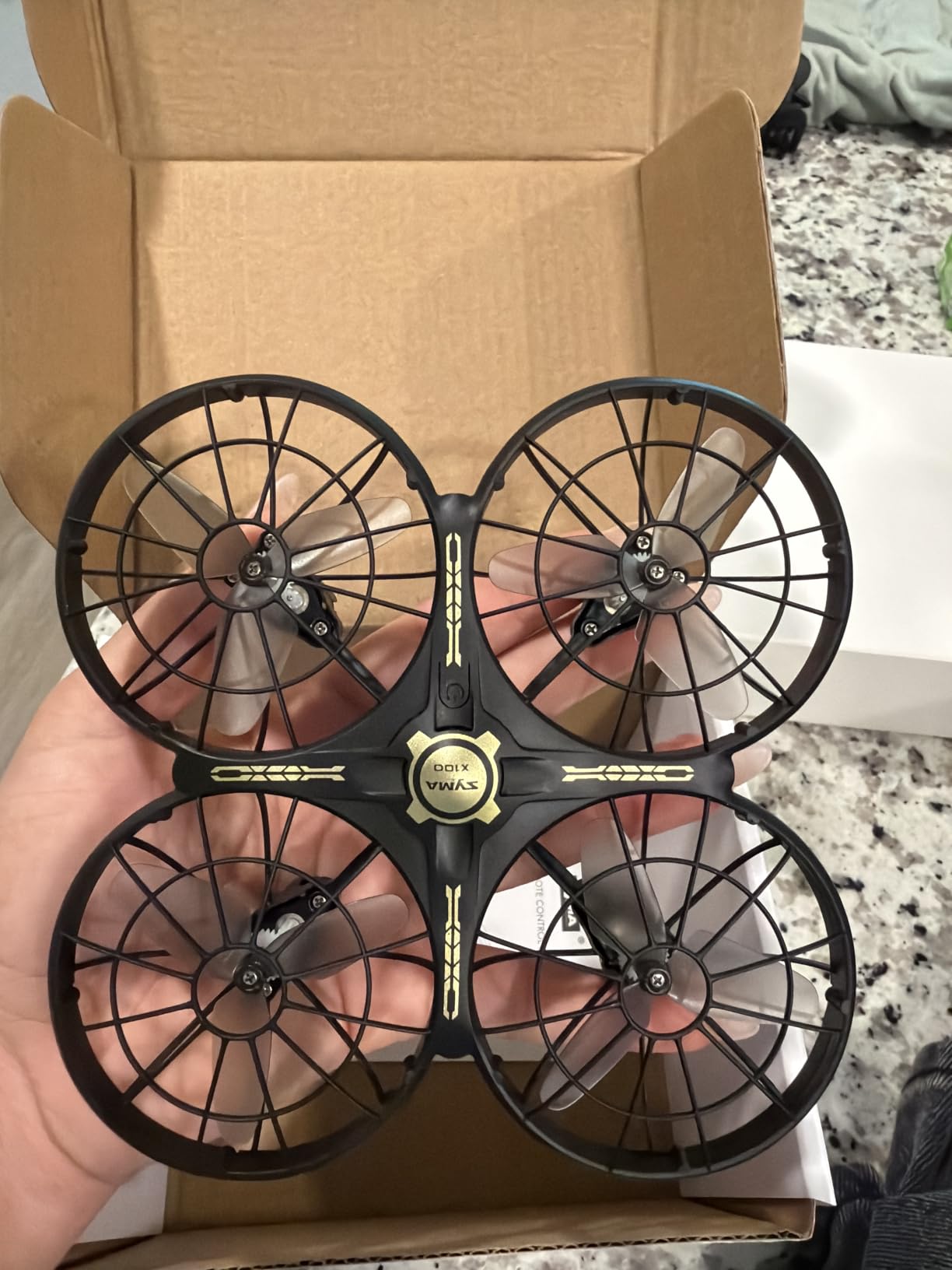
The parents who buy this one tend to be buying it for a child under eight, largely because of the fully enclosed propeller guard. There is no exposed blade anywhere on the airframe, and reviewers repeatedly cite visible peace of mind as the reason for the purchase.
Two 700mAh batteries deliver close to the advertised 20 minutes of total flight, which is genuinely good in a sub-60g indoor drone. Children can fly for ten minutes, swap, and go again.
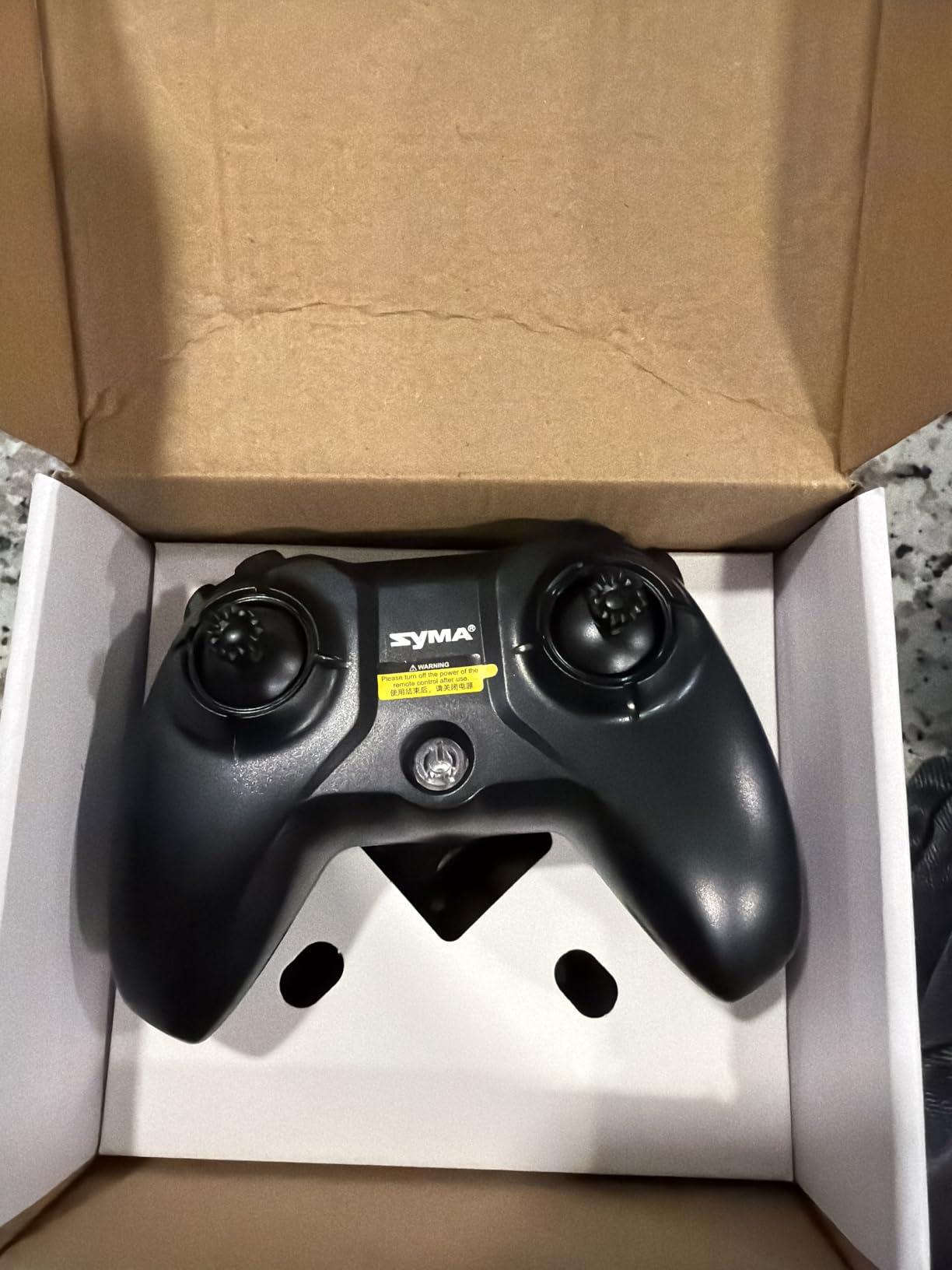
There is a real weakness, and it is the guard. A minority of owners report the propeller cage cracking after only a handful of indoor collisions, sometimes within days. That is the single component protecting the child’s fingers, so we would inspect it before every flight and treat visible cracks as a reason to stop.
Outdoor use is a firm no. Reviewers describe it as difficult to control outside and report losing aircraft in open conditions, which is unsurprising given the 58g weight and infrared-only sensing.
Why the sensors are worth it for young children
For a child who reacts to noise and contact with a bad crash, sensors are worth more than a longer flight time. The aircraft absorbs most of the mistakes before they become a bang against a television.
The slow-mode start also helps. It launches in the gentlest speed setting and only moves up when the child is ready, which removes the first twenty seconds of panic from a typical flight.
Who should skip it
Skip it if your child crashes hard and often, because the cage is the first thing to fail. Skip it for anything outdoors, and skip it if you want more than two speed settings to grow into.
It is also one of the smaller review counts in this roundup, so long-term reliability is less well documented than for the Holy Stone models.
5. Swifsen SWA35 – Best Top-Down Protection for Small Children
- Upper protective cover shields children from touching the fan blades from above
- 720p camera lets kids capture photos and video in addition to flying
- Modular battery design avoids the cable batteries that used to break
- Two batteries give roughly 15 minutes of combined flight
- Multi-coloured lights and one-click calibration make setup straightforward
- Manufacturer advises staying within 60 feet or the drone may be lost
- Limited to 720p video rather than higher resolutions
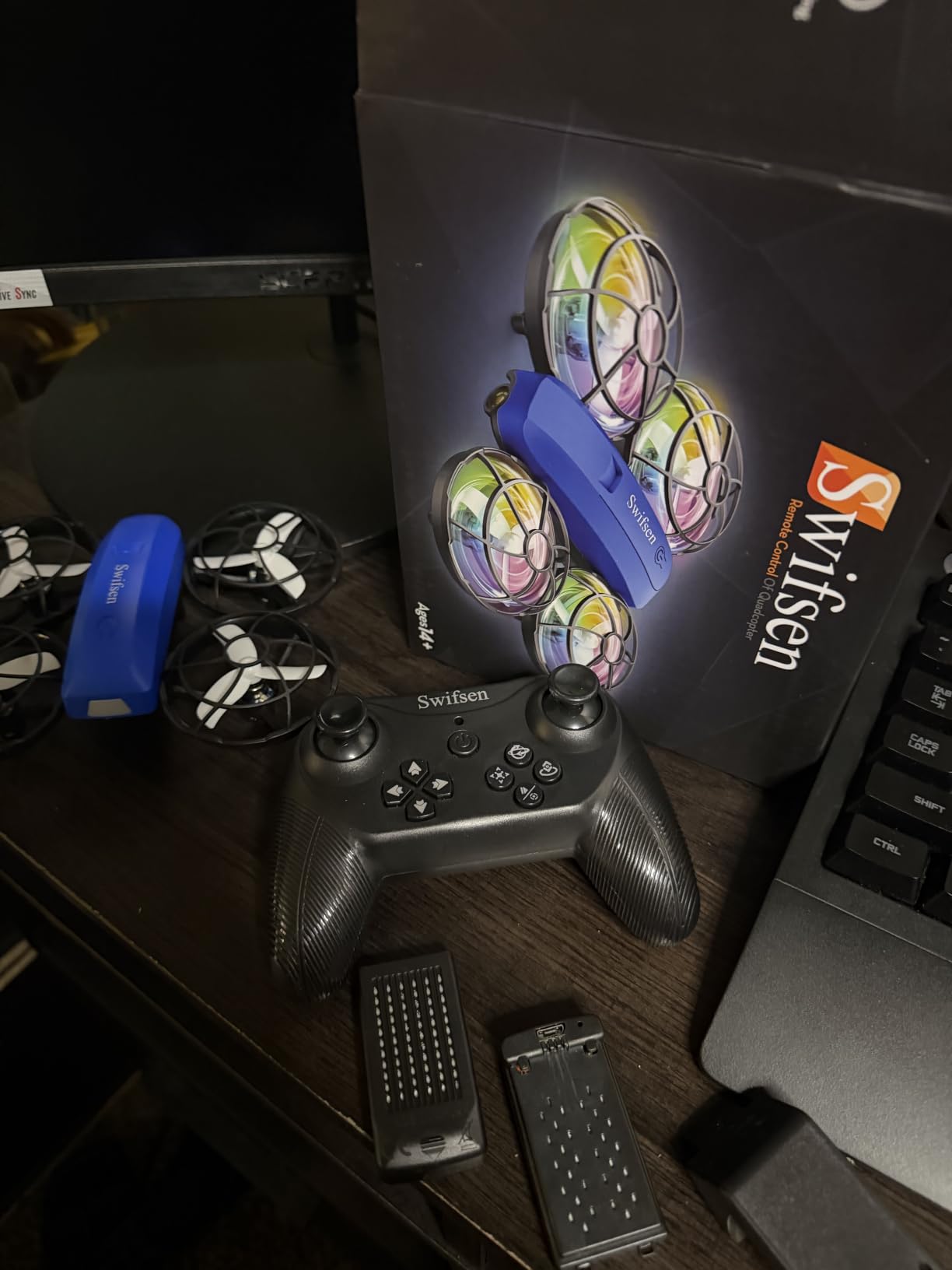
Most mini drones protect the propellers around the edges. This one adds a cover across the top as well, so a child reaching down to pick it up cannot reach a blade. That single design choice is the whole reason to pick it for a four or five year old who will not follow the instruction to use the landing gear.
The 720p camera is a bonus rather than the point. It captures stills and short clips to an SD card, which is enough to keep a small child interested and gives them a reason to fly deliberately rather than crash randomly.
The modular battery design is a genuine improvement over earlier generations. Cable-connected batteries are the first thing to snap on these cheap drones, and the reviewer consensus credits the upgrade with better reliability than what came before.
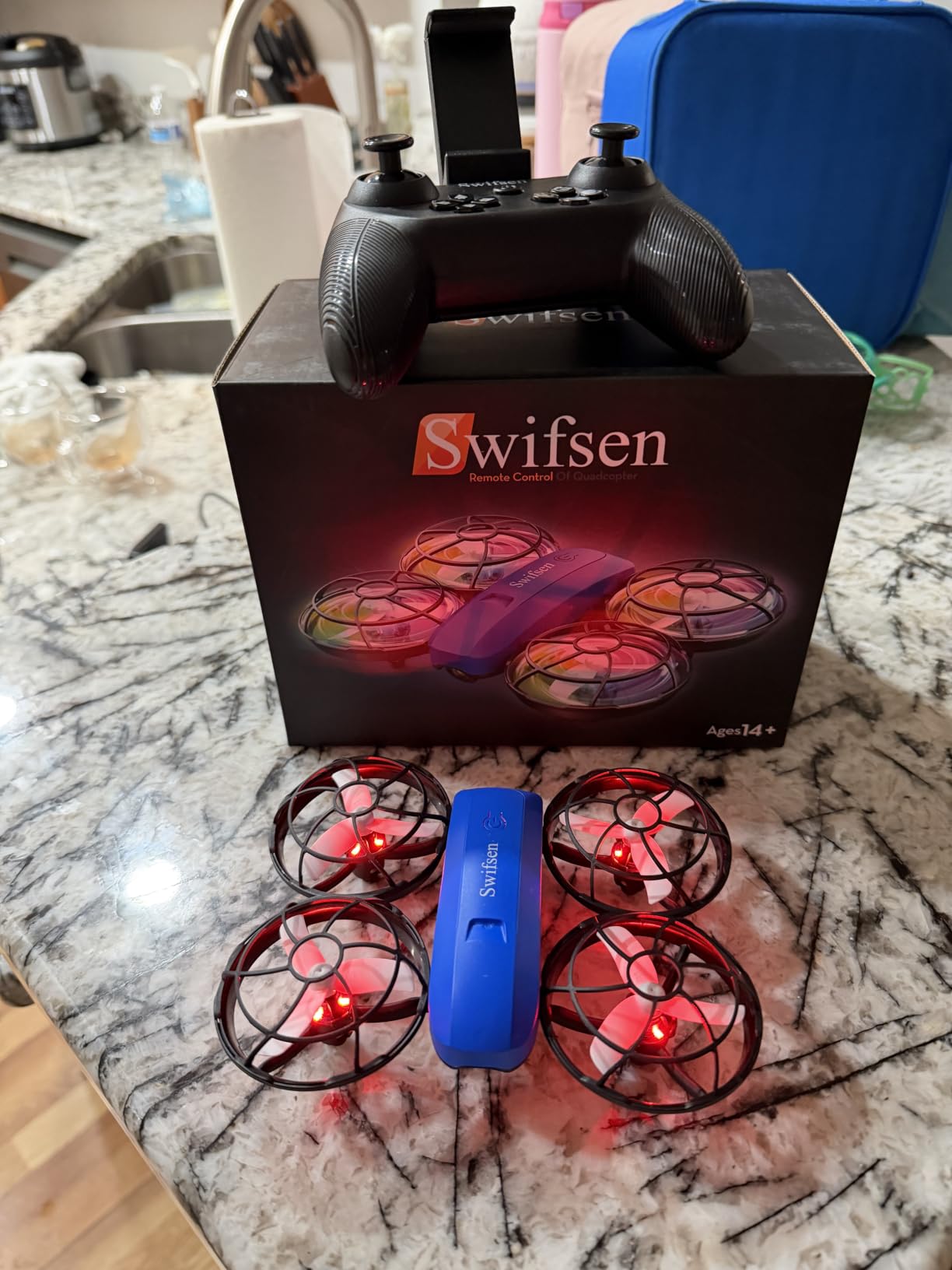
Two batteries give roughly 15 minutes combined, which is decent. The important operational note is the 60-foot recommended limit: past that, the signal can drop and the drone may be gone, so this is a garden-and-porch aircraft rather than a field aircraft.
The video is 720p. That is fine for a child to look at on a phone and pointless if anyone expects broadcast quality, but nothing in the toy class delivers more.
Where the top cover earns its place
Ask any parent of a small child and the fear is reaching into a spinning drone to pick it up. This airframe is built for that moment, with an upper shell that blocks the fingers from the blades. Combined with the perimeter guards, there is no exposed rotor from any angle.
It is a good birthday gift for a child aged four or five who is not ready for stick coordination, because the one-key calibration and multi-coloured lights make the setup forgiving.
Who should skip it
Skip it if you need long flights, because 15 minutes combined is the ceiling. Skip it if you plan to fly in a large open space, since the 60-foot limit is a hard practical boundary rather than a marketing suggestion.
And skip it for an older child, who will find the top cover limiting and the 720p camera underwhelming within a week.
6. SIMREX X800 – Best Camera Drone for a Child Who Wants to Film
- 1080p camera with a 90 degree manually adjustable lens beats expectations at this level
- Two large 1000mAh modular batteries give roughly 20 minutes each
- Optical flow positioning plus altitude hold keeps the drone steady
- Game-controller style remote has no learning curve for children
- Very durable
- it has survived being flown into trees and buildings
- Phone app disconnects intermittently and the interface is dated
- Actual photo quality is closer to 480p than the advertised 1080p
- No low-battery warning
- Not suitable for windy outdoor conditions
This is the one to buy when the reason your child wants a drone is to record video. The camera is listed at 1080p with a 90 degree manually adjustable lens, and while reviewers note the real output is closer to 480p, they also repeatedly say it exceeds expectations for the class, which is the test that matters.
Endurance is the standout. Two 1000mAh modular batteries at roughly 20 minutes each is more than double what most mini drones in this roundup manage, so a child can film a whole event rather than 45 seconds of it.
Optical flow positioning is the other reason it feels stable. A downward camera holds position over a surface, so it hovers convincingly indoors, which is far more sophisticated than the plain altitude hold used by cheaper models.
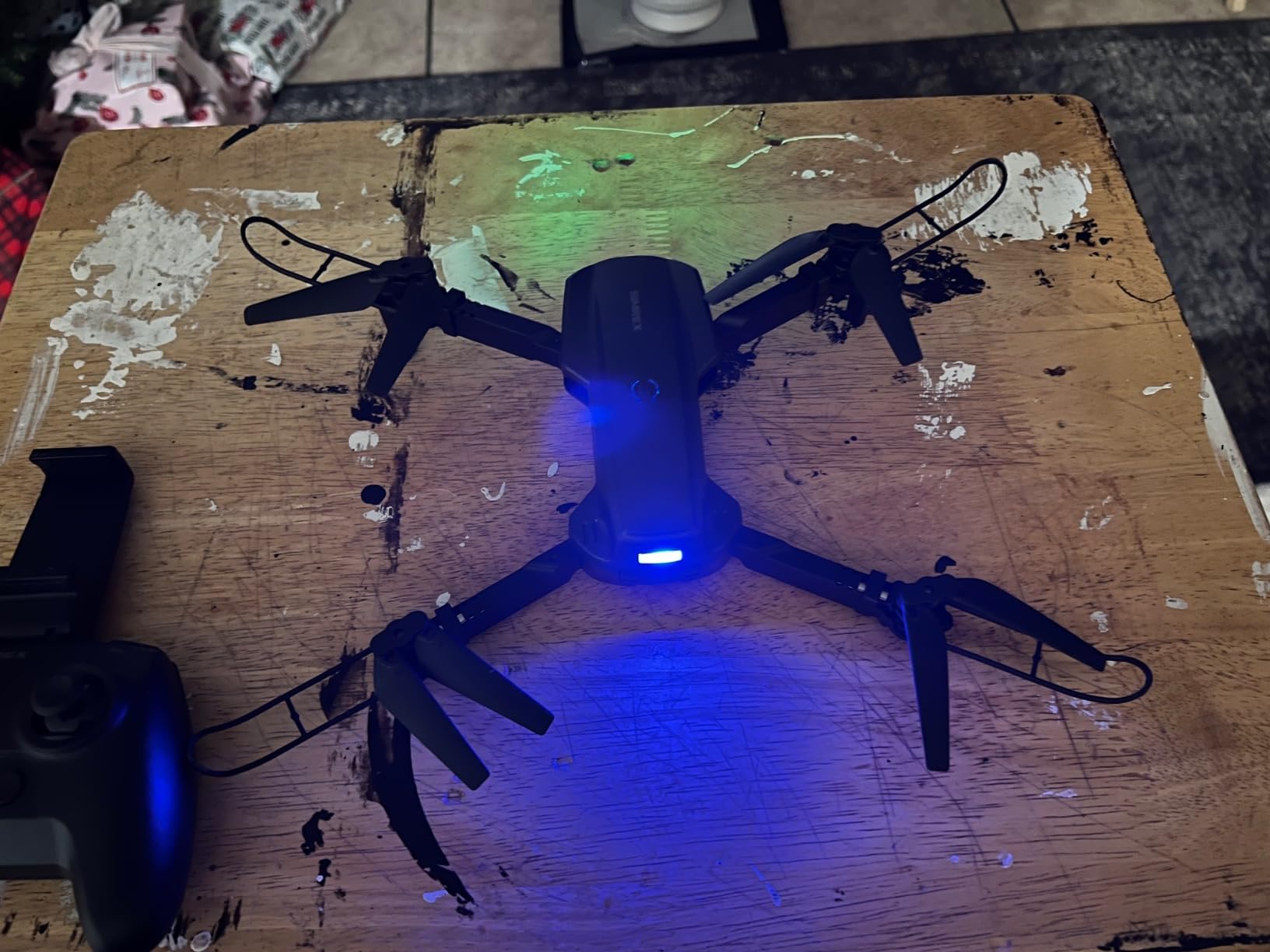
The weak point is the app. Reviewers describe it as dated and prone to dropping the connection when used as a controller, and there is no low-battery warning, so the drone simply descends gradually where it happens to be. Neither is dangerous, both are irritating.
It is also a light 96g airframe with no wind tolerance, and the phone holder clamp feels precarious with a heavy phone attached. Fly it indoors, and fly it with the physical remote rather than tilt controls.
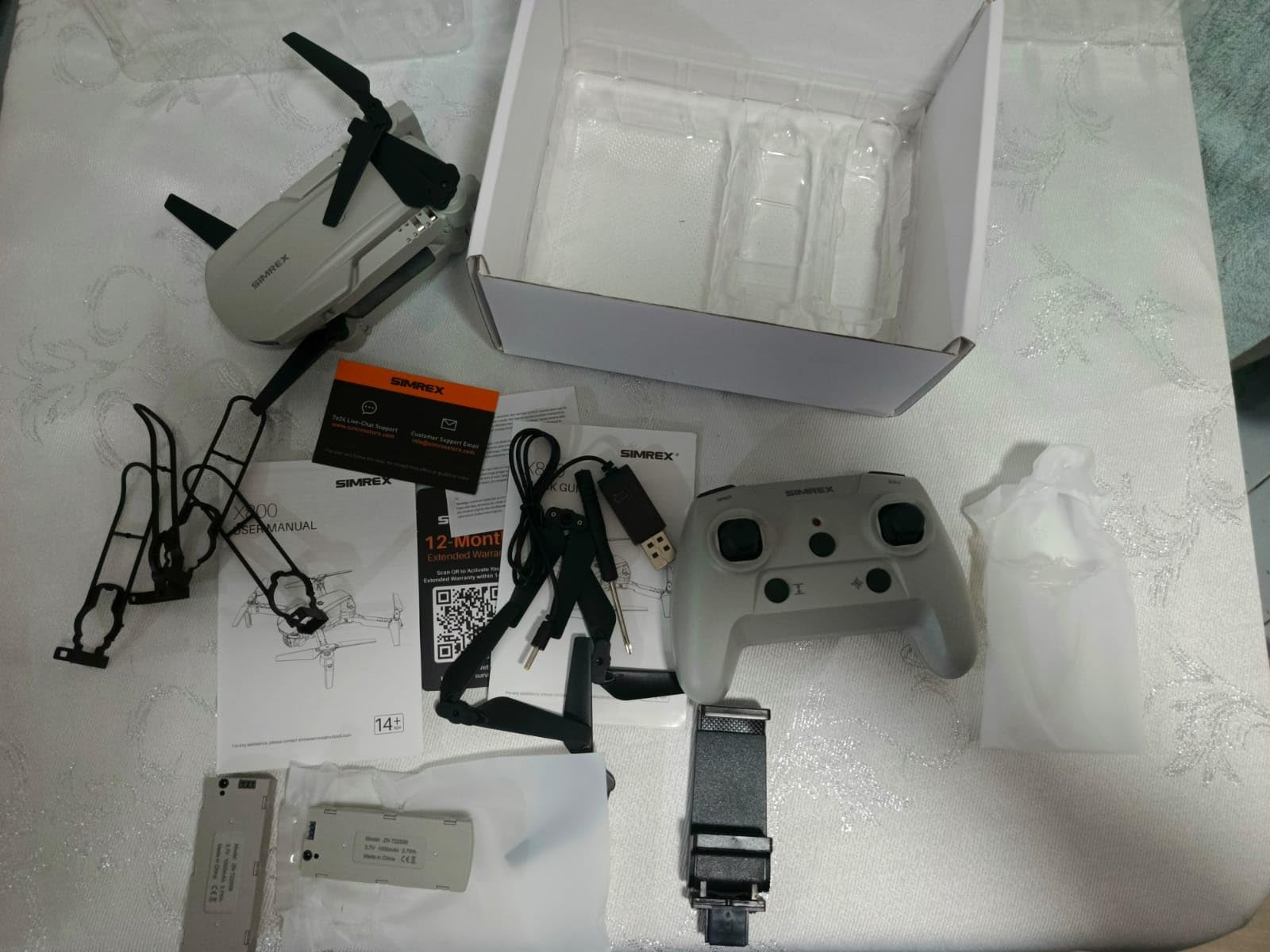
Why this is the film-first pick
Children aged nine and up can operate the game-controller style remote immediately, and the camera means every flight produces something to look at afterwards. Reviews report both complete beginners and experienced pilots rating it highly, which is unusual for this price bracket.
It also survives abuse. Owners report flying it into trees and buildings without damage, so it tolerates the outdoors in a way the smaller drones here do not, at least in calm conditions.
Who should skip it
Skip it if your child is under seven and obsessed with video, because the app workflow adds friction. Skip it if you need true 1080p files, since the real output is lower than the specification suggests.
It is also not a windy-weather aircraft, and the weight makes it a poor choice for flying high outdoors.
7. Holy Stone Drive Climb H4831 – Best Wall-Crawling Drone for Play
- 3-in-1 design flies
- drives on the ground and crawls along walls and ceilings
- Wheel-style chassis is a distinctive change from a standard mini drone
- One-key takeoff and landing plus headless mode ease first flights
- Four speed modes let beginners progress gradually
- LED lighting makes it more visible during play
- Wall-crawling and ceiling modes need specific technique and are not reliably repeatable
- Manufacturer lists it as a gift for ages 14 and up
- which is higher than most drones in this group
No other drone in this roundup does this. The H4831 flies like a quadcopter, drives along the floor on a wheel-style chassis, and then crawls up a wall and across a ceiling with its rotors tilted 90 degrees. For a child who has already decided that normal drones are boring, it is a genuinely different toy.
It is also a competent flyer in its own right. One-key takeoff and landing, automatic hover at about 1.2 metres, headless mode, and four speed modes give a new pilot plenty to work with before they touch the stunt modes.
At 82g it is one of the heavier aircraft here, which helps it feel substantial in the hand and gives it a bit more presence in the air.
There is an oddity worth flagging for gift buyers: the manufacturer lists this as a gift for ages 14 and up, which is higher than almost everything else in this roundup. The controls are beginner-friendly regardless, but the box is not designed to appeal to a five-year-old.
Where the drive and climb modes shine
The floor driving mode is the most reliable of the three, and it works well on carpet or a smooth wooden floor. Children who have grown bored with hovering can still get a run of play out of it long after the flight novelty has worn off.
The wall crawling is the showpiece, though it needs practice to reproduce consistently. Treat it as a reward for a settled child rather than a first-flight objective.
Who should skip it
Skip it for a first-ever drone, because the stunt modes are technique-dependent and the manufacturer rates it for older users. Skip it if you need a camera, because there is none.
It is also a poorer fit for outdoor flying despite the weight, since the drive and climb features only make sense indoors.
8. Veeniix V995 – Lightest Airframe for the Youngest Pilots
- Very light at 22.3g
- making it the smallest and safest option for young children
- Three batteries included for over 21 minutes of combined flight
- Altitude lock keeps a steady hover while kids learn the controls
- One-touch takeoff and landing plus headless mode simplify first flights
- Protective propeller cage and battery warning system guard against fly-aways
- Smallest battery capacity here at 180mAh so each pack runs only a few minutes
- Very light weight means it is easily pushed around by air currents
- Short practical range indoors
At 22.3 grams, this is the smallest and lightest aircraft in the roundup, and that is the entire selling point. For a child aged four or five, weight is the safety argument: a lighter drone simply cannot carry enough momentum to do damage, whatever the child does with it.
Three batteries are included, giving over 21 minutes of combined flight, which is remarkable for a pack this small. Most parents assume one battery means one short session, and here it does not.
The altitude lock holds a steady hover without any stick input, so a very young child can fly it by pushing one direction at a time. Toss-launch is also supported, which is how a four-year-old will start every flight regardless of what the manual says.
The protective cage encloses the props completely, and a low-power alert system warns the pilot before the drone simply stops.
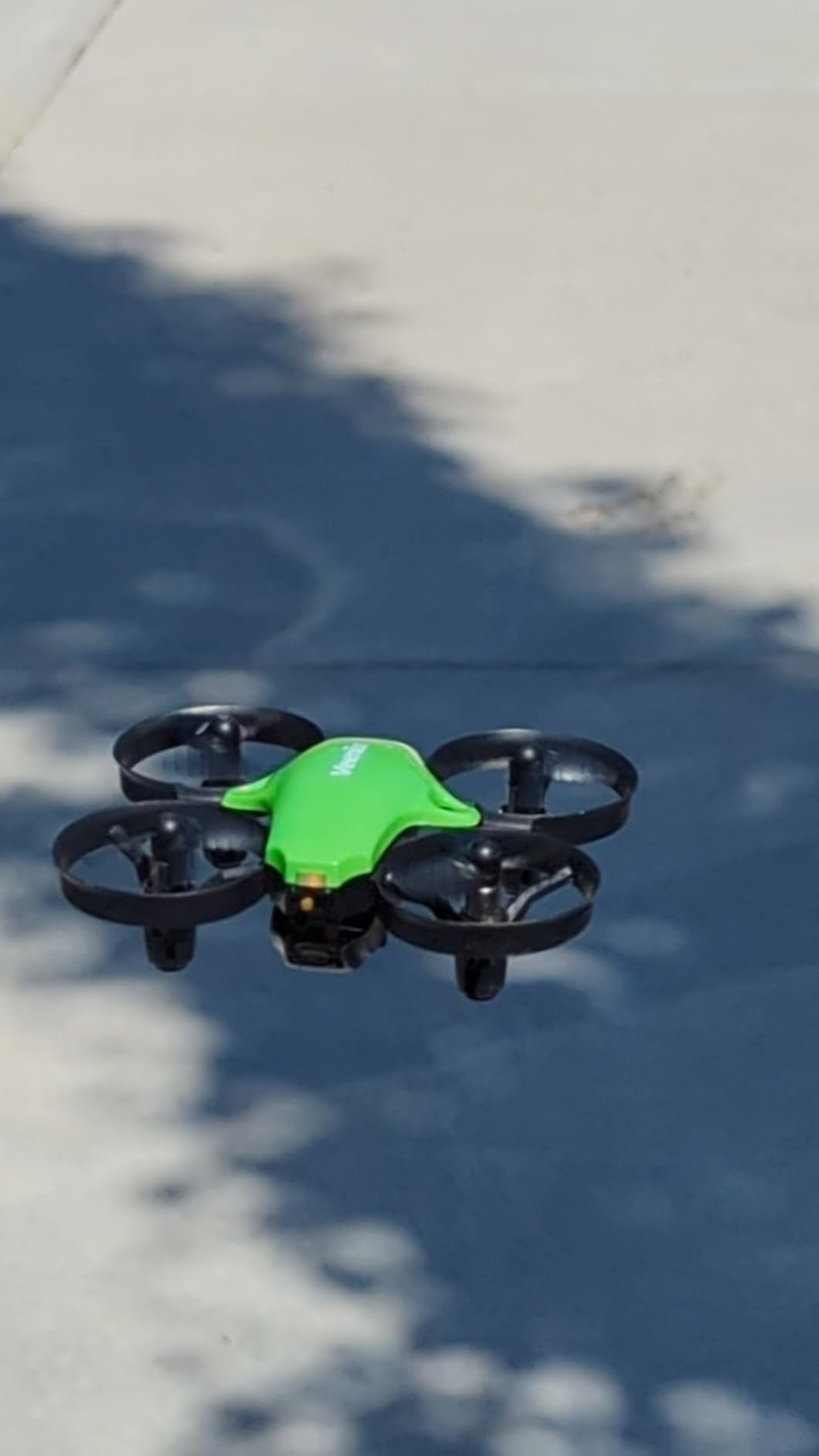
It is worth being clear about what the smallest drone cannot do. There is no camera, no smart flight modes, and no outdoor capability. It is a first drone and nothing more, which is exactly what a four-year-old needs and exactly what a ten-year-old will find boring within a fortnight.
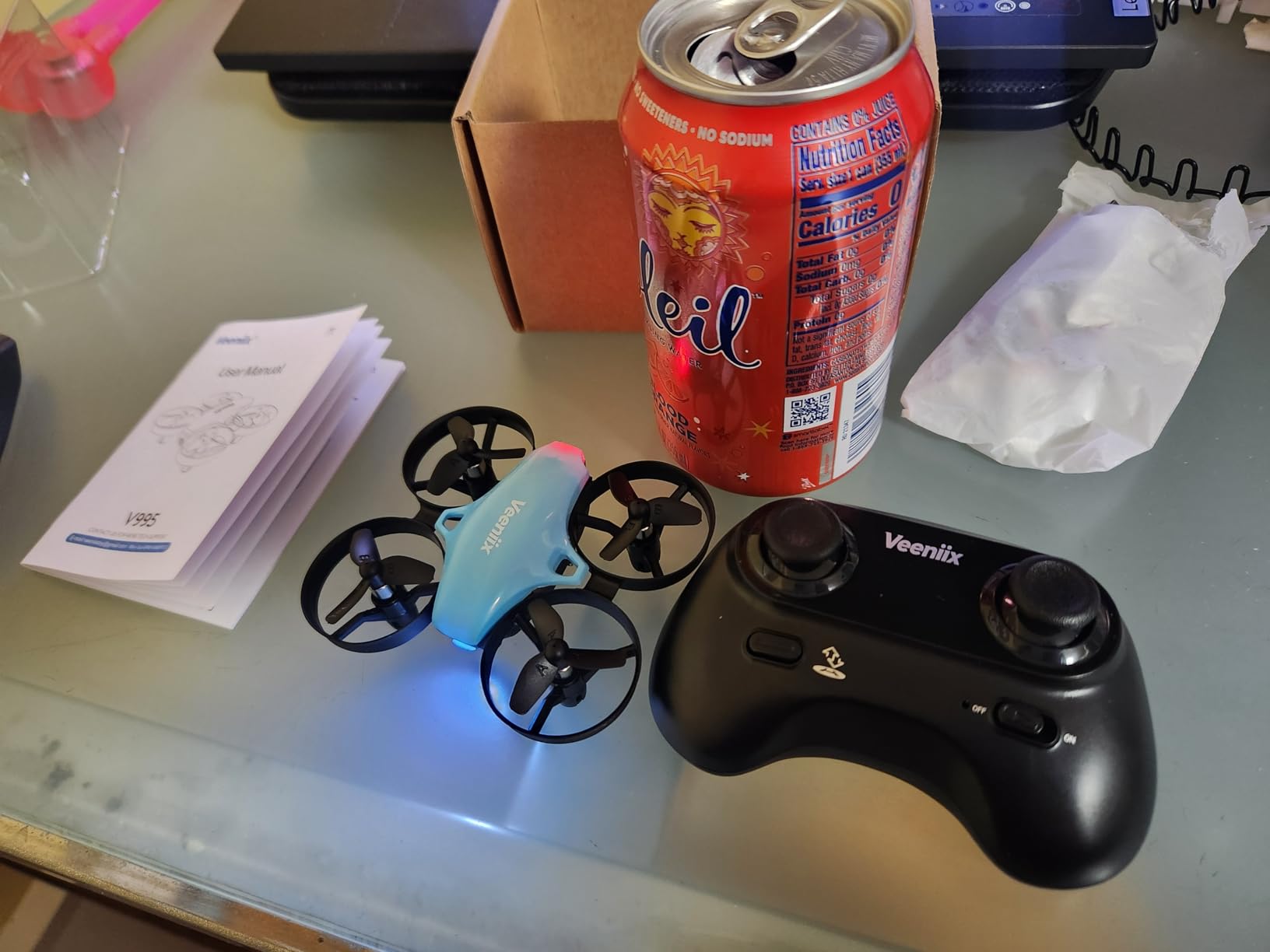
Why the smallest drone suits the youngest children
There is no arguing with the physics here. When a parent asks whether a 22g drone is safe enough for a preschooler, the weight answers the question better than any feature list. The cage and altitude lock then make the remaining risk close to zero.
For a very young child, the three included batteries also solve the most common practical complaint about cheap drones, which is that play ends after a few minutes.
Who should skip it
Skip it for a school-age child who will find the tiny airframe frustrating. The 180mAh cells are the smallest capacity here, so each individual flight is only a few minutes even though the total is high.
Skip it in a draughty room, where such a light aircraft is easily pushed off course, and skip it for anything outdoors.
9. FUNPX LED RC Drone – Best for Battery Life and Light Shows
- By far the longest claimed flight time in this group at 45 minutes across three modular batteries
- Five LED light modes with one-tap cycling give an eye-catching night show
- Blue LED direction indicator and dual-joystick layout make orientation obvious for beginners
- Lightweight crash-resistant ABS body with full-coverage propeller guards
- Red LED low-battery warning shows when to land
- Manufacturer advises avoiding windy outdoor conditions
- 360-degree rolls are best performed indoors with caution
The complaint we hear most about entry-level drones is that play ends after six minutes, and this one directly answers that. Three modular batteries give a claimed 45 minutes of total flight, which is roughly seven times what a single-battery mini drone manages and the best endurance in this roundup by a wide margin.
The lighting package is the other reason to like it. Five LED modes on one button, plus a blue direction indicator that makes orientation obvious to a beginner, turn what would be a frustrating grey speck in a dim room into something a child can actually follow and control.
Design choices show attention to the actual buyer. Batteries for both the drone and the remote are included in a windowed gift box, so it is genuinely ready to fly out of the packaging, and the red low-battery LED removes the most common cause of a drone being lost in a tree.
Two speed levels and full-coverage propeller guards complete an uncomplicated, forgiving package for a beginner aged six and up.
Why flight time changes everything indoors
Shorter batteries do more than limit play. They teach a child that drones are fragile and temporary, and a child who puts a drone down because it has run out of power never forms the habit of learning to fly it. Long endurance removes that cycle.
The direction indicator is a small thing that matters disproportionately, because beginner drones spinning out of control in an unfamiliar orientation is the most common reason a first flight ends badly.
Who should skip it
Skip it for outdoor flying, since the manufacturer is explicit about wind. With only two speed levels it also has less room to grow with an older child than the four-speed models in this roundup.
And skip it if your child wants to film, because there is no camera despite the listing mentioning 720p capture in the specifications.
10. Zappyway Spider Mini Drone – Budget Pick for a Very Young Child
- Spider-shaped design with a red and blue LED light show
- Emergency drop button gives young children confidence the drone will not escape
- Three speed gears and headless mode suit beginners
- Supports multiple drones flying at once without interference so children can race
- Propeller guard and ABS body hold up to repeated drops
- Two batteries plus spares and a screwdriver included
- Battery runtime is only about 5 to 8 minutes per pack
- Lowest average rating of the set at 4.0 with motor failures reported
- Listed 1080p capture does not match real output quality
- Several reviewers report a motor failing within a couple of flights
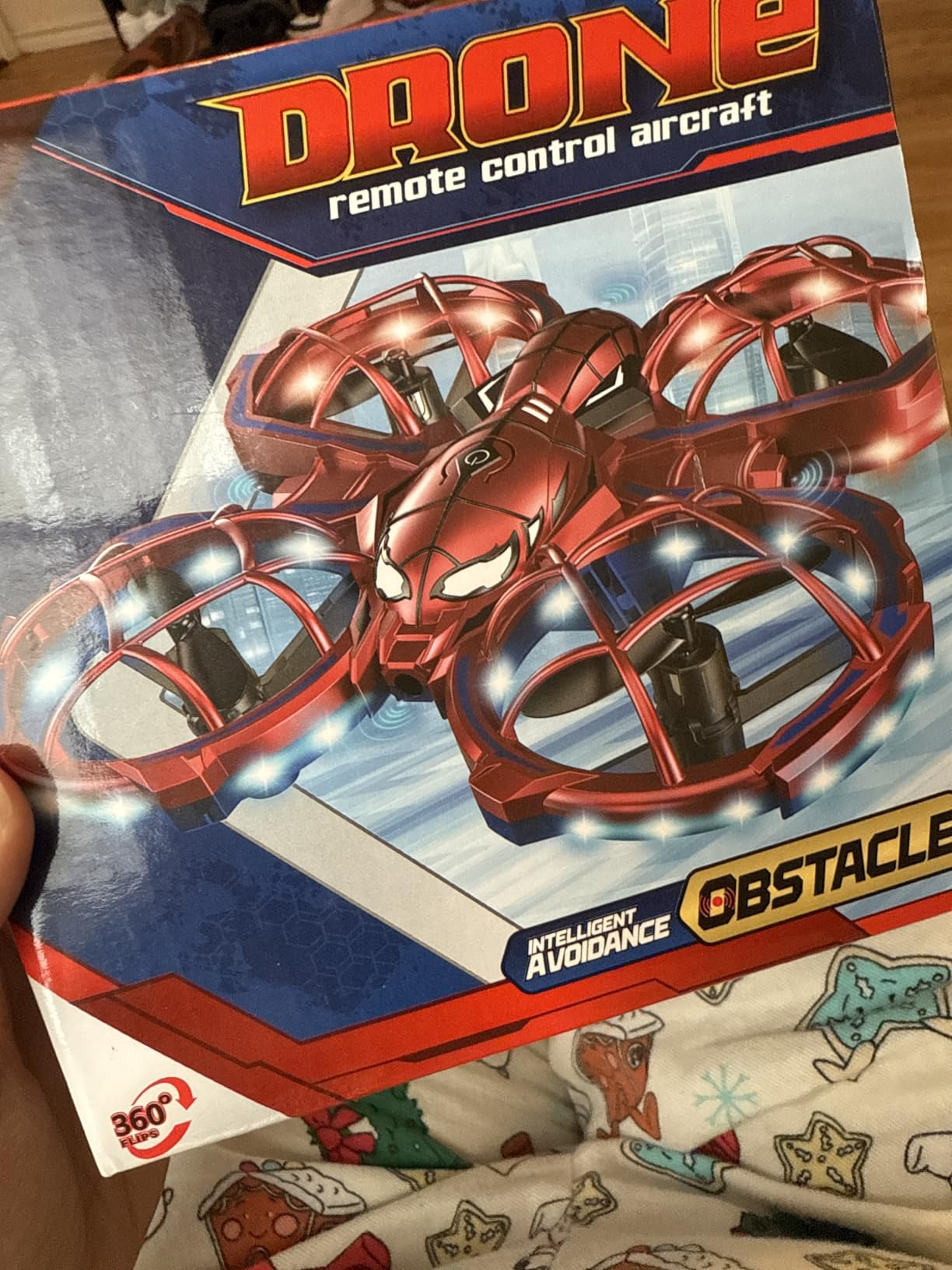
This is the cheapest way to put a drone in a very young child’s hands, and the multi-drone feature is unusual and genuinely useful. Because the control frequency does not clash, a child can fly two of these at once and race a sibling, which is a better reason to play than a single aircraft.
Children aged roughly three to eight reportedly pick up the controls almost immediately. The emergency drop button is the detail parents mention most: one press makes the drone fall instantly, which removes the fear of a runaway aircraft heading toward a light bulb or a sibling.
The spider frame with red and blue LED lighting is a novelty, and novelty matters more than it sounds for a child who has never flown anything.
We put this one last among the toy class for honest reasons, and they are specific. The 4.0 rating is the lowest in this roundup, and the cause is motor failures reported after only one or two flights rather than after a year of abuse.
Battery runtime of 5 to 8 minutes per pack is the weakest in the group. The listed 1080p capture does not match real output quality, so treat the camera as a gimmick.

Who this works for
It suits a child aged three to five whose main interest is the light show and the racing. The emergency drop button and the multi-drone capability make it feel safe and social, which matters more at that age than flight time.
It is also the sensible pick as a pair, because the interference-free control means two children can fly simultaneously without either losing signal.
Who should skip it
Skip it if you want a drone that survives a year of use. Reports of motor failure within a couple of flights are specific enough that we would buy a spare rather than risk repeat replacements.
Skip it for a child who will be disappointed by flight time, and skip it if the camera is the selling point.
11. Helatt 807 – Best for a Live Camera Feed on a Budget
Drones for Kids and Beginners with LED Lights 2 Batteries One Key Start
- Stays stable in the air and is quick to learn
- Two 500mAh batteries give up to 16 minutes total with quick-swap design
- 1080p FPV camera produces crisp images and decent video for the price
- One-key takeoff and landing
- altitude hold and two speed modes
- Full propeller guards and sturdy ABS body handle everyday bumps
- Gift box presentation with spare propellers included
- Remote controller batteries are not included
- Recommended operating range of 133 feet
- One reviewer received two batteries that would not charge
If a child wants to see what the drone sees, this is the cheapest way to do it. The 1080p first-person view feed goes to a phone, and reviewers describe the image quality as crisp and better than expected for the money, which is a strong phrase to find in reviews of a budget drone.
Two 500mAh batteries with a quick-swap design give up to 16 minutes of total flight. The swap matters more than the number: nothing is unplugged and nothing is torn, so a child can change batteries unaided.
Feedback is overwhelmingly positive for a model at this level. Buyers describe a stable hover, quick learning curve, and a camera that performs above its class, with the two batteries singled out as the feature that extends play.
Five LED light modes on a single button and full propeller guards round out a package that is well suited to an eight or nine year old.
Where the FPV feed changes play
Seeing through the camera turns a drone from a remote-controlled toy into something closer to a game. For an older child, the first-person view is usually the moment they stop asking to fly outside and start asking to make videos.
It is also the cheapest bridge to FPV flying, and our FPV drone guide covers what to move on to once that interest develops.
Who should skip it
Skip it if you want to open one box and fly immediately without hunting for batteries, because the controller cells are not included. Note the recommended operating range of 133 feet, which limits it to a garden rather than a field.
It also has only two speed modes, so it has less headroom for growth than the four-speed alternatives.
12. Pallton X80 – Best for App Control and Gesture Features
- 1080p HD camera with real-time FPV feed to a phone
- Gesture Selfie mode snaps a photo with a hand gesture
- Two modular batteries give up to 24 minutes of total flight time
- Foldable design with a carrying case for travel
- Trajectory flight lets you draw a path on a screen for the drone to follow
- Three speed levels and 360-degree 3D flips
- Smallest review base in this group at 155 ratings so long-term reliability is less well documented
- Gravity control via phone tilt can be imprecise for younger children
- Light 8-ounce build is best flown indoors or in calm air
The gesture selfie mode is the feature that gets children excited. Hold a hand up in front of the drone and it takes the photo, which is simple enough for a six or seven year old to trigger on demand and a genuine reason to fly deliberately.
Trajectory flight is the more grown-up draw. You draw a path on the phone screen and the drone follows it, which is the closest thing here to a programmable drone and works well for a child who likes building things rather than just flying them.
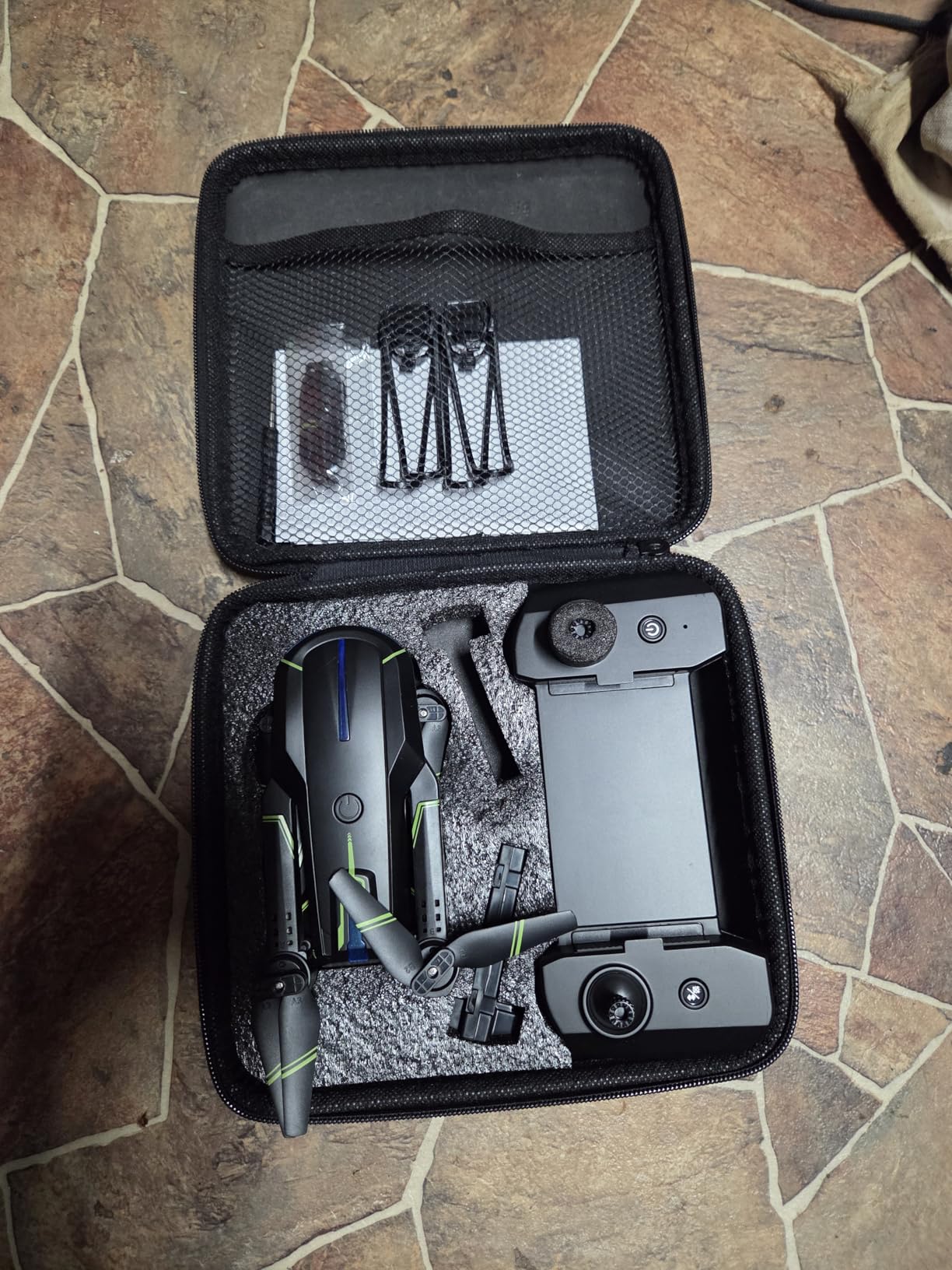
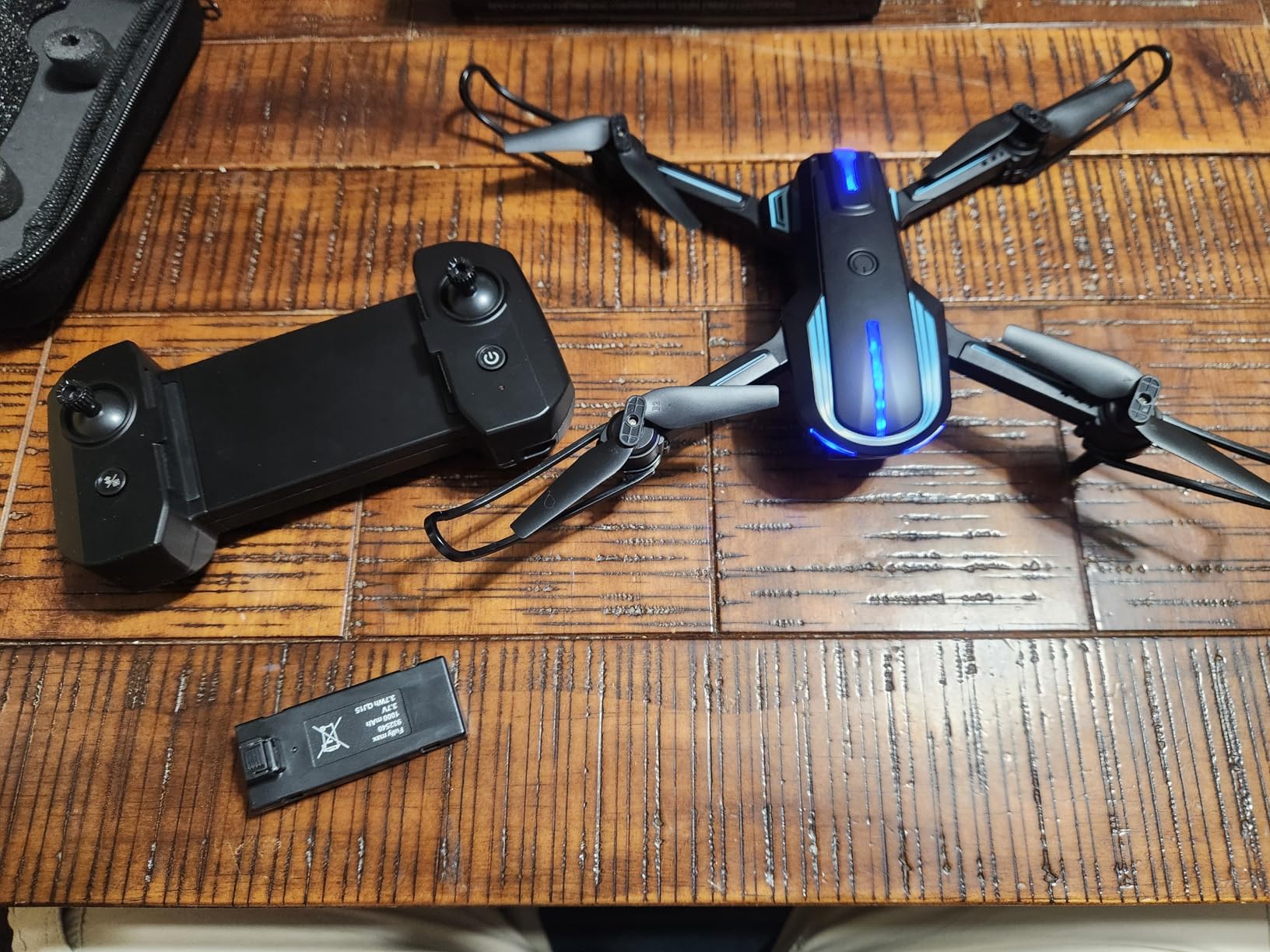
Endurance is strong: two modular batteries give up to 24 minutes, and the foldable body with a carrying case makes it the most travel-friendly camera drone here.
Three speed levels, 360-degree flips, headless mode, four protective guards, and a 1080p camera with live FPV complete a feature list that is unusual at this weight class.
Two honest caveats. This is the newest and least-reviewed product in the roundup with 155 ratings, so long-term reliability is less well documented than for anything else here, and at 8 ounces the airframe is best flown indoors or in calm air.
Gravity control through phone tilt is also imprecise for younger children. We would hand them the physical remote first and let them find the gesture features later.
Why the app features are worth the extra setup
For a child who is ready to move beyond joystick flying, the app is where the interesting possibilities sit. Trajectory flight in particular turns the drone into something a child programs, which appeals to the same kids who later enjoy robotics or coding.
Gesture selfie is a good first app feature because it delivers a result immediately without needing to understand the interface first.
Who should skip it
Skip it for a very young child, since tilt control is imprecise and a physical remote is the better starting point. Skip it if you need a well-proven long-term record of reliability, because the review base is small.
It is also not a windy-outdoor aircraft despite the app features, and it is heavier than it looks to a small hand.
How to Choose a Kids Drone
Four questions decide nearly every purchase, and none of them are about resolution or range. Work through them in order and the right tier becomes obvious.
1. How old and how mature is the pilot? Under seven, prioritise weight, enclosure, and props over anything else. Between eight and twelve, prioritise controls, batteries, and prop protection. Thirteen and up, prioritise camera and flight features.
2. Where will it actually fly? Almost every child’s first flights happen indoors, and that single fact should drive the buying decision more than any spec sheet. For indoor flying you want a light airframe, full guards, a decent hover mode, and enough clearance in a room. Nearly all of the drones in this roundup are indoor aircraft by design, and the ones that claim outdoor capability generally mean calm air only.
3. Toy drone or camera drone? The basic answer to what the best basic drone for kids is: a guarded toy quadcopter with altitude hold. It is cheaper, tougher, and far less frustrating. A camera drone only makes sense from about age nine, when the child can operate an app and will actually use the footage. Parents on drone forums consistently report that starting cheap and moving up works better than starting expensive, because the child learns stick coordination on forgiving hardware first.
4. Does it need GPS? Here is the counter-intuitive part, and it is the argument a drone expert made when choosing a first drone for his eight-year-old. A drone without GPS forces the child to fly on sticks, which builds genuine piloting skill. A drone with GPS and automated assistance will quietly do the hard parts, and the child may never learn control at all. For a first drone, no GPS is arguably better. Our advice is to buy a no-GPS toy drone first, then a GPS camera drone second, rather than trying to get both lessons from one aircraft.
Teaching your child to fly a drone
Most first flights go badly because the adult hands over the controller and says nothing. A short script avoids most of it.
Start in the largest clear room you have, with furniture pushed to the edges. Take the propellers off and let the child spin them, then refit them together so they understand the risk is real but handled.
Demonstrate once, then hand over. Show one-key takeoff, a slow rise to about waist height, a gentle move forward, and how to bring it down with one-key landing. Then step back and let them hover before they try to move.
Use the low speed mode for the first five minutes. Most crashes happen in the first minute, and a slower aircraft simply falls shorter.
Set a clear boundary on crashes. A child who is allowed to say the drone broke it learns to hide the next one, and you lose the information that would tell you to move up a tier. We treat every dent as a data point rather than a failure.
What it really costs after the box is open
Budget for accessories, because the toy class is where this bites hardest. Spare propellers and a screwdriver are essential, since blades chip first and a bent propeller is the main reason a drone will not fly properly. Most of the products here include a few spares.
Extra batteries are the second expense, and they are the one parents mention as a genuine shock. Small 180mAh to 500mAh cells wear out, and replacements for obscure brands are harder to find than the drone itself. Batteries for well-known lines are easier to source.
Budget for damage to other objects. A light indoor drone bouncing off a lamp is normal, and it is worth moving fragile items before the first flight rather than after.
Noise and neighbours
Small drones are quiet enough for indoors, and that is the main reason to keep them there. A larger drone flown outdoors in a residential area produces a sound neighbours recognise, and neighbour tension is a real complaint in parent communities.
Keep outdoor sessions short, away from houses, and inside your own property boundary. If your child wants outdoor flying regularly, that is the signal to move up a tier, and we cover the options in our beginner drone roundup.
Signs it is time to move up
Move up a tier when your child can hover consistently for a full minute, when they ask to fly outside more than indoors, or when they start asking for video. Those are the three signals that the toy class has stopped teaching anything new.
Our camera drone guide covers the step up, and for a serious hobby starting point our professional photography picks show what full-size aircraft look like.
Safety, Rules and Legal Basics for Young Pilots
None of this is meant to frighten anyone away. It is the part most guides skip and the part that matters most if you live near an airport or share a street with neighbours.
In the United States, recreational drone flying is governed by FAA guidelines. Drones heavier than 250 grams generally require registration, and the recreational pilot must pass the free TRUST test online before their first flight. A child cannot complete either of those alone.
That is the practical point for parents. The adult is responsible. If your eight-year-old flies, the adult supervising is the responsible party for airspace rules, altitude limits, and staying away from people and property. Every drone in this roundup sits in the sub-250g weight class, which is the practical threshold that keeps things simplest, and that is not a coincidence.
Before every first flight, check four things: that you are not near an airport, that you are not over people, that the maximum altitude limit is respected, and that you can see the aircraft at all times. Visual line of sight is not negotiable, and a child who cannot see the drone cannot fly it legally regardless of the drone’s capability.
If you travel, other countries have their own rules and some register all drones regardless of weight. Check before you pack.
One last practical safety step that costs nothing: tie long hair back before every flight, and never reach into a spinning aircraft to catch it by hand. Use the one-key landing, then pick it up.
Frequently Asked Questions
What is a good starter drone for kids?
A good starter drone for kids is a small, fully guarded quadcopter with altitude hold and headless mode, usually weighing under 100g and flying indoors. The Holy Stone HS210 is our pick because it combines a full propeller guard, three batteries, and three speed modes in a 50g airframe that survives crashes.
What is the best basic drone for kids?
The best basic drone for kids is a guarded toy quadcopter rather than a camera drone. Altitude hold, headless mode, one-key takeoff and landing, and enclosed propellers matter far more than camera quality, and a child aged five to nine can learn to hover on this class of drone within a single session.
Which drone is the easiest to learn on for beginners?
The easiest drones to learn on share four traits: altitude hold so height stays fixed, headless mode so directions follow the pilot’s facing, one-key takeoff and landing, and low speed modes a beginner can graduate from. The Holy Stone HS210, HASAKEE Q9s, and Holy Stone HS190 all have every one of those features.
What age should a kid get a drone?
Most children can handle a beginner drone from about age five or six with adult supervision. Ages 5 to 7 suit featherweight caged drones, ages 8 to 10 suit guarded drones with multiple speed modes, ages 11 to 13 suit camera drones, and teenagers generally outgrow the toy class entirely.
Do kids need a license or TRUST certificate to fly a drone?
In the United States, TRUST is a free online test required for recreational pilots, and registration applies to drones over 250g. Children cannot complete either requirement alone, so a supervising adult is the responsible party. Every drone in this roundup is under 250g to keep the legal position simple.
Should I buy a cheap toy drone or a camera drone for a kid?
Start with a cheap guarded toy drone for any child under nine, because it teaches stick coordination on hardware that will not break. Move up to a camera drone at about age nine or ten, once the child can operate an app and will genuinely use the footage. Parents report that starting cheap avoids a costly outgrown purchase.
Are drones under 250 grams better for kids?
Under 250g is the practical threshold for a child’s drone. Below it, the aircraft is lighter and safer, recreational registration is not required in the United States, and the whole toy category lives there. Almost every beginner drone for children sits in this weight class, which is why we chose them for this roundup.
What is the best drone for a 10 year old or a teenager?
For a 10 year old, a guarded drone with three or four speed modes and a camera is the sweet spot, such as the SIMREX X800 or SYMA X100. Teenagers usually want a proper camera drone rather than a toy, so move up to a GPS-equipped model with return to home and real flight time.
Where to Start: Our Final Pick in 2026
For the best kids drones for beginners, start with the Holy Stone HS210. It is the combination we could not argue our way past: full propeller guards, three batteries, altitude hold, headless mode, three speed modes, and a 50g airframe that is light enough to fly indoors and tough enough to survive a year of crashes.
If your child is younger than seven, go lighter and simpler with the Veeniix V995 at 22.3g. If they want to film, choose the SIMREX X800 for its camera and long batteries. If they are simply going to crash it as hard as possible, the HASAKEE Q9s will take it.
Whatever you choose, fly indoors, start on the low speed setting, and supervise every flight. The drone is the easy part.