
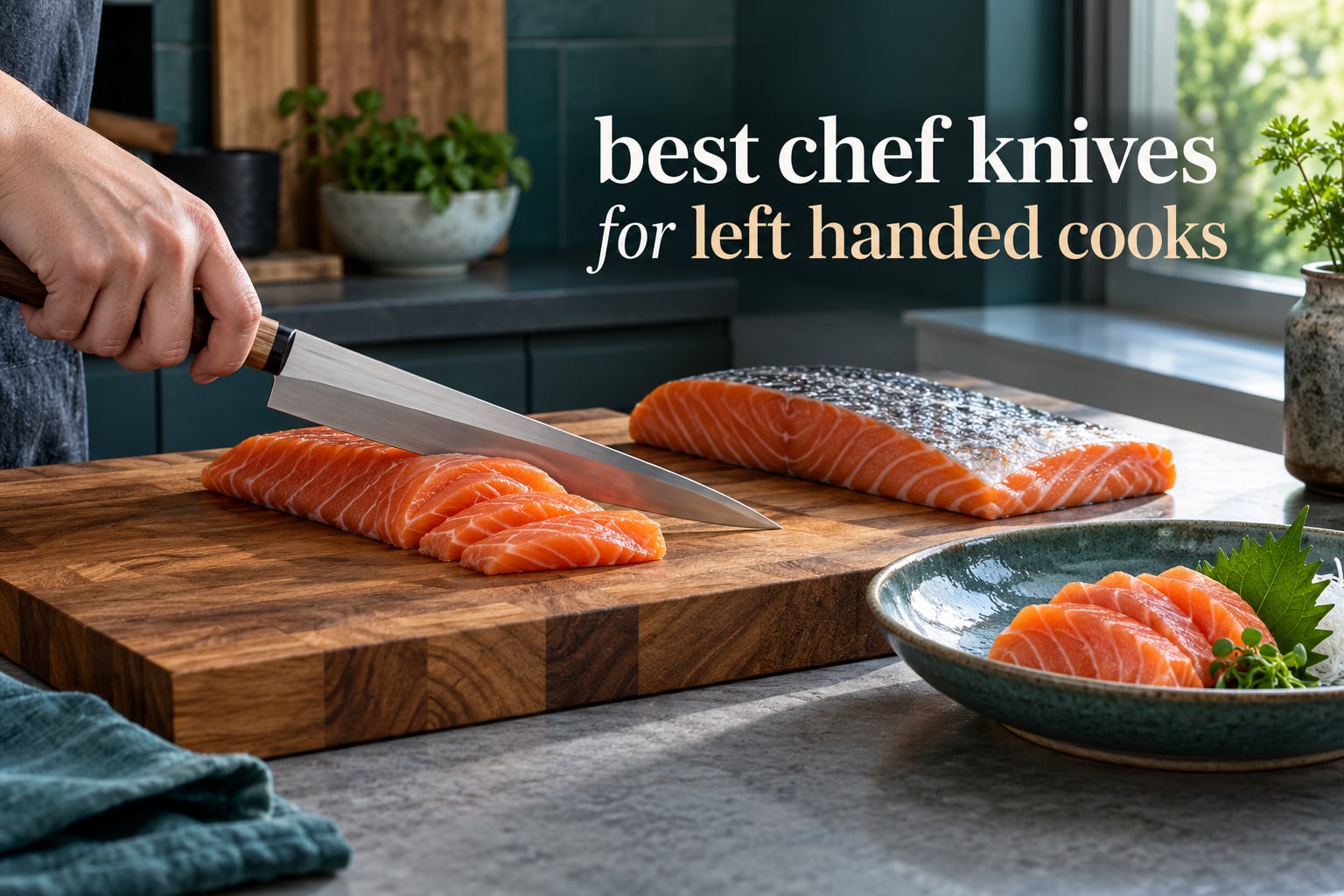
Most left-handed cooks don’t need a special knife. What they need is a knife whose cutting edge sits in front of their hand instead of behind it, and almost every double-bevel chef’s knife sold today already does that. The problem starts with the small group of Japanese-style knives that are genuinely single-bevel, because those really are handed, and a right-handed yanagiba or deba in a left hand will drag the blade off line every single cut.
That is the whole argument in one paragraph, and the rest of this guide is built on it. We went through twelve left-handed listings, checked the grind, the bevel side, the steel, the handle and the review history for each one, and separated the knives that are truly ground for a left hand from the ones that simply carry the word “left” in the title. You will find both in this list, because both exist, and we tell you which is which.
Below that, you get a ranked roundup of the best chef knives for left handed cooks in 2026, a plain-English explanation of single bevel versus double bevel geometry, a step-by-step way to verify a knife’s handedness before you pay for it, a list of styles to stay away from, and a care section for the reactive carbon steel that most of the good single-bevel options are made from.
If you are still assembling your first kit, our picks for the best chef’s knives overall and the best chef knife sets cover the general case. This page is the left-hand version of that conversation.
Table of Contents
Top 3 Picks for Best Left-Handed Cooks
The Mercer yanagi is the pick with the most real-world evidence behind it, the KAI deba is the specialist fish knife, and the Shun is the only one of the three built as a true all-purpose left-handed chef’s knife. All three are single-line shortcodes worth reading before the long list.
Mercer Culinary Left Handed Yanagi
- Single-bevel left-hand profile
- High-carbon German steel
- D-shaped Santoprene handle
- 8 inch blade

Shun Classic Left-Handed Chef’s Knife
- 8 inch all-purpose blade
- 16-layer Damascus-style cladding
- D-shaped PakkaWood handle
- Forged construction

KAI Seki Magoroku Left-Handed Deba
- 5.9 inch single-bevel blade
- Molybdenum vanadium steel
- Natural wood handle
- Made in Japan
Best Chef Knives for Left Handed Cooks in 2026
Here is the full lineup at a glance. Every knife below is either ground single-bevel for a left hand or shipped with a handle and grind that reviewers confirm work for left-handed use; the table notes which is which.
| Product | Specifications | Action |
|---|---|---|
| Mercer Culinary Left Handed Yanagi |
|
Check Latest Price |
| KAI Seki Magoroku Left-Handed Deba |
|
Check Latest Price |
| Shun Classic Left-Handed Chef’s Knife |
|
Check Latest Price |
 Global G-11L Left-Handed Yanagi Global G-11L Left-Handed Yanagi |
|
Check Latest Price |
 Lefty’s Left Handed Chef Knife Lefty’s Left Handed Chef Knife |
|
Check Latest Price |
 Lefty’s Four-Knife Left-Handed Set Lefty’s Four-Knife Left-Handed Set |
|
Check Latest Price |
 WILDMOK Left Handed Yanagiba WILDMOK Left Handed Yanagiba |
|
Check Latest Price |
 Sakai Ajimasa Yanagiba and Deba Set Sakai Ajimasa Yanagiba and Deba Set |
|
Check Latest Price |
 EverGrip Pro Left Handed Chef Knife EverGrip Pro Left Handed Chef Knife |
|
Check Latest Price |
 KANKIKUSUI Left-Handed Sashimi Knife KANKIKUSUI Left-Handed Sashimi Knife |
|
Check Latest Price |
 WILDMOK Left Handed Deba WILDMOK Left Handed Deba |
|
Check Latest Price |
 Global G-7L Left-Handed Deba Global G-7L Left-Handed Deba |
|
Check Latest Price |
Are Knives Actually Left- and Right-Handed?
Yes, but far fewer of them than the marketing suggests. A left-handed chef’s knife is one where the bevel and the handle angle are mirrored, so your dominant hand sits behind the sharp edge rather than fighting it. In practice only the traditional single-bevel Japanese styles — yanagiba, deba, usuba and the older kiritsuke forms — are genuinely handed. Double-bevel knives such as the gyuto, santoku and nakiri are ambidextrous and work identically for both hands.
Here is the myth that causes left-handed cooks to overspend. Plenty of lefties assume that because a Japanese knife has an asymmetric grind, the blade will “steer” and pull sideways in their hand. Practitioners on knife forums repeatedly report the opposite: double-bevel Japanese knives usually don’t steer at all, and when a knife does pull, it is almost always a single-bevel edge, not an asymmetric spine.
On a right-handed single-bevel knife, the angled edge faces right. A left-handed grip on that knife pushes the blade toward its flat side instead of into the food, and slices come off torn and off-centre — the tunnel-cutting effect. Mirror the bevel to the left, re-angle the handle, and the edge tracks straight for your hand.
So which knives actually steer? The short answer is the four traditional single-bevel shapes, plus any listing where the vendor photographs a right-handed blade and ships it anyway. Forum threads on r/lefthanded and r/chefknives carry this same finding repeatedly, along with the useful corollary that most lefties end up happiest with a good double-bevel slicer than with a scarce single-bevel specialism.
1. Mercer Culinary Left Handed Yanagi Sashimi Knife, 10 Inch
Mercer Culinary Asian Collection Left Handed Yanagi Sashimi Knife with NSF Handle, 10-Inch
- Single edge left hand profile confirmed by buyers
- High carbon German steel arrives razor sharp
- Handle stays secure with wet hands
- Hand wash only and limited lifetime warranty
- Single bevel suits one cutting style only
- Not dishwasher safe
- Japanese profile is specialised rather than general purpose
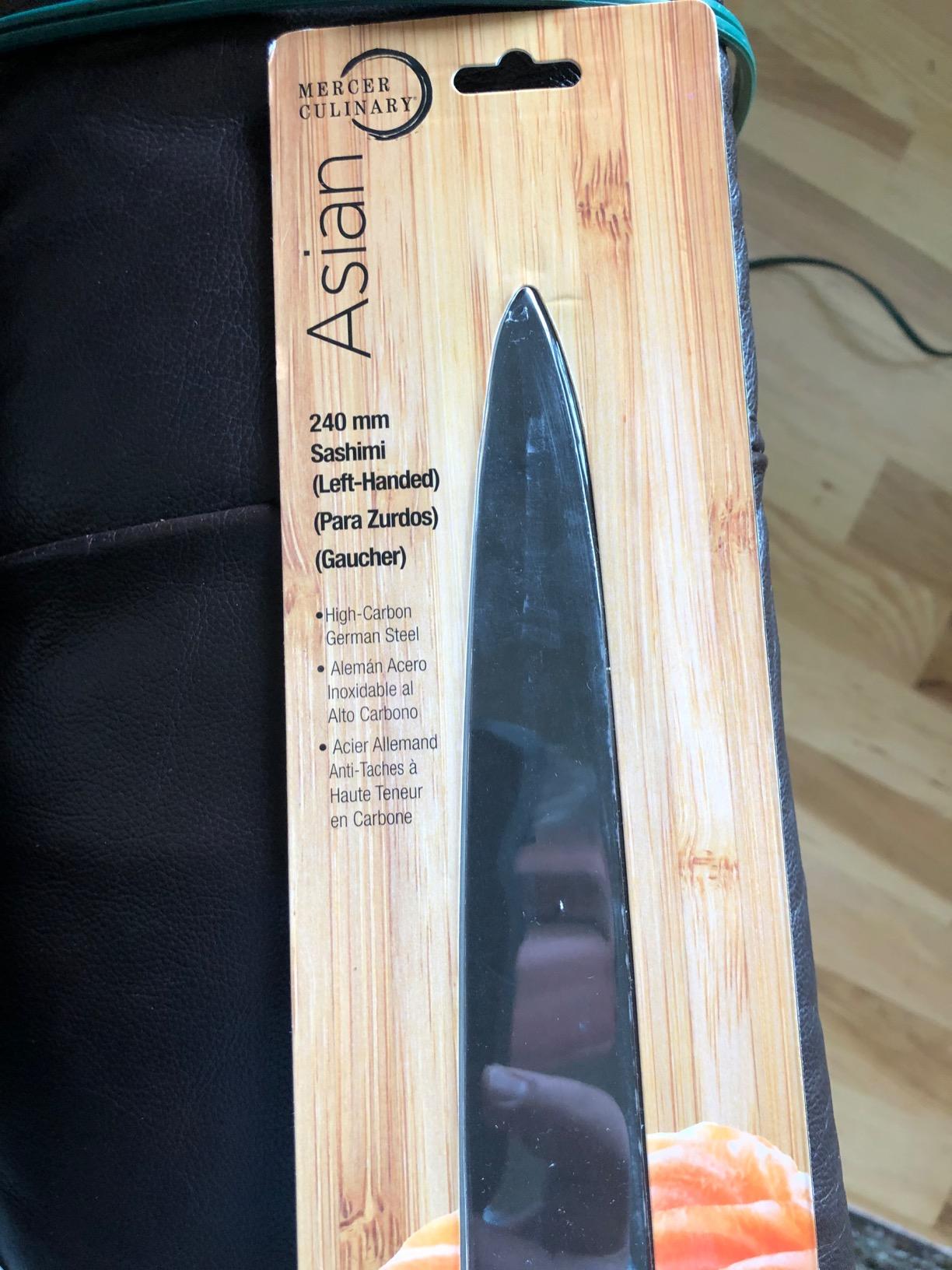
This is the knife we would hand to a left-handed cook who wants one serious blade and does not want to think about handedness again. The blade is high-carbon German steel with a fine stone finish, ground to a single edge on the left-hand profile, with roughly six degrees on one side and fifteen on the other. In practice that means it slices cleanly rather than chopping, which is exactly what you want for fish and large roasts.
What convinced us is the size of the review base for a genuinely left-handed product. At 188 ratings it is the most reviewed true left-handed blade in this roundup, and the rating distribution is heavily weighted toward five stars. Reviewers single out the D-shaped Santoprene handle as the part they notice most, saying it stays comfortable and secure even with wet hands during fish prep.
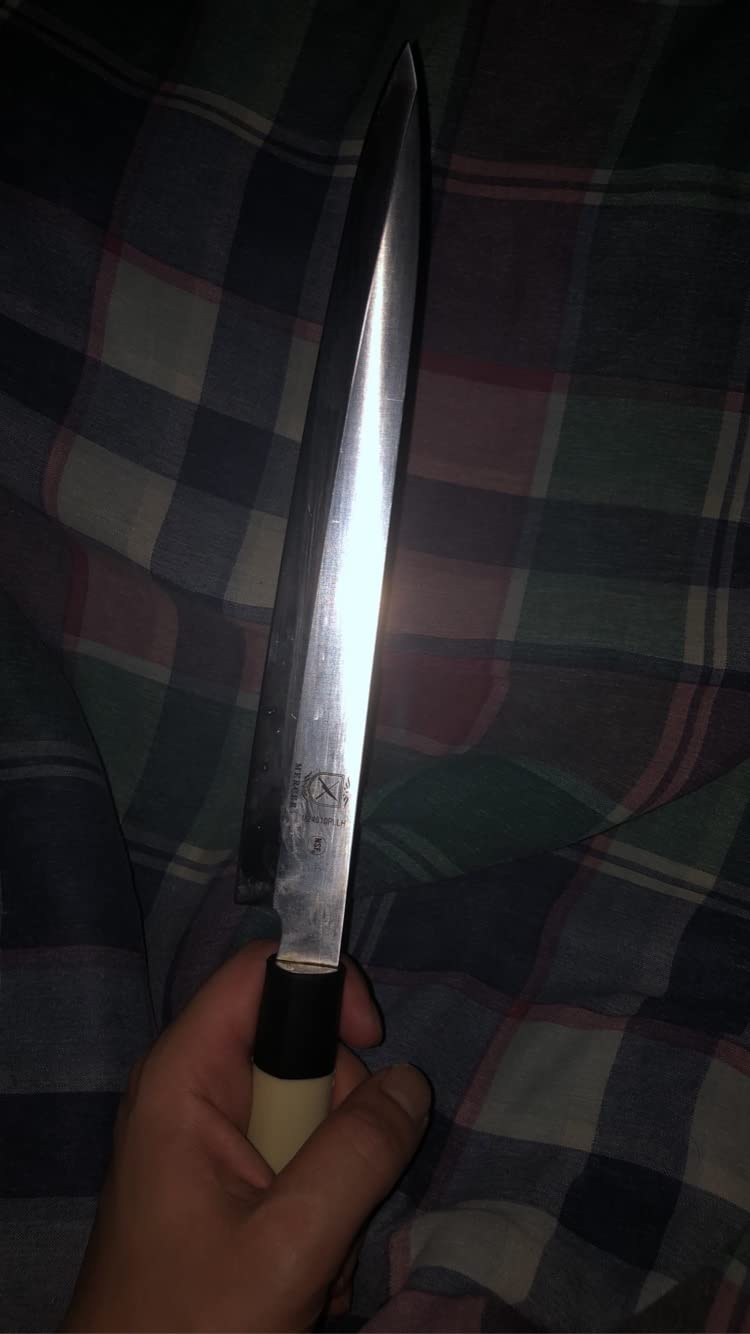
The counter is that this is a single-bevel slicer, not a general chef’s knife. Reach for it to slice salmon, halibut or a cooked roast, and it is excellent. Reach for it to go through a butternut squash or a bag of potatoes and you are using the wrong tool, and the edge will pay for it.
Care is simple but non-negotiable: hand wash with warm water and mild soap, dry immediately, and never put it in a dishwasher. It is stamped construction rather than forged, and it is NSF certified with a limited lifetime warranty, so durability is covered for as long as you own it.
Who it suits and who it does not
Buy this if you cook fish often, if you already understand that a single-bevel edge is a commitment, and if you want left-handed geometry with steel that will not fight you. It suits a home cook who slices several times a week and is not precious about the blade.
Skip it if you want a single knife that does vegetables, herbs, boneless meat and fish without you thinking about which motion suits it. For that job, look at the Shun in position three or the four-piece Lefty’s set further down.
What to check before you commit
The grind is the whole product here, so check the bevel side in the listing photos: the flat side of the blade should face right, toward your knife hand when you hold it left-handed. Reviewers confirm this is correct on this listing, which is more than we can say for several cheaper left-handed knives in this roundup.
Also confirm you are comfortable hand-washing. If your kitchen runs on the dishwasher and nothing else, this is the wrong pick, and the EverGrip option later in the list is built the opposite way.
2. KAI Seki Magoroku Left-Handed Deba Knife, 5.9 Inch
KAI AK5062 Deba Knife Seki Magoroku Ginju, Stainless Steel, Left Hand, 5.9 inches (150 mm), Made in Japan, Easy to Clean
- Weight sits toward the blade for stable fish work
- Cuts through hard fish and bone cleanly
- Stainless steel core resists rust
- Made in Japan
- Handle wood described by some reviewers as feeling inexpensive
- 4.1 average with a 6 percent one-star share
- Deba geometry is a specialist fish knife
A deba is the knife that makes the left-handed question unavoidable. Its spine is thick, the tip is a single downward point, and the edge runs at an angle that only works from one direction — which is exactly why genuine left-handed deba knives exist at all. This one is made in Japan and sold explicitly as a left-hand model.
The molybdenum vanadium stainless steel is the practical draw for home cooks. It resists rust, which matters enormously for anyone who is nervous about maintaining reactive carbon steel, and it still takes and holds an edge well for fish work. At 171 g the balance sits forward of the bolster, so the blade does the work and your hand stays relaxed.
Reviewers who switched from a right-handed deba describe the improvement in fish prep as dramatic rather than subtle. Cutting through whole fish and bony sections comes cleanly, and the stainless core means you can dry it in a hurry without worrying about overnight rust blooms.
The honest weakness is the handle. Several reviewers describe the natural wood and nylon ferrule as feeling inexpensive, and at 4.1 out of 5 this knife carries the second-lowest average of the roundup with a six percent share of one-star ratings. It is not a bad knife; it is a plainly finished one.
Who it suits and who it does not
This is for the angler, the sashimi regular, or anyone who breaks down fish at least once a week. If you own a whole fish on a Sunday and want a knife that feels like a professional tool in the hand, the forward balance here is the feature you are paying for.
It is the wrong choice for general kitchen prep. A 5.9 inch single-bevel deba cannot mince herbs, cannot rock-chop a pile of onions, and cannot handle the tip work that a board full of vegetables demands. Buy it as a second knife, not a first one.
What to check before you commit
Confirm the handedness in the listing images rather than trusting the word alone. On a true left-hand deba, the angled bevel sits on the left side of the blade. A right-handed deba shipped into a left hand is the single most common complaint pattern we saw across knife forums, and it is worth thirty seconds of photo inspection.
Also check your fish volume. A 150 mm deba suits a whole fish and a few fillets a week. If you are doing commercial quantities, you will grow out of it quickly and should look at a larger left-handed slicer instead.
3. Shun Classic Left-Handed 8-Inch Chef’s Knife
- Sharp out of the box and stays sharp in normal use
- Damascus style cladding reduces sticking
- Handle suits large and smaller hands
- Limited lifetime warranty
- Handle can carry a chemical or burnt plastic smell
- Fine edge and tip dull or chip with heavy use
- One reviewer reported a bent tip on arrival
If you want a knife that does everything a chef’s knife does and does not care about single-bevel theory at all, this is the pick. Shun grinds this one as a conventional all-purpose 8 inch chef’s knife and simply built the handle and palm swell for a left hand. For everyday chopping, dicing and slicing, that is the right answer for most left-handed cooks.
The blade is stainless steel clad with 16 layers in a Damascus-style pattern. That cladding is not cosmetic marketing: the slight patterning genuinely helps cut food release from the blade, which matters on a wet board. The forged construction and offset steel bolster give it a solid, balanced feel in the hand at 209 g.
Reviewers consistently praise the D-shaped PakkaWood handle for fitting both large and small left hands, which is the first thing that stops a lefty returning a knife. Balance is even enough for thin slices and thick chops alike, and it comes sharp enough to work with straight out of the box.
Two complaints come up repeatedly. The handle can carry a chemical or burnt-plastic smell that lingers for a while, and the micro-sharp point and fine edge dull or chip faster than reviewers expect at this level of spending. One buyer also reported a bent tip on arrival that needed a warranty repair.
Who it suits and who it does not
This suits the home cook who wants one knife for everything, who cooks a few times a week, and who would rather not learn whetstone sharpening before dinner. A left-handed handle on an ordinary chef’s knife profile is an underrated combination and this is the clearest example of it in this roundup.
It is the wrong choice for fine sashimi or katsuramuki peeling, where a single-bevel edge beats it easily, and the wrong choice for anyone who loves a razor-thin brittle edge — this one prioritises durability over finesse.
What to check before you commit
Look closely at the handle in the listing photos. D-shaped handles are the most common reason left-handed returns happen, because some of them have a palm swell built for the right hand that feels wrong reversed. This one is specified as a left-handed D-handle and reviewers confirm the fit, but it is still the part to check on arrival.
Inspect the tip out of the box. One reported bent tip suggests you should check the packaging before you use it, so a warranty claim is straightforward if you need one.
4. Global G-11L Left-Handed 10-Inch Yanagi Knife
Global G-11L-10 inch, 25cm Left-Handed Yanagi Knife 10″ Sashimi, Stainless Steel
- Sharp with long edge retention
- Perfectly balanced for precise slicing
- Seamless build is easy to sanitise
- Sure grip handle holds well when wet
- Higher cost than most Japanese imports in this roundup
- Hollow ground edge suits slicing not heavy prep
- Handles feel less comfortable over long sessions
Global builds left-handed yanagi as standard rather than as a special order, which makes this one of the easiest genuine left-handed slicers to find. The 10 inch blade is long, so it makes a single clean draw through a whole fillet with no sawing, and the hollow-ground edge is a slicer’s geometry rather than a chopper’s.
What sets Global apart here is construction. The blade and handle are seamless stainless steel with no rivets or seams where food can lodge, which is a real advantage if you are slicing raw fish several times a week. It also makes sanitising simple, which matters more than most buyers expect.
Reviewers describe it as razor sharp with edge retention better than typical Japanese knives, and rate the balance as close to perfect for sashimi work. The sure-grip handle holds securely through wet prep, and 67 percent of ratings sit at five stars.
The trade-off everyone mentions is cost. This sits at the top of the price range in this roundup, and Global handles are known for being demanding over a long session. If you are buying one knife and it will be on the board for eight hours a day, that is worth weighing carefully.
Who it suits and who it does not
Pick this if sushi and sashimi are a regular feature of your cooking, if you want a left-handed slicer from a brand you can buy without a specialist importer, and if the seamless stainless construction appeals to your hygiene habits.
It is the wrong pick for heavy vegetable work or for anyone who wants a knife they can rock-chop with. A hollow-ground 10 inch slicer on a board of root vegetables is the wrong tool, and the edge geometry will not enjoy it.
What to check before you commit
Confirm that this listing is the left-handed G-11L and not a right-handed blade with a left-handed label nearby. Global uses an L suffix on the model number for left-handed, so check that the model number in the listing ends in L.
Consider the handling honestly. Global’s all-stainless handles are famously stiff compared with wa-handled Japanese knives, and if you already know you prefer wood or octagonal handles, the appeal here drops.
5. Lefty’s Left Handed Chef Knife, 7.5 Inch
- Sharp out of the box for the money
- Soft grip suits left hand holding
- Bevel on the correct side for most buyers
- Dishwasher safe and waterproof
- One verified buyer reports a right side bevel
- No sheath supplied
- Edge dulling reported after a handful of uses
- Plain plastic handle
If your priority is finding out how you actually feel about a left-handed chef’s knife before spending real money, this is the sensible first step. It is a 7.5 inch stainless steel chef’s knife with the bevel ground on the left-hand side and a soft grip handle sized for a left hand, and most buyers report that the geometry feels natural immediately.
At 4.5 stars from 26 ratings, the reception is genuinely positive for the tier. Buyers call it surprisingly sharp for the money, like the soft grip, and specifically say the bevel on the correct side makes left-handed slicing feel natural rather than like an adjustment period.
We are including it with a clear caveat, and that caveat is the most repeated complaint in left-handed knife shopping: listings that say left-handed and ship right-handed. One verified buyer on this product reports the blade beveled on the right, behaving like a standard right-handed knife. The majority report the correct side, but the risk is real.
Other limitations are ordinary for the tier: no sheath, so a sharp blade loose in a drawer is a cut waiting to happen, and some buyers report the edge dulling quickly. The handle is plain plastic rather than steel or hardwood.
Who it suits and who it does not
This suits a left-handed cook who wants a usable general knife now, who does not want to research single-bevel geometry, and who would rather replace a budget knife in a year than think about sharpening stones. Dishwasher safe is a genuine plus for a busy kitchen.
It is not the right pick if you care about long-term sharpness, if you have children reaching into drawers, or if a mislabelled grind would bother you. There are better-supported options later in this list for cooks who want a knife that holds an edge for years.
What to check before you commit
Ask the seller directly which side the bevel is on, and look for a photo of the blade with the flat face toward you. If the answer is vague, assume right-handed. That single question prevents the most common disappointing purchase in this whole category.
Plan to buy a sheath or a knife block separately. Reviewers flag the missing sheath more often than anything else on this listing, and it takes seconds to solve.
6. Lefty’s Left Handed Four-Knife Set
- Covers four core knife jobs in one set
- Soft grip handles sized for left hands
- Edges ground on the correct side for lefts
- Good value for a complete lefty starter kit
- Weakest rating distribution here with a 15 percent two-star share
- Plain plastic handles feel basic
- Some buyers note edges dull relatively quickly
A set is the wrong answer for a serious cook and the right answer for someone starting from nothing. This one covers paring, steak, chef and bread, all with edges ground or serrated on the correct side for a left-handed grip, and all with soft grip handles sized for left hands.
The appeal is obvious if you own no left-handed tools at all. Rather than buying one and discovering it does not suit your hand, you get four everyday jobs covered and you learn what you like. Reviewers generally find the set convenient and correctly ground.
It is also the weakest-rated product here. The 4.0 average comes with a doubled-up share of two-star ratings, which points at build consistency and edge retention rather than handedness. Plain plastic handles feel basic, and several buyers note the edges dull sooner than they would like.
The serrated members deserve a specific warning. Serration is not the same geometry as a plain edge, and a left-handed bread knife works because the teeth are set to cut on the pull as well as the push. Judge the set on the plain-edged pieces, not the serrated ones.
Who it suits and who it does not
This suits a left-handed cook setting up their first kitchen, a renter furnishing a shared space, or anyone buying a left-handed kit as a gift where the recipient’s taste is unknown. The four jobs covered are the four that come up daily in a home kitchen.
It is the wrong pick if you already have a good right-handed knife and want one better tool rather than four basic ones. A single quality chef’s knife will always outperform a set for the work that matters most.
What to check before you commit
Verify each blade individually rather than trusting the set label. Check the paring and chef knife bevels in the photos, since those are the ones that carry the handedness requirement, and remember that a serrated bread knife and a steak knife are handed-neutral by design.
Look at the handle scale in the photos next to your own hand. These are full-size soft grip handles, which suit most adults but can feel large on smaller hands.
7. WILDMOK Left Handed 10-Inch Yanagiba Sushi Knife
- Single bevel yanagiba ground for left hands
- Ice tempered German stainless resists corrosion
- Narrow 10-12 degree edge for fine slicing
- Balanced maple handle
- Only 11 ratings give limited long-term evidence
- Limited to sashimi and fish work
- One-star share of 12 percent hints at build inconsistency
This is a pure yanagiba: a 10 inch single-bevel slicer with a narrow 10 to 12 degree edge, ground for left-handed use and made from German stainless steel that is ice tempered and vacuum heat treated to 56-58 Rockwell. That narrow angle is what lets it make a clean single draw through fish without a sawing motion.
The hard maple handle is balanced to reduce finger numbness, which is a real consideration on a long slicing knife. Reviewers interested in left-handed sashimi work like the balance and the edge angle, and the blade ships in gift packaging, which makes it an easy present.
Be clear about what the evidence here amounts to. Eleven ratings is a thin base, and the average of 4.0 with a 12 percent one-star share suggests the brand still has some build-consistency work to do. We would not call this a proven workhorse.
As with any yanagiba, it is a specialist tool. It slices; it does not chop, mince or handle a butternut squash. If left-handed fish work is a hobby rather than a regular task, the higher-rated Global slicer is the safer bet.
Who it suits and who it does not
This suits a left-handed cook who has decided that fish and sushi are worth a dedicated slicer, who wants a narrow-angle edge, and who wants stainless steel that forgives a missed hand-drying. It also works as a gift for a left-handed cook who cooks fish.
It does not suit anyone who wants one knife for a whole kitchen, or anyone who wants a large body of customer feedback before committing. Three other slicers in this roundup have far deeper review histories.
What to check before you commit
Check the bevel side and the hardness figure together. A genuine left-handed yanagiba has the angled face on the left, and 56-58 HRC on stainless steel is a sensible number — anything claimed much higher on a stainless blade should make you ask what was traded away to get there.
Confirm the maple handle is a comfortable diameter for your grip. Ten inch slicers with slim handles feel very different from short knives with thick handles, and this one is on the slim side.
8. Sakai Ajimasa Left-Handed Yanagiba and Deba Set
Kitchen knife set kitchen knife set Dottokomu willow blade knife, two “bright sound Sakura” (Akane Suzaku et al.) Left-handed (japan import)
- Genuine Sakai white steel construction
- Pairs yanagiba and deba for slicing and fish work
- Highest five-star share here at 85 percent
- Forged blades with very fine keen edges
- White steel is highly rust prone and needs careful drying
- Carbon steel requires hand sharpening and maintenance
- Only 7 ratings so durability is undocumented
- Heavy 580 g for two knives
This is the most traditionally Japanese option in the roundup. It is a matched pair forged in Sakai from Yasuki White Steel carbon steel: an 8.3 inch yanagiba for slicing and a 5.9 inch deba for fish. Both are made for left-handed use, which for white steel is not an accessory but the only way they are made.
White steel sharpens to an edge nothing else in this list reaches. Reviewers describe the edges as very fine and keen, and this pair has the highest five-star share of anything we looked at, at 85 percent. If you have ever wondered whether a Japanese kitchen edge is worth the fuss, this is the knife that demonstrates it.
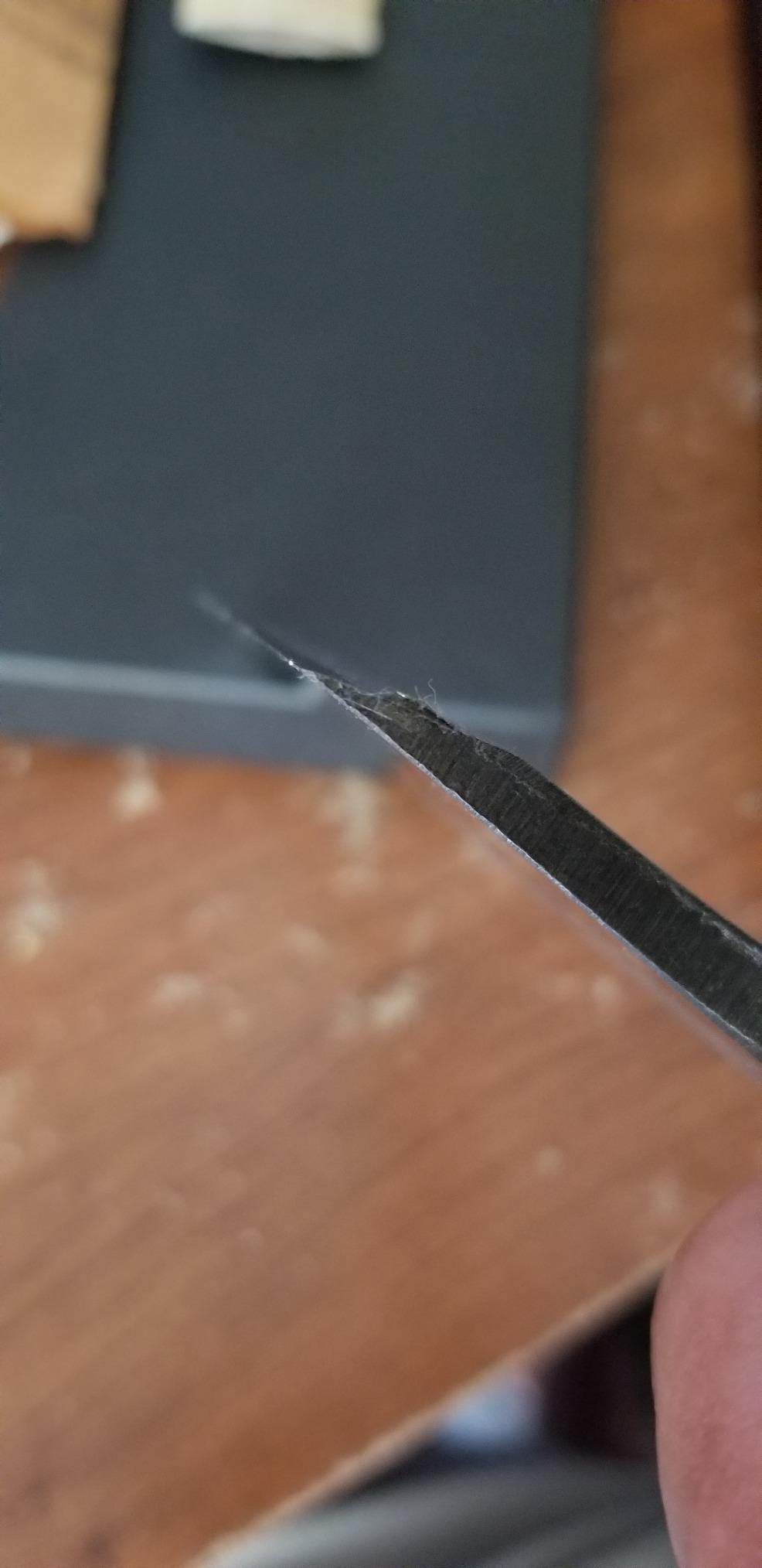
The carbon steel is also the reason to slow down. White steel is highly rust-prone, it needs a whetstone rather than a honing steel to maintain, and it rewards a cook who dries the blade immediately after every use. Reviewers note that the left-handed pairing itself delights buyers, which tells you how rare a genuinely well-executed left-handed set is.
Keep in mind the evidence: seven ratings is a very small sample. The enthusiasm is consistent, but nobody has yet reported what this steel looks like after five years of daily use, and the 580 g set weight is substantial in the hand.
Who it suits and who it does not
Pick this if you are a left-handed cook who already likes sharpening, or who wants to learn, and who wants the sharpest edge a home knife can deliver. Two knives means you cover both slicing and fish breakdown with genuinely handed tools, which is rare.
Skip it if you do not want to maintain a carbon steel edge and you are not willing to learn whetstone sharpening. It is also the wrong gift for someone who is new to cooking and just wants a knife that works.
What to check before you commit
Accept the rust obligation before you order. Yasuki White Steel will spot or stain if it sits wet, and it will darken with use into a patina that some cooks love and others find alarming. Either way it is not a stain you can wash off later.
Check that you have a sharpening plan. A coarse whetstone to bring the edge back and a finer stone to finish it covers most needs, and many owners send white steel knives out to a specialist sharpener rather than working stones at home.
9. EverGrip Pro Left Handed 8-Inch Chef Knife
EverGrip Pro Chef Knife 8 Inch, High Carbon Stainless Steel Full Tang Kitchen Knife, Ergonomic Handle for Chopping, Slicing & Dicing, Left Handed
- Sharp out of the box and held its edge through extended prep
- Full tang construction feels solid
- Non slip grip stays secure with wet hands
- Dishwasher safe and corrosion resistant
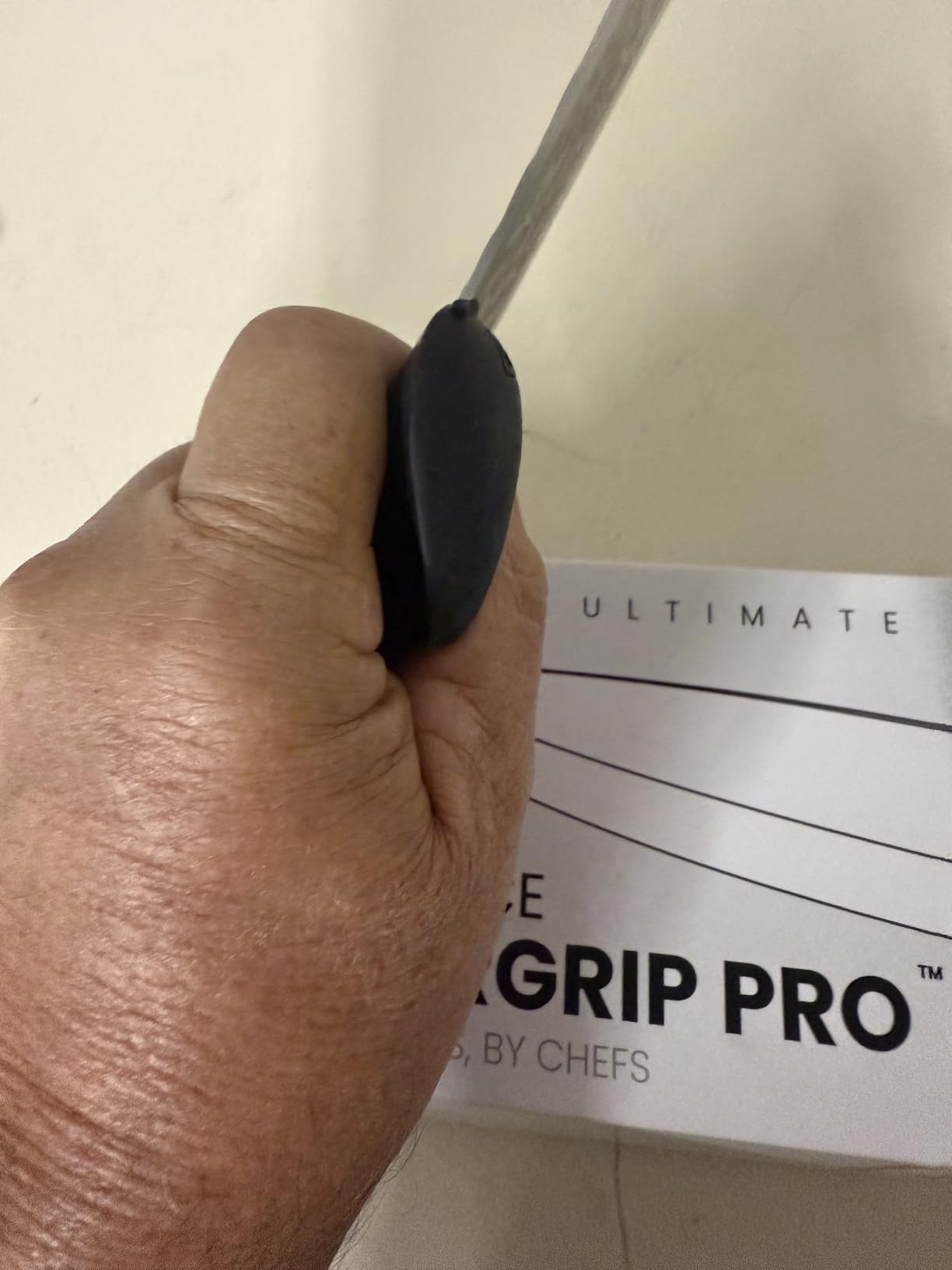
- Bulky handle suits only large to very large hands
- Soft left grip can force an awkward wrist on straight down cuts
- Heavier than a traditional chef's knife
- Listing photos appear to show the bumper on both sides
This is the practical left-handed chef’s knife for a kitchen that runs on the dishwasher. The 8 inch forged blade is high-carbon stainless with high chrome content for stain and corrosion resistance, the handle is a rubberised composite, and the whole thing is dishwasher safe. That combination is rare among knives in this roundup and it is what this pick is for.
Left-handed testers mostly like the control. Reviewers report it arrived razor sharp and held its edge through an extended meal prep session, and one left-handed tester reported powering through a large frozen chuck roll. The non-slip grip stays secure with wet hands and is marketed to reduce fatigue and blisters.
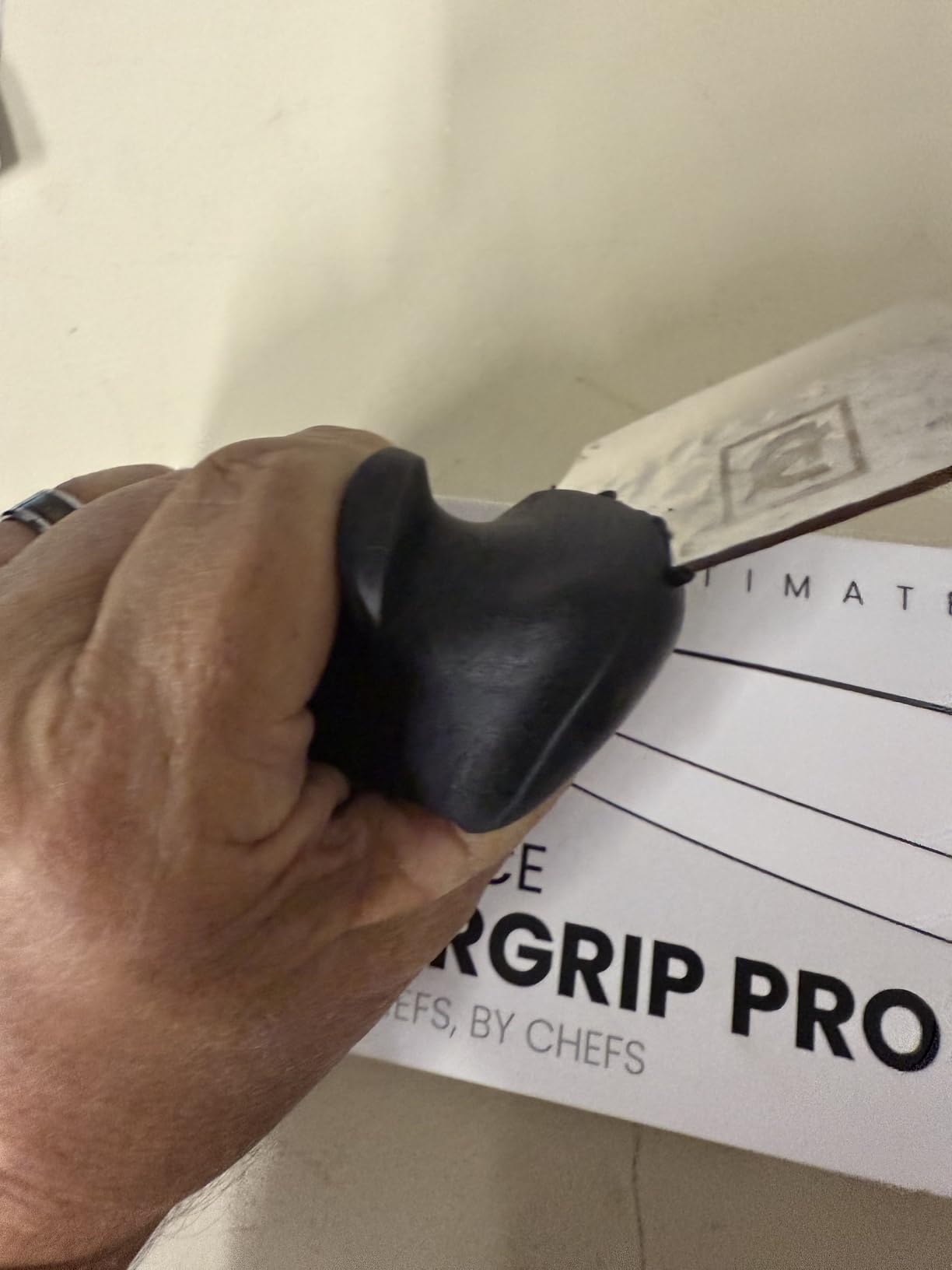
The handle is also the main complaint. It is bulky, and that bulk suits only large to very large hands. One buyer preferred a standard knife and found the grip forced an awkward wrist position when cutting straight down, which is a specific and useful warning.
There is also a verification point: the listing photos appear to show the bumper flipped on both sides, which muddies the handedness. Ask before you buy rather than after. Six ratings is a small base, so treat the enthusiasm as promising rather than proven.
Who it suits and who it does not
This suits a left-handed cook with large hands who wants a knife they can put in the dishwasher without anxiety, who chops hard ingredients, and who wants a full tang they can feel. It is also a reasonable choice for gifting to a left-handed beginner.
It is the wrong pick for smaller hands, for anyone who does fine detail work where a bulky handle gets in the way, and for anyone who cares about a light, balanced knife. A 6.24 ounce handle-heavy design is the opposite of a wa-handled Japanese profile.
What to check before you commit
Ask the seller to confirm which side the left bumper is on and ask for a clear choil or handle photo. Given the ambiguity in the listing images, this is a case where a written confirmation before purchase is worth the effort.
Measure your grip against the handle photos. Compare the handle diameter with a knife you already use comfortably, because a full tang grip this size feels completely different between large and small hands.
10. KANKIKUSUI Left-Handed 9.3-Inch Sashimi Knife
KANKIKUSUI Left-Handed Sashimi Knife, 9.3″ Sushi Knife Set
- Precise clean cuts confirmed by verified buyers
- Single bevel edge does not tear fish structure
- Wenge handle balances the blade well
- Strong category rank in sashimi knives
- Arrives needing sharpening before true sashimi work
- Only 3 ratings so little long-term evidence
- Single bevel geometry is specialised for fish and boneless meat
This one is a single-knife package built specifically for left-handed sashimi work. The knife is a 9.3 inch hand-ground single-bevel blade in German 70Cr17MoV high carbon steel, vacuum heat treated to 57-59 Rockwell, with a natural wenge wood handle sized and balanced for a left grip.
The steel choice is worth noting. Molybdenum vanadium stainless is a practical middle ground for a single-bevel edge: it holds a fine edge like a Japanese knife without the rust anxiety of carbon steel. Verified buyers confirm the cuts are precise and clean, and note that the single-bevel edge does not tear fish structure.
The reviews are uniformly positive but almost nonexistent in volume: three ratings, none below four. The one specific critique is important enough to flag before you buy — the edge arrives needing sharpening before it is genuinely sashimi-ready.
The category rank in sashimi knives is strong for a new listing, which suggests real demand. But rank is not the same as a long-term record, so plan on a few sharpening sessions before the knife is doing the work you bought it for.
Who it suits and who it does not
This suits a left-handed cook who wants to start making sashimi at home, who wants a self-contained gift that is ready to give without hunting for accessories, and who wants a single-bevel edge in forgiving stainless steel rather than reactive carbon.
It is the wrong pick if you want a knife that is sharp the moment you unbox it, or if you need a general-purpose chef’s knife. A self-contained kit like this is either the main appeal or irrelevant depending on what you already own.
What to check before you commit
Plan your first sharpening session before the first piece of fish. A single-bevel edge on hand-finished steel usually needs a few passes on a stone to reach its potential, and doing that on a cutting board is how edges get damaged.
Check the blade photos for the bevel side before ordering, and note that a basic honing tool is not a substitute for a stone. For a true single-bevel edge, a whetstone at around 1000 grit followed by a finer stone will do considerably more.
11. WILDMOK Left Handed 7-Inch Deba Knife
WILDMOK Left Handed 7 Inch Deba Knife German Stainless Steel Sashimi Knife Asian Usuba Salmon Knife for Left Handed
- Medium deba profile slices through fish easily
- Left handed single bevel edge
- Ice tempered and vacuum treated steel
- Balanced hard maple handle
- Strong category rank for a new listing
- Only 3 ratings across the deba line
- Deba geometry is a fish knife not a general chef's knife
- Small sample makes long term retention unproven
The 7 inch deba is a sensible middle size for a home kitchen. Where a 5.9 inch deba handles a whole fish and little else, a 7 inch blade gives you more surface for filleting larger fish and for boneless poultry, without the weight of a full professional deba.
The construction matches the 10 inch yanagiba in this same brand: German stainless steel, ice tempered and vacuum heat treated to 56-58 Rockwell, with a 13-15 degree single-bevel edge ground for left-handed use. That wider edge angle compared with the yanagiba makes it tougher and better suited to structural cuts.
The hard maple handle is the same balanced shape designed to reduce finger numbness, and it carries the same caveat: a small review base. Three ratings across the deba line means the long-term edge retention is unproven, and the high average of 4.6 reflects a handful of very positive experiences rather than a track record.
Worth mentioning that the category rank for this listing in deba knives is strong despite that short history, which tells you demand exists even if evidence does not. Buy it with realistic expectations.
Who it suits and who it does not
Pick this if you are a left-handed cook who wants a deba for larger fish and boneless poultry and has found the 150 mm knives too small. It is also a logical companion to the 10 inch yanagiba from the same brand if you slice and break down.
It is the wrong pick for general kitchen duty. Deba geometry is a fish and boneless-meat knife, and the single-bevel edge is not built for the rocking, mincing and tip work that a chef’s knife does all day.
What to check before you commit
Look at the bevel side and the spine. On a left-handed deba the flat face and the bevel run the other way from a right-handed one, and this is the shape where getting it wrong hurts most because the tip is used for delicate work.
Check the tip condition on arrival. Single-bevel tips are the first thing to dull, and a 7 inch deba tip does a lot of filleting work that a narrower knife would not attempt.
12. Global G-7L Left-Handed 7-Inch Deba Knife
Global G-7L, Classic 7″ Left handed Deba Knife, Stainless Steel
- Highest average rating here at 4.8
- Very sharp out of the box with a premium feel
- CROMOVA 18 resists rust and staining
- Seamless build is easy to keep hygienic
- Well weighted and balanced
- Single bevel edge nicks and dings with everyday use
- Owner restricted it to soft foods after edge repairs
- Higher maintenance than a German chef's knife
- Only 5 ratings
This carries the highest average rating in the roundup at 4.8, though it rests on five ratings, so treat that as a signal rather than a verdict. What is not in doubt is the quality of the object: CROMOVA 18 stainless steel, seamless construction, carefully weighted, with a limited lifetime guarantee.
CROMOVA 18 is a high-hardness Japanese stainless that Global uses across the range, and it is the reason this knife feels sharp out of the box while still resisting corrosion. Seamless construction means no rivets or joins to trap food, which matters for a knife that goes into raw fish.
The caveat is the one every Global owner eventually learns. The single-bevel edge on this deba is delicate and nicks and dings with everyday use, and the detailed review here describes an owner who had to restrict it to soft foods such as fruit and sushi after edge repairs.
That is a more demanding maintenance relationship than a German stainless chef’s knife, and it is worth being honest about before you buy. This is a knife that rewards careful use and punishes boards with glass or stone surfaces.
Who it suits and who it does not
Pick this if you are a left-handed cook who wants a compact deba for delicate fish work and who already accepts that a fine single-bevel edge needs a cutting board and a routine. The limited lifetime guarantee also makes it a sensible inheritance piece.
It is the wrong pick for heavy prep or for anyone who treats knives roughly. If you chop through bone and tough vegetable on a daily basis, a double-bevel knife will serve you better for far longer.
What to check before you commit
Verify the L in the model number before ordering. The G-7 is the right-handed deba and the G-7L is the left-handed one, and they look almost identical in a listing thumbnail, which is exactly how people end up with the wrong one.
Decide your board situation. A single-bevel stainless deba wants a wood or soft plastic board, and pairing it with a glass or stone surface is the fastest way to reproduce the nicking described in reviews.
How to Tell If a Knife Is Really Left-Handed
Four checks, in order, catch almost every mislabelled knife. Start with the choil photo, then confirm the bevel side, then the handle, then get it in writing. Vendors ship right-handed by default far more often than listings admit.
First, find a choil or grind photo. The choil is the unground notch at the heel of the blade, and on a left-handed knife the grind on the flat side will be mirrored relative to a right-handed one. If the listing has no choil photo at all, treat that as a question you still need answered rather than a problem solved.
Second, check the bevel side in the main images. On a left-handed single-bevel knife the angled, bevelled face is on the left when you are looking at the blade with the edge pointing away from you. On a double-bevel knife this check is meaningless, which is why you should also confirm the handle.
Third, look at the handle. A left-hand handle carries the finger grooves or palm swell arranged for a left grip, and D-shaped handles are the specific place to check because a right-hand D reversed is a common listing error. Our knife sharpener guide covers what to do once the knife arrives.
Fourth, ask the seller in writing before you buy: which side is the bevel on, is this the left-handed model, and does it ship left-handed as pictured. A written answer creates a record. Forum buyers report this single message prevents the majority of returns in this category.
One more clue worth knowing: on a left-handed knife, the knife should sit on the board with the flat side facing right when you are standing over it in your usual chopping position. If you pick it up and your knuckles want to sit behind the edge, the geometry is right for you.
What Not to Buy as a Left-Handed Cook
The short list of styles to avoid is: right-handed yanagiba, right-handed deba, right-handed usuba, and traditional kiritsuke forms. These are single-bevel styles where handedness is structural, not cosmetic, and using the mirrored version badly wrecks peeling and slicing.
Also avoid anything where the listing photo shows a right-handed blade and a disclaimer saying the pictured knife is right-handed before dispatch. This pattern appears on several otherwise reputable left-handed product pages, and it means you will be unboxing a return.
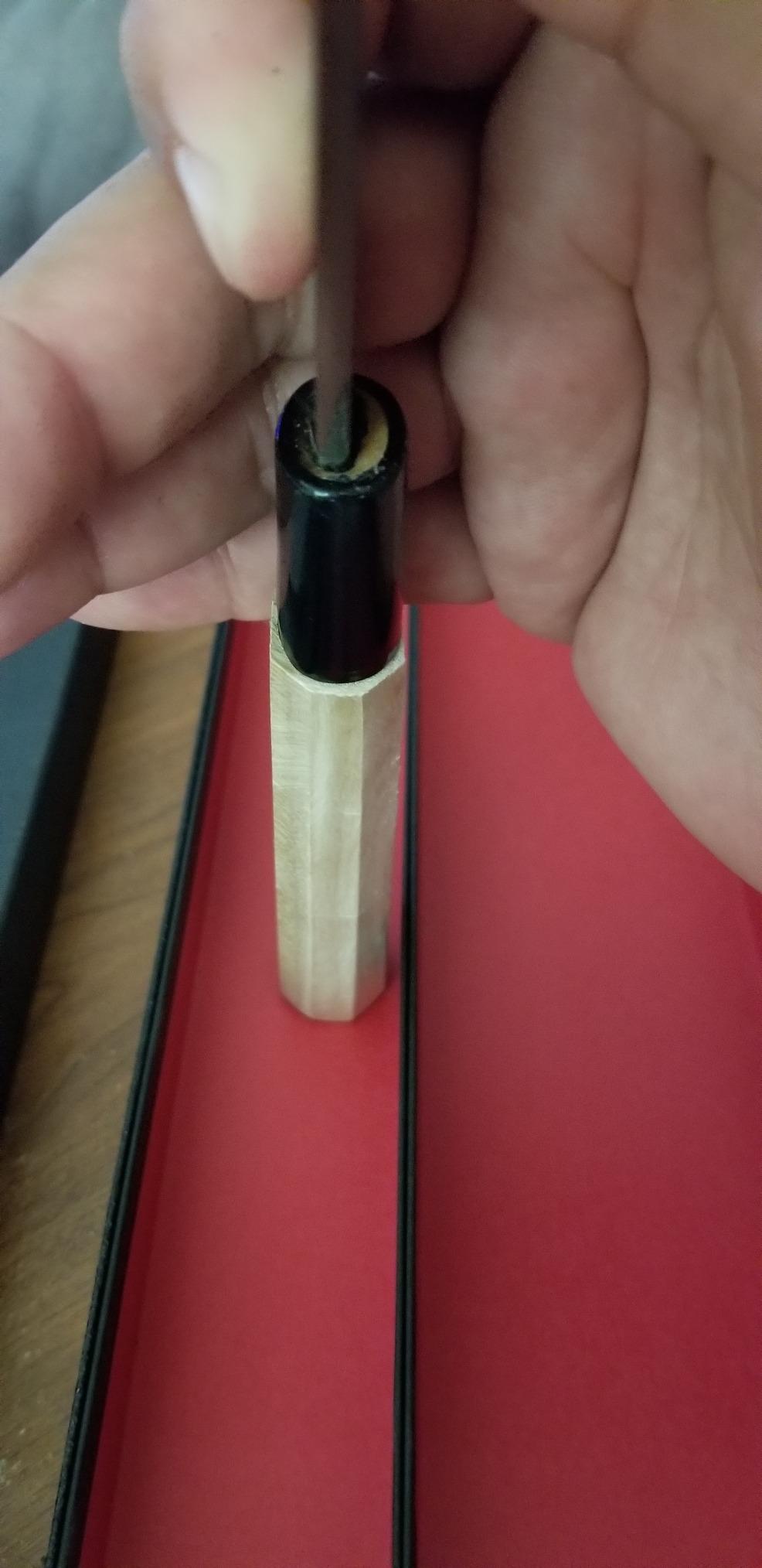
Be cautious with D-shaped handles generally. Retailers report a recurring trickle of returns from lefties purely because of the palm swell, and while most D handles can be sanded down to suit, that is a job you should not have to do on a new knife. Octagonal wa handles are the neutral choice if you can find one.
Do not buy a package of three to five knives in a single-bevel style to “get a set”. Single-bevel skills do not transfer between tasks, and you will end up with two unusable knives and a bill. One good left-handed chef’s knife beats any number of specialists.
How to Choose a Left-Handed Knife: Buying Guide
Decide whether you actually need handedness at all before you spend anything. If your cooking is general home prep, a left-hand-handled double-bevel chef’s knife is the correct answer and you should start there.
Entry tier: if you want to test the geometry without committing, a general chef’s knife with a left-hand handle is the low-risk place to start. Expect ordinary sharpness and edge retention, and expect the grind to be something you check on arrival rather than something the listing guarantees. Our guide to the best chef’s knives covers general selection criteria that apply regardless of handedness.
Mid tier: this is where stainless left-handed slicers and deba knives live, and where most home cooks should stop. Molybdenum vanadium or similar stainless gives you a fine edge without carbon steel’s rust burden, and the trade-off is that you will need stones rather than a honing rod to keep it truly sharp.
Premium tier: Japanese white or blue steel single-bevel knives are where the cutting quality jumps, and also where the maintenance obligation jumps. Buy them if you are willing to learn whetstone sharpening and to dry your blade the moment it is rinsed.
Choose by task, not by prestige. A gyuto or santoku handles most home cooking. A nakiri or usuba is for vegetables and katsuramuki peeling. A yanagiba is for sashimi. A deba is for fish. A sujihiki is for long straight slices. Only some of these exist in true left-handed form, and for the ones that do not, a double-bevel version used in a left hand is the sensible substitute.
Handle choice matters more than most buyers expect. Octagonal wa handles are symmetrical and neutral. D-shaped handles give control and must genuinely be left-handed. Soft grip composite handles are comfortable and dishwasher friendly. Test the diameter against a knife you already like before you commit.
Finally, consider where to buy. Genuine left-handed Japanese knives are concentrated with specialist retailers rather than general marketplaces, and it is worth asking a specialist retailer directly whether they can source a left-handed version of a specific model. A related workaround that comes up often on forums is buying a wa-handled blade you like and having a handle maker fit a left-handed handle to it.
Sharpening and Care for Left-Handed Single-Bevel Knives
A single-bevel edge is maintained differently from a double one, and getting this wrong is what damages knives. The angled side has a primary bevel you grind to the angle, and a secondary bevel called the ura that you refine to hone the edge. You sharpen the primary side only, then hone the secondary side to match.
Start coarse and finish fine. A progression of roughly 1000 grit to remove any rolled edge, then 3000 to refine, then 6000 for a polishing finish covers most single-bevel maintenance at home. Flat stones work; the whetstone learning curve is real but a weekend of practice on a cheap knife is enough to get competent.
The soaking question is a myth. Unlike a splash of water during a session, a properly flat stone needs no soak, and over-soaking can soften the stone faster than it helps. Splash and go is the standard practice.
Send it out when you cannot fix it yourself. A single-bevel edge that has been ground unevenly, or a knife with chips at the tip, needs someone who works these edges regularly. Weights, cutting board type and shipping insurance matter more for a fine edge than any other knife maintenance factor.
For carbon steel, the routine is simple and non-negotiable: wash by hand immediately, dry fully before storing, and expect the blade to darken. A patina on white or blue steel is normal rather than damage, and applying a light oil if you are leaving a knife unused for weeks will slow any staining.
For stainless left-handed slicers, maintenance is easier but still not zero. Hand wash, dry, and use a stone when the edge goes dull rather than reaching for a honing rod that cannot fix a lost bevel. If you sharpen often, our best knife sharpeners for the kitchen guide covers the mechanical options.
Frequently Asked Questions
What are the best knives for left-handers?
The best knives for left-handers are a left-hand-handled double-bevel chef’s knife for general cooking, plus a true left-handed single-bevel slicer such as a yanagiba if you do fish or sashimi. Double-bevel knives such as gyuto and santoku work for both hands and rarely steer. Our top pick is the Mercer Culinary left handed yanagi for slicing and the Shun left-handed 8 inch chef’s knife for everyday prep.
What are some good kitchen knives for left-handed people?
Good kitchen knives for left-handed people fall into three groups. A double-bevel all-purpose knife with a left-hand handle covers most cooking. Left-handed single-bevel yanagiba and deba knives cover fish and sashimi. And specialist left-handed nakiri or usuba knives handle vegetable peeling, though they are the hardest to find. In this roundup the Mercer yanagi, the Shun chef’s knife and the KAI deba cover the three groups.
Are there left and right-handed knives?
Yes, but only a few traditional styles. Yanagiba, deba, usuba and older kiritsuke forms are single-bevel and genuinely handed, so they are made in left-handed versions. Double-bevel knives such as gyuto, santoku, nakiri and sujihiki are ambidextrous and identical for both hands. Forum practitioners report that double-bevel Japanese knives usually do not steer in a left hand at all.
Can a left-handed cook use a right-handed chef’s knife?
Yes. On a double-bevel chef’s knife the edge is symmetrical, so a right-handed knife in a left hand behaves almost identically. The problems only start with single-bevel styles, where the angled edge pushes a left-handed grip off line and causes torn slices. For those shapes you need a mirrored left-handed version, and you should verify the grind before you buy.
How do I tell if a knife is truly left-handed?
Check four things. Look for a choil photo and confirm the grind is mirrored. Check that the bevel face is on the left when you view the blade with the edge pointing away from you. Confirm the handle grooves or palm swell are arranged for a left grip, especially on D-shaped handles. Then ask the seller in writing which side the bevel is on before you order, since vendors ship right-handed by default.
Do left-handed knives need special sharpening?
Left-handed double-bevel knives do not, they sharpen exactly like any other double-bevel edge. Left-handed single-bevel knives do, because you grind only the primary bevel on the angled side and hone the ura, the secondary bevel on the flat side. A typical progression is around 1000 grit, then 3000, then 6000. If you are not confident, send the knife to a sharpener who works single-bevel edges.
The Best Chef Knives for Left Handed Cooks
Start with the Mercer left handed yanagi if you want the strongest evidence behind a genuinely single-bevel blade. Add the Shun as your everyday all-purpose left-hand chef’s knife, and pick up the KAI deba only if fish is a regular part of your week. Those three cover almost every left-handed kitchen.
Skip the shapes that fight your hand: right-handed yanagiba, deba, usuba and traditional kiritsuke. And verify the grind on anything sold as left-handed before you pay, because a mislabelled blade is the one mistake this category keeps asking buyers to make.
For cookware, aprons and the rest of the left-handed setup, our leather chef apron guide and chef knife set roundup cover the surrounding kit.