
A Japanese kitchen knife is a different animal from a German chef’s knife, and the sharpening kit that sits in your drawer should reflect that. Most kitchen whetstone sets are built around a coarse-to-fine grit ladder that works fine for European stainless steel, but the best whetstone sets for Japanese knives need to handle harder steel held at 60 HRC and above, thinner edge geometry, and an appetite for finer finishes. I have sharpened everything from a dented santoku to a single-bevel yanagiba on the stones below, and the differences between them are bigger than the packaging suggests.
The reason Japanese steel changes the equation is simple. Harder steel holds an edge longer but punishes you for sloppy work: too much pressure, a wandering angle, or a coarse grit used out of habit will thin the edge far faster than a European knife of the same size. A pull-through sharpener or an electric wheel removes metal in fixed increments and cannot be adjusted, which is why experienced owners on r/chefknives and Kitchen Knife Forums keep coming back to stones. A stone lets you choose the grit, control the angle, and stop the moment the apex forms.
What follows is a straight comparison of twelve sets and stones, plus the technique and buying decisions that actually change results. If you want the short version: the Sharp Pebble 1000/6000 is the most complete single-stone answer, the KING KW65 is the traditional Japanese waterstone pick, and the KEENBEST 400/1000 is the honest entry point if you only need to keep edges alive. If you are still choosing knives, our guide to the best chef knives is worth a look first.
Top 3 Whetstone Sets for Japanese Knives 2026
These three cover the three situations most home cooks fall into: one stone that does nearly everything, one traditional Japanese waterstone, and one inexpensive way to learn the basics. Ratings and review counts come straight from the retail listing for each product.

Sharp Pebble 1000/6000
- Dual 1000/6000 grit corundum
- Angle guide included
- Non-slip bamboo base

KEENBEST 400/1000
- Two-sided 400/1000 grit
- White corundum and silicon carbide
- Rubber non-slip base
All 12 Whetstone Sets and Stones Compared in 2026
Every product in the roundup, with its grits, what it comes with, and the job it does best. Prices move constantly, so use the buttons to check the current figure rather than trusting a number here.
| Product | Specifications | Action |
|---|---|---|
| Sharp Pebble 1000/6000 |
|
Check Latest Price |
 KING KW65 1000/6000 KING KW65 1000/6000 |
|
Check Latest Price |
 Intelitopia 7-Piece Complete Set Intelitopia 7-Piece Complete Set |
|
Check Latest Price |
 KNIFEPLANET 4-Grit Set KNIFEPLANET 4-Grit Set |
|
Check Latest Price |
 Wucgea 8-in-1 Stone Kit Wucgea 8-in-1 Stone Kit |
|
Check Latest Price |
| KEENBEST 400/1000 |
|
Check Latest Price |
 Chefic 3000/8000 Water Stone Chefic 3000/8000 Water Stone |
|
Check Latest Price |
 YeopAsda Whetstone Set YeopAsda Whetstone Set |
|
Check Latest Price |
 Amazon Basics Whetstone Set Amazon Basics Whetstone Set |
|
Check Latest Price |
 Goodjob 12-Piece Sharpening Kit Goodjob 12-Piece Sharpening Kit |
|
Check Latest Price |
 Kota Japan 1000/6000 Kota Japan 1000/6000 |
|
Check Latest Price |
 Kota Japan 3000/8000 Kota Japan 3000/8000 |
|
Check Latest Price |
1. Sharp Pebble 1000/6000 Whetstone – Best Overall for Japanese Knives
Sharp Pebble Whetstone Knife Sharpener – 1000/6000 Grit Sharpening Stone
- Angle guide holds a consistent angle for first-time sharpeners
- 1000/6000 pairing covers routine sharpening and finishing
- Water based so no honing oil and simple cleanup
- Works on kitchen knives scissors chisels and pocket knives
- No flattening stone included so you will need one later
- Freehand sharpening is still hard without the guide
- Identical stones available from other sellers
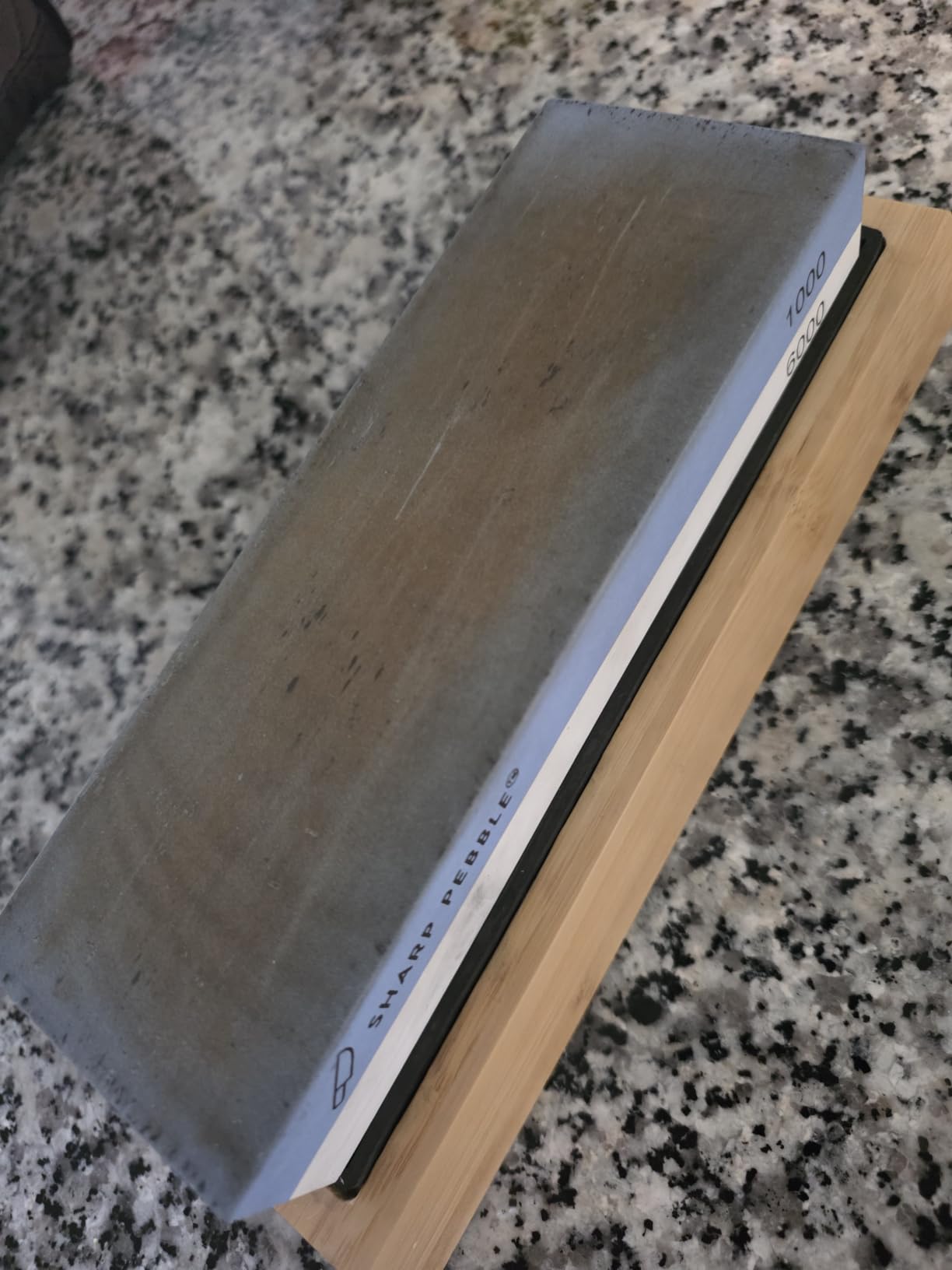
This is the stone I hand to friends who have just unboxed a Japanese chef’s knife and have no idea what they are doing. The stone is a 1000/6000 combination corundum block measuring 7.25 by 2.25 inches, and the thing that makes it stick for beginners is the moulded angle guide that cradles the blade so you are dragging the stone along the edge rather than the edge along the stone. Get the technique wrong and it mostly still works, which is exactly what you want from a first system.
In my kitchen it handles a 240 mm gyuto and a santoku equally well. The 1000 side resets a dull edge quickly and takes care of small nicks, and the 6000 side refines without needing a whole progression in between. Owners report visible improvement on very dull knives inside a single sitting, and that matches what I have seen.
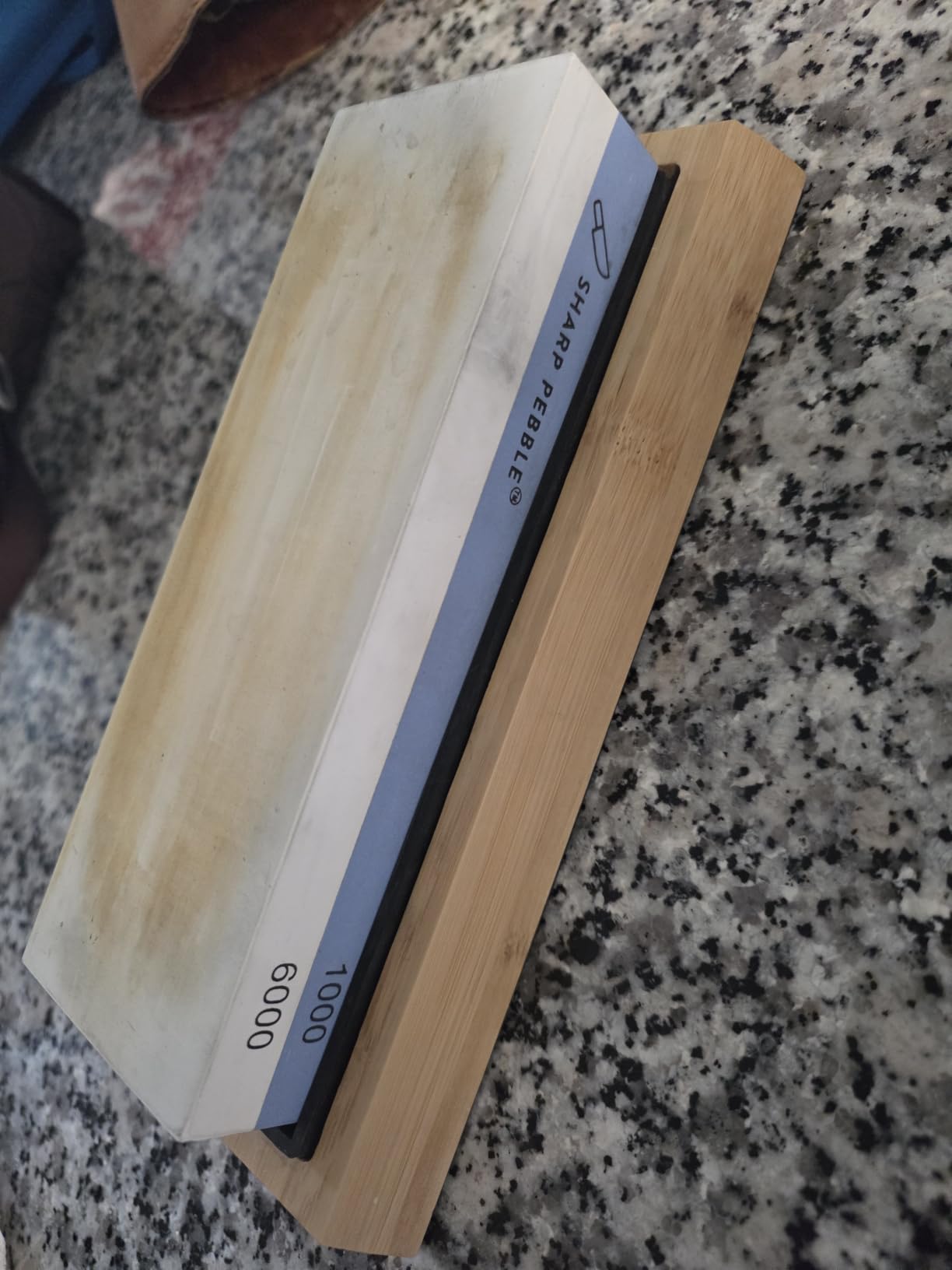
The compromise is what the kit leaves out. There is no flattening stone, so once the block dishes in the middle after a few months of use you will want to pick one up separately. Freehand sharpening without the guide remains a genuine learning curve, and the same specification is sold by several other brands, so nothing here is exclusive. The bamboo base, though, does its job and keeps the stone from walking across a wet counter.
Why this one works for hard Japanese steel
Corundum at 1000 grit is a middle-of-the-road abrasive that will not chew through hardened VG-10 or SG2 edges, but it is not so gentle that a rolled edge stays dull. It sits in the range most sharpeners use as their default working step for both European and Japanese knives, which is why it transfers so easily from one to the other.
What you give up by choosing it
There is no coarse side below 1000, so a real chip needs a 400 or 220 stone you do not have. There is no fine side above 6000 either, so the mirror finish that sashimi work wants is out of reach. And the stone is small for very long blades, where a larger surface reduces the number of passes you need.
2. KING KW65 1000/6000 Combination Whetstone – Best Traditional Japanese Waterstone
- Japanese waterstone that produces a genuine hairedge with practice
- Harder than typical soft stones so it wears slowly
- Full 8 inch surface suits long gyuto blades
- Dual sided pairing covers sharpening and polishing
- No written instructions included
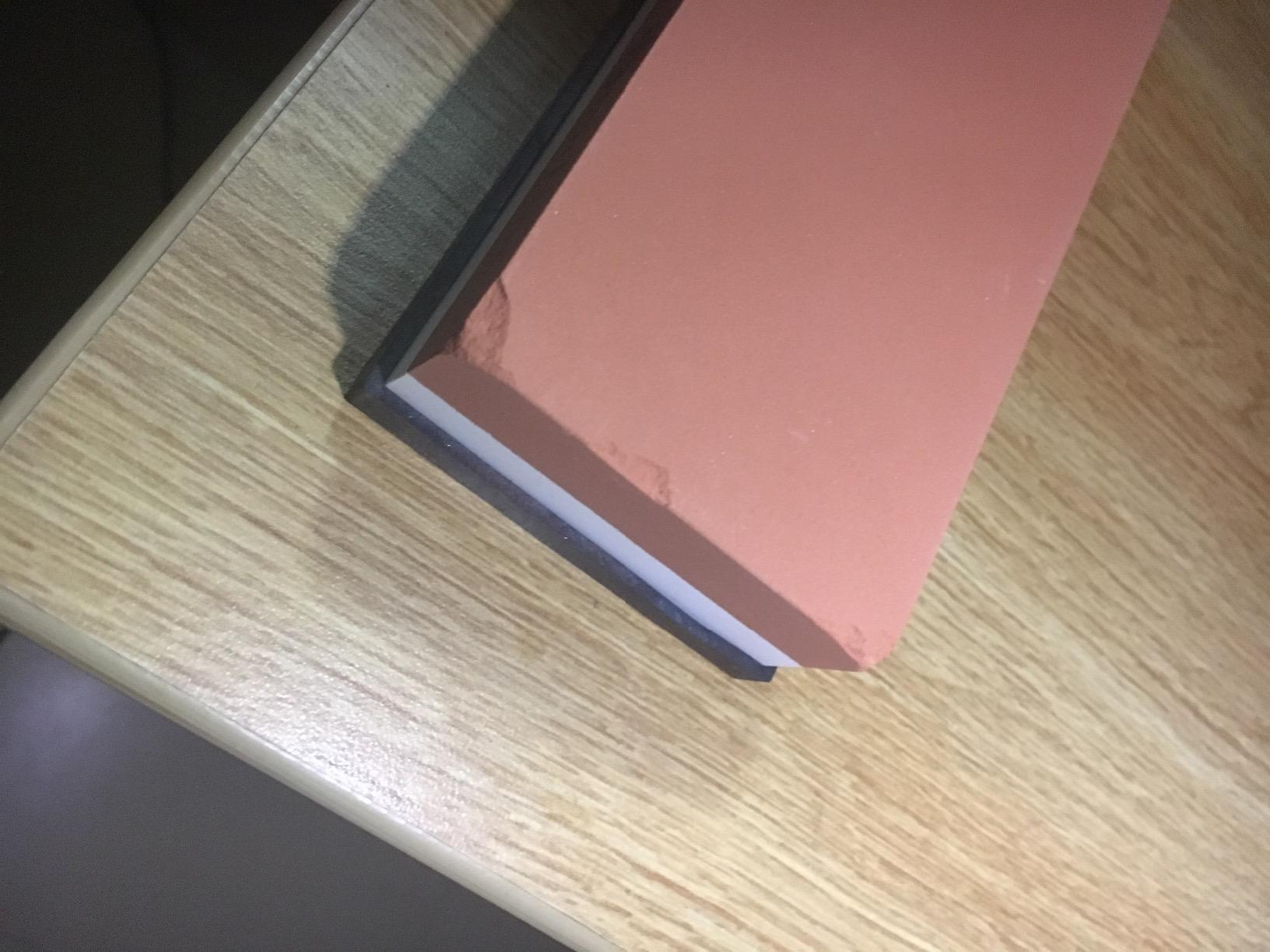
- Fragile stone with chipped corners reported on arrival
- Neither grit side is labelled on the stone
- Slides on wet counters unless set on a damp towel
The KW65 is the reference budget Japanese waterstone, and the reason experienced owners keep it in rotation is the 8 by 2.5 inch surface. That extra length matters more than beginners expect, because a longer stone means fewer full-length passes to cover a gyuto or a yanagiba, and fewer passes means less time concentrating on a consistent angle at the tip.
Owners describe this as the last step in a sharpening cycle that produces an edge holding for months, and several reviewers note the pair is a Japanese waterstone that genuinely delivers a hairedge rather than a merely functional one. The stone is harder than the soft white corundum blocks in cheaper kits, so it dishes more slowly and needs flattening less often.
Where it beats the cheaper stones
Hardness is the difference. Softer stones self-level aggressively and feel forgiving, but they lose their flatness fast and drift out of true as soon as you press hard near the edge. A harder stone rewards patience with a surface that stays true across more knives and more sessions, which matters when you own three or four Japanese blades rather than one.
Why buyers complain anyway
Transit damage is the most repeated complaint in the reviews, with several owners describing cracked or chipped corners on arrival because the stone is packed thinly in a thin box. The grit sides are not labelled on the stone itself, and the 1000 side produces a heavy clay-like slurry that will need rinsing out. Put it on a damp towel or the plastic base alone will not stop it sliding.
3. Intelitopia Complete 7-Piece Sharpening Set – Best All-in-One Kit
- Covers the entire grit progression plus strop and flattening stone
- 400 grit repairs nicks and 8000 gives a near mirror finish
- Heavy stones feel solid and stable while sharpening
- Angle guide lowers the barrier for first-time users
- Stones dry out fast during use unless kept wet
- Advertised bamboo base still slides on smooth counters
- Soft stones wear faster and need regular flattening
- Some users find the strop is not genuine leather
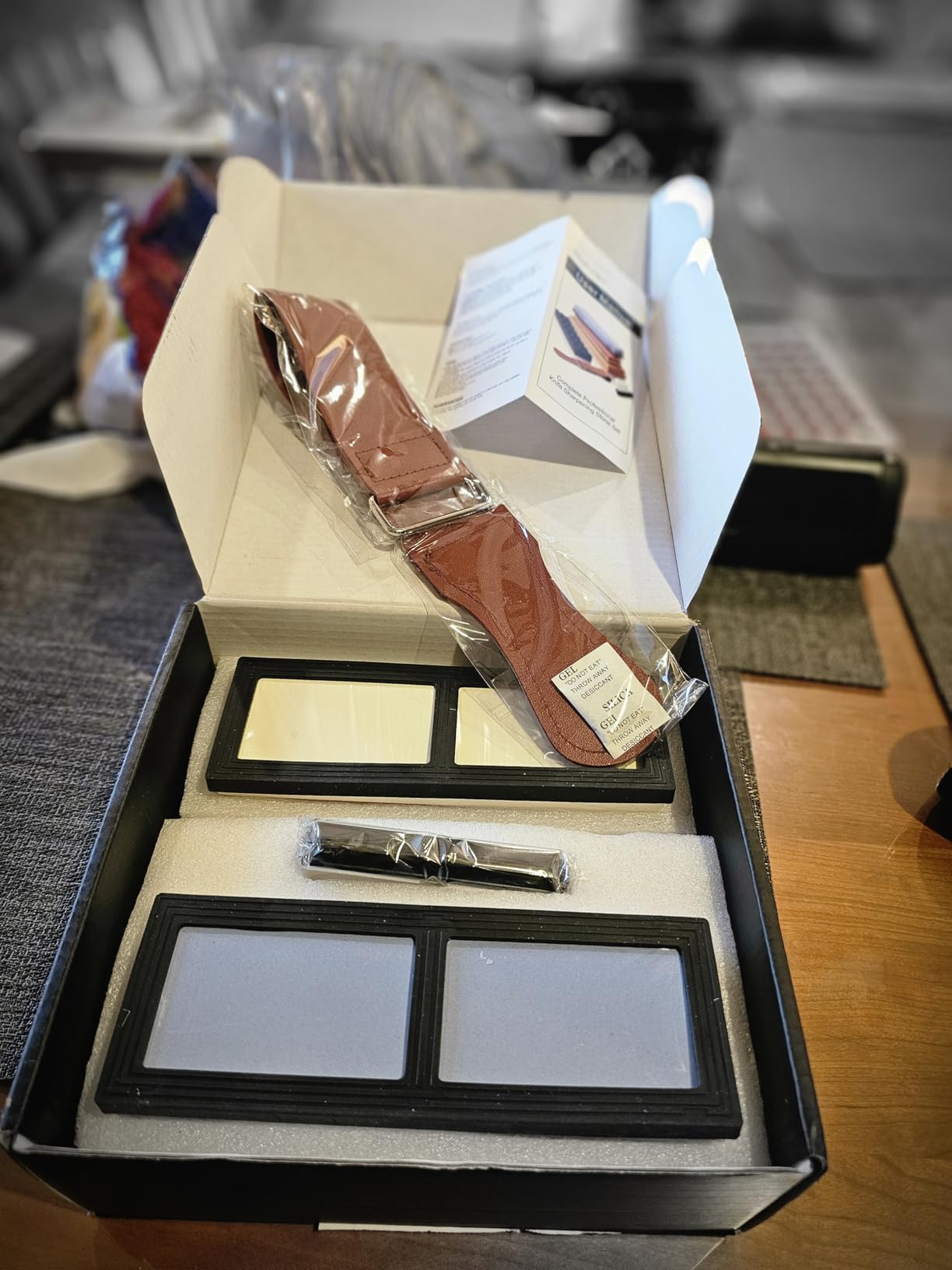
This is the kit to buy if you want everything on the counter at once and do not want to make a second purchase in six months. You get two dual-sided stones covering 400, 1000, 3000 and 8000 grit, a leather strop, a coarse flattening stone, a bamboo base, three non-slip rubber bases and an angle guide. On paper that is a full system from coarse repair to polish, plus the maintenance tool most kits leave out.
In practice it works well for routine home maintenance, which is exactly what reviewers report. People buy it, find knives in the drawer they had given up on, and bring them back. The 400 grit side removes small nicks, the 1000 does the daily sharpening, the 3000 refines, and the 8000 plus strop produces the polished finish. At five pounds the kit stays planted on the counter, which removes a frustration you do not appreciate until a lighter set starts skating mid-stroke.
Where the accessories genuinely pay off
The flattening stone is the sleeper item. Forums constantly identify skipping stone maintenance as the reason beginners conclude their stone is faulty, when in truth a cupped surface produces a curved edge no matter how well you hold the angle. Having the tool in the box means you will actually do it. The strop is a genuine second step for straightening the burr and taking the skin off the apex before the final finishing pass.
Where it falls short against real Japanese stones
The stones are soft aluminum oxide corundum, and soft means fast metal removal but also fast dishing. If you press hard toward the edge the stones will gouge. A minority of reviewers with high-end Japanese knives find them lighter and coarser than traditional waterstones, and one compared the strop unfavourably against real Japanese hide. The bamboo base is also the item most likely to disappoint, since it still slides on a smooth counter.
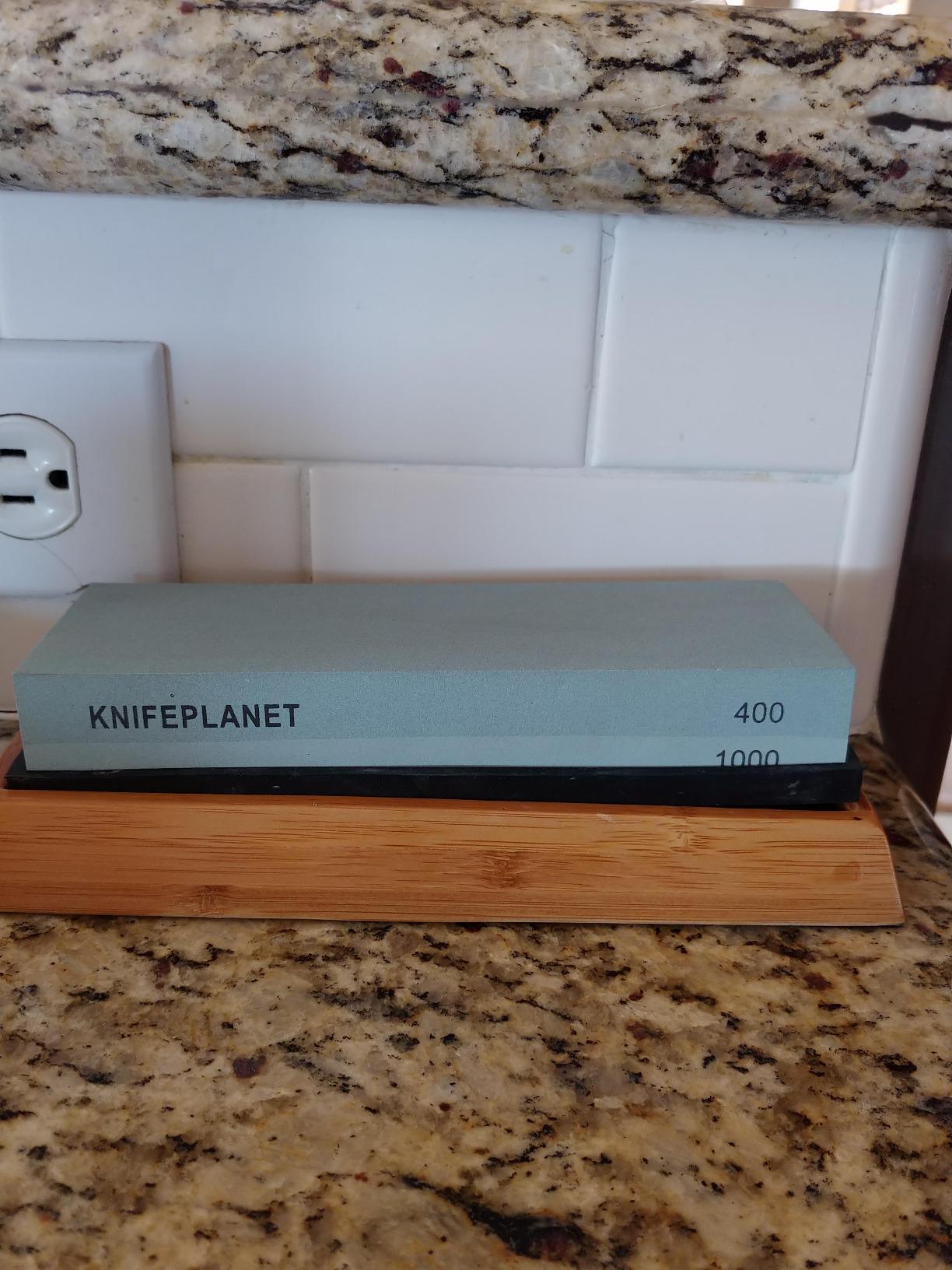
4. KNIFEPLANET 400/1000 and 3000/8000 Set – Best Value Four-Grit Set
- Well chosen grit array with no redundant grits
- Flattening stone restores dished stones quickly
- Sealed bamboo base holds the wet stone securely
- Instructional videos help beginners get technique right
- Soft stones nick easily during use
- Narrower and smaller than full-size 8.3 inch stones
- Included angle and guide accessories feel cheap
- Storage box degrades with wet and dry cycles
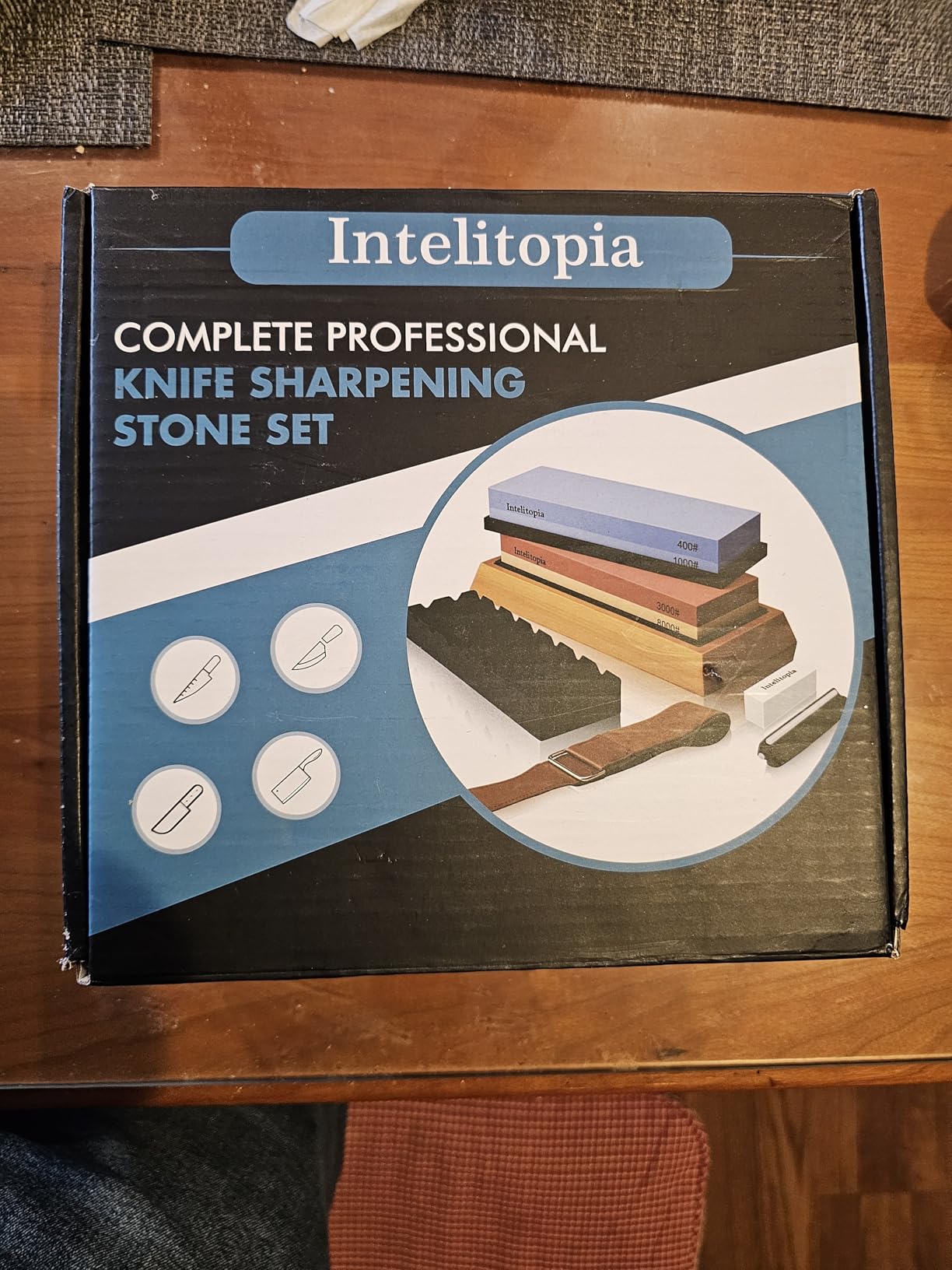
Experienced sharpeners single out this set for one reason: the grit selection. There are four stones and no filler, meaning 400 for repair, 1000 for daily work, 3000 for refining and 8000 for finishing, and nothing wasted. That is a complete progression for a fraction of what a single premium stone costs, which is why the set keeps drawing strong ratings despite its budget positioning.
The flattening stone here does real work. Owners use it to bring back stones that an earlier owner or an inexperienced user has cupped, and it does so quickly. The bamboo base is sealed, which matters more than it sounds, because unsealed bamboo absorbs water and eventually warps. Instructional videos are included, and beginners single them out as the reason they stopped guessing.
Why the grit choice matters more than the stone body
You can fix a soft stone by flattening it. You cannot fix a missing grit, because a skipped step leaves either a burr you never removed or an apex you never refined. Picking a set that covers 400, 1000, 3000 and 8000 with no gaps means you can go from a chipped edge to a polished one without a second purchase, and that is the single biggest value decision in this whole roundup.
Where the cost cutting shows
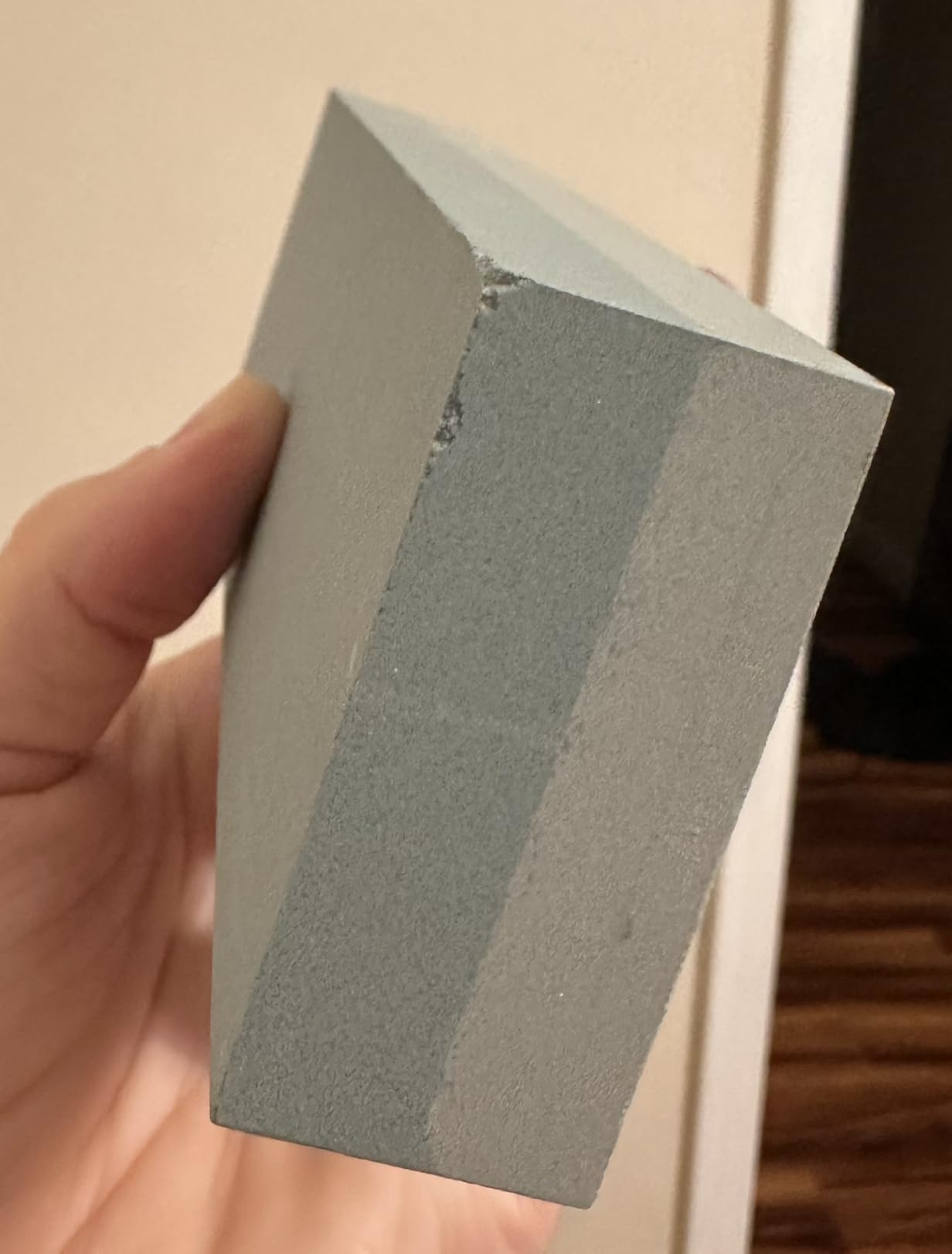
These stones are soft and they nick, particularly if you work near the edge or drop one. They are also narrower and shorter than a full-size 8.3 inch stone, so long blades take more passes. The plastic accessories are the weak point, and the storage box does not enjoy the repeated wet and dry cycle as well as the stones do.
5. Wucgea 8-in-1 Whetstone Kit – Best Budget Multi-Piece Bundle
Wucgea Knife Sharpening Stone Kit – 400/1000 3000/8000 Grit Japanese Whetstone Set with Non-Slip Rubber Base, Angle Guide, Flattening Stone and Leather Strop
- Bundles four grits with base guide flattening stone and strop
- White corundum suits premium and budget stainless blades alike
- Water based so no honing oil is needed
- Works on kitchen pocket knives scissors and chisels
- Angle guide is optional and does not stop angle drift
- Stones are soft and need frequent flattening
- Bulkier than a single stone for limited counter space
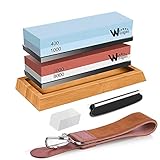
The Wucgea kit is the same playbook as the other four-grit bundles, executed a little more cheaply: white corundum stones at 400/1000 and 3000/8000, a rubber base with a bamboo holder, an angle guide, a flattening stone and a leather strop. At this price the accessory count is the argument, and for a gift or a first kit it holds up. Forum regulars note that kits in this shape are commonly bought as presents and then quietly used for years of routine home maintenance.
For sharpening itself, the stones are ordinary soft corundum. They cut fast, they raise slurry quickly, and they will happily take an edge from dull to sharp in a few minutes on a kitchen blade. That is precisely the job most people need a stone to do. The white corundum abrasive is also unfussy about what you put on it, working on both premium Japanese steel and cheap stainless.
Best gift in this roundup
If someone you know has just been given a Japanese knife and has no equipment, this is the safest choice. It has a stone for every stage, a base so the sharpening does not end up on the draining board, a guide to slow them down, and a strop to finish with. Nothing about it needs explaining beyond soak it, wet it, use it. A single stone from a specialist brand asks more of the recipient than most gift-givers want.
Where to draw the line
The angle guide is an aid, not a guarantee, and owners note it will not stop you drifting if you push the guide down the blade. The stones are soft, so they need flattening more often than a hard Japanese stone and they will not hold a mirror finish for long. And the whole package takes up real counter space, which matters in a compact kitchen. For a 240 mm gyuto I would still choose a single larger stone.
6. KEENBEST 400/1000 Whetstone Set – Best Budget Two-Sided Stone
- Highest average rating in the group among these sets
- 400 repairs damaged edges while 1000 smooths the finish
- Soak 10-15 minutes and it is ready
- Self sharpening white corundum releases abrasive quickly
- Handles knives scissors chisels hatchets and garden tools
- No polishing or finishing grit at all
- No angle guide or flattening stone included
- Short 7 inch stone is limiting for long blades
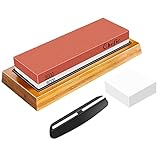
Two stones, two grits, one job, and the highest average rating of anything in this roundup at 4.7 across more than 4,500 reviews. That rating reflects a stone that does a narrow thing very well rather than one that tries to be a system. The 400 side fixes damaged edges and the 1000 side smooths the result, which is the full cycle you need if you sharpen once a month and want an edge that slices rather than one that looks shiny.
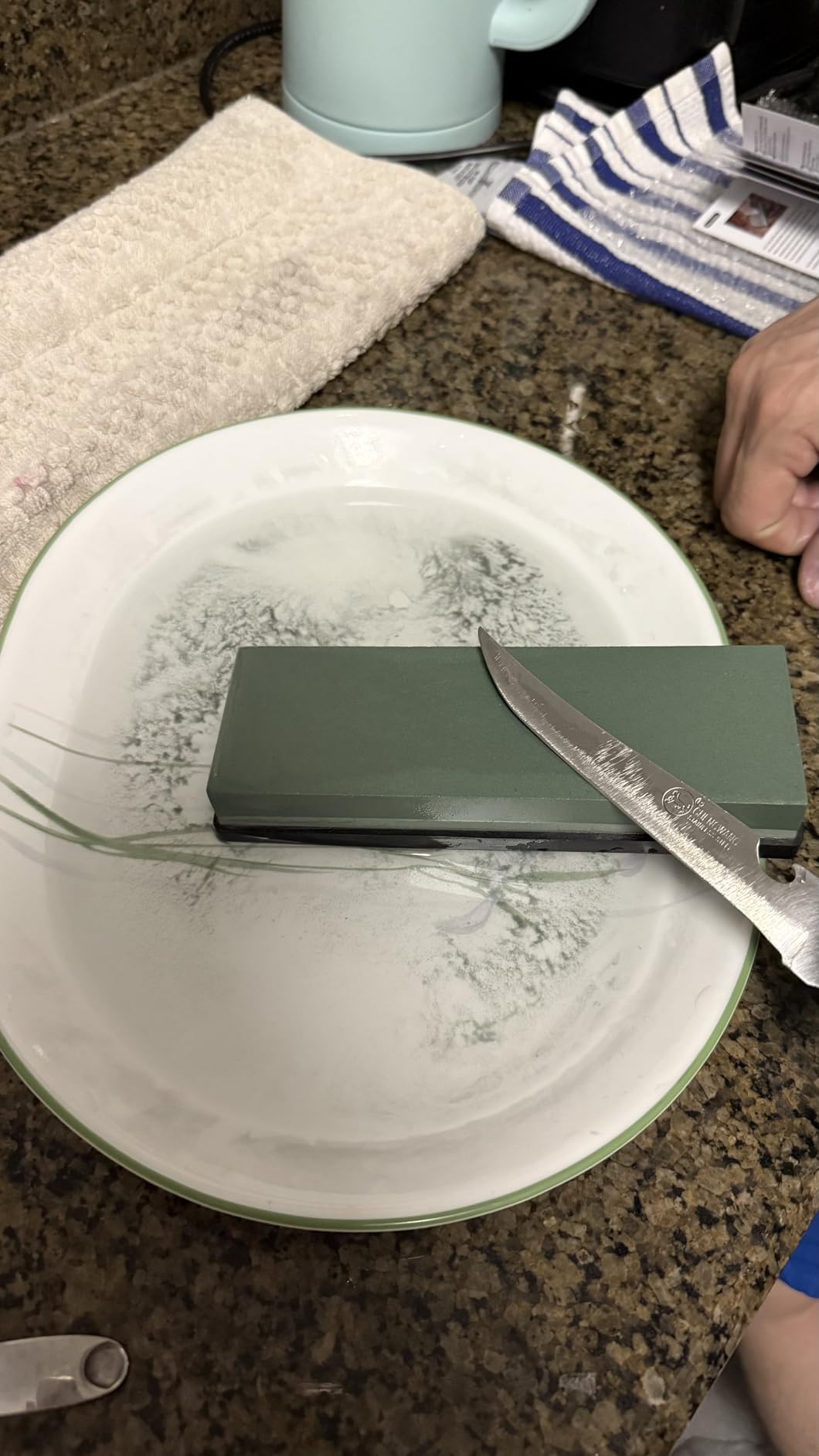
It is a white corundum and silicon carbide construction, water lubricated, and you soak it for 10 to 15 minutes before you start. Because the abrasive is self-sharpening, it releases fresh particles as you work and you are not scrubbing a dead stone clean every ten minutes. Owners use it on everything from a chef’s knife to a hatchet, and it is the rare budget set that nobody describes as a toy.
Why two grits is genuinely enough for a lot of homes
The forum consensus is blunt about this: most people buy a five-stone progression and never learn to use one stone properly. A 400 and a 1000 pair covers chip repair and routine sharpening, which is the entire maintenance cycle for a knife you use daily and hone weekly. Add a 3000 later if you decide you want the finer finish, but nothing breaks for months without it.
Where it will frustrate you
There is no finishing grit, so the edge is sharp rather than polished, and a single-bevel yanagiba used for sashimi will want a finer step. There is no angle guide, which makes the first hour of learning harder than it needs to be. And the stone is 7 inches, which is fine for a santoku and tight for a 240 mm gyuto or a long-bladed deba.
7. Chefic 3000/8000 Water Stone – Best for Refining and Finishing
- Refines an existing edge then polishes it
- Forms slurry fast and cuts quickly even on hard VG-10 steel
- Angle guide makes first-time use manageable
- Rubber holder grips a slimy countertop
- Water cleanup only
- no oil required
- Real grits run coarser than labelled at roughly 1500 and 5000
- Soft stone needs flattening often and can gouge
- Stone is narrow for wide plane irons
- Grit marking printed on one side only
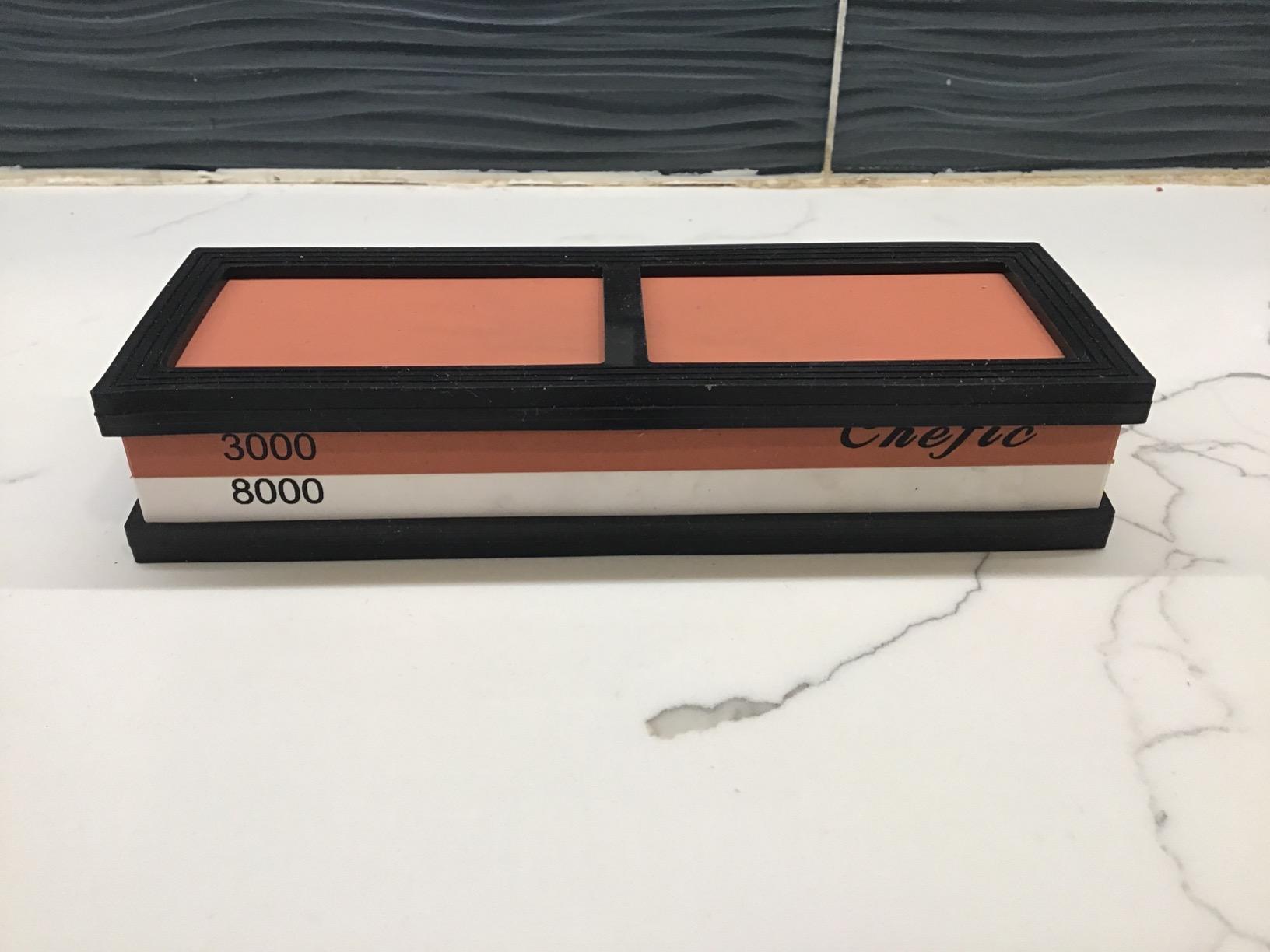
This is a finishing stone, not a starting one, and that distinction is the whole point. The 3000 side refines the scratch pattern left by a 1000, and the 8000 side takes the apex to a fine polish. If your edge feels sharp but rough, this is the step that fixes it, and experienced reviewers still consider it a genuinely useful single combination once you accept what it is.
It cuts quickly and raises slurry fast, even on hard VG-10 steel, which is the hardest part of the job on Japanese knives. Softness cuts both ways here: the stone self-levels quickly so you get consistent results sooner, but it dishes and needs flattening roughly every 50 to 75 knives. The rubber holders grip a wet counter better than the bamboo base alone, and the whole thing rinses clean with water.
The grit label is not the real grit
Reviewers who compared this stone against reference materials estimate the actual grits sit nearer 1500 and 5000 than the printed 3000 and 8000. That is common with budget stones and it is not a scam, it is just faster-fired abrasive with a wider particle spread. Practically it means the stone is less fine than advertised, so if you already own a hard 8000 grit stone this will not replace it.
Where to place it in your progression
Put it after a 1000, not instead of one. It cannot repair a chip and it cannot set an edge from scratch, so on its own it will disappoint. Paired with any of the 1000 stones above, though, it is a cheap way to add a refinement and polish stage, and it also handles pocket knives, scissors and straight razors in a pinch.
8. YeopAsda Four-Grit Whetstone Set – Best Full Accessory Bundle
Whetstone Knife Sharpening Stone Set, Double-Sided Grit 400/1000 3000/8000
- Four grits plus strop compound gloves flattening stone and two guides
- Angle guide and silicone bamboo base make it approachable
- Rubber base holds stones with no slipping during strokes
- Reviewers report restoring badly chipped blades
- Corundum stones wash clean with water
- Leather strop is the weakest item in the kit
- Bamboo base described as plasticky
- Water and slurry make a real mess on counters
- Outer packaging is not sealed tightly
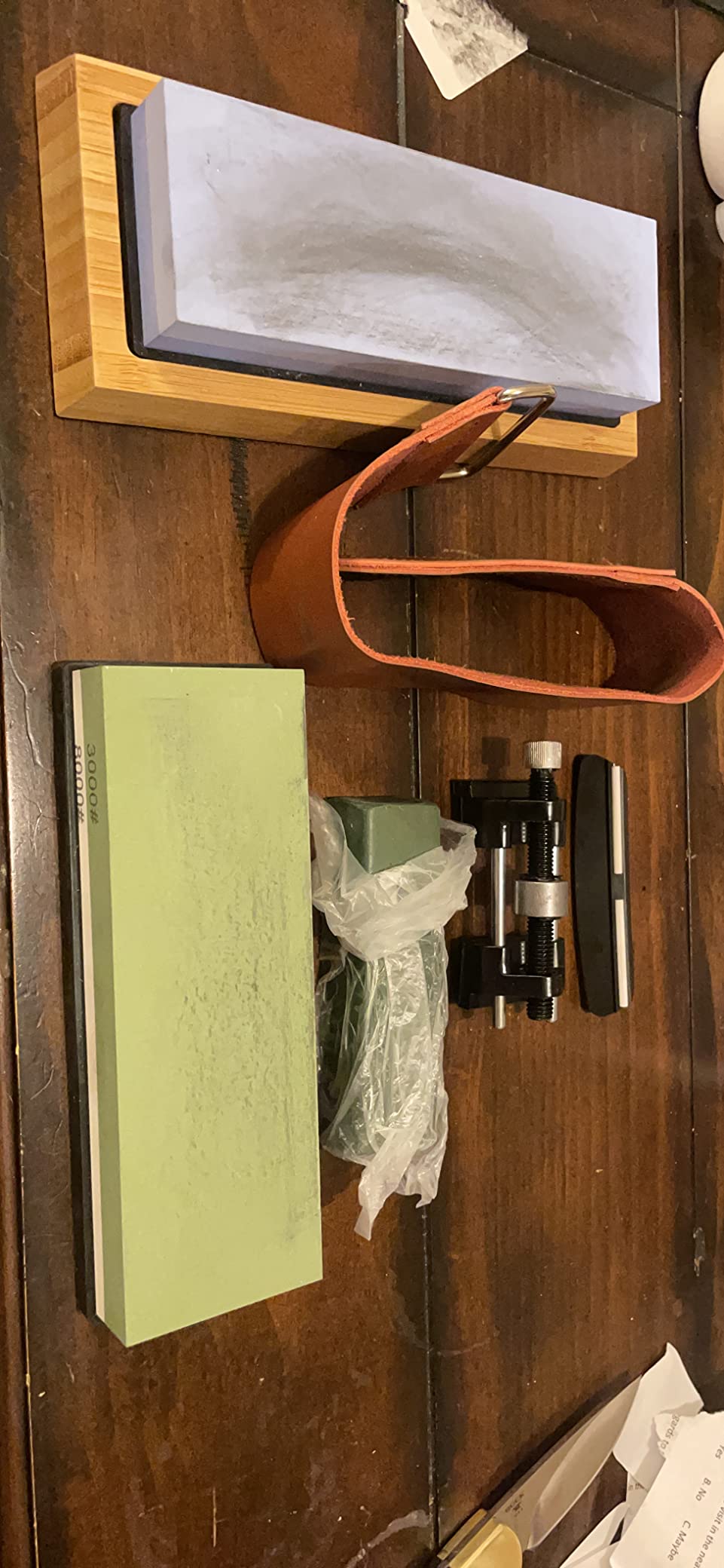
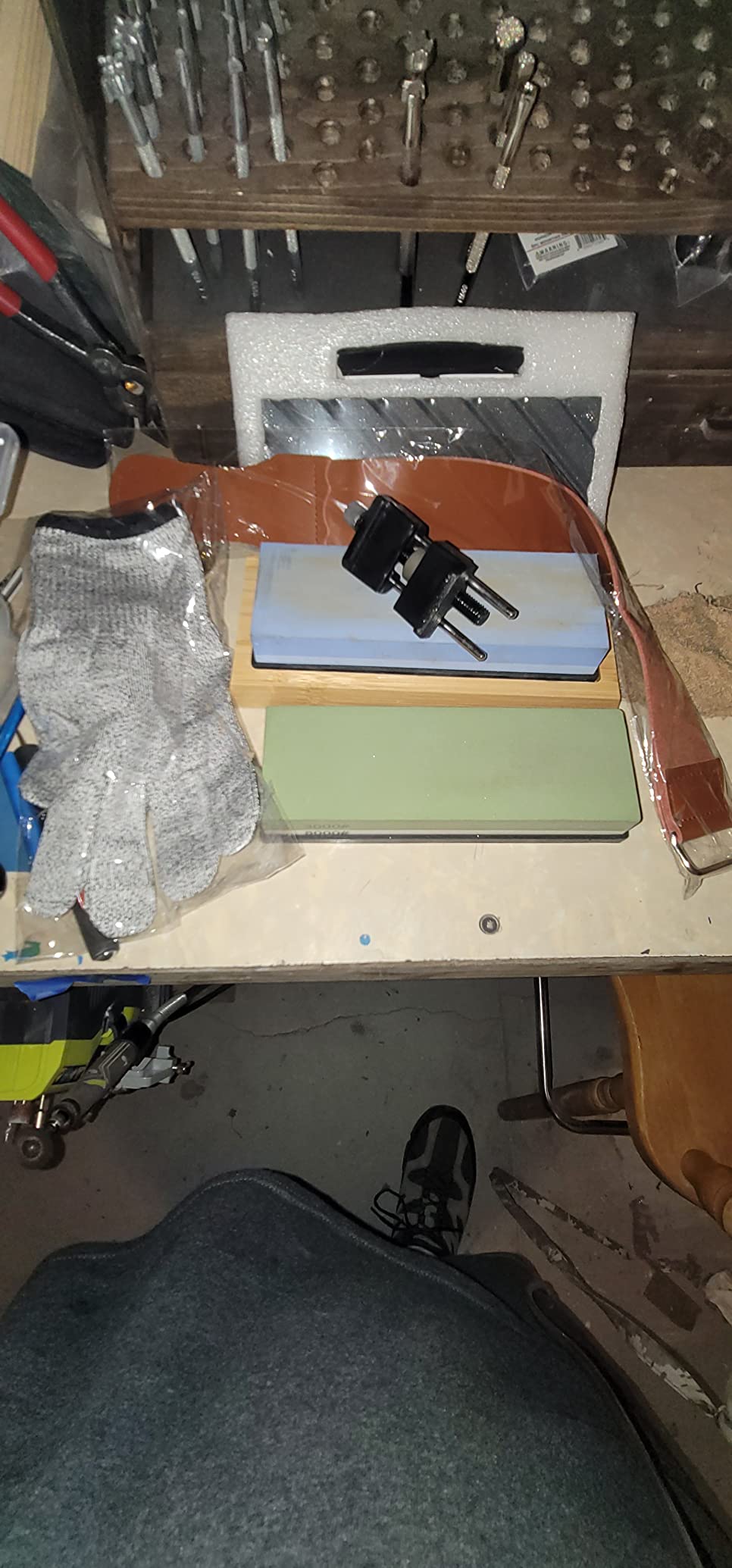
This is the most thoroughly accessorised set in the group, and it is the one to consider if you sharpen more than knives. Alongside the two dual-sided stones at 400/1000 and 3000/8000 you get an angle guide, a separate honing guide sized for chisels and plane irons, a leather strop with green polishing compound, a flattening stone, a cut-resistant glove and a non-slip silicone bamboo base. Nothing else in this roundup covers hand tools as well as blades.
Reviewers repeatedly describe it as extremely comprehensive and praise the rubber base for holding steady through long sessions, which is what you want when a plane iron is dragging across a 7 inch stone. Several describe it as an entry-level system with the caveat that anyone serious eventually moves to a specialist brand. That is a fair summary of where it sits.
Best for hand tools as well as blades
The dedicated honing guide is the differentiator. A knife guide holds a blade at an angle, while a honing guide holds a chisel or plane iron square and flat, which is a completely different geometry problem. If you own hand tools at all, this kit solves two jobs at once for less than buying a proper stone and a separate honing guide separately.
Where the accessory quality falls short
The strop is the most criticised item and the base comes in for similar criticism, described as plasticky. The gloves are the other weak point, with one reviewer reporting a hole on first use, which makes them worse than useless on a wet stone. And wet sharpening is genuinely messy: budget your counter space and your towel budget accordingly.
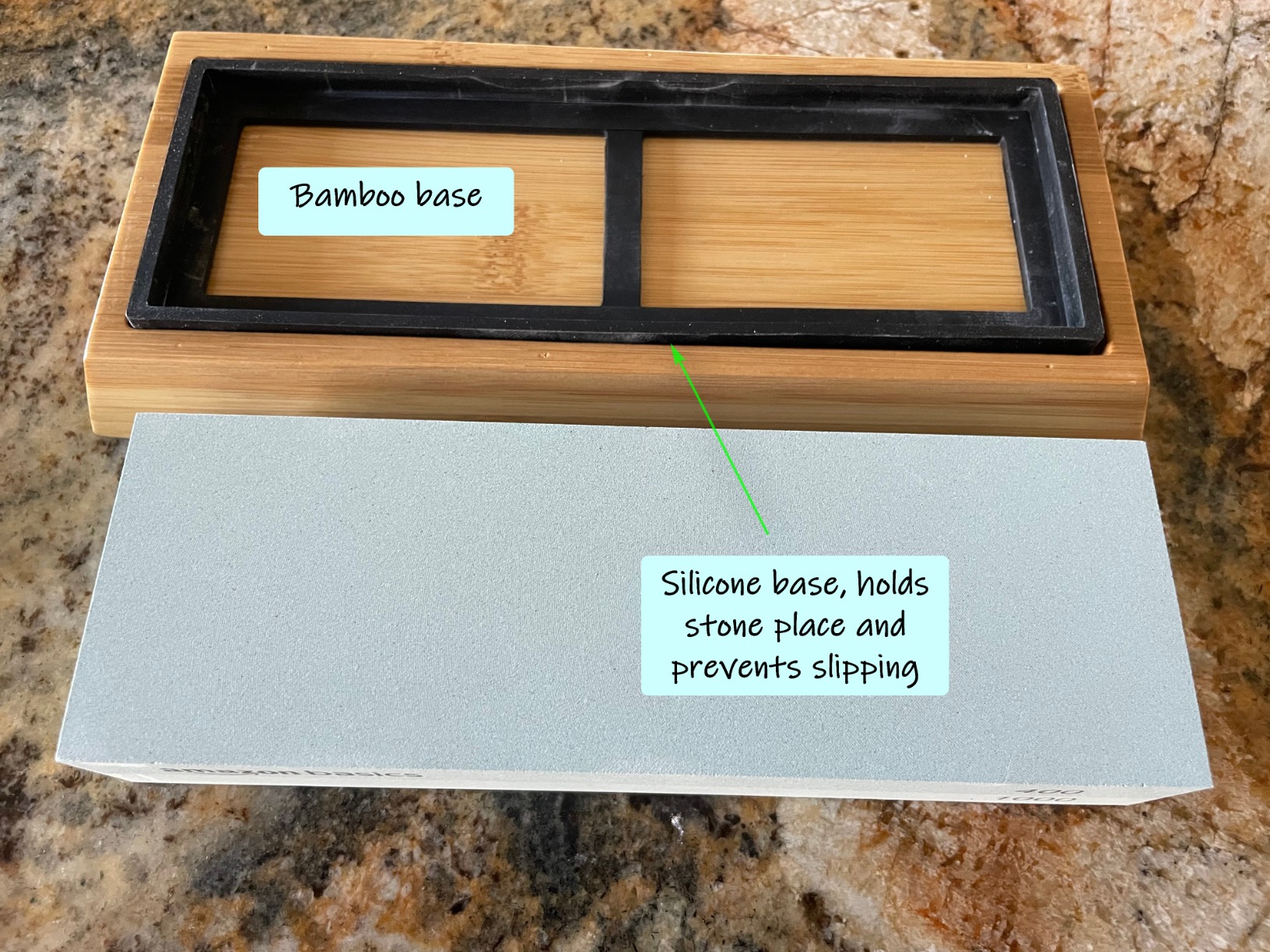
9. Amazon Basics Four-Grit Whetstone Set – Best No-Fuss Set
- Performs like costlier kits with four usable grits
- Flattening stone revives stones that have dished
- Stones feel solid with nothing crumbling
- Angle guide holds a consistent angle
- Light pressure is all it takes
- Printed instructions are far too small to read
- Angle guide can scratch knife finishes
- Wet slurry needs a suitable work area
- Real learning curve before results are consistent
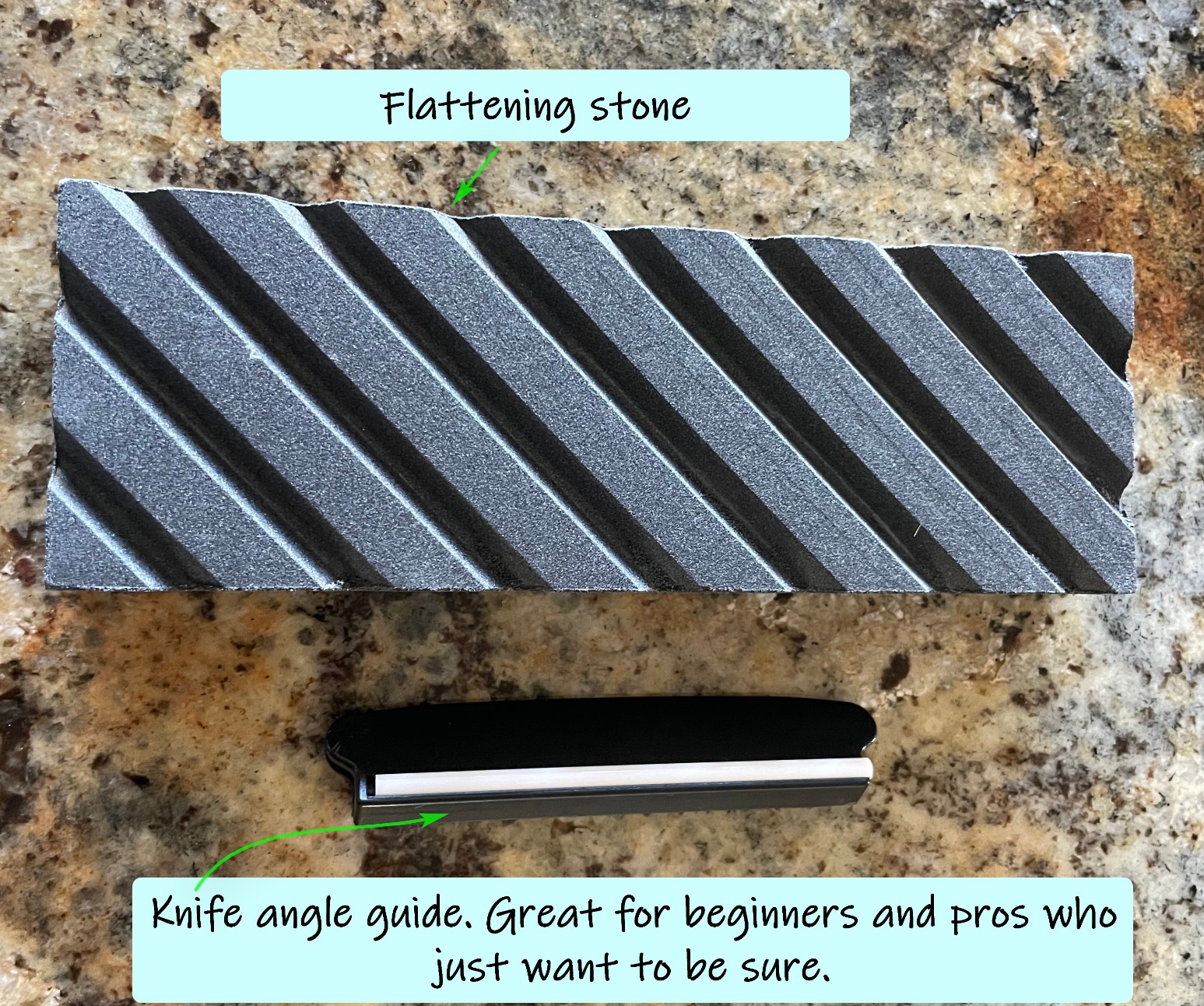
Buyers consistently report that this entry-level set performs like more expensive kits, and the four grits are the reason. You get 400/1000 and 3000/8000 stones, a flattening stone, an angle guide and a silicone holder on a non-slip bamboo base, with a 1-year limited warranty behind it. That is a complete progression, and the flattening stone genuinely revives stones that have cupped with use.
What owners actually complain about is technique, not quality. Light pressure gives the best results, and the printed manual is so small it is effectively unusable unless you enlarge it. The angle guide holds a steady angle but can scratch knife finishes if you drag it down the blade, so use it as a starting position and then take over freehand.
The right fit for a practical kitchen
Nothing about this set is exciting and everything about it works. The stones are water based and rinse clean, the base keeps them planted, and the guide gives a beginner a usable reference angle. If you want a system that quietly handles routine maintenance on a santoku and a petty without demanding a hobby, this is the most unpretentious way to get there.
What to know before you start
Set up near a sink, put a towel down, and expect cleanup. The learning curve is real and the only thing that fixes it is repetition on a knife you do not mind marking. Learn the guide first, then practise freehand, because the guide scratches finishes if you slide it along the blade. The instructions being unreadable is a genuine flaw, so look up a technique walkthrough before your first session.
10. Goodjob 12-Piece Complete Sharpening Kit – Best for Chisels and Planes
Complete Knife Sharpening Stone Kit, Double-Sided Grit400/1000 & 3000/8000
- Twelve piece kit with stones plus full accessory set
- Stones fired at high temperature for durable grinding
- Silicone non slip bamboo base holds stones firmly
- Cut resistant gloves included for safety
- Angle and honing guides make it accessible to novices
- Accessory quality varies and not every item is essential
- Water based sharpening leaves slurry to clean up
- Narrow stone width limits use on wide blades
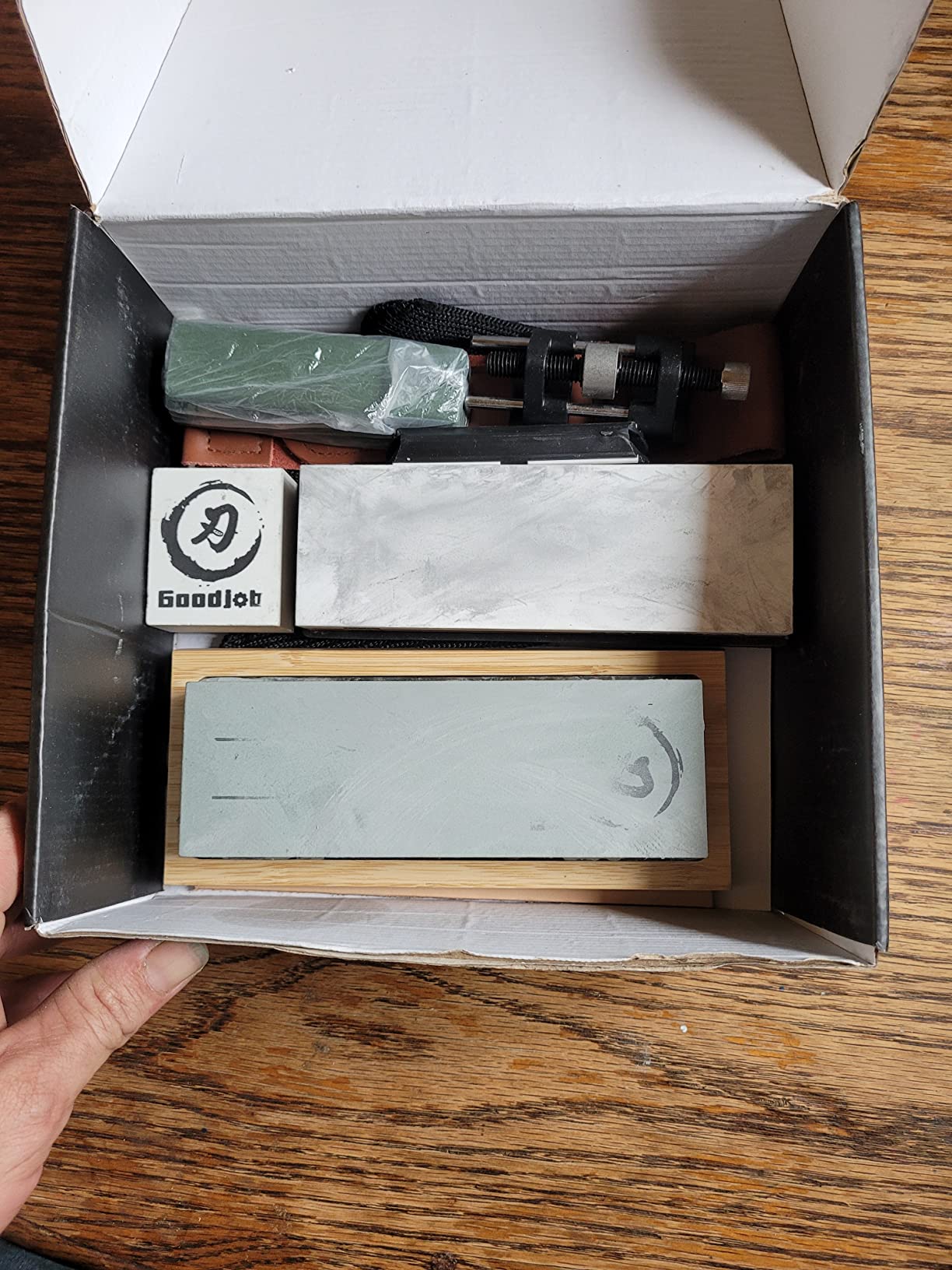
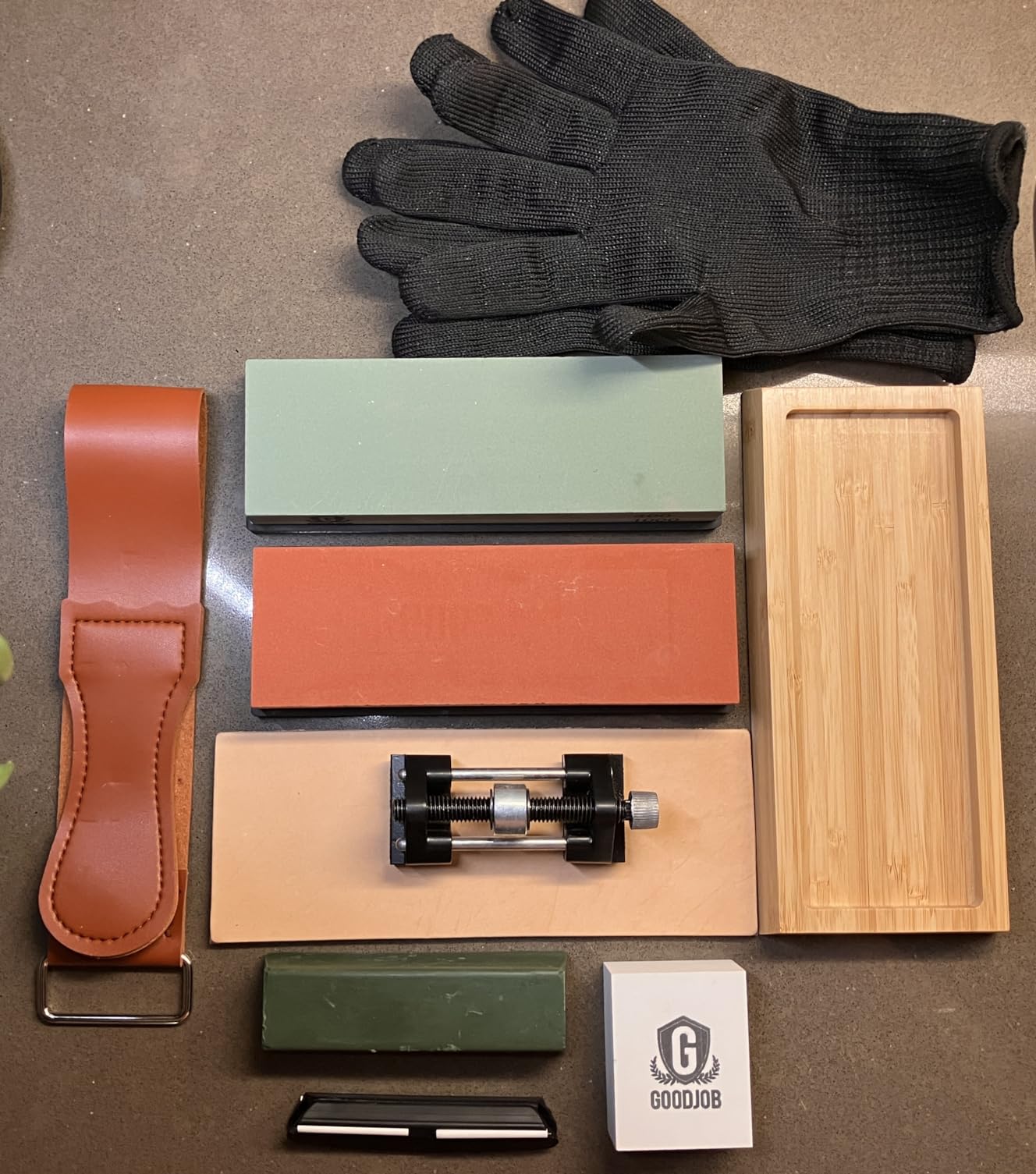
The Goodjob GB-12 sits at the top of the price range in this group and delivers the widest accessory spread: two dual-sided corundum stones, an angle guide, a honing guide for chisels and plane irons, a bamboo base with silicone, a flattening stone, cut-resistant gloves, and two leather strops with green compound. The stones are white corundum fired at high temperature across a long process, which is the manufacturer’s claim for harder-wearing abrasive.
For a kitchen that also contains a hand plane, the honing guide is the reason to look here. Like the YeopAsda set, it lets you register a chisel or plane iron properly, which a knife angle guide cannot do. The 1-year warranty is also a small reassurance on a kit with this many components.
Two leather strops is a genuine bonus
One strop is a tool, two is a system: one loaded with compound for polishing a refined edge, one clean for straightening the burr straight after the 1000 grit pass. Keeping compound off the burr-removal strop is what makes that strop work, and a kit that gives you both removes the temptation to get the sequence wrong.
What the extra pieces cost you
Accessory quantity is not accessory quality. Reviewers note that not every included item is essential, and the value calculation weakens as the list grows. The narrow stone width is a more practical problem than the extras, because a wide plane iron or a long-blade deba will not sit comfortably on a stone this size, and you end up working the middle section in stages.
11. Kota Japan 1000/6000 Whetstone – Best for Guide-First Learners
Kota Japan 1000-grit Coarse Side and 6000-grit Polishing Side Knife Sharpening Whetstone with Bamboo Base and Blade Guide
- 1000/6000 pairing suits general kitchen knives
- Blade angle guide stops the angle drifting mid stroke
- Bamboo base with silicone holders keeps the stone planted
- Owners reach shave level sharpness in 20-30 minutes per knife
- Works on knives pocket knives scissors and razors
- Angle guide is stiff and can scratch the finish if slid down
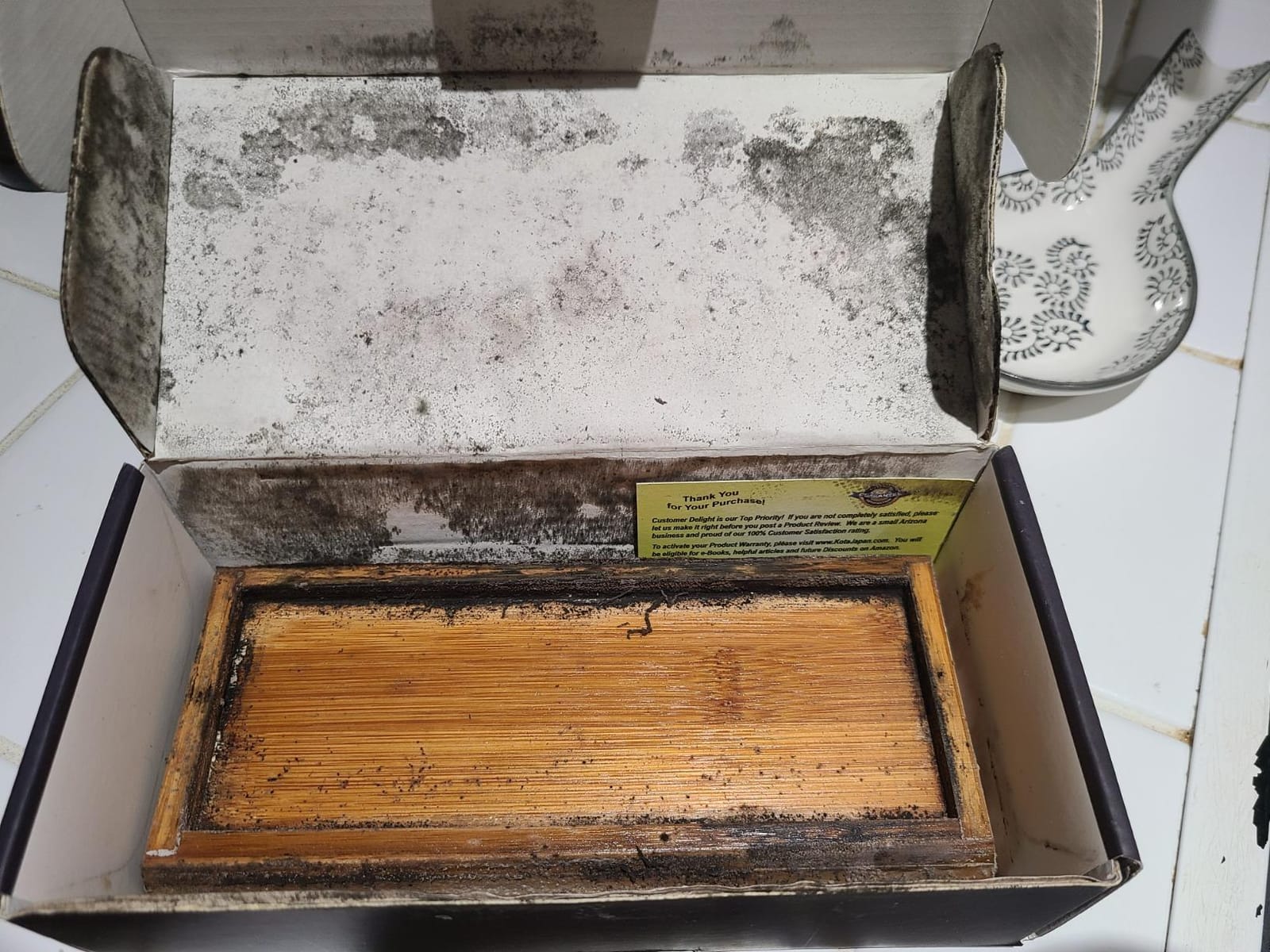
- Stone must be dried for days to avoid mould in the box
- Requires a 10-15 minute soak before each session
The Kota 1000/6000 is a compact Japanese-style waterstone where the guide does the heavy lifting. The blade angle guide holds the knife at a set angle so you are working the stone rather than searching for the geometry, and beginners report that it removed their fear of sharpening entirely. Owners also reach shave-level sharpness in 20 to 30 minutes per knife, which is a reasonable session length for a home kitchen.
The body is aluminum oxide corundum, which resists cracking and chipping better than the softer white corundum blocks in cheaper kits. Soak it for 10 to 15 minutes, no oil needed, and the bamboo base with silicone holders keeps it steady. The 1000 side is your daily working grit and the 6000 side refines and polishes, which is the pairing most beginners settle on.
Guide first, then freehand
Use the guide for your first several sessions on each knife. It converts a question about geometry into a simple sliding motion, and you can concentrate on pressure and stroke count instead. Once the burr appears predictably, drop the guide and hold the angle by feel, because a knife angle guide cannot handle the geometry of a single-bevel yanagiba the way it handles a gyuto.
Storage is the real hazard with this stone
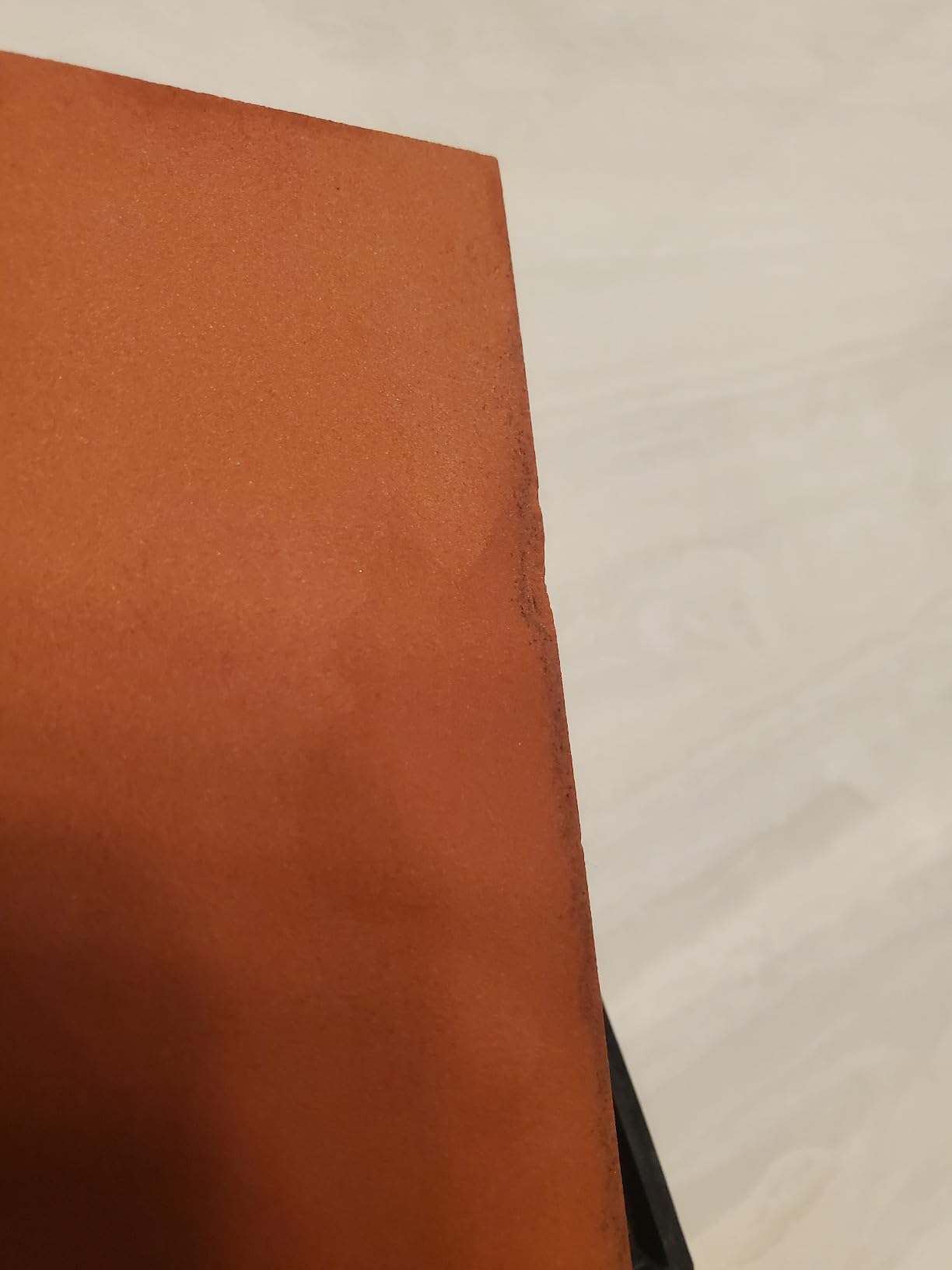
This is the wet-stone storage rule that catches everyone out. A soaked stone left damp in its box grows mould, and reviewers warn it can take days of drying to clear. Stand the stone on edge somewhere ventilated after every session, and do not put it back in a sealed box until it is completely dry to the touch. The stiff guide is a secondary concern: slide it along the blade and it can scratch a finish.
12. Kota Japan 3000/8000 Whetstone – Best Finishing-Only Pick
- 3000 refines an edge and 8000 restores a mirror finish
- Corundum body resists cracking and chipping
- Silicone holder keeps the stone stable
- Water based so no honing oil and quick cleanup
- Handles knives pocket knives scissors chisels and razors
- No coarse grit so it cannot repair nicks on its own
- No bamboo base angle guide or flattening stone included
- Needs a coarser step ahead of it to be useful
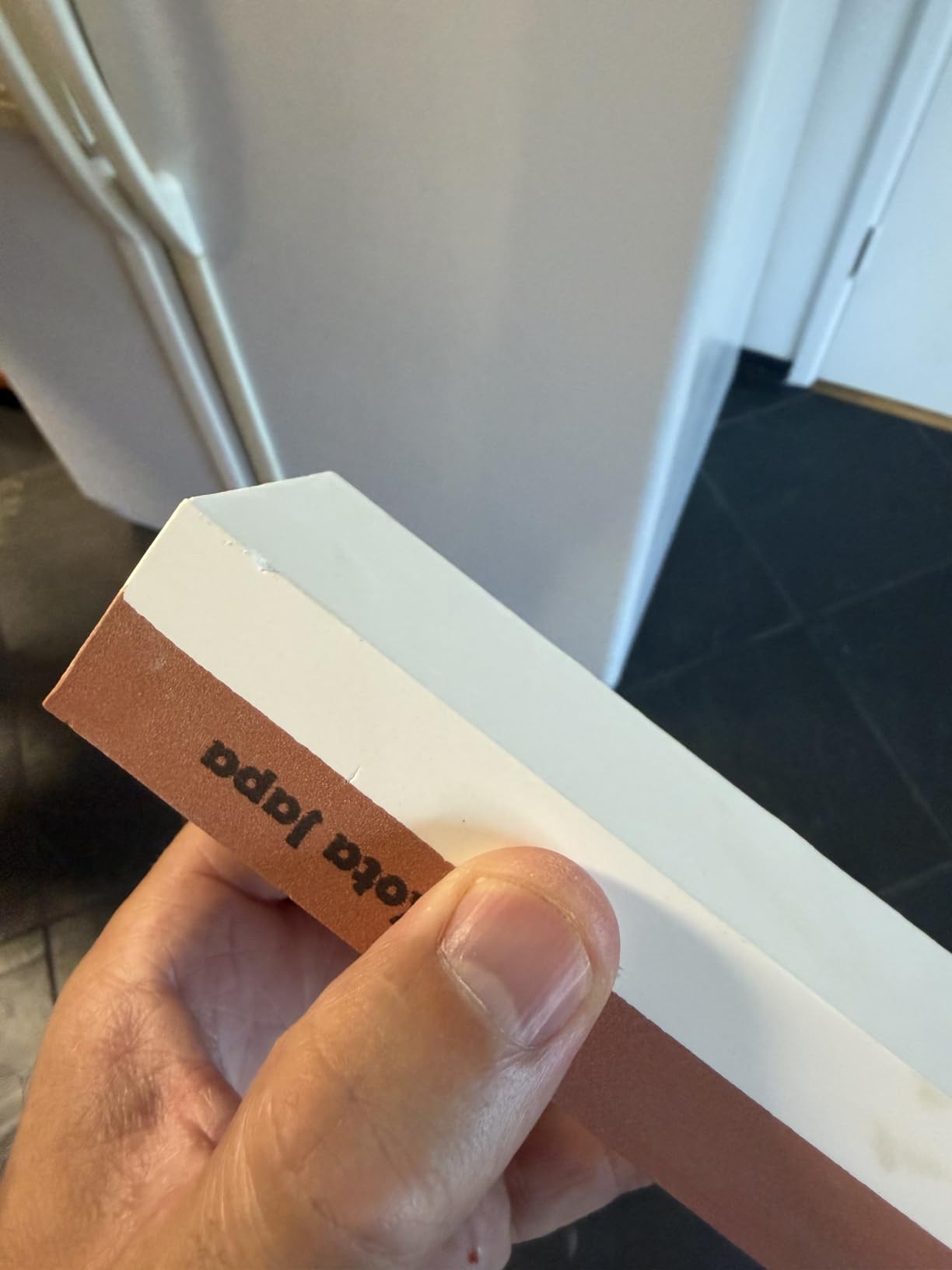
This is the other half of the Kota pairing, and it is deliberately a finishing stone. The 3000 side refines what a 1000 grit stone left behind, and the 8000 side restores a mirror finish. The corundum body resists cracking and chipping in normal use, the silicone holder keeps the stone stable, and there is no oil to deal with afterwards.
It rates 4.4 from 616 reviews, the lowest average and the lowest review count among the products analysed here, which is consistent with what it is: a supplement rather than a starting point. If you already own a working 1000 grit stone and you want the edge to stop feeling rough, this does the job for very little money. If you own nothing, it cannot get you a sharp edge from dull.
Who should add this to an existing kit
Owners of a hard Japanese knife notice a finishing step before they notice anything else, because a 1000 grit edge cuts but feels abrasive against food. Adding a 3000 and an 8000 step changes the finish from merely sharp to genuinely refined, and on sashimi work that difference is visible. It also handles pocket knives, scissors, chisels and razors if that is what is in the drawer.
Where it leaves you stuck
No coarse grit means no chip repair and no recovery from a dull blade, so you need a 400 or 1000 stone ahead of it in the progression. There is no bamboo base, no angle guide and no flattening stone in the box, so you are adding accessories on top of the price. At 7 inches it is also compact, which is fine for a petty knife and tight for a 240 mm blade.
How to Sharpen a Japanese Knife at Home
None of the twelve sets above will rescue you from bad technique, so here is the sequence I use. It takes fifteen to twenty minutes per knife once you get the hang of it, and the first three sessions will be slower than that.
Step one: soak the stone
Water stones need 10 to 15 minutes submerged so the binder is saturated and the surface stops releasing grit into the air. Splash-and-go ceramic stones need a minute or two of wetting instead, and never a long soak, since thermal shock is what cracks them. Wipe the stone down, then add a few drops of water as you go so the slurry keeps forming.
Step two: set the angle and find the burr
Hold the blade at roughly 15 degrees per side for a Japanese knife, which is noticeably lower than the 20 degrees typical of a European chef’s knife. Lift the spine, keep the pressure on the edge side of the blade, and work in even full-length strokes with the knife trailing slightly. Stop when you can feel a wire edge along the whole length, then flip and raise a matching burr on the other side.
Step three: refine, then finish
Move to the next finer grit only once the burr is consistent, and drop your pressure as you go. A common mistake is to grind the apex off with too much force at 1000 grit. On a single-bevel yanagiba the flat side is your reference surface, so most of the work happens on one side and the finishing stone establishes the kasumi finish across the blade.
Step four: strop and store
A leather strop with a little compound straightens the burr and polishes the apex. Wipe the blade dry, run it along a clean cloth, and put it away. Leave the stone standing on edge to dry fully, and never seal a wet stone into a box, which is how mould finds its way into a set. If you own a nakiri, a boning knife or a smaller utility blade, our picks for the best boning knives need the same routine.
How to Choose the Right Whetstone Set
One stone is enough for most kitchens
The most common mistake is buying five stones and learning none of them. A single 1000 grit stone plus a flattening plate is a complete kit for anyone who sharpens a knife every week, and adding a 3000 to 6000 combination stone covers the refinement and polish you would eventually want. Forums reach the same conclusion from different directions: the technique matters more than the inventory.
What each grit number actually does
Grit is particle size, and a lower number means bigger particles. The 220 to 400 range sets an edge, repairs chips and reshapes a badly damaged bevel, and it removes the most metal so use it sparingly. The 800 to 1500 range is daily maintenance and the default working grit for almost every kitchen knife. The 3000 to 6000 range refines the scratch pattern and produces a fine, toothy edge. The 8000 and above range is for polish and mirror finishes, most useful on single-bevel blades for sashimi.
Soaking waterstone or splash-and-go
Soaking stones are traditional waterstones that need 10 to 15 minutes in water and reward you with a fast, feel-driven cut. They are what most of the sets here are, and they are what a Japanese knife owner usually ends up using. Splash-and-go stones are ceramic or bonded stones that need only a light wetting, dry in seconds and store without fuss, which is the better choice for a small kitchen or anyone who sharpens sporadically. Never soak a splash-and-go stone for longer than a couple of minutes.
Corundum, ceramic and natural Toishi
Corundum, also sold as white aluminum oxide, is the soft and forgiving default: it self-levels, cuts fast and is cheap, but it dishes and needs regular flattening. Silicon carbide cuts faster still and is harder, which makes it less kind to a very hard Japanese edge if you lean on it. Ceramic stones are hard, flat and hold their surface, which makes them excellent for consistency and risky if you drop them. Natural Toishi stones are quarried Japanese stone, prized for the edge they produce, but they need a nagura to raise slurry and they punish inexperience.
Matching the grit to your steel
VG-10, the most common Japanese stainless, behaves well with any of the stones here at sensible pressure. Aogami and Shirogami carbon steels are softer and easier to work, and they prefer slower passes at finer grits to keep the edge from being over-thinned. SG2, R2 and HAP-40 are extremely hard, and users on r/chefknives and r/sharpening generally point toward Shapton Glass or comparable very hard stones, since softer corundum wears faster against them. Our best fillet knives guide covers the thinner blades where over-sharpening hurts most.
The accessories that actually matter
A flattening stone or diamond plate is the one item worth buying separately if your set lacks it, because a cupped surface produces a curved edge no matter how good your angle is. A stable base is the second, since a moving stone ruins consistent strokes. An angle guide helps for the first few sessions and is optional after that. A leather strop is a genuine finishing step rather than a gimmick. A nagura stone only matters if you own a Toishi or a very fine natural stone.
Beginner mistakes worth avoiding
Do not skip flattening, because the most common complaint in every forum thread is a beginner blaming a stone for an edge that curves in the middle. Do not press hard, since hard Japanese steel and thin edges do not need force. Do not skip grits, because jumping from 1000 straight to 8000 leaves a scratch pattern that dulls faster. Do not store a wet stone in a closed box. And do not chase a mirror finish on a knife you use for chopping, because it is not what makes an edge cut well.
Frequently Asked Questions
Is 1000 grit okay for a Japanese knife?
Yes, a 1000 grit stone is the right default for Japanese knives. It resets a dull edge and removes small nicks without thinning the edge aggressively, which matters on steel hardened to 60 HRC or above. Use 400 grit or coarser only to repair chips, and step up to 3000 or 6000 when you want a finer finish.
Do Japanese knives need special sharpening?
They need gentler sharpening, not special equipment. Japanese steel is typically hardened above 60 HRC with a thinner, often single-bevel edge, so light pressure at roughly 15 degrees per side preserves geometry that force would destroy. Most Japanese knives need the same 1000 grit stone a European knife uses, applied more carefully.
What type of whetstone is best for sharpening Japanese knives?
A water-based corundum or aluminum oxide stone in the 1000 grit range is the best all-round starting choice, ideally combined with a 3000 to 6000 side for finishing. Very hard stones suit extremely hard steels such as SG2 and HAP-40, while natural Toishi stones give a remarkable edge but demand far more skill. Begin with synthetic and graduate later.
What are the best Japanese whetstone brands?
The names that come up most often on sharpening forums are KING, Shapton, Naniwa, Suehiro and Imanishi. Community consensus often pairs Naniwa Chosera and Shapton Pro as a dependable two-stone pairing, with KING KDS praised as a forgiving first stone. None of those brands appear in this roundup, which concentrates on widely available sets instead.
What is a good Japanese wet stone for knife sharpening?
A corundum waterstone soaked for 10 to 15 minutes, with a 1000 grit working side and a 3000 to 6000 finishing side, is a good Japanese wet stone for kitchen knives. The key routine is to keep the surface wet with a few drops during use so slurry forms, and to let the stone dry fully on edge before storing it.
Are Japanese knives 15 or 20 degrees?
Japanese knives are generally sharpened to about 15 degrees per side, where European chef’s knives often sit closer to 20 degrees. The lower angle produces a finer, slicing edge that suits thin steel. A knife angle guide is useful for learning the feel, though you should be able to hold the angle freehand before long blades get involved.
Final Verdict: The Best Whetstone Sets for Japanese Knives in 2026
The Sharp Pebble 1000/6000 takes the top spot because it covers the whole cycle for a first-time owner with a single stone, ships with an angle guide that removes the biggest barrier to learning, and holds a 4.6 rating across more than 25,000 reviews. If you would rather own a traditional Japanese waterstone and can live with a chipped corner showing up on delivery, the KING KW65 is the more rewarding long-term choice. If you just need to stop your kitchen knives from going dull, the KEENBEST 400/1000 does that job and nothing else, at a price that makes it hard to get wrong.
Everything else here is a variation on the same question: how much of the grit ladder and how many accessories do you actually need. Buy a flattening stone with whatever you choose, keep the base stable, and put in twenty minutes a week. If you are planning a larger knife order, our Japanese soaking tubs guide covers the other half of knife care, and the best Japanese tea sets pairing makes a thoughtful gift alongside a new whetstone set.