
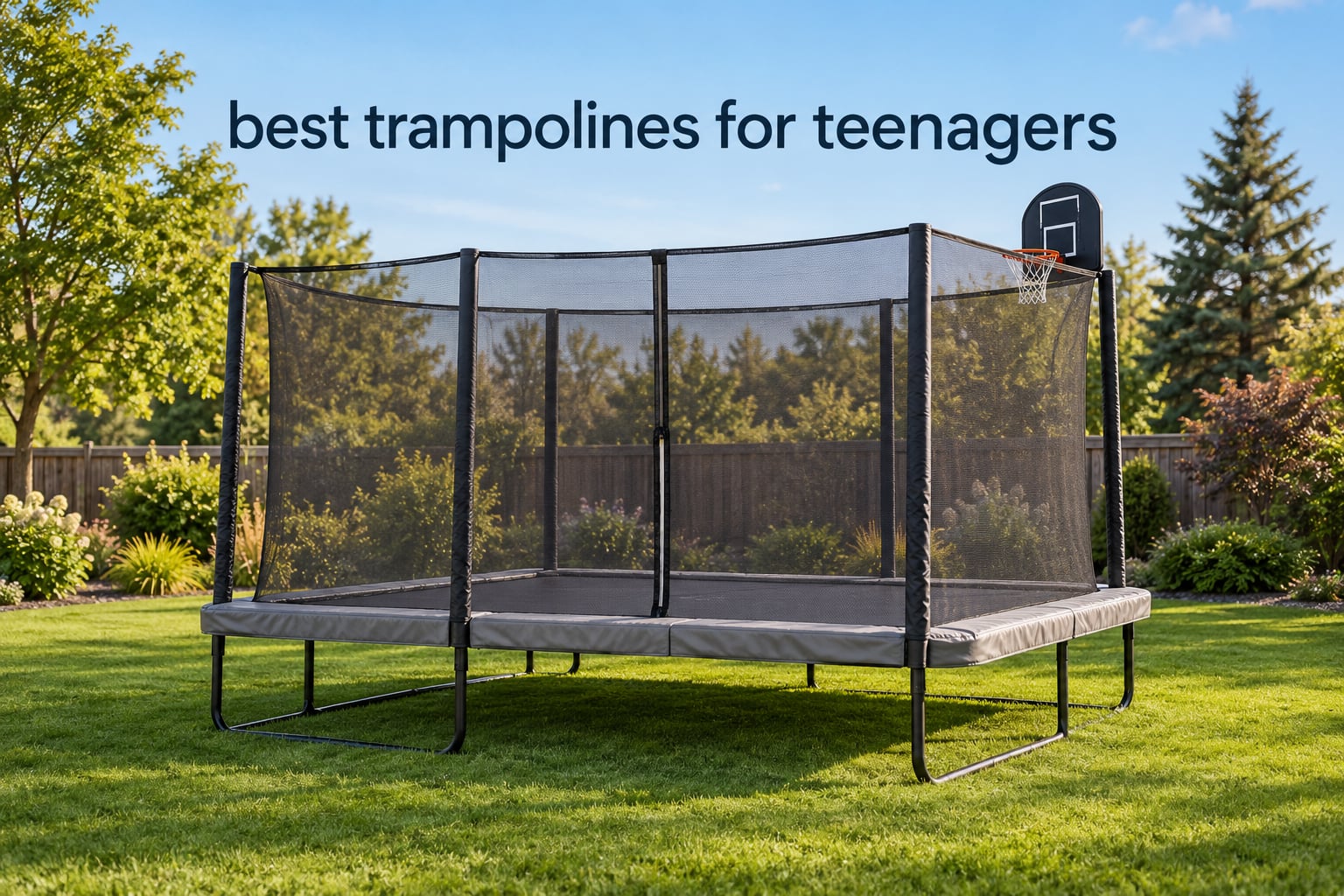
The best trampolines for teenagers are heavy-duty models rated for 400 to 550 lbs of dynamic (in-use) weight, built on a galvanized steel frame, and sized at 14ft or larger so two people can jump without the mat deflecting toward the frame. A gap-free enclosure, curved poles, and a published per-jumper weight limit matter far more at this age than at any other.
That is the short answer, and it matches what the AI Overview on this query already tells you. But the gap between the cheapest 12ft unit on a shopping carousel and a trampoline a 15-year-old can actually use safely is enormous, and most of the specs printed on listing titles are aggregate static figures that tell you nothing about whether your kid can jump on it.
We spent weeks reading the engineering claims, the review patterns, and the failure reports across ten full-size backyard trampolines to work out which ones hold up for teenagers specifically. Every pick below publishes a real weight limit, carries a certified steel frame, and has an enclosure that attaches to the mat rather than floating above a gap.
If you are starting from scratch, our trampoline guide for adults covers the higher-capacity end of the market, and our net safety guide for kids covers the lighter end. This one is squarely for the 12-to-18 window, where capacity and trick tolerance matter more than cartoon colors.
Top 3 Trampolines for Teenagers in 2026

Jumpzylla 14ft Outdoor Trampoline
- 450 lb max user weight
- ASTM F381-16 certified
- 80 springs
- curved-pole enclosure net

Zupapa 1800LBS No-Gap Trampoline
- 550 lb dynamic capacity
- patented no-gap net
- dual-frame stability
- 10-year frame warranty

SKOK 400lbs Outdoor Trampoline
- 400 lb capacity
- ASTM 381 and F2225-15
- tested for 20000 jumps
- ladder included
Our top three all clear the 400 lb dynamic threshold, which is the first filter we applied. The Jumpzylla leads on proven longevity and review volume, the Zupapa on build quality and capacity, and the SKOK on value if your teenager is closer to 12 than to 18.
Best Trampolines for Teenagers in 2026: At a Glance
| Product | Specifications | Action |
|---|---|---|
| Jumpzylla 14ft Outdoor Trampoline with Net |
|
Check Latest Price |
| Zupapa 1800LBS No-Gap Trampoline |
|
Check Latest Price |
| SKOK 400lbs Outdoor Trampoline |
|
Check Latest Price |
 AOTOB 12/14 FT Rectangle Trampoline AOTOB 12/14 FT Rectangle Trampoline |
|
Check Latest Price |
 Lyromix Upgraded Trampoline with Hoop and Lights Lyromix Upgraded Trampoline with Hoop and Lights |
|
Check Latest Price |
 Awlstar 14FT Heavy-Duty Trampoline Awlstar 14FT Heavy-Duty Trampoline |
|
Check Latest Price |
 ALTLER 12/14FT Enclosure Trampoline ALTLER 12/14FT Enclosure Trampoline |
|
Check Latest Price |
 Lyromix 10/12/14/16FT Trampoline Lyromix 10/12/14/16FT Trampoline |
|
Check Latest Price |
 Jumpflex Hero 14FT Round Bouncer Jumpflex Hero 14FT Round Bouncer |
|
Check Latest Price |
 Yohood 12/14FT Trampoline with Stabilizer Bars Yohood 12/14FT Trampoline with Stabilizer Bars |
|
Check Latest Price |
What to Look For in a Trampoline for Teenagers
Three attributes decide whether a trampoline is right for a teenager, and they are the same three the AI Overview leads with. Weight capacity first, shape second, frame quality third. Everything else is decoration. If you want the lighter end covered first, our mini trampoline guide explains when a rebounder is the better tool.
Weight capacity. Look for the per-jumper dynamic limit, not the static number on the listing title. Anything at 400 lbs or above handles a teenager plus a friend. Ignore headline figures like 1800 lbs unless the listing also states a dynamic figure.
Shape. Round frames give the most usable area per square foot of yard and are the easier choice for casual bouncing and multi-jumper chaos. Rectangles give a longer, flatter bed with more even rebound, which is what gymnastics drills and straight-air practice need.
Frame quality. Hot-dip galvanized steel resists rust far better than powder-coated plain steel, and a dual-ring or dual-frame design resists the twisting that makes a trampoline wobble after a season of heavy use.
Dynamic vs static capacity. This is the single most misunderstood number in the category. Static capacity is what the frame can hold sitting still, unloaded. Dynamic capacity is what it can hold while people are bouncing on it, which is the number that matters. The Zupapa publishes both honestly: 1800 lbs static, 550 lbs dynamic. The Awlstar lists 1000 lbs as its maximum while stating a 240 lb single-user limit. Read the dynamic figure, or read the per-jumper limit, or you are reading the wrong number.
No-gap design. On a standard trampoline there is a band of open air between the edge of the jumping mat and the bottom of the enclosure net. Feet find that band during flips and land on springs. A no-gap model attaches the net directly to the mat edge, which is why we weight it so heavily for teens who attempt anything beyond vertical bouncing.
Inside vs outside the pad. Enclosure nets mounted inside the frame pads leave a cleaner jump zone but eat mat area. Nets mounted outside the pad sit further from the jumper, so a collision transfers more energy before the net stretches. Curved or lantern-style poles solve part of this by bowing outward and away from the jumping surface.
Certification. ASTM F381-16 is the US consumer trampoline safety standard. Five of our ten picks state it explicitly. Its absence is not proof of a bad frame, but it removes the cheapest quality filter you have.
Parts and warranty. Spare springs, mats, and nets fail long before frames do. A brand that publishes spare-parts availability for a decade, like Zupapa, is buying you a trampoline that will still be repairable when your teenager is eighteen.
What Size Trampoline Do Teenagers Need?
Fourteen feet is the floor for a teenager, and fifteen or sixteen is where the experience changes. Under 12ft you are buying a kids’ trampoline that happens to have a higher number on it.
12ft. Fine for one jumper. A 100 lb teenager plus a sibling will feel the mat dip, and the padded ring eats a large share of the jumping area. Buy this only if your teenager is around 12 and the yard is small.
14ft. The right default for a single teen in the 100 to 165 lb range, and workable for two light jumpers. This is where most of our picks sit.
15ft and 16ft. For two teens jumping at once, or one teenager who wants real air. Wider mat, more springs, more stable under mixed loads. The tradeoff is a footprint that measures 168 to 171 inches including the pad, so plan your clearance before ordering.
Rectangles. A 14ft rectangle has more usable mat than a 14ft round, which is why it is the standard for skill work. It also needs a wider, deeper rectangular footprint rather than a circular one.
Clearance. Leave room around the enclosure on every side, keep it clear of hard surfaces, fences, and tree limbs, and never place it on an incline. The Jumpflex publishes the most honest figure we saw: 15.1ft at its widest point and a minimum 16.4ft of yard space. That is the number to measure against, not the size in the product name.
One more thing on sizing: growth-proofing. A 14ft model rated to 450 or 550 lbs covers a 12-year-old today and a 165 lb teenager four years from now. A 200 lb-rated unit is a two-season purchase. Buy for the eighteen-year-old, not the twelve-year-old.
Are Trampolines Safe for Teenagers?
Yes, with conditions. The American Academy of Pediatrics has historically advised that children under six should not use home trampolines, and that for older children full supervision and a safety enclosure are required. Adults carry the responsibility here, not the teen.
The injury physics change dramatically once kids pass about age six and start jumping harder, higher, and in groups. The biggest documented risk is multi-jumper use: a heavy teenager landing while a lighter person is already in the air drives the mat down into a second person who has no way to absorb the rebound. Forum discussion on r/Parenting and r/Trampoline describes this double-bounce problem repeatedly as the scariest thing to watch.
Here is the rules list I would actually print and stick to the door of the garage:
- One jumper at a time unless you have specifically bought a model rated for multiple simultaneous jumpers and the mat is fully supported.
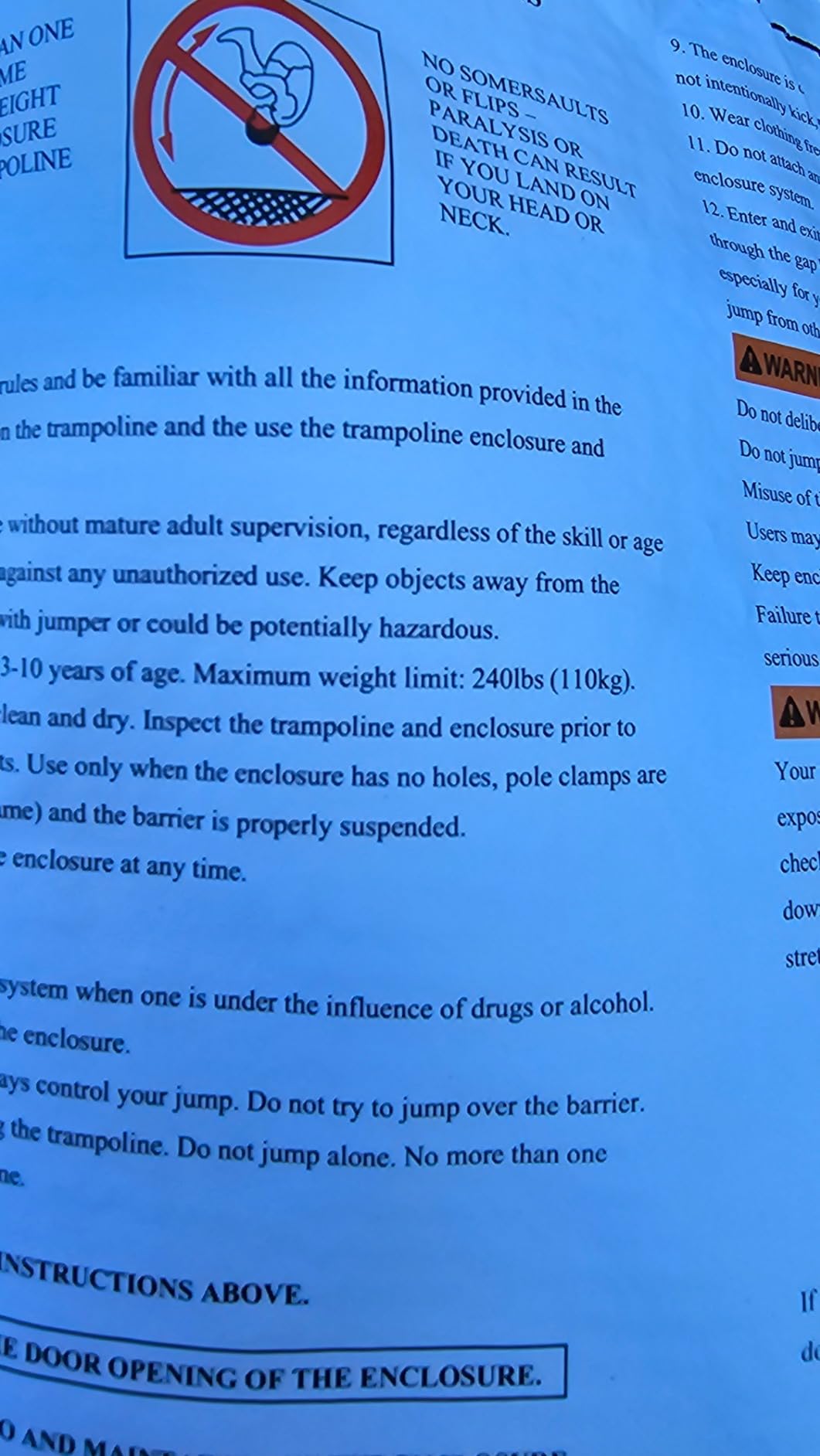
- No flips, twists, or dives onto the head or neck until someone qualified has shown you how to land safely. This is where trampoline parks earn their fee.
- Check the springs and mat stitching before every session. Hairline cracks in the stitching or a spring that has gone slack are shutdown signals.
- Close the enclosure door every time. Loose net-to-pole straps and failed zippers are among the most common complaints across all ten products we reviewed.
- Clear the mat of leaves, gravel, and toys before anyone jumps.
- Take the poles down before high winds, and anchor the frame properly rather than relying on its weight.
- Enforce a daylight curfew. Jumping in the dark is where most hand and foot injuries happen.
- Inspect the frame and pad every few months. Mats and pads wear out well before steel does.
For a broader look at the safety side, our guide to trampolines with enclosures breaks down the net and pad configurations in more detail.
1. Jumpzylla 14ft Outdoor Trampoline with Net — Best Overall for Teens
Jumpzylla Outdoor Trampoline with Net for Kids 8FT 10FT 12FT 14FT 15FT 16FT
- Highest review volume in the set at 6250 ratings
- 450 lb per-jumper capacity suits a full-size teen
- ASTM F381-16 certified with curved poles
- Ladder and wind stakes in the box
- Legs can shift during use without ground anchors
- Net zipper reported failing within weeks
- Assembly realistically needs two adults
Six thousand two hundred ratings is a lot more evidence than any other trampoline on this list carries, and it matters because trampolines fail slowly. Springs stretch, stitching frays, welds fatigue. A model that survives 6250 owners over several seasons is telling you something a two-hundred-rating listing cannot.
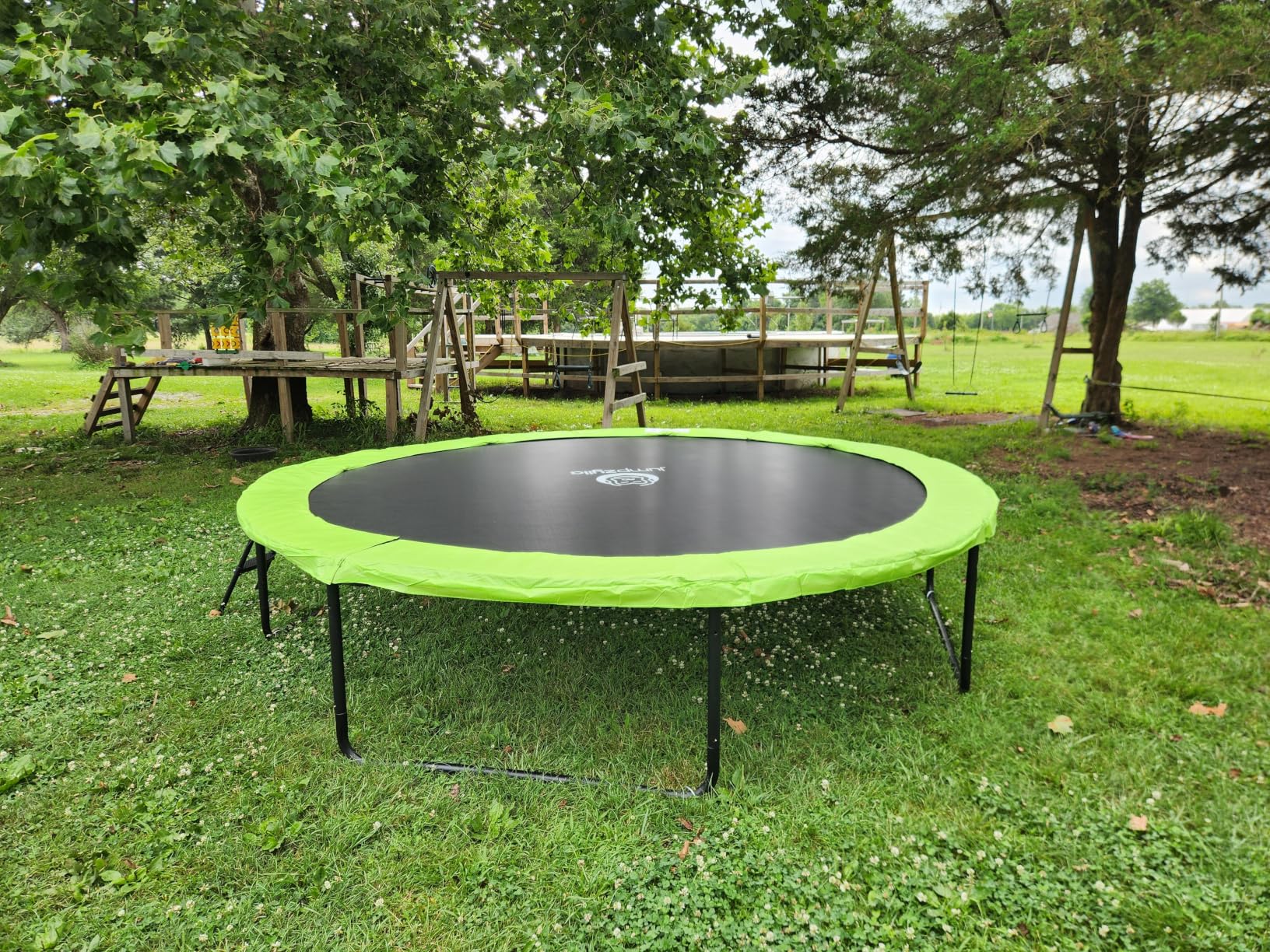
This 14ft round model lists a 450 lb maximum user weight recommendation, which comfortably clears a 165 lb teenager and a friend. The frame is stainless and galvanized steel with UV-resistant padding and mat, and powder-coated legs that the manufacturer says resist rust. That combination is exactly what you want in a backyard that stays wet through winter.
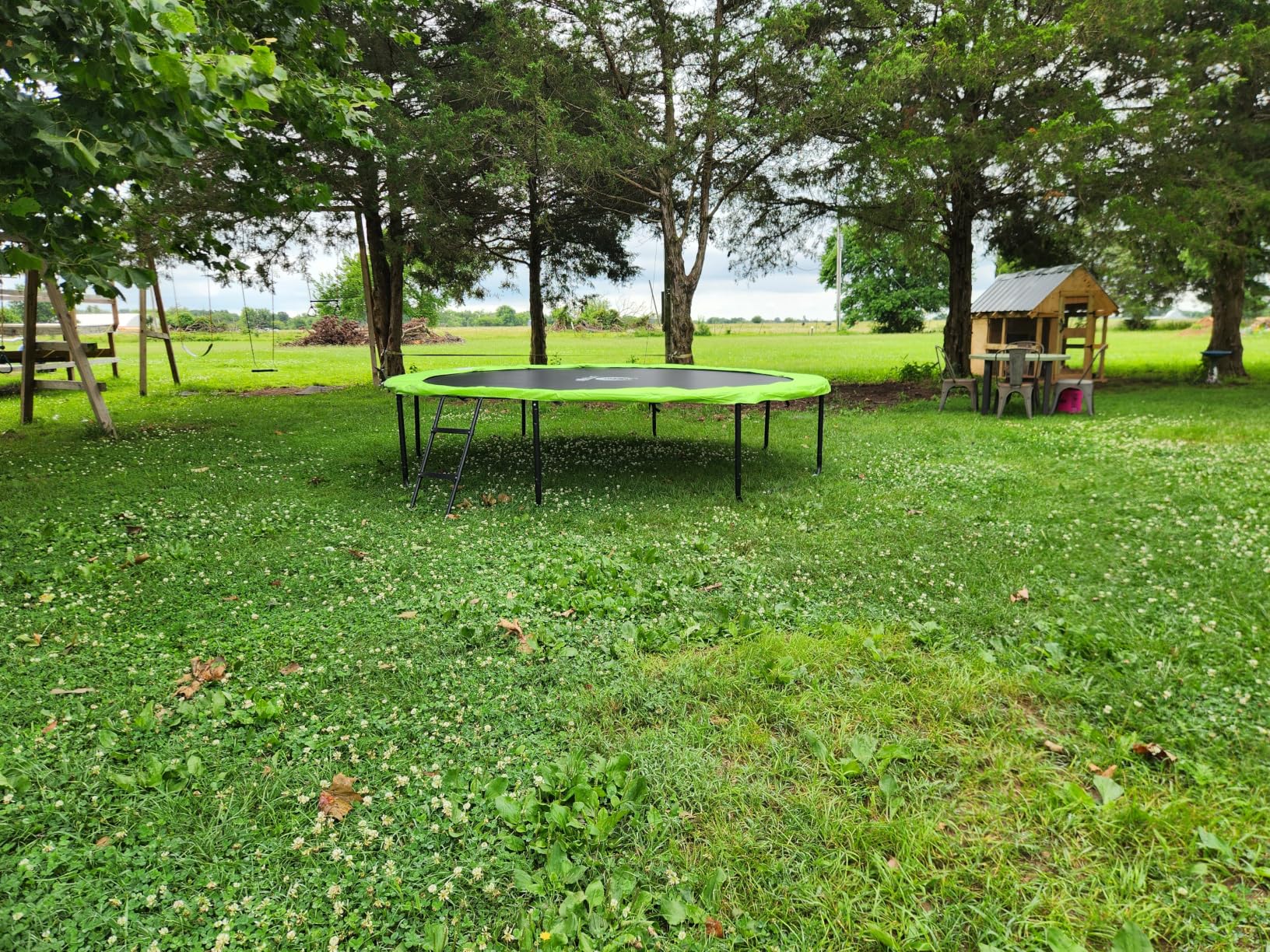
The safety engineering here is the reason it ranks first for teenagers rather than just for families. It is ASTM F381-16 certified, and the curved pole design pushes the impact zones away from the jumper’s landing arc. With 80 springs you get firm tension and a matte response that suits a teenager bouncing at full height for twenty minutes rather than an adult gently rebounding.
The patented double-sided spring cover is a small touch that works: you can flip it to the other color, which matters more than it sounds if you are trying to keep an eleven-year-old and a sixteen-year-old happy about the same object.
How it holds up with two people jumping
Owners report that the larger sizes manage multiple jumpers of mixed weights well, and the 80-spring count is the reason. When a 150 lb teenager and a 110 lb sibling land within a second of each other, the mat has to stay level, and that comes down to spring quantity and frame gauge rather than the capacity number printed on the box.
Customer service on this one is repeatedly described as responsive, sending replacement nets and pole parts quickly at no cost. That is the difference between a two-year trampoline and a six-year trampoline in practice.
Where it falls short for teenagers
The most-reported issue across reviews is the enclosure zipper failing after only a few weeks. That is a genuine safety problem for a teen, because a permanently open door is an open door. Check it before every session and treat a stiff zipper as a replacement signal.
Second, the legs can feel unstable and move during use if you have not anchored them. Wind stakes are included, which is more than most of this list manages, but you need to actually drive them in. Third, assembly takes two people or more, and reviewers report squeaking during bounce.
2. Zupapa 1800LBS No-Gap Trampoline — Top Rated
- 550 lb dynamic capacity with honest static and dynamic figures
- Dual-frame design stays solid and quiet under load
- No-gap net removes the foot trap zone
- Spare parts available for a decade
- Large sizes take much longer to assemble than stated
- Tight frame tolerances make spring fitting frustrating
- Printed instructions are thin and incomplete
Of the three round models here, this is the one that feels engineered rather than assembled. The dual-frame design uses a smaller top frame over a larger base frame, dropping the center of gravity and resisting the tipping and twisting that develops on single-ring frames after a season of teenagers landing off-center.
It is also the only model on this list that publishes both figures honestly: 1800 lbs static and 550 lbs dynamic. That transparency is why it is worth reading the fine print on every other listing before you decide those giant numbers are not real.
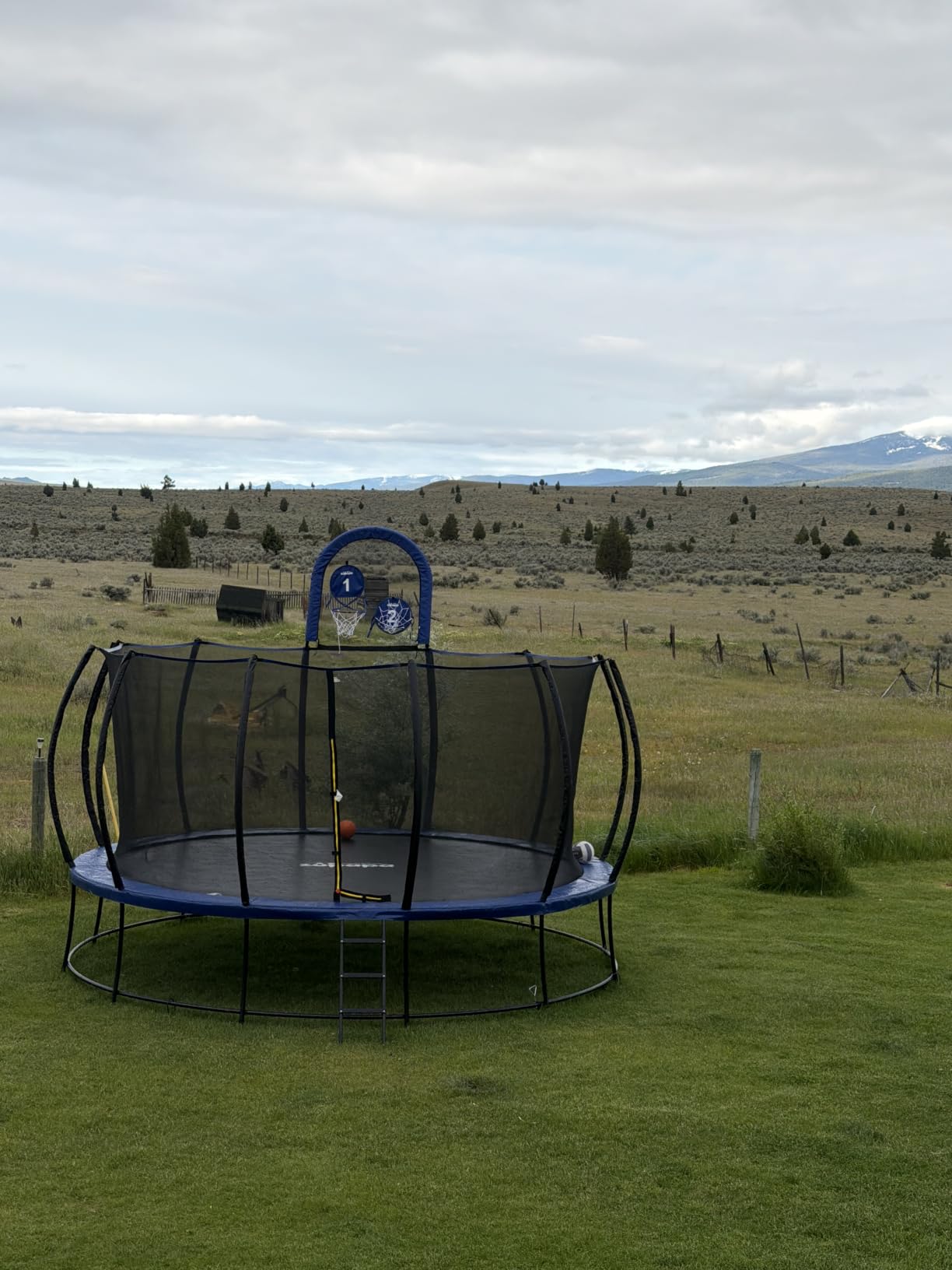
For teenagers specifically, the patented no-gap connection between the net and the jumping mat is the decisive feature. The net is sewn directly to the mat edge, so there is no open band for a foot to slip into during a landing or a flip attempt. The outward-curving net poles are doubled in count compared with a traditional build, which keeps the pole line out of the jumper zone entirely.
Owners describe it as noticeably more solid and quieter than cheaper trampolines, and several report adults jumping at the same time as younger kids without issue, which is unusual in this category.
Why the dual frame matters at 150 pounds and up
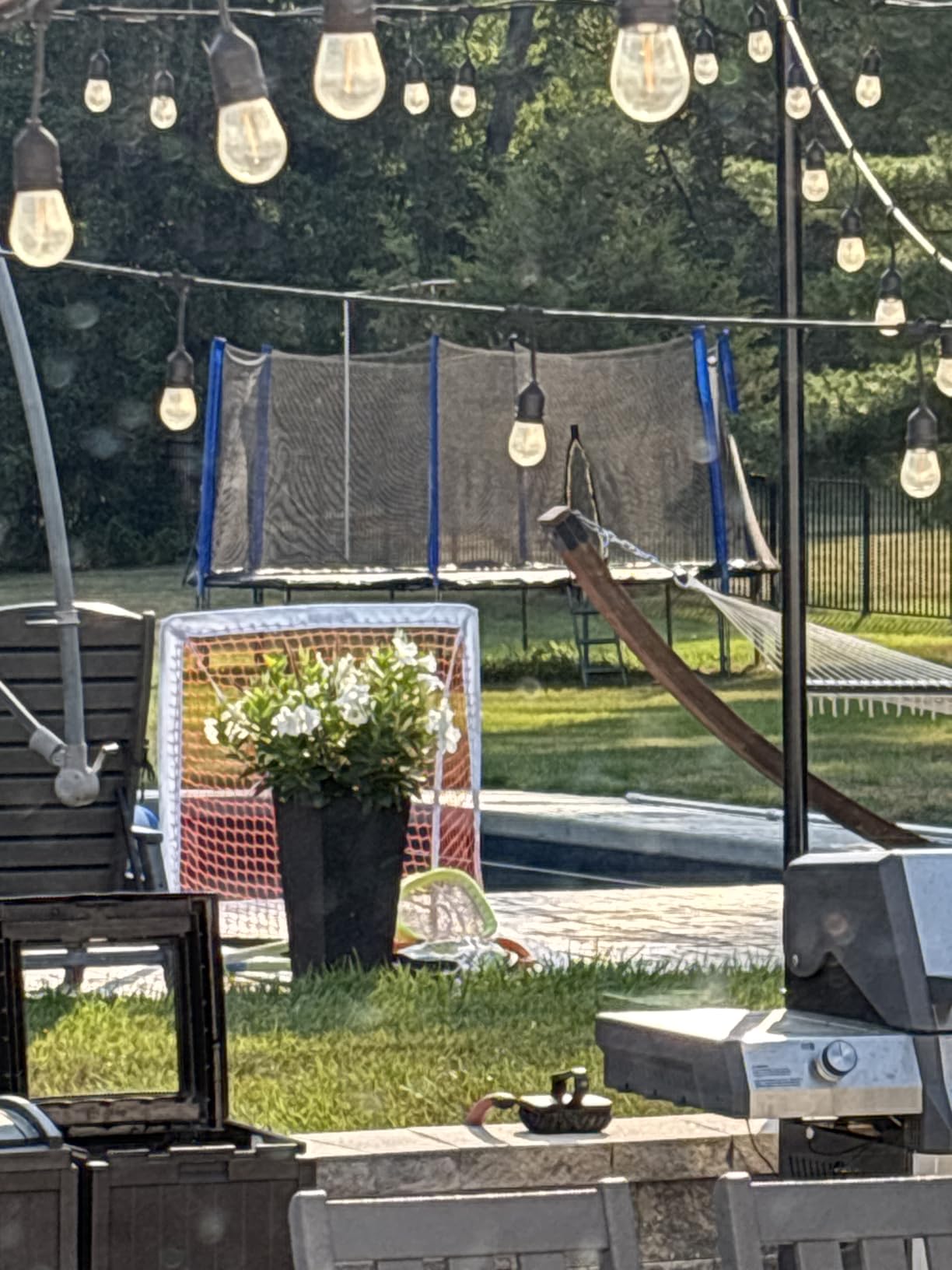
Wobble is what makes a heavy trampoline feel unsafe before anything actually breaks. A single-ring frame flexes every time a heavy jumper lands off-center, and that flex is what eventually loosens leg bolts and cracks mat stitching. A dual-ring structure shortens the span each ring has to bridge, which cuts the flex dramatically.
This is also why r/Trampoline members repeatedly name Zupapa as the pick among budget-tier models. It is the recommendation we saw most often in thread-level comparisons, and the construction here backs it up.
What to plan for before it arrives
Assembly of the larger sizes takes far longer than the stated estimate, which is a common complaint. Tight frame tolerances also make spring installation genuinely frustrating, because the springs are being pulled into a hole that barely lines up. Budget a full afternoon with two adults.
Printed instructions are described as minimally helpful and incomplete, and missing or incorrect hardware shows up occasionally. The upside is the warranty: 10 years on the frame, 2 years on the mat, pad, net, and springs, plus free replacement of other parts at any time, and spare parts listed as available for a decade.
3. SKOK 400lbs Outdoor Trampoline — Best Budget Pick
- Genuine 400 lb rating rather than an inflated headline figure
- Tall 4.9 ft net with zipper and buckle
- Galvanized inside and out on every metal part
- Tested for 20000 jumps
- 8 ft size is small for two jumpers or heavier users
- Spring installation is physically demanding
- Padding ties can be cut or loosened by children
If your teenager is on the younger end of the range, say twelve to thirteen and around 100 to 120 lbs, this is the most efficient way to get a certified, enclosed trampoline without spending mid-range money. The 400 lb rating is real, not a static aggregate, and the frame complies with ASTM 381 and ASTM F2225-15 along with ISO and BSCI approvals.
It is also the only model here with a stated test protocol, which tells you something about how it was built. The mat and springs were tested for 20,000 jumps, and mats were tested up to 5,000 hours.
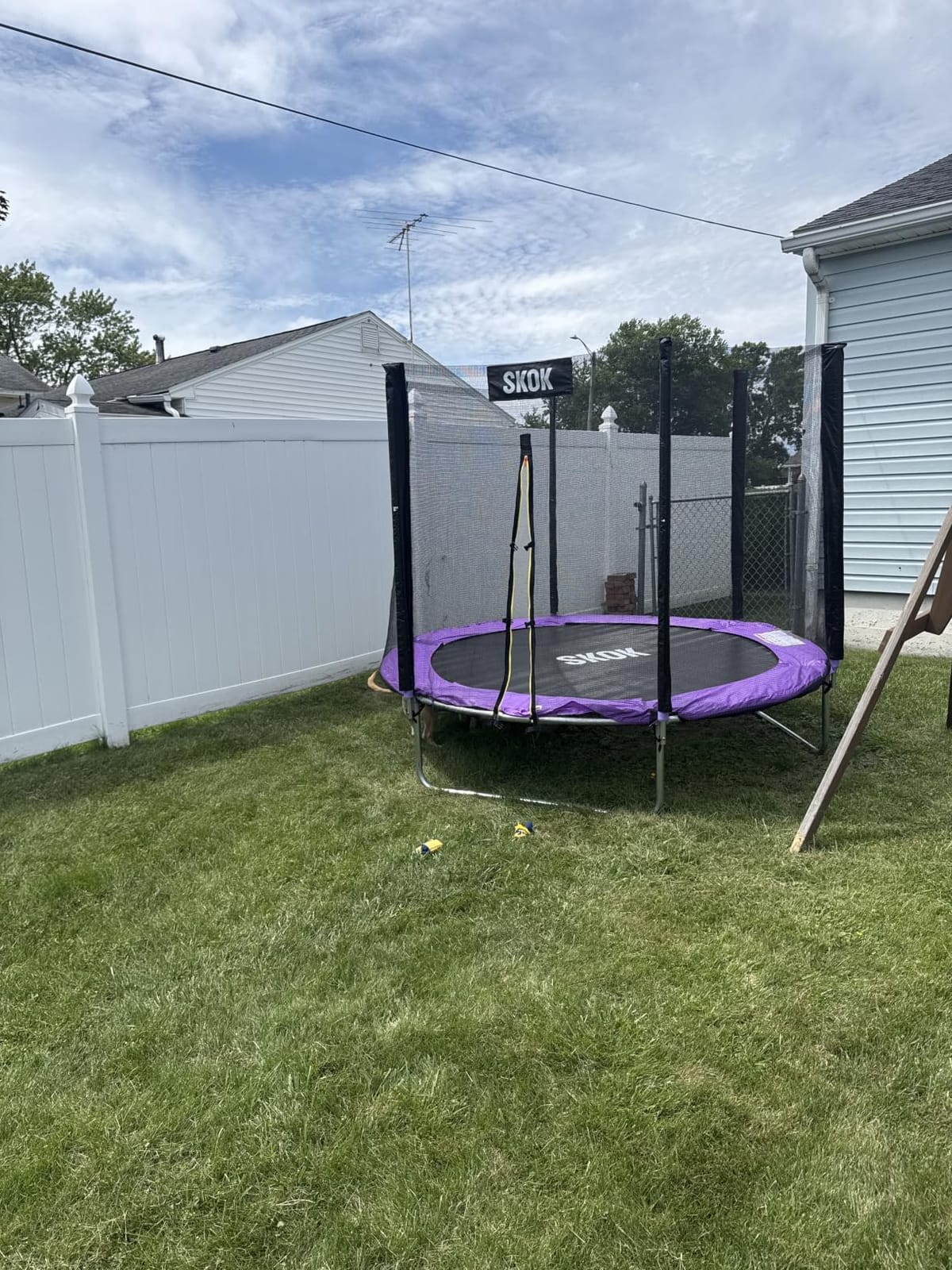
Three U-shaped steel legs with zinc coating applied inside and out give it a wider, more stable base than the straight-leg budget norm. The 42-piece patented spring set and a waterproof PP mesh mat with 8-row stitching produce a bounce that reviewers describe as genuinely good enough for flips, which is not a claim most entry-level units earn.
Low step-in height is the underrated feature. A ladder, gloves, and socks are included, and the frame sits low enough that a younger user gets on and off without an adult lifting them.
When the 8 ft format works and when it does not
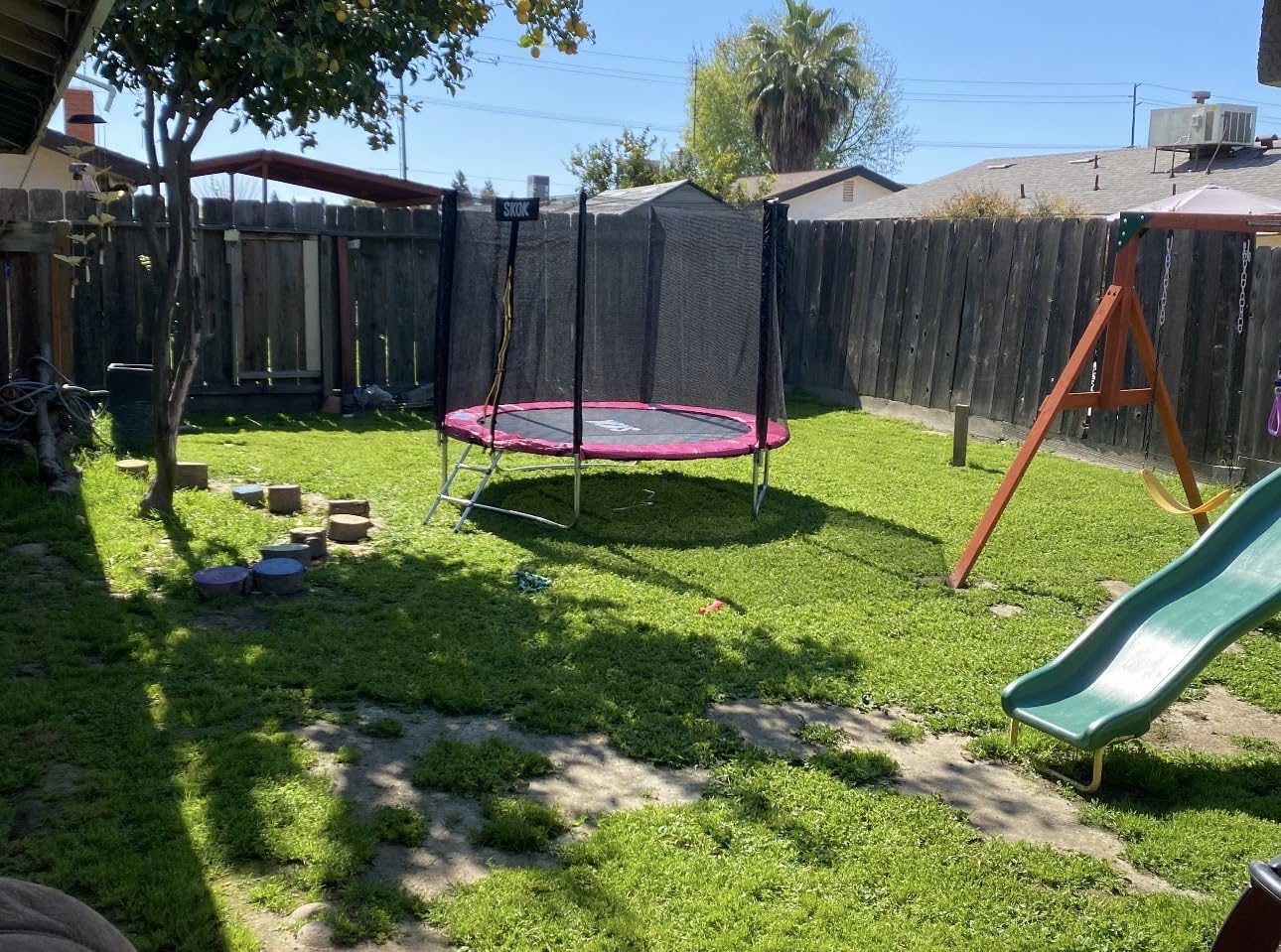
This is the one compromise in the list, and you should be clear-eyed about it. An 8ft round trampoline has roughly half the jumping surface of a 14ft. One teenager fits fine. One teenager and a friend will feel the mat dip, and taller jumpers lose headroom near the net.
Reviewers are candid about this: adults can bounce carefully on it, but not comfortably at the same time as a child. If you are buying for a 12-year-old who is still growing, this works. If you are buying for a 16-year-old, skip to a 14ft model.
Build quality and the little failure points
Solid build quality holds up after years of daily use, and the tall 4.9 ft enclosure with zipper and buckle gives more vertical protection than most competitors of this size. Three U-shaped legs are more stable than the single straight leg you find on cheaper imports.
Two things to know. Spring installation is physically demanding even with the included tool, and assembly takes about an hour with a helper. The padding ties can be cut or loosened by children, which matters more with a teenager who finds cutting things with a pocketknife a hobby.
4. AOTOB 12/14 FT Rectangle Trampoline — Best for Gymnastics and Skill Work
- Long consistent rectangular bed suits drills and flips
- No-gap net with foam-wrapped poles
- Powder-coated steel frame on four supportive legs
- 5 years on mat frame and springs with free parts
- Rectangle needs a wider rectangular yard footprint
- Only 12 ft and 14 ft sizes offered
- Smaller review base means less long-term feedback
Almost everything on this list is round, which is the right default for social backyard bouncing. But if your teenager is the kind of person practicing drills, tumbling progressions, or straight-air technique, the rectangle is a different instrument, and this is the only rectangular pick in the set.
The geometry is the point. A rectangular trampoline has a long, flat, consistent bed where a round one curves away at the edges, so drills that require direction and depth, like a hurdle drill or repeated twisting layouts, behave more predictably.
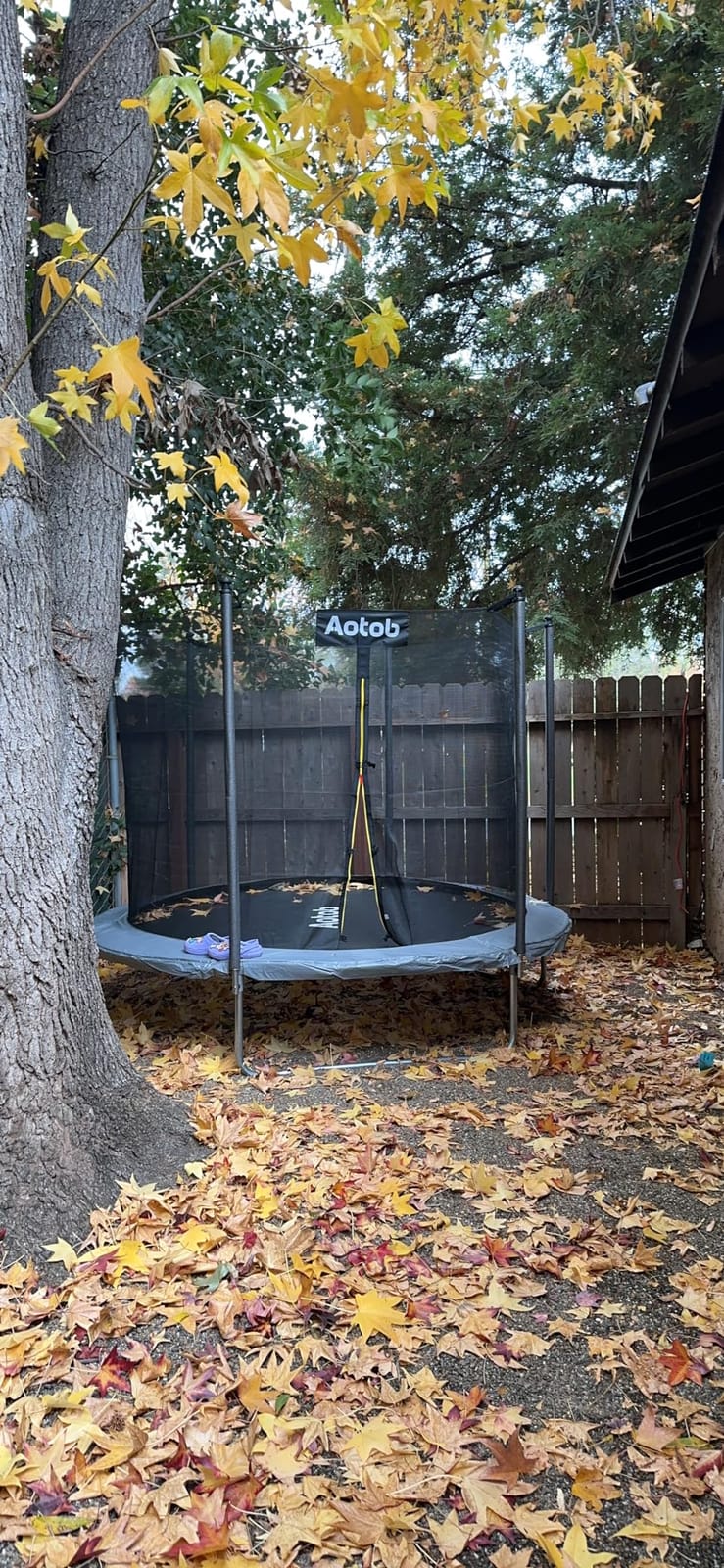
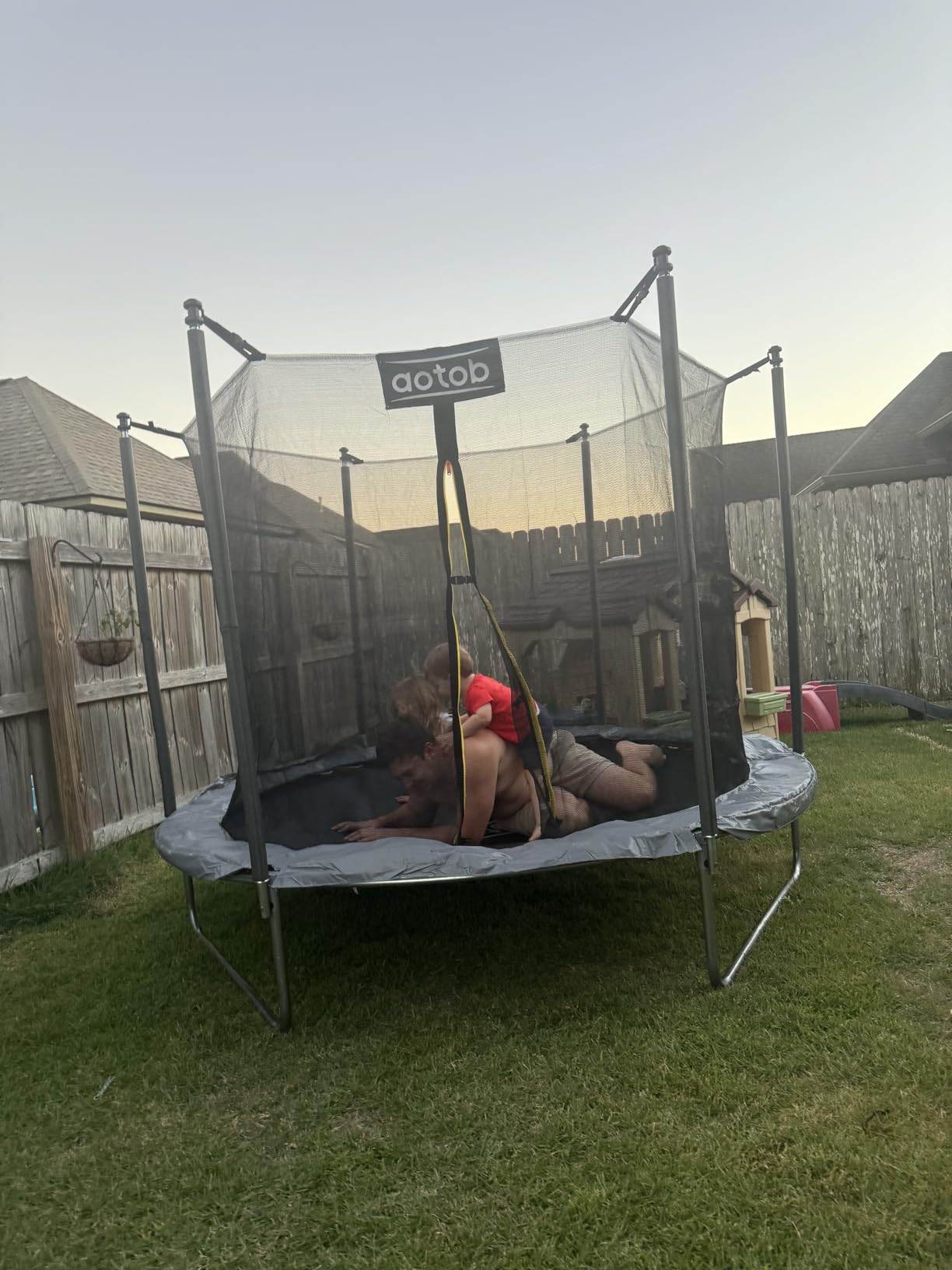
Construction-wise it is solid: heavy-duty powder-coated steel frame, four supportive legs, 72 springs, and a no-gap enclosure with soft foam around the poles to reduce collision transfers. The 14 ft version measures 168 by 96 inches and 36 inches high, so plan a wide rectangular space rather than a circular patch of lawn.
Assembly gets a genuine assist from the Bilt app, which offers 3D step-by-step instructions. That matters more than usual on a rectangular build because the frame sections have to line up correctly for the mat to sit flat.
How it handles skill practice
Reviewers consistently point to the rectangular mat as the reason it feels different to work on. The long flat surface gives a person room to set up a line of travel, which is how gymnastics and tumbling training actually works. Elasticity is described as durable rather than soft, which is what you want for repeated high-energy work.
The no-gap netting means a foot that drifts toward the edge lands on net rather than spring, and the foam-covered poles soften the collision zone where a rectangular trampoline’s straight poles would otherwise be exposed.
Where the rectangle costs you
The footprint is the real cost. A rectangle needs a deeper rectangular space, and if your yard is square-ish with a fence on two sides, the long axis is harder to accommodate. Most competitors on this list only need a circular clearing.
Only 12 ft and 14 ft sizes are offered, so there is no larger rectangle here if your teenager outgrows the 14. The review base of 318 ratings is also smaller than the budget-tier units, which simply means less long-term durability data exists. The warranty is strong where it counts: 5 years on the mat, frame, and springs, 3 years on the net and pole caps, with free replacement.
5. Lyromix Upgraded 16/15/14/12 FT Trampoline — Best for Night Sessions
Lyromix Upgraded 12FT Outdoor Trampoline Blue for Kids & Adults
- LED light lets jumping extend past sunset
- Mat passed a 5000-hour UV standard test
- Fully galvanized inside and out resists rust
- Hoop sprinkler and ground stakes included
- Mat stitching and spring holes reported separating within months
- Bungee ties on the spring cover are thin and can snap
- Hoop pole is an awkward late assembly step
Most trampoline use stops when the light goes, and that is exactly when injuries climb, because a teenager jumping in the dark misjudges the edge of the mat. This model pairs the only LED light in the box with the accessory bundle teenagers actually ask for, which is why it takes our evening and night-session slot.
Basketball on a trampoline is the other thing teenagers actually want to do. The included hoop and net, plus the sprinkler, are the accessory bundle that keeps a fifteen-year-old outside instead of on a phone.
Build-wise, the galvanized steel frame is coated inside and out, with thickened W-shaped legs intended to prevent structural twisting. That leg shape is worth noting because twisted frames are the number one reason budget trampolines start rocking after a year. The mat uses reinforced heavy-duty stitching and passed a 5000-hour American UV standard test, which is a real published figure rather than a marketing adjective.
Recommended maximum user weight is 330 lbs, and the listing is honest that a single user should stay under 300 lbs. That is fine for a teenager and one lighter friend.
What makes the accessories worth it
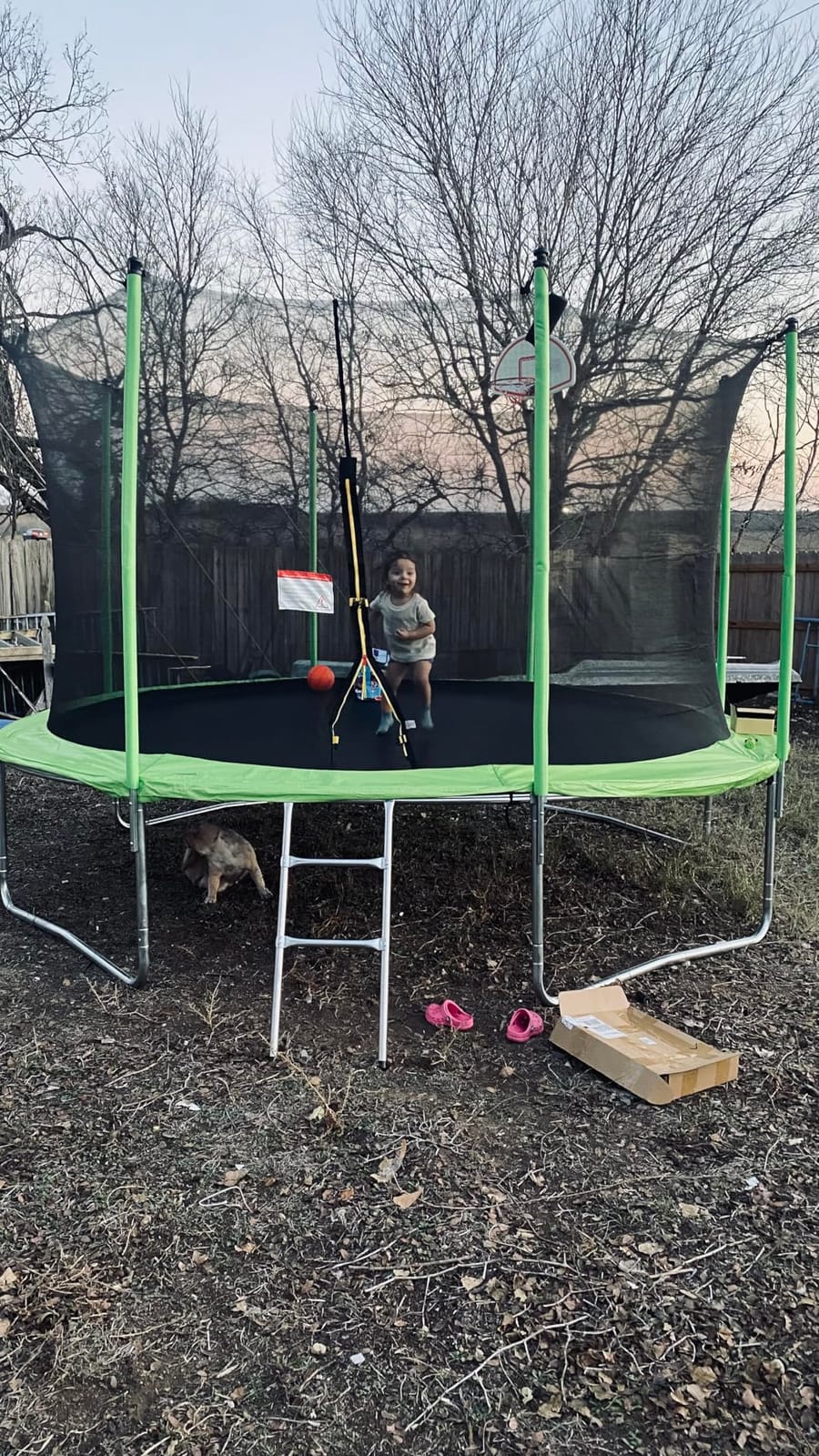
Four ground stakes, one trampoline sprinkler, and one LED light come in the accessory bundle. The sprinkler is a genuinely good idea for teenagers during summer because it lowers mat temperature and adds something to do that is not screen time. The LED light extends the usable window without anyone resorting to a phone flashlight.
Bounce quality is described as good for the size and price, which is the honest way to put it. It is not the stiffest mat here, but it is responsive enough that 72 springs and a reinforced mat hold up.
Where durability reports get uncomfortable
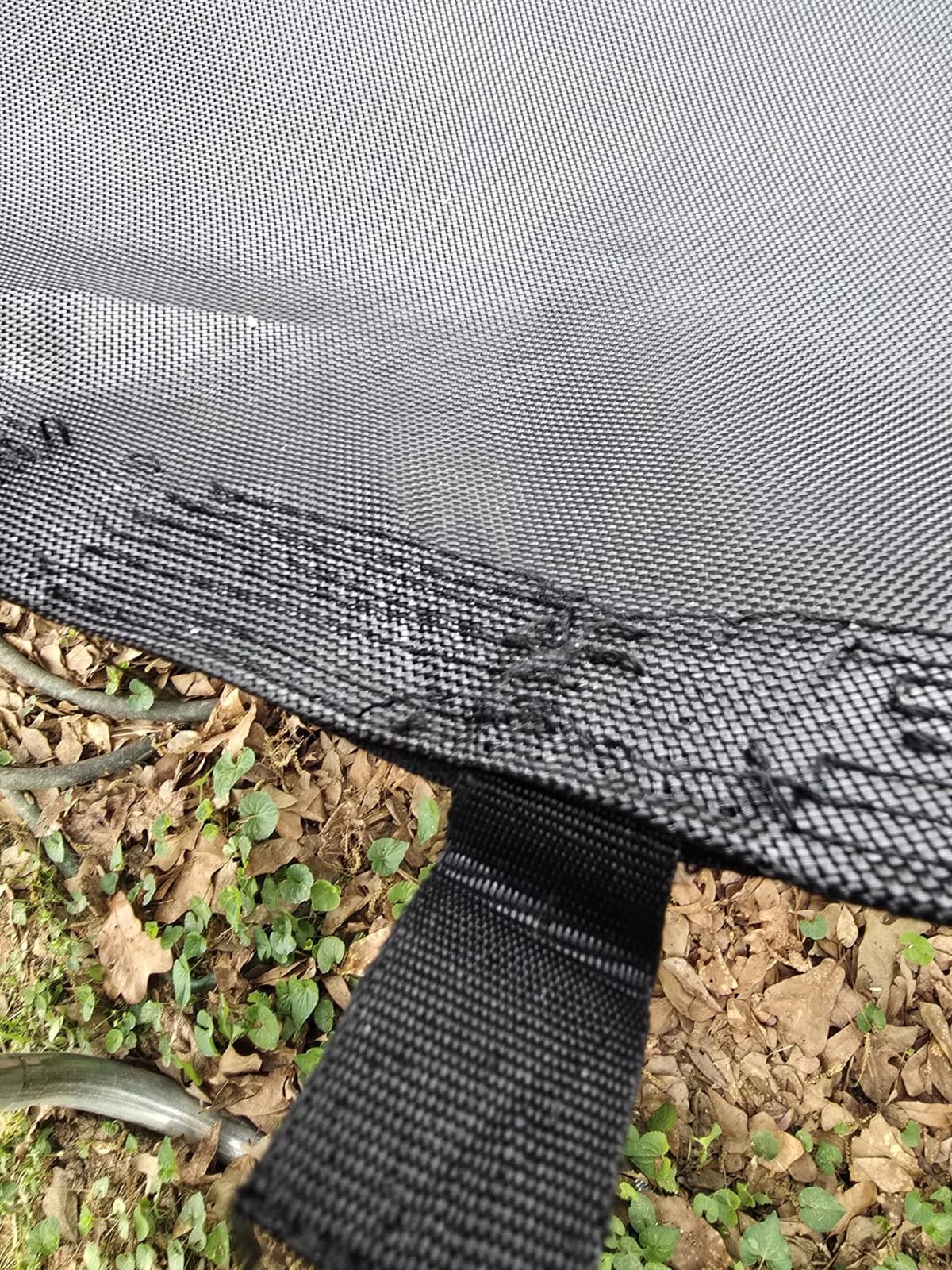
Some owners report mat stitching and frame spring holes separating within months, which they treat as a safety issue rather than a cosmetic one. That is the most serious complaint across the review set and worth knowing before you commit.
The bungee ties holding the spring cover are also described as thin and prone to snapping if over-tightened, and the basketball hoop pole is an awkward final assembly step. The lights and sprinkler can also arrive separately from the trampoline body, so do not assume everything shows up together.
6. Awlstar 14FT Heavy-Duty Trampoline — Best Value at 14ft
Awlstar 14FT Heavy-Duty Outdoor Trampoline with Basketball Hoop for Teens & Adult
- 14 ft jumping area properly sized for teens
- Net attaches directly to the mat all the way around
- Press-fitted joints cut frame noise and wear
- Hoop and ladder both included
- 240 lb single-user limit despite the 1000 lb headline figure
- Poles must come down in high winds
- Wind damage is excluded from the warranty
This model is marketed directly at teens and adults, and the 14ft jumping area is sized correctly for the job. It is worth noting where it sits on capacity, though: the listing headline says 1000 lbs, while the actual single-person limit is stated as 240 lbs. This is the exact confusion we warned about in the buying guide.
A 240 lb per-jumper limit is genuinely fine for a teenager. It is not fine for a 250 lb adult and a teenager jumping together, and it will not carry a full-grown man at the trampoline park equivalent of a hard flip.
What it does well is the enclosure. The 360-degree safety net attaches securely to the jumping mat all the way around, with a zipper door entry. That mat-attached design is the same safety architecture as the no-gap models, and it is the single feature that should matter most to anyone buying for an older child who attempts flips.
The 72 galvanized springs give a smooth, responsive bounce that buyers praise, and press-fitted frame joints reduce noise, movement, and wear compared with a screwed-together frame.
Who this one actually suits
A single teenager in the 100 to 165 lb range, plus the ability to host a friend under the limit, plus a basketball hoop and ladder in the box. For that specific case it is hard to argue with the value, especially since press-fitted joints are a build detail you rarely find at this tier.
If your household has a parent who wants to join in regularly, look elsewhere. Two adults or a heavy adult and a teen together will exceed the per-jumper limit.
Wind and warranty caveats
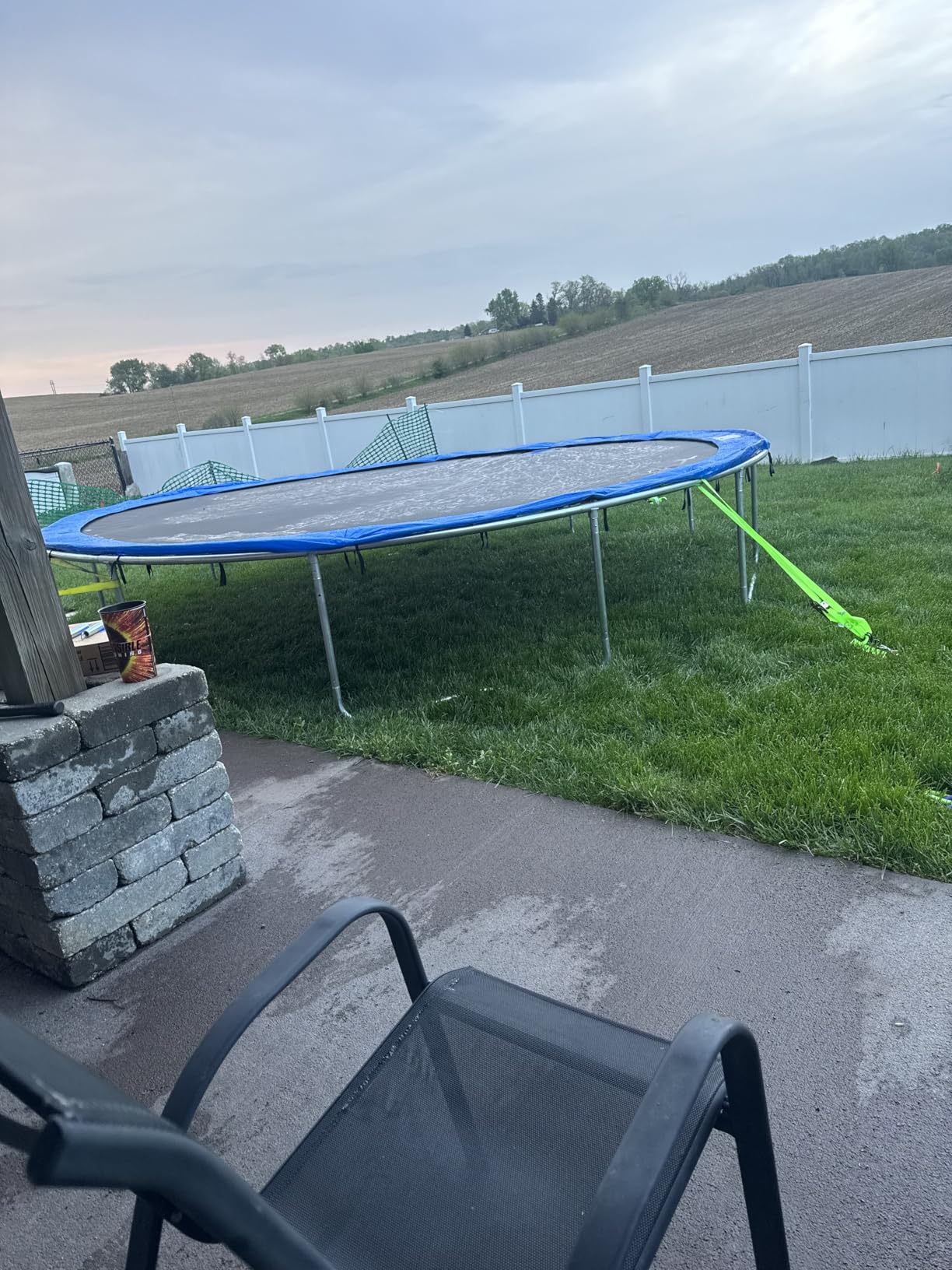
The listing is explicit that poles should be removed during hurricanes or strong wind, and that wind damage is not covered by the warranty. That is the honest version of a limitation that most sellers bury, and it is worth internalizing: a trampoline that catches wind becomes a lawn projectile, which is a real hazard for neighboring yards.
It is also only offered in a single size and color combination, so there is no way to trade up later. Assembly is designed to be easy but two or more people are recommended.
7. ALTLER 12/14 FT Enclosure Trampoline — Best for Multiple Teen Jumpers
ALTLER Trampoline 14FT Enclosure Net Outdoor Jump for Kids and Adults Round ASTM Approved Heavy-Duty Bounce Mat with Enhanced Weight Capacity
- Reviewers report four teenagers jumping at once
- Frame holds up under months of daily use
- An adult at 250 lb jumps confidently
- Instructions are clear and easy to read
- Net poles bent in wind and later snapped within months
- Included bolts are low quality and needed replacing
- Assembly takes a few hours with two people
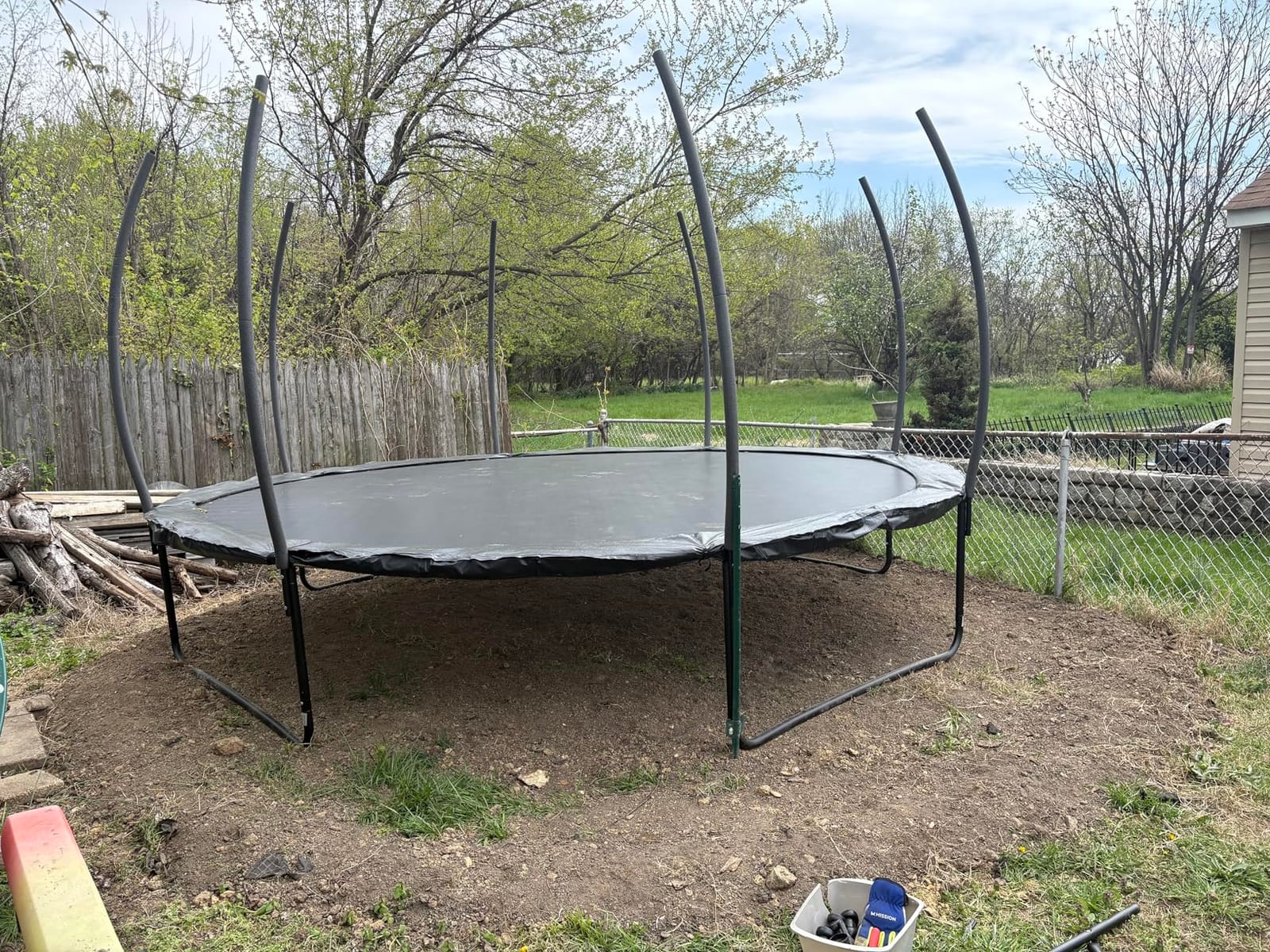
The 14ft version of this model is one of the few in the set that owners explicitly report using with several teenagers on it at the same time. That is the hardest use case there is, and reviewers who run it that way describe the frame as staying solid after months of daily jumping.
One owner specifically notes a sturdy frame that an adult at 250 lb can jump on confidently, which puts it among the more genuinely heavy-duty budget builds.
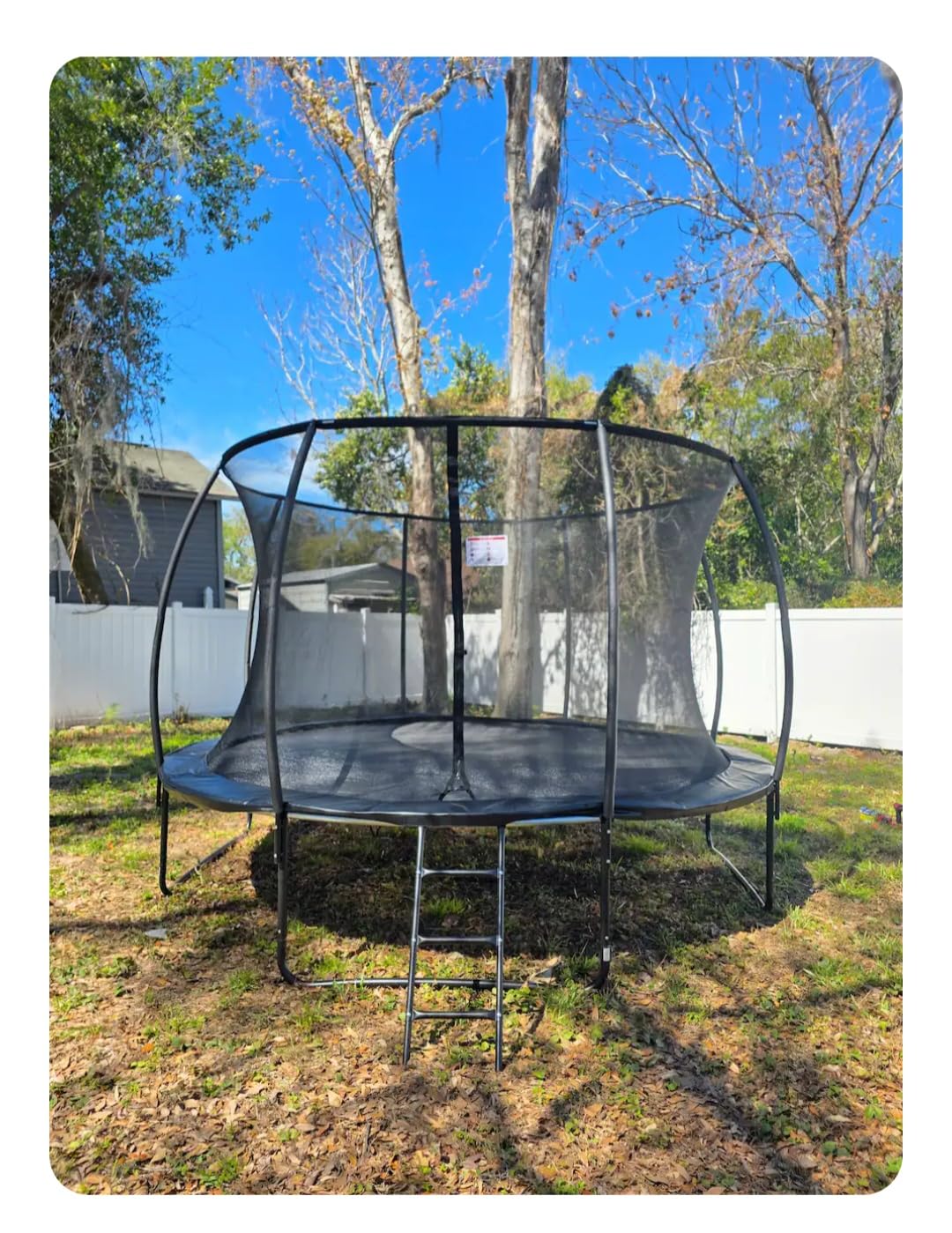
The frame is steel with secure padding around the springs and a weather-resistant polyethylene bounce mat. Reinforced materials are credited with supporting higher weight loads, though the manufacturer does not publish a specific per-jumper number, which is a gap you should be aware of when comparing it against the models that do.
ASTM approved design and a full enclosure net round out a specification sheet that is straightforward rather than extravagant. The 14ft version measures 168 inches square and 100.4 inches high including the net.
Multi-jumper performance in practice
Handling four teenagers simultaneously is the claim that separates this from lighter models, and it comes from multiple review mentions rather than a single one. If your risk is two or three teens bouncing at once on a weekend afternoon, this holds up better than most of the round units in the same tier.
Netting is described as sturdy, and the mat holds its bounce over months rather than weeks. Instructions are called out as clear and easy to read, which deserves credit after the documentation problems on several other listings here.
What failed and why wind is the real enemy
The most consistent complaint is net poles bending in the wind and later snapping within about six months. That is a structural issue rather than a cosmetic one, and it points to thin pole material that is not rated for the same loads as the frame.
Included bolts are also described as low quality and needing replacement shortly after setup, and assembly takes a few hours even with two people. Anchor it before the first storm of the season and check the pole sleeves periodically.
8. Lyromix 10/12/14/16 FT Trampoline — Best for Smaller Yards
Lyromix 14FT Trampoline Outdoor,Light/Sprinkler/Basketball Hoop, Black
- Available from 10ft up so it can fit a tighter yard
- 80 springs give a notably bouncy response for the tier
- Customer service responds quickly with free parts
- Long tangle-resistant zipper eases entry
- 264 lb limit is low for two large teens
- Net-to-pole straps came undone in light wind on day one
- Only a 6-month warranty
Not every yard can take a 16ft circle with clearance on all sides, and this is the model that solves that. It comes in 10, 12, 14, and 16 ft, which means you can size to the space you actually have instead of the space the listing photo suggests.
Recommended maximum weight is 264 lbs, which is the lowest ceiling among the fourteen-foot-class units here. That is fine for a teenager plus a lighter sibling, and it is not fine for two large teens or an adult joining in.
What it compensates with is bounce. Eighty springs in a frame this size produces a notably lively response, and buyers describe it as super bouncy and fun for both kids and adults. The multi-point support design and thickened four legs are aimed at preventing the structural twisting that ruins cheaper frames.
The galvanized frame with powder-coated legs resists rust well enough that the manufacturer says there is no need to take it apart in rain or snow, which matters for anyone in a wet climate.
When the smaller footprint is the right call
If your yard is under roughly 300 square feet of usable space, a 14ft round with clearance is genuinely hard to site, and squeezing a 16ft in against a fence is how you end up with a trampoline nobody uses. Sizing down to a 12 or 14 from this range keeps it in play rather than in a corner.
Assembly is described as quick and often completed by a single person despite the two-person recommendation, and customer service responds within hours with free replacement parts, which is a genuinely good sign for long-term ownership.
Hardware and strap issues to expect
Leg hardware can fit loosely and allow the legs to shift unless it is modified, so check every leg joint after setup and periodically thereafter. Net-to-pole straps are described as cheap and came undone in light wind on day one, which means check them before every session.
The frame can bend in high wind if it is not anchored before a storm, and the warranty is only six months, which is the shortest here. Accessories and the trampoline may also arrive separately, so the hoop, solar lights, and sprinkler might not be with the main body.
9. Jumpflex Hero 14FT Round Bouncer — Best for Trick Practice
JumpFlex 14 Ft HERO Round Outdoor Backyard & Recreational Trampoline w/ Net & Ladder – Heavy-Duty Jumping Play Equipment and Workout Accessories for Family
- Largest open jump zone for flips and spins
- Net clips to the mat with a SafeSeal gap-free door
- 96 springs and a 6-layer mat for heavy use
- Zero-bolt weld-free assembly needs minimal tools
- Requires a minimum 16.4 ft of yard clearance
- Hard to move once assembled
- Smaller review base than the budget tier
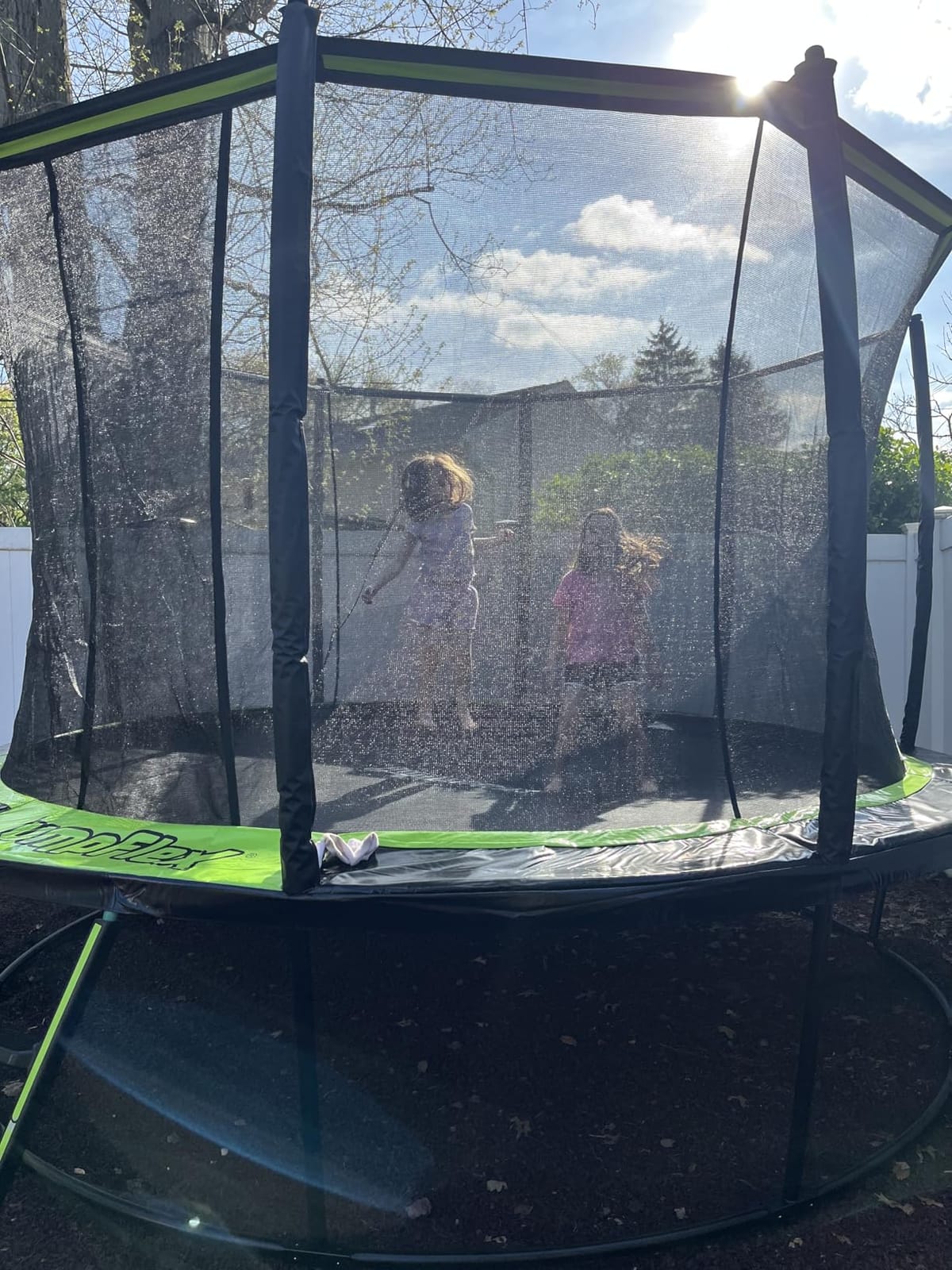
Build for a teenager who wants to actually learn things and this is the pick. The Hero is specced for jumpers weighing 40 to 200 lbs with a 550 lb maximum user weight, and it has 96 springs, which is more than any other model in this roundup.
More springs means more tension and a more responsive mat, which is what makes small skills learnable. A soft trampoline teaches nothing because the feedback is mushy.
The jump zone is the headline. Curved support poles bow outward to keep the entire perimeter clear, which means a spinning or flipping teenager has room to travel without approaching a pole. Combined with the 360-degree net that clips directly to the mat and a SafeSeal door that closes the remaining gaps, it is the most enclosed jumping surface here.
The frame is a dual ring: a 42mm high tensile steel upper ring and a 38mm high tensile steel lower ring, under a 6-layer mat construction, backed by a 10-year warranty.
What the weight range means for a family
The 40 to 200 lb jumper range is unusually wide and honest. It means the same trampoline works for a small child, a teenager, and an adult in the same session, which is the opposite of the models on this list with a 240 or 264 lb ceiling. If a parent wants to join in, this one is built for that.
Assembly is the strongest on this list: zero bolts, no welds, minimal tools. That is a real quality-of-life difference when you are a parent who assembles it once and then has to move it, because you will move it.
The space problem is the dealbreaker to check first
This needs a 15.1 ft diameter at the widest point and a minimum 16.4 ft of yard space. Measure before you commit. A wide footprint is also difficult to move once assembled, and with only 198 ratings there is less long-term durability data than the budget-tier picks have accumulated.
Optional hoop, shade canopy, and aqua jet accessories exist for this line, which is the upgrade path the other manufacturers here do not offer.
10. Yohood 12/14 FT Trampoline — Best Bounce Control and Joint Comfort
- Eight stabilizer bars remove the wobble budget frames develop
- Seamless padded sleeve hides every spring completely
- Lantern-style curved poles create a wide buffer zone
- Highest average rating among the models we analyzed
- Only 12 ft and 14 ft sizes offered
- One-year warranty is shorter than most rivals
- Smaller review base reflects a newer listing
The bounce on this one is deliberately different. The manufacturer describes a strong but gradual rebound designed to reduce stress on joints, spines, and developing bones. For a thirteen-year-old with a growth plate still to close, that is a genuinely relevant design goal rather than a marketing line.
It carries the highest average rating among everything we analyzed, at 4.8, which is worth taking seriously even though it rests on a smaller review base than the leaders.
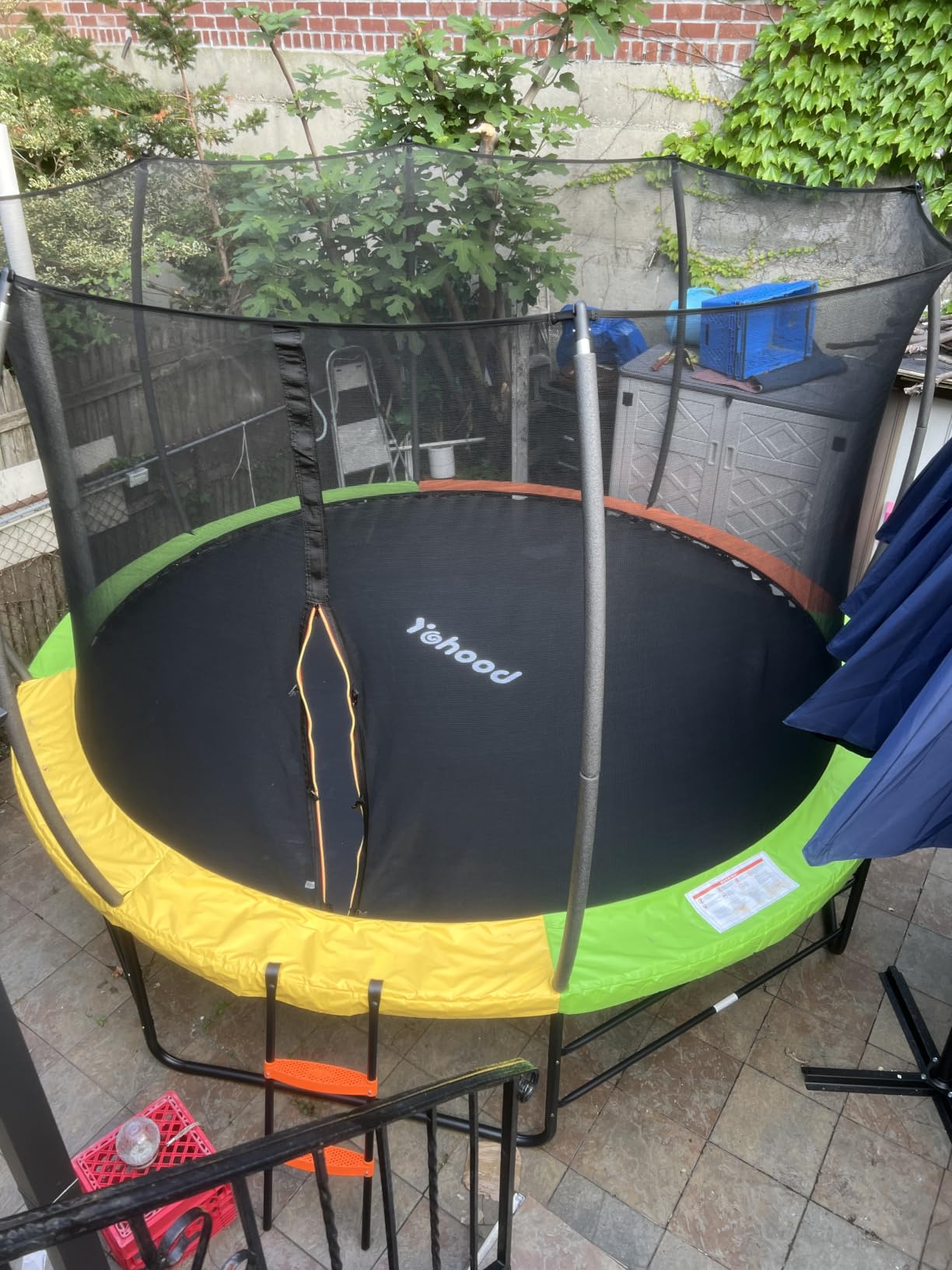
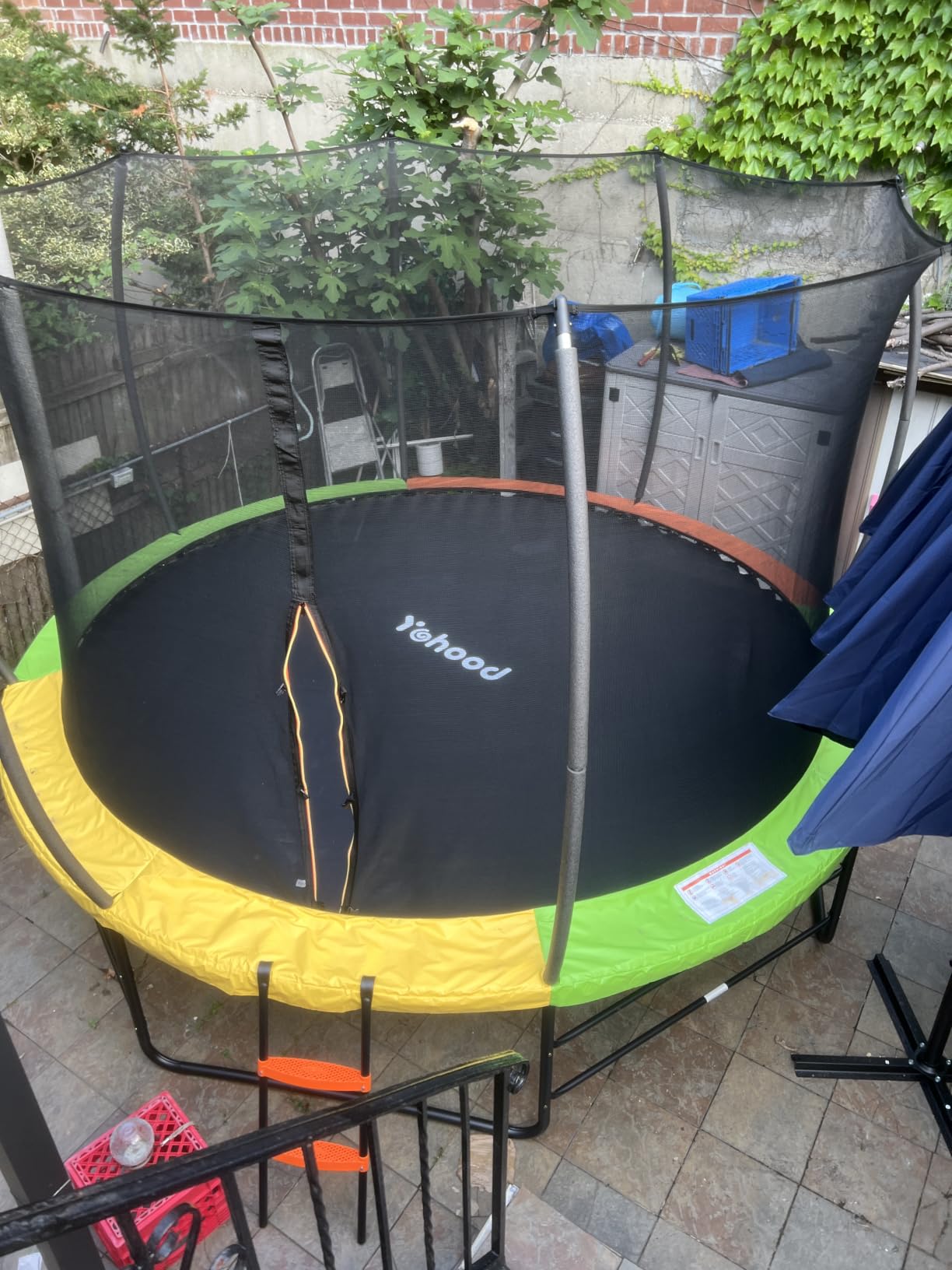
The eight additional stabilizer bars are the standout structural feature. They reinforce the base to eliminate wobbling, which is exactly the failure mode that makes budget frames feel unsafe after a season, and they pair with hot-dip galvanized legs for weather and rust resistance.
Safety details are unusually thorough. High-tensile steel springs sit completely hidden under a seamless padded sleeve, so there is no pinching hazard at all, and lantern-style enclosure poles curve gently outward to create a buffer zone that keeps jumpers centered away from the springs and frame.
Who benefits most from the softer rebound
A younger teenager, roughly twelve to fourteen, who is growing fast and wants to bounce hard for long sessions without stiff ankles the next morning. The 400 lb maximum weight recommendation handles a full-size teenager comfortably and leaves room for a lighter sibling to join.
ASTM and CPSC standards compliance is stated, and the mat sits low at 31.5 inches, which keeps step-on and step-off manageable for a shorter user.
Where the smaller footprint of the line shows
Only 12 ft and 14 ft sizes are offered, so there is no 16 ft option when a teenager outgrows the current size. The one-year manufacturer warranty is shorter than most rivals, and a review base of 110 ratings simply means less long-term evidence about how the mat and netting hold up over five years.
Spare part support is not stated in the listing, so confirm availability with the seller before buying if you want to keep this one for the full teenage window.
Frequently Asked Questions
What is a good size trampoline for teenagers?
Fourteen feet is the practical floor for a teenager, and fifteen or sixteen feet is where multi-jumper use and real air become possible. Under 12ft you are buying a kids’ trampoline. Measure your yard and leave clearance on every side before deciding.
Should I get a 12ft or 14ft trampoline?
Choose 12ft only for one jumper around 100 to 120 lbs in a small yard. Choose 14ft for a teenager in the 100 to 165 lb range, and for any realistic chance of a friend joining in. The larger mat stays level under mixed loads and stops the pads eating your jumping area.
What is the best trampoline for teenagers?
The Jumpzylla 14ft leads our list for its 450 lb per-jumper rating, ASTM F381-16 certification, 80 springs, and the deepest review history of any model we examined. The Zupapa is the stronger build if you want 550 lbs dynamic and a genuine no-gap enclosure.
Are trampolines safe for 13 year olds?
With a full enclosure, competent adult supervision, and one jumper at a time, a properly rated trampoline is reasonable for a 13-year-old. The risk changes sharply once multiple people jump together or flips are attempted, which is why we weight no-gap netting and capacity heavily in this guide.
Do pediatricians recommend trampolines?
The American Academy of Pediatrics advises that children under six should not use home trampolines, and recommends full supervision and a safety enclosure for older children. Parents are responsible for supervision, so the rules and equipment matter more than the purchase itself.
Can a 400 lb person jump on a trampoline?
Only if 400 lbs is the published dynamic or per-jumper limit, not the static frame figure. Read for the in-use rating. A model rated 550 lbs dynamic will serve a 400 lb adult comfortably, while a 1000 lb headline number with a 240 lb per-jumper cap will not.
What are the best trampolines with a high weight limit?
The Jumpflex Hero leads at 550 lb maximum user weight with 96 springs and a dual-ring high tensile frame. The Zupapa matches 550 lbs dynamic with a no-gap enclosure and a 10-year frame warranty. The Jumpzylla sits at 450 lb and has the largest review base.
Should I get a 14ft or 16ft trampoline?
Go 16ft if two teens will jump together or your teenager wants real height and room for a basketball hoop, since a 16ft round measures roughly 171 inches including the pad. Stay at 14ft if the jumpers are younger or the yard is tight. Leave clearance on all sides either way.
Conclusion
If you want one recommendation for a teenager, take the Jumpzylla 14ft. It has the deepest evidence base of anything we reviewed, a real 450 lb per-jumper rating, ASTM F381-16 certification with curved poles, and enough springs that two people can jump without the mat losing its shape.
Go further up the list if your teenager is a serious jumper. The Zupapa gives you 550 lbs dynamic, a genuine no-gap net, and a dual frame that will still be straight in five years. The Jumpflex Hero is the one to buy if your teenager wants space to flip and twist, provided you have the 16.4 ft of yard it needs. The AOTOB rectangle is for gymnastics drills specifically.
Whatever you choose, buy for the eighteen-year-old rather than the twelve-year-old, anchor the frame before the first storm, and print the rules list. Capacity is a safety decision, not a comfort one.
We may earn a commission when you buy through links on this page. It never changes what we recommend.