
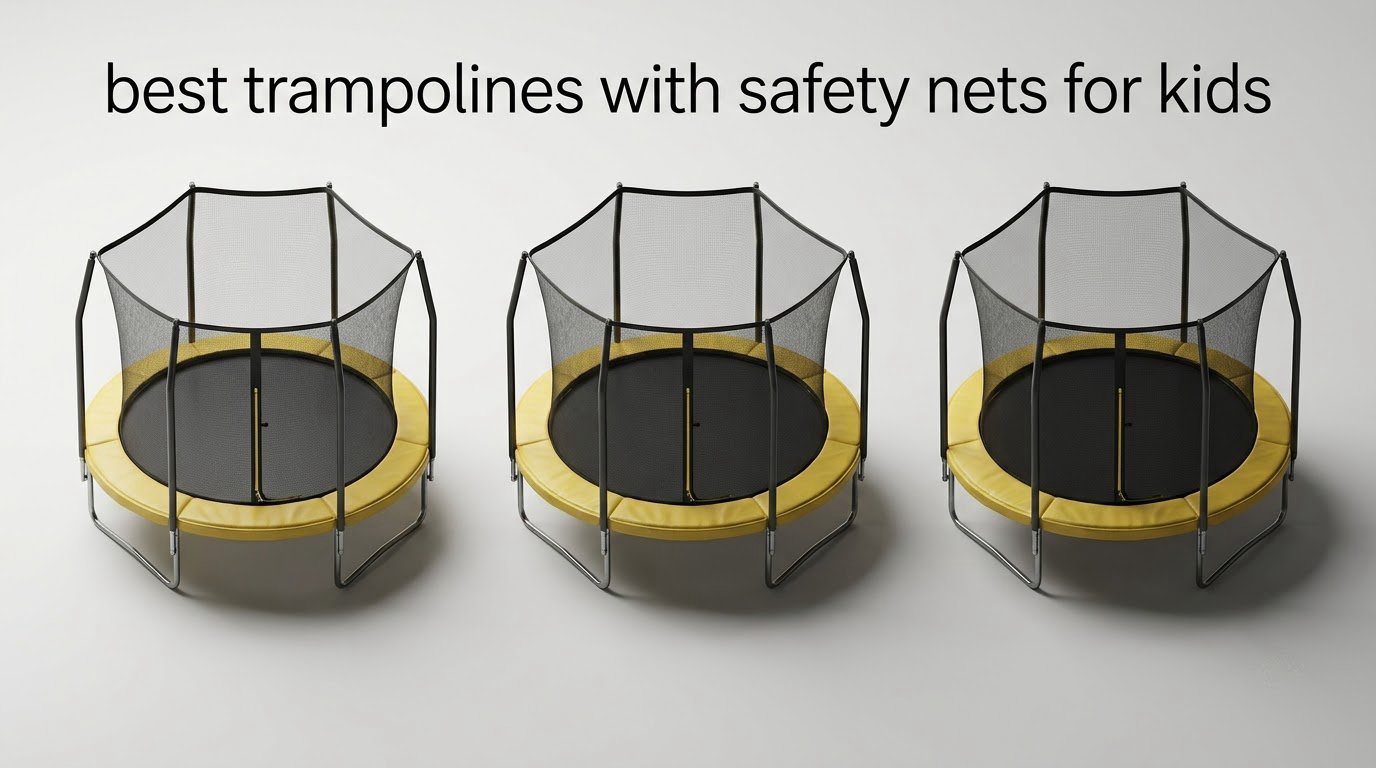
Every family that buys a trampoline for children ends up asking the same question, usually after the first visit to a friend’s yard: does the net actually keep a kid from bouncing off the edge? The honest answer is that a net only helps when it is tall, taut, gapless at the mat edge, and zipped shut every single time. A floppy enclosure on a wobbly frame is decoration, not protection.
That is why the best trampolines with safety nets for kids are not defined by the size of the box they ship in. They are defined by the enclosure construction, whether the manufacturer states a certification standard, and whether the mat-to-spring gap is closed. Those three details decide more about injury risk than any accessory bolted onto the frame afterwards.
We spent weeks reading the review data on ten of the most-bought enclosed trampolines on the market, from compact indoor rebounders to 14-foot family models, and compared net height, closure type, pole shape, weight limits, and what owners actually say a year after assembly. If you want a broader look at enclosures specifically, our guide to the best trampolines with enclosures covers the frame and shape angle in more detail.
Top 3 Trampolines With Safety Nets for Kids in 2026
Jumpzylla takes the overall spot for the strongest combination of build quality, repair-part support, and the largest review base in this set. SKOK and AOTOB both deliver genuine low-to-the-ground frames that small children can climb without a ladder, while the VEVOR mini leads on owner satisfaction for toddlers. Here is the short version of the podium.

Jumpzylla 10 ft Round with Enclosure
- ASTM F381-16 certified
- Curved poles
- 64 springs
- 330 lb capacity

AOTOB 8 ft with Net and Zipper
- 400 lb capacity
- 5-year warranty
- U-shaped legs
- Extended zipper

VEVOR 55 inch Toddler Trampoline
- ASTM and CPC certified
- One-piece stitched mat
- 3-minute assembly
Every Pick at a Glance in 2026
All ten models below ship with an enclosure net, a spring cover, and a stated certification. They split cleanly into two groups: full-size above-ground frames built for a backyard, and compact rebounders built for playrooms, garages, and screened porches. The table lines up the deciding specs before you read the full reviews.
| Product | Specifications | Action |
|---|---|---|
| Jumpzylla 10 ft Round Trampoline with Net |
|
Check Latest Price |
 Skywalker 15 ft Jump N Dunk with No-Gap Net Skywalker 15 ft Jump N Dunk with No-Gap Net |
|
Check Latest Price |
| AOTOB 8 ft Trampoline with Safety Net |
|
Check Latest Price |
 ZCMHAXJ 55 inch Toddler Trampoline with Bar ZCMHAXJ 55 inch Toddler Trampoline with Bar |
|
Check Latest Price |
 SKOK 8 ft ASTM Trampoline with Tall Net SKOK 8 ft ASTM Trampoline with Tall Net |
|
Check Latest Price |
 Giantex 7 ft Hexagonal Trampoline with Net Giantex 7 ft Hexagonal Trampoline with Net |
|
Check Latest Price |
 JoyBerri 14 ft Trampoline with LED Lights JoyBerri 14 ft Trampoline with LED Lights |
|
Check Latest Price |
 Ativafit 60 inch Rebounder with Enclosure Ativafit 60 inch Rebounder with Enclosure |
|
Check Latest Price |
| VEVOR 55 inch Trampoline with Enclosure Net |
|
Check Latest Price |
 VGMiu 60 inch Indoor Trampoline with Net VGMiu 60 inch Indoor Trampoline with Net |
|
Check Latest Price |
1. Jumpzylla 10 ft Round Trampoline With Net: The Best Overall Pick
Jumpzylla Outdoor Trampoline with Net for Kids 8FT 10FT 12FT 14FT 15FT 16FT
- Largest review base in the category at more than 6k reviews
- Curved poles move impact zones away from jumpers
- Galvanized steel tubes and reinforced mat
- Responsive replacement parts support
- Sizes from 8 ft through 16 ft
- Snap-together legs feel less rigid under load
- Net zipper failed early on one unit
- Two people required for assembly
This is the model we kept coming back to while putting the list together. It carries 64 springs on a 10-foot round frame with a 330-pound recommended maximum, which is enough headroom for two children or one child and an adult without the mat feeling like it is near its limit. The frame is galvanized steel tube with a thick reinforced mat, and the whole unit weighs 113 pounds, so it feels like a real piece of equipment rather than a light-gauge garden product.
The enclosure is where it earns the top spot. The poles are curved rather than straight, which pushes the impact zone away from the jumping surface, and the manufacturer states ASTM F381-16 certification for the safety design. There is a patented double-sided spring cover you can flip between two colors, so a torn face does not mean replacing the whole pad.
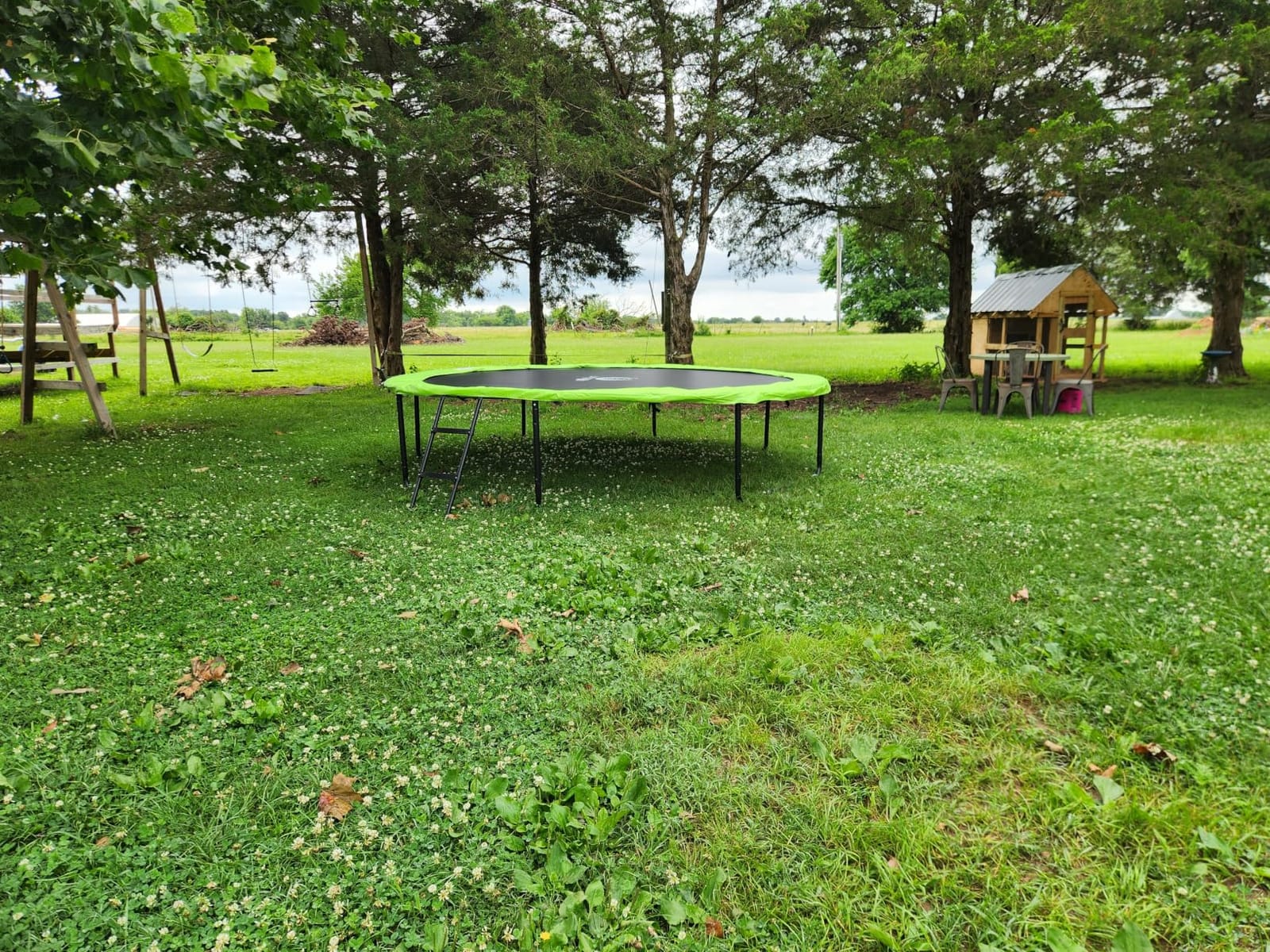
Owners consistently report that assembly was straightforward with clear instructions and included tools, and that the springs and frame hold up with multiple jumpers on at once. The 10-foot footprint measures 135 inches by 135 inches by 94 inches tall, and the box includes the enclosure net, ladder, wind stakes, and instruction manual. The ladder matters more than it sounds: a 10-foot frame is effectively a wall to a five-year-old.
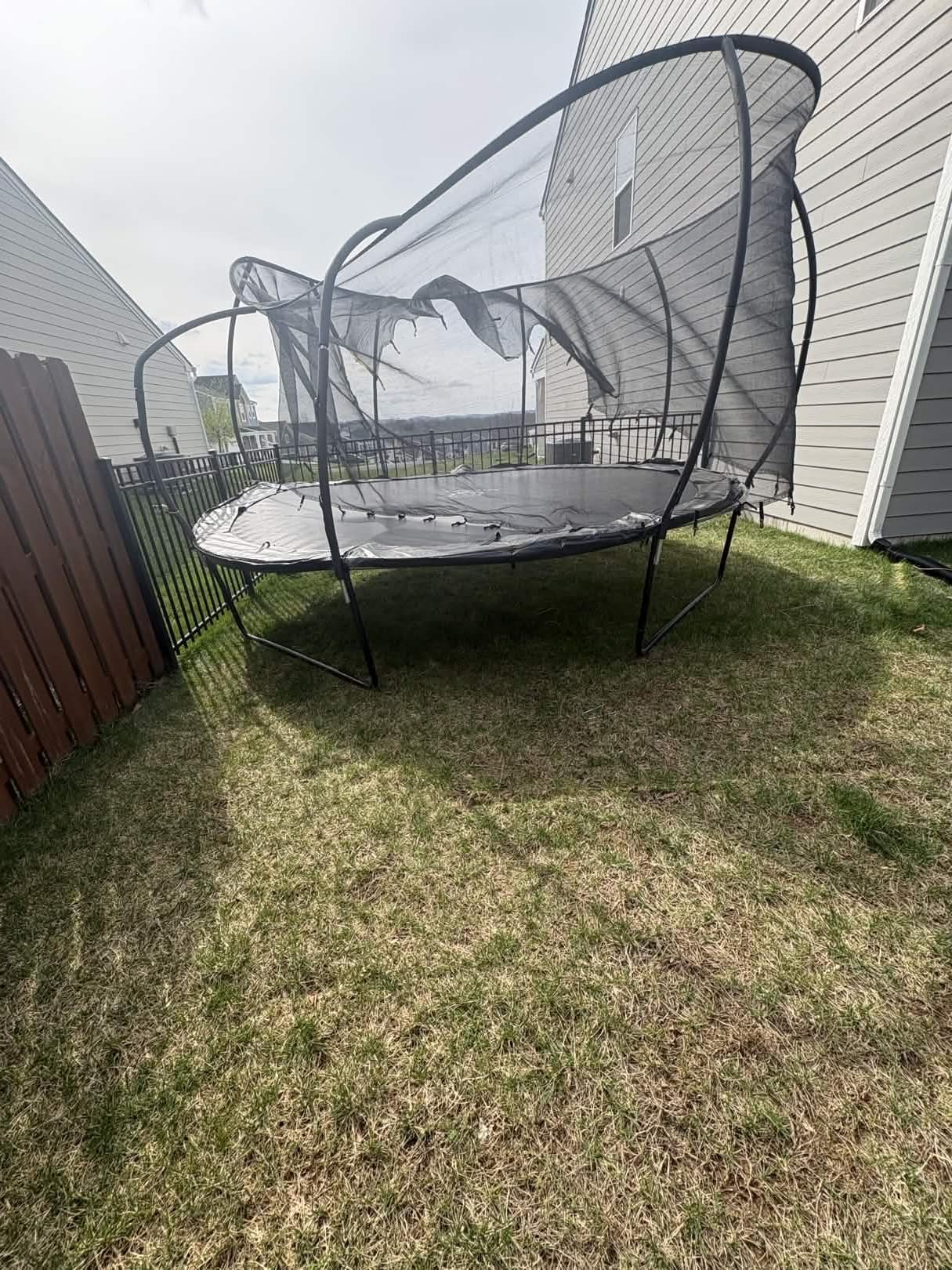
The recurring criticisms are narrow but real. The legs use lighter snap-together metal and can feel less rigid than the upper frame, and one reviewer reported the net zipper breaking after about a month. A few owners also noted small gaps near the bottom of the net that very small feet could theoretically reach, and the legs can shift in windy weather if you skip the included ground stakes. A 1-year manufacturer warranty is on the short side of this group.
Why we picked it over the 12-foot and 14-foot versions
The same model family comes in 8, 10, 12, 14, 15, and 16 foot sizes, and the 10-foot is the sweet spot for a typical suburban yard. Below 10 feet, two children genuinely struggle to pass each other. Above 12, the frame demands clear ground and more supervision than most families have time for. The 10-foot also gives you a jumping area that works for a 25-pound six-year-old and a 150-pound teenager in the same session.
Warranty length is where this one gives ground, and we want to be upfront about it. The Jumpzylla carries a 1-year manufacturer warranty, though spare parts are listed as available in the EU for two years, and the support team has a track record of shipping replacements quickly. If a longer frame warranty matters to you, the AOTOB in this list runs five years.
Where this one falls short
The gap at the bottom of the net is the detail we would not gloss over for families with children under four. It is described by reviewers as theoretical, and in practice the curved poles plus the spring cover make it hard to reach, but it is not a true no-gap system like the one the Skywalker uses. Parents shopping for a toddler who will still try to squeeze under things should look at a compact rebounder instead, such as the VGMiu or the VEVOR, where the mat-to-net gap is fully covered by frame pads.
Assembly is a firm two-person job. The spring tensioning in particular is not realistic solo, and the snap-together leg design means you want a second adult holding the frame square while you work. Budget an hour and a half, and read the manual before you open the springs.
2. Skywalker 15 ft Jump N Dunk: Best No-Gap Enclosure
Skywalker Trampolines 15 Foot Jump N Dunk Round Trampoline with Enclosure-Basketball- Camo
- Patented no-gap enclosure removes mat-to-spring gaps
- Reinforced T-sockets at every leg joint
- Tested to 4x max user weight
- Survived multiple hurricanes per owners
- Fun foam basketball with breakaway rim
- No ladder included with the enclosure
- Replacement parts can be hard to source
- Needs at least two people to assemble
Skywalker takes a different approach to the safety problem, and it is the approach the safety-first crowd argues for. Instead of bolting the net outside the springs, the enclosure attaches at the mat edge so there is no gap at all for fingers or feet to slide into. The listing cites a patent number for the no-gap system, which is the kind of detail that tells you the design is deliberate rather than incidental.
The frame is galvanized steel with reinforced T-sockets at each leg and each enclosure joint, and the company states these trampolines are tested to four times the maximum user weight. At 15 feet with 96 springs and a 275-pound recommended limit, this is the largest jumping surface in the group and the one built for older kids and serious bouncing. The enclosure net and jump mat are both UV-protected polyethylene and polypropylene.
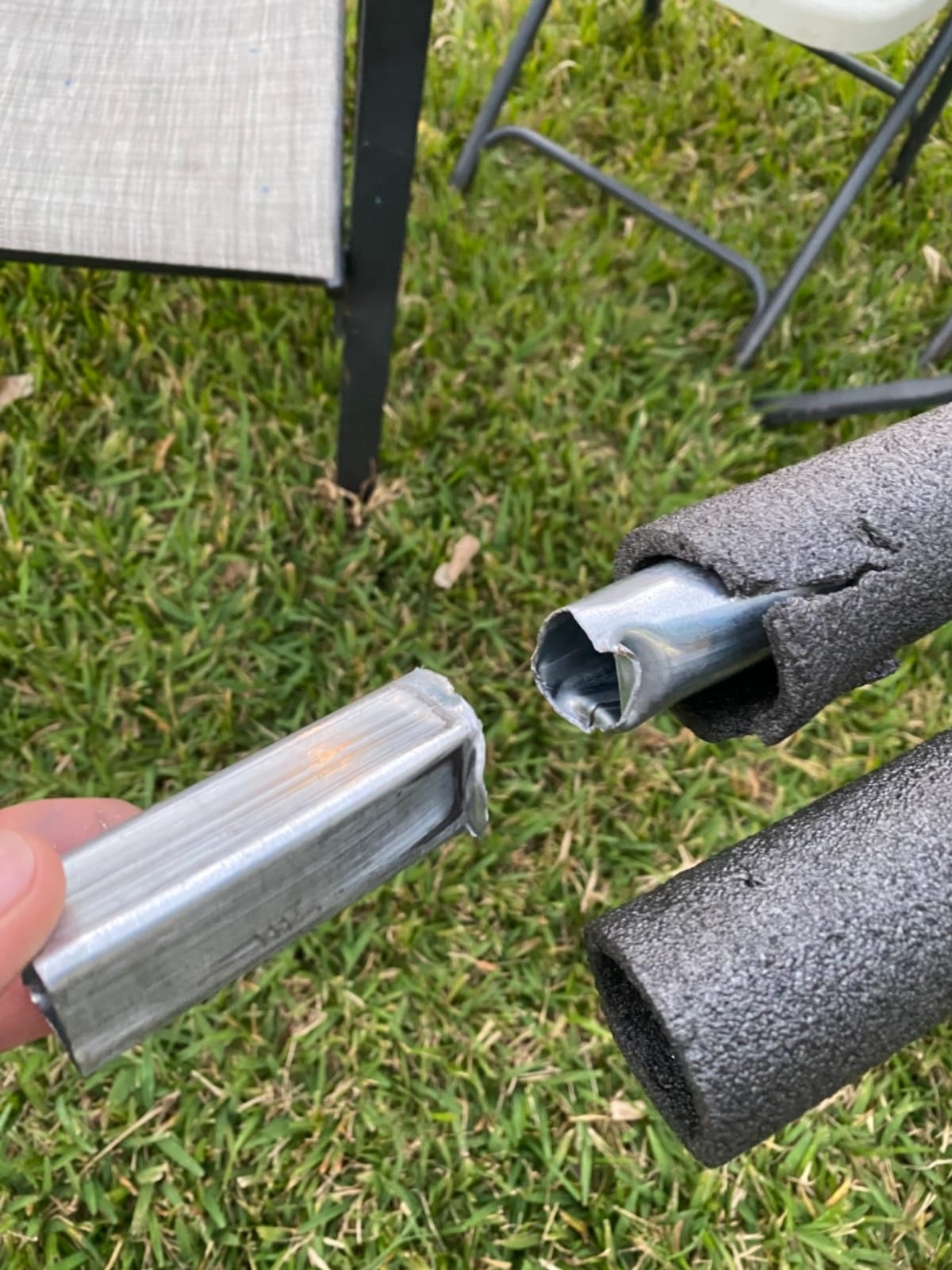
Owners describe the build as sturdy and durable, with several noting it has withstood multiple hurricanes in place. They specifically credit the safety sides and padded poles with preventing injuries that would otherwise have happened, and the two-person assembly is described as relatively simple. The foam basketball with a hook-and-loop breakaway rim on elastic cords is a genuine hit with older children, and the camo finish disappears into a garden rather than looking like equipment.
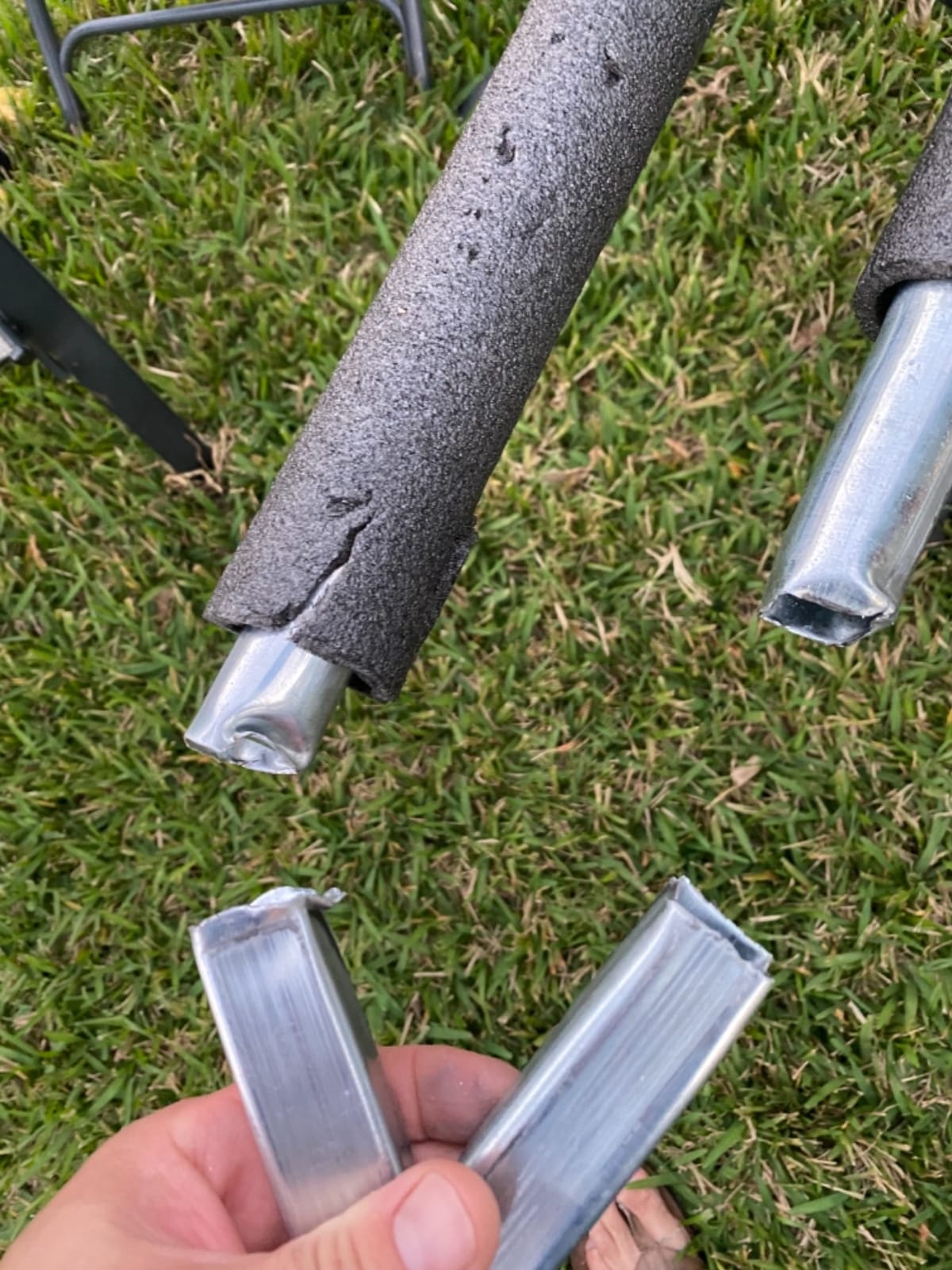
The gaps are about what is not in the box. No ladder is included, which on a 15-foot frame is a real problem for a six-year-old, and one reviewer reported stripped assembly screws along with loud use noise. Replacement parts can be hard to source, which matters given the 3-year limited frame warranty and only 1-year limited warranty on other materials. The net, pad, and springs all fall into that shorter window.
What the no-gap design actually solves
The mat-to-spring gap is the single most common source of trampoline finger and foot injuries, and it is the part a net bolted to the outside poles cannot protect. In a no-gap system the mat edge and the net bottom meet at the same point, so there is no exposed coil for a child to land on or reach into. That is a structural difference, not a marketing one, and it is the reason this model shows up in safety-focused roundups ahead of higher-rated but conventionally enclosed units.
The tradeoff is usable jumping area. Because the net mounts at the mat edge rather than out at the frame, the enclosure consumes none of the bounce surface, so the 15-foot mat stays 15 feet. For families with two or three kids bouncing at once, that is worth more than the soft outer ring you get on an outer-mount design.
When this is the wrong pick
Two situations rule it out. First, if your yard cannot give a 15-foot round frame plus the recommended clearance on every side, this is physically unworkable and you should be looking at a 10 or 12-foot model. Second, if your children are under seven, a 15-foot frame with no included ladder means you are lifting them or building a platform yourself, and neither is a good trade for the safety gain.
Also worth noting: at 86 reviews, this listing has the smallest review base in the entire group. The design is well made and owners are enthusiastic, but you are relying on a thinner evidence base than the models with thousands of reviews behind them. The 3-year frame warranty is the longest in this lineup.
3. AOTOB 8 ft Trampoline With Net: Best for Big Families
- 400 lb capacity is unusually high for 8 ft
- 5-year warranty is the joint longest here
- 3 U-shaped legs on 6 contact points
- Jump pad and spring cover sit close together
- All accessories arrive in one box
- Frame size varies by variant on the listing
- Protective cover recommended to protect mat appearance
The AOTOB solves a specific problem well, which is fitting more weight into a small footprint. A 400-pound recommended maximum on an 8-foot round frame is the highest capacity-to-size ratio here, and it runs in sizes from 8 to 15 feet so the same design scales with your family. The thickened anti-rust steel structure sits on three U-shaped legs with six contact points, which is what keeps the frame from twisting when two children land on opposite edges.
On the safety side, two details stand out. The jump pad and the spring cover sit close together specifically to reduce foot-entrapment risk, which is the same problem the Skywalker’s no-gap design attacks from a different angle. The zipper is lengthened and fitted with more buckles, so a parent can open a wider entry and a child cannot slip the closure one-handed. Foam sleeve padding runs along the frame to prevent injury on contact.
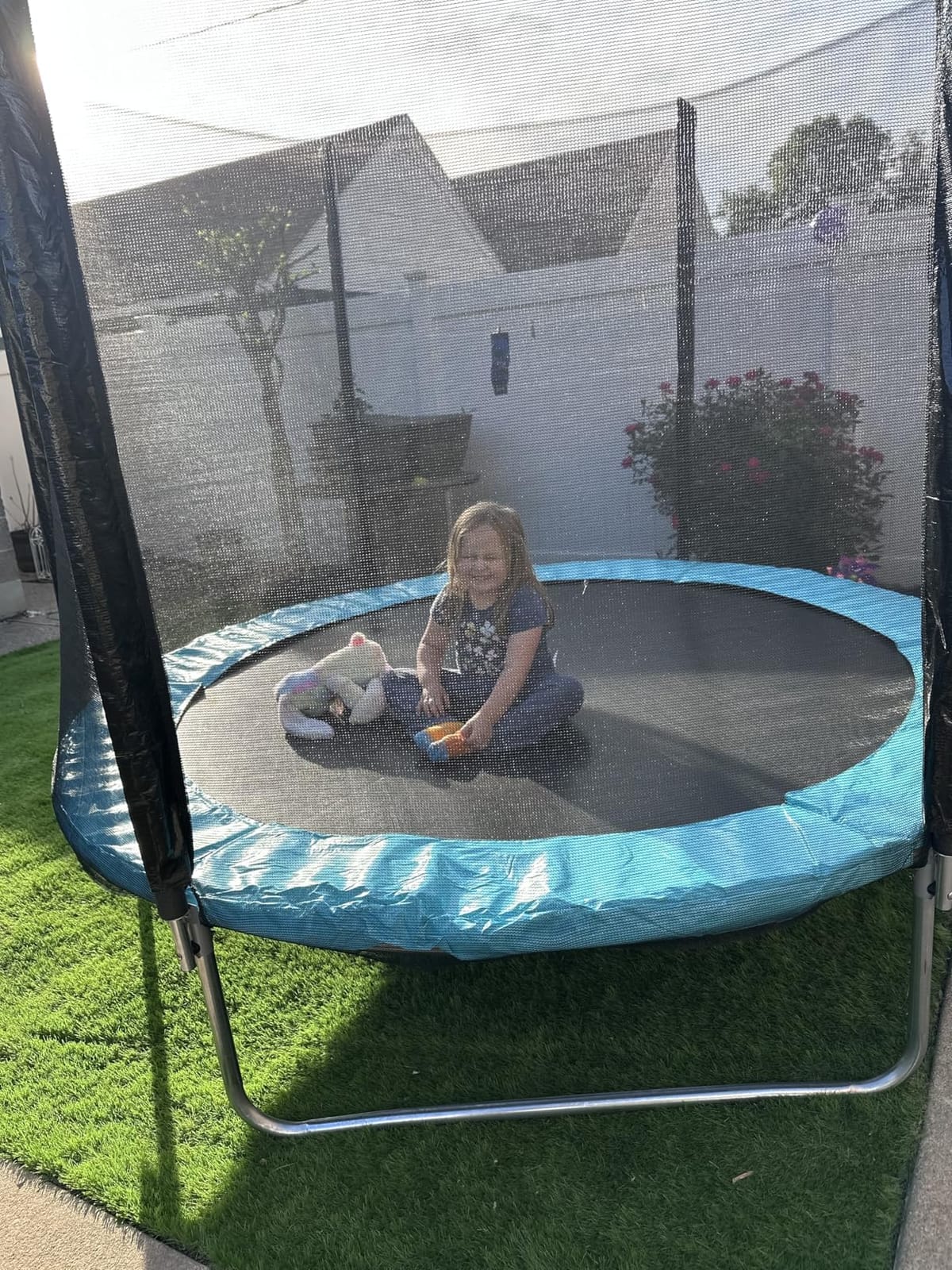
Owners highlight the 400-pound capacity as the headline benefit, along with the fact that everything arrives in a single box, which removes the multi-delivery headache that plagues some brands. The wear-resistant PP jumping mat resists outdoor fading, and the 5-year warranty is the joint-longest in this group, which is rare at this size and point in the range. At 60.8 pounds, it is also one of the lighter full-size frames to wrestle into position.
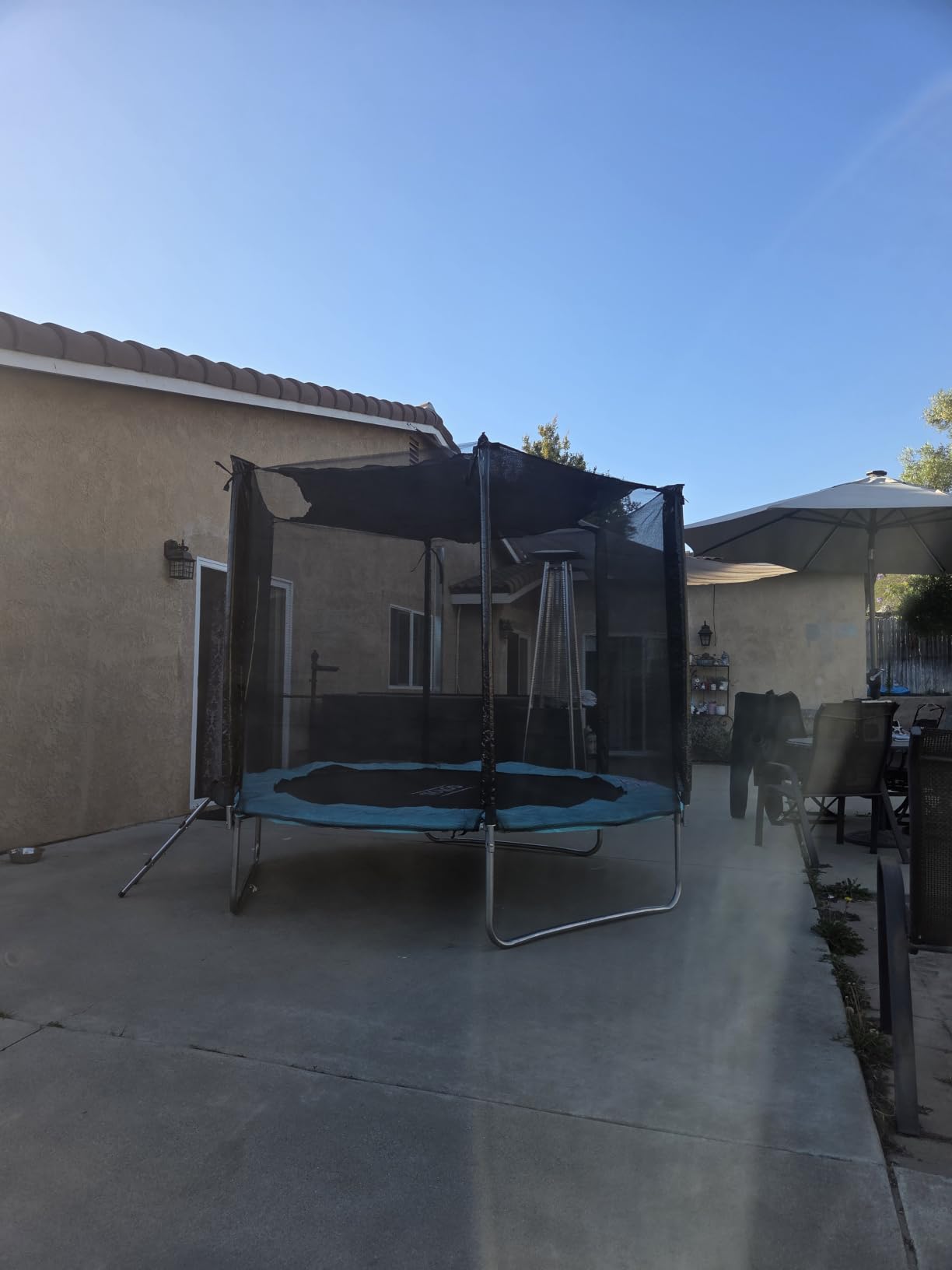
The complaints are mostly about the shopping experience rather than the product. The listing covers many sizes, so the exact frame size varies by variant, and buyers need to check carefully which one they are selecting. A protective cover is recommended to preserve the appearance of the mat over time. The 8-foot model measures 96 by 96 by 20.9 inches, so the low frame is a genuine plus for small children.
Why the low frame matters more than the capacity number
The single most useful thing about an 8-foot model is height. The frame sits at 20.9 inches, so a four-year-old can climb on without a ladder, and a fall off the edge is a step down rather than a drop. For households with a 3-year-old and a 7-year-old sharing one trampoline, that is the difference between the trampoline getting used and the trampoline sitting unused behind a fence.
The 400-pound figure is a recommended total user weight, not a per-jumper limit, and brands quote these numbers inconsistently. The practical rule we use: for a single jumper, stay well under the stated maximum; for two children, add their weights plus a margin and check it against the number before you buy. If a listing gives you a total number with no breakdown, that is a reason to be cautious rather than encouraged.
Who should skip it
If your children are older than about nine and bounce hard, a 42-spring 8-foot mat will feel soft and low compared with the 96-spring Skywalker or the 79-spring JoyBerri. Younger children in a small yard are the exact audience this serves well, and anyone planning to move up to a full-size trampoline within a few years should probably start one tier higher to avoid replacing it.
The other limitation is bounce consistency over time. Reviewers of budget full-size frames consistently report that jump quality drops off within a season or two, with spring rust as the first visible sign. Pairing the trampoline with a cover and checking the springs each spring is a small chore that extends the useful life considerably.
4. ZCMHAXJ 55 inch Trampoline With Gymnastics Bar: Best Indoor Activity Set
ZCMHAXJ 55″ Trampoline for Kids with Enclosure, 440lbs Capacity Indoor & Outdoor Toddler Trampoline with Adjustable Gymnastics Bar & Toys, Gifts for Boys & Girls
- Fits inside a living room or small patio
- Five accessories keep toddlers busy
- Suction pads keep it quiet and stable
- Adjustable 3-level gymnastics bar
- Handles rough play from multiple children
- Safety net has no dedicated tie point so fabric bunches
- Base frame can snap apart without screws
- Thin foam pole sleeves tear easily
- Instructions are poorly printed
This is the least conventional pick in the group, and it is here because a large share of families buying a trampoline with a safety net are buying an indoor play station rather than a backyard bounce surface. At 55 inches square and 11.2 inches tall, it stores against a wall and weighs 14.15 kilograms, which is a manageable thing to move between rooms. The carbon steel frame sits on three U-shaped legs with non-slip suction pads, so it is quiet on a hard floor and does not creep while a child jumps.
The feature that separates it from other mini trampolines is the 3-level adjustable and removable gymnastics bar, which turns the same frame into a hanging station for rings, a hammock, or the included sandbag. A 360-degree wrap-around safety pad and dense netting cover the frame, and the listing states a 440-pound maximum recommendation. Five accessories ship in the box: boxing gloves, a hammock, ocean balls, rings, and a sandbag. Six colour options are available.
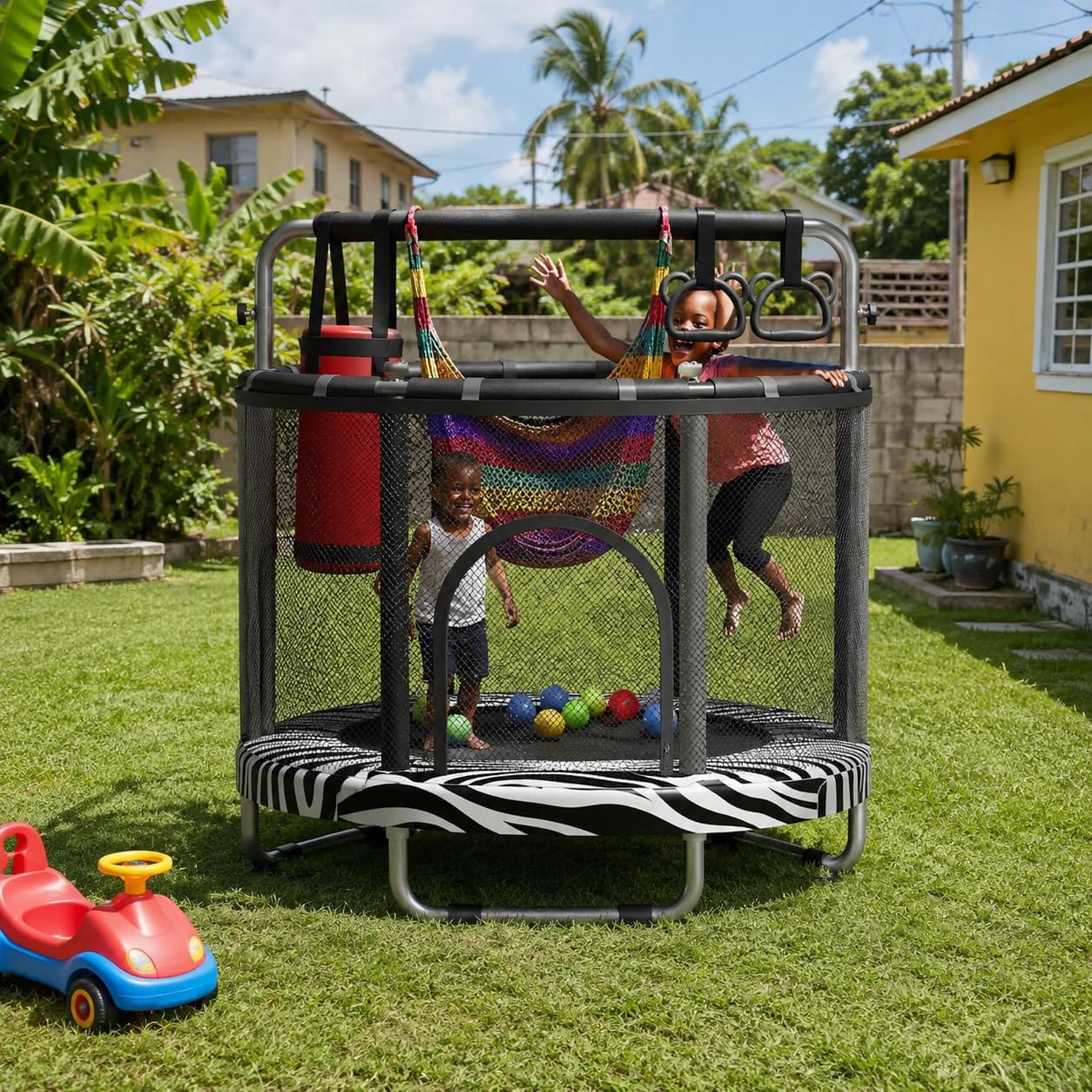
Families like the compact footprint, the accessory bundle, and the fact that it holds up to rough play from multiple children. The suction pads are praised specifically for keeping it stable and quiet indoors, and the included toy set keeps toddlers engaged for long sessions without a screen. It carries a 1-year manufacturer warranty.
It is also the lowest-rated model here, and the reasons are consistent. The safety net has no dedicated tie attachment point, so the fabric scrunches where it should tension, and several owners point to that as a factor in the net not sitting taut. The base frame pieces can snap apart under tension because they lack screws, the thin foam pole sleeves and spring covers tear easily, and the printed instructions use blurry diagrams with no guidance for the accessories. It needs two people to assemble.
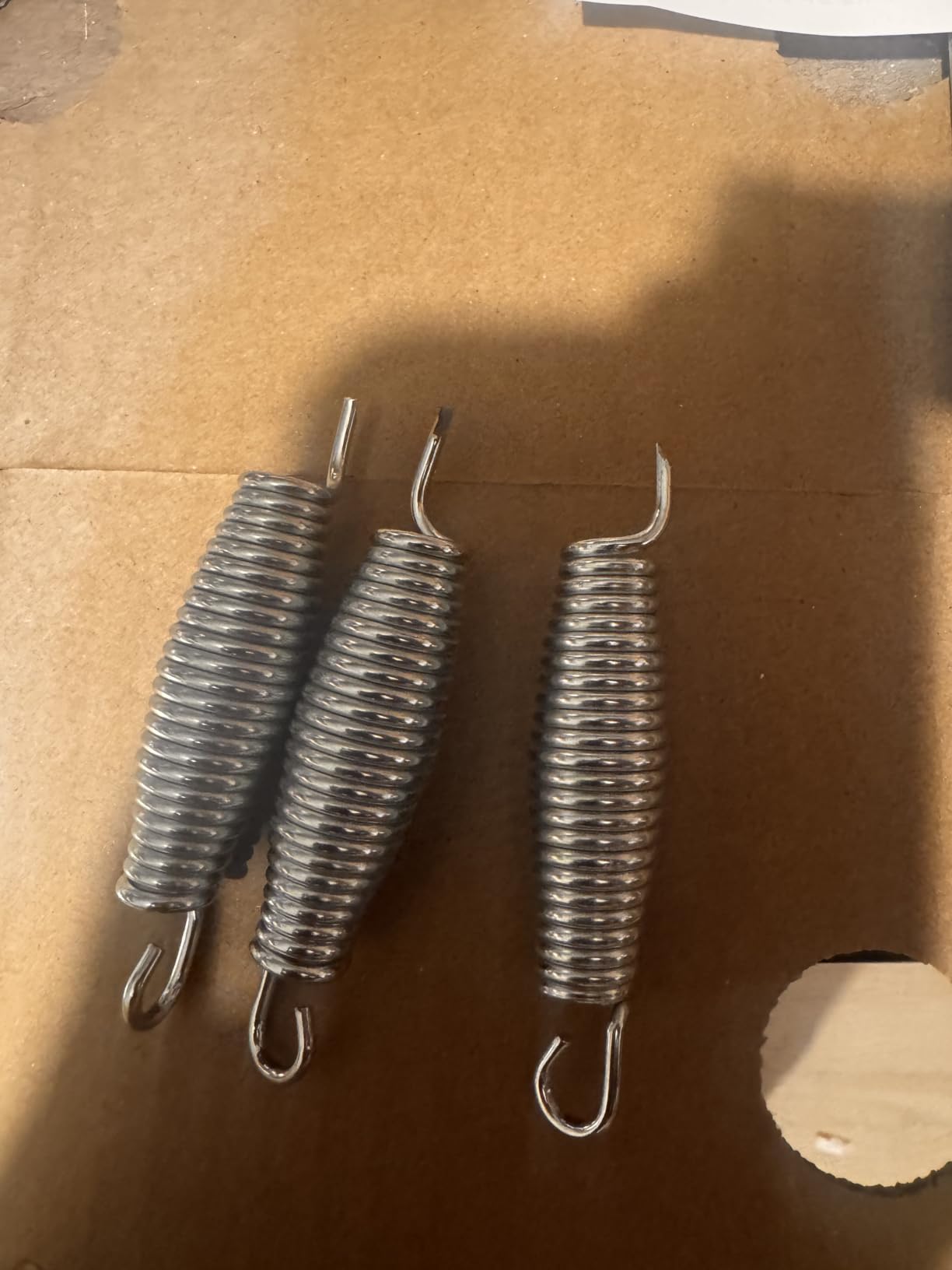
Is a 440-pound capacity claim meaningful on a 55 inch trampoline?
Take it as a static structural rating rather than a real-world jumper limit. A 55-inch mat with 36 springs gives a 4-year-old about 12 inches of bounce, which is safe but modest. The stated figure is more about frame strength than about what the surface is built to deliver, and it is exactly the kind of number that reads as reassuring without being a guide. Judge the bounce on the spring count and mat size instead, which is why we read all three together.
The gymnastics bar is the part that earns its keep. Families report it works for a toddler hanging from the bar while another child jumps, and it keeps a 2-year-old occupied on days when the weather keeps everyone indoors. If you are buying purely for bouncing, this is over-featured and a simpler rebounder is the better spend.
Who should not buy this one
Anyone treating it as a primary outdoor trampoline should pass. The carbon steel frame and foam padding are not built for weather exposure on the scale of the full-size models here, and the lack of a proper net tensioning point means the enclosure is the weakest safety feature in the lineup despite being one of the most prominent features on the page.
It is also the hardest to score confidently on a 4.1 average with more than 2,800 reviews. That rating is not disqualifying for a toddler indoor station, but it is a clear signal that assembly quality and hardware finish are the weak points. Set aside an extra 30 minutes for assembly, and check the base connections are seated fully before anyone jumps.
5. SKOK 8 ft ASTM Trampoline: Best Value Full-Size Pick
SKOK Trampolines 8FT Kids Trampoline with Enclosure Net, Trampoline Outdoor for Kids and Adults, Capacity 400lbs,ASTM Approved,Black
- Tallest net in the group at 4.9 ft
- Low frame is easy for small kids to climb
- Tested for 20000 jumps and mat tested 5000 hours
- Includes ladder plus grip gloves and socks
- Owners report durability after two years
- Spring installation really needs a helper
- Pad ties can be pulled off by children
- Net complicates moving it indoors
The SKOK is the pick we would tell most families to buy without overthinking it. It states compliance with ASTM 381 and ASTM F2225-15 along with ISO and BSCI approval, and it publishes the test protocol: trampolines tested for 20,000 jumps, with mats tested up to 5,000 hours. Very few listings in this category put numbers like that in front of buyers, and it is the single most useful thing to look for when you cannot test the product yourself.
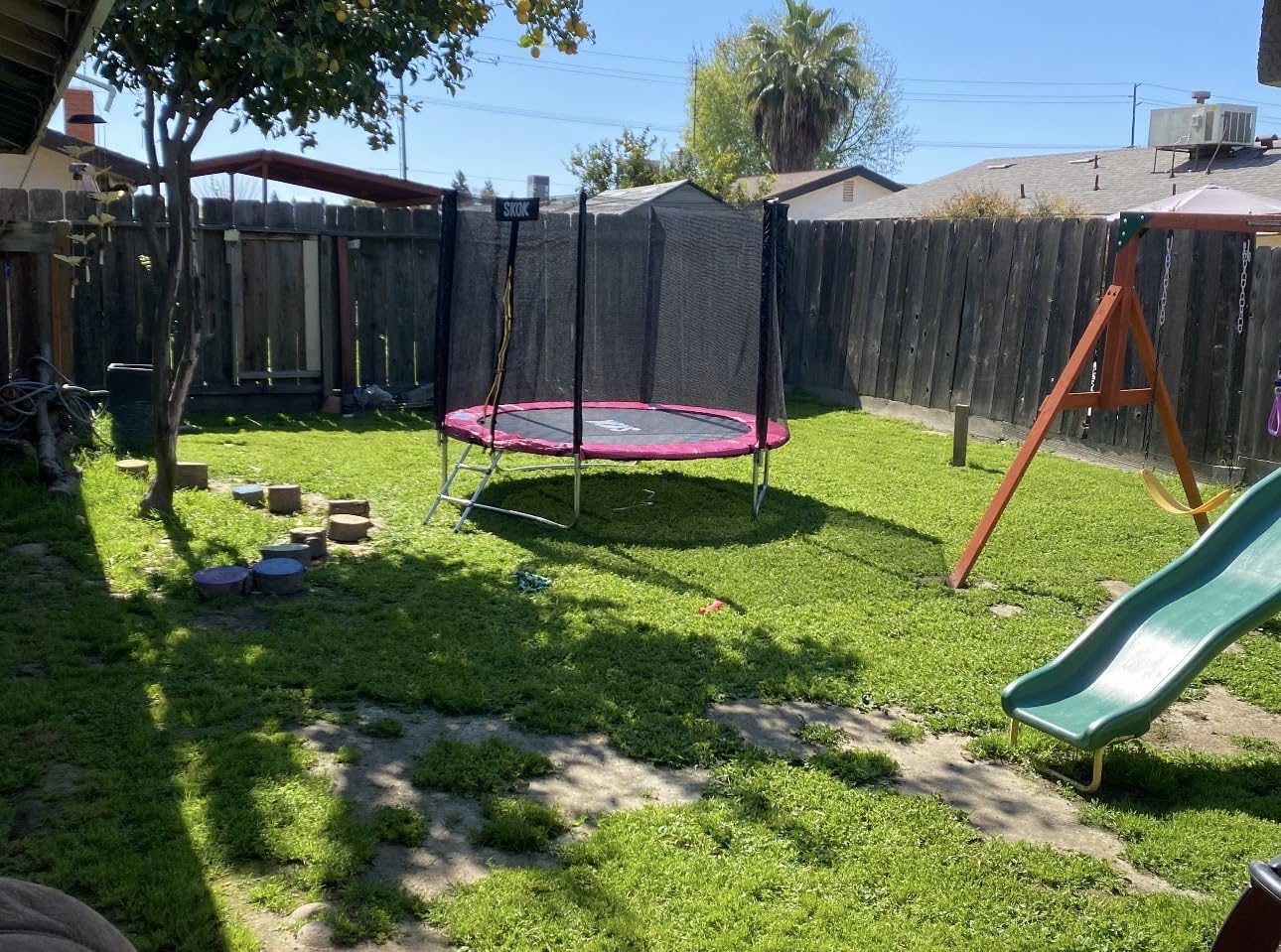
The enclosure is a 4.9-foot-high net with a zipper and buckle closure, the tallest specified net height among the full-size models here. Six EPE foam and PVC-covered poles protect the frame, and a 14-millimetre foam spring cover sits over the springs. Underneath, dual-side galvanized steel with a wear-resistant zinc coating and three U-shaped legs carry 42 patented heavy-duty springs and an 8-row stitched PP mesh mat rated to 400 pounds.
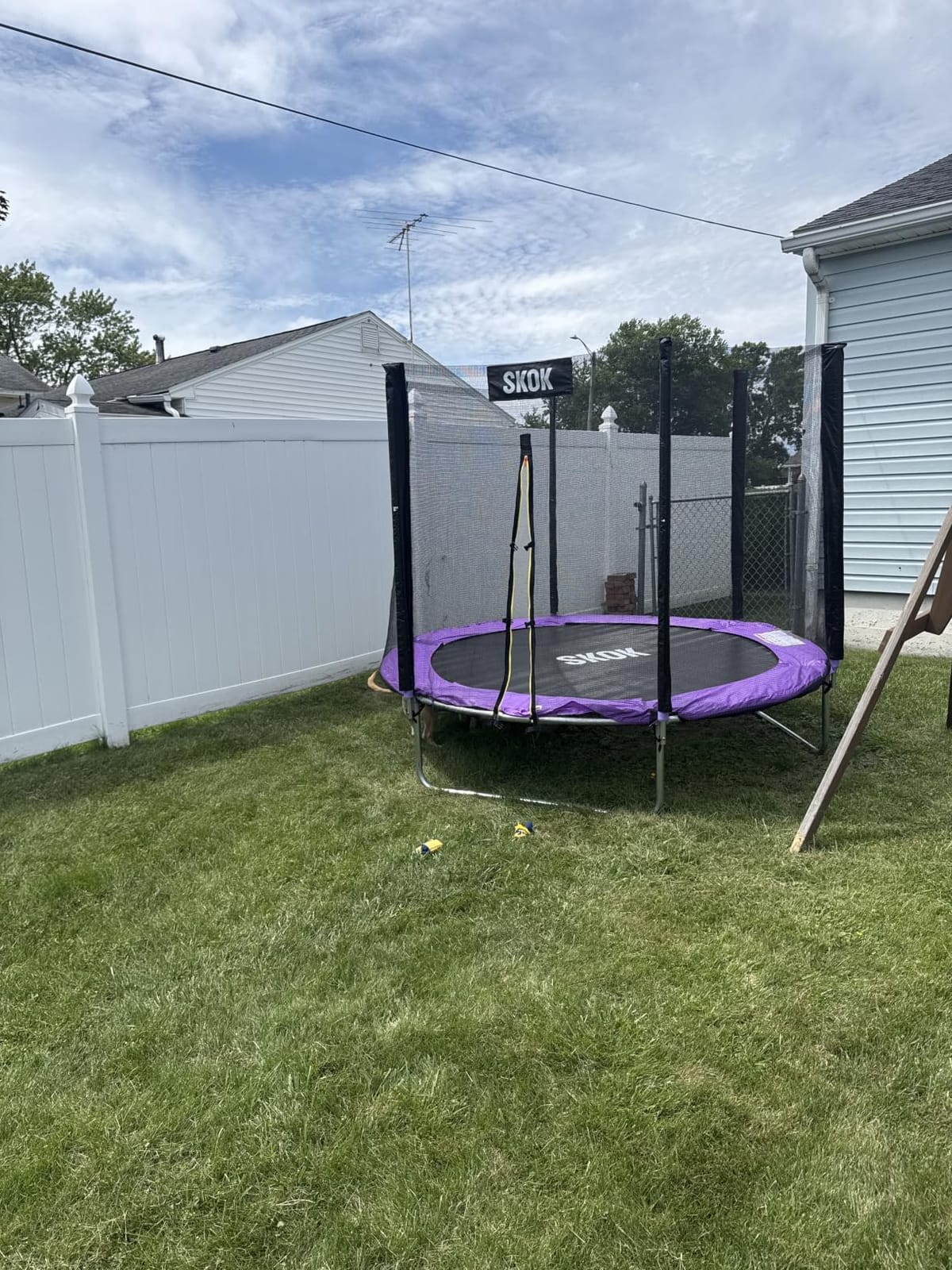
What owners consistently praise is the combination of bounce and enclosure height. The mat is described as bouncy and comfortable enough for flips and sit-to-stands, the frame is low to the ground for small children, and it is sturdy enough to hold several children at once. The box also includes a 2-step ladder plus grip gloves and socks, which is a genuinely thoughtful bundle that most competing listings leave out. The unit weighs 77 pounds and measures 96 by 96 by 21.6 inches.
Minor complaints only: spring installation takes real effort and benefits from a helper, the pad ties can be pulled off by children who treat them as toys, and the net makes the trampoline awkward to move indoors. Reviewers who have owned it for two years describe the bounce as still holding up, which is the durability signal you want to see at this level.
Why enclosure height changes the outcome
Most falls off a trampoline are not wild leaps over a tall net. They are short bounces at the edge while a child is distracted, and what stops those is net height combined with a taut bottom edge. At 4.9 feet, a seven-year-old bouncing hard in the middle of the mat is not going to clear the enclosure, and a distracted five-year-old bouncing low is contained by the height rather than sailing over it.
That is also why zipper discipline comes up so often in owner discussions. A net with a buckle closure only works if the buckle is done up. This model uses a zipper plus buckle, which is a two-step system that a determined four-year-old will eventually defeat, so the closing habit belongs to the adult, not the child.
Where the trade-offs sit
This is an 8-foot round frame with 42 springs, so it lands in the same performance band as the AOTOB rather than above it. Where it beats the AOTOB is documented testing and the 4.9-foot net. Where it falls behind is the 5-year warranty the AOTOB carries, and the mat-to-net transition, which is padded but not the true no-gap construction the Skywalker uses.
If your yard gives you room for 10 to 12 feet, do not stretch an 8-foot model to fill it. Two children passing each other on a 42-spring mat is a collision risk in itself, and the net does nothing about a collision mid-mat. Match the size to how many kids will actually be on it at once, and treat the one-jumper rule as the real fix.
6. Giantex 7 ft Hexagonal Trampoline: Best for Basements and Garages
Giantex 7FT 84” Kids Trampoline for Toddlers with Enclosure Net, ASTM Approval & Widened Base for Indoor Outdoor
- Hexagonal shape fits low-ceiling basements
- Seamless waterproof pad removes spring snag points
- Double-closure side zippers with buckles
- Net mounts outside for a larger jumping area
- Can be moved indoors for winter
- Instructions are unclear and slow to follow
- Metal shavings reported in the box
- Pad coverage is thinner than ideal
- Support posts can pop apart without screws
The Giantex solves a geometry problem that round trampolines cannot. A 7-foot hexagonal frame measures 87.6 inches by 62 inches when assembled, so it slips into a corner, a garage bay, or a basement with a low ceiling where a round frame simply will not go. The shape uses the same material budget as a round 7-footer, which is why the 220-pound limit and 36 springs are unsurprising, and why this is a two-child trampoline rather than a family one.
The build is better than the size suggests. The frame is hot-dip galvanized pipe with galvanized steel running inside the base, and the base is a widened, curved U-shape for stability and tip resistance. The waterproof seamless pad cover has no stitching line for a sock to catch on, and the upper steel frame is foam covered. The high-density PE enclosure net is installed outside the frame, which keeps the jumping area larger than an inner-mounted net would, and two side L-shaped zippers with buckles provide double closure.
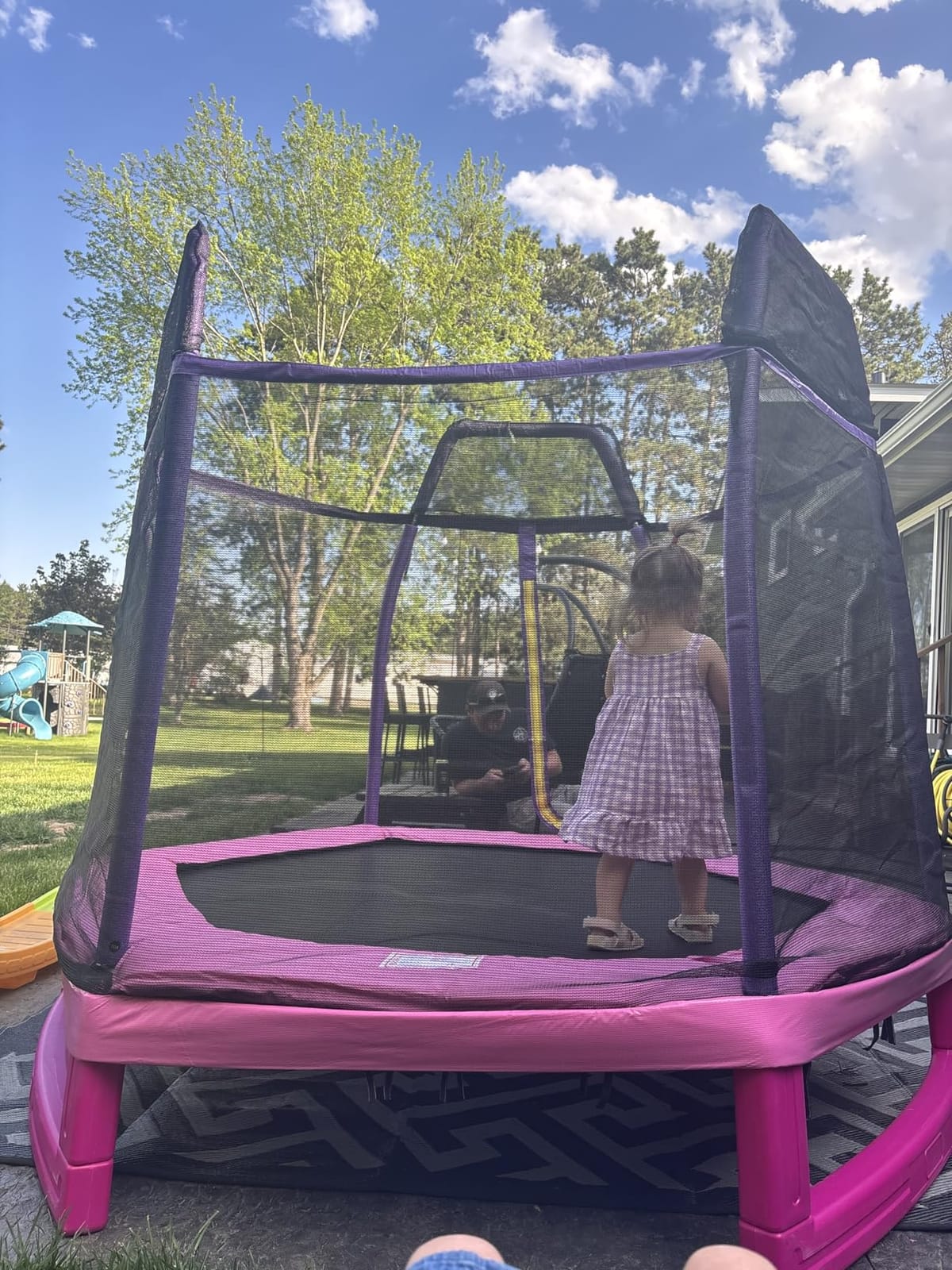
Owners report that the PE net is sturdy with no foot entrapment, that the seamless pad prevents anyone getting caught on the springs, and that the double-closure side zippers are straightforward for children to operate. The ASTM safety specification compliance is stated, and the listing positions it for ages 3 and up. At 56.5 pounds, it moves between rooms without a fight, which is what makes it a seasonal indoor unit as much as a permanent outdoor one.
The weak point is the build quality of the assembly itself. Instructions are unclear, and several owners reported metal shavings present in the box and on the parts before assembly. The vertical support posts can pop apart without extra screws, and spring pad coverage is thinner than ideal. Best suited to two children rather than a group, which is a limit worth taking seriously in a 7-foot hexagon.
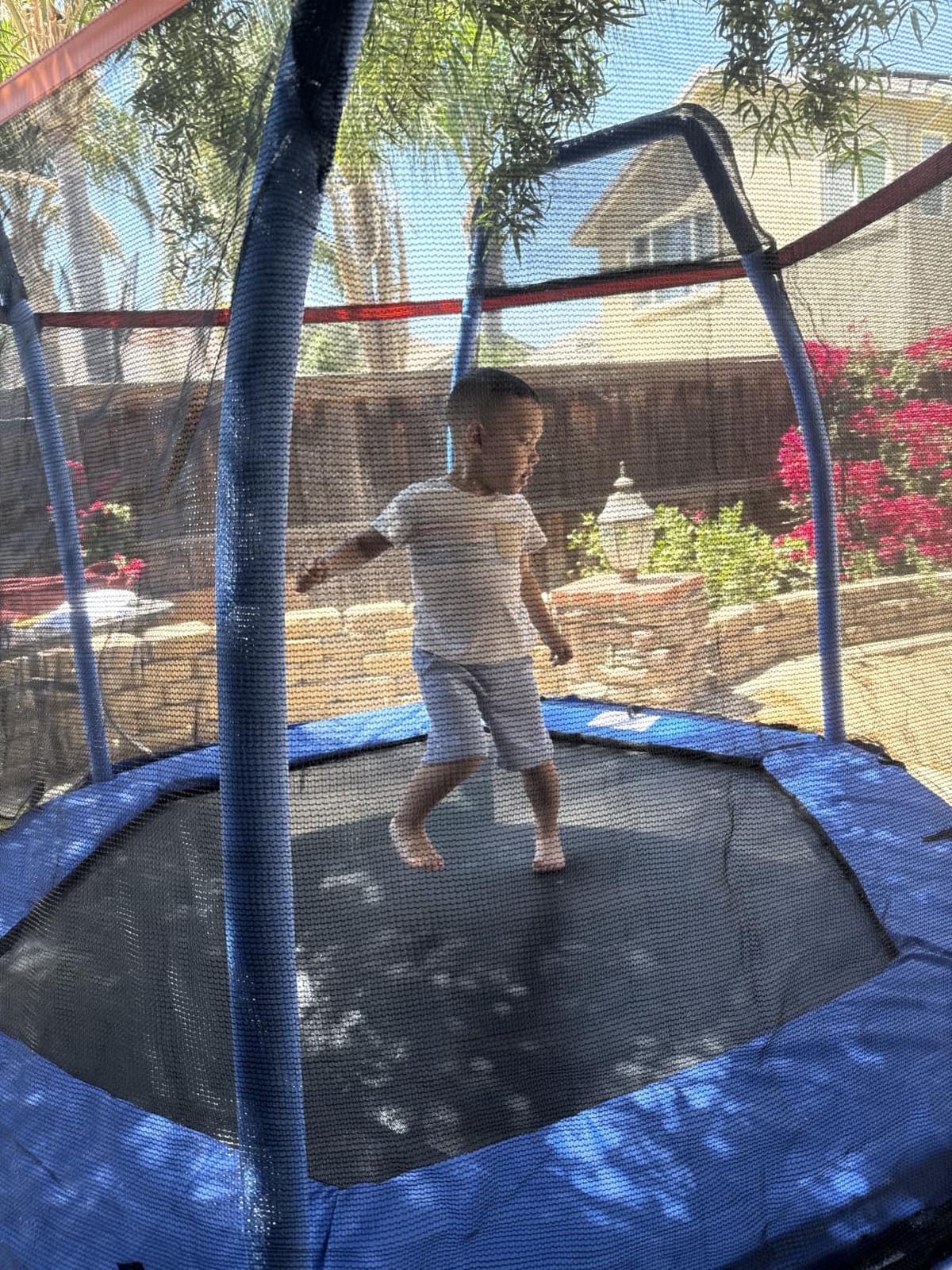
Hexagonal, square, or round: what the shape actually changes
Shape changes usable jumping area and fall exposure, not much else. A round frame has a single usable centre and naturally keeps a child in the middle, which is why pediatric guidance prefers it for younger jumpers. A rectangular frame offers a larger, more consistent bounce across the whole surface, which suits older kids and anyone practising skills. A hexagon sits between them: more corner-efficient than a square, more compact than a circle of the same area.
So the Giantex makes sense when the constraint is room shape, not performance. If you have an open, generously sized yard and two children over seven, a round or rectangular full-size model is the better buy. If you are working with a basement, a converted garage, or a narrow side yard, this footprint is the difference between having a trampoline and not having one.
When it is the wrong choice
Do not buy it for a 7-foot jumping requirement. At 220 pounds and 36 springs it is a kids’ unit, and the manufacturer says so with the 3-and-up positioning. An adult joining a child on the mat will overtax it quickly, and the reduced pad coverage that owners flag becomes more relevant as the load goes up.
Assembly is the other friction point. Clear the floor for metal debris before you start, and check every support post has seated and locked before the first jump. Plan on two people and more time than the manual implies. The 1-year manufacturer warranty is also the shortest in this group, which is one reason we placed it here as a secondary pick rather than higher.
7. JoyBerri 14 ft Trampoline With LED Lights: Best for Night-Time Fun
- Highest stated capacity at 450 lb
- LED system has 16 colours and 7 modes
- Sprinkler system included
- Ground stakes and ladder included
- Curved poles and gap-free net design
- Heaviest unit in the set at 143.5 lb
- Large footprint needs real yard space
The JoyBerri is the feature-forward option, and the feature is light. Integrated LED lighting offers 16 colours and 7 modes controlled by a remote, and an optional sprinkler system is included, so this is the trampoline that extends a summer evening rather than ending play at dusk. For families in areas where daylight hours are short, that is a genuine practical benefit and not just a novelty.
The safety design is credible on paper. The poles curve outward specifically to prevent collisions, and the listing describes an extra strong safety net with no gaps. The frame is rust-proof galvanized steel rated to 450 pounds, which is the highest stated capacity here, and it runs on 79 springs. The unit is ASTM certified and lab tested, ground stakes are included for the stability that a 14-foot frame needs in wind, and the 5-year protection plan comes with lifetime customer support.
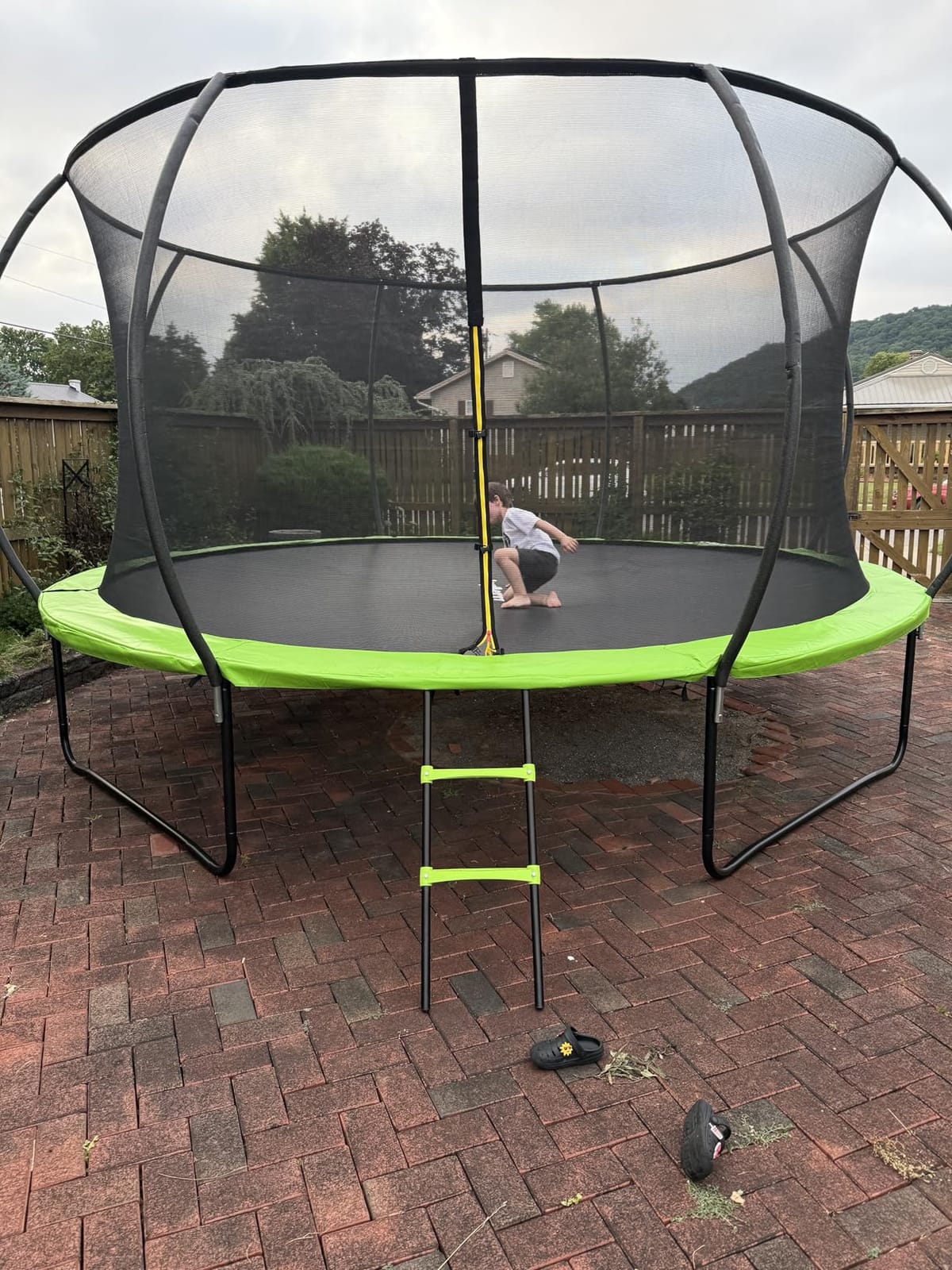
Owners are enthusiastic about the lighting and sprinkler as a play element, and the curved poles plus gap-free net design are cited as the reason the unit feels safe for the whole family. The 450-pound rating supports a household where an adult joins the kids, and the model is available in sizes from 8 to 16 feet, so the same design covers a smaller yard if 14 feet does not fit.
The obvious cost is weight. At 143.5 pounds this is the heaviest unit in the lineup by a wide margin, and it measures 168 inches square by 105.2 inches tall. Assembly and repositioning are correspondingly more involved, and you will want three people rather than two. A 14-foot round frame also demands real estate, so measure the footprint plus clearance before ordering rather than after.
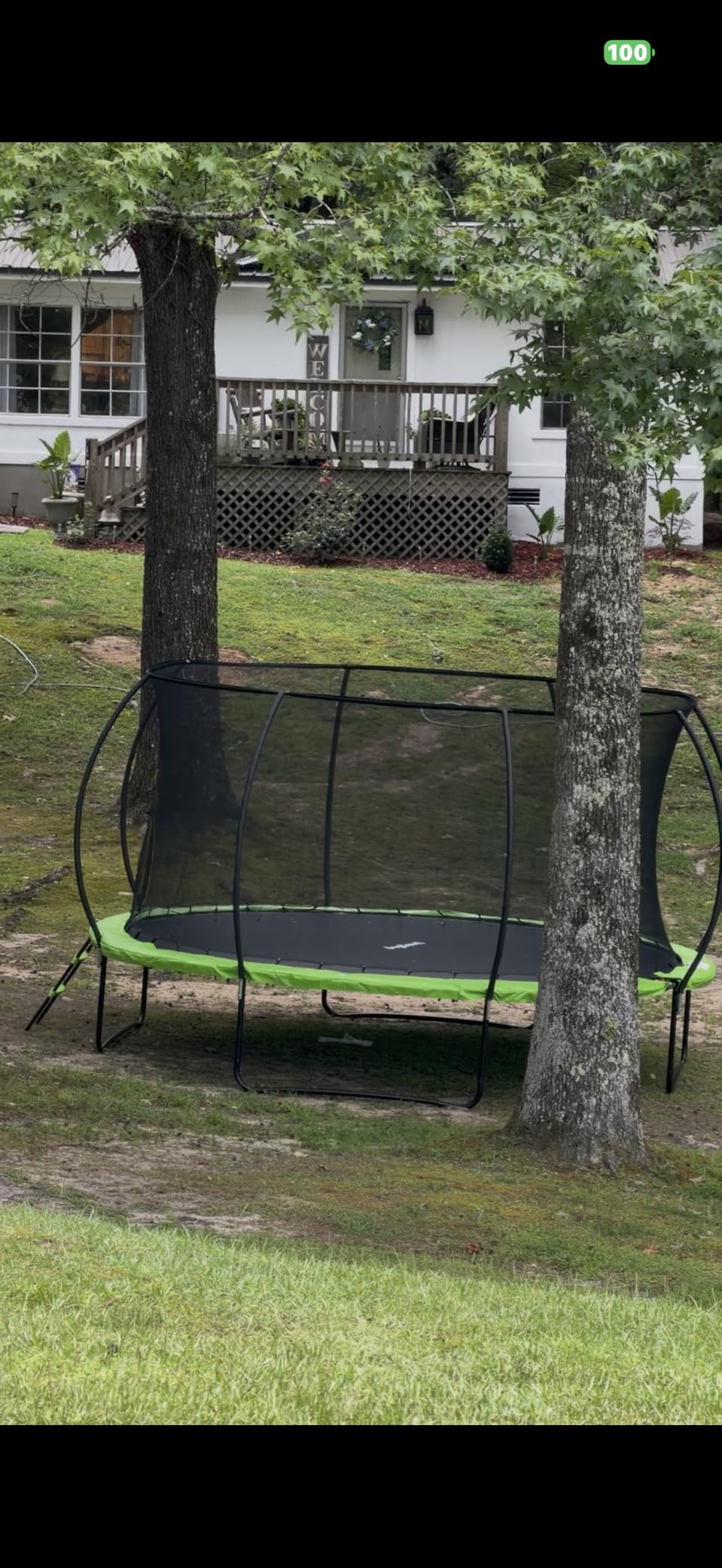
Does a 450-pound capacity change how you use it?
It changes who can be on the mat at once, which is the practical difference. A higher rating means an adult can join a child without approaching the structural limit, which matters in households where the trampoline is genuinely a shared activity rather than a kids’ zone with an audience. It does not make simultaneous multi-person bouncing safer, and it does not change the collision risk of two children on the same surface.
Read the number as a total across everyone on the mat at one time, and check it against the combined weight of the people you expect to use it. We also treat the 5-year protection plan as the strongest warranty position in this group when you factor in that spare parts are listed as available for five years in the EU.
Who this is not for
Skip it if your yard is small, full stop. A 14-foot round frame with net poles and the recommended clearance on all sides needs considerably more ground than most people assume, and the heavyweight steel makes it unforgiving to move once it is placed. The lighting and sprinkler are also more relevant in climates with long evenings than in ones where kids are outside all afternoon.
There is a fair argument for the 12-foot version of the same model in a mid-size yard, which keeps the LED system and the safety design while cutting roughly two feet off the diameter. If the accessories are what drew you here rather than the size, that is the version to look at first.
8. Ativafit 60 inch Rebounder: Best for Toddlers and Preschoolers
ATIVAFIT 60″ Indoor‑Outdoor Kids Trampoline Mini Rebounder with Safety Net & Hoop, Ideal for Toddlers and Children 1‑8
- Low to the ground so toddlers do not fall off
- Zippered enclosure for visible peace of mind
- Small footprint stores easily indoors
- Assembly is quick with clear instructions
- Good bounce for its compact size
- 80 lb limit rules out older children
- Needs securing or it can topple in wind
- Basketball pole mount broke for one buyer
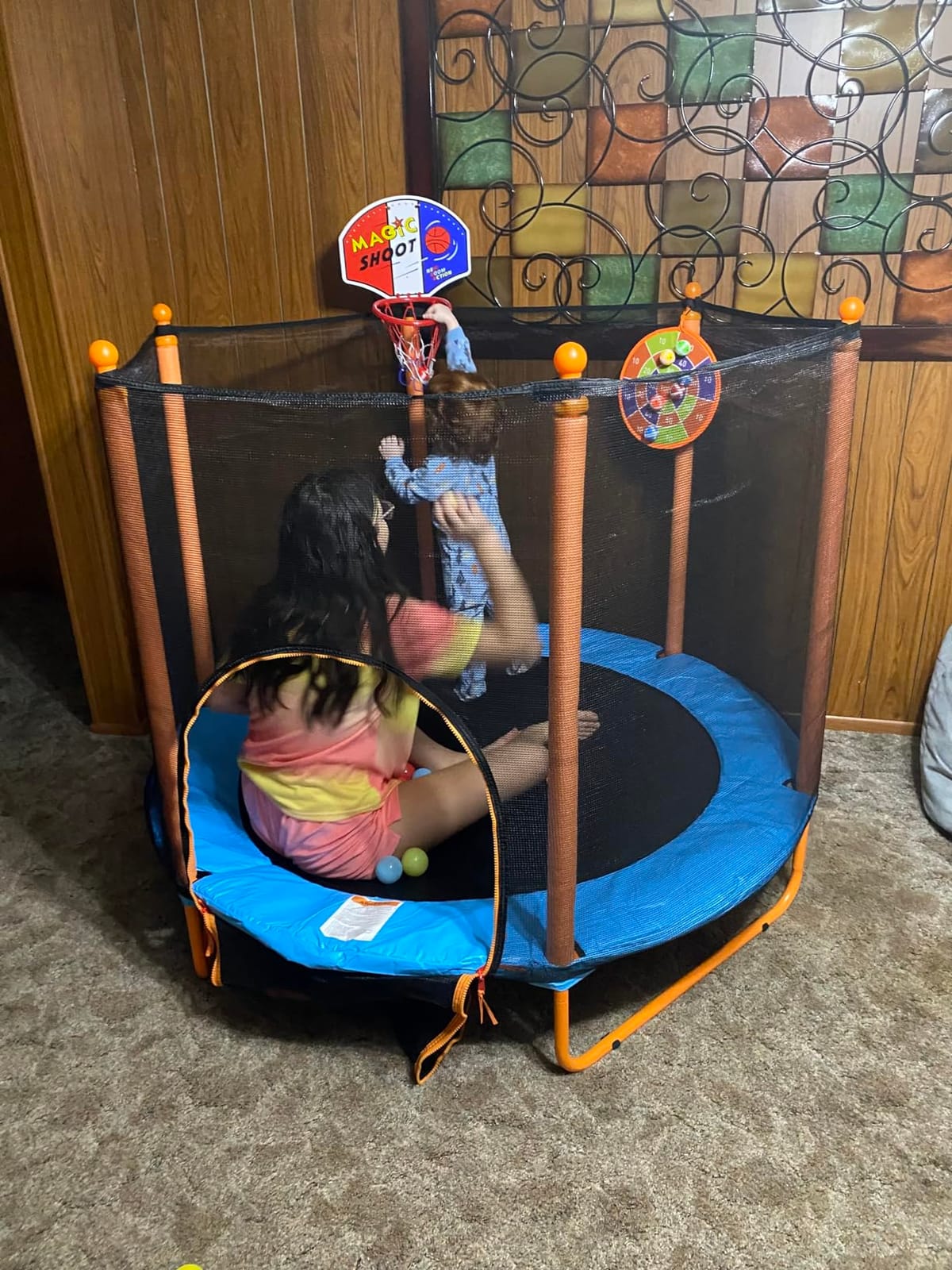
This is the one we recommend for the youngest jumpers. A 60-inch jumping area with a three-layer thickened safety pad and a fully enclosed reinforced safety net with cushioned sponge padding does something a full-size trampoline cannot: it removes the height problem. A fall off a rebounder this low is a step down, so a toddler who loses balance lands on the floor rather than dropping from a frame at adult waist height. The 36 springs use a hidden spring design, and U-shaped legs add stability underneath.
Assembly is genuinely quick here, with clear instructions and video guidance, which matters more than it sounds because the whole point of a rebounder is spontaneous indoor use. The listing positions it for ages 1 to 8 and ships with a basketball hoop, dartboard, and ocean ball so a 2-year-old to 5-year-old has something to do beyond bouncing. The unit measures 60 inches by 60 inches by 51 inches and weighs 13.45 kilograms.
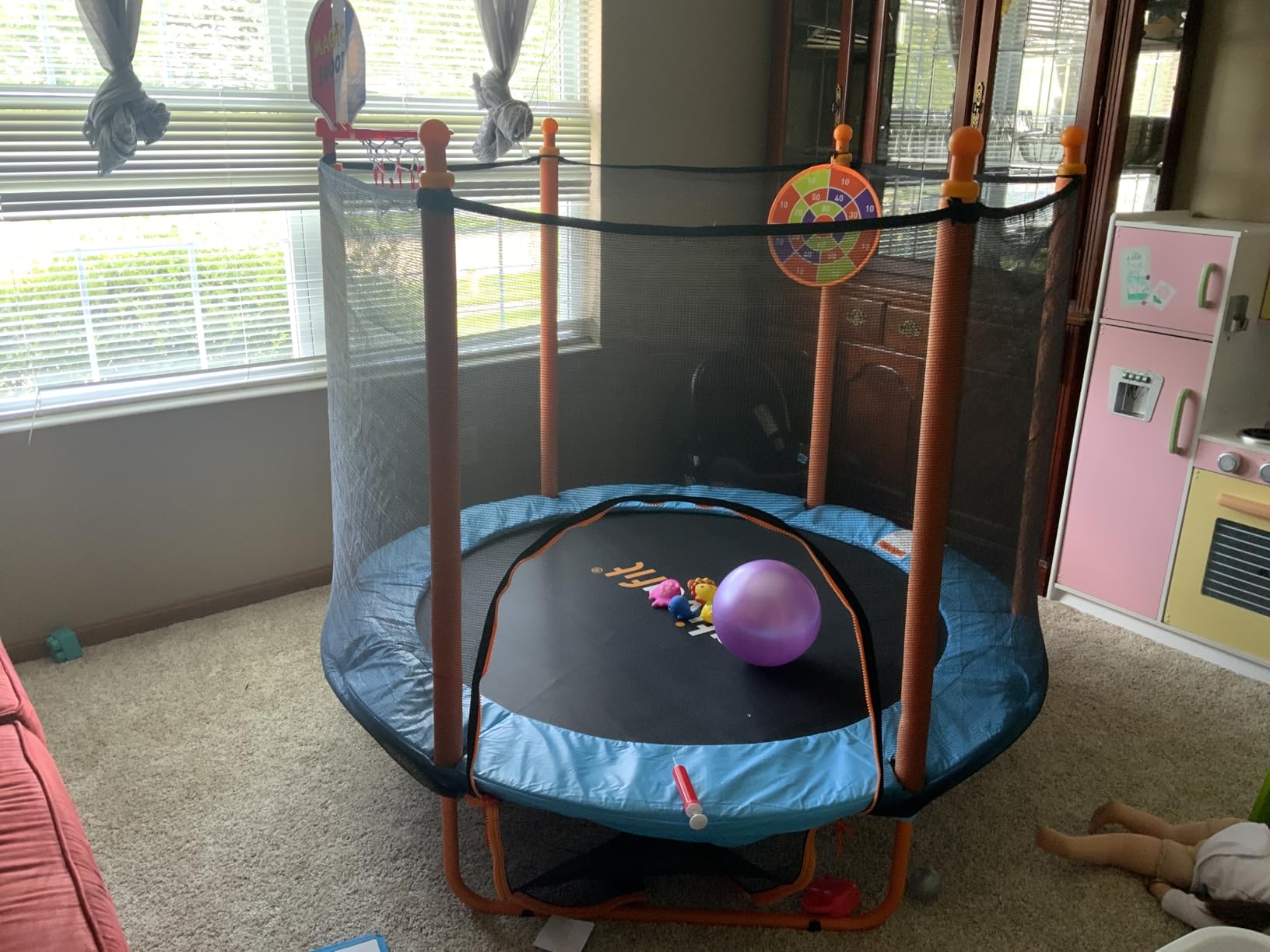
Owners value the low profile and the fact that a zippered enclosure gives them actual visual reassurance while playing in another room. The small footprint stores easily and fits a screened porch, and reviewers describe the bounce as good for its compact size. The accessory set adds welcome variety for the age range it is designed around, and it carries a 1-year manufacturer warranty.
Limitations are predictable for the category. The 80-pound maximum recommended weight makes it unsuitable for older children, which means you are buying a stage rather than a permanent solution. It needs securing against wind, as it can topple and bend the posts, and debris can collect between the net and the safety rim. One buyer had the basketball pole mount break within the first hour, and the spring holes are punched inconsistently, so setup needs care.
Toddler trampoline versus full-size: when to move up
The rule of thumb is coordination, not age. Most children can handle a rebounder safely from about age one, and the limiting factor for moving up is whether they can control a bounce well enough to land centred and stay on the mat. In practice that transition happens somewhere around five to six, and it is worth watching for rather than rushing, because the first month on a full-size frame is where a lot of edge falls happen.
Buying a rebounder first is a good strategy for a different reason too. It gives a 2-year-old an independent play option during the years when a full-size trampoline is genuinely too big for them, and it doubles as an indoor option during winter. Plenty of families end up keeping both, with the rebounder moving to a garage or playroom.
What to watch after a few months
Two things degrade fastest on a rebounder: the net attachment and the foam. Net tensioning depends on attachment points that are simply not as robust as the frame-welded systems on full-size models, and the sponge padding compresses with use. Check the zipper still runs smoothly and the closure fully engages every time, and rotate the pad if you notice it flattening.
For outdoor use, anchor it properly rather than trusting its low weight to hold it. A light frame that catches a gust can be thrown a surprising distance, and the bent posts owners report usually start as an unsecured unit. Indoors on a carpet or a smooth floor, the U-shaped legs are enough for the load a toddler puts on it.
9. VEVOR 55 inch Trampoline With Enclosure: Top Rated for Toddlers
- Highest owner rating in the group
- Assembles in about 3 minutes by one person
- One-piece mat sewn to a tear-tough PVC skirt
- 360 degree see-through mesh net with foam padding
- Three sizes including a fold-flat 36 inch model
- Smallest models suit one or two young children
- Handlebar foam and toys are light-duty for older kids
The VEVOR earns the highest rating in the group, and the reason is a specific manufacturing choice rather than a feature list. The jumping mat is a single piece stitched and sewn to a tear-tough PVC skirt, which physically blocks the gap between the mat and the springs instead of covering it with a separate pad that can shift or be pulled off. Combined with ASTM and CPC certification and a 360-degree see-through dense mesh net with upgraded foam padding, it is the most genuinely gap-free compact trampoline in this lineup.
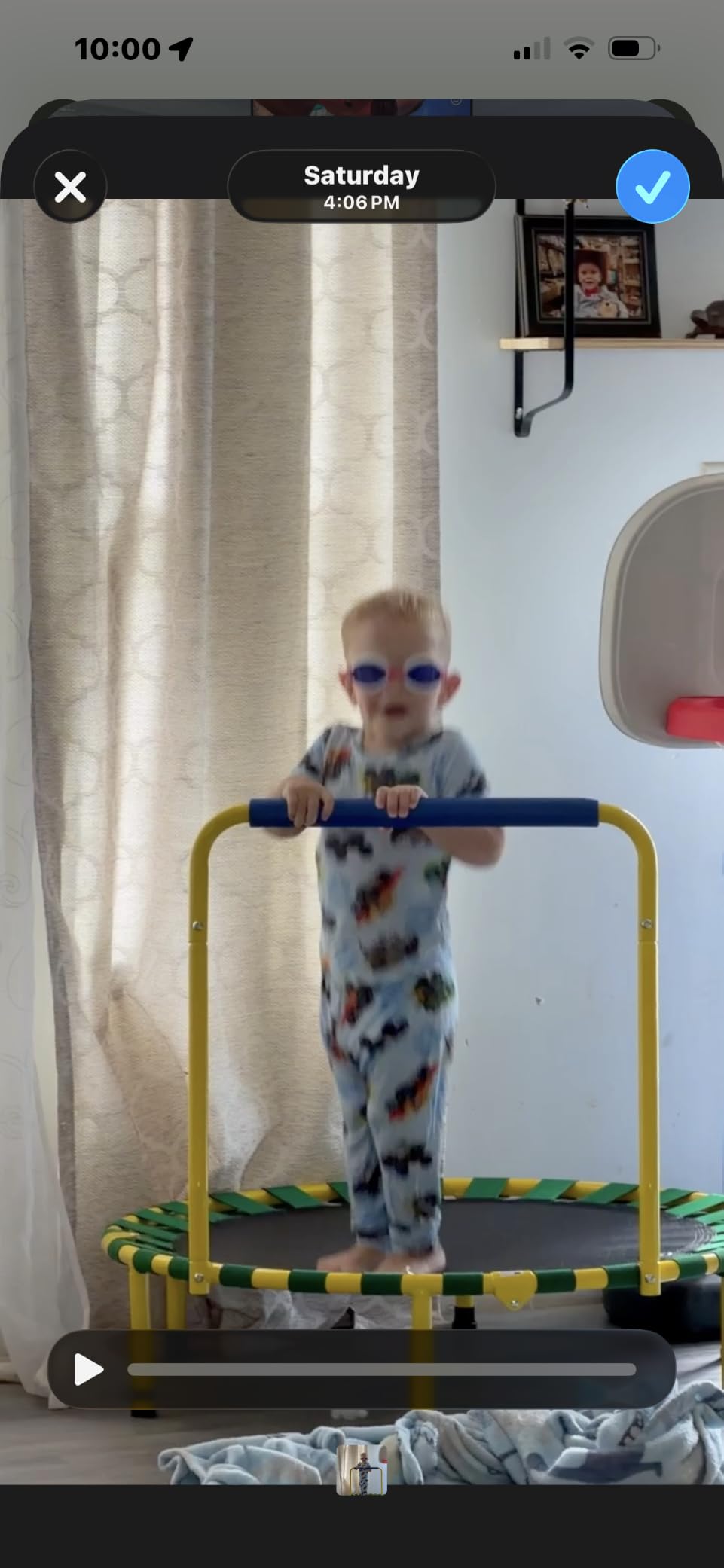
It is also the fastest to set up. The listing states assembly in about 3 minutes by one person with the included tool kit, and that claim holds up in practice because there is no frame to square and no spring to tension by hand. Frame structure uses thickened reinforced metal tubes with three U-shaped legs and non-slip suction cups, a padded foam handlebar gives toddlers something to hold for balance, and a 1-year manufacturer warranty is included. Three sizes are available at 36, 55, and 60 inches.
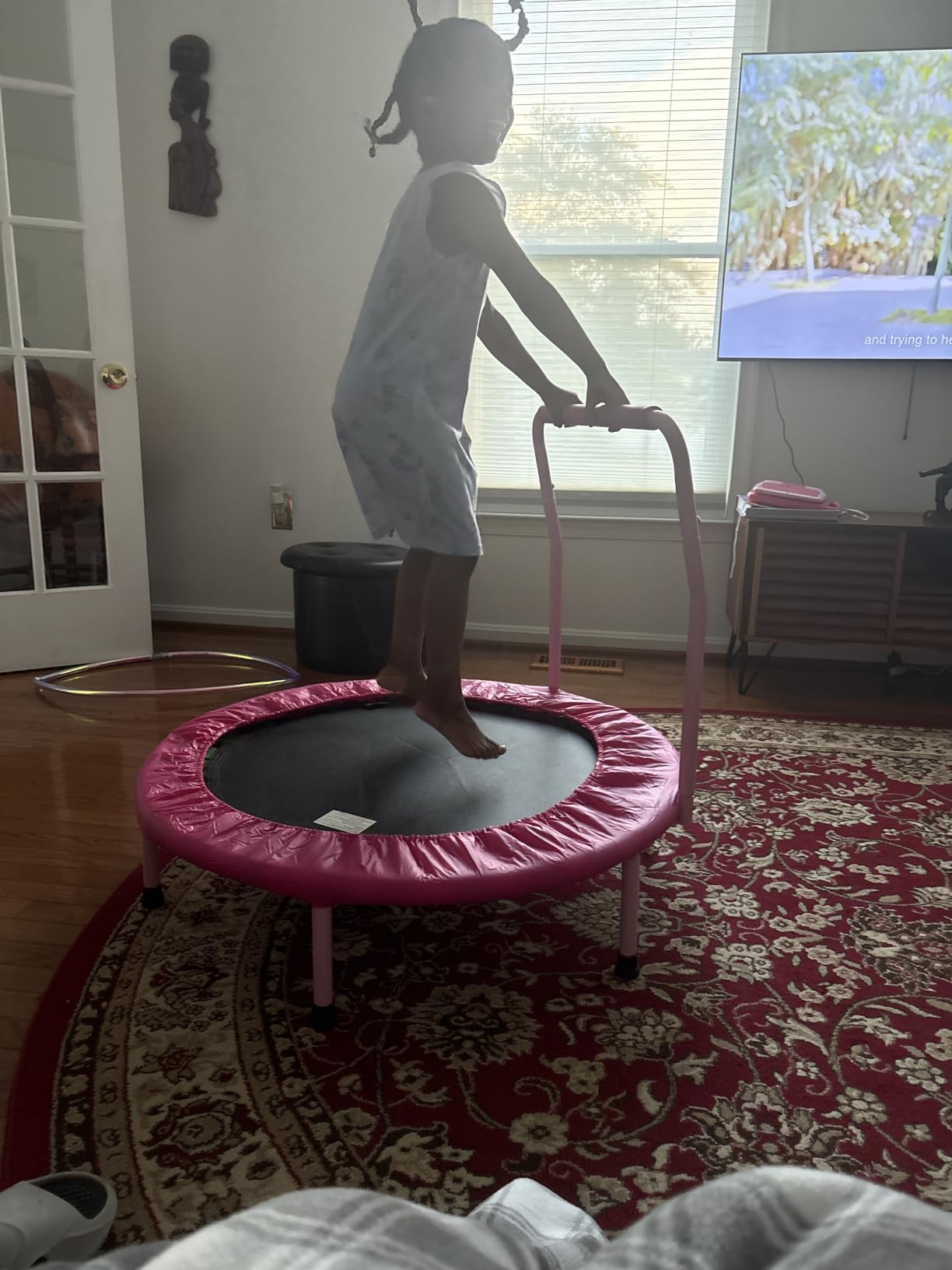
Owners consistently note the enclosure has no gaps for hands or feet to enter, which is the design goal stated plainly. The 36-inch fold-flat model is popular for tight spaces, and the 5-in-1 toy set, including a punching bag, basketball hoop and ball, ocean balls, and gymnastic rings, keeps a 3-to-12-year-old range occupied. The rating of 4.7 across more than 1,500 reviews is the strongest in this group, and it ranks at the top of the category.
Two honest limits. The smallest models hold one or two young children at a time, which is by design but worth being clear about if you have three kids in the 3-to-12 bracket. And the handlebar foam plus the toy accessories are light-duty, so a 10-year-old will outgrow the play value long before they outgrow the trampoline. The stated maximum is 220 pounds.
Why the one-piece mat changes the safety equation
On most compact trampolines the spring cover is a separate sleeve or pad that sits over the springs, held in place by ties. That works until a child pulls the ties loose, which owners of several competing models report happening, and then the springs are exposed. Seaming the mat directly to a PVC skirt means there is no separate part to remove, no ties to lose, and no way for the cover to migrate into the mat during a bounce.
That single design decision is why this model outranks more expensive options for a household with a 3-year-old. The other safety-relevant feature is the 360-degree see-through mesh, which lets you keep visual contact from any angle, including from inside the house while the trampoline is on a patio.
Choosing between the three sizes
The 36-inch model is a 3-foot trampoline that folds flat and stores in a closet, and it suits a single toddler or a travel arrangement. The 55-inch version is the sweet spot for a 3-to-8-year-old with room for two, and it is the one most families land on. The 60-inch model gives a bit more bounce room for a slightly older child or a second jumper, at the cost of a larger footprint.
Given the age range of 3 to 12 printed on the box, be clear-eyed about the top of that range. The 220-pound capacity and the light-duty toys mean the sweet spot is roughly ages 3 to 8, with an older child using it for a supervised bounce rather than as their main play equipment. Beyond that, a full-size frame with a proper ladder is the right upgrade.
10. VGMiu 60 inch Indoor Trampoline With Net: Best for Small Spaces
VGMiu 60″ Trampoline for Kids, Toddler Trampoline Indoor with Net, Age 3-8
- Suction cup feet protect hard floors and reduce rattling
- Visible mesh net for watching from any angle
- Frame pads fully cover the mat-to-net gap
- Built-in basketball hoop
- Complete package includes pit balls and tools
- Only available in the 5 ft size
- Suction cups can lose grip on very smooth surfaces
The VGMiu is the most apartment-friendly unit in the group, and the reason is the feet. Six large suction cups per foot sit under three U-shaped legs, which means it does not scratch a hard floor, does not rattle against it while a child jumps, and does not need to be bolted down. The frame is rust-proof alloy steel, the jump pad is wear-resistant PP with high elasticity, and the whole unit measures 60 inches by 60 inches by 50 inches.
The safety detail worth noting is the padding strategy. Durable frame pads cover the gap between the mat and the net, which is the pinch point that most budget rebounders leave open, and the top safety net uses enhanced double-layer reinforced stitching. The net itself is visible mesh, so you can watch a child from any angle in the room rather than losing sight of them behind an opaque wall. Rated to 220 pounds with 30 springs.
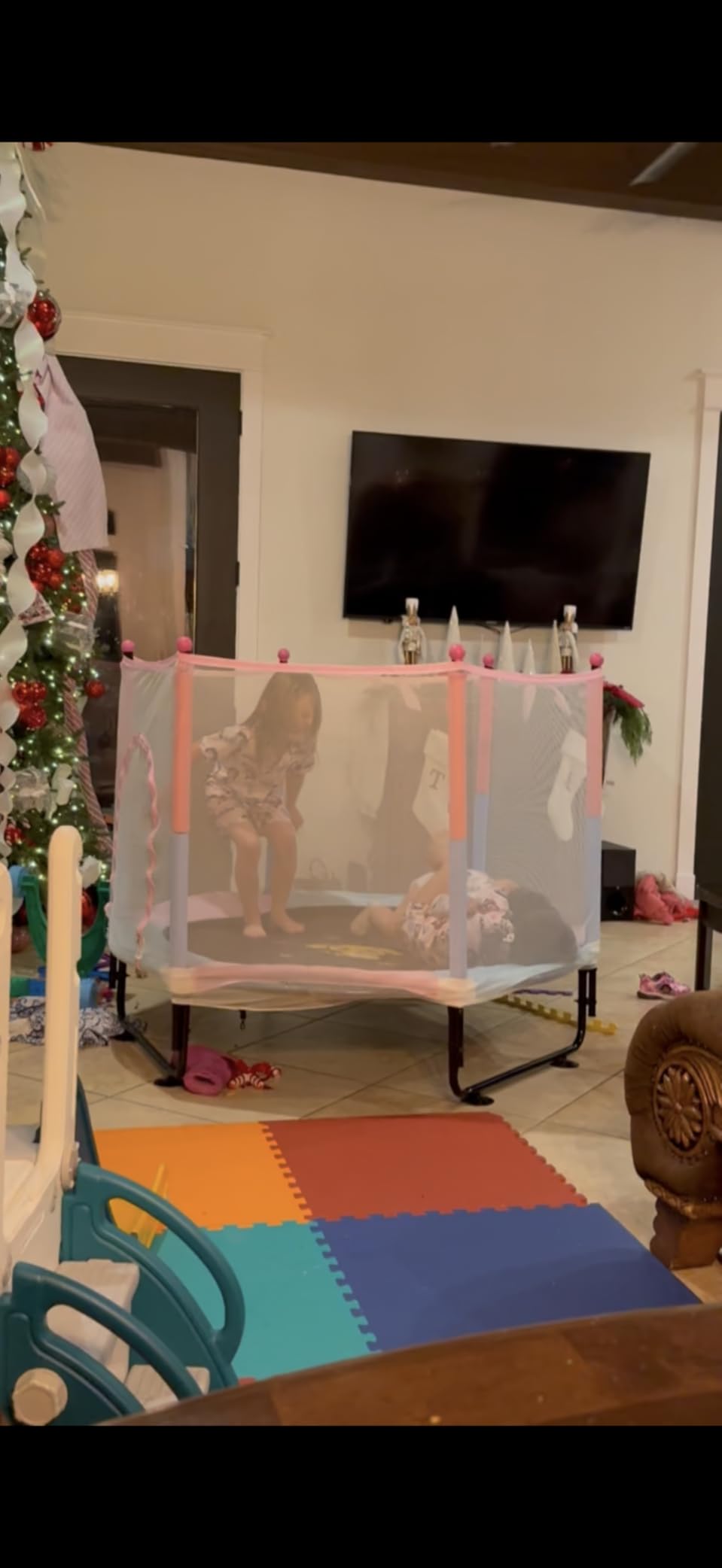
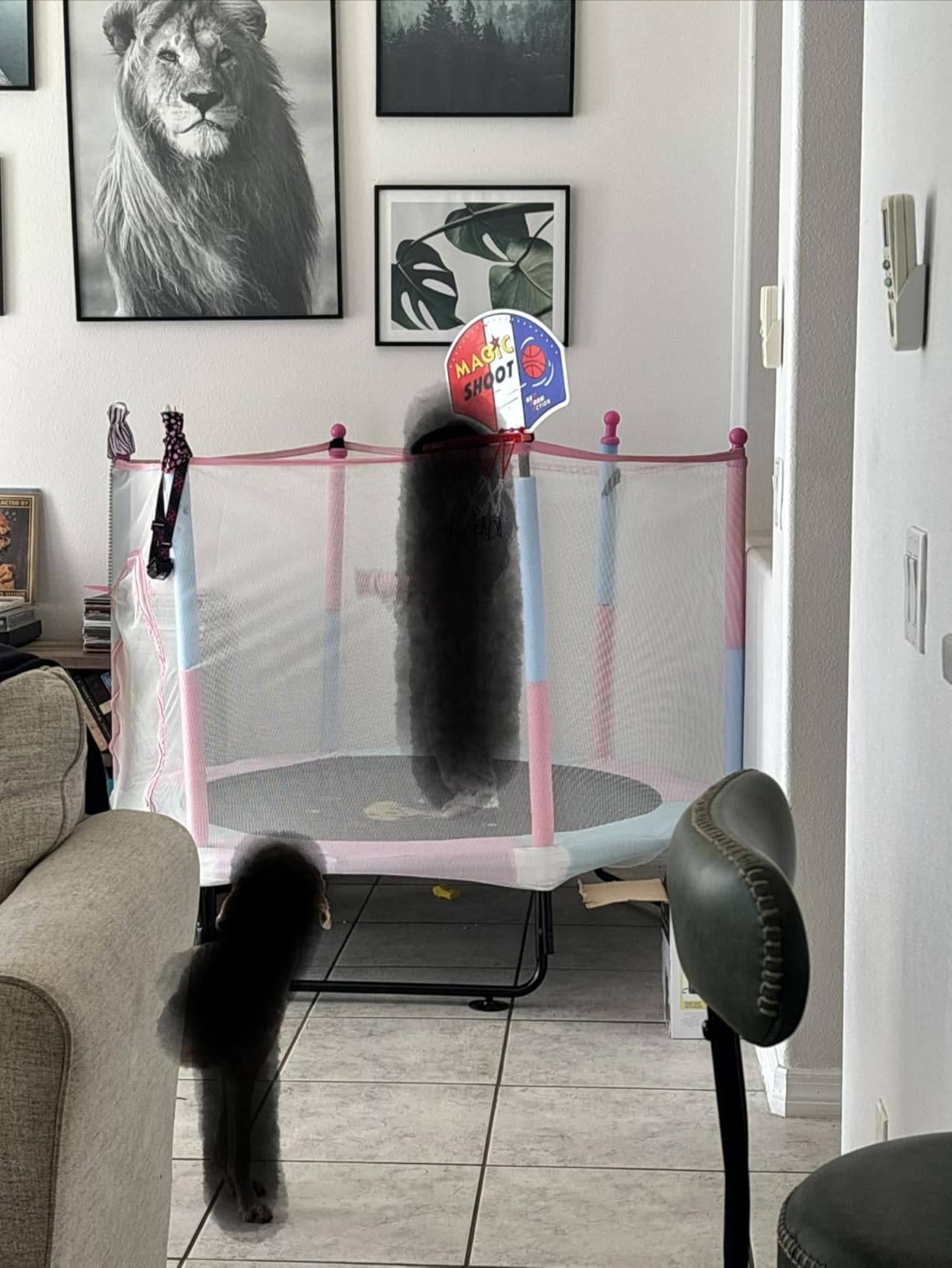
Owners appreciate the suction-cup floor protection and how much quieter the unit is on hard surfaces, and the visible net gets called out as the reason they can relax while playing in another room. The frame pads that fully cover the mat-to-net gap are noticed too, since that is the exact issue other owners complain about elsewhere. A built-in basketball hoop adds play value, and the box includes the hoop, 10 pit balls, a T-Hook pull tool, and all installation tools.
The limitation is that this is a 5-foot design in five colour options, so there is no larger version if you outgrow it. The suction cups can also lose grip on very smooth surfaces over time, which is worth watching if you use it on laminate or tile. It is positioned for ages 3 to 8, and there is no stated warranty length in the listing, which is a fair consideration for long-term use.
When an indoor rebounder beats a full-size trampoline
Indoor rebounders win in three situations: small urban yards where a 10-foot frame plus clearance will not fit, climates where outdoor use is limited to a few months of the year, and households with a child under five who is not ready for a full-size frame. They also work as a secondary unit so an older child can keep using the big trampoline while a toddler has their own.
What you give up is bounce and capacity. Thirty springs on a 60-inch mat produce a gentle bounce that is correct for a small child and unsatisfying for a teenager, and the 220-pound rating means one adult plus one child is a reasonable maximum. The advantage is that a gentle surface is precisely what a beginner needs to learn to land safely.
How to get the most out of a suction-cup base
Clean the feet and the floor before assembly, because grit is what kills suction. If you notice the unit creeping, lift rather than drag it, since dragging can roll the cups out of shape, and check them every couple of months. On very smooth surfaces, a thin mat underneath the cups adds grip without adding the noise of rubber feet on wood.
One more practical point: indoor trampolines need ventilation and floor protection for whatever is underneath. A 60-inch round mat with a jumping child sends more impact energy into the floor than people expect, and the net does nothing about that. A foam play mat underneath is cheap insurance for a hardwood or laminate floor.
How to Choose a Trampoline With a Safety Net
The four enclosure designs you will find on retail listings differ in one respect that matters more than any other feature: where the net meets the mat. Everything else, including pole shape, fabric weight, and colour, is secondary.
Outer-mounted net. The net attaches to the upper frame outside the springs, which gives the largest jumping area. The tradeoff is the exposed coil bed between the mat and the net, which is where most finger and foot injuries happen. Good examples mitigate this with a thick spring cover; the Giantex uses a seamless waterproof pad over its springs.
Inner-mounted net. The net attaches inside the spring bed, so a child standing on the mat edge is fully enclosed. It costs a strip of jumping surface, and on a smaller trampoline that is a meaningful loss, but it removes the fall-off-the-edge path entirely.
No-gap system. The mat edge and the net bottom meet at the same point with no exposed coil bed at all. This is the construction the Skywalker uses under patent, and it is the one to prioritise if a child in your house is under five or tends to land on the edge.
One-piece sealed mat. Rather than covering the spring gap from the outside, the mat is seamed to a rigid skirt so nothing is draped over anything. The VEVOR uses this approach, and it holds up better over time because there is no separate cover to shift or lose.
On pole shape, curved poles that bow away from the jumping surface reduce head-strike risk compared with straight vertical poles. The Jumpzylla and JoyBerri both use curved poles for that reason. On closure, a zipper plus a buckle is stronger than a zipper alone, and either way the closing is the adult’s job, every time.
If adults are the primary users rather than small children, the same enclosure logic applies but the sizing changes. Our guide to the best trampolines for adults covers the capacity and bounce differences that come with a full-grown jumper.
Three Steps to Verify ASTM Certification Before You Buy
Certification claims are easy to make and hard to check, but there is a fast way to filter a listing in about 30 seconds. Look for a standard number rather than the word ASTM on its own, because the number tells you the testing regime and the year of the specification.
- Find a standard number in the technical details, not just the bullet points. ASTM F2270 is the consumer trampoline standard, and ASTM F381 covers the safety performance testing most residential listings reference. Models here state F381-16, ASTM 381, and ASTM F2225-15 among others. A listing that says only parent-approved or safety certified has told you nothing testable.
- Look for a published test figure alongside the claim. The SKOK listing states testing for 20,000 jumps and mats tested up to 5,000 hours. The Skywalker states testing to 4x the maximum user weight. A number attached to the certification is a much stronger signal than the certification alone, and most cheap listings skip it.
- Check that the certification covers the size you are actually buying. Listings that span 8 through 16 feet often certify one variant and group the rest under the same page. Read the variant selector and the product details again after you choose a size, and confirm the capacity and certification language still applies to that version.
If a listing will not name a standard, treat that as a reason to look at a different one. Every product in this roundup states a certification of some kind, and the difference in how specifically they state it tracks the difference in build quality reasonably well.
Safety Rules That Matter More Than the Net
A net reduces falls off the edge. It does nothing about collisions between jumpers, landings in the middle of the mat, or a child who has decided the enclosure is the obstacle. These rules do more for your child than any product on this list.
One jumper at a time. This is the rule that experienced owners insist on most, and it holds regardless of trampoline size. A large mat invites two children to bounce together, and the resulting collision is exactly the scenario a net cannot prevent. Our experience with families who follow this rule is that it is unpopular for about a week and then becomes normal.
Close the zipper and buckle, every time. The most common reason children still leave a netted trampoline is that the enclosure was left open. Owners describe this repeatedly, and the fix is a habit rather than a product: the adult opens the net, the adult closes the net, and the jumper waits until it is shut.
No somersaults and no flips onto a full-size frame. Head and neck injuries are the serious risk on a small trampoline, and a caregiver in a bounce house is standing, watching, and positioned to catch. That is not something you can replicate in a backyard. Our guide to mini trampolines covers the rebounders built for a low-impact alternative.
Adult supervision for children under 16. This is the standing paediatric guidance and it does not change because a model is ASTM certified. Close supervision is the cheapest safety feature available and the only one that responds in real time.
Clear the ground and the air above it. Level ground, no concrete nearby, nothing hard within reach, and a wide berth from overhead power lines. The enclosure only controls the air inside the frame.
Retension the net at the start of each season. Net fabric gets UV-brittle and attachment points loosen over a year or two. A net that has gone slack stops working, and the first sign is a visible ripple. Check the tension and the stitching before anyone jumps.
What Size Trampoline Does Your Yard Actually Need?
Measure the usable ground before you fall for a diameter, because a trampoline needs clear space beyond its own footprint. A 10-foot round frame needs roughly a 20-foot circle around it, and the net poles add to that. A 14-foot model needs closer to 28 feet. Rectangular models need the most room, so they suit long, narrow yards rather than square ones.
Under 20 feet of usable space: a compact rebounder in the 55 to 60 inch range, such as the VEVOR, Ativafit, or VGMiu. These are indoor-capable, and they work outdoors on a patio if you anchor them.
A yard that fits a 20-foot circle: an 8-foot round full-size frame, such as the AOTOB or SKOK. The low profile is the point at this size, since a small child can climb on without help.
A yard that fits a 24-foot circle: a 10 or 12-foot round frame. The Jumpzylla comes in both, and the 10-foot is the version we recommend for a typical family. This is the size where two children can pass each other without constant negotiation.
A rectangular yard over 30 feet long: a rectangular frame gives the best bounce consistency for older kids and anyone practising skills, but the footprint is the largest and clearance at both short ends is essential. Rectangular is a performance decision, not a safety one.
On age bands: under five belongs on a rebounder with a low profile and a covered mat-to-net gap. Five to nine works well on a low 8 or 10-foot full-size frame. Ten and up benefits from a larger mat and a higher-capacity frame, and from a ladder included in the box. Adults joining the kids push you toward the 400-pound and up ratings.
Finally, be honest about who this is not for. Renters without a written agreement from the landlord, families sharing a yard with neighbours, and very small urban plots are all cases where a full-size trampoline creates a problem the enclosure cannot solve.
Frequently Asked Questions
What is a good trampoline with a safety net for kids?
A good trampoline with a safety net for kids is one with a full-perimeter enclosure that is tall enough to contain a bounce, taut at the bottom, and attached with no gap between the jumping mat and the springs. Prioritise a stated ASTM F2270 or ASTM F381 certification, a zipper plus buckle closure, curved poles that bow away from the jumping surface, a covered spring bed, and a published weight capacity. The Jumpzylla 10 ft is the strongest all-round pick and the SKOK 8 ft is the best value full-size option.
Are netted trampolines safer than ones without nets?
Yes, a properly fitted net meaningfully reduces the chance of a child bouncing or falling off the edge, which is one of the most common trampoline injuries. A net does not prevent collisions between two jumpers, landings in the centre of the mat, or somersault injuries, and a slack or open net performs poorly. Enclosure plus one-jumper-at-a-time supervision plus ASTM certification is the combination that matters.
Should the trampoline net go inside or outside the poles?
An outer-mounted net gives you the largest jumping area but leaves the coil bed exposed unless a thick spring cover hides it. An inner-mounted net removes the fall-off-the-edge path but consumes a strip of mat. A no-gap system, where the mat edge and net bottom meet with no exposed springs, is the strongest option for children under five. The Skywalker uses a patented no-gap design and the VEVOR seals the mat to a PVC skirt to block the same gap.
Which trampoline has the best net?
It depends on net construction rather than brand. The Skywalker has a patented no-gap enclosure that eliminates the mat-to-spring gap entirely, which makes it the strongest net construction here. The SKOK has the tallest specified enclosure at 4.9 feet with a zipper and buckle closure, and the VEVOR blocks the spring gap with a one-piece seamed mat. The JoyBerri also specifies a gap-free net on a 14 ft frame.
Do I need a safety net for my trampoline?
For any household with children under 16 using an above-ground trampoline, yes, a full-perimeter enclosure is the single most important safety feature on the product. If you are buying a rebounder for a toddler the enclosure is included in the design and is part of why a low profile works. The one case where a net is not enough is a child who bounces unsupervised, because a net does not respond in real time the way an attentive adult does.
Should my trampoline be ASTM approved?
Yes, and look for the standard number rather than the word ASTM on its own. ASTM F2270 is the consumer trampoline standard and ASTM F381 covers residential safety performance testing, with F2225-15 also cited on some models. A listing that also publishes a test figure, such as testing for 20,000 jumps or to four times the maximum user weight, is a stronger signal than the certification claim by itself. Confirm the certification applies to the size variant you select.
How much space do you need around a trampoline?
Budget clear space well beyond the frame itself, not just the frame footprint. A 10-foot round model needs roughly a 20-foot circle of level ground and a 14-foot model needs closer to 28 feet. Keep hard surfaces like concrete away from the bounce area, stay well clear of overhead power lines, and place the unit on level ground. The enclosure controls the air inside the frame, not what is on the ground around it.
How long does a trampoline take to assemble?
Plan on two people and about ninety minutes for most full-size frames, with spring tensioning being the slow part. Compact rebounders are far quicker, and the VEVOR states assembly in about three minutes by one person with the included tool kit. Set the springs aside for last, read the manual before opening them, and do not attempt a full-size frame solo. A few owners across this group reported missing or unclear instructions, so allow extra time to sort hardware before starting.
The Best Trampoline With a Safety Net in 2026
For most families, the best trampolines with safety nets for kids come down to three answers. Buy the Jumpzylla 10 ft if you want the strongest all-round build and the widest support network behind replacement parts. Buy the Skywalker 15 ft if net construction is your top priority and your yard can take the footprint, because its no-gap enclosure is the best in this group. Buy the VEVOR if the child is a toddler, because its one-piece seamed mat closes the spring gap rather than covering it.
Whatever you choose, the net is the last line of defence, not the first. Check the certification number, confirm the mat-to-spring gap is closed, and set the house rule of one jumper at a time before the first afternoon rather than after the first accident.