
The best backyard playhouses for toddlers are ground-level cottages roughly 4 to 5 feet wide, built from cedar or double-walled plastic, with a door a small child can open alone and low pretend-play fixtures. Most are rated from 18 months or 24 months upward, and the best of them do their work as a small pretend-play space rather than as a climbing structure.
Our team spent 2026 reviewing twelve of the highest-rated playhouses on the market, weighing manufacturer age labels, materials, footprints, warranty length and the complaints that turn up in buyer reviews. What surprised us most was how much the age label matters. A playhouse rated 2+ is not an 18-month-old playhouse, and several parents on parenting forums describe buying a 2+ model for a younger child and watching them lose interest in weeks.
Below is the same roundup you will find in our broader outdoor playhouse guide, narrowed to the units that genuinely suit a toddler. Every pick below states its manufacturer age minimum, and every pick links to the current listing so you can check the details yourself.
We earn from qualifying purchases, which does not change what we recommend.
Table of Contents
What Is the Best Backyard Playhouse for Toddlers?
The best outdoor playhouse for toddlers is the Little Tikes Cape Cottage, a double-walled plastic cottage rated from 24 months with a working door, windows, shutters and a mail slot at a weight of 32 pounds. If your child is under two, the Step2 Neat and Tidy Cottage is the pick, because it is rated from 18 months. Look for a ground-level footprint, a door your child can operate alone, and a stated age minimum rather than an age guess.
That is the short version. The long version is that most toddler playhouses are small houses rather than playgrounds. Nearly every unit in this roundup sits at ground level, because platforms, ladders and slides push the minimum safe age up and turn a two-year-old’s structure into a supervision problem.
Top 3 Picks for Toddlers in 2026

Little Tikes Cape Cottage
- Working door windows and shutters
- Built-in mail slot
- Lightweight 32 lb design

Backyard Discovery Sweetwater
- All cedar construction
- Play kitchen and snack bar
- Working doorbell
The Little Tikes Cape Cottage takes our top slot on evidence rather than novelty. It carries more than fourteen thousand reviews, holds a 4.5 star average, weighs 32 pounds so one adult can move it, and disassembles just as easily as it assembles. If you want the highest-rated model instead, the Step2 All Around Patio with Canopy sits at 4.7 stars and is the only pick here with a removable shade canopy.
The Backyard Discovery Sweetwater earns the third slot because it is the rare combination of real cedar, a full play kitchen and a five-year warranty. It is also the pick we would put in a yard with a real grass surface rather than a paved patio.
All 12 Picks Compared Side by Side in 2026
| Product | Specifications | Action |
|---|---|---|
| Little Tikes Cape Cottage |
|
Check Latest Price |
| Step2 All Around Patio |
|
Check Latest Price |
| Backyard Discovery Sweetwater |
|
Check Latest Price |
 Step2 Neat and Tidy Cottage Step2 Neat and Tidy Cottage |
|
Check Latest Price |
 Step2 Lookout Treehouse Step2 Lookout Treehouse |
|
Check Latest Price |
 Simplay3 Discovery Playhouse Simplay3 Discovery Playhouse |
|
Check Latest Price |
 Chicos Pink Princess Chicos Pink Princess |
|
Check Latest Price |
 Chicos Grand Cottage XL Chicos Grand Cottage XL |
|
Check Latest Price |
 Outsunny Fir Wood Playhouse Outsunny Fir Wood Playhouse |
|
Check Latest Price |
 Outsunny Wooden Playhouse Outsunny Wooden Playhouse |
|
Check Latest Price |
 BTMWAY Cedar Playhouse BTMWAY Cedar Playhouse |
|
Check Latest Price |
 Le Chalet Grand Cottage Le Chalet Grand Cottage |
|
Check Latest Price |
A note on reading that table: most of these models are rated from 24 months, four are rated from 18 months, and one starts at 3 years because it is built tall enough to outgrow the toddler years quickly. We include all of them because plenty of families buy ahead and the units keep working once a child is ready.
1. Little Tikes Cape Cottage: the best overall pick for toddlers
Little Tikes Cape Cottage Playhouse with Working Door, Windows, and Shutters – Tan, Toddlers Ages 2+ Years
- Assembles with minimal tools
- Lightweight at 32 lb so one adult can move it
- Working door windows shutters and mail slot
- Sleek cottage styling that suits indoors or out
- Spacious enough for early elementary ages
- Plastic feels flimsier than older Little Tikes models
- Occasional damaged panel or missing piece on arrival
- Can blow over in wind without anchoring
This is the model we come back to after looking at everything. The manufacturer lists it from 24 months to 6 years, and at 35 inches wide by 42.8 inches deep it is small enough to sit on a patio yet roomy enough that a four-year-old still fits inside. The working door, two windows and functional shutters are the kind of hardware that makes pretend play stick.
Weight is the underrated spec. At 32 pounds, one adult can carry this from the yard into a garage playroom in a single trip, which matters more in practice than any feature list. Assembly is snap-together plastic with minimal tools, and the whole thing disassembles just as cleanly for storage over winter.
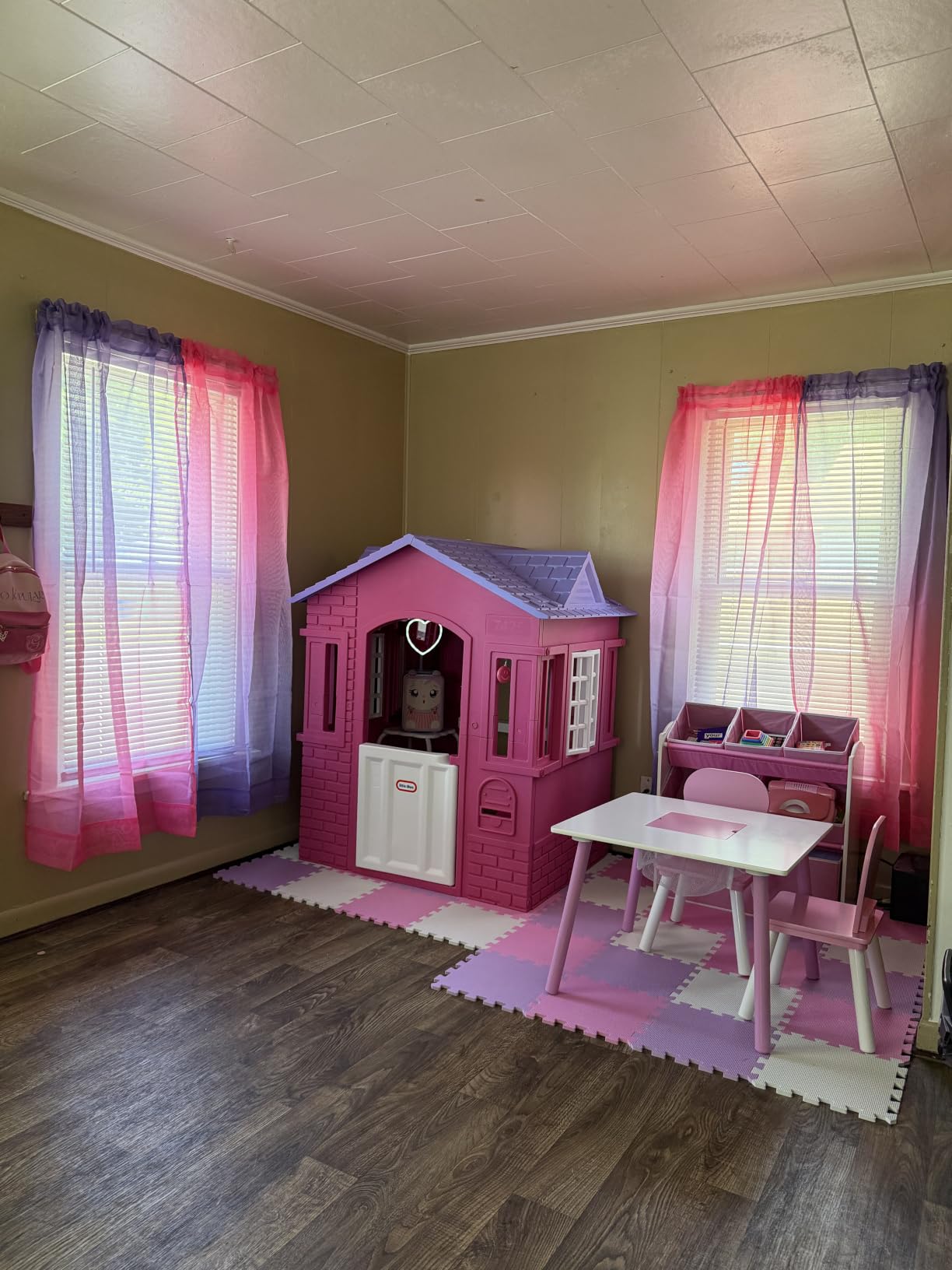
Buyers describe the cottage styling as clean rather than cartoonish, which is why it works in a front yard visible from the street. The built-in mail slot and flag holder are the two details our own kids used most, and neither requires a separate accessory purchase.
Buyer reviews also mention the mail slot driving a whole afternoon of scenarios. Delivery damage and a door that does not always latch are the two complaints that recur most often, so inspect the panels on arrival and check the hinge before the first play session.
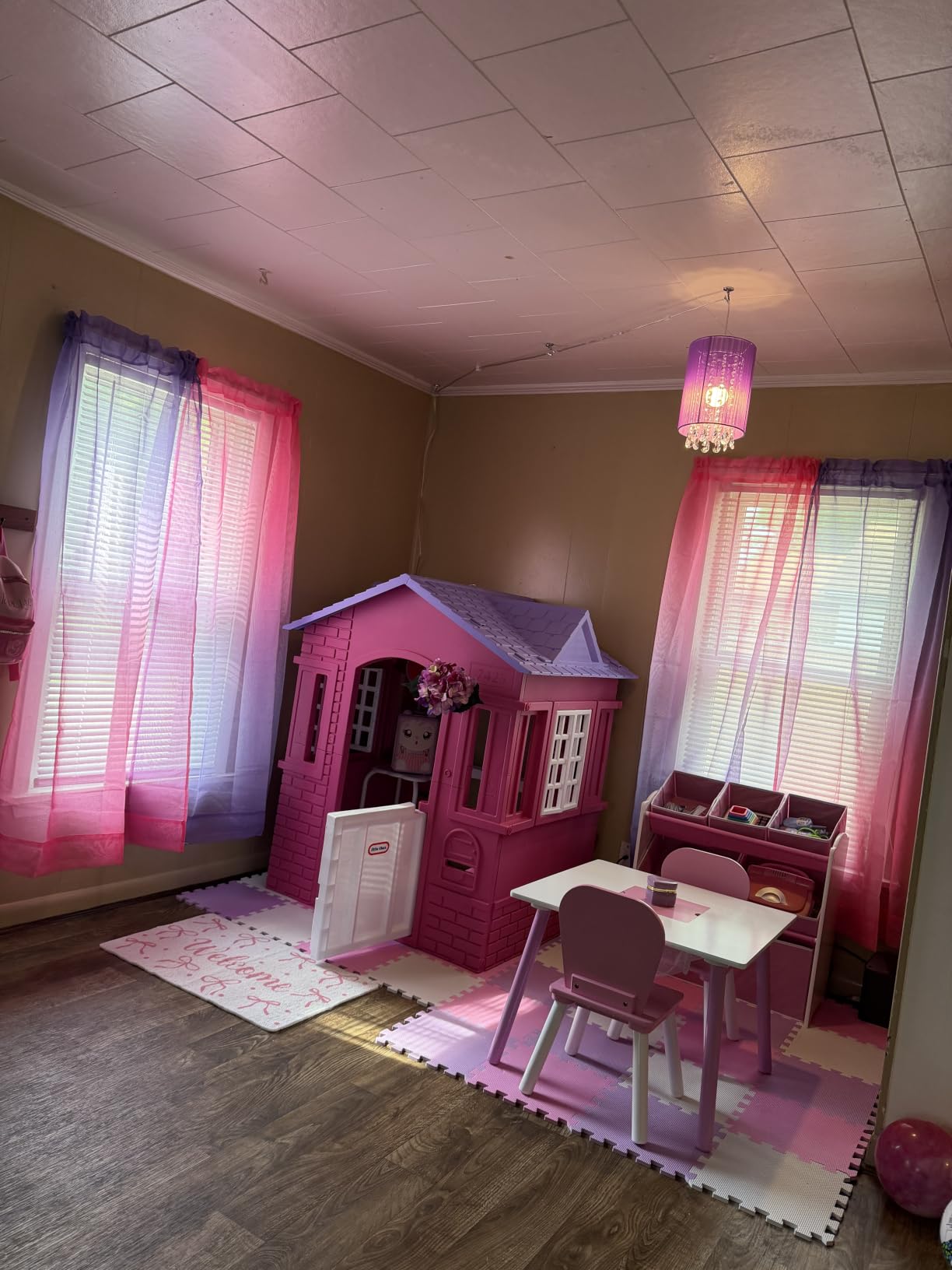
How it handles a two-year-old who cannot yet work a handle
Expect to help with the door for the first few weeks. The handle is a real handle rather than a soft toddler latch, so a two-year-old can learn it quickly but will not manage it on day one. Once the motion is familiar, it becomes the first thing they show guests.
For indoor use, this is the pick we would buy. It has no wood to treat, no ground anchoring to dig and a footprint small enough for a playroom corner.
Where it falls short for a toddler household
The plastic panels are thinner than on older Little Tikes models, and several owners mention flexing when a child leans hard on the wall. It is not a structure for active climbing, and it is not built for a big sibling to sit on the roof.
In wind, it needs anchoring. The shell is light enough that a gust can shift it, which is a real consideration on an open lawn.
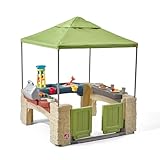
2. Step2 All Around Playtime Patio with Canopy: the highest-rated pick with real shade
- Highest rated in the group at 4.7 stars
- Removable canopy gives shade outdoors and comes off indoors
- Water and sand table plus pretend grill countertop
- Double-walled plastic resists fading and cracking
- Room for more than one toddler
- Adult assembly required and takes time
- Toy kitchen accessory set is sold separately
- Large footprint for a small yard
At 4.7 stars across more than 3,700 reviews, this is the best-rated model we found, and the rating holds up when you look at why. The pretend grill and large countertop give a toddler a proper outdoor-kitchen scenario, and the water and sand table adds a sensory element that most plastic cottages skip entirely.
The canopy is the real differentiator. In summer it makes the difference between a playhouse that gets used at noon and one that gets used at three o’clock, and it unhooks for indoor play during the colder months. Double-walled plastic wipes clean with household spray, which matters when a toddler is handling pretend food in it daily.
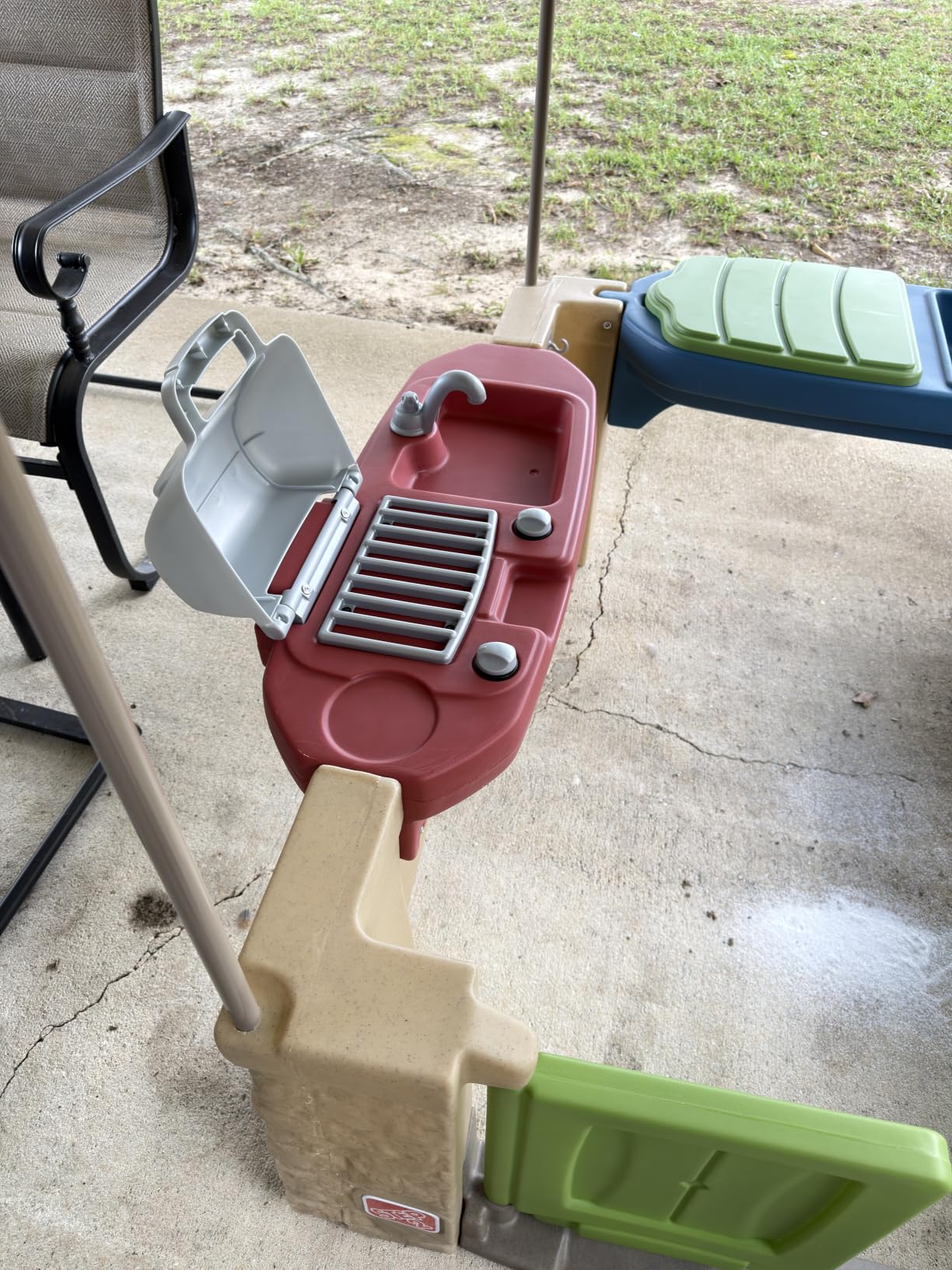
At 47.5 inches square, it holds multiple toddlers at once, which is unusual in this category. That makes it the pick for households with a shared playgroup or an older sibling who will join in.
Two things to know before buying. The 16-piece toy kitchen accessory set is a separate add-on, so the grill and counter arrive bare. Assembly needs an adult and real time, not a snap-fit.
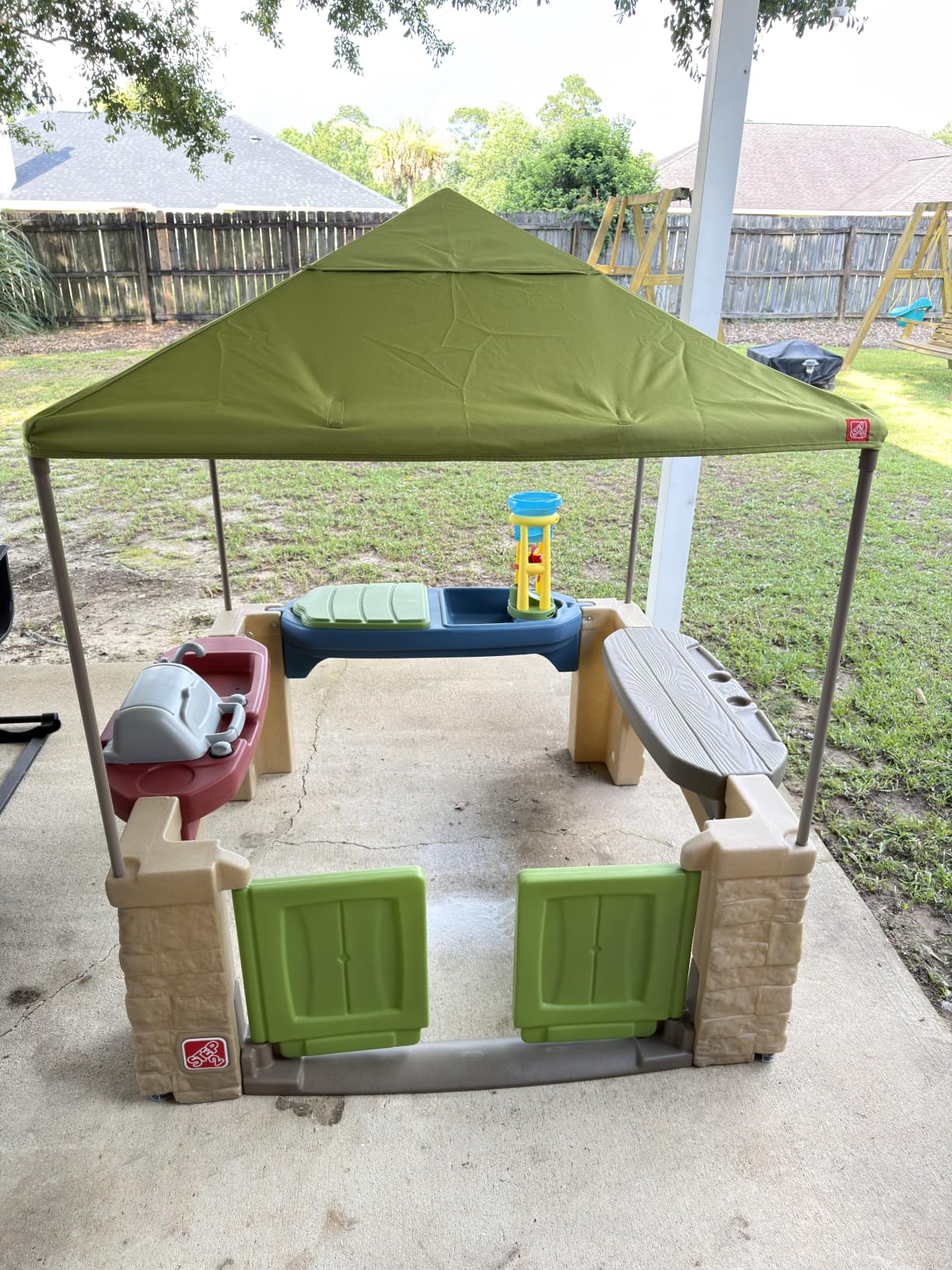
Why the canopy matters more than the kitchen accessories
A removable canopy changes the hours a toddler will use the space. Shade extends outdoor play into the hottest part of the day, which is often exactly when you need the child outside and calm.
Removal takes seconds and lets you use the same footprint as an indoor playroom set. Nothing else in this roundup converts that cleanly in both directions.
Where it is the wrong choice
Space is the limit. A 47.5-inch square footprint plus clearance around the door is one of the largest here, so a narrow side yard or a small paved courtyard is a tight fit.
If you are buying strictly for a child under two, the 24-month rating is a hard floor. Wait until your child is walking confidently before starting.
3. Backyard Discovery Sweetwater: the best cedar value with a full play kitchen
- Solid cedar that resists decay
- Pre-cut pre-drilled pre-stained pieces
- Play kitchen with sink stove and cookware
- Snack bar window and flowerpot holders
- 5-year warranty
- Wood needs periodic sealing outdoors
- Heaviest at roughly 77 lb so moving takes two adults
- Flowers and pots are not included
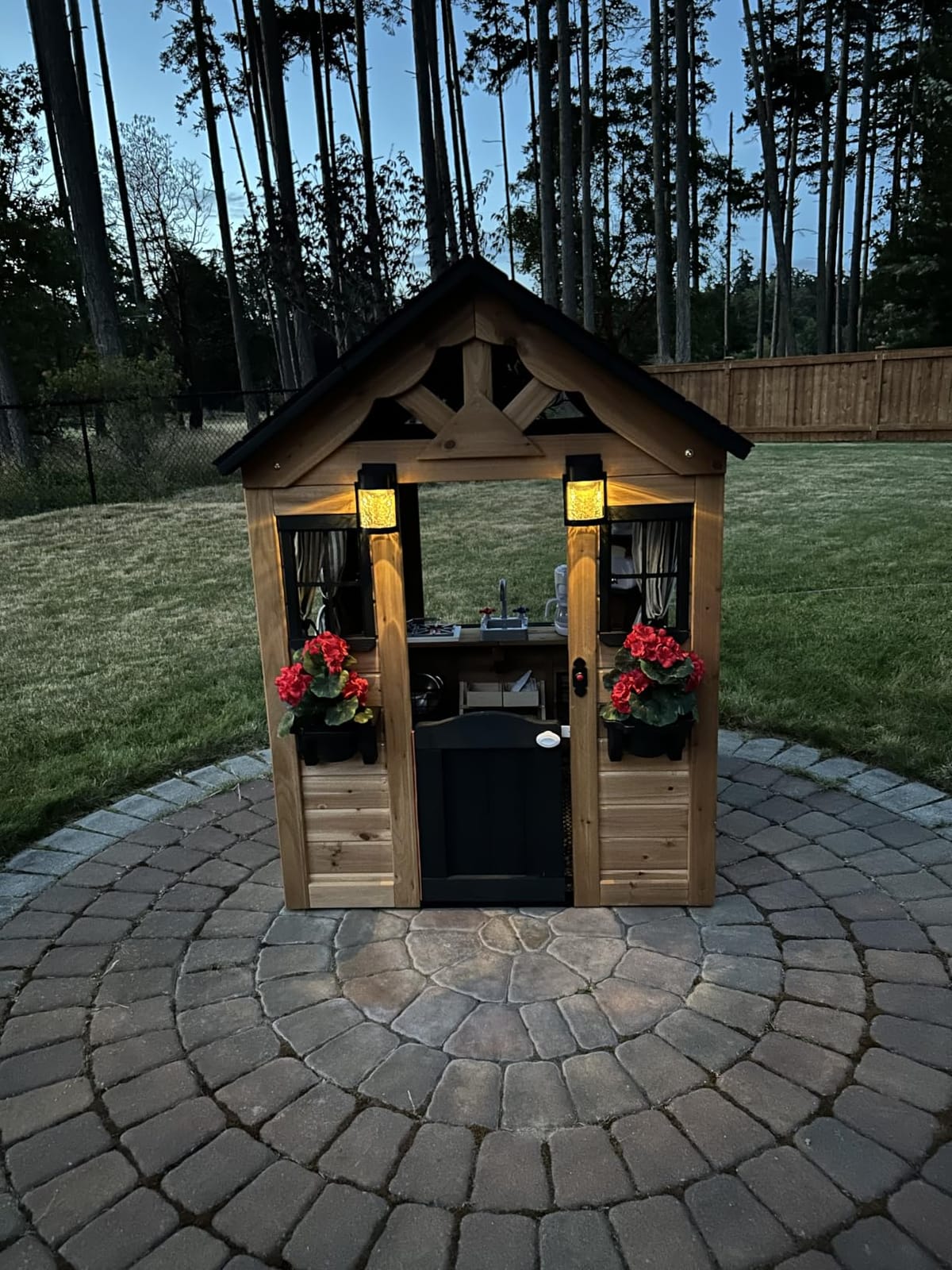
Cedar changes the feel of a playhouse immediately, and the Sweetwater is the version of that we recommend. It is 100 percent cedar, rated 24 months to 6 years, and it is engineered to meet or exceed ASTM standards. At 42 inches wide and 46 inches deep it is compact enough for a normal suburban yard.
The accessory set is unusually complete for this category. Buyers get a pretend sink, a pretend stove, cookware and utensils, a working doorbell, a cordless toy phone and a side snack-bar serving window, plus flowerpot holders under the front windows. That is a full play kitchen rather than a moulded plastic sink.
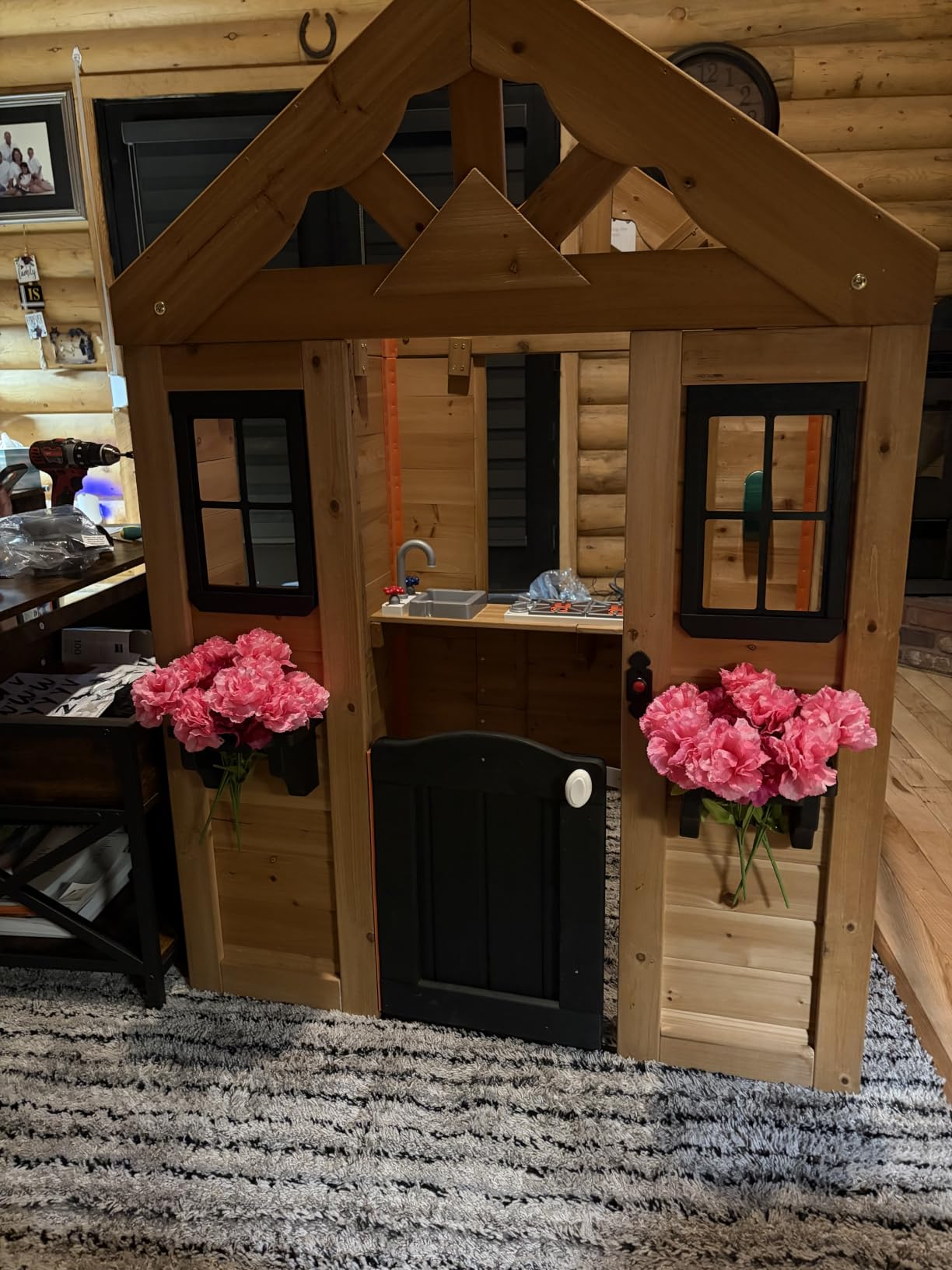
Pre-cut, pre-drilled and pre-stained pieces make assembly far less painful than a raw-lumber build. The four wide windows also mean you keep line of sight into the house from a patio or kitchen window, which we consider a safety feature rather than a design one.
Engineered to meet or exceed ASTM standards under code 963 and covered by a 5-year limited warranty, it also has the longest warranty of any wood model here. The hinged half door is genuinely operable by a small child, with no pinch point at the frame.
How it suits a two-year-old who wants to cook
This is the pick if your child’s dominant fantasy is running a cafe. The snack-bar window means they can serve a customer on one side while working the sink and stove on the other, which is exactly the kind of two-role play a two-year-old finds absorbing.
Buying a couple of real herb seedlings for the flowerpot holders extends that scenario outdoors. Owners frequently report the playhouse becoming a general storage and art station as well as a kitchen.
Where the cedar tradeoff shows up
Cedar needs maintenance. Outdoors it should be resealed or re-stained on a schedule, and skipping that is how you end up with grey, cracked boards within a couple of seasons.
At roughly 77 pounds it is the heaviest model in the roundup, so moving it is a two-person job. Assemble it where you want it to live.
4. Step2 Neat and Tidy Cottage: the best playhouse for an 18-month-old
- One of only two enclosed models rated from 18 months
- Doorbell shutters play phone fireplace skylight sink and BBQ
- Double-walled plastic resists fading and cracking
- Works indoors and outdoors
- Simple snap-together build
- 2-year warranty is shorter than rivals in the group
- Wide 53.25 inch footprint takes real space
- Sound and sensory features wear off for older kids
If your child is 18 months old, this is the one. It carries a 4.6 star average across more than 1,100 reviews and, alongside the Simplay3, is one of only two enclosed models here rated from 18 months rather than 24. That head start of six months is the whole argument for it.
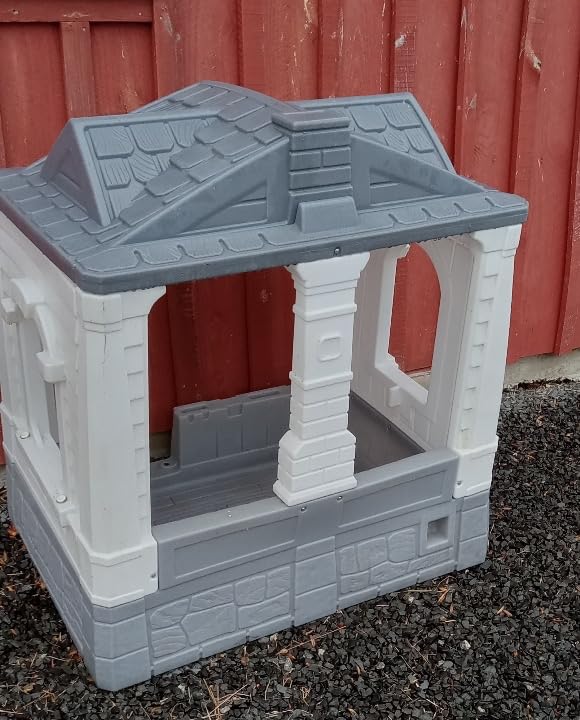
The feature density is unusual at this age band. You get a working doorbell and shutters, a play phone, a tabletop, a fireplace, a skylight, a moulded-in sink, a barbecue and a drive-thru window. All of it sits at toddler height, which is why a one-year-old can operate it and a five-year-old cannot anymore.
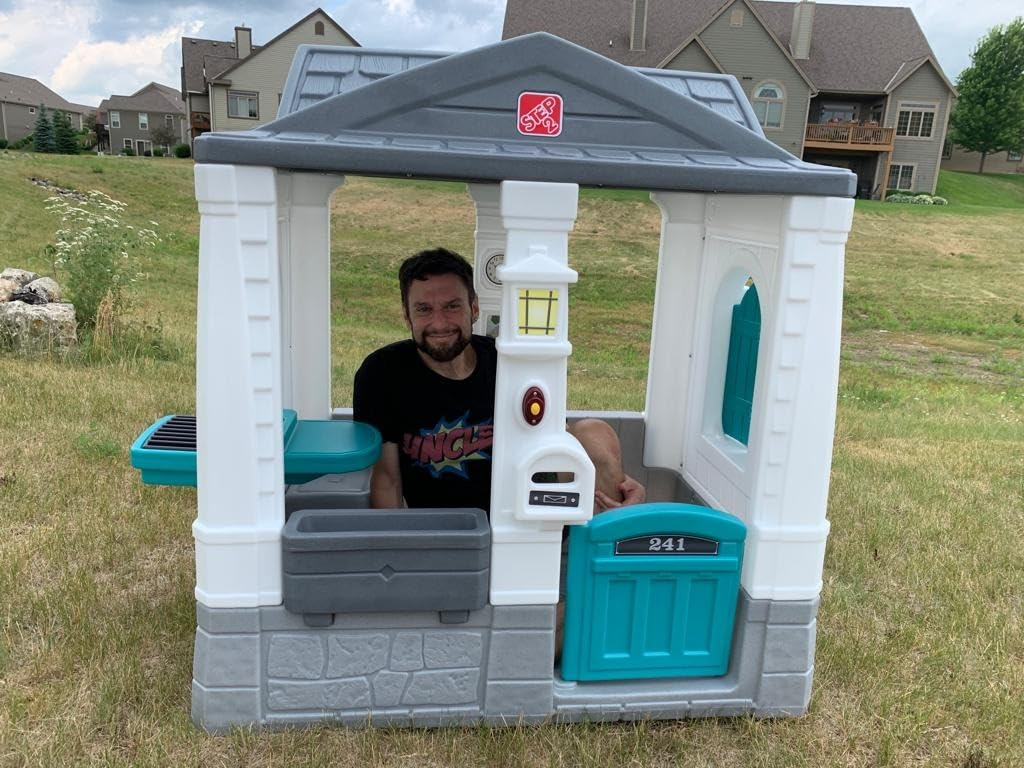
The double-walled plastic shell resists chipping, fading and cracking, and the whole house wipes down with a damp cloth. Assembly is genuinely effortless snap-together, with no hardware and no adult project attached.
A word of caution about the sensory features. Buyers note that the sounds and moving parts lose their appeal by the time a child is four or five, so if you are buying for a long horizon, weigh the two-year value higher.
What an 18-month-old can actually do in it
At this age the win is the door and the drive-thru. Pushing a working door open, then running a delivery through a window, is a genuine fine-motor and sequencing exercise that no play mat offers.
Keep sessions short and stay within earshot. Toddlers this young should be supervised whenever a playhouse is in use, and that stays true across every pick in this roundup.
Where the width becomes a problem
At 53.25 inches across, this is one of the widest footprints here. It suits an open lawn or a playroom, and it will crowd a narrow patio.
The 2-year warranty is the shortest of the plastic group. That matters less for a playhouse than it would for an appliance, but it is worth knowing if you keep toys for a second child.
5. Step2 Naturally Playful Lookout Treehouse: best for a toddler who burns off energy
- Slide ladder and climbing platform in one structure
- Sure-grip steps and rails help small climbers
- One of the lighter builds here at 30 lb
- Storage space underneath for toys or hiding
- Rated from 18 months
- Open-air climber rather than a sheltered cottage
- Maximum child weight is 50 to 66 lb
- 66.5 inch footprint needs a flat level surface
Not every toddler wants a house. Plenty want a tower, a slide and something to climb, and for those children this is the strongest gross-motor option rated from 18 months in the roundup. It carries a 4.6 star average across more than 1,000 reviews.
What makes it work for small children is the entry. Sure-grip steps and rails give a toddler something to hold that is not a narrow rung, and the platform sits low enough that a fall is a step down rather than a drop. The pivoting periscope adds a lookout role that keeps the climbing loop going.
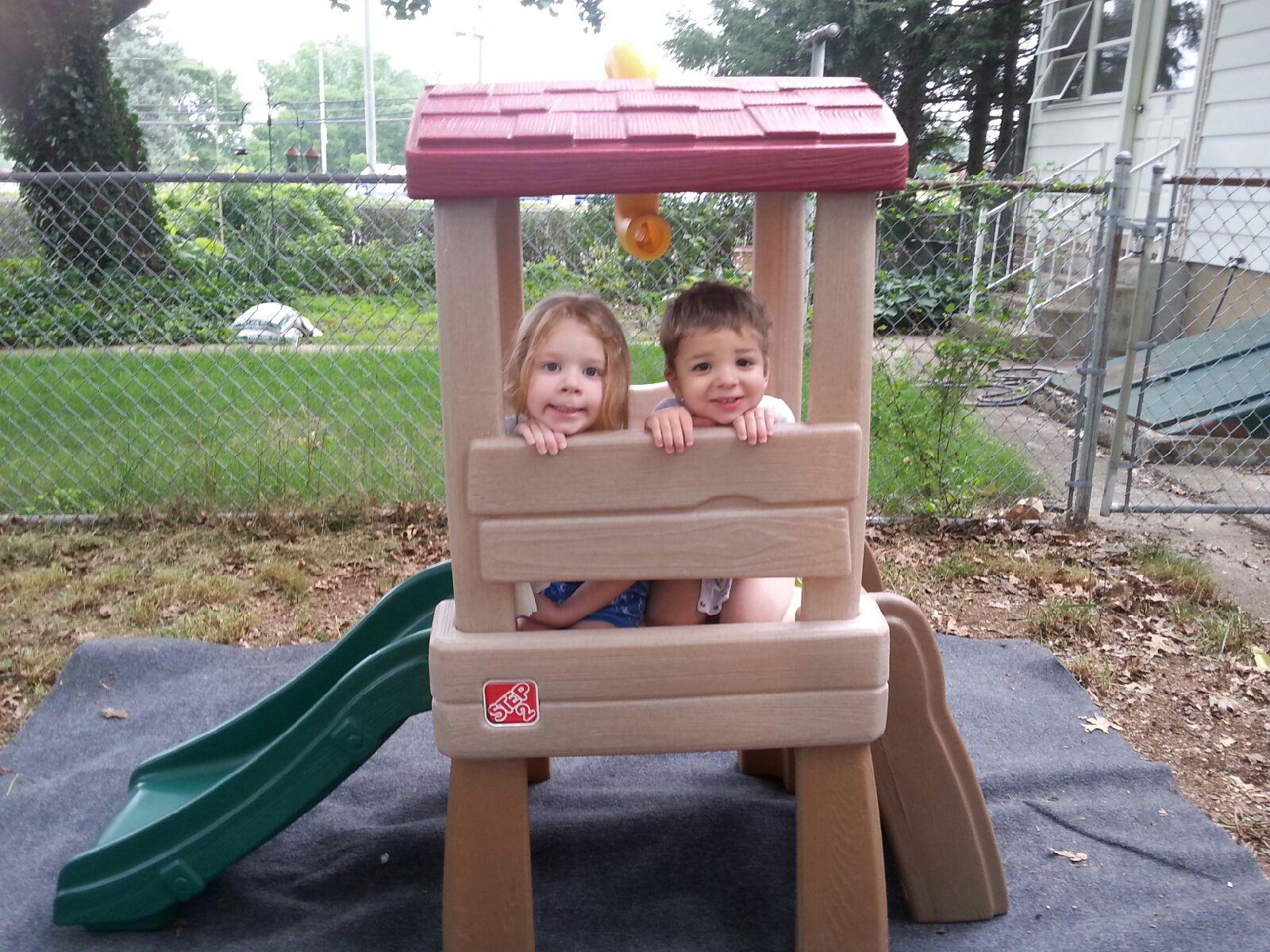
The space underneath is genuinely useful rather than structural filler. It becomes outdoor toy storage, a hide-and-seek spot, or the base for a sandbox when you want a second play zone underneath the same footprint.
At 30 pounds it is also one of the easier models here to reposition, which is helpful if you want it on grass in summer and on a covered patio in winter.
Why parents pair this with a small house
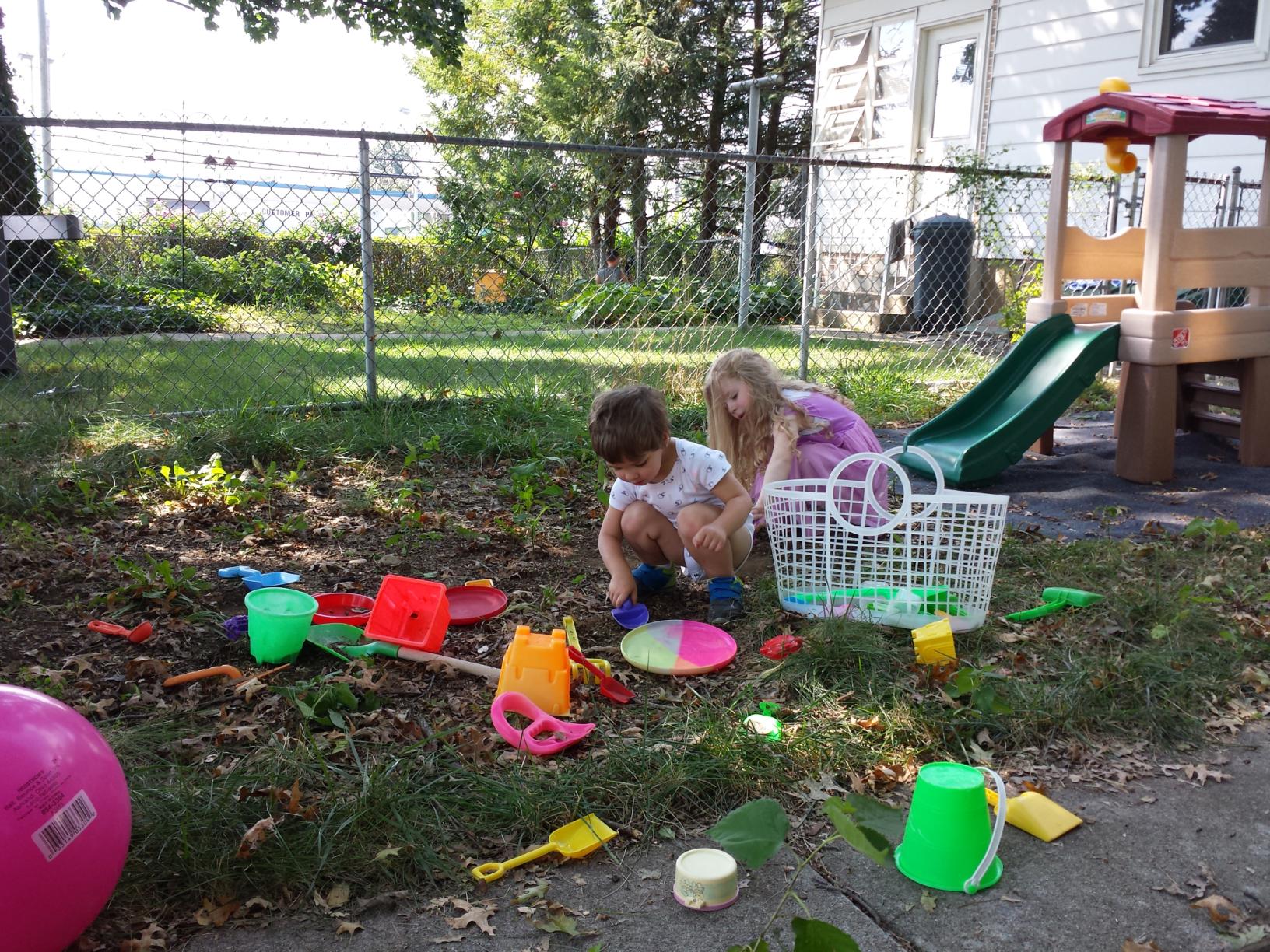
Forum conversations about toddler yards keep landing on the same conclusion: the under-two crowd often prefers running, sliding and chalk outdoors to sitting inside a house. This structure serves that preference directly.
Many families combine one of these with a compact cottage, which gives a mixed-age yard a toddler tower and a pretend-play space without the footprint of a single large structure.
Where it is not a playhouse
There is no roof and no walls. In winter, wet weather or direct sun, a child inside this is a child sitting in the open, so it is a seasonal structure rather than a year-round one.
It also needs genuinely flat ground for stability, and the 66.5-inch width is the largest footprint in the roundup. On a sloped lawn, skip it.
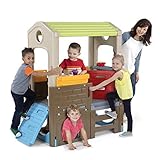
6. Simplay3 Young Explorers Discovery Playhouse: best for a toddler and an older sibling
Simplay3 Young Explorers Discovery Playhouse – Indoor or Outdoor Clubhouse and Activity Playset for Toddlers and Kids, Made in USA
- Two levels with ramp and ladders plus a crawling space
- Art board with paper clips and marker tray
- Two working doors with mail slots
- Fits through a standard door frame for easy indoor-outdoor moves
- Modular with other Young Explorers sets
- Premium cost for a plastic playhouse
- Larger footprint needs real yard space
- Lower review count than the other picks
The Simplay3 solves a problem most playhouses ignore: a two-level layout where the toddler route and the older-child route are genuinely separate. A ramp and ladders lead up to a pretend kitchen with a sink, stove and drink holders, while a lower crawling space and rooftop peek portals occupy the child who is not climbing yet.
The feature our team likes most is the art board with paper clips and a marker tray. In parent accounts, a playhouse that gets used as an art station and an instrument nook lasts considerably longer than one used only for kitchen play, because the use case changes as the child’s skills grow.
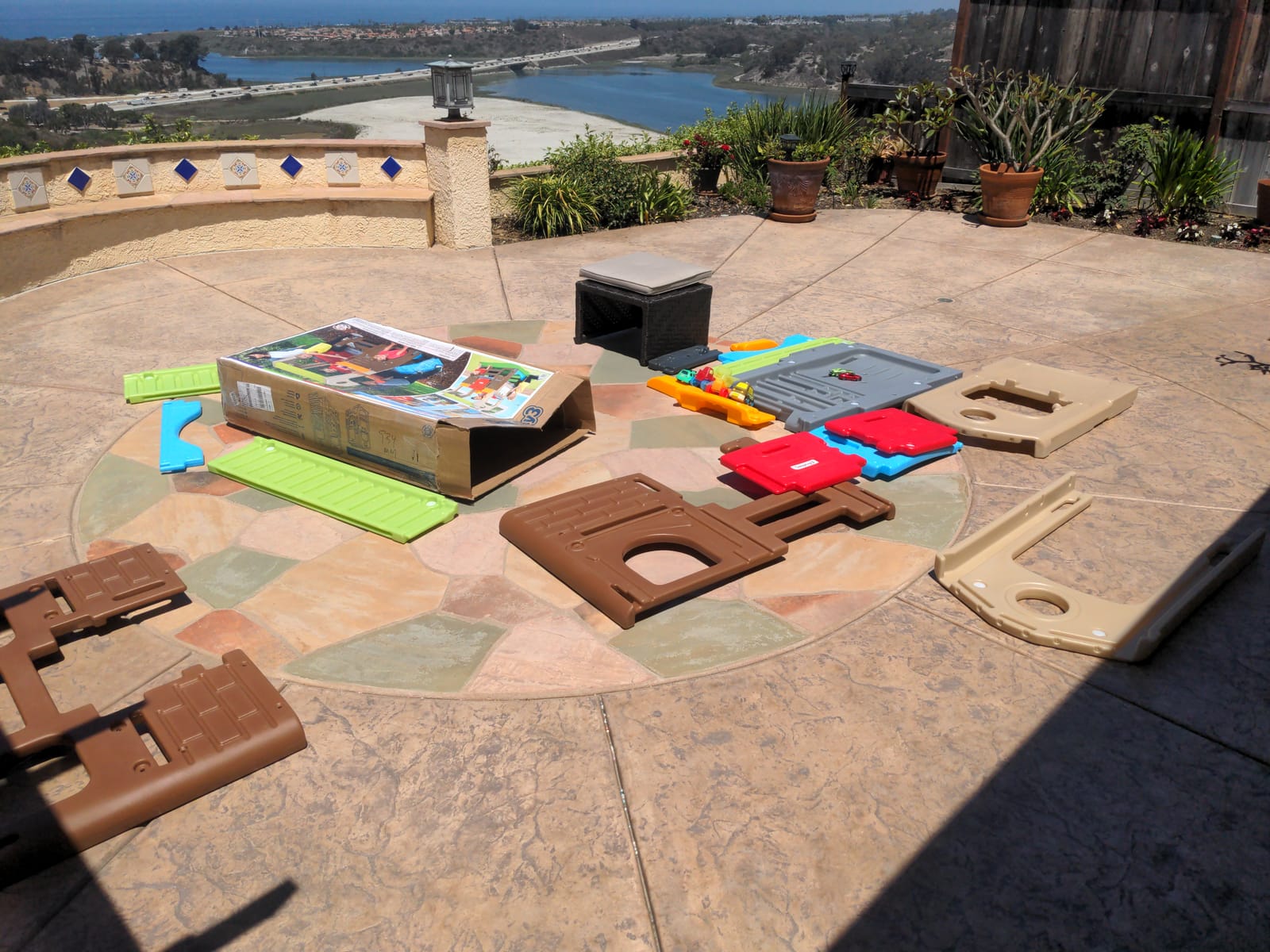
It is built from weather and UV resistant double-wall plastic with rounded child-friendly edges, and it is designed and manufactured in Ohio. The lower level gives an 18-month-old something to do without being lifted into a space built for a four-year-old.
Because it fits through a standard door frame, the indoor-outdoor transition is genuinely easy. That matters in winter, when a two-level play structure in a bare yard is unusable for months.
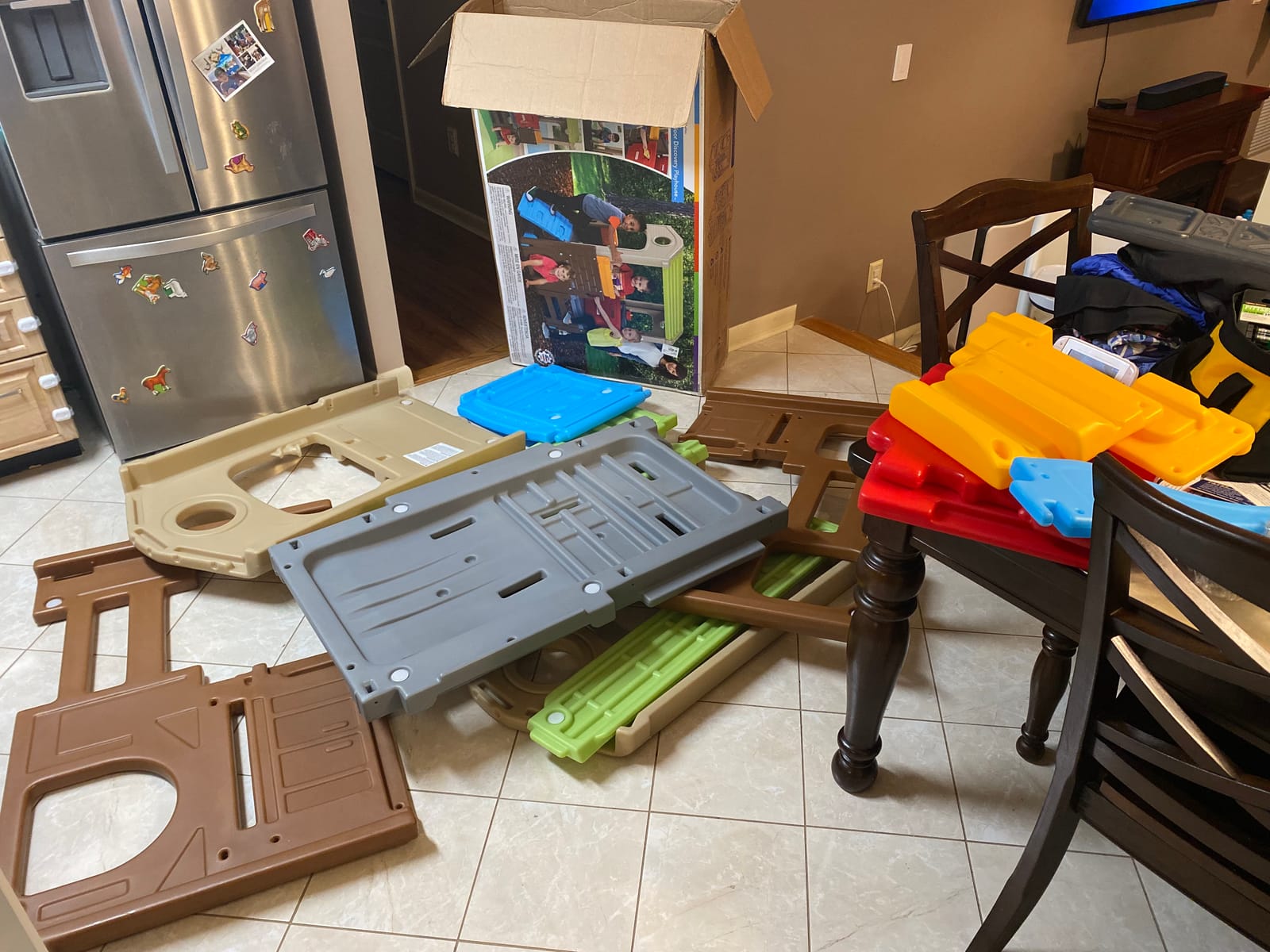
How it handles a wide age spread under one roof
Two working doors with mail slots means two children can run separate scenarios at the same time, which is the specific problem families with a toddler and a five-year-old face. Neither child has to wait for the other.
The modular design also means you can add other Young Explorers sets later rather than replacing the whole structure when a second child arrives.
Where the cost and space bite
It carries a premium cost for a plastic playhouse, and the 57.75 by 58.25 inch footprint needs real yard space on more than one side for safe circulation.
It also has the smallest proven track record in this group, with 278 reviews. The design is sound and well made, but there is less long-term data behind it than behind the Step2 and Little Tikes models.
7. Chicos Pink Princess Playhouse: best for a toddler who lives in a fantasy
- Fantasy theme that pulls children straight into role play
- Tool-free snap-together assembly
- Lightest build here at 11.7 kg so one adult can reposition it
- Durable plastic rated for indoor and outdoor use
- Made in Spain
- Lowest-rated model in the roundup at 4.4 stars
- 7 percent of reviews are one star
- Narrow interior suits one or two small children
- Theme is narrow and not gender-neutral
Themed playhouses divide parents more than any other category, and this is the strongest pure-theme pick in the roundup. Children between two and five respond to the fantasy styling immediately, and parents report that it shortens the time between a child seeing the house and a child playing in it.
At 11.7 kilograms it is the lightest model here, so repositioning it between a patio and a lawn is a one-person job. Assembly is tool-free snap-together, and the plastic is rated for both indoor and outdoor use. Made in Spain, and rated 24 months to 5 years.
Be realistic about the numbers, though. Its 4.4 star average is the lowest of the plastic playhouses in this roundup, and 7 percent of reviews are one star, which points at a narrower and more polarised experience than the higher-rated models.
Who this works for best
A child who has a strong, specific fantasy gets a lot from this. If your toddler is narrating castles and royal households, the themed shell gives them somewhere to put that story, and the imitation and role play supports early social development.
It is also the easiest model here to move indoors on a bad-weather day, which is when a themed house tends to earn its keep fastest.
Where it is the wrong fit
The narrow interior suits one or two small children. If you expect a playgroup of three or more regularly, look at a roomier model instead.
The theme will not grow with the child. Within a year or two most owners report the fantasy fading and the house becoming an open-ended space, and a second child with different interests may not use it at all. The rating spread in the reviews reflects exactly that range of outcomes.
8. Chicos Grand Cottage XL: best classic cottage with a roomy interior
Chicos – Grand Cottage XL Children’s Outdoor House, Made of Durable Plastic, Durable and Easy Assembly, Beige with Red Roof, Single (89627)
- XL interior gives real room for stories with friends
- Five windows for light and visibility
- Tool-free click-clack assembly
- Classic beige body and red roof suits any child
- Rated from 24 months up
- Second-lowest star average in the roundup at 4.2 stars
- Only 62 percent five-star with 8 percent one-star
- Feature-light compared with equipped rivals
- Open-plan interior with little pretend-play kit
The Grand Cottage XL is the most conventional-looking playhouse here, and for some families that is the entire appeal. A beige body, a red roof and five windows read as a cottage from any angle, and the XL interior gives two or three children room to play a scenario together rather than taking turns.
Assembly is click-clack with no tools, at a similar weight to the other plastic models, so it is a weekend-morning job rather than a project. It is rated 24 months and up and works both indoors and outdoors.
The honest drawback is that this is a shell. There is no working doorbell, no play kitchen, no sand table, no snack window. For the same money you can get a fully equipped model, and buyers regularly note that mismatch as the reason for the 4.2 star average and the 8 percent one-star share.
Who this works for best
Buy it if you are supplying the play food yourself. A plain, spacious shell plus a box of pretend food, a tea set and a clipboard gives a toddler more to do than an equipped house with nothing in it.
It is also a good choice if the cottage has to look neutral in a front yard visible from the house, which rules out a bold theme.
Where it is not the right call
If you want the playhouse to carry its own entertainment, this is the weakest value in the roundup. The feature gap against the Step2 Neat and Tidy Cottage is large and it costs close to the same amount.
Its 4.2 average is the second-lowest among the plastic playhouses here, and with 8 percent one-star reviews, the disappointment is concentrated in parents who expected a complete play set.
9. Outsunny Fir Wood Playhouse: best for a playhouse that doubles as an animal shelter
Outsunny Outdoor Kids Playhouse with Dutch Door for Toddlers 3-8, Beige
- Tilted roof sheds rainwater off the wood
- Two planter boxes and two planter pots included
- Six windows including two openable side windows
- Cottage styling with a Dutch-style front door
- Doubles as a small animal shelter
- Fir wood needs sealing or staining outdoors
- Second-heaviest model in the roundup at 74 lb
- Smaller review base means less long-term data
- Untreated panels can splinter or warp
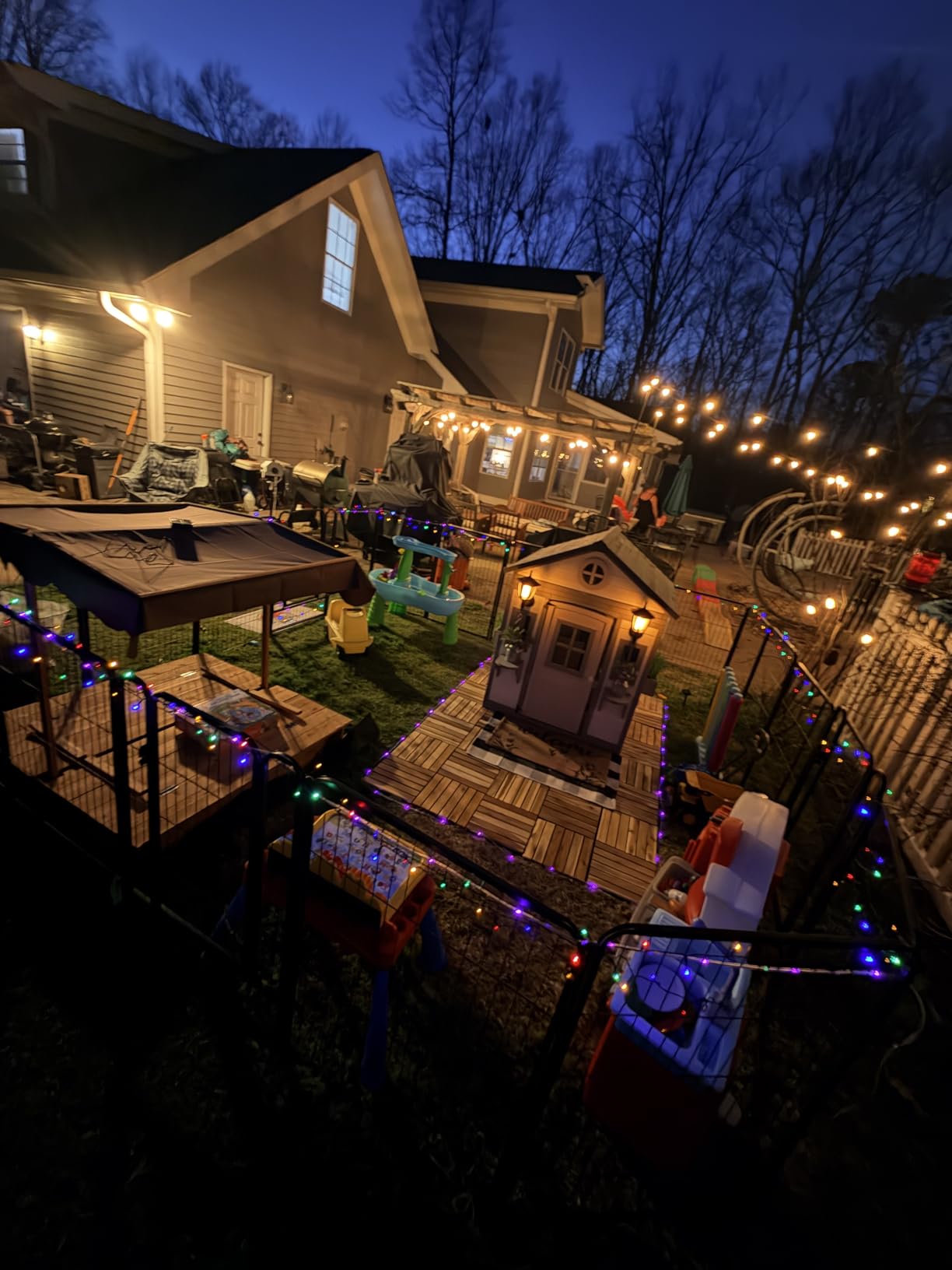
This is the pick for a household that also keeps small animals. Owners use it as a coop or shelter for rabbits and small poultry, and the 49.8-inch width gives a child and a hutch or enclosure a shared footprint rather than two separate structures competing for yard space.
The design detail that earns that second life is the tilted roof, which directs rainwater away from the wall panels instead of letting them pool at the joints. Two openable side windows and the retro front windows keep it ventilated, which matters as much for an animal as for a child.
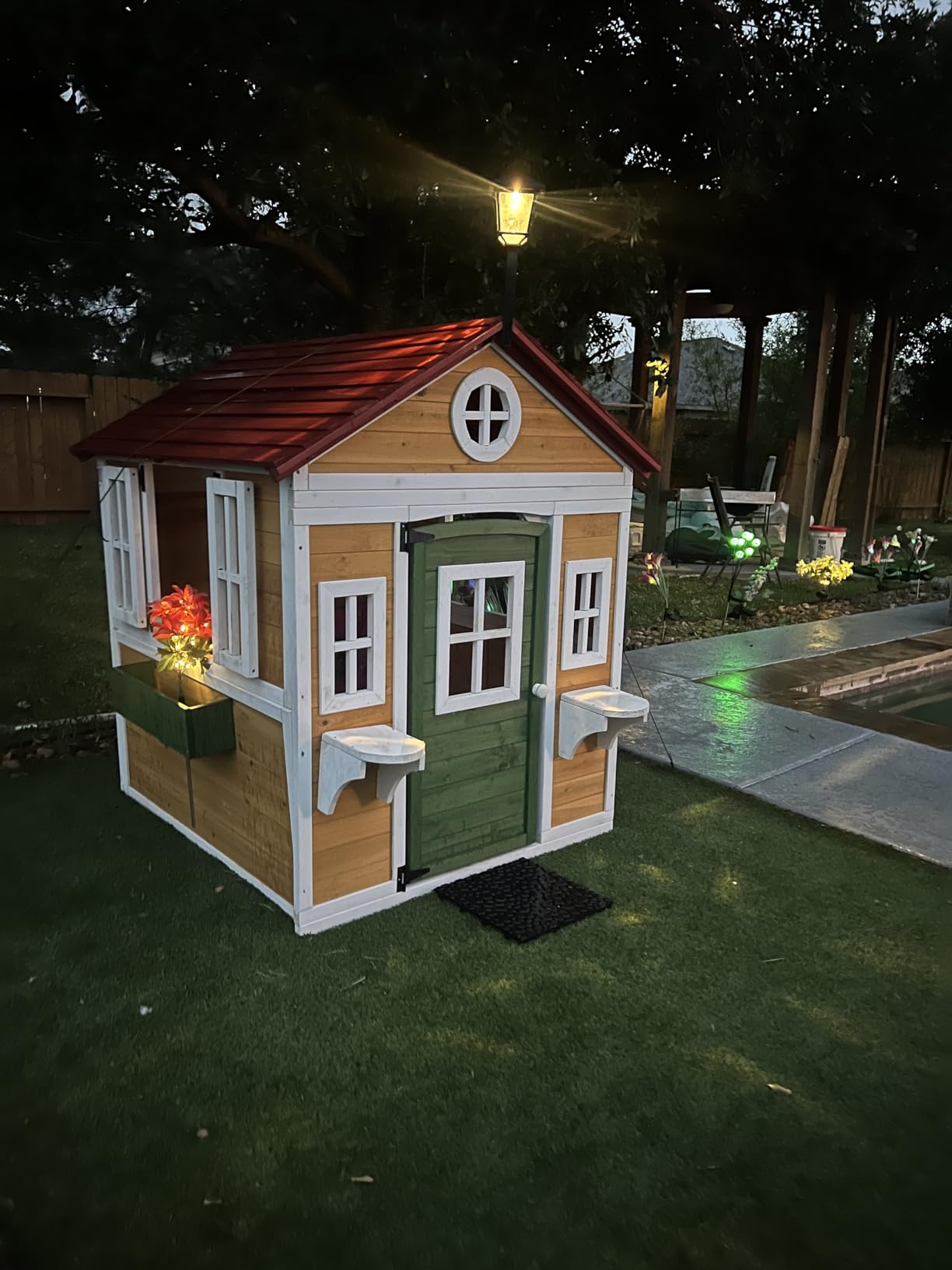
The Dutch-style front door gives a toddler a full-height opening to walk through, and the two planter boxes with two decorative pots support a gardening scenario alongside the pretend play. It is rated 24 months to 8 years and available in gray, white and beige.
Note that this is fir, not cedar. Fir is a legitimate outdoor-grade choice when it is treated, but it has less natural decay resistance, which makes the sealing schedule more important here than on the cedar models.
When the dual use actually pays off
If you were going to build or buy a small animal shelter anyway, this removes that separate purchase. Parents report the dual role keeping the structure in daily use long after the pretend-play novelty fades.
The planter boxes also give a toddler a real, seasonal task, which is a genuine advantage over a purely imaginary play space.
Where the weight and wood catch up
At 74 pounds it is one of the two heaviest models in the roundup, so repositioning it is a two-person job and you should assemble it in place.
The smaller 182-review base means less evidence about how it holds up across many seasons, and untreated fir panels can pick up splinters or weather-warp. Seal it before the first wet month, not after.
10. Outsunny Wooden Playhouse with Working Door: the most straightforward wooden start
Outsunny Outdoor Playhouse Wooden Kids Playhouse with Working Door Brown
- Lowest-cost wooden model in the roundup
- Open serving station plus three windows
- Working door and flowerpot holders add realism
- No splinters reported after assembly
- Straightforward build with a simple drill
- Some panels arrive without pilot holes and need hand drilling
- Flimsier than expected without added hardware
- Frame still needs anchoring outdoors
- Smallest review count in the group
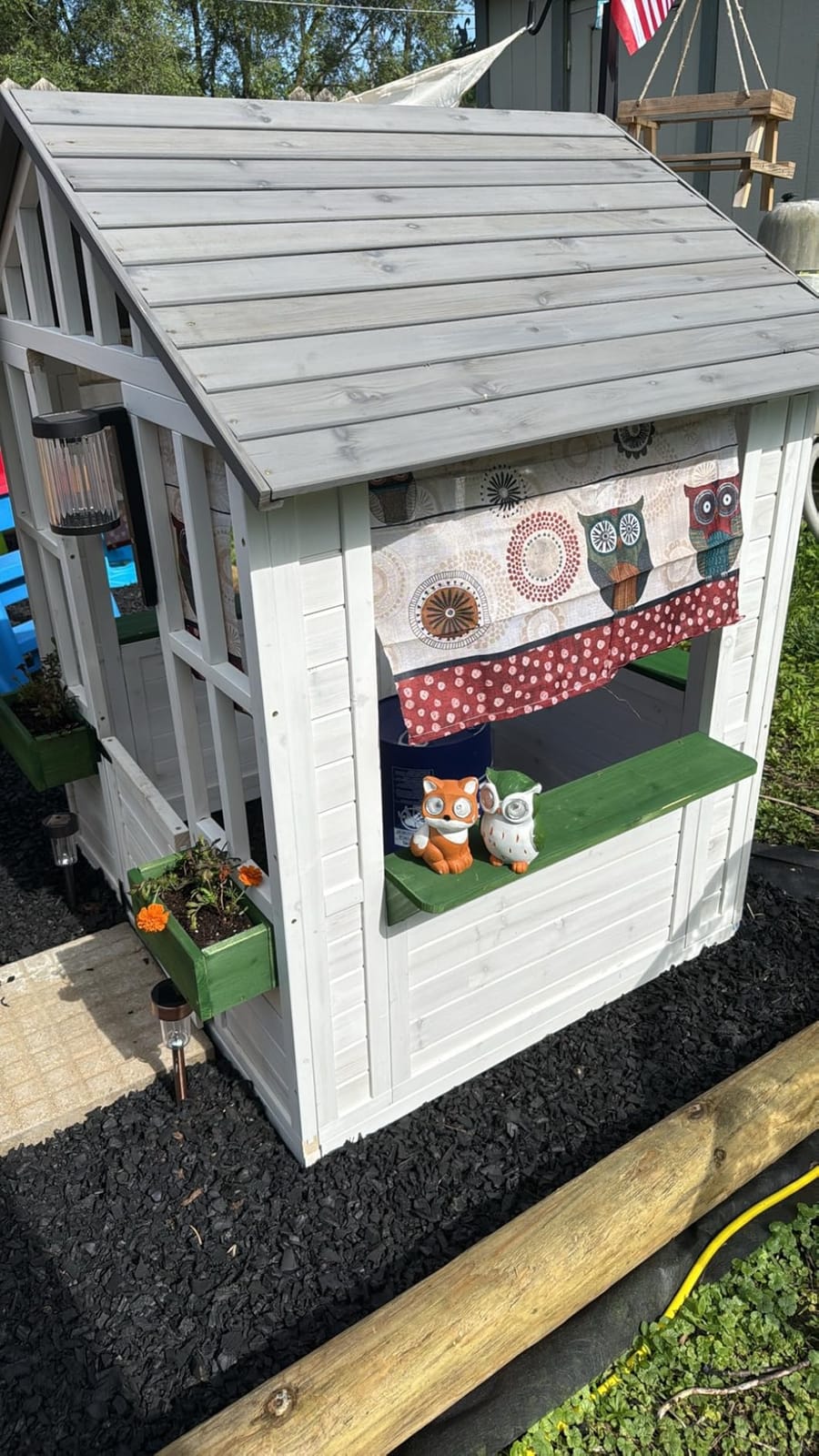
If you want wood rather than plastic but not a full weekend project, this is the compromise. It carries a 4.5 star average, and the open serving station window plus a working door and flowerpot holders give a toddler enough role-play furniture to start immediately.
Buyers consistently describe the build as straightforward with a simple drill, and several report no splinters after assembly with a well-finished look. The 46.75-inch width fits comfortably into a small garden, which is where most wooden playhouses run into trouble.

Three windows keep airflow moving, so it is more comfortable in summer than an enclosed shell with a single opening. The door is a working half-size door, meaning a toddler can open and close it independently rather than relying on a parent to lift it.
There is a practical warning here. A number of buyers found panels arriving without pilot holes and needed to drill them by hand, and several describe the frame as flimsier than expected until they added their own hardware. Families in wetter climates report treating and sealing the wood themselves for longer life.
How a small yard changes the shortlist
This is one of the few wooden models compact enough for a narrow garden or a paved courtyard, where a 5-foot cedar cottage simply will not go. For very small outdoor spaces, we also covered small-space options in our playhouse picks for kids.
If your ground is paved, this lightweight frame is easier to site than a solid wood structure, though it still needs anchoring against tipping.
Where the price shows
The thin frame is the trade-off. Children who lean on panels or climb the sides will find it moves, and owners often add corner brackets to solve it.
It also has the smallest review base in the roundup at 111, so there is less evidence about multi-season durability than for the better-reviewed models. The flower boxes also benefit from pre-drilled drainage holes before you fill them with soil.
11. BTMWAY Cedar Playhouse with Play Kitchen: best for a toddler who will grow into it fast
BTMWAY Kids Outdoor Playhouse with Play Kitchen, Ages 3-8, Fits 2-4 Kids
- Tallest model here at 66.3 inch with roomy interior
- Weather-resistant cedar with a water-based finish
- Panels sanded smooth with rounded edges
- Full play set with sink stove doorbell and phone
- Pre-cut pre-drilled panels with sorted hardware
- Floor or deck is not included and owners must build one
- Assembly takes 3 to 5 hours and needs two adults
- Awkward doggie door fitting
- Faucet failure reported by one buyer
- Sealant must be re-applied annually
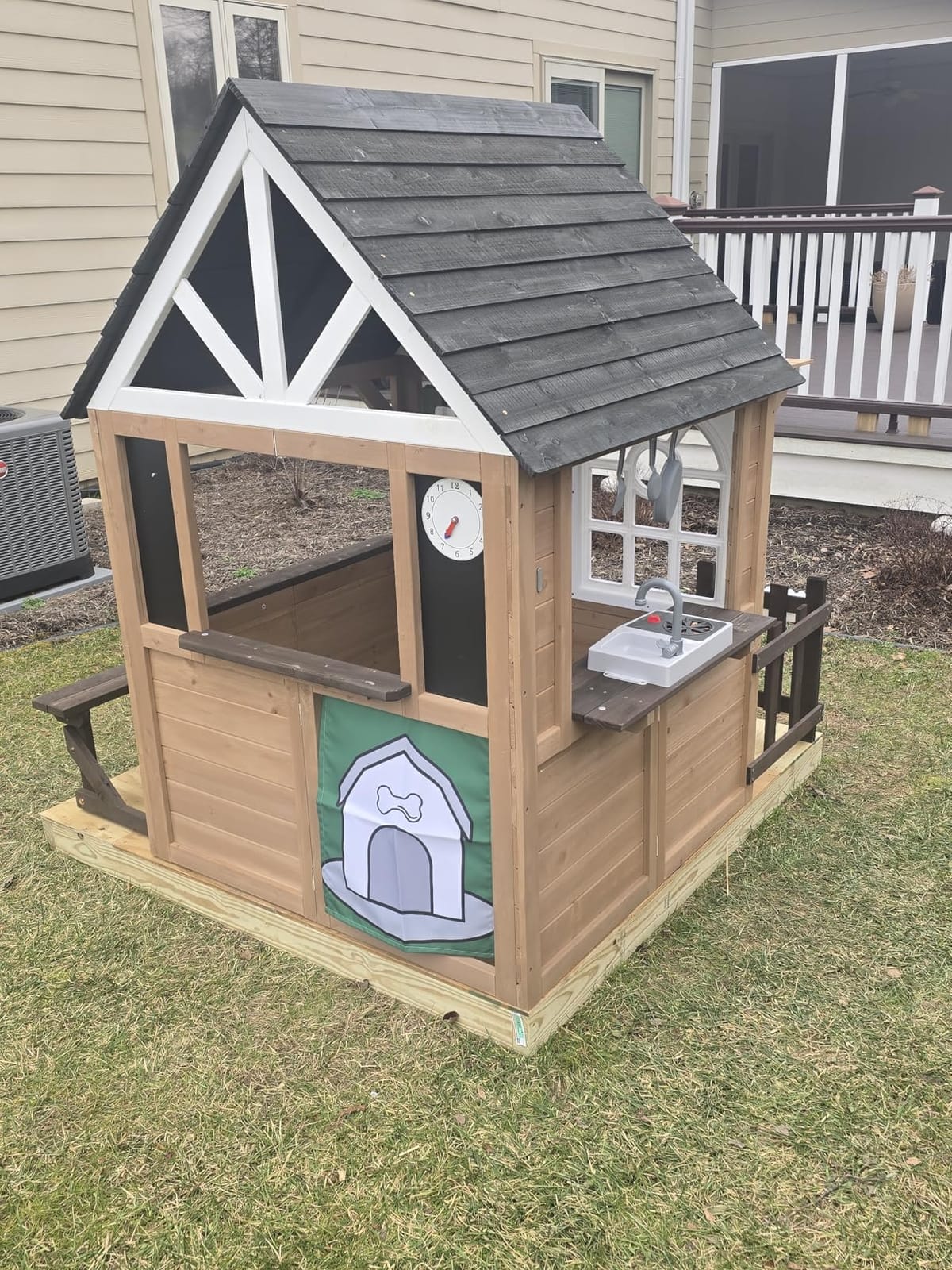
This is the tallest structure in the roundup at 66.3 inches, and that height is the entire point. Parents note that older children can duck through the door and still stand upright, which extends the useful life of the same structure well past the toddler years. It is rated 3 to 8 years and fits two to four children.
The pretend-play set is the most complete here: a play kitchen with sink, stove and kitchenware, a working doorbell, a toy phone and window flowerpots for growing real plants. Every panel is sanded with rounded edges and finished in a child-safe water-based paint with ABS-free plastic accessories.
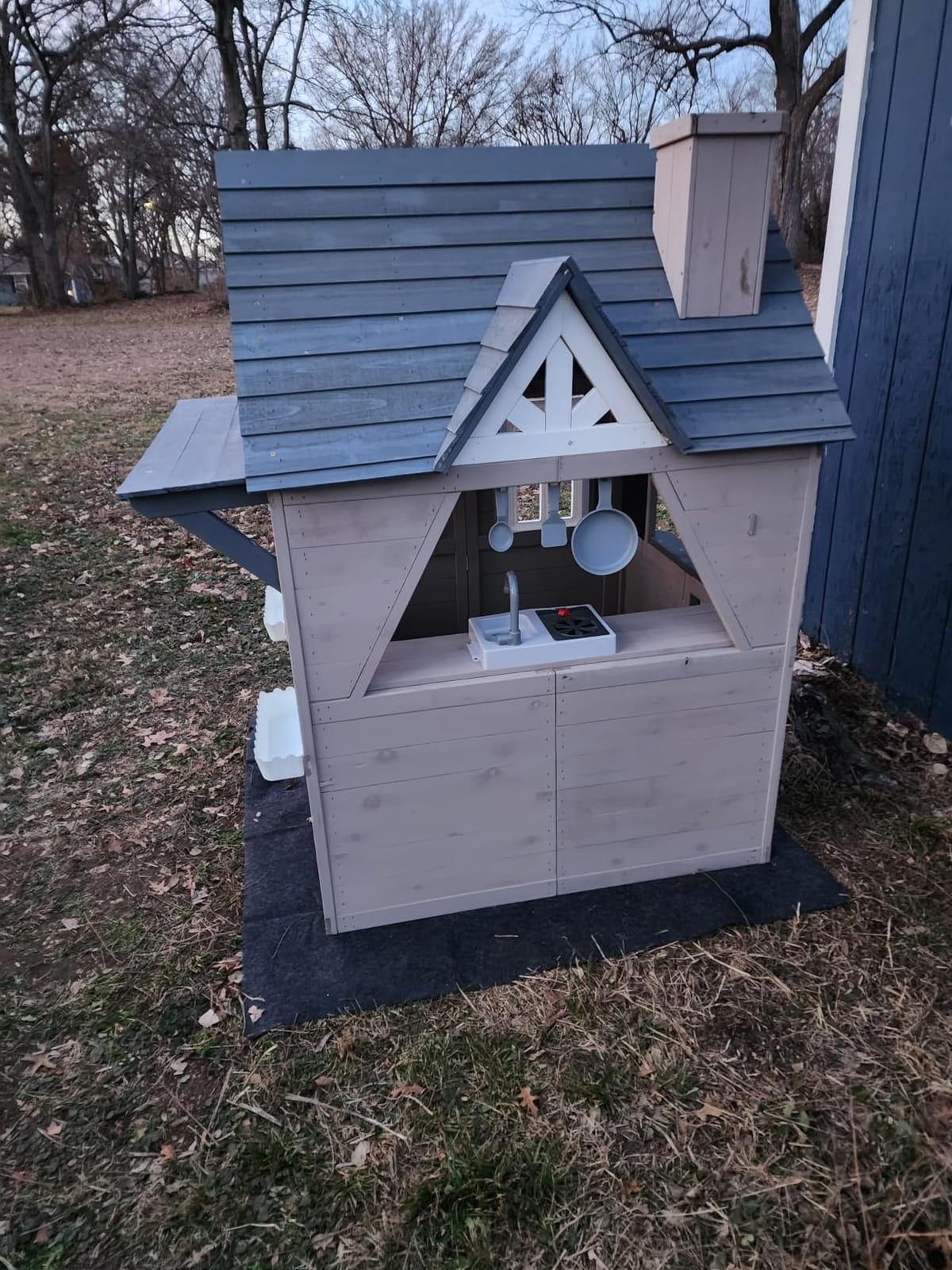
We include it because a family buying for a three-year-old today is buying for a six-year-old in two years, and this model covers both. Families who treat and seal it themselves for rainy climates report it lasting well beyond the stated range.
Pre-cut, pre-drilled panels and sorted, labelled hardware make the build methodical rather than guesswork, which is the single biggest predictor of a successful weekend assembly.
When the height is worth waiting for
A three-year-old who can stand and walk confidently will use this immediately, and the extra headroom stops the structure from feeling cramped at five. If your child is under three and under 40 inches tall, the door will feel low.
The flowerpot windows give a genuinely useful task alongside pretend play, and owners report treating the playhouse as a small garden station as well as a house.
Where the assembly realities matter
The floor or deck is not included, and several owners had to build one, which adds a project on top of the build. Assembly takes three to five hours and is much easier with two adults.
The doggie door is fiddly and needs fitting before the sink counter goes on, a sequencing detail the instructions do not make obvious. One buyer reported a broken faucet and a replacement that never arrived, so check that part on arrival. The cedar also needs sealant re-applied annually to outlast the weather.
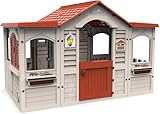
12. Le Chalet Grand Cottage Playhouse: most role-play fixtures, most polarised reviews
Le Chalet Grand Cottage Playhouse for Kids, Indoor & Outdoor, Easy Assembly, Fun Features, Durable Plastic
- Most spacious plastic interior in the roundup
- Six windows including folding windows
- Letterbox BBQ and cat flap add distinctive detail
- Tool-free click-clack assembly
- Supports social and motor development through imitation play
- Lowest-rated model in the roundup at 4.0 stars
- 12 percent one-star reviews is the highest in the group
- Highest relative cost against the feature set
- Snap-together plastic flexes compared with wood
The fixture list is what draws people in: six windows including folding ones, a letterbox, a barbecue and a cat flap, in a 159 by 103 by 104 cm shell. At 15 kilograms and with a tool-free click-clack assembly system, it is a large, quick-build plastic playhouse with more built-in detail than any other model here.
The interior is the most spacious of the plastic playhouses in the roundup, which is what makes it work for hosting friends rather than playing alone. Assembly needs no tools at all, and the plastic is rated for both indoor and outdoor use.
We are listing it last deliberately, because the numbers are the weakest here. Its 4.0 star average is the lowest of all twelve, with only 56 percent five-star reviews and a 12 percent one-star share, the highest in the group. Buyers also report that the snap-together plastic flexes, and several question the relative cost for the feature set.
What the extra fixtures actually add
The cat flap and letterbox are the differentiators, and they create play scenarios no other model here can support, especially for a child who likes animal and postman narratives. The folding windows give a real ventilation adjustment as the temperature changes.
Because the interior is open and large, it also works as a storage and dressing-up space, which is how many parents describe extending the useful life beyond pretend cooking.
Where the reviews earn their caution
A 12 percent one-star share is a real signal. Combined with plastic flex and a high relative cost for the feature set, the risk is that you end up paying more for a shell with fixtures than a better-rated equipped model costs outright.
It also carries a limited market presence and lower review depth than the alternatives. If the fixture list is the deciding factor, buy it, but go in knowing the polarisation rather than being surprised by it.
How to Choose a Playhouse Your Toddler Will Use for Years
What age is best for an outdoor playhouse?
Between 18 months and 3 years is the window when a playhouse adds most, and 18 months is the earliest sensible start. Before that, a child cannot open a door, cross a threshold or operate fixtures independently, so the structure becomes a static object rather than a play space. Most parents on parenting forums describe waiting until their child walks confidently, then starting with a ground-level house and no climbing features.
There is also an upper bound worth planning for. A playhouse that is too small gets outgrown in months, which is the sizing anxiety parents repeat most often. Judge the door height against your child’s height now and against their height in two years, and buy for the child you are becoming, not the one you have.
Under three, an adult should be within earshot and within sight. That supervision expectation does not change with the model, and it is worth saying plainly because a doorbell does not make a toddler independent.
Wood or plastic: what actually lasts in your climate
Plastic is the easier choice for a first playhouse. Double-walled plastic resists chipping, fading, cracking and peeling, wipes clean with household spray, needs no sealing schedule and weighs less, which means one adult can move most of them between a patio and a lawn.
Wood is the better choice if you want a structure that stays put for a decade. Cedar has natural decay resistance and the Backyard Discovery Sweetwater carries a 5-year warranty, but every wooden model here needs sealing or staining on a recurring schedule, and skipping that is what produces grey, cracked boards within two or three seasons.
Watch out for cedar look-alikes. The description field in a listing may say cedar when the material is fir, and the fir models in this roundup are perfectly good once treated, but they demand a stricter maintenance habit. If a listing does not name the wood species, assume it is not cedar.
One more climate variable. In a damp region, mould and mildew on wooden playhouses is a recurring complaint, and plastic is simply easier to keep sanitary. In a hot region, direct sun is harder on plastic colour than on sealed wood, so shade helps both.
Where to put it: ground surfaces, anchoring and drainage
Level ground matters more than anything else about siting. A playhouse on a slope settles unevenly, doors stop closing properly, and climbing structures become unstable. Use a spirit level on the finished ground before you unpack the boxes, not after assembly.
Four surfaces work, and each suits a different yard. Mulch or wood chips give the best fall surface and let you level a patch easily. Grass is fine if the ground drains and the area is not prone to standing water. A gravel or sand pad drains fastest and stops mud tracking indoors. A concrete or patio pad is the most durable and the easiest to anchor into, and it is the answer for a fully paved garden.
Drainage is the failure nobody plans for. A playhouse set directly on a low spot will sit in water after heavy rain, which is how timber rots at the base and how plastic bases crack. Set it slightly proud of the lowest point, with a shallow fall away from the door.
Anchor it. Light plastic playhouses can shift or tip in a gust, and a structure a toddler can push over is a genuine hazard. Use the manufacturer-supplied ground anchors on soil, and drill or bolt to the slab on a paved surface. Our extra backyard building guides cover similar anchoring and siting problems for larger structures.
How much assembly time should you plan for?
Plan on a morning for a plastic snap-together model and a half-day for a wooden one. Every plastic pick in this roundup except the Step2 All Around Patio assembles without tools at all. The Chicos cabins use a click-clack system, and the Little Tikes and Step2 Neat and Tidy units snap together in minutes.
Wood is a different category. The Backyard Discovery Sweetwater arrives pre-cut, pre-drilled and pre-stained, which is the best case. The BTMWAY cedar takes three to five hours with two adults, has no floor included, and has a doggie door that must be fitted in the right order. Budget the whole Saturday and the two of you.
Build it where it will live. Two of the heaviest models here weigh more than 70 pounds, and moving an assembled cedar cottage across a lawn is a project in itself.
What to check in the first 30 days
- Walk the base and confirm the structure is level and cannot rock.
- Torque every screw and hinge the manufacturer supplied, then re-check after two weeks of hard use.
- Confirm the anchor points are in the ground or the slab, not just resting on it.
- Register the warranty if the model has one, and photograph serial numbers before the packaging goes.
- Check the door swing for pinch points a small hand can reach.
- For wood, apply the first seal or stain before the first wet season rather than at the end of the first year.
- For plastic, check panel flex at the corners and tighten any hardware that has worked loose.
Add play food, a small chalkboard and a set of tools inside within the first week. Forum conversations about playhouses keep returning to the same finding: a house that is furnished keeps being used long after the initial novelty wears off, and a house that is empty gets abandoned by age four.
What Parents Report After a Year of Play
The most useful thing we found in parent conversations is that the biggest wins are rarely the biggest structures. Forum sentiment favours value units for toddlers, with a mid-priced plastic house delivering more play value than a premium wooden build, and the value of a playhouse often comes from the accessories inside rather than the shell outside.
The second theme is multi-use. Parents describe a playhouse that becomes an instrument nook, a chalkboard art station and general toy storage as the model that survived three children. A playhouse with a play kitchen and nothing else tends to get used only for cooking, and the interest fades once the scenarios stop changing.
The third theme is the surprise favourite activity. For the under-two crowd, parents repeatedly report that running around outside, sliding and chalking beat sitting inside the house. That is the honest argument for pairing a compact cottage with a small climbing structure rather than buying one large unit and hoping it covers everything.
Screen time is the underlying motivation behind a lot of these purchases, and it is the one worth naming honestly. Several threads frame the playhouse as the tool that got a tablet-focused child outside and moving. If that is your situation, the models with sand and water tables, art surfaces and open-ended interiors tend to work better than feature-heavy kitchen shells.
Finally, expectations. Plastic fading in strong sun, cedar going grey between seasons and mould in damp climates are all reported, and none of them are defects. They are maintenance realities, and a household that accepts an annual 20-minute sealing session gets a wooden playhouse that outlasts the plastic one by a wide margin.
Frequently Asked Questions
What is the best outdoor playhouse for toddlers?
The best outdoor playhouse for toddlers is a ground-level cottage rated from 18 or 24 months, built from cedar or double-walled plastic, roughly 4 to 5 feet across, with a door the child can open alone and low pretend-play fixtures such as a play kitchen, mailbox or sand and water table. Our top pick is the Little Tikes Cape Cottage for its proven durability and light weight, while the Step2 Neat and Tidy Cottage starts at 18 months and the Backyard Discovery Sweetwater wins on play-kitchen detail.
What is a good playhouse for a 2-year-old?
A good playhouse for a 2-year-old is a single-storey, ground-level structure with a working door, shutters or windows a small child can operate, and no platform, ladder or slide. At two, children are rehearsing roles rather than climbing, so a play kitchen, a mailbox, a working doorbell and a sand and water table deliver far more than a climbing structure does. Always check the manufacturer age minimum before buying, and stay within earshot whenever a child under three is inside.
Is it cheaper to build a kids playhouse or buy one?
Buying is usually cheaper once you count your time. A cedar playhouse needs a full weekend with two adults, a drill, sealant and often a separate floor, and a rotary saw in the price list. Pre-cut kits such as the Backyard Discovery Sweetwater cut that dramatically, which is why they are the wooden option we recommend. Building only makes sense if you already have the tools and a weekend, or if you want a size and layout that no retail model offers.
What age is best for an outdoor playhouse?
The best starting age is 18 months, once a child walks confidently and can open a door, and the sweet spot runs to about age 3. Before 18 months the structure sits unused because the child cannot operate it. Most units are rated to 24 months and up, so check the label rather than guessing. Aim for a door height your child will still fit through at five, since sizing that is too small is the most common reason a playhouse gets outgrown early.
How long should I let my 2 year old play outside alone?
A two-year-old should not be left completely alone outdoors, even in a fenced yard with a playhouse. Toddlers at this age lack the judgement to assess a climbing risk, a hot surface or an animal, and they will wander. The useful compromise is a visible playhouse in a yard you can see from a door or window, with a device that lets you hear them, and check-in intervals rather than constant supervision. Use the playhouse as a tool that buys you a longer, calmer stretch of independent play, not as childcare.
Our Final Verdict for 2026
The Little Tikes Cape Cottage is the best backyard playhouse for most families, because a 4.5 star average across more than fourteen thousand reviews and a 32-pound weight are harder to argue with than any feature list. Buy the Step2 All Around Playtime Patio if you want the highest rating and real shade, and buy the Backyard Discovery Sweetwater if a play kitchen and real cedar matter more to you than weight.
Whichever you choose, check the stated age minimum against your child today, level the ground before you open the first box, and anchor it properly. Those three steps do more for how long the playhouse gets used than any accessory in the box. Fill it with pretend food, a chalkboard and real tools in the first week, and you should still be using it in 2026 and beyond.