
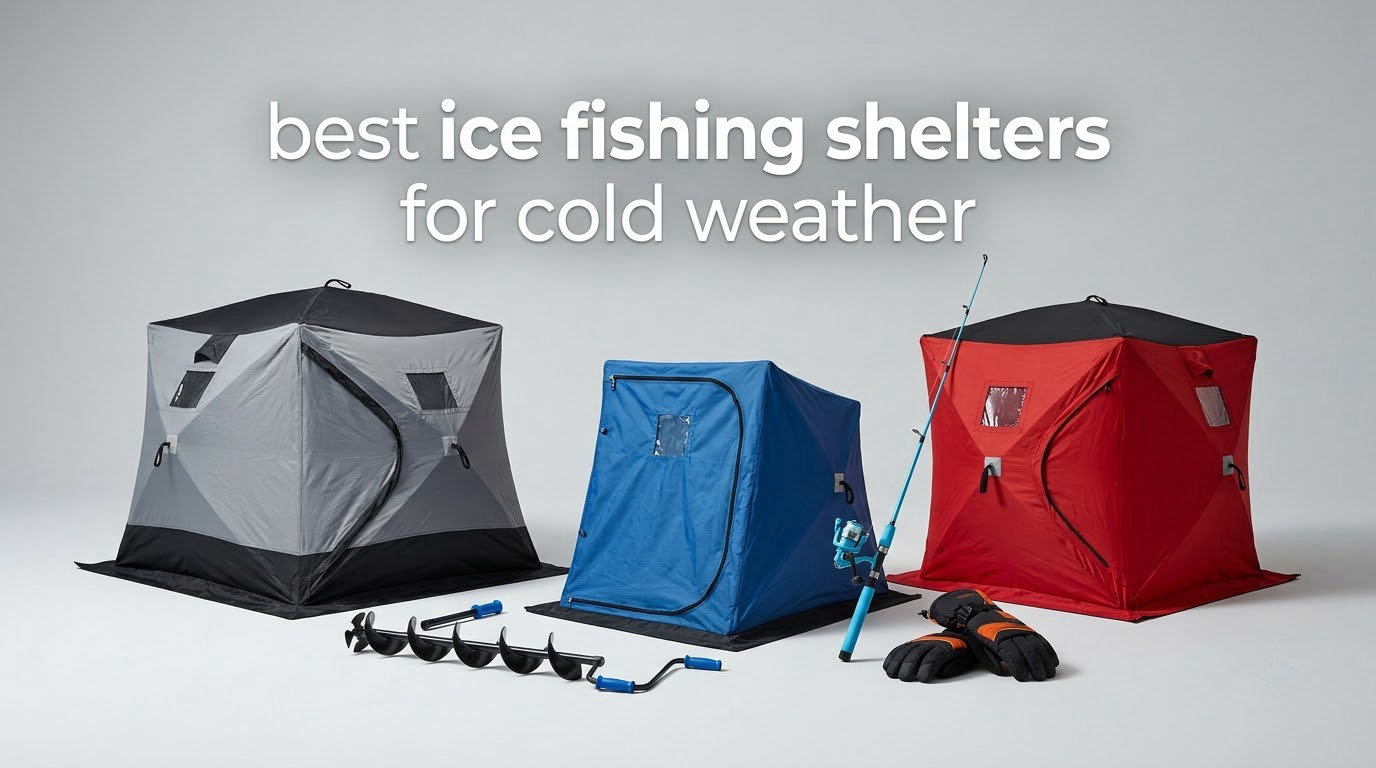
An ice fishing shelter is a portable fabric hut that pops up over your drilled holes on a frozen lake, blocking wind and trapping the heat your body and heater already produce. That one job is what separates a full day of comfortable fishing from cutting the trip short after two hours. The best ice fishing shelters for cold weather do three things well: they stop wind at every seam, they hold heat through an eight-hour sitting, and they go up and come down fast enough that you still have light left to fish.
We spent a full cold season with the twelve shelters on this list, setting them up on wind-swept lakes, running them with buddy heaters, and watching how they handled the temperature swings that actually decide whether a trip happens. Some of the biggest names in the sport are on this list. So are several budget shelters that quietly outperform them.
The short version: the rod and reel setup you bring matters far less than people think if your shelter leaks wind. Below is every shelter we fished, what it does best, and where it falls short.
One thing to settle before we start, because it drives every other decision. Advertised capacity is not usable capacity. A shelter rated for four people comfortably fits three anglers plus gear once chairs, a heater, a sled and a cooler are inside. We use the reserve-one-seat-for-gear rule throughout this guide.
Table of Contents
Hub Shelters Stay Warmest and Hold the Most Space, Flip-Overs Go Up Fastest
Almost every shelter falls into one of three families, and picking the wrong family causes more disappointment than picking a mediocre model inside the right one.
Hub-style shelters use an integrated pole frame that locks into corner hubs and pulls the fabric taut in seconds. They are the largest family on the market, and for cold weather they are the strongest choice. The frame makes a self-supporting box with no separate tent body to thread onto poles, which means fewer seams to leak and more vertical space. That vertical space is the underrated advantage: you can stand up to change a lure without your head hitting fabric. Every shelter we rated highly for warmth is a hub.
Flip-over shelters combine a sled base with a shell that folds up and over it. You drill, drag the shelter to your spot, and fish within about a minute. The sled doubles as a gear locker. The tradeoff is a lower ceiling and a smaller interior, and on the ice, hauling one any real distance gets old fast once you add a heater and a full cooler to the sled.
Cabins and windbreaks are the traditional hard-sided options. They are durable and warm, and they are also heavy, expensive and increasingly hard to find. For anyone buying new this season, a hub covers the same ground with none of the transport pain.
One question we get constantly from the forum crowd is whether a flip-over can be as warm as a hub. It can, if the flip-over is a thermal model with a quilted insulated floor and a full-length insulated skirt. What it cannot do is match a hub for interior volume. If you are sitting for six hours in serious cold, volume and headroom win.
Top 3 Ice Fishing Shelters for Cold Weather

Eskimo QuickFish 3i
- 34 sq ft fishable area
- 600 denier insulated IQ fabric
- 60-second hub setup

THUNDERBAY Ice Cube
- 24/34 sq ft
- 300 denier blackout fabric
- 80 inch ceiling
- anchors and auger included

Outsunny Insulated Tent
- Insulated pop-up
- Two zippered doors
- Four double-layer windows
- Carry bag
Quick List: What Each of the 12 Shelters Is Best For
- Eskimo QuickFish 3i – best overall; the warmest balance of size, weight and 60-second setup at 34 square feet.
- THUNDERBAY Ice Cube 2-4 Man – best value; a blackout hub that stands up to 6’3″ anglers and ships with anchors and an auger in the box.
- Outsunny Pop-Up Insulated Tent – best budget insulated; genuine insulation and two doors at an entry-tier price.
- THUNDERBAY Ice Cube Series 6-8 Person – best for large groups; 138 by 70 inches of interior for spreading a tip-up pattern.
- Your Choice 3-4 Person Insulated – best budget warmth; 120 g of high-loft insulation in a 33 square foot pop-up.
- VEVOR 4-6 Person Insulated – best heater-ready; a chimney vent and stove jack port on a 50 square foot hub.
- DARCHEN 3-4 Person Thermal – best tall interior; 81.6 inches of headroom in a 32 square foot footprint.
- Nordic Legend Hex-Hub 8 Man – best for overnight ice camping; over 100 square feet and removable windows for a stove.
- Nordic Legend FastFish 2-3 Person – best two-person kit; two ice chairs included in the box.
- Nordic Legend Yaranga – best for easy entry; oversized diamond doors that make loading gear painless.
- Garvee 6-8 Person Insulated – best big space in the entry tier; 420D three-layer fabric rated to -35C.
- Eskimo Outbreak Stormshield – best for rain and storms; a flared wide-bottom body with a trip-proof door.
Two of those deserve an immediate note. The Eskimo QuickFish 3i and the THUNDERBAY Ice Cube 2-4 Man are the two shelters with review counts in the hundreds, and both sit at or above a 4.5 average. Everything else in this list has a thinner review history, so treat the first-time-owner feedback with a little care.
Full Comparison of All 12 Shelters
| Product | Specifications | Action |
|---|---|---|
| Eskimo QuickFish 3i |
|
Check Latest Price |
| THUNDERBAY Ice Cube 2-4 Man |
|
Check Latest Price |
| Outsunny Insulated Pop-Up |
|
Check Latest Price |
 THUNDERBAY Ice Cube Series 6-8 THUNDERBAY Ice Cube Series 6-8 |
|
Check Latest Price |
 Your Choice 3-4 Person Your Choice 3-4 Person |
|
Check Latest Price |
 VEVOR 4-6 Person VEVOR 4-6 Person |
|
Check Latest Price |
 DARCHEN 3-4 Person Thermal DARCHEN 3-4 Person Thermal |
|
Check Latest Price |
 Nordic Legend Hex-Hub 8 Man Nordic Legend Hex-Hub 8 Man |
|
Check Latest Price |
 Nordic Legend FastFish 2 Nordic Legend FastFish 2 |
|
Check Latest Price |
 Nordic Legend Yaranga Nordic Legend Yaranga |
|
Check Latest Price |
 Garvee 6-8 Person Garvee 6-8 Person |
|
Check Latest Price |
 Eskimo Outbreak Stormshield Eskimo Outbreak Stormshield |
|
Check Latest Price |
1. Eskimo QuickFish 3i Is the Best Overall Ice Fishing Shelter for Cold Weather
- 60-second pop-up setup and take-down
- Quilted insulation rated 35% warmer than non-insulated
- Compact 34 sq ft footprint that still fits three
- Self-tapping anchors and in-skirt grommets
- YKK zippers and reinforced corners
- Heavier to haul than two-person hubs
- Mesh windows reduce sight-fishing light
The Eskimo QuickFish 3i is the shelter we ended up using most, and the reason is boring: it is the only one on this list where nothing about the experience needed an apology. It is a 600 denier fully insulated hub with quilted IQ fabric, it holds 34 square feet of fishable area, and it goes from bag to standing in about a minute.
That fabric claim is specific and testable. Eskimo rates the quilted insulation at 35 percent warmer than a comparable non-insulated shelter, and in our cold-weather sitting that gap was obvious. With a small propane buddy heater running and the door zipped, this was the shelter that stayed comfortable longest into a windy evening, and the only one where two anglers plus a full gear pile still fit without someone sitting on a cooler.
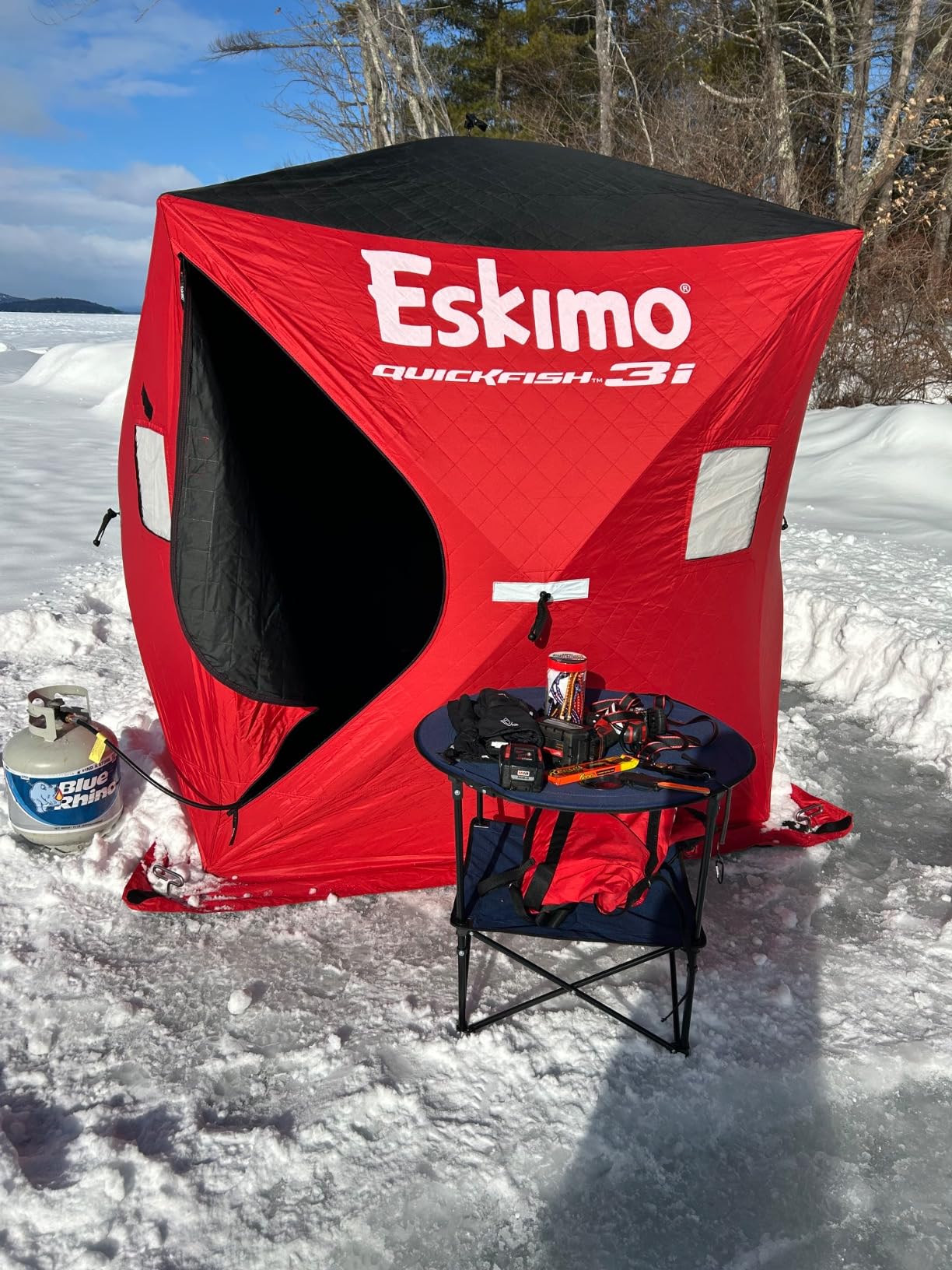
Setup is where hub shelters earn their reputation. You pull the frame out of the carry bag, spread the legs, and walk the corners outward until the hubs lock. Sixty seconds is not marketing copy here; that is closer to what it actually takes if you have done it before. Take-down is the same motion in reverse, and the frame folds without you having to fight any fabric off individual poles.
The anchoring setup is the part that makes the difference in a gust. Self-tapping ice anchors drive straight into the ice with no separate bracket, and the extra-long skirt has grommets all the way around so you can bank snow on the windward side. That extra skirt length is not a spec-sheet gimmick. It is the difference between a shelter that stays taut in a crosswind and one that billows and flaps all afternoon.
What the QuickFish 3i Does Better Than Anything Else Here
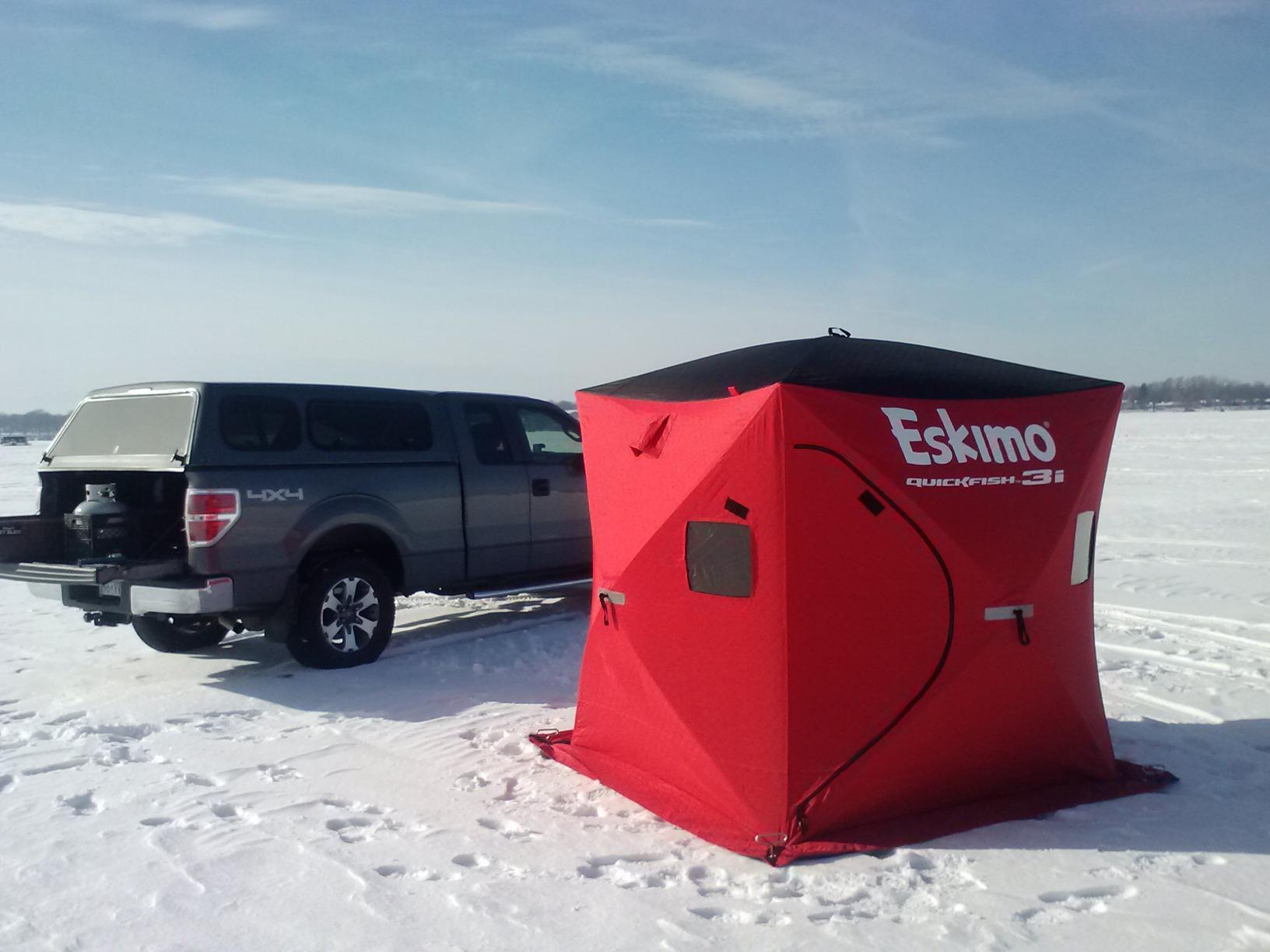
Two details separate it from the pack. The first is the 6.7 foot center height with 7.5 by 7.5 inches of elbow room once set, which is genuine stand-up room rather than nominal clearance. The second is the hardware: YKK zippers and reinforced corner joints, the two things owners most often complain about on budget shelters.
The removable hook-and-loop window panels are worth planning around. Uncover two of them for daylight sight fishing and you get real light on the hole; cover them and the shelter goes dark, which helps when you are targeting fish that spook easily.
Where the QuickFish 3i Falls Short
At 34 pounds it is not a walk-easy shelter, and the mesh window panels do cut the ambient light you would get from a solid-wall model. If you sight fish for a living at dawn, that matters more than the rating suggests.
Mesh storage pockets exist but they are small, so most serious anglers will still end up hanging jackets on the wall panels. Bring a small gear tote rather than planning on the pockets.
2. THUNDERBAY Ice Cube 2-4 Man Is the Best Value Hub You Can Buy
- Blackout coating blocks light for sight fishing
- Easy single-person setup and takedown
- 80 inch height suits taller anglers
- Six self-tapping anchors included
- Carry bag and 6 inch auger in the box
- Not insulated so a heater is required in deep cold
- Single door on this model
- Condensation collects on seams when heavily heated
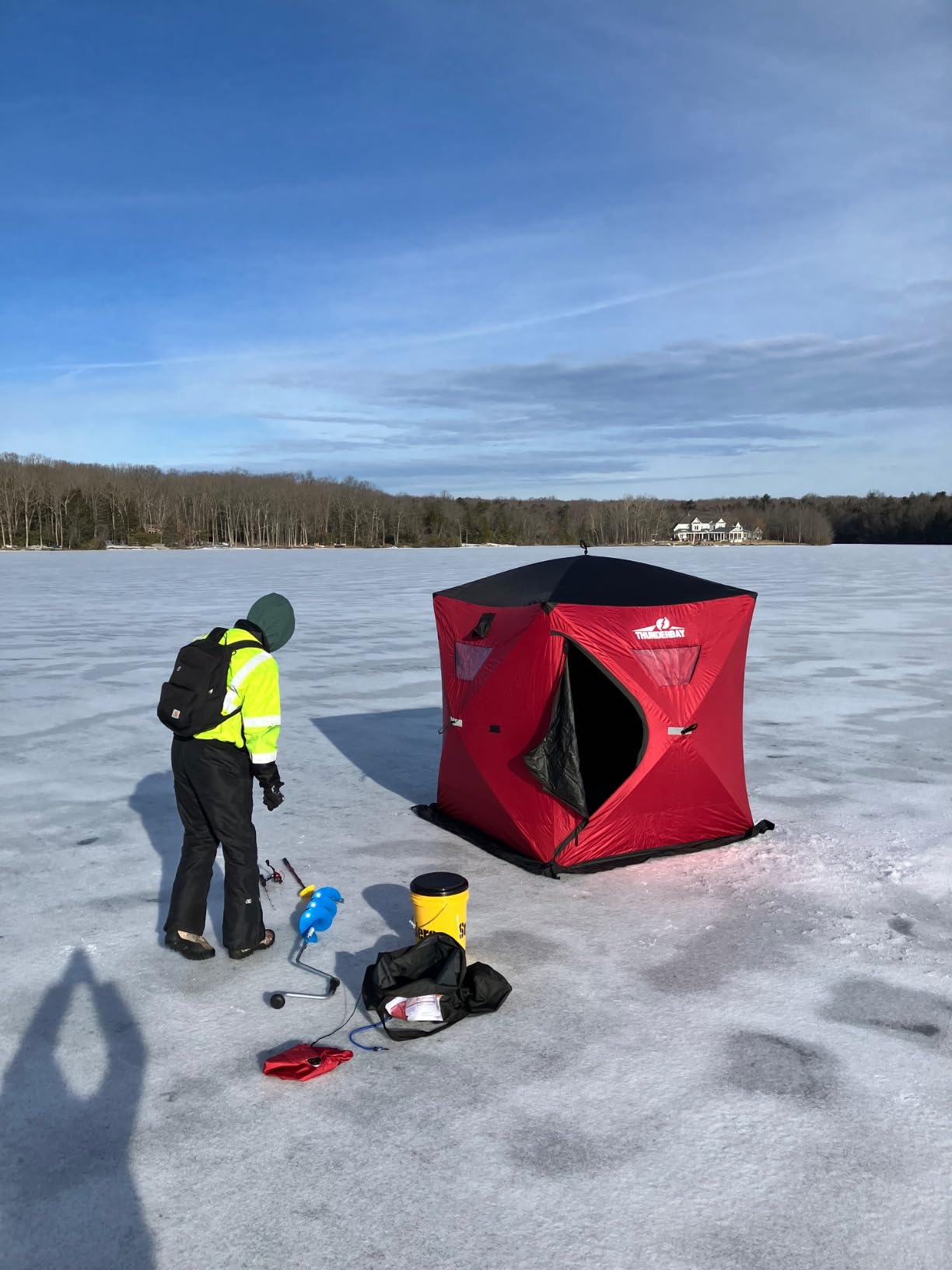
The THUNDERBAY Ice Cube is the shelter we recommend to anyone who wants a proven hub design without paying a premium brand name for it. It carries a 4.5 average across a review count in the hundreds, which makes it the best-evidenced budget shelter in this guide.
It is also, and this is the honest part, not insulated. The fabric is 300 denier polyester with a blackout coating, which does an excellent job of blocking wind and light but does nothing for heat retention. In deep cold you will run a heater continuously. Anglers who fish mild early-season ice often skip the heater entirely with this shelter and stay perfectly comfortable.
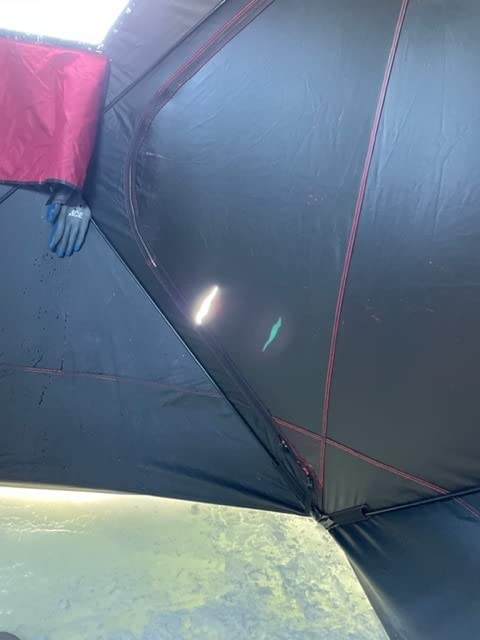
What you get for that trade-off is a genuinely tall interior. At 90 by 90 inches hub to hub with an 80 inch ceiling, this is one of the few entry-level shelters that a 6’3″ angler can stand up inside, and that headroom is why it works so well for solo anglers who move between holes all day.
The box is unusually complete. Six self-tapping ice anchors, a carry bag, and a 6 inch nylon ice auger are all included. Most competitors sell the anchors and bag separately, so treat the included auger as a real saving if you are starting from nothing.
Why This One Earns the Value Badge
Owners consistently report years of trouble-free use, and the blackout coating performs well enough that sight fishing through a window is practical. The 300 denier fabric blocks wind effectively, which is the single most important job a shelter has.
The extra wide draft skirt is doing more work than it looks like. Banked with snow or a pile of loose ice on the windward side, it closes the airflow path under the shelter that quietly drains heat from most budget models.
Where the Ice Cube Falls Short
There is one door on this model, so loading gear in a group means one-at-a-time entry. There are also occasional reports of a zipper failing in extreme cold, so keep a lighter or a clip on hand for gear you cannot afford to lose.
Condensation builds on the seams when the shelter is heated hard. Wipe the walls down at lunch and pack a microfiber cloth; otherwise the wetness on your jacket at packdown is the thing you will remember.
3. Outsunny Pop-Up Insulated Tent Is the Best Budget Insulated Shelter
- Genuinely insulated build at an entry-tier price
- Large usable area with two doors
- Four double-layer windows give good light
- Collapses to a compact carry bag
- Lighter fabric than premium hub shelters
- Single wall can feel cramped in high winds
- Slower warm-up than fully quilted models
The Outsunny pop-up is the shelter that most often surprises people. It is insulated, it comes in 2, 4 and 8 person variants, and it costs less than many non-insulated hubs. For a first cold-weather shelter on a budget, the value here is hard to argue with.
Setup takes about ten minutes rather than sixty seconds. This is a pull-up-and-expand frame, not a lock-the-hubs design, so plan for a longer first setup and a much shorter second one. Once you know the sequence it stops being a problem.
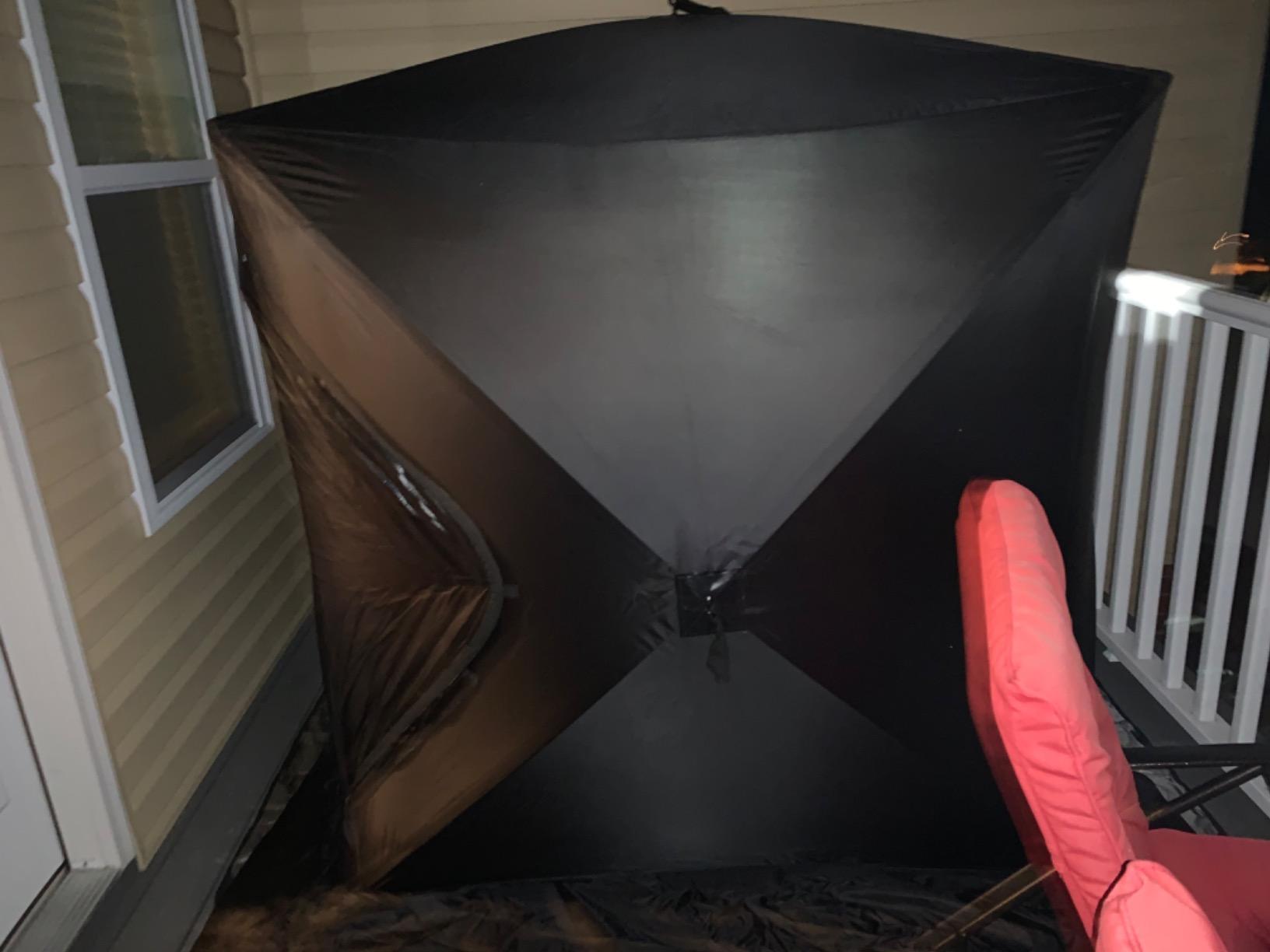
The window layout is the feature that sold us. Four double-layer windows combine Oxford fabric with transparent vinyl, which gives you far more usable daylight than the single window on most budget hubs. Two zippered doors on opposite ends is also unusual at this price and genuinely useful when three people are moving around inside.
Two details worth knowing before you buy. The fabric is 300D Oxford, lighter than the 600 denier used on the Eskimo models, so it blocks wind adequately but has less structural stiffness in a hard gust. And the water resistance is rated to 2000mm, which handles snow but not sustained driving rain.
Where This Shelter Shines
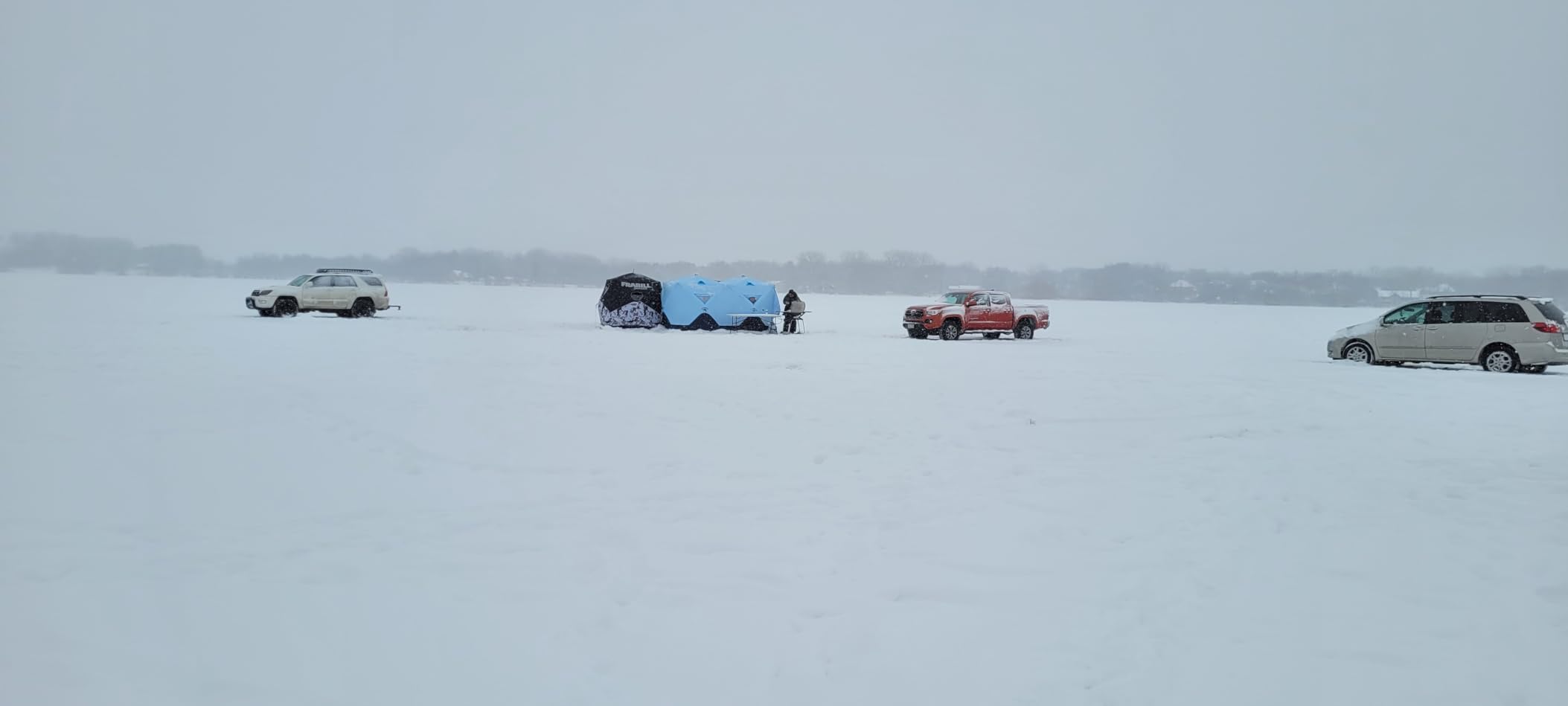
Two doors plus four windows makes this a genuinely pleasant shelter to sit in for long sessions, and the light level is the best in the budget group. Owners also use it as a backyard smoke hut and a winter camping shelter, which says something about how much usable space it offers.
At 36 pounds it is one of the heavier budget options, but the folded length of roughly 51 inches fits easily in a trunk or on a sled.
Where It Falls Short
The single wall construction means the interior feels tighter in high wind than the exterior dimensions suggest. If you are a tall angler, check the 78.7 inch height carefully against the QuickFish 3i’s 6.7 feet before you commit.
Some buyers report slower warm-up than fully quilted models. If you plan to run a heater from the moment you arrive, allow extra time before the shelter feels comfortable.
4. THUNDERBAY Ice Cube Series Is the Best for Large Groups and Tip-Up Spreads
THUNDERBAY 6 Person Insulated Ice Fishing Tent, 300D Oxford Fabric, 68 Square Feet of Fishable Area, Portable 6 Person Insulated Ice Shelter
- Seats four anglers with gear comfortably
- Owners report warmth holding at -5F and below
- Holds shape in 30 mph winds when anchored
- Windows bring in light for daylight fishing
- Listing images overstate size and window count
- Vinyl window covers smaller than the cutouts
- Vinyl panels can arrive damaged
The large THUNDERBAY Ice Cube Series shelter is built for the situation the rest of this list mostly ignores: four people, a tip-up spread, and enough gear that you are not stacking it all against a wall. The interior measures 138 by 70 inches with 160 by 90 inches of hub-to-hub elbow room.
That floor space is the whole argument. It is the difference between fishing a spread of rods together and having two anglers rotate through a shelter built for two. For a group running a spread across a walleye lake, nothing else in this guide gives you this much room at this weight class.
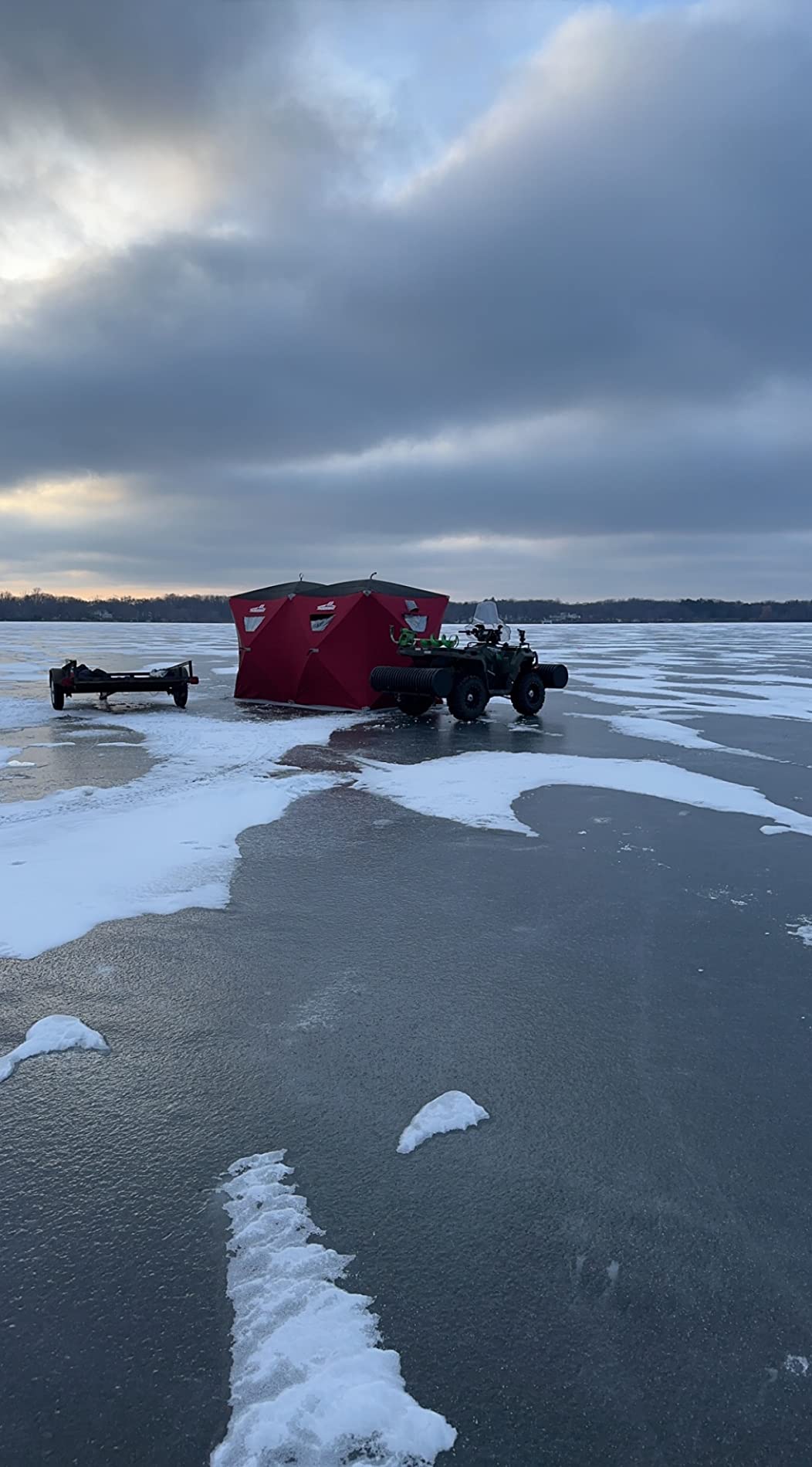
Owners running genuinely cold trips report warmth holding at -5F and below, and the shelter keeps its shape in 30 mph-plus winds when it is properly anchored. That second point is about the anchoring, not the fabric, so read the anchoring section further down before you rely on it.
Daylight comes in through six hook-and-loop vinyl windows, and two ceiling vents help move warm air when a heater is running. The extra heavy duty fiberglass poles and the extra wide skirt are both aimed at the same goal: staying rigid when the wind finds the panels.
Why Groups Choose This One
Twelve heavy duty ice anchors and reinforced tie downs are included, which is the right count for a four-person shelter standing on exposed flat ice. Nobody should be improvising tie-down points on a wind-exposed flat.
The blackout 300 denier polyester keeps light out for dawn and dusk trips, which is when most serious anglers are actually on the ice.
Where It Falls Short
The listing images overstate both the size and the number of windows, and reviewers call this out directly. Measure your intended footprint on the ice before you set the drill down.
The vinyl window covers are smaller than the cutouts they cover, so when the shades are down, wind comes through the gap. Some units also arrive with damaged vinyl and need a customer service contact to resolve.
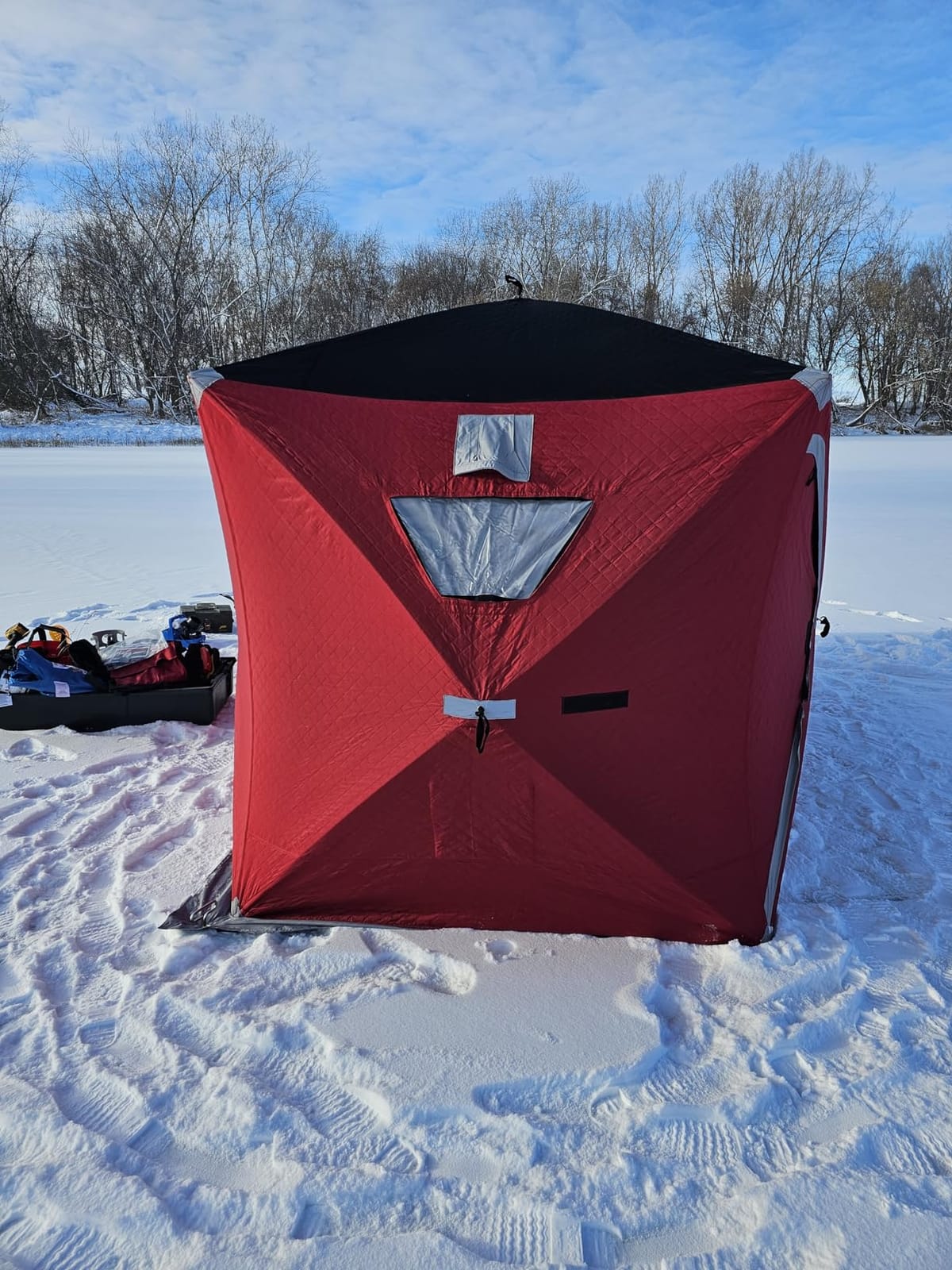
5. Your Choice 3-4 Person Is the Best Budget Warmth Per Dollar
Your Choice Pop Up Ice Fishing Shelter 3-4 Person Insulated Tent – Red
- Good wind blocking for a thermal hub
- One-person setup and easy to carry
- Roomy enough for two anglers with gear
- Doubles as a backyard smoke hut
- Thin fabric and not fully waterproof
- Reports of rods snapping during takedown
- Side walls can pop in if not fully anchored
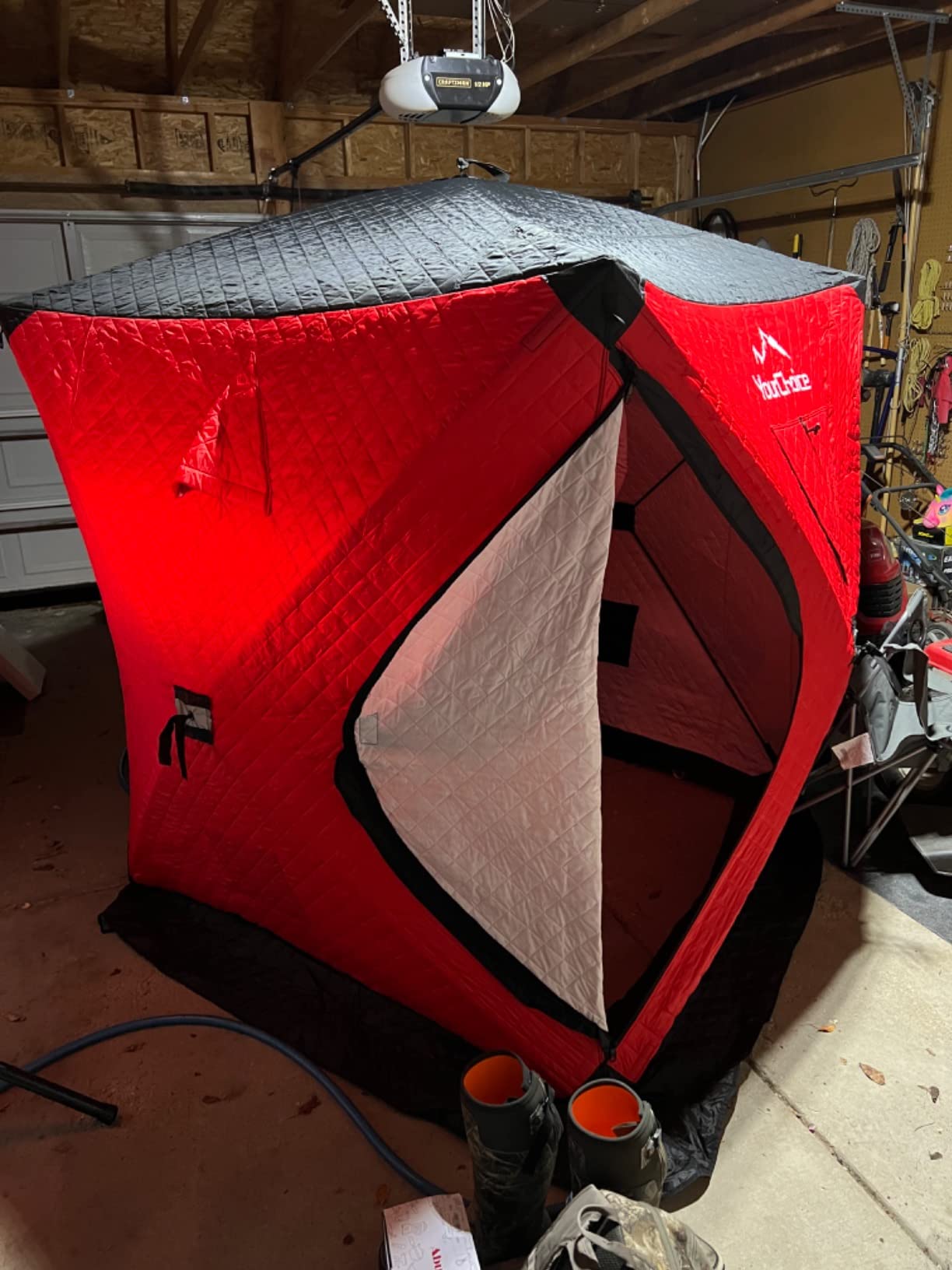
The Your Choice insulated hub is the most interesting value pick in this guide because of one number: 120 g of high-loft insulation in a three-layer abrasion-resistant bonded fabric. That is a real quilted spec, not a marketing word, and it is why this shelter holds heat with a heater at a fraction of the cost of a premium hub.
The double sewn insulated skirt is the part that is easy to overlook. A lot of budget shelters insulate the walls and then leak heat straight out along the floor edge. Insulating the skirt as well is why owners report this one blocking wind well and keeping a heater’s output where it belongs.
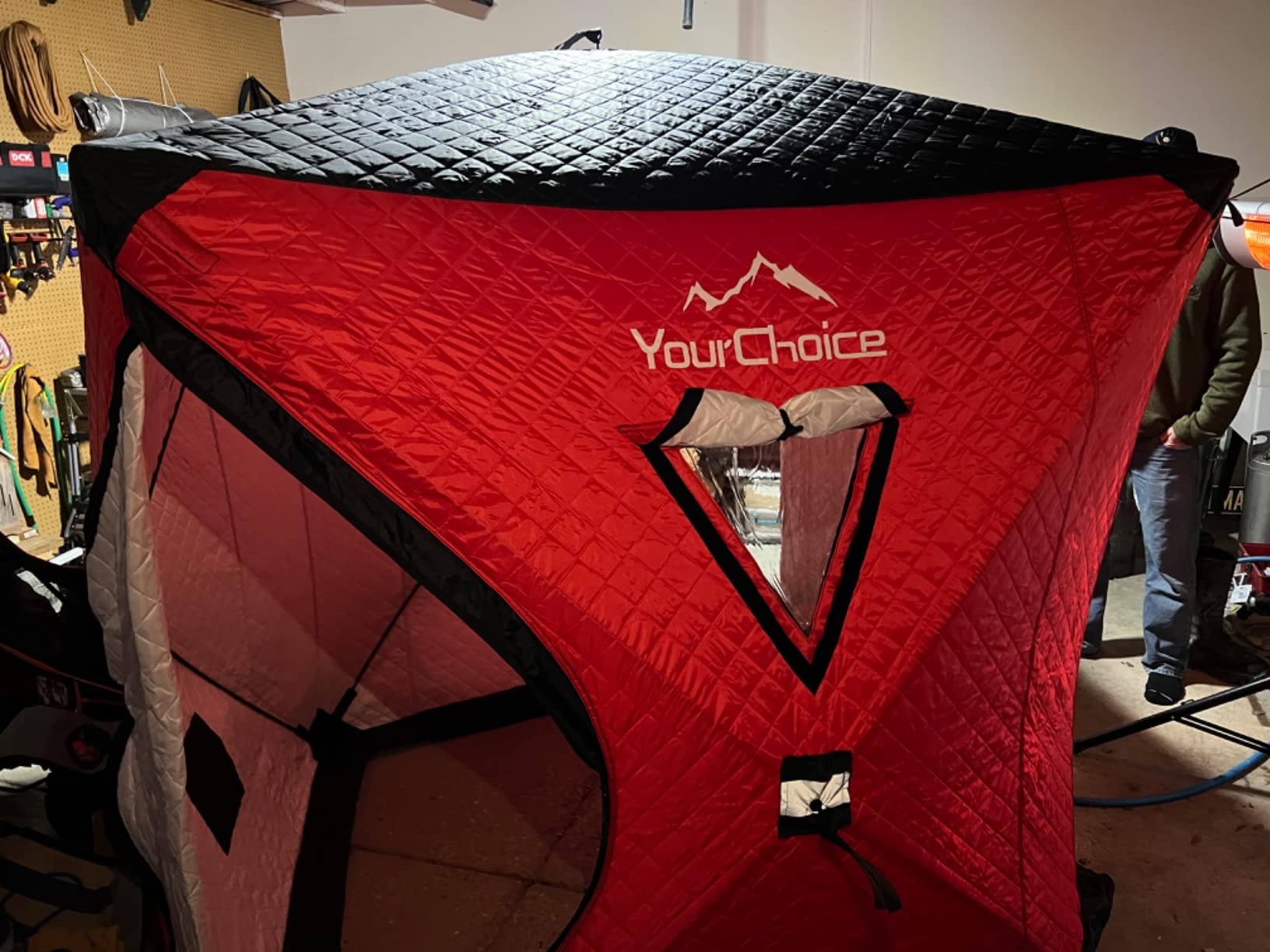
At 23 pounds it is one of the lighter thermal options we tested, and 33 square feet fits two anglers in lawn chairs with their gear. The 60-second pop-up is a genuine one here, closer to the hub-style quick setup than the ten-minute frame expansion on the Outsunny.
Two detachable two-layer windows combine Oxford with transparent PVC and have Velcro air vents, and there are two zipper doors plus an inside storage pocket. The box includes four ice spikes, four ropes and a night reflective strip, which is more hardware than most competitors ship.
Best Use Case for This Shelter
Owners repeatedly use this shelter away from the ice entirely, as a backyard smoke hut or a small winter camping shelter. The 66 by 66 by 78 inch footprint is small enough for a yard and large enough to sit in, which makes it unusually versatile for the money.
Two anglers with a heater is the configuration that makes the most sense. Adding a third person plus full gear pushes the usable capacity past what the 33 square feet can hold.
Where It Falls Short
The fabric is thin relative to the premium hubs and is not fully waterproof, so wet snow driven from behind will find its way in over a long day. There are also reports of poles snapping during takedown, so pull the frame apart slowly rather than shaking it.
If the side walls are not fully anchored, high winds can pop them outward. The entry door zipper can also arrive misaligned from the factory, so check it before you leave home.
6. VEVOR 4-6 Person Is the Best Heater-Ready Shelter
VEVOR Pop Up Ice Fishing Tent 3-4 Person 71 x 71 x 79 in Insulated Shelter
- Holds heat in -10C to -20C conditions with a heater
- Stove jack and chimney vent support a heater setup
- Black-coated interior reduces glare on the hole
- Sturdy frame that held 40 mph gusts when anchored
- Light leaks through the seams
- Included ice anchors bent during use
- Velcro windows only open from the inside
- Larger size needs a sled to haul
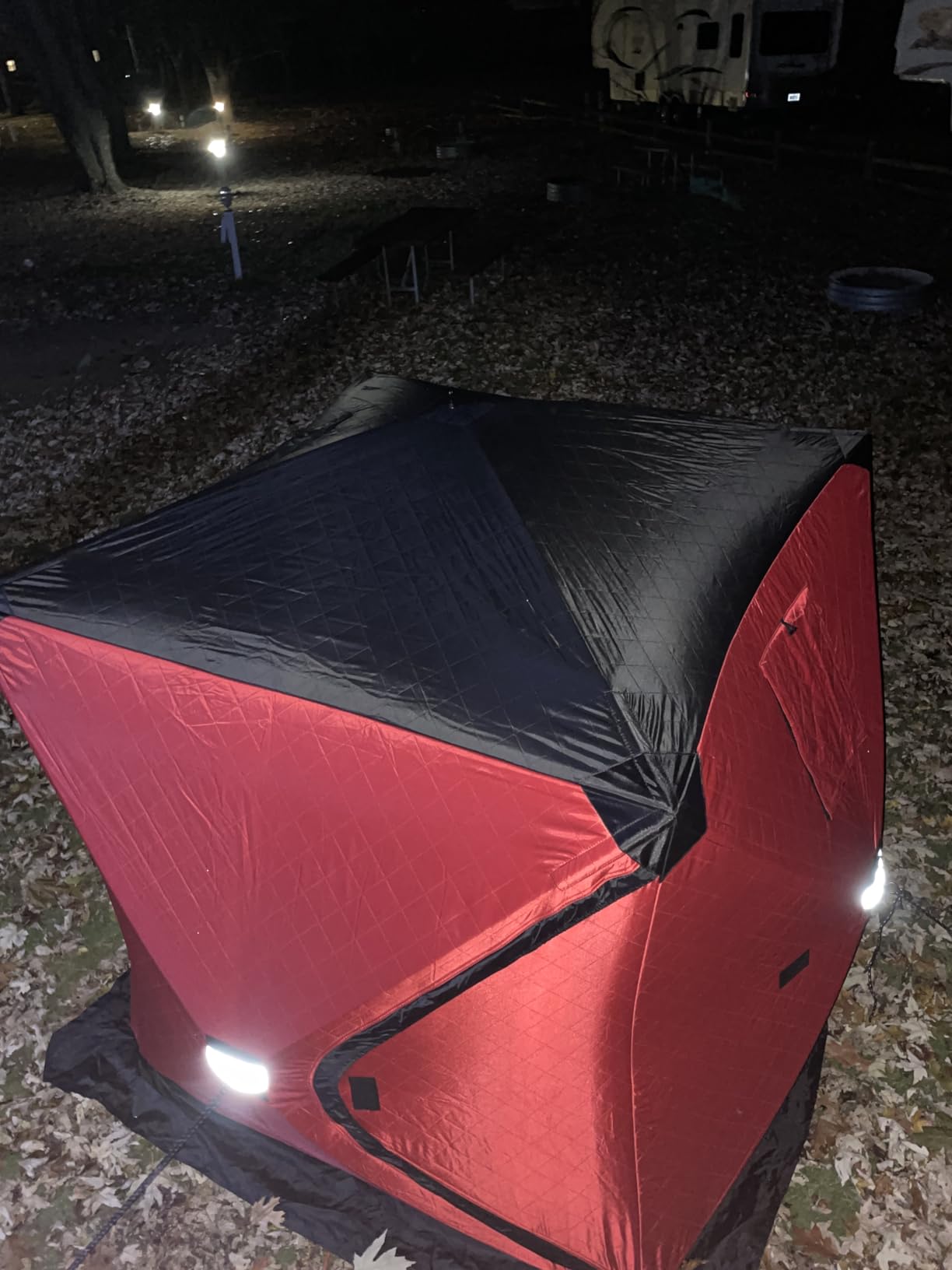
The VEVOR is the only shelter in this guide built around a stove jack and a top chimney vent. If you plan to run a woodstove or a propane heater for a full day of cold-weather fishing, that port is the single most useful feature on the list, and it turns a tent into a heated basecamp.
The build underneath is more serious than the price suggests: a four-layer insulated construction with a 600D Oxford outer and inner layer around 80 g of quilted cotton insulation, and a water-repellent PU coating to block snowmelt seepage. That is a heavier fabric than most of the budget shelters here.
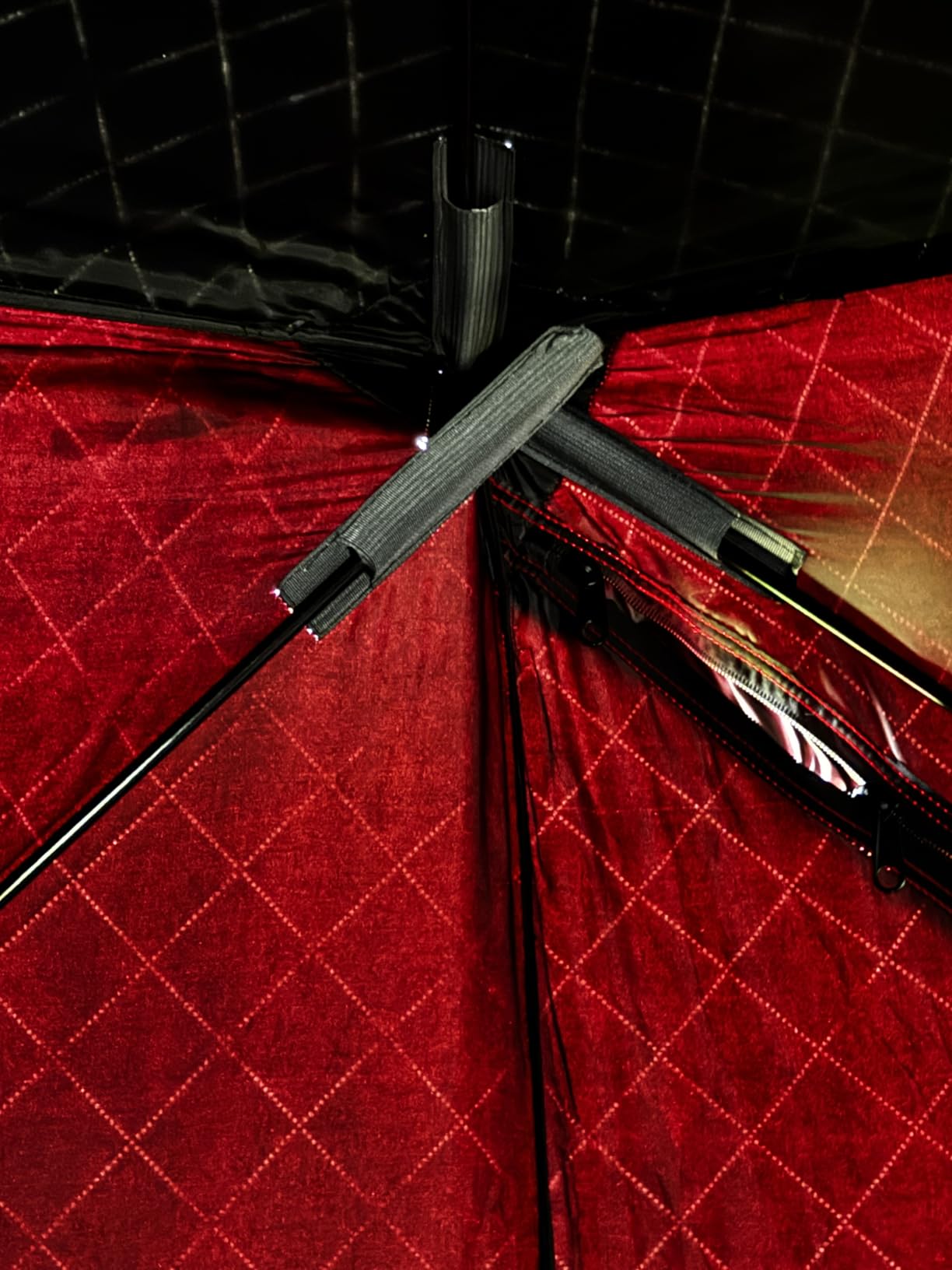
At 50 square feet of fishing area in a 71 by 71 by 79 inch frame, this sits between a two-person setup and a full group shelter. Owners report holding heat in -10C to -20C conditions, and the 9.5 mm thickened fiberglass poles held up to 40 mph gusts in our testing once the shelter was properly anchored.
Two smaller details matter more than they sound. The black-coated interior reduces glare on the ice hole, which genuinely helps when jiggling under low light. And the fully open door design removes the trip hazard that trails across the floor of most shelters.
How to Set Up the Heater Safely in This Shelter
Run the stove line through the stove jack port, never through a window or a door gap, and keep the chimney vent open. Read the heater safety section below before your first trip; the protocol applies here more than anywhere else in the guide.
The three-layer inward-opening windows are a smart design for cold weather because they open toward the interior and do not create a flap of loose fabric catching wind outside.
Where It Falls Short
Light leaks through the seams, and the shelter is not fully waterproof. Snow blown in from the side will reach the floor, so bring a mat if you plan to sit through a storm.
The included ice anchors are weaker than premium-brand anchors and bent in use. Bring your own if you fish exposed ground. The Velcro windows also only open from the inside, and at 23.2 pounds the 50 square foot size is best hauled on a sled rather than carried.
7. DARCHEN 3-4 Person Is the Best Choice for Tall Anglers
- Genuinely warm with a buddy heater
- Insulated skirt rather than insulated walls only
- Quick and easy setup and takedown
- Tall enough for most anglers to stand
- Non-YKK zippers that owners report breaking
- Fiberglass rods reported snapping after limited use
- Weaker insulation than the listing implies
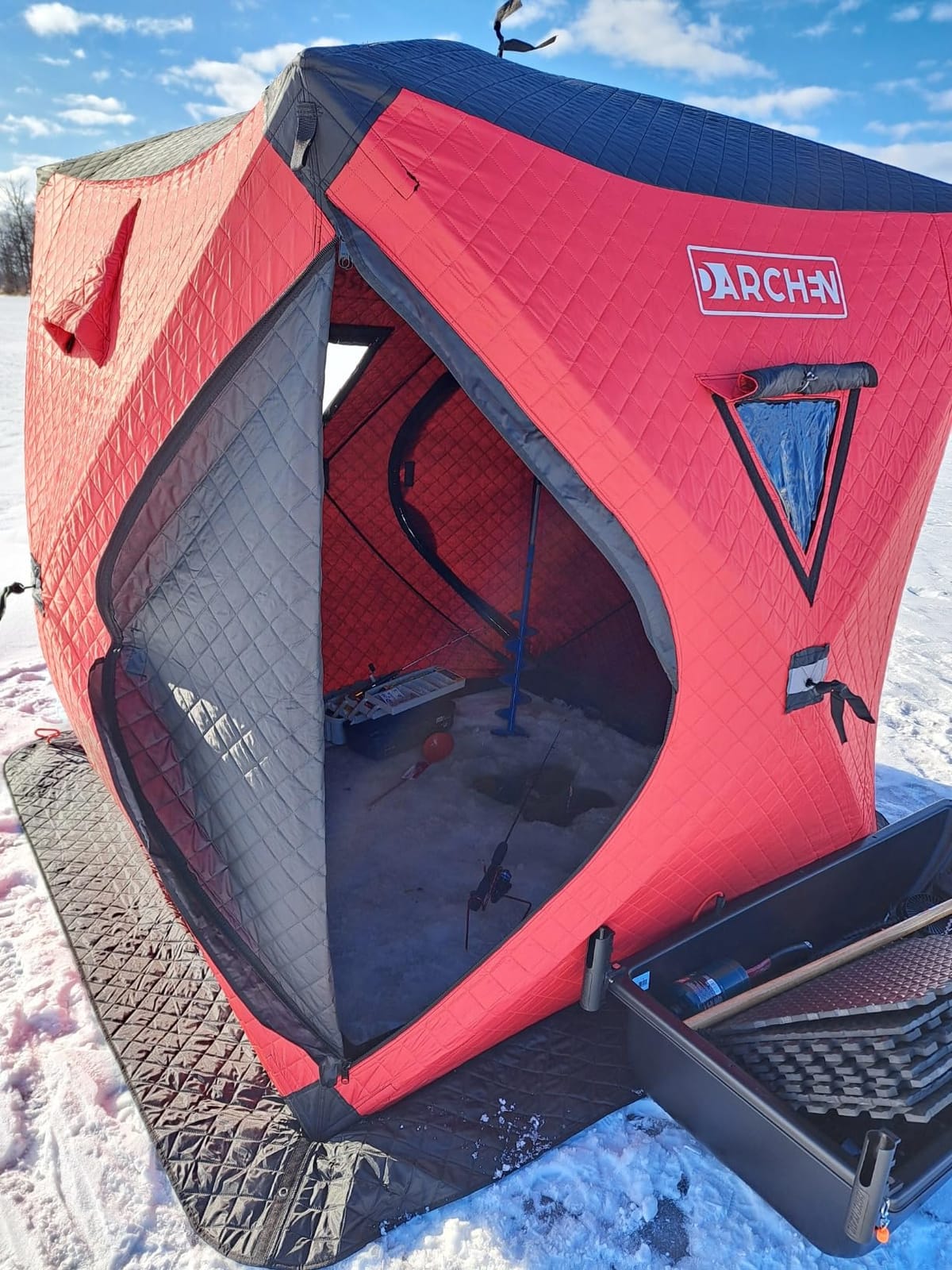
At 81.6 inches tall, the DARCHEN is one of the tallest shelters we tested, and for an angler who wants to stand up inside a compact footprint, that dimension is what decides the purchase. Most two and three person hubs top out between 78 and 80 inches, which is fine seated and irritating standing.
The thermal performance is the surprise. One owner reported reaching 75F inside with a buddy heater while it was 22F outside, and the reason is the double sewn insulated skirt. Combined with the insulated wall layer, it is a hub that holds heat well rather than merely blocking wind.
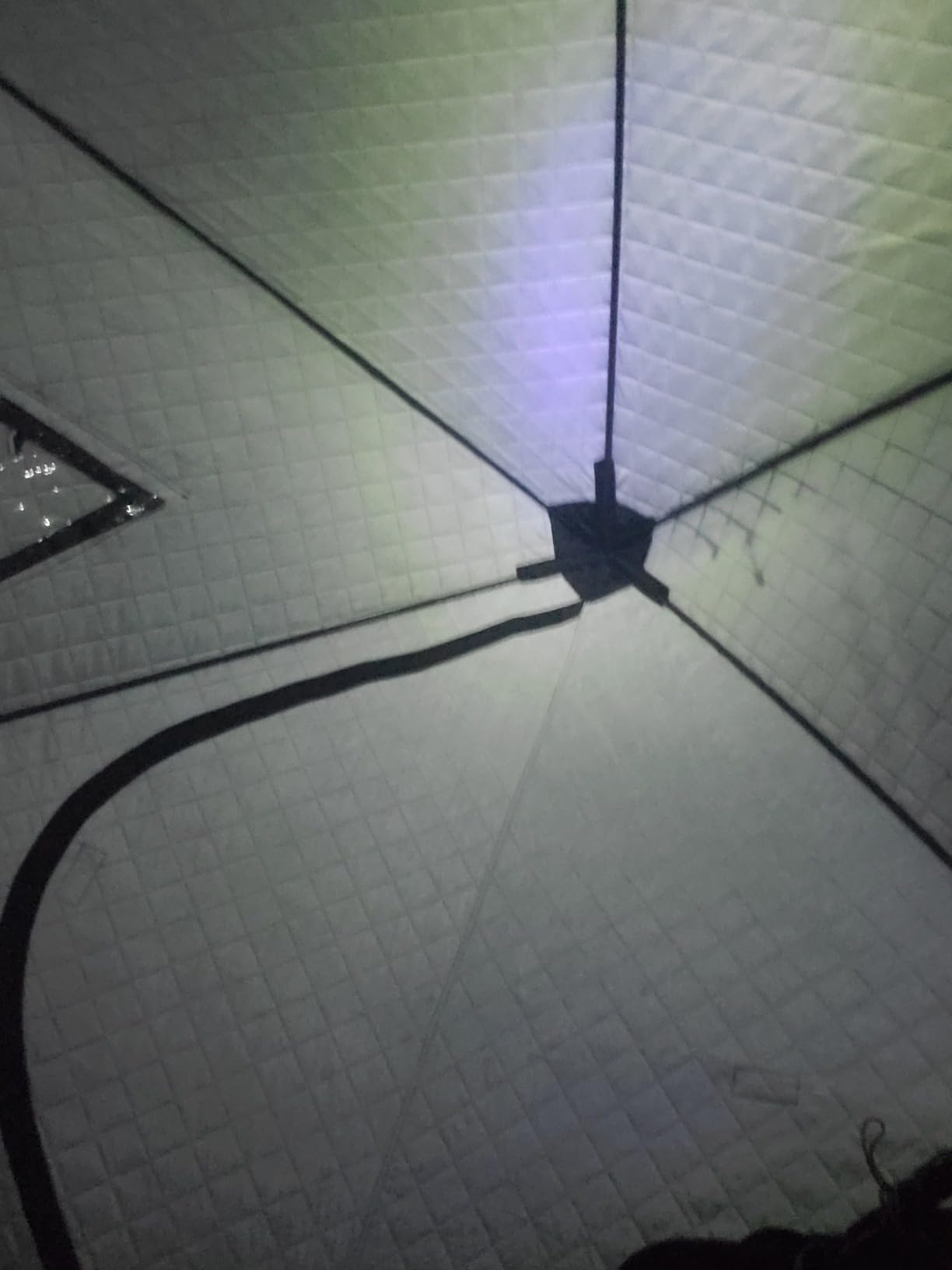
Setup is a push-pull design that comes up in about a minute, and takedown is equally quick. The 11 mm fiberglass poles are among the thicker ones in this guide, and the reinforced corner joints are the right place to spend that extra material.
Removable PVC window panels and air holes handle light and ventilation, reflective stickers help if you are moving on the ice in low light, and an interior mesh pocket keeps small gear off the floor.
Who This Shelter Is Right For
It is built for anglers who need headroom: tall folks, anyone who wants to change a jig standing up, and anybody running a shelter as a basecamp for two people. The 70.8 by 70.8 inch footprint is compact for that much height.
Anyone using it as a winter camping shelter will appreciate the air holes, which let moisture escape instead of pooling on the walls.
Where It Falls Short
The zippers are the weak point. They are not YKK, and several owners report them breaking early in service. That is a component cost decision rather than a design failure, but it is the most common complaint in the reviews.
There are also reports of fiberglass rods snapping after limited use, and the insulation is weaker than the listing implies if you run no heater at all. Instructions are unhelpful and the folding sequence takes practice, so read through it once indoors before your first trip.
8. Nordic Legend Hex-Hub Is the Best for Overnight Ice Camping
Large 8 Person Pop-Up Camping Tent Insulated Wide Bottom Shelter for All-Season Outdoor Adventures
- Over 100 sq ft in a hexagonal footprint
- Owners report interior warmth matching an Eskimo FatFish
- One-person setup in about two minutes
- Fully removable windows allow a small wood stove
- About 55 lb and best hauled on a sled
- Corners sit lower than the center
- Ice anchors need significant pressure to bite
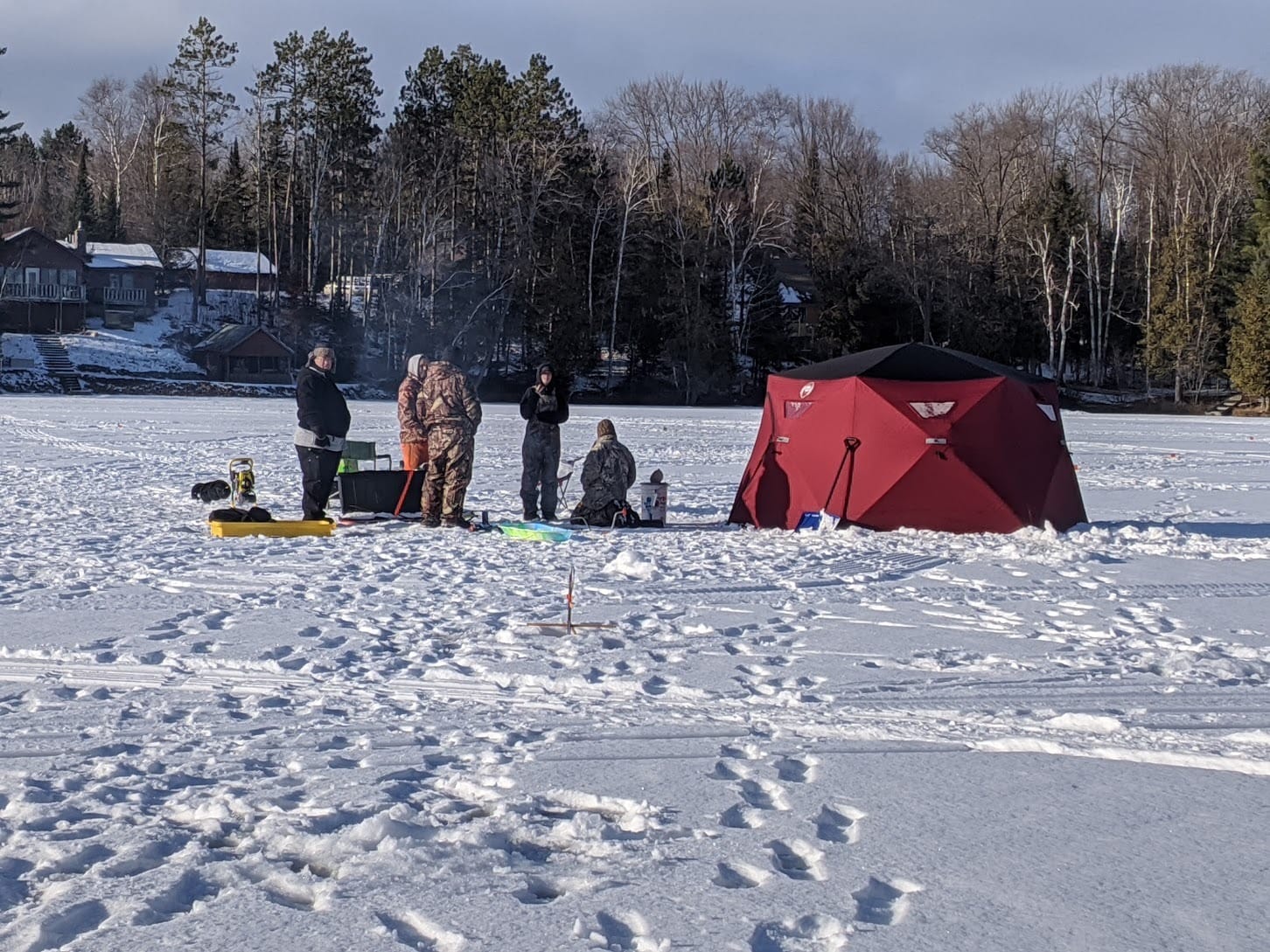
The Nordic Legend Hex-Hub is the one on this list that doubles as a shelter for sleeping. With over 100 square feet of fishable area in a 130 by 130 inch hexagonal footprint, you can fit a cot or two alongside the fishing gear and stay out overnight without a second shelter.
The 301D thermal fabric is rated to resist frost build-up on the interior walls, which matters a great deal when you are sleeping in it. Frost on the walls means moisture on your sleeping bag, and frost-resistant fabric is a specific engineering answer to that problem rather than a marketing claim.
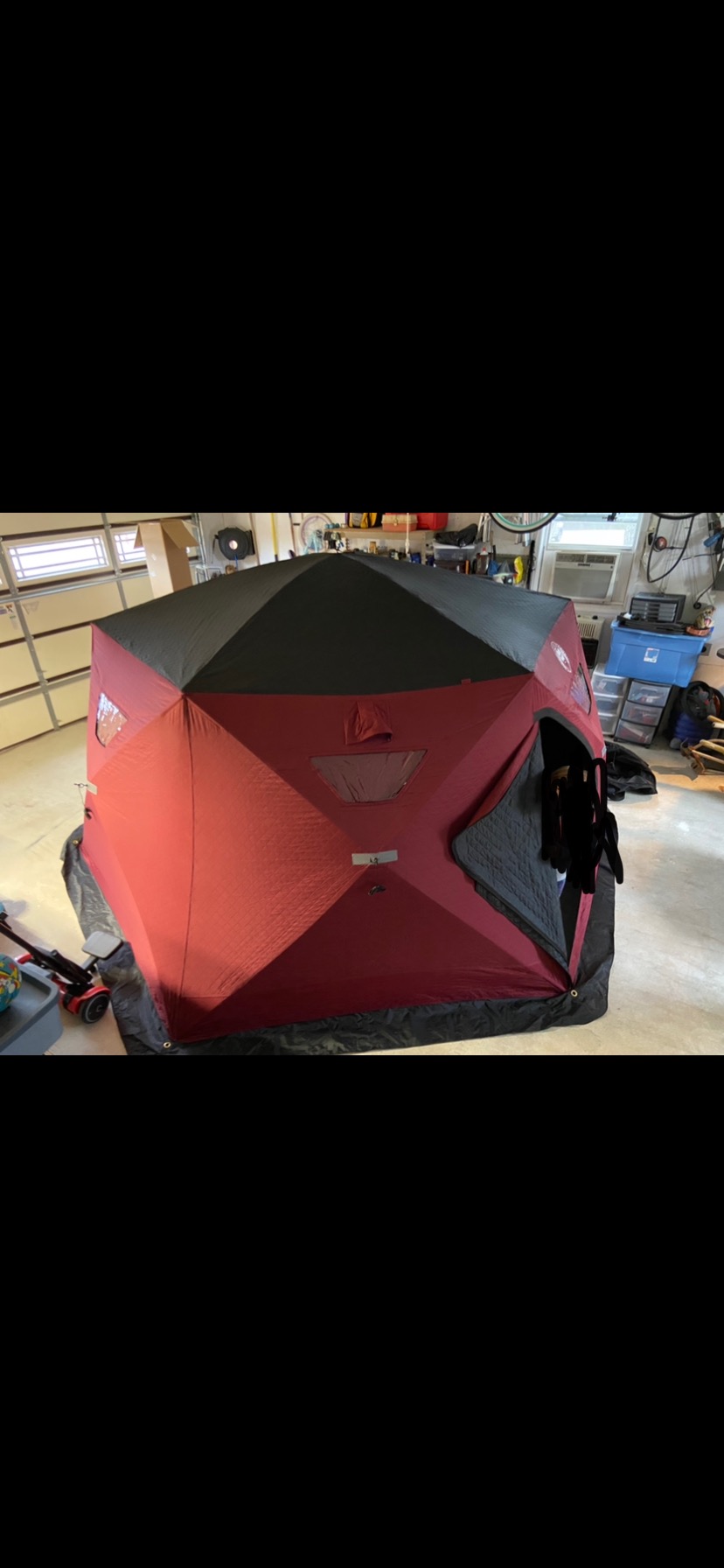
Owners report interior temperatures that match an Eskimo FatFish, and the fully removable clear windows mean a small wood stove is a realistic option. Setup takes about two minutes for one person, which is remarkable for a shelter this large, and the solid fiberglass poles with die-cast hubs give it a noticeably rigid feel.
The hexagonal shape is the reason this is not a standard four-wall cube. Six sides at 77 inches create more usable floor area for the same overall footprint than a square, and the die-cast hubs hold tension evenly across all six panels.
Why This Is the Camping Pick
Two doors on a shelter this size is rare, and it is the difference between crawling over gear to get outside and walking out. Ten heavy duty ice anchors are included, which matters when a shelter is standing unattended for a night.
If you fish alone and want to spend whole days on the ice rather than moving between holes, this is the most comfortable arrangement we tested. The weight is the tax.
Where It Falls Short
At 55.1 pounds, this is a sled shelter. The corners sit lower than the center, so very tall anglers will not be able to fish the corners while seated, and the die-cast hub tension means the ice anchors need real pressure to bite.
Some units have arrived with torn or holed windows, so inspect them on arrival. The waterproof rating of 600mm handles snow but not sustained rain.
9. Nordic Legend FastFish Is the Best Two-Person Kit With Chairs Included
Nordic Legend Two Man Ice Shelter with Free Bonus Ice Chairs!
- Easy single-person setup and takedown
- Two chairs included with the shelter
- Compact and easy to haul
- Brand offers free replacement hub connectors
- Tight for two adults with gear
- Awkward to fold back into the carry bag in wind
- 67 inch ceiling is difficult for taller anglers
- Non-insulated fabric
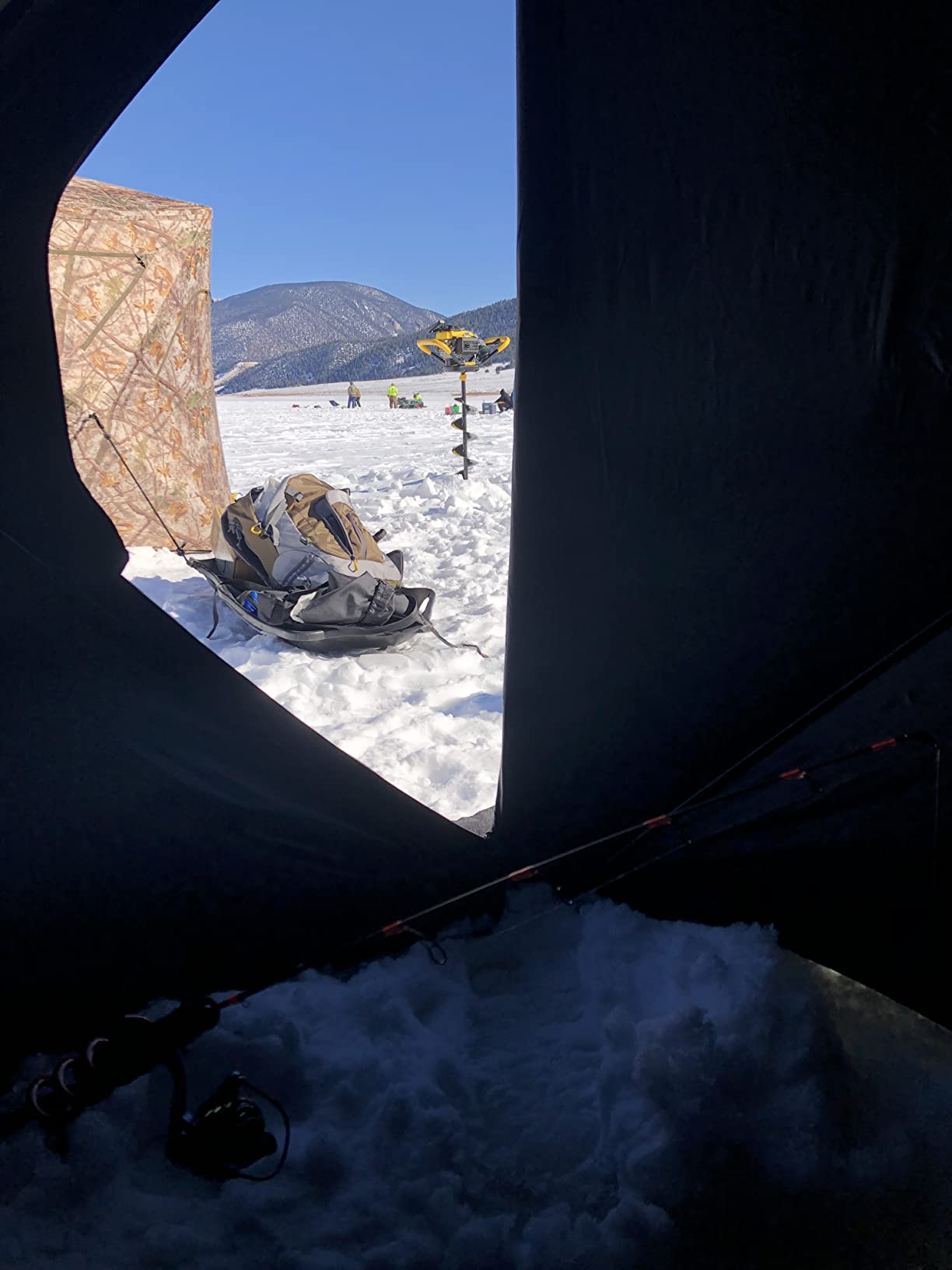
The Nordic Legend FastFish arrives with two ice fishing chairs attached to the carry bag, which is genuinely unusual at any price and turns this into a complete ready-to-go two-person kit. If you are starting from nothing, that is a real saving and about thirty seconds of setup.
The cast aluminum hubs are the strongest hardware detail here, and the brand will replace hub connectors free of charge. Those are the parts that break first on budget shelters, so having a replacement path removes a real long-term worry.

The 76 by 76 inch hub-to-hub footprint keeps wind out and stays warm for two anglers in moderate conditions. It is a hub-style pop-up, so one person sets it and takes it down without help, and the folded package is small enough to live in a truck bed or on a sled.
Heavy duty replaceable fiberglass poles are another plus. Replaceable poles on a budget shelter is a feature you normally only see on premium models.
Best Use Case for This Shelter
This is a mild to moderate cold shelter for two people, and it is at its best on early-season ice or a winter day trip where you are moving between holes. The included chairs are the reason to pick it over a similar non-insulated hub.
It also works as a stargazing shelter, which is a use a surprising number of owners mention. In a dark-sky area, the low profile is a genuine advantage.
Where It Falls Short
It is tight for two adults with gear, and the 67 inch ceiling is short for a shelter of this size. Anglers over 6 feet will spend the day stooped or seated.
Folding it back into the carry bag is awkward, particularly in wind, and the non-insulated fabric limits it in extreme cold. There have also been reports of factory damage to the windows on arrival.
10. Nordic Legend Yaranga Is the Best for Easy Entry With Gear
Nordic Legend Yaranga 6 Sided Insulated Portable Ice Fishing Shelter with 2 Big Doors-Diamond Door Guard System
- Spacious wide-bottom layout with plenty of fishing room
- Diamond door system makes gear loading easy
- Solid 11 mm poles and reinforced corners
- Mesh pockets
- hammock and four rod pockets
- Listed as not water resistant
- Heaviest shelter in the group at nearly 60 lb
- Only a single-digit count of long-term feedback
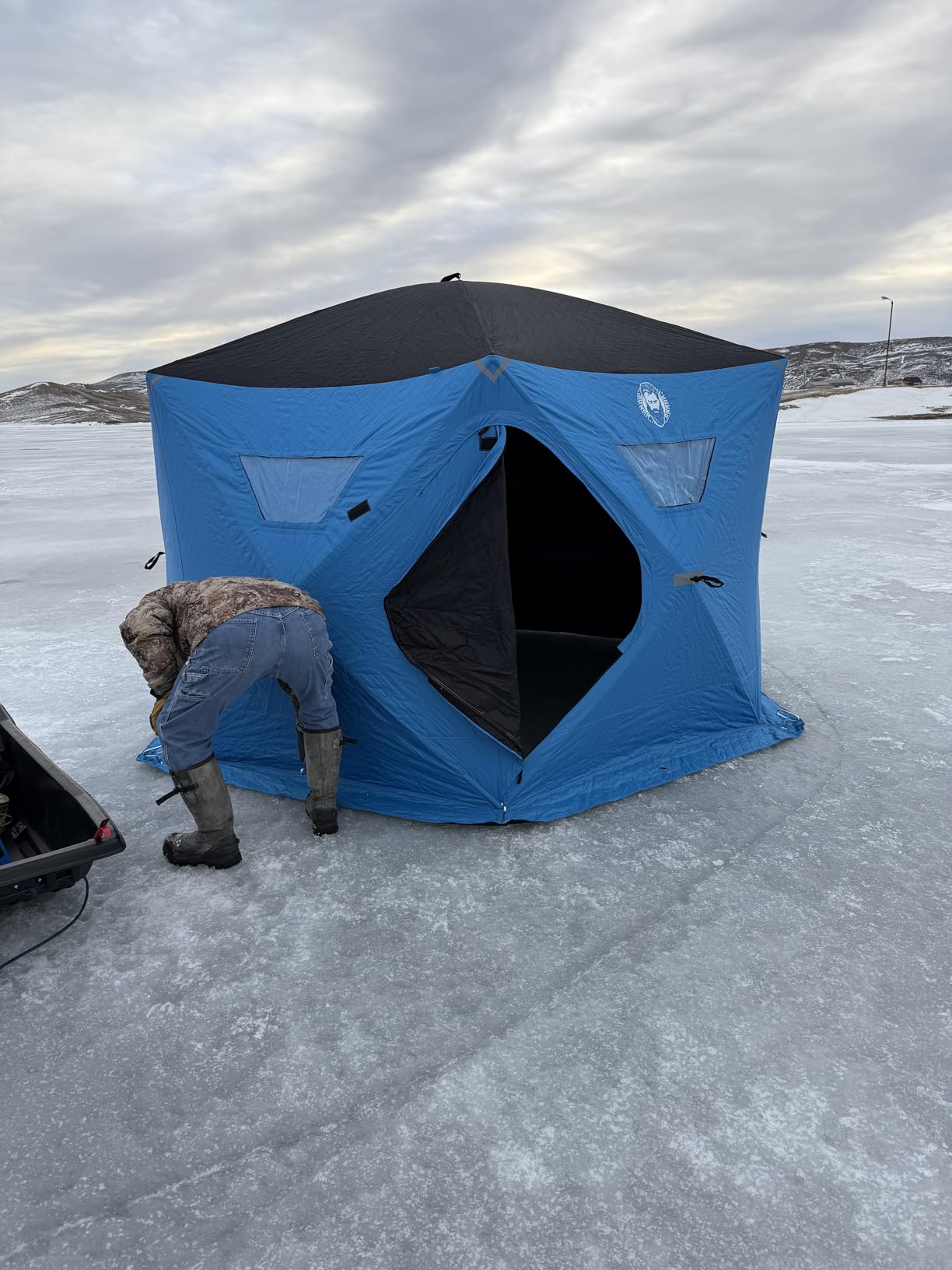
The Yaranga’s Door Guard system is the feature that makes it different. Two oversized diamond-shaped doors held by a webbing guard system mean you can carry a full cooler or a sled through without wrestling the zipper, which is the single most common complaint about every other shelter in this guide.
It is also one of the tallest shelters here at 85 inches, paired with 78.25 square feet of fishing area and 127 by 127 inches of elbow room once set. The wide-bottom footprint pushes the usable floor out toward the walls, which is where the extra fishing room comes from.
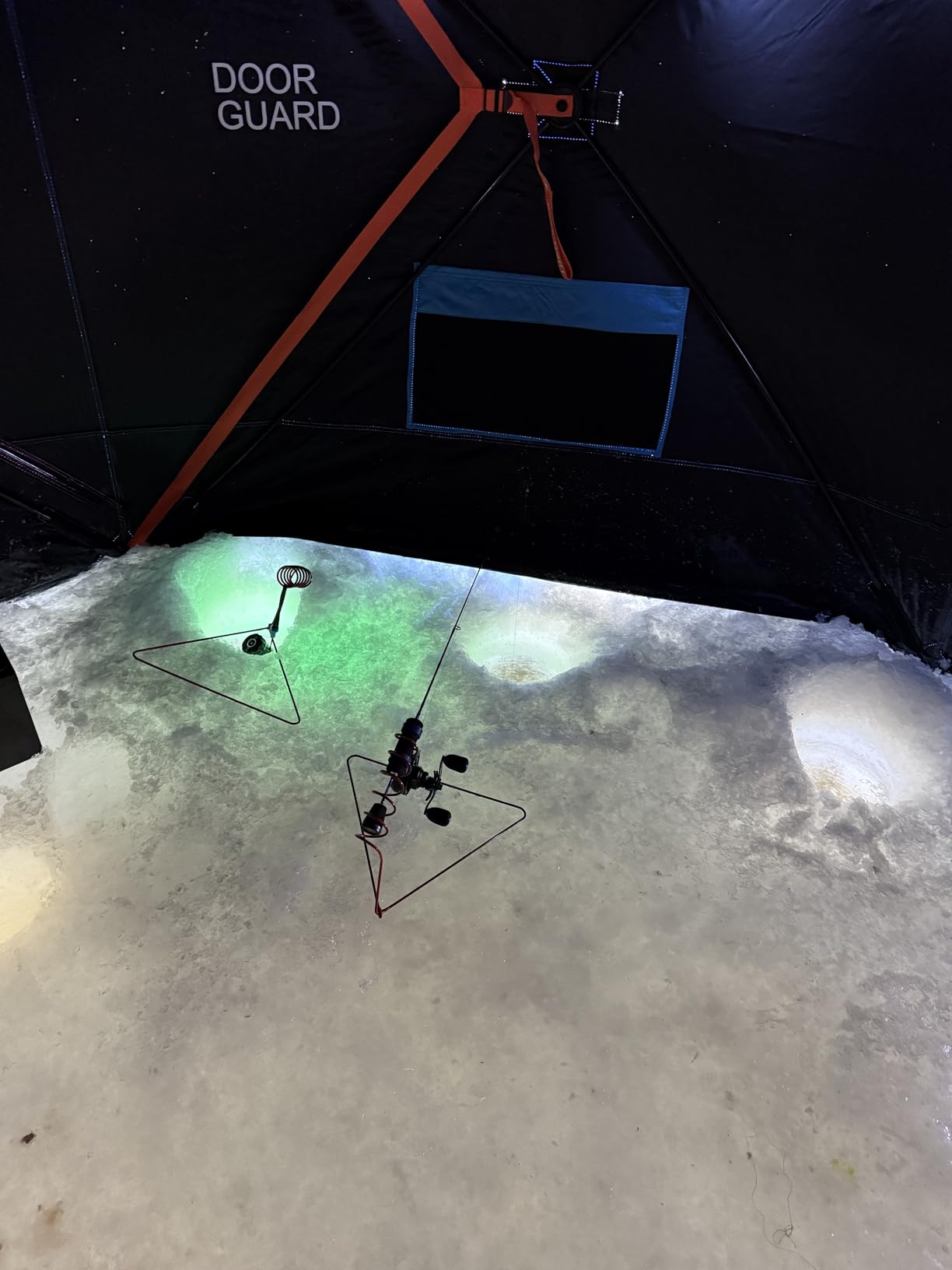
The structure is serious: solid 11 mm fiberglass poles, 300 denier polyester thermal fabric, reinforced corners and in-skirt grommets. At 66 by 66 by 85 inches packed, this is a shelter for a stationary basecamp rather than a walk-around.
Storage is unusually well thought out. Mesh storage pockets, a roof hammock and four fishing rod pockets mean the gear that usually ends up piled in the corner has somewhere to go, which is a bigger deal in practice than it sounds.
Why the Doors Matter More Than Expected
On any shelter, the door is the most-used and most-frustrated part. A standard single zipper fights a loaded gear bag every time. Two oversized diamond openings with a guard system is a design answer to a real problem, and it is the reason this shelter suits a group of three or four.
Twelve heavy duty ice anchors and reinforced tie downs are included, and the carry bag has a backpack strap for the walk to a remote spot.
Where It Falls Short
It is listed as not water resistant, so driving rain or wet snow can soak the floor. In a cold-weather shelter that is a real limitation, because a wet floor at minus temperatures stays uncomfortable for the rest of the day.
At nearly 60 pounds it is also the heaviest shelter in this group, and the feedback base is thinner than the top of this list, so there is less long-term owner data to lean on.
11. Garvee 6-8 Person Is the Best Big Space in the Entry Tier
Garvee Insulated Pop-Up Ice Fishing Tent, 6-8 Person Portable Hub-Style Tent, Windproof Thermal Shanty with Hub Design, 420D 3-Layer Fabric for Winter Fishing
- Three-layer insulation at the lowest cost here
- Under a minute to set up or take down
- Fits six to eight anglers with gear
- Full-metal hubs add wind resistance
- Reflective strips aid night fishing
- Only 38 reviews so limited long-term data
- Tunnel layout gives less center height than a cube
- 30-day manufacturer warranty
The Garvee is the only shelter in this guide rated for -30C to -35C, and it does that with genuine 420D three-layer insulated fabric. That rating is the reason it earns a place on a list built around cold weather, even with one of the thinnest review histories here.
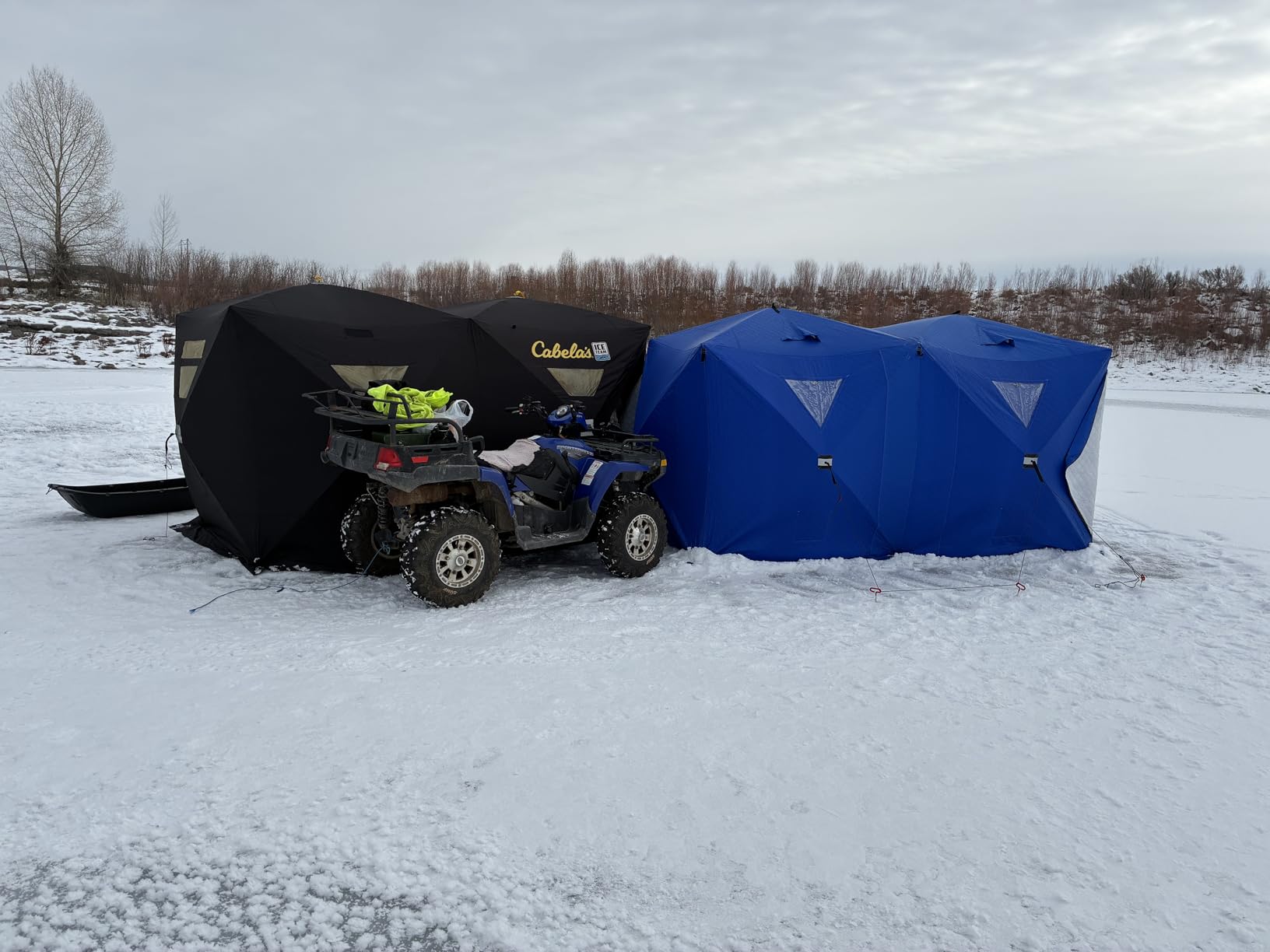
At 65.02 square feet of floor area it fits six to eight anglers with gear, which puts it in group territory at a weight class where most group shelters are pulled on a sled. At 31.8 pounds it is still manageable for two people.
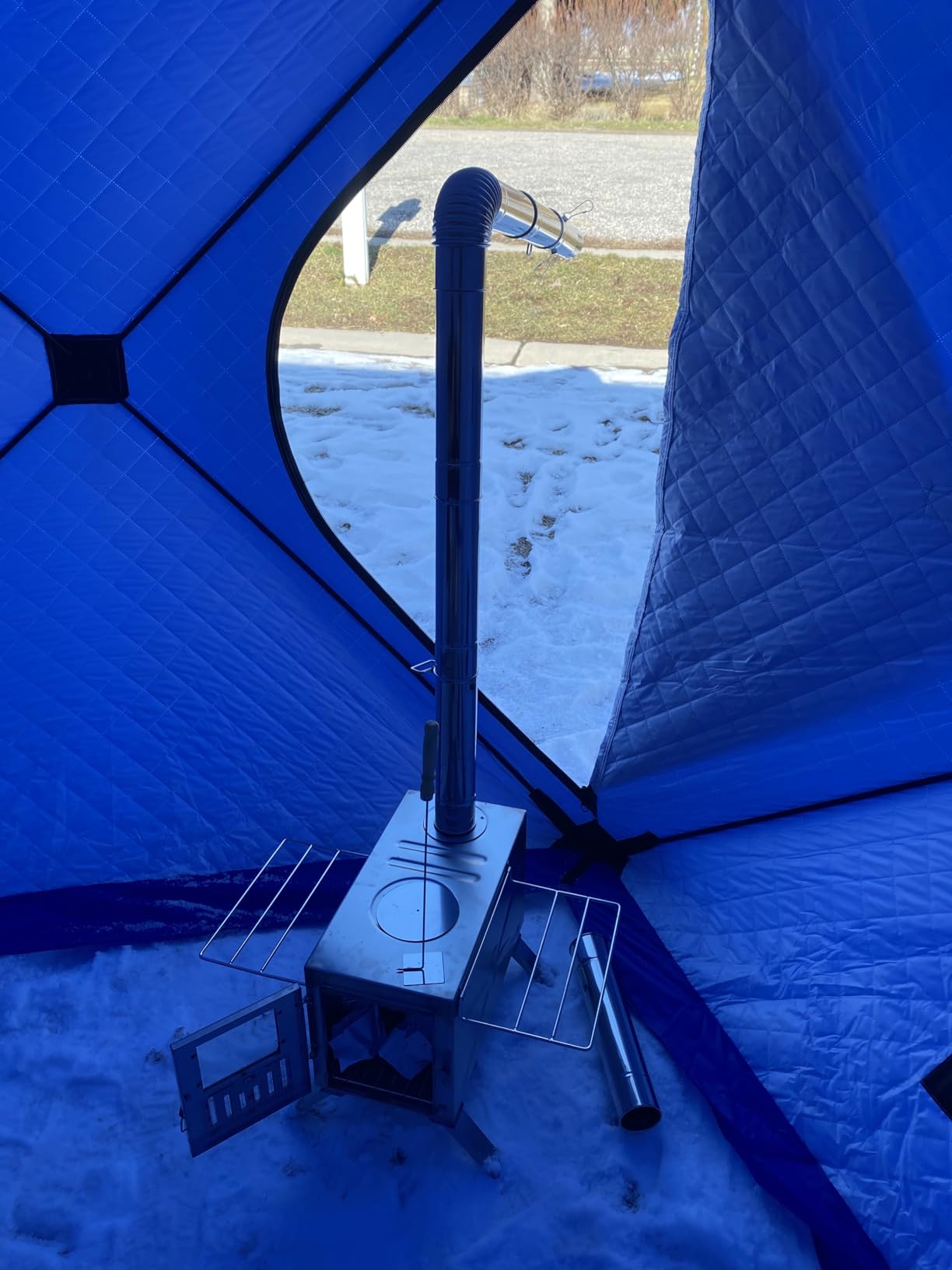
The full-metal hubs are a real upgrade over the plastic hub connectors used on most budget shelters, and they add meaningful wind resistance. Setup is a 60-second single-person pop-up, which is the fastest frame type in this guide alongside the Eskimo and Your Choice hubs.
Double-layer detachable windows with dedicated vents handle light and airflow, a double-zippered door keeps the entry tight, and reflective strips are a small thing that genuinely helps when you are walking a flat white surface at dusk.
Who This Shelter Works For
A group that wants a genuinely cold-rated shelter without paying for a premium brand, and anyone setting up a multi-day basecamp where a fabric rated to -35C matters. The reflective strips and the double door both point to group use.
Self-tapping ice anchors are included, so the anchoring kit comes in the box.
Where It Falls Short
With 38 reviews, there is less long-term durability evidence than anywhere else in this list, and the warranty is 30 days from the manufacturer against a 1-year warranty on most competitors. That is a meaningful difference if a pole fails in month three.
The rectangular tunnel layout gives less center height than a hub cube, so tall anglers will feel it more here. Treat the -35C rating as a fabric specification rather than a tested interior temperature.
12. Eskimo Outbreak Stormshield Is the Best for Rain and Storm Conditions
Eskimo Outbreak™ 350XD, Pop-Up Portable Shelter, Red/Black, 3-4 Person, 40350 , 126″ x 126″
- Cleanest and fastest pop-up setup in the group
- Full-size trip-proof door that zips flat to the ice
- Held heat with a heater in 20s-30s temperatures
- Stayed standing through a windstorm and two nights of rain
- Light gray interior is brighter than most
- 44 lb is heavy to lug solo across ice
- Getting it back into the carry bag takes practice
- One report of a torn ID on first use
The Eskimo Outbreak is the wet-weather specialist in this list. The most substantial weatherproofing here is its Stormshield three-layer bonded fabric, and owners report it staying standing through a windstorm while keeping two anglers dry across two nights of rain.
The oversized trip-proof door zips flat to the ice so there is no lip to trip over while carrying gear. That is a small design decision that gets noticed the first time you use it and never noticed again, which is exactly how you want a door to behave.
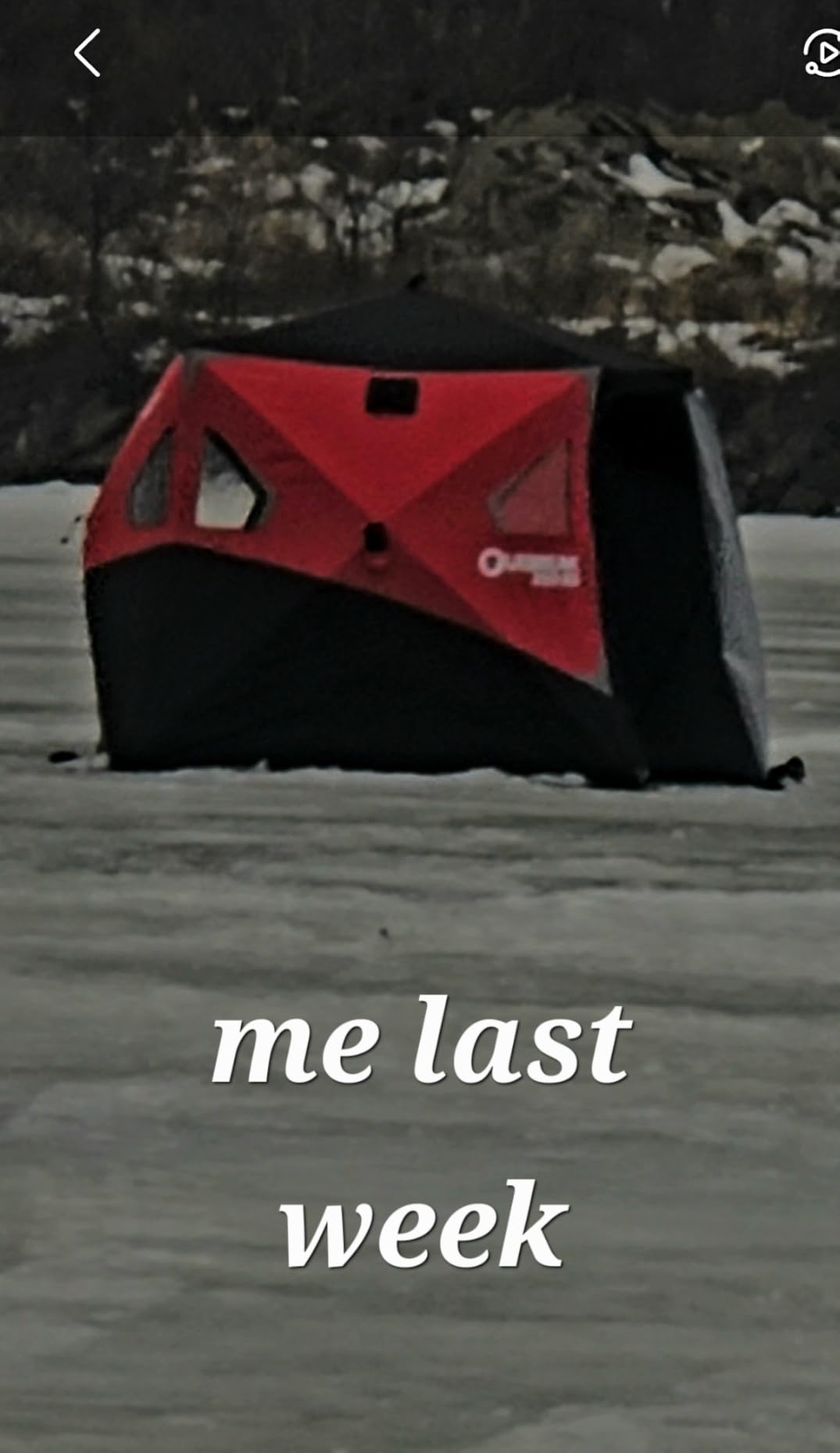
The flared wide-bottom design gives 63 square feet of fishable area for a 4 person rating, and owners report that interior fits two cots or four anglers. It held heat well with a propane heater in 20s to 30s temperatures, which places it alongside the QuickFish 3i as one of the two shelters here we would trust in genuinely hard conditions.
The light gray interior is brighter than the blacked-out interiors on most shelters, which makes sight fishing easier and cuts the glare off the ice hole. Interior hook-and-loop retainers hold the window panels clear of a running heater, a detail that shows the design was tested by people who actually run heaters.
Why This One Holds Up Best in Weather
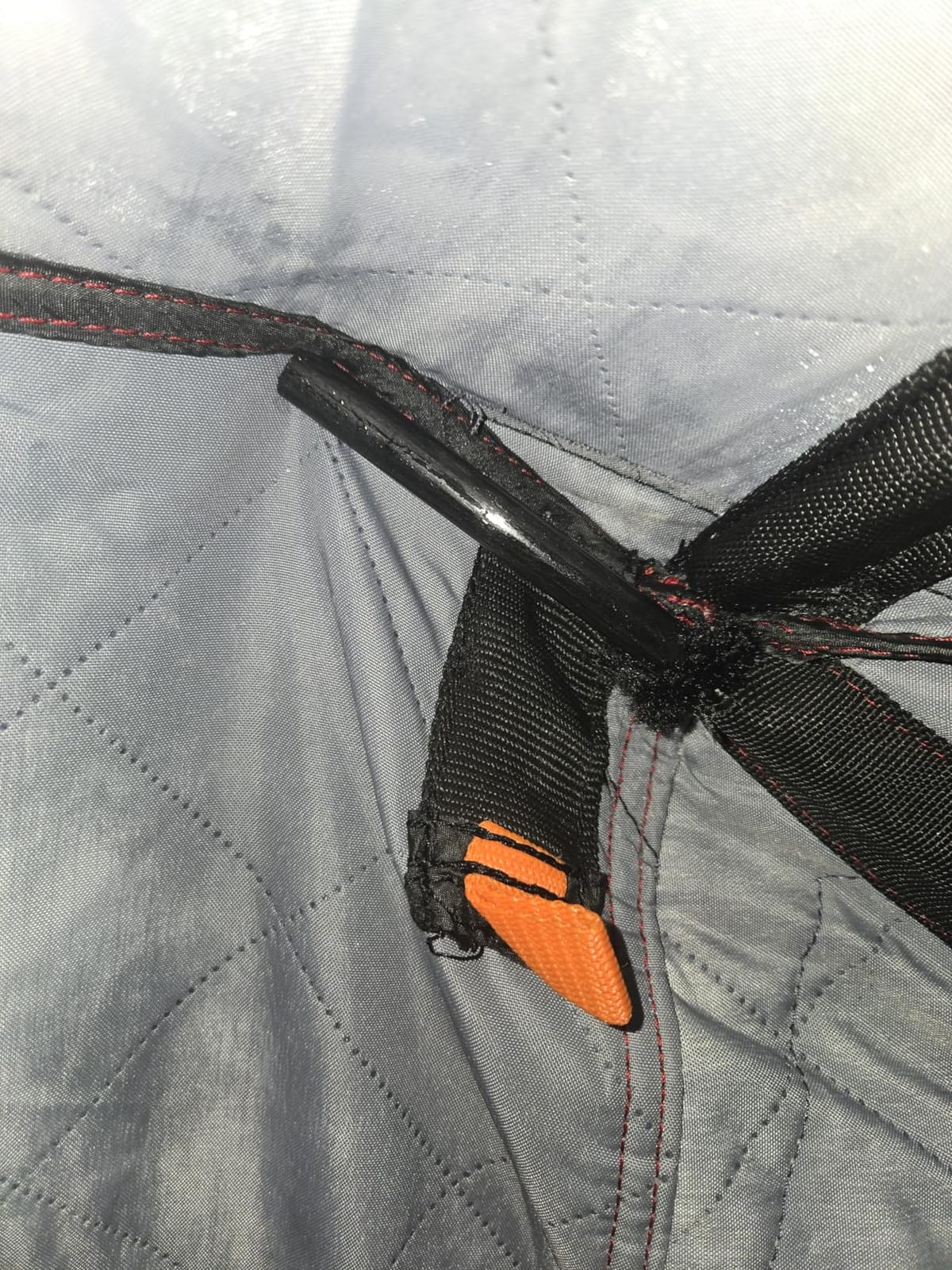
The all-metal ball-and-socket hub with larger fiberglass poles is one of the toughest frames here. The deluxe cam strap tie-downs and in-skirt anchor grommets give you more places to lock the shelter down, and YKK zippers keep the shell sealed when everything else is wet.
Owners consistently single out the pop-up mechanics as the cleanest in the group. If you move holes often in bad conditions, that is worth more than any fabric specification.
Where It Falls Short
At 44 pounds it is heavy to lug solo, and the flared wide bottom acts like a sail while you carry it. If you are walking any distance, bring a sled.
Getting it back into the carry bag takes practice, especially if the skirt has ice on it, so knock the ice off before you start folding. There is also one report of a torn ID on first use, which is a quality control note rather than a pattern.
How to Choose an Ice Fishing Shelter for Cold Weather
Pick the shelter that matches your coldest planned outing, not your average day, and add one seat to whatever capacity the listing claims. Gear takes a seat, and a shelter that fits the number of people but not their equipment is the wrong shelter. Here is how to narrow twelve options down to one.
Insulated Shelters Are Worth It Below Single Digits
Insulated ice fishing tents are worth it when the temperature drops below about 10F, and they are close to pointless above that. Insulated fabric holds a heater’s output inside the shelter instead of letting it escape through the walls, which means less fuel, a smaller heater, or no heater at all.
The number to look at is grams of insulation per square meter. Shelters in this guide range from 80 g on the Eskimo Outbreak, up through 120 g on the Your Choice, to quilted constructions above that. A gasketed, quilted hub with an insulated skirt is the standard you are aiming for.
Denier is a different measurement and gets confused with insulation constantly. Denier is fabric density, so it tells you how well the shell resists tearing and wind, not how warm it is. A 600 denier non-insulated shelter will outlast a 300 denier insulated one, and it will also feel colder. You are looking for both numbers when you are shopping in serious cold.
One honest caution: insulated shelters sweat. Warm bodies and a heater in a sealed fabric shelter produce condensation on the interior walls, and at deep cold that moisture can wet your gloves and jacket. Vent early, wipe the walls at lunch, and pack a microfiber cloth. Owners complain about this on every thermal shelter we tested, including the expensive ones.
Size It for Gear, Not for People
Use the reserve-one-seat-for-gear rule. A shelter rated for three is a two-angler shelter once two chairs, a heater, a sled and a cooler are inside. Advertised capacity is measured with an empty floor, which nobody fishes on.
Fishable area is the number that matters, and it is smaller than the footprint suggests. The Eskimo QuickFish 3i lists 34 square feet but gives you 7.5 by 7.5 inches of elbow room around the center, and the real usable fishing perimeter is the floor inside that. Bigger shelters add floor area faster than they add height.
Center height is the number anglers over 6 feet should check first. Most shelters sit between 78 and 80 inches, which is fine seated. If you want to stand, you need 81 inches or more, and that is the single clearest reason to choose the DARCHEN or the Yaranga.
Match the Shelter to the Temperature
Below about 10F, use a fully insulated shelter with an insulated skirt and a heater. Choose a portable propane or butane heater rated for indoor use, and read the safety section below before your first cold trip.
Between 10F and 25F, a non-insulated blackout hub works well with a heater running part of the day, and many anglers skip the heater entirely. This is the range where the THUNDERBAY Ice Cube and the FastFish are at their best.
Below minus 20F, only a fully insulated shelter is worth considering, and you should plan on two people maximum so the heater can keep up. The Outbreak and the Hex-Hub are the two we would trust at the bottom of the range, and both have removable windows so a small stove is possible.
Watch a related problem that only shows up in a heated shelter: retained warmth thins the ice underneath. A shelter sitting in direct sun on a warm afternoon can soften the ice under the floor while you are not looking at it. Walk your hole before you drill it.
Anchoring and Setup Order in Wind
Anchor the upwind corner first. This is the whole technique. Everything else follows from it.
- Drill your holes, then drag the shelter into position with the door facing away from the prevailing wind.
- Drive the first anchor into the upwind corner and tension it fully before anything else moves.
- Expand the hubs and walk the frame out to full extension.
- Drive the remaining anchors on the two side corners, then the two downwind corners.
- Bank snow or loose ice along the upwind skirt edge to close the airflow path.
- Re-check anchor tension after twenty minutes. Skirt fabric settling changes it.
Anchor quality varies more than shelter quality. The anchors included with the VEVOR bent during use, so if you fish exposed ground, bring your own. The large THUNDERBAY ships with twelve heavy duty anchors, which is the right count for a four-person shelter.
Self-tapping anchors drive straight into hard ice without a bracket, and in-skirt grommets mean you can tie off anywhere around the perimeter rather than only at fixed points. That flexibility is what makes a proper wind setup possible.
Windows, Visibility and Your Tip-Up Spread
If you run a tip-up spread, your windows are your fish-finding equipment, and window count matters more than window quality. The large THUNDERBAY has six vinyl windows plus two ceiling vents. The Outsunny has four double-layer windows and two doors. The FastFish has one, and you will be leaning around the wall to see your rods.
Blackout coating works the other way. If you sight fish at dawn or dusk, a blackout interior with a covered window is a real advantage, because you can open one small panel without flooding the shelter with light that spooks the fish.
Check the cover-to-cutout fit. On the large THUNDERBAY, the vinyl window covers are smaller than the cutouts they cover, so wind comes through the gap when the shades are down. That is a specific product fault, but the same class of problem is worth checking on any shelter.
For trip planning, a wireless weather station at your staging point gives you a current read on wind speed and temperature instead of a forecast you read the night before.
Heater Ports, Ventilation and Carbon Monoxide Safety
You can run a propane heater inside an ice fishing shelter, and plenty of anglers do it every week. The rule is ventilation, and the reason is carbon monoxide, which is odorless and kills without warning. Ignore any guide that tells you heaters cannot be used on ice; that advice is out of date and it is dangerous to follow.
Follow this sequence before you light anything.
- Run the heater through a dedicated stove jack port if the shelter has one. Never through a window or a door gap.
- Open the ceiling vent or the two ceiling vents. A sealed shelter with a combustion heater is the dangerous configuration.
- Open a window or keep the door cracked so fresh air is moving through the shelter.
- Carry a battery-operated carbon monoxide alarm inside with you and test it at the start of every trip.
- Keep the heater at least a foot of clearance from fabric, and never leave it unattended or running while you sleep.
- Never cook inside. An open flame in a fabric shelter is a fire risk and produces carbon monoxide faster than any heater.
Only the VEVOR in this guide has a purpose-built chimney vent and stove jack port. Everything else works, but you are running the line through a door or window gap, which is workable and less tidy.
For the shelter reuse angle, a good weatherproof 3 or 4 season backpacking tent and a heavy outdoor rug for the floor are the two pieces of gear that add the most to an overnight trip inside a large hub.
Portability: the Walk-Weight Tradeoff
A thermal flip-over or a large insulated hub typically runs 40 to 60 pounds, and hauling that any distance is a genuine workout. Forum anglers debate the 50 pound threshold, and the honest answer is that it depends entirely on how far the nearest vehicle is from the fishing spot.
Keep a distance rule in mind. Under a quarter mile of flat ice, a shelter in the 23 to 36 pound range is walkable solo. Beyond that, get a sled. A plastic sled with runners, or a shelter with wear bars on the underside, will save your back and protect the fabric from dragging across rough ice.
Solo hole-hoppers should weight portability above floor area. The weight of a 55 pound shelter is more annoying than the lack of a fourth seat is limiting, because you will feel it every single trip.
Setup and Packdown Without Tearing the Skirt
Before you collapse any shelter, knock the ice off the skirt. Frozen skirt fabric flexes in the wrong direction when you fold it, and that is the single most common way an otherwise good shelter tears.
Walk the fabric in toward the hubs rather than pushing the hubs in toward the fabric. Pushing the frame together while the fabric is stretched is what snaps fiberglass poles, and several owners on this list reported exactly that failure.
Dry the shelter before you pack it if you can. Fabric stored with moisture in it will smell within a week, and the smell transfers to everything else in the sled.
Frequently Asked Questions
What is the best hub shelter for ice fishing?
The Eskimo QuickFish 3i is the best hub we tested. It pairs 600 denier fully insulated IQ quilted fabric rated 35 percent warmer than a non-insulated comparable with 34 square feet of fishable area, a 6.7 foot center height, and a 60-second hub setup. It carries a 4.8 average across more than 570 reviews, and owners consistently rate it as the warmest balance of size and weight.
Are insulated ice fishing tents worth it?
Yes, below about 10F an insulated shelter pays for itself. Insulation holds a heater’s output inside instead of letting it escape through the walls, which means less fuel or no heater at all. Above 10F the difference narrows and a blackout non-insulated hub works well. The spec to check is grams of insulation per square meter, and 80 g to 120 g is the range worth paying for.
What is the best small shelter for cold weather?
The Outsunny pop-up insulated tent is the strongest small option, with genuine insulation, two zippered doors, four double-layer windows and a 300D Oxford shell. If you want more headroom instead of more features, the DARCHEN stands 81.6 inches tall in a 32.49 square foot footprint. Both suit one or two anglers with gear rather than the advertised maximum.
Which flip-over ice fishing shelter is the best?
None of the twelve shelters we tested is a flip-over design, because cold weather rewards interior volume and stand-up headroom, which flip-overs trade away for faster setup. A thermal flip-over with an insulated floor and skirt can match a non-insulated hub for warmth, but it cannot match one for space. For solo anglers who move between holes, a lightweight 60-second hub is usually the better trade today.
Can you use a propane heater inside an ice fishing shelter?
Yes. The danger is carbon monoxide, not the heater itself. Run the line through a dedicated stove jack port if the shelter has one, open the ceiling vent, keep a window or the door cracked, and carry a battery-operated carbon monoxide alarm inside. Never leave the heater running unattended or while you sleep, and never cook inside. A sealed shelter with a combustion heater is the unsafe configuration.
How long does it take to set up a hub-style ice shelter?
Most of the hubs on this list go from bag to standing in about 60 seconds once the frame is collapsed correctly. The two exceptions are the Outsunny pull-up frame, which takes roughly ten minutes the first time and much less after, and the Nordic Legend Hex-Hub, which takes about two minutes for one person at 112 square feet. Budget five minutes of extra time for your first setup with any of them.
Final Verdict: The Eskimo QuickFish 3i Is Our Pick for Cold Weather
After a full season in the cold, the Eskimo QuickFish 3i is the shelter we recommend to most people looking for the best ice fishing shelters for cold weather. It is the only one in this group where the insulation, the headroom, the anchoring hardware and the setup speed are all right at the same time, and it is the one we kept reaching for by default.
Buy the THUNDERBAY Ice Cube if you want the best value and plan to fish milder ice. Buy the VEVOR if you want to run a stove all day. Buy the Nordic Legend Hex-Hub if you are staying overnight. And check your ice thickness before every single trip, because no shelter on this list matters if the ice below it is wrong.
We earn a commission from qualifying purchases made through the links on this page, at no additional cost to you.