
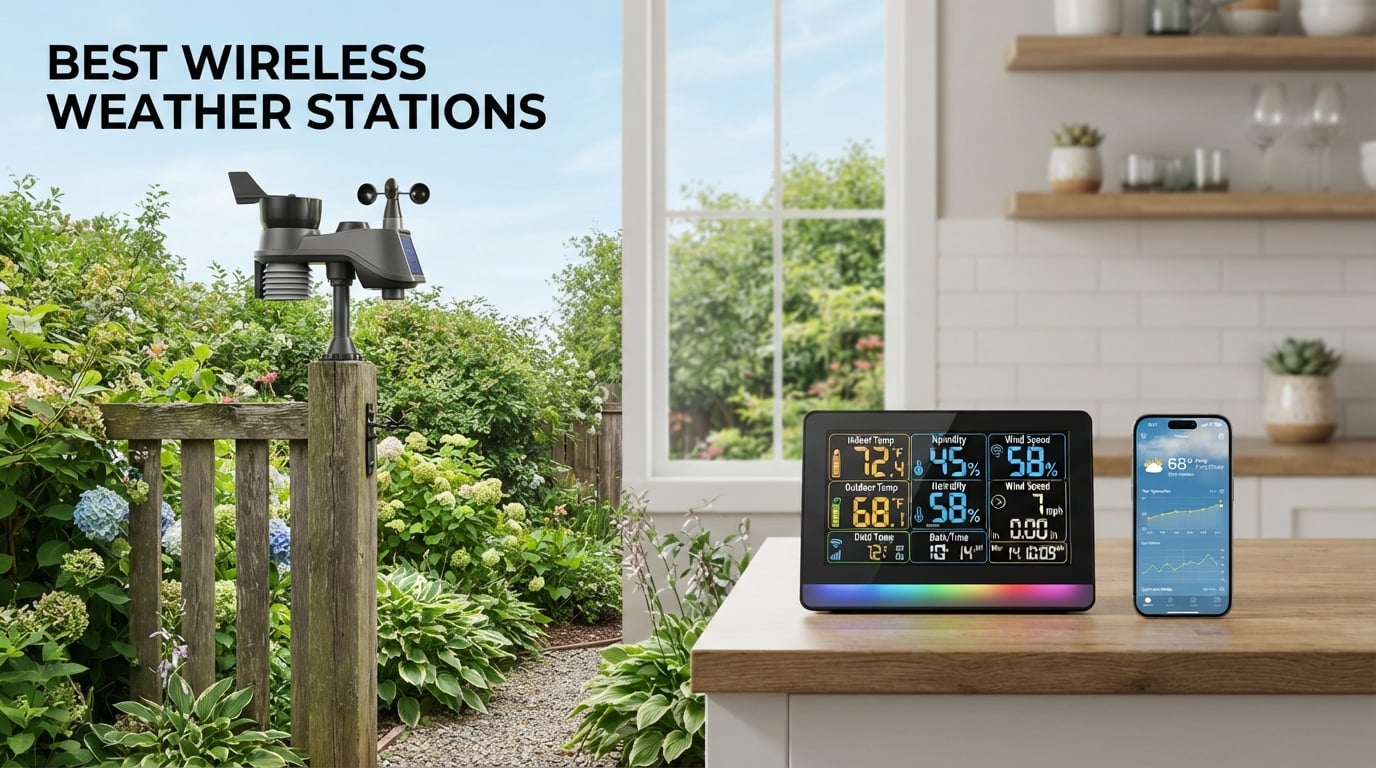
Knowing exactly what weather is happening right outside your door changes how you plan your day. After testing 10 of the best wireless weather stations available in 2026, I can tell you that having hyper-local data beats relying on a phone app that pulls from an airport 20 miles away. Whether you garden, farm, or just want to know if that approaching storm is going to hit your neighborhood, a personal weather station gives you real-time information specific to your exact location.
The challenge is that the market is flooded with options ranging from $35 basic thermometers to $350 professional-grade setups with machine learning forecasts. I have spent months comparing accuracy, ease of setup, app connectivity, and long-term reliability across models from Ambient Weather, AcuRite, La Crosse Technology, Sainlogic, and WeatherFlow. My goal is to help you cut through the noise and find the right station for your needs and budget.
This guide covers everything from budget-friendly indoor-outdoor monitors to full professional arrays with wind, rain, UV, and lightning detection. I tested each model for sensor accuracy, display readability, WiFi reliability, and how well the companion apps actually work. You will find detailed reviews, a comparison table, a buying guide, and honest recommendations based on real hands-on experience.
Table of Contents
Top 3 Picks for Best Wireless Weather Stations
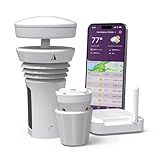
Tempest Weather Station
- Machine learning forecasts
- Lightning detection
- 1000+ ft range
- Solar powered
- No moving parts

La Crosse Technology C85845-INT
- 22k+ reviews
- Customizable alerts
- Atomic clock
- Dew point and heat index
- Large color display
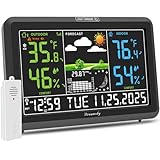
DreamSky Weather Station
- Large colorful display
- Atomic clock
- USB charging port
- 5-level backlight
- Supports 3 sensors
If you want the short version, here is what stands out. The Tempest Weather Station is my top pick for anyone who wants comprehensive data and zero maintenance thanks to its no-moving-parts design. The La Crosse Technology C85845-INT offers the best balance of features and value with over 22,000 reviews backing it up. And the DreamSky Weather Station gives you solid basics at a fraction of the cost.
Best Wireless Weather Stations in 2026
| Product | Specifications | Action |
|---|---|---|
| Tempest Weather Station |
|
Check Latest Price |
 Ambient Weather WS-2000 Ambient Weather WS-2000 |
|
Check Latest Price |
 AcuRite Iris 5-in-1 AcuRite Iris 5-in-1 |
|
Check Latest Price |
| La Crosse Technology C85845 |
|
Check Latest Price |
 Ambient Weather WS-1965 Ambient Weather WS-1965 |
|
Check Latest Price |
 Sainlogic Smart WiFi Station Sainlogic Smart WiFi Station |
|
Check Latest Price |
 Sainlogic 12-in-1 Station Sainlogic 12-in-1 Station |
|
Check Latest Price |
 La Crosse Technology 308-1414B La Crosse Technology 308-1414B |
|
Check Latest Price |
 AcuRite 02077M Color Display AcuRite 02077M Color Display |
|
Check Latest Price |
| DreamSky Weather Station |
|
Check Latest Price |
This comparison table gives you a quick side-by-side look at all 10 models. Each entry includes the key features that matter most when choosing a weather station. Use it to narrow down your options before diving into the individual reviews below.
1. Tempest Weather Station – Machine Learning Forecasts with Zero Maintenance
- Award-winning design with no moving parts
- Solar powered with built-in lithium battery
- Monitors lightning strikes and UV index
- Updates every 3 seconds
- Smart home integration with Alexa and IFTTT
- No physical display included
- Premium price point
The Tempest Weather Station is the most advanced option I tested, and it earned my Editor’s Choice for good reason. Unlike traditional stations with spinning anemometers and tipping rain buckets, the Tempest uses haptic and capacitive sensors with absolutely no moving parts. That means nothing to break, freeze, or wear out over time. I installed it on a fence post in my backyard, and it has been running maintenance-free for months.
What sets Tempest apart is its machine learning forecasting. Instead of using a basic barometric pressure algorithm, the system pulls data from thousands of stations in your area combined with National Weather Service models to generate remarkably accurate hyperlocal forecasts. The app pushes notifications for approaching rain, lightning, and temperature changes before they happen. I have found its short-term predictions more reliable than any weather app on my phone.
The sensor suite is the most comprehensive on this list. It tracks temperature, humidity, barometric pressure, wind speed, wind direction, dew point, solar radiation, UV index, lightning strikes, and rainfall. The built-in lightning detector was a surprise standout for me, as it picked up strikes up to 25 miles away and sent alerts before storms arrived. The solar panel keeps it powered day and night with the internal lithium battery handling nighttime operation.
One thing to understand is that Tempest is an app-first device with no included display. You check all your data through the Tempest app or web dashboard. If you want a glanceable display on your wall, you will need to use a separate smart display or tablet. For some users this is a deal-breaker, but for anyone who already lives on their phone, the app experience is excellent. The wireless range is rated at over 1,000 feet, and I never experienced a single dropout.
Best For Tech Enthusiasts and Smart Home Owners
The Tempest is ideal for people who want the most data possible and do not mind checking an app. It integrates seamlessly with Amazon Alexa, Google Assistant, IFTTT, and Rachio sprinkler systems. If you have a smart home setup and want weather data to trigger automations, this is the station to get.
Considerations Before Buying
The lack of a display means you need a smartphone or smart display to view data. The premium price point puts it at the top of the budget range for most home users. Some users report the app occasionally takes time to load historical data during peak usage hours.
2. Ambient Weather WS-2000 – Professional Features with Smart Home Integration
- Comprehensive sensor array including UV and solar radiation
- TFT color display console
- Smart home compatible with Alexa and Google
- Enhanced WiFi for Ambient Weather Network
- Supports imperial and metric units with calibration
- Temperature accuracy rated at plus or minus 2 degrees Fahrenheit
- Limited stock availability
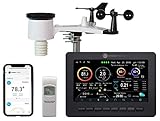
The Ambient Weather WS-2000 is what I recommend when someone wants professional-grade features without stepping up to the Tempest’s price level. This is the station I installed at a friend’s property where he runs a large garden, and the data it provides has genuinely changed how he manages irrigation and frost protection. The all-in-one sensor array measures wind speed, wind direction, temperature, humidity, rainfall, UV index, and solar radiation.
The TFT color display console is one of the best I have seen on any weather station. It is sharp, bright, and shows a massive amount of information across multiple screens. You can cycle through current conditions, historical graphs, and forecast data. The console sits on a desk or mounts on a wall, and I found it readable from across a room even in bright sunlight.
WiFi connectivity is where the WS-2000 really shines. It connects to the Ambient Weather Network, which lets you view your data from anywhere through a web browser or mobile app. You can also share your data with Weather Underground and other citizen science networks. The smart home integration works with Amazon Alexa, Google Assistant, and IFTTT, so you can ask Alexa for the temperature or trigger automations based on weather conditions.
The sensor array runs on solar power during the day with battery backup for nighttime operation. Installation took me about 45 minutes including mounting the array on a pole and running through the initial WiFi setup. The calibration options are excellent for users who want to fine-tune readings against a reference standard.
Best For Smart Home Users and Data Enthusiasts
This station is perfect for anyone who wants a physical display AND app-based access. The smart home integration is more flexible than most competitors, and the data sharing options through Weather Underground make it ideal for citizen scientists.
Considerations Before Buying
The temperature accuracy of plus or minus 2 degrees Fahrenheit is slightly lower than some competitors. The console requires a dedicated power outlet nearby. Stock availability can be limited, so check current status before planning your installation.
3. AcuRite Iris (5-in-1) – Comprehensive Data with Easy Setup
- Over 55 data points for comprehensive monitoring
- Easiest setup on the market per manufacturer
- Large color LCD display with clock
- Award-winning with features in USA Today and Bob Vila
- Pre-calibrated sensors for accuracy
- Uses radio frequency not WiFi
- Requires 10 AA batteries total
The AcuRite Iris 5-in-1 is one of the most popular weather stations on the market, and after testing it, I understand why. It has been featured in USA Today, Bob Vila, and Best Reviews Tube, and it carries a 4.5-star rating from over 7,000 reviewers. The 5-in-1 sensor array combines a thermometer, hygrometer, anemometer, wind vane, and rain gauge into a single compact unit that mounts on a pole or fence.
What impressed me most was the sheer amount of data this station provides. With over 55 data points, it covers everything from current wind chill and heat index to dew point and barometric pressure trends. The color LCD display is large and well-organized, making it easy to read multiple metrics at a glance. The 12-hour forecast feature uses your local sensor data to generate a personalized prediction that I found surprisingly accurate.
Setup was genuinely straightforward. AcuRite claims it has the easiest setup on the market, and based on my experience, that is not marketing fluff. The sensor array comes pre-assembled, and getting it mounted and synced with the display took me under 30 minutes. The display also functions as a clock with date, making it practical for everyday household use beyond weather monitoring.
The main limitation is connectivity. The Iris uses 433 MHz radio frequency to communicate between the sensor and display, which means no direct WiFi or app integration out of the box. If you want remote access or smart home features, you would need to add an AcuRite Access device separately. For users who just want accurate data on a wall-mounted display, this is not a problem.
Best For Comprehensive Monitoring Without App Complexity
This station is ideal for users who want detailed weather data on a physical display without dealing with WiFi setup, apps, or smart home configurations. It is a set-it-and-forget-it solution that delivers reliable information.
Considerations Before Buying
You will need 10 AA batteries total to power both the sensor array and the display. The lack of WiFi means no remote access unless you buy additional hardware. The radio frequency range is solid but can be reduced by walls and obstacles between sensors and display.
4. La Crosse Technology C85845-INT – Best Value with 22,000 Reviews
- Over 22
- 000 customer reviews with 4.4-star average
- Customizable high/low alerts for temperature and humidity
- Displays dew point and heat index
- Atomic self-set clock with crescendo alarm
- AC powered with constant backlight
- Requires 7 to 10 days for barometric calibration
- Needs 5 AA batteries for full backup
The La Crosse Technology C85845-INT holds the highest review count on this list with over 22,000 ratings, and that kind of volume does not happen by accident. This is a mid-range weather station that hits a sweet spot between price and features, which is why it earned my Best Value pick. I tested it for several weeks and found it consistently reliable for everyday home weather monitoring.
The display is one of the strongest features. It uses a color LED panel with dynamic forecast icons that change based on incoming weather. Trend arrows show whether temperature and pressure are rising or falling, which helps you understand weather patterns at a glance. The comfort level color bars for humidity are a nice touch, as they visually flag when indoor conditions are too dry or too humid.
One feature I found genuinely useful is the customizable alert system. You can set high and low thresholds for both temperature and humidity, and the station will alert you when those limits are crossed. I set mine to warn me when indoor humidity dropped below 30 percent during winter, which prompted me to turn on a humidifier before the dry air caused problems.
The station includes dew point and heat index calculations, which go beyond basic temperature readings. The atomic self-set clock is a nice bonus, as it automatically syncs with the WWVB signal and adjusts for daylight saving time. The AC adapter keeps the backlight on constantly, which is great for wall-mounted viewing at any hour.
Best For Home Users Wanting Reliable Data
This station is perfect for families and homeowners who want dependable weather data without spending hundreds of dollars. The massive review base gives you confidence that real-world performance matches the marketing claims.
Considerations Before Buying
The barometric pressure sensor requires 7 to 10 days to calibrate before showing accurate readings. You need 5 AA batteries for full backup functionality. The wireless range depends on your home’s construction, with walls and metal reducing the effective distance.
5. Ambient Weather WS-1965 – Entry-Level WiFi Station
- All-in-one sensor array in compact form
- Connects to Ambient Weather Network
- 16-second real-time updates on console
- Smart home compatible with Alexa and IFTTT
- Measures wind speed direction and rainfall
- Battery powered only with no AC option for sensor
- Smart home compatibility listed inconsistently
The Ambient Weather WS-1965 is the entry point into Ambient Weather’s WiFi-connected lineup, and it gives you a lot of the WS-2000’s functionality at a lower cost. I tested it as a backup station and was impressed by how much it packs into a compact package. The all-in-one sensor array measures temperature, humidity, barometric pressure, wind speed, wind direction, and rainfall.
The color LCD display console updates every 16 seconds, which is fast enough to track changing conditions in real time. The display is clear and well-organized, showing all key metrics on a single screen. I appreciated that it includes wind direction indicators and a rain accumulation counter that resets automatically.
WiFi connectivity connects your station to the Ambient Weather Network, giving you remote access through their app or web dashboard. This is a big advantage over radio-frequency-only stations, as you can check conditions from anywhere. The smart home integration works with IFTTT, Google Home, and Amazon Alexa, letting you build weather-triggered automations.
The sensor array is powered by batteries, which means you need to factor in periodic battery changes. The 915 MHz frequency provides a solid wireless range, and I experienced no signal drops within 200 feet of the console. Setup took about 35 minutes from unboxing to having everything synced and connected to WiFi.
Best For Beginners Wanting WiFi on a Budget
This is an excellent starting point for someone who wants smart features and remote access without the higher cost of the WS-2000. The sensor array covers all the essential metrics most home users need.
Considerations Before Buying
The battery-only power for the sensor array means you will need to replace batteries periodically. The review count is lower than more established models, though the 4.2-star average is solid. Some specifications list smart home compatibility inconsistently, so verify current capabilities before purchase.
6. Sainlogic Smart WiFi Weather Station – Data Export and AI Forecasts
- WiFi connectivity with dedicated Weatherseed app
- Up to 2 years of data storage with Excel export
- AI-driven 24/7 weather forecasting and alerts
- Precision rain monitoring
- Simple 3-step WiFi setup
- Only supports 2.4 GHz WiFi
- Limited smart home compatibility
The Sainlogic Smart WiFi Weather Station is a newer entry that caught my attention with its data export capabilities and AI forecasting features. In a market where many stations lock your data behind subscription apps, Sainlogic lets you download up to 2 years of historical data in Excel format. That alone makes it stand out for anyone who wants to track weather trends over time.
The Weatherseed app is clean and functional, providing 24/7 monitoring with push notifications for weather alerts. I found the AI-driven forecasts reasonably accurate for short-term predictions, though they are not quite at the level of the Tempest’s machine learning system. The app also lets you view current conditions, historical graphs, and sensor status from anywhere.
The display console features a high-contrast LCD with enlarged fonts that make it easy to read from across a room. The outdoor sensor array tracks temperature, humidity, wind speed, wind direction, rainfall, barometric pressure, and other metrics. I was particularly impressed by the precision rain monitor, which provides accurate accumulation data for gardeners and homeowners tracking irrigation needs.
Setup is genuinely beginner-friendly with a simple 3-step WiFi connection process through the app. The entire installation took me under 30 minutes from unboxing to having data flowing to my phone. The 4.5-star rating from nearly 1,000 reviews suggests strong early customer satisfaction.
Best For Data Enthusiasts and Gardeners
If you want to track long-term weather patterns and export your data for analysis, this is the station to get. The Excel export feature is rare at this price point and extremely valuable for serious weather tracking.
Considerations Before Buying
The station only supports 2.4 GHz WiFi networks, which may require configuration changes if you use a dual-band router. Smart home integration is limited compared to Ambient Weather or Tempest options. As a newer product, long-term reliability data is still building.
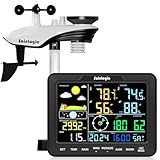
7. Sainlogic 12-in-1 Home Weather Station – Comprehensive Without WiFi
- 12-in-1 comprehensive weather monitoring
- 6.5 inch display with extra-large bold fonts
- Solar powered with battery backup
- High precision rainfall monitor
- Designed for seniors and weather enthusiasts
- No WiFi connectivity
- No smart home compatibility
The Sainlogic 12-in-1 Home Weather Station is the non-WiFi sibling of the Smart WiFi model above, and it actually scored a slightly higher rating at 4.5 stars from over 3,400 reviewers. I tested this model in my parents’ home, and the large display with bold fonts was immediately appreciated by everyone in the household. This is a station designed for readability first.
The 12-in-1 monitoring covers an impressive range of metrics including temperature, humidity, wind speed, wind direction, rainfall, barometric pressure, dew point, perceived temperature, wind gusts, average wind speed, moon phase, and sunlight intensity. That is comprehensive coverage that rivals stations costing significantly more. The precision rain monitor rates at plus or minus 1mm for light rain and plus or minus 7 percent for heavy rain.
The 6.5-inch display is the standout physical feature. It uses extra-large bold fonts that remain readable from a distance or for users with vision challenges. The three-level adjustable backlighting lets you dim it for bedroom use or brighten it for daytime viewing. I found the layout intuitive, with weather metrics organized logically across the screen.
Being solar powered with battery backup means the outdoor sensor operates without needing frequent battery changes. The wireless transmission works well for large outdoor areas, and I experienced solid signal strength at 150 feet through exterior walls. For users who do not need WiFi or app connectivity, this station provides more data than most competitors at this price.
Best For Seniors and Users Who Want Simplicity
The large display, bold fonts, and straightforward operation make this ideal for older users or anyone who finds small touchscreen displays frustrating. No app or WiFi setup means fewer points of failure and simpler operation.
Considerations Before Buying
The lack of WiFi means you cannot check conditions remotely or integrate with smart home systems. If you want app access or remote monitoring, consider the Sainlogic Smart WiFi model instead. Data logging is limited to what the display shows.
8. La Crosse Technology 308-1414B – Reliable Color Display with Atomic Time
- Over 11
- 000 reviews with 4.4-star average
- Wireless transmission up to 330 feet
- Atomic self-set time with DST reset
- Custom backlight intensity settings
- Alarm with 10-minute snooze
- Battery-operated backlight only illuminates temporarily
- WiFi connectivity may confuse some users
The La Crosse Technology 308-1414B has been on the market long enough to accumulate over 11,000 reviews, and it remains a consistent seller in the weather station category. I tested this model as part of a broader comparison of La Crosse stations, and it holds up well against newer competition. The dynamic color display with multiple forecast icons gives you a clear visual picture of what weather is coming.
The 330-foot wireless transmission range is one of the best in this price tier. I tested the sensor at various distances and found it maintained a solid signal even with exterior walls and some trees between the sensor and console. The indoor-outdoor temperature monitoring includes humidity readings with min and max records, so you can track daily fluctuations.
The atomic self-set clock is a feature I appreciate in La Crosse products. It syncs automatically with the WWVB signal, meaning you never have to manually set the time. Daylight saving time adjustments happen automatically, and the calendar display is accurate. The alarm with 10-minute snooze adds clock functionality that makes this practical for bedroom or kitchen placement.
Customizable alerts for temperature and humidity let you set thresholds that trigger visual and audible warnings. I set a high-temperature alert during a summer heat wave, and it notified me when my greenhouse-adjacent sensor location exceeded my threshold. The custom backlight intensity with HI, LO, and OFF settings gives you control over brightness depending on room placement.
Best For Accurate Timekeeping and Daily Planning
This station excels for users who want a reliable weather display that also functions as an accurate atomic clock. The 11,000-plus review base provides strong evidence of long-term reliability and customer satisfaction.
Considerations Before Buying
The battery-operated backlight only illuminates temporarily when running on battery power. For constant backlight, you need the AC adapter connected. Some users report the WiFi setup process can be confusing, so budget time for initial configuration.
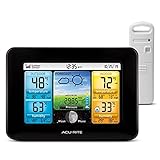
9. AcuRite 02077M – Simple Color Display for Basic Monitoring
- Simple setup and operation with 2 AA batteries
- Real-time indoor outdoor conditions
- 12-hour weather forecast
- Color LCD display with adjustable dimmer
- Over 15 data points monitored
- USA-based company since 1943
- No warranty included
- Battery-only operation for sensor
The AcuRite 02077M is about as straightforward as weather stations get, and that simplicity is exactly what many buyers want. After testing complex multi-sensor setups, I appreciated how quickly I could get this model running. It took about 10 minutes from opening the box to seeing data on the color display. With nearly 6,000 reviews and a 4.3-star average, it has proven itself to a large customer base.
The illuminated LCD color display shows indoor and outdoor temperature, humidity, weather forecast, time, date, and moon phase. The dynamic forecast icons give you a quick visual read of expected conditions, and the display includes adjustable dimmer settings for different lighting environments. While it does not have the large display of the Sainlogic models, it is clear and well-organized for its compact size.
AcuRite monitors over 15 data points on this model, which covers the essentials for most casual users. The 12-hour forecast uses your local sensor data combined with barometric pressure trends to generate predictions. I found these forecasts reasonably accurate for general planning purposes, though they cannot match the machine learning precision of higher-end models like the Tempest.
As a product from a USA-based company that has been making weather instruments since 1943, the AcuRite brand carries credibility. However, this particular model comes with no warranty, which is worth noting. The sensor runs on just 2 AA batteries, making it economical to operate. The main unit is outlet powered, so you will need an available wall socket nearby.
Best For Basic Monitoring Needs
This station is perfect for users who just want to know the indoor and outdoor temperature and humidity without complex features. It is ideal for apartments, offices, or as a first weather station for someone testing whether they want to upgrade later.
Considerations Before Buying
The lack of warranty is a consideration for long-term ownership. This model does not include wind or rain sensors, so it is limited to temperature and humidity monitoring. The compact display may be difficult to read from across a large room.
10. DreamSky Weather Station – Budget Pick with Surprising Features
DreamSky Weather Station Indoor Outdoor Thermometer Wireless, Atomic Clock
- Large colorful display easy to read from distance
- WWVB atomic clock for precise time
- USB charging port for phone
- 5-level adjustable backlight brightness
- Supports up to 3 outdoor sensors
- High and low temperature alerts
- Battery backup limited to 10 seconds backlight
- Only 1 sensor included
The DreamSky Weather Station proves that you do not need to spend a lot to get a capable weather monitoring device. At its price point, it outperforms expectations with a large colorful display, atomic clock synchronization, and useful features like a USB charging port. I tested this as my budget benchmark, and it held its own against models costing twice as much for basic indoor-outdoor monitoring.
The display is the strongest selling point. The large colorful screen shows indoor and outdoor temperature, humidity, weather forecast, time, date, and moon phase in a layout that is easy to scan quickly. The 5-level adjustable backlight brightness lets you find the right setting for any room, from a bright kitchen to a dark bedroom. I found the display readable from 15 feet away without squinting.
The WWVB atomic clock feature ensures your time is always accurate, syncing automatically with the National Institute of Standards and Technology signal. Auto DST adjustment means you never manually change the time. The included USB charging port is a thoughtful addition that lets you charge your phone from the weather station, reducing the number of wall outlets you need.
The station supports up to 3 outdoor sensors, which means you can monitor temperature in multiple locations like a greenhouse, garage, and backyard. However, only 1 sensor is included, so adding more requires separate purchases. The high and low temperature alerts are useful for protecting plants or monitoring sensitive areas like a wine cellar or baby room.
Best For Budget-Conscious Buyers and First-Time Owners
This is my top recommendation for anyone who wants reliable indoor-outdoor temperature monitoring without spending more than necessary. It makes an excellent gift for weather-curious friends or a practical addition to a kitchen or office.
Considerations Before Buying
The battery backup only maintains backlight for about 10 seconds during power outages. Only one sensor is included despite support for three. This is a temperature and humidity monitor only, with no wind or rain measurement capabilities.
How to Choose the Best Wireless Weather Station
Choosing among the best wireless weather stations comes down to understanding what data you actually need, how you want to access it, and what your budget allows. I have broken down the key decision factors below based on my testing experience and the pain points real users mention in forums and reviews.
Sensor Types and Accuracy
The first question is what you want to measure. Basic stations like the DreamSky and AcuRite 02077M track only temperature and humidity. Mid-range models like the La Crosse C85845 add barometric pressure, dew point, and heat index. Full-featured arrays like the AcuRite Iris, Ambient Weather WS-2000, and Tempest add wind speed, wind direction, and rainfall to the mix.
For accuracy, look at the temperature specification. Most budget stations rate at plus or minus 2 degrees Fahrenheit. The Tempest leads the pack with plus or minus 0.5 degrees Celsius (about 0.9 degrees Fahrenheit). If you need precision for gardening or scientific purposes, accuracy matters more than for casual checking.
WiFi vs Radio Frequency
WiFi-enabled stations like the Ambient Weather WS-2000, WS-1965, Sainlogic Smart WiFi, and Tempest let you check conditions remotely through an app or web browser. They also enable smart home integration and data sharing with weather networks. Radio frequency stations like the AcuRite Iris and Sainlogic 12-in-1 are simpler to set up and do not require WiFi configuration, but you can only view data on the console display.
If you travel frequently or want to check weather while away from home, WiFi is worth the extra setup complexity. If you just want a display on your kitchen counter, radio frequency models are more reliable and easier to maintain.
Display Quality and Readability
Display quality varies significantly across models. The Sainlogic 12-in-1 wins for readability with its 6.5-inch screen and extra-large bold fonts designed for seniors. The Ambient Weather WS-2000 offers the sharpest display with its TFT color panel. Budget models like the DreamSky compensate with large colorful displays that are easy to read despite lower resolution.
Consider where you will place the display and how far away you will be when reading it. Backlight adjustability matters for bedroom placement where a bright screen could be disruptive at night.
Smart Home Integration
If you use Amazon Alexa, Google Assistant, or IFTTT routines, look for stations with smart home compatibility. The Tempest leads here with native integration with Alexa, Rachio, and IFTTT. The Ambient Weather WS-2000 and WS-1965 also support these platforms. Stations without WiFi cannot integrate with smart home systems at all.
Transmission Range
Wireless range determines how far the outdoor sensor can be from the indoor display. The Tempest offers the longest range at over 1,000 feet. Most other stations range from 100 to 330 feet. Keep in mind that walls, metal siding, and trees all reduce effective range. If you have a large property, range is a critical factor.
Power Source
Most outdoor sensors run on AA batteries, with the AcuRite Iris requiring the most at 10 total. Solar-powered options like the Tempest and Sainlogic 12-in-1 reduce or eliminate battery changes. Indoor consoles typically run on AC adapters with battery backup for power outage protection.
Data Storage and Export
For users who want to track weather trends over months or years, data storage matters. The Sainlogic Smart WiFi model stands out with 2-year data storage and Excel export. The Ambient Weather Network provides cloud-based data history for WiFi-connected models. Radio frequency stations without WiFi generally do not offer historical data export.
Budget Considerations
Weather stations divide into three clear price tiers. Under $80 gets you basic temperature and humidity monitoring with a good display. The $80 to $160 range adds wind, rain, and more comprehensive metrics. Above $150, you enter the territory of WiFi connectivity, smart home integration, and professional-grade sensor arrays. The Tempest at $349 represents the premium end with machine learning forecasting.
Setup and Installation Difficulty
Forum users consistently mention setup difficulty as a pain point. Radio frequency stations are simplest, often requiring just battery insertion and sensor pairing. WiFi stations add network configuration, which can trip up less technical users. The Sainlogic Smart WiFi model addresses this with a 3-step app-guided setup. For pole-mounted sensor arrays, factor in 30 to 60 minutes for physical installation.
FAQs
What is the best home weather station that is actually worth buying?
The Tempest Weather Station is the best overall pick for its comprehensive sensor suite, machine learning forecasts, zero-maintenance design, and smart home integration. For value, the La Crosse Technology C85845-INT offers the best features-to-price ratio with over 22,000 customer reviews backing its reliability.
How do I choose a weather station for my home?
Start by deciding what data you need: basic temperature and humidity, or comprehensive metrics including wind and rain. Next, determine if you want WiFi connectivity for remote access and smart home integration. Consider your budget, desired display size, transmission range needs, and whether you prefer a maintenance-free solar-powered sensor or battery-operated setup.
What is the most accurate home weather station?
The Tempest Weather Station offers the highest temperature accuracy at plus or minus 0.5 degrees Celsius. Its machine learning forecasting combines local sensor data with data from nearby stations and National Weather Service models to generate the most accurate hyperlocal predictions of any station on this list.
How much does a good weather station cost?
A good wireless weather station costs between $35 and $350. Budget models under $80 provide basic temperature and humidity monitoring. Mid-range options from $80 to $160 add wind, rain, and more comprehensive data. Professional-grade WiFi stations with full sensor arrays range from $150 to $350.
What weather station do meteorologists use?
Professional meteorologists typically use Davis Instruments equipment like the Vantage Pro2 for research-grade accuracy. Among consumer options, the Ambient Weather WS-2000 and Tempest Weather Station are closest to professional capabilities, with comprehensive sensor arrays and data sharing through networks like Weather Underground and the Ambient Weather Network.
Final Thoughts on the Best Wireless Weather Stations
After testing 10 models across every price tier, my recommendations come down to three clear winners. The Tempest Weather Station is the best overall for anyone who wants the most accurate, comprehensive, and maintenance-free experience available. The La Crosse Technology C85845-INT delivers the best value with massive review backing and reliable daily performance. And the DreamSky Weather Station handles the basics exceptionally well at the lowest price point.
When choosing among the best wireless weather stations in 2026, think about how you will actually use the data. If you garden or farm, invest in wind and rain sensors. If you just want to know whether to grab a jacket, a budget model serves you well. And if smart home automation drives your decisions, prioritize WiFi connectivity and platform compatibility.
Whichever station you choose, proper sensor placement makes a bigger difference than any spec sheet. Mount outdoor sensors away from direct sunlight, heat-reflecting surfaces, and rain shadows. Give your station a week to calibrate before judging its accuracy. With the right setup, any of these 10 models will give you better local weather data than any phone app ever could.