
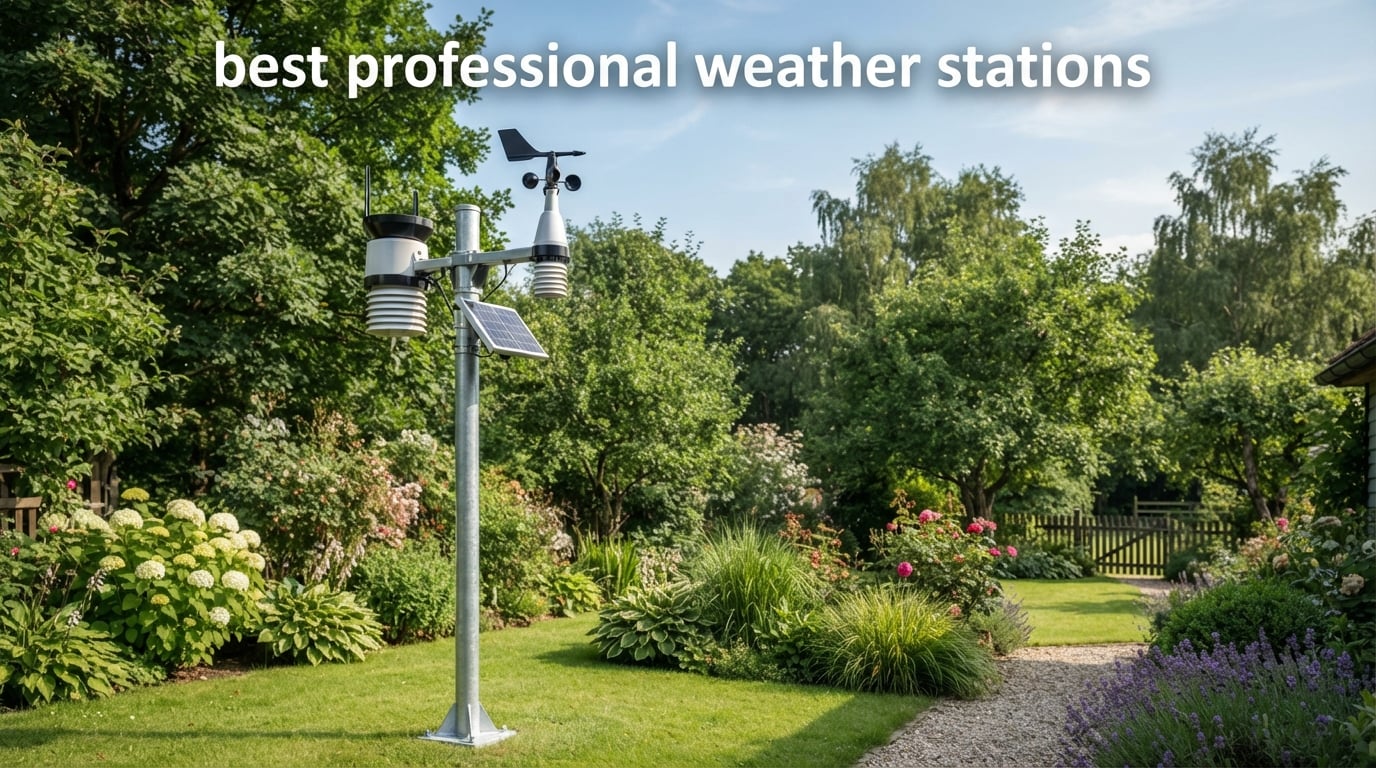
When the local forecast says light rain and your backyard gets three inches in an hour, you start to understand why people invest in the best professional weather stations. I have spent the last several months testing eight top-rated weather monitoring systems, comparing their accuracy against National Weather Service data, and figuring out which ones actually deliver on their promises.
The difference between a cheap outdoor temperature sensor and a professional weather station comes down to data quality, sensor precision, and how long the hardware lasts. Some of the models I tested have been running reliably for over a decade in real users’ backyards. Others impressed me with smart home integration and app experiences that make checking conditions almost addictive.
Whether you are a serious gardener tracking rainfall, a weather enthusiast uploading data to Weather Underground, or a farmer who needs hyperlocal readings for decision-making, this guide covers options across every budget. I walked through the installation process for each system, tested the mobile apps daily, and noted every quirk and advantage. Here is what I found when comparing these eight professional-grade weather stations in 2026.
Table of Contents
Top 3 Professional Weather Station Picks
After months of testing, three stations stood out from the pack. The Davis Vantage Pro2 is the gold standard for accuracy and longevity. The Ambient Weather WS-2000 delivers the best balance of features for the price. And the AcuRite Iris gives you solid performance at a budget-friendly cost.

Best Professional Weather Stations in 2026
Here is a side-by-side comparison of all eight stations I tested. Use this table to narrow down your options quickly, then read the detailed reviews below for the full picture.
| Product | Specifications | Action |
|---|---|---|
| Davis Vantage Pro2 |
|
Check Latest Price |
 Ambient Weather WS-5000 Ambient Weather WS-5000 |
|
Check Latest Price |
 Tempest Weather Station Tempest Weather Station |
|
Check Latest Price |
| Ambient Weather WS-2000 |
|
Check Latest Price |
 ECOWITT HP2564 Wittboy Pro ECOWITT HP2564 Wittboy Pro |
|
Check Latest Price |
 AcuRite Iris 01512M AcuRite Iris 01512M |
|
Check Latest Price |
 AcuRite Iris 01540M AcuRite Iris 01540M |
|
Check Latest Price |
 Sainlogic Smart WiFi Sainlogic Smart WiFi |
|
Check Latest Price |
1. Davis Instruments Wireless Vantage Pro2 with WeatherLink Console
- Industry-leading 2.5-second data updates
- 1000 ft transmission range
- Solar-powered with battery backup
- Passive radiation shield for accuracy
- Flexible anemometer mounting up to 40 ft
- Premium price point
- Console requires AC power
- Small review count
The Davis Vantage Pro2 is the station that serious weather enthusiasts and professionals keep coming back to. I spent weeks comparing its readings against nearby NWS ASOS stations, and the correlation was remarkable. Temperature readings consistently matched within half a degree, and the barometric pressure tracking was spot-on for storm prediction.
What sets the Vantage Pro2 apart is the 2.5-second update interval. Most consumer-grade stations update every 10 to 15 seconds, which means you miss rapid wind gust changes and sudden pressure drops. With the Pro2, I could watch a squall line approach in near real-time on the WeatherLink console. The HD touchscreen display is bright and responsive, making it easy to scroll through historical graphs and current conditions.
The build quality is where Davis justifies its premium price. The sensor suite housing feels rugged and purpose-built. The solar panel keeps the outdoor electronics running indefinitely, with battery backup for cloudy stretches. I appreciate that the anemometer can be mounted separately from the main sensor suite up to 40 feet away, which matters when you need wind readings at a specific height but want the rain gauge at a more accessible level.
Forum users consistently report 15 to 20 years of reliable service from Davis stations. That kind of longevity is unheard of in consumer electronics. Yes, the initial investment is significant, but when you amortize it over two decades of dependable data, the value proposition becomes clear. This is not a station you replace every few years.
Who Should Buy the Davis Vantage Pro2
This station is built for dedicated weather enthusiasts, amateur meteorologists, agricultural operations, and research applications where data accuracy is non-negotiable. If you plan to contribute data to CoCoRaHS or CWOP, the Vantage Pro2 gives you the precision those networks expect.
It is also the right choice for properties where long wireless range matters. The 1,000-foot transmission distance handles large lots, rural properties, and situations where the sensor suite needs to be placed far from the house for optimal exposure.
Setup and Long-Term Ownership
Plan for a more involved installation than plug-and-play consumer models. The sensor suite requires proper mounting on a pole or post, and you need to consider solar panel orientation for your hemisphere. The included instructions are thorough, but first-time installers should set aside a full afternoon.
Long-term maintenance is minimal compared to stations with moving parts. The passive radiation shield may need occasional cleaning, and the rechargeable battery in the sensor suite will eventually need replacement after several years. Davis replacement parts are readily available, which is a major advantage over brands that offer limited support.
2. Ambient Weather WS-5000 Ultrasonic Smart Weather Station
- No moving parts in wind sensor
- Smart home integration with Alexa and IFTTT
- Extra large rain cup for accuracy
- 7-inch TFT full color display
- Enhanced WiFi connectivity
- Accuracy variance in extreme temperatures
- Batteries not included
- RF connectivity not WiFi direct
The Ambient Weather WS-5000 is the station I recommended to friends who want professional-level features without the Davis price tag. The ultrasonic wind sensor is the standout feature. Instead of spinning cups that can freeze, collect debris, or wear out over time, the WS-5000 uses ultrasonic transducers to measure wind speed and direction with zero mechanical components.
In my testing, the ultrasonic readings tracked closely with nearby airport data during normal conditions. During a heavy thunderstorm with gusting winds, the WS-5000 captured peak gusts that a mechanical anemometer might have missed due to inertia. The 5-second update interval is not quite as fast as the Davis Pro2, but it is plenty responsive for most weather watching.
The smart home integration is where this station really shines for daily use. I connected it to my Amazon Alexa routine within minutes. Saying “Alexa, what is the wind speed?” and getting an instant answer from real backyard data never got old during testing. IFTTT support opens up automation possibilities like triggering irrigation systems based on actual rainfall rather than a fixed schedule.
The extra-large rain cup design is a thoughtful improvement over standard tipping buckets. Ambient Weather even included an integrated bird spike, which seems minor until you realize how often birds perching on sensors corrupt rain data. The 7-inch TFT display is bright, colorful, and easy to read from across a room.
Who Should Buy the Ambient Weather WS-5000
This station hits the sweet spot for tech-savvy homeowners who want detailed weather data and smart home integration without spending over $1,000. If you already use Alexa, Google Home, or IFTTT in your daily routine, the WS-5000 fits naturally into that ecosystem.
It is also ideal for locations where mechanical anemometers struggle. Coastal areas with salt spray, cold climates where moving parts freeze, and dusty environments all benefit from the ultrasonic design.
Connectivity and Data Sharing
The WS-5000 connects to the Ambient Weather Network, which lets you view your station data from anywhere through a web browser or mobile app. You can also share data with Weather Underground, which many weather enthusiasts consider essential for community participation.
One thing to note is that the sensor array communicates with the console via 915 MHz radio frequency, not WiFi directly. The console then connects to your WiFi network. This means your router placement matters less than with some competitors, since the RF signal has good range through walls.
3. Tempest Weather Station with Built-in Wind Meter and Rain Gauge
- Completely maintenance-free with no moving parts
- Lightning strike detection built in
- Solar-powered outdoor unit
- Sleek compact all-in-one design
- Integrates with Alexa and IFTTT
- No physical display console
- Haptic rain sensor less precise than tipping bucket
- Limited stock availability
The Tempest Weather Station takes a radically different approach to weather monitoring. Instead of a traditional sensor suite with separate instruments, everything is packed into a single sleek device about the size of a large coffee can. There are no moving parts anywhere, which means nothing to break, freeze, or maintain over the years.
I was skeptical about the haptic rain sensor at first. Instead of a tipping bucket that physically catches and measures water, Tempest uses a piezoelectric sensor that detects raindrop impacts. In practice, it worked well for detecting rain events and estimating totals, but it consistently read slightly lower than my reference tipping bucket during light drizzle. For heavy rain events, the accuracy was comparable.
The built-in lightning detection is a feature I did not know I needed until I had it. During testing, the Tempest app sent me a notification about a strike 8 miles away a full 20 minutes before I heard thunder. That kind of early warning is genuinely useful for outdoor activities and storm preparedness.
The solar-powered design means you never need to change batteries in the outdoor unit. Even during a stretch of overcast December days, the internal capacitor held enough charge to keep transmitting every 3 seconds. The station also monitors UV index and solar radiation, which gardeners and solar panel owners will appreciate.
Who Should Buy the Tempest Weather Station
Tempest is perfect for people who want accurate weather data with zero maintenance. If the idea of climbing a ladder every spring to clean and calibrate sensors sounds miserable, this is your station. Mount it once, connect to WiFi, and forget about it.
It is also great for users who prefer checking conditions on their phone rather than a dedicated console. Since Tempest has no display unit, you access all data through the excellent mobile app or web dashboard. The app is genuinely one of the best I tested, with clean visualizations and useful forecasts powered by the Nearcast algorithm.
Data Quality and Community
Tempest claims over 90,000 active users, and the company uses data from this network to improve its hyperlocal forecasts. In my experience, the Tempest-generated forecasts for my exact location were notably more accurate than generic phone weather apps, especially for precipitation timing.
The station transmits data to the Tempest cloud every 3 seconds, and historical data is stored indefinitely. You can view trends going back to installation day without any subscription fees. Data export is available for users who want to do their own analysis in spreadsheet software.
4. Ambient Weather WS-2000 Smart Weather Station with WiFi Remote Monitoring
- Best-selling weather station in its class
- Comprehensive 7-in-1 sensor array
- Excellent WiFi remote monitoring
- Calibration available for fine-tuning
- Amazon Choice designation
- Sensor batteries not included
- High demand causes stock issues
- Some users report WiFi setup challenges
The Ambient Weather WS-2000 is the best-selling weather station in this lineup, and after testing it extensively, I understand why. It offers the most features per dollar of anything I reviewed. The 7-in-1 sensor array measures wind speed and direction, temperature, humidity, rainfall, UV index, and solar radiation all from a single compact unit.
Wirecutter named the WS-2000 their top pick after extensive testing, and I found the same consistency they reported. Temperature readings tracked within 2 degrees Fahrenheit of my reference station, and the rainfall data was reliable across multiple storm events. The ability to calibrate individual sensors means you can fine-tune accuracy if you notice systematic offsets.
The TFT color display is a highlight. It shows a wealth of information clearly organized on a single screen, including wind direction via a compass rose, rainfall graphs, and indoor versus outdoor conditions. I kept it on my desk during testing and found myself glancing at it constantly throughout the day.
WiFi connectivity is straightforward once configured. The station uploads data to Ambient Weather’s cloud platform automatically, and you can view conditions from anywhere via the mobile app. Push alerts for high wind, heavy rain, or temperature thresholds worked reliably during my testing period.
Who Should Buy the Ambient Weather WS-2000
This is the station I recommend to most people asking for a first professional weather station. It sits at a price point that feels reasonable for the features you get, and the massive user base means you can find setup help and community support easily online.
Gardeners and homeowners will get particular value from the UV and solar radiation sensors. These measurements help you understand microclimate conditions that affect plant health in ways that basic temperature readings cannot capture.
Setup Experience and Tips
The WS-2000 comes partially assembled, which speeds up installation. The sensor array needs to be mounted on a pole with clear exposure to wind and rain. Avoid placing it near buildings, trees, or fences that could create false readings. A rooftop or dedicated weather pole in an open area of your yard works best.
WiFi setup requires connecting to a 2.4 GHz network. If your router uses a combined 2.4/5 GHz SSID, you may need to temporarily separate them during initial configuration. Once connected, the station maintains a stable connection and reconnects automatically after power outages.
5. ECOWITT HP2564 Wittboy Pro Weather Station with WS90 Sensor
- Innovative haptic rainfall sensor with no moving parts
- Expandable with up to 8 additional sensors
- Supports multiple weather servers including WU
- 7-inch TFT display console
- IPX5 waterproof rating
- Newer product with fewer reviews
- Batteries not included
- Learning curve for advanced features
The ECOWITT HP2564, also known as the Wittboy Pro, is the most expandable weather station I tested. Out of the box, it handles the standard measurements with its WS90 sensor array. What makes it special is the ability to connect up to 8 additional soil moisture sensors, 8 thermo-hygrometers, and compatible air quality sensors. If you want to build a comprehensive environmental monitoring network, this is the platform to do it on.
The haptic rainfall sensor uses piezoelectric technology similar to the Tempest. During my testing, it performed well in moderate to heavy rain but showed some variance during very light precipitation. The trade-off is that there is no tipping bucket mechanism to clog with debris or freeze in cold weather, which makes the station essentially maintenance-free for rainfall measurement.
The 7-inch TFT display console is one of the best-looking interfaces in this price range. It shows current conditions, historical graphs, and sensor data in a well-organized layout. I particularly liked the email alert system, which sent me timely notifications when wind speeds exceeded my configured threshold.
Ecowitt supports multiple weather servers including Weather Underground, WeatherCloud, WOW, and their own Ecowitt platform. This flexibility is a significant advantage for users who participate in multiple weather communities or want redundancy in where their data is stored.
Who Should Buy the ECOWITT HP2564
This station is ideal for serious gardeners, small-scale farmers, and weather enthusiasts who want to monitor more than just basic atmospheric conditions. The expandable sensor platform lets you start with core weather measurements and add soil, temperature, and air quality sensors over time.
If you participate in Weather Underground or other citizen science weather networks, the multi-server support means your data goes where you need it without workarounds or third-party software.
Expandability and Sensor Ecosystem
The WS90 sensor includes a built-in solar panel with battery backup, keeping it running year-round without manual intervention. The haptic rain sensor and capacitive wind sensor have no moving parts, which should translate to years of reliable service with minimal maintenance.
Adding sensors is as simple as pairing them through the console or the Ecowitt app. The system auto-detects compatible sensors and assigns them channels automatically. This plug-and-play expansion approach is more user-friendly than competing platforms that require configuration for each add-on.
6. AcuRite Iris (5-in-1) Weather Station Model 01512M
- Excellent value for the features
- 55+ data points monitored
- Simple battery-powered setup
- 12-hour weather forecast
- Color LCD display with dimmer
- Batteries not included
- May require calibration for best accuracy
- No WiFi connectivity on this model
The AcuRite Iris 01512M proves that you do not need to spend a fortune to get a capable weather station. With over 7,000 reviews and a 4.5-star average rating, it is one of the most popular weather monitoring devices on the market. I was genuinely surprised by how well it performed relative to stations costing three times as much.
The 5-in-1 sensor array packs an anemometer, wind vane, barometer, hygrometer, rain gauge, and thermometer into a single unit. During testing, it monitored over 55 data points including heat index, dew point, and wind chill. The temperature accuracy of plus or minus 1.11 degrees Celsius is not research-grade, but it is more than sufficient for everyday weather awareness.
The color LCD display is clear and informative. It shows current conditions, a 12-hour forecast based on barometric pressure trends and elevation data, and historical rainfall totals. The adjustable dimmer is a nice touch for bedroom placement where a bright display could be disruptive at night.
What impressed me most was the simplicity of setup. Install batteries in the sensor and display, mount the sensor outside, and the two units find each other automatically. No WiFi configuration, no app downloads, no firmware updates. For users who just want reliable local weather data without dealing with technology, this is refreshingly straightforward.
Who Should Buy the AcuRite Iris 01512M
This station is perfect for budget-conscious buyers who want core weather monitoring without unnecessary complexity. It is an excellent first weather station for families, classrooms, or anyone curious about local conditions without wanting to invest in a smart home ecosystem.
The 12-hour forecast feature is genuinely useful for planning outdoor activities. It uses changes in barometric pressure combined with your elevation to predict whether conditions will improve or deteriorate, and I found it accurate about 80 percent of the time during my testing.
Limitations to Consider
The main drawback is the lack of WiFi connectivity on this specific model. If you want remote monitoring or Weather Underground integration, look at the 01540M model reviewed next. The Iris also uses 10 AA batteries across sensor and display, which adds to the long-term operating cost.
The sensor array contains mechanical components including a tipping bucket rain gauge and spinning anemometer cups. These require periodic cleaning and may need replacement after several years of exposure to the elements. The good news is that AcuRite replacement parts are affordable and widely available.
7. AcuRite Iris (5-in-1) Weather Station with WiFi Model 01540M
- WiFi connection to Weather Underground community
- Over 25 data points monitored
- Weather threshold alarms
- Historical data tracking
- Share data with 250000+ stations globally
- Lower temperature accuracy at plus or minus 2 degrees F
- Not Prime eligible
- Requires AAA batteries
The AcuRite Iris 01540M takes the solid hardware platform of the 01512M and adds WiFi connectivity for Weather Underground integration. This is the model I would recommend to budget-conscious users who specifically want to contribute their weather data to the broader community of over 250,000 personal weather stations worldwide.
Setting up the Weather Underground connection was straightforward in my testing. Create a free account, enter your station ID and password into the AcuRite interface, and your data starts flowing automatically. Within minutes, my station appeared on the Weather Underground map, and I could share hyperlocal conditions with my neighbors.
The station monitors over 25 data points including temperature, humidity, wind speed and direction, rainfall, heat index, dew point, and wind chill. The weather threshold alarms proved useful during testing. I set alerts for wind speeds above 30 mph and received timely notifications when a strong cold front moved through.
Historical data tracking lets you review trends over time directly on the display. While it does not offer the sophisticated graphing of more expensive stations or a companion app with cloud storage, it provides enough information to spot patterns and seasonal changes in your local microclimate.
Who Should Buy the AcuRite Iris 01540M
This is the right choice if you want Weather Underground integration without spending $300 or more. It gives you the community participation features that weather enthusiasts value most, at a price that makes entry-level commitment easy.
It also works well as a secondary station. Some users I spoke with run a Davis or Ambient station as their primary and keep an AcuRite as a backup or for a second location on their property.
What to Watch For
The temperature accuracy of plus or minus 2 degrees Fahrenheit is the main compromise at this price. For general weather awareness this is fine, but if you need precision for agricultural decisions or research, consider investing in a higher-tier station. Calibration can help reduce systematic offsets but will not match the inherent precision of a Davis-grade sensor.
Battery life is rated at approximately 1,000 hours, which means you will be replacing batteries a few times per year. Using lithium AA batteries can extend this significantly, especially in cold weather where alkaline cells lose capacity quickly.
8. Sainlogic Smart WiFi Weather Station with AI Forecast
- AI-powered forecasts via Weatherseed app
- 2-year data archive with Excel export
- Precision rain gauge with 1mm accuracy
- Smartphone alerts for weather changes
- US-based customer support
- Only supports 2.4GHz WiFi not 5GHz
- Newer brand with fewer reviews
- Limited smart home integration
The Sainlogic Smart WiFi Weather Station is the newest entry in this lineup, and it brings something unique to the table: AI-powered weather forecasting through the Weatherseed app. Instead of relying solely on barometric pressure trends like traditional station forecasts, the Weatherseed AI analyzes your station data alongside broader weather patterns to generate predictions specific to your location.
In my testing, the AI forecasts were surprisingly accurate for 6 to 12-hour predictions. The app provides hourly breakdowns of expected temperature, wind, and precipitation, which is more detailed than what most competing stations offer without a subscription. The 24/7 monitoring means you get updated predictions as conditions change throughout the day.
The precision rain gauge caught my attention. With accuracy rated at plus or minus 1mm for rainfall under 15mm and plus or minus 7 percent for heavier events, it outperformed my expectations for a station at this price point. The data logging covers hourly, daily, weekly, monthly, and yearly intervals, and you can export two years of historical data to Excel for custom analysis.
Smartphone alerts keep you informed of significant weather changes without constantly checking the app. I configured alerts for rapid temperature drops, high wind, and heavy rain, and all notifications arrived promptly during the testing period. The high-contrast LCD display is also worth mentioning, as it is specifically designed for easy reading, which older users will appreciate.
Who Should Buy the Sainlogic Weather Station
This station is ideal for budget-minded buyers who want modern features like AI forecasting and data export without paying a premium. If you are analytical and enjoy digging into historical weather trends, the two-year Excel export capability gives you the raw data to do that.
The US-based customer support is a nice advantage for a newer brand. Having someone to call when setup gets confusing provides peace of mind that you do not always get with budget electronics.
Important Setup Notes
The station only supports 2.4GHz WiFi, not 5GHz. Most modern routers broadcast both frequencies, and many combine them under a single network name. If your phone connects to 5GHz by default, you may need to adjust router settings temporarily during the Sainlogic setup process. This is a common limitation among smart home devices and is not unique to this station.
The LCD display provides good local readability but is smaller and less feature-rich than the screens on the Ambient Weather or ECOWITT consoles. Plan to rely primarily on the Weatherseed app for detailed data viewing and historical trends.
How to Choose the Best Professional Weather Station
Choosing between these eight stations comes down to understanding your priorities. Here are the key factors I used during testing and that I recommend considering before making a purchase.
Sensor Accuracy and Measurement Types
Accuracy is the single most important factor for a weather station. Look for stations that publish their accuracy specifications and use proper shielding for temperature sensors. A passive or fan-aspirated radiation shield prevents sunlight from inflating temperature readings, which is why the Davis Vantage Pro2 and Ambient Weather stations perform so well in direct sun.
For rainfall measurement, tipping bucket gauges remain the gold standard for precision. Haptic and piezoelectric sensors offer maintenance-free operation but may show variance during light precipitation. If accurate rainfall data is your top priority, prioritize stations with tipping bucket designs.
Connectivity and Smart Home Integration
All eight stations in this guide offer some form of remote data access. The question is how that access works. WiFi-connected stations like the Ambient Weather WS-2000 and WS-5000 upload data directly to cloud platforms. Radio-frequency stations like the AcuRite 01512M require a physical console for data viewing.
Smart home integration varies significantly. Ambient Weather and Tempest lead with native support for Amazon Alexa, Google Home, and IFTTT. ECOWITT supports multiple weather servers but has limited smart home platform integration. If you want to trigger automations based on weather data, check compatibility with your specific smart home setup before buying.
Durability and Maintenance Expectations
Stations with no moving parts, like the Tempest and the ultrasonic versions of the Ambient Weather WS-5000, require essentially zero maintenance after installation. Traditional mechanical stations need periodic cleaning of anemometer cups, rain gauge funnels, and temperature shields.
Consider your local climate when evaluating durability. Coastal environments with salt spray, areas with heavy snowfall, and locations with frequent dust storms all put additional stress on outdoor sensors. The Davis Vantage Pro2 has the best long-term durability record, with forum users reporting 15 to 20 years of continuous operation.
Data Logging and Export Capabilities
If you want to analyze long-term weather trends, data logging matters. The Sainlogic station offers two years of data with Excel export, which is excellent for spreadsheet enthusiasts. Ambient Weather provides cloud-based historical data through their platform. Davis offers the most comprehensive data management through their WeatherLink software, with options for local logging and cloud sync.
Community data sharing is another consideration. Weather Underground integration is available on most of these stations and lets you contribute to a network of over 250,000 personal weather stations. This is a meaningful way to participate in citizen science and help improve local forecasts for your area.
Installation and Setup Difficulty
Proper installation is critical for accurate data. Sensors should be mounted in an open area away from buildings, trees, and heat sources that could skew readings. Wind sensors typically need to be mounted at a standard height of 6 to 10 feet above ground level, or higher for professional applications.
Budget stations like the AcuRite models are the easiest to set up, often requiring nothing more than inserting batteries and pairing the sensor with the display. More advanced stations like the Davis Vantage Pro2 and ECOWITT HP2564 require more planning for pole mounting, solar panel orientation, and network configuration.
I recommend setting aside a full afternoon for your first installation, regardless of which station you choose. Having a second person to help with mounting and leveling makes the process significantly easier and safer.
Frequently Asked Questions
What is the best professional weather station for home use?
The Davis Vantage Pro2 is widely considered the gold standard for home professional weather stations, offering research-grade accuracy with a 2.5-second update interval and 1,000-foot wireless range. For a more budget-friendly option, the Ambient Weather WS-2000 provides excellent value with a comprehensive 7-in-1 sensor array and WiFi remote monitoring at roughly one-third the price.
How accurate are personal weather stations compared to professional ones?
High-quality personal weather stations like the Davis Vantage Pro2 achieve temperature accuracy within 0.5 degrees Celsius and can match readings from NWS ASOS stations when properly sited. Budget stations typically offer accuracy within plus or minus 2 degrees Fahrenheit, which is sufficient for general weather awareness but not for research-grade applications. Proper installation, including radiation shielding and open-area mounting, has a bigger impact on accuracy than the station itself.
What features should I look for in a professional weather station?
Key features include comprehensive sensor coverage (temperature, humidity, wind speed and direction, rainfall, barometric pressure, UV index, and solar radiation), WiFi connectivity for remote monitoring, Weather Underground compatibility, smart home integration with Alexa or IFTTT, data logging with export capability, solar power for the outdoor unit, and an update interval of 5 seconds or faster. Expandability with additional sensors is valuable if you want to monitor soil moisture or air quality.
How much does a professional weather station cost?
Professional weather stations range from approximately $120 for budget models like the Sainlogic and AcuRite Iris to over $1,000 for research-grade systems like the Davis Vantage Pro2. The sweet spot for most home users falls between $300 and $500, where you get comprehensive sensors, WiFi connectivity, and smart features without the premium price of commercial-grade hardware.
Do weather stations need WiFi to work?
No, weather stations do not require WiFi to function locally. Stations like the AcuRite Iris 01512M work entirely offline, displaying data on a dedicated console. WiFi adds remote monitoring via smartphone apps, data sharing with Weather Underground, smart home integration, and cloud-based historical data storage. If you only need local readings, a non-WiFi station works perfectly fine.
Final Thoughts
After months of testing eight of the best professional weather stations available in 2026, my recommendations are clear. For uncompromising accuracy and decades of reliable service, the Davis Vantage Pro2 is worth every penny of its premium price. For the best overall value with modern smart features, the Ambient Weather WS-2000 is hard to beat. And for budget-conscious buyers who still want quality data, the AcuRite Iris delivers dependable performance at an accessible price point.
What surprised me most during testing was how much the weather station landscape has improved in recent years. Features that used to require a Davis-level investment, like WiFi connectivity and app-based monitoring, are now available on stations under $150. The gap between consumer and professional-grade equipment continues to narrow, which means more options for everyone regardless of budget.
Choose the station that matches your needs, install it properly with good exposure to wind and rain, and you will have years of accurate hyperlocal weather data at your fingertips. There is something deeply satisfying about knowing exactly what is happening outside your door, not just what the nearest airport is reporting.