
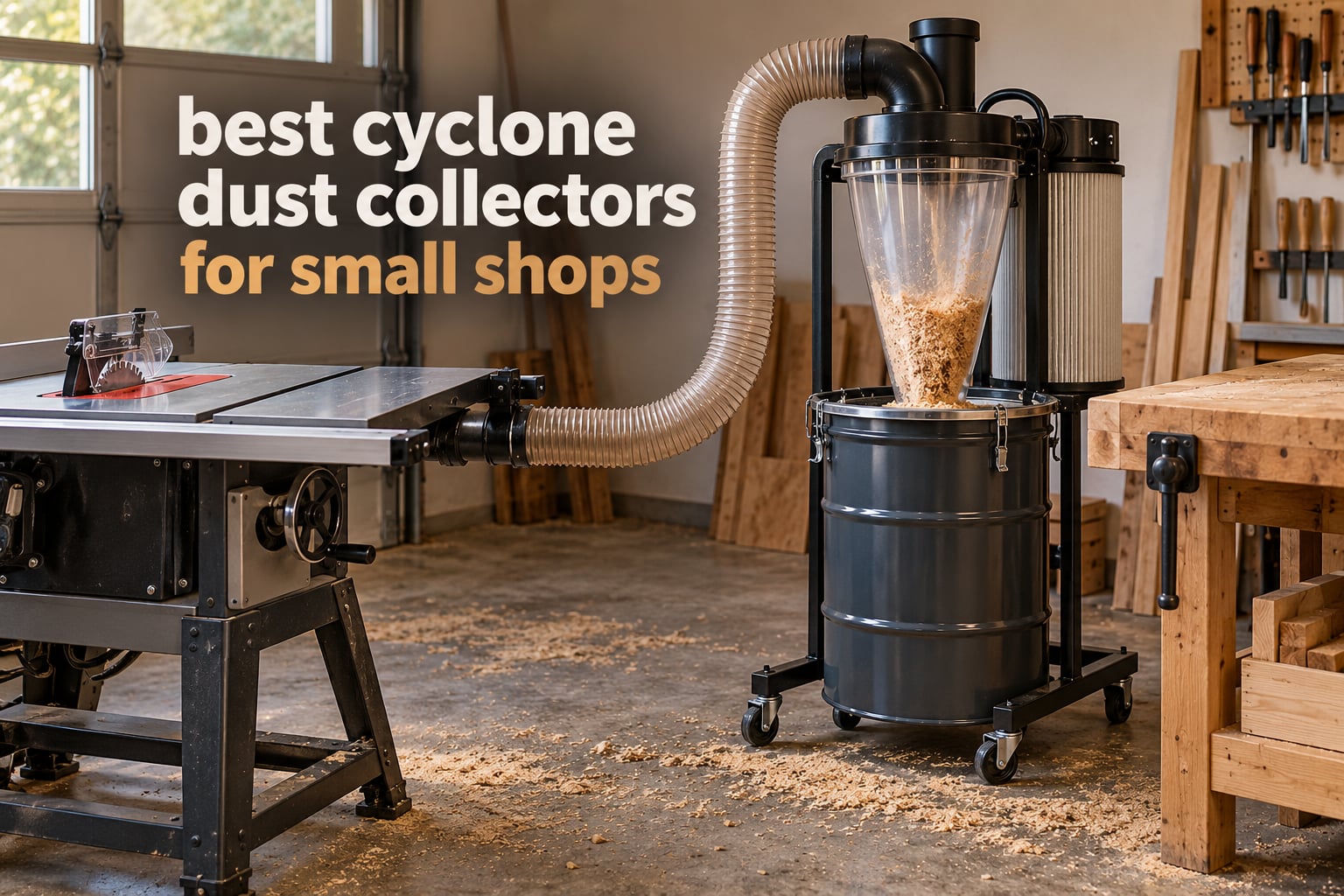
Fine wood dust is the by-product you cannot see until it has already settled on every surface in the garage. It comes off the blades and the sanding pads, hangs in the air, and gets breathed. A cyclone dust collector fixes most of that problem by spinning the airstream in a cone, dropping the bulk of the chips and coarse sawdust into a container before the air ever reaches the filter.
We went through twelve cyclone units and read every review block we could find on them, from the bucket-lid kits that bolt onto a shop vac to the one complete powered machine in the group. What surprised us most is that eleven of the twelve are separators or retrofit parts rather than full machines with their own motor. That distinction decides whether you spend a small amount now or a large amount later, so it comes first in this guide.
The best cyclone dust collectors for small shops are not the biggest or most expensive machines on the market. They are the ones that actually capture what your machines produce, sit in a compact workspace, and can be maintained on a weekend. Every review below names who it suits and who should walk past.
Table of Contents
Are Cyclone Dust Collectors Worth It?
Yes, if you run a table saw, planer, jointer or wide-belt sander, if your duct or hose run is longer than about ten feet, and if you care what is in the air you are breathing for eight hours a day. No, if you only use a router and a random orbit sander.
In that second case, a shop vac with a cyclone separator lid on a five-gallon bucket does most of the same work for a fraction of the outlay. The separator stages are cheap add-ons that pay for themselves in filter and bag replacements. The full powered machines earn their money only when a planer is generating a serious chip load every week.
If you are choosing a workbench first and dust collection second, get the bench settled before you size a collector. We covered the layout side in our small shop bench roundup, and the ducting distances you end up with will change which collector fits.
Top 3 Cyclone Dust Collectors for Small Shops

Oneida Dust Deputy DIY
- Cyclone lid for any shop vac
- Tapered 2 inch ports
- Captures up to 99.9 percent of debris
Peachtree 4 Inch Cyclone Kit
- 4 inch top and elbow ports
- Turn key clamps included
- Fits a bucket barrel or box

The Dust Deputy wins because it has the deepest review base in the category at over four thousand ratings, and that is the number that matters when nobody publishes airflow at the tool. The Peachtree kit is the cheapest way into two-stage separation and posts a 4.7 average across 822 ratings. The Mullet is the best-built separator we tested and pairs naturally with a dust extractor rather than a shop vac.
Every Cyclone Unit We Compared in 2026
| Product | Specifications | Action |
|---|---|---|
| Oneida Dust Deputy DIY Cyclone Separator |
|
Check Latest Price |
 Dustopper PRO Dust Collector Dustopper PRO Dust Collector |
|
Check Latest Price |
| Peachtree Cyclone Dust Separator Kit for 4 |
|
Check Latest Price |
 POWERTEC Low Profile Dust Separator POWERTEC Low Profile Dust Separator |
|
Check Latest Price |
 Oneida Dust Collector Cyclone Kit with Clear Bucket Oneida Dust Collector Cyclone Kit with Clear Bucket |
|
Check Latest Price |
 Oneida Cyclone Attachment for Single Stage Collectors Oneida Cyclone Attachment for Single Stage Collectors |
|
Check Latest Price |
 POWERTEC 70293V Cyclone Separator Kit POWERTEC 70293V Cyclone Separator Kit |
|
Check Latest Price |
| Mullet Cyclone Dust Collector High Speed Separator |
|
Check Latest Price |
 VEVOR Cyclone Separator with Metal Tank VEVOR Cyclone Separator with Metal Tank |
|
Check Latest Price |
 Cikawit High Efficiency Dust Separator Cikawit High Efficiency Dust Separator |
|
Check Latest Price |
 FoxAlien 800W Desktop Dust Collector FoxAlien 800W Desktop Dust Collector |
|
Check Latest Price |
 PEMEDOR Double Filtration Cyclone Collector PEMEDOR Double Filtration Cyclone Collector |
|
Check Latest Price |
Two products in this table publish a decibel figure, and only one includes a motor. Read the notes before you assume you are shopping for the same category of thing.
Cyclone Dust Separator vs Cyclone Dust Collector
This is the confusion that trips up more small-shop buyers than any other, and it is worth ten minutes of reading before you spend anything. Three different products get called a cyclone dust collector, and they are not interchangeable.
Cyclone separator, shop vac mounted
A lid that bolts onto a five-gallon bucket, a barrel or a box and hangs off the hose of a wet and dry vac. It has no motor and no filter of its own. The shop vac still does the suction work, and the separator simply spins the incoming air so the chips drop out before they reach the vac filter. Most of our list is in this class, and it is the right starting point for a garage.
Cyclone attachment, collector retrofit
A larger cone sized to bolt onto the inlet of an existing single-stage dust collector of one to three horsepower. You already own the motor, the filter and the drum, so this is the cheapest path to true two-stage separation. The Oneida retrofit in our list weighs about eight pounds and fits collectors with a four or five inch inlet and a four or six inch outlet.
Cyclone dust collector, complete machine
A powered unit with its own motor, filter and drum, where the cyclone cone is one stage inside a larger system. Only one product here qualifies, and it is a desktop unit built for hobby CNC work rather than for cabinetry or furniture. If you want a full machine for a garage shop, you are shopping outside this list.
The rule we use is simple. If your machines sit within a few feet of the vac, a separator lid works. If you are running fixed ductwork or a planer with a wide port, buy the powered collector instead and save the upgrade for later.
1. Oneida Dust Deputy DIY Cyclone Separator, the Widest-Tested Bucket Lid
Oneida Air Systems Dust Deputy DIY Anti-Static Retrofit Cyclone Separator for Wet/Dry Shop Vacuums (DD DIY)
- Over four thousand ratings to draw on
- Up to 99.9 percent of debris dropped before the filter
- Neutral vane technology
- Works with wood drywall concrete and metal
- Made in the USA
- Hose and adapters not included
- Needs a rigid bucket rather than a thin pail
- Can tip without a cart
This is the unit most of the small-shop crowd already owns, and it earned the top spot here because of volume rather than novelty. Owners in r/BeginnerWoodWorking keep naming it as the shop vac upgrade that actually keeps the filter clean, and the Wood Whisperer separator shootout used one as the reference point when comparing bucket-top designs.
The mechanism is straightforward. Air enters tangentially, spins into the cone, and centrifugal force throws chips and coarse sawdust down into your bucket while the cleaned air continues into the vacuum. The neutral vane inlet is the part worth understanding, because it is designed to keep the swirl fast without starving the suction.
What surprised us was how much of the reported value comes from avoiding filter purchases. Once fines stop reaching the pleats, the vacuum keeps its suction and the bag stops filling on the first cut. For a shop running a shop vac two or three times a week, that compounds quickly.
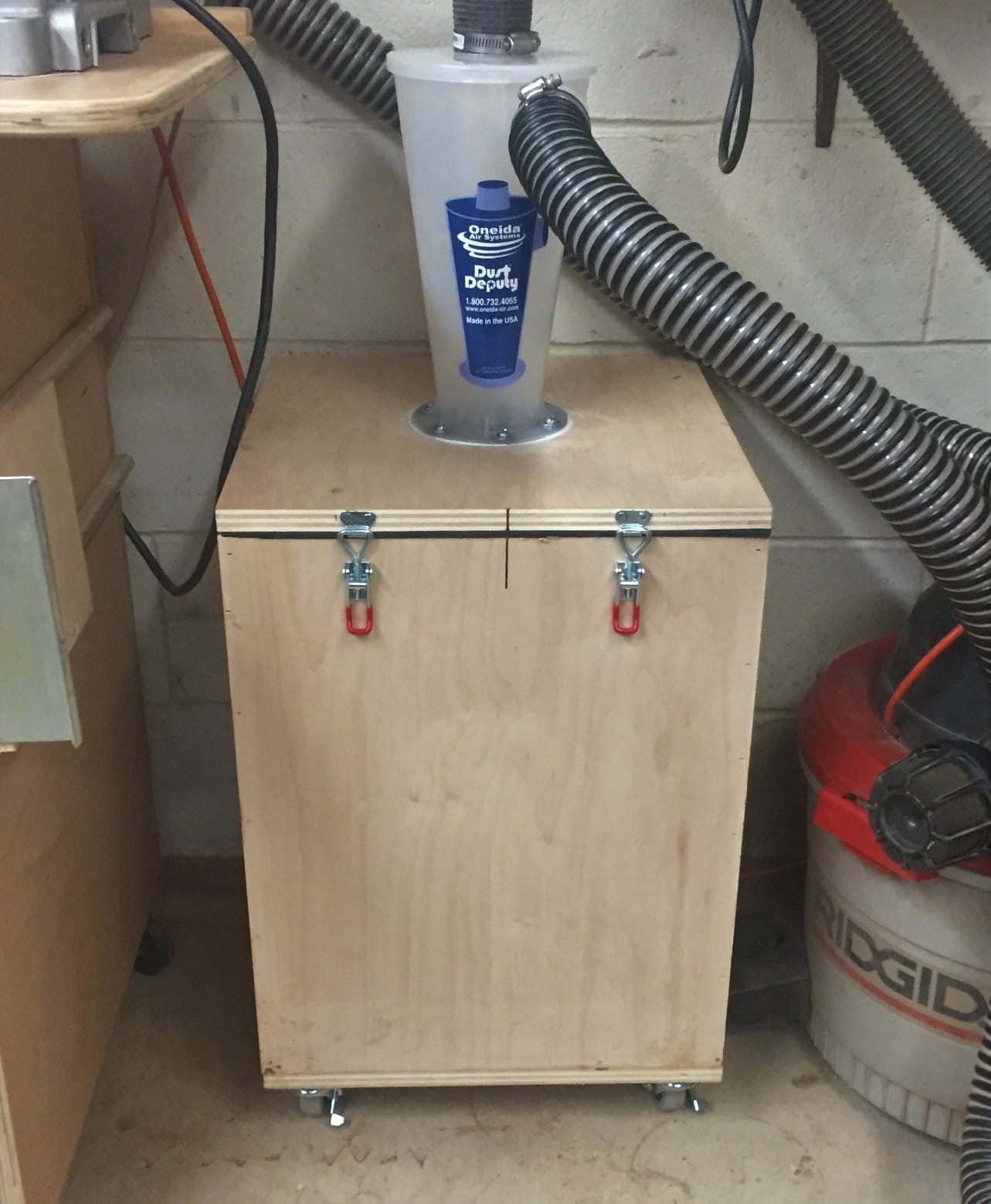
The friction is all in assembly. There is no hose in the box and no bucket, so you are hunting for a 2.0 inch hose that matches your vac and a container sturdy enough not to collapse. Several builders reported warping at the base and sealing it with caulk, which is a five-minute fix that most people skip.
Male fittings on both the intake and the exhaust side can also choke airflow if the hose is oversized for the debris. Take the diameter down to match what your machines actually spit out, and this becomes a genuinely set-and-forget part of the shop.
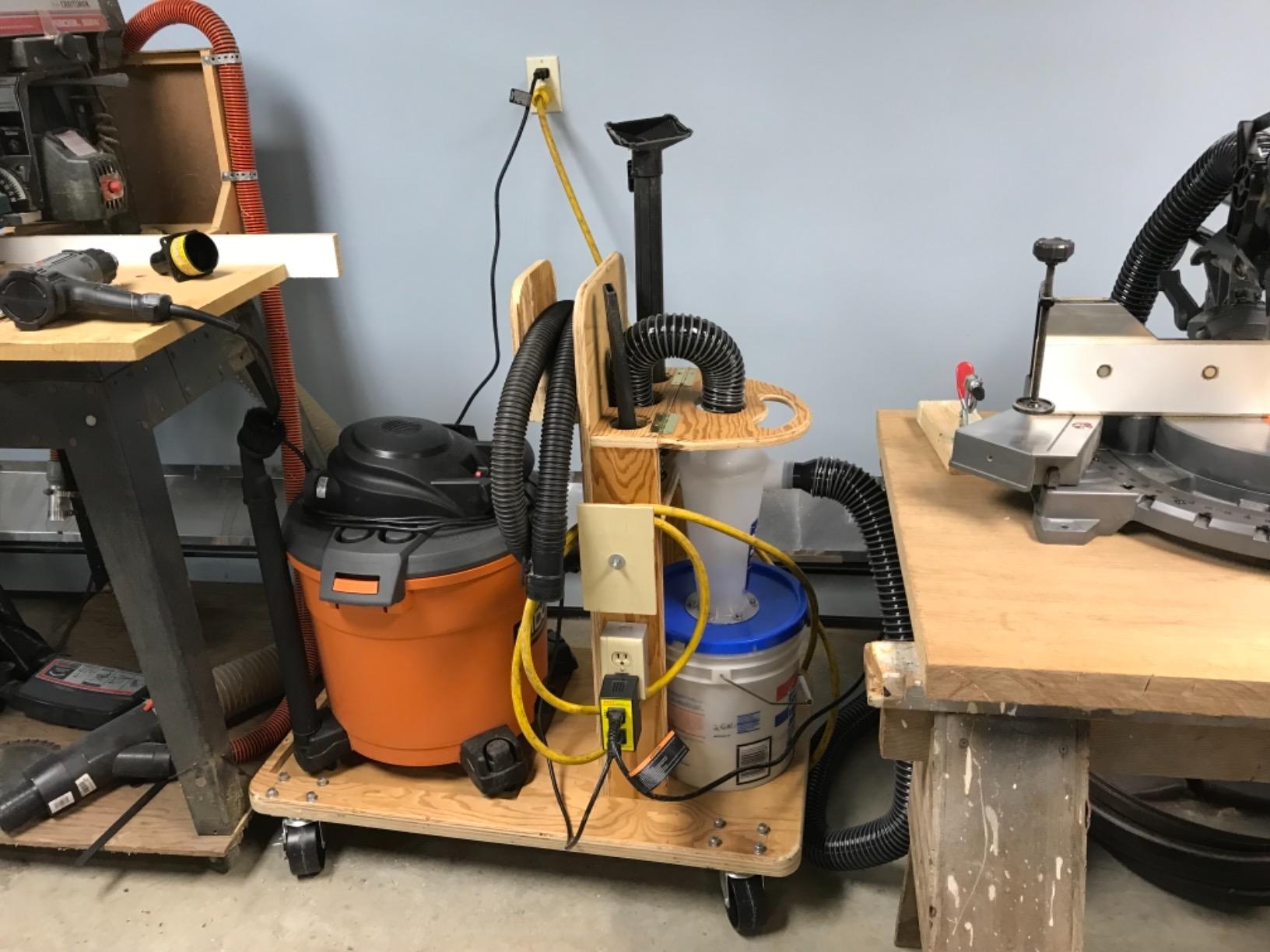
Will it fit the bucket you already have
It bolts to any container with a flat lid, so a standard five-gallon pail works. The practical requirement is rigidity, because suction pulls the walls inward on a cheap pail. A heavy-duty bucket, a metal can or a doubled pail removes the collapse problem entirely.
Port sizing is the second thing to check before you buy. Tapered 2.0 inch ports accept several common hose diameters, which is wider compatibility than most competitors in this price range.
Where it stops being enough
If you are ducting to a planer more than a few feet away, the 2.0 inch ports become the bottleneck. Move up to a four inch kit such as the Peachtree, or go straight to a powered collector. If you only sand and sweep, you can stop here and spend nothing more.
2. Dustopper PRO, the Bucket Cyclone With Independent Test Data
Dustopper PRO Dust Collector – 99.9% Efficiency Cyclone Dust Separator
- Independently tested by a third party lab
- Preinstalled hollow core EPDM gasket
- Sweep elbows cut turbulence
- Keeps vac filters nearly clean
- Made in the USA
- Needs a genuinely powerful vacuum
- Builds static without grounding
- Does not stop ultrafine dust
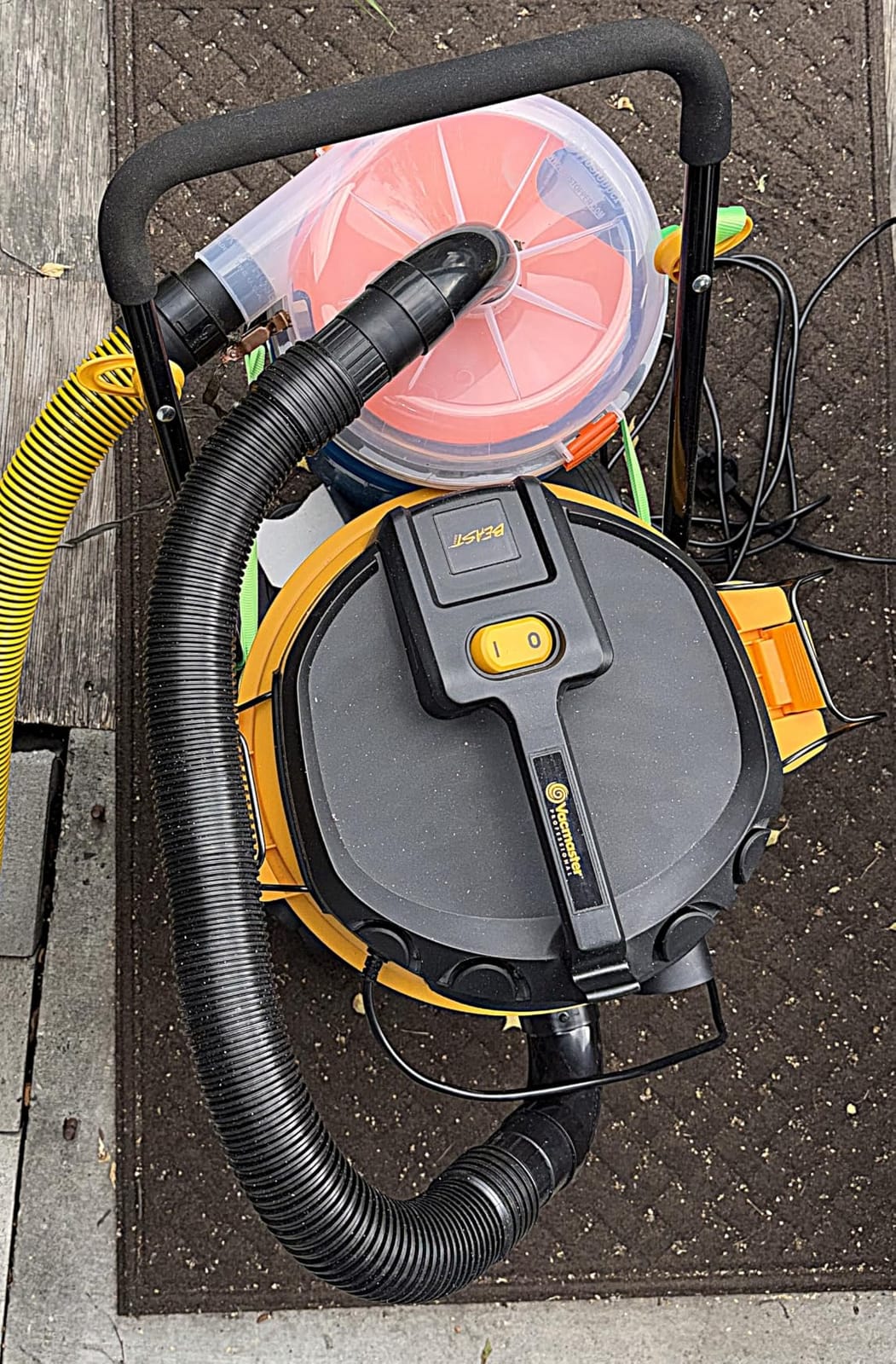
This is the one product in the set that arrives with third-party performance data attached. Aerodyne Environmental tested it against other low-profile separators on fine sawdust, coarse sawdust and drywall powder, and it came out ahead across those loads. That matters because most competitors in this category simply assert a separation percentage.
The build quality is the other argument. The gasket sits in the groove from the factory, so there is no adhesive step, and the two included sweep elbows are shaped to keep the airstream moving instead of letting it stall against a sharp bend.
Low profile is not marketing here. The body sits almost flat on the pail lid, which means it does not walk across the shop floor when the vac kicks on and it does not knock your bench legs as you pass.
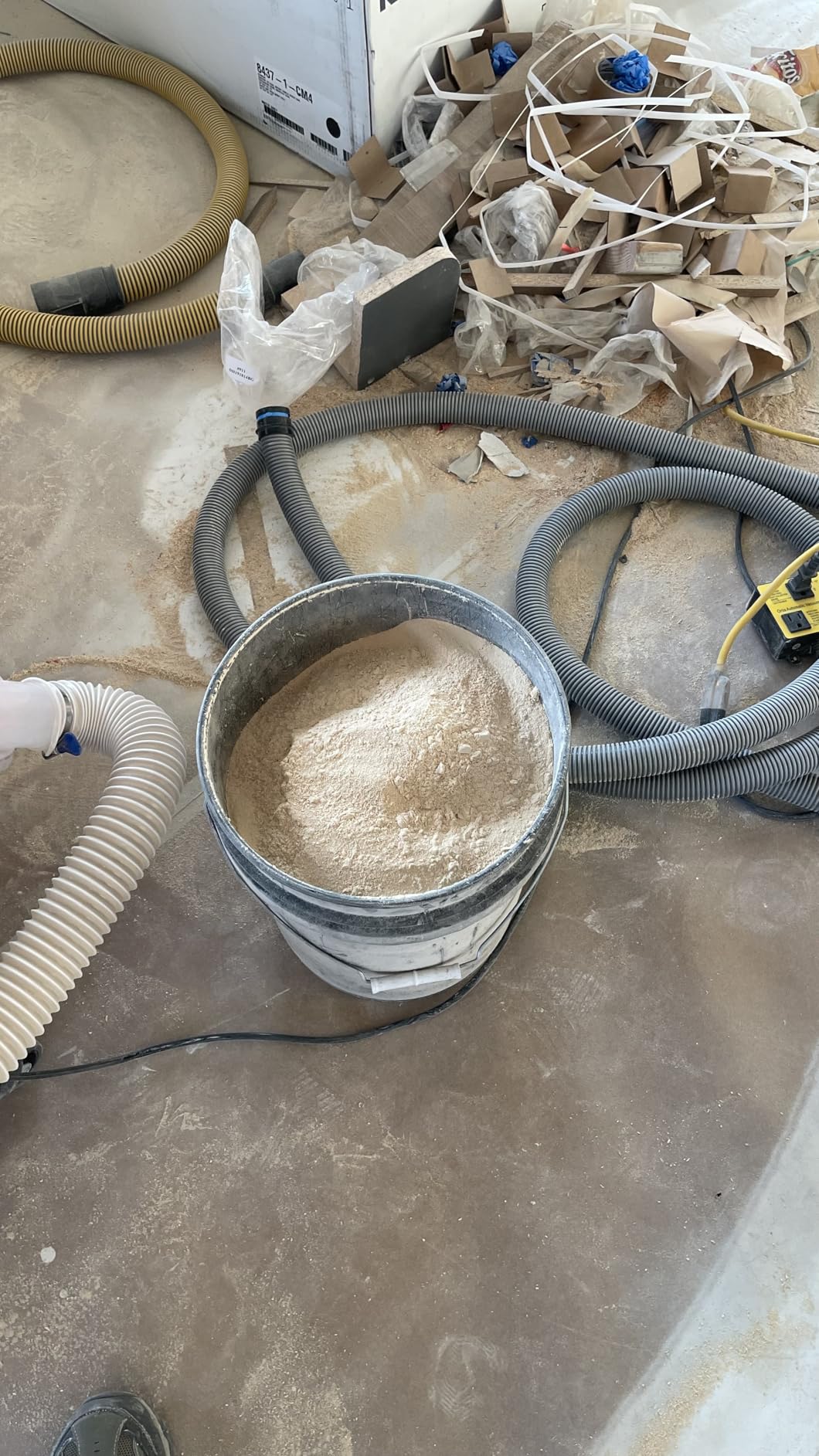
Owners describe shop vac bodies coming out nearly empty after a heavy session, which is exactly the behavior you want from a separator. The recurring caveat is that separation quality tracks whatever airflow the vacuum delivers. Paired with a weak machine, fine dust slips through no matter how good the cone is.
Static is the second theme in the reviews, and it is worth taking seriously if you work with very dry lumber. Ground the can if you can, and keep an eye on the gasket, which some owners report popping out of its channel when the whole assembly is lifted off.
What to pair it with
Match it to a wet and dry vac with real airflow rather than the small units sold for cars and benches. Reviews repeatedly show a night and day difference between a modest vac and one with more cubic feet per minute behind it. If you already own a dust extractor with a hose, this attaches cleanly.
It also handles drywall and concrete dust, so it doubles as a cleanup tool. That makes it easier to justify than a woodworking-only separator.
Where it falls short
It will not stop ultrafine dust, so a filter sock or secondary filter still matters for sanding. It also needs a heavy-duty pail, since a standard retail bucket can flex. And the gasket issue is real enough that you should check the seal each time you swap the drum.
3. Peachtree Cyclone Dust Separator Kit for 4, the Cheapest Route Into Two-Stage
- 4.7 average across 822 ratings
- 4 inch ports suit real duct work
- Catches chips before they reach the impeller
- Clamps and hardware included
- Mounts on a bucket barrel or box
- Hose and container not included
- Built around 4 inch ports
- Hardware and gasket quality vary
If you have ever wanted to understand why cyclones work before committing real money, this is the kit to build first. It is the lowest-priced item in the group by a wide margin, and it teaches you the layout you will eventually duplicate in a permanent install.
Four inch ports matter more than the price does. The four inch cross section is roughly double the area of a two inch port, so a run that chokes on a small hose stays open here. That is the difference between a separator that collects and one that merely sits there.
The included turn-key clamps are a nice touch. You do not need to source hardware, and a loose clamp is the most common reason a homemade rig leaks and pulls dust back into the room.
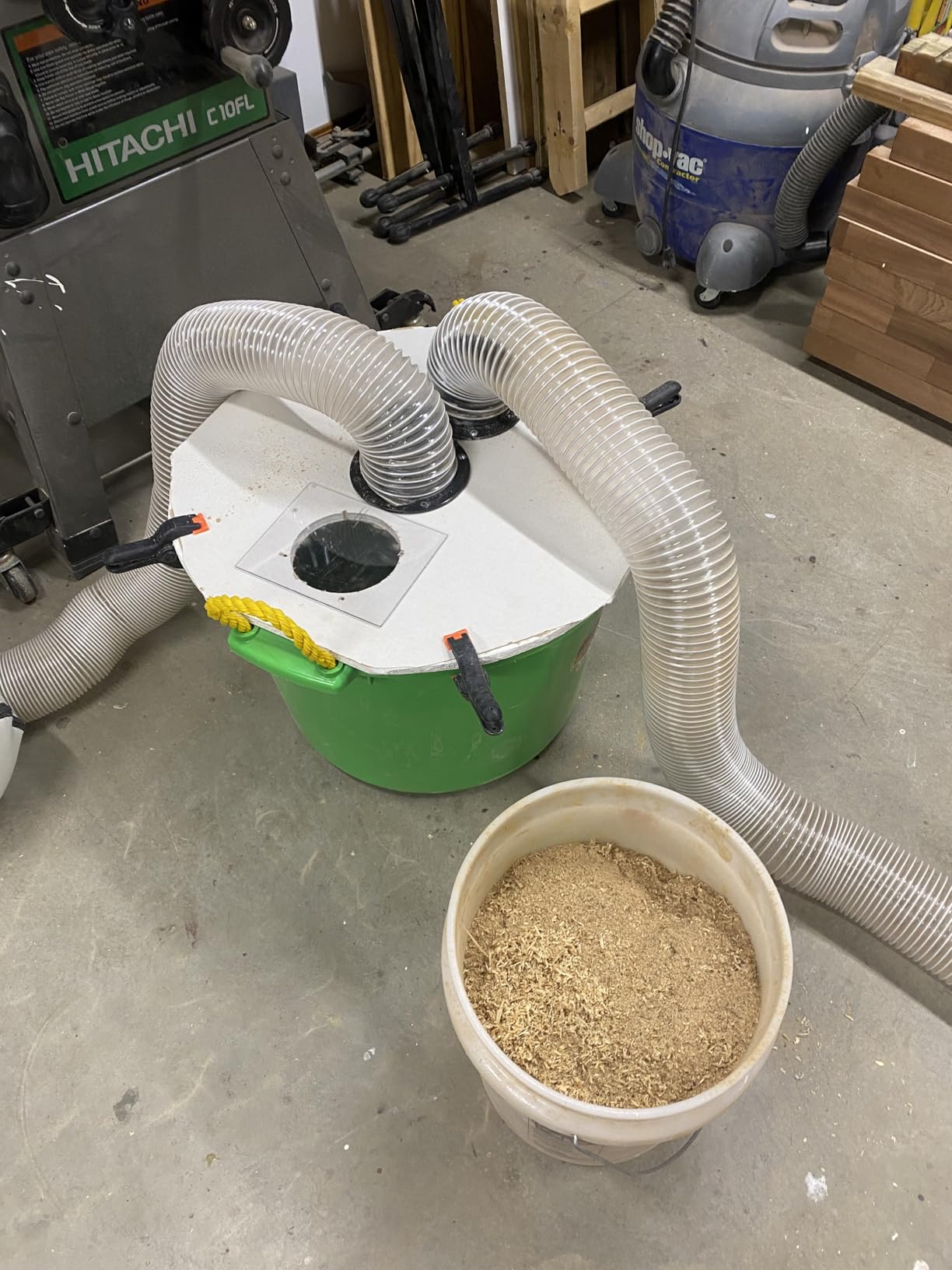
Owners credit it with extending the life of the impeller by catching chips before they reach the blade. That is a quieter machine and a longer filter life, and both show up within the first few months of regular use.
Since it mounts on a box, a barrel or a bucket, you can start with a bucket and move to a metal can later without rebuilding anything. Plenty of builders in this price range upgrade the container once the layout settles.
Whether the port size fits your machines
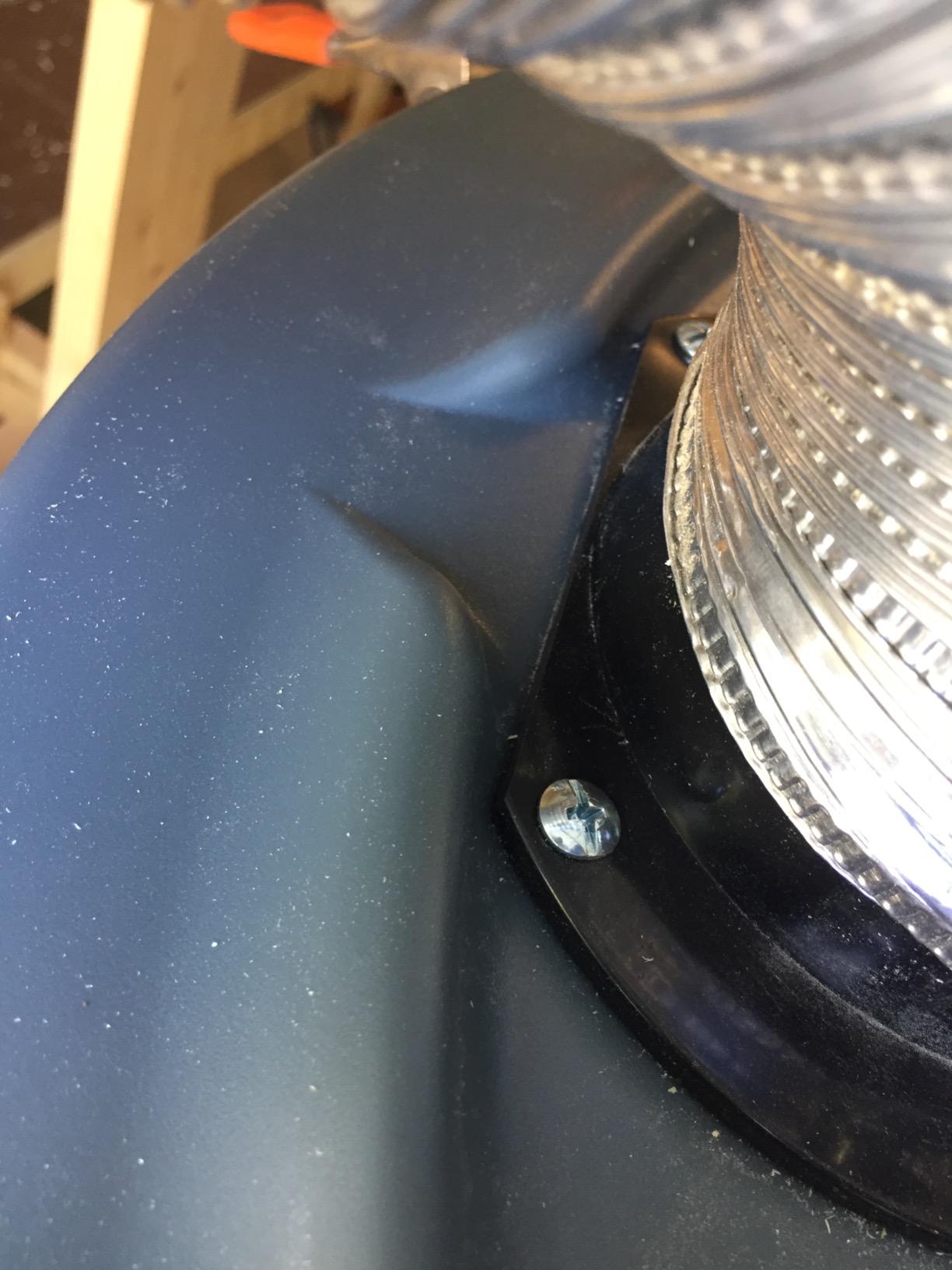
Check what your table saw and sander outlets actually are before ordering. If they are two and a half inch or two inch, budget for reducers. Mixed-brand shops almost always need at least one adapter, and skipping that step is the usual reason a first build underperforms.
Plan on sourcing hose and a container separately. Neither is in the kit, and the difference between a plastic pail and a metal can shows up immediately under suction.
When to choose something else
Skip it if your machines are handheld only. A shop vac already handles that without a separator. Also consider a smaller two and a half inch kit if your runs are short, because a four inch port will not help if your hose is the bottleneck instead.
4. POWERTEC Low Profile Dust Separator, for Shops Under a Bench
- Works with shop vacs and 4 inch systems
- Low profile body resists tipping
- Includes hose elbow and adapters
- Impact resistant PP and ABS
- Foam rubber gasket for a tight seal
- Latches pop out of their brackets
- Foam gasket runs short of full circumference
- Needs emptying past half full
This is the most complete low-cost kit in the set. A hose, a ninety degree elbow, adapters, latches and grounding hardware all arrive together, which removes most of the sourcing frustration that comes with a bare cyclone lid.
It connects either to a shop vac through the included two and a quarter inch elbow or into a two and a half inch or four inch collection system. That flexibility is useful in a mixed shop where the router table and the bandsaw come from different manufacturers.
The low profile design is the quiet advantage. It sits flat on the bucket, which means it fits under a bench and does not tip when the vacuum spins up. In a compact garage, where floor space decides what you get to own, that matters more than another feature on the label.
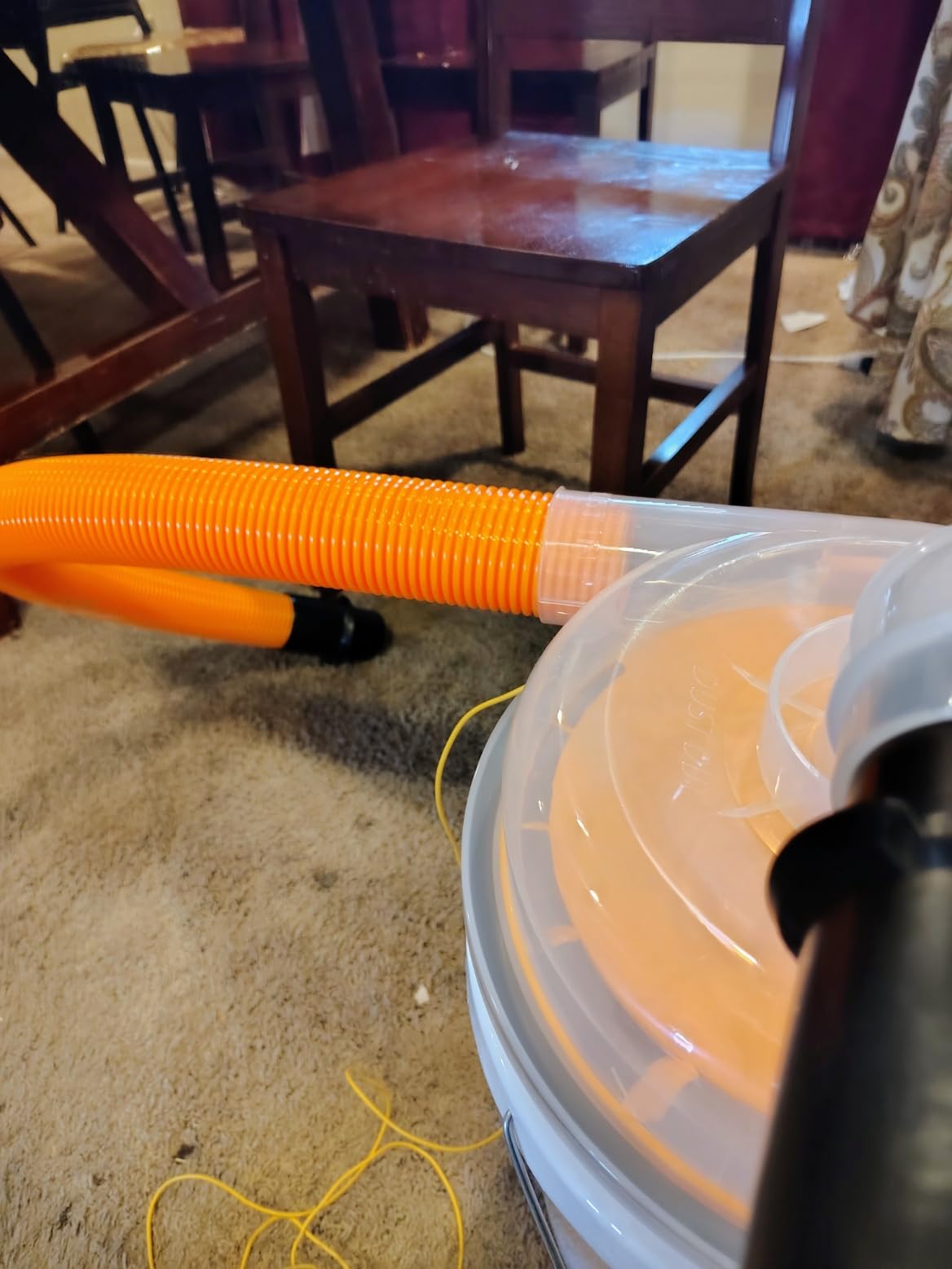
Reviewers who compared directly against the Dustopper PRO rate this one favorably on heavy debris and say the original still edges it. Fine powdery dust is where the gap opens, and users doing a lot of sanding noticed it.
The most common build note is to keep the bucket under about half full. Once the internal arch carries a deeper load, dust spins back up into the airflow and defeats the separation.
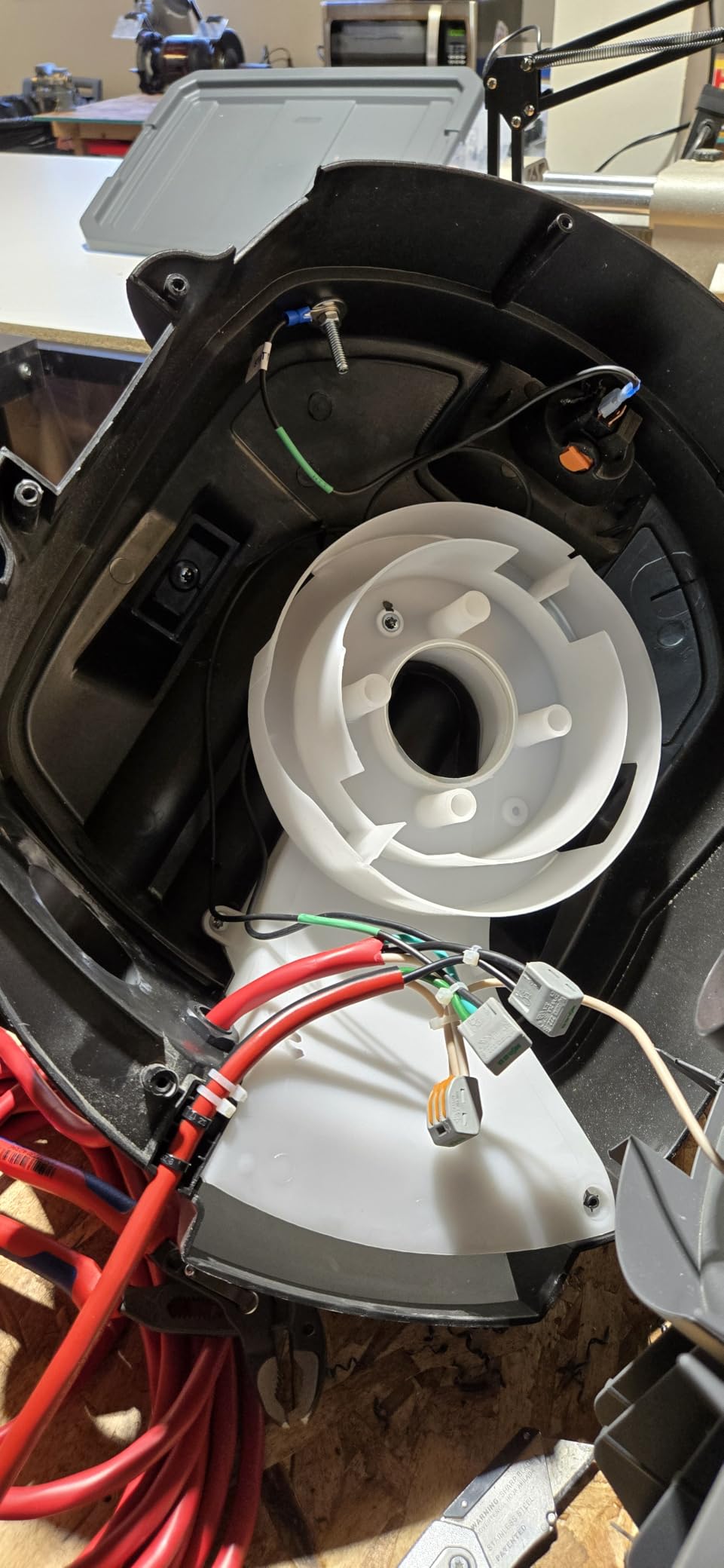
Whether it suits a mixed-brand shop
Yes, if your outlets are two and a quarter inch, two and a half inch or four inch, which covers most small shops. The included adapters bridge the common gaps, and the three foot hose is long enough to reposition the whole rig without a dedicated stand.
It also handles drywall and general shop debris, so one rig covers cleanup as well as machine collection.
What to fix before you commit
Reinforce or replace the latches, and check the gasket length against your bucket rim. Owners who did that quickly report a solid, leak-free rig. The grounding wire is referenced in the documentation but not included, so add your own before working with dry hardwood.
5. Oneida Cyclone Kit with Clear Bucket, Built to Roll Around
Oneida Air Systems Dust Collector & Cyclone Separator Kit w/ Clear Bucket, 2.5 Deluxe 5-Gal – Portable Cyclone Machine for Wet and Dry Shop Vacuums
- Everything needed in one purchase
- Four casters make it mobile
- Rigid bucket resists collapse
- Pre cut neoprene gasket
- Tether kit for the vac connection
- Rated 4.1 with a 9 percent one star share
- Bulky footprint for a tight garage
- Premium feels high for the separator alone
This bundle exists for people who do not want to assemble anything. The cyclone, a collapse-proof five-gallon bucket, a lid, four casters, a four and a half foot hose with swivel cuffs, a gasket and the vacuum tether kit arrive as one package. You hook it up and start collecting.
Portability is the reason to choose it. The bucket sits on casters, so you roll the whole station from the table saw to the planer instead of dragging a hose across the shop. Owners who teach in a shared space mention exactly this benefit.
The rigid bucket is a genuine upgrade over a retail pail. It does not flex, and that means the cyclone sees a stable inlet no matter how hard the suction pulls.
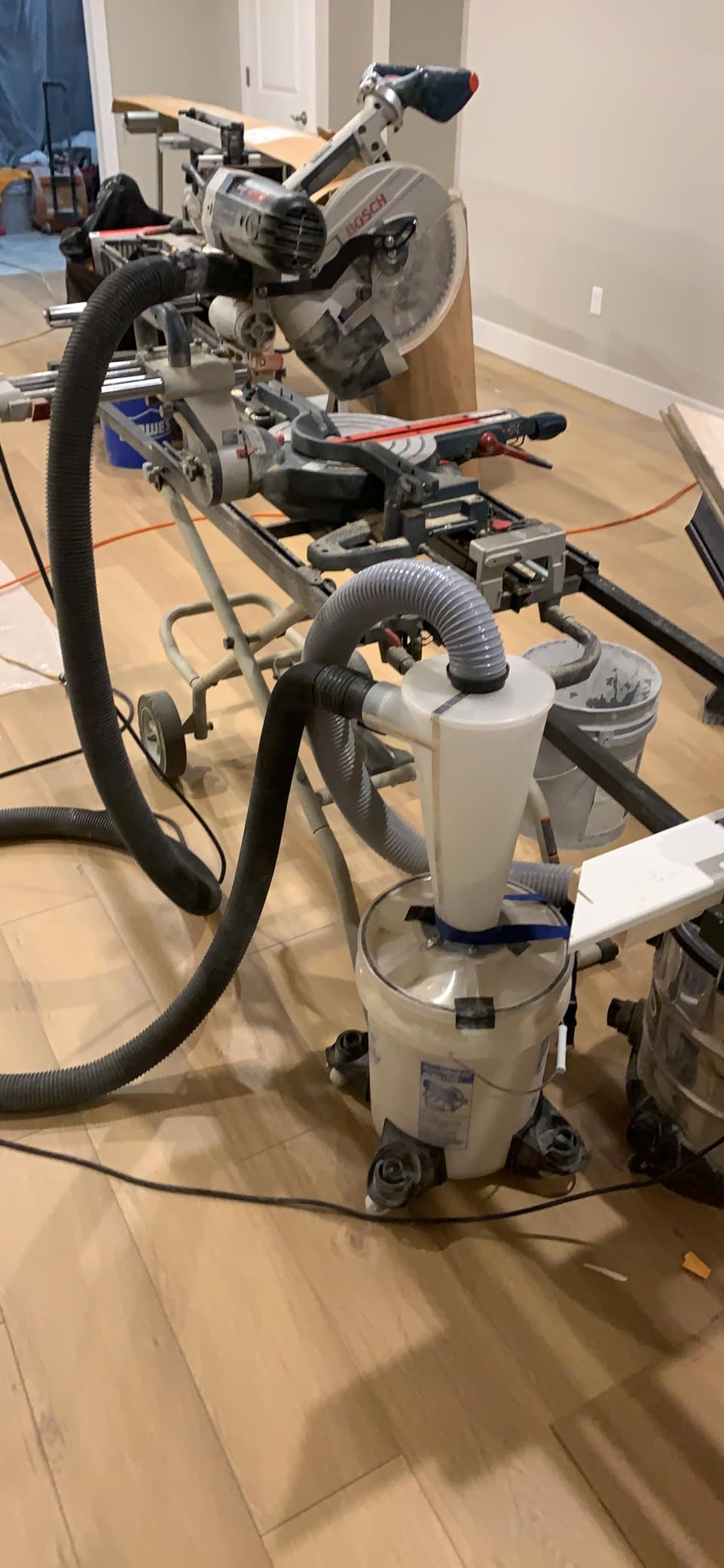
This one drew the widest spread of ratings in our group, and the reviews explain why. People who bought it for convenience are happy, while people who compared it against building the same thing themselves felt the assembled package did not justify its premium.
That split is worth weighing honestly. If you enjoy building, a bare cyclone plus a bucket from a hardware store gives you the same outcome and lets you choose the container. If you want it working today, this is the shortest path.
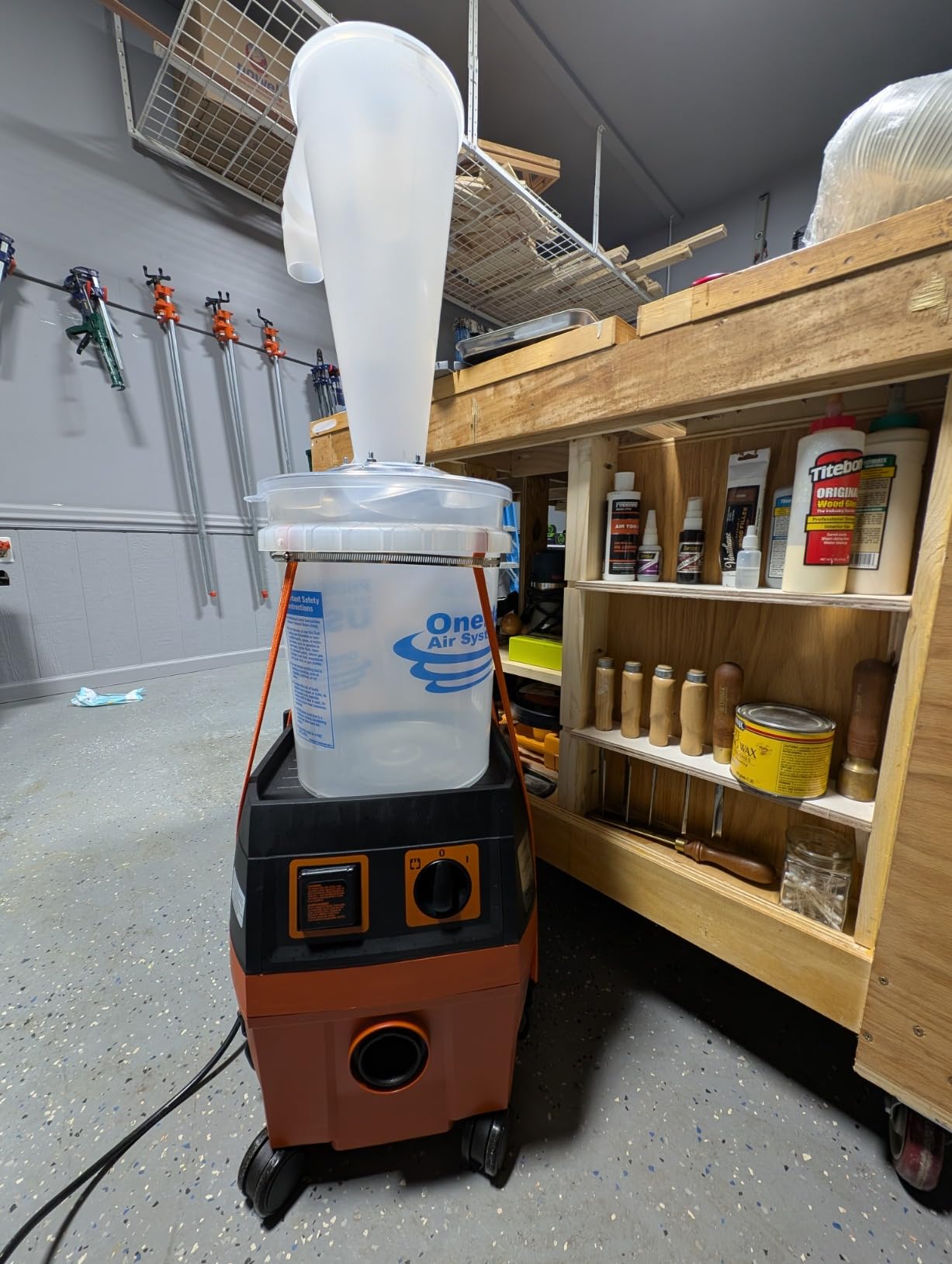
Whether it suits a shared or teaching shop
Yes. The casters and the tether kit make moving between stations a one-person job, and the swivel cuffs prevent the hose from kinking as you roll. Nobody reported the assembly fighting them once the gasket was seated.
The four and a half foot hose is a reasonable compromise. It reaches a nearby machine but will not span a shop, so plan the layout around a short run.
When to build it yourself instead
If your floor space is tight, the bucket plus caster footprint is the problem. A wall-mounted lid-style setup gives you the same separation in a fraction of the area. This is also the second lowest rated of the twelve, so check the recent reviews before committing.
6. Oneida Cyclone Attachment for Single Stage Collectors, the Retrofit Path
Oneida Air Systems Cyclone Attachment for 0.5-3HP Dust Collectors, 4/5 DIY
- Captures over 99 percent before the filter
- Retrofits 1 to 3 HP single stage units
- Integrated air ramp inlet
- 4 inch reducer adapters included
- Made in the USA
- Sold as a bare attachment
- You supply drum hose and lid
- Needs an existing collector
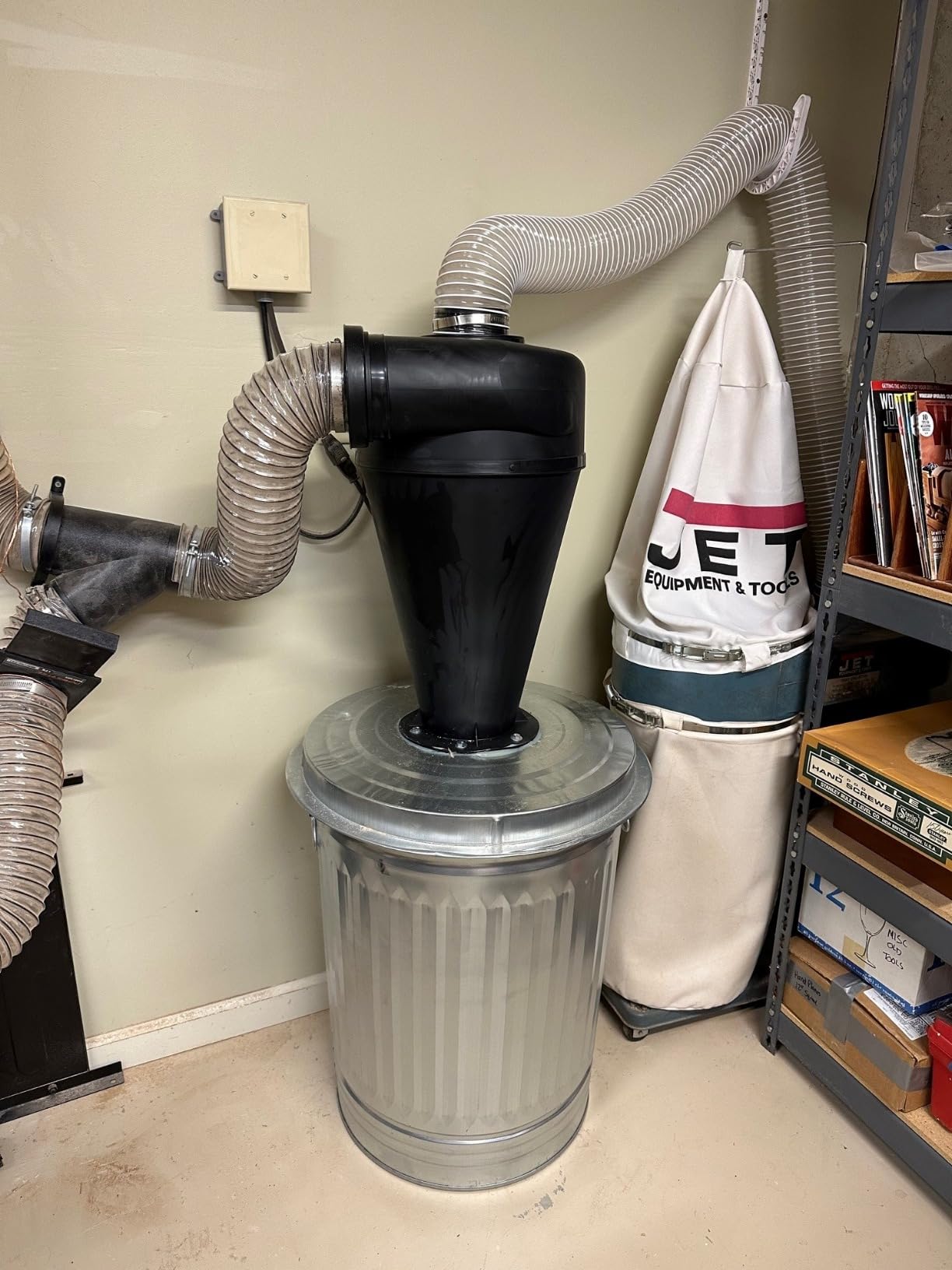
This is the answer for anyone who already owns a single-stage collector and is disappointed by how fast it clogs. Bolting this cone onto the inlet turns what you have into a two-stage system, which is the most direct upgrade path we found in this whole list.
Compatibility is broad. It fits single-stage collectors from one to three horsepower with a four or five inch inlet and a four or six inch outlet, and the included four inch reducer adapters cover the most common mismatch.
The integrated air ramp and neutral vane inlet are the design features that get praised. They keep the airstream moving at speed through the cone, so separation stays high without dragging the suction down, which is the usual complaint with cheap retrofits.
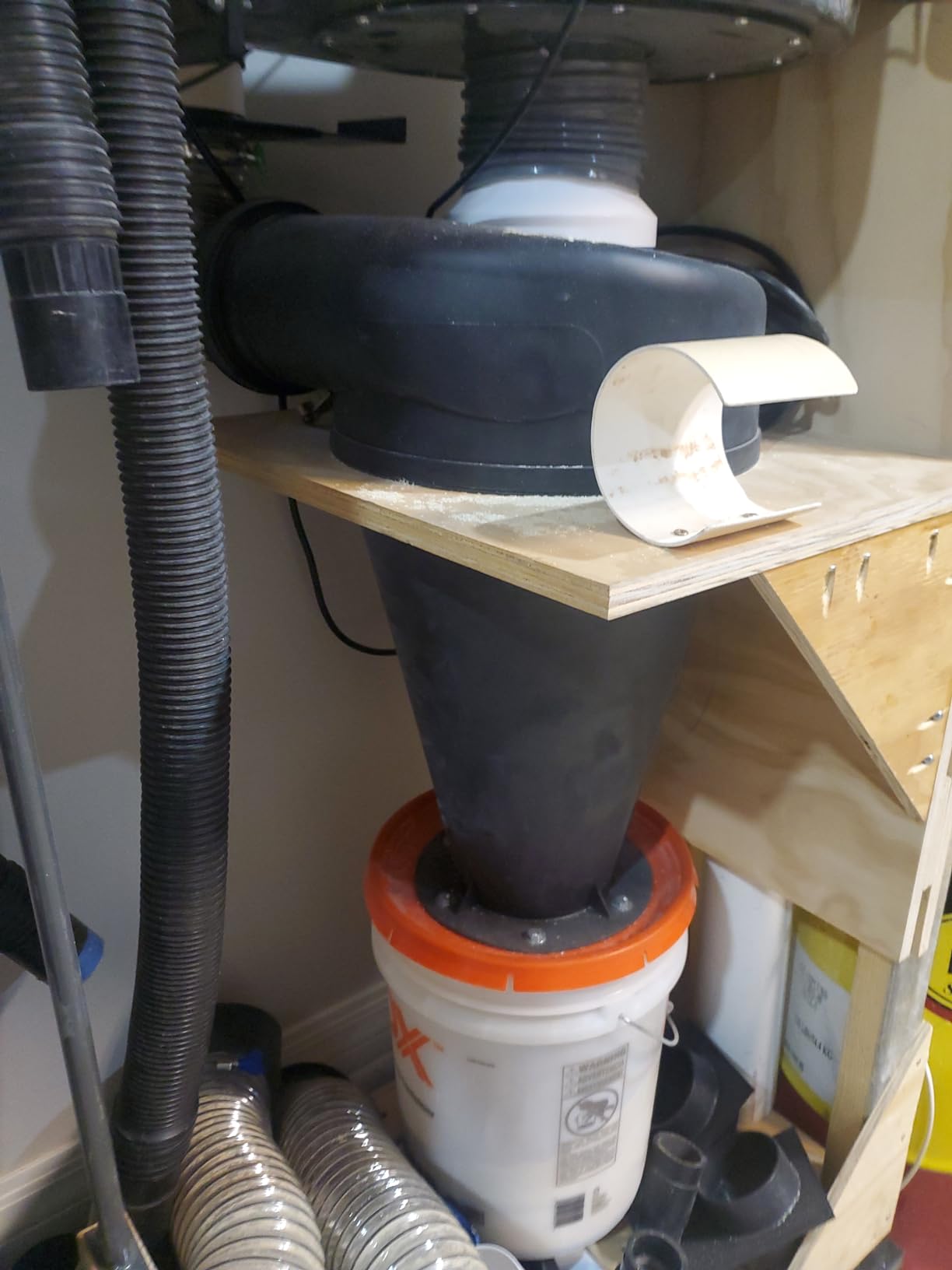
Owners report filter life extending noticeably after fitting it, and the low weight makes installation a one-person job. At under eight pounds it is easy to remove when you need the original single-stage setup back.
At nearly eight out of ten ratings being five stars, this has one of the cleanest satisfaction profiles in the category. The recurring caveat is that it is a component rather than a system, so you are still sourcing a drum, hose and lid.
Whether your collector will accept it
Measure the inlet and outlet diameters before ordering. Anything from one to three horsepower with a four or five inch inlet is in range, and the reducers handle most smaller outlets. A five minute measurement saves a return.
It also suits a shop that is still deciding between a single-stage and a full cyclone later, because you can remove it and recover the original machine.
When it is the wrong purchase
It needs a single-stage collector to exist first. If your plan is to start from nothing with a shop vac and a lid, the Dust Deputy route is cheaper and simpler. It is also heavier and dearer than a plastic separator lid, so a plastic bucket will not hold it comfortably.
7. POWERTEC 70293V Cyclone Kit, the One With a Clear Bucket
POWERTEC 70293V Cyclone Dust Collector and Separator Kit w/Clear 6 Gallon Dust Bucket, Hoses, Reducers, Couplers and Hose Clamps
- Complete package with bucket and hose
- Clear bucket shows fill level
- Reducers cover most brands
- Anti clogging design
- Quick to set up
- 6 gallon bucket needs frequent emptying
- Accessories miss some port sizes
- Clear bucket can move under suction
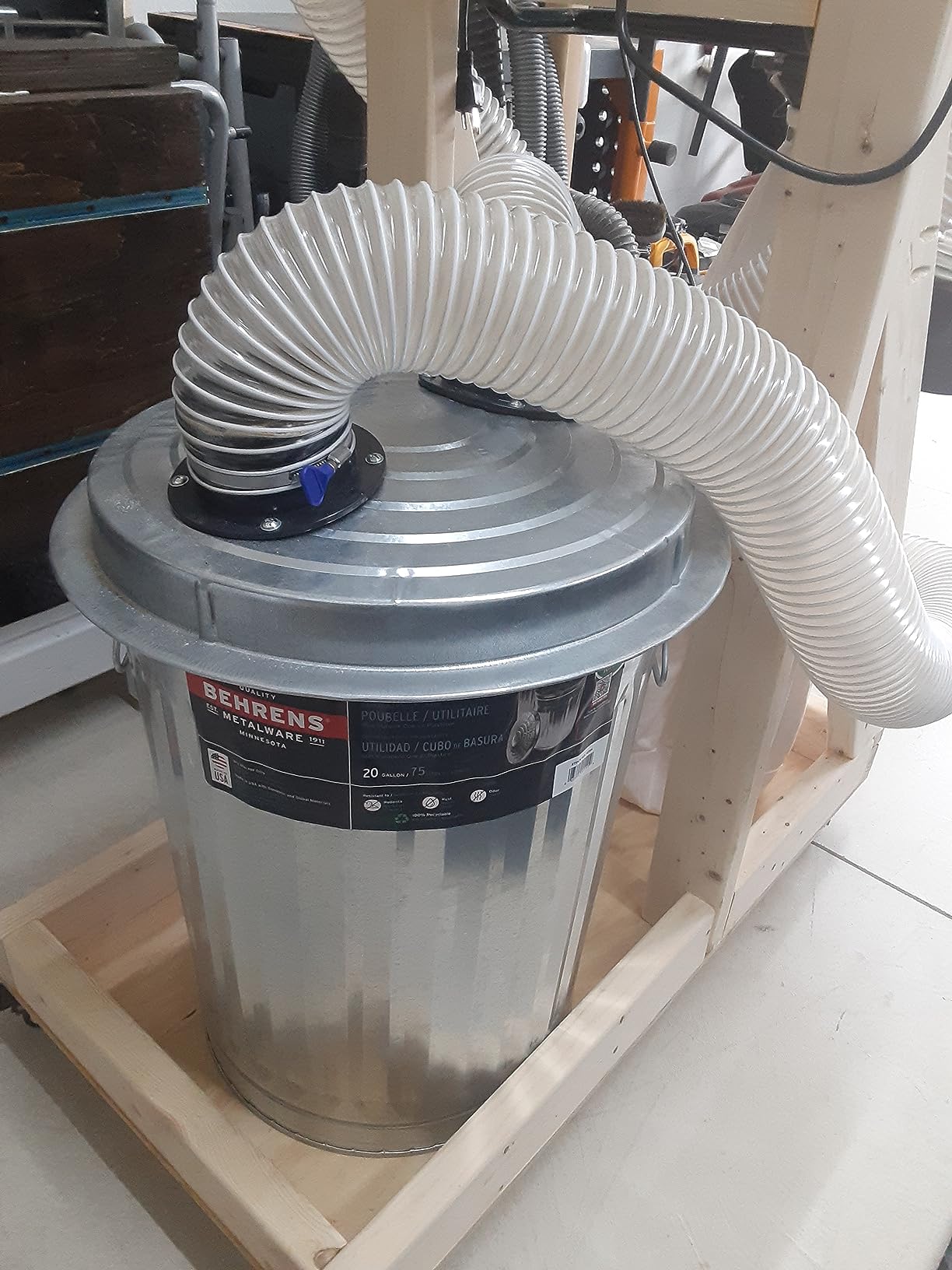
This kit wins on completeness at the mid tier. The separator, a six-gallon clear bucket, an expandable vacuum hose, reducers, couplers and clamps all arrive together, which is the part that usually turns into a Saturday afternoon of hardware store runs.
The transparent bucket is the sleeper feature. You can see the fill level without lifting the lid, and for a shop that runs a lot of sanding, knowing when to empty beats guessing.
It works on a shop vac, on a dedicated collector or straight onto an individual tool port, which makes it flexible when your machines are scattered.
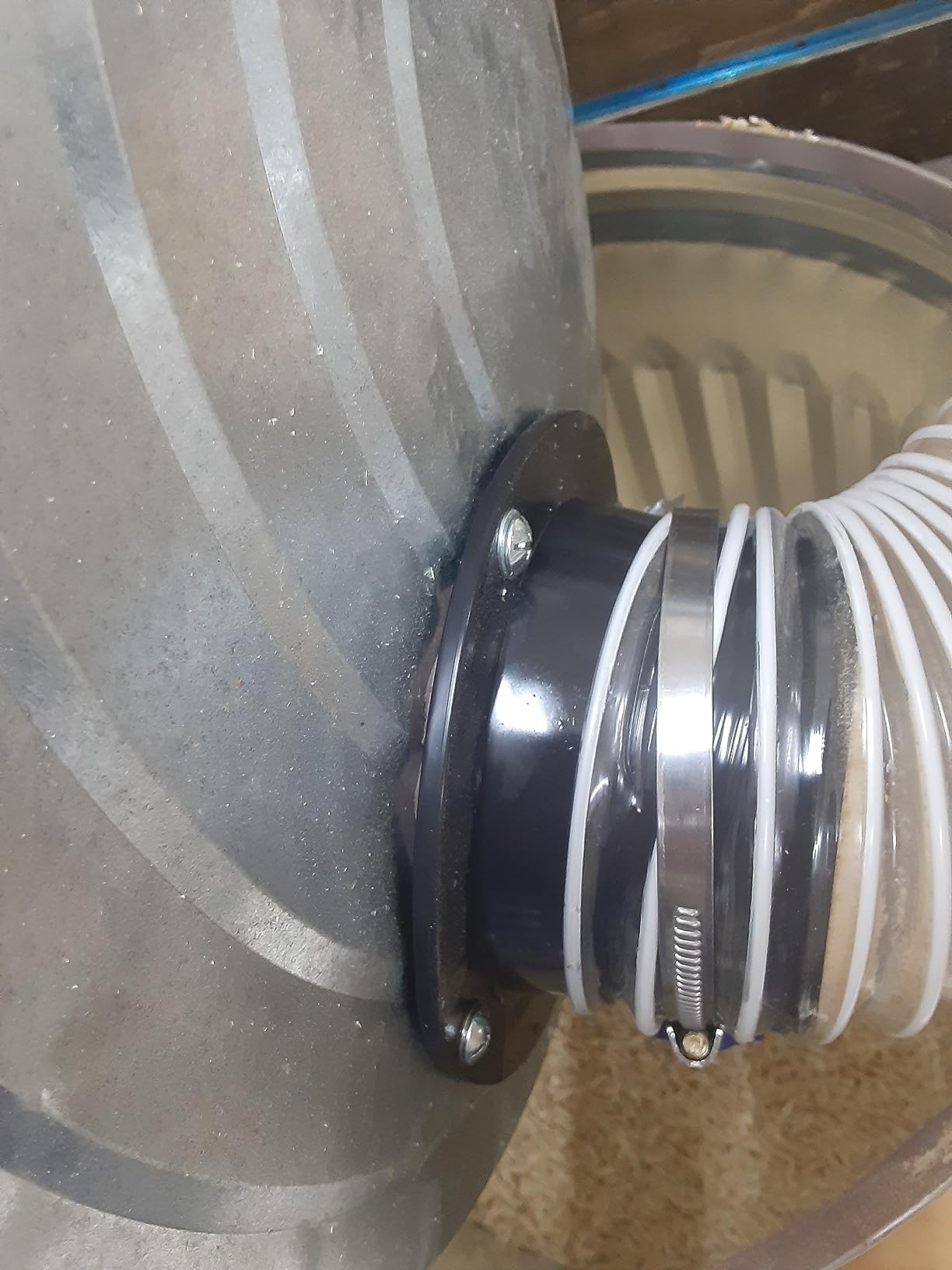
Owners credit the anti-clogging design with extending tool life on planers and drum sanders, because the chips are caught before they reach the impeller. A quieter planer is a noticeable change in a small shop.
With only about one percent of reviews at one star, this is a consistent performer. The clear bucket and expandable hose get singled out most often as making setup and emptying straightforward.
Whether six gallons is enough for your week
For sanding and routing, yes. Six gallons empties into a trash can in seconds and the visibility means you never overfill it. For a planer or jointer running heavy chip loads, you will empty it more often than a 25 or 35 gallon drum, so factor in the extra trips.
It suits a shop running mixed machines since the reducers and couplers cover most port sizes.
What to watch after assembly
The clear plastic is less rigid than steel and can shift under strong suction, so brace or weigh the container if the rig starts to creep. Confirm your reducer sizes before final assembly, because mixed-brand shops sometimes need one part that is not included.
8. Mullet High Speed Cyclone, the Best Built Separator Here
- Highest average rating at 4.8
- Parabolic body spins the air faster
- Single molded body
- No bolts bungees or duct tape
- Works with most vacs and extractors
- Costs noticeably more than bucket lid kits
- Needs a separate vacuum or extractor
- Only two hose adapters included
Everything else in this list is assembled from parts. The Mullet is a single molded body with a parabolic profile, and that geometry is the whole pitch. A parabolic shape moves the airstream faster than a straight-walled cone, and faster spin means more of the heavy material lands in the container.
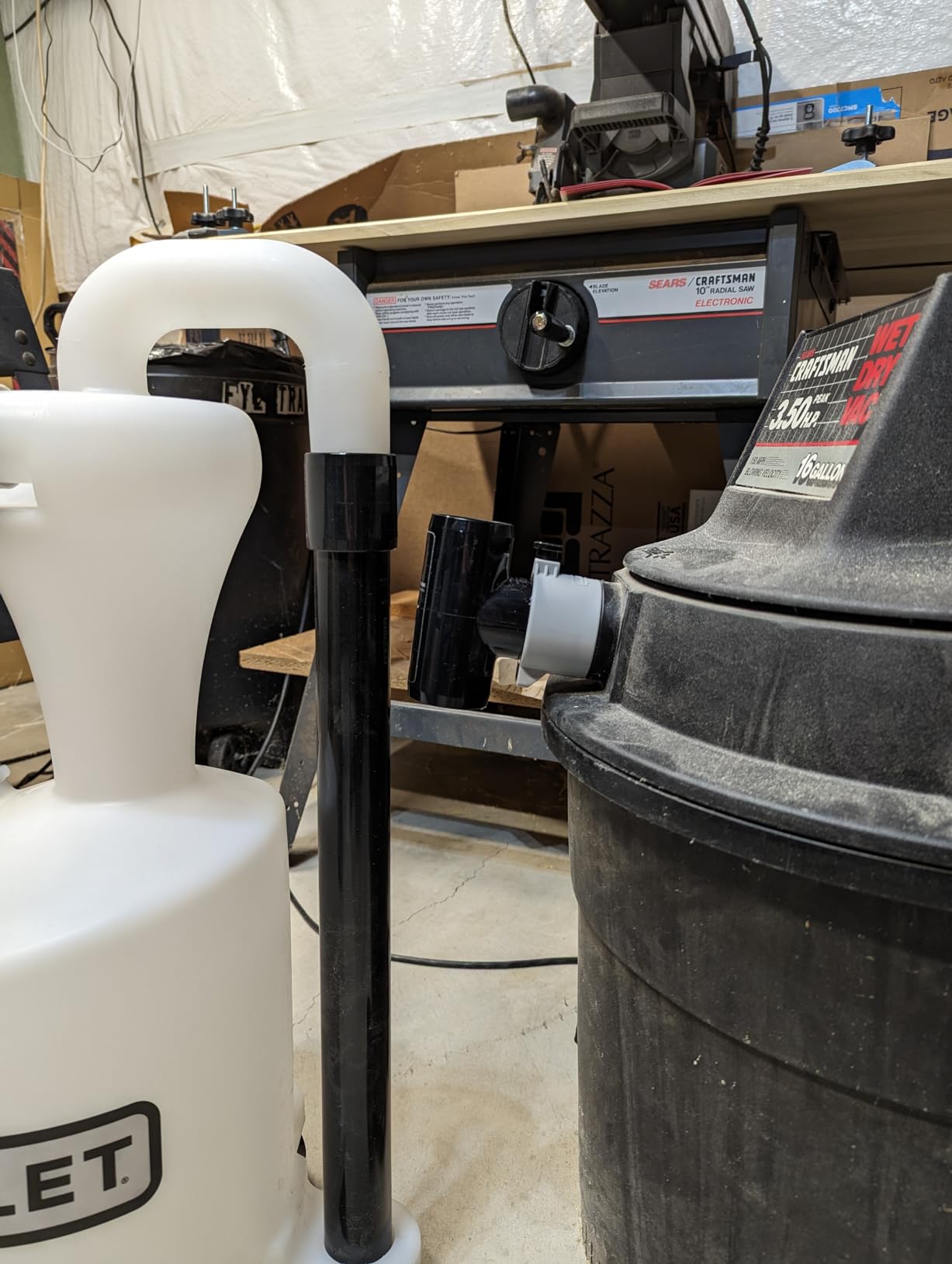
The connection is the part owners mention most. Instead of bolting a lid to a bucket and hoping the gasket holds, you cut rigid PVC to fit and get a unified airtight seal. No bungees, no duct tape, no leaks.
At 4.8 across 289 ratings, it holds the highest average of the twelve we examined.
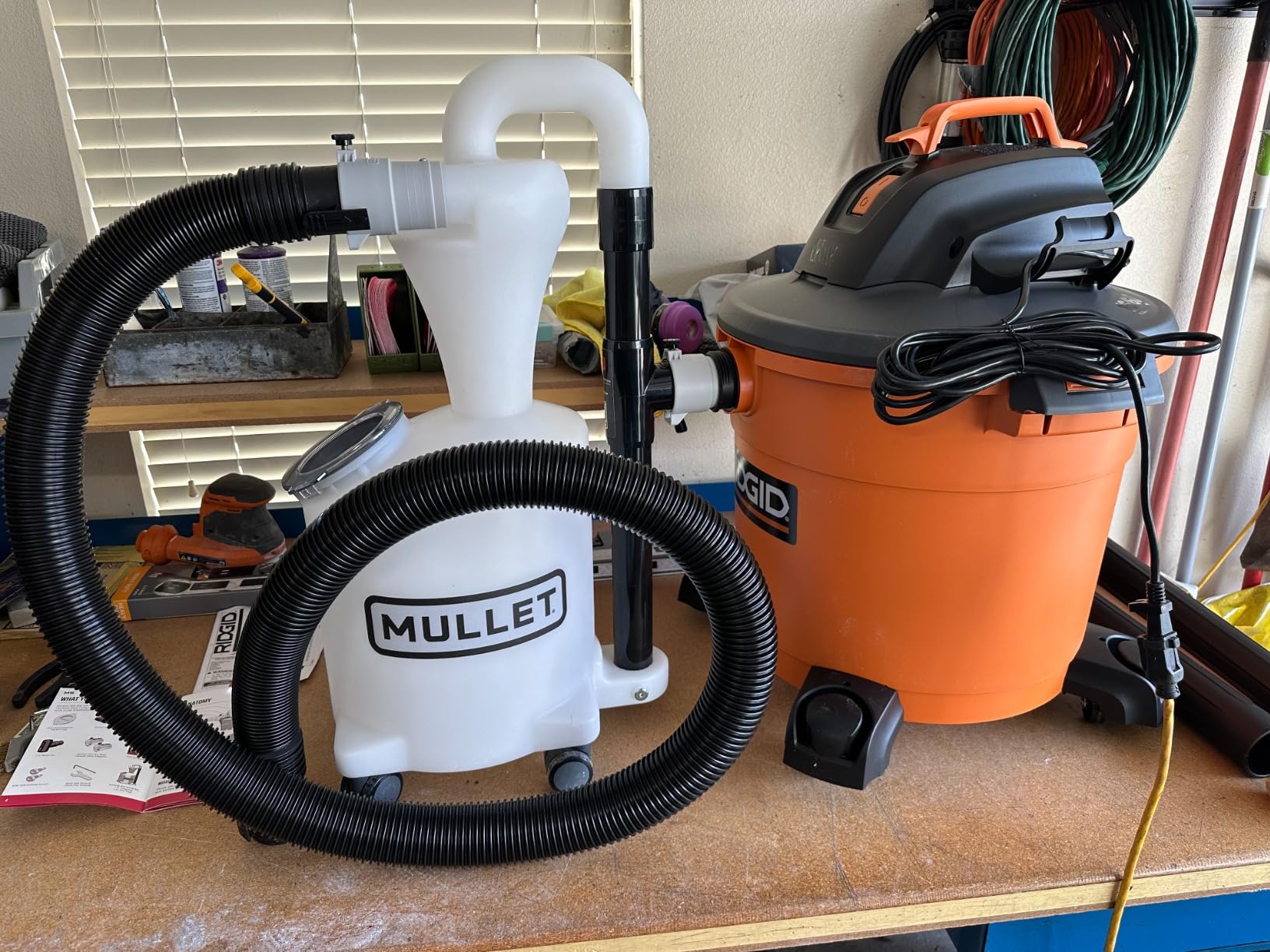
It is designed to run off a shop vac or a dust extractor, and the included adapters fit virtually all wet and dry vacuums. Pair it with a dust extractor if you have one, since that pairing is where the high speed design pays off most.
The published sound level is 72 dB, which is among the quieter figures in this category and worth considering if your shop shares a wall with living space. One of only two products here that publishes a decibel number at all.
Whether it fits a dust extractor setup
Yes, and it is the natural partner for one. Because the extractor supplies consistent high volume low pressure airflow, the cone can maintain the fast spin it was designed for, which is exactly where separation improves most.
At about seven and a half pounds it is heavier than a plastic lid, so plan a solid mount rather than a lightweight stand.
Where the cost sits
This is the highest-priced separator in the group, and the honest case for it is build quality and airtightness rather than raw separation numbers. If you are building a rig you expect to keep for years, the difference shows. If you are covering a sander for a year, a bucket lid does the job.
9. VEVOR Cyclone Separator with Metal Tank, the Steel Drum Option
- Includes a steel can instead of plastic
- Transparent body with a sight window
- Handles a high pressure 4 HP collector
- 13 gallon size suits a hobby shop
- Attachments and wrench included
- Nearly 18 lb to move when full
- Three casters make it tip prone
- Static clings to the plastic body
Regulars on the FineWoodworking forum are unambiguous that plastic barrels and cardboard drums are a fire risk, and that advice carries real weight. This unit answers it without making you hunt for a separate can afterwards.
The can also tolerates high static pressure, which means it works with a large four horsepower collector as well as with a small shop vac. For a hobbyist who might grow into that, it is a safer place to start than a plastic bucket.
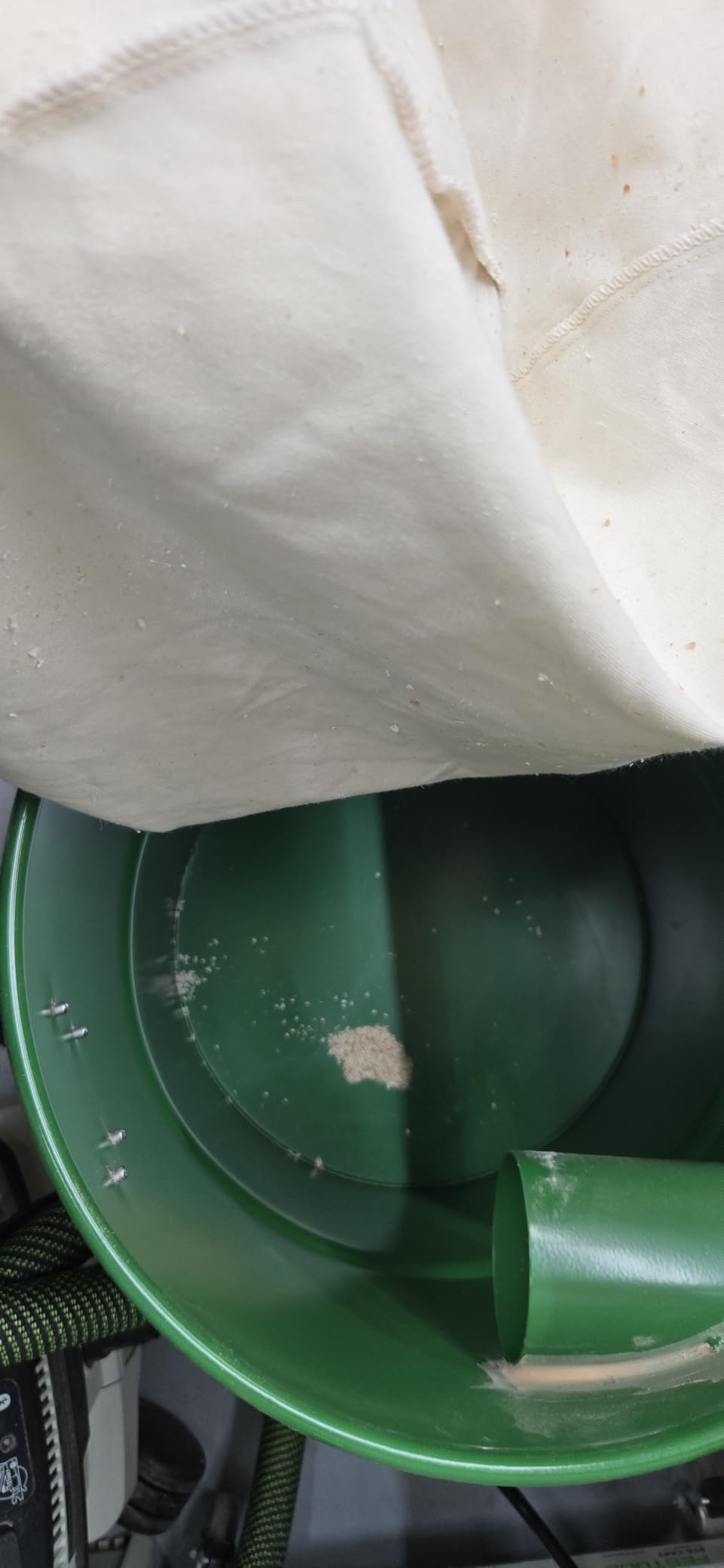
The transparent separator body and a window in the can mean you can watch separation happen and check the fill level without opening anything.
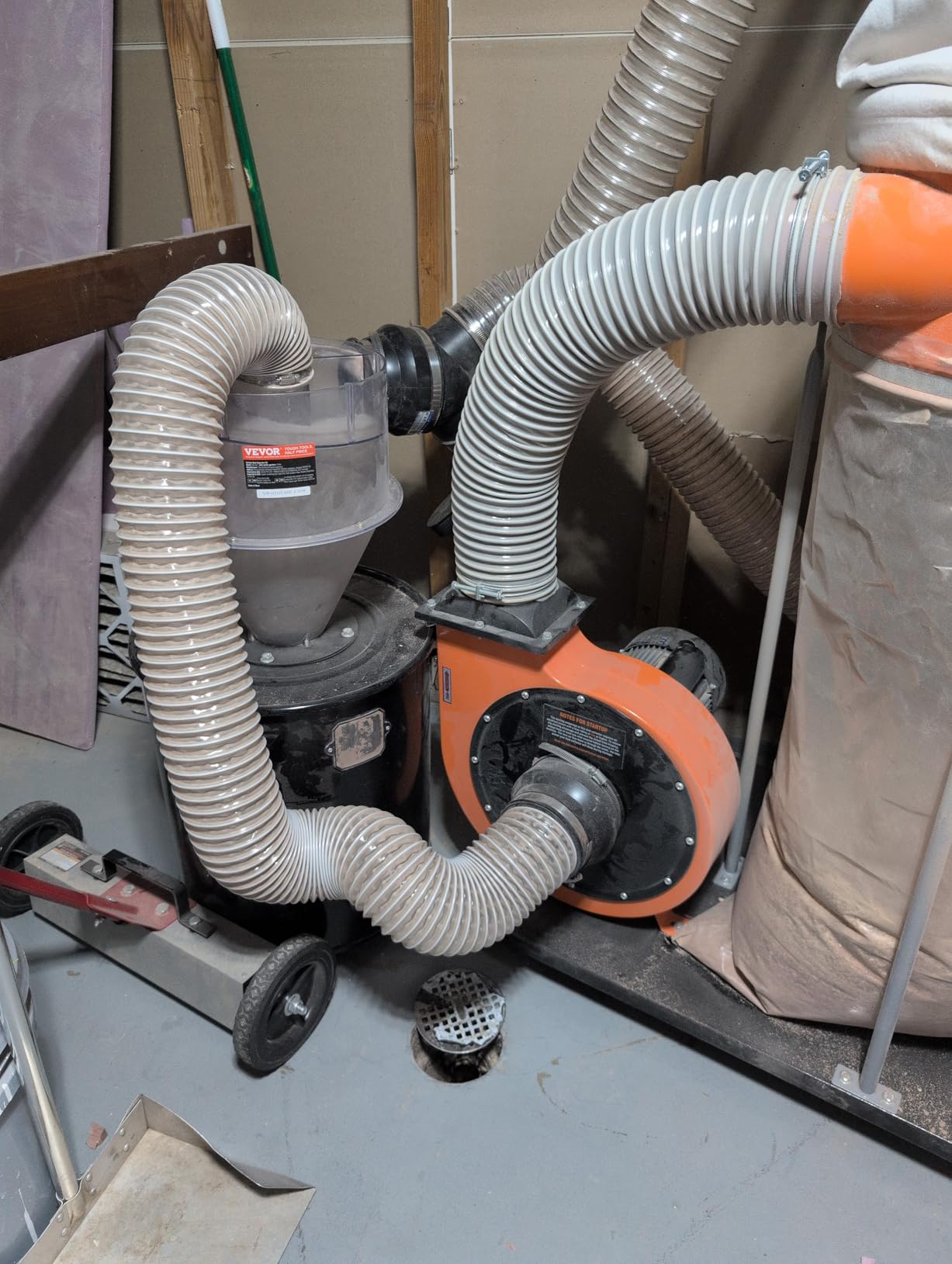
Owners frame it as strong value against premium brand cyclones of similar capability. The steel can does not collapse, and reviewers call the thirteen gallon size right for hobby and small shop use.
Most complaints are mechanical details rather than performance. Short ports can leave clamps without room to seat, and the included reducers do not always fit as supplied.
Whether the steel can is worth the extra weight
If you are not moving it often, yes. A rigid steel can is what fire safety advice points toward, and it stays stable under strong suction in a way plastic never does. It also lets you mount the whole unit outside if you prefer.
If you move between machines constantly, the nearly eighteen pound assembled weight becomes a real strain once it is full of dense hardwood chips.
What to fix before first use
Add a fourth caster or brace the can, since three casters tip when loaded. Check the reducer sizes against your hose before tightening, and ground the unit to reduce the static cling buyers report on the plastic body.
10. Cikawit High Efficiency Dust Separator, the Compact One for Tight Corners
- Compact enough to slide under a bench
- Complete kit with elbows and hose
- Preinstalled thickened gasket
- Handles chips sand and pet hair
- Among the least expensive complete kits
- No internal baffle so fine dust passes
- Does not reduce filter cleaning
- Needs weighting to stop tipping
At under three pounds assembled, this is the unit to buy when floor space decides everything. It tucks under a bench and needs nothing but a bucket to become a working separator.
The included two and a half inch hose, two ninety degree elbows and connectors mean you can assemble it without a parts run. For sweeping and routing work, buyers report results that match costlier kits on heavy debris.
It is also among the least expensive complete separator kits available, which makes it a low-risk way to find out whether you even like cyclone separation.
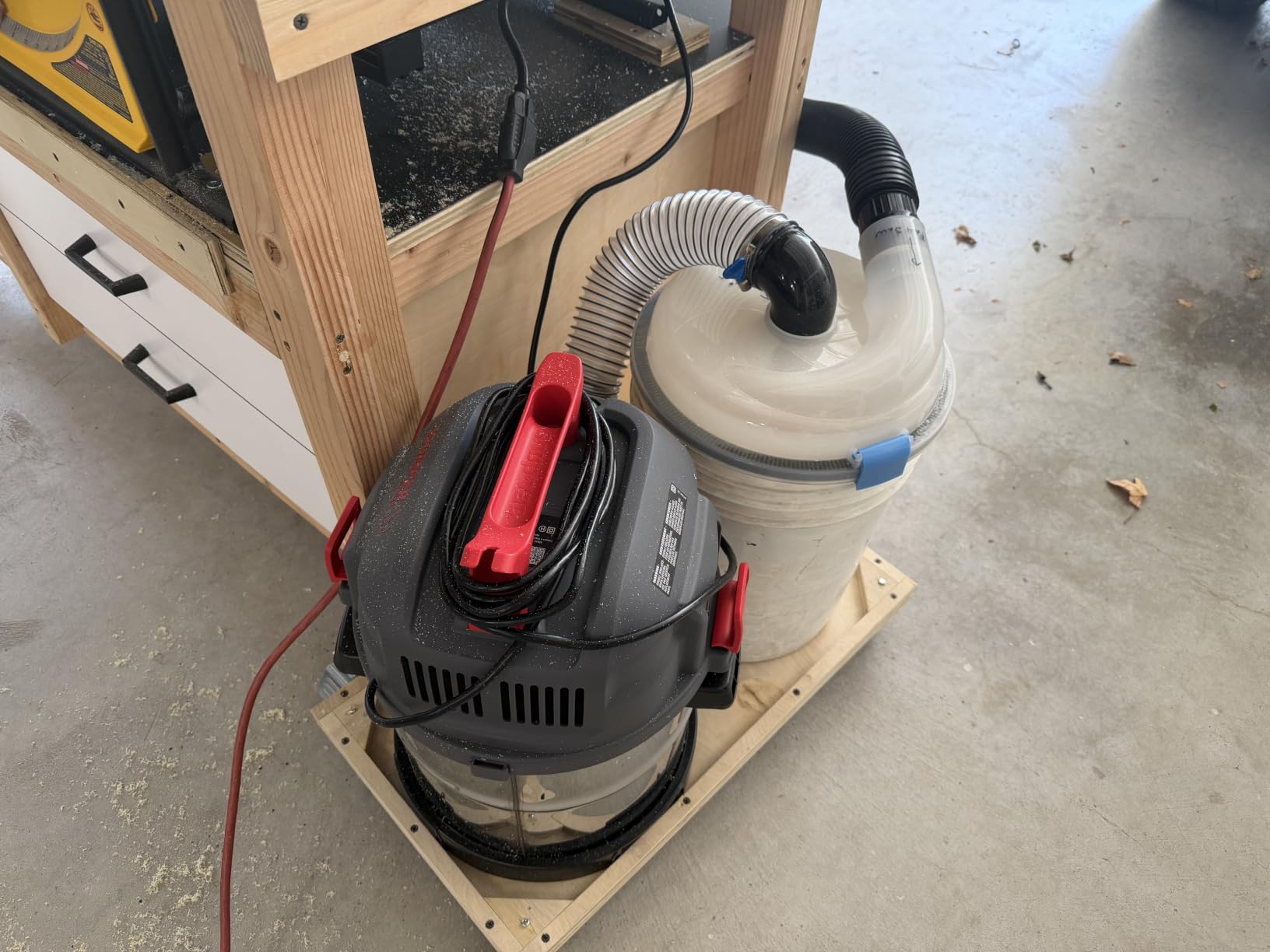
The reviews split sharply by use case. Sweepers rate it well. Sanders do not, and the reason is specific: there is no internal baffle, so fine powdery material spins in the bucket without settling and ends up back in the shop vac.
The rating distribution reflects that split, with 58 percent five stars alongside a double digit share of two and three star reviews. Know which one you are before you buy.
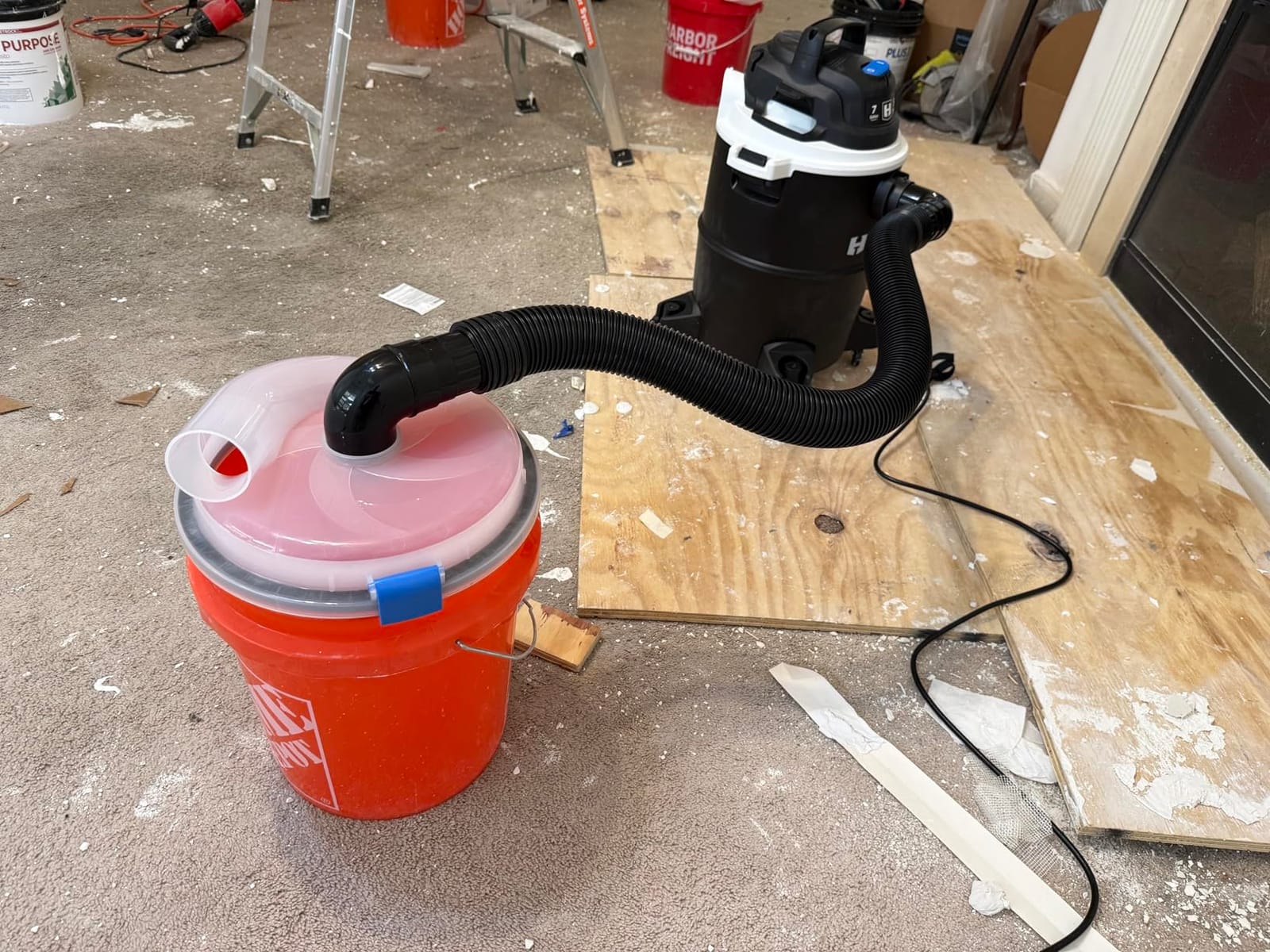
Whether it suits a sweeping and routing shop
Yes. If your dust is mostly chips and coarse shavings from a router table or a track saw, this handles it at a fraction of the outlay. The compact size is a genuine advantage in a garage where a rolling machine cannot fit between the bench and the wall.
The included hose is a real convenience for a shop still deciding on permanent ducting.
Why sanders should look elsewhere
The missing baffle is the whole story for fine dust. If sanding is a significant part of your work, spend the extra on a unit with a baffled cone such as the Dustopper PRO. Weight the bucket with a brick or a sandbag, and check that the gasket has not lifted from its backing.
11. FoxAlien 800W Desktop Dust Collector, the Only Complete Machine Here
- Cyclone HEPA and carbon in one unit
- Adjustable airflow knob
- Standard 1.5 inch hose
- Compact desktop footprint
- Handles acrylic and MDF fumes
- 85 dB is the loudest figure here
- Fixed 1.5 inch hose only
- Listed voltage conflicts with the 110V marketing
This is the only product here with its own motor, filter and cyclone stage in one package. It is built for desktop CNC routers, engravers and carvers rather than for cabinetry, which makes it an odd fit for most small shops but a strong fit for one specific bench.
The layering is the point. The cyclone strips out the big debris, the HEPA catches micro dust, and the activated carbon handles the smell from acrylic, MDF and resin. An airflow knob lets you trade suction for noise depending on whether you are hogging out material or doing a delicate pass.
It plugs into a standard 1.5 inch hose, which is what most desktop CNC dust shoes expect.
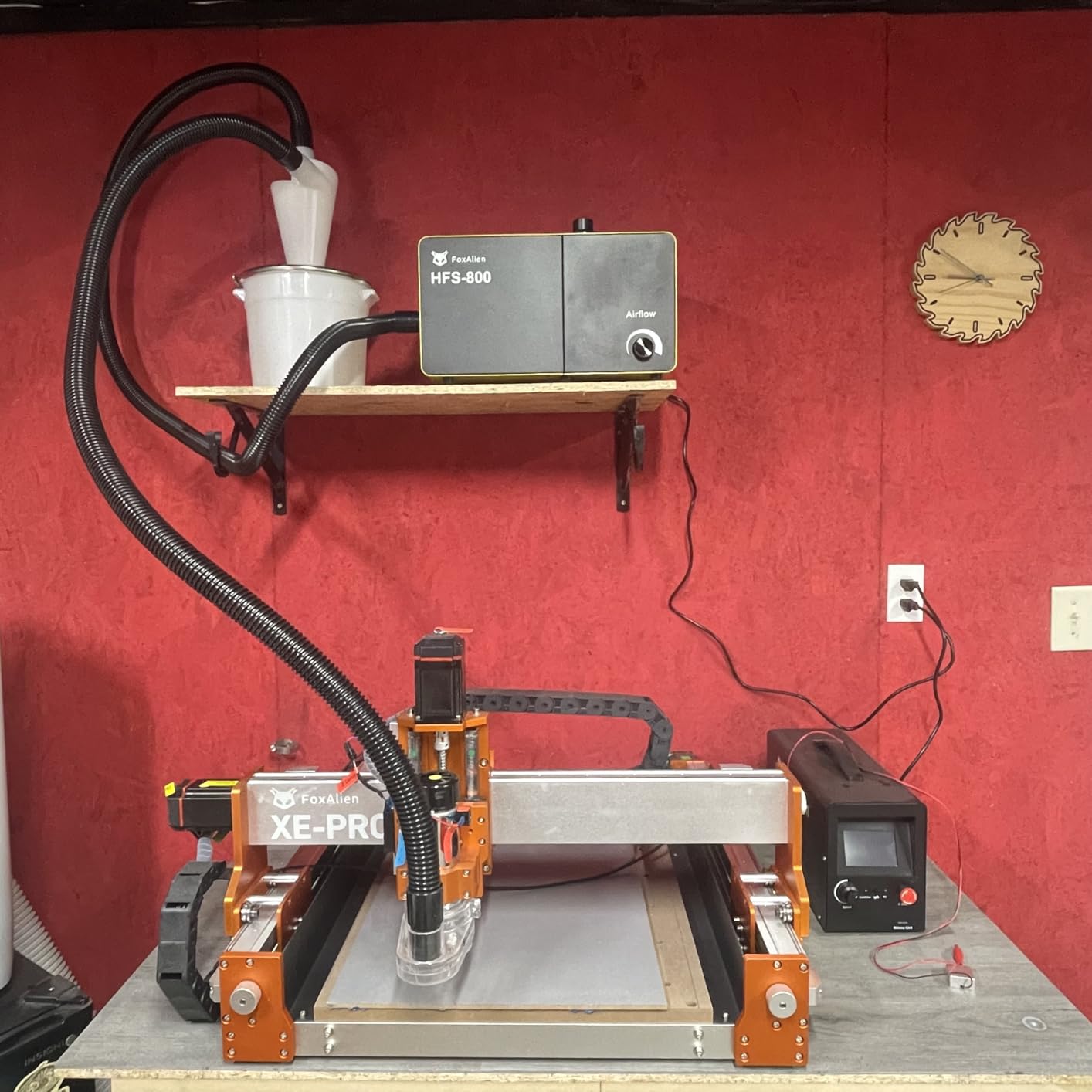
At 41 reviews this is the least proven item in the set, and it carries the lowest average rating at 4.0 with a 12 percent one star share. Long term durability is simply not established.
The published sound level of 85 dB is the loudest figure we found, and that matters if your machine sits in a room you also work in. The listed voltage also conflicts with the marketing copy, so confirm what actually arrives in the box.
Whether it suits a CNC bench
Yes, if your workflow is routing, carving or engraving on a desktop machine. The carbon layer genuinely helps with resin and acrylic fumes, and the cyclone stage keeps the HEPA from loading up with chips.
The adjustable airflow is worth using. Turning it down cuts noise noticeably for finishing passes.
Why most shops should skip it
A fixed 1.5 inch hose cannot be adapted to a two and a half inch or four inch system, and at 27.5 pounds it is heavy for a desktop footprint. If you are not running a CNC, this solves a problem you do not have.
12. PEMEDOR Double Filtration Cyclone Collector, the Small and Adaptable One
Pemedor Double Filtration – Cyclone Dust Collector, OD2” DIY Turbocharged Woodworking Filter Industrial Separator Collector Canister Dust Control System
- Adapters in multiple sizes included
- Clear cup doubles as a fill indicator
- Filters stay nearly spotless
- No measurable suction loss
- Works with collectors down to 3 HP
- Top heavy so the can must be secured
- Connector may need tape to seal
- Flange gets heavy when the cup fills
This is the smallest and most flexible of the twelve. Instead of a bucket lid it mounts as a flange on top of a container, and the clear cup lets you watch it fill.
Adapters in several sizes come in the box, which is how it earns its place for a shop with mismatched equipment. It also works with dedicated collectors as small as three horsepower, so it is not limited to shop vac setups.
Owners are most impressed that the vacuum filter comes out essentially clean after heavy sawdust work, with no measurable loss of suction once it is fitted.
Whether it works with whatever you own
The included adapters cover most common hose connections, and a fifty millimeter inlet is a reasonable default for a small shop. If you run a dedicated collector, confirm the flange diameter matches your outlet before fitting it.
It suits a shop that wants separation on a single machine port without committing to a full rig.
What to secure before you run it
It is top heavy, so the receiving can needs to be fixed in place or weighted. Some owners tape the hose connector to get an airtight seal, and the flange itself gets uncomfortably heavy once the cup is full.
With 77 ratings and 96 percent at four stars or better, the feedback here is solidly positive despite the small sample.
How to Size a Cyclone Dust Collector for a Small Shop
Start with the biggest machine you own and work down. A 13 inch planer wants roughly 500 cubic feet per minute at the tool, an 8 inch helical jointer around 400, a miter saw about 350, a 4 by 8 foot router table around 180, and a compact table saw near 170. Those are minimums at the machine end, not at the collector inlet, which is why manufacturers publish an inlet number that flatters the machine.
Now work out your tier. Under 500 cubic feet per minute covers handheld tools and a single small machine. Five hundred to a thousand covers a table saw plus a sander. Above a thousand is when a planer or jointer enters the picture and a real cyclone machine starts to make sense.
Duct diameter is the part people get wrong. A four inch port is about 12.6 square inches of area and a six inch port is about 28.3, so the larger pipe moves far more air for the same fan speed. Fifteen feet of four inch flex hose has been measured cutting airflow roughly in half, which is why long runs with small hose are the most common self-inflicted mistake in a small shop.
Power is the next decision. Single phase at 110 or 220 volts covers a garage without new wiring, while three phase needs an electrician. Filter choice matters too: a canister at one micron for general shop dust, or a true HEPA at 0.3 microns when you work with MDF or do a lot of finish sanding. On respirable dust, protection at the source beats any air cleaner in the room, so keep your woodworking dust masks on hand for the cleanup pass either way.
On fire safety, follow the FineWoodworking forum advice rather than a spec sheet. Use an all-steel can, avoid plastic barrels and cardboard drums, ground the assembly to control static, and get the collector outside the building if you can. A cyclone that works perfectly well can still be a liability in a closed room.
What You Give Up by Going Cyclone
The value case for staying single-stage is real and worth stating plainly. SawmillCreek regulars point out that a single-stage collector of the same horsepower delivers close to double the airflow for roughly half the outlay, because it has no cone to push air through. That is not a bad machine. It is a different machine for a different job.
Second, a cyclone assumes fixed ducting. The Wood Whisperer makes this argument well: a big collector only earns its place when you are running a permanent installed system. If your machines are portable and clustered, you are paying for separation you do not need.
Third, portability. A cyclone with a steel drum is a heavy object to move, and it is less pleasant to reposition than a shop vac on casters.
Fourth, noise. Only two products in our set publish a decibel figure, one at 72 dB and one at 85 dB, which tells you how little the industry reports. If your shop shares a wall with a living space, measure before you commit.
Filter, Drum and Noise Costs Over Time
The running cost of a cyclone setup is mostly filter media, and the separator approach changes that math. When a cyclone drops the bulk of the debris in a drum, the vac filter or canister upstream sees far less loading, so replacement slows to a fraction of a single-stage setup. Reusable drum liners cost almost nothing and turn emptying into a quick shake-out.
Where you spend more is on a powered machine with a true HEPA or one micron canister, and those are consumables you plan for. Noise follows the same pattern, since a running vacuum is the loudest thing in most garages and a smaller vacuum running less often is quieter than a big one running constantly.
Frequently Asked Questions
Are cyclone dust collectors worth it?
Yes, if you run a table saw, planer, jointer or wide-belt sander, if your duct or hose run is longer than about ten feet, and if you are in the shop often enough for airborne dust to build up. No, if you only use a router and a random orbit sander, because a shop vac with a cyclone separator lid on a five-gallon bucket handles that case for far less.
What is the best dust collection system for a small shop?
Start by matching airflow to your largest machine. A 13 inch planer needs roughly 500 cubic feet per minute at the tool, a helical jointer about 400, a miter saw around 350, a router table about 180, and a compact table saw near 170. Under 500 covers handheld tools, 500 to 1000 covers a table saw and sander, and above 1000 is when a full cyclone machine earns its cost.
What is the difference between a cyclone dust collector and a dust separator?
A dust separator is a passive cone or lid that spins the air and drops chips into a container while a shop vac provides the suction. A cyclone dust collector is a complete powered machine with its own motor, filter and drum, where the cyclone is one stage inside a larger system. Separators cost a fraction as much and suit handheld tools and short runs.
Is a cyclone dust collector better than a regular dust collector?
It filters better but moves less air. A single-stage collector of the same horsepower typically delivers close to double the airflow because it has no cone to push air through. A cyclone wins on filter life, chip handling and the health of the air in your shop. Choose it when you have duct runs and heavy machines, not for a handheld-only setup.
What are the disadvantages of using a cyclone dust collector?
The main ones are cost, noise, weight and inflexibility. Cyclones cost more than single-stage units of the same horsepower, a steel drum is heavy to move, they are louder while running, and they assume fixed ducting rather than a portable setup. In a very small shop, that inflexibility can outweigh the better filtration.
The Verdict for Small Shops in 2026
The Oneida Dust Deputy DIY takes the top spot in 2026 because it has the deepest review base in the category by a wide margin and it does the one job that matters on a shop vac, keeping fines out of the filter. Pair it with a rigid bucket and a hose matched to your machines, and it will run for years.
If your runs are longer than a few feet, the Peachtree four inch kit is the next step up. If you already own a single-stage collector, the Oneida retrofit cone converts it in an afternoon. If you sand a lot and want the fine fraction handled well, the Dustopper PRO is the one with independent test data behind it.
That is the honest shape of the best cyclone dust collectors for small shops in 2026. Build the separator first, learn what your airflow actually is, and only then decide whether a full powered machine is worth the money it takes from other parts of the shop.