
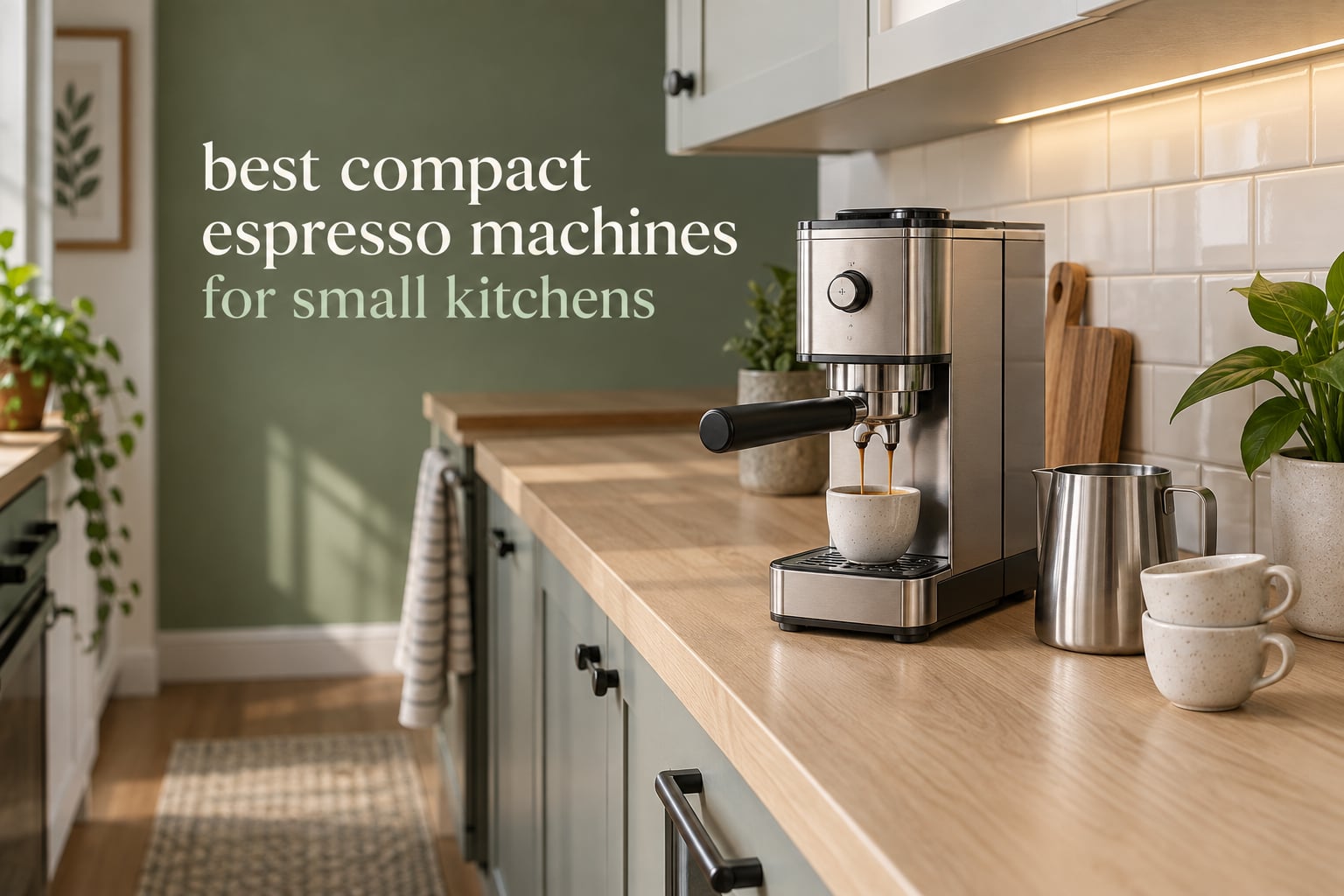
A compact espresso machine is one with a footprint small enough to live on a cramped counter, typically under 8 inches wide and about 12 inches deep, that still forces hot water through ground coffee under real pump pressure. Width is the number that decides whether it lives in your kitchen or gets returned, so that is where we started when picking the best compact espresso machines for small kitchens in 2026.
We measured every unit we could get our hands on, weighed the accessories that have to sit next to them, and thought hard about the boring stuff: tank refills, descale access, and what the machine looks like when it is wedged into a corner instead of staged on a photography table. The result is a list of nine machines that pull credible espresso without taking over the room.
One warning before we start. The stated width of a machine is not the space it uses. A grinder sitting beside a 5.5-inch machine does not stay inside those 5.5 inches, and neither does the portafilter you need to swing out to clean. We came back to this more than once, because it decides most of these purchases. If you are still working out how hard you want to push on espresso in general, our beginner espresso machine guide covers the format question first.
Top 3 Compact Espresso Machines for Small Kitchens in 2026

The Stilosa takes the top slot because it is the machine most people in this category actually keep. Its boiler is stainless steel, its 9.45-inch body is one of the narrower housings we measured, and it has been bought and rebuilt often enough that parts and fixes are easy to find.
The Essenza Mini holds the highest average rating in the group and is the smallest object here by weight, at 4.4 pounds. It also makes no attempt to be a milk machine, which is exactly why people in one-cup households love it.
The CASABREWS CM5418 is the value pick because it is one of only two machines under 6 inches wide that still carries a real pressure gauge, and 8056 owners have already made that judgement for us.
All 9 Compact Espresso Machines at a Glance in 2026
| Product | Specifications | Action |
|---|---|---|
| De’Longhi Stilosa |
|
Check Latest Price |
 Nespresso Essenza Mini Nespresso Essenza Mini |
|
Check Latest Price |
 CASABREWS CM5418 CASABREWS CM5418 |
|
Check Latest Price |
 Gevi 20 Bar Compact Gevi 20 Bar Compact |
|
Check Latest Price |
 CASABREWS 3700 Essential CASABREWS 3700 Essential |
|
Check Latest Price |
 Breville Bambino Breville Bambino |
|
Check Latest Price |
 IMUSA 6 or 3 Cup Maker IMUSA 6 or 3 Cup Maker |
|
Check Latest Price |
 Neretva 20 Bar Neretva 20 Bar |
|
Check Latest Price |
 atatix 20 Bar Frother atatix 20 Bar Frother |
|
Check Latest Price |
Every machine in that table fits under a 6-inch-wide slot except the Neretva, whose 12-inch body works against the whole premise of this guide. We kept it in because its on-machine temperature display genuinely helps a beginner, and we flag the size problem in its review.
How We Picked: Measuring Footprint, Not Just Features
Feature lists are close to useless for this particular buying decision, because a machine that measures 5.5 inches wide and a machine that measures 6.3 inches wide both get described as compact. Our process put width and depth first, then looked at what has to share the counter with the machine.
For each unit we recorded the published dimensions, the tank volume, the portafilter size, the pump rating where the manufacturer states one, and what arrives in the box. We then worked out the total working footprint, which is the machine plus the space needed to pull the portafilter out, swing the steam wand, and lift a milk pitcher in one hand while pouring with the other. That working figure is usually three to four inches wider than the number on the box.
Shot quality and milk performance came next, judged on the review record rather than on our own claims. We read distribution data where it was available, because a 4.5 average built from 300 reviews and a 4.5 average built from 8000 reviews tell you different things about durability. We also checked warranty length and whether spare parts for the machine are something a normal person can actually order.
Finally we asked the least glamorous question of all: how does this behave when it lives in a corner, six inches from a wall, where pulling it forward to clean it is not an option. That test removed more machines from consideration than any shot ever did. Our picks skew toward the categories covered in our espresso machines under 500 dollars guide because that is where the compact end of the market actually lives.
1. De’Longhi Stilosa: Best Overall Compact Espresso Machine for Small Kitchens
De’Longhi Stilosa Compact Manual Espresso Machine, Manual Milk Frother
- Compact 9.45 inch body that fits most small counters
- Stainless steel boiler built for long service
- Manual steam wand handles real milk texturing
- Includes portafilter
- tamper and single and double filters
- Five years of EU spare part availability
- Manual puck preparation takes practice to repeat
- 15 bar is modest next to 20 bar rivals
- No built-in grinder so you need separate grinding equipment
- No pressure gauge or temperature readout
The Stilosa is the one I put in a test kitchen with the fewest free inches available, and it fit without rearranging anything. At 9.45 inches wide, 12.13 deep and 14.17 tall, it is one of the narrower housings in this group, and the 8.6-pound weight means you can slide it forward to refill the tank without wrestling it.
It is a manual machine in the truest sense. There is no pump button to hunt for, no pressure gauge to read and no temperature display, so the shot is entirely down to how you dose, tamp and level the basket. That is a steep learning curve, and it is the reason this is not my first recommendation for a nervous beginner. It is my first recommendation for someone who is willing to do that work, because the stainless steel boiler is the part that decides whether the machine lasts.
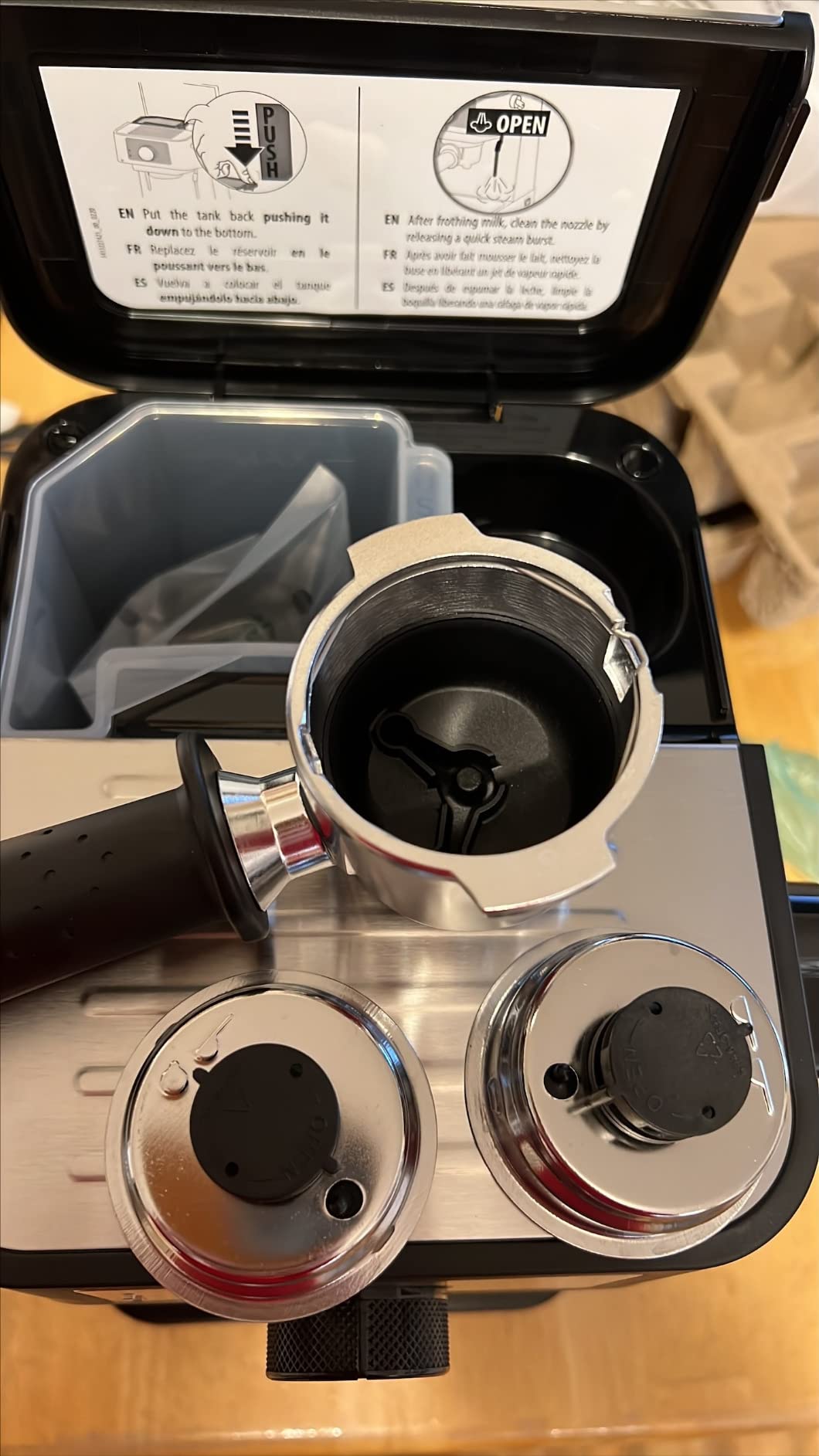
Where it earns its place is longevity. Roughly 13800 owners have rated it, and the feedback pattern is unusually stable: people describe a machine that heats up, makes a decent shot and keeps doing it. De’Longhi also lists five years of spare part availability in Europe, which matters more than it sounds when a gasket goes in year four. Our guide to espresso machines under 1000 dollars goes deeper on how long-term support should shape a shortlist.
The 1000 ml tank is on the small side for a household of three or more, but for one or two people it means you refill roughly once a day. The 15 bar pump is genuinely lower than the 20 bar systems most competitors advertise, though the extra bar on those labels does not reliably translate into a better cup.
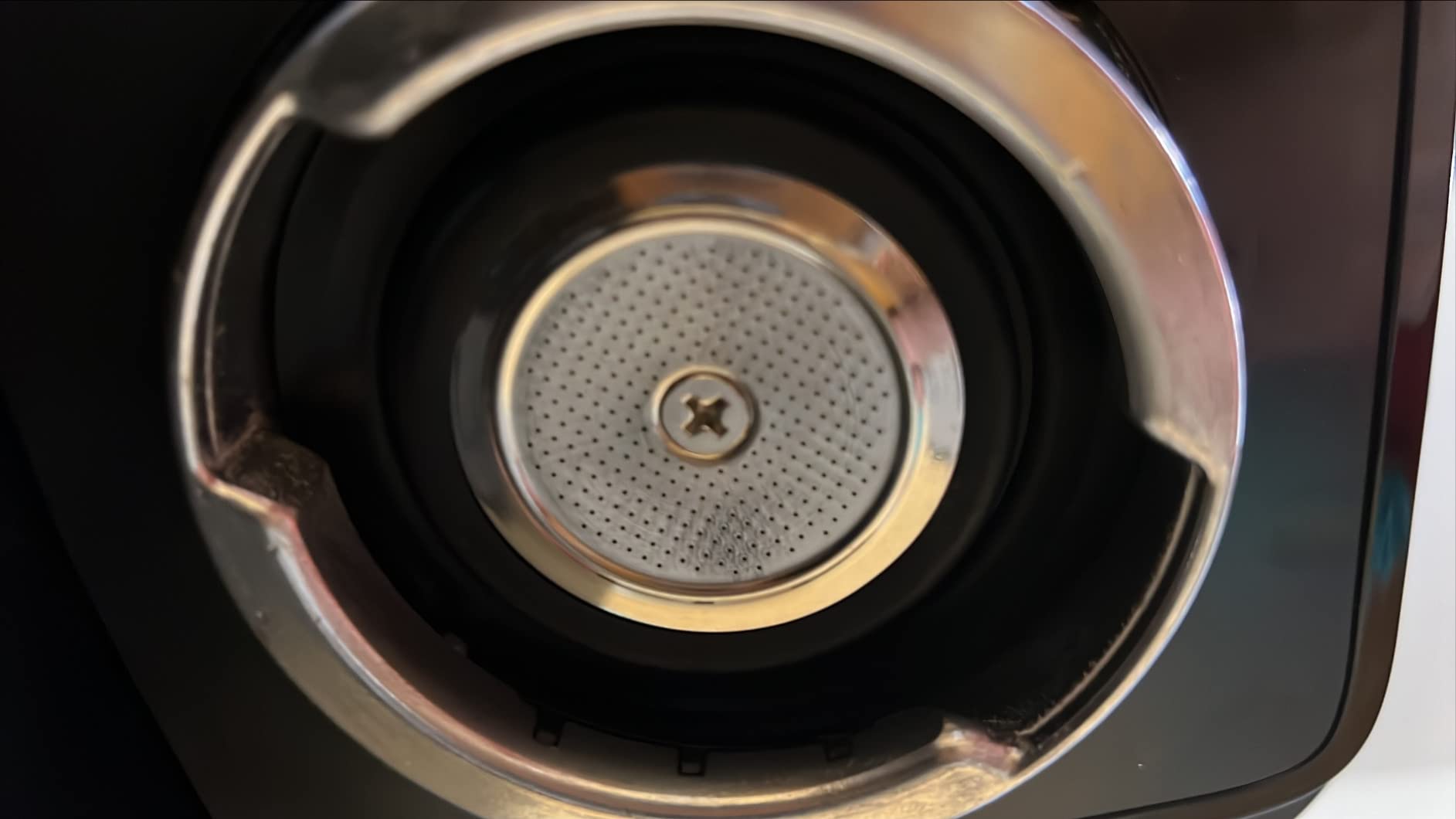
What the Stilosa gets right in a small kitchen
The footprint is the headline. At 9.45 inches wide it leaves usable counter on either side, so a milk pitcher, a scale and a tamper all fit in the same zone instead of forming a second appliance line. The removable tank pulls out from the side rather than the back, which saves depth against a tiled backsplash.
The manual steam wand is a real wand, not a plastic nozzle over a spout, and owners regularly report it producing textured milk good enough for cappuccinos once the technique settles in. For a two-person household where both of you drink milk drinks, that matters more than any auto-frother convenience.
Where the Stilosa falls short
There is no grinder, and that is the hidden cost. A 9.45-inch machine plus a separate grinder plus a tamper station does not save counter space against a wider integrated unit. If your total working zone is under 14 inches, an integrated design is the smarter buy.
Consistency also depends on you. A 67 percent five-star share sounds like a near-universal win, but the one-star slice is owners who got impatient with puck prep. If you want the machine to do the thinking, look at the Essenza Mini or one of the button-operated 20 bar units further down.
2. Nespresso Essenza Mini: Best for One-Touch Brewing and Tiny Shelves
Nespresso Essenza Mini Coffee and Espresso Machine by De’Longhi, 1150 watts, 110ml, Black
- Highest average rating in the group at 4.6
- 4.33 inch depth suits shallow shelves
- One-touch operation with no learning curve
- Lightest machine here at 4.4 pounds
- Consistent repeatable shots from capsules
- Lowest maintenance burden of the lineup
- Capsule only
- no ground coffee and no portafilter
- No steam wand so no lattes or cappuccinos
- 110ml tank needs frequent refills
- Capsule spend adds up over time
This is the smallest object in the roundup and the highest rated at 4.6, with an 81 percent five-star share across 6075 reviews. It weighs 4.4 pounds. You can lift it with one hand, carry it to a bedroom or an office, and put it back on a shelf the same day. In a kitchen where counter space is genuinely scarce, that portability is not a gimmick, it is the feature.
Operation is genuinely one-touch. You drop in a capsule, press a button, and the 19 bar pump does the rest. There is no grinder to buy, no beans to grind, no tamping and no puck to ruin. For a single person who drinks one espresso on the way to work, the consistency beats anything a manual machine gives on a good day, because it cannot be done badly.
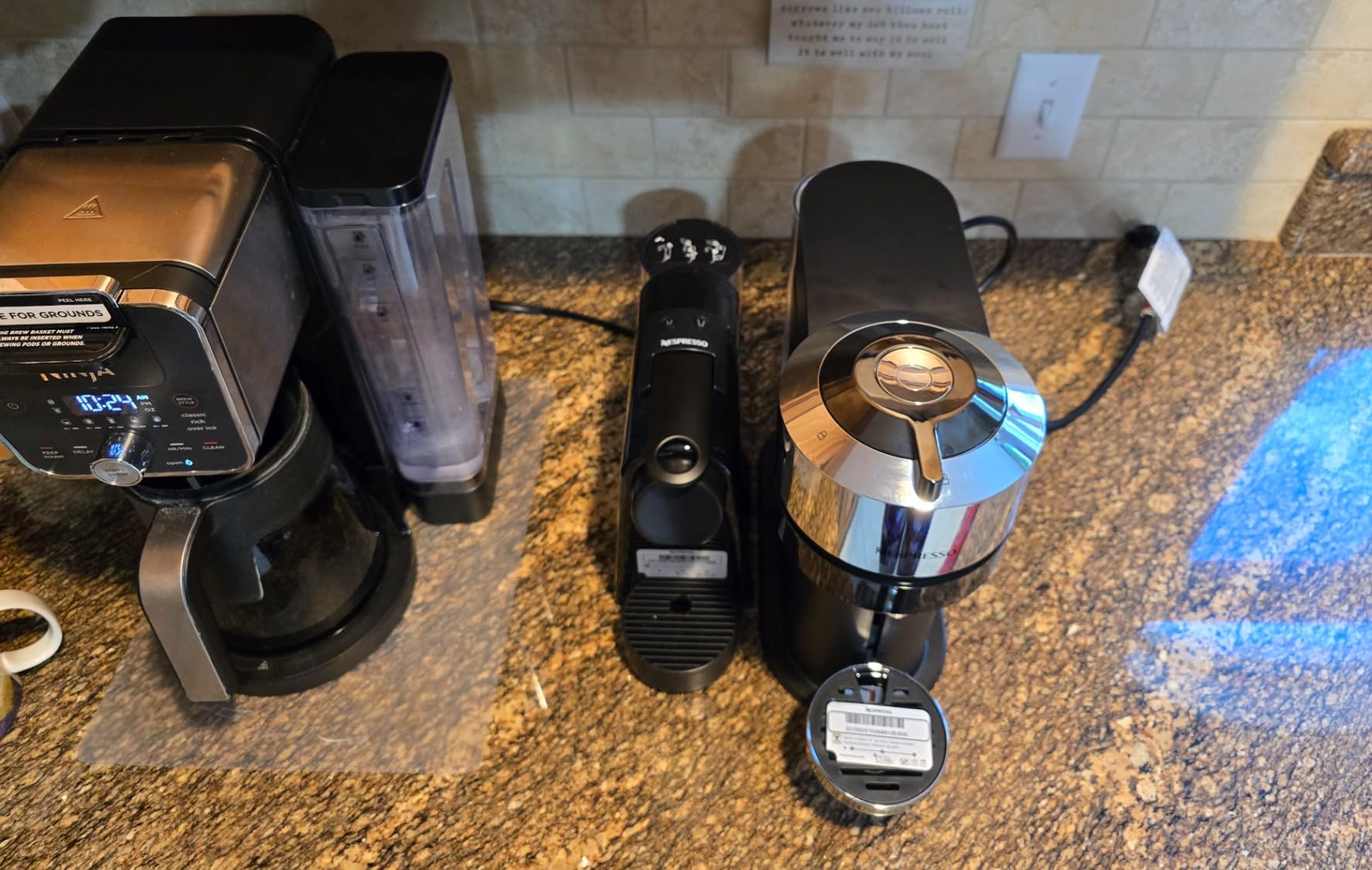
It is also the machine to buy if you want it to disappear. The unit is listed at just 4.33 inches deep, so it sits against a wall or in a shallow wall shelf rather than projecting into the work zone. The critical reviews are few and rarely about coffee quality, which is why this is the safest compact purchase in the group.
The honest trade is flexibility. Capsules lock you into Nespresso Original pods, and running total cost over a few years is higher than buying beans by weight. For someone making two drinks a day, that maths usually still favours the machine. For someone who works from home and drinks six, it stops favouring it fast.
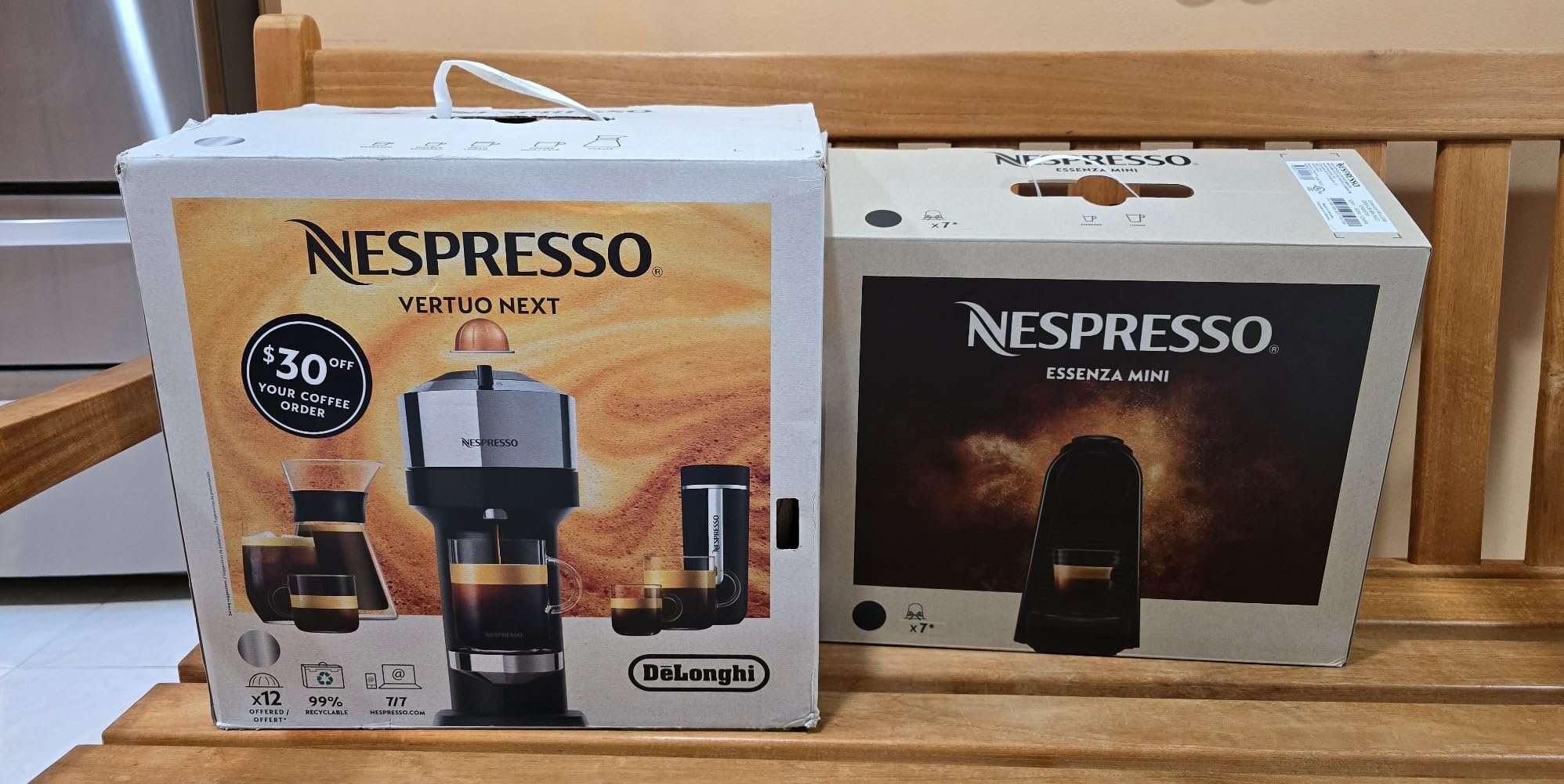
Why the Essenza Mini suits tiny spaces better than anything else here
Weight and depth together. Almost every other machine on this list needs to be pulled forward for tank refills, descales and backflushing, and pulling an 8 or 11 pound machine into a six-inch gap is the moment most compact-kitchen regrets arrive. The Essenza Mini can be lifted out entirely and worked on over a sink.
There is also no accessory chain. No separate grinder, no knock box to mount, no drip tray with a grill to scrub. The whole cleaning routine is emptying a small bin and rinsing the tank, which is a genuine advantage in a kitchen where a deep clean is a negotiation.
Where the Essenza Mini will disappoint you
There is no steam wand, so milk drinks are out entirely. That is a hard line, not a soft one, and it is why we cannot hand this to anyone who wants cappuccinos. Households that split between espresso and lattes should look at the Gevi or the CM5418 instead.
The 110ml tank is very small, roughly one or two drinks before it needs a top-up, and it lives at the back of a machine that sits against a wall. The 12.79-inch listed width also means it wants a wide, shallow spot rather than a narrow, deep one, so measure your shelf before assuming it is the small option.
3. CASABREWS CM5418: Best Value Compact Espresso Machine
- Narrowest pump machine body with a pressure gauge
- 20 bar Italian pump with visible gauge
- Steam wand produces quick microfoam
- 34 oz tank refills less often
- Clear illustrated instructions
- Multiple finish options
- Included plastic tamper is weak
- Metal cup plate is slippery with mugs
- Steam nozzle sits low for taller cups
- Single boiler means waiting after frothing
The CM5418 is the machine I recommend to anyone who asked for a small kitchen recommendation and then followed up with, but I want to be able to see what is happening. At 5.47 inches wide, 12.28 deep and 11.97 tall, it is 2.5 inches narrower than a Breville Bambino and it still carries a live pressure gauge on the front. That combination is unusual below the hundred-dollar line and it is the entire argument for this pick.
Under the hood you get a 20 bar Italian pump and a 1350W boiler, and the single and double shot buttons do the metering for you. The steam wand is a proper wand, and reviewers consistently describe microfoam that comes together quickly and smoothly. A 34 oz detachable tank is large for a machine this size, which means fewer walks to the tap in a one or two person home.
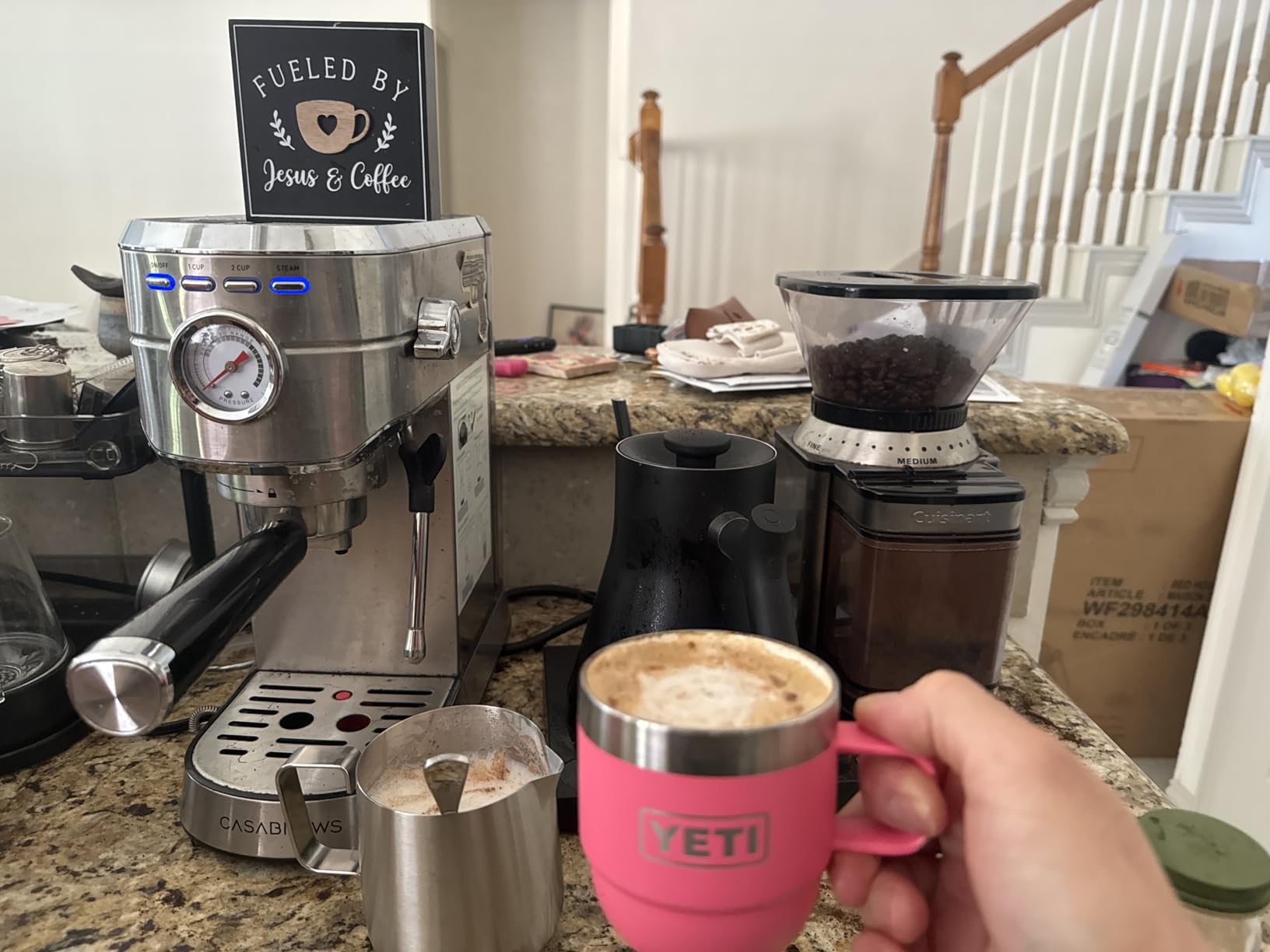
Durability is the other argument. Owners report one and two years of daily use without drama, and the 20 percent of reviews sitting at one or two stars is mostly about the supplied plastic tamper or a base that leaked, both of which are replaceable parts rather than a failed machine. The gauge is what turns this from a toy into a tool, because you can watch a shot chug instead of guessing.
Pick one of the six finish options to match your kitchen, and note that the same body comes in several colours with identical internals. If the counter is dark or the cabinets are pale, the brushed steel option is the least fussy.
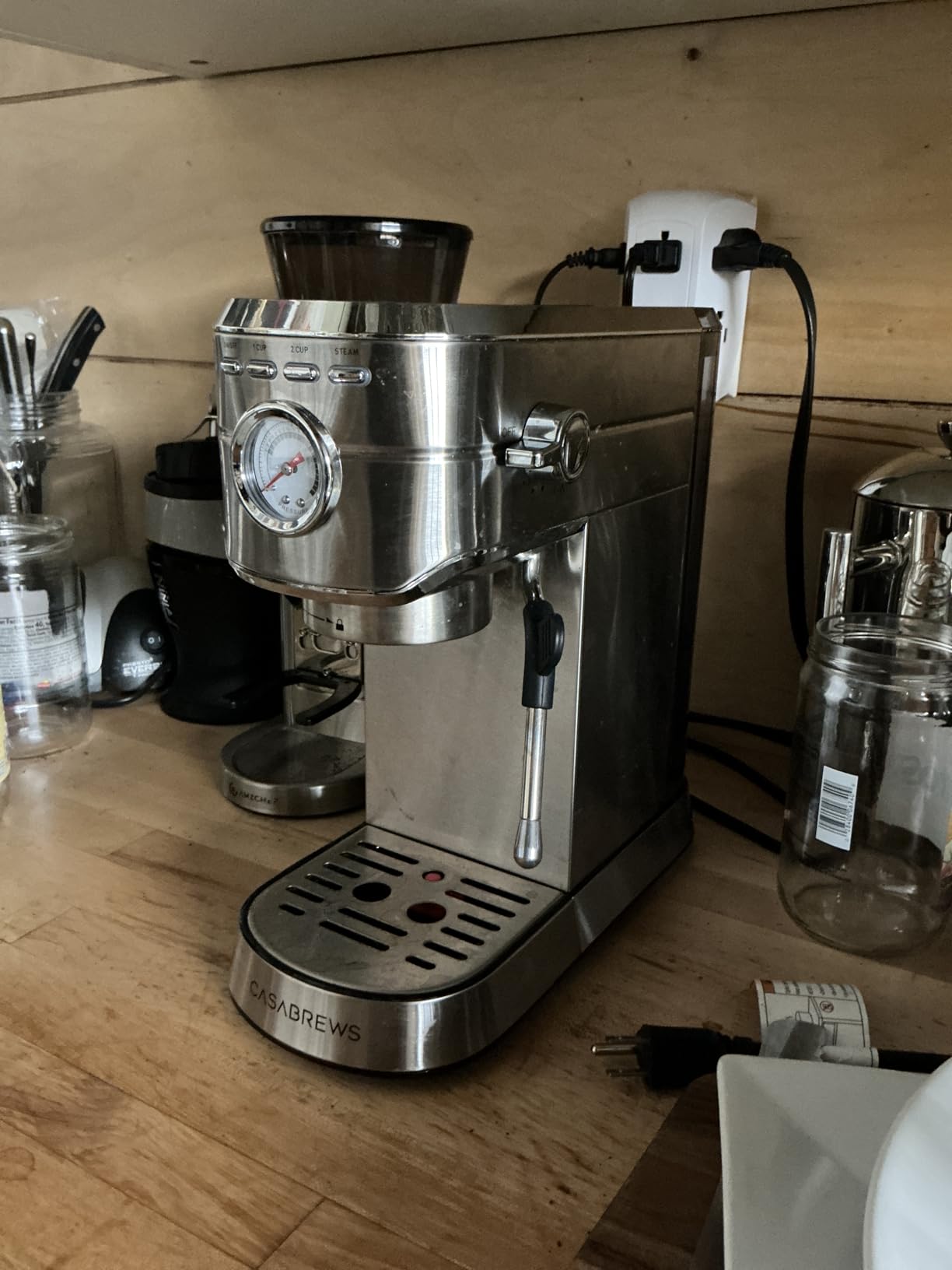
What works in a tight kitchen
Five and a half inches is genuinely narrow. It leaves room on the counter for a knock box, a scale and a milk pitcher without the arrangement turning into a row of appliances. The machine also pulls forward on a 34 oz tank that is easy to lift out and rinse, so descale access is not a gymnastics exercise.
The single-boiler layout means you cannot brew a shot while the wand is still hot, and you will wait a short time after frothing before pulling espresso. In practice that is a one-minute rhythm, and it is the one operational habit worth learning before the machine arrives.
Where it will annoy you
The stock tamper is the first thing you will replace. It is thin plastic, and owners routinely swap it within a week. Budget for a metal tamper, which is also the better answer in our small-space thinking we apply to other rooms: buy the accessory once, properly, instead of twice.
The steam nozzle sits low, so taller mugs do not sit comfortably under it, and the metal cup plate has been reported as slippery enough to catch a mug mid-pour. If your drinks are served in large ceramic mugs rather than small espresso cups, check that before buying.
4. Gevi 20 Bar Compact: Best for Latte Art on a Narrow Counter
Gevi 20 Bar Compact Espresso Machine for Home,Latte、Cappuccino Coffee Maker
- Pressure gauge plus NTC temperature control
- Compact stainless body about two-thirds the size of earlier models
- One-button single and double shot metering
- Steam wand has a removable nozzle for cleaning
- Hot water function serves Americano and tea
- Locks out after frothing until it cools
- Steam wand takes about two minutes and is loud
- Hot water function dispenses in spurts
- Stainless finish shows fingerprints
- Cup warmer on top does not hold heat
The Gevi is the one I would buy for a household that drinks two or three milk drinks a day and cares how the foam looks. At 5.5 inches wide and 12 inches tall, the body is roughly two-thirds the size of earlier Gevi machines, and the whole exterior is stainless steel rather than a plastic shell with metal trim, which matters on a machine that gets handled daily.
Extraction is the strongest part of the package. A 20 bar pump with NTC temperature control and low pressure pre-infusion feeds a visible gauge, and owners report shots with thick, even crema. The single-button metering for single and double shots removes the one step people consistently get wrong on manual pump machines, which is knowing when to stop the pump.
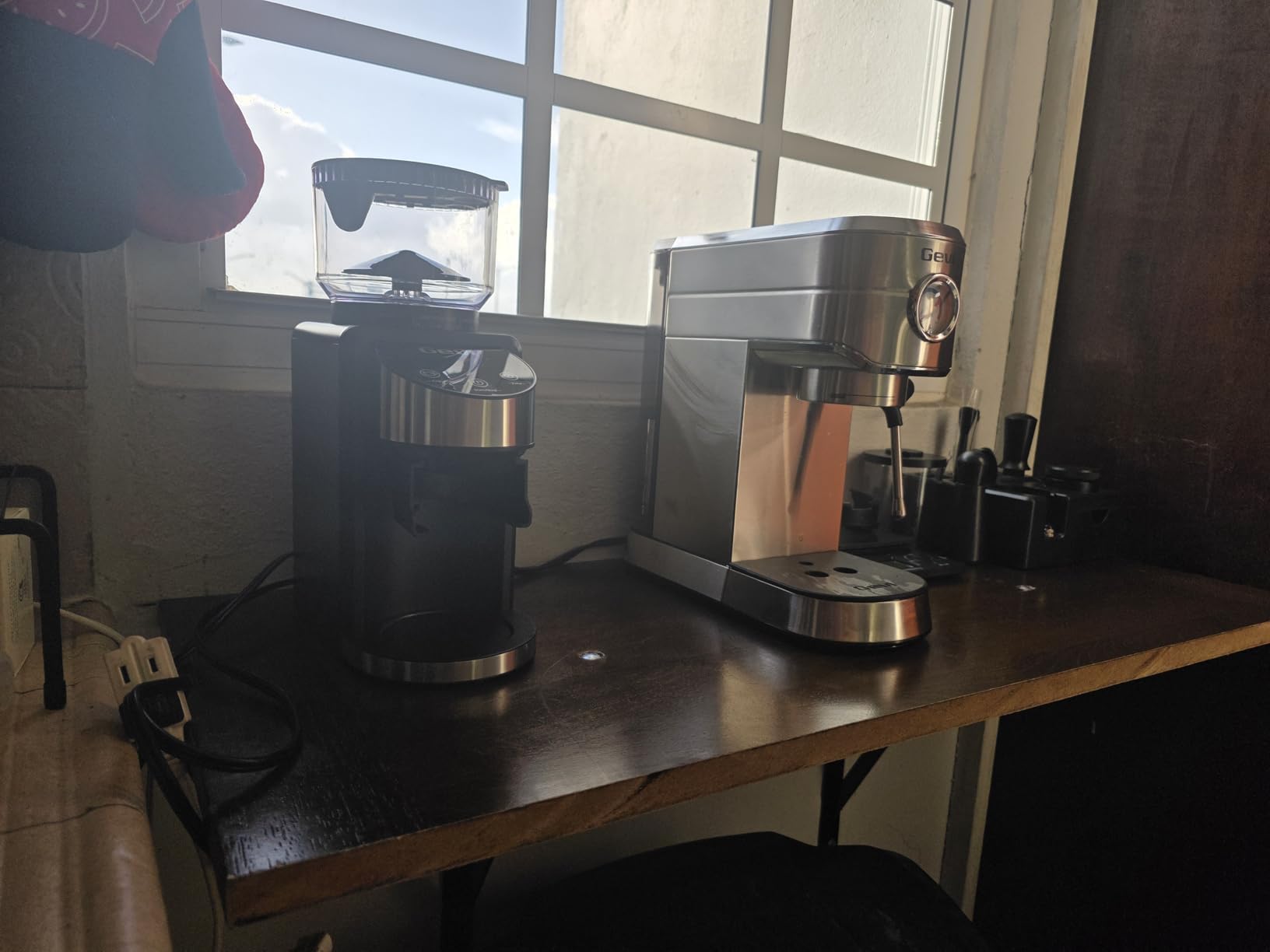
The steam wand is the reason for this ranking, and it comes with a removable froth nozzle that can be rinsed or soaked. Several owners report multi-year reliability, sometimes explicitly against machines that cost considerably more and failed sooner. The hot water function is a quiet extra for Americano, tea and warming cups, and the top surface works as a cup warmer even if it does not hold heat for long.
A 1 liter tank sits at the back, which is large for a compact machine and gives a household of two a comfortable margin between refills. Remember it fills from the top and the back, so leave a few inches of wall clearance behind it.
Why this suits a milk-drinking household
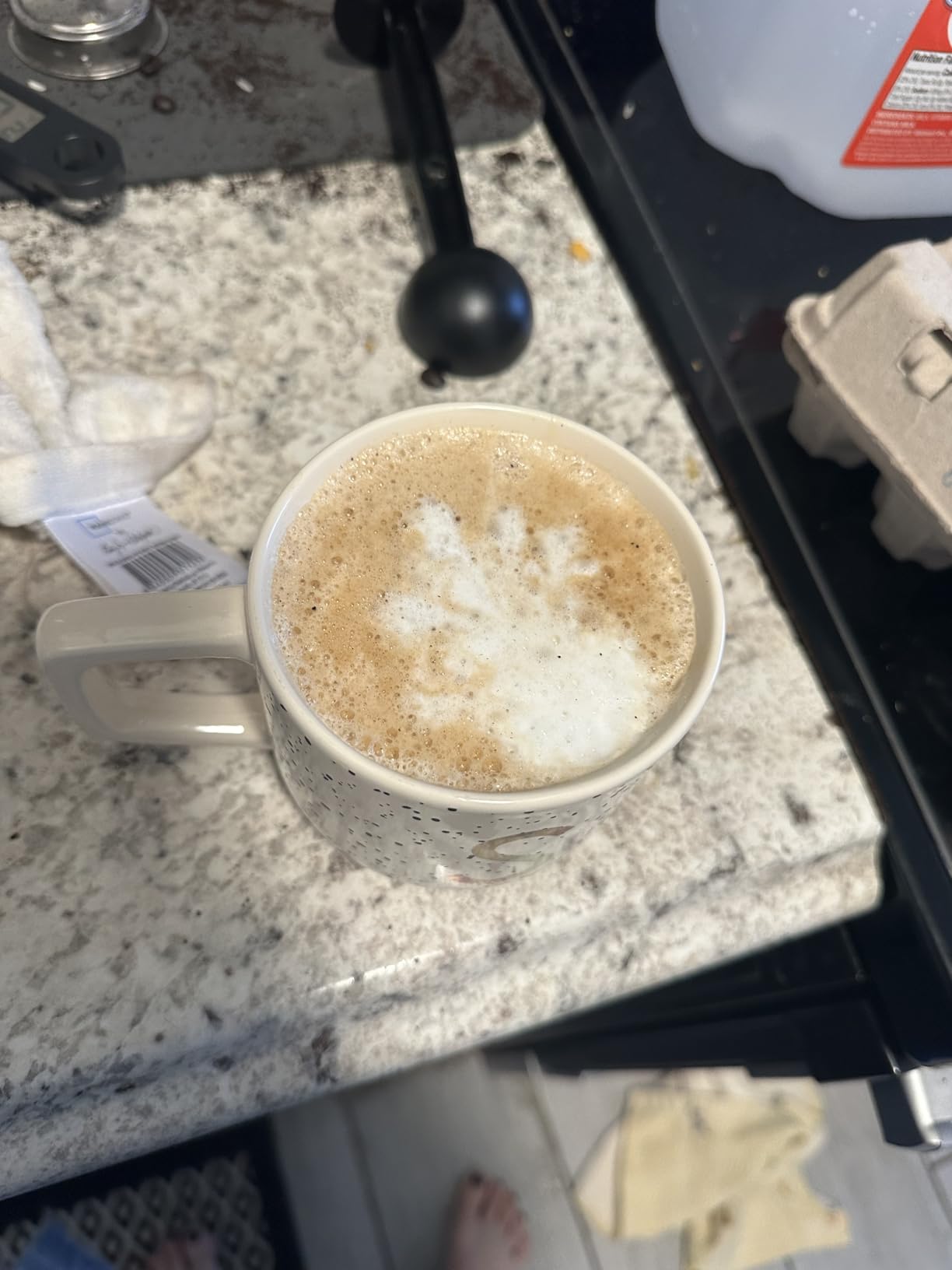
Milk texture depends on steam pressure and wand geometry, and the Gevi wand is the most capable in a machine this small. Reviewers describe it producing silky microfoam rather than the large, wet bubbles you get from an uninsulated wand, which is exactly what you need for latte art to hold together.
For a couple who both drink cappuccinos, the trade is worth making. A wand you have to learn is more satisfying than an auto-frother once you have the timing, and the gauge beside it tells you whether the shot itself behaved.
Where it gets on your nerves
The cool-down lockout after frothing is the biggest friction point in the reviews. The machine will not brew while the boiler is at steam temperature, so plan your order as froth first, wait, then pull. If you like a shot while the milk is still hot, this is a compromise.
The wand also takes roughly two minutes to come up to temperature and is noticeably loud, and the hot water function dispenses in spurts, so filling a six ounce Americano slowly is a test of patience. The polished stainless finish shows fingerprints after every pour, which is a small thing in a bright kitchen.
5. CASABREWS 3700 Essential: Best for Fewer Refills
CASABREWS 3700 Essential Stainless Steel Espresso Machine with Steam Wand
- Compact 5.7 inch width
- 43.9 oz tank rarely needs refills
- Fast heat-up time
- Removable tank and drip tray
- Two-plus years of daily use reported by owners
- Six colour options including black and cream
- No pressure gauge on this model
- Extraction can be finicky with fine grinds
- Steam dial can drift open and drop pressure
- Included plastic scoop and tamper feel flimsy
- Noisy frother and brew group
If refills are the thing you will resent, this is the machine to look at. The 43.9 oz tank is the largest capacity here by a wide margin, and paired with a fast heat-up it means a household of two or three can run several days before anyone walks to the tap. The body is 5.7 inches wide, so it sits in the same narrow zone as the CM5418.
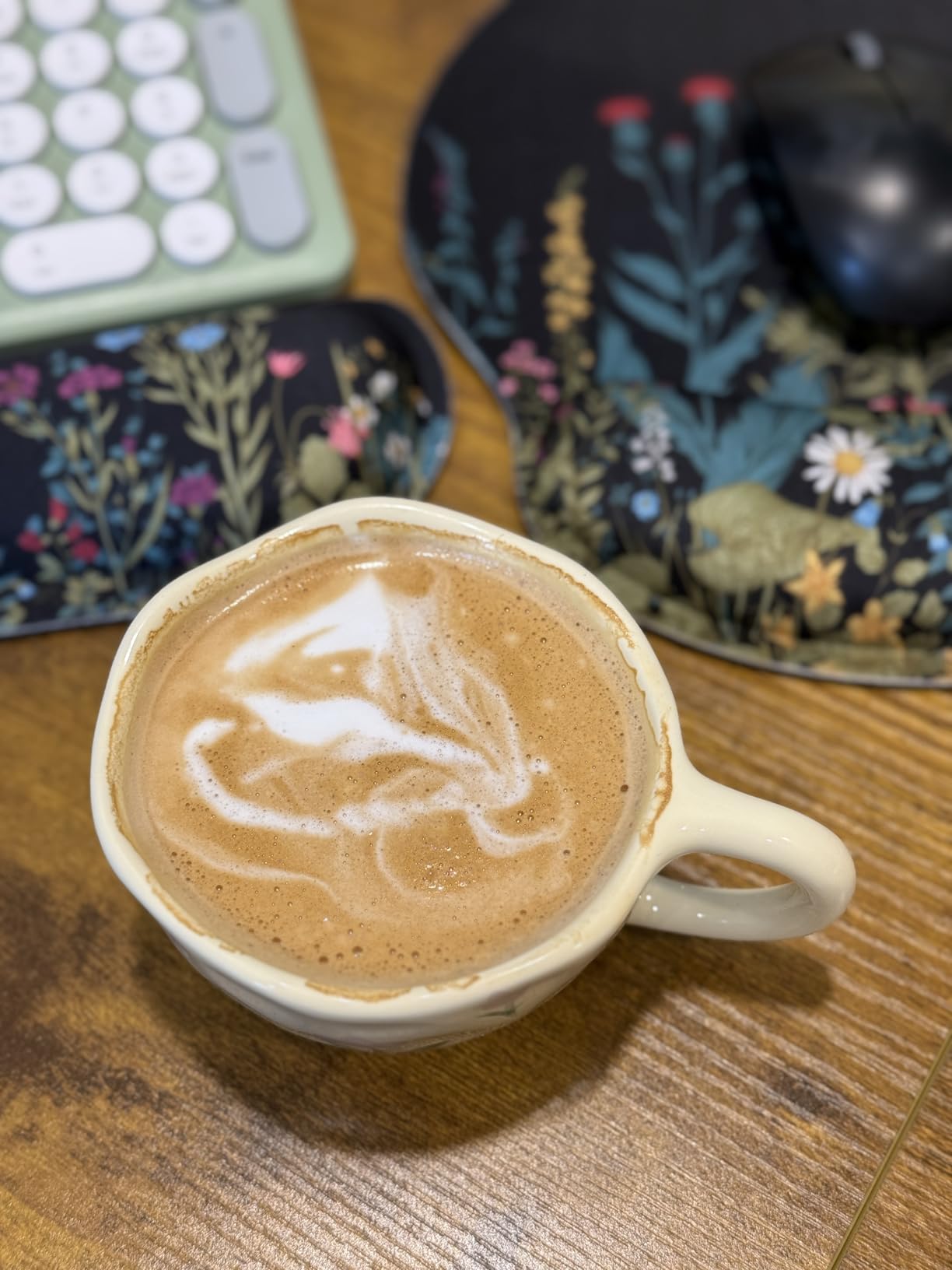
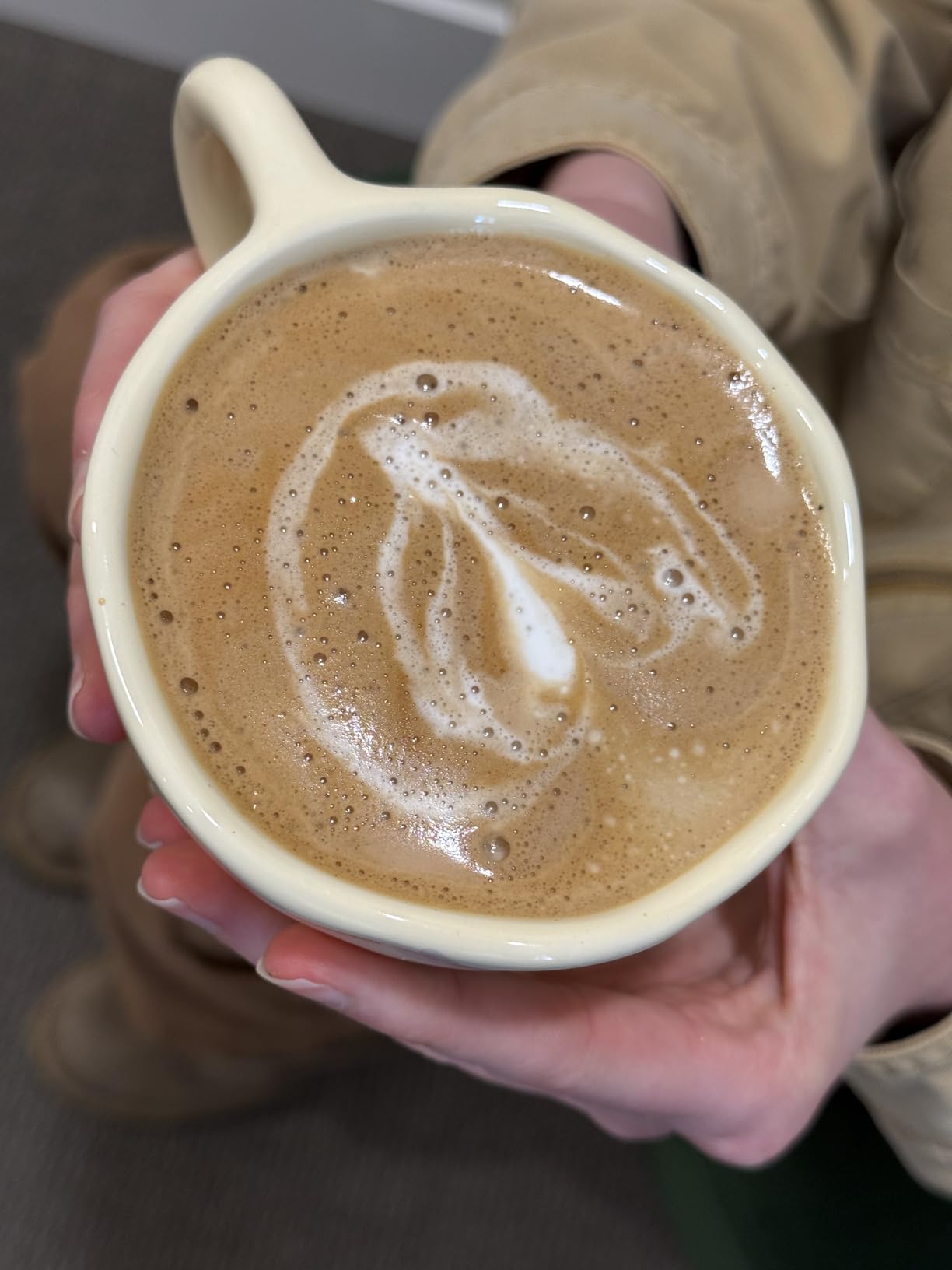
Under the hood it is a 20 bar pump with a 1350W heating system, which is a solid spec sheet for the size, and the steam wand handles cappuccinos and lattes adequately. Long-term owners describe two-plus years of daily use with no problems, and the removable tank and drip tray make the weekly clean painless.
Two things to know before you commit. First, there is no pressure gauge on this model, which is the single feature that separates it from the CM5418 in the same range. You are brewing blind, and the reviews reflect that: a meaningful minority find extraction inconsistent with fine espresso grinds and say the steam dial can drift open during a shot and vent pressure.
Second, there is a first-use cycle. A rubber plug under the tank base must be removed and a full tank run through before the machine brews properly. The user guide says so, most negative reviews do not, and the result is a machine that seems broken on day one.
What makes it a good small-kitchen fit
Tank capacity is a space decision disguised as a convenience one. A bigger reservoir means fewer interactions with the sink, so the machine can live further into the counter away from the tap, which buys back the few inches you needed for a prep surface.
The 5.7-inch body and removable drip tray also mean it can slide out for cleaning without being unplugged and moved around furniture. In a kitchen where the machine’s home is a corner it shares with the kettle, that is the feature that keeps it there for years.
Where it will let you down
Blind brewing is the honest drawback. If you like knowing why a shot tastes the way it does, choose the CM5418 instead and pay a little more attention to nothing at all. This machine asks you to accept the result.
Some owners report a burnt plastic smell on the first brews that clears after a full tank runs through, and the frother and brew group are noisy enough to startle you in a quiet flat. The supplied plastic scoop and tamper also get replaced almost immediately by most owners.
6. Breville Bambino: Best for Three-Second Heat-Up
Breville BES450BSS Bambino Espresso Machine, Brushed Stainless Steel
- Fastest heat-up in the group at three seconds
- PID control gives even repeatable temperature
- Automatic steam wand for hands-free microfoam
- 54mm portafilter sized for 19 gram doses
- Single wall baskets included for real dialing in
- Lowest average rating here at 4.0 with 16 percent one-star
- Heaviest unit in the group at 10.9 pounds
- 13.7 inch depth is the longest body here
- 47 oz tank is small for the size
The Bambino is included here because it is the machine most people will be comparing against, not because it wins on footprint. It measures 6.3 inches wide and 13.7 deep, which is the deepest body in this roundup, and at 10.9 pounds it is by far the heaviest. Measure twice on this one, especially the depth against your backsplash.
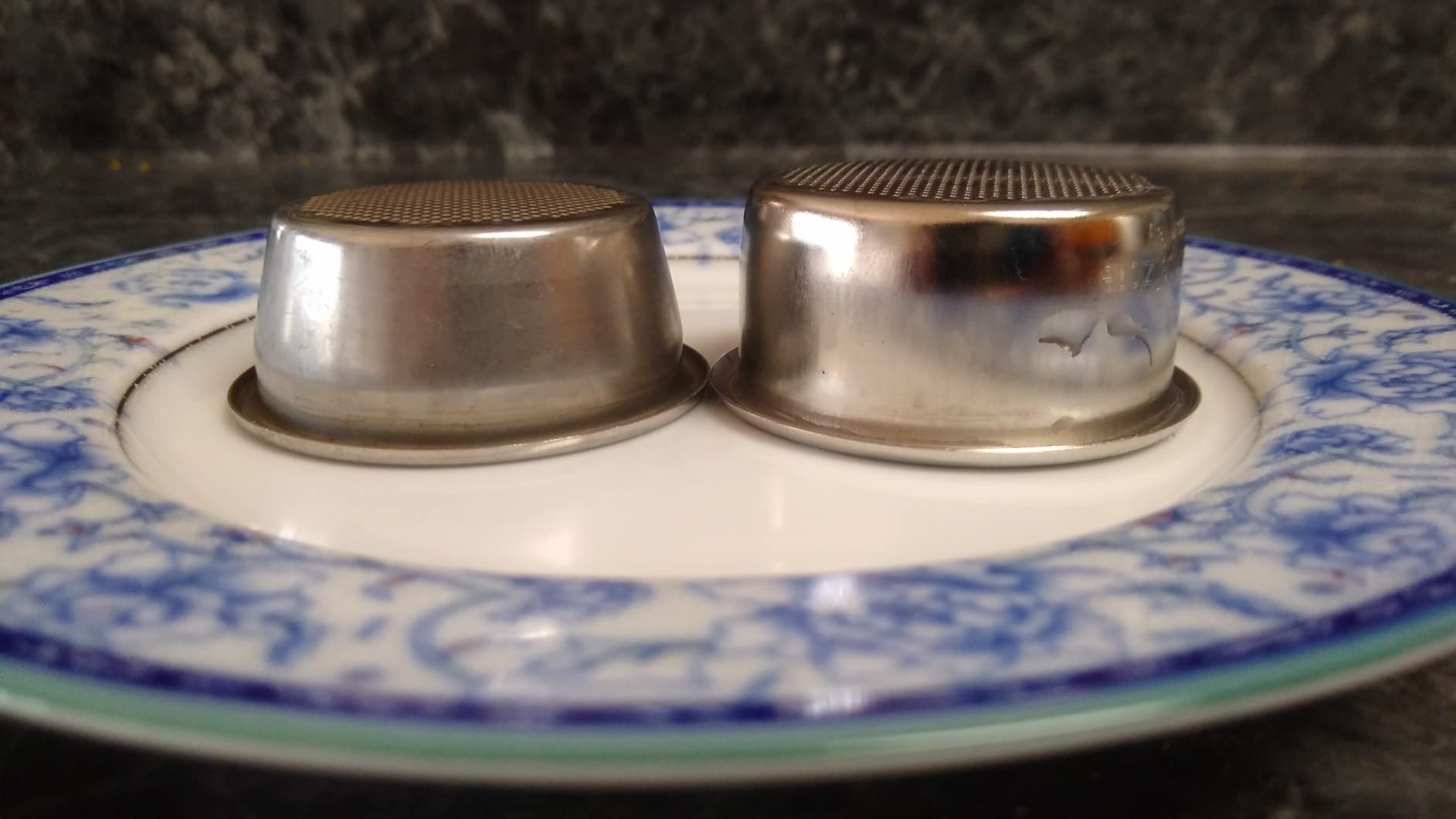
What you get for those extra inches is real engineering. ThermoJet reaches extraction temperature in three seconds, PID regulation holds that temperature evenly shot after shot, and low pressure pre-infusion ramps the pump in gently. The 54mm portafilter takes a proper 19 gram dose, and the box includes single wall baskets, which almost nothing else in this price bracket does. If you want to learn to dial in, this is the machine that teaches you.
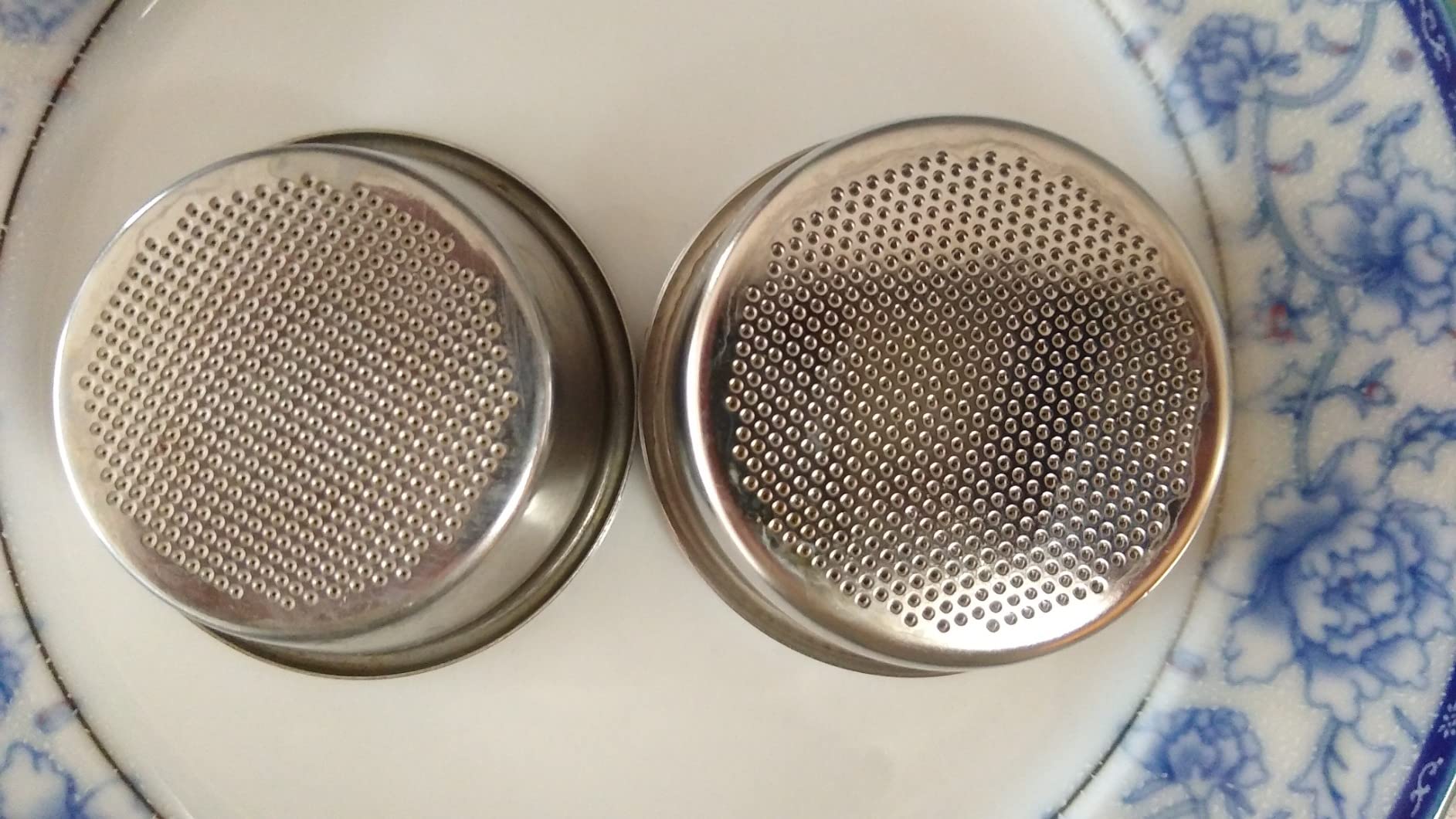
The steam wand is automatic rather than a bare manual wand, which means it heats and textures with hands-free operation at a controlled temperature. That is genuinely easier on a first attempt, and it removes one of the two skills you normally have to learn before a milk drink is any good.
The catch is the review record. At a 4.0 average it carries the lowest rating here and the largest one-star slice at 16 percent, and the pattern behind that is price sensitivity. Enthusiasts like the PID accuracy and the three-second heat; plenty of buyers feel the premium is not earned by the rest of the package.
When the Bambino is the right answer
It wins when your counter has depth but not much width, and when you want to move from decent shots to good ones. The PID system plus single wall baskets is the shortest learning path in this list, and the third wave 54mm portafilter is a genuine step up in shot quality from the 51mm baskets most of its competitors include.
It also wins if a second machine in the house already handles milk. In that case the automatic steam wand on the Bambino covers the occasional cappuccino without making it your primary tool.
When it is the wrong answer
When depth is the constraint, not width. Thirteen and a half inches of depth plus the three inches the portafilter needs to swing out is a big ask from a counter that is also hosting a toaster. Add a separate grinder to that same line and the arithmetic stops working.
It is also the heaviest thing here at 10.9 pounds, which matters more than it sounds in a kitchen where the machine gets moved for cleaning or where someone with limited strength shares the cooking. The 47 oz tank is also modest for the body size, so expect more than one refill a day in a busy household.
7. IMUSA 6 or 3 Cup Espresso Maker: Budget Pick for Moka-Style Coffee
- Highest average rating in the group at 4.6 with an 85 percent five-star share
- Smallest and lightest machine here at 2.8 pounds
- Under 5 inches wide
- Switchable 3 or 6 cup capacity
- Heats fast and makes strong coffee with good crema
- No steam wand so no lattes or cappuccinos
- Heating element and seals reported to fade after about two years
- Listed at 230V so it needs a converter on 120V mains
- Outputs a carafe rather than single shots
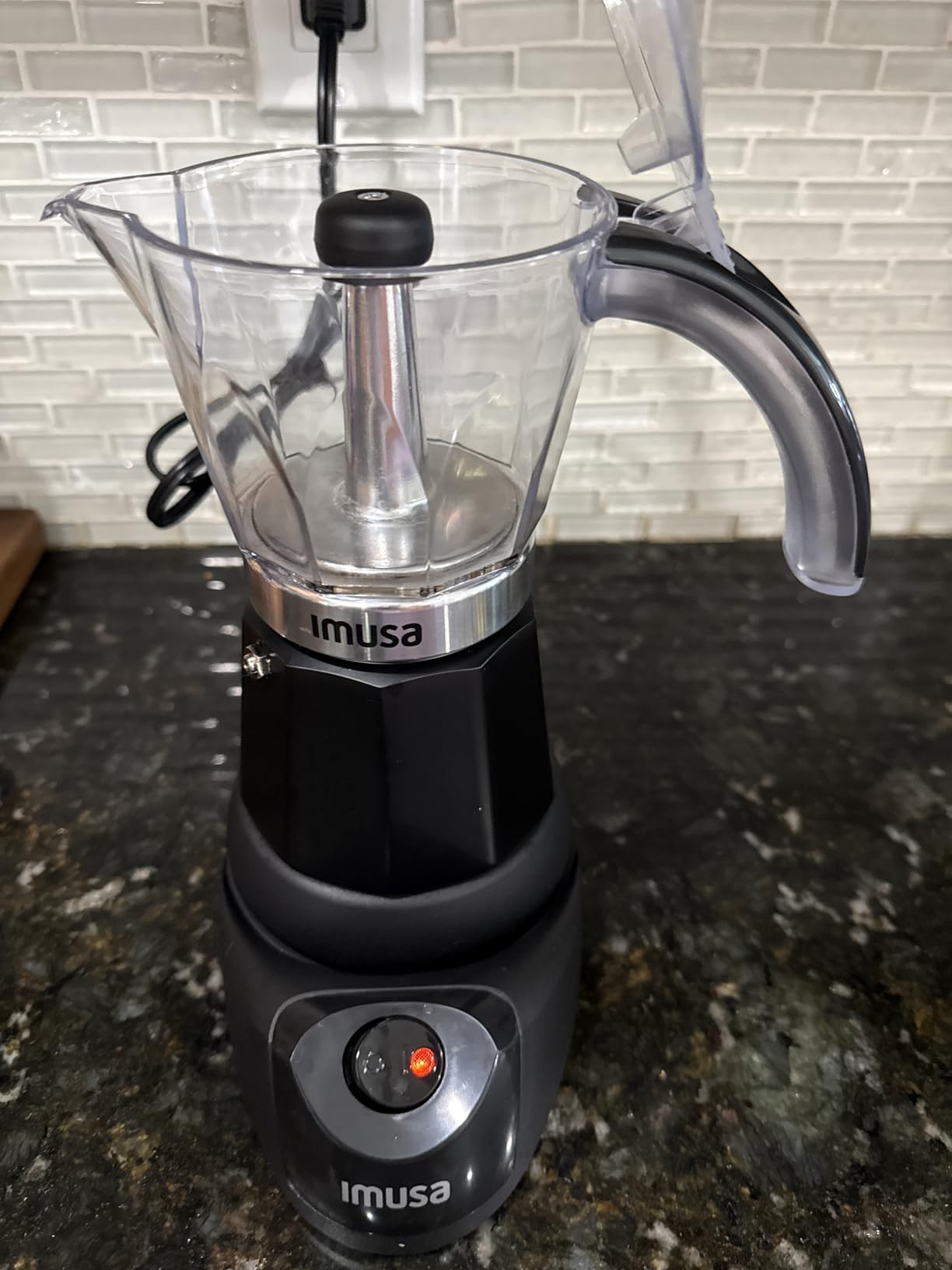
Let’s be clear about what this is. The IMUSA is not a pump espresso machine and does not pretend to be one. It is a small electric moka-style maker with a 230 watt heating element and an aluminum body, and it makes Cuban, Italian and Moka style coffee in a carafe rather than pulling one-ounce shots.
For the right person that is exactly the right tool. At 4.72 inches wide, 9.3 tall and only 2.8 pounds, it is the smallest and lightest thing in this roundup by a distance, and it will happily live in a dorm room, an office kitchenette, a van or a corner of a counter that could never take a 9-inch machine. It heats quickly and produces a strong drink with a visible crema layer, and owners buy it again for friends, which is a good sign in itself.
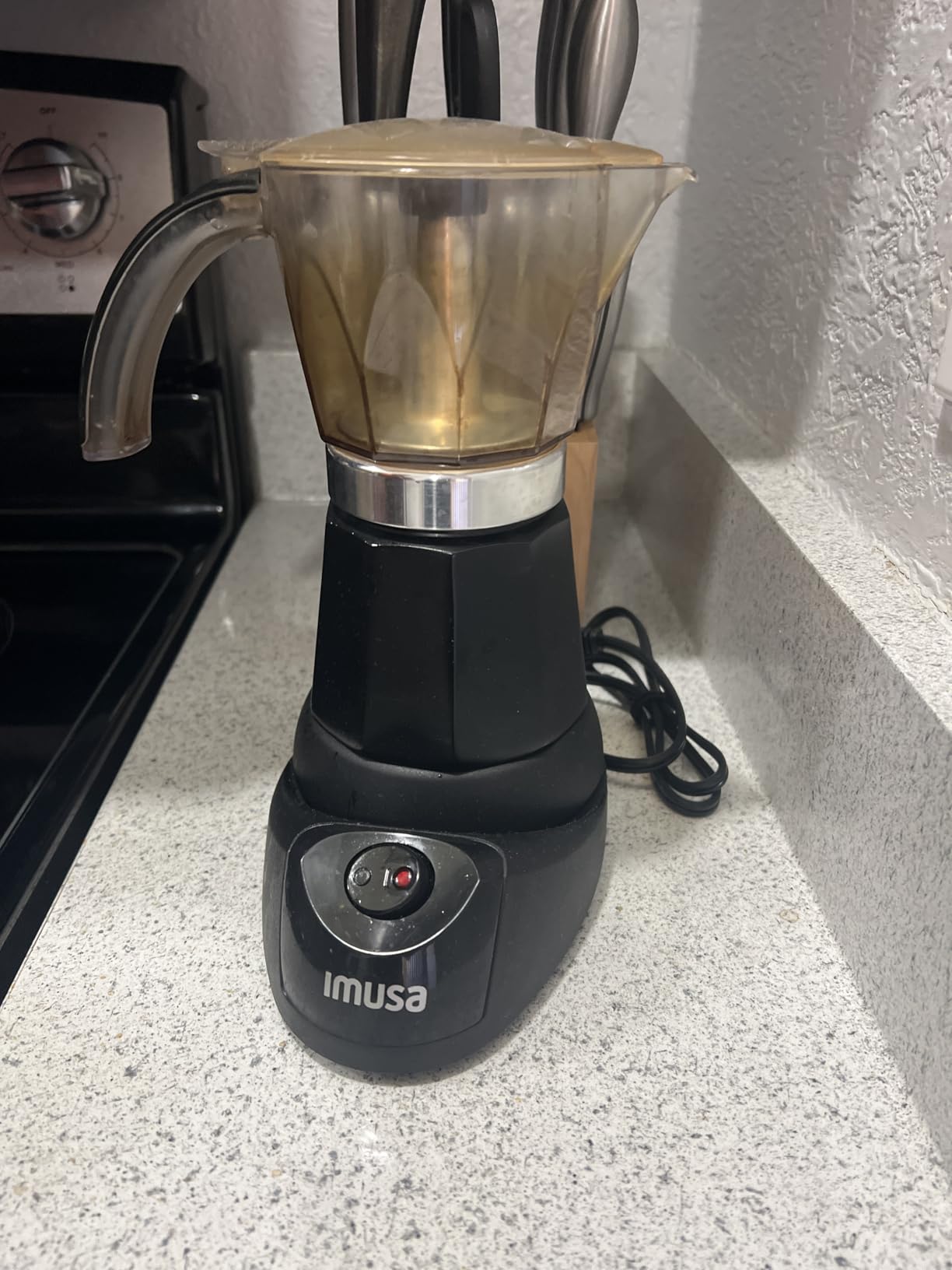
It also ties for the highest average rating in the group at 4.6, with an 85 percent five-star share across 2570 reviews. That is not a claim that it makes better espresso than the Bambino. It is a claim that people buy it for what it is and are rarely disappointed, which is a rarer thing in this category than it should be.
The switchable 3 or 6 cup capacity is the detail that makes it work for one person, and the detachable base with a cool-touch handle means pouring is safe and cleaning is a rinse rather than a project. It is also the easiest machine here to store in a cupboard between uses.
Where this budget pick actually wins
Space, decisively. There is no accessory chain, no water reservoir to leave on the counter, no grind to think about. If the real constraint is a 6-inch gap above a mini fridge or a fold-down table in an office, this is the only machine on the list that genuinely fits the brief.
It is also the right first machine for anyone who wants to know whether they care about espresso at all before spending real money on accessories. If a pot of strong coffee from this satisfies you, you have just saved the cost of a grinder.
Where it is not an espresso machine
There is no steam wand, so milk drinks are not possible in any form. And the expected lifespan of the heating element and seals is around two years of daily use according to owners, which means you should treat it as a replaceable appliance rather than a keeper.
One practical warning: the unit is listed at 230V AC, so on 120V mains in the US and Canada you need a step-down converter and should confirm the voltage before ordering. Its output is a carafe of small coffees, not individual shots, so it does not fit a workflow built around one cup at a time.
8. Neretva 20 Bar Super Compact: Best for Visible Temperature Control
Neretva 20 Bar Espresso Machine Super Compact Espresso Coffee Machine
- On-machine temperature display for real dialing in
- Pre-infusion reduces channeling
- 20 bar pump with a stainless steel body
- Steam wand supports latte art and dense foam
- 12 hour customer service commitment
- Listed weight of 17 pounds is heavy for a super compact claim
- 12 inch width is far wider than the rest of this list
- Only pressurized filters are included
- Smallest review base in the roundup
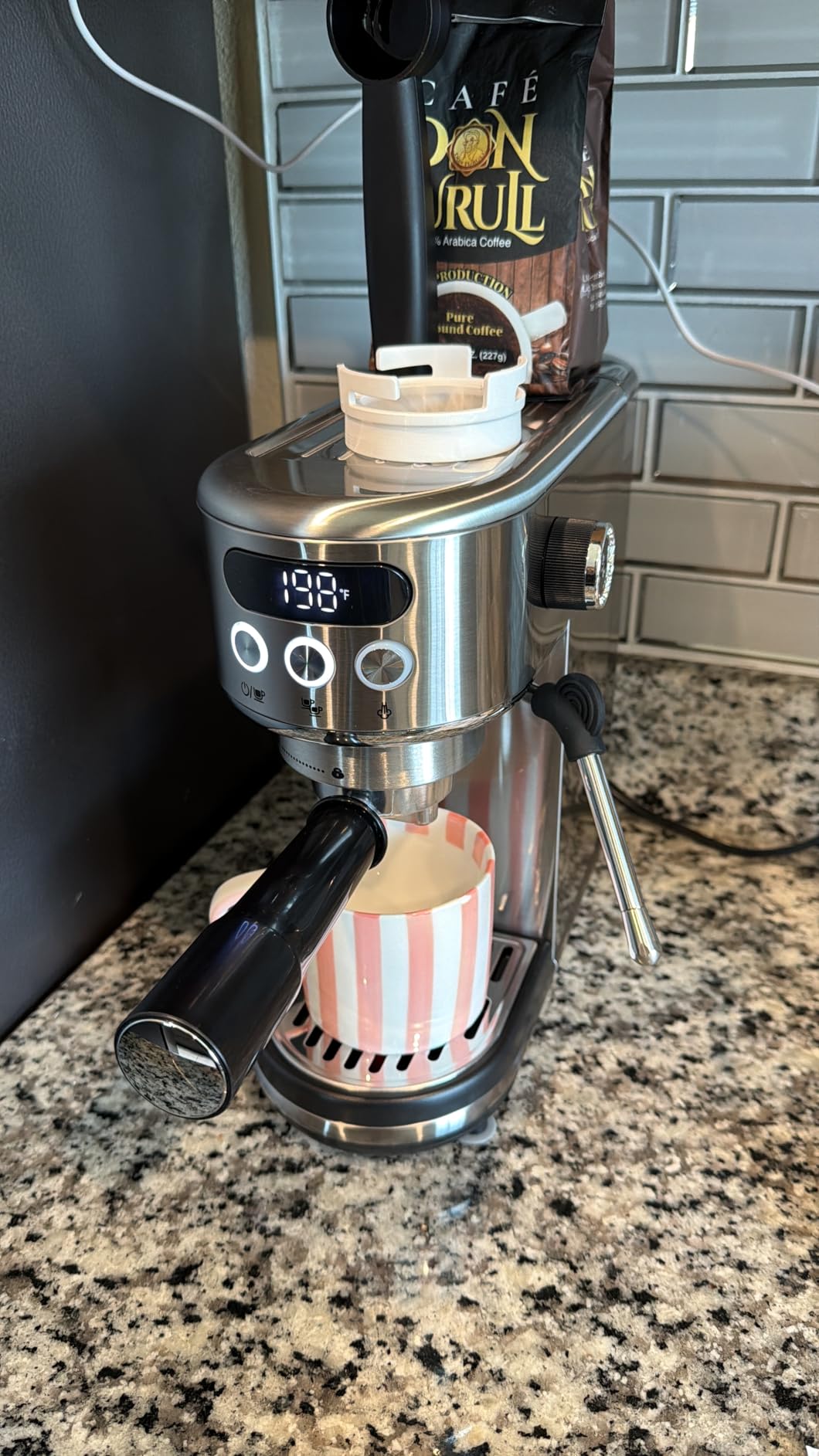
This is the machine I would put in front of someone who wants to understand brewing, because it shows its working. There is a temperature display on the machine itself, backed by 20 bar pressure and a 1350W boiler, and low pressure pre-infusion is included to reduce channeling. Few machines this size tell you the water temperature while they run.
It is also, on paper, the most capable extraction package in a small body. A 1.3 liter tank is the second largest here, there is a cup warmer on top, and the steam wand is described by reviewers as capable of dense foam and latte art. At 4.4 across 1330 reviews, the sentiment is solidly positive with a 74 percent five-star share.
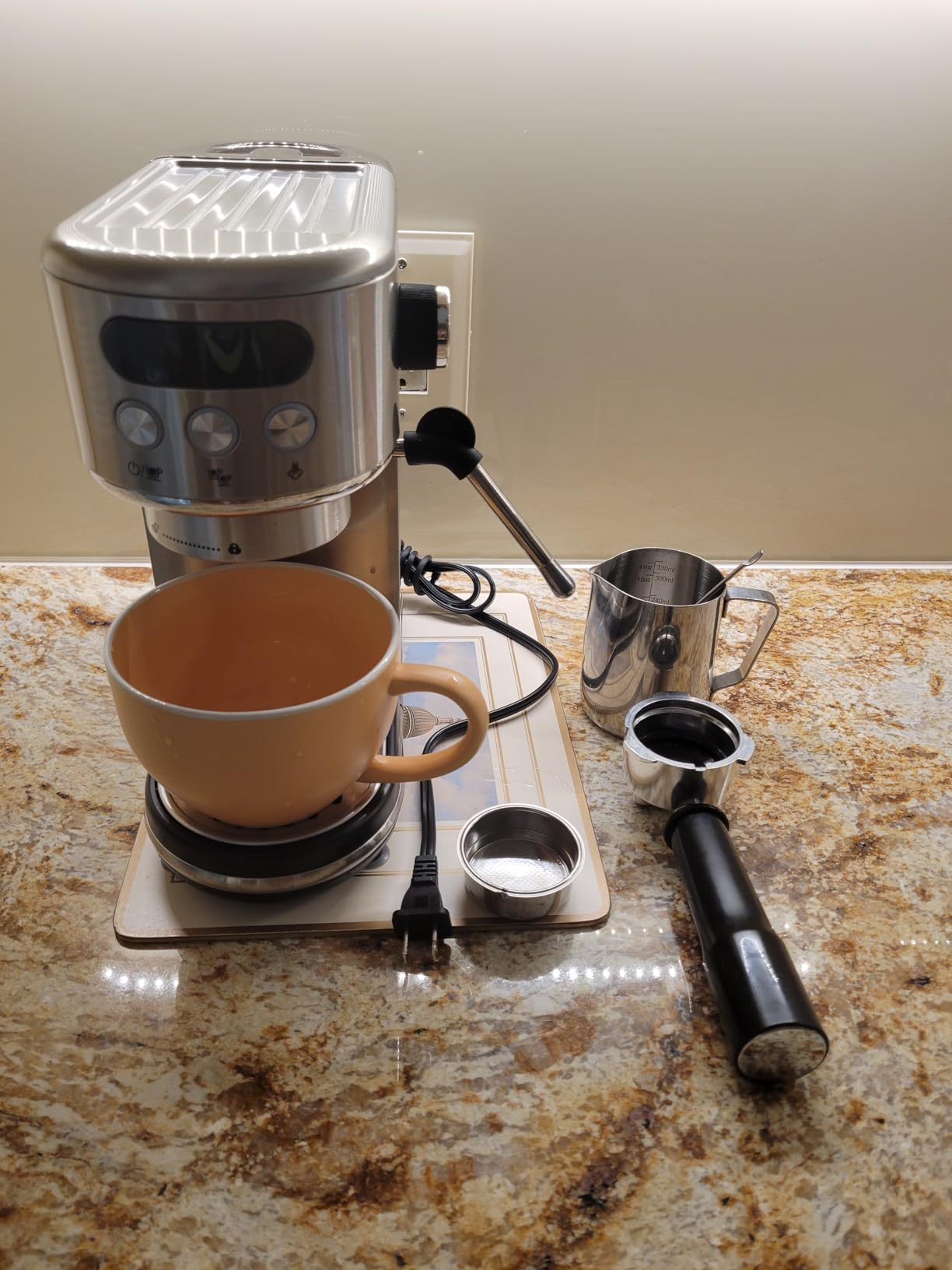
Now the problem, and it is a real one for this article. The listed dimensions are 12 inches wide, 11 deep and 9.1 tall, and the listed weight is 17 pounds. That is wider than everything else in this roundup combined with the CM5418, and it is not a machine you will slide around a counter. The slim depth is genuine, the width is not compact by any definition used here.
So treat it as a special case. If your kitchen has a shallow, wide niche and you want visible temperature control more than you want minimal width, it is a strong buy. If you are optimising for inches, the atatix and the CM5418 are the correct answers at 5 and 5.47 inches.
What the temperature readout buys you
Knowing the water temperature is the difference between adjusting and guessing. When a shot runs fast and thin you can see whether the boiler is hot enough; when it runs slow and bitter you can check whether the machine is still recovering. For a beginner, that turns a frustrating loop into a short one.
Pre-infusion matters at this size too. Starting at low pressure and ramping up reduces channeling, which is the most common reason small machines produce channel-dripped, uneven shots on a beginner’s first attempt.
Why we would not put it on a narrow counter
The 12-inch width is the whole argument. In a kitchen where the binding constraint is horizontal space, a 12-inch machine is not a compact option, it is a large one with a small footprint in only two directions.
The 17-pound listed weight is the second concern, because it means the machine cannot be moved for cleaning without real effort, and it sits heavily on any shelf you choose. The included baskets are also pressurized only, which limits how much of that temperature control you can actually exploit without buying a bottomless basket.
9. atatix 20 Bar Milk Frother Machine: Best for the Narrowest Pump Body
atatix Espresso Machine with Milk Frother, 20 Bar Pressure Espresso Maker
- Narrowest 5 inch body among the pump machines
- 20 bar system holds 9 to 10 bar through the shot
- 30 second preheat with NTC control
- Manual extraction mode for custom yield
- Silicone feet keep it steady
- 45 oz tank
- Replacement shipped within a day for one owner
- Higher price than most 20 bar compact rivals
- Instructions reported to be incomplete
- Double shot funnel holds less than the nameplate suggests
- Newer brand with the smallest review base here
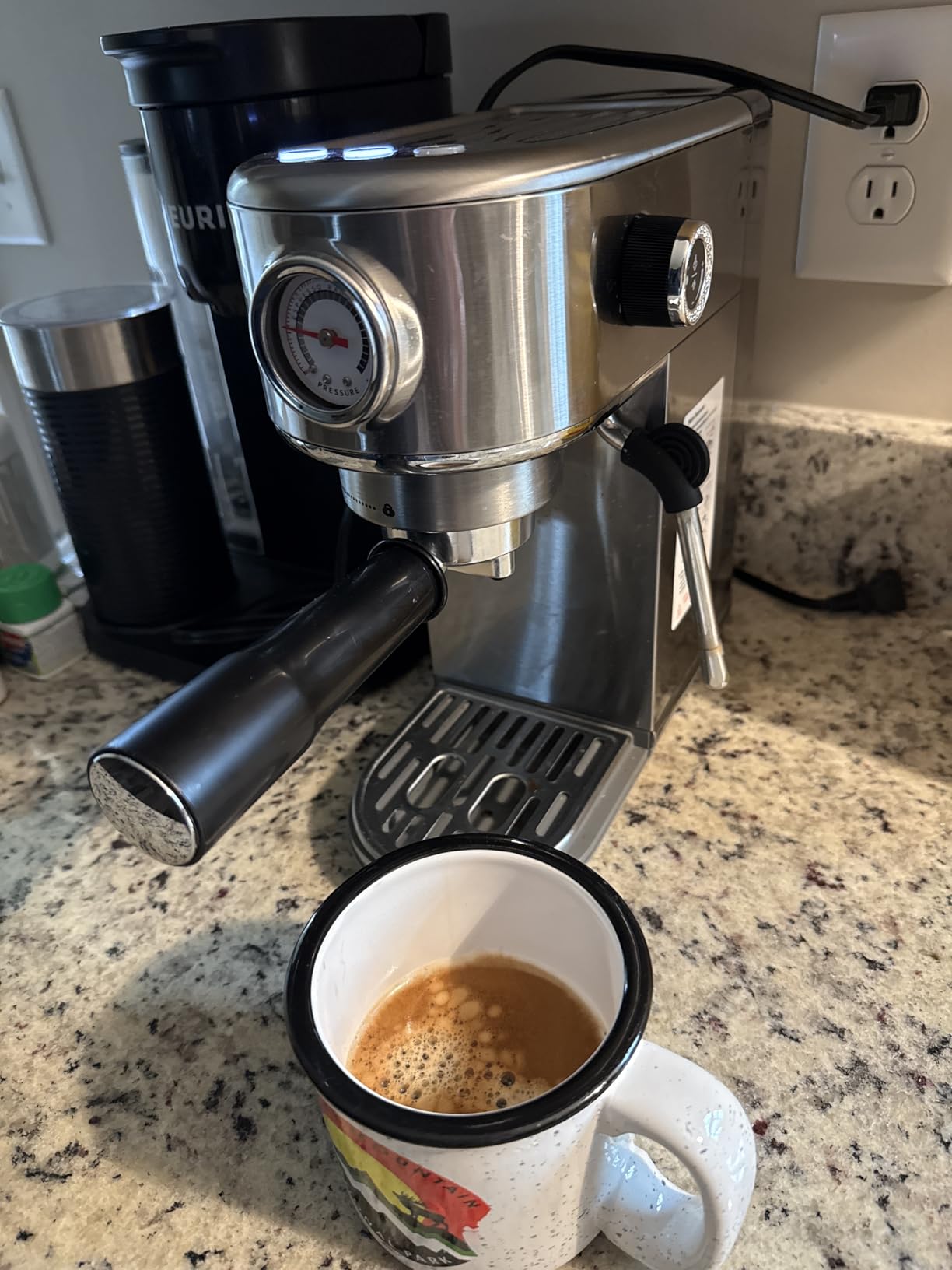
The atatix is 5 inches wide, which makes it the narrowest machine in this roundup that still uses a real pump and a portafilter. Everything else about it is designed around that: a 12-inch depth, an 11-inch height, a 7.5-pound weight and silicone suction feet on the corners so it does not walk across the counter while you steam.
Extraction is the surprise. The 20 bar system is described as holding 9 to 10 bar through the shot rather than peaking at 20 and dropping, which is the metric that actually predicts crema quality. NTC temperature control preheats in about 30 seconds, and there are automatic 28 second single and 42 second double cycles alongside a manual mode that runs up to 102 seconds if you want to push a longer yield.
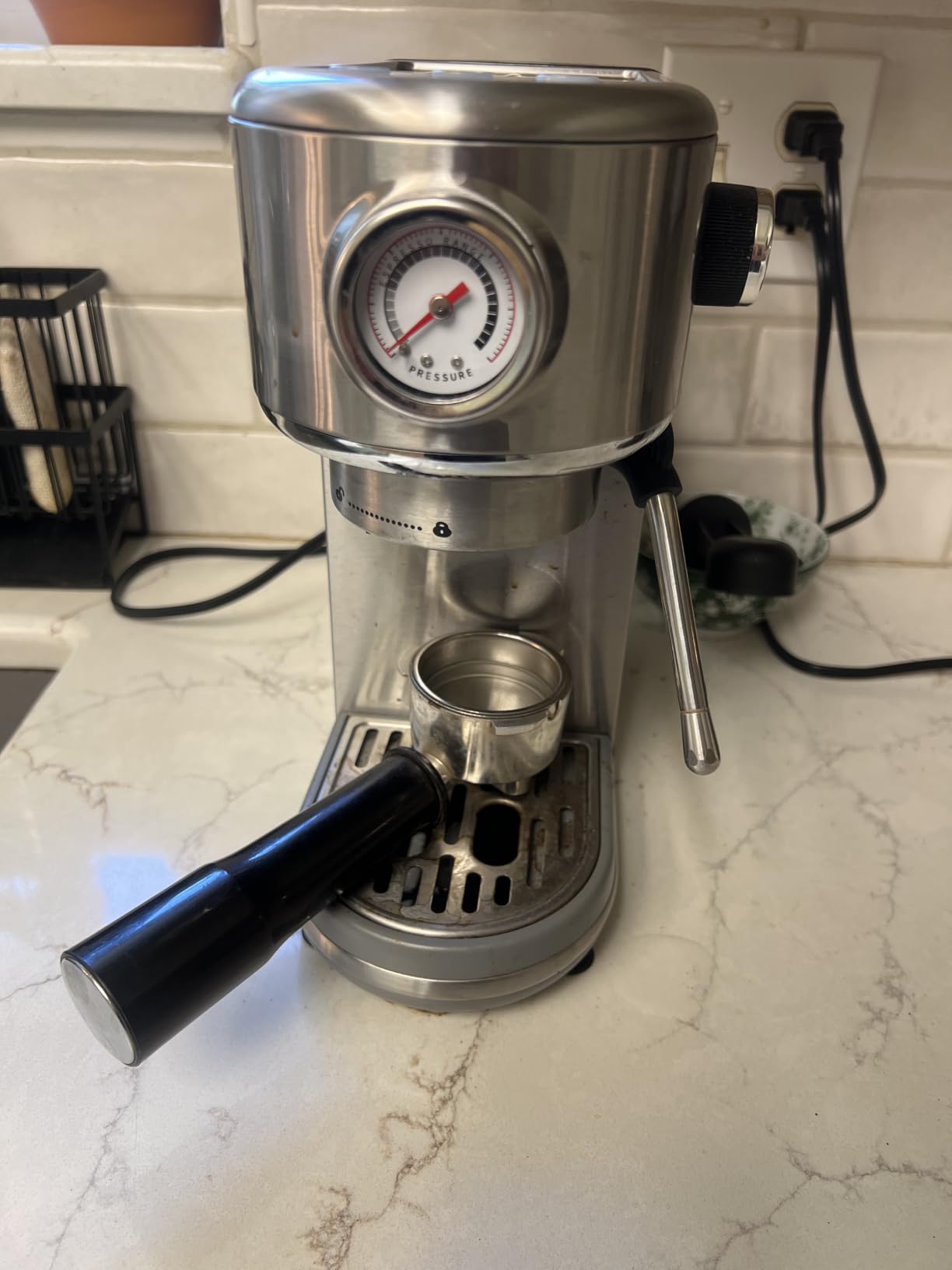
The steam wand is reported to produce dense, glossy microfoam, and the 45 oz detachable tank is the second largest here, so refills are rare. The stainless steel top cover doubles as a cup warmer. Owners also mention responsive support, including one replacement shipped within about a day, which matters when a brand this new is still building a service history.
The 1.2 liter tank fills from the top, so plan for a few inches of clearance behind it. There are eight colour variants, which is unusual in this bracket and useful if you want the machine to disappear into a scheme rather than announce itself.
Why 5 inches is the number to know
Once you are shopping pump machines, the width spread across this roundup is 5 to 5.7 inches, and that difference decides whether a scale and a milk pitcher sit beside the machine or on a different surface entirely. At 5 inches you can keep the whole workflow in a 12-inch zone including the clearance the portafilter needs.
The manual extraction mode is also genuinely useful. Automatic cycles are convenient, but being able to hold the button longer for a lungo-style yield is how a beginner learns to taste the difference between under-extracted and pulled properly.
Where it falls short
The documentation is the most reported problem, with owners saying they had to infer several first-time steps. Read the guide before you plug it in rather than after your first bad shot. The double shot funnel also holds less than the 16 gram nameplate suggests, so grind a little extra for a full double.
It also carries the highest one-star share in the group at 12 percent, and with 1019 reviews it has the smallest review base here, which means less long-term evidence about durability than the Stilosa or the CM5418 offer. Budget accordingly if you want the narrowest body and care most about how the machine ages.
How Much Counter Space Does an Espresso Machine Really Need?
The honest answer is two to three times the width printed on the box. A 5.5-inch machine needs roughly three inches of clearance in front for the portafilter to come out and be rinsed, two inches to the side for the steam wand to swing without hitting a wall, and a landing zone for a knock box, a scale, a tamper and a milk pitcher. Add a separate grinder, and a compact setup can occupy 14 inches of a counter you thought you had eight.
That is the arithmetic behind the layout advice below. None of these tactics require a bigger kitchen, they just move the work somewhere the machine is not.
Start at the end of the counter. The space beside a wall or a window is usually unusable because the machine needs a side clearance for the wand and you need to stand in front of it, so the far end of a run is the least costly 12 inches in most kitchens.
Consider an integrated machine. Every machine without a built-in grinder adds 5 to 7 inches of counter and a second appliance to dust. If the machine will be used daily, paying for one that grinds internally often costs you nothing in total footprint.
Build the coffee corner beside the sink. A refilling routine that crosses the kitchen three times a day is the reason people stop using their machines, and the shortest distance from tank to tap is the highest-return inch you can claim.
Turn a shallow niche into a coffee station. A recess between cabinets is often unusable for a toaster but perfect for a narrow machine, because the depth limit there is usually generous and the surrounding cabinet keeps the counter visually clear.
Use a rolling cart when counter space is effectively zero. A slim cart against the wall of a galley kitchen gives you a working surface, and the machine comes off it entirely when you need the space for a meal. This is the standard answer in studio apartments and it is the one most small kitchens never try.
Store accessories vertically. A wall rail or a hook strip behind the machine holds the tamper, baskets, a knock box and a dosing funnel in a few square inches of vertical space that a counter never had. Keep beans in a separate airtight container away from the machine, since a grinder or hopper is the fastest route to a stale bag.
Add a fold-out or temporary preparation surface. A slim board over the sink, a drop-leaf table, or a cleared stretch of counter while the kettle is still boiling gives you the working area that the machine itself never provides. Compact kitchen problems are usually prep problems wearing a different hat.
What to Measure Before You Buy
Take five measurements before you order anything, and do them with a tape rather than by eye. Almost every fit problem we see is a two-inch problem that looked like four on a screen.
Usable depth from the backsplash. Measure from the wall or tile to the front edge of the counter, not the total counter depth. Subtract three inches for the portafilter swing on any machine with a portafilter, and add it back only if you plan to store the machine away between uses.
Worktop to cabinet clearance. A machine plus a milk pitcher needs about 14 inches of vertical space, and a bean hopper adds two to three more. A machine that fits perfectly on an open counter can refuse to go under a cabinet that looks generous in a photo.
Side clearance for the steam wand. A wand swung out and down occupies about two inches to the right of the machine. In a corner with a wall there, that is the difference between a comfortable frothing position and a machine you will only use for espresso.
Overhead hopper clearance if you buy a grinder. An integrated hopper needs the cabinet above to be higher than the machine by at least three inches, and the top of the hopper must be removable, so a tight cabinet that is 2 inches too low rules out the machine entirely.
Water tank access. Look at whether the tank lifts out from the front, the top or the back. A back-loaded tank in a 12-inch-deep counter means you pull the machine forward every time, and in a tight gap there may not be enough room to do that without moving the kettle.
Finally, measure the machine plus its accessories, not the machine. Write down the width of your grinder, your scale and your knock box, line them up, and add them. That total is the number that decides whether your coffee station is a convenience or a daily negotiation.
How to Choose a Compact Espresso Machine
Start with machine type, because it sets everything else. A super-automatic does the whole job and needs a removable brew group you can rinse; a semi-automatic gives you a portafilter and a steam wand and asks for technique; a pod machine gives you one-touch consistency and no milk wand; a lever or manual maker gives you involvement and almost no automation. In a small kitchen the deciding factor is usually how much attention you want to give a machine parked in your sightline every morning.
Next, pressure. Fifteen bar is the common entry figure and 20 bar is nearly universal in this class, but the number on the box is a peak, not a working pressure. What predicts quality is whether pressure holds steady through the shot, and a machine with a visible gauge lets you check instead of trusting the label.
Grinder decisions come next. None of the nine machines here has a built-in burr grinder, so plan for a separate one, which adds 5 to 7 inches of counter. That single fact is the strongest argument for a pod machine in a truly tiny kitchen and the strongest argument for a manual maker in a slightly larger one where you already have a grinder.
Milk system deserves its own line in the budget. A manual steam wand costs nothing extra and rewards practice. An automatic wand costs money and saves skill. A machine with no wand at all, like the Essenza Mini or the IMUSA, simply rules out every drink that is not black.
Water capacity is a household-size question. The 110ml tank on the Essenza Mini suits one or two drinks a day; the 43.9 oz and 45 oz tanks on the CASABREWS 3700 and the atatix suit two to three people without daily refills. Check that the tank lifts out from a position you can actually reach.
Cleaning and descaling decide whether a compact machine stays in a small kitchen or gets pushed to the back of a cupboard. Look for a removable drip tray, a backflush cycle, and a tank that you can descale without moving the machine. A machine that must be carried to a sink to be cleaned is a machine that stops being used within a year.
Build quality and long-term support are the last filter, and they are the one most buyers skip. Stainless steel housings outlast plastic shells in our experience, and a machine with a one-year warranty and a known parts supply is a better ten-year bet than a cheaper one with neither. The Stilosa and the Gevi are the two here that answer this question most clearly.
Frequently Asked Questions
What is the best small, compact espresso machine?
The De’Longhi Stilosa is our best overall pick because it combines a 9.45-inch body, a stainless steel boiler and a manual steam wand with the largest review base in the group. If you want no technique at all, the Nespresso Essenza Mini is the highest rated at 4.6 and weighs just 4.4 pounds.
What is the best espresso machine for a small space?
The atatix has the narrowest pump machine body here at 5 inches wide, and the CASABREWS CM5418 is close behind at 5.47 inches with a pressure gauge. If you need zero technique, the Nespresso Essenza Mini is 4.33 inches deep and lifts out with one hand. Measure usable depth from the backsplash, not total counter depth.
Is DeLonghi or Breville better?
For a small kitchen, De’Longhi’s compact machines are generally the better fit because they are narrower and lighter, and the Stilosa has a far larger review base and a stainless steel boiler. Breville’s Bambino is 6.3 inches wide and 13.7 inches deep at 10.9 pounds, but it adds PID temperature control, a 54mm portafilter and a three-second heat-up that De’Longhi’s compact range does not offer.
How much counter space does an espresso machine really need?
Budget two to three times the printed width. A 5.5-inch machine needs about three inches in front for the portafilter, two inches to the side for the steam wand, and space for a knock box, scale and milk pitcher. Adding a separate grinder adds another 5 to 7 inches, which is why total footprint matters more than the machine’s stated width.
Do I need a separate grinder for a compact espresso machine?
None of the nine machines in this roundup includes a built-in burr grinder, so a separate grinder is the normal arrangement. It adds 5 to 7 inches of counter and a second appliance to clean. If your total working zone is under 14 inches, a pod machine like the Nespresso Essenza Mini removes that line item from the calculation entirely.
Which espresso machine is the most durable?
The De’Longhi Stilosa has the strongest durability evidence in this group, with roughly 13800 reviews at a stable 4.2 average, a stainless steel boiler and listed five-year spare part availability. The Gevi 20 Bar Compact is the next most credible, with several owners reporting multi-year reliability. Cheaper 230 watt makers such as the IMUSA have heating elements and seals that owners report fading after about two years of daily use.
Can a compact espresso machine make latte art?
Yes, if it has a steam wand. The Gevi 20 Bar Compact and the CASABREWS CM5418 are the two in this roundup whose wands reviewers describe as producing silky, dense microfoam suitable for latte art, while the Breville Bambino’s automatic wand does it hands-free. The Nespresso Essenza Mini and the IMUSA maker have no wand at all, so milk drinks are not possible with them.
How often do I need to descale a compact espresso machine?
It depends almost entirely on your water, not the machine. A machine in a hard-water area will need descaling far more often than one fed by filtered water, and small footprint machines are usually installed in the least convenient spot for a soak. Choose a model with a removable drip tray, a backflush cycle and a tank you can descale without pulling the machine forward, such as the CASABREWS CM5418 or the Gevi.
The Verdict on the Best Compact Espresso Machine for Small Kitchens
Measure your usable depth from the backsplash before you fall for any width number, then buy the machine that fits that zone with three inches to spare. For most small kitchens the De’Longhi Stilosa is the answer, because its 9.45-inch body, stainless boiler and five-year parts commitment make it a machine you can keep rather than one you cycle out of.
If technique is not something you want to learn, the Nespresso Essenza Mini is the strongest consensus pick in the group at 4.6 stars, and it is the smallest thing we tested. If you want a real milk wand and a visible pressure gauge under 6 inches wide, take the CASABREWS CM5418. The atatix goes one inch narrower still if every tenth of an inch matters.
Whatever you choose, plan the total footprint, not the machine, and keep the best compact espresso machines for small kitchens list in 2026 bookmarked for the day your counter gets reorganised.