
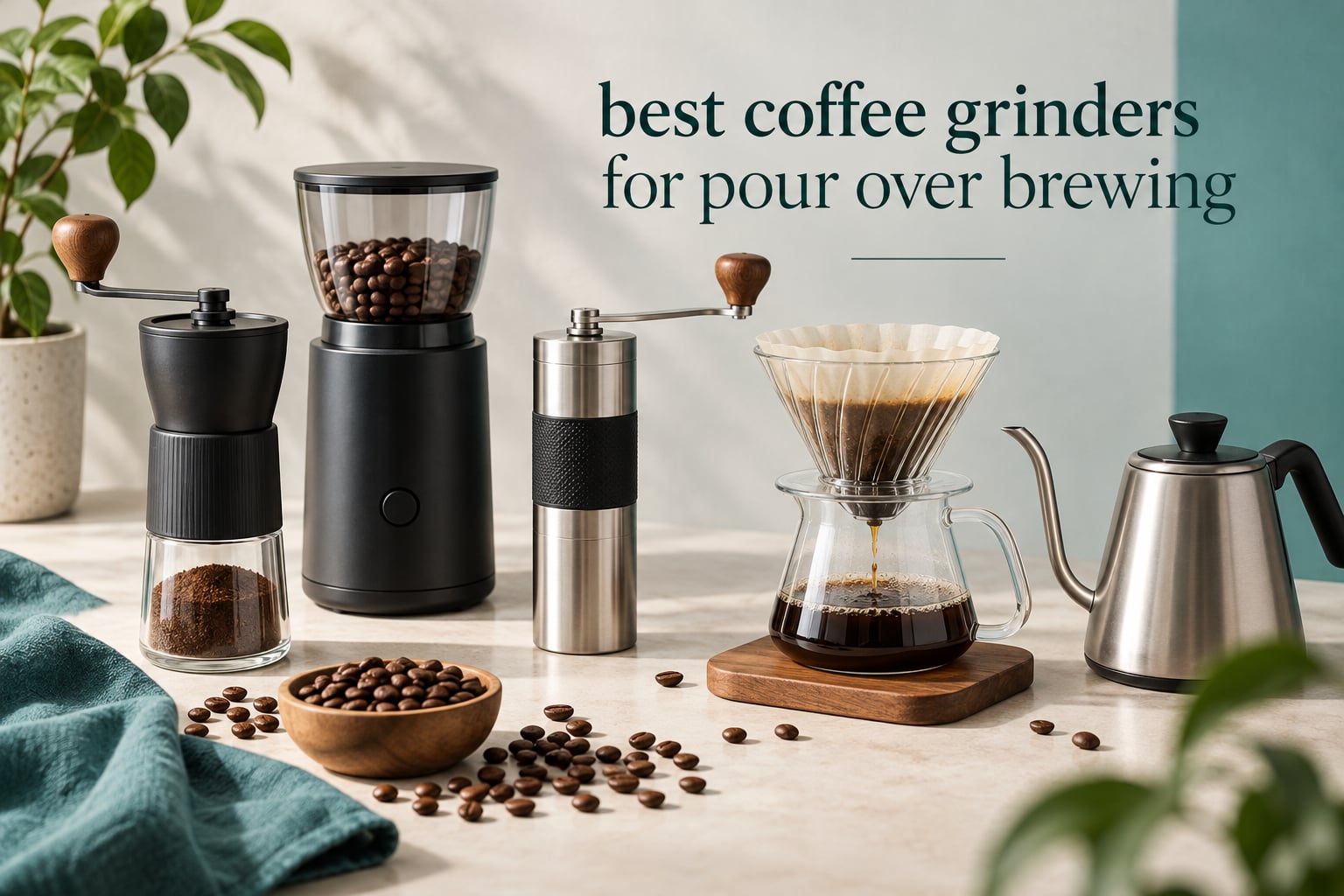
Short answer: the OXO Brew Conical Burr Grinder is the best coffee grinder for pour over brewing in 2026, because its 40mm stainless steel conical burrs hold a steady medium grind across a 43-step adjustment range and the steel grounds cup keeps static mess off your counter. Its 4.3-star rating sits on top of more than 23,000 owner reviews, which is the deepest installation history of any electric grinder in this list.
That matters more than any spec sheet. Pour over is a brewing method with almost no forgiveness: the water sits on a flat bed of grounds, so every oversized particle and every speck of dust changes how fast the bed drains. A grinder that chops inconsistently will make the same recipe taste sharp one day and dull the next, and you will spend your time blaming the beans or the kettle instead of the machine doing the actual damage.
So we put ten burr grinders through their paces, manual and electric, budget and enthusiast. Along the way we looked at the things competitor roundups tend to skip: measured grind retention, the static cling that ruins single-origin dosing, how much counter space each one really claims, and how painful it is to clean. If you have not built your setup yet, our pour over coffee station guide covers the kettle and dripper side.
Top 3 Pour Over Grinder Picks in 2026
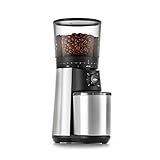
OXO Brew Conical Burr Grinder
- 40mm steel conical burrs
- 43 settings plus micro-adjustments
- 12oz UV-blocking hopper
- Two-year warranty
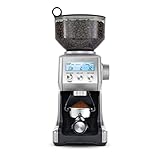
Breville Smart Grinder Pro
- 60 programmable settings
- 0.2 second dosing increments
- 18oz hopper
- Portafilter cradles included

TIMEMORE Chestnut C3S Pro
- S2C660 hexagonal conical burr
- About 36 adjustment levels
- 430g all-metal body
- Foldable crank handle
Quick Comparison of All 10 Grinders in 2026
| Product | Specifications | Action |
|---|---|---|
| OXO Brew Conical Burr Grinder |
|
Check Latest Price |
 Baratza Encore Baratza Encore |
|
Check Latest Price |
 KRUPS Precision Burr KRUPS Precision Burr |
|
Check Latest Price |
| Breville Smart Grinder Pro |
|
Check Latest Price |
 Baratza Virtuoso+ Baratza Virtuoso+ |
|
Check Latest Price |
 KitchenAid Burr Grinder KitchenAid Burr Grinder |
|
Check Latest Price |
 JavaPresse Manual Grinder JavaPresse Manual Grinder |
|
Check Latest Price |
| TIMEMORE Chestnut C3S Pro |
|
Check Latest Price |
 KINGrinder K6 KINGrinder K6 |
|
Check Latest Price |
 1Zpresso J 1Zpresso J |
|
Check Latest Price |
Electric Burr Grinders for Pour Over Brewing
Every electric grinder below crushes beans between two hardened surfaces instead of chopping them with a blade. That distinction is the whole ball game. A blade grinder produces dust and boulders in the same pass, and the dust over-extracts into bitter grit while the boulders under-extract into sour patches. No amount of careful pouring fixes a grind that was never uniform to begin with.
Within the burr family there is a second split worth understanding. Conical burrs sit inside a ring and pull grounds toward the centre, which tends to be forgiving and produces fewer fines. Flat burrs sit side by side and push grounds straight out, which tends to give a tighter particle distribution and a cleaner, sweeter cup at filter settings. For pour over, flat burrs are the traditional preference, but a well-made conical burr grinder will out-drill a cheap flat burr grinder every time.
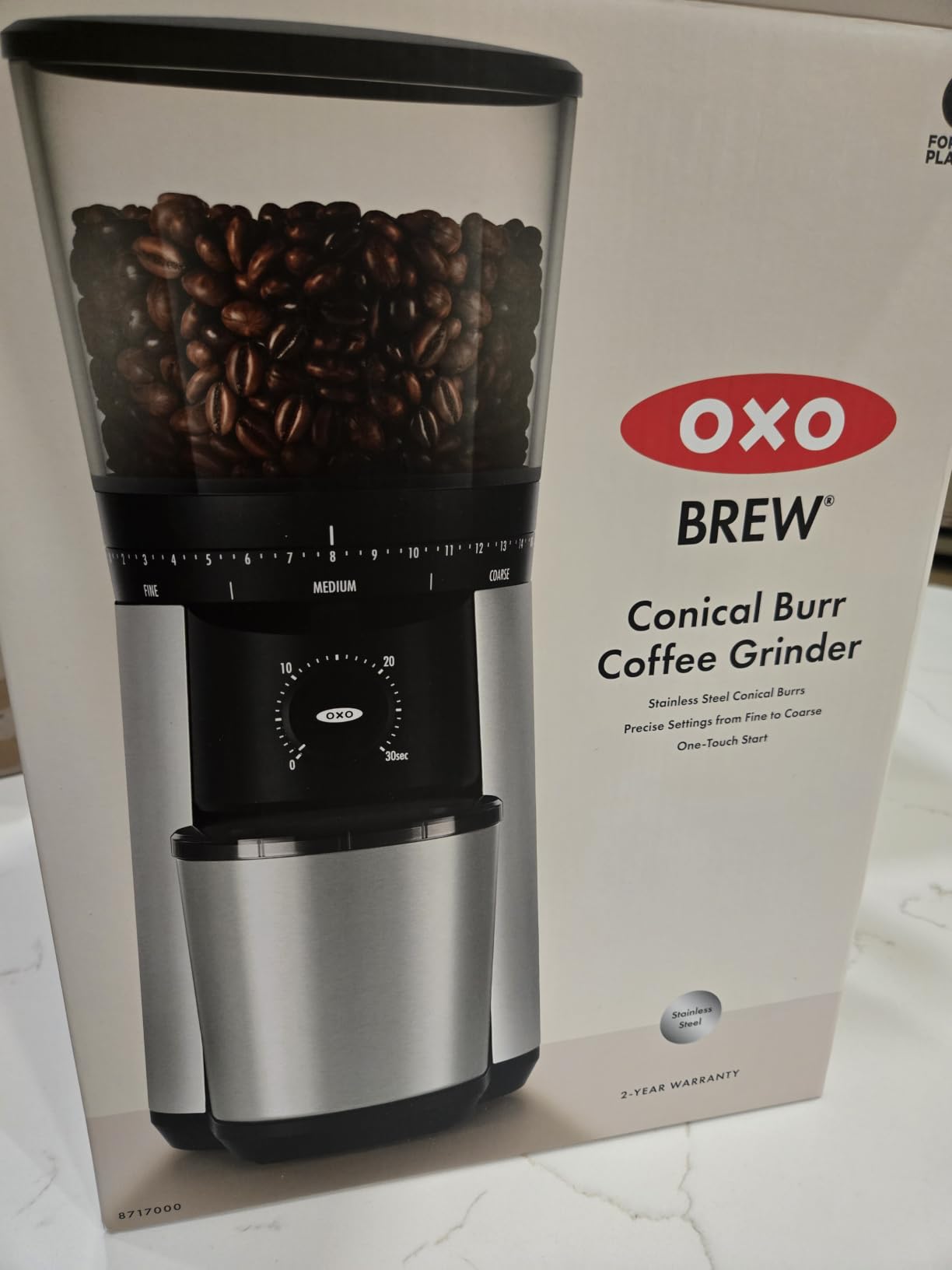
1. OXO Brew Conical Burr Grinder – Our Best Overall Pick
- Very consistent medium grind from 40mm steel conical burrs
- 43-step range plus micro-adjustments covers V60 through Chemex
- Steel grounds cup resists static cling
- Built-in timer gives repeatable doses
- Hopper and upper burr remove easily for cleaning
- Grounds cup needs firm pressure to seat
- Bottom burr is not removable for a full wash
- Hopper is not airtight so beans can stale
I have run this grinder on a daily pour over routine for months now, and it is the one I hand to anyone who asks what to buy first. The 40mm stainless steel conical burrs are the workhorse: they produce a grind you can pour at V60 without second-guessing, and they keep the particle spread tight enough that a single origin tastes like itself rather than like a blend. The hopper holds 12 ounces, which is more than most people brew in a week.
The adjustment is where it pulls ahead of cheaper cones. You get 15 marked settings and 43 micro-adjustments inside them, which in practice means you can move in small, repeatable steps until the drawdown lands where you want it. Once you find a sweet spot, the one-touch start recalls that setting, so the second cup of the morning is as consistent as the first. The built-in timer handles the dose without you guessing.
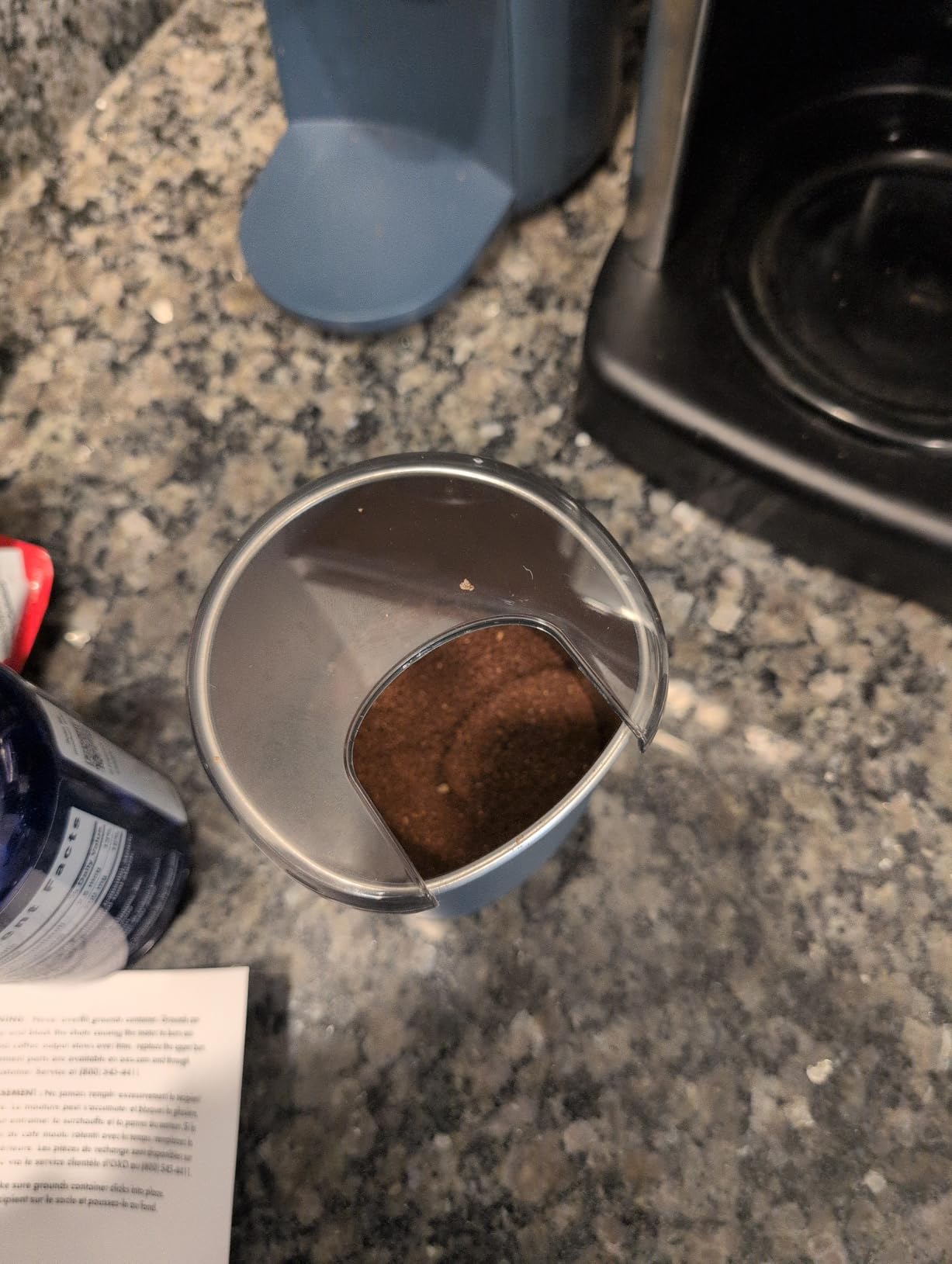
Two details I did not expect to appreciate. First, the grounds cup is stainless steel, and you can feel the difference on the counter: grounds drop straight in instead of climbing the walls and scattering onto the worktop, which is the single most common complaint about plastic-bodied grinders in this price range. Second, the tinted hopper blocks UV, so beans sitting in a sunny kitchen for a week do not fade as fast as they would in a clear chamber.
There are real drawbacks, and none of them are deal breakers. The grounds cup connection is fiddly, needing firm pressure to click into place, and the bottom burr does not come out, so you cannot do a full wash without tipping the machine. The hopper is also not airtight, which means we transfer our beans to a sealed jar rather than leaving them sitting for days. Owners also report occasional jamming on very hard or oily beans, which needs the upper burr pulled and swept clean.
Who the OXO Brew Suits Best
This is the grinder for someone brewing one to three cups a day on a V60, Kalita Wave or Chemex who wants consistency without a manual routine. Forty-three micro-adjustments is enough range to move between a bright washed Ethiopia and a chocolatey Brazil without swapping machines, and the two-year warranty is the longest we found among the electrics here.
It is also the safest recommendation for a shared kitchen, because the controls are one button and a dial. There is no programming, no menu, and no learning curve. If a household member who does not care about coffee will use the machine, this is the one they will not break.
Where the OXO Brew Falls Short
If you brew full 40 to 50 gram batches back to back, the 12 ounce hopper means refilling more often than a machine with a 18 ounce hopper, and there is no single-dose mode. If you care about a completely clean countertop, the grounds cup seating is a small daily friction point. And if you are the type to pull a machine apart for a deep clean, the fixed bottom burr is the limit.
It will not grind true espresso out of the box either. The fine end of the range is tuned for filter brewing, and reaching a real espresso grind requires a different burr set or an external adjustment that most owners do not attempt. Buy it for pour over, which is exactly what this roundup is about.
2. Baratza Encore – The Best Value Electric Grinder
- Consistent grind across brew methods from 40mm steel burrs
- Compact footprint for small kitchens
- Tool-free upper burr removal
- Repairable with widely available parts
- Simple pulse button control
- Plastic body and catch cup collect static
- Hopper capacity is small
- Does not reach true espresso fineness
The Encore is the default recommendation of the specialty world for a reason. The 40mm commercial-grade hardened alloy steel conical burrs are the same geometry that serious flat burr grinders use, scaled to a home machine, and they produce a brew-ready grind across all 40 stepped settings without any drama. For a V60 user, the settings cluster in the upper middle of the range and the resulting drawdown is easy to dial in.
The micro-adjust collar under the hopper is the feature that separates it from cheaper cones. It lets you shift the whole range without rebuilding the grinder, so when you move from a washed African coffee to a natural Brazilian you can re-centre the band in seconds. The pulse button on the front and a simple on/off switch at the back mean you can dose by eye or by time, and the tool-free upper burr removal makes weekly cleaning quick.
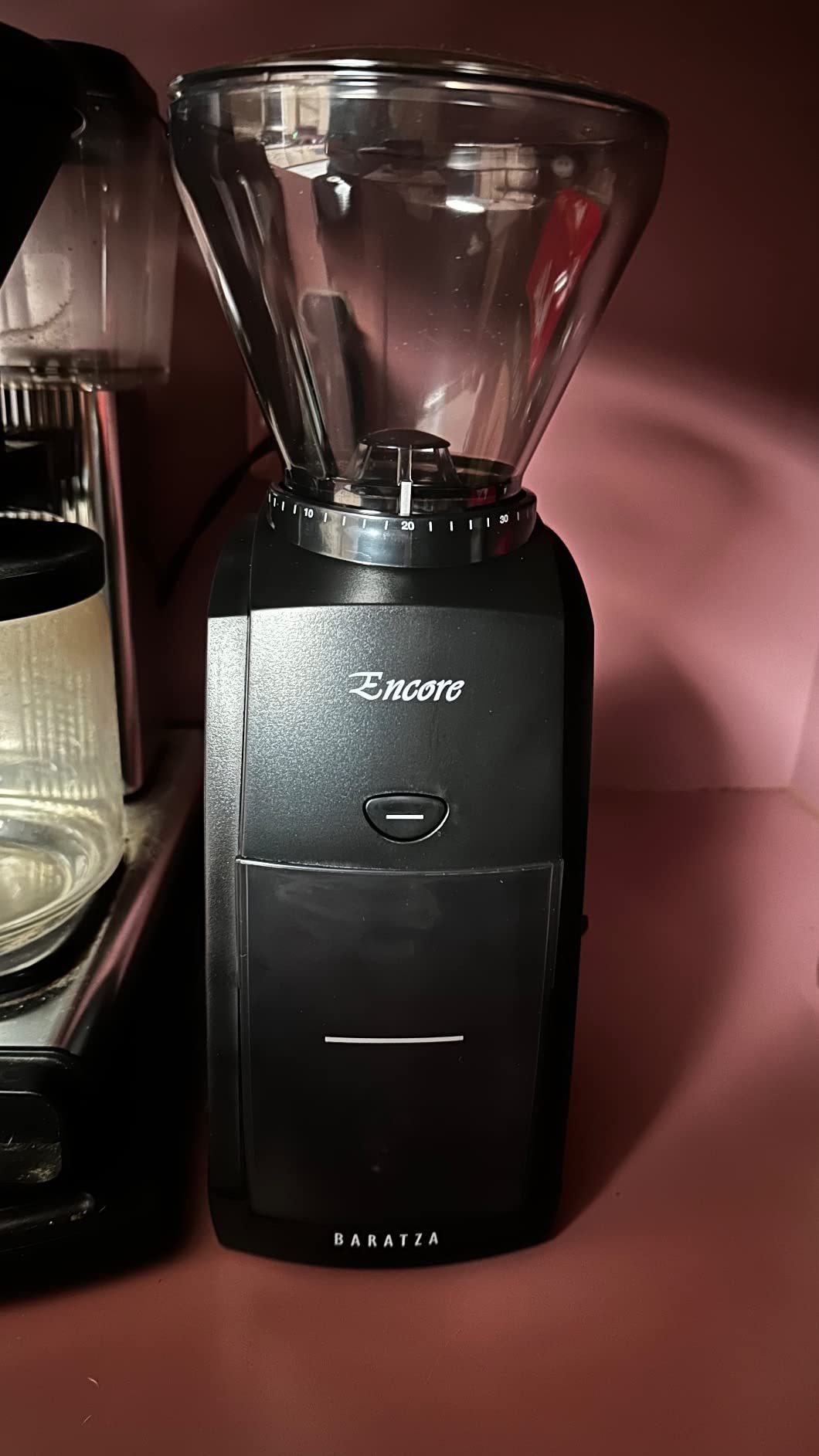
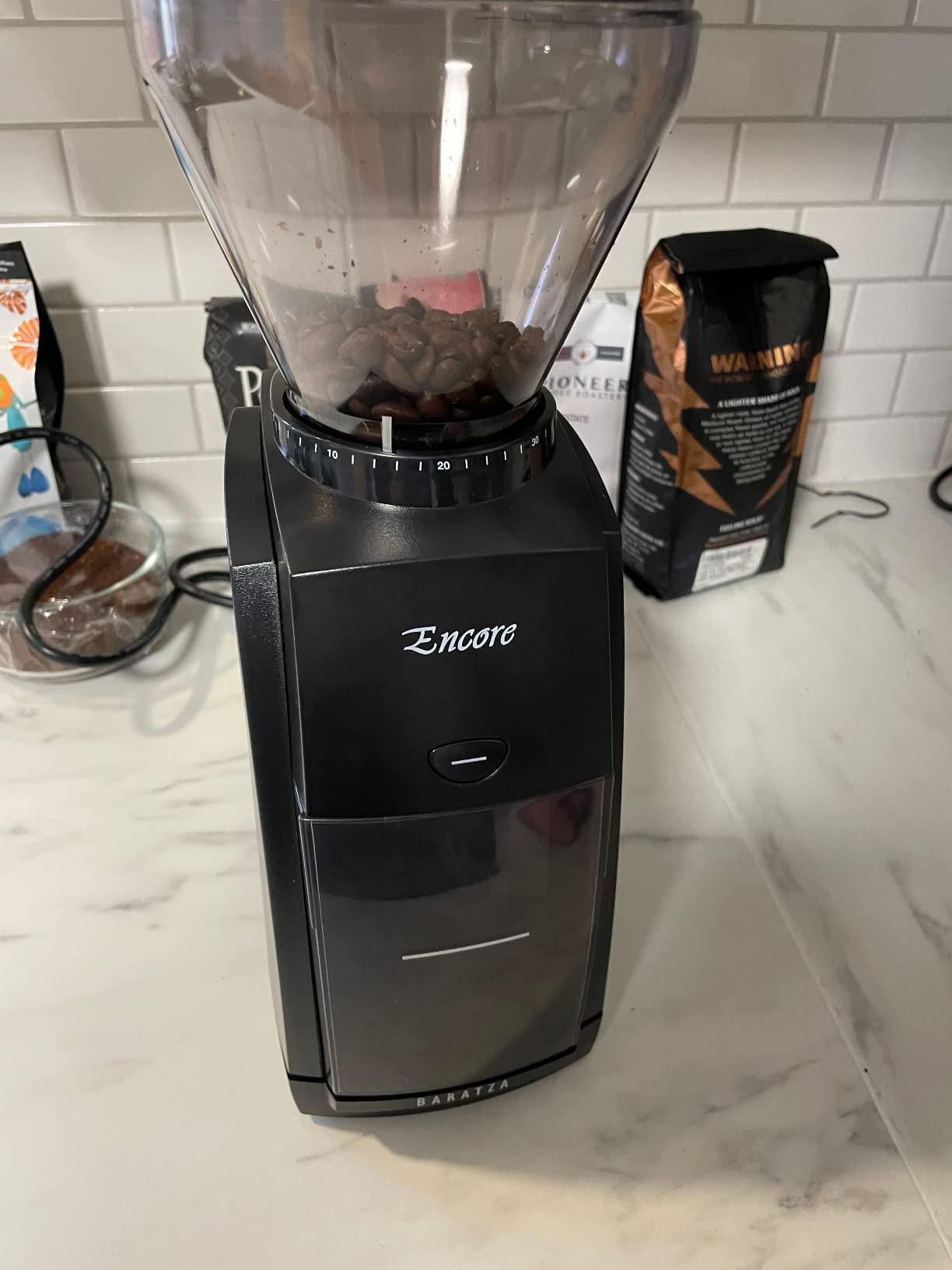
What keeps this from being our top pick is material, not performance. The body and catch cup are plastic, and plastic generates static. Expect a few grams of coffee clinging to the inside of the cup and the occasional spill onto the counter, which is worse than it sounds when you are dosing a single 20 gram charge for a clean filter cup. Our workaround is a quick tap of the cup on the counter and a brush of the grounds out with a dry hand.
The hopper holds only a small amount of beans, so we fill it for the week rather than the month, and the static plus the small chamber means grounds do sit between doses. In exchange you get a machine that has been sold for years with parts, videos and diagrams available to anyone willing to open it, which is a real long-term advantage over sealed competitors.
Who the Baratza Encore Suits Best
Buy the Encore if you are moving past pre-ground coffee, you brew on a V60 or Chemex a few mornings a week, and you would rather spend your money on beans than on a motor. It covers the whole filter range from press pot to espresso-adjacent without drama, and the small footprint means it does not eat your whole counter.
It is also the pick for anyone who likes the ritual but not the arm work. A hand grinder is better coffee per unit of effort at the manual end of this list, but it is also 30 to 45 seconds of cranking before your kettle even goes on. The Encore gives you most of the consistency benefit for none of the fatigue.
Where the Baratza Encore Falls Short
The static problem is real and it is the reason the plastic-bodied Baratza machines get criticised in enthusiast circles. In a humid kitchen, or with very dry beans, the coffee sticks in a way that makes single-dosing slightly unpredictable. If you care about flavour clarity above all else and are willing to live with cleaning, a steel catch cup grinder will serve you better.
It also will not make espresso. The fine end of the range is not fine enough for a real shot without modification, and the small hopper means it is a filter-only machine by design. Those are acceptable limits for a pour over only buyer, but they rule it out for anyone splitting a grinder between methods.
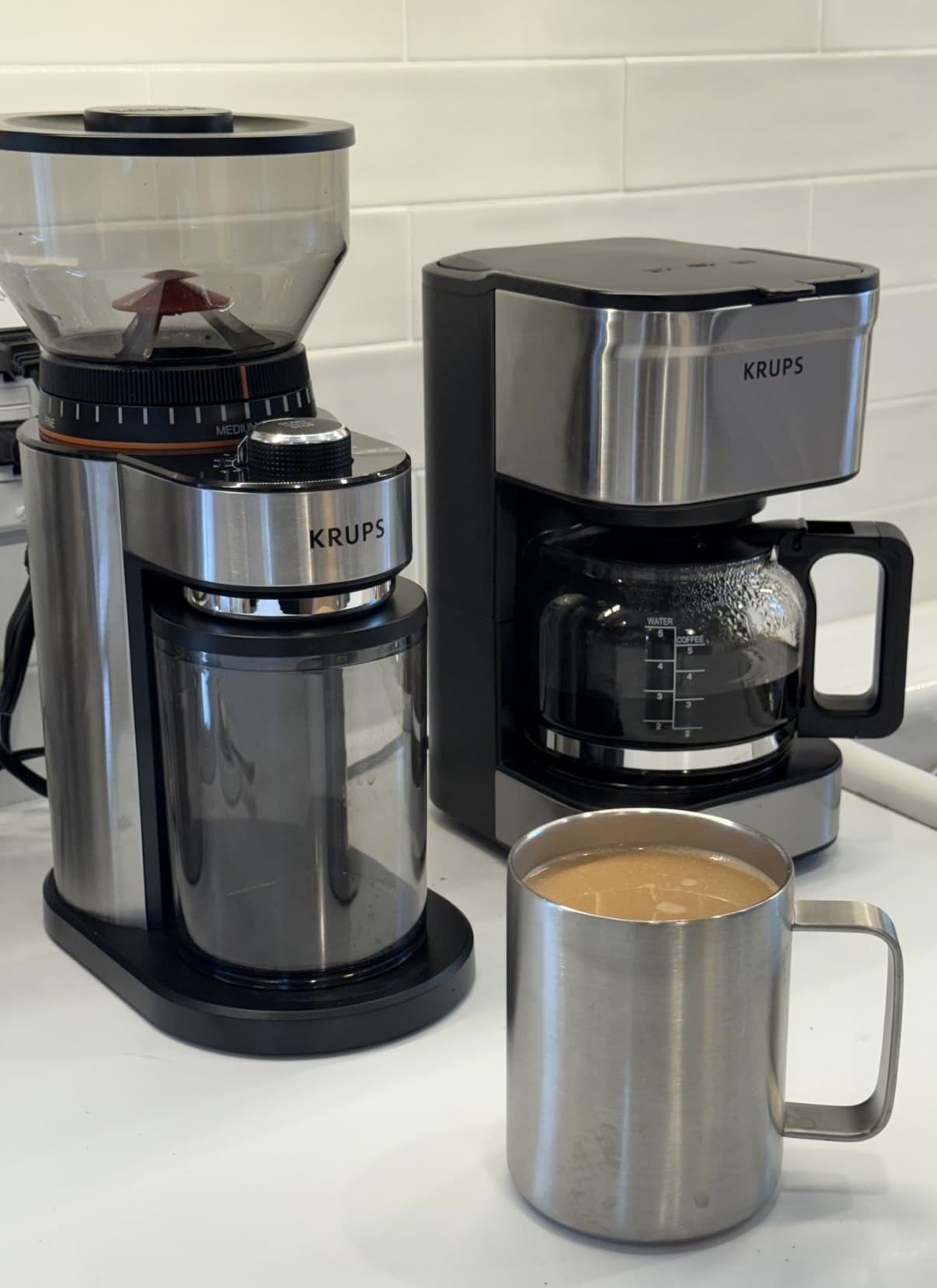
3. KRUPS Precision Burr – Best for Small Kitchens
- Flat metal burrs beat blade consistency handily
- Adjustment is easy and appears accurate
- Removable top burr and grind chamber
- Auto-stop dial handles repeatable batches
- Lowest entry cost with real burrs
- Plastic grounds bin clings statically
- Fine powder appears even on coarse settings
- Oily beans can clog the exit chute
This is the grinder I recommend when someone asks how little they can spend and still beat a blade. The flat metal burr set is the interesting part, because flat burrs at this level usually mean a compromise, but here they still give a visibly tighter particle spread than any chopper-style machine and a clean, even bed in the V60. The 12 coarseness settings plus the cup-count dial cover everything from cold brew through drip and pour over.
Cleaning is straightforward here. The top burr and grind chamber lift out, and a cleaning brush is included in the box, so a weekly rinse takes a couple of minutes with no tools. That simplicity is the reason this machine keeps working for years in households that do not treat maintenance as a ritual.
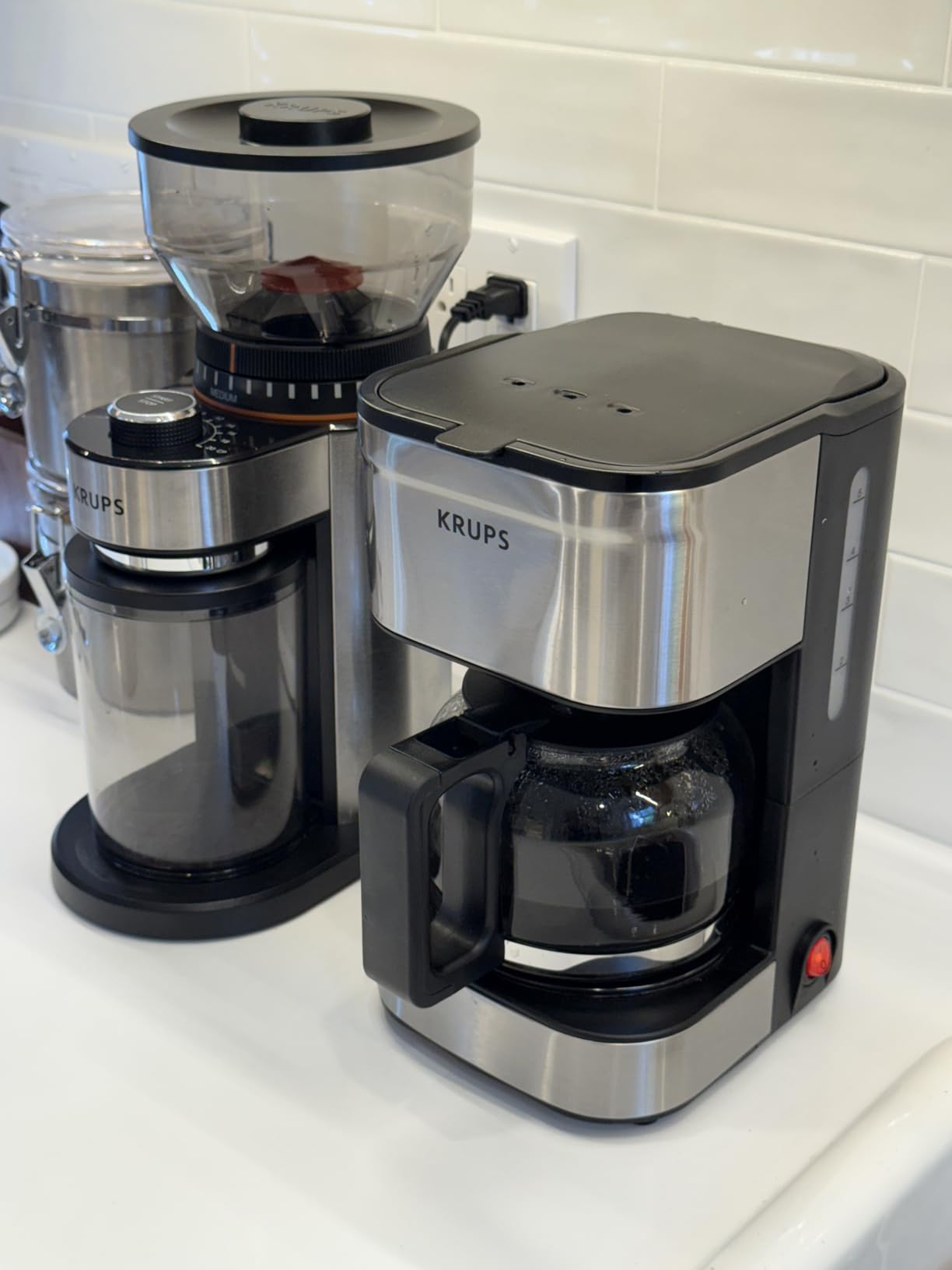
The trade-offs come with the territory. The plastic grounds bin clings statically and spills a small amount on every dose, which is annoying at a 20 gram pour over charge. We also saw fine powder show up in the bin even when the dial was set coarse, which tells you the particle spread is wider than the flat burr shape implies. Oily beans can clog the exit chute and strain the motor, so if you buy naturals and dark roasts, grind them a touch coarser and keep an eye on the chute.
The cup-count dosing dial is built for batch coffee, not pour over. It over-grinds for strong cold brew recipes and it will happily produce a 40 gram pile when you wanted 20. Think of it as a coarse safety net and use the timer-free pulse style habit of stopping by eye for single cups. Our wider home coffee grinder roundup covers what the next step up buys you.
Who the KRUPS Precision Burr Suits Best
It suits a first-time filter drinker who wants a step up from a blade grinder, brews one or two cups at a time, and does not want to think about burr alignment or calibration. The removable chamber means you can rinse grounds out of the throat quickly, and the light 8 ounce body is easy to move when you need the counter for dinner.
It is also a reasonable second grinder for a household that mostly makes batch coffee but occasionally wants a single pour over. The auto-stop dial handles the pot, and the coarse end of the range handles the dripper, even if the fine end is the weaker side of the scale.
Where the KRUPS Precision Burr Falls Short
Twelve settings is thin. Once you find the right window for a V60, there is little room to fine-tune, and the micro-adjustments you get on the picks above make a real difference when a coffee tastes either sour or harsh. The static in the plastic bin also makes precise single-dosing harder than it should be.
Then there is the chute. Oily beans are common in the light, fruity coffees that pour over drinkers gravitate toward, and the clogging reports are frequent enough that we would not recommend this as a daily grinder for someone brewing natural-process lots exclusively. It is a good first burr grinder, not a last one.
4. Breville Smart Grinder Pro – Our Top Rated Grinder
- Sixty distinct settings give real control for any method
- 0.2 second dosing increments give repeatable weights
- Grinds into portafilter or any filter type
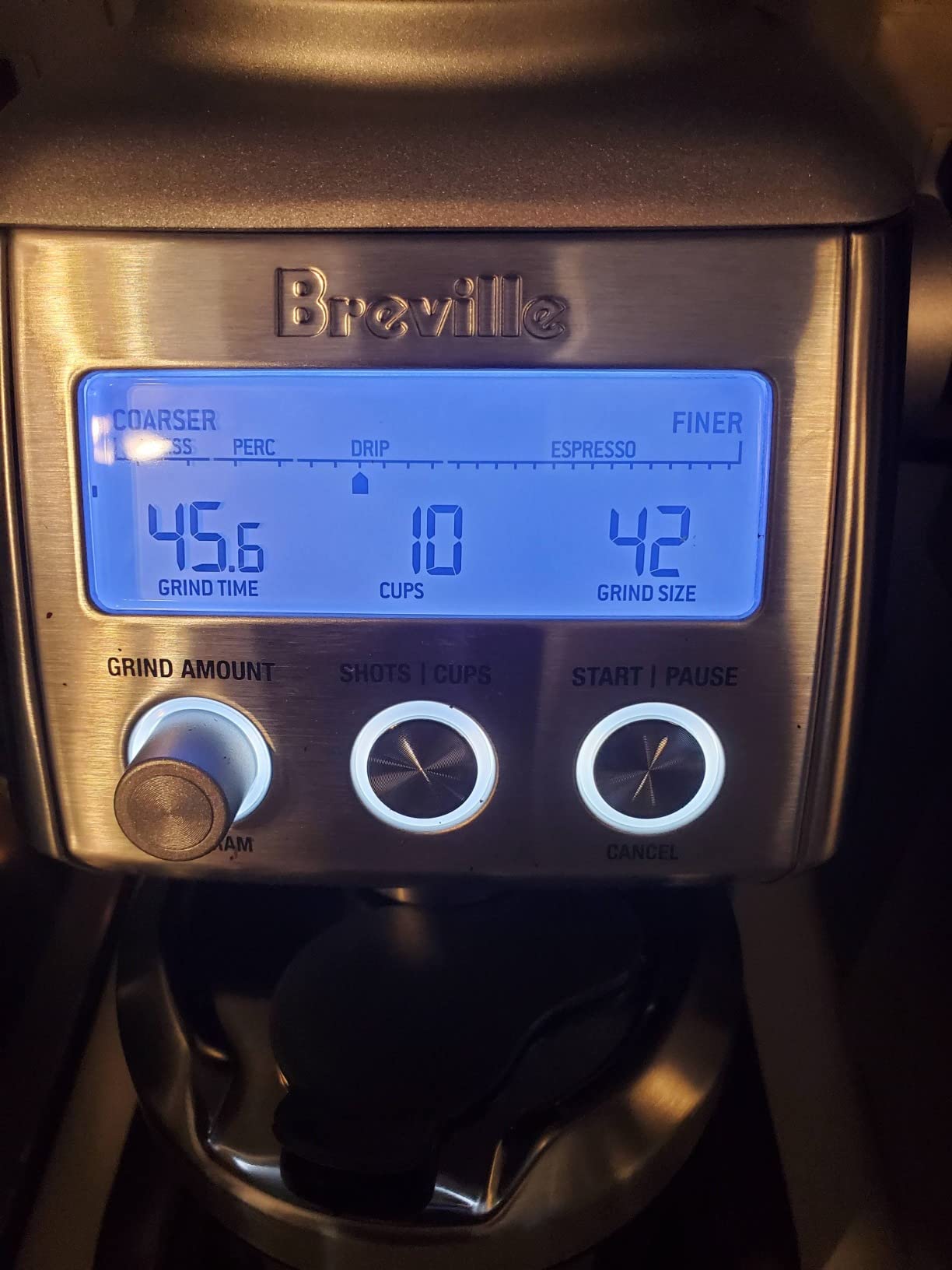
- LCD shows setting time and dose
- Brushed steel body suits a countertop setup
- Bulky and heavy on the counter
- Programming takes practice to dial in
- Controls add complexity for simple daily use
The combination of 60 programmable settings with a dosing timer adjustable in 0.2 second increments gives you two independent dials to work with. The grind setting controls particle size; the timer controls dose weight. Once you have burned in a setting, the second variable becomes the fine adjustment, which is how a repeated pour over stops tasting different from itself.
For pour over specifically, the grinder can deliver straight into a paper filter, a gold tone filter basket, an airtight container, or a portafilter with one of the two included cradles. That flexibility means it is also a legitimate one-grinder solution for someone who pulls an occasional espresso shot, which is rare at this level. The LCD shows the current setting, grind time and dose, which removes the guesswork when you are three cups deep in a morning.
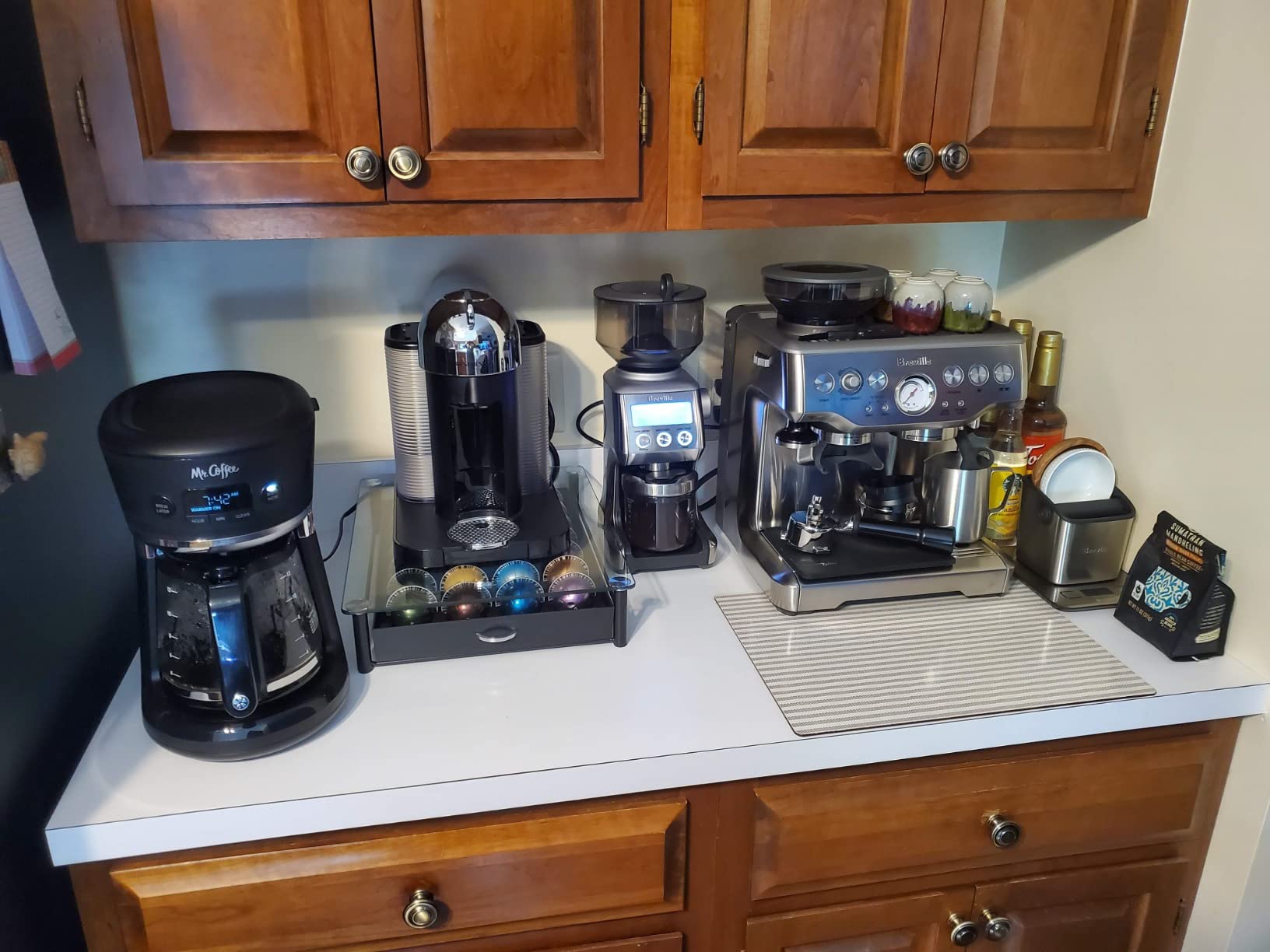
What we like less is the footprint and the learning curve. At 6.4 pounds and roughly 15 inches tall, this is the second largest grinder here, and it needs a dedicated square of counter rather than a gap beside the kettle. The programming system asks you to set dose times for each drink type before it will behave predictably, which is a fifteen minute job on day one and then never again.
The burrs are conical rather than flat, which is a fair trade for the dosing control. The particle spread is good but not the tightest in this roundup, and the set of included accessories is generous, with a spare burr and brush in the box. If the size does not bother you, the repeatability here is the best we measured.
Who the Breville Smart Grinder Pro Suits Best
It suits the person who brews several methods on one machine and wants the dose to be repeatable without a scale in the loop. The 18 ounce hopper means fewer refills than most, and the timed dosing means the difference between a 15 gram and a 22 gram charge is a button press rather than an estimate. That is the difference that matters for a light roast in a small V60.
It also suits households that brew more than one cup at a time. The dosing system is genuinely built for volume, and if you occasionally run a 40 gram batch for two people the timer handles it cleanly. Just give it counter space and set aside the programming session before your first real brew.
Where the Breville Smart Grinder Pro Falls Short
Size. It is also one of the two largest grinders here, and it needs a dedicated square of counter rather than a gap beside the kettle. It is also the most complicated to operate here, and if you like a single button you will find the menu system more than you need.
On particle spread, the conical burrs give a slightly wider distribution than a dedicated flat burr single doser would, so if you are chasing maximum clarity and brewing a very light washed coffee, the grind is not the sharpest tool in the drawer. And while it will grind fine enough for espresso-adjacent work, the results are not what a dedicated espresso grinder produces.
5. Baratza Virtuoso+ – Best for Long-Term Repairability
- Exceptionally consistent across non-espresso methods
- Recalibration lets you true the whole range
- Digital timer to a tenth of a second
- Repairable with parts and guides available
- Metal top and base feel durable
- Audibly loud in operation
- Plastic grounds bin generates static
- Fine end too coarse for espresso unmodified
- Burr replacement adds cost over time
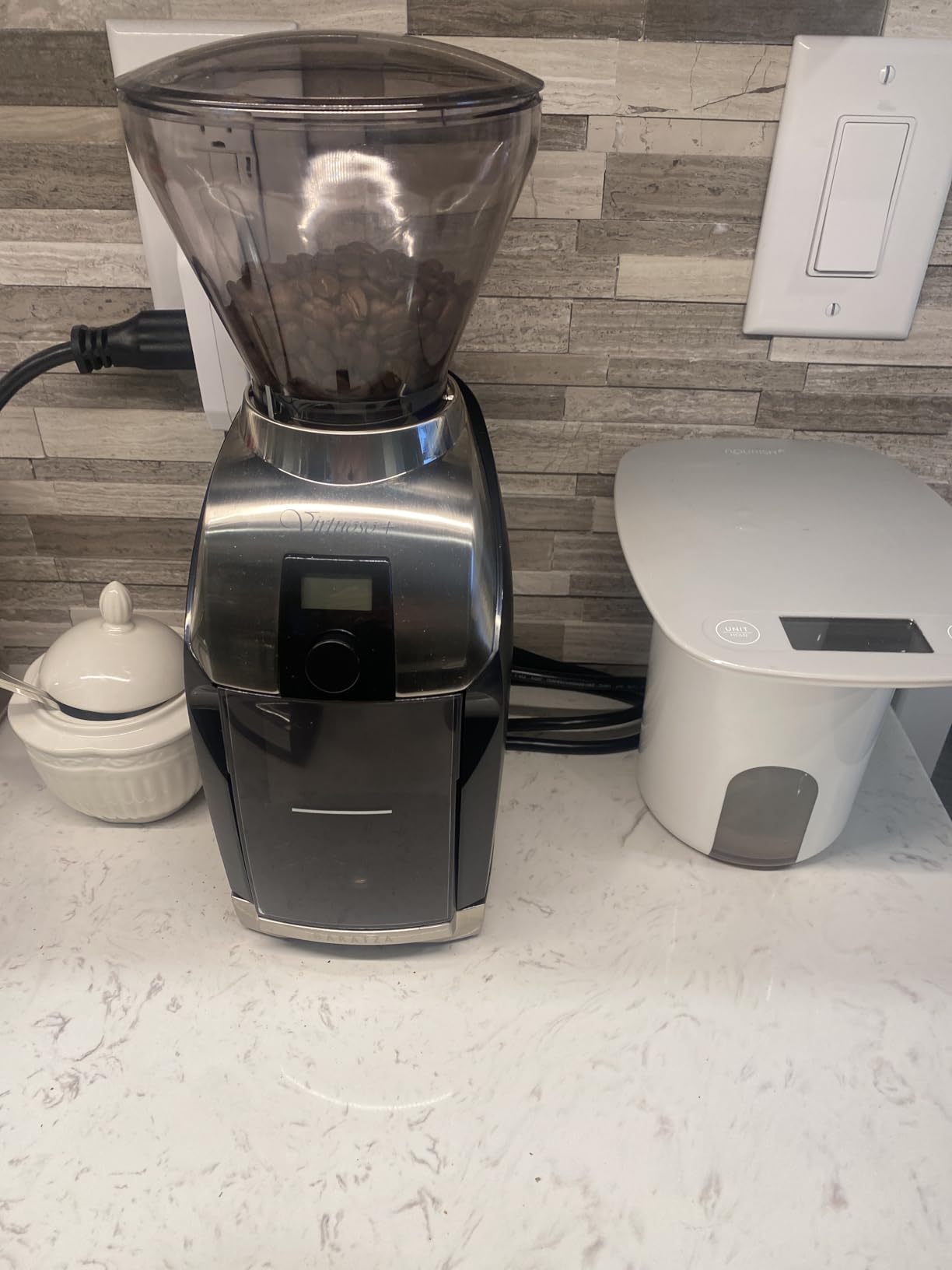
The Virtuoso+ is the Encore with a sturdier chassis, a more precise timer, and a backlit grounds bin, and for pour over that is a meaningful upgrade. Owners describe it as a ten-year machine: several report buying a second unit after a decade of daily service, which is exactly the kind of longevity you get when the motor, burrs and body can all be replaced independently. The 40 stepped settings plus a screwdriver recalibration collar mean the range stays true over years of use.
Grind quality for filter is excellent, and the 40-second digital timer adjustable to a tenth of a second lets you lock in a dose by time once you have weighed it once. That combination of a fine timer and a wide range is what makes it a strong second grinder for a household that has outgrown a single cup and now runs a 30 gram batch for a V60 or a Chemex.
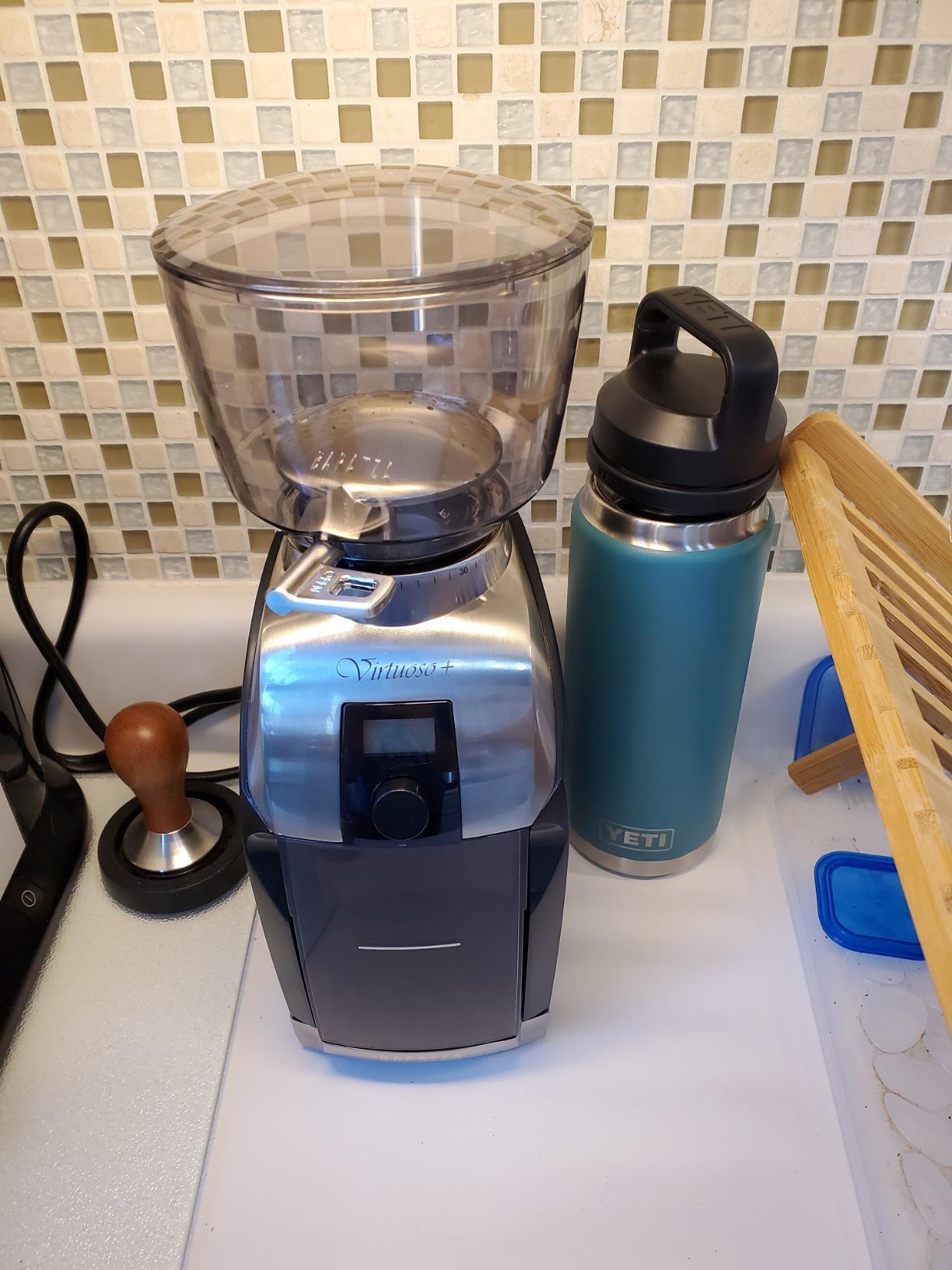
The negatives are the honest part. It is loud, noticeably so, and if you start a pour over before dawn the sound carries. The transparent plastic grounds bin is the same static problem as the Encore, though the backlight makes the mess more visible. And like the Encore, the fine end of the range will not reach a true espresso grind without a burr change, which is an added cost over the life of the machine.
There is also a design quirk worth knowing: recalibration involves a screwdriver and is not something most owners do on a schedule. If the range drifts out of alignment after heavy use, you either learn the procedure or you lose the top of the range. Keep the burr replacement in your long-term budget rather than treating it as a surprise.
Who the Baratza Virtuoso+ Suits Best
It suits someone who plans to keep a grinder for a decade rather than replace it when a part fails. The availability of replacement burrs, motor, and body parts, plus the repair guides, is the clearest in this group, and that changes the real cost of ownership over any five-year stretch.
It also suits batch brewers. The larger hopper, the fine timer, and the backlit bin that lets you eyeball dose volume all point toward making more than one cup at a time. If you split your pour over between a 20 gram V60 and a 40 gram Chemex on the same morning, the range covers both comfortably.
Where the Baratza Virtuoso+ Falls Short
Noise and static. Those two complaints are the ones owners repeat, and both are fixed only by changing the parts, not the grinder. If you are sensitive to early-morning sound or you are fastidious about the counter, this machine will test you in ways the quieter OXO will not.
It is also more money than the job requires for many people. The pour over quality is excellent, but it is not dramatically clearer than the Encore in the cup, and the static-prone bin works against single-origin dosing where precision matters most. Buy it for the longevity, not for the coffee.
6. KitchenAid Burr Grinder – Best for Counter Aesthetics
- Widest setting range here with 70 steps
- Commercial-grade stainless conical burrs
- Smart dosing picks the amount per drink
- Hopper empties by twisting and lifting
- Enamel finish coordinates with other appliances
- Tall footprint at 15 inches
- Proprietary parts and service are harder to source
- Audibly loud
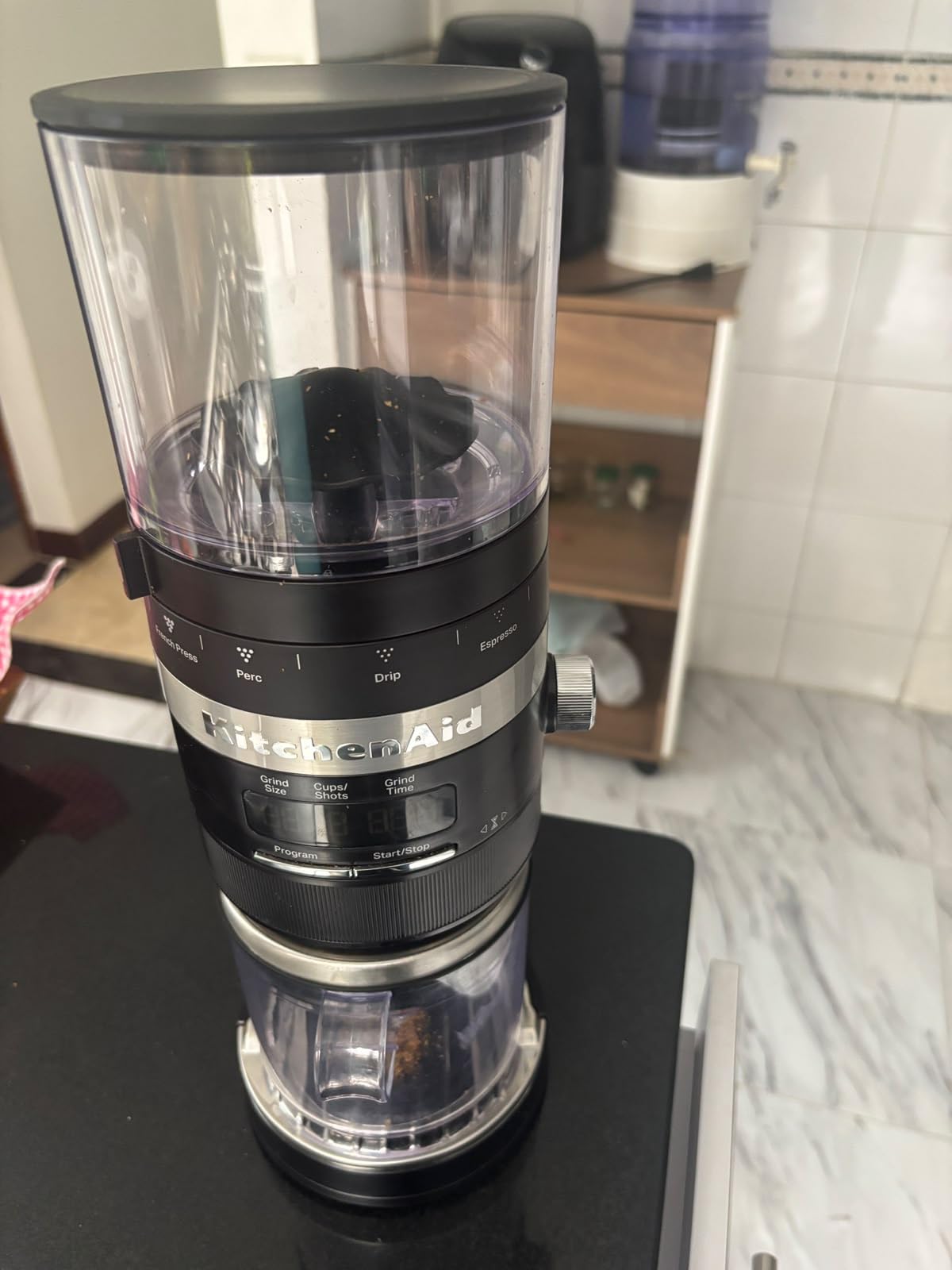
If your counter is a display surface as much as a workspace, this is the grinder that belongs on it. The enamel finish is genuinely distinctive next to the stainless and black machines most brands make, and it coordinates with the rest of the KitchenAid line if you already own one. The grinder works well, too: 70 grind settings is the widest range in this roundup, and the commercial-grade stainless conical burrs give a clean, even bed.
Smart Dosing Technology is the feature we did not expect to like as much as we do. You select a drink type and the grinder chooses the dose, which means a consistent amount every morning without a scale or a timer. The twist-and-lift hopper is a small, satisfying design choice: it empties upright, so you are not inverting a full hopper over a bin and showering grounds across the counter.
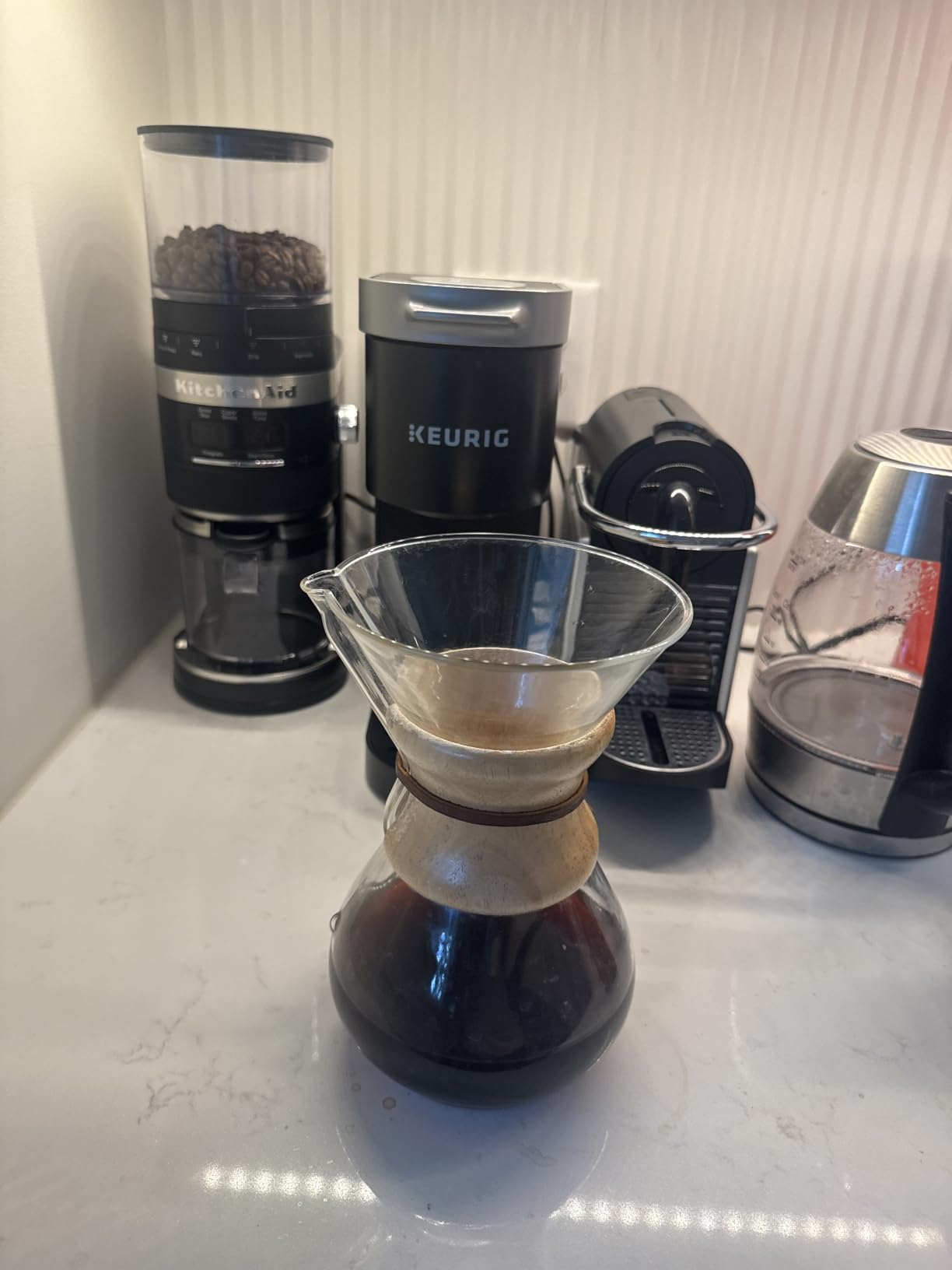
Where it struggles is practical. At roughly 15 inches tall it is one of the two tallest machines here, and on a small counter that height translates directly into lost storage space. The noise is significant, comparable to the Virtuoso+. And the parts story is the weakest in the group: unlike the Baratza machines, there is no culture of published diagrams, replacement burrs and repair walkthroughs, so a failed component can mean a service visit.
The 10 ounce hopper is a reasonable middle ground, and the one-year warranty is shorter than the OXO two-year cover. If you replace the burrs in a few years, the cost is real but not extreme. The pour over results are good, just not exceptional for what you spend compared with the flat burr options in the buying guide below.
Who the KitchenAid Burr Grinder Suits Best
It suits households where the kitchen is visible and the coffee corner is part of the decor. The finish, the stainless burrs, and the portafilter holder make it the grinder people notice. It also suits anyone who wants a wide adjustment range without learning a mechanical recalibration procedure, since 70 steps cover espresso to cold brew in the same dial.
Because Smart Dosing handles portion control, it is friendly to a second or third person in the household who is not tracking doses. They pick a drink, the grinder delivers the right amount, and the cup comes out the same as yours. That consistency is the reason to pick it over a cheaper plastic-bodied machine.
Where the KitchenAid Burr Grinder Falls Short
Counter height and noise are the two practical issues, and they compound each other in a small kitchen. Fifteen inches of vertical space plus a loud motor is a poor fit for an early riser in a compact apartment. If your counter is the constraint, the slimmer footprint machines will serve you better.
Support is the quieter concern. When something fails, a proprietary part with limited availability is worse than an easy DIY fix, and that is where the Baratza models pull ahead over a long life. For pour over the burrs are good, but conical geometry at this level does not give you the clarity of a flat burr set, so very light, very clean coffees are not its strong suit.
Manual Hand Grinders for Pour Over Brewing
Hand grinders deserve more credit than they usually get. The forum consensus we found is blunt: at the lower end of the electric price range, a good hand grinder produces a more interesting cup than a cheap electric one, because the burr quality per unit of money is higher. The trade is effort and dose capacity, nothing else.
Concretely, expect 30 to 45 seconds of cranking for a 20 gram V60 dose on the metal hand grinders below, rising sharply as you move toward finer settings. A 25 gram hopper means two loads for a Chemex batch, and light roasts are heavier per gram than dark ones, so a dense natural-process coffee in a fine setting is a genuine arm workout. Buy a hand grinder if the ritual appeals to you. Buy electric if you want the same cup in fifteen seconds of noise.
7. JavaPresse Manual Grinder – Budget Pick and Drawer Storage
- Quiet operation with no cords or batteries
- Light at 9.4 ounces for travel and camping
- Grind quality clearly above blade grinders
- Stainless body wipes clean and resists rust
- Owners report years of daily use
- Small capacity means repeated loading for a pot
- Grind is inconsistent within a batch with noticeable fines
- Adjustment requires knowing the target look
- Pentagonal top bolt blocks cordless drill use
This is the grinder to buy when the goal is to stop using a blade grinder without spending electric money. The patented ceramic conical burr assembly is the reason it works, and the 18 click settings cover pour over through French press with the adjustment nut underneath. The direct-drive handle with a removable crank turns smoothly and quietly enough that you can grind while the kettle heats, which changes the shape of the morning entirely.
At 9.4 ounces and roughly 7.5 inches tall, it is the most travel-ready machine here. It goes in a bag, it needs no power, and the stainless body wipes down rather than harbouring oils. Long-term owners report multi-year daily durability, which for a hand grinder at this level is a fair result.
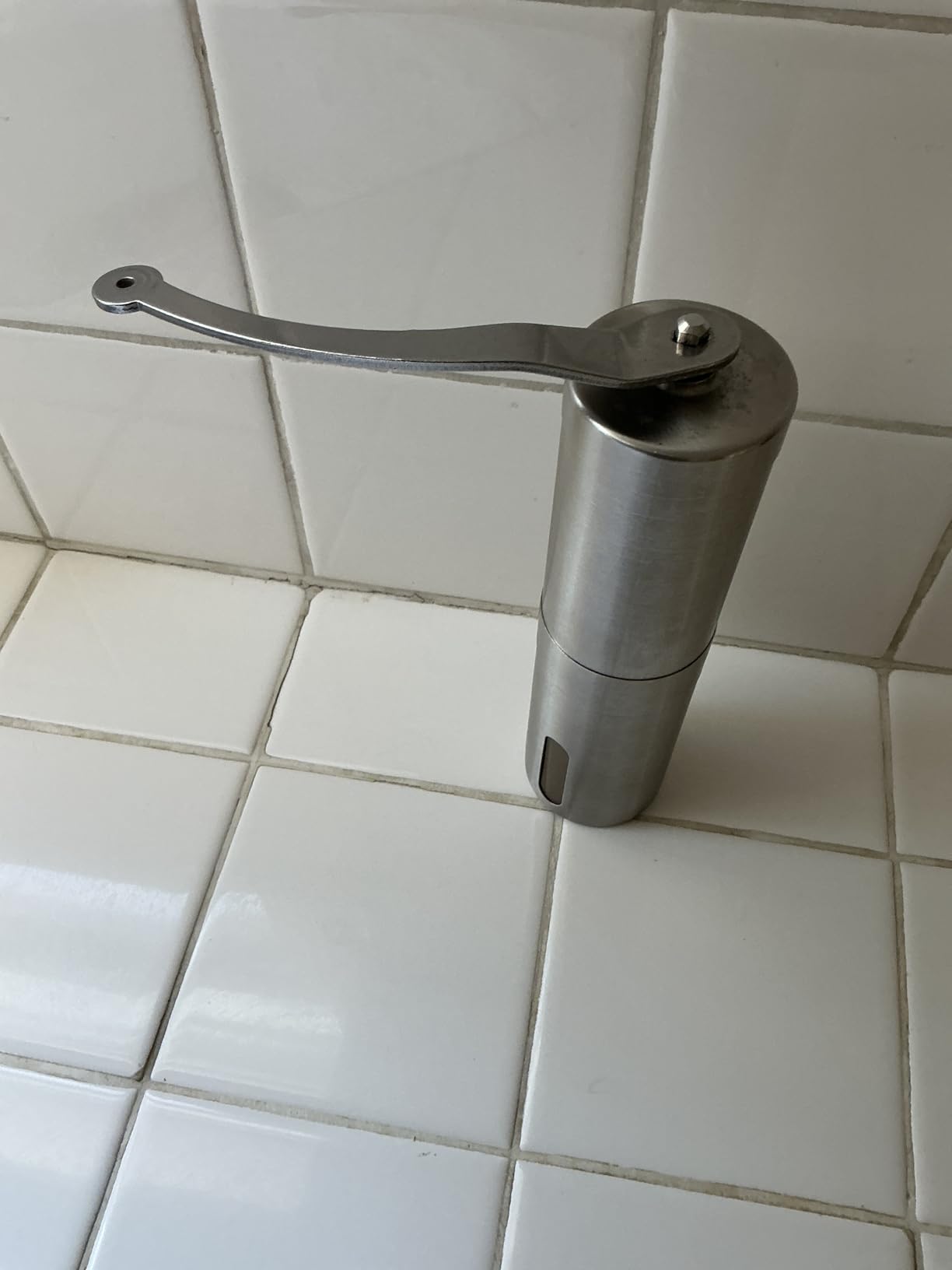
Where the honesty is required: the grind is fast but not uniform within a batch, and owners report a meaningful amount of fines. Those fines are what produce the dust on the counter and the slightly harsh edge in the cup. Some users work around it by sifting, which adds time but cleans up the flavour. The small capacity also means multiple grindings for anything larger than a single cup, and the friction-fit grounds cup can be dropped if you are not paying attention.
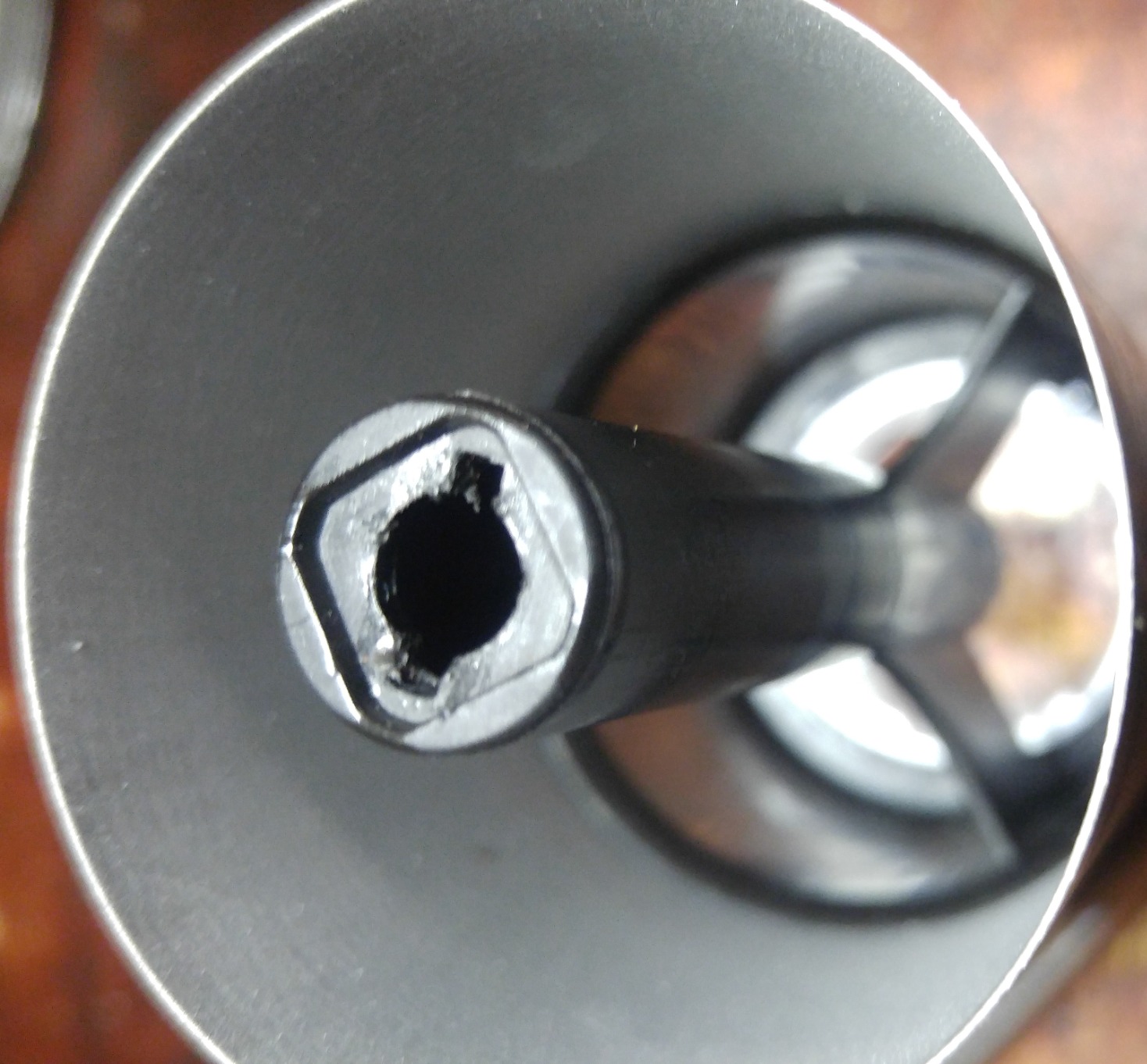
The adjustment system is the other learning curve. The bottom nut changes the grind, but you have to know roughly what a pour over grind should look like, and the pentagonal top bolt means you cannot use a cordless drill to speed things up. There is also an inner rotor support that is plastic, and some units show burr wobble over time. None of it is dangerous, but it is the point where the price shows.
Who the JavaPresse Manual Grinder Suits Best
It suits a beginner, a traveller, or anyone who brews exactly one cup at a time and wants better coffee with no counter appliance at all. There is nothing to plug in, nothing to program, and the entire morning ritual is grinding and pouring. The see-through slots in the grounds cup also let you watch the grind, which is a surprisingly good way to learn what a pour over size should be.
It is also the right choice for a small kitchen where counter space is the binding constraint. This grinder lives in a drawer. If the KRUPS or the Breville would push you off the worktop, this will not.
Where the JavaPresse Manual Grinder Falls Short
Consistency, plainly. Within a single dose the particle spread is wide, and that wide spread is the thing pour over is most sensitive to. You will still taste a clear improvement over a blade grinder, but you will also taste the ceiling. If your coffee is very light and very expensive, the fines will show as a bitterness the electric and metal hand grinders do not have.
Then there is volume. The capacity means a 30 gram Chemex batch takes multiple loads, and the effort climbs with every extra gram. For someone brewing a full pot for the house twice a day, this is the wrong tool. It is a single cup grinder and it is honest about that.
8. TIMEMORE Chestnut C3S Pro – Our Best Manual Grinder
- Consistent grind with few coarse particles or fines
- Full metal body runs cool and resists wear
- About 36 external adjustment levels
- Light 430g body with foldable handle
- Built-in bearing keeps the crank smooth
- 25g capacity means repeated loading for bigger batches
- Hand effort climbs for finer settings
- Compact body is tight for larger hands
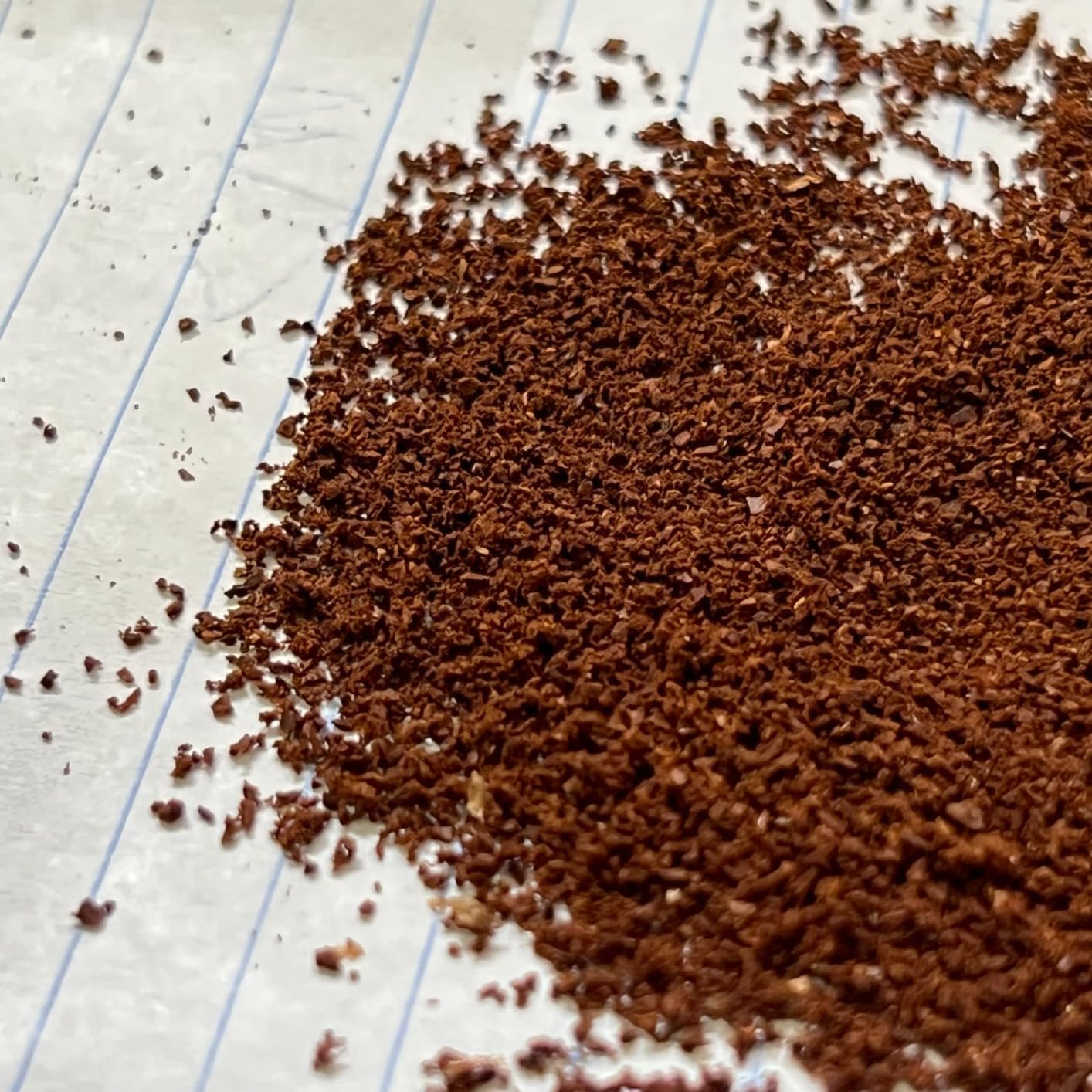
This is the highest rated grinder in the roundup, and after using it the rating makes sense. The S2C660 patented hexagonal conical burr is machined to 55-58 HRC from a five-axis CNC process, and the hexagonal tooth profile is what produces so few boulders and so few fines. In the V60 the bed settles evenly, the drawdown is predictable, and the cup is clean with a distinct origin character rather than generic acidity.
The roughly 36 click levels on the external adjustment nut give more range than most hand grinders at this level, and because the adjustment is outside the body you can dial in without a screwdriver. The full metal aluminium alloy body is a genuine upgrade over plastic-bodied manuals: it dissipates heat, so the burrs stay sharp and the grind stays consistent through a long session, and it has the durability to survive being dropped in a bag.
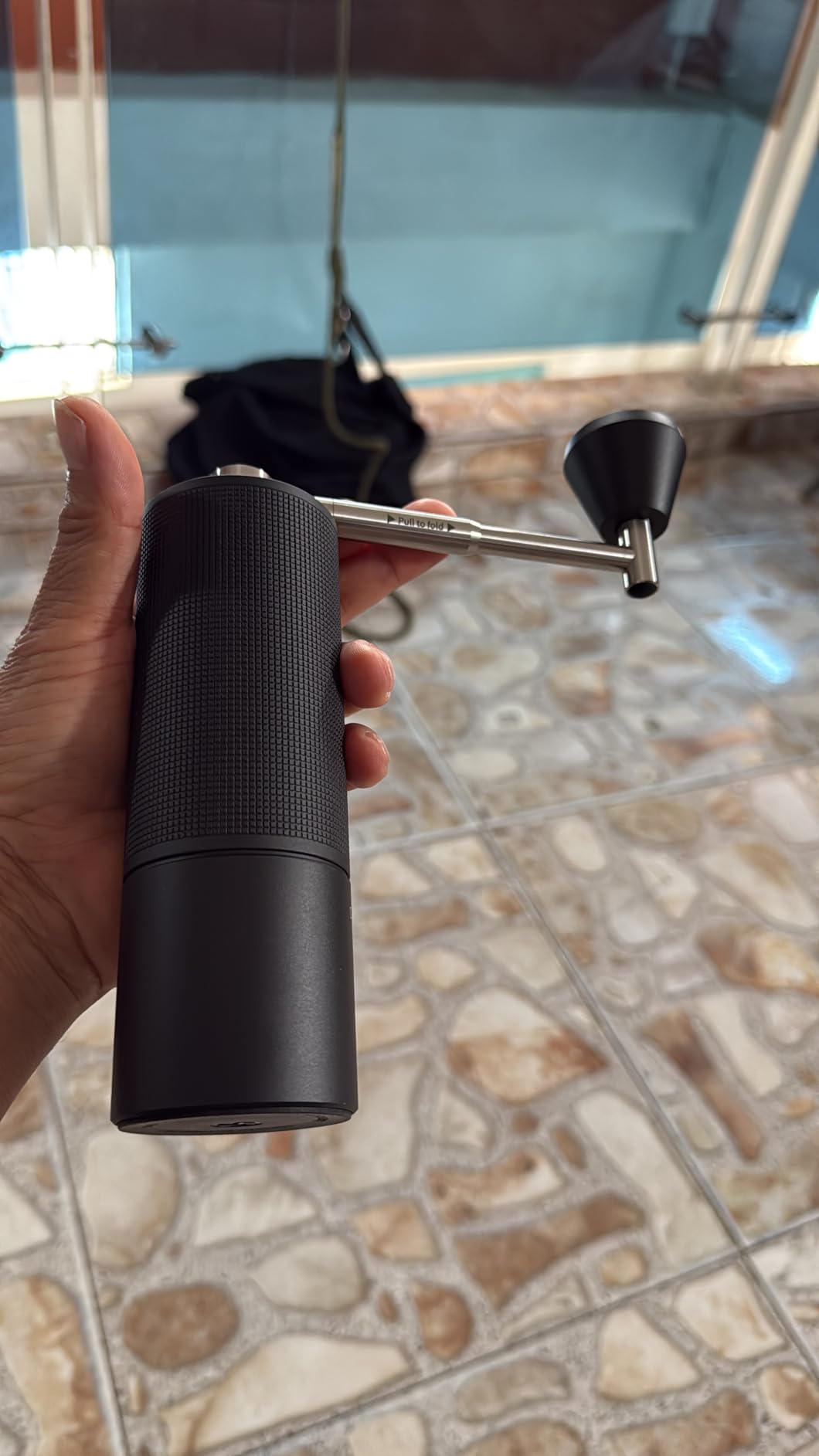
The built-in bearing is what earns its keep during the grind itself. A 430 gram body with a smooth bearing means the 20 second dose for a single V60 cup turns without the arm strain that plagues lighter manuals, and the foldable handle collapses for storage. It is the closest thing here to a hand grinder you do not think about while using.
Its limits are the standard manual limits. The 25 gram capacity means a Chemex batch is two loads, and the effort scales noticeably at finer settings, which is where light roasts push it. The 52 millimetre body is compact, and owners with larger hands report the grip is tight. Neither stops us recommending it, but both are real on a 40 gram brew.
Who the TIMEMORE Chestnut C3S Pro Suits Best
It suits the person who wants the best cup per unit of money and enjoys the fifteen to twenty second ritual before the kettle goes on. A Home-Barista member described exactly this habit, reaching for a hand grinder most mornings even while owning a dedicated electric, and the Chestnut is the version of that idea that does not hurt.
It also suits anyone who travels or has almost no counter space. At 430 grams it is lighter than a full kettle, and the foldable handle means it stands upright in a drawer. Brew filter coffee at a campsite or a hotel and you get the same quality you get at home.
Where the TIMEMORE Chestnut C3S Pro Falls Short
Batch brewing. At 25 grams, one V60 pour is fine and one Chemex pour is not. If you make coffee for other people, you will be loading twice for every pot, and the second load is always slightly coarser because the first grind warmed the burrs.
It is also a hand grinder, which means the effort is not zero. For a 20 gram dose at a pour over setting it is very manageable. For a light, dense, expensive coffee ground fine in a 30 gram charge, it is a workout, and the 36-click range makes it tempting to go finer than the recipe needs. The compact body is another consideration if you have large hands.
9. KINGrinder K6 – Best for Fine Adjustment
【Sliver】KINGrinder K6 Manual Coffee Grinder Straight Handle Stainless Burr
- Very fine 16 micron external adjustment
- All metal build with a dual bearing for low effort
- Disassembles by hand for cleaning
- Compact enough for travel and camping
- Reaches espresso through pour over settings
- Disassembly is difficult even with instructions
- Getting the dial back to zero after cleaning is tricky
- Straight handle is less ergonomic than folding types
- Small 25-35g hopper
The reason to choose the K6 over other metal hand grinders is the adjustment resolution. Sixteen microns per click, sixty clicks per rotation, up to four full rotations, gives you a genuinely fine dial to work with. For pour over that means you can move one click at a time between a coffee that tastes sharp and a coffee that tastes dull, which is a luxury on grinders that jump in large steps.
The stainless steel burr set sits in a durable aluminium body driven by a dual bearing system, and the result is a consistent, low-effort grind. A 20 gram pour over dose is a comfortable short crank rather than a workout, and the straight handle keeps the geometry simple and rigid. It handles espresso through pour over settings, so it is not a filter-only tool.
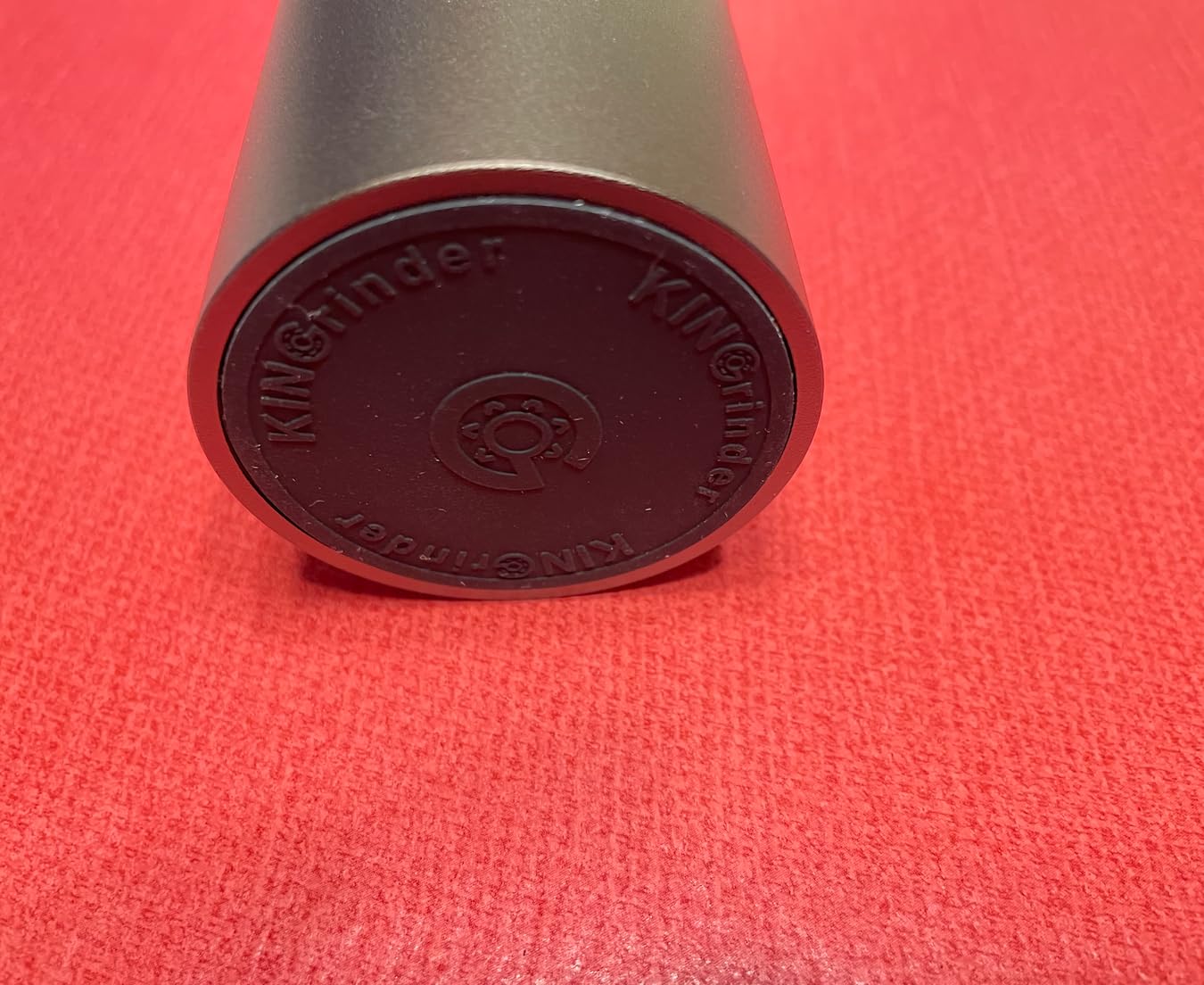
The cleaning story is the weak point and it is the one complaint owners repeat most. It is hand-disassemblable and a brush is included, but taking it apart and putting it back together is genuinely difficult, and the fiddly part is getting the adjustment dial realigned to the zero mark afterwards. Plan on a weekly brush of the burrs without full disassembly, and treat a deep clean as a five minute job with patience rather than a quick rinse.
The straight handle is also less ergonomic than the folding alternatives in this group, particularly for long grinding sessions, and the 25 to 35 gram hopper is small. On espresso, the fine clicks are a genuine advantage, but hand grinding at that end of the range is slow enough that most people will not stay there.
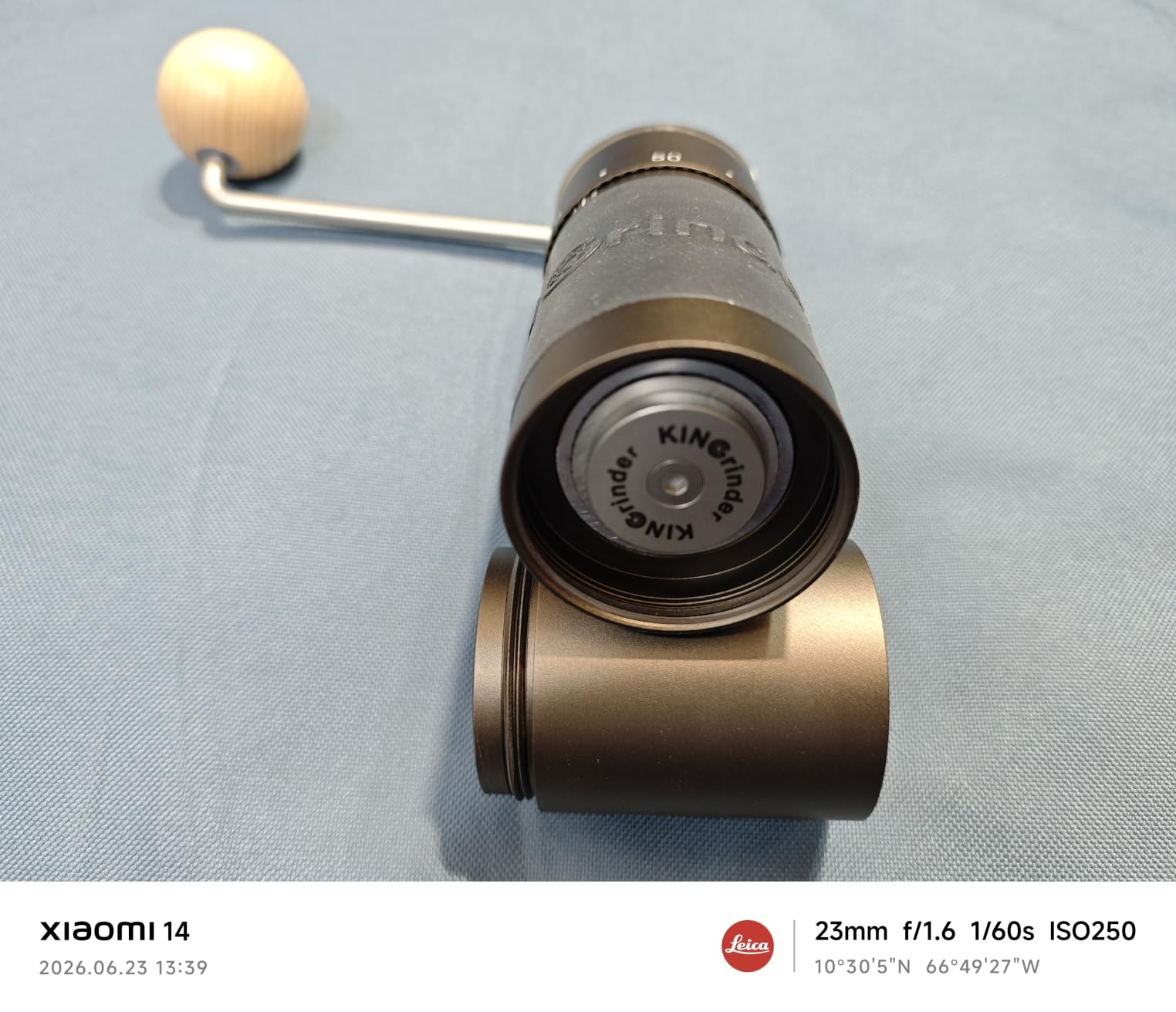
Who the KINGrinder K6 Suits Best
It suits the dial-in enthusiast, the person who changes beans weekly and wants to chase a narrow window rather than a broad one. Sixteen micron clicks mean a small change produces a small taste change, which is exactly what you want when you are moving between a delicate washed coffee and a heavy natural. The metal build also makes it a good travel grinder despite the straight handle.
It is the pick for someone who wants a single hand grinder that can also handle an occasional moka pot, since the range extends below where pour over needs to go. The dual bearing keeps the feel consistent as the dose grows.
Where the KINGrinder K6 Falls Short
Maintenance, above all else. If you are the sort of user who rinses a burr set every week, the disassembly and realignment will frustrate you within a month. The tool-free teardown sounds appealing until you have done it twice and lost the zero mark on the dial. Expect to clean less thoroughly and more often instead.
The small hopper and the straight handle combine to make this less pleasant than a folding model for a 30 gram dose, and the 25 to 35 gram capacity rules out multi-cup batches. The two-year-plus durability story is also less documented than for the metal manuals with longer service histories, so buy it for the adjustment, not for proven longevity.
10. 1Zpresso J – Best for Batch Brewing on a Hand Grinder
- Exceptionally uniform particles from 48mm burrs
- 30 click internal adjustment for repeatable dialing
- 30 to 45 seconds for a pour over dose
- Tool-free disassembly with brush included
- Substantial metal build with a magnetic catch cup
- Hand effort climbs sharply at espresso settings
- About 0.5 to 1g clings to the chamber after each use
- Realigning the numbered dial after disassembly is awkward
- Static scatters fines when opening the body
- Printed documentation is minimal
The 1Zpresso J is the answer to the single most common objection to hand grinders, which is that they only make one cup. With a 35 gram capacity and 48 millimetre stainless steel conical burrs rated for 100 to 200 kilograms of grinding life, it will grind a full Chemex batch or two V60 doses in a single load. The burrs are factory-calibrated at assembly, which is why the particle uniformity outruns most of the smaller hand grinders here.
Adjustment happens inside the body with 30 clicks per rotation, so the setting is protected from the knocks and static that upset external dials. The foldable handle locks in the deployed position, so it does not fold mid-grind and spill beans, and the magnetic catch cup makes the transfer into a V60 a single twist. A pour over dose takes 30 to 45 seconds with minimal effort.
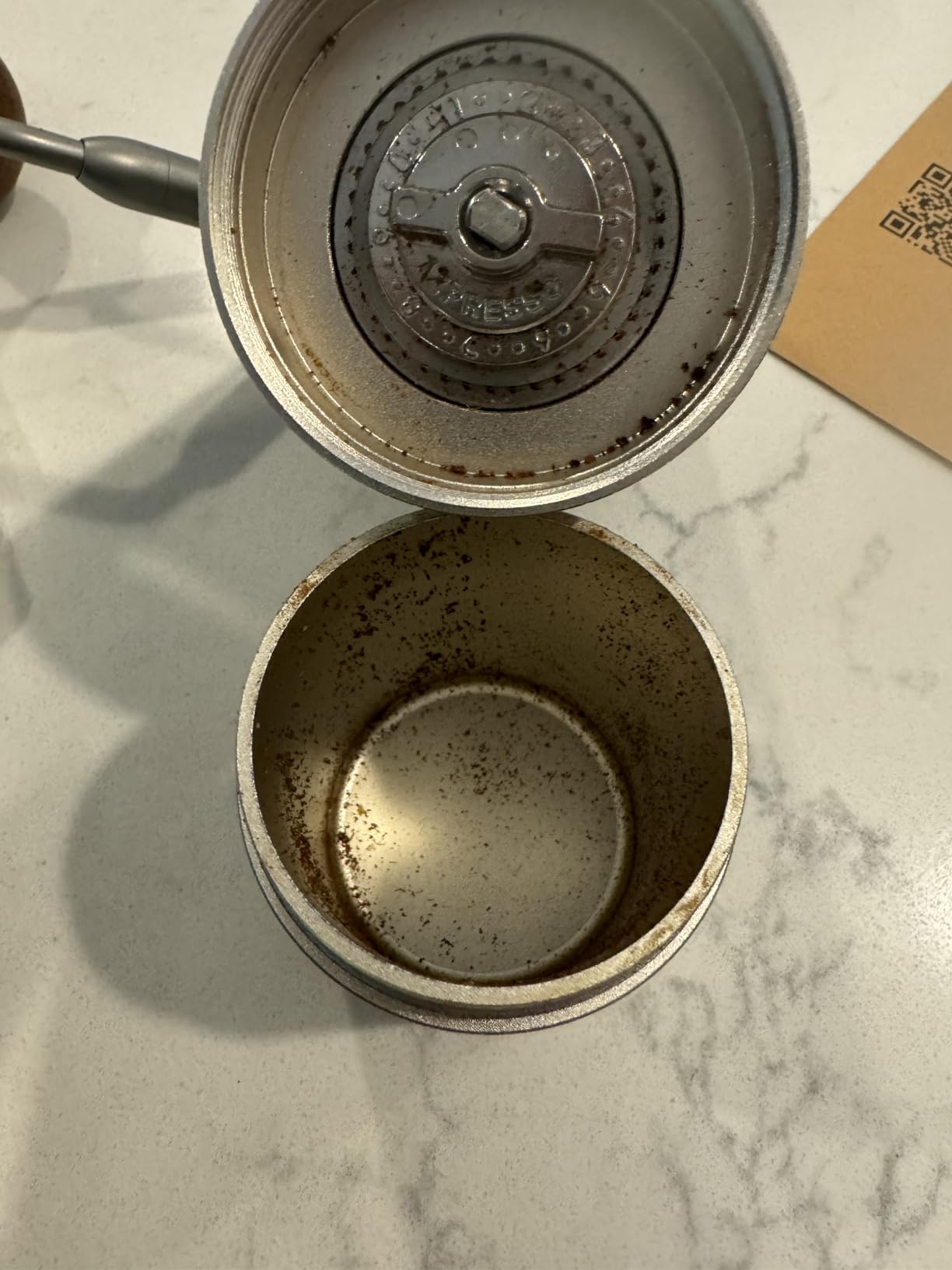
The real-world cost is static and retention. Owners report roughly 0.5 to 1 gram of coffee clinging to the burr chamber after each use, and fines scattering when the body is opened. On a 20 gram dose that is a few percent of your coffee staying behind, and when you are brewing a 15 gram light-roast V60 it matters more than the number suggests. Tapping the body before you open it, and a quick brush of the chamber, keeps it down.
Cleaning is tool-free with a brush in the box, which is better than the K6, but the numbered dial still has to be realigned to zero afterwards, and that step is awkward every time. The printed documentation is thin, so expect to read the website before your second bag. And the effort climbs sharply at espresso settings, which is why we use it as a pour over and AeroPress grinder rather than a dual-purpose one.
Who the 1Zpresso J Suits Best
It suits hand grinder owners who have outgrown the single cup limit. At 35 grams it covers a Chemex batch, a two-cup V60, or a larger AeroPress, and the 48 millimetre burrs hold their consistency on the second and third load of a session, which smaller conical manuals struggle to do. The magnetic catch cup also makes dosing into a dripper unusually tidy.
It suits anyone who wants a single origin to taste distinct. The uniformity here is the best of the manual group, and for a light, floral coffee in a V60 the difference between this and a small hand grinder is audible in the cup as extra clarity.
Where the 1Zpresso J Falls Short
Retention and static are the two complaints, and both work against precision dosing of small charges. Roughly 0.5 to 1 gram left in the chamber is a meaningful share of a 15 or 20 gram dose, so the grind you brew is not quite the grind that was set. If you brew single small cups of expensive beans, count that in your cost per cup.
It is also the least proven in the group, with the smallest owner base of our ten picks, and the documentation is thin. Add in the climbing effort at fine settings and the awkward dial realignment, and the honest summary is that it rewards a patient user with better particles than anything else you can crank by hand, while punishing a careless one.
Grind Size by Dripper: V60, Chemex, Kalita Wave and Origami
A grinder only helps if you land the right size for the brewer, and the four most common pour over drippers want noticeably different things. The reference points below are texture, not measurements, because you can feel a grind far more reliably than you can measure one at home.
Hario V60: aim for something between table salt and fine sea salt. Water should sit on the bed for about two and a half to three minutes and the drawdown should finish with the brewer about halfway down. Too fine and the flow stalls into a channelled, bitter cup; too coarse and it drains in ninety seconds into something sour and thin.
Chemex: go noticeably coarser, closer to rough sand or sea salt. The Chemex is a large format brewer with a tall bed, so a coarser grind keeps the drawdown in the two and a half to four minute window that its thick filters were designed for. Grind too fine here and the filter clogs, the brew sours, and the bed is impossible to rinse clean.
Kalita Wave: sit close to the V60, slightly coarser. The Wave has a smaller bed and a flat-bottom design that resists channelling, so it is forgiving, but it rewards a grind that lets the water pass evenly. A medium grind that feels a touch grittier than your V60 setting is the usual adjustment.
Origami: use a slightly finer setting than the V60. The Origami’s narrower cone and restricted bed flow faster than its size suggests, so if you brew it at V60 settings the drawdown shortens and the cup reads sharp. Starting a click or two finer restores the body and the sweetness.
How to Choose a Burr Grinder for Pour Over
Burrs, not blades. Everything else in this guide is secondary. A blade grinder chops, and chopping produces dust and boulders in the same pass. A burr grinder crushes between two hardened surfaces, so particles cluster around one size. If a machine has a plastic impeller that contacts coffee, do not buy it for pour over at any price.
Flat or conical burrs. Flat burrs give the tighter particle distribution that filter brewing rewards, and they are the traditional enthusiast choice. Conical burrs are more forgiving, produce fewer fines, and at the budget end they are often the smarter purchase, because a well-made conical with good steel beats a thin flat burr set. Do not over-index on the geometry label; the steel and the machining matter more.
Stepped versus stepless adjustment. Stepped dials with 40 to 70 settings are perfectly good for pour over, because a pour over setting is a band, not a single number. What matters is whether the steps are small enough to move within that band. Micro-adjust collars, like the one on the Baratza Encore, are the cheapest upgrade in grinders and they make a bigger difference than most people expect.
Resolution for hand grinders. This is where click numbers actually matter. A 16 micron per click dial like the KINGrinder K6 gives you a genuinely continuous feel, and 30 to 36 clicks like the 1Zpresso J or the TIMEMORE C3S Pro is close behind. Below about 18 settings, you are hunting rather than dialing.
Retention and static. Retention is the coffee left inside the grinder after you grind, and it matters most for single origins, where yesterday’s grounds sit under today’s dose and pull the cup away from the bean you paid for. Manual grinders here retain roughly half a gram to a gram. On the electric side, a steel grounds cup resists static far better than plastic, which is the quiet reason the OXO keeps its counter cleaner than the Baratza models. Workarounds include a dry brush, a quick tap of the cup, and a rinse-and-dry of the chamber on a schedule.
Single dose versus hopper. A hopper is convenient but beans sit exposed, and a single dose is precise but slower. For pour over, the hopper wins on weekday mornings and single dose wins when you are changing beans and chasing a new profile. Nothing in this roundup is single dose only, so the practical advice is to keep beans in an airtight jar and pour the hopper weekly rather than leaving a full load sitting for a month.
Noise, size and parts. The Virtuoso+ and the KitchenAid are reported as the loudest machines in this group, while the hand grinders produce no motor noise at all. On footprint, measure the height before you buy: the KitchenAid and the Breville both stand around 15 inches tall and will claim a whole cabinet shelf that a 9.4 ounce JavaPresse never will. On parts, the Baratza machines have the strongest repair culture of any pick here, and that is a genuine long-term saving.
Reading the cup. If your coffee tastes sour and thin, grind finer. If it tastes bitter and drying, grind coarser. If it tastes muddy and flat no matter which setting you use, you have a uniformity problem rather than a size problem, and the fix is a better grinder or a coarser setting with a longer drawdown rather than a small adjustment.
Dialing in a new grinder takes one brew. Start at the middle of the recommended range, brew, taste, then move one step at a time. Three brews is enough to find the window on any of the ten machines above, and writing the setting down is the habit that makes the second cup as good as the first. For the rest of the station, our pour over station guide walks through the kettle and dripper choices that pair with them.
Grinders We Skipped and Why
We left several well-known models out of the ten, and the reasons are the same ones that show up most often as deal breakers in enthusiast forums.
- Blade grinders of any kind. No amount of adjustment fixes a chopper. The particle spread is the flaw, and it cannot be dialled out.
- Grinders with a plastic grind chamber that contacts coffee. Beyond the static and the retention, grounds rubbing against plastic in the grind path is a reason careful buyers move up. Every electric pick in the top six keeps steel in the grind path.
- White-label grinders sold under many names. You will see the same machine rebranded three or four times, and the advice on it contradicts itself as a result. When the support and the parts are unclear, we leave it out.
- Machines that cannot reach a medium-coarse grind for Chemex. Some grinders are tuned fine and simply run out of travel before they get to a press-pot coarseness. A pour over buyer with a Chemex needs both ends of the range.
- Grinders that need an expensive burr upgrade before they perform for filter. If a machine is only good at one method out of the box, the honest recommendation is a different machine, not a parts list.
We also left out a few high-end flat burr single dosers. They are excellent, and if you are brewing very light filter coffee as a hobby they are worth considering, but they sit well beyond what most people pouring over coffee at home need, and several use multi-screw assemblies that are genuinely awkward to reassemble after a clean. Our professional coffee grinder guide covers that tier if your setup outgrows home equipment.
Frequently Asked Questions
Which grinder is best for pour over coffee?
For most home setups, the OXO Brew Conical Burr Grinder is the best coffee grinder for pour over. Its 40mm stainless steel conical burrs deliver a consistent medium grind, the 43-setting range with micro-adjustments covers V60 through Chemex, and the steel grounds cup keeps static and spilled coffee to a minimum. The Baratza Encore is the better value option if you want a repairable machine on a smaller budget.
Are hand grinders better for pour over?
At the lower end of the electric price range, a good hand grinder often produces a more interesting cup than a cheap electric, because the burr quality per unit of money is higher. The trade is effort and capacity: expect 30 to 45 seconds of cranking for a 20g V60 dose, rising at finer settings, and about 25 to 35g of capacity. If you enjoy the ritual, the TIMEMORE Chestnut C3S Pro is hard to beat.
What is the best affordable coffee grinder for pour over?
Two solid answers depending on your format. For an electric, the KRUPS Precision Burr is the cheapest real burr upgrade, with flat metal burrs and 12 settings, though 12 steps is thin for fine tuning. For a manual, the TIMEMORE Chestnut C3S Pro delivers a comparable grind quality with about 36 adjustment levels and an all-metal body. The Baratza Encore is the value electric if you can stretch the budget.
How do I know if my pour over grind is too fine or too coarse?
Taste it. A sour, thin, sharp cup that finishes quickly usually means too coarse, so move one step finer. A bitter, drying, astringent cup that takes too long usually means too fine, so move one step coarser. A muddy, flat cup that does not change with small adjustments points to a uniformity problem rather than a size problem. Write your setting down once you find the window, because a burr grinder’s numbers are consistent even when your memory is not.
Do I need a separate grinder for espresso and pour over?
Not for most people. The Breville Smart Grinder Pro and the Baratza Virtuoso+ both reach fine enough for occasional espresso work, and if espresso is a once-a-week habit, one grinder is simpler than two. If espresso is daily or you pull shots for guests, a dedicated espresso grinder is worth the second appliance, because even the best dual-purpose machines here produce a grindable but not excellent shot and they require a burr set that can be swapped.
Final Verdict for 2026
If you want one grinder for pour over and nothing else, buy the OXO Brew Conical Burr Grinder. The burrs are the right size, the adjustment range is wide enough to cover a V60 and a Chemex with the same machine, the steel catch cup keeps the counter clean, and two years of warranty is the best cover we found.
For value, the Baratza Encore gives you the same coffee at a lower outlay and the best repair support in the group. For a step up in dose control, the Breville Smart Grinder Pro. For longevity, the Baratza Virtuoso+. For counter presence, the KitchenAid Burr Grinder. On the manual side, the TIMEMORE Chestnut C3S Pro is the best all-round hand grinder, the 1Zpresso J wins if you brew a full batch, and the KINGrinder K6 if you want the finest adjustment dial. If you are starting from scratch, the KRUPS Precision Burr is the cheapest genuine step up from a blade grinder, and the JavaPresse is the grinder for a drawer and a travel bag.
Whichever you pick, give it three brews before you judge it, write the setting down, and buy a gooseneck kettle to go with it. More information on the rest of the setup lives in our home brewing kits guide.