
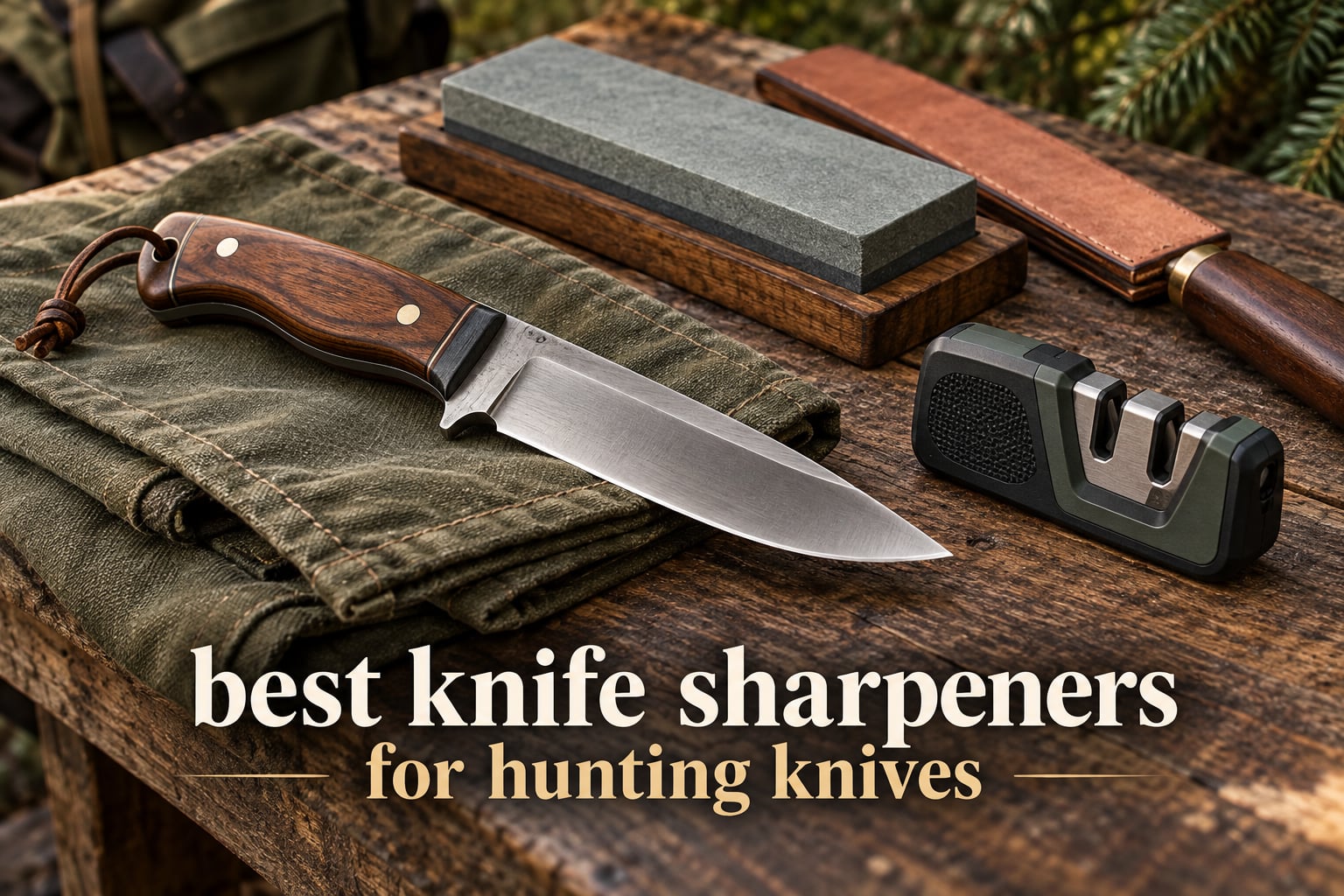
Short answer: the SHARPAL 101N is the best knife sharpener for hunting knives overall, because it puts a coarse carbide slot, a fine ceramic slot and a 400 grit diamond rod in a 2.4 ounce body you can clip to a hunting pack. The Work Sharp Guided Field Sharpener is the better bench-in-a-bag option, and the Work Sharp Precision Adjust Elite is what I buy when I want one system at home that covers every bevel a fixed blade ever had.
If you are still choosing a knife rather than a sharpener, start with our best boning knives roundup, because edge geometry only matters if the blade is right for the job.
Most sharpening advice on the internet is written for kitchen knives. That is a problem, because a hunting knife is a different job. It takes abuse from hide, bone, sinew and frozen mud, and it gets dull in a way a Santoku never does. It also lives in a pack, not a drawer, so whatever rides along has to earn its weight.
Our team put 12 sharpeners through their paces over a hunting season, on carbon steel case stockmen and on modern high-Rockwell stainless alike. We weighted the things that actually decide whether an edge survives a season: how much steel the tool removes, whether it holds a repeatable angle, whether it works without oil or water in a freezing tent, and whether it can be used one-handed in the dark.
Top 3 Picks for Hunting Knife Sharpeners in 2026
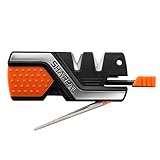
SHARPAL 101N 6-in-1 Field Sharpener
- 2.4 ounces
- 6 tools in one body
- Handles serrations and gut hooks

Work Sharp Guided Field Sharpener
- 20-25 degree guide
- Leather strop included
- Five abrasive surfaces

Work Sharp Precision Adjust Elite
- 15-30 degree adjustment
- 320 and 600 grit plates
- Serrated blade rod
Quick Overview: Every Sharpener in This Roundup
Twelve tools, sorted by the job they do. Five are small enough to live in a pack, four are bench systems, two are stones and one is a belt of both worlds.
| Product | Specifications | Action |
|---|---|---|
| SHARPAL 101N 6-in-1 Pocket Sharpener |
|
Check Latest Price |
 AccuSharp Ergonomic Knife Sharpener AccuSharp Ergonomic Knife Sharpener |
|
Check Latest Price |
 Smith’s PP1 Pocket Pal Sharpener Smith’s PP1 Pocket Pal Sharpener |
|
Check Latest Price |
 Smith’s CCKS 2-Step Sharpener Smith’s CCKS 2-Step Sharpener |
|
Check Latest Price |
| Work Sharp Guided Field Sharpener |
|
Check Latest Price |
 Sharp Pebble 1000/6000 Whetstone Sharp Pebble 1000/6000 Whetstone |
|
Check Latest Price |
 Lansky Deluxe 5-Stone System Lansky Deluxe 5-Stone System |
|
Check Latest Price |
 SHARPAL 162N Diamond Sharpening Stone SHARPAL 162N Diamond Sharpening Stone |
|
Check Latest Price |
| Work Sharp Precision Adjust Elite |
|
Check Latest Price |
 RazorSharp 3-in-1 Sharpener RazorSharp 3-in-1 Sharpener |
|
Check Latest Price |
 Intelitopia Complete Whetstone Set Intelitopia Complete Whetstone Set |
|
Check Latest Price |
 Kershaw Ultra-Tek 600-Grit Sharpener Kershaw Ultra-Tek 600-Grit Sharpener |
|
Check Latest Price |
1. SHARPAL 101N 6-in-1 Field Sharpener – Best Overall for Hunting Knives
- Six functions in a 2.4 ounce body
- Handles straight edges serrations and gut hooks
- Preset angle removes guesswork
- Carbide and ceramic rated to 10000 uses
- Lanyard hole for pack carry
- Fixed preset angles limit bevel control
- Coarse slot will not produce a mirror finish
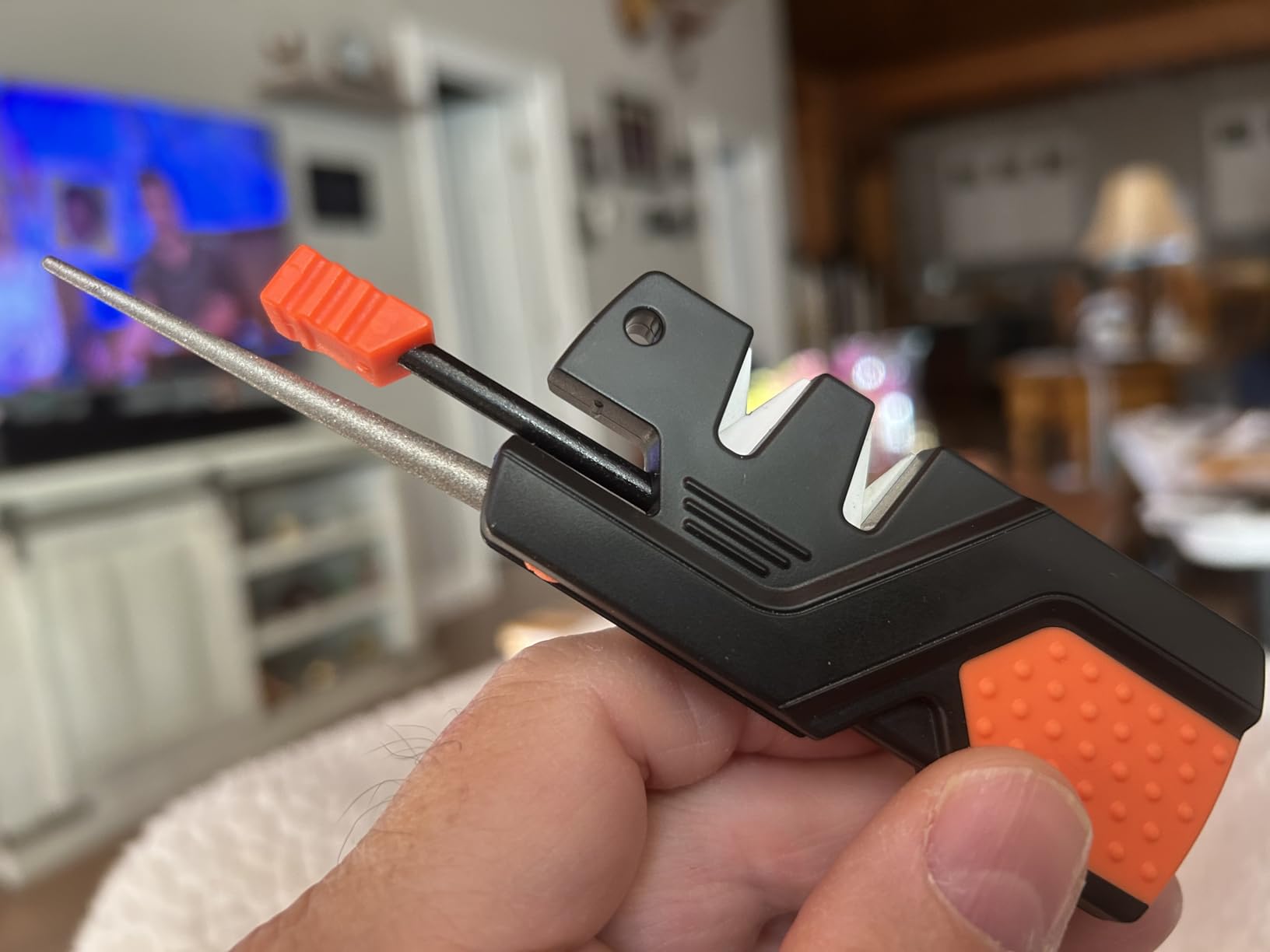
This is the sharpener that lives in the side pocket of my hunting pack and has for four seasons. It is a 3.54 inch black and orange stick with a V-notch carbide slot at one end, a fine ceramic slot beside it, a tapered 400 grit diamond rod that folds out, a second diamond rod with a groove for fishhooks, a ferro rod and a whistle. Nothing about it looks like precision engineering, and that is exactly why it works.
The coarse carbide slot is what rescues a blade. When a fixed blade stops parting hide cleanly and starts pushing, three or four passes through that V-notch take you back to a working edge in under a minute. The ceramic slot then smooths it off so the edge is not abrasive on your glove. I do not expect a mirror from either, and I stopped expecting one about the first week.
Where it earns its place is the diamond rod. A gut hook or a serrated skinning blade will never sit in a V-slot properly, and the tapered 400 grit rod follows that curve well enough to reopen the valleys between the teeth. The ferro rod and whistle are not sharpening features, but on a November elk hunt I have been glad they were there, and that is a fair argument for one body instead of three.
Two details matter more than the spec sheet suggests. The carbide and ceramic abrasives are rated to a 10000 use field test, which on a hunting knife is a lifetime. And the whole 2.4 ounces adds nothing measurable to a pack, so there is no argument for leaving it behind.
Who this sharpener suits
This is the right first purchase for anyone who owns one hunting knife and no system. It is also the right permanent pack tool for a hunter who sharpens at camp rather than at home, because it needs no water, no oil and no flat bench. A person who skins deer, capes an elk and fishes the same lake should find the ferro rod and hook groove quietly useful.
Buyers treat it as a dependable grab-and-go maintenance tool, with around 40000 reviews averaging 4.5 stars. The single most common theme is that it resets a dull edge quickly, which is exactly the job.
Where it falls short
The preset angles are the limit. There is no way to set a 20 degree edge on one pass and a 25 degree edge on another, so if you want a specific hunting geometry you will need a guided system instead. The coarse slot also works toward a working edge rather than toward a polished one, and it will not save a blade that already has a tip broken off.
For anyone who cares about a refined finish or needs a repeatable angle from heel to tip, treat this as the field tool and pair it with a bench option. The forums reach the same conclusion: the most repeated carry recommendation across r/Bushcraft and r/knifeclub is a guided field sharpener, and this fits that role for people who also want fire starter and whistle in the same object.
2. AccuSharp Ergonomic Sharpener – Fastest Way Back to a Working Edge
AccuSharp Knife Sharpener, Ergonomic Comfortable Handle, Compact & Easy to Use, Restore and Hone Straight & Serrated Knives, White
- Restores most blades in about 10 seconds
- Reversible carbide blades double usable life
- Full-length hand guard keeps fingers clear
- Handles straight and serrated edges
- Light and dishwasher safe
- Preset slot angle only
- Cannot repair missing or badly damaged tips
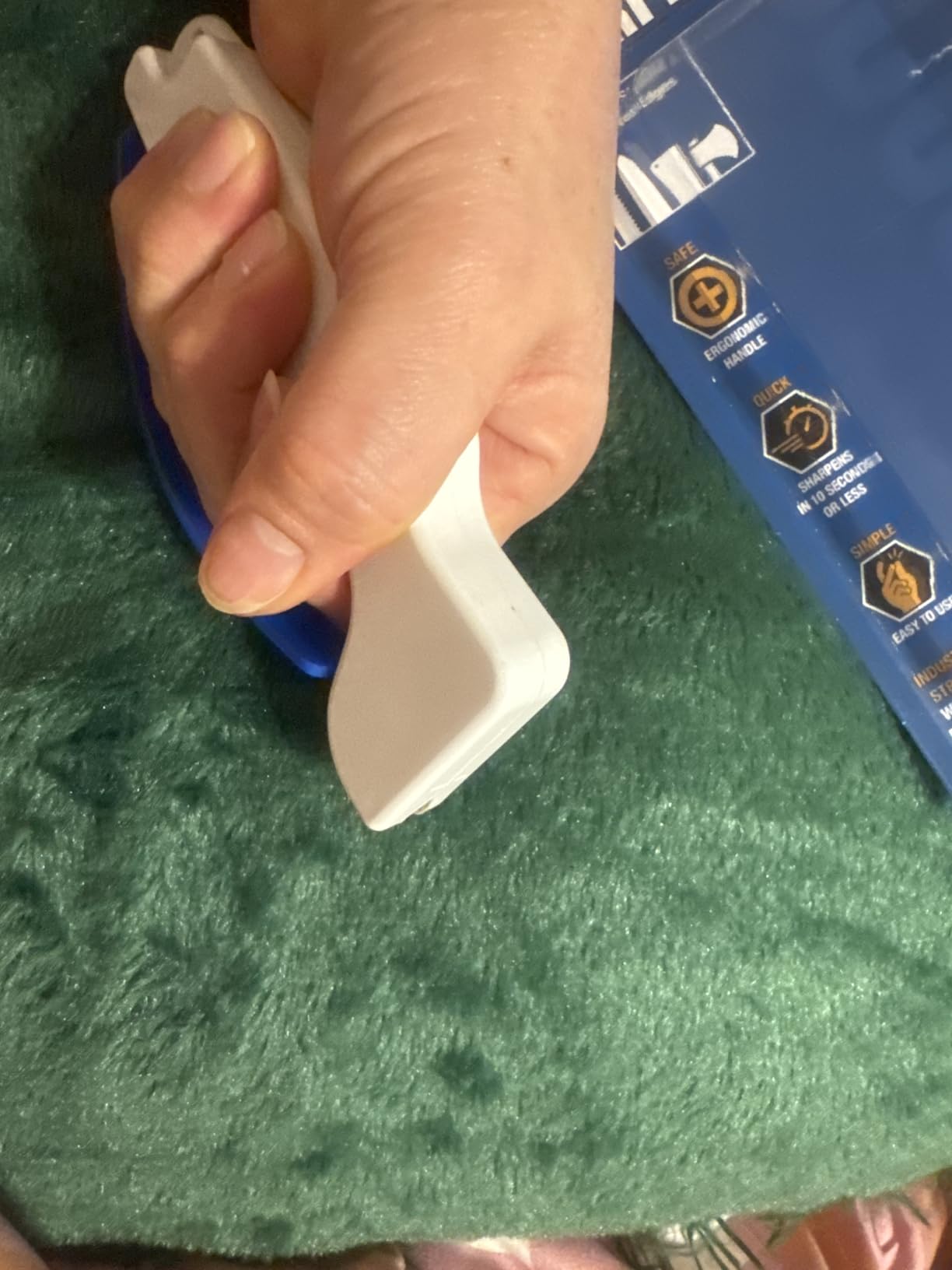
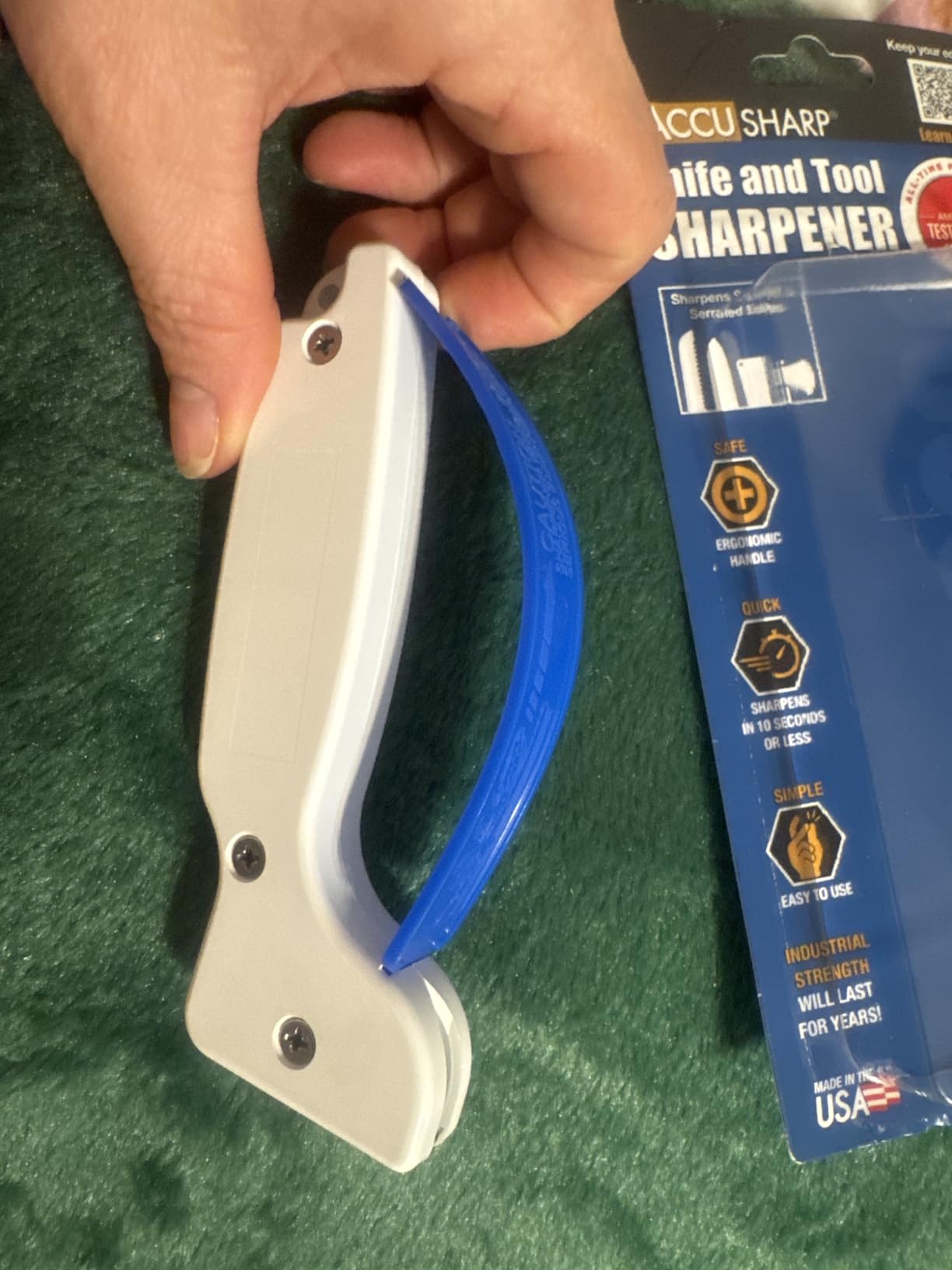
About 28670 reviews at 4.7 stars makes this one of the highest rated sharpeners in the category, and the reason is speed. You pull the handle through a crossed pair of diamond honed tungsten carbide blades and in roughly ten seconds a dull hunting blade is cutting again. It is the fastest recovery from a dull edge of anything we tested, and it does it with no learning curve at all.
The blades reverse to a second set of edges, which roughly doubles their life, and owners routinely report five to ten years between replacements. The full-length hand guard sits between your fingers and the blade, and on a slim skinning knife that guard is the difference between comfortable and not.
It is also, at 1.6 ounces, one of the lightest tools here, so it is easy to keep in a jacket rather than a pack. It cleans with soap and water, which matters after it has been in contact with hide and blood, and the ergonomic handle sits comfortably in hand even with cold fingers.
The crossed carbide geometry is what makes it work as quickly as it does. Rather than grinding one side flat, the blades shear a short bevel on both faces, so you need fewer strokes to establish an edge. Reviewers with tens of thousands of purchases behind them use the phrase dependable more than any other.
Who this sharpener suits
Anyone who wants one tool, no maintenance ritual and no stones. It is a good match for a hunter who skins a few deer a year, wants a fast recovery in the truck or at the kitchen counter, and does not care about achieving a specific edge angle. It is also the safest option on this list for someone with no knife experience whatsoever.
It handles serrated blades as well as straight ones, so a hunter who carries both a fixed blade and a serrated folding skinner is covered by one tool. At 1.6 ounces it disappears in a chest pocket.
Where it falls short
There is no angle control whatsoever, only the single preset slot. That means a factory hunting edge set at 20 degrees and a coarse chopper edge at 25 degrees get the same treatment, and one of them will be losing steel it did not need to lose. Repeat this across a season and the blade thins toward the heel faster than it should.
It also cannot fix damage. A tip snapped off on a femur or a deep chip from a bone shard is out of reach for a pull-through of this type. Treat it as a maintenance tool, not a repair bench, and the honest buyer pairs it with a stone or guided system for the once-a-year full sharpen.
3. Smith’s PP1 Pocket Pal – Best for Serrations and Gut Hooks
Smith’s PP1 Pocket Pal Knife Sharpener Preset Carbide & Ceramic Stone Sharpeners Fold-Out Diamond Coated Rod Outdoor Hunting Knife & Hook Sharpener, Handheld, Compact, Lightweight, Multiuse
- Diamond rod handles serrations gut hooks and fishhooks
- About 1 ounce and keychain portable
- Carbide stones reversible and replaceable
- Preset crossed blades give repeatable results
- Fold-out rod hinge is stiff and can snap if forced
- Ceramic stones cannot be reversed
- Fine rod is aggressive on serrations
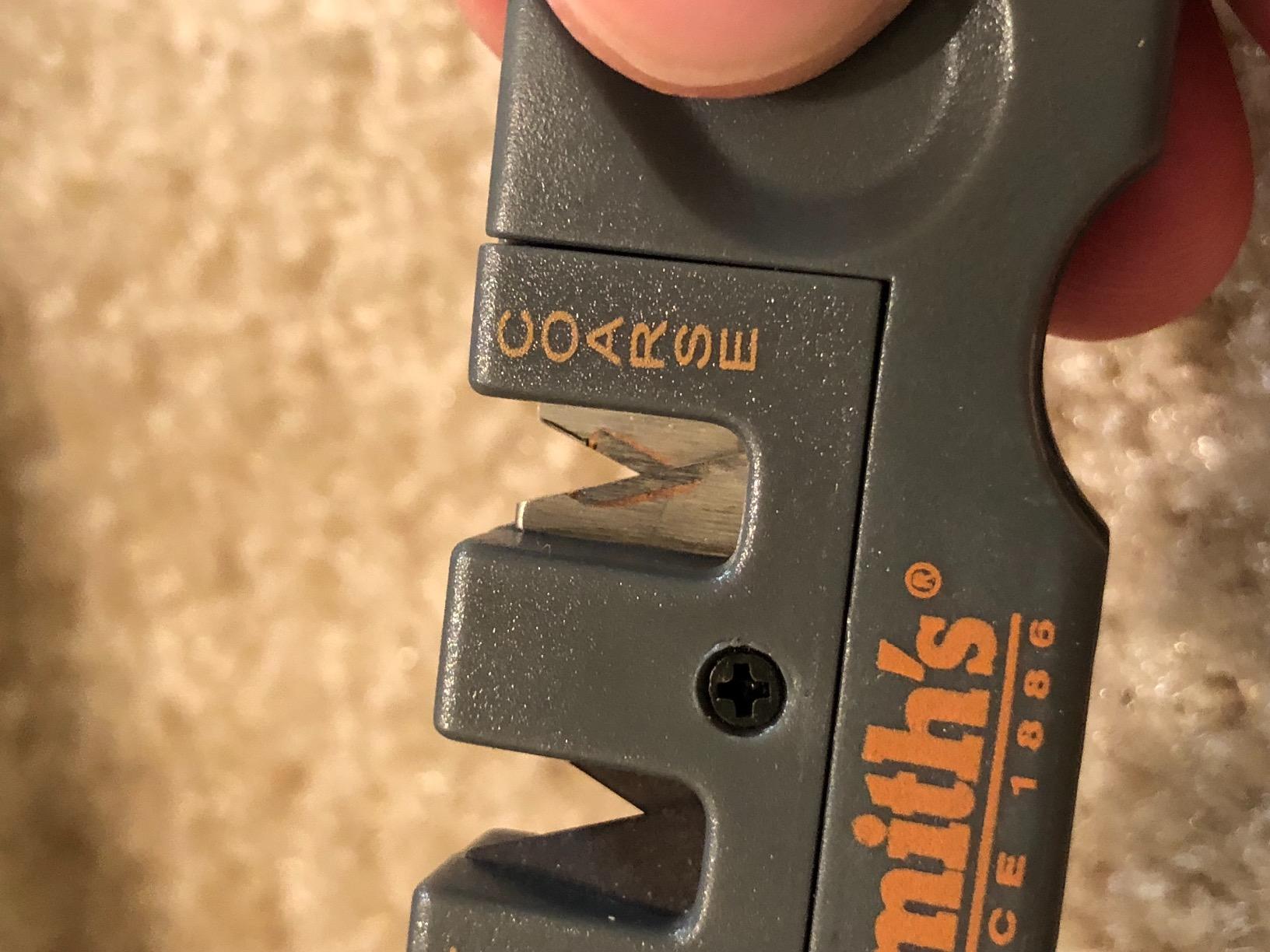
At roughly one ounce, this is the lightest serious sharpener we tested and the only one that fits on a keychain without becoming a nuisance. It is a gray plastic body about 3.24 inches long with a coarse crossed carbide slot, crossed ceramic stones for finishing, and a tapered round diamond coated rod that folds out for serrations.
That rod is the reason it earns a place on a hunting knife roundup. A gut hook has a deep concave curve that a V-slot cannot reach, and a serrated skinner has valleys no flat abrasive will touch. Running the blade down the tapered rod at the matching angle reopens both, and for anyone who carries a gut hook this tool earns its slot alone.
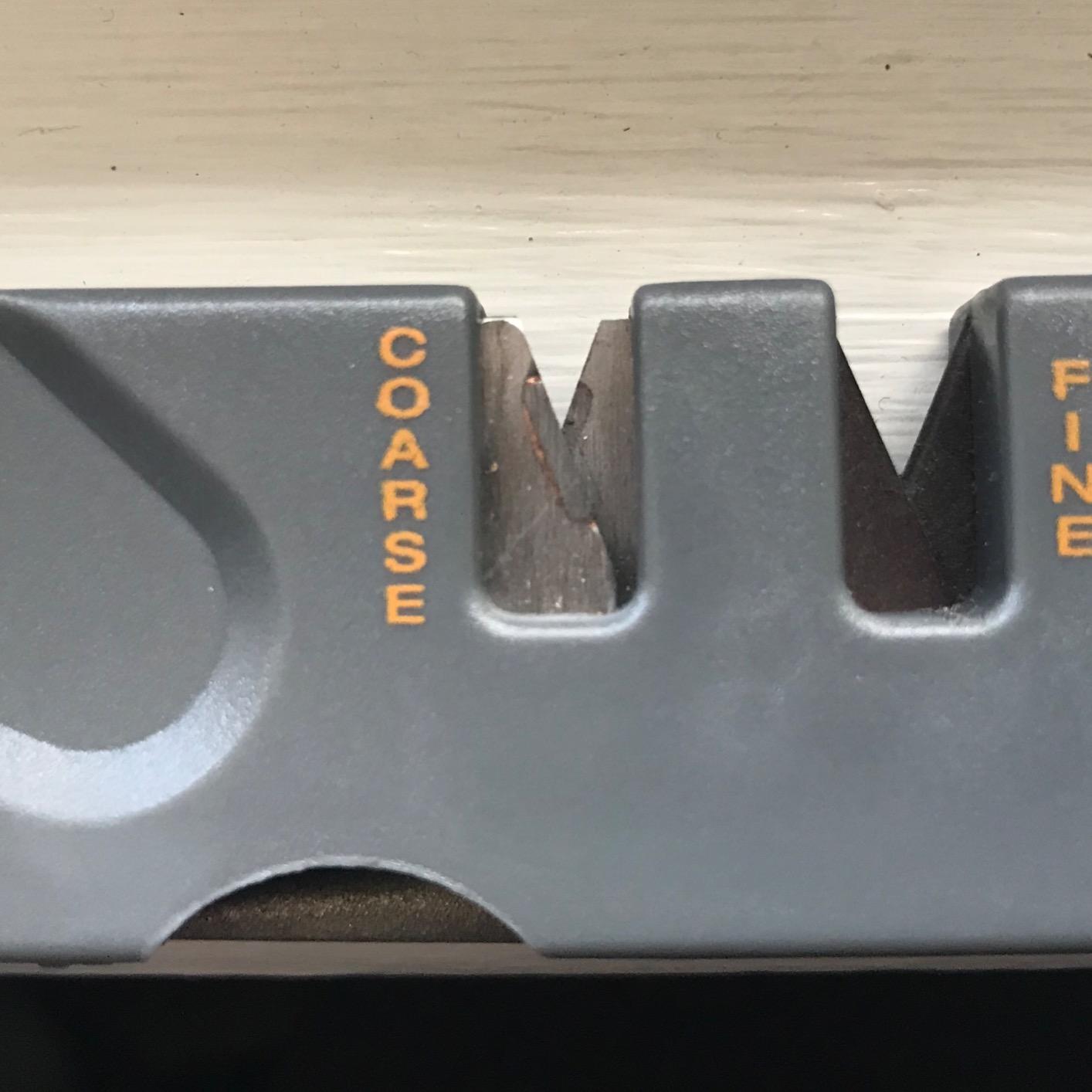
The carbide stones are reversible and replaceable, which is rare at this size and quietly extends the tool’s life. The preset crossed blades give a consistent result with very little practice, so it is a reasonable second sharpener for a family member who borrows your knife.
Around 22400 reviews at 4.5 stars, and the most repeated comment is simply sturdy. It is the sort of tool that has been lost in a jacket for a year and turned up still working.
Who this sharpener suits
Anyone whose hunting kit includes a gut hook, a serrated folding knife or a fishhook terminal rig, and who wants to carry sharpening capacity without feeling it. A hunter who walks a long way from the truck and carries only a knife and a fire source will not notice one extra ounce of kit.
It is also a good backup in a multi-knife kit, where one person is carrying a primary and a skinner and only one sharpener. The three year limited warranty adds a little confidence at this size.
Where it falls short
The fold-out diamond rod is a tight fit. Several reviewers warn that forcing it when extending or folding can snap the hinge, and it is the one failure mode that ends the tool’s usefulness. Open it squarely and slowly.
Unlike the carbide blades, the ceramic stones cannot be reversed, and the fine rod is aggressive enough that careless angle on a serrated blade can thin the teeth. It is also strictly a maintenance tool with no angle control, so anything beyond a routine edge is out of its reach.
4. Smith’s CCKS 2-Step Sharpener – Budget Pick for a Truck Cab
- Three to four strokes restore a very dull edge
- Under 2 ounces and genuinely tiny
- Floats in water which helps around rivers and lakes
- Non-slip rubber feet for safe use
- Cleans with a damp cloth
- Preset angles only with no polishing control
- Plastic body wears with long heavy use
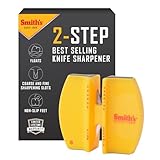
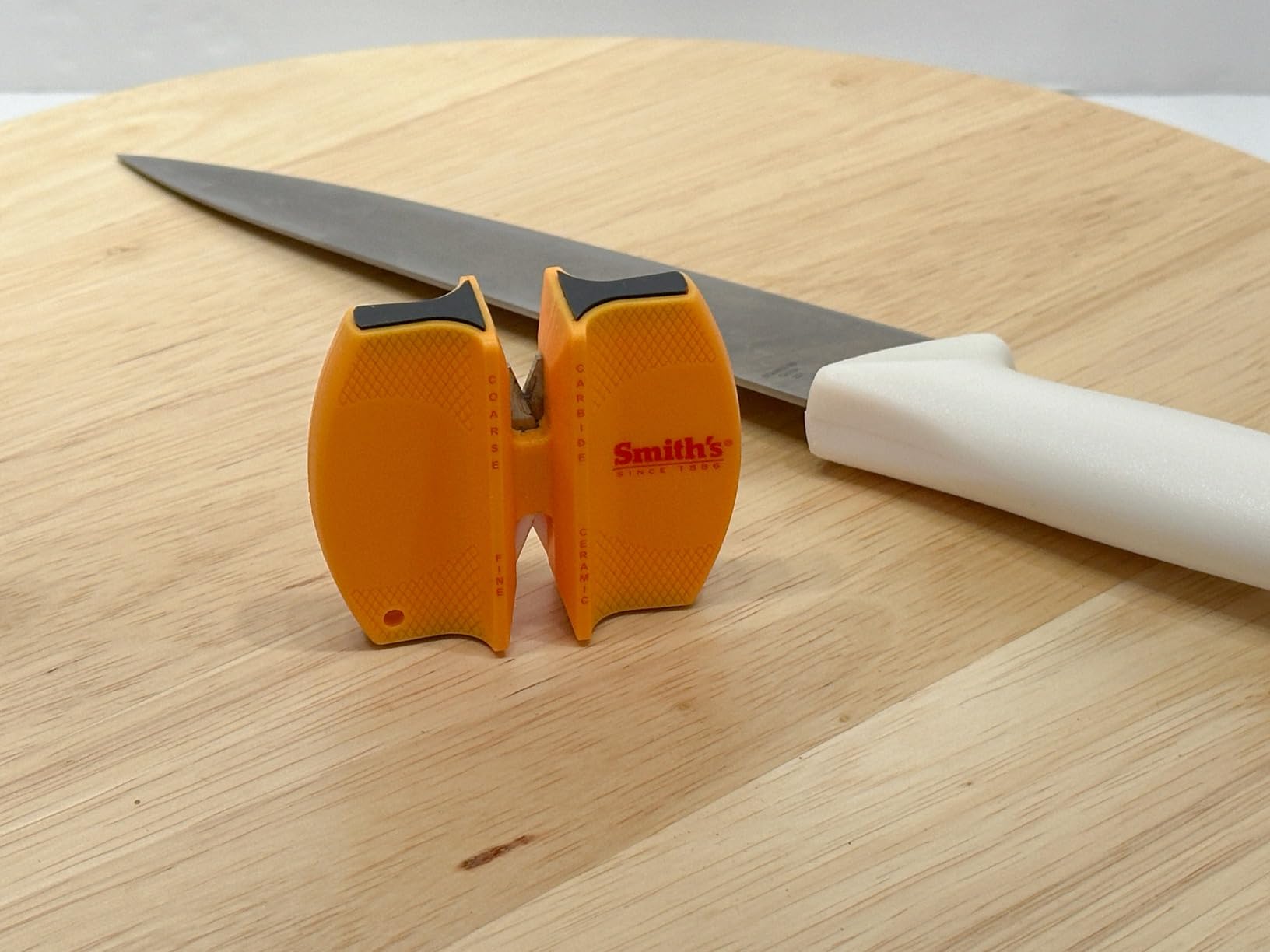
This is the smallest, simplest tool in the roundup and the one I keep in the truck. At 2.71 by 2.33 inches and under 2 ounces it fits a cup holder, and two crossed tungsten carbide blades followed by crossed ceramic rods mean you can rescue a dull blade in a parking lot in about a minute.
What makes it genuinely useful in a hunting context is that it floats. Hunters who clean fish, work near water or drop a tool in a creek recover it instantly rather than losing it, and the non-slip rubber feet give it stability on a truck dash or a wet log.
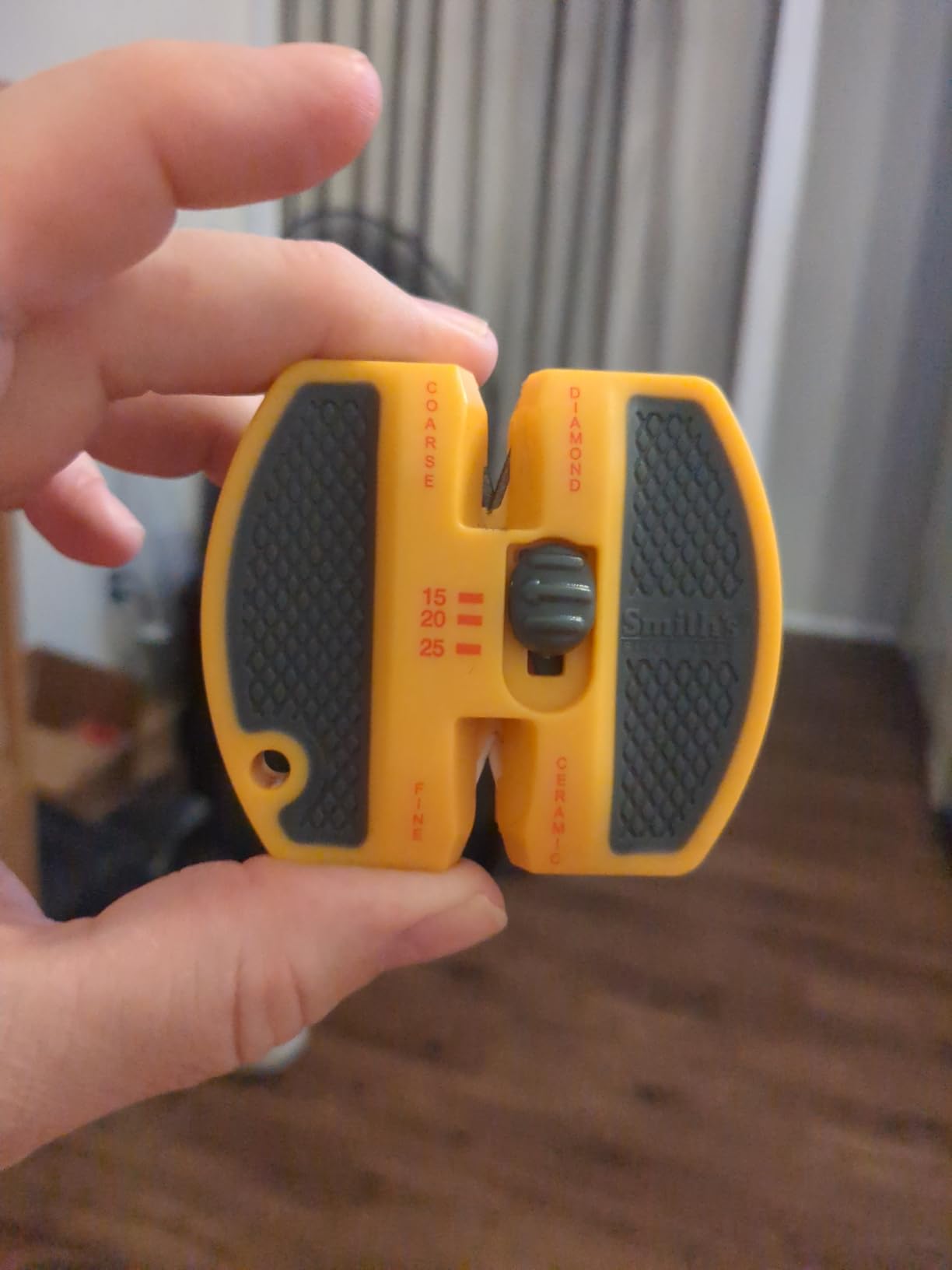
Roughly 17000 reviews at 4.5 stars, and the recurring theme is that three or four strokes through the coarse slot rescues an edge that had stopped working. That is a low bar and it clears it every time.
There is nothing clever about the design, and that is the point. It has no angle settings to read, no water or oil to manage, and no moving parts except the plastic body you squeeze. My one rule for it is that it lives in the truck and never goes in the pack.
Who this sharpener suits
It suits a hunter who wants a backup and refuses to spend real money on one. If your primary edge tool lives in the truck, this is a sensible second one for a glove box or a tackle box, and it handles fillet, pocket and hunting knives with the same stroke.
It is also a reasonable loaner. Handing this to someone who has never sharpened a knife is low risk, because the worst case is a working edge rather than a fine one.
Where it falls short
There is no angle control and no fine control. The ceramic stage smooths an edge, but it does not produce a refined finish, so it will not satisfy anyone who wants a hunting knife sharpened to a specific bevel.
The plastic body is the durability question. Under normal seasonal use it will outlast most owners, but it is not a tool to take to a bench and hammer on. Use it to keep an edge working, and use a proper system when the edge is actually gone.
5. Work Sharp Guided Field Sharpener – Best Guided Sharpener for the Field
Work Sharp Guided Field Sharpener, Compact Travel Knife Sharpener Tool
- Guided system gives repeatable 20-25 degree angles
- Five abrasive surfaces plus a leather strop in one package
- Self contained with no tools or setup
- Highest rating in the roundup at 4.8 stars
- Backed by a 3-year warranty
- Heavier than a keychain pull-through
- Field use is maintenance rather than reprofiling
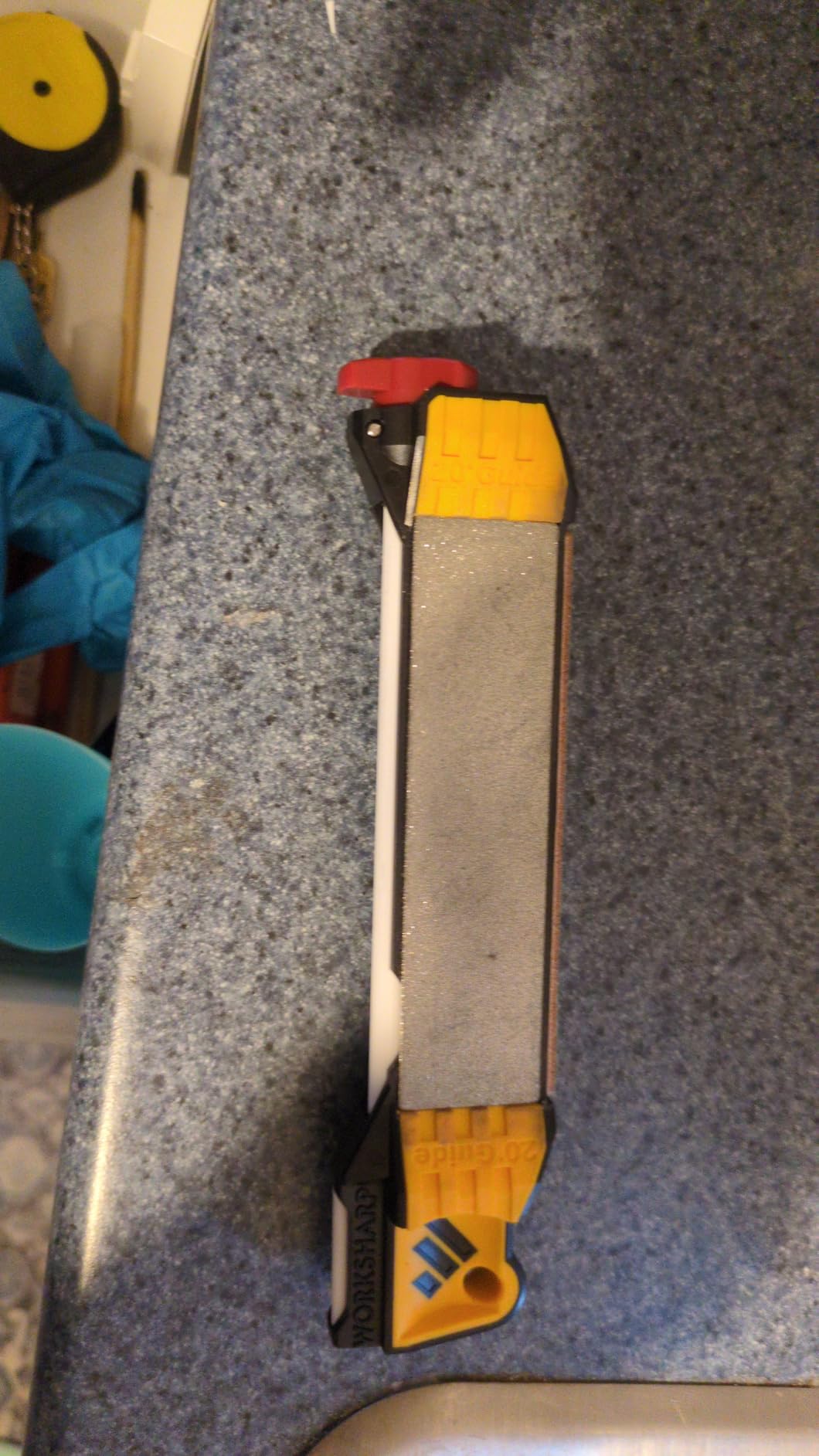
The most repeated carry recommendation on r/Bushcraft and r/knifeclub is a guided field sharpener, and this is the one they mean. It is a 9.53 by 5.42 inch black case holding a 20 to 25 degree guide, five abrasive surfaces and a leather strop, with nothing to assemble and no tools required. You open it, pick a surface, and go.
The angle guide is the whole point. Instead of judging an angle by eye, you rest the guide on the blade and draw it through, and the bevel comes out the same at the heel and the tip. Once that 20 degree reference is in your hands, it stays there, which is the reason forum users recommend it as a first purchase for someone who has never sharpened anything.
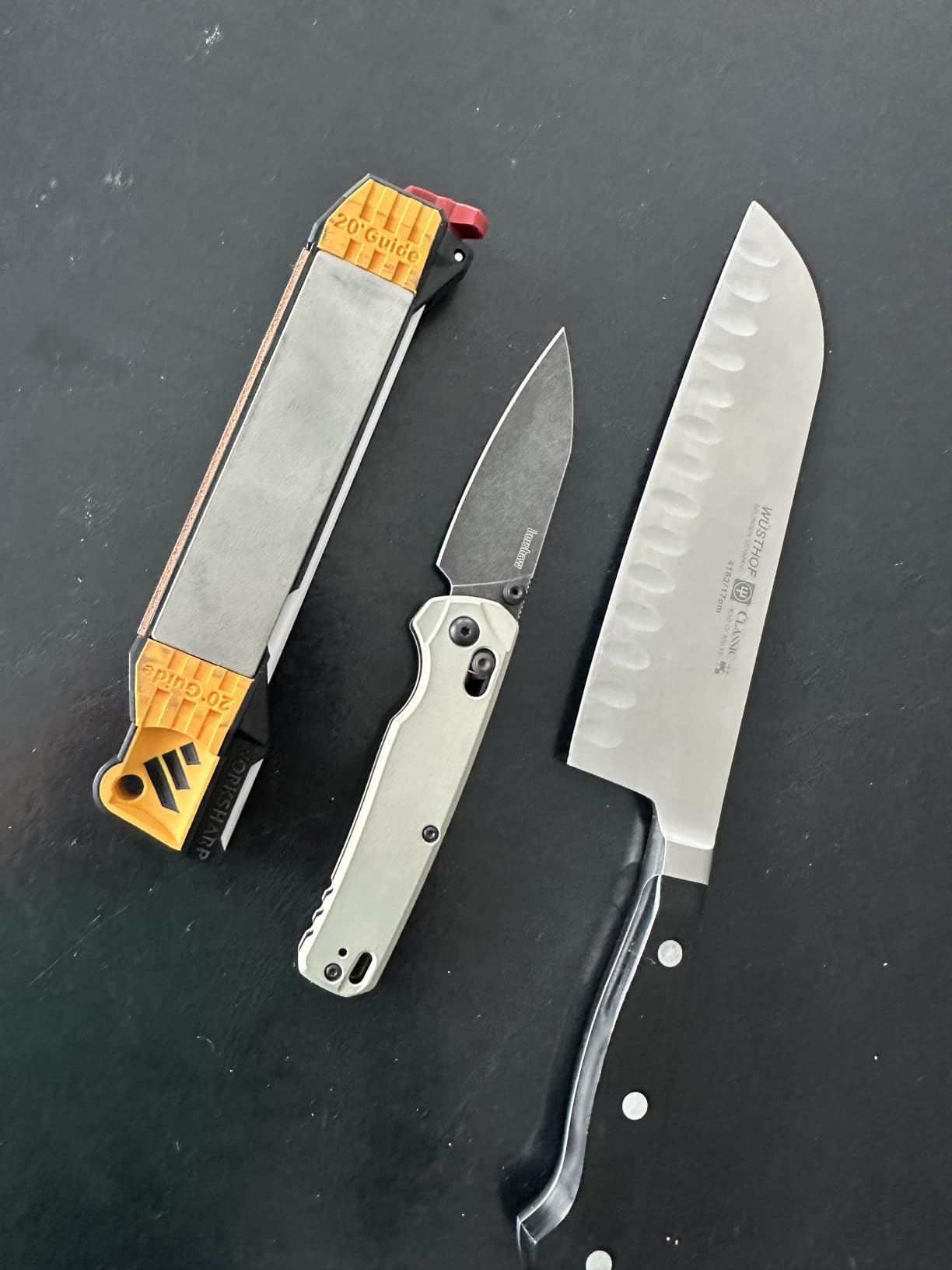
The rotating ceramic rod adds a coarse face, a fine face and a fishhook groove in one part. The diamond plates lift out to expose a broad head wrench for faster work on a genuinely dull blade, and the leather strop with compound is the last step, taking the burr off and closing the edge up.
At 4.8 stars from more than 12700 reviews with 85 percent five-star ratings, this is the highest rated product we analyzed. Reviewers repeatedly describe the guides as removing the guesswork, and they single out the all-in-one packing of plates, rod and strop as the reason it works in a hunting camp rather than only in a garage.
Who this sharpener suits
This suits a hunter who wants a real sharpening system and also wants to be able to put it in the truck or on a camp table. It is the single most useful object in a pack for someone who skins, bones and caps without going home between the truck and the tree.
It is equally a good first system, because it teaches the angle without punishing mistakes. If you have one hunting knife and no setup, this is the one I would start with, and it is a fine companion to a fixed blade bought from any of the major makers.
Where it falls short
At 135 grams it is heavier than a pull-through, and in a long backcountry pack that is a real consideration. More importantly, the fixed guide is a maintenance tool, not a reprofiling system. If a tip is broken or an edge is badly uneven, a guided field unit does not have the range to fix it.
There is also no angle adjustment below 20 or above 25 degrees, so a knife set at 15 or a chopper at 30 degrees is outside what it can reproduce. The consensus in forums is that it is worth it as a carry tool and worth pairing with something at the bench.
6. Sharp Pebble 1000/6000 Whetstone – Best Whetstone for Beginners
- Angle guide makes a consistent bevel achievable for beginners
- Stays flat longer than budget stones
- Dual grit covers most sharpening without over buying
- Water based so no oil and no mess
- Non-slip bamboo base holds the stone steady
- Still needs a steady hand to use well
- Stone must be soaked and kept wet
- Same stone sold by others under different branding
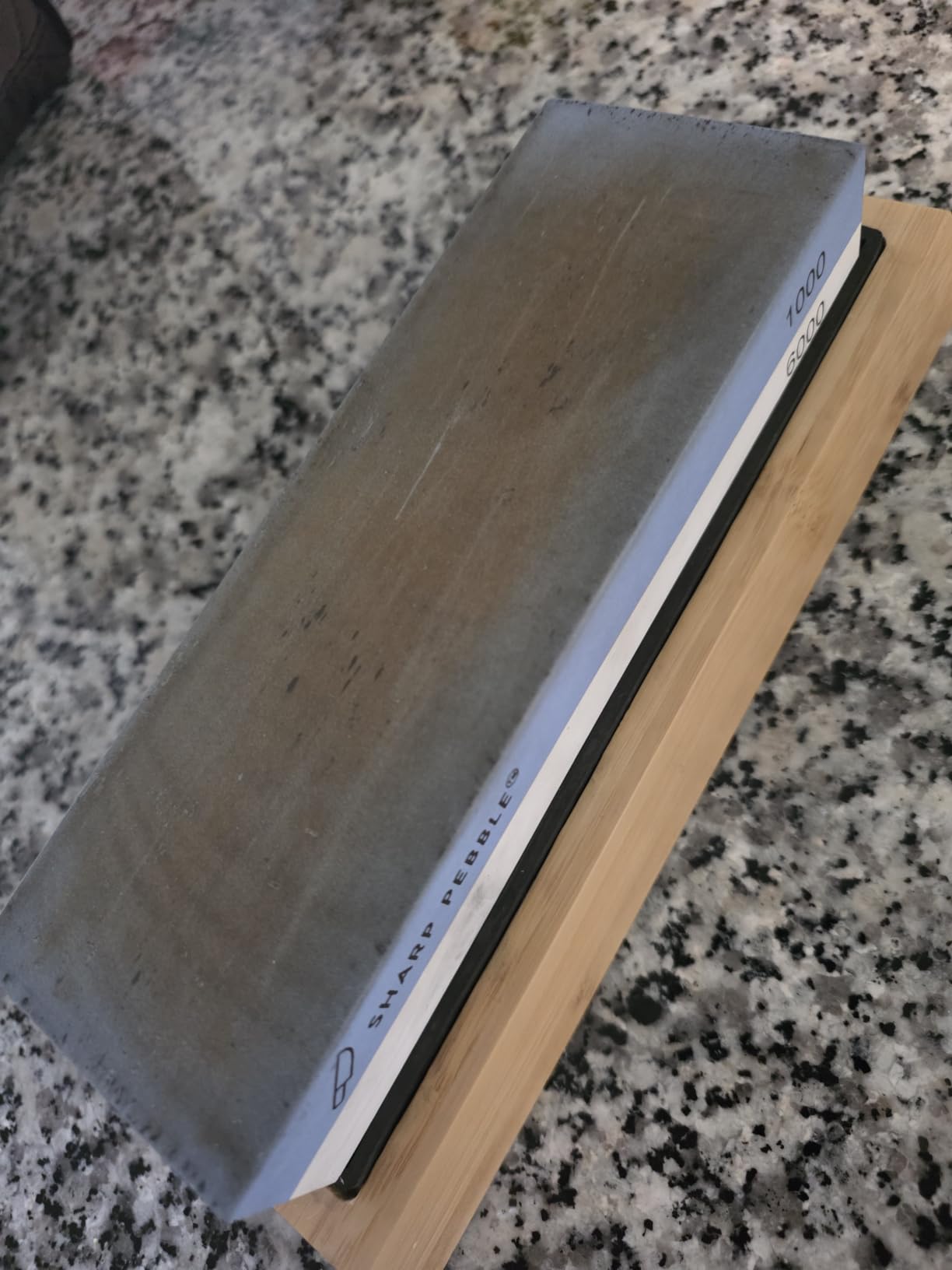
A 7.25 by 2.25 inch corundum stone with 1000 grit on one side and 6000 on the other, sold with a bamboo base and an angle guide. The 1000 side repairs a dull or lightly damaged edge and the 6000 side polishes it to a fine finish, and the two grits between them cover almost every task a hunting knife presents.
The angle guide is the feature that makes this stone work for someone who has never sharpened. You set the blade against the guide, the guide sets the bevel, and the result is repeatable. Advanced users note that it still demands real technique, but the gap between first attempt and competent attempt is far smaller here than with a bare stone.
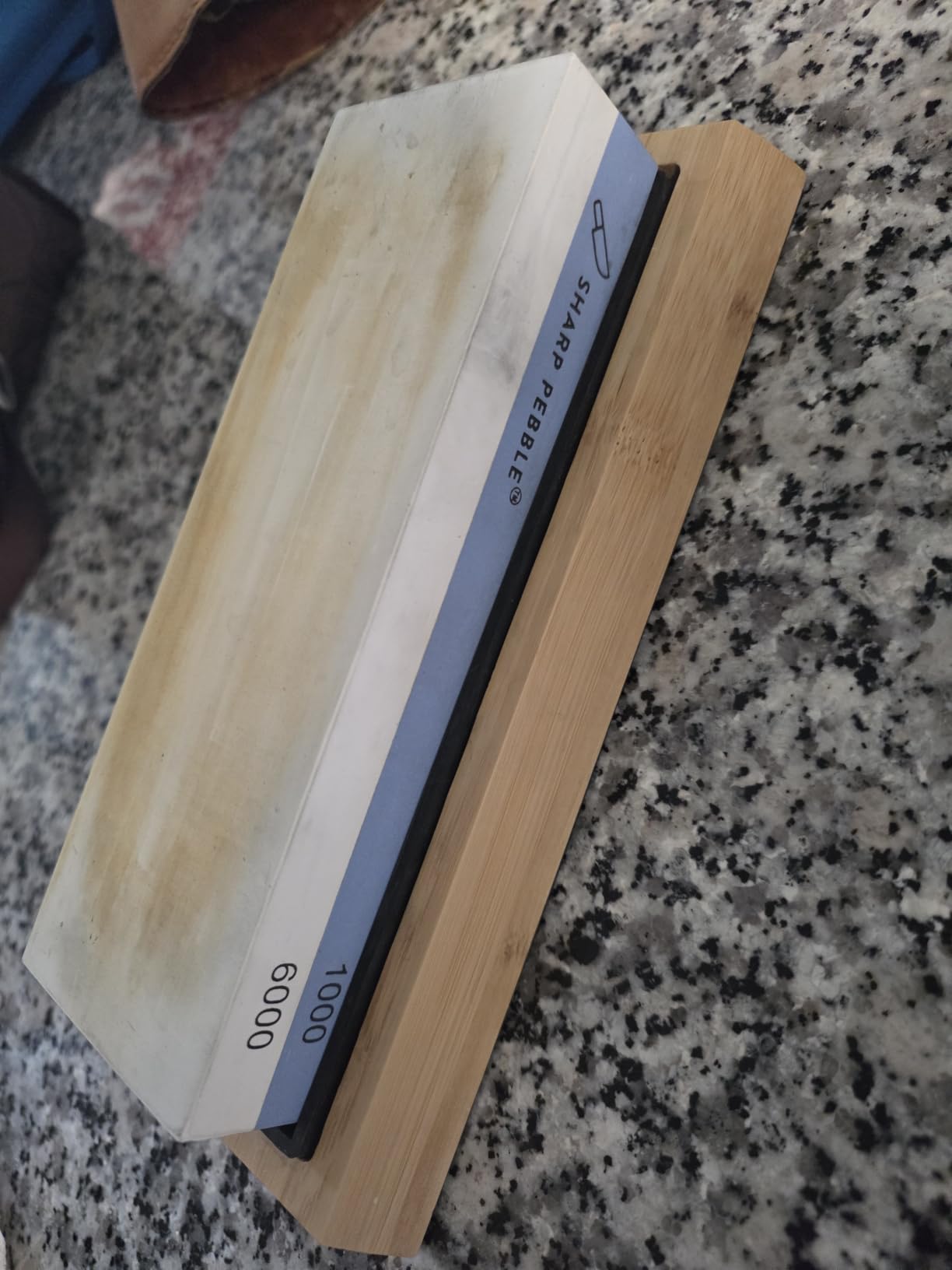
Water based sharpening is the other practical win. No oil, no slurry, no sticky bench, and cleanup is a rinse under a tap. Soak the stone for about 15 minutes before you start and keep it wet while you work, and the 6000 side will produce a genuinely fine edge on a carbon steel skinner.
Around 25700 reviews at 4.6 stars, and the dominant theme is that the guide removes the hardest part of stone sharpening. Reviewers also say it stays flat longer and resists dishing better than cheap stones, which matters more over years than it does on day one.
Who this sharpener suits
It suits a hunter who wants a proper bench setup but does not want to learn freehand stone technique yet. The two grits cover repair, edge setting and refinement, and the angle guide handles geometry, so the skill you actually need to build is stroke consistency.
At 2.1 pounds it is a home or truck tool, not a pack tool. It pairs well with a carbon steel hunting knife, where a natural abrasive produces an edge that many users find more satisfying than a diamond finish.
Where it falls short
Two grit numbers do not cover everything. A badly damaged edge, a deep chip or a blade that needs reprofiling wants something coarser than 1000, and a hunting knife that has been abused through a whole season without maintenance will need that step done elsewhere.
At 6000 grit this is a finishing stone, not a mirror polish, and one highly rated reviewer points out that the same stone is available from other sellers under different branding at a lower cost. Know what you are buying before you assume the branding is the product.
7. Lansky Deluxe 5-Stone System – Best Value Complete Sharpening Station
Lansky Deluxe Knife Sharpening System: 5-Stone Ceramic Knife Sharpener Kit with Honing Oil – LKCLX
- Full five stage grit progression in one kit
- Knife clamp holds a repeatable angle
- Color coded stones and grooved holders
- Custom molded case for storage and transport
- Covers kitchen outdoor and garden knives
- Wet stones and honing oil add setup and mess
- 1.1 pounds and a large footprint
- Less suited to a day pack than a rod
The Lansky kit is the classic answer to how do I sharpen everything without thinking about it. Five color coded stones run from extra-coarse through coarse, medium, fine alumina oxide and an extra-fine ceramic, held in finger-grooved safety holders, with a specially formulated honing oil in the box and a precision engineered knife clamp.
The clamp is the reason to buy this over a pile of loose stones. It holds the blade at a consistent angle while the stone moves, so the whole five-step progression is repeatable. A hunter who skins and bones a lot can walk a dull edge back through the sequence in one sitting and finish with an extra-fine ceramic edge that pops hair.
Users pair it with a strop to get the last of the burr off, and around 14300 reviews at 4.5 stars the praise lands on the same two things: the color coded progression that makes the sequence obvious, and the clamp that flattens the learning curve.
It is a complete bench or garage station, not a portable tool. At 1.1 pounds with a 10.25 by 9.75 inch footprint, it lives on a bench and comes out for a full sharpen, not a pack-in.
Who this sharpener suits
It suits a hunter with several blades, a preference for traditional stones, and a bench to work on. If you own a fixed blade, a skinner and a caping knife, this handles all of them, and the same kit covers garden and outdoor tools that show up on the same property.
It is also the right budget for someone who wants the full range of grits in one purchase instead of buying a 1000 grit stone now and a 400 grit stone in a panic later. The custom molded case makes it easy to store and to move to a hunting cabin.
Where it falls short
Wet stones and honing oil mean setup and mess. The stones need soaking, the oil has to be cleaned off your hands and your bench, and a hunting cabin with a wood table will show it. Reviewers accept this as the cost of a traditional system rather than a flaw.
Its size rules it out as a pack tool, and the clamp style works best on blades with a defined shoulder, so a very thin modern skinner with a flat grind can feel awkward in it. It also comes with a one year manufacturer warranty, shorter than some of the systems here.
8. SHARPAL 162N Diamond Sharpening Stone – Best for Modern Super Steel
SHARPAL 162N Double-sided Diamond Sharpening Stone, 8 in. x 3 in.
- Sharpens dry with no water or oil
- Verified flat surface holds even contact
- Fast cutting 325 grit raises a burr quickly on tough steel
- Substantial steel base with hinged case that doubles as a stand
- Cuts clipper blades and woodworking knives too
- Diamond plate wears through and cannot be lapped flat again
- Fine side collects metal particles
- Case lid is not a safe platform on its own
- Needs bedding in before first use
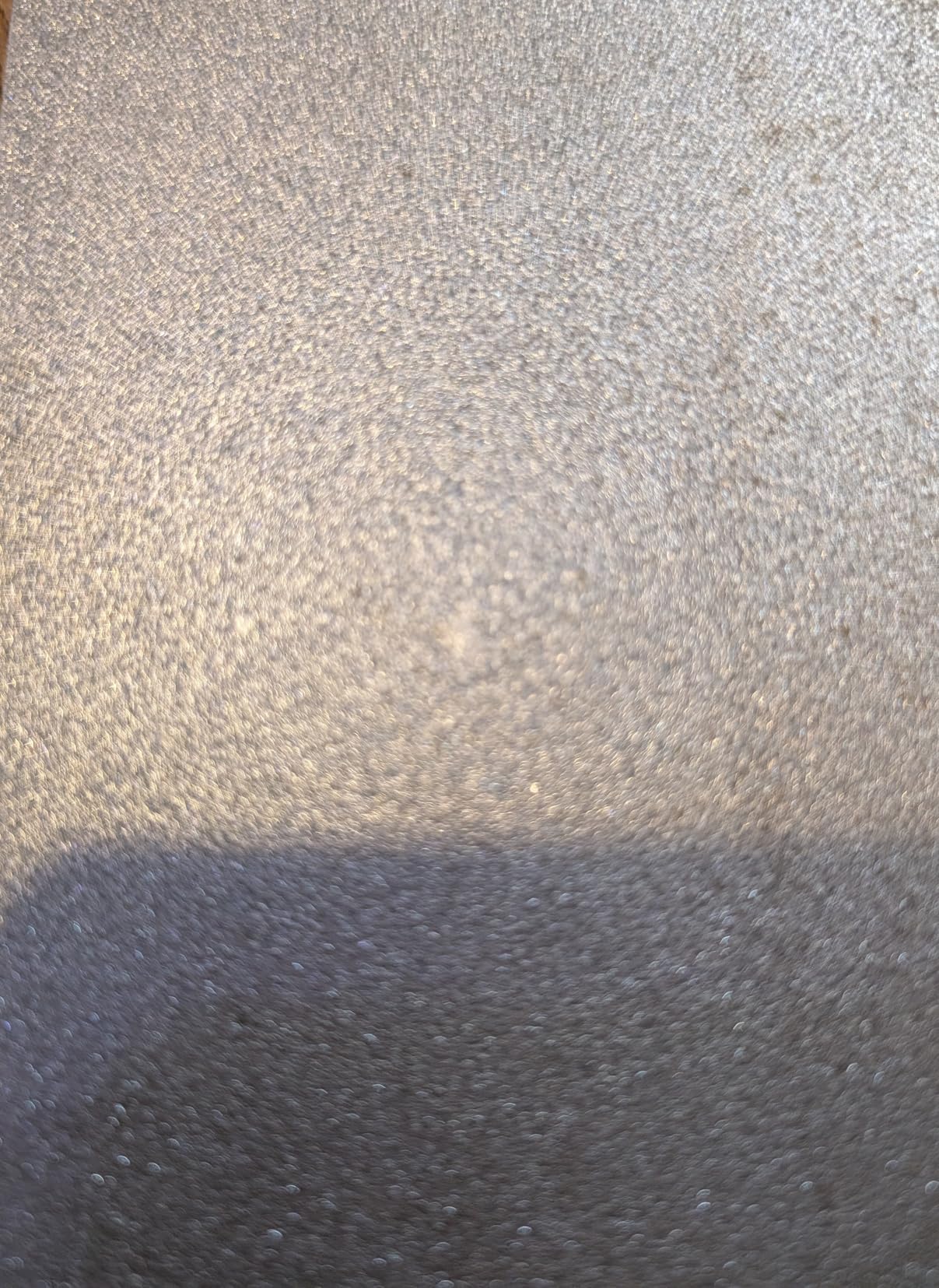
Here is the honest constraint with modern hunting knives. Blades in high-Rockwell stainless and high speed tool steel are slow and hard to cut with natural stone, and many hunters end up giving up on stones because their blade is not responding. This 8.46 by 3.94 inch diamond plate, electroplated with monocrystalline diamond onto a 0.35 inch stainless steel base, is the answer to that problem.
One side is 325 grit for setting an edge and the other is extra fine 1200 for honing. It sharpens high speed steel, carbide, ceramic and cubic boron nitride, and it does it dry, with no water and no oil, which removes both the mess and the setup from wet stone work. Multiple reviewers verify the flatness with a straightedge, and the MirrorFlat surface is the reason the whole face keeps making contact.
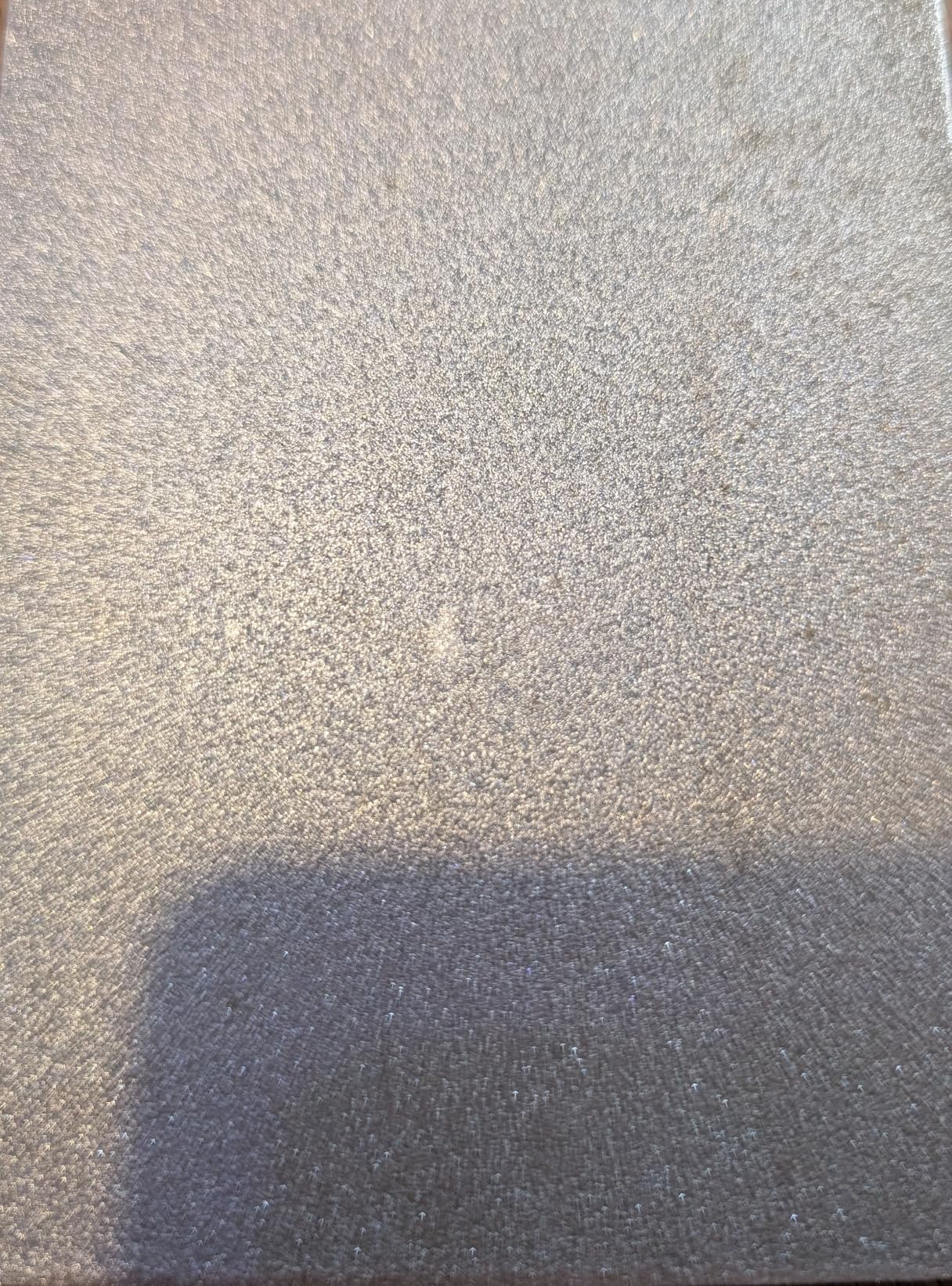
The storage box doubles as a non-slip base, and the included angle guide covers 14, 17, 20 and 25 degrees, which covers essentially every common hunting knife geometry. At 4.7 stars from around 4000 reviews with 84 percent five-star, the praise concentrates on three things: flatness, cutting speed and zero mess.
On an S30V or a modern stainless fixed blade, the 325 grit raises a burr in seconds where a water stone would take much longer. The 1200 side then takes that burr down and leaves a working edge good enough to skin with.
Who this sharpener suits
It suits anyone whose hunting knife is modern super steel and who has been frustrated by stones. It also suits a hunter who wants one bench tool that handles clipper blades, woodworking knives and a carbon steel skinner without changing abrasives.
Because it works dry, it is a good choice for a hunting cabin with no water nearby and no interest in oil cleanup. The included guide also means a first-time stone user has a reference angle on hand.
Where it falls short
Every diamond plate has the same durability ceiling. Heavy volume honing wears the plating through, and unlike a stone it cannot be lapped flat again. For seasonal hunting use that is years away, but for someone sharpening every day it is a real limit.
Two smaller cautions. The fine 1200 side can collect metal particles that leave tiny imperfections, so it wants cleaning. And the case lid is not a safe sharpening platform on its own, so buy a proper holder or the base, and run a lapping plate over the surface before the first use to knock off the proud surface diamonds.
9. Work Sharp Precision Adjust Elite – Best Adjustable System for Hunting Blades
- 15 to 30 degree range covers Japanese Western hunting and cleaver edges
- Guided clamp produces genuinely sharp repeatable edges
- Holds full flat grind knives solid out of the box
- Conical ceramic rod restores serrated blades
- Sturdy carry case holds all six pieces
- Knife mount can flex under heavy pressure
- Spring clamp must be pushed from the rear to rotate
- Awkward with very thick oversized blades
- Angle setting has some room for error
This is the system we recommend to a hunter who sharpens at home and wants one tool to cover everything. The angle adjusts from 15 to 30 degrees through a guide, which spans a Japanese single bevel, a Western double bevel, a typical hunting edge and a chopper. The coarse plate is 320 grit diamond and the fine plate is 600 grit, with a conical ceramic rod for serrations, a tri-brasive attachment for curved blades and a leather strop.
The clamp-and-guide design means you set the angle, clamp the knife and sharpen, with no measuring. On a full flat grind hunting knife it holds solid and centred straight out of the box, and the resulting edge is the kind users describe as shaving sharp. Around 6410 reviews at 4.6 stars with 77 percent five-star, enthusiasm comes from people who simply cannot sharpen freehand.
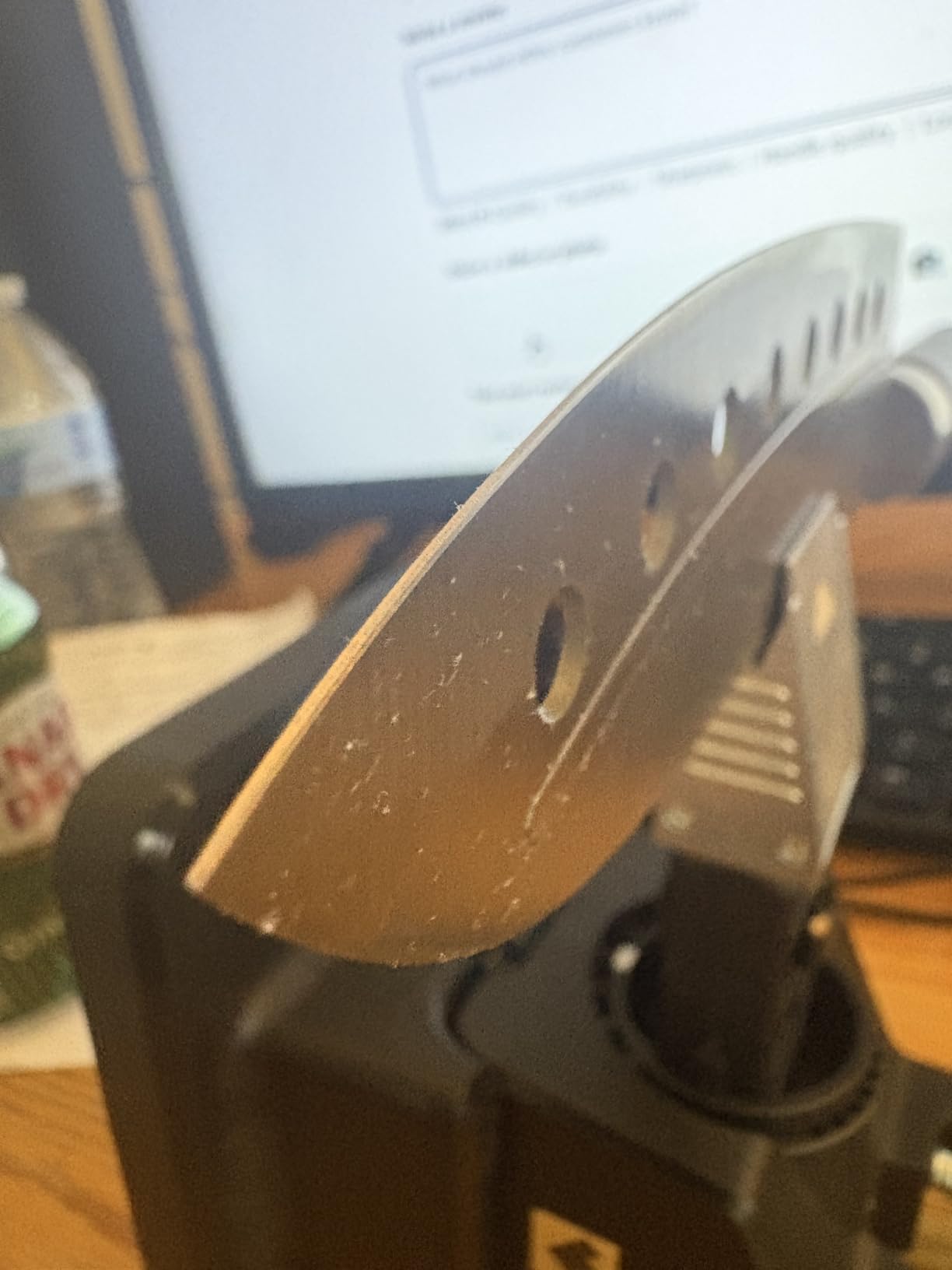
Reviewers also stress reading the manual and watching the technique material, which is fair advice for any guided system. The angle range is the part that matters most for hunting knives, because it lets you keep a thin skinning edge at 20 degrees and a tougher edge for bone work at 25 without changing tools.
The strop and the serrated rod together cover the two steps most people skip. The strop removes the burr and polishes, the rod reopens serrations, and the tri-brasive attachment handles a curved gut hook or a hawkbill blade that would rock on a flat plate.
Who this sharpener suits
It suits a serious hunter who processes game regularly, owns more than one blade, and wants a repeatable angle without learning freehand stone work. It is the natural step up for someone who has outgrown a pull-through and does not want to buy a full stone collection.
It is also the right bench companion to a field sharpener. Carry a guided field unit in the pack for touch-ups and keep this at the house for the full session before and after the season.
Where it falls short
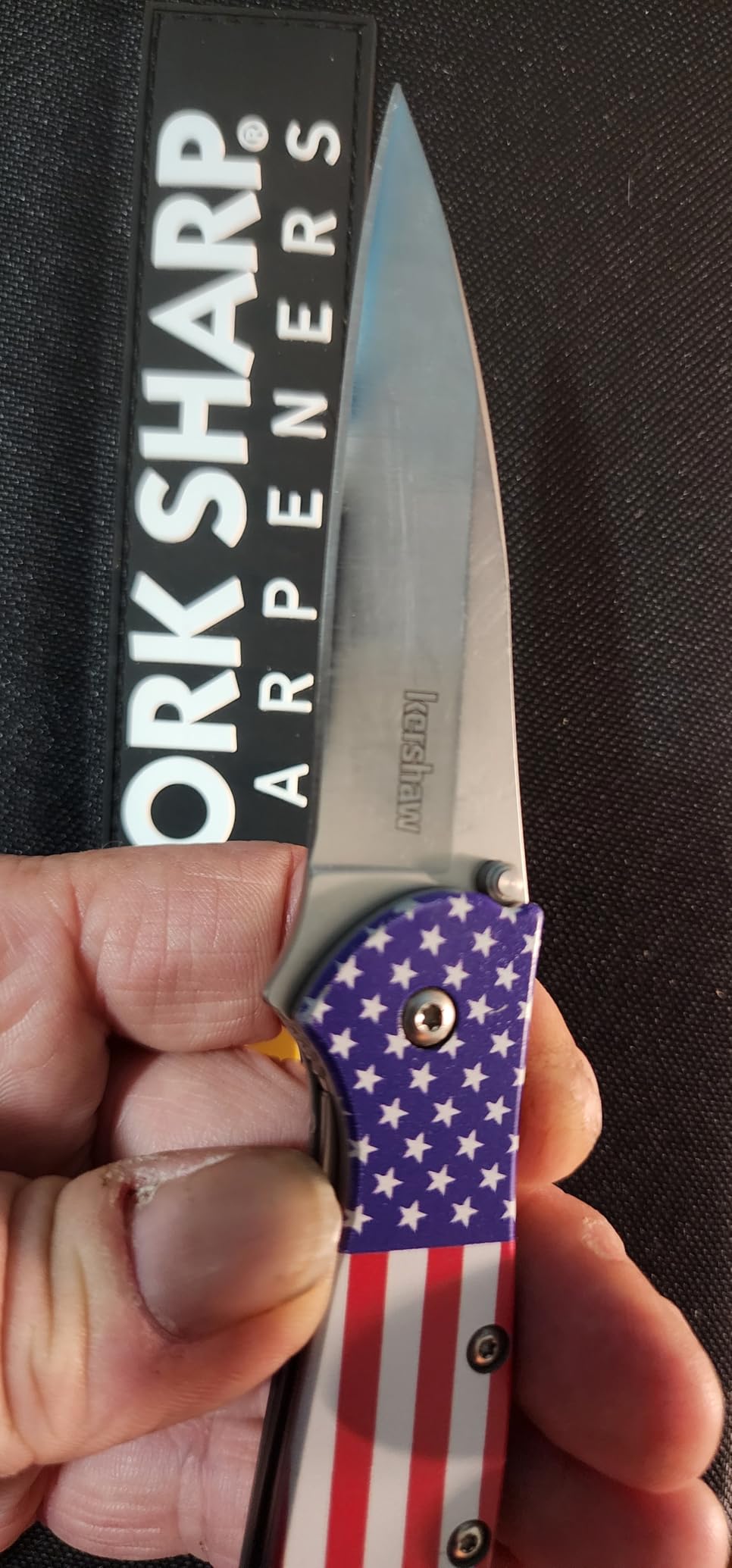
The knife mount can flex slightly under heavy pressure, which can throw the angle off, so use light steady pressure rather than leaning on it. The spring loaded clamp also has to be pushed out from the rear to rotate the blade, an awkward step that catches out most new owners the first few times.
Very thick or oversized blades are the weak spot, because you have to lift and flip the whole unit to swap sides. And while the guide is precise, the angle setting has some room for error if you do not check it, so a cheap angle finder is worth owning. A few reviewers also note that the metal clamp can scratch a blade finish, which is worth masking with tape on a collector grade knife.
10. RazorSharp 3-in-1 Sharpener – Best for Adjustable Angles on a Small Budget
RazorSharp™ Knife & Scissor Sharpener | Adjustable 14-24 Degree Angle Guide
- Adjustable knob lets you match different blade types
- Also sharpens household scissors
- Lightweight stable and easy to store
- Diamond coated stones extend abrasive life
- Safe when the instructions are followed
- Some users report blades catching in the slot
- Cannot fix badly damaged edges
- Predominantly plastic construction
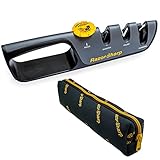
An adjustable angle is the feature most hunters ask for and most cheap sharpeners refuse to offer, and this one puts it on a small frame. A knob sets the sharpening angle from 14 to 24 degrees, the base stones are laser-cut diamond coated ceramic, and the high density ABS frame carries non-slip rubber grips. At 8.8 ounces it is small, stable and easy to store.
It also sharpens household scissors, which many knife-only tools skip, and the diamond coated stones last longer than plain ceramic in a home setting. It is a sensible first step up from a pull-through for someone who wants to start choosing their own geometry.
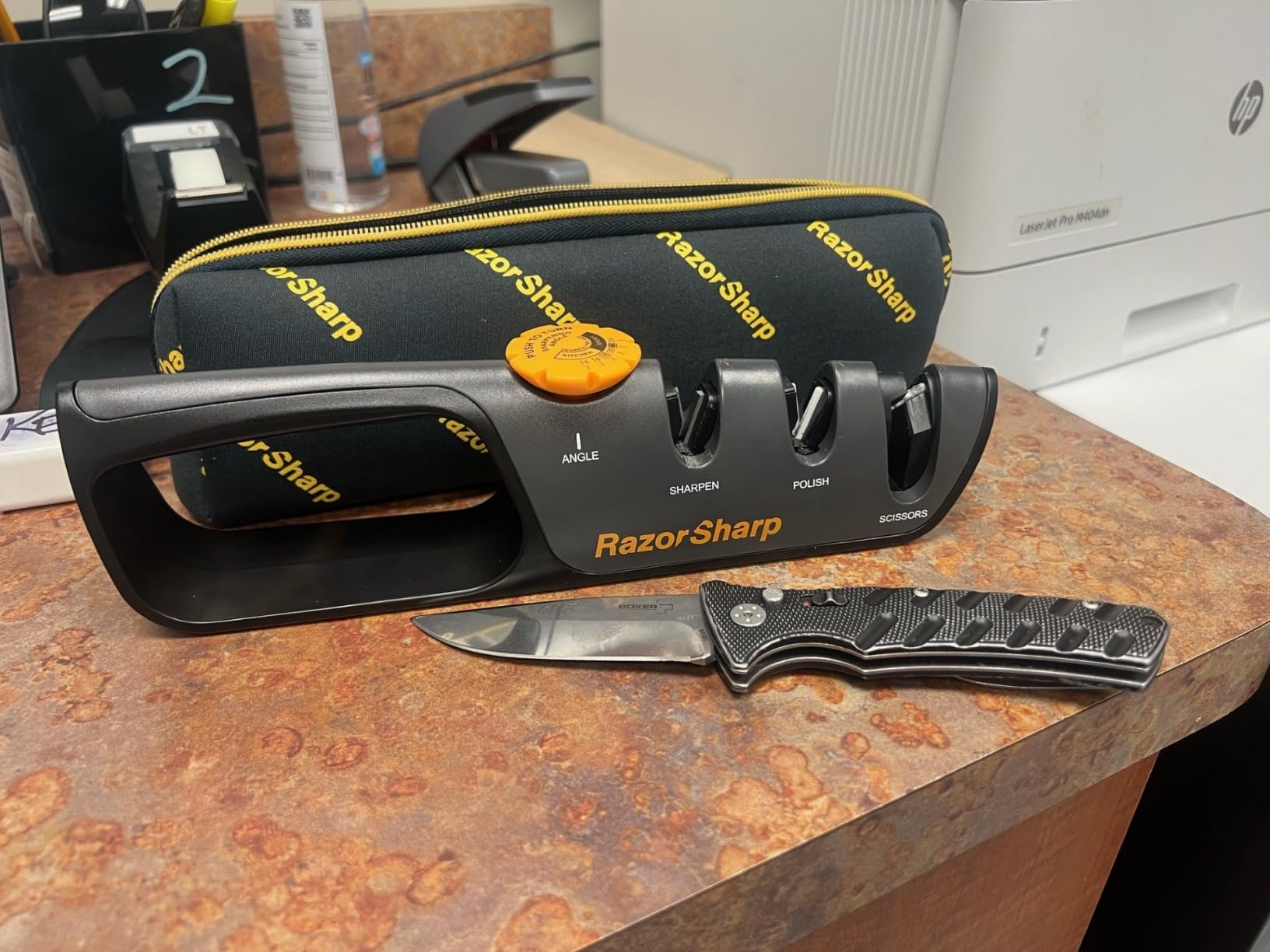
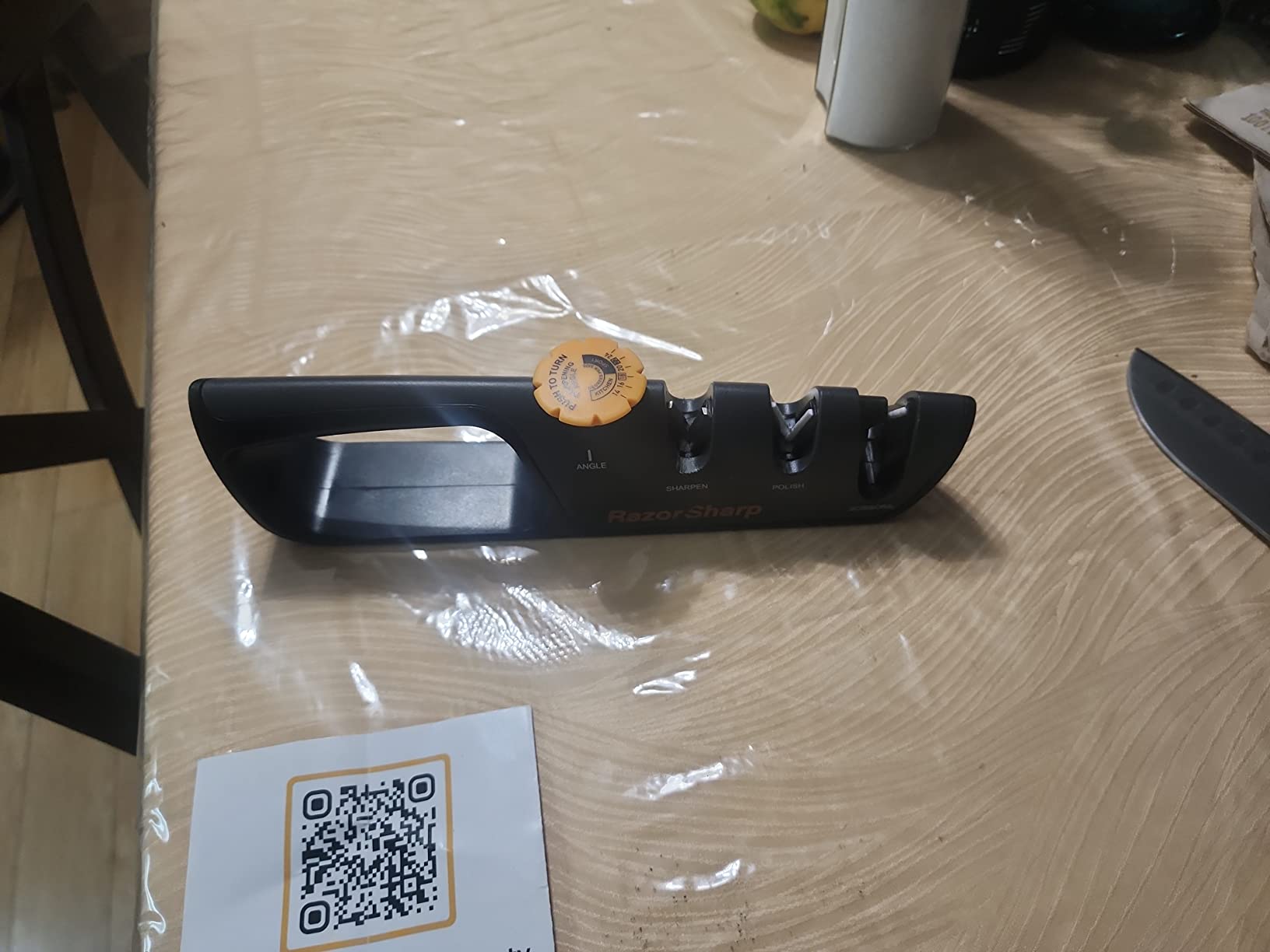
It is the lowest rated product we analyzed, at 4.4 stars from about 3200 reviews with 68 percent five-star, and the reason shows up clearly in the reviews: a small but vocal group reports blades catching in the sharpening slot and needing several repeated passes before the stone bites.
The 14 to 24 degree range is narrower than a full bench system, which means a very thin Japanese edge at 15 degrees sits at the bottom of the dial and a 25 degree chopper edge is out of range. Know your target before you dial it in.
Who this sharpener suits
It suits a hunter who wants angle control, has a small kitchen and a modest toolkit, and does not want to commit to a full sharpening system. The scissor capability is a genuine bonus in a household where the same person sharpens the fillet knife and the shears.
It is also a reasonable second system for a cabin or a rented house, since it stores anywhere and needs no water, oil or setup.
Where it falls short
The catching-in-the-slot reports are frequent enough to plan around. Slow, steady passes with light pressure work; fast aggressive strokes are where blades stall. Treat the first few passes as a test rather than a fix.
Beyond that, it cannot repair a badly damaged or dishwasher-neglected edge, and the frame is predominantly plastic, so it is a home tool rather than one to leave in a truck bed. The brand does back it with a no questions asked satisfaction guarantee, which softens the risk.
11. Intelitopia Complete Whetstone Set – Best All-in-One Stone Kit
- Four grit progression from repair to mirror polish
- Angle guide and manual make it approachable
- Flattening stone keeps the whetstones flat
- Real cowhide strop removes burr and adds keenness
- Handles hunting pocket scissors and razors
- Stones must be soaked and kept wet or they dry fast
- Stone density below true Japanese stones
- Bamboo base grips less well than advertised
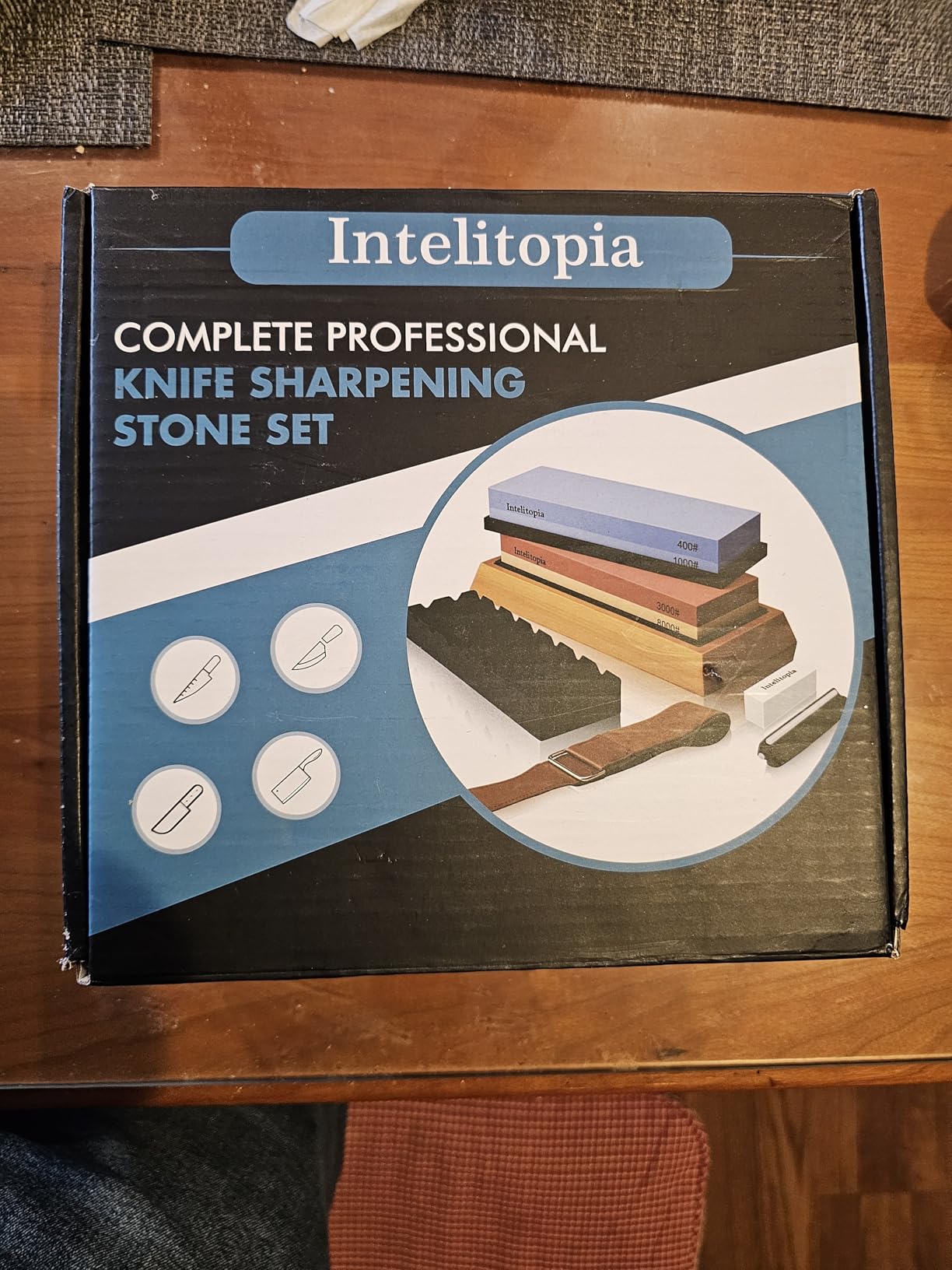
Most people who start with a single whetstone discover within a year that they need a coarser grit, a finer grit and a strop. This kit solves that in one box. It contains a 400/1000 grit corundum stone, a 3000/8000 grit stone, a coarse flattening stone, a genuine cowhide strop, a bamboo base, three non-slip rubber bases and a knife angle guide.
That four step progression is complete. The 400 side takes out damage and resets an edge, the 1000 establishes the bevel, the 3000 refines, and the 8000 polishes before the strop removes the last of the burr. The flattening stone is the item most kits leave out, and it is the one that keeps the other two working flat over years.
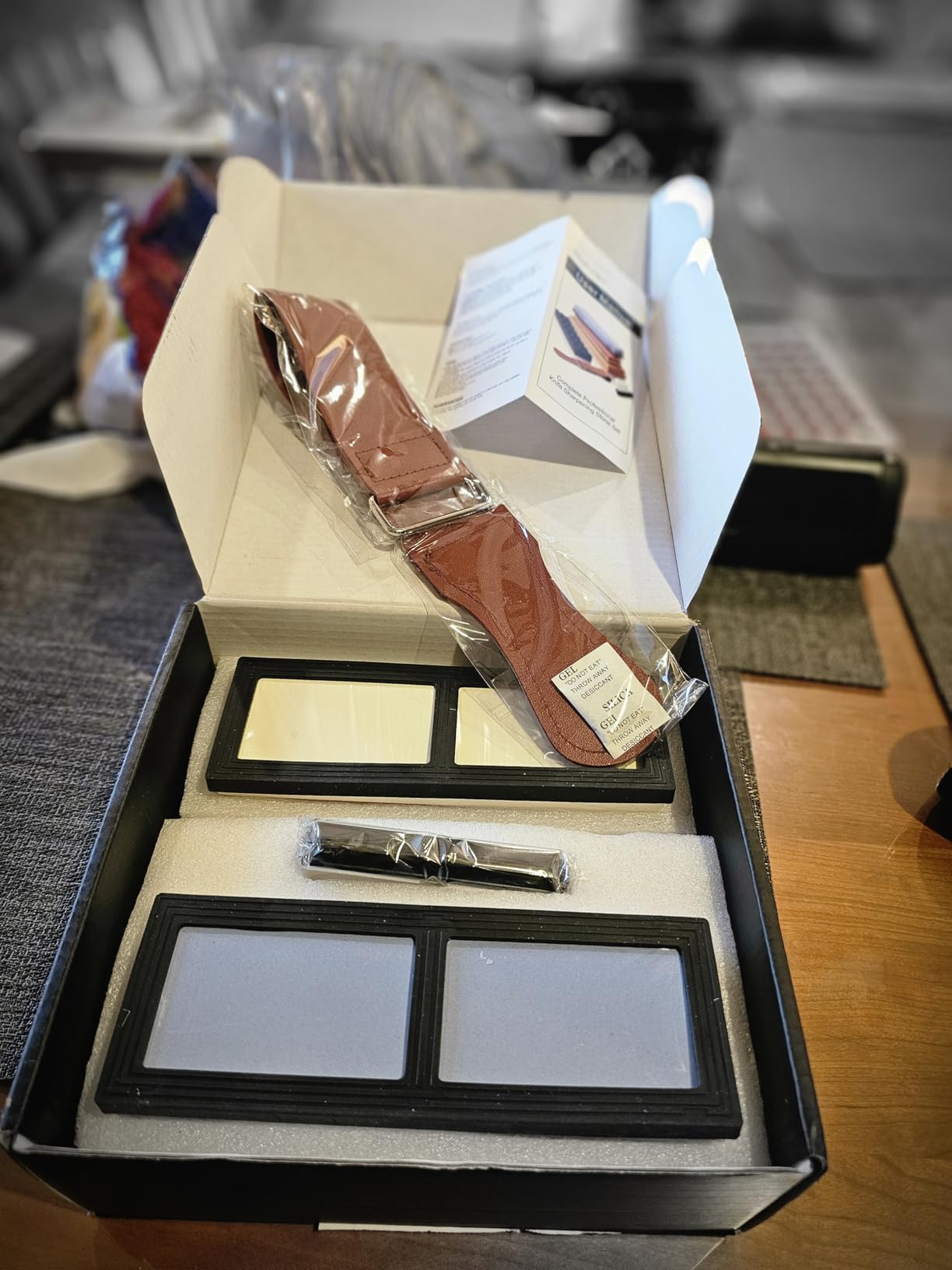
Owners report professional looking results after working through more than 20 knives, which is the right test for a kit like this. At around 7260 reviews and 4.5 stars, the set is valued for completeness above all else, and the manual plus angle guide make a first attempt much less likely to go wrong.
The strop is worth calling out. Genuine cowhide with compound is what turns a sharp edge into a keen one, and finishing a hunting knife on leather after the stones is the difference between cutting and parting hide.
Who this sharpener suits
It suits a hunter who wants a full bench setup in one purchase and plans to keep knives for years. The 400 grit handles the abuse a fixed blade takes, and the 8000 grit plus strop handles the occasions when you want the edge as clean as you can get it.
It is a good gift for someone starting out, because the missing pieces are all in the box. It covers hunting and pocket knives, scissors and straight razors, so it serves a household as well as a hunting kit.
Where it falls short
These are wet stones. They must be soaked beforehand and kept wet during use, or they dry out mid-session and stop cutting, which is the single most common complaint in the reviews. A spray bottle solves it once you know.
At 5 pounds this is a stationary kit, not a pack tool. A minority of reviewers rate the stone density below true Japanese stones and question the bamboo base grip, so if you are used to a hard waterstone the finish will feel different, and if you work wet you will want a better holder than the one supplied.
12. Kershaw Ultra-Tek 600-Grit Sharpener – Best Single-Tool Camp Sharpener
- Oval shaft is easier to hold at a consistent angle than a round rod
- Shaft unscrews and stores inside the handle
- Works dry with no oil or water
- Compact at 2.4 ounces for pack or glove box
- Effective routine maintenance on hard steels
- Unguided so it takes practice and steady hands
- 600 grit is too fine for heavy removal on a dull blade
- Diamond coating wears out over a year or two
- Cannot produce a true razor edge
One rod, one handle, no angle setting. A 600 grit diamond coated oval shaft unscrews from inside a black anodized aluminum handle and screws onto the opposite end, and that is the entire mechanism. At 2.4 ounces it is one of the smallest things here and it needs no oil and no water, so it works anywhere in camp.
The oval profile is the reason it works better than a round rod. A flat or oval face gives you a reference surface to hold against the blade, so the angle stays closer to consistent than it would on a cylindrical hone. Reviewers with a long history of carrying it call it the best one-step pocket sharpener they have used.
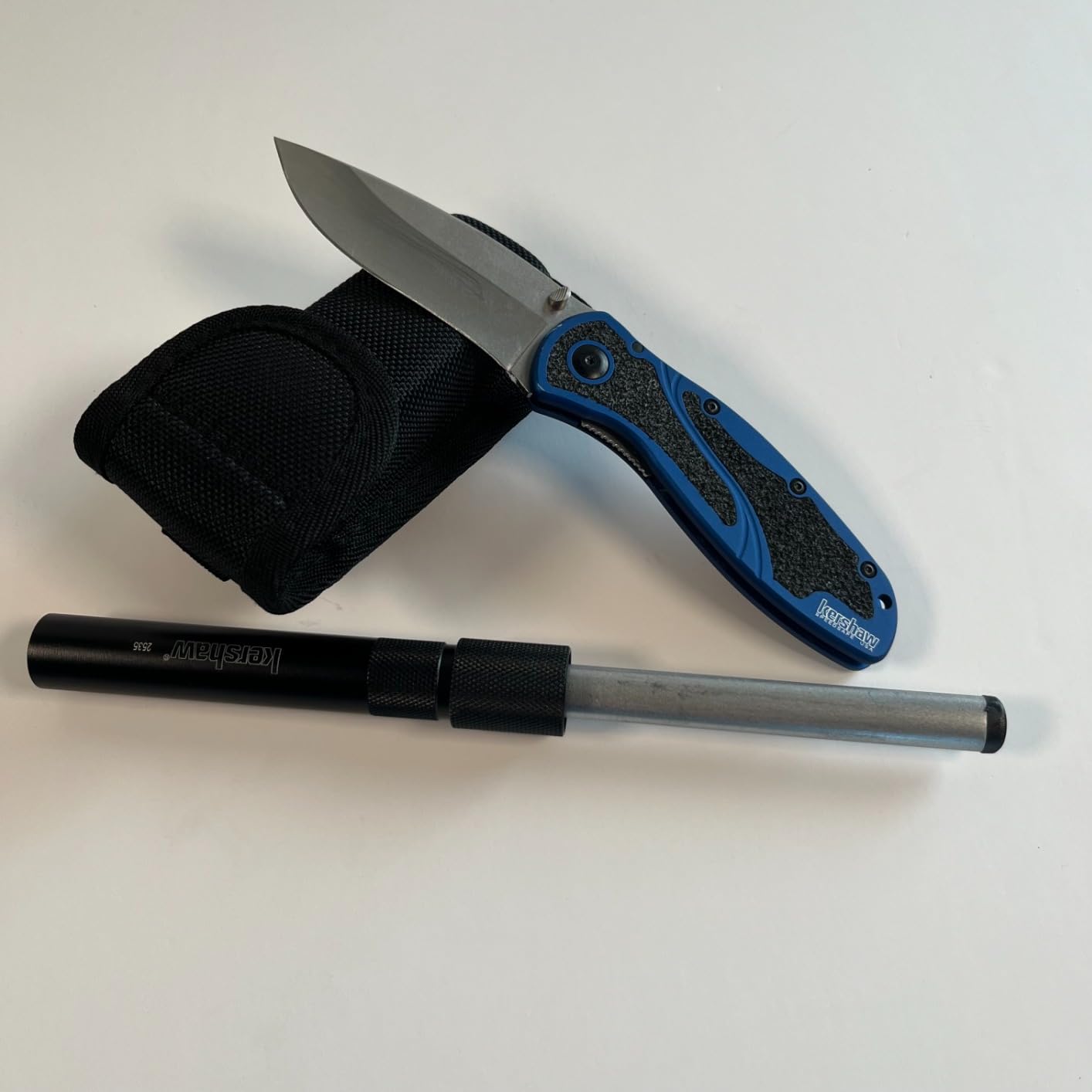
The self-storing shaft is a small design decision with a large effect in a hunting pack. Nothing to lose, nothing separate to fish out, and the anodized 6061-T6 handle with a knurled grip will not slide when your hands are cold and wet.
At 4.5 stars from around 1800 reviews with 74 percent five-star, the feedback is consistent: excellent for routine edge maintenance and for straightening the edge of a hard steel blade, strictly a maintenance tool, and the diamond coating eventually wears through.
Who this sharpener suits
It suits a hunter who wants one object, minimal weight and no learning curve. If your sharpening needs are mostly touch-ups between hunts, one rod in a handle is enough, and the fact that it works dry makes it a good match for a cold-weather or wet-weather camp.
It is also a good backup for anyone who already owns a full system. It is not for the person who wants a precise angle or a polished finish.
Where it falls short
It is unguided, so results depend on your hands. A steady stroke and a consistent wrist angle will produce a good edge, and an inconsistent one will not, and there is nothing in the tool to correct for you.
600 grit is a maintenance abrasive, not a repair abrasive. A blade with a deep chip or a broken tip needs something coarser, and 600 grit will not cut that volume of steel quickly. The diamond coating also wears out with regular use over roughly a year or two, and unlike a stone it cannot be renewed.
How I Chose the Best Knife Sharpeners for Hunting Knives
We sharpened on a carbon steel case stockman and on a modern high-Rockwell stainless fixed blade, and we cared far more about what happened over a season than about what happened in a single session. A sharpener that produces a beautiful edge on day one and thins the blade to nothing by December is a bad tool for this job.
Five things decided our rankings. First, angle control: whether the tool holds a repeatable bevel, because a hunting edge that changes from heel to tip tears hide instead of cutting it. Second, material removal: how much steel a tool takes to get there, since every pass is permanent. Third, whether it works without oil or water in a freezing camp. Fourth, whether it can handle a serration or a gut hook. Fifth, weight, because a tool that stays in the truck is a tool that never gets used.
We also weighted what forums get right. The most repeated piece of advice on r/Bushcraft and r/knifeclub is that beginners should practice on a cheap knife first, and that advice shaped how we used each tool. The deal-breakers that came up again and again were unbranded diamond coatings that wear out on super steel, pull-throughs that roll the edge, electric sharpeners that change factory edge geometry, and anything that cannot hold a consistent angle.
How to Sharpen a Hunting Knife Step by Step
This is the bench workflow. It works with a stone, a diamond plate or a guided system, and it is the routine that should run before opening day and once more at season end.
- Set the angle before you touch steel. Check the existing edge with a straightedge or an angle finder, or read the maker spec. Guessing here is how blades get over-thinned.
- Start coarse only if there is damage. A chipped tip or a rough section needs something around 200 to 400 grit. If the edge is simply dull, begin at 600 to 1000 and save yourself a great deal of steel.
- Raise a burr along the full length. Work in even passes, alternating sides, and concentrate on the heel and the tip where an edge is usually thinnest. Stop when the burr runs off the tip.
- Remove the burr. Move to the next finer grit and work both sides lightly until the burr detaches. A strop with compound is faster and removes less steel than another stone pass.
- Refine and polish. Finish at the finest grit your edge needs, then strop. If the blade is high-Rockwell stainless, go straight to a diamond or ceramic abrasive rather than grinding through natural stone.
- Strop before you put it away. A few passes on leather with compound align the edge and make it shave rather than merely cut.
The sixty-second field routine
Do not try to fully sharpen in the field. Start with the coarse slot or plate to get back to a working edge, two or three passes per side, and stop. Finish with a few stropping passes on the leather if your field kit has one, then wipe the blade and put it away.
Fully reprofiling a hunting knife at camp takes longer than it should, requires a flat surface and clean water, and is the one job you want to do wrong in a hurry.
Fixing an edge chipped on bone
A tip broken on a femur is the most common hunting knife damage and the easiest to fix. Start at a coarse grit, roughly 200 to 400, and raise a full burr past the break before you change grit. Once the chip is gone, drop to 600, then 1000, then strop. The cost is a little more steel than a routine session, and the alternative is a tip you will chip again.
Buying Guide: Sharpener Types, Edge Angle and Blade Steel
Every sharpener on this list falls into one of five families, and the family matters more than any brand. Pull-through sharpeners such as the AccuSharp and the Smith’s CCKS are the fastest way back to a working edge and the least precise. Guided systems like the Work Sharp Precision Adjust Elite and the RazorSharp hold an angle for you and cost more. Stones like the Intelitopia set and the Sharp Pebble give the finest results and demand the most skill. Diamond plates like the SHARPAL 162N cut fast and handle super steel. Rods and pocket tools such as the Kershaw Ultra-Tek and the SHARPAL 101N live in the pack and handle serrations.
Electric and rolling sharpeners deserve an honest warning. They are fast and they are convenient, and hunters report repeatedly that they change the factory edge geometry into a convex edge the owner did not ask for. On a cheap stainless kitchen knife that is a fair trade. On a fine hunting blade, it is not.
What edge angle your hunting knife needs
A lower angle is sharper and less durable. A higher angle is tougher and slices less cleanly. For hunting work, the task decides the number. Skinning a deer wants a thin, keen edge around 20 degrees. Boning through joints and cartilage wants more durability, so 25 degrees is a better fit. Capping and general utility sit in between. A broadhead or a heavy axe edge wants even more, and cutting cordage wants less.
Sharpening and honing are different jobs, and the forum consensus is that confusing them wastes steel. Honing realigns an edge that has rolled over, which is what a strop or a ceramic rod does. Sharpening removes steel to create a new bevel. Strop and hone between hunts and sharpen fully only when the edge is genuinely gone, and your hunting knife will keep its factory geometry and its expensive steel far longer for it.
Blade steel is the other half of the decision. Carbon steel is easy to sharpen and holds a fine edge, but it wants maintenance. Modern high-Rockwell stainless and high speed tool steel are tougher and need diamond or ceramic abrasives, because natural stones work slowly on them. If your hunting knife is a modern super steel, skip straight to a diamond plate or a guided system with diamond plates.
Field conditions nobody mentions
Blood, hide residue, mud and frozen grit are the real enemies of a hunting edge, and they are the reason a dry-working tool earns its place. A wet stone that has been used on a gutted animal needs cleaning immediately, because contaminated grit will scratch the blade in ways you cannot see until it is on the edge. Wipe the blade dry before it goes back in the sheath, and keep grit out of the pocket where the sharpener lives.
Cold hands make a pull-through awkward and a guided system more valuable, because a guide is a physical reference you can feel when you cannot see well. If you sharpen in the dark, a fixed guide beats a freehand rod every time.
What to skip and why
Skip unbranded diamond coatings sold under an unknown name. Forum reports describe coatings that wear out on super steel in a single session and can scratch a premium blade while doing it. Skip pull-throughs for a fine hunting edge unless you treat them purely as maintenance, because the preset angle removes steel from a knife whose geometry you never chose.
Skip anything that needs a screwdriver to clamp, and be cautious with clamps that mar a blade finish. Skip an expensive collector grade system recommended to a beginner, which is the most common form of bad advice on knife forums. If you own one hunting knife and no system, a guided field sharpener and a stone will serve you better than a full professional kit.
If your sharpening is mostly about kitchen blades rather than hunting gear, our guides to the best knife sharpeners for kitchen use and to ceramic knife sharpeners cover that side. For the blades themselves, we have tested the best boning knives for game work, and our best chef knives roundup explains why edge geometry differs so much between a boning blade and a chef knife.
Frequently Asked Questions
What is the best way to sharpen a hunting knife?
The best way is to keep the edge aligned rather than re-cut it constantly. Hone or strop after every use, sharpen fully only when the edge is actually gone, and start at a coarse grit only when there is real damage. For a fixed blade, work in even alternating passes until the burr runs off the tip, then deburr on a finer grit and finish on a leather strop. This removes far less steel over the life of the knife.
What do professionals use to sharpen their knives?
Most professionals use a guided system or a stone progression rather than a pull-through. Guided clamp systems hold a repeatable angle and suit kitchen and pocket work, while a five-stage stone kit with a strop handles fine finishing and edge geometry. For hunting specifically, the pairing that works best is a guided field sharpener in the pack for touch-ups and a bench system or diamond stone at home for the full session.
What is the best field knife sharpener for hunting?
The Work Sharp Guided Field Sharpener is the strongest all-round field choice, with a 20 to 25 degree guide, five abrasive surfaces and a leather strop in a self-contained case. If you want the lightest option, the SHARPAL 101N does the same maintenance job in 2.4 ounces and adds a ferro rod. If your blade has serrations or a gut hook, pick a tool with a tapered diamond rod such as the SHARPAL 101N or the Smith’s PP1.
Is a pull-through sharpener bad for hunting knives?
Pull-through sharpeners are not bad, but they are limited. They hold one preset angle, remove steel from the whole edge to maintain a working edge, and cannot repair chips or a broken tip. Used occasionally as a maintenance tool between full sharpens, they are fine and they are fast. Used as your only method, they will thin a hunting blade faster than it needs to be and will not fix damage from bone.
What grit should I use to sharpen a hunting knife?
Use roughly 200 to 400 grit when there is a chip, a missing tip or a rough section, then move to 600 or 1000 to set the edge, and finish at 1000 or finer before stropping. If the blade is a modern high-Rockwell stainless, use a diamond or ceramic abrasive, because natural stones cut it slowly. Start finer rather than coarser whenever the edge is only dull, since every pass removes steel permanently.
How long does it take to sharpen a hunting knife?
A routine field touch-up takes about a minute with a pull-through or guided field tool, and a full bench session on a stone or guided system takes 15 to 30 minutes depending on how much steel needs removing. Repairing a tip broken on bone is the longest job at 30 to 45 minutes, because the coarse grit has to remove a lot of material before the finer grits can refine the edge again.
Final Thoughts on the Best Knife Sharpeners for Hunting Knives in 2026
The best knife sharpeners for hunting knives come down to two decisions: where you sharpen, and how much angle control you want. For the pack, the SHARPAL 101N wins our roundup because six functions in 2.4 ounces means you will actually carry it, and the tapered diamond rod handles the serrations and gut hooks that flat sharpeners cannot touch.
At camp, the Work Sharp Guided Field Sharpener is the better tool, with a 20 to 25 degree guide, five abrasive surfaces and a leather strop in a case that needs no setup. At home, the Work Sharp Precision Adjust Elite covers 15 to 30 degrees and a serrated rod in one system, and the SHARPAL 162N diamond plate is what you want if your hunting knife is modern super steel and natural stones have been losing the argument.
Whichever one you choose, strop it between hunts rather than sharpening it every trip. A hunting knife that is maintained stays sharp, keeps its factory geometry, and still parts hide on the first swing in November.