
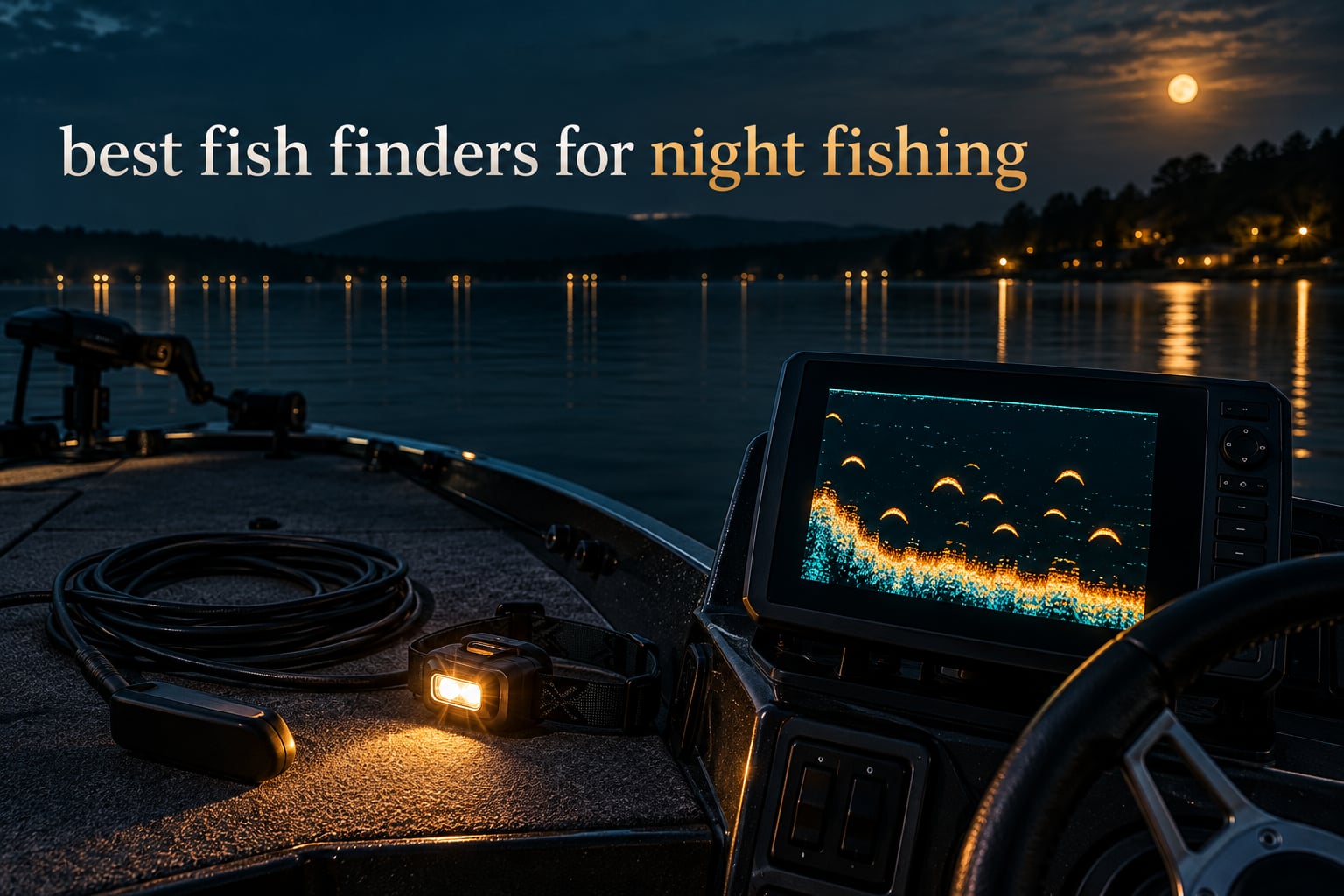
A fish finder for night fishing is a sonar unit with a dimmable high-brightness or backlit display, a high-contrast night color palette, and a battery that can run for a whole trip after dark, so you can read depth, structure and fish arches without wrecking your night vision. That is the whole difference between a graph you use at midnight and one you squint at and turn off.
Night fishing concentrates everything on structure. Once the sun goes down you cannot see a ledge, a brush pile or a drop-off, and the fish that feed after dark are often suspended or tight to cover rather than pushing near the surface. The display becomes your only eyes on the water column.
We spent 2026 season evenings comparing ten fish finders built for exactly this job, from a 3.5-inch Garmin console unit to castable sensors and a tethered underwater camera with infrared lighting. What we kept coming back to is that night use rewards a small set of things: a screen you can dim to a low glow without losing the fish arches, a transducer you can trust in calm water, and power that lasts past 2 a.m. Our broader fish finder buying guide covers daylight use in more detail.
Last updated: October 2026
Top 3 Best Fish Finders for Night Fishing in 2026

Garmin Striker 4
- 3.5-inch color LCD
- CHIRP and ClearVu sonar
- Built-in flasher mode
- 0.23 amp draw at 12V

Garmin Striker Vivid 7cv
- 7-inch color display
- Vivid sonar color palettes
- CHIRP plus ClearVu
- Quickdraw Contours built in

Humminbird Helix 5 Chirp DI
- CHIRP Down Imaging
- Dual Spectrum CHIRP
- Basemap of 10
- 000+ lakes
- AutoChart Live recording
The Striker 4 wins this list because it is the only unit here that pairs a genuinely readable backlit screen with a flasher mode built for working a structure in the dark, and it draws 0.23 amps at 12V, so it will not be the reason your night ends early. The 7cv is the pick when screen size matters more than anything else, and the Helix 5 CHIRP DI is the one to buy if you want charts and recorded mapping on the unit itself.
All 10 Fish Finders Compared for Night Fishing in 2026
| Product | Specifications | Action |
|---|---|---|
| Garmin Striker 4 |
|
Check Latest Price |
| Garmin Striker Vivid 7cv |
|
Check Latest Price |
| Humminbird Helix 5 Chirp DI GPS G3 |
|
Check Latest Price |
 LUCKY Portable Fish Finder LUCKY Portable Fish Finder |
|
Check Latest Price |
 LUCKY Wireless Portable Sonar LUCKY Wireless Portable Sonar |
|
Check Latest Price |
 Venterior Rechargeable Castable Sonar Venterior Rechargeable Castable Sonar |
|
Check Latest Price |
 Deeper PRO+ 2 Deeper PRO+ 2 |
|
Check Latest Price |
 ReelSonar iBobber ReelSonar iBobber |
|
Check Latest Price |
 ZXBVSU Underwater Fishing Camera ZXBVSU Underwater Fishing Camera |
|
Check Latest Price |
 LUCKY Kayak Handheld Fish Finder LUCKY Kayak Handheld Fish Finder |
|
Check Latest Price |
What Makes a Fish Finder Good at Night: Six Criteria That Decide It
Almost every spec sheet looks the same on paper. These are the six things that actually decide whether a unit works after sunset.
- Dimmable backlight, not just a bright screen. A screen you cannot turn down forces a choice between wrecking your dark adaptation and dimming it until fish arches disappear. A real backlight or brightness slider is the single most important night feature.
- High-contrast or switchable color palettes. Garmin calls its option Vivid scanning sonar palettes, and other brands offer black and white screen backgrounds. On a black background a white arch reads instantly even at low brightness, which is the difference between seeing a fish and guessing.
- Battery runtime that outlasts your night. The Striker 4 pulls 0.23 amps at 12V, which is the sort of honest number that matters. Handheld and castable units advertise 4 to 10 hours, and reviewers consistently report less in cold air.
- Noise rejection for calm water. Night water is often glassy, and high gain on a flat surface lights up the entire water column with clutter. CHIRP sonar and down imaging filters exist specifically to cut that.
- A way to find your sensor in the dark. Glowing caps, lamp-equipped transducers and glowing float bodies are cheap features that save real time when you drop something over the side at midnight.
- A transducer that stays in clean water. At low trolling speed or with a pedal-drive kayak, turbulence bubbles across the face of the transducer and the screen shows an empty column. Mounting position matters more than any spec.
1. Garmin Striker 4 With Transducer: The Best Fish Finder for Night Fishing Overall
Garmin 010-01550-00 Striker 4 with Transducer, 3.5″ GPS Fishfinder with Chirp
- Readable backlit screen with dimmable brightness
- Flasher mode built in for vertical jigging after dark
- CHIRP gives crisp arches in calm night water
- Low 0.23 amp draw at 12V for long sessions
- IPX7 water rating with a one-year limited warranty
- Supplied power lead is thin and fragile
- Sonar signal cuts out at higher boat speeds
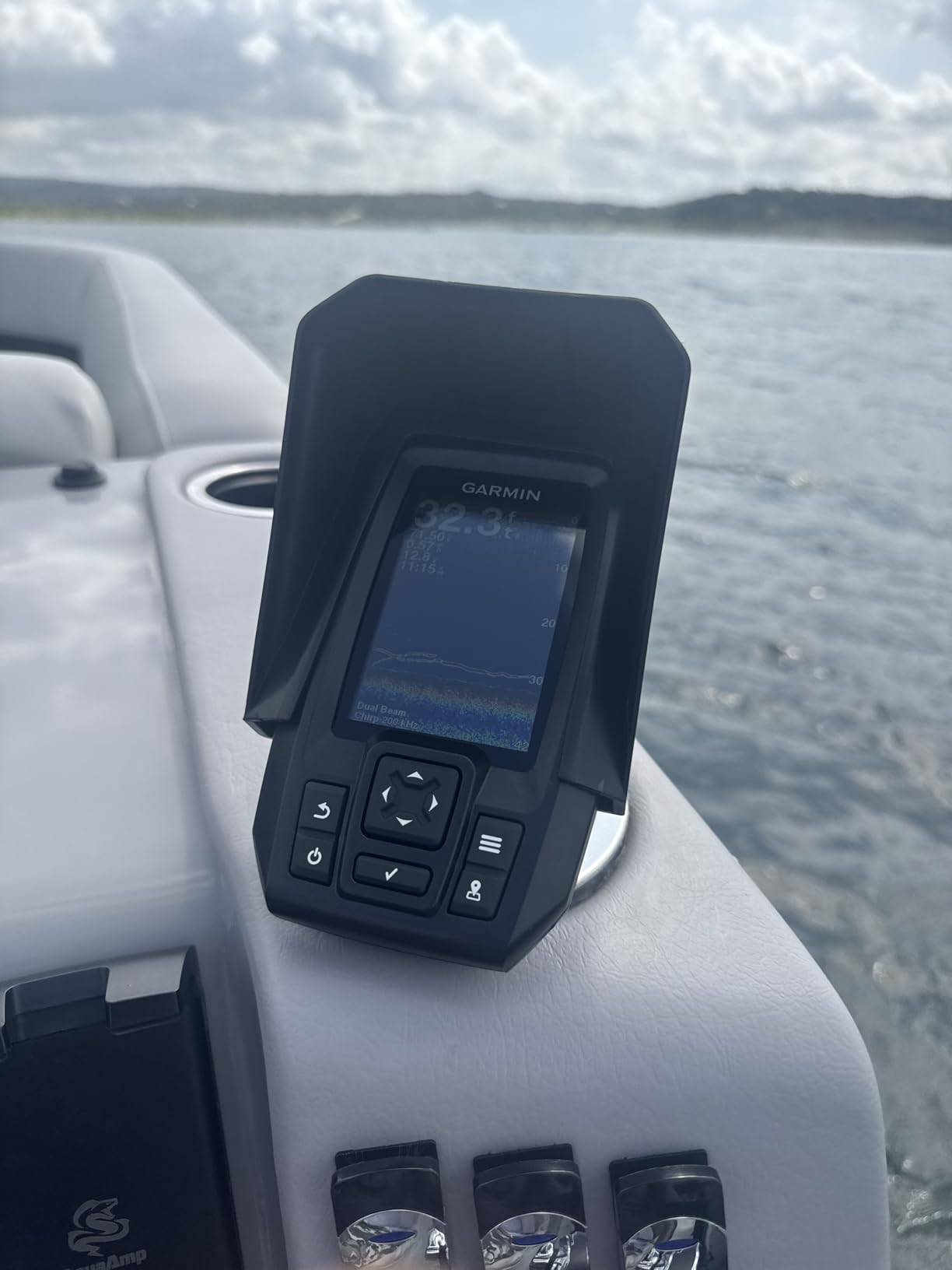
- Small 3.5-inch screen makes Zoom and A-Scope essential
Our pick for the best fish finder for night fishing is the Garmin Striker 4, and the reason is one feature that almost no competitor at this level offers: a built-in flasher mode. At midnight, working a brush pile, the flasher view puts large targets right in the center of the screen as bright shapes instead of small arches in a cluttered column. It is the fastest way to confirm something is down there.
Daylight anglers already know this unit well. With 9,312 reviews and a 4.6 rating, it is one of the most heavily reviewed fish finders on the platform, and 79 percent of owners give it five stars. Reviewers consistently frame it as the value benchmark, with reliable depth, temperature and speed data plus a GPS that genuinely helps you navigate and mark spots at night.
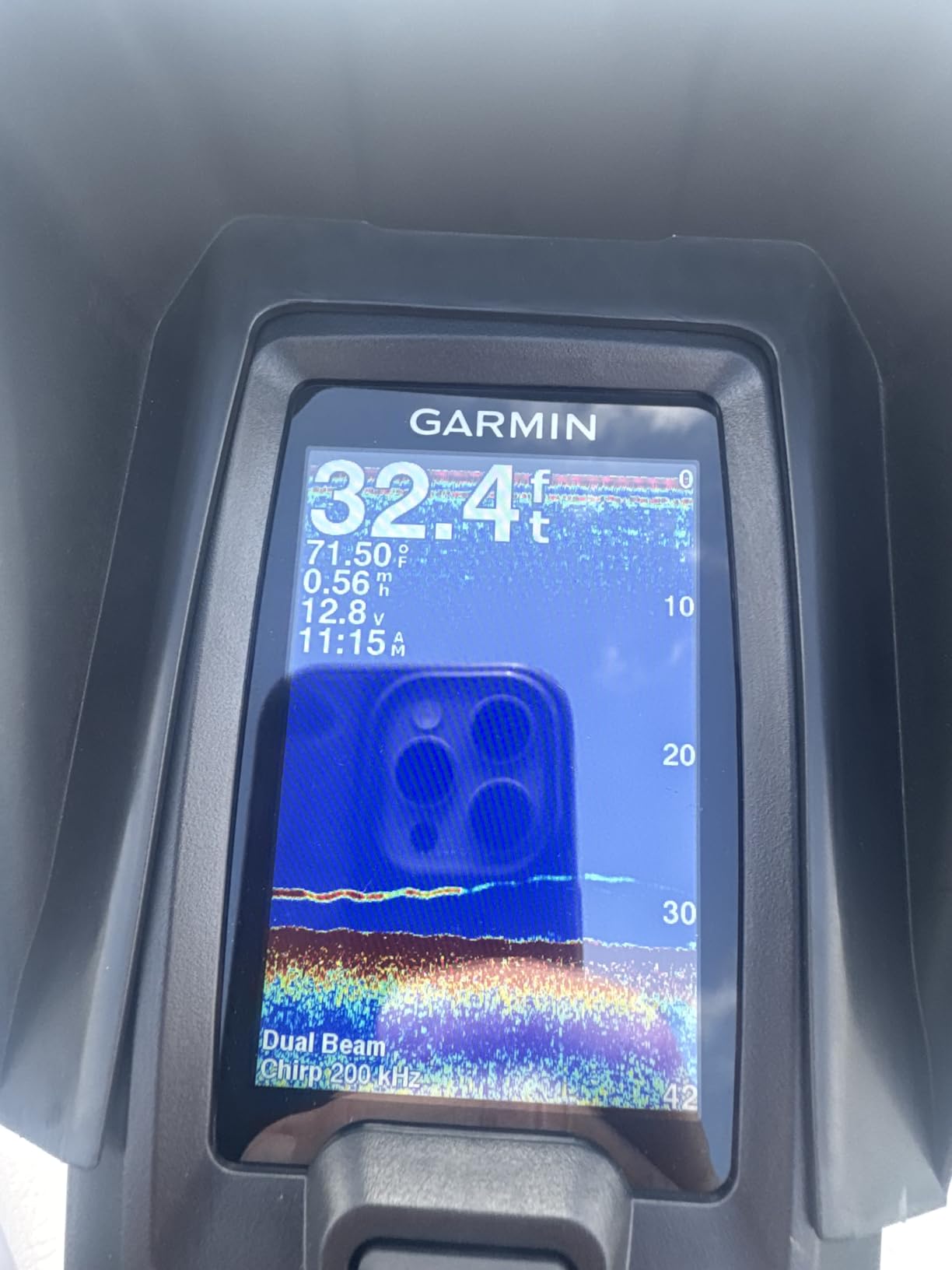
The night-specific numbers matter more here than the marketing. Current draw at 12V is 0.23 amps, which is why owners report it running all day off a deep-cycle marine battery and why we would not worry about it through an overnight session. ClearVu scanning sonar gives near-photographic structure images, and CHIRP traditional sonar sweeps a continuous range of frequencies for tighter target separation in calm water.
The built-in flasher also covers ice fishing and vertical jigging, so the same unit works for a winter night trip and a summer one. The GPS waypoint map lets you mark a stake, a stump or a dock edge and find it again on the way out. On a night trip that difference is worth more than a bigger screen.
What you should know before buying it for night use
The 3.5-inch screen is genuinely small, and at night your eyes are already adjusting. Owners say Zoom and A-Scope become essential for judging bottom versus fish rather than optional. Plan on sitting closer to the console than you would in daylight, and consider an anti-glare cover.
The included power lead is thin and needs crimping and taping before it goes anywhere near a battery, and no battery is included in the box. That is fine on a boat with a house battery, but for a portable night setup you need to budget for a deep-cycle battery and a proper fuse.
Where it struggles after dark
Sonar signal cuts out at higher speeds, so this is a trolling-speed or drifting graph rather than a run-and-gun one. That matters at night because you will be moving slowly anyway, but it does mean you should plan your route before dark rather than covering water fast.
Because the screen is small, bright structure at night can look like fish and vice versa. Splitting the screen between the flasher and 2D sonar is the practical answer, and most owners do exactly that. If you want a graph you can read at a glance from a moving boat, step up to the 7cv below.
2. Garmin Striker Vivid 7cv: Best for Big Screens After Dark
- Seven-inch screen readable from a seated position at night
- Vivid palettes separate fish from structure cleanly
- GT20 transducer covers CHIRP and ClearVu out of the box
- Everything needed for setup in the box
- Wi-Fi to the ActiveCaptain app
- No charts preloaded despite the U.S. label
- Feature set takes real study time
- Heaviest unit in this group and less suited to a small craft
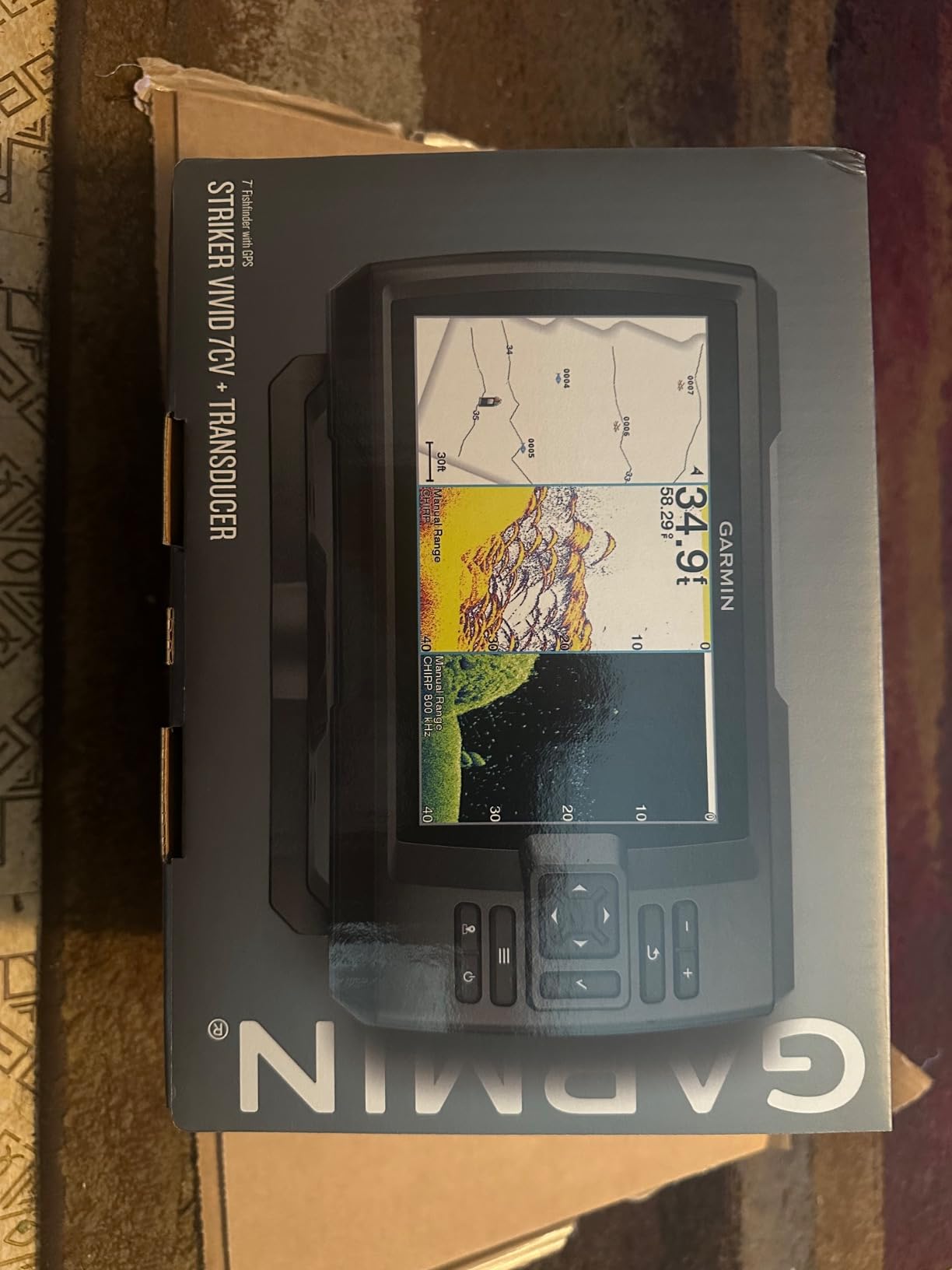
The Striker Vivid 7cv is the best choice when the screen size is what you want, and for night fishing from a bass boat that is often the case. A seven-inch color display is easy to read from a seated position without leaning in, which on a dark deck is a bigger advantage than it sounds.
The Vivid scanning sonar color palettes are the feature to spend time with here. They let you pick how sonar returns are drawn on screen, and a high-contrast palette on a dark background makes fish arches much easier to separate from bottom structure than a single fixed color scheme. Owners credit the palettes with making the difference between fish and bottom obvious at a glance.
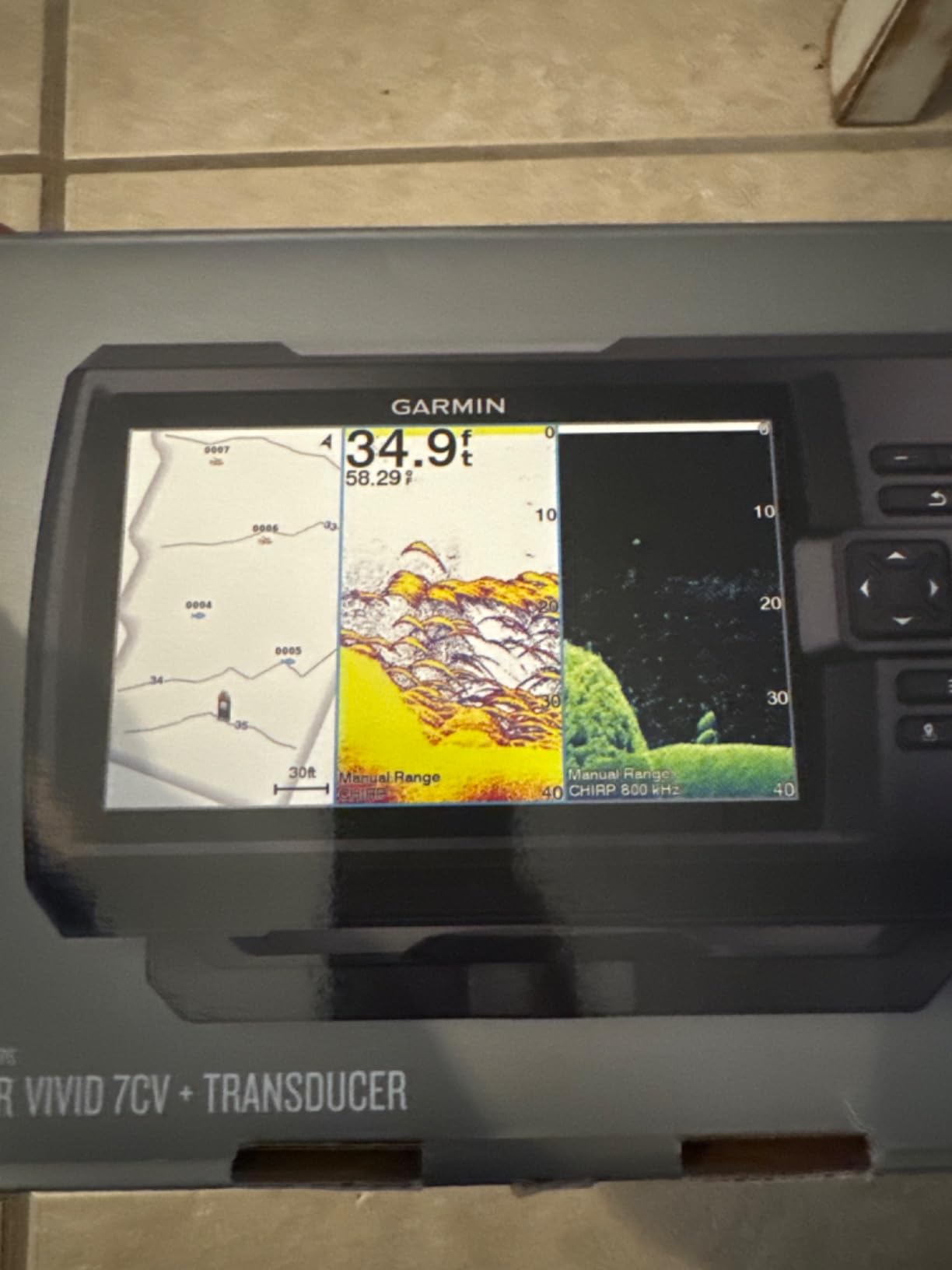
The GT20-TM transducer in the box covers both CHIRP traditional sonar and CHIRP ClearVu scanning sonar, so you get a traditional view and a down view without buying anything else. High-sensitivity GPS handles waypoints and routes, and Quickdraw Contours lets you record your own mapping without a separate plotter. Wi-Fi connects to the ActiveCaptain app for waypoint transfer and updates.
With a 4.5 rating across 574 reviews, the feedback is solidly positive. Reviewers describe it as well built, complete in the box, and clear once you have learned the menu.
What you should know before buying it for night use
No charts or maps are preloaded, which catches buyers who assume the U.S. version includes them. At night, without a chart, you are relying on your own marks and sonar, so either load charts or commit to using waypoints and structure instead of navigating by map.
Several owners describe a learning curve that takes multiple trips to work through. That is fine if you plan to fish the unit for years, less fine if you want to be productive on the first night trip of the season. Practice the palette switching on a familiar lake before you need it in the dark.
Where it struggles after dark
At 4.4 pounds this unit is heavy for a small craft and a poor match for a kayak night session. On a jon boat or a small bass boat with a tight console, check that you have the space and the mounting surface before committing.
Anyone moving up from a mid-tier graph may want contour mapping beyond Quickdraw, and buyers eyeing premium models sometimes find the feature set here frustrating. For night fishing specifically that is not a dealbreaker, because sonar and brightness matter more than chart detail once you cannot see the water.
3. Humminbird Helix 5 Chirp DI GPS G3: Best for Mapping and Down Imaging
Humminbird Helix 5 G3 GPS Fish Finder with Transducer, Dual Spectrum Chirp Sonar & Down Imaging
- Changeable colors suit changing light conditions
- CHIRP Down Imaging filters clutter in calm water
- Basemap with 10000+ lakes and U.S. coastline
- AutoChart Live with eight hours of recording
- Softkey keypad works reliably in any weather
- No inline fuse or holder in the box
- Down Imaging adds setup complexity
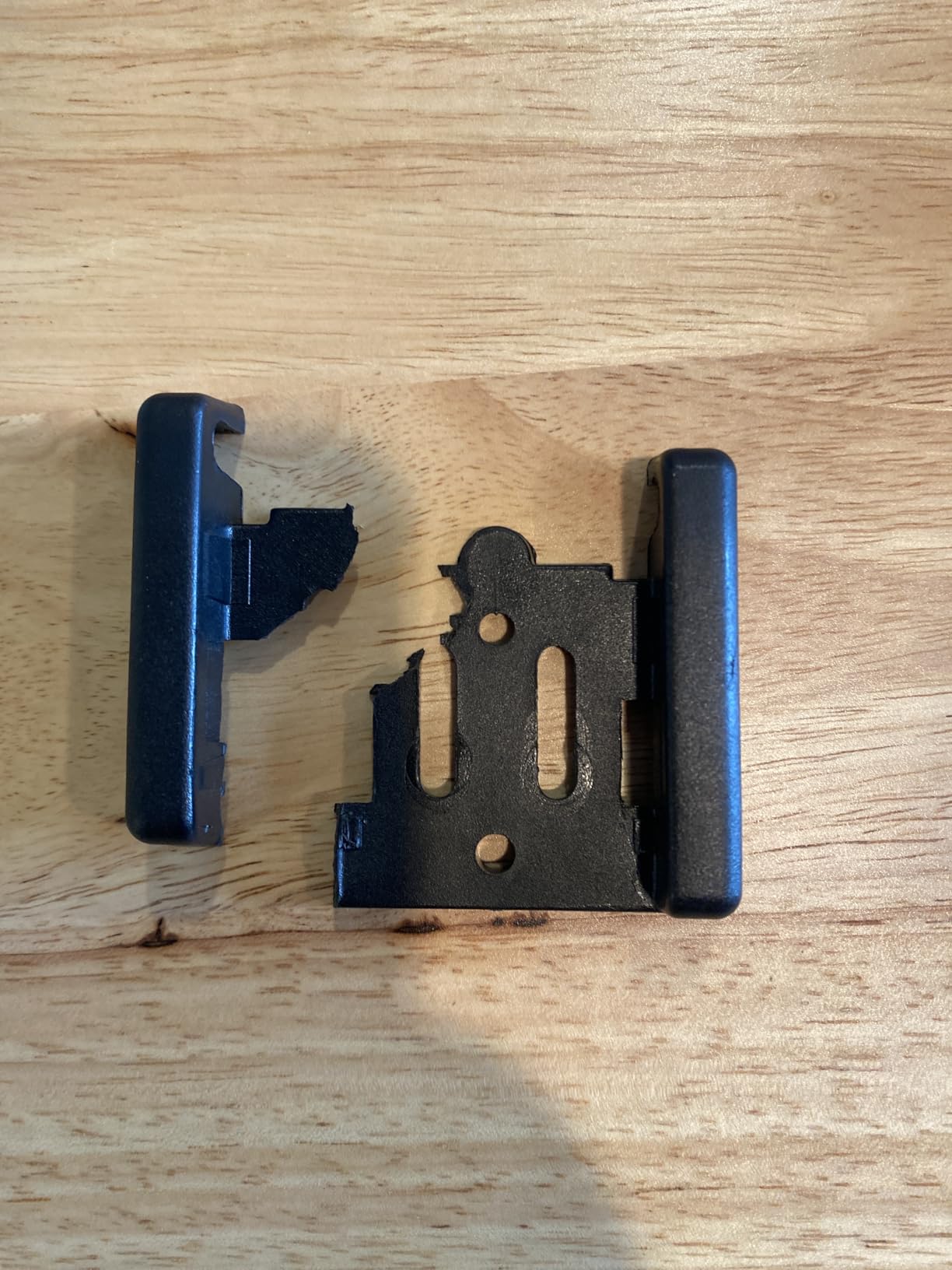
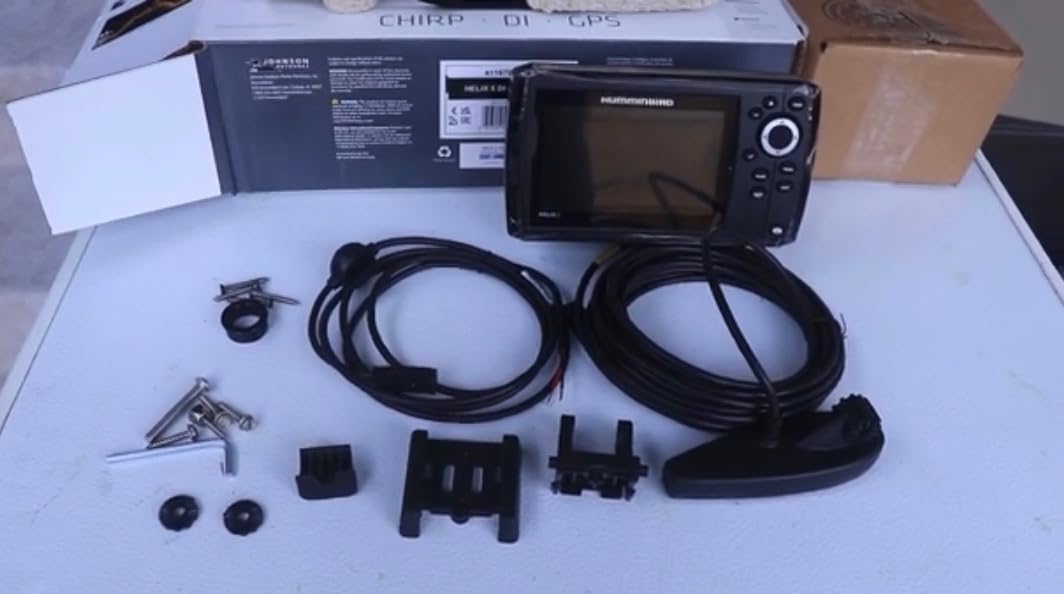
- Bail mount bracket is awkward to fit and remove
The Humminbird Helix 5 CHIRP DI GPS G3 is the pick if you want charts on the unit and a genuine down-imaging view. Out of the box it carries a Humminbird Basemap covering 10,000+ lakes and U.S. coastlines, which on a night trip means you can find a marked channel or a known ledge without guessing in the dark.
CHIRP Down Imaging is the reason anglers buy this unit, and it filters visual noise to give a clean view beneath the boat. That filter matters after dark, because calm night water tends to light up the whole column and bury small arches in clutter. Dual Spectrum CHIRP sonar runs in both Wide and Narrow modes, and the Low-Q transducer delivers precise 2D target separation.
Owners rate it 4.5 across 338 reviews and consistently describe it as the best value in the Humminbird line. Reviewers report the screen staying easy to read in bright sun and note that colors can be changed for varying light, which is exactly the flexibility you want when the light changes hour by hour on a long night session.
AutoChart Live records real-time mapping with eight hours of built-in storage, so you can build a map of a lake while you fish it in the dark. If you are learning a new water after sunset, that capability is hard to replace.
What you should know before buying it for night use
There is no inline fuse or fuse holder in the box. You will need to source those separately, and for a night session running the graph for hours on a house battery, proper fusing is not optional.
Down Imaging adds real setup complexity if you have only ever used 2D sonar. Budget a trip or two to learn it in daylight before you depend on it at night. The softkey keypad is intuitive and has preloaded views, which shortens that learning curve considerably.
Where it struggles after dark
It does not carry every feature or the screen size of the top-of-the-line models, so if you later want side imaging or a larger display you will be changing units. Some owners also report a head unit that would not power up after installation, which is a wiring issue rather than a night issue but is worth checking immediately at the dock.
The bail-mount bracket is described as a little awkward to fit and remove. On a night trip where you might want to pull the head unit inside, that is a small annoyance rather than a dealbreaker, but it is the kind of thing you notice at 1 a.m.
4. LUCKY Portable Fish Finder With Lamp Sensor: Best Value for Dock and Kayak Nights
LUCKY Portable Fish Finder Transducer Sonar Sensor 147 Feet Water Depth Finder LCD Screen Echo Sounder Fishfinder with Fish Attractive Lamp for Ice Fishing Sea Fishing
- Lamp-equipped sensor is easy to locate in low light
- Accurate depth and bottom contour in calm water
- Both handheld and sensor are rechargeable
- Compact enough to carry in one hand
- Simulation mode lets you test before you go
- Signal drops and no-signal errors even with antenna extended
- Sensor is not weighted so it drifts in chop
- 2.4-inch screen is small for reading arches
- Connection can take time to complete
The LUCKY portable fish finder is the best value in this group for dock, shore-adjacent and small-craft night fishing, and the feature that earns it that place is the lamp in the sonar transducer. The sensor carries a fish attractive lamp under a transparent replacement cover specifically so you can see it in the dark, which solves the most common night problem with portable sonar: not knowing where your transducer actually is.
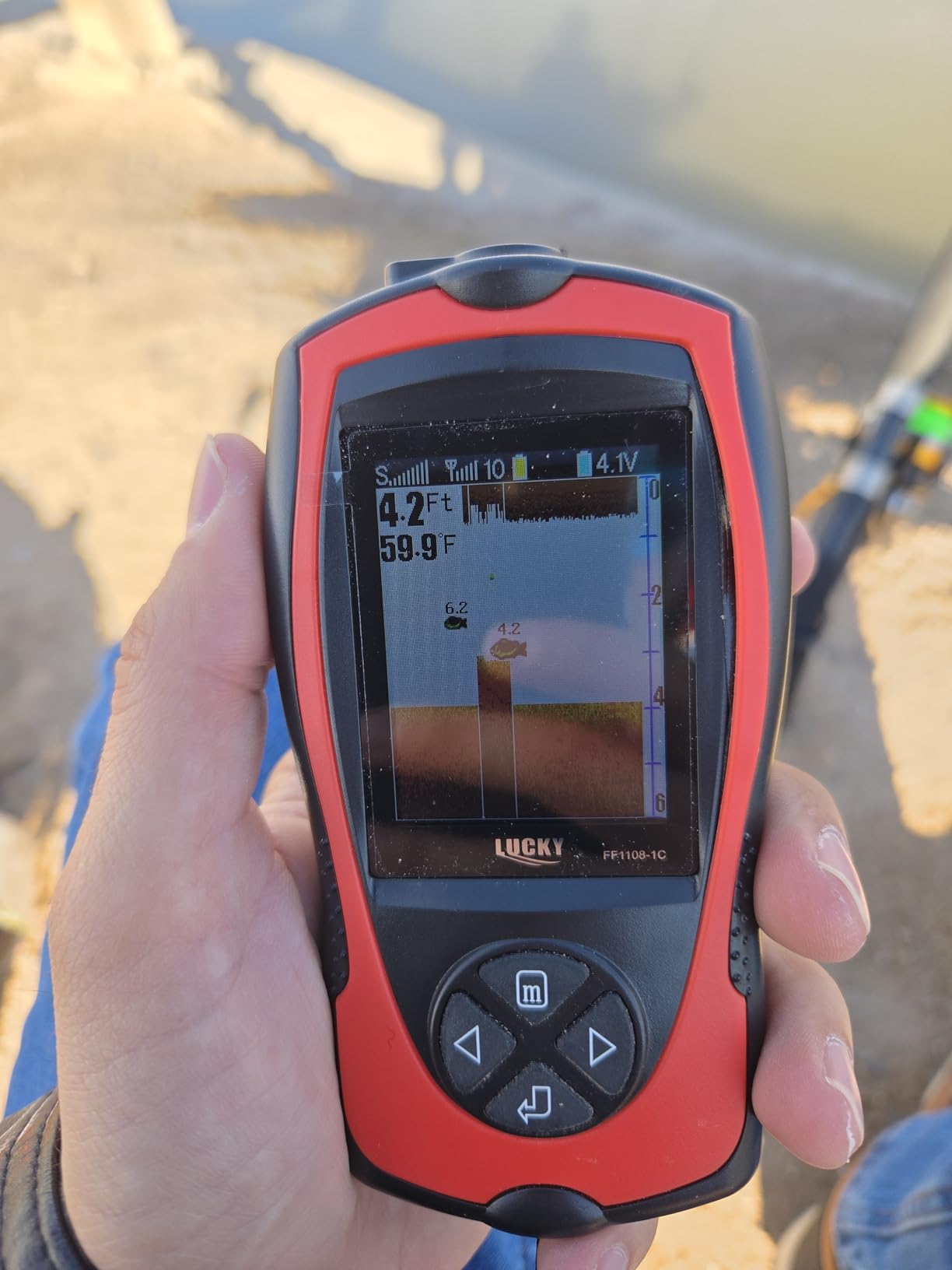
Reviewers treat this as a capable entry-level sonar that does the basics well, with reliable depth numbers, a useful bottom contour and a lamp that genuinely helps at night. The 2.4-inch TFT color LCD shows depth, temperature, bottom contour and fish size with depth, and depth detection reaches 147 feet over a 492 foot wireless operating range.
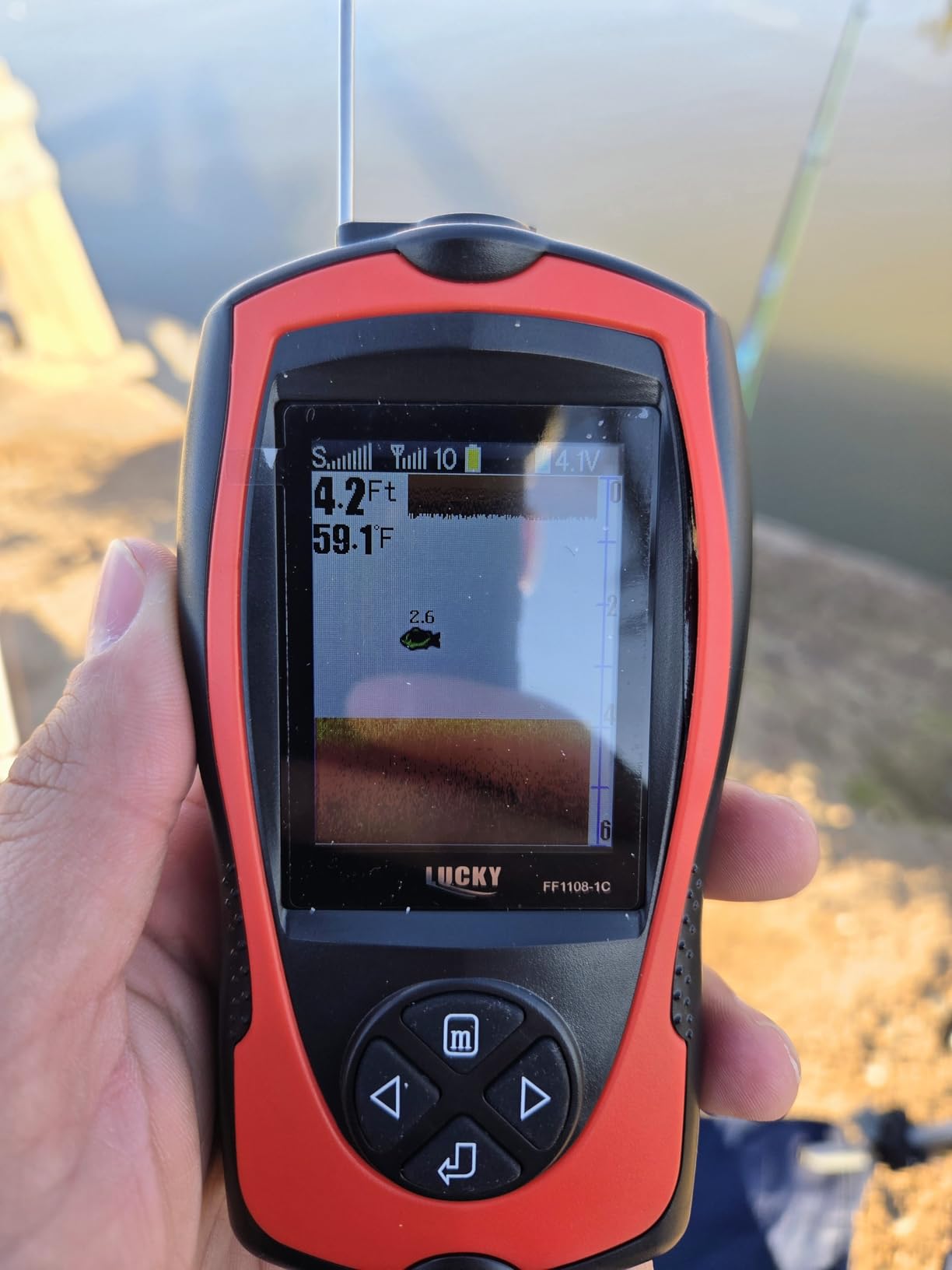
Both the handheld unit and the sensor recharge over the included USB cable. The handheld battery runs about four hours per charge and the sensor about ten, which is a sensible split for a night trip where you check the graph, mark a spot, and then fish for a while without the screen on.
Five settings you can actually change at night include sensitivity, screen brightness, depth range, zoom, depth alarm, fish alarm, fish icon, units and language. Being able to dial brightness down and range up without digging through nested menus is more useful after dark than it sounds.
What you should know before buying it for night use
The wireless link is the weak point. Reviewers report signal drops and no-signal errors even with the antenna extended, and connecting can occasionally never complete. That is a problem you notice much more at night, because you are usually casting to a mark rather than sitting next to the sensor.
The sensor is not weighted, so it drifts and tilts in chop, and a tilted transducer produces false arches. In calm pre-dawn water this matters less, which is one reason this unit suits overnight calm conditions better than a windy evening.
Where it struggles after dark
The 2.4-inch screen is small for reading fish arches and the depth scale quickly, and shallow rocks are sometimes read as fish. If your night target is specific structure like a drop-off edge rather than open water, expect to work harder to confirm holds.
For a slightly larger screen and a wider wireless range, the LUCKY wireless unit below covers the same use case with a 656 foot range and a bigger color graphic display.
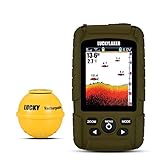
5. LUCKY Wireless Portable Sonar: Best for Finding a Dropped Sensor at Night
LUCKY Portable Sonar Fish Finder Boat Depth Fishing Fish Finders Waterproof Handheld Wireless Fishing Finder Kayak Transducer Depth Finders for Ice Fishing Sea
- Glowing transparent cap makes the sensor easy to find at night
- Depth readings accurate within about a foot
- Floats if dropped in water
- Five to six hours runtime and over ten in battery save
- Own screen so it does not drain a phone
- Some sonar balls stopped transmitting or would not charge
- Thin manual leaves setup to trial and error
- Signal lost if the receiver dips below the surface
- Fish size thresholds are not defined
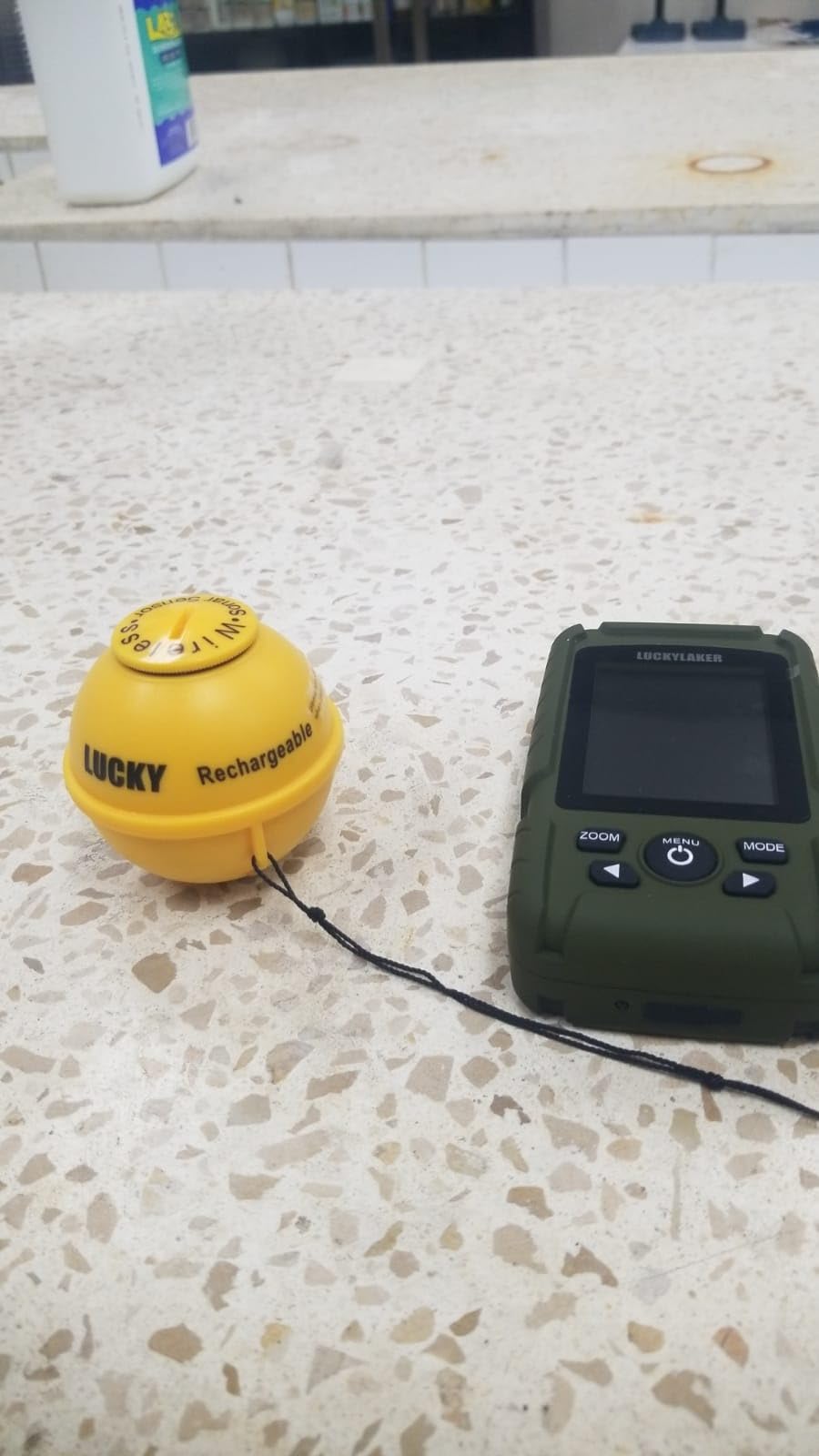
This LUCKY unit is the one to pick when losing your transducer in the dark is your main worry. The sonar ball accepts a transparent replacement cap that glows in the dark for night fishing, and owners single this out as the feature that makes the biggest difference after sunset. You can see where your sensor went instead of guessing.
Reviewers rate it 4.2 across 565 reviews and describe it as a strong mid-tier portable unit. It has its own screen, so it does not drain a smartphone, and runtime is about 5 to 6 hours per charge or over 10 hours in battery save mode. That makes it a better all-night companion than a phone-dependent sonar.
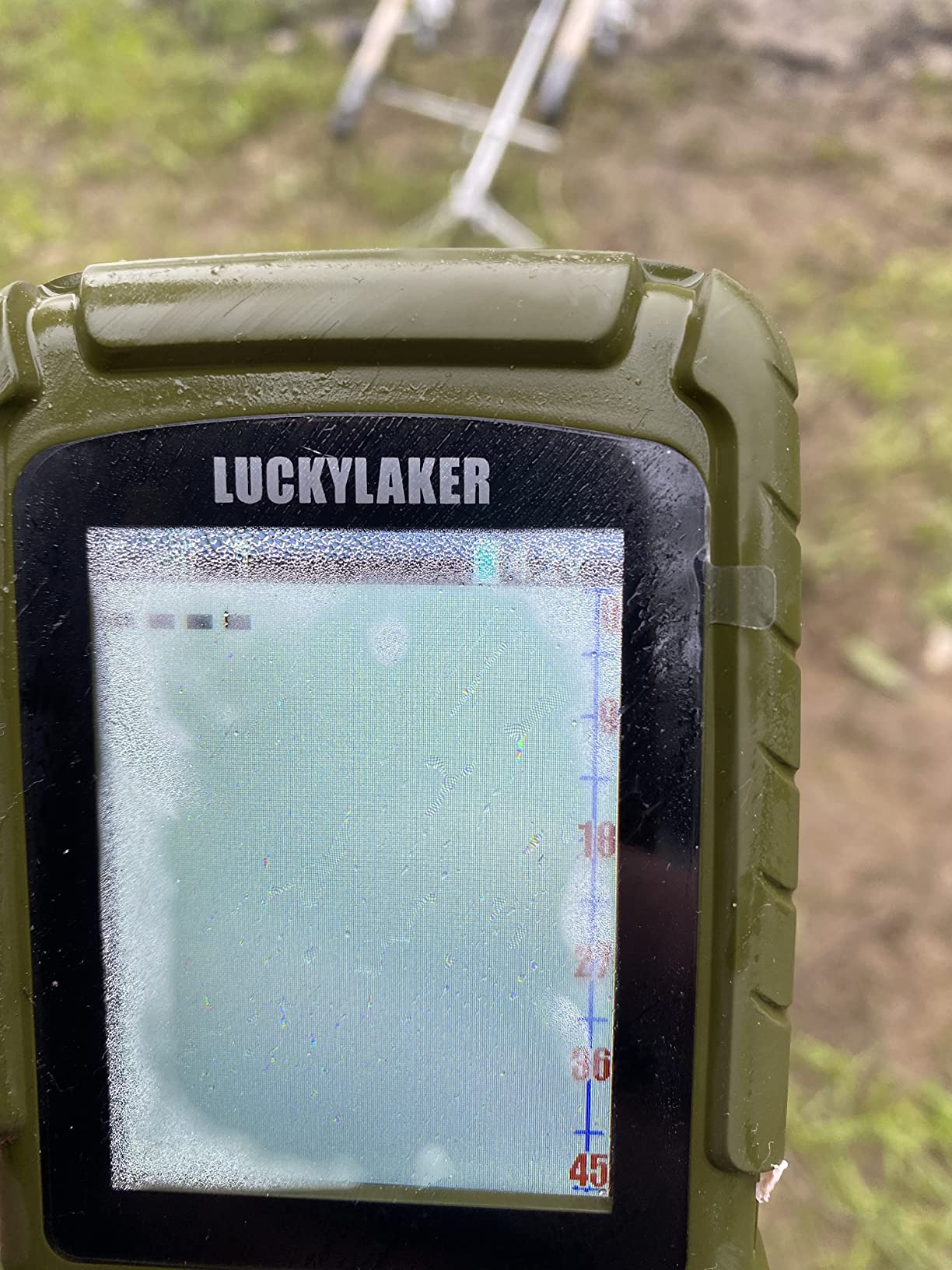
The 125 kHz transducer has a 90 degree beam angle, with range up to 656 feet and depth detection to 147 feet. The color graphic display maps bottom structure and brush piles clearly, and it alerts on fish, fish schools and shallows. A selectable on-screen area narrows the display for more accurate readings, which helps when you are looking at one specific target.
The housing is waterproof and floats if dropped in water. The one thing you need to remember is to leave it in open air after use, because trapped condensation causes problems that look like dead electronics.
What you should know before buying it for night use
Some report the sonar ball stopping transmission or refusing to charge after a few months. That is not a night-specific fault, but it is exactly the kind of reliability concern that matters when you are two hours into a dark trip far from a ramp.
The user manual is thin, so initial setup takes trial and error, and the unit can be finicky about pairing with the handheld at first. Set it up and test it in daylight, then run a full charge cycle before your first night trip.
Where it struggles after dark
You lose the signal if the receiver dips below the water surface, so keep the handheld well clear of the water when you are sitting low in a kayak or on a dock edge. Working well tethered behind a kayak at slow speed is reported as fine, with the signal recovering when the receiver resurfaces.
Fish size thresholds are labeled small, medium and big without definitions, so treat them as a rough hint rather than a measurement. If you are targeting specific species at night by size, a unit with calibrated separation is a better fit.
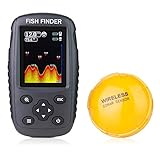
6. Venterior Rechargeable Castable Sonar: Best for Casting From the Bank at Night
Venterior Portable Rechargeable Fish Finder Wireless Sonar Sensor Fishfinder Depth Locator with Fish Size, Temperature, Bottom Contour, Color Display
- Switchable black and white backgrounds work in sun and dark
- Sensor connects instantly with no pairing delay
- Depth and temperature readings check out
- Castable with a plain medium-action rod
- Two-year warranty with brand support
- Wide 105-degree beam gives poor depth on ice
- Cold weather shortens battery life on sensor and receiver
- Towing behind a moving boat produces false signals
- Fish size classes are subjective
The Venterior castable sonar is the pick for bank and dock night fishing because it gives you two screen backgrounds you can switch between, black and white, for bright sunlight or night use. Reviewers credit that simple toggle with making a small 2.6-inch display usable both in harsh sun and after dark, which is rare at this level.
Satisfaction centers on the sensor’s instant-on behavior. It connects the moment it lands in the water with no pairing delay, and it wakes when it floats and sleeps when dry, so you are not burning battery while you fish. Depth, temperature and bottom contour readings are repeatedly confirmed as accurate against known depths.
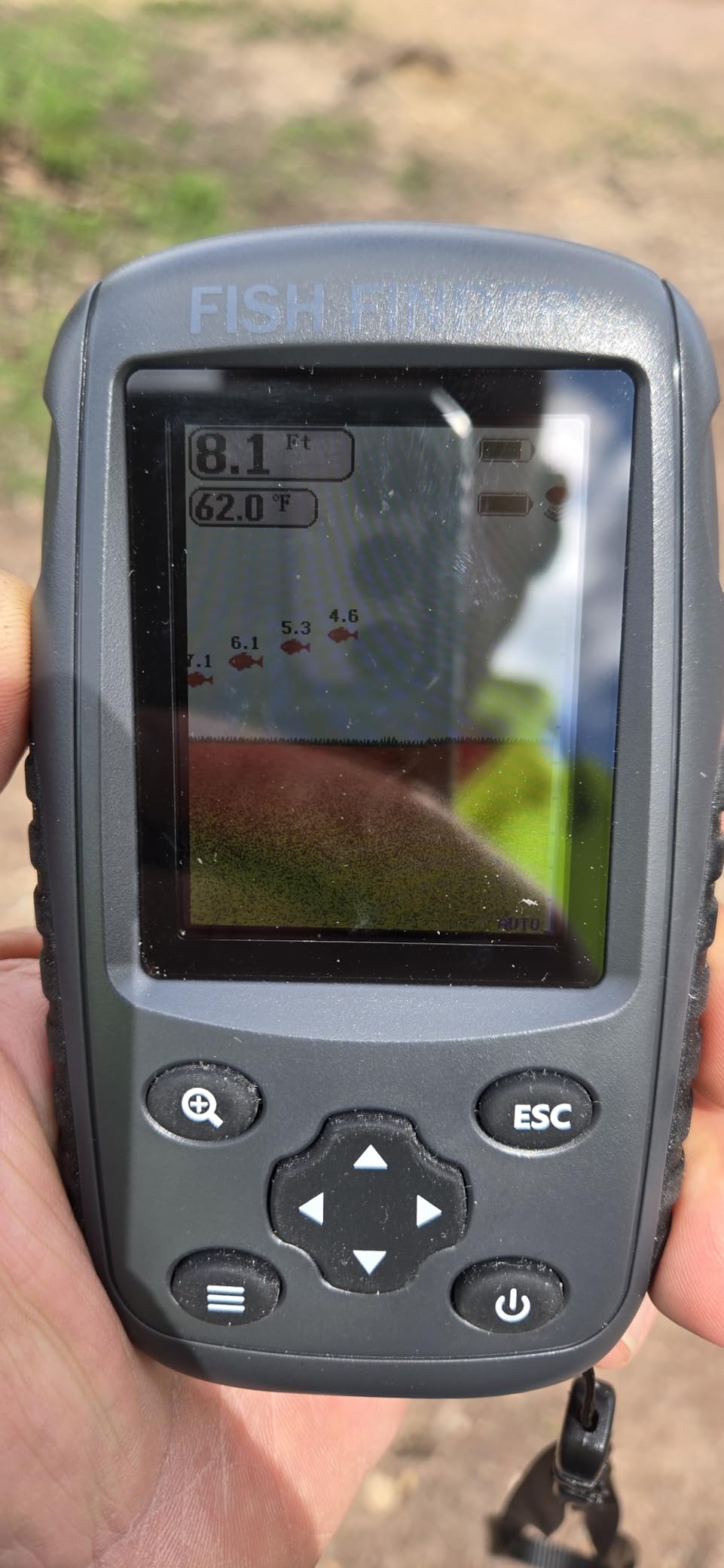
Range is up to 262 feet between sensor and handheld, with depth range from 2.6 to 164 feet and a 105 degree sonar beam angle. Two tether holes on the sensor accept fishing line, so casting is all you need. At 15.04 ounces it is light enough to carry in one hand, and the two-year warranty is longer than most of this group offers.
Work and simulation modes let you get familiar with the display before a trip, and the depth readout converts between feet and meters, which matters when you are reading a map made in a different unit.
What you should know before buying it for night use
Cold weather noticeably shortens battery life on both the sensor and the receiver. Late-season night fishing in winter is exactly when you want a longer runtime, so plan on a spare charge or a power bank, and expect roughly three to four hours per charge in normal conditions.
Towing behind a moving boat produces false signals from wave action, and the wide beam angle reflects off ice-hole walls and gives poor depth on ice. This is a stationary or slowly paddled unit, which is fine for a bank or dock night session and wrong for a trolling run.
Where it struggles after dark
Fish size classes are subjective and not calibrated to real measurements, so if you are picking a size limit for crappie or walleye after dark, this display will not tell you whether a fish is 8 inches or 14. Use it for depth and structure and let your rod do the sizing.
The receiver also drains quickly in continuous fish-alarm mode. If you leave the alarm running all night on a dock, expect your charge to disappear long before your battery pack would.
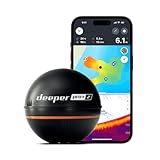
7. Deeper PRO+ 2: Best for Shore Mapping With a Phone
- Three beam angles let you scan wide or zoom in
- Fine target separation resolves individual fish
- Built-in GPS creates maps from shore or dock
- Cable-free wireless design at 3.2 ounces
- Compact enough to live in a tackle box
- No screen of its own so it depends on a phone or tablet
- Highest share of one-star ratings in this group
- Phone battery drains during long sessions
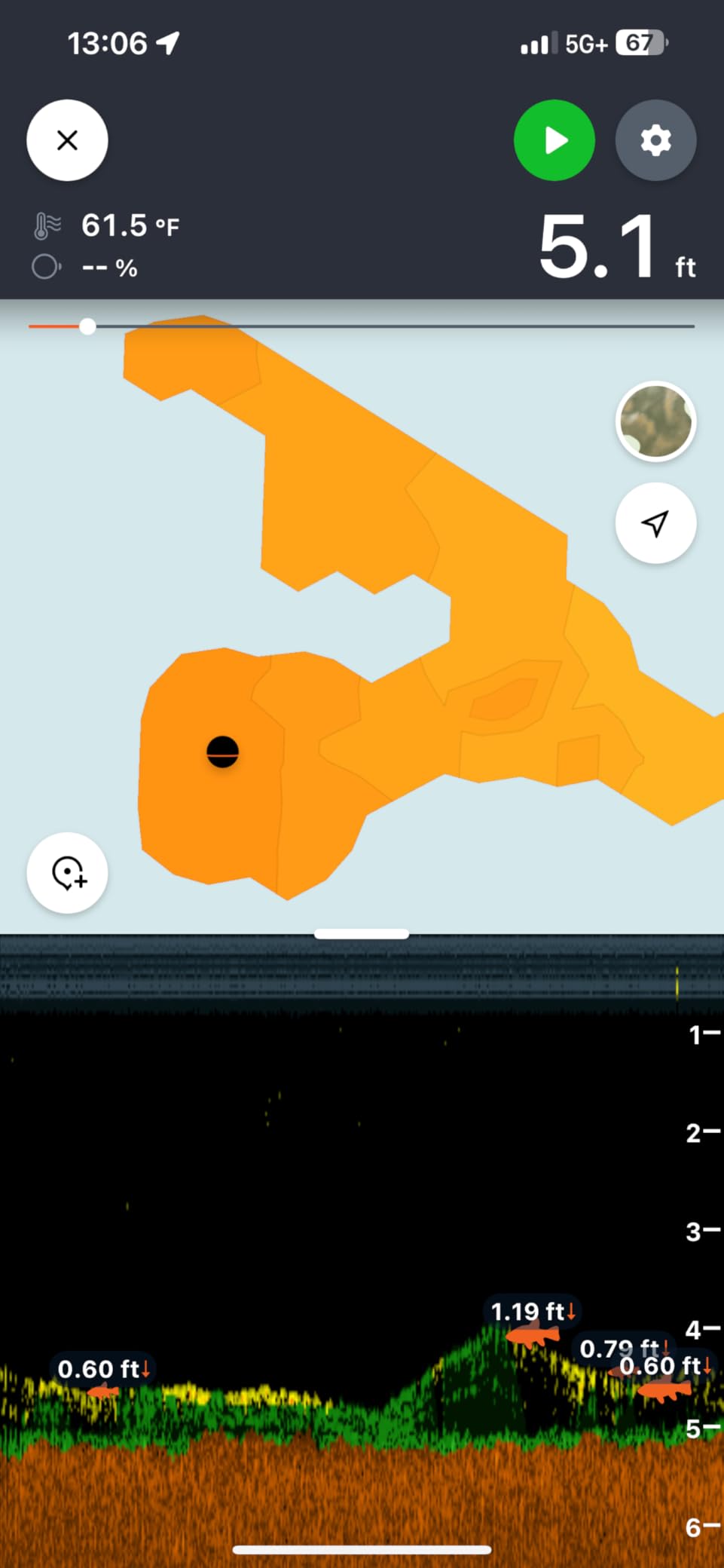
The Deeper PRO+ 2 is the enthusiast pick for night shore and dock mapping, and its built-in GPS is the reason. It records bathymetric maps from shore, dock or bank and saves them to the Fish Deeper app, so a night session on an unfamiliar bank can produce a map you keep forever.
The sonar side is strong too. Three selectable beam options cover coverage versus detail, accuracy runs to 330 feet, and target separation is 0.4 inches on the narrow beam and 1 inch on the wide and mid beams. Owners mention resolving individual fish, and even a small lure when vertical jigging.
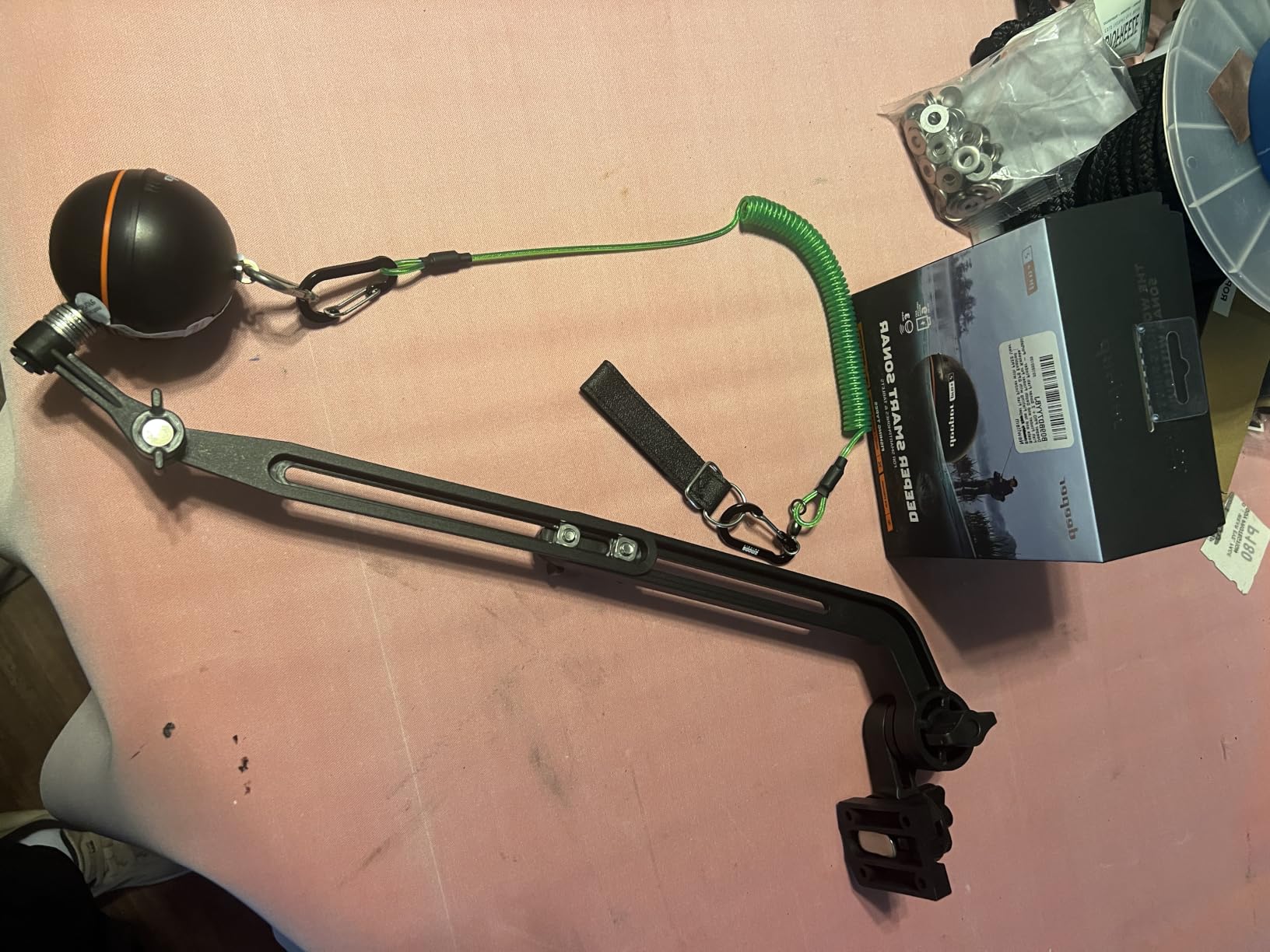
It is 3.2 ounces with no cable to the boat, and a neoprene pouch and USB wire are included along with attachment bolts. That makes it the easiest unit here to carry down a dark bank path or move between spots on a pier.
With 861 reviews at a 4.2 rating, consensus settles at a qualified recommendation. Owners back up the capability claims but raise the same two caveats every time, and one of them is specifically about night fishing.
What you should know before buying it for night use
It has no screen of its own. Readings appear on your phone or tablet, and that is a genuine drawback after dark, because a phone screen is harder to read at low brightness than a dedicated backlit LCD and a bright phone screen will wreck your dark adaptation faster.
App dependency also means your phone battery drains during long sessions. Carry a power bank, lower the screen brightness, and consider a screen dimmer or night-mode app.
Where it struggles after dark
This group has the highest share of one-star ratings of anything we tested, which points to some variability in unit-to-unit reliability. On a night trip where a failure is costly, that is worth weighing against a unit that has its own display and power.
For a night session where you mainly want to see fish rather than build maps, a unit with its own dimmable screen is the more practical tool. The Deeper is better when the mapping is the point.
8. ReelSonar iBobber: Best for a Glowing Float You Can Find After Dark
Reelsonar Portable Fish Finder Accurate Fish Depth Finder with Depth Range of 135 feet 10+ Hours Battery Life with iOS & Android App Wireless
- Glowing body and ring make the float easy to spot after dark
- Casts well and runs 8 to 10 hours in real use
- Switches itself on in water and off when dry
- App has a clear tutorial and demo mode
- Watch app support extends readings to the wrist
- Bluetooth range is roughly 40 to 50 ft in practice
- Connection drops from aluminum boats
- App drains phone battery
- Minimum working depth of about 5 ft
The ReelSonar iBobber is one of the two most reviewed devices in this group, with 6,659 reviews, and its night feature is the simplest one on the list: the float glows. Owners repeatedly single out the glowing ring and body as genuinely useful for locating the float after dark, which turns a frustrating search into a matter of walking toward the light.
It works as a conventional float or as a sonar unit fished below the float using the strike alert. Depth range is 135 feet with depth-tagged, color-coded fish icons by size, and the rechargeable battery is rated at 10 hours or more. Reviewers report closer to 8 to 10 hours in real-world use, which is enough for a night shore session.
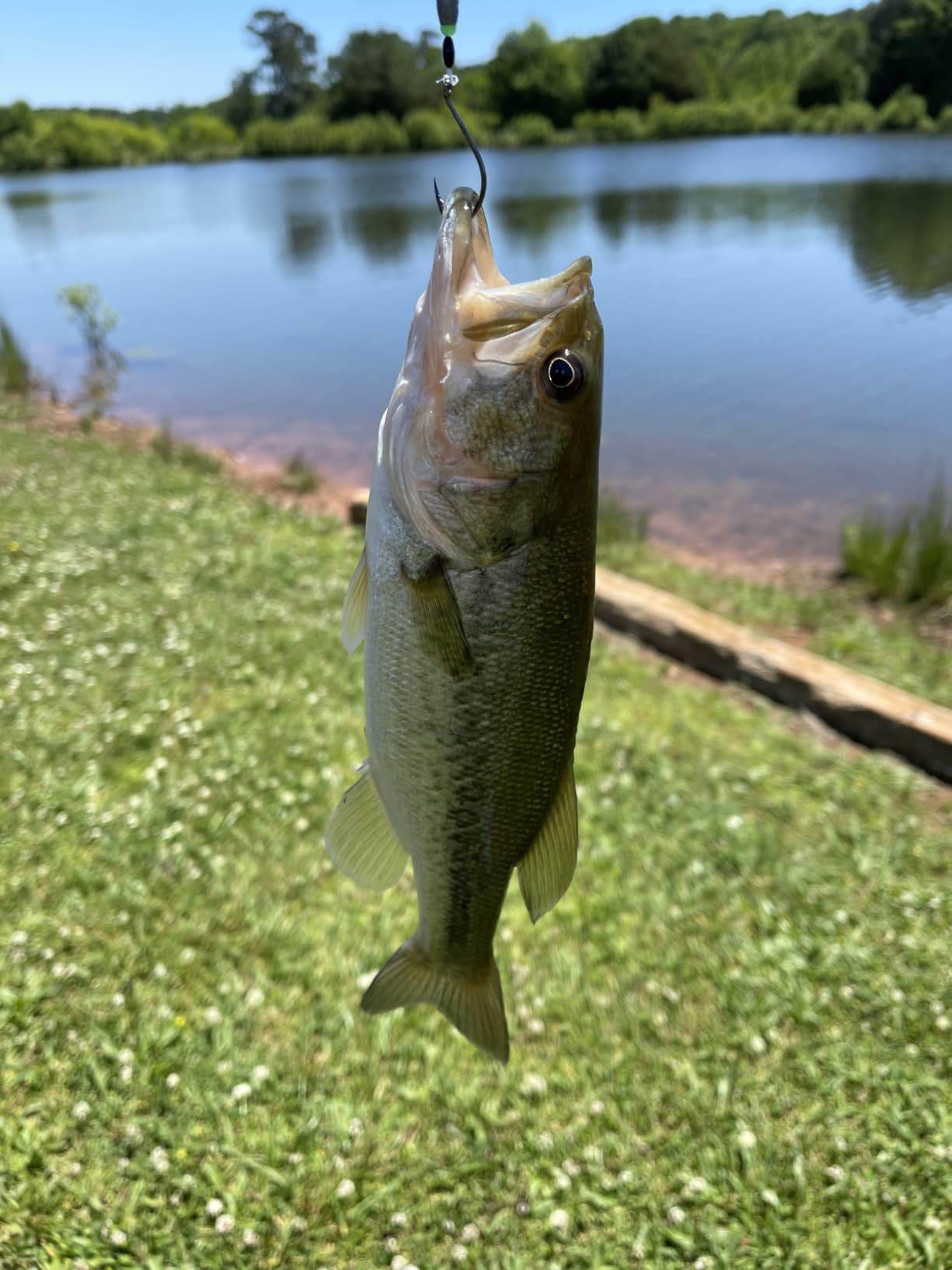
It floats, switches itself on in water and off when dry to conserve power, and it casts well enough to fit in a pocket. The app has a clear tutorial and a demo mode, and smartwatch app support extends readings to your wrist, which is genuinely useful at night when you want to glance without lighting up the whole screen.
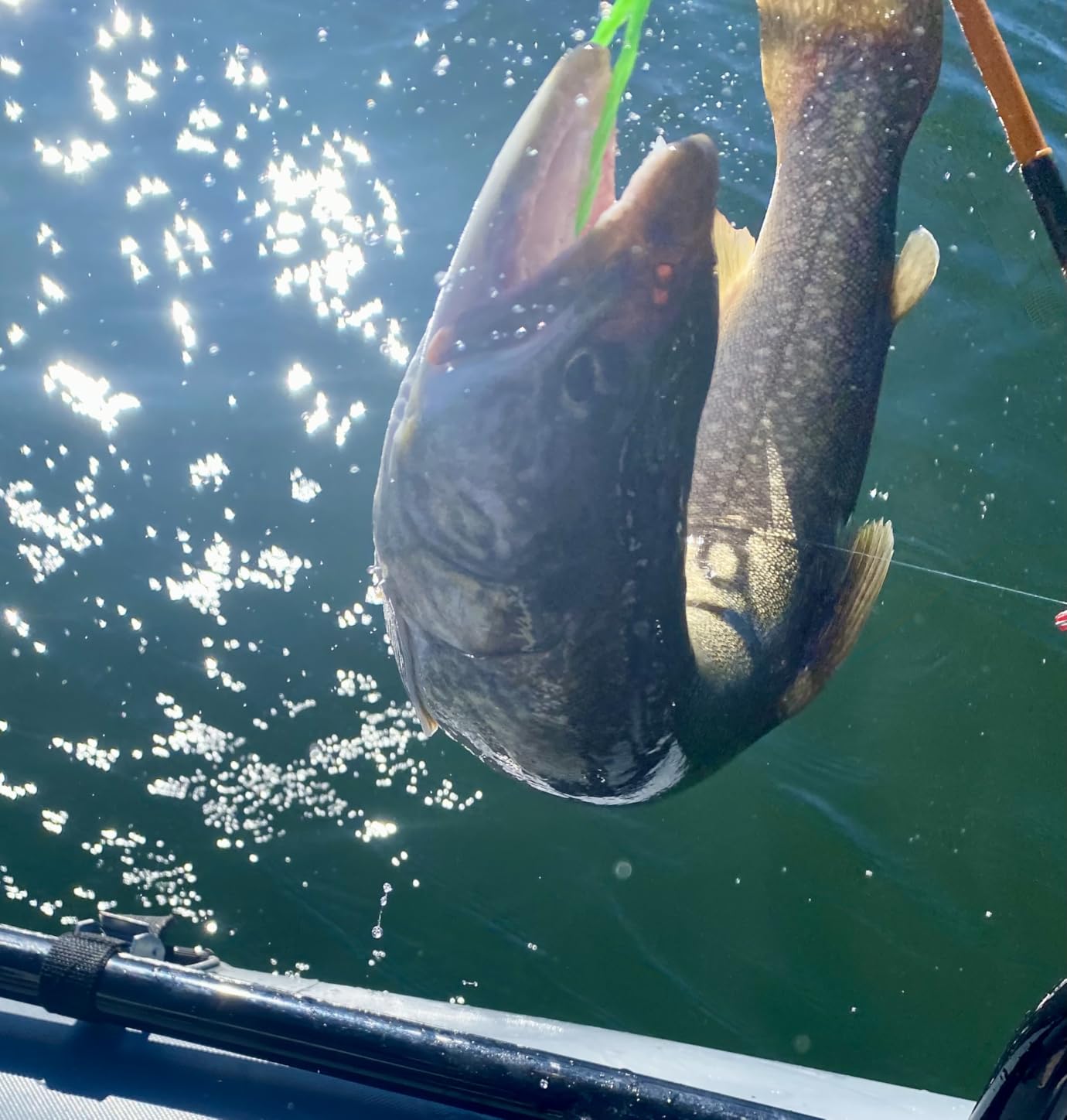
The 4.0 rating across those reviews shows the widest spread of experience in the group. The concept is well liked; the limits are equally consistent.
What you should know before buying it for night use
Bluetooth range is short, roughly 40 to 50 feet in practice, so you must reel the float in to see readings. Connection drops intermittently, especially from an aluminum boat or when the phone is set down, and the app drains phone battery heavily. Bring a power bank and expect to hold the phone.
Minimum working depth is about 5 feet, so shallow ponds and creeks are unusable. That is a real limit for late-season night fishing in skinny water, where fish often push into 2 or 3 feet.
Where it struggles after dark
It is unreliable when towed behind a boat at trolling speed and gives false depth readings, so it is a shore and kayak tool rather than a boat console tool. Earlier firmware revisions showed depth readings stuck near 5.2 feet and drained the battery while out of water, which is the most common source of the lowest ratings in this set.
If you want a float you can see after dark but also want dependable depth numbers from a boat, the LUCKY portable fish finder above is the more robust choice.
9. ZXBVSU Underwater Fishing Camera With Infrared Night Vision: Best for Seeing Fish Directly
Underwater Fishing Camera with 4.3 Inch LCD, 5000mAh Battery, Infrared Night Vision Light, Portable Fish Finder with 100ft Cable for Ice Lake Boat Kayak Fishing
- Infrared night vision gives usable footage in dark water
- 195-degree wide-angle lens shows a broad slice of activity
- Clear LCD readable in bright sun and low light
- 5000mAh battery lasts most of a multi-hour trip
- 100 ft cable on a reinforced spool
- Printed instructions are thin and unillustrated
- Camera is top-heavy and spins on the spool in current
- Cheap plastic shell and metal probes feel unfinished
- Small screen and no phone connectivity
This is not a sonar unit, it is an underwater camera, and that is exactly why it is on this list. Twelve infrared LEDs produce glare-free night vision footage, which means after dark you can look directly at a brush pile or a ledge and see what is holding there instead of interpreting an arch. For structure fishing at night that is a different kind of information.
The 195-degree wide-angle lens shows a broad slice of underwater activity, and owners consistently praise the clarity of the LCD in both bright and dark conditions. The 5000mAh lithium battery runs up to 8 hours of continuous use, which covers a typical night session, and the monitor can also be charged from a power bank or adapter.
With a 4.4 rating across 274 reviews, sentiment is strongly positive for the tier. Reviewers note that infrared helps in clearer water but cannot penetrate heavily sedimented or sandy water, so set expectations accordingly on your lake.
What you should know before buying it for night use
The printed instructions are thin and largely unillustrated, so many owners worked out the setup themselves. The camera is top-heavy and spins on the cable spool in current, making it hard to hold a fixed angle, and the housing and metal weight probes feel unfinished.
It is real-time monitoring only, with no photo or video recording. If you want to capture what you saw at 1 a.m., this will not do it. At 0.79 kg it also packs heavier than it looks.
Where it struggles after dark
Infrared performs best in clearer water. In sedimented or sandy water, visibility drops off sharply, and you may be staring at a murky green screen all night. The 4.3-inch screen is small relative to what competitors offer, and it does not connect to a phone, so you are limited to the on-board monitor.
Treat it as a complement to a sonar rather than a replacement. Running a camera on one side of the boat and a graph on the other is how we would pair it on an actual night trip. Our portable fish finder picks cover the sonar side of that setup.
10. LUCKY Kayak Handheld Fish Finder: Budget Pick for Small Craft
- Backlit display readable in sun and darkness
- Works through the bottom of a kayak hull
- Neck strap and one-hand size suit small craft
- Bottom structure readout of weeds sand and rocks
- Runs about 4-5 hours per battery
- Must be used from a boat or kayak and not from shore
- Does not distinguish fish sizes
- Thru-hull install does not read through fiberglass
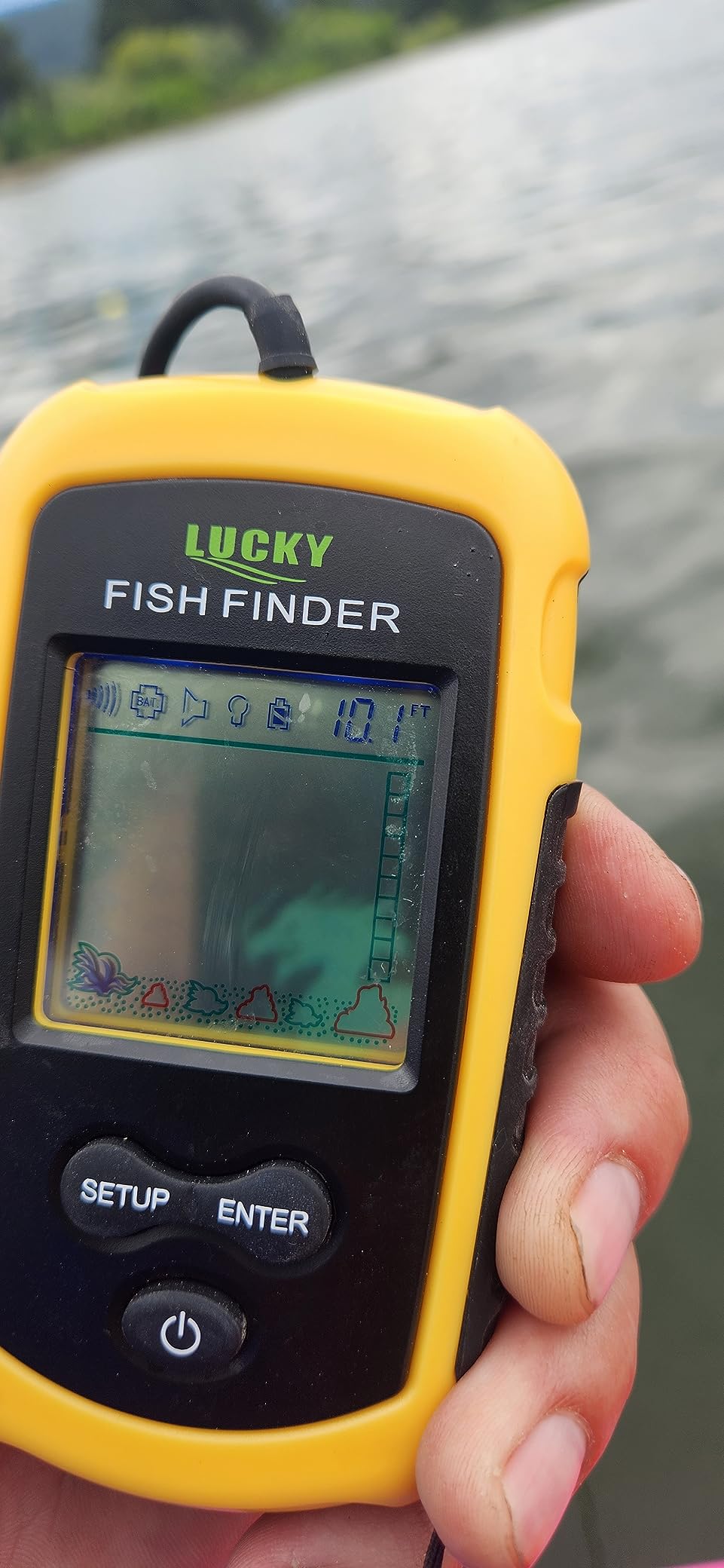
The LUCKY kayak handheld is the budget pick and the kayak choice, with 3,284 reviews behind it. Kayak owners are its most enthusiastic group because the transducer reads through a kayak hull, and the backlit LCD stays visible in sunshine or darkness, which is the bare minimum for a night session.
Depth detection runs from 3 feet to 328 feet with the transducer fully immersed, and the display shows fish depth, water depth and bottom structure including short and tall weeds, sand and rocks. Five levels of sensitivity adjustment let you tune for clear or turbid water, and fish and fish-school alarms alert you to something you cannot see at night.
Reviewers treat it as a depth finder first and a fish finder second. They are satisfied when it maps ledges and bottom contours, and mildly underwhelmed when it cannot tell a minnow from a bass, which is a fair expectation at 2 inches.
Battery life is roughly 4 to 5 hours, and longer in battery save mode. That covers most evening sessions but not a full night of continuous screen time, so bring a spare battery or plan to work in bursts and turn the screen off while you fish. It also has to be used from a boat or kayak and does not work from shore, which is the limitation that generates most of the three-star reviews.
What you should know before buying it for night use
It does not distinguish fish sizes and will register minnows as targets. On a night trip targeting crappie or walleye by depth, the depth readout is the useful part and the fish icons are a rough hint.
Thru-hull installation does not read through a fiberglass hull, so on a jon boat you need another mounting approach. Test your mount in daylight, because turbulence across the transducer face will read as empty water after dark.
Where it struggles after dark
A handful of buyers report a unit that stopped powering on entirely after limited use, accounting for most of the one-star share. Test it fully before you rely on it in the dark, and keep a backup plan.
If you want a screen you can dim through a whole night on a house battery, the Garmin Striker 4 at the top of this list is the step up.
How to Set a Fish Finder for Night Fishing: Gain, Range, Palette and Brightness
Most anglers set their graph once in daylight and never touch it again, then wonder why the night trip looks wrong. Six adjustments, done in order, fix most night problems.
- Drop brightness first. Set the backlight or brightness to the lowest level where you can still read the depth scale without leaning in. Your eyes will adapt in 10 to 15 minutes.
- Switch the palette to a high-contrast night view. Garmin’s Vivid palettes, the LUCKY sonar ball glow, and the Venterior’s black and white background switch all serve the same purpose, a bright target against a dark field.
- Reduce gain. Calm night water returns strong echoes and lights up the entire column at high gain. Lower gain until the background clears, then raise it one step.
- Set range to match actual depth. Range beyond the bottom depth compresses the useful part of the screen into a few pixels. Match your range to the water you are fishing.
- Use zoom or A-Scope to separate fish from bottom. On small screens this is not optional at night. The Striker 4 relies on both.
- Turn the screen off between checks. Every unit here runs longer that way, and you keep your night vision sharper for spotting actual structure and fish.
If your unit has a flasher mode, use it. It centers large targets and is the fastest confirmation tool on a small screen after dark.
Light Color at Night: What Lights Attract Fish and Protect Your Night Vision
What color of light is most effective for night fishing? The practical answer is green and red, with green the better choice for finding structure and red the better choice for preserving your night vision. Blue and white light are the two you want to avoid pointing at the water.
Red light is the standard choice for a headlamp because it disturbs dark adaptation least, which is why anglers who pair a graph with a spotlight and a red headlamp can look up from the screen without losing their night sight. Our night vision monocular picks cover the viewing side of a night setup.
On the fish behavior question, most night anglers point at boat noise and propeller wash rather than screen glow as the real problem. A lit screen mounted inside the console stays contained, while a light aimed at the water is a different matter entirely. Point your light down at your feet, not out across the surface.
One caution worth repeating from the forums: a bright display at max brightness is the thing most likely to ruin your night vision, not the fish finder itself. Dim the screen and the same unit reads fine.
Garmin vs Humminbird vs Lowrance for Night Fishing
Three brands dominate this category, and forum consensus holds Humminbird at number one for side imaging while Garmin is most associated with LiveScope forward-facing sonar. Lowrance sits alongside with its own imaging approach and mapping.
Among the units in our list, Garmin takes the small-screen and large-screen positions with the Striker 4 and the Striker Vivid 7cv. Both offer switchable or adjustable color palettes and both come with a transducer in the box, which matters if you are mounting from scratch for night use.
Humminbird’s Helix 5 CHIRP DI takes the mapping position, with a basemap covering 10,000+ lakes and U.S. coastlines plus AutoChart Live recording. Lowrance does not appear in our list because the units analyzed here are portable and budget-tier, and the broader brand comparison in our complete fish finder guide covers that ecosystem in detail.
The honest caveat is that none of the ten units we compared includes forward-facing sonar. If seeing fish ahead in real time after dark is the goal, that is a separate purchase and a separate budget conversation.
How to Pick the Right Screen, Battery and Transducer for Overnight Trips
Screen size is the first real decision. Anything under 4 inches forces you to use zoom and A-Scope to judge a target, which at night is tiring. A 5-inch display is a reasonable middle ground and a 7-inch display is genuinely readable from a seated position on a moving deck.
Brightness control matters more than raw brightness. A unit with a wide dimming range beats a brighter unit you cannot turn down, because a screen you must dim to protect your night vision is a screen you cannot read.
Power is the third decision and the easiest to get wrong. Fixed console units on a house battery are rarely a problem, and the Striker 4 drawing 0.23 amps at 12V is the kind of number that lets you stop thinking about it. Handheld and castable units are the ones that die, and reviewers consistently report shorter runtimes than advertised in cold air.
Transducer and mounting is the fourth. Low-Q transducers deliver tighter target separation, transom and trolling motor mounts avoid drilling the hull, and through-hull installs will not read through fiberglass. Test your mount at trolling speed in daylight, because turbulence across the transducer face will read as empty water after dark.
Shallow water deserves its own note. Anglers on several forums report units bugging out below roughly 4 to 8 feet of depth. Check the minimum depth of any unit you are considering for winter or creek fishing.
Finally, ecosystem lock-in. Buying a cheaper unit today can block a forward-facing sonar upgrade path later, and transducers, mounts and map chips are where the real cost of a graph hides. Decide how far you plan to go before you pick the head unit.
Frequently Asked Questions
What makes a fish finder good for night fishing?
A good night fishing fish finder needs four things: a dimmable backlight or brightness slider so you can lower the glow without losing fish arches, a high-contrast or switchable color palette so a white arch reads against a dark background, battery runtime that outlasts a full night, and a transducer that stays in clean water. Noise rejection also matters, because calm night water lights up the whole water column at high gain.
What color of light is most effective for night fishing?
Green and red are the most effective light colors at night. Green works best for picking out structure and fish because it cuts through water and improves contrast. Red is the better choice for headlamps because it disturbs your dark adaptation least, so you can look up from a sonar screen without losing your night vision. Avoid pointing white or blue light at the water.
Do fish like light at night when fishing?
Most night anglers point to boat noise and propeller wash rather than light as the thing that puts fish down. A light aimed at the surface can move shallow fish temporarily, so keep a headlamp pointed down at your feet instead of out across the water. A dimmed screen inside the console is contained and rarely the problem.
Is side scan or livescope better?
Side imaging covers a wide area behind and beside the boat and is better for searching large stretches of water and finding structure. Forward-facing sonar shows individual fish in real time ahead of the boat and is better for picking out specific fish and watching them react to a lure. Side imaging helps you find places, forward-facing sonar helps you fish them, and for night fishing the narrow view of forward-facing sonar is easier to read on a dim screen.
Is Garmin better than Humminbird?
Forum consensus generally holds Humminbird at number one for side imaging while Garmin is most associated with LiveScope forward-facing sonar. In our group, the Garmin Striker 4 is the best all-round night pick because of its flasher mode and low 0.23 amp draw, while the Humminbird Helix 5 CHIRP DI wins on mapping with a basemap covering 10,000+ lakes plus AutoChart Live recording.
What is the best fish finder for the money for night fishing?
The Garmin Striker 4 is the best fish finder for the money for night fishing in our testing, earning a 4.6 rating across more than 9,300 reviews. It pairs a readable backlit screen with a built-in flasher mode for working structure in the dark, includes a CHIRP and ClearVu transducer, and draws only 0.23 amps at 12V so it will not end your night early.
Conclusion: The Fish Finder That Reads Best After Dark
After a season of evening trips, the Garmin Striker 4 remains the best fish finder for night fishing in this group, because the flasher mode and the 0.23 amp draw solve the two problems that end night sessions early: seeing the target and keeping power on.
Buy the 7cv if you want to read the screen without leaning in, the Helix 5 CHIRP DI if charts and recorded mapping matter to you, and one of the portable units on this list if you fish from a dock, a bank or a kayak instead of a console. Whatever you choose, dim it, drop the gain and match your range to the depth before you cast off after dark in 2026.