
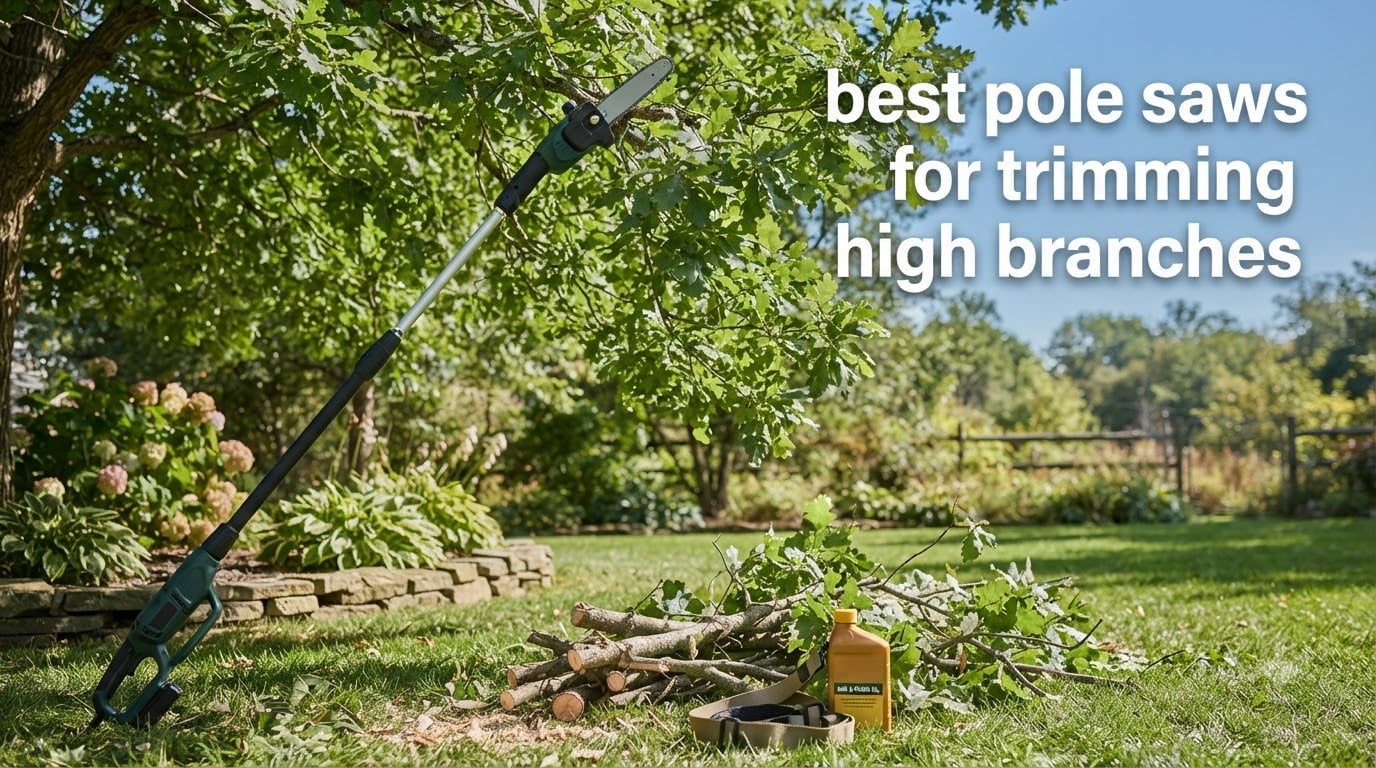
Two or three limbs reach over the roofline every spring, and every one of them is just far enough above the top rung of the ladder to make you think about a pole saw. A pole saw is a chainsaw cutting head bolted to the end of a long shaft, usually telescoping, so you can cut from the ground. Most handle branches roughly 2 to 8 inches thick depending on bar length and power source. Above about 15 feet of real overhead clearance, stop and call an arborist. That is our rule for the best pole saws for trimming high branches we recommend in 2026.
After a season of comparing saws on the same three trees, our rule of thumb settled early: bar length decides what you can cut, real reach decides where, and shaft rigidity decides whether you can still make the cut once your arms are overhead. Weight is the fourth factor, and at full extension it matters far more than the weight on the label.
We leaned on owner feedback heavily, because pole saws fail in predictable places. Oil that stops reaching the chain, poles that flex under load, extension joints that slip mid-cut. Those three complaints dominate owner reports, so we treated them as buying criteria rather than footnotes.
Table of Contents
How We Picked These Pole Saws
We compared ten saws that cover the realistic homeowner range: cordless battery kits, one corded model, one manual pole saw and a two-tool combo. For each one we logged bar length, rated reach, weight, whether the battery and charger were included, whether oiling is automatic, and how owners describe the pole at full extension.
Our weighting was simple. Cutting capacity came first, because a saw that cannot reach the branch’s diameter is a decoration. Real overhead clearance came second. Shaft rigidity and weight at extension came third, since that is what separates a usable overhead saw from one you set down after two cuts. Automatic chain oiling was treated as close to mandatory, because topping up oil mid-job overhead is miserable. Kit contents, warranty length and value closed out the ranking.
We did not test cutting speed against a stopwatch, so treat our performance read as a read of measured specifications plus thousands of owner accounts rather than our own timing data. For the bench-side half of a workshop, our guides to miter saws and table saws cover the cuts this one cannot reach.
Top 3 Pole Saws for Trimming High Branches in 2026
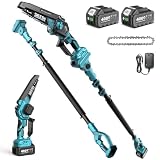
SEESII 2-in-1 Electric Pole Saw
- 2-in-1 handheld and pole saw
- 16 feet of combined reach
- Dual 4000mAh batteries
- Brushless motor

Supstable 6 in and 8 in Mini Chainsaw Kit
- Two bar sizes in one kit
- 16 foot reach
- 30ml automatic oiler
- Two 4.0Ah batteries
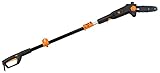
WEN 6-Amp 8-Inch Corded Pole Saw
- Corded 6-amp motor
- Up to 12 feet of reach
- 6.7 pound weight
- Two-year warranty
Pole Saw Quick Comparison in 2026
| Product | Specifications | Action |
|---|---|---|
| SEESII 2-in-1 Electric Pole Saw |
|
Check Latest Price |
| Supstable Dual Bar Mini Chainsaw Kit |
|
Check Latest Price |
| WEN 6-Amp 8-Inch Corded Pole Saw |
|
Check Latest Price |
 VEVOR 7.3-27 ft Manual Pole Saw VEVOR 7.3-27 ft Manual Pole Saw |
|
Check Latest Price |
 Greenworks 40V Pole Saw and Trimmer Kit Greenworks 40V Pole Saw and Trimmer Kit |
|
Check Latest Price |
 CRAFTSMAN V20 14-Foot Pole Saw Kit CRAFTSMAN V20 14-Foot Pole Saw Kit |
|
Check Latest Price |
 Greenworks 40V 8-Inch Pole Saw Greenworks 40V 8-Inch Pole Saw |
|
Check Latest Price |
 Greenworks 24V 8-Inch Pole Saw Greenworks 24V 8-Inch Pole Saw |
|
Check Latest Price |
 Ryobi P4360 18V 8-Inch Pole Saw Ryobi P4360 18V 8-Inch Pole Saw |
|
Check Latest Price |
 EGO Power+ PS1001 56V Pole Saw Kit EGO Power+ PS1001 56V Pole Saw Kit |
|
Check Latest Price |
1. SEESII 2-in-1 Electric Pole Saw – The Best All-Rounder for High Branches
- Converts from handheld saw to pole saw in seconds
- Two 4000mAh batteries give roughly 120 minutes of runtime
- Brushless motor runs cooler and quieter
- Tool-free oil refill and chain change
- Goggles gloves belt and spare chain included
- Chain needs frequent re-tensioning during use
- Six inch bar limits you to lighter branches
- Not a heavy-limb or all-day commercial saw
This is the one I keep reaching for on a typical suburban Saturday. The head detaches from the pole and becomes a handheld 6-inch mini chainsaw in seconds, which means the same tool handles a low hedge and a limb over the garage with no second purchase. Owners rate it 4.5 out of 5 across more than 16,000 reviews, and the volume of feedback itself is telling: a saw this category does not usually gather that kind of owner base.
The telescoping pole runs from about 4.6 feet to 9 feet, which works out to roughly 16 feet of reach once your own arm height is added. That is enough to clear a two-story eaves line from flat ground, which is where most people stop caring about a pole saw and start worrying about a ladder.
Two 4000mAh batteries give roughly 120 minutes of runtime and about 200 cuts on a charge, so a whole pruning session fits in one pack with the second as backup. The brushless motor is a genuine upgrade over the brushed units in this tier, running cooler and quieter, and the tool-free chain refill, oil refill and head angle adjustment mean you are not hunting for a wrench every time something needs adjusting.
The kit is unusually complete for this class. You get two batteries, a fast charger, an extension pole, a shoulder belt, gloves, goggles, a spare chain and an oil bottle in the box. That matters more than it sounds, because the most common ownership regret in this category is discovering the battery or the oil was never included.
Who It Suits Best
If your branches run 2 to 4 inches and you want one tool that handles ground-level brush too, this is the pick. It is also the easiest saw here to hand to a family member, at 6.9 pounds with the pole attached and 3.4 pounds in handheld mode. Reviewers consistently single out the battery runtime and the tool-free maintenance as the two features that made it stick.
Where It Falls Short
The 6-inch bar is the limiting factor, not the motor. Max out around a 4-inch branch and you will be working the saw hard for a result that is merely adequate. The other recurring note is that the chain needs re-tensioning during use, which is normal for a homeowner-grade saw but is the thing that annoys people who cut a lot of wood.
2. Supstable 6 in and 8 in Mini Chainsaw Kit – Two Bars, Two Batteries, One Pole
- Includes both 6 inch and 8 inch bars
- 16 foot reach from the ground
- Automatic oiler with a sight window
- Tool-free chain tensioning
- 180 degree adjustable cutting head
- Automatic oiler is unreliable on some saws
- Chain dulls and needs tightening often
- Heavy at 10 pounds with the pole attached
Two bar sizes is the idea that sells this kit. The 6-inch bar handles twigs and hedge work, the 8-inch bar handles real limbs, and you swap between them instead of committing to one compromise. Owners rate it 4.4 out of 5 from just under 5,000 reviews, and cutting power is the word that comes up most often in that feedback.
The pole telescopes to give up to 16 feet of reach measured from the ground, and the head pivots through 180 degrees so you can approach a branch from underneath or from the side. For storm cleanup, where you are cutting wet, brittle wood at awkward angles, that head adjustment saves more time than any other feature on this list.

Two 4000mAh batteries give roughly 100 minutes of runtime, and the 30ml oiling system has a transparent window so you can see the level while the saw is up in a tree. Tool-free tensioning means the most common mid-job adjustment takes seconds rather than a trip to the garage. A two-year manufacturer warranty also covers the head and the pole, not just the motor.
The kit contents are generous: gloves, goggles, a chain protective sleeve, a spare chain, a pole belt, an oil bottle, an upgraded extension pole, both saw bodies, two batteries and a charger.
Who It Suits Best
For someone clearing a storm-felled limb or cutting back a hedge and an overhanging branch in the same afternoon, having both bar sizes in one box is the whole argument. It also suits anyone who wants cordless convenience without committing to a single bar length for the rest of its life.
Where It Falls Short
The oiler is the weak point. A recurring group of reviews reports that the automatic system performs poorly, that oil consumption is noticeable, and that you end up topping up manually more often than the sight window implies. Chain tensioning and chain wear come up together too: this saw wants attention between branches more than a saw with a better-adjusted chain out of the box.
3. WEN 6-Amp 8-Inch Corded Pole Saw – The Budget Pick for Work Near an Outlet
WEN 4019 6-Amp 8-Inch Electric Telescoping Pole Saw, Corded electric – Black&orange
- Telescoping pole adjusts from 5.3 to 7.3 feet
- 6-amp motor drives the chain at 36 feet per second
- Lightweight at 6.7 pounds
- Emission-free operation with no battery to charge
- Two-year warranty with responsive parts service
- Needs a long extension cord to reach away from an outlet
- Some owners report motor failure within one to two years
- Blade cover does not latch
- Requires arm strength to hold steady overhead
The corded option still makes sense in a surprising number of yards. If your pruning happens within a cord’s length of an outdoor outlet, you get a 36 feet-per-second chain speed, zero battery degradation, zero charging downtime and a saw that starts the instant you plug it in. WEN rates this one at 4.2 out of 5 from nearly 4,000 reviews.
The telescoping pole adjusts from 5.3 feet to 7.3 feet for up to 12 feet of overhead reach. That is short of the 16-foot figures from the cordless kits, and it is the reason we frame this saw as a light-duty pick rather than a high-branch solution for a two-story wall.
At 6.7 pounds it is one of the lighter saws here, and that weight is the real advantage of a corded design. A motor with no battery pack hanging off the top of the shaft keeps the balance closer to your hands, which is exactly what you want while cutting straight overhead. Tool-free chain adjustment and a shoulder strap in the box make setup quick.
Owners describe the cut itself in strong terms, calling it fast on thin and medium branches with minimal effort. It is also one of the few saws here with a shoulder strap in the box. The included blade cover, chain and strap mean you are not buying extras before the first cut.

Who It Suits Best
This suits a homeowner with a small yard, an outlet near the tree, and a handful of 2-to-5-inch branches to clear each year. It also makes sense for a rental or a house with no battery platform, where adding a charger and packs would be pure overhead. Anyone with back or shoulder sensitivity will find 6.7 pounds easier to hold than most of the cordless saws here.
Where It Falls Short
The cord is the whole limitation. Reaching away from an outlet means a long extension lead, and the cord is dead weight hanging from the pole while you work overhead. Beyond that, a recurring set of reviews reports motor failures within one to two years, and the blade cover is described as loose and prone to falling off while you walk. Nothing about the saw is wrong; it is simply the least durable option in this group.
4. VEVOR 7.3-27 ft Manual Pole Saw – Long Reach Without a Motor
- Reaches further than any other pick here
- No battery or fuel to buy or maintain
- Carbon steel blade with hooks at both ends
- Includes a scissors head and an 11.5 foot pull rope
- Spare blade and canvas storage bag included
- Significant flex and wobble past 15 to 16 feet
- Scissor head struggles above roughly half an inch
- Demanding to control at full extension
A manual pole saw has no battery, no charger, no engine and no fuel line. It also has no throttle, which means it is quiet enough for early mornings, needs zero maintenance beyond sharpening, and will still work in thirty years. For a handful of branches a season, that argument is hard to beat.
This one extends from 7.3 feet to 27 feet across eight fiberglass pole sections with double-lock joints. That 27-foot figure is longer than any powered saw in this roundup reaches.

The cutting blade is Teflon-coated carbon steel with hook knives at both ends, so once you start the cut the branch cannot back out of the groove. Owners rate it 4.3 out of 5 from about 3,600 reviews, and seasonal pruning plus blade sharpness plus low commitment is the common summary. The blade also unscrews and doubles as a hand saw, which quietly doubles the tool’s usefulness.
You also get an Mn steel scissors trimming head and an 11.5-foot nylon pull rope with a pulley, useful for twigs and small branches where firing a saw would just send them scattering.
Who It Suits Best
This suits someone who prunes a few times a year, dislikes petrol or battery ownership, or has a tall tree with light deadwood that a ladder could never reach safely. It is also a saw you never need to plug in or fuel up, and the only one here with no motor to service. The spare blade and canvas bag in the box mean it is ready to store between seasons.
Where It Falls Short
Pole flex is the dominant complaint. Past roughly 15 to 16 feet of extension the pole wobbles noticeably, and you lose the precision you extended it for. The scissor head also lacks leverage and gives up on branches over about half an inch. At 14.8 pounds, and at 27 feet of extension, this is a demanding tool to control overhead.
5. Greenworks 40V Pole Saw and Hedge Trimmer Kit – Two Heads, One Pole
Greenworks 40V 8 in Pole Saw Hedge Trimmer Kit, 2.0 Ah Battery and Charger
- Covers pole saw and pole hedge trimming in one kit
- Seven position pivoting hedge head
- Automatic oiler and tool-free chain tensioning
- Cuts 3 to 4 inch branches without struggle
- Three-year warranty
- Hedge head jams on bent teeth or debris
- Heavy and tiring at full extension
- Stiff pole connectors
- Confusing shoulder strap hardware
The reason to buy this kit is the second attachment. Alongside the 8-inch pole saw bar you get a 20-inch dual-action pole hedge blade with a pivoting head that locks into seven positions, so the same pole trims a tall hedge from above, below or from the side without repositioning yourself.
Owners rate it 4.3 out of 5 from around 3,400 reviews, and the recurring theme is capability for routine suburban trimming at a quiet, instant-start level with no gas, no oil mixing and no emissions. Automatic chain oiling and tool-free tensioning are both present, which puts it ahead of several bare-tool competitors.
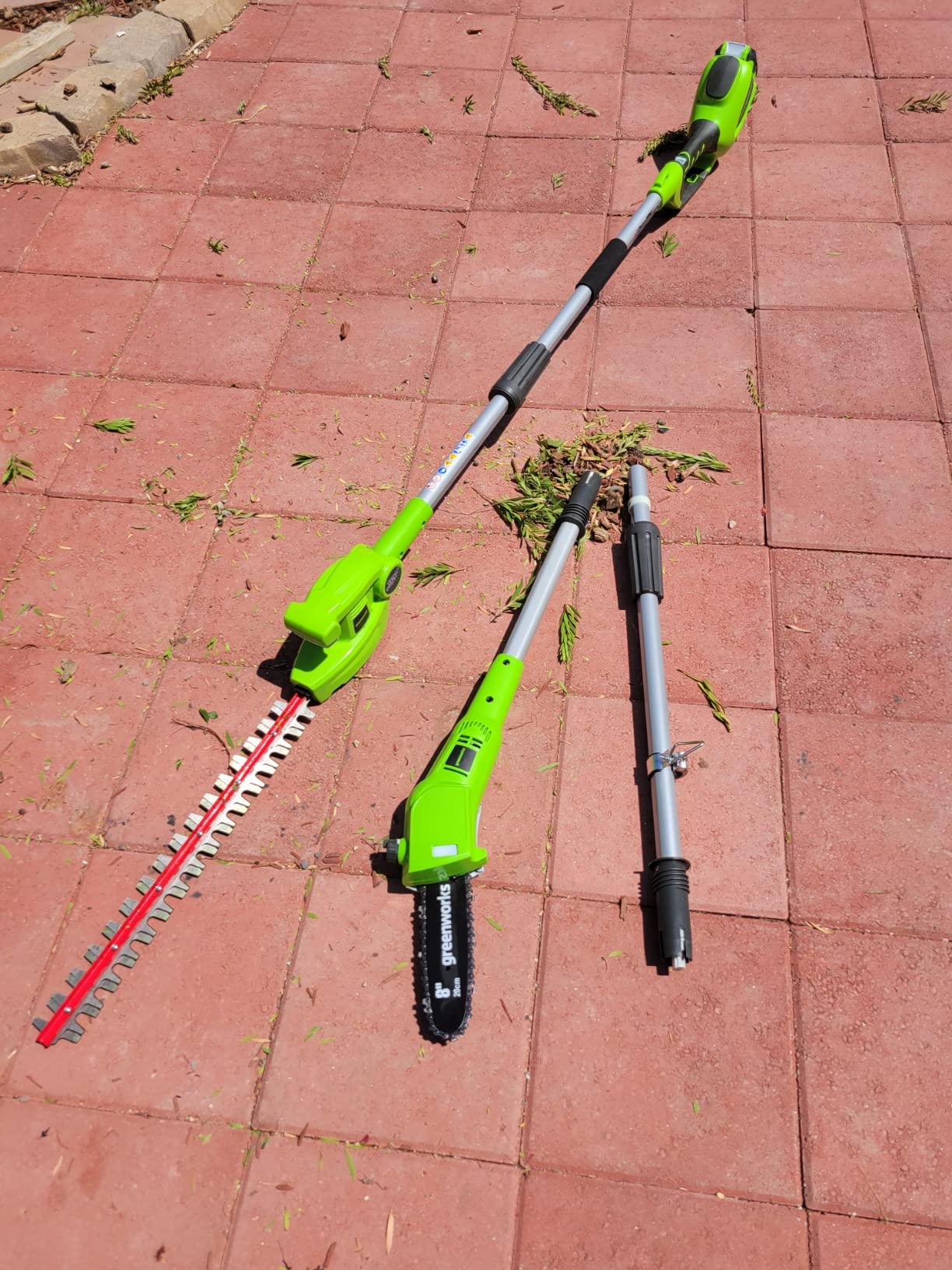
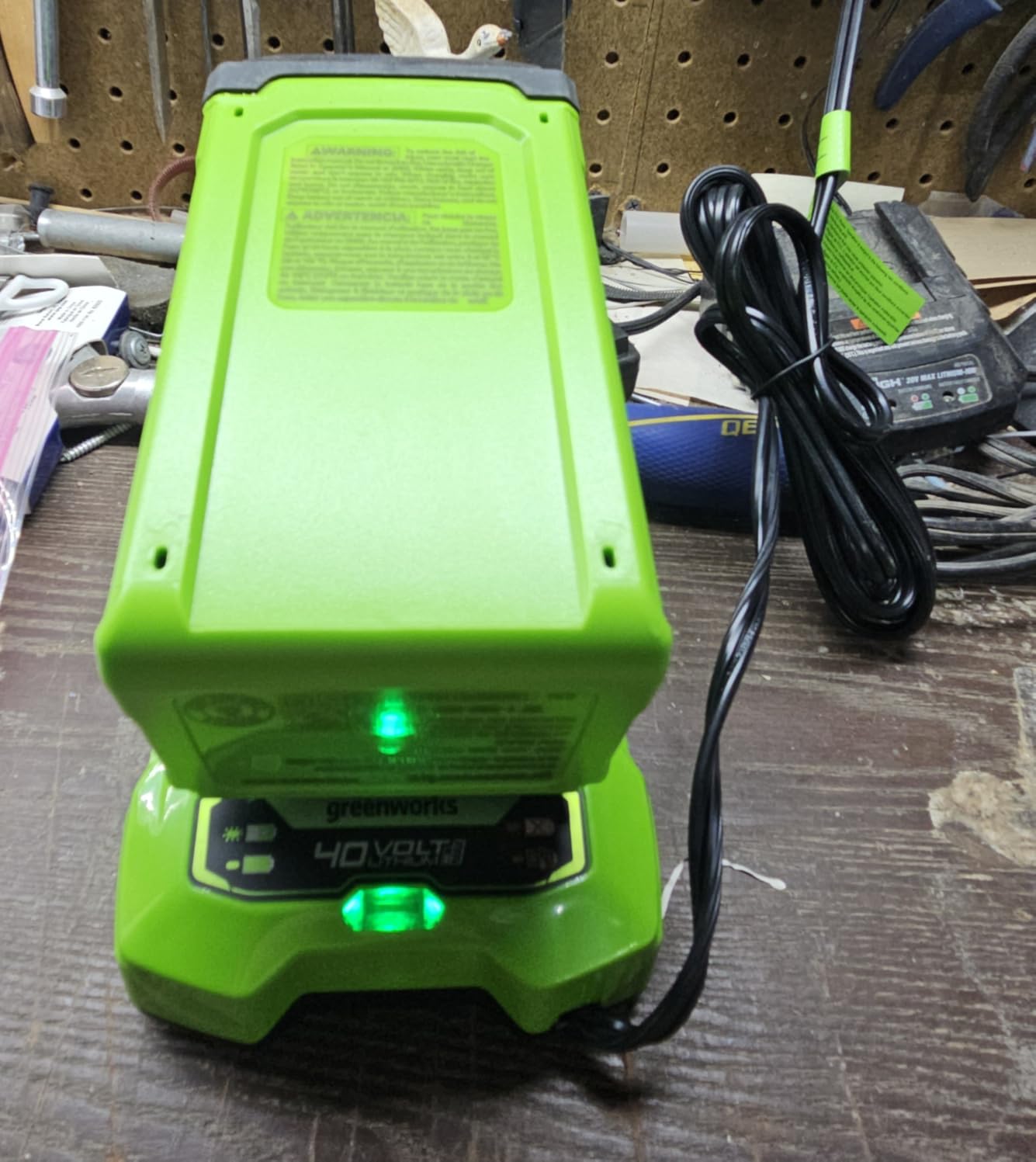
At 11 pounds this is a heavy saw, and that shows up in the reviews as fatigue at full extension. The 2.0Ah battery and charger are included, plus a blade cover, and the kit carries a three-year warranty. On cutting ability, owners report moving through 3-to-4-inch branches without difficulty.
Two design choices are worth knowing before you buy. Chain tensioning uses a bar-pull adjustment rather than the familiar side screw, so it feels different from every other saw on this list. The pole connectors are also stiff to turn, which is annoying once, and irritating every time you collapse the pole in the car.
Who It Suits Best
If your yard has both tall hedges and overhanging branches, this kit buys two tools with one pole and one battery. It is a strong pick for suburban properties with hedges, boxwood and mature shrubs alongside a couple of trees that need an annual trim. The automatic oiler also removes the most annoying part of saw ownership.
Where It Falls Short
The hedge head jams when a bent tooth or debris blocks the reciprocating blades, and clearing it takes time you did not plan on. Weight is the bigger day-to-day issue at 11 pounds, and the balance at full extension is where the fatigue complaints come from. If you only need a pole saw, this kit is asking you to carry a second attachment you will not always reach for.
6. CRAFTSMAN V20 14-Foot Pole Saw Kit – The Lightest Kit With a Battery Included
CRAFTSMAN V20 Cordless Pole Saw, 14-Foot, Battery and Charger Included, Pole Saws for Tree Trimming, Up to 325 Cuts per Charge, 4.0Ah, Electric Tree Trimmer (CMCCSP20M1)
- Lightest full kit here at 6 pounds
- 4.0Ah battery rated for up to 325 cuts
- 14 foot reach with the extension poles
- Angled head and blade improve overhead precision
- Three-year limited warranty
- No automatic chain oiler
- Section connection loosens during use
- Pole feels flimsy and nose-heavy at full extension
At 6 pounds assembled, this is one of the lightest complete kits in the group, battery and charger included. That weight does more for overhead work than any motor specification. Reviewers rate it 4.4 out of 5 from just over 3,000 reviews and repeatedly single out how manageable it feels in the air.
The 4.0Ah V20 battery is the reason the runtime figure is so high: up to 325 cuts per charge is the manufacturer rating, and owners describe it as holding up across a full trimming day. Batteries swap with other CRAFTSMAN V20 tools, so if you already own a V20 mower or blower, this platform costs you one battery to enter.
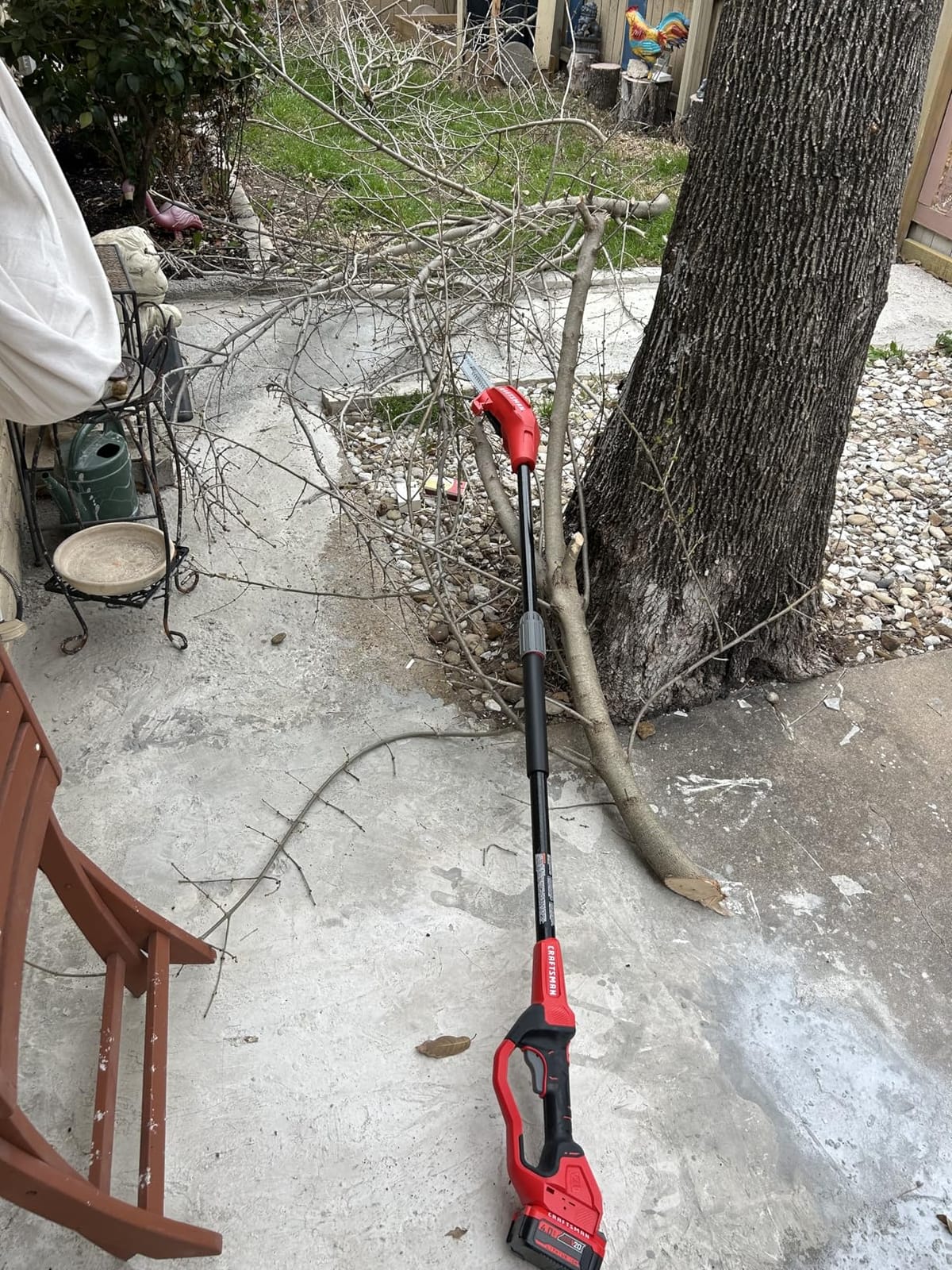
The angled cutting head and angled blade improve precision on overhead cuts, and a branch hook helps pull finished limbs free instead of leaving them wedged in the fork of the tree. Reach runs to 14 feet with the included extension poles, and the soft-grip pole section keeps your lower hand comfortable.
The box holds the saw, a 4.0Ah lithium-ion battery, a charger, an extension pole, an oil bottle and a chain wrench, backed by a three-year limited warranty. In the box is a saw that works on unboxing day, which is not always true in this category.

Who It Suits Best
This is the pick for someone with shoulder or back sensitivity, or a smaller frame, who still wants cordless. Six pounds held overhead for twenty minutes is a different proposition from eleven. It also suits owners already invested in the V20 platform, where this kit is the most direct way to add overhead cutting to the shed.
Where It Falls Short
There is no automatic chain oiler, and that is the dealbreaker feature for many buyers. You carry the oil bottle, and the included one is very small. Owners also report the pole feeling flimsy and nose-heavy at full extension, and a section connection that loosens during use and needs periodic re-tightening. Limited leverage also makes larger cuts slow.
7. Greenworks 40V 8-Inch Pole Saw – The Shaft That Holds Its Shape
Greenworks 40V 8-Inch Cordless Polesaw, 2.0Ah Battery and Charger Included PS40B210
- Aluminum three-piece shaft resists sagging and bouncing
- 11 feet of maximum reach
- Automatic oiler extends chain life
- Tool-free chain tension adjustment
- Battery works across Greenworks 40V tools
- Balance suffers when over-extended
- Auto oiler needs the cover removed to clear chips
- Disassembly for storage takes effort
- Out-of-box chain tension runs tight
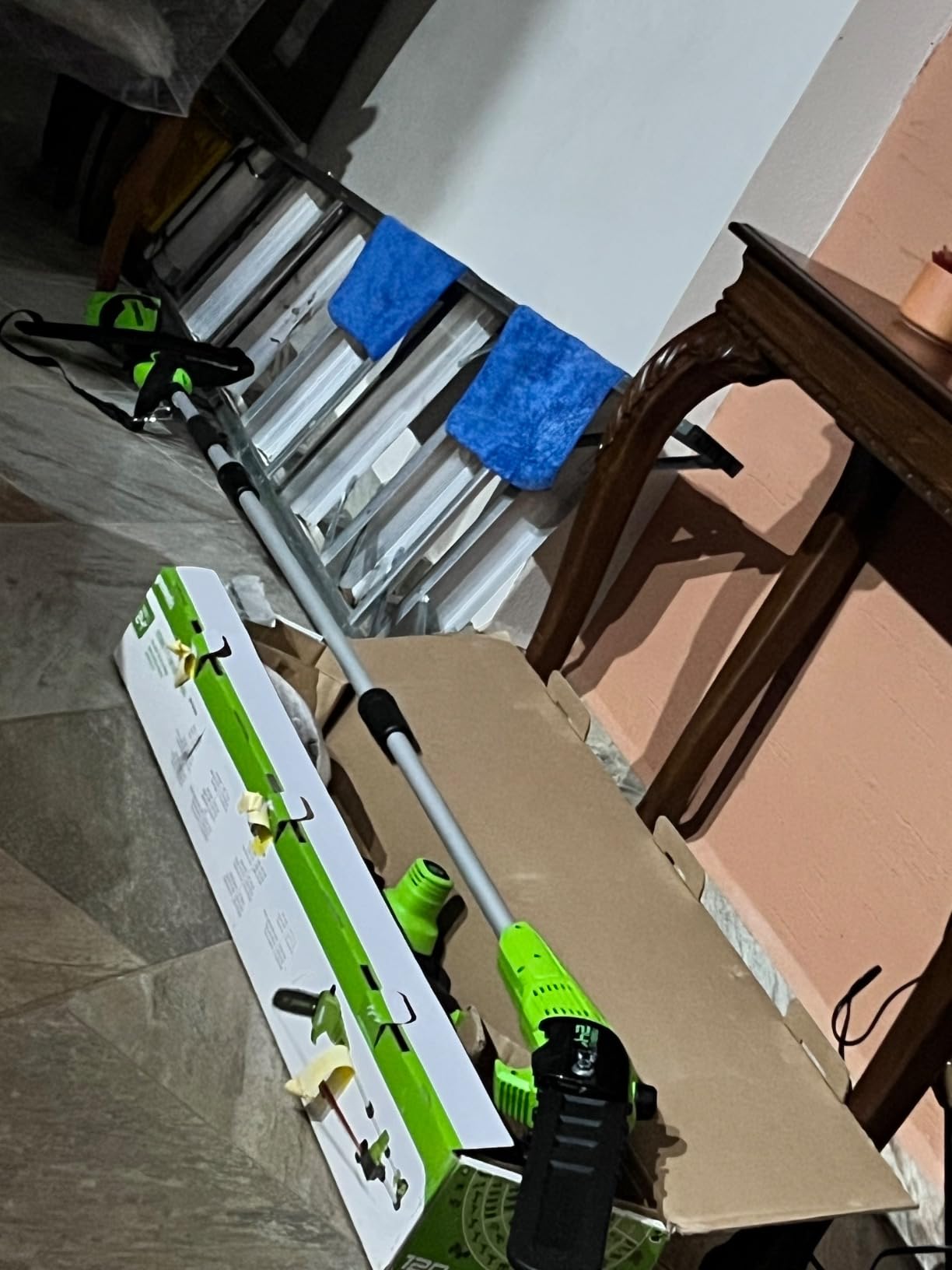
Shaft material is the story here. This model uses a three-piece aluminum shaft, and owners consistently single it out for resisting the sagging and bouncing they get from fiberglass poles. That rigidity is what lets the bar sit still against a branch while you work, instead of dancing around the cut.
Reviewers rate it 4.5 out of 5 from just under 2,000 reviews, and more than seven in ten of those ratings are five stars. The automatic oiler, the tool-free tension adjustment and the 11 feet of maximum reach from the extended shaft all show up as the reasons it works for dead and live branches alike.
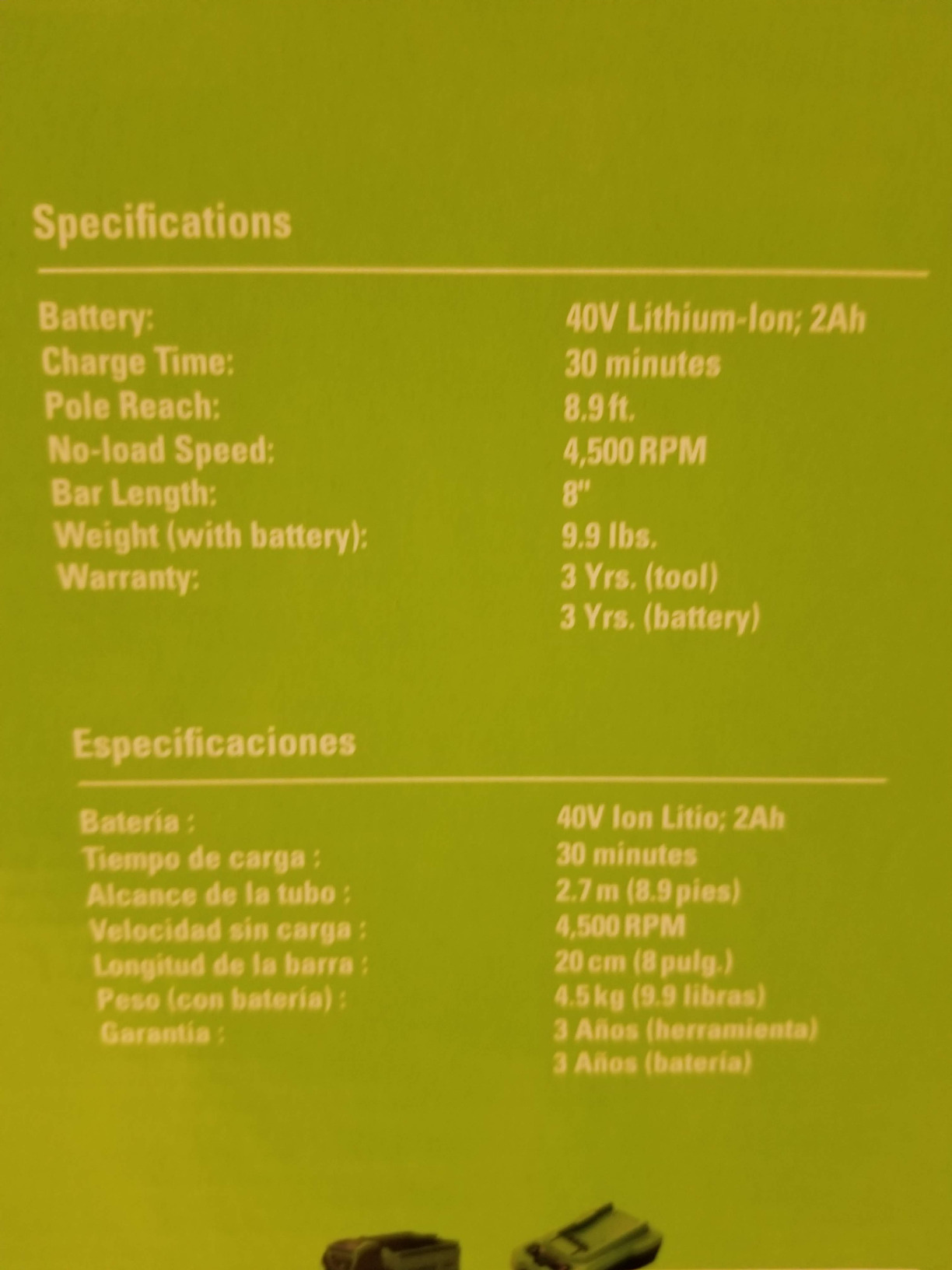
The kit includes the saw, bar and chain, a 2.0Ah battery, a charger, an extension pole and a scabbard, so the storage problem is handled. Quiet instant-start operation with no gas, no mixing and no emissions makes it usable on a street-adjacent yard where a gas saw would draw complaints.
Balance is the trade-off for the aluminum. At 7.8 pounds this is not the lightest saw here, and if you push it past its intended extension the top end gets heavy in your hands. The 2.0Ah battery is also the smaller pack, so runtime is a step below the 4.0Ah kits.
Who It Suits Best
Choose this if pole wobble drives you mad. If you have cut with fiberglass saws that buck at full extension, the aluminum shaft here changes the feel of every overhead cut. It also suits Greenworks 40V owners, since the battery and charger work across that platform.
Where It Falls Short
Three small annoyances recur. The automatic oiler needs the chain cover removed to clear chip debris, disassembly for storage takes real effort, and the chain tension straight out of the box runs tighter than it should, which trips up first-time owners. None of these are failures, but all three show up in normal use.
8. Greenworks 24V 8-Inch Pole Saw – Owners Report All-Day Runtime
Greenworks 24V 8″ Cordless Polesaw (Great For Pruning and Trimming Branches / 125+ Compatible Tools), 2.0Ah Battery and Charger Included
- Reviewers report 4 to 5 hours of cutting per charge
- Battery works across 125 plus Greenworks tools
- Aluminum three-piece shaft
- Automatic oiler with low oil consumption
- Longest warranty in this roundup at four years
- Double safety interlock is awkward to operate
- Heavy and tiring at full extension
- Oil drains out after use and can leak
- Some owners report wiring failures and chains coming off
The headline here comes from owners rather than a spec sheet. Reviewers repeatedly describe getting four to five hours of limb cutting from a single 2.0Ah charge in real yard use, which no manufacturer rating in this group claims. For a full Saturday of branch work, that is the difference between one charge and three.
The 24V platform is less powerful on paper than the 40V and 56V saws, but it still cuts larger limbs without difficulty and uses very little oil, which is a more efficient combination than raw voltage. The 8-inch bar and 11 feet of maximum reach match the 40V model exactly.
Owners rate it 4.3 out of 5 from just over 1,000 reviews, and professional crews who use it full-time tend to leave grounded reviews. Several owners describe it as stout next to petrol models, and the four-year warranty is the longest warranty here.
Who It Suits Best
This suits anyone doing a genuinely long session, where stopping to recharge overhead is the worst part of the job. It is also the choice for households already running Greenworks gear at 24V, since the battery and charger come in the box and cover a huge tool range.
Where It Falls Short
The double safety interlock is genuinely awkward, because the chain control and the trigger cannot be touched together, which slows down every start. Owners also report draining the chain oil after use or it leaks, and the 7.8-pound weight is tiring with a second extension section fitted. A smaller set of owners reports internal wiring failures and chains coming off.
9. Ryobi P4360 18V 8-Inch Pole Saw – An Easy Entry Into ONE+
- Works with every Ryobi ONE+ battery and tool
- Angled head improves overhead cuts
- Light enough for older or smaller users
- Chain brake included
- Three-section pole accepts an extra extension
- Battery and charger not included
- Modest chain speed leaves ragged pruning cuts
- No oil reservoir so you add oil by hand
- Second extension section makes it too wobbly
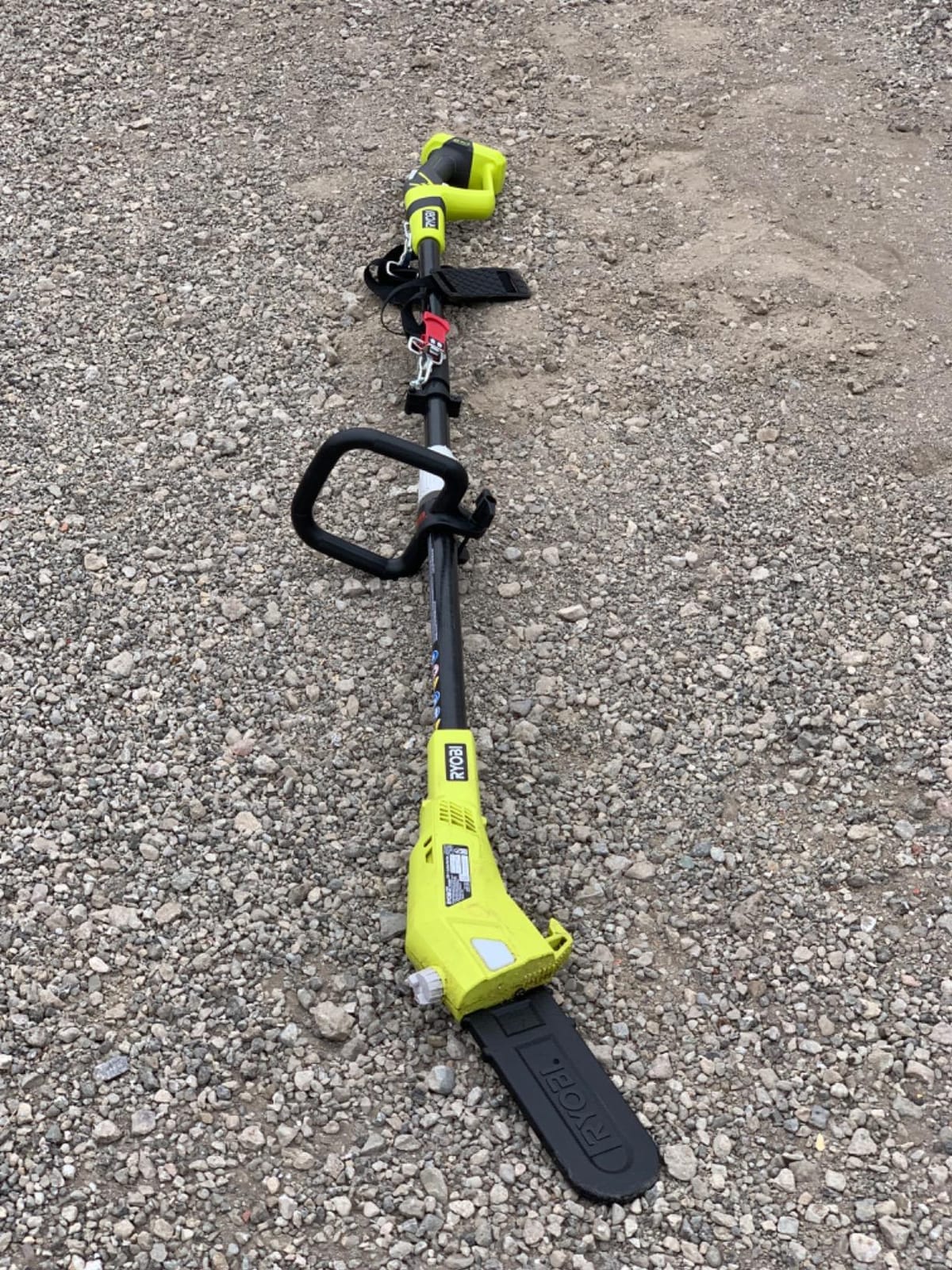
This is a bare tool, and we want to be direct about that before anything else. Battery and charger are not in the box. If you already own Ryobi ONE+ packs, that saves you money. If you do not, add a battery and a charger before you own a working pole saw.
What you get for that is an angled cutting head that makes overhead work noticeably easier and helps reduce blade pinch, an 8-inch high speed steel bar, and a chain brake. Owners rate it 4.4 out of 5 from about 785 reviews, and older users and smaller-framed users are named often as people who find it comfortable to handle for a full session.
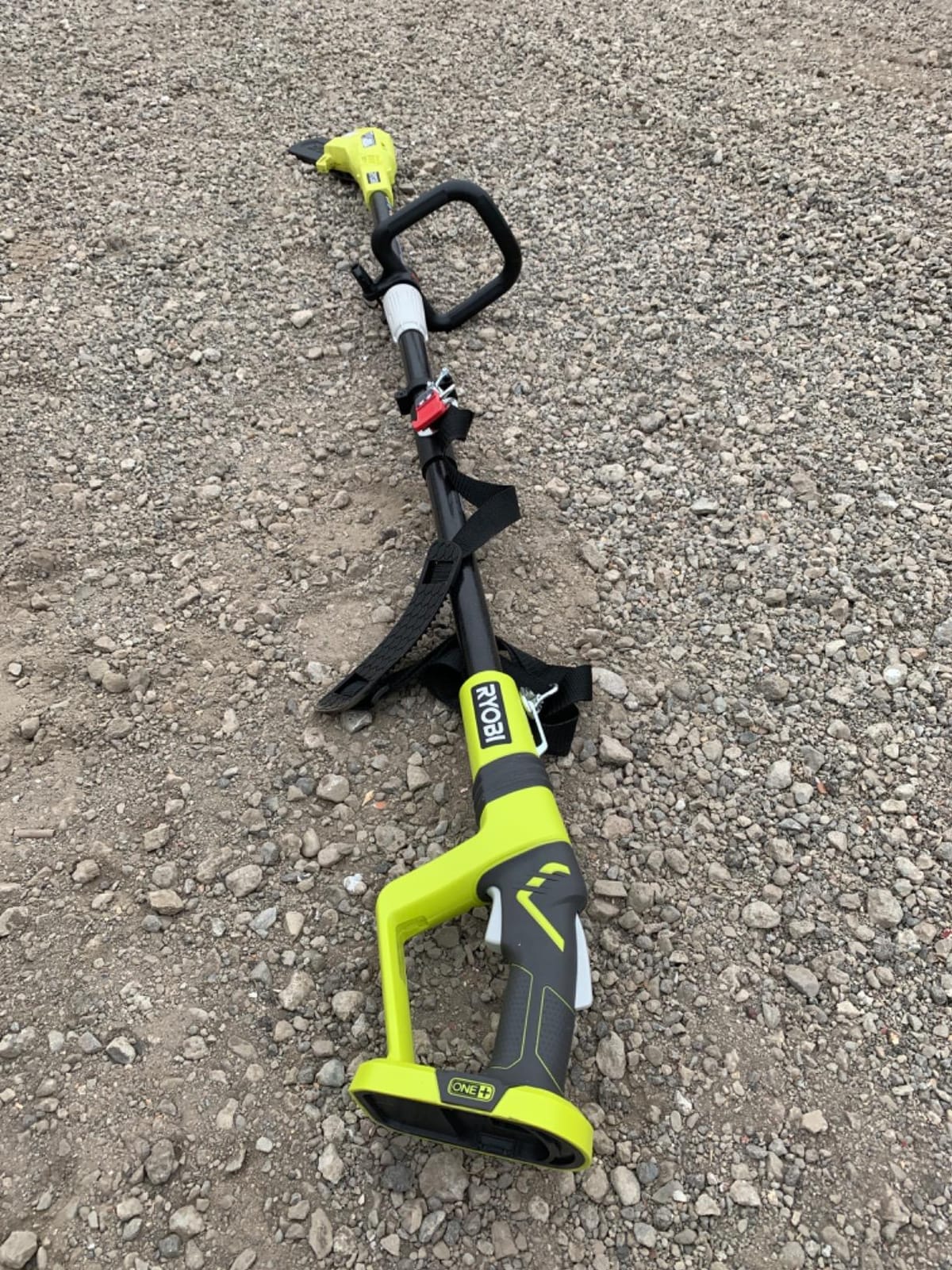
The three-section fiberglass pole breaks down for storage and accepts an extra extension section for more reach. On a 4.0Ah ONE+ pack, owners report battery life holding up across a full day of trimming, and the saw handles 3-inch limbs without trouble.
The oil-free design is the thing to understand here. There is no reservoir, so if the saw runs hot you add oil by hand, and some owners report the oiler dripping down the pole. Treat bar oil as a manual task on this saw rather than something the machine handles.
Who It Suits Best
This suits ONE+ owners who already have batteries, and anyone who wants a light saw for smaller limbs. The angled head and manageable 7.4-pound weight make it a good choice for older users and for reaching fruit trees where you are working close in. It is also a sensible companion if you already own ONE+ tools and want one more job covered.
Where It Falls Short
Chain speed is modest and cuts come out ragged for pruning work, which bothers people who care how a cut looks on a fruiting tree. There is no oil reservoir. Adding a second extension section makes the saw too wobbly to use safely, which caps the useful reach. The supplied scabbard is also difficult to fit.
10. EGO Power+ PS1001 56V Pole Saw Kit – 10-Inch Bar and an LED Cut Line
EGO Power+ Pole Saw for Tree Trimming, Cordless Electric Pole Saw with Telescopic LED Cut Line Indicator, Includes 56V 2.5Ah Battery and Charger – PS1001
- Only 10 inch bar in this roundup
- LED cut line shows the path in shade
- Telescopic carbon fiber shaft with lifetime warranty
- Battery and 56V charger included
- Brushless motor runs the quarter-inch chain up to 20 m/s
- 9.4 pounds is heavy to hold overhead
- Arm strength becomes the limit before cutting capacity does
The 10-inch bar makes this the only saw here that takes on genuinely serious limb work, and it pairs with a quarter-inch pitch, 0.043 gauge chain driven by a brushless motor at up to 20 meters per second. Owners rate it 4.5 out of 5 from 367 reviews, and 80 percent of those ratings are five stars, the strongest distribution in this group.
The feature nobody else in this roundup has is the LED cut line indicator. It projects the cut path so you can see where the bar will land, which matters far more than it sounds. In shade, against a dark trunk, on an overcast afternoon, it turns a guess into a plan.
Reach runs to 13 feet on its own, or 17 feet with the EP1000 extension pole. The telescopic carbon fiber shaft carries a limited lifetime warranty, which tells you how the maker feels about the component that actually flexes on cheaper saws. Owners name that warranty, the 10-inch bar and the cut line as the three reasons to buy.
The kit includes the pole saw, a 56V 2.5Ah battery and a 56V charger, so it is ready to run. Tool-free chain tensioning, a quick-adjust handle and a shoulder strap hook are all included, and the battery works across the EGO 56V ARC Lithium range. Expect up to 100 cuts per charge on the included pack.
Against that, it is a heavy saw at 9.4 pounds. Cutting capacity is not what limits it. Your shoulders are, once the pole is fully extended and you are pushing a 10-inch bar through green wood.
Who It Suits Best
This suits you if you genuinely have thick branches, roughly 6 to 8 inches, and want to stop deferring that job. It also suits anyone cutting in shade or under canopy where the LED cut line earns its keep, and EGO owners who can use their existing 56V packs. The carbon fiber shaft warranty makes it a lower-risk long-term purchase.
Where It Falls Short
Nine point four pounds overhead is real. It is heavier than every other pole saw on this list except the combo kit, and that weight lands on your shoulders at the exact moment you are least able to shrug it off. The second limit is the reach ceiling: even at 17 feet with the extension, that is the boundary where a professional arborist with climbing gear and rigging is the right call.
Corded, Battery, Gas or Manual – Which Power Source Fits Your Yard?
Most homeowners land on battery, and the reason is not power, it is convenience. Instant start, no starting pull cord, no fuel mixing, no exhaust, and low noise that keeps neighbours friendly. For 2-to-8-inch branches, a cordless saw does everything a gas saw does at a fraction of the hassle.
Corded electric still wins in a narrow lane: light trimming close to an outlet. You get full chain speed with no battery weight on the pole, which keeps the saw balanced, and you never wait on a charge. You pay for that with a cord that limits where you can work.
Manual saws win on running costs. No battery, no fuel, no oil system beyond the blade itself, and near-silent operation. A manual saw is slower per cut and demands real arm strength, but if you cut a few branches a season it is the tool that never fails.
Gas is the honest gap. Nothing in this roundup is petrol powered, because for typical residential pruning the noise, starting pull cord and maintenance outweigh the raw cutting power. If you are cutting large limbs all day on repeated jobs, petrol still earns its place, and you will want the biggest bar you can carry.
How Thick a Branch Can a Pole Saw Cut?
The maximum branch thickness is usually 1 to 2 inches less than the bar length. An 8-inch bar cuts branches up to about 6 inches, and a 10-inch bar handles roughly 8 inches. The working rule is simple: choose a bar at least 2 inches longer than the thickest branch you expect to cut, so the chain has room to clear the cut and the bar never gets pinched.
Pinch is the reason that margin exists. A bar cut too short traps the kerf, the chain binds and the bar kicks. Adding 2 inches of margin is what keeps the cut clean and the motor out of a stall. Most of the 8-inch saws here are therefore genuinely 2-to-6-inch tools, and the 10-inch bar extends that to 8 inches.
Add the manual saw to the mix and the arithmetic changes, because a manual blade is limited by blade thickness and the flex of a telescoping pole rather than by motor torque. Those saws cut cleanly through light branches but flex visibly on anything heavy.
How Far Can a Pole Saw Actually Reach?
Advertised reach overstates reality, and this is the single biggest source of buyer frustration in the category. Manufacturers quote total reach, which folds in an estimated 2-to-3-foot arm length on top of the pole. The honest measurement is trigger to bar tip, which is what you actually control from the ground.
On that basis, the 8-inch cordless saws here deliver roughly 9 to 11 feet of genuine overhead clearance. The 16-foot claims in this roundup are combined-reach figures that assume a tall operator holding the saw overhead. Add a compatibility-rated extension pole and you can push a well-designed saw to 15 or 17 feet, as the 10-inch model does.
The taller the tree, the less control you have. A branch at 16 feet is heavy, wet wood under compression, and a wobbling pole turns that into an uncontrolled event. Past about 15 feet of real overhead clearance, an arborist with climbing gear and rigging is the better call, and no pole saw on this list changes that.
Weight, Balance and Pole Flex at Full Extension
Weight is quoted with the saw collapsed and lying flat. That number tells you almost nothing about what you hold overhead, where the saw is nose-heavy and the head end pulls. If you are choosing between a 6-pound saw and a 9.4-pound saw and you will be working above head height, the gap matters far more than the label suggests.
Pole flex is the failure mode nobody warns you about. A fiberglass shaft that bounces at full extension makes precise cuts impossible, and extension joints with play that slip under load are a near dealbreaker. Owners repeatedly single out the aluminum shaft on the Greenworks models and the carbon fiber shaft on the 10-inch saw as the components that make overhead work feel controlled.
Fit the shoulder strap before the first cut. A strapped saw transfers load to your torso; an unstrapped one loads your arms and hands, which is how people end a job shaking. And check the connection point between sections mid-job, because it can loosen under the torque of a cut.
Bar Oil and Chain Maintenance Basics
Every chain-and-bar saw needs bar oil, cordless and petrol alike. The oil carries heat away from the bar and keeps the chain from welding itself to the rail. Running even briefly dry can score the bar, ruin the chain and damage the sprocket, which is why we treat an automatic oiler as close to mandatory on an overhead saw.
If your chain is not getting oil, run the saw barless for a few seconds and watch whether oil fills the bar groove. That is the standard check users on r/Chainsaw reach for, and it tells you instantly whether the oiler works or the fault is a blocked or misaligned port. Then check the oil hole in the bar is clear, confirm the chain is not overtightened across it, and re-align the bar as you tension. Some bars ship with the oil port sealed from the factory.
Keep the chain tensioned just enough that it snaps back into the groove without a gap. Chain life tracks tensioning more than most owners expect. Clear chips from under the chain cover on oil-powered saws, and check reservoir level before every session, not halfway through.
Pole Saw Safety – Never Use One on a Ladder
A pole saw should never be used while standing on a ladder. A ladder plus a running saw is one of the most dangerous combinations in yard work, and the pole exists precisely so you can stay on the ground. Every saw in this roundup replaces a ladder trip; none of them makes a ladder safe.
Set up a drop zone before the trigger is pulled. Clear people, pets, vehicles and anything you would mind replacing out of the branch path, and remember that a cut limb falls where gravity wants it to, not where you planned. Wear eye protection and hearing protection, gloves and a hard hat when working under limbs, and keep both feet planted.
Cut on the far side of the limb and keep the bar moving away from your body. Understand that kickback happens when the upper nose of the bar binds, which is another reason to size your bar 2 inches longer than the branch. And if the tree is larger than your reach, stop. That is the entire safety section in three sentences.
Frequently Asked Questions
What is the best tool for cutting high branches?
A pole saw, which is a chainsaw cutting head mounted on a telescoping pole, is the best tool for cutting high branches because it lets you cut from the ground with no ladder. It is safer than a ladder, quieter and cleaner than gas, and handles branches roughly 2 to 8 inches thick depending on the model. Most homeowners are best served by a cordless pole saw with 12 or more feet of real reach.
How thick of a branch can you cut with a pole saw?
The maximum branch thickness is usually 1 to 2 inches less than the bar length, so an 8-inch bar cuts branches up to about 6 inches and a 10-inch bar cuts up to about 8 inches. The practical rule is to choose a bar at least 2 inches longer than the thickest branch you expect to cut, which keeps the chain from binding in the kerf.
What type of saw is best for cutting high limbs?
For most homeowners a cordless battery pole saw is best: quiet, instant-start, no cord, and strong enough for branches from 2 to 8 inches thick. Pick corded electric for light trimming near an outlet, a manual pole saw if you cut only a few branches a season, and petrol only if you cut large limbs all day and already own petrol equipment.
What is the best long pole saw for tree trimming?
For genuinely long reach, choose a telescoping cordless pole saw with a rigid shaft that extends past 12 feet and accepts an extension pole. The 10-inch bar model here reaches about 13 feet, or 17 feet with its extension pole. Above roughly 15 feet of real overhead clearance, an arborist with climbing gear is the safer call.
Why is my pole saw chain not getting oil?
Run the saw barless for a few seconds and check whether oil fills the bar groove. If it does, the oiler works and the port may be blocked or misaligned. Check the oil hole in the bar is clear, verify the chain is not overtightened across it, and re-align the bar as you tension. Some bars ship with the oil port sealed from the factory.
Is it safe to use a pole saw on a ladder?
No. Never stand on a ladder to use a pole saw. A ladder combined with a running saw is one of the most dangerous combinations in yard work, and the pole exists so you can stay on the ground. If a branch sits above about 15 feet of real overhead clearance, hire an arborist rather than improvising.
Do pole saws need bar oil?
Yes. Every chain-and-bar saw, cordless or petrol, needs bar oil to lubricate the chain and stop the bar overheating. Prefer a model with an automatic oiler so you are not stopping mid-cut, and check the reservoir before each session. Running even briefly without oil can score the bar, damage the chain and ruin the sprocket.
How long does a pole saw chain last?
Chain life depends far more on tension and lubrication than on how many cuts you make. A chain that is kept tensioned correctly and fed oil from a working automatic oiler will outlast one that runs loose or dry. Clearing chips from under the chain cover and checking the oil level before each session extends chain life more than any storage habit.
The Bottom Line – Which Pole Saw Should You Buy in 2026
The SEESII 2-in-1 is our pick for most people in 2026. It weighs 6.9 pounds with the pole attached, ships with two batteries and a full kit of safety gear, converts to a handheld saw in seconds, and reaches far enough to cover a two-story wall. Its 6-inch bar is the one limitation worth knowing before you buy, and it holds up to roughly 4-inch branches.
Buy the EGO 10-inch model if you have thick limbs and want to stop postponing that job, and pair it with the extension pole if the tree demands it. Buy the manual pole saw if you cut a few branches a year and refuse to own a battery platform. Buy the CRAFTSMAN kit if weight overhead is your real constraint. Everything else on this list is a variation on those three ideas.
Whatever you choose, stay on the ground, oil the chain, and check the connection between pole sections before every job. If your work turns to thinner material after the limbs are down, our scroll saw guide covers curved cuts.