

A garage is usually the last room in the house to get comfort features, and in July it becomes the first room you avoid entirely. Concrete floors soak up heat all day, a sun-facing wall doubles that load, and the ceiling is usually bare plywood radiating stored heat downward. That combination is why the best portable air conditioners for garages have become one of the most searched-for appliance categories in the summer months.
We spent the past few months reading through thousands of owner reviews, comparing manufacturer cooling ratings against real garage dimensions, and sorting out the two design choices that actually matter: single hose versus dual hose, and how each unit handles the water it pulls out of the air. What follows is a garage-specific roundup, not a generic room-AC list. Every unit below is judged on whether it can hold a workable temperature in a space with a hot ceiling, whether it needs a bucket emptied into it, and whether it will run all day without becoming the loudest thing in the room.
If you want our short list before the details, jump to our general portable air conditioner guide first, then come back here for the garage-specific sizing work. We also break down the alternatives we compare against near the end, including our mini-split picks, because a portable AC is not always the right answer for a garage.
Table of Contents
Will a Portable Air Conditioner Work in a Garage?
Yes, a portable air conditioner can cool a garage, but only when three conditions are met: the unit is sized in BTU for your garage’s square footage and ceiling height, the exhaust hose is sealed into a window, door or wall vent, and you accept that a garage with a hot uninsulated ceiling will still settle warm rather than cold. Portable units also lose rated capacity as the garage temperature climbs, so a unit that performs well in a 90F room works much harder in a 110F one.
That third condition is the one most buyers skip. A portable AC moves heat from the room into the exhaust hose, which means it is a heat pump working against a very high indoor temperature. Garage air also carries more dust, metal particles and moisture than a bedroom does, which loads up the filter and the coils faster.
The honest framing: a portable AC is an excellent seasonal tool for a one or two-car garage you use for a few months. It is a poor solution for a finished room above a garage, a space you cool every single day, or a workshop where you weld and need the compressor to survive a full duty cycle. We will be direct about which of the ten units below handles which scenario.
Our Top 3 Picks for Garage Cooling
These three came closest to earning a permanent spot in a working garage. The SereneLife does the most with the least fuss, the Shinco is the value workhorse, and the BLACK+DECKER is the safest choice when you want a brand with a decade of support behind it.

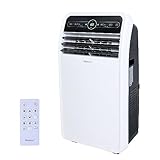
SereneLife 12,000 BTU
- 12000 BTU ASHRAE cooling
- 4-in-1 cool heat dry fan
- Self-evaporating drainage
- 48-51 dBA
Shinco 12,000 BTU
- 12000 BTU ASHRAE
- 43.2 L per day self-evaporation
- 52 dB
- Window sealing kit included

BLACK+DECKER 10,000 BTU
- 10000 BTU
- Follow Me remote thermostat
- Casters and side handles
- Full window kit
All 10 Models at a Glance
Every model we cover, with the specification that matters most for a garage space. Cool this table by BTU first, hose configuration second, and drainage design third.
| Product | Specifications | Action |
|---|---|---|
| SereneLife 12,000 BTU 4-in-1 |
|
Check Latest Price |
| BLACK+DECKER 10,000 BTU |
|
Check Latest Price |
| Shinco 12,000 BTU |
|
Check Latest Price |
 DREO 14,000 BTU Dual Hose Inverter DREO 14,000 BTU Dual Hose Inverter |
|
Check Latest Price |
 ZAFRO 14,000 BTU Dual Hose Inverter ZAFRO 14,000 BTU Dual Hose Inverter |
|
Check Latest Price |
 Temprium 16,000 BTU Inverter Temprium 16,000 BTU Inverter |
|
Check Latest Price |
 Whynter 10,000 BTU Dual Hose Whynter 10,000 BTU Dual Hose |
|
Check Latest Price |
 Garvee 14,000 BTU 3-in-1 Garvee 14,000 BTU 3-in-1 |
|
Check Latest Price |
 Gasbye 14,000 BTU Dual Hose Inverter Gasbye 14,000 BTU Dual Hose Inverter |
|
Check Latest Price |
 DOMANKI 12,000 BTU DOMANKI 12,000 BTU |
|
Check Latest Price |
How Many BTU Do You Need for a Garage?
Size the unit to the garage’s square footage multiplied by its ceiling height, not to the manufacturer’s coverage number. A 500-square-foot garage with a 9-foot ceiling behaves like a 1,000-square-foot room at floor level because all that warm air sits above your head.
A useful starting rule for a typical detached garage with standard 8-foot ceilings: one ton of cooling, which is 12,000 BTU, handles roughly 500 square feet of ordinary living space. Open garage floors with concrete and a hot ceiling need far more. Multiply that base figure by 1.5 for standard ceiling height, and by roughly 2 for a workshop with high ceilings, heavy sun exposure, welding heat or a wood stove.
There is a second number on the spec sheet, and it is the one that trips people up. Manufacturers quote ASHRAE BTU, and many also quote a lower DOE or SACC figure. The SereneLife in this roundup is 12,000 BTU ASHRAE but only 7,000 BTU SACC. The Gasbye is 14,000 BTU ASHRAE and 10,500 BTU SACC. When the gap between the two numbers is large, the unit is fighting a hotter ambient environment and delivering less effective cooling than the headline number implies. For garage work, treat the lower number as the honest one.
Finally, add a margin. A unit that exactly matches the load runs its compressor continuously, which is where reliability problems start. Twenty to thirty percent of headroom means the compressor cycles instead of grinding, and it leaves room for a door that stays open while you carry something out to the car.
1. SereneLife 12,000 BTU 4-in-1 Console Unit
- Cools and heats in one cabinet
- Strong 1.5 liters per hour dehumidification
- Self-evaporating system avoids bucket emptying
- Quiet enough to run like background noise
- 4.1 stars across 2678 reviews
- Window vent adapter can need trimming
- Exhaust hose connection can pop loose
- Heavy 70-pound cabinet
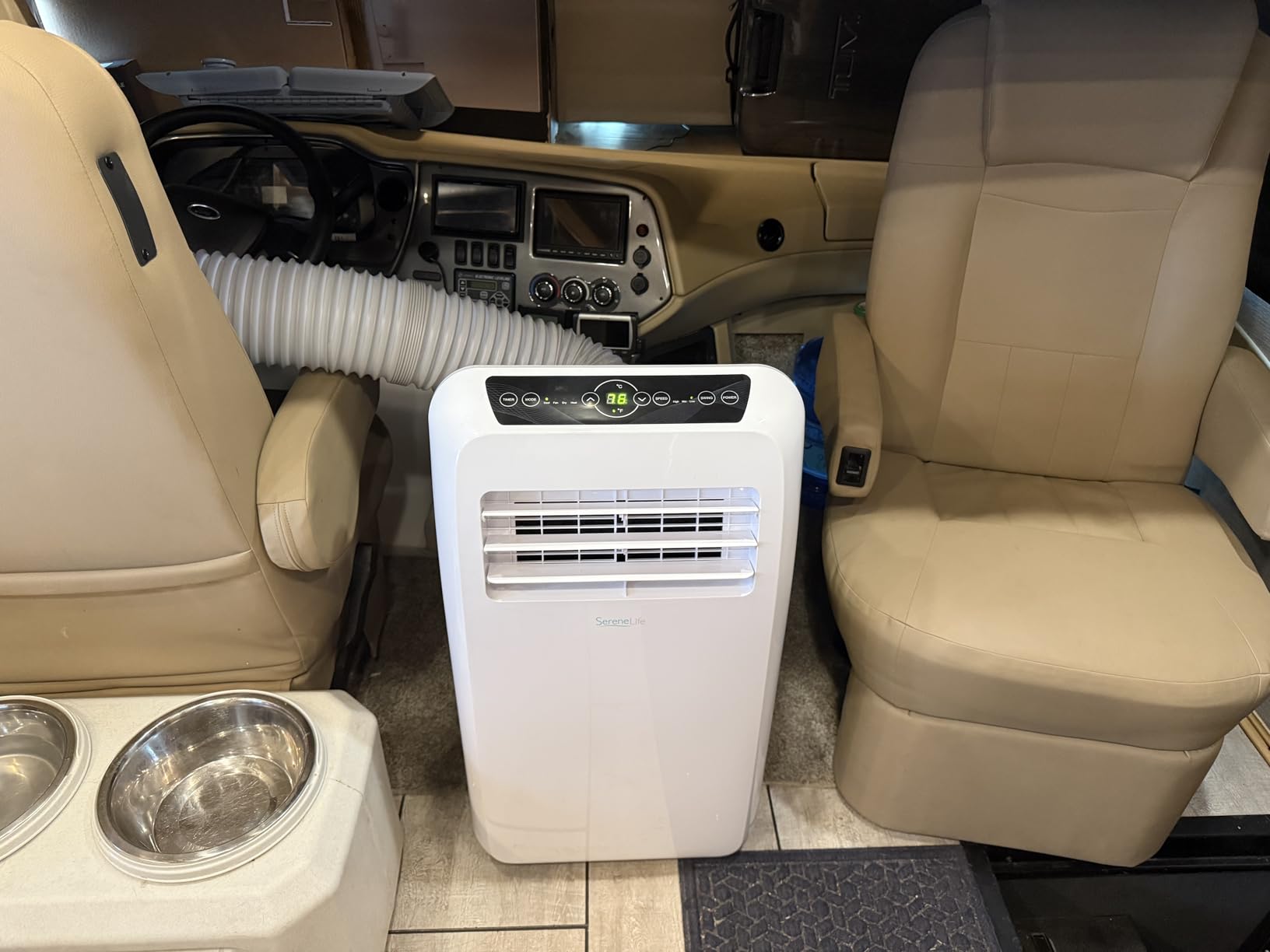
This is the unit we would put in a one-car garage with a standard ceiling, and the reason is versatility rather than raw power. It cools, heats, dehumidifies and fans from one cabinet, which means a garage that swings from 40F in February to 105F in July only needs one appliance on the circuit.
The 12,000 BTU ASHRAE rating covers 550 square feet of rated floor area, and the built-in dehumidifier pulls out up to 1.5 liters of moisture per hour. In a garage that has been closed and damp, that is the feature you will notice first, because the air stops feeling heavy within the first half hour. Owners frequently describe the 48 to 51 dBA operating range as soft background noise rather than an appliance they are aware of.
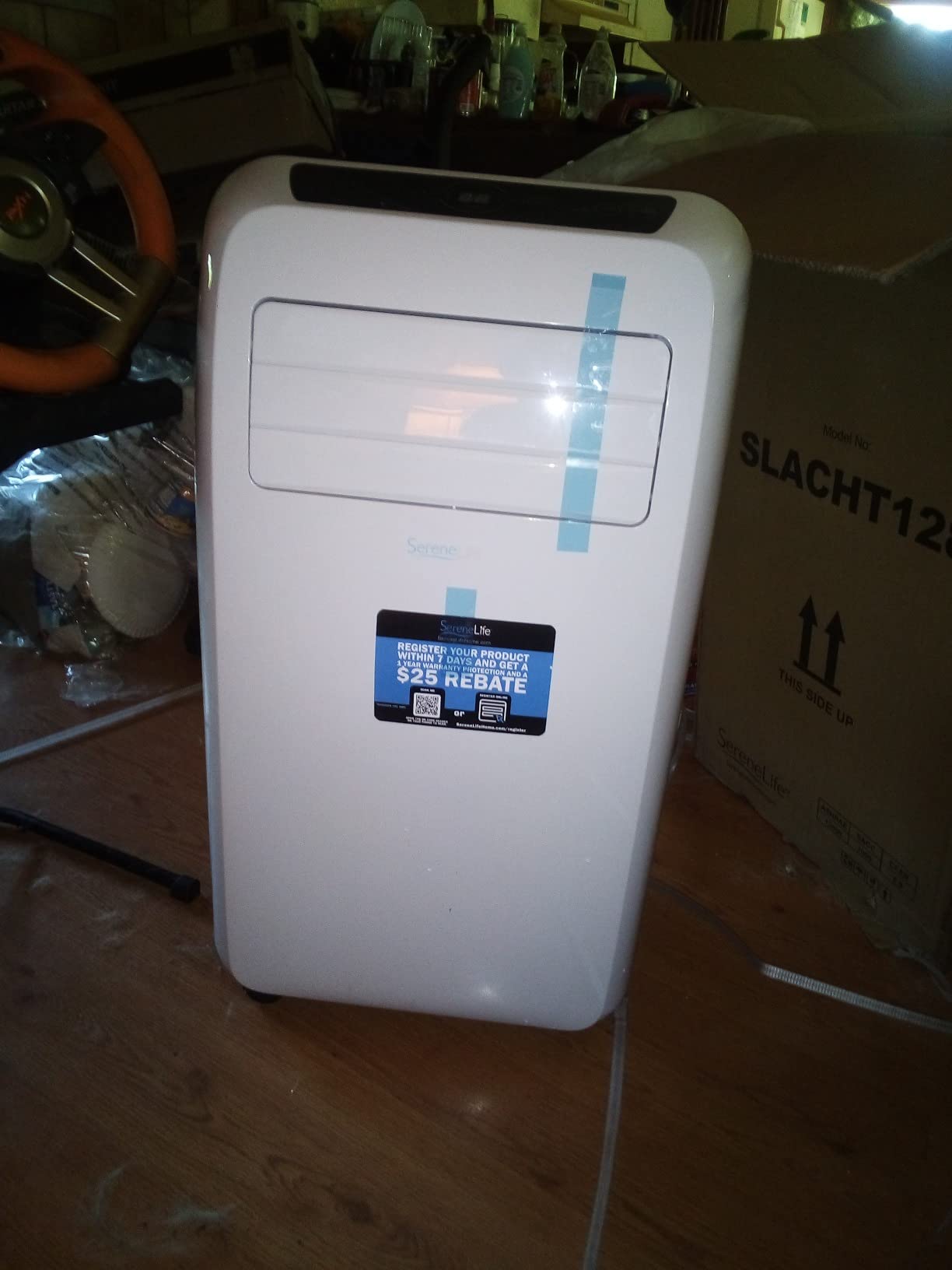
Two real-world limitations showed up repeatedly in the reviews. The window vent adapter is thin, and some owners had to trim it to fit their window opening, so budget ten minutes with a utility knife before setup. The exhaust hose connection also has a reputation for working loose if the hose is pulled or tugged, which matters in a garage where people walk around it constantly.
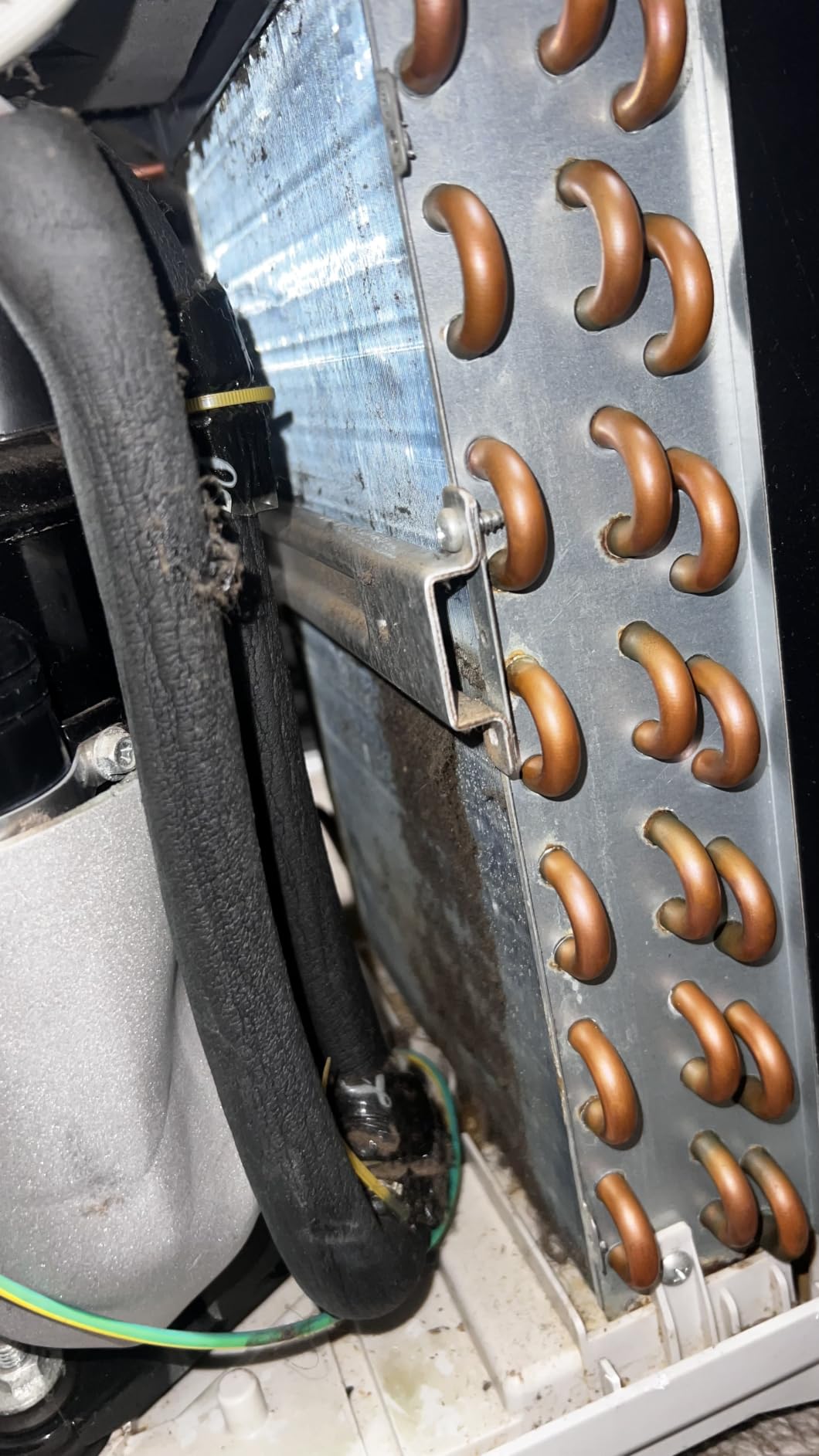
The heating function is the reason this earns the top spot rather than simply another 12,000 BTU box. At 10,500 BTU of heating output it will keep a workshop workable on a cold spring morning, and a minority of owners report units in this family blowing cool air when heating is selected, so test that mode in the first week while the warranty is fresh. The rotary scroll compressor and R-32 refrigerant are solid choices for a seasonal appliance, and the washable filter with self-evaporation means no consumables to keep buying.
How it handles a one-car garage versus a two-car garage
In a one-car garage with 8-foot ceilings, the 12,000 BTU ASHRAE figure is well matched to roughly 500 square feet, and the dehumidification mode does most of the heavy lifting on muggy days. The cabinet measures 14 by 16.5 by 27 inches, so it fits beside a workbench without taking a parking bay.
Stretch it into a two-car garage and the math tightens considerably. That space is usually 480 to 600 square feet with a much larger thermal load and often a 10-foot ceiling, which pushes the effective requirement past what this unit can deliver comfortably. If your garage is two-car sized, one of the 14,000 or 16,000 BTU models later in this roundup is the better buy, and the SereneLife is better used as a spot cooler for one half of the space.
Where the setup will frustrate you
The 70.3-pound weight is the real ergonomics problem. Rolling it across a bare concrete floor is fine on the casters, but lifting it onto a shelf or into a vehicle is a two-person job, and it is heavier than its competitors here. Plan a permanent floor position near the outlet before you unbox it.
Owners also flag the electrical side. At 1,060 watts this unit draws less than the largest models in this list, so it will usually run on an existing household circuit, but any garage outlet on an old or shared circuit deserves a check before a summer afternoon of continuous running. Keep the hose connection seated and check it during the first few days, because a loose fit is the most common reason a working unit gets returned.
2. BLACK+DECKER 10,000 BTU BPACT10WT
BLACK+DECKER Portable Air Conditioner, 10,000 BTU, BPACT10WT, White
- Largest review base in the category at 11068
- Compact footprint for a 10000 BTU model
- Follow Me remote works as a room thermostat
- Casters and side handles on both sides
- Complete window kit included in the box
- Single-hose design recirculates hot exhaust
- 54 dB is louder than inverter rivals
- Not Energy Star rated
This is the most proven portable air conditioner we recommend and the least interesting one, which is exactly why it earns a place. With more than 11,000 reviews it sits at the top of the Amazon category ranking, and that volume of long-term ownership data is worth something in a niche where reliability is the first question buyers ask.
At 10,000 BTU with a 5,550 DOE rating, this is a small-space machine. It covers rooms up to 450 square feet, and the cabinet is a genuinely compact 14 by 15.3 by 24.8 inches at 47.3 pounds, roughly twenty pounds lighter than most units in this roundup. That weight difference is meaningful when you are moving the unit to a bench, a workstand or a different wall each season.

The Follow Me remote is the feature more useful in a garage than in a bedroom. Press the button on the remote and the unit senses the temperature at that spot instead of at the cabinet, so you can put the remote on a chair in the actual work area and have the compressor target where you are sitting rather than where the machine is parked.
Be clear-eyed about the trade-off, though. This is a single-hose design rated at 1,220 watts, so it draws room air in through the same hose it exhausts hot air from, and some of that heat comes straight back into the space. In a cool room that inefficiency is manageable. In a hot garage with a leaky door seal, it works against you, and the 54 dB operating noise is louder than the inverter models here even on low settings.
Best garage size and job for it
This unit suits a single-car garage, a detached workshop under about 300 square feet, or a half of a two-car space where you want a personal comfort zone rather than a cooled room. A welding booth, a small woodworking nook or a home gym set up in one corner of a garage are all realistic uses, because the cabinet is small enough to sit out of the way and light enough to move when the layout changes.
It also makes sense as a backup unit. A lot of owners keep one of these for a bedroom or a home office and drag it to the garage for the summer, and the compact body makes that rotation painless. If your garage work happens in a defined corner rather than across the whole floor, that is the scenario this machine suits best.
Why a single hose costs you in a garage
The single-hose architecture creates slight negative pressure in the room, which pulls unconditioned air in through every gap in the garage. A bedroom has one window to seal. A garage has a big door, gaps around the door, a passage to the house and sometimes an uninsulated wall, so the leakage load is much larger. Owners working in garages frequently report the unit running hard and still not reaching the thermostat setting.
The fix is installation discipline rather than a bigger machine. Seal the window kit properly, close the interior door to the house, and keep the garage door shut while it runs. With a good seal this unit performs respectably, but if you need to cool a two-car space below 90F on a 105F afternoon, a dual-hose model will get there faster and quietly.
3. Shinco 12,000 BTU 3-in-1
- Strong cooling per dollar for a 12000 BTU model
- Quick tool-free installation with the window kit
- 43.2 liters per day self-evaporating dehumidification
- 24-hour timer and 23 ft remote range
- Four casters for mobility
- Large gap between ASHRAE and SACC ratings
- Fixed-speed compressor is less efficient
- Plastic cabinet feels light for its size
The Shinco is the value pick in this roundup, and the reason is straightforward: a 12,000 BTU unit with real self-evaporating dehumidification and a complete installation kit, backed by 3,542 reviews at 4.1 stars. That combination is hard to find at this tier.
Setup is where this unit clearly wins. The exhaust hose and window sealing kit go in with no tools, and owners repeatedly describe the whole process as a ten-minute job. That matters more in a garage than in a bedroom, because the window or door panel you are sealing is often older, heavier and less forgiving than a modern bedroom sash.
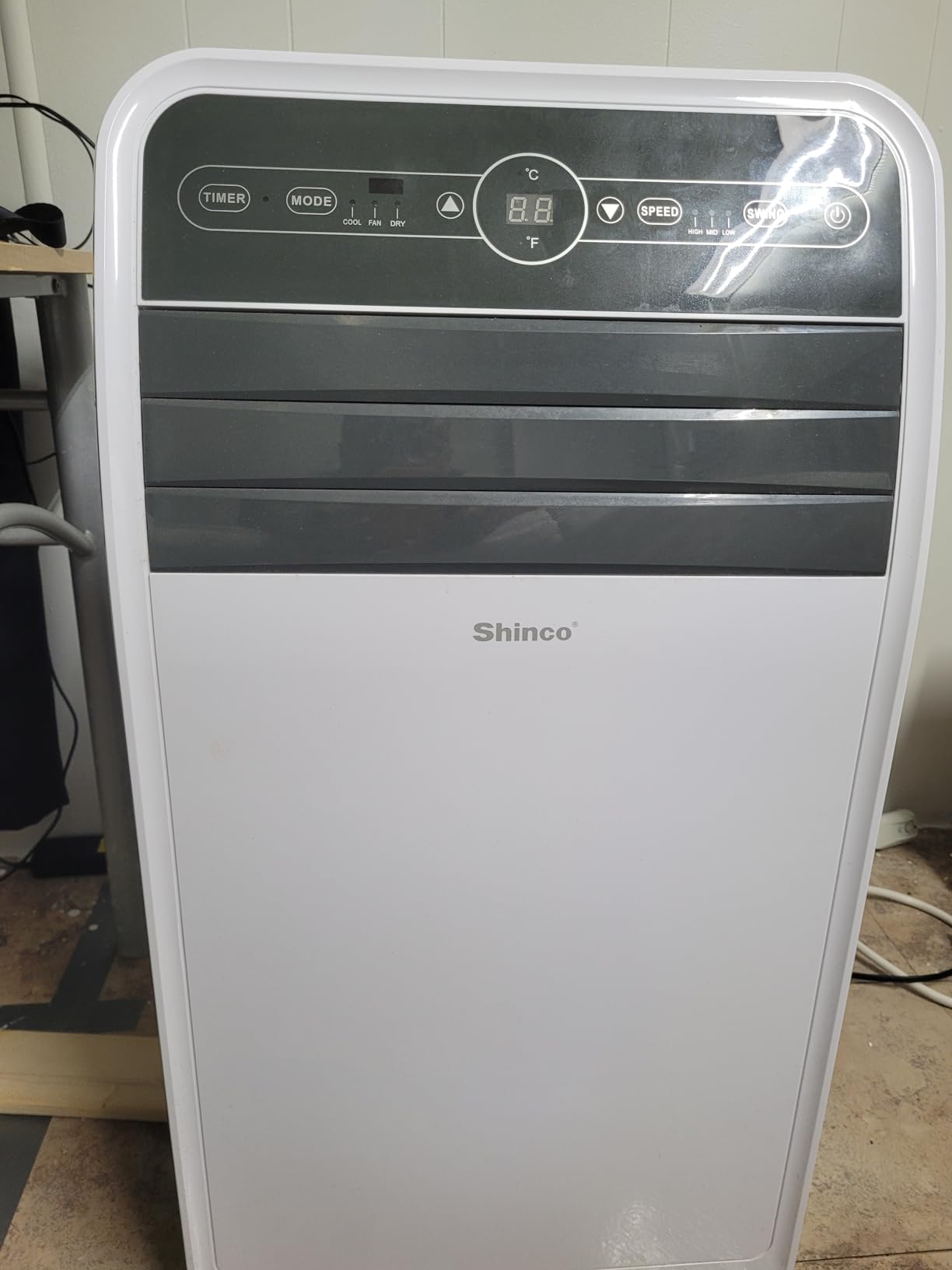
The dry mode is the sleeper feature. It pulls 43.2 liters of water per day using a self-evaporating design, so the moisture is pushed out through the exhaust hose rather than into a bucket. In humid weather that is the difference between a machine that runs unattended for a weekend and one you have to check every few hours, and it is the single most common complaint we found about budget units in garage forum discussions.
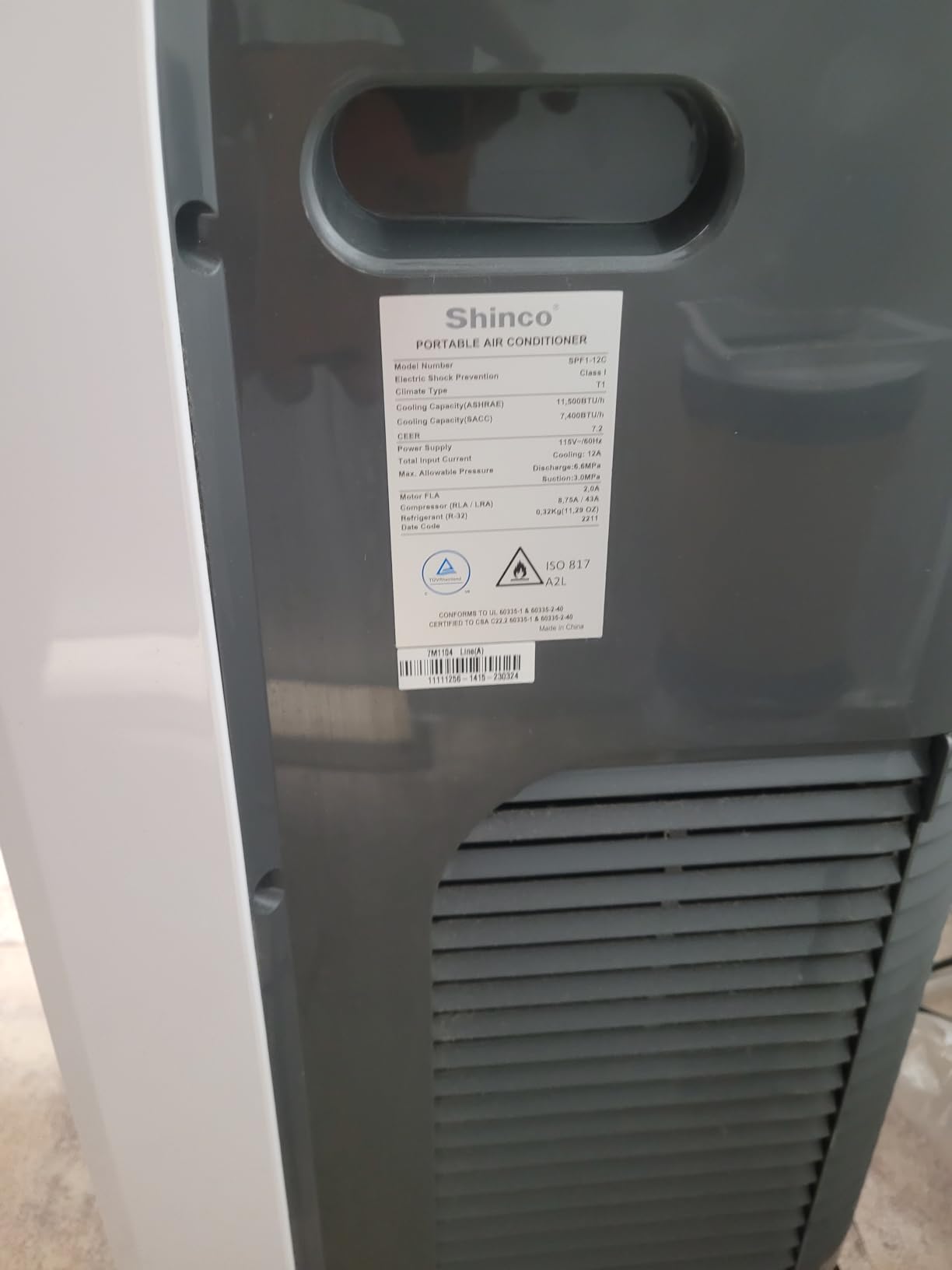
Now the honesty. The 12,000 BTU ASHRAE figure translates to 7,500 BTU SACC, a sizeable gap that signals the unit is rated for a hot, high-load environment. The 3,520-watt wattage figure is also the highest in this roundup, and the reciprocating fixed-speed compressor is an older, less efficient design than the inverter compressors used in the premium models. Buy it for summer duty in a moderate climate, not for year-round shop cooling.
Which garage it fits best
This is a one-car garage machine rated to 450 square feet, and it works best in a space with standard ceilings that does not take direct afternoon sun on the door. A detached workshop, a hobbyist’s garage, or a workspace above a one-car bay that you use seasonally are all strong fits. The adjustable 60F to 86F range and the 24-hour timer make it easy to schedule around work hours.
At 32.68 inches tall and 17.44 inches wide it is the tallest cabinet in the lineup, so check your window opening before you commit. The remote reaches 23 feet, which is enough to control the unit from a desk in a two-car garage, though the unit itself will only be managing one section of the space.
When to step up instead
If your garage has a 9-foot or higher ceiling, faces west, or already holds heat from equipment running, this unit will run near continuously and still hold a higher temperature than you would like. In those cases the efficiency gap between a fixed-speed and an inverter compressor stops being a specification and starts being the difference between a comfortable afternoon and an exhausted one.
Also consider the manual factor. The 43.2-liter dry figure is a self-evaporation claim, and in genuinely humid conditions every design eventually needs the drain hose, so plan where that hose goes before the summer starts. For a moderately sized garage in a moderate climate, though, this is the configuration most owners in this price band end up needing, and it delivers it well.
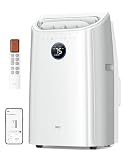
4. DREO 14,000 BTU Dual Hose Inverter
DREO Inverter Portable Air Conditioners,High Efficiency,14000 BTU Dual-Hose
- Dual-hose design eliminates hot air backflow
- Self-evaporating operation below 90 percent humidity
- App remote and voice control
- Low 42 dB operation
- Strong steady cooling in open areas
- Backlit display sometimes fails to stay lit
- Measured noise runs higher than the stated figure
- Can trip a breaker on dated wiring
Of everything in this roundup, this DREO is the one we would trust most in the exact scenario most garage owners describe: a hot, leaky space where the ceiling soaks up sun all day and the temperature sits above 100F before you get home. Dual-hose exhaust means it pulls its intake air from a separate hose, so it does not recirculate the hot air it just expelled, and the inverter compressor modulates rather than cycling hard on and off.
Owners consistently report steady, even cooling across large open areas and note that the unit holds its set temperature rather than oscillating around it. The 14,000 BTU ASHRAE figure is backed by a 10,000 BTU DOE rating, and at 1,540 watts it is one of the higher-draw machines here, which matters for older garage circuits.
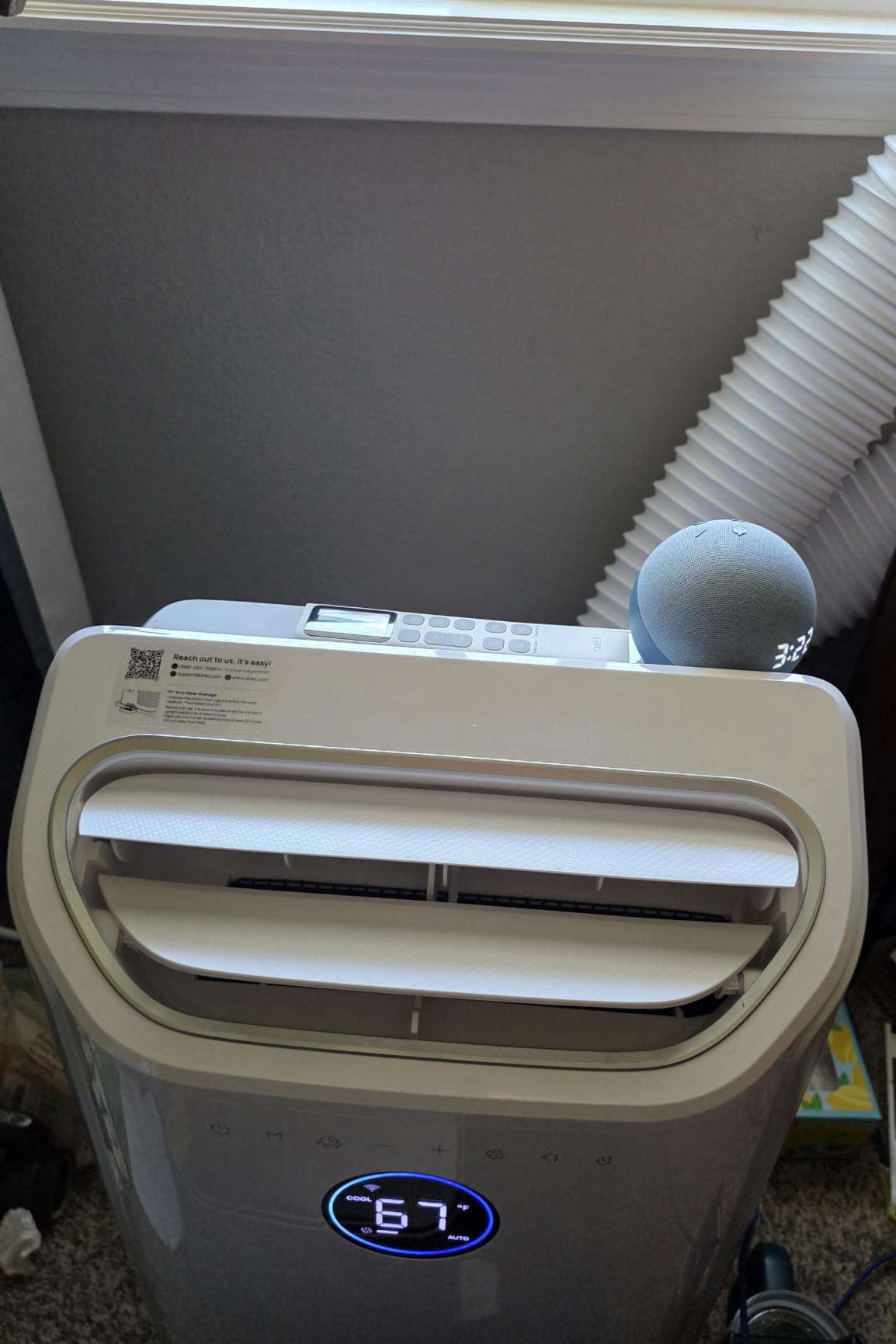
Two details deserve attention before you buy. The manufacturer states that measured noise runs higher than the published figure at close range, so if you sit within a few feet of the unit while working, put it across the garage rather than beside the bench. And several owners reported the unit tripping a surge protector or breaker in homes with dated wiring, which is a circuit problem worth fixing before summer rather than a defect in the machine.
The self-evaporating claim covers operation below 90 percent relative humidity, and the installation kit is described as genuinely well designed, with a fit for hung and sliding windows between 20 and 53 inches. The 14.37 by 17.32 by 28.13 inch body at 55.4 pounds is a normal footprint for a dual-hose unit, and app, remote and voice control cover most preferences.
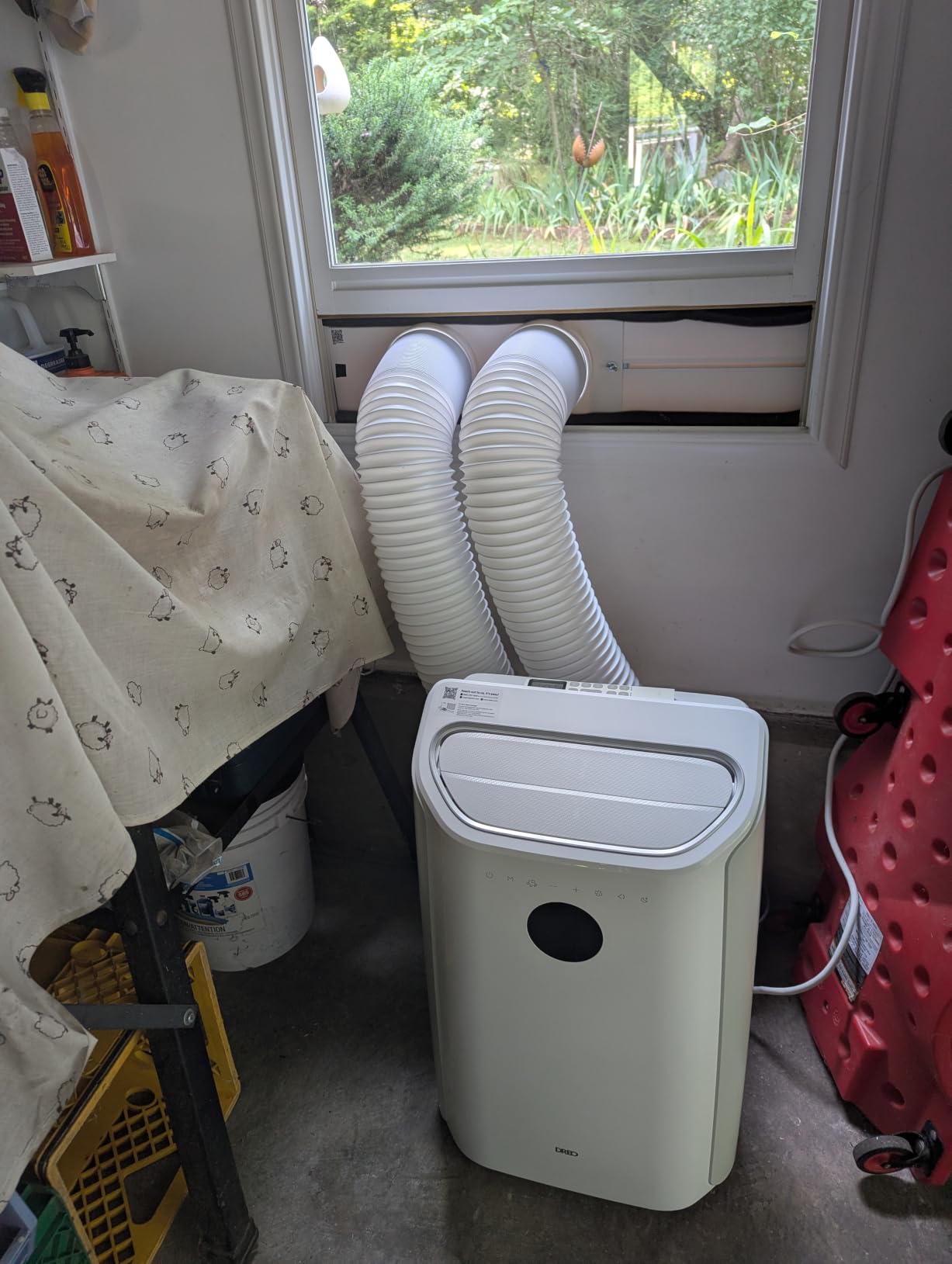
Where a dual-hose inverter pays for itself
Dual-hose matters most when the load is high and the space is leaky. In a well-insulated room, a single-hose unit can keep up. In a garage with a 10-foot ceiling, a hot ceiling deck and a door that gets opened every time you walk a tool out to the car, the recirculation problem compounds, and a dual-hose unit reaches a workable temperature in a fraction of the time.
It also means the thermostat setting is achievable rather than aspirational. If your work depends on being able to sit still at a bench for an hour, that difference between a room that settles at 84F and one that keeps climbing to 95F is the whole point of spending more on the hardware.
Limitations to plan around
Some owners reported a display thermostat running several degrees off until a firmware update corrected it, so update the unit before you judge its accuracy. The backlit status display has also failed to stay lit for a minority of owners, which is a nuisance rather than a cooling failure, but it does mean you may be relying on the app for feedback.
There is also one serious isolated safety report involving internal failure and burnt-oil fumes. One report out of 733 is not a pattern, and we would not weight it heavily, but it is a reminder to run a new unit for a few hours in a ventilated space before trusting it overnight in a closed garage.
5. ZAFRO 14,000 BTU Dual Hose Inverter
ZAFRO Smart Inverter Portable Air Conditioners, 14000 BTU (10000 BTU SACC)
- 12.8 CEER efficiency against a 7.83 federal minimum
- 72 hours drainage-free self-evaporating
- 42 dB operation
- Six modes with 24-hour timer and oscillation
- Extra Mode locks at 61F
- Only a one-year manufacturer warranty
- Window opening must be at least 17.72 inches
- Dual-hose setup needs more floor space
The ZAFRO is the most efficient machine in this roundup, and efficiency is what decides the running cost question. A 12.8 CEER against a federal minimum of 7.83 is a real gap, and in a space where the compressor runs for hours on a hot afternoon that difference shows up in the electricity bill every month you use it.
It is also one of the quietest. The stated 42 dB low figure comes from inverter piping and vibration control, and it is the number we would trust in a workshop where you need to concentrate on detailed work. Owners specifically call out the combination of inverter efficiency, low noise and drainage-free convenience as the reason they recommended it to others.
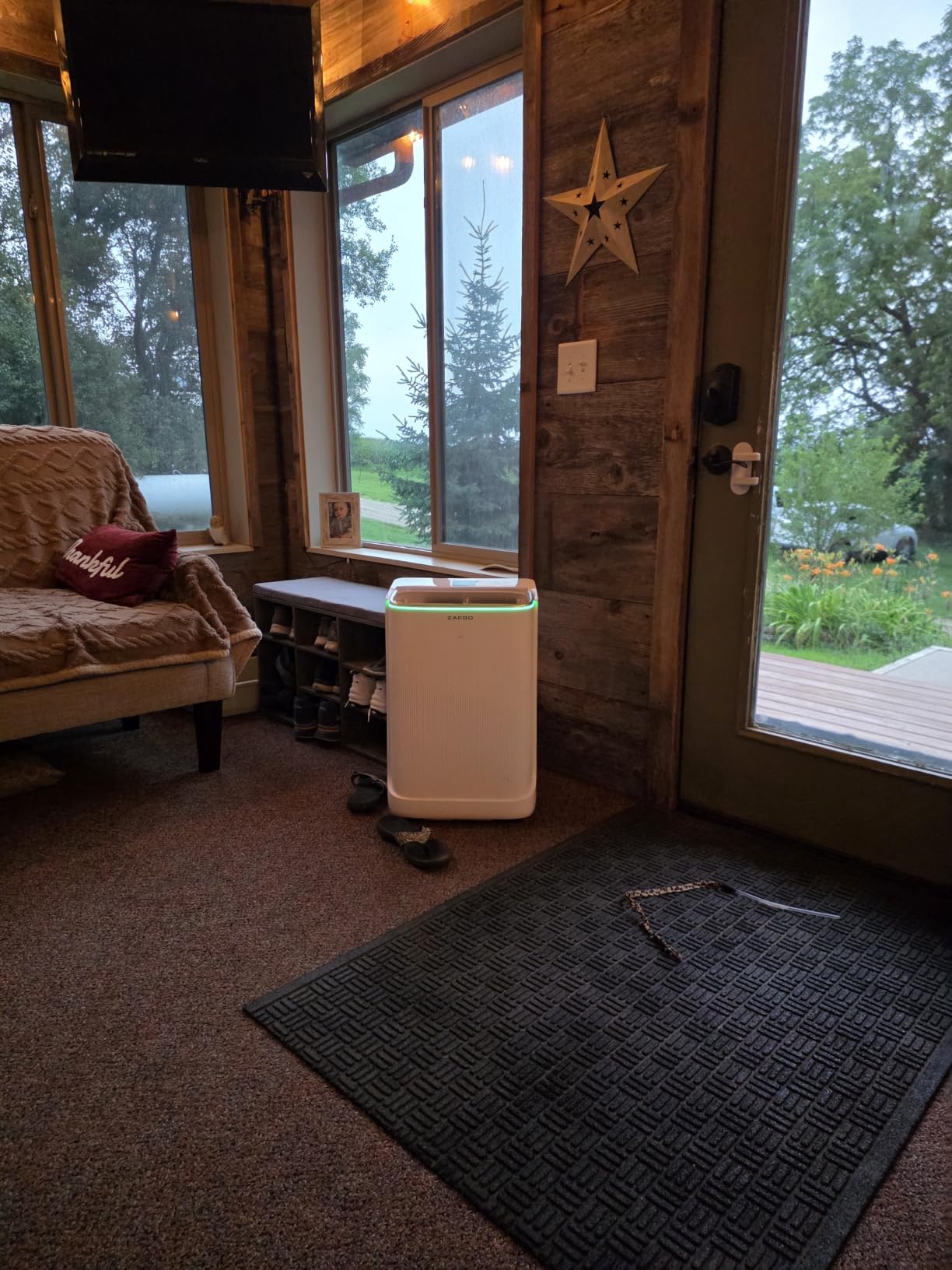
Drainage is handled by a self-evaporating system that cycles moisture back onto the condenser for up to 72 hours of operation below 90 percent humidity. That is the longest claimed window in this roundup, and it is the feature that most directly solves the complaint that dominates garage portable AC discussions, where units fill a pan that has to be emptied by hand.
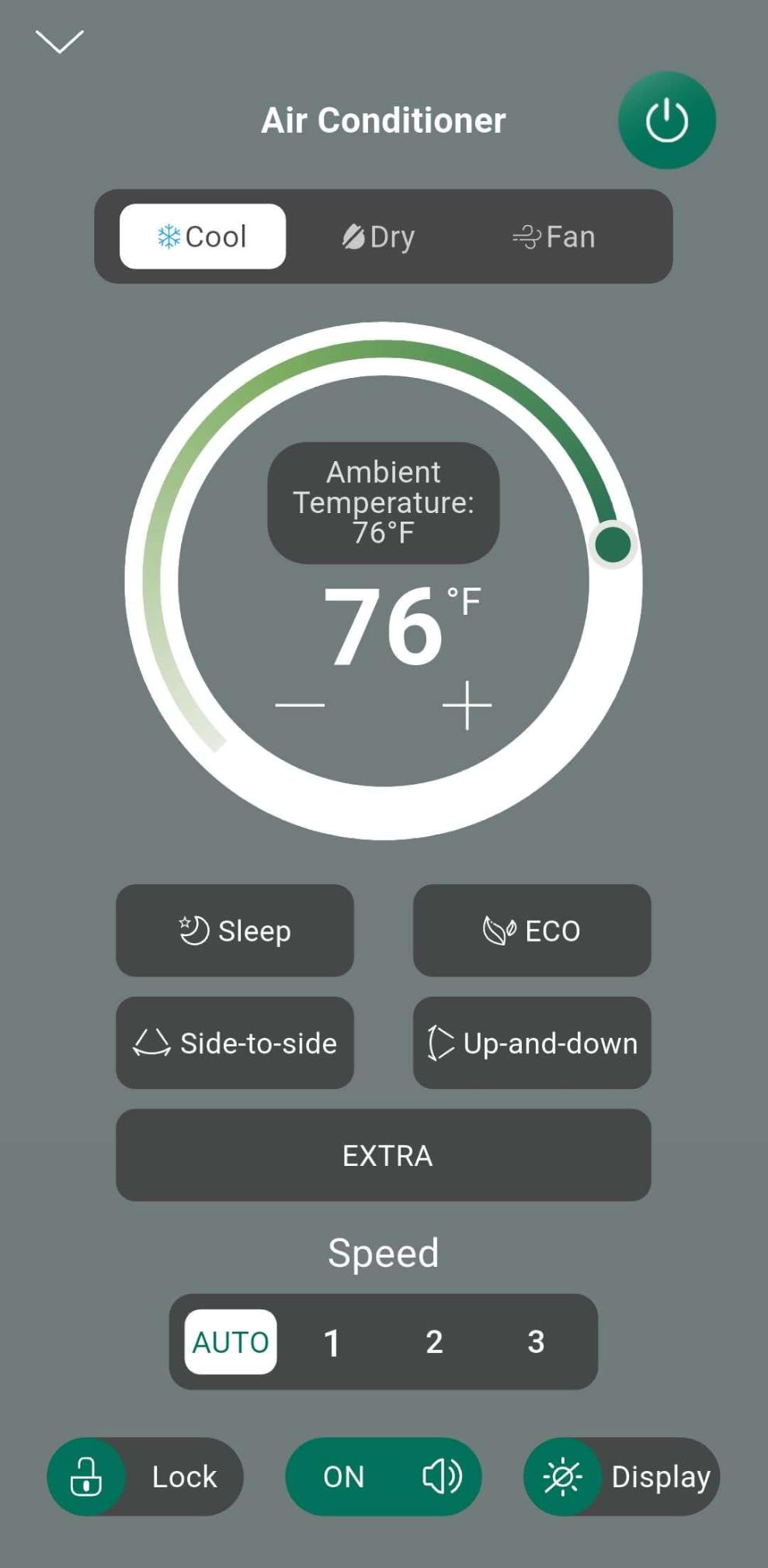
The 14.3 by 16.5 by 27.2 inch cabinet weighs 54 pounds, moves 480 cubic meters per hour of airflow, and offers six modes including Sleep, Extra and Eco with 4-way oscillation and a 24-hour timer. App, remote and touch control are all supported, which is unusually complete for this tier.
Best fit and best ceiling on the list
The 700 square feet rated coverage is the most generous in the lineup relative to its physical size, and combined with the 14,000 BTU ASHRAE rating it makes sense for a workshop or a one-car garage with a raised ceiling. It is also our pick for a smaller, drier garage in a region where a swamp cooler is a poor idea.
Think of it as the efficiency-first choice: if you plan to run the unit many hours a week, the better CEER pays back the difference in running cost. If you run it for ten weekends a year, the efficiency argument weakens and you should choose on capacity and drainage instead.
What to check before you commit
The one-year manufacturer warranty is shorter than the three-year coverage offered by one of the other dual-hose models in this roundup, and for a seasonal appliance with a multi-season lifespan that is a meaningful gap. Read what the warranty actually covers on compressors before you decide.
The window requirement of a 17.72 inch minimum opening rules out some narrow basement or garage windows, and a dual-hose setup needs a bit more floor space and a longer seal run than a single-hose unit. Measure the opening and the floor area first, since both are harder to change than the model choice.
6. Temprium 16,000 BTU Inverter Dual Hose
Temprium 16,000 BTU Inverter Dual Hose Portable Air Conditioner for Rooms
- Largest cooling capacity in the lineup
- Quietest stated operation at 40 dB
- 12.3 CEER for lower running cost
- Turbo mode locks output at 61F
- Self-evaporating design runs 72+ hours
- Heaviest unit here at 64.8 pounds
- Only a one-year manufacturer warranty
- Newer listing with a smaller review base
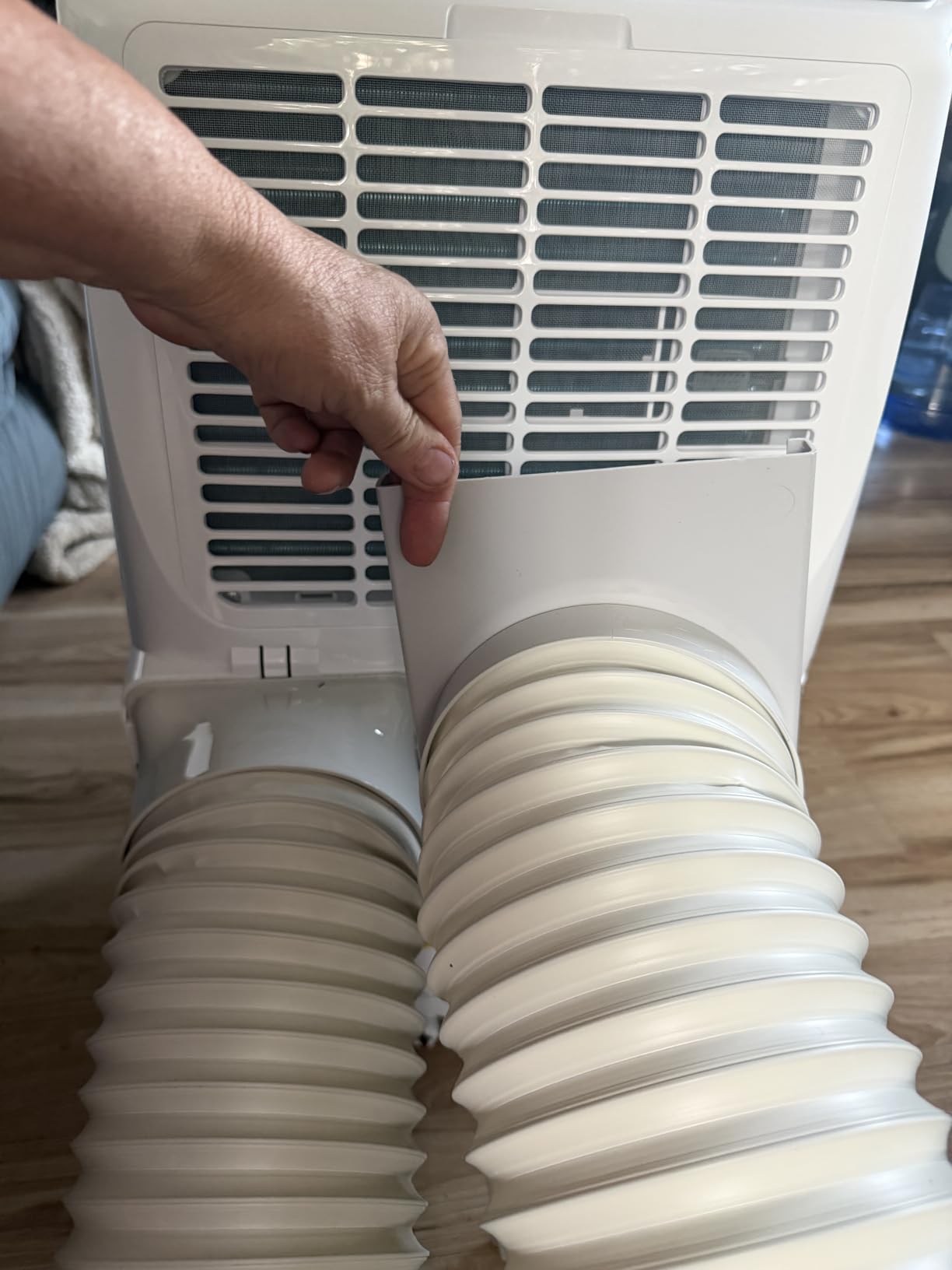
If you have a genuine two-car garage, this is the unit with the raw capacity to move the air. At 16,000 BTU ASHRAE and a 750 square foot rated coverage, it is the only machine in this roundup that matches the thermal load of a full two-car bay without the compressor working continuously to hold its set point.
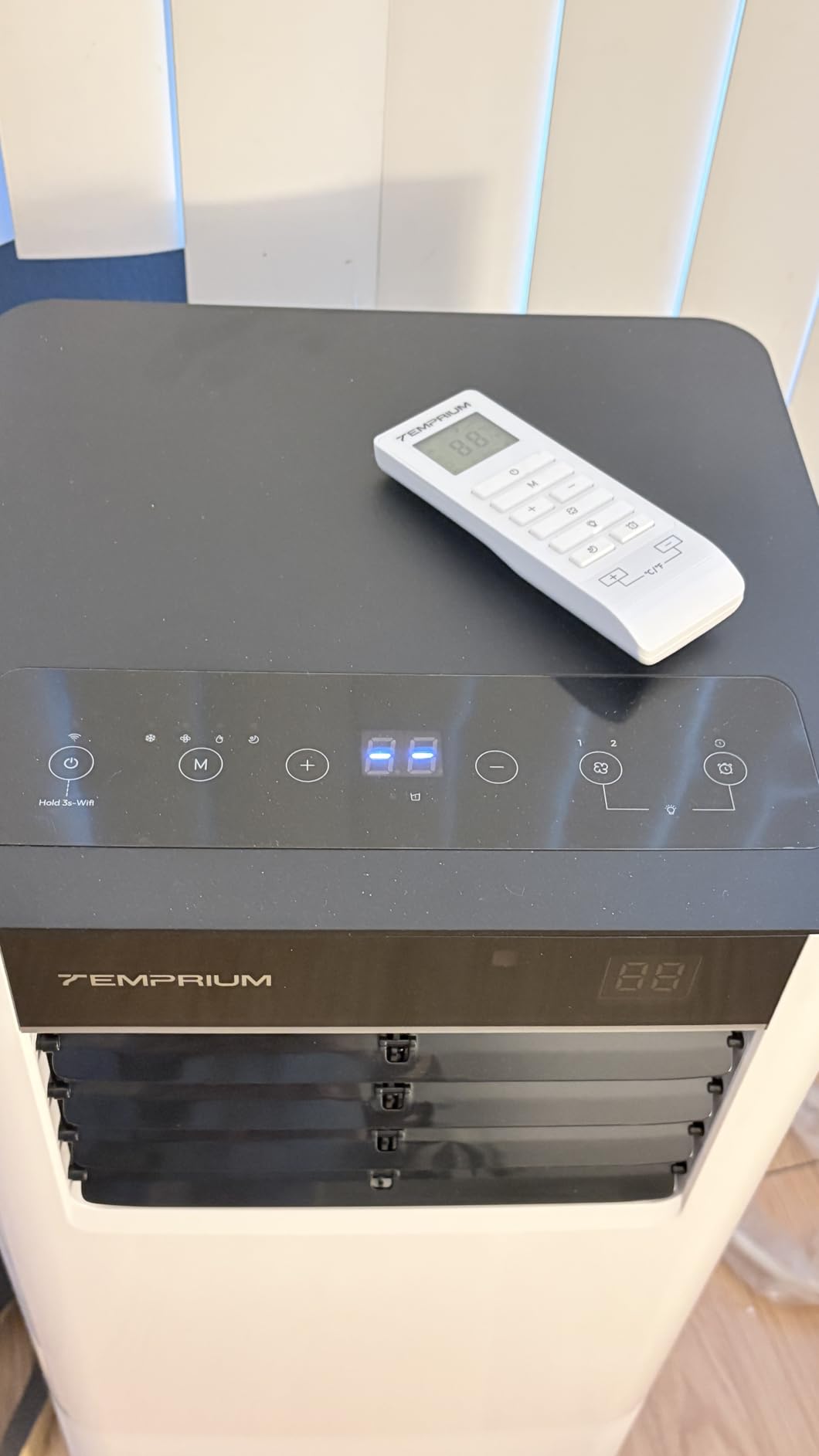
It is also the quietest on paper, at 40 dB in Silent Mode using a brushless DC motor and redesigned internal ducting. In a garage used as a recording or detail space, that figure is the difference between working with the unit running and switching it off during the important parts.
Efficiency is strong for the capacity class, at 12.3 CEER against the same 7.83 federal floor, with a claimed saving of up to 57 percent in electricity versus a standard unit. The inverter holds set temperature within plus or minus one degree, which is worth more in a garage than a tighter number looks, because a stable room means you stop adjusting the thermostat every twenty minutes and stop re-opening the garage door.
Eight operating modes cover cooling, heating, dry, fan, sleep, silent, turbo and eco, with Turbo locking output at 61F for a fast pull-down. Alexa, Google Assistant, app, voice, remote and touch control are all supported, and a self-evaporating water-slinging wheel delivers 72 or more hours of drainage-free operation below 90 percent humidity, with an overflow hose for extreme conditions.
Where the extra BTU actually matters
A two-car garage with 9-foot ceilings, a bare plywood ceiling deck and a west-facing wall is roughly twice the thermal load of a one-car space, and that is where a 12,000 BTU unit simply runs out of headroom. This machine has the capacity to pull the space down quickly and then maintain it with the compressor cycling rather than grinding continuously.
It is also the right call for a shop that generates its own heat, whether that is welding, a compressor, a kiln or a vehicle idling with the door open. If the garage produces more than a kilowatt of heat on top of the summer solar load, no portable unit of any size fully solves the problem, but starting with 16,000 BTU gets you closest.
What the size costs you
At 64.8 pounds and 14.1 by 16.5 by 27.1 inches, this is a genuinely full-size appliance and it needs a clear floor footprint with room for two hoses. Plan the exhaust path before delivery, because a 16,000 BTU unit pulling 1,550 watts on a shared circuit is the setup most likely to trip a breaker in an older detached garage.
The one-year warranty and a 341-review history mean less long-term data than the category leaders offer. If you are comfortable with that, the capacity advantage is real; if you prioritize proven longevity over raw BTU, the 14,000 BTU dual-hose models are the more conservative choice.
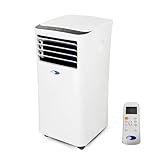
7. Whynter 10,000 BTU ARC-102CS
Whynter Portable Air Conditioner, 10,000 BTU, Dehumidifier Fan, ARC-102CS
- Lowest-cost dual-hose design in this roundup
- Whynter is a dedicated portable AC manufacturer
- Patented auto drain removes most bucket emptying
- Activated carbon filter plus washable pre-filter
- Compact 14 by 14.5 by 28 inch footprint
- Smallest capacity here at 10000 BTU
- 300 sq ft room rating is tight for open garages
- Fixed-speed compressor with 6.9 SEER
The Whynter is the cheapest way into a dual-hose portable AC, and for a small garage that combination is worth more than raw BTU. Dual-hose means no hot-air recirculation and no negative pressure in the room, so the unit actually reaches the temperature you set instead of fighting itself.
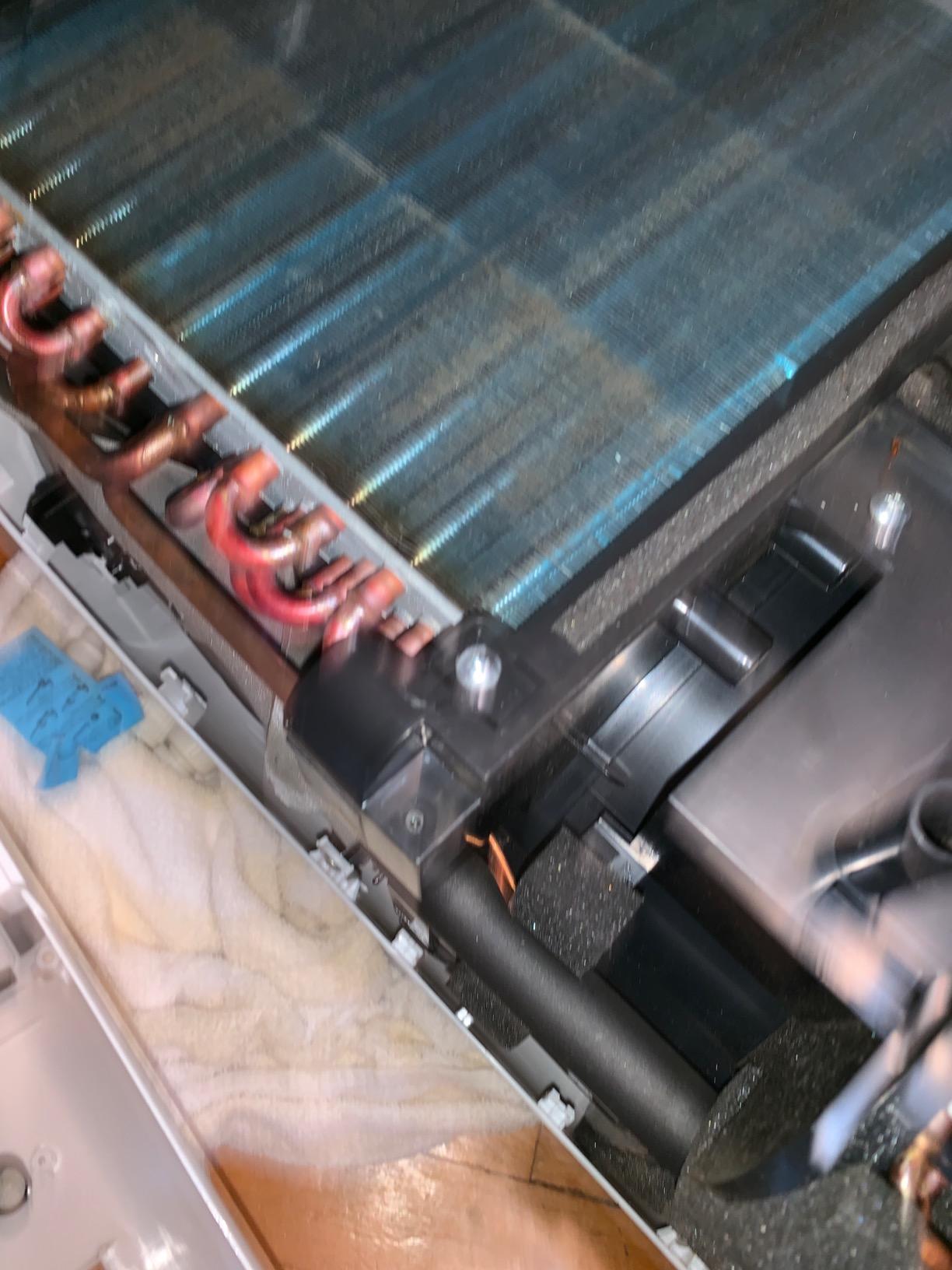
Whynter has built portable air conditioners for decades, and that manufacturing focus shows in the details. The patented auto drain exhausts condensate automatically in most environments, which is the single most requested feature in this niche, and the unit includes both an activated carbon filter and a washable pre-filter. Workshop air carries oil mist and fine metal dust, and having a washable pre-filter changes how often you need to pull the cabinet apart.
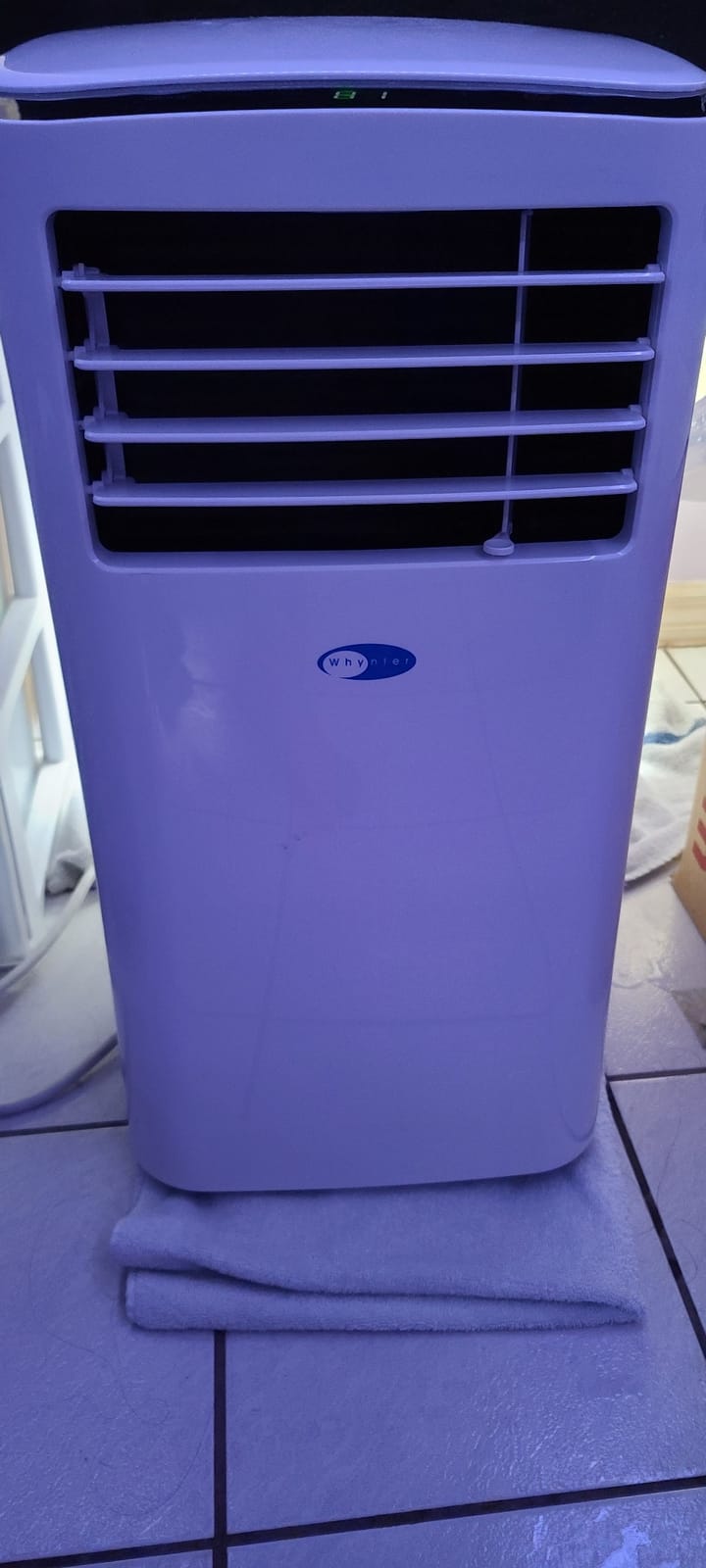
Operation is quiet, at 51.5 dBA on low speed, and thermostatic control spans 62F to 86F across cooling, dehumidifying and fan modes. The rotary scroll compressor, R-32 refrigerant and 1,110-watt draw are all modest figures, and the warranty is unusual for the category: one year limited on the unit but three years on the compressor, which is the part that actually fails.
The honest limitation is capacity. At 10,000 BTU and a 300 square foot rating, this is the smallest machine here, and that rating assumes a normal room. An open garage floor with a high ceiling will outrun it, and owners note that it is tight for workshop spaces. The included 59-inch extendable exhaust hose and window kit are complete, so setup is not the problem. Size is.
The garage this unit is genuinely right for
Think a single-car garage with a low ceiling, a small detached workshop, a hobby greenhouse or a storage-and-work area where you want the temperature down from 105F to something bearable rather than genuinely cold. At 53 pounds and 14 by 14.5 by 28 inches it is easy to reposition, which matters if you are alternating between a bench position in the morning and a seating position in the evening.
It is also the most sensible pick for a garage office that only needs cooling on the hottest afternoons, because the auto drain removes the one task you would otherwise be doing at the worst possible moment. Set it, close the door, and leave it.
Where you will want more capacity
If your garage measures more than about 300 usable square feet, has a ceiling above 8 feet, or takes direct sun, this unit will cycle almost continuously through a heat wave. Continuous duty is exactly the condition that ages a fixed-speed compressor, and the 6.9 SEER rating means it is drawing more electricity for the same result than the inverter models here.
Our advice is to treat the Whynter as a right-sized choice rather than a compromise. A 10,000 BTU dual-hose unit in a 300-square-foot low-ceiling garage is a genuinely good match. The same unit in a 600-square-foot workshop is a summer of continuous running and a disappointing result, and in that space the 12,000 to 16,000 BTU models are worth every additional step.
8. Garvee 14,000 BTU 3-in-1
Garvee 3-in-1 Portable Air Conditioner, 14000 BTU (9300 BTU SACC) AC Unit
- 4.3 stars from 105 reviews
- 14000 BTU capacity for the money
- 90 pint dehumidifying capacity
- No-drill window installation
- Rolling casters and side handles
- Heaviest cabinet here at 85.3 pounds
- Largest physical footprint
- No warranty listed
- Smallest review base in the roundup
The Garvee is a capacity play. Fourteen thousand BTU ASHRAE and a 750 square foot rating at the lower end of this roundup’s price range is a lot of cooling for the money, and the no-drill window installation is the detail that makes it genuinely attractive if you rent, work in a leased unit, or do not want to touch the trim on an older garage window.
It handles three-in-one duty: air conditioning, fan and dehumidifier, with an LED control panel, a 24-hour programmable timer and sleep mode. Rated dehumidifying capacity of 90 pints is the largest figure here, and that is not a trivial number in a humid garage where damp air is as uncomfortable as hot air.
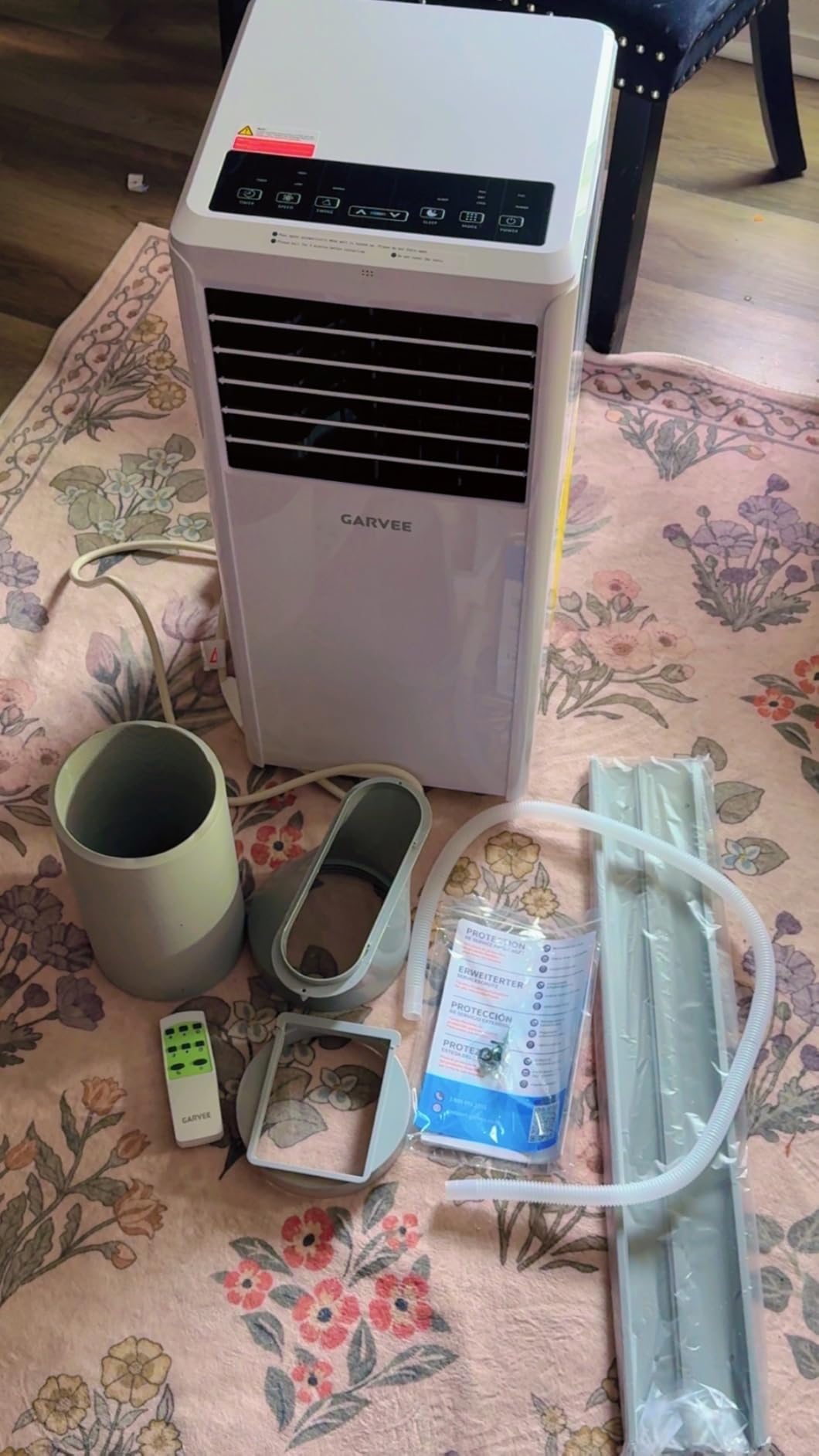
Owners consistently rate the cooling power relative to cost as the standout, and the 4.3 average across 105 reviews ties for the highest rating in this roundup. That is a small sample, and we treat it accordingly, but a 4.3 with no large volume of complaints below three stars is a reasonable signal for a unit in this class.
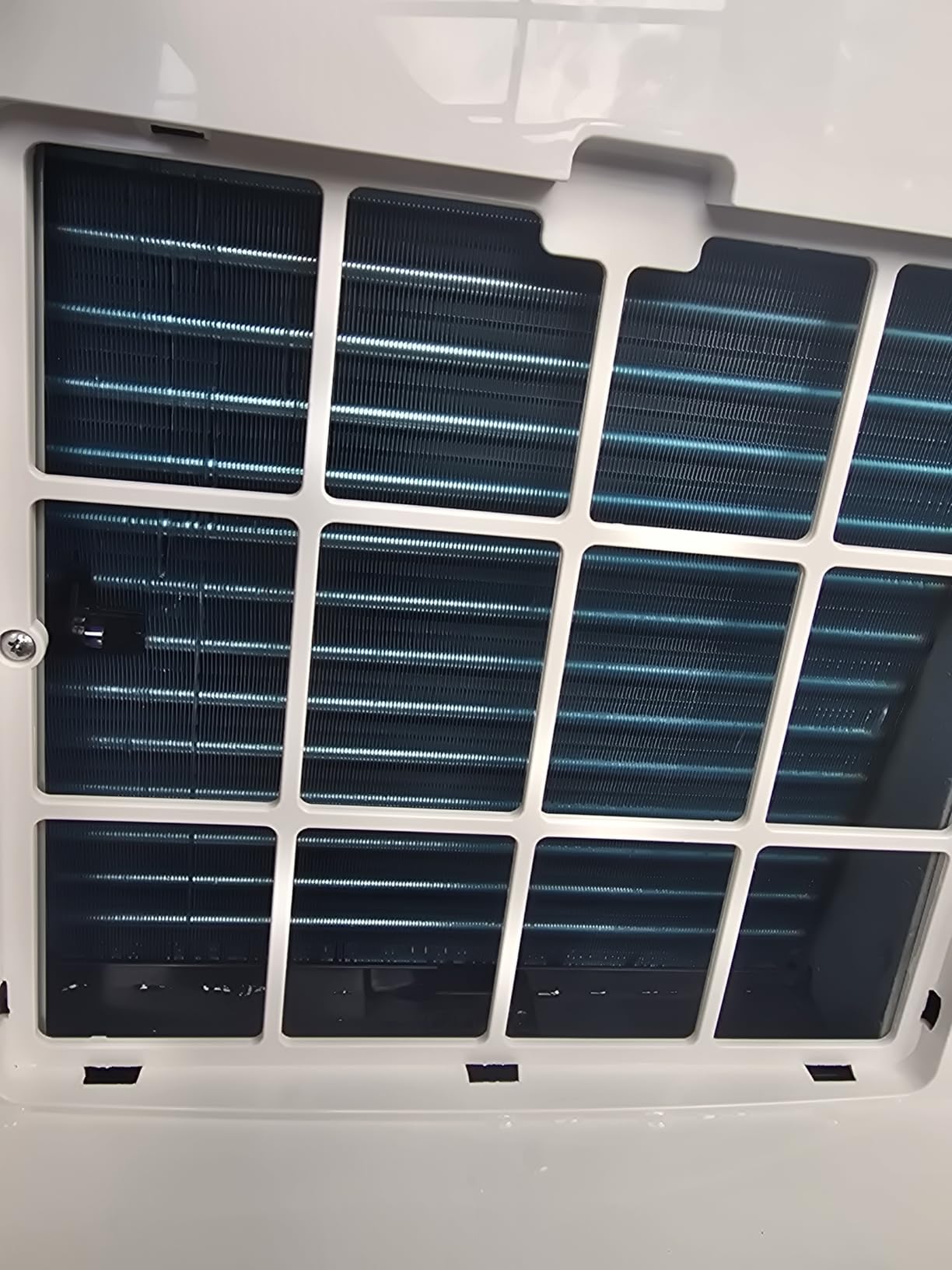
What you are accepting is bulk. At 20.16 by 18.11 by 33.66 inches and 85.3 pounds, this is by some margin the largest and heaviest cabinet in the roundup. It needs a dedicated floor area, it is not a unit you carry up stairs, and moving it takes two people. Casters and ergonomic side handles make repositioning within a floor practical, which is how you will actually use it.
Who this suits
Renters and anyone who needs a full-size garage cooled for a few months without modifying the building. The no-drill install means you can take it with you when you move, and the high capacity means it handles a larger space than the other units in this price bracket. A two-car garage, a workshop with a high ceiling, or a home gym in a detached building are all reasonable targets.
It is also a reasonable second unit if you already own a smaller portable AC, since the two can cover opposite ends of a long space. The 50 dB rating is acceptable for a workshop but not for recording or sleep.
What to check first
Measure the floor area and the window opening before you buy, because a 33.66-inch-tall, 18-inch-wide cabinet is not going into a narrow window aperture or a tight corner beside a car. The 50 dB operating noise is a mid-range figure, fine for general work and a problem for anything that requires real quiet.
The warranty is listed as not applicable, which we would not accept without checking with the manufacturer before purchase, and the 105-review base is thin. Our practical guidance is to confirm both points directly. If the warranty turns out to be solid and the dimensions fit, the capacity-per-cost here is hard to argue with.
9. Gasbye 14,000 BTU Dual Hose Inverter
- 4.4 stars
- the highest rating in this roundup
- 13.6 DOE verified CEER is the best efficiency figure here
- About 45 dB once the inverter steps down
- Three-year warranty with new replacement units
- Dual-hose avoids negative pressure and hot influx
- Full-size 14000 BTU dimensions need floor space
- Both hoses are 5.9 inch diameter and 59 inches long
- Extension hoses reduce cooling performance
The Gasbye is our warranty pick and the highest-rated machine here, at 4.4 stars with 76 percent five-star reviews. What separates it from the other inverter models is the combination of a three-year warranty, support that sends brand new replacement units rather than refurbished ones, and a DOE-verified 13.6 CEER that is the highest verified efficiency figure in this roundup.
The efficiency is measured, not projected. Inverter mode drops the compressor to 50 percent load within about two minutes, taking the unit to roughly 45 dB and 500 to 800 watts, while turbo mode runs 800 to 1,300 watts. That two-tier power draw is what makes the unit viable for extended work, because the low-load state is where most of the hours are spent.
![Gasbye Dual Hose Portable Air Conditioner, [2026 Upgraded] Full DC Inverter Compressor, Energy-Saving 13.6 CEER, Low Noise (45dB), Cools Room up to 500 Sq.Ft., Backlit Remote Control, 14,000BTU, White customer photo 1](https://www.talkofthehouse.com/wp-content/uploads/2026/09/B0DXKBG6LT_customer_1.jpg)
Dual-hose operation maintains balanced indoor pressure across a 61F to 90F range with no hot air influx, which is the configuration advantage we would prioritize for any garage above 300 square feet. There is also an additional rear drainage outlet positioned for high-humidity rooms, which is a sensible detail for anyone in a damp climate.
Manufactured by TCL Delonghi Home Appliances, this is a full-size 14,000 BTU machine rated to 500 square feet with 10,500 BTU SACC. At 1,290 watts it draws less than several smaller competitors, which is helpful in an older garage with limited circuit capacity, though we would still check the outlet before a full afternoon of running.
![Gasbye Dual Hose Portable Air Conditioner, [2026 Upgraded] Full DC Inverter Compressor, Energy-Saving 13.6 CEER, Low Noise (45dB), Cools Room up to 500 Sq.Ft., Backlit Remote Control, 14,000BTU, White customer photo 2](https://www.talkofthehouse.com/wp-content/uploads/2026/09/B0DXKBG6LT_customer_2.jpg)
Why the warranty matters more than the price gap
Reliability is the top-of-mind doubt in this category, and owners of this unit specifically call out the support experience. A three-year warranty with full refund or new-unit replacement changes the calculation for a garage that only needs cooling for two or three months a year, because the risk period is spread over many off-seasons. One-year warranties assume you will get several summers of use; a garage unit may not see three.
The efficiency rating compounds that. If you run it frequently, the gap between 13.6 CEER and a 6.9 SEER fixed-speed unit is substantial over multiple summers, and the inverter’s low-load mode is what makes quiet extended running possible.
Plan the footprint before ordering
At 15.5 by 17.7 by 29.3 inches and 65 pounds, this is a genuine full-size appliance and it needs clear floor space. Both the intake and exhaust hoses are 5.9 inches in diameter and 59 inches long, so a tall window may require a stand or a support to hold the seal, and the manufacturer specifically advises against extension hoses because they reduce cooling performance.
That last point is worth repeating for every unit in this roundup. Longer hose runs create pressure drop, and a hose stretched across a doorway is both a performance loss and a trip hazard. If the window is more than about eight feet from the nearest wall, work out the routing before the unit arrives, because adding length to the hose is the one modification that reliably undoes the design.
10. DOMANKI 12,000 BTU 3-in-1
- Fast tool-free setup in under 10 minutes
- Holds cooling performance on very hot days
- Compact footprint with hidden handles and swivel wheels
- Self-evaporating system with optional drain hose
- Washable filter with no replacement purchases
- Noticeably loud in a quiet office
- Some owners report weak cooling and low air volume
- US-style plug only
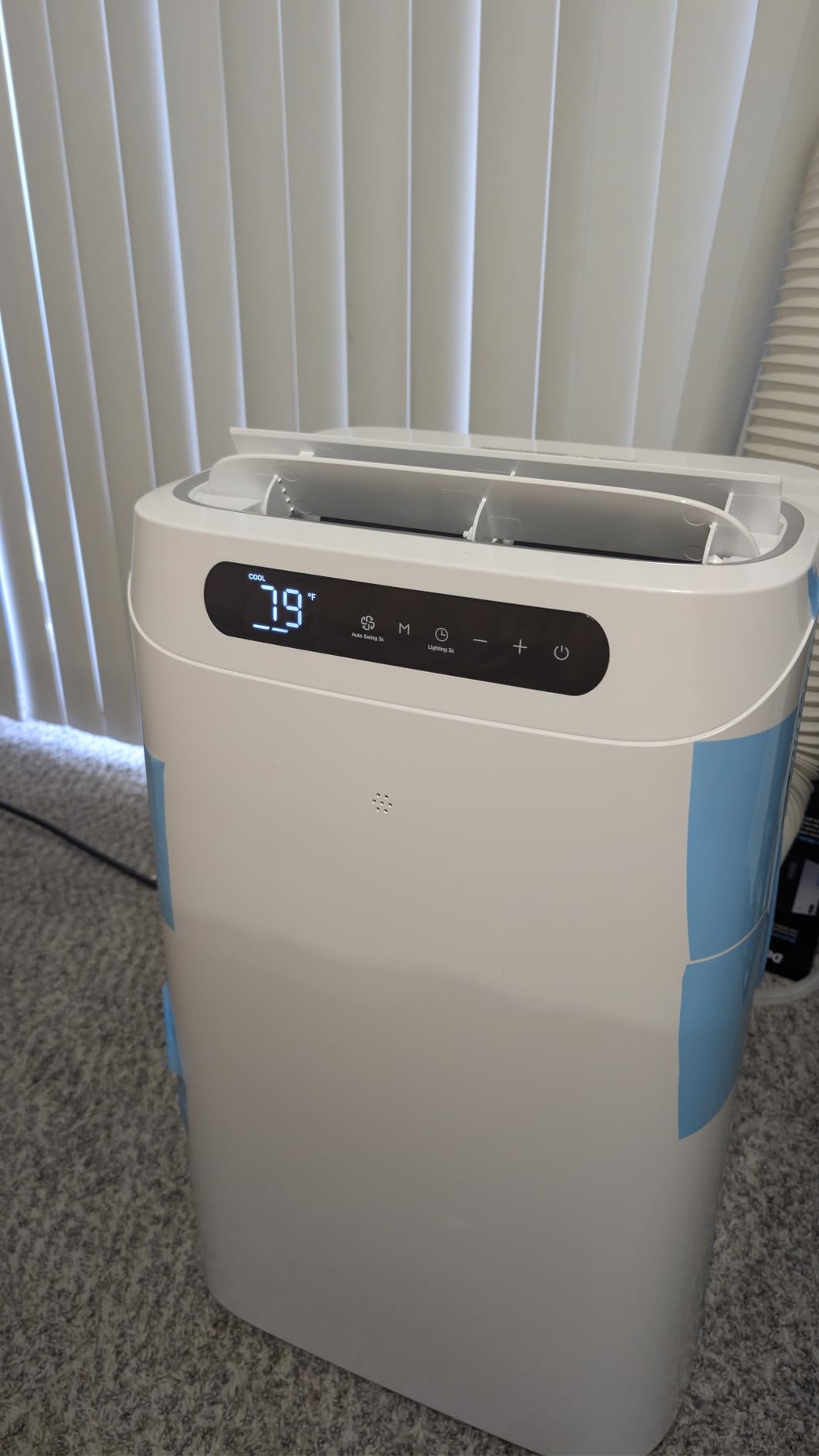
The DOMANKI is the compact option, and in a garage the footprint matters more than it does in a bedroom. At 15 by 14.5 by 24 inches it is one of the smallest cabinets for its BTU class, with hidden handles and four swivel wheels that let you move it out of the way of a parked car without wrestling it across the floor.
Owners frequently mention the speed of setup, often under ten minutes with the tool-free window kit, and several note that cooling performance held up during very hot days. It is CEC and ETL certified, moves up to 380 cubic meters per hour, and covers rooms up to 500 square feet with an operating range of 61F to 86F.
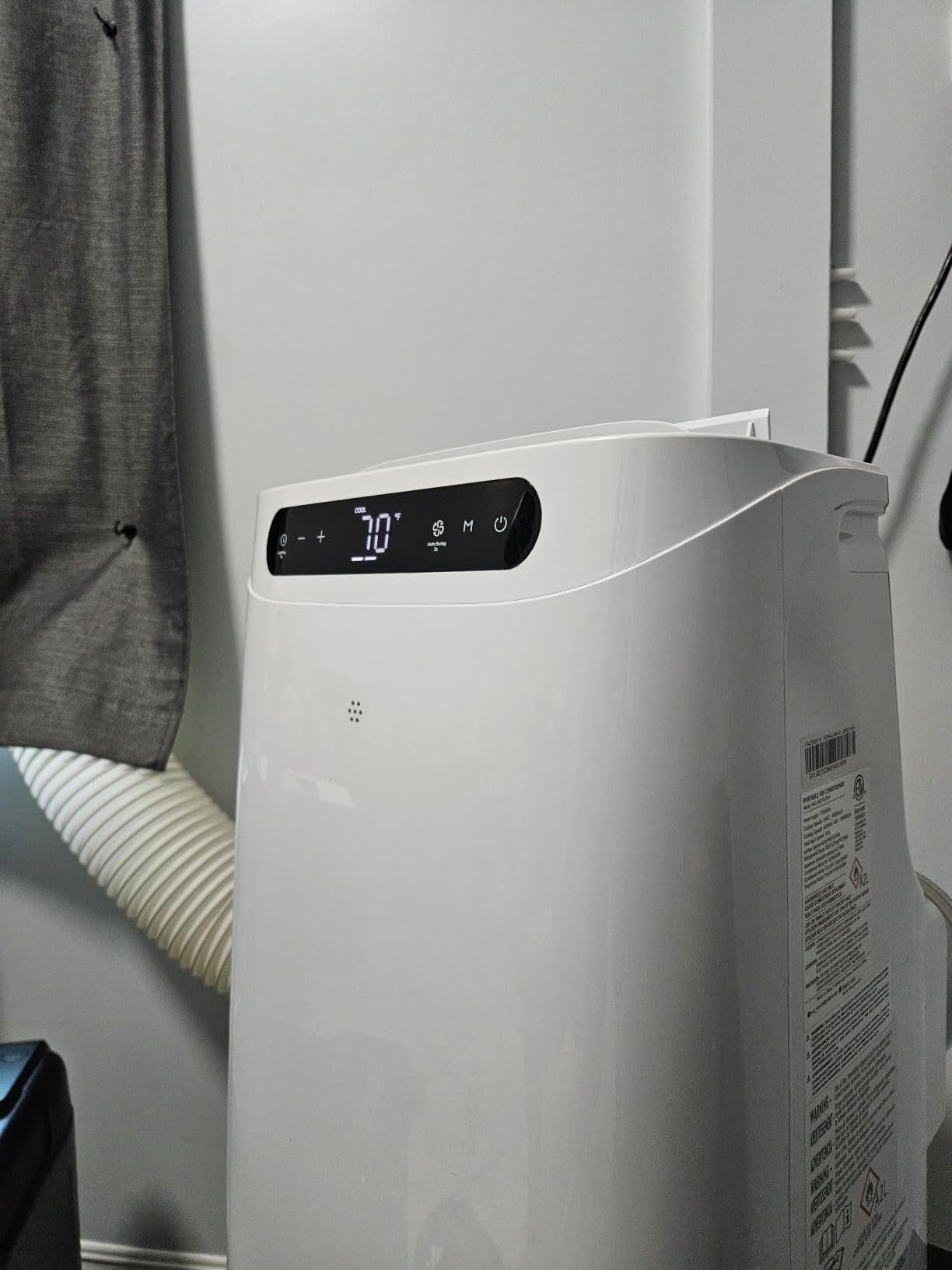
At 1,300 watts it sits mid-pack for power draw, and the fixed-speed compressor is the older design. Condensate is handled by a self-evaporating system, with a drain hose included for high-humidity conditions, and the washable filter means no replacement purchases over the life of the unit.
The feedback is mixed in one specific way: several owners describe it as noticeably loud in a quiet space, loud enough to require switching it off for calls, and a smaller group report weak cooling with low air volume. If you work with headphones or run power tools and do not need to hear conversation, the 48 dB figure is acceptable. If you plan to take calls at the bench, it is not.
Best garage fit
A one-car garage, a converted garage gym, or a home office in the corner of a two-car space where you want the cabinet tucked against a wall. The small footprint means you can place it near the work area rather than at the far end of the room, which improves the actual cooling you feel instead of just the number on the spec sheet.
Three-in-one operation covers cooling, dehumidifying and fan, with a 24-hour timer, auto swing, sleep mode and a child lock. The remote reaches 23 feet, and the window kit fits openings from 20 to 60 inches, which covers most garage windows and sliding doors.
When to pick something else
Choose differently if the space is large, the ceiling is high, or quiet matters. A 12,000 BTU single-speed unit in a 600-square-foot workshop will cycle hard, and the reported noise is the deciding factor for anyone who records, studies or holds conversations at the bench.
The 137-review base is also modest, and a few buyers reported order cancellations or refunds, which is a fulfilment issue rather than a product fault. If you want the same footprint with more headroom and lower noise, the 14,000 BTU dual-hose inverter models in this roundup are the step up, and they are worth considering if your garage is anything close to two-car sized.
Single Hose vs Dual Hose in a Garage
Dual hose is the more consequential design choice in this category, and for garages we recommend it whenever the space is over roughly 300 square feet. A single-hose unit draws room air in through the same hose it exhausts hot air from, so it recirculates a portion of its own hot exhaust and creates slight negative pressure that pulls unconditioned air in through every gap in the building.
That recirculation penalty grows with the load. In a cool, well-sealed bedroom, a single-hose unit can catch up. In a hot garage with a high ceiling and a leaky door, it runs constantly and still leaves you warm, which is the single most common reason people conclude that portable air conditioners do not work in garages. They do work. They just lose ground to the room they are in.
Look at the list in this roundup as a real comparison. Five of the ten machines here are confirmed dual-hose designs: the DREO, the ZAFRO, the Temprium, the Whynter and the Gasbye. The 10,000 BTU BLACK+DECKER and the 12,000 BTU DOMANKI are single-hose and rated for smaller spaces, and the remaining three are configured for standard single-hose-style exhaust. The pattern is not marketing; it matches how the physics works.
One honest counterpoint: dual-hose units need more floor space, two hoses to route, and often a larger window adapter. If your garage is small, the window is narrow, or you need to move the unit frequently, a well-sealed single-hose unit can still be the more practical purchase.
Condensate and Drainage in a Garage
Drainage design is the most important feature to check in a garage, and it is where budget units fail first. Every air conditioner pulls moisture out of the air as it cools it, and that water has to go somewhere. There are three designs, and they are not equally good.
A manual drip pan collects water in a bucket inside the cabinet. In humid weather it fills faster than you expect, and once it is full the unit shuts down until you empty it. Garage forum discussions describe this failure mode more than any other, and the practical answer is that if a unit relies on a bucket, it is not a unit you can run unattended in a damp garage.
Self-evaporating designs route some of the condensate onto the condenser coils, where the compressor heat evaporates it, and the remaining moisture exits with the exhaust air. Most self-evaporating units specify a humidity ceiling, commonly 90 percent relative humidity, above which the design stops keeping up. The Shinco, the ZAFRO, the Gasbye, the DREO and the DOMANKI all use this approach, and the ZAFRO and Temprium claim 72 hours or more of drainage-free operation.
The best solution for a permanently installed garage is a continuous drain line. Whynter’s patented auto drain exhausts condensate automatically in most environments, and the Gasbye adds a high rear drainage outlet for high-humidity rooms. Plan the routing before you buy, because a drain line to a floor drain or out through a wall is far easier to install while the unit is still in its original position.
Noise, Power and the Electrical Question
Noise is a hard requirement for anyone who records, studies, sleeps or holds conversations in the garage, and the numbers in this roundup span a wide range. The quietest claims belong to the Temprium at 40 dB in Silent Mode, the ZAFRO and DREO at 42 dB, and the Gasbye at about 45 dB once its inverter steps down. The SereneLife runs 48 to 51 dBA, the Garvee is rated at 50 dB, the Shinco sits at 52 dB, and the BLACK+DECKER is the loudest at 54 dB.
Two cautions on those figures. Published noise is usually measured at a minimum distance, and several owners of the DREO reported that measured noise ran higher than the stated figure at close range. And compressor noise is only half the sound; a rattling cabinet or a hard floor amplifies whatever the compressor is doing. A rubber isolation mat under the cabinet is a cheap improvement that makes a measurable difference in a concrete-floored space.
On power draw, the range across this roundup runs from about 1,060 watts to 1,550 watts. A dedicated 15-amp circuit is the safer arrangement for anything above 12,000 BTU, and older detached garages frequently lack one. An owner of the DREO reported the unit tripping a breaker on dated wiring, which is a wiring problem rather than a defect, but it is worth resolving before July rather than during the first hot afternoon.
Running cost follows the efficiency rating. A unit with a CEER near 12 to 13 uses substantially less electricity for the same cooling than a fixed-speed unit in the 6.9 SEER class, and the inverter models here drop to roughly half compressor load once the room reaches temperature, which is where most of the hours are spent.
Portable vs Mini-Split vs Window AC for a Garage
A portable AC is the right answer for a garage you cool seasonally, an uninsulated or detached space, or a rental where you cannot modify the building. It needs no installation, it moves with the season, and it can be taken with you if you move. For most single and two-car garages, that is the practical choice and the one we recommend.
A window AC beats it on efficiency, because a window unit does not draw the same recirculated air back in. If your garage has a suitable window and you only need a few degrees of improvement, a window unit does more with less electricity. Our smart window air conditioner guide covers that category if a window is available.
A mini-split is the better long-term investment above a certain point. It is roughly twice as efficient as a portable unit, runs silently at low load, cools far better at high ambient temperature, and lasts a decade or more. The catch is installation: a line set has to be run, a pad or a high wall has to be drilled, and the interior unit has to be mounted somewhere you can live with. Experienced builders with finished spaces above garages consistently recommend a mini-split from a major brand, and that advice holds for anyone cooling the same space every day of the year.
The crossover point is frequency, not price. If you plan to use the unit for two or three months a year, portable wins on total outlay and flexibility. If you plan to use it every day, a mini-split wins on running cost, noise and reliability. If the garage is a workshop you use in the evening through the summer, portable is the sensible middle path.
One category to approach carefully is the evaporative or swamp cooler. These are not air conditioners. They add moisture to the air rather than removing it, which means they work well in hot dry climates and are effectively useless in humid ones. A garage in a humid region needs true dehumidification, and a swamp cooler will make the space feel worse, not better. The same warning applies to the spot coolers sold for cars and patios, which cool a person rather than a room and are a different product entirely.
What to Look for When Buying a Portable AC for a Garage
Measure the garage properly before you compare anything. Multiply square footage by ceiling height, add 20 to 30 percent for a hot uninsulated space, and treat the lower SACC or DOE figure rather than the ASHRAE headline number as the real capacity. Buying a unit that is slightly larger than the load is worth it, because it lets the compressor cycle.
Confirm the exhaust path before you buy. A window kit needs an opening within the stated range, and a doorway with a proper seal panel is better than nothing. If the nearest opening is more than about eight feet away, plan the routing now, because adding hose length is the modification that reliably reduces performance and manufacturers advise against it.
Check the electrical supply. Units above 12,000 BTU often want a dedicated 15-amp circuit, and many older detached garages have a shared outlet or none at all. This is a five-minute conversation with an electrician that prevents the most common summer failure.
Look for self-evaporating drainage, and treat a manual bucket as a deal breaker if you plan to leave the unit running unattended. Continuous drain capability is even better if your garage has a floor drain or an easy route to an outside wall.
Then judge noise against your actual use. If you will weld, use power tools, record music or sleep in the space, anything above roughly 55 dB is going to be a problem no matter how well it cools. The inverter models in this roundup are the ones built for that.
Finally, be honest about frequency. A garage AC is a two or three month purchase, which changes the durability calculation. A three-year warranty matters more here than it would for a bedroom unit you run nine months a year, and it is one of the reasons we rank the Gasbye highly despite a smaller review base than some competitors.
Frequently Asked Questions
Will a portable air conditioner work in a garage?
Yes, provided three conditions are met. Size the unit in BTU to your garage square footage and ceiling height, seal the exhaust hose into a window, door or wall vent, and set realistic expectations for a hot ceiling deck. Portable units lose rated capacity as garage temperature rises, so a machine rated for a 90F room works much harder in a 110F one.
What type of AC is best for a garage?
For most single and two-car garages, a portable air conditioner is the best fit because it needs no installation and moves with the season. A window AC is more efficient if a suitable window exists. A mini-split is the better investment if you plan to cool the space every day, and an evaporative cooler only makes sense in a hot, dry climate.
What is the cheapest way to cool a garage?
Start by cutting the heat load rather than buying hardware. Insulate and paint the ceiling deck white, add a reflective garage door, and keep the interior door to the house closed so the unit is not cooling the whole building. Then a correctly sized 8,000 to 10,000 BTU portable unit with a good window seal, or a box fan moving air through an open door, will do more than an oversized machine in a leaking room.
Is there a portable car AC that actually works?
True automotive 12V spot coolers exist, and they work well for the person sitting in the vehicle. They are small spot coolers, not room air conditioners, and they are a separate product category from the units covered here. Nothing sold for a car will cool a garage, and nothing in this roundup is an automotive unit.
How many BTU do I need to cool my garage?
A 12,000 BTU unit, which is one ton, handles roughly 500 square feet of ordinary space at standard ceiling height. Garages need more: multiply by 1.5 for standard ceilings and by about 2 for a workshop with high ceilings, heavy sun exposure or welding heat, then add 20 to 30 percent headroom. A two-car garage with a hot ceiling usually needs 14,000 to 16,000 BTU.
Is a dual hose portable air conditioner better than a single hose one?
For garages, usually yes. A dual-hose unit draws intake and exhaust air through separate hoses, so it does not recirculate the hot air it just expelled and does not create the negative pressure that pulls unconditioned air in through gaps. In a small, well-sealed room the difference is modest. In a hot, leaky garage with a high ceiling it is the difference between reaching your set temperature and running continuously without getting there.
Is a mini split better than a portable AC for a garage?
If you plan to cool the garage every day, yes. A mini-split is roughly twice as efficient, runs quietly at low load, handles high ambient temperatures better, and lasts far longer. A portable AC wins on installation cost, flexibility and portability, and it is the better choice for seasonal use or a rental. Decide by frequency of use rather than by purchase price alone.
Conclusion: Which Portable AC Fits Your Garage
Match the machine to the room. A one-car garage with a standard ceiling wants 12,000 BTU, and the SereneLife is our pick there because it cools, heats and dehumidifies from one cabinet while running quietly enough to background. If you want the most proven brand name and the lightest unit to move, the BLACK+DECKER 10,000 BTU is the safe buy, and the Shinco 12,000 BTU is the strongest value in the roundup.
A two-car garage or a workshop with a high ceiling needs a dual-hose inverter, and here the choice comes down to priorities: capacity and quietest operation points to the Temprium 16,000 BTU, measured efficiency and a three-year warranty points to the Gasbye 14,000 BTU, and the balance of efficiency, noise and drainage-free running points to the ZAFRO 14,000 BTU. The DREO 14,000 BTU is the one to buy if app and voice control matter to you and your garage gets extremely hot.
For smaller and cheaper options, the Whynter 10,000 BTU is the least expensive way into a proper dual-hose design, the Garvee 14,000 BTU is the capacity-per-cost option for renters, and the DOMANKI 12,000 BTU is the most compact cabinet here. Whichever you choose, buy it for a self-evaporating drainage design, seal the exhaust properly, and confirm your circuit can carry it before the first hot weekend arrives.
We update this roundup as new models land and as owner reports come in. If cooling a vehicle matters to you too, our RV air conditioner guide covers that category in detail.