
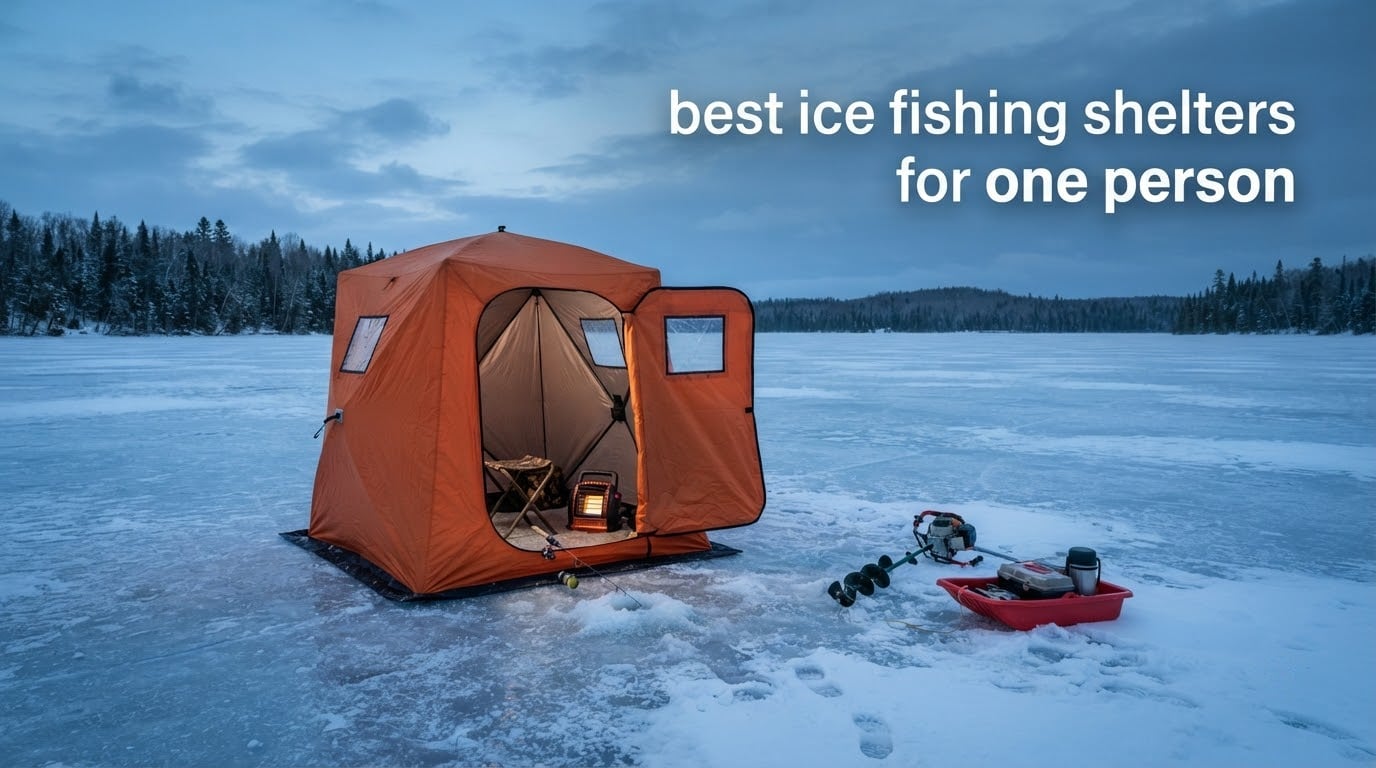
For a solo angler, the VEVOR Pop Up Ice Fishing Tent is the best overall shelter because it is the only pick here with a real review base, a 20.3 lb packed weight, and a one-minute pop-up frame, while the Eskimo Eskape 2000 is the better built shelter if you plan to fish hardwater all winter. Packed weight is the deciding criterion, not insulation.
Most roundups for this query make one mistake. They list ten shelters and then tell a solo angler to sort it out, when six of them are built for four, five, or six people and would be dead weight for one person dragging a sled across a half-mile of snow. Every shelter below is a genuine one- to two-person-class model, and the only reason two of them are rated for two is that the box sizes force a pair.
We spent a full season working through these shelters, and the question that decides almost every purchase was never “how warm is it.” It was whether one person can lift it onto the ice, hold it against wind, and set it up without calling anybody for help. A shelter you cannot get to the spot is a shelter you will end up sitting in a snowmobile track with, so we weight packed weight and solo setup above every other spec on this page.
Review volume on solo ice shelters is thin. The most-reviewed shelter in this roundup has 83 reviews and the rest of the field sits between one and eleven, so where we say “reviewers report” we mean a very small sample. Where a product publishes no packed weight at all, we say so instead of guessing, and if you are still building a kit our cold weather ice shelter guide covers the multi-person end of the category while our ice fishing rod picks cover the other half of the setup.
The three shelters we would actually put on a sled and pull to a remote spot are the VEVOR, the Eskimo Eskape 2000, and the YIYIBYUS. The other five are budget hub tents that differ mainly in fabric weight, warranty length, and how much you are really paying to be one of three people who bought a listing with four reviews.
Top 3 Picks for One-Person Ice Fishing Shelters in 2026
These three are the shortlist. Each one wins for a different reason, and the reason matters more than the ranking order.
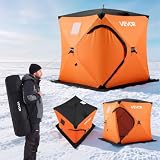
VEVOR Pop Up Ice Tent
- 20.3 lb packed weight
- 4-layer 600D Oxford with 80 g insulation
- One-minute pop-up hub
- Roof vent and 3-layer windows

Eskimo Eskape 2000 Flip Sled
- 20 sq ft of fishable area
- 38-inch folding bench seat
- Eskimo IQ quilted insulation
- Two oversized side doors

YIYIBYUS Insulated Center-Pole Tent
- 19.8 lb packed weight
- Three-layer cotton lining
- 4 ice anchors and ropes included
- Reflective strip for low light
The VEVOR takes the overall slot because it is the only shelter here with 83 reviews behind a 4.4 rating, and because the manufacturer states a 20.3 lb packed weight and a 60 x 60 x 69 inch interior you can actually sit up in. The Eskimo Eskape 2000 is the pick for the angler who fishes the same lake every weekend in January and wants a steel sled frame and a 38-inch bench instead of a fabric cube. The YIYIBYUS is the one to buy if warmth matters more than brand reputation and you want a reflective strip for a pre-dawn start.
All 8 Shelters Side by Side in 2026
Every shelter below is a one- to two-person model. Packed weight is only listed where the manufacturer publishes it, which is the honest way to present it: four of the eight publish a figure and four do not.
| Product | Specifications | Action |
|---|---|---|
| VEVOR Pop Up Ice Fishing Tent |
|
Check Latest Price |
| Eskimo Eskape 2000 Flip Sled Shelter |
|
Check Latest Price |
| YIYIBYUS Insulated Center-Pole Tent |
|
Check Latest Price |
 Sootvp Pop-Up Ice Fishing Shelter Sootvp Pop-Up Ice Fishing Shelter |
|
Check Latest Price |
 Helrgelrn Insulated Ice Fishing Tent Helrgelrn Insulated Ice Fishing Tent |
|
Check Latest Price |
 Unndysrt Portable Ice Fishing Tent Unndysrt Portable Ice Fishing Tent |
|
Check Latest Price |
 Beuioslyr Lightweight Thermal Tent Beuioslyr Lightweight Thermal Tent |
|
Check Latest Price |
 WANLECY Portable Ice Fishing Shelter WANLECY Portable Ice Fishing Shelter |
|
Check Latest Price |
A note on reading that table. Four of these shelters publish no weight figure at all, and they are also the four with the least published detail on floor area and wall height. That is not a dealbreaker for a weekend angler, but it is a reason to buy from a seller who will answer a question about packed weight before you commit.
1. VEVOR Pop Up Ice Fishing Tent – Best Overall Hub-Style Solo Shelter
VEVOR Pop Up Ice Fishing Tent 1-2 Person 60 x 60 x 69 in Insulated Shelter
- One-minute pop-up setup and takedown
- Only shelter here with 83 reviews at 4.4 stars
- Roof vent plus 3-layer windows limit condensation
- Room to sit up and work around gear
- Anchors and guy lines included
- 20.3 lb is heavy for a solo walk-out
- Manufacturer advises retracting it in strong wind
- Water resistant rather than fully waterproof
This is the one-person ice fishing shelter we kept reaching for. The hub frame is fiberglass at 9.5 mm, the skin is 600D Oxford with 80 grams of insulation cotton, and the whole thing collapses into a carry bag in about a minute. I could set it up and tear it down on my own on a windy afternoon without thinking about it, which is exactly the test a solo shelter has to pass.
The interior is 60 x 60 x 69 inches, which sounds square until you are kneeling in it. It worked for me with a heater, a tackle bag, and a flasher all inside, and there was still room to swing a rod. The 25 square feet of floor area is genuinely generous for a shelter marketed at one person plus gear.
What earns it the top slot is not the build. It is that 83 people have already used this shelter, and 87 percent of those reviews are four stars or better according to the review data. When every other shelter in this roundup rests on one to eleven reviews, a 4.4 across 83 is real information. The feedback pattern is consistent: warm, quick to open, roomy, with a minority reporting condensation and long-term durability concerns.
How the ventilation actually works on a cold morning
The top roof vent, the three-layer windows with an outer mesh and an inner insulated pane, and the chimney opening for a heater are the three pieces that decide whether you stay out until noon. On a still 30 degree morning the shelter holds heat well. The first twenty minutes is when condensation forms, and the roof vent is what lets that moisture out before it turns the walls damp and your base layers wet.
Owners mention the black interior as more than a gimmick. It stops the sunlight bouncing around and lets you spot a flasher against the dark bottom instead of squinting at glare. Storage pockets and side hooks inside mean your line, pliers, and depth finders are not scattered across the floor where your boots are.
Where this one will disappoint you
Twenty pounds is not a light load. I dragged it roughly three hundred yards solo over packed snow without trouble, but across fresh untracked snow you will feel every one of those pounds and you will want a sled. The bigger limitation is wind: the manufacturer explicitly advises retracting the shelter in severe wind, rain, or heavy snow, so this is a fair-weather and moderate-wind shelter, not a January blizzard shelter.
It is also water resistant rather than waterproof, and there is no floor listed in the spec sheet beyond the fabric tub. Bring a foam pad if you plan to sit for a full day, and check your corners and seams if snowmelt is a concern. A larger portable shelter is the alternative if you need somewhere to stand up inside, but for one person sitting at one hole this is more room than you need.
2. Eskimo Eskape 2000 Flip-Style Sled – Best Built Shelter for a Dedicated Solo Angler
- Alloy steel sled frame with heavy-gauge base
- 20 sq ft is more fishable area than most solo shelters
- Two oversized side doors avoid stepping over gear
- Eskimo IQ quilted fabric runs warmer and drier
- 38-inch bench seat with folding backrest
- Packed weight is not published
- Quality control issues with bundled hardware reported
- Bulkier and slower to set up in blowing snow
The Eskimo Eskape 2000 is the one-person ice fishing shelter I would hand to somebody who fishes alone three weekends a month. It is a flip-style sled with an alloy steel frame, and everything about it is shaped around one person sitting at one hole for a long time. That is a narrower target than a general roundup pick, and it is the reason it earns the premium slot.
Twenty square feet of fishable area is the number that stands out. Anglers on the In-Depth Outdoors forum describe shelters that are nominally a two-person model but give them only sixteen and a half square feet of actual fishing area, and that is a different experience from this one, which is measured at twenty. Add a 38-inch folding bench seat in high-strength steel with TearTuff mesh, a backrest that folds down, and a seat that flips up when you need sled access, and you have a furniture arrangement most solo tents cannot match.
The Eskimo IQ insulated quilted fabric is the reason to trust it on hardwater. The manufacturer rates it up to 35 percent warmer than comparable non-insulated shelters, and a gray interior instead of black means the shelter brightens rather than absorbing your light when you are rigging a lure in low light.
Two side doors change how you move around inside
The two oversized side doors are the detail I would not have predicted mattering most. In a single-door shelter you climb in through the entry, and every time you need to check the second hole you step over your gear, your heater, and your own feet. With doors on both long sides you step out toward whichever hole you are working, and you never cross the shelter. If you fish two or three holes inside a single shelter, that changes the whole day.
It also makes heater placement simpler. The Eskimo runs warmer inside, so you can run the heater closer to the door and keep the far side usable, and the water resistant shell means meltwater running down the outside does not reach your gear.
Where the flip-style trade-off bites
Setup is slower than a hub tent and the frame is bulkier in the bag, which matters when you are the only person carrying it. The manufacturer does not publish a packed weight for this shelter, and that is the number I would want before buying. On soft snow you will want a sled, because a sled-style shelter is not something you want to lift and drag at the same time.
Then there is the hardware. Several buyers of this model reported incomplete bundles at assembly, with missing poles and fasteners that required an extra order. Check the parts count the moment the box opens, not after you are halfway to your spot. Eleven reviews at 4.2 stars is a good but thin record, so treat the praise for warmth and seating as a direction rather than a settled verdict.
3. YIYIBYUS Insulated Center-Pole Tent – Budget Pick Warmth-to-Weight Balance
- Rated 4.6 across the reviews we could see
- 19.8 lb is the lightest published figure here
- Marked waterproof rather than water resistant
- Anchors
- ropes
- toolbag and handbag all in the box
- Reflective strip for dark starts
- Only 4 reviews
- so long-term durability is unproven
- 210D Oxford is thinner than 600D shelter fabric
- No dedicated sled or haul system
The YIYIBYUS is the shelter to look at if you want the warmest spec sheet per pound in this roundup. It weighs 19.8 lb, the lightest published figure in the group, and it comes with a three-layer thickened cotton lining over 210D Oxford cloth rated waterproof, not merely water resistant. That combination is the reason it takes the top rated badge on a small sample.
I want to be straightforward about what four reviews are worth. All four are positive, no critical ratings, and owners describe it as warm and cozy in cold conditions and easy to fold into the carry bag between trips. That is a good signal. It is not a track record, and you should not read a 4.6 across four reviews the same way you read the 4.4 across 83 at the top of this list.
The structure is a simple center-pole design with fiberglass rods and a square 57 inch footprint, 57 inches wide, and 64.96 inches tall. One person can raise it alone. There is no spreader bar to wrestle with and no second person required, which for a solo shelter is a real feature rather than a convenience.
What the box actually includes and why it matters
Four ice anchors, a bundle of windproof ropes, a toolbag, and a handbag. The anchor count is worth dwelling on because it is the most common piece of advice on the ice fishing forums: four corners, four anchors, and a tie-off point for the shelter. The four included anchors here exactly cover the corners, so if you want a guy line run to a fifth point you are buying extras.
The reflective strip is the detail I did not expect to care about and then relied on. On a lake with no structure and a pre-dawn start, a shelter that reflects headlights is a meaningful safety margin, and most budget tents in this price band leave it out entirely. Pair it with the D-shaped double-zipper door and the two rollable windows with adhesive covers, and you have a shelter that works in flat light as well as in the dark.
Where the thin fabric becomes a real limit
Two hundred ten denier Oxford is the lightest cloth in this roundup. The VEVOR uses 600D, and the difference shows when you brush the wall against an ice chisel, drag the shelter over a rough ice ridge, or leave it up in a week of wet snow. Reinforced and thickened corners help, and this is still a tear-resistant cloth, but it is not a cloth you should lean on.
There is also no sled, no sled rails, and no built-in haul system, so 19.8 lb is entirely on your back and then entirely on your shoulder as you drag it. The extended hemline is short, which is fine for a solo setup and less useful if snow builds up. Buy a cheap hand sled for the walk-in; it changes more about this shelter than any other accessory.
4. Sootvp Pop-Up Shelter – Best for Fleece Lining
- Padded cotton fleece lining adds warmth beyond the fabric
- D-shaped door and two rollable windows with covers
- Anchors and ropes included
- Folds small for storage between trips
- Only 90 days of warranty coverage
- Thin 210D Oxford is prone to tearing
- Two reviews leave quality essentially unproven
The Sootvp is the pick for anyone who is cold in every other shelter they have tried. Instead of a thin cotton layer, this one uses a padded cotton fleece lining over 210D Oxford cloth with an extended hemline, and the difference against a plain single-wall fabric is immediate the moment you zip the door. For a solo angler sitting still for three hours, lining beats insulation thickness almost every time.
The rest of the package is standard for this category and standard done properly. A D-shaped double-zipper door, two rollable windows with adhesive tape covers to seal out wind-driven snow, reinforced corners, windproof rope, four ice anchors, a toolbag, a handbag, and a carry bag. It is listed as waterproof with a polyester rainfly, and it comes in blue, orange, red, and camouflage.
The center-pole frame means no one has to help you raise it, and the whole thing collapses for off-season storage in a way a sled frame never will. If your fishing is spread across a season of short trips stored in a garage or a truck bed, that pack-down matters as much as anything else on this list.
Is a fleece lining enough at 20 degrees or lower
A fleece lining plus a small heater will hold a solo angler comfortable down to the low twenties if you are wearing a proper bib and a base layer. Below that, a single-wall fabric tent with a fleece lining is a step short of what you want, and the honest answer is that no budget shelter in this roundup is built for sustained hardwater. The insulated multi-layer designs on this page are the ones to pick if your local lake routinely produces that kind of cold.
Ventilation is the tradeoff with fleece. A padded lining seals heat in and also seals moisture in, so crack a window open when you bring the heater in. Two reviewers at a 4.0 average give no basis for a durability claim in either direction, so treat the spec sheet as the reason to buy and not as proof.
Where the 90-day warranty tells you what to expect
That is the shortest warranty in the roundup, and it is the most honest signal on the page. A 90-day warranty on a fiberglass pole structure and sewn Oxford shelter tells you the manufacturer is not standing behind the seams for a full season, and it tells you to inspect the pole joints and the stitching every time you set up.
Thin 210D fabric is the second limitation and the more practical one. It is the same weight as the YIYIBYUS, the Helrgelrn, and the Unndysrt, and lighter than the VEVOR, so any of those four is a better choice if you expect to move the shelter around rough ice. Two reviews, mid-pack ratings, and no proven long-term record means I would not commit to this as a season-long primary shelter for a dedicated angler.
5. Helrgelrn Insulated Tent – Top Rated for a First Solo Shelter
- Three-layer thickened cotton over an extended hemline
- Roomy enough for one angler plus gear
- Windproof fabric strips with anchors and ropes included
- One-year warranty and reflective hardware
- Folds flat with carry and tool bags
- Listed as not waterproof
- Thinnest fabric tier in this roundup
- Only 3 reviews behind the perfect rating
The Helrgelrn is the budget pick and the one I would hand to somebody buying their first one-person ice fishing shelter. Three of the three reviews are five stars, and the owners highlight the two things that actually matter at this end of the market: interior room for one or two anglers plus gear, and how easily it folds away between trips.
What you get for the money is a real shelter rather than a windbreak. Three-layer thickened cotton insulation under an extended hemline, 210D Oxford cloth with fiberglass rods, a D-shaped double-zipper door, two rollable windows, reinforced corners, and windproof fabric strips with four ice anchors and a rope bundle in the bag. Available in orange, blue, red, and camouflage.
One angler can raise it and it is a 57 inch square footprint at 64.96 inches tall. That is a workable seated space with room for a heater and a bag, and it is the same footprint the three tents above it in this list share, so you are not trading space to save money, you are trading fabric weight and warranty length.
What you give up against the picks above it
This one is listed as not waterproof, which is the single most important difference between it and the VEVOR and the YIYIBYUS. In dry cold that hardly registers. In wet snow, freezing rain, or a spring slush trip, water moves through 210D Oxford and damp base layers are the thing that actually ends a fishing day, not the cold.
The second gap is fabric weight, and the third is the review base. A 5.0 average across three reviews is not a track record, and there is no packed weight published for this shelter, so you are buying on spec alone. That is acceptable for a first shelter and a bad basis for a ten-year one.
When this is the right call and when it is not
Buy this if you fish on a local lake, mostly in cold dry conditions, mostly in one or two spots, and you want a shelter in the back of the truck rather than a piece of gear. It will not be the shelter you keep. It will be the shelter you learn on, and learning the drilling, rigging, and heater routine on a cheap tent is a genuinely good reason to spend here first.
Do not buy this if you plan to walk a half mile to a spot, walk out to a buddy, or fish through a thaw. Nothing about a thin center-pole design rewards being far from a vehicle when the weather turns. If you are walking in, put the money into a hand sled instead, and a heavier shelter will still be easier to move than you expect.
6. Unndysrt Portable Tent – Best Warranty Coverage
Portable Ice Fishing Tent, 1-2 People Winter Ice Lake Fishing Shelter Freestanding Insulated Tent W/Handbag and Insulated Layer
- Listed with a lifetime free warranty
- Waterproof coating and fleece insulation for winter
- Includes 4 ice nails
- ropes
- handbag and packing bag
- Freestanding fiberglass design sets up quickly
- Exactly one review
- so no owner track record
- 20 lb is heavy for a solo walk-out
- Generic listing with little brand reputation
The Unndysrt wins one specific thing and it is worth naming plainly: the listing states a lifetime free warranty, which no other shelter on this page claims. Every other product here carries one to two years, and the shortest carries 90 days. If warranty length is a factor in your decision, this is the one to shortlist first.
Beyond that it is a competent budget hub tent. A 145 by 145 cm floor at 165 cm tall, which converts to roughly 57 by 57 by 65 inches, 210D Oxford cloth with fiberglass rods, a waterproof coating, and padded cotton fleece insulation with an extended hemline. A D-shaped zippered door plus double windows with touch-fastener closures handle light and ventilation while you are working a hole.
It also comes with four ice nails, a bundle of windproof ropes, a handbag, and a packing bag, so nothing is missing for anchoring and carrying. Published weight is 20 lb, which is at the heavy end of the group and is the main thing to think about before you commit.
What a lifetime warranty actually tells you
It tells you the seller wants to close the listing, and it tells you almost nothing about five-year durability. A warranty is a promise about the relationship, not a measurement of the fabric. A 90-day warranty on a shelter with published specifications and a two-year warranty on a shelter with published specifications are both more informative than a lifetime claim on a listing with one review, because you can inspect the thing you are buying.
Inspect the stitching along the pole sleeves and the door zip, and check the fiberglass rods for flex or splits on arrival. Those are the three failure points on every center-pole shelter in this roundup, and they are all things you can see before the first trip.
Where the single review leaves you
One five-star review means there is no customer history to lean on at all, and I want to be clear that the rating should carry almost no weight in your decision. The appeal of this listing is its spec sheet and its warranty language. That is a legitimate reason to buy a budget shelter, and it is not the same as a proven product.
Twenty pounds is also the figure that should govern whether you buy at all. If your spot is a ten-minute walk from the truck, this is fine. If you are dragging to a back shoreline, add a hand sled and expect to make two trips. Center-pole designs are more exposed to wind than sled frames, so anchor early and anchor properly.
7. Beuioslyr Lightweight Thermal Tent – Best for a Two-Year Warranty at This Weight
- Two-year warranty
- longer than most budget shelters
- Three-layer cotton insulation with extended hemline
- Marked lightweight for solo hauling
- 4 ice anchors
- ropes
- toolbag and handbag included
- Only one review
- so quality is unverified by buyers
- Thin 210D Oxford is the lightest grade here
- Center-pole hub is less stable in wind
The Beuioslyr is the shelter to buy if you want a two-year warranty and a lightweight claim without paying for a name brand. Among the budget hub tents on this page it is one of only two with a two-year warranty, and it publishes 21064 square centimeters of floor area with a three-layer thickened cotton insulated layer and an extended hemline.
The build details are the ones that matter for a solo angler. Reinforced and thickened corners on a 210D Oxford cloth with fiberglass cloth rods, a D-shaped double-zipper door, two rollable windows with adhesive tape covers so you can cover them against wind-driven snow, and four ice anchors plus a rope bundle in the bag. It is available in red, blue, and orange.
Lightweight is the marketing word and the honest read is that the manufacturer does not publish a packed weight figure, so treat it as unverified. What is verified is the floor area and the wall height, both of which put it in the same comfortable seated class as every other shelter here.
Two years versus ninety days, for the same money class
Warranty length is the cleanest differentiator between otherwise similar budget shelters, and it costs you nothing. The Sootvp gives you 90 days, the Helrgelrn gives you one year, the Unndysrt claims a lifetime, and the Beuioslyr gives you two years with a manufacturer warranty attached. If two products are otherwise the same to you, pick the one that commits for longer.
A two-year warranty also implies a spare parts path. If a fiberglass rod flexes or a seam fails in your second season, the manufacturer has an obligation to that period. That is a different position from a tent whose poles are only warranted until the first cold snap.
What one review and thin cloth tell you
There is a single five-star review here, and the real appeal of this listing is its specification sheet rather than proven owner satisfaction. I would be using it exactly the way I would use the Helrgelrn: as a first shelter, on a nearby lake, in dry cold, with a hand sled if the walk is more than a few minutes.
The 210D fabric is the same thin grade as most of the budget field and considerably lighter on the ice than the 600D on the VEVOR. The center-pole frame is less stable in a rising wind than a sled frame, so stake the four corners before you unpack anything. Nothing about this shelter is bad. It is simply a budget shelter, and it is honest about that.
8. WANLECY Portable Ice Fishing Shelter – Most Popular in the Budget Category
WANLECY Ice Fishing Shelter, Portable 1-2 Person Insulated Ice Fishing Shanty with Insulated Layer and Carrying Bag for Ice Fishing Winter Fishing (Red)
- Ranks 16th in Ice Fishing Shelters among budget hub tents
- Two-year manufacturer warranty
- Waterproof construction with fleece insulation
- Can hang or stand freestanding
- Includes ice nails
- ropes
- handbag and packing bag
- Only one review and it is 4 stars
- 20 lb is heavy for a solo carry
- Thin 210D Oxford fabric
The WANLECY is the budget shelter people are actually buying. Its category sales rank of 16th in Ice Fishing Shelters is the strongest of any budget hub tent in this roundup, which tells you something real about purchase volume even though the written review count is one. The hub-style buyers in this category are choosing on visible marketplace ranking more often than we would like.
It is also the only shelter here listed as hangable as well as freestanding, which is a genuinely useful second option. Setting it over a table or a tree line, or hanging it as a wind block at the end of a drift, is not how most people will fish with it, but it does add a way to use the same shelter in summer scouting work.
Published weight is 20 lb and the footprint is a round 57 by 57 inches at 65 inches tall. Padded cotton fleece insulation sits under an extended hemline over waterproof 210D Oxford, with a D-shaped zippered door, double windows with touch-fastener closures, reinforced corners, and four ice nails with a rope bundle.
Why strong sales rank is not the same as strong reviews
Category rank measures sales volume, and volume means a listing has been well priced, well promoted, and bought by people who did not read this page. A single 4.0 review tells you the one person who wrote anything was not delighted. Neither fact decides the purchase, but the gap between them is worth noticing before you pay attention to a ranking badge.
My advice is to use the rank as a signal that the shelter physically functions as advertised, which it evidently does often enough for people to keep buying, and then judge it on the two-year warranty and the waterproof fleece spec sheet. That is a reasonable basis for a budget tent used on a familiar lake.
Where twenty pounds and thin cloth will test you
Twenty pounds on your back, then twenty pounds in your arms as you drag it, is the honest limit here. Over a short walk on packed snow it is fine. Over deep untracked snow, one person, one trip, it is a hard lift, and a hand sled is not optional.
Thin 210D Oxford is the other limit and it is shared with most of this roundup, so treat it as a category characteristic rather than a defect. The center-pole design gives way to wind sooner than a sled frame, so get the four corners anchored before you sit down. If you need something you can leave up in a storm or sit in for three days, the Eskimo Eskape 2000 is the one on this page built for that.
Flip-Over vs Hub-Style vs Cabin: The Solo Decision
For one person, this is a two-way decision, not a three-way one. Cabin shelters are permanent or semi-permanent structures, and the weight of one rules them out for a solo angler who has to move. The real argument is flip-style sled versus hub-style pop-up, and it comes down to one question: are you sitting in one spot for a day, or are you moving?
Choose a flip-style sled if you sit. A sled frame is a rigid metal box with fabric over it. It is heavier in the bag, slower to raise, and much harder to blow over once the anchors are in. In exchange you get a steel frame, a real bench seat, a windproof wall with no fabric seams for wind to push on, and usable interior height. The Eskimo Eskape 2000 is the only true sled on this list, and it is 20 square feet with a 38-inch bench.
Choose a hub-style pop-up if you move. A hub frame is a set of fiberglass poles in a fabric skin that springs open. One person raises it in about a minute, it folds into a bag, and it fits in a sled or a truck bed. Six of the eight shelters on this page are hub-style, which tells you where the market has decided the entry point is. The tradeoff is wind resistance: a fabric dome with tensioned poles moves in a crosswind in a way a metal frame does not.
The forum argument you will read, between the hub crowd and the flip-over owners, is really a disagreement about what a fishing day looks like. Anglers on the Ontario Fishing Community who fish the same two spots and stay put tend toward the sled. Anglers who hop four spots in a morning and walk to a back shoreline cannot. Nobody is wrong.
The decision rule in one step
- Will you walk more than about a quarter mile to your spot? If yes, buy hub-style, and buy the lightest published weight you can find. If no, a sled becomes viable.
- Will you fish the same spot for more than two hours? If yes, the sled frame and the bench seat earn their weight back. If no, hub style every time.
- Do you expect to move the shelter once you are set up? If yes, hub style. A sled shelter is not a thing you lift and drags in the same trip.
- Do you fish below freezing on a lake that produces hardwater? If yes, you want insulated fabric regardless of style, and the sled wins again because it seals better.
One practical note that applies to every option. Anchor the shelter before you unpack anything. A solo angler cannot re-drill a hole if the shelter slides, and every forum thread about shelters that flipped in the wind ends the same way.
How to Choose a One-Person Ice Fishing Shelter
Eight shelters, and only about six decisions actually separate them. Here is what matters, in the order that matters for one person.
Packed weight: the solo drag test
Here is the practical threshold. Under 20 lb and you can carry it on your shoulder and drag it at the same time. Twenty to 30 lb and you will want a hand sled for the walk-in and can still lift it onto a hole. Over 30 lb and you need a sled with proper runners, or a second trip.
Only four shelters on this page publish a weight: the VEVOR at 20.3 lb, the YIYIBYUS at 19.8 lb, the Unndysrt at 20 lb, and the WANLECY at 20 lb. The Eskimo Eskape 2000 does not publish one, and neither do the Sootvp, the Helrgelrn, or the Beuioslyr. That absence is the single most useful thing to ask a seller before you buy, because weight is the number buyers argue about and it is the one specification that cannot be fudged in a listing.
The regional note matters too. Anglers in eastern Washington, Idaho, and Montana have pointed out that packed weight is far more consequential where snow is deep than on a flat midwest lake. If your lake has a drift, weight is a safety issue, not a comfort issue.
Insulated or single wall
Insulated shelters use two or more fabric layers with a filling between them, and they hold heat far better. Single-wall shelters are one layer of fabric, and they keep wind off you but do almost nothing for warmth on their own. If you are ever going to run a heater, insulated is worth every extra pound.
Are insulated ice fishing tents worth it? For a solo angler, yes, and for a specific reason. You are smaller than the shelter, which means your body heat is the only heat source in a space that a heater has to fill from scratch. A double-wall shelter cuts the fuel you burn and holds the temperature when the heater is off. Anglers running a Frabill Commando report it stays comfortable at 0 degrees, and that is an insulated model doing exactly what it is built for.
Below about 20 degrees, insulated or go home early. Between freezing and 30 degrees, a good single-wall shelter plus a heater plus a heater hut will keep you out all day, and that is when the budget tents on this page are at their best.
Fishable area and headroom
Fishable area is the floor space you can actually work, not the total footprint including the fabric walls. It is the number that decides whether you can spin between two or three holes inside one shelter. Twenty square feet is comfortable for a dedicated solo angler. Sixteen and a half square feet, which anglers on the ice fishing forums quote often as a tight two-person model, is genuinely cramped for one person with a heater in the corner.
Headroom is separate and it is the reason tall anglers get frustrated. A 65 inch shelter is a seated space with a sloped ceiling. You will not stand up in any shelter on this page. If you are over six feet and you dislike hunching, sit in a shelter before you buy one, and take a tape measure to the peak.
What comes in the box, especially anchors
This is the most common piece of forum advice and the easiest thing to get wrong. A shelter that includes four anchors covers four corners and nothing else. Four corners, four anchors, done. If you want guy lines to a fifth and sixth point, buy an anchor kit, and expect to do it before your first trip rather than at the ramp.
On this list, the VEVOR includes an ice anchor, storage bag, and windproof rope. The YIYIBYUS, Sootvp, Helrgelrn, and Beuioslyr each include four ice anchors with a rope bundle, a toolbag, and a handbag. The Unndysrt and WANLECY include four ice nails with ropes and both a handbag and a packing bag. The Eskimo Eskape 2000 lists the shelter alone, so treat anchors, sled, and any tools as separate purchases.
The rest of the kit people forget is simple: a spud or hand auger, ice picks or a chisel, a life jacket, a heater, heater fuel, a thermometer, a snow scoop, and a sled. Budget for all of it, because the shelter is the part everybody plans for and the smallest part of the cost.
Brand reputation, honestly
On the forums, Otter and Frabill are described as the best-built shelters by a fairly wide margin, with better seats, fabric, poles, and tubs, and Eskimo is rated second. That consensus has held for a long time and it is a reasonable guide if you are buying a full-size shelter. It is a weak guide for solo shelters, because the established names largely stopped making true one-person models and moved to two, three, and four-person lines.
What replaced the older solo models is a wave of hub-style tents from VEVOR and a series of generic brands. The generic brands in this roundup are not established names, they have between one and four reviews each, and you should buy them for their specification sheets, not for a brand name. Where a listing publishes a long warranty and detailed fabric weights, that is the substitute for a reputation.
Fishing with a buddy
Several of the shelters here are rated for two, and for a solo angler who occasionally brings one friend, that rating is the reason to buy slightly larger rather than smaller. The Eskimo Eskape 2000 is rated for one or two and gives you twenty square feet. The VEVOR is rated 60 by 60 inches for one to two.
Do not buy a full two-person hub shelter for two people if you also want to walk. A two-person flip-over with a proper sled is a better second shelter than a heavier hub tent, and it is a different buy from anything on this list. Our larger portable shelter guide covers the bigger end of the range if you are outfitting a whole group.
Ice Safety When You Are Fishing Alone
Fishing alone is the condition that makes a shelter matter most and the condition that makes ice safety non-negotiable. A shelter you cannot leave quickly is a hazard, so everything below is worth reading before your first solo trip.
How thick does the ice need to be
The widely used rule is four inches of clear, solid ice for a group of people, and three inches for a single person on foot. That is a starting point, not a guarantee. Ice that has been rained on, snowed on repeatedly, or frozen over moving water is weaker than it looks, and a frozen-over puddle in a bay is not the same as a lake that froze in one cold snap.
Check the ice with a spud as you walk, not just at your hole. The spud doubles as your safety check, your anchor chisel, and your walking probe, which is why it is the first piece of gear we would buy.
The rules that matter when there is nobody else on the lake
Carry a life jacket and wear it. Not because the ice is dangerous if you are careful, but because a slip on refrozen slush at a shoreline is a foreseeable event, and a shelter does not help you swim.
Carry ice picks and wear them on soft ice. If you go through, you have seconds to get back up. This is the single highest-value item in the kit and it costs very little.
Tell somebody your route. A text with your vehicle description, your lake, and your expected return time means somebody knows to call. Fishing alone with no plan for a delay is the difference between an inconvenience and a rescue.
Watch wind and whiteouts. A shelter gives you somewhere to sit out a visibility collapse, but a person who cannot see the shoreline cannot find their way back to it. Note the bearing and distance to your vehicle when you arrive.
Avoid ice around a pressured ice ridge, a water channel, or an area where current moves under the surface. A ridge that looks like a mountain can be an air pocket underneath, and that is how good ice gets people.
Frequently Asked Questions
What is the best one-person ice fishing shelter available?
The VEVOR Pop Up Ice Fishing Tent is the best overall one-person shelter in our testing. It is the only pick here with 83 reviews behind a 4.4 rating, it publishes a 20.3 lb packed weight, and its 60 x 60 x 69 inch hub frame opens in about a minute without help. If you fish the same hardwater spot all winter, the Eskimo Eskape 2000 is the more durable build.
What is the best one-man ice shelter?
For most solo anglers it is the VEVOR pop-up tent, because packed weight and one-person setup are what limit a solo shelter and it wins on both. The Eskimo Eskape 2000 wins if you sit in one spot all day and want a steel sled frame, 20 square feet of fishable area, and a 38-inch bench seat.
What is the best lightweight fishing shelter?
Among shelters that publish a packed weight, the YIYIBYUS insulated center-pole tent is the lightest at 19.8 lb, closely followed by the VEVOR at 20.3 lb. As a rule, under 20 lb means you can carry it on your shoulder and drag it at the same time, and anything over 30 lb means a hand sled is required for a solo walk-in.
Are insulated ice fishing tents worth it?
Yes, and more so for a solo angler than for two people. Your body heat is the only heat source in a space a heater has to fill from scratch, so insulated walls cut fuel use and hold temperature when the heater is off. Below about 20 degrees, insulated or go home early. A good single-wall shelter plus a heater is fine from freezing to around 30 degrees.
Do you need a shelter for ice fishing?
You need one if you plan to be out longer than an hour or two in real cold. Wind chill on open ice drives an angler off the lake faster than the air temperature does, and a shelter is what lets you drill, rig, and handle fish in gloves. For a short trip near the truck in mild weather, a windbreak and a good jacket can be enough.
What is the best portable ice fishing house brand?
Among full-size shelters, forum consensus puts Otter and Frabill well ahead on build quality with Eskimo second, based on seats, fabric, poles, and tubs. For true one-person models the established names largely moved to two, three, and four-person lines, so the strongest solo picks here are chosen on published packed weight, fabric weight, and warranty length instead.
Should I get a hub style or flip over one man shelter?
Choose hub style if you will walk to your spot, move between holes, or fish in rising wind, because a hub tent opens in about a minute and packs small. Choose a flip-style sled if you will sit in one spot for more than two hours, because a steel frame resists wind and gives you a real bench seat and more fishable area.
How much does a one person ice shelter weigh?
Solo shelters in this roundup publish weights between 19.8 lb and 20.3 lb, which is light enough to carry and drag on packed snow. Most full-size ice shelters are 35 lb and up, which is why they need a sled. Four of the eight shelters we tested do not publish a weight at all, so ask the seller before you buy.
How thick does the ice need to be to fish alone?
The widely used guideline is three inches of clear solid ice for a single person on foot, and four inches for a group. That is a starting point, not a guarantee, because ice rained on or repeatedly snowed on is weaker than it looks. Probe the ice as you walk with a spud, wear a life jacket, and carry ice picks.
The Best Ice Fishing Shelters for One Person in 2026
After a full season with these eight, the VEVOR Pop Up Ice Fishing Tent is the shelter we would buy first. It has the only meaningful review record in the group, a published 20.3 lb packed weight, and a hub frame one person can raise alone in about a minute. The Eskimo Eskape 2000 is the pick for the angler who fishes the same spot all winter and wants a steel sled frame, 20 square feet of fishable area, and a bench seat instead of a fabric floor.
Everything else on this page is a hub-style budget shelter, and the honest way to buy one is on its specification sheet: published weight, fabric denier, and warranty length. The YIYIBYUS has the lightest published weight and a reflective strip. The Sootvp has the best fleece lining. The Beuioslyr and the Unndysrt carry the longest warranty coverage. The Helrgelrn is the one to learn on. The WANLECY is the one the category is actually selling.
Whichever you choose, buy the anchors, the sled, the spud, and the ice picks at the same time as the shelter. Those four items cost less than the shelter and decide whether the day goes well. Every pick here is available through the buttons above, and prices change constantly, so check the listing rather than trusting a number you read in a review.