
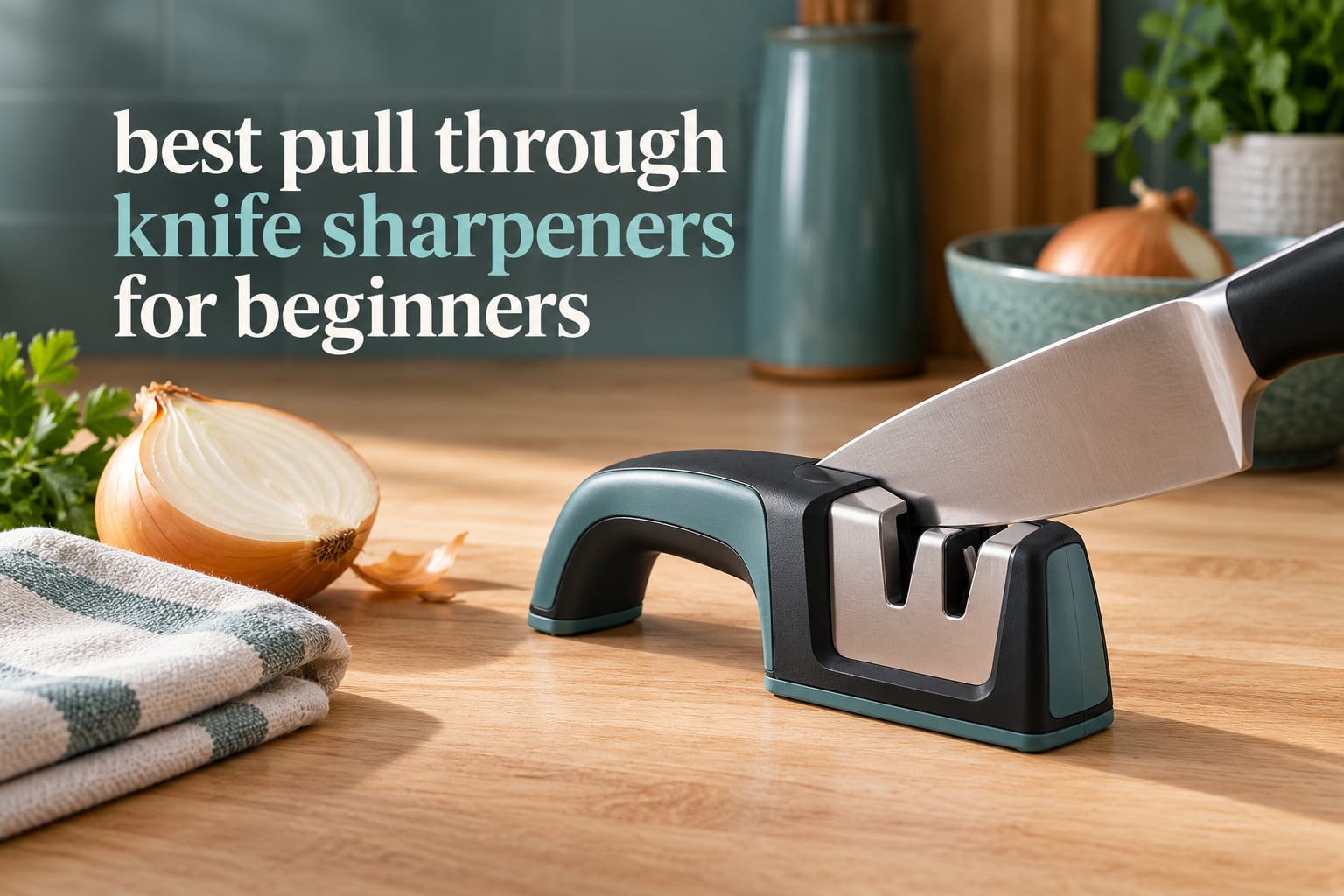
If you have just moved into your first kitchen, the knife block came with a set of blades and the edges stopped slicing onions, a pull through knife sharpener is the fastest fix. You draw the blade through a slot lined with carbide, ceramic or diamond, and the slot sets the angle for you, so there are no stones to soak, no clamps to set and no technique to learn first.
That simplicity is also the reason experienced sharpeners argue about these tools. A pull through knife sharpener grinds metal away rather than merely straightening a rolled edge, and it does so at whatever angle the tool was built to. Get the match right and it is genuinely the easiest sharpener a beginner can own. Get it wrong and you can work a premium edge down to a bevel it was never made with.
We compared ten of the most-used pull through models for 2026, from a two-slot counter unit to a pocket-sized keychain tool, and tested them on the things beginners actually sharpen: dull straight-edge knives, serrated bread knives, pocket knives and household shears. Ten products, all diamond, carbide or ceramic slot designs, judged on how many passes a very dull edge needs, how stable the unit sits, and whether the abrasive can be replaced when it wears out.
If you want the wider field, we also cover the best knife sharpeners for a kitchen and the best ceramic knife sharpeners, but this guide stays narrow: manual pull through sharpeners that a first-time owner can pick up and use correctly on day one.
Top 3 Picks for Beginner Knife Sharpeners in 2026

KitchenIQ Diamond Deluxe 2-Stage
- Diamond coarse slot
- ceramic fine slot
- V edge grip
- Works on serrated blades

AccuSharp Ergonomic Handheld
- Diamond-honed tungsten carbide
- Reversible blades
- Finger guard
- Dishwasher-safe

Chef’sChoice Diamond 2-Stage
- Diamond abrasives in every stage
- 15 and 20 degree control
- Polishing stage
- 10 year warranty
The KitchenIQ is the pick we hand to almost anyone, because a coarse diamond slot and a fine ceramic slot cover both a neglected knife and a merely tired one, and the review history behind it is enormous. The AccuSharp is the simplest possible introduction, one guarded carbide stage and no settings at all. The Chef’sChoice is the one to buy when edge quality matters more than convenience, since every stage is diamond abrasive and it holds both 15 and 20 degree bevels.
Best Pull Through Knife Sharpeners for Beginners in 2026
| Product | Specifications | Action |
|---|---|---|
| KitchenIQ 50825 Diamond Deluxe 2-Stage |
|
Check Latest Price |
| AccuSharp Ergonomic Handheld |
|
Check Latest Price |
 Smith’s CCKS 2-Step Keychain Smith’s CCKS 2-Step Keychain |
|
Check Latest Price |
| Chef’sChoice Diamond 2-Stage |
|
Check Latest Price |
 Smith’s Jiffy-Pro 50185 Smith’s Jiffy-Pro 50185 |
|
Check Latest Price |
 Smith’s Adjustable S-50264 Smith’s Adjustable S-50264 |
|
Check Latest Price |
 Wusthof 2-Stage Hand-Held Wusthof 2-Stage Hand-Held |
|
Check Latest Price |
 Henckels Handheld Two-Stage Henckels Handheld Two-Stage |
|
Check Latest Price |
 Lansky D-Sharp Lansky D-Sharp |
|
Check Latest Price |
 AccuSharp Compact 2-Stage AccuSharp Compact 2-Stage |
|
Check Latest Price |
A note on ranking before we get into the individual picks. We sorted these by how forgiving they are to a first-time user, not purely by star rating. A model with two stages, a stable base and a clear coarse-to-fine order scores higher here than a higher-rated single-stage tool that leaves a beginner guessing whether they are done.
Do Pull-Through Knife Sharpeners Really Work?
Yes, a pull through knife sharpener really works, but it sharpens rather than hones, and it only produces a good edge when the tool’s built-in angle is close to your knife’s bevel. A fixed or dial-adjustable slot holds the blade at a preset angle against a carbide, ceramic or diamond abrasive, and each pass grinds a little metal away to reset the edge. On a very dull Western kitchen knife pulled three or four times through a coarse stage and the same through a fine stage, it returns a genuinely usable edge in under a minute.
The catch is that the V-shaped slot can only remake an edge in its own image. A slot ground to a shallow angle will grind a steeper factory bevel thinner and thinner until the geometry no longer matches what the maker intended. On a 20 degree European chef’s knife that trade is usually invisible. On a Japanese single-bevel knife it can be permanent.
That is also the source of the confusion in a lot of online arguments. People think a pull through hones, because the motion looks like honing a knife on a steel. It does not. Honing straightens a rolled edge and removes almost no metal. Sharpening grinds. Every pull through pass is a sharpening pass, and treating it as maintenance is how beginners end up with knives that feel thinner than they remember.
How Many Times Should You Pull a Knife Through a Sharpener?
Three to four pulls per stage is the working rule, and light pressure matters more than the count. Most preset models are designed around that number, and reviewers consistently report that a heavy-handed first session removes far more metal than the same knife needed later.
- Coarse stage, three to four pulls. Lay the heel of the blade near the front of the slot and draw the whole blade through in one smooth motion, keeping the handle slightly raised so the edge stays seated. Wipe the blade before moving on.
- Fine stage, three to four pulls. Use the same motion at the same pace. If you skipped the coarse stage because the knife was only slightly dull, run the fine stage alone and stop.
- Stop and inspect. Slice a sheet of paper or a ripe tomato. If it bites cleanly, you are finished. Extra passes past that point are pure metal loss.
Two habits separate a clean result from a ragged one. First, wipe the blade between stages so loose swarf does not drag across the fresh edge. Second, if you can see a wide band of coarse scratches after the fine stage, you almost certainly pushed too hard on the coarse stage rather than needing more fine passes.
On a countertop model, brace the base with your other hand and let the tool do the work. On a handheld model, hold the handle in a full fist rather than pinching it, and let the guard or non-slip base take the reaction force instead of your fingers.
1. KitchenIQ 50825 Diamond Deluxe 2-Stage Sharpener – Best Overall for Beginners
- No technique needed
- two labelled stages cover dull and tired edges
- Compact enough for a small utensil drawer
- Non-slip base and soft-grip handle
- Handles straight and serrated blades
- Fine stage wears out and the whole unit gets replaced
- Sharpened edge fades sooner than a stone edge
- Must sit on a countertop rather than be held one-handed
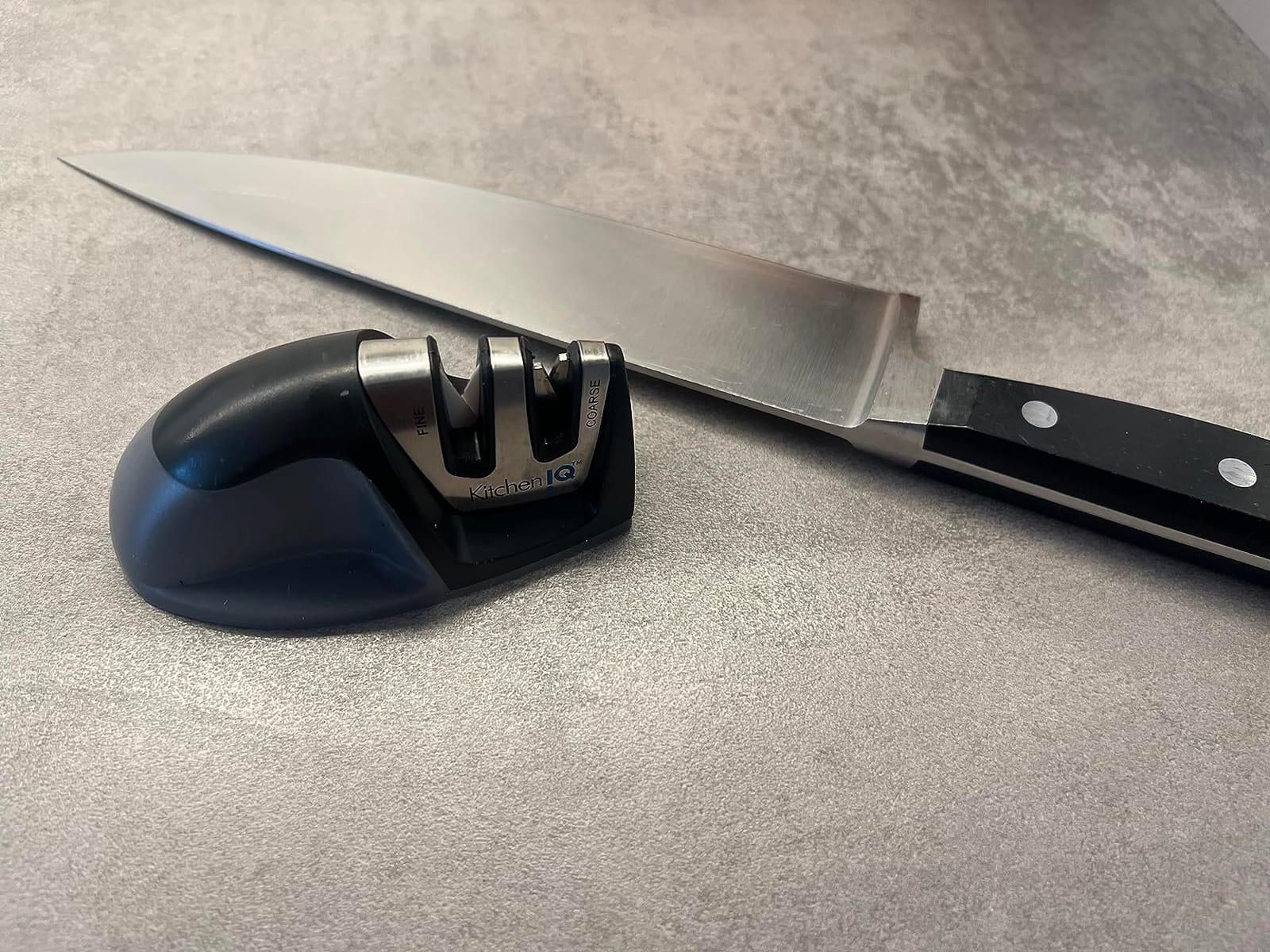
This is the one I put on the counter of a kitchen with someone who has never sharpened anything. The coarse slot is diamond-coated for dull and slightly damaged blades, and the fine slot is ceramic for finishing an edge that is already close. Two stages means you are not guessing which side of the unit to use, which is the single most common beginner mistake with a one-stage tool.
The patented V edge grip is a small thing that changes the whole experience. The base hangs over the edge of a countertop so you can see the blade and both slots clearly instead of craning over a flat surface. Reviewers also point out that the correct order matters, and the honest answer is that skipping the coarse slot on a genuinely dull knife leaves you disappointed.
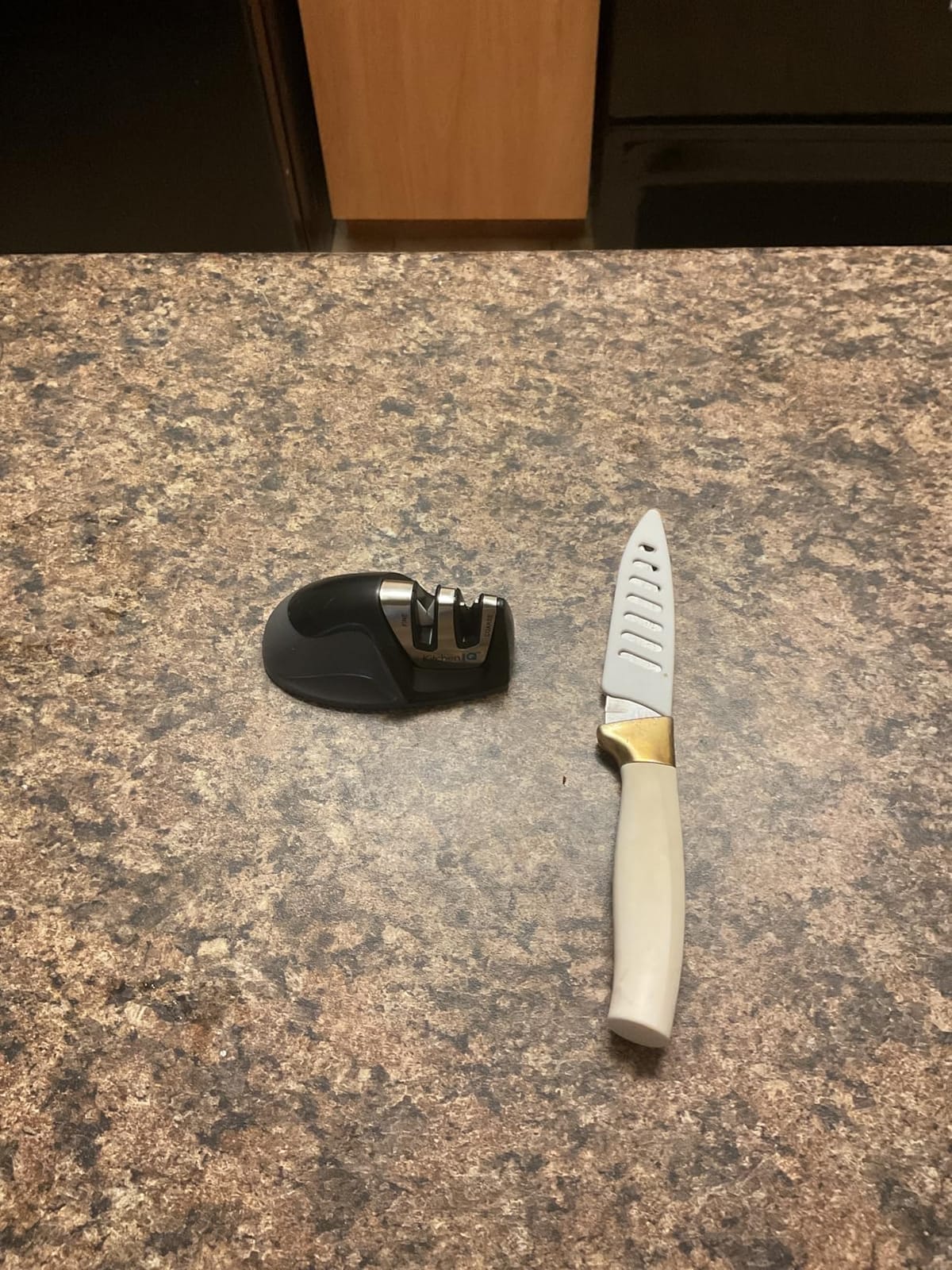
What I do not love is the end of the life cycle. The fine ceramic stage wears out, and there is no way to swap just that component, so the whole unit is replaced. Owners also report that an edge from this sharpener fades faster than one from a stone, which tracks with how much coarser work the ceramic stage is doing relative to a fine whetstone. The edge is still perfectly good for weeknight prep.
At under two ounces and just under four inches long, it disappears into a drawer. That matters more than it sounds: a sharpener you have to hunt out on the counter gets used, and one that lives in a cupboard does not. We cover the broader kitchen sharpener field if you want a benchstone option alongside it.
Who this is good for
A first-time kitchen owner with an assorted knife block, a renter with a small counter, and anyone who wants one tool that handles both a neglected knife and a weekly touch-up. It also works on serrated blades, so a single unit covers your bread knife as well as your chef’s knife.
It suits hands that dislike fiddly mechanisms. There is nothing to set, no dial to read, no plate to clamp. The trade-off is fixed angles on both slots, so a very shallow or very steep edge on your knife will not be matched.
Who this is bad for
Owners of Japanese single-bevel knives, and anyone who wants a fine polished edge on a premium European blade. The fine stage is a ceramic rod, which refines an edge but does not produce the polished result you would get from a micron diamond stage or a stone.
It is also the wrong tool if you want to hold it one-handed. The design expects to sit on a surface, and a group of reviewers confirms that trying to use it in the air is uncomfortable and less safe. Heavy-handed users should still use fewer passes than the label suggests.
2. AccuSharp Ergonomic Handheld Sharpener – Best Value for Absolute Beginners
- Sharpens most blades in about ten seconds
- Highest average rating in this group
- Reversible carbide blades double service life
- Full finger guard makes it safe to learn on
- Dishwasher-safe
- Single stage with no fine ceramic finish
- Fixed angle cannot match a different blade grind
If the only thing standing between you and sharpening is the belief that it is a skill, this is the shortest path past it. Draw the blade through, keep the edge seated in the slot, and in about ten seconds you have a working edge. There is one stage, one slot, and nothing to configure. That is genuinely why it carries the highest average rating in this group.
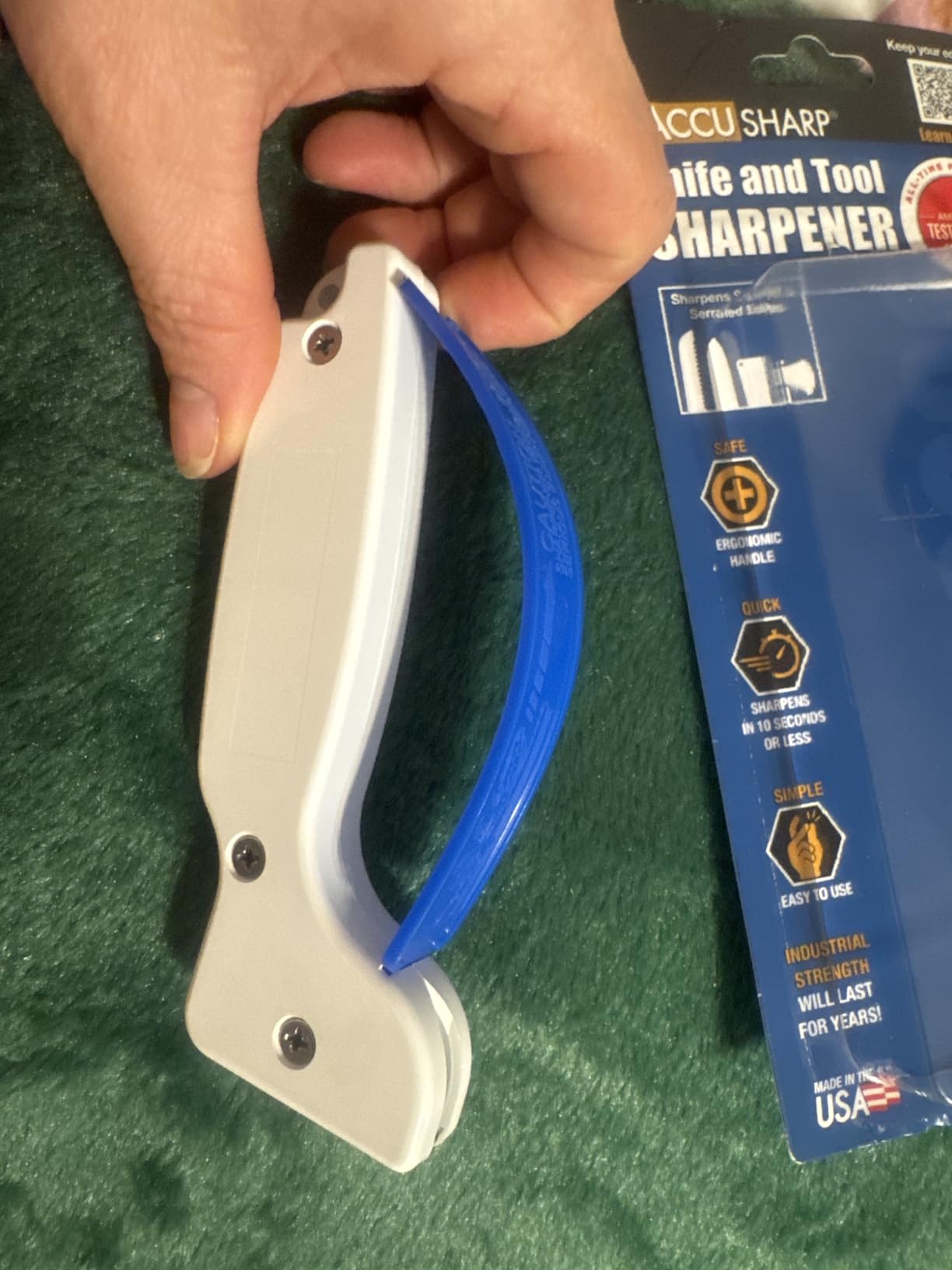
The carbide blades are diamond-honed, which is how they get the bite needed to fix a knife that has been sitting in a drawer since spring. The reversal trick is the detail that wins over most owners: when one side of the carbide wears dull, you flip the cartridge and get a second run of service out of the same tool. Owners report service intervals measured in years rather than months.
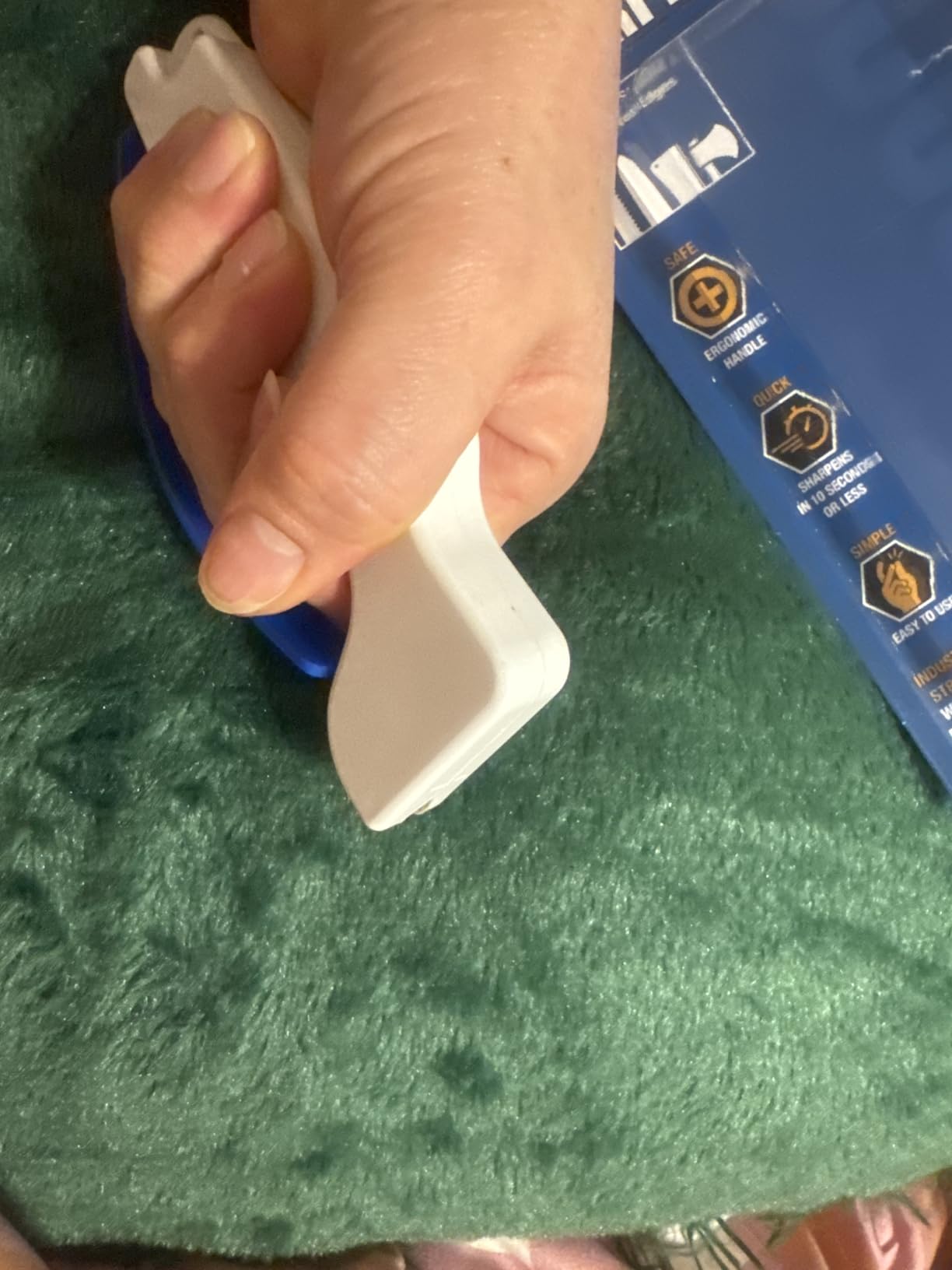
The full-length finger guard is the safety story here. New sharpeners are more likely to slide a blade than to be cut by it, and a guard that keeps a full hand-width between your fingers and the cutting path lets a beginner concentrate on the pull instead of on their own hands. The handle is also comfortable enough for repeated strokes, which matters when you are learning pressure control.
It handles more than you would expect for a single-stage tool, including chef’s knives, paring knives, serrated blades, filet knives and cleavers. It is also the one I would hand to someone who wants to practise technique cheaply, which is the single most repeated piece of advice across the sharpening forums: learn the motion on a knife you do not care about.
Who this is good for
Anyone who wants the shortest possible path from a dull knife to a working edge, and anyone who values a five-to-ten-year service life over a polished finish. It is also the right first tool for a family that wants one sharpener shared between kitchen knives, pocket knives and a fillet knife.
Because the abrasive is fixed and reversible rather than consumable, it suits households that sharpen occasionally and do not want to track when a cartridge ran out. Dishwasher-safe construction means cleanup is not a reason to stop using it.
Who this is bad for
Anyone chasing a refined edge. With no fine stage, the carbide leaves a working edge rather than a polished one, which is fine for chopping vegetables and not what you want on a sashimi knife or a high-end European chef’s knife.
It is also the wrong choice if your knives have unusual grinds. The sharpening angle is fixed and not adjustable, so a knife beveled at a different angle gets its edge thinned down to match the slot. For a matched set of knives from one maker at a standard bevel, that is a non-issue.
3. Smith’s CCKS 2-Step Keychain Sharpener – Best for Travel and Pocket Knives
- Small and light enough for a keyring or tackle box
- Two preset stages need no technique
- Floats in water for cleaning around water
- Lanyard hole for keychain or pack attachment
- Non-slip rubber feet
- Small housing is awkward on large chef's knives
- Fixed preset angles cannot be adjusted
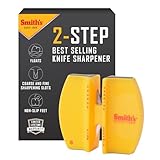
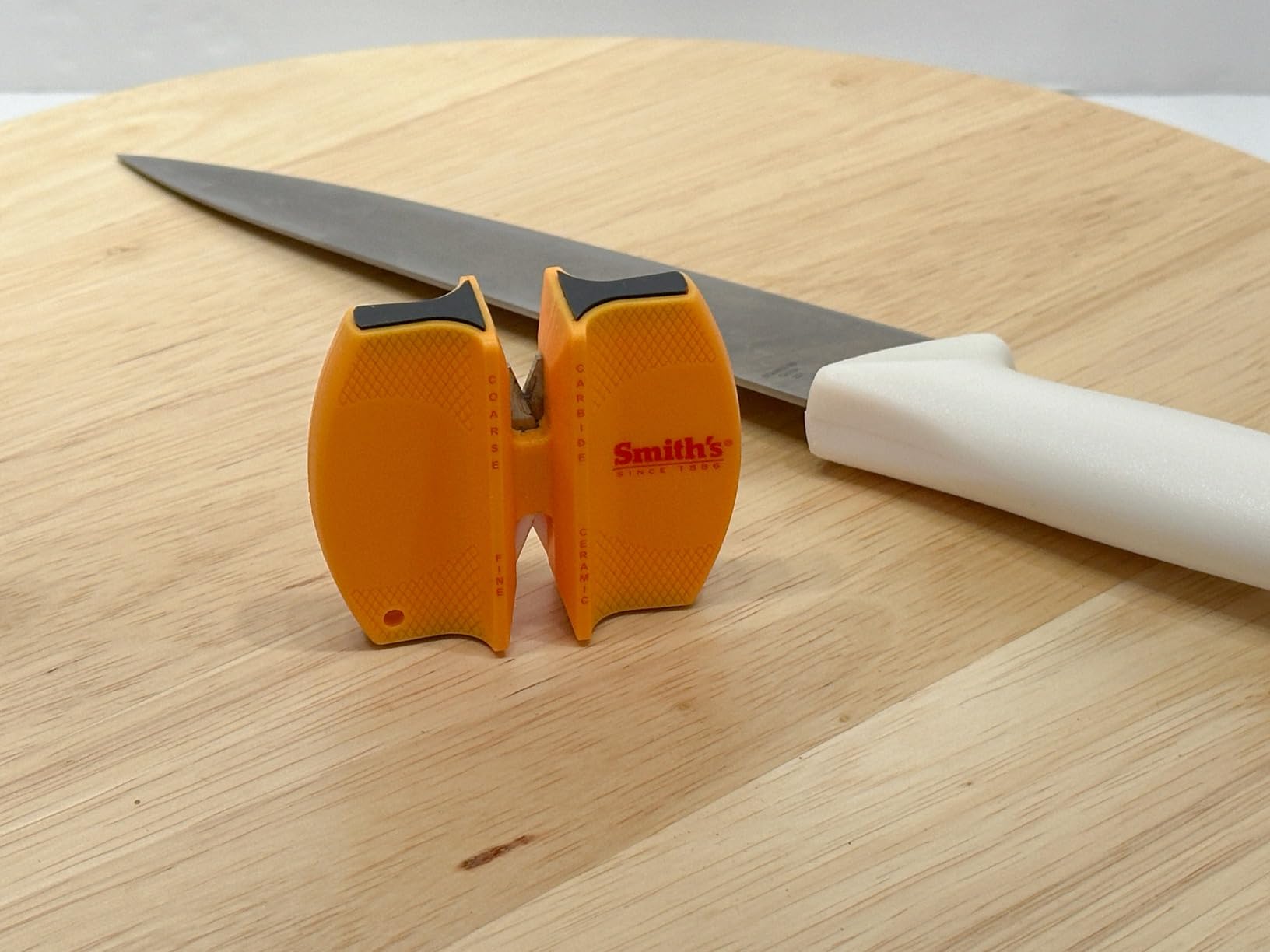
This is the one to clip to a backpack if your knives travel. It measures just over two and a half inches in both directions and weighs under two ounces, and it still has two stages: crossed tungsten carbide for setting a dull edge and crossed ceramic rods for finishing one that is merely tired. The preset angles mean three to four strokes per slot, according to the design.
The crossed-rod geometry is the reason it works as well as it does on small blades. Rather than a flat abrasive face that scrapes, the rods bite on either side of the edge as it passes, so a short fillet knife or a pocket knife gets an even bevel instead of one flat scrape on one face. Fillet, pocket and hunting knife owners are the most enthusiastic group here.
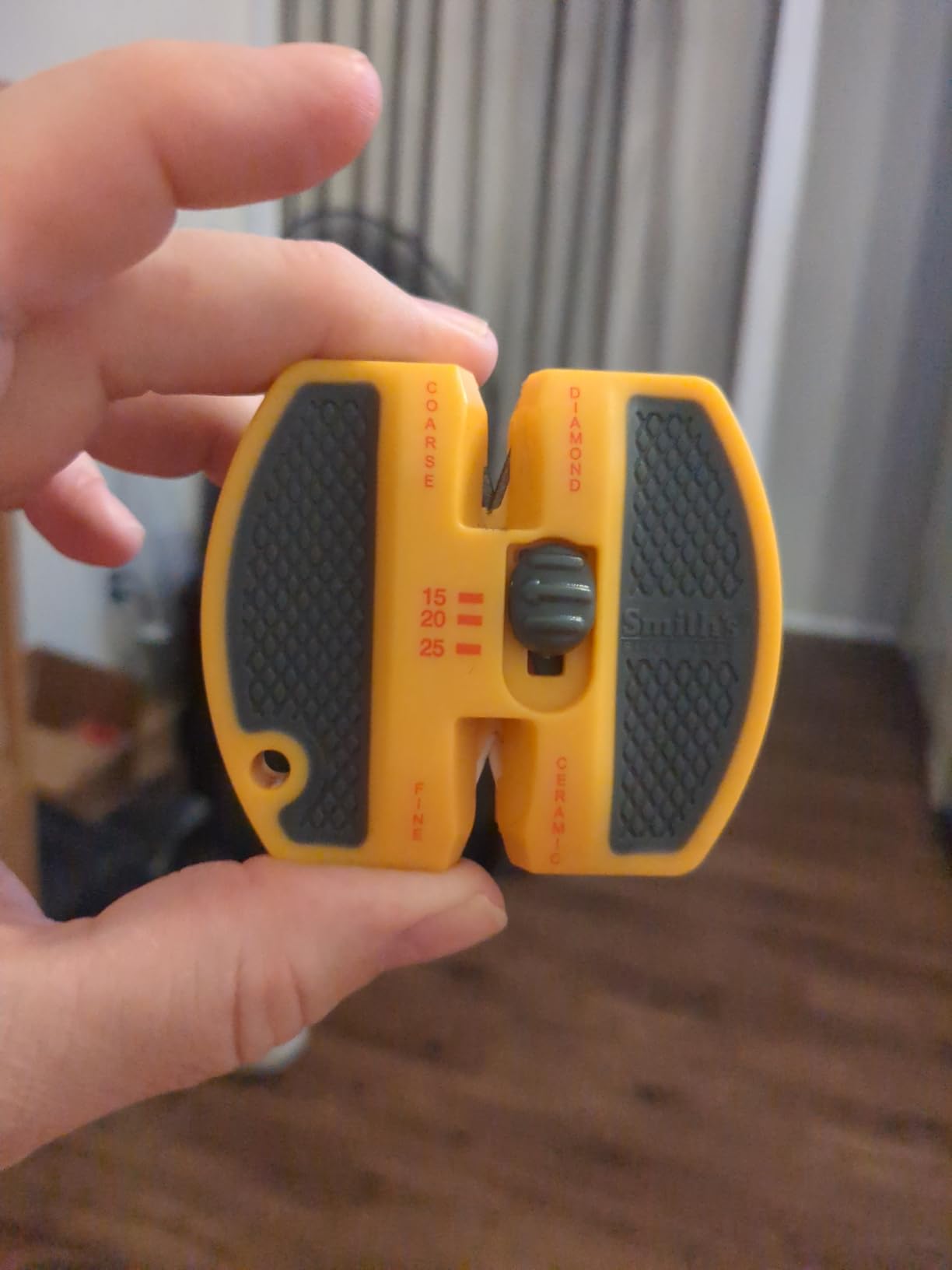
Two details make it a genuinely portable tool rather than a small gimmick. It floats, so if you drop it in a sink, a lake or a boat’s bilge you can retrieve it, and the lanyard hole lets it live on a keychain so it is present when a knife dulls on the trail rather than back at home in a drawer. The rubber feet keep it from skating on a wet dock or a boat deck.
Cleaning is a damp cloth, not a soak, which suits an outdoor kit far better than a stone that needs water and drying time. Between the two stages you wipe the blade, and the whole routine takes under a minute.
Who this is good for
Hunters, anglers, campers, boat owners and anyone who sharpens away from a kitchen counter. It is also a sensible first gift for a new cook who cooks from a small apartment, because the footprint is trivial and the tool disappears into a drawer or a bag.
It suits someone sharpening several pocket knives and fillet knives regularly, since the crossed carbide slot is well matched to short, thin blades. The two stages also mean it can do light touch-up duty on a serrated blade without needing a separate tool.
Who this is bad for
A twelve inch chef’s knife or a pair of large kitchen shears. The housing is genuinely small, and owners consistently note that long blades feel cramped and hard to keep seated in the slot. If your kitchen work is the only thing you sharpen, this is a backup rather than a primary tool.
Fixed preset angles are the other limitation. That is fine for the pocket and hunting knives this unit is aimed at, but it will not adapt to a knife ground at an unusual bevel.
4. Chef’sChoice 4643009 Diamond 2-Stage Sharpener – Best Edge Quality
- Diamond abrasive in every stage for a finer edge
- Precise 15 and 20 degree control for European blades
- Separate polishing stage builds a durable arch edge
- Sharpens both bevels at once
- Backed by a 10 year warranty
- Bulky and heavier than typical pull through models
- Takes more counter space than a compact slot unit
This is the one to buy if you have already owned a cheap pull through and concluded that the whole category produces a toothy edge. That impression is often accurate for carbide-only designs, and this one is built differently. Every stage uses 100 percent diamond abrasive, including a micron-sized diamond polishing stage that comes after the sharpening stages.
Separate sharpening and polishing stages are the reason the edge holds. Most two-stage pull throughs finish on a ceramic rod, which refines but does not polish. A micron diamond stage removes the burr that a rod leaves behind and leaves an arch-shaped edge that is stronger at the tip and more durable through ordinary use. Owners consistently report that the edge stays sharp longer between sessions.
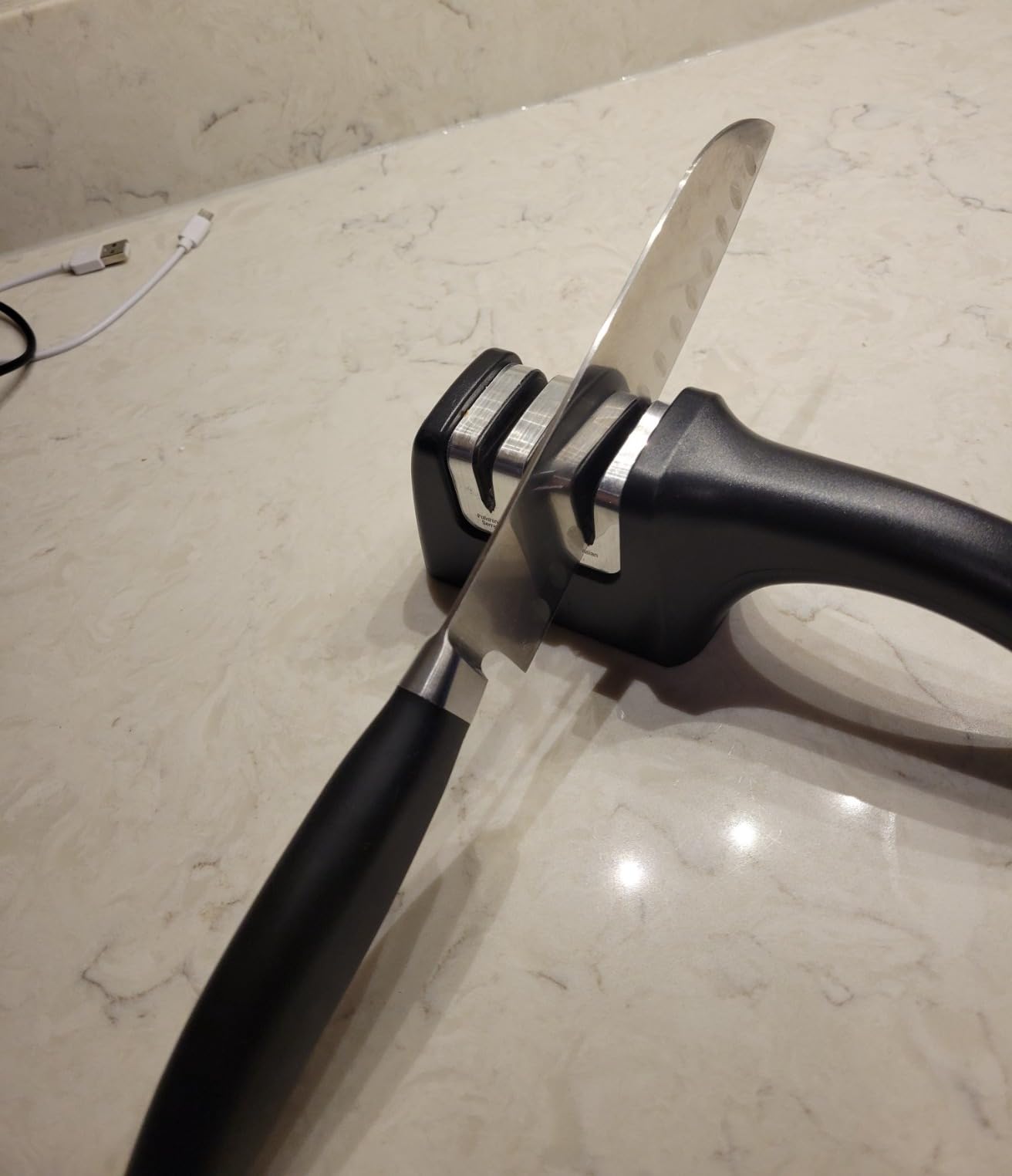
The CrissCross system sharpens both bevels in a single pass rather than working one face at a time, and the angle control is set for 15 and 20 degree edges, which covers most European kitchen knives including thinner German and French bevels. The 10 year warranty is the longest stated coverage in this group and the one detail that most reduces the hesitation around spending more on a sharpener.
At just over nine inches long and eight ounces, this is the biggest handheld unit here, and it wants real counter space. That is the honest cost of a better edge: you get a diamond polishing stage, and you give up the ability to slip it into a drawer the size of a spice rack.
Who this is good for
A cook who owns a good European chef’s knife and is disappointed that cheap pull throughs leave a rough edge. It suits anyone sharpening regularly enough that edge durability matters, and anyone with a 15 degree bevel that a 20 degree slot would thin down too aggressively.
It is also a reasonable choice for sharpening sporting and pocket knives alongside kitchen blades, because the fine diamond stage is kinder to a hard modern stainless than a coarse carbide pass would be. The warranty makes it an easier purchase for a gift buyer.
Who this is bad for
A small kitchen, a renter who does not want a device occupying counter space, and anyone sharpening mainly very small blades. The length and weight are real, and the bulk is the most common complaint owners raise.
It is also not a whetstone substitute. If your goal is a mirror finish on a single-bevel Japanese knife, no pull through at any price gets you there, and this unit is no exception. Practice on a knife you do not mind before you point it at something expensive.
5. Smith’s 50185 Jiffy-Pro Handheld Sharpener – Best for Shears and Scissors
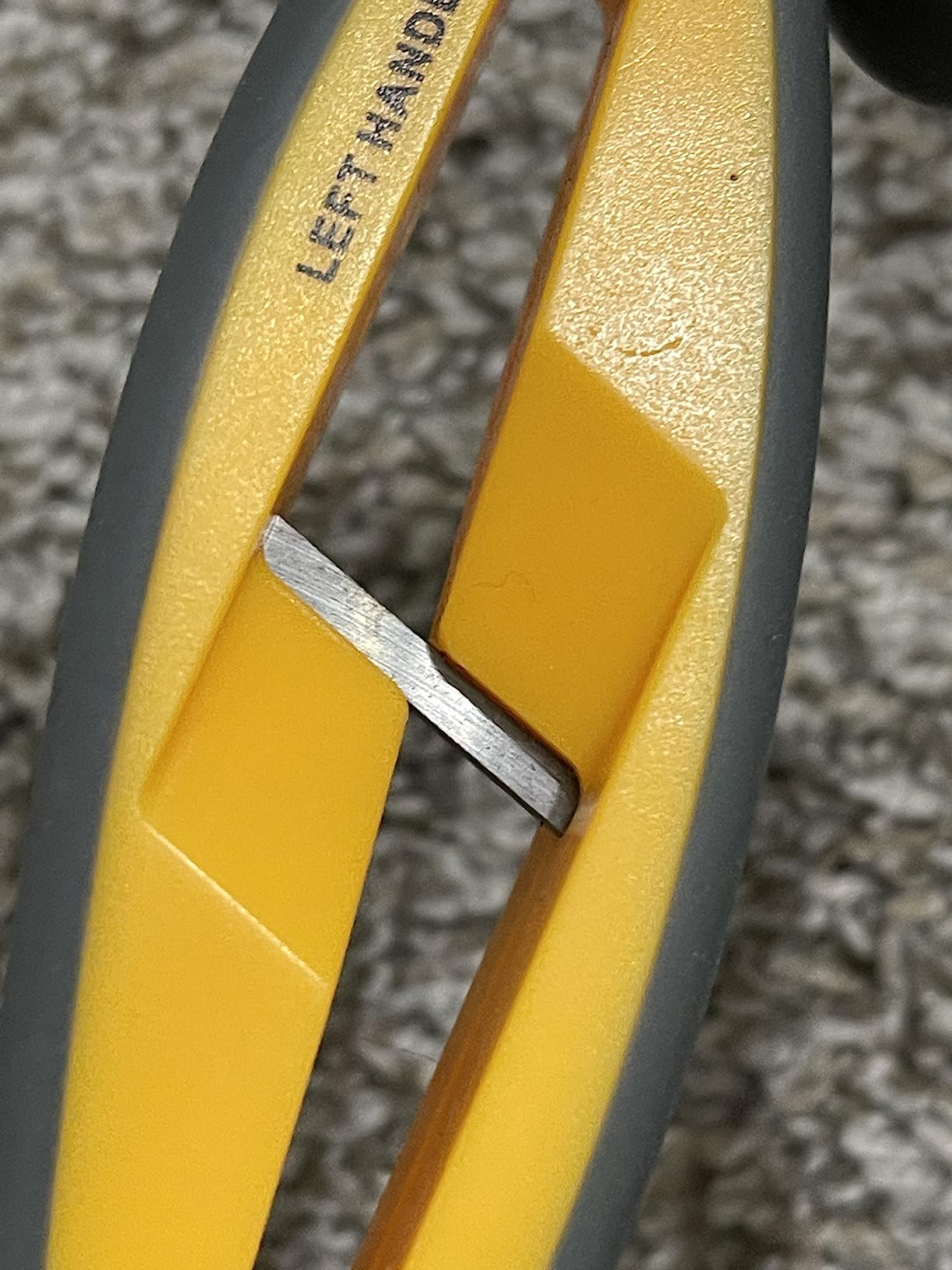
- Integrated scissor sharpener works on both hands
- Dull household shears cut cleanly again in a few passes
- Enlarged slots fit game and fishing shears
- Full finger and thumb guard
- Clips to a backpack or belt
- Carbide stage is harsh under heavy pressure
- Scissor position takes practice to get comfortable
Most pull through sharpeners are knife tools that happen to survive a serrated blade. This one was designed around a gap that kitchen owners notice constantly: dull kitchen and utility shears. The scissor sharpener is built into the handle, works on either hand, and uses a ceramic rod that sits at the angle of the shears rather than a slot set for a knife bevel.
Owners report dull household shears cutting cleanly again after a few passes, which is a visible before-and-after result that no knife test can match. The enlarged slots also accept game, hunting and fishing shears that smaller cross-section tools cannot take, which makes this a genuinely two-tool purchase in one housing.
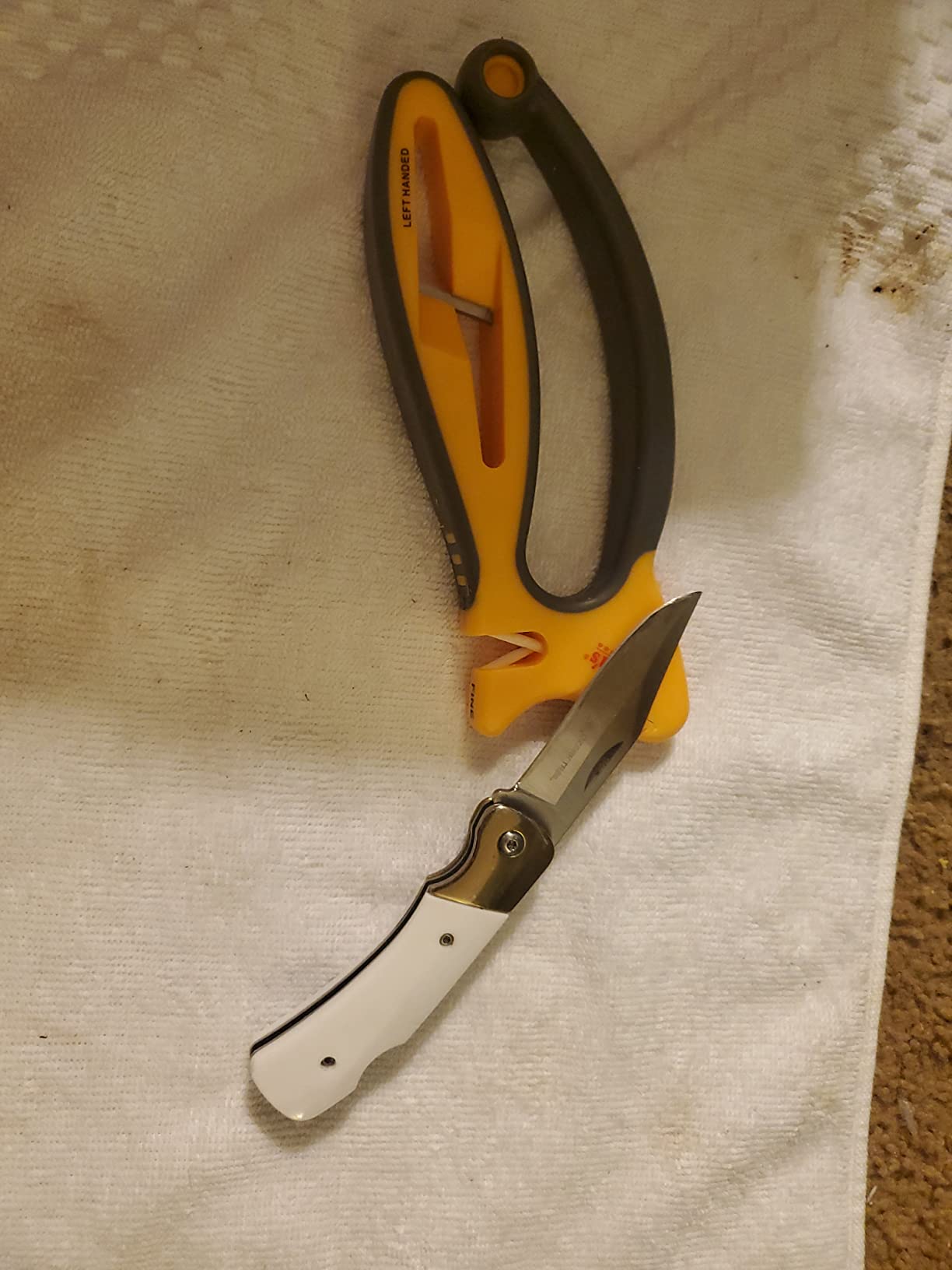
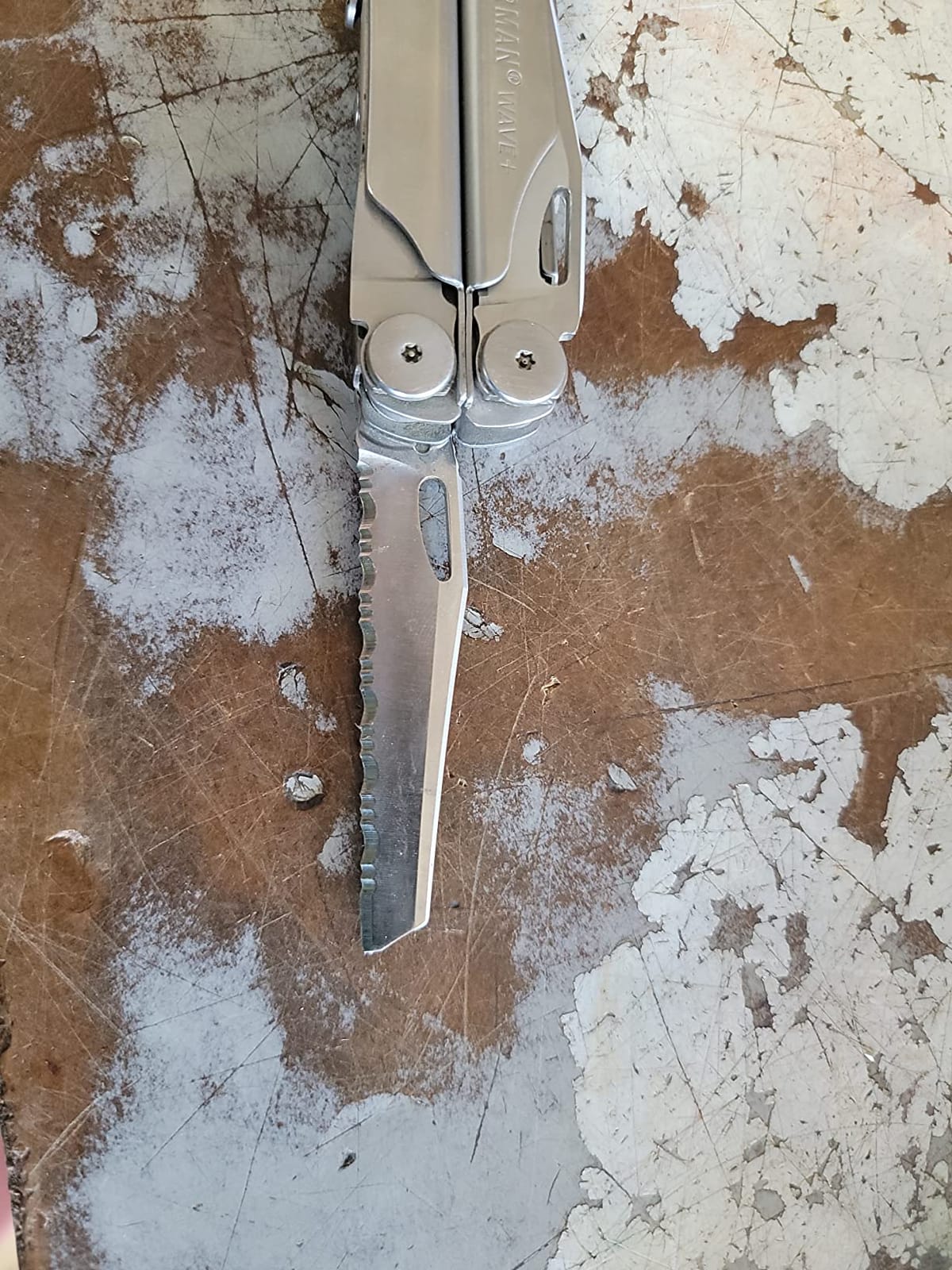
As a knife sharpener it is a capable two-stage handheld: crossed carbide sets the edge and ceramic rods finish it. The full-length finger and thumb guard is a real safety benefit for beginners, and the handle clips to a belt or pack, so it lives where you already carry a knife. The build feels more substantial than a thin plastic keychain tool.
The caution is the carbide stage. A minority of owners report that pushing hard leaves a rough, chipped edge that costs more blade length than the job required. Light strokes and a straight wrist fix it, but it is the one thing to watch on this model.
Who this is good for
Households that actually cut with shears: poultry shears, kitchen shears, pruning shears and craft scissors. It is also a good fit for someone who sharpens outdoors, since the scissor stage covers the tool they always forget to bring.
It suits a beginner who wants a guard. Between the full-length guard and the two separate slots, there is less chance of a slip than with a narrow keychain unit, and the guard leaves room for an included glove if you use one.
Who this is bad for
Anyone whose priority is a fine, smooth edge on a premium knife. The carbide stage is an edge-setter, not a refiner, and a stone is the right tool for a smooth finish on a valuable blade.
The scissor position also feels awkward for the first few attempts, because the shear has to sit in a narrow slot at a specific angle. Budget a couple of practice cuts on a pair of old shears before judging it.
6. Smith’s S-50264 Adjustable Manual Sharpener – Best Adjustable Angle
- Six angle settings match different knife grinds
- Separate fixed slot handles serrated blades
- Replaceable carbide and ceramic parts
- Soft-grip handle and non-slip base
- Longer and bulkier than a simple two-slot model
- The angle knob adds a setting beginners must understand
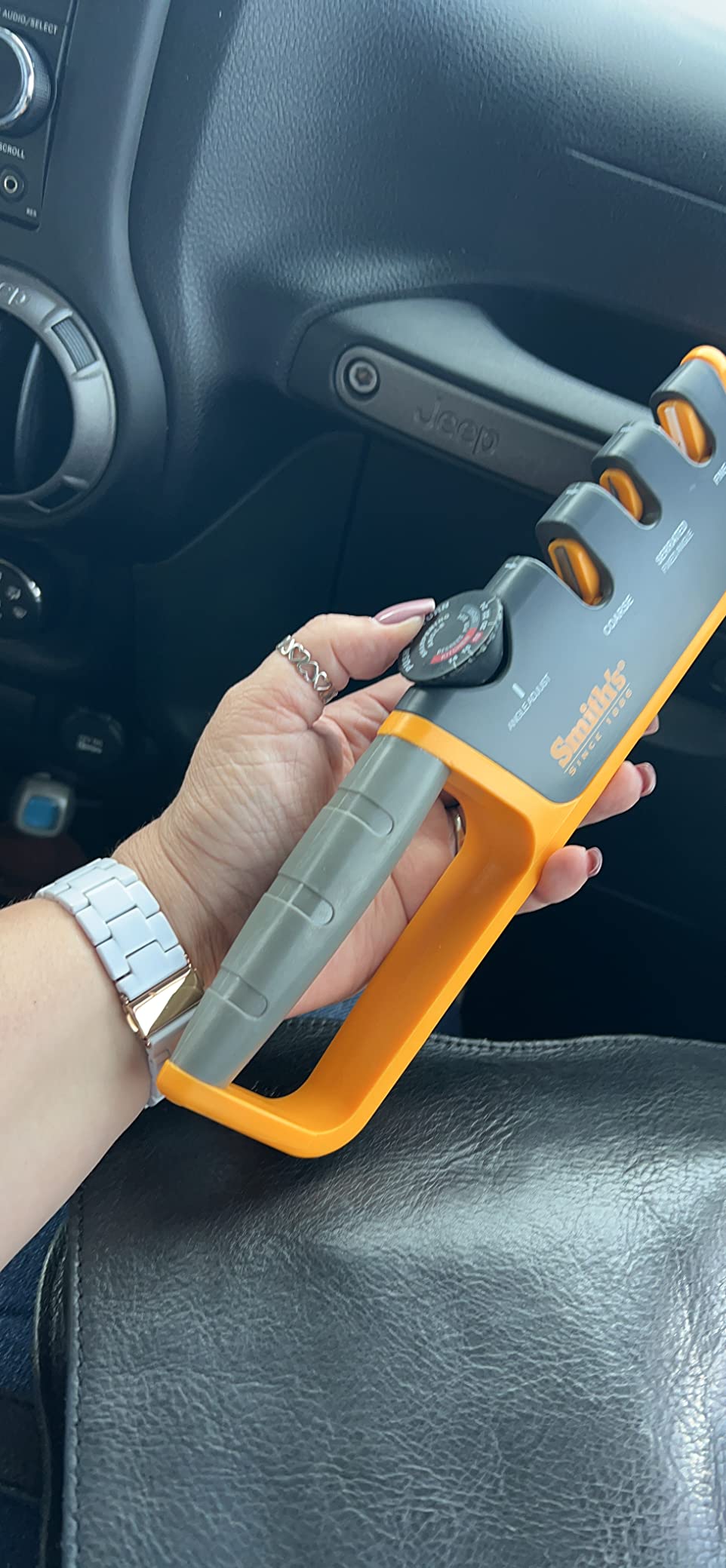
A fixed slot is only correct for the knife it was designed around, and this is the fix for anyone who owns blades with different grinds. A turning knob selects between six angle settings spanning 14 to 24 degrees, and the coarse and fine slots grind both sides of a straight-edge blade at whatever angle you chose. That covers the shallow bevels on European knives and the steeper ones common on Asian blades.
The second slot matters just as much. It is a fixed-angle slot for serrated edges, so the tool handles your bread knife without you having to think about which setting to use. Several owners note that this is the feature that keeps the unit on the counter rather than in a drawer once they own more than one knife.
The replaceable carbide and ceramic components are a genuine long-term win. Rather than discarding the whole tool when the abrasives wear, you swap the inserts. Owners who sharpen several times a week tend to notice this most, and it removes the main cost argument against buying a larger unit.
The honest drawback is size and complexity. At nearly eleven inches it is the longest handheld model here, and the angle knob introduces the one decision a beginner was trying to avoid. Get that wrong and you will grind a correct bevel down to a wrong one, which is worse than not having the option at all.
Who this is good for
Anyone whose knife collection has mixed grinds, or who has already burned a correct edge with a fixed-slot sharpener and wants to stop repeating the mistake. It is the most flexible option here for fillet, pocket and hunting knives of different angles.
It suits a household that sharpens often enough to care about consumable costs, because the inserts are replaceable. The soft-grip handle and non-slip base also make longer sessions more comfortable than a bare plastic tool.
Who this is bad for
Your first knife, if you only own one. The dial exists to solve a problem you probably do not have yet, and 20 degrees is a safe default for a standard Western kitchen knife. Add the length and you are carrying a larger tool for a small job.
It is also not the right tool for very small blades, where the long body is awkward to control, or for anyone who wants to sharpen away from a counter. The adjustability is worth nothing if you cannot set it down and brace it.
7. Wusthof 2-Stage Hand-Held Sharpener – Best Matched to Its Own Knives
- Almost foolproof draw-through operation
- Pre-set angle matches the brand's own blade geometry
- Two stages cover a dull knife then refine it
- Non-slip base holds the unit steady
- Backed by a lifetime warranty
- Fixed 34 degree angle is a poor match for 15 degree blades
- Coarse carbide stage is not ideal for an already-good premium edge
- Some owners prefer a moist whetstone for long-term edge control
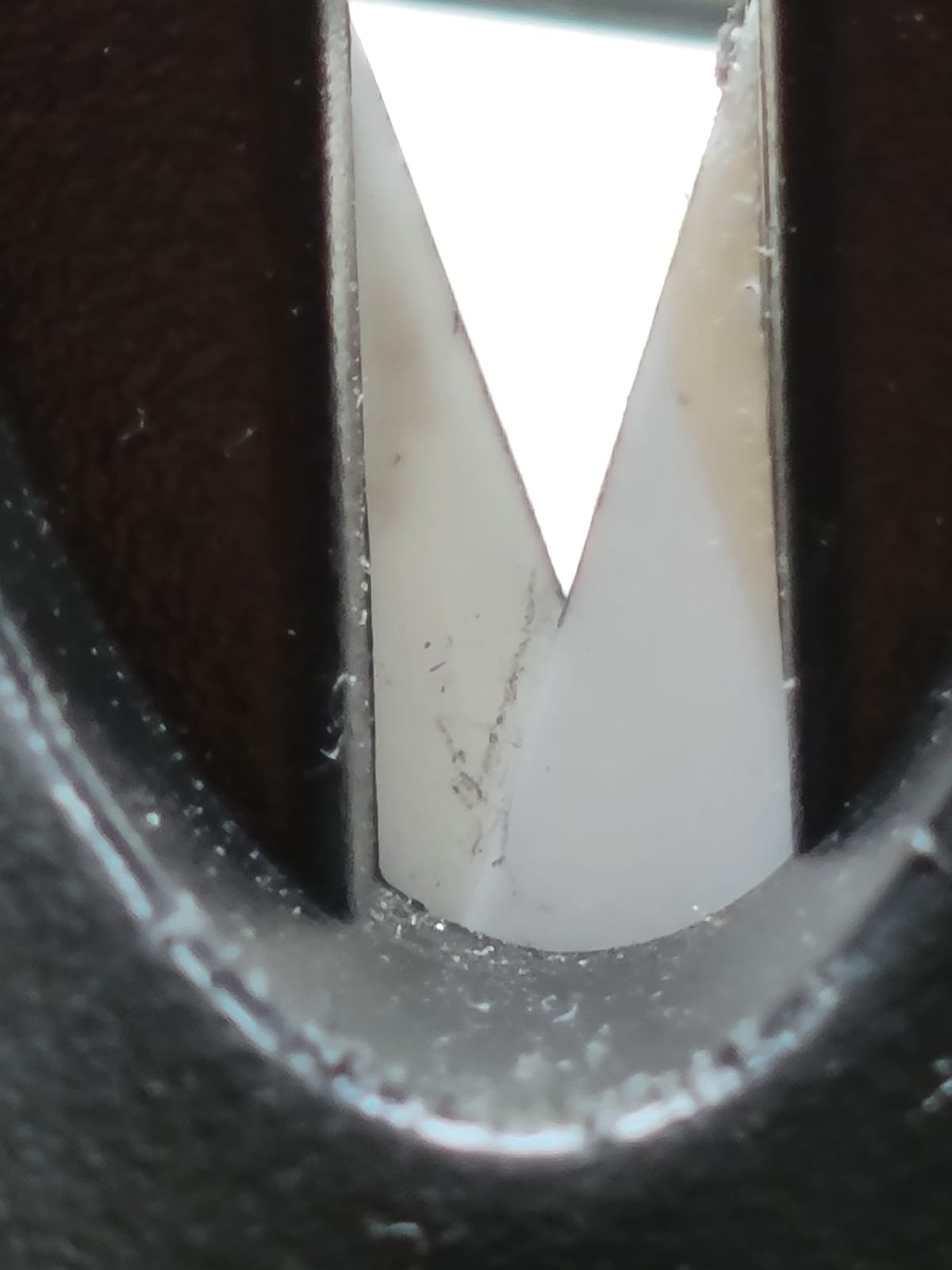
Wusthof builds this to match its own knives, and owners of that brand are the most enthusiastic users. If your set is Wusthof, the pre-set 34 degree guide angle is exactly the geometry your blades were made with, so you are reinforcing the factory edge rather than re-cutting it. That is the most favourable case a fixed-angle pull through can have.
Operation is a straightforward draw-through at a 90 degree angle to the unit, with stage one carbide abrasive wheels setting the edge and stage two ceramic slats finishing it. The E-Z grip handle and non-slip base do the work of keeping the unit steady, so the stroke is a straight pull with no technique to learn.
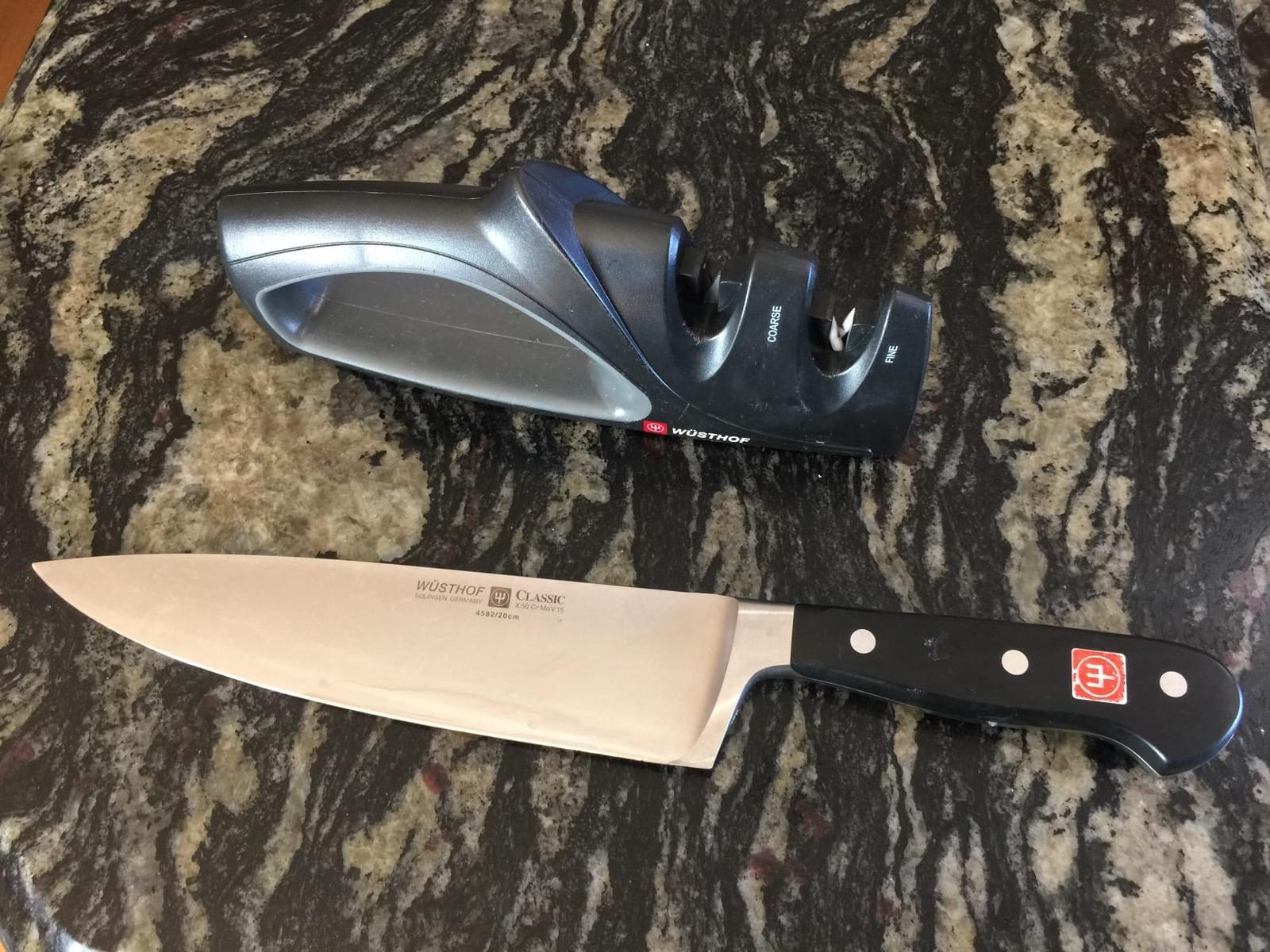
Two product details are worth weighing. The first is the lifetime warranty against manufacturing defects, which is the broadest stated coverage in this group and removes the main hesitation for a gift buyer. The second is that this is a 238 gram tool at nine inches long, so it is not a pocket option and it wants a flat surface under it.
The reviews are unusually clear-eyed about the limitation: the preset 34 degree angle is wrong for 15 degree European blades, and running a shallower knife through it produces heavy shavings. Owners of mixed knife sets are the ones who push back, and their advice is to use the coarse stage sparingly on an edge that is already good.
Who this is good for
Owners of Wusthof knives who want a matching companion sharpener, and anyone who wants a tool with a lifetime warranty behind it. The handle and base make it comfortable for repeated strokes, which helps a beginner learn light pressure.
It suits a gift for someone who already owns quality European knives and will keep them for years. The warranty means the tool itself is a low-risk purchase compared with an entry-level unit you might replace in a couple of years.
Who this is bad for
Owners of 15 degree blades, where the 34 degree guide will over-work the edge. If your knives are German, French or Japanese thin-bevel steel, this is the wrong preset and no amount of light pressure fully solves it.
It is also a poor choice for routine maintenance, because the coarse carbide stage is not a honing tool and using it on an already-good premium edge removes metal you did not need to lose. For a matching brand set only.
8. Henckels Handheld Two-Stage Sharpener – Best Labelled Design for New Cooks
Henckels Handheld Knife Sharpener, Easy to Use, Ergonomic Non-Slip Handle
- Restores sharpness in a few passes
- Labelled slots cut down guesswork for beginners
- Safety grip keeps fingers out of the blade path
- Rubberized base holds steady on the counter
- Printed instructions show the coarse and fine slots reversed
- Some owners find the resulting edge less sharp than expected
- Minimal instructions in the box
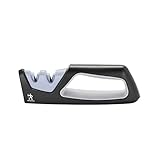
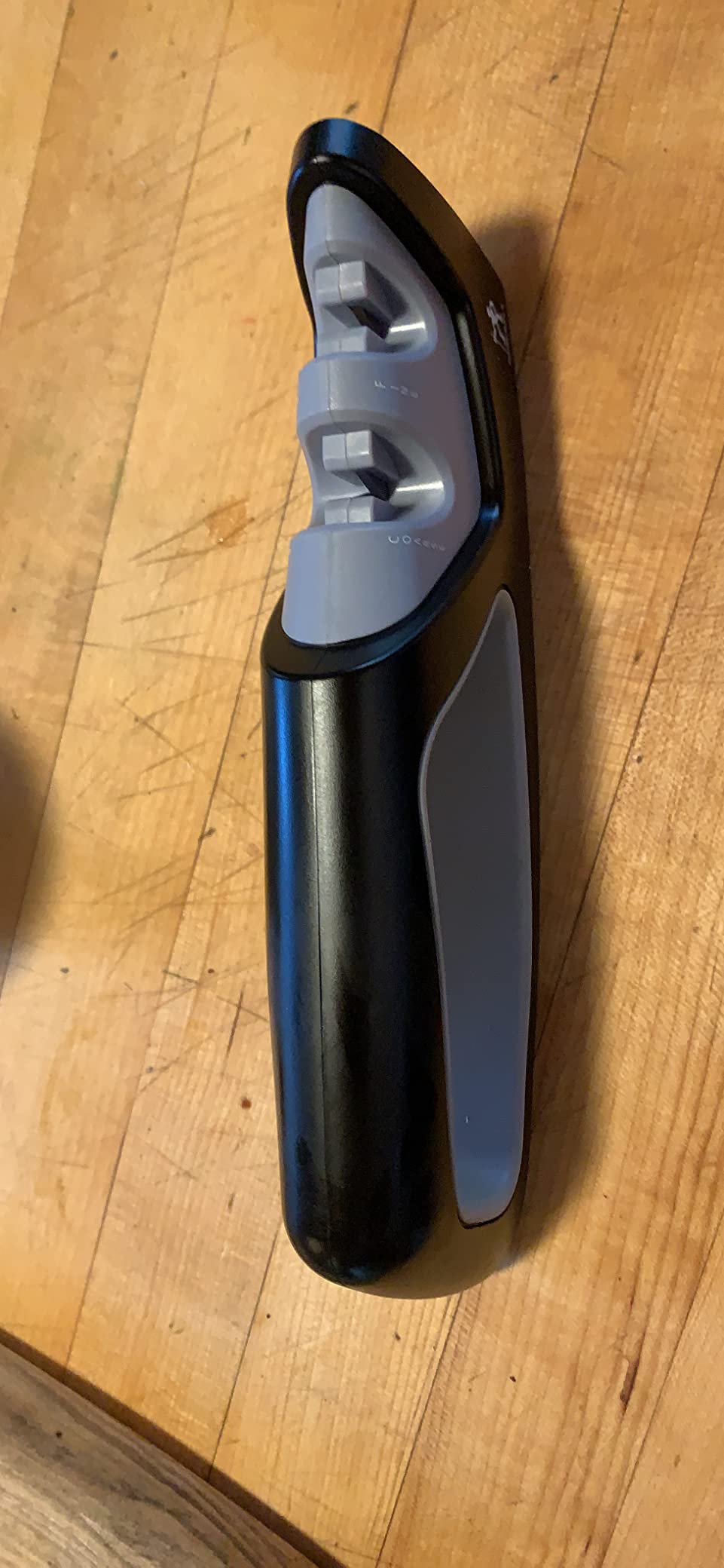
The design decision that stands out here is labelling. Both slots are marked, so a first-time user is not opening the box and guessing which end to start from. That sounds trivial until you read the complaint that shows up most often across pull through reviews, which is a beginner using the fine stage first on a very dull knife and deciding the tool does not work.
It is a two-stage manual design with coarse and fine ceramic grits, a contoured easy-to-hold handle and a unique safety grip that keeps fingers away from the blade path. The rubberized non-slip base holds the unit steady, which matters because a sharpener that skates is the fastest way to lose confidence as a new user.
Owners of Henckels knives tend to be delighted, describing it as the missing piece of their knife set. A few passes through the two slots take a dull blade back to usable, and the geometry suits the brand’s own knives, which is the same reasoning that makes the Wusthof a strong match for Wusthof steel.
Two caveats show up repeatedly. The printed diagram shows the coarse and fine slots the wrong way around, which is worth knowing before your first session rather than after. And a handful of owners find the resulting edge less sharp than they expected, which is a reasonable outcome from ceramic grits rather than diamond.
Who this is good for
A new cook who wants zero ambiguity, and anyone who values a physical safety feature over a soft-grip or an included glove. The safety grip is the quiet advantage here for a household where more than one person will use the tool.
It suits someone whose knives come from one brand, since the slot geometry is built to work with that ecosystem. At eight ounces and under nine inches, it stays a handheld counter or drawer tool rather than a pocket one.
Who this is bad for
Anyone who needs a fine polished edge, or who owns knives with mixed grind angles. The two-stage progression is useful but the abrasive choice is the limit on the finish.
It is also a poor choice if minimal instructions bother you, and it is worth confirming the slot order against the physical labels on your unit before your first pull, because the paperwork in the box is reportedly reversed.
9. Lansky D-Sharp Diamond Sharpening System – Best for Multiple Angles
Lansky D-SHARP Diamond Pull Through Quad Angle Knife Sharpener, Green (DSHARP)
- Four angles cover European
- Asian and axe bevels
- Round diamond rods shape an edge more gently than flat carbide
- Integrated ceramic benchstone removes burrs and adds polish
- Solid metal casing with thumb rest
- Small enough for a work bag
- Heavier than typical pocket pull through sharpeners
- Will not deliver the mirror finish of a full stone system
- Ceramic bar can arrive chipped
This one straddles two categories, and that is its strength. It has four selectable angles at 17, 20, 25 and 30 degrees, which covers thin European kitchen bevels, standard 20 degree blades, steeper hunting knife edges and hand axes. The pull-through slots use 600 grit medium diamond, and an integrated 800 grit ceramic benchstone handles final polishing and serrations.
Round rods are the detail worth understanding. Rather than a flat carbide face that scrapes one side at a time, the round diamond rods contact both sides of the edge as it passes, shaping a gentler and more even bevel. Owners who have used both describe it as a less aggressive tool on a good edge, which is exactly what you want if you also own knives you care about.
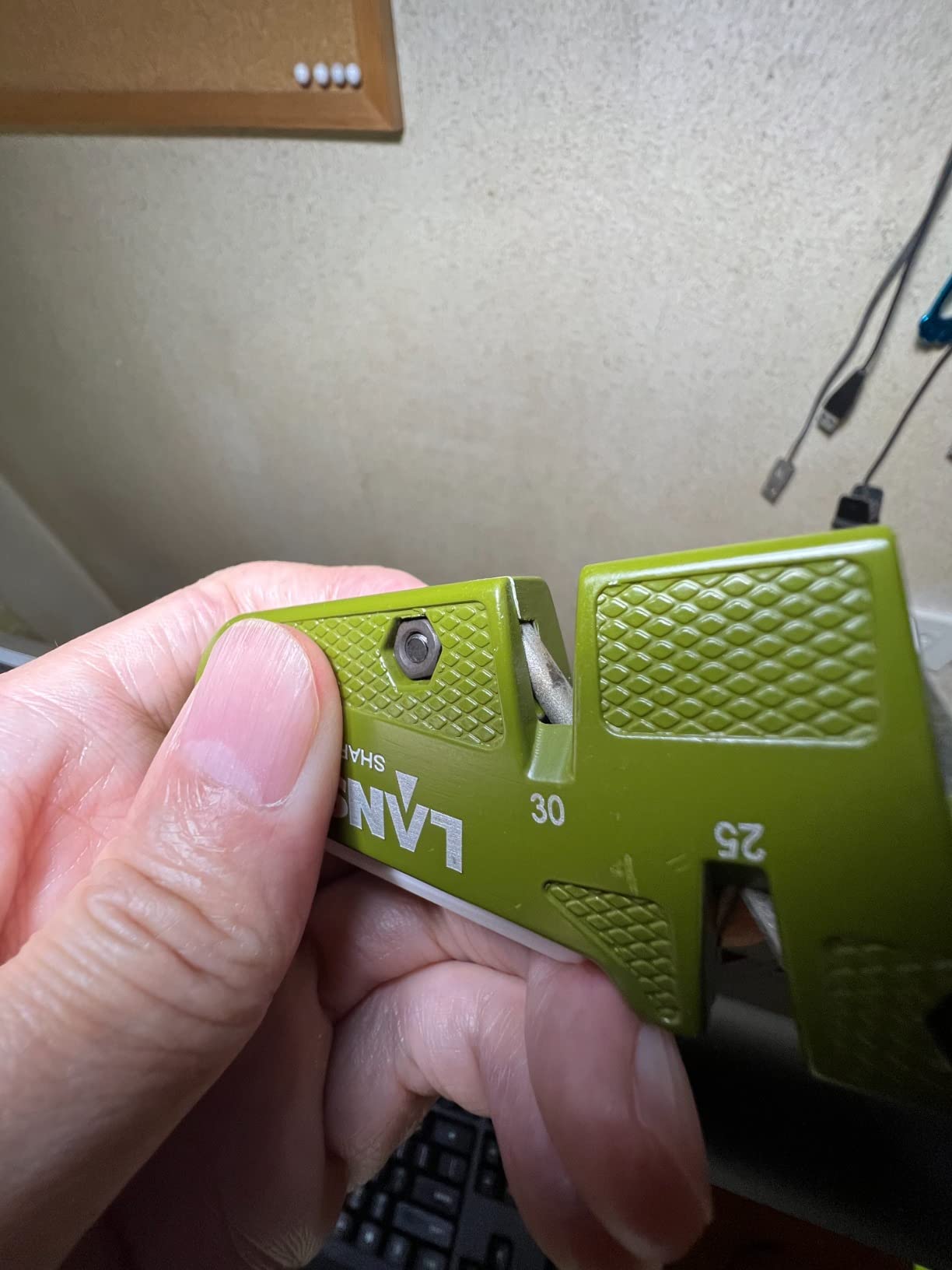
The build is a step up from plastic housings. It is a metal casing with a rubberized grip and a thumb rest, and long-term users report that the fasteners are still tight after a year of regular work and the diamond slots are still cutting effectively. That durability reporting matters more than star ratings when you are choosing one tool to keep.
The integrated benchstone is what makes it a system rather than a gadget. You draw the knife through the chosen slot to set the edge, then use the ceramic bar laid flat across the rubberized base to knock off the burr and add polish. It is a two-step routine that no pure pull-through in this group can offer.
Who this is good for
Anyone who owns blades at different angles, or who wants to protect a good edge while still fixing dull ones. The four angle options map cleanly onto filet knives, standard kitchen knives, hunting knives and axes.
It suits someone who wants a second step beyond a pull through, since the ceramic bar is a real polishing tool rather than a finishing rod. Long-term owners use it as a fast touch-up tool for work, hiking and camping rather than a full sharpening system.
Who this is bad for
Anyone wanting a mirror finish. This is a quick touch-up tool, and owners are explicit that it will not match a full stone system, so a very fine edge still needs a stone.
It is heavier than a pocket unit, so it belongs in a work bag rather than on a keychain. Reviewers also note the ceramic bar can arrive chipped from handling, so inspect it before the first session and set expectations that a few light passes are enough.
10. AccuSharp Compact 2-Stage Pull-Through – Best Compact Two-Stage Backup
- Two-stage coarse then fine sequence restores an edge quickly
- Compact enough for a drawer
- boat
- workshop or field kit
- Handles straight and serrated blades
- Solid carbide
- ceramic and ABS construction
- Not suitable for scissors or ceramic knife blades
- Small body is less comfortable on very large chef's knives
- Far fewer owner reviews than the best known names here
This is the compact two-stage option from a brand with a long record in this category. A diamond-honed tungsten carbide coarse stage sets the edge and fine ceramic rods finish it, and the sequence restores a dull blade in seconds. The proportions sit between a full-size handheld unit and a keychain tool, which is a gap few products fill.
The stated use is kitchen drawers, boats, workshops and field kits, and that portability is what owners mention most. It handles both straight and serrated blades, and the carbide, ceramic and ABS construction is solid for something this size. If you want two stages in a small footprint, the list of alternatives is short.
The honest caveat is the review base. With a few hundred owner reviews, this has a much thinner evidence trail than the established names in this category, and we are not going to pretend otherwise. Everything we say about it comes from the small pool of owners who have used it, and the recurring positive is the two-stage sequence and the compact form.
Who this is good for
Someone who wants a two-stage pull through that fits in a boat locker, a workshop drawer or a field bag, and who does not want a single-stage compromise. It suits a household that also sharpens serrated blades regularly.
It is a reasonable second sharpener for a dorm or small kitchen where counter space is tight, since it stores flat and takes up less room than a full-length handheld unit.
Who this is bad for
Anyone who sharpens scissors or shears. The manufacturer states plainly that it is not for scissors or ceramic knife blades, so if either is in your rotation you need a different tool.
It is also a poor match for very large chef’s knives, because the small body is less comfortable to control on a long blade. And if you want confidence from a large body of owner feedback, the review volume here is much thinner than for the leading models.
Pull-Through vs. Honing Rod vs. Whetstone vs. Electric Sharpener
The easiest knife sharpener for beginners is the pull through knife sharpener, because it holds the blade at a set angle for you. The right tool depends on what you are sharpening and how much of your knife’s life you are willing to spend. Here is the short version.
- Use a pull through when the edge is dull, the blade is a standard Western straight edge, and you want the result in under a minute with no setup.
- Use a honing rod when the edge is merely rolled from a cutting board and you want to straighten it back without removing metal. Many owners on sharpening forums put a pull through on a daily rotation and a rod in their hands while cooking.
- Use a whetstone when you own a premium knife, you want control over the finish, or you have already thinned a bevel past recovery with a badly matched slot. A stone is also the only way to reprofile an edge that has been ground to the wrong angle.
- Use an electric sharpener when you sharpen many knives often and want consistent results without learning a stone technique. It is fast and repeatable, and it still removes metal every pass.
Most people end up with two tools, not one. A pull through for the fortnightly reset and a rod for the between-cook touch-up covers almost all home use without any stone technique at all. Our ceramic sharpener guide covers the abrasive question in more detail if that is your priority.
When Not to Use a Pull-Through Sharpener
There are four cases where a pull through knife sharpener is the wrong choice, and every one of them is a case where the damage cannot be undone. This is the part most roundups skip.
- Japanese single-bevel knives. The flat back and a deliberately asymmetric edge cannot be reproduced by a symmetric V slot. Sharpening enthusiasts on BladeForums and r/sharpening consistently warn against putting a pull through through a single-bevel blade.
- Ceramic blades. Diamond abrasives and carbide will chew a ceramic edge. The AccuSharp two-stage model, for example, states directly that it is not for ceramic knives.
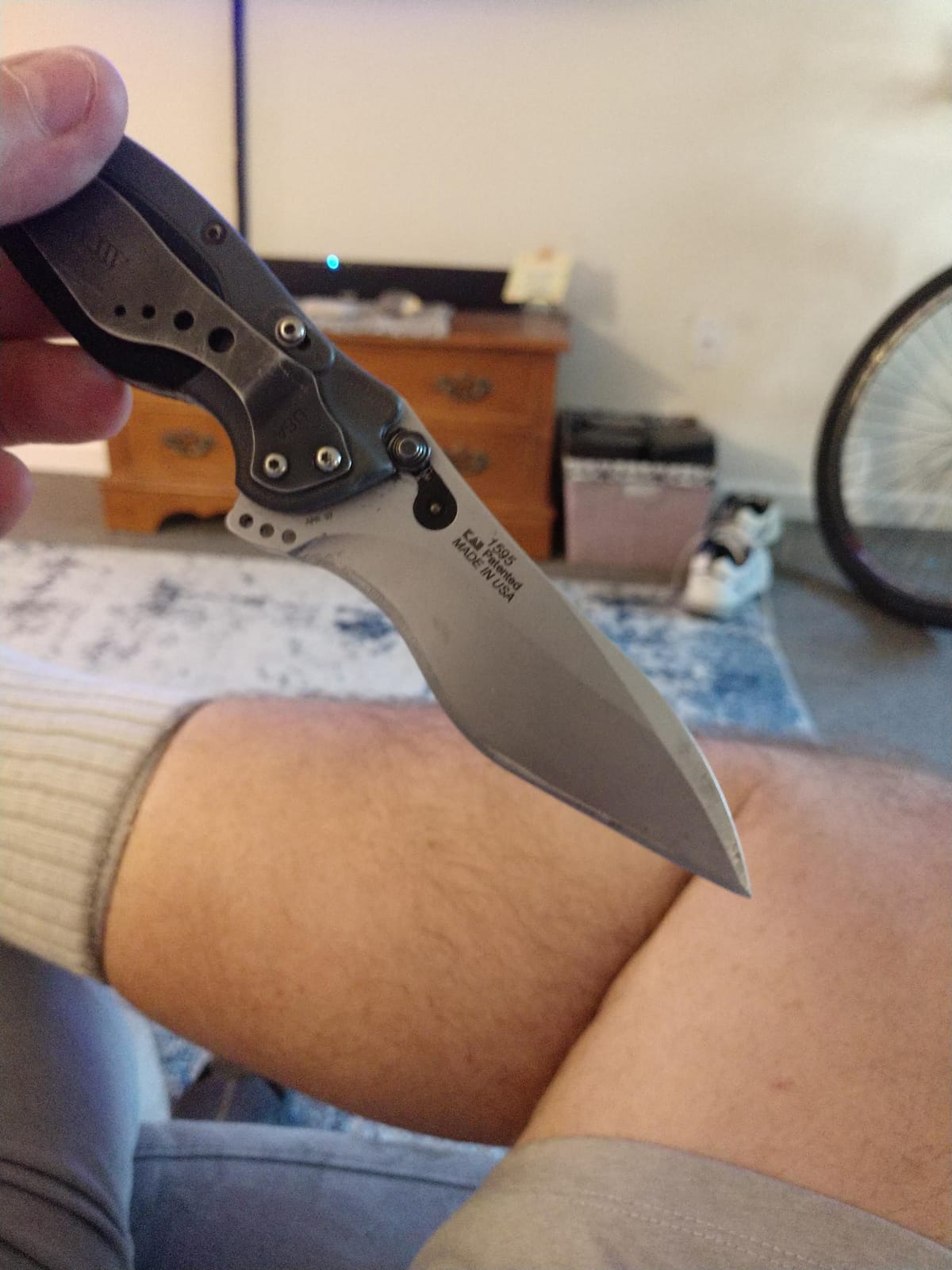
- Folding pocket knives and coated hardware. Some manufacturers state that their pull throughs are not intended for folding pocket knives, and enthusiasts describe visible edge damage on a Benchmade after repeated use of one. Practise on a knife you do not own before you point one at an expensive folder.
- Premium knives under warranty. Manufacturers have been reported to decline claims where a pull through has visibly thinned the edge, and forum posters specifically cite this for some Japanese brands. Check the warranty terms before you start.
There is also a fifth, softer case: a very dull knife. A pull through can rescue a neglected blade, but it needs more passes and more pressure, which is precisely when a beginner over-corrects. Sharpening forums repeat one instruction more than any other, and it is worth following: run your first session on a cheap knife you do not mind.
Knife Sharpener Buying Guide for First-Time Owners
Five decisions account for almost all of the difference between a sharpener you keep and one that ends up in a drawer. Here is what actually matters.
Number of stages. A single stage sets an edge. Two stages set an edge and refine it, which is why every two-stage model here is a better beginner tool than the one-stage AccuSharp, even though that unit has the highest rating in the group. Start with two.
Abrasive type. Carbide removes metal fast and lasts a long time. Ceramic is finer and gentler but wears sooner. Diamond sits at the top for edge quality and cost, and it is the only one that produces a genuinely polished finish on a pull through. Most beginners will be happy with carbide plus ceramic.
Fixed or adjustable angle. A fixed slot is simpler and less error-prone, and 20 degrees covers most Western kitchen knives. Adjustable or multi-angle models protect a collection with mixed grinds, at the cost of a longer body and a setting you can get wrong.
Serrated support. Serrated blades need a shallower, dedicated slot, and not every model has one. If you own a bread knife, check that the unit has a serrated position or a separate micro-angle stage before buying.
Base stability and guard. A non-slip base beats a handheld-only design for a beginner, because a skating base causes slips and uneven sharpening. A full-length finger guard is the next best safety feature, and an included cut-resistant glove is a helpful extra on models that do not have one.
Two smaller considerations round out the decision. Replaceable carbide and ceramic inserts extend the life of a larger tool rather than forcing a replacement, which matters if you sharpen more than once a month. And storage size decides how often you reach for the thing, so measure the drawer before falling for a long countertop model.
Frequently Asked Questions
Do pull through knife sharpeners really work?
Yes, a pull through knife sharpener really works, but it sharpens rather than hones. A fixed or dial-adjustable slot holds the blade at a preset angle against a carbide, ceramic or diamond abrasive, and each pass grinds metal away. On a standard straight-edge kitchen knife, three to four passes through a coarse stage and three to four through a fine stage return a usable edge in under a minute. The result is only as good as the match between the tool angle and your knife bevel.
What is the easiest knife sharpener to use for beginners?
A two-stage pull through knife sharpener with a non-slip base is the easiest option for a beginner, because the slot sets the sharpening angle and there is no setup, soaking or clamping to learn. Start with the coarse stage, then the fine stage, and use light pressure. Models with labelled slots and a full-length finger guard reduce guesswork and slips while you learn.
How many times should I pull a knife through a sharpener?
Three to four pulls per stage is the working rule, with light pressure. Draw the blade through the coarse stage in one smooth motion, wipe the blade, then do the same through the fine stage. If the knife is only slightly dull, run the fine stage alone. Stop when a sheet of paper or a ripe tomato slices cleanly, because any further passes are pure metal loss.
Are pull through sharpeners bad for expensive knives?
A pull through sharpener can damage an expensive knife when the tool angle does not match the blade bevel, and the error is permanent because metal removed cannot be replaced. Avoid pull throughs on Japanese single-bevel knives, ceramic blades and folding pocket knives, and check whether the manufacturer warranty excludes edge damage before you start. Many experienced owners practise on a cheap knife first.
What is the difference between a pull through sharpener and a whetstone?
A pull through sharpener holds the blade at a preset angle and removes metal with abrasive rods or wheels, so it needs no technique but gives limited control over the result. A whetstone is water-based and requires the user to set and hold the angle, which takes practice but allows control over the finish and the ability to repair an edge ground to the wrong angle.
The Best Pull Through Knife Sharpener for Beginners in 2026
Buy the KitchenIQ 50825 if you want one tool that does both jobs. A diamond-coated coarse stage for the knife that has been in the drawer since spring, a ceramic fine stage for the one you used last night, a base that grips the counter edge, and a body small enough to live in a utensil drawer. It is the model we put in front of people who have never sharpened anything, and the breadth of owner feedback behind it is the strongest in this group.
If you want the simplest possible first step, take the AccuSharp instead. One guarded carbide stage, no settings, and a usable edge in about ten seconds, with reversible blades that keep it working for years. If you own a good European knife and were disappointed by a coarse edge, the Chef’sChoice is the upgrade, because every stage is diamond abrasive and it holds both 15 and 20 degree bevels.
Whatever you choose, learn the motion on a knife you do not care about, keep the pressure light, and treat three to four passes per stage as a ceiling rather than a suggestion. That habit alone will keep the best pull through knife sharpeners for beginners working in your favour for years.