
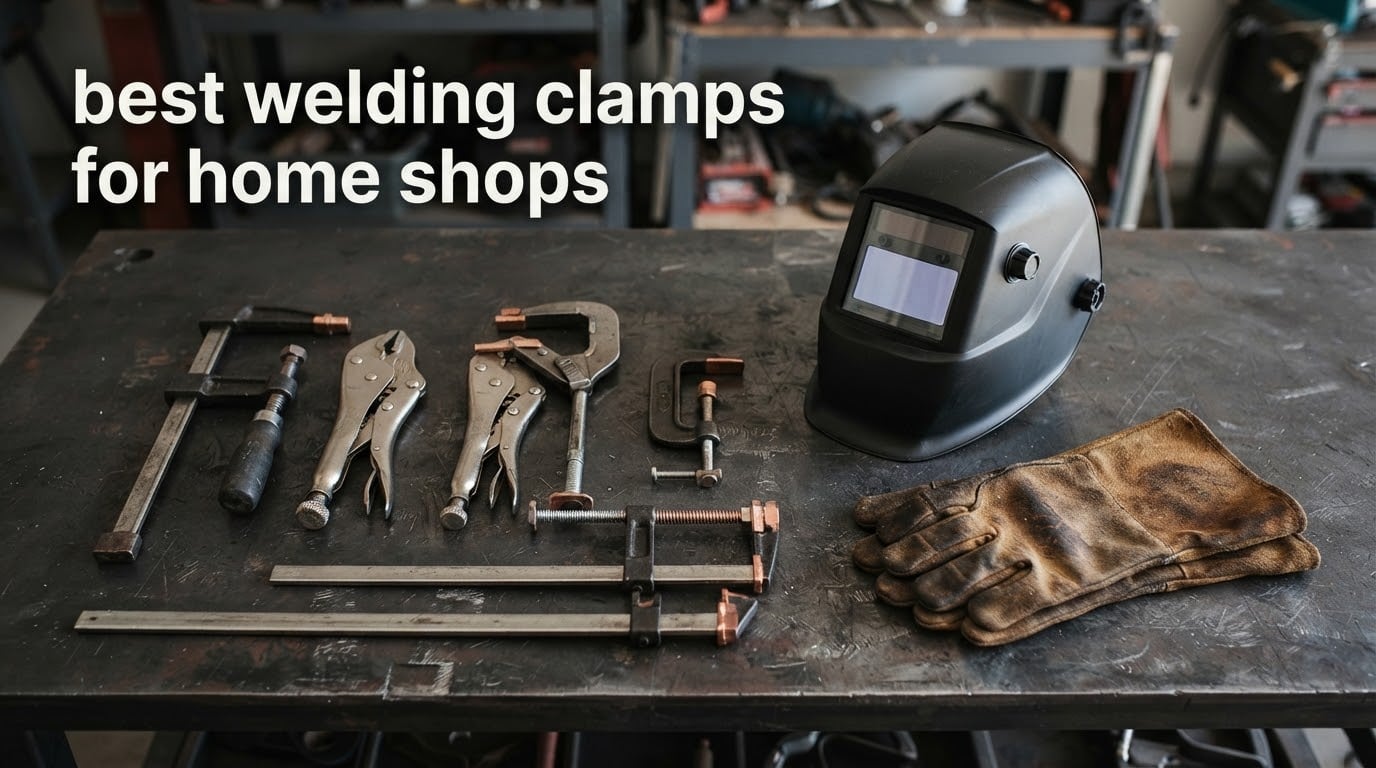
A welding clamp is a mechanical gripping tool that holds two pieces of metal in fixed alignment while they are joined by a weld, resisting the shrinkage and expansion that heat causes metal to move. That single job decides whether a frame comes out square or twisted, whether a butt joint closes cleanly or gaps open in the middle, and whether you spend the afternoon chasing a repair or put the work on the wall the same day.
Every clamp on this list earns its place in a small garage or basement shop, and every one of them works for someone. But the honest truth is that the best welding clamps for home shops are not the most expensive ones or the ones with the biggest force number on the box. They are the ones whose throat depth matches the tube you are actually clamping, whose jaw material will not weld itself to your work, and whose adjustment you can repeat in the dark when the fit-up gets complicated.
We spent weeks putting these twelve through frame assemblies, panel tacks and plate work in a home garage setup, and we compared them against what welders actually say on welding forums rather than what the packaging promises. The short answer: start with a pair of adjustable face clamps for bench and fixture work, add a four-pack of bar clamps for frame and box section joints, and keep one locking clamp plier in your apron for everything else. That combination covers roughly 90% of what a home shop welder touches in a year.
If you want the broader picture of bar and F-style clamps, including the woodworking-side differences in jaw design, our guide to the best bar clamps is worth a read before you commit to a set.
Top 3 Welding Clamps for a Home Shop in 2026
These three cover the widest range of real home-shop work between them. The face clamps anchor work to a bench or fixture, the bar clamp set handles frame joints, and the locking plier stays in your hand for tack positioning.

Amazon Basics Metal Face Clamps 3 inch, 2-Pack
- 3 inch jaw reach
- Clamps up to 2-3/4 inch thick
- Swivel pads
- Thumb screw adjustment

Jorgensen 4-Pack 600 lb Bar Clamps
- 6 inch and 12 inch openings
- 2-1/2 inch throat
- 600 lb load limit
- Clutch disc holds position

IRWIN VISE-GRIP 9 inch Locking Clamp 25ZR
- U-shaped jaw clears sight line
- Guarded trigger release
- Hex key pressure screw
- Heat-treated alloy steel
All 12 Welding Clamps Compared in 2026
The table below is the whole list in one view. Each row carries the clamp family, the two numbers that decide fit-up quality (opening capacity and throat depth), and where the tool earns its keep. For a full breakdown of each one, scroll to the individual review below.
| Product | Specifications | Action |
|---|---|---|
| Amazon Basics Metal Face Clamps 3 inch 2-Pack |
|
Check Latest Price |
 IRWIN VISE-GRIP 6 inch Locking C-Clamp IRWIN VISE-GRIP 6 inch Locking C-Clamp |
|
Check Latest Price |
| Jorgensen 4-Pack 600 lb Steel Bar Clamps |
|
Check Latest Price |
 MAXPOWER 4-Piece 12 inch Heavy Duty F Clamps MAXPOWER 4-Piece 12 inch Heavy Duty F Clamps |
|
Check Latest Price |
 SHALL 4-Pack 12 inch Drop Forged Bar Clamps SHALL 4-Pack 12 inch Drop Forged Bar Clamps |
|
Check Latest Price |
| IRWIN VISE-GRIP 9 inch Locking Welding Clamp |
|
Check Latest Price |
 HOZEON 3-Piece 18 inch C Clamp Welding Pliers HOZEON 3-Piece 18 inch C Clamp Welding Pliers |
|
Check Latest Price |
 HFS 10-Pack 11 inch Locking C-Clamp Pliers HFS 10-Pack 11 inch Locking C-Clamp Pliers |
|
Check Latest Price |
 MAXPOWER 15-Piece Locking Pliers and Clamp Set MAXPOWER 15-Piece Locking Pliers and Clamp Set |
|
Check Latest Price |
 IRWIN VISE-GRIP 11 inch Fast Release C-Clamp IRWIN VISE-GRIP 11 inch Fast Release C-Clamp |
|
Check Latest Price |
 BuildPro Inserta Table Clamp 8-1/2 inch BuildPro Inserta Table Clamp 8-1/2 inch |
|
Check Latest Price |
 Pumtus 24-Piece Butt Welding Clamp Set Pumtus 24-Piece Butt Welding Clamp Set |
|
Check Latest Price |
1. Amazon Basics Adjustable Metal Face Clamps, 3 inch Jaw Reach, 2-Pack
Amazon Basics Adjustable Metal Face Clamps for Woodworking, Welding, or Repairs, 3-inch Jaw Reach, 2-Pack, Black/Silver
- Rigid metal construction for fabrication work
- Fine tunable tension instead of an automatic lock
- Swivel pads avoid marking the workpiece
- Consistent quality at a low per-clamp cost
- Heavier than plastic-bodied face clamps
- Opening tops out near 2-3/4 inch so it is not a deep-throat clamp
These are face clamps, not C-clamps, and that distinction matters more than it sounds. A face clamp grips the edge of a panel and holds it down onto a bench, a welding table or a fixture, which makes it the fastest way to stop sheet metal from moving while you tack it. For a first purchase in a home shop, this pair solves a problem no other clamp on the list does.
We used them repeatedly holding 16 gauge panels and light channel for tack welds, and the swivel pads spread the load well enough that the finished face still looked good after we ground the seam flush. The thumb screw knob gives genuinely fine tension control, so you can snug a joint without the sudden lurch that automatic-locking face clamps give you.
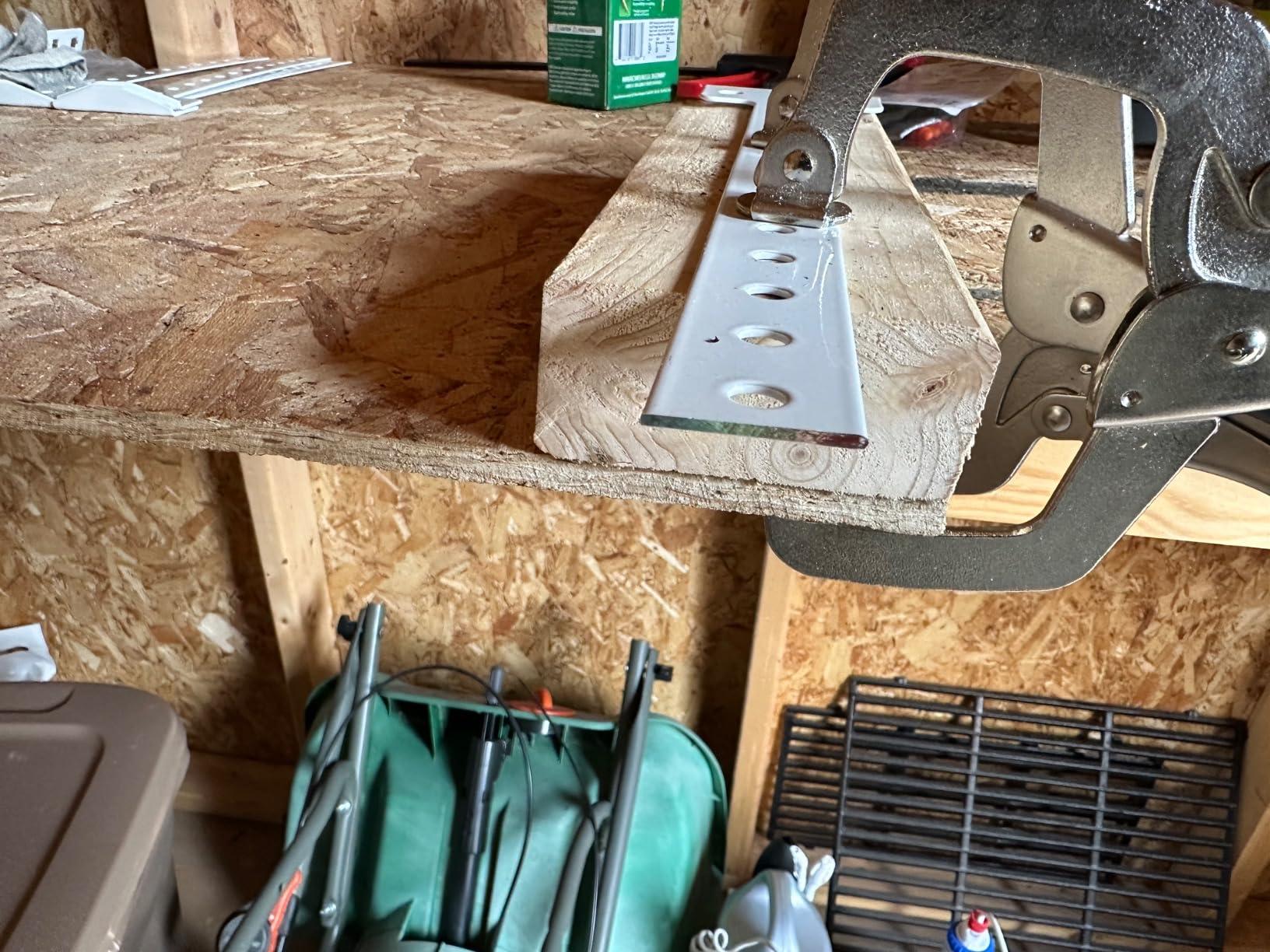
The build is heavier than the plastic-bodied face clamps you might see cheaper, and that weight is a good thing on a welding bench. It does not skate across a table when the torch comes near it, and the alloy steel frame handled repeated impacts without any permanent set.
What you give up is reach. With a 2-3/4 inch maximum thickness and a 3 inch jaw, this is not the tool for clamping an I-beam flange or reaching inside a box section. It is the tool for flat work, fixture work and tack positioning.
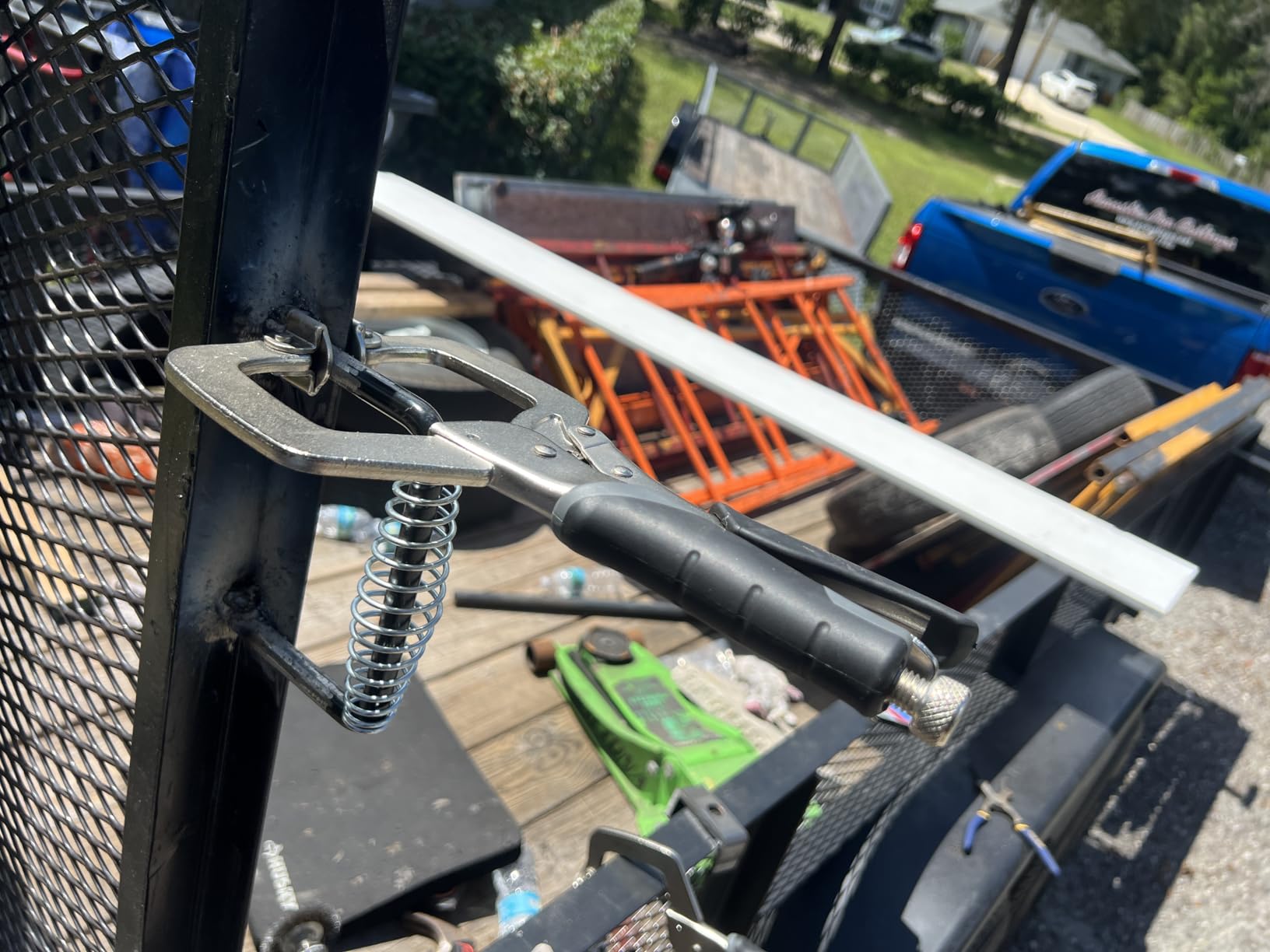
Where it earns a place in a first clamp purchase
Put these on the table before anything else. Almost every home-shop job that goes wrong is a part that moved during fit-up, and holding the workpiece down to a fixture is the cheapest way to stop that happening.
Two is the right number to start. One clamps the near edge, the second lets you work along a seam without your hand in the way. Reviewers consistently describe these as sturdy and easy to adjust, and several compare them favourably to pricier name-brand C-clamps for this specific job.
Where it will frustrate you
Anyone building square tube frames will find the opening limit binding fast. Once your material exceeds roughly 2-3/4 inches, you need a bar clamp or a locking plier, and the face clamp stays on the bench for panel work only.
Because the screw is a thumb knob rather than a sliding bar, there is no clutch holding position partway up a rail. For short fits that is fine. For a long seam you will be resetting it repeatedly, which is why we treat these as a companion to a bar clamp set rather than a replacement.
2. IRWIN VISE-GRIP 6 inch Locking C-Clamp, Regular Tip
IRWIN Tools Vise-Grip 6-Inch Locking C-Clamp, Silver
- Compact enough to live in an apron pocket
- One-handed locking action
- Regular tip gives a firm grip on square and flat surfaces
- Backed by the IRWIN lifetime guarantee
- Shallow 1-1/2 inch throat limits it to thin material and narrow sections
- 2 inch maximum opening is small for larger weldments
The 6 inch locking C-clamp is the clamp most people picture when they hear the phrase, and it is the smallest tool in this roundup that does the job properly. At under half a pound it disappears into a tool bag, and it locks with one hand, which means you can clamp, step back and pick up your torch without losing position.
We used it as a fourth hand on small assembly work, holding a bracket to a tube while the tack cooled, and on electrical box fitting where a strap was tighter than the frame was thick. The regular tip bites well on flat and square surfaces, which is exactly what you want when the material is structural and grip matters more than cosmetics.
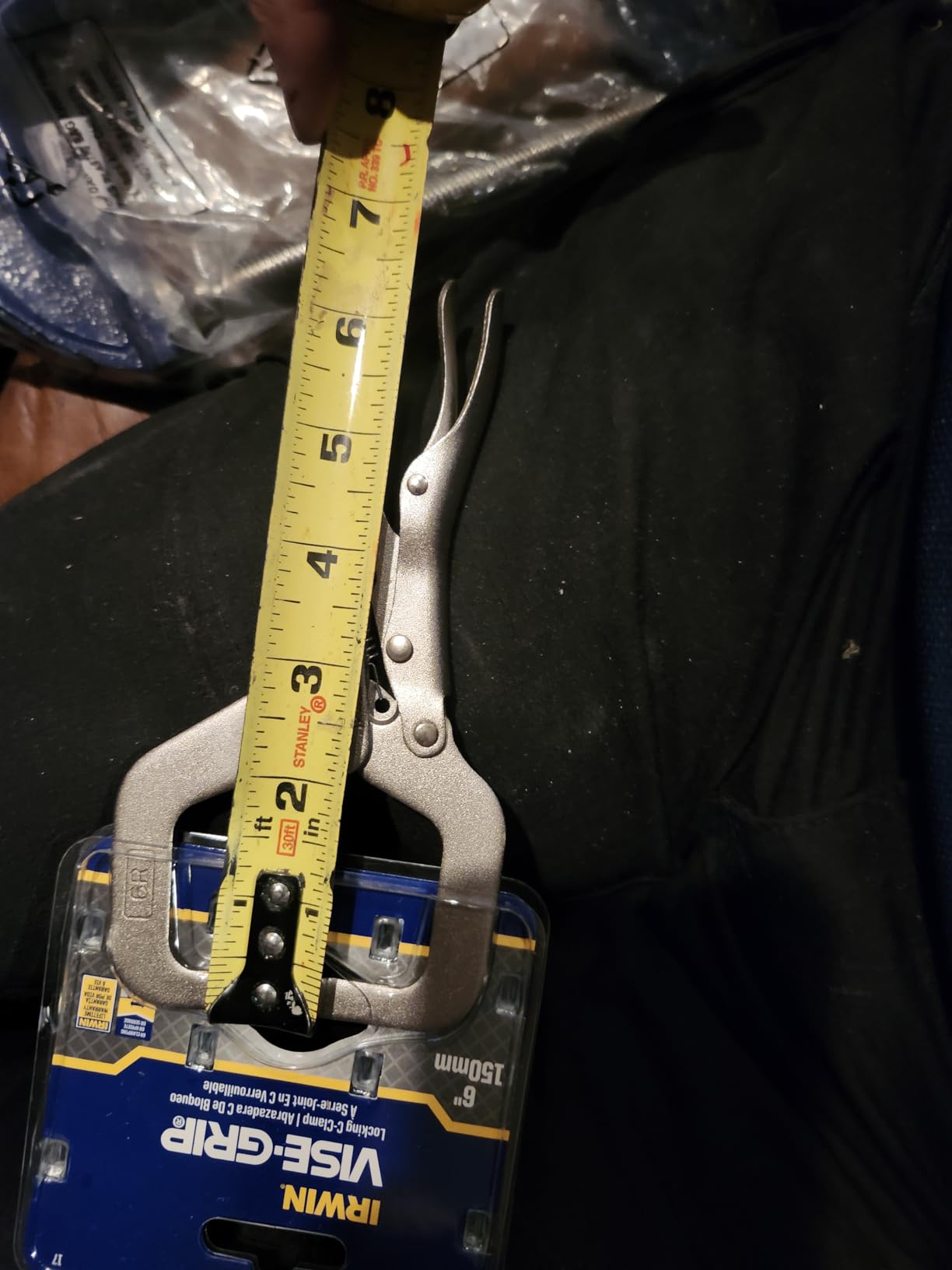
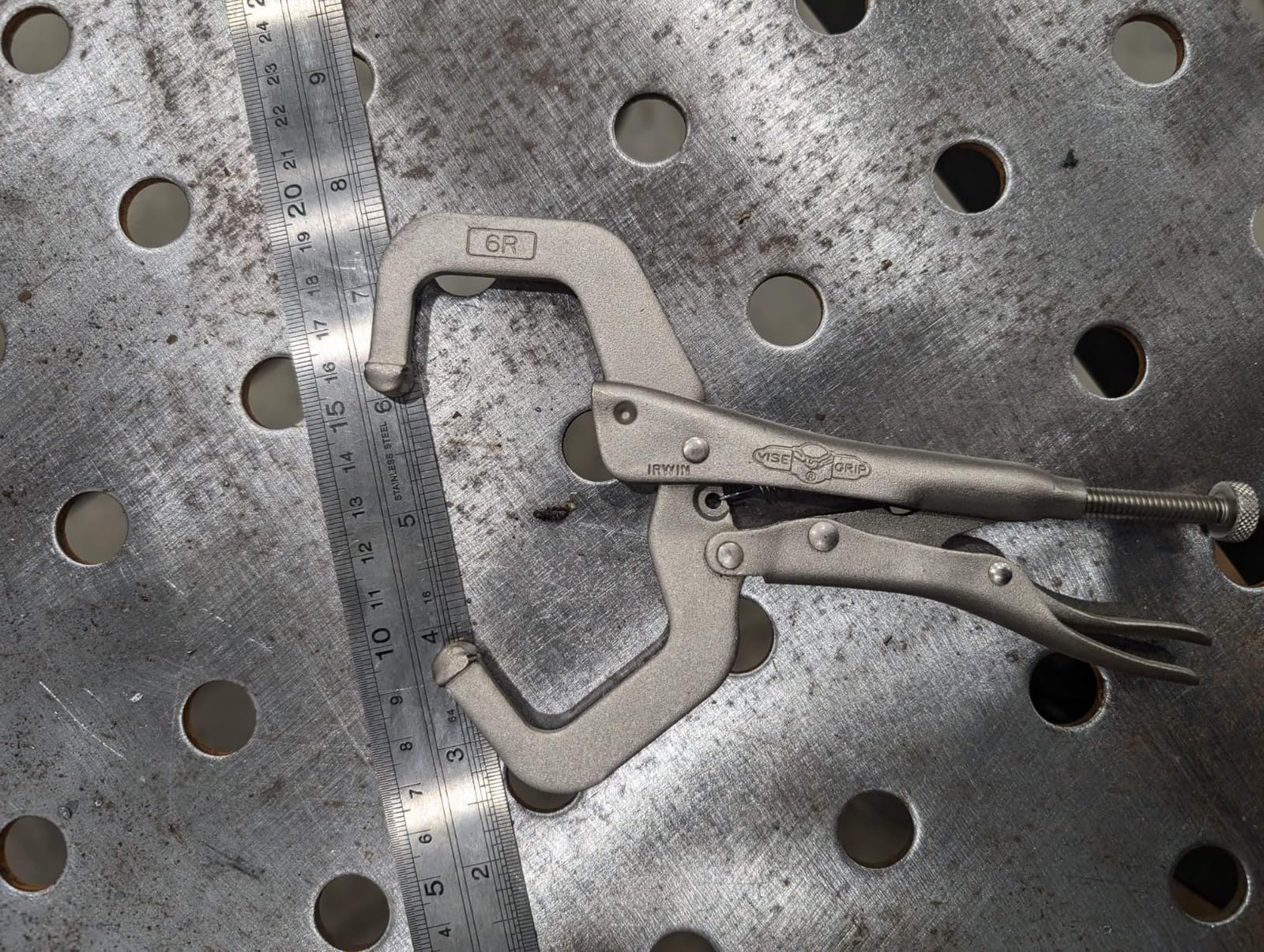
The limiting number here is the throat. At 1-1/2 inch you can get into narrow gaps and clamp on the outside of a joint, but you cannot reach deep into a box section or grab a flange that sits well inside the frame. Owners have logged roughly 1,900 reviews at a 4.5 average, and the pattern is consistent: people love it for small jobs and know exactly where its limit is.
The lifetime guarantee is the real long-term story here. This is the kind of tool that gets dropped, spattered on and dropped again, and knowing the manufacturer stands behind it changes how freely you throw it in the bag.
Whether a 6 inch model is enough for you
Yes, if your work is mostly small brackets, tubing under about 2 inch, repair work and fit-up on a bench. It handles the fiddly jobs that eat an afternoon, and it is the one clamp we would never leave the shop without.
No, if you regularly work with box section, channel or anything over 2 inch across flats. You will be repositioning constantly, and each reposition means the part can move. In that case, spend the money on the 9 inch and 11 inch versions instead.
Why the regular tip matters more than you think
A regular tip concentrates force into a small hard contact patch. That is ideal for bare structural steel, where the only thing that matters is whether the joint moves. It is the wrong choice on a finished face or thin soft metal, because it marks the surface.
If you routinely clamp visible or plated material, buy the swivel-pad version later in this list and keep this one for raw steel. That split alone will save you from grinding marks you did not want in the first place.
3. Jorgensen 4-Pack Steel 600 lb Bar Clamps, 6 inch and 12 inch
- Highest rated clamp here at 4.8 across 1115 reviews
- Multi-disc clutch holds the head anywhere on the bar
- Mixed 6 inch and 12 inch sizes cover most shop tasks
- Soft pads protect finished surfaces
- 600 lb rating sits below heavy F-clamp options
- Fixed bar geometry gives less throat depth than deep-throat models
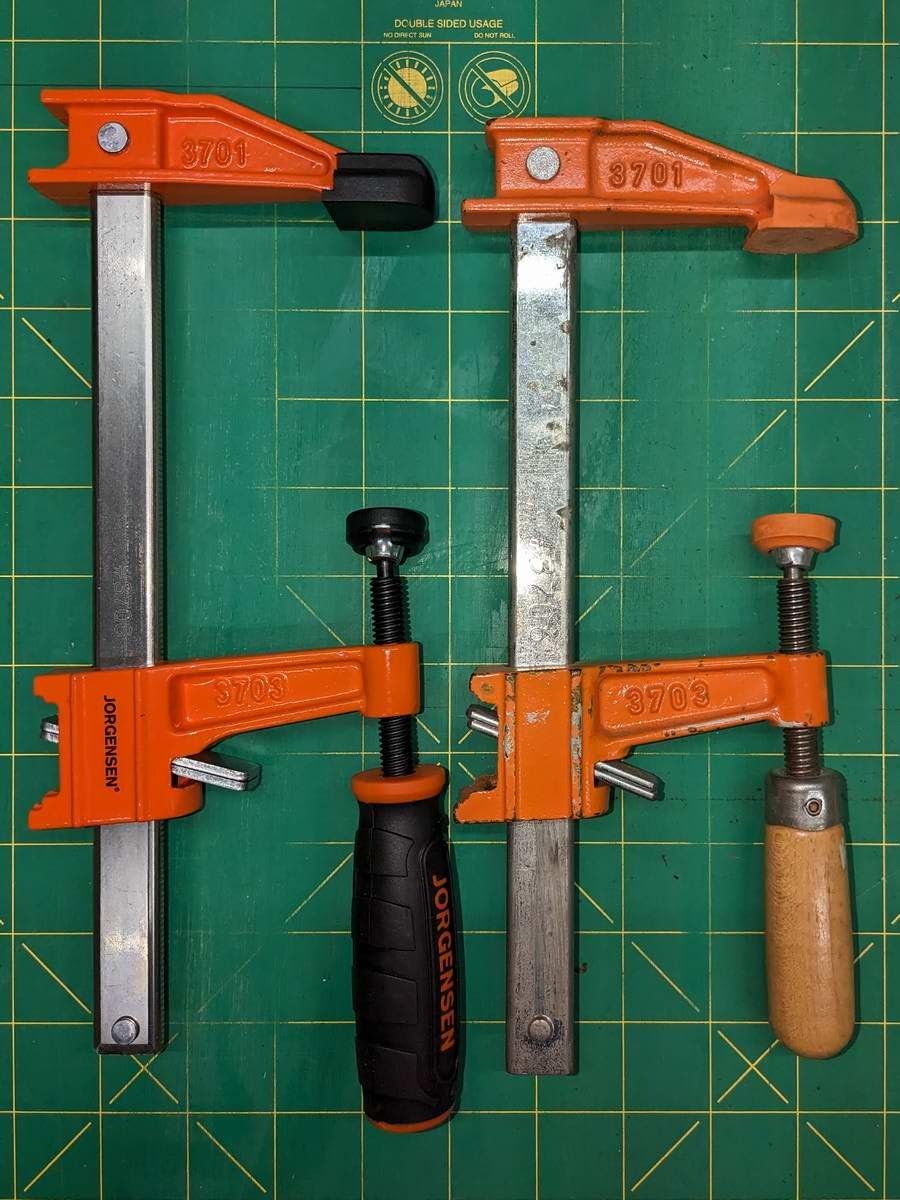
This is the set we reach for first on frame work, and it has the highest average rating of anything we tested. The reason is the multi-disc clutch: the sliding head locks at any point along the bar, so you position the clamp once and leave it there while you tack, grind and fit the next piece. That is the whole difference between F-clamps and C-clamps in daily use.
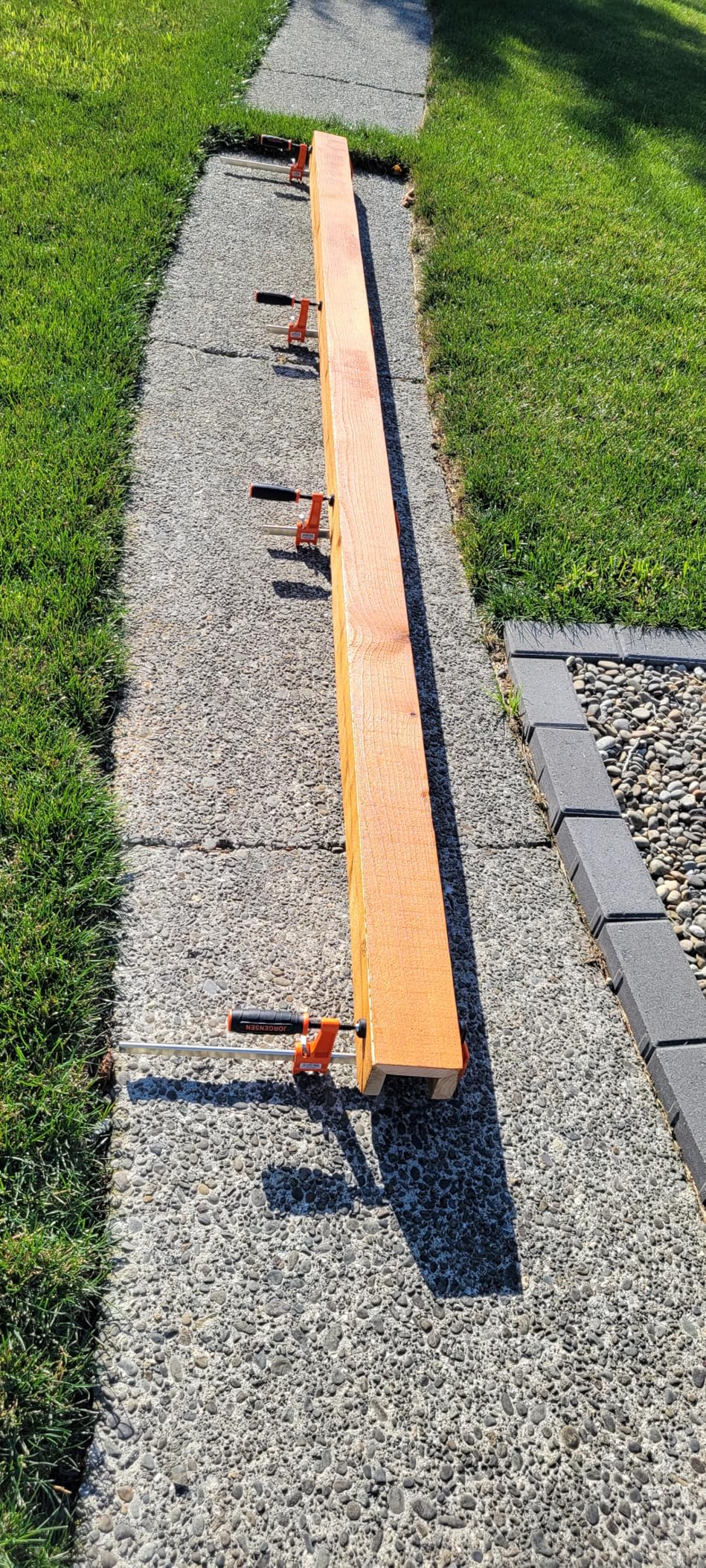
Four clamps covering 6 inch and 12 inch openings is a genuinely useful spread. The 6 inch pair handles cross members and small box section, and the 12 inch pair closes tube frames up to a foot across without you stacking blocks under the jaw to fake more reach.
At 600 lbs normal load, this is honest medium duty rather than inflated heavy duty. That number is a normal working load, not a momentary maximum, and for tube and box section at typical home-shop thickness it is comfortably adequate. If you are clamping heavy solid plate and pushing the spindle to its stop, move up a class.
The soft pads are worth noting for welding specifically. They prevent the jaw from biting into the material and leaving a notch you will find later, and they spread force across a wider area so thin wall tube does not dent under the clamp.
Whether 600 lb is enough force for your work
For square tubing, angle iron, channel and sheet under about 1/8 inch, yes. Fit-up pressure needs to be firm enough to hold alignment while the joint cools, not enough to crush the material. A 600 lb clamp on 16 gauge tube is far more force than the metal can use.
For solid bar, heavy plate or thick structural work, no. The throat is also only 2-1/2 inch, so on wide flanges you will be clamping the edge rather than getting true bearing surface. Both limits are honest for a medium-duty set, and neither is a reason to skip it.
Why the clutch head changes how you work
Without a clutch, the head slides every time you lift the clamp, and you end up holding the part with one hand while you chase the head with the other. That is where most beginners lose alignment on a frame.
With the multi-disc clutch, you let go and the clamp stays exactly where you put it. Owners rate fast adjustment and secure holding as the two things that matter most, and it is the reason welding forum regulars keep moving toward bar clamps for general fabrication work.
4. MAXPOWER 4-Piece 12 inch Heavy Duty F Clamps with 4-3/4 inch Throat
MAXPOWER 4-pieces Heavy Duty F Clamp 12-inch, 4-3/4″ Throat
- Genuinely deep 4-3/4 inch throat in an uncommon size
- Drop-forged full steel bar resists flex
- Swivel pads centre the load on the workpiece
- Black oxide spindle resists wear and rust
- Sliding arm plays loose until the pads are under load
- Heavier than lighter F-clamp sets
- A minority of owners find the bar thinner than premium brands
Throat depth is the specification that decides whether a clamp fits your project, and a 4-3/4 inch throat is hard to find in anything but the deepest F-clamps. That number is the distance from the screw to the outside edge of the frame, so it tells you how far the jaw can reach past the material and still make solid contact. On wide flange or I-beam work, this is the set that removes the need to improvise.
The drop-forged steel bar is the other reason to like it. Forged steel is pressed and worked rather than cast, which leaves a grain structure that resists bending far better under load. We pushed these hard on plate butt welds and the bar barely moved, which is exactly what you want when the clamp is the only thing keeping the joint aligned.
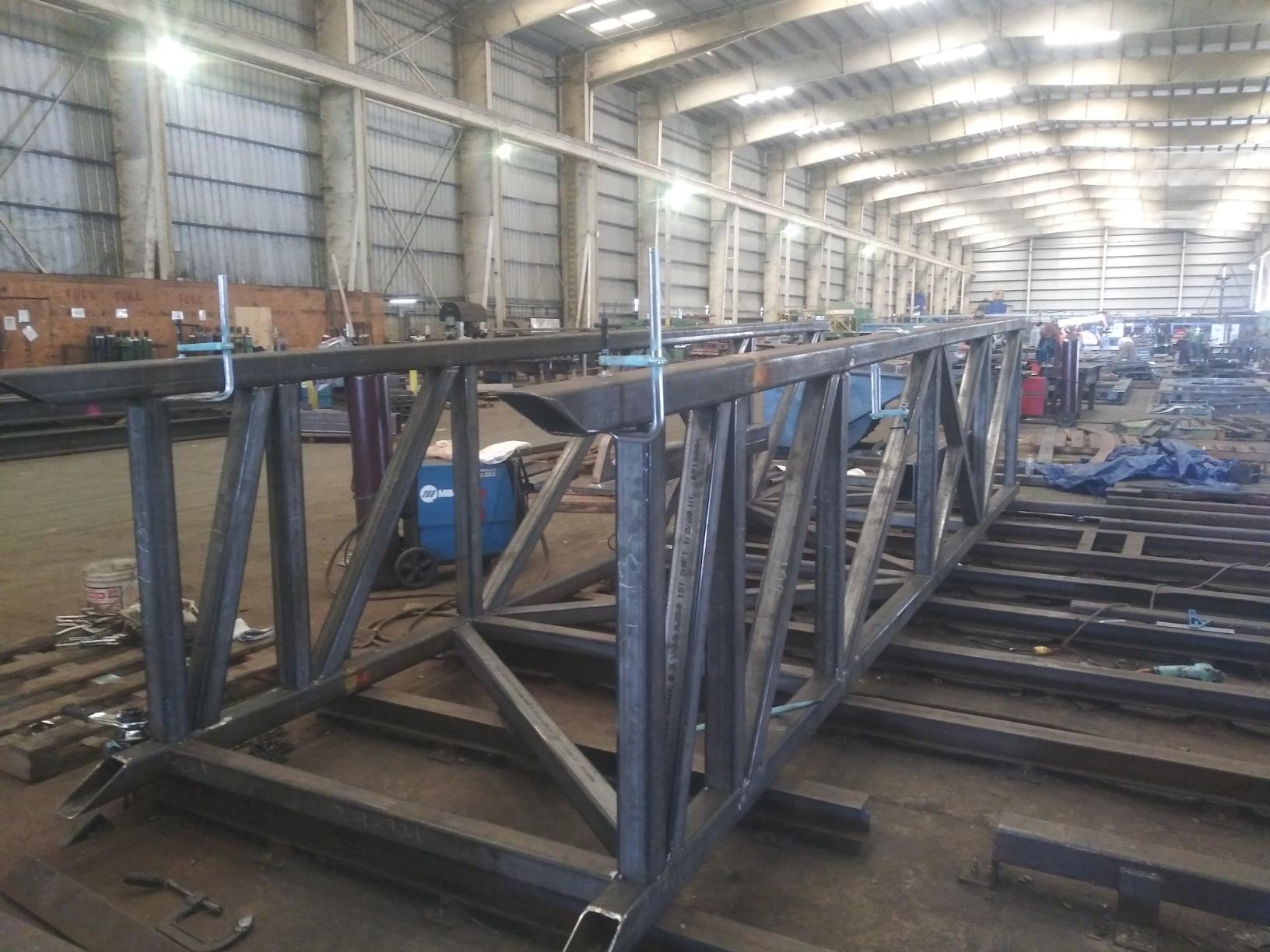
At 1200 lbs rated clamping pressure across a four-pack, this sits a full class above the medium duty sets. That number is again a rated figure rather than a guarantee, and we would still not put a cheater bar on the handle. But for structural work it gives you real margin.
The swivel pads are a genuine improvement for welding. They centre the load on the workpiece and spread it evenly, so a thin flange gets pressed without a single concentrated bite mark, and the black oxide spindle resists both wear and rust better than a bare steel screw in a spatter-heavy shop.
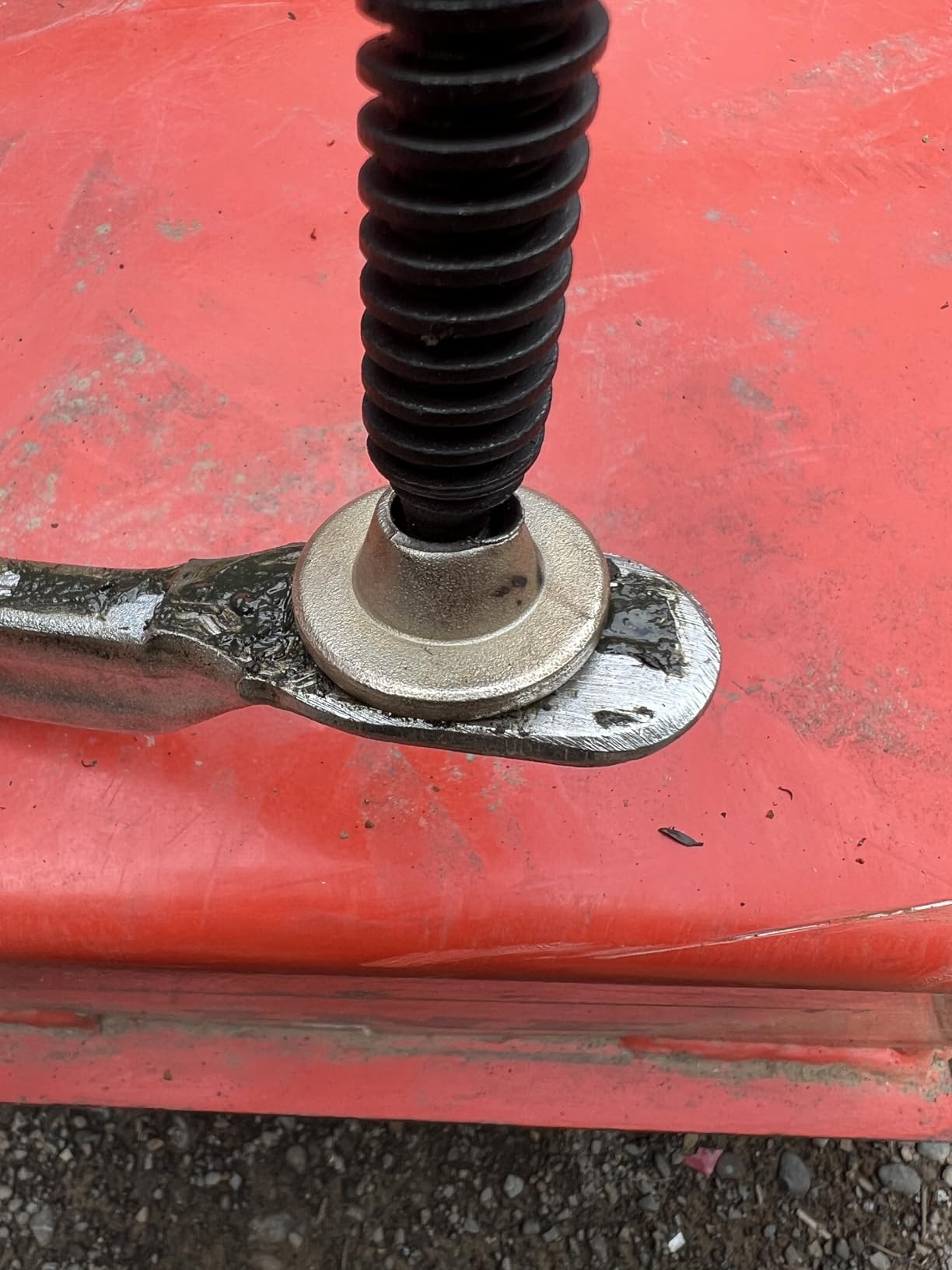
When you need a 4-3/4 inch throat
You need it when the bearing surface you want to clamp sits far from the frame edge. That covers I-beams and channel, wide plate seams where you want the clamp well back from the heat, and frame work where a shallow clamp would only bite the very corner of the flange.
You do not need it for thin sheet, small tube or work on a flat welding table. For those, the extra reach just makes the clamp heavier and more awkward to position. Match the throat to the widest thing you intend to hold, not to the widest thing you might one day build.
How the loose sliding arm actually behaves
Before the pads touch the work, the sliding arm has visible play. That is normal for this design and it disappears the moment the clamp takes load, which is why fabricators rate them highly despite it. Just do not judge the clamp by how much it rocks in your hand.
A small number of owners do report more flex on heavy work than premium-brand bars give you, so if you are clamping solid plate every day, compare the bar thickness before you commit. For tube, angle and structural assembly, we found nothing to complain about.
5. SHALL 4-Pack 12 inch Drop Forged Steel Bar Clamps, 450 lb
- Exceptionally rigid steel frame for the class
- Well-cut threads give smooth operation
- Slides without a clutch so adjustment is fast
- Flat top can be mortised into a portable bench
- 450 lb rating is light duty next to 600 and 1200 lb sets
- No clutch means a rubber band is needed to hold the head
- Some units arrive with sharp edges
This set earns its spot on one decision alone: it contains no rubber parts. The soft plastic pads that make a bar clamp pleasant on finished wood will melt, smear and eventually ignite if spatter lands on them. With a nickel-plated all-metal build, these clamps tolerate a spatter shower without needing to be thrown out of the shop.
The rigidity is a genuine surprise at this level. Owners regularly report the frame is stiffer than the Jorgensen set that costs more, and the threads are cut well enough that the spindle runs smoothly without a drop of oil. We ran these across a fabrication table for weeks of tack and grinding work with no flex creeping in.
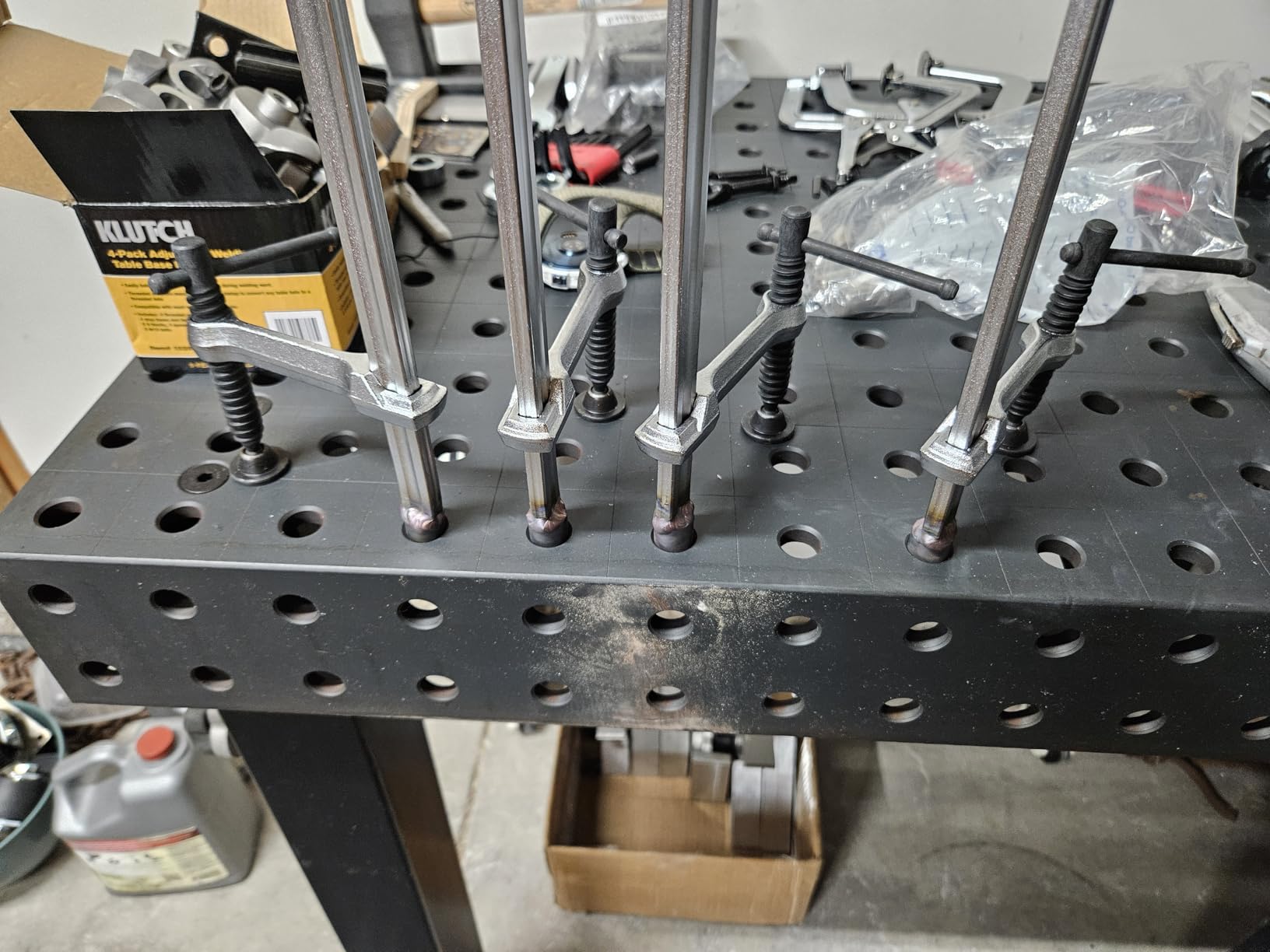
Here is the honest catch: 450 lbs is genuinely light duty. Compare it to the 600 lb and 1200 lb sets on this list and you are choosing a clamp that will not take a cheater bar. For thin material and medium shop work that is plenty. For solid bar and heavy plate you will feel it give up before you finish tightening.
The missing clutch is the second catch. The head slides freely, which some owners love as simplicity and others solve with a rubber band around the bar to hold position. Either way, plan on two hands to set it.
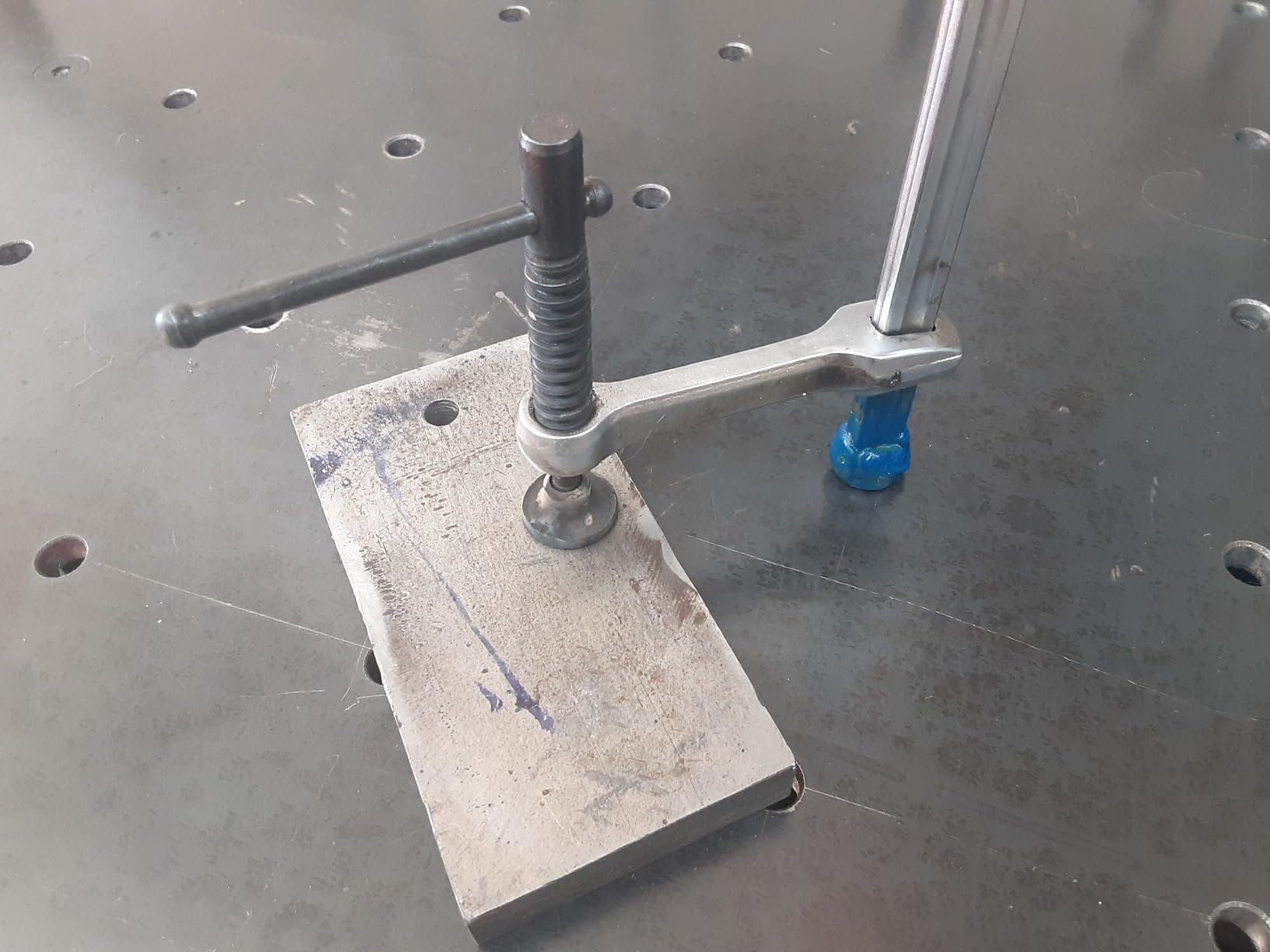
Whether a 450 lb clamp is enough
Enough for square tube, angle iron, channel, thin sheet and most general home-shop fit-up. Those are the jobs where the joint only needs to hold alignment while the weld metal cools, not to survive a lift or a press.
Not enough for solid bar stock, heavy plate or anything where you plan to squeeze the joint closed to close a gap. In those cases the clamping force becomes the limiting factor rather than throat depth, and you should move to a 600 lb or higher set instead.
Why the metal-only build matters near a torch
Every plastic pad on a bar clamp is a small fire and mess risk in a welding bay. Spatter sticks to soft plastic, hardens there and turns the pad into a lump that marks every workpiece after it.
A nickel-plated steel surface lets you chip spatter off with a chisel in seconds, or scrub it with a wire wheel on the bench. If your clamps live next to a welder rather than in a woodshop, this is the feature that will matter most to you over five years of ownership.
6. IRWIN VISE-GRIP 9 inch Locking Welding Clamp, 25ZR
- U-shaped jaw gives a clear line of sight to the joint
- Guarded trigger prevents accidental release
- Heat-treated alloy steel body survives shop abuse
- Hex key hole allows precise pressure control
- Regular tip rather than swivel pads
- Can mark softer or finished surfaces
This is the single clamp we would hand to someone who asks for one welding clamp to start. The U-shaped jaw is the whole design argument: instead of wrapping the frame in a solid curve, the jaw is cut away so you can see the joint through the clamp while you weld. On a 9 inch body that sight line is wide enough for MIG work with a gun, which is where most clamp bodies get in the way.
We used it on more frame and panel work than anything else in the roundup, and the guarded trigger release earned its keep more than once. On a plain locking plier, squeezing the handle to open the jaw is easy to do by accident with a gloved hand, and a released clamp mid-tack is a piece of steel on the floor. The guard fixes that.
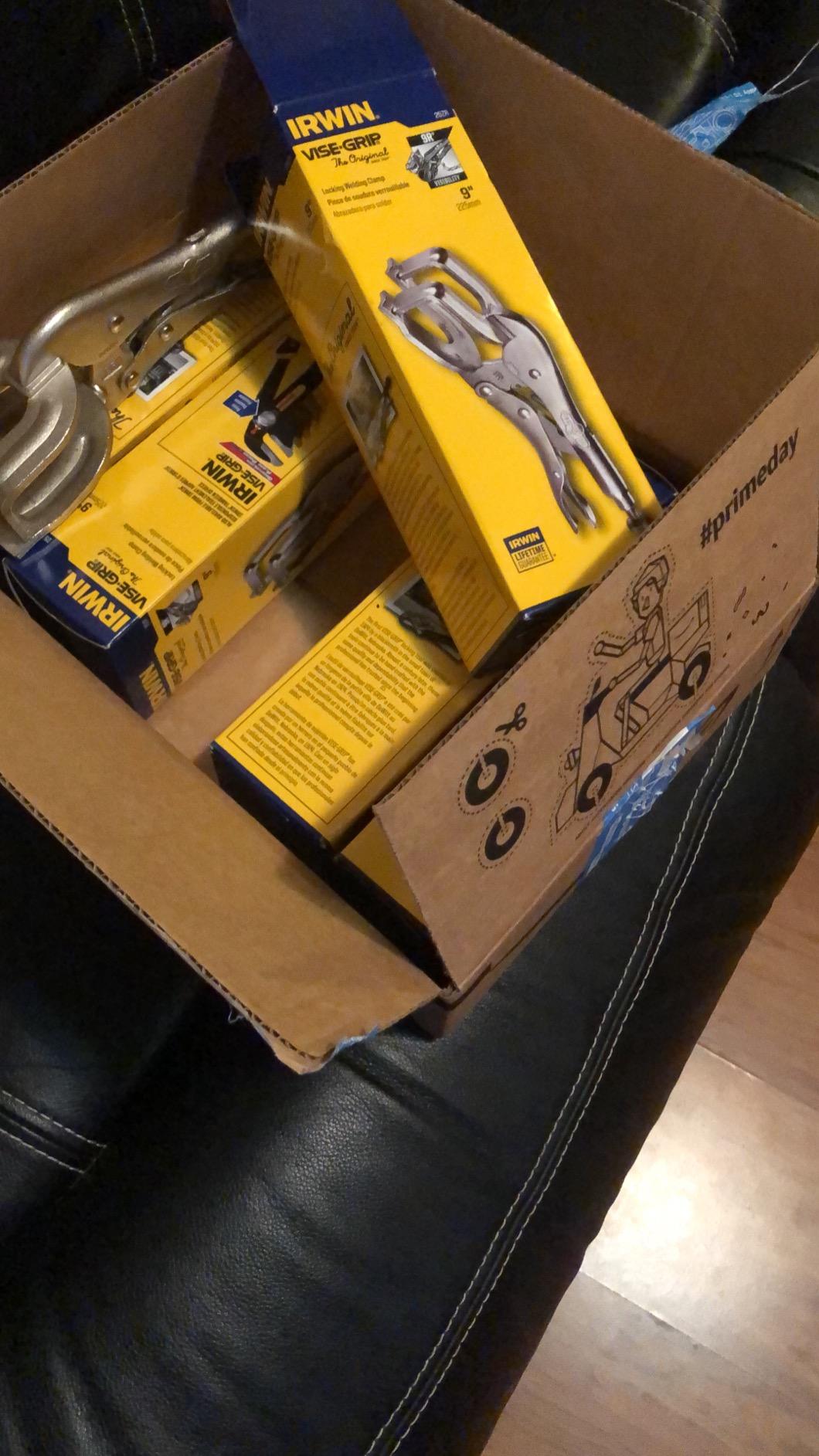
Owners describe this one in unusually durable terms, with a 4.8 average and roughly 600 reviews behind it, and the usual pattern is buying another only when the original goes missing rather than wears out. That is the test a shop tool should pass.
The hex key hole in the thumb screw is a small feature that matters. It lets you set clamping pressure accurately and repeat it on the next joint, which is how you keep a multi-piece assembly square without guessing every time.
Why the U-shaped jaw changes welding work
Because you can see the seam. On a conventional C shape, the top of the jaw blocks your view of the joint from above, so you either weld blind or move the clamp mid-pass. With the jaw cut away, the torch and the joint stay visible together.
That visibility is why this model has held its position for so long against newer, cheaper 9 inch clamps. For a home shop welder doing fit-up and tack work rather than production welding, it is a feature you notice every single time you use the tool.
When it is the wrong pick
When surface finish matters more than holding power. The regular tip concentrates pressure into a hard contact point, so on soft aluminium, plated sheet or a face you plan to polish, it will leave a mark. There is no swivel pad to spread that load.
Also worth knowing: this is a 9 inch tool with no stated throat or opening figure in the published specification, so treat it as a general-purpose positioning clamp rather than a reach clamp. For a 4 inch opening with swivel pads, the 10-pack later in this list is the direct comparison.
7. HOZEON 3-Piece 18 inch C Clamp Welding Pliers with Swivel Pads
- Deep 18 inch throat reaches into box sections and panels
- Swivel pads protect the workpiece surface
- Holds pressure under full hand force
- Good value against name-brand locking pliers
- Lighter and wobblier when unlocked
- Adjustment screws are stiff to wind down
- Heavier than an equivalent name-brand clamp
An 18 inch throat is a different category of tool from everything above it. That reach lets the jaw get inside a wide box section, a truck bed rail or a large fabricated panel and still have solid bearing surface on the far wall, which a 9 inch plier physically cannot do. If you build anything with large hollow sections, this is the one that makes the job possible.
The swivel pads adjust to match the surface. On a tapered or angled section, a flat pad touches on one corner only and the clamp rocks; an articulating pad makes full contact, which means the force actually goes into holding the part instead of rocking it loose.
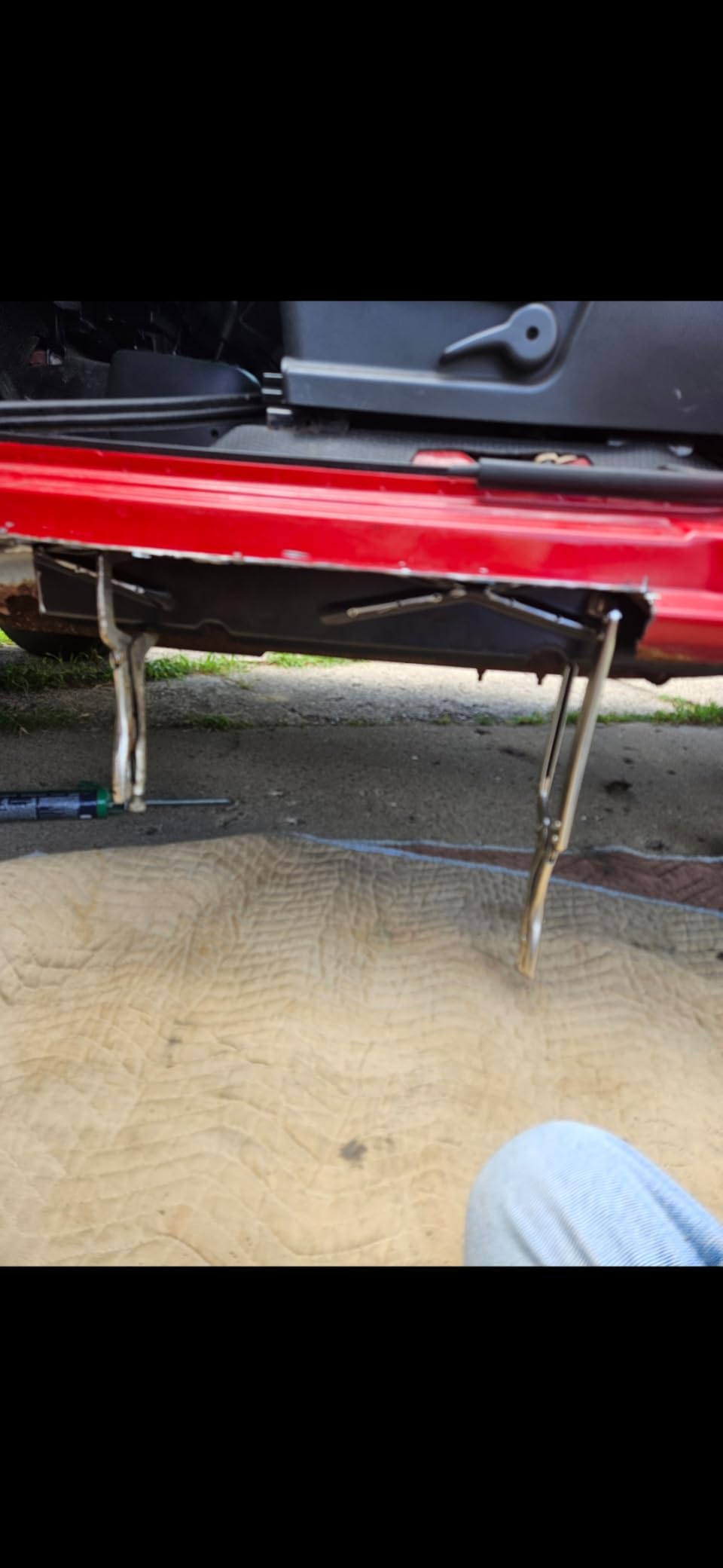
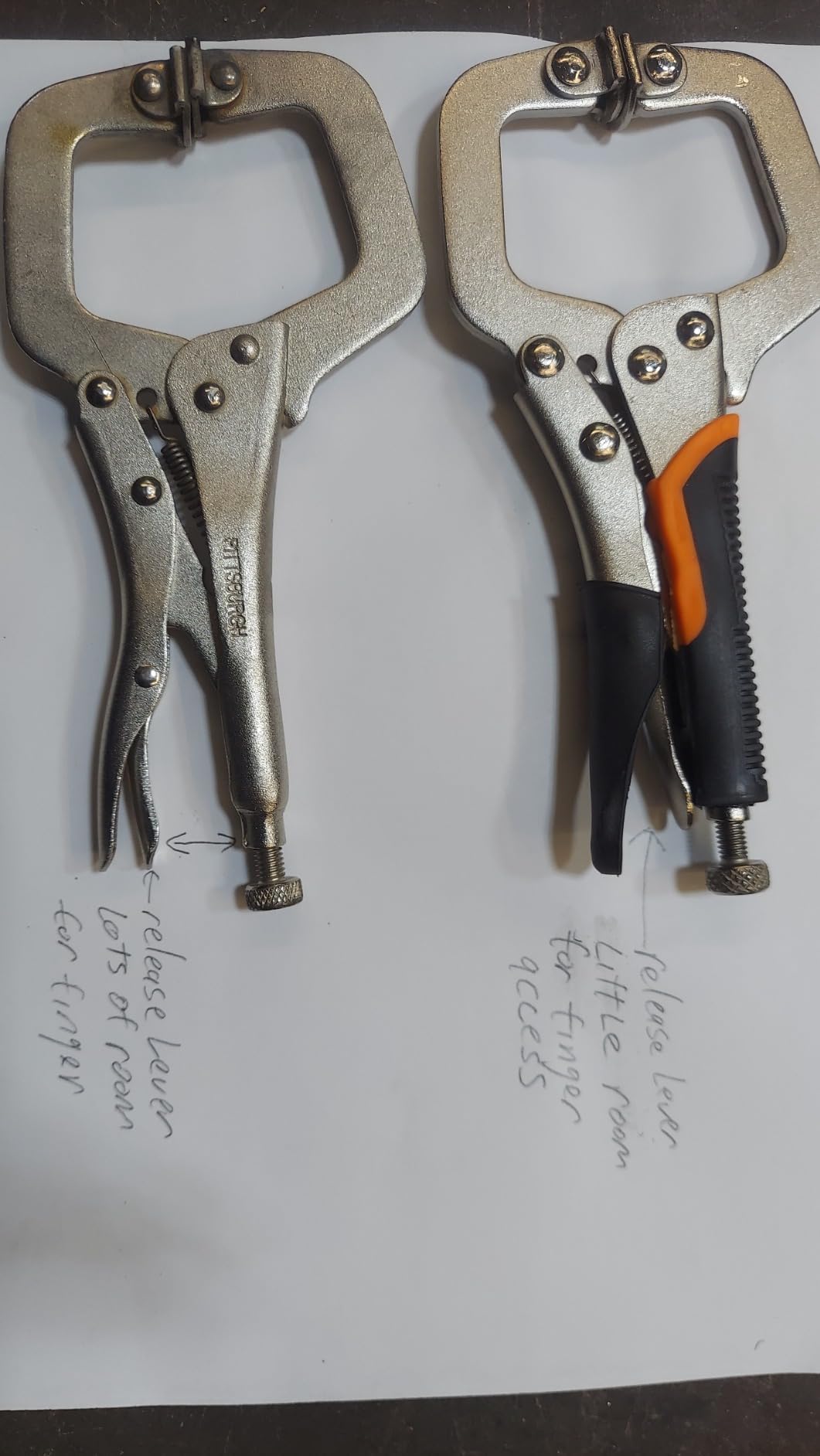
The honest weakness is what you feel before you clamp. As with most deep-throat clamps, the body is lighter in construction and has some play in the unlocked position, so it does not feel as solid as a short premium plier. Under load, that difference largely disappears.
Adjustment screws are another recurring note: stiff threads that take effort to wind down. Budget a few extra seconds per clamp on the first setup, and keep a drop of oil on the spindles, which cuts down both the effort and the seizing that spatter causes.
When an 18 inch throat is the difference
Any time the clamp needs to reach past the material and grab structure further in. Inside a truck bed rail, across the width of a large panel, on the far wall of a wide box section, or clamping an I-beam flange from the opposite side of the frame.
If your work is tube under 2 inch, flat plate or sheet, this reach is dead weight and you would be better served spending the money on a second pair of 11 inch pliers. Buy reach only when you have measured a job that needs it.
How the swivel pads protect your work
They pivot to match the angle of the surface, so contact is across the whole pad rather than at one corner. That matters twice on welding work: it holds more predictably, and it does not dig a crescent-shaped notch into a face you still have to grind and finish.
They also spread force over a wider area, which reduces the denting you get on thin wall tube. If you clamp painted or finished metal with a regular tip and you can see the marks afterwards, a swivel pad is not an upgrade, it is a requirement.
8. HFS 10-Pack 11 inch Locking C-Clamp Pliers with Swivel Pads
HFS (R) 11-Inch Locking C-Clamp Pliers, 10-Pack Heavy-Duty Welding Clamps with Swivel Pads, Heat-Treated Steel, 4-Inch Jaw Opening
- Ten clamps hold an entire assembly at many points at once
- 4 inch opening handles sheet
- frames and panels
- Swivel pads spread pressure and cut marking
- Nickel-plated heat-treated steel resists wear
- Bulky pack is heavy and eats bag space
- 4.4 average reflects mixed reports on durability
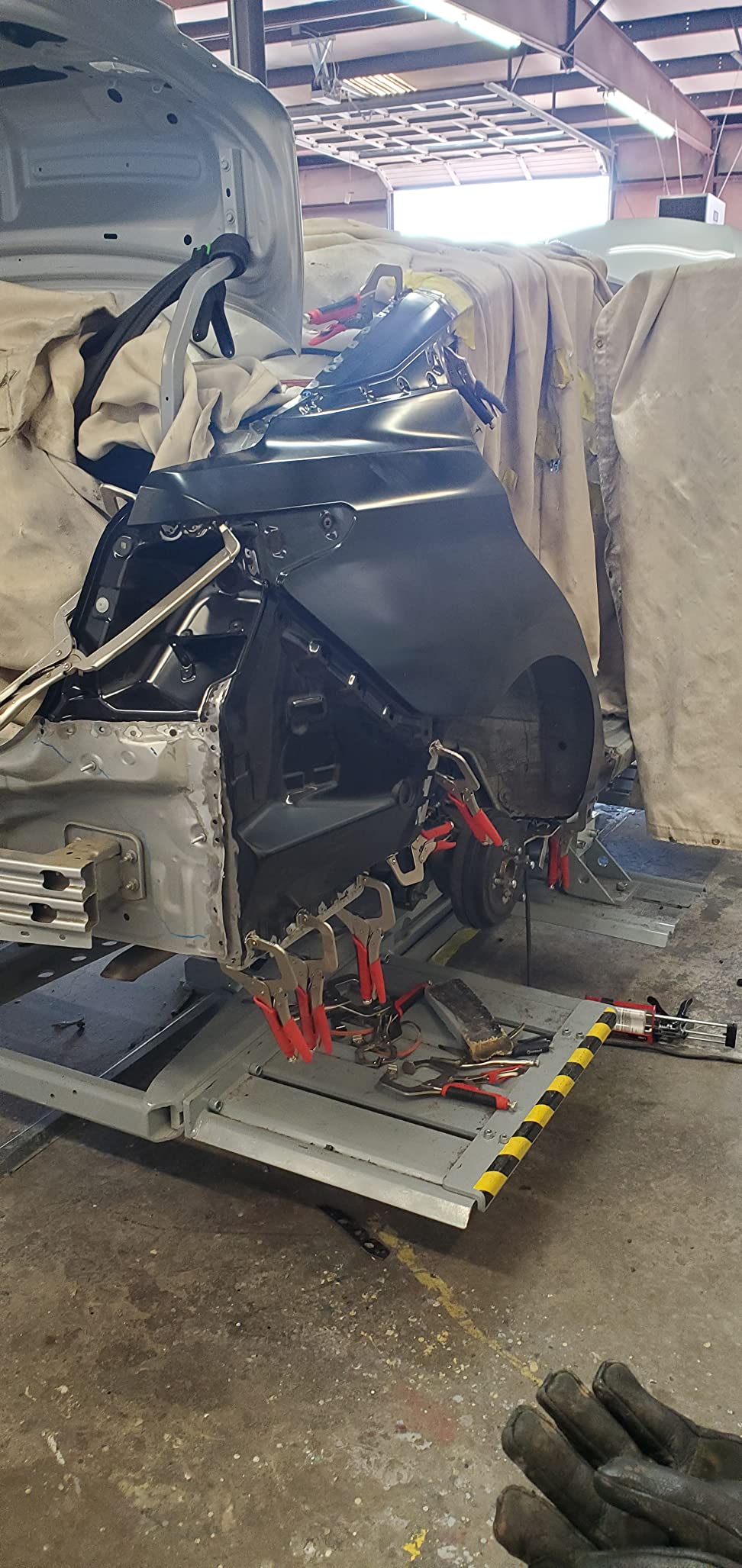
Count solves a problem that no single clamp can. A welded box has four corners and five or six joints, and if you only own three clamps you are constantly releasing one, re-gripping and hoping the part has not moved. Ten clamps let you set the whole assembly once and work through it without touching the fit-up.
At 11 inches with up to a 4 inch opening, each one is a general-purpose tool rather than a specialist. The pivoting swivel pads conform to angled, curved and irregular surfaces, which is what lets you hold a frame member that is not perfectly flat against the table.
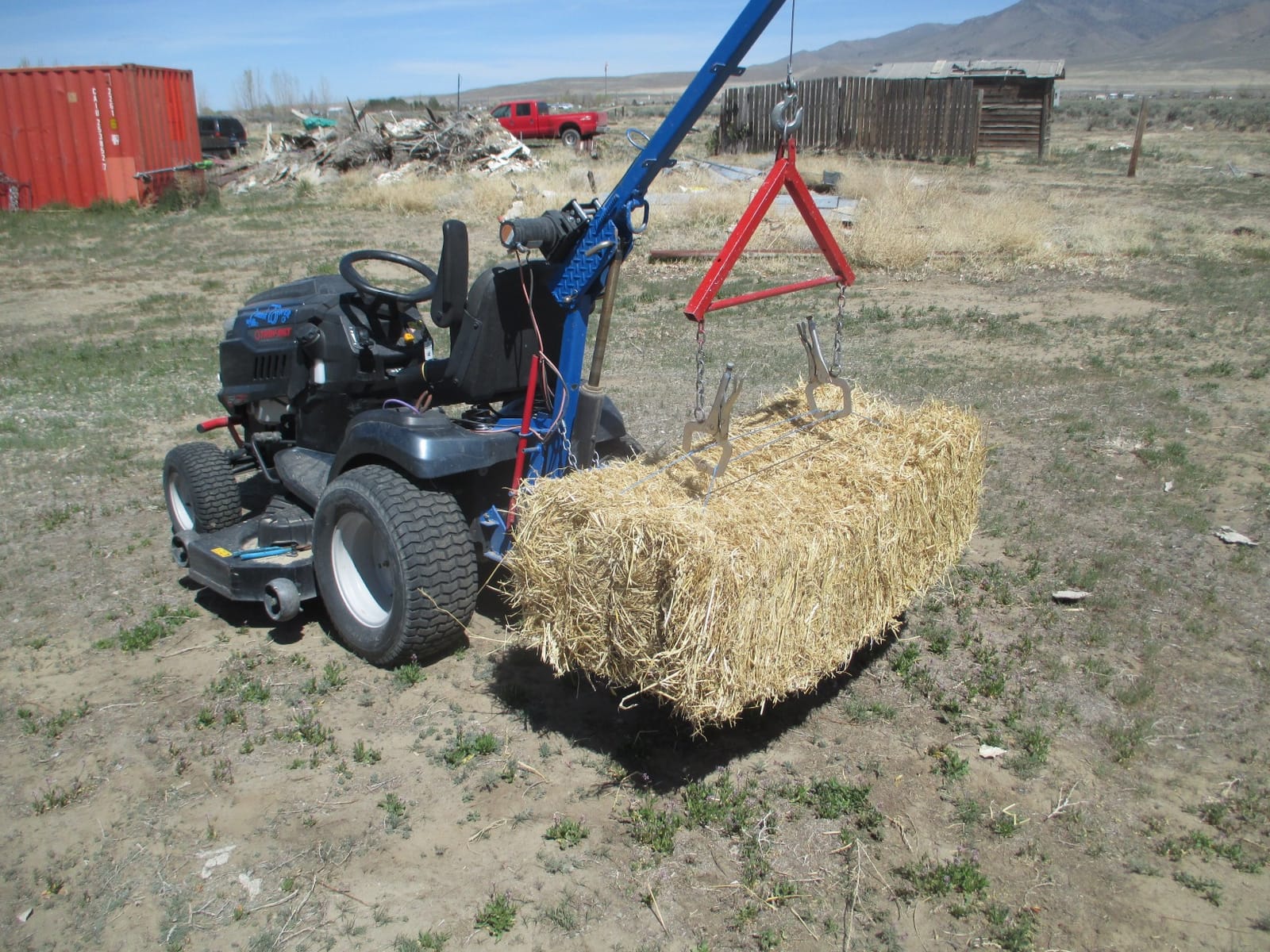
The turn-screw adjustment is finer than the spring-loaded adjustment on most pliers, so you can dial in a specific clamping force and repeat it on the next identical joint. On production-style work where you want the same pressure every time, that repeatability matters more than raw speed.
The heat-treated steel with nickel plating is the right material story for a welding shop. Plating slows the rust and the wear on the screw threads, which is the single biggest cause of failure for clamps living near a welder.
Whether a ten-pack is overkill for a home shop
Only if you mostly weld small pieces. For a fixed frame or a gate or a table, ten clamps is exactly the right number, because you can secure every joint simultaneously and stop worrying about drift.
If your work is one-off small assemblies, four clamps is the practical quantity and you would be better off spending the difference on a longer clamp or a bar clamp set. Bulk packs also dilute quality, and this set’s 4.4 average is visibly below the single-clamp ratings elsewhere in the list.
Why quantity changes fit-up quality
Because every time you release and re-grip, the part moves. Even a fraction of an inch shifts during tack, and by the end of a long assembly the error has compounded into something out of square that no amount of grinding fixes.
Forum consensus across welding communities is that welding magnets get used alongside clamps as a fourth hand, but magnets cannot hold against the push and pull of a welding arc. For anything structural, more clamps genuinely means better work, not just faster work.
9. MAXPOWER 15-Piece Locking Pliers and Welding Clamp Set with Tool Bag
MAXPOWER 15-Piece Locking Pliers & Welding Clamps Set with Tool Bag
- Fifteen jaw types cover nearly every gripping task
- Jaws machined flat to each other for even contact
- Rivets fully formed and seated for smooth operation
- Bag is heavy duty enough for general tools
- Finish and handle texture feel cheap against premium brands
- Adjustment nuts use cast slots rather than knurling
- Jaw teeth are cast rather than cut
This is the answer for someone who wants one purchase to cover most gripping tasks rather than building a collection piece by piece. Inside the nylon bag you get nine locking pliers across long nose, curved jaw and straight jaw profiles, two 11 inch locking C-clamps with a 3-3/8 inch opening, an 8 inch sheet metal clamp and a 9 inch U-shaped clamp for corners and angled sections.
The sheet metal clamp is the sleeper. It holds, bends and aligns thin panels, which is the job that regular pliers handle badly because their narrow tips concentrate force and dent the panel rather than controlling it.
What impressed us was the machining detail. The jaws are machined together and flat to each other, so the two halves make parallel contact instead of pinching on one edge. The rivets are fully formed and seated rather than just pressed in, which is why the pliers operate smoothly instead of developing play after a season of use.
When the all-in-one set makes sense
When you are setting up a shop from nothing and want to be able to grab the right jaw for any job the day the box arrives. Owners consistently point to the range of fifteen tools plus the carry bag as hard to beat for the money, and many compare the general quality as close to established premium brands.
The set also includes hex key sockets in the clamp tightening knobs, which is a small touch that makes pressure adjustment precise and repeatable across the whole collection.
Where the quality compromises show up
Three of them, honestly. The finish and handle texture read cheap next to a premium brand, the adjustment nuts have cast slots rather than knurling so they are harder to grip with oily hands, and the jaw teeth are cast rather than cut, which some owners see as a question for long-term wear on hard steel.
Owners also report occasional units arriving poorly made, which is normal with a set this size. Treat it as a collection to draw from rather than a set of twelve clamps you depend on individually, and it delivers. If you want one dependable clamp you use daily, buy one instead of fifteen.
10. IRWIN VISE-GRIP 11 inch Fast Release Locking C-Clamp with Swivel Pads
IRWIN VISE-GRIP Welding Pliers, Fast Release, C-Clamp with Swivel Pads, 11-Inch (IRHT82586)
- Fast triggerless release speeds up repositioning
- Reduced hand span lowers fatigue in long sessions
- Swivel pads prevent marking the workpiece
- Grip zone designed for high-temperature use
- Costs more than generic locking clamp pliers
- Heavier feel than a 6 inch model
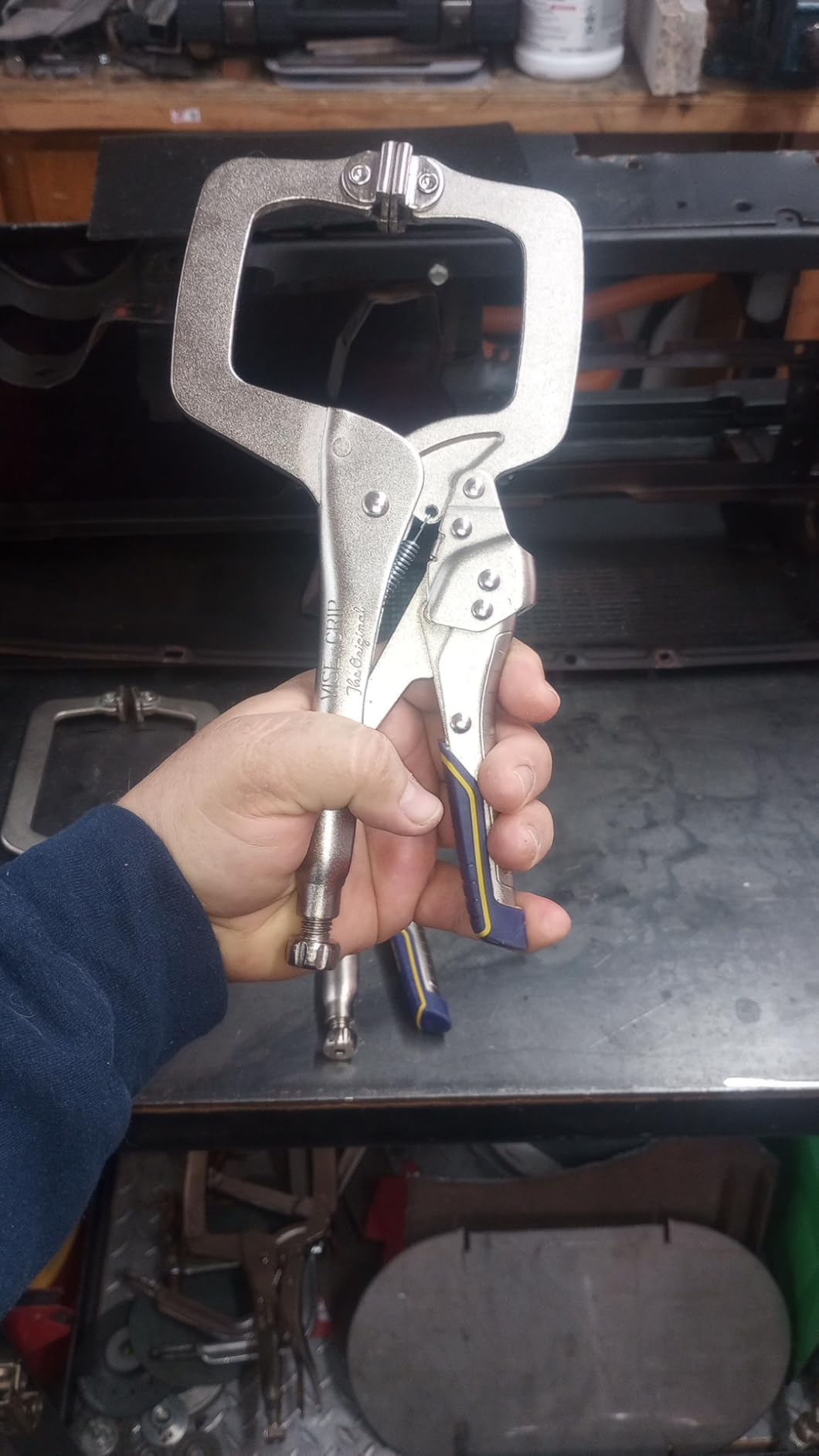
The release mechanism is what separates this from every other locking clamp plier in the list. A conventional trigger plier opens by squeezing the handles together, which requires a second hand and often a second attempt. This one opens one-handed from a reduced-span design, and owners describe it as roughly twice as easy to open.
That sounds like a small thing until you are holding a part in one hand with a glove on and a torch in the other. Quick repositioning is what keeps you from setting the work down and losing the alignment you just established.
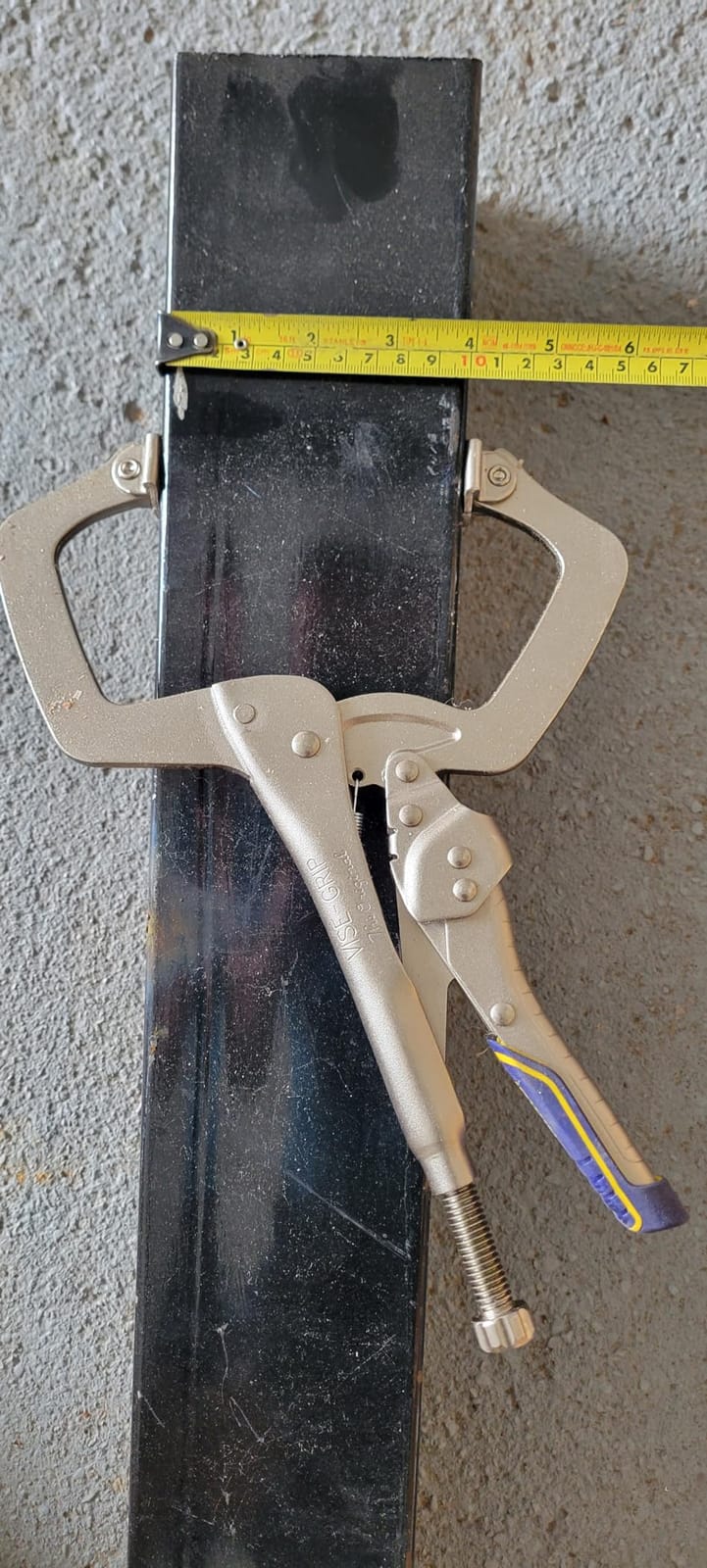
The reduced hand span is a comfort feature with a real effect over a long session. Shorter handles mean less hand opening, which means less strain through the wrist and forearm when you are clamping and releasing repeatedly. The redesigned tactile grip zone is also specified for high-temperature applications, which matters in a welding bay where the clamp body is closer to the arc than you planned.
The swivel pads are the other half of why this one earns a place. Articulating pads spread the clamping force so the jaws leave no deep impression on soft or finished material, which is the single complaint that comes up most often about generic locking pliers.
Who should pay the premium for this one
Anyone clamping visible, finished or soft material, and anyone doing long sessions where hand fatigue is the limiting factor. If you weld stainless, aluminium or anything you intend to polish afterwards, the swivel pads alone justify the step up.
On bare structural steel where grip matters more than appearance, the regular-tip models do the same job for less. Buying the premium model for its release mechanism is worthwhile; buying it purely for its pads on rough stock is not.
What reduced hand span actually changes
It changes how wide you have to open your hand. A shorter span lets you get a full grip with less stretch, which distributes force across more of the palm and takes strain off the fingers and wrist.
Over a full afternoon of fit-up work, that difference accumulates into whether you finish the day comfortable or finish it sore. For a part-time home shop welder it is a smaller deal than for someone welding full time, but the one-handed release is useful at any skill level.
11. BuildPro Inserta Table Clamp, 8-1/2 inch Capacity
BuildPro Inserta Clamp, Clamp Capacity: 8-1/2″, UEN5200, Build Pro
- Drops into standard 5/8 inch fixture table holes with no play
- Solid cast and steel construction for shop duty
- Suits welding tables
- arbor presses and drill jigs
- Tight predictable clamping that holds through a weld
- 400 lb clamping pressure is modest for heavy work
- Over-tightening can distort holes in a thin portable table
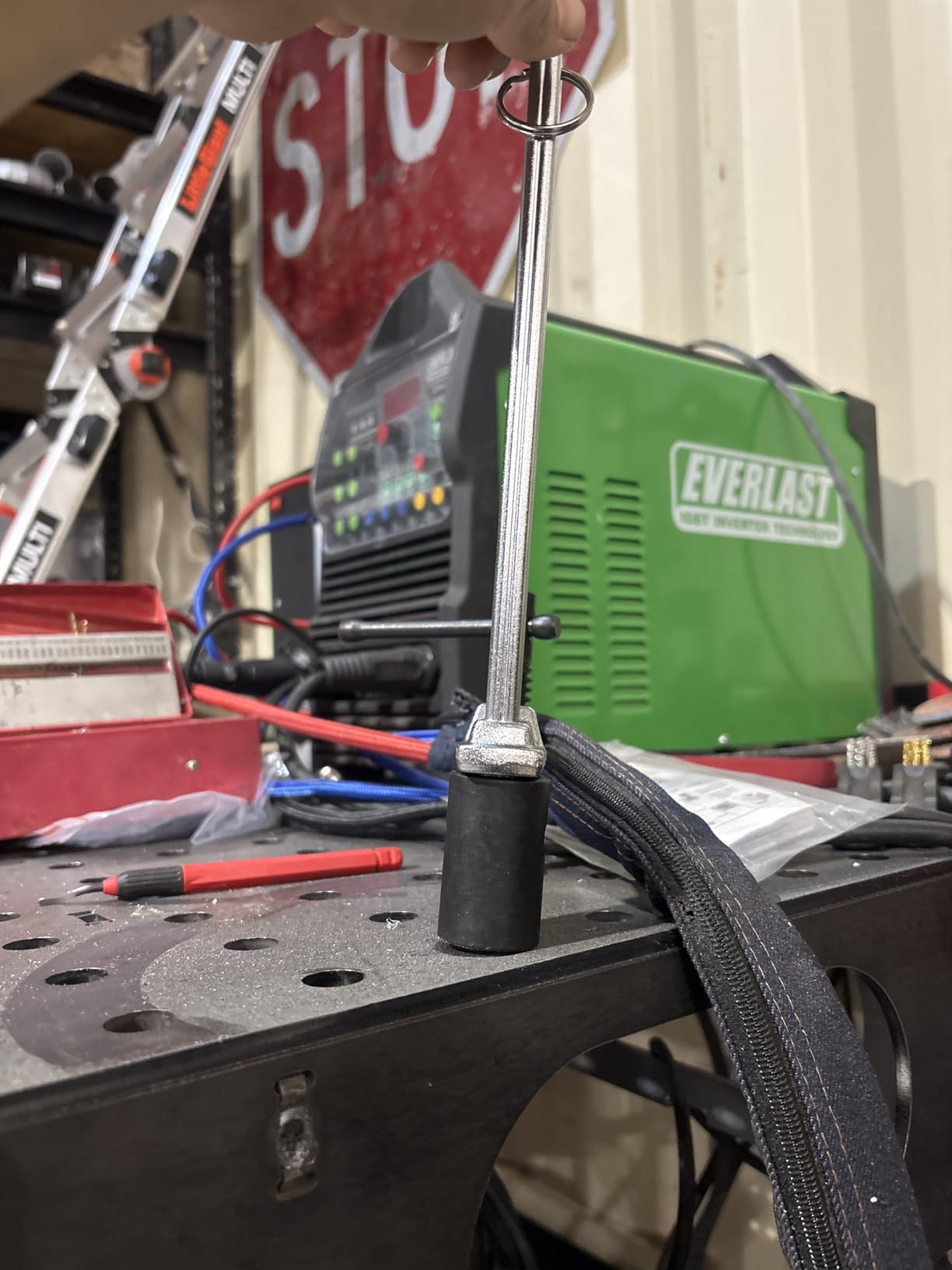
If your home shop has a welding table with a hole grid, this clamp is the one that disappears into the table and becomes part of the fixture. It drops into standard 5/8 inch holes with no play at all, which is the difference between a clamp that holds a part square and one that lets it shift a fraction under load.
The rail is 25/32 by 3/8 inch steel and the body weighs a little over two pounds, so it stays where you put it. Home fabricators who build their own tables rate it very highly for exactly that reason, and the rail is what carries the load into the table frame rather than letting the clamp tip over.
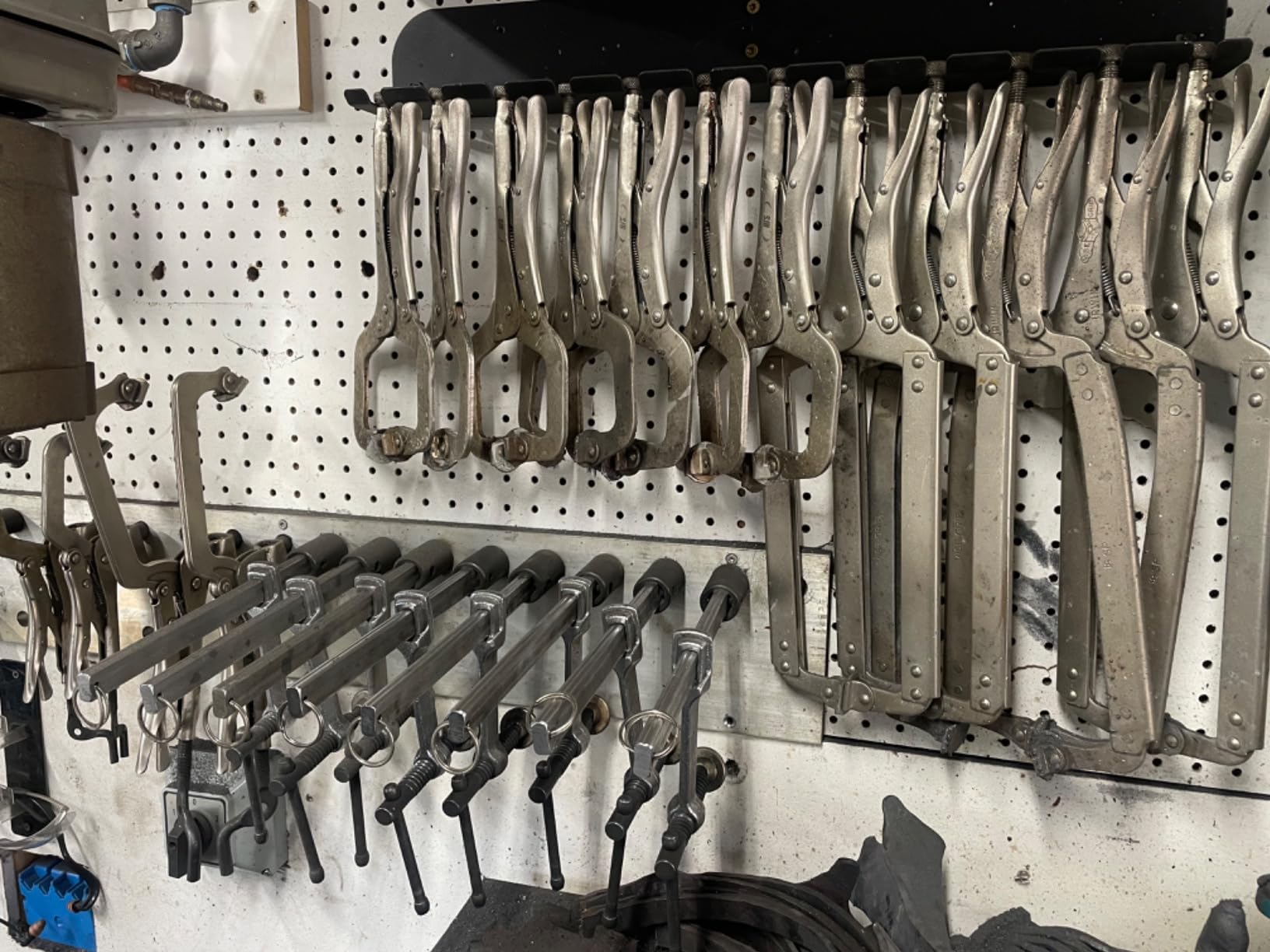
With an 8-1/2 inch capacity and a 4 inch throat, it clears most flat bar, tube and small plate work. Owners consistently note tight, predictable clamping that does not shift during a weld, which is what you want from a table-mounted clamp when the whole point of the table is repeatability.
A 6-1/2 inch capacity version exists as a separate model for smaller tables or lighter work, so you are not forced into one size for every fixture on the bench.
When a table clamp beats a hand clamp
When you are doing repeat work on the same parts. Once a clamp is part of the table, your setup stays put between welds, so the next piece goes into exactly the same position. That repeatability is what makes a production fixture faster than hand clamping.
It also wins for anything you want to weld from both sides or underneath. A clamp screwed into the table holds its position while you work around it, instead of being released and re-set every time you change sides.
Why over-tightening can damage the table
Because the clamp is reacting against the table hole, not against a solid frame. A thin or portable table with a light-gauge top will deform that hole under a heavy crank, and once the hole is oval the clamp no longer seats properly and starts to rock.
Tighten until the part stops moving, then stop. The 400 lb pressure rating is adequate for typical plate and tube work on a proper table, and if you find yourself wanting more than that, the fix is a heavier table rather than more torque on this clamp.
12. Pumtus 24-Piece Butt Welding Clamp Set for Sheet Metal
Pumtus 24 Pcs Butt Welding Clamps, Sheet Metal Welding Clips, Auto Body Panel Clamps for Edge to Edge Welding, Small Welding Clamps Tack, Welding Door Alignment Tool for Patch Repairs
- Twenty-four clamps cover a whole panel seam at once
- Adjustable block sets a consistent root gap
- Carbon steel resists rust through tack cycles
- Individually bagged so they stay organised
- Limited to thin gauge metal around 3/16 to 1/5 inch
- Small 2 inch body is only for edge-to-edge joints
Butt clamps solve a specific problem badly and cheaply: holding two flat panels edge to edge at a fixed gap while you tack a seam. The adjustable clamp block sets a 0.4 inch root gap, and the wing nut pulls the panels together against it. Twenty-four of them means a full car floor or a long panel seam stays put from one end to the other.
Sheet metal work is where this matters. A butt joint on thin material moves constantly as heat hits it, and once the panels close on each other you have a gap in the middle of the seam and a lot of grinding to do. Clips at intervals solve it cheaply.
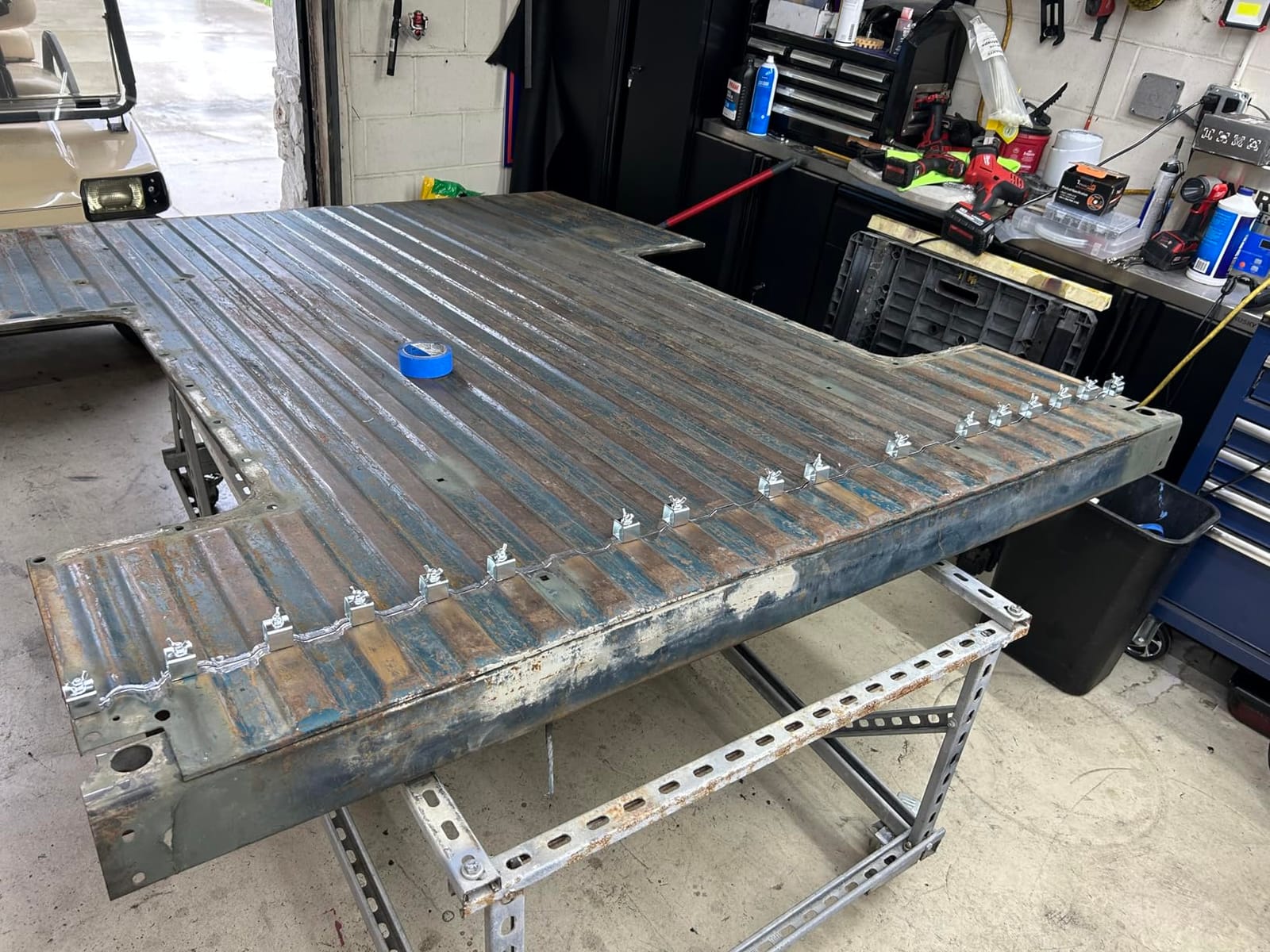
Each clamp is individually bagged, which sounds minor until you try to store twenty-four small metal clips loose. Bagged, they live in a drawer and you are not fishing clips out of the bottom of a toolbox covered in swarf.
The carbon steel holds up through repeated tack cycles without rusting, and the tensile rating listed for the material gives you reasonable confidence in the clamping bite. For a clip this small, that is more than adequate.
What these clamps are not for
They are not general-purpose clamps. At 2 inches long they only span an edge-to-edge joint, so they cannot clamp a bracket to a frame, hold two tubes parallel, or secure a panel at an angle.
They are also gauge-limited to roughly 3/16 to 1/5 inch material. Thicker plate leaves the clamp with nothing to grip, and much thinner sheet gets marked by the block. If you are welding heavier structural plate, this set is the wrong tool entirely.
Where a butt clamp set saves the most time
Panel and patch repair. Door skins, wings, floor sections and re-skinning all involve long edge-to-edge seams in thin material, and those are exactly the joints that walk out of alignment the moment you strike an arc.
The practical method is to set the gap once on the first clip, match every other clip to it, and tack from the middle outward. Using many clips beats using a few on this kind of work, and the difference is visible in how straight the finished seam grinds flat.
Which Type of Welding Clamp Does Your Shop Actually Need?
Most home shops end up needing four families, and confusing them is the most expensive mistake in this hobby. A face clamp holds a panel down to a bench. A C-clamp, also sold as a G-clamp, is a rigid frame with a threaded spindle that pushes against a fixed jaw, and it is what you use when you need to squeeze two flat pieces together or reach into a fixed space. A bar clamp, also called an F-clamp, has a sliding head you position once and lock in place along a steel rail. A locking plier clamps with a compound linkage and a knurled screw, so it grips with one hand and holds without any pressure from you.
Two more families are narrower. Table clamps, like the BuildPro Inserta, are rail-mounted and screw into a hole grid so they become part of your fixture. Butt clamps are the small panel clips for edge-to-edge seams in thin material. For round stock and irregular shapes, our pipe clamp picks cover the dedicated fixtures worth having for tube and pipe work.
C-Clamp vs F-Clamp: Which Should a Home Shop Buy?
The honest answer is that both work, and the difference is convenience rather than capability. In long-running welding forum threads the consensus is remarkably consistent: C-clamps hold a joint just as well as F-clamps for the same job, but F-clamps win on speed and on not having to reposition while the metal is hot. That is the whole debate, and it resolves into a simple buying rule.
Buy an F-clamp whenever the clamp can sit in one place while you work. If you are holding a bracket onto a tube, tightening as you go, or reaching around a joint, the sliding head locks in position and stays there while you tack. With a C-clamp, the same job means three hands, because the spindle has to keep moving or the part shifts.
Buy a C-clamp when reach matters more than speed, when you are inside a frame and cannot get a bar clamp body in there at all, or when you need to hold pressure while you reposition your other hand. Deep-throat C-clamps are genuinely better at getting into confined spaces than any bar clamp, which is exactly why the 18 inch pliers earlier in this list earn their place.
The practical rule for a home shop: bar clamps first, locking pliers for the fourth-hand job, C-clamps for confined reach. Our recommendation to a first-time buyer is a four-pack of bar clamps plus one 9 inch locking plier, and adding C-clamps only when a specific project demands the reach.
How Many Welding Clamps Should a Home Shop Own?
Work from the seam, not the tool. A rule of thumb that has held up well in our shop is two clamps for a seam under 12 inches, then one more clamp for every additional 8 to 12 inches of seam. A short bracket gets two. A 4 foot frame rail gets four or five. A car floor panel gets a clip every 6 inches or so, which is why the 24-piece butt clamp set exists.
Count by joints rather than by length when the assembly is three-dimensional. A simple square frame has four corners and typically six to eight joints, so four good clamps lets you secure every corner at once and add the rest as needed. The HFS ten-pack above is the version of this problem solved properly for larger assemblies.
Frequency matters too. Anyone welding weekly should own more than someone welding twice a year, because a seized screw on a clamp you use every week is an afternoon lost. Keep one spare of whatever your main clamp is, and expect to replace threads rather than tools.
Clamping Force vs Material Thickness: How Tight Is Too Tight
Over-clamping distorts. On thin sheet and light tube, squeezing the joint closed with a cheater bar can bow the material away from the seam, and you will spend more time straightening the distortion than you saved by closing the gap. On heavy material, you simply strip the thread or bend the bar permanently, and then you own a bent clamp.
The useful mental model is that fit-up needs enough force to hold alignment against the pull of a cooling weld, not enough to change the shape of the part. Thin material under about 1/8 inch is held comfortably by firm hand pressure on a 450 to 600 lb clamp. Heavy plate and solid bar are where the higher rated clamps earn their place, and even there, tighten until it stops moving.
Also clamp across the joint rather than in line with it, and load the clamp perpendicular to the surface. A clamp sitting in the bead line will heat up, soften its own jaw and can fuse to the workpiece, which damages the clamp and the part in the same weld.
Common Clamping Mistakes in the Home Shop
The first mistake is owning too few clamps and working around it. Every release and re-grip is an opportunity for the part to move, and the movement compounds across a long assembly.
The second is the cheater bar. Extending the handle multiplies your force well past what the spindle is designed for, and the result is stripped threads and bent bars rather than a better fit-up. If you need more force than the clamp delivers, the answer is a heavier clamp.
The third is clamping in the bead line. The clamp takes heat, its jaw softens or distorts, and it can fuse to the workpiece so you lose both. Move the clamp back from the weld by as much as you can.
The fourth is letting spatter build up. Spatter on a screw thread turns the spindle into a grinding wheel and eventually seizes it. A wire wheel on the bench takes seconds and prevents the most common cause of clamp failure.
The fifth is clamping finished or soft material with a regular tip. Deep jaw marks show up after grinding and finishing, and they are miserable to repair. Use swivel pads, or scrap wood between the jaw and the work.
Spatter, Maintenance and Why Woodworking Clamps Melt Near a Torch
Welding clamps live in a hostile environment. Spatter sticks to screw threads and to any soft surface, and the hardened lumps that build up will damage the thread and mark every workpiece afterwards. The maintenance routine is simple: brush or wire-wheel the spindle before and after heavy sessions, and keep a drop of oil on the threads. That single habit is the difference between a clamp that lasts ten years and one that seizes in two.
Rust is the other enemy, which is why nickel plating and black oxide finishes show up repeatedly in the specifications here. Neither coating is permanent, but both slow corrosion enough that a shop clamp stored in ordinary conditions still works when you pull it off the shelf next spring.
Do not put a woodworking clamp next to a welding torch. Many carry plastic handles, plastic pads or a plastic body section, and spatter softens them, they deform, and a hot fragment can ignite. If your collection overlaps with woodworking, our woodworking clamp roundup is a fine guide, but keep those tools on a separate rack from anything metalworking.
For shops where spatter is constant, all-metal clamps are worth the trade. The SHALL set earlier in this list is built with no rubber parts for exactly that reason, and copper-plated screws and feet are the same idea taken further if you can find them.
Home Shop Clamp Budget: Starter Set vs Full Collection
A sensible first purchase is three things: a pair of adjustable face clamps for bench and fixture work, a four-pack of 12 inch bar clamps for frame joints, and one 9 inch locking clamp plier for the fourth-hand job. That combination is where nearly every home shop should stop for the first year, and it covers the overwhelming majority of work a beginner does.
The second purchase should be reach. Add a second size of bar clamp, or move up to a deep-throat set with a 4 inch throat, because the limit you will hit first is not force, it is being able to get a clamp into the space where the joint actually is.
The third purchase is quantity. Once you are building anything with more than four joints, extra identical clamps beat one better clamp. Buying four of the same bar clamp is worth more than buying four different ones, because they hold a symmetric assembly symmetrically.
Table clamps are the fourth purchase, and only once you have a table with a proper hole grid. That is the point where a shop stops being a collection of tools on a bench and starts being a fixture system. If you are still building your bench, our guide to small shop benches is the natural next step.
None of that needs to happen at once. Buying one clamp family, learning its limits, and adding the next family when a project demands it is how most working shops were actually built.
Frequently Asked Questions
What are the best brands of welding clamps?
For general home-shop work the most reliable names are IRWIN VISE-GRIP for locking pliers, Bessey and Jorgensen for bar clamps, and Harbor Freight for budget entry points. Brand matters less than build quality in a given price class. Welding forum regulars frequently report Harbor Freight clamps performing comparably to Bessey, with much of the premium being brand name rather than performance.
Who makes the best clamps?
IRWIN VISE-GRIP is the most established name in locking clamps, and the 9 inch model on this list carries a lifetime guarantee. Jorgensen rates highest for bar clamps, while Harbor Freight covers the budget tier well. There is no single best maker, because a 450 lb clamp and a 1200 lb clamp are built for different jobs, not different quality levels.
What makes a C clamp better for welding?
A C clamp is better when reach and confinement matter more than speed. Its rigid frame reaches into box sections and narrow gaps where a bar clamp body cannot fit, and the spindle gives fine continuous pressure control as you tighten. It is also more tolerant of being placed off-centre. Both clamp types hold equally well on the same job.
What is the best clamp for welding?
For most home shops the best all-round answer is a 9 inch locking C clamp plier for general positioning plus a four-pack of 12 inch bar clamps for frame and box section joints. The locking plier works one-handed and stays in your apron, and the bar clamps hold a whole assembly in place while you weld through it.
What are F-clamps used for?
F-clamps, also called bar clamps, are used for frame assembly, box section and tube welding, panel work and any joint where the clamp can sit in one place while you weld. The sliding head locks at any point along the steel rail, so you position it once instead of adjusting the spindle every time you move your hands.
What is the difference between a G clamp and an F clamp?
A G clamp is another name for a C clamp: a rigid C-shaped frame with a threaded spindle you turn to push the pieces together. An F clamp has an F-shaped frame with a sliding head that you position along a rail and lock in place. Same clamping job, different mechanism, and the F clamp is faster because it holds position without pressure from you.
Which pipe clamps are the best?
For round tube and pipe the useful sizes to keep in the shop are one clamp for 1/2 inch stock and one for 3/4 inch, plus an adjustable strap clamp for anything irregular. Choose clamps with swivel pads so round stock is not flattened at the contact point. Our pipe clamp guide covers the fixture-style options in more detail.
What are the best Harbor Freight clamps?
Harbor Freight is a sensible entry point for a first purchase, and forum regulars commonly report them performing on par with premium brands for the money. Start with their locking C clamp pliers and a bar clamp set, and avoid buying deep-throat models where build consistency matters most, since those are where budget clamps vary most.
What is the best welder earth clamp?
An earth or ground clamp is a different category entirely, because it attaches the work cable to the workpiece rather than holding a piece in position. The best option is a spring-loaded copper jaw clamp that self-energises, since it maintains contact as the workpiece heats and moves. None of the clamps on this list are earth clamps.
How many welding clamps do I need for a typical project?
Use two clamps for a seam under 12 inches, then add one clamp for every extra 8 to 12 inches. Count by joints for three-dimensional assemblies, where a square frame needs four good clamps plus extras. For a long thin panel seam, a pack of small butt clips every 6 inches is cheaper and better than large clamps.
The Best Welding Clamps for Your Home Shop in 2026
Pick your first move by the work you actually do. Weld flat panels and sheet metal most of the time, and the adjustable face clamp pair on this list is where you should start, because holding work to a fixture is what stops panels moving during a tack. Build frames and boxes, and the four-pack of bar clamps with mixed 6 inch and 12 inch openings covers more joint types than anything else we tested.
For everything else, keep a locking clamp plier in your apron. The IRWIN 9 inch is the one we reach for most, because the U-shaped jaw keeps the joint in sight while you weld and the guarded release stops it opening when you do not mean it to. Add reach later when a project needs it, and add quantity when a multi-joint assembly starts fighting you.
The real lesson from putting all twelve of these through a garage shop is that clamp force is the least important number on the box. Throat depth, jaw material and whether the tool can stay where you put it decide the quality of the fit-up. Buy for the shape of your work, keep the threads clean, and the best welding clamps for home shops are the ones you stop thinking about because they just hold.