
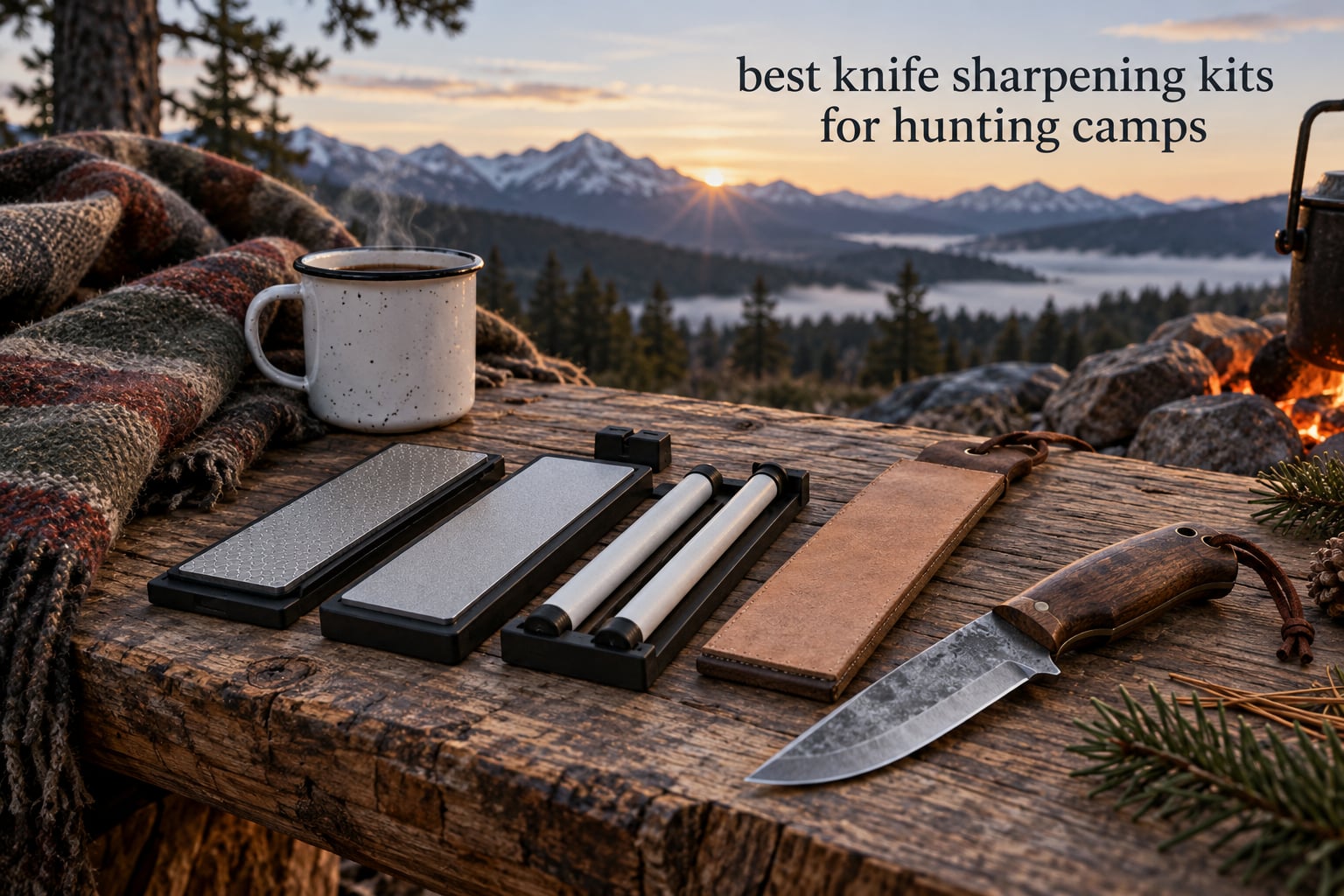
A dull knife is the quiet failure that ruins a hunting trip. You notice it first when the skin refuses to part, when the tip skates off a joint instead of following the bone, when a caping cut takes three passes that should take one. In camp there is no bench, no water bucket and no outlet within a hundred miles of tree line, so whatever edge you left the house with is the edge you will be working with.
That is the entire argument for carrying a knife sharpening kit in a hunting camp kit, and the reason we spent weeks putting twelve of them through field routines before writing this list of the best knife sharpening kits for hunting camps. We sharpened fixed blades and folders, cut paper and hair, worked serrated edges and pulled a few edges back from mid-trip damage. The winners are the ones that restored a working edge with cold hands and low light, not the ones that made the prettiest edge on a clean kitchen table.
If your interest is the home side of the craft rather than the treeline, we also track kitchen knife sharpening systems and electric knife sharpening systems separately. Those tools are excellent and mostly wrong for a pack. What follows is built for the pack.
Table of Contents
Key Takeaways for Hunting Camp Sharpening Kits
The Work Sharp Guided Field Sharpener Elite is the best knife sharpening kit for hunting camps overall because it carries two diamond plates, a rotating three-surface ceramic rod, a leather strop and a hard case in one 5.6-ounce package.
For pack weight, nothing here beats the Work Sharp Pocket Hunting Sharpener at 1.6 ounces, and the Smith’s Pocket Pal at roughly 1 ounce is close behind with a fold-out diamond rod for serrations.
The best knife sharpener for hunting on a tight budget is the Smith’s CCKS 2-Step, a two-stage pull-through that restores a dull straight edge in three or four strokes and floats in water.
A pull-through sharpener is fine as an emergency and harmful as a habit, because it scrapes steel away at a fixed angle every single pass without letting you reset the geometry.
Whetstone sets like the Intelitopia and Sharp Pebble kits belong in your garage sharpening plan, not your pack, because they need soaking, a flat surface and several minutes of focused time.
Field condition matters more than grit numbers: cold hands, wet hands and a headlamp change which sharpener you can actually use at 8 p.m. after a long day in the timber.
Match the sharpener to the steel, because hard powder steels such as S30V and S45VN punish natural stones and respond to resin bonded diamond.
Build in three tiers of kit: an ultralight carry piece, a standard pack sharpener, and a full camp kit with a strop and a coarse plate for mid-trip edge repair.
What Is a Knife Sharpening Kit for a Hunting Camp?
A knife sharpening kit for a hunting camp is a portable set of stones, diamond plates, rods and strops that lets you restore a working edge on a hunting knife in the field, where no bench, water or power is available.
That single sentence is the filter we applied to every product below. Anything that needs a mains outlet, a sink, or twenty uninterrupted minutes at a workbench is a home tool, however good it is.
Top 3 Picks for Hunting Camp Sharpening Kits in 2026

Work Sharp Guided Field Sharpener Elite
- 220 and 600 grit diamond plates
- Rotating 3-surface ceramic rod
- Leather strop and hard case
- 5.6 ounces
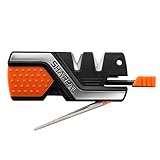
SHARPAL 101N 6-in-1 Pocket Sharpener
- Carbide and ceramic slots
- 400 grit and grooved diamond rods
- Ferro rod and whistle
- 2.4 ounces
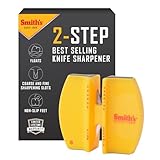
Smith’s CCKS 2-Step Sharpener
- Coarse carbide and fine ceramic stages
- Three to four strokes to restore an edge
- Floats in water
- Under 2 ounces
The 12 Best Knife Sharpening Kits at a Glance
| Product | Specifications | Action |
|---|---|---|
| Work Sharp Guided Field Sharpener Elite |
|
Check Latest Price |
| SHARPAL 101N 6-in-1 Pocket Sharpener |
|
Check Latest Price |
 Smith’s Pocket Pal Sharpener Smith’s Pocket Pal Sharpener |
|
Check Latest Price |
 Lansky Blademedic 4-in-1 Lansky Blademedic 4-in-1 |
|
Check Latest Price |
| Smith’s CCKS 2-Step Sharpener |
|
Check Latest Price |
 Smith’s DCS4 Diamond Combination Stone Smith’s DCS4 Diamond Combination Stone |
|
Check Latest Price |
 SHARPAL 178N 3-in-1 Sharpener SHARPAL 178N 3-in-1 Sharpener |
|
Check Latest Price |
 Lansky D-Sharp Diamond System Lansky D-Sharp Diamond System |
|
Check Latest Price |
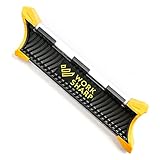 Work Sharp Pocket Hunting Sharpener Work Sharp Pocket Hunting Sharpener |
|
Check Latest Price |
 Work Sharp Tri-Brasive Benchstone Work Sharp Tri-Brasive Benchstone |
|
Check Latest Price |
 Intelitopia Complete Stone Set Intelitopia Complete Stone Set |
|
Check Latest Price |
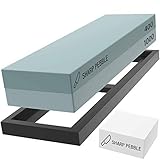 Sharp Pebble 400/1000 Whetstone Kit Sharp Pebble 400/1000 Whetstone Kit |
|
Check Latest Price |
Everything above is a single decision made easy. Below is the reasoning, and the twelve reviews that go with it.
How We Tested These Camp Sharpening Kits
Our test routine was built around the way a blade actually fails on a hunting trip rather than the way it looks in a product photo. We took each sharpener into the field kit, worked it by feel, and judged the result on four axes: sharpness, ease of use in the field, versatility and value.
For sharpness we used the three checks that do not require a machine. We pulled a hair from my head and from the dog and tried to shave it with a single controlled stroke, we sliced a ripe tomato without pushing, and we cut a sheet of copy paper with the blade held so the paper supplies only its own weight. A burr that remains on one side after stropping or honing counts against the sharpener, because that burr is the thing that will abrade a hide mid-skin.
For ease of use in the field, we sharpened at dusk under a headlamp and again on a wet picnic table after rain, deliberately with gloves on for part of the session. This is where the pack sharpener earns or loses its place. A tool that demands two hands, a light source from above, and a perfectly flat surface is a garage tool that happens to be portable.
For versatility we checked whether the tool handled straight edges, serrations, gut hooks and bone contact, since a hunter’s blade sees all four in a single trip. For value we weighed what the tool replaced rather than what it cost, because the sharpest single gadget in the pack can still be a poor trade if it leaves three gaps you have to carry something else for.
One deliberate omission: we did not measure apex angles with a test gauge, because a number from a machine does not tell you whether a blade will skin an elk shoulder. Every claim below comes from what the tools did to paper, hair, tomato and game.
1. Work Sharp Guided Field Sharpener Elite – the Full Kit That Travels
Work Sharp Guided Field Sharpener Elite with case, Travel Knife Sharpener Tool
- Five abrasives in one carry case
- Rotating ceramic rod exposes coarse fine and hook groove
- Angle guidance for 20-25 degree bevels
- Plates lift out to expose a broad wrench
- Self contained with no tools needed
- Heavier and bulkier than a pocket pull-through
- A larger package than single-function sharpeners
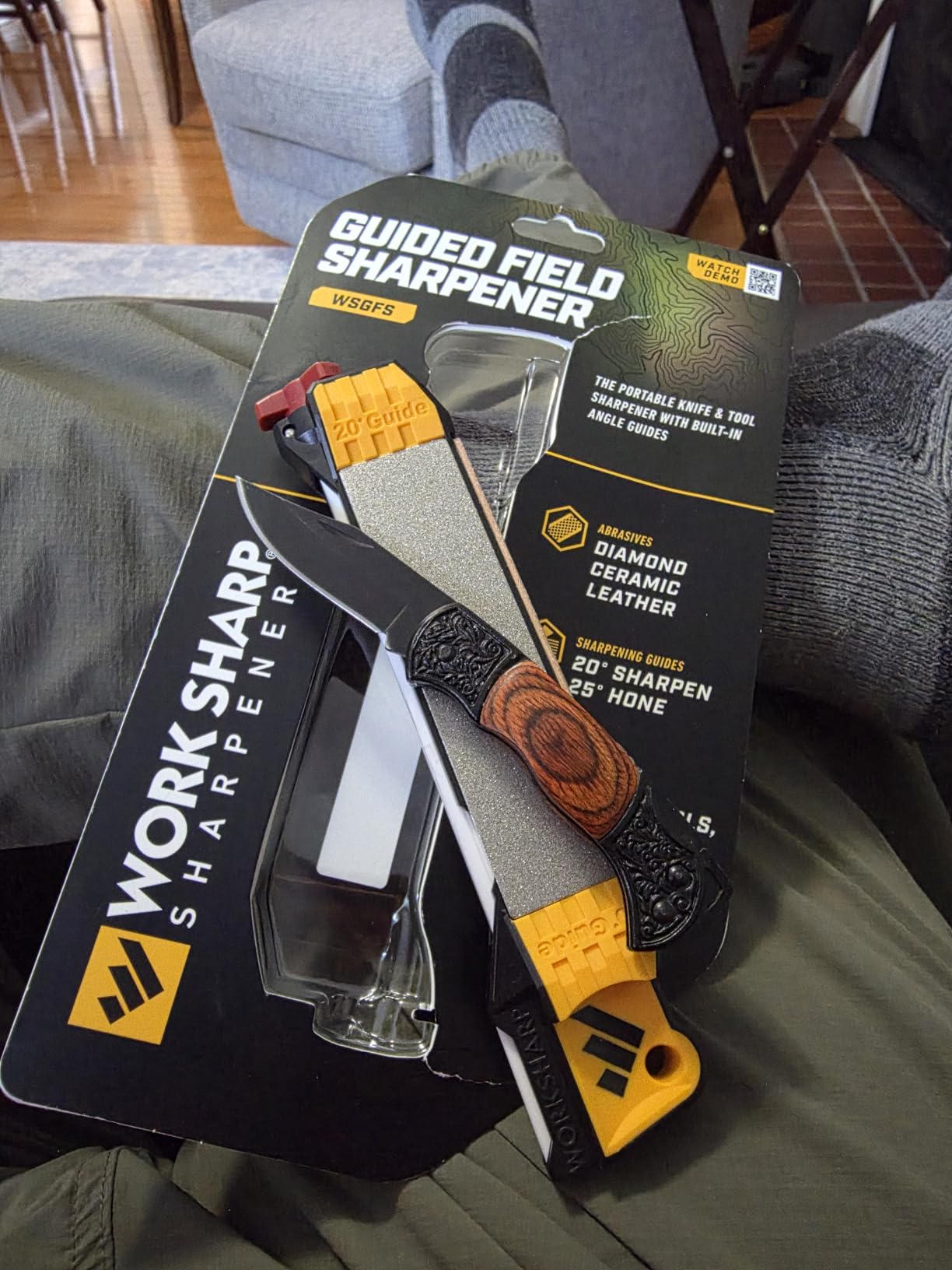
This is the kit I keep within reach of the tent door. The Work Sharp Guided Field Sharpener Elite is the only product in this list that genuinely behaves like a complete knife sharpening kit rather than a single tool: a 220 grit diamond plate, a 600 grit plate, a ceramic rod that rotates to show two working surfaces plus a fish-hook groove, and a leather strop, all in a hard case.
Over several weeks it became the sharpener I reached for first, because it removes the decision. A blade that lost its edge in the timber gets 220 grit to reset it, then 600 to refine, then a few passes on the ceramic rod, then the strop. Doing that in four separate tools means four objects to lose in the duffel.
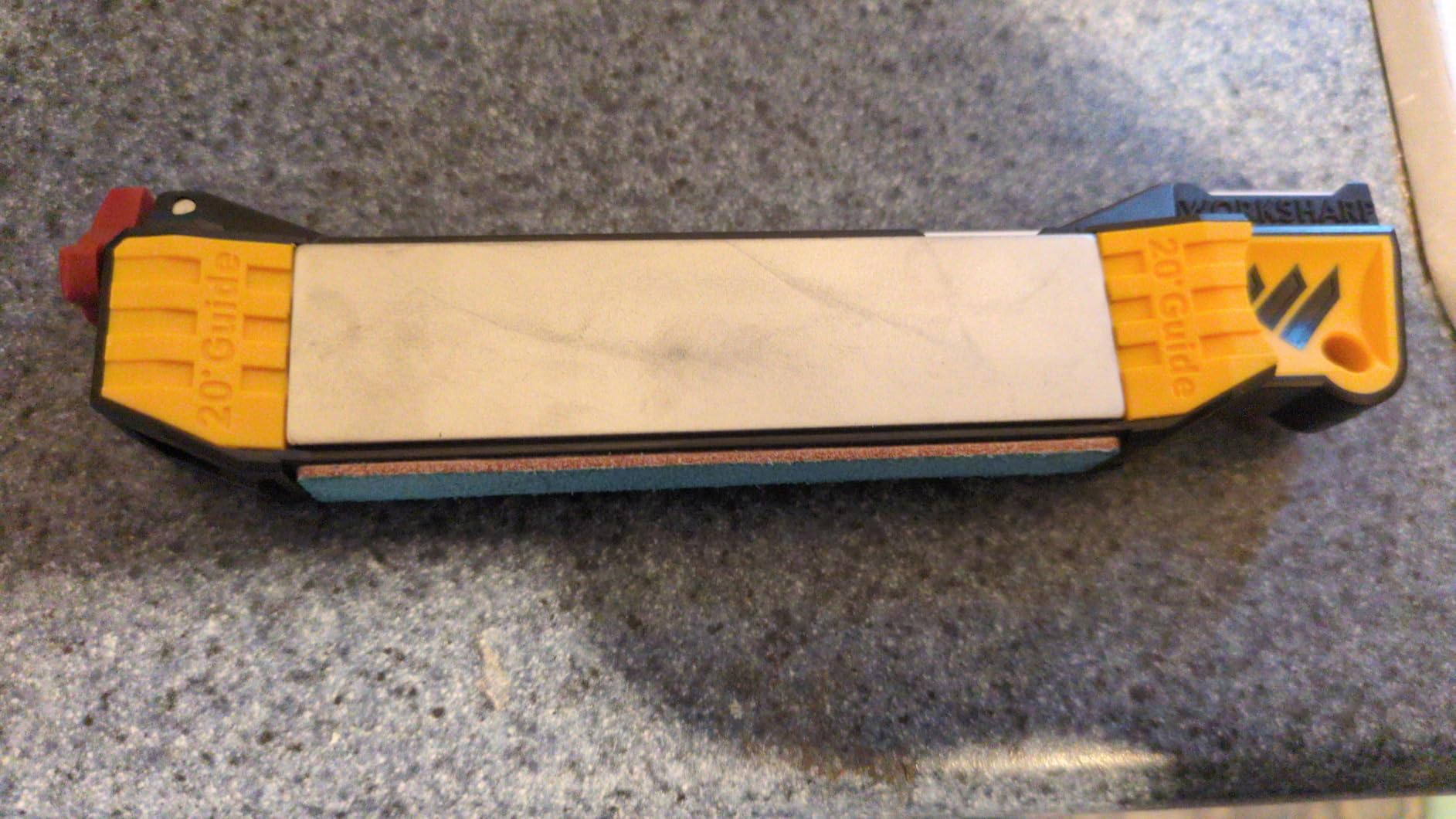
Two details make it better than the sum of its parts in the woods. The diamond plates lift out of the body and expose a broad head underneath, so you can drive a bolt or a wrench against something hard without hunting for a second tool. And the 20 to 25 degree guidance holds a consistent bevel on a thick fixed blade where a freehand stroke would wander and thin the edge.
The honest drawback is weight and bulk for what it does. At 5.6 ounces and nearly ten inches long, it is a pack item, not a shirt pocket item. Anyone counting every ounce for a solo overnight deer camp should read the pocket reviews further down and decide whether the extra coverage is worth the ounces.
Why it earns the top spot
Every other sharpener here solves one problem. This one covers dull repair, edge setting, serration touch-up, hook sharpening and final polish, and it does all five from a single case that fits in a jacket pocket when closed. That coverage is what makes it a kit rather than a gadget.
Where it falls short
The leather strop needs a stropping compound to do its best work, and the case adds bulk that has to live somewhere in the pack. Reviewers also point out that it is not a pocket tool, which is fair. Treat it as the pack anchor and add a small carry piece for the days you leave the pack at camp.
2. SHARPAL 101N 6-in-1 Pocket Sharpener – Six Tools in One Slot
- Six functions in a pocket body
- Handles straight edges and serrations
- Carbide and ceramic rated for 10000 uses
- Lanyard hole for pack attachment
- Doubles as a fire starter
- Short slots feel awkward on large blades
- Survival extras add weight you may not want
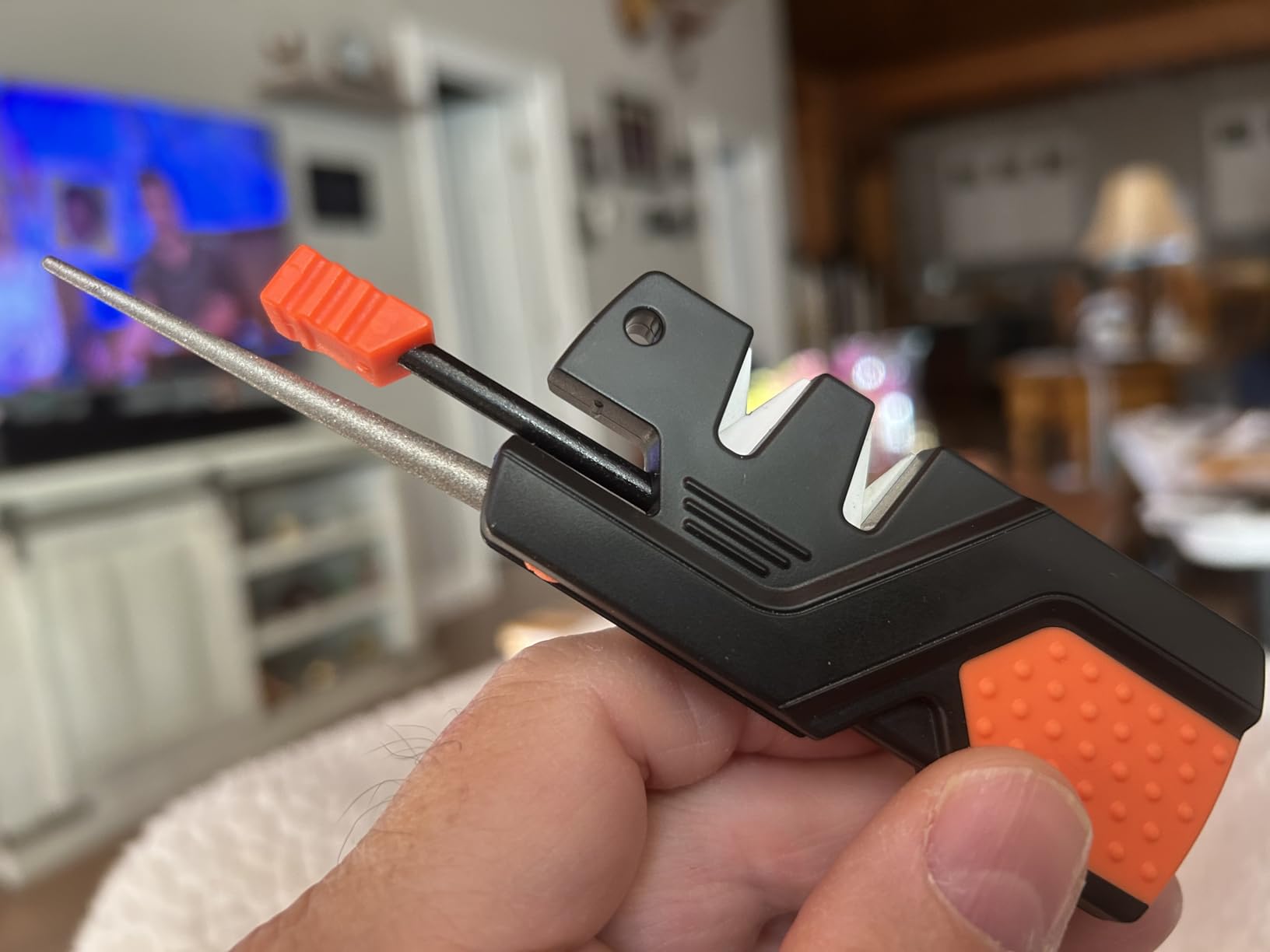
The SHARPAL 101N is the most reviewed sharpener we tested, with close to 40,000 ratings, and the reason is simple: it refuses to be only a sharpener. In one 2.4-ounce body you get a coarse carbide slot, a fine ceramic slot, a tapered 400 grit diamond rod, a grooved diamond rod for serrations and hooks, a ferro rod and a whistle.
During our tests it did exactly what the layout implies. The carbide slot brought a dull skinning blade back to working in a handful of passes, the ceramic slot cleaned it up, and the grooved rod handled a serrated folder without the guessing that a flat stone demands. By the end of a session it had also started our fire twice, which is not nothing when you are eight miles from a road.
The compromise is size. At 3.5 inches long, the slots are short, and on a large fixed blade or a boning knife you are working near the tip of the stroke rather than across the full bevel. It is a hunter’s pocket tool, not a kitchen drawer tool, and it is at its best on a 3 to 4 inch skinner.
On its own it is the most capable single object we would put on a keychain before a season opener. A hunter who processes a lot of game and wants a true bevel should add a proper guided system beside it.
Best for a hunter carrying one tool
If you want a sharpener, a fish-hook tool, a fire starter and a signal in one package, nothing else in this list compares. The diamond and carbide stages cover what a camp knife needs, and the survival functions make it worth its weight even on days you never sharpen.
Where the small body shows
Reviewers consistently flag that the short slots are less comfortable on big blades, and that the ferro rod and whistle are dead weight for anyone who already carries those items separately. Buyers focused purely on sharpening can spend that ounce budget better elsewhere.
3. Smith’s Pocket Pal – the One-Ounce Carry Sharpener
- Restores a working edge in about a dozen passes
- Excellent on serrations and gut hooks
- Lightest option we tested
- Replaceable reversible stones
- Three year limited warranty
- Fold-out rod hinge is tight and can snap if forced
- Ceramic stones cannot be rotated when worn
- Will not fix a badly rolled edge
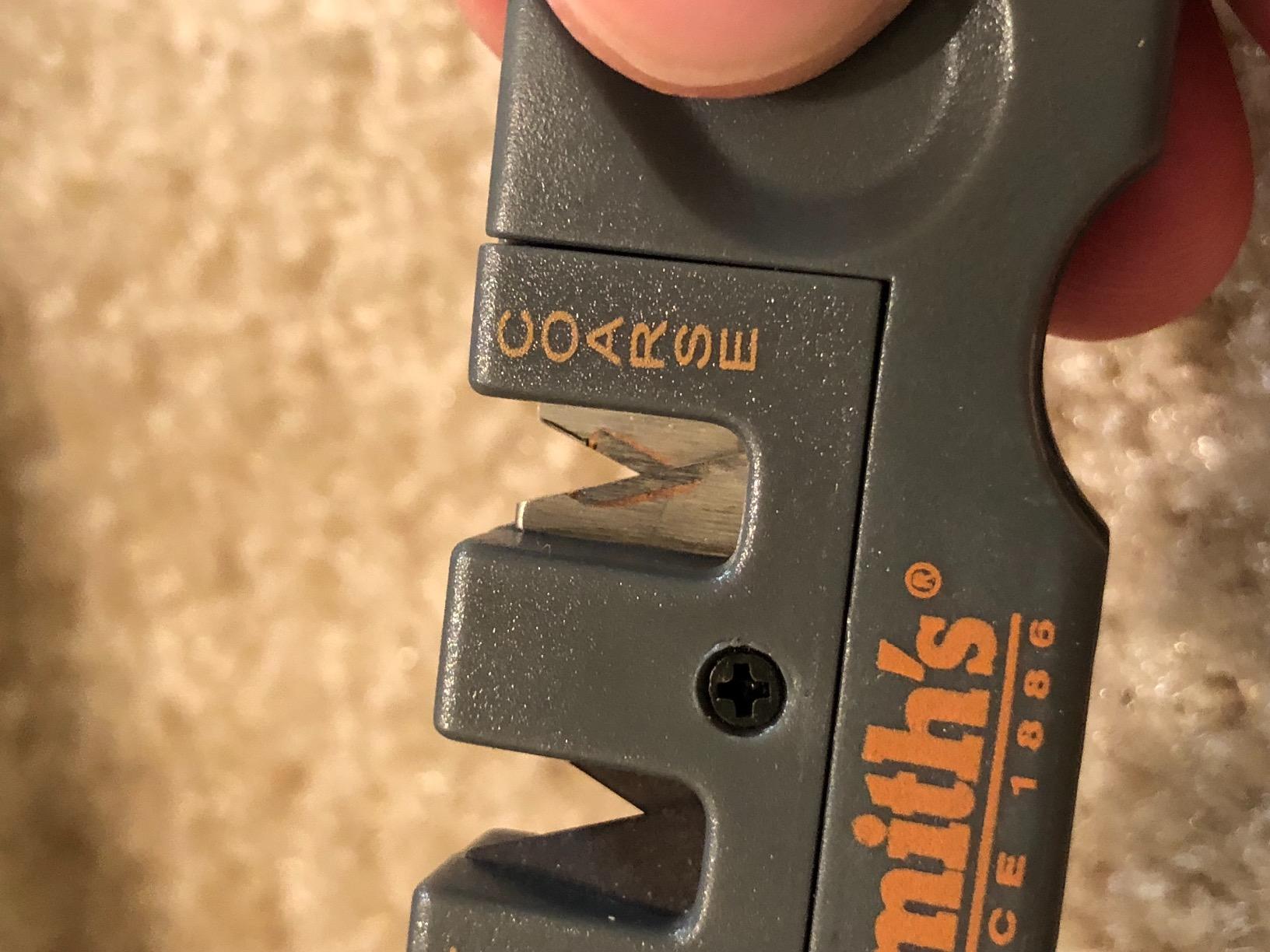
The Smith’s Pocket Pal is the sharpener we ended up using most often on days when the pack stayed at camp. At roughly one ounce and 3.24 inches long it disappears into a chest pocket, and the preset crossed carbide and ceramic blades mean you are not thinking about angle at all. You pull, you count strokes, you stop.
Its strength is serrated edges. The fold-out tapered diamond-coated rod is the part we leaned on with our serrated folder, and reviewers report the same pattern: a dozen passes and the blade is cutting again. Gut hooks and fish hooks are handled by the same tapered rod.
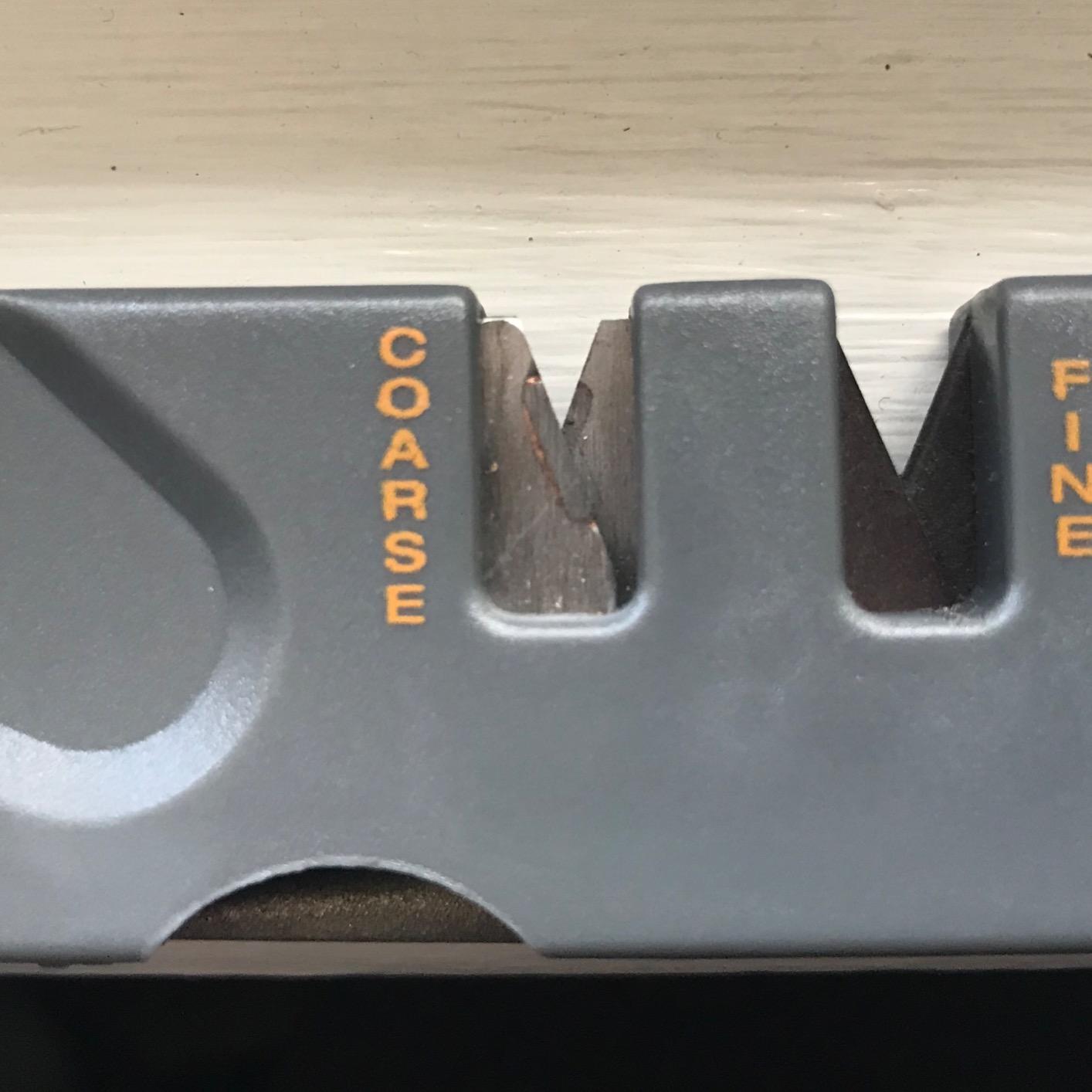
Two limitations are worth respecting. The fold-out rod is held by a tight hinge, and several owners warn against forcing it, so treat it as a tool you open deliberately rather than one you flick open one-handed while holding a headlamp in your teeth. And a pull-through never rebuilds a badly rolled edge; it maintains an edge, it does not restore a ruined one.
The other complaint, that the ceramic stones cannot be rotated when they wear, is a service-life detail rather than a performance one. Both carbide and ceramic elements are replaceable and reversible, which is the part that matters over a long season.
Why serrated hunters should buy it
Serrated blades defeat most pull-through sharpeners because the teeth sit below the edge line. The tapered diamond rod on the Pocket Pal follows that contour, which is why it is the sharpener we would trust for a folding saw or a serrated skinner on a wet week.
What it will not do
It produces a workable edge, not a mirror edge, and it does not reprofile a blade whose bevel has been ground down to nothing by repeated careless sharpening. Buy it as a maintenance tool that lives in your pocket, not as a rescue for a neglected knife.
4. Lansky Blademedic 4-in-1 – One Pocket Tool Instead of Three
- Four sharpening functions in one body
- Restores an edge in three or four strokes
- Metal body resists field abuse
- Diamond rod holds magnetically closed
- Replaces separate stone and rod
- Heavier than slim pull-through tools at 100 grams
- Cannot reprofile badly aged knives
The Lansky Blademedic is the one we hand to friends who own exactly one knife and refuse to carry more. Four functions sit in a single metal body: a tungsten carbide draw-through, a ceramic draw-through, a ceramic serration tool and a tapered diamond serration tool.
The straight-edge performance is where the four-in-one layout pays off. Owners consistently describe three or four strokes in the carbide slot to bring a dull edge back, then three or four on ceramic to polish it. That is a full maintenance cycle in under a minute, which is the speed you want when the light is going and you would rather be eating.
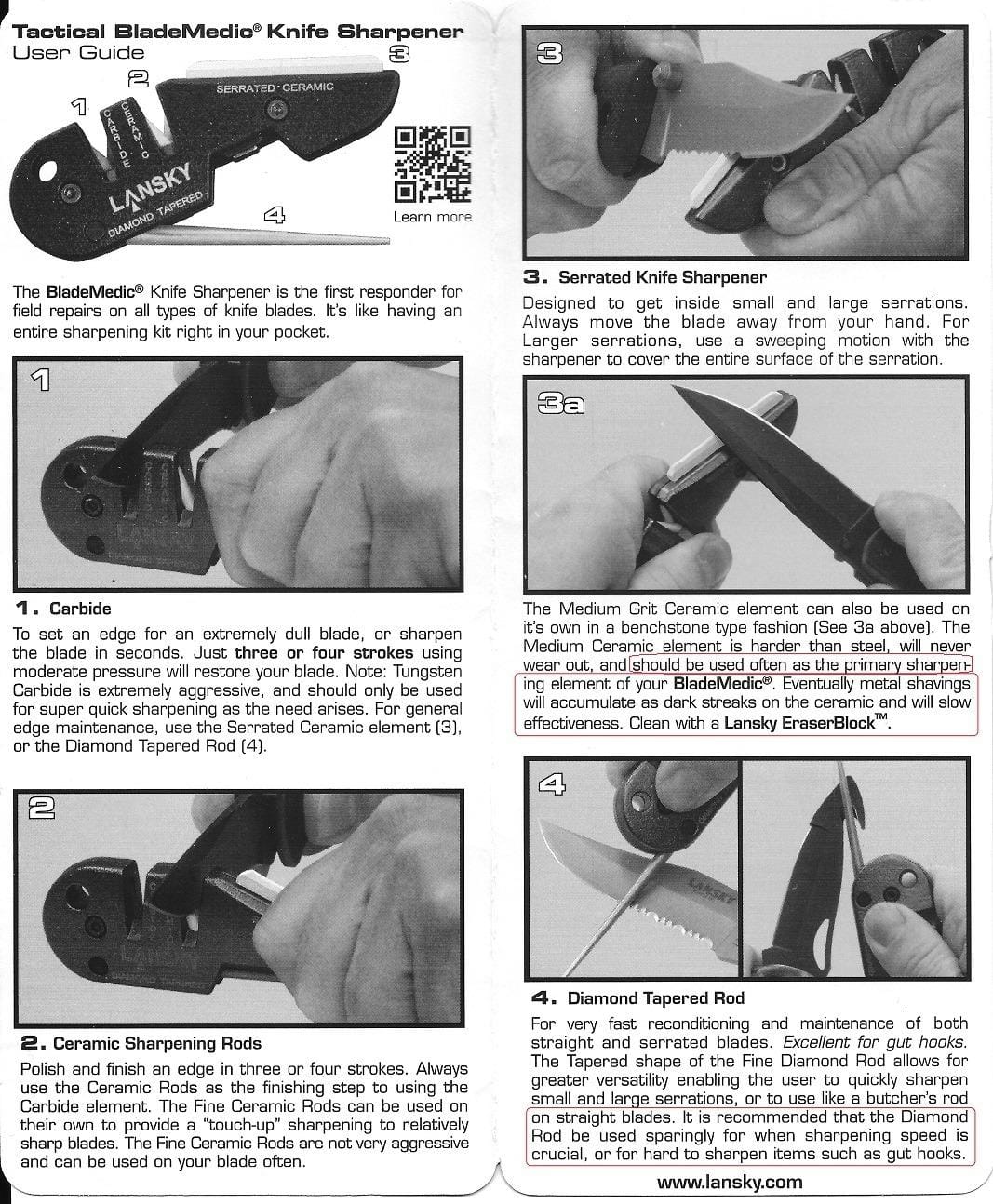
The diamond rod is held magnetically when closed, which is a small engineering decision that prevents the two most common field failures: a rod snagging on a jacket zipper or snapping against a hard object inside the pack. It is the kind of detail you only appreciate the first time it saves a tool.
The trade is 100 grams. That is roughly triple the weight of the slimmer pull-throughs in this list, so the Blademedic earns its place in a jacket pocket rather than on a keychain. It also draws a hard limit: an aged knife needing major reprofiling is beyond what any draw-through can do.
Best for knife-and-nothing-else packers
Carrying one tool that covers straight edges, serrations and finish work beats carrying three small tools you have to keep track of. For a hunter who takes one knife and processes everything with it, the Blademedic is the efficient answer.
Where it falls short
Reviewers cite weight more than any other drawback, and buyers with genuinely old, neglected knives report that no amount of draw-through strokes will restore the geometry. If your blade has been sharpened badly for years, learn to use stones at home first.
5. Smith’s CCKS 2-Step – the Smallest Credible Camp Sharpener
- Three to four strokes restore a dull edge
- Tinyest credible body in the test group
- Floats if it drops in a river
- Non-slip rubber feet
- Good for fillet and pocket knives
- Plastic body limits it to routine maintenance
- No serrated or fish-hook capability
- Preset angles cannot be adjusted
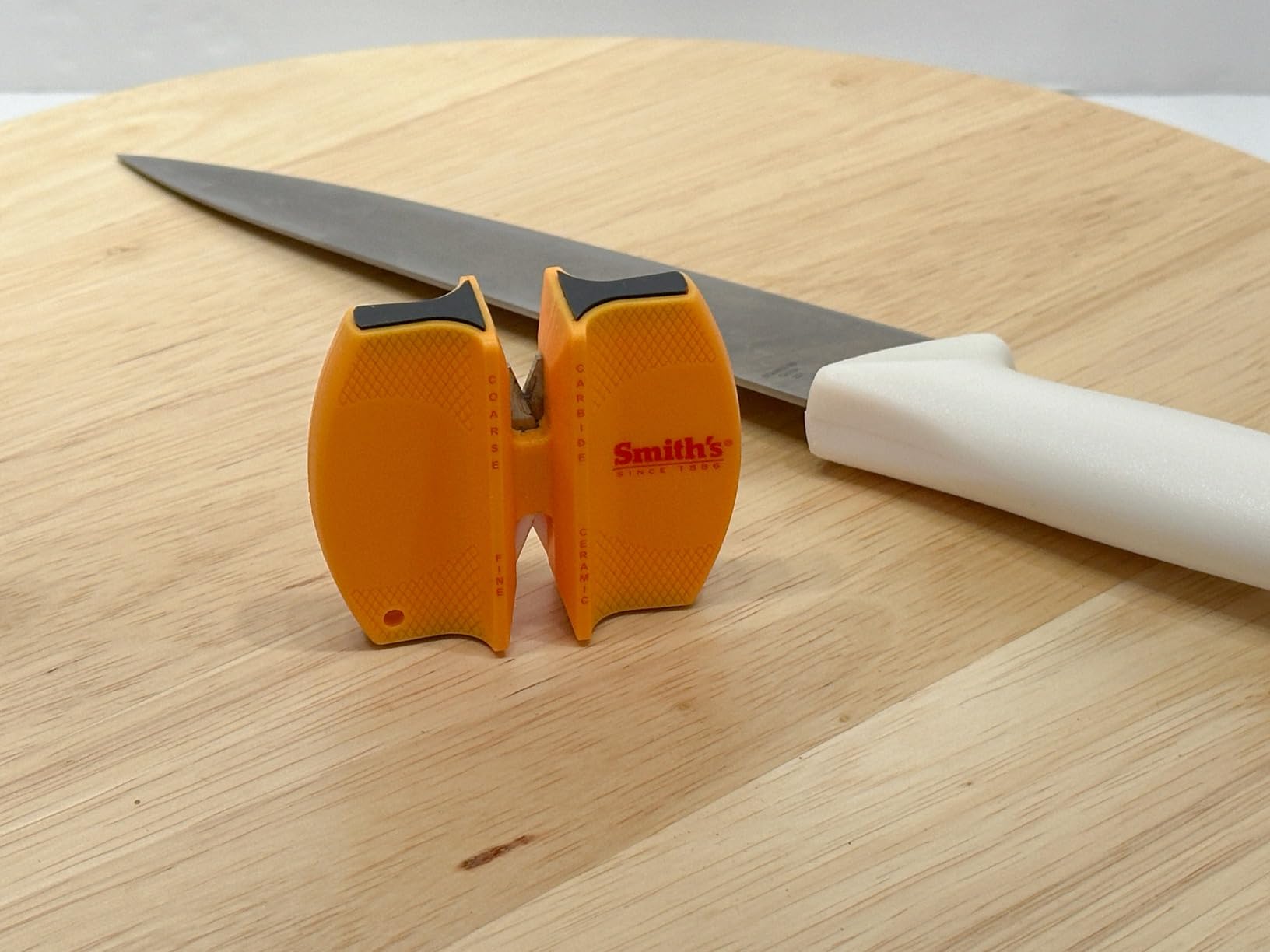
There is a floor below which a camp sharpener stops being useful, and the Smith’s CCKS 2-Step sits almost exactly on it. Crossed tungsten carbide for dull edges, crossed ceramic for polish, a body under two ounces, and a footprint small enough for a coin pocket. Reviewers consistently describe three or four strokes through the carbide slot as enough to bring a very dull edge back to working.
For a first hunting camp kit, this is the tool we would hand to a beginner. There is nothing to assemble, nothing to adjust, and no technique to learn beyond pulling the blade through the slot with a little pressure. Reviewers also appreciate that it floats and has rubber feet, so a wet hands session or an accidental drop in a creek is not a disaster.
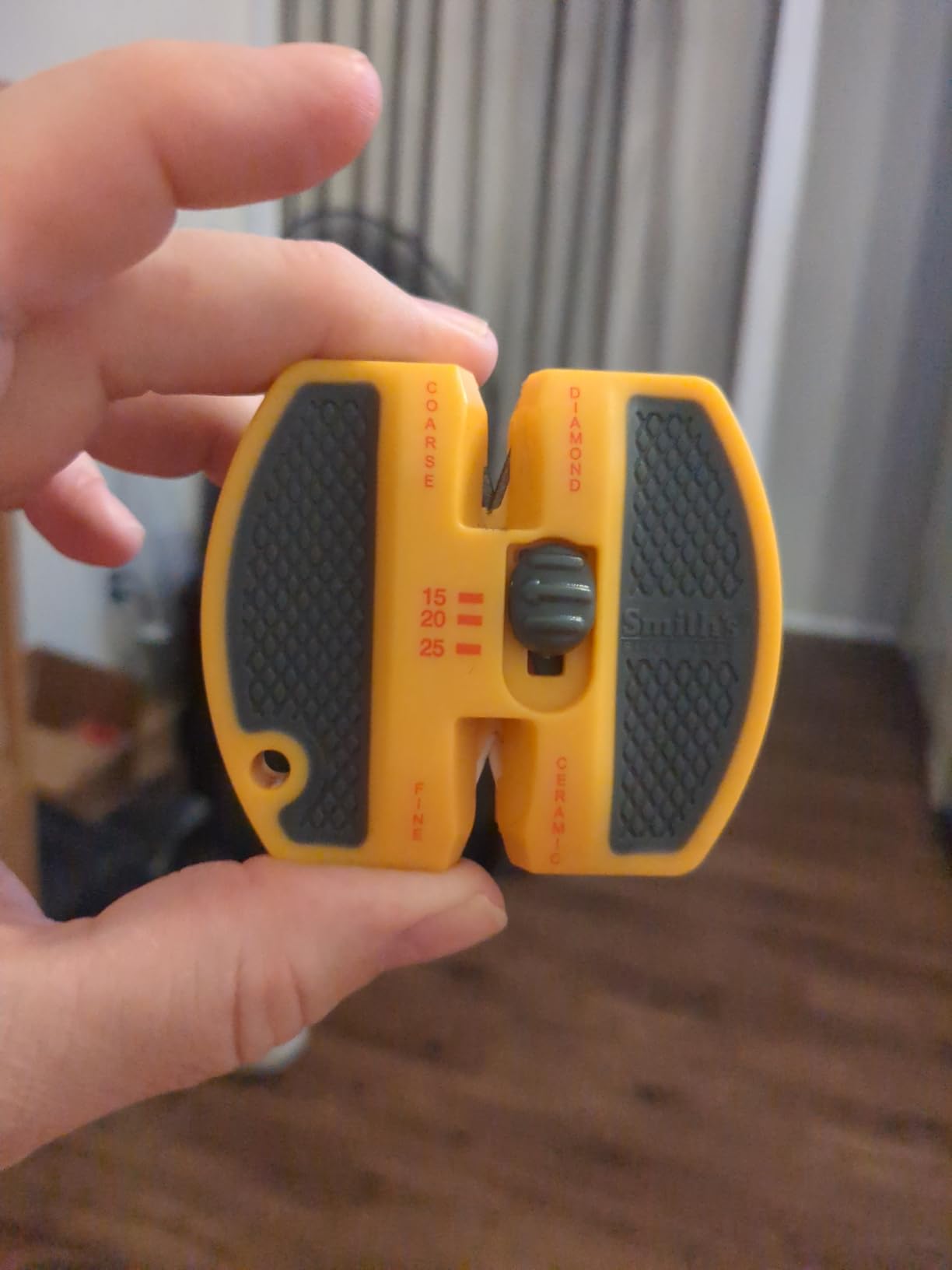
It is a maintenance tool, and it is honest about that. The plastic body and the fixed preset angles mean it will not reprofile anything, and there is no serrated or hook capability at all. If your hunting pattern includes gut hooks or a serrated saw, this is not the pick.
The other thing to know is that a two-stage pull-through is a fixed-angle scraper by design. It works well while the blade geometry matches the preset, and it works badly once the edge has been thinned by careless sharpening. Used as intended it is genuinely useful; used constantly it slowly narrows the bevel.
Best for a first camp kit or a gift
It is inexpensive, weighs almost nothing and does the one job a hunting knife needs most often. For a new hunter assembling a first kit, or for anyone who wants a spare sharpener in every truck and tackle box, that is a strong case.
What you give up
Two stages, no hooks, no serrations, and no ability to change the angle. If you process a lot of game or carry specialty blades, choose a guided system instead and keep this as a backup.
6. Smith’s DCS4 – a Two-Sided Field Stone With Grooves
Smith’s DCS4 4” Diamond Combination Sharpener – Double Sided Stone – Outdoor Field Knife Sharpener – Fish Hook & Pointed Tools Micro Sharpener – Lightweight, Compact, Handheld
- Two real grits instead of one fixed slot
- Micro-tool pad and groove for hooks and needles
- Storing handle doubles as protection
- Thumb guard and drainage ports for wet use
- Interrupted diamond surface speeds metal removal
- Awkward for two-handed bench technique
- Needs a break-in period before it feels consistent
- Diamond surface can scratch more than finishing stones
Most camp sharpeners give you one working surface and pretend that is enough. The Smith’s DCS4 gives you two grits on a genuine stone, color coded so you can tell them apart in the dark: 325 coarse on one side and 750 fine on the other.
In our testing the coarse side reset a blade that had been through a full day of cutting hide, and the fine side took it to slicing paper without any change of tool. Each side also carries a micro-tool sharpening pad and a groove, so fish hooks, needles and small pointed tools get sharpened on the same object. That matters more for a camp that includes a trout stream than most buyers expect.
At 22.68 grams with a 9 inch length, it is longer than a pocket tool but far lighter than a whetstone. The handle stores the stone for packing and protects it from knocks, and the thumb guard plus drainage ports mean you can use it with wet hands without the risk that comes from a slick stone on a slick table.
The honest negatives: it is awkward for two-handed bench technique, so treat it as a traveling stone rather than a workbench stone. Reviewers also note a break-in period, during which the interrupted diamond surface feels rougher than it will later, and that it can scratch an edge more aggressively than a dedicated finishing stone.
Best when hooks and game are both on the list
A hunter and angler who carries one tool for everything gets two working grits plus dedicated hook grooves here. That combination is rare in a body this light, and it is why we keep the DCS4 in the gear bag rather than the pocket.
Where patience is required
The break-in is real, and so is the scratch pattern on an already fine edge. Use the coarse side only when the edge is genuinely dull, and finish on the fine side. Skipping the fine pass leaves a rougher edge than you intended.
7. SHARPAL 178N 3-in-1 – Long Rods That Unscrew Into the Handle
SHARPAL 178N 3-In-1 Pocket Knife Sharpener, 4-Inch 600 Grit
- Long tapered rod handles bread and game knives well
- Both rods unscrew into the aluminum handle
- Works dry with no water or oil
- Also sharpens axes and broadheads
- Only 701 reviews but a 4.6 rating
- 600 grit rod is aggressive and can gouge
- Threaded assembly has a learning curve
- Instructions are minimal
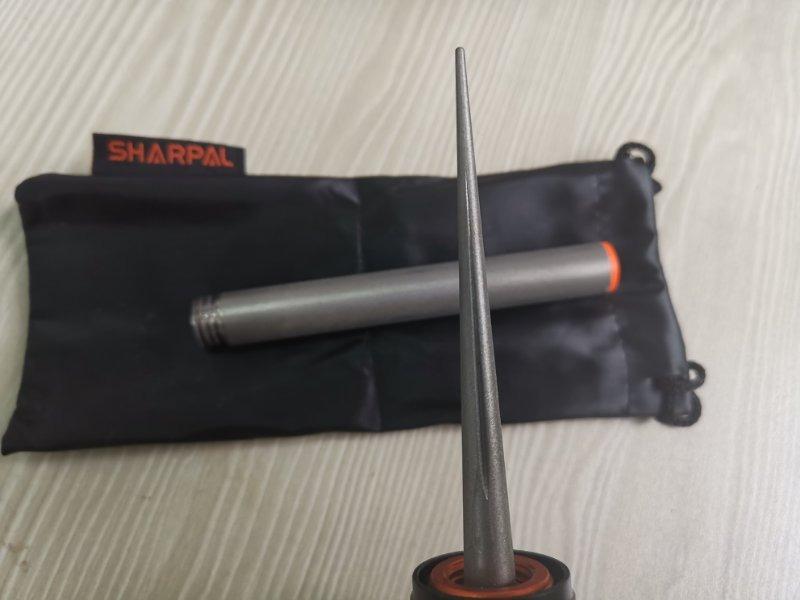
The SHARPAL 178N solves the packaging problem that plagues rod sharpeners by unscrewing both rods into the aluminum handle. What looks like a 9.25 inch tool packs as a single 4 inch stub, and reviewers who carry it in a chest pocket notice that immediately.
Its standout feature is the 3.5 inch tapered rod. Long tapered rods are the quiet upgrade in knife sharpening, because they follow the length of a blade rather than working a short section of it. On a wide skinning blade or even a bread knife, owners rate it as effective as or better than competing tapered hones. The 4 inch round 600 grit rod handles straight edges, and the same tool covers axes and broadheads.
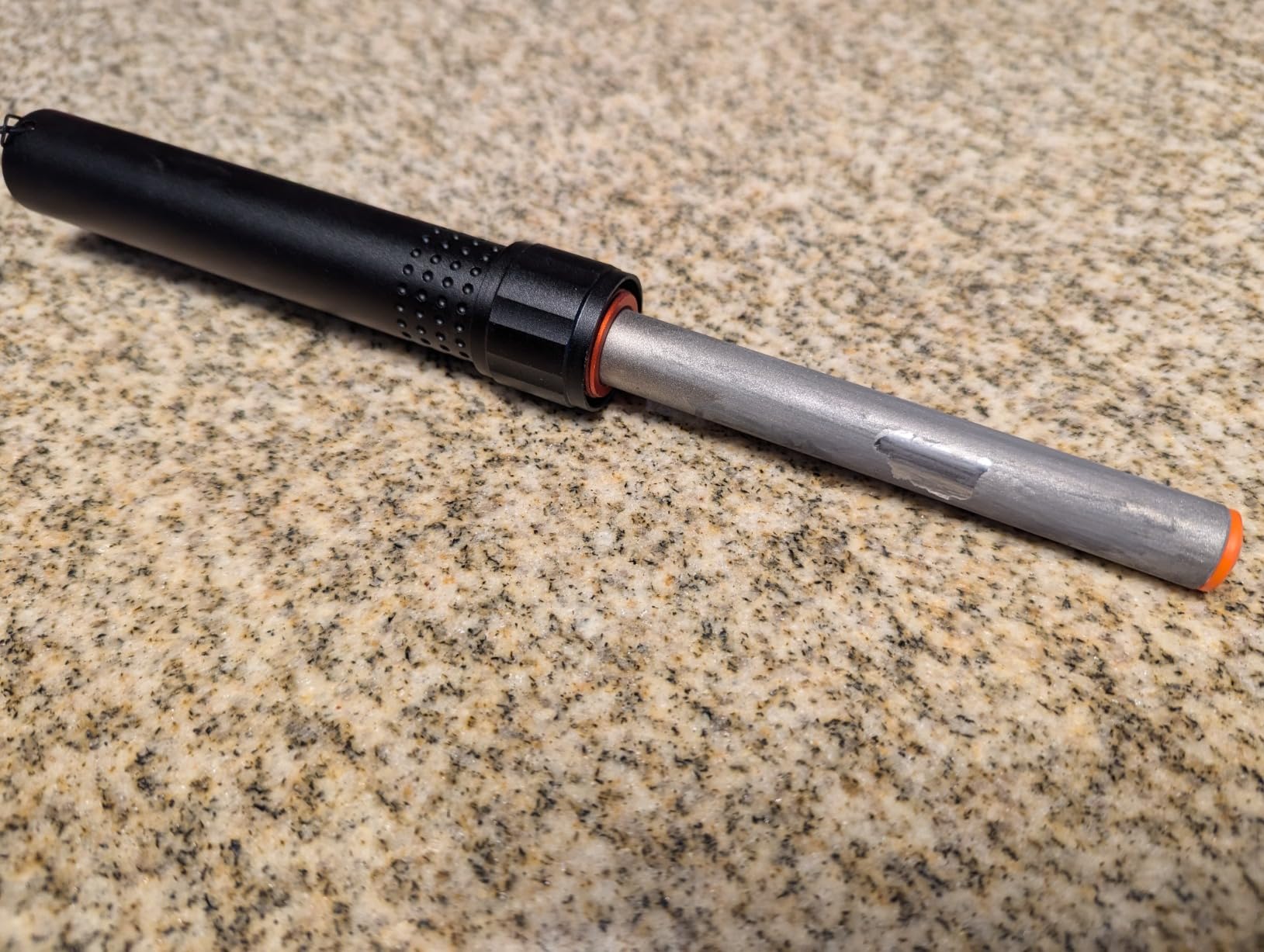
It works dry, which removes the water and oil problem entirely. There is no soaking, no flaking residue to wipe off a camp table, and no forgetting a bottle of honing oil at the trailhead. That single design choice does more for field usability than any feature we tested.
The catch is that 600 grit is a coarse cutting abrasive, not a finishing one. Used carelessly on a fine edge, it can gouge, and you will need a finer stage or a strop afterward. The screw-together assembly also takes practice, and a few owners report putting it together in the wrong order on the first attempt.
Best for long blades and axes
If your camp work includes a hatchet, a drawknife or a broadhead alongside the knife, the tapered rod earns its place. It is one of the few tools in this list that treats non-knife cutting edges as a first-class use.
Where it needs a partner
There is no fine finishing stage, so the finished edge is functional rather than polished. Plan to strop afterward, and read the assembly instructions because they are minimal. The 701-review count also means less long-term field history than its competitors carry.
8. Lansky D-Sharp – Four Angle Options in a Metal Case
Lansky D-SHARP Diamond Pull Through Quad Angle Knife Sharpener, Green (DSHARP)
- Four selectable angles match knife to tool
- Metal case survives years of use
- Diamond slots reshape edges quickly
- Compact enough for a small zip pouch
- Rubberized grip and thumb rest
- 4.8 ounces rules out a shirt pocket
- No stropping step for a mirror finish
The decision that shapes a hunting knife’s long-term behavior is the bevel angle, and the Lansky D-Sharp is the only tool here that lets you change it without buying a second sharpener. Four selectable angles: 17, 20, 25 and 30 degrees.
Those numbers are not arbitrary. A 25 degree bevel on a skinning knife is a sensible working angle. Push toward 30 and you gain edge durability for a caping knife or a hand axe that takes abuse. Drop to 17 or 20 and you get a finer, slicing edge on a boning knife, at the cost of an apex that chips sooner.
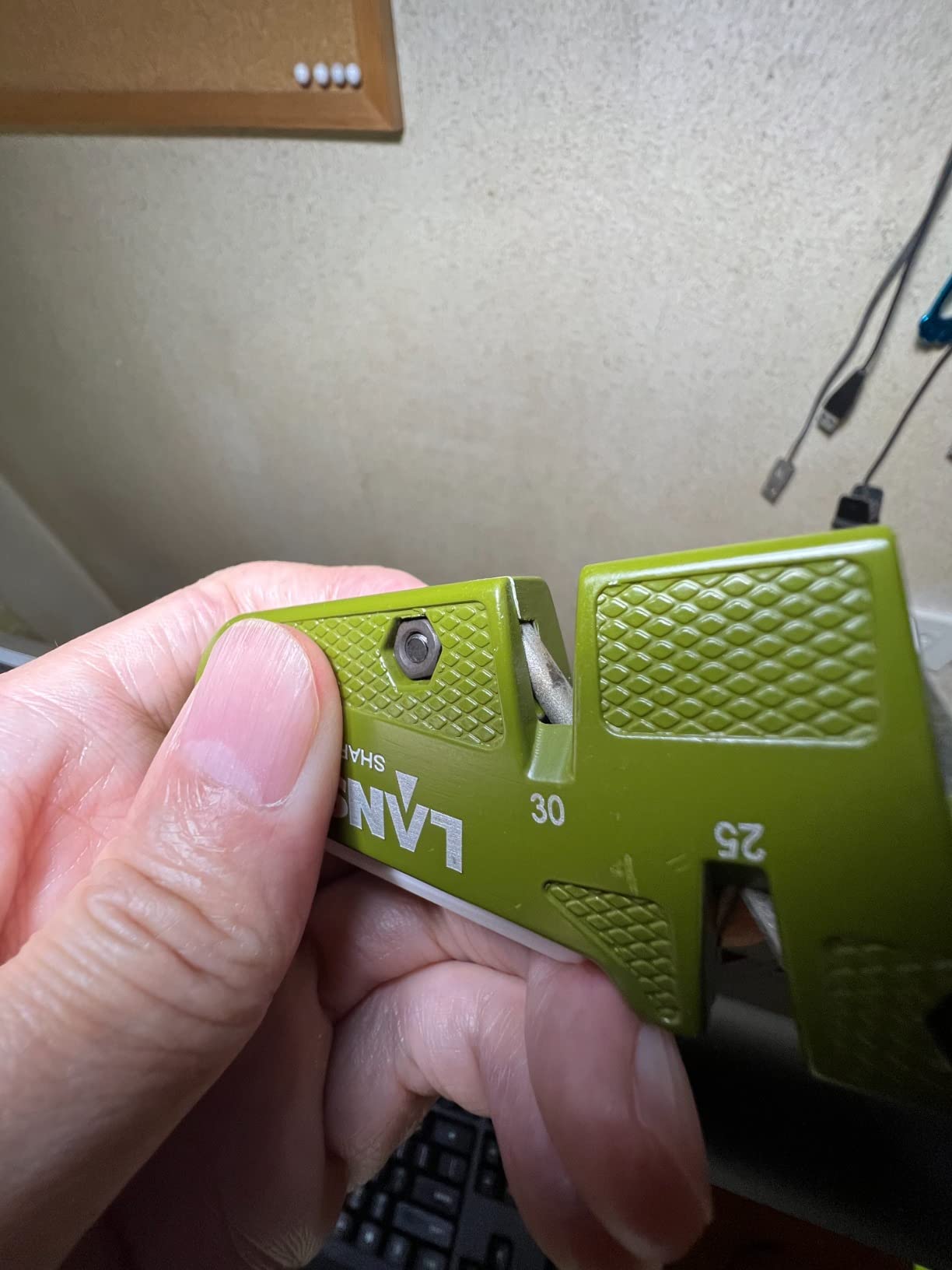
Below the angle selector sit 600 grit medium diamond pull-through slots and an 800 grit ceramic mini benchstone for burr removal and polish. Reviewers value the diamond rods over flat carbide scrapers for reshaping an edge quickly, and the metal casing is reported to still be working after a year of regular use.
Two limits are clear. At 4.8 ounces it is a work-bag item rather than a pocket item, and it delivers a very good working edge rather than a stropped mirror finish. If the finish matters to you, add a strop to the kit.
Best for a hunter with several blade types
Moving between a skinner, a caping knife and a camp axe is exactly the scenario the angle selector solves. Matching each blade to its intended use is the difference between an edge that holds and an edge that chips on the second elk shoulder.
Where the weight bites
Reviewers name weight as the primary complaint, and anyone walking a long backcountry route will feel it. The absent stropping stage is the other gap, so treat this as the shaping tool in your kit rather than the final step.
9. Work Sharp Pocket Hunting Sharpener – Guided Sharpness at 1.6 Ounces
- Lowest weight with true angle guides
- Razor edge in roughly 10-15 strokes per side
- Both surfaces wash clean with soap and water
- No assembly needed in the field
- Lifetime warranty for consumer use
- Narrow grip is easy to mis-hold
- Small rod suits pocket knives over cleavers
- 320 grit feels rough before it beds in
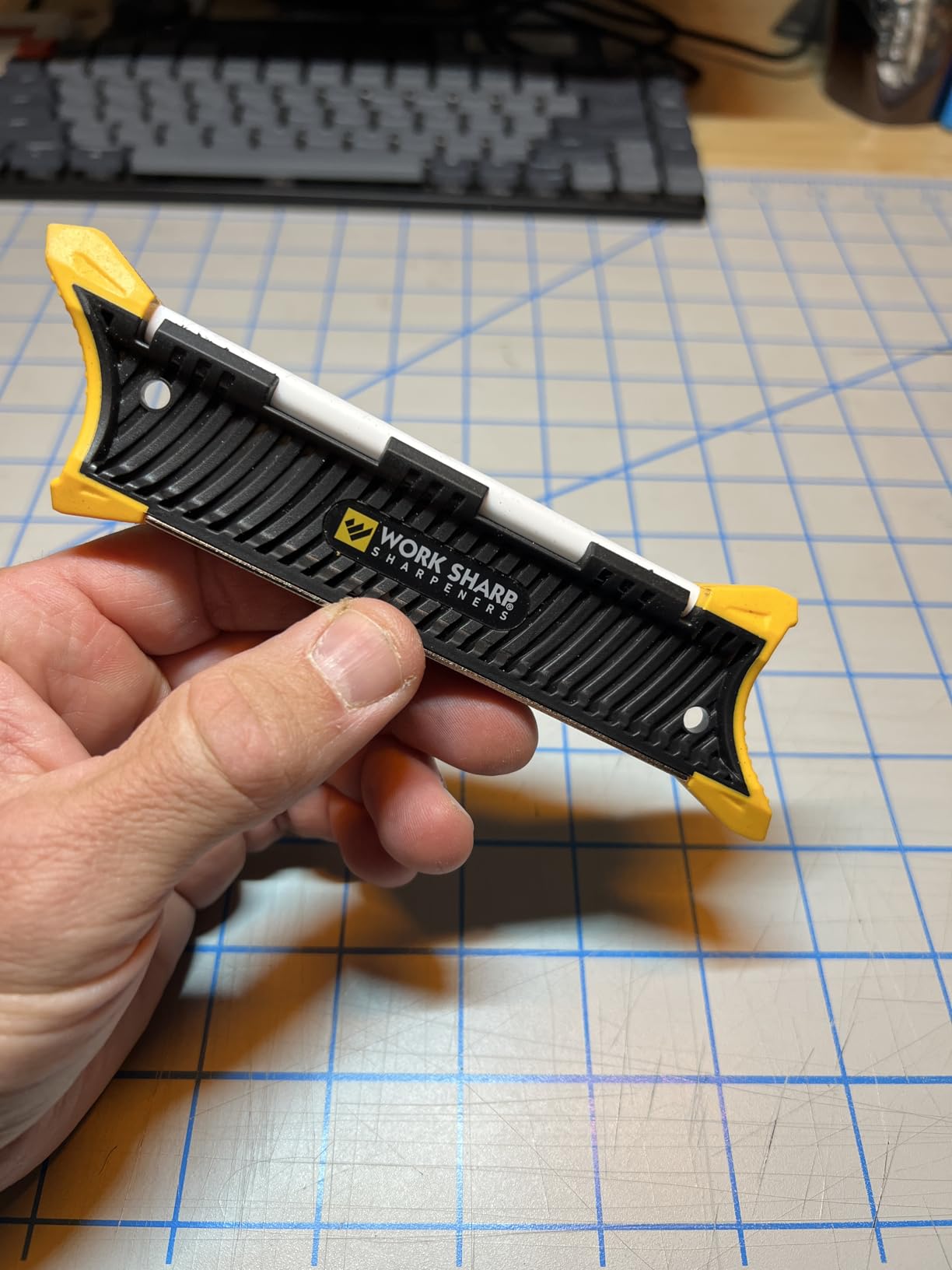
This is the sharpener we consider the right answer to the question hunters ask most often on forums: what is a good knife sharpener to take camping or hunting. At 1.6 ounces it costs almost nothing to carry, and unlike most ultralight options it holds the blade at a consistent angle rather than leaving you to guess.
The guides are set at 20 degrees for the 320 grit diamond plate and 25 degrees for the fine ceramic rod. In our tests roughly 10 to 15 strokes per side on the plate, a few on the ceramic, then a strop produced a razor edge on a 3 inch skinner. Both surfaces clean with dish soap and hot water, which matters after a session with deer blood and mud.
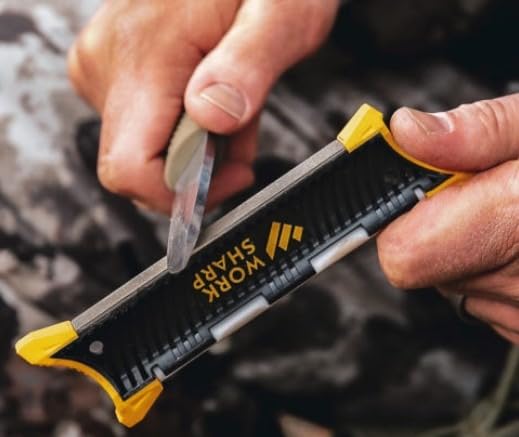
The recurring complaint is the grip. It is narrow enough that an off-center hold can let a light blade nick a finger, and reviewers recommend a glove for exactly that reason. There is also a break-in feel to the 320 grit plate, which starts rougher than it settles.
Scope matters too. A small rod works best on pocket and hunting knives, not on a cleaver or a large caping blade. Match it to the knife you actually carry, and it is genuinely excellent.
Best when every ounce counts
Users consistently describe it as the best balance of size to effectiveness for a carry sharpener. Angle guidance at 1.6 ounces is a combination we did not find anywhere else in this test group.
Where caution is needed
Hold it firmly, or wear a glove. And if your primary blade is a large fixed blade with a thick spine, expect to work across a short section of edge per pass and budget more strokes than we quote here.
10. Work Sharp Tri-Brasive Benchstone – the Best Pre-Trip Setup
Work Sharp Benchstone Knife Sharpener, 3 sided for faster manual pocket or hunting knife sharpening
- Three abrasive stages instead of two
- Angle guides removable for freehand work
- Pivot-response base follows blade curve
- Replacement abrasives available
- Keen edges much faster than a two-stage stone
- Benchstone format is bulky for a pocket
- Learning curve on the pivot-response base
- Sits above two-stage pull-through tools
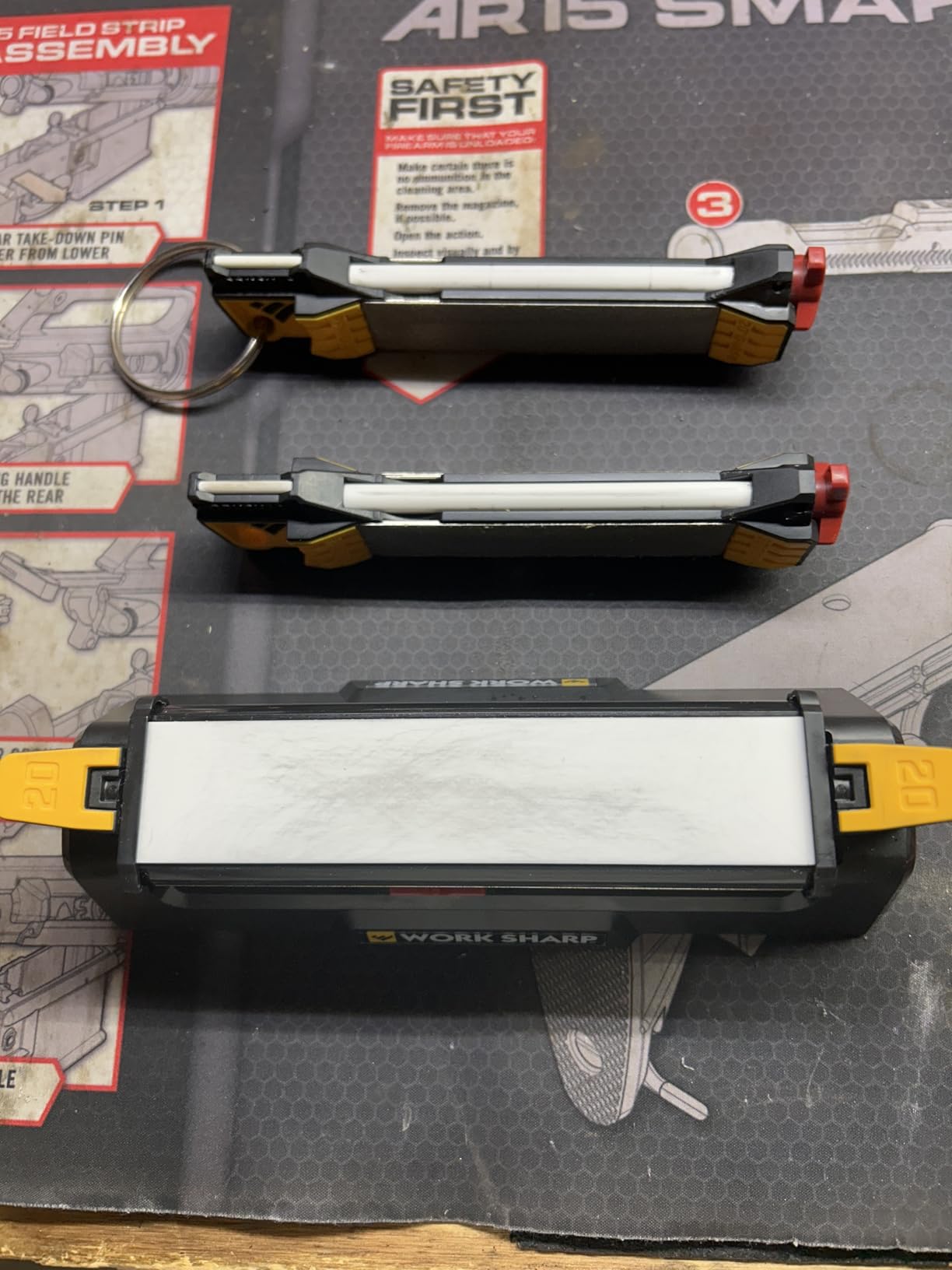
The best knife sharpening kit for hunting camps is the one that leaves camp with sharp knives and comes home with sharp knives. For the sharpening before and after the trip, the Work Sharp Tri-Brasive Benchstone is the tool we reach for, with a 4.7 rating and a three-sided system that no other entry here matches.
Three abrasives: 400 grit diamond, 800 grit diamond and a fine ceramic stone. That progression lets you repair a damaged edge, set the bevel and then refine it on one tool, which is why users report reaching keen edges considerably faster than with a two-stage stone. The pivot-response base follows the curve of the blade for consistent contact and can be locked rigid when you want a fixed platform.
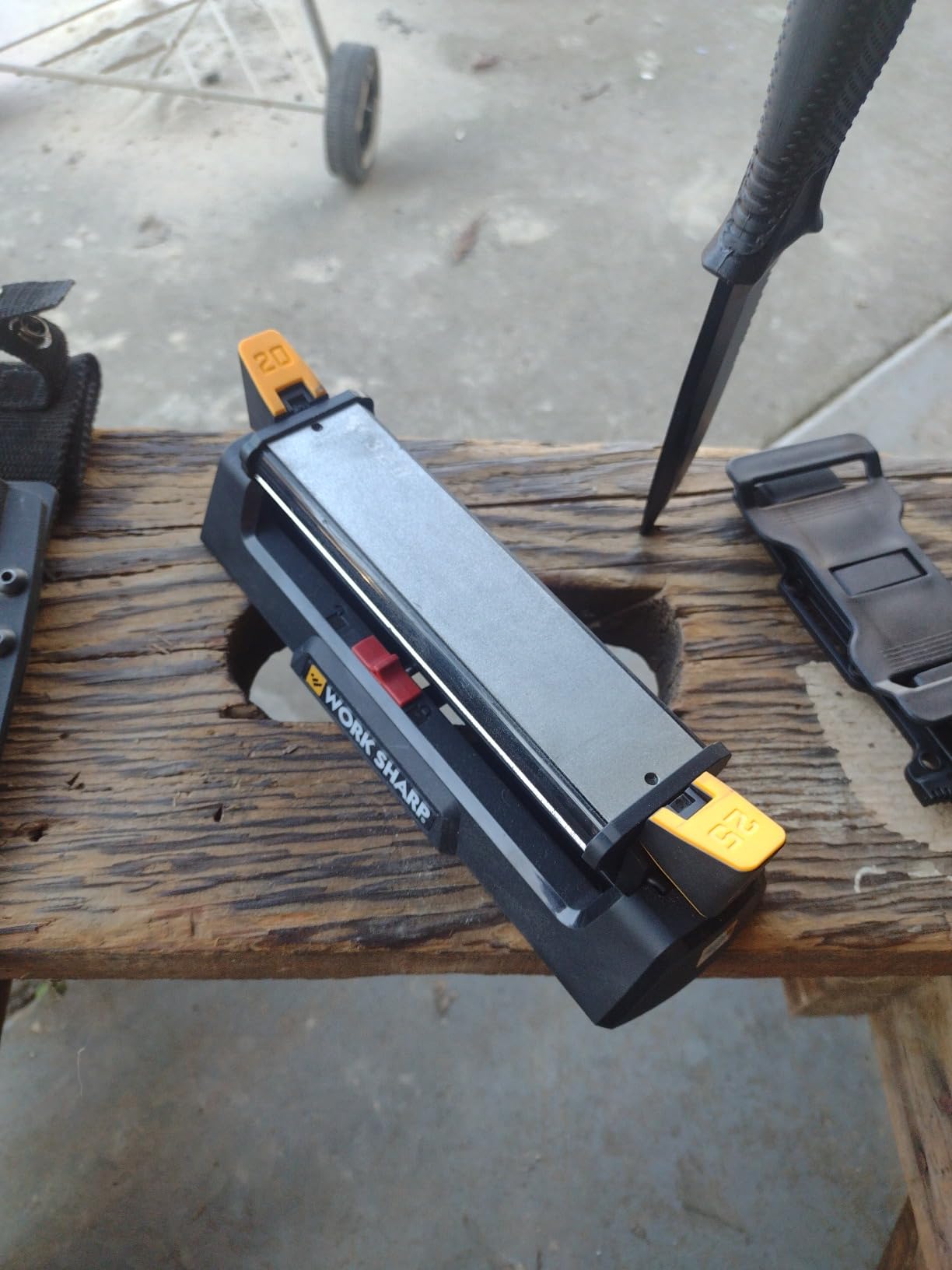
Angle guides set at 20 and 25 degrees come in the box and lift out for freehand work. Additional 15 and 17 degree guides are available separately for anyone thinning an edge on a boning knife. Replacement abrasives are sold, so the tool can stay in service for years.
It is 2.4 ounces but 8.5 inches long, which makes it a bench item or a pack item depending on your pack. The learning curve on the pivot base is the main hurdle, and it sits in a different tier from simple pull-throughs. None of that matters if your trip plan includes a sharpening session before dawn.
Best for the trip ends, not the trip middle
Three stages plus angle guides is a full sharpening station. We use it to reset a broadhead, put a fresh bevel on a caping knife and finish a skinner before the season starts, which removes most mid-trip sharpening pressure.
Where it does not fit
It is not a pocket tool, and the pivot-response base asks for a little practice before it feels natural. If you only sharpen at lunch on a rock, this is more system than you need.
11. Intelitopia Complete Stone Set – Every Grit From Repair to Polish
Intelitopia Complete Knife Sharpening Stone Set – Dual Grit Whetstone 400/1000 3000/8000 Knife Sharpener with Leather Strop, Flattening Stone, Bamboo Base, 3 Non-slip Rubber Bases & Angle Guide
- Two stones cover the whole progression
- Leather strop removes the final burr
- Flattening stone keeps surfaces true
- Angle guide helps beginners hold angle
- Non-slip rubber bases for stability
- 5 pound weight rules out backpacking
- Stones need soaking and rewetting while working
- Base can slip when wet
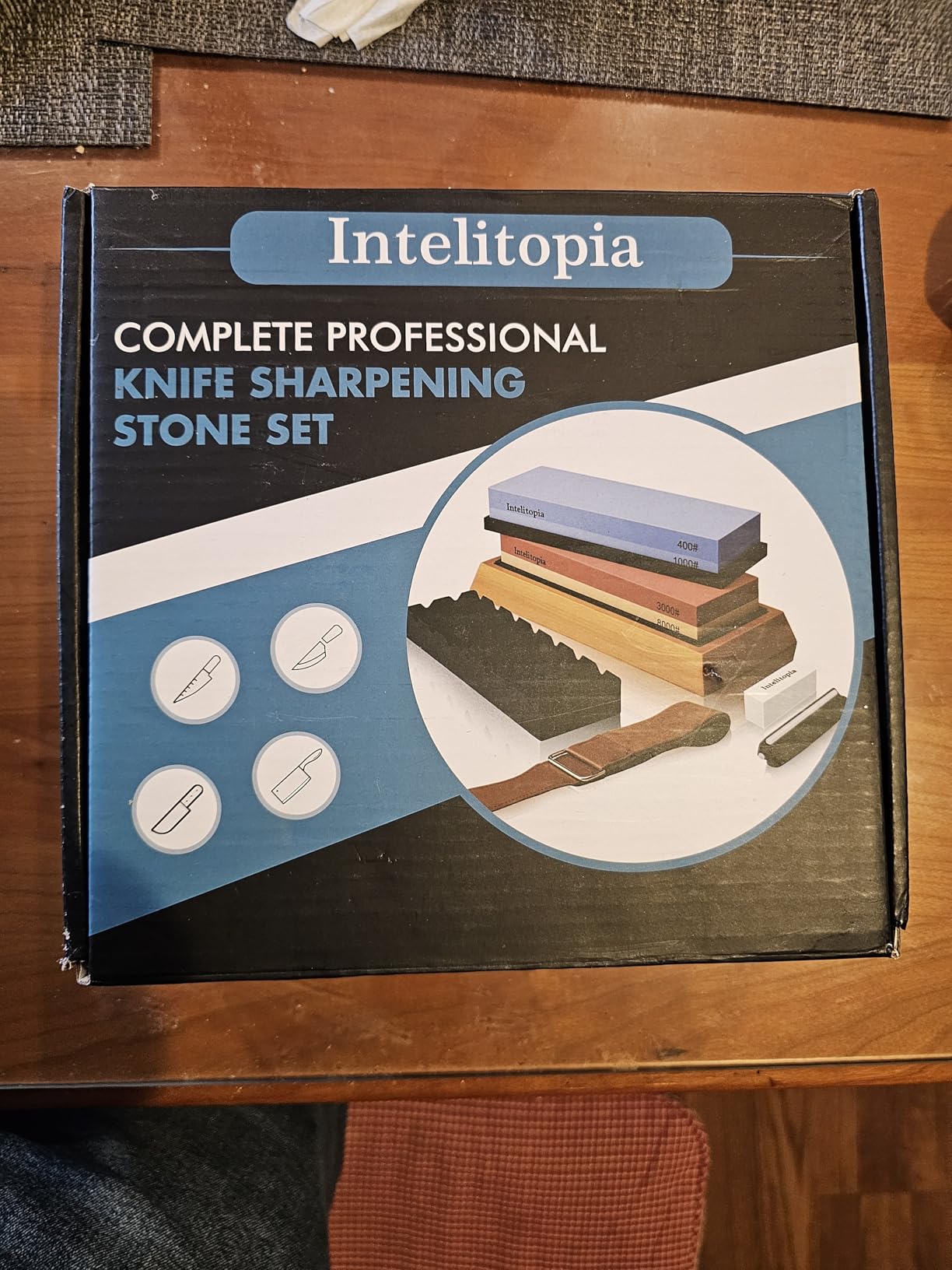
The Intelitopia set is the most complete traditional sharpening kit on this list, and we include it with a clear caveat: this is a garage and basecamp tool, not a pack tool. At five pounds, it is never going into a backcountry duffel.
What it does offer is the full progression in one box. Corundum stones at 400/1000 for edge repair and refinement, and 3000/8000 for finishing and polish, plus a cowhide leather strop that removes the last burr, a flattening stone, a bamboo base, non-slip rubber feet and an angle guide for beginners. Users report slicing paper-thin edges after about 20 sharpened knives.
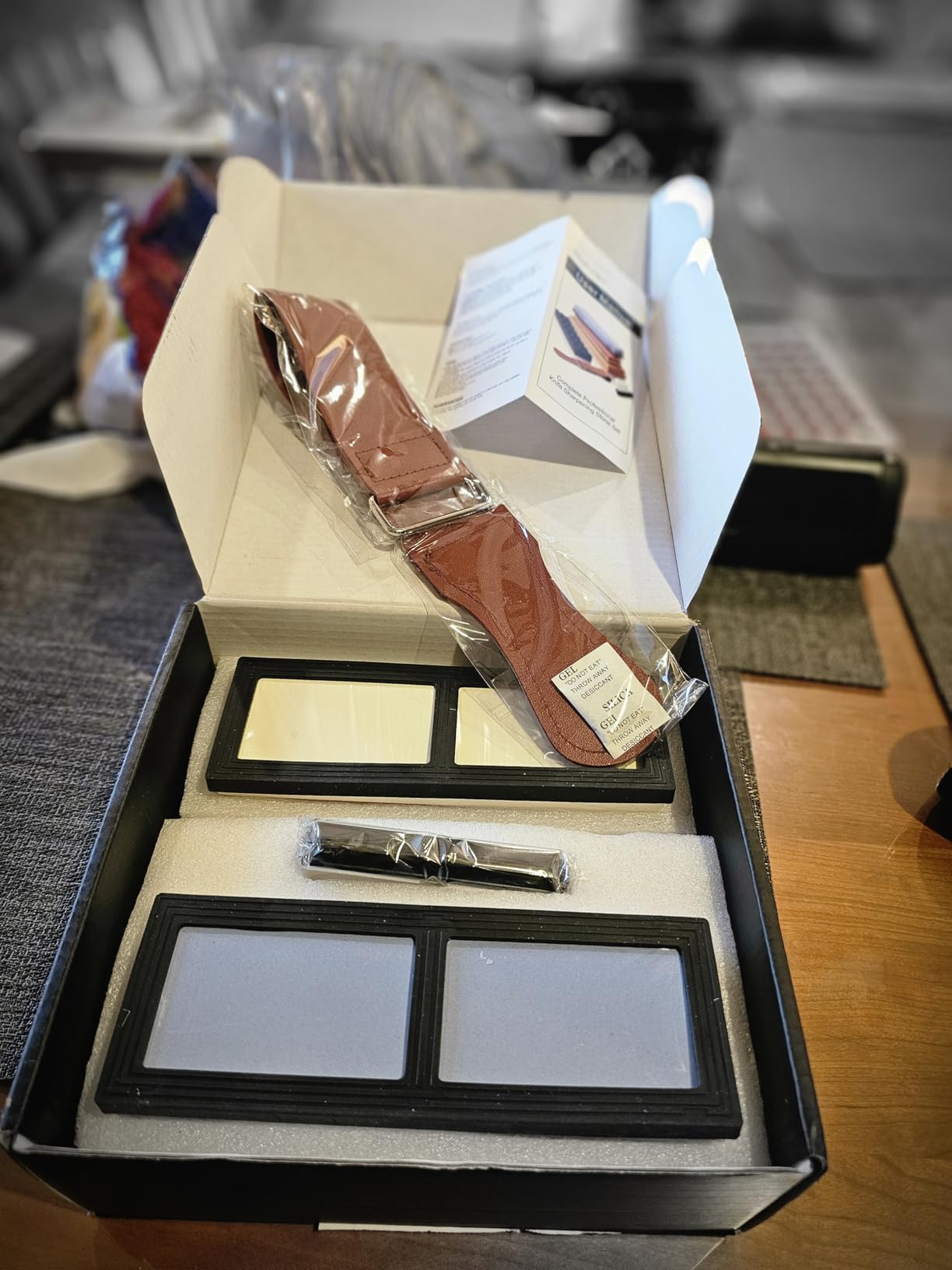
The included angle guide is what makes this approachable. Holding a consistent angle by hand is the single biggest obstacle for a new stone user, and a plastic guide removes most of it. The strop then handles the step where most beginners stop too early and wonder why the edge feels rough.
The maintenance reality is what separates it from the field tools. Wet stones must be soaked before use and kept wet during use or they dry out and stop working, and several reviewers note the base can slip when wet. That is fine in a garage and unworkable on a rain-slick picnic table.
Best for basecamp and home prep
Two stones, a strop, a flattener and a base cover an entire sharpening lifecycle, and the 3000/8000 pair reaches a finish that field tools cannot. This is where we set up edges before a season of use.
Why it stays out of the pack
Five pounds, a soaking ritual, and a flat working surface are three camp-unfriendly requirements in one product. A few buyers also find the stones wear faster than Japanese stones, which is the trade for the price.
12. Sharp Pebble 400/1000 – the Easiest First Whetstone Kit
Sharp Pebble Whetstone Knife Sharpening Stone Kit – 2 Sided 400/1000 Grit
- Simplest kit to learn on
- Flattening stone included from the start
- Water based cleanup with no honing oil
- Good feedback and control for the size
- Handles knives chisels and garden tools
- Rubber base can slip on a wet stone
- Stone wears faster than premium stones
- Must be soaked before each session
Most whetstone kits sell you a stone and hope you figure out the rest. The Sharp Pebble 400/1000 kit includes the flattening stone, a non-slip rubber base and a step-by-step guide, which is why reviewers describe it as the easiest entry into stone sharpening. At 4.6 across more than 7,000 ratings, it is also the most proven kit here.
The dual-grit stone covers both jobs: 400 grit rebuilds a dull edge and 1000 refines it. It is water based, so there is no honing oil to buy, carry or lose, and cleanup is a rinse. Experienced users single out the feedback and control from a stone this small as better than larger, heavier alternatives.
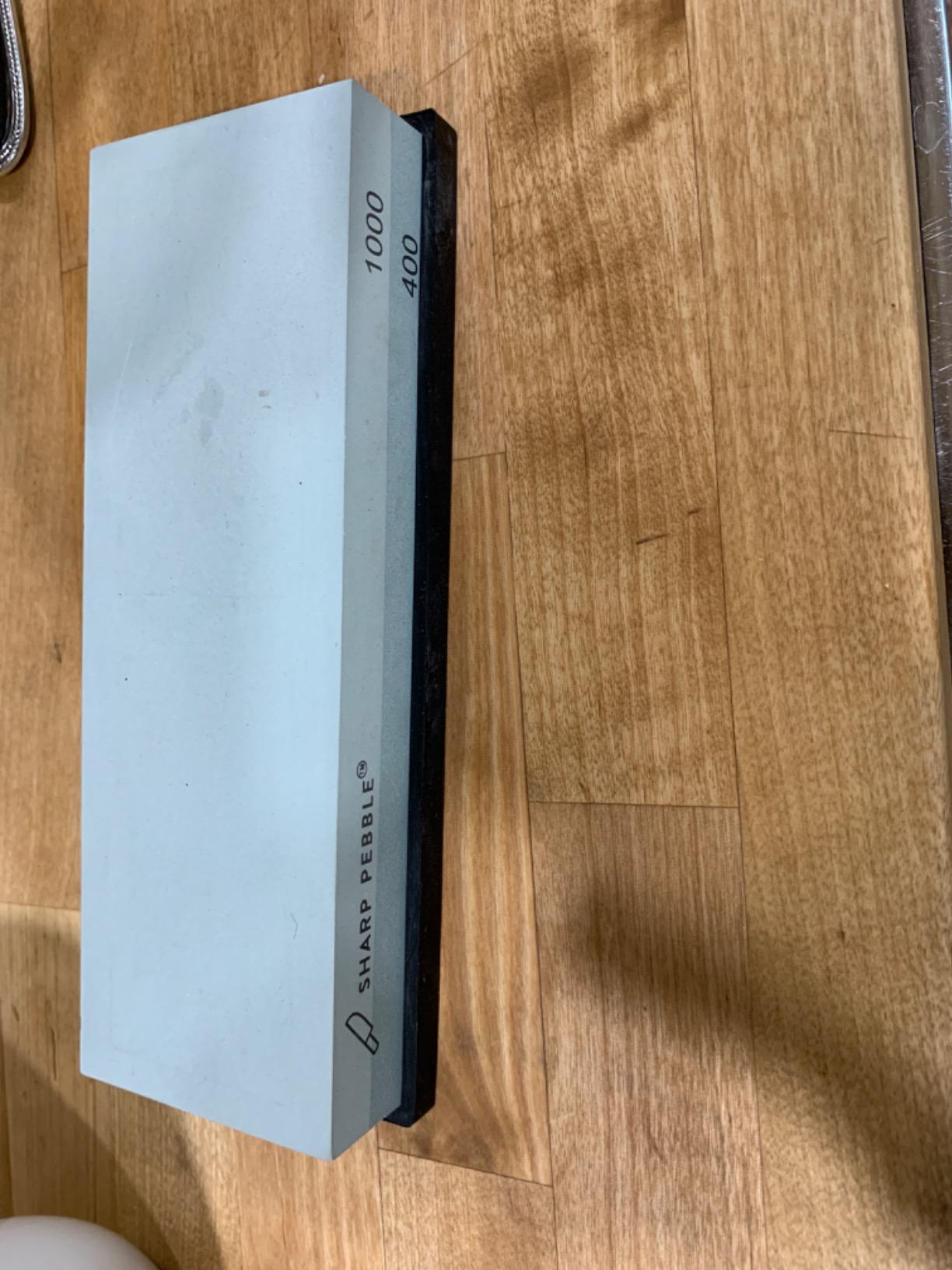
The limitation is the same one every water stone has. It must be soaked before each session and kept wet while you work, and a few reviewers note the rubber base is a tight fit that can still slip on a wet stone. The stone also wears faster than premium stones and needs regular flattening, which is why the flattener is in the box.
At 1.6 pounds it is lighter than most stone sets and could ride in a truck or a wall tent, but it is not the answer for a backpacking pack. Treat it as the place where you learn the strokes that make a field sharpener faster to use.
Best for learning stones without a big investment
The included guide and flattening stone remove the two most common beginner problems, angle consistency and a dished surface. By the time you understand what 400 grit does, you can use any of the field sharpeners on this list with better results.
Where the compromise shows
Wear rate and the wet-care ritual are the costs. If you want a stone that stays flat and cuts predictably for years, spend more; if you want to learn the craft this week, this kit is the sensible door.
What Actually Belongs in a Camp Sharpening Kit
Most people assemble a camp sharpening kit by buying one sharpener. That covers the daily maintenance and none of the emergencies. A complete kit has three jobs: keep an edge, repair a damaged edge, and finish an edge once it is sharp again.
Keeping an edge is a strop or a fine ceramic rod. Repairing a damaged edge after a bone strike or a buried tip needs a coarse abrasive, usually 200 to 400 grit. Finishing needs a fine stage or a leather strop with compound. Those are three different tools, and one multi-function sharpener can cover all three.
We build camp kits in three tiers. The ultralight tier is a single piece: one draw-through or one pocket guided sharpener at under 3 ounces, worn on a belt or in a chest pocket. The standard tier adds a small field stone or a tapered rod, bringing the package to roughly 5 to 7 ounces and covering serrations and hooks. The full camp tier adds a strop with compound and a coarse plate for mid-trip damage, landing near 10 ounces.
Two accessories matter more than most buyers expect. A short lanyard or carabiner keeps a small sharpener attached to the pack rather than loose in a pocket, where it migrates. And a small cloth or piece of leather for the strop travels cheaply while preventing the most common camp sharpening failure, which is stropping on a dirty surface and rolling the edge back.
What you do not need in the pack is a stone set. If you want to see how the materials compare, our guides to whetstones for knife sharpening and diamond knife sharpening stones cover the home side in detail.
Sharpening at Camp: Cold Hands, Wet Hands and Fading Light
The reason a great sharpening system sits unused in camp is not difficulty. It is conditions. You are cold, your fingers are stiff, your hands are wet or bloody, the light is gone by the time you sit down, and you are holding a blade with an edge that has just failed you.
Cold hands are the first hurdle. Fine motor control degrades sharply below freezing, which is exactly when you are most likely to need the edge, because a frozen hide or a frozen sheath edge chips. Choose a sharpener with a large grip surface and short strokes. The Smith’s D-Sharp with its rubberized grip and thumb rest, and the DCS4 with its protected handle and thumb guard, both handle cold hands better than a narrow pencil-shaped rod.
Wet hands are the second. Look for drainage ports and rubber feet, which is why the DCS4 and the CCKS earn their places in wet conditions. The CCKS floats, which matters more than it sounds when you are working beside a river. Anything that relies on a flat stone sitting still on a wet table is asking for trouble.
Fading light is the third, and the fix is a headlamp plus a plan that does not need to see the edge. Guided systems win here. A fixed angle guide means you are counting strokes rather than inspecting the bevel, which you cannot do at 8 p.m. behind a tree. Pull-throughs also work in low light because the slot defines the angle visually. Freehand stone sharpening in the dark does not.
Sequence matters more than technique. Set up before dark, work on a flat stable surface, keep the blade moving, and stop when the stroke count is met rather than when you think it looks right. Our field routine is simple: coarse plate only if the edge is truly damaged, medium to set, strop last, and wipe the blade clean before putting it away so moisture does not sit on the steel overnight.
How to Choose: Electric, Guided, Stones or Pull-Through
Electric sharpeners are fast and consistent, and they are home tools. A motor-driven wheel needs a flat bench, a power source and several minutes per blade, which makes it useless at 40 degrees north in October. If you want the home side covered, our guide to electric knife sharpening systems covers the options.
Guided angle systems are the best compromise for camp use. The blade rests on a rod or plate at a fixed angle, so results depend on stroke count rather than skill. The Work Sharp Guided Field Sharpener Elite and the pocket models from the same brand are the strongest examples here, and they are the tools we would hand to someone learning to sharpen.
Stones are the answer when the edge is damaged rather than merely dull. Coarse grit can remove steel that no pull-through will touch, and a fine stone can produce a finish that stropping alone will not. The cost is water, a flat surface and time, which is why stones stay at basecamp. Our whetstone guide covers the selection in more detail if that is your use case.
Pull-throughs are the most common choice and the most misunderstood. They are fast, pocketable and effective on a straight edge that is simply dull. They are the wrong tool for serrations, for hooks, for a deeply rolled edge, and for anyone who wants to control the bevel angle.
One warning belongs on its own. Pull-through sharpeners are fine as an emergency and poor as a habit. Every pass scrapes steel away at a fixed angle, and using one repeatedly narrows the bevel until the edge chips. Treat it as a roadside tool: pull three or four strokes, stop, and do the real sharpening at a proper angle.
Honing vs Sharpening and Why Edge Angle Matters
Honing realigns an existing edge without removing much metal. Sharpening removes metal to create a new edge. A honing rod, ceramic rod or bare leather strop belongs to the first category; a diamond plate or whetstone belongs to the second.
For a hunting knife, honing is the daily habit. A strop or ceramic rod after each use keeps the apex where it is and pushes back the rounding that comes from cutting hide. Sharpening is the seasonal event, done before the hunt or after a real failure.
Edge angle decides how that edge behaves. A thinner angle around 15 to 20 degrees per side slices and releases meat cleanly, but the apex is fragile and will chip on bone or a buried nail. A thicker angle near 25 to 30 degrees per side is more durable and forgiving, which suits caping work and any blade used as a general camp tool.
Geometry compounds this. A V-edge has a straight primary bevel with a small secondary bevel at the apex, and it holds a crisp point for slicing. A convex edge curves continuously from spine to edge, rolling the edge over rather than folding it, which makes it forgiving of abuse and slow to lose its line. Most hunting knives leave the factory as V-edge, and most field sharpeners maintain that geometry better than they create it.
Matching Your Sharpener to Your Blade Steel
Hard steels change what you need. Powder steels such as S30V and S45VN hold an edge far longer than older stainless or carbon steel, which means they stay sharp and also mean they are harder to restore once they do go dull. Resin bonded diamond is the practical answer because it cuts hard steel quickly and needs no water.
AUS-8 and similar mid-hardness stainless steels are the easiest to work with, responding well to both diamond and natural stones. Carbon steel takes an edge beautifully and sharpens easily, but it needs care in camp: moisture will rust it overnight, so wipe the blade dry after sharpening and before it goes back in the sheath.
Whetstone users should know that hard steels and natural stones are a poor pairing. The abrasive can glaze over before it does useful work, and many enthusiasts now reserve natural stones for softer steels. Diamond plates and rods like those in the Work Sharp and SHARPAL kits sidestep the problem entirely, which is another reason they dominate camp kits.
Edge geometry and steel together set the maintenance interval. A thick-beveled caping knife on S30V might hold a working edge for a full week of butchering. A thin 20 degree skinner on the same steel may need a strop every day.
Your Sharpening Plan by Trip Length
Before the trip, sharpen every knife you intend to carry to a full working edge, then strop. This single step eliminates most mid-trip sharpening. A blade that starts the trip sharp spends the trip getting slightly dull rather than failing catastrophically on a shoulder bone.
Day one in camp, strop or ceramic hone after use. Five passes on the leather and a handful on the rod resets the edge in under a minute, and it costs you almost nothing in daylight hours.
Mid-trip damage changes the tool. A bone strike or a tip buried in a rock leaves a chip, and a pull-through cannot address it. That is when a coarse diamond plate earns its weight, and it is the reason the Work Sharp Guided Field Sharpener Elite and the DCS4 carry a coarse surface. Reset the chip, re-establish the bevel, refine, strop, and put the knife back to work.
After the trip, clean the steel properly and finish the job at a bench. Blood and salt left on a blade overnight cause pitting that no sharpener removes. Rinse, dry, touch up the oil, and store it dry.
One practical note for bowhunters specifically: a broadhead is a different job from a knife edge, and it is worth checking the point and the primary grind before the season rather than in the woods. Our guide to hunting blinds for bow hunting covers the rest of the tree stand kit if that is your next purchase.
Frequently Asked Questions
What is the best knife sharpener for hunting knives?
The Work Sharp Guided Field Sharpener Elite is the best all-round choice because it carries a 220 grit diamond plate, a 600 grit plate, a rotating ceramic rod and a leather strop in one 5.6 ounce case. It handles dull repair, serrations, fish hooks and final polish without a power source, which is what a hunting knife away from a bench actually needs.
What should be in a hunting camp knife sharpening kit?
Three jobs define a complete kit. Keeping an edge needs a strop or fine ceramic rod, repairing damaged steel needs a coarse 200 to 400 grit plate, and finishing needs a fine stone or leather strop with compound. Add a lanyard so the tool stays attached to the pack, and a small cloth for stropping on a clean surface.
Are pull-through sharpeners bad for knives?
They are fine as an emergency and poor as a habit. Every pass scrapes steel away at a fixed angle, so repeated use narrows the bevel until the edge chips. Use three or four strokes to restore a working edge, then stop and do proper sharpening at a controlled angle. They also cannot fix a badly rolled edge or reach serrations well.
What angle should a hunting knife be sharpened to?
Most hunting knives work best at 20 to 25 degrees per side. That range balances slicing performance with enough apex strength to survive bone contact. Thinner angles near 15 to 20 degrees slice and release meat better but chip easily, while 25 to 30 degrees suits caping knives and axes. Tools like the Lansky D-Sharp let you switch between these angles.
What do professionals use to sharpen their knives?
Professionals generally use guided angle systems, electric wheels or bench stone progressions at a dedicated station. Those tools deliver repeatable results but require a flat surface, time and usually a power source, which makes them home or shop equipment rather than camp equipment. In the field, the equivalent is a guided angle sharpener or a field stone.
How do you keep a knife sharp while hunting?
Start the trip with a fresh edge, strop after each use, and address damage the moment it happens rather than pushing through. A bone strike or a buried tip needs a coarse diamond plate, not a pull-through. Keep the blade dry and clean, and avoid cutting bone or frozen material that can chip an otherwise sound apex.
Final Thoughts on the Best Knife Sharpening Kits for Hunting Camps
Start with the Work Sharp Guided Field Sharpener Elite. It is the only product here that covers maintenance, mid-trip repair and final polish from one case, and at 5.6 ounces it costs little in a hunting pack. Add the Work Sharp Pocket Hunting Sharpener or the Smith’s Pocket Pal if you want an ounce-scale piece for the days the pack stays at camp.
Carry a pull-through for straight edges on a tight budget and a strop for finishing. Save the whetstone sets for basecamp, where water and a flat surface exist. Whatever you choose, sharpen before you leave, because the best sharpening session of the year is the one you did at home.