
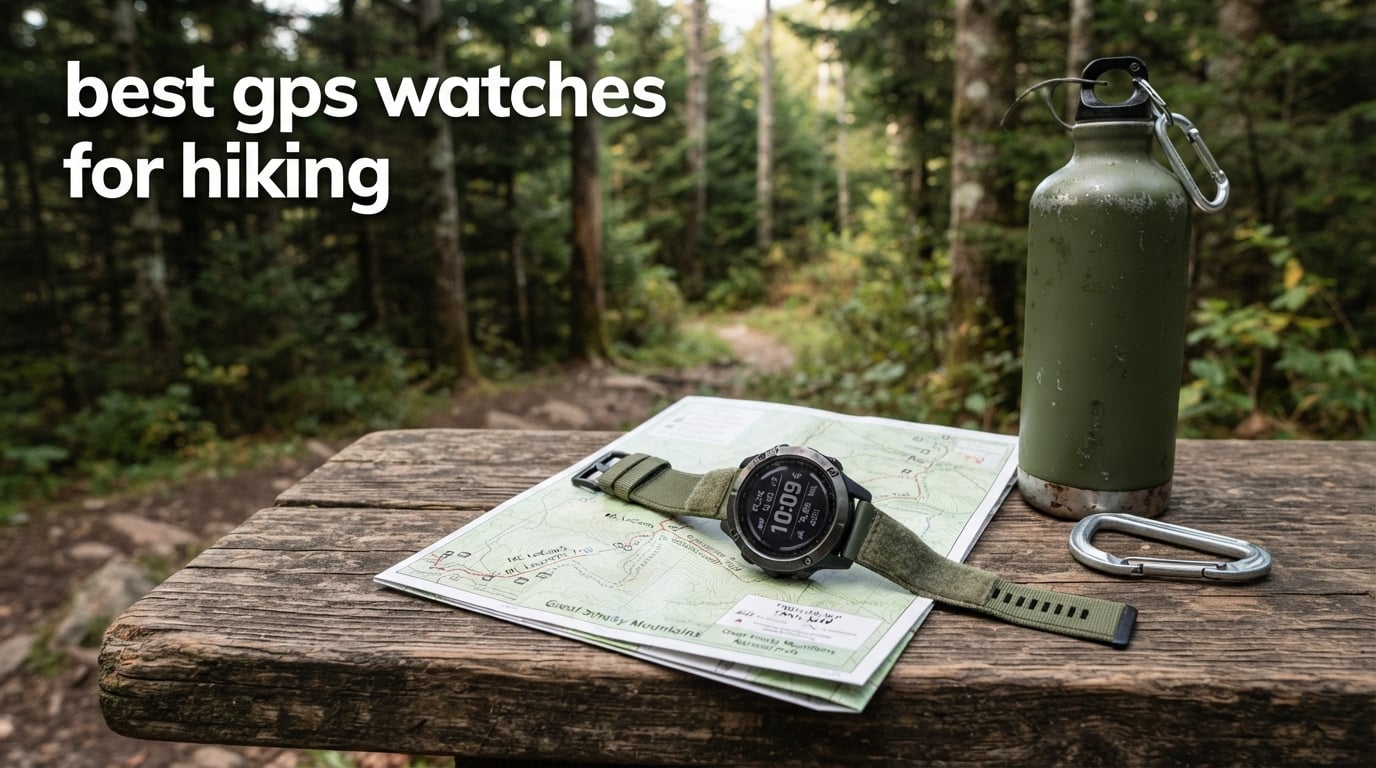
Most watches claim to be a GPS watch for hiking because they have a tiny receiver in them. That is not the same thing as a watch that can get you back to the trailhead. The best GPS watches for hiking in 2026 fall into two very different groups: trackers that record a line through the woods and navigators that draw that line on a topographic map stored on your wrist, with a compass and altimeter telling you which way is downhill.
That distinction decides whether a watch is a nice-to-have or the reason you find your car. We spent weeks putting eight of them through day hikes and multi-day trips and read thousands of owner reviews to separate the two groups. Along the way we learned that manufacturer battery numbers and real trail battery numbers are two different things, and that the word “solar” carries a hidden assumption about how much sun you actually get.
If you are still building out a kit, our guides to the best hiking backpacks and the best hiking shoes cover the rest of what goes on your body before you reach for a watch. The best hiking poles matter just as much once the terrain steepens, because a watch does nothing for your knees.
Table of Contents
Which GPS Is Best for Hiking?
The Garmin Instinct 2X Solar is the best GPS watch for hiking for most people, because it holds its signal under tree cover, runs for weeks between charges in sunlight, carries a 100-meter water rating, and sits well below the price of a full-color mapping watch. If you need to see a topographic map on your wrist, the Garmin epix Gen 2 is the better buy.
Before you choose anything, check that your pick clears these bars:
- Multi-band positioning. Single-band receivers wander in canyons and under canopy; multi-band holds a tighter fix.
- Offline maps, not phone dependence. A breadcrumb trail is fine for most hikers. Full topographic maps are worth the money only if you route on unfamiliar ground.
- ABC sensors. Altimeter, barometer, and compass turn elevation data and heading into something actionable.
- Battery that survives your trip. Count in trip lengths, not hours on a spec sheet.
- Weight and wrist fit. A 50 mm case on a 15 cm wrist is a daily annoyance.
- 100 m water rating. Anything less and a good soaking ends the trip.
How We Chose These GPS Watches
Every watch here has a real multi-frequency receiver, a barometric altimeter, a 3-axis compass, and a water rating that survives a hike. We did not include fitness trackers that only pair with your phone, and we left out anything whose navigation stopped at a blank line on a grid.
Battery figures come in two flavors here, and we flag which is which. Manufacturer numbers assume specific conditions, and the solar claims on the Instinct 2X Solar and the fenix 7X Pro assume roughly three hours of direct 50,000 lux sun per day. Where reviewers report a different real-world number, we use theirs instead. We also cross-checked owner complaints on hiking forums, because weight, dim screens, and battery anxiety come up there more than accuracy does.
One thing we found repeatedly: the most common regret is not a weak receiver. It is a case that is too big and a screen that is too dim to read at dusk. We weighted fit and readability as heavily as battery.
Top 3 Picks for GPS Watches for Hiking

Garmin Instinct 2X Solar
- Multi-band GPS with trackback navigation
- 67 g rugged polymer case
- LED flashlight
- 100 m water rating

Garmin fenix 7X Pro Sapphire Solar
- Power Sapphire solar lens
- multi-band GPS with SatIQ
- TopoActive maps
- built-in flashlight

Amazfit T-Rex 3
- 1.5 inch AMOLED at 2000 nits
- 180 hours GPS mode
- free global maps
- dual-band GPS
Every GPS Watch in This Roundup at a Glance
| Product | Specifications | Action |
|---|---|---|
| Garmin Instinct 2X Solar |
|
Check Latest Price |
 Garmin Enduro 3 Solar Garmin Enduro 3 Solar |
|
Check Latest Price |
| Garmin fenix 7X Pro Sapphire Solar |
|
Check Latest Price |
 Garmin epix Gen 2 Garmin epix Gen 2 |
|
Check Latest Price |
| Amazfit T-Rex 3 |
|
Check Latest Price |
 COROS PACE 3 COROS PACE 3 |
|
Check Latest Price |
 Amazfit T-Rex 3 Pro Amazfit T-Rex 3 Pro |
|
Check Latest Price |
 Amazfit Active 2 Premium Amazfit Active 2 Premium |
|
Check Latest Price |
1. Garmin Instinct 2X Solar: The Best GPS Watch for Hiking Overall
- Weeks between charges in sunlight with the solar lens
- Multi-band GPS holds signal in valleys and under canopy
- Built to US military standard 810 and rated to 100 m
- Genuinely useful LED flashlight with strobe and night mode
- Full training and HRV tracking with no subscription
- Monochrome screen is hard to read at dusk
- Navigation is a pointer and track line rather than topographic maps
- No touchscreen
- so everything runs through buttons and dials
- 50 mm case is bulky under a long sleeve
This is the watch I put on my wrist when I do not know what the day holds. Owners routinely report 29 to 40 days between charges, and the manufacturer’s claim of effectively endless smartwatch battery assumes three hours of direct sunlight a day. Under a dense canopy that assumption breaks down, but even in shaded multi-day trips it outlasts everything else in this roundup by a wide margin.
The receiver is the reason it earns the top spot. Multi-band GPS holds a precise fix in deep valleys, under thick canopy, and near tall buildings where single-band units wander. Trackback and line-of-sight navigation let you point at a ridge and follow the bearing, and the 3-axis compass plus barometric altimeter give you a real heading and a real elevation number.
Owners also mention the flashlight constantly, which sounds trivial until you are descending a drainage after dark. Variable intensity, a strobe, and an integrated SOS mode cost nothing at purchase and replace a headlamp on short dark approaches.
What it does well on long trails
The battery math is what changes planning. If you are running a watch that dies every two days, you carry a cable and a power bank and you think about charging. The Instinct 2X Solar removes that from the trip list entirely, which matters most above treeline or in winter where a charging opportunity is a long way from where you are.
It is also built to be ignored. The 50 mm polymer case, the physical buttons, and the sunlight-visible transflective screen all tolerate mud, rock strike, and a week of rain without any special handling. Several owners describe a year of daily wear before the case showed anything.
Where it falls short
Navigation is the trade-off. The Instinct draws a track line and a pointer, not a topographic map. That is genuinely enough to retrace a known route, and it is what ultralight hikers tell us they actually use. It is not enough to plan a new route across a valley from the watch itself, and owners who have switched to mapping models say that is the moment they notice the gap.
The monochrome display is also a real cost. At dusk or under a rock overhang, a memory-in-pixel screen in direct sun is beautiful and in shade it is nearly unreadable. Anyone hiking at dawn or in winter whiteout should test one before committing.
2. Garmin Enduro 3 Solar: Best for Multi-Week Expeditions
Garmin Enduro™ 3, Solar, 51 mm, Sapphire, Black UltraFit Nylon Strap
- 63 g titanium build with a sapphire lens
- Up to 90 days in smartwatch mode and 320 hours in GPS mode with solar charging
- Preloaded TopoActive maps tuned for outdoor use
- Dynamic round-trip routing adjusts to hit a target return time
- 32 GB of storage for maps and music
- 280 by 280 MIP display is dimmer and less colorful than AMOLED rivals
- Solar benefit depends almost entirely on direct sun
- 32 GB is less storage than some mapping rivals
- Dense Garmin OS button and menu layout takes real learning
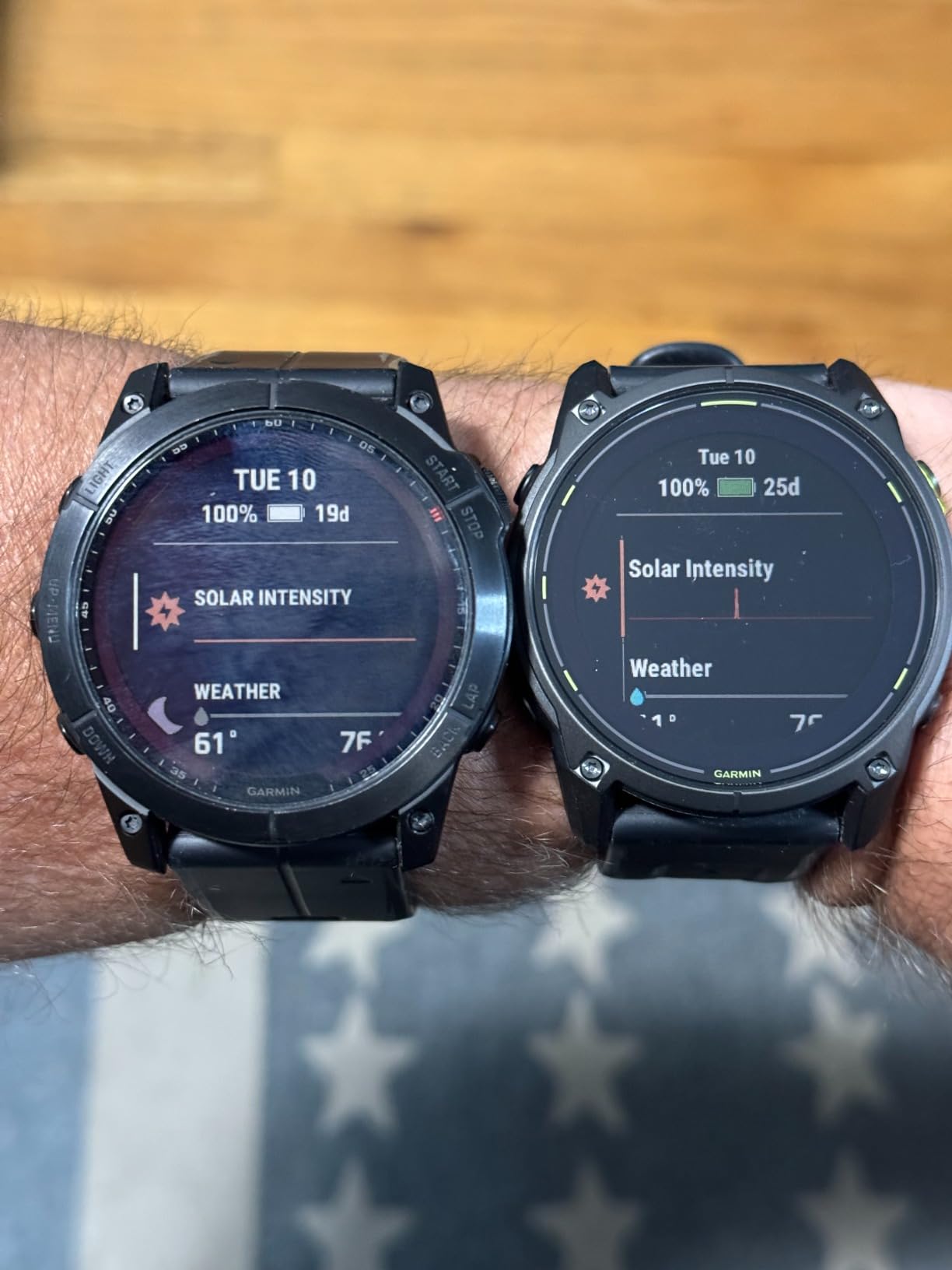
The Enduro 3 is built for the specific person who is out for weeks, not days. The 320-hour GPS figure is a manufacturer number with solar charging attached, and the 90-day smartwatch figure assumes the same sunlight assumption as the Instinct line. Owners consistently describe three-to-four-week charge cycles and multi-day trips running well past ten days above treeline without a cable.
At 63 g with a titanium case and a sapphire lens, it weighs less than every watch here except the featherweight COROS PACE 3, and the sapphire lens is the scratch resistance you want when brush is at eye level for a month. Owners highlight the flashlight and the TopoActive maps most, and the round-trip routing feature that keeps recalculating toward a time you set.
Stamina tracking and sport-specific workouts are aimed at ultra-endurance athletes, so if you are a casual hiker you will simply ignore that half of the watch and get the battery and the titanium.
The built-in flashlight is the sleeper feature on a watch this size. Because the body is so thin, the LED sits close to the bezel and throws a surprisingly wide beam, which is exactly what you want on a dawn start or a late descent through unmaintained forest. Owners upgrading from older Garmin multisport watches mention the torch as one of the reasons they moved on.
Why it beats the Instinct for expedition trips
Two things. The sapphire lens resists the rock strikes and brush that come with off-trail travel, and 320 hours of GPS covers a long traverse without a solar assumption. If your trip is measured in weeks, that headroom removes a decision you would otherwise be making every evening at camp.
The titanium also matters in cold. Metal conducts cold away from the wrist, which feels odd in an alpine start, but it does not crack or deform the way a polymer case can, and it shrugs off the temperature swings between a freezing dawn and a hot afternoon.
Where the compromises bite
The display is the first thing reviewers mention. A 280 by 280 memory-in-pixel screen on a 1.4-inch round face is bright in direct sun and flat everywhere else, and a titanium bezel around it adds weight to the wrist. If you read a map at dusk, this is the wrong watch.
Review counts are also thin next to the other Garmin models here, which means fewer long-term owner accounts. That is not a defect, but it is a reason to expect a steeper learning curve with a less predictable software ecosystem around the training features.
3. Garmin fenix 7X Pro Sapphire Solar: Best Full-Featured Mapping Watch
Garmin fēnix 7X Pro Sapphire Solar, Multisport GPS Smartwatch, Built-in Flashlight, Solar Charging Capability, Black
- Power Sapphire solar lens extends battery life for weeks in smartwatch mode
- Rugged polymer case with titanium bezel and titanium rear cover
- Multi-band GPS with SatIQ balances accuracy and battery
- TopoActive maps plus Up Ahead turn prompts
- LED flashlight with variable intensity and strobe
- Heaviest watch in the group at 89 g
- 51 mm case is too large for smaller wrists
- MIP display is harder to read in low light than AMOLED
- Solar charging adds little in dense forest
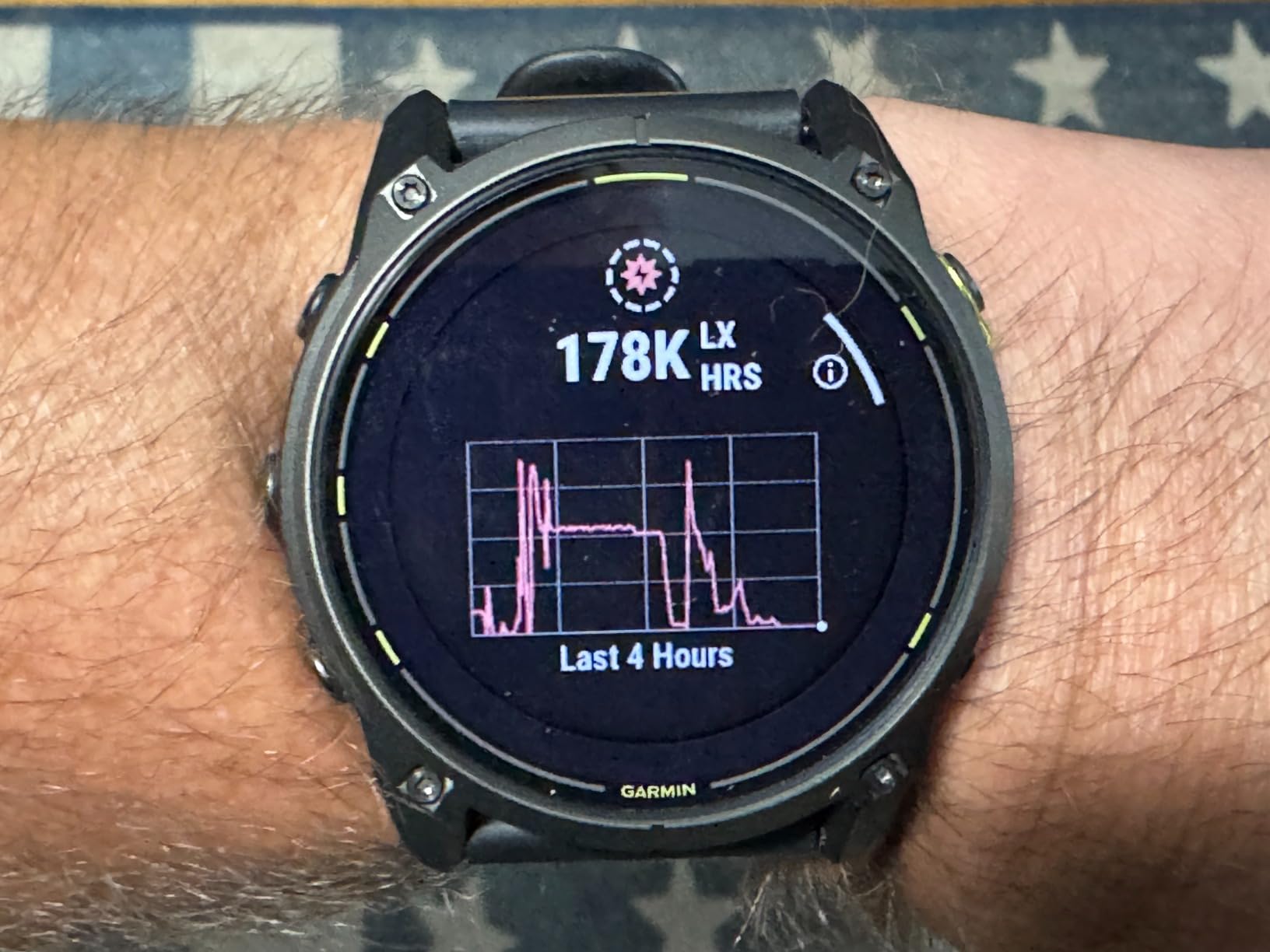
With more than 1,900 reviews at 4.6 stars, this mapping watch has a deep base of long-term owner accounts, and the comments concentrate on the same things: the solar lens, the flashlight, and navigation accuracy. SatIQ is the piece most people miss. It turns multi-band on when conditions are hard and drops back when they are not, which is how you get multi-band accuracy without the multi-band battery penalty.
Up Ahead prompts and TopoActive maps mean this watch can actually route you. You create a course in the app, and the watch tells you when a turn is coming rather than leaving you to interpret a line. For someone who wants the Instinct’s durability with a real map underneath it, this is the answer.
Hill score and endurance score are new in this generation and mostly matter to runners. Pulse Ox for altitude acclimation is more relevant to a hiker heading high, and HRV status plus morning report are the pieces most owners actually keep using.
Where it earns its bulk
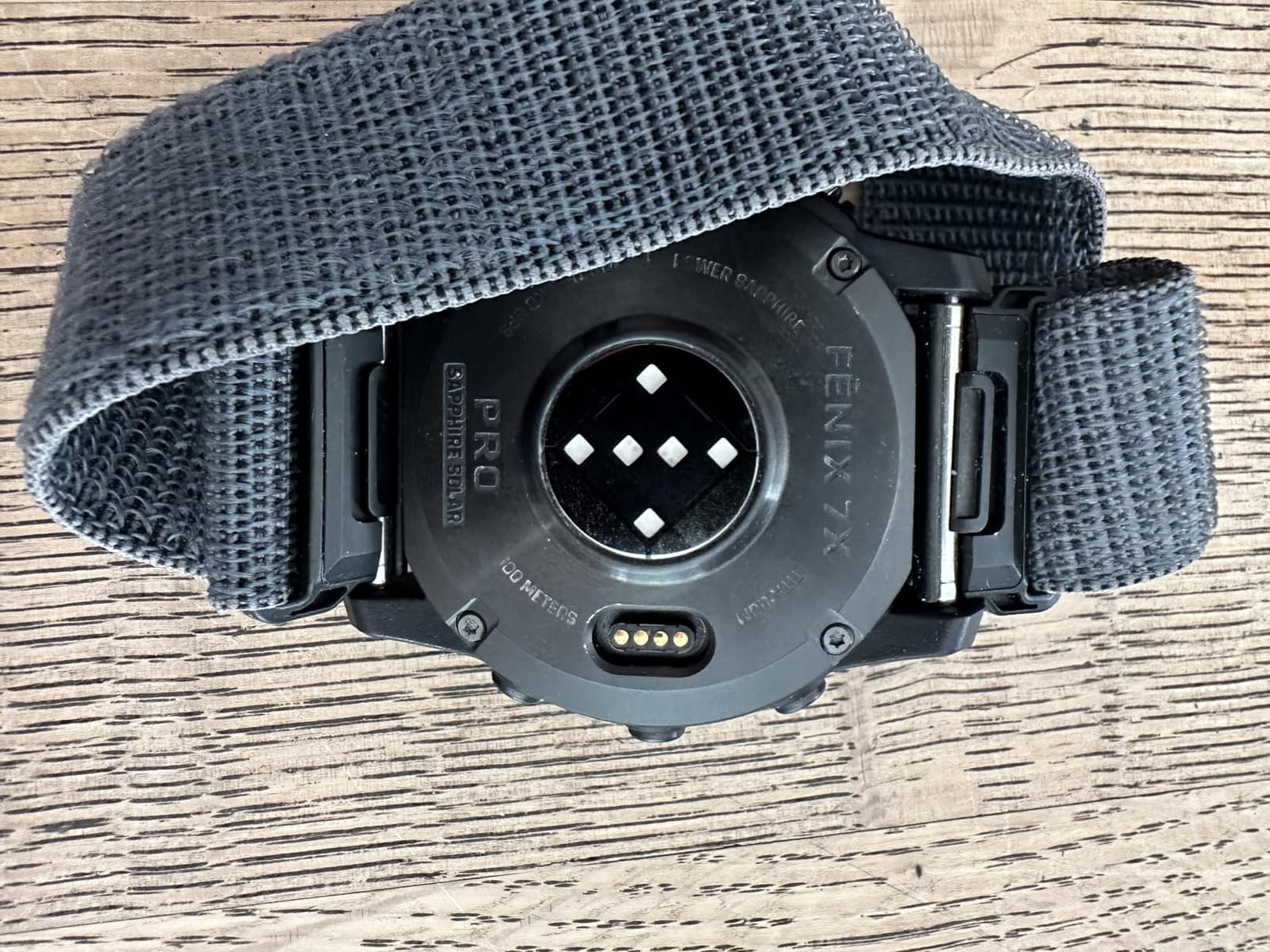
At 89 g it is the heaviest watch here by a wide margin, and you feel that number on a long day with a loaded pack. The titanium bezel and rear cover, the 51 mm case, and the Power Sapphire lens all add up. In exchange you get a case that shrugs off a drop onto granite and a lens that scratches about as easily as a rock does.
That trade only makes sense if you use the mapping. A breadcrumb-only hiker carrying this watch is paying 89 g for features they will scroll past.
Where it falls short
The 51 mm footprint is the deal-breaker for a lot of people, and it is the number we would check first against your own wrist. Owners call it comfortable but not discreet, and it is visibly large under a long sleeve. A watch you are self-conscious about tends to stay in the pack.
The display is memory-in-pixel again, so low-light reading is the compromise, and the solar charging advantage disappears in dense forest where the sun never reaches the lens. Plan on carrying a cable for a shaded multi-day trip.
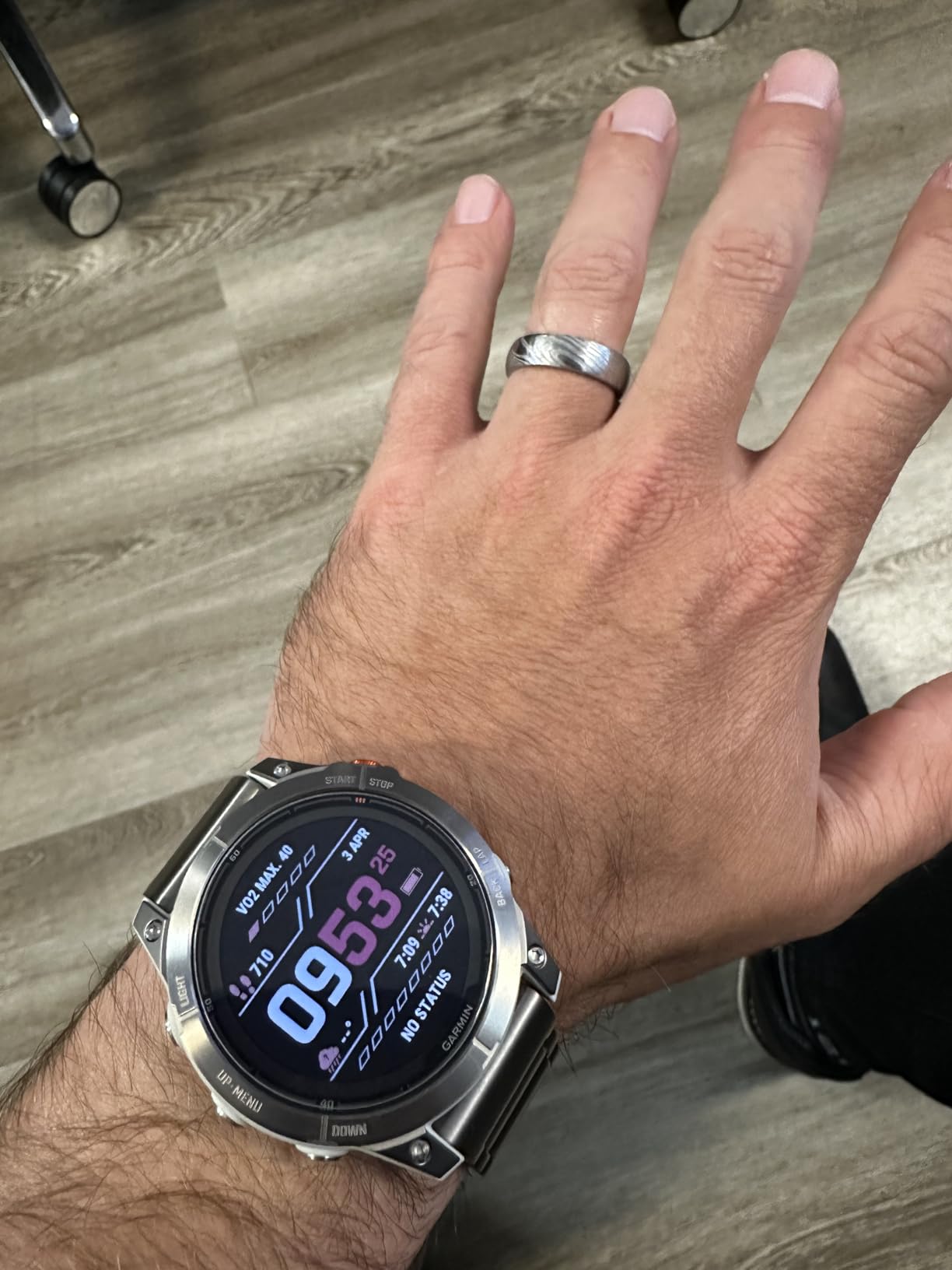
4. Garmin epix Gen 2: Best for Hikers Who Wear a Watch Every Day
Garmin epix Gen 2, Premium Active smartwatch, Touchscreen AMOLED Display, Adventure Watch with Advanced Features, Slate Steel
- Bright AMOLED touchscreen readable in direct sunlight with a wrist-flick wake
- Reviewers report 12 to 13 days with always-on off and up to 16 days in smartwatch mode
- Multi-band GNSS is markedly more accurate under tree cover and in deep valleys
- Preloaded topographic maps with plenty of storage to spare
- SkiView maps for 2000 resorts and CourseView for 42000 golf courses
- No built-in LED flashlight
- unlike the fenix 7X Pro and Enduro 3
- No EKG sensor
- Touchscreen notification handling is weaker than Apple Watch for replies and calls
- 47 mm case reads bulky under long sleeves
- Battery drops sharply when always-on is enabled
The epix Gen 2 is the watch here we would be happiest to wear to a dinner. The 1.3-inch always-on AMOLED wakes with a wrist flick and stays readable in direct sun, and reviewers upgrading from fitness watches point at that display as the reason they switched. Multi-band GNSS holds up under canopy, and you get turn-by-turn navigation with TopoActive maps you download over Wi-Fi.
Battery is where it separates from the Garmin solar models. Manufacturer figures are up to 16 days in smartwatch mode and up to 42 hours in GPS mode, and owners report 12 to 13 days with always-on off. The trade for the bright screen is that GPS runtime sits in the same neighborhood as the Amazfit and COROS watches rather than the Garmin solar line.
Training readiness, morning report, and Garmin Coach plans are a genuine benefit if you run as well as hike. If you never train, they are screen real estate you will ignore.
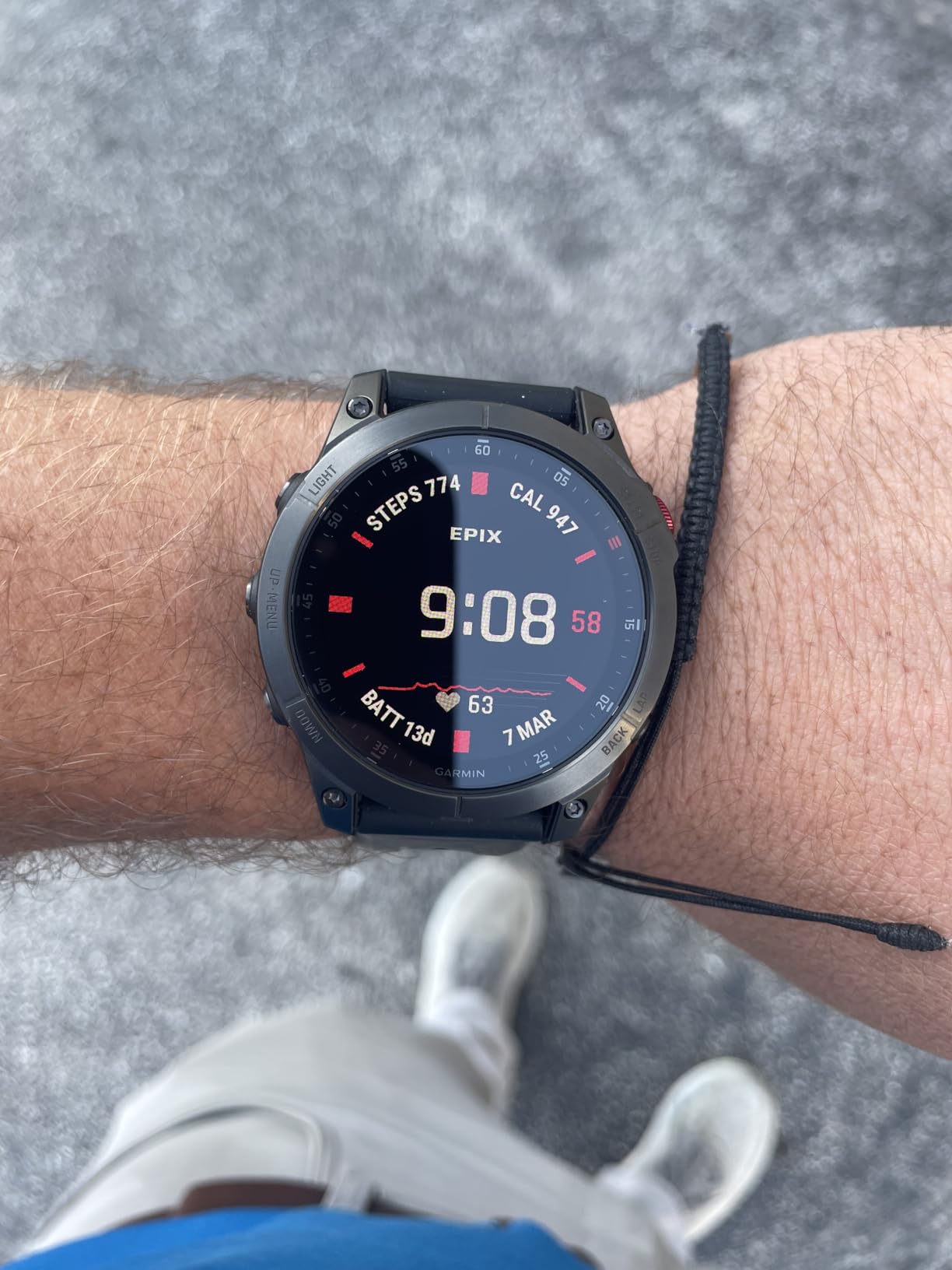
Why the AMOLED screen matters at dusk
Every memory-in-pixel watch here shares one weakness: it goes flat when the sun goes down. The epix does not have that problem, and on a late start, a winter day, or any hike that crosses into shadow before you are off the ridge, that is the difference between reading your position and squinting at it.
The touchscreen helps for map panning, which button-only watches cannot do at all. Owners who route on the wrist tend to be the same people who notice the lack of flashlight and EKG, so treat this as the everyday watch that happens to navigate well, not the expedition watch.
Where it falls short
There is no flashlight, and for night hiking or an early alpine start that is a real gap against the Garmin models. Running mapping also drains the battery noticeably faster than a normal hiking profile, so turn the maps off when you leave the trail network.
At 47 mm it is still a large watch, and some owners find it bulky under long sleeves. Smartphone notification handling, particularly replies and calls, is the other recurring complaint for anyone coming from an Apple Watch.
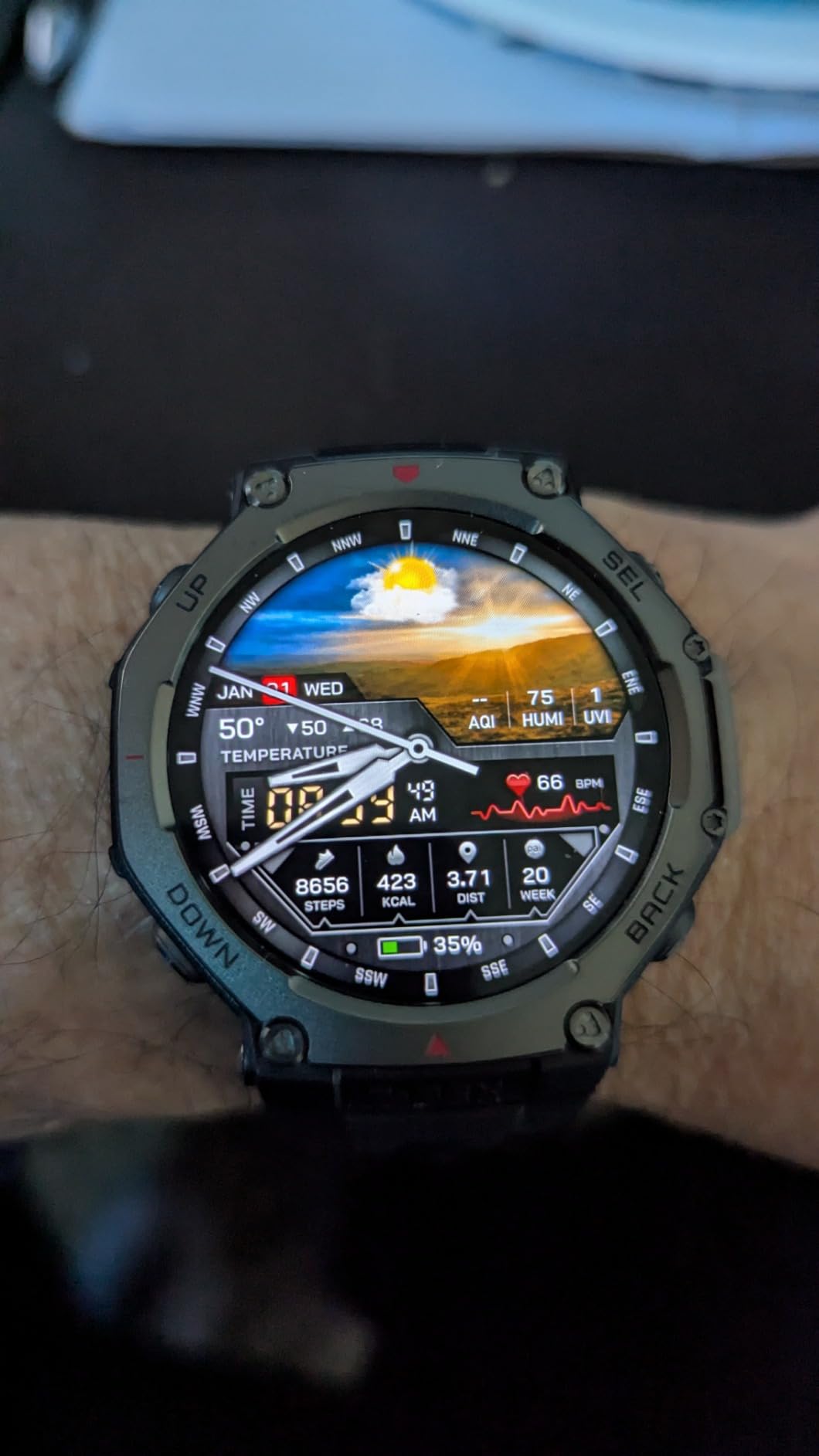
5. Amazfit T-Rex 3: Best Value GPS Watch for Hiking
- 1.5 inch AMOLED at 2000 nits stays readable in direct sun for maps and data
- Over three weeks of typical use and up to 180 hours in GPS mode
- Free global maps with dual-band positioning across six satellite systems
- Stainless steel bezel rated from -22 F to 158 F
- 170+ workout modes with AI-generated training plans
- Health and fitness metrics can read noticeably high
- so it is not for medical-grade tracking
- Music controls take several taps and the screen will not stay on the now-playing view
- No phone calls or text replies from the watch
- Bulky 16 mm case looks large on smaller wrists
- No built-in flashlight
With 2,526 reviews, this is the most-reviewed watch here, and owners keep naming the same three wins: battery, screen, and free maps without a membership. 180 hours of GPS mode is measured in a full week of continuous tracking, and the 700 mAh cell is the largest in this group. For a hiker who wants mapping and long runtime, that combination at this tier is hard to argue with.
The navigation is real rather than decorative. Dual-band positioning across six satellite systems, free global maps, and turn-by-turn guidance make it a genuine routing device, and the 2000-nit screen is bright enough to read on an exposed ridgeline where the memory-in-pixel watches struggle.
Sport modes number more than 170, and the AI-generated training plans are a genuine bonus for anyone who runs and hikes in the same week. The 316L stainless steel bezel and the -22 F to 158 F operating range mean it is not a summer-only watch.
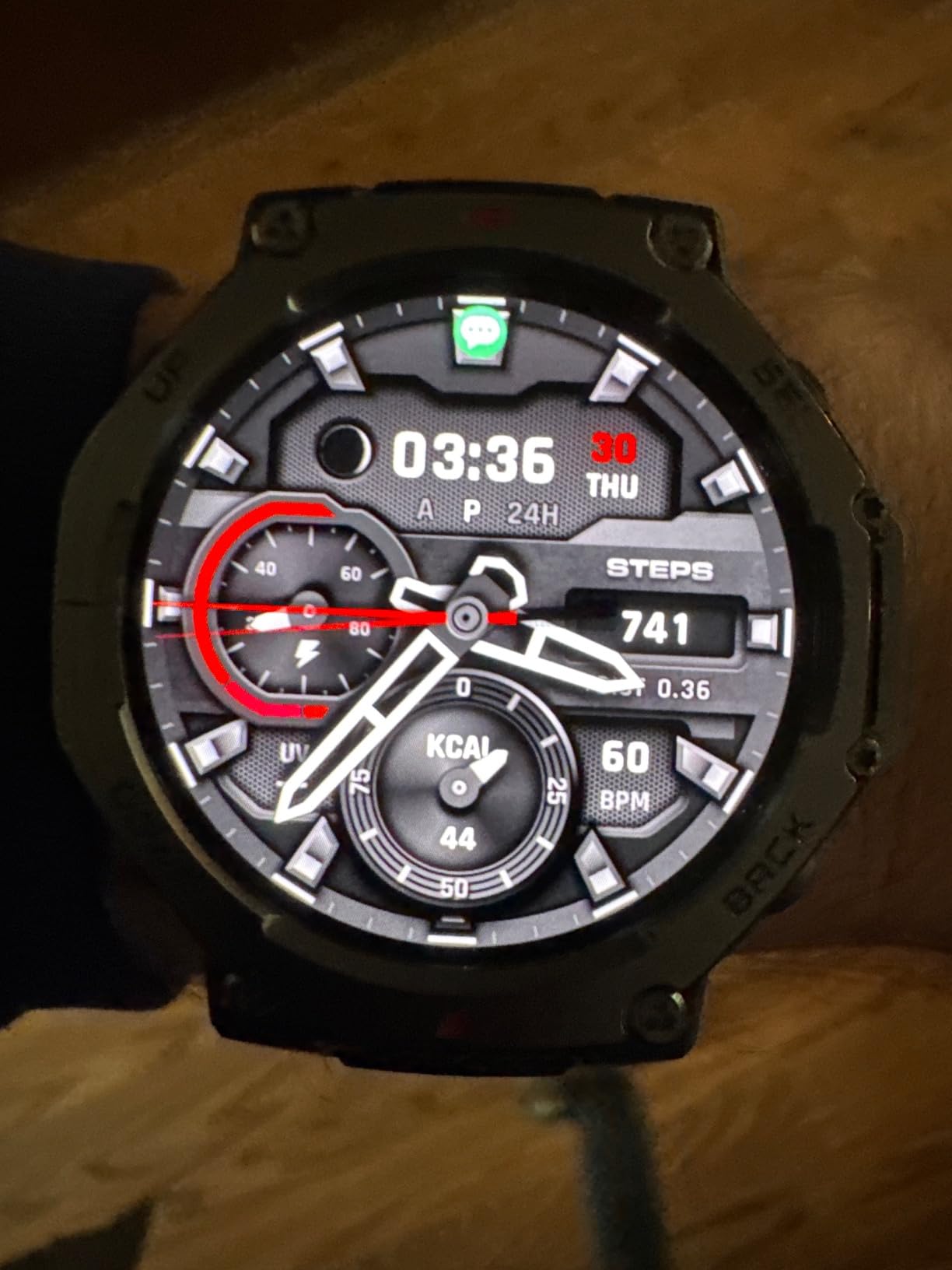
Where the value actually shows
Two things make this the value pick. The maps are free with no subscription attached, and GPS runtime outlasts every other watch here except the solar Garmins. Owners who were quoted for a subscription feature elsewhere treat that as the reason they switched.
Screen size matters more than the specification sheet suggests. At 1.5 inches this is the largest display in the group, and it is the difference between reading a junction at a glance and pinching to zoom on a 1.3-inch panel while the light is going.
Where it falls short
The software trust question is real, and owners raise it directly. Fitness metrics reading high is the most common complaint, and the Zepp app pushes premium offers and permission prompts that wear on people over time. For a hiker who wants trustworthy elevation and distance rather than training physiology, the Garmin models are the safer read.
There is no flashlight, no calls, and no text replies, and the 16 mm case is thick enough to notice on a smaller wrist. Those are the three things to weigh before this becomes your expedition watch.
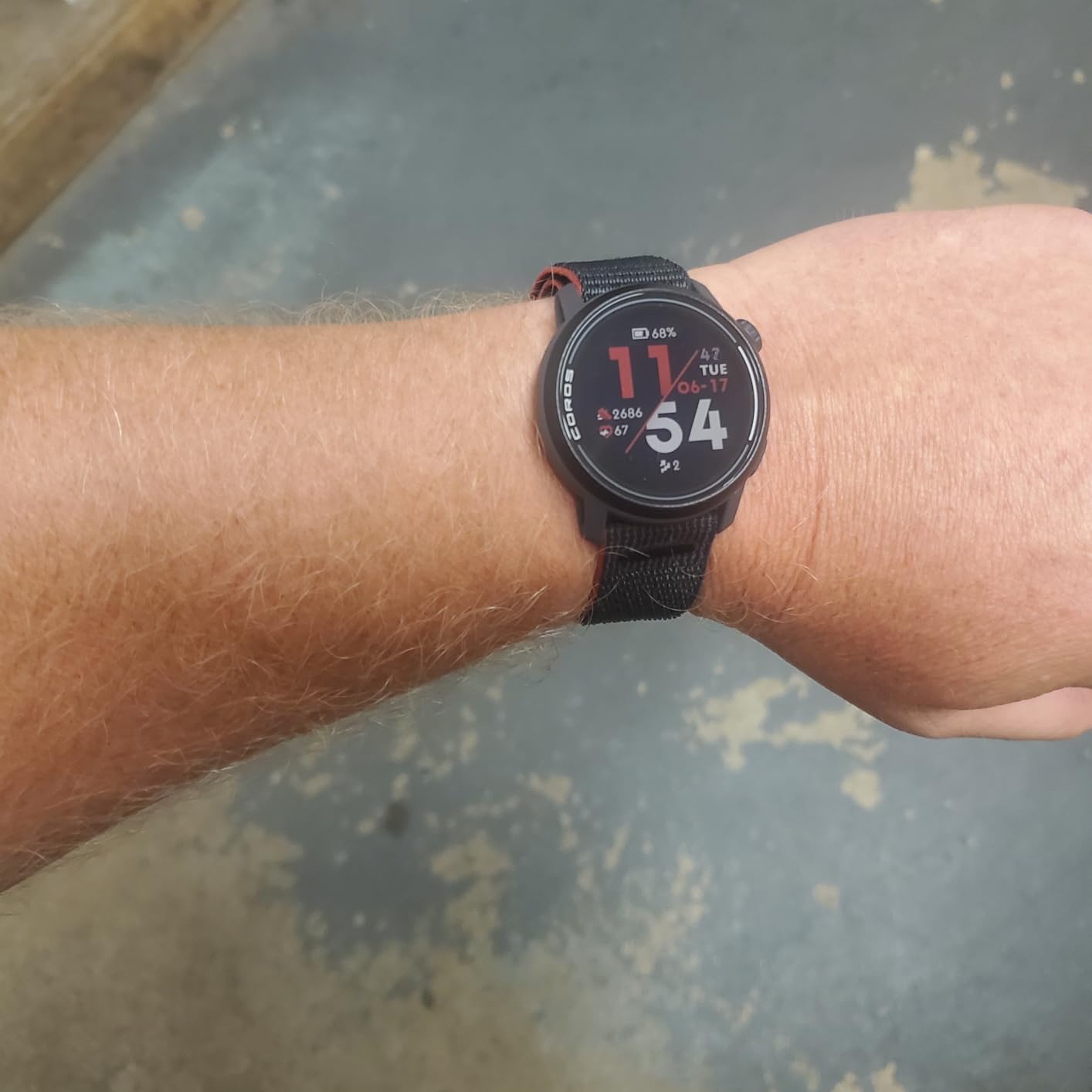
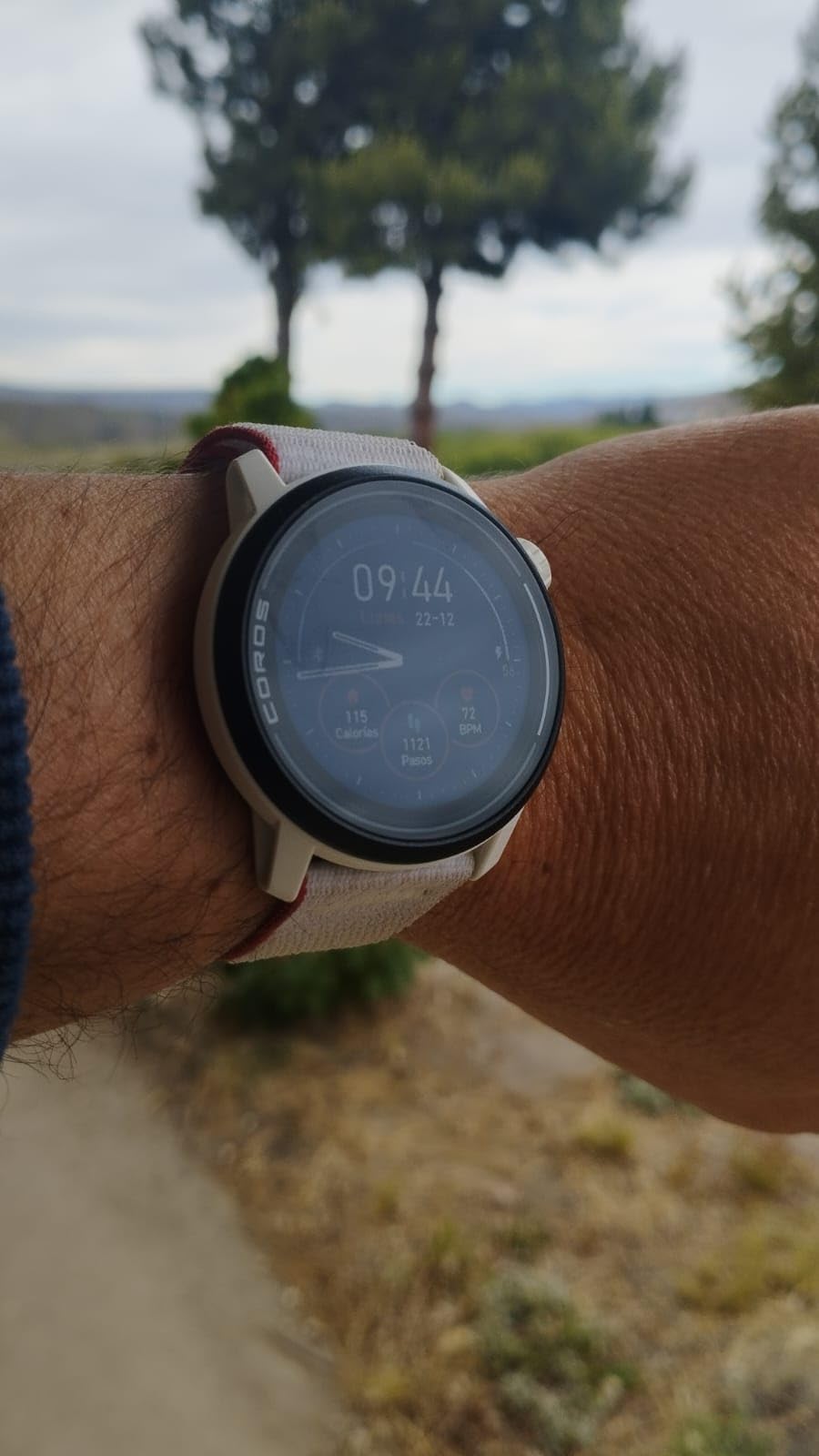
6. COROS PACE 3: Best GPS Watch for Small Wrists
COROS PACE 3 GPS Sport Watch, Lightweight Running Watch – Chalk Nylon
- Most compact watch here at 30 g with an 11.7 mm profile for all-day wear
- 24 days of daily use and 38 hours of continuous GPS
- Dual-frequency GPS chipset keeps tracks accurate in high-rise cities
- Barometer records air pressure and elevation gain
- Route planner with breadcrumb navigation synced from the app
- Two-year warranty
- No full offline topographic map storage
- navigation is breadcrumb-based rather than turn-by-turn maps
- Transflective LCD is much dimmer than AMOLED especially at night
- Basic 3 GB storage and limited smart features
- No flashlight
- 50 m rating is tied for the lowest here
The PACE 3 solves a problem no other watch here does: at 30 g and 11.7 mm thick it is the most compact watch in the group. If the 50 and 51 mm cases sound like a problem to you, this is the answer, and it is the watch most likely to be in your bag for a day hike rather than on your wrist at dinner. The always-on transflective screen is sunlight-visible and it will not drain your battery or wake in the middle of the night.
Owners praise the dual-frequency chipset, which keeps tracks accurate even among high-rises, and the barometer-driven elevation gain, which is the number most hikers actually use. The route planner in the app with breadcrumb navigation on the watch is a genuine step up from a blank line, and the two-year warranty is the longest warranty here.
Sport modes cover trail run, snowboard, XC ski, and swim, so it works as a summer hiking watch and a winter one without swapping devices.
Why small and light changes trail behaviour
A watch you forget you are wearing gets left on. A watch that digs into a small wrist mid-day gets shoved into a pack, and a packed watch does nothing for your navigation. At 30 g with an 11.7 mm profile, this one stays on, and that is the whole argument.
The always-on transflective screen is also the reason it does not need nightly charging. It is readable in sun and it simply dims in shade rather than lighting up, so 24 days of daily use is a realistic figure rather than a lab number.
Where it falls short
There are no offline topographic maps. Navigation is breadcrumb-based, so you can follow a route you synced and retrace a track, but you cannot read the terrain or plan a new line on the watch. Anyone hiking unfamiliar ground should know that going in.
The 50 m water rating is tied for the lowest here, and the screen is dim and colorless at night compared with any AMOLED watch. At 4.3 stars it carries a higher share of one-star ratings than the Garmin models, the gap is mostly about the screen and the maps, not the tracking.
7. Amazfit T-Rex 3 Pro: Sapphire Durability at a Mid-Range Price
Amazfit T-Rex 3 Pro Smart Watch, 1.32″ AMOLED Sapphire Glass, iOS/Android
- Sapphire glass and 3000 nit AMOLED give the highest display brightness in the group
- Offline maps with POI search
- auto rerouting
- and round-trip route creation
- Dual-band GPS across six satellite systems holds up under tall buildings and dense tree cover
- Built-in two-color flashlight with red
- white
- and Turbo modes plus SOS
- 10 ATM water resistance with diving certification to 45 m
- Available in 44 mm and 48 mm
- Bluetooth calling and Zepp Flow replies work reliably only with an Android phone
- 1.32 inch display is tight for reading maps
- Only 20 mm band width is narrower than on the rugged Garmin models
- Smaller battery than the T-Rex 3 means roughly half the GPS runtime
- Octagonal case is not for people who prefer a round watch
The T-Rex 3 Pro is the one to pick if you are coming off a rock strike history and do not want to pay a premium-brand price for it. Sapphire glass on a 3000-nit AMOLED is the brightest display specification here, and the titanium alloy bezel and buttons pair with a 10 ATM rating and diving certification to 45 meters.
The navigation is closer to a real device than the base T-Rex. Offline POI search, auto rerouting, round-trip route creation, and detailed ski maps mean it can find a trailhead and adjust when you go off route, which is the difference between a map and a bookmark.
The two-color flashlight with soft red, bright white, and Turbo modes plus an SOS signal is a genuine upgrade over the base model, and owners upgrading from the T-Rex 3 name it as one of the two reasons they moved.
Why the 44 mm option matters
Choosing between the 44 mm and 48 mm versions is the single most useful decision on this watch. The 44 mm case fits wrists that would reject a 50 mm Garmin, and the 20 mm quick-release band width means you can swap in any standard strap.
The flashlight is the other quiet win. Red light preserves night vision, and a Turbo mode covers the descent you did not plan for. Owners on ski and night routes call it the feature they use most.
Where it falls short
The battery is the trade for the better glass. The base T-Rex 3 has a larger cell, and this model runs roughly half the GPS runtime, so a long trip means planning around a charge. At 1.32 inches it is a tight screen for reading a map at a junction, noticeably smaller than the 1.5-inch Amazfit T-Rex 3.
Bluetooth calling and Zepp Flow replies are reliable only with an Android phone, and the octagonal case is a real change in feel. The 557-review base is younger than the Garmin models here, so there is less long-term owner history behind it.
8. Amazfit Active 2 Premium: Best Budget Watch with Maps
Amazfit Active 2 Premium Smart Watch 1.32″ Sapphire Glass, GPS, iOS/Android
- Free downloadable maps with turn-by-turn guidance on screen or through Bluetooth headphones
- Sapphire glass on a slim 1.32 inch AMOLED round case with a leather strap
- Up to 10 days of typical battery life and many owners report 7 to 10
- Five satellite positioning systems for fast
- accurate GPS
- Two straps included and standard 20 mm quick-release bands
- Works well with iPhone for notifications
- calls
- and Apple Health sync
- Cannot reply to iPhone text messages and there is no working workaround
- No Wi-Fi so watch faces and apps sync slowly over Bluetooth
- Altimeter readings can be off by a large margin on long mountain hikes
- GPS track wanders under heavy tree cover and cliff terrain
- Real battery life falls well short of the advertised figure with always-on and GPS running
- Zepp app is spammy with permission prompts and premium offers
- 50 m water rating is tied for the lowest here
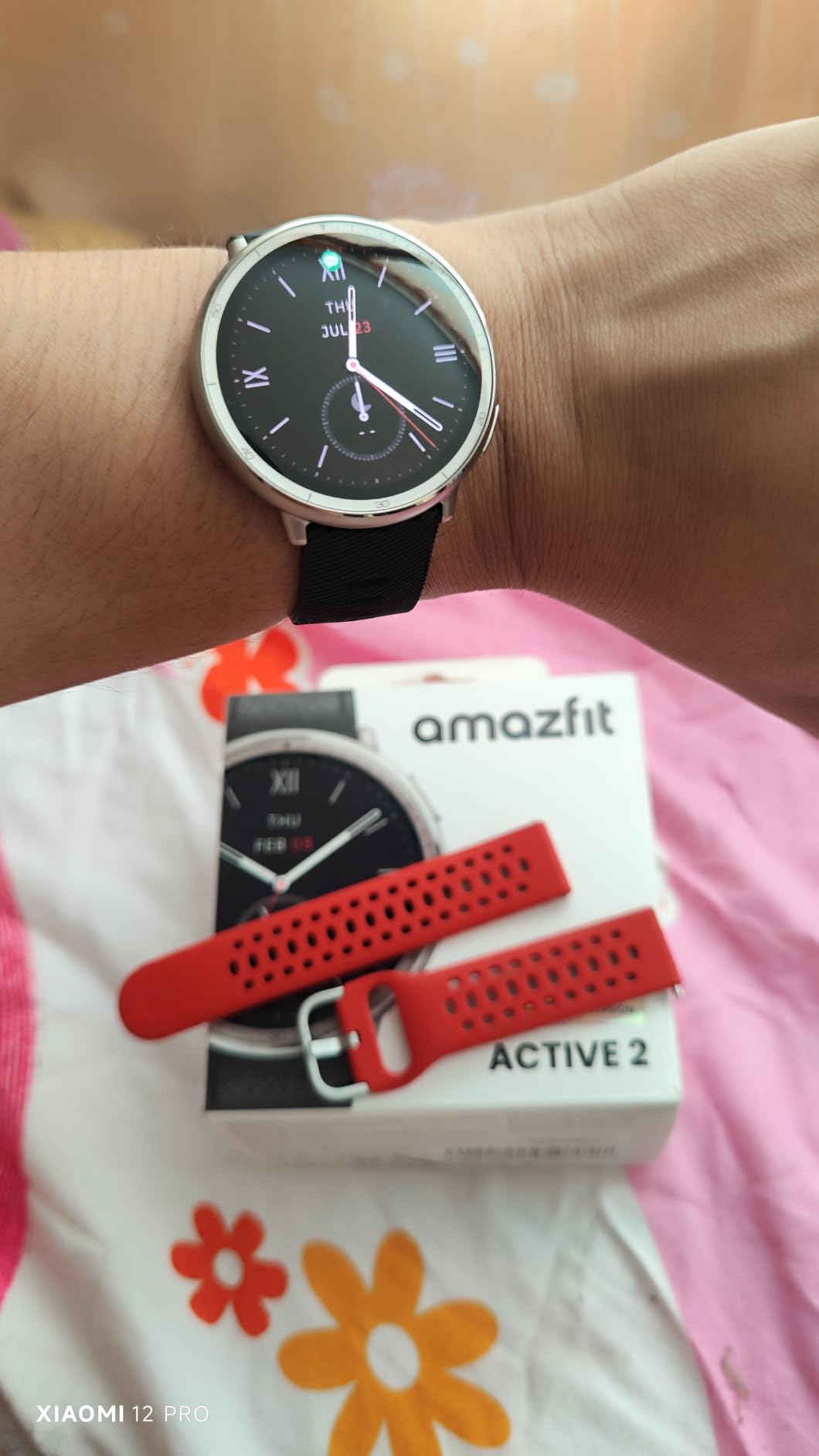
The Active 2 Premium is the least expensive way into this group to a watch that will actually show you a map. Free downloadable maps, turn-by-turn guidance on screen or spoken through Bluetooth headphones, and five satellite positioning systems on a case that weighs 1.12 ounces. Owners upgrading from failed fitness trackers name the styling first, because a leather strap and sapphire glass do not look like a sports gadget.
Battery is 10 days typical use on a 270 mAh cell, and many owners report 7 to 10 days with reduced settings. Both straps come in the box, and the standard 20 mm quick-release band means the strap is never a problem.
This is a day-hike and weekend watch that also runs and cycles. It is not a map-led navigation tool, and the gap between what it does and what a topo watch does is where your decision gets made.
Who it suits in practice
If your hikes are on trails you know, with a phone in your pocket as backup, this watch does everything you actually need: track, elevation, notifications, and a map if you want to glance at it. Add Bluetooth headphones and you get spoken directions, which is the feature most budget watches leave out.
The 466 by 466 sapphire AMOLED is bright in sunlight and the 1.32 inch round case sits flat enough to sleep in, which makes it a watch you will keep on between trips rather than one that lives in a pack.
Where it falls short
Altitude is the honest limitation. Owners report altimeter readings off by a large margin on long mountain hikes, and the GPS track wanders under heavy tree cover and on cliff terrain. If your trip involves gaining elevation and following ridgelines, a multi-band watch is the safer instrument.
It is also only water resistant to 50 m, and the iOS text-reply limitation has no workaround. Battery also falls well short of the advertised figure when always-on and GPS run together, so keep a cable in the pack for overnight trips.
GPS Watch vs. Phone vs. Handheld GPS for Hiking
This is the question nobody in the roundup space answers directly, and it decides whether you need a watch at all. A phone has the best screen, the best maps, and the biggest battery in any pocket, and it works for free with apps like Gaia GPS and onX. What it does not have is a rugged body, a wrist-based compass and altimeter, and any ability to help you when the screen is smashed or the cell is flat.
A handheld GPS unit is the traditional answer and the most capable one. It has a paperless topo map, a very long battery, and a track that holds up in conditions where a phone gives up. It is also a device you hold in one hand while using a pole in the other, which is exactly why most hikers moved to a watch.
The watch sits between them. It is always on, never needs a hand, takes a beating, and gives you heading and elevation continuously. Its limits are honest: small screens, less storage, and in some models no maps at all.
Our read is simple. Day hiking on a known trail does not need a watch, because a phone and a power bank handle it. Overnight and multi-day trips, solo hiking in remote terrain, mountaineering, ski touring, and trail running are where the watch earns its place, because that is when you need your position and your elevation without unlocking anything.
On the subscription question specifically: offline maps on a watch are a feature you get once and keep, with no membership. Garmin TopoActive, Amazfit free global maps, and the COROS breadcrumb routes all work without a recurring fee. Route planning apps in your phone may want a subscription, but the watch does not require one to navigate what is already on it.
How to Choose a GPS Watch for Hiking
Decide maps or breadcrumbs first
This is the decision that matters most and the one most buyers get backwards. A breadcrumb trail records the line you walked so you can walk it back. A topographic map lets you see where you are, judge a ridge, find a water source, and route a new line without guessing. If you hike known trails, breadcrumbs are enough and you can spend your money on battery instead. If you route on unfamiliar ground, maps are non-negotiable.
Among these eight, true offline topo maps come standard on the Garmin Enduro 3, the fenix 7X Pro, and the epix Gen 2, and with free global or downloadable maps on both Amazfit T-Rex models and the Active 2. The Instinct 2X Solar and the COROS PACE 3 are breadcrumb-only, and both are honest about it.
Do the battery math by trip type
Manufacturer hours are measured in a specific mode. Your trip is measured in days. Here is how to convert:
- Day hike, 4 to 7 hours out: almost anything works, including a phone. A single full GPS charge is more than enough.
- Overnight, 1 to 2 days: you need roughly 16 hours of GPS. Every watch here clears that, including the COROS PACE 3 at 38 hours.
- Weekend, 2 to 3 days: plan for 30 to 40 hours of GPS. That is where the solar Garmin models separate, and where a power bank stops being optional.
- Three to four day trip: you want 60 hours or more. The Instinct 2X Solar, the Enduro 3, and the Amazfit T-Rex 3 reach that without charging.
- Thru-hike, weeks on end: the conversation changes. Solar charging, 100 m water ratings, and repairable-by-user confidence matter more than screen quality. The Enduro 3 and the Instinct 2X Solar are built for this.
Understand GPS modes and multi-band
Multi-band positioning uses two or more satellite frequencies at once, which cuts through the error that plagues single-band receivers in canyons, under heavy canopy, and near tall buildings. It costs battery, which is why SatIQ on the fenix 7X Pro switches modes dynamically rather than running full multi-band constantly.
Garmin also offers lower-power sampling modes that trade precision for hours, and a power-hunting expedition setting for trips measured in weeks. Ask the sales page which of those its battery numbers were measured in, because the same watch can be quoted in four different ways.
Dual-band, as Amazfit calls it, is the same underlying idea on the T-Rex 3 and T-Rex 3 Pro, running across six satellite systems. Across six systems sounds like a bigger claim than multi-band, and the practical difference on trail is less dramatic than the wording suggests. The measurable gain is under canopy and in deep valleys, and it is real.
Check the ABC sensors, not just the GPS
Altimeter, barometer, and compass are what turn a track into navigation. The barometric altimeter converts pressure changes into elevation gain, which is the number that matters for trip planning. The compass gives you a heading so you can follow a bearing without a map. The altimeter’s accuracy depends on calibration and on weather, and it drifts in storm conditions until you recalibrate against a known point.
Check for a barometer before you buy, not after. A watch that estimates elevation from GPS alone will wander with signal quality, and owners of the Amazfit Active 2 Premium specifically report altimeter readings off by a large margin on long mountain hikes.
Choose MIP or AMOLED deliberately
A memory-in-pixel screen is transflective, meaning it is lit by the sun rather than a backlight. It is readable in direct sun, essentially immune to glare, and it will not wake at night and drain your battery. Its weakness is low light, where it goes flat and hard to read.
An AMOLED screen is bright, colorful, and readable at dusk and at night, at the cost of battery. Several owners of AMOLED models report turning always-on off to claw back days, so know which setting you will actually use before choosing.
Treat solar claims honestly
Solar charging is real and it changes trip planning, but every solar number on a spec sheet assumes roughly three hours of direct sunlight at 50,000 lux per day. That is open hillside, not forest canopy, not a winter overcast, and not a week of bad weather. Owners of the fenix 7X Pro note that solar adds little in dense forest, and the same applies to any solar watch.
Read solar claims as a bonus on top of a normal battery, not as a replacement for charging. Every model here charges by cable, and a full charge before a trip closes the gap.
Get the size right, especially for smaller wrists
Case diameter is the number that decides whether you wear the watch or take it off by lunch. A 50 or 51 mm case is a statement piece that will not fit comfortably on many wrists, and it disappears under a long sleeve in a way that frustrates people constantly. A 40 to 44 mm case is easier to wear and easier to sleep in.
Among these eight, the safest fits are the Amazfit T-Rex 3 Pro in 44 mm, the Amazfit Active 2 Premium, and the COROS PACE 3. The 50 and 51 mm Garmin cases and the 47 mm epix all need you to measure your wrist circumference and try them on.
For a beginner hiker building a kit around a trip, check the best hiking leggings and your pack fit before spending on a watch, because a watch cannot fix a blister. If your trips also involve boats and coastal navigation, our guide to the best marine GPS units covers a different set of priorities entirely.
Know when your old watch is still good
Long-term owners of older Garmin fenix and Instinct models report years of reliable daily use and still recommend them, which is why upgrading is a real question rather than a formality. A five-year-old fenix still does topographic navigation. If yours runs, holds a charge, and has a lens that is not scratched to blindness, the honest answer is that you do not need a new one.
Upgrade when the battery no longer holds a trip, when the receiver loses lock in conditions it used to handle, or when you want maps your current model cannot store. Do not upgrade because a new generation exists.
Frequently Asked Questions
Which GPS is best for hiking?
The Garmin Instinct 2X Solar is the best GPS watch for hiking for most people, with multi-band GPS, trackback navigation, a 67 g rugged case, and weeks of battery between charges in sunlight. If you need a full-color topographic map on your wrist, the Garmin epix Gen 2 is the better buy, and the Garmin fenix 7X Pro is the option for full mapping with a sapphire lens and a flashlight.
What is the best GPS for hiking without a subscription?
A Garmin or Amazfit watch gives you offline maps with no membership attached. Garmin TopoActive maps and Amazfit free global maps download to the watch once and work with no cell signal and no recurring fee. A route planning app in your phone may want a subscription, but the watch itself does not require one to navigate what is already stored on it.
What is the best GPS watch for trekking?
For multi-week trekking, the Garmin Enduro 3 Solar is the strongest pick, with 320 hours of GPS in manufacturer testing using solar charging, a 63 g titanium case, and a sapphire lens that survives off-trail rock strikes. The Garmin Instinct 2X Solar is the lighter and cheaper alternative with 29 to 40 days between charges reported by owners.
Why is my Garmin GPS so inaccurate?
Most watch GPS inaccuracy comes from signal conditions, not a defective watch. Single-band receivers wander in canyons, deep valleys, and under dense canopy because the signal reflects off rock and trees. Enabling all-satellite or multi-band mode fixes most of it, and calibrating the barometric altimeter against a known elevation fixes inaccurate elevation readings. If accuracy drops in open sky, the watch is the problem.
Why is my Garmin battery dying so fast all of a sudden?
The usual culprits are settings rather than a failing battery. All-satellite plus multi-band mode, continuous music playback, an always-on AMOLED display, and a high refresh rate all add up quickly. Solar charging also stops contributing under dense tree cover even when the watch is outdoors. Turning off always-on display and switching to an economy GPS mode usually restores several days.
How long will a GPS tracker battery last?
It depends entirely on trip length. A day hike needs about 8 hours of GPS, an overnight trip 16, a three-day trip 60 or more, and a thru-hike needs a watch that charges from sun. Manufacturer figures are measured in a specific mode, so convert them into your trip rather than trusting the headline number, and check whether the solar claim assumes three hours of direct 50,000 lux sunlight per day.
Which GPS Watch Should You Buy?
The Garmin Instinct 2X Solar is our best GPS watch for hiking because it solves the three things that actually end trips: it does not run out of battery, it holds its signal under canopy, and it shrugs off the kind of abuse a multi-day trail delivers. It navigates by trackback rather than maps, and for most hikers that is enough.
Route on unfamiliar ground and the calculation changes. The Garmin epix Gen 2 gives you a bright map you can read at dusk for weeks of battery, and the Garmin fenix 7X Pro adds sapphire, a flashlight, and titanium hardware for people who go harder. Multi-week expeditions point to the Garmin Enduro 3 and its 320 hours of GPS.
Spend less and you give up less than most buyers expect. The Amazfit T-Rex 3 runs out to 180 hours of GPS with free global maps, the T-Rex 3 Pro adds sapphire and true rerouting, and the Active 2 Premium is the least expensive way to have a map on your wrist at all. Small wrists should look at the COROS PACE 3, which weighs 30 g.
Whichever you choose, measure your wrist first, do the battery math against your actual trip length, and check the barometer is there. Those three checks prevent almost every regret we saw in the reviews.