
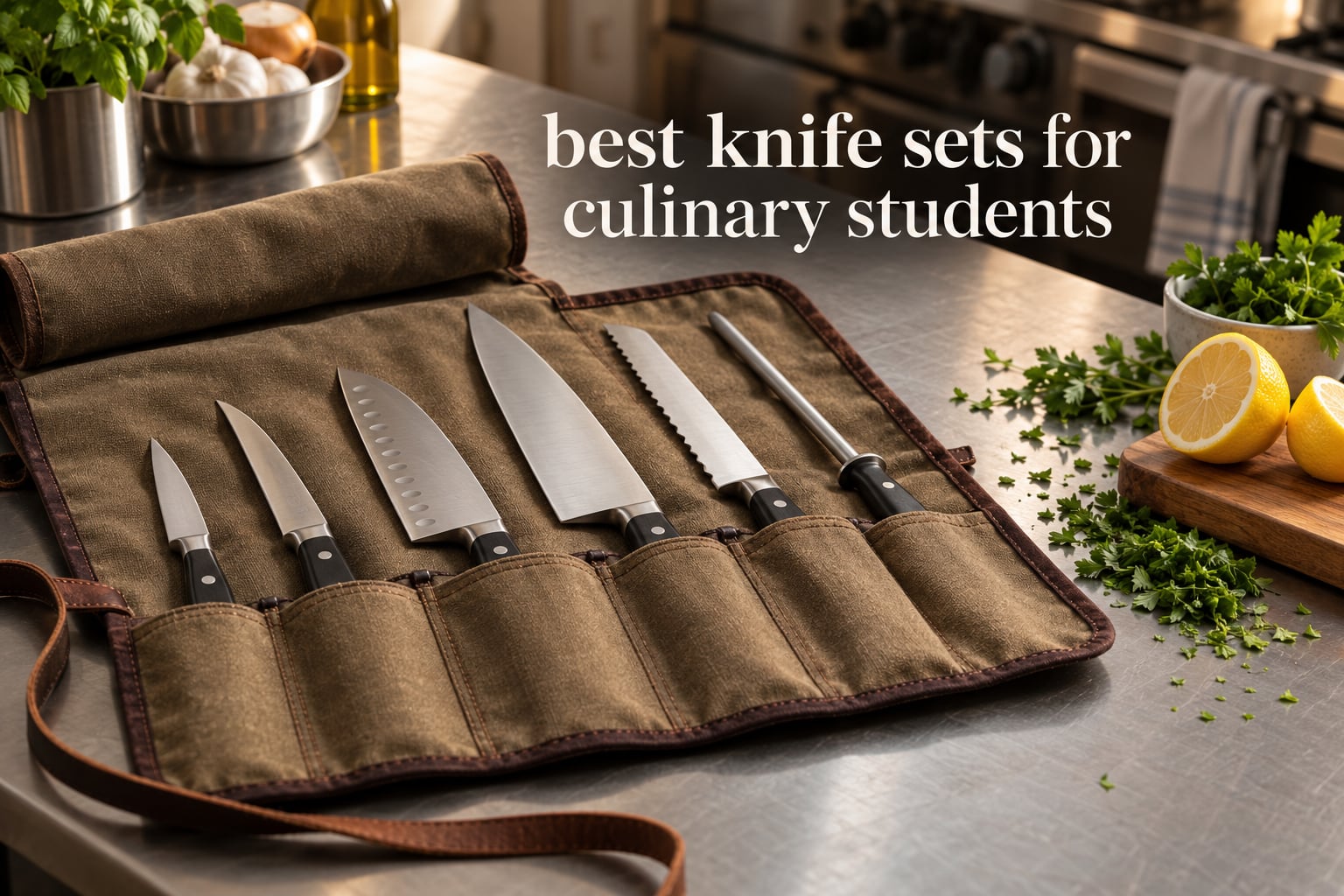
The best knife sets for culinary students are the ones that cover four core blades, come in a roll you can carry to class, and stay easy to sharpen when you are tired at 9pm after a double prep shift. Our overall pick is the Cuisinart 15-Piece Hollow Handle Block Set, because it pairs a forged high-carbon stainless chef knife with a full complement of prep knives and a 4.7-star average across more than 20k reviews.
Most students do not have a huge budget or a spare closet. You have a locker, a knife skills class that starts at 6am, and a tool list your program probably already handed you. That changes what matters in a knife set. Weight matters, because you carry it on a bus or a walk across campus. Edge retention matters, because a dull blade makes you press harder and slows your mise en place.
Below I break down ten sets that hold up to school use, what each one is genuinely good at, and who should walk away from it. I have leaned on the review patterns that repeat across student forums: ease of sharpening, replaceability, and a grip that survives wet hands, not brand prestige. If you also need a blowtorch for torching creme brulee, we covered the best culinary blowtorches separately.
Table of Contents
Top 3 Picks for Culinary School

Cuisinart 15-Piece Hollow Handle Set
- Forged high-carbon stainless blades
- 15 pieces with wood block
- 8 inch chef and santoku

Mercer Culinary Millennia Roll Set
- One-piece high-carbon Japanese steel
- 7-pocket knife roll
- 8 inch chef knife

HOSHANHO 6-Piece Magnetic Set
- Forged Japanese steel at 60 HRC
- Hand-ground 15 degree edge
- Pakkawood handles
The 10 Best Knife Sets for Culinary Students at a Glance in 2026
Every set below is judged on the same four things: does it cover the required blades, does it come in something you can carry, how does the steel hold an edge, and is the handle comfortable through a long prep shift. Piece count is deliberately treated as a minor factor. Steak knives and kitchen shears fill a bag without earning their keep at a school station.
| Product | Specifications | Action |
|---|---|---|
| Cuisinart 15-Piece Hollow Handle Block Set |
|
Check Latest Price |
| Mercer Culinary Millennia 8-Piece Roll Set |
|
Check Latest Price |
 Dfito 9-Piece Chef Knife Set with Roll Bag Dfito 9-Piece Chef Knife Set with Roll Bag |
|
Check Latest Price |
| HOSHANHO 6-Piece Magnetic Knife Set |
|
Check Latest Price |
 imarku 15-Piece Japanese Stainless Block Set imarku 15-Piece Japanese Stainless Block Set |
|
Check Latest Price |
 Amazon Basics 14-Piece Full Tang Set Amazon Basics 14-Piece Full Tang Set |
|
Check Latest Price |
 Astercook 13-Piece Set with Blade Guards Astercook 13-Piece Set with Blade Guards |
|
Check Latest Price |
 SYOKAMI 7-Piece Foldable Magnetic Block Set SYOKAMI 7-Piece Foldable Magnetic Block Set |
|
Check Latest Price |
 XYJ 12-Piece Professional Set with Roll Bag XYJ 12-Piece Professional Set with Roll Bag |
|
Check Latest Price |
 Farberware 15-Piece High-Carbon Block Set Farberware 15-Piece High-Carbon Block Set |
|
Check Latest Price |
If you are on a strict budget and cutting mostly vegetables, our sushi knife set guide covers the thinner single-bevel options worth knowing about before you commit to a heavier European set.
What Knives Do Culinary Schools Actually Require?
Every program has its own list, and plenty of schools hand out a branded kit bag on day one and expect you to fill the gaps. But the core four never really change, and this is the list to buy against.
1. An 8-inch chef knife. This is roughly 90 percent of your prep work: chopping onions, dicing mirepoix, slicing proteins, portioning. If you only buy one knife, buy this one well.
2. A 3.5-inch paring knife. Small, cheap, and indispensable. Peeling, trimming, deveining, and cutting an onion without a cutting board all live on this blade.
3. A serrated bread knife. Eight inches of scalloped edge handles crusty loaves, tomatoes, and firm-skinned produce without crushing them. Serrated edges cannot be sharpened on a honing steel, so buy one that arrives sharp.
4. A 6-inch utility or boning knife. The flexier, narrower blade that slides between bone and meat, and the one you reach for during fish filleting and deboning.
Add a sharpening steel to that list and you have a complete student kit. Student forums keep returning to the same advice: Mercer Culinary is repeatedly described as the knife line used by many North American culinary schools, and on r/chefknives a first-year student asked exactly what to add to a school-issued kit, with Miyabi Ishin called out as an easy-to-sharpen entry-level Japanese line. If your program issues knives, treat that bag as the baseline and upgrade one piece at a time rather than replacing it wholesale.
1. Cuisinart 15-Piece Hollow Handle Block Set – Best Overall for a Student Kit
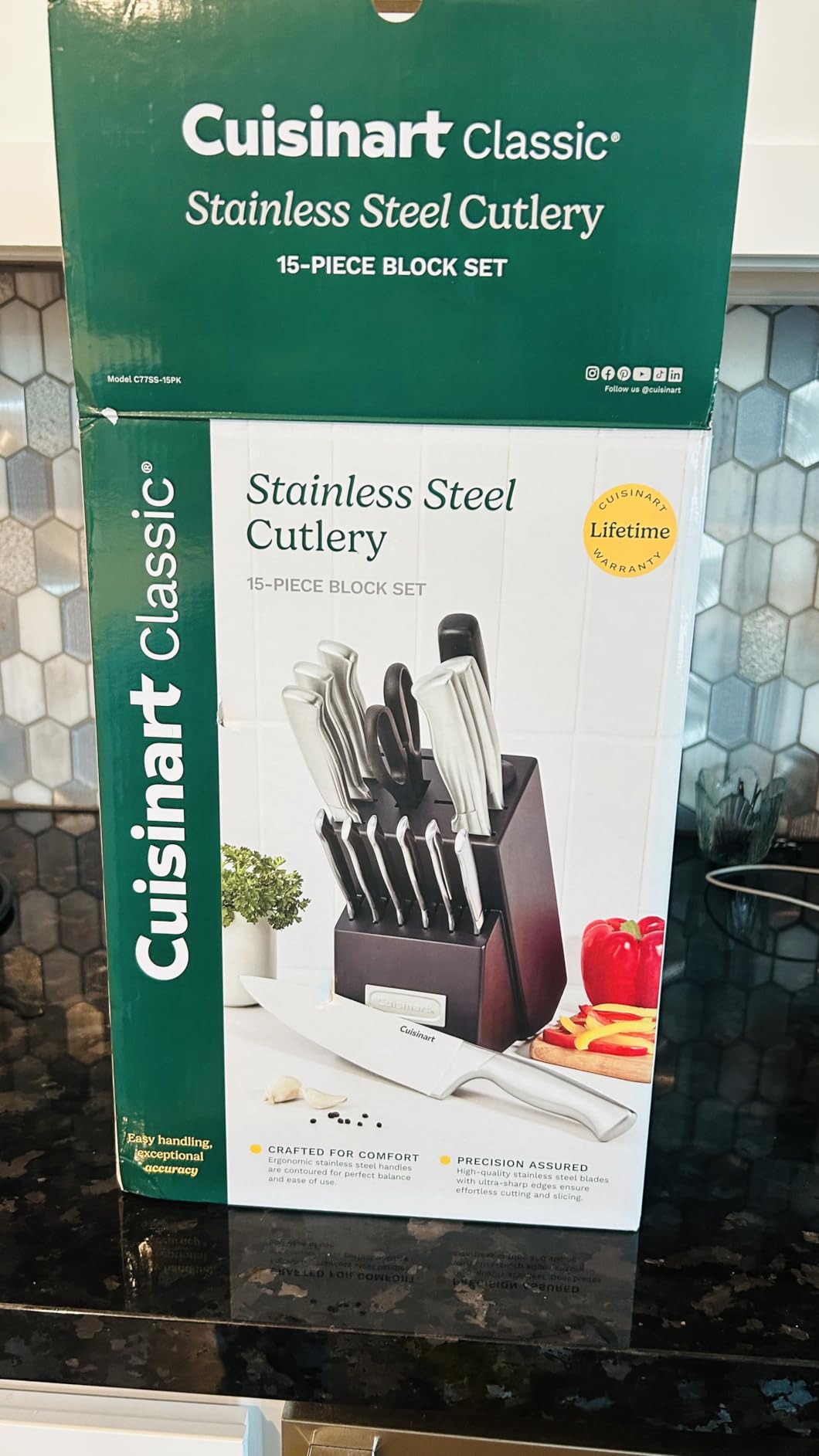
Cuisinart 15-Piece Stainless Steel Hollow Handle Block Set, C77SS-15PK
- Arrive sharp and hold an edge with little maintenance
- All-stainless hollow handles feel balanced and not slippery
- Very complete 15-piece selection
- Wooden block keeps knives organized
- Rust spots if knives sit wet so dry them immediately
- Hardened steel can chip if dropped or torqued
- Slim 4.5 inch steak knives feel small in larger hands
I keep coming back to this set because the review base is enormous and the complaints are narrow. More than 20k reviews at a 4.7 average tells you the core knives hold up, and the negatives cluster around care rather than construction. That is the profile you want in something you will use four hours a day.
The blades are forged rather than stamped, and reviewers repeatedly note they arrive sharp and stay sharp with minimal maintenance. The 8-inch chef and the 7-inch santoku handle the bulk of school prep, and the 5.5-inch serrated utility and 3.5-inch paring cover the precision work.
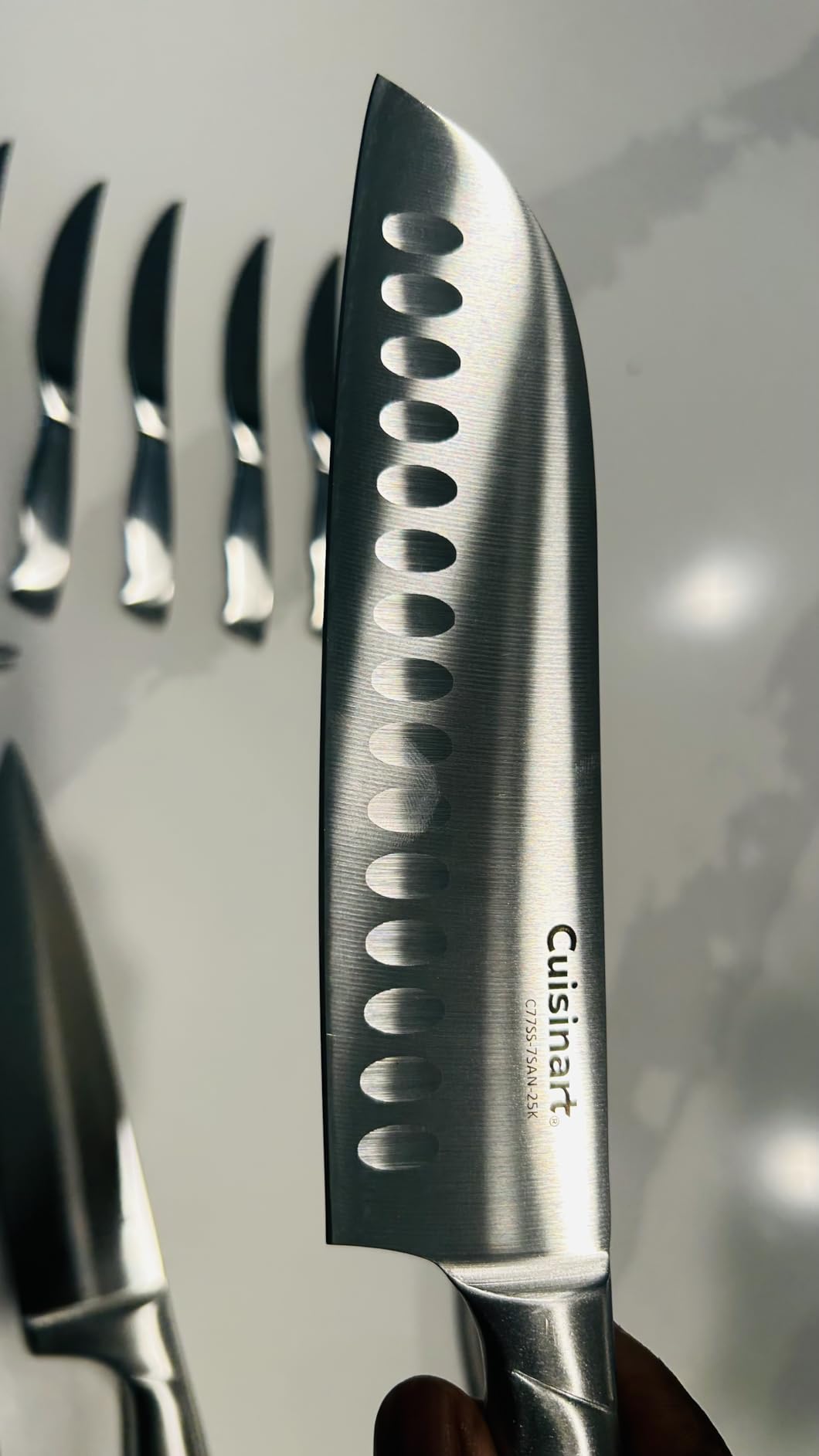
The hollow stainless handles are the underrated part here. They feel balanced, they do not get slippery the way textured polymer can, and there are no crevices for a kitchen to trap food in. During a wet station that matters more than most spec sheets suggest.
What you get beyond the core four is a mixed blessing. Six 4.5-inch steak knives and a pair of shears add weight to a bag you carry to class, and the steak knives are slim enough that reviewers with larger hands find them cramped. You will not use them much at school.
Where it will hold up in a school kitchen
This is the set I would hand a student whose program does not issue a kit. The coverage is complete, so nothing on the required list is missing, and the wood block gives you a place to store it at home between program terms. When the internship starts, you can take the four core knives out of the block and carry them in a roll.
Where it will frustrate you
The steel is fully hardened, which is why it holds an edge, and also why a few owners report chipping or tip damage after a drop or a hard twist against a bone. Dry blades the moment you rinse them, because owners do report light rust spots when knives sit wet.
And if your program requires a 6-inch boning knife, this set does not have one. The 5.5-inch serrated utility is a different animal entirely. Plan on adding a boning knife from the butcher knife sets we tested if butchery is on your schedule.
2. Mercer Culinary Millennia 8-Piece Roll Set – Best for Carrying to Class
- Very sharp out of the box and easy to resharpen
- Textured non-slip handles feel secure
- Well-stitched 7-pocket roll protects and carries blades
- Complete range of blade sizes
- Inconsistent factory sharpening on some pieces
- Lightweight feel next to forged alternatives
- Dishwasher use dulls and damages the blades
If your week involves a commute, this is the set I would choose over anything with a block. At 3.4 pounds, packed into a stitched 7-pocket roll, it is the easiest kit here to move between a locker, a bus, and a shared station. The whole thing collapses to the size of a laptop sleeve.
The blades are one-piece high-carbon Japanese steel, which is the sweet spot for students: they take an edge quickly and they are forgiving if you are new to sharpening. Reviewers consistently describe them as sharp out of the box and easy to resharpen, and several note this is the same knife line used in culinary school, which means technique advice and replacement advice will match what your instructor says.
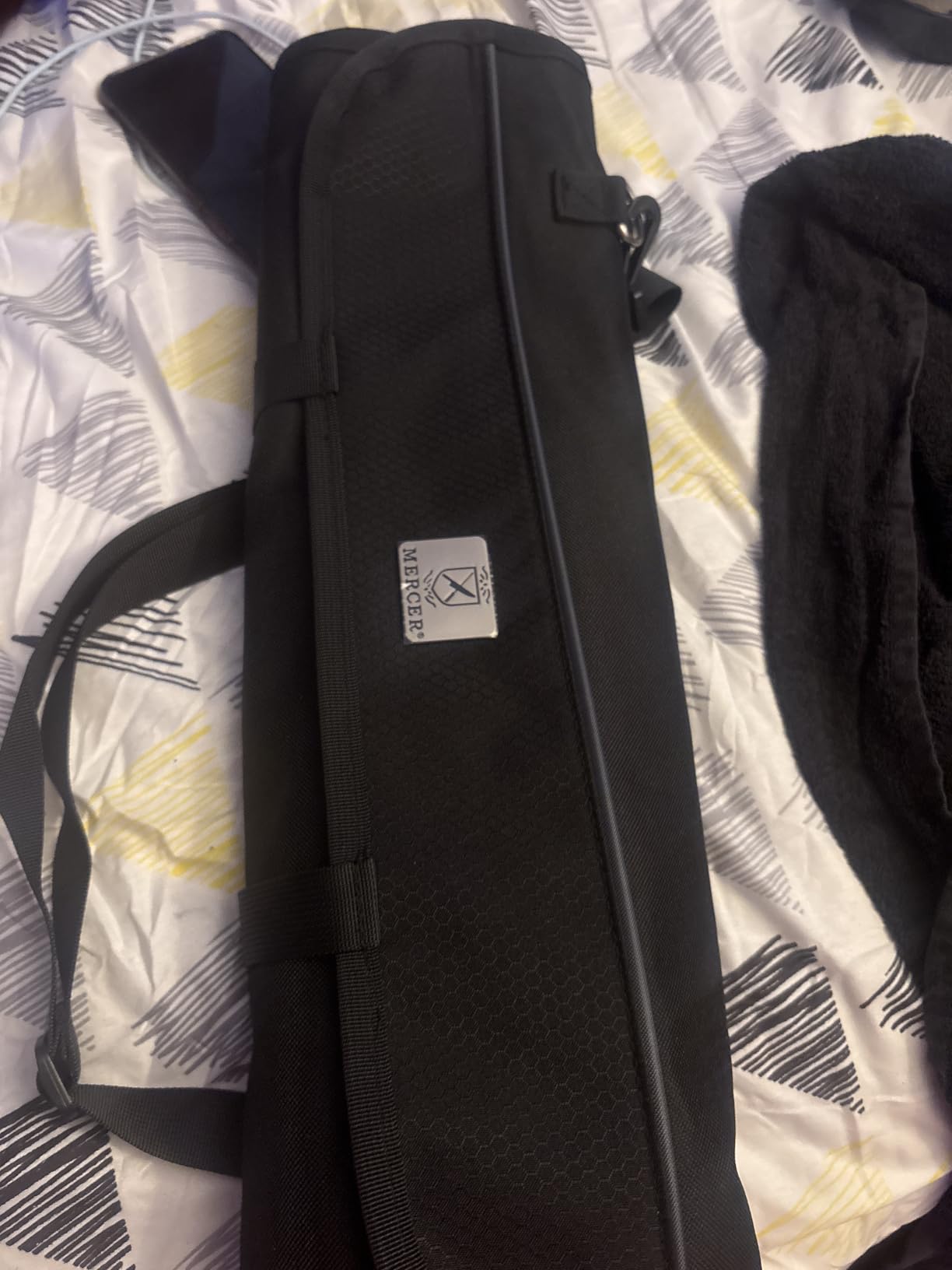
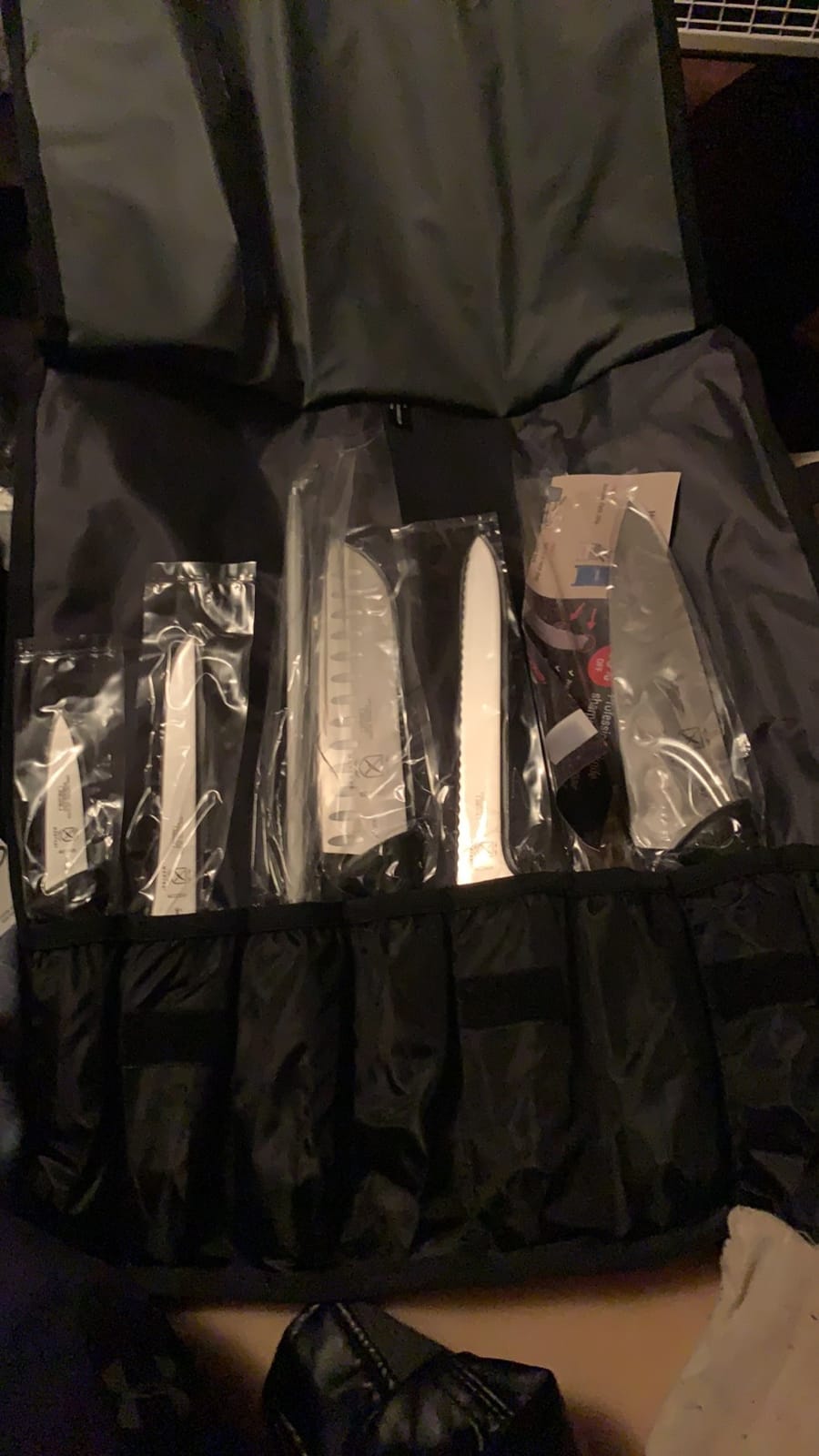
The set covers the range: a 3.5-inch paring knife, a 6-inch boning knife, a 7-inch Granton edge santoku, an 8-inch wavy edge offset bread knife, an 8-inch chef knife, an 11-inch slicer, and a 10-inch traditional steel. The 6-inch boning knife is the piece that completes a school tool list, and it is the one students most often have to buy separately.
Two cautions. Factory sharpening is inconsistent across the set, with the 11-inch slicer specifically called out as arriving duller than the rest, so plan a honing session the night you unbox it. And the Santoprene handles feel thin next to a forged steel handle, which some cooks read as less precise on very fine work.
What students actually notice after a term
The handles. Textured, non-slip Santoprene with finger points stays secure when your hands are wet and cold, and the whole kit survives being dropped in a locker bag without a rigid case. Reviewers also point out the roll is well stitched and genuinely protective, which matters more than it sounds when a bread knife slides loose against a chef blade all semester.
What to watch out for
Hand wash only, and this is not optional. Dishwasher heat dulls these blades and dulling compounds every week. The lighter feel is also the tradeoff for that portability, and if you prefer a substantial European profile, our carving knife set picks lean heavier in the hand.
3. Dfito 9-Piece Chef Knife Set with Roll Bag – Best Lightweight Roll Kit
Dfito Chef Knife Sets with Roll Bag, 9 Pieces Professional Knife Set
- Sharp 5Cr15MoV high carbon stainless blades
- Ergonomic non-slip handle with finger protection
- Roll bag makes the set easy to store and carry
- Lightest kit in the group at 1.5 pounds
- Included blade guards can sit loose or pinch tight
- Build quality unproven against forged sets
At 1.5 pounds, this is the lightest kit in the group, and light is exactly what you want when you are hauling a bag from a dorm to a kitchen four floors up. Nine pieces land in a roll that stays flat in a locker or a locker-sized cubby, which is a real constraint most students underestimate before week one.
The steel is 5Cr15MoV high carbon stainless at Rockwell 56-58, with 16-18 percent chromium for rust resistance. That is a sensible hardness for student use: sharp enough to hold through a prep shift, forgiving enough that a botched whetstone pass is not a disaster.
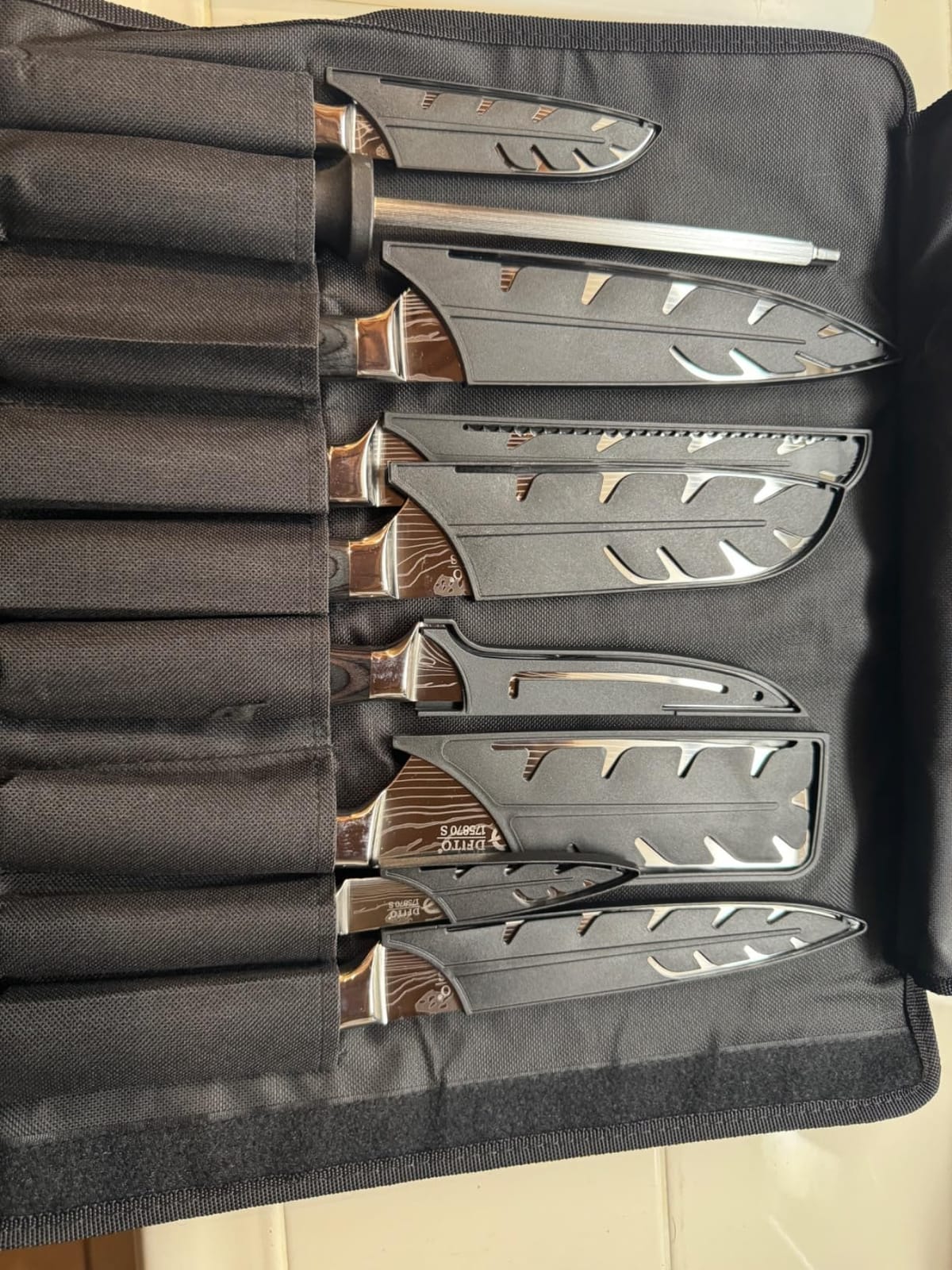
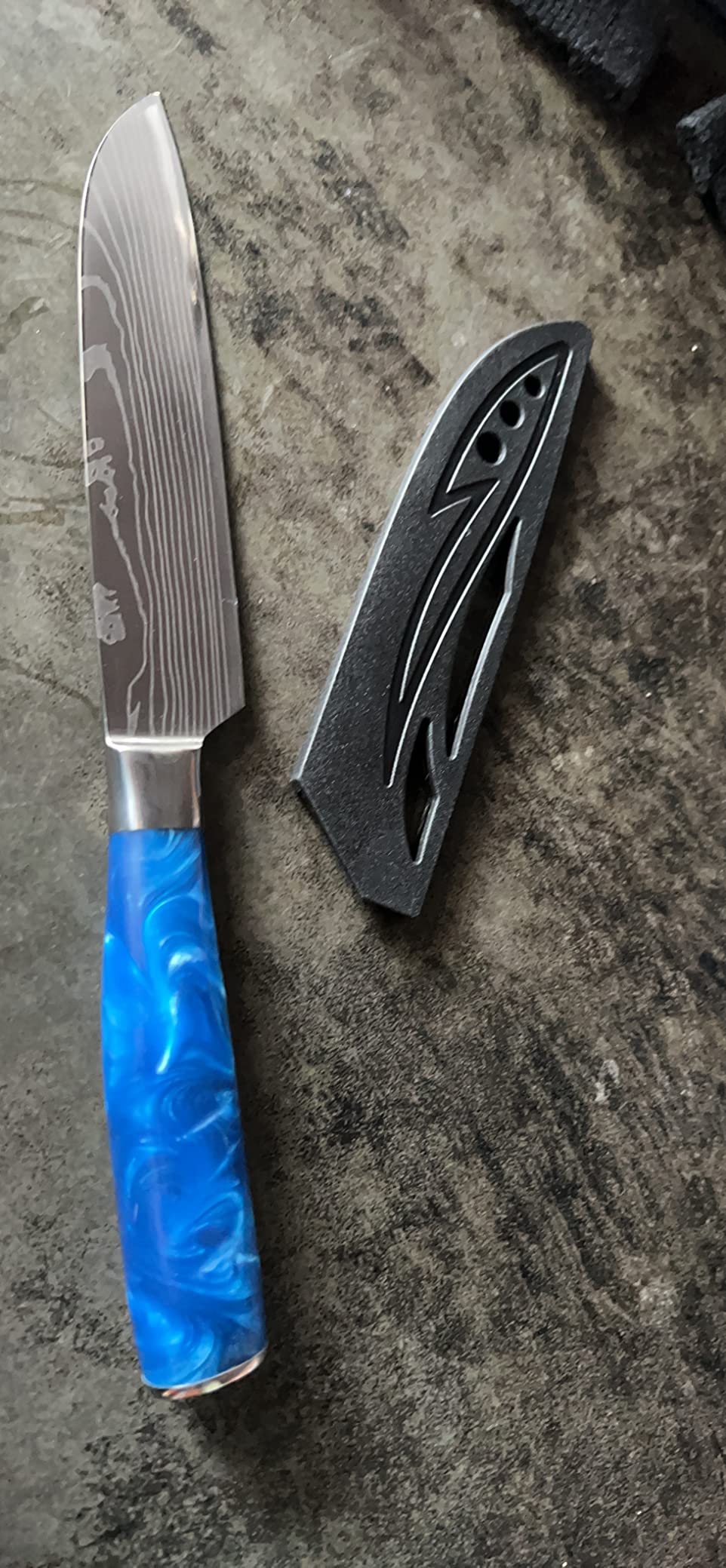
The handle design is the differentiator. An integrated finger guard and a non-slip grip are described as comfortable across hand sizes, which solves a genuine problem: standard chef handles feel oversized to smaller hands, and most students buy a set that fits nobody in the kitchen.
Reviewers like the sharpness, the handle comfort, and the roll storage at this level, and the recurring criticism is the accessories rather than the knives. The included blade guards vary in fit and can slip off or pinch tight, so treat them as a bonus for drawer storage rather than a transport system.
Why students keep this one
It covers the four required blades, it is light, and the handles fit a range of hands. When you are doing 200 pounds of vegetables for a catering prep, blade weight fatigue is the thing that ruins your hands, and this is the kit least likely to cause it.
Where the compromises show
Edge consistency is the open question. With a 4.6 average across 835 reviews, owners broadly like the set, but the knives have not been proven against forged sets the way the Cuisinart blades have. If you break a tip mid-term, replacement cost and availability are your problem, not the brand’s.
Buy a real honing steel separately. A set at this level does not need to include one, but a student without a steel is a student who will reach for a dish towel and a cutting board.
4. HOSHANHO 6-Piece Magnetic Knife Set – Best Forged Japanese Steel
- Forged Japanese steel delivers a very sharp edge
- Magnetic acacia holder displays knives and lets them air dry
- Pakkawood handles with a wide bolster reduce fatigue
- Compact six-piece layout keeps counter space small
- Only six pieces so a full school list needs additions
- Magnetic holder needs careful mounting
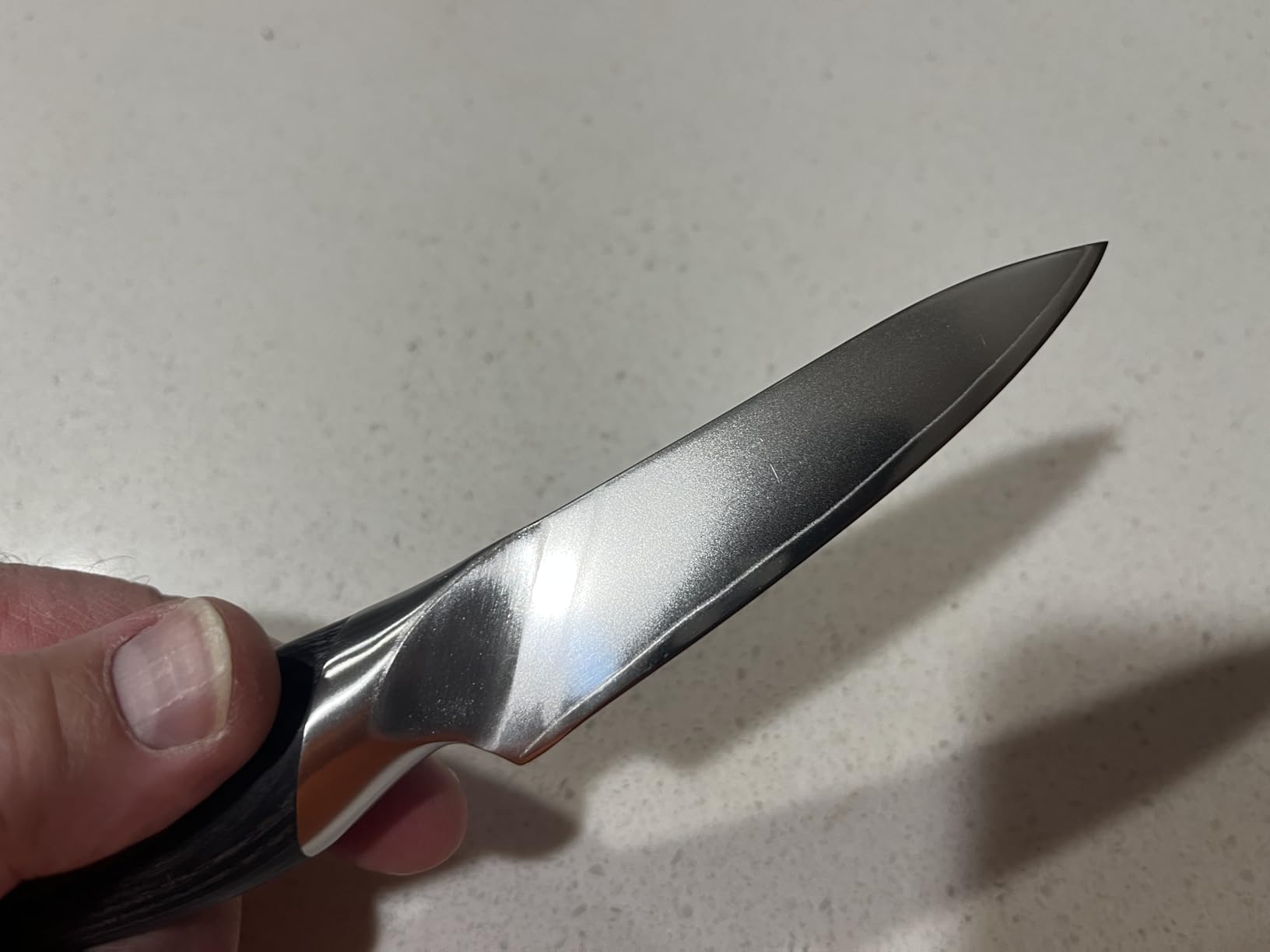
This is the refinement pick. The blades are forged Japanese 10Cr15CoMoV high carbon stainless at 60 HRC, hand-ground to a 15-degree edge per side. That is a thinner, sharper geometry than the 20-degree European bevel, and it is the reason this set cuts cleaner with less force.
The catch is the thinness. A 15-degree edge holds a beautiful slice but is more vulnerable to a careless drop or a hard knock on a stainless counter. For a student who drops things, that is a real risk to price in mentally.
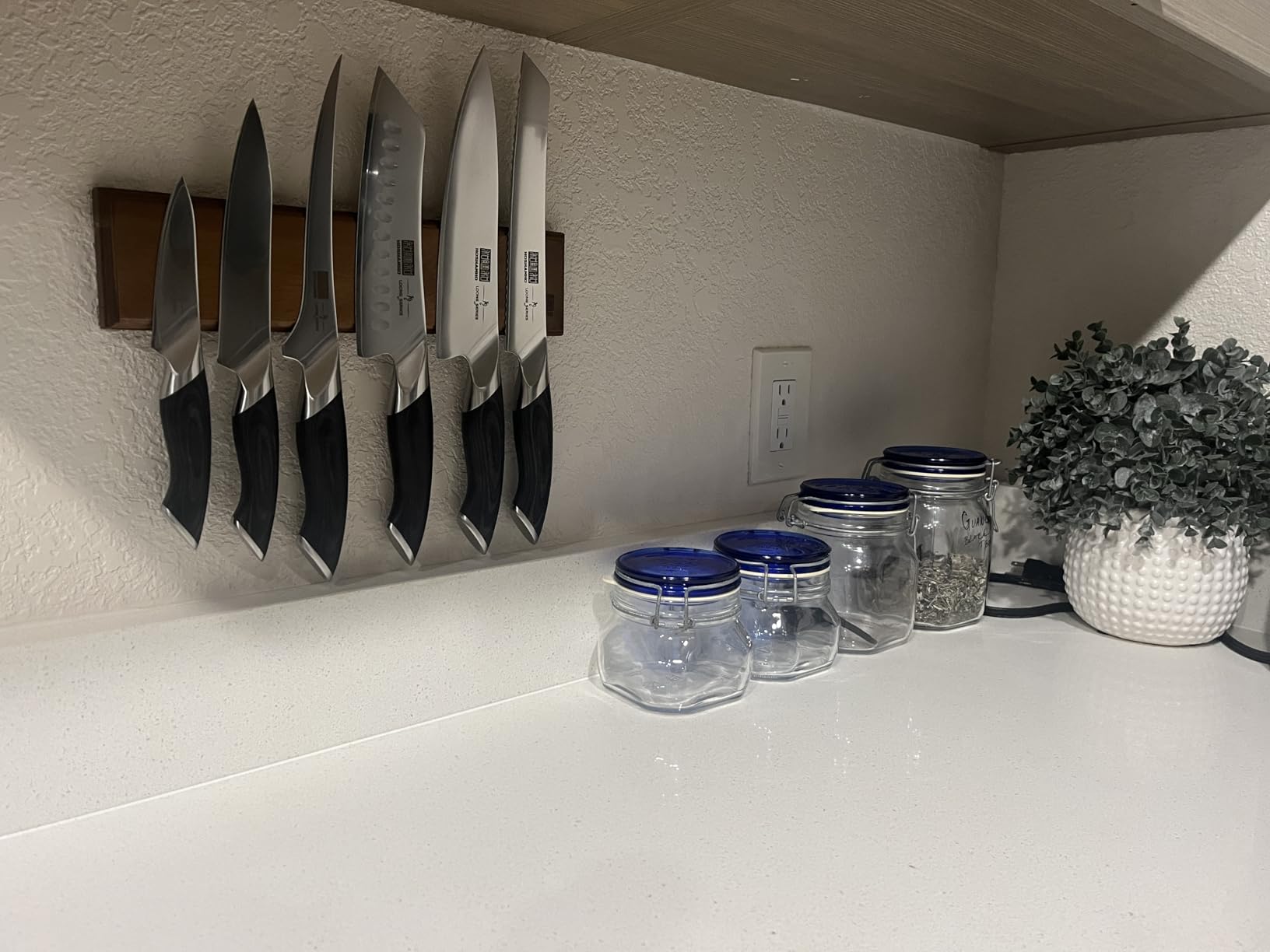
The magnetic acacia wood holder is the feature reviewers talk about most. Knives sit on an open wood surface, so they can air dry fully instead of sitting damp in a sheath, and the block stays visually clean. That is genuinely better care practice than a plastic block with slots that trap moisture.
Pakkawood handles with a wider finger bolster are described as balanced and fatigue-reducing over long sessions, and the six-piece count keeps the whole configuration compact. You get an 8-inch chef, an 8-inch serrated bread, a 7-inch santoku, a 6-inch utility, and a 3.75-inch paring.
Why a student would pick this over a German set
Sharper out of the box and less dependent on force. If your prep involves a lot of delicate fish work, paper-thin vegetable cuts, or precision brunoise, a 15-degree Japanese edge makes those tasks noticeably faster at the same skill level.
Why most students skip it
Six pieces means gaps. A 6-inch boning knife is not here, and neither is anything large for butchery. The magnetic holder also has to be mounted on a wall properly, which is not always an option in a rented flat or a shared house kitchen, and a poorly mounted magnetic strip is how a chef knife ends up on a tile floor.
5. imarku 15-Piece Japanese Stainless Block Set – Best Full-Tang Block Set
- Unibody stainless handles eliminate crevices where bacteria collect
- Japanese stainless steel delivers a long lasting edge
- Wood block organizes a full 15-piece configuration
- Well balanced for extended prep sessions
- Occasional early rust reports though the seller replaced them
- 10 pound listed weight makes the block set bulky
- Hand washing preserves sharpness better than the dishwasher
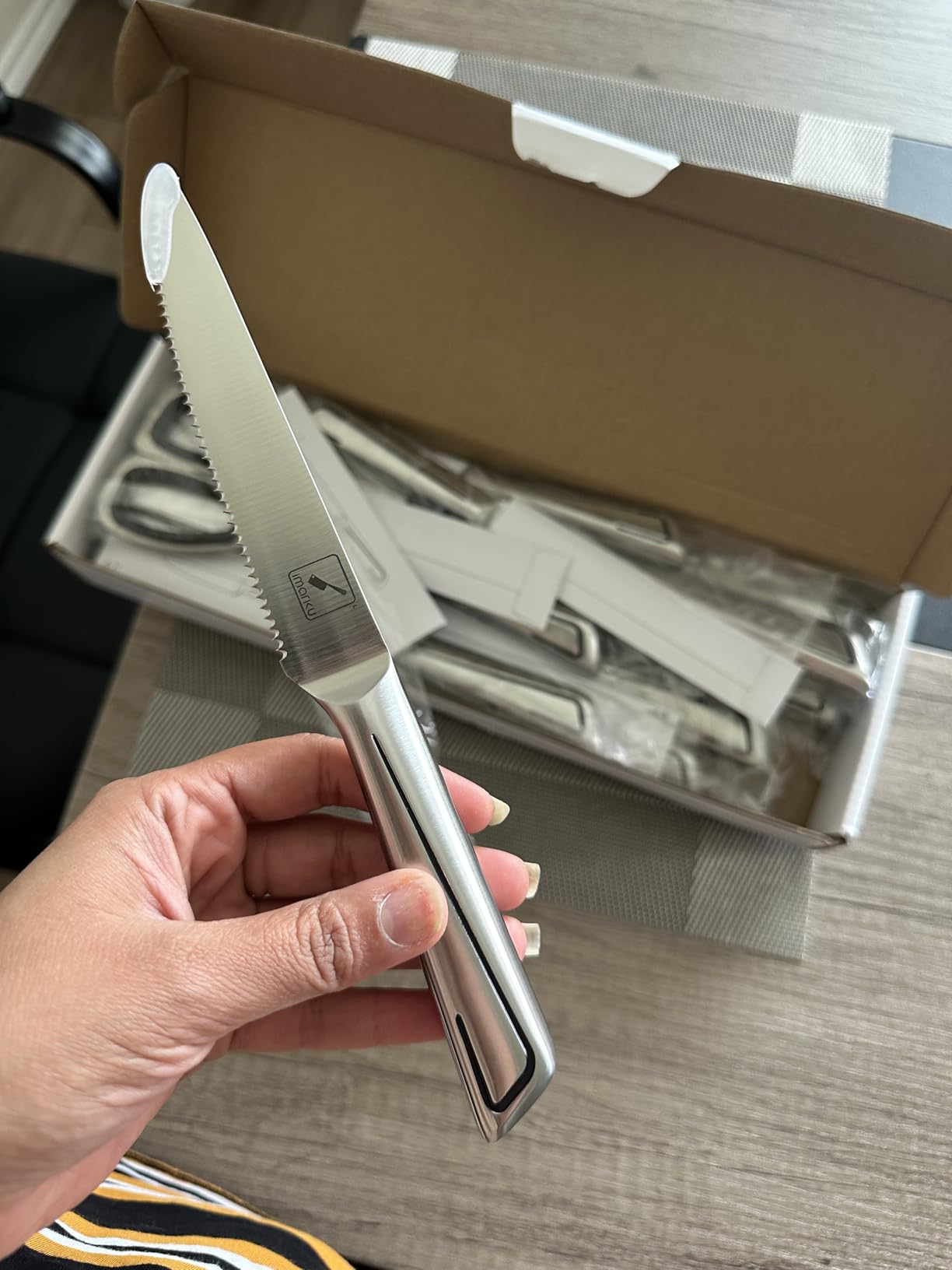
The unibody handle is the argument here. One piece of stainless steel from bolster to butt, no rivets, no seam, nowhere for a school kitchen to trap food. Reviewers call this out specifically, and in a commercial context it is a hygiene point as much as a feel point.
Construction is full tang with a wider finger bolster, and the steel is Japanese stainless with fine tempering for edge retention. That combination is what you want in a knife you will keep past graduation rather than sell on the way out.
Handle balance is the quiet strength. Owners describe the set as well balanced and comfortable for extended prep sessions, which is what separates a set you can hold for four hours from one that makes your wrist ache by the second service.
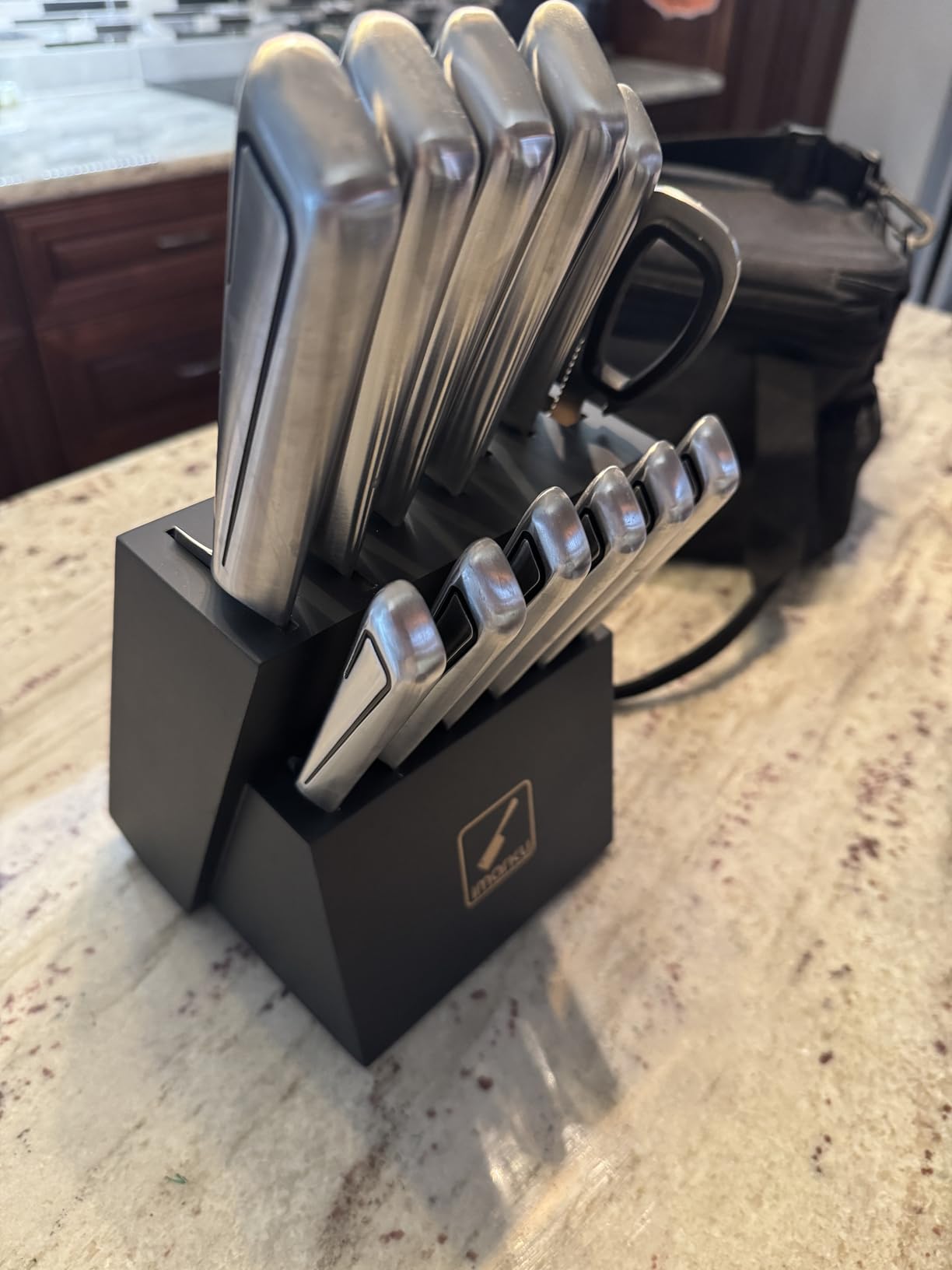
Be honest about the bulk. This is a block set with a 10-pound listed weight, and a solid wood block has no place in a locker. Treat it as a home station kit: it holds your knives between terms, and you pull the four you need into a roll for class and internship.
Where it earns its keep
If you plan to cook professionally after school, a full tang, unibody handle, well-balanced set is the closest thing here to a working kit that graduates with you. The block keeps a 15-piece configuration organized, including shears, a sharpener, and steak knives for catering work.
Where it does not
There are isolated reports of surface rust appearing shortly after purchase, though the seller replaced the sets. At this level of steel, hand washing is worth the extra five minutes. And if your housing situation has no counter space, a wood block you cannot put on a wall is a liability.
The steak knives are fine at home. For a home kitchen where you actually cook them, we rated the best steak knife sets separately.
6. Amazon Basics 14-Piece High Carbon Stainless Steel Set – Best Starter Block Set
- Largest review base in the group
- Sharp out of the box with solid full tang handles
- Complete 14-piece set with shears and sharpener
- Dependable first kit for a student
- Blades need resharpening more often than forged sets
- Occasional handle finish or tip alignment defects
- Dishwasher cycles can affect the handle finish
With more than 22k reviews, this is the most-reviewed set in the group, and that review base is why it is worth reading closely rather than skimming. The consensus: sharp on arrival, complete, and sturdier than the tier suggests, with the complaints concentrated in sharpening frequency and occasional factory defects.
The handles are full tang with a traditional triple-riveted design, which means the tang runs the full length of the handle instead of stopping at the bolster. That is the single biggest structural upgrade over cheap stamped sets, and it is why these feel more solid than the piece count suggests.
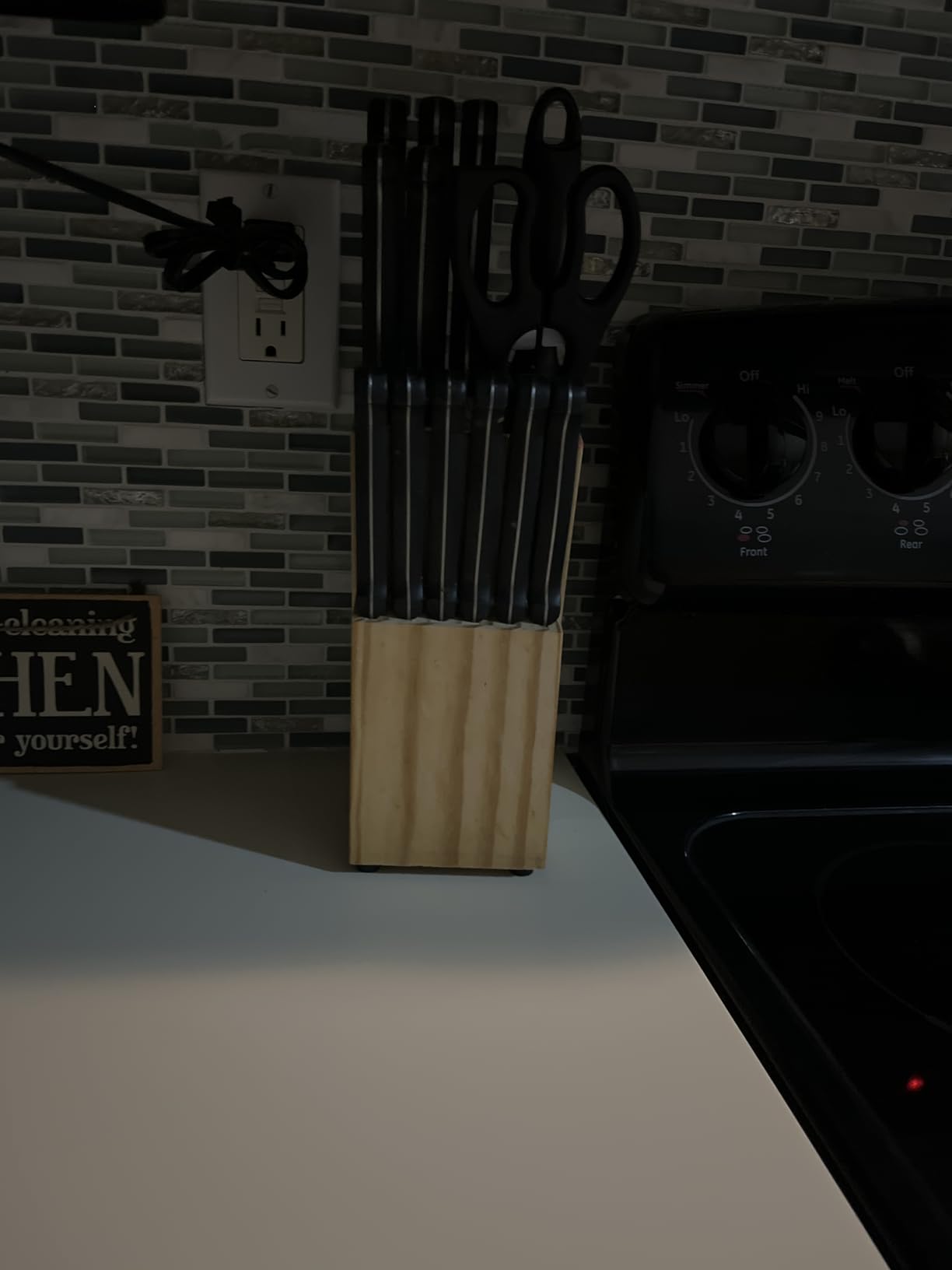
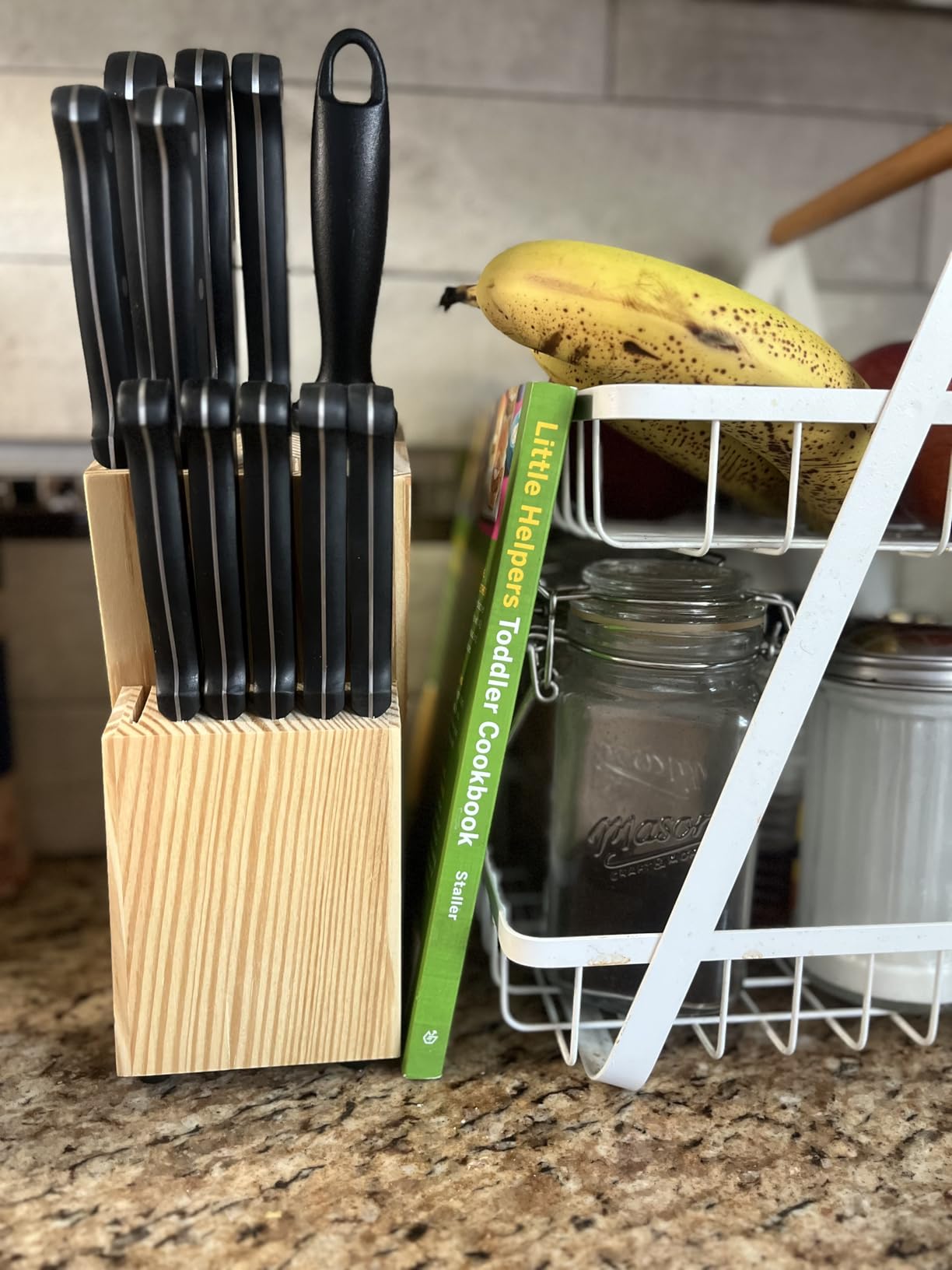
The 14-piece configuration covers the core four: an 8-inch chef, an 8-inch bread, an 8-inch slicer, a 5.5-inch utility, and a 3.5-inch paring. Add six 4.5-inch steak knives, 8-inch kitchen scissors, an 8-inch sharpener, and a pine block, and the box stays compact at 7.87 inches long.
Edge retention is the trade. Owners report needing to resharpening more often than they would with a forged high-end set, and a few report slightly peeled handles or a bent tip on the largest knife out of the box. For a school kit that will take a beating, that is an acceptable exchange for never worrying about the knife.
Who should buy this
A first-year student who has never held a full tang knife and needs the whole kit in one purchase, plus a sharpener and block, without thinking hard about it. The rating is a modest 4.5 rather than exceptional, and the piece count means very little gets thrown away when you move out of rented accommodation.
Who should not
If you already own a chef knife you like, six more steak knives are dead weight in a bag you carry. Also skip it if sharpening is something you want to be good at, because a set that needs frequent re-honing can teach bad habits when you are tired.
Hand wash and dry immediately, and air-dry the block upside down once a month. The care instruction is in the box and it does make a measurable difference to the handle finish.
7. Astercook 13-Piece Set with Blade Guards – Best Dishwasher-Safe Kit
- Highest rated set in the group at 4.8 stars
- Anti-rust coating and dishwasher safe construction
- Six blade guards make drawer storage safer and more compact
- Color coded handles help you identify each knife
- Coated blades lose an edge faster under daily use
- Plastic handles feel less refined than forged sets
- Reviewers report edge nicks straight from unpacking
At a 4.8 average across nearly 6600 reviews, this is the highest rated set in the group, and the reason is straightforward: it is the least anxious knife set to own. Coated blades, dishwasher-safe construction, and anti-rust protection remove the two things students worry about most, which is damage and rust.
That matters more in a school context than it would at home. Shared sinks, crowded drying racks, and a knife that has to survive being handed to a classmate who does not respect your edges are real conditions. A coated blade is a lower-stakes blade.
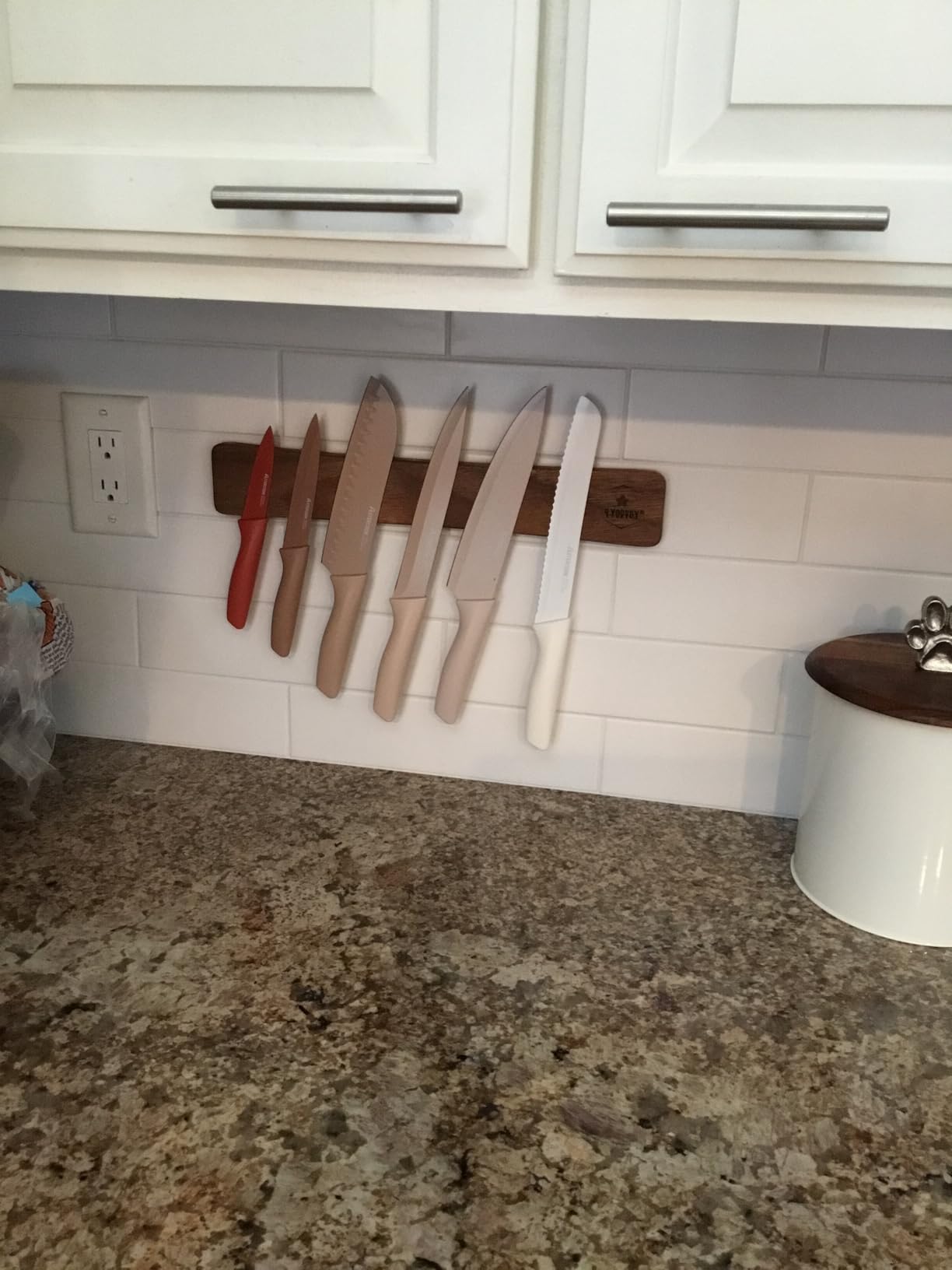
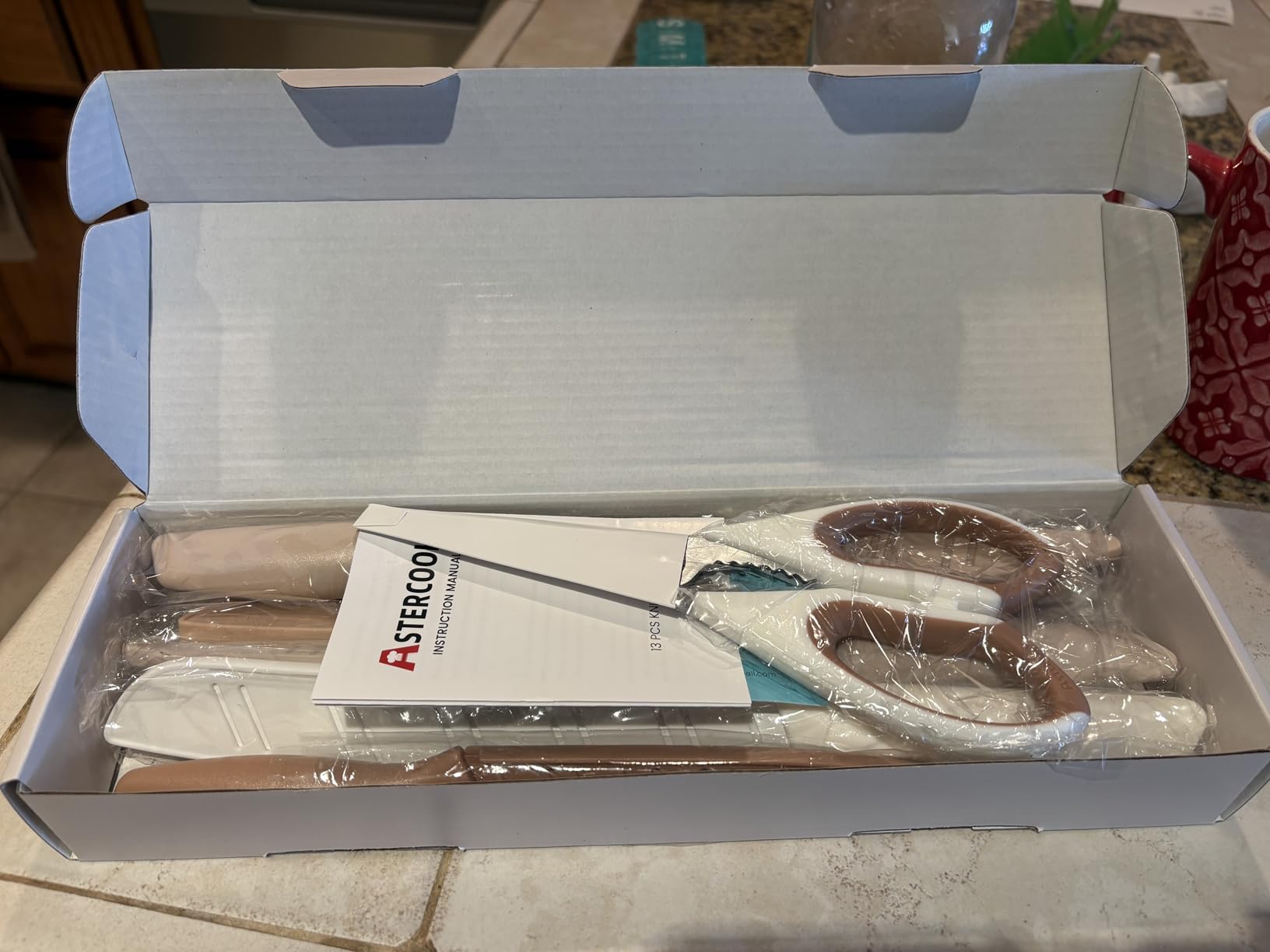
The six blade guards are genuinely useful. Instead of a roll, you get individual plastic sheaths that let you pack the set into a drawer or a locker shelf in a fraction of the space, and they stop the blades from knocking together. Color coded handles in cream, green, purple, or Morandi finish make it obvious which knife is which at a glance.
Set composition covers the core four plus an 8-inch slicer, a 7-inch santoku, kitchen shears, and the guards. The 13-piece count is well chosen for a student: nothing that is pure decoration, though the coating does mean this is a cooking knife set rather than a precision one.
The case for it
Replaceability and forgiveness. If you lose it on a night out, or leave it at a school station, or nick it during a rushed mise en place, the emotional and financial cost is lower than with a thin Japanese edge or a hand-finished forged bolster. Reviewers treat it as a low-risk first set, and that is exactly the right frame for year one.
The case against it
Coated blades lose an edge faster under daily use than heavier forged sets, so you will be honing or resharpening more often. Reviewers also report nicks straight out of the packaging, which is what you would expect from a set this thin and this lightly built. Plastic handles transmit less feedback than steel or pakkawood, and precision work suffers first.
Do not treat it as a knife skills class knife. Use it for prep, veg, and general production, and put your sharpening budget into a better chef knife later.
8. SYOKAMI 7-Piece Foldable Magnetic Acacia Block Set – Best Drawer-Friendly Set
SYOKAMI 2026 Upgrade Kitchen Knife Set, Foldable Magnetic Acacia Wood Block
- Very sharp hand-sanded 15 degree edges with no corrosion
- Foldable acacia block stores flat in a drawer or stands upright
- Well balanced wooden handles with a non-slip grip
- Open cleanable slots with reserved finger positions
- Block magnets can be too weak for heavier knives
- Wood handles can stain and need occasional oiling
- Single bevel edges need different sharpening technique
The foldable block is the idea worth stealing. It stands on the counter like a normal magnetic holder, then folds flat and lives in a drawer, which is the single most underrated feature for anyone in a small kitchen. Parents and partners in shared flats will notice this before you do.
Knives are forged high carbon stainless at 56+ Rockwell and hand-sanded to a 15-degree edge. Reviewers report very sharp factory edges and no corrosion after months of use, and the FSC-certified acacia holder resists moisture.
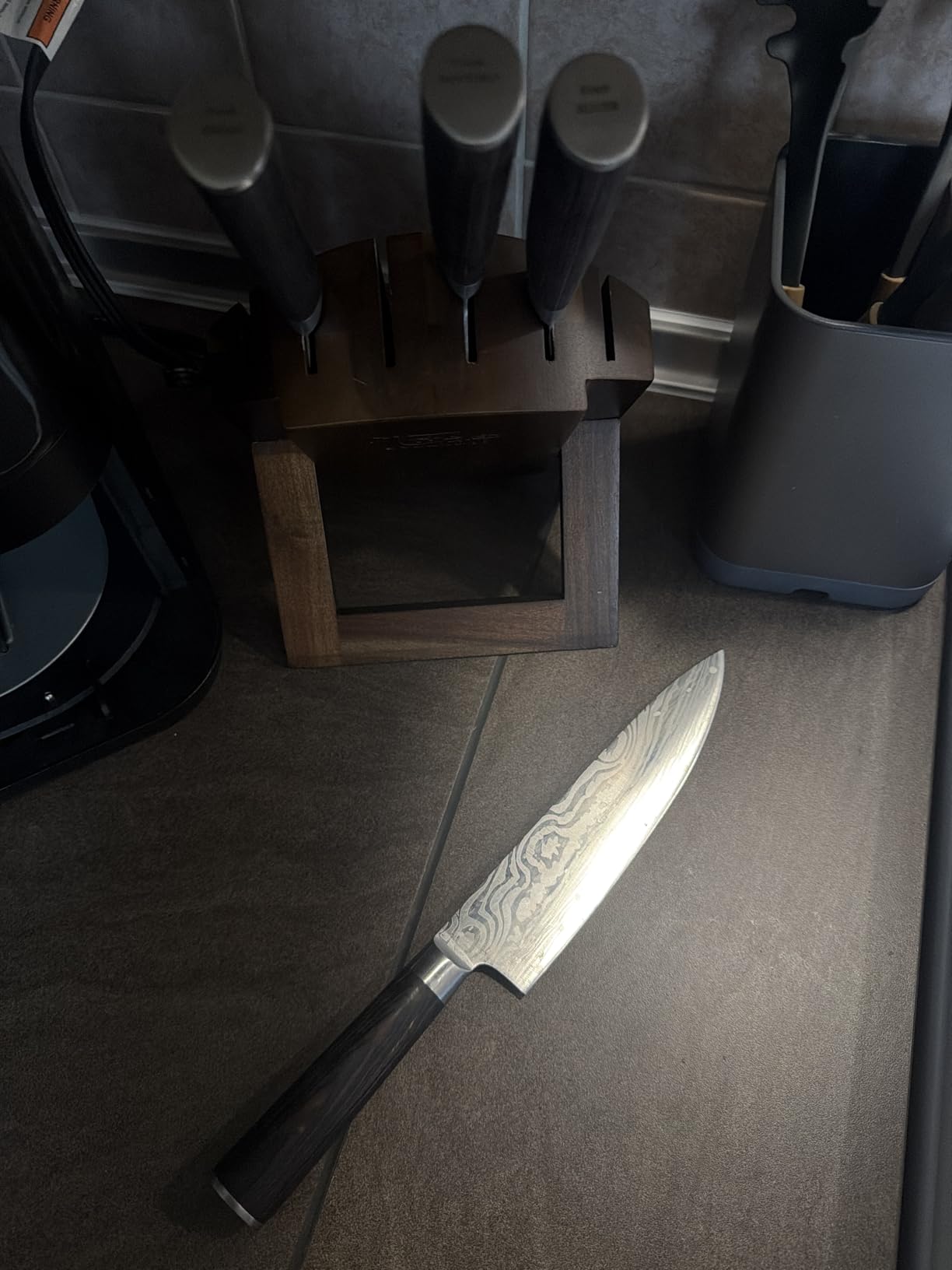
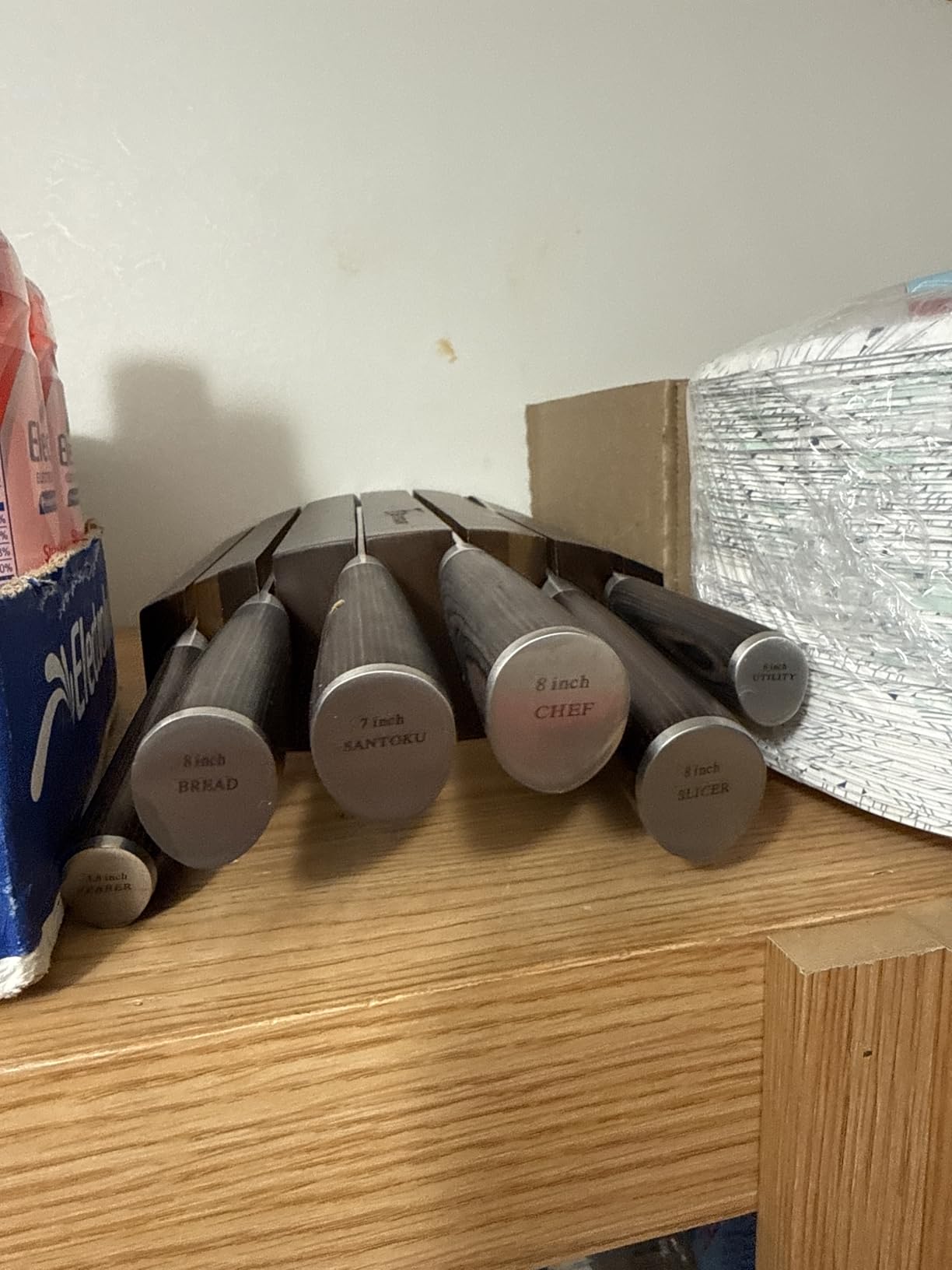
Handle balance is good, with wooden handles described as well balanced and non-slip. Six knives make up the working set: an 8-inch chef, a 7-inch santoku, an 8-inch slicer, an 8-inch bread, a 6-inch utility, and a 3.8-inch paring. That is a tight, sensible configuration with no steak knives inflating the box.
Two things to know before you buy. The magnets can be too weak for heavier knives, so a tall chef knife can shift in the slot. And because the edges are single bevel, they need a different sharpening technique than the double-bevel European blades most students learn first. If you are starting from zero, that is a curve to climb.
Who this suits
A student in a small flat who wants Japanese-style sharpness and a sharp-looking kitchen without a wall to mount anything on. The open, cleanable slots and reserved finger positions mean you can pull a single knife quickly during service without disturbing the rest, which is how you work at a station.
Who should look elsewhere
If you need a boning knife, it is not here. If you are moving into fish or butchery, the geometry is wrong. And if your hands are rough and wet all day, sealed wood handles that need occasional oiling are a step up in maintenance over a non-slip polymer grip.
Value is the word reviewers keep using when comparing it against Japanese-store sets, and at under 710 reviews the sample is thinner than most here, so treat the consensus as directional rather than settled.
9. XYJ 12-Piece Professional Set with Roll Bag – Best for Butchery Classes
XYJ Knives Authentic Since 1986,Chef Knife Professional Set with Bag,Cleaver Butcher Knife for Meat Cutting Bag
- Broad range of blade shapes from paring to bread work
- Sharp out of the case and easy to sharpen
- Solid stainless construction handles travel and heavy use
- Roll bag plus sheaths protect the blades
- Roll bag straps are too short so knives sit loosely
- Blade guards can slip off or not match blade dimensions
- Hard steel with no flex for delicate fish work
- Included honing rod is basic
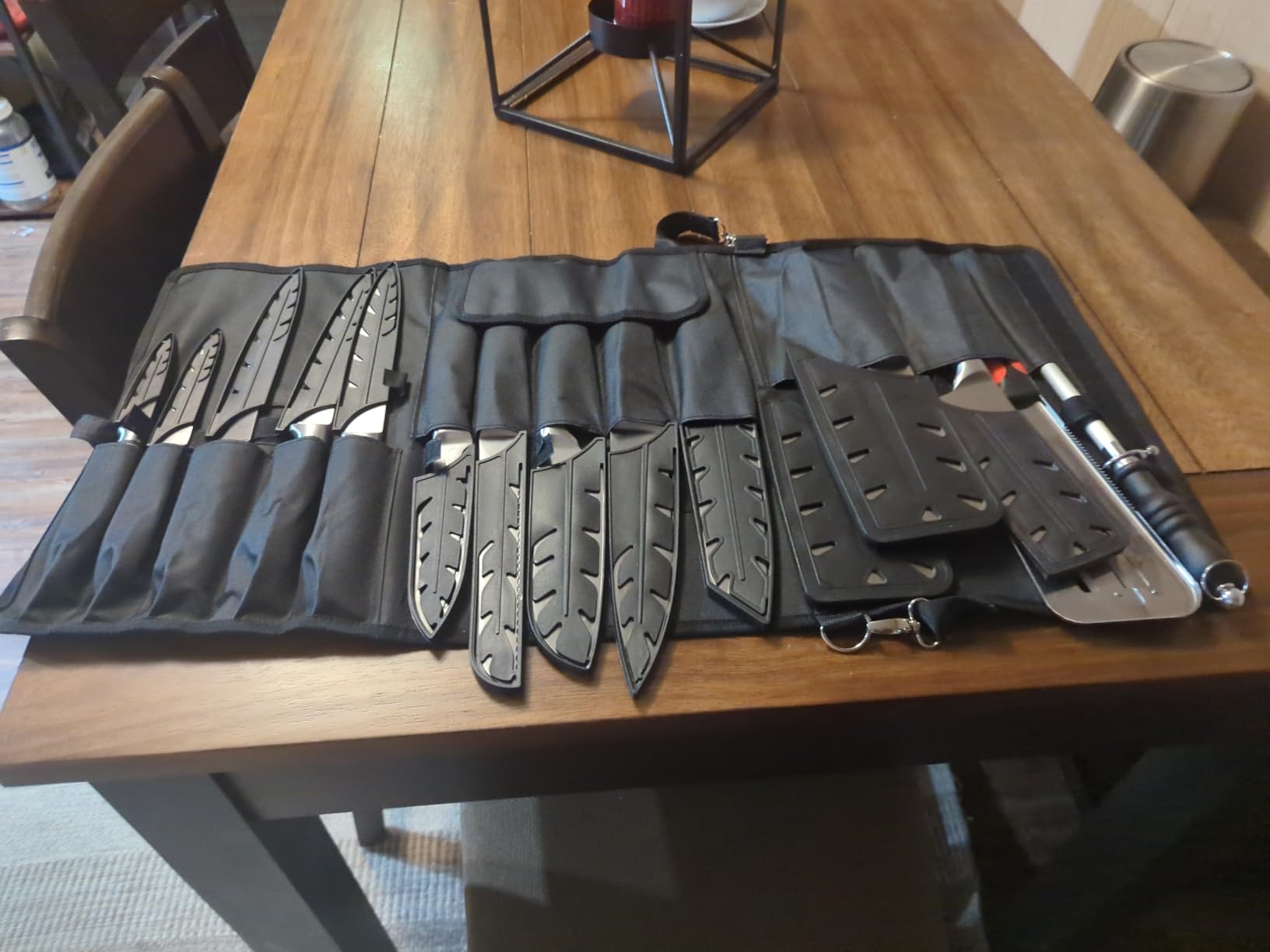
Twelve knives is the broadest working range here, and for a student whose schedule includes butchery, that matters. You get 3.5-inch paring, 5-inch utility, 6, 7, and 8-inch boning knives, a 6-inch chopping knife, a 6.5-inch nakiri, a 6.5-inch vegetable cleaver, a 7-inch santoku, 8-inch cooking, slicing, bread, and chef knives. Three sizes of boning knife is generous.
Construction is forged stainless with seamless welded handles and a V-shaped edge finishing process for edge retention. Reviewers describe the set as sharp on arrival, easy to sharpen, and sturdy enough to travel with, and they frame it plainly as good for culinary school rather than professional grade.
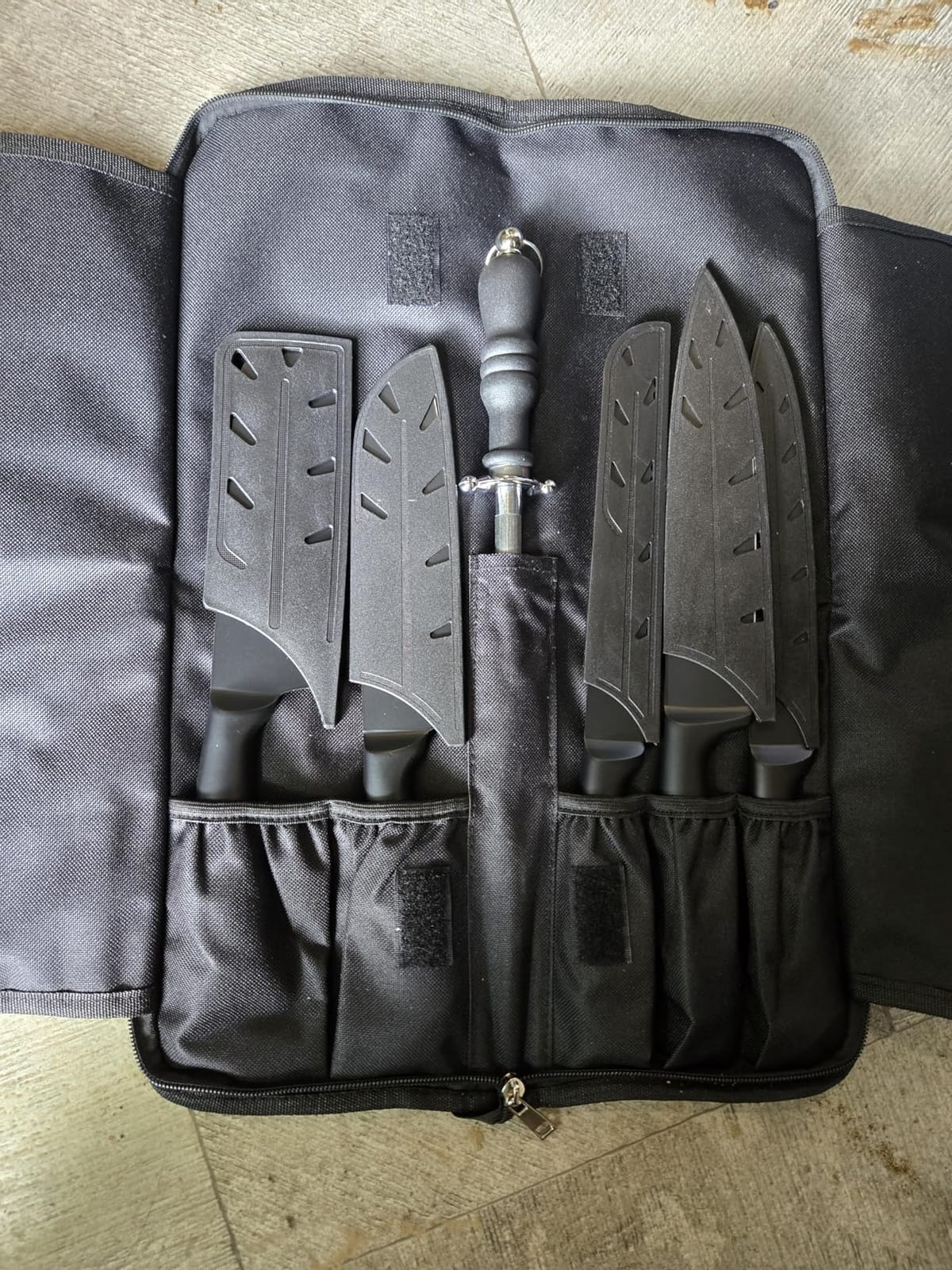
Be careful with the storage, because it is the recurring complaint. The 13-pocket roll comes with straps that are too short, so knives sit loose in their slots, and the included blade guards vary in fit. Assume you will buy a separate roll or fit the pieces you care about into a better one.
The 6.3-pound weight is the other issue. It is the second-heaviest kit in this group and it is all in the bag, on your shoulder, on a bus. It is a kit for a student who is already at school and sharpening on campus, not one carrying between dorms and a kitchen.
Why butchery students pick it
Three boning sizes plus a chopping knife and a cleaver means you are not borrowing station knives for a whole butchery practical. For students who will be breaking down chickens and primals on a tight clock, having the right blade in your own bag is a real advantage.
Where it will disappoint
The steel is hard with no flex, which makes the boning and filleting blades wrong for delicate fish work. Do not use the 6-inch boning knife to fillet a whole salmon. Balance is average, and the included honing rod is basic, so buy a proper steel to go with it.
Twelve knives is also more than a year-one student will use. If your school issues a kit, this is a year-three purchase, not a week-one purchase.
10. Farberware 15-Piece High-Carbon Stainless Block Set – Best Complete Starter Set
- Broad 15-piece coverage with shears and a sharpening steel
- Forged high-carbon stainless blades with a long lasting edge
- Satin finish ergonomic handles reduce fatigue
- Black pinewood block keeps cutlery organized
- Lowest rating in the group at 4.3 stars
- Edges dull faster than higher rated sets
- Hand wash and dry required to protect the finish
I am including this one with a caveat. At 4.3 stars across more than 14k reviews, it is the lowest rated set in this group, and that rating is a real signal rather than noise. Owners like the piece count, the block, and the comfortable handles, but a meaningful minority report average edge retention.
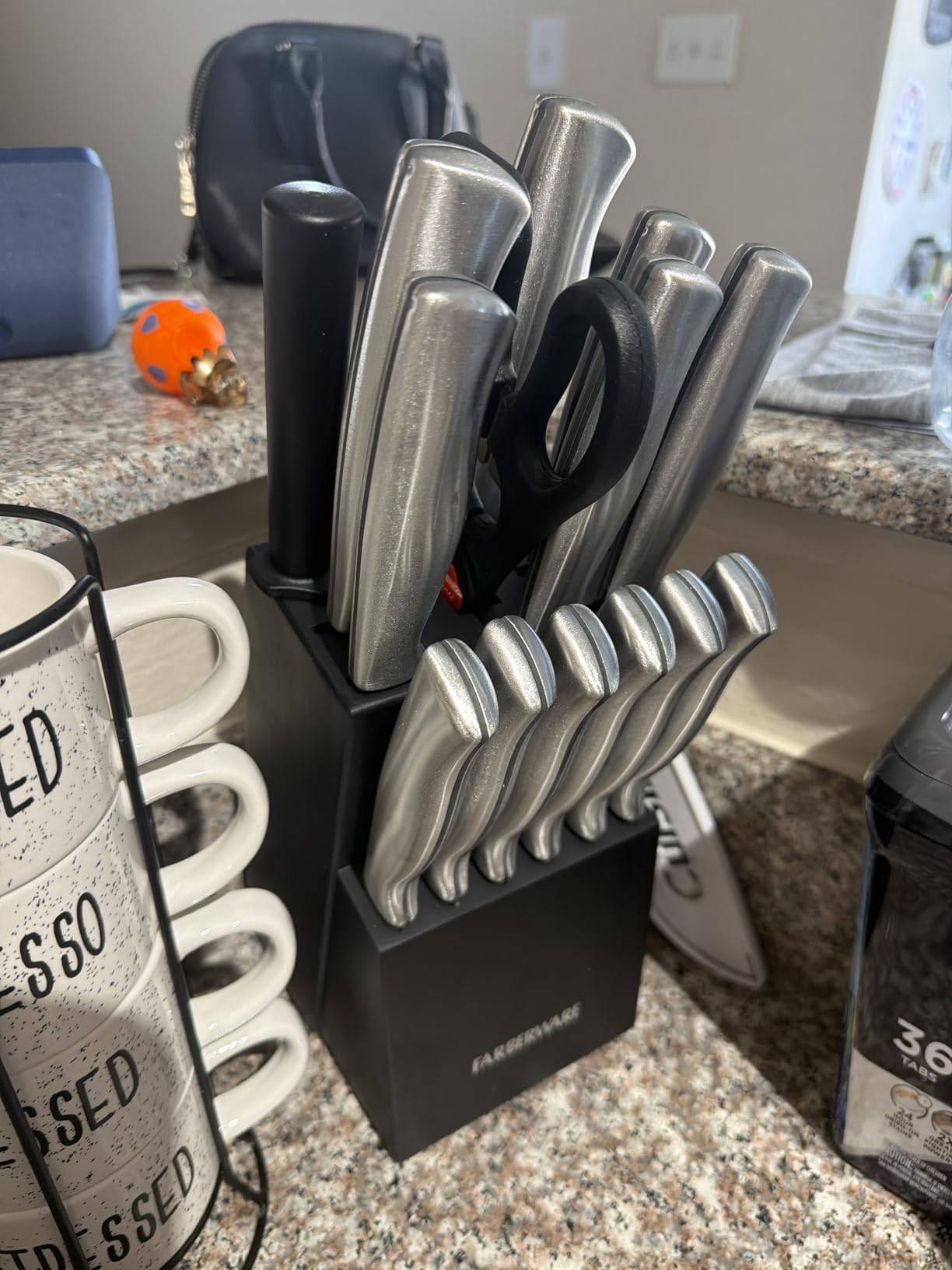
What you get is genuinely complete: an 8-inch chef, a 6-inch bread knife, a 6-inch slicer, a 5-inch serrated utility, a 4.5-inch santoku, a 3-inch paring knife, shears, a sharpening steel, six 4.5-inch steak knives, and a black pinewood block. Having a sharpening steel in the box is a genuine plus that a few cheaper sets skip.
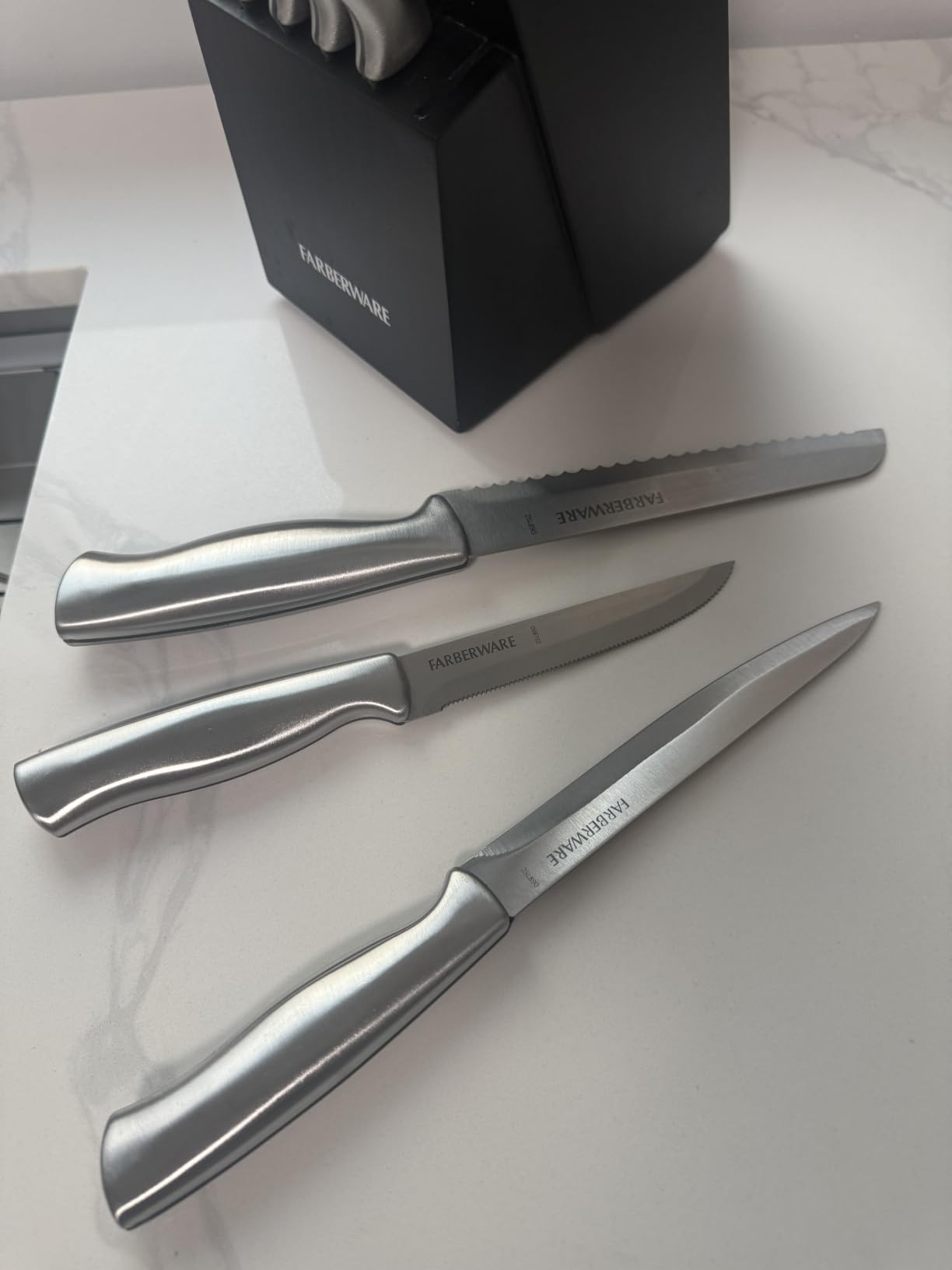
Construction is forged high-carbon stainless with satin-finish ergonomic handles that owners say reduce fatigue. Forged construction at this level is not a given, so the build is better than the rating suggests. At 6 pounds, it is a home block set rather than a carry set.
The high-carbon steel is also why the care instruction matters. Hand wash and dry is required to protect the finish, and a carbon steel blade left wet will tell you about it. If you are going to be this casual about care, buy a lighter set.
Where it still works
A student who will genuinely cook at home between terms, and who wants a kitchen that looks fully equipped from day one. Six steak knives are useless at school but real at a home dinner table, and the block makes the set feel substantial in a kitchen you share with housemates.
Where it is the wrong buy
For knife skills class, the 3-inch paring knife is small and the set has no 6-inch boning knife, so you will end up replacing it in year one. The dulling rate also works against a student learning to work with a sharp blade, because a knife that loses its edge mid-service teaches you to press harder.
Read the 4.3 as a fair score and buy accordingly: this is a complete first kitchen set, not a first professional kit.
How to Choose a Knife Set for Culinary School
Buy against the tool list, not the piece count. A 20-piece set with steak knives, a peeler, and scissors is a home kitchen set that happens to contain the four blades you need. Count the core four first, then decide how much of the rest you will actually use at a station.
Then weigh the kit. Every set here has a listed weight, and the spread runs from 1.5 pounds to 10 pounds. If you are carrying your knives to class daily, anything under 4 pounds is the working range. If your knives live at a counter at home, ignore this entirely.
Third, decide how you will store them. Roll and sheath systems protect blades and survive a bag. Block sets protect blades and look good at home but do not commute. Magnetic holders save drawer space but need mounting. There is no right answer, only the one that matches where the knives will be on a Tuesday morning.
Fourth, check the steel against your sharpening ability. A 15-degree Japanese edge on the HOSHANHO or SYOKAMI is sharper and more satisfying, and harder to maintain if you are new. A European 20-degree edge on the Cuisinart, imarku, or Amazon Basics set is more forgiving and repairs mistakes faster.
Fifth, look for full tang on anything you plan to keep past graduation. The Amazon Basics set gets it at the entry tier, and the imarku set pairs it with a unibody handle. Stamped construction on a roll set is fine while you are a student, because a dropped stamped chef knife is a lesson rather than a catastrophe.
Finally, be honest about your program. Many culinary schools issue a knife kit and expect you to supplement it, so check your student handbook before you buy anything. Mercer Culinary is repeatedly described on student forums as the line used by many North American culinary schools, which means an instructor may hand you a better chef knife than you can afford and quietly judge your sharpening.
Care, Honing and Sharpening
Hand wash, every time, and dry immediately. This is the rule that decides how long your set lasts. Dishwasher heat, detergent, and prolonged moisture dull edges and can strip handle finishes, and reviewers across this group mention hand washing as the recurring care instruction.
Use a honing steel before you use a whetstone. A honing steel straightens a rolled edge without removing metal, and it takes ten seconds before service. A whetstone removes metal, which means it is a weekly or monthly job depending on how hard you work the knife.
Understand the angle difference. European bevels sit around 20 degrees per side and are easier to learn. Japanese single-bevel and 15-degree edges are sharper and hold better, and the single-bevel edges on the SYOKAMI set genuinely need a different technique. Start with the angle your instructor demonstrated, not the one you thought looked nicer.
Buy a board that treats blades well. End-grain wood or a soft polymer board is kinder to an edge than glass or stone, and a grooved board helps with the deep cuts that cause edge damage. A cheap board will cost you more knives than it saved.
Store blades dry and separated. A roll, individual sheaths, or a block with open slots all work, and all beat a loose knife in a knife drawer where they grind against each other every time you open the door.
Frequently Asked Questions
What is a good knife set for a culinary student?
A good student knife set covers four blades: an 8-inch chef knife, a 3.5-inch paring knife, an 8-inch serrated bread knife, and a 6-inch utility or boning knife. Add a honing steel and a roll or sheath system for carrying. Sets that weigh under 4 pounds are easier to commute with, and forgiving European-style edges are easier to maintain while you are learning.
What knives do they use in culinary school?
Most culinary programs require or issue a kit built around four knives. The 8-inch chef knife handles the large majority of chopping, slicing, and dicing. The 3.5-inch paring knife covers peeling and precision work. The serrated bread knife handles crusty bread and firm produce. The 6-inch boning or utility knife breaks down meat and fish. A sharpening steel completes the working list.
What knife sets do chefs recommend?
Across student forums, the most repeated recommendations are Mercer Culinary, Victorinox Fibrox, and entry-level Japanese lines such as Miyabi Ishin. The pattern behind them is consistent: a knife that is easy to sharpen, comfortable in the hand, and cheap enough to replace without pain. Brand prestige matters far less than whether you can keep the edge.
What knife set does chef Ramsay use?
Endorsement-level claims about a specific chef knife set are hard to verify, and set marketing around a television personality is rarely a good buying signal for a student. Judge any set on the four required blades, the steel, the weight, and how easy the edge is to restore. That matters far more than which name is on the box.
What is the highest rated kitchen knife set?
Among the ten sets we compared, the Astercook 13-piece set with blade guards carries the highest average rating at 4.8 stars across nearly 6600 reviews, helped by an anti-rust coating and dishwasher-safe construction. The Cuisinart 15-piece hollow handle set follows at 4.7 with more than 20k reviews, which makes it the better-proven choice for heavier daily use.
The Verdict
For most culinary students the answer is straightforward. Buy a set that covers the four required blades, weighs under 4 pounds if you are commuting, and comes with a roll. On all three counts, the Cuisinart 15-Piece Hollow Handle Block Set is the pick we would hand a first-year student, backed by the largest proven review base in this group.
If your program already issues a kit, do not fight it. Add to it. The Mercer Culinary Millennia roll set is the best supplement because it is the same knife line many North American schools use, which means your instructor’s sharpening advice will apply to your own blades.
Buy once, sharpen often, hand wash everything, and expect to be buying a nicer single chef knife after graduation rather than a bigger set. The best knife sets for culinary students are the ones that survive four years of school and a first internship without you thinking about them. Our picks for 2026 are built for exactly that.