
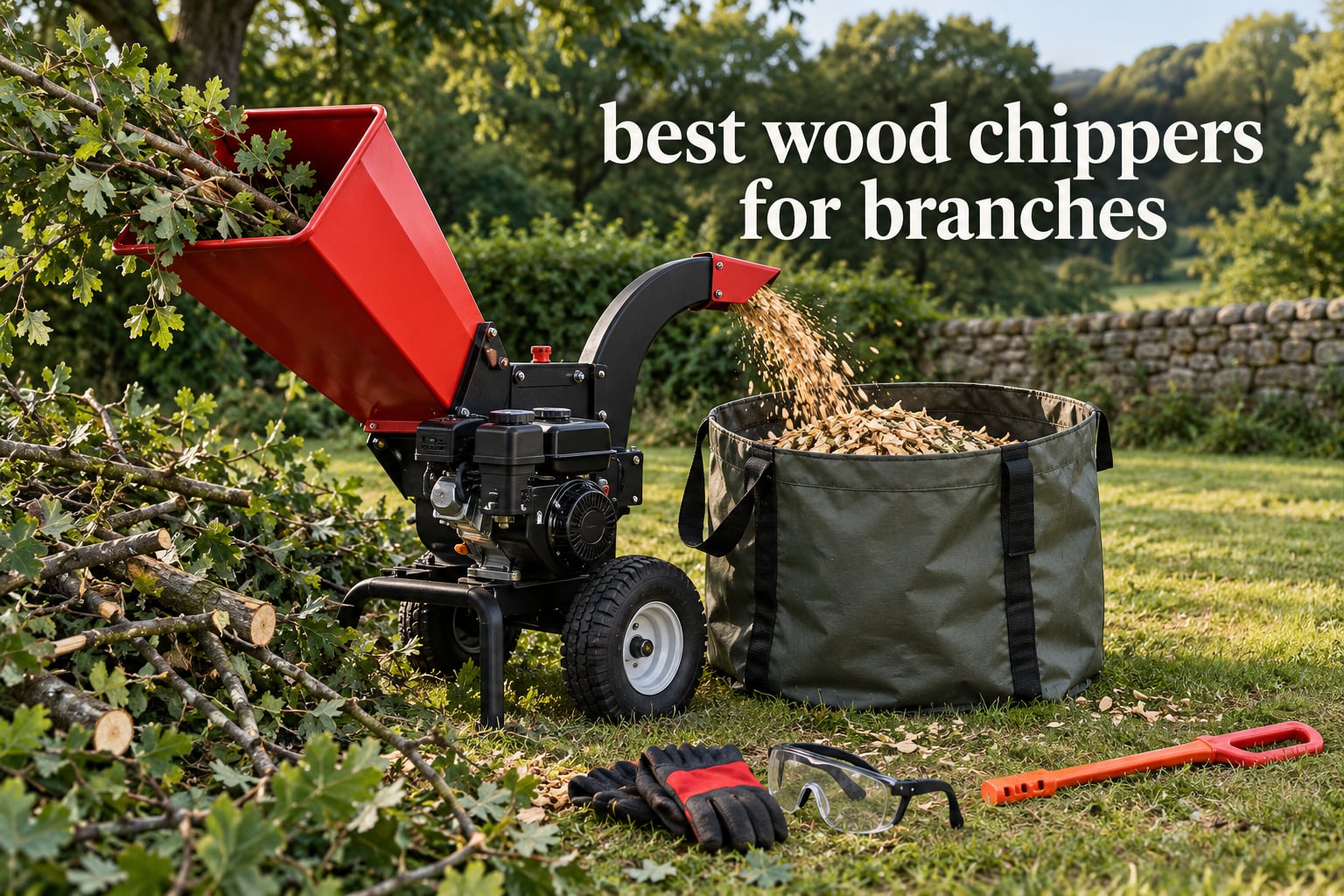
The best wood chippers for branches come down to one number: the thickest branch you actually expect to feed. Buy above that and you are paying for power you will never use; buy below it and the machine stalls on every limb. For most homeowners the answer is a 3-inch capacity gas chipper, with the Sun Joe CJ603E covering small yards, the SuperHandy 7HP 3-in-1 as the value pick for 3-inch branches, and the EFCUT C30 LITE if chip quality matters more to you than weight.
A wood chipper is a yard machine that pulls branches and woody debris into rotating knives or hammers and reduces them to small chips. Those chips become mulch for garden beds, compost feedstock, pathway surfacing, or erosion control on slopes. Without one, a single storm leaves you cutting branches small by hand and hauling them to the curb in multiple trips.
We compared ten corded-electric and gas chippers rated from 1.7-inch capacity up to 4-inch, weighing every spec sheet against what owners actually report after a season of feeding. The differences that matter in real use are rarely the ones printed on the box. A machine advertised at 3 inches often settles in closer to 2 with real hardwoods. Blades dull in an hour on oak. A cloth collection bag tears before the fuel runs out.
This guide covers everything from 23-pound electrics for garden twigs to a 136-pound 4-inch machine for wooded acreage, plus the rotor types nobody explains and the wet-wood mistakes that cause most jamming. Updated for 2026, and it is worth pairing with our wood planer buying guide if you are also processing lumber from the same cleanup.
One more note on method: capacity figures below come from manufacturer listings, and owner-reported limits are called out separately wherever the two disagree.
Top 3 Wood Chippers for Branches in 2026


SuperHandy 7HP 3-in-1
- 3 inch max capacity
- 7HP OHV gas engine
- 15:1 reduction
- Top hopper plus side chute

EFCUT C30 LITE
- 3 inch capacity
- 11.8 inch rotor
- High speed steel blades
- Check window blade access
Quick Overview: All 10 Wood Chippers Compared
| Product | Specifications | Action |
|---|---|---|
| Sun Joe CJ603E |
|
Check Latest Price |
| SuperHandy 7HP 3-in-1 |
|
Check Latest Price |
 Landworks 3-in-1 7HP Landworks 3-in-1 7HP |
|
Check Latest Price |
 Landworks Mini 7HP Landworks Mini 7HP |
|
Check Latest Price |
 LawnMaster FD1503 LawnMaster FD1503 |
|
Check Latest Price |
 Landworks Rotor 7HP Landworks Rotor 7HP |
|
Check Latest Price |
| EFCUT C30 LITE 7HP |
|
Check Latest Price |
 GARDENBEAUT S3 7HP GARDENBEAUT S3 7HP |
|
Check Latest Price |
 EFCUT C40 9HP EFCUT C40 9HP |
|
Check Latest Price |
 GreatCircleUSA Mini 7HP GreatCircleUSA Mini 7HP |
|
Check Latest Price |
How We Picked and Ranked These Chippers
Every machine here was evaluated against the same six criteria, chosen because they are what separate a chipper you enjoy from one that ends up in the corner of the garage.
- Real branch capacity. Stated diameter versus what owners report actually feeding, weighted for hardwood rather than soft pine.
- Stalling and clogging behavior. Especially with wet, green, twiggy material.
- Chip fineness. Whether output matches the claimed reduction ratio.
- Blade accessibility. Can you change a blade in minutes or does it require full disassembly?
- Bag and discharge design. Collection capacity, chute clogging, where chips land.
- Value and parts support. Availability of replacement blades, carburetor kits and how the maker responds when something breaks.
Where hands-on results and owner reviews disagreed, we went with the owner reports. Marketing horsepower is also unreliable across brands, which is why engine displacement in cc carries most of the weight in our rankings.
1. Sun Joe CJ603E: Best Overall for Small Yards
- No gas
- oil or pull cord to maintain
- 1.7 inch capacity covers twigs and small branches
- 7 inch wheels roll easily over a lawn
- Forward and reverse switch plus a safety lock
- Collection bag included
- Only rated for branches up to 1.7 inches
- 94 dB is high for a small machine
- This listing is a certified refurbished unit
The CJ603E is the first machine most people consider, and for a specific reason: it needs nothing. Plug it into a 15-amp outlet, press the switch, and it runs. There is no fuel mixing, no oil check, no choke, and no recoil cord to yank in damp morning air. For someone with a couple of small trees and a pile of seasonal twigs, that simplicity outweighs raw capacity every time.
Its 1.7-inch cutting diameter is the honest limit. Feed it finger-thick to wrist-thick branches and it produces a bag of mulch in a couple of minutes. Feed it a two-inch limb and you will be pushing, stopping the machine, and clearing the chute. Owners treat it as a garden machine rather than a storm machine, and they report thousands of hours of that light duty without complaint.
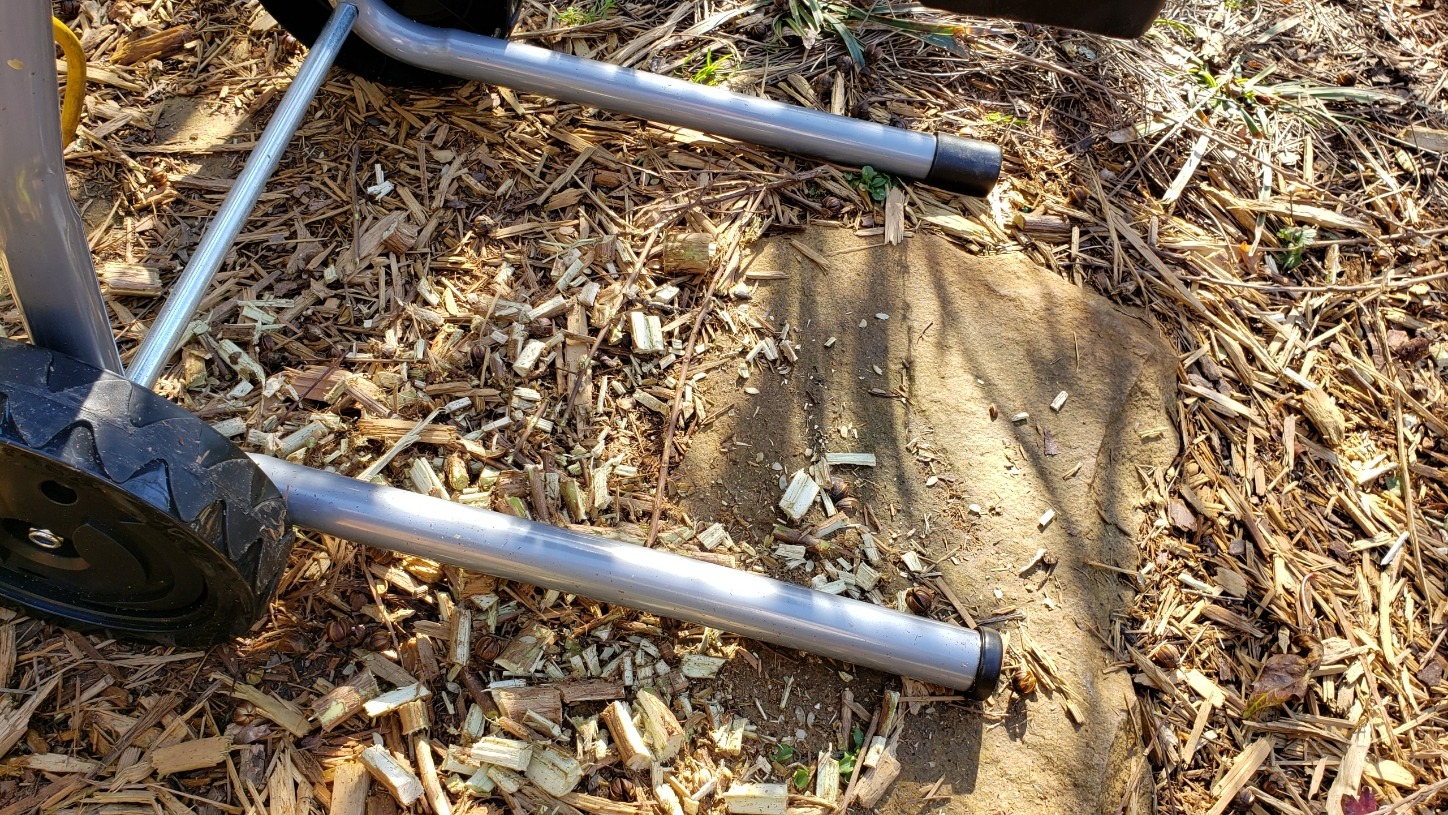
Two details stand out against smaller electrics. The 7-inch wheels are noticeably larger than the small casters on most compact models, which matters on a lawn where you are dragging the machine between branch piles. And the forward and reverse switch is a real convenience: when a branch wedges, you can back the rotor out instead of opening the housing with the machine running.
The 94 dB noise rating surprised us and appears repeatedly in owner reviews. That is not a quiet machine, and you should plan on eye and hearing protection. One more thing to know before you order: this particular listing is a certified refurbished unit, tested and repackaged with possible light scratches and generic-box packaging. Function is intact, but you should not expect showroom condition.
What it handles well
Twigs, small limbs, and thin garden material feed without drama, and the reverse switch is the difference between a minor pause and a ten-minute unjam. Owners use it for pruning leftovers, vines, and the thin branch clutter that accumulates near shrubs.
It also stores easily at 38.6 pounds, which matters if your only option is a corner of the garage. Setup is essentially unbox and plug in.
Where it falls short
It is the wrong tool for storm debris or anything approaching two inches thick. If your property produces limbs you cannot cut with loppers, the capacity ceiling will frustrate you within a season.
And the cord is a leash. Once you are at the far end of a property, you are working within reach of an outlet, which is the single biggest complaint electric chippers share.
2. SuperHandy 7HP 3-in-1: Best Value for 3-Inch Branches
- Starts on the first or second pull
- Predator clone engine with cheap parts
- 3-in-1 design with attachable leaf vacuum
- Very loud with kickback from the chute
- Anything over 2 inches tends to jam
- Small cloth collection bag tears
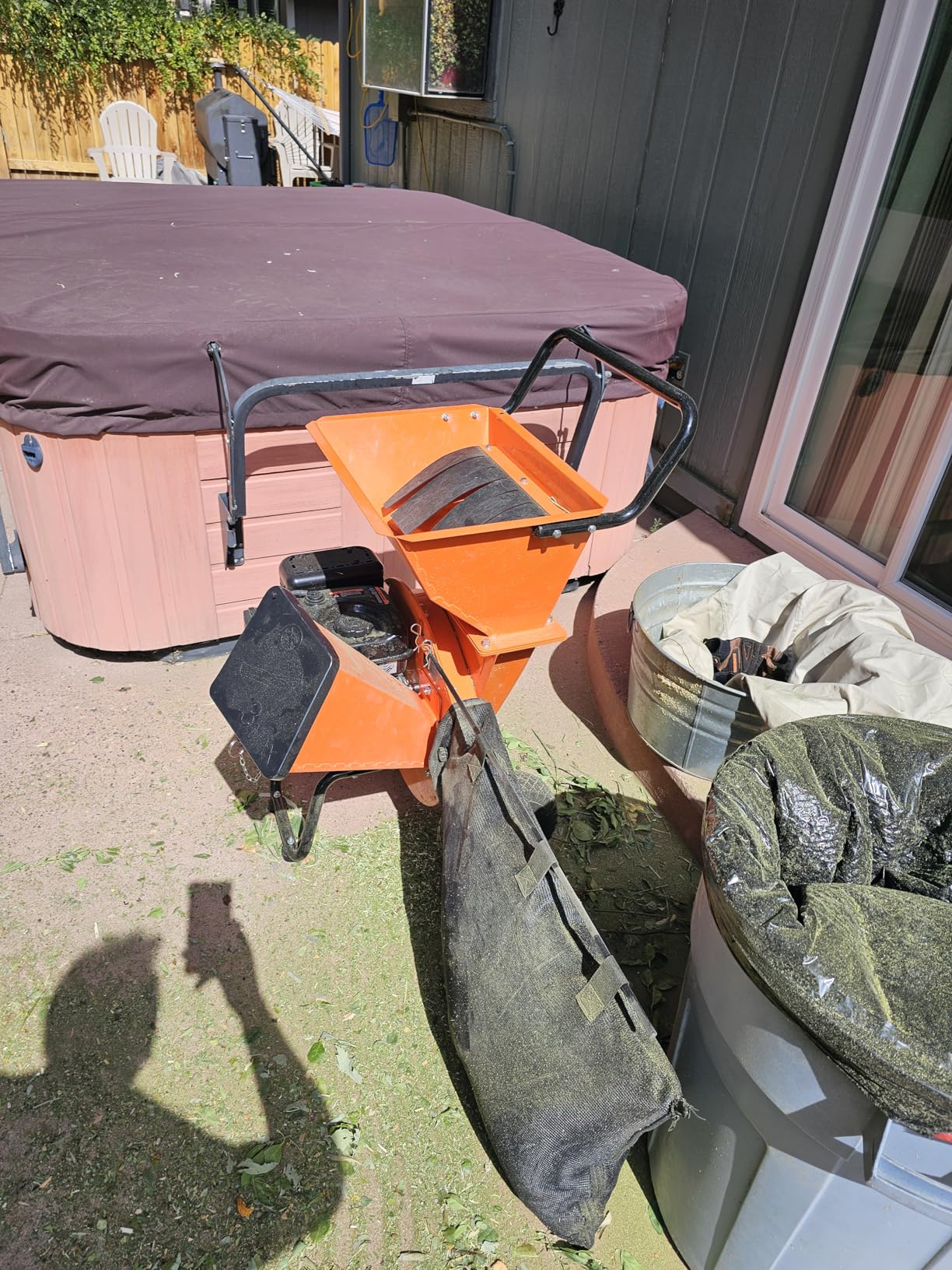
This is the strongest all-round gas machine in the group for someone whose branches run to about two inches and sometimes three. The 7HP horizontal four-stroke OHV engine is a Predator design, and that is genuinely good news: carburetor rebuild kits, ignition coils and similar parts are cheap and everywhere, which matters more over five years of ownership than any specification on the sticker.
Owners with two-plus years of use report consistent starting and steady branch chipping. The slanted housing feeding into the rotor is a real design choice rather than marketing, and it does reduce the wedge points that cause jams. The 3-in-1 layout gives you a top hopper for shredding at 15:1, a side chute for branches, and a port for an attachable leaf vacuum.
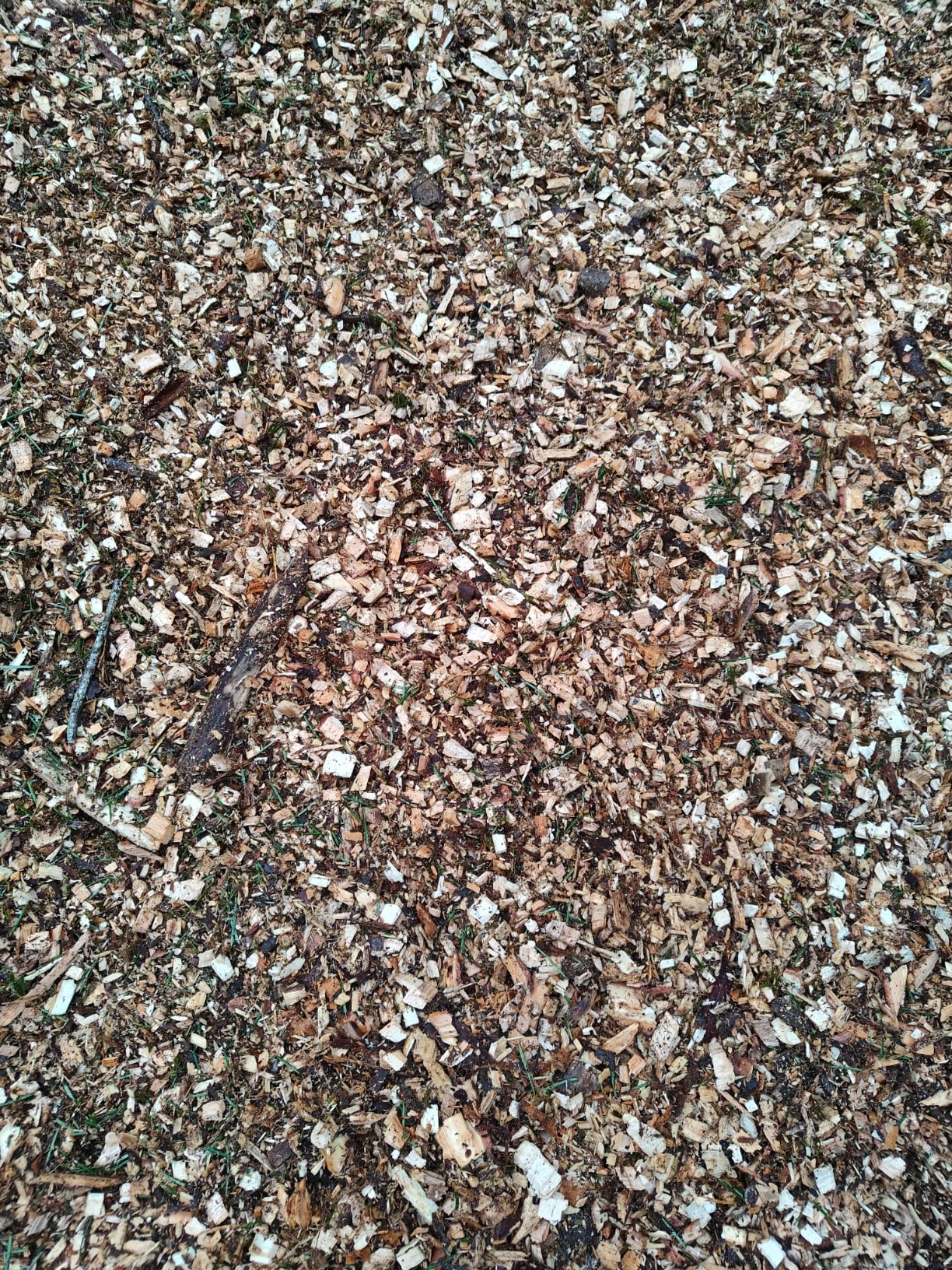
The gap between the advertised 3 inches and the working reality is where expectations get hurt. Owners consistently report that material above roughly 2 inches stalls and requires disassembly to clear, and the top hopper struggles with loose pine needles and fine twigs. Feed slowly, pre-cut gnarly crotches, and it does its job well.
Also budget for sound. Chips eject hard from the chute, so eye and hearing protection are not optional, and the included cloth bag will not survive a season of hardwood chips. Plan on replacing it early.
What it handles well
Dry branches under 2 inches feed reliably and quickly, and the engine starts without fuss in most conditions. The extendable chute and tow-bar compatibility make it workable from a truck bed or trailer.
Owners doing two-plus years of mixed yard work cite the engine as the long-term strength, with parts available when something eventually fails.
Where it falls short
If your thickest branches are truly 3 inches of hardwood, this machine will disappoint you. Advertised capacity and real capacity are different numbers here, and that gap is the most common complaint in the reviews.
The discharge side is unforgiving. Loud operation, kickback, and a cloth bag that tears mean extra safety gear and a replacement most owners had not budgeted for.
3. Landworks 3-in-1 7HP: Chipping, Shredding and Vacuum Mulching in One Frame
Landworks 3-in-1 Gas Wood Chipper Shredder, 7 HP, 3″ Capacity
- Genuine 3-in-1 chipping shredding and leaf vacuum
- Slanted housing designed to cut jams
- Alloy steel enclosure with tow bar compatibility
- At 130 pounds it is hard to reposition
- Reports of thin metal and weak welds failing
- Collapsed discharge chute reported by one owner
Where the SuperHandy and this Landworks overlap is on paper: 7HP OHV engine, 3-inch side chute, 15:1 top hopper, leaf vacuum port. Where they differ is durability reporting. Several owners of this model describe thin-gauge steel and welds failing on the wheel base and discharge chute shortly after warranty, along with carburetor degradation on a second machine.
That does not make it a bad machine. The 3-in-1 design is legitimate and the slanted housing genuinely helps, and customer service has been praised repeatedly for sending free replacement parts. But if you are buying for a decade of storm cleanups rather than one season, the thin-gauge reports are worth weighing seriously.
At 130 pounds it is one of the heavier machines here, and small hard wheels make it awkward to move across uneven ground. Plan the work area before you lift it, and consider the tow-bar kit rather than dragging it by hand across a lawn.
On the positive side, the alloy steel enclosure is rated as jam resistant and the fuel tank holds 0.7 gallons of 87 octane, which is a full afternoon of chipping on ordinary branches.

What it handles well
Gardeners who want chips, shred, and vacuum mulch from one frame get real versatility, and the top hopper at 15:1 does a reasonable job on twigs and leaf litter when fed steadily.
Simple recoil starting with a choke means no learning curve, and the tow-bar compatibility helps if your branch pile is far from the shed.
Where it falls short
The durability reports cluster around welded joints and thin sheet metal. Buyers in this category check whether replacement parts are actually published, and for some models that catalog is hard to find.
Weight is the other issue. At 130 pounds, this is not a machine you carry across uneven ground after a long day of cutting.
4. Landworks Mini 7HP: Compact Storage for Small Sheds
Landworks Mini Wood Chipper Shredder Mulcher Heavy Duty 7HP Compact Design 3″ Inch Max Capacity
- Quick assembly around 30 minutes
- Handles 2.5 to 3 inches when fed slowly
- Removable chute and rear service port aid storage
- Welded joints and blade holder disc failed for some owners
- Needs pre-cutting on 1 to 2 inch limbs with side twigs
- No published parts catalog located
This is the machine for anyone whose shed is genuinely too small for a full-size chipper. The chassis is lighter and the footprint is tighter, yet it still carries a 7HP OHV engine and a 15:1 reduction ratio through an extended chute rated for 3-inch branches.
Feed technique is the deciding variable, and owners are split on it in a way that tells you a lot. Branches under 1.5 inches of hard wood run fine and one owner logged more than 30 hours with no engine trouble using ethanol-free fuel. Larger, gnarly limbs need trimming and gradual feeding. Fresh stringy material such as crepe myrtle is described as a mess.
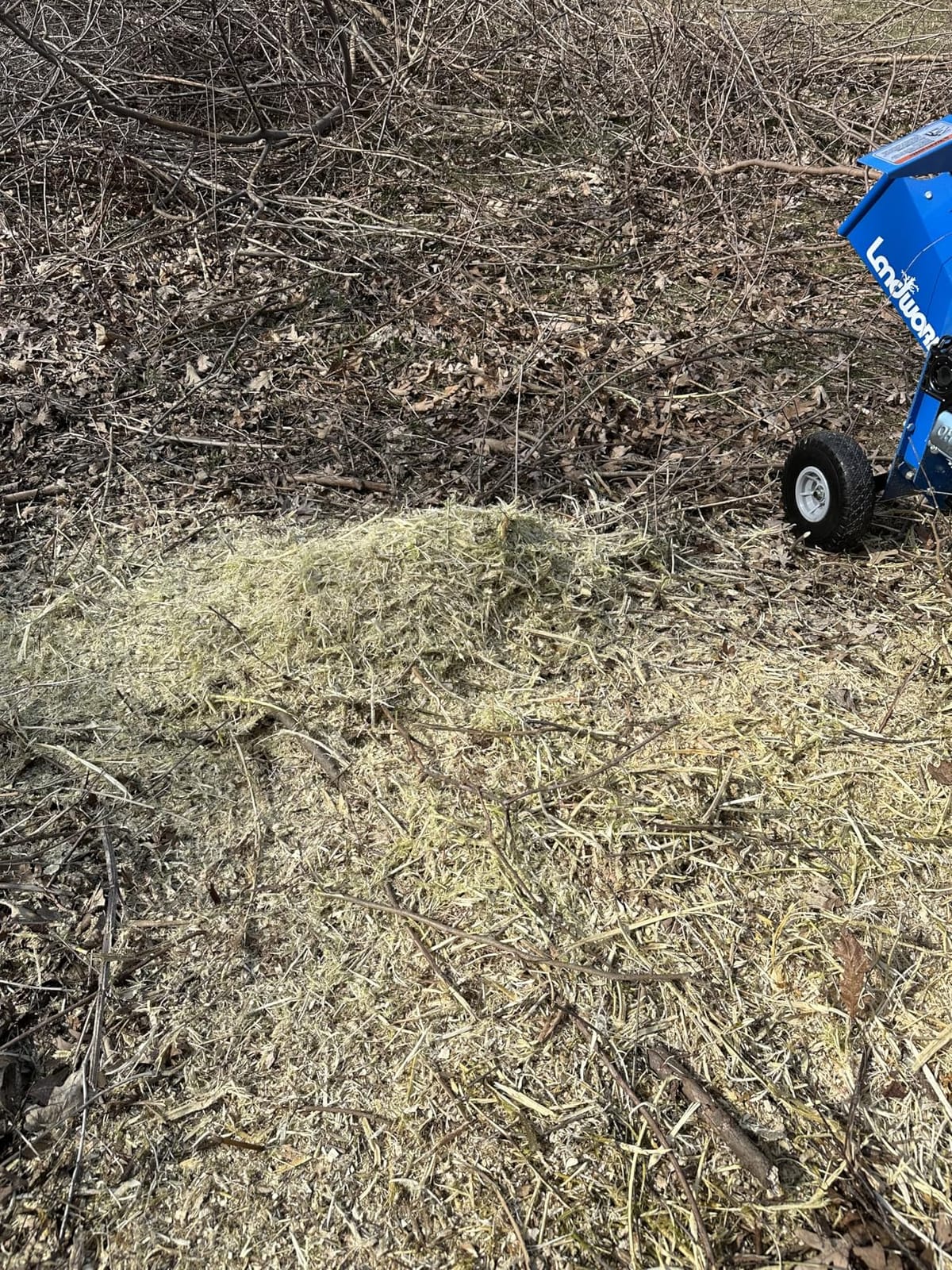
The listing calls it a shredder, and owners push back on that. Small twigs escape the blades and clog the output chute rather than being reduced. Treat the top path as a chipper feed, not a mulcher, and you will avoid most of the frustration.
Durability is the weak point. Multiple long-term owners report welded joints and the rotating blade-holder disc failing after a year or two of intermittent use, and no published replacement parts catalog could be located for this brand.
What it handles well
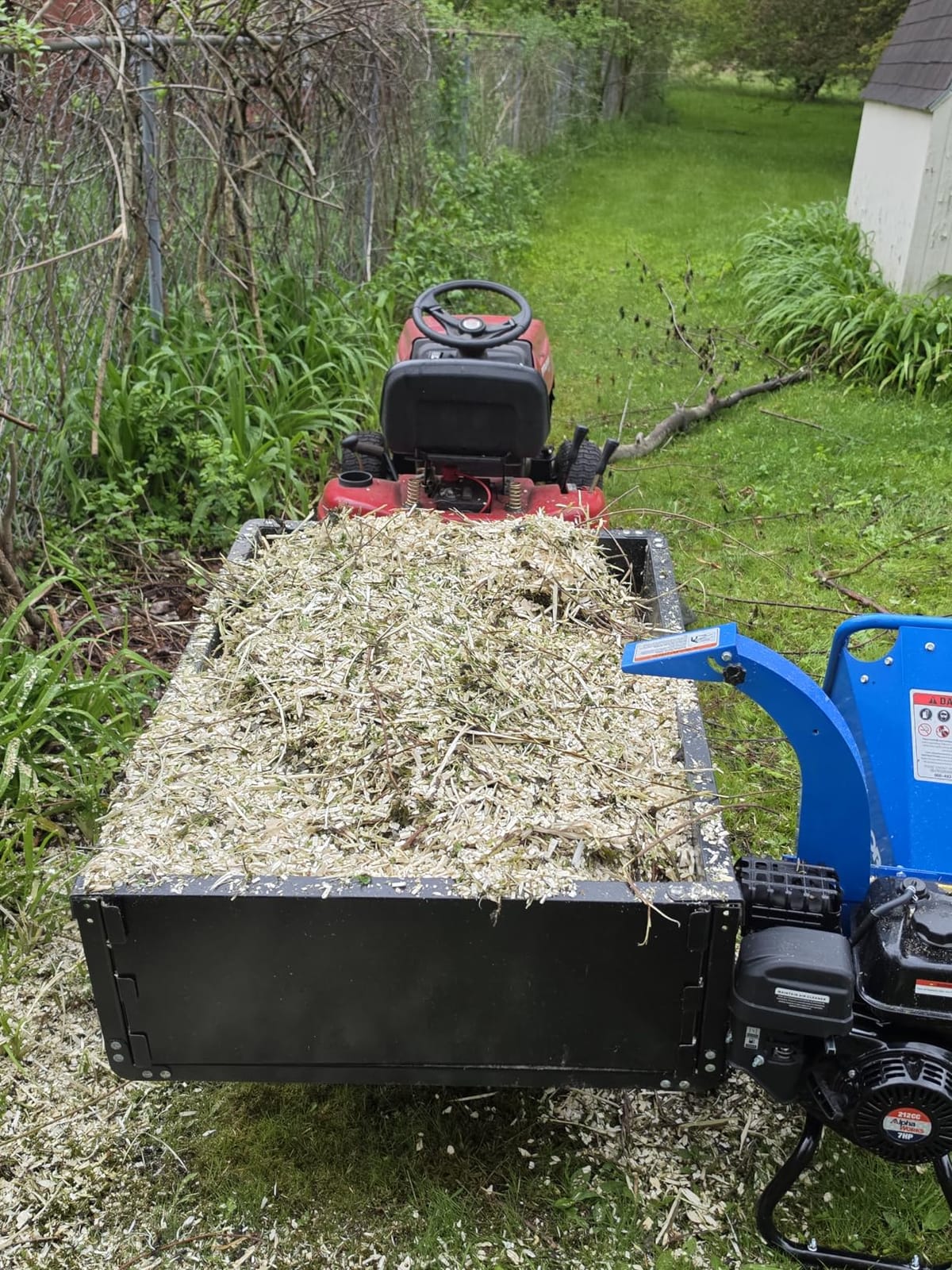
Dry branches up to about 2.5 inches feed well with steady pressure, and the adjustable 90 to 145 degree discharge guide lets you direct chips precisely into a pile or a trailer rather than across the yard.
The removable feed chute and rear clean-out port genuinely help when you are squeezing it into a small shed.
Where it falls short
It needs more pre-cutting than the machines above it, especially on limbs with side twigs, so budget real time for trimming before you feed.
Weak weld reports and a missing parts catalog make this a harder machine to own long term, even though the engine itself performs.
5. LawnMaster FD1503: Budget Corded-Electric for Twigs and Vines
- A 15 amp motor with no gas oil or pull cord
- Two-sided blade spinning at 3700 RPM
- Cheap widely available replacement blades
- Supplied blades dull and heat within 30 minutes
- Practical limit is about 1.5 to 1.75 inches
- Flexible whips like cedar wrap around the blade
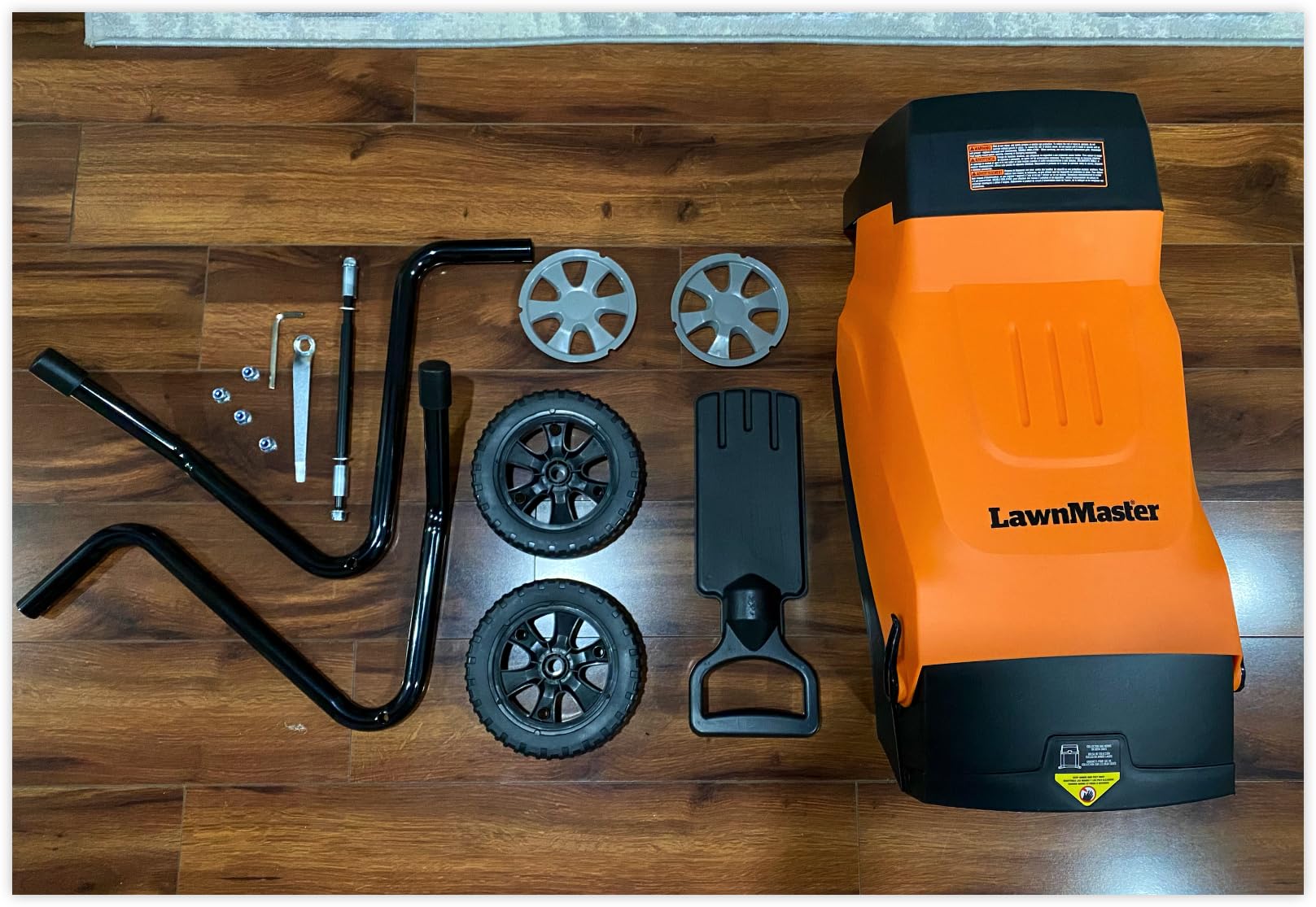
At 23.2 pounds with a dent-resistant polypropylene body, this is the easiest machine here to carry, store, and move between branch piles. It also ranks among the best sellers in its category, which tells you how many people have bought one to handle twigs and vines rather than limbs.
The 15-amp motor drives a two-sided blade at 3,700 RPM, and the manufacturer claims it reduces 14 bags of yard debris down to one bag of mulch. Owners treat that as a marketing figure rather than a measured result, but they do confirm the machine shreds garden material effectively when fed correctly.
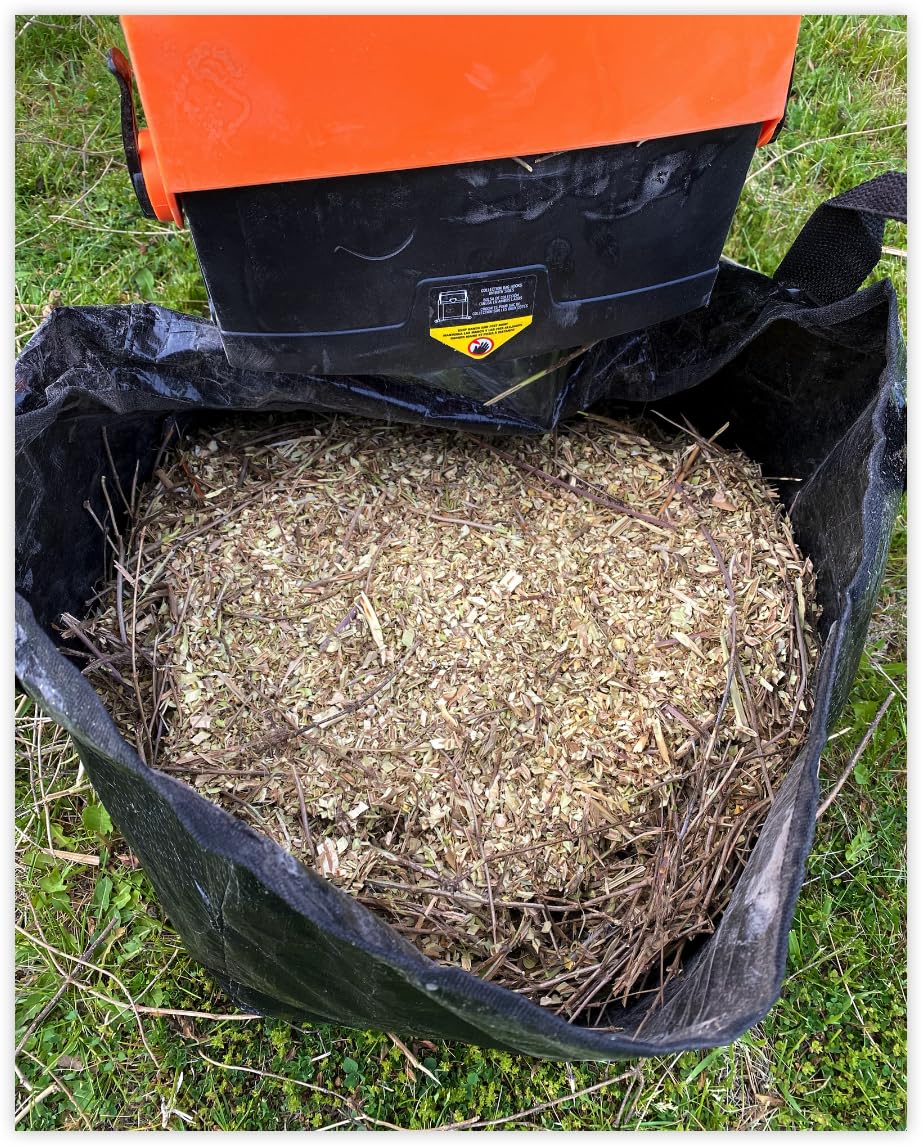
The universal advice in the reviews is to order replacement blades immediately. The supplied set dulls and heats up inside half an hour of use, and cheap widely available blades are the difference between a useful tool and a frustrating one. The included push paddle also matters, since branches must be pushed in and held down by hand.
Realistically the ceiling is 1.5 to 1.75 inches even though the headline figure says 1.8. Long flexible whips such as cedar branches wrap around the blade and need manual untangling, which is the one failure mode we would design out.
What it handles well
Twigs, vines, and thin branch debris, with a side slot that accepts a branch with a side twig without trimming first. It is genuinely convenient for compost prep and bed cleanup.
Storage and portability are its best features. At 23.2 pounds, one person can carry it from the garage to the pile and back without planning the route.
Where it falls short
Anything over roughly 1.75 inches will not feed. If your cleanup includes real branches, this machine simply stops being the right tool.
No self-feed means constant hand pressure, and that hand is close to moving blades. The push paddle helps, but this is manual feeding only.
6. Landworks Rotor 7HP: Check-Window Blade Changes in a 97-Pound Frame
- Reinforced welding and high speed steel blades
- Check windows for fast blade changes
- Large extended hopper for big branches
- Engine oil must be supplied separately
- Only one product image published for this listing
Put simply, this is a 7HP chipper you can roll between branch piles without needing a second pair of hands. At 97 pounds it is more than 30 pounds lighter than the disc-style Landworks above, and the rotor design trades some raw capacity for a much easier machine to reposition around a yard.
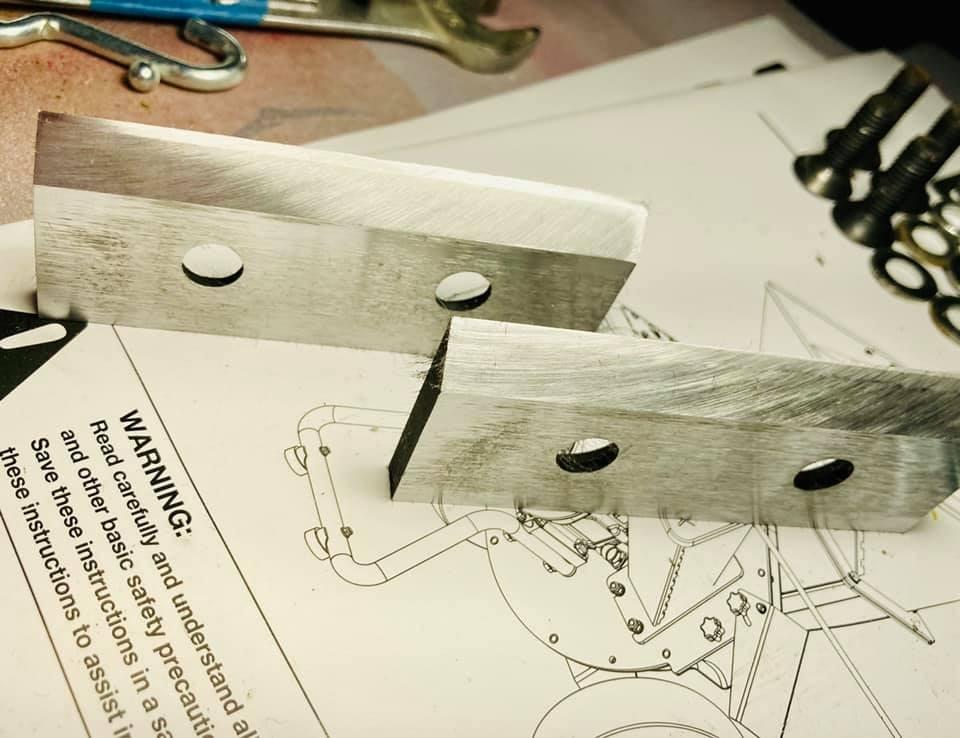
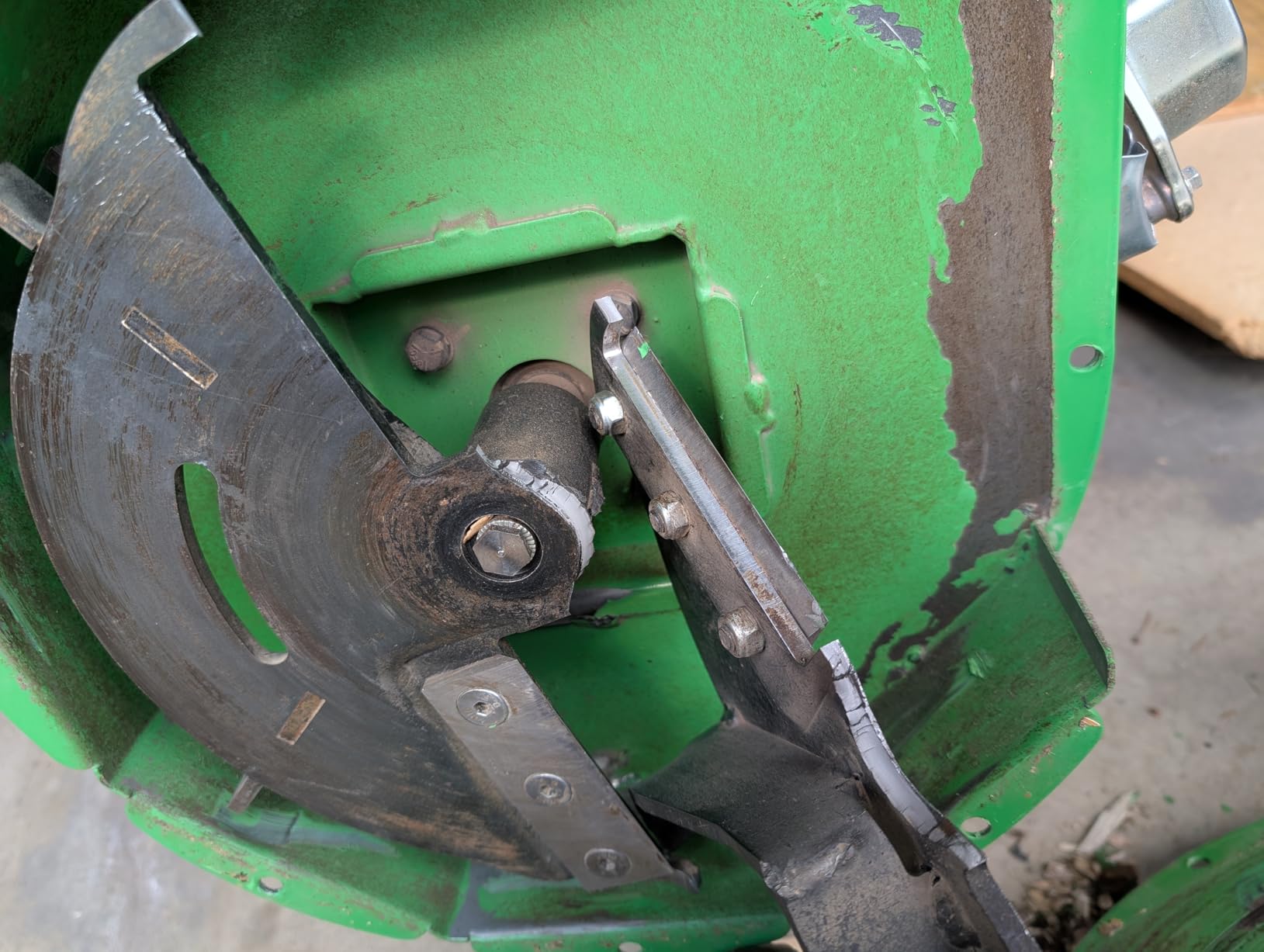
The spec sheet emphasizes reinforced welds and high-speed steel blades, and the 3,600 RPM engine delivers a 15:1 reduction on branches up to 3 inches. Check windows on the housing mean blade changes do not require full disassembly, which removes one of the most annoying parts of chipper ownership.
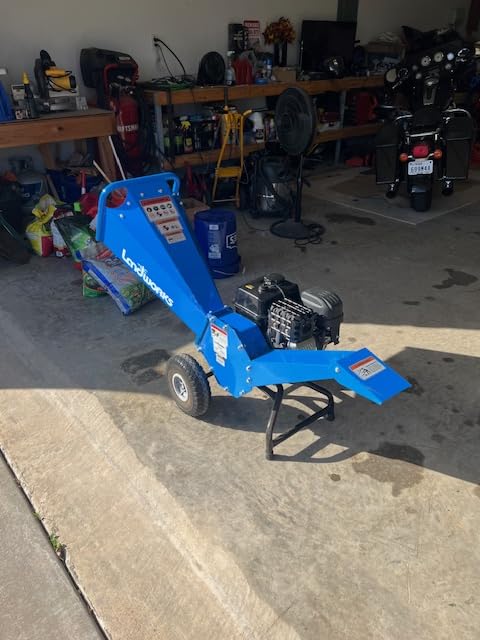
One practical note: engine oil is not included. Add that to your first fuel purchase or you will not get past the fill line. The listing also publishes a single product image, so visual inspection before purchase is limited compared with the machines that show multiple angles.
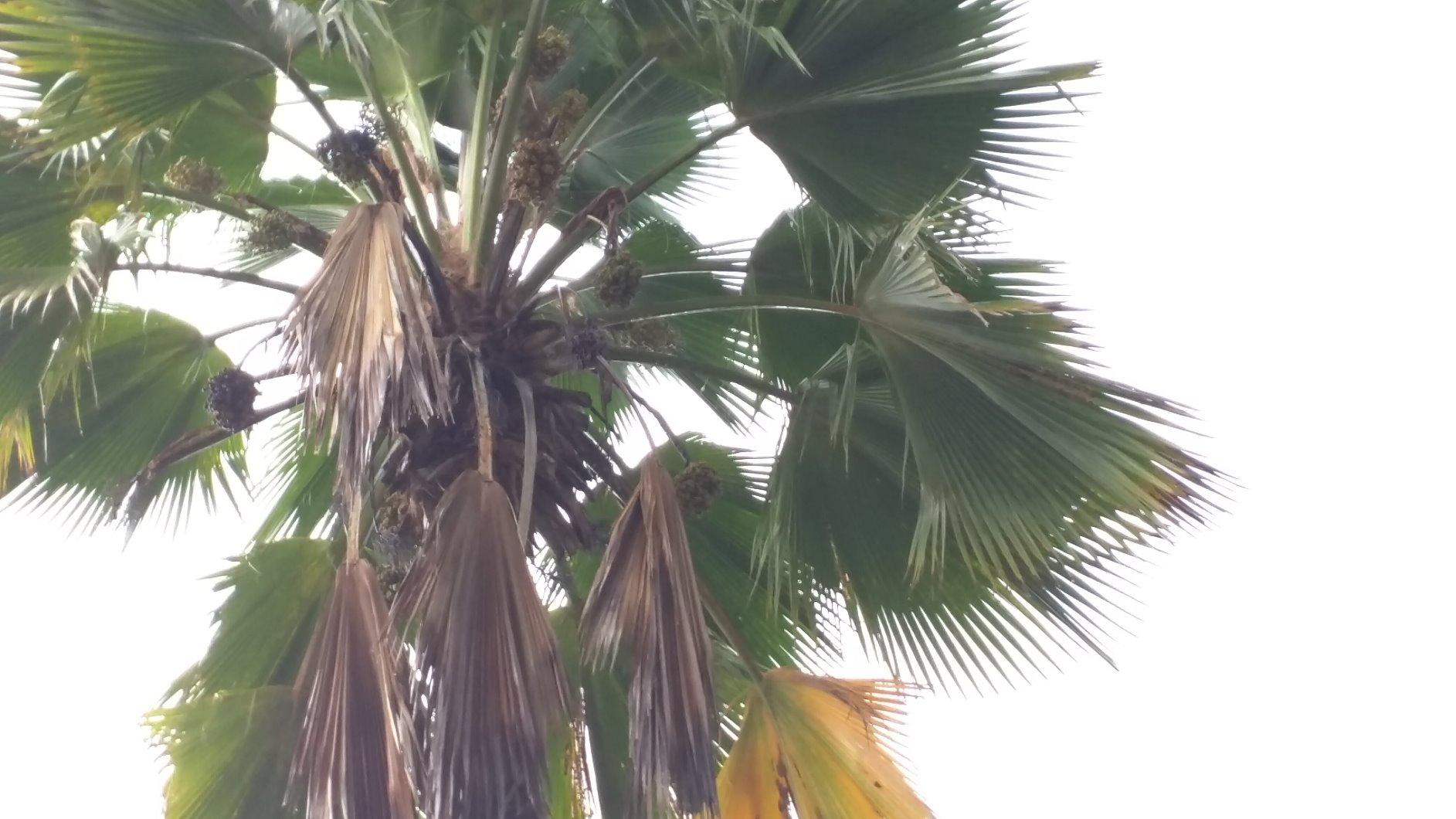
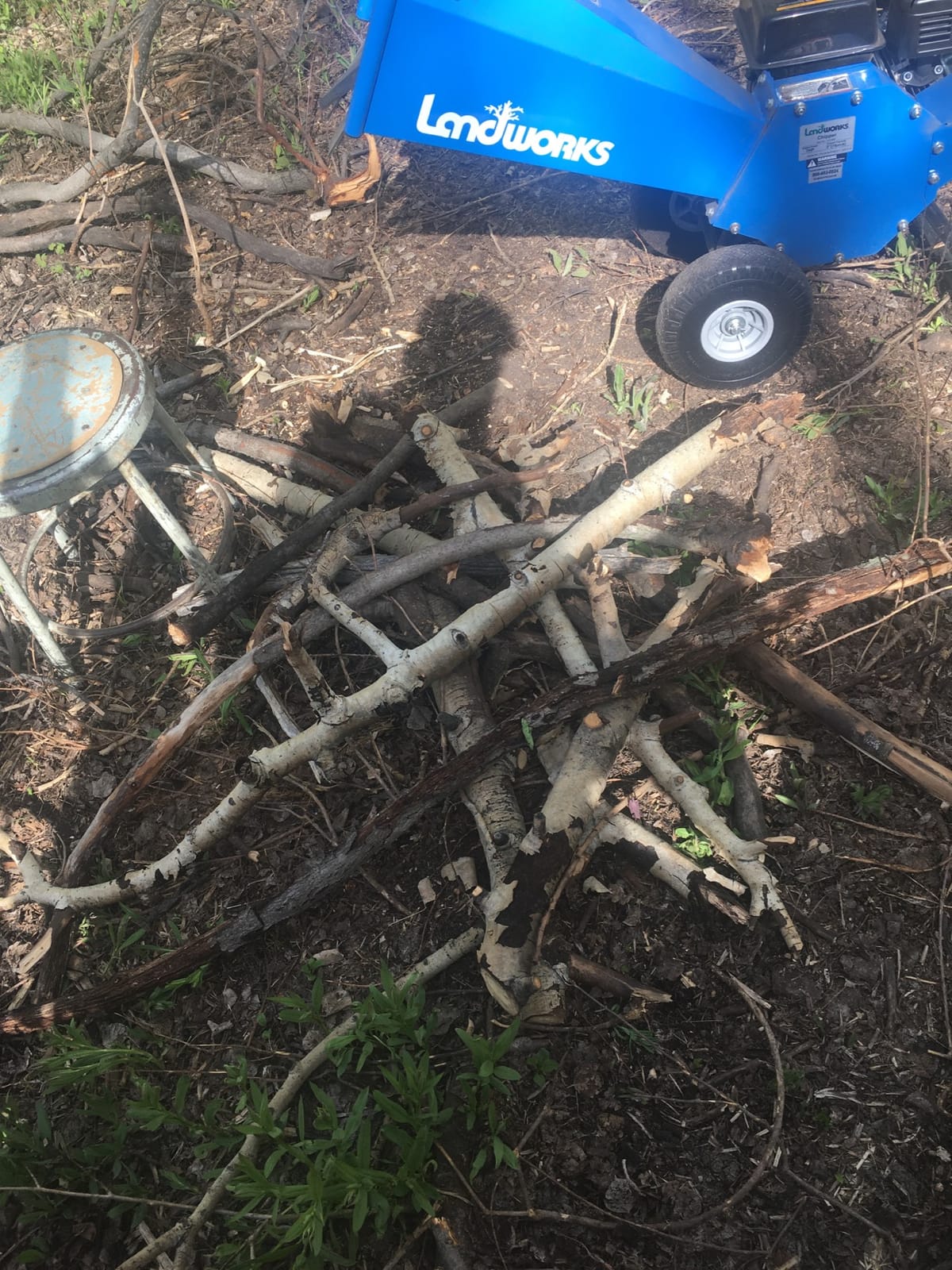
The usual exclusions apply. Owners are told explicitly not to feed fresh greens, pine cones, palm fronds, petrified wood, or vines, and that guidance matches what owners report across this category: those materials wrap, jam, and dull blades fast.
What it handles well
Standard 2 to 3 inch branch work in a yard where you need to carry or roll the machine between piles. The extended hopper makes loading large branches and twigs easier than on smaller machines.
Blade changes are quick thanks to the check windows, which is the main practical advantage over machines that need full disassembly. Owners report steady results on standard branch work once they learn to feed slowly.
Where it falls short
On soft ground it is still an awkward lift, so the weight advantage narrows quickly if your pile is far from the road or the lawn is wet.
It is a chipper rather than a shredder, and it will not take the odd green or vine material that a true mulcher handles without complaint.
7. EFCUT C30 LITE 7HP: Chips Fine Enough to Mulch Beds Directly
- 68 percent five star share across its 413 reviews
- 11.8 inch rotor holds speed under load
- Starts on the first pull consistently
- Factory blades dull within an hour or two
- Blade nuts are over torqued and hard to remove
- Small twigs clog the hopper
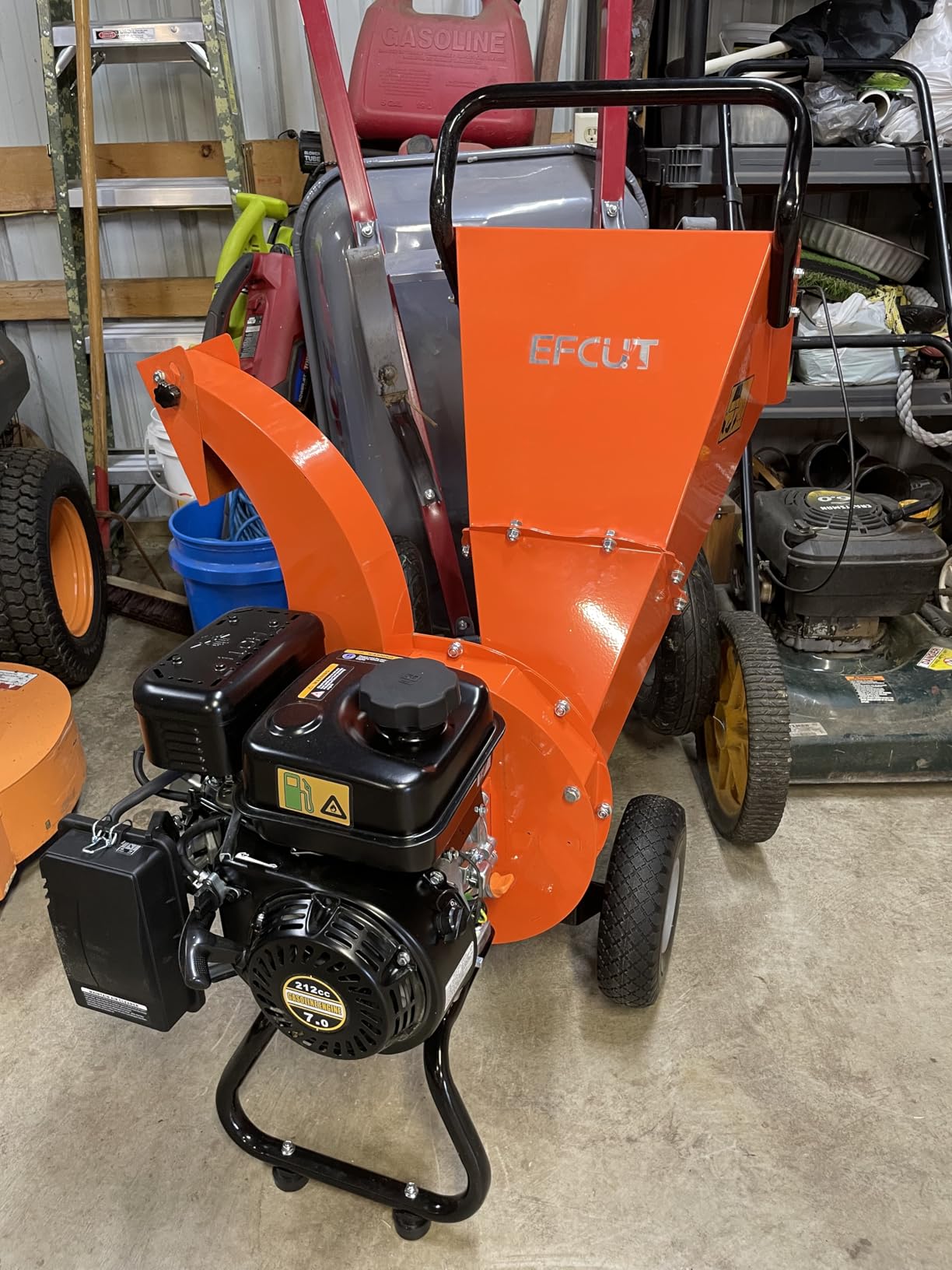
Two ratings in this roundup reach 4.3, and the C30 LITE is one of them. It carries a 68 percent five-star share across 413 reviews, the best rating distribution we saw, with owners frequently comparing it favorably to larger-brand machines on chip quality and first-pull starting.
The reason is mechanical. The 11.8-inch cutting rotor is larger than comparable mini chippers, and combined with high-speed steel blades and reinforced welding it holds blade speed under load. Owners switching from other brands report visibly finer, more uniform chips, and the machine handles 2.5 to 3 inch hardwood branches.
Two consumable problems recur. Factory blades dull within an hour or two of hardwood chipping, so buy a replacement set with the machine. And the retaining nuts are over-torqued, which makes sharpening genuinely difficult for anyone without the right tools.
The feed itself has no draw. Branches must be pushed and steadied, and twiggy brush piles stay manual work because small twigs clog the hopper rather than pulling in. At 84.4 pounds it moves well, but plastic tires and safety flaps that obstruct the view into the feed opening are real ergonomic complaints.
What it handles well
Hardwood branches in the 2.5 to 3 inch range, where you want chips fine enough to mulch a bed directly. Owners moving up from a smaller machine notice the difference immediately.
Starting is reliable and assembly takes about 30 to 40 minutes. The access panels serve double duty for blade changes and clog clearing.
Where it falls short
Consumables cost you twice: once for replacement blades and once in your time, because the blade nuts resist removal. Budget for a socket set and some patience.
No self-pull means steady hand work, and twig piles clog the hopper. This is a branch machine that happens to make fine chips, not a brush mulcher.
8. GARDENBEAUT S3 7HP: Never-Flat Wheels and a Compact Footprint
- 212cc engine starts on the first pull for multiple owners
- Non pneumatic wheels that never go flat
- Compact footprint that stores easily
- Unbalanced on the hopper side and can tip
- Starter cord sits on the hot exhaust side
- No blade draw so a push stick is needed
The engine is the reason to look at this machine. Multiple owners report first-pull starting every single time, and international reviewers in Germany, France and Belgium describe long jam-free runs on it, with one German owner processing 4 cm of fresh wood cleanly.
That reliability matters more than it sounds. The most common reason chipper projects stall at 7pm in the yard is a machine that will not start, and a 212cc OHV engine that fires on the first pull removes an entire category of frustration.
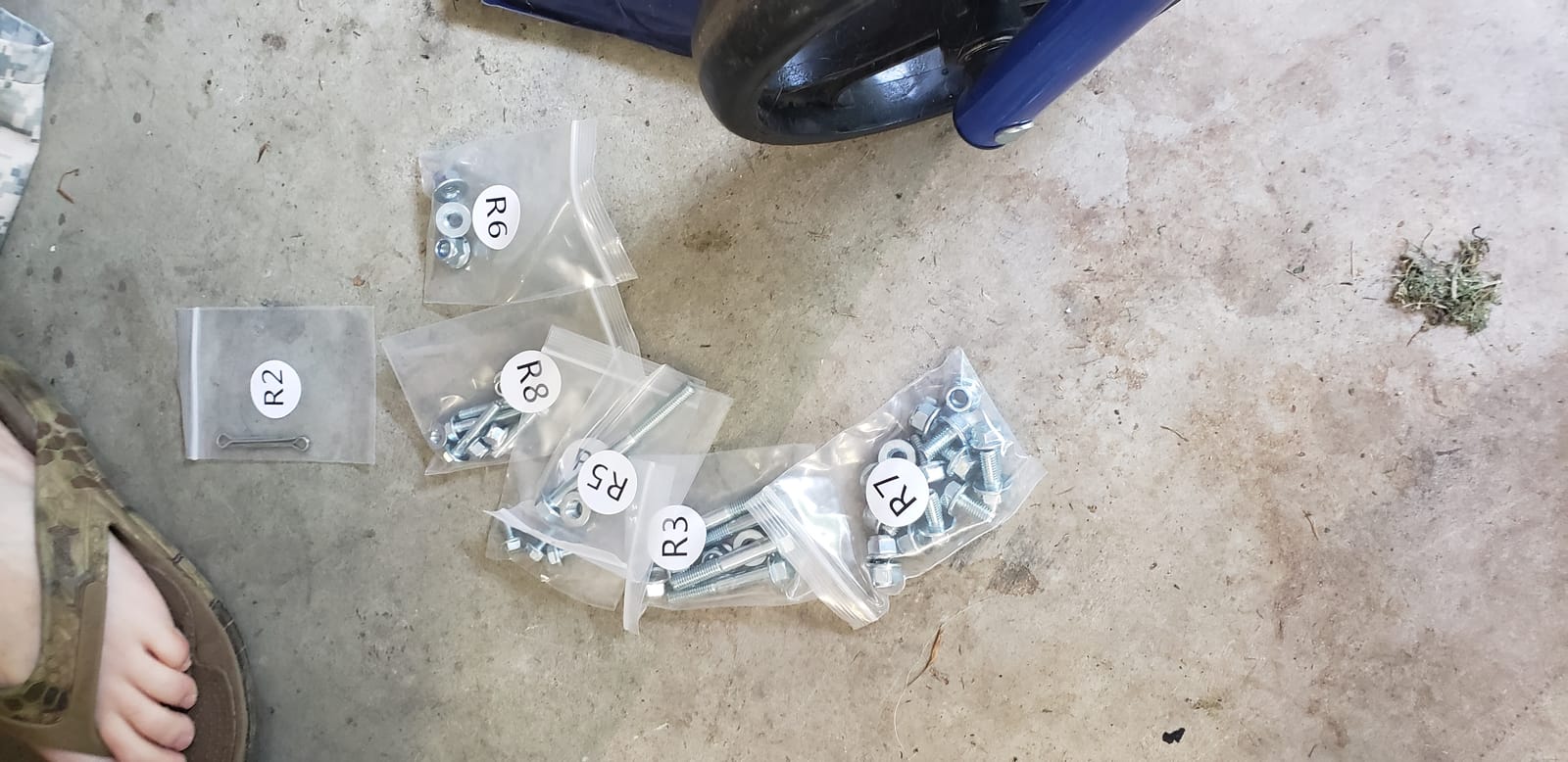
The chassis is where the complaints land. It is unbalanced on the hopper side, and one owner welded on a 60-pound counterweight to keep it upright. The hopper is too small for bulk leaf feeding, the starter cord sits on the hot exhaust side where a bare hand can get burned, and the assembly instructions are poorly translated with tiny diagrams and missing washers.
Several owners also report no draw at the blades, requiring a push stick even for quarter-inch branches. Treat that as a technique requirement rather than a defect, but factor in the extra time.
What it handles well
Three-inch branches when fed slowly and steadily, with the 212cc engine chewing through them without bogging. The non-pneumatic wheels are a genuine plus on gravel and rough ground.
Compact enough to store in a modest shed, and one owner chipped two full trailer loads with it as a first serious cleanup.
Where it falls short
The tip risk from an unbalanced hopper side is not a minor issue. Assemble it on level ground and check stability before you start feeding.
It is a branch chipper, not a leaf machine. Small hopper and no blade draw mean twiggy and leafy material is manual work.
9. EFCUT C40 9HP: Built for 4-Inch Branches
EFCUT C40 Wood Chipper 4″ inch Max Diameter Capacity 9 HP 274cc Gas Powered Engine Heavy Duty Shredder Mulcher
- Largest capacity here at 4 inches
- 15.9 inch flywheel and longer steel blades
- Reinforced hardware and improved L bracket mounting
- Lowest rated here at 3.8 stars with 16 percent one star
- At 136.7 pounds it is the heaviest machine in the group
- Blades are excluded from the warranty
If your property genuinely produces four-inch limbs, this is the only machine here rated for the job. The 9HP 274cc engine drives a 15.9-inch flywheel, larger than competing brands, with longer blades made entirely from high-speed steel and a 15:1 reduction ratio.
The listing specifically calls out reinforced hardware and improved L-bracket mounting as responses to durability complaints on earlier models, which tells you the manufacturer has heard the same feedback the rest of us have. For a machine aimed at heavy throughput, that is the right direction.
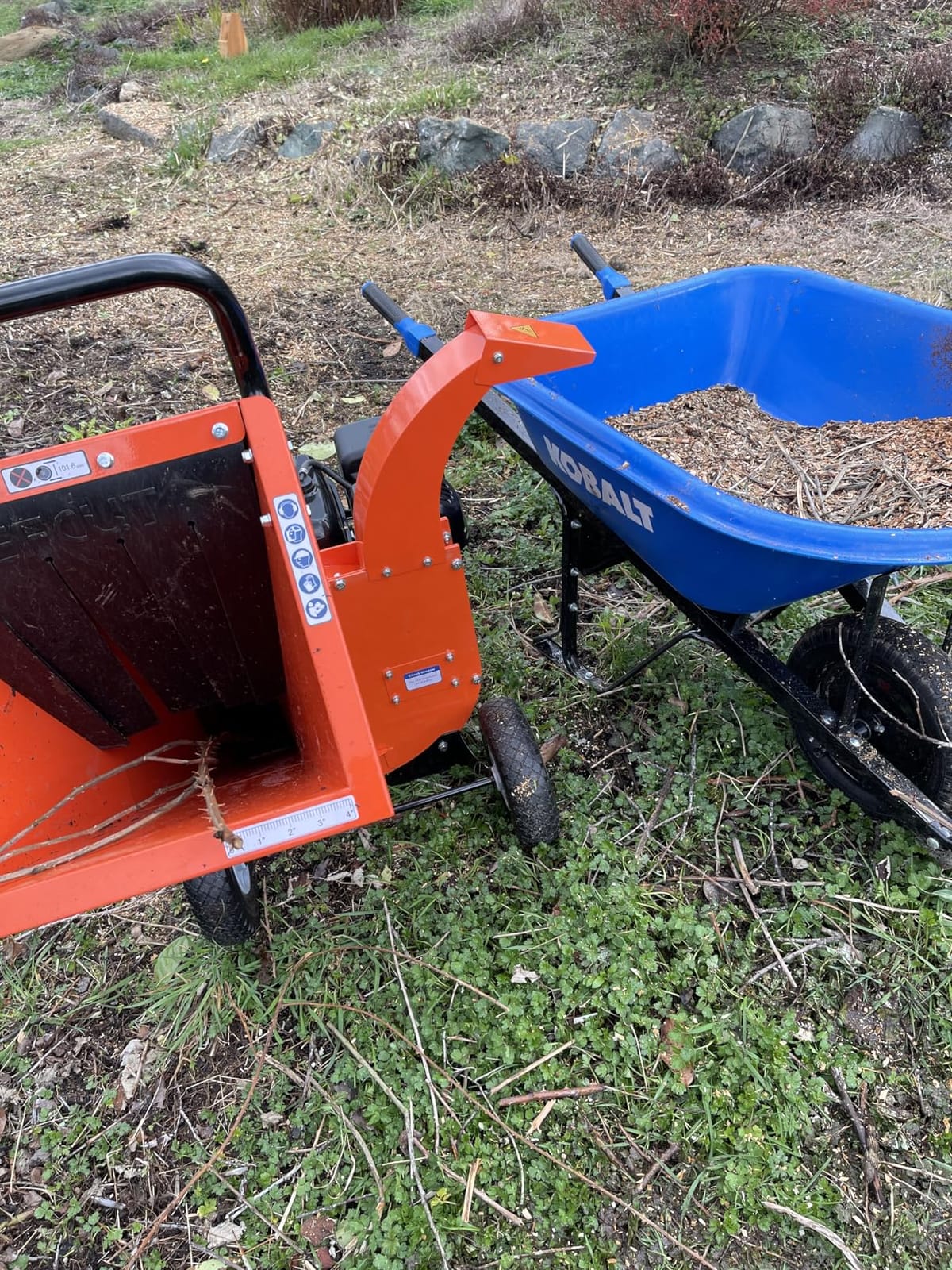
It also carries the lowest rating in the group, at 3.8 with a wide spread between owners. The split makes sense: people who needed 4-inch capacity value what they get, and people who did not feel the extra capability justified the jump in size and weight. At 136.7 pounds it is the heaviest machine here, so plan your work area carefully.
The warranty covers machine construction only and explicitly excludes blades and consumables. Because blade replacement is part of normal ownership for every machine in this category, factor it into your running cost from day one.
What it handles well
Four-inch branches and limbs on wooded acreage, where a 3-inch machine would stall repeatedly. The spacious hopper and adjustable chute make big material easier to load and place.
The larger flywheel carries speed through dense hardwood, which is exactly where smaller rotors bog down.
Where it falls short
It is overkill for most suburban yards. If your thickest branch is under 3 inches, you are paying for capability and weight you will not use.
The rating spread is a caution. Before committing, read the critical reviews specifically about assembly and hardware rather than the aggregate star figure.
10. GreatCircleUSA Mini 7HP: Customer Support and Parts That Arrive Free
GreatCircleUSA Mini Wood Chipper Shredder Mulcher Ultra Duty 7 HP Gas Powered 3″ Inch Max Wood Capacity EPA/CARB Certified Aids in Fire Prevention and Building Firebreaks
- Engine starts on the first pull with 10.7 ft-lb of torque
- Well placed variable speed control
- Customer service sends free replacement parts
- Blades dull in about an hour of hardwood chipping
- Blade replacement requires near total disassembly
- Poor self pull and the machine kicks back
Customer service is the reason this machine earns a place on the list. Across the reviews, Great Circle USA support is singled out repeatedly for sending free replacement parts proactively, which is exactly what you want from a brand with no published part numbers for its engine or chipper.
The AlphaWorks 7HP engine also has a good track record in these reviews: reliable first-pull starts, low fuel and oil consumption over extended runs, and one owner still cutting well on the original blades after 60 hours. Variable speed control is well placed and genuinely useful when you are feeding mixed material.
At 76 pounds it moves easily to the pile and stores without consuming a wall of the shed.
That said, this listing carries a 4.0 average with 12 percent one-star reviews, and owners who try to feed it true 3-inch hardwood report that 2 inches is the realistic ceiling. Treat the 3-inch figure as a maximum rather than a working capacity.
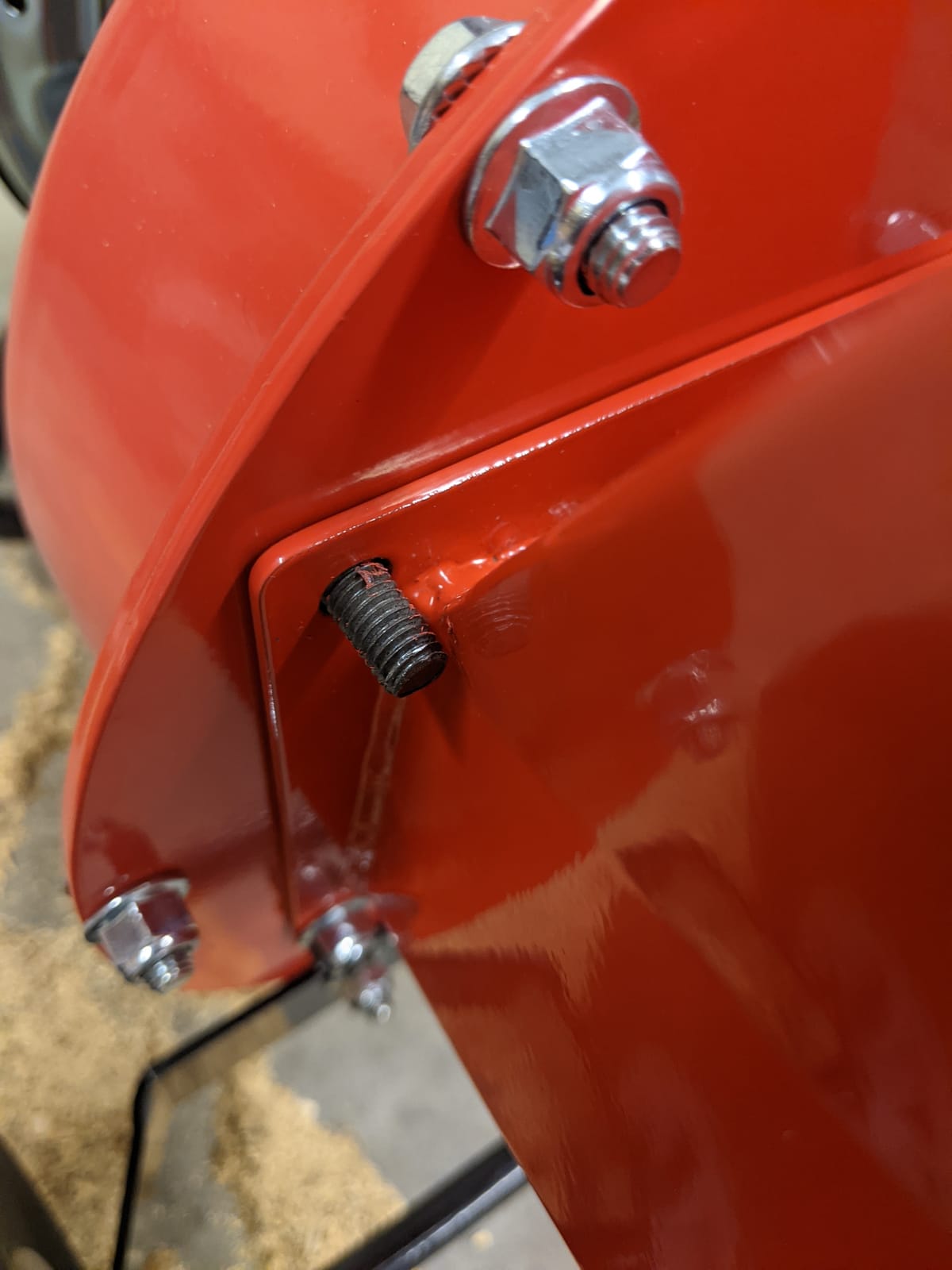
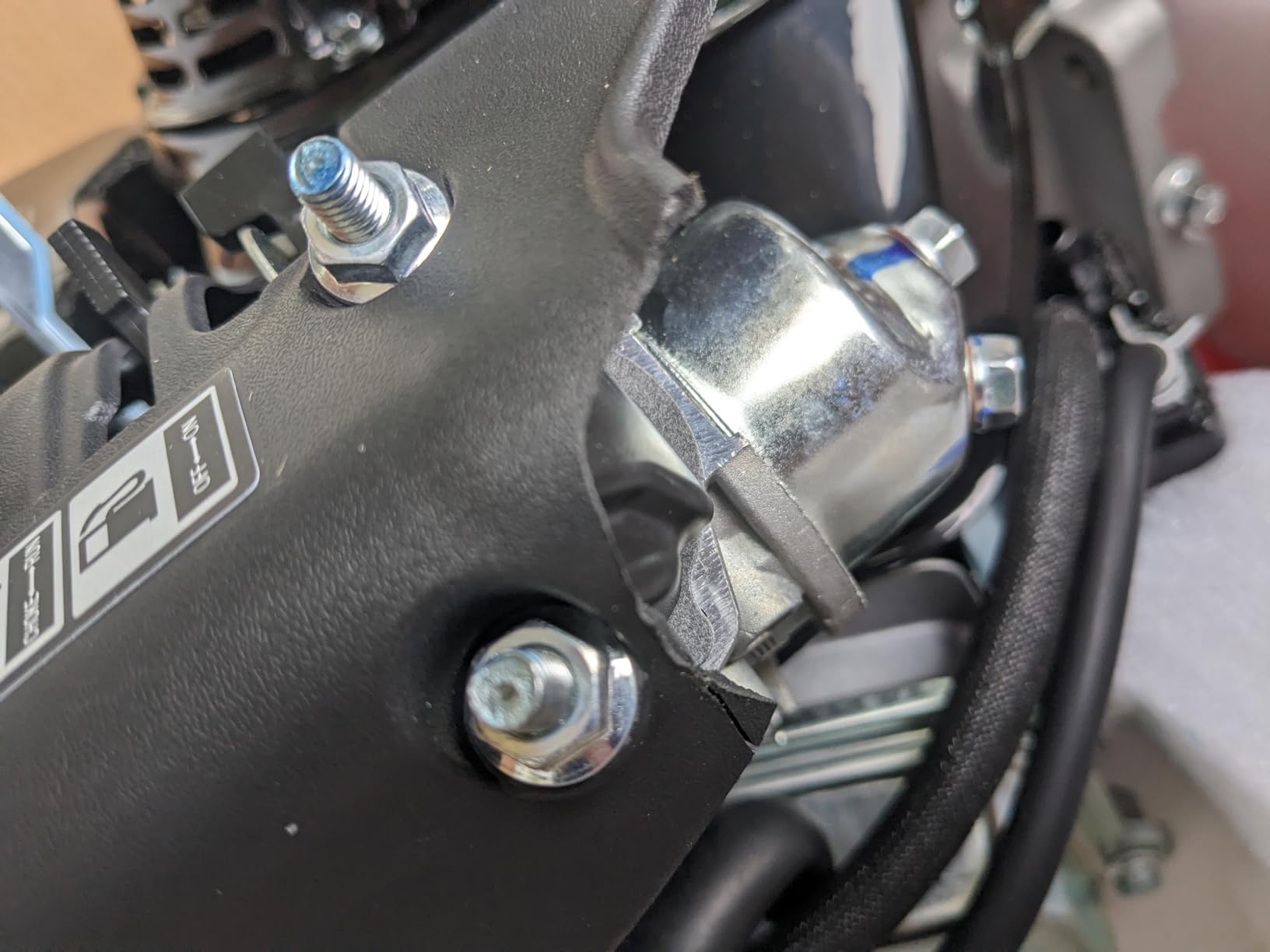
The blade situation is the weak point. Blades dull in about an hour of hardwood work, and changing them requires near-total disassembly lasting one to two hours each time. Self-pull is poor, so branches get pushed against the blades and the machine kicks back. Owners also report missing hardware, lost bolts, and vibration-related loosening of the nozzle welds. The discharge tube also clogs quickly with soft green wood, twigs and pine needles.
What it handles well
Lightweight gas work on dry branches under 2 inches, where you want a machine that is easy to move and store in a normal shed. The engine and support are the durable parts.
Long runtime at low fuel consumption makes it economical for a full weekend cleanup once you factor in blade time.
Where it falls short
Blade life and blade access together are the main complaint. A one-hour blade life with a two-hour replacement procedure is a poor trade over several seasons, and soft green material keeps the discharge tube clogged.
Overall it suits dry branch work rather than fresh fall debris, which is the opposite of what a lot of owners need it for.
What Size Wood Chipper Do I Need for Branches?
Match the chipper’s stated cutting capacity to the thickest branch you expect to feed, then step up one tier to leave margin. Electric chippers top out near 1.5 to 1.8 inches, homeowner gas machines handle 3 inches reliably, and 4-inch-plus capacity requires a heavier gas model. Cutting below that limit is what causes stalling, and buying far above it is how people end up with a 136-pound machine in a garden that only produces twigs.
- 1.5 inch and under (twigs, vines, pruned suckers): the LawnMaster FD1503 or the Sun Joe CJ603E. At 23.2 pounds the LawnMaster is easy to carry.
- 1.5 to 2 inch branches (small ornamental trees, routine pruning): either electric, or a gas machine if you also want to handle thicker material later. Start at the bottom of the gas range.
- 2 to 3 inch branches (mature shade tree limbs, storm debris): a 7HP 212cc gas chipper. This is the category most homeowners should buy into, and it is where our SuperHandy, EFCUT C30 LITE and GARDENBEAUT S3 picks live.
- 3 to 4 inch branches (wooded lots, already-down trees): a 9HP 274cc gas machine such as the EFCUT C40, ideally with a feed wheel or the patience to trim limbs before feeding.
One honest note on advertised capacity: owners of the 3-inch machines in this roundup commonly report a working ceiling closer to 2 inches on hardwoods. If your branches are dense oak, elm or maple, buy the tier above what you think you need.
Wood Chipper vs Shredder vs Mulcher: What Is the Difference?
A chipper cuts branches into discrete chips using knives or hammers, a shredder reduces leaves and twigs into fine mulch with hammers, and a mulcher does the shredding while vacuuming the debris into a bag. The best branch shredder for most homes is a 3-in-1 machine that does both.
- Chipper: branches, limbs, brush. Chunks of chip you can mulch with or blow.
- Shredder: leaves, grass, soft green material. Fine, compost-like output, but it cannot take a limb.
- Mulcher: a shredder with a vacuum inlet and collection bag, so one pass does cut, collect, and empty.
Several machines here are 3-in-1 units with a top hopper, a side chute for branches, and an attachable leaf vacuum port. That is the most useful configuration if you want one machine for both jobs rather than two machines taking up shed space.
Self-Feeding Chippers: Do Homeowners Need One?
Self-feeding chippers use a powered feed wheel or hydraulic arm to pull branches in at a steady rate instead of you pushing. Owners who have one describe it as transformative: the feed wheel grabs a branch and you step back rather than wrestling it. The tradeoff is a meaningful step up in size and weight, so most homeowners buying from this roundup are better served by learning good feed technique on a manual machine.
Step up when you are chipping already-down trees, when the material is wet and heavy, or when you are feeding alone. For dry seasonal branches under 3 inches, a manual feed you can modulate is easier to control.
Gas vs Electric Wood Chipper for Branches
Electric wins on simplicity: no fuel, no oil, no pull cord, low noise relative to gas, and a machine light enough to carry. It loses hard on capacity and on the extension cord, which limits where you can work on the property. Gas wins on throughput, on where you can set up, and on branch diameter.
Choose electric for a small yard, one or two small trees, and light twig work near an outlet. Choose gas for anything involving real branches, for work at the far end of a property, and for any cleanup measured in trailer loads.
Drum, Disc or Turbine: Which Chipper Rotor Lasts?
The durability consensus from long-term owners breaks down by rotor type: disc chippers are built like tanks, drum-style machines will eat a branch regardless of its shape but wear their teeth faster, and turbine designs produce the nicest finish. That is the honest trade, and it is worth knowing before you buy, because most roundups never explain it.
Among the machines here, most use a high-speed steel rotor driven by a 7HP OHV engine, so rotor type is a less useful filter than build quality. For most homeowners the practical test is simpler: a machine whose blades and hardware you can replace will outlast one whose parts catalog is hard to find, which is the concern that comes up most often in long-term buyer discussions.
Before You Chip: Safety and Jam Checklist
Clearing a jam with the machine running is the most common way people get hurt, and the most common cause of those jams is feeding material that should have been removed first.
- Remove wire, nails, fence staples, stones, and metal edging before a branch goes anywhere near the chute.
- Never feed acorns, pine cones, palm fronds, vines, or fresh greens; several manufacturer listings rule these out explicitly.
- Stop the machine before reaching into the chute, and use the reverse function or a clearing tool rather than your hand.
- Wear eye and hearing protection, plus gloves, and keep a firm two-handed grip using the pusher stick.
- Stand to the side of the discharge chute. Kickback from ejected chips is a real injury risk on gas machines.
- Let wet branches dry where you can. Wet and stringy wood is the leading cause of clogging in owner reports.
Feed slowly and steadily. Every machine on this list will jam if you stuff a bundle of twigs into the hopper faster than the rotor can pull it.
Buy vs Rent: Is a Homeowner Wood Chipper Worth It?
If you have one big cleanup ahead and then nothing for two years, renting is the better call. A chipper is a machine you either use seasonally or you do not use at all, and rental avoids the storage problem entirely. If you are clearing branches every year, or if a single storm puts more debris curbside than you want to move by hand, buying pays back quickly in avoided hauling. Our wood router guide covers another common power-tool ownership question with the same math.
Also ask yourself whether a chipper is needed at all. If you have a small lawn and a tree service already handles branch cutting, a 23-pound electric for twigs may be the entire machine you need.
What to Do With the Chips
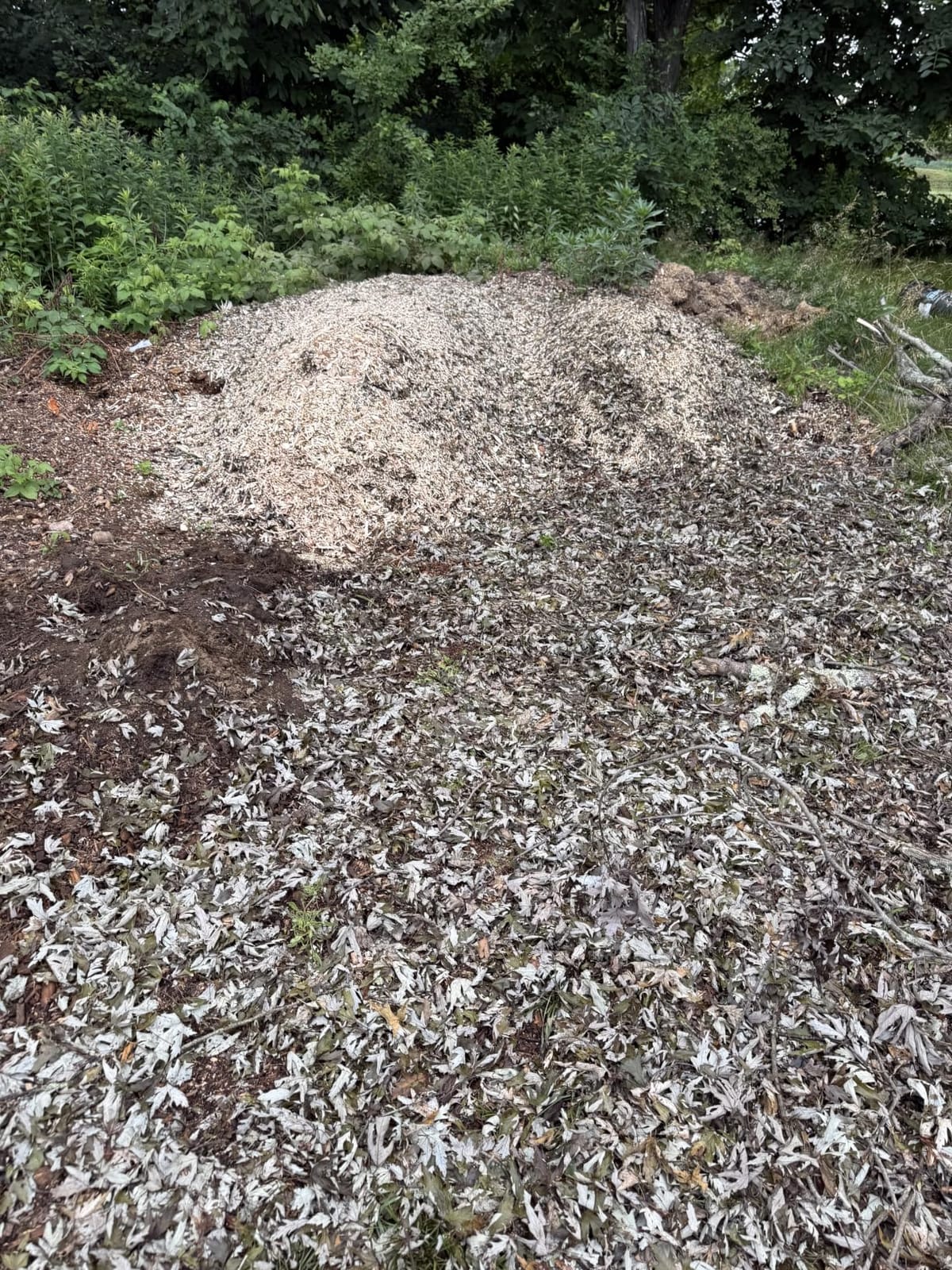
The output is worth planning for, because a chipper that fills a bag with something useless has solved half a problem. Fresh hardwood chips make excellent garden mulch, and you can run them straight around drip lines and fruit trees where they hold moisture and suppress weeds without forming a mat.
Rougher chips from larger branches suit pathways and erosion control better than beds. On a slope, a two-to-three-inch layer of coarse chips slows runoff far more effectively than fine mulch, and on paths it is easier to rake level after the wood dries.
Playground surfacing is the other common use, provided you let the chips age for several months so any sharp edges break down. For composting, mix chips with green material rather than using them alone, since woody material adds carbon and dries the pile. Finally, chips from untreated hardwood make usable smoker wood once dried, while softwoods such as pine and cedar are too resinous for that.
Frequently Asked Questions
What size wood chipper for branches?
Match the chipper’s stated cutting capacity to the thickest branch you expect to feed, then step up one tier. Electric chippers top out around 1.5 to 1.8 inches, homeowner gas machines handle 3 inches reliably, and 4-inch branches need a heavier 9HP 274cc gas model. Buying well above your branch size wastes money and shed space.
What is the best branch shredder?
For branches specifically, a 3-in-1 chipper shredder with a side chute for limbs and a top hopper for twigs is the most useful configuration. The SuperHandy 7HP 3-in-1 and the Landworks 3-in-1 both cover branches and leaf mulch from one frame. Pure shredders handle leaves and vines but cannot take a limb.
Are Harbor Freight wood chippers any good?
The Harbor Freight Predator 6.5 HP is strong value for 3-inch capacity, and its large review base reflects both enthusiasm and complaints about plastic wheels and real-world limits closer to 2 inches on hardwood. Judge it on parts availability and engine serviceability rather than on the horsepower figure. If you want that platform with clearer specs, the 7HP 212cc machines in this roundup sit in the same class.
Can you put branches in a wood chipper?
Yes, that is exactly what a wood chipper is designed for, within its rated cutting capacity. Before feeding, remove wire, nails, fence staples, stones, and metal edging from the branch, and cut limbs slightly longer than the rated maximum so they enter the chute cleanly. Feed slowly with the pusher stick.
What is the best wood chipper for a homeowner?
For the average homeowner with mature shade trees, a 7HP 212cc gas chipper rated for 3-inch branches is the right answer. In this roundup the SuperHandy 7HP 3-in-1 is the best value and the EFCUT C30 LITE is the one owners single out for chip quality. Homes with only one or two small trees are better served by a corded electric.
Are self-feeding wood chippers available?
Yes. Self-feeding chippers with a powered feed wheel or hydraulic arm now come in homeowner-friendly sizes, typically a step up in size and weight over manual-feed machines. Owners describe them as transformative because the feed wheel grabs a branch and pulls it at a steady rate. Most homeowners handling dry branches under 3 inches do not need one.
Are homeowner wood chippers worth it?
Worth it if you clear branches every year or chip already-down material yourself, since it turns hauling into minutes of processing. Not worth it if you have one cleanup ahead and nothing after, because storage and blade maintenance are real costs. Renting for a single job is usually the better choice.
Can you put wet wood or acorns in a chipper?
Wet wood can be chipped, but it is the leading cause of clogging and blade wear reported by owners, so let it dry where you can. Acorns, pine cones, palm fronds, vines, and fresh greens should not be fed at all, and several manufacturers state this in their own guidance.
The Verdict on the Best Wood Chippers for Branches
Start with the thickest branch you have, not the horsepower number. If that branch is under an inch and a half, the Sun Joe CJ603E or the 23-pound LawnMaster FD1503 will serve you well and store anywhere. If it runs to three inches of hardwood, choose a 7HP 212cc gas machine, and the SuperHandy 7HP 3-in-1 is the value pick while the EFCUT C30 LITE is the one to buy if you want chips fine enough to mulch a bed directly.
Only reach for a 4-inch machine on genuinely wooded acreage, and only consider self-feeding if you are working alone or chipping wet, already-down wood. Whatever you choose, feed slowly, buy replacement blades before you need them, and check for a published parts catalog before you commit. Each pick below has its own listing to check, and you can see how our wood lathe guide compares if you are turning the same wood afterward.