
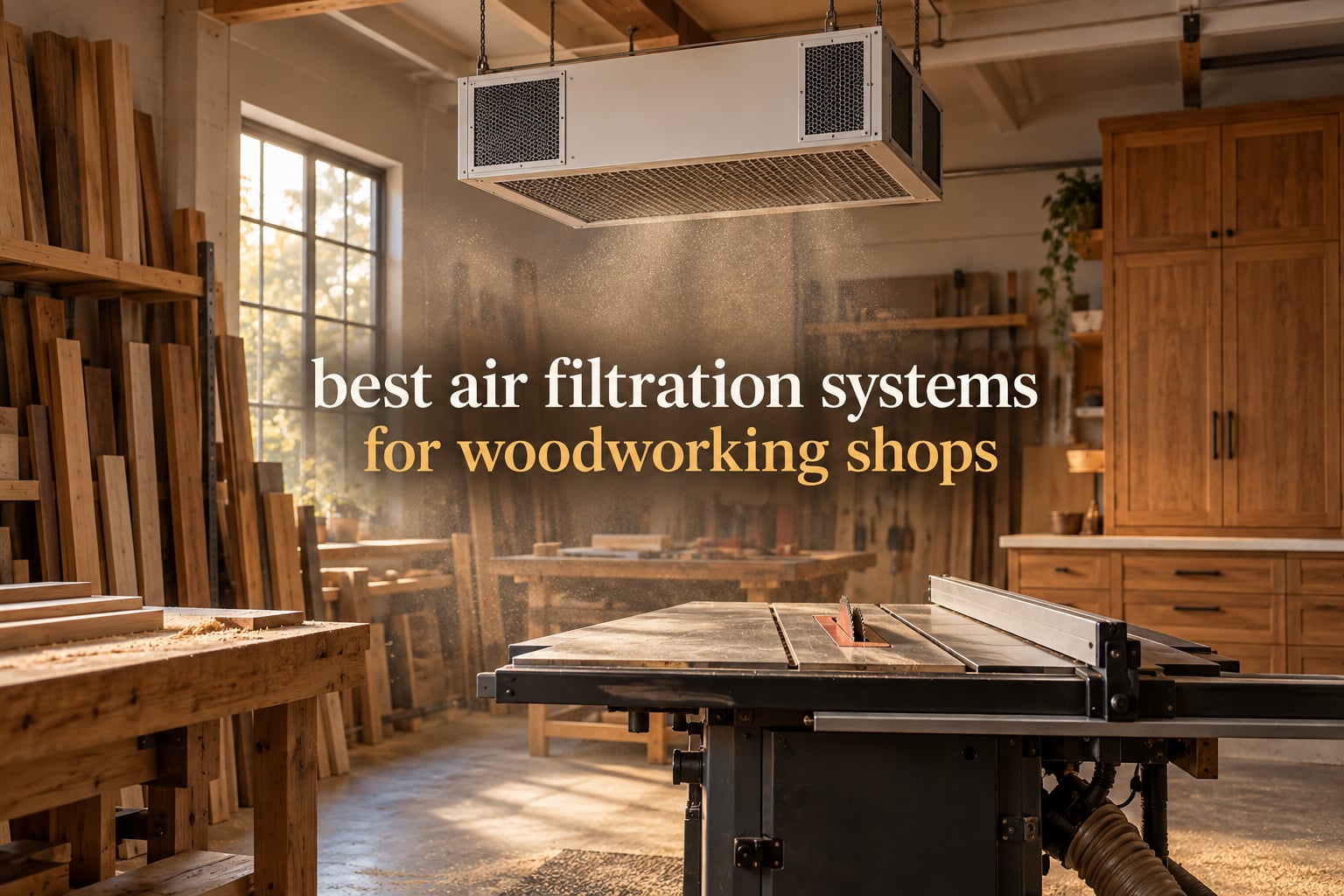
An air filtration system for a woodworking shop is a high-volume fan unit, usually ceiling mounted, that pulls airborne fine dust out of the room and traps it in replaceable filters. It cleans the air itself rather than capturing dust at the tool port, which is what a dust collector or extractor does. That difference matters more than most buyers realize.
We spent weeks putting these machines side by side, weighing airflow against filter rating, noise against mounting weight, and running cost against replacement filter availability. The short version: the best air filtration systems for woodworking shops are the ones that clear your square footage several times an hour, hold a filter fine enough for wood fines, and can be hung or moved without a ladder every time you use them.
Wood dust is the reason any of this matters. A study woodworking publications frequently cite found roughly 88 percent of airborne wood particles are smaller than one micron, which is the size that reaches deep into the lungs, and wood dust is treated as a carcinogen hazard. Finishing the room with an air cleaner is cheap insurance next to a proper workbench setup that keeps your body out of the plume in the first place.
One warning before we start. Household air purifiers are not shop equipment. Shop owners on r/woodworking and ncwoodworker.net repeatedly report that a spare bedroom purifier clogs its small cartridge within weeks of sanding dust, so we left them out of this roundup entirely.
Top 3 Picks for Wood Shop Air Filtration in 2026
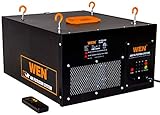
WEN 3410 Air Filtration System
- 400 CFM three-speed
- 1-micron filter
- 26-foot RF remote
- Programmable auto-off timer
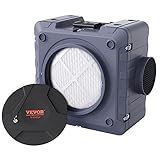
VEVOR Air Scrubber
- 550 CFM adjustable
- MERV-10 plus carbon plus H13 HEPA
- Daisy-chain to 1650 CFM
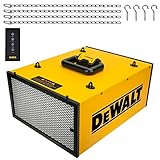
DEWALT DWXAF101
- H11 HEPA second stage
- Auto air-quality sensing mode
- 8-hour timer
- 3-year warranty
If you want one answer, the WEN 3410 is the machine most shops should buy first, and the reasoning is simple: more than 5,600 owners have left a 4.6-star average behind, and nothing else in this group comes close to that track record. The VEVOR scrubber earns its place for shops that spray finish or oil hardwood, because it is the only unit here with a carbon stage sitting in front of an H13 HEPA filter. The DEWALT is the pick when brand support and a three-year warranty matter more than raw dollars.
All 12 Systems Compared Side by Side in 2026
| Product | Specifications | Action |
|---|---|---|
| WEN 3410 Air Filtration System |
|
Check Latest Price |
| DEWALT DWXAF101 |
|
Check Latest Price |
| VEVOR Air Scrubber |
|
Check Latest Price |
 PSI Woodworking DC725 PSI Woodworking DC725 |
|
Check Latest Price |
 Abestorm DecDust 1350 Abestorm DecDust 1350 |
|
Check Latest Price |
 Abestorm DecDust 1080 Abestorm DecDust 1080 |
|
Check Latest Price |
 JET AFS-1000C JET AFS-1000C |
|
Check Latest Price |
 Abestorm DecDust 780S Abestorm DecDust 780S |
|
Check Latest Price |
 PURISYSTEMS PuriCare 500IG PURISYSTEMS PuriCare 500IG |
|
Check Latest Price |
 POWERTEC AF4001C POWERTEC AF4001C |
|
Check Latest Price |
 POWERTEC AF1045 POWERTEC AF1045 |
|
Check Latest Price |
 OUKEETO FJ250 Air Filtration System OUKEETO FJ250 Air Filtration System |
|
Check Latest Price |
1. WEN 3410 Air Filtration System: The One Most Shops Should Buy
WEN 3410 3-Speed Remote-Controlled Air Filtration System (300/350/400 CFM), Basic w/ RF Remote (400 CFM) , Black
- More than 5600 reviews at a 4.6 average
- Three speeds at 300 350 and 400 CFM
- RF remote reaches 26 feet through obstructions
- Programmable auto-off timer
- Filter pair is easy to swap
- 400 CFM suits a 400 sq ft shop
- no larger
- Remote only with no touch panel on the case
- Replacement filters are proprietary WEN parts
The WEN 3410 is the unit I recommend to anyone who asks me where to start. It moves 300, 350 or 400 cubic feet per minute across three speeds, and the top speed is sized for a 400 square foot shop, which covers most converted two-car garages and dedicated hobby rooms.
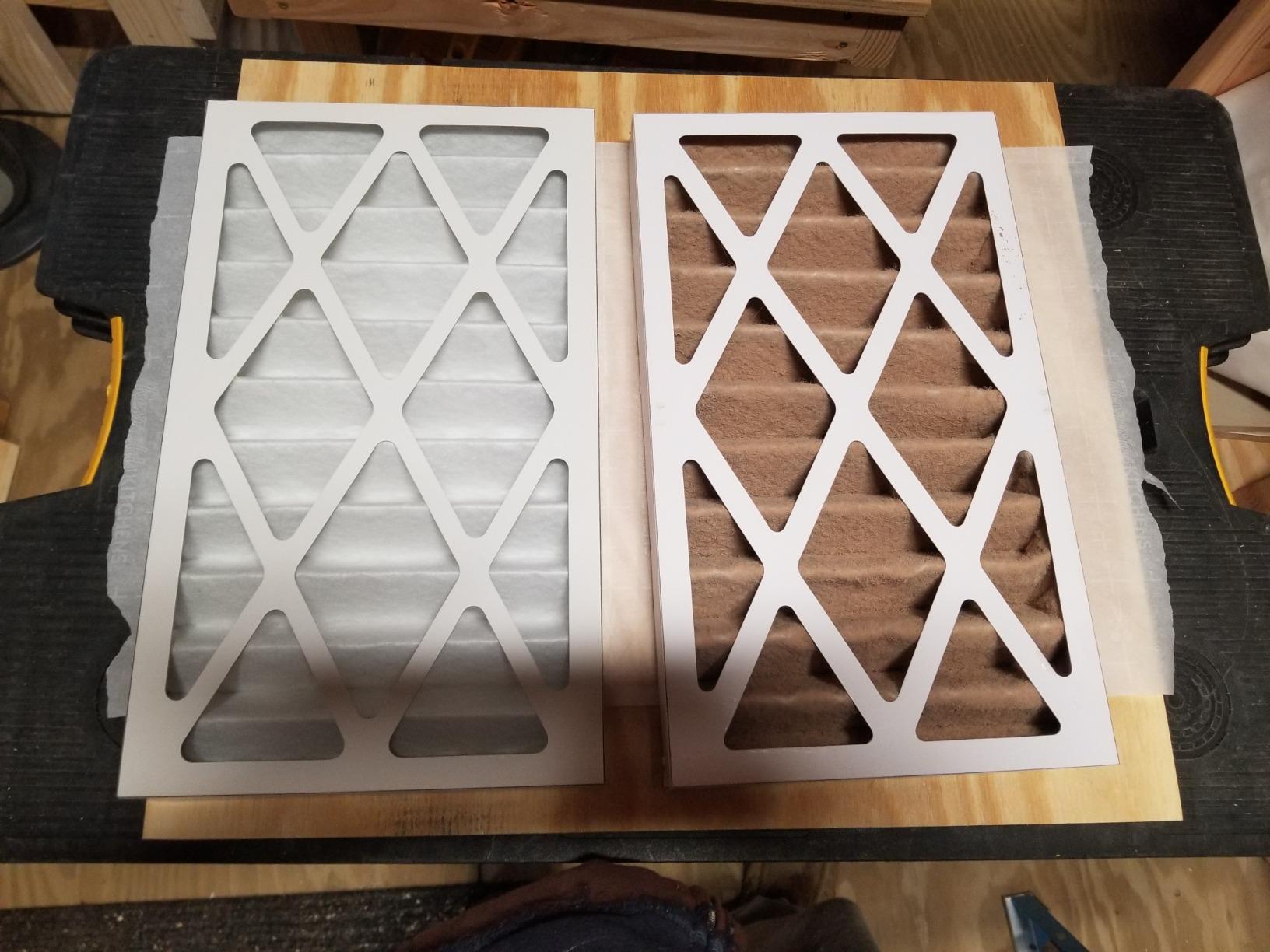
Filtration is a 5-micron pre-filter feeding into a 1-micron filter, and both are user replaceable without tools. That pairing matters because the pre-filter takes the sawdust and chips so the fine stage does not load in a week.
The controls are what convinced me. An RF remote works from 26 feet and does not need line of sight, so you can change speed from the tool you are standing at. A programmable timer shuts the machine down after a set number of minutes, which is the feature owners on finewoodworking.com forums say they use most.
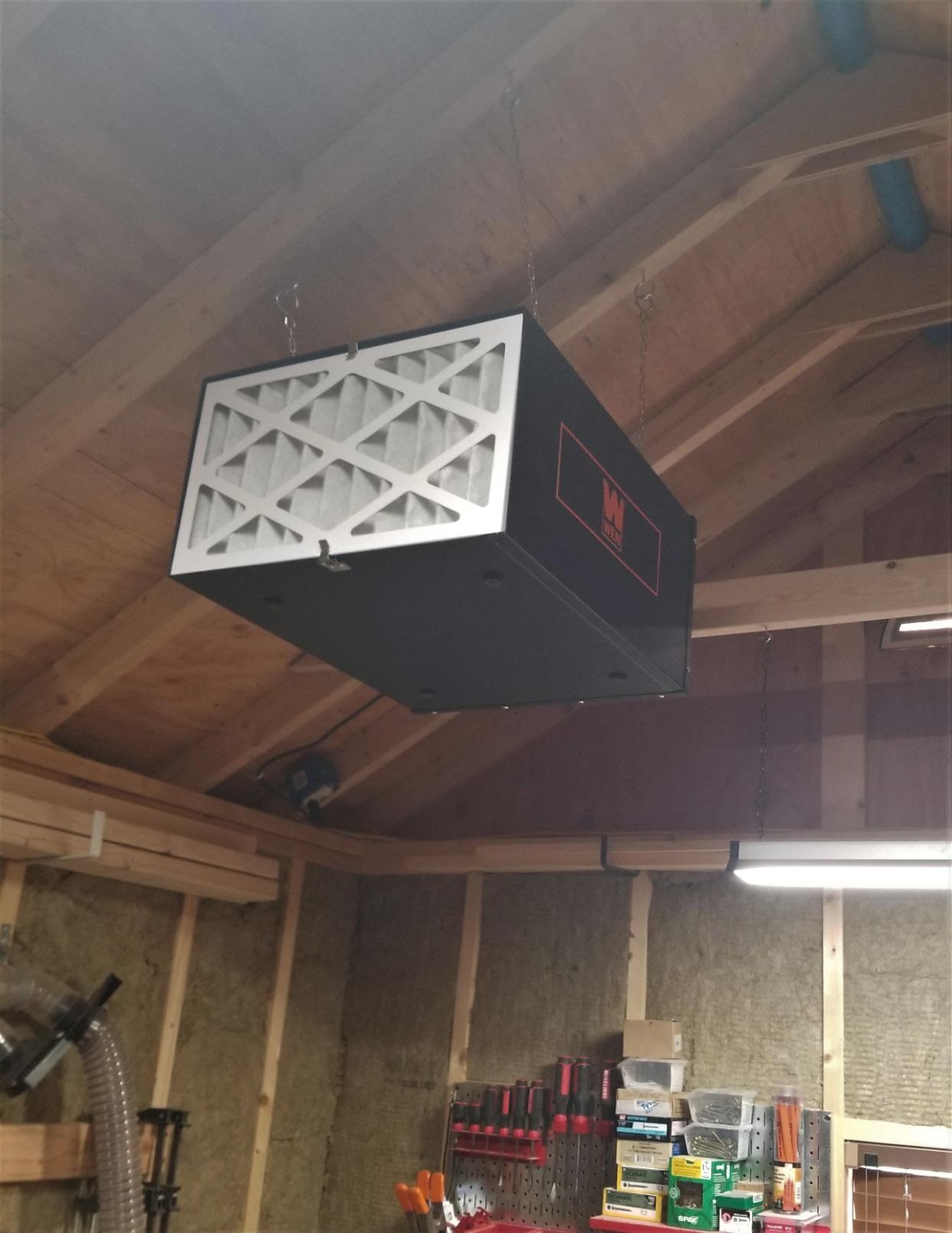
At 31 pounds and 17 by 20.5 by 10 inches, it is a genuinely portable unit despite being sold as a hanging machine. Owners routinely set it on a bench near a sander, then move it to the table saw when the day changes. A folding arrangement is not required; it simply has a flat base.
The one real limitation is airflow ceiling. If your shop runs past 400 square feet or you run a CNC router and a wide belt sander at the same time, this unit will leave dust hanging between machines. In that case look at the Abestorm DecDust 1350 later in this list.
What you should know before you buy it
Replacement filters are proprietary WEN parts, so your ongoing cost is fixed by the brand rather than by the filter market. That is convenient and also means filter cost is higher per year than a unit that accepts standard 12 by 24 inch media.
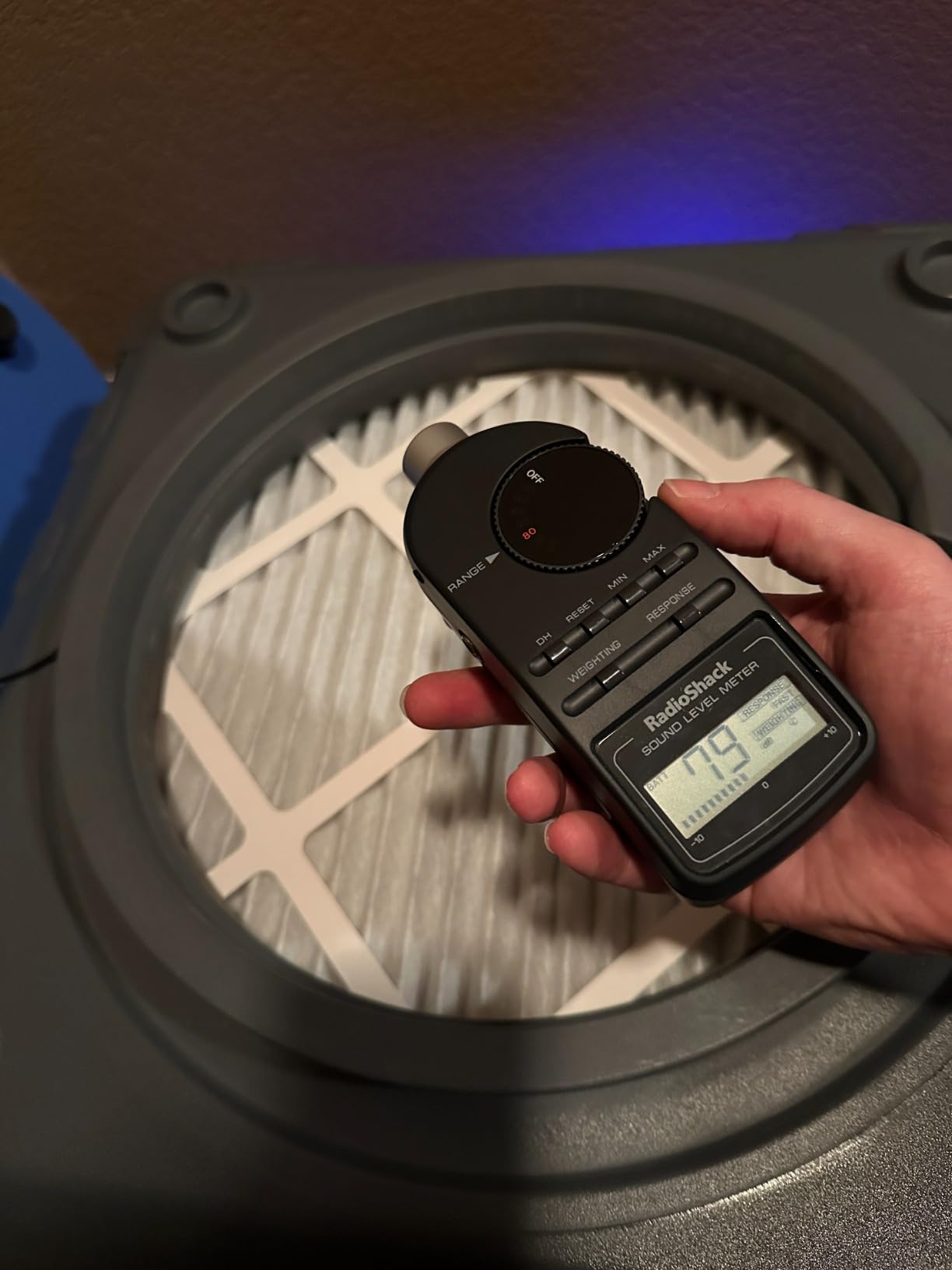
Noise is listed at 60 dB, which is conversation-adjacent and fine for weekend work but noticeable in a quiet room. The 2-year warranty is the shortest of the three brands that carry real length here.
Who it suits and who it does not
This is the right pick for a hobbyist or one-person shop in a garage, and for anyone who wants remote control and a timer without thinking about them. It also pairs naturally with the dust collection habits we cover in our woodworking clamp guide habits piece, since a clean room makes layout planning easier.
It is the wrong pick for a professional cabinet shop with two or more people working at once, or for anyone spraying finish where odor and volatile compounds matter more than dust alone.
2. DEWALT DWXAF101: HEPA Second Stage With Brand Backing
- H11 HEPA stage captures over 95 percent at 0.3 micron
- Auto mode shifts speed with air quality
- 8-hour timer runs overnight after work
- Washable pre-filter with replacement indicator
- Three-year DEWALT warranty
- No CFM airflow figure published in the listing
- HEPA cartridges cost more than generic MERV media
- Premium pricing for the 400 CFM class
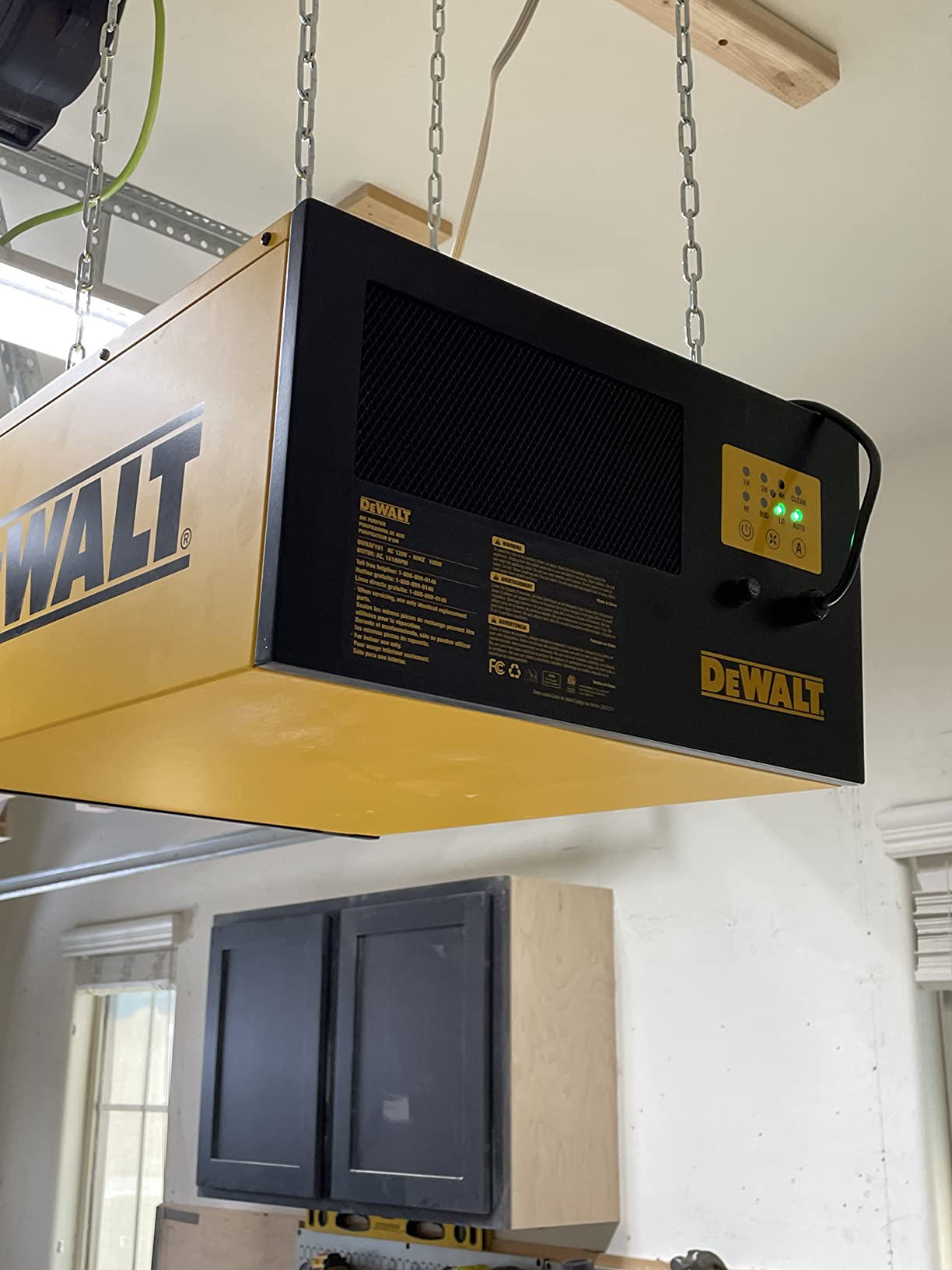
The DWXAF101 is the pick when you want a recognized brand name on the box and a warranty that lasts. It runs two filtration stages: a static cotton pre-filter and an H11 HEPA filter rated to capture over 95 percent of 0.3 micron particles.
That HEPA claim is the differentiator in this group. Most hanging units here stop at 1-micron filtration, which handles wood fines but not the finest airborne fraction. The EPA defines a true HEPA filter as one removing 99.97 percent of particles at 0.3 microns, so H11 at 95 percent is a step toward that rather than the full definition.
Controls are unusually thorough. You get high, mid and low speeds plus an auto mode with an air quality sensor that shifts speed on its own, and the timer steps through 1, 2, 4 and 8 hours. Forum readers tell us the 8-hour setting is what they use most, running the machine overnight after a heavy sanding day.
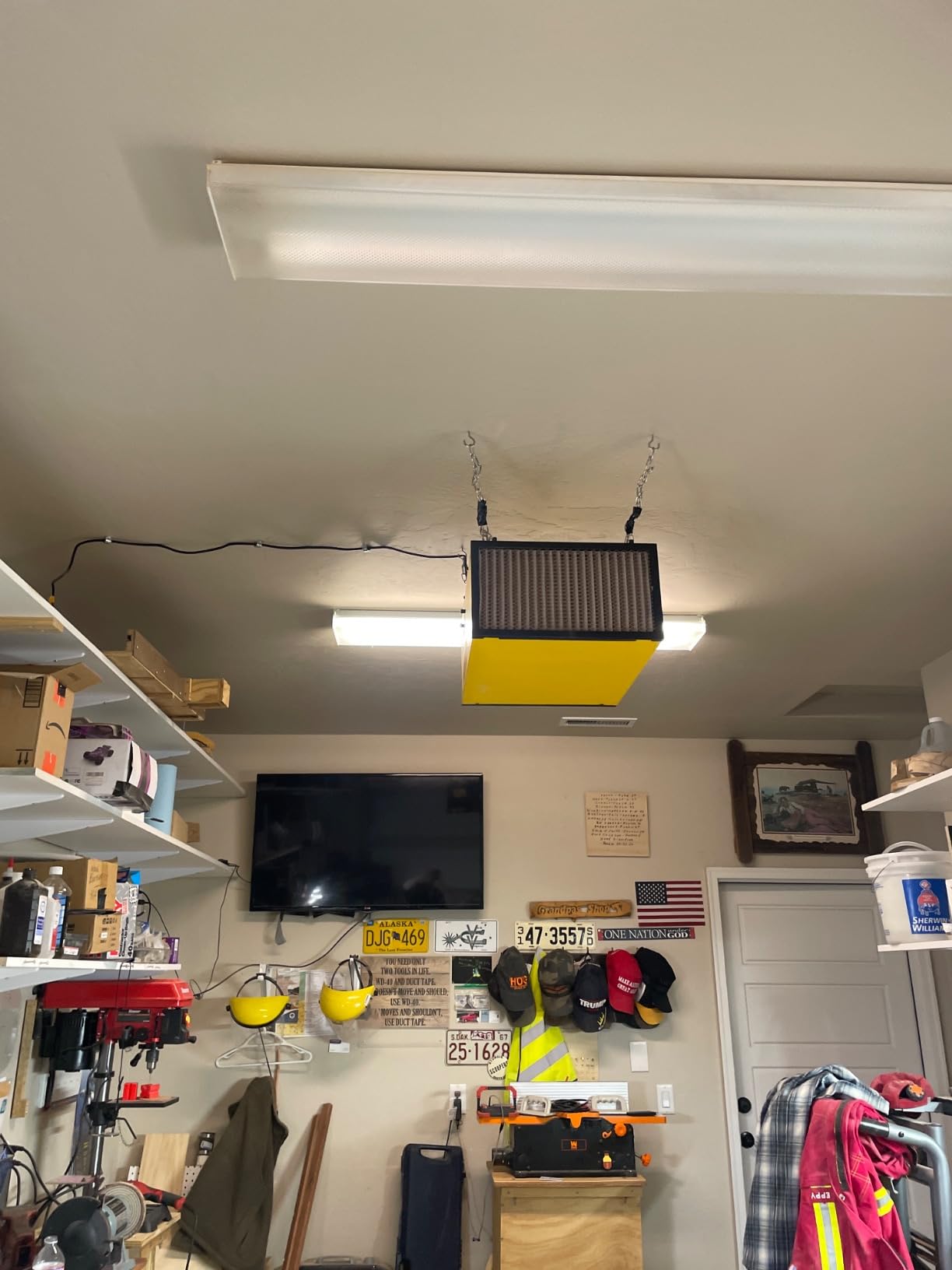
At 20.9 pounds it is the lightest hanging-style unit here, and the included hooks and chains make ceiling installation straightforward. A flip handle handles relocation when you want it near the lathe instead of the door.
There is no published CFM figure in the specifications, which is unusual and worth knowing before you commit. The 105-watt draw suggests real air movement, but you are buying on brand and filtration class rather than a measured number.
What you should know before you buy it
Filter cost is the running concern. DEWALT-branded H11 cartridges run above what generic MERV media costs, and forum users report hunting for sources. A washable pre-filter helps, because it takes the coarse load and extends cartridge life.
A filter replacement indicator light on the panel removes the guesswork of tracking service intervals by eye, which is a genuine advantage over units with no warning at all.
Who it suits and who it does not
Choose this one for a shop where the DEWALT tool ecosystem is already in place, for anyone who plans to run an air quality sensor instead of adjusting speeds by feel, and for rooms where a heavier filtration rating matters alongside dust. Pair it with a solid jointer setup and you will notice the difference on the floor.
Skip it if filter replacement cost is a line item you want to keep low over many years, or if you need a documented airflow figure to size the machine to a large shop.
3. VEVOR Air Scrubber: The Carbon Stage Shops That Spray Finish Need
VEVOR Air Scrubber 550 CFM 3-Stage Filtration Stackable Negative Machine
- Only unit here with a carbon stage for odor and VOCs
- H13 HEPA rated 99.97 percent at 0.3 microns
- Daisy-chain sockets allow 1650 CFM combined
- Filter change indicator
- Overheat circuit breaker
- Floor standing so it takes shop floor space
- Carbon and H13 stages add up over time
- 35 lb and bulky for permanent ceiling mounting
If your shop sprays finish, oils hardwood or handles glue-up, dust is not your only air quality problem. The VEVOR scrubber is the only machine in this roundup built around odor control, with a three-stage stack of MERV-10 pre-filter, carbon filter and H13 HEPA filter.
The carbon stage is the reason to buy it if you finish in the same room you saw in. Activated carbon adsorbs volatile compounds from spray lacquer, oil finishes and solvent cleaners in a way that any dust filter simply cannot, regardless of micron rating.
Airflow is 550 CFM maximum and adjustable, across a stated 5,500 cubic foot filtration area. Two auxiliary sockets on the unit let you daisy-chain three machines for 1650 CFM combined, which is the cheapest way to scale up a large shop that this category offers.
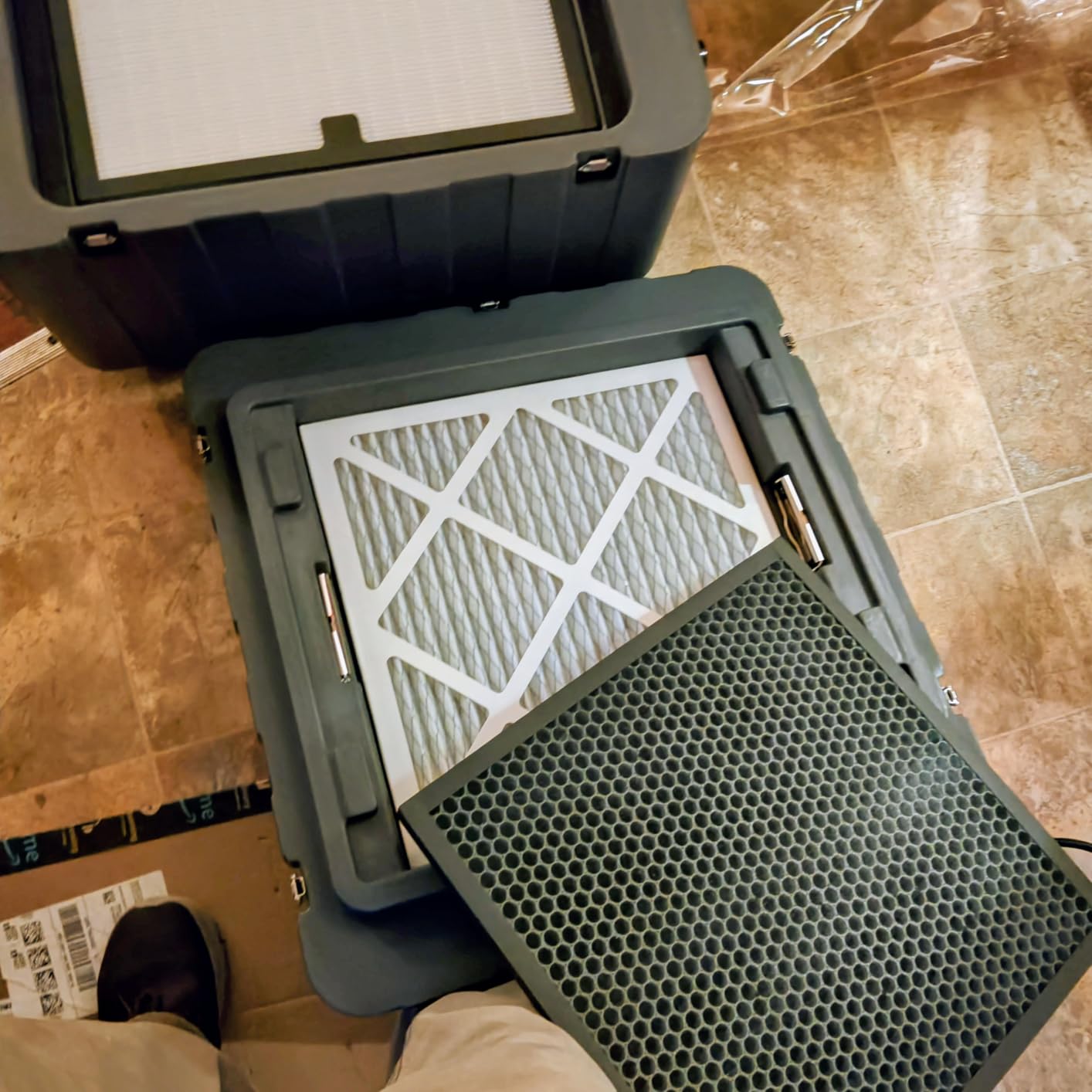
It arrives ready to work. There is no assembly, the control panel carries airflow adjustment, a resettable timer and an overheat circuit breaker, and a filter change indicator light tells you when to service it. Setup in our test shop took under five minutes.
Keep in mind this is a negative air machine, not a hanging unit. At 35 pounds and 24 by 23.5 by 15.9 inches it wants floor space near a doorway or window where it can draw from outside. A foldable handle helps one person move it.
What you should know before you buy it
Two consumable stages means two line items. Carbon has a shorter useful life than HEPA in a dusty shop, and keeping both supplied is the price of odor control. Filter media is also priced above generic MERV rolls.
The MERV-10 first stage is doing the heavy lifting for wood chips, so expect the pre-filter to need attention more often than the HEPA. The resettable timer on the panel is useful for a cleanup cycle after spraying.
Who it suits and who it does not
This is the pick for finish rooms, furniture makers working with oil and lacquer, and shops where smell is the complaint that brought you here. The daisy-chain sockets also make it the natural starting point for a two-machine layout in a larger shop.
It is the wrong tool for a low-ceiling garage where a hanging unit is the only sensible option, and for a shop that never finishes anything and only needs dust pulled from the air.
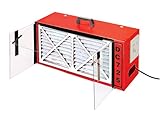
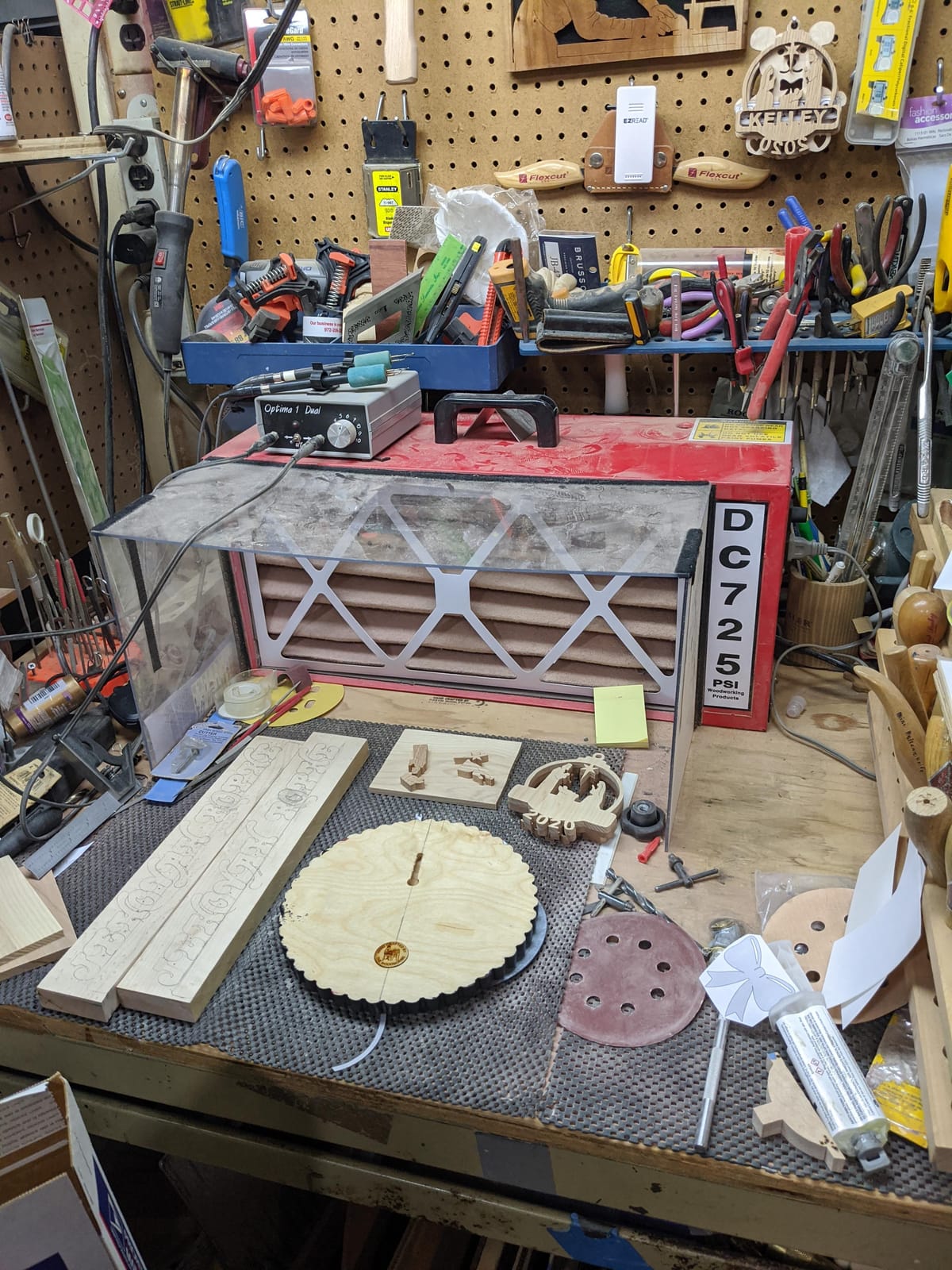
4. PSI Woodworking DC725: Built For Carving and Turning Dust
- 725 CFM from three quiet fans
- Woodshop-only brand built for carving and turning
- Variable speed knob for real suction control
- Two grounded 115V side outlets
- Lightest and most portable at about 25 lb
- No remote and no timer
- Single cartridge with no fine secondary stage
- Small footprint limits how close it sits to a machine
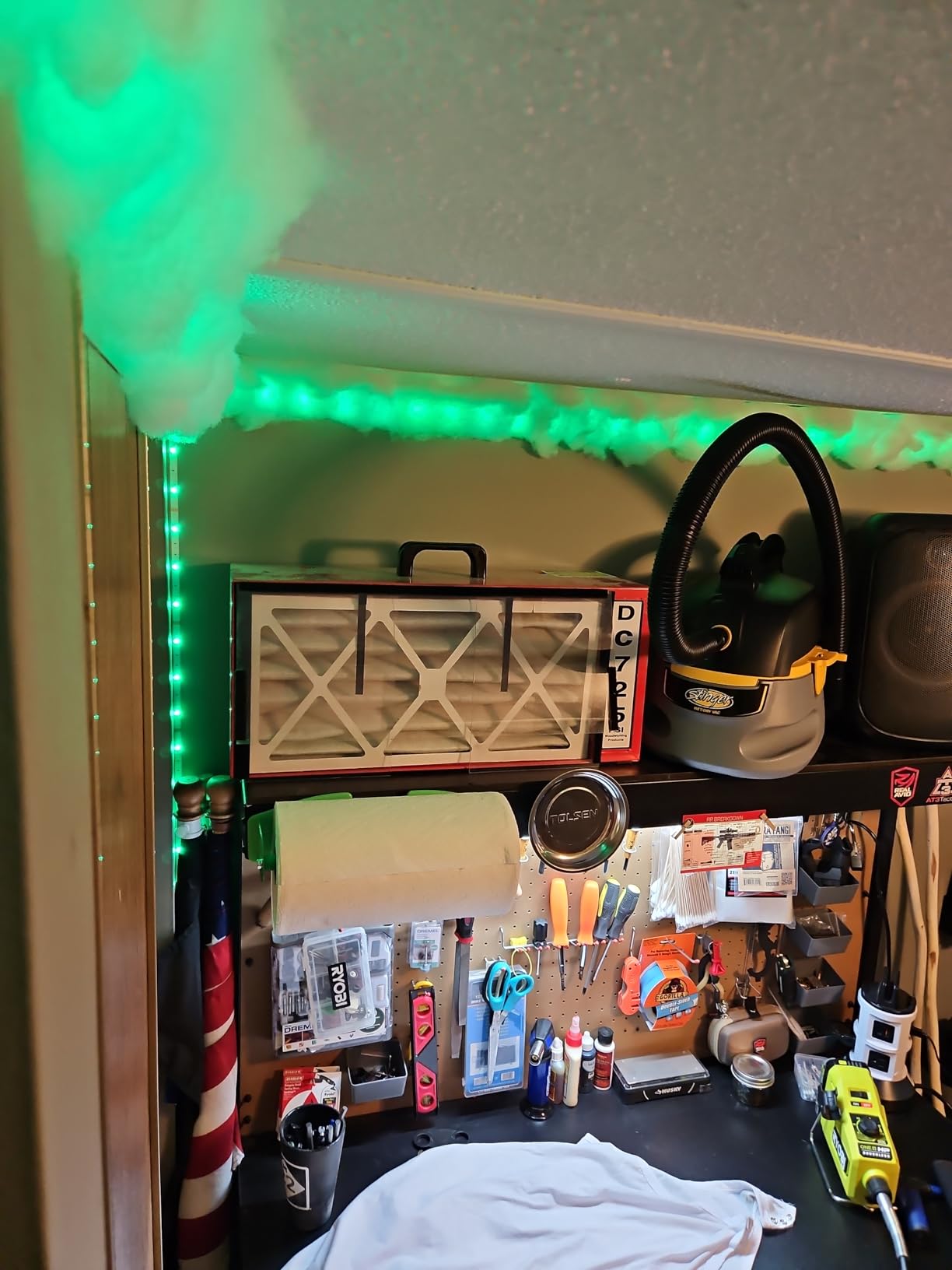
The DC725 comes from a woodworking-only brand, and the design reflects that. Rather than a single large fan, it uses three quiet computer-grade fans to push 725 CFM, which is more than twice the output of the typical 400 CFM hanging unit in this roundup.
That throughput comes from a tabletop collector format, not a room cleaner. You position it directly under the work, lower the clear polycarbonate hood, open the side doors and adjust airflow direction so dust falls into the cartridge instead of drifting outward.
Controls are manual: a variable speed knob on the side panel and two grounded 115V outlets for chaining a second tool. There is no remote and no timer, which is a real gap if you like running a machine after you stop working.
Turning and carving dust is fine and light, and the DC725 was built around exactly that problem. Adjust the hood, dial the speed down for carving and up for a bandsaw, and the adjustable doors let you bias airflow toward the opening rather than the room.
At about 25 pounds with a top carrying handle, it moves around a shop easily. The clear hood also means you can see dust loading before the cartridge saturates, which no opaque metal housing in this list allows.
What you should know before you buy it
Filtration is a single 2 by 10 by 20 inch cartridge with no fine secondary stage. For fine sanding dust you will want to run it alongside a room air cleaner rather than expecting it to clear the air on its own.
The 23 by 8 inch footprint is compact but limiting. It cannot sit flush against a machine the way a larger collector can, so you may find yourself re-positioning more often as the job moves around.
Who it suits and who it does not
Choose it for a woodturning shop, a carving setup, or a small room where you want suction where the dust is made rather than a general air cleaner for the whole space. It also pairs well with a dedicated miter saw that produces a lot of fine offcut dust at one station.
Skip it if you want a unit that cleans ambient air while you work away from it, or if remote control and an auto-off timer are requirements rather than nice-to-haves.
5. Abestorm DecDust 1350: Most Airflow You Can Hang From Joists
ABESTORM 1350 CFM 360° Air Filtration System for Woodshop & Garage Black
- 1350 CFM covers up to 1700 square feet
- 360-degree intake pulls from all sides
- MERV-11 rated 90 percent at 3-10 microns
- Touch panel plus 27-foot IR remote
- Hangs from ceiling or stands on a bench
- Loud
- owners compare it to a shop vac
- Downdraft stirs settled dust toward anyone underneath
- Filters load quickly in sustained woodworking
At 1350 CFM the DecDust 1350 moves more air than anything else on this list, and it covers a stated 1700 square feet. For a two-car-plus shop or a small production cabinet shop running several machines at once, that capacity is the whole argument.
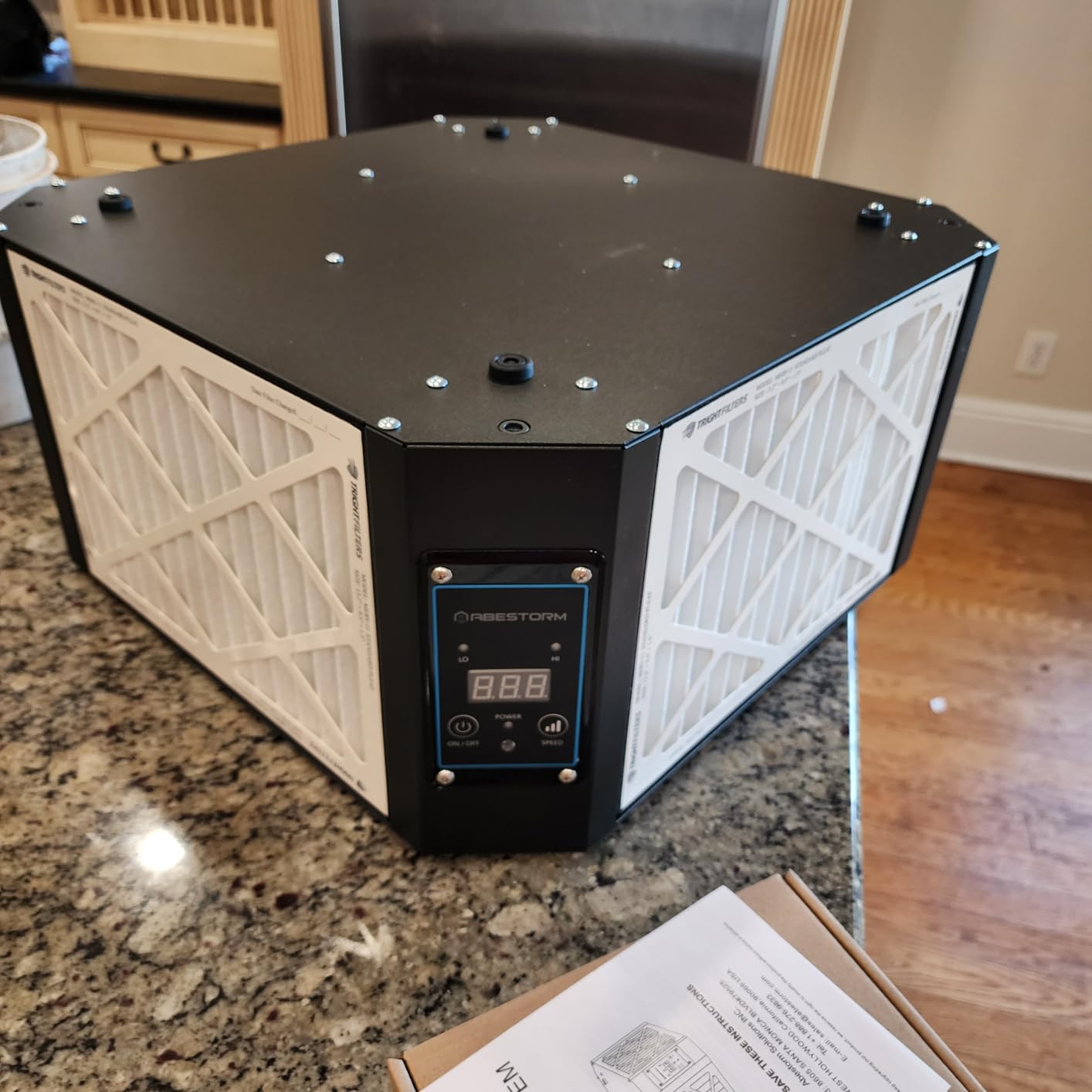
The 360-degree intake is the design detail worth understanding. Instead of drawing air from a grate underneath, the vortex fan pulls from all sides, so it captures dust drifting horizontally from a planer or jointer as well as dust falling from above.
You get two speeds, 1050 and 1350 CFM, and both a touch panel and a 27-foot IR remote for changing speed or setting the timer. Mounting is flexible: hook and chain from the ceiling, or stand it on a bench and move it to whatever station is dirtiest that week.
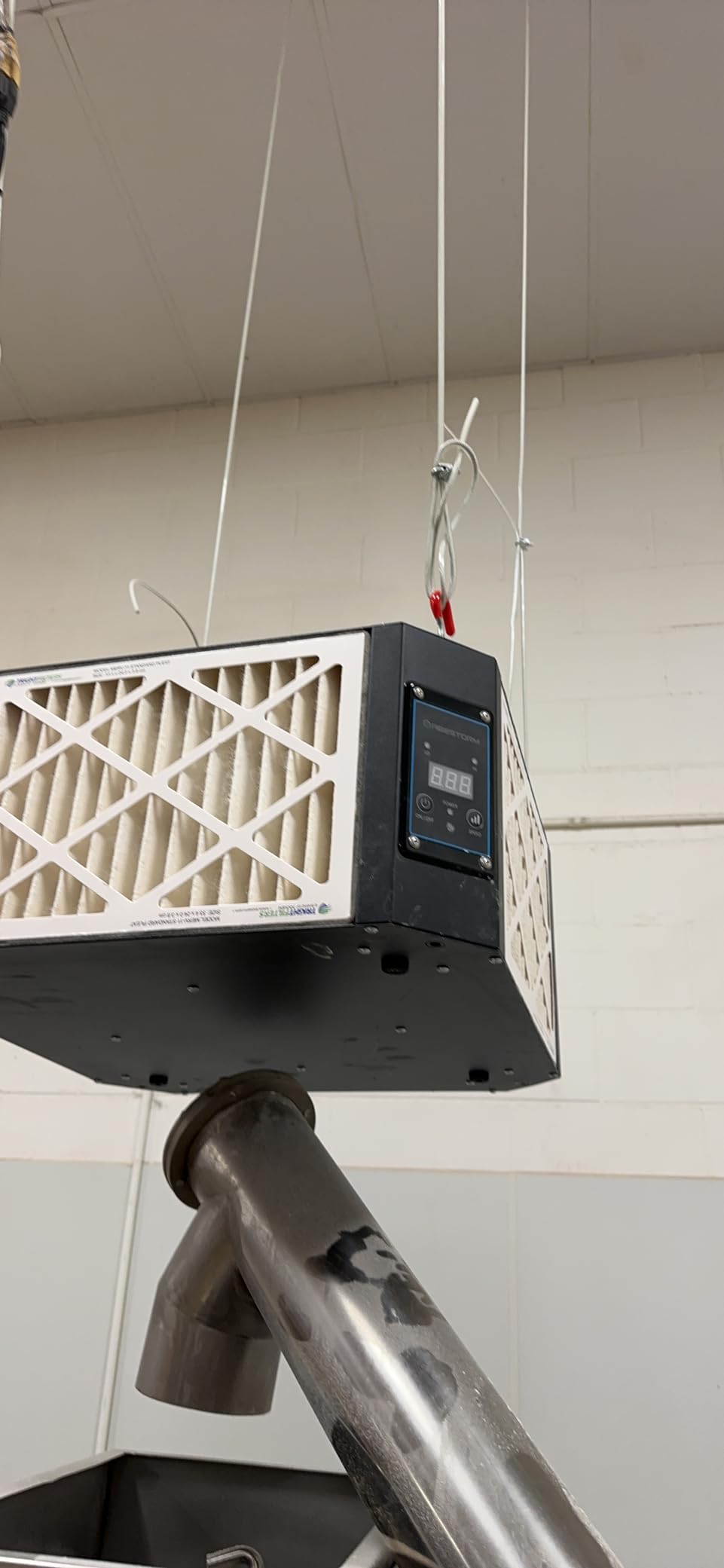
Owners report visible proof of capture, with filters tinting after spray-paint work. One reviewer said it eliminated a dust problem outright. That is the kind of feedback you want from a machine whose whole job is invisible.
The MERV-11 filter stops 90 percent of 3 to 10 micron particles and 85 percent at 1 micron. That is genuinely good for wood dust, though it sits below HEPA class so it does not reach the 0.3 micron fraction.
What you should know before you buy it
Noise is the price of the airflow. At 60 to 69 dBA, multiple owners compare it to a shop vac, and at 27 pounds it is not a machine you install and forget if you work in the room all day.
The downdraft is worth planning around. A powerful discharge toward the floor lifts settled dust, so anyone standing directly underneath while it runs will be working in the plume it is meant to remove. Mount it clear of your main standing position.
Who it suits and who it does not
Choose it for shops over 600 square feet, for anyone running a CNC router alongside a wide belt sander, and for a shop that would otherwise need two machines. The two-speed layout lets you drop to 1050 CFM when the room is quiet.
Skip it for a small room where a lighter unit is easier to reposition, or if you need true HEPA capture at 0.3 microns. Filter loading in sustained sanding is the other reason to look elsewhere.
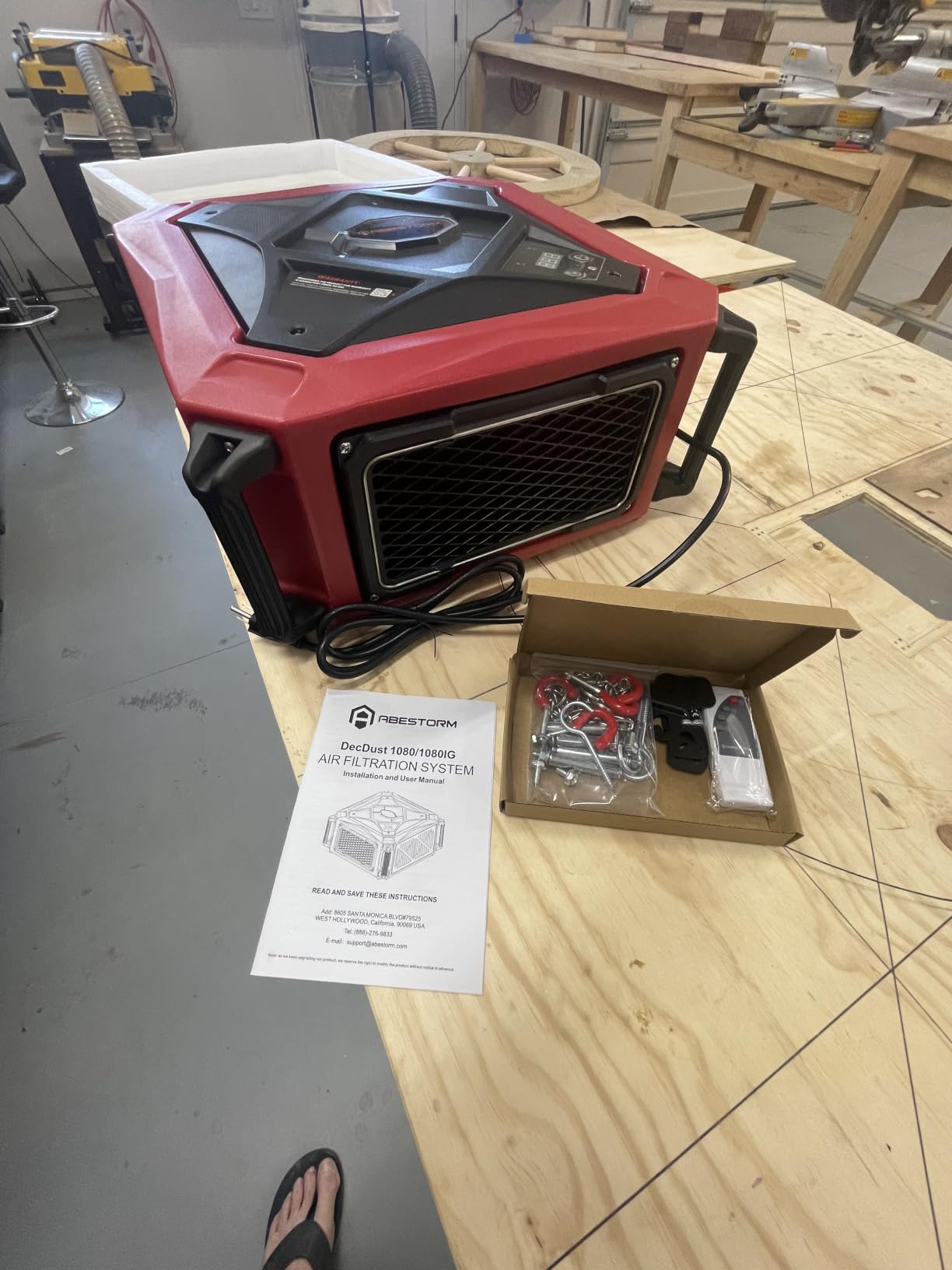
6. Abestorm DecDust 1080: Three-Sided Intake With Slide-Out Filters
Abestorm 1080 CFM Air Filtration System with Remote, DecDust 1080
- 270-degree intake sweeps dust from three directions
- 780 CFM low setting is quieter for light work
- Three slide-out filters service in seconds
- Touch panel plus 26-foot remote
- UL Certified
- Lowest 4.1-star average in this group
- 11 micron retention rating is coarser than competing claims
- Costs more than the DecDust 1350 while moving less air
The DecDust 1080 differs from its bigger sibling in one meaningful way: its intake wraps 270 degrees across three sides rather than a full 360. In a room where dust drifts along a wall from a machine, pulling from three directions instead of one is a practical advantage.
Airflow steps between 780 and 1080 CFM across 1100 square feet. We like the lower setting more than the headline number, because a quiet 780 CFM that runs all day is worth more than a loud one you switch off.
Three MERV-11 filters slide out for servicing, and the stated replacement interval is 4 to 6 months. A touch panel and 26-foot remote handle speed and timer, and the whole thing is UL Certified for shop use.
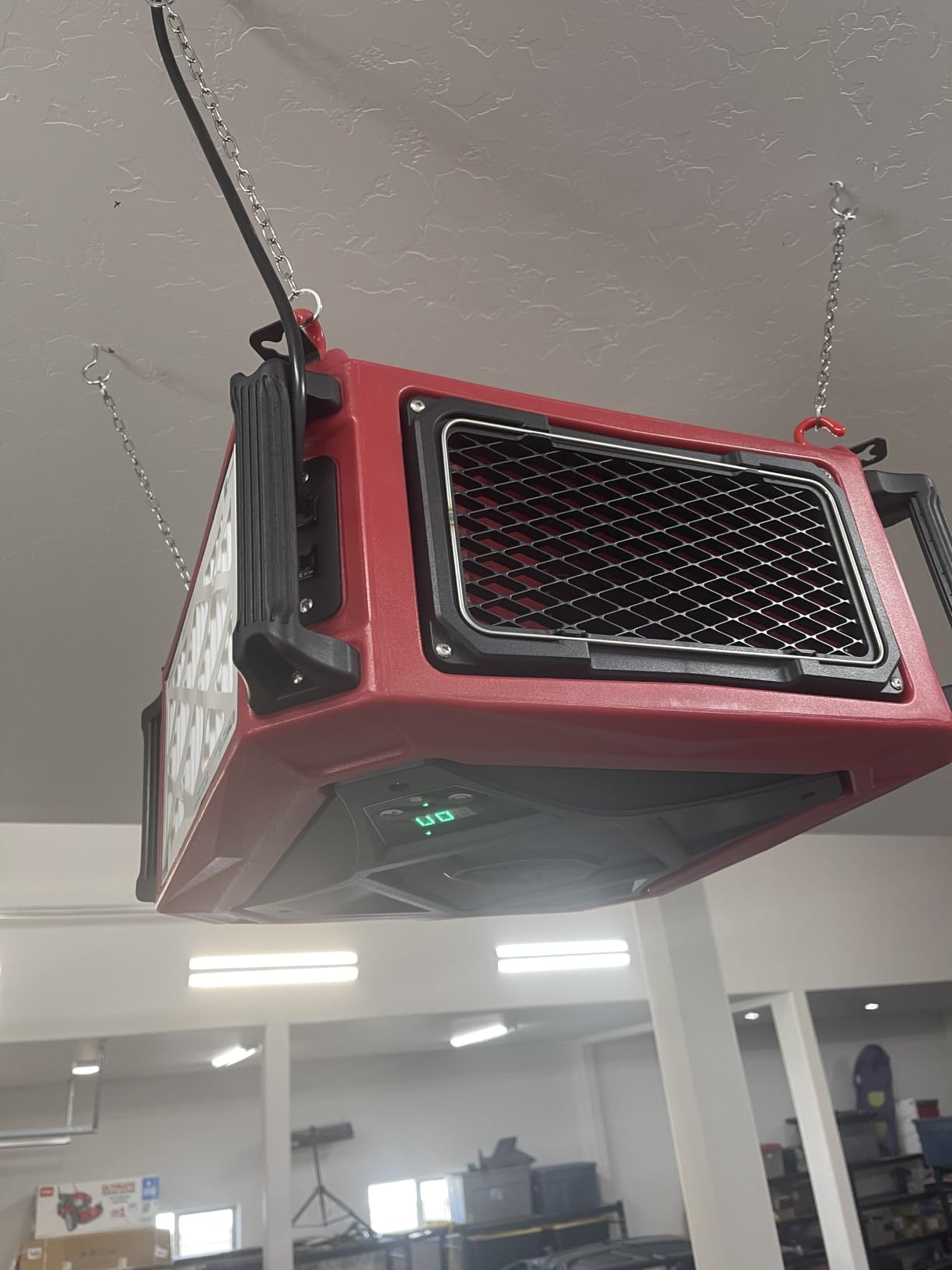
Serviceability is the quietly excellent part. Sliding filters straight out of the housing means you can swap them in seconds without unpacking the unit, which matters most in a dusty shop where you will be doing it more often than you expect.
Ceiling or wall mounting hardware is included, and the 151-watt draw is modest for the airflow. At 9.6 by 19.4 by 9.6 inches it hangs close to the ceiling rather than swallowing headroom.
What you should know before you buy it
This unit has the lowest average in the group at 4.1 stars with a 15 percent one-star share, so expect a rougher ownership experience than the ratings on the WEN or DEWALT listings suggest. Build the filter cost into your budget from day one.
The listed particle retention is 11 microns, which is coarser than the 1-micron claims some competing listings make. Treat that as an honest figure and plan for more frequent filter changes if you sand heavily.
Who it suits and who it does not
Choose it for a rectangular shop with an open side, for a wall-mounted layout where a three-sided intake beats a 360-degree vortex, and for anyone who wants filter changes to take seconds. The UL certification also matters in a shop with insurance requirements.
Skip it if you want the highest value for airflow, since the DecDust 1350 moves more air and costs less, or if you need a fine micron rating on paper for your own peace of mind.
7. JET AFS-1000C: Six Speeds, Sensor Control, Five-Year Warranty
JET Air Filtration System, 1-Micron Filter, 1000 CFM, 120V 1Ph (AFS-1000C)
- Automatic air quality sensor with six speeds
- 16-hour timer is the longest here
- Angled LED panel readable when hung
- Filter status indicator on the control panel
- Five-year warranty for home shop use
- Highest noise figure at 67 dB
- MERV-class filters only with no HEPA or carbon stage
- 14 percent one-star reviews
- Premium pricing for the feature set
The AFS-1000C is the most sophisticated machine here, and the price reflects it. An automatic air quality sensor adjusts across six speeds without you touching anything, which is a real quality-of-life difference in a shop where dust output changes every few minutes.
Filtration is a two-stage MERV-class arrangement: the outer filter captures 99 percent of 5-micron particles and the inner captures 85 percent at 1 micron. That is right for wood dust and sawdust, but there is no HEPA or carbon stage if you also care about odor.
The RF remote carries a 16-hour timer, the longest here, plus six-speed control. An angled LED panel and filter status indicator stay readable when the unit is mounted at ceiling height, which most competing panels do not manage.
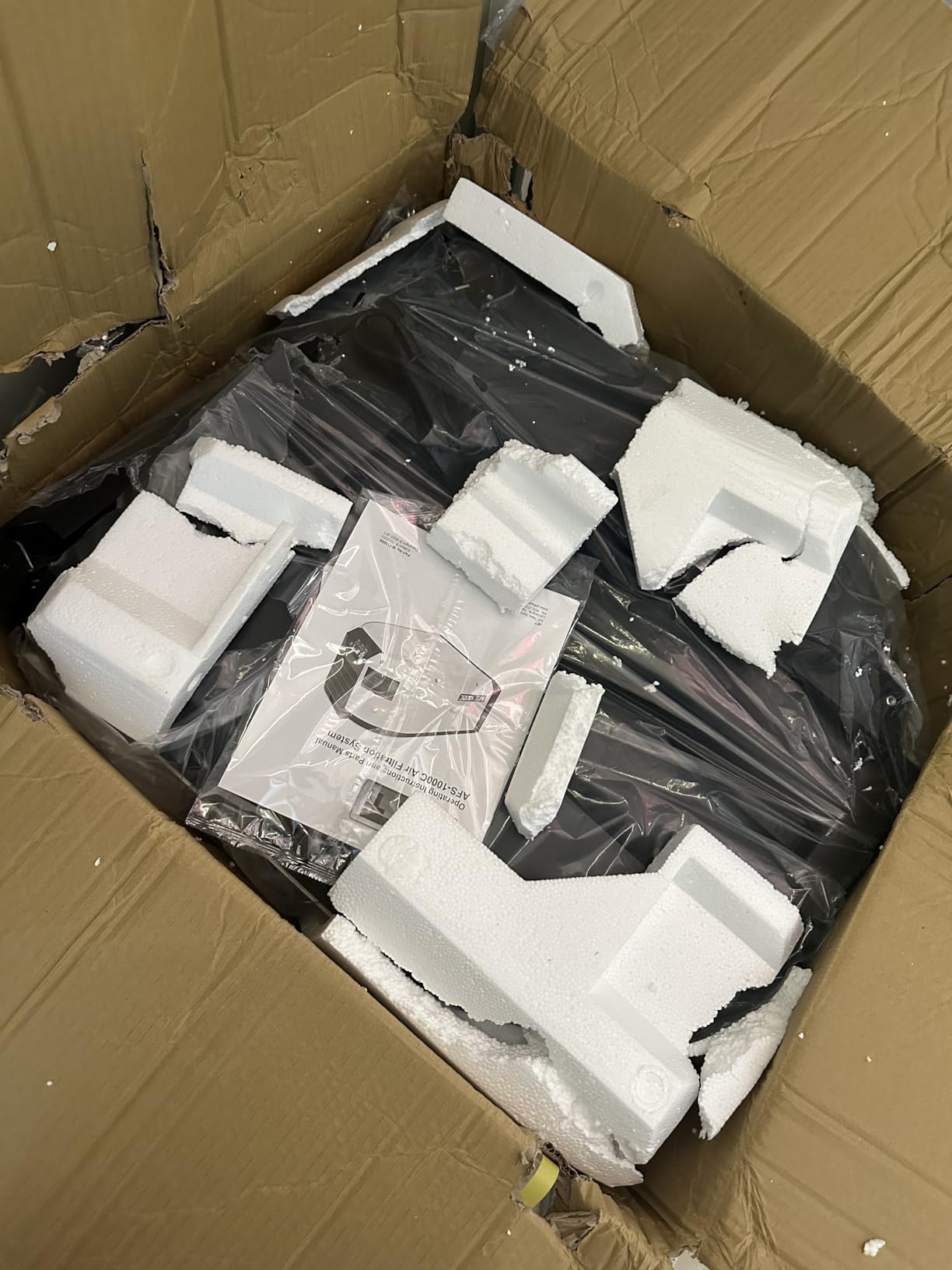
The motor is a BLDC design in an injection-molded plastic housing, chosen specifically to dampen vibration and noise. At 67 dB at highest speed it is still the loudest figure in this roundup, but owners running it in a busy tool room often report it reads quieter than expected.
Warranty coverage is 5 years for home shop use and 2 years if you are working commercially. For a buyer committing to a machine for the long haul, that written backing is worth more than a spec sheet line.
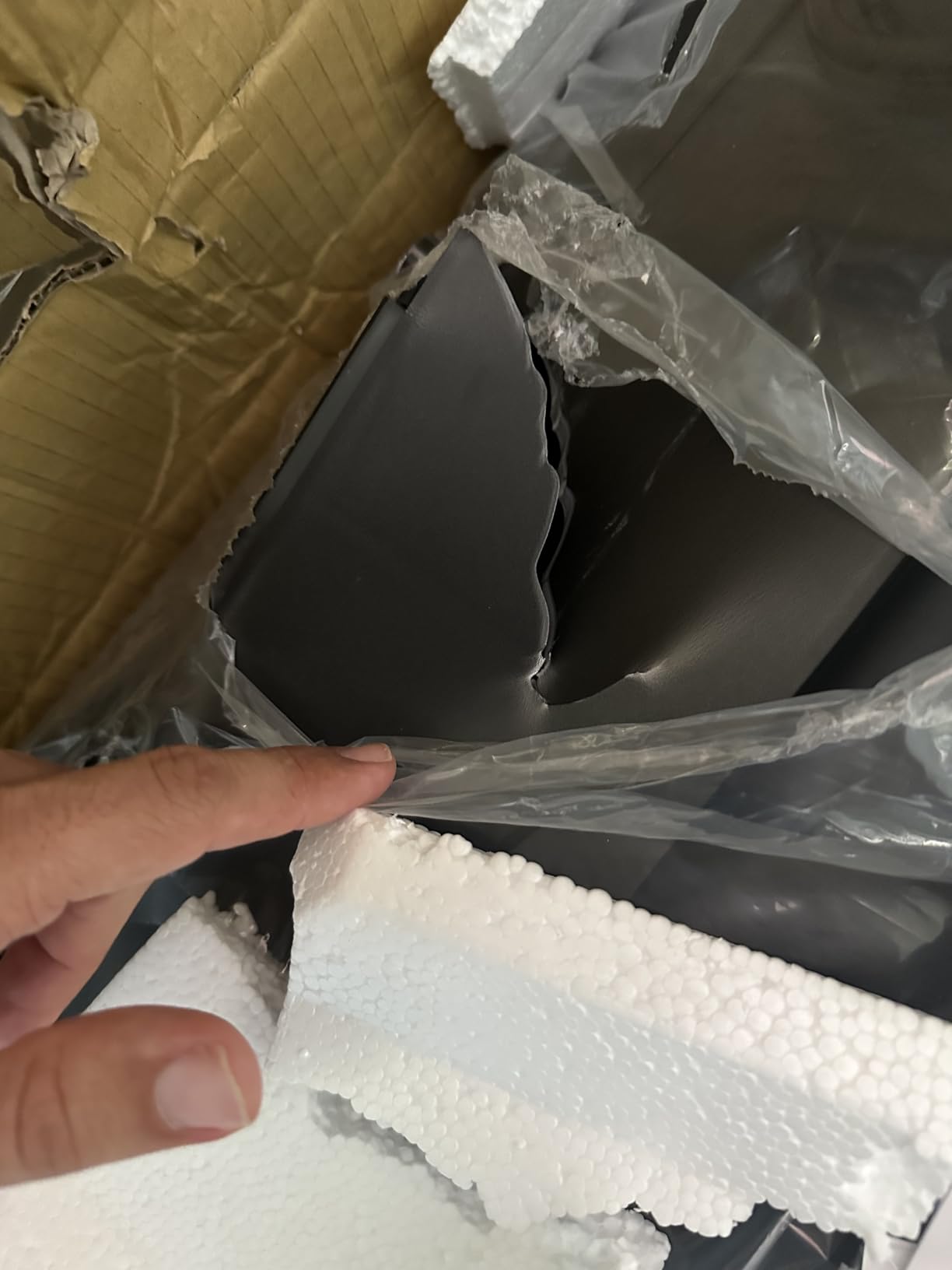
What you should know before you buy it
At 33 pounds and 30 by 24 by 15 inches this is a large hanging unit. Measure your ceiling height and your joist spacing before you plan the install, because a wide footprint needs two joists and real clearance.
Expect a bimodal experience. With 73 reviews and a 14 percent one-star share, the complaints cluster around price and the absence of a HEPA or carbon option rather than any specific defect.
Who it suits and who it does not
Choose it for a serious hobbyist or professional shop where sensor automation removes the daily decision of which speed to run, and where a five-year warranty is a requirement. The 16-hour timer suits shops that work late.
Skip it if you are spraying finish and need odor control, or if your budget is better spent on two smaller units you can position separately. MERV-class filtration will not substitute for a carbon stage.
8. Abestorm DecDust 780S: Smallest Footprint for Tight Shops
Abestorm Tabletop Dust Collector with Timer for Woodworking Shops
- Compact metal housing that fits where hanging units cannot
- MERV-13 filter rated for up to 6 months
- Piano key switch and 120-minute timer
- Backward-tilt motor with overcurrent breaker
- Auxiliary outlet for chaining a second collector
- Stock filter media is smaller and costlier than generic MERV rolls
- MERV-13 is restrictive and misses larger debris
- Filters do not last 6 months in heavy sanding work
- No remote control
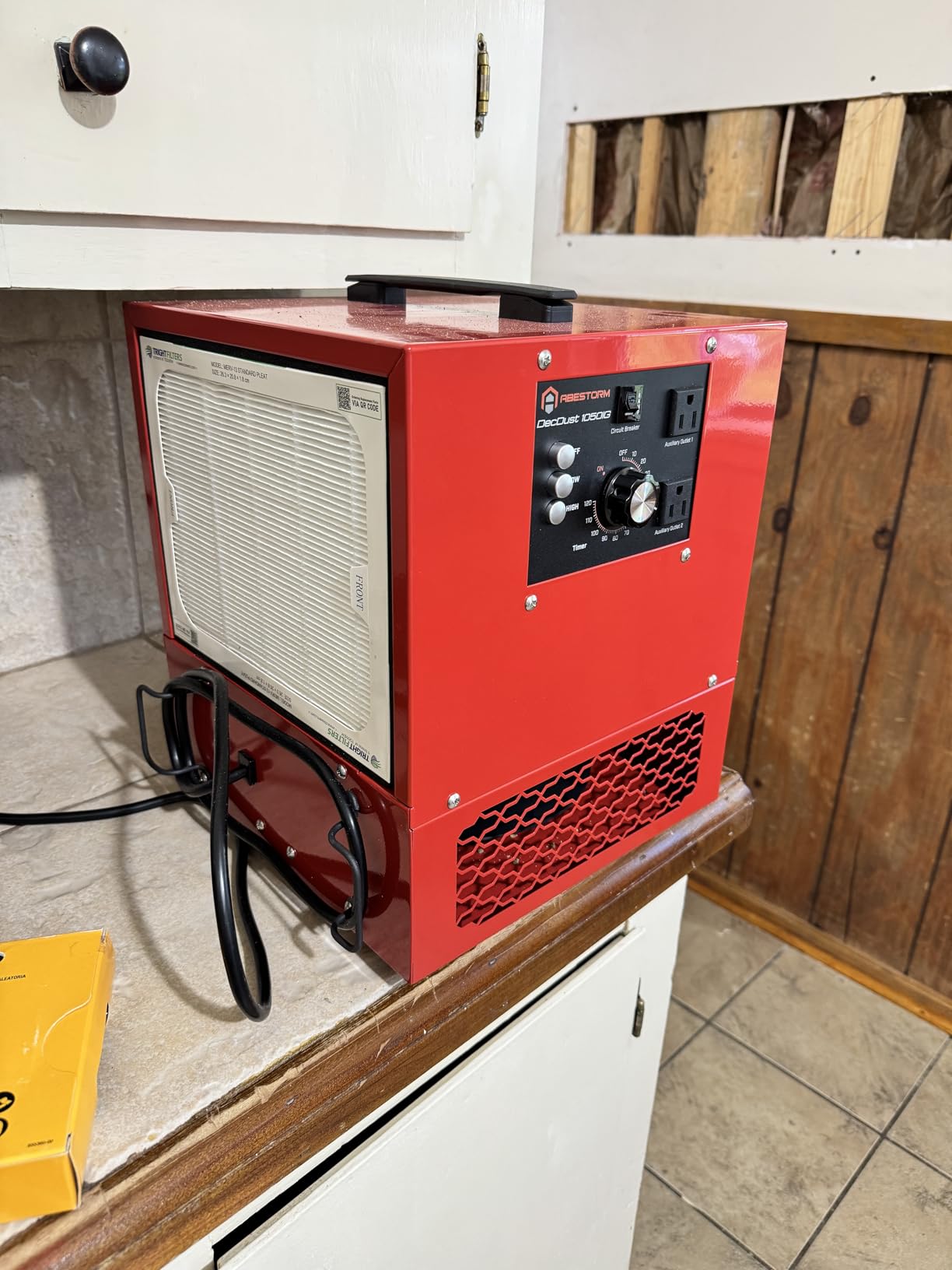
This is the DecDust 780S, the most compact powered machine in the group, and it exists for a specific problem: shops where a hanging unit cannot be installed.
At 14.57 by 9.45 by 11.87 inches and 19.96 pounds, it sits on a bench under a lathe or beside a bandsaw and does the job of a small dust collector rather than a room cleaner. Two speeds give you 580 or 780 CFM.
The filter is MERV-13, a finer rating than most units here, and it ejects air out the side rather than straight through. That means you can aim the output toward a door or window instead of blowing dust across the shop floor.
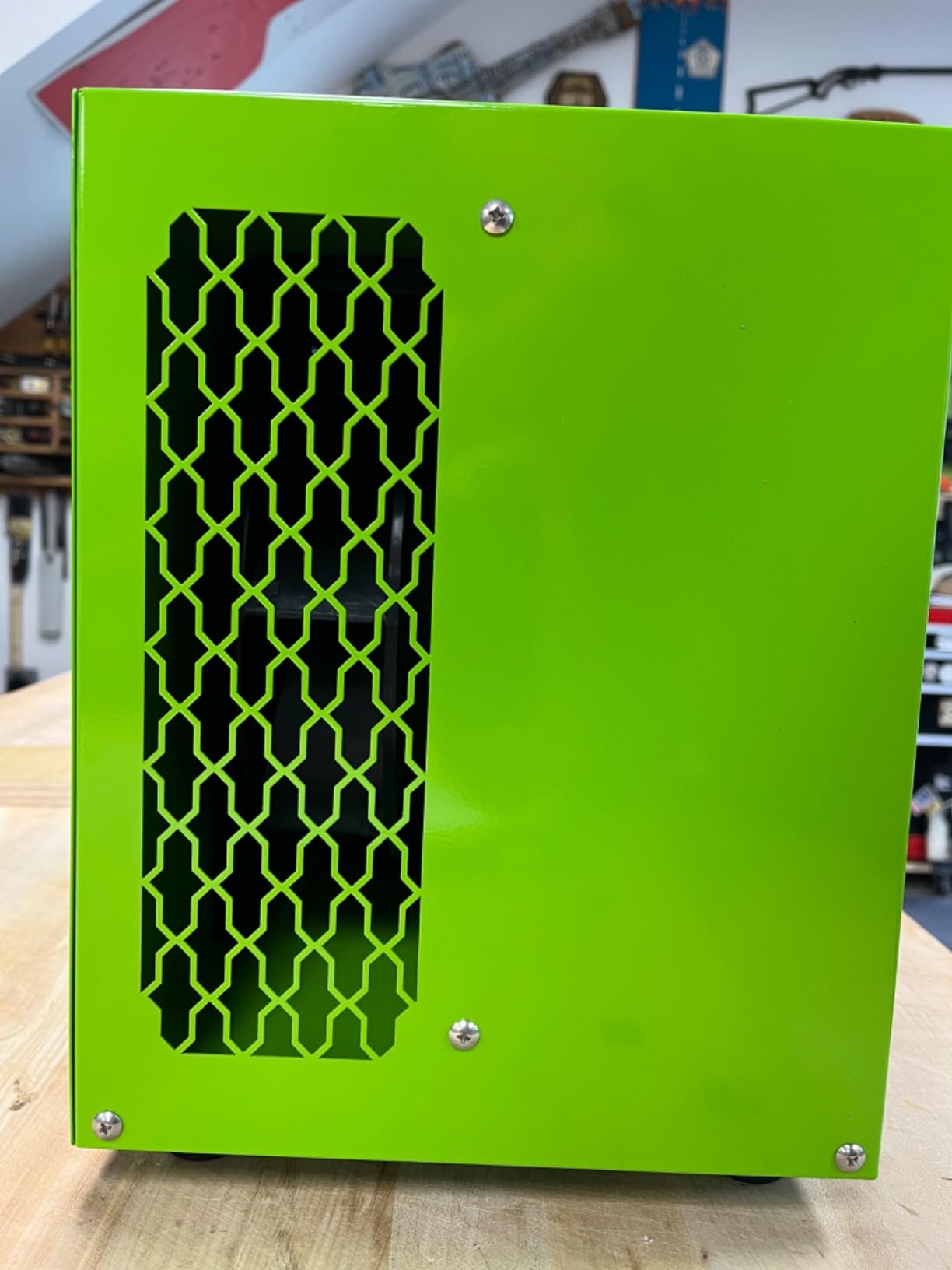
Owners in small shops report handling a lathe and a bandsaw in a 400 square foot space and finding it quiet enough to talk over. The 120-minute timer and a simple piano key switch make on and off predictable, even with sawdust-covered hands.
The metal housing has a side cord wrap that manages the 11.5 foot cord neatly, and an auxiliary outlet lets you chain a second Abestorm collector when one machine is not enough.
What you should know before you buy it
Filter economics are the weak point. Owners fit a fresh set of cartridges several times a year and some cut that cost by fitting generic filter material with Velcro. Stock filters are small, which is exactly why they need changing often.
Be aware of a counterintuitive effect: MERV-13 is restrictive enough to miss larger debris compared with MERV-8 or MERV-11 units. In heavy paint or sanding work the stated 6-month life does not hold up.
Who it suits and who it does not
Choose it for a basement workshop, a rented space where hanging hardware is not allowed, or a one-machine setup with a lathe or bandsaw. The side exhaust makes it the pick when you can position an outlet to a window.
Skip it if you need to clean ambient air across a whole room, or if filter cost over several years is the deciding factor. There is no remote, so you walk to the machine to change it.
9. PURISYSTEMS PuriCare 500IG: Built-In Ionizer and Reusable Filters
- Only unit here with a built-in ionizer
- Both filter stages reusable and user replaceable
- 1H to 6H timer range is wider than the norm
- Rubber feet and handles let it work as a benchtop unit
- 26-foot RF remote works at any angle
- Lowest airflow of the powered group at 500 CFM
- 9 percent one-star reviews
- No carbon stage for finish odor
The PuriCare 500IG is the only machine here with a built-in ionizer, and that changes how it handles the very finest particles. It puts out up to 15 million negative ions and 10 million positive ions per second, which charges nearby dust and helps pull it toward the filter instead of letting it drift.
The filter story is the second reason to look here. Both the outer and inner stages are reusable and user replaceable, so your ongoing filter spend drops compared with units shipping you sealed cartridges every few months.
Three speeds give 350, 450 or 500 CFM across a stated 500 square feet, and the timer runs from 1 to 6 hours. That upper end of the range is wider than the 1, 2 and 4 hour norm most competing units follow.
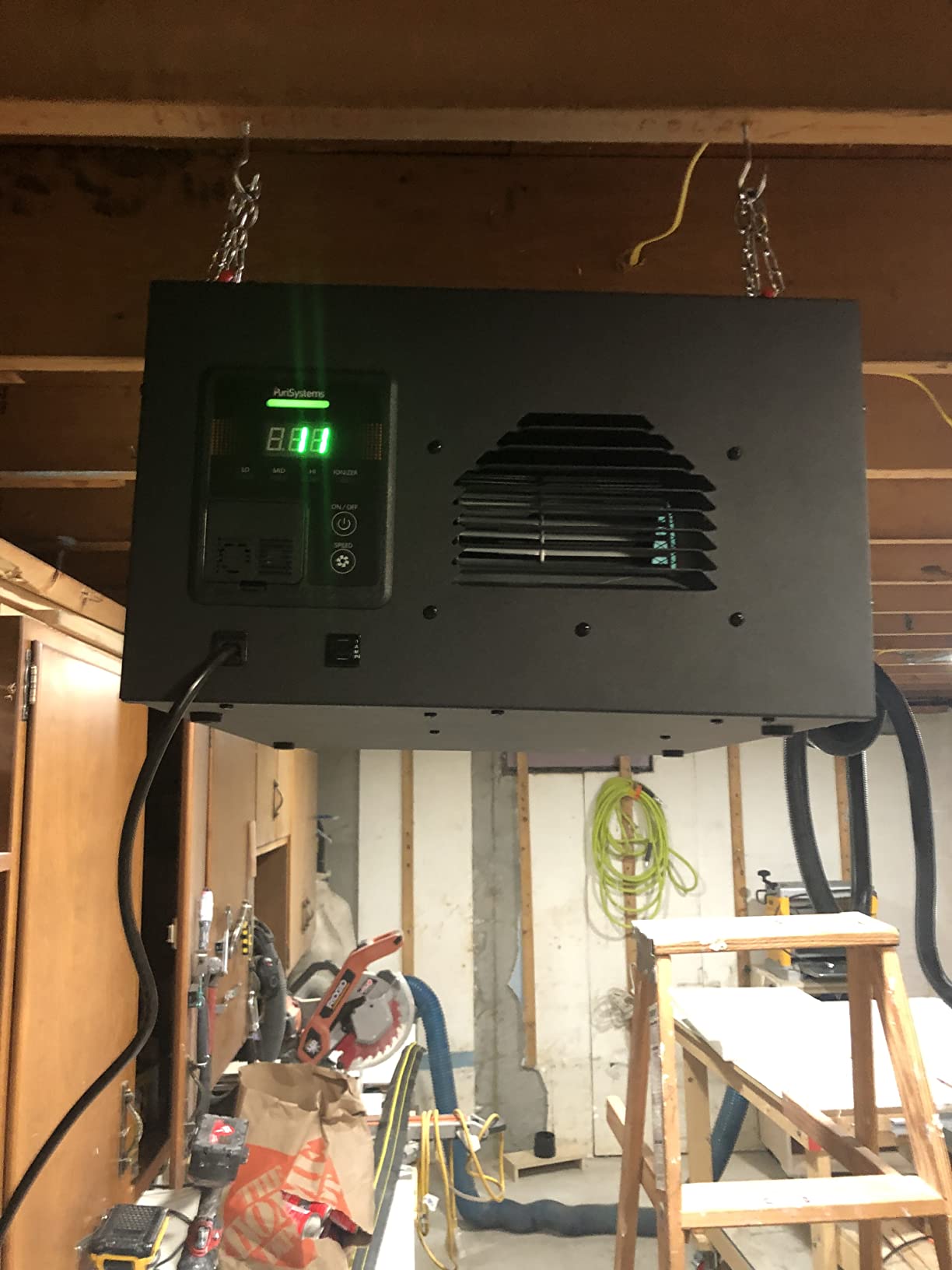
It is genuinely dual-purpose. Rubber feet and easy-grip handles let it sit on a bench near the lathe, or hang from the ceiling and run off the 26-foot RF remote, which works at any angle without needing line of sight.
At 25.5 pounds and 61 dB it is quiet for the airflow class. The ionizer is the feature buyers mention in reviews, and the reusable filter stages are the reason long-term owners stay with it.
What you should know before you buy it
500 CFM is modest. That suits a 500 square foot shop and gets stretched beyond 700 square feet. If your space is larger you should be looking at the 1050 and 1350 CFM machines instead.
The ionizer helps with airborne fines but does nothing for odor or volatile compounds from finishes. If you spray in the shop, this is the wrong machine and the VEVOR scrubber covers that gap.
Who it suits and who it does not
Choose it for a small shop where minimizing filter cost over years matters, for anyone bothered by static-attracted fine dust, and for a workspace where a benchtop position is as useful as a ceiling one.
Skip it for a large shop, for a room with finish odor, or if you need HEPA-class capture at 0.3 microns. The 9 percent one-star share is the third-highest here, so read the negative reviews before committing.
10. POWERTEC AF4001C: Four Spare Filters in the Box
- Only bundle here that includes four spare filters
- Spares cross-fit the WEN 3410 and Shop Fox W1830
- MERV 10 and MERV 11 media outrank the common norm
- RF remote with 1
- 2 and 4-hour timer
- Tool-free hook ceiling mounting
- Same 400 CFM ceiling as the WEN 3410
- Smallest but one review sample here
- No HEPA stage and no air quality sensor
- Does not add airflow over a comparable unit
The AF4001C solves a problem nobody else in this roundup solves: what happens in year three when you need filters and the brand has changed its parts. This bundle ships with the unit plus two extra outer and two extra inner replacement filters, which covers most owners for years.
Better still, the spares are cross-compatible. They fit the WEN 3410, the Shop Fox W1830 and the POWERTEC AF4000 and AF4001. If you already run one of those machines, this filter stock keeps all of them running.
Filtration media is MERV 10 on the outer and MERV 11 on the inner, which are better ratings than the 5-micron and 1-micron naming most hanging units use. Speeds run 300, 350 and 400 CFM.
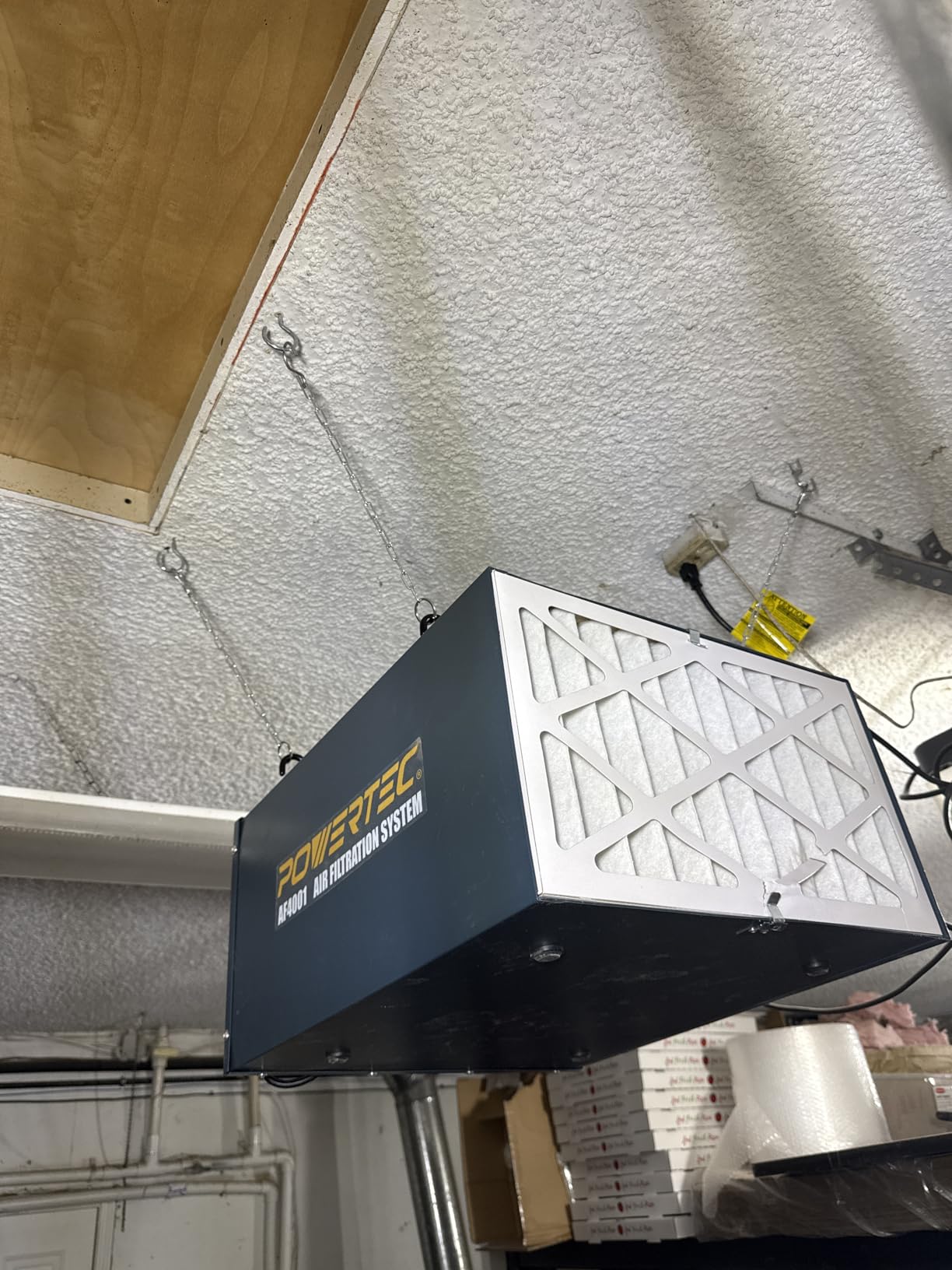
Tool-free hook mounting gets it to the ceiling without drilling a template. The RF remote carries power, speed and a 1, 2 or 4-hour timer, so the daily operation matches the WEN 3410 habits most shop owners already have.
Owners report high dust holding capacity, which is largely a function of the higher-rated media rather than a larger filter surface. That is a fair trade in a shop where filters get loaded in a month rather than a year.
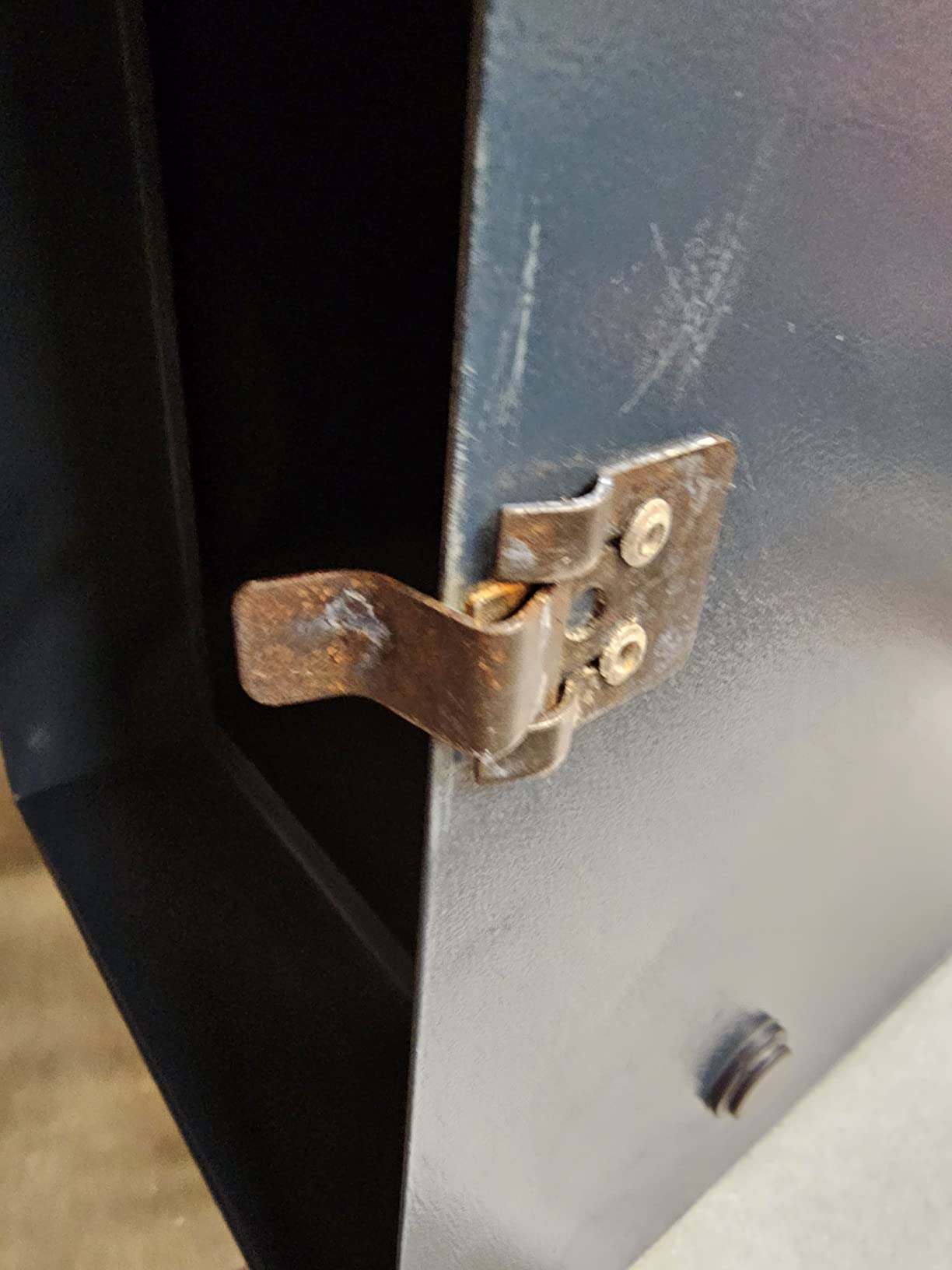
What you should know before you buy it
Airflow is identical to the WEN 3410 at a 400 CFM ceiling, so this is a filter-supply purchase rather than a capacity upgrade. If your shop is larger than about 400 square feet, buy the machine for its airflow instead.
The listing runs on 36 reviews with a 61 percent five-star share, the second-lowest positive mix in this group. That is a small sample, so treat the rating as provisional rather than settled.
Who it suits and who it does not
Choose it if filter availability worries you, if you already own a WEN 3410 or Shop Fox W1830 and want compatible spares, or if you prefer a single purchase that removes filter shopping from your year.
Skip it if you need more airflow, if you want HEPA capture, or if you want an air quality sensor to automate speed changes. It is a filter strategy in a machine body.
11. POWERTEC AF1045: Standard Filter Media, Known Electrical Complaints
POWERTEC AF1045 3-Speed Remote Controlled Air Filtration System (655/875/1060 CFM), Hanging Air Filter for Woodworking & Dust Collector, Air Purifier for Garage & Workshop (AF1045)
- Over 1000 CFM for a hanging unit
- Squirrel cage fan moves large air volumes
- Accepts standard 12x24x1 filters so generic MERV 13 media works
- Tool-free hook mounting
- Three-speed IR remote with timer
- Lowest rating at 3.8 stars with 22 percent one-star
- Reports of the unit powering on by itself
- Reports of failures within two years
- Very loud squirrel cage fan
- Too heavy to hang solo
The AF1045 has the one feature nobody else here offers, and it matters more than the rating suggests. The filter housing accepts standard 12 by 24 by 1 inch filters, so you can buy generic MERV 13 media instead of proprietary cartridges and cut your running cost substantially.
Airflow is 655, 875 or 1060 CFM across three speeds, driven by a squirrel cage fan. That is real volume for a hanging unit, and at 1060 CFM it covers a mid-size shop that would need two smaller machines.
Controls are an IR remote with power, speed and a 1, 2 or 4-hour timer, plus tool-free hooks for ceiling installation. The filtration story is a 5-micron outer stage feeding a 1-micron inner stage, cutting 99 percent of airborne particulates.
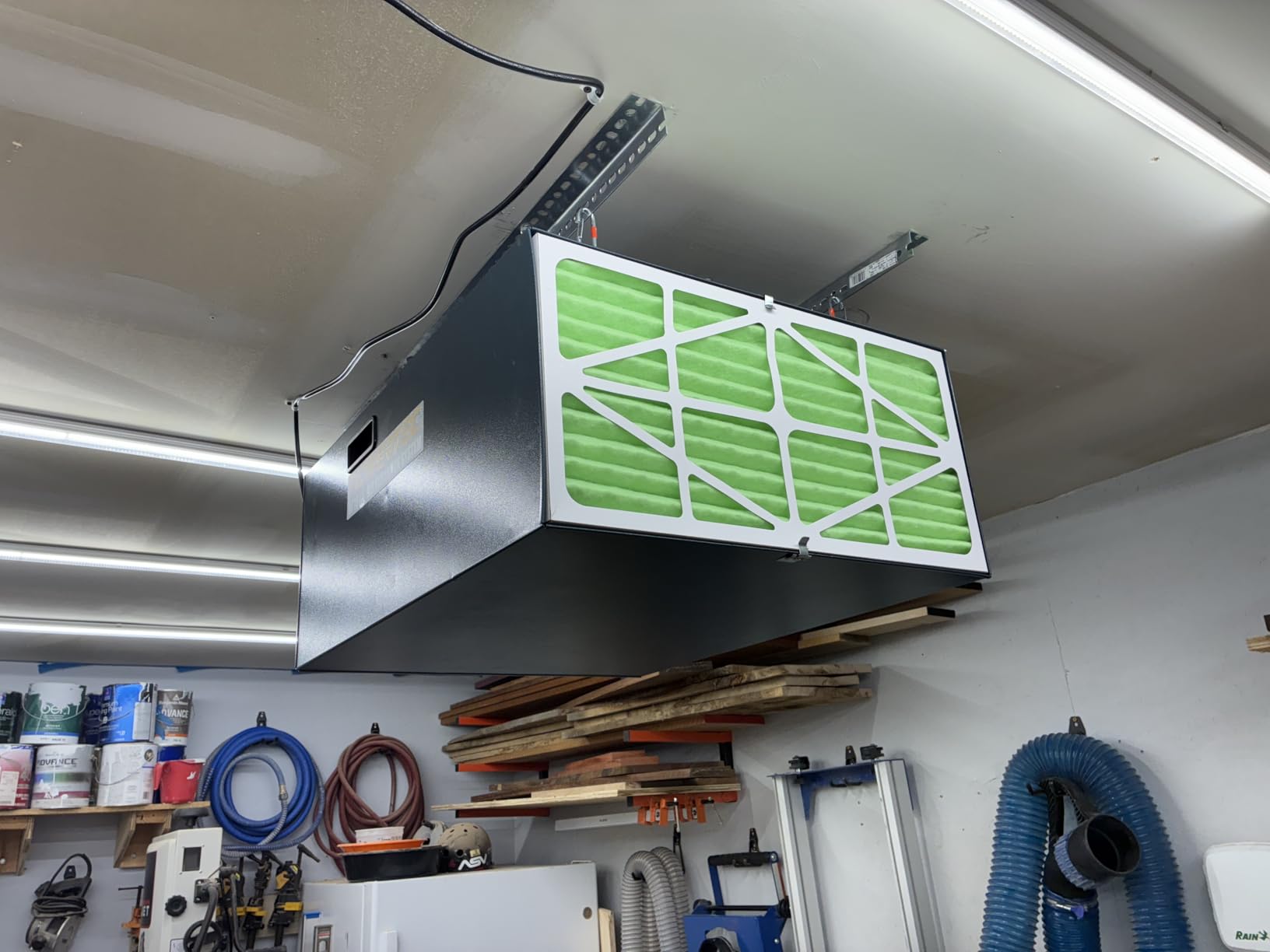
We are including it because the standard-media advantage is genuinely useful, and we are flagging the drawbacks because they are serious. The 3.8-star average is the lowest in this roundup and 22 percent of reviews are one-star.
Two failure themes dominate those negative reviews. At least two separate owners report the unit switching itself on unexpectedly, described by one as an extreme fire hazard. Others report machines that stopped working inside two years with no response from support.
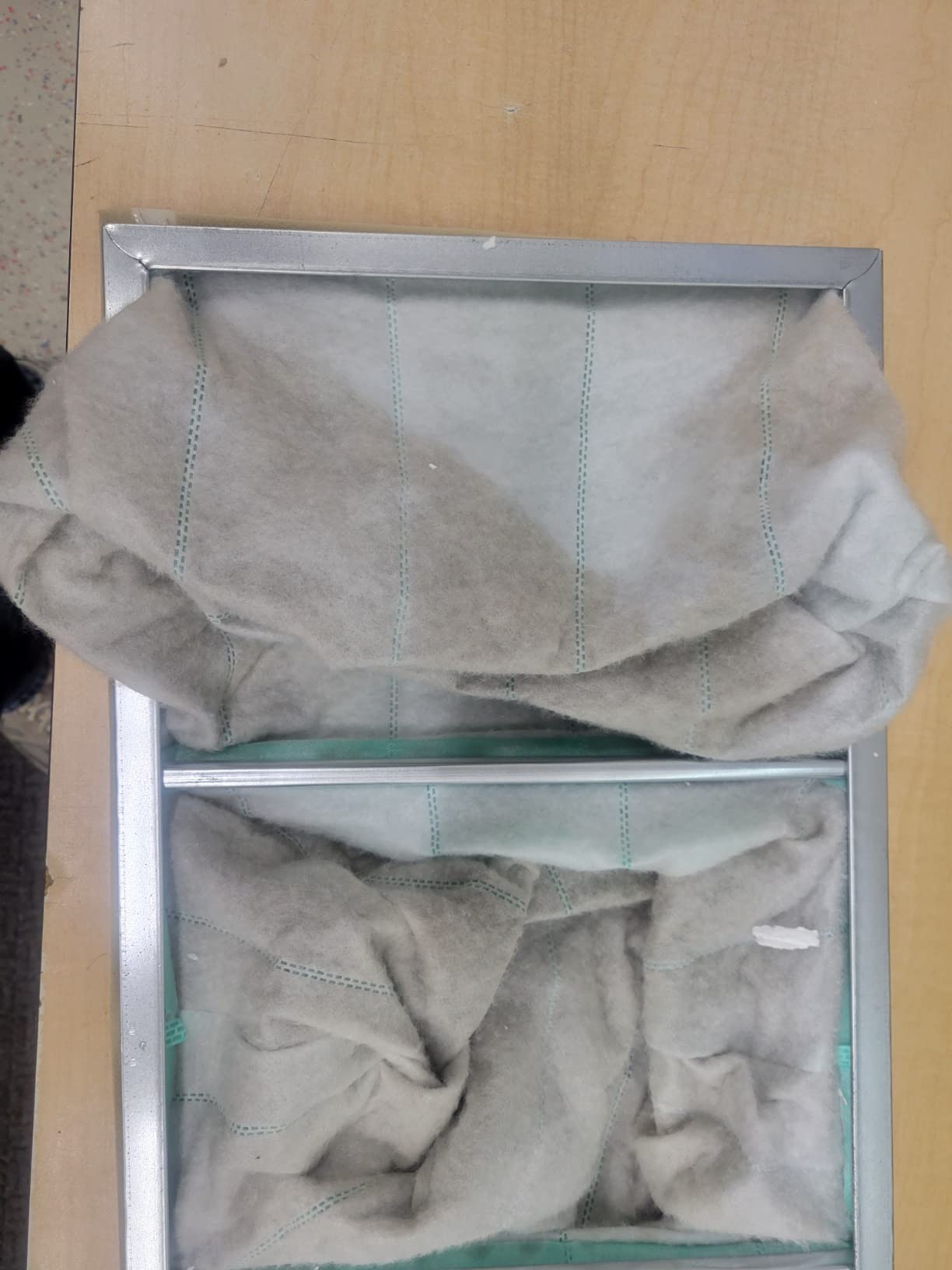
What you should know before you buy it
The squirrel cage fan is inherently loud, and multiple buyers describe it as too loud for a quiet shop. If you work in headphones alongside a planer, factor that in before choosing the highest speed.
Weight is unspecified in the listing, but owners report needing two people to hang it. Plan for help on install day, and confirm your joists can carry it if you are mounting overhead.
Who it suits and who it does not
Choose it if your deciding factor is filter cost over many years and you can source standard 12 by 24 inch media locally. It also covers more floor area than any other hanging unit in this group.
Skip it if you cannot verify the electrical behaviour concerns against current reviews, or if noise tolerance is low. For most buyers the Abestorm DecDust 1350 delivers similar airflow with a better ownership record. If you also want HEPA filtration for your dust, our HEPA vacuum guide covers the filter class in more detail.
12. OUKEETO FJ250: Quietest Airflow in the Group
- Quietest unit here with no hum or fan whine
- HEPA plus carbon captures 99.5 percent at 0.3 microns
- Side exhaust lets you aim airflow direction
- 90-minute timer and two auxiliary outlets
- Inexpensive replacement filters
- Smallest review sample here at 14
- No remote control
- HEPA and carbon media must stay dry
- Some owners find it circulates air without containing heavy debris
The FJ250 is the acoustics story of this roundup. Owners describe hearing only airflow with no humming and no fan whine, even on the high setting, and it is rated under 55 dB. For a shop where you work beside the machine and want conversation, that is the rarest feature in this category.
It still moves serious air. A vortex fan delivers 850 and 1050 CFM, with the double-side variant marketed up to 1250 CFM. The filter stack is HEPA plus a carbon deodorization net rated at 99.5 percent of 0.3 micron particles.
The benchtop format with a durable leather handle solves a real problem: shops with high or unfinished ceilings where nothing can be hung. Owners move it between stations or mount it on a ceiling platform to mimic a hanging unit.
Side exhaust is the second smart detail. Instead of blowing air straight up or down, you can aim it toward a door or window, which makes it one of the few machines here that helps with odor as well as dust.
There are two auxiliary power outlets for chaining another tool and a 90-minute timer. Replacement filters are inexpensive, with a stated service interval of roughly every four months.
What you should know before you buy it
Fourteen reviews is the thinnest sample here, so long-term reliability is genuinely unproven. One owner reported that the listing overstated workshop dust capture, finding it circulated air well without containing heavy grinder debris.
HEPA and carbon media must be kept dry, so this is not a machine for wet filtering or a damp basement. There is no remote, and support has proven hard to reach for filter questions.
Who it suits and who it does not
Choose it for a noise-sensitive shop, for a high-ceiling space where nothing can hang, and for anyone who wants HEPA plus carbon odor control without a floor-standing footprint. The leather handle makes moving it between stations easy.
Skip it if you want proven long-term ownership, if you plan to run it in a humid space, or if you need remote control. The quiet motor comes with the least field history of anything we tested.
How to Size Air Filtration for Your Shop Square Footage
Most buyers guess wrong here, usually undersizing. The method is straightforward: multiply your shop floor area by your ceiling height to get cubic feet, then divide by 60 to convert to CFM for a single air change per minute, then multiply by your target air changes per hour.
For fine wood dust, aim for 4 to 6 air changes per hour. Eight is worth it in a shop running a CNC router or a wide belt sander, because those machines produce airborne fines faster than a small machine can clear them.
Worked example for a 500 square foot shop with 8 foot ceilings. That is 4000 cubic feet of volume. For 6 air changes per hour you need 4000 times 6 divided by 60, which is 400 CFM of continuous airflow. That is exactly the ceiling of the WEN 3410, which is why that unit is rated for 400 square feet.
Scale that up for the machines you actually run. Under 250 square feet with hand tools only, 300 to 400 CFM is comfortable. Between 400 and 800 square feet with a table saw and a few sanders, 780 to 1080 CFM is the range. Above 800 square feet, plan on 1350 CFM from one unit or two smaller units placed separately.
If your shop is rectangular and open plan, one central unit is fine. In an L-shaped or divided space, two units beat one bigger unit every time, because air does not travel around corners well. Place each machine in the airspace where dust is generated rather than in the geometric center of the building.
Air Filtration vs Dust Collector vs Dust Extractor
These four tools solve different problems and shop owners frequently buy the wrong one. Knowing the difference saves money and prevents buying a dust collector when the actual problem is airborne dust settling throughout the room.
A dust collector connects to a machine with a hose and captures dust at the source port. It has high suction, low airflow, and a drum or bag. It is the correct first purchase for a table saw or planer and prevents dust ever becoming airborne.
A dust extractor is a mid-point: more airflow than a collector, less than a room cleaner, still hose-connected, usually with a HEPA cartridge. Shop vacs sit in the same family, with a canister instead of a drum.
An air filtration system has no hose and no suction port. It pulls room air through a filter to clean the ambient air, and it is what you add after you have source capture under control. It complements dust collection rather than replacing it.
A cyclone separator sits between the machine and the collector, spinning dust out of the airstream so the filter or bag lasts longer. Our recommended order is source capture first, separator if you generate heavy volume, then air filtration for whatever remains airborne.
HEPA vs MERV vs Micron: What Rating Wood Dust Needs
Wood dust is fine. Research cited by woodworking publications found roughly 88 percent of airborne wood particles are smaller than one micron, and particles that size reach deep into the lungs, which is why wood dust is treated as a carcinogen hazard.
MERV is the rating most shop units use. MERV 8 catches coarse dust and does not choke airflow quickly. MERV 11 is a sensible shop default, catching 90 percent of 3 to 10 micron particles. MERV 13 is finer but noticeably more restrictive, so it loads faster and catches less large debris.
HEPA is the top of the consumer and shop range. The EPA defines a true HEPA filter as one removing at least 99.97 percent of particles at 0.3 microns. Only the VEVOR in this roundup claims that full figure, and the DEWALT H11 stage is rated above 95 percent at 0.3 microns.
Micron naming is less precise than MERV. A 1-micron filter sounds comparable to HEPA but describes a different test method. For dust-only shops, MERV 11 at 90 percent of 3 to 10 micron particles is the practical target. Add a carbon stage when odor matters.
Noise is the other spec buyers misread. Under 55 dB is close to a quiet conversation, 60 to 65 dB is noticeable, and 67 dB or above demands hearing awareness during long sessions. We list the figure for every machine above so you can match it to your tolerance.
Ceiling Mounting and Where to Place Multiple Units
Check your joists before you plan a ceiling install. Shop joists are often not residential-grade, and units in this roundup run from about 20 to 35 pounds. Attach to solid framing, not to drywall or to a joist that has been drilled through for ducting.
Use the supplied hook and chain hardware on four points rather than a single strap, and leave clearance from lights and sprinkler heads. Mount high enough to keep the discharge above head height, since a downdraft at face level is the single most common complaint we saw.
In a rectangular shop, hang one unit over the machine generating the most dust. In an L-shaped shop, use one unit in each wing rather than one large unit in the corner. In an open-plan shop with a CNC at one end and a finishing bench at the other, two portable units beat one ceiling mount, since fine dust travels further than most people expect.
If you run hoses or ducting nearby, use anti-static hose and bond metal runs to ground. Static shock from non-anti-static lines is a recurring complaint on planer and jointer setups, and it improves noticeably once you correct it.
The DIY Corsi-Rosenthal Box Filter for Wood Shops
The most-repeated advice on woodworking forums is that a box fan and good filters can move more air than a dedicated commercial unit, if you build the housing properly. The layout is called a Corsi-Rosenthal box after the researcher who described it, and it costs a fraction of a manufactured machine.
You need a box fan, four 20 by 20 by 1 inch furnace filters, plywood or particleboard to build the frame, a cabinet or crate roughly 24 inches on a side, and basic tools. The filters mount in a four-sided cube around the fan so air is drawn in on all four faces.
Build the cube to fit snugly against the filter edges. Gaps are what defeat the design, because air leaks through open seams instead of being pushed through media. Set the fan in the center of one face and leave the opposite face open as the exhaust, then stand the unit on a high shelf.
Filter selection matters more than fan choice here. Use MERV 13 or better, and expect to replace them far more often than you would with a shop machine because there is no pre-filter stage. Build it for the shop, not for a bedroom, and check the forum consensus on frame sealing before you cut any wood.
Frequently Asked Questions
What is the best air filtration system for a woodworking workshop?
For most single-person and hobby shops, the WEN 3410 at 400 CFM with a 1-micron filter covers a 400 square foot space and has more than 5,600 reviews at a 4.6 average. Larger shops should step up to 780-1080 CFM, and shops spraying finish need a carbon stage like the VEVOR scrubber.
What is the best air filter for removing wood dust particles?
MERV 11 is the practical default for wood dust, capturing about 90 percent of 3-10 micron particles while keeping airflow up. MERV 13 is finer but loads faster and can miss larger debris. For the very finest airborne fraction, an H13 HEPA stage rated 99.97 percent at 0.3 microns is the top of the shop range.
Do I need air filtration or a dust collector?
You need both, in order. A dust collector connects to a machine by hose and captures dust at the source, preventing it from becoming airborne. An air filtration system has no hose and cleans the ambient room air. Source capture first, then filtration for what escapes.
What MERV rating should I use for a wood shop?
MERV 11 for most shops, because it balances capture against airflow. MERV 8 if you want longer filter life and less noise. MERV 13 for fine sanding dust, accepting that restrictive media loads faster and needs more frequent changes. Add a carbon stage if you spray finish or oil hardwood.
How much CFM air filtration does my shop need?
Multiply floor area by ceiling height for total cubic feet, then multiply by 4 to 6 air changes per hour for wood dust, then divide by 60. A 500 square foot shop with 8 foot ceilings at 6 air changes per hour needs about 400 CFM of continuous airflow.
How often do I replace filters in a wood shop?
Every 4 to 6 months in a typical shop running hand tools and sanders, and more often with a CNC router or heavy paint work. Units with a washable pre-filter extend cartridge life because the coarse stage takes the load. Signs of a loaded filter include visible dust on the media and reduced airflow.
Final Verdict
The best air filtration systems for woodworking shops in 2026 come down to three answers. Buy the WEN 3410 for a small or mid-size room where proven reliability matters most. Buy the Abestorm DecDust 1350 when you need real airflow over 600 square feet. Buy the VEVOR scrubber when finish odor and VOCs are part of the problem.
Whichever you pick, size it to your floor area at 4 to 6 air changes per hour, hang it above head height, and set the timer so it runs 30 to 60 minutes after you stop working. That is when the last suspended dust settles and the machine does the most for you.