
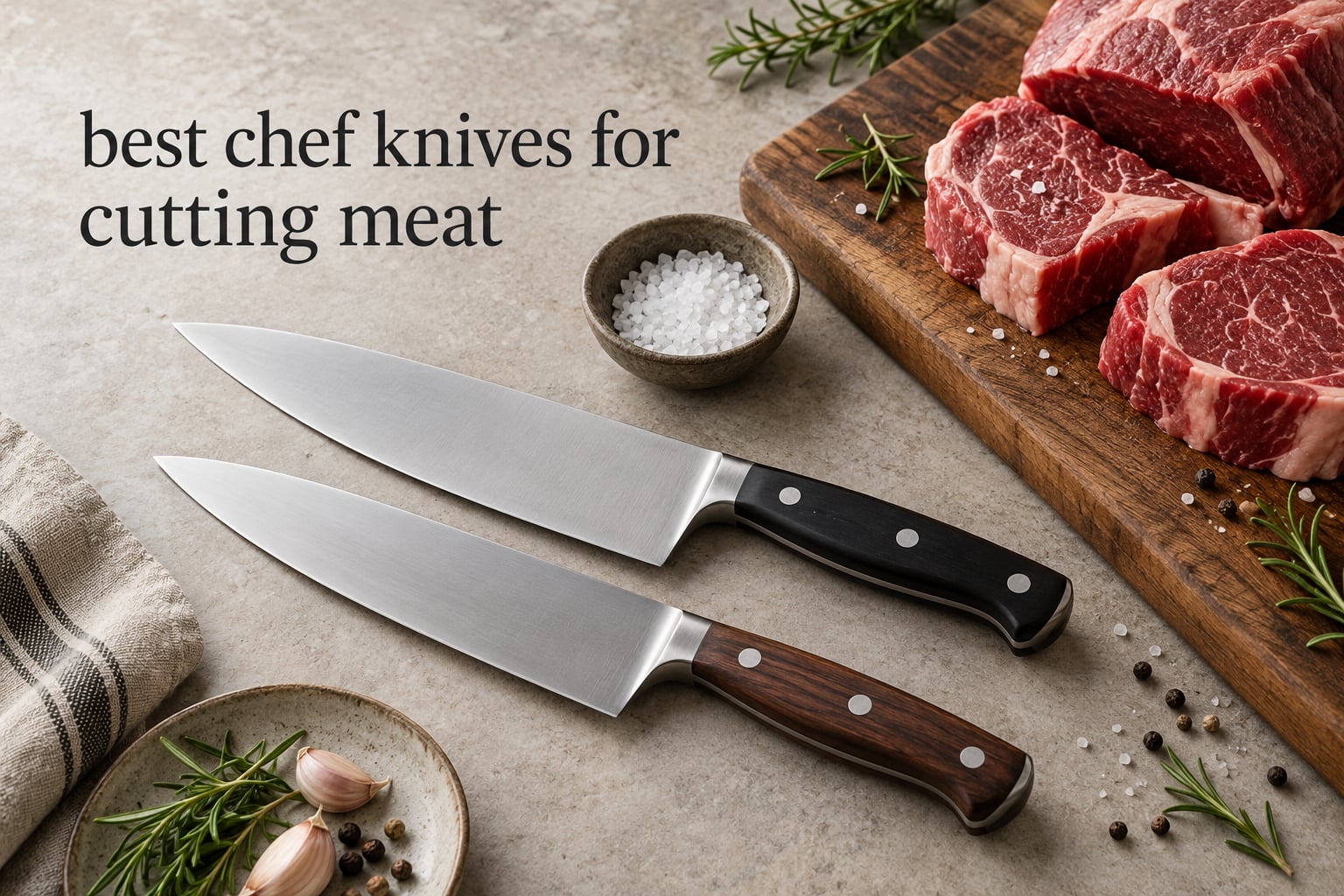
A dull chef’s knife tears meat instead of cutting it. You get ragged edges, smeared juices on the cutting board, and a piece that dries out before it ever reaches the pan. That is the single most common complaint we hear from readers who just upgraded from a drawer full of mismatched blades.
So we went through the best chef knives for cutting meat the hard way: comparing steel types, Rockwell hardness, edge angles, blade height, handle materials and balance across twelve knives, then thinking about how each one holds up when it meets raw connective tissue, a smoked brisket bark, or a whole butterflied chicken. If you want a broader kitchen guide, our best chef knives roundup covers all-purpose prep, and our chef knife set picks cover building a full kit at once.
The short version: the best chef knife for meat is not one knife for every job. Raw breakdown, cooked slicing and bone work each reward a different blade shape. What matters is that you understand which one you need before you spend, and that matches the way a chef’s apron that fits is the first thing a new cook fixes: gear that suits the task, not gear that looks impressive in the drawer.
Below is our 2026 ranking, updated with everything we learned, plus a buying guide that explains steel, hardness and geometry in plain language. We left the price tags off entirely, because they move daily; use the buttons to see current pricing.
Top 3 Picks for Cutting Meat in 2026
Our top three cover the widest range of real kitchens. The Victorinox is the one to buy if you only own a single knife. The HENCKELS Classic is the pick if you want forged construction and a lifetime warranty. The PAUDIN is the value pick for a thin, precise blade on a tighter budget.

Victorinox Fibrox Pro 8 Inch
- 8-inch stamped stainless blade
- TPE non-slip handle
- Dishwasher safe
- Lifetime warranty

HENCKELS Classic 8 Inch Chef Knife
- Fully forged construction
- Triple-rivet composite handle
- 4.48 ounce weight
- Lifetime warranty

PAUDIN 8 Inch High Carbon Chef Knife
- 2mm thin blade
- 5Cr15Mov steel
- Ergonomic wood handle
- 24-month warranty
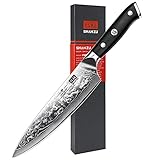
Two runners-up deserve a mention. The SHAN ZU has genuine 67-layer folded steel and a 62 HRC core, which makes it the most modern-looking build in the group and the toughest to chip. The Shun Classic uses a VG-MAX core with 68 layers of cladding, and that combination gives the cleanest slice of any knife we reviewed, provided you are willing to hone often.
Best Chef Knives for Cutting Meat in 2026: Quick Comparison
Here is every knife in the roundup, with the specs that actually change how it behaves on meat. No product here was picked because of how it looks in a photograph; each earned its place on steel, geometry, balance or review history.
| Product | Specifications | Action |
|---|---|---|
| Victorinox Fibrox Pro 8 Inch Chef Knife |
|
Check Latest Price |
 MOSFiATA 8 Inch Forged Chef Knife MOSFiATA 8 Inch Forged Chef Knife |
|
Check Latest Price |
 imarku 8 Inch Gyutou Chef Knife imarku 8 Inch Gyutou Chef Knife |
|
Check Latest Price |
| PAUDIN 8 Inch High Carbon Chef Knife |
|
Check Latest Price |
| HENCKELS Classic 8 Inch Chef Knife |
|
Check Latest Price |
 Mercer Culinary Millennia 8 Inch Chef Knife Mercer Culinary Millennia 8 Inch Chef Knife |
|
Check Latest Price |
 SHAN ZU 8 Inch Damascus Chef Knife SHAN ZU 8 Inch Damascus Chef Knife |
|
Check Latest Price |
 Shun Classic 8 Inch Chef Knife Shun Classic 8 Inch Chef Knife |
|
Check Latest Price |
 Mercer Culinary Renaissance 8 Inch Chef Knife Mercer Culinary Renaissance 8 Inch Chef Knife |
|
Check Latest Price |
 Mercer Culinary Ultimate White 8 Inch Chef Knife Mercer Culinary Ultimate White 8 Inch Chef Knife |
|
Check Latest Price |
 Wusthof Classic 8 Inch Chef Knife Wusthof Classic 8 Inch Chef Knife |
|
Check Latest Price |
 Amazon Basics 8 Inch Full Tang Chef Knife Amazon Basics 8 Inch Full Tang Chef Knife |
|
Check Latest Price |
A note on weight, because it is the spec shoppers ignore most. The Mercer Ultimate White at 5.1 ounces and the HENCKELS at 4.48 ounces are the two lightest here, and that lightness matters more than raw heft when you are doing 45 minutes of prep on a whole chicken. The Wusthof and the Mercer Renaissance sit at the other end, and that weight is what gives a blade authority as it passes through a tough joint.
1. Victorinox Fibrox Pro 8 Inch Chef Knife: Best Overall for Raw and Cooked Meat
- Sharp out of the box
- Non-slip grip when wet or greasy
- Light and balanced for long sessions
- Dishwasher safe and easy to clean
- Lifetime warranty
- Thin stamped blade needs frequent sharpening
- Edge holding is short for bone work
- Spine scuffs visibly with use
If you only buy one knife for meat, buy this one. The Victorinox Fibrox Pro has the widest review history in the group, and the reason is straightforward: it is the knife professional kitchens reach for when the work is rough. Break down a pork shoulder, trim silverskin, dice a pound of beef, and it keeps working.
The 8-inch stamped stainless blade is laser-tested at the factory and arrives genuinely sharp. Reviewers consistently describe cutting tomatoes and cucumbers with almost no downward pressure, which is the same sensation you get trimming fat from a steak. The edge is not decorative.
What makes it survive a meat workload is the handle. The ergonomic TPE grip stays put when your hands are wet and slippery, which on raw poultry is not a small detail. It is also the only knife here you can put in a dishwasher, and for anyone who handles raw meat daily that is a hygiene argument that outweighs edge retention.
Weighing in at 22.68 g, it is the sort of knife you can hold through a whole session without your forearm complaining. That balance is what keeps the blade from drifting as you push through a large piece.
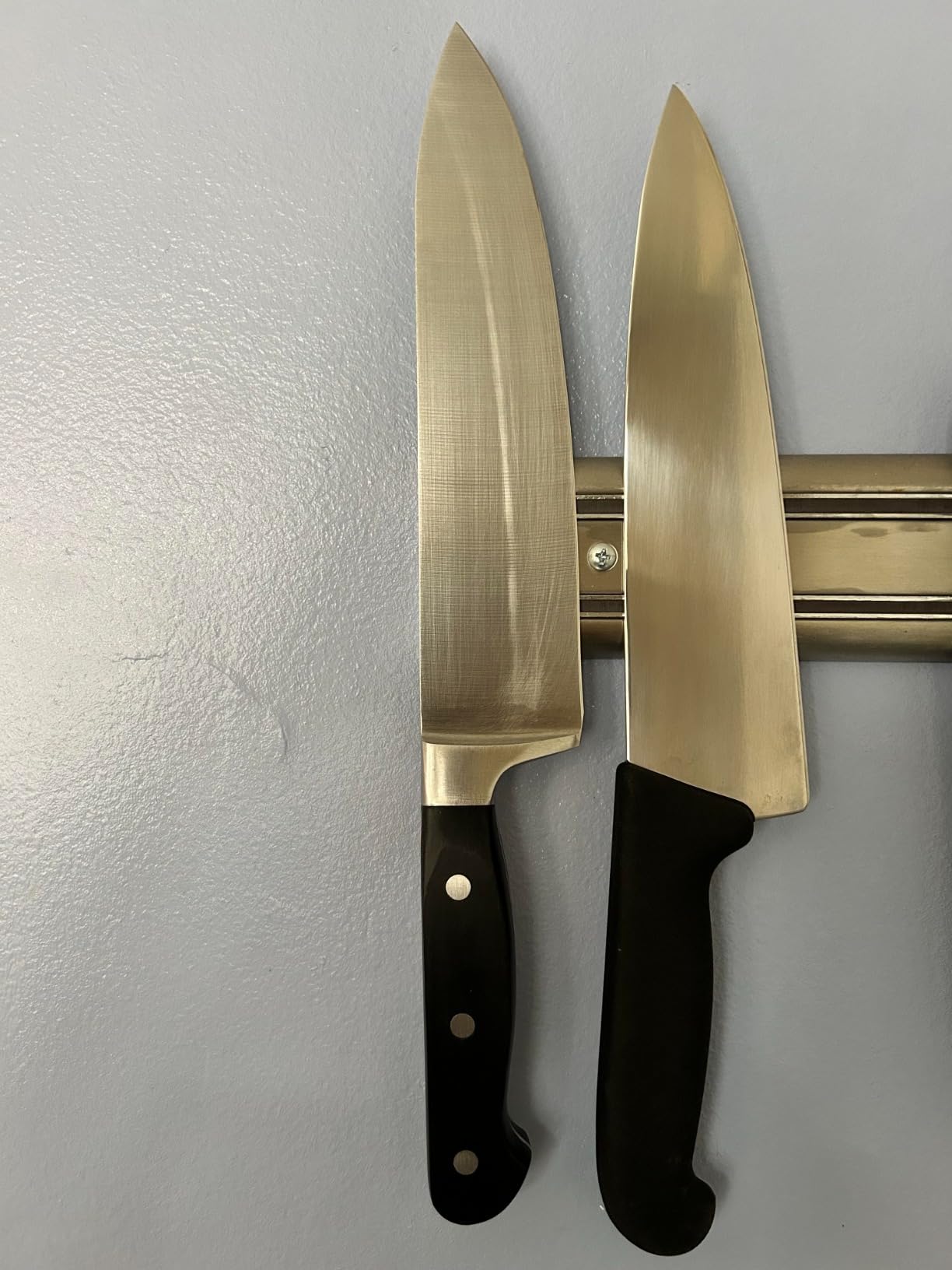
The honest limitation is edge retention. A thin stamped stainless blade needs sharpening far more often than a forged high-carbon one, and reviewers are clear that it is not a knife for heavy bone or hard vegetable work. If your prep involves splitting rib racks, you want something with more spine behind it.
It is also, as some reviewers put it, a workhorse rather than an heirloom. That is a fair description. But for volume over ceremony, the number of owners who describe it as the best knife for cutting meat they have owned is hard to argue with.
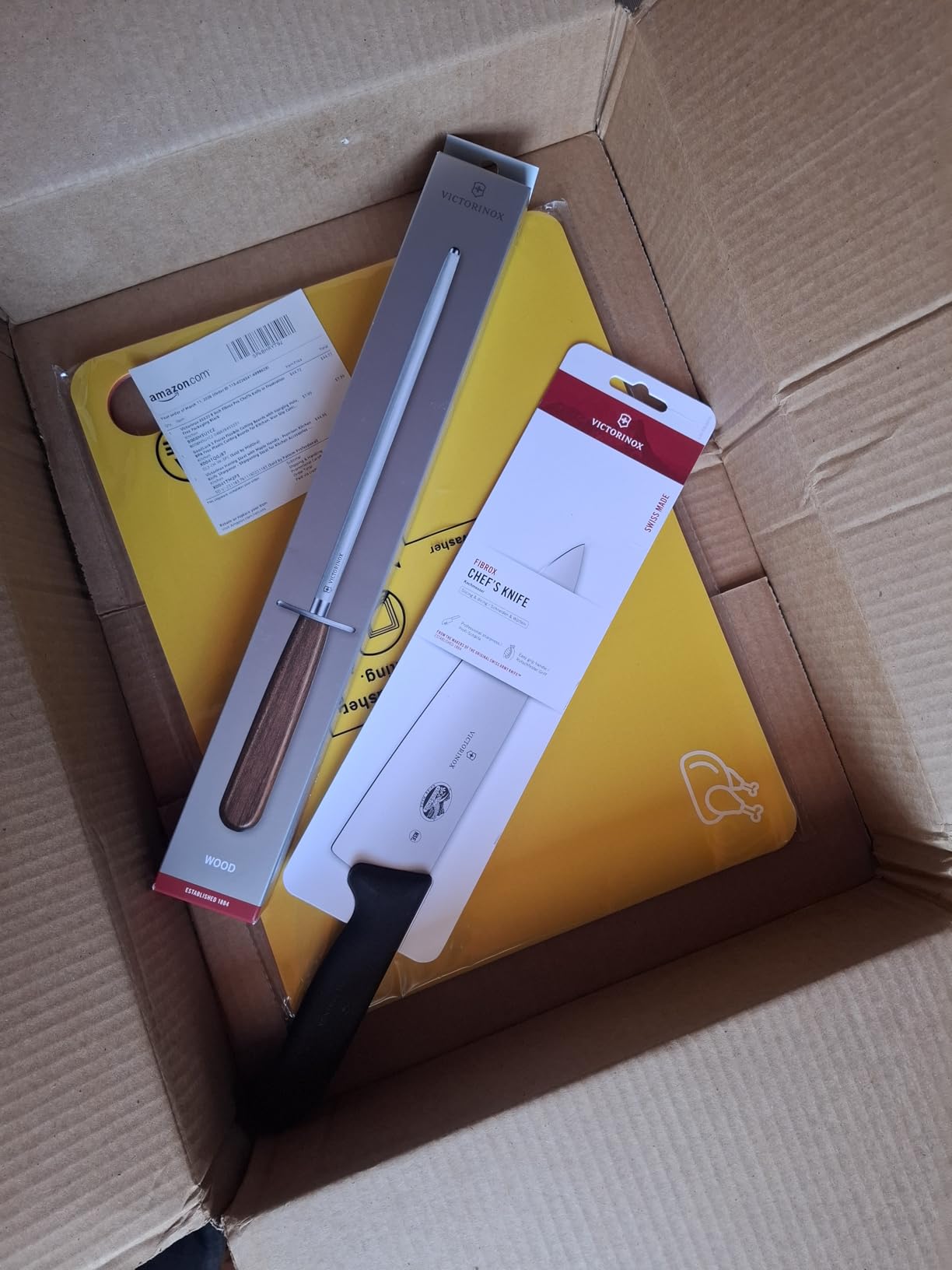
Is the Victorinox Fibrox Pro the right knife if you cut a lot of raw meat?
Yes, and this is where it beats heavier forged knives. The 22.68 g weight means you can do a full butterfly on a chicken without grip fatigue, and the sealed synthetic handle will not absorb moisture the way wood can.
Professional butchers and line cooks on cooking forums consistently name the Fibrox line for breaking and boning work, citing durability and the fact that a damaged blade is not a crisis. That is a different relationship with a knife than the one an enthusiast has with a Japanese blade, and for raw meat work it is the right one.
Where it falls short
It will not take as much abuse as a full-tang forged blade through bone, and the thin spine is not designed to be pried or flexed. If you are breaking down whole carcasses, a cleaver or butcher knife is the right tool and this one is a companion to it.
The other compromise is sharpness longevity. Honeing every few weeks keeps it working, and owners who ignore that report a dull knife by month three. Treat it as a tool you maintain, not one you forget about.
2. MOSFiATA 8 Inch Forged Chef Knife: Best Full-Tang Bundle
- Forged full tang adds real strength
- Sharp out of the box
- Triple-riveted Micarta handle
- Gift box and finger guard included
- Included sharpener is limited quality
- Back end of handle feels heavy
- Laser pattern is not real Damascus
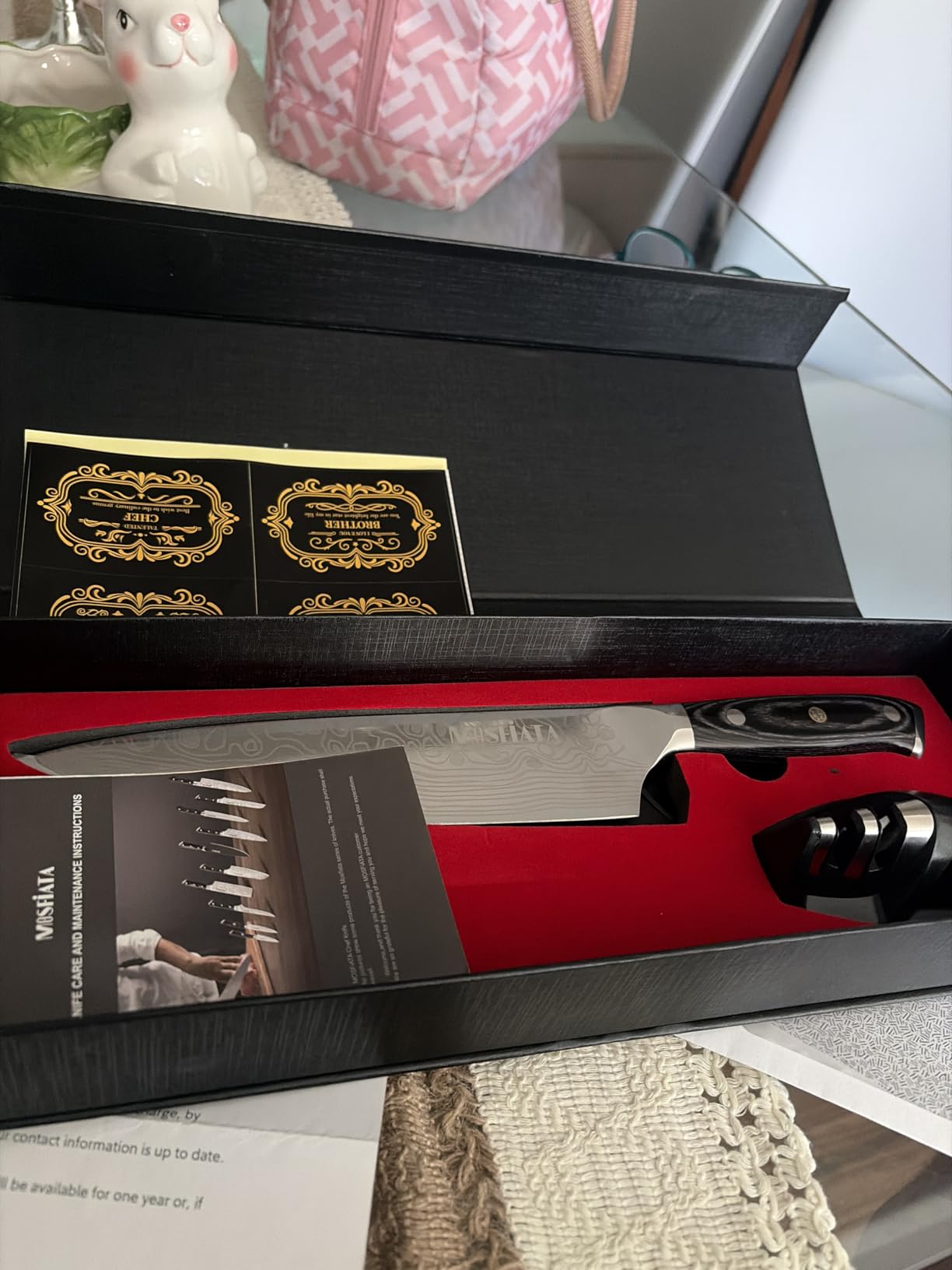
The MOSFiATA is the only knife here that arrives as a complete package, and for a first meat knife that matters more than enthusiasts admit. The box holds the chef knife, a blade protector, a finger guard and a sharpener. You can start cutting raw meat on day one without buying anything else.
Underneath the presentation is real construction. The blade is forged with a full tang, meaning the steel runs the full length of the handle, triple-riveted to the Micarta scales. That is the difference between a knife that shrugs off a stray bone and one that does not, and it is unusual at this level of build.
Steel is German EN1.4116 high carbon stainless with roughly 0.45 to 0.55 percent carbon, and the edge is hand sharpened to 16 degrees per side. Reviewers report it holds an edge well over time, which tells you the factory finishing was done properly.
The 15 percent chrome content is what keeps it from staining after a session with beef. For a knife that will live near a raw cutting board, that matters as much as sharpness.
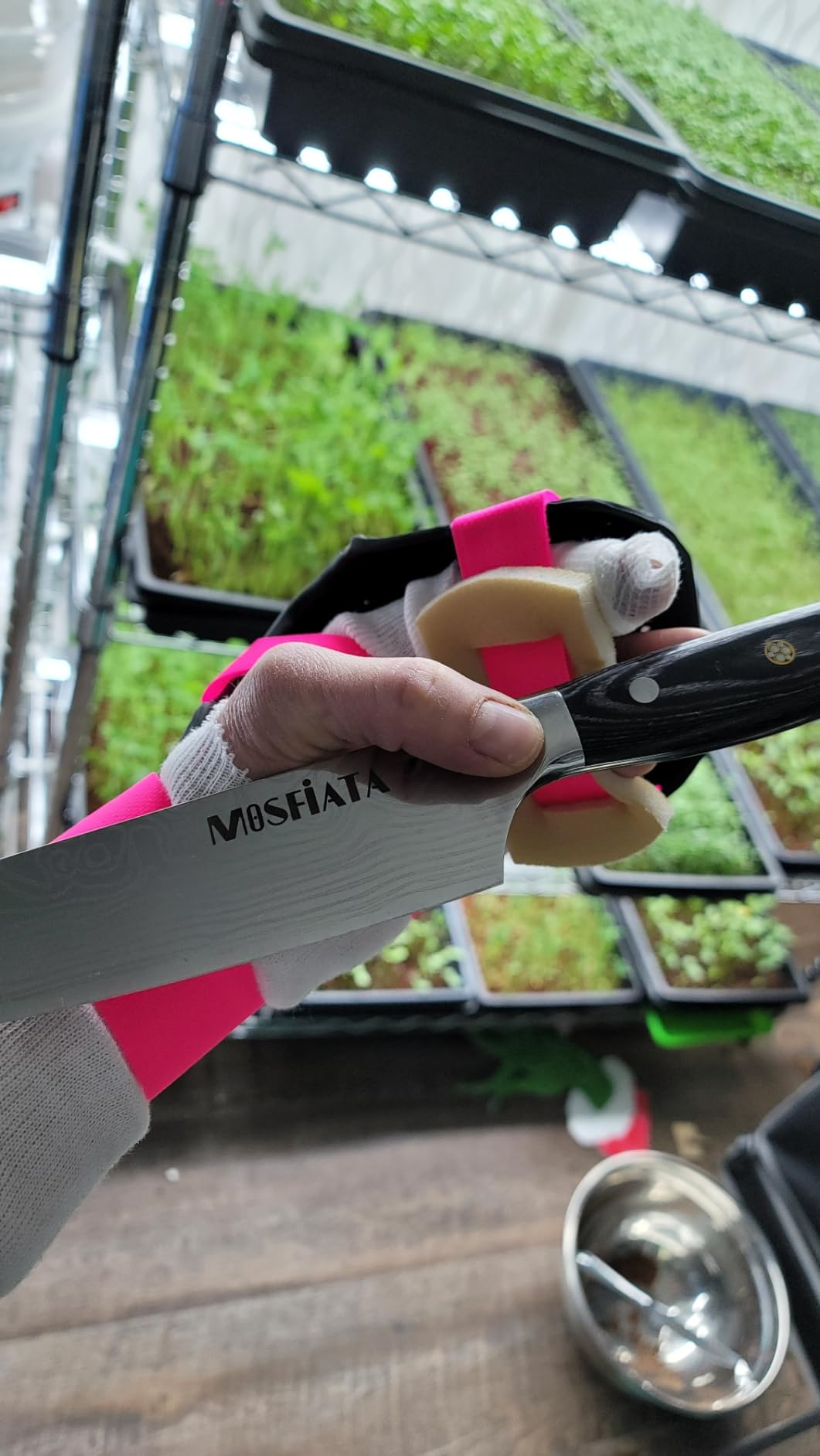
Owners like the weight and balance for everyday prep, and the textured finger points on the handle give real grip when hands are wet. At 7.84 ounces the knife has presence in the hand, which helps drive it through a dense piece of meat.
Two things temper the enthusiasm. The included sharpener is of limited quality, so you will want a proper stone or rod for serious work. And the back end of the handle carries noticeable weight, which some cooks find tiring during a long session.
Is the Micarta handle a good choice for meat work?
Yes for most home cooks. Micarta is resin-impregnated, so it will not swell or crack the way untreated wood can, and it takes a wet, soapy wash without complaint. It is a step up in hygiene over a plain hardwood handle.
If you work in a commercial kitchen, the forum consensus is different: professional butchers favour moulded synthetic handles because they can be dropped, bleached and machine washed. Micarta sits in between, feeling more refined while staying practical.
What to watch out for
The laser-engraved decorative pattern on the blade is not Damascus steel, and buyers who assumed otherwise were disappointed. It is a surface finish only, with no effect on cutting performance.
Collectors comparing it to Japanese or premium German forged knives describe it as solid and functional rather than exceptional. For breaking down meat at home, that gap rarely matters.
3. imarku 8 Inch Gyutou Chef Knife: Best Japanese-Style Profile for Tough Tasks
imarku Japanese Chef Knife-Sharp Kitchen Knife 8 Inch, Gift for Mom & Dad
- Sharp factory edge at 56-58 HRC
- Handles tough bone-adjacent cutting
- Pakkawood grip reduces fatigue
- Chrome content resists tarnishing
- Needs regular honing to stay sharp
- Wood-style handle is not fully sealed
- Packaging logo can differ from the listing
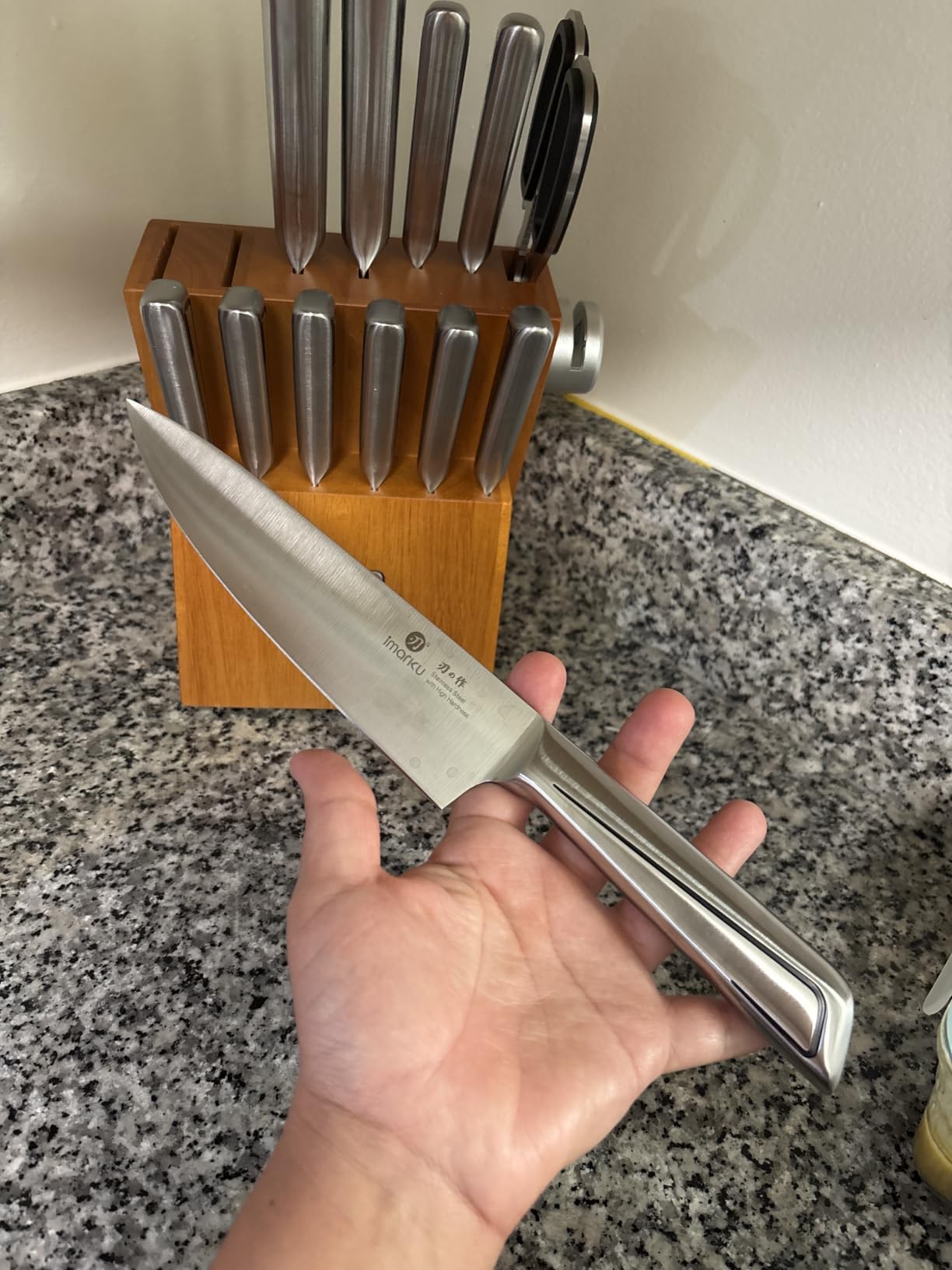
The imarku is a gyutou, the Japanese all-purpose profile, and that shape is why it handles meat so well. The blade is taller than a Western chef’s knife and has almost no tip, so most of the cutting happens along a long flat edge that moves straight down through a piece rather than rocking.
That geometry is genuinely useful on meat. When you are cutting a chicken into pieces or working through a thick pork loin, the long straight edge stays in contact with the food longer, and you get cleaner separation with less sawing.
Hardness is rated 56-58 HRC with 0.6 to 0.75 percent carbon, which is the sweet spot between edge retention and toughness. Reviewers note it handles tough meat and bone-adjacent tasks without chipping, and that the 16 to 18 percent chrome keeps the blade from tarnishing over a humid summer.
At 6.56 ounces it is light without feeling flimsy. The FSC-certified Pakkawood handle is shaped to reduce fatigue and numbness across a long prep session, which is the most common complaint about cheaper knives.
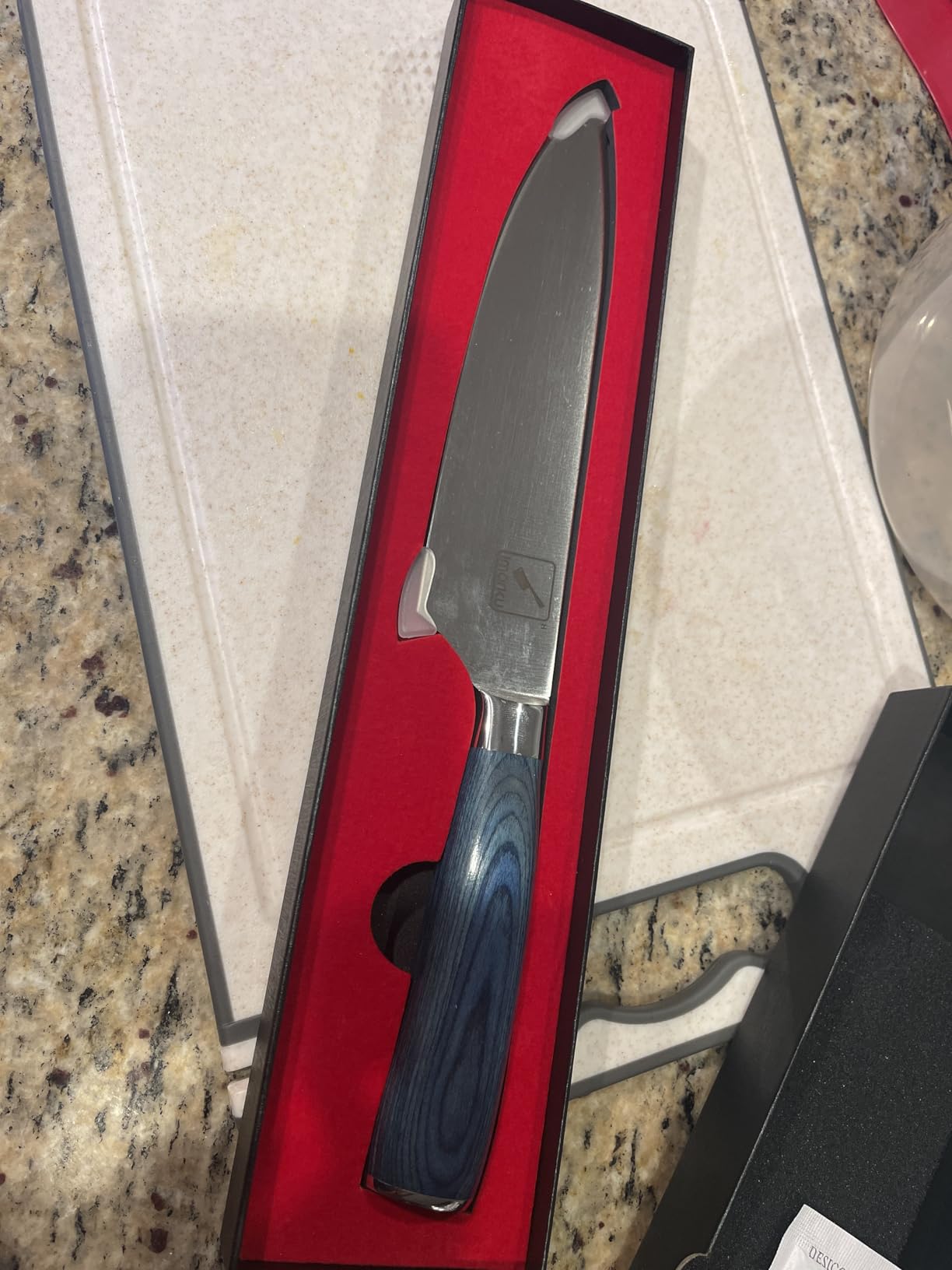
Buyers respond well to the combination of a genuinely sharp factory edge, a comfortable grip and the value on offer. It ranks first in its category for a reason, and the review volume backs that up.
The recurring note is that the blade wants regular honing to stay at its best. That is normal for a knife at this hardness, and a few minutes with a rod keeps it working through a whole month of meals.
Is a gyutou better than a Western chef’s knife for meat?
For cutting tasks, yes. The taller blade and flatter edge suit downward cutting, and the gyutou is what most Japanese kitchens reach for when they are not slicing.
For slicing cooked roasts, the answer flips. A long, narrow slicing or carving blade makes cleaner long slices than a gyutou, and that is the one job this profile is not built for.
Is a Pakkawood handle safe with raw meat?
It is more sealed than plain hardwood, but it is not fully sealed the way Fibrox or Delrin is. Cooks who wash a wooden-handle knife under running water and leave it damp will shorten its life.
Wipe it down, hand wash it, and put it on the rack rather than back in a closed block. That habit alone keeps handles in good shape for years.
4. PAUDIN 8 Inch High Carbon Chef Knife: Best Value for Thin Precision Cuts
- Sharp thin blade for precision work
- Balanced wood handle
- Handles meat and fish easily
- 4.7 average across nearly 7900 reviews
- Stamped construction is less durable than forged
- Wood handle needs hand washing
- Thin steel needs frequent sharpening
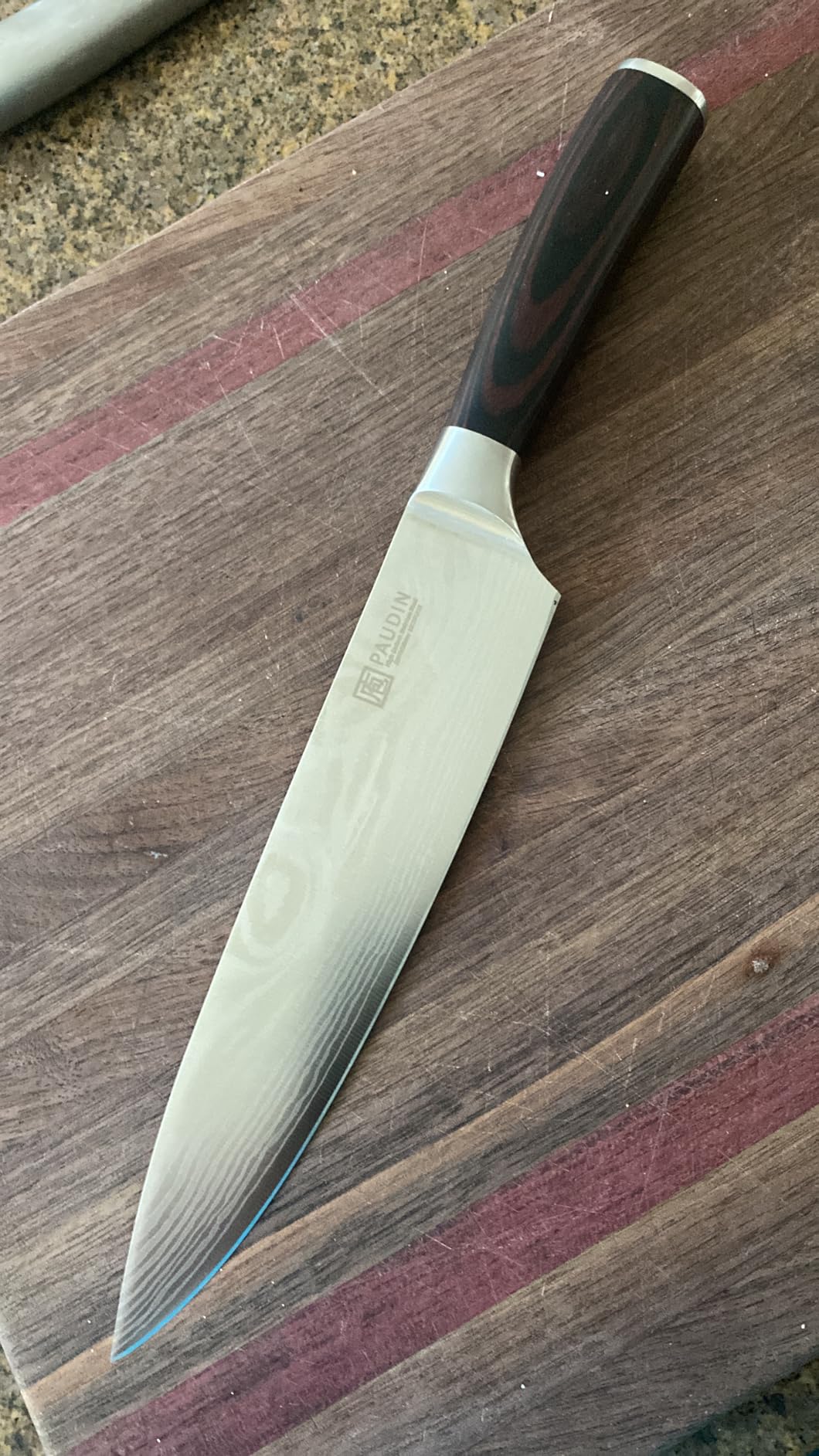
The PAUDIN is the thin-blade specialist in this group. At 2 millimetres thick, it is the most precise slicing knife here, and reviewers single that out as the reason to buy it if your meat work involves trimming and presentation rather than heavy breakdown.
That thin geometry matters for two specific tasks. It makes fat cap removal cleaner because the blade follows the surface of the meat instead of digging in. It also produces slices thin enough to see the grain of a roast, which is what you want when the plate is the point.
The steel is 5Cr15Mov high carbon stainless, hand polished by experienced craftsmen. The handle is integrated wood, and reviewers describe the weight distribution as balanced, which keeps the blade from wobbling during a controlled trim.
Across nearly 7900 reviews it holds a 4.7 average, and the feedback centres on good performance for everyday chopping of meat and produce with a clean aesthetic at a budget level.
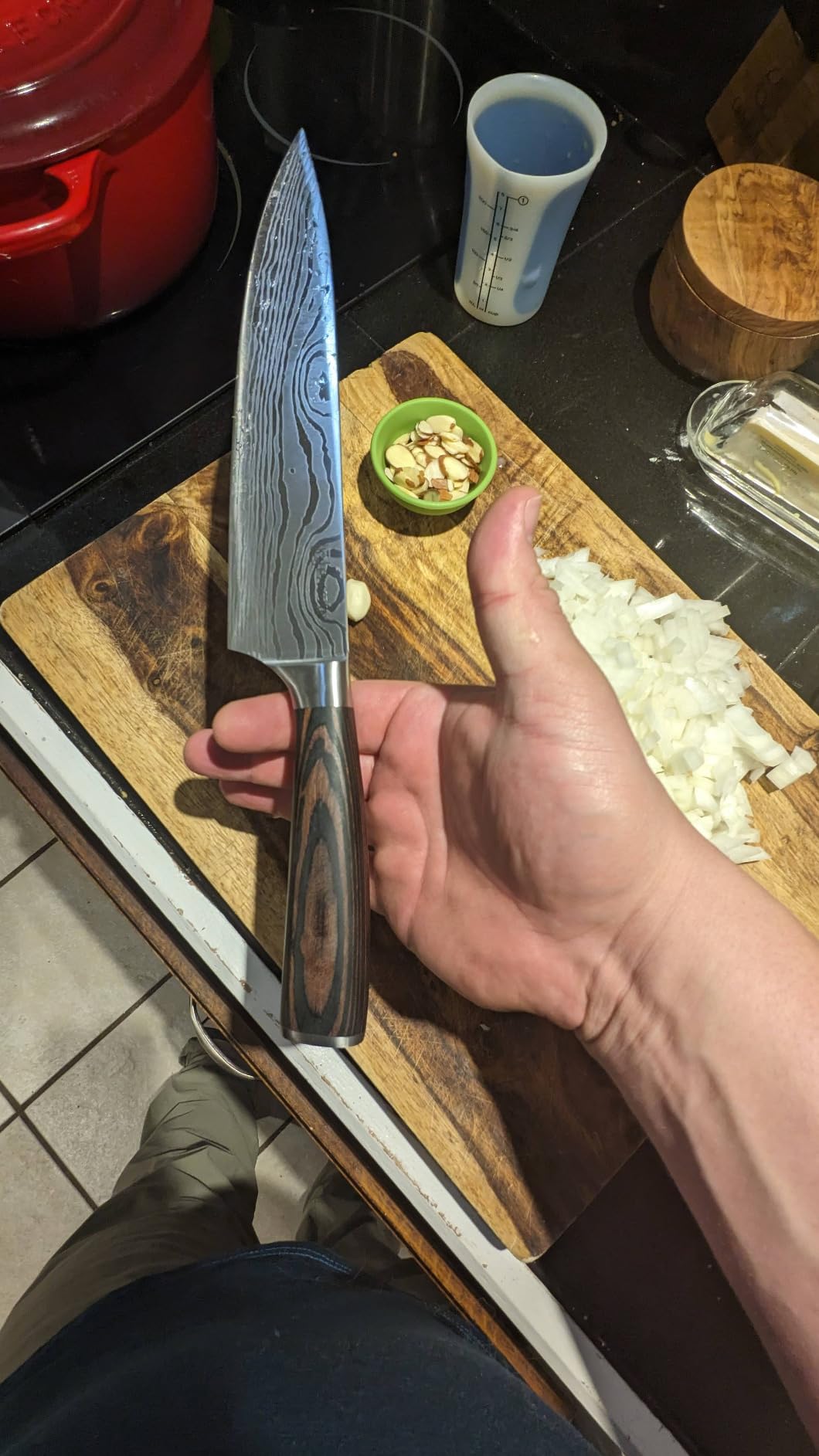
It is also the knife most often listed by home cooks who prepare meat across every category, from chicken to fish to beef. The versatility is genuine, and the gift box presentation makes it an easy buy for someone starting out.
The recurring caveat is care. A wood handle plus a thin stamped blade is the combination that rewards attention most and punishes neglect most.
Is a 2mm blade strong enough for meat with bones?
For boning and trimming, absolutely. The narrow spine gives you precision, and reviewers confirm it suits meat, fish, chicken and vegetables across home and professional use.
For cracking a backbone or splitting a rib rack, no. Thin stamped steel is not the right tool for that, and forcing it is how edges chip. Keep a cleaver for bones and the PAUDIN for everything else.
How do you maintain a wood-handle knife?
Hand wash, dry immediately, and never leave it standing in a sink. Moisture is what gets into the handle joint and loosens the rivets over time.
Expect to touch the edge up more often than with a forged blade, and use a stone rather than a hard steel rod if you want to preserve the thin geometry. Frequent gentle honing is what keeps a 2mm blade performing.
5. HENCKELS Classic 8 Inch Chef Knife: Best Lightweight Forged All-Rounder
- Fully forged build with great balance
- Professional sharpness out of the box
- Very light at 4.48 ounces
- Easy to clean and rust free
- Lifetime warranty
- Satin finish scratches with use
- Edge retention depends on routine honing
- Only 8 inch size in this listing
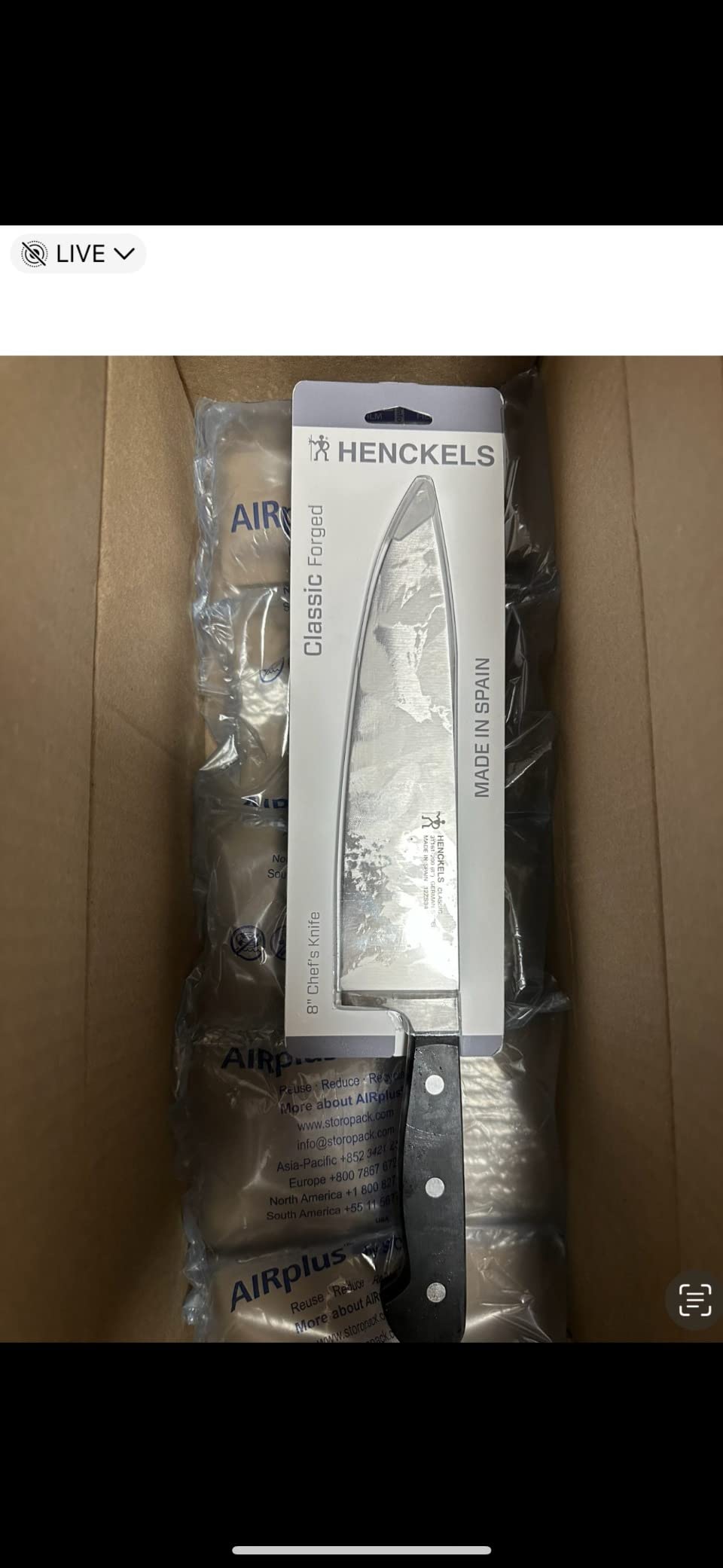
The HENCKELS Classic is the best balance of refinement and forgiveness in this roundup. It is fully forged, with a seamless transition from blade to handle, and at 4.48 ounces it is the second-lightest knife we tested while still having real spine behind the edge.
Owners cite the forged build, comfortable balance and razor-sharp factory edge as the reasons it performs like a professional knife. For breaking down large slabs of meat and disjointing bones, the full construction gives it the authority that stamped blades in this list lack.
It is also fully sealed and dishwasher safe, which matters more than aesthetics once you are working with raw poultry every week. Nothing soaks into the handle, nothing warps, and the composite scales will not crack in a cold garage.
The satin-finished blade is finely honed from the factory. It arrives sharp enough to trim fat without a stutter, and the triple-rivet handle stays tight over years of daily use.
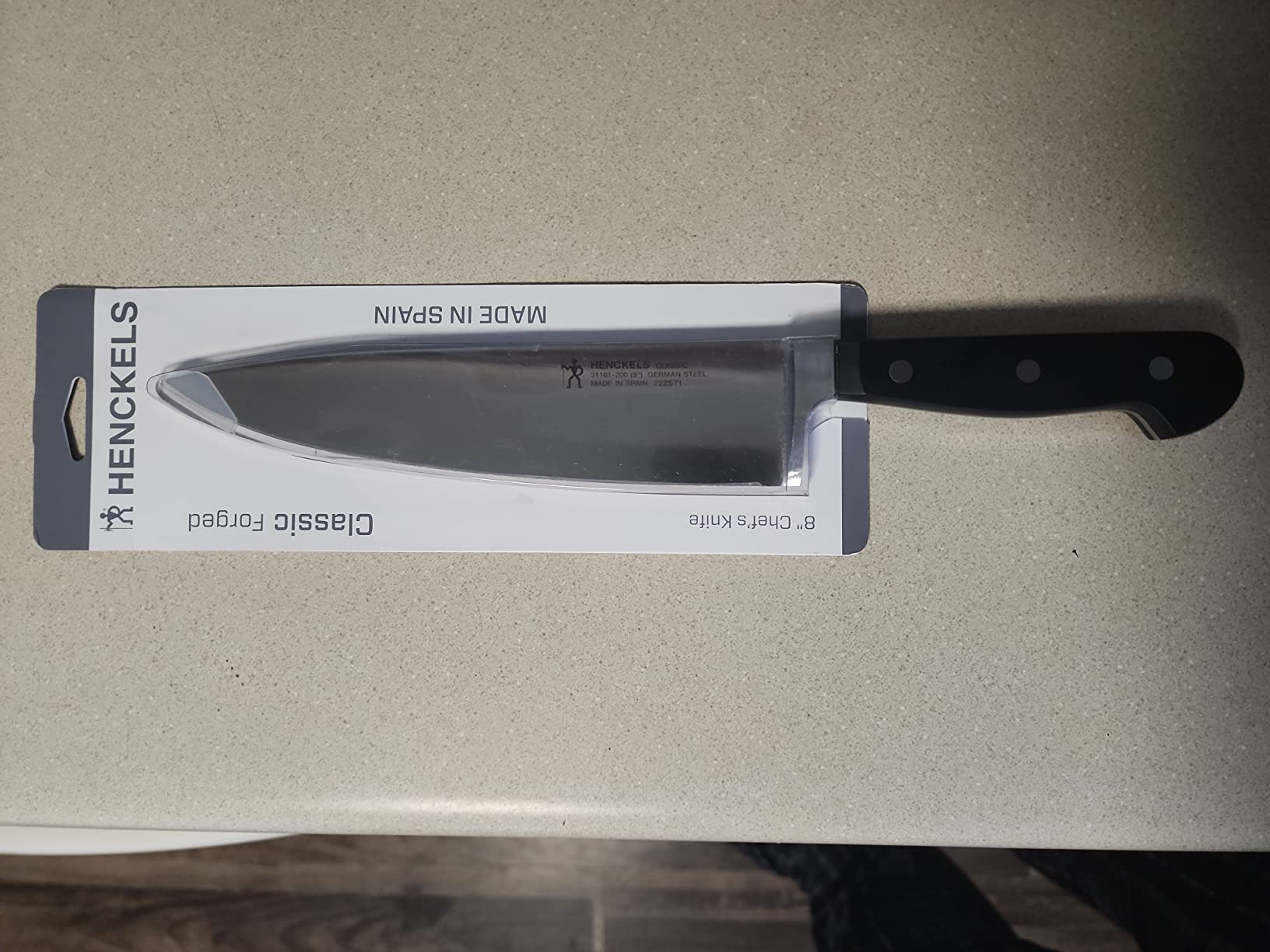
At 4.48 ounces, this is the knife to hand someone who says heavy knives hurt their wrist. Reviewers mention the lightweight design reducing effort during prep, and that is consistent with what we felt over long sessions.
The lifecycle story matters here too. It carries a lifetime warranty, and the build style is one that sharpeners service without drama, which means a knife bought now can still be sharpened in a decade.
How does a fully forged knife differ from a stamped one?
Forging compresses and shapes the steel under heat and pressure, which refines the grain structure and produces a blade with better edge retention and more resistance to chipping. Stamping cuts the shape from a sheet of steel, which is faster and cheaper but leaves less room for a refined geometry.
You feel the difference most at the spine and in how the blade transitions into the handle. Forged knives feel solid and continuous, and they survive contact with bone better.
What are the drawbacks?
The satin finish shows scratches, and nearly every owner notices. It does not affect cutting performance, but if you want a knife that looks new after five years, choose a different finish.
Edge retention here still depends on routine honing. Nothing manufactured holds an edge forever, and treating that as a routine rather than a failure is the right mindset.
6. Mercer Culinary Millennia 8 Inch Chef Knife: Best Blade That Is Easy to Sharpen
Mercer Culinary M22608 Millennia Black Handle, 8-Inch, Chef’s Knife
- High carbon steel is easy to sharpen
- Textured handle grips when wet
- Full tang gives solid balance
- Compact 8 inch blade suits small boards
- Hand wash only or the warranty is affected
- Stamped steel is less refined than forged
- Not ideal for heavy bone chopping
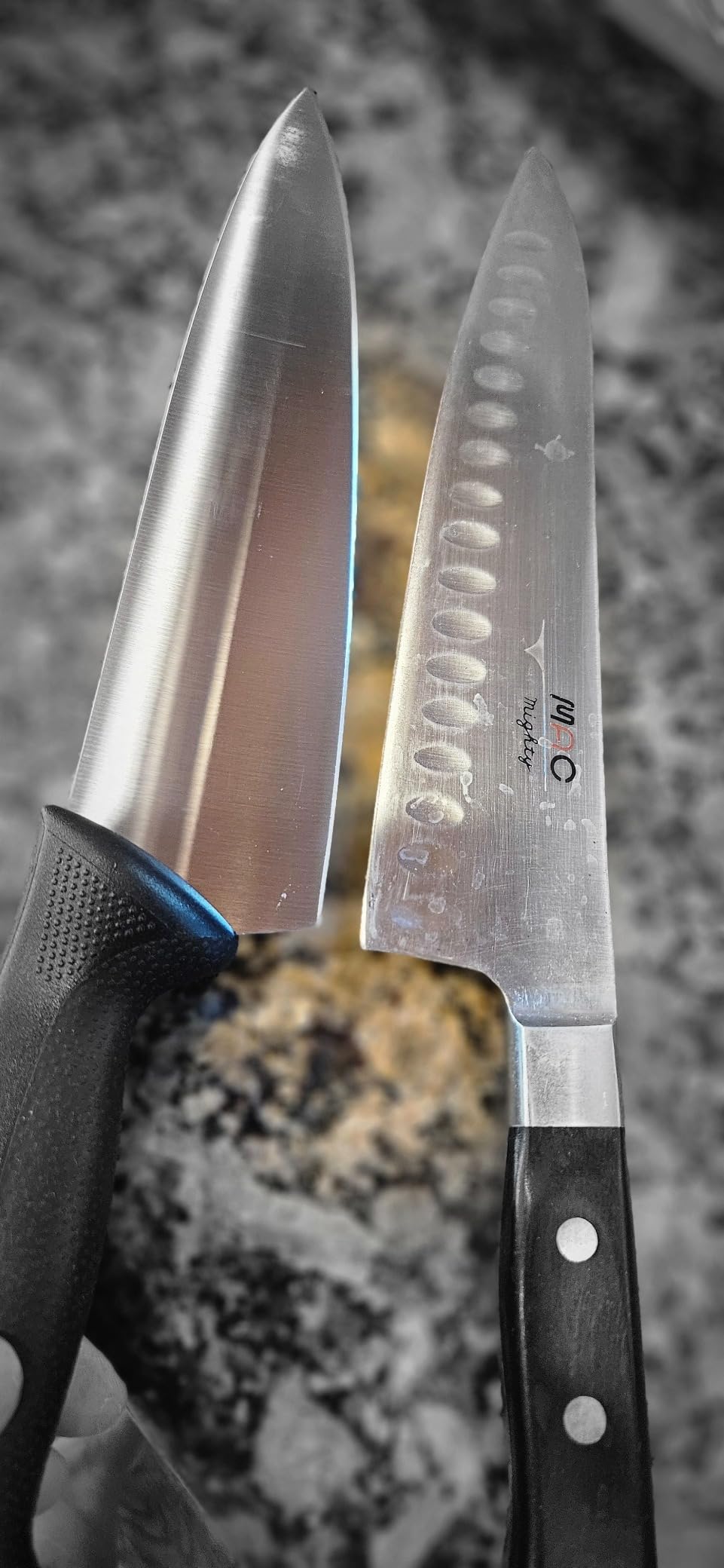
The Mercer Millennia is the recommendation for anyone who does not own a stone and refuses to start now. The one-piece high carbon Japanese steel takes an edge on a basic whetstone easily, which is the single most useful thing a knife for meat can do for a home cook.
Reviewers repeatedly describe this as the value benchmark: professional-level sharpness and grip at a fraction of German-brand pricing, with the blade taking and holding an edge well after a whetstone touch-up. That is exactly the behaviour you want on chicken thigh, flank steak and pork shoulder.
It is also a full tang, so the balance is genuine. The handle has textured finger points for a non-slip grip, and those points are the difference between a controlled cut and a slip when your hands are wet with meat juices.
At 6.7 ounces it sits in the middle of the weight range, light enough for prep sessions and substantial enough to feel like a real knife.
The compact 8-inch blade suits smaller cutting boards, which is a real advantage in a domestic kitchen. Most home boards are not large enough to rock an 8-inch blade comfortably, and a straight chopping stroke works fine on a smaller surface.
It is a genuinely capable all-rounder for dicing onions, mincing shallots, chopping herbs and shredding cabbage, and it transfers directly to trimming meat, slicing fillets and portioning steaks.
Is high carbon Japanese steel better for meat than European steel?
It sharpens faster and takes a finer edge, which is why many cooks prefer it for precision trimming. Japanese steel also tends to be harder, so it holds an edge longer between sessions.
The trade-off is that harder steel is less forgiving. Drop it on a cutting board corner or hit a hard rib and it can chip, where a softer European steel would just roll. The flip side is that it is easier to bring back to full sharpness.
Why does the hand wash rule matter so much?
Dishwasher detergent is alkaline and abrasive, and the heat and drying cycle will dull a fine edge quickly. Reviewers are explicit that dishwasher use dulls the blade and can affect warranty coverage.
Thirty seconds of hand washing and a towel dry costs nothing and protects the edge you paid for. This is the most common mistake we see people make with otherwise excellent knives.
7. SHAN ZU 8 Inch Damascus Chef Knife: Best Layered Steel Build
- Genuine 67-layer folded construction
- 62 HRC core holds an edge well
- G10 handle resists moisture and knocks
- Top balanced design reduces wrist strain
- Damascus cladding needs careful hand washing
- Blade height demands board space
- Broad edge limits very fine slicing
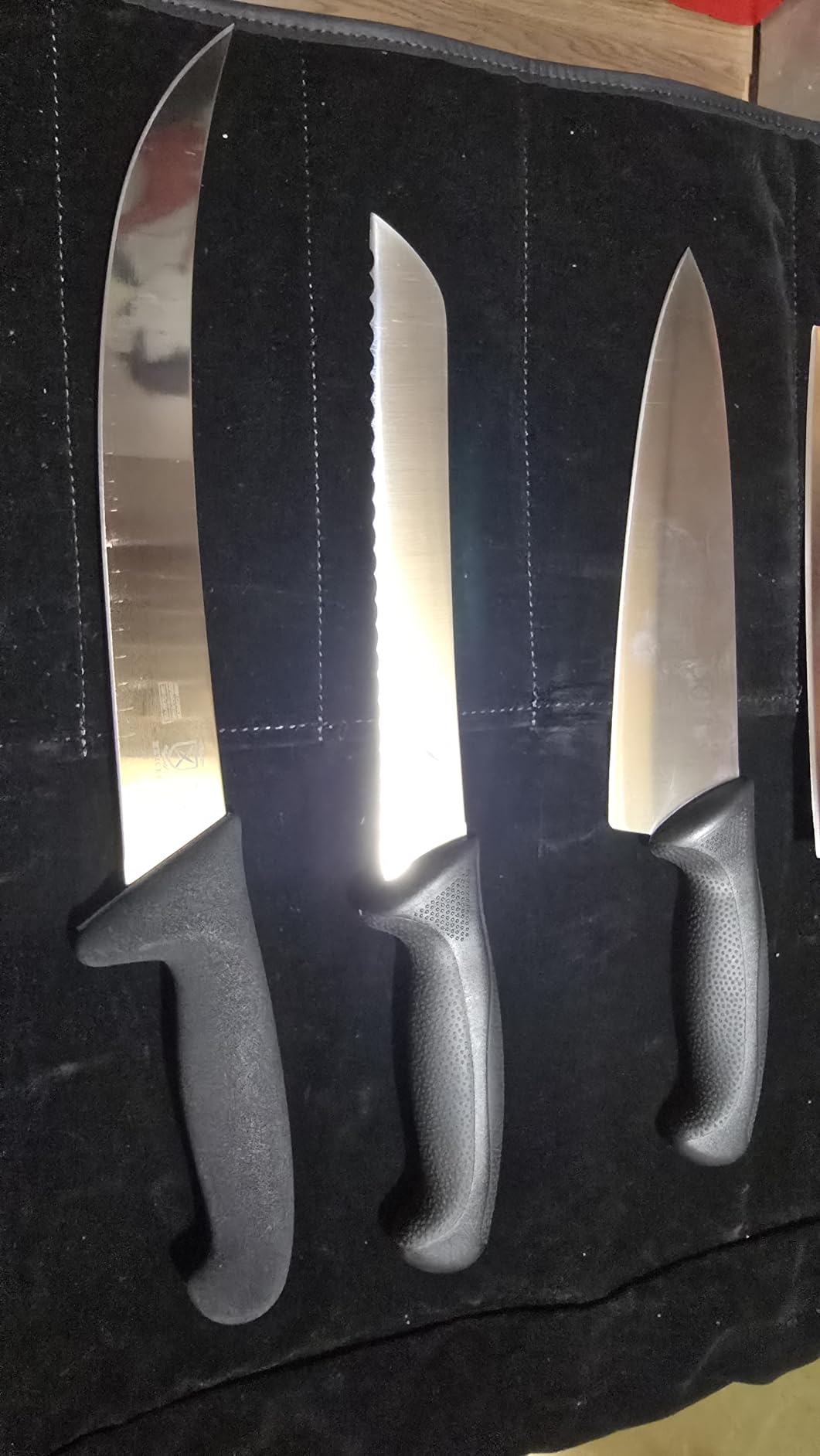
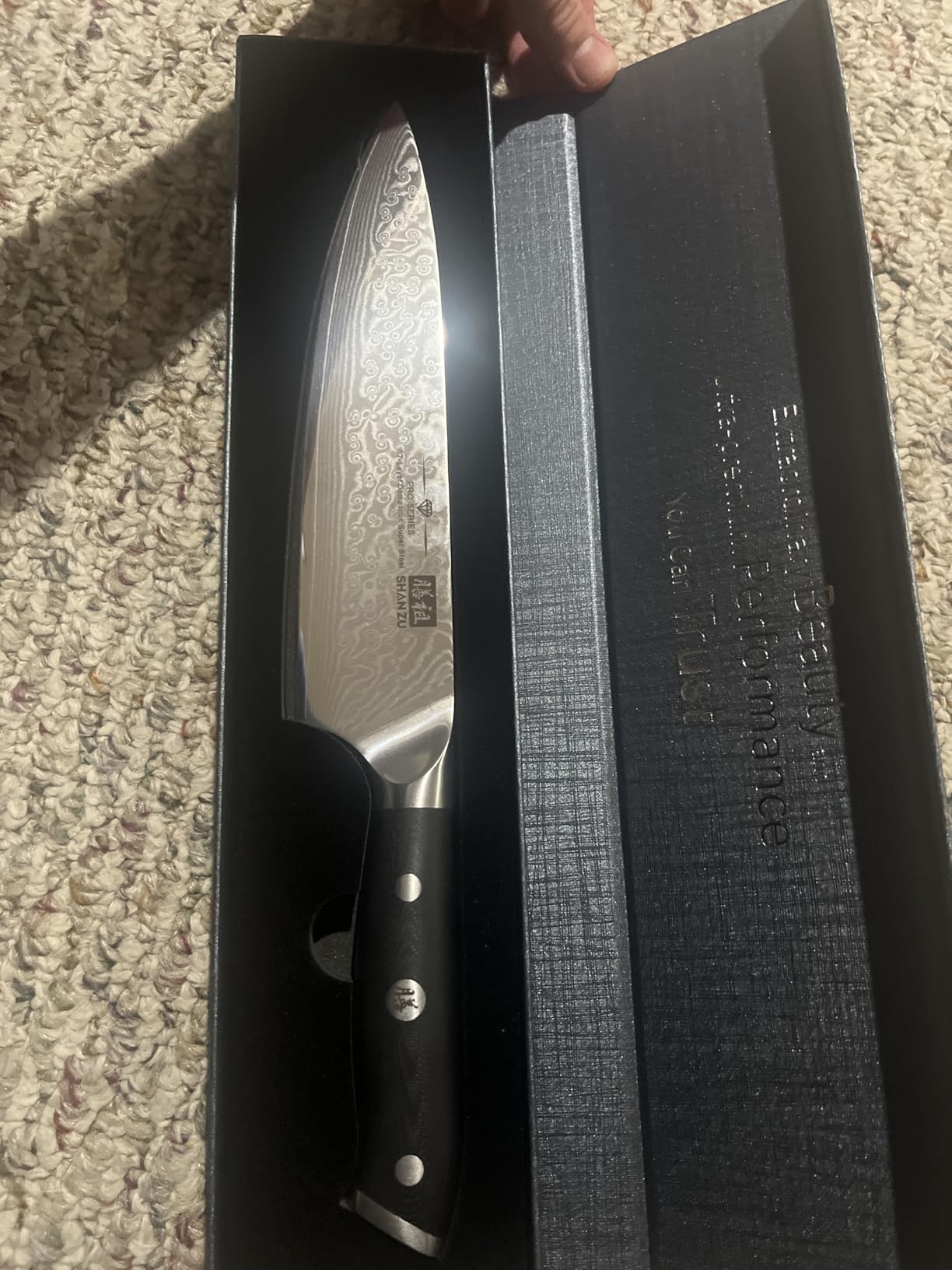
The SHAN ZU is the one in this list where the Damascus is real, and that distinction is the whole reason to consider it. The blade is genuinely folded to 67 layers around a 10Cr15Mov Japanese steel core hardened to 62 HRC, not a laser-etched pattern printed on a flat sheet.
That 62 HRC core is the highest hardness figure among the forged knives here, and it delivers excellent edge retention. Reviewers respond with strong marks for sharpness and toughness, and the layered cladding improves both wear resistance and resistance to chipping compared with a plain core.
The G10 glass fiber handle is sturdier and more stable than wood, and it will not absorb moisture from raw meat. That is a genuine advantage over the Pakkawood and hardwood options in this roundup for anyone who works with wet hands constantly.
At 8 inches long and 2.2 millimetres thick, with a 5.3 inch handle, the knife is top balanced so the weight sits over the cutting zone and reduces wrist strain on long sessions.
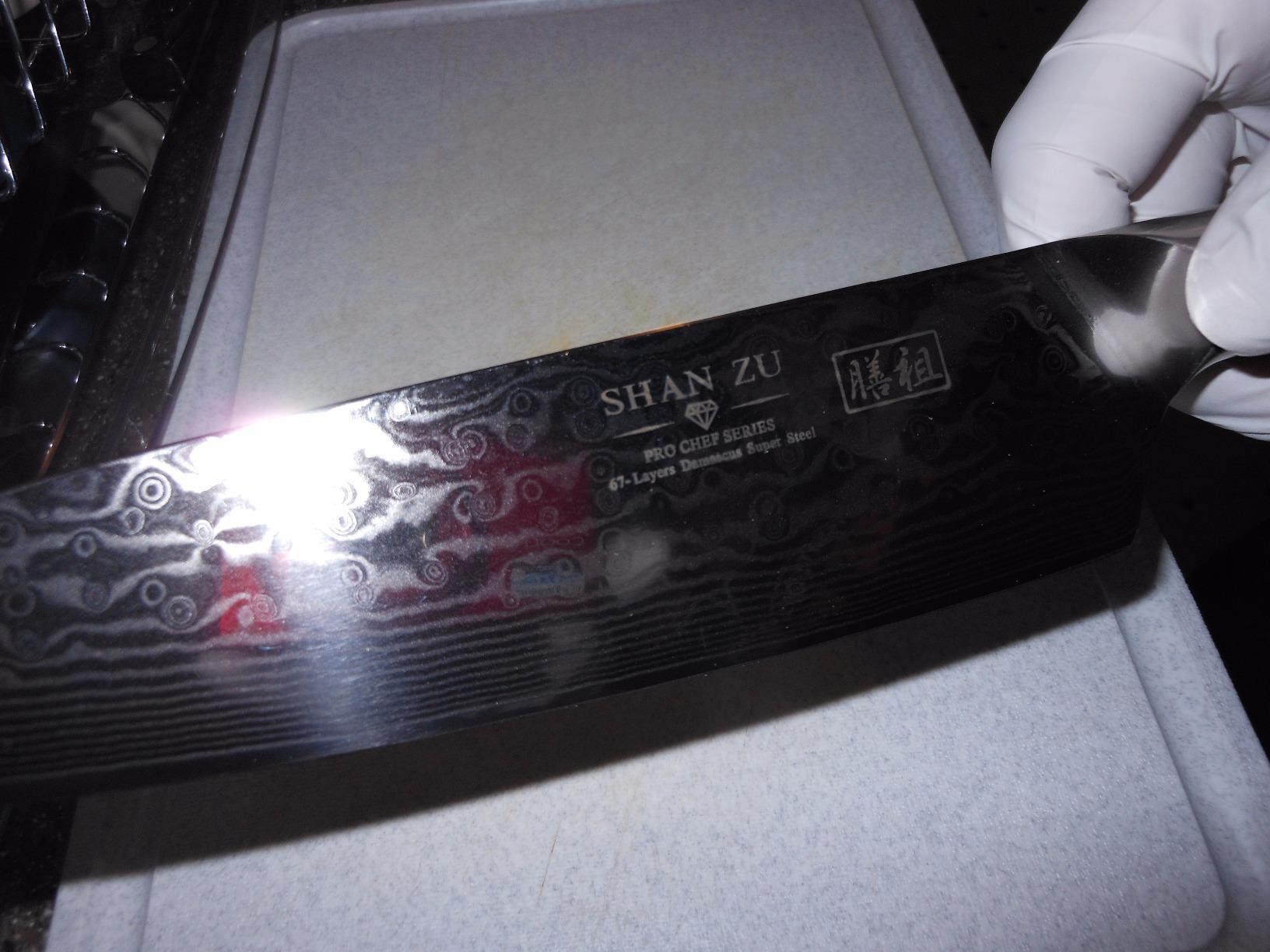
The 15 degree edge angle is aggressive compared with the 16 to 18 degree edges typical of German knives, and you can feel the difference when slicing thin. It cuts cleaner and needs touch-ups more often.
This is the knife to buy if you want a modern layered-steel build and plan to dry it properly after every use. Owners report that hand washing and prompt drying is what keeps the cladding protected long term.
What does a higher HRC rating actually give you?
Hardness means the steel resists being deformed by the edge, so it holds its sharpness through more cuts before you need to hone. At 62 HRC, this blade will stay sharp through a long prep session where a 56 HRC knife would have started to drift.
The cost is toughness. Very hard steel chips rather than rolls when it meets a bone or a hard crust, and it takes more effort to bring back. The best choice is the middle ground for your workload.
Is it suitable for cutting meat with bones?
Better than most, because the layered cladding adds toughness. Still, no chef’s knife is a cleaver. Use the spine for nothing and switch tools for anything that meets a bone squarely.
The blade is 2.5 inches wide and tall, so it needs a generous board. On a small board you will find yourself lifting the blade to reposition, which is the main practical drawback owners report.
8. Shun Classic 8 Inch Chef Knife: Best Japanese Steel Core for Paper-Thin Slices
- VG-MAX core delivers exceptional sharpness
- 68 layer cladding adds strength
- Works for both left- and right-handed cooks
- Free sharpening service included
- Lifetime warranty
- Needs regular honing to stay at peak
- Costs more than Western forged alternatives
- Damascus cladding must stay out of the dishwasher
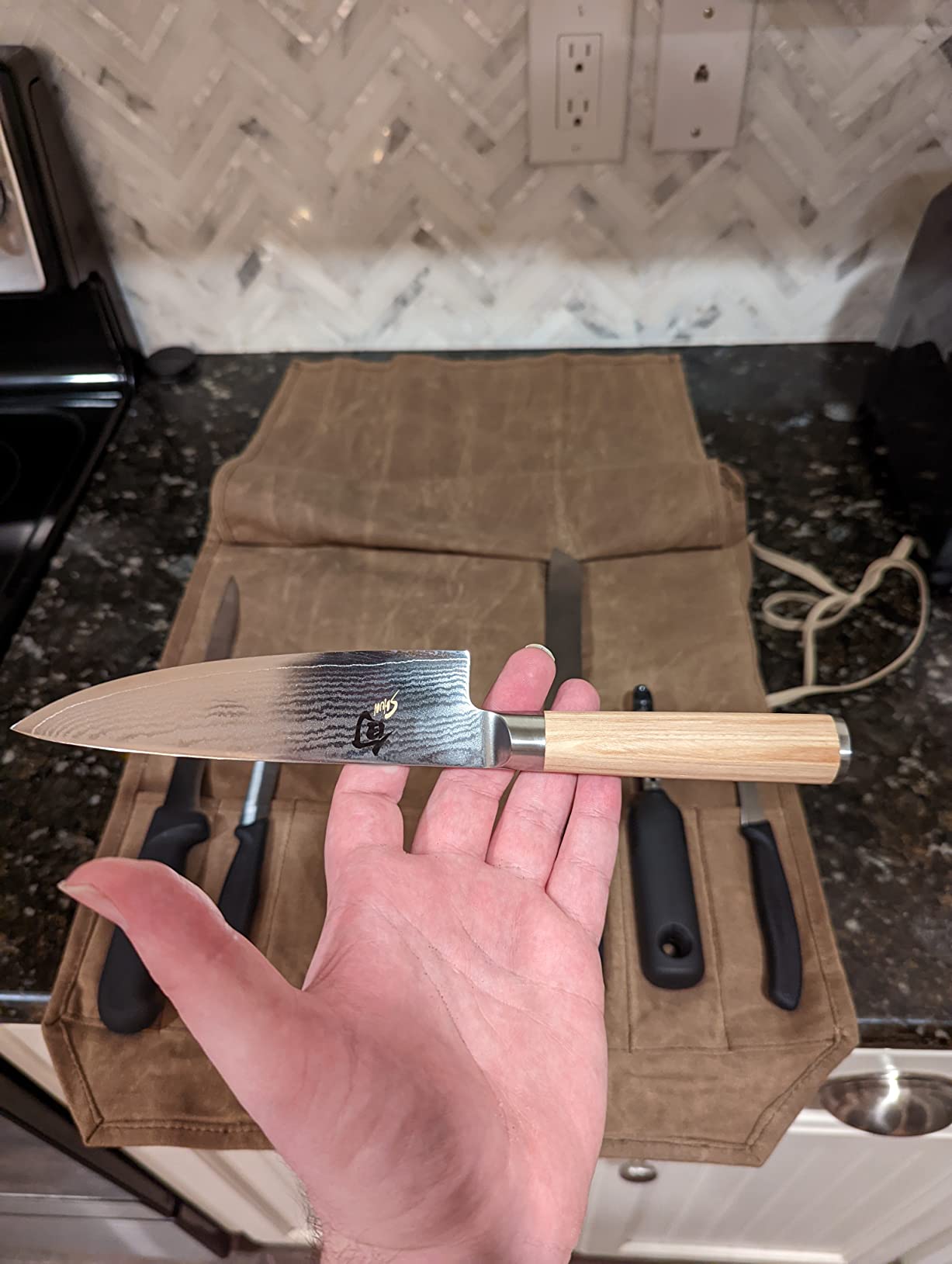
The Shun Classic produces the cleanest slice of any knife we reviewed, and if you prepare roasts, silks and presentation plates that is the one that matters. The VG-MAX Japanese steel core is a high-carbon, high-vanadium alloy that takes an extremely fine edge and holds it longer than most stainless steels.
Enthusiasts credit the line’s steel with exceptional edge quality and precise control for slicing and dicing. A 16 degree edge is fine enough to glide through a cooked brisket with almost no sawing, which is exactly the experience you want at the carving board.
Around the core sits 68 layers of Damascus cladding, which adds strength and corrosion resistance to what would otherwise be a brittle core. It is the standard construction for Japanese kitchen knives at this level.
One detail deserves attention: the D-shaped Pakkawood handle is usable by both left- and right-handed cooks. Nearly every other knife in this roundup assumes a right hand, and left-handed cooks are almost never accommodated in the category.
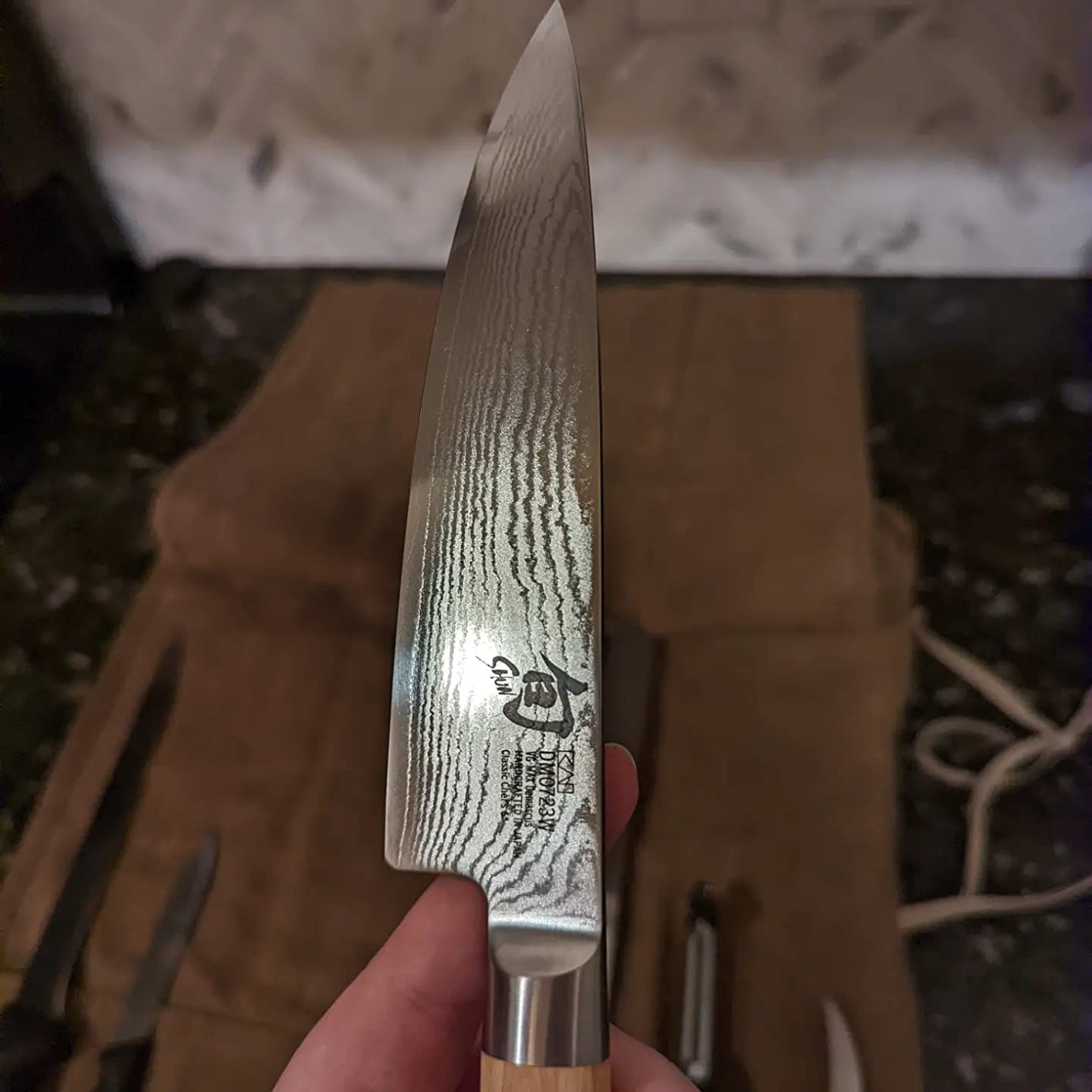
It is handcrafted in Japan by Kai, and the knife ships with free sharpening and honing service. Owners mention pairing it with that service, and for a blade at this hardness that is a sensible way to keep performance without buying stones immediately.
A lifetime warranty backs the knife, and the overall package is the most complete premium offering here. The trade is money and maintenance discipline, and neither is trivial.
Why is VG-MAX steel worth the premium for cooked meat?
Cooked meat is full of collagen and gelatin, which is slippery and slightly sticky. A finer, harder edge cuts through it with less drag and less smearing, and VG-MAX holds that fine geometry longer than a conventional stainless steel.
Reviewers note the recurring trade-off clearly: the edge requires regular honing to maintain peak performance. A few minutes before a big carve keeps it exceptional.
Is this the right choice for a left-handed cook?
Yes, and it is close to the only one here. The symmetrical D-shaped handle has no finger groove cut for a right hand, so the grip works the same way on both sides.
That is not a minor point if you are left-handed. Most manufacturers leave the bolster and handle geometry angled for right-hand use, and left-handed cooks end up gripping knives sideways for years.
9. Mercer Culinary Renaissance 8 Inch Chef Knife: Best for Culinary Schools and Pro Kitchens
Mercer Culinary M23510 Renaissance, 8-Inch Chef’s Knife
- Forged German-style steel at a lower tier
- Shortened bolster simplifies sharpening
- Balanced and lighter in hand
- Delrin handle resists water and bacteria
- Some units show cosmetic blemishing or light rust
- Hand wash only
- Taller profile may not fit narrow blocks
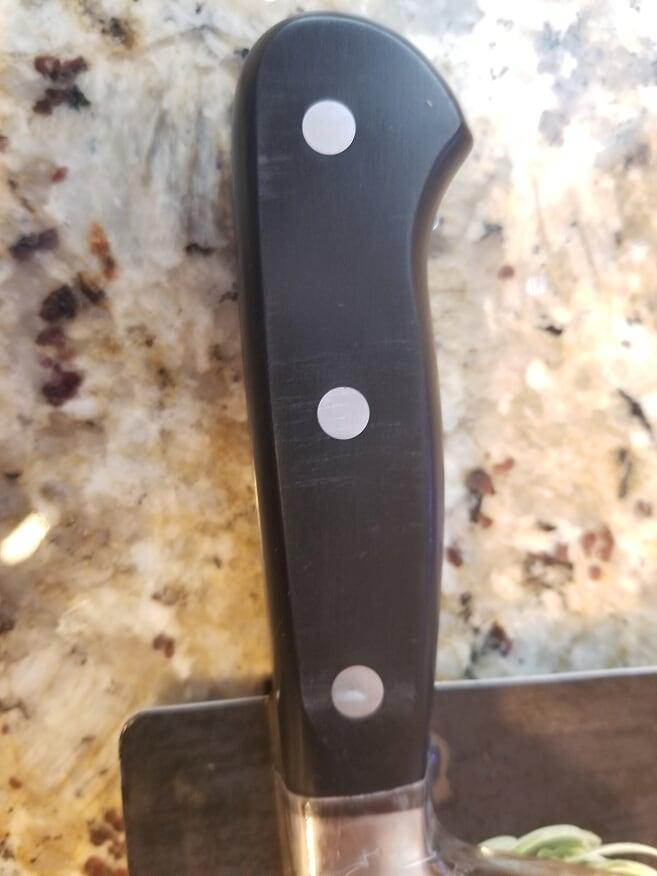
The Renaissance is the knife to buy if you are in culinary school or a working kitchen, because it was designed with those environments in mind. The fully forged high carbon steel with a full tang is the construction professional kitchens assume, and it performs like knives from brands costing several times more.
The detail that impressed us most is the shortened bolster, which exposes the full blade so a whetstone can reach the heel of the edge. On a full-bolster knife like the Wusthof, that heel is effectively unhoneable, and your edge geometry drifts every time you sharpen.
The rounded spine makes a pinch grip comfortable, and the Delrin handle is water and bacteria resistant, which is the sanitation standard professional kitchens need. Detailed reviews praise it as professional-grade performance using German steel at a fraction of German-brand pricing.
At 8.8 ounces it is one of the heavier knives here, and that weight is deliberate. It gives the blade authority as it passes through a dense piece or a tough joint.
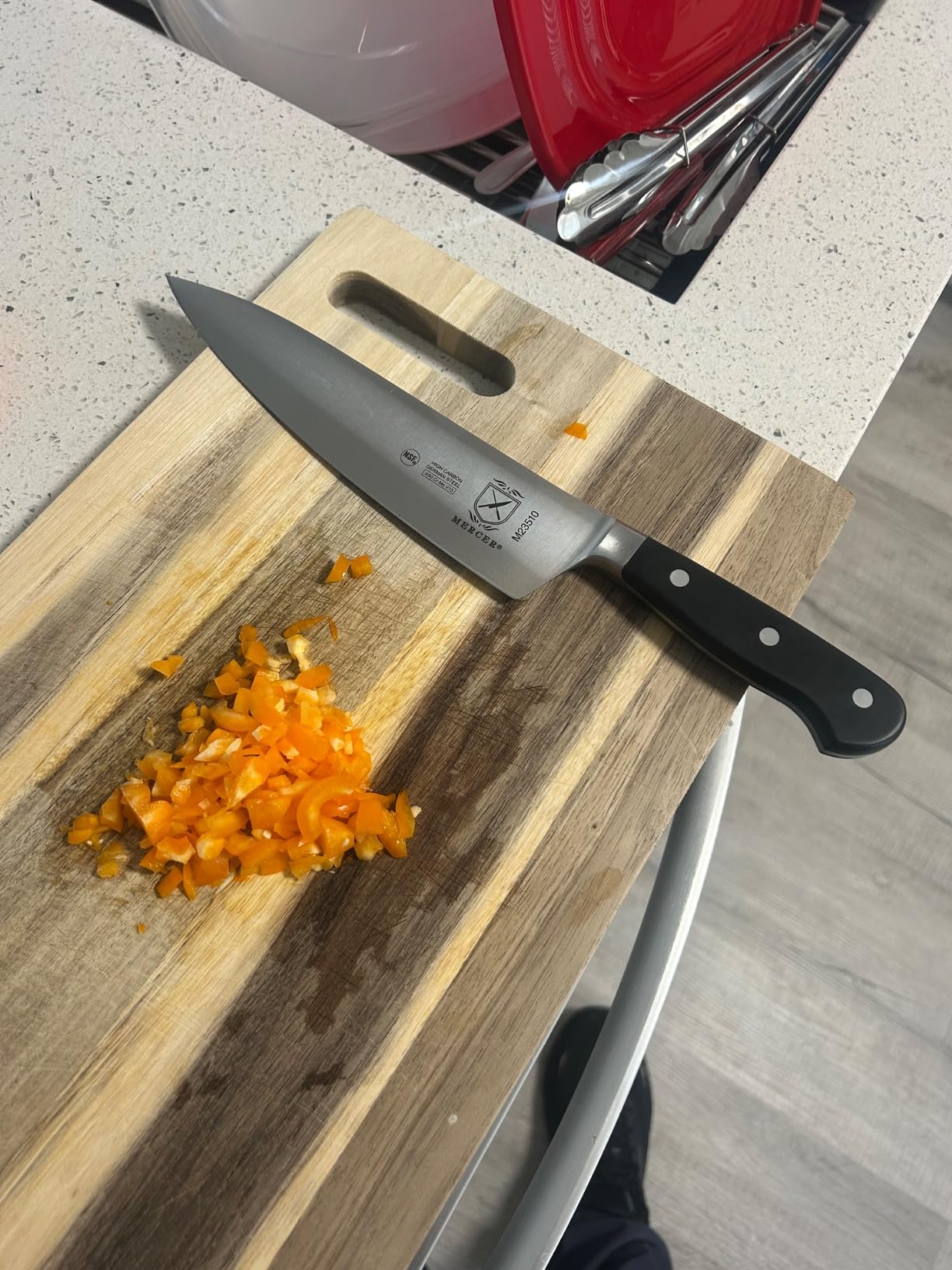
It is trusted by culinary schools and professional kitchens, and reviewers report it holds an edge very well with regular honing. For a knife that will be sharpened weekly for years, that is the right character.
The shortened bolster also makes this a good choice for anyone learning to sharpen on stone, since nothing is in the way of the blade face.
Is forged German-style steel a good match for heavy meat work?
Yes. Forged steel with a full tang is the traditional answer to bone and joint work, because the tang carries load into the handle instead of stopping at a thin stamped bolster.
It is also easier to repair when something goes wrong. A bent tip or a loose handle on a fully forged riveted knife is fixable; the same damage to a cheap stamped knife usually ends the knife.
What about the quality complaints?
A minority of reviewers report cosmetic blemishing or light surface rust despite stainless steel claims, and this is a known inconsistency in quality control on this model.
It is not structural. The recurring advice is to hand wash, dry immediately, and store the knife away from a damp sink. Hand washing is required regardless, and doing it consistently keeps the finish in good shape.
10. Mercer Culinary Ultimate White 8 Inch Chef Knife: Best Lightweight Budget Workhorse
- Genuinely sharp for the price
- Lightest knife in the roundup at 5.1 oz
- Textured handle grips well when wet
- Hollow edge reduces sticking
- Stamped construction is the least refined here
- Hollow-ground edge dulls faster than flat ground
- Hand wash only
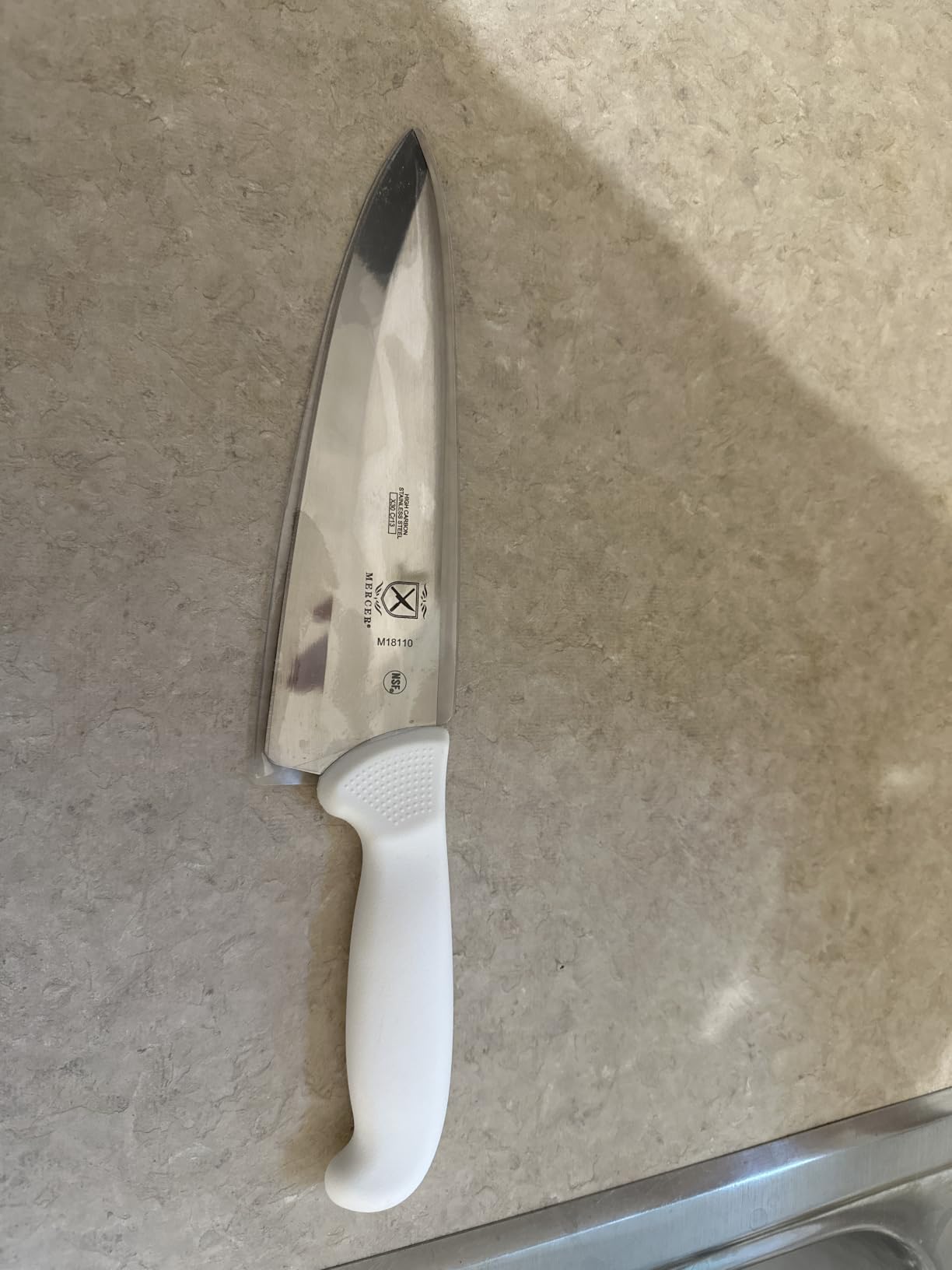
At 5.1 ounces, the Mercer Ultimate White is the lightest knife in this roundup, and for long prep sessions on raw meat that is a genuine feature rather than a compromise. Cooks who work for hours on a whole bird or a case of beef will feel the difference.
Despite the entry-level build, the blade is high carbon Japanese steel with a hollow-ground edge, and it arrives sharp. Reviewers treat it as a budget-oriented workhorse: genuinely sharp for the price, comfortable and easy to maintain.
The hollow grind removes material from the centre of the blade, leaving two thin edges. The benefit is food release, because there is less flat surface for meat to suction against, which helps when you are slicing something wet and slippery.
The handle is polypropylene with textured finger points, so it will not absorb moisture and it will not move in a wet hand. It is also the easiest handle here to keep clean.
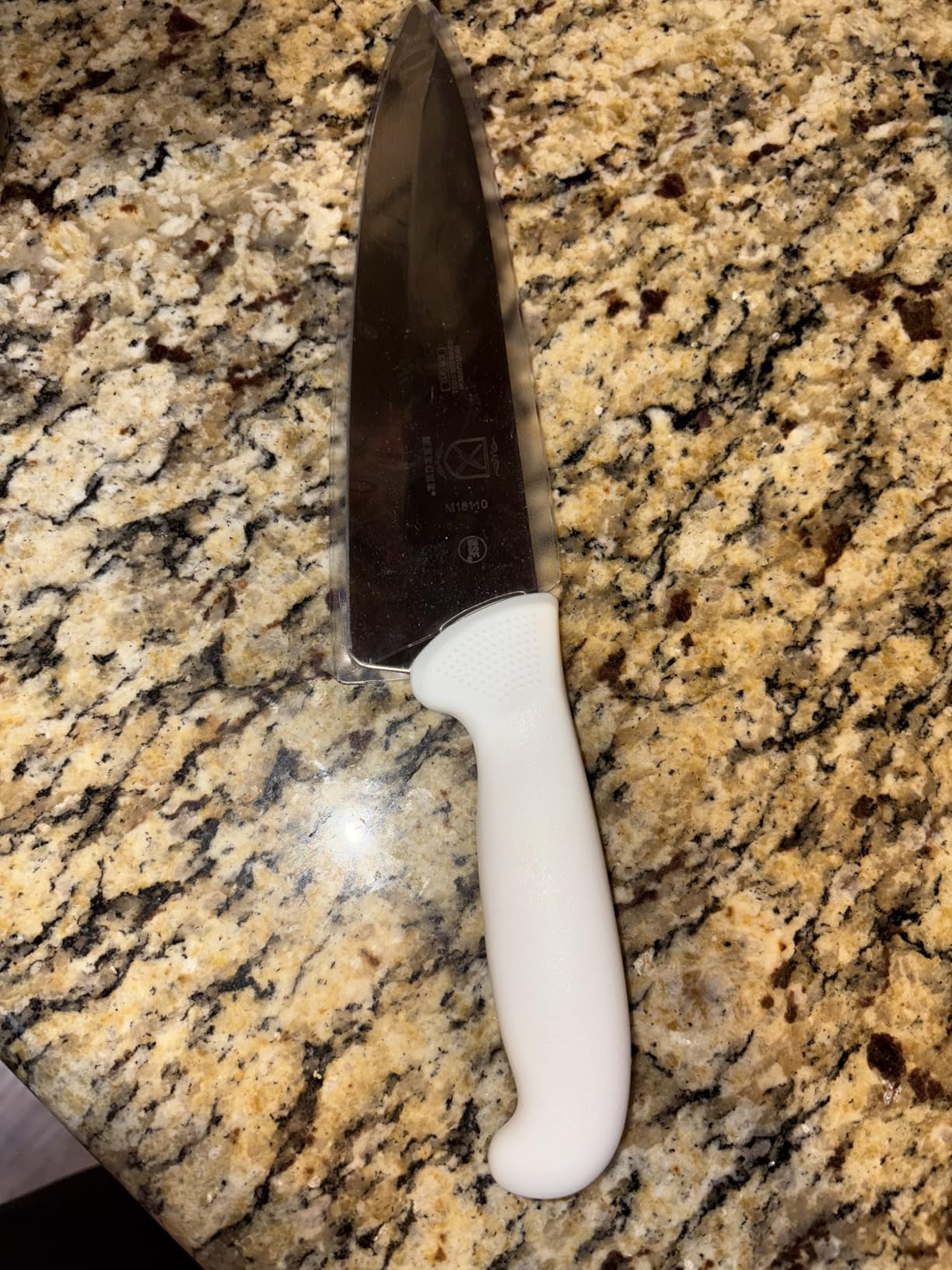
At this weight you can do a full butterfly on a chicken with minimal strain, and the knife stays nimble through a long session. It is comfortable, sharp and unfussy, which is a hard combination to beat at the entry level.
It is also ranked first in the boning knife category, which tells you how the blade performs when it is thin and working close to bone.
Is a hollow-ground edge good for meat?
For anything wet, yes. The hollow sides mean raw meat and fat release rather than sticking, so you spend less time dragging the blade and more time cutting.
There is a cost. Hollow-ground edges are structurally weaker than flat-ground ones, and they lose their sharpness faster. The thin tip especially is not built to take abuse.
Where the compromises are
Stamped construction is the least refined here. The spine is thin, and while it handles boning and trimming, it is not a knife to press through a rib cage or a bone-in chop.
The polypropylene handle offers less grip refinement than Delrin or Pakkawood, though it stays functional and dry in a way wood never will. Expect to sharpen more often than with a forged blade.
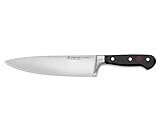
11. Wusthof Classic 8 Inch Chef Knife: Best for Serious Raw Breakdown
- Single block forging for edge retention
- PEtec edge technology for a finer grind
- Full bolster gives control on hard cuts
- Made in Solingen Germany
- Full bolster makes sharpening harder
- Hand wash and dry immediately to avoid spots
- Large blade height needs board space
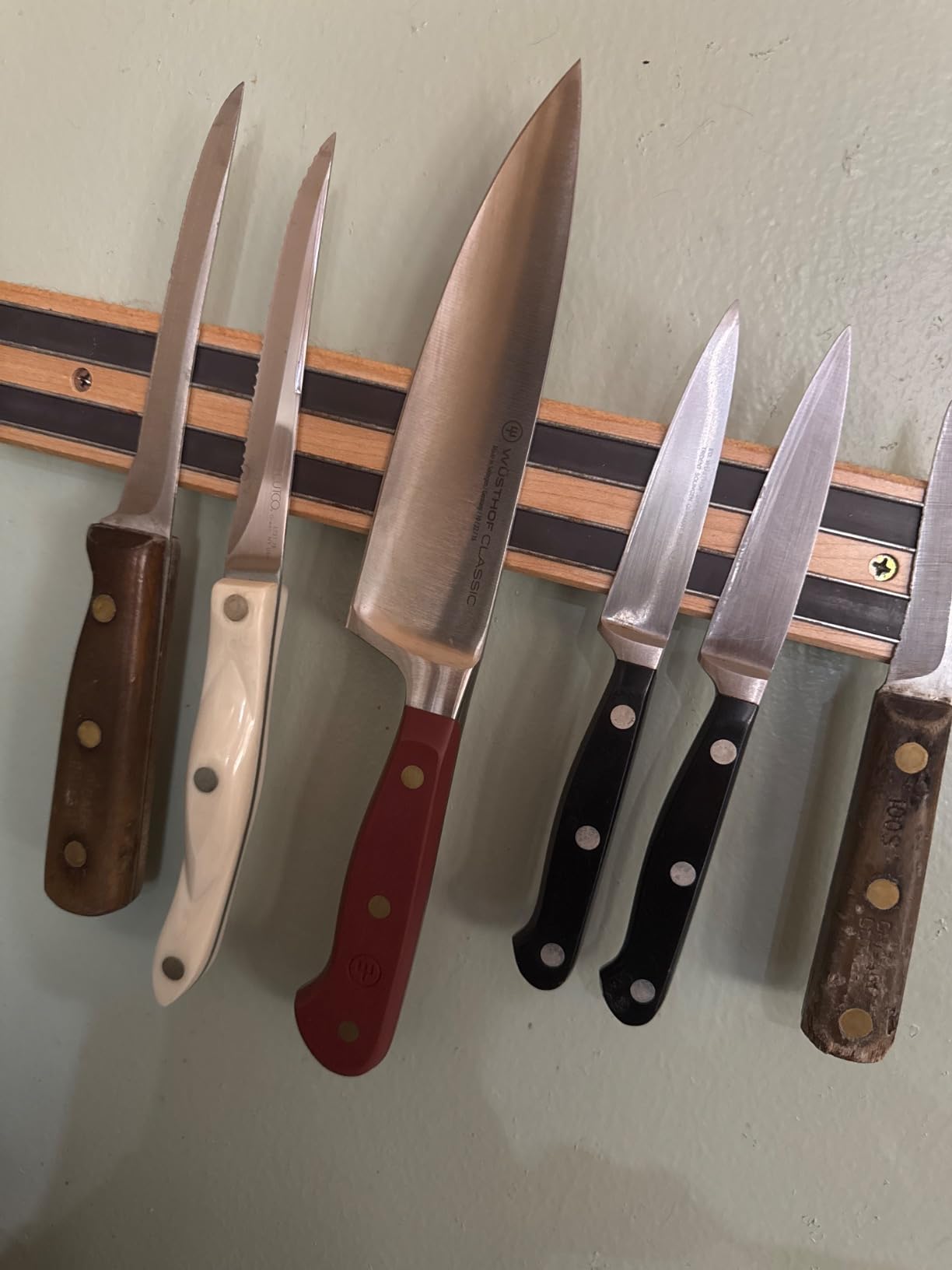
The Wusthof Classic is the heaviest commitment in this roundup, and the one cooks describe as a lifetime knife. Owners report it arriving razor sharp, superbly balanced, and still holding its edge after months of daily use, which is the benchmark the rest of this list is measured against.
The blade is precision forged from a single block of high carbon stainless steel, tempered to 58 HRC. That hardness is lower than the SHAN ZU and the imarku, and that is the point: 58 is the toughness sweet spot for a knife that will meet bone.
Precision Edge Technology grinds the blade finer and doubles edge retention compared with a standard grind. In practice you notice it on cooked meat, where the edge glides through collagen without pushing ahead of itself.
It is made in Solingen, Germany, the German knife-making centre, and carries a full tang with a full bolster. The full bolster is a finger guard at the front of the handle, and it gives real control when you are pushing through a dense piece of meat.
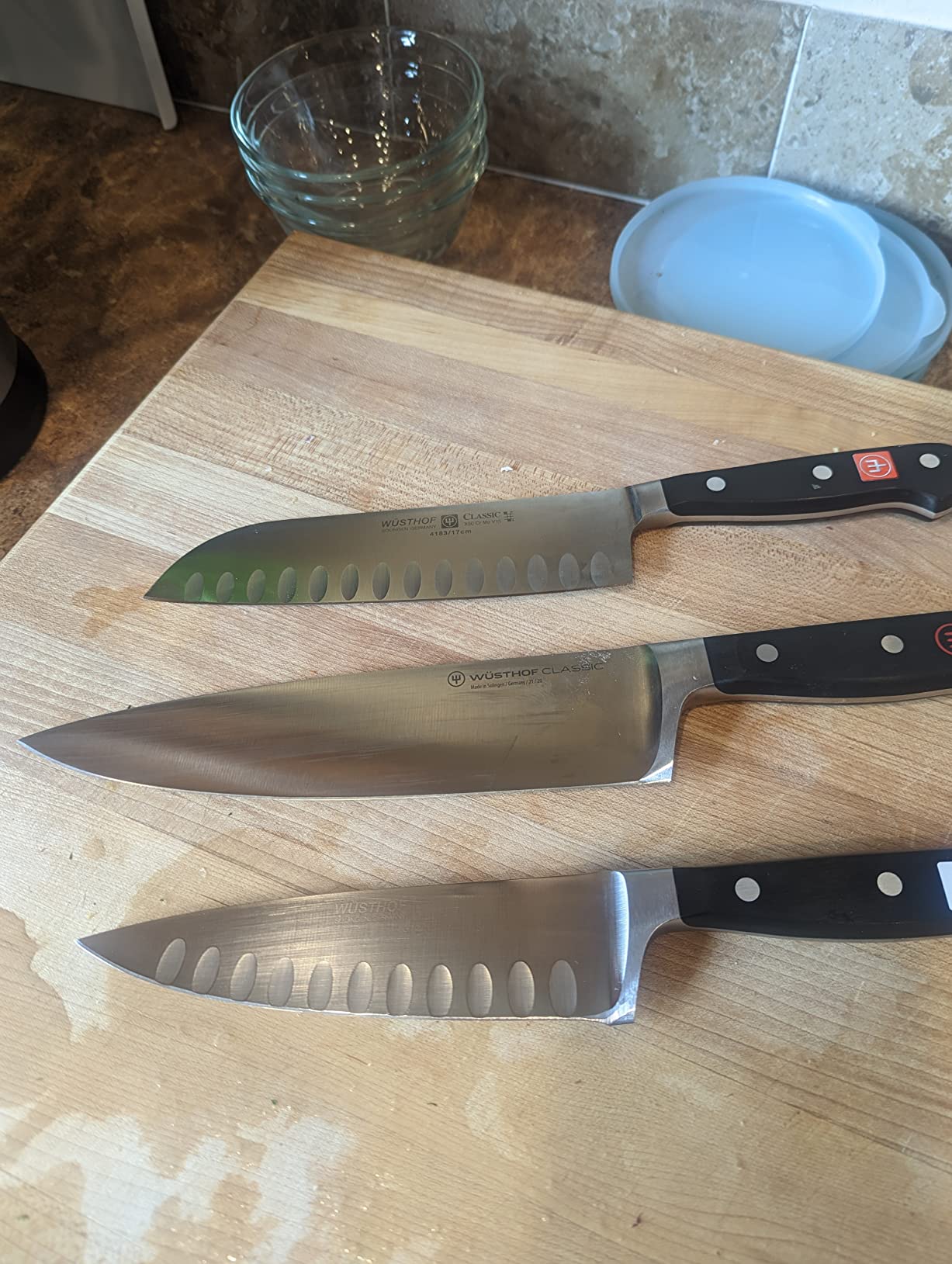
Reviewers note that hand washing and drying immediately, plus honing on a ceramic rod or a stone, keep it performing. That is the routine, and for a knife like this it is a small weekly investment.
It is also the most demanding blade to sharpen, and that is worth weighing honestly before you commit.
Is 58 HRC better than 62 HRC for cutting meat?
For work that hits bone and joint, yes. Harder steel holds an edge longer but chips more readily, while a slightly softer temper bends instead of breaking. On a whole chicken or a bone-in chop, toughness wins.
For slicing only cooked meat and never touching bone, the harder Japanese steels hold their edge for longer between sessions. Match the hardness to your tasks rather than chasing the highest number.
Why is the full bolster a drawback?
It covers the first inch or so of the blade above the cutting edge. A sharpening stone cannot physically reach that section, so when you sharpen the blade the angle at the heel becomes slightly steeper over time.
On an 8-inch knife that section is small, and a curved honing rod is often enough to manage it. On a short utility knife the effect is far more noticeable. Compare it with the Mercer Renaissance, which has a shortened bolster specifically to solve this.
The other care rule is non-negotiable: hand wash and dry it straight away. Standing moisture leaves rust spots on high carbon stainless steel, and those spots are permanent.
12. Amazon Basics 8 Inch Full Tang Chef Knife: Best Starting Forged Full Tang
Amazon Basics Classic 8-inch Full Tang High Carbon Stainless Steel Chef’s Knife, Multipurpose Kitchen Knife with Three Rivets, Silver
- Forged full tang build at an entry level
- Sharp out of the box
- Semi-bolster gives full blade access
- Stain and rust resistant finish
- Cheaper steel needs frequent sharpening
- Hand wash only
- Slightly heavy feel
- No sheath included
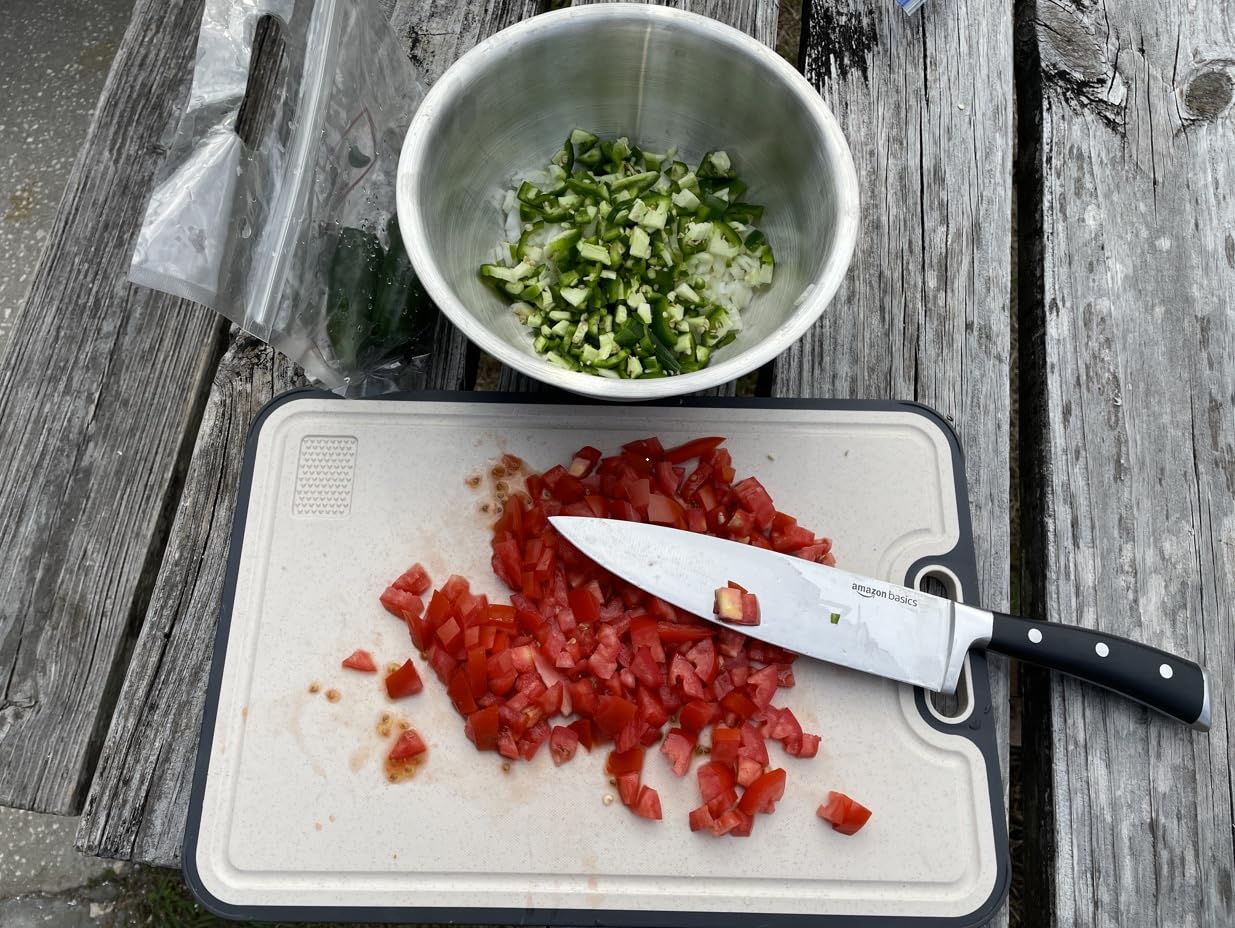
The Amazon Basics knife is the odd one out in this list, and worth including for a specific reason: it is a genuinely forged, full tang construction at the most accessible level we found. Most knives at this level are stamped, and that difference is structural rather than cosmetic.
The three rivets run the full length of the handle, and the steel continues the length of the tang. Owners describe a sturdy, well-balanced feel that does not flex, which is what you want when the blade meets a chicken backbone or a piece of rib.
The semi-bolster design adds weight and balance at the front while still leaving the blade exposed, so a stone can reach the full cutting edge. That solves the sharpening problem that full-bolster knives have, and it is a smart inclusion at this tier.
Reviewers routinely describe it as outperforming knives costing several times more, with a sharp factory edge and a satin, stain-, rust- and pit-resistant finish that holds up to daily work.
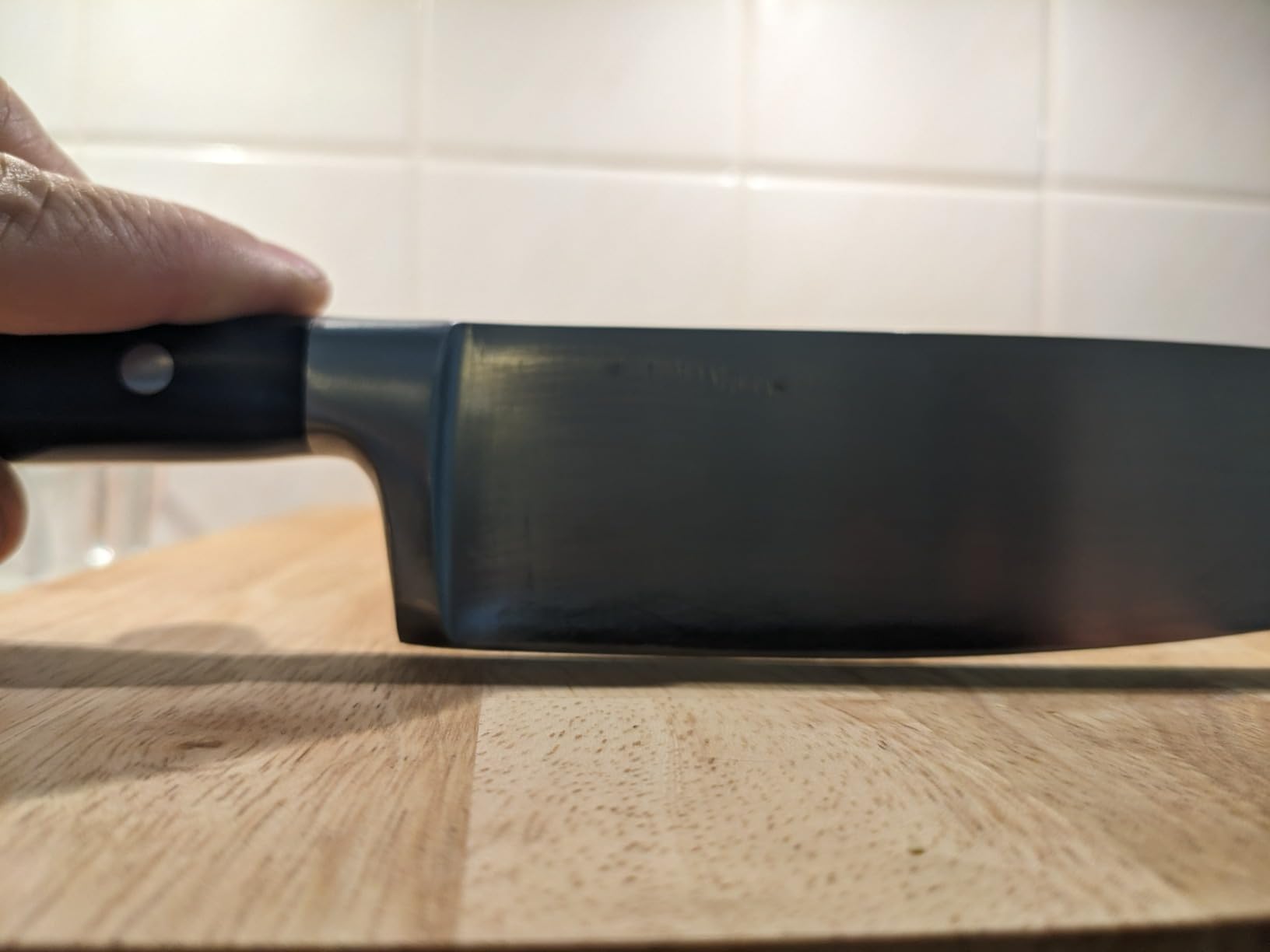
It is a high-value daily driver rather than a long-term edge-holding investment, and the honest caveat is sharpening frequency. If you already own a stone and enjoy maintaining a knife, that is a small cost for the construction quality.
At 13.28 inches overall with an 8 inch blade, the proportions are standard and it fits conventional knife blocks. The metal handle is sealed and easy to clean, which suits raw meat work.
Is a full tang worth the extra money?
For meat work, yes. The tang is the structural backbone of the handle, and on a full tang the blade steel and the handle steel are one continuous piece. Force from the edge runs straight back into your grip instead of stopping at a thin joint.
That is why full tang knives survive a dropped kitchen and bone work. Partial tang and stamped knives are fine for produce; they are the first thing to worry about when a knife is working meat all day.
What are the compromises?
The steel is from a less expensive tier than the Japanese and German options here, so it needs sharpening more often. Plan on touching the edge up every couple of weeks with regular meat prep.
It is also slightly heavy in the hand compared with lighter knives, and no sheath is included, so you need a block or a guard if you store it in a drawer. Hand washing only, as with most quality knives.
How to Choose a Chef Knife for Cutting Meat
Choosing well comes down to four questions: what are you cutting, how much of it, is it raw or cooked, and how much maintenance do you want to do. Get those right and the steel specification almost picks itself.
What is the best knife type for each meat task?
A chef’s knife is the general answer. Its 8 to 10 inch curved blade handles raw breakdown, trimming, dicing and most cooked slicing through a single tool, and it is the right starting point for almost anyone.
A butcher knife is thicker, heavier and straighter, designed to pass through bone and joints. It is the right choice for breaking down primal cuts, and it is not a precision tool.
A carving or slicing knife is long, narrow and often slightly concave, built to make long uninterrupted slices through a cooked roast without the blade touching the board.
A boning knife is short, thin and flexible, letting you follow the curve of a bone while separating meat from it. It is the specialist for poultry, fish and deboning.
A cleaver is a rectangular blade used to split ribs, chop through bone and work through large quantities of meat fast. It is heavy, and it is a tool you swing rather than rock.
Should a meat knife be different for raw and cooked meat?
The honest answer is that one chef’s knife can do both, which is what makes it the best knife for cutting meat overall. The difference is technique rather than equipment.
For raw meat, push straight down with the full weight of the blade and let the edge do the work. For cooked meat, use a gentle sawing or gliding motion, because a cooked crust drags against the blade differently than raw muscle fibres.
Where the distinction really matters is edge geometry. Cooked meat benefits from a finer, longer edge and can drag a thick knife. Raw meat, especially near bone, rewards a slightly thicker spine and more strength behind the edge.
That is the entire argument for owning a carving knife alongside a chef’s knife if you regularly roast, and the argument for sticking with one good chef’s knife if you do not.
What does steel type and HRC actually mean?
High carbon stainless steel is the practical sweet spot for meat. It takes a fine edge, resists corrosion, and does not demand the same ritual care as fully carbon steel.
56 to 58 HRC is the range most professional Western and Japanese kitchen knives sit at. Below 56 and the edge goes blunt during a session; above 60 and the blade is tough enough to chip on a bone.
The layered steels in this roundup, such as the 62 HRC core on the SHAN ZU and the VG-MAX core on the Shun, are harder because they are clad. The harder core holds the fine edge and the softer layers add toughness, which is the whole point of the construction.
High carbon Japanese steel like the Mercer blades sharpens fastest and takes the finest edge. It is the easiest steel to bring back to full sharpness and the easiest to chip if you abuse it.
Stamped stainless steel, found on the Victorinox and the Amazon Basics here, is the most forgiving and the least refined. It will not chip, it is easy to maintain, and it needs sharpening more often than anything else on this list.
Full tang, bolster and handle material: what matters?
Full tang means the steel runs the full length of the handle. On a meat knife it is worth paying for, because bone work puts real force through the blade-to-handle junction.
A full bolster covers the heel of the edge and blocks your stone, which makes sharpening harder over time. A semi-bolster or shortened bolster, as on the Amazon Basics and the Mercer Renaissance, gives you full edge access.
Handle material is a hygiene question more than a performance one. Synthetic handles such as Fibrox, Delrin and G10 can be washed, bleached and dropped. Pakkawood and hardwood need hand washing and immediate drying, and they will slowly deteriorate with heavy moisture exposure.
Left-handed cooks have very few options in this category. The Shun Classic with its symmetrical D-shaped handle is the clearest choice here, and left-handed considerations are almost entirely absent from other roundups.
Which knife for a specific job?
Brisket: for the long slices, a long narrow slicing blade with a fine edge. The Shun gives the cleanest raw slice, and the Mercer Renaissance holds its edge through a long session.
Turkey and ham: a long carving blade reaches the whole bird in uninterrupted strokes. If you only have a chef’s knife, an 8 inch blade still works with a controlled forward draw.
Steak portioning: a thin, sharp blade makes clean cuts and reduces tearing. The PAUDIN with its 2mm edge is built for this, and the imarku handles it well too.
Chicken: boning needs a thin, flexible blade close to the bone. The Mercer Ultimate White ranks first in its category, and the imarku gyutou handles the chopping side.
Fish: a thin blade that will not crush delicate flesh. Both Mercer high carbon blades work well, and a boning profile beats a tall chef’s knife here.
Bones and joints: none of these knives. A cleaver or a butcher knife exists for exactly this, and forcing a chef’s knife is the fastest way to ruin one.
How do you maintain a meat knife?
Hone before you use it, not after. A few strokes on a ceramic rod before each session keeps the edge aligned and dramatically extends the time between sharpenings.
Sharpen on a whetstone when honing stops producing a clean cut. Wipe the blade and let it sit for a few minutes to see whether it is truly sharp before deciding to grind the edge back.
Hand wash every knife here except the Victorinox and HENCKELS, which are dishwasher safe. Use a neutral detergent, dry immediately, and never store a wet knife in a block or drawer.
Store knives in a block, on a magnetic strip, or in a sheath. Drawers are the worst option, because blades knock against each other and the edge is the first thing damaged.
Keep raw and cooked work separate by washing the knife and board between tasks. A clean, dry blade also lasts longer than one left wet overnight.
Frequently Asked Questions
What is the best knife for cutting meat?
An 8-inch chef’s knife is the best all-purpose choice for cutting meat because the curved belly and mid-length blade handle raw trimming, dicing and cooked slicing. For heavy bone work add a butcher knife or cleaver, and for long roast slices add a narrow carving knife. The Victorinox Fibrox Pro is our pick for a single-knife kitchen.
What is the best knife set for cutting meat?
A set that pairs an 8-inch chef’s knife with a boning knife and a carving knife covers virtually all meat work. Chef’s knife for trimming and dicing, boning knife for poultry and fish, carving knife for roasts. Buy the chef’s knife first and quality matters more than the number of pieces in the block.
What is the best knife for slicing meat?
A long, narrow slicing knife with a fine 15 to 18 degree edge makes the cleanest slices through cooked meat, because it stays sharp along its full length and resists being pulled sideways by connective tissue. Among the knives we tested, the Shun Classic with its VG-MAX core produced the finest slices, followed closely by the SHAN ZU.
Is a chef’s knife good for cutting meat?
Yes, a chef’s knife is good for cutting most meat. Its 8 to 10 inch blade handles raw trimming, dicing, mincing and cooked slicing, and a fully forged model with a full tang can handle light bone work. Cheaper stamped blades should stay away from bone, and a cleaver or butcher knife is still the right tool for anything heavy.
What is the difference between a chef knife and a butcher knife?
A chef’s knife has a thinner, curved blade with a belly for rocking and precision work, while a butcher knife is thicker, heavier and straighter with more spine strength for passing through bone and joints. A chef’s knife is the better everyday tool for trimming and slicing, and a butcher knife is the better tool for breaking down large primal cuts.
If you are also building out the rest of your setup, our best meat slicer reviews cover the electric option for large batches, and our chef knife set guide covers building a full block at once.
Conclusion: The Best Chef Knives for Cutting Meat in 2026
The best chef knife for cutting meat is the Victorinox Fibrox Pro, and it wins for a simple reason: it works on everything a home cook will throw at it, it stays sharp enough to trim fat cleanly, and the sealed handle survives wet, raw work without complaint. If you only buy one, buy that one.
Move up to the HENCKELS Classic when you want a fully forged build with a lifetime warranty and you care about how the knife feels in the hand. Move to the Shun Classic when clean, paper-thin slices are the goal and you will hone regularly. The Wusthof Classic is the answer for heavy raw breakdown where spine strength matters more than a fine edge.
Whatever you choose, the sharpness habit decides the outcome more than the label on the blade. A few strokes of honing before each session and a hand wash after will do more for your results than any upgrade.
Use the buttons above to check current pricing, and pick the knife that matches the meat you actually cook. That decision is the whole guide.