
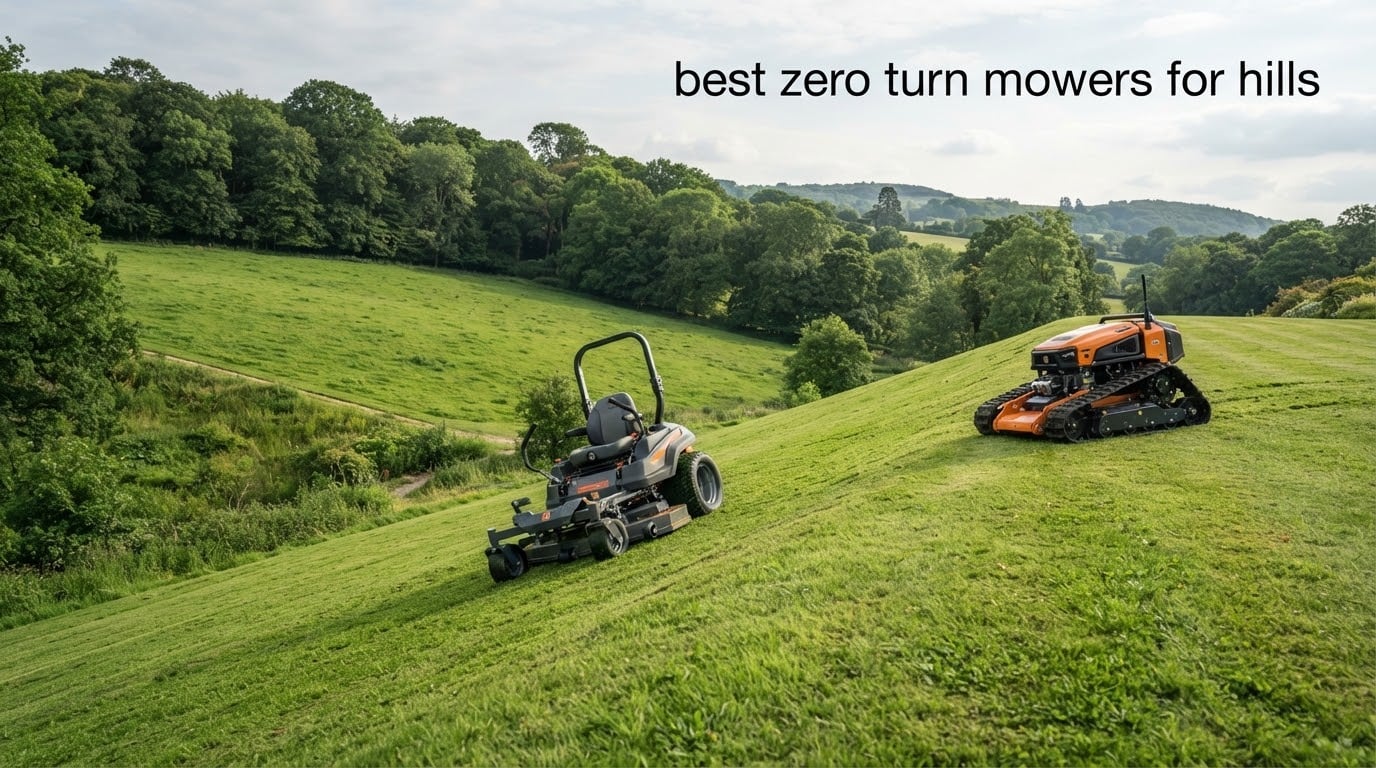
Our best overall pick for rolling hills is the EGO Power+ ZT4204L, a 42-inch battery zero-turn with lap-bar steering, a stamped steel deck and a 620-pound platform that stays planted on moderate inclines without the noise or fuel servicing of a gas machine. If your lawn is steeper than any riding mower should ever be taken, the answer changes completely, and the tracked remote-control mowers in this list climb grades that no zero-turn riding platform is warranted for.
That split is the whole story of this roundup. A zero-turn riding mower earns its keep on a lawn with swells, dips and a moderate grade because the rear-drive steering wheels let you pivot on the spot and hug a contour without circling wider and wider. Past a certain grade, though, a rider is the wrong tool entirely, and the only machines worth the money are rubber-tracked crawlers you drive from the top of the slope.
We grouped the 10 machines below by the grade they are actually rated for, not by price or brand, and we note in every review whether the manufacturer publishes a degree figure. Several do not, and we say so rather than inventing a number. If you want a broader look at the format first, our guide to the best zero turn mowers covers machines that never see a slope, and our lawn mowers for hills guide covers walk-behinds and tractors.
Top 3 Picks for Zero Turn Mowers for Hills in 2026

EGO ZT4204L 42in Battery Zero Turn
- 620-pound platform
- 42-inch stamped steel deck
- lap-bar steering
- 8 MPH

EGO ZT4214L Wide Frame 42in
- Wide frame tuned for slope balance
- deck suspension
- color display
- 5-year warranty

EGO ZT5207L 52in Battery Zero Turn
- 52-inch deck
- 25 HP equivalent
- 6 batteries
- 4 acres per charge
All 10 Zero Turn Mowers for Hills Compared in 2026
Read the grade column first, then everything else. Three picks carry a manufacturer figure at 45 degrees or steeper and none of them are riding platforms you sit on. Only one pick here is a conventional gas zero-turn, and it is the heaviest machine in the group.
| Product | Specifications | Action |
|---|---|---|
| EGO ZT4204L 42in Battery Zero Turn |
|
Check Latest Price |
| EGO ZT5207L 52in Battery Zero Turn |
|
Check Latest Price |
 AIWEIYA AWY-550 Tracked RC Mower AIWEIYA AWY-550 Tracked RC Mower |
|
Check Latest Price |
| EGO ZT4214L Wide Frame 42in |
|
Check Latest Price |
 DareDevil Tracked RC Mower 55 Degree DareDevil Tracked RC Mower 55 Degree |
|
Check Latest Price |
 AIWEIYA 1000S Flail Crawler 39.4in AIWEIYA 1000S Flail Crawler 39.4in |
|
Check Latest Price |
 INFRONT Tracked RC Mower 45 Degree INFRONT Tracked RC Mower 45 Degree |
|
Check Latest Price |
 Tyzar TYZ-550 Track Mower Tyzar TYZ-550 Track Mower |
|
Check Latest Price |
 Tyzar TYZ-1000 Flail Crawler 55 Degree Tyzar TYZ-1000 Flail Crawler 55 Degree |
|
Check Latest Price |
 Ariens Zenith 60 Gas Zero Turn Ariens Zenith 60 Gas Zero Turn |
|
Check Latest Price |
1. EGO Power+ ZT4204L 42in Zero Turn – Best Overall for Rolling Hills
- Quiet operation with no fuel or oil servicing
- Smooth lap-bar steering that new operators pick up quickly
- Covers about two acres per charge
- Ten cutting heights from 1.5 to 4.5 inches
- Three-in-one deck design
- Deck height markings are hard to read while seated
- Arrives in a heavy steel crate that must be dismantled
- Some owners report electronics or battery management faults
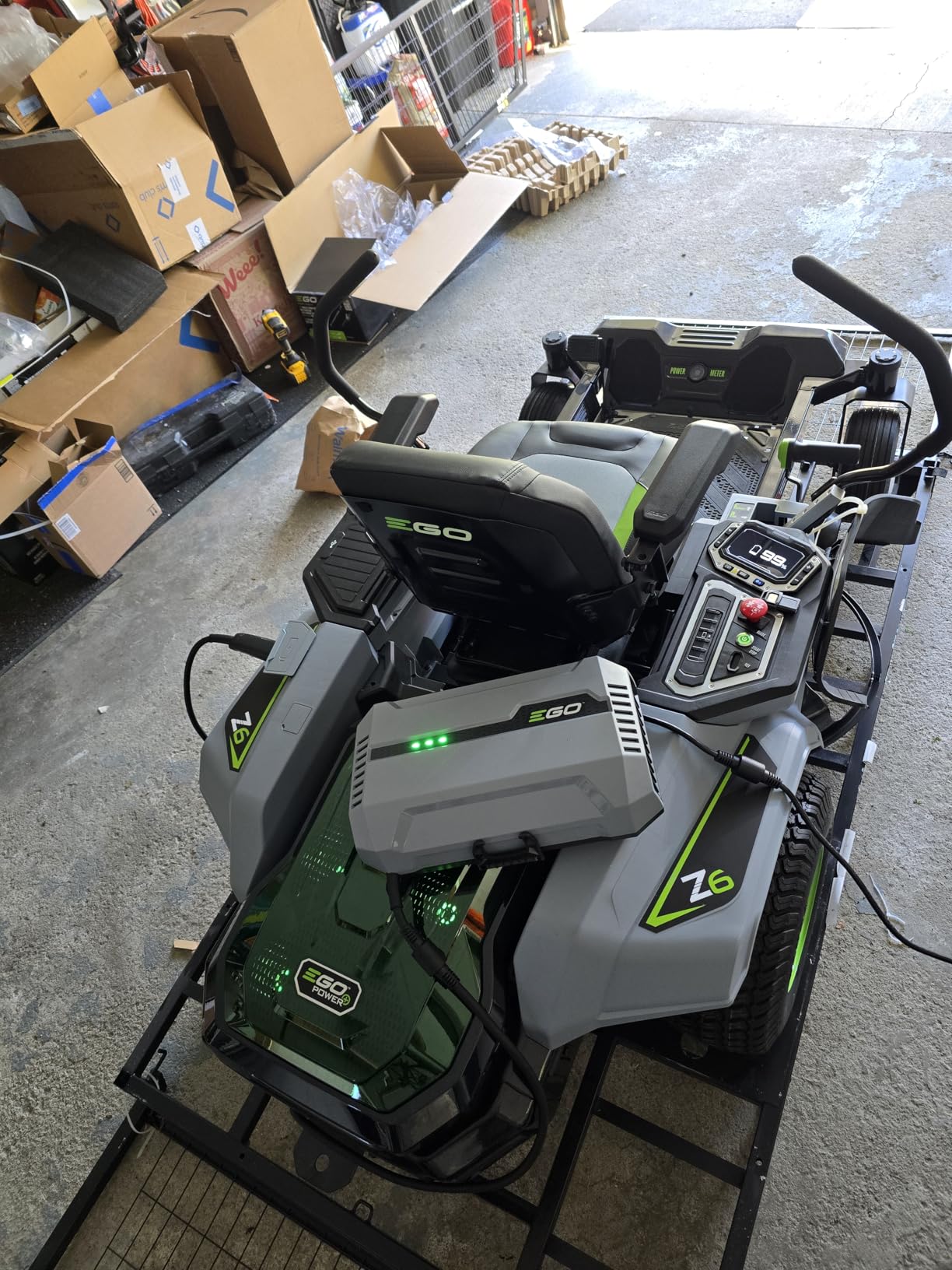
This is the machine we put on a lawn with swells, a shallow drainage swale and one grade that would give a conventional tractor pause. The ZT4204L weighs 620 pounds, carries a 42-inch stamped steel deck and runs on four 56V 10.0Ah batteries that cover up to two acres per charge. Owners consistently single out the smoothness of the lap bars, which matters more on a slope than it sounds.
Weight is the reason this one works. A battery platform carries its mass low and evenly, with no fuel tank slung high and no drivetrain hump to lighten. On a side-hill pass the machine holds its attitude instead of easing sideways, and the wide rear tires do the rest. The absence of an engine also means nothing shifts under you when you cross uneven ground.
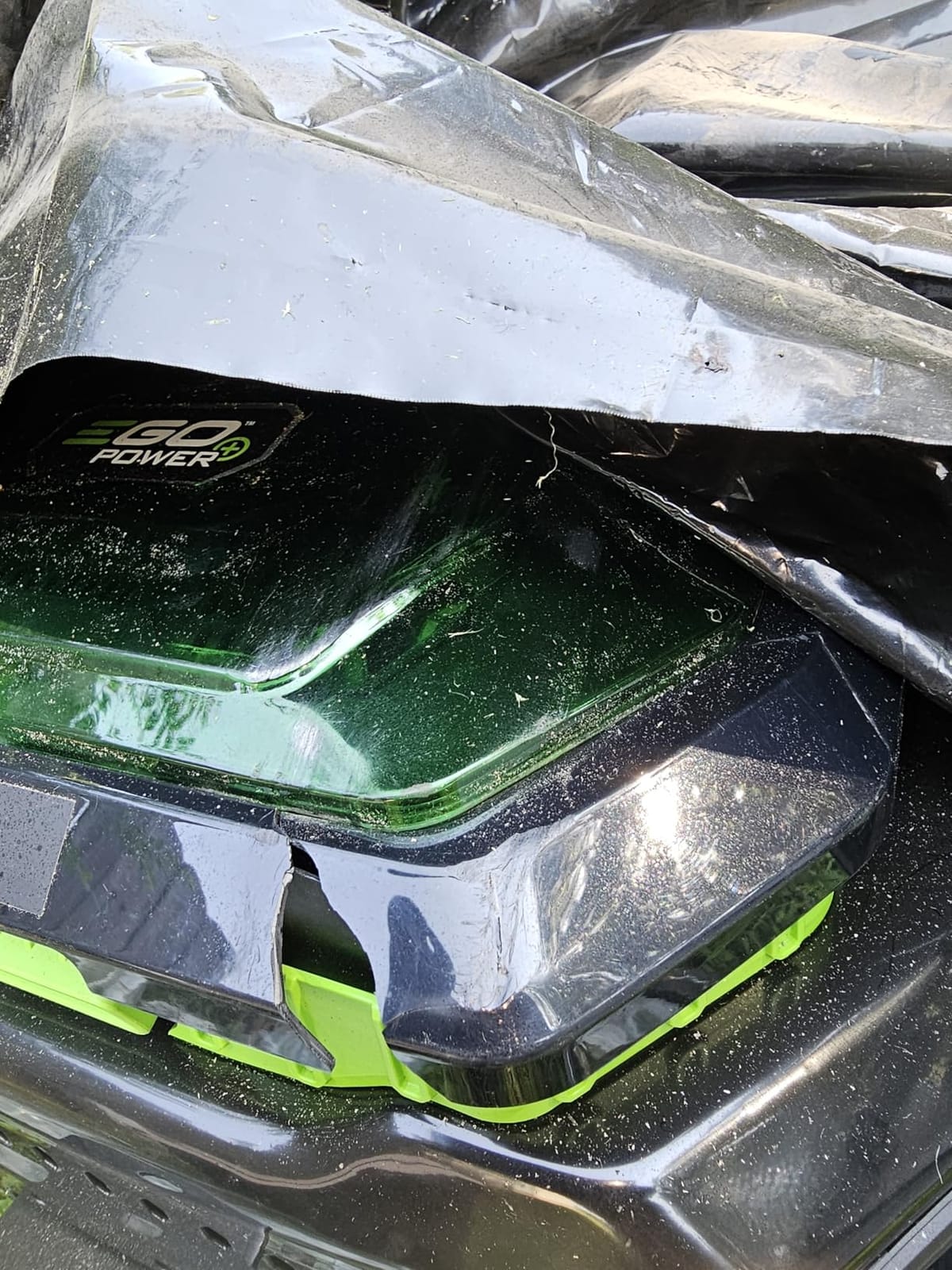
EGO does not publish a slope rating in degrees for this model, so treat any number you see elsewhere as guesswork. What the company does state is the top speed of 8 MPH, three drive modes of Standard, Control and Sport, and a deck suspension-free stamped platform with ten cutting heights. The 3-in-1 deck handles mulching, bagging and side discharge.
The honest limitation is runtime rather than slope behavior. Two acres per charge means a large property needs a mid-session battery swap, and the four included packs are the bulk of the machine’s weight. Reviewers also flag that the deck height scale is genuinely hard to read from the seat, which is a small annoyance when you are setting up on uneven ground.
What you need to know before you buy
Check the width of your narrowest gate and path, because the platform is 76.8 inches long and 44.4 inches wide at its widest point. Plan where the machine lives, since a 620-pound electric zero-turn is not something you want to push across a lawn every morning.
Read the battery registration terms. EGO offers a five-year battery warranty on the machines that carry it, and registration windows are short, so the paperwork matters more than it looks like it should.
Where it falls short
Battery packs degrade in cold weather and the charging logistics are real work on a big lot. A handful of long-term owners report firmware and battery management faults that required dealer service, so the support network matters more here than it would for a simple gas machine.
There is no roll-over protective structure and no seat belt, which is the single biggest gap if your steepest pitch approaches the limit of what a rider should do. If your grade is sustained and severe, step down the list rather than up.
2. EGO Power+ ZT5207L 52in Zero Turn – Best for Large Flat Acres With Hills
- Cuts knee-high weeds and dense growth on a multi-acre lot
- 52-inch deck clears two acres on one charge
- Deck wash adapter for post-mowing cleaning
- App doubles as the key with fast firmware updates
- Front axle is as wide as a 42-inch deck so the wide deck can catch
- Bluetooth pairing fails if the power button is held
- Blades clog quickly in very thick springy grass
When the hills are a minority of a large property, cut speed is the deciding factor and this is the fastest rider here. The 52-inch deck, a 25 horsepower gas equivalent and a 4 to 8 MPH speed range cover up to four acres on a single charge from six 56V 12.0Ah batteries. Two-season owners report that it matches gas cutting with none of the fuel or oil work.
On the slope sections of a large lot, the machine is at 527.4 pounds, the lightest of the three EGO platforms in this list, and the lap bars are adjustable. That combination is stable enough for the rolling ground between hill sections, and reviewers single out the adjustable seat and lap bars as making long sessions bearable on rough terrain.
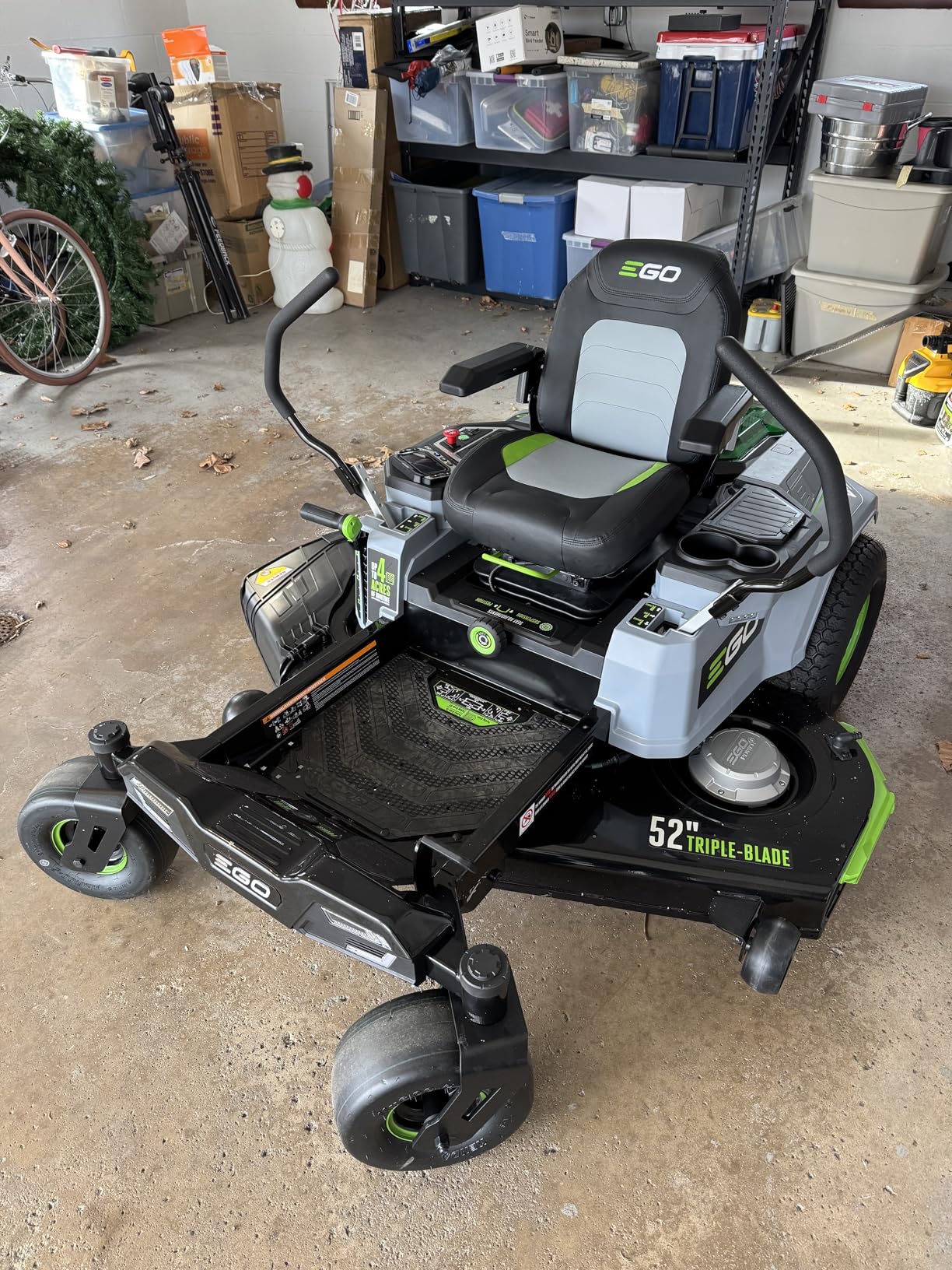
The wide front axle is the detail hill owners should not miss. Reviewers report it is as wide as a 42-inch deck, so the 52-inch cutting deck can contact obstacles that a narrower machine would clear cleanly. On a lawn with trees, ditches or buried stumps, that turns a quick pass into a repair.
Thick springy grass is the other weak point. Owners note the blades clog and drain the battery pack faster in that condition, which turns a two-hour charge into something closer to ninety minutes. On a hillside that has been left for a month in spring, plan for that.
What you need to know before you buy
Measure your tightest turning space against a 52-inch deck and a 76.8-inch length. This is a machine for open ground with a few swells, not for a property hemmed in by beds, fences and irrigation heads.
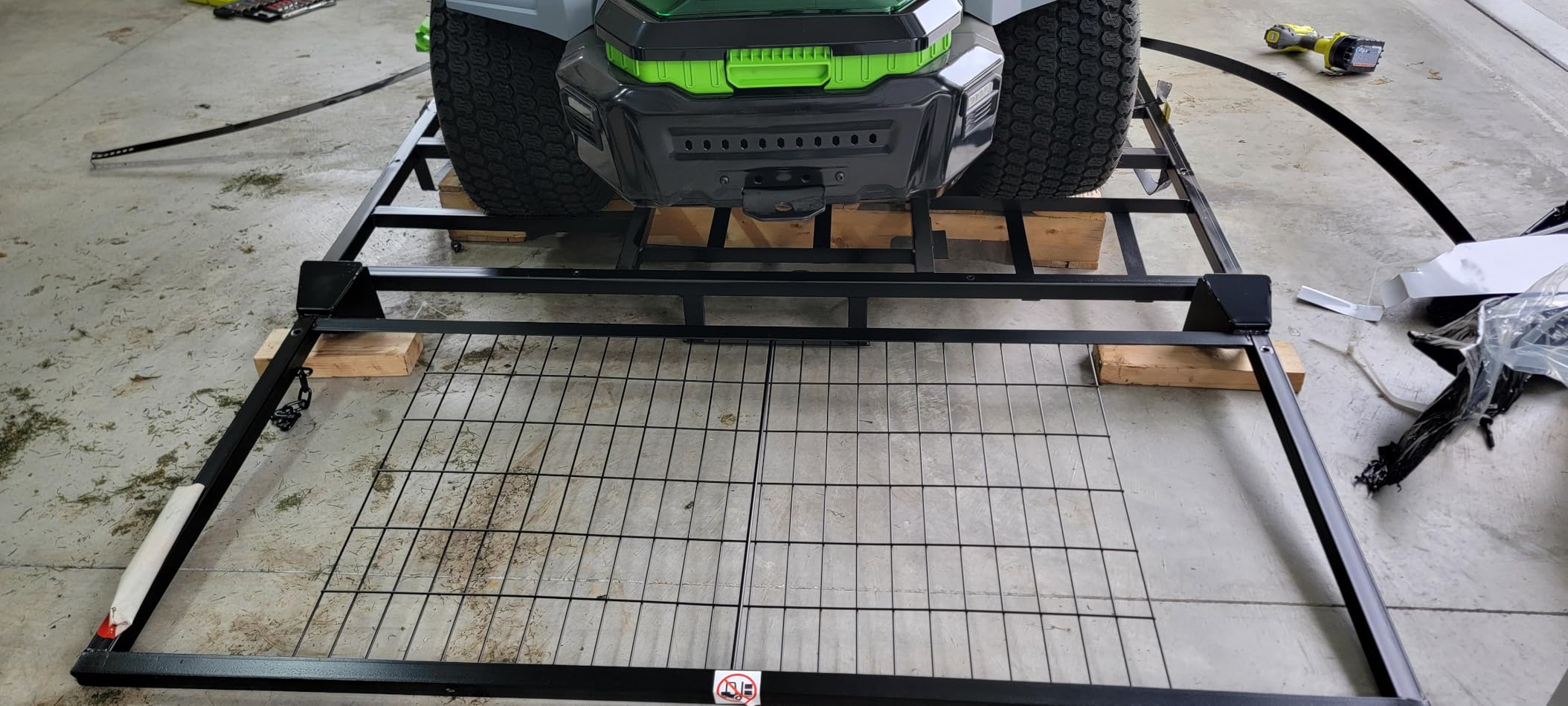
Factor in charging. Six 12.0Ah packs is a lot of battery to store and cycle, and the deck wash adapter is worth having because the underside of a 52-inch deck collects clippings quickly.
Where it falls short
This is the heaviest deck in the list, and deck width is a slope variable, not just a productivity one. A wide deck side-hills worse than a narrow one because more of the cutting edge is at an angle to the grade.
Like the other EGO platforms, it has no roll bar and no seat belt. The bolts in the steel crate it arrives in are an annoyance reviewers mention often, but the front axle geometry is the issue that actually matters on uneven land.
3. AIWEIYA AWY-550 Tracked Remote Mower – Best Budget Route to 45 Degrees
- Tracks grip steep
- uneven and soft ground where wheels spin
- Remote cutting height across 49 positions
- Brushless motor and gearbox for durability
- Compact deck maneuvers around trees and tight areas
- Narrow 21.6-inch width means more passes
- Cut consistency varies in very tall or dense grass
- Remote steering takes practice on side-hills
This is the cheapest way into the class of machine that belongs on a genuinely steep bank, and at 286 pounds it is light enough to reposition by hand when a track digs in. The oil-electric hybrid crawler track chassis is rated by the manufacturer for slopes up to 45 degrees, with 360-degree rotation and on-the-spot climbing under remote control.
The category itself is the point. A tracked remote mower lets you stand at the top of the slope rather than on it, which removes the rollover question entirely. The 1600W 24V permanent magnet brushless drive motor and the two-piece manganese blade are the parts buyers mention most.
Cutting width is 21.6 inches, and that number is the whole trade-off. On open ground you will make a lot of passes, and on tall grass the review record is mixed. Buyers point to the track chassis and the remote deck height adjustment, which spans 1.1 to 5.9 inches, as the reasons it works where ordinary mowers stall.
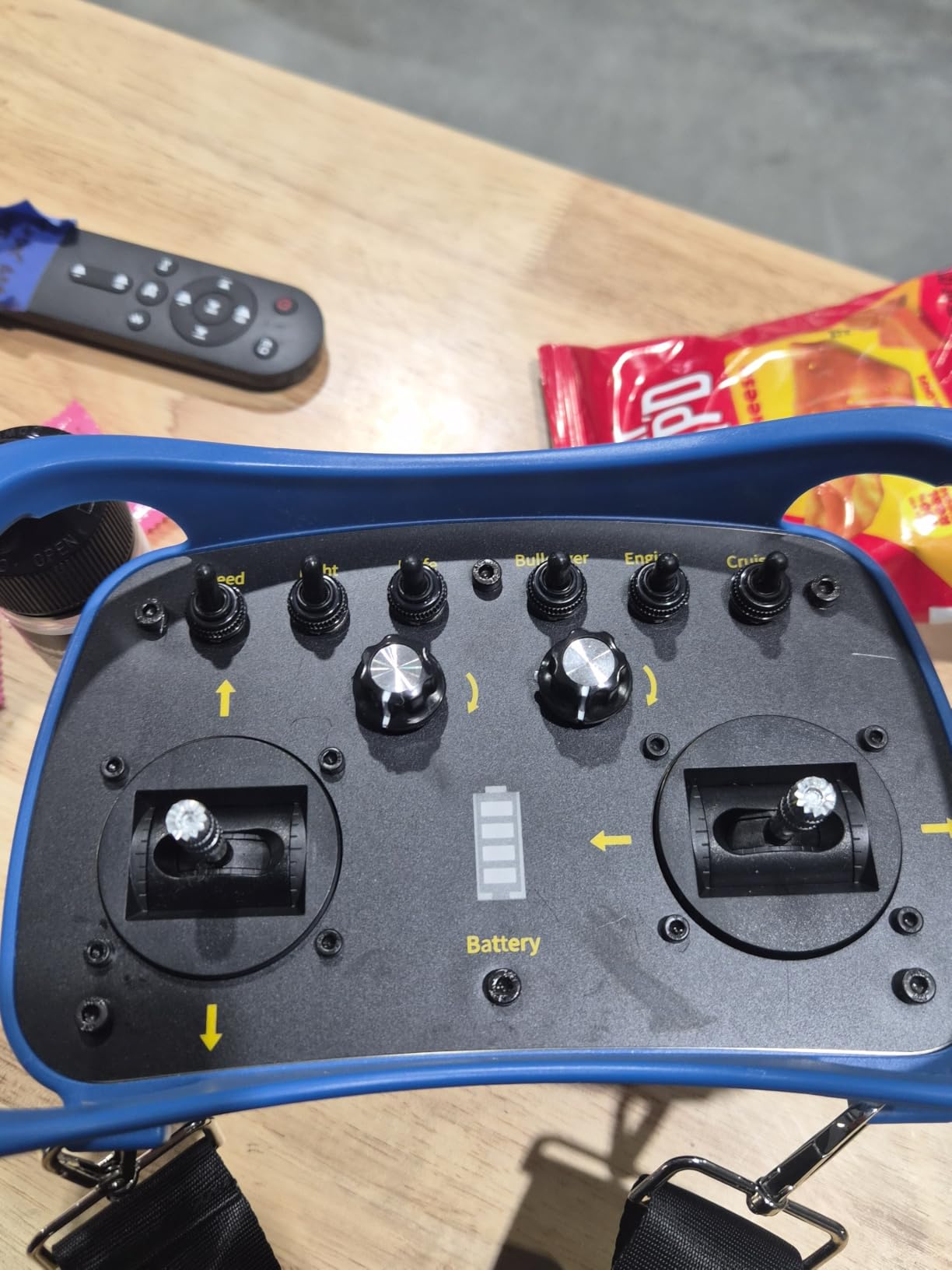
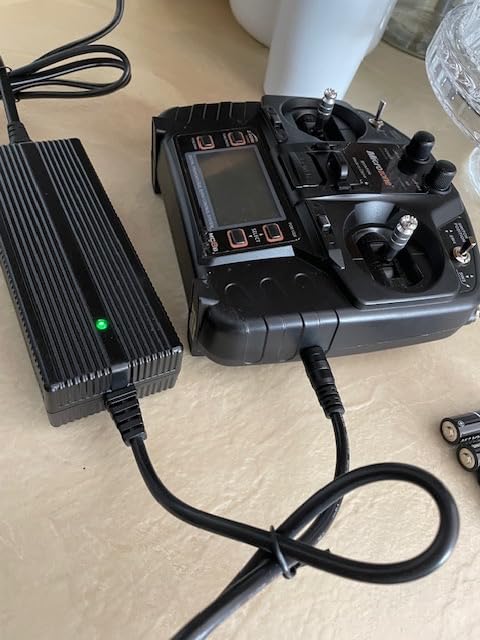
EGO-style electronics are absent here, which cuts one failure class and adds another. There is no app, no firmware and no display, just a handheld remote with 49 cutting height positions. Practice on a gentle slope first, because the control feel on a side-hill takes a session to learn.
What you need to know before you buy
Property size is the deciding question. At 21.6 inches wide and 38.5 inches long, this suits an acre or two of rough ground, an orchard edge, a pond bank or a terrace, rather than a main lawn.
There is no emergency stop listed in the specifications, and on a 45-degree grade that is a real consideration. Confirm the control layout and the stop behavior before you commit to a steep property.
Where it falls short
Only 22 reviews back the 4.2 rating, so the owner evidence is thin. Some buyers report less consistent results on the heaviest growth, and the 21.6-inch deck means a slope that took a walk-behind two hours can take this considerably longer.
Its 45-degree figure is a manufacturer claim rather than an independent test, and it sits well above what any residential zero-turn is warranted for. On a property where a person would have to walk a brush mower up the bank, this is a genuine upgrade rather than an oversized garden tool.
4. EGO Power+ ZT4214L Wide Frame – Top Rated for Slope Balance
- Wide frame is the one slope-specific feature the manufacturer names
- Deck suspension keeps the cut quiet on uneven ground
- Color display and app for battery status
- Blade speed selectable from 2300 to 3200 RPM
- Six 6.0Ah batteries give less runtime per charge
- Only 1.5 acres of coverage per charge
- Zero-turn lap bars take practice for new operators
This is the only machine in the list whose manufacturer explicitly names slope balance as a design goal, and it carries a 4.4 star average. EGO states that the wide frame design gives the platform exceptional balance on slopes and that the deck suspension delivers a quieter cut, which is exactly the pairing you want on uneven ground.
It is the heaviest of the EGO trio at 610 pounds and runs on six 56V 6.0Ah batteries for up to 1.5 acres per charge. Power is equivalent to a 24 horsepower gas engine, with three drive modes of Control, Standard and Sport and a top speed of 8 MPH.
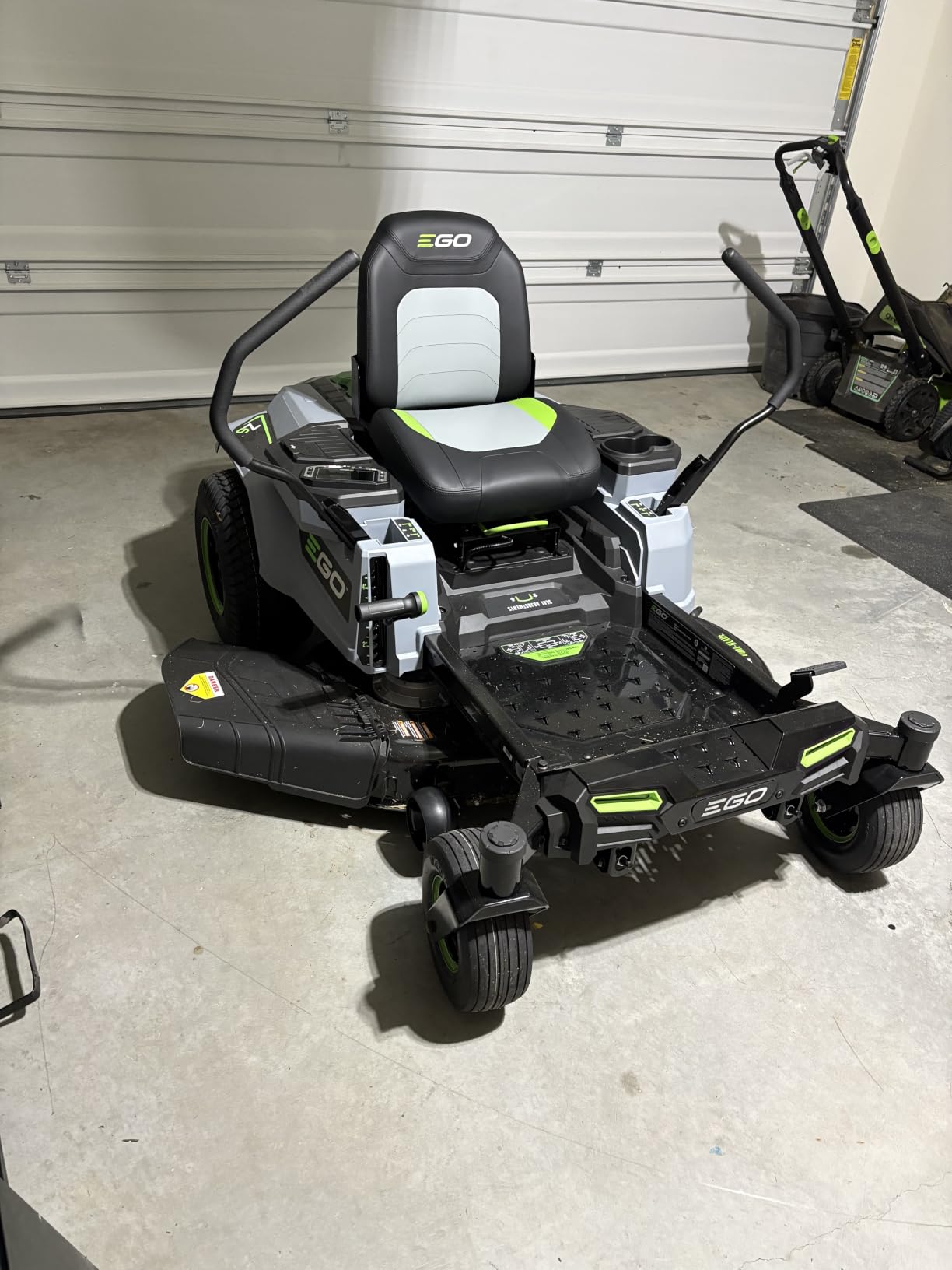
Owners consistently name the wide frame and slope balance as the reasons they are happy, which is a rare level of agreement on a spec that usually goes unmentioned. The five-year mower warranty, or 300 hours, along with battery and charger coverage, is the longest stated warranty package in this roundup.
The cost of that package is runtime. Six smaller 6.0Ah packs cover a smaller area per charge than the 10.0Ah and 12.0Ah configurations, so on anything larger than a couple of acres you are swapping packs more often. First-time operators also note the lap bars need practice.
What you need to know before you buy
The blade system is adjustable from 2,300 to 3,200 RPM, which lets you slow the blades down on a side-hill to reduce the chance of throwing turf. Ten cutting heights from 1.5 to 4.5 inches cover everything from rough ground to a formal front lawn.
Dimensions are 76.8 by 40.2 by 52.2 inches, so measure your storage and gate access the same way you would for any other rider.
Where it falls short
There is still no roll bar and no seat belt. If your grade is at the steep end of what a rider should handle, the absence of ROPS is the deciding factor, and no amount of frame width changes that.
With 23 reviews the rating is well short of a long track record, and at 1.5 acres per charge this is a mower for a large suburban lot rather than a working acreage. The 42-inch deck keeps it manageable in tight ground, which is why we rate it above the wider platform for hill work.
5. DareDevil Tracked RC Mower – Best for Extreme Grades
DareDevil Mower Remote Control Tracked Lawn Mower, 55° Slope Climb, 22-Inch Cutting Width, 9 HP Gas Engine, 6L Auxiliary Fuel Tank, Brushless Drive Motor
- Strongest slope performer in the group by owner accounts
- Owners report mowing above 45 degrees
- Remote start and stop improves safety on steep ground
- 6L tank supports long sessions
- Brushless motors and heavy gearboxes
- Remote and emergency stop switch faults reported at delivery
- Not fast and described as a workhorse
- Can stall in extremely dense four-foot weeds
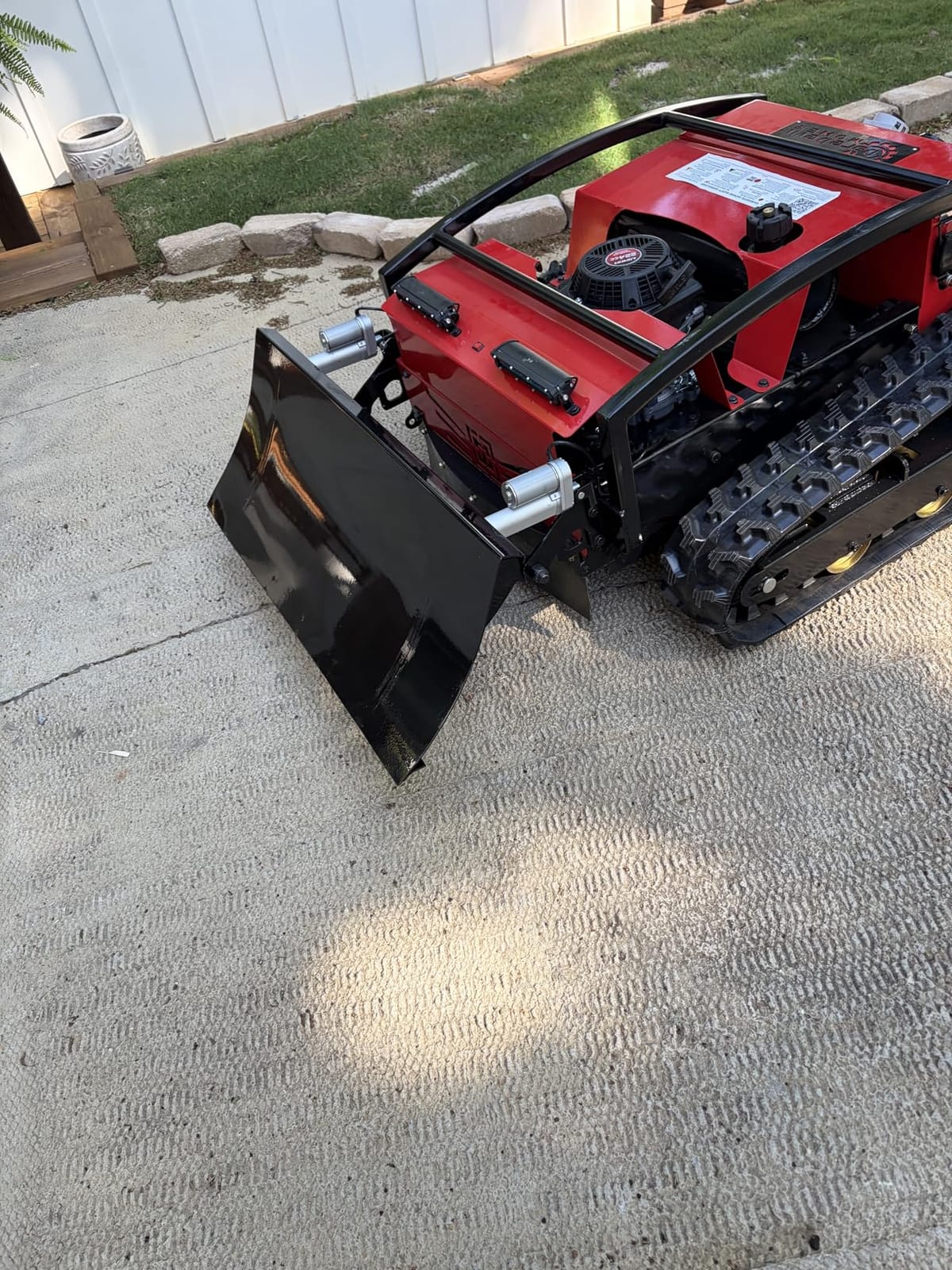
When the bank is too steep for a person with a walk-behind, this is the class of machine that gets the job done. The manufacturer states a 55-degree working slope capability on 5.91-inch-wide rubber tracks driven by dual 700W brushless motors, and owner reports describe mowing slopes steeper than 45 degrees.
One buyer describes cutting a hillside that had previously taken six to eight hours of weed eating, which is the kind of result that matters on a property with a bank nobody wants to revisit. Remote start and stop means you are not walking behind the machine on the grade at all.
The drivetrain is a 9HP 3600 RPM four-stroke gas engine with a 6L tank, running on a 376-pound reinforced steel build with two 12V batteries as a 24V system and electric start and stop. The 22-inch dual-blade deck turns at 2,500 to 3,600 RPM and adjusts from 0.72 to 4.72 inches with an integrated ruler.
Independent track control gives a true zero-turn pivot, and an optional snowplow attachment extends the season. The 70 percent five-star share in the review data is the highest concentration of top marks in this group, and the complaints are about accessory hardware rather than mowing capability.
What you need to know before you buy
Confirm the remote and the emergency stop switch before anything else. A broken emergency stop at delivery is the single most-reported complaint, and on a 45-degree grade that is the part you cannot work around.
Buy straight passes and avoid U-turns. Track cleats chew up turf when the machine pivots, and on a slope you want the track edge tracking straight down or straight up the grade anyway.
Where it falls short
It is slow, and owners describe it as a workhorse rather than a speed machine. Dense four-foot-tall growth can bog and stall the engine, so very overgrown sections may need a cut before the mower can take them.
At 22 inches the deck is narrow, and 20 reviews is a thin base. Treat the 55-degree figure as a manufacturer specification and read it as the rated limit rather than a suggestion to test the edge of your property.
6. AIWEIYA 1000S Flail Crawler – Best for Wet Ground and Mud
- Flail head clears brush and light saplings in one pass
- Hybrid tracks grip mud and wet grass
- Remote operation keeps the operator off the slope
- One-touch stop cuts power to blades and tracks
- Lowest average rating in the group at 3.8 stars
- 826 pounds makes manual repositioning difficult
- Flail finish is secondary on a manicured lawn
This is a clearing machine rather than a lawn mower, and that framing matters. The 459cc commercial engine drives a professional flail head that shreds dense grass, weeds, brush and light saplings into fine debris in one pass, on a 39.4-inch cutting width. If your hill is overgrown, this is the tool and the others are not.
The hybrid crawler system runs the gas engine for cutting and electric drive for the tracks, which spreads ground pressure and keeps the machine working in mud and wet grass where tires would dig. The one-touch emergency stop on the remote cuts power to both the cutting head and the tracks.
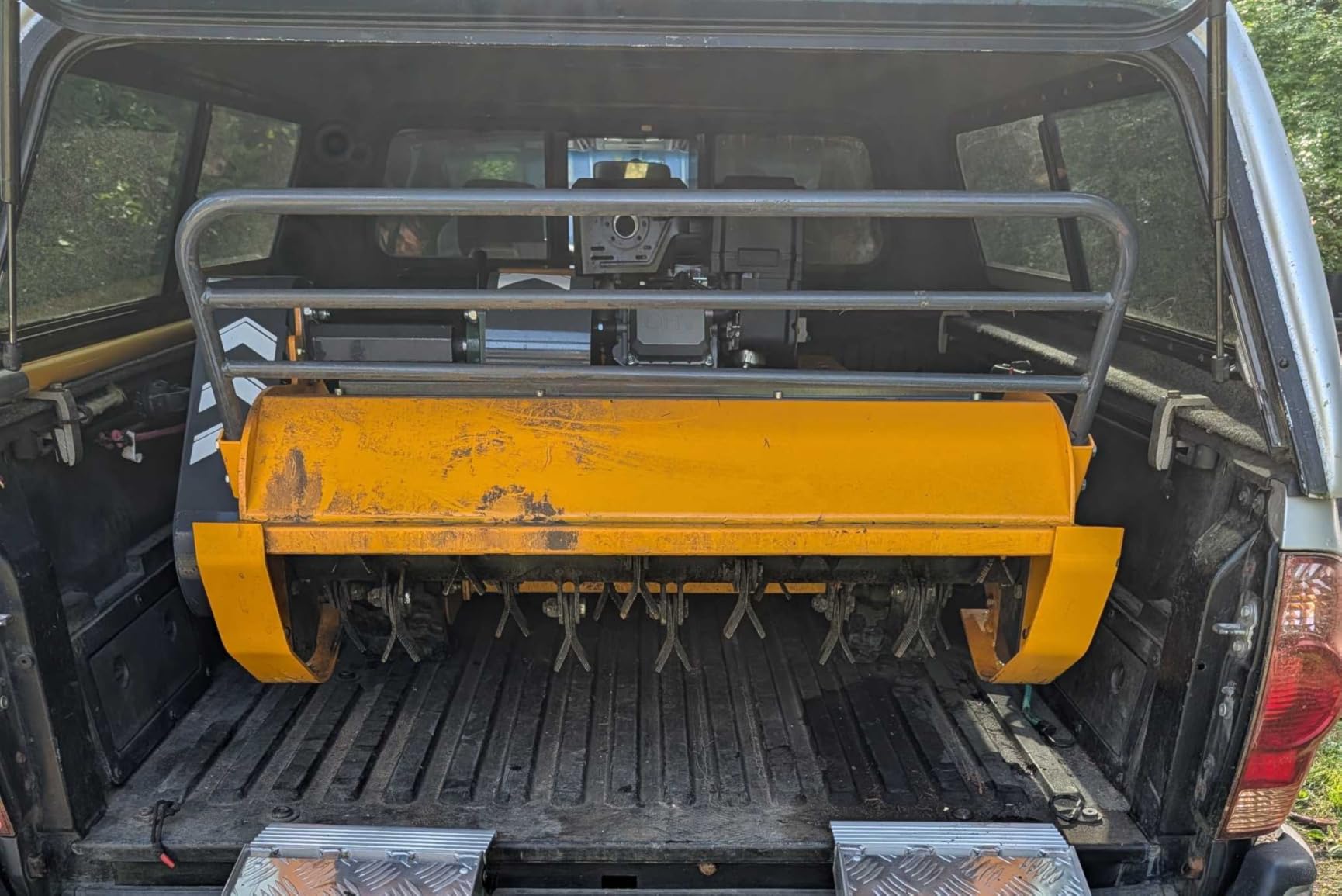
Be clear-eyed about the 3.8-star average, the lowest in this group, and about the 14 percent one-star share in the review data. Buyers credit the 459cc flail head and the track traction, while the critical reviews describe handling and build quality falling short of what the listing claims.
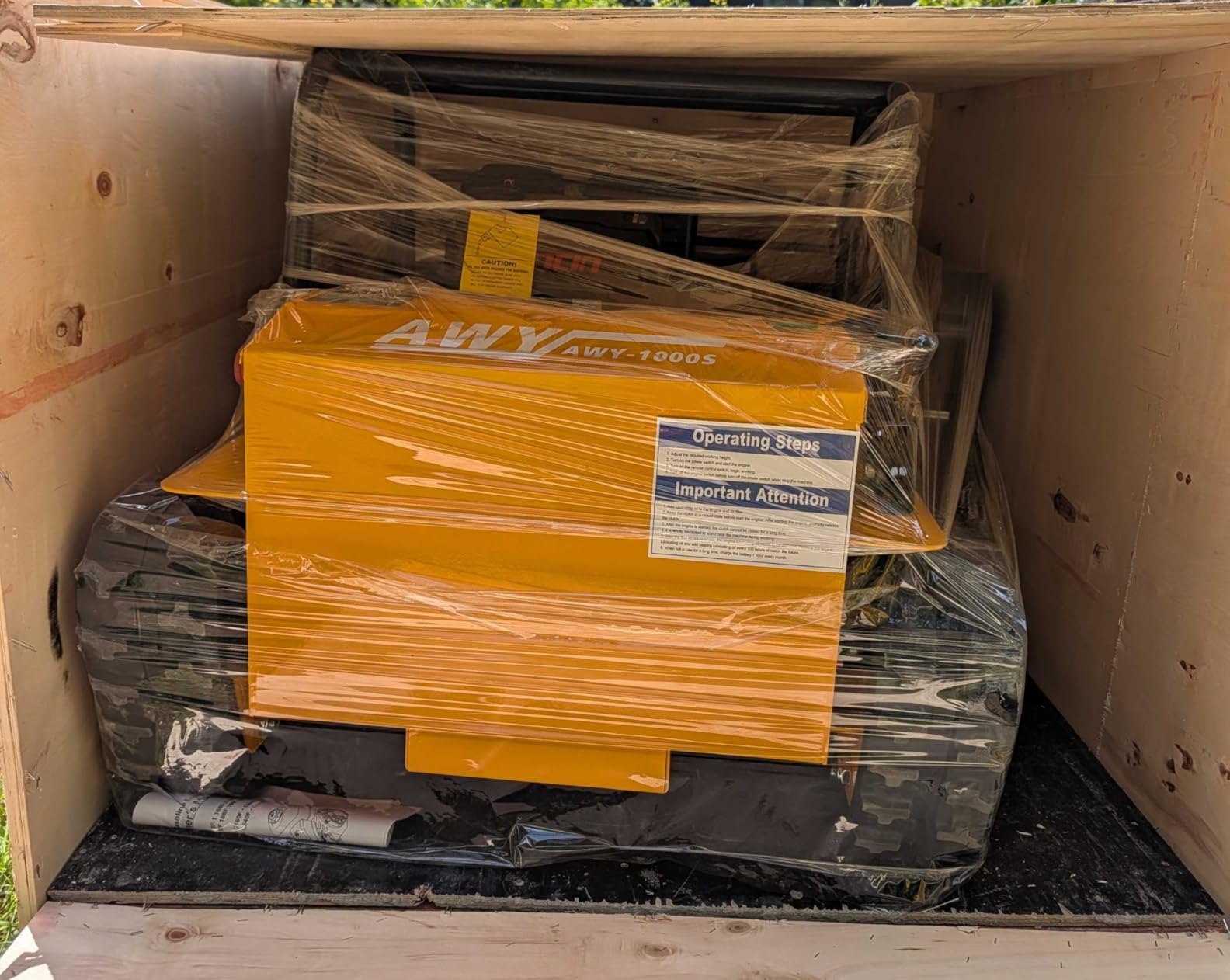
At 826 pounds, repositioning by hand is a two-person job and the track chassis is not designed to be dragged. The flail head is a shredding setup, so finish quality on a manicured front lawn is a secondary consideration at best.
What you need to know before you buy
Iron construction and a 51.2 by 31.5 by 47.2 inch frame make this the heaviest machine we list. Plan a trailer and a flat spot to park it before the season starts, not during.
Deck the area twice. A flail head turns standing growth into mulch on the first pass, and a second pass at a lower setting gives a much cleaner finish on anything you actually intend to look at.
Where it falls short
Some buyers report a rough ride and handling that does not match the description, and the review spread is wide. The 3.8 rating is a caution flag, and it is the reason this sits sixth rather than higher despite capable hardware.
It is a brush machine on a lawn. If your property is mostly maintained turf with a few swells, the EGO platforms above will serve you better and cost less to own.
7. INFRONT Tracked RC Mower – Best for Orchards and Tight Paths
INFRONT Remote Control Lawn Mower – All Terrain Tracks, 45° Slope Climbing, Gas Electric Hybrid, High Power Strong Mower
- All-terrain tracks handle 40-45 degrees
- ditches and soft soil
- Zero turning radius rotates 360 degrees in place
- Blades retract automatically on hard objects
- Remote operation avoids walking behind it
- Tool kit with spare blades included
- Narrow 19.68-inch listed width means more passes
- Remote latency and sensitivity take practice on side-hills
- Gas engine needs fuel and oil servicing
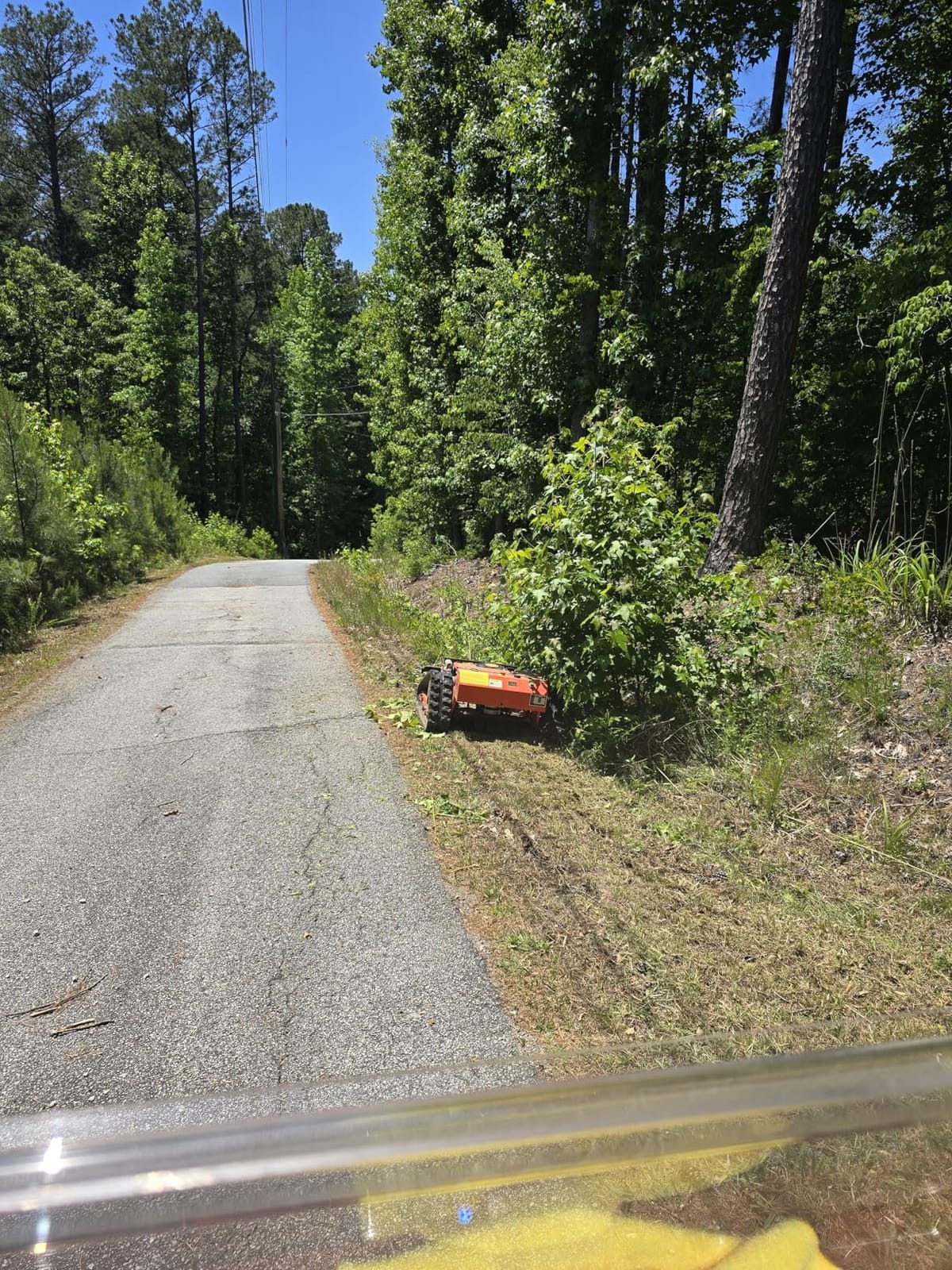
Where trees, posts and narrow lanes break up a slope, maneuverability matters more than cutting width. This machine rotates 360 degrees in place using a differential drive system, and the all-terrain rubber track chassis is rated for slopes up to 40 to 45 degrees across orchards, embankments, wetlands and brush.
The engine is a 9HP 225cc four-stroke with electric start, and the deck is 550mm, roughly 21.7 inches, with dual alloy and manganese steel blades that retract automatically when they hit a hard object. That self-retracting feature is a genuine advantage on stony orchard ground.
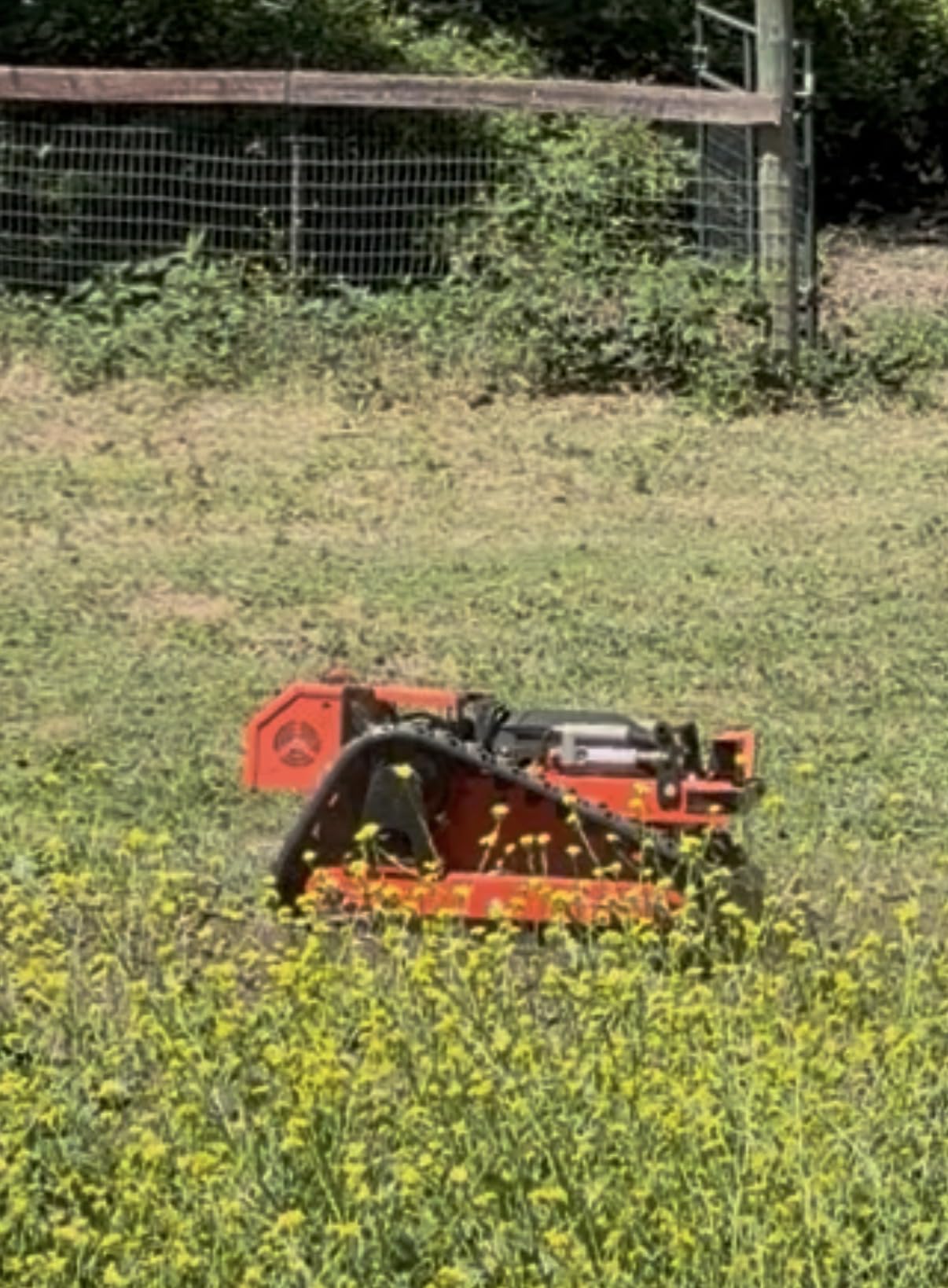
Remote adjustable cutting height spans 0.79 to 5.9 inches, and a professional tool kit with spare blades is included. Buyers credit the track chassis and the in-place rotation for working terrain that ordinary mowers cannot reach, particularly around tight obstacle-filled yards.
Two-star feedback in this group focuses on control feel on steep side-hills rather than on cut quality or reliability, which is exactly the sensitivity you would expect from a tracked platform with differential steering. With 11 reviews, the evidence base is small and we treat the 4.3 rating accordingly.
What you need to know before you buy
At 374 pounds and 35.5 by 36.6 by 21 inches, this is a manageable tracked machine, but it is still not a one-person carry. Plan the route from the top of the slope and keep the remote in line of sight.
Orchards, wetlands and ditches are the stated strengths, so match it to that use case. On a wide open lawn the 19.68-inch listed width turns the job into a long afternoon.
Where it falls short
Remote latency and sensitivity need real practice before you trust them on a side-hill. The listed cutting width of 19.68 inches is narrower than the physical deck suggests, and gas servicing returns the maintenance burden that the electric platforms avoid.
Eleven reviews is a thin history for a machine in a category with few buyers. Test it on the mildest slope you own first and work up from there.
8. Tyzar TYZ-550 Track Mower – Best for Briars and Kudzu
- Tackles steep hillsides and thick weeds that stall lesser mowers
- One buyer cleared 23 acres of briars
- kudzu and saplings in a weekend
- Remote height adjustment switches between trimming and clearing
- Twin manganese blades mulch clippings back in
- Small 21.6-inch deck means slow progress on open lawn
- Large-acreage buyers wish they had chosen a larger model
- Optional snowplow missing or faulty on one unit
- Slowest recommended speed for kudzu and thick saplings
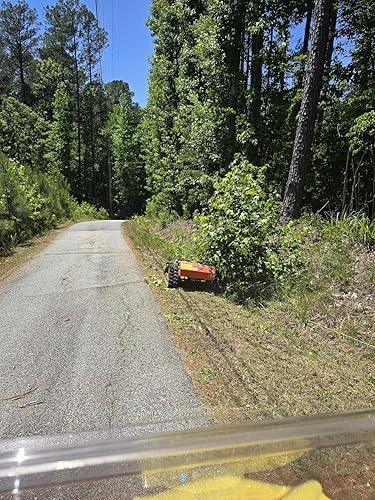
The 23-acre claim is what separates this machine from the others in its class. One buyer reports clearing briars, kudzu and saplings across 23 acres in a single weekend, and all four reviews describe steep, weedy properties between five and 23 acres being handled comfortably.
The 224cc gas engine and gearbox drive rubber crawler tracks rated for 45-degree climbing, with 360-degree rotation under remote control. Chassis height adjusts remotely from 1.1 to 5.9 inches, so you can trim a lawn edge and then lift up to chew through brush without leaving the seat of your life behind a remote.
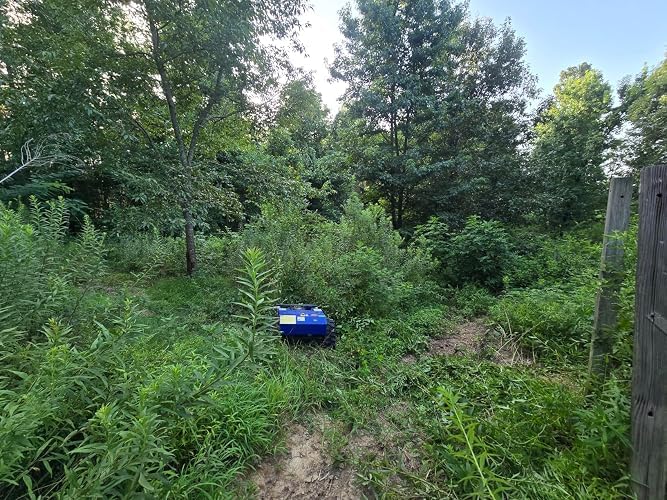
Twin manganese rebound blades handle the mulching, leaving clippings in place as the reviews describe. At 286 pounds and 38.5 by 22 by 36 inches, it is the same weight class as the AIWEIYA tracked mower but with a different engine layout, and buyers report the setup was intuitive enough to run without reading the instructions.
We need to be direct about the evidence. Four reviews, all five-star, is not a reliability record, and the only issues raised are accessory-related, including an optional snowplow that arrived with an installation fault. Support reportedly answered within an hour and produced a custom install video.
What you need to know before you buy
The 21.6-inch deck is the limit. Buyers working large acreage specifically wish they had chosen a larger model, and the flail crawlers in this list cover ground far faster on open runs.
Confirm which accessories you actually want at the point of purchase, since the missing snowplow is the one hardware complaint in the review set.
Where it falls short
This is a clearing machine that happens to cut grass well, not a finish mower. Slowest recommended speed for kudzu and inch-thick saplings means genuinely heavy growth takes patience.
A perfect 5.0 rating on four reviews tells you very little about a decade of ownership. Buy it for a specific overgrown job with a specific deadline, and treat the rating as a signal of owner satisfaction rather than mechanical longevity.
9. Tyzar TYZ-1000 Flail Crawler – Best for Dense Brush and Saplings
- Shreds grass
- weeds and saplings up to 2 inches into fine mulch
- Commercial rubber-steel tracks keep ground pressure under 5 psi
- Remote control range stated up to 2000 ft
- Replaceable flail blades in three hardness grades
- Hybrid drive claims up to 25 percent fuel savings
- Only four reviews
- all posted on the same date
- 826 pounds is the heaviest machine here
- Flail deck is a shredding setup rather than a lawn finish
This is the heavy-duty end of the tracked category, and the specification is the most capable in the list. A 459cc commercial engine drives a reinforced flail head across a 39.4-inch width, rated for 55-degree slopes on commercial rubber-steel hybrid tracks that keep ground pressure under 5 psi.
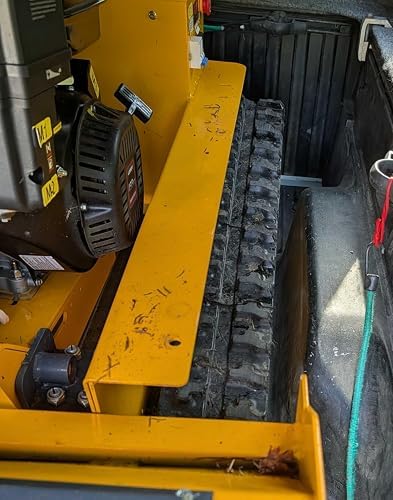
That low ground pressure is the detail that matters on a slope with thin soil or a lawn you care about. A machine that spreads its weight will not punch ruts and gouge turf the way a wheeled mower does when it spins on an incline, and the review set credits excellent traction in thick grass.
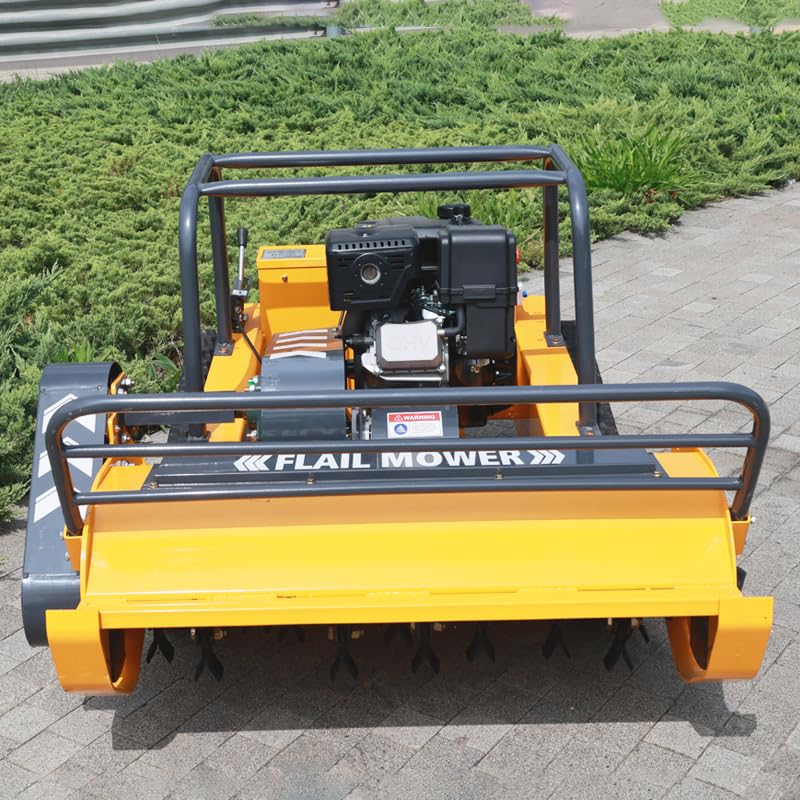
Owners describe driving it straight out of the crate, running an eight-hour session without a break, and solid metalwork on first unboxing. Replaceable flail blades in three hardness grades let you convert between slope mowing and brush work without retooling, and the remote control range is stated up to 2000 feet.
The rating needs a caveat attached. All four reviews are five-star and share the same date, so the 5.0 average is essentially four first impressions rather than a track record. We list it because the hardware is genuinely capable, not because the number is strong.
What you need to know before you buy
At 826 pounds and 51.2 by 31.5 by 47.2 inches, this needs a trailer and level storage. The weight is the price of the steel and the flail head, and there is no cheap way around moving it.
The three blade hardness grades are worth understanding before the season. Softer blades for grass, harder for woody growth, and swapping them takes minutes rather than a workshop visit.
Where it falls short
The same 39.4-inch flail setup shares the finish-quality limitation of the other flail machines here. If most of your property is maintained turf with one steep section, this is far more machine than the job needs.
A rating history of four same-day reviews cannot support a durability claim, and the claimed 25 percent fuel saving is a manufacturer figure rather than an independent measurement. Budget for a real service plan on a 459cc engine.
10. Ariens Zenith 60 – Best for Big Open Properties With Gentle Swells
Ariens Zenith 60 (60″) 23.5HP Kawasaki Zero Turn Lawn Mower
- Kawasaki V-Twin has the power for large properties with steady grades
- 60-inch deck is the widest here and covers open ground fast
- Zero-turn platform handles ground a walk-behind cannot reach
- Only two ratings on record
- Heaviest machine here at 930 pounds
- No published detail on deck suspension or hill-holding features
- Gas engine servicing that the electric options avoid
This is the only conventional gasoline zero-turn in the roundup, and it is included for a specific reason: some large properties have gentle swells rather than grades, and on that kind of ground a 23.5HP Kawasaki FX730 V-Twin with a 60-inch deck is the most efficient way to cover acres. Nobody in the reviews mentions traction on a real incline.
The trade-off is mass. At 930 pounds this is by a wide margin the heaviest machine here, and that weight is the stability argument. Low, dense mass resists tipping on moderate ground, and the wide rear stance of a zero-turn platform does the rest. The 60-inch deck is the widest in the list, which cuts productivity and hurts side-hilling.
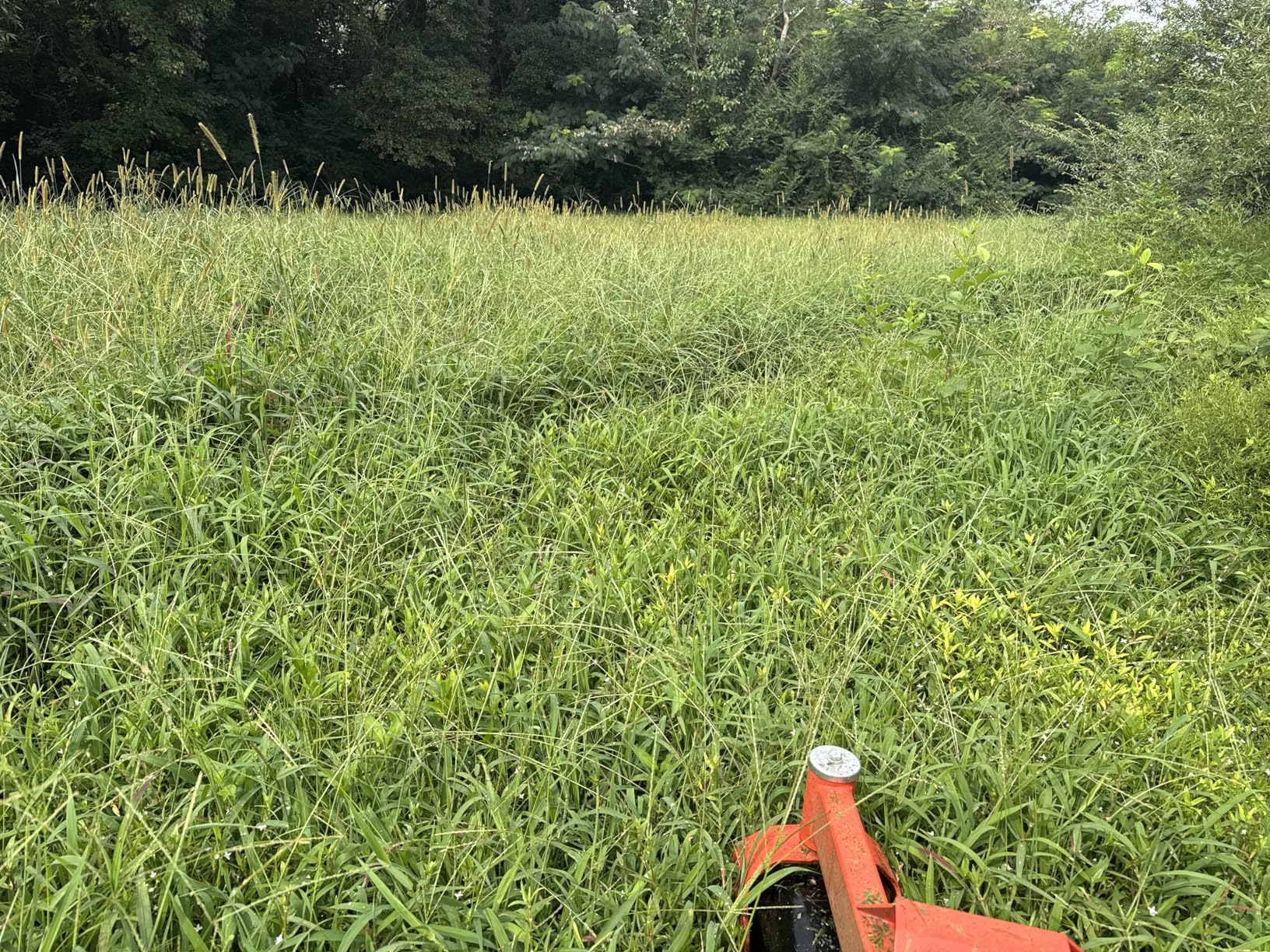
Being straight with you about the evidence: two ratings, both five-star. There is no owner data at all on slope traction, ride comfort over rough ground or long-term reliability, and Ariens publishes no slope rating in degrees for this model. We would not put an unverified 930-pound machine on a steep property on the strength of two reviews.
The 60-inch deck has three height positions and a 726cc V-twin with overhead valves, which is a durable, simple powerplant with a large parts base. It is a mowing machine for flat acreage with the occasional roll, not a hill machine.
What you need to know before you buy
Deck width is the real safety variable here. A 60-inch deck side-hills noticeably worse than a 42-inch because far more of the cutting edge meets the grade at an angle, and side-hilling is exactly what a hilly property requires.
At 930 pounds you will need a trailer for anything beyond a gentle driveway slope. Budget for a fuel cap, oil changes, spark plugs and an air filter, none of which the battery platforms ask of you.
Where it falls short
Two reviews is essentially no signal, and the product listing itself carries no published dimensions or detail on deck suspension, seat adjustment or hill-holding features. That absence matters most for a machine weighing this much.
If your property has a grade that makes you think about traction, this is not the machine. Our first, fourth and fifth picks are the ones we would consider for that ground.
Mowing Slopes Safely Without Losing Control
Zero-turn mowers handle hills well, and in the right hands a slope is the safest place to use one. The failure mode is not the grade itself. It is mowing across the face of it, which puts a lateral load on a machine designed to drive in straight lines, and that is the leading cause of zero-turn rollovers on residential lawns.
Mow up and down, never across. This is the single rule that matters, and it comes from CPSC guidance and university extension services rather than from any one manufacturer. Contour mowing is tempting on a long slope because it looks efficient, and it is also the fastest way to put a mower on its side.
Slow to walking pace on the way down. Owners in the forum discussions make this point repeatedly, and it is the real test of a machine rather than climbing power. a thread on tractorbynet.com about a 42-inch Toro TimeCutter puts it plainly: no problem climbing the slope, the difficulty is going downhill or making a turn. Creeping down a grade under control is the skill worth practising before you need it.
Stay inside the machine’s rating. Residential zero-turn owner’s manuals from Toro, Cub Cadet and Gravely commonly cap slope use at roughly 15 degrees, which is a 3:1 grade. Several models in this roundup publish no degree figure at all, and we have not substituted an estimate for a missing number.
Do not mow wet grass on a slope. A damp hill turns traction problems into sliding problems, and a zero-turn with hydrostatic controls will keep sending power to the drive wheels whether or not the tires have grip. Wait for a dry day.
Use a roll bar and a seat belt where one is available. ROPS, a rollover protective structure, is offered on very few residential zero-turns, and its absence is why we flag it on every rider in this list. If your grade approaches the manufacturer limit, that flag matters more than any spec on the sheet.
Above roughly 20 degrees, stop riding. A lawn tractor sits lower and puts four wheels on the ground, which makes it the safer machine on a sustained grade that a zero-turn should not be asked to hold. Past 30 degrees, a tracked or remote-control machine is the only sensible class. A 3:1 grade is roughly 15 degrees, so if you can stand a level on the slope, you already know you are near the limit.
How to Choose a Zero Turn Mower for a Sloped Lawn
Work through this in order, because the first three questions eliminate most of the market before you look at a single spec sheet. If you want the format explained from the ground up, our guide to lawn mowers for hills covers walk-behinds and tractors alongside riders.
1. Measure your steepest grade and convert it. Most people underestimate a slope. A 3:1 grade, three units of run for every unit of rise, is roughly 15 degrees and is the common manufacturer ceiling. If your property has sections steeper than that, you are shopping for a tracked machine, not a zero-turn.
2. Match the machine to the grade, not the brand. Under 10 degrees of rolling ground, any of the residential platforms here will work. Sustained 10 to 15 degrees needs a wide rear stance and a published rating. Beyond 15 degrees, use a remote-controlled tracked crawler and take yourself off the slope.
3. Size the deck to your narrowest working area. Deck width is a slope variable, not just a productivity one, and this is the least obvious point in this whole guide. A 60-inch deck side-hills worse than a 42-inch because more of the cutting edge meets the grade at an angle. If you are bouncing between banks and flat runs, a narrower deck is the safer buy.
4. Check the tires and the pressure. Wide rear tires spread the load and resist lateral tipping, and front-to-rear tire pressure is a genuine stability lever that costs nothing to set correctly. A rear set carrying too little pressure gives up grip on a descent, which is precisely when you need it.
5. Decide sit-on versus stand-on. Stand-on machines sit lower and keep weight centred, which helps in ditches and tight work. Sit-on platforms are better for long sessions and are where ROPS availability exists. For a graded property with swales and ditches, a stand-on is worth a look.
6. Settle the lap bar versus steering wheel question honestly. Popular summaries often claim lap bars lose traction on inclines while steering-wheel machines grip better. That is not supported by the manufacturer data we can see. Cub Cadet Synchro-Steer models carry the same published slope rating as the lap-bar lineup in the same range, which suggests steering type is a comfort and precision question rather than a slope-rating one. Choose on how you like to steer.
7. Check the support before the price. A tracked remote mower is a small niche with thin review histories, and the review record in this category shows accessory and remote faults at delivery. A dealer who will pick up the phone when a switch fails is worth more than a specification point.
What to Avoid and Which Brands Hold Up
Avoid any riding mower with no published slope rating if your property is genuinely sloped. You cannot manage a risk you have not measured, and a listing that states nothing is not the same as a manufacturer that warrants 15 degrees. Also avoid decks wider than about 54 inches on a lot with real grades, for the side-hilling reason above.
On long-term reliability, the honest answer from owners is that there is no single best brand. In the forum discussions, professional landscapers name the same shortlist repeatedly, including Scag, Exmark, Ferris, Kubota, Wright, Toro ProLine and Hustler, with recurring mention of Scag and Bad Boy for larger lots and a Kubota Z422 with a Kawasaki engine recommended by name. One long-term owner bought a John Deere Z915 specifically for the roll bar and build quality rather than the engine, and still valued it six or seven years later.
The recurring theme is that owners buy commercial-grade chassis for residential hills when the money allows, and that they value long ownership duration far more than spec-sheet performance. Our zero turn mower guide covers the mainstream models from those brands if you want to see the format without the slope filter.
Skip discontinued residential-only lines with thin parts support, and treat perfect ratings on very small review counts the way we have here, as a signal of early satisfaction rather than a track record. The 5.0 averages in this roundup rest on four reviews each.
Frequently Asked Questions
Are zero-turn mowers okay on hills?
Yes, with conditions. Mow up and down the slope and never across it, stay inside the manufacturer’s degree rating, and slow to walking pace on the way down. CPSC and university extension guidance both point to cross-slope mowing, not the grade itself, as the leading cause of zero-turn rollovers on residential lawns.
What is the steepest slope a zero-turn mower can handle?
Roughly 15 degrees, which is a 3:1 grade, is the common manufacturer ceiling in residential zero-turn owner’s manuals. Above that, use a machine with a roll bar and seat belt, a lawn tractor, or a tracked remote-controlled mower. Many models in this roundup publish no degree figure at all.
Which zero-turn mower is best for steep slopes?
Among riding platforms, the EGO ZT4214L stands out because EGO states its wide frame design is built for balance on slopes. For genuinely steep grades, no rider is the right answer, and the tracked remote mowers here carry published figures of 40, 45 or 55 degrees with the operator standing safely off the slope.
Which riding mower is best on hills?
A zero-turn wins on maneuverability and cut speed on rolling to moderately steep ground. Above roughly 20 degrees of sustained grade, a lawn tractor is safer because it sits lower with four wheels on the ground. Past 30 degrees, only a tracked or remote-controlled machine is a sensible option.
What zero-turn mower to avoid?
Avoid any model that publishes no slope rating if your lawn is genuinely sloped, and avoid decks wider than about 54 inches on a hilly property, since a wide deck side-hills worse. Also avoid discontinued residential-only lines with thin parts support, and read very high ratings on very few reviews as an early signal rather than a track record.
Do I need a zero turn or a lawn tractor for hills?
Choose the zero-turn for lawns with swells, ditches and obstacles where pivoting on the spot saves time and a wide rear stance keeps you stable. Choose the lawn tractor for sustained grades, where a lower center of gravity and four-wheel contact matter more than maneuverability.
The Bottom Line
For most people searching for the best zero turn mowers for hills, the answer is the EGO Power+ ZT4204L, and the reason is weight rather than horsepower. A 620-pound battery platform with a 42-inch deck holds its line on rolling ground, needs no fuel servicing and carries the largest owner review base in this group at 149 reviews. If your property has one sustained grade and you want the manufacturer to have said the word slope, the ZT4214L names it in the design.
For anything genuinely steep, take yourself off the mower and buy a crawler. The DareDevil at 55 degrees and the two flail crawlers at 39.4 inches are built for banks that a person with a walk-behind would not want to climb, and the operator standing at the top of the slope removes the rollover question entirely. Measure your steepest grade before you spend anything, and stay in 2026 with the technique rather than the machine.