
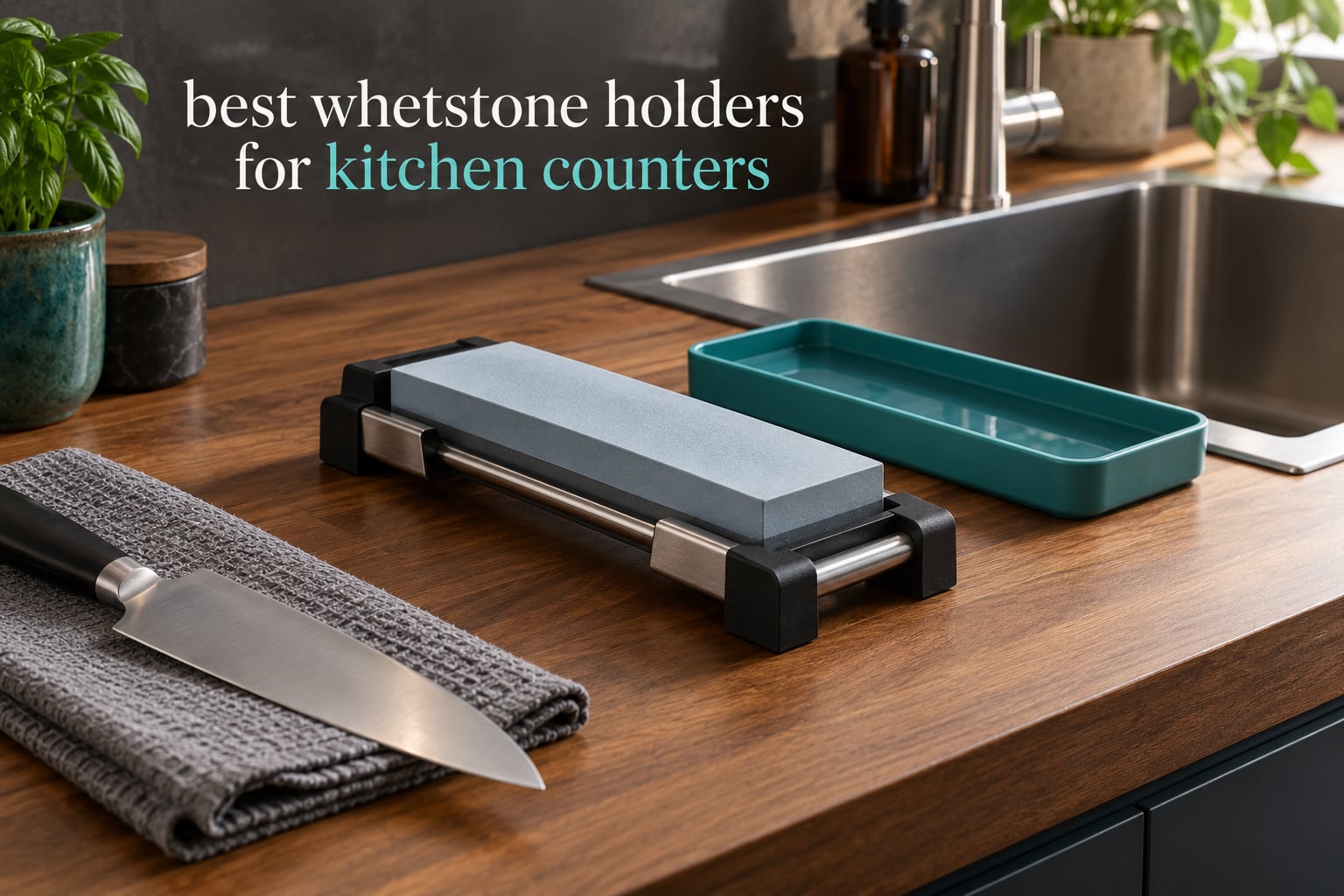
There is a particular kind of frustration that every home cook with a water stone eventually meets. You soak the stone, you settle it on the counter, you draw the first stroke, and the whole thing creeps sideways under the pressure of the blade. The bevel wanders, your knuckles hit the worktop, and you end up chasing a slip you never asked for.
A whetstone holder exists to stop that. It is a small stand, usually bamboo, rubber, plastic or stainless steel, that grips a sharpening stone and holds it fixed and level while you work, so pressure from the blade transfers into sharpening instead of into sideways motion. It also gives you somewhere for the water and slurry to go, which matters more on a kitchen counter than most people expect.
What follows is our guide to the best whetstone holders for kitchen counters. We looked across the full category and pulled eight stands that cover every sensible setup, from a plain counter base to a silicone tray that contains the mess entirely. Every pick here is a holder first, judged on grip, fit range, water resistance and how it behaves after months of wet sessions rather than weeks.
Table of Contents
Key Points
- A holder works by adding inertia and friction. A heavier, wider base beats a fancier clamp every time.
- Four archetypes cover the whole category: over-sink bridge, counter-top base, spring clamp, and tray or full station.
- Stone length fit is the number that actually blocks purchases. Every pick below carries its real range in inches and centimetres.
- Mess control is the reason the query says kitchen counters. Only the tray archetype catches slurry outright.
- Water stones soak, drip and leave carbon residue. Metal parts need a wipe-down; wood and rubber parts just need air.
- Storage is a real problem. Most holders live on the counter permanently, which is why footprint matters.
We also spend a good deal of time here on fit, because that is where returns come from. If you enjoy the wider layout approach, our cutting board holder guide covers the same counter-space logic for a different job, and our rod holder picks sort out the same stand-anything-you-like problem for fishing gear.
Top 3 Picks for Kitchen Counter Sharpening in 2026

POWERTEC Adjustable Holder
- Adjusts 5.5 to 9 inch
- Non-slip rubber body
- Chrome-plated arms
- Works with water and oil stones

Kota Japan Steel Holder
- Stainless steel body
- Non-skid rubber base
- Fits 6 to 8.5 inch stones
- Rust and wear resistant

SCOTTCHEN Tabletop Holder
- Tabletop-only design
- 3-1/8 to 10-1/2 inch fit range
- 304 stainless steel rods
- Solid rubber blocks
All 8 Whetstone Holders Side by Side in 2026
Stone length fit is the column to read first. If your stone falls outside a holder’s stated range, nothing else about that holder matters.
| Product | Specifications | Action |
|---|---|---|
| POWERTEC Adjustable Holder |
|
Check Latest Price |
 Steelex D1091 Holder Steelex D1091 Holder |
|
Check Latest Price |
| Kota Japan Steel Holder |
|
Check Latest Price |
| SCOTTCHEN Tabletop Holder |
|
Check Latest Price |
 DMD Diamond Holder Kit DMD Diamond Holder Kit |
|
Check Latest Price |
 SHARPAL 149H Silicone Tray SHARPAL 149H Silicone Tray |
|
Check Latest Price |
 S SATC Adjustable Holder S SATC Adjustable Holder |
|
Check Latest Price |
 Naniwa A-902 Holder Naniwa A-902 Holder |
|
Check Latest Price |
The Four Types of Whetstone Holder
There are really only four forms, and almost every product on the market is one of them in a different material:
- Over-sink bridge – a long frame that spans a sink basin so water, swarf and slurry drop straight into the bowl. Nothing lands on your counter at all.
- Counter-top base – a compact adjustable stand that sits flat on the work surface and grips the stone between two jaws. This is the default choice for most homes.
- Spring clamp holder – a stand whose jaws close on the stone under spring or screw tension. Tightest grip in the category, usually with a small loss of usable stone surface.
- Tray or full station – a shallow mat or tray with raised lips, a stopper bar and integrated water capacity. The only archetype that catches a wet stone’s runoff as a matter of design.
The type you want follows from your kitchen. A large stone and a deep sink point to a bridge. A single mid-size stone and an ordinary sink point to a counter base. Two or more stones in a cramped drawer point to an adjustable clamp. A pale stone counter or a wooden butcher block table points to a tray.
1. POWERTEC Adjustable Whetstone Holder – Best Overall
- Adjustable grip covers 5-1/2 to 9 inch stones
- Non-slip rubber body with ridged knobs
- Chrome-plated arms resist corrosion
- Works with diamond
- water and oil stones
- 2-3/4 inch wide jaws reduce usable stone surface
- Rubber body shows wear with heavy long-term use
This is the holder we keep coming back to, and the one we would put in a kitchen that has never thought much about the subject. The adjustable jig is 2-3/4 inch wide and takes stones from 5-1/2 to 9 inches long, which covers the overwhelming majority of home kitchen stones in a single frame.
What makes it work is the combination of a non-slip rubber body and chrome-plated arms with EZ-grip ridged knobs. The rubber gives friction against the counter, the ridged knobs give purchase on a wet stone face, and the plated arms will not stain or seize in standing water. At 12 by 3.5 by 1.5 inches and 1.1 pounds, it is substantial without taking a whole section of worktop.
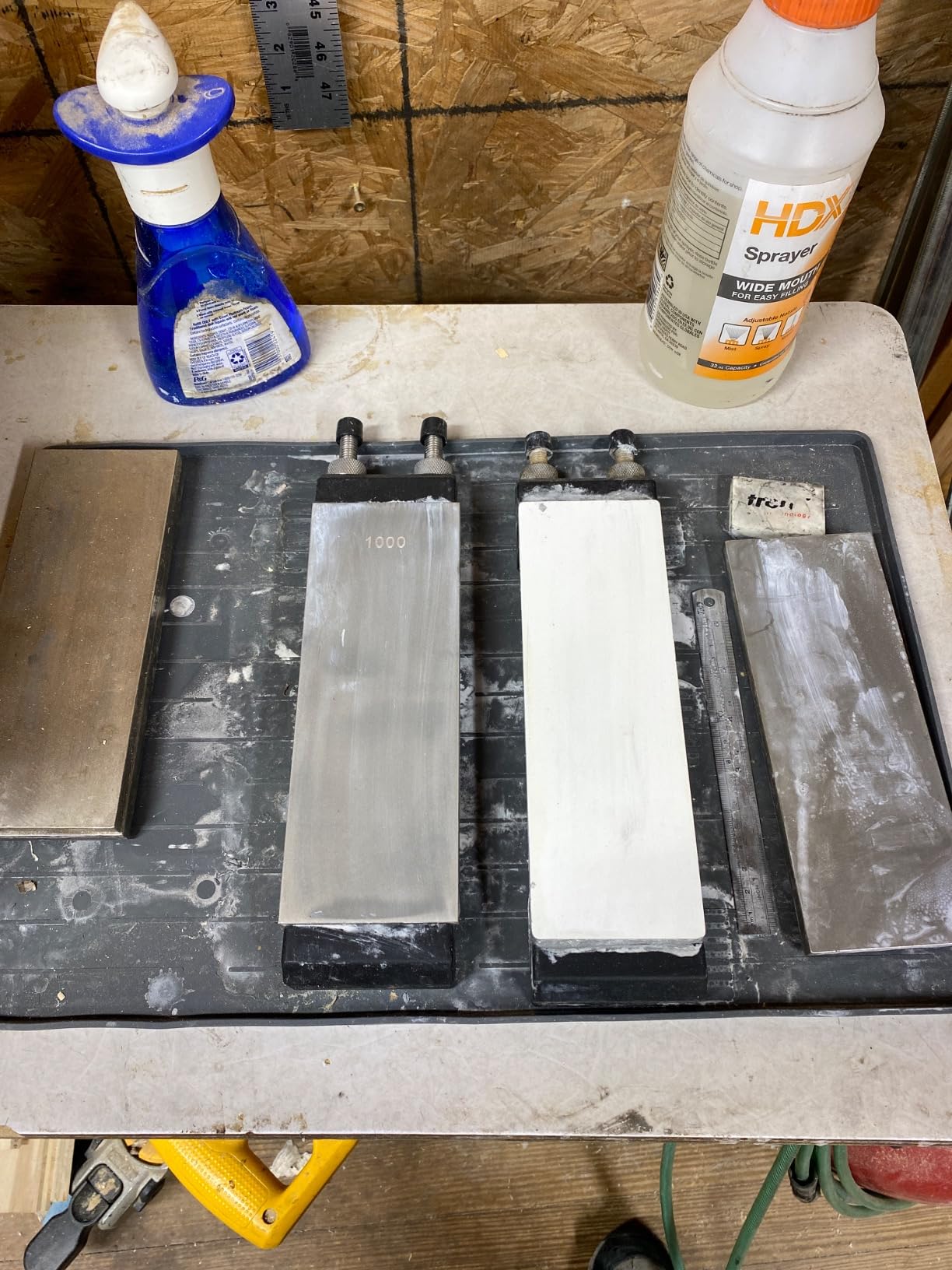
Across 2k+ reviews it holds a 4.7 average, with 83 percent of ratings at five stars. Owners repeatedly single out the adjustable grip and the fact that it does not mar the stone edges, which matters more than most buyers expect going in. Listing claims cover diamond plates, water stones, whetstones, Japanese stones and oil stones.
The honest drawback is geometric. At 2-3/4 inches wide, the jaws sit on the stone’s usable face, so on a narrower stone you lose a strip along each long edge. For a 2 inch wide stone that is a meaningful fraction of the working area, though for the common 3 inch wide plate it is not.
Check the fit before you commit
Measure your stone’s length first and compare it to the 5-1/2 to 9 inch window. Anything shorter than 5-1/2 inches will not seat properly, and that includes several compact sharpening plates on the market.
Then measure the width. If your stone is 2 inches wide or narrower, look at the Kota Japan or Naniwa options instead, both of which use narrower contact points.
Know what you are getting with the extra jaw width
The 2-3/4 inch jaws are why this holder grips so hard and stays so level. You trade a strip of stone surface for that stability, and for most sharpening angles you will never notice the difference.
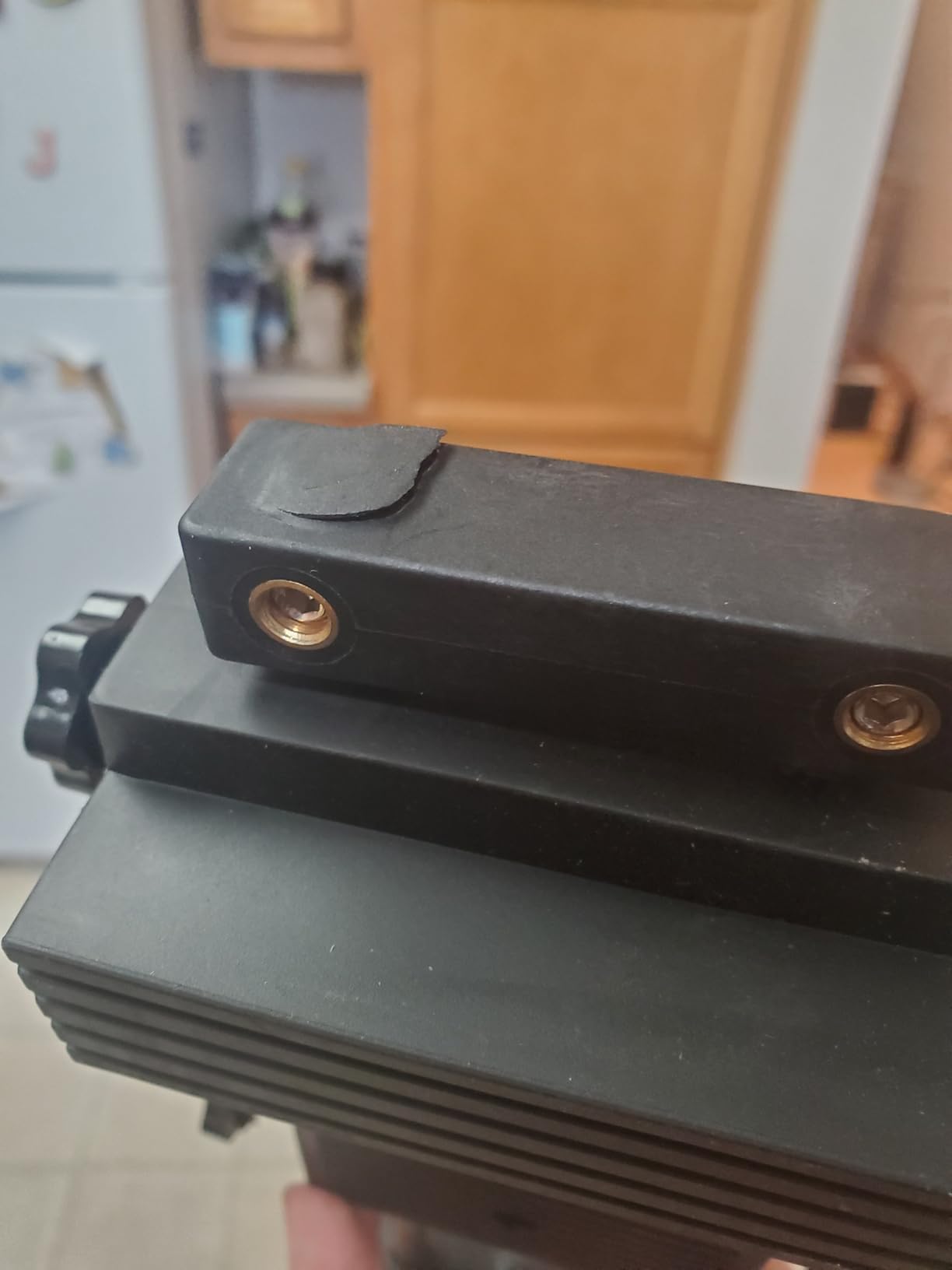
Owners do report that the rubber body gradually shows wear with daily use over a couple of years. Nothing cracks or fails outright, so treat it as a cosmetic point rather than a durability concern.
2. Steelex D1091 Sharpening Stone Holder – Best Budget Cast-Metal Pick
- Long-running design with a large owner base
- Adjusts across a 5-1/2 to 9 inch stone range
- Zinc-plated parts resist rust with wet water stones
- Rubber base does not slip during honing
- Lowest average rating in this group at 4.4
- Bulky 1.5 pound footprint uses real counter space
The Steelex D1091 is the old guard of counter-top holders and it has been on enough kitchen counters to have a very long memory. It adjusts from 5-1/2 to 9 inches, sits on a rubber base that resists slipping during honing, and uses zinc-plated steel parts that hold up around wet water stones.
Where it earns its place here is durability and familiarity. This is a cast-style frame with real mass to it, and that inertia is what keeps the stone put when you lean on a coarse grit. If you already own a Steelex stone, this is the holder the ecosystem was built around.
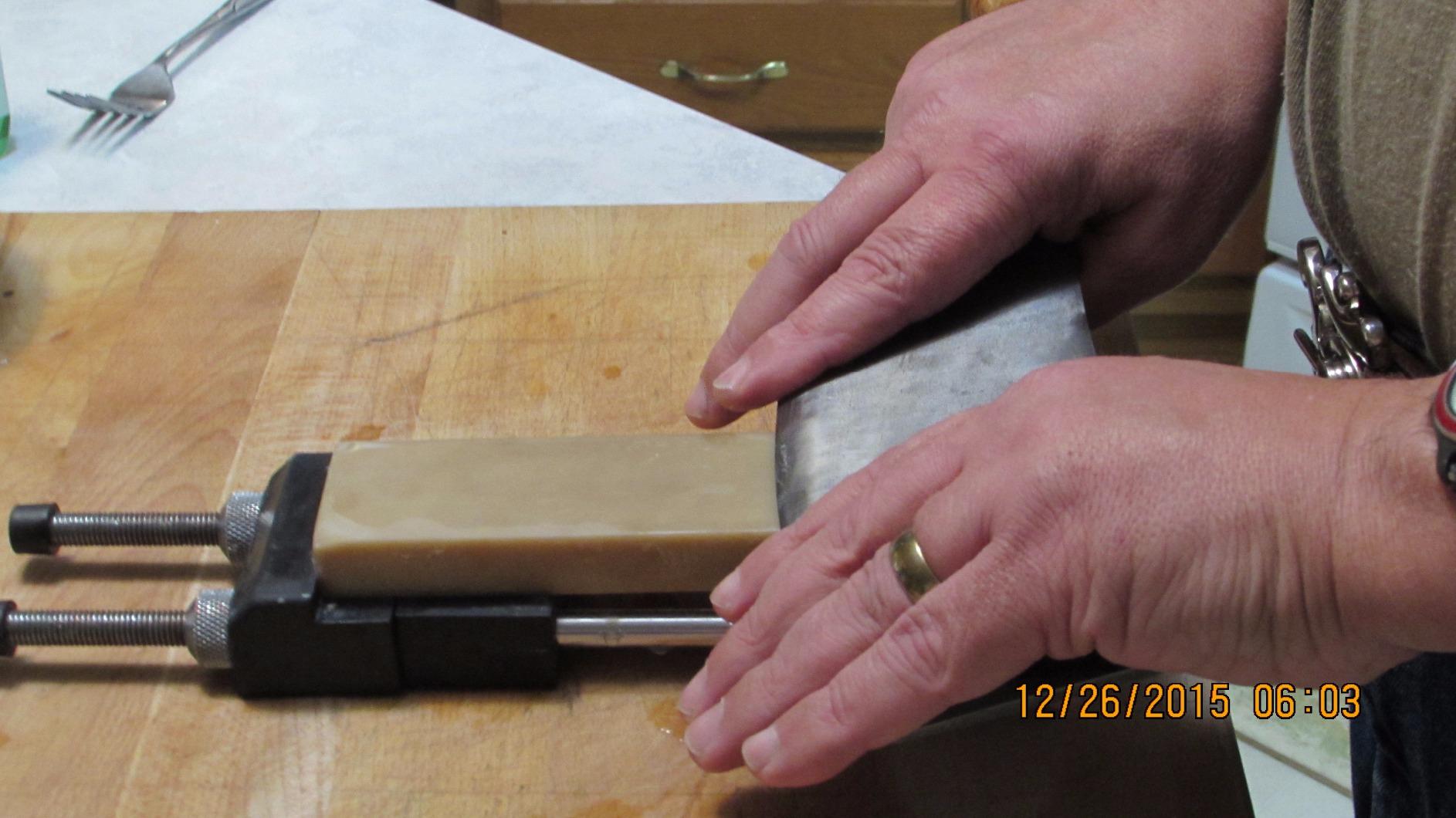
Its 700-plus reviews average 4.4, the lowest in this group, and the rating distribution explains why: 68 percent five stars and 18 percent four, but a 9 percent share of three stars or below. Those are not safety complaints, they are mostly complaints about bulk and about a feel that some buyers describe as dated.
At 1.5 pounds, this is the heaviest holder in the group by some margin, and its footprint is wide enough to matter in a small kitchen. If your worktop is tight, a lighter adjustable frame will serve you better.
Why the extra weight actually helps
Enthusiasts who sharpen with real pressure tend to favour heavier stands, because a stone that weighs more resists sideways movement without needing aggressive clamping. That is the argument for this one over the plastic frames it replaced.
You give up counter space and some of the modern finishing. If you have room, the stability is worth it.
Where it falls short for a small kitchen
The 1.5 pound body does not tuck away, and there is no storage story here beyond a cupboard or a drawer with depth to spare. On a compact counter this becomes a permanent fixture rather than a tool.
The lower average rating also tracks a slight reluctance to adjust for very short stones. Check the 5-1/2 inch minimum against your stone before ordering.
3. Kota Japan Stainless Steel Whetstone Holder – Best for Rust and Wear
Kota Japan Stainless Steel Whetstone Holder, Non-Slip, Fits 6-8.5 in Stones
- Stainless steel body outlasts plastic and coated metal
- Non-skid rubber base keeps it planted
- Low wobble supports a consistent sharpening angle
- 81 percent five-star ratings across 461 reviews
- Narrower 6 to 8.5 inch fit than several rivals
- Limited feature detail in the listing
Wet sharpening is a corrosive business. Every rinse cycle pushes water into seams, under screws and across bare metal, and that is why we like this stainless body over anything coated. The Kota Japan holder resists rust and wear better than plastic or lower-grade metal frames, and the non-skid rubber base underneath keeps the whole thing planted on the counter.
The design is a low, wide, stable platform. Buyers credit the construction for reducing wobble, which matters because a stone that rocks changes the effective angle mid-stroke. That consistency is the whole point of buying a holder rather than setting a stone on a folded tea towel.
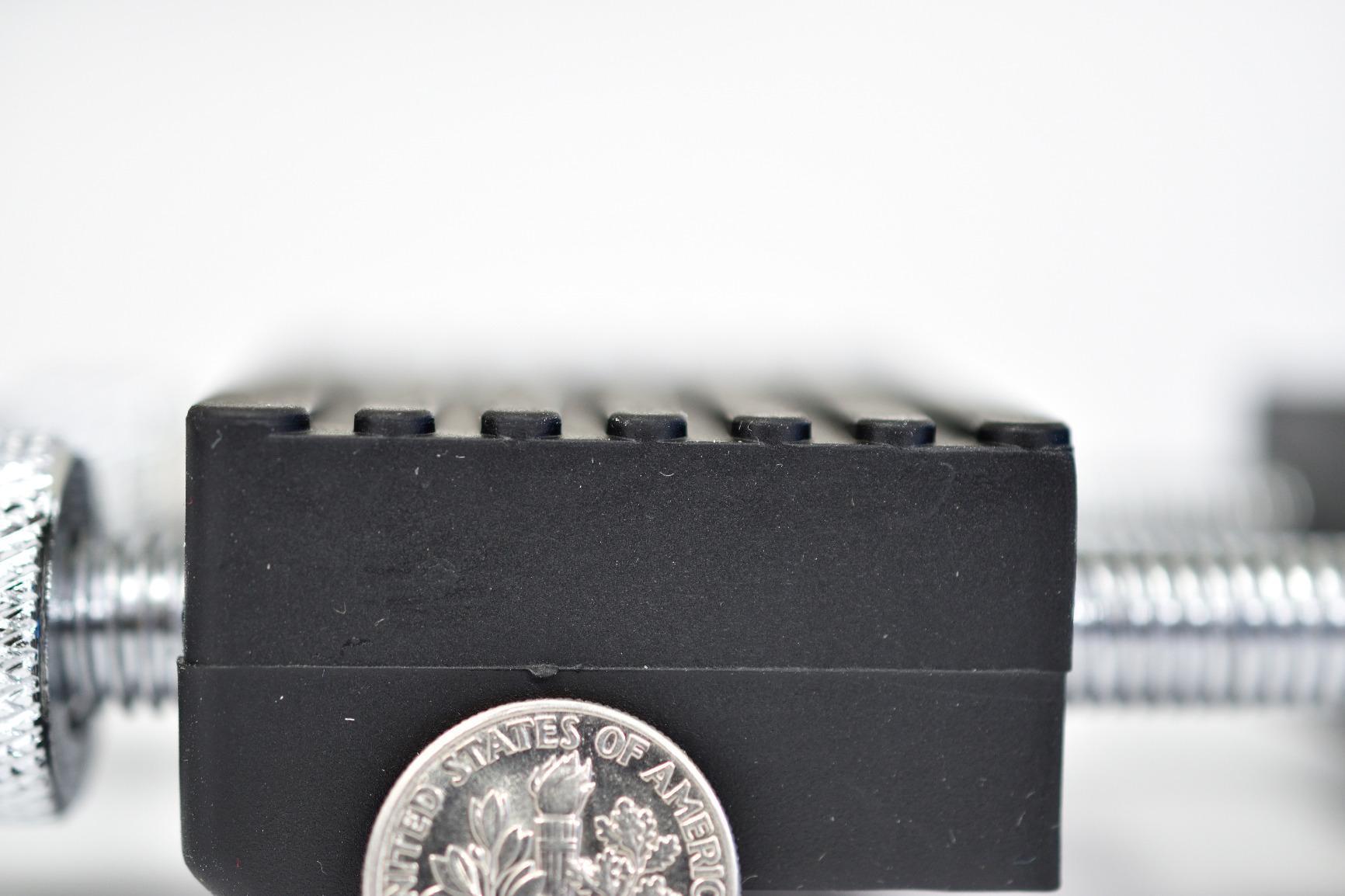
It ties for the highest average rating in this group at 4.7 across 460-plus reviews, with 81 percent of ratings at five stars and only 1 percent at one star. The size, at 12 by 3 by 1 inches and 1.3 pounds, is substantial and sits low enough to feel settled rather than perched.
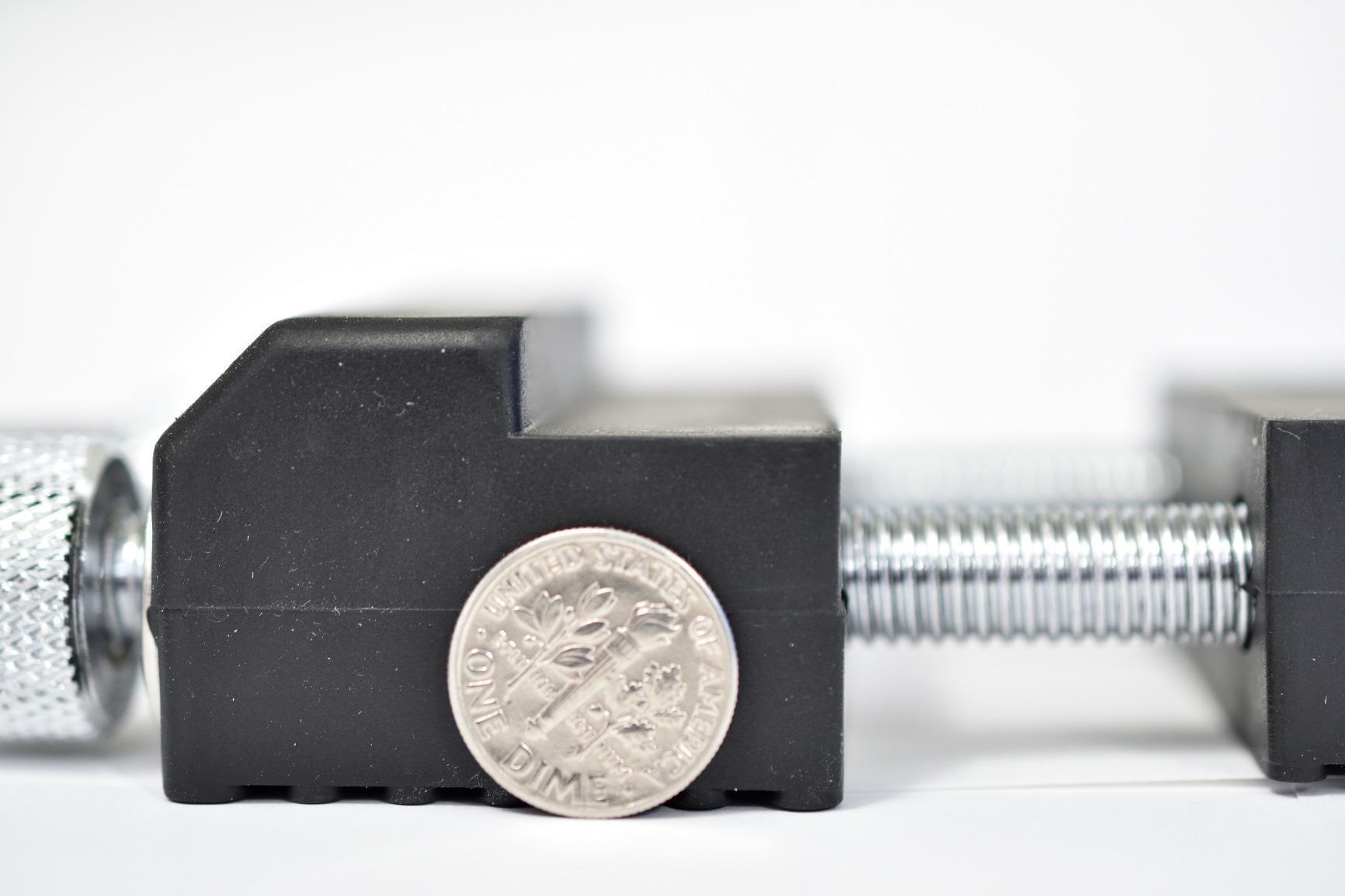
The limitation is fit. The adjustable range runs from 6 to 8.5 inches, narrower than several rivals here, so a small plate or an oversized Japanese stone will not seat properly. That single number decides it for many kitchens.
When stainless is the right call
If you sharpen often, leave the stone soaking, and rinse the holder after every session, a stainless frame simply outlasts the alternatives. There is no coating to chip and nothing to absorb water.
It also suits a kitchen where a stone sits out on display rather than in a drawer. The metal reads as a tool rather than a plastic accessory.
Measure your stone against the 6 to 8.5 inch range
This is the whole decision for this holder. Stones under 6 inches or over 8.5 inches fall outside what the jaws will hold.
If your stone is at either extreme, move to the SCOTTCHEN or the POWERTEC, both of which open wider. Keep this one for standard mid-size stones and you will be very happy with it.
4. SCOTTCHEN Tabletop Whetstone Holder – Widest Stone Size Range
- Widest adjustability in the group by a wide margin
- 304 stainless rods wash clean with hot water
- Raises stones off the bench to spare knuckles
- Holds water stones
- oil stones and diamond plates
- Securing screw sits on the rubber block rather than the steel rail
- May arrive slightly out of true and need a gentle twist
- Tabletop-only and cannot bridge a sink
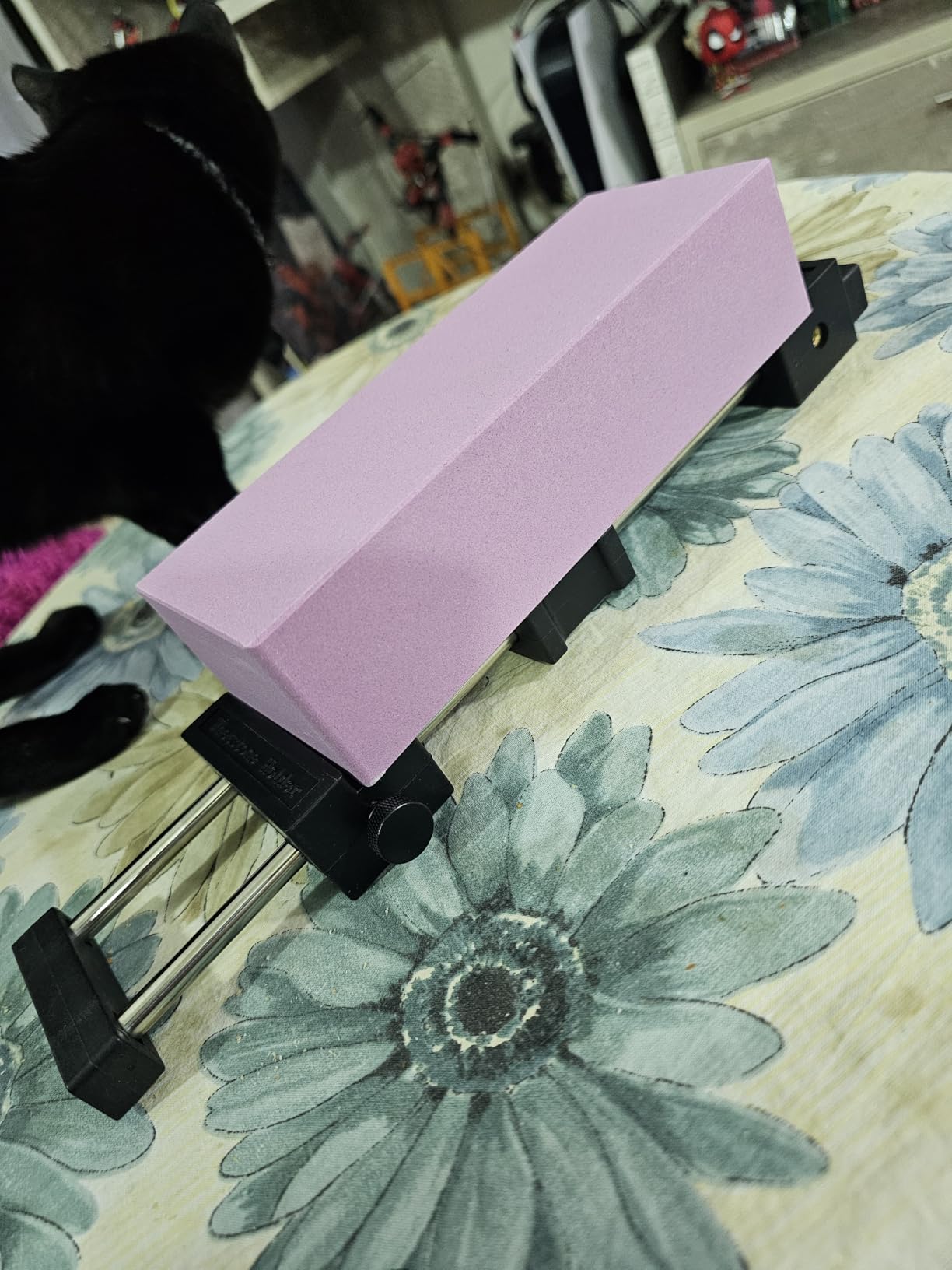
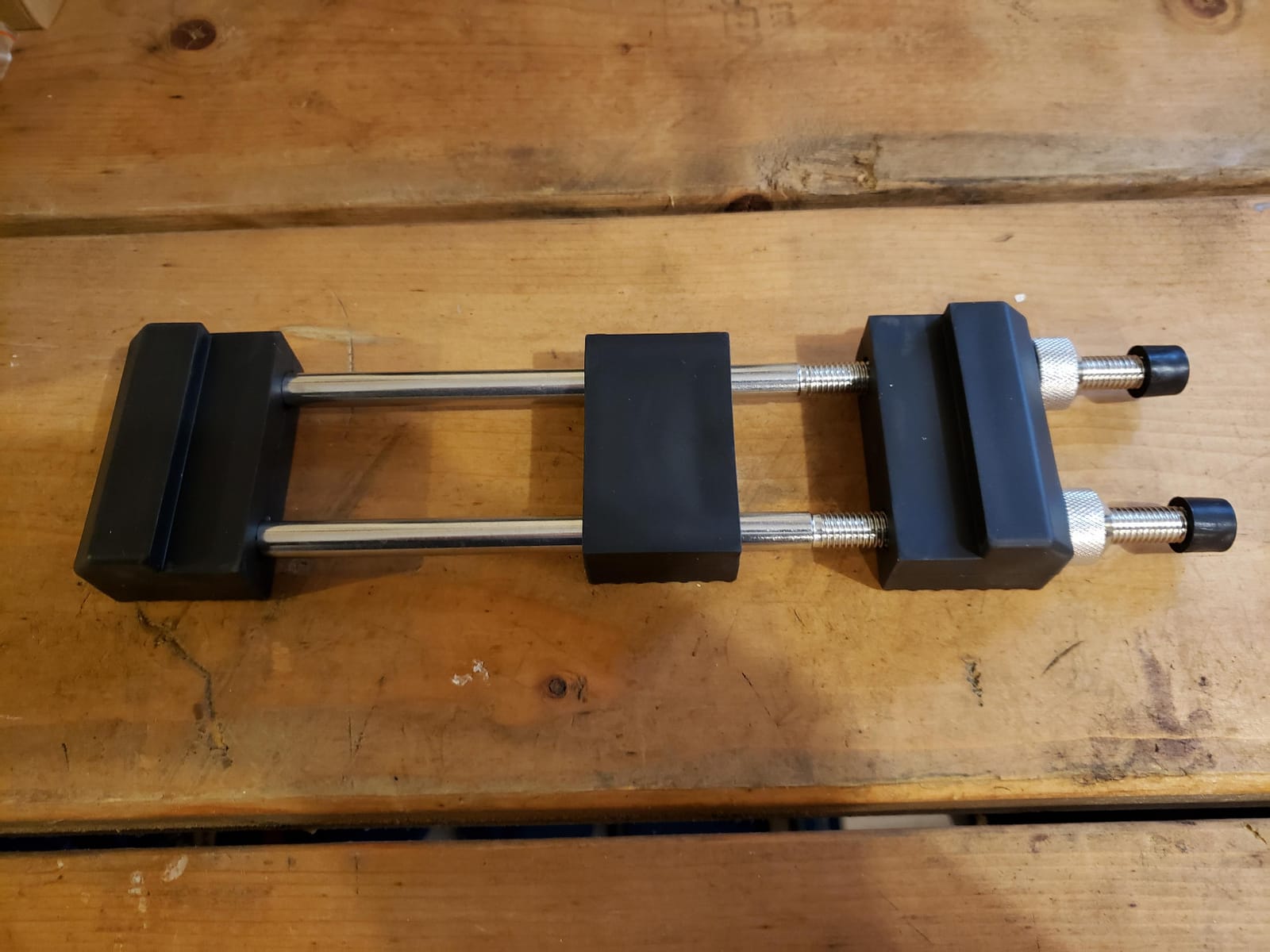
No other holder here opens as far as this one. The SCOTTCHEN adjusts from 3-1/8 to 10-1/2 inches, which means one frame can take a tiny sharpening plate, a standard 8 inch water stone and a full-size Japanese stone in turn. For anyone accumulating stones rather than settling on one, that range is the entire argument.
The build is 304 stainless steel threaded rods carrying solid rubber blocks, and it is explicitly a tabletop design rather than a sink bridge. Both parts wash clean under hot water, which is a genuine advantage in a kitchen where the holder will get splashed every time you use it.
We also like what it does for your hands. Raising the stone off the work surface gives you access to more of the sharpening face and keeps your knuckles off the counter, which matters on a stone with a narrow width where you naturally want to work near the edge.
Across roughly 300 reviews it averages 4.5, with 72 percent five stars. Owners call it well built and long lasting, and the elevating height comes up repeatedly as the standout benefit in the feedback.
Where the wide range earns its keep
If you own or plan to own more than one stone, a wide adjustment is the difference between one holder and three. Diamond plates of mixed thickness, a 6 inch water stone and a 10 inch stone all fit the same frame.
It also handles thin plates better than most, since the low, open design does not depend on the stone being exactly the right thickness to be gripped.
Know the two criticisms before you order
The securing screw sits on the rubber block rather than the steel rail, so it locks the block down more than it locks the stone. In practice the stone still holds, but it is a design detail worth knowing.
Owners also report that the holder may not sit perfectly flat straight out of the box, and that a gentle twist along the axis levels it out. It is a five-second fix, but expect to do it once.
5. DMD Adjustable Diamond Sharpening Stone Holder Kit – Stone and Guides Included
- Holder plus 400/1000 grit diamond plate and three angle guides in one set
- Solid weighted base grips the work surface
- Angle guides help hold a consistent bevel
- Adjustment lets it take plates from other makers
- Base rubber is soft and can shift on very slick counters
- Narrower adjustment range than the SCOTTCHEN
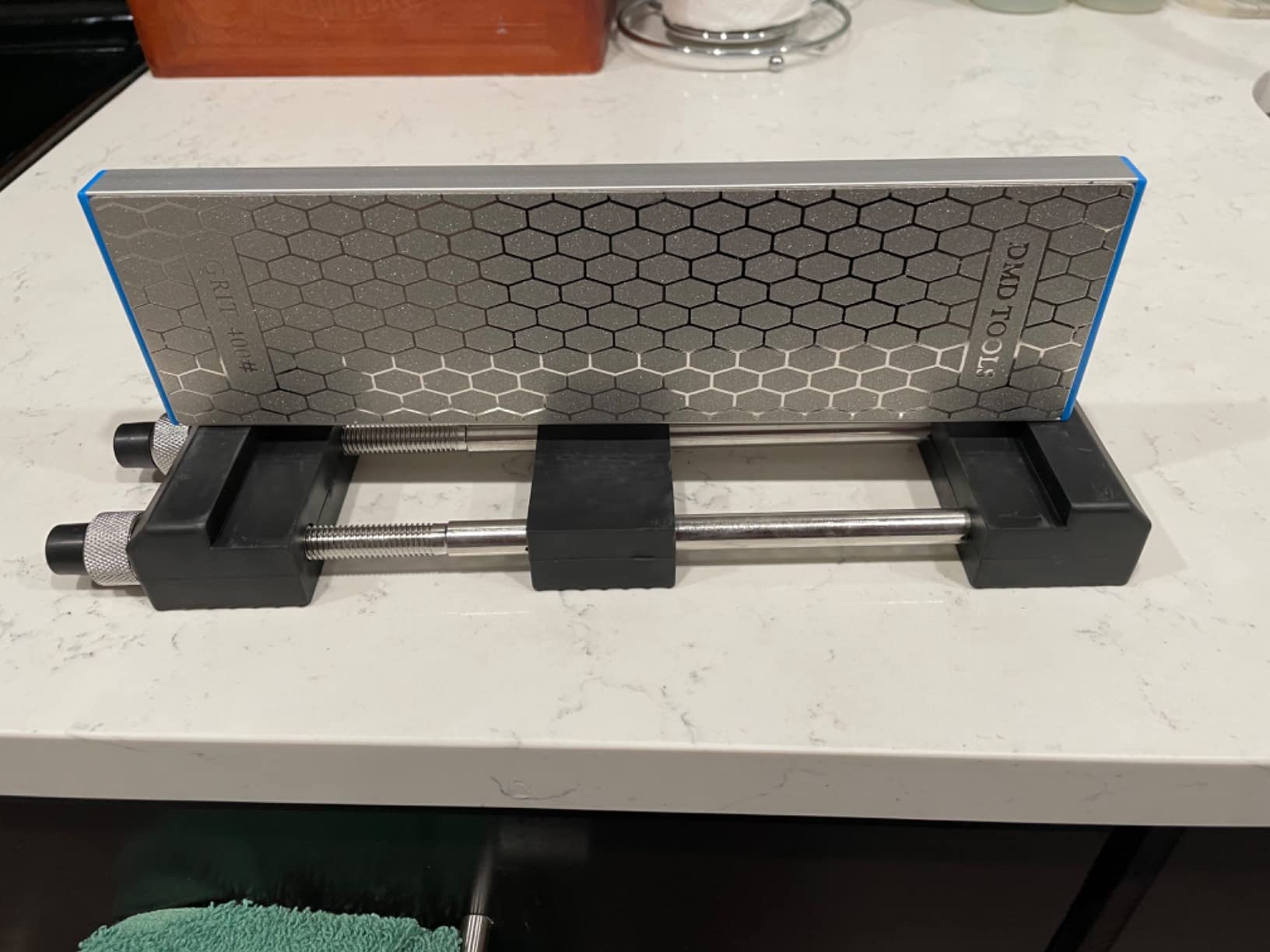
Most holders on this list are empty frames. This one arrives complete, with a holder, a 400/1000 grit diamond sharpening stone and three angle guides in the box. If you are setting up your first sharpening station on a counter, that removes three separate purchases and the guesswork of matching plate to frame.
The frame itself is a stainless structure with solid rubber support blocks and threaded adjustment screws, running 11-7/16 by 2-13/16 by 1-3/16 inches and weighing 1.4 pounds. That weight is why owners describe the base as solid and well weighted rather than flimsy.
It adjusts from 5-13/16 to 8 inches, and reviewers appreciate that it will hold plates from other makers rather than being restricted to the bundled stone. The three guides cover long, short and triangle profiles, which is more guidance than most casual setups offer.
Across roughly 250 reviews it averages 4.6 with 74 percent five stars. Buyers frequently praise how much arrives in the box, while being measured about the stone itself, describing it as good rather than premium.
The 400/1000 pairing is a sensible two-stage setup on its own. The 400 side takes an edge back to shape after use, and the 1000 side leaves something that is sharp enough to work with straight away. The guides remove the guesswork about how far to tilt a blade when you have no reference point yet.
Who this kit is actually for
It suits a home cook who wants a complete working setup without researching which plate pairs with which holder. Open the box, clamp the stone, and start sharpening.
It also works well as a second station, since the adjustable jaws take other plates once you outgrow the bundled one.
Where it falls behind the bare holders
The adjustment range is narrower than the SCOTTCHEN, so it will not take a 10 inch stone. The rubber base is also on the softer side and can let the holder shift on a very smooth or polished counter.
If your worktop is glossy stone rather than wood or matte quartz, test it in place before committing to this as your only holder.
6. SHARPAL 149H Silicone Sharpening Stone Tray – Best for Mess Control
SHARPAL 149H Sharpen-No-Mess Silicone Sharpening Stone & Whetstone Tray
- Keeps water and slurry off counters and wooden tables
- Anti-slip texture holds both tray and stone
- Basket handles let you empty wastewater without spilling
- Rinses clean and rolls up small for a drawer
- Silicone is thin and one reviewer cut through it on first use
- Very flexible so it can slosh liquid while emptying
- Low lip can catch a chisel handle
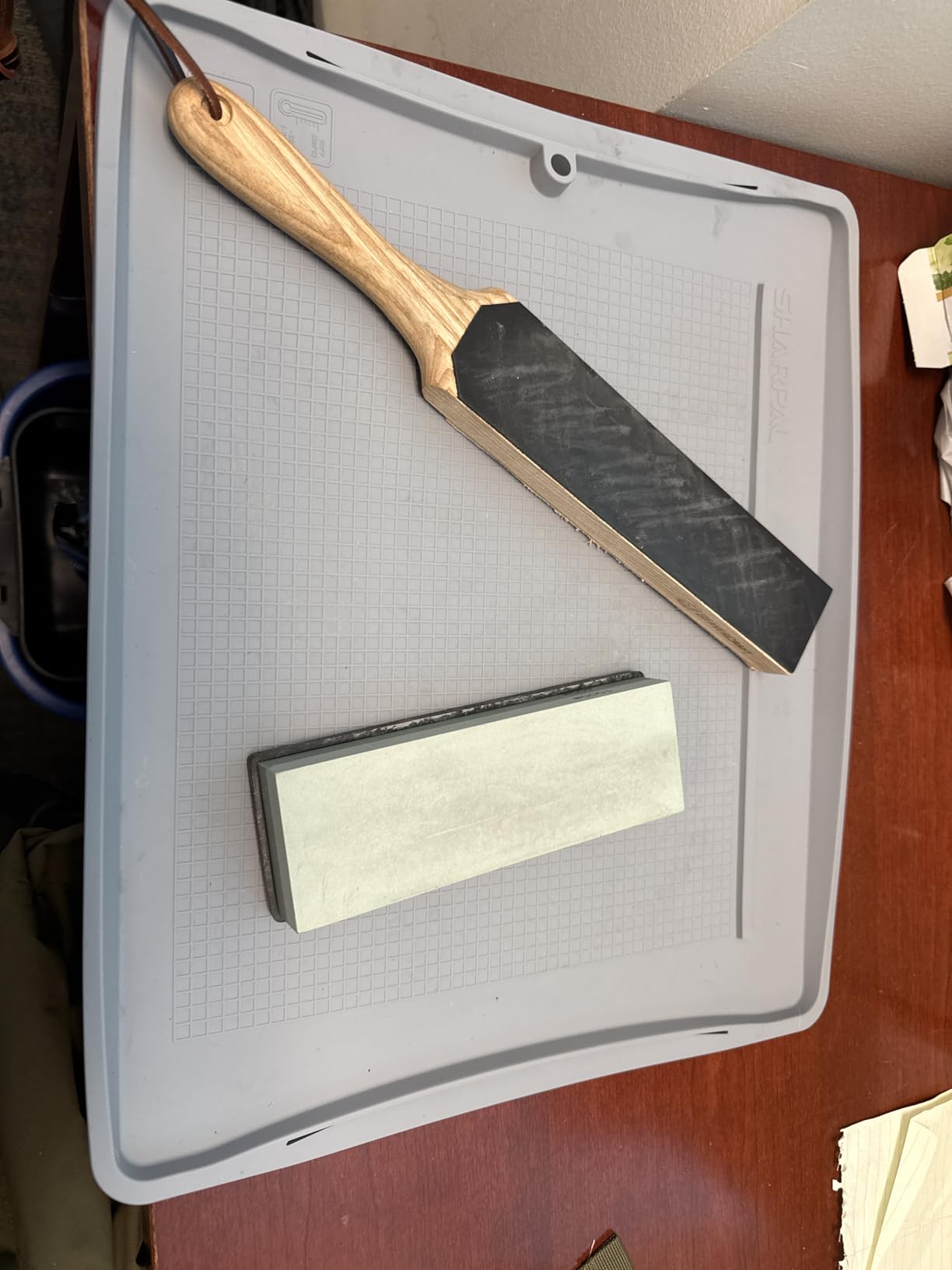
This is the only tray in the group, and it solves the problem none of the others address. Where a counter base keeps the stone still and still lets water escape onto your worktop, the SHARPAL 149H catches it. At 17 by 14 inches with a raised lip, anti-slip textures and a stopper bar, it holds an oil stone in place and contains everything around it.
It holds up to 0.21 gallons, or 800 mL, of liquid. On a pale stone counter, a light quartz worktop or a butcher block table, that is the difference between wiping up after every session and not thinking about it.
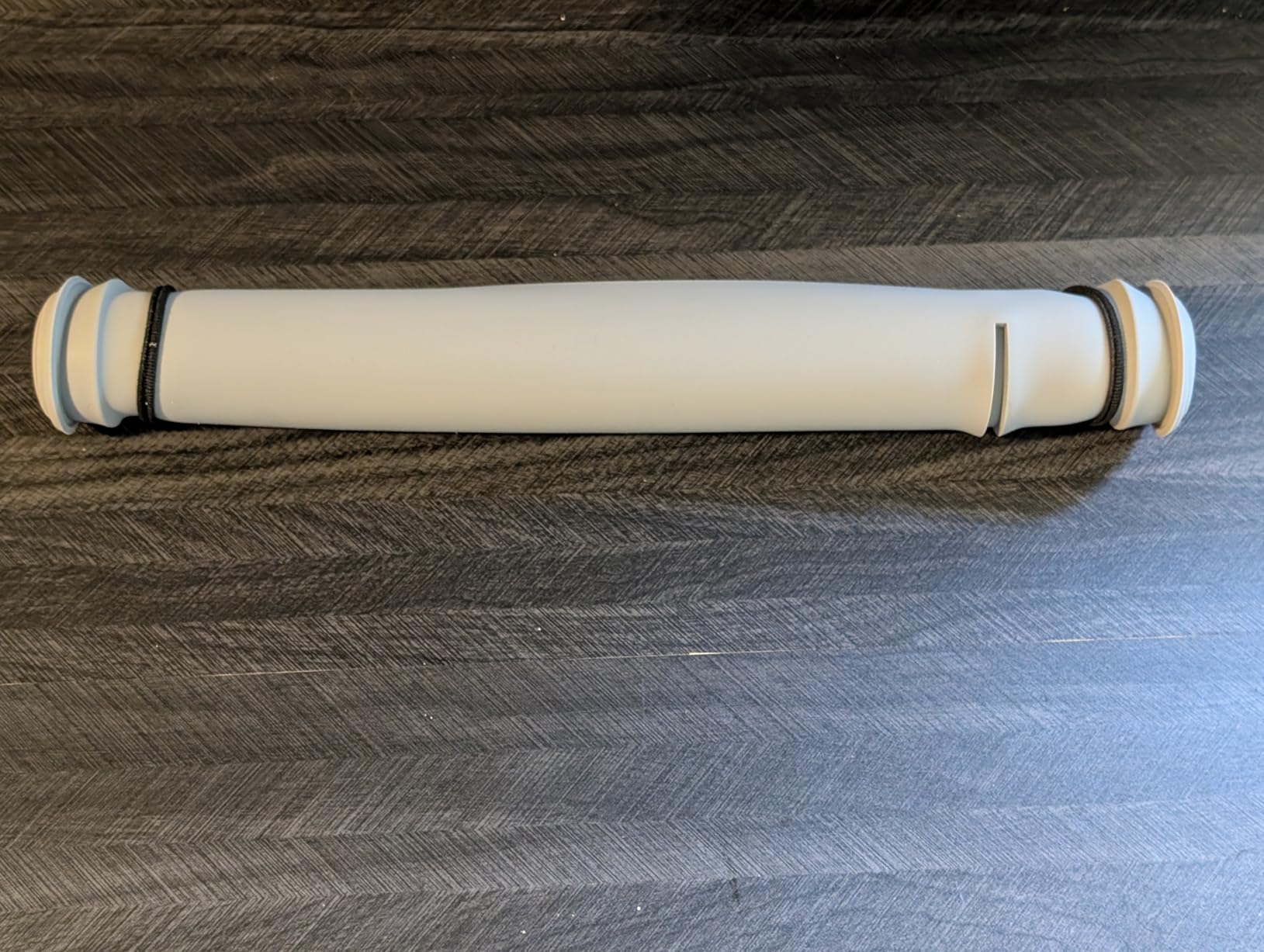
The details are thoughtful for a kitchen tool. Basket-style handles let you carry the tray to the sink and tip the wastewater out without a slip, and the stopper bar means the stone does not skate around inside the tray during wet sharpening. The silicone is BPA-free and rated from 392F down to minus 22F.
Storage is handled too. It rolls up for a drawer or hangs from a built-in hole, which matters in a house where a 17 by 14 inch mat would otherwise occupy prime worktop forever. One of our kitchen gift guides picks this kind of tidy, self-contained setup for new cooks.
When a tray is the right answer
If your counter is light, porous or wood, containment beats grip. A tray lets you soak and rinse without worrying about what the water carries across the surface.
It is also the easiest holder to store between uses, since it rolls into a drawer rather than living on the counter permanently.
Where the flexible mat shows its limits
The silicone is thin, and one reviewer cut through it during first use, so treat the base with a knife edge rather than a chisel edge. It is also very flexible, which means liquid can slosh as you carry it to the sink.
The low lip is worth knowing about if you back a stone across the tray with a flattening plate. A chisel handle can catch on the edge, so work toward the open side.
7. S SATC Adjustable Sharpening Stone Holder – Best for Diamond Plates
S SATC Sharpening Stone Holder,Adjustable 5-1/2 Inch to 9 Inch,Rubber Stainless Steel No-Slip Sharpening Stone Base for Diamond Stones
- Solid stainless frame that resists flex
- Grippy underside pattern resists movement
- Elevates the stone for access to the full surface
- Round adjuster nuts tighten easily by hand
- Overtightening the jaws can crack a stone
- Metal parts need washing and drying after wet use
- Some slippage reported on very smooth counters
At 1.3 pounds with a stainless steel frame, this is a serious little frame, and heft is the first thing owners mention. The non-slip base pattern grips dry work surfaces, and the rubber jaws hold diamond and other sharpening stones firmly while you work.
It adjusts from 5.5 to 9 inches and uses round adjuster nuts rather than wing nuts, which are easier to tighten by hand with wet fingers. It also raises the stone, giving you access to more of the sharpening surface than a low cradle does.
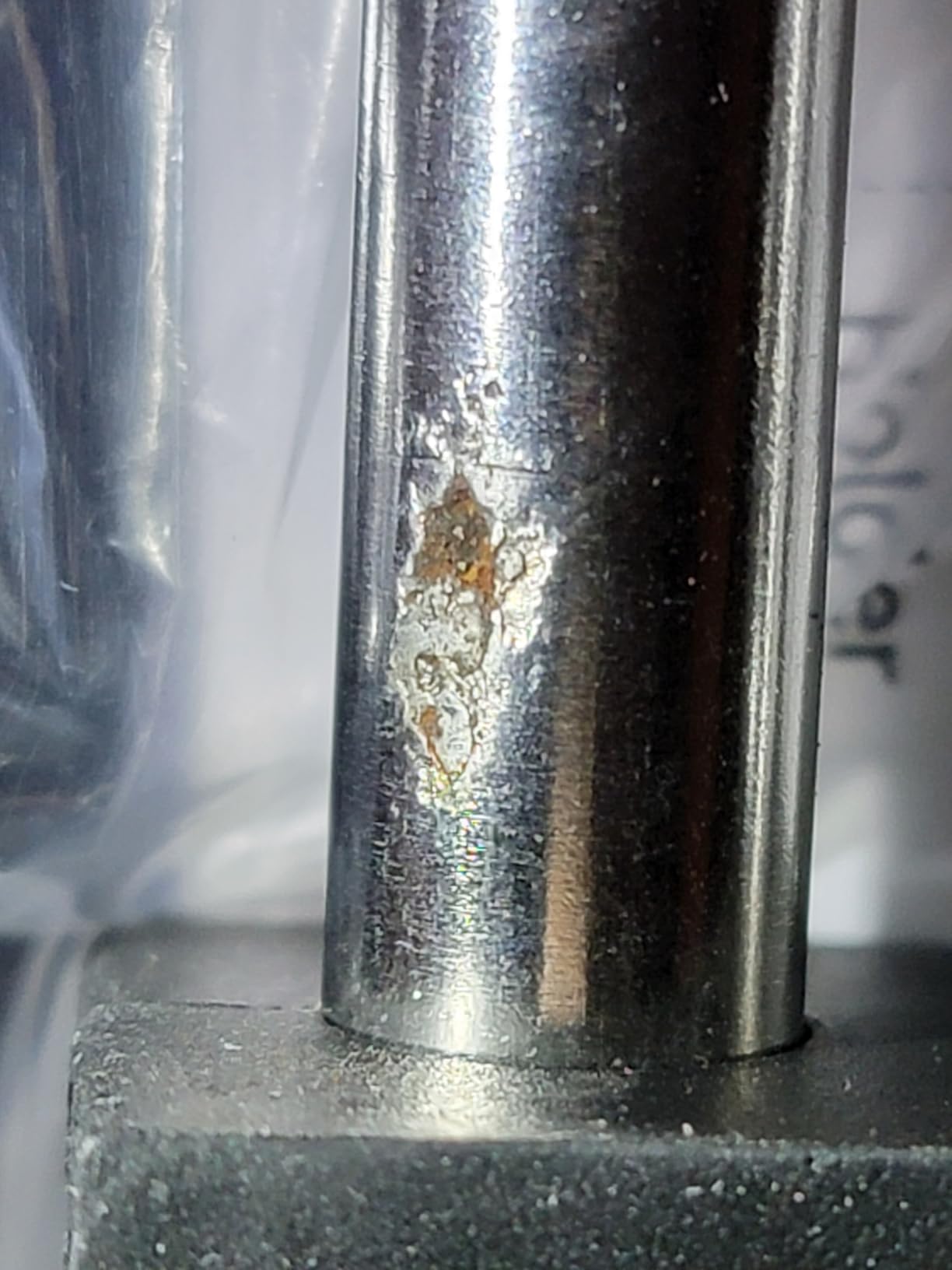
Across 175 reviews it averages 4.6 with 81 percent at five stars, which is a strong showing for a smaller-reviewed product. The recurring advice from owners is simple: do not overtighten, and dry the metal parts after a wet session.
That second point is the one to take seriously. Bare stainless that sits damp under a water stone will spot and eventually corrode at the threads, and this design puts the adjustment hardware right where the water lands.
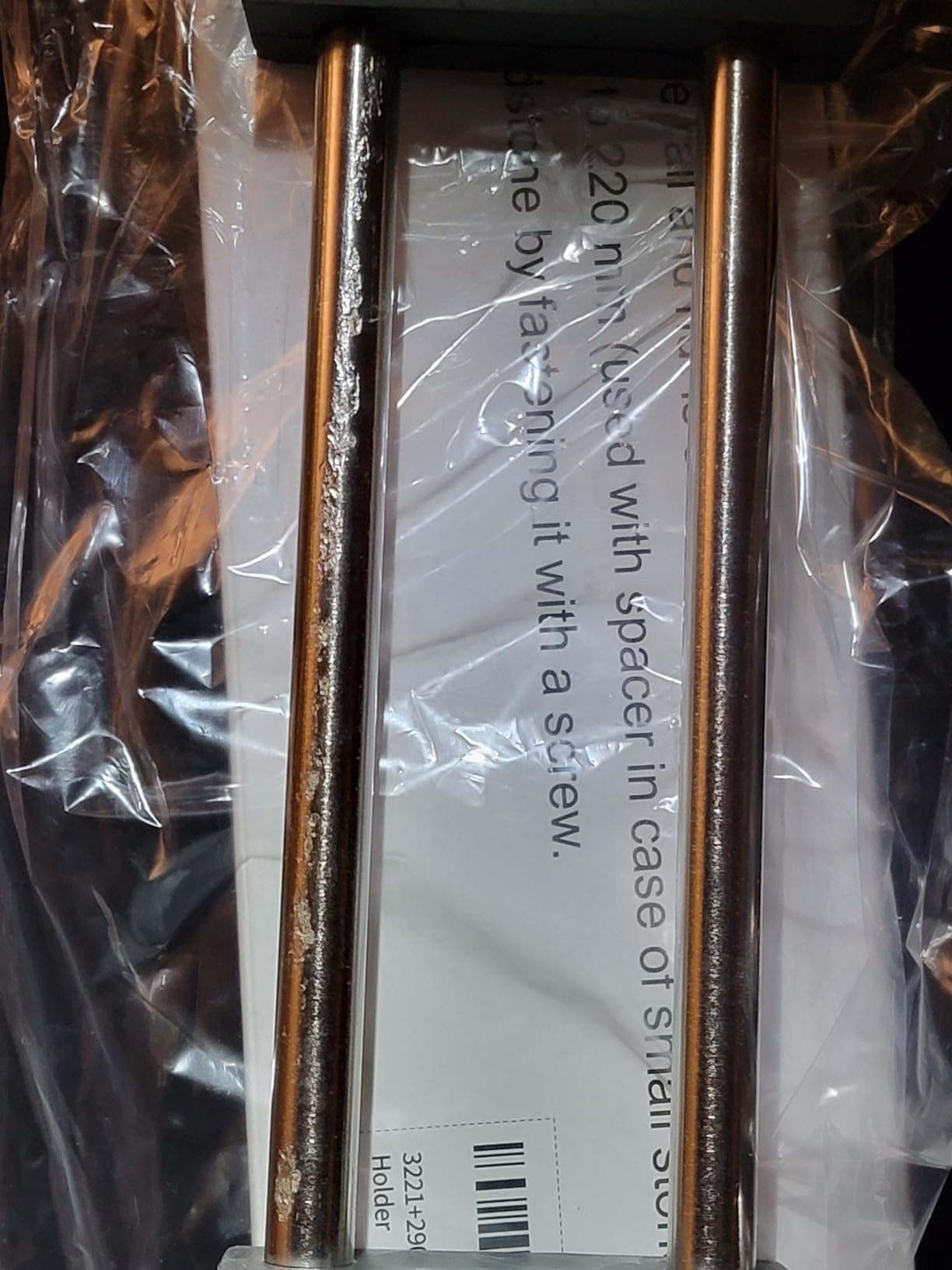
Diamond plates are where it fits best
Diamond plates are thin, flat and unforgiving of a narrow grip. The rubber jaws here give a wide, soft contact that suits them, and the elevated position helps when you are working close to the stone edge.
If you sharpen mostly on diamond rather than a traditional water stone, this is a good match for the way you work.
Two habits that keep it in good order
Tighten until the stone stops moving, then stop. Owners report that overtightening the jaws can crack a stone or pop it out under pressure.
Rinse and dry the metal after every wet session, and expect slight movement on a very smooth or polished counter despite the grip pattern.
8. Naniwa A-902 Sharpening Stone Holder – Best for Japanese Stones
- Least rocking reported of any holder tested
- Will not rust with wet stones and slurry
- Thin rubber end stops expose more usable stone surface
- Stones rarely pop out of the jaws
- Costs considerably more than anything else here
- Not adjustable across a wide range of stone lengths
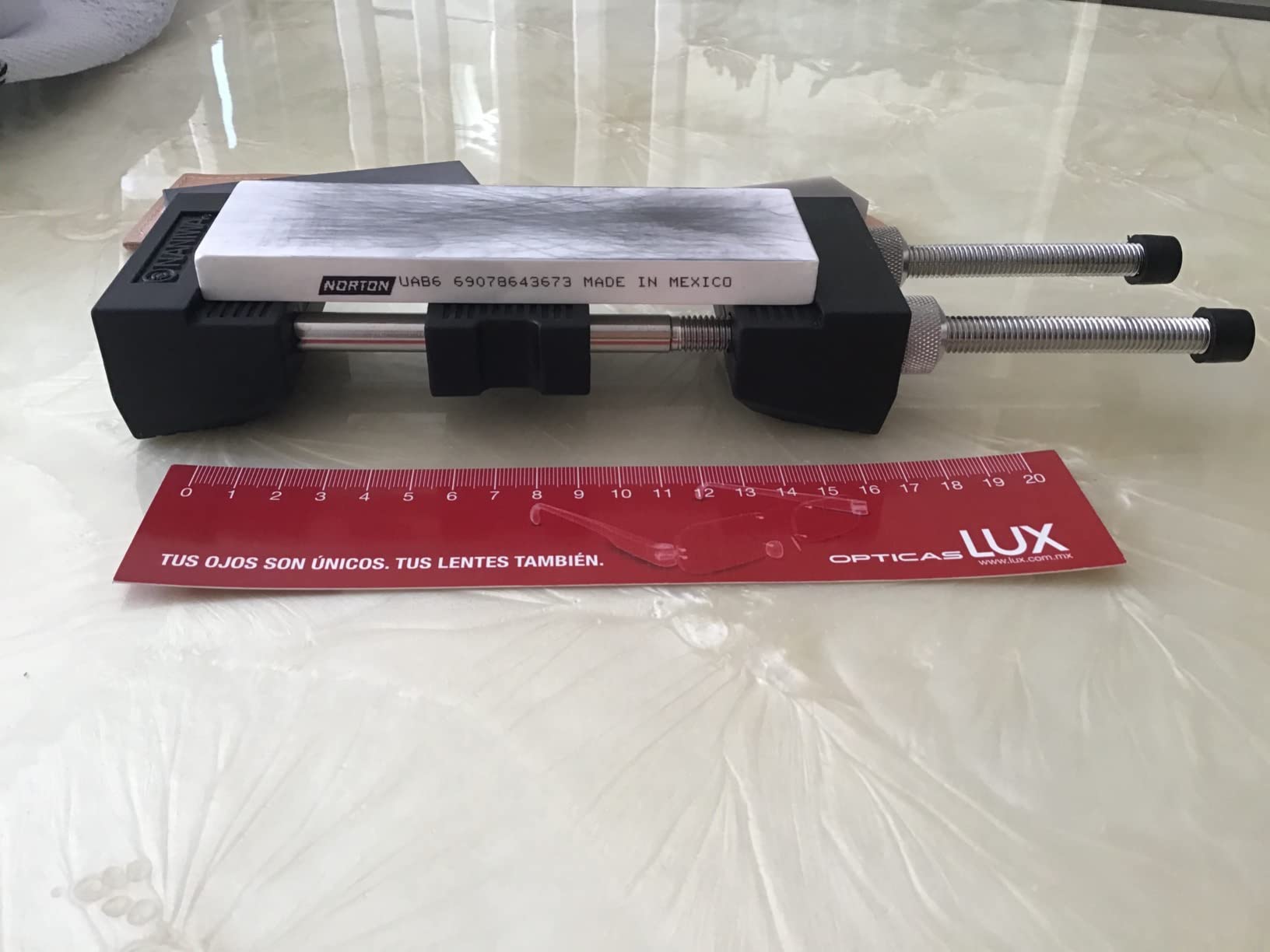
The Naniwa A-902 is made in Japan from stainless steel and rubber, and it is the one most owners describe as genuinely rock solid. Reviewers who have owned cheaper knockoffs single this out as the most solid and most rust-proof holder they have used.
The design detail that matters is the end stops. At roughly 3 mm thick, they cover far less of the stone than the wide jaws on an adjustable clamp, so more of the sharpening surface stays available to you. The taller profile also lifts the stone further off the counter than most rivals.
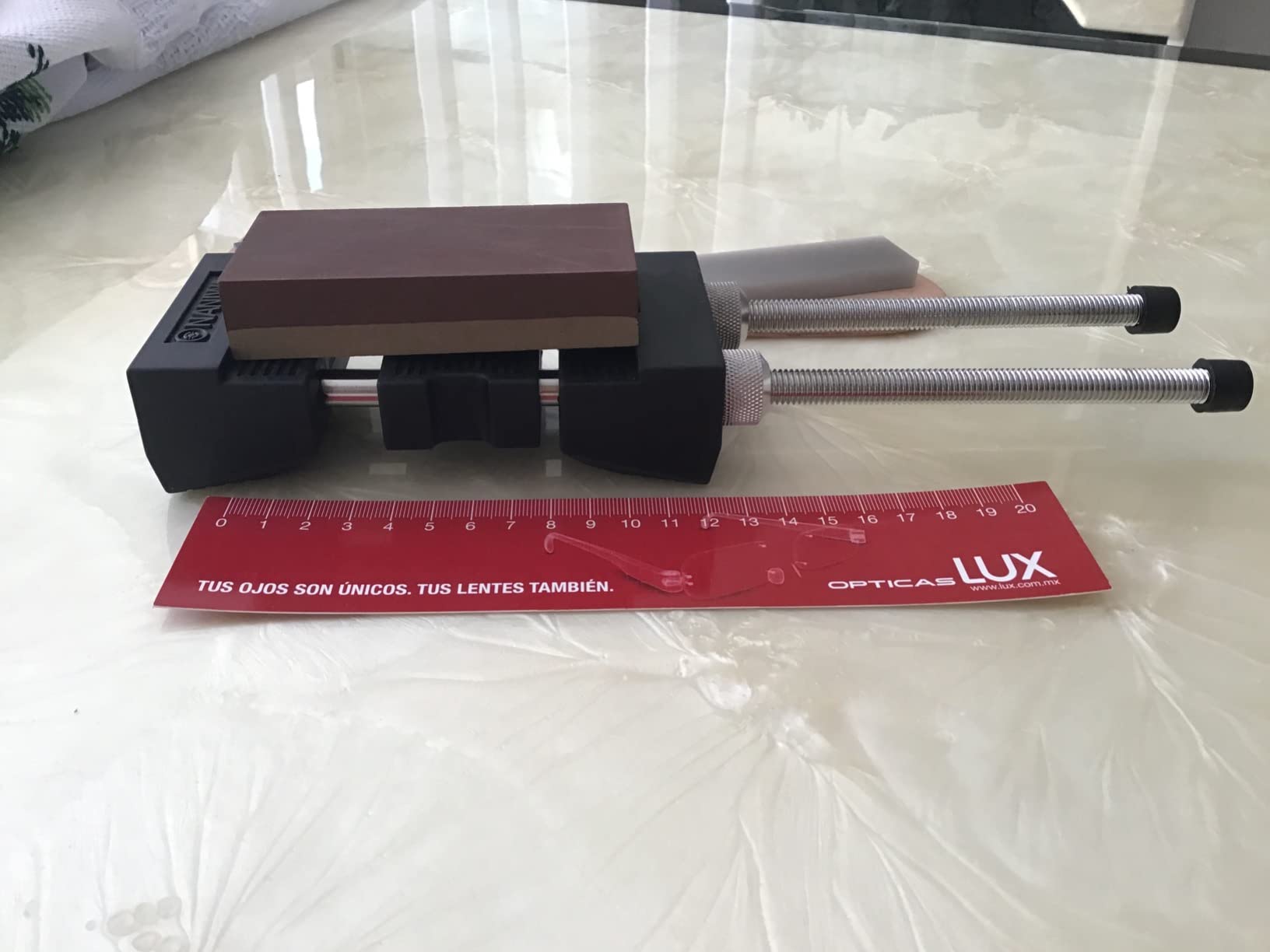
Across 140-plus reviews it holds 4.6 with 82 percent at five stars, and several buyers specifically credit the extra height and thin jaws for making better use of a stone. Stones rarely pop out of the jaws, and the frame will not rust even with wet stones and slurry.
This is also the holder that handles full-length Japanese stones well, including thicker stones that will not seat in a generic clamp. At 11.34 by 2.99 by 1.42 inches and 0.65 kg it is compact for what it does.
Why enthusiasts end up here
The combination of no rocking and maximum exposed stone is what a practised sharpener notices first. Both affect angle consistency, and angle consistency is what a keen edge actually comes from.
If you own Japanese water stones and sharpen regularly, the quality difference over a knockoff shows up in how the stone behaves rather than in how the holder looks.
Where it does not fit
It is not adjustable across a wide range of stone lengths. It suits standard 21 cm stones, and if your collection includes very small plates or oversized stones, this frame will not stretch to meet them.
It also costs noticeably more than anything else here, so it is a deliberate purchase rather than a casual one.
How to Choose a Whetstone Holder for Your Kitchen Counter
Start with the holder type your counter and sink can accept
Decide where the water is going before you decide on a brand. Over-sink bridges catch everything and leave the counter dry, but they need a sink wide and deep enough to span. Counter bases sit anywhere and need nothing except a flat patch of worktop. Trays need counter space and nothing else, and they are the only option that contains water by design.
Ask one question honestly: does my kitchen have room for this thing to live permanently? If the answer is no, favour a holder that stores flat or in a drawer.
Measure before you buy: sink width and stone width
Stone length is the number that blocks most purchases, so measure it with a tape before you order anything. Then compare it against the stated fit range on the listing. Every holder in this guide publishes its range, and there is no substitute for checking it yourself.
For an over-sink bridge you also need the internal width of your sink measured across the basin, inside the bowl rather than across the outer lip. Some sinks are narrower at the bottom than at the rim, so measure low. If you are unsure, the safest approach is to measure twice and treat the lower figure as the real one.
Material and water resistance
Stainless steel and solid rubber tolerate repeated wet work best. Rubber does not absorb water or stain, and it grips a counter at the same time, so a steel frame on rubber feet is the most forgiving combination for a busy kitchen.
Bamboo and wood look warmer and suit a styled kitchen, but they need to dry fully between sessions and can swell or split around fasteners. Plastic is light and inexpensive and perfectly adequate for dry, occasional use.
Whatever the material, wipe metal parts after every wet session and let wood parts air out. That single habit prevents most of the long-term complaints we saw in the reviews.
Countertop mess control: slurry, swarf and carbon residue
Water stones throw off two different things. Swarf is the loose black metal and stone particles that come off the blade. Slurry is the grey or brown suspension of abrasive and steel that forms on the stone face as you work. Both end up on your counter, and both carry carbon that will mark a light surface.
If your counter is pale, honed, wood or unsealed stone, containment is worth more than grip. A tray solves it outright, and a bridge solves it by sending everything into the basin. If you use a counter base, put a folded tea towel or a chopping board underneath as a sacrificial surface.
Footprint, weight and where the holder lives between uses
Counter space is the real constraint in most kitchens. Note the footprint of any holder before buying, and remember that a heavier stand is steadier but permanently occupies more room.
Think about storage in the same breath. A tray that rolls up is invisible in a drawer. A clamp holder does not fit a shallow cutlery drawer at all. If your sharpening gear already crowds the utensil drawer, a holder that mounts over the sink or on a wall-adjacent shelf solves a second problem at once.
Build quality, fasteners and the failure modes to avoid
Look closely at how the holder is put together. Hidden fasteners driven through wood or bamboo can split the piece over time as the material swells and dries, and a nut underneath can pull the clamp apart entirely. Solid screws through solid rubber and steel, with no buried hardware in a natural material, are what we look for.
The other recurring failures are bases that cup or warp after repeated wet sessions, and grips that fade and stop biting. If a listing says nothing about the base material, assume it is a soft rubber and check reviews for reports of movement before you commit.
Warranty, returns and what to check before you commit
A published warranty length tells you something about how a maker expects the product to be used, and it is worth reading. Long material and manufacturing defect coverage is a reasonable signal on a bamboo or steel frame that should last years.
Returns are the other half. A holder with a narrow fit range is a purchase you should be able to return cheaply if your stone does not fit, so check that before you order rather than after.
Before you spend: DIY holder alternatives that work
A sharpener on a forums thread will tell you three things work without buying anything. A damp paper towel under the stone adds grip and catches some water. A plastic serving tray under the whole setup keeps slurry off the counter and gives you somewhere to tip the water. And a recess chiselled into a scrap of wood with a saw and chisel makes a permanent home for one specific stone.
None of these match a machined frame on stability, but they are genuinely workable and cost nothing. Some enthusiasts pair a stone holder with a plastic serving tray specifically to keep the counter clean, which tells you how common that problem really is.
Frequently Asked Questions
What is the best whetstone holder?
The best whetstone holder is the one that fits your stone, matches your sink or counter, and stays still under pressure. Four types cover the category: an over-sink bridge for mess containment, a counter-top base for most kitchens, a spring clamp for the tightest grip, and a tray for catching water. Measure your stone length first, then choose the fit range that contains it.
How do I measure my sink for a sink bridge holder?
Measure the internal width of your sink basin from inside wall to inside wall, taken low in the bowl rather than across the outer rim, since many sinks narrow toward the bottom. Then measure the length of your sharpening stone. You need the bridge to span the sink opening and still leave room for the stone to sit inside the frame.
How do I stop a whetstone from slipping on the counter?
Use a holder. The stone slips because pressure from the blade turns into sideways force on a low-friction surface. A holder adds mass and traps the stone in a recess, cradle or clamp so that force goes into sharpening instead. A damp folded towel underneath adds friction for a quick session, but it moves, soaks and leaves grit behind.
What whetstone is best for kitchen knives?
For most home kitchens a dual-sided water stone around 1000 and 3000 grit covers everything from repairing a dull edge to putting a fine finish on a slicing knife. A coarser 400 or 600 grit side is only needed for very dull or nicked blades. Whatever grit you choose, flatness matters more, so keep a flattener for it.
Do you push or pull on a whetstone?
Pull strokes are the traditional technique and most sharpeners prefer them, because the blade rides the stone face toward you and you can feel the edge develop. Push strokes work equally well for many people and suit a shallow bevel angle. Whichever you use, keep the stone still and lift the blade at the end rather than dragging it off the side.
Why does my knife feel dull after using a whetstone?
The most common cause is a hollow or cupped stone, which creates a wavy edge that feels dull in places. Check the stone against a straightedge and lap it flat if you see a light gap. The second cause is a rock, since any movement during a stroke changes the angle. A third is skipping, which happens when the stone is too hard for the edge or the pressure is too heavy.
How do you store sharpening gear when the drawer is full?
Move the gear out of the drawer rather than squeezing it further. A tray style holder rolls up and lives flat, a sink bridge hangs on the side of the basin, and a counter base can sit at the end of a worktop as a permanent station. Store stones upright on edge on a rack so the edges cannot chip each other, and let them dry fully first.
What are the drawbacks of using a whetstone knife sharpener?
The main drawbacks are time and mess. Sharpening by stone takes minutes per knife and produces water, slurry and swarf that need managing. A stone also needs occasional flattening, and water stones need soaking and drying. Electric sharpeners are faster and wetter to clean up, but they remove more metal and give less control over the final edge.
The Best Whetstone Holder for Your Kitchen Counter
For most kitchens, the POWERTEC adjustable holder is the pick. Its 5-1/2 to 9 inch range covers the typical home water stone, the rubber body grips a wet worktop, and the chrome-plated arms take standing water without complaint. It is the one we would buy first and the one we keep reaching for.
Choose the SCOTTCHEN instead if you own stones of very different sizes and want one frame for all of them. Choose the SHARPAL tray if your counter is pale, wood or stone and mess is the thing you most want to avoid. Choose the Naniwa if you sharpen Japanese water stones often enough that exposed surface area and zero movement are worth paying for.
Whichever you pick, the fit range is the number to check, and the base material is the one to think about. Everything else is preference. If you enjoy the small but satisfying upgrades a well-organised worktop brings, our magnetic tool holder guide covers the same problem for the rest of your kit, and a fireplace log holder solves a version of it in another room entirely.