

The best solar batteries for off grid cabins are lithium iron phosphate (LiFePO4) banks in 12V, 24V or 48V form, sized around how many nights your cabin has to survive without sun. Our top pick is the Weize 12V 100Ah AGM for owners who want proven lead-acid behaviour, the ECO-WORTHY Cubix100 48V rack-mount for a serious 5.12kWh system, and the ECO-WORTHY EnergyRock 12V 280Ah for the most usable energy in a single case.
Cabin power is a different problem from home backup power, and almost every ranking page on this query gets that wrong. Home battery articles are written for people who want to shift midday solar into an evening tariff window. A cabin has no tariff window. It has a fridge, a water pump, a handful of lights, maybe a router, and a heater that nobody wants to run on a battery, and it has to do that on a short winter day when the panels produce almost nothing.
That changes the decision. What matters is usable capacity at a shallow discharge, cold-weather charging behaviour, whether the battery will talk to the inverter you already own, and how far you have to carry the thing when a cell fails. The most-read threads on r/OffGrid and diysolarforum make the point bluntly: cabin owners are not shopping for a brand, they are trying to solve a sizing and survivability problem.
So we built this list around three cabin types. A weekend cabin running 12V loads might need 1 to 2 kWh of storage. A seasonal cabin occupied spring through fall usually runs 4 to 6 kWh a day. A full-time off-grid home with a well pump and a water heater is looking at 15 kWh a day and up. Each of the 12 batteries below is matched to one of those patterns, and each carries an honest drawback, because forum readers spot a list with no negatives instantly.
Two more ground rules before we start. Prices in this category are installer-quoted and move constantly, so we give price bands rather than false precision, and every pick should be read alongside total installed system cost, not battery cost alone. Our broader battery guides cover the chemistry families at more depth: our lithium battery guide and our whole-home solar battery picks.
Table of Contents
Top 3 Picks for Off-Grid Cabins

Weize 12V 100Ah AGM
- Sealed AGM lead-acid
- 3% monthly self-discharge
- 1150A 5-second surge
- 1-year warranty
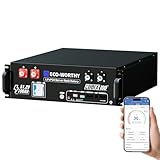
ECO-WORTHY Cubix100 48V
- 51.2V 5.12kWh rack mount
- UL9540 and UL1973 listed
- CAN and RS485 comms
- 10-year warranty

ECO-WORTHY EnergyRock 280Ah
- 3584Wh in a metal case
- 200A BMS with Bluetooth
- Low-temp charge cutoff
- Shock resistant
These three cover very different cabins, and that is deliberate. The Weize is a starter bank for a weekend place that mostly runs DC loads. The Cubix100 is a genuine 5.12kWh 48V rack unit for a cabin that has to hold three days of power on its own. The EnergyRock is the middle ground most cabins actually land on, because it packs 3.58kWh into one metal case with Bluetooth monitoring built in.
Best Solar Batteries for Off-Grid Cabins at a Glance in 2026
| Product | Specifications | Action |
|---|---|---|
| Weize 12V 100Ah AGM |
|
Check Latest Price |
| ECO-WORTHY Cubix100 48V 100Ah |
|
Check Latest Price |
| ECO-WORTHY EnergyRock 12V 280Ah |
|
Check Latest Price |
 yeagulch 12V 200Ah LiFePO4 yeagulch 12V 200Ah LiFePO4 |
|
Check Latest Price |
 ECO-WORTHY 12V 314Ah LiFePO4 ECO-WORTHY 12V 314Ah LiFePO4 |
|
Check Latest Price |
 Dyness 12V 100Ah Two-Pack Dyness 12V 100Ah Two-Pack |
|
Check Latest Price |
 dumfume 12.8V 100Ah Mini dumfume 12.8V 100Ah Mini |
|
Check Latest Price |
 Rvpozwer 12V 100Ah Group 31 Rvpozwer 12V 100Ah Group 31 |
|
Check Latest Price |
 GRNOE 12V 100Ah Group 31 GRNOE 12V 100Ah Group 31 |
|
Check Latest Price |
 BUKNUWO 12V 100Ah Bluetooth BUKNUWO 12V 100Ah Bluetooth |
|
Check Latest Price |
 Renogy 12V 100Ah AGM Renogy 12V 100Ah AGM |
|
Check Latest Price |
 WOXABHSL 12V 200Ah Two-Pack WOXABHSL 12V 200Ah Two-Pack |
|
Check Latest Price |
1. Weize 12V 100Ah AGM – The Proven Starter Bank for a Weekend Cabin
- Maintenance-free sealed AGM with no acid leakage
- Dependable deep-cycle charge retention
- Very high 1150A five-second surge
- Standard Group 31 footprint
- Discharge rated to 122F
- 57 pounds makes handling awkward
- Only 1-year warranty
- About half the usable capacity of comparable lithium
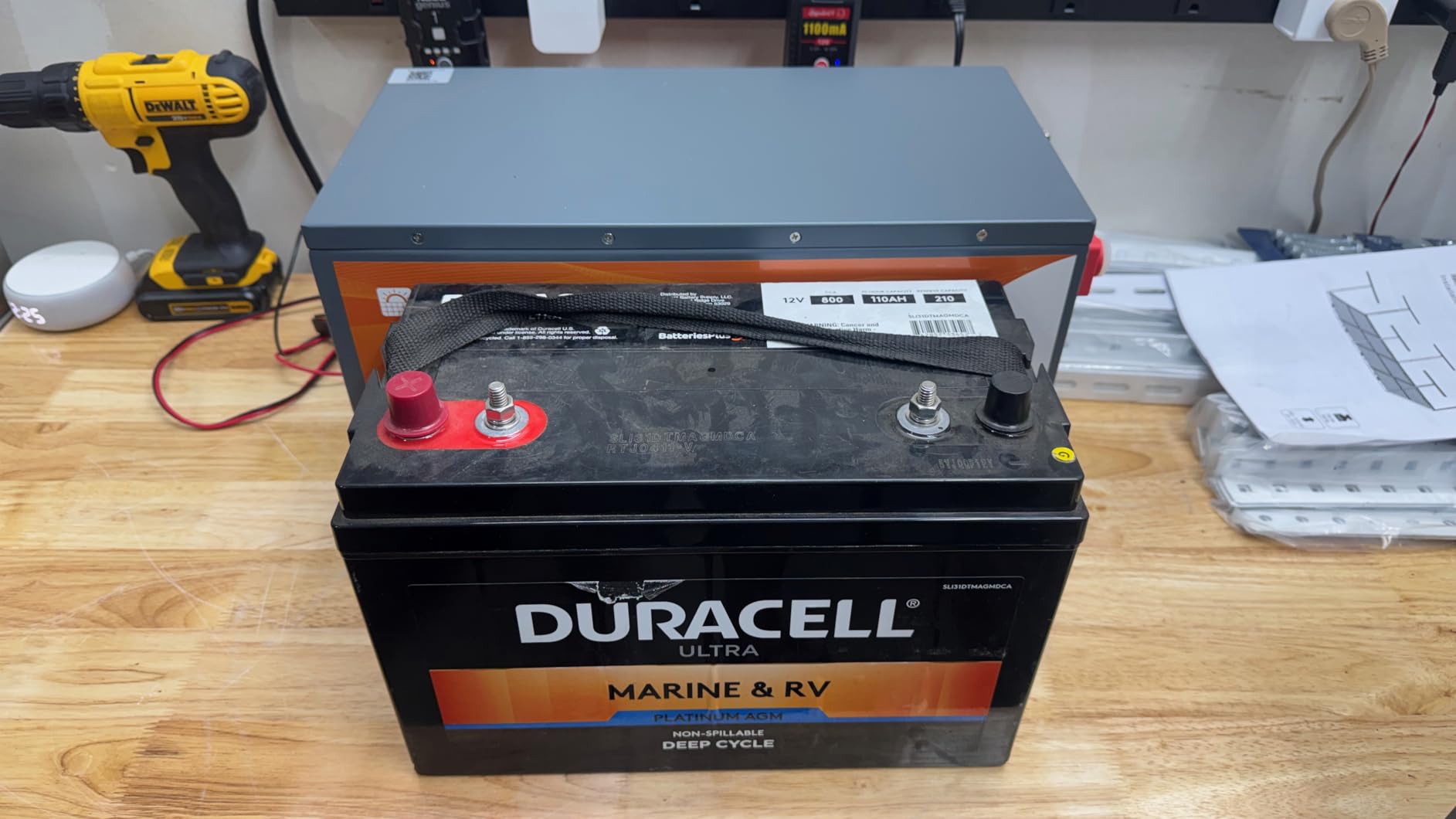
I keep coming back to this battery because for a lot of weekend cabins it is simply the right amount of battery. A 100Ah 12V AGM is 1.28kWh of nameplate energy, and if you only pull it down to 50% like you should with lead-acid, you have roughly 640Wh of real storage. That covers a 12V fridge, LED lights, a router and a small water pump for a night or two.
It has been the most-reviewed battery in this roundup by a wide margin, and the pattern in that review history is consistent: owners praise charge retention, durability and simple hookup, and report it powering solar, RV and marine loads without shore power. The single most repeated complaint is weight. At 57 pounds, two people are needed to move it.
Two spec numbers do the heavy lifting for cold cabins. The discharge range runs from 5F to 122F, and the self-discharge rate is 3% per month, which means a cabin that sits empty for a month still starts with most of its charge when you get there. Lithium alternatives in this list need a top-up charge every two to six months during storage; this one largely does not.
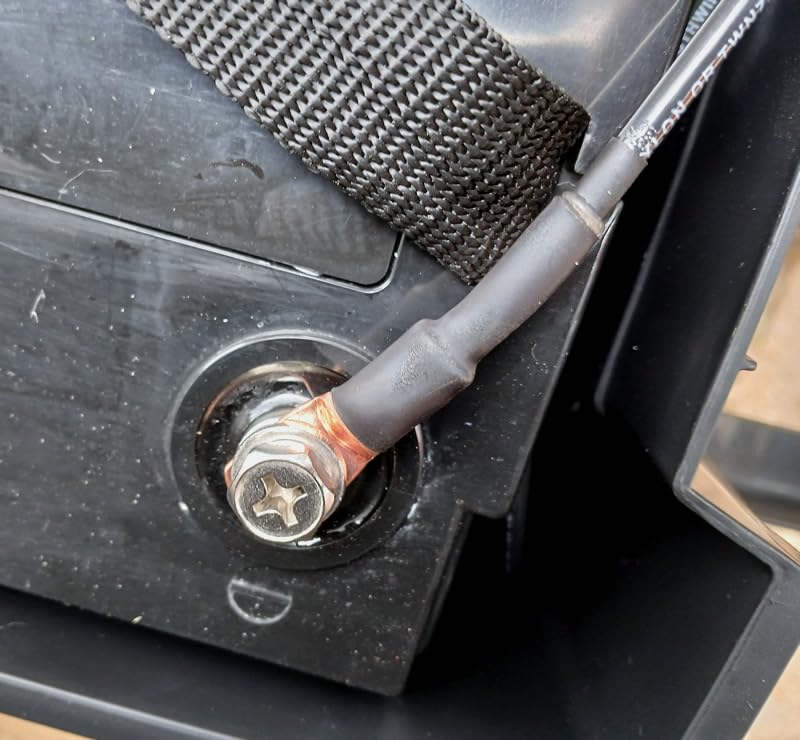
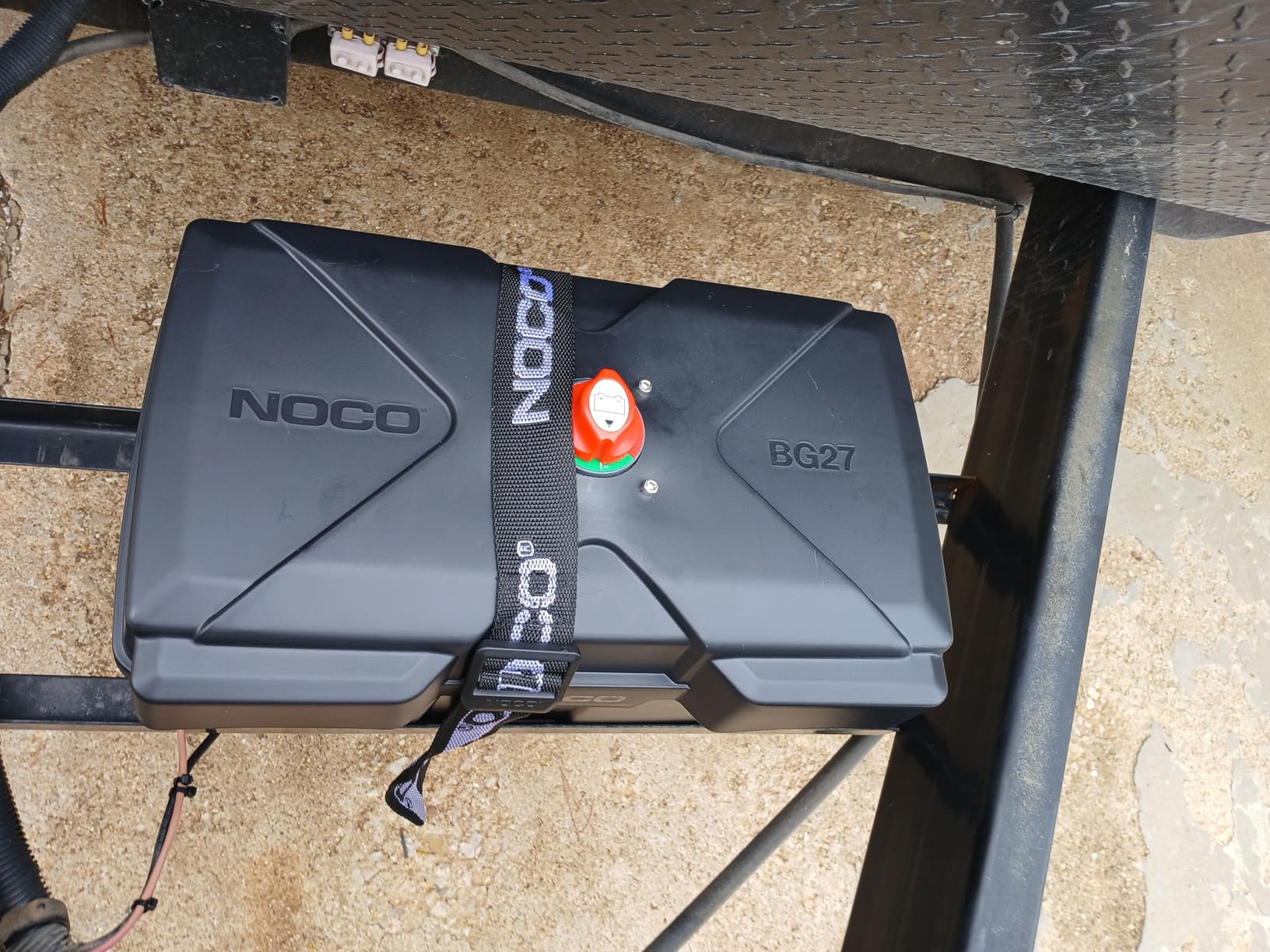
There is also a 1150A maximum discharge current for a five-second window, which is more than enough to start a well pump motor or a compressor without the BMS-style protection trips you see on lithium. Marked terminals with clearly identified positive and negative posts make the wiring unambiguous in a dark battery box.
Where this battery is the right call
This is the pick for a weekend cabin or a hunting cabin that runs mostly 12V DC loads, or for anyone who wants a bank they can diagnose with a cheap multimeter and replace by driving to town. Forum readers who like to keep a spare on the shelf tend to land here for exactly that reason.
It is also the safest choice if the cabin sits in genuine cold and you are not confident about lithium charging behaviour. Lead-acid will take a charge in temperatures that will make a lithium BMS refuse. Reviewers report it charging down to 14F, which is well below the point where most lithium packs here stop accepting charge.
Where this battery will disappoint you
The 50% usable ceiling is the whole story. To store the same 640Wh of usable energy with the ECO-WORTHY EnergyRock later in this list, you need roughly a third of the footprint and a third of the weight. If your goal is more nights of autonomy rather than a cheap weekend, this battery is under-sized by design.
The one-year warranty is also the shortest in this roundup, and the footprint is larger than most batteries it replaces, so an existing battery box may need modification. A small number of buyers reported batteries arriving with lower-than-expected state of health, though the seller replaced them.
2. ECO-WORTHY Cubix100 48V 100Ah – The Only True 48V Rack Bank Here
- Highest rated battery in this roundup
- Certified for code-conscious installations
- CAN and RS485 plus Bluetooth and WiFi
- Parallel stack to 163.8kWh
- Complete cable and hardware kit in the box
- No on-battery status screen
- Basic app without time-remaining estimates
- 103 pounds per battery
Every other lithium battery in this list is a 12V building block. This one is a 51.2V nominal rack-mount module at 5.12kWh, which is the voltage and form factor real off-grid installs actually use. If your cabin has an off-grid inverter that expects a 48V bus, this is the battery in the list that speaks its language out of the box.
The certification is the quiet headline. It carries UL9540, UL1973 and CEC listings, tested by Intertek. Those three marks are what an electrical inspector and a code-conscious installer will ask about, and none of the other rack-style options in this roundup carry the same combination on the listing.
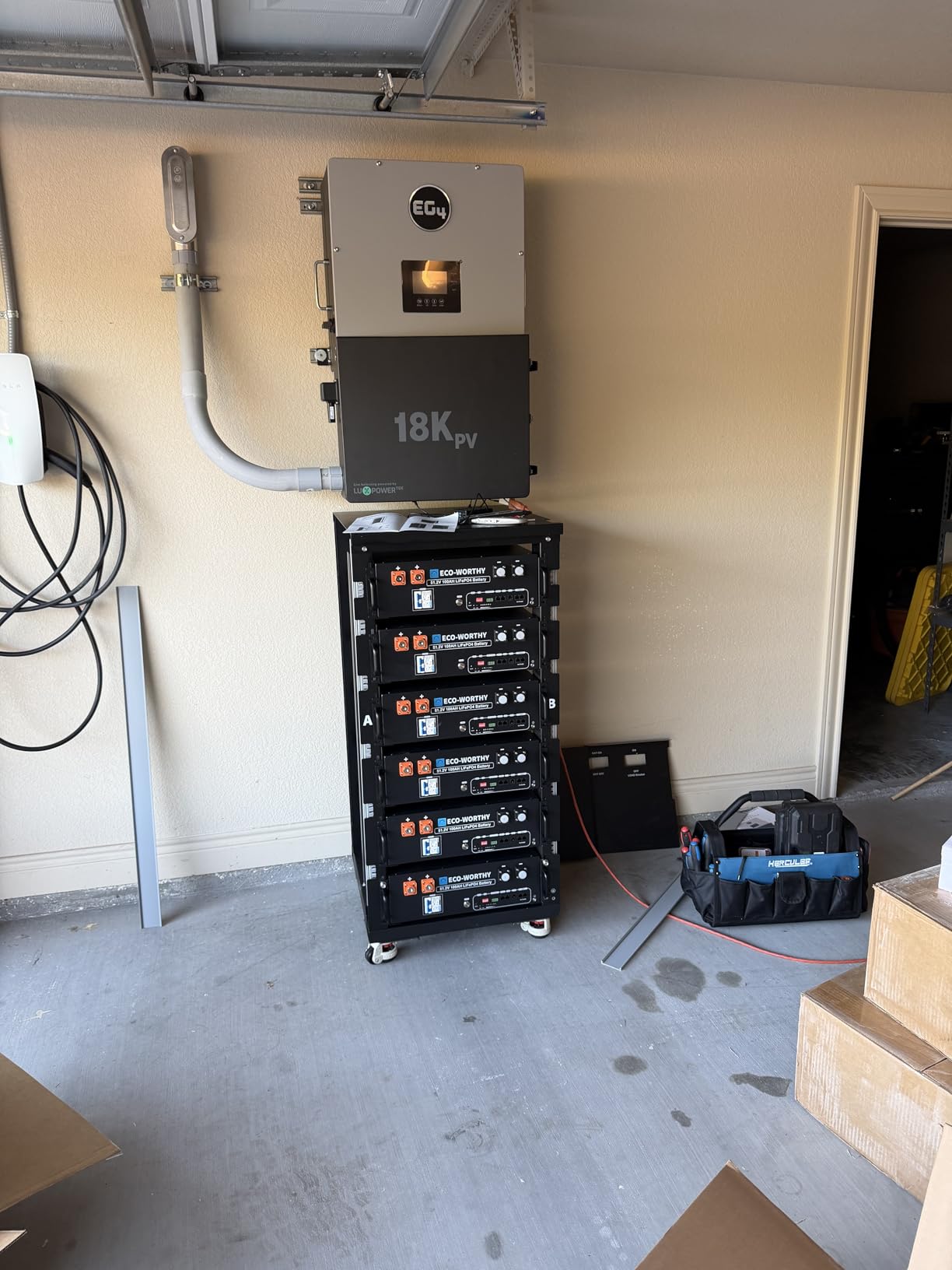
Communication is handled properly too. CAN and RS485 closed-loop comms let the battery negotiate with Victron and other inverter brands, and Bluetooth plus WiFi cover remote monitoring for a cabin you are not standing in. It parallels up to 32 modules for a 163.8kWh bank, so the same cabinet can grow with the household.
Owners running whole-home off-grid systems on Sungold, Victron and Bluetti hardware report strong capacity, stable parallel operation and easy rack assembly. Several have bought a second or third module. The box also includes parallel cables, communication cables, grounding wires, terminal covers, screws and the manual, which saves a parts order.
Why cabin owners pick it
It is the longest warranty in this roundup by five years, and on a bank that is meant to survive decades of cycle cycling, that matters more than any single spec. Buyers repeatedly cite the certified safety listing and the CAN communication as the deciding factors.
For a seasonal rental cabin, the monitoring story is the quiet winner. You can check state of charge from your phone at home base rather than driving four hours to find out the bank tripped a breaker in January. Support is available 24 hours, and one documented unit failure was resolved with a prepaid return and a full refund.
Where it falls short
There is no status screen on the battery itself. You read state of charge from the app or an external monitor, and the app is basic, lacking time-remaining and time-to-full estimates. For someone standing in a cold battery room with gloves on, that is a real friction point.
At 103 pounds per module, handling needs a plan for anything past two or three units. And a single module at 5.12kWh is more than a weekend cabin needs, so this is a bank for a full-time or high-autonomy build rather than a small place.
3. ECO-WORTHY EnergyRock 12V 280Ah – The Most Usable Energy in One Case
- 3584Wh from a single 12V case
- Metal case adds stiffness and fire resistance
- One-touch safety disconnect switch
- Bluetooth app reports voltage current and SOC
- Low-temperature charge cutoff built in
- 68.5 pounds and a large footprint
- No IP rating or sealed lid
- Some orders arrive in more than one box
This is the pick we return to most often for a mid-size cabin. One battery gives you 3.58kWh of stored energy in a 12V package, and because lithium can be discharged to 90% or beyond without damage, most of that is genuinely usable. That is roughly five times what a single 100Ah AGM gives you in practice.
The metal case is the detail that separates it from the plastic-cased competition. It feels sturdier, it tolerates vibration, and it adds a layer of fire resistance that matters when the battery is bolted into a floor of a remote building. Four mounting feet mean you do not need a separate battery box.
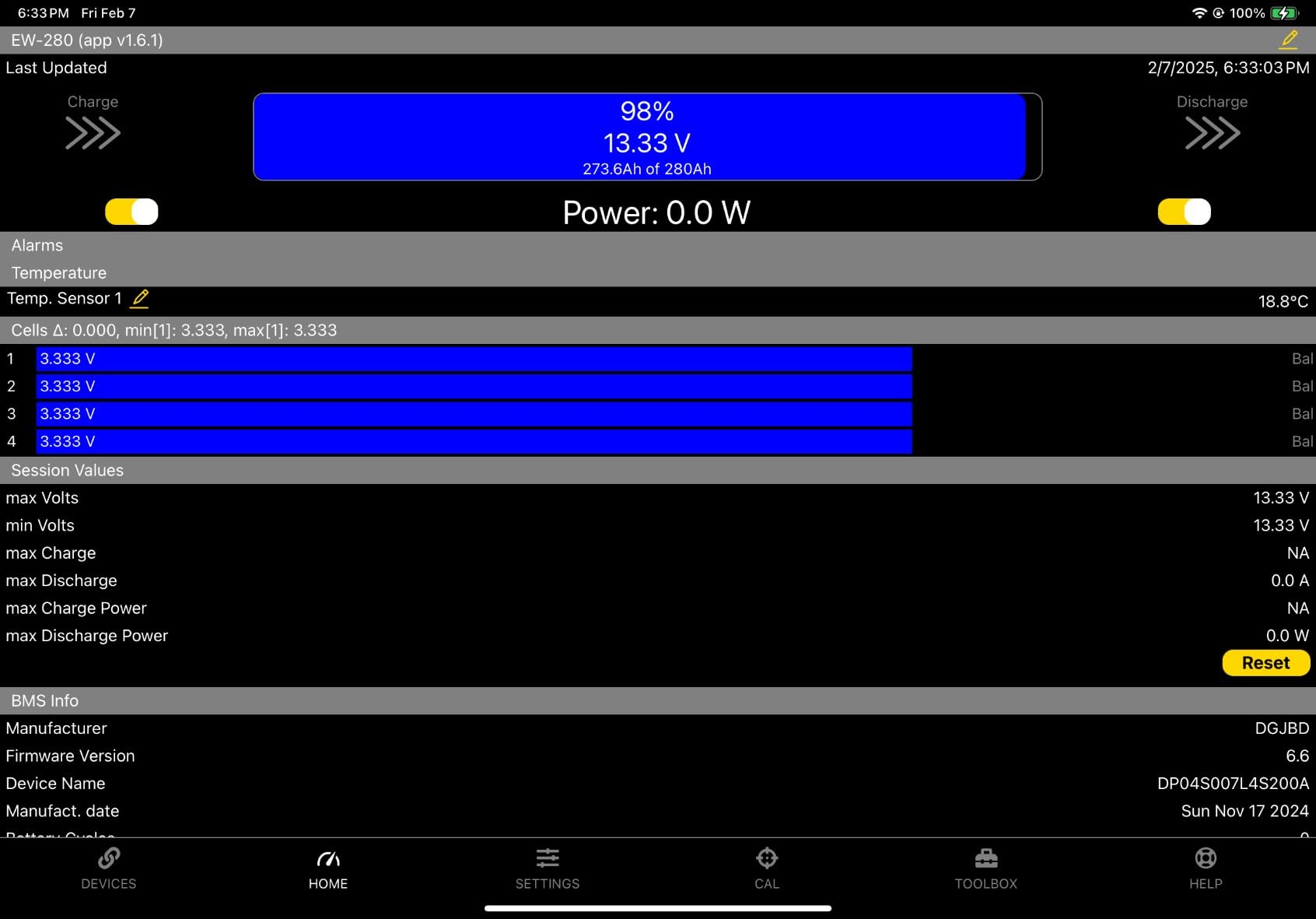
Three built-in features matter for cabin life specifically. A one-touch safety switch disconnects the discharge circuit so you can work on the wiring without a fuse pull. Bluetooth monitoring reports voltage, current and state of charge. And the BMS carries a low-temperature charge cutoff rated around a 20F threshold, which protects the cells on a freezing night.
Owners describe it as a drop-in upgrade from AGM setups, powering RV fridges, 12V air conditioners, sump pumps and off-grid cabins with Victron or Sungold inverters. Eighty-five percent of its reviews are five-star, and the Bluetooth monitoring, safety switch and low-temperature cutoff are the three features singled out most often as decision drivers.
Where it earns its place
Buy this if your cabin runs a 12V fridge, some lighting, a router and a small pump, and you want three or four days of autonomy from a single box. It packs more stored energy per pound than any other single-case battery in this roundup, and the 200A BMS has plenty of headroom for a well pump or a microwave.
It is also a strong candidate for someone replacing an aging lead-acid bank in place. Multiple parallel 100Ah AGMs can be swapped for one of these without reworking the cable gauge or the enclosure footprint, which is where most of the labour cost of a lithium conversion hides.
Where it does not fit
It is heavy at 68.5 pounds and noticeably larger than a Group 31 AGM, so tight battery compartments are out. A few buyers returned it on weight alone, and it is a touch wider than standard batteries, which can mean minor fitment modifications in an older cabin.
There is no IP rating and no watertight lid seal, so for a boat or an exposed wet location you should look at an IP65 option instead. Some orders also arrive in more than one box, so plan the install date around delivery rather than assuming everything shows up together.
4. yeagulch 12V 200Ah LiFePO4 – Best for Well Pumps and Power Tools
12V 200Ah LiFePO4 Lithium Battery Built-in 200A BMS 15000+ Deep Cycle
- 4.6 average with 87% five-star feedback
- 2560Wh in a fixed footprint
- 200A BMS handles high inrush loads
- Automatic high and low temperature cutoff
- Flexible 4S4P expansion
- 20-inch length may not fit tight compartments
- Around 59 pounds to lift
- Vendor advises cycling it every six months
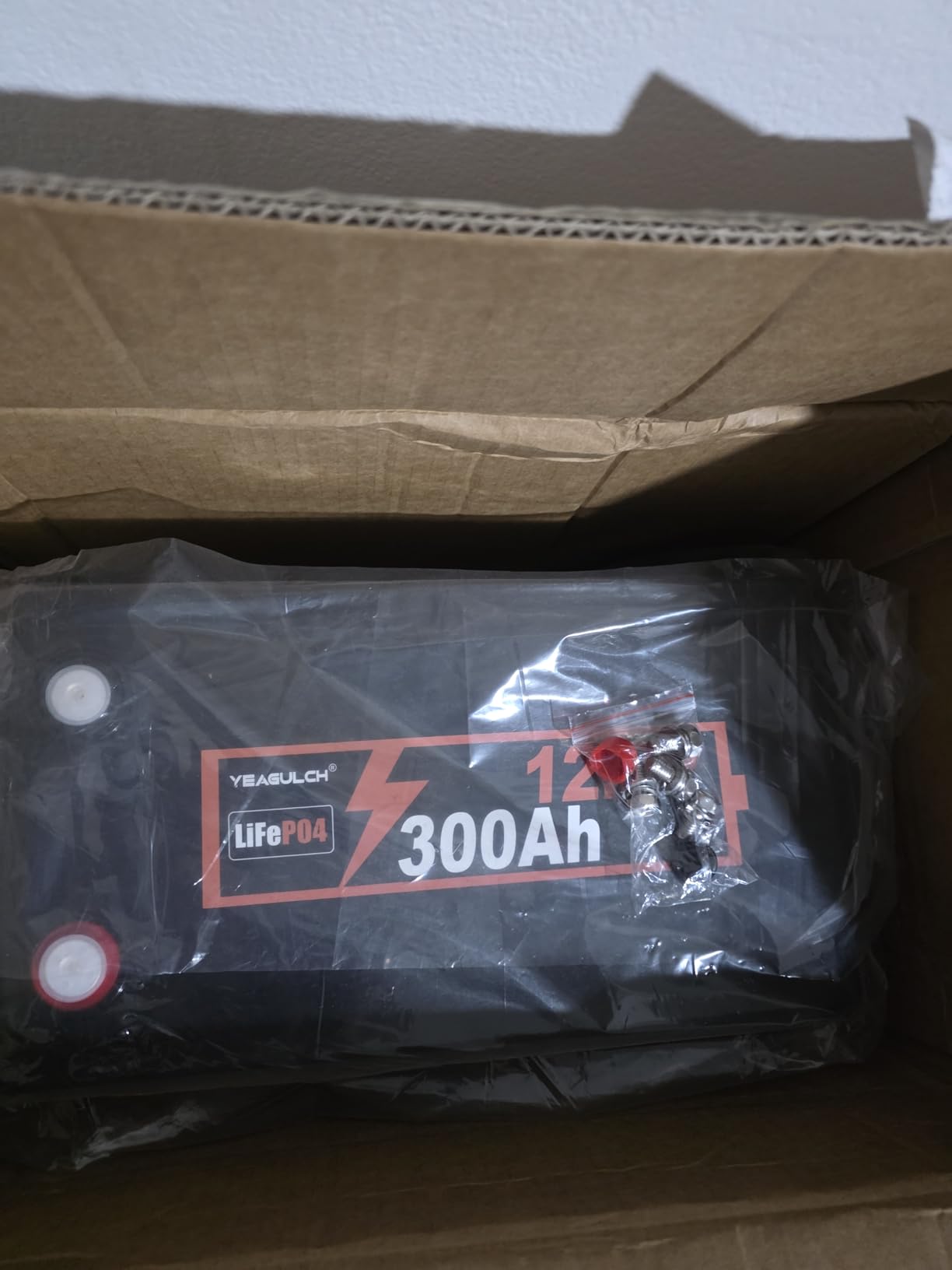
Well pumps and power tools care about one number: sustained current. A 200A continuous BMS is what separates this from the 100A units elsewhere in the list, and it is why this is the battery we point cabin owners toward when a submersible pump or a saw is going to be on the same bank as the fridge.
Capacity is 2560Wh, and the cycle claims are 4000 cycles at 100% depth of discharge, 6000 at 80% and 15,000 at 60%. The BMS covers overcharge, overdischarge, overcurrent, overheat and short circuit, plus an automatic high and low temperature charge and discharge cutoff that is the whole cold-weather story for this unit.
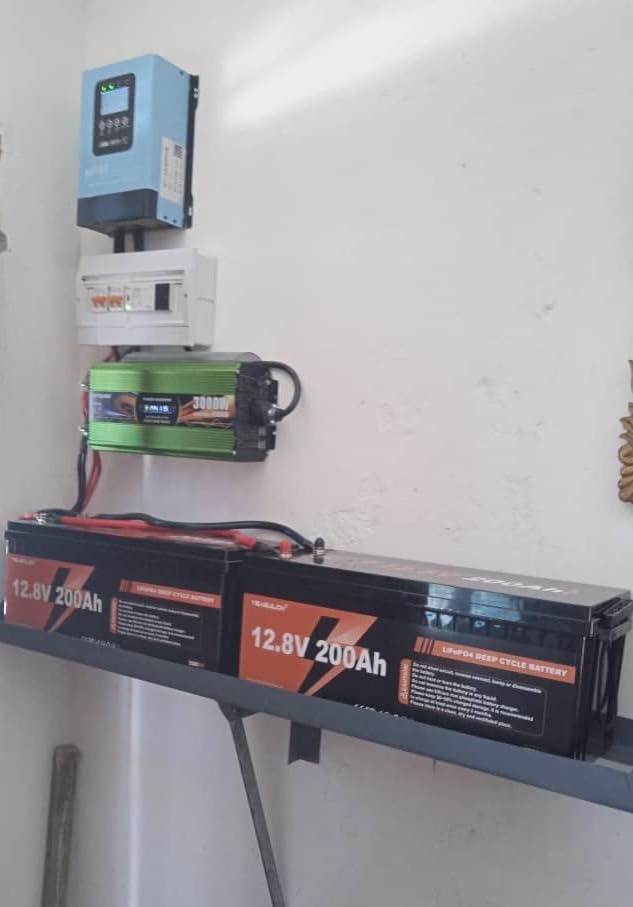
Expansion is unusually flexible. Four in series gives you 48V at 200Ah, and four in parallel gives 12V at 800Ah or about 10.24kWh. That means the same battery works in a small 12V weekend system today and in a 48V seasonal build later without changing chemistry.
Owners running off-grid solar, RV and trolling motor duty report holding stated capacity, and they appreciate the light weight for a 200Ah battery, roughly a third of an equivalent lead-acid battery. Only 5% of reviews are one-star, among the cleanest rating distributions in this roundup.
What it is best at
High-draw appliances. A 200A BMS at 12.8V supports loads well beyond what a 100A unit can hold, and the automatic temperature cutoff means a cold-morning start does not damage the cells. It also holds a 4.6 average while still supporting a full 48V stack.
If your cabin runs a water heater on electricity, this is the battery class that budget for. Resistive heating loads are exactly where a small 100A bank gets uncomfortable and where continuous current matters more than raw watt-hours.
What to watch
At 20.08 inches long it will not fit a tighter battery compartment without modification, and 58.9 pounds still needs a two-person lift into a high enclosure. It is not for engine starting, and the vendor advises running a charge or discharge cycle at least every six months during storage, which matters for a cabin that sits shut for months.
5. ECO-WORTHY 12V 314Ah – Best for Multi-Day Autonomy
- 4019Wh in a case about the weight of a 100Ah lead-acid
- On-case SOC LED plus app monitoring
- 200A BMS handles large RV air conditioner loads
- Multi-day autonomy reported with little or no solar
- Bluetooth voltage readings reported as inaccurate
- App data is basic and English is imperfect
- 3-year warranty is short for the capacity
The 314Ah version is the biggest single-case energy store in this roundup at 4019Wh, and that figure is what makes it the multi-day autonomy pick. One owner reported carrying a camper through several days on stored energy with little or no solar input, and others replaced two 100Ah gel batteries with a single battery of this class.
It was upgraded from the earlier 300Ah cell to 314Ah, which is a small percentage on paper and a meaningful one in practice. The case weighs about the same as a 100Ah lead-acid battery, so the real gain is the roughly threefold increase in usable power in a similar footprint.
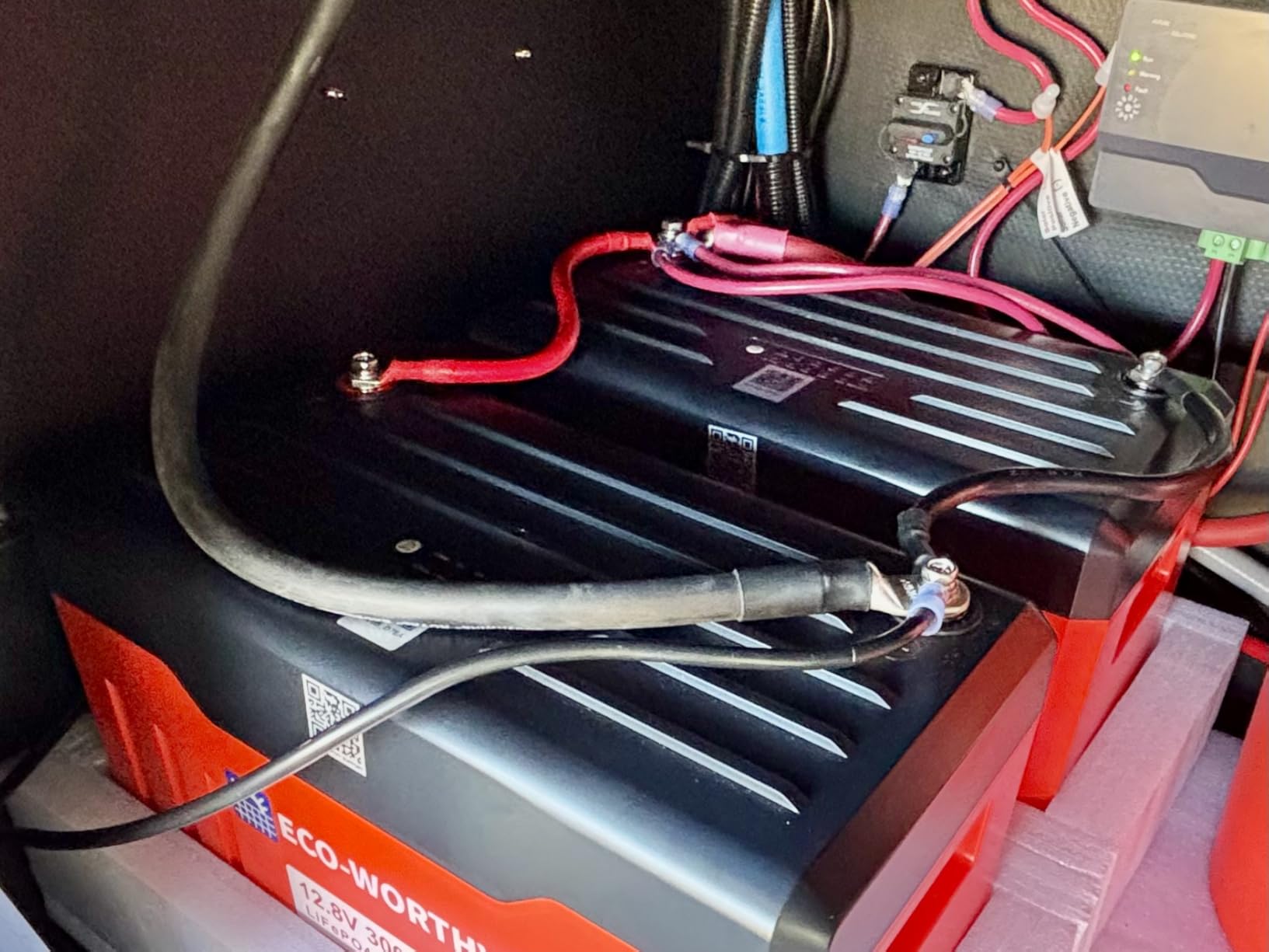
Two monitoring paths are offered, which is unusual at this capacity. A row of SOC LEDs on the case gives you a glance reading without an app, and Bluetooth adds remote access. The BMS handles low-temperature charge cutoff below -7C, which is 19.4F, so the pack protects itself on a freezing night rather than trying to force a charge into lithium plating.
Expansion runs to 4P2S or 2P4S for as much as 32.15kWh, and the 200A BMS is rated to handle 15kW RV air conditioners and similar large loads. The case is fire-resistant and has integrated handles for moving it into place.
Where it makes sense
Pick this for a cabin that gets multi-day storm outages, or a seasonal place where you do not want to run the generator. The SOC LEDs are genuinely useful when you are standing in a dark shed, and the app is the answer to the remote monitoring question for a cabin rented to guests who cannot troubleshoot.
It is also a strong candidate as a lead-acid replacement, because the massive capacity gain removes the need to double up strings of flooded or gel batteries in the same bay.
What holds it back
Telemetry accuracy is the recurring complaint. Some owners report Bluetooth voltage readings that do not match their own meters, and one reported the BMS cutting off charge at 13.9V alongside a badly wrong state of charge estimate. The vendor issued working replacements when issues were reported, but verify with a handheld meter rather than trusting the app alone.
The app itself is fairly basic with imperfect English, and the 3-year warranty is short for a pack this large. Pricing has also moved upward over the life of the listing, which narrows its value case against the 280Ah metal case.
6. Dyness 12V 100Ah Two-Pack – Best for Certified Installs
- Two batteries at 25.3 pounds each
- Well-documented FCC CE RoHS and UN38.3 certifications
- Charging resumes automatically at 41F
- Low-temp discharge protection to -4F
- Support responds within 24 hours
- Smallest review base here at 78 ratings
- No Bluetooth in the standard Group 31 version
- Needs a LiFePO4-specific charger
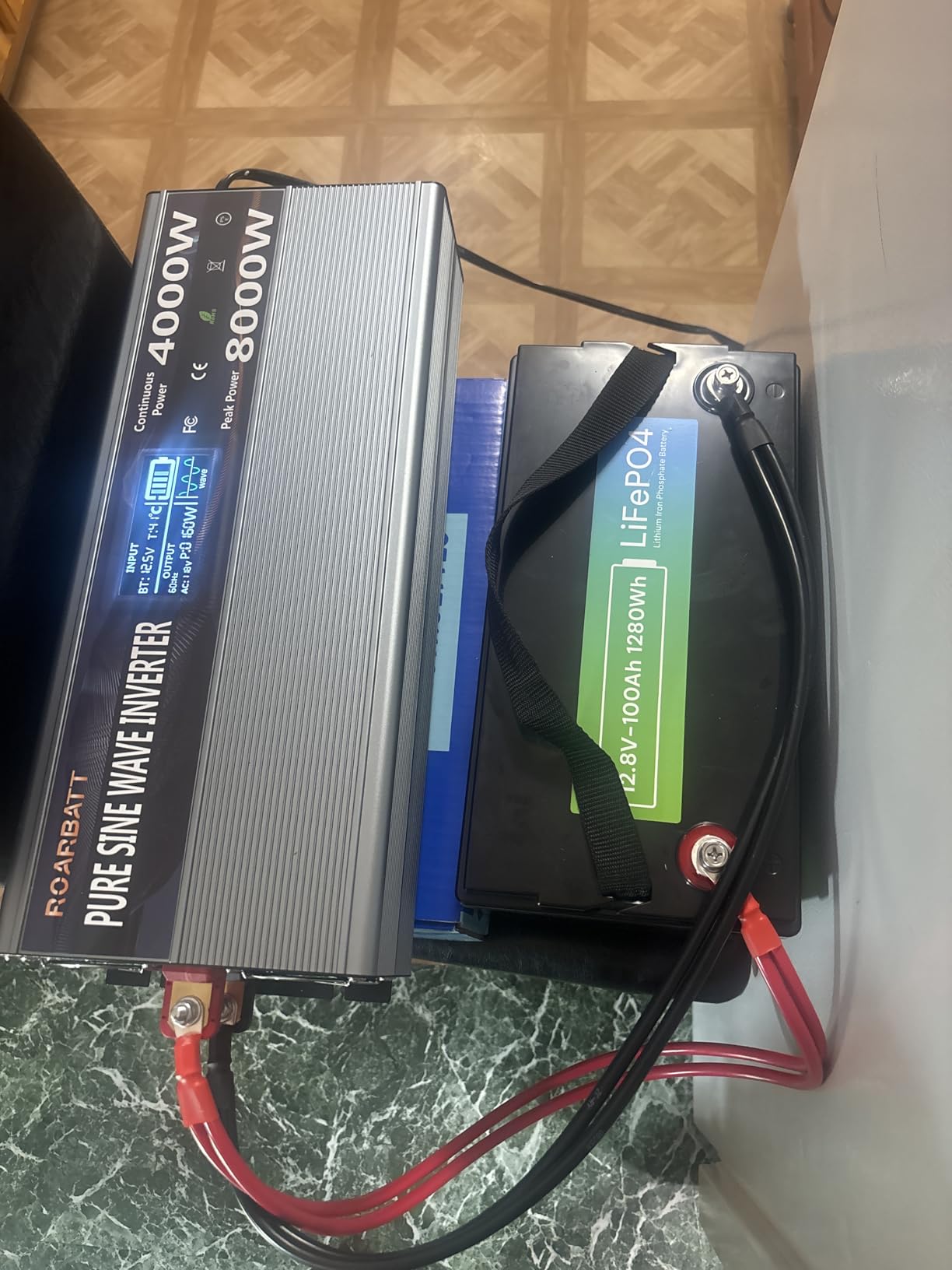
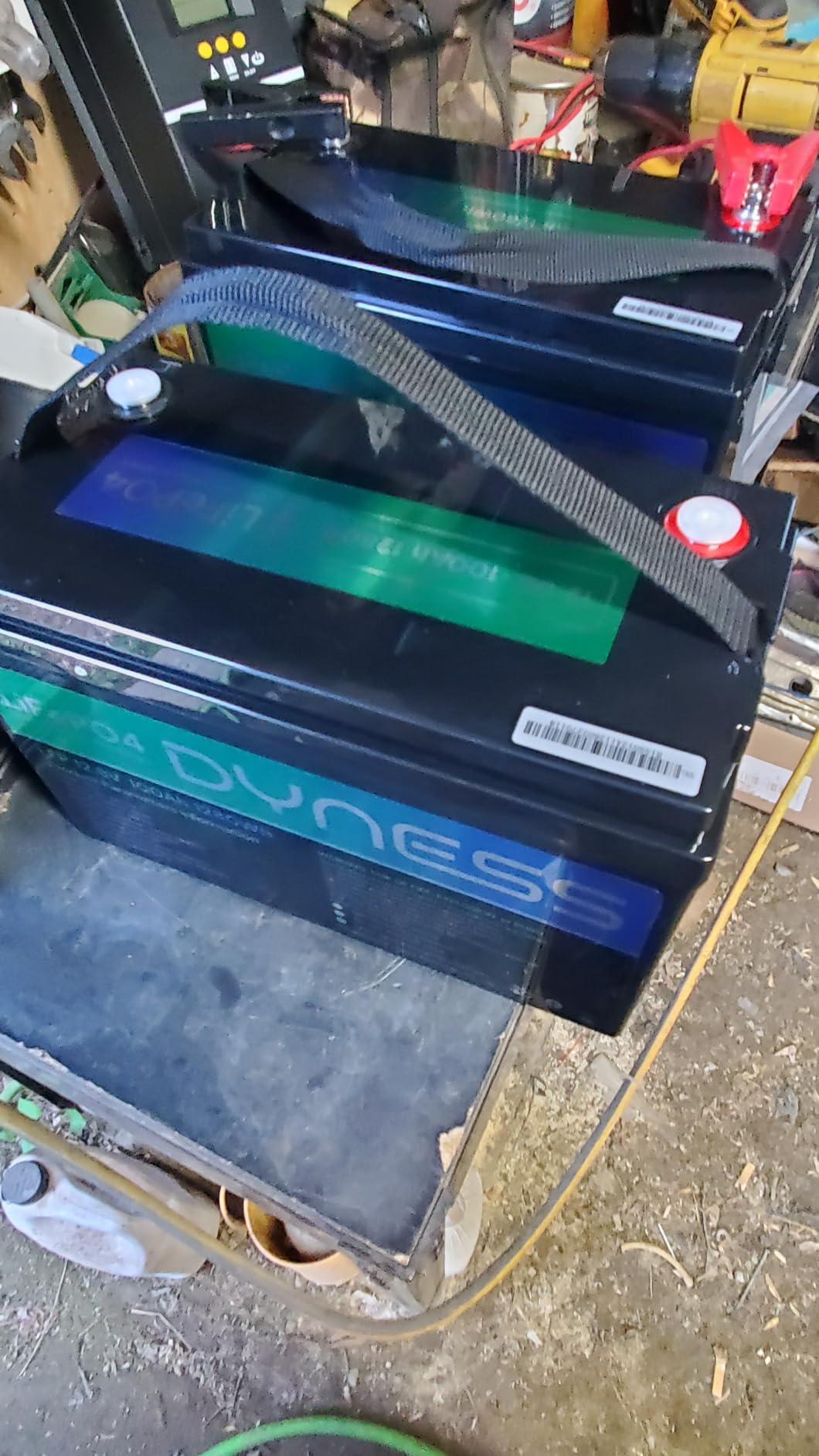
Two certified 100Ah lithium batteries at 25.3 pounds each is a straightforward upgrade path from a pair of AGMs, and the paperwork behind them is the reason this one is here. The listing documents FCC, CE, RoHS and UN38.3 certification and A+ grade cell traceability, which matters when a cabin is a rental property and someone will ask for the paperwork.
The cold-weather behaviour is well specified. Charging stops below 32F and resumes automatically at 41F, with a discharge cutoff at -4F. That automatic resume is the detail that separates a usable winter install from one where you have to go out and reset a BMS by hand every cold morning.
The BMS is sealed and dust resistant, so it is comfortable near a marine battery box or a dusty generator shed. At over 65% lighter than the lead-acid equivalent, installing a second and third pack is far less painful than it would be with flooded cells.
Buyers point to the size and weight savings, the Group 31 fit and the cold-weather charging cutoff as the deciding factors for RV and cabin installs. Seventy-eight percent of its reviews are five-star, with another 11% at four stars, which is a tight spread at the top.
Where it fits best
Two packs in parallel give about 2.3kWh usable, which covers a seasonal cabin running a fridge, lights, a router and a small pump. Expansion to 4S4P reaches a 20.48kWh bank, so this is a reasonable starting point for a property that may grow into a full-time home.
It is also a good pick where a well pump and an outdoor equipment shed share a battery room and salt spray is a factor. The 24-hour support response is a genuine advantage on a remote build where a replacement part is a two-hour drive away.
What to keep in mind
The review base is the smallest in this roundup at 78 ratings, so long-term durability feedback is thin. That is an honest limitation and worth weighing against the broader service history of batteries with thousands of reviews.
There is no Bluetooth monitoring in the standard Group 31 version, which limits remote visibility for a rental cabin. Charging also needs a LiFePO4-specific charger, ideally recharged at 0.2C, and the 5-year warranty is shorter than the 10-year lifespan claim on the listing.
7. dumfume 12.8V 100Ah Mini – Best for Tight Battery Boxes
12.8V 100Ah Mini Lithium LiFePO4 Battery Group 24 100A BMS Low-Temp Cut off
- Only 21.6 pounds
- about a third of a comparable lead-acid battery
- Group 24 footprint fits most standard battery boxes
- IP65 protection for marine and dusty environments
- Expandable to 4S4P for 51.2V systems
- 11% of reviews are one-star
- IP65 covers water spray only not immersion
- Needs a recharge every six months when stored
At 21.6 pounds this is the lightest battery in the roundup, and for an older cabin with a small battery box that is not a footnote, it is the whole pitch. The Group 24 mini footprint at 10.23 by 6.61 by 8.46 inches drops into boxes that will not take a full-size Group 31 case.
It still stores 1280Wh, with a built-in 100A BMS and cell balancing. The cycle claims are 4000+ cycles at 100% depth of discharge and up to 15,000 at 60% depth of discharge, and the operating range runs from 5C to 65C for charging and -20C to 70C for discharge. A low-temperature charging cutoff is built in.
Expansion is a genuine strength for a small cabin. Four series and four parallel reaches 51.2V at 400Ah, or 20.48kWh, so a weekend system today can become a 48V full-time system later using the same battery chemistry and the same BMS family.
Buyers highlight the dramatic weight savings over lead-acid and the drop-in Group 24 sizing, along with solid usable capacity for solar and RV use. Eighty percent of its reviews are five-star and the listing carries a five-year warranty with 24-hour customer support, which is better warranty coverage than most of the lithium options here.
Where it works well
Smaller cabins, boats, and any install where a second person is not available to help. Dropping from 57 pounds to 21.6 pounds changes the installation from a two-person job into a one-person job, and that alone can change the installed labour quote on a remote build.
It is a sensible weekend-cabin battery, and the IP65 rating plus 4S4P expansion means it does not have to stay a small system.
What gives us pause
Eleven percent of reviews are one-star, and the complaints cluster around charging behaviour and support responsiveness rather than capacity. The IP65 rating covers water spray only, so do not submerge it. And it needs a recharge at least every six months when stored unused, which means a winter visit for a cabin that sits for months at a stretch.
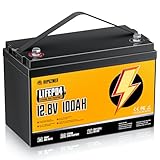
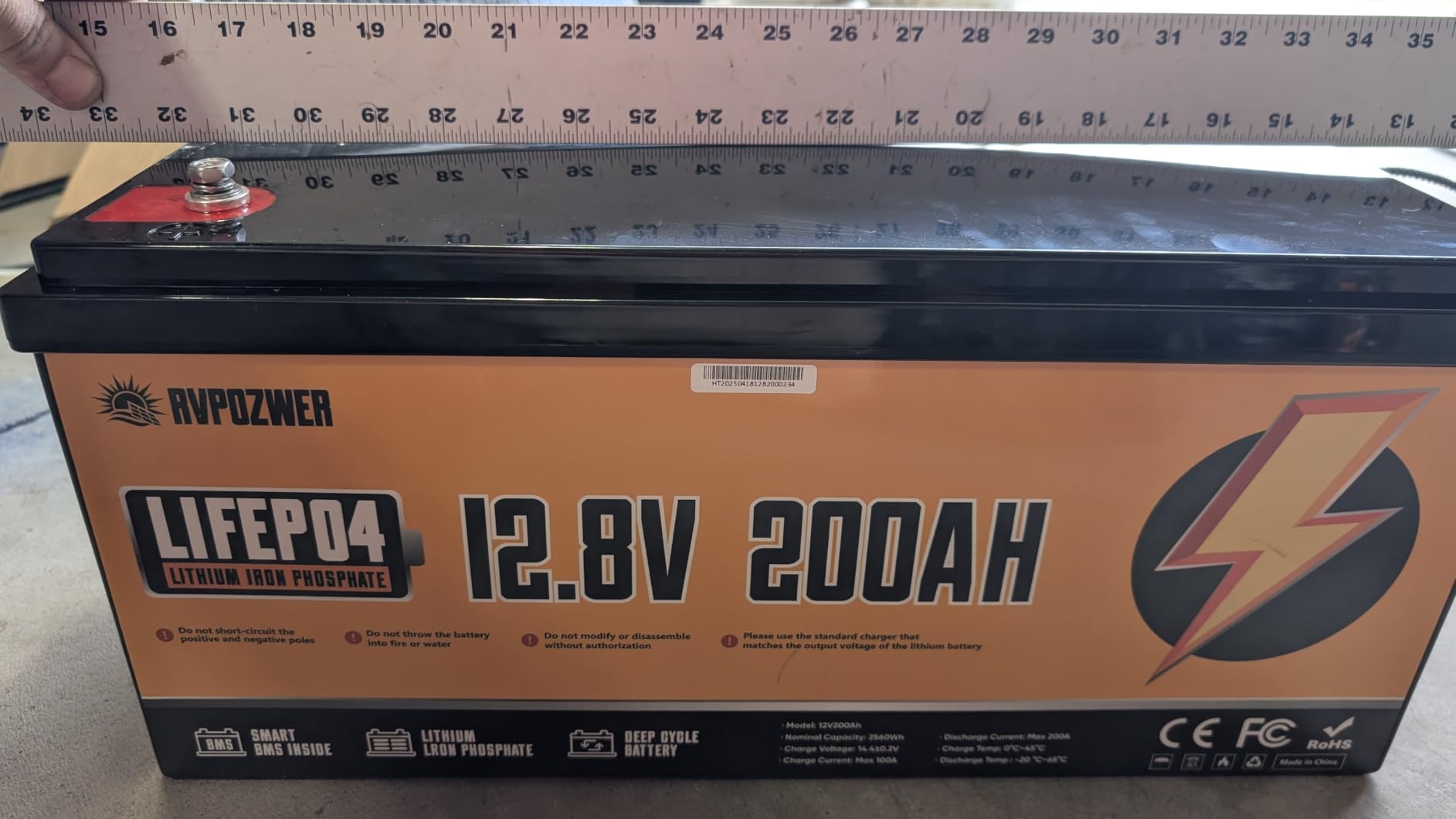
8. Rvpozwer 12V 100Ah Group 31 – Budget Pick With a Big Warranty Question
Rvpozwer 12V 100Ah LiFePO4 Lithium Battery Group 31 with Built-in 100A BMS
- Standard Group 31 footprint
- Only 23 pounds
- Advertised cycle life at 100% 80% and 60% depth of discharge
- Built-in 120A BMS with multi-function protection
- Rated for operation down to -20C
- Lowest rating in this roundup at 4.1
- 17% one-star reviews
- No Bluetooth or app monitoring
- Listed warranty length is unclear
This is the cheapest way into a Group 31 lithium footprint in the roundup, and the arithmetic is attractive: 1280Wh, 23 pounds, a Group 31 case that fits standard boxes, and expansion to 51.2V in series or 400Ah in parallel. If the budget is the binding constraint, this is where the list bottoms out.
The 120A Smart BMS handles overcharge, overcurrent and short circuit, and the cells are Grade A LiFePO4. Advertised cycle life is 4000 cycles at 100% depth of discharge, 6000 at 80% and up to 15,000 at 60%, with an operating range from -20C to 65C. A nylon carry handle is included.
Value-focused buyers like the fit, the weight and the solid output for RV, trolling motor and solar duty. The Group 31 case is the quiet hero here, because it is the case most existing American battery boxes are built around, which keeps the mechanical part of the swap simple.
It is also honest to say this is the weakest-reviewed unit here. Seventeen percent of its reviews are one-star, pointing to a meaningful share of early failures, premature capacity loss or slow support response, and that pulls the average down relative to the other lithium options.
Where it still makes sense
A budget build where the bank gets treated as consumable hardware rather than a fifteen-year asset. If you expect to add capacity in a few years anyway, buying a cheaper bank now and expanding later is a defensible plan, and this is the cheapest per unit of stored energy on the list.
Operating down to -20C for discharge is a genuine plus if the cabin is cold but the battery is not being charged in freezing conditions, which is the case for a cabin with a propane stove supplying heat in the main room.
What to weigh before buying
The listing advertises lifetime technical support but does not state the warranty length clearly, and a warranty you cannot read is not a warranty. There is no Bluetooth or app monitoring, which matters for a remote cabin, and some buyers report capacity or charge-management issues shortly after purchase.
At 4.1 with 17% one-star feedback, this is the one we would replace before we would recommend. If the budget is the constraint, the AGM options in this list give you a more predictable service life for a comparable outlay.
9. GRNOE 12V 100Ah Group 31 – Best for Wet and Salty Locations
12V 100Ah LiFePO4 Battery Built-in 100A BMS, Group 31 Lithium Battery 1280Wh Up to 15000 Deep Cycles Rechargeable Battery for RV, Marine/Trolling Motors, Home Energy Storage
- Group 31 compatible at 22.5 pounds
- 1280Wh and up to 15000 cycles
- IP65 waterproofing with 300A three-second surge rating
- Automatic low-temperature charge and discharge cutoffs
- Expandable to 48V and 20.48kWh
- Needs a 14.6V lithium activation charger
- 14% one-star reviews indicate quality variance
- Requires a charge every two to three months in storage
For a cabin near salt water, a boat, or a place where the battery box gets wet, the IP65 rating combined with a 300A three-second discharge rating is what earns this a place. The surge figure covers the startup current of a compressor or a well pump without tripping protection.
At 22.5 pounds in a Group 31 case at 12.8V, it is one of the lighter options here, and it delivers 1280Wh with up to 15,000 cycles advertised. Expansion to 4P4S reaches 51.2V and 20.48kWh, so a weekend setup can grow into a 48V system later.
The temperature logic is well thought through. Charging stops below 32F and discharging stops below -4F, which means the pack protects itself in both directions rather than letting a cold cell get pushed into an unsafe state. That dual cutoff is exactly what you want in an unheated cabin.
Budget buyers like the capacity-to-weight ratio and the Group 31 drop-in sizing for RV, marine and home backup use, and the low-temperature cutoff is valued for cabin and cold-weather installs. The box includes insulating caps and M8 terminal bolts, so nothing extra is needed to terminate cables.
Where it is the right pick
Any install with water exposure, salt spray or dust. A Group 31 case at 22.5 pounds with an IP65 rating and a 300A surge window covers the majority of cabin loads, and the smart cutoffs mean you can leave it installed through winter without babysitting it.
It is also a reasonable second battery to pair with a larger unit. Buying two of these gives you about 2.3kWh usable in a standard footprint, which is a sensible weekend-to-seasonal step up.
What to plan around
Activation is the real gotcha. It must be brought up with a 14.6V lithium charger, because a 12V lead-acid charger will not fully charge it. Several owners tripped protection by connecting the wrong charger, so budget for the correct charge controller from the start.
It is energy storage only, not for starting, golf cart or jack applications, and it needs a charge at least every two to three months during storage. With 14% one-star feedback, quality variance is the reason this sits lower than the better-reviewed picks.
10. BUKNUWO 12V 100Ah Bluetooth – Best for Remote Monitoring
BUKNUWO 12V 100Ah LiFePO4 Lithium Battery with Bluetooth,15000+ Cycles Lithium Battery for Trolling Motor, Off-Grid,Boat,RV, Marine, Solar (12.8V 100Ah-Bluetooth)
- Bluetooth 5.0 monitoring at a rare price for this class
- Range reaches 33ft which is useful inside a battery room
- One buyer verified near-rated watt-hours through an inverter test
- 5-year warranty
- 22 pounds in a 12V case
- One review reports rapid self-discharge when idle
- App connection and refresh rate inconsistent
- 12% one-star reviews including a difficult return
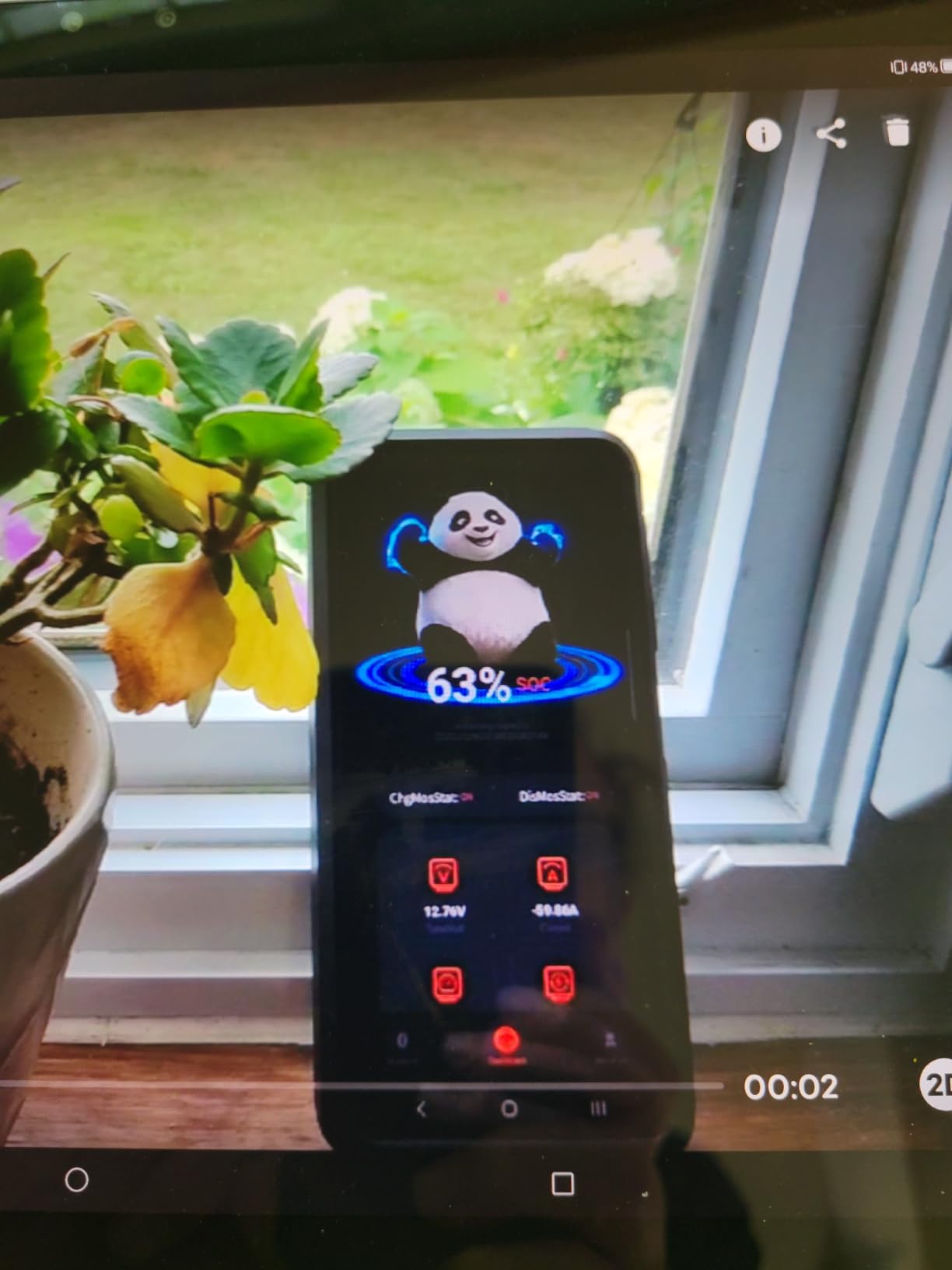
Remote monitoring is a hard requirement rather than a nice-to-have when a cabin is rented seasonally to guests who cannot troubleshoot a tripped breaker. This battery reports state of charge, voltage, current, temperature and cycle count over Bluetooth 5.0 with a stated 33ft range, which is unusual at this price point.
Usable capacity is stated at up to 95% versus about 50% for lead-acid, which is the single most important number for a cabin bank. The 100A BMS carries an automatic high and low temperature cutoff, and advertised cycle life is 4000 at 100% depth of discharge, 6000 at 80% and 15,000 at 60%.
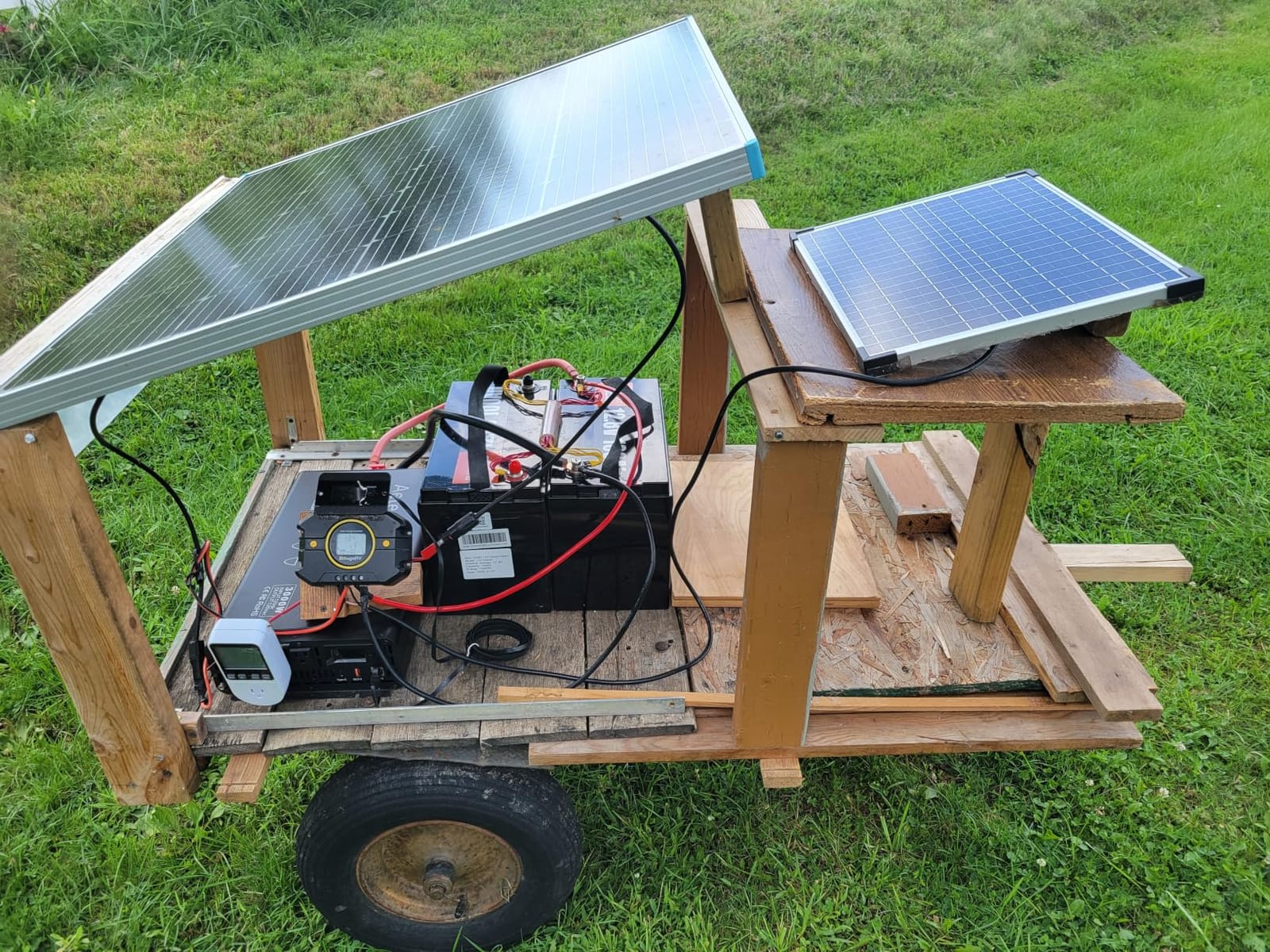
At 22 pounds in an ABS casing, it expands to 4S4P for a 51.2V 400Ah system. The listing carries a five-year manufacturer warranty and a 10-year design life claim, and detailed buyer testing has confirmed the rated capacity and build quality with near-rated watt-hours measured through an inverter test.
Support has also earned some credit: one buyer received a free 0V-activation LiFePO4 charger when a unit would not wake, which is the kind of response that matters when the nearest town is a long drive away.
Why cabin owners like it
The monitoring detail set is the best in the list for this price. Temperature and cycle count in particular tell you whether a bank is actually being cycled or sitting idle, which is the information you need to judge a remote install you only visit monthly.
It is a good match for a small weekend cabin with a 12V fridge, LED lights and a router, where the whole load is modest and the 95% usable figure translates into two full nights from one battery.
What to know before relying on the app
Quality control is the weak point. One review reports losing roughly half the charge in two days sitting idle on a bench, the app sometimes fails to connect immediately with an inconsistent refresh rate, and inverter inrush can trip the BMS unless the load is pre-charged. Twelve percent of reviews are one-star, including a complaint that the return process was difficult.
There is also no per-cell voltage data in the app, so for deep diagnostics you will still want a shunt or a handheld meter. Treat the app as a convenient status view rather than a source of truth.
11. Renogy 12V 100Ah AGM – Best Lead-Acid Reliability
Renogy 12 Volt 100Ah Deep Cycle AGM Battery, Lead Acid Solar Battery
- Proven AGM reliability with very few failure points
- Self-discharge under 3% per month
- Discharge rated from -4F to 140F
- Up to four batteries in parallel
- M8 screw terminals with removable caps
- About 64 pounds
- AGM offers roughly 50% usable capacity
- 2-year prorated warranty
- Some reports of transit damage
We picked two lead-acid batteries in this roundup on purpose. Forum users make the case for AGM in cold climates consistently: it is proven, it charges in temperatures that make a lithium BMS refuse, and you can replace a failed battery with a drive to town rather than a long wait for a replacement.
This Renogy is the more serviceable of the pair. It supports up to four batteries in parallel with unlimited series connections, so you can build a 400Ah bank in a standard configuration, and the M8 screw terminals with removable positive and negative caps make cable work straightforward.
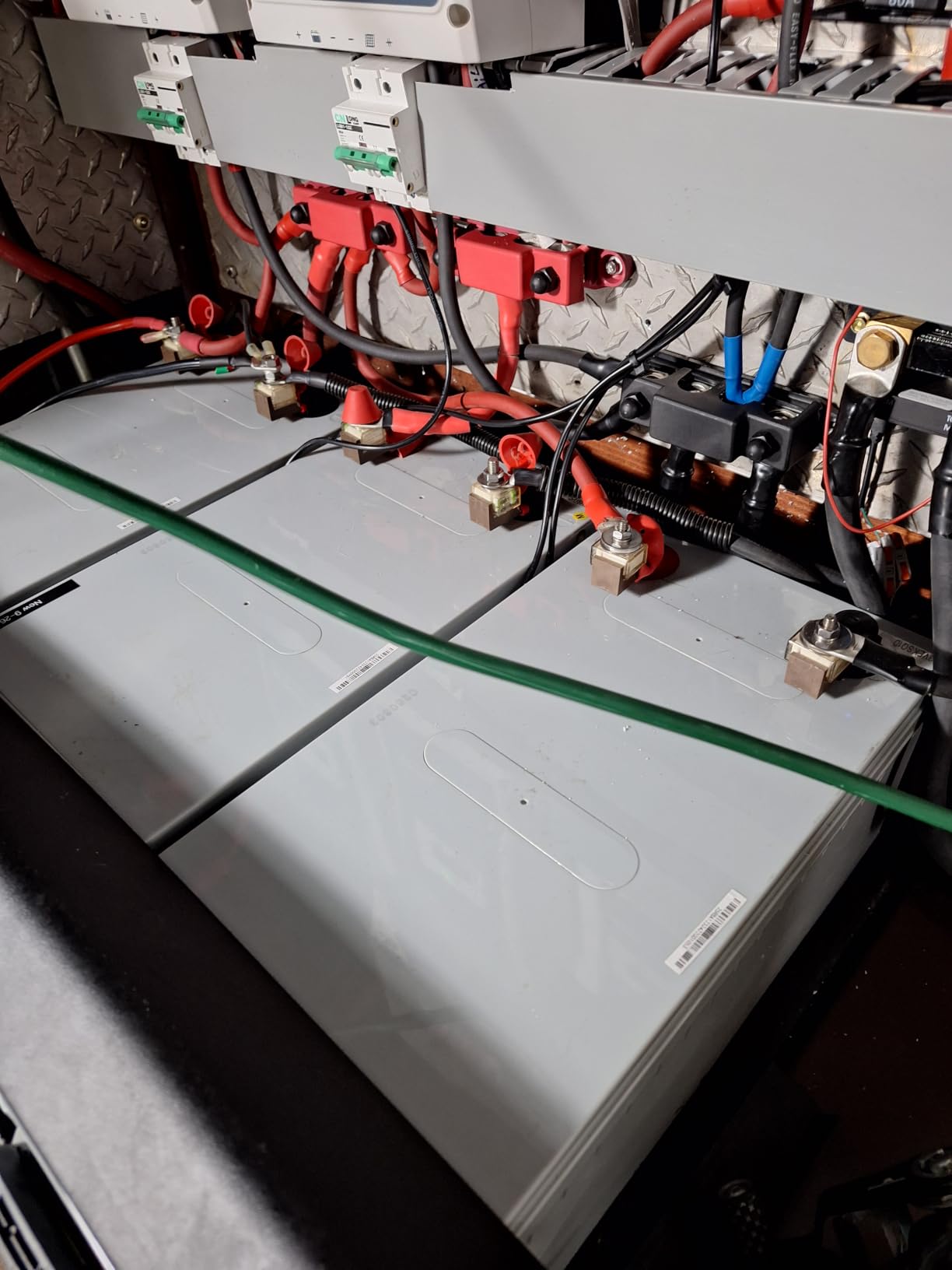
Two numbers make it a genuine cold-climate option. Discharge performance is rated from -4F to 140F, which is the widest temperature window of any battery in this list, and self-discharge stays below 3% per month at 77F. For an unheated cabin that sits for a season, that combination is worth a lot.
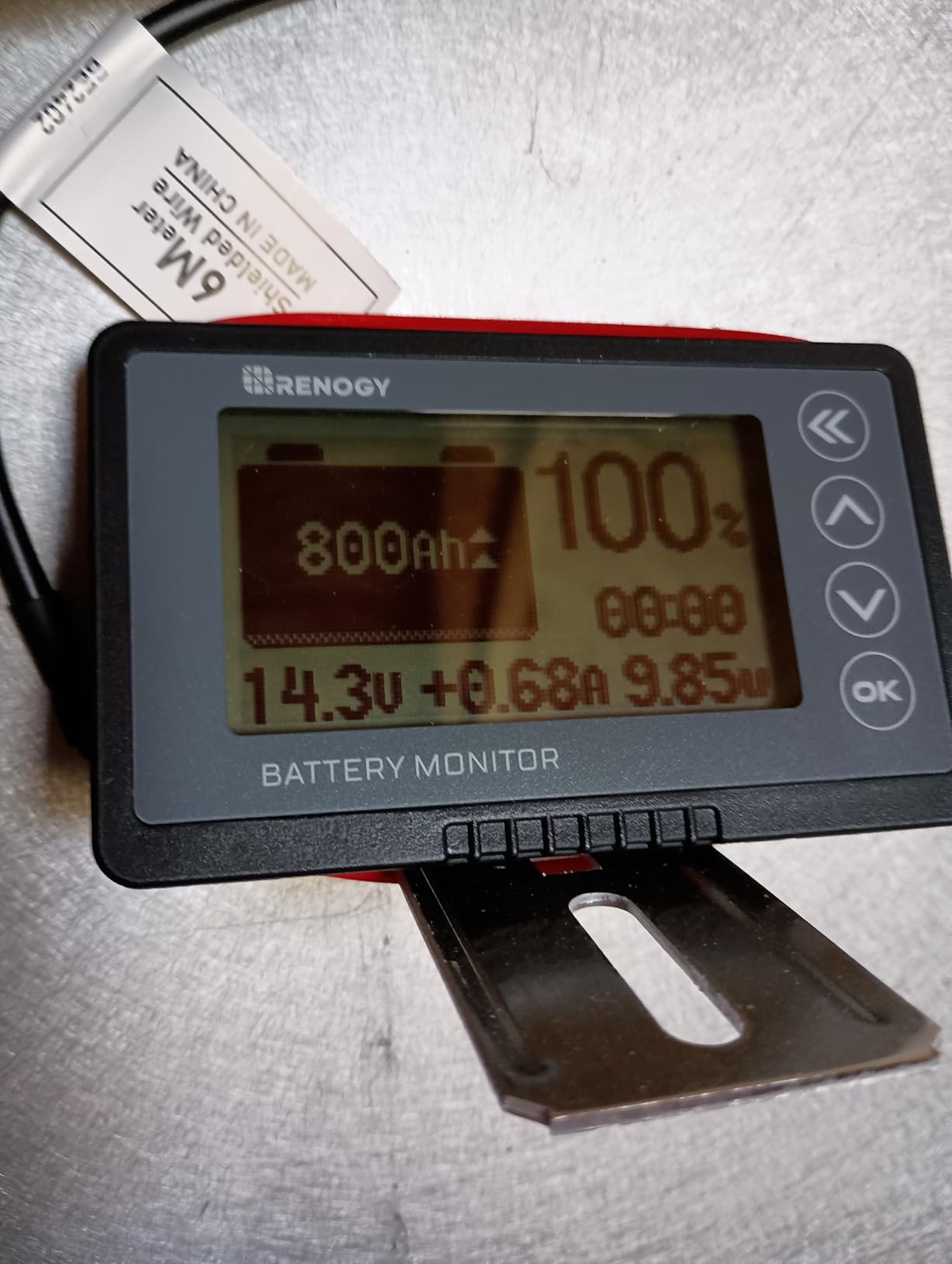
Experienced solar users report that capacity tests confirm the rated 100Ah spec, and that parallel banks of these give long service life with fewer failure points than LiFePO4. The support team also provides detailed technical data such as Peukert’s constant, which is the kind of documentation that makes real design work easier.
Where the AGM case still holds
If your cabin sits at a latitude where winter charging is genuinely marginal, the ability to accept charge in near-freezing conditions is worth more than capacity. A bank that will not take a charge in January is a generator decision every week, and no amount of lithium capacity fixes that.
It is also the right pick where a second person is not available to help install, because while it is heavy, an AGM is a familiar technology to any installer and the failure diagnosis is straightforward with a voltmeter.
Where it costs you
At roughly 64 pounds it is the heaviest battery here, and at about 50% usable capacity you need roughly twice the bank for the same overnight power as a lithium unit. The 2-year prorated warranty is short, a small but notable group of buyers report units arriving with transport damage or not holding charge, and charging-system compatibility questions with smart chargers come up occasionally.
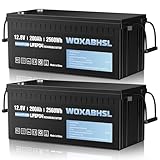
12. WOXABHSL 12V 200Ah Two-Pack – Best for Boats and Trolling Motors
WOXABHSL 12V 200Ah LiFePO4 Lithium Battery, Built-in 200A BMS, 15000+ Deep Cycles, Max 2560W Power Output, FCC UL Certificates, Perfect for RV, Solar, Marine, Off-Grid, etc. (2PCS)
- Two 200Ah batteries included in one pack
- 200A BMS with automatic overload recovery
- A+ grade cells with UL testing
- 4000+ cycles at full depth of discharge
- 48.6 pounds for the pair
- 15% of reviews are one-star
- Short 1-year manufacturer warranty
Two 200Ah lithium batteries in a single pack is an unusual amount of energy for one line item, and that is the entire appeal. Each battery stores 2560Wh, so a cabin running a 12V fridge, lighting, a router and a water pump gets well over five kilowatt-hours of nameplate capacity in one pack rather than through two separate purchases.
The 200A BMS includes automatic overload recognition and recovery, which is the part that matters when a motor-driven load such as a well pump or a trolling motor throws a surge at the bank. A+ grade cells are UL tested, and the pack is sold for RV, solar, marine and off-grid duty, so it covers the marina-adjacent cabin scenario as well as the inland one.

Cycle claims are 4000+ at 100% depth of discharge, 6000 at 80% and 15,000 at 60%, with expansion to 4S4P available. At 48.6 pounds for the pair, it is far lighter than the lead-acid equivalent of that capacity, and the pair-in-one-box format simplifies wiring on a boat where space is already tight.
Buyers like the sheer capacity and the 200A power headroom, particularly for trolling motors and RV use, and the two-pack configuration is a recurring positive in the reviews. Against that, 15% one-star and 6% three-star feedback point to quality-control variance.
Where it is worth the trade
Boats, pontoons, and cabins near water with a 12V fridge, where you want a lot of amp-hours without a large footprint. The 200A overload recovery is genuinely useful around motor-driven loads, and the pair-in-one-box format keeps the wiring simple where every centimeter of deck space counts.
If you want to avoid two separate purchase decisions, this is the simplest path to about 5kWh of nameplate storage in two 12V units.
What to watch
The 1-year manufacturer warranty is the shortest for a lithium pack here, and fifteen percent one-star reviews is the highest one-star share among the multi-battery options in this list. It is also sold as a pair, so there is no way to add a single unit later, and you will want a LiFePO4-specific charger rather than improvising with a lead-acid unit.
What Battery Chemistry Works Best in an Off-Grid Cabin
Lithium iron phosphate is the right default for almost every cabin, and the reason is not energy density, it is usable depth of discharge. A lead-acid bank is generally treated as a 50% bank because discharging deeper causes sulfation and shortens life. A LiFePO4 bank runs happily at 80 to 90%. That single difference means a 3.5kWh lithium case does the work of a 7kWh lead-acid bank in the same space.
The AGM case is still real, and cold climates are its home turf. Lead-acid accepts a charge at temperatures that make a lithium battery management system refuse, which in a northern January can be the difference between a cabin that rides through a storm and one that needs the generator. If your site sits well below freezing for extended stretches, that tradeoff is worth making deliberately.
NMC and LTO lithium chemistries turn up in off-grid systems but rarely in cabin-scale ones. NMC carries more energy per kilogram than LFP but has a narrower thermal window and a shorter cycle life, which is a poor trade for a battery that must survive unattended. LTO is extraordinarily durable, with cycle counts well beyond the lithium chemistries discussed here, but its cell voltage does not sit where most off-grid inverters expect it, so compatibility work is required.
Our verdict: LFP for a weekend or seasonal cabin, LFP for full-time off-grid, AGM when winter charging is the binding constraint, and NMC or LTO only when weight or cycle life is genuinely the dominant constraint. For a wider look at lithium choices, our lithium battery guide for solar covers the chemistry families in more detail.
Cold-Weather Operation: The Spec That Breaks Cabin Systems
Cold-weather charging is the number one operational worry in off-grid forums, and it deserves to be a ranked criterion rather than a footnote. Lithium cells cannot be charged below roughly 5C without risking plating, so a battery management system will simply stop accepting charge. On a short overcast winter day, a bank that refuses charge cannot recover, and the deficit compounds every cloudy day until something has to give.
This is why the low-temperature cutoff rating on each battery matters more than its watt-hour figure, and the differences show up in the specs. The Dyness pack stops charging below 32F and resumes automatically at 41F, which means no manual reset. The ECO-WORTHY 314Ah cuts off below 19.4F, and the EnergyRock 280Ah is rated around a 20F cutoff. The GRNOE stops charging below 32F and discharging below -4F.
The 200Ah batteries from yeagulch and WOXABHSL take a different approach, holding automatic high and low temperature charge and discharge cutoffs, with the WOXABHSL pack requiring charging to stay between 15C and 35C. That is a wider band and a less forgiving one. If your cabin is genuinely cold, read that number before you buy.
None of the batteries here carry an integrated self-heating element, and that is a real gap to be honest about. Self-heating racks exist and are the answer in sustained sub-zero conditions, but they add a parasitic load that has to be sized into the array. Panels also derate in winter: a fixed south-facing array in northern latitudes can lose a large share of its summer output in midwinter, and a few overcast days in a row can drop output to a small fraction of rated. The community’s own rule of thumb is a good place to start: size the battery to run your fridge and inverter for three days, then size the panels to recharge it in one to two days.
If your cabin is above about 45 degrees latitude or above roughly 3,000 feet, budget for a conservative bank and a generous array. Our RV battery guide covers the low-temperature and dual-use setups that translate well to a cold cabin.
How to Size a Battery Bank for a Weekend, Seasonal, or Full-Time Cabin
Start with your actual daily consumption, not a nameplate guess. Multiply each load’s watts by its hours of use per day and divide by 1000 for kilowatt-hours. A 12V fridge averaging 0.87A draws about 21Ah per day, roughly 260Wh, and an inverter idling can pull 30W continuously. One forum user quantified standby plus inverter loss at about 500Wh per day, more than double the daily draw of the fridge it was powering.
That last figure is the single biggest lever most cabin owners miss. If you can run the fridge, lights, router and water pump as 12V DC loads directly, you bypass the inverter entirely and shrink the bank dramatically. One small-cabin operator running 12V-only loads reported total consumption of 500 to 1000Wh per 24 hours, which is a fraction of what a comparable cabin on AC loads would draw. For more on the practical side, our off-grid inverter guide covers the units that handle the AC side.
Once you have a daily kWh figure, here is the sizing sequence:
- Add up your daily load in kWh. Include inverter idle draw, not just appliances.
- Multiply by your required autonomy in nights. Three nights is the community standard for overcast stretches.
- Divide by your target depth of discharge. Use 0.5 for lead-acid and 0.9 for LiFePO4.
- Divide by inverter round-trip efficiency, usually around 0.9 to 0.95.
- Add a cold-weather margin of 20 to 30% if you are above freezing latitude or 3,000 feet.
- Size the array to replenish that bank in one to two peak sun hours, not in a whole day.
Worked example, weekend cabin: a 12V fridge at 260Wh, LED lights at 60Wh, a router at 90Wh and a small pump at 200Wh gives roughly 610Wh per day. Times three nights is 1.83kWh. At 0.9 depth of discharge and 0.92 efficiency you need about 2.2kWh of storage, so a 100Ah LiFePO4 at 1.28kWh falls short and either a two-pack or a 200Ah unit is the right call.
Worked example, seasonal cabin: a small 12V fridge, LED lighting, a router, a laptop, a 400W well pump running twenty minutes a day and a monitored electric water heater on a timer totals roughly 4 to 6kWh per day. At three nights of autonomy and 0.9 depth of discharge, that is 15 to 20kWh of storage, which is two to four 5.12kWh 48V rack modules. This is where the Cubix100 in this list earns its place.
Worked example, full-time off-grid home: with a well pump, electric water heater, electric range and electric heat, daily consumption can exceed 15kWh, and three nights of autonomy pushes the bank past 45kWh. At that scale you are not shopping for a retail battery at all; you are working with an installer on a cabinet design, and no battery in this roundup is the answer on its own.
The most common mistake is oversizing. Forum commenters warn repeatedly about owners specifying a full-blown system for a weekend cabin and spending far more than the property warrants. Starting at the smallest bank that gives you three nights, then adding a module when you understand your real load, is the cheaper path.
Buy the Inverter First: Compatibility and Coupling
The most expensive mistake in an off-grid build is buying the battery before the inverter. A managed battery with a proprietary battery management system may simply refuse to run on an inverter it was not designed for, and the money is already spent. Self-managed batteries are far more forgiving because any competent inverter with the right voltage and adequate current can talk to them.
Voltage is the first gate. Decide between 12V, 24V and 48V before you buy anything, because the inverter’s DC bus is fixed. A 48V bus running four 12V batteries in series is a very different cable gauge, a very different charge controller and a very different expansion path from a 12V system. For a small cabin running mostly DC loads, 12V is genuinely defensible. As soon as you add a well pump, a water heater or any AC appliance above a few hundred watts, 48V becomes the sensible choice.
Coupling is the second gate. In a DC-coupled system the panels charge the battery through an MPPT charge controller, and the inverter draws from that same bank. It is cheaper in components and more efficient for a small system. In an AC-coupled system the panels feed an inverter that makes AC, which charges the battery through another inverter. It costs more in hardware but lets you add panel capacity later without touching the controller.
Remote monitoring closes the loop. For a cabin you visit monthly or rent to guests, an app is not a luxury. The units in this list with Bluetooth or WiFi, including the EnergyRock, the 314Ah and the Cubix100, let you see state of charge, current and temperature from your phone, which turns an invisible system into a manageable one.
Finally, think about the generator as a partner rather than a replacement. Most cabin owners keep one. A bank sized for three nights with a generator that auto-starts on a low state of charge gives you a much smaller battery and a much more comfortable winter, and that combination usually costs less than doubling the bank. If you want to see how these batteries compare with whole-home rather than cabin-scale systems, our home battery backup guide covers the grid-tied side.
Frequently Asked Questions
What is the best battery for an off-grid solar system?
For most cabins, a lithium iron phosphate bank in 12V or 48V form is the best battery for an off-grid solar system. LFP tolerates deep discharge without damage, needs no maintenance and has a long cycle life. A 12V 100Ah LFP stores 1.28kWh, while a 48V 100Ah rack module stores 5.12kWh. Choose AGM instead only if your winters are cold enough that lithium charging cutoffs become a real problem.
What type of battery is best for an off-grid solar system?
Lithium iron phosphate is the best type of battery for an off-grid solar system because it can be discharged to roughly 90% depth of discharge without damage, versus about 50% for AGM lead-acid. That means a 3.5kWh LFP case replaces roughly a 7kWh lead-acid bank in the same space, and it weighs about a third as much with no watering, venting or equalising.
What size solar battery do I need to be off-grid?
Add up your daily load in kWh, multiply by the nights of autonomy you want, then divide by depth of discharge and inverter efficiency. For a weekend cabin running 12V loads, about 2kWh of storage is usually enough. A seasonal cabin with a well pump needs 15 to 20kWh. A full-time off-grid home with electric heat and water heating can exceed 45kWh.
How many batteries do I need for my off-grid solar system?
Divide your required kWh by the usable kWh per battery. A 12V 100Ah LiFePO4 gives about 1.15kWh usable, a 12V 314Ah gives about 3.6kWh, and a 48V 100Ah rack module gives about 4.6kWh. A weekend cabin typically needs one or two 100Ah units, a seasonal cabin needs two to four 5.12kWh modules, and a full-time home needs a cabinet rather than individual batteries.
How much solar power is needed for an off-grid cabin?
Size the array to replenish your bank in one to two peak sun hours rather than a whole day. A weekend cabin using 700Wh per day needs roughly 400 to 500W of panels. A seasonal cabin using 5kWh per day needs around 2kW, and a full-time home using 15kWh per day needs 6kW or more. Winter output drops sharply, so add margin if you are at a northern latitude.
Can you go completely off-grid with solar and battery?
Yes, but only if your array and battery are sized for the worst stretch of weather rather than an average day. Solar and battery can run a cabin indefinitely provided the bank holds your loads for three to five overcast days and the panels can refill it between storms. Most owners keep a backup generator for multi-day winter stretches and long absences.
What are the common problems with off-grid solar?
The most common problems are inadequate winter solar production, lithium charging cutoffs in cold weather, inverter standby draw quietly eating the bank, undersized charge controllers, sulfation in neglected lead-acid, load surges tripping a battery management system, and mismatched inverter and battery. Poor battery monitoring on remote properties is another big one, since nobody is on site to notice a fault.
Are LiFePO4 batteries better than AGM for off-grid?
For most cabins, yes. LiFePO4 gives roughly twice the usable capacity in the same space, weighs about a third as much, charges faster and needs no maintenance. AGM keeps one genuine advantage: it accepts a charge at temperatures below freezing where a lithium battery management system will refuse. In a sustained sub-zero climate that advantage can outweigh the capacity loss.
The Verdict for Your Cabin
The best solar batteries for off grid cabins come down to how much power you need on a dark day and how cold it gets. For a weekend place on DC loads, start with the Weize 100Ah AGM or a 100Ah LiFePO4 Group 31 and grow from there. For a seasonal cabin with a well pump, the ECO-WORTHY EnergyRock 280Ah or the 314Ah gives you multi-day autonomy in one box. For a full-time build, the Cubix100 48V rack module is the one with the certifications and warranty to carry a serious bank.
Decide your system voltage and inverter before you buy a single cell, count inverter standby draw into your daily total, and add a 20 to 30% cold-weather margin. Get that right in 2026 and the battery is a fifteen-year purchase rather than an expensive experiment.