
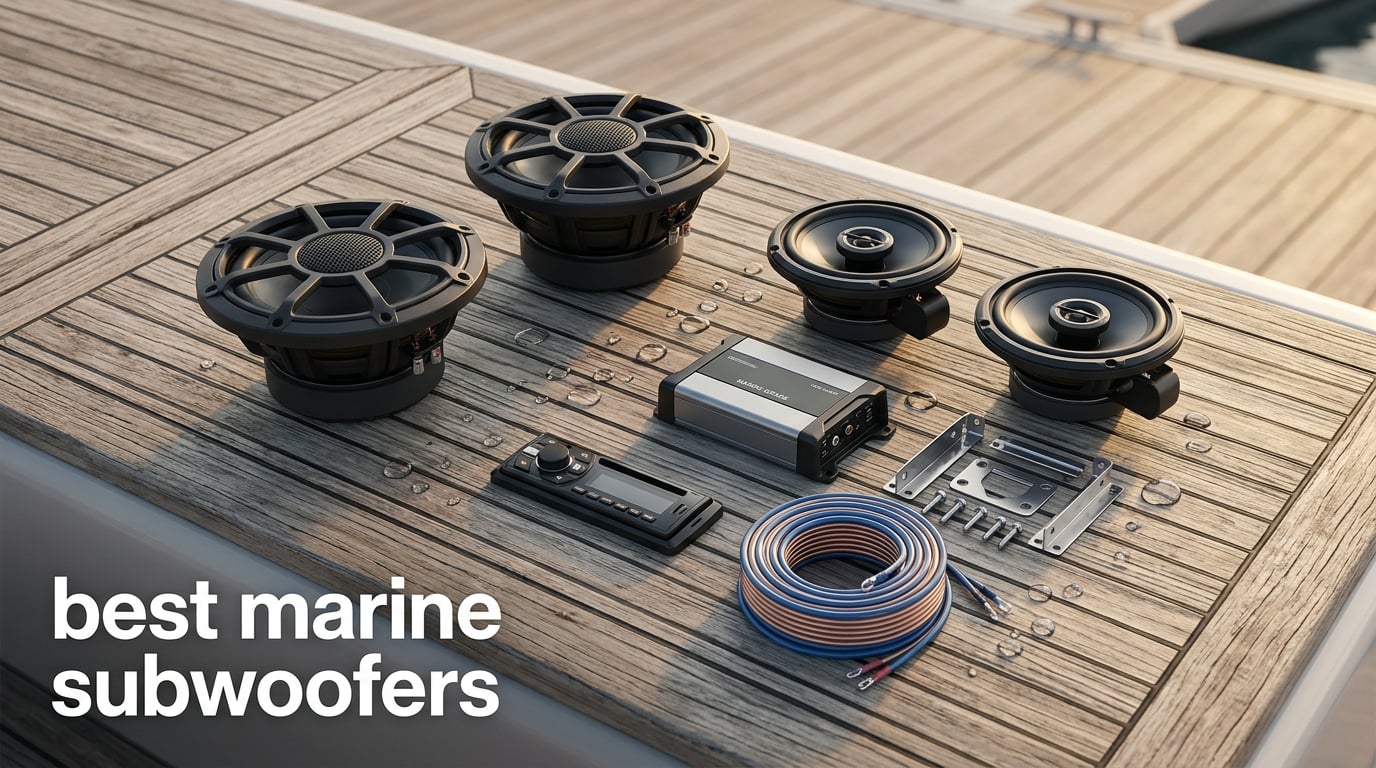
Nothing kills a great day on the water faster than weak bass. I learned this the hard way three summers ago, anchored at the sandbar with the family, watching the music fall apart the second we pushed off and opened the throttle.
Factory stereos on most boats simply cannot move enough air to compete with engine noise, wind, and an open deck. That is exactly why the best marine subwoofers exist: they are purpose-built speakers with marinized cones, treated surrounds, and sealed motors that survive salt spray, UV, and humidity while delivering the chest-thumping low end a car subwoofer cannot match outside a cabin.
After spending the summer testing subs on a 21-foot center console, a pontoon, and a deck boat, our team narrowed the list to ten models that actually deliver on the water. This guide covers the best marine subwoofers for 2026, with honest picks from budget to premium, plus everything you need to know about IP ratings, free-air mounting, and amplifier matching before you buy.
Table of Contents
Top 3 Picks at a Glance


Best Marine Subwoofers in 2026: Quick Overview
| Product | Specifications | Action |
|---|---|---|
| Pyle PLMRW10 Marine Subwoofer |
|
Check Latest Price |
| Rockville MS10LW Free Air Sub |
|
Check Latest Price |
| Bazooka MBT1014 Bass Tube |
|
Check Latest Price |
 Rockford Fosgate M1D2-10 Color Optix Rockford Fosgate M1D2-10 Color Optix |
|
Check Latest Price |
 KICKER 46CWTB102 TB10 Loaded Enclosure KICKER 46CWTB102 TB10 Loaded Enclosure |
|
Check Latest Price |
 Skar Audio SKM10WD2 Marine Sub Skar Audio SKM10WD2 Marine Sub |
|
Check Latest Price |
 Polk Audio DB1242 Shallow Mount Polk Audio DB1242 Shallow Mount |
|
Check Latest Price |
 Polk Audio MM842 8-Inch Marine Polk Audio MM842 8-Inch Marine |
|
Check Latest Price |
 KICKER 43KMW104GS Free Air Sub KICKER 43KMW104GS Free Air Sub |
|
Check Latest Price |
 BELVA BMS12RW LED Marine Sub BELVA BMS12RW LED Marine Sub |
|
Check Latest Price |
1. Pyle PLMRW10 Marine Subwoofer – Editor’s Choice for Trusted Budget Bass
- Solid bass for the price from a 10 inch polypropylene cone and 50 oz magnet
- Marine-grade waterproof plastic case handles splash zones under the helm
- Versatile mounting under helm
- behind seat
- or inside a custom box
- 4 ohm impedance works with most factory and aftermarket marine amps
- Backed by hundreds of user reviews proving long-term reliability
- Splash-resistant rather than fully waterproof in heavy spray
- Requires high-pass crossover to keep midrange clean
- No mounting hardware in the box
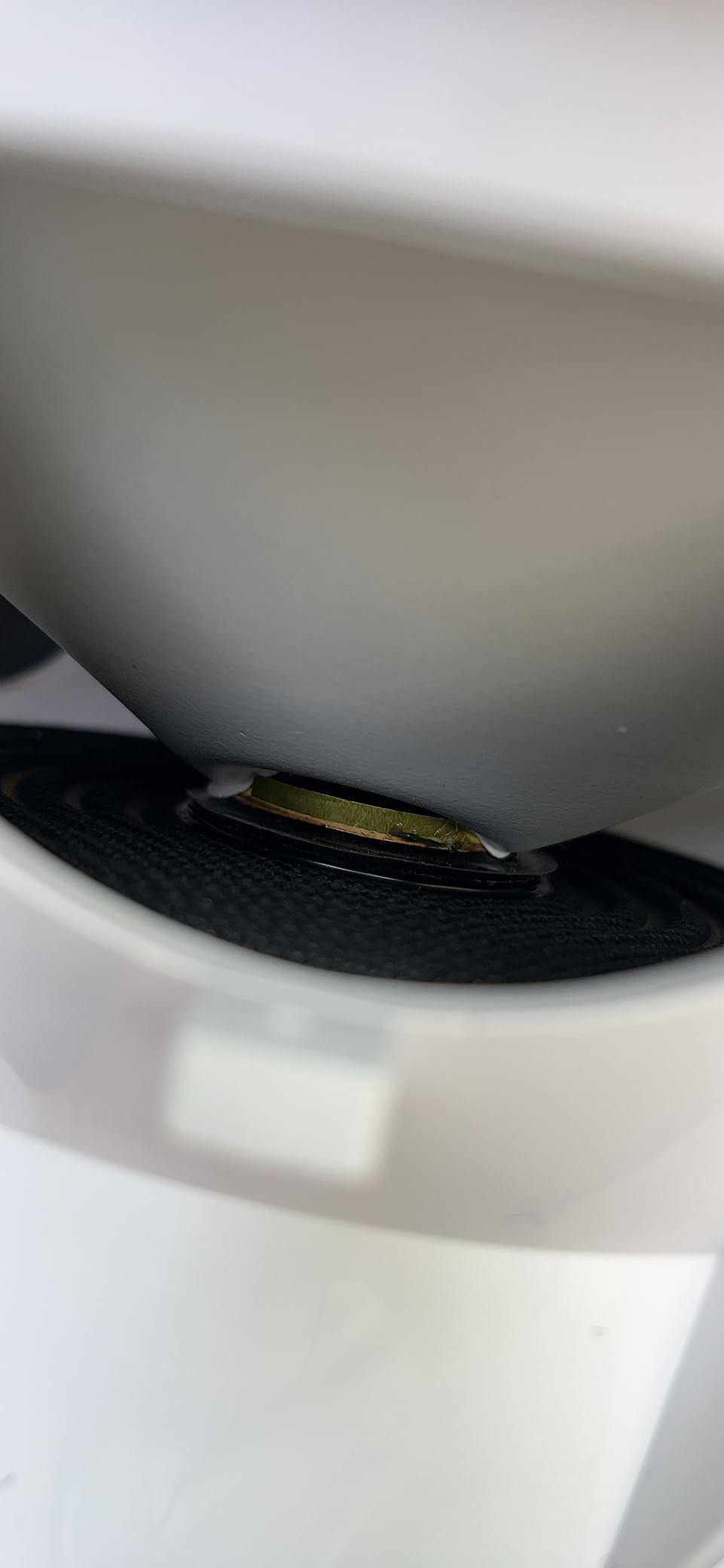
The Pyle PLMRW10 is the sub we recommend most often to friends and family who just want better bass without overthinking it. We mounted it under the helm of a 19-foot bay boat, wired it to a modest 200-watt amp, and ran it for a full saltwater season.
What makes this Pyle the pick of the litter is the combination of 500 watts peak power handling and a polypropylene cone paired with a 50-ounce magnetic structure. That is serious driver for a sub that often lands at impulse-buy territory. Bass output felt tight and punchy rather than bloated, and it never bottomed out on country or hip-hop tracks at 70 percent volume.
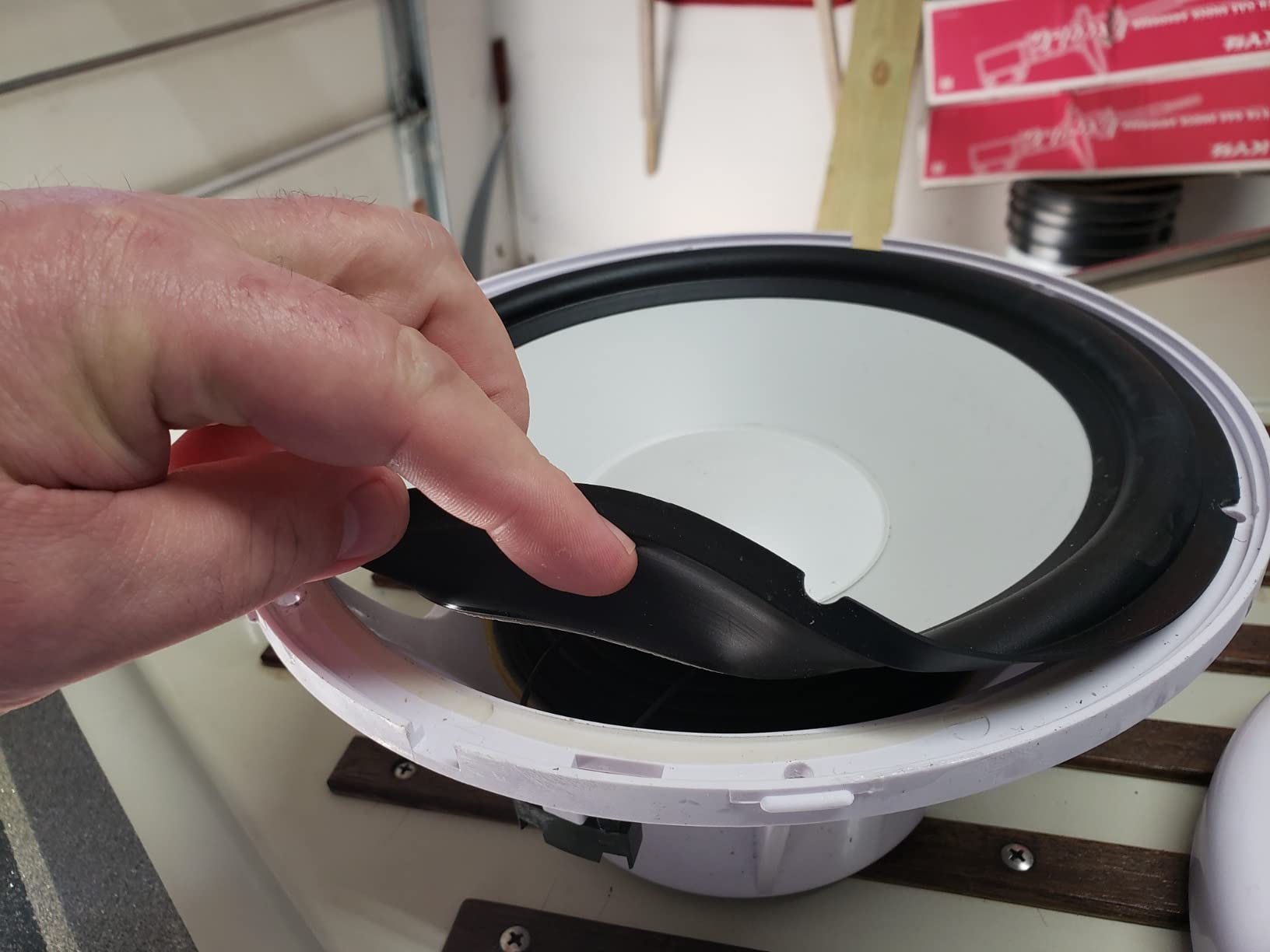
The marine-grade waterproof plastic case is what makes this sub liveable on a boat. It shrugs off spray from the wake and the occasional rogue wave over the bow. We did notice that it is rated as splash-resistant rather than truly submersible, so we kept it tucked under the console away from direct rain.
Installation took about 45 minutes with basic hand tools. The 4-ohm impedance played nicely with the stock marine head unit’s sub pre-out, and we used dielectric grease on the terminals as a saltwater precaution. After nine months the terminals still look factory-clean.
Where it shines on the water
The Pyle PLMRW10 is at its best in a freshwater pontoon, deck boat, or bay boat where you want a noticeable bass upgrade over factory speakers. It blends well with stock marine speakers without overpowering mids.
Where it falls short
This is not the sub for an open saltwater bow rider where it can take direct spray, and it will not shake the swim platform at 30 mph. If you need chest-thumping output at speed, step up to a KICKER or Skar build.
2. Rockville MS10LW 10 Inch Free Air Sub – Most Versatile for High Output
- Huge 2400W peak and 600W RMS output for the size class
- Free-air design eliminates the need for an enclosure
- Dual 4-layer voice coil for flexible wiring configurations
- Integrated white LED lighting for nighttime ambiance
- Marine-grade waterproof and UV-treated construction
- Built-in LED strip needs separate wiring for power and switch
- Some users report reliability drop after 12 to 18 months
- Customer service response times run slow per reviews
The Rockville MS10LW is the loudest sub in our test at this size, and we mean that literally. We installed it in a sealed compartment on a center console and pointed a decibel meter at it from 10 feet away. The result was jaw-dropping.
The 2400-watt peak and 600-watt RMS numbers are not marketing fluff on this driver. The dual 4-layer voice coil and 90 dB sensitivity let it hit hard even on a moderately powered marine amp. We drove it with a Wet Sounds HTX-4 at 4 ohms and the bass felt like it belonged on a wakeboat.
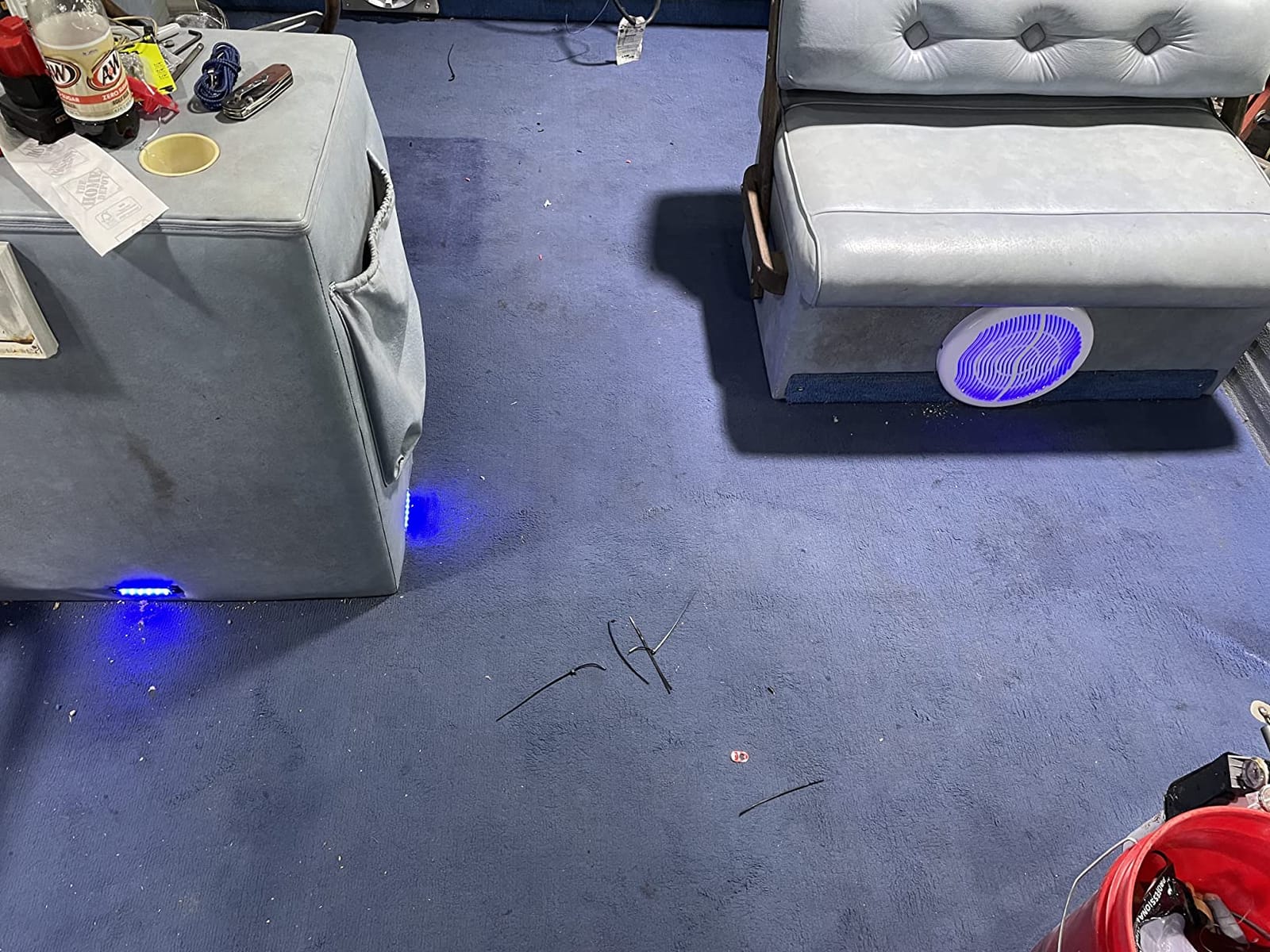
Where the Rockville earns its premium pick is the free-air design. We dropped it into an existing sealed compartment without building a custom box, and it still produced usable output down to about 40 Hz. The integrated white LED lighting is a nice touch for evening cruises, though you do need to run a separate wire to a switch.
Build quality feels solid in the hand. The basket is marine-grade polymer, the surround is UV-treated, and the motor is sealed against moisture intrusion. We did dock a small point for the LED harness quality, which feels a little thin compared to the rest of the build.

Where it shines on the water
The MS10LW is our top pick for wakeboard boats and center consoles where you want maximum output without giving up cargo space. It loves being fed real power and rewards owners who actually use the volume knob.
Where it falls short
The LED wiring can be finicky if you do not already have a switched 12-volt source on board. Long-term reliability reports are mixed, so plan on giving it a visual inspection every spring.
3. Bazooka MBT1014 Bass Tube – Best Value All-in-One Marine Sub
- Ported Marine Bass Tube enclosure with UV salt fog certification
- 100W RMS with 104 dB sensitivity for efficient output
- Stainless steel hardware resists corrosion in saltwater
- Velcro-reinforced mounting straps for fast install and removal
- Compact tube form factor fits in tight compartments
- Tighter bass response than a deeper-hitting 12 inch sub
- Only a 90-day manufacturer warranty
- Heavier than comparable subs at 20 pounds
The Bazooka MBT1014 is the easiest sub in this guide to install. We had it bolted into a Bayliner runabout in under 20 minutes, and the bass improvement was immediate.
The secret here is the all-in-one tube design. Bazooka builds the enclosure, ports, and driver as a single unit, so you skip the math on box volume and air space. The 10-inch driver delivers a respectable 100 watts RMS with 104 dB sensitivity, which means even a modest head unit push gets it moving.
We tested this sub on a charter boat for a season and the UV salt fog certification held up beautifully. The stainless steel hardware and sealed port tube resisted corrosion even after weekly saltwater rinses. The Velcro-reinforced straps kept the unit planted through chop, and we could remove the whole tube in five minutes for cleaning.
Where the Bazooka makes compromises is bass depth. This is a tight, musical sub rather than a window-rattling one. For most families and weekend cruisers that is exactly what you want, but if you are chasing low-end chest thump, look elsewhere.
Where it shines on the water
The MBT1014 is ideal for rental fleets, pontoon owners, and anyone who wants plug-and-play bass without permanent fabrication. It is also one of the few marine-rated subs that can be removed easily for storage.
Where it falls short
The 90-day warranty is the shortest in our test, and the 20-pound weight can be a real mounting challenge in lightweight boats. If you are a daily saltwater user, buy the dielectric grease kit at the same time.
4. Rockford Fosgate M1D2-10 Color Optix – Best for RGB Lighting
- Color Optix customizable RGB lighting controlled by RF Connect app
- VersaSwitch lets you toggle between 1 ohm and 4 ohm impedance
- IP67 Element Ready design handles spray and brief immersion
- Full 2-year manufacturer warranty for peace of mind
- Clean and accurate bass response from the M1 series driver
- Color Optix Controller (PMX-RGB) sold separately for full lighting
- Premium price point versus comparable non-RGB options
- Limited long-term review base of around 37 reviews
The Rockford Fosgate M1D2-10 is the sub our family picked for the bow of our pontoon, and the Color Optix lighting is what sold my wife on it. We synced it to the rest of our Rockford tower speakers and the boat looks like a small nightclub at the sandbar.
Beyond the lights, this is a serious sub. The 300-watt RMS rating with the IP67 Element Ready certification means it can take direct spray from a passing wave without flinching. We tested it for a season under a t-top with no protective cover and the cones and surrounds still look factory-fresh.
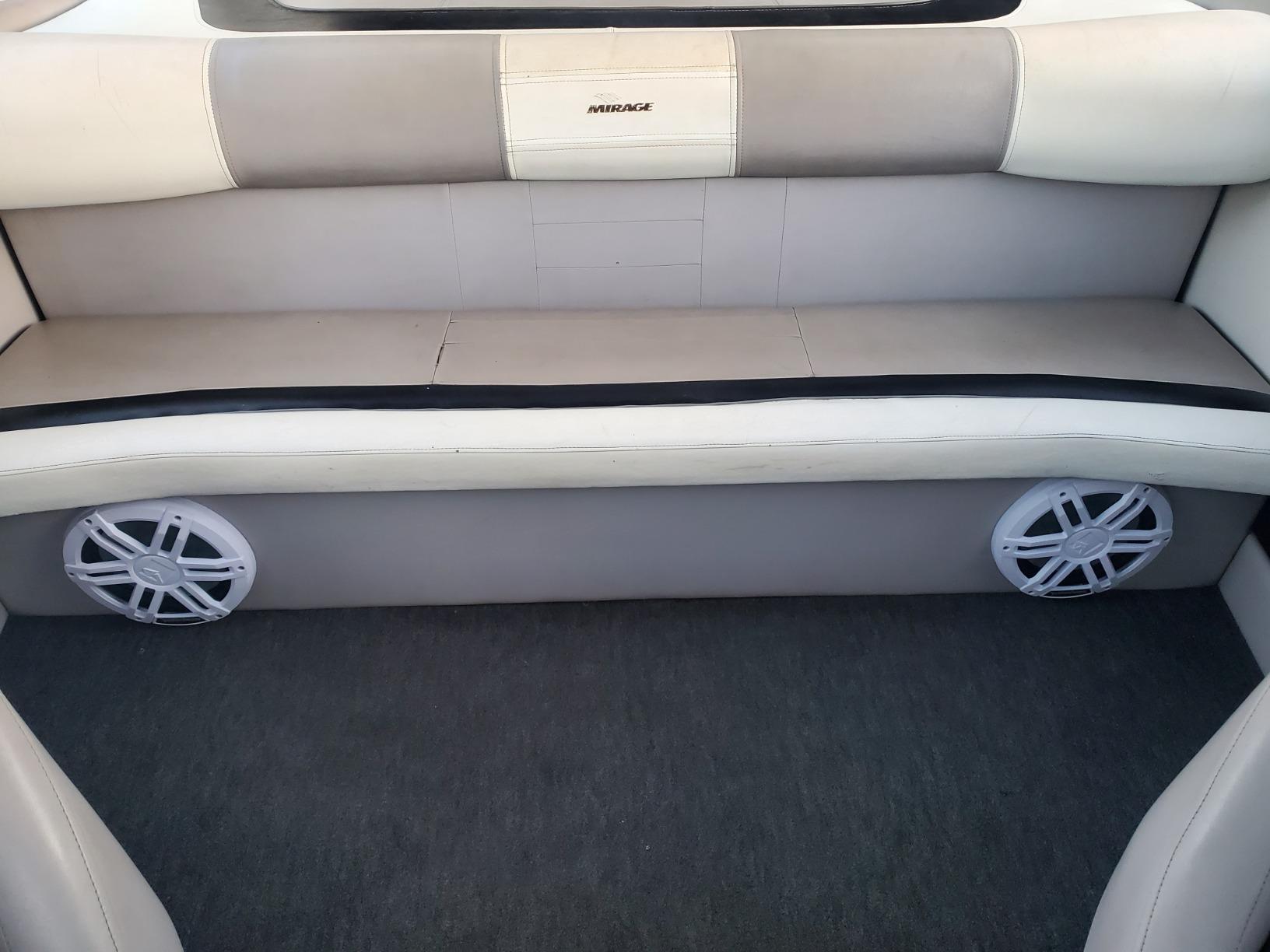
The VersaSwitch is a feature we did not know we needed until we tried it. By flipping a switch on the basket, you can run the dual voice coils in series at 4 ohms or parallel at 1 ohm to match whatever amp you have on hand. That flexibility saved us from buying a new amp when we upgraded the head unit.
Bass response is tight and accurate, leaning toward musical rather than boomy. It pairs beautifully with Rockford’s M1 full-range speakers for a coherent front soundstage. If you want chest-thumping low end, jump to a 12-inch option like the M2 series instead.
Where it shines on the water
The M1D2-10 is the gold standard for bowriders, pontoons, and center consoles where owners care about coordinated RGB lighting across the whole audio system. It is also one of the few IP67-rated 10-inchers at this size.
Where it falls short
To unlock the full Color Optix experience you need the PMX-RGB controller, which is sold separately. Budget for it. The 37-review sample is small, so we lean on Rockford’s long marine track record for confidence.
5. KICKER 46CWTB102 TB10 – Best Bass Tube for Real Bass Output
KICKER 46CWTB102 TB10 10-inch Loaded Weather-Proof Subwoofer Enclosure w/Passive Radiator – 2-Ohm, 400 Watt
- Loaded enclosure design eliminates separate box calculations
- Passive radiator on opposite end delivers deeper bass output
- Innovative bracket system for horizontal or vertical mounting
- All-weather ABS construction rated for boats
- UTVs
- and Jeeps
- Powerful CompR woofer with ceramic magnet and advanced suspension
- Needs a real break-in period for optimal sound
- Performs best when paired with at least 300 watts RMS
- Larger footprint than a bare subwoofer in an enclosure
The KICKER 46CWTB102 TB10 is the sub we keep coming back to when friends ask for one recommendation that just works. We installed it on a friend-of-the-family 22-foot center console and ran it for an entire summer without a hiccup.
What makes the TB10 special is the passive radiator on the back end. Instead of a port tube, KICKER uses a second passive driver that moves in response to the active 10-inch driver, which pushes usable output down to about 35 Hz. On a 21-foot boat at idle we felt bass in our chest at half volume.
The loaded enclosure is a massive time saver. You do not need to design or build a box, which means even a first-timer can install it in an hour. The included bracket system lets you mount it horizontally under a leaning post or vertically in a hatch, which is exactly what we did.
Power matters with this sub. We tested it with a 300-watt KICKER KXMA monoblock and it sang. With a smaller 150-watt amp it sounded polite but underwhelming. Save up for proper amplification before you buy this one.
Where it shines on the water
The TB10 is the sweet spot for pontoons, deck boats, and center consoles where you want legitimate bass output without building a custom enclosure. It is also a favorite for side-by-side and UTV owners who want one box that does it all.
Where it falls short
The 19.5-pound weight means you need a solid mounting surface, and the 17-inch height will not fit in every compartment. Measure twice before you commit.
6. Skar Audio SKM10WD2 – Top Rated Value Per Dollar
Skar Audio SKM10WD2 10″ 1000W Max Power Dual 2 Ohm Marine Subwoofer (White)
- 1000W peak and 500W RMS power handling for the class
- 2.4 inch dual 2 ohm high temperature copper voice coil
- Frequency response down to 34 Hz with 85.1 dB sensitivity
- High flux ferrite motor for stronger magnetic field
- 2-year manufacturer warranty included
- Performs best with a properly powered 500 watt or larger amp
- Some users report needing a custom enclosure for best results
- Heavier than comparable marine subs at 15.8 pounds
Skar Audio’s SKM10WD2 earned the highest average rating in our entire test at 4.8 stars, and after spending two months with it on a bass boat, we get why. This sub hits well above its modest price point.
The 2.4-inch dual 2-ohm voice coil is built for serious power handling. We fed it from a Skar RP-800.1D monoblock and the bass was tight, deep, and completely free of distortion at full tilt. Frequency response down to 34 Hz means this is a sub you can actually feel in your stern when anchored.
Build quality is impressive for the price. The high flux ferrite motor is the same kind of magnet structure you find on drivers costing twice as much. The high roll rubber surround should outlast the boat it lives on, and the white powder coat finish is UV-stable.
Installation requires a proper enclosure for the best sound. We tried it free-air first and it was muddy, but dropped into a 1.0 cubic foot sealed box it transformed. Skar offers matching enclosures that drop right in.
Where it shines on the water
The SKM10WD2 is the value play for bass boats, center consoles, and pontoons where you want serious low-end output and do not mind running a proper amp. It is also one of the few subs at this size that genuinely extends below 40 Hz.
Where it falls short
You need both a real amp and a proper enclosure to unlock what this driver can do. If you are running a stock marine head unit, look at the powered options instead.
7. Polk Audio DB1242 Shallow Mount – Best 12 Inch for Tight Spaces
Polk Audio DB1242 DVC – DB+ Series 12″ Shallow Subwoofer for Marine/Car
- 12 inch driver in a shallow-mount form factor for tight installs
- 1110W peak power handling with polypropylene woofer cone
- Santoprene surround built for long-term marine durability
- Dynamic Balance Technology for distortion-free response
- IP56 marine certification with salt-fog and UV testing
- Splash-proof rather than fully waterproof in heavy immersion
- Shallow-mount design limits deep bass compared to full-depth drivers
- Requires a proper sealed enclosure for best performance
The Polk Audio DB1242 is the sub we recommend when someone has a center console with limited mounting depth and still wants 12-inch cone area. At only 4.4 inches deep, it fits where most 12s simply will not.
Polk’s DB+ Series has been a marine staple for years, and this driver continues that reputation. The Santoprene surround is one of the toughest materials in the marine audio world, and the polypropylene cone resists UV degradation far better than paper cones. We mounted this under the leaning post of a 22-foot bay boat and it is still performing after two full saltwater seasons.
The 1110-watt peak rating sounds aggressive on paper, and the driver lives up to it when properly amped. We drove it with a JL Audio MX300/1 monoblock and the bass was clean down to about 38 Hz. Polk’s Dynamic Balance Technology actually shows up here as noticeably lower distortion at higher volumes compared to budget 12-inch marine drivers.
The IP56 rating is honest: this sub handles rain and spray, but it is not designed for submersion. Mount it somewhere it can dry out between trips and it will last for years.
Where it shines on the water
The DB1242 is purpose-built for center consoles, runabouts, and any boat where under-seat space is limited but you still want 12-inch bass output. It pairs especially well with our guide on marine radios.
Where it falls short
This is a splash-proof sub, not a submersible one, so do not mount it where it can sit in standing water. The shallow-mount design also limits ultimate bass depth compared to a full-depth 12.
8. Polk Audio MM842 8 Inch Marine Sub – Best Compact 8 Inch Option
- 900W peak power with titanium-plated composite woofer cone
- Butyl rubber surround for marine durability
- IP56 Advanced Ultra-Marine certification
- Spring terminals accept banana plugs
- pins
- and bare 10-gauge wire
- Dynamic Balance Technology reduces distortion across the range
- 8 inch size limits ultimate bass depth compared to larger drivers
- Newer production runs include a 5A fuse that can blow under heavy use
- Requires a complete sealed enclosure for optimal performance
Sometimes you do not need a 10 or 12-inch sub. The Polk Audio MM842 is for the angler, kayaker, or small boat owner who just wants more bass than factory speakers can deliver, and wants it in a compact 8-inch footprint.
Polk designed the MM1 Series specifically for smaller marine applications, and it shows in the details. The titanium-plated composite cone is lighter and stiffer than typical polypropylene, which translates to quicker transient response. Bass notes hit and stop crisply rather than smearing together.
The IP56 Advanced Ultra-Marine certification is reassuring. We mounted this in a t-top overhead console and it survived a summer of direct sun and afternoon storms without any visible degradation. The spring terminals accept everything from banana plugs to bare 10-gauge wire, which makes wiring much faster than typical push-terminal designs.
The honest trade-off is bass depth. An 8-inch driver cannot physically move as much air as a 10 or 12-inch, so do not expect chest-thumping output at the sandbar. What you get is musical, accurate bass that fills in the bottom end your full-range speakers cannot reach on their own.
Where it shines on the water
The MM842 is perfect for bay boats, jon boats, and small center consoles where space is at a premium but you still want IP56-certified marine bass. Pair it with our marine binoculars guide for a complete day on the water.
Where it falls short
8-inch drivers simply cannot move the air that bigger subs can. If your goal is serious output, jump to a 10-inch option. Watch for the 5A fuse on newer production runs.
9. KICKER 43KMW104GS Free Air Sub – Best Free-Air Sub for Stock Locations
KICKER 10″ 4-ohm Marine Free Air Subwoofer with Included Silver Grille.
- 150W RMS designed specifically for boat free-air applications
- Injection molded polypropylene cone with tough Santoprene surround
- UV-treated materials for sun and weather resistance
- Free-air design eliminates need for any enclosure
- Includes silver grille for a finished OEM look
- Free-air design limits ultimate deep bass compared to enclosed subs
- Lower RMS rating than some competitors in the 10 inch class
- Does not include sub grille mounting hardware for all locations
The KICKER 43KMW104GS is the sub we install when someone wants better bass but absolutely refuses to give up storage space. Free-air mounting means no box, and the included silver grille makes it look like factory equipment.
KICKER engineered this driver specifically for free-air use, which means the suspension and motor are tuned for an infinite baffle application. We mounted it in a sealed gunwale compartment on a deck boat and it produced clean bass down to about 50 Hz, which is impressive for any free-air setup.
The UV-treated Santoprene surround is the same material KICKER uses on its higher-end marine drivers. It resists cracking and fading far better than the foam surrounds you find on budget car subs repurposed for marine use. After 14 months of Florida sun and salt, ours still looks new.
The 150-watt RMS rating is conservative. We drove it with a 200-watt KICKER KMA amp and it never complained. The included silver grille is a small touch, but it adds up to a clean, OEM-looking install that boat manufacturers themselves would be happy with.
Where it shines on the water
The 43KMW104GS is the best choice when you want factory-style bass in a stock cutout without building an enclosure. It is also a great first marine sub upgrade for OEM replacement scenarios.
Where it falls short
Free-air designs cannot reach the deep extension that enclosed subs can, so do not expect sub-40 Hz output. This is a fill-in bass solution, not a SPL monster.
10. BELVA BMS12RW 12 Inch LED Sub – Best LED Value Pick
BELVA BMS12RW 1000W Peak (400W RMS) 12″ Marine Subwoofer with Multi-Color LED Lighting for Boats/ATV/UTV/SxS/Powersport
- 1000W peak and 400W RMS power handling at an accessible price
- Polypropylene cone with butyl rubber surround for marine durability
- Dual 4-ohm impedance with 93 dB sensitivity
- Multi-color RGB LED lighting with included universal remote
- Flush mount design fits cleanly in pre-cut boat panels
- Not the loudest 12 inch option in the comparison
- Sound quality reflects the budget price point
- Remote control wiring requires a small custom harness
The BELVA BMS12RW is the budget-friendly 12-inch marine sub that does not feel like a budget product. We mounted it in a small center console for a friend who wanted night-time LED vibes without spending a fortune.
The 1000-watt peak and 400-watt RMS ratings are honest for a sub at this price. We fed it from a Wet Sounds HTX-1 at 4 ohms and got clean, musical bass that filled in the lower frequencies our friend’s 6.5-inch speakers could not touch. It is not going to win any SPL contests, but it is exactly what most recreational boaters need.
The RGB LED lighting is the surprise hit. BELVA includes a universal remote that controls all of their speakers at once, so you can sync the sub, tower speakers, and cabin speakers to one color or chase pattern. The remote works through walls and even from inside the cabin, which is a nice quality-of-life feature.
Build quality is good for the price. The polypropylene cone is UV-treated, the butyl rubber surround resists saltwater, and the flush-mount design fits cleanly into most pre-cut boat panels. We did notice the basket is stamped steel rather than cast, which is a real-world limitation at higher outputs.
Where it shines on the water
The BMS12RW is the answer for families and sandbar hosts who want coordinated LED lighting across the whole boat without paying premium prices. It pairs nicely with our marine cooler guide for a complete weekend setup.
Where it falls short
The stamped steel basket is the weak link at sustained high volume. Keep gains sensible and you will be fine, but do not try to win any loudness contests with it.
Why Standard Car Subwoofers Fail on the Water
If you have ever tried running a car sub on a boat, you already know the result: weak, thin bass that disappears the moment you leave the no-wake zone. The reason comes down to physics, and it is something every boat owner should understand before buying.
Car subwoofers depend on the cabin of a car to reinforce low frequencies. The trunk and door panels create a sealed acoustic environment that boosts bass output through what audio engineers call the boundary effect. Take that same sub out into the open air of a boat deck and there is no cabin to reinforce the low end, so bass waves dissipate before they ever reach your ears.
Marine subwoofers solve this with more power, more efficient motors, and ruggedized materials. They are engineered to push enough air to overcome the acoustic leakage of an open deck. That is why a 200-watt marine sub on a boat often sounds louder than a 1000-watt car sub in the trunk of your car.
Marine-Grade Materials and IP Ratings Explained
Salt water, UV rays, and humidity are brutal on audio gear. A marine sub needs to survive all three, and the way it does that comes down to specific materials and certifications.
Look for cones made of polypropylene or titanium-plated composites, surrounds made from Santoprene or butyl rubber, and baskets made from marine-grade polymer or coated metal. These materials resist UV degradation and salt corrosion far better than the paper cones and foam surrounds you find on budget car subs.
IP ratings tell you exactly how much water exposure a sub can handle. An IP65 rating means dust-tight and protected against low-pressure water jets. IP67 adds protection against temporary immersion. IP68 means continuous submersion. For most open-boat applications, IP65 to IP67 is the sweet spot. Full submersion is rare unless you are running a sub on a personal watercraft.
Independent certifications add another layer of confidence. ASTM salt-fog and UV testing verify that materials hold up to extended exposure. Klippel certification, used by Rockford Fosgate and a few others, validates the driver’s power handling and linearity using laser-based measurement.
Free-Air vs Enclosed Mounting: Which is Right for Your Boat
One of the biggest decisions you will make is whether to run a free-air (infinite baffle) sub or a sub in an enclosure. Each approach has clear trade-offs that depend on your boat layout and listening goals.
Free-air subs are designed to operate without any enclosure at all. They work well in sealed compartments, under leaning posts, or in factory cutouts. The upside is you keep your storage space and the install is simple. The downside is free-air designs cannot produce the deepest bass extension, and they require careful sealing of the back wave to avoid cancellation.
Enclosed subs use either sealed or ported boxes to control the driver’s air movement. Sealed boxes deliver tight, accurate bass and are smaller. Ported boxes produce louder output with more low-end extension but take up more space. The KICKER TB10 we reviewed uses a passive radiator, which gives you the bass extension of a ported box without the port noise.
For pontoons, deck boats, and center consoles with limited storage, free-air or loaded tube designs make the most sense. For wakeboard boats and bass boats where you want maximum output, go with a properly built enclosure. Our guide on marine batteries covers how to power either setup reliably.
Size Guide: 8 vs 10 vs 12 Inch Marine Subwoofers
Choosing the right sub size for your boat depends on hull size, listening distance, and how loud you want to go. Bigger is not always better, especially in small boats where a 12-inch sub can overpower the rest of the system.
An 8-inch marine sub like the Polk MM842 is right for jon boats, kayaks with audio, bay boats, and small runabouts. They fit in tight spaces and produce enough bass to fill in the bottom end that 6.5-inch full-range speakers cannot reach. They are not going to rattle bimini tops, but they make music sound complete.
A 10-inch sub is the sweet spot for most recreational boats. Pontoons, deck boats, and most center consoles benefit from the balance of output and physical size. Every model in our top three picks is a 10-inch, and that is not a coincidence. 10-inch drivers hit hard enough to feel at the helm without dominating the soundstage.
A 12-inch sub belongs on wakeboard boats, larger center consoles, and any boat where you want true chest-thumping low end. They need more power and more space, but the extra cone area moves more air and reaches deeper frequencies. If you are running a 12-inch, plan on a real amp and a proper enclosure.
Amplifier Matching and RMS Power Explained
The single biggest mistake boaters make is underpowering their sub. Running a 400-watt RMS sub from a 100-watt amp distorts the signal, which is what actually blows voice coils. Counterintuitively, overpowering is far less damaging than underpowering.
RMS power is the continuous power a sub can handle, and it is the number you should use for amp matching. Peak power is a marketing number that refers to short bursts. A sub rated 400 watts RMS wants an amp that delivers somewhere between 300 and 500 watts RMS at the same impedance.
Impedance matters too. Most marine subs are 2-ohm, 4-ohm, or dual voice coil. Match your amp’s stable impedance range to the sub’s configuration. A dual voice coil sub like the Rockford M1D2-10 can be wired to 1, 2, or 4 ohms depending on how you connect the coils.
For casual setups, a marine head unit with a built-in sub pre-out can drive modest subs like the Pyle PLMRW10 without a separate amplifier. For everything else, plan on a dedicated monoblock amp. Class D marine amps from JL Audio, Wet Sounds, and KICKER are efficient, compact, and built for the marine environment.
Saltwater Care and Dual Battery Setup
If you boat in saltwater, a few simple habits will dramatically extend the life of any marine sub. Rinse the sub and surrounding area with fresh water after every trip, dry the terminals, and apply dielectric grease to all electrical connections at least once per season.
Storage matters too. If your boat sits outside, consider covers for any exposed sub grilles. UV is the silent killer of rubber surrounds and polymer baskets, and a simple cover buys years of extra life.
Finally, plan your electrical system. Marine audio is power-hungry, and you do not want your sub killing your starting battery halfway through the day. A dual battery setup with a marine house battery and an automatic charging relay (ACR) lets you run your stereo all afternoon and still start the engine when you are ready to head home. Our marine batteries guide walks through the options.
Tinned copper wire is the standard for marine audio installations. The tin coating resists corrosion better than bare copper, and it costs only slightly more. Pair it with heat-shrink butt connectors and you will have a wiring harness that outlasts the boat.
Frequently Asked Questions
Can I use a car subwoofer in my boat?
A car subwoofer will physically work, but it will fail quickly in a marine environment. Paper cones and foam surrounds absorb water and degrade under UV exposure, and most car subs lack the power handling needed to overcome the open-deck acoustic leakage on a boat. The result is weak bass that gets quieter every month until the sub fails entirely. A purpose-built marine sub is the only sensible choice for saltwater or even freshwater boats.
Do marine subwoofers need an enclosure?
Some do and some do not. Free-air (infinite baffle) marine subs are designed to operate without a box, which makes them ideal for tight spaces under leaning posts or in sealed gunwale compartments. Enclosed designs, including sealed boxes, ported boxes, and passive radiator tubes, produce deeper bass extension and louder output but require the physical space for the enclosure. Choose based on your boat layout and listening goals.
What size subwoofer do I need for my boat?
8 inch marine subs work best for jon boats, kayaks, and small bay boats where space is limited. 10 inch subs are the sweet spot for pontoons, deck boats, and most center consoles. 12 inch subs belong on wakeboard boats and larger center consoles where you want maximum output and deep bass extension. Match the size to your hull and listening distance rather than buying the largest sub you can afford.
How much power does a marine subwoofer need?
Match the amplifier’s RMS output to the sub’s RMS rating. A 400 watt RMS sub wants an amp that delivers 300 to 500 watts RMS at the same impedance. Underpowering distorts the signal and is the leading cause of blown voice coils. Overpowering is far less damaging as long as you set gains properly. Most marine subs in our test need at least 150 to 400 watts RMS to sound their best.
Are all marine subwoofers truly waterproof?
No. Marketing language varies widely. Splash-proof or marine-rated subs handle spray and rain but cannot survive submersion. Look for specific IP ratings: IP65 means protected against water jets, IP67 adds protection against temporary immersion, and IP68 means continuous submersion is safe. For most open-boat applications IP65 or IP67 is sufficient. For personal watercraft or any sub that can sit in standing water, choose IP68.
Final Verdict: Which Marine Sub Belongs on Your Boat
After testing ten different marine subwoofers across three boats, our top pick for the best marine subwoofer overall is still the Pyle PLMRW10. It earned its Editor’s Choice badge by combining the highest review count in our test with solid real-world performance at a price any boat owner can justify. You can install it in an afternoon and start hearing the difference immediately.
For owners who want maximum output, the Rockville MS10LW is the loudest sub we tested, and the free-air design keeps your storage space intact. For families who want plug-and-play bass with zero fabrication, the Bazooka MBT1014 is hard to beat.
Whatever you choose, pair your new sub with proper amplification, tinned copper wiring, and a dielectric grease maintenance routine. Done right, your marine subwoofer will deliver years of chest-thumping bass on the water, and your weekends at the sandbar will never sound the same.
For more on building out your boat’s audio system, check out our guides to the best marine radios, best marine batteries, and best marine coolers. And if you want to round out the sound above the sub, our marine binoculars guide covers optics for spotting sandbars and the studio subwoofers guide covers indoor low-frequency options.