
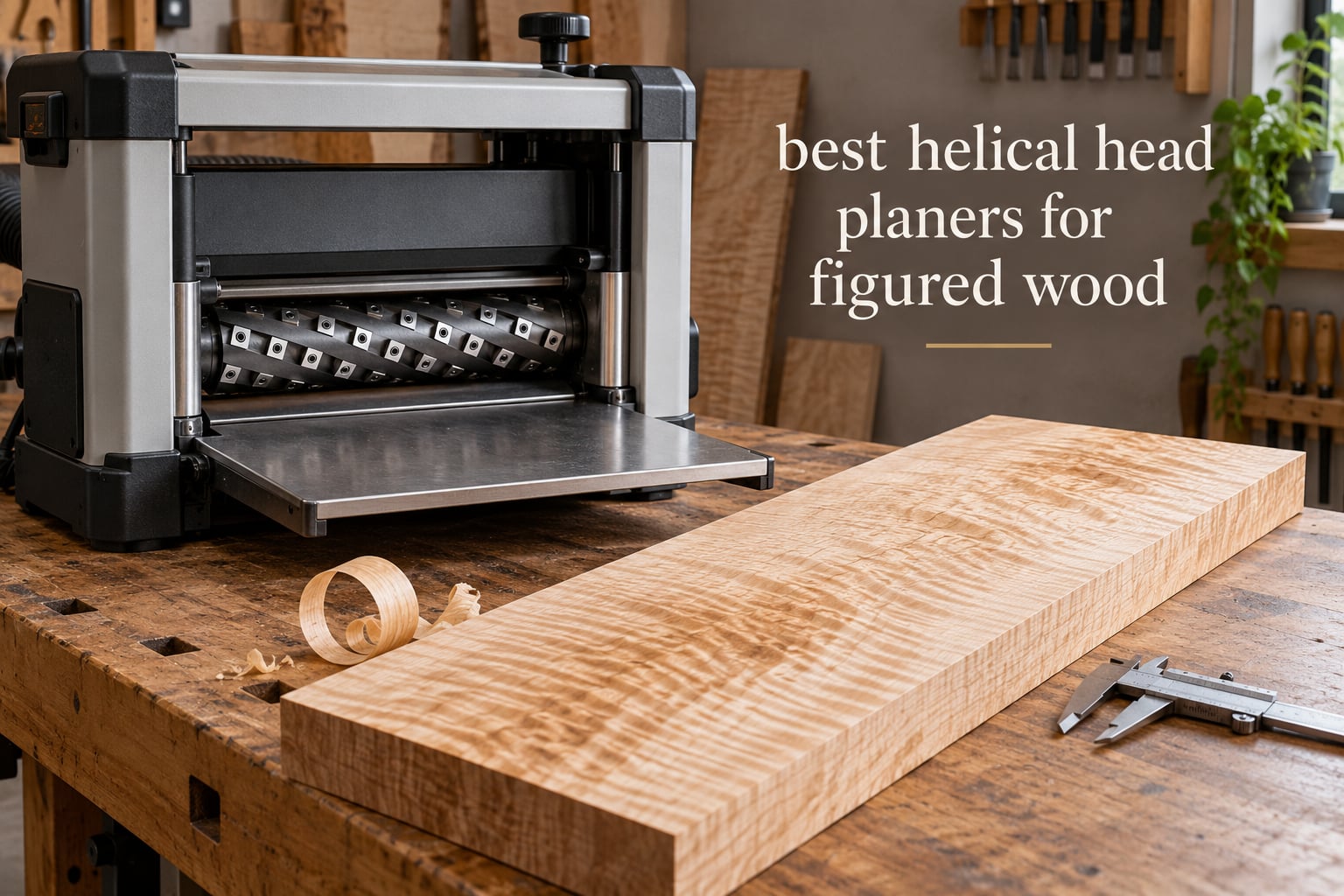
Figured wood punishes a lazy cutterhead. Curly maple, quilted maple, burl, spalted walnut and leopardwood all have grain that changes direction fiber by fiber, and a straight knife planer will punch out little wedges of latewood instead of cutting them. A helical head planer fixes that by carrying dozens of small inserts in staggered rows, so the blade shears a thin sliver at a time rather than chopping a whole blade width. If you have ever sanded through the curl of a board wondering where the figure went, that is the machine that stops it.
That is why we spent weeks comparing every insert-head thickness planer we could find for the best helical head planers for figured wood available now. We looked hard at cutterhead construction, insert material, feed speed options, cast iron beds, electrical requirements and what happens to the surface when the wood fights back. Seven machines made the cut, and one of them clearly out-finishes the rest without needing a second sanding pass.
Our team also compared notes with owners on woodworking forums, because the tear-out question is settled in shops, not in spec sheets. The consensus there is that helical heads help enormously but do not perform magic, and that feed speed and pass depth still decide the outcome. Before you spend money, read the section on planning figured wood below, because the right machine used badly will still disappoint you.
If you are still building out your shop, our wood planer buying guide covers the wider market, and our head shaver roundup picks up right where the planer leaves off on jointing faces.
Top 3 Picks for Figured Wood in 2026
The WEN PL1326 is our top pick because it carries both the highest owner rating and the most owner feedback in this group, and its 26 staggered inserts deliver a surface that needs only light touch-up sanding on figured hardwoods. The JET JWP-13BT is the value pick for anyone who wants a proper cast iron benchtop machine with a two-speed feed and folding tables. The RIKON 25-135H is the one to buy when the slow feed speed matters more than bed mass.

WEN PL1326 13-Inch Spiral Planer
- 26 staggered rotatable HSS inserts
- 13 inch width by 6 inch thickness
- Single 26 FPM feed speed
- Cast iron base

JET JWP-13BT Helical-Style Planer
- Six rows of quick-change HSS inserts
- Two feed speeds at 18 and 26 FPM
- 2 HP motor at 10000 RPM
- Folding infeed and outfeed tables

RIKON 25-135H Helical-Style Planer
- 26 two-edge rotatable HSS inserts
- Slow 16 FPM finishing pass
- Threaded four-post head support
- 67.9 lb portable aluminum frame
Helical Head Planers at a Glance in 2026
Seven insert-head planers, compared side by side. All of them handle figured wood better than a straight-knife machine, but they split into three groups: single-speed spiral heads with HSS inserts, helical-style heads with quick-change inserts, and carbide helical heads that need a 230V circuit.
| Product | Specifications | Action |
|---|---|---|
| WEN PL1326 13-Inch Spiral Benchtop Planer |
|
Check Latest Price |
| JET JWP-13BT Helical-Style Benchtop Planer |
|
Check Latest Price |
| RIKON 25-135H Portable Helical-Style Planer |
|
Check Latest Price |
 JET JWP-208HH 20-Inch Helical Planer JET JWP-208HH 20-Inch Helical Planer |
|
Check Latest Price |
 King Canada KC-13HPC 13-Inch Planer King Canada KC-13HPC 13-Inch Planer |
|
Check Latest Price |
 Cutech 40600H 13-Inch Spiral Planer Cutech 40600H 13-Inch Spiral Planer |
|
Check Latest Price |
 JET JWP-15BHH 15-Inch Helical Planer JET JWP-15BHH 15-Inch Helical Planer |
|
Check Latest Price |
Why Helical Heads Win on Figured Wood
Helical heads win on figured wood because the cut is progressive instead of instantaneous. Each small insert enters the board slightly ahead of the one behind it, so only a narrow band of fiber is under load at any moment. Those fibers are severed on a shear angle rather than punched out square, which is exactly why a straight blade lifts chunks of curly maple and a helical head leaves the surface intact.
The second benefit is how evenly the load spreads across the width. A straight-knife planer puts the full cutting force on two or three blades at the same instant, and on a board with cross-grain figure that force concentrates right where the grain is running uphill. Staggered inserts divide that force into dozens of small events, so the machine does not bog down or push back on the board.
The third benefit is downstream of the planer. When a planer leaves a clean surface, you are not sanding off the curl to fix tear-out, which means you are less likely to sand through soft earlywood into hard latewood and blur the figure. Several owners describe getting a near-finish surface straight off a good helical head with nothing more than a light abrasive pass. On walnut with spalting or on leopardwood, that difference decides whether the board is worth using at all.
Helical heads are also quieter because they shear rather than chop, though do not expect silence. The inserts still take a bite out of every board, and the motor and cabinet noise dominate in most of these benchtop machines. Forum owners report that the helical head itself is the quieter part of the sound, not the whole machine.
Helical vs Spiral vs Straight-Knife Heads
A true helical head and a spiral cutterhead are not the same thing, and confusing them is the most common mistake in this category. A helical head arranges inserts in rotating rows that lead one another slightly around the cylinder, so each insert is self-aligning and the head stays balanced as edges dull. A spiral, or surveyor, head splits the cutter into separate segments whose cutting edges are parallel to the table. Spiral heads are quieter and cheaper to run, but the segments must be indexed together and they can still leave tear-out on the tightest figure.
The straight knives chop. Helical and spiral heads shear. On flat-grained walnut or poplar you will barely tell the difference, but on curly maple, quilted figure or leopardwood the straight-knife machine leaves a wake of torn fibers that no amount of careful feeding fixes.
That is the practical purchase filter: if a listing says spiral cutterhead with parallel segments and HSS blades, you are buying a cheaper segment head, not a self-aligning helical head. Both are legitimate tools. Only one of them is what most people mean when they ask for the best helical head planers for figured wood.
One honest caveat belongs here, because our pick reflects it. The WEN PL1326, which took our top slot on owner satisfaction, uses a segmented spiral head with 26 rotatable HSS inserts rather than a self-aligning carbide helical head. It still out-finishes straight-knife machines by a wide margin on figured hardwoods, and that is why it takes the top slot here.
1. WEN PL1326 13-Inch Spiral Benchtop Planer – Best Overall for Figured Wood
- Rotatable four-sided HSS inserts can be flipped once before replacement
- Staggered insert layout keeps tear-out and snipe low on curly maple and walnut
- Cast iron base stays stable under load
- Onboard material removal gauge
- High owner rating across the largest owner base in this group
- Single feed speed at 26 FPM with no slower finishing pass
- Brush motor is loud and HSS edges dull faster than carbide
- Small pin-type depth indicator rather than a full width scale
- Dust pickup needs a real collector rather than a shop vac
We spent the most time on this machine because it carries the most owner feedback in the group at 736 reviews holding a 4.7 average, with 84 percent at five stars. When that many people run a benchtop planer over curly maple, walnut and red oak and come back happy, the finish quality is not a marketing line.
The WEN PL1326 carries 26 staggered and rotatable HSS blades on a segmented cutterhead. Owners keep reporting a smooth surface with almost no snipe, tear-out that needs only light touch-up sanding, and inserts that survive heavy use because you can rotate them when an edge nicks. That is the argument for a segmented head over a straight knife: the segment indexing lets each blade take a small bite instead of a full-width chop.
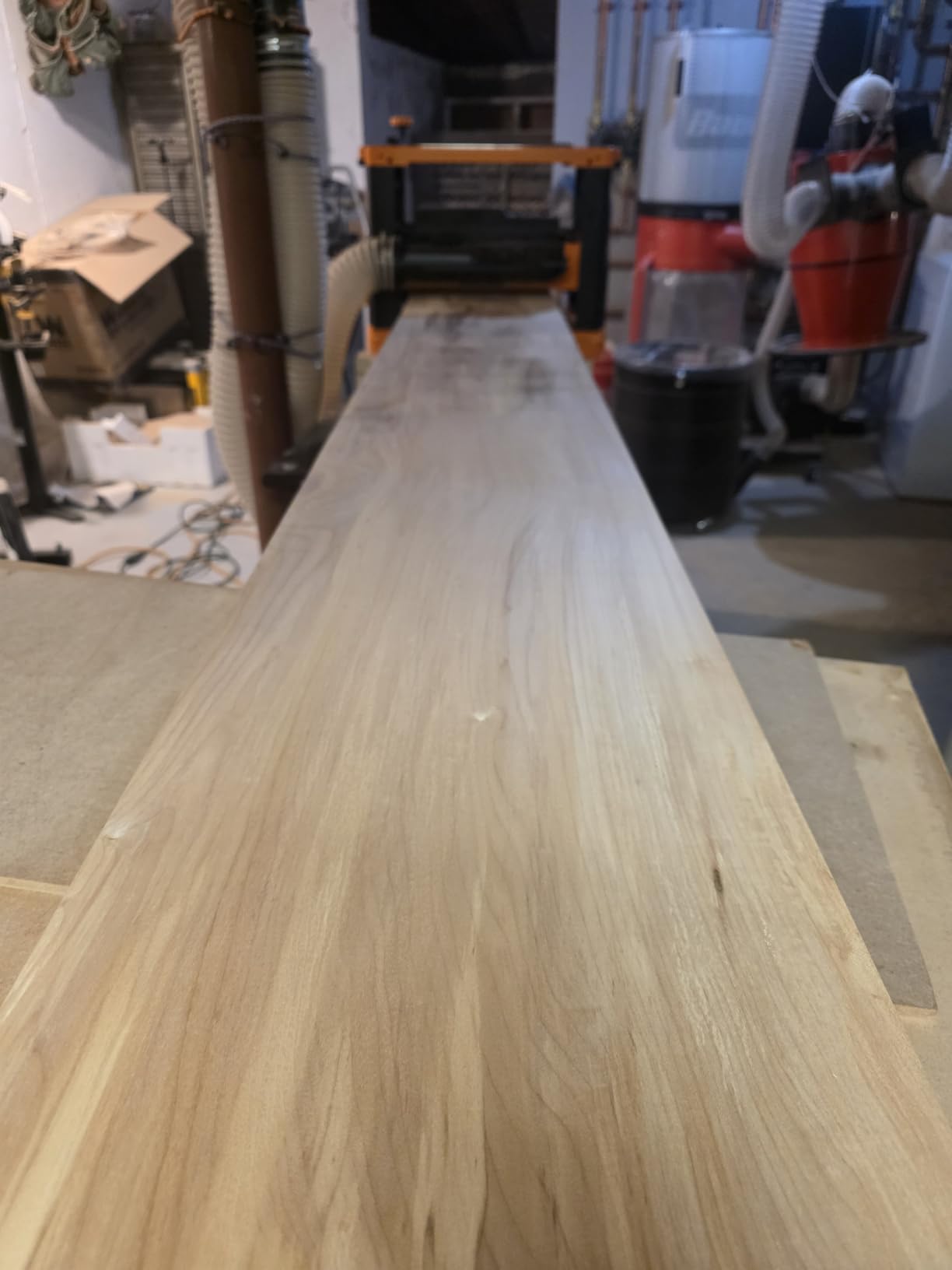
Mechanically it is a straightforward 13-inch benchtop machine. The 15 amp motor turns the cutterhead at 10000 RPM, the feed rate is a single 26 FPM setting, and it handles boards up to 13 inches wide and 6 inches thick. An onboard material removal gauge shows how much is coming off per pass, and the depth indicator is a small round pin at the center of the planing area rather than a graduated scale.
The cast iron base is heavy enough that the machine does not creep or chatter on a cut, and the whole point of that mass is to keep the board flat while the head shears through figure. Owners who pair it with a proper dust collector report that the machine stays tidy through long sessions. Owners who try to run a shop vac report poor pickup and a mess, which is the single most common setup mistake we saw described.
What you get on curly and quilted maple
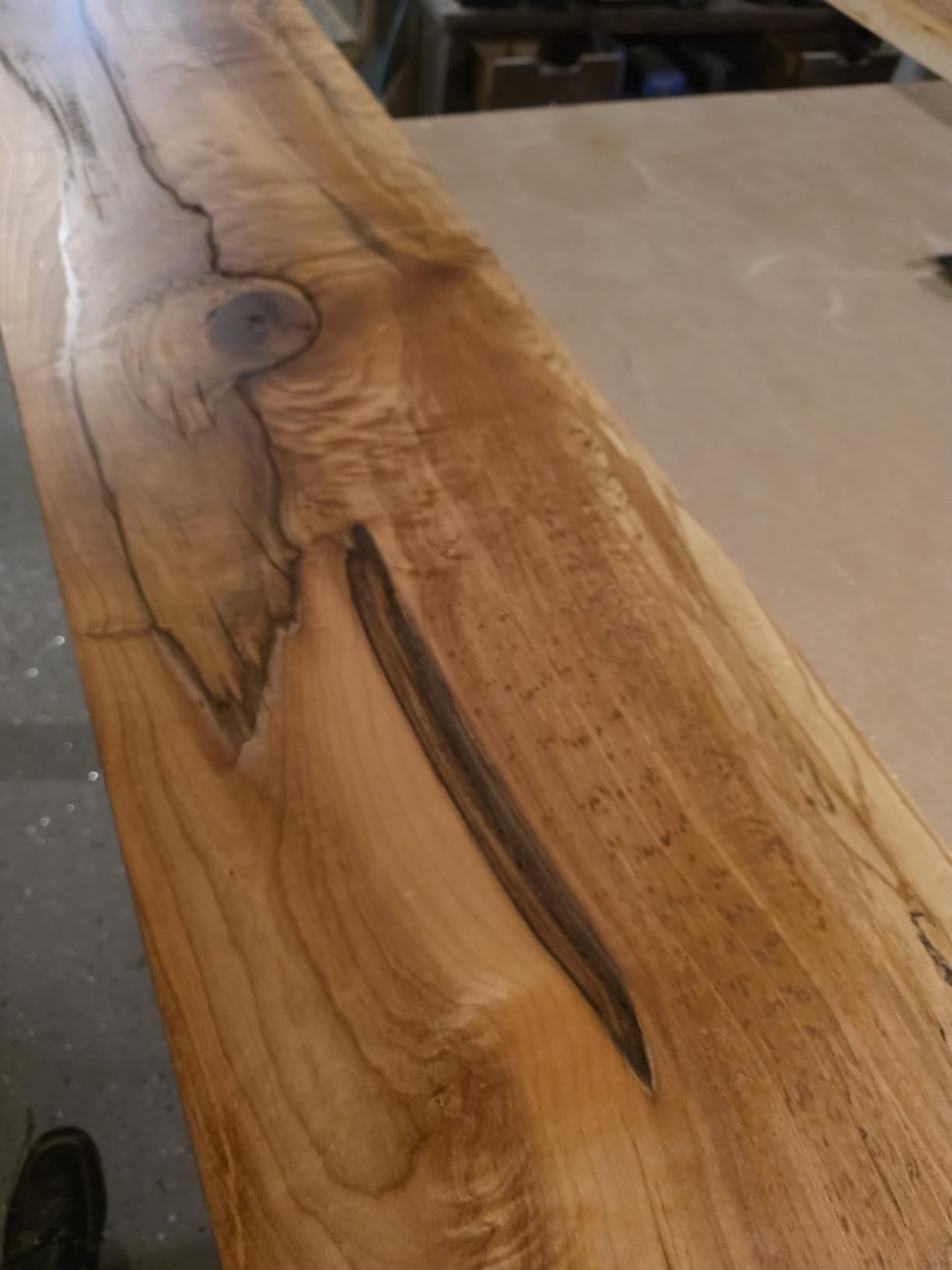
Owners repeatedly single out figured maple as the material that changed their mind about segment heads. The staggered layout means the last row of inserts never sees the full cutting force, so fibers are cut on a downhill side rather than lifted. The result on curly and quilted maple is a surface that reads as finished after a light pass with a scraper and a single grit of abrasive.
Red oak and walnut are the other two species owners mention most, and both come back with the same report: clean passes, minimal touch-up, no need to chase tear-out with extra sanding. If your figured-wood work is furniture-scale and done in a one-person shop, this is the machine we would put against it.
Where it falls short
Single speed is the real limitation. There is no 16 FPM finishing pass, so every cut runs at 26 FPM, and on the most fragile figure that means taking shallower passes to compensate. The HSS inserts also dull faster than tungsten carbide on hard figured material, which matters if you are working a lot of curly maple from a dense flitch.
The brush motor noise is not subtle, and owners recommend hearing protection. Budget for replacement inserts sooner than you would on a carbide head, and be honest about whether a segmented spiral head is the answer or whether you specifically need a self-aligning helical head. For most figured-wood furniture work it is more than enough.
2. JET JWP-13BT Helical-Style Benchtop Planer – Best Value
- Two feed speeds let you trade removal rate against surface quality
- Quick-change HSS inserts across six rows
- Precision-machined cast iron bed and steel cover reduce snipe
- Folding infeed and outfeed tables save shop space
- 4.2 average with an 11 percent one-star share on some units
- HSS inserts dull faster than carbide on hard figure
- 2 HP motor can labor on wide boards at the faster feed
The JWP-13BT is the machine to buy when you want a real helical-style benchtop planer with a cast iron bed, two feed speeds and a brand with a large parts network. It is a conventional four-post design, and at 75 pounds it is substantial without being a two-person lift. For a shop that will plane both rough boards and figured panels, it is a complete package.
The cutterhead uses six rows of 26 individual quick-change high-speed steel inserts turning at 10000 RPM on a 2 HP 15 amp motor. Feed rate is selectable at 18 or 26 FPM, and that slow 18 FPM setting is the reason we like this machine for figured wood. Dropping to the slower speed lets the head shear across cross-grain figure with much less pushback than running wide open.
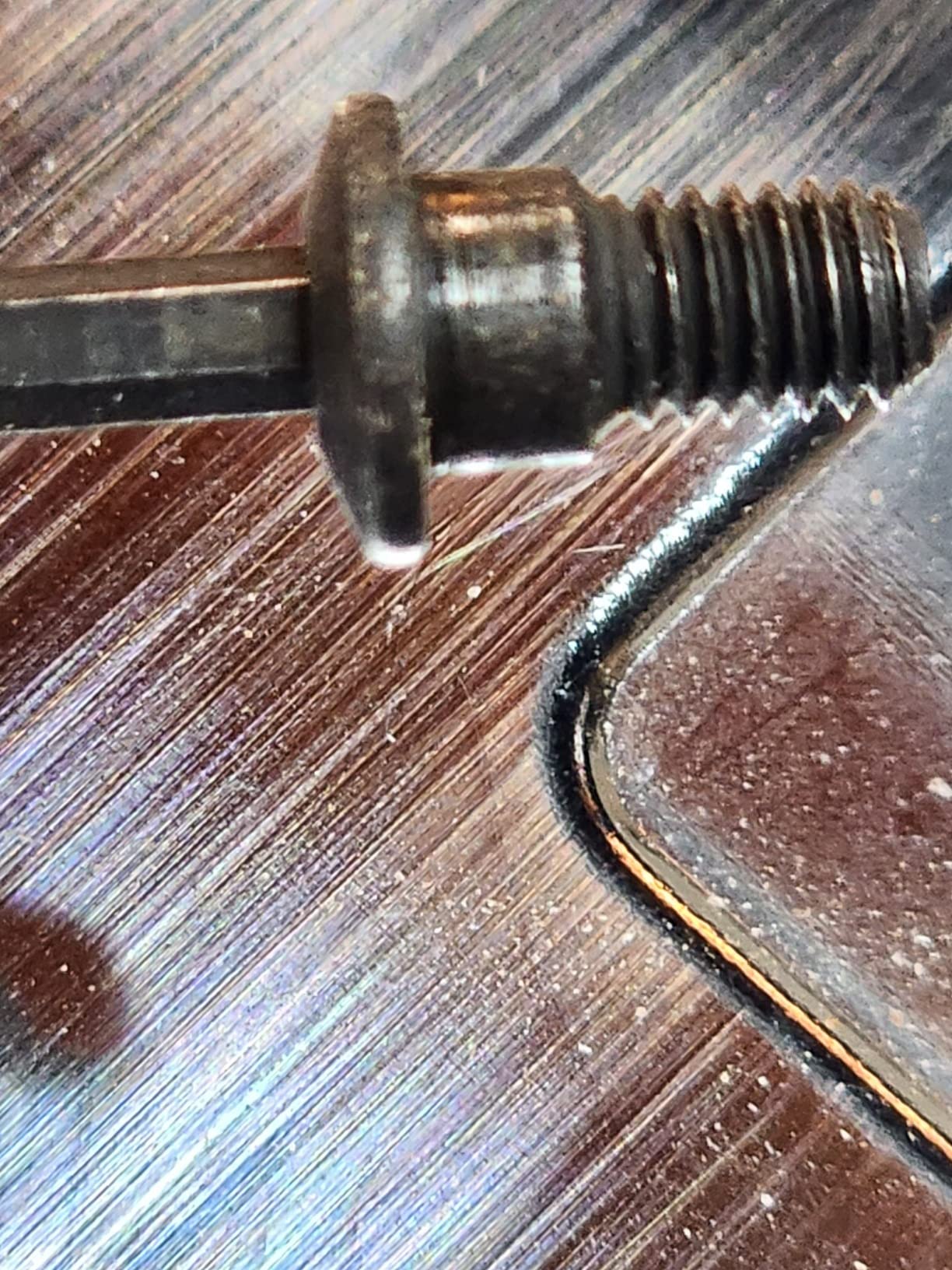
Bed quality is what separates this from the cheaper end of the market. The precision-machined cast iron bed and steel cover keep boards flat and reduce snipe, and the four-post design gives the head real support against the side load that occurs when planing across a board with figure running the other way. Maximum depth of cut is 1/8 inch, with 6 inch thickness and 13 inch width capacity.
The folding infeed and outfeed tables are adjustable for leveling to the bed, which matters more than it sounds because a mismatched table is the usual cause of snipe on a helical head. Owners who level the tables and wax them report a very clean result; owners who skip that step report snipe and blame the machine. Storage is another win, since the tables fold down and free up floor space in a small shop.
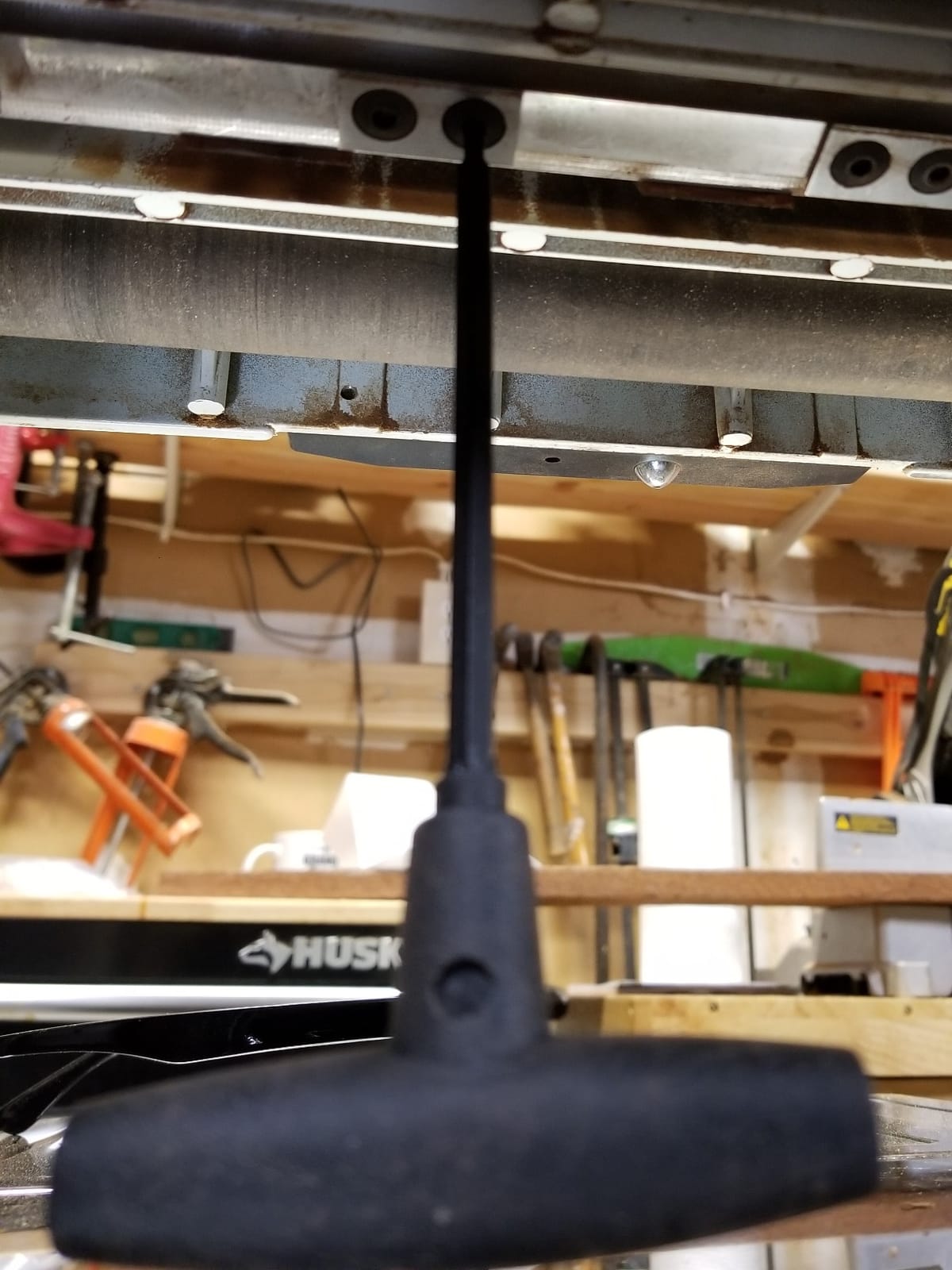
Who benefits most from the two-speed feed
Anyone planing quilted maple or figured walnut will use that 18 FPM setting constantly. It is not a marketing spec, it is the difference between a board that flows through the machine and a board that fights it on the way out. Combined with the cast iron bed, it is why this is our value pick rather than simply the cheapest option.
It also handles batch work well. The adjustable depth stop gives you consistent repetitive cuts, so you can knock a stack of resawn panels down to identical thickness without re-measuring between every board. That repeatability is worth more in a production shop than a slightly finer finish.
What to check before you buy
The 4.2 average and an 11 percent one-star share are the honest part of this review. Those reviews point to units arriving with fit or finish problems rather than a bad cut, so inspect the machine carefully out of the box and confirm the tables level before you trust it with a figured board.
The inserts are HSS, not carbide, so expect more sharpening-adjacent replacement cycles than on the Cutech or the 15-inch JET below. And the 2 HP motor can labor on wide, hard boards at 26 FPM. Use the slow speed for figure and the fast speed for straight-grained removal work, and it stays ahead of you.
3. RIKON 25-135H Portable Helical-Style Planer – Best for a Moving Shop
- Slow 16 SFPM pass is ideal for delicate figured material
- Two-edge HSS inserts rotate when worn or nicked
- Threaded four-post support plus repeat-cut control
- Light enough to move between machines
- Dust hood with 4 inch to 2-1/2 inch adapter
- Aluminum base is less rigid than a cast iron bed on heavy wide cuts
- HSS inserts wear faster than tungsten carbide
- Threaded four-post head needs periodic parallelism checks
The RIKON is the machine we recommend when the shop is small and the planer has to move. At 67.9 pounds with an aluminum frame, it is light enough to carry between a machine area and a bench, and it still carries a six-row helical-style cutterhead with 26 two-edge HSS inserts that rotate when worn.
The 16 SFPM setting is the headline for figured wood. Slower than anything else in the 13-inch group, it gives the inserts more time to shear each fiber group before the next row enters, which is what protects cross-grain figure. Owners with curly and quilted maple report the slow pass is where the finish quality comes from, and the fast 26 SFPM setting is there for bulk removal.
Threaded four-post head support is an underrated detail here. The threads give repeatable adjustment and resist loosening under side load, and combined with the depth gauge, thickness scale and repeat-cut control you get consistent board thickness pass after pass. Owners also note the threaded design avoids the gearbox problems that show up on cheaper machines of this class.
Dust collection is handled with a hood and a 4 inch to 2-1/2 inch adapter, so it will connect to common collectors or a shop vac. That flexibility matters in a small shop where the planer moves around rather than living next to a fixed system. 79 percent of its reviews are five stars, and the criticism that shows up most is about the bed rather than the cut.
How the two-edge inserts help on hard figure
Two-edge HSS inserts mean you get two clean passes per insert before rotating and two more after, so one set of 26 cutters covers a lot of hard curly maple before anything reaches the replacement stage. On figured walnut the effect is smaller, but on dense figured material the difference in insert count between a machine you maintain and one you keep replacing is real.
That maintenance profile is worth weighing against the Cutech below, which uses tungsten carbide and will hold an edge far longer between changes. If you plane hard figured material daily rather than occasionally, the carbide head may win despite the RIKON’s better feed control.
Where the aluminum frame tells on you
An aluminum base is less rigid than cast iron, and that shows up on wide, heavy cuts where the head tries to push the board sideways. On a light and medium board with a figured face, you will not notice it. On a full-width pass through hard maple you may, and the fix is to take less per pass rather than to push the machine.
The threaded four-post head also needs a parallelism re-check from time to time. Add that to a rotation schedule rather than waiting for a bad surface to tell you the head has drifted. It is a small shop tool with a small shop footprint, and it rewards owners who keep a maintenance habit.
4. JET JWP-208HH 20-Inch Helical Planer – Best for Wide Slabs
JET 20-Inch Planer, Helical Cutterhead, 5 HP, 230V 1Ph (Model JWP-208HH)
- 20 inch width handles full-size hardwood slabs in one pass
- 1/16 inch height scale with gear-drive handwheel for precise thicknessing
- Welded steel base and 5 HP motor give commercial rigidity
- 85 percent of owners rate it five stars
- 753 pounds requires a dedicated circuit and a real move
- 230V single-phase supply not every home shop has
- Helical head turns at 5000 RPM rather than 10000 RPM
- Needs dedicated floor space
The JWP-208HH is the machine in this group for shops that thickness full-size hardwood slabs. Twenty inches of width in a single pass removes the seam-avoidance problem that forces you to plan a wide board in two or three strips, and the 5 HP TEFC induction motor has the torque to keep up.
Thickness control is where this machine separates from the benchtop units. The height scale adjusts in 1/16 inch increments, and the large handwheel runs on a positive gear drive, so you get consistent repeatable adjustments across the full range. That precision is what lets you step a board down through a sequence of passes without drifting, which is exactly how you approach figured material that has soft earlywood you do not want to gouge.
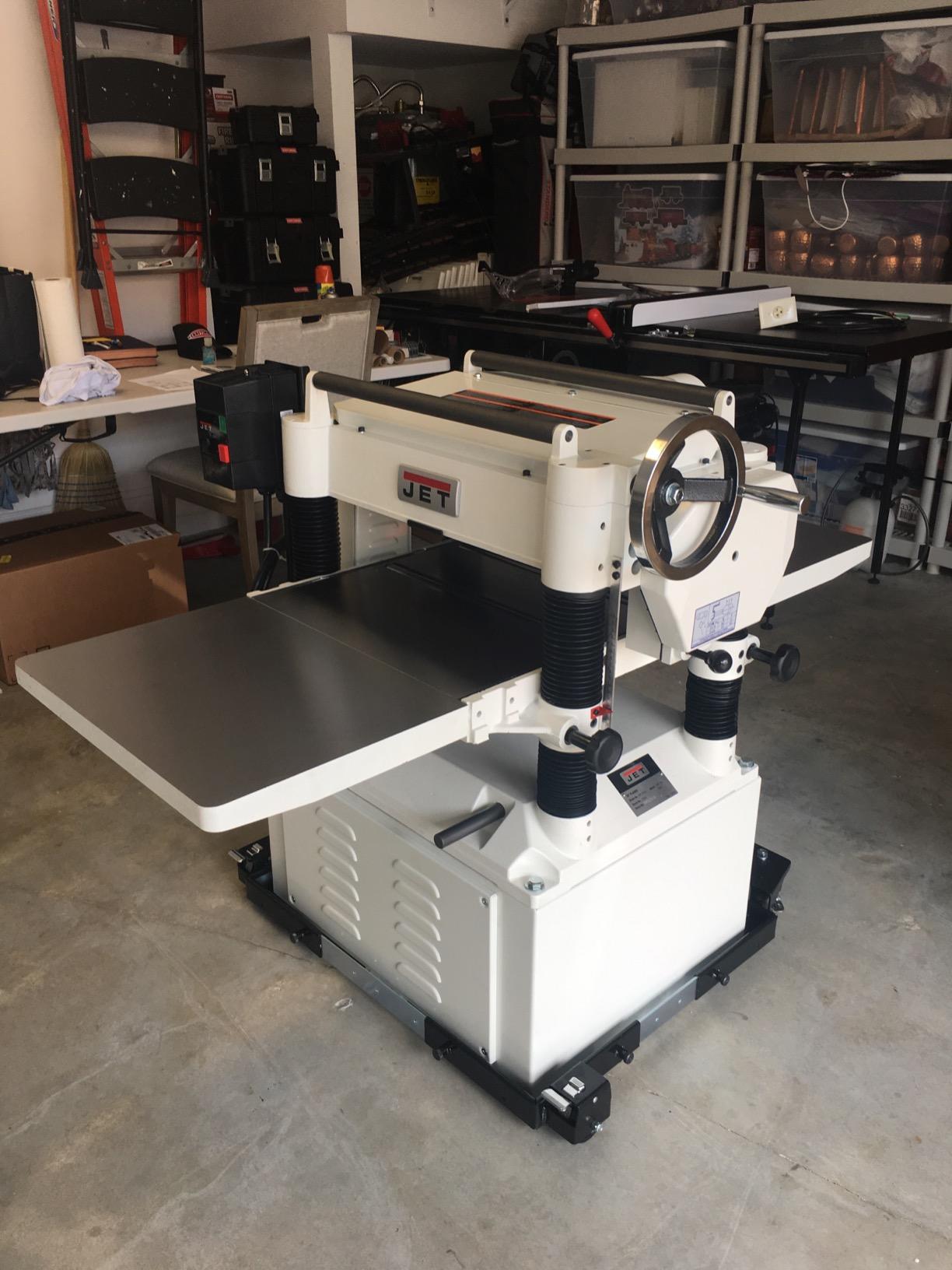
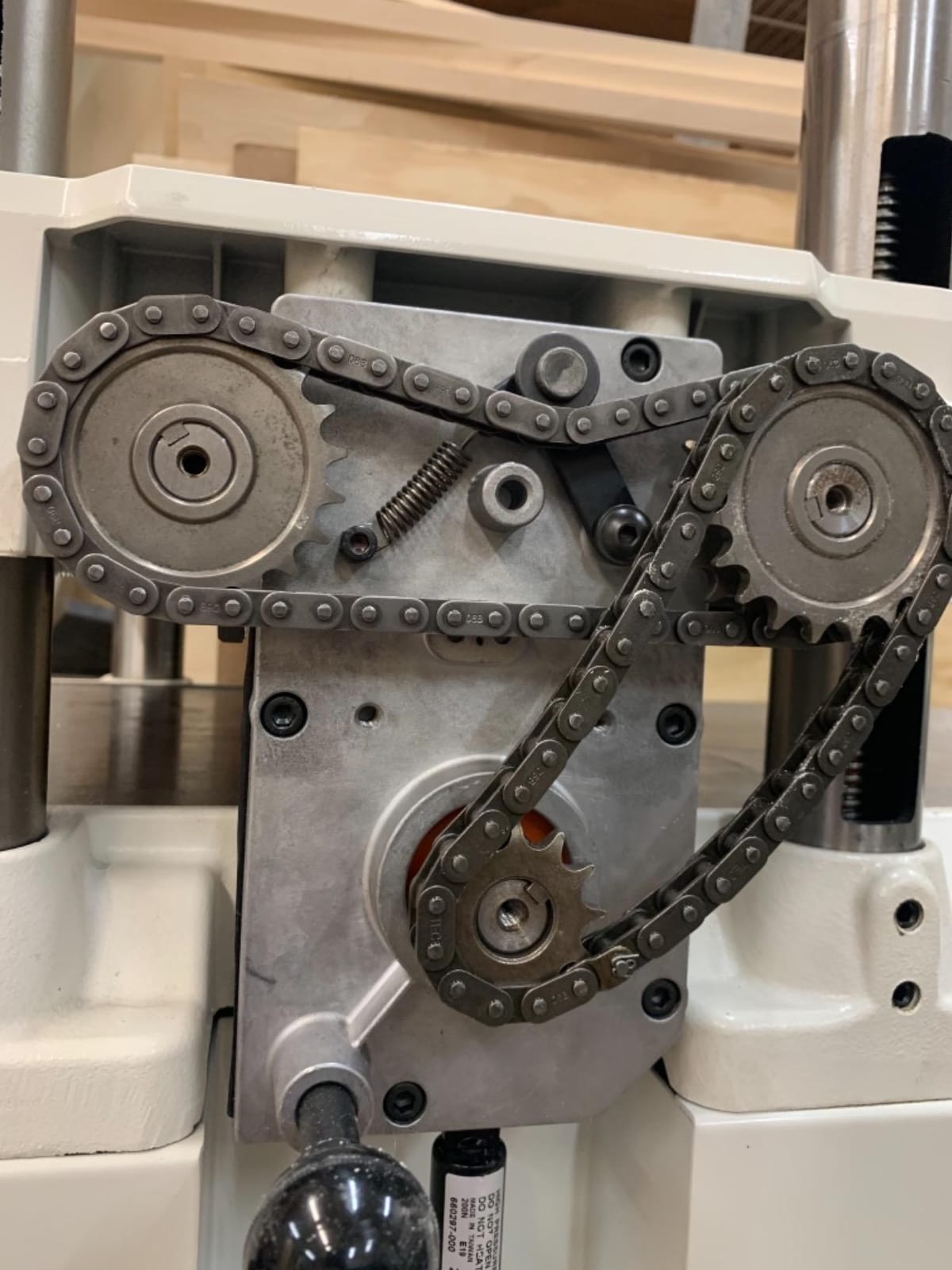
The gearbox offers two feed speeds at 24 and 31 FPM with an automatic chain tensioner. Both are faster than the 13-inch benchtop machines, and for wide figured material that is fine because the 20-inch head is spreading the work across far more inserts at once. The one-piece welded steel base, cast iron infeed and outfeed tables, and magnetic controls give it the feel of a production machine rather than a shop tool.
Owners rate the results highly on wide material, and 85 percent hand it five stars. The cut quality on figured walnut and spalted wood is reported as flat and accurate, and the head turning at 5000 RPM rather than 10000 RPM is a design that leans into wide, hard passes.
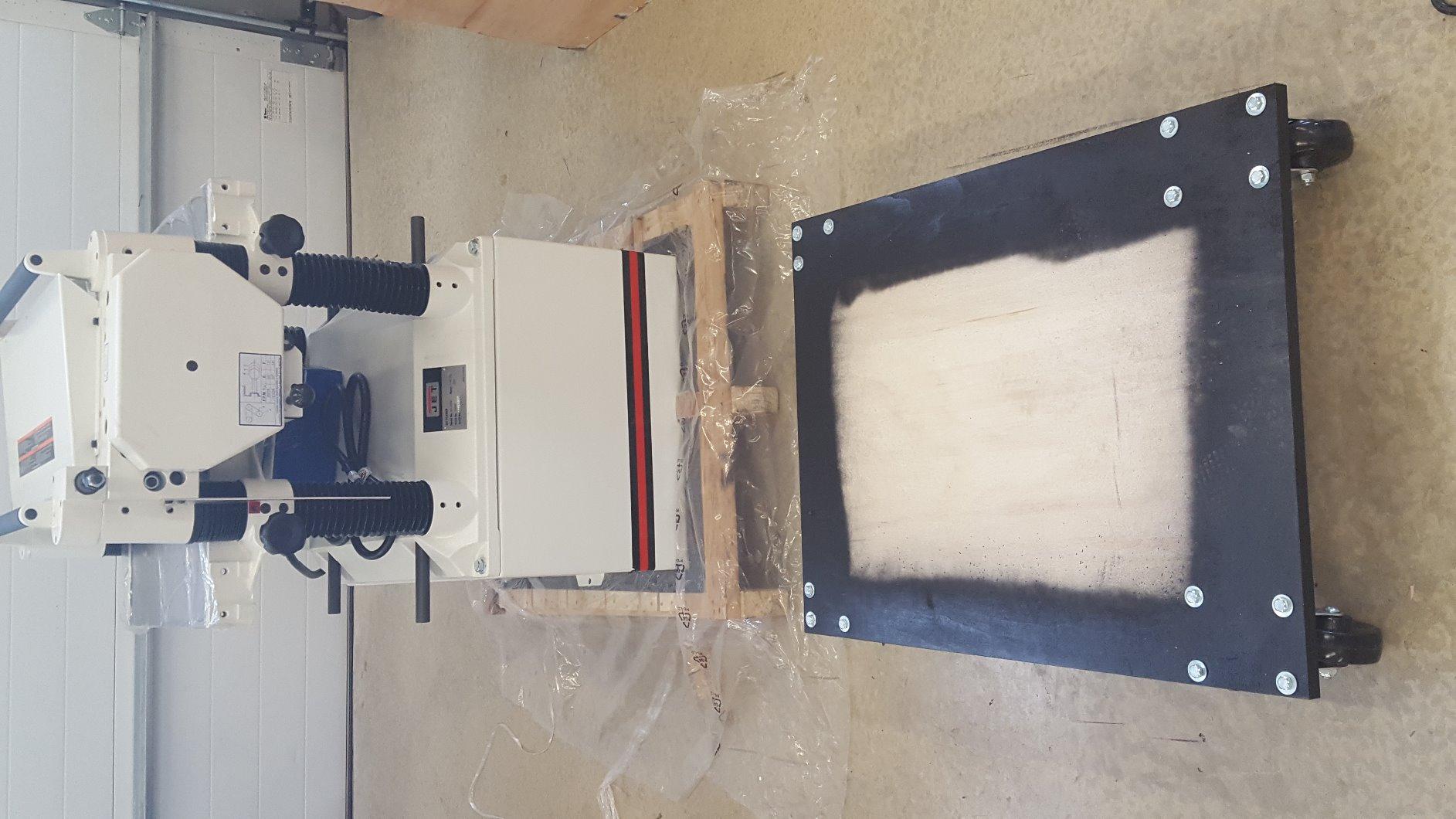
Why width changes the figured-wood decision
Figured wood punishes you twice for width. A wide board is more likely to contain figure running in conflicting directions, and a planer that needs two passes will leave a witness line right across the middle of the most interesting part of the board. Taking it in one pass removes that problem entirely and removes the temptation to overlap passes.
If your work involves flitch preparation, wide walnut slabs or glued-up panels of figured maple, the 20-inch width pays for itself in avoided witness lines alone. Just be honest about whether your shop can support the machine.
Requirements that decide the deal
At 753 pounds and 230 volts single phase, this is a two-person move and a dedicated circuit. Most home shops are 120 volt, and adding a 230 volt branch with the correct breaker is a project of its own. Plan for that before you commit.
It also needs dedicated floor space at 36.7 by 26 by 41.4 inches. In a one-person shop, that footprint and the electrical work are often the real reasons to choose a 13-inch machine instead. If you already have the circuit and the space, this is a wide-stock machine with very little holding it back.
5. King Canada KC-13HPC 13-Inch Helical Cutterhead Planer – Best Readout
- Cutterhead rides on four precision-ground columns for stable depth
- Thickness display with a scale in inches and millimetres
- Eight preset depth stops for repeatable batch cuts
- 15 amp motor with thermal overload protection
- Single-speed feed with no slower finishing pass
- Brand and parts availability more limited than JET WEN or DEWALT
- Insert changes need the included Torx key and hex key
The KC-13HPC stands out for one reason: measurement. It carries a thickness display with a graduated scale in both inches and millimetres, which is more than any other 13-inch machine here offers. When you are stepping a figured board down through several passes and trying to protect soft earlywood, a real readout removes a lot of guessing.
The cutterhead rides on four precision-ground columns that let the head raise and lower for added stability, and that support matters on boards with figure running against the feed direction. 82 percent of its reviews are five stars, and owners cite the head support and the dual-unit scale as the two features that separate it from cheaper machines.
Preset depth stops go from 1/8 inch through 1/8, 1/4, 1/2, 3/4, 1, 1-1/4, 1-1/2 and 1-3/4 inch, so you can repeat a cut at a common board thickness without re-measuring. The 15 amp motor carries thermal overload protection, which is a sensible inclusion for a machine you might run through a long stack of panels.
The spiral cutterhead produces a superior finish with low tear-out on figured hardwoods according to owners, and the head support keeps depth consistent as the material changes. This is a well-regarded 13-inch machine whose weakness is not the cut but everything around it.
Where the measurement advantage pays off
Figured wood punishes inconsistent depth more than any other material, because a dip into soft earlywood shows up as a flat spot under finish and a hard high spot through the curl. Having a live thickness display with both units means you can take a 1/32 inch skim across a whole board, read the result, and know whether you took an even layer.
The preset stops pair with that readout well for batch work. Set the stop, run a pass, check the display, and you get consistent thickness across a stack of panels without a caliper and without repeated re-setting.
The parts problem you should price in
Brand and parts availability are the honest limitation. A JET or WEN machine has a deep replacement-parts network and service support that most shops can draw on. King Canada does not, and if a casting, column or drive component fails you may wait longer for the part.
Single-speed feed is the other limitation. There is no slow finishing pass for the most fragile figure, so you compensate by taking lighter cuts, which is slower work. For a buyer who values measurement and has patience for parts, that trade is worth making.
6. Cutech 40600H 13-Inch Spiral Planer – Best Carbide Value
- Tungsten carbide inserts outlast the HSS competitors in this range
- Two-sided inserts with a non-cutting edge resist skewing
- Four lead screws and patented coupling minimize snipe automatically
- Low amp draw from the in-house insert and head design
- Board return rollers allow consecutive passes
- Single-speed feed with no slow finishing pass
- 10 percent one-star share on some units for assembly problems
- Unproven brand with a smaller replacement-parts network
The Cutech is the only 13-inch machine here specified with tungsten carbide inserts, and that single fact changes the ownership math. Carbide holds an edge far longer on hard figured material than the HSS inserts used by the WEN, the JET and the RIKON, so you spend far less time removing, rotating and reinstalling cutters.
Its inserts are two-sided with a non-cutting edge on the back, and that geometry is the second reason we like them. The non-cutting edge keeps the insert from skewing while it is in the cut, so the row stays aligned without repeated adjustment. Owners planning curly maple, burl and walnut specifically point to the inserts as the deciding factor.
The snipe minimizer is the feature owners single out most. Four lead screws and a patented coupling design reduce snipe automatically, without a separate snipe lock accessory that other machines in this class treat as an add-on. Snipe is the most common complaint helical owners have, so building the fix into the machine is a real advantage.
Board return rollers sit on top so you can send a board back to the front for the next pass without walking around the machine. The flip-up dust hood gives you a choice of blowing chips out the back or hooking up a collector, an eight-position depth stop handles batch thicknessing, and a front scale shows the amount to be taken off in the next pass.
Why carbide matters on figured hardwood
Figured hardwood is abrasive work. Curly maple figure means the cutter is repeatedly entering and leaving earlywood and latewood in a very short distance, and burl and spalted walnut are full of hard, gritty material. HSS edges dull under that load and start to produce a fuzzy, torn surface. Carbide resists it, which is why carbide-headed machines hold a cleaner edge for longer on exactly the woods you care about.
The carbide head also draws less power in this design, since the inserts and head were developed together in-house. Low amp draw on a 13-inch benchtop machine means less voltage drop and more consistent depth under load, which on figured material is a quiet win.
The two drawbacks worth weighing
Single speed means there is no slower finishing pass for the most fragile figure. You compensate with shallow cuts, and on a wide board that is more time at the machine. If you mostly plane straight-grained boards you will not miss it; if figure is your main material you will.
A 10 percent one-star share points to some machines arriving with assembly or quality problems, and the brand has a smaller parts network than JET or WEN. Inspect on arrival and keep an eye on the drive components. In exchange you get carbide inserts at a benchtop price, which is a trade many small shops make happily.
7. JET JWP-15BHH 15-Inch Helical Planer – Best Carbide Head for a 230V Shop
JET 15-Inch Thickness Planer for Woodworking, Helical Style Cutterhead with 2-Speed (16 FPM / 20 FPM) Feed Rate, 3 HP, 230V 1Ph (JPW-15BHH)
- 48 staggered carbide knives self-align for long edge life
- Helical head shears fibers instead of chopping
- Precision Air Strut System reduces snipe when tables are level
- Quiet for a 15-inch machine with no motor strain on wide boards
- Reports of units arriving with missing or broken parts
- 4 inch dust port clogs fast on small wall collectors
- Weakest rating spread at 4.0 with 18 percent three-star reviews
- 230V circuit and 285 pound floor footprint
The JWP-15BHH is the dedicated helical head machine here, and the difference is in the cutterhead. It carries 48 staggered carbide knives engineered to align themselves without any adjustment, so as an edge dulls and you rotate or replace it, the head stays balanced. No indexing drills, no manual alignment, no re-setting after a rotation.
For figured wood, that self-aligning geometry is the whole argument. The head shears fibers instead of chopping them, and buyers report a smoother, quieter cut with no tear-out and no snipe on wide hardwoods, plus no motor strain on 14-inch raw boards. Where the segmented machines lift wedges out of cross-grain figure, this one rides through.
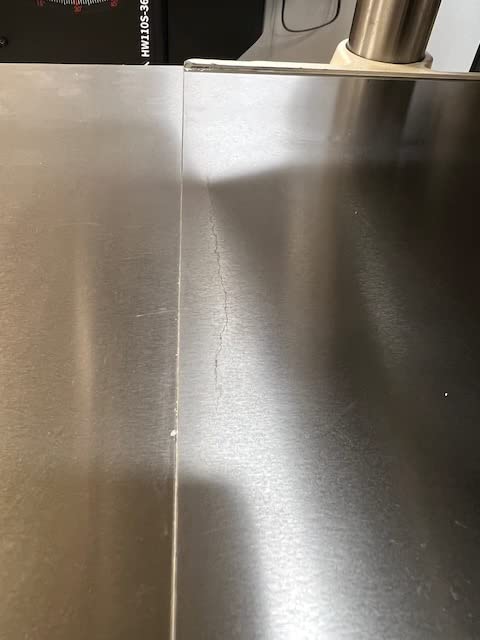
The Precision Air Strut System holds consistent upward pressure on the cutterhead, which reduces snipe as long as your tables are set correctly. Feed rate is selectable at 16 or 20 FPM, and the slow 16 FPM pass is the one to use on figured material. The precision-ground cast iron tables, four-post design and large gear-drive handwheel give it a stable, easy-to-dial feel.
A 4 inch dust port connects to a dust management system, which is a good match for a shop with a real collector. It is noticeably quieter than a straight-knife planer of the same size, and the 3 HP motor handles wide hardwood boards without complaint.
Where self-aligning carbide earns its keep
The advantage over a segmented spiral head appears the first time you rotate inserts and do not have to re-align anything. On a helical head the cutters align themselves, so a rotated edge comes back in with the same relationship to its neighbours. On a segmented head the segments need to be indexed together or the finish changes, which is the maintenance friction that makes some owners give up on spiral machines.
Carbide plus 48 self-aligning knives is the pairing on this list that reduces insert downtime most. If you plan figured material regularly rather than occasionally, that keeps more working hours in the cut, and 16 FPM is the most conservative feed setting on any 15-inch machine here.
What the 4.0 rating is telling you
Eighteen percent of its reviews sit at three stars, the weakest spread in the group, and the complaints cluster around delivery and assembly rather than cutting. Owners report units arriving with broken or missing foot plates, rollers, chain hardware and even a non-functional off switch, which is a quality-control problem rather than a design problem.
The dust port shares a side with the power switch, so you have to route around the wiring, and a 4 inch port clogs quickly on a small wall-mounted collector. Budget for a 230V circuit and roughly 285 pounds of floor space. If you have both and you want the best head on the most figured wood, this is the machine.
How to Plan Figured Wood Without Tear-Out
Even the best helical head planer for figured wood can be beaten into a bad surface. The machine handles most of the problem; these seven steps handle the rest, in order.
- Joint one face first. A flat reference face tells you where the tear-out is coming from. If your jointer tears out the figure, the planer will too, and no amount of money in a planer fixes it.
- Plane with the curl, not against it. Figure has a direction. Feed the board so the fiber leans away from the cut, and the head lifts out the full thickness of the fiber group rather than catching it.
- Take a skim pass first. A very light cut shears surface fibers without punching into them. Once you know the surface is sound, increase depth.
- Use the slowest feed speed your machine has. The 16 to 18 FPM settings on the JET and RIKON machines exist for this. Fast feed is for straight-grained removal, not for curl.
- Reduce depth per pass on wide boards. A 13-inch pass and a 15-inch or 20-inch pass are very different amounts of material for one head to shear. Split the work.
- Level and wax the infeed and outfeed tables. Snipe comes almost entirely from a height difference between tables and bed. Level them, then paste wax so the board slides instead of catching.
- Use a sacrificial board at the start and finish of each pass. Entry and exit marks show up as snipe at the ends of the cut. Feeding a scrap board first changes the entry point.
Feed speed and pass depth do more for your figured-wood surface than the difference between two machines of similar quality. If your results are bad, work through these seven steps before you blame the cutterhead.
Helical Head Retrofits vs Buying a New Planer
A helical retrofit is a legitimate path, not a compromise. Converting an existing straight-knife planer to a helical cutterhead gives you the shearing cut and the insert convenience without replacing the machine, the bed, or the electrical work you have already done. Owners running this conversion on their machines report the same clean figured-wood results they expected from a dedicated helical planer.
The math favours retrofit when your existing machine already has a good bed, adequate power and a serviceable cabinet, because you are only replacing the head. It favours a new machine when the drive, bearings or bed are worn, when you need more width than you have, or when you want the slow feed speed that stock machines often lack.
Forum owners are consistent on one point: a converted machine needs careful setup. Over-tightening insert retaining screws is the most common mistake and it damages both the screws and the inserts. Set them to the manufacturer torque, rotate inserts on a schedule rather than at random, and re-check head alignment after the first rotation. Related reading on keeping your tools sharp between machines is in our wood router roundup for the sharpening habits that carry over.
How to Choose a Helical Head Planer
Choose on the material first, then the machine. Figured wood decides the cutterhead type, the feed speed and the bed. Width and electrical requirements decide whether the machine fits your shop at all.
Cutterhead type is the first filter. A self-aligning helical head with carbide knives gives the longest edge life and the least maintenance, and it is what you want if figure is a regular material. A spiral or segmented head with rotatable HSS inserts costs less to buy and still beats straight knives on figured material, at the price of more frequent insert changes.
Feed speed is the second filter, and it is the one people skip. A second, slower feed lets you finish a pass without pushing the head hard across cross-grain figure. If a machine has one speed, you will compensate with lighter cuts, which is slower work and no better on the surface. Four of our seven picks carry two feed speeds.
Bed rigidity is the third filter. Cast iron beats aluminum on wide, hard cuts, and the two machines with the widest capacity both use cast iron or a welded steel base. The exception is the RIKON, which is a 67.9 pound portable aluminum machine that trades some rigidity for the ability to move around a small shop. That is a reasonable trade if your boards are narrow or your material is light.
Insert material decides your maintenance life. Tungsten carbide holds an edge far longer than HSS on hard figured hardwood, and one machine here pairs carbide with a self-aligning helical layout. HSS inserts are cheaper to replace and rotatable, which stretches their life, but they still reach the point where a fresh edge matters more than the cost.
Electrical requirement is where many home-shop purchases stall. A 120V benchtop machine plugs into a normal circuit and moves between locations. Anything at 15 inches or wider, or any 5 HP machine, wants 230V single phase on a dedicated circuit, and adding that branch is a real project. Check your panel before you commit.
Two things matter more than any of the above, and both are free. Level and wax the infeed and outfeed tables before your first figured board, because a height mismatch causes snipe no matter what head you own. And check the rating distribution in the reviews, not just the average, because a 4.2 with an 11 percent one-star share means a meaningful share of machines arrive with fit or finish problems.
Frequently Asked Questions
What is the best helical head planer for the money?
Among the machines that carry a true helical or helical-style head, the JET JWP-13BT is a well-rounded choice: six rows of quick-change HSS inserts, a precision-machined cast iron bed, two feed speeds at 18 and 26 FPM, and folding tables. If you want carbide inserts instead, the Cutech 40600H runs 26 tungsten carbide inserts in a 13-inch benchtop format with a built-in snipe minimizer.
Which is better, a spiral or a helical cutterhead?
A true helical head is better on figured wood. Its inserts are arranged in staggered rotating rows and self-align, so the head shears fibers progressively and stays balanced as edges dull. A spiral, or surveyor, head uses separate segments with cutting edges parallel to the table. Spiral heads are quieter and cheaper to maintain, but the segments must be indexed together and they can still leave tear-out on tight figure.
Are helical cutters worth it?
Yes, for figured wood. Helical heads shear rather than chop, which dramatically reduces tear-out on curly maple, quilted maple, burl and walnut, cuts sanding time, and lets you keep the figure instead of sanding through it. The benefit is smaller on straight-grained boards, where a straight-knife planer already produces a clean surface.
Can a helical planer handle figured maple without tear-out?
Mostly. Owners report near-zero tear-out on quilted and curly maple with helical or six-row insert heads, provided you take light passes, use the slower feed speed, joint one face first and feed with the direction of the curl. On the most extreme figure, such as burl or spalted wood, a wide belt sander can still finish what a planer leaves behind.
How often do I replace carbide inserts in a helical planer?
Carbide inserts on a helical head last far longer than HSS knives because each one takes a tiny share of the cut and can be rotated. In practice a set covers well over a year on typical hardwood work, provided you rotate them on a regular schedule and keep the head clean. HSS inserts wear faster on hard figured material and reach the point of replacement sooner.
How do I avoid snipe when planing wood?
Level the infeed and outfeed tables to the bed first, since a height mismatch is the main cause. Then paste wax the tables, feed the board through a sacrificial scrap at the start of the pass, keep the feed speed slow, and check the four-post head for parallel drift. Machines with a snipe control system, such as the Precision Air Strut on the JET JWP-15BHH, handle most of this for you once the tables are right.
What is the best helical cutterhead for the Dewalt DW735?
A helical cutterhead retrofit is the standard upgrade path for a DW735 and owners report the same clean figured-wood results they expected from a dedicated machine. The conversion only replaces the cutterhead, so you keep the bed and the electrical setup. The alternative is buying new, which makes more sense if the drive, bearings or bed are already worn or if you need more width.
The Verdict by Shop Type
For a one-person shop working furniture-scale figured wood on a 120V circuit, the WEN PL1326 is the machine we would buy first, with the JET JWP-13BT behind it for anyone who wants a cast iron bed and a slow feed speed. If your boards are narrow and your shop is small, the RIKON 25-135H is light enough to move and slow enough to protect the curl.
For shops with a 230V circuit and wide material, the JET JWP-15BHH pairs 48 self-aligning carbide knives with the figured wood, and the JWP-208HH handles slabs that no 13-inch machine should be asked to swallow. The King Canada KC-13HPC wins on measurement, and the Cutech 40600H wins if you want carbide inserts without stepping up to a 15-inch machine.
Whatever you choose, level the tables, wax them, take light passes and feed with the curl. That habit matters as much as the hardware, and it is the difference between a surface you can finish and one you have to sand back to nothing. For broader guidance on machine sizing and shop layout, start with our wood planer buying guide.