
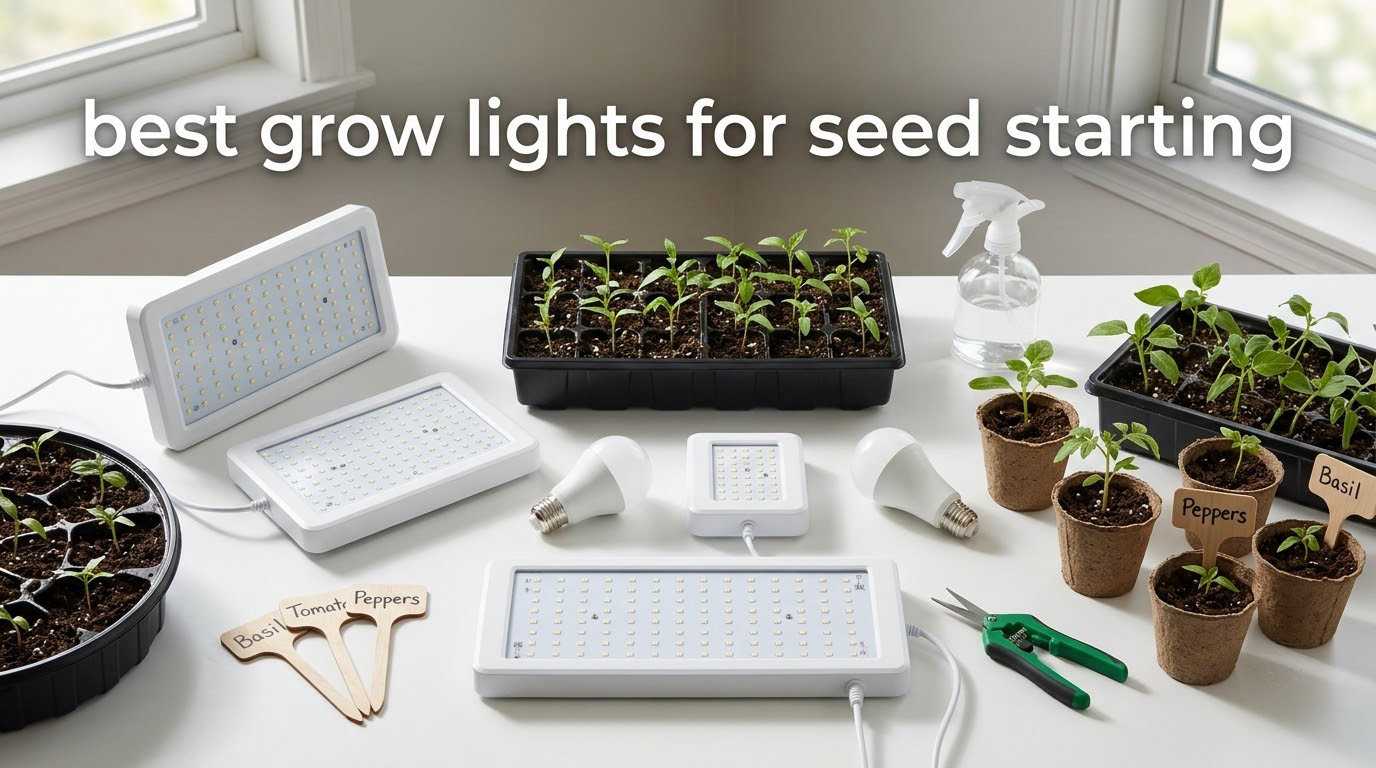
Every February I do the same thing: I clear a shelf, plug in a light, and set a timer for sixteen hours a day. Then in March the tomatoes come up looking like pale green chopsticks, and I spend a fortune on a brighter lamp that fixes nothing at all. That is the most common seed-starting mistake there is, and it has nothing to do with wattage.
The reason it keeps happening is that search results for this question are dominated by enormous fixtures built for indoor cannabis grows. You will see 860W and 2000W panels in the shopping carousel for a query that should be answered with a modest strip light. Those fixtures are not better for starting seeds. They are simply aimed at a different job, and they cost you money, heat and desk space to prove it.
This roundup of the best grow lights for seed starting covers twelve fixtures that are actually sized for propagation, from a single tray on a windowsill up to a four-shelf rack full of tomato and pepper starts. We looked at published output, colour temperature, mounting options, timer behaviour and the warranty, then checked what thousands of buyers report after a full season of use. We did not buy every unit here, so we tell you plainly where we are working from specifications and review data rather than our own bench.
If you already own a grow light for houseplants, start with our indoor plant grow light guide before you buy anything new. And if you want the broader science rather than a shopping list, our piece on the best LED grow lights we tested explains how these fixtures behave once seedlings turn into plants.
Top 3 Grow Lights for Seed Starting in 2026
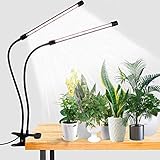
GooingTop 6000K Clip Grow Lamp
- 84 LEDs with CRI 90
- 10W draw
- Clip mount and gooseneck
- 4H 8H and 12H timer

Barrina T5 5000K Strips
- 20W across 4 fixtures
- Linkable design
- Clip and cable tie mounting
- 2-year warranty
All 12 Grow Lights Side by Side in 2026
Every fixture below is in the roundup with a full write-up. Ratings and review counts are the current figures shown on the product page.
| Product | Specifications | Action |
|---|---|---|
| GooingTop 6000K Clip Grow Lamp |
|
Check Latest Price |
 VIPARSPECTRA 70W Dimmable Grow Light VIPARSPECTRA 70W Dimmable Grow Light |
|
Check Latest Price |
| Barrina T5 5000K Strips 4 Pack |
|
Check Latest Price |
 LEOTER 80 LED Clip Grow Light LEOTER 80 LED Clip Grow Light |
|
Check Latest Price |
 bseah Dual Tube Grow Lamp bseah Dual Tube Grow Lamp |
|
Check Latest Price |
 LBW Grow Light with Tripod Stand LBW Grow Light with Tripod Stand |
|
Check Latest Price |
 Aokrean Telescoping Halo Grow Light Aokrean Telescoping Halo Grow Light |
|
Check Latest Price |
 FOXGARDEN Grow Light with Stand FOXGARDEN Grow Light with Stand |
|
Check Latest Price |
 Bokeedo T5 Twin Tube Grow Lights Bokeedo T5 Twin Tube Grow Lights |
|
Check Latest Price |
 SDOVUERC 16 Inch Six Bar Strip SDOVUERC 16 Inch Six Bar Strip |
|
Check Latest Price |
 Hlite 16 Inch Linkable Grow Light Bars Hlite 16 Inch Linkable Grow Light Bars |
|
Check Latest Price |
 LBW Three Head Grow Light with Stand LBW Three Head Grow Light with Stand |
|
Check Latest Price |
What Type of Grow Light Is Best for Starting Seeds?
A full-spectrum LED light, almost always a strip or bar fixture rather than a bulb lamp, hung two to six inches above your seed trays and run 14 to 16 hours a day. That combination delivers roughly 210 to 300 micromoles of light per square metre per second at the leaf surface, which is the range seedlings need to grow short, sturdy and ready to transplant.
Fluorescent T5 tubes still work well and cost very little, so an old shop light in a spare room is a perfectly respectable rig. What matters far more than the fixture type is how close you hang it and whether you raise it as the seedlings grow, because light intensity falls away with the square of the distance.
One more thing worth saying up front, because it saves a lot of confusion: seeds do not need light to germinate. The light starts mattering the moment the first true leaves unfurl.
1. GooingTop 6000K Clip Grow Lamp – The One I Keep Coming Back To
- 84 LEDs with CRI 90 at a 10W draw
- Sturdy gooseneck holds its aim
- Heavy-duty clip grips shelves and tables
- 4H 8H and 12H timer with dimming
- Timer runs one cycle per 24 hours
- Narrow beam when hung close to a tray
- Outer seedlings need regular tray rotation
This is the lamp I put on the shelf first every year. It clips to the front lip of a wire rack, the gooseneck arcs over, and the head sits low enough over a 1020 tray that nothing has to stretch. The clip is genuinely heavy duty, which matters more than any spec sheet when you are balancing a lamp over wet soil.
The light itself is 6000K white with ten red diodes mixed in across 84 sources, and the 90 colour rendering rating means seedlings look like themselves rather than a strange purple. It draws 10W, so running it sixteen hours a day for a twelve-week season costs less than a cup of coffee a week.
Reviewers consistently point out the same strength: the gooseneck holds position. Clip lamps in this category usually droop within a season, and a drooping head means a changing footprint, which means uneven seedlings across the tray.
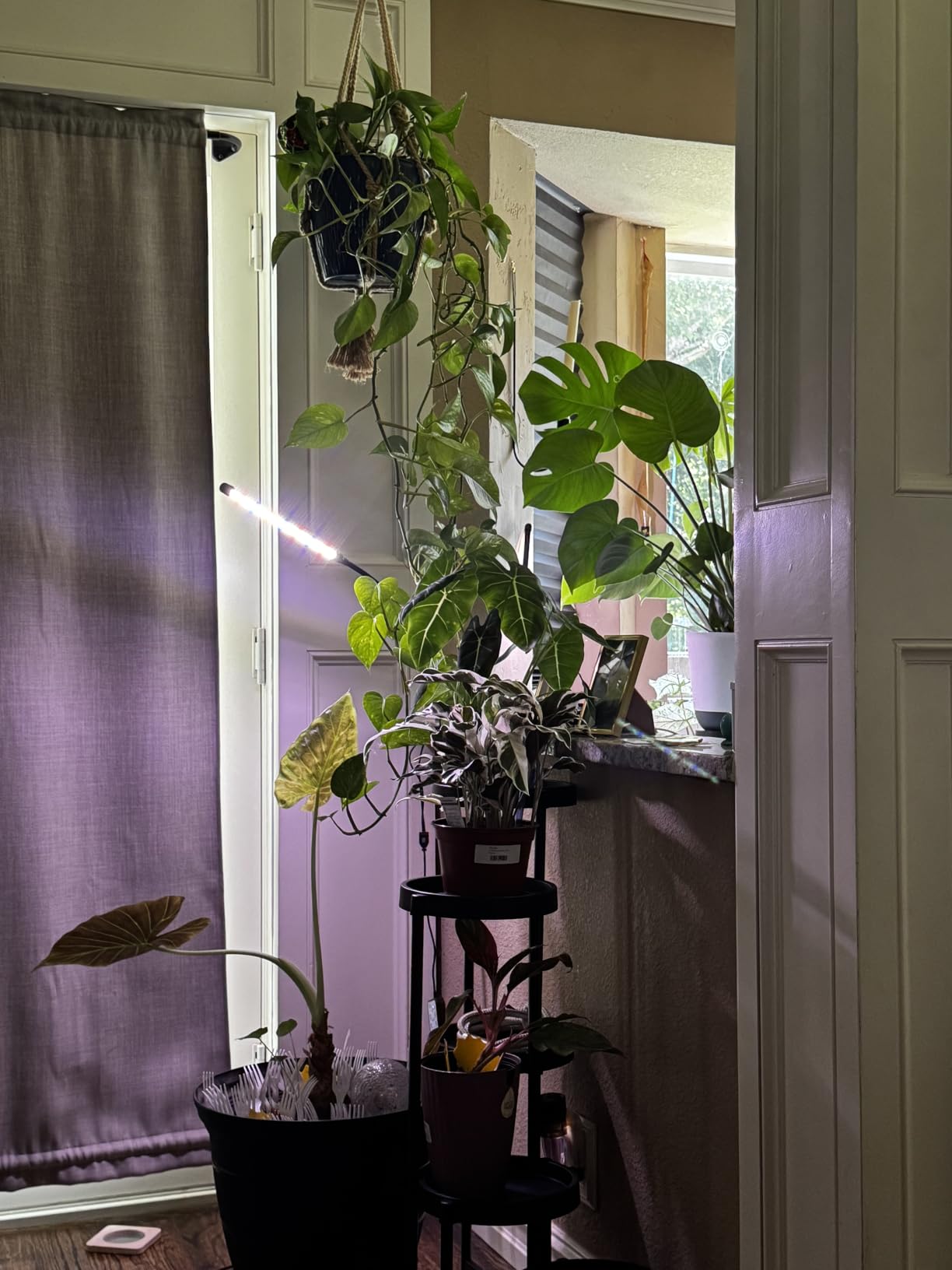
The one thing to understand before you buy is the timer. The 4, 8 and 12 hour settings do not alternate on and off within that window. The lamp runs for the chosen block once, then stays off until you reset it or until the 24-hour cycle comes back around. Owners describe this as confusing more than broken, but plan your schedule around it.
It is also a single-row head, so the beam is narrower than the older flat-head versions from the same brand. Hung right above a tray, the centre gets more light than the corners.
Our fix is unglamorous: rotate the tray a quarter turn every few days. Two minutes of work keeps the outer seedlings from leaning outward toward the middle of the lamp.
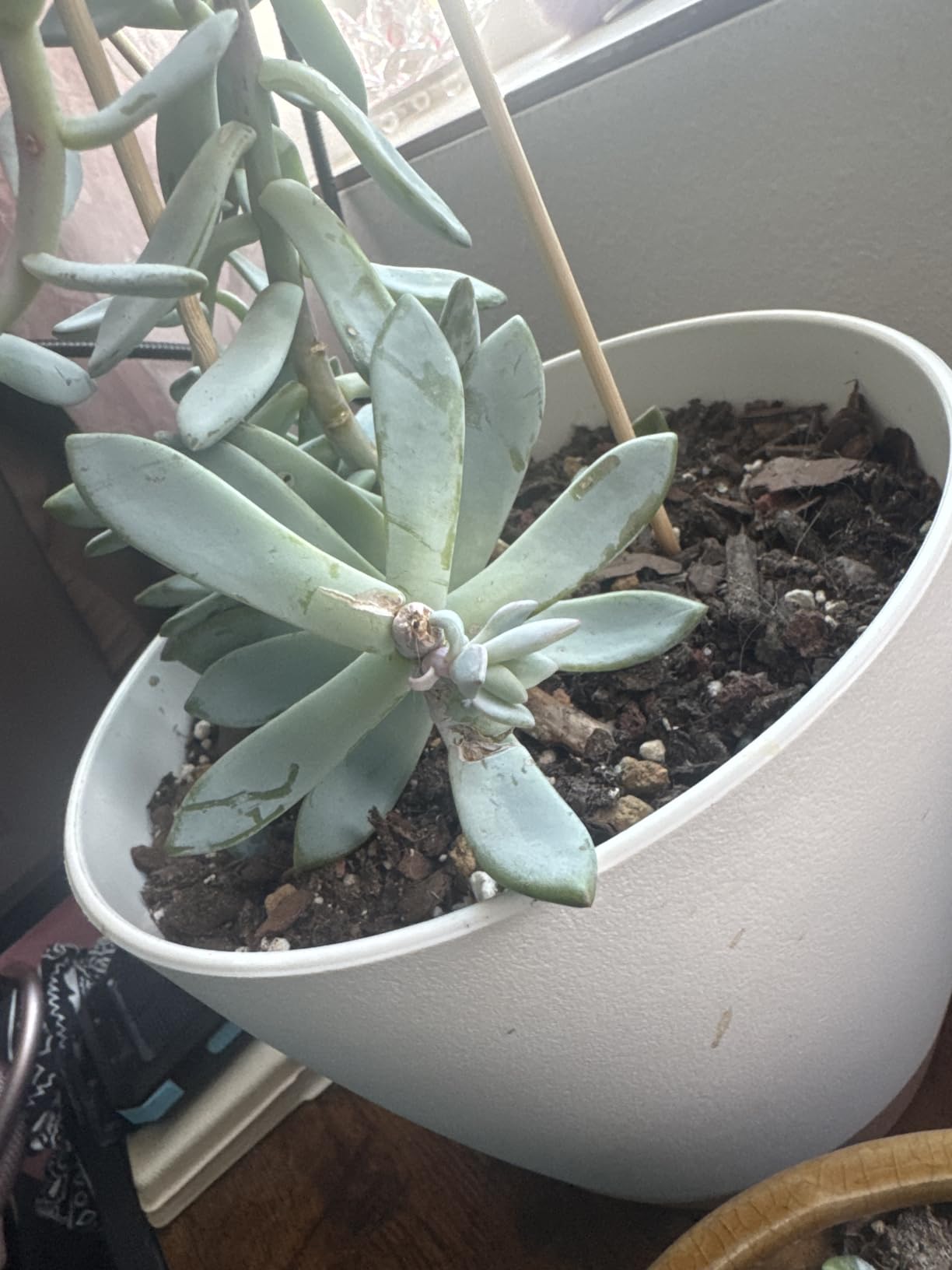
Who this lamp suits
If you are starting a handful of trays on a single shelf and you want a fixture that will not need drilling, this is the safest first purchase. The clip grips thick enough surfaces, the aim is adjustable, and the timer takes care of the hours.
It is also the light I recommend if your seed-starting spot is a spare room rather than a garage, because the head is compact and the housing is unobtrusive on a shelf.
Where it falls short
It will not light an entire four-shelf rack on its own, and the narrow beam means a single tray needs active management. Gardeners who want even coverage across a wide shelf are better served by the strips further down this list.
The dimming is also a simple step control rather than a smooth dial. That is fine for most seed starting, since seedlings rarely need fine intensity changes before transplant.
2. VIPARSPECTRA 70W Dimmable Grow Light – 11,000 Lumens for Full Shelves
70 Watt Grow Light, Dimmable Plant Light, LED Grow Lights for Indoor Plants
- 11000 lumens aimed at seedling and vegetative growth
- 4-level dimmer for newly emerged seedlings
- Fanless aluminum heat sinks run cool
- Pulley system makes height changes quick
- 3-year limited warranty
- Very bright even on the lowest setting
- Emits noticeable heat in enclosed spaces
- Switch and plug sit awkwardly on a shelf
This is the fixture to buy when a strip light feels too timid for your space. It produces 11,000 lumens from a 70W draw, and the 4.7 rating across more than 5,000 reviews is the strongest number in this roundup. Users running seed-starting racks on wire shelving report strong germination and fast early growth.
That brightness comes with the single most useful feature here for a first-time grower: a dimmer. Set it to the lowest level for freshly emerged seedlings, then step it up as the cotyledons fill out. You are not forced to choose between too dim and too bright.
The spectrum balances 660nm red with 3000K and 5000K white, which is a sensible approximation of daylight rather than the heavily purple output of cheaper strips. The aluminum body has large fanless heat sinks, so it dissipates without a fan humming in a quiet room.
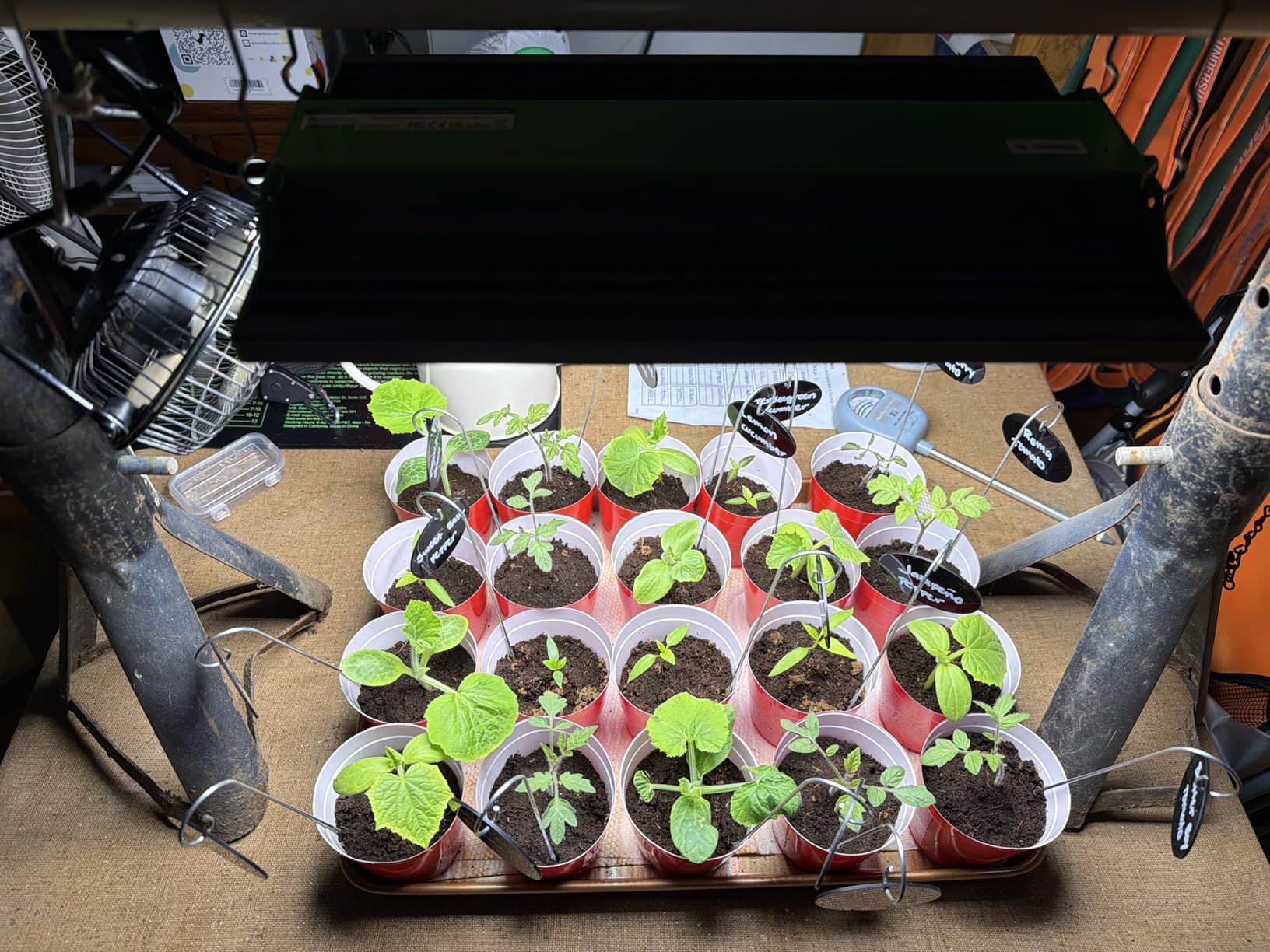
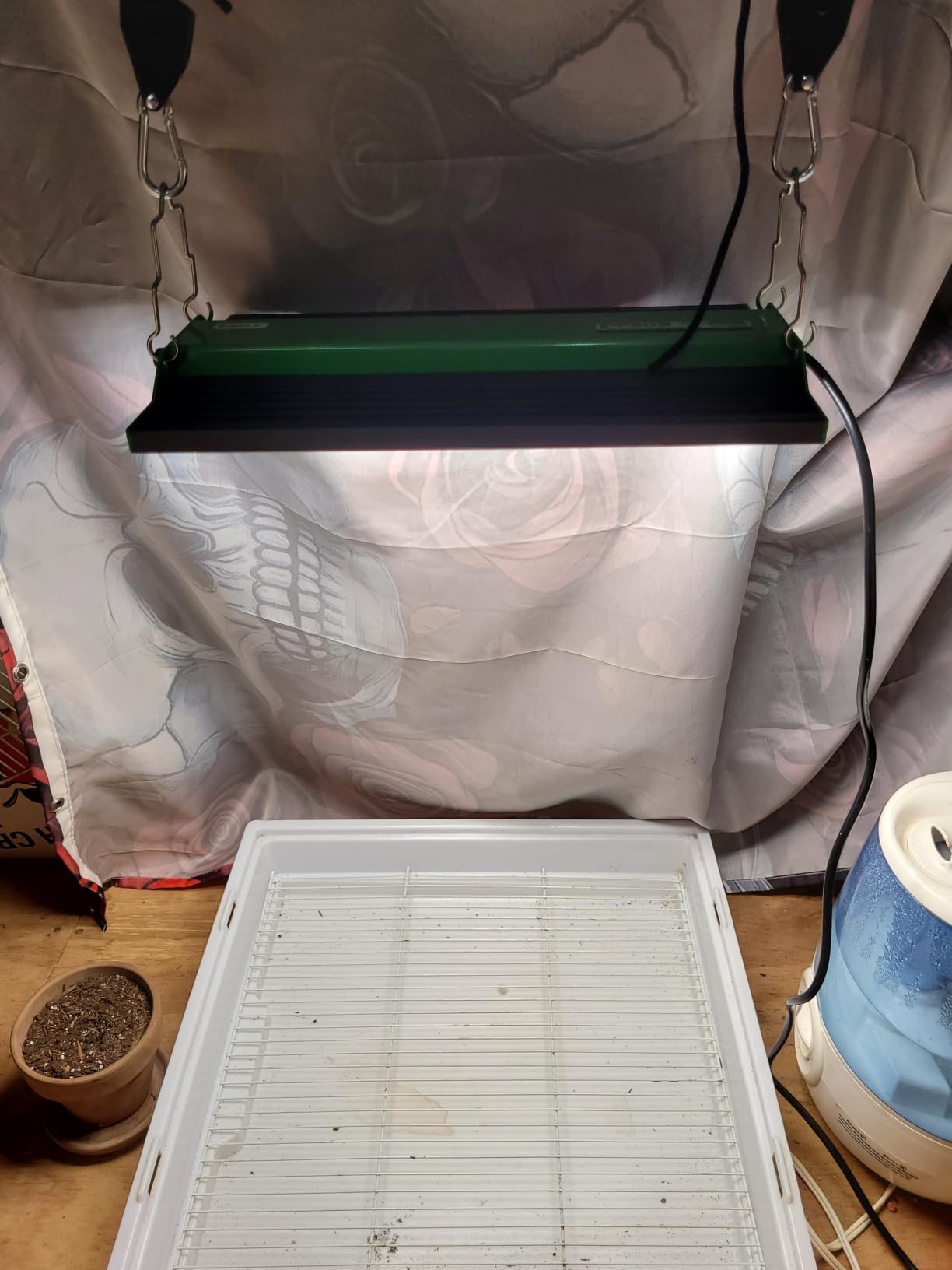
Reviewers measuring with PAR meters report that the coverage matches what is advertised at dimmed settings, which is more than most budget fixtures manage. The pulley hanging system with stainless steel hooks means you can raise the bar as the canopy climbs without rebuilding anything.
The honest drawback is brightness in eye line. Even on the lowest setting it is a strong light, and many owners solve this with a shade or by keeping the fixture out of the direct sightline from a desk.
It also throws real heat. In a small enclosed room you will want an airflow fan, which is worth budgeting for if you are running it in a closet conversion.
Who this light suits
Anyone running a full wire shelf, a two-shelf unit or a small greenhouse corner where a single strip will not cover the width. The dimmer is what makes it safe for seedlings rather than only for established plants.
If you are also growing on past the seedling stage, the output headroom here is the reason to stretch for it. Most lights in this roundup are sized for propagation and become marginal at flowering.
Where it falls short
For a single tray on a windowsill it is genuinely too much light at full power, and it takes up a shelf you probably needed for pots. The dimmer resolves that, but only if you remember to use it.
The on/off switch and power plug sit on the top and middle of the fixture, which reviewers note is awkward on a tight shelf. Plan the cable run before you hang it.
3. Barrina T5 5000K Strips – The Shelf Builder’s Choice
Barrina T5 Grow Lights for Indoor Plants, 5000K Full Spectrum, 1FT, 4 Packs
- 96 LEDs across four fixtures at 20W combined
- Linkable in series up to 16 fixtures
- Each fixture has its own on/off switch
- Runs cool and mounts under shelves
- 2-year warranty with mounting kit
- No built-in timer
- Short cords on wide shelving
- Double-sided tape can let a fixture slip
If you are building a rack rather than buying a lamp, this is the fixture most gardeners end up with. A user in r/vegetablegardening described the canonical build plainly: four 4ft Barrina T5 LED strips, two pieces of wood, four cable ties. That rig underpins most home propagation shelves on the internet.
The 5000K white spectrum is the detail other forums keep circling back to. In r/gardening the recurring advice is that any LED at 5000K or above works well, and Barrina strips come up repeatedly as the durable, inexpensive version of that idea. Ninety-six diodes across four fixtures pull 20W combined.
They are also the easiest to arrange. Each fixture has its own on/off switch, and two power cords mean you can split the set across two shelves. Linkable in series up to sixteen fixtures covers a large rack from a single run.
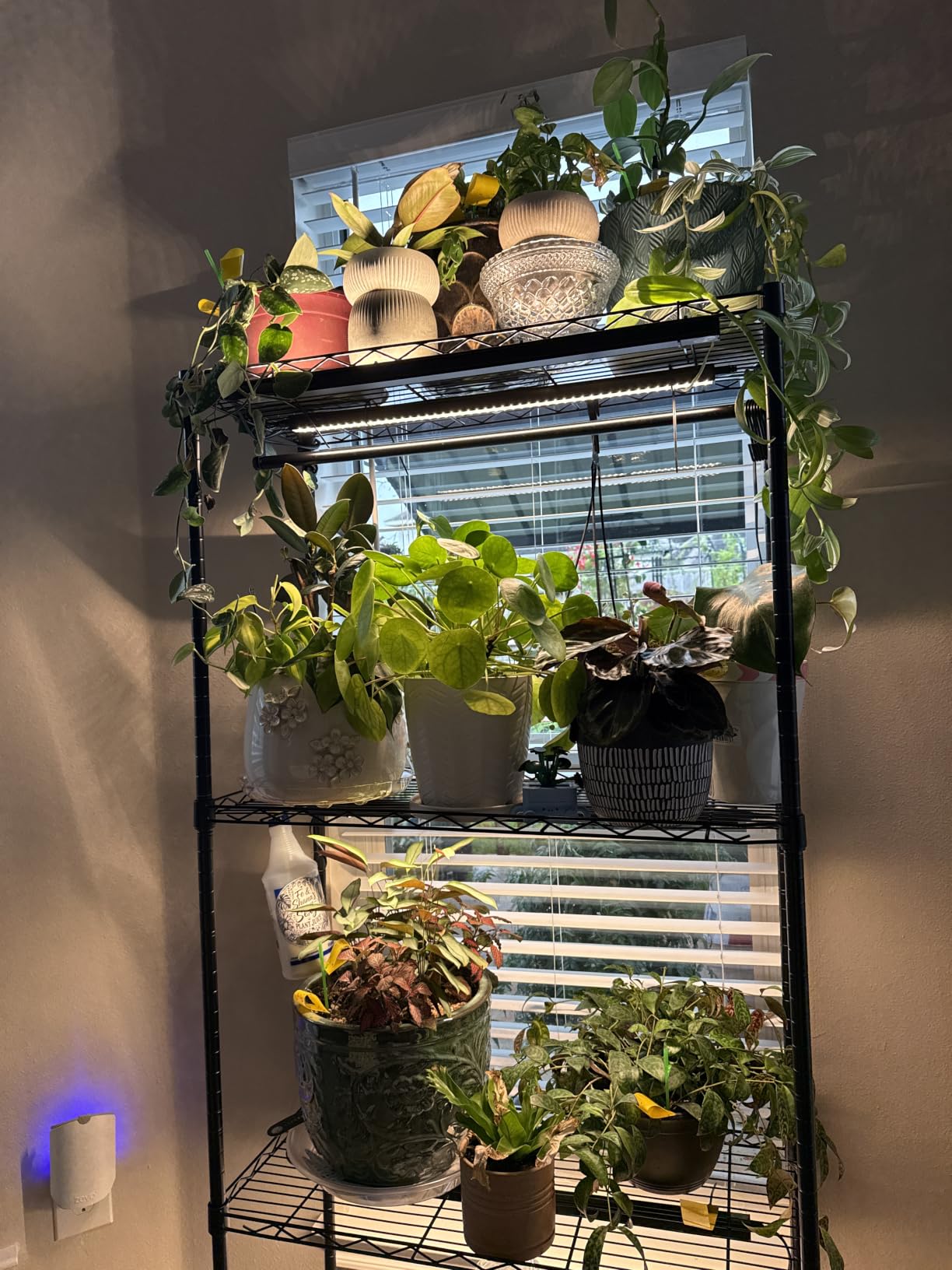
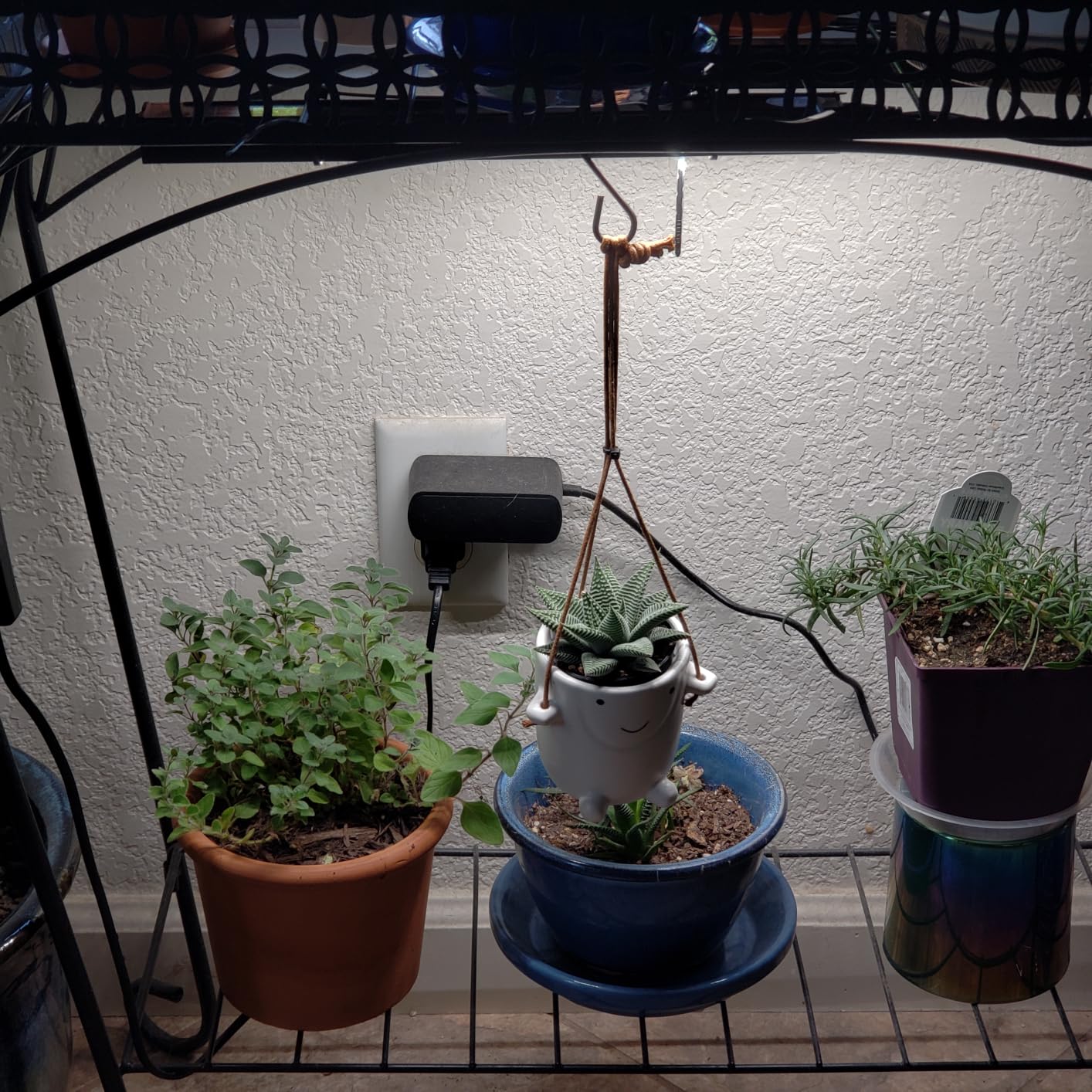
The housing is slim, runs cool and mounts under shelf boards, cabinet tops or rack frames. The mounting kit includes double-sided tape, clips and cable ties, which covers most renter situations without a drill.
Two years of warranty is longer than most competitors in this category offer, and at over 7,000 reviews at 4.6 stars there is a large body of long-term owner feedback to draw on.
The limitation everyone mentions is the missing timer. There is no scheduling built in, so you need a wall timer or a smart plug. That is a five-minute job once and then never again.
Who these strips suit
Multi-shelf propagation racks, especially where you want one purchase to scale. Four fixtures cover an 18 inch by 4 foot shelf comfortably, and more strips extend the same run.
They are also good under-cabinet lighting if you are starting herbs and greens on a kitchen shelf, since the aluminium and polycarbonate body stays cool enough to mount directly underneath.
Where they fall short
The one-foot version in this pack covers a small area, and the cords are short enough that wide shelving units will need an extension. Buy the four-foot version if your shelf is wide.
Double-sided tape is a quick fix but needs a properly cleaned surface. On a dusty shelf board a fixture can creep, so use the clips or cable ties if the light hangs over anything fragile.
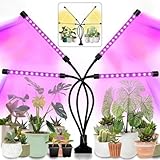
4. LEOTER 80 LED Clip Grow Light – Most Control in a Small Footprint
- 80 LEDs spanning 380nm to 800nm
- 10 dimming levels and 3 spectrum modes
- Gooseneck holds aim without drooping
- Circular memory timer repeats daily
- Heat sink with temperature control
- Timer resets after a power interruption
- USB cord needs an outlet within reach
This is one of the most adjustable lamps in the roundup, and for a gardener who wants to change intensity week by week that matters. Eighty diodes cover 380nm to 800nm, split across 32 red, 12 blue, 20 yellow and 16 white, and you can run them as full spectrum, red and blue, or red and blue with warm white added.
Ten dimming levels take the edge off the intensity question. Freshly emerged seedlings sit comfortably at the bottom two or three settings, and you step up as leaves develop, which sidesteps the bleaching risk of a fixed-output lamp.
The 360-degree gooseneck holds a fixed position rather than creeping, and the metal clamp mounts on anything with a lip. At more than 12,700 reviews and a 4.5 rating, this is one of the most thoroughly reviewed clip lamps in the category.
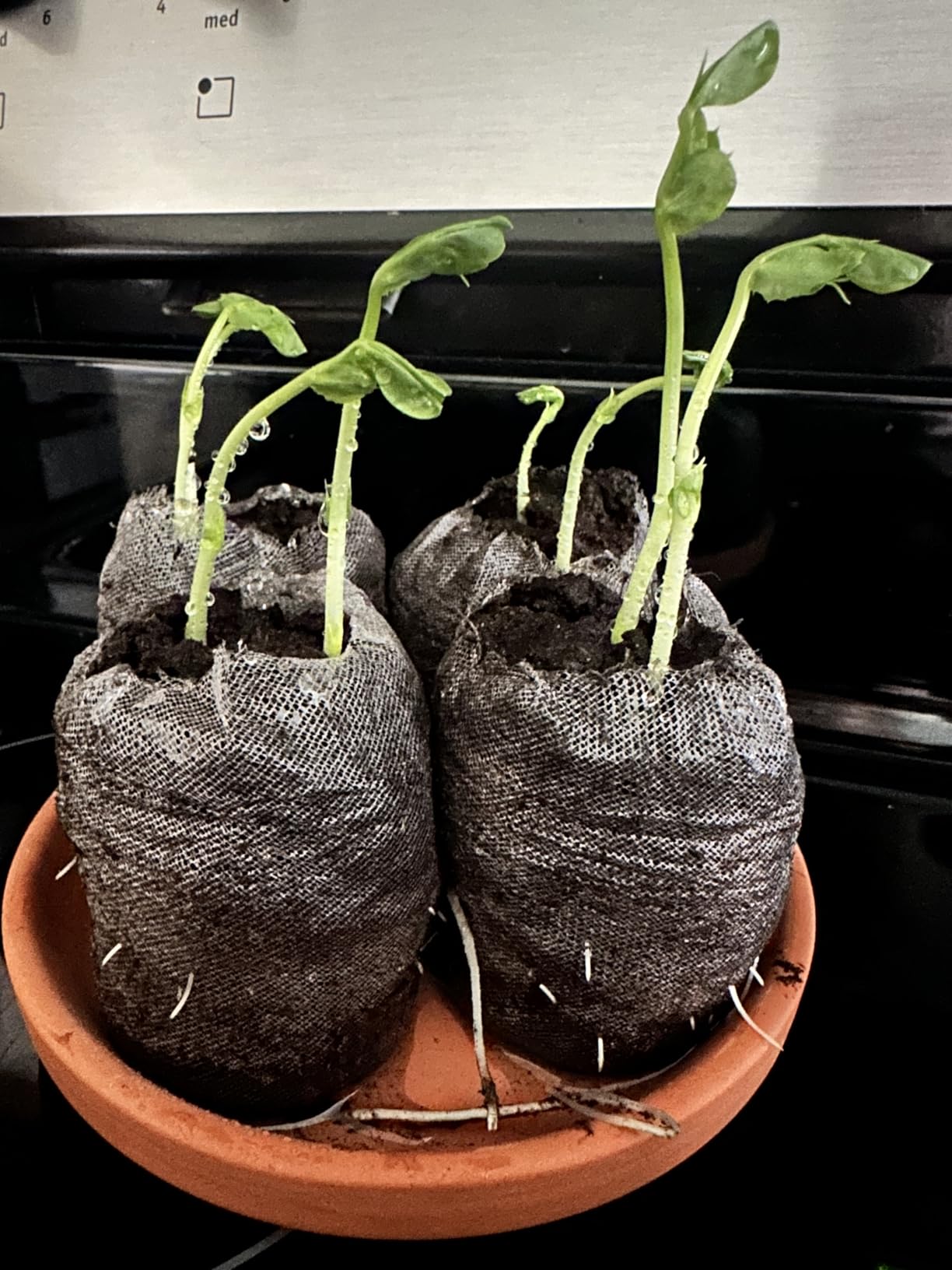
The circular memory timer runs at 3, 9 or 12 hours and repeats daily while power stays on, which is closer to what a seed starter actually wants than the single-cycle timers on some competitors.
Reviewers like the aviation-grade heat sink and temperature control unit, which keeps output steady rather than letting it sag as the housing warms.
The recurring notes are practical. The timer needs resetting after a power cut, and the USB connection with the included adapter means an outlet has to be within reach of the cord, so plan your shelf around the socket.
Who this lamp suits
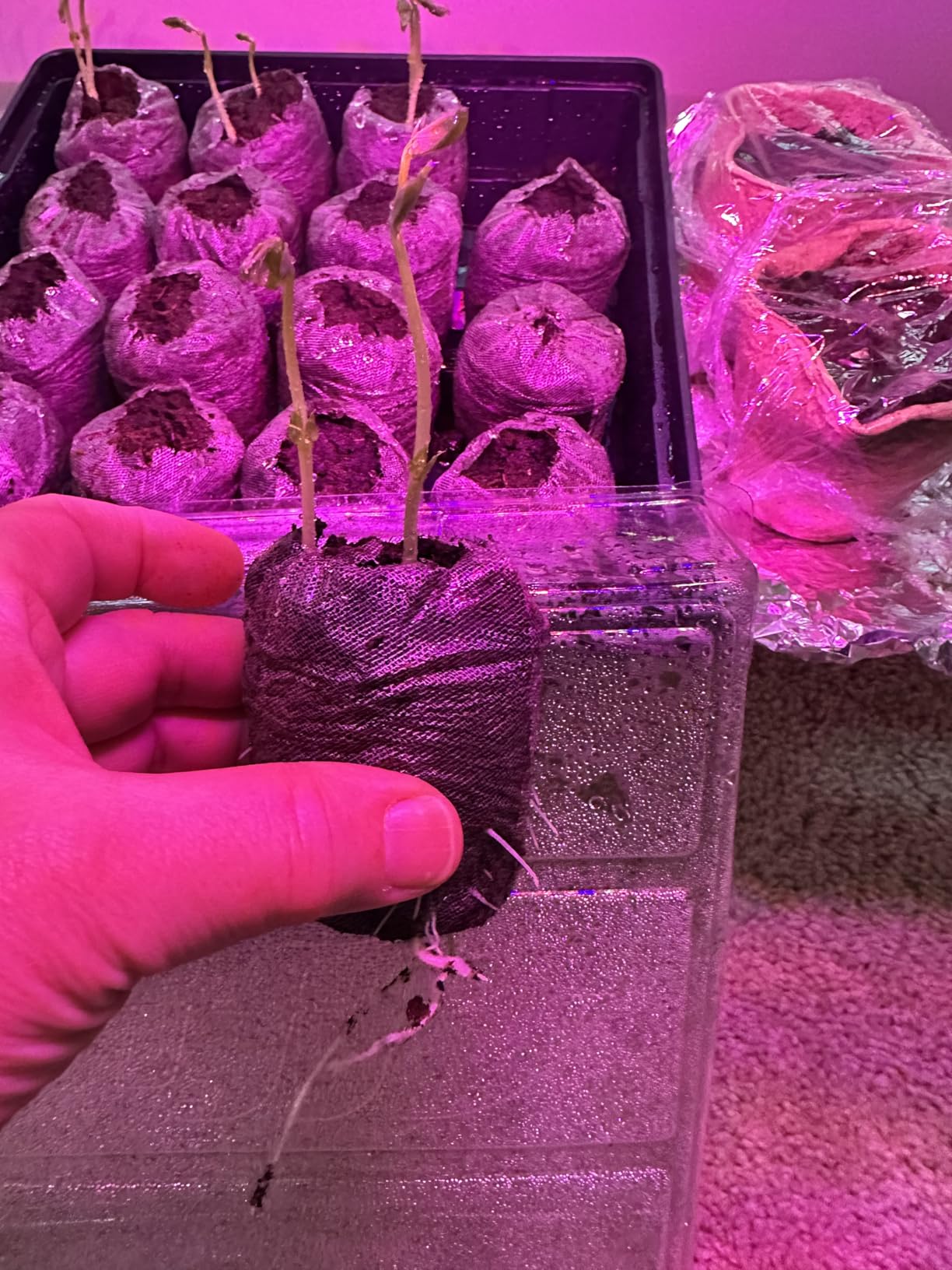
Anyone who wants to dial light down for sprouting and up for leafy growth using the same fixture. The three spectrum modes also let you run a warmer, less purple light once you are overwintering herbs on the same shelf.
If you only have one outlet and a short distance from it to the tray, check the cord length before you commit. Otherwise this is a strong all-rounder for a single shelf.
Where it falls short
It covers a small area. Eighty diodes at this size is a lamp for one or two trays, not a full rack, and pushing it wider leaves edges dim.
Some buyers also note that the range of settings invites fiddling. Set a schedule in the first ten minutes and then leave it alone, because changing intensity weekly is how you end up with uneven trays.
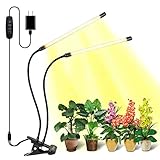
5. bseah Dual Tube Lamp – The Smallest Useful Light
- Full spectrum yellow and white LED pairing
- Metal clamp grips shelves firmly
- No assembly needed
- LEDs rated for up to 50000 hours
- 2-year manufacturer warranty
- USB cord runs about 54 inches
- Plastic film on the tubes is hard to remove
- Goosenecks lose rigidity over time
Two LED tubes, a metal clamp and a timer. This is the most affordable light here that still does the job properly for a single tray, and at nearly 9,000 reviews with a 4.5 rating it has clearly been put to work by a lot of people.
The yellow and white combination covers photosynthesis, germination, growth, flowering and fruiting in the manufacturer’s description. In practice for seed starting, what you are getting is a soft, even wash with ten dimming levels and three switch modes for different stages.
It needs no assembly at all. The clamp has a non-slip mat that grips a shelf edge, and the two gooseneck arms let you aim each tube independently at a tray angled toward a window.
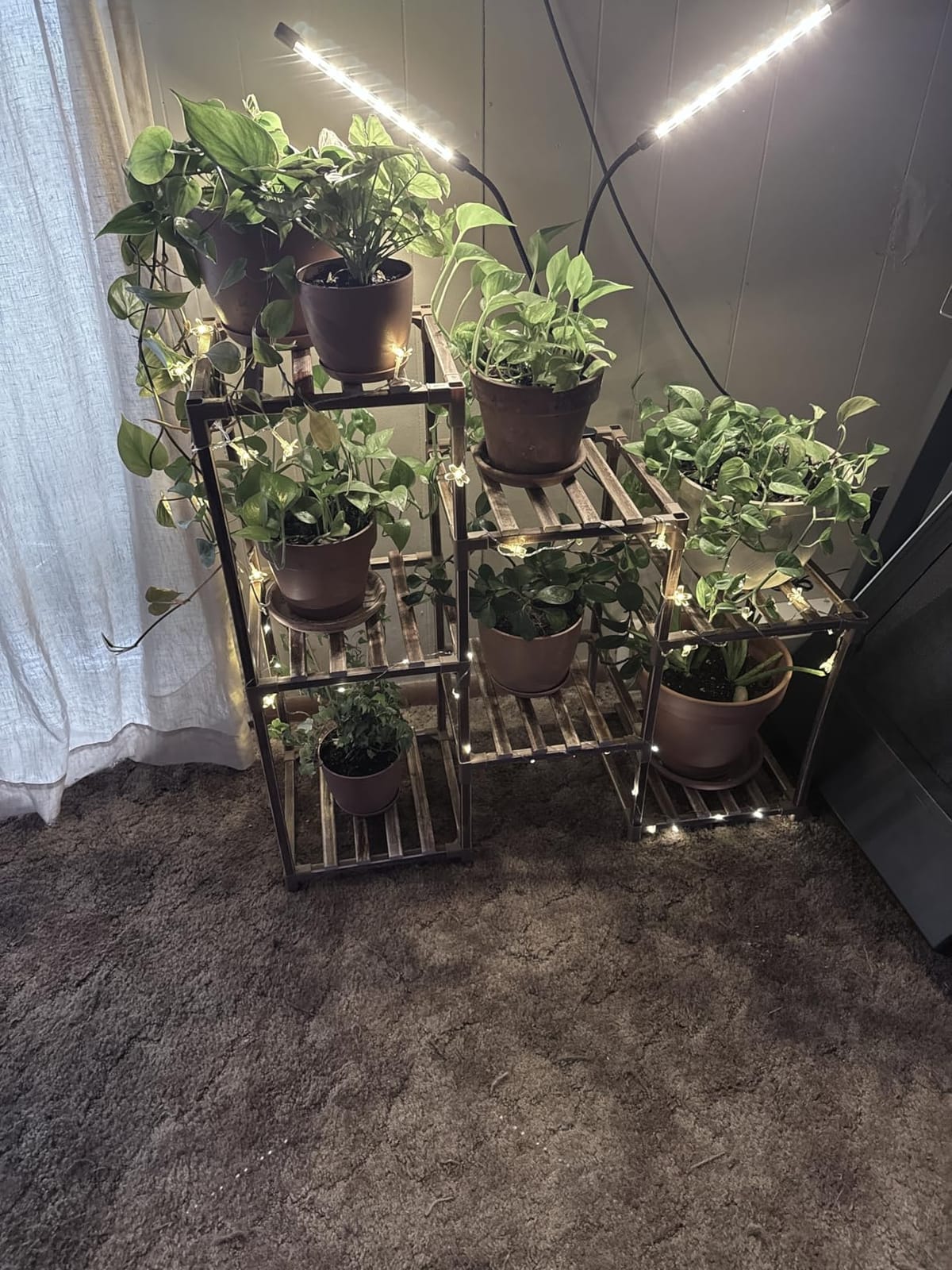
The automatic 3, 9 and 12 hour cycle memory timer removes the daily on and off chore, and the LEDs are rated for up to 50,000 hours, which is far beyond the roughly 1,500 hours a twelve-week seed-starting season uses.
Owners frequently repurchase it, which is the clearest signal that it does something useful rather than merely existing on a shelf.
The gripes are consistent. The USB cord is short, the protective plastic film on the tubes gets trapped under the end caps and is difficult to remove completely, and the goosenecks lose some rigidity after a season or two of repositioning.
Who this lamp suits
A first-time starter with one 1020 tray and no shelf space to spare. It clamps on, plugs in, runs its timer and covers the tray for very little money.
It is also a good second light for a windowsill, because it can be aimed rather than centred and so compensates for light coming in from one side.
Where it falls short
Ten watts total across two tubes is not enough for a wider shelf or multiple trays. If your seed starting grows past two trays this year, budget for another fixture rather than stretching this one.
That film on the tubes sounds trivial and is not. It dims the output until you get it off, and reviewers often only find it after a season of mediocre results.
6. LBW Tripod Light – Freestanding With No Drilling
LBW Grow Light with Stand, Full Spectrum Grow Lights for Indoor Plants
- Stand raises from 15 to 48 inches as plants grow
- Assembles in about a minute
- Runs warm rather than hot
- 48 LED beads rated for 50000 hours
- 12-month servicing
- Tripod is top-heavy and tips easily
- LED panel is not replaceable if it fails
- Some report output weaker than expected
Some of us cannot drill into a windowsill or a rented flat, and this is the freestanding answer. The tripod adjusts from 15 to 48 inches, so the same unit covers sprouting seeds at the bottom of its range and leggy transplants at the top.
Assembly takes about a minute. You screw the legs together, drop in the head and gooseneck, and it is standing. That speed matters when you have decided to start seeds on a particular weekend.
The spectrum runs 390nm to 730nm with 3500K and 6500K white alongside red and blue, which covers germination, vegetative growth and flowering on the manufacturer’s own list. It runs warm rather than hot, so it will not dry out a tray beneath it.
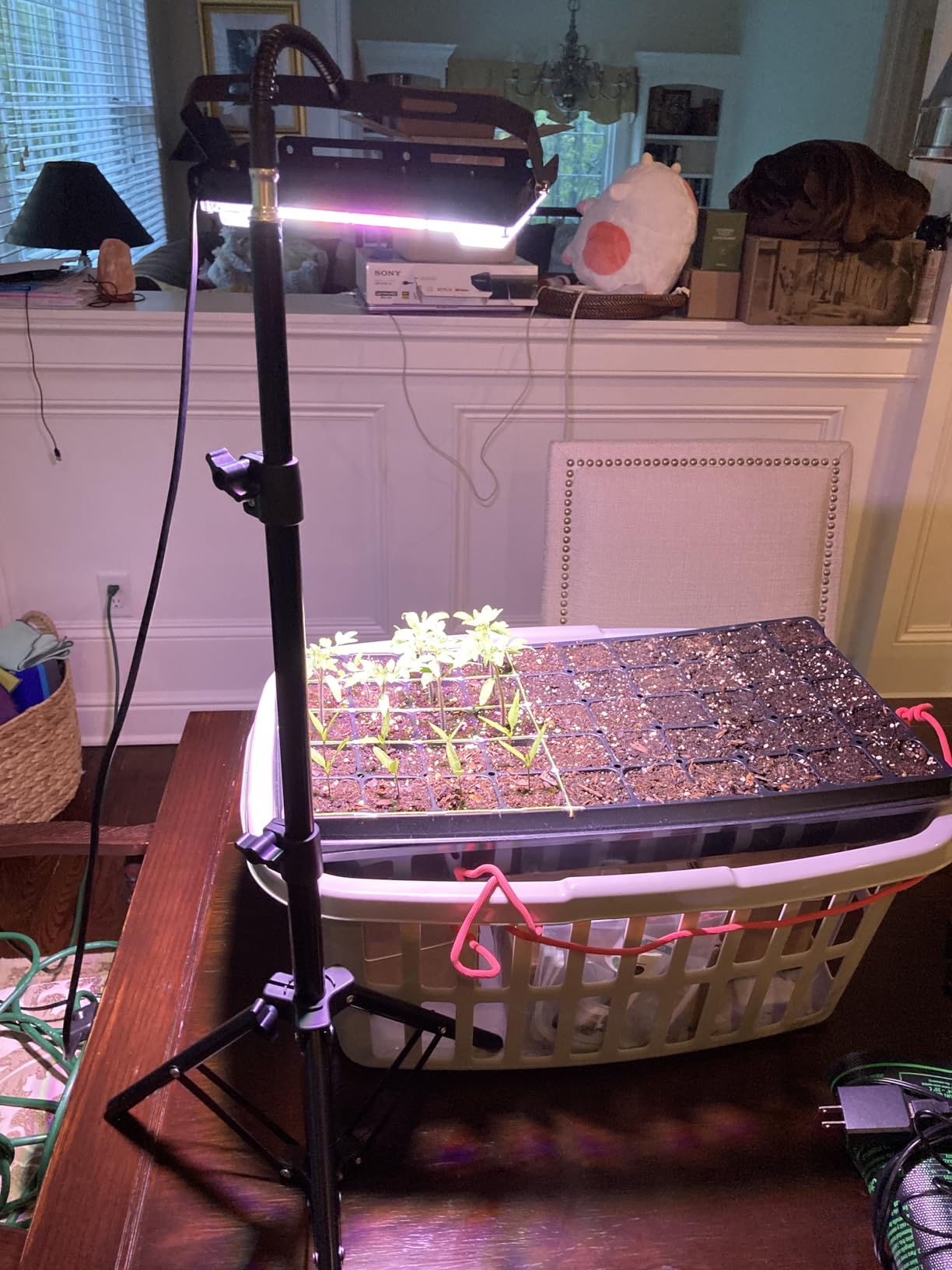
Owners report visible results in seedlings, peppers and houseplants, and at almost 6,000 reviews with a 4.4 rating there is a long record of use to draw on.
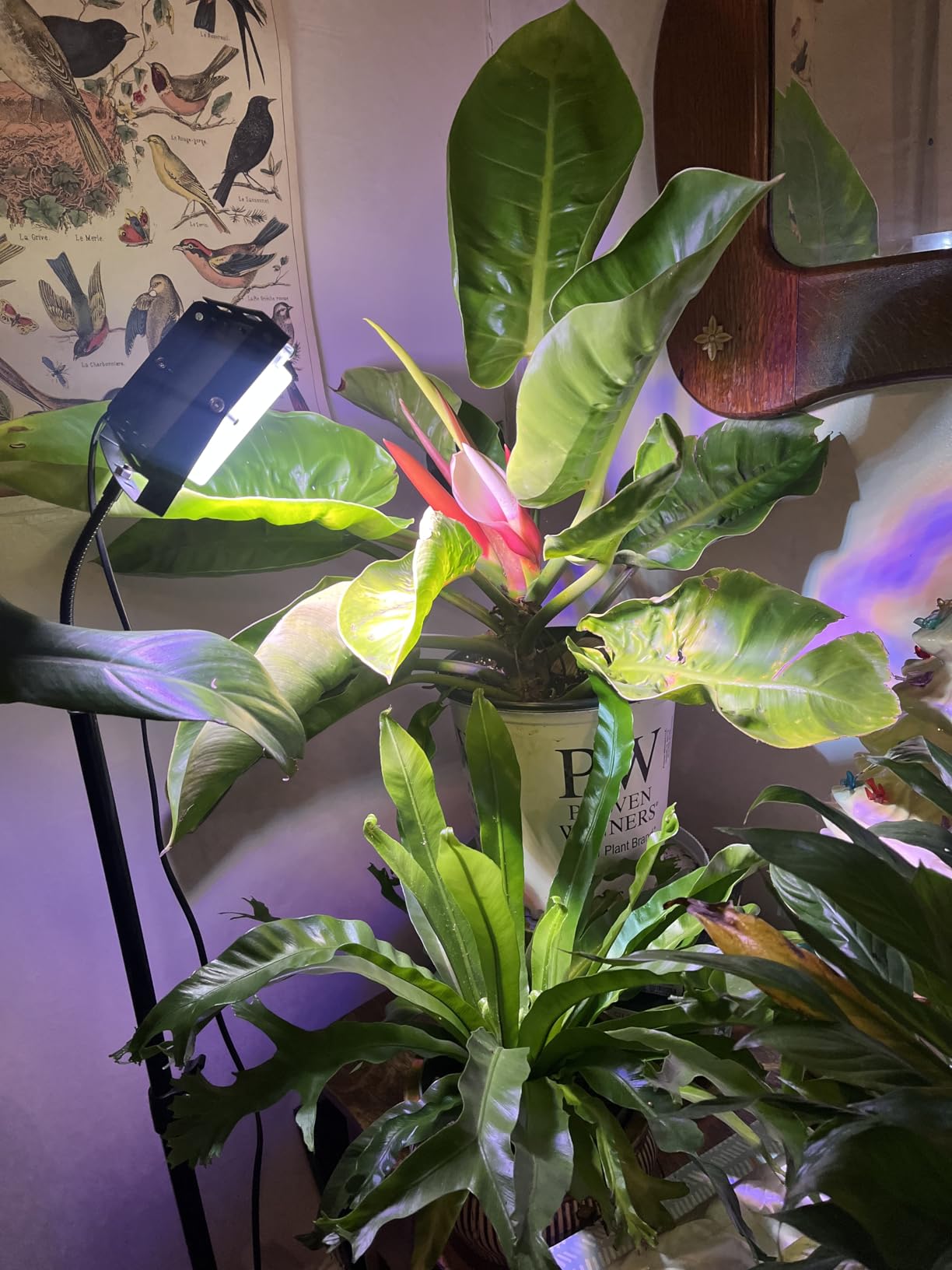
The consistent problem is stability. The tripod is top-heavy relative to its base, and reviewers describe it tipping over when nudged, which is a real risk beside a windowsill with seedlings underneath.
Position it away from the window edge, or wedge the legs against a wall. The LED panel also cannot be replaced if it fails, so treat it as a season-to-season fixture rather than a lifetime one.
Who this light suits
Renters, anyone with no permission to drill, and gardeners who want to move one lamp between the seed tray and the potting bench. The height range is genuinely useful across a season.
It is also a good choice if your seed starting spot has no shelf edge to clamp to, since the stand needs only floor space.
Where it falls short
The tip-over risk is the thing to plan around rather than discover. Set it back from the edge and treat it as a fixture that lives in one spot.
A few reviewers also report light output weaker than they expected for the wattage. If your seedlings stretch within the first fortnight, check the height before you blame the fixture.
7. Aokrean Telescoping Halo Light – Best for Pots on a Shelf
Aokrean Grow Lights for Indoor Plants, Full Spectrum Plant Light with Base
- Stakes into soil or sits on a weighted base
- Telescoping pole reaches 26 inches and rotates
- 10 brightness levels with touch control
- Finishes that suit a living space
- 3/9/12 hour timer repeats daily
- Base needs a flower pot on it for balance
- Requires the included power adapter
- One light covers a single pot
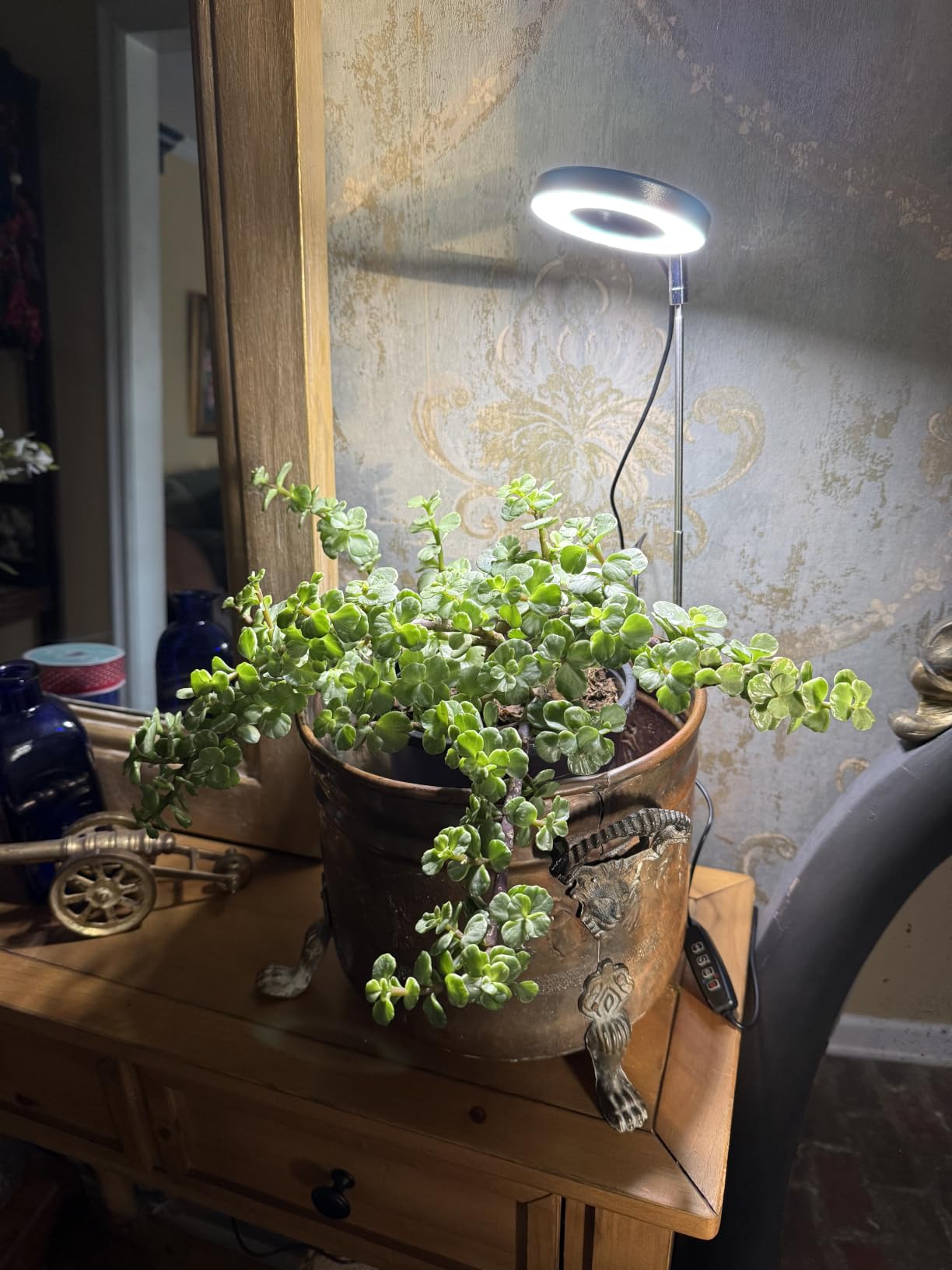
This one is not a propagation lamp and we will not pretend otherwise. It is a grow light for individual pots, and if your seed starting involves a few vegetable seedlings plus a basil plant and a lemon tree on the same shelf, that is exactly what it is for.
The installation choice is the appeal. Push the stake into the soil of a pot, or use the weighted base for floor planters and larger containers. It does not need a shelf edge, a clamp or a drilled bracket.
The telescoping pole reaches 26 inches and rotates 90 degrees, so as a potted plant stretches you can raise and re-aim the halo ring without rebuilding anything. Touch control gives three lighting modes and ten brightness levels.
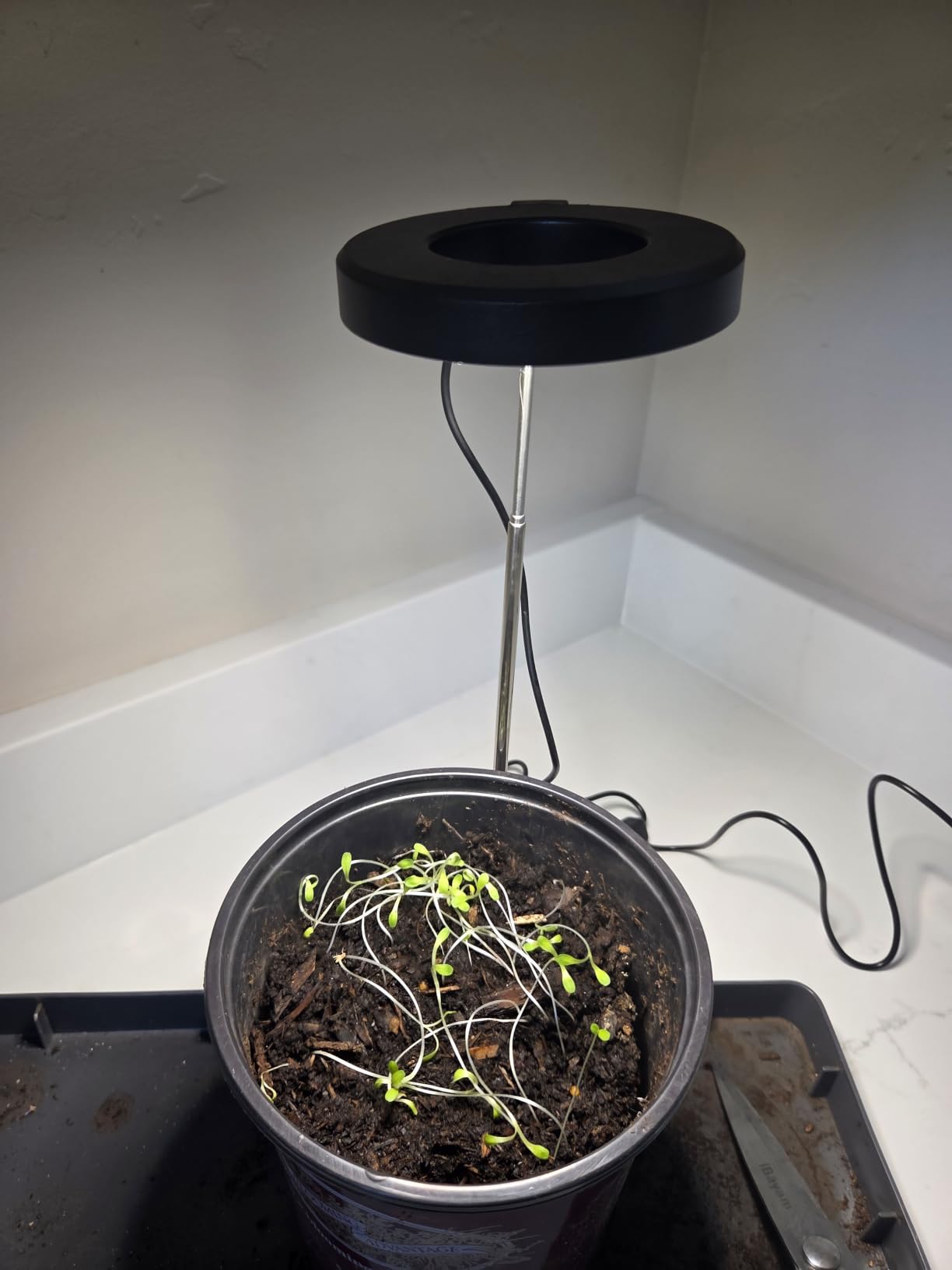
What we like most for this site is how it looks. Finishes in black, white and wood grain mean the light does not read as equipment, and reviewers repeatedly mention leaving it in a living space rather than hiding it in a utility room.
With more than 3,600 reviews at 4.4 stars, the feedback is consistent about what works and what does not.
The base needs weighting with a flower pot to stay stable on its own, which is the single most repeated friction point. It also needs the included power adapter, so it is not a cordless lamp you can move freely around the house.
Who this light suits
Anyone overwintering herbs, a few houseplants or a young fruit tree indoors through a dark winter. We keep one on a kitchen shelf for exactly this.
It is also a thoughtful gift, because it looks considered rather than functional. Pair it with our full spectrum grow light guide if you are covering a whole room of plants rather than one pot.
Where it falls short
Do not buy it for seed trays. At 10W with a narrow ring of coverage, a 1020 tray will have bright patches under the ring and dim corners.
The stability issue is real enough that you should decide on a permanent spot early. A base with a pot on it is stable; a bare base on a hard floor is not.
8. FOXGARDEN Stand Light – Sized for a Desktop
- Telescoping stand from 11 to 21 inch
- 6 dimming levels from 10 to 100 percent
- Built-in reflector widens the lit area
- Sponge base pad protects a desktop
- Remote control included
- Maximum height of 21.65 inches is limiting once plants get tall
- Plug runs hot on the highest brightness setting
- Produces a loud high-pitched sound on the lower dimming levels
Ten or twelve tomato seedlings on a desk beside your laptop is a real and common scenario, and the FOXGARDEN stand is built for it. It sits over a tray or a small tabletop greenhouse without needing to be strapped to shelving.
The stand telescopes from 11.02 to 21.65 inches, which is exactly the range a windowsill tray passes through between sowing and the point where seedlings are ready to pot on. Six dimming levels run from 10 to 100 percent, so you can start low.
108 LED beads are split across 60 cold white, 32 warm white and 16 red, and a built-in reflector widens the lit area and cuts wasted spill. That reflector is the reason a 22W fixture covers a desktop tray as evenly as it does.
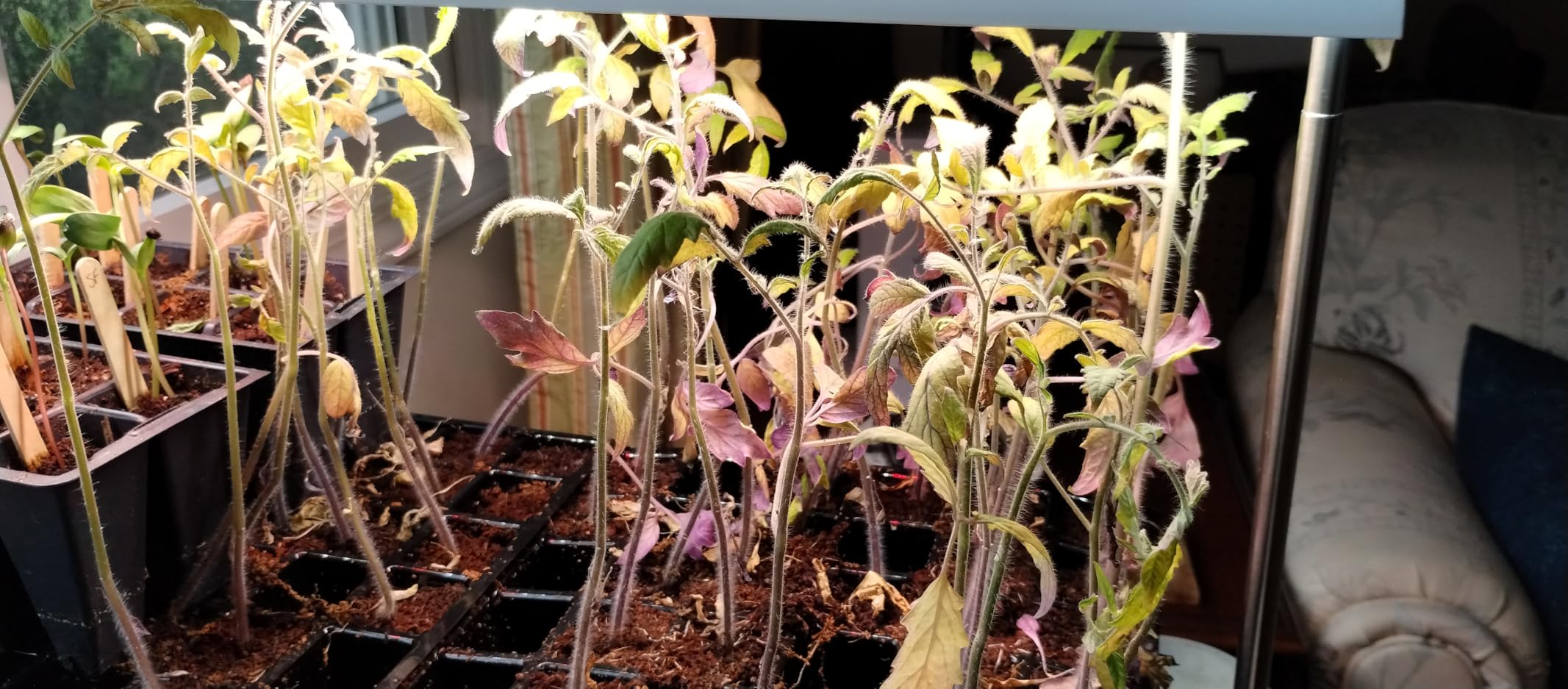
The base has a sponge pad, which matters more than it sounds on a wooden desk, and a remote control means you can adjust it without reaching under the tray.
Owners report non-leggy seedlings, which is the outcome that matters most in a small setup where the light is close to the canopy by necessity.
Two limits are worth knowing. The maximum height of 21.65 inches becomes restrictive once plants get tall, and the plug runs hot at full brightness. There is also a high-pitched sound on the lower dimmer levels that a few reviewers find audible in a quiet room.
Who this light suits
A desk or side table setup with one tray, or anyone who wants a self-contained light that does not need a separate timer plug, a clamp or a shelf bracket. It is also the easiest fixture here to move between rooms.
If your seedlings are destined for a windowsill with several hours of direct sun, this is more than sufficient and arguably over-specified.
Where it falls short
It is not a rack light and should not be stretched into one. The height limit means anything taller than a young transplant needs a different plan.
With 542 reviews at 4.4 stars there is less long-term reliability data here than for the heavily reviewed fixtures in this roundup. Plan for the possibility of replacing it after a few seasons rather than expecting it to last a decade.
9. Bokeedo T5 Twin Tube – Reflectors Focus the Light
T5 Grow Lights for Seed Starting, 10W x2, Grow Lights for Indoor Plants
- V-shape reflectors add roughly 25 percent more useful light
- Two 10W tubes deliver 1900+ lumens combined
- Full aluminum housing doubles as a heat sink
- Four mounting options for shelves or racks
- 12-month warranty
- Not dimmable for very young seedlings
- No built-in timer
- Lightly reviewed compared with the rest
The T5 format is the one experienced growers still reach for, and this pair is the compact version of it. Two 10W tubes deliver more than 1,900 lumens combined, which puts it well ahead of the small USB plant lamps in brightness per pound of shelf space.
The V-shape reflectors are the detail that makes it worth choosing over a bare tube. They redirect roughly 25 percent more effective light onto the tray while cutting stray spill, so the difference between the lit area and the rest of your shelf narrows considerably.
The spectrum is a 3-in-1 combination of 3000K full spectrum, 6000K white and 660nm red chips at 4000K overall. The full aluminum housing doubles as a heat sink, which lengthens service life in an enclosed rack.
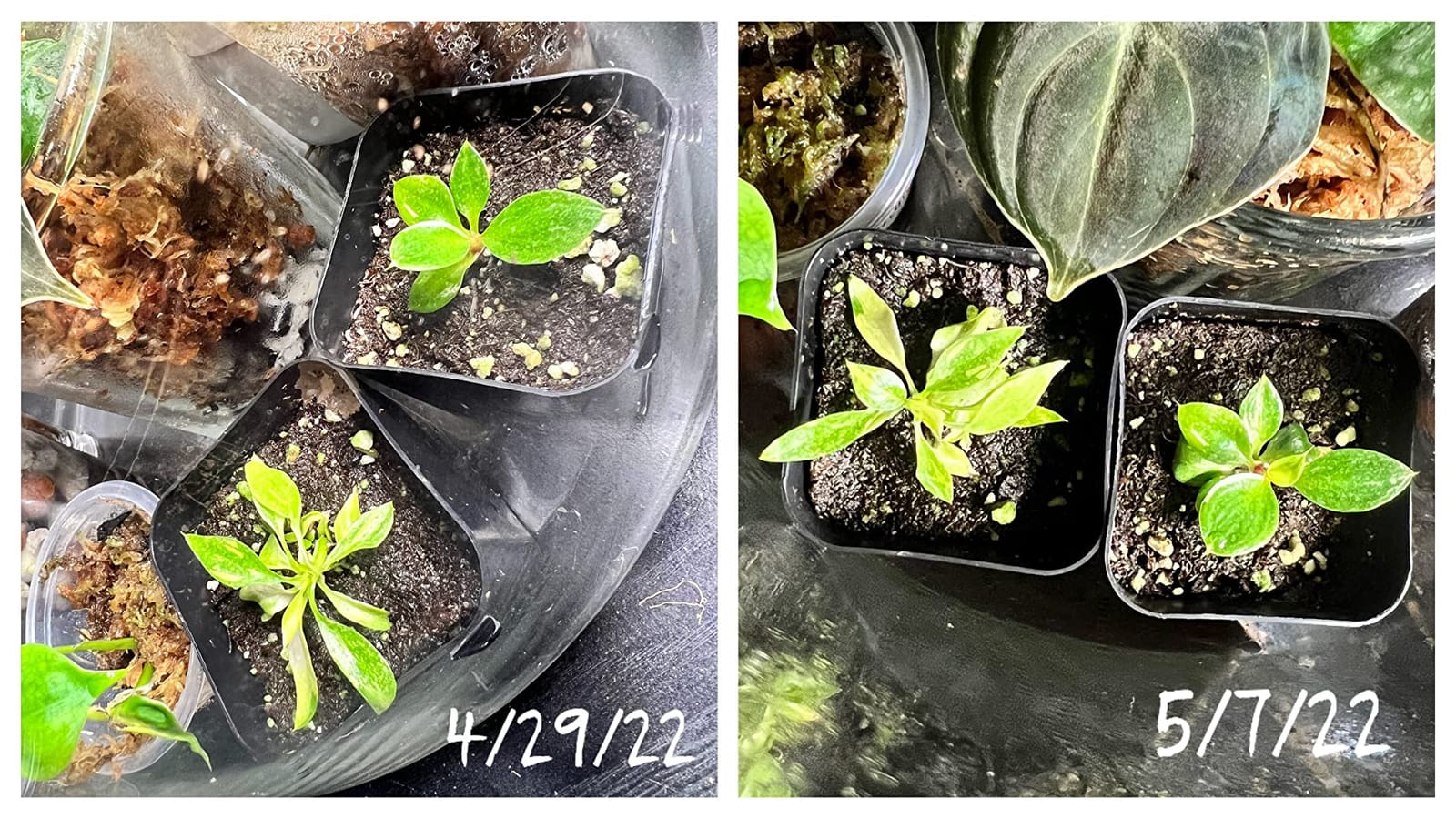
Four mounting options are included, covering plant shelves, flower racks and hanging above plants, so it works in the same rigs as the strip fixtures further up this list.
Seed starters and shelf growers like the brightness per watt and the reflectors, and at 4.6 stars across 489 reviews the ratings hold up.
What it lacks is control. There is no dimming, so light intensity cannot be reduced for very young seedlings, and there is no built-in timer, so scheduling needs an external plug-in timer.
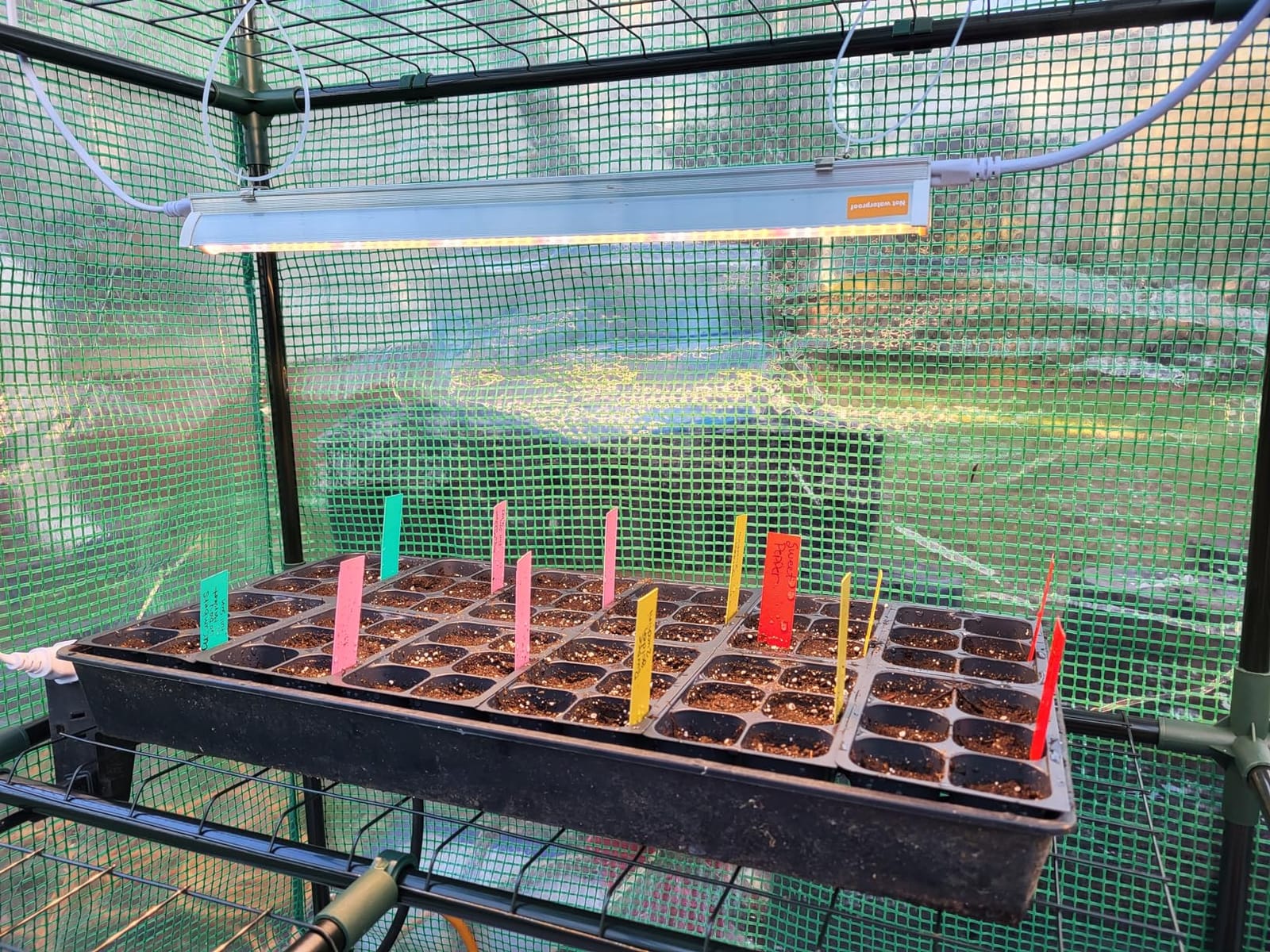
Who these tubes suit
A propagation shelf where you already have a timer and want the light concentrated on the tray rather than the whole room. Reflectors are particularly useful when the shelf is against a wall.
They are also a sensible option if you already own a T5 shop light and want the same format with grow-oriented spectrum and reflectors included.
Where they fall short
Fixed output is the main one. If you are sprouting delicate herbs alongside tomatoes, one brightness will never suit both, and the fix is height rather than a switch.
With fewer than 500 reviews there is less long-term data on driver failure than for the highest-reviewed fixtures here. Choose a longer warranty if you can find one in this format.
10. SDOVUERC Six Bar Strip – Longest Timer Cycle
SDOVUERC 16” 6 Bars Grow Light Strips for Indoor Shelves Plants Growing.
- Six bars light an entire shelf width
- Runs cool and does not overheat plants
- Timer runs 6
- 12 or 18 hour cycles
- 95 inch cord reaches tall and wide shelving
- Light reads very blue and purple
- Push-button dimming with few soft-white options
- Output below what sunlight delivers
Six individual bars across a 16 inch strip gives you the coverage of a much larger fixture in a slim profile that slides under a shelf board. Three hundred and sixty diodes across the bars cover 380nm to 800nm at 36W total.
The reason this one earns a place is the timer. A circular memory timer with 6, 12 and 18 hour options means you can run a longer photoperiod than the 12-hour maximum most of the small lamps here offer, which matters for crops that reward a full day of light.
Owners repeatedly repurchase it for additional shelves, which is the clearest evidence it works. They also single out the cool running and the fact that it does not overheat the plants or the surrounding area.
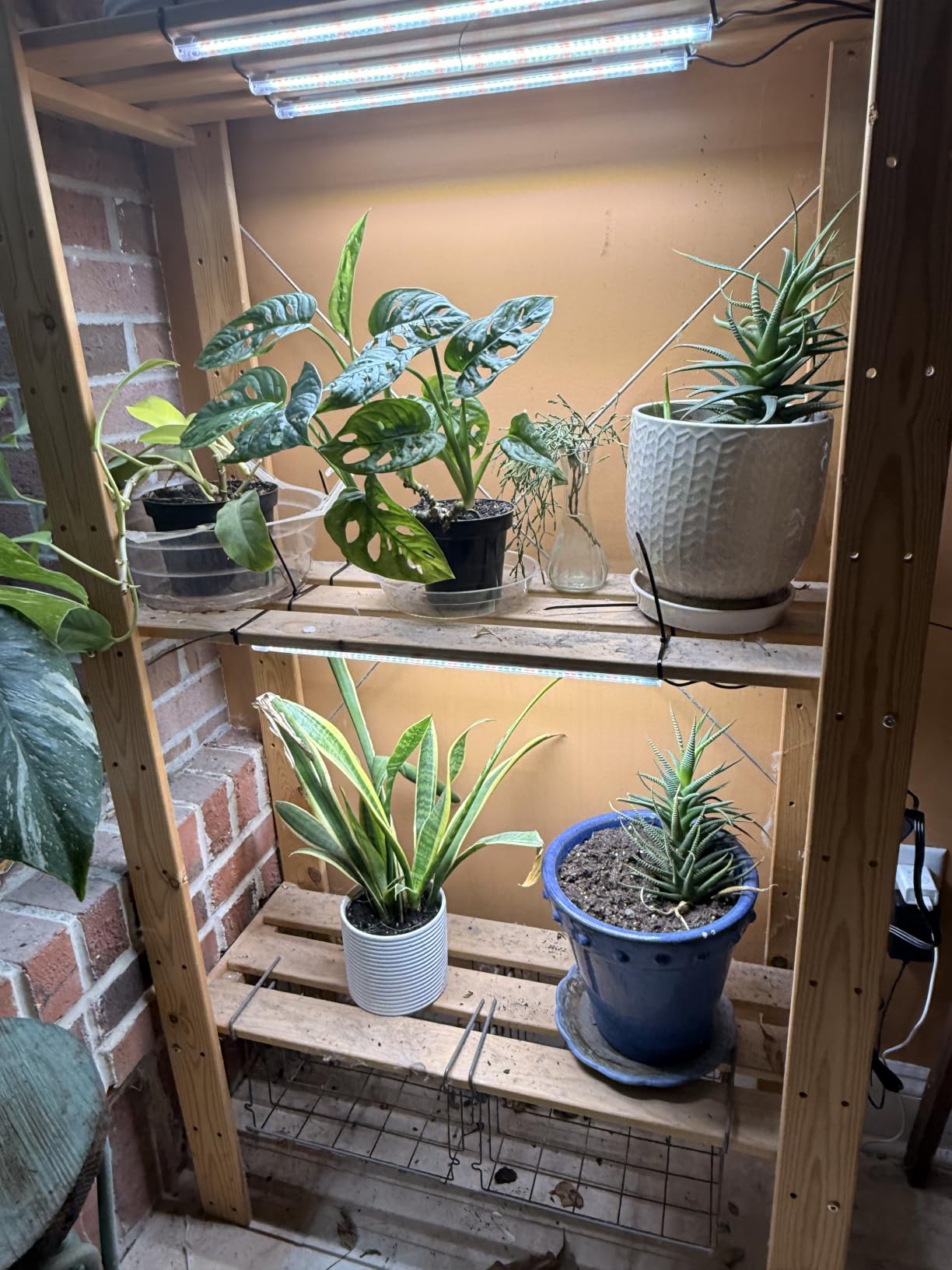
Installation is flexible. The box includes twelve screws, six cable ties and six double-sided tape pads, so the same strip works on a wall, a shelf underside or a stand.
The 95 inch cord reaches tall and wide shelving without an extension, which solves one of the most common complaints about budget strip lighting.
The dominant complaint is colour. The output reads very blue and purple, and reviewers note that the red setting does little to soften the tone. If the shelf sits in your living space, that is a real consideration.
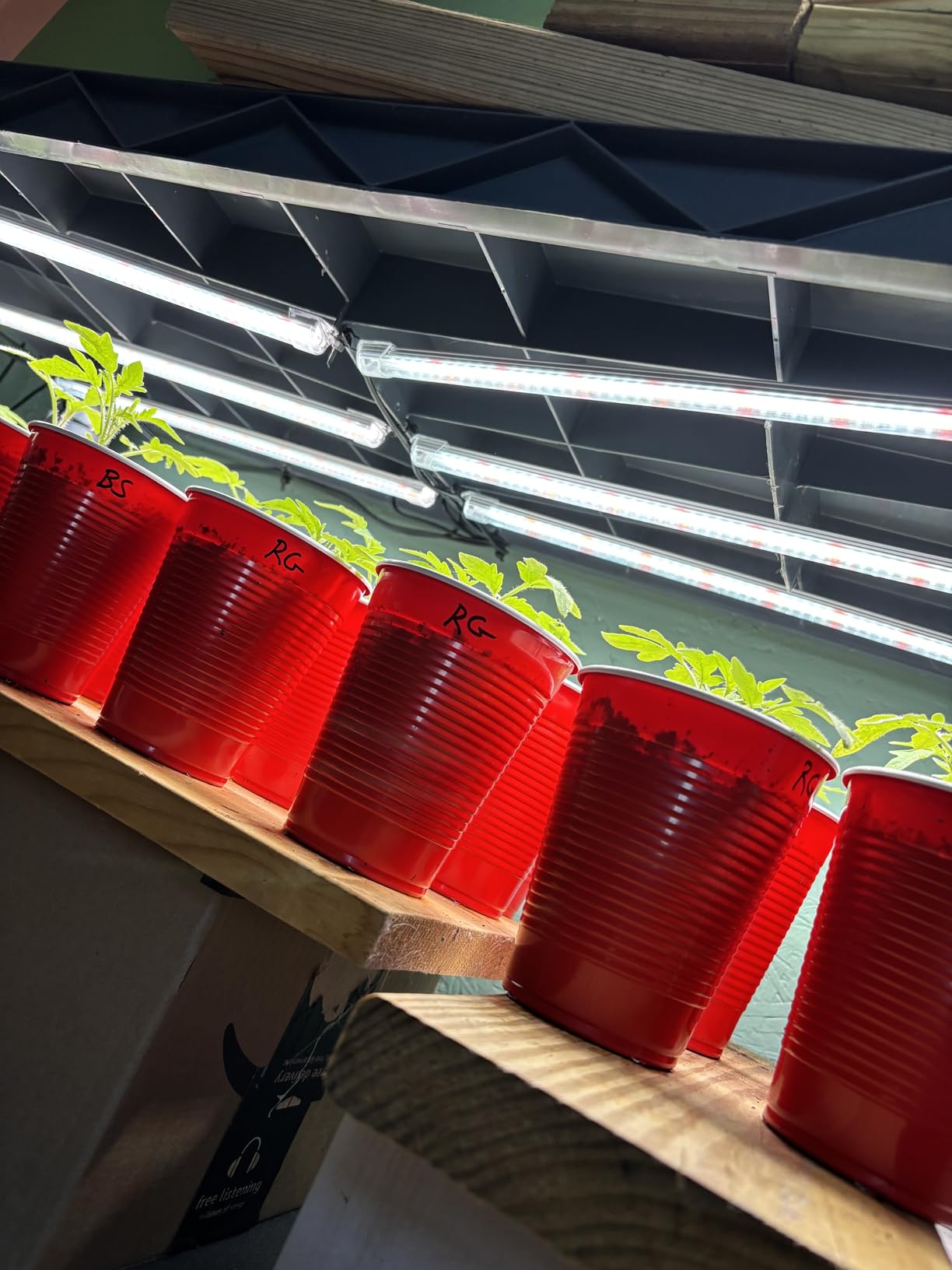
Who this strip suits
A wide shelf where a single narrow bar leaves gaps. Six bars across 16 inches spread the light more evenly than one or two tubes of the same total power.
The extended timer options also make it a good fit for anyone who wants to run closer to 16 hours without buying an external timer.
Where it falls short
Output is well below what direct sunlight delivers, and one reviewer saw red-leaf lettuce fail to colour indoors. If you are chasing maximum yield rather than getting seedlings established, this is not the end point.
The blue cast is worth weighing carefully. Many growers simply do not care, but if the light sits at eye level in an office or living room you will.
11. Hlite 16 Inch Linkable Bars – Four Bars, One Cord Run
Hlite 16inch LED Grow Lights – Linkable Grow Lights for Indoor Plants
- Four linkable bars cover a wide shelf
- Runs cool enough to survive a knock over
- Chains
- hooks
- brackets and zip ties included
- Reportedly strong results on pepper seedlings
- Link up to six fixtures on one run
- Switch-only versions have no built-in timer
- One brightness setting with no dimming
- No reflectors to aim light downward
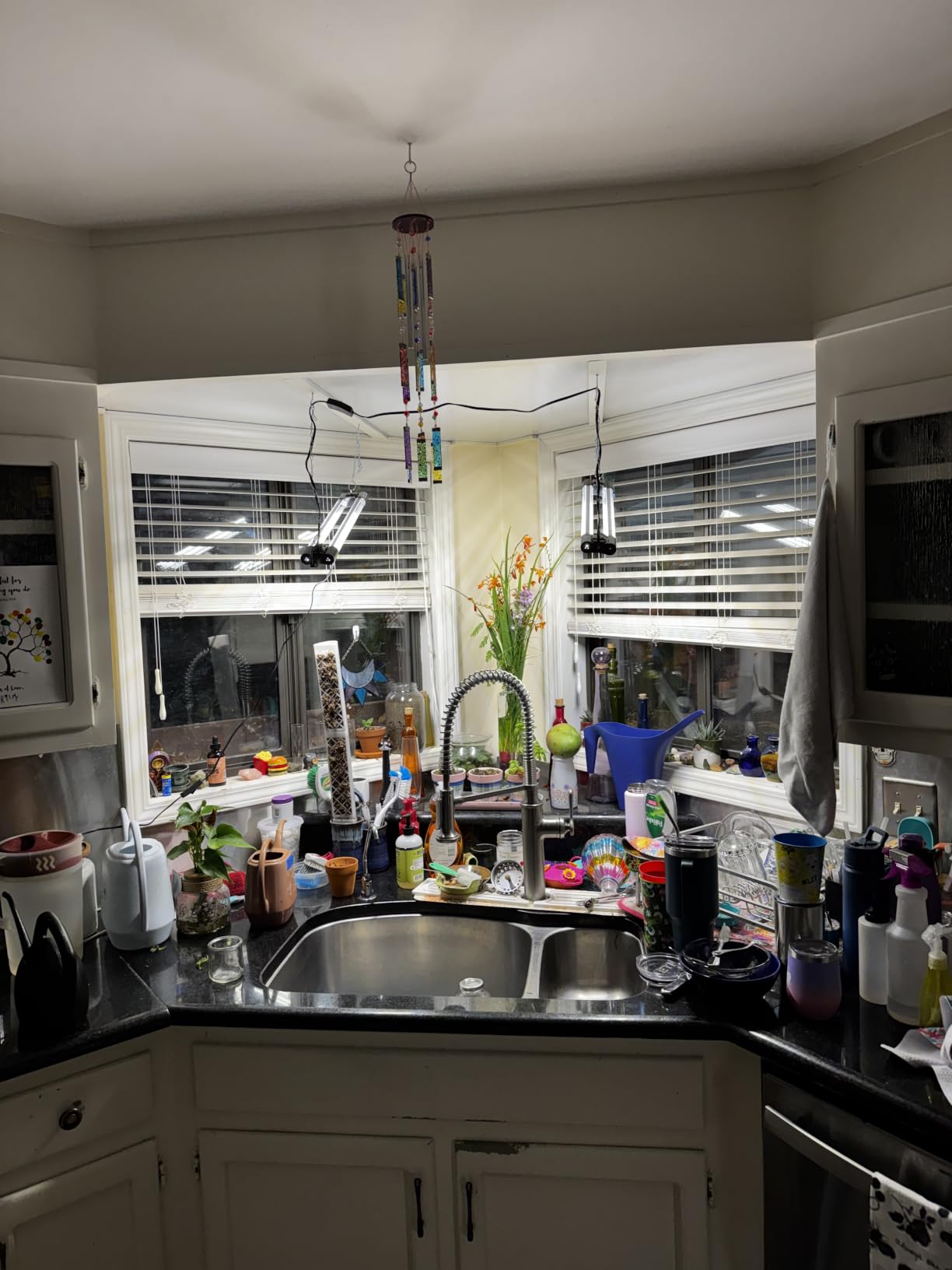
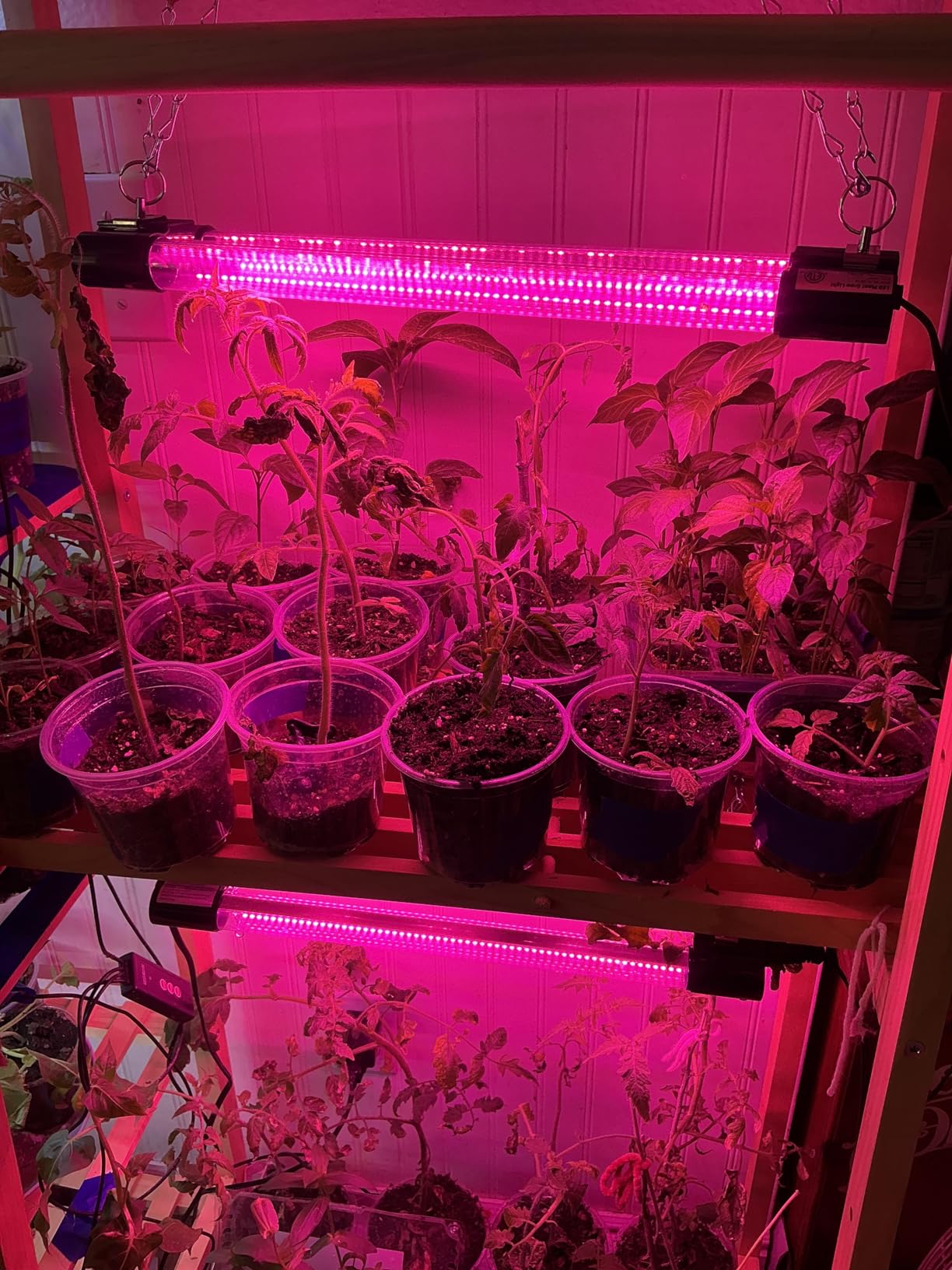
Four bars at 20W each, daisy-chained together, is the simplest way to get even coverage across a shelf without a single large fixture hanging over it. Buyers report strong results starting peppers and other vegetable seedlings away from windows, including in a dark basement.
The linkable design supports up to six fixtures in series, so a wide shelf or two shelves in a run come from the same approach. Installation is plug-and-play, and the package includes screws, hooks, chains, zip ties and brackets.
The housings run cool enough that reviewers report they survive being knocked over outdoors, which tells you something about the build quality relative to other budget bars.
What we like for a home setting is the ambient effect. The pink hue gives a soft glow in a home office or apartment that does not feel like equipment, and many owners keep them up after the seedling season for houseplants.
There is genuine long-term feedback here across 569 reviews, with most of the praise going to simple installation and cool-running housings.
The most repeated limitation is the absence of an integrated timer on the switch-only variants, so you will need an external timer. Secondary gripes are a single brightness level and no reflectors to aim light downward.
Who these bars suit
Gardeners covering a basement shelf, a closet or any space with no natural light at all. Nothing about these bars depends on daylight to finish the job.
They are also good for a multi-shelf unit where you want one consistent, low-profile fixture per shelf rather than a stand in the way.
Where they fall short
Sixteen inches is shorter than a standard shelf or a small greenhouse width, which leaves gaps at the edges. That is the main reason to choose the six-bar strip above instead.
Without dimming, height is your only intensity control. Hang them a little higher and accept softer light rather than waiting for a seedling stage that will never come.
12. LBW Three Head Panel – Aiming Three Lights at Once
LBW Grow Light for Indoor Plants, 642 LEDs Grow Light with Stand
- Three independently aimable heads
- Tripod adjusts from 27 to 63 inches
- Built-in 3
- 6 and 12 hour timer
- Ventilated panel backs stay cool
- No visible flicker at full brightness
- Several buyers report dead or rapidly flickering LED sections on arrival
- Stand legs are thin and only stable on a flat surface
- Timer has been reported as intermittently unreliable
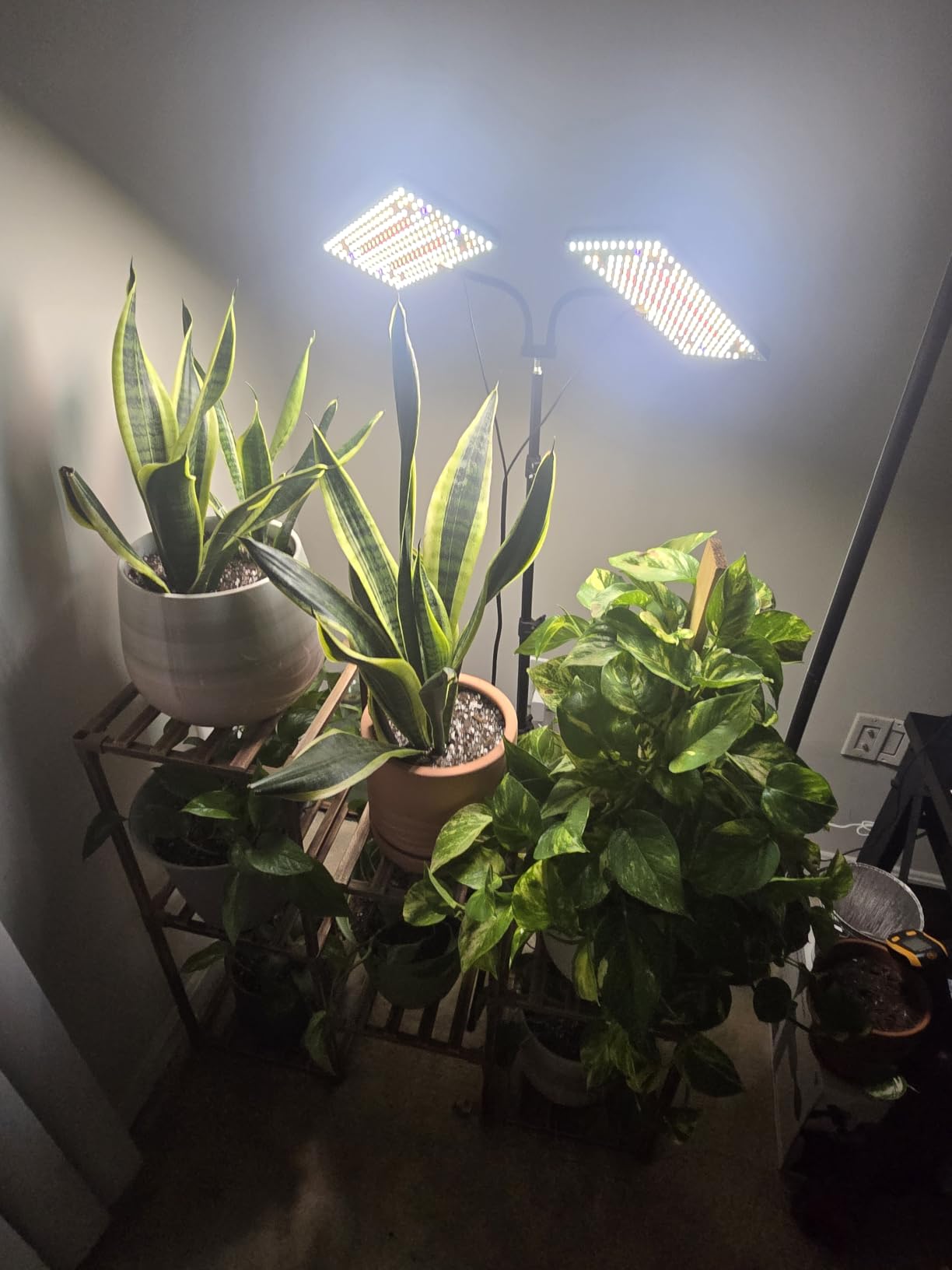
This is the one to buy if you are starting a large batch and want to cover three separate trays with one fixture. Each head carries 214 LED chips, so 642 across three heads, and each arm aims independently.
That aim is the feature. Instead of one wide, weak wash, you can point a head at a tomato tray, a second at peppers and a third at a tray of flowers, each at the distance that suits it. Multi-year owners report strong durability and no flicker.
The tripod adjusts from 27.8 to 63 inches, which covers seedlings on a low shelf and taller specimens on the floor. The panels have ventilation holes and owners report the backs staying cool after hours at full brightness.
The built-in 3, 6 and 12 hour timer on a 24-hour cycle plus six dimming levels means you can schedule and adjust output without extra hardware, which is convenient in a self-contained rig.
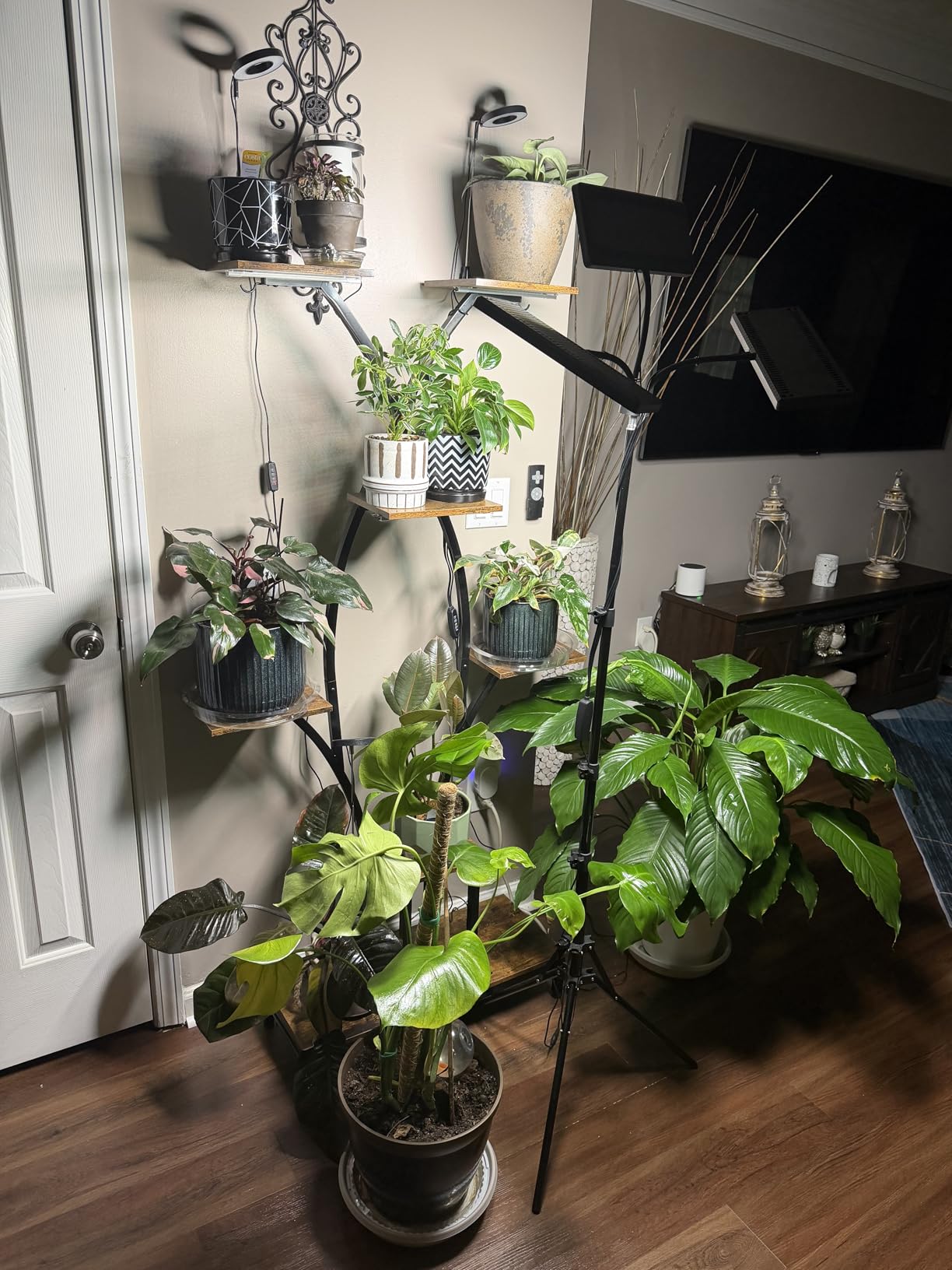
It is widely used for overwintering houseplants as well as spring seed starting, so it earns its place across more than one season.
The significant quality concern is LED panel failure. Several buyers report dead or rapidly flickering sections on arrival, including on replacement units, and that is what drives the 9 percent one-star share. The tripod legs are also thin and only stable on a flat surface, and the timer has been reported as intermittently unreliable.
Who this light suits
A propagation shelf with several trays at different heights or stages, and anyone who wants one fixture to cover both a seed tray and a potted plant further along. The adjustable heads are the whole point.
It also works well for overwintering houseplants in a spare room, since the height range covers floor-level pots as well as a bench.
Where it falls short
Test it the day it arrives and keep the packaging. Panel failures are reported often enough that you want the option of a straightforward return or replacement.
Some users also find the output marginal for demanding high-light plants, with a few reporting etiolation even at maximum brightness. For propagation this is rarely an issue, but if you plan to grow the same fixture through to fruiting, choose something with more output headroom.
How to Set Up a Seed Starting Station
A working propagation shelf needs five things and none of them is complicated. The order matters, because light placement affects everything else.
First, pick the space. A shelf near an outlet with room to hang something six inches above a tray is all you need, and airflow matters more than square footage. A closed closet works badly because seedlings in still, damp air are where damping off starts.
Second, choose the fixture from the size of the area above your trays rather than from wattage. One tray on a desk calls for a clip or stand lamp. A full shelf calls for two or more strips. A four-shelf rack calls for one run of linkable bars per shelf.
Third, add the timer before you hang anything. Fixtures without a built-in timer need a mechanical plug-in timer or a smart plug, and you want that decided while you are still holding the light.
Fourth, hang it low. This is the single most important step and the one most people get wrong. Strip lights want to sit two to six inches above the canopy, not twelve. Light intensity falls off with the square of distance, so doubling the gap quarters the intensity reaching the leaves. Community advice in r/gardening makes the same point repeatedly: unlike shop lights, these little LED strips need to be closer to the plants.
Fifth, raise it weekly. As seedlings grow, lift the fixture so the gap stays roughly constant, and never let foliage touch a hot fixture. Riggers on r/vegetablegardening build this with two pieces of wood and cable ties, which is a perfectly good approach for a renter.
Two supporting pieces are worth adding. A heat mat with a thermostat underneath the tray keeps germination even, and a small fan on a low setting stops the trunk stretch that growers mistake for a light problem. Remember that leggy seedlings are almost always a hanging height issue, not a fixture issue.
LED or Fluorescent T5: Which to Buy in 2026
Buy LED for new setups, and keep your fluorescent tubes if you already own working ones. That is the short answer, and the reason is efficiency plus control rather than any change in what plants can use.
Fluorescent T5 tubes were the standard propagation light for two decades and they still grow excellent seedlings. They run cooler, they spread light more evenly and they never bleach young plants because they cannot deliver enough intensity to cause photobleaching. That softness is genuinely useful for the first week after emergence.
LED strips and bars now outperform them on the numbers that matter. You get more usable light per watt, longer service life with no ballast or tube replacement, dimming on many models, and far more compact housings that fit under a shelf board where a T5 fixture will not.
The T5 versus T8 question comes down to size rather than quality. T5 tubes are thinner, usually one foot or four feet long, and the four-foot version is the classic shelf format. T8 tubes are fatter, closer to traditional shop light dimensions, and fit the fixtures many people already have in a garage or utility room. If you own a working T8 shop light, it will start seeds adequately as long as you do not hang it too close to the canopy.
Spectrum marketing deserves a scepticism check too. “Full spectrum” is a phrase with no regulated standard attached to it. The checkable part is the colour temperature figure, and anything at 5000K or above is a sensible general-purpose white for seedlings.
Do Seeds Need Light to Germinate?
No. Most vegetable and flower seed germinates fine in darkness, and a warm tray with moisture is doing the real work during those first days. A light does not help a seed crack.
Light becomes essential the moment the first true leaves appear, which is typically two to four days after emergence for tomatoes and longer for slower crops. From that point the seedling is photosynthesising, and it needs a dependable daily dose of usable light or it stretches, pales and produces a weak transplant.
This is why many growers leave seed trays under a clear dome for germination and then move them under the light immediately, rather than lighting from day one. Our desk and task lighting guide has a similar principle for the first week, keeping things low and close while the tray is covered.
Frequently Asked Questions
What type of grow light is best for starting seeds?
A full-spectrum LED light, usually a strip or bar fixture rather than a bulb lamp, hung two to six inches above your seed trays and run 14 to 16 hours a day. That delivers roughly 210 to 300 micromoles per square metre per second at the leaf surface, which is the range seedlings need to grow short and sturdy. Fluorescent T5 tubes work well too, so an old shop light is a perfectly respectable rig.
Is 10,000 lumens too bright for seedlings?
Not if the fixture is dimmable and you use the lower settings. Ten thousand lumens is plenty for seedlings, but it is too much intensity for freshly emerged sprouts sitting directly underneath, which can bleach or stress them. Set the dimmer low at first, raise the light as a stopgap, or choose a lower-output fixture for a single tray.
Which grow light is better, LED or fluorescent?
Buy LED for a new setup. You get more usable light per watt, longer service life with no ballast or tube replacement, dimming on many models, and housings slim enough to mount under a shelf board. Fluorescent T5 still grows excellent seedlings and runs cooler, so keep any working tubes you already own rather than replacing them.
How long should a grow light be on for seedlings per day?
Fourteen to sixteen hours a day is the standard range for seed starting. Sixteen hours of light followed by eight hours of darkness gives seedlings the long day they would naturally experience and the darkness they need to respire. Running lights around the clock produces worse growth, not better. A plug-in timer or smart plug is the cheapest and most reliable way to hold the schedule.
What lights do professional growers use?
Commercial growers use T5HO fluorescent strips or horticultural LED bars mounted in banks over rolling benches, with each fixture spaced so light overlaps across the canopy. Professional setups prioritise even coverage and height adjustment rather than peak output at one spot. Home growers do not need that density, and a handful of strips above a home shelf will start seeds perfectly well.
The Best Grow Lights for Seed Starting in 2026
The best grow lights for seed starting are not the biggest ones. They are the fixtures you can hang two to six inches above a tray, run on a timer for sixteen hours a day, and raise weekly as the canopy climbs.
For a single tray or a small desk, the GooingTop clip lamp is the one we recommend most often, with the VIPARSPECTRA bar behind it when a shelf needs real intensity and dimming. For a propagation rack, Barrina T5 strips or the linkable Hlite bars will light every shelf from one cord run.
Measure your tray count, hang the light low, and set a timer before you buy anything bigger.