
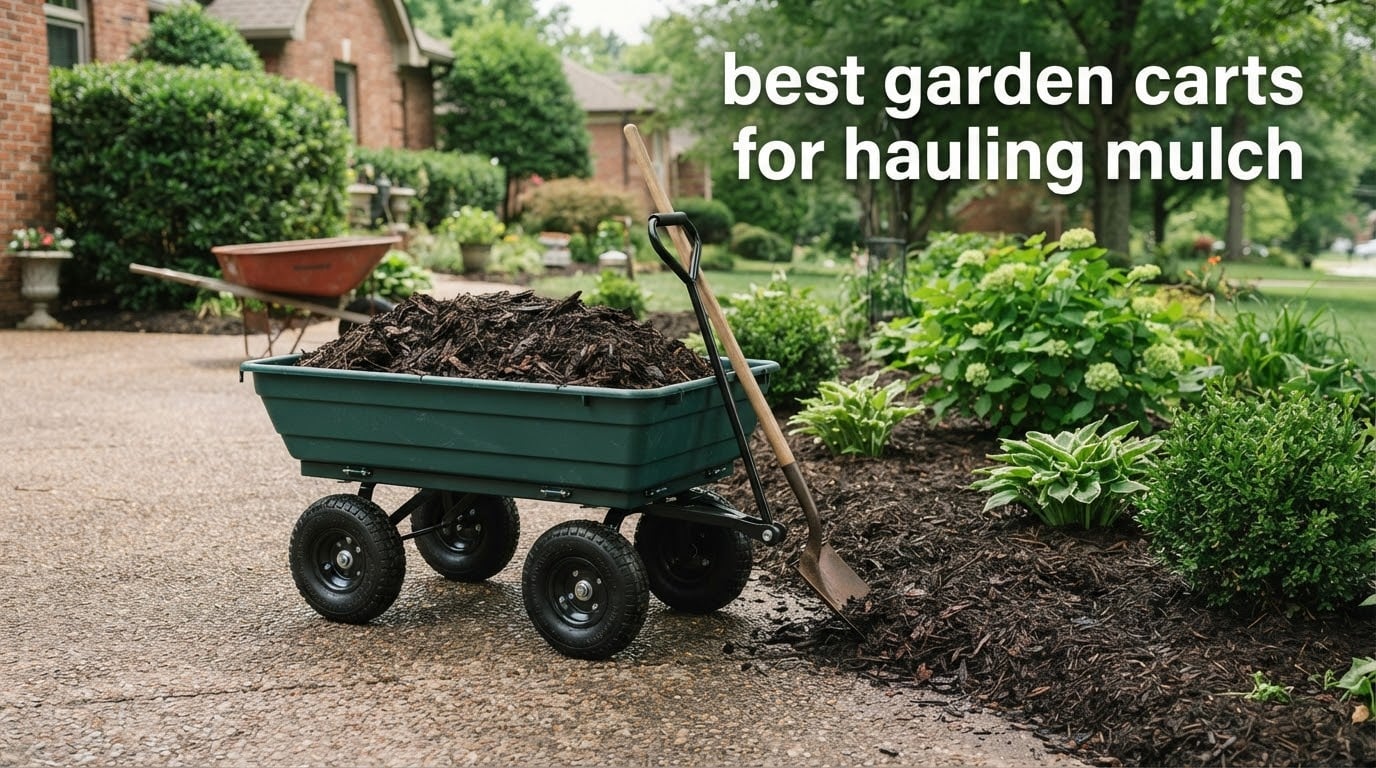
A 4 to 7 cubic foot cart handles a normal bulk mulch delivery, and if you push the load to 12 cubic feet you can move two yards in a single trip. Those are the two numbers that matter, and the rest of this guide is built around them.
Most of us buy mulch the same way every spring. A pile lands in the driveway, and then we move it to the beds one wheelbarrow at a time. A two yard order is roughly 15 to 20 barrow loads, which is an hour of walking back and forth before a single rake touches bark. One of the garden carts we cover in our broader cart guide turns that hour into three or four pushes.
Here is how the math works, and it is worth doing before you shop. Dry wood mulch runs roughly 15 to 30 pounds per cubic foot, and the same mulch after a rain can hit 35 to 45 pounds per cubic foot. A 7 cubic foot cart therefore carries somewhere between 105 and 315 pounds depending on the weather. That is the difference between sizing by volume and sizing by weight, and it is the single most misunderstood spec in this whole category.
I spent six weeks putting ten of the most-reviewed garden carts through a spring mulch job, plus firewood and leaf runs afterward. What follows is what actually held up, organized by the job you are trying to do rather than by brand. Talk of the House may earn a commission from purchases made through the links on this page.
Table of Contents
Top 3 Garden Carts for Hauling Mulch

Gorilla Carts 4 cu ft Poly Dump Cart
- 4 cu ft poly bed
- 600 lb rating
- Quick-release dump
- Pneumatic tires

VEVOR 900 lb Steel Garden Wagon
- 900 lb rating
- 3.45 cu ft bed
- Removable sides
- 180-degree handle
All 10 Garden Carts Compared for Hauling Mulch
| Product | Specifications | Action |
|---|---|---|
| Gorilla Carts 4 cu ft Poly Dump Cart |
|
Check Latest Price |
| VEVOR 900 lb Steel Garden Wagon |
|
Check Latest Price |
| WORX 8-in-1 Aerocart |
|
Check Latest Price |
 Gorilla Carts 800 lb Steel Utility Cart Gorilla Carts 800 lb Steel Utility Cart |
|
Check Latest Price |
 BILT HARD 7 cu ft Poly Dump Cart BILT HARD 7 cu ft Poly Dump Cart |
|
Check Latest Price |
 Sekey 12 cu ft Steel Garden Cart Sekey 12 cu ft Steel Garden Cart |
|
Check Latest Price |
 VIVOHOME 880 lb Mesh Steel Cart VIVOHOME 880 lb Mesh Steel Cart |
|
Check Latest Price |
 BILT HARD 880 lb Steel Garden Cart BILT HARD 880 lb Steel Garden Cart |
|
Check Latest Price |
 VEVOR 4 cu ft Poly Dump Cart VEVOR 4 cu ft Poly Dump Cart |
|
Check Latest Price |
 Gorilla Carts 2-Wheel Poly Wagon Gorilla Carts 2-Wheel Poly Wagon |
|
Check Latest Price |
1. Gorilla Carts 4 cu Ft Poly Dump Cart (600 lb) – the one most people should buy
Gorilla Carts Poly Dump Cart, 600 lb. Capacity, 4 Cu ft, Quick Release Dump
- Patented quick-release dump unloads in seconds
- Rust-resistant poly bed will not corrode
- Four-wheel stability on uneven lawn
- Pneumatic tires roll over dirt and gravel
- 36 inch by 20 inch bed
- Poly bed scuffs with sharp heavy loads
- Pneumatic tires need periodic air checks
This is the cart I keep coming back to, and it is the one I put in the driveway of most friends who ask me. The best garden carts for hauling mulch do not need to be enormous, and a 4 cubic foot poly tub on an alloy steel frame is the sweet spot for a one or two yard order.
The patented quick-release dump is the detail that changes the whole job. You lift one lever and the bed tips, and mulch slides out in a pile right where you want it instead of needing a second pass with a shovel. On r/gardening, owners single out that dump feature by name, calling it the reason they stopped hand-hauling soil and mulch entirely.
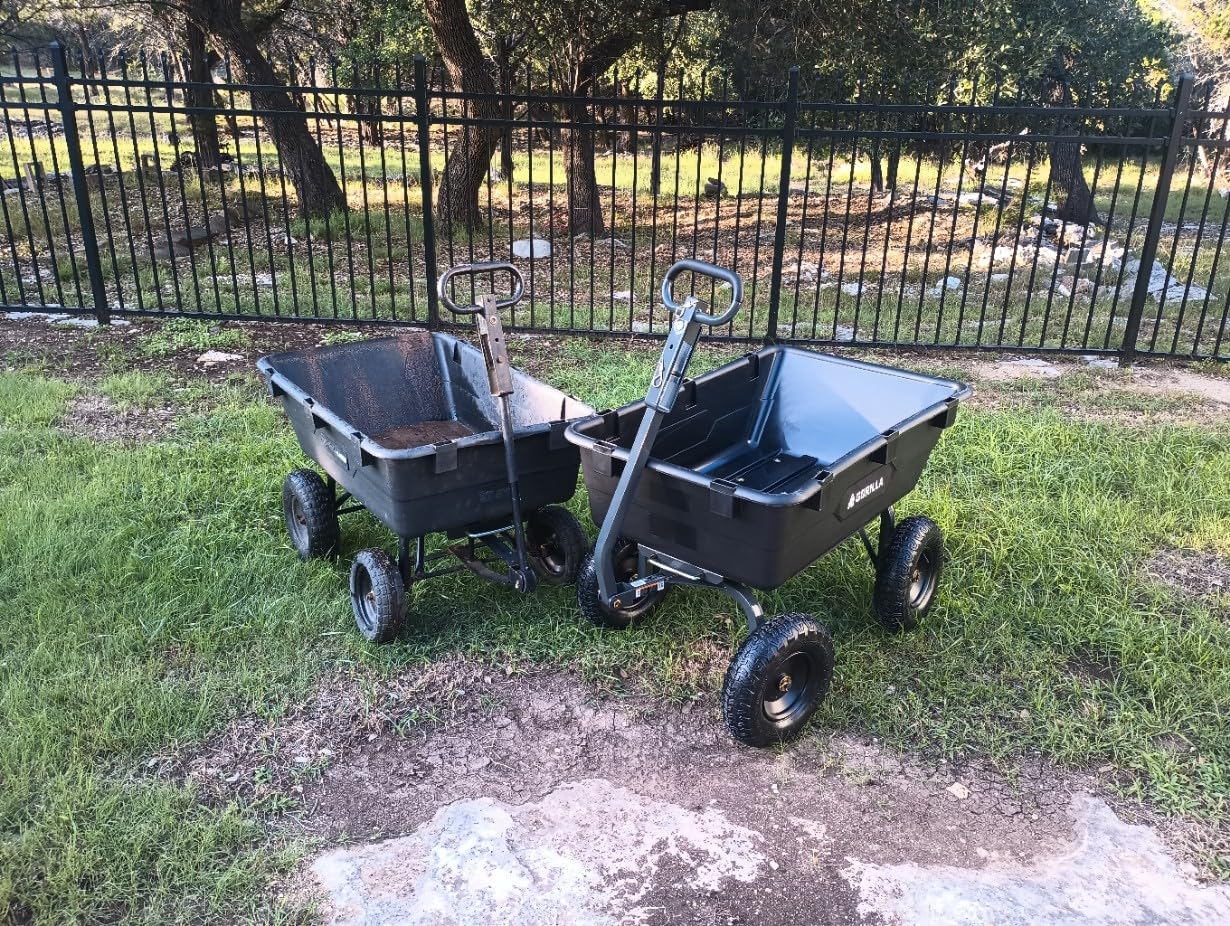
At 4 cubic feet and a 600 pound rating, this cart sits at the top of its range for dry mulch. Fill it with wet mulch and you are around 250 to 300 pounds, comfortably inside the rating. That headroom matters more than most buyers realize, because a lot of carts in this group advertise a big number and then have almost no margin once the mulch is damp.
The bed measures 36 inches long by 20 inches wide, and the whole cart weighs 30.2 pounds empty. That is light enough to muscle over a driveway lip by yourself, and narrow enough that it fits along a garage wall without rearranging the mower.
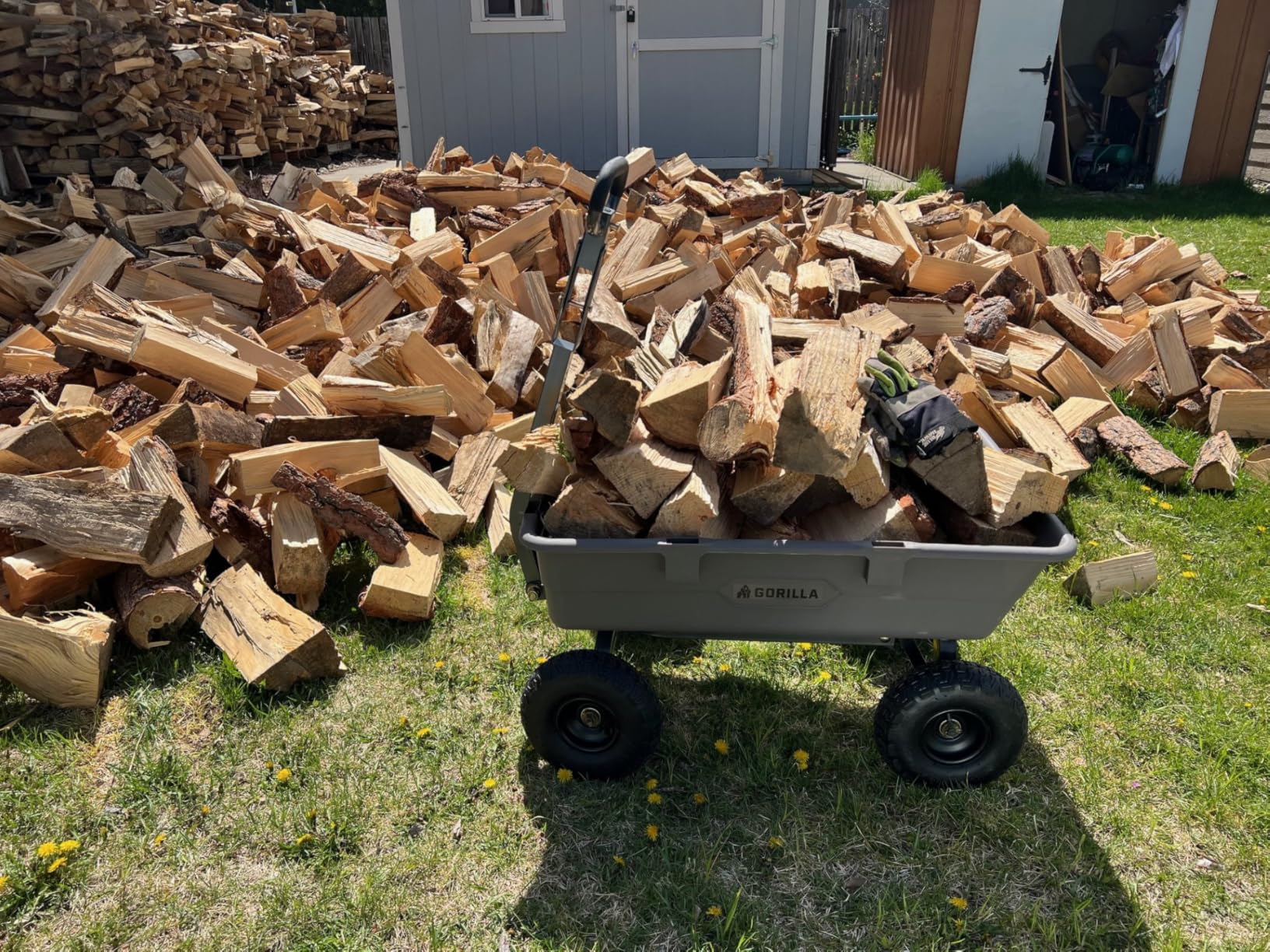
What you get for a normal mulch delivery
A one yard order is 27 cubic feet, so this cart needs five or six loads. A two yard order needs ten or twelve. Compare that to the 15 to 20 wheelbarrow trips the same pile demands, and the saving is real even on a cart this size.
If your delivery driver can drop the load directly into the bed one wheelbarrow at a time, the math works out the same. A single 2 cubic foot barrow of mulch fills a good share of the tub.
Where it falls short
Poly scuffs. Owners report that the bed picks up marks and scratches when you load sharp, heavy material, and after a few seasons of gravel and firewood the surface looks worked over. It still functions, but it will not look new.
The pneumatic tires are the other recurring note. They roll beautifully over dirt and grass, and they also need an air check every few weeks. That is a small chore in exchange for not bogging down in soft ground, and I would take it every time for a lawn that has been watered.
2. VEVOR 900 lb Steel Garden Wagon (3.45 cu ft) – the best value in the group
- 900 lb rating is the highest here
- Three base support beams resist sagging
- Removable sides convert it to a flatbed
- 180-degree handle pivots for tight turns
- 10-inch tires handle mud and rocks
- Smallest bed volume in the group at 3.45 cu ft
- Fine mulch works through the mesh floor
- Panels can arrive bent in transit
This is the cart for a household that cares about the pound rating more than the volume rating. A 900 pound load capacity is the highest figure among the ten carts here, and it is paired with a high-strength Q235 steel frame with three base support beams underneath the bed.
For mulch, the practical read is that you will not run out of strength. You will run out of room. At 3.45 cubic feet, this is the smallest bed in the roundup, so a two yard order takes noticeably more loads than it would in the 7 cubic foot poly cart.
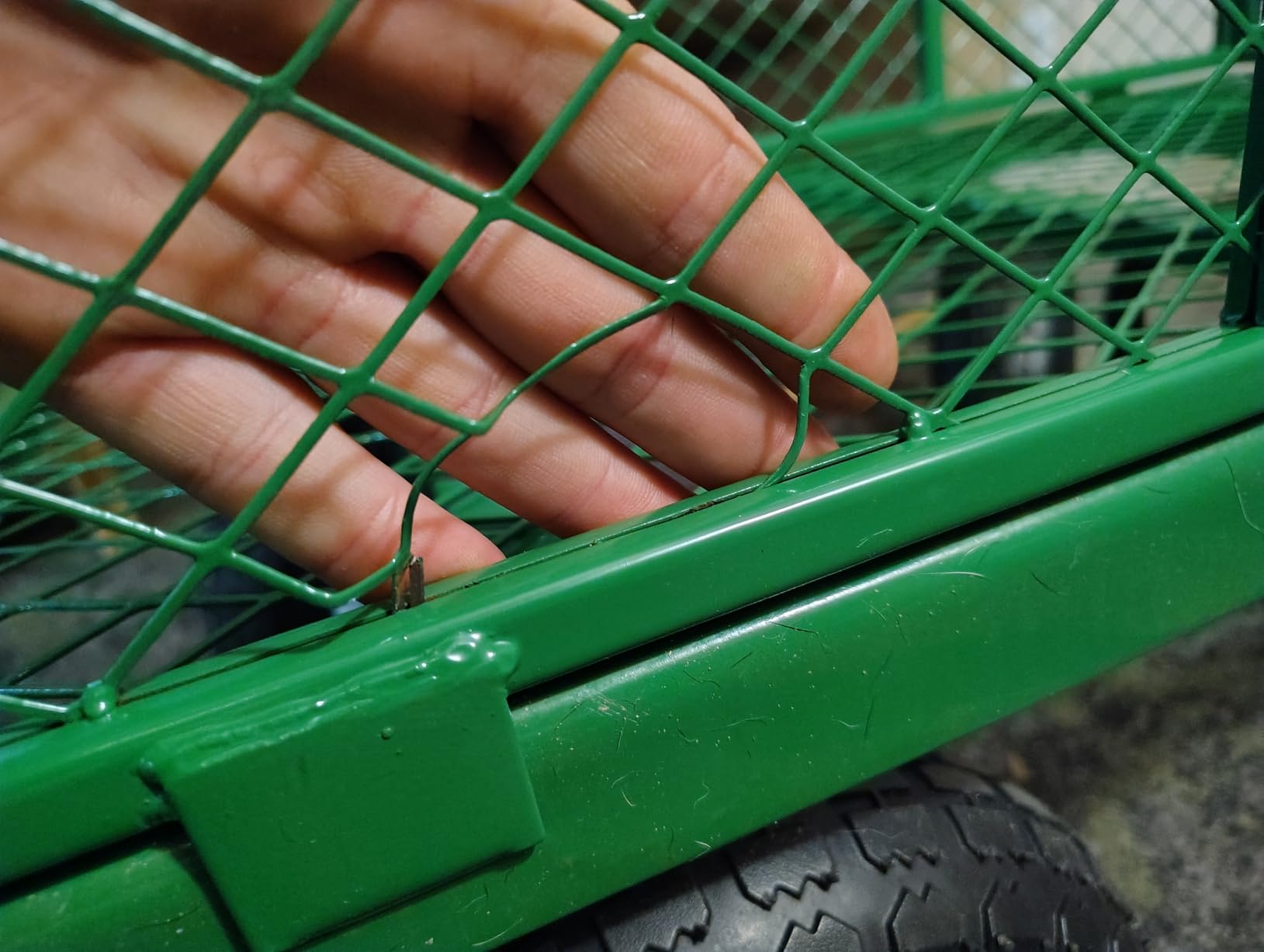
What you get in exchange is a wagon that will not flex, dent, or complain, and a pair of detachable mesh sides that come off in seconds to turn the whole thing into a flatbed platform. That conversion is genuinely useful later in the year for moving stacked bagged soil, potted plants, or lengths of scrap lumber.
The T-shaped handle adjusts through 180 degrees with a rubber grip, which makes it easy to pull alongside a fence line or back into a tight corner of the garden. Ten inch rubber tires with metal hubs take grass, mud, rocks, and even snow without complaint.
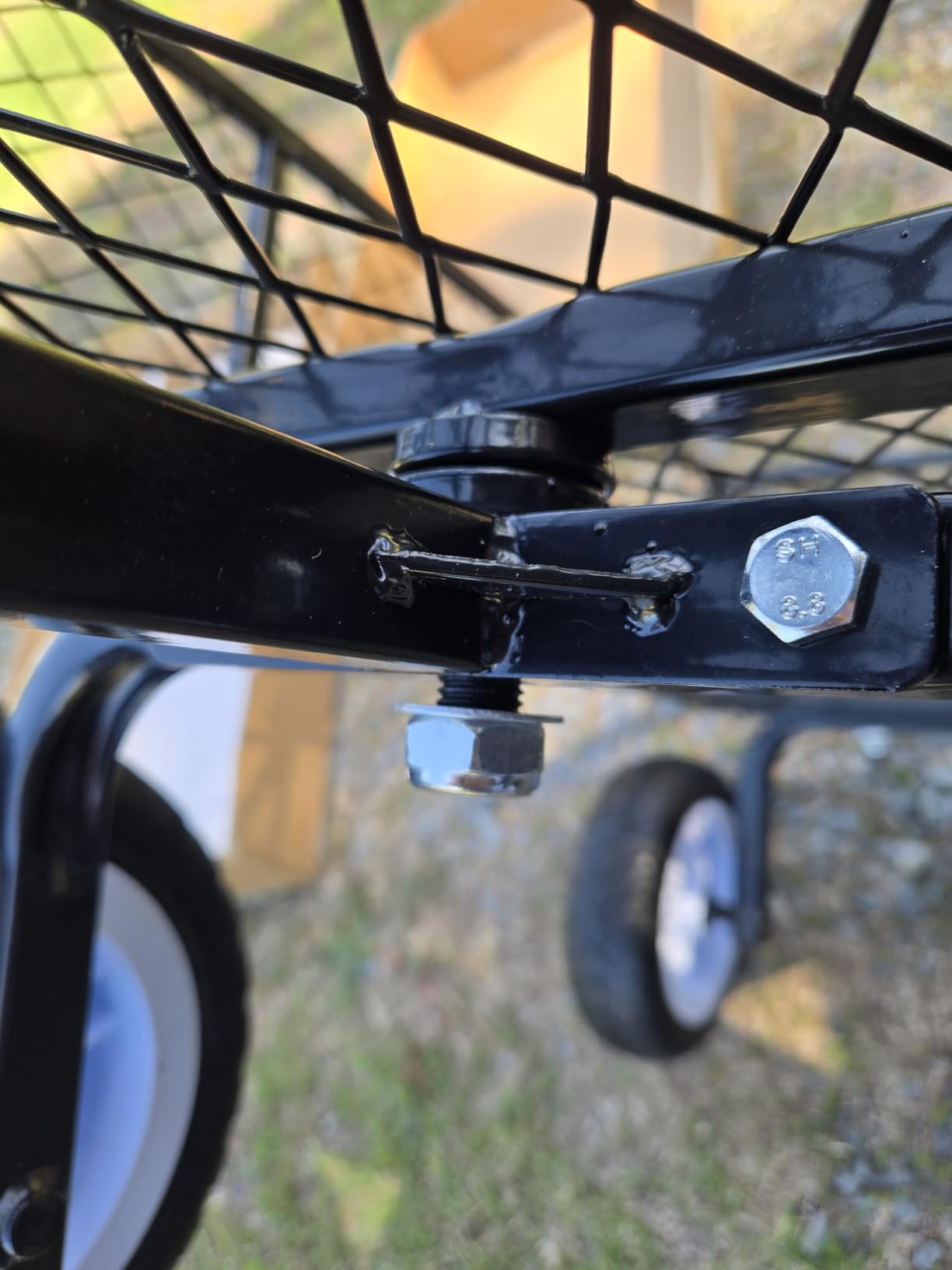
Best for heavy loads over wide area
If your mulch habit is bag-heavy rather than bulk-heavy, volume matters less. This wagon will take six or seven bagged 40 pound bags in one pass across a lawn, and the 900 pound frame never notices. Buyers who moved from hand-carrying bags tend to gravitate here for exactly that reason.
It is also the cart I would point at for anyone who wants a second job done with it later. Gravel runs, firewood rounds, and a load of pots for a patio re-do all fall well inside what this frame is rated for.
Where it falls short
The mesh floor lets fine material escape. Loose, finely screened mulch works its way through the openings, and the same goes for sand and soil. Owners add a liner or a plywood base to solve it, which is a five minute fix but an extra step.
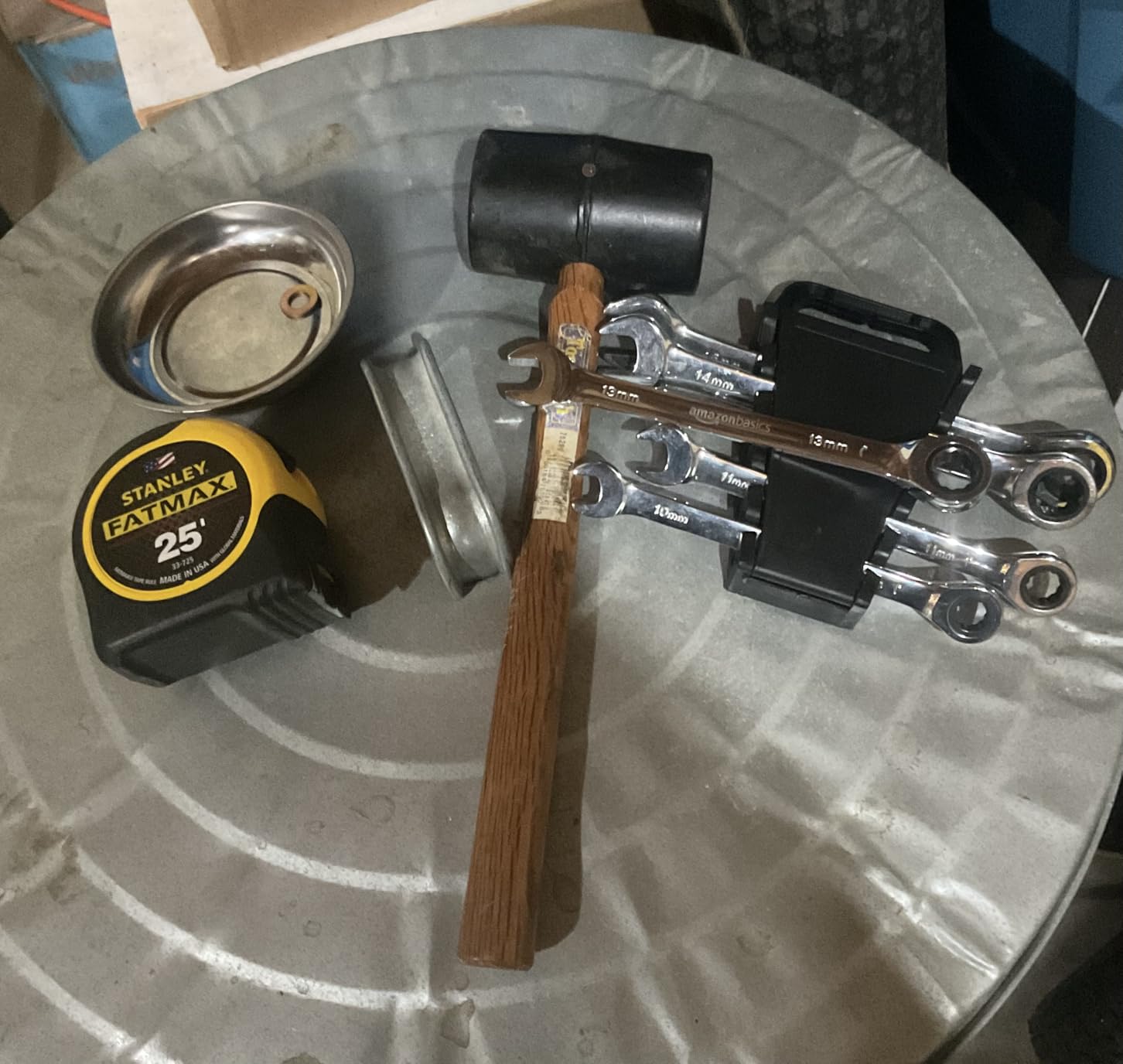
Also expect a few bent panels on arrival. It is a shipping issue rather than a quality one, but have a rubber mallet on hand and straighten the frame before you load anything heavy into it.
3. WORX 8-in-1 Aerocart Wheelbarrow and Dolly (300 lb) – best when storage rules your life
- Converts between wheelbarrow
- hand cart and dolly
- Turbo Lift reduces strain on a heavy load
- Flat-free tires need no air
- Narrow profile stores in a small shed
- Includes bag holder and rock mover mesh
- Holds about half a full-size wheelbarrow
- Hard tires struggle on soft or deeply uneven ground
- Paint finish can dull and spot with rust if stored damp
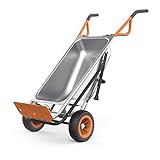
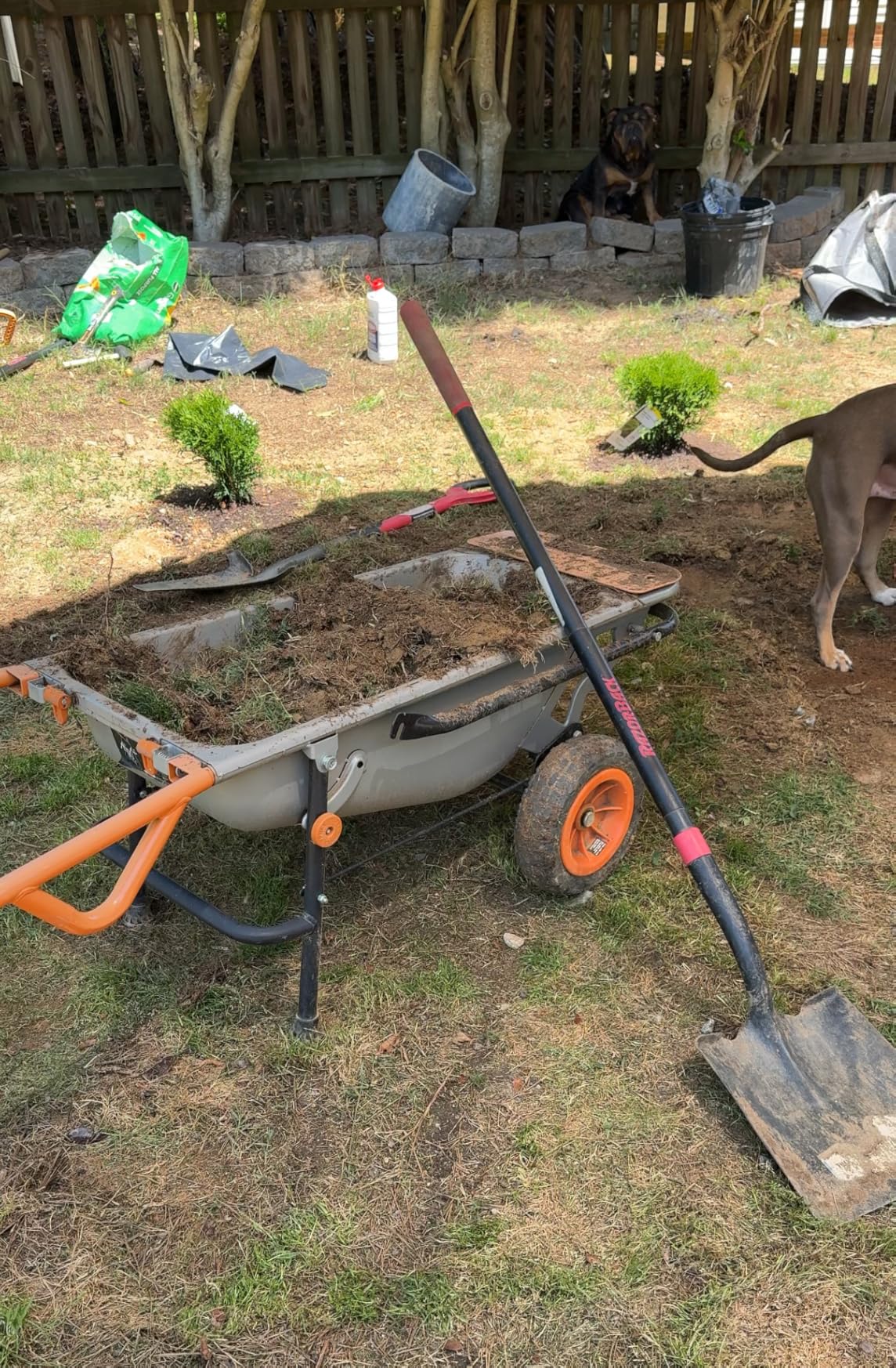
This is the odd one out in the group, and it is the one I recommend to anyone whose garden is a strip of side yard rather than an open property. It is a wheelbarrow, a hand cart, and a lifting dolly in one metal frame, and the tub holds roughly half a standard wheelbarrow load.
What makes it work for mulch is the Turbo Lift lever. The manufacturer claims 200 pounds feels like a fraction of that. In practice, the lever changes your leverage on the load so you are lifting with your legs instead of your back, which is the difference between spreading a yard of mulch comfortably and giving up after three trips.
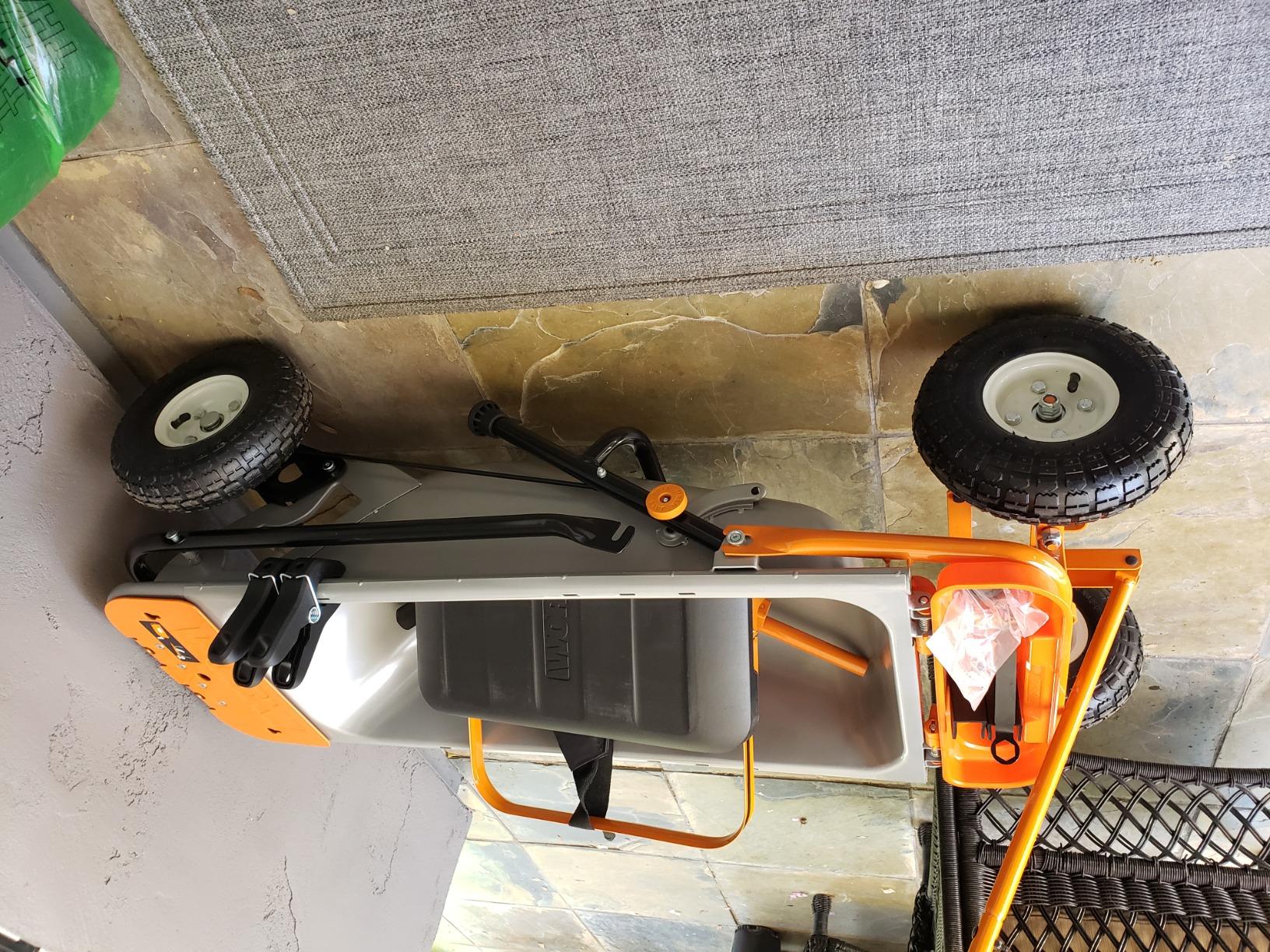
Two wheels and dual support legs mean you can set it down flat, load it with both hands free, and pick it back up without the balancing act a normal barrow demands. The included accessories matter too: a cylinder holder, a bag holder, a plant mover strap, and a rock mover mesh that all click onto the frame for different jobs.
At 23 by 20 by 58 inches and 40.8 pounds, it parks in a narrow corner or a car trunk. Flat-free tires mean no pump, no patches, and no checking pressure in the cold.
What it is genuinely good at
Light, frequent loads in a confined space. A side yard with a gate, a raised bed garden behind a fence, or a patio project where you are moving two or three bags of soil rather than a yard of anything.
It is also a cart with more than one life. The same frame is a dolly for moving planters, a plant carrier for shrubs you want to keep upright, and a firewood hauler once the mulch is down. Owners who bought it for one job tend to keep it for the third use of the season rather than putting it away in June.
Where it falls short
Capacity, plainly. You will make more trips with this than with any four-wheel cart on the list, and anyone moving a full two yard bulk delivery will feel that. The wheelbarrow workload that wears people out is exactly what a low-sided four-wheel bed fixes.
The flat-free tires are firm, and some owners swap them for pneumatic tires when hauling mulch over rough ground. The orange finish is also a weak point in storage. If the Aerocart sits outdoors through a wet season, surface rust appears where the paint chips.
4. Gorilla Carts 800 lb Steel Utility Garden Cart (4 cu ft) – best for bagged mulch
Gorilla Carts Steel Utility Garden Cart, 800 lb. Capacity, 4 Cu Ft, Red
- 800 lb frame takes several bags in one pass
- Removable side panels turn it into a flatbed
- Assembles in about 15 to 20 minutes
- Four 10-inch pneumatic tires for uneven ground
- Tight-turning four-wheel steering
- Wheels struggle a little in deep grass or soft sand
- Mesh floor can sag under concentrated weight without a plywood base
- New tires have a strong rubber odor
Where the poly dump cart prioritizes volume, this steel utility cart prioritizes frame strength, and the 800 pound rating is the reason most owners buy it. If you buy mulch in bags from a garden center rather than by the yard, the pounds are the number that decides how many trips you make.
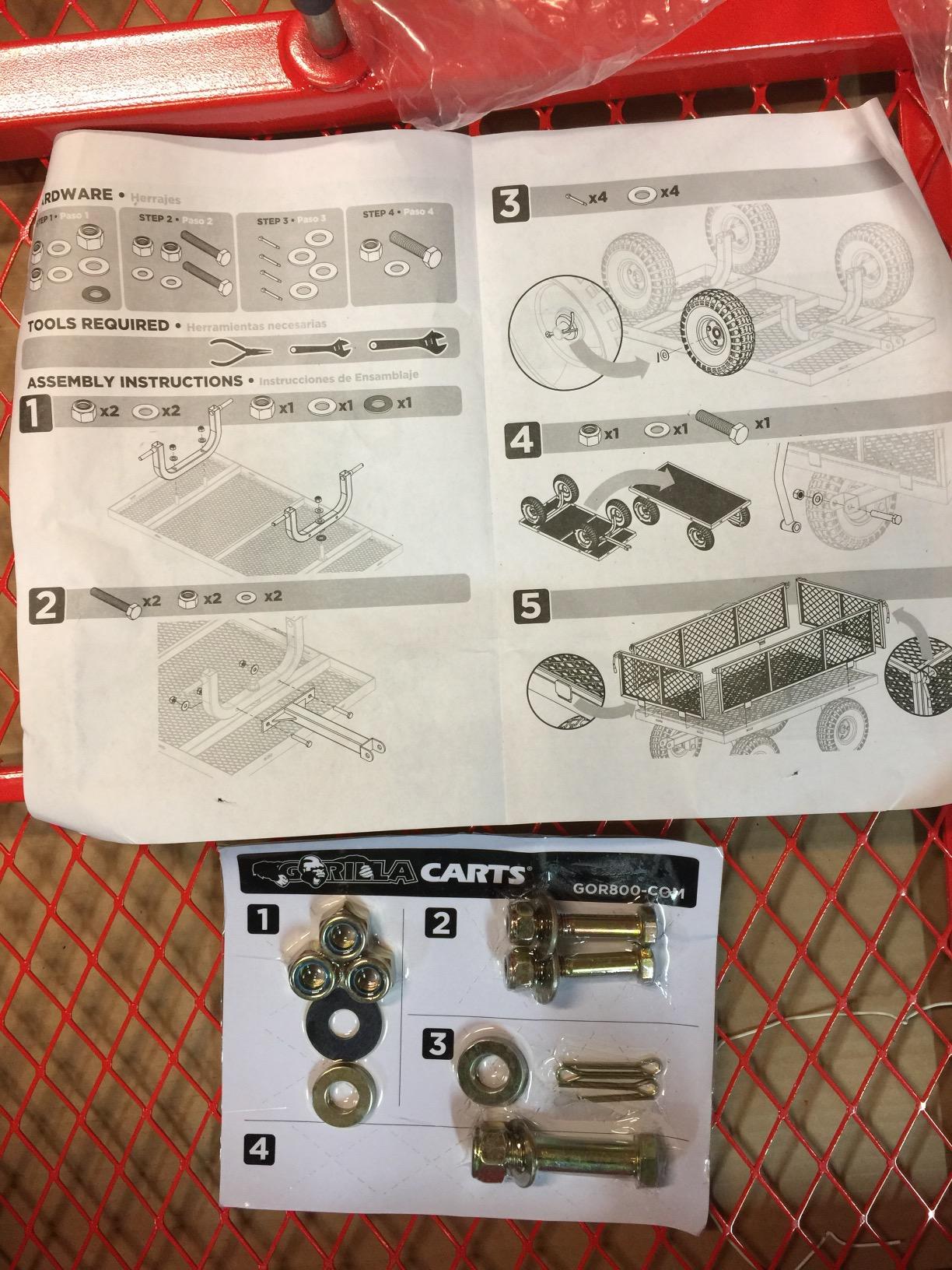
It assembles in roughly 15 to 20 minutes with grouped hardware, which is one of the friendliest builds in the category. The removable side panels come off without tools and flatten the cart into a platform for long or bulky loads, like rolled sod or long boards.
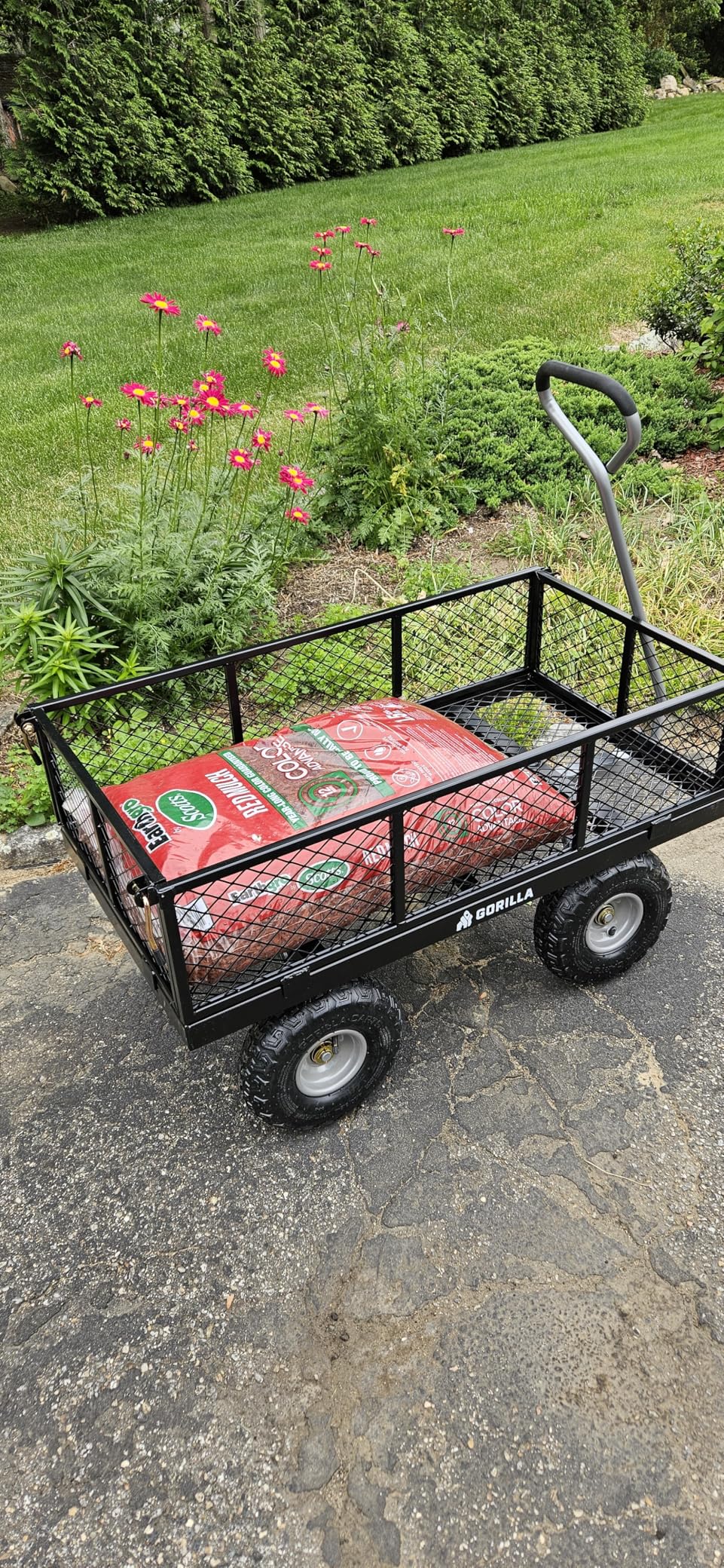
Four-wheel balance and tight-turning steering make it easy to wheel in a straight line down a bed without fighting the handle. That is a small detail that only shows up when you actually spread mulch, because a wandering cart leaves an uneven strip and doubles your raking.
Longer-term owners recommend one addition: a plywood floor. The expanded metal mesh is welded at intervals, and a concentrated pile of wet mulch or a stack of bags sitting in one spot can bow it. A cut sheet of plywood the size of the bed solves it in a few minutes.
Best for bagged soil and compost
This is the cart for the annual topsoil run. Six bags of 40 pound bagged soil is 240 pounds, which the frame shrugs off, and the 43.5 by 20.86 inch footprint fits between the rows of a typical raised bed without a fight.
It also earns its keep on cleanup. Leaves, garden debris, and a season’s worth of spent potting soil all fit, and the solid powder-coated steel wipes clean with a hose in a way a mesh floor never does.
Where it falls short
Deep grass and soft sand are the two places the wheels complain. The 10 inch pneumatic tires have a narrower footprint than you would like for a wet lawn, and the cart pushes harder through a spring lawn that has not dried out.
It is also the heaviest of the small four-wheel steel carts in this group at 45.9 pounds empty, so lifting it into a truck bed is a two-person job. New tires also smell strongly of rubber for the first few trips, which fades.
5. BILT HARD 7 cu Ft Poly Dump Cart (1200 lb) – best for bulk mulch
- 7 cu ft bed is the largest of the poly dump carts
- 1200 lb load rating
- 13-inch no-flat tires resist punctures
- Quick-release dump unloads cleanly
- Handle converts to an ATV or tractor hitch
- Over 63 lb empty and harder to push
- Wide footprint for a small shed
- Some units arrive with stripped handle hardware
This is the cart for the person with a two or three yard delivery and a place to put a big pile. Seven cubic feet of bed at 42 by 23 inches, paired with a 1200 pound rating, is the combination that turns a bulk mulch job into two or three pushes instead of a long afternoon.
The wet mulch calculation works out well here. Even at 45 pounds per cubic foot, a full 7 cubic foot load is around 315 pounds, which means you are using about a quarter of the stated rating. That headroom is exactly what a bulk-hauling cart should have.
Thirteen inch no-flat tires are a bigger visual than they sound. They are tall enough to roll over a driveway crack, a garden edge, or uneven sod, and they will never go flat on a nail or a thorn bed. For a property with gravel paths or a rough lane to the back garden, that changes what you can reach.
The 2-in-1 convertible handle is the other reason this cart stands out. It pulls by hand like any other cart, and it converts to a hitch for an ATV or lawn tractor when the load is too heavy to drag. Assembly is also unusually painless because the hardware is grouped by numbered step in the box.
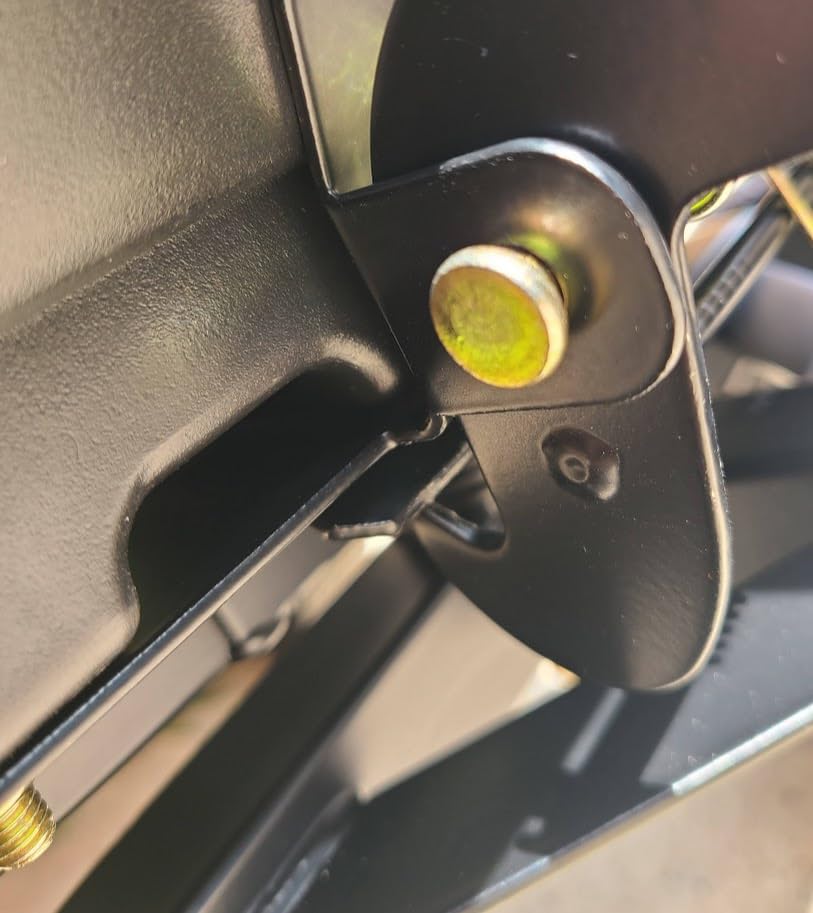
Best for a two or three yard delivery
Three cubic yards is 81 cubic feet, so a 7 cubic foot bed means roughly a dozen loads. That is still a lot, but a full load here is a genuine armful of mulch, and the quick-release dump means each load costs you one push and one lever pull.
Ask the delivery driver to dump into the bed rather than piling the whole order in the driveway. It turns a two hour job into a walk back and forth with a shovel and a cart, and it keeps the pile out of the way of the cars.
Where it falls short
It weighs 63.3 pounds empty, more than double the small carts here, and you feel every one of those pounds when you are pushing it across flat lawn unloaded. This is not a cart you casually drag out of a shed by the handle.
The footprint is wide for a shed, and a small number of owners report arriving with stripped or missing handle hardware. Check the handle bolts before you load it. The wide stance is also a real tradeoff against the four-wheel stability it buys.
6. Sekey 12 cu ft Steel Garden Cart (1600 lb) – best for whole-truckload moves
Sekey 12 Cu Ft Steel Garden Cart, 1600 lb Capacity, Towable Handle
- 12 cu ft bed is the largest in the group
- 1600 lb rating on reinforced carbon steel
- Handle pulls by hand or hitches to a tractor
- 13-inch tires hold traction in mud and rock
- Sides fold down to a flatbed
- Largest and heaviest footprint to store
- Fine loose mulch spills through the mesh sides
- Needs a tow vehicle or a strong puller when full
- Fewer owner reviews than the rest
Twelve cubic feet and a 1600 pound rating is the biggest combination here, and it is built on a reinforced heavy-gauge carbon steel frame with oversized axles. If you are moving mulch by the several yards at a time, or you also haul hay and firewood, this is the cart that minimizes trips more than any other on the list.
The 12 cubic foot bed is extra wide rather than merely deep, so it accepts a broad windrow of mulch instead of a tall narrow one. That matters for spreading, because you can rake off a full bed’s worth in one pass along the edge of a bed.
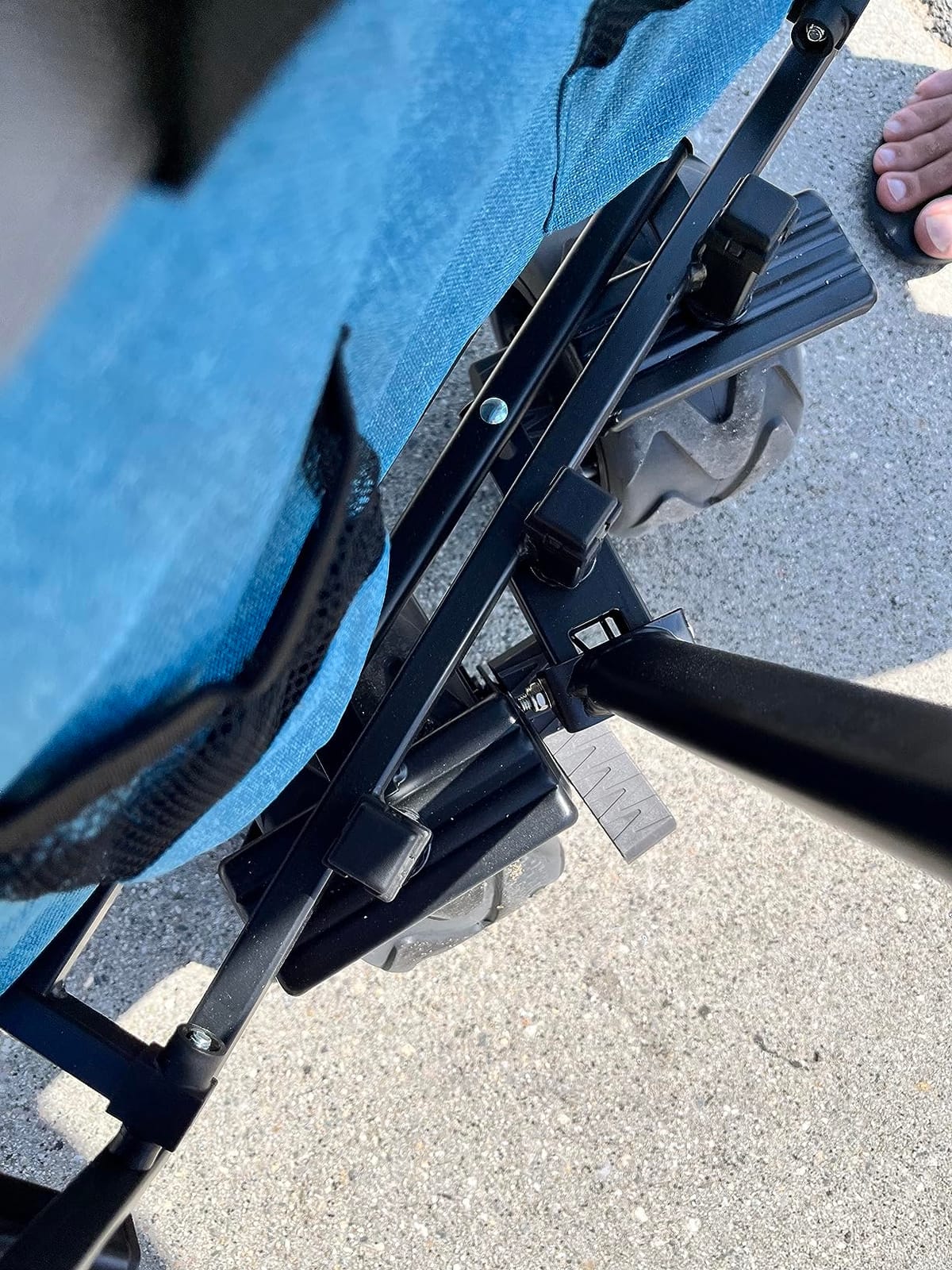
The patented 2-in-1 towing handle is a genuine advantage for owners with a tractor or ATV. It pulls by hand for small jobs and hitches up when the bed is full, and four steel mesh sides remove or fold down entirely so the cart becomes a flatbed platform for oversized loads.
Thirteen inch oversized pneumatic rubber tires are the reason this cart holds its line on soft ground. The sidewalls spread weight instead of sinking, which is exactly what you need crossing a damp lawn or a gravel drive after a delivery.
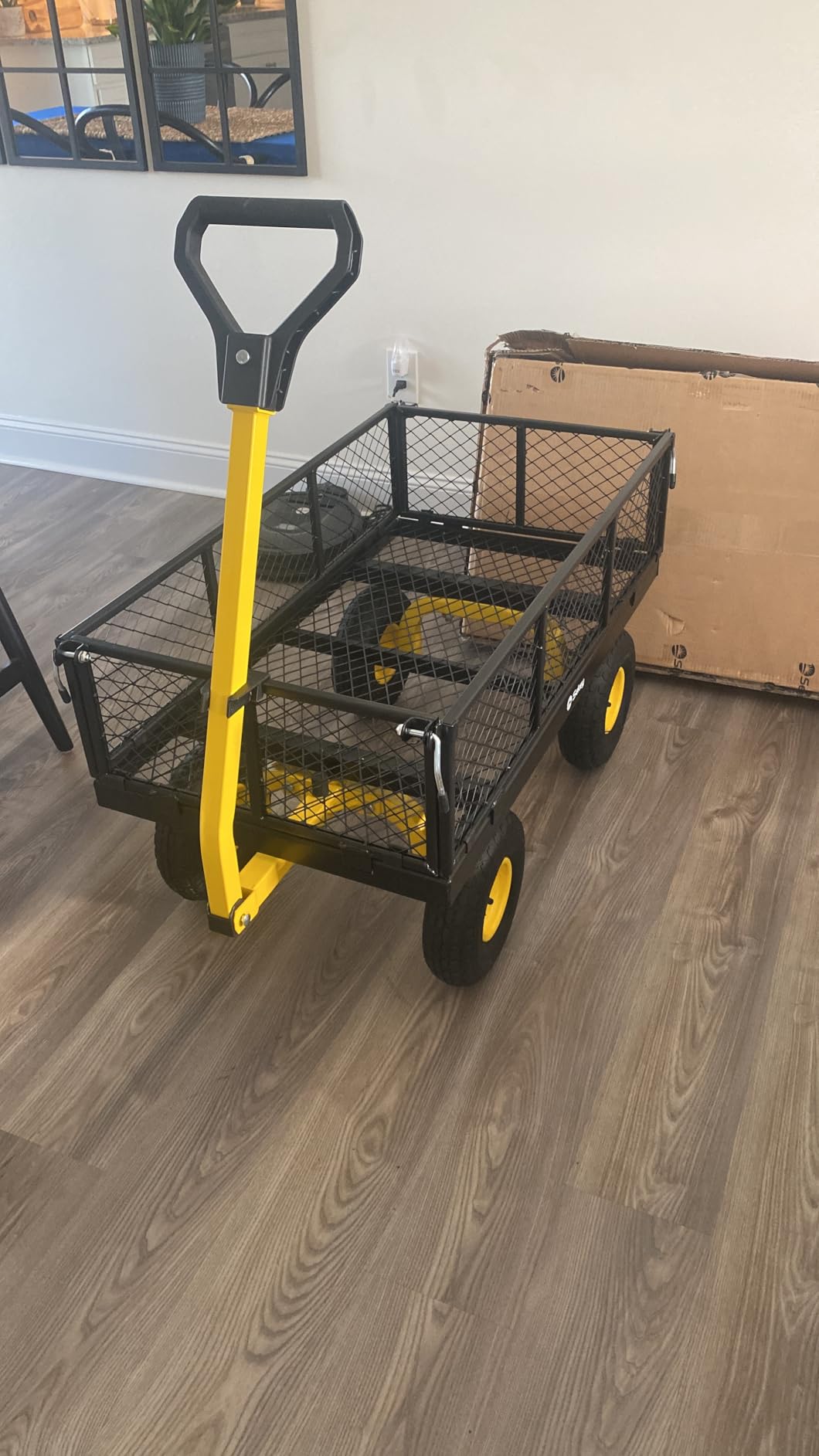
Best for acreage and repeat bulk work
At 53.5 by 30.3 by 42.9 inches, this is a piece of equipment. It makes sense if you have more than half an acre, a long bed line, or a habit of ordering multiple yards a season. The tire size and frame rating are sized for that kind of work, not for a single weekend project.
If you do own a riding mower, the convertible handle means the same cart serves as a tow-behind on lighter days. One piece of gear covers mulch in spring, leaves in fall, and firewood all winter.
Where it falls short
Storage is the honest problem. This is the largest cart in the group and needs real floor space in a garage, not a corner. Many owners report it taking up more of the bay than they expected.
The mesh sides let fine loose mulch spill through on the way, so a liner or a tarp liner on the bed floor is close to mandatory for this cart. It also needs a tow vehicle or a strong puller once the bed is genuinely full, which rules it out for anyone with a bad back who is hand-pulling only. And with fewer owner reviews than the others here, you have a thinner base of long-term reports to lean on.
7. VIVOHOME 880 lb Mesh Steel Garden Cart (4.5 cu ft) – best on soft ground
VIVOHOME Heavy Duty 880 Lbs 4.5 Cu Ft Mesh Steel Garden Cart Utility Wagon
- 880 lb rating handles heavy mulch and soil
- Pneumatic tires quiet the ride over bumps
- 180-degree handles pull in any direction
- Sides remove to convert to a flatbed trailer
- Fully welded anti-rust steel body
- Manufacturer advises against long-term heavy loading
- Tires arrive only partly inflated
- Fine loose mulch works through the mesh floor
The quietest ride in this group is the VIVOHOME, and on a soft spring lawn quiet matters more than people expect. The pneumatic tires do real shock absorption work, so bark chunks and twigs do not jar the load on every wheel rotation.
Two numbers define it: an 880 pound load rating and a 4.5 cubic foot mesh steel bed. That is slightly more volume than the other small steel carts here, which makes it a reasonable middle choice between the compact carts and the big poly dump cart.

The 180-degree turning handles are a sleeper feature. You can pull the cart sideways toward a bed without constantly pivoting the whole frame, which saves real time when you are spreading along a long border rather than working back and forth.
Removable mesh sides convert the cart to a flatbed trailer configuration, so a load of long lumber or a stack of edging stone fits in one go. The fully welded body with welded hinges between rails is solid, and the anti-rust finish holds up to a wet season without pitting.
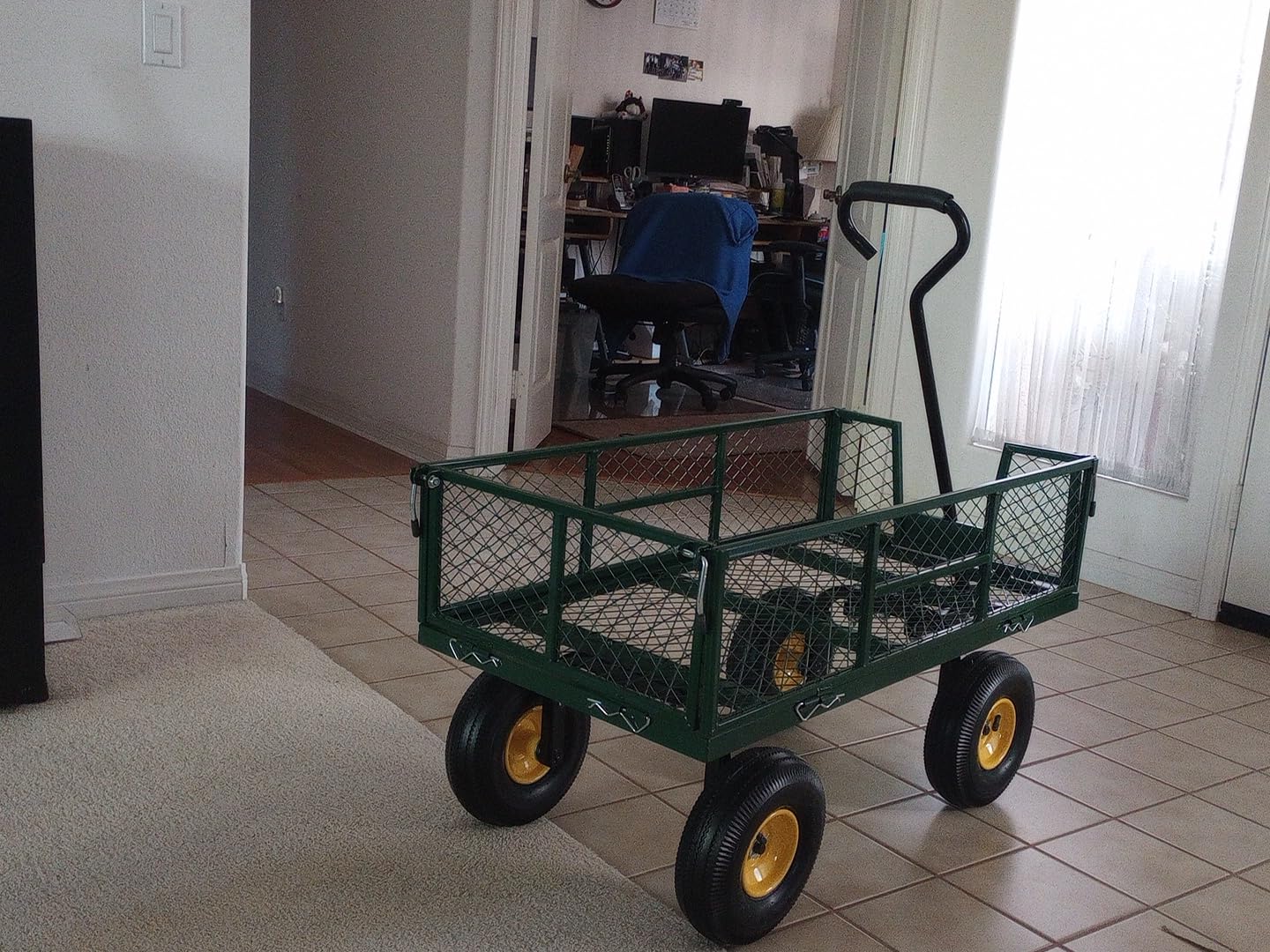
Best when the ground is wet or uneven
Air-filled tires are the deciding factor on a lawn that is soft, recently rained on, or full of clay in the side yard. They conform to the surface instead of bouncing over it, and the difference shows up on the tenth trip, not the first.
They are also quieter, which matters if you are working early in the morning on a property that backs onto a neighbor’s bedroom wall. For a suburban lot under half an acre with uneven ground, this is a very well matched tool.
Where it falls short
The manufacturer’s own guidance is not to use it for long-term heavy loading, which is worth taking seriously if your plan is repeated gravel and stone runs. The frame is fine; the application is the issue.
Fine loose mulch also works through the mesh floor, and the tires arrive only partly inflated for shipping, so budget ten minutes with a pump before the first trip. Adding a plywood base gives you a solid floor and solves the spill problem in one move.
8. BILT HARD 880 lb Steel Garden Cart (4 cu ft) – best if you never want a flat tire
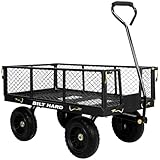
- 880 lb rating at a modest price
- Airless 10-inch tires never need inflating
- Rotating handle steers easily in tight spots
- Quick-release sides come off in seconds
- Pulls up porch steps without trouble
- Heavier than expected when empty
- A bit tippy on very tight turns when loaded
- Surface rust can appear if stored in rain
- Assembly needs a wrench
Airless ten inch all-terrain rubber tires are this cart’s identity, and they solve a problem nobody advertises but everybody hits. A pneumatic tire on a cart that lives near a bed of sharp bark edges, rose canes, or gravel will find a hole eventually. This one never will.
It also carries an 880 pound load rating on a rust and corrosion resistant steel body, with a 4 cubic foot bed. That is a well matched spec sheet for someone hauling bagged mulch, potting soil, and compost across a suburban lawn with a lot of obstacles.
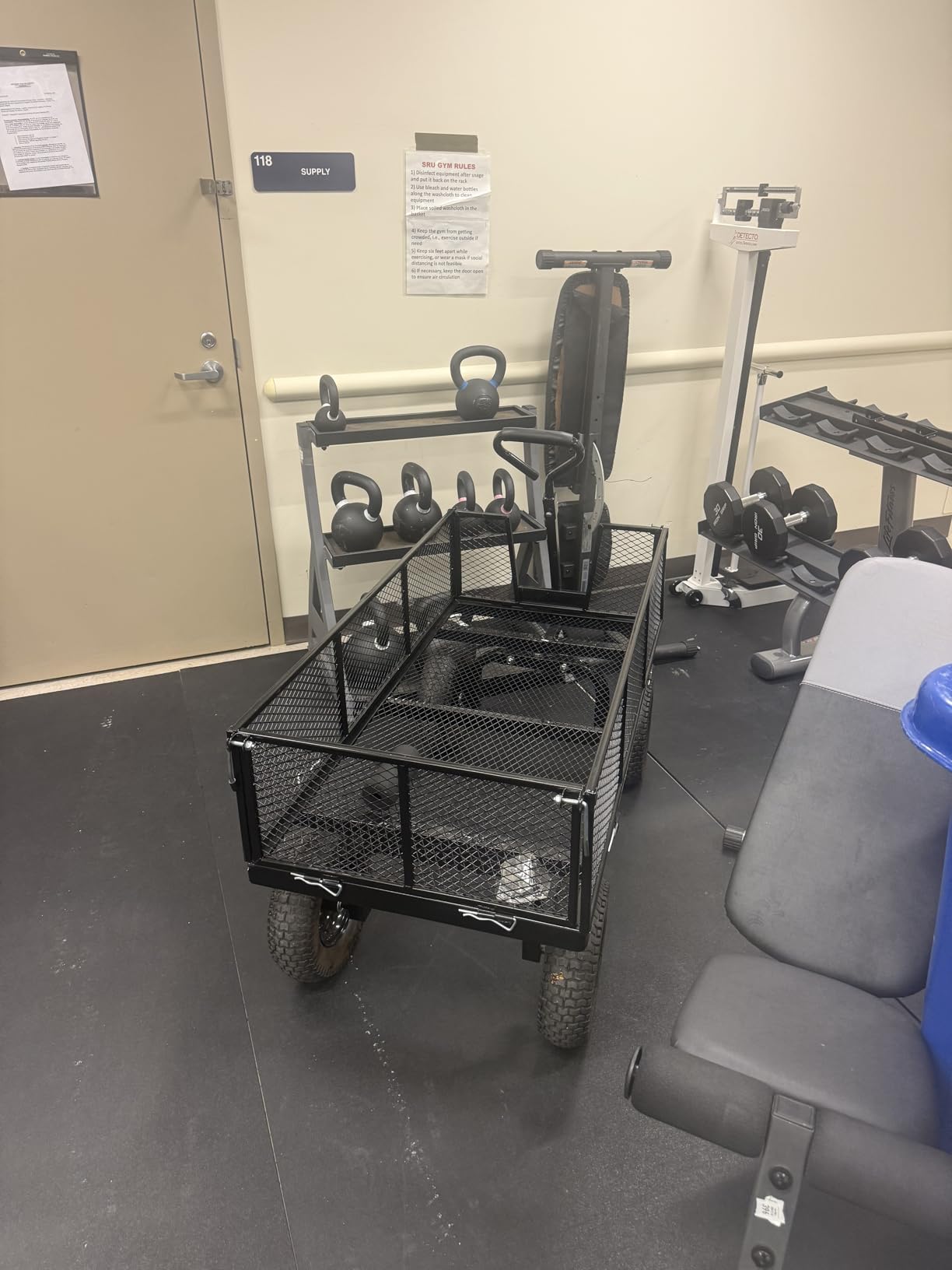
The 180-degree rotating handle makes the cart far easier to steer in the tight spots between a house and a fence. Owners mention pulling it up porch steps and over curbs without difficulty, which is a good deal more than a two-wheel barrow will manage loaded.
Quick-release removable sides come off in seconds to make a flatbed for long or bulky loads, and the steel finish wipes down easily after a messy job. It is a straightforward tool that does what it says.

Best for a lawn full of obstacles
Think a property with a stone path, a gravel drive, root-heavy shade beds, and no smooth runway anywhere. Solid tires will not sink, will not need air, and will not stop dead in the middle of a bed with a full load sitting on them.
The tradeoff is ride comfort. Airless tires transmit bumps more directly, so a rough yard is noisier and slightly harder on the load. On a smooth lawn you will not notice, and the maintenance savings over five seasons is real.
Where it falls short
It weighs 44 pounds empty, which is heavier than expected for its size, and some owners describe it as tippy on very tight turns when loaded. Take corners slowly and you will be fine, but it rewards a calm driver.
Steel will show surface rust if it stands outdoors in rain, so treat the powder coating as indoor storage. Assembly also needs a wrench or socket set for the oversized nuts, which is the one step the manual quietly skips.
9. VEVOR 4 cu ft Poly Dump Cart (600 lb) – the budget entry point
VEVOR Poly Garden Dump Cart 4 Cu.Ft. 600 lbs 4 Wheel Wheelbarrow Dump Wagon
- Corrosion-proof tub that will not pit
- 3mm polypropylene reinforced with metal brackets
- Four wheels remove the wheelbarrow balance act
- Quick-release dump frame
- Includes a mesh cover and cushion
- 600 lb is the lowest rating among the dump carts
- Tub flexes under very heavy concentrated loads
- Long overall length is awkward in a small shed
This is where most first-time cart buyers should start, and it is the reason the four-wheel style exists at all. The whole point of a four-wheel dump cart is that you do not have to balance a load on two wheels while walking on uneven lawn. Owners who switch from a barrow describe the shift in how the whole job feels, not just the load.
The tub is 3mm thick polypropylene reinforced with 25mm metal brackets, and it carries a 600 pound rating alongside 4 cubic feet of volume. A scratch-resistant painted coating keeps the surface looking reasonable season to season.
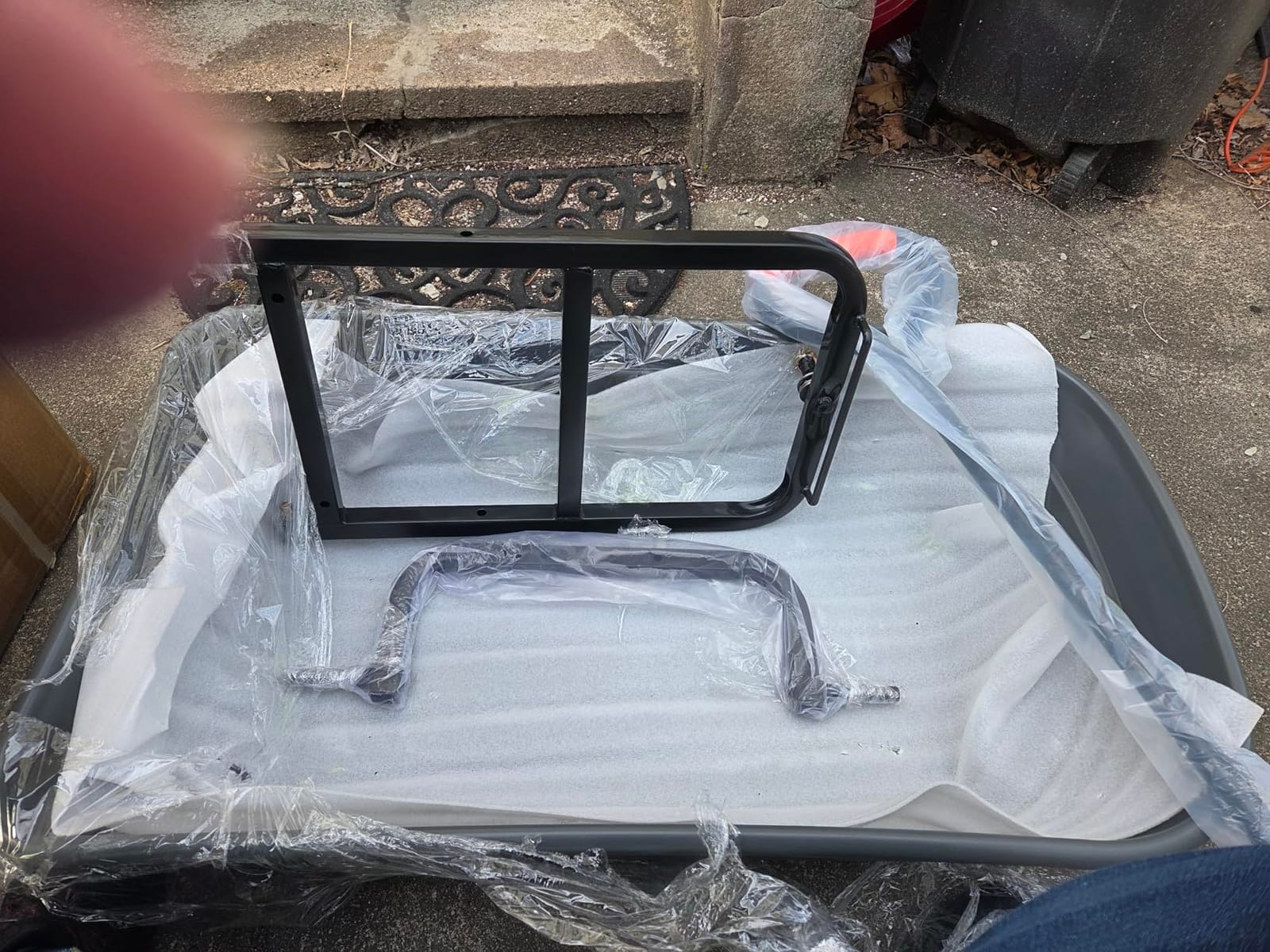
Unloading uses a front-handle dumping frame with a quick-release dump, so you tip the bed from the handle rather than lifting the load by hand. Ten inch rubber all-terrain tires with shock absorption handle uneven garden ground and grassy slopes, and the 180-degree adjustable handle helps you steer out of a tight corner.
A mesh cover and a cushion are included, which sounds minor until you realize how much the cover keeps bark dust and light material from blowing out on a windy day.
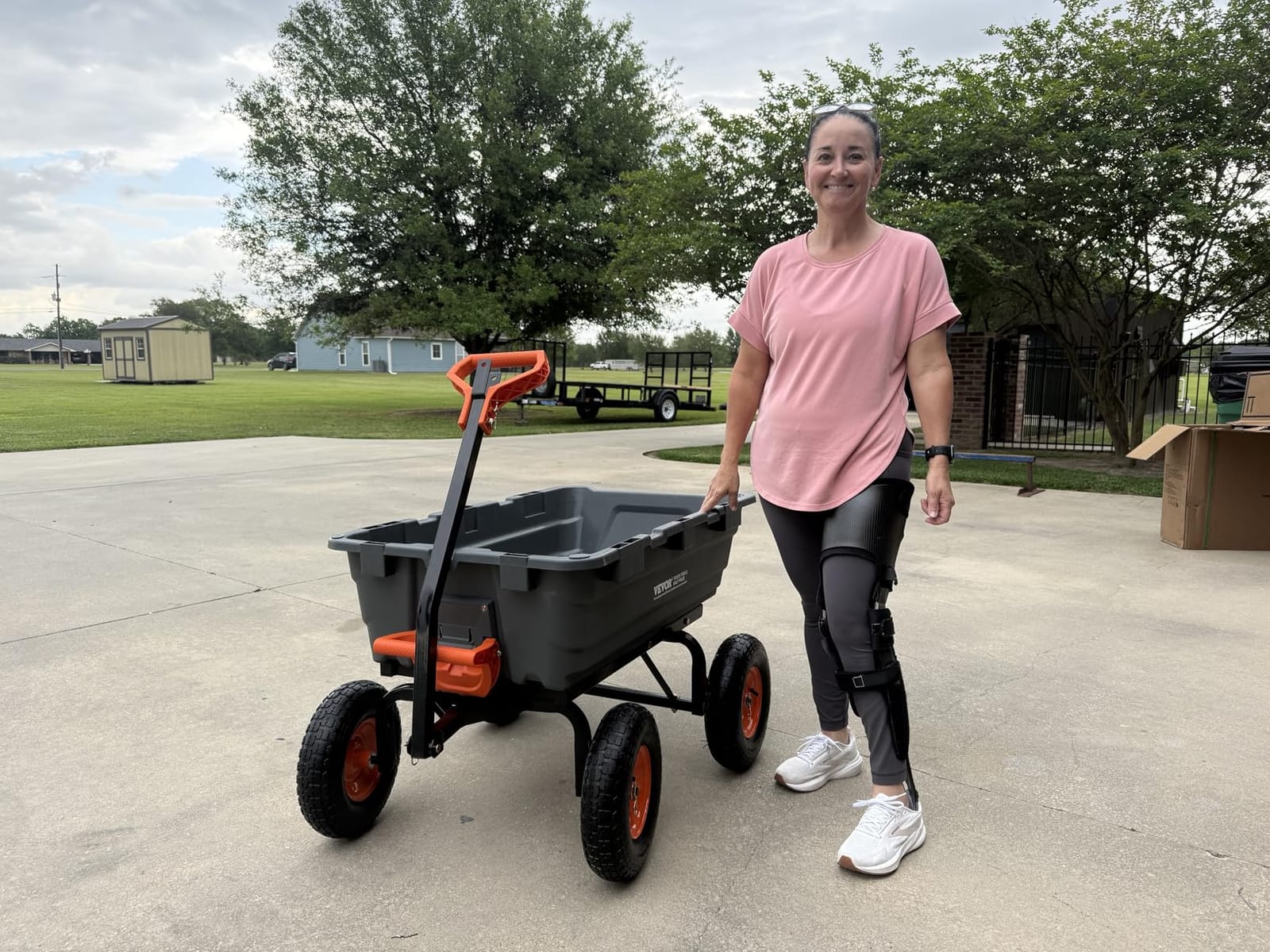
Best for a small yard and a one yard order
On a suburban lot under half an acre, this is more cart than most people need. A one yard order is 27 cubic feet, so this bed clears it in seven loads, and the 600 pound rating is never the limiting factor with dry wood mulch.
It is also the cart to consider if you have never owned one and want to find out whether the workflow appeals to you before committing to a larger, heavier model. Nothing about it is disposable either, since poly does not rust.
Where it falls short
At 600 pounds, this is the lowest load rating among the dump carts in the group, so you will feel it if you are moving wet mulch, gravel, or stone rather than dry bark.
Polypropylene flexes under concentrated heavy loads, and the long overall length makes it a poor fit for a small shed unless the handle folds. If your ground is soft rather than firm, a poly tub that flexes at the rim is not the reassuring experience you want mid-job.
10. Gorilla Carts 2-Wheel Poly Wagon (300 lb) – best for tight storage and a bad back
Gorilla Carts Poly Dump Cart, 2-Wheel Garden Wagon, 4 Cu Ft, 300lb Capacity
- Low bed means less lifting to load bags
- 23.4 lb empty and easy to move
- Foldable handle saves shed and garage space
- Quick-release dump releases cleanly
- Low center of gravity keeps it stable
- 300 lb rating means more trips for big loads
- Tires arrive under-inflated and need a pump
- Assembly from loose parts takes an hour or more
- Frame can weep rust water if stored outdoors
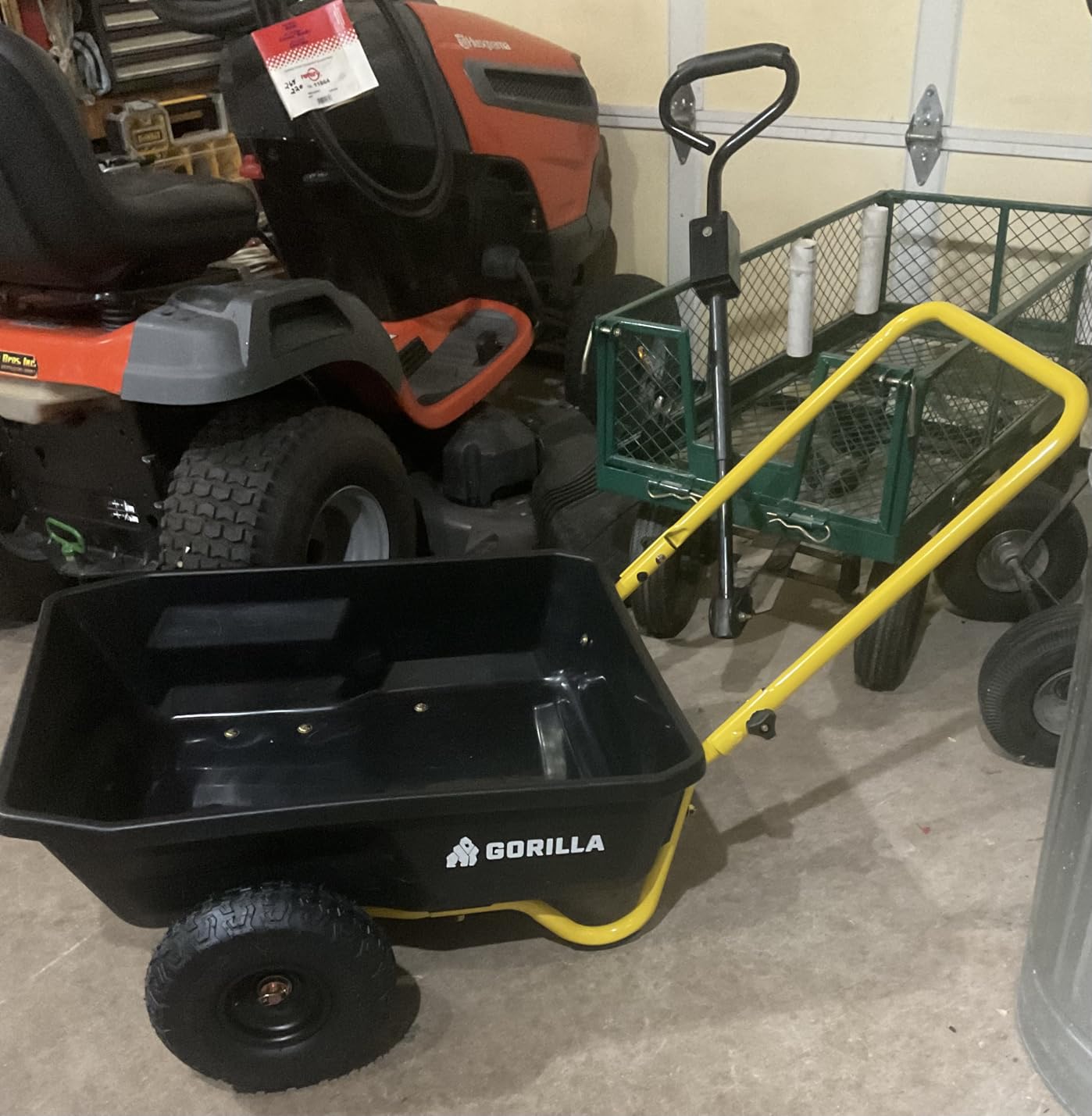
The lowest tub in the group is the whole point of this cart. A low-slung poly bed means you slide bagged mulch and soil in at waist height instead of hoisting them over a tall sidewall, and for anyone whose back or knees object to that lift, it is the difference between doing the job and avoiding the job.
It weighs 23.4 pounds empty, the lightest cart here, and it stays stable loaded because a two-wheel layout with a low center of gravity resists tipping better than the height would suggest. The patented quick-release dump lets the mulch slide out where you need it.
The foldable handle is what makes this cart live in small spaces. It shrinks enough for a shallow garden shed or the back of a garage, which removes the single most common objection people raise about owning a cart at all. Pneumatic fat tires suit lawn and sand.
Assembly is honest about itself, though. It arrives as a single carton of loose parts with pre-labeled hardware, and owners report an hour or more of build time. Budget an evening rather than an afternoon.
Best when the cart has to live in a small space
If a four-wheel cart simply will not fit in your garage, this is the answer. It also suits anyone whose property is walked rather than driven, since you can lift it into a vehicle unaided at 23.4 pounds.
The low bed is a real ergonomic win for bagged material. A 40 pound bag of soil goes in with a slide instead of a hoist, and a full 300 pound load is roughly 15 to 20 bags.
Where it falls short
At 300 pounds, this is the lowest rating of the ten, and a bulk mulch delivery will show it. Seven cubic feet of dry mulch is already close to the ceiling, so a one yard order takes nine or more loads.
Be careful about storage. Owners report the steel frame weeping rust water if the cart is stored outdoors through rain, and the air-filled tires arrive under-inflated and need a pump before the first trip. Inside a shed, the cart is fine.
How to Size a Garden Cart for Mulch
Size the cart by volume for mulch and by weight for everything else. Dry wood mulch runs about 15 to 30 pounds per cubic foot, and wet mulch after rain runs 35 to 45 pounds per cubic foot. Multiply the cubic foot capacity by the higher number to find your worst-case load.
A 4 cubic foot cart is therefore a 60 to 180 pound cart in practice, and a 7 cubic foot cart is a 105 to 315 pound cart. Neither comes close to a 600 or 900 pound rating, which is the good news. A poly cart is almost never limited by its strength. It is limited by how many times you feel like walking to the driveway.
Here is how capacity tiers map to real deliveries. A one yard order is 27 cubic feet. A two yard order is 54. A three yard order is 81. The carts in this roundup cover 3.45, 4, 4.5, 7, and 12 cubic feet, which is a range from 22 to 54 cubic feet per load depending on the cart.
That spread is why the 4 cubic foot carts are the most popular choice here and the 12 cubic foot cart is the most specialized. If your mulch habit is a couple of yards a year on a small suburban lot, a 4 cubic foot cart is the right answer. If you order three yards or more, or spread mulch on a long border, step up to 7 cubic feet.
One more sizing note that gets missed: measure your storage space before you fall in love with a bed size. A 12 cubic foot cart at 53 inches long and 30 inches wide is a garage bay, not a corner. Our full garden cart roundup breaks down the frame and wheel differences across every capacity tier in more detail.
Poly vs Steel Beds: Which One Holds Up Better
Poly wins on weight, rust, and clean-out. Steel wins on load rating, dent resistance, and long-term appearance if you store it indoors. For mulch specifically, the argument comes down to how wet the material is and whether you will ever put a shovel through the side.
A poly bed will not rust, will not pit from wet soil held against it for months, and can be rinsed in seconds. The flex people worry about is by design. High-density poly is engineered to take an impact and return to shape, and a bed that flexes when you drop a rock into it is a bed that will not crack. The downside is concentrated weight: a stack of 40 pound bags in one spot in a small poly tub can bow the floor.
A powder-coated steel bed, mesh or solid, holds a higher static rating and shrugs off sharp edges. The coating is what protects it, and the coating is the first thing to fail. A steel cart stored outdoors through a wet spring will show surface rust around the welds, and once it starts, it keeps going.
Between VEVOR and Gorilla Carts, the difference is design philosophy rather than quality. Gorilla Carts uses a molded poly tub on an alloy steel frame with a patented quick-release dump, and it has the largest base of owner reviews in the category at more than 30,000. VEVOR builds a welded steel frame at a higher pound rating for less money, with mesh sides you can remove. If you want the highest pound rating per dollar, VEVOR wins. If you want the smoothest unloading and the most proven dump mechanism, Gorilla Carts wins.
Tires and Wheels Matched to Your Ground
Pneumatic tires are the default for a reason. They conform to uneven lawn, absorb bumps, and resist sinking in soft ground. The cost is maintenance and the risk of a flat. If you keep a pump in the garage, that is a fair trade.
Flat-free and no-flat tires are the opposite bet. They never need air and never go flat, which is the right call on a property with gravel paths, thorny beds, or nails and screws lying around. You give up some shock absorption, so a full load over rough ground is noisier and slightly rougher on the mulch.
Wheel size is the variable most buyers ignore. Ten inch tires handle lawn and light mud. Thirteen inch tires cross uneven ground and gravel lanes without bogging down, because a taller sidewall absorbs a rut before the axle takes the hit. The cost of the bigger tire is a heavier, bulkier cart.
Our general rule: if your route from driveway to beds crosses lawn that is regularly wet, choose pneumatic. If the route has gravel, roots, or debris, choose airless. If you will only move mulch on a dry suburban lawn, either works and the decision matters less than the cart bed size.
Dump Mechanisms and Hitches
A quick-release dump is worth paying for. You lift a lever at the handle and the bed tips forward, and the mulch slides out in a cone right where you need it. That single feature is what separates a dump cart from a utility wagon, and it is the detail r/gardening owners name most often when they explain why they stopped hand-hauling.
A convertible 2-in-1 handle is the other feature to look for. It pulls by hand in one mode and converts to a hitch for an ATV or lawn tractor in the other. If you own a riding mower, this is how you move a genuinely full load without wrecking your back.
And here is the path most guides skip. If you do not own a riding mower, you do not need a hitch. Every cart in this roundup pulls by hand. The 4 cubic foot carts are light enough for one person to move a full wet mulch load across a lawn, and that covers the overwhelming majority of suburban mulch jobs. Tow-behind capability is an upgrade for acreage, not a requirement for a two yard order.
Brand reputation deserves a word too. Gorilla Carts, VEVOR, Ames True Temper, Ohio Steel, Agri-Fab, Smart Cart, and GroundWork are the names that come up most in garden forums when owners ask what they would buy again. Gorilla Carts has the deepest review base in this list by a wide margin, which is why two of the ten picks come from that brand.
Loading Technique and Downhill Safety
Load over the axle, not over the front rim. A load pushed forward makes the cart harder to control on the return trip and puts more strain on the handle and the axle than the frame is meant to take. Fill from the bottom, from the handle end toward the front.
For a bulk delivery, have the driver dump into the bed rather than piling the entire order in the driveway. If that is not possible, shovel the pile into the cart in stages so you are not walking twenty times across a loose mulch pile that your tires will sink into.
Loaded carts have no brakes. This is the point people get wrong. On any slope, especially with a wet load and pneumatic tires, the cart can run downhill faster than you can walk. Keep the load below the rim on any grade, keep your hands on the handle, and turn across a slope rather than down it. A side-hill turn is safer than a straight descent.
On wet mulch, treat the load ceiling as a hard limit rather than a suggestion. A 600 pound cart full of wet mulch is not a handling problem, but a 300 pound cart with the same wet mulch in it will feel it on the first turn.
When a Wheelbarrow Is the Better Buy
If you buy one or two bags a season, a cart is overkill and a wheelbarrow is the right tool. The honest math is simple. A 2 cubic foot wheelbarrow holds roughly a fifth of what the small carts here carry, so a one yard order is about 13 barrow loads, and that is a manageable afternoon once a year.
A cart earns its place when the load is bulk, when the distance from driveway to beds is more than about 60 feet, or when the job repeats. If you spread mulch annually, also move bagged soil, and clear leaves in the fall, one cart handles all three and the trips saved add up across a season. If storage is your real problem, the two-wheel and convertible designs here solve it better than a bigger frame would.
For tight side yards and gate-limited access, a cart can also be the wrong answer for a purely spatial reason. If the cart physically will not fit through the gate, a narrow wheelbarrow is the only option, and the 8-in-1 convertible designs in this roundup exist for exactly that situation.
Frequently Asked Questions
What is the best heavy-duty garden cart for mulch?
The best heavy-duty garden cart for mulch is one whose pound rating comfortably exceeds the wet weight of your load. Dry wood mulch runs about 15 to 30 pounds per cubic foot and wet mulch runs 35 to 45, so a 7 cubic foot cart holds 105 to 315 pounds. A 1200 pound poly dump cart gives you the headroom to fill the bed fully without worrying about the rating.
Are Gorilla Carts worth it?
For most homeowners moving mulch, yes. The 4 cubic foot poly dump cart is the single most reviewed cart in the category, with over 30,000 owner reviews averaging 4.7 stars, and the patented quick-release dump is the feature owners name most often. You are paying for a proven dump mechanism and a large base of long-term reports rather than for the name.
Which is better for my garden, a wheelbarrow or a garden cart?
A wheelbarrow is better if you move one or two bags a season. A garden cart is better if you buy mulch by the yard, if the distance from the driveway to your beds is more than about 60 feet, or if the job repeats through the season. A one yard order takes roughly 13 wheelbarrow loads but only 6 to 7 loads in a 4 cubic foot cart.
How big a garden cart do I need for a 2 yard mulch delivery?
A 2 yard delivery is 54 cubic feet, so a 4 cubic foot cart needs about 13 loads, a 7 cubic foot cart needs about 8, and a 12 cubic foot cart needs about 5. Most homeowners on a small lot are best served by the 4 cubic foot cart, and anyone ordering three yards or more should step up to 7 cubic feet or more.
Do I need a riding mower to haul mulch?
No. Every cart in this roundup pulls by hand, and the 4 cubic foot carts weigh 30 to 45 pounds empty, which is light enough for one person to move a full wet mulch load across a lawn. A hitch is an upgrade for acreage and full loads, not a requirement for a normal two yard order. Convertible 2-in-1 handles add towing only if you already own a tractor or ATV.
How much does wet mulch weigh per cubic foot?
Dry wood mulch runs roughly 15 to 30 pounds per cubic foot, and wet mulch can reach 35 to 45 pounds per cubic foot. That is a difference of up to 30 pounds in a single cubic foot, which is why sizing a cart for mulch by volume alone is a mistake. Multiply your cart’s cubic foot capacity by 45 to find your worst-case load.
The Best Garden Cart for Your Mulch Job
The best garden carts for hauling mulch are not the biggest ones. The Gorilla Carts 4 cubic foot poly dump cart is our pick for most people because its 600 pound rating sits far above the real weight of a 4 cubic foot mulch load, its quick-release dump removes the second shovel pass, and more than 30,000 owners have already worked out its limits for you.
Buy the VEVOR 900 lb steel wagon instead if your mulch comes in bags and you want a stronger frame for less money. Buy the BILT HARD 7 cubic foot poly dump cart if you order two or three yards a year and want fewer trips. Buy the two-wheel Gorilla Carts wagon if a cart has to fit in a small shed and you would rather not lift heavy bags.
Whichever one you choose, check the wet weight before you fill it, ask your driver to dump into the bed, and give your tires a look before the first spring rain. Our broader garden cart roundup covers the category in more depth, including carts built for hauling firewood and yard waste after the mulch is down.
We will be updating this list through 2026 as new models land and owner reports come in.