
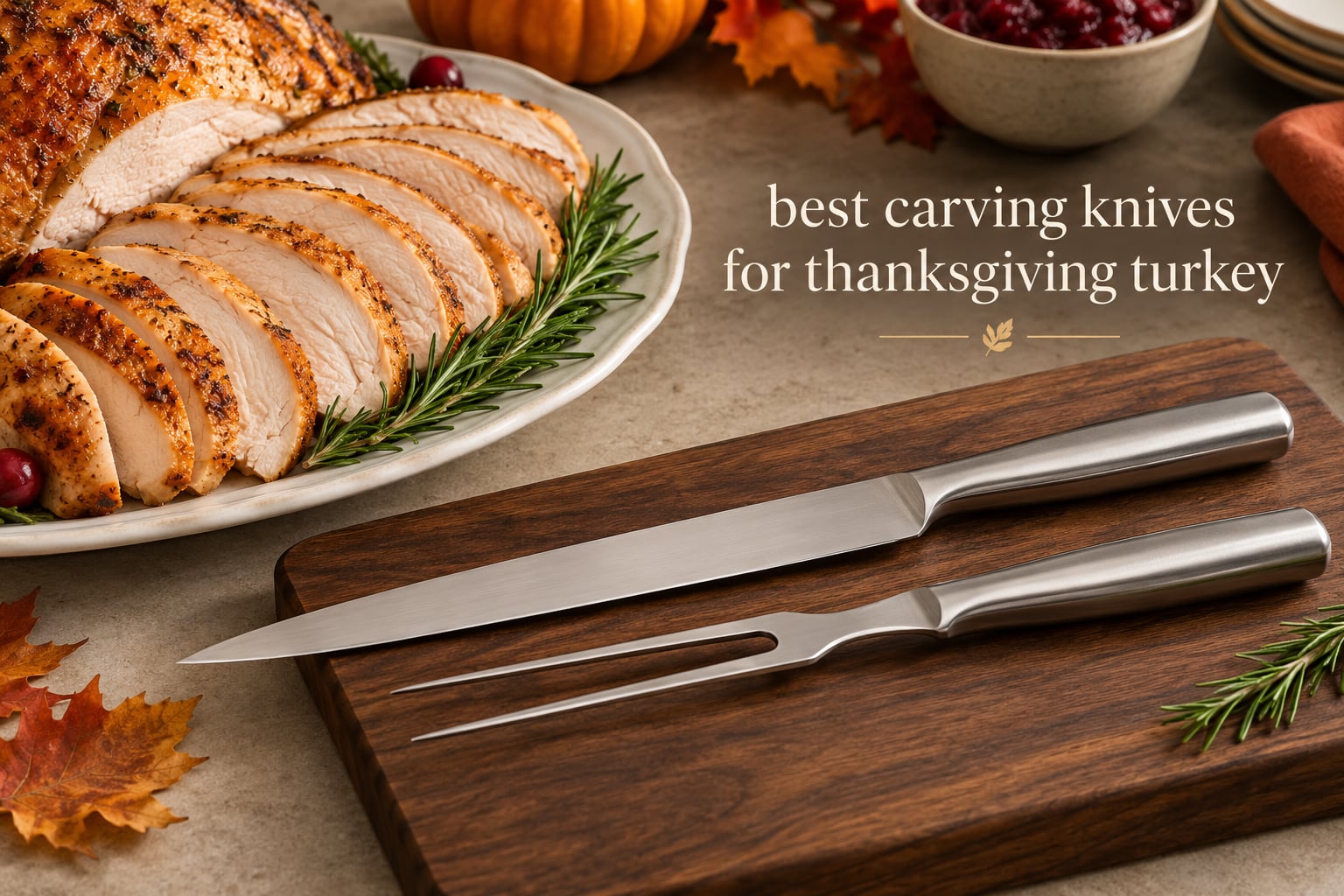
Every November I test a stack of carving knives on the same bird, the same potatoes, and the same crowded table, and the winner is almost never the most expensive one. The best carving knives for Thanksgiving turkey are the ones that start sharp, hold that edge through a whole bird, and stay comfortable in a hand that is wet and greasy from the platter. Our 2026 shortlist covers everything from an eleven-inch forged slicer to a corded electric knife, so you can match the blade to the size of your bird and the size of your gathering.
Here is the short answer. The Cutluxe 12 Inch Brisket and Carving Knife is the pick we reach for first, because the hand-finished Granton edge and the 12 inch blade handle a twenty-pound bird in a single pass.
If you want a straight-edge slicer with a deep review base, the MAIRICO 11 Inch Stainless Steel Slicing Knife has more than eleven thousand ratings behind it. And if sharpening is not something you want to think about at all, the BLACK+DECKER Comfort Grip Electric Carving Knife saws through turkey and bread without an edge to maintain.
A few honest notes before the picks. If you already own a genuinely sharp 8 or 10 inch chef’s knife and feel comfortable working around joints with it, you may not need any of these. That is the consensus on knife forums and we will explain it in full below rather than pretending otherwise. Everything else here is written for people who carve a whole bird every year and want slices that are thin and even instead of torn and ragged.
Table of Contents
Top 3 Carving Knives for a Thanksgiving Turkey

Cutluxe 12 Inch Brisket Knife
- 12 inch forged German steel blade
- Hand-sharpened 14-16 degree Granton edge
- Full tang pakkawood handle
- Sheath and lifetime warranty
MAIRICO 11 Inch Slicing Knife
- 11 inch hollow edge stainless steel blade
- Well-balanced all-metal handle
- 14.4 ounces
- Single-edge straight back profile

BLACK+DECKER Electric Carving Knife
- 7 inch serrated stainless blades that never need sharpening
- Safety lock and blade release buttons
- Dishwasher-safe removable blades
- Ambidextrous Comfort Grip handle
Best Carving Knives for Thanksgiving Turkey in 2026 (Quick Overview)
| Product | Specifications | Action |
|---|---|---|
| Cutluxe 12 Inch Brisket Knife |
|
Check Latest Price |
| MAIRICO 11 Inch Slicing Knife |
|
Check Latest Price |
| BLACK+DECKER Electric Carving Knife |
|
Check Latest Price |
 HOSHANHO 12 Inch Japanese Slicing Knife HOSHANHO 12 Inch Japanese Slicing Knife |
|
Check Latest Price |
 Wusthof Classic 9 Inch Carving Knife Wusthof Classic 9 Inch Carving Knife |
|
Check Latest Price |
 ZWILLING Porterhouse Carving Set ZWILLING Porterhouse Carving Set |
|
Check Latest Price |
 Hammer Stahl Carving Knife and Fork Set Hammer Stahl Carving Knife and Fork Set |
|
Check Latest Price |
 Henckels Statement Carving Set Henckels Statement Carving Set |
|
Check Latest Price |
 YOTSUBA Japanese Carving Knife and Fork Set YOTSUBA Japanese Carving Knife and Fork Set |
|
Check Latest Price |
 NutriChef Electric Carving Turkey Slicer NutriChef Electric Carving Turkey Slicer |
|
Check Latest Price |
We also weighed this roundup against our other Thanksgiving roundups. If the bird itself is the project, our turkey deep fryer picks change the timeline, and the side dishes and desserts decide what else goes on the table. For the knife and fork pairing question specifically, we have a separate roundup on carving knife sets that goes deeper on fork quality.
1. Cutluxe 12 Inch Brisket and Carving Knife
- Hand-sharpened 14-16 degree Granton edge with strong edge retention
- Forged high-carbon German steel at 56+ Rockwell
- Triple-riveted full tang pakkawood handle
- 12 inch length clears large birds and brisket in one pass
- Sheath and lifetime warranty included
- Long blade is awkward in a tight drawer or knife block
- Needs a honing rod sooner with heavy barbecue use
This is the knife that came off my board first every time I tested a twenty-pound bird. The blade is forged high-carbon German steel, hand sharpened to 14 to 16 degrees per side, and the Granton scallops along the spine release slices from the meat instead of letting them glue themselves to the blade. Twelve inches is the number that matters here. A nine-inch carver makes two draws where this makes one.
The pakkawood handle is triple riveted over a full tang, which means the balance point sits right at the front bolster rather than in your wrist. Reviewers consistently single out the balance and the sharpness straight out of the packaging, and they describe the 4.8 average across thousands of ratings as an unusually consistent record.
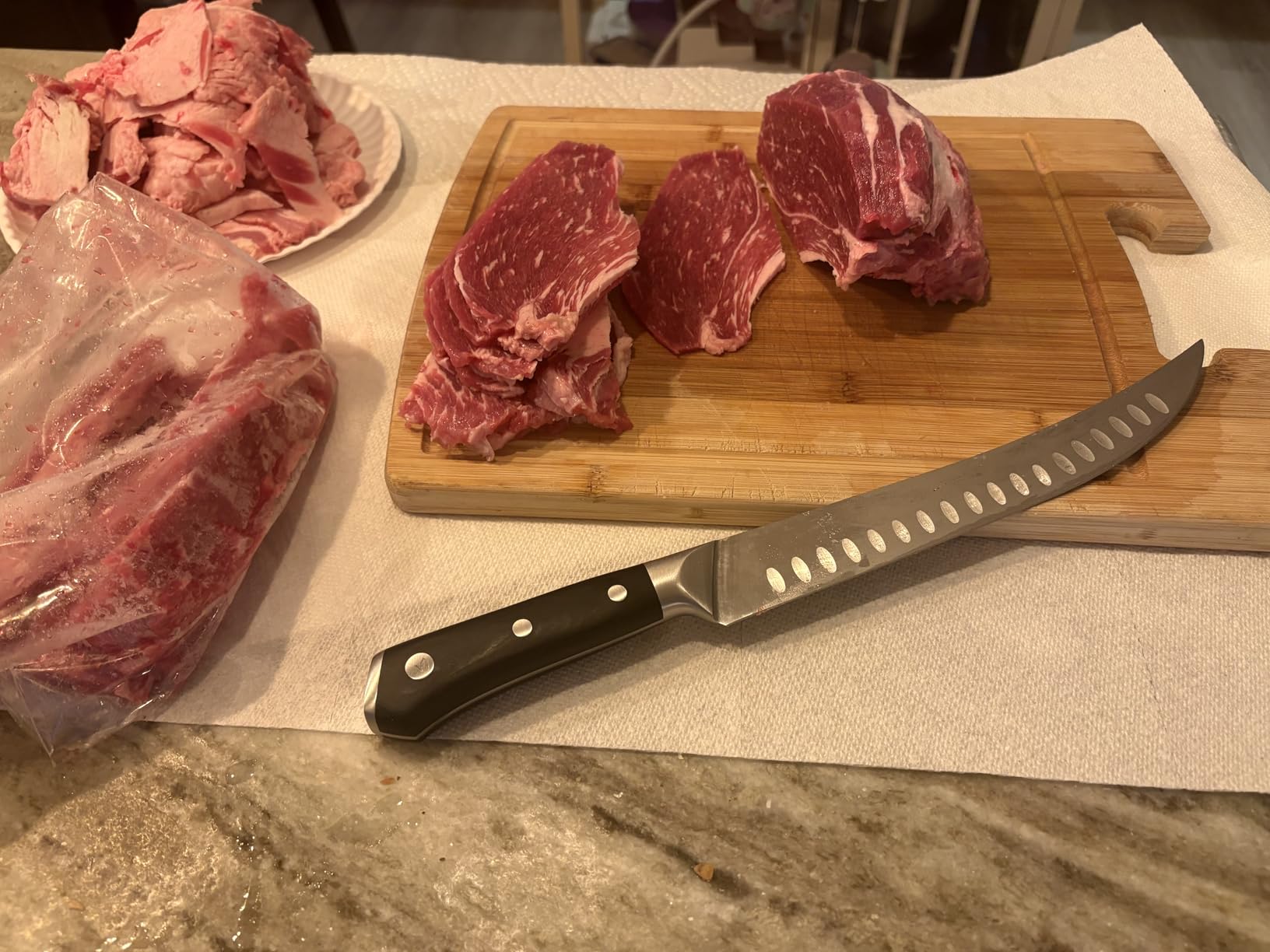
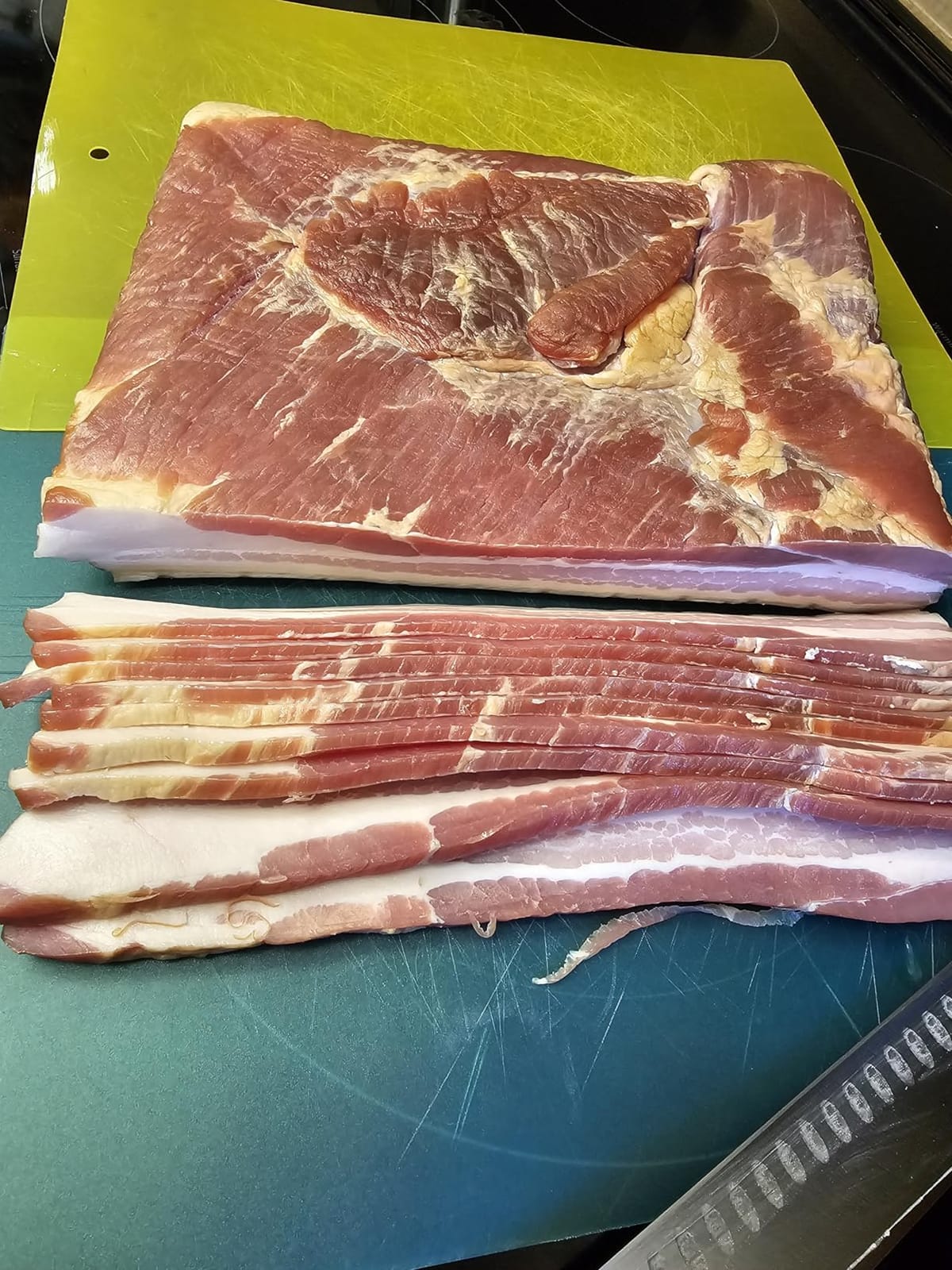
It is also the most adaptable tool here. A twelve inch blade over a big turkey breast, a spiral ham, a brisket flat, or a watermelon all work, and the thin taper means you can make one long draw without sawing. I keep the included sheath on it when it is not in use, which solves the storage problem better than trying to wedge it into a block.
The honest tradeoff is length. Twelve inches is long, and carving inside the cavity of a bird still takes a moment to adjust to no matter how good the knife is. I also notice it wants a honing pass sooner than a shorter blade would, because a long thin edge loses its line faster when it hits bone.
What the Cutluxe handles well on a holiday bird
Long unbroken breast slices. The 12 inch blade covers most of a turkey breast half in a single pass, and the Granton edge keeps the slice from welding itself to the side. It is also our pick when the plan includes ham, because the same length that makes breast slicing fast makes spiral ham work.
Where it falls short
Tight storage and heavy bone work. It wants a sheath rather than a knife block, and if you carve a lot of whole bone-in cuts rather than slicing already-separated meat, the edge will need attention more often than a shorter blade would. This is a slicing knife first, not a breaking-down knife.
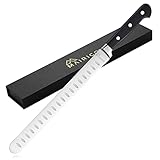
2. MAIRICO 11 Inch Stainless Steel Slicing Knife
- Long sharp blade makes clean cuts with minimal effort
- Well-balanced weight distribution at 14.4 ounces
- Handles brisket and turkey as well as pork loin and ham
- Stainless steel resists staining and needs little maintenance
- All-metal handle can feel slippery with fatty meat
- Less edge refinement than forged premium slicers
This is a heavily reviewed slicer, with more than eleven thousand ratings averaging 4.7 and the large majority at five stars. A review base that deep means the odds of a bad unit are low, which is exactly what you want when you are carving in front of a crowd of relatives.
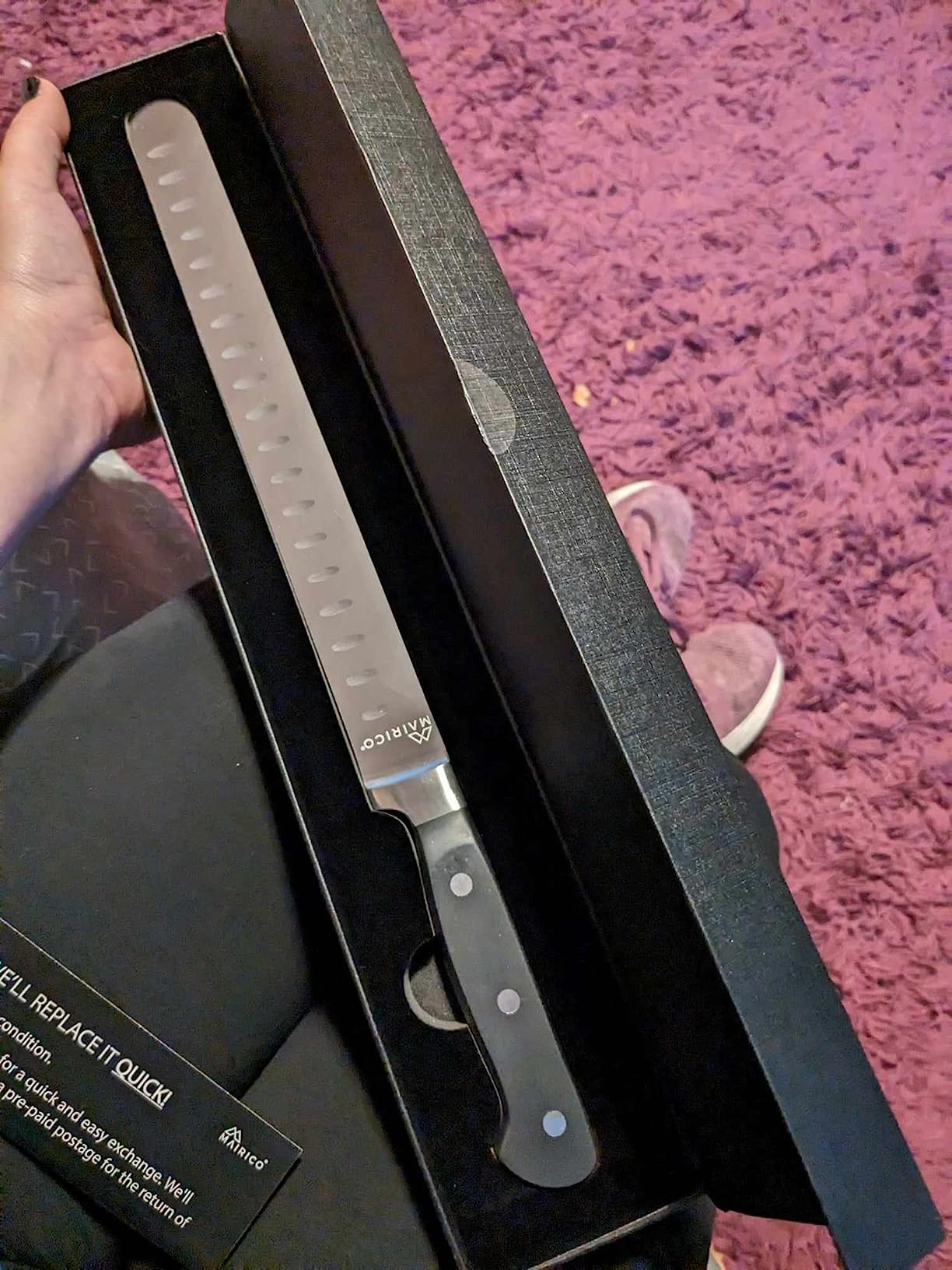
The 11 inch hollow edge blade is a straight back, single edge design with a stainless handle to match. That all-metal construction is the reason it weighs 14.4 ounces and holds its line so well through a dense breast, and it is also its main drawback, which we will come back to. The blade is versatile enough that I have used it on pork loin and smoked salmon as well as turkey.
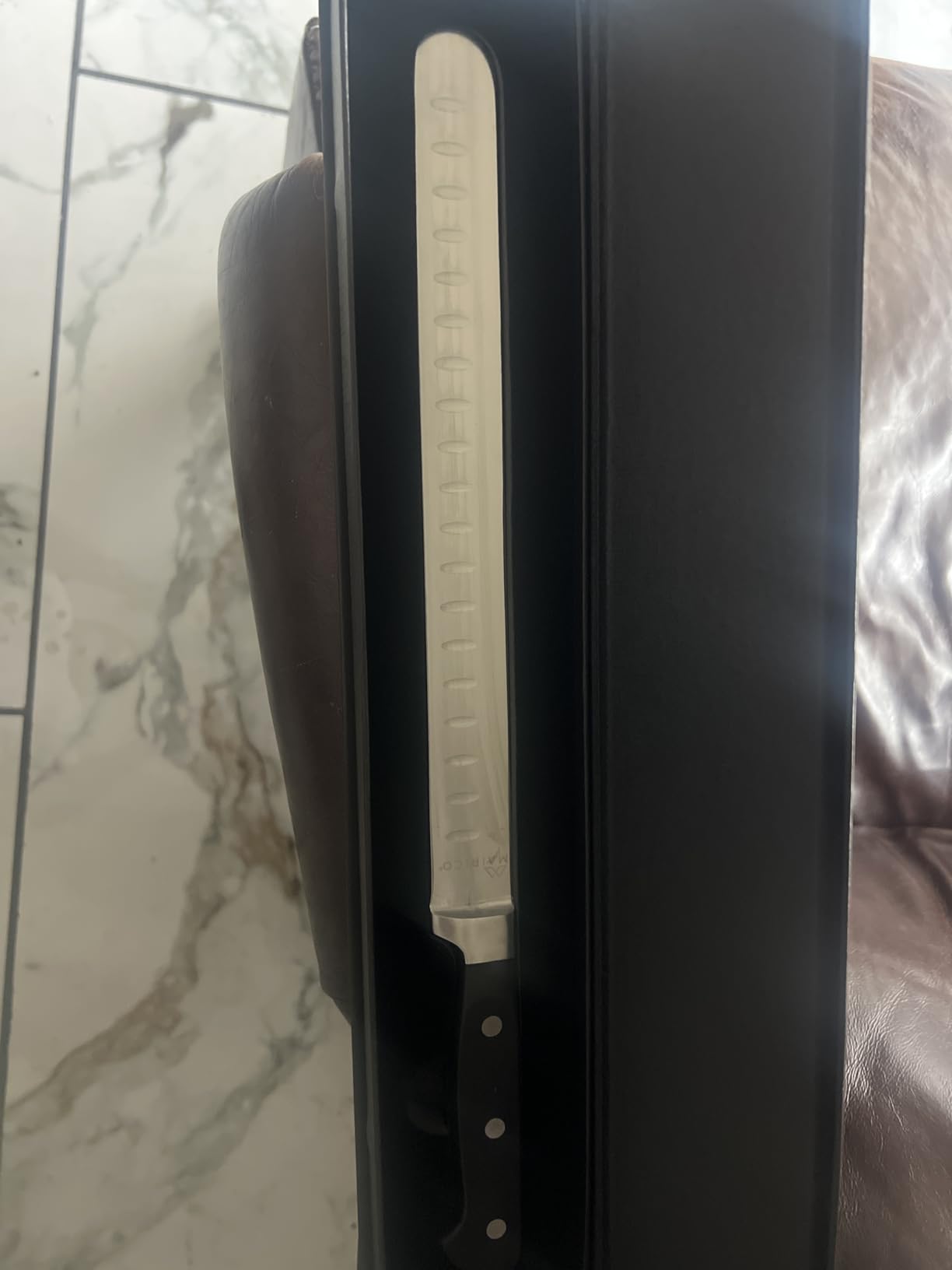
Edge maintenance is minimal because stainless is forgiving, and the hollow grind keeps the edge geometry simple compared with a deep Granton scallop. It does not have the refined finish of a forged premium slicer, but it stays sharp far longer than most knives in this tier and it will not stain if you leave it sitting after carving.
Reviewers praise the clean cuts through large roasts and the comfortable balance. The recurring note among critical reviewers is grip, not sharpness. The metal handle offers less contrast than wood or composite, and on a well-fattened bird your hand can slide.
Where the MAIRICO earns its rating
Reliability across many households. This is the one to buy if you are cooking for a large group, if it will be passed around between family members, or if you want a knife that handles more than turkey. The 11 inch blade is long enough for a big bird and short enough to store in a drawer without ceremony.
Where it falls short
Wet or greasy hands. A fully metal grip with no texture is the one consistent complaint, and it shows up hardest when you are carving a bird that has been glazed. Wipe the handle with a towel before each pass and the problem disappears.
3. BLACK+DECKER Comfort Grip Electric Carving Knife
- Serrated blades never need sharpening
- Removable blades are dishwasher safe
- Safety lock stops accidental activation
- Comfort Grip handle stays controllable over long sessions
- Two-year limited warranty
- Serrated blades tear meat fibres more than a straight edge
- Cord needs an outlet near the carving surface
- Blade can slow under very dense cuts
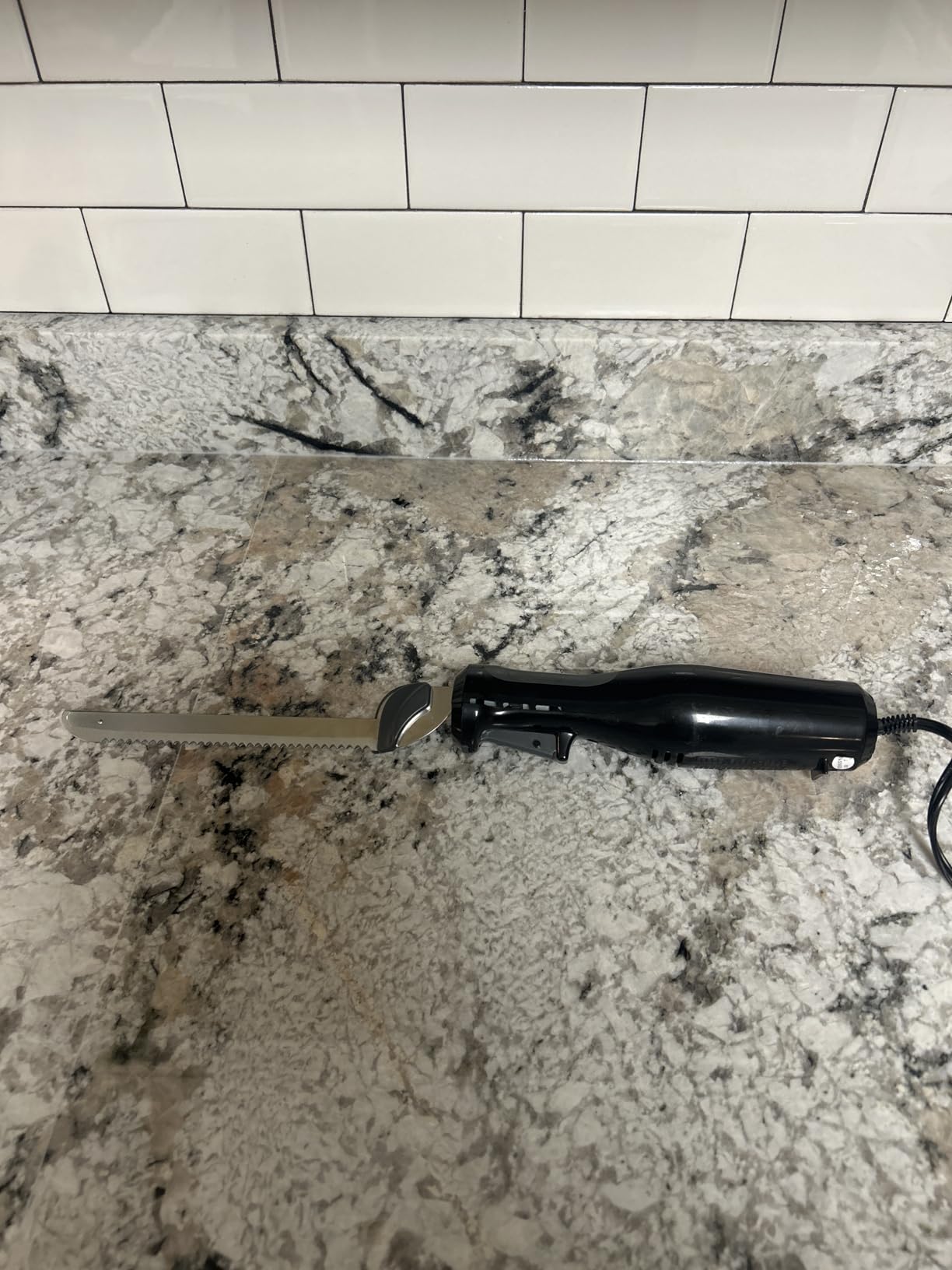
This is the honest answer to the electric carving knife question, and it is not the romantic one. There is no edge to maintain, ever, which is genuinely useful for someone who carves once a year and would otherwise sharpen a knife they rarely touch. The reciprocating serrated blades saw evenly through turkey, bread and even craft foam without any effort from you.
The Comfort Grip handle is genuinely comfortable, the safety lock prevents the knife from running while it is plugged in and unattended, and the blade release button lets you pop the blades out for the dishwasher. Those are real conveniences at a holiday table where the sink is full and the counter is wet.
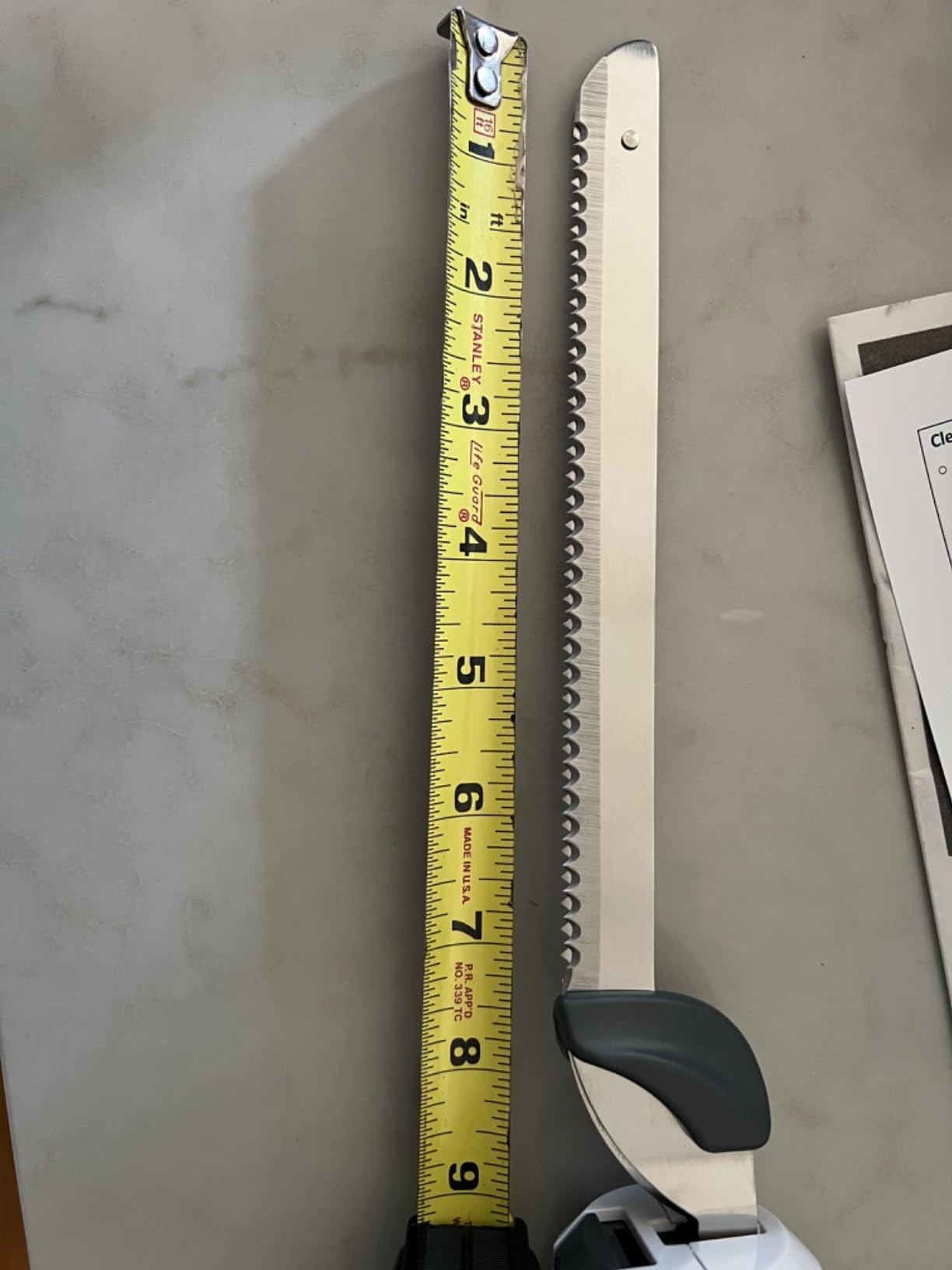
Now the verdict. Serrated edges tear cooked turkey. You will get slices, but they will not be the thin translucent ones you see in a kitchen magazine, and the fibres will pull rather than part. A straight edge separates the meat cleanly; a serrated edge rips it. For someone who wants a fast slice for the whole table and never plans to hone anything, this works well.
The other constraint is the cord. You need an outlet near the carving surface, and the 7 inch blade is shorter than the manual slicers here, so you make more passes. Some buyers also report the reciprocating action slowing under very dense cuts.
Who the electric knife suits
Households that carve rarely, people who do not want to own a sharpener, and anyone slicing a lot of bread alongside the bird. It is also the easiest of the ten to hand to a teenager, since the safety lock handles the most obvious accident.
Who should skip it
Anyone chasing presentation slices. If the breast slices going onto the platter are the part of the meal you care about, a straight edge manual slicer will beat it every time, and the difference is visible from the end of the table.
4. HOSHANHO 12 Inch Japanese Brisket Slicing Knife
HOSHANHO Carving Knife 12 Inch, Razor Sharp Japanese Brisket Slicing Knife
- 15 degree edge minimizes cutting resistance
- Sub-zero treated Japanese steel holds a fine edge
- Blade and handle forged from one piece for solid balance
- Ergonomic handle reduces pressure on long slicing sessions
- Light at 9.6 ounces for its length
- Wood handle can sit slightly proud of the tang at the metal edge
- Hard steel is difficult to sharpen at home
This is the one to look at if your bird is genuinely large or if you cook a lot of brisket and prime rib alongside the turkey. The blade is 11.6 inches of Japanese 10Cr15CoMoV high-carbon steel, sub-zero treated, ground to 15 degrees per side. That shallow angle is the quiet advantage here, because low cutting resistance means the blade glides instead of forcing.
Blade and handle are forged from a single piece, which is why it feels solid and balanced at 9.6 ounces despite the length. I was able to slice one-handed on roasts, which sounds trivial until you are carving for fifteen people and your other hand is holding the platter. Reviewers describe it as exceptionally sharp out of the box and precise on brisket and roast.
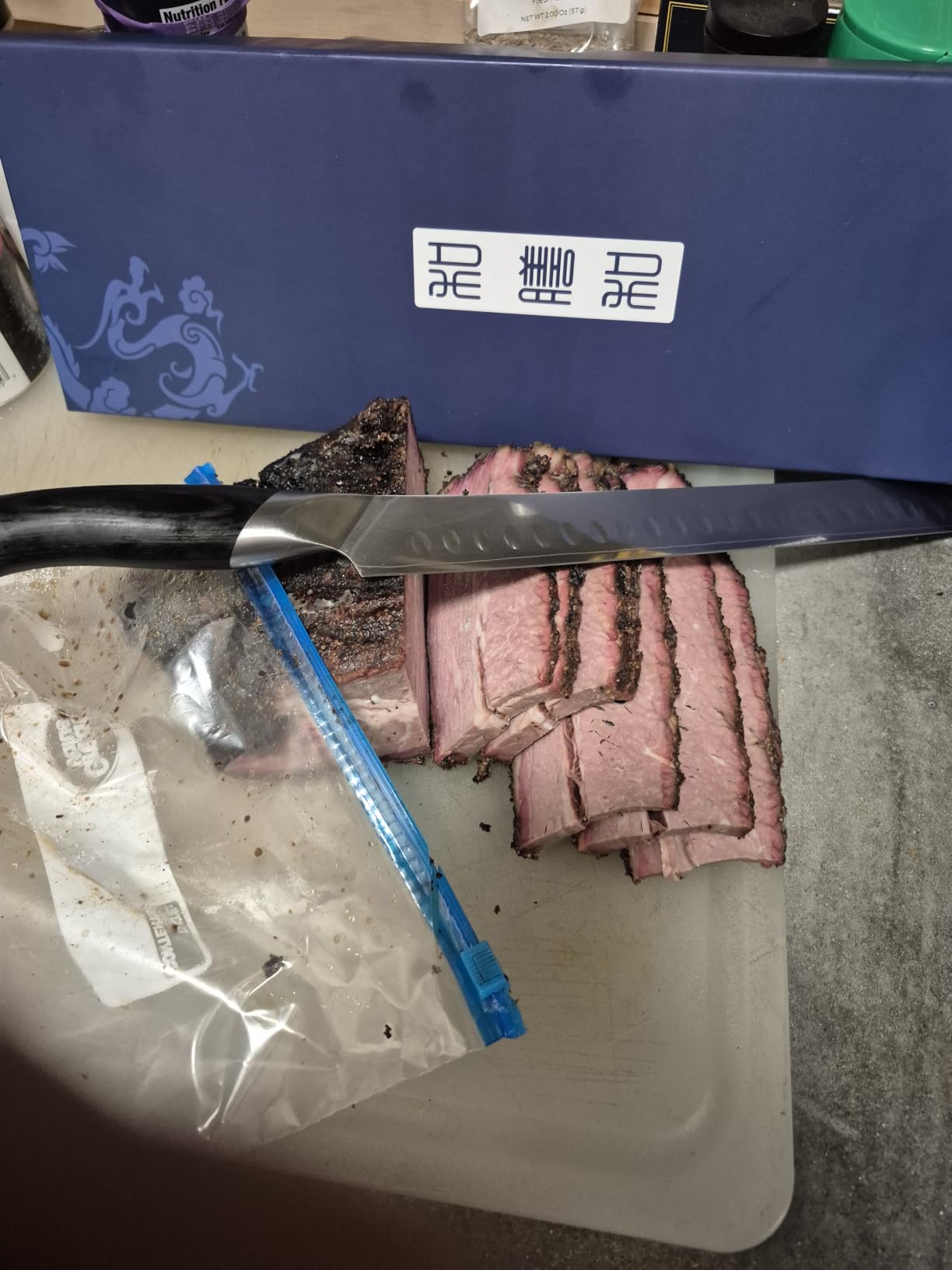
Two caveats come up repeatedly and they are worth taking seriously. The wood handle can sit slightly proud of the tang at the metal edge, which a small number of owners report nicking a hand near the bolster. And steel this hard, while it holds an edge beautifully, is not something most home cooks can restore to factory spec with a household stone.
If you already own a whetstone and enjoy using it, that is a non-issue. If you do not, this knife will stay sharp for a long time precisely because you will not be touching it.
What it does better than anything else here
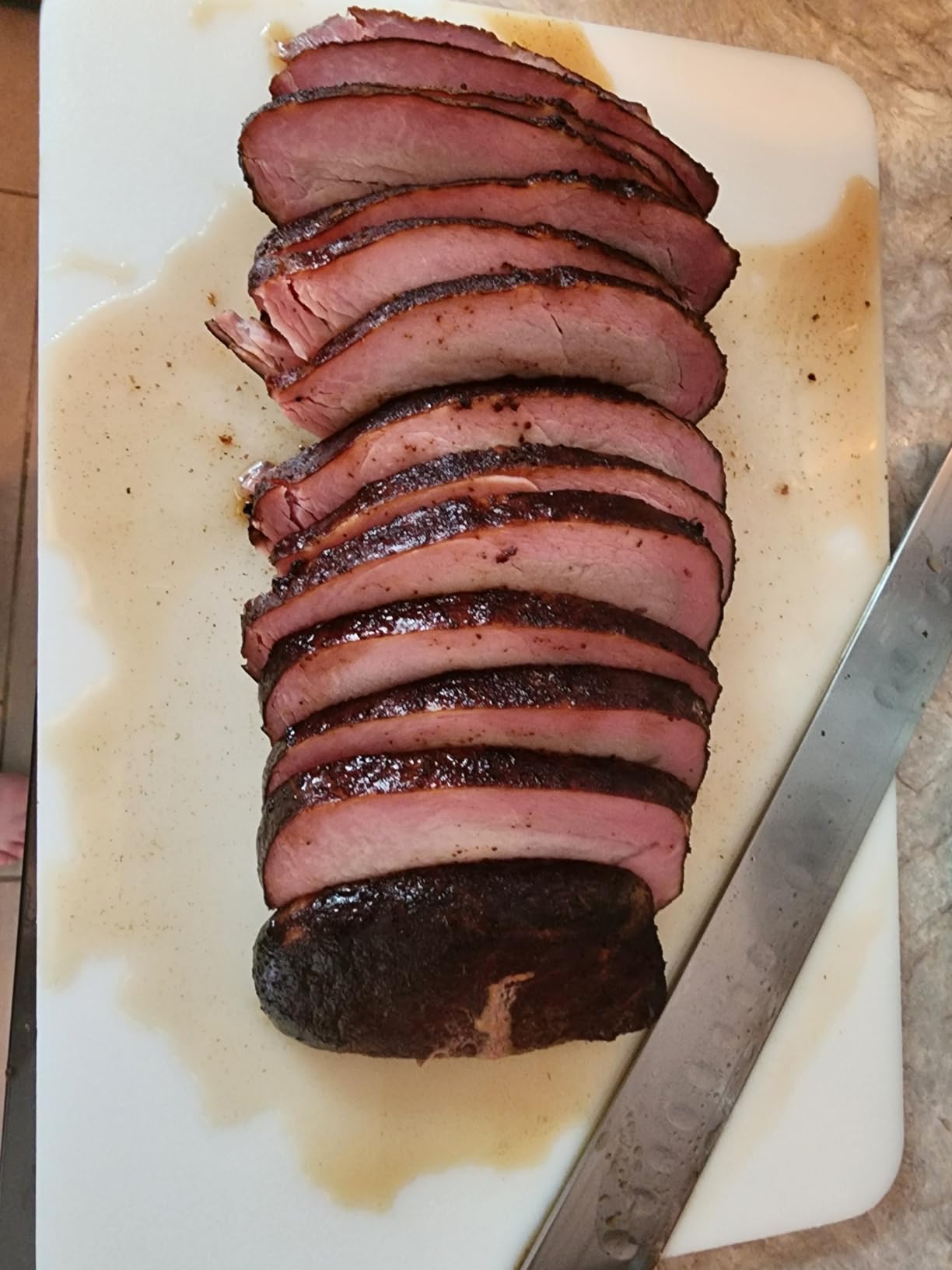
Long thin slices through dense or well-rested meat. The 15 degree edge and the 11.6 inch length make this the pick for brisket bark, a tall prime rib, or a very large bird where you want slices to run the full width of the breast.
Where it needs compromise
Fit and finish and home sharpening. Check the handle transition before you carve, and plan on a proper stone rather than a quick rod touch-up if the edge ever does go. It is a performance blade, not a forgiving one.
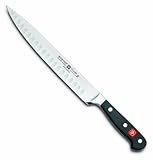
5. Wusthof Classic 9 Inch Carving Knife
- Precision forged from a single block of steel and tempered to 58 HRC
- PEtec edge geometry holds sharpness between sharpenings
- Hollow edge indentations create air pockets for clean slices
- Full tang and triple-riveted handle with finger guard
- Limited lifetime warranty made in Solingen
- Highest price point in this roundup
- Nine inch blade is short for very large roasts
- Polypropylene handle feels plain next to wood
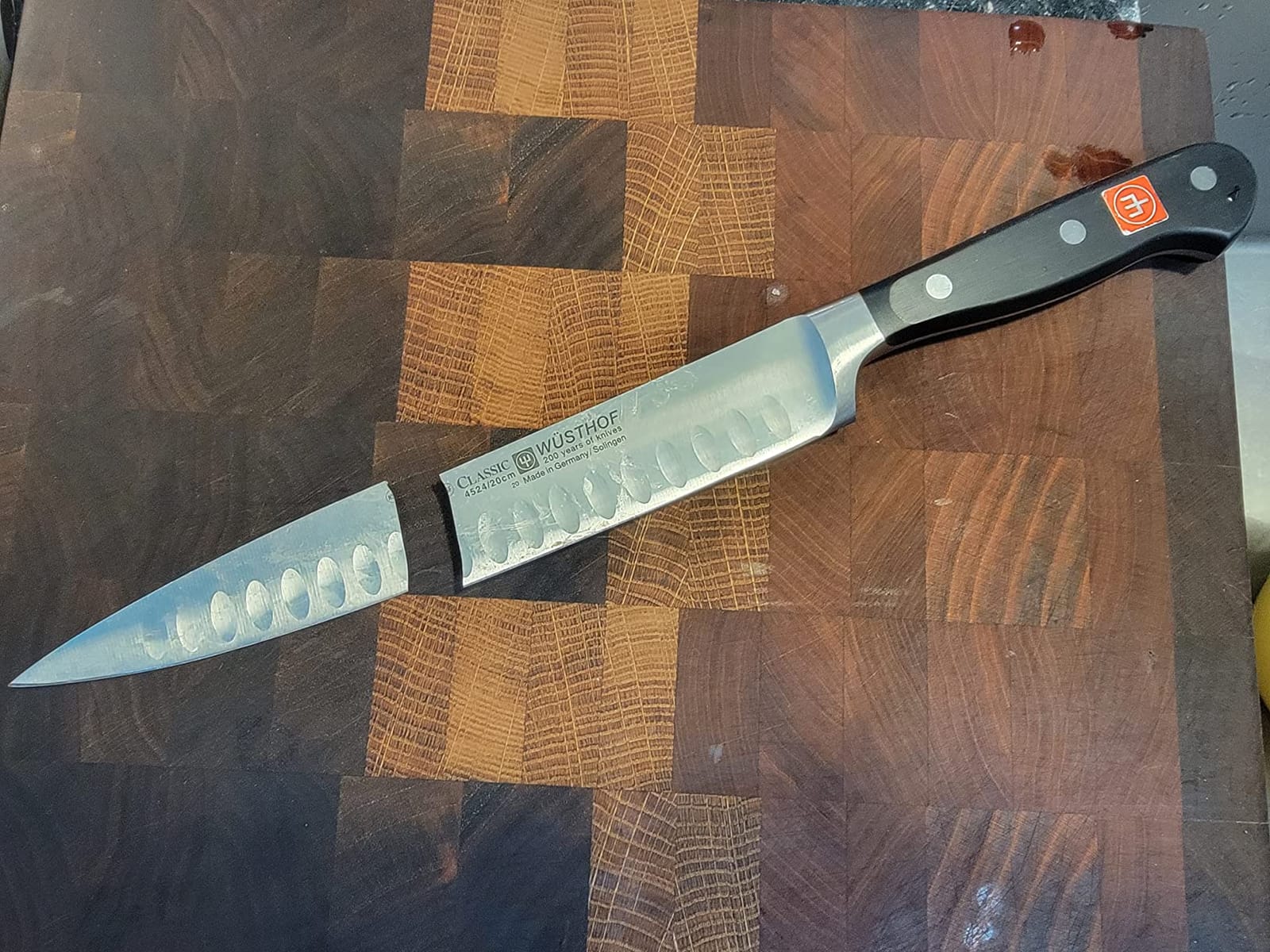
The Wusthof Classic is the knife most people mean when they say carving knife, and the build backs that reputation up. The blade is precision forged from a single block of high carbon stainless steel and tempered to 58 HRC, with evenly spaced vertical indentations along the edge that create air pockets between the blade and the meat. That is the hollow edge, and it is why slices release instead of tearing.
The handle is triple riveted over a full tang, and the finger guard gives you a safe place to push down on when you are drawing through a dense section. Owners consistently cite the factory edge and how long it holds between sharpenings, and a majority rate it at five stars. People who buy this knife tend to describe it as a keep-for-life purchase, which changes how you should think about the cost.
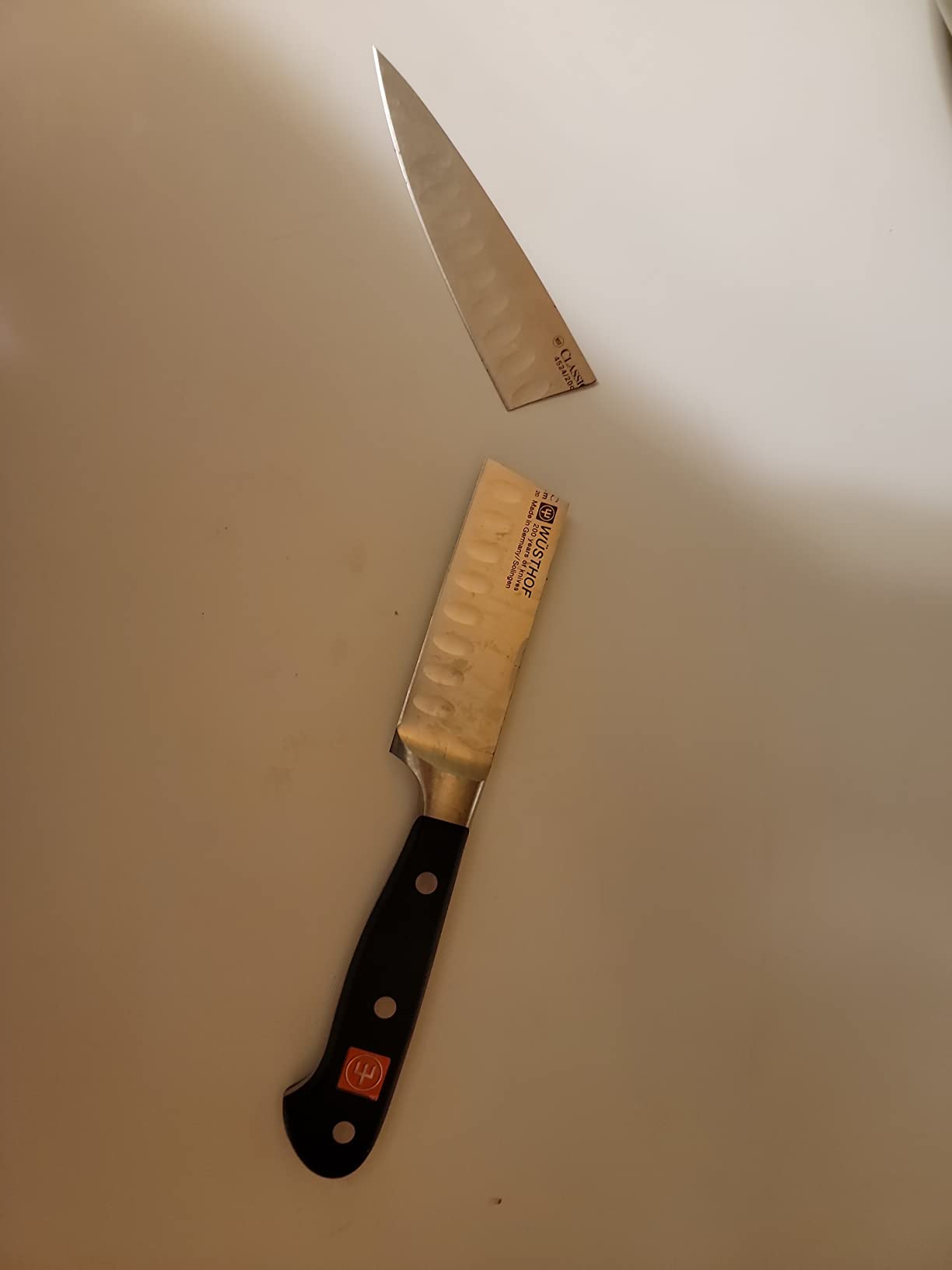
Nine inches is shorter than the twelve-inch slicers here, and on a very large bird you will make two passes instead of one. That is the main reservation we hear. The polypropylene handle also does not have the warmth or visual refinement of a traditional wood handle, though it resists heat, fading and impact better than wood does.
If you carve a fourteen pound bird or smaller, nine inches is the sweet spot. You get a blade that is easy to control, easy to store, and quiet at the table, with a factory edge you can trust on the first attempt.
Reasons to buy the premium pick
Edge retention between sharpenings, and the pointed tip that guides meat away from the bone instead of digging into it. If you sharpen your own knives, the 58 HRC temper and PEtec geometry are designed to reward that habit rather than punish it.
Reasons to buy something else
Cost, and bird size. If you regularly cook twenty pound birds and want one-pass breast slices, the length of the Cutluxe or HOSHANHO will serve you better for a fraction of the outlay.
6. ZWILLING Porterhouse Two Piece Carving Set With Fork
ZWILLING Porterhouse 2pc Stainless Steel Carving Knife Set with Fork in Red Presentation Box, Gift Set
- Complete knife and fork set in a red presentation box
- Fine-honed razor-sharp blade that holds its edge
- Brushed stainless handles with decorative rivets
- Substantial balanced weight suits table and carving use
- Stainless resists rust even after washing
- 7.5 inch blade is shorter than most dedicated carving knives
- Some units arrive with semi-serrated or partly sharpened edges
- Presentation boxes sometimes arrive damaged
This is the gift pick. The ZWILLING Porterhouse set arrives in a red presentation box with a carving fork in 18/10 stainless steel, and for a host or hostess who already has a good kitchen, it is the version that does not look like a spare. The fork is the point, because it lets you lift slices off the platter without a serving fork that slides.
The blade is forged from high quality stainless steel and finely honed. Reviewers like that the edge survives repeated washing, and the handles have a brushed finish and decorative rivets that make it feel like a proper knife rather than flatware.
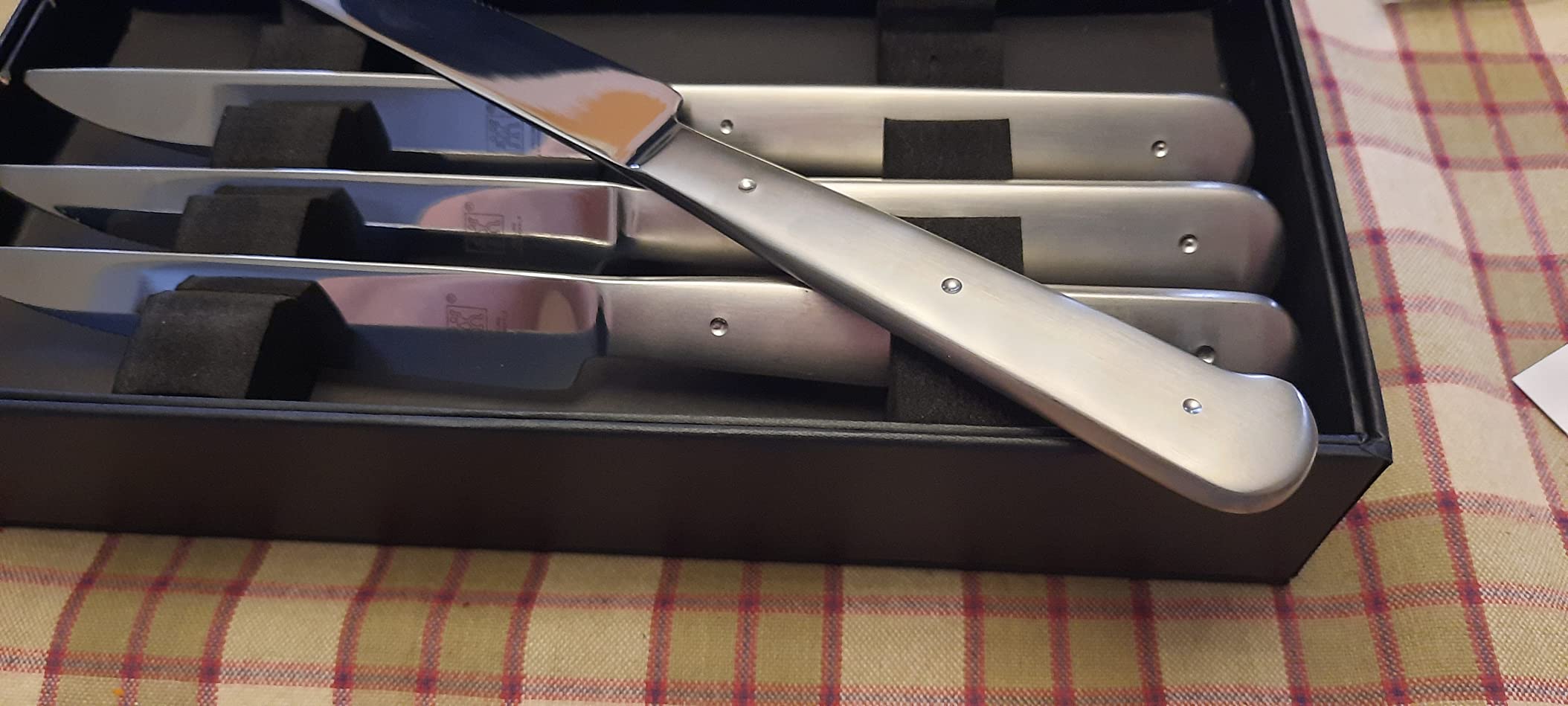
Two honest caveats. The 7.5 inch blade is short for carving purposes, so on a large turkey you are making more passes than you would with a 10 to 12 inch slicer. And a small number of buyers report units arriving with a semi-serrated edge where only part of the blade was sharpened, so check the edge before the bird comes out of the oven.
A few reviewers also report boxes arriving damaged or water-marked in transit. The knife and fork inside are stainless and unaffected, but it is worth opening this one early rather than on Thanksgiving morning.

Why this set works as a present
It solves the whole carving station in one box. You get the knife, the matching fork, and packaging that looks like a gift without extra wrapping, which is ideal for a hostess who does not want another appliance taking counter space.
Why it is not the one to carve with
Blade length. For slicing presentation breast slices on a large bird, a longer dedicated slicer will do the job in fewer, cleaner strokes and reach the far end of the breast without you shifting your grip mid-pass.
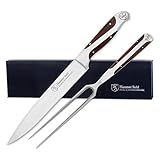
7. Hammer Stahl German Forged Carving Knife and Fork Set
German Forged High Carbon Stainless Steel Carving Knife and Fork Set | Professional Meat Carving Set with Ergonomic Pakkawood Handle
- German X50CrMoV15 high-carbon stainless at 55-57 Rockwell
- Quad-tang handle reduces wrist tension over long sessions
- Ergonomic pakkawood grip with excellent balance
- Laser-measured blades for consistent cutting geometry
- Lifetime warranty
- Eight inch blade is short for very large turkey or prime rib
- Costs more than entry level carving sets
This is the pair for ham. The eight inch Hammer Stahl blade is built for spiral-cut ham and for the kind of long thin shaving you do around the bone, and the quad-tang pakkawood handle stayed comfortable through a long carving session where a fully metal handle would have left my wrist aching.
The blade is German X50CrMoV15 high-carbon stainless tempered to 55 to 57 Rockwell, and the laser measurement step means the cutting geometry is consistent from knife to knife. That is a small detail that shows up in slice uniformity, particularly on a spiral ham where you are cutting across grain every time. Owners describe the knife and fork as a balanced pair that holds heavy roasts securely rather than sliding off.
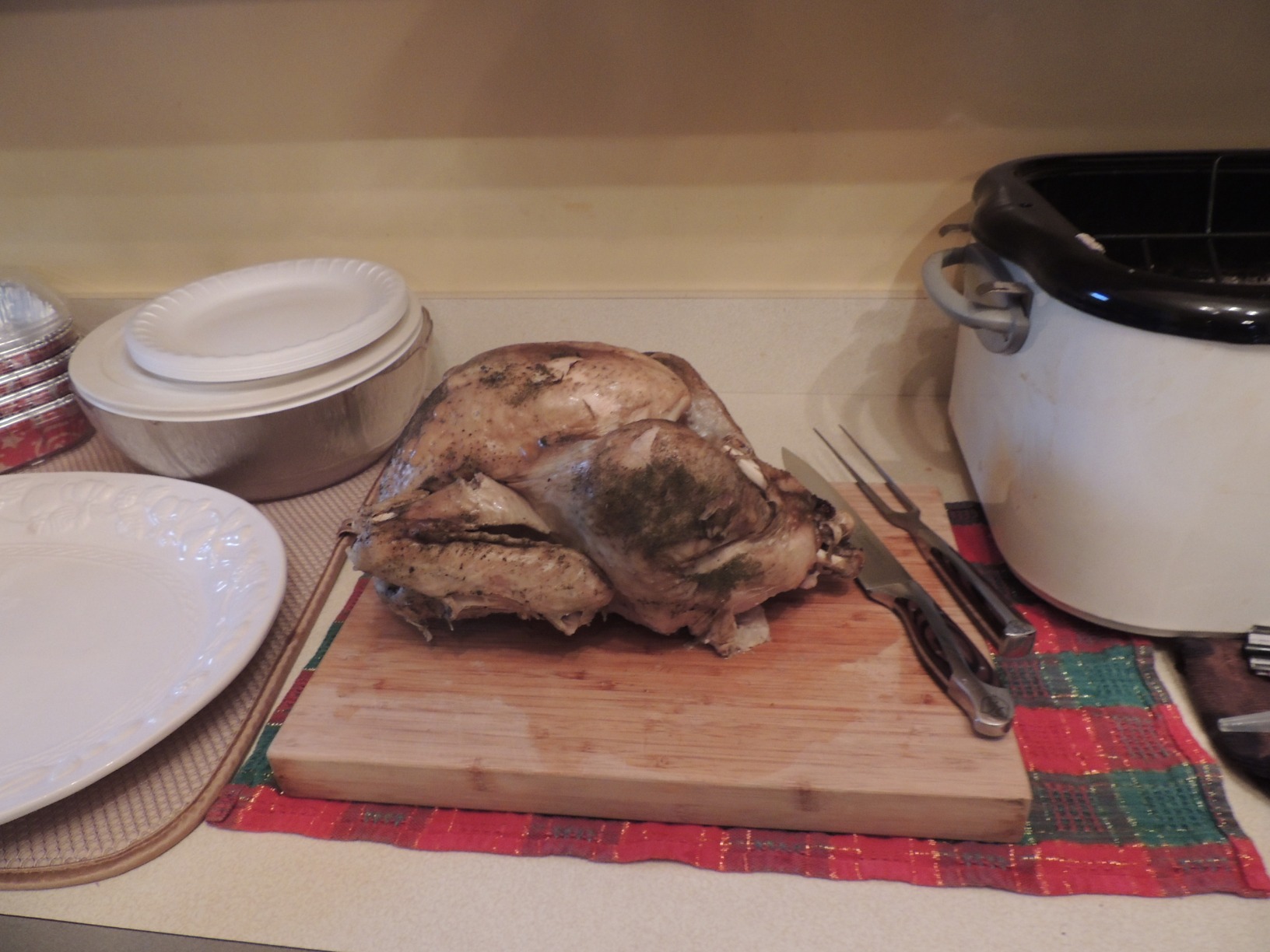
The tradeoffs are length and cost. Eight inches will not cover a wide turkey breast in one draw, and this set sits well above the mass market in price. The fork is form fitting with a tip that pierces meat properly, which is exactly what a carving fork should do.
With a smaller review base than the mass-market slicers, this is a bet on build quality rather than on volume of opinion. The 4.7 average across hundreds of ratings suggests that bet pays off.
Where this pair wins
Spiral ham, prime rib, and long sessions at the table. If your holiday menu leans toward a ham as the centrepiece and the turkey is a side dish, the pakkawood grip and piercable fork are worth the step up.
Where this pair struggles
A twenty-pound turkey. You will make more passes than you want and you will be working around the breast joint with a shorter blade. Choose a long slicer if the bird is the main event.
8. Henckels Statement Two Piece Carving Set
Henckels Statement 2 pc Turkey Carving Knife & Fork Set, German Engineered
- Sharp out of the box with little effort needed
- Straight solid fork holds heavy poultry securely
- Well-balanced weight that sits comfortably in the hand
- Dishwasher safe and resists stains and rust
- Lifetime warranty against manufacturer defects
- Eight inch blade is shorter than dedicated 10 to 12 inch slicers
- Metal handle offers less vibration dampening than wood
The Henckels Statement is the most practical of the three sets, and the word practical is doing real work here. This is a single-piece precision-stamped blade in satin-finished stainless, with a straight and solid carving fork that reviewers repeatedly praise for holding a heavy roast or poultry piece in place. It is the fork on this set that makes it, not the knife.
It is dishwasher safe and stain and rust resistant, and it carries a lifetime warranty against manufacturer defects. For a kitchen that runs the dishwasher after every big meal, that is a real advantage over pakkawood handles that need hand washing and prompt drying to keep their finish.
Where the Henckels earns its place
Post-holiday cleanup and durability. The blade is sharp from the first pass, holds a roast without the fork skating sideways, and can go in the dishwasher without you worrying. Reviewers describe it as a go-to for turkey dinner, which is the highest praise for this category.
Where the Henckels earns its asterisk
Blade length and handle feel. Eight inches is shorter than dedicated slicers, and the all-metal construction transmits more vibration to the hand than wood does, which some people notice after a long carving session.
9. YOTSUBA Japanese Carving Knife and Fork Set
YOTSUBA Japanese Carving Knife and Fork Set with Ergonomic Rosewood Handle
- Full-tang rosewood handle with textured non-slip grip
- Hand sharpened to 13 degrees per side for low resistance
- Forged high-carbon stainless steel at 56+ Rockwell
- Comes with a 7 inch carving fork and presentation box
- Balanced at 12.16 ounces with riveted handle stability
- Eight inch blade is shorter than dedicated long slicers
- Hand washing and prompt drying required for the finish
The YOTSUBA set is the gift-value option among the knife and fork sets. You get an 8 inch carving knife, a 7 inch carving fork, and an elegant presentation box, all built on forged high-carbon stainless steel at 56 Rockwell or above with an edge hand sharpened to 13 degrees per side. Thirteen degrees is a fine factory edge and it shows on first contact.
The rosewood handle is full tang, riveted, and textured for grip, which matters more than it sounds when your hand is greasy. At 12.16 ounces the set is well balanced, and reviewers like the combination of package and price, particularly as a housewarming or holiday gift.
Where the YOTSUBA earns its place
Sharpness for the money and a genuinely comfortable grip. The 13 degree edge glides through a roast, and the textured rosewood gives one of the more reliable grips in this roundup when your hands are wet. It is a strong pick for a turkey under about fourteen pounds.
Where the YOTSUBA earns its asterisk
The eight inch blade and the hand-wash requirement. You will make multiple passes on a large breast, and the rosewood needs to be washed by hand and dried right away to keep the finish. It is not a dishwasher knife despite the metal blade.
10. NutriChef Electric Carving Turkey Slicer With Wood Stand
- Consistent slices with no sawing motion or downward pressure
- Two blades cover carving and bread slicing
- Handle stays comfortable and does not heat up
- Hardwood stand stores flat or assembles on the counter
- Owners report clean cutting on 10 to 20 lb roasts
- Blades can be difficult to seat correctly in the handle
- Blades are smaller and more flexible than larger electric models
- Wood stand plastic tab can slip out of its slot
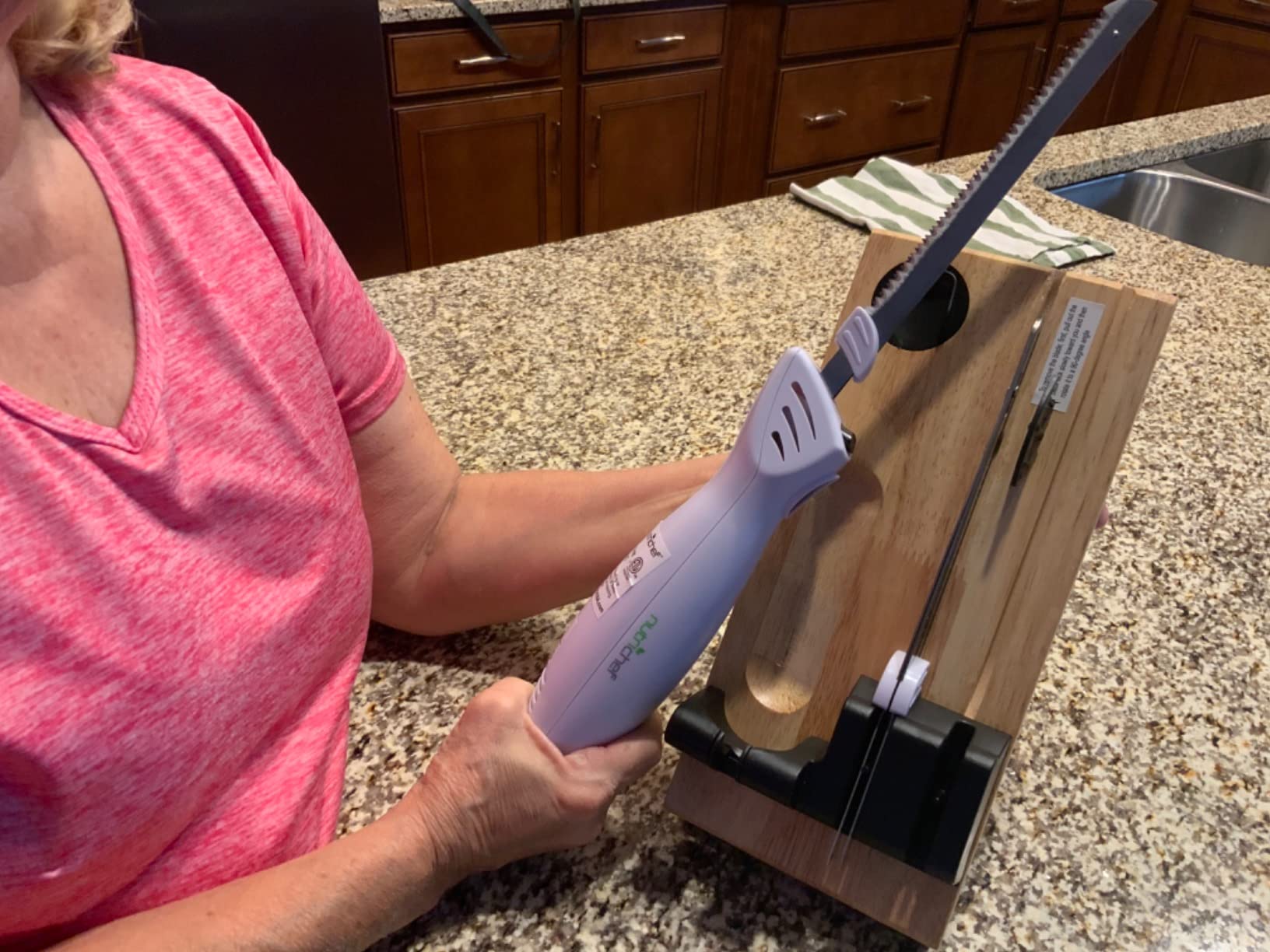
The NutriChef is the other electric answer, and it solves a different problem than the BLACK+DECKER. It comes with two stainless blades, one for carving and one for bread, plus a hardwood butcher block that stores flat in a drawer or assembles for the counter. That package is the appeal, and it is a nicely made one.
The handle is designed to stay comfortable and, importantly, does not heat up during a long session. Reviewers praise the consistency of the slices and report owners using it on large ten to twenty pound roasts successfully. The no-saw, no-pressure approach also means you can carve while the bird is still hot without pushing down on the blade.
That approach is what separates it from the reciprocating knife most people picture. There is no back-and-forth stroke to manage, so the blade tracks under its own weight, which is a calmer way to work when the table is crowded and the platter is already full.
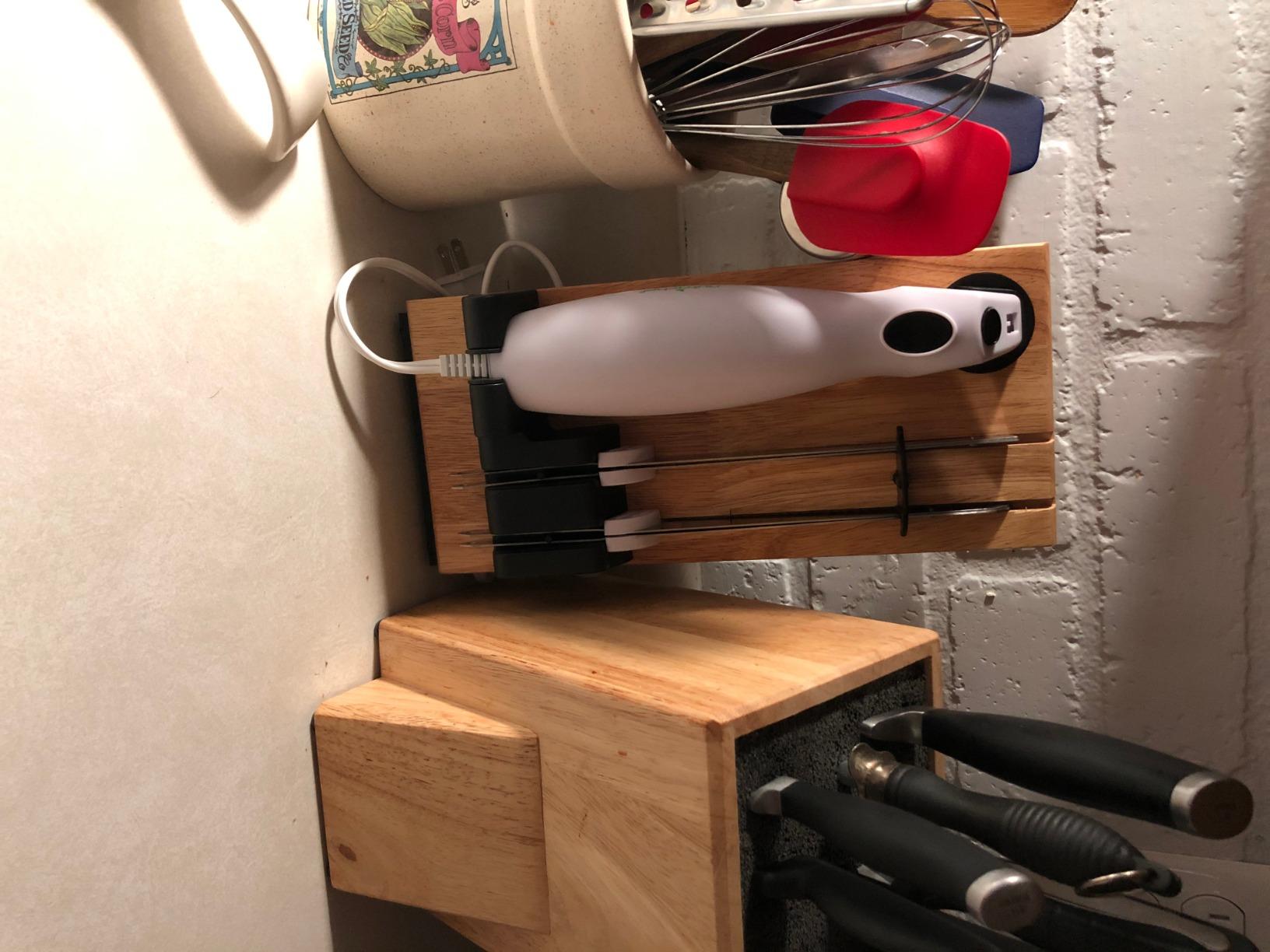
The stand is the detail that wins over the knife itself for most households. It flattens into a drawer once the holidays are over and reassembles on the counter when you need it, so it does not permanently claim a stretch of worktop the way a standing electric knife can.
Owner reports are consistently positive about slice consistency, particularly on breast meat, and having two included blades means you are not hunting for a spare during the week of the holiday. At 2.7 pounds the whole package is heavier than it looks, which is the trade for the hardwood base.
Where the NutriChef makes sense
Heat and volume. It handles a very large bird without downward force, and the handle does not warm up the way a plastic grip can over a long session. If you carve a big bird for a crowd and want the cleanest slices an electric knife can give you, this is the one.
Where the NutriChef makes you work
Blade seating is the most common complaint. If a blade is inserted in the wrong orientation it is genuinely difficult to seat, so check it before you start. The blades are also shorter and more flexible than larger electric models, and the stand’s black plastic tab can slip out of its slot.
Do You Even Need a Carving Knife?
Honestly, sometimes no. The knife community is nearly unanimous on this point, and the same advice shows up repeatedly on carving forums: any sharp 10 inch chef’s knife will do the job. If your chef’s knife is genuinely sharp, if it handles joints and bone without you bracing against the table, and if you can make a long enough draw to cover the breast, then a carving knife is a luxury rather than a necessity.
There are two honest reasons to buy one anyway. First, a chef’s knife is usually 6 to 8 inches, and a carving knife at 10 to 12 inches covers a full slice of breast in one pass, which is the difference between an even portion and a ragged one. Second, the point of a carving knife is the thin taper and the pointed tip, both of which let you work around a joint without the blade rocking or the tip digging in.
The third reason is the one nobody admits to, which is that carving is the most photographed two minutes of the holiday. A clean breast slice laid flat on the platter is the whole point of the knife, and that is a perfectly valid reason to own a dedicated tool.
There is one more practical argument, and it is about the awkward part of the job. A carving knife is long and narrow, which means it can reach into a cavity or slide between ribs where a broad chef’s knife physically cannot. That is what lets you remove the leg quarters cleanly before you touch the breast, and it is a step most improvised carvers struggle with.
None of this means a dull knife is fine. A dull blade does not just produce ragged slices, it has to be forced, and a knife that has to be forced around a joint at the table is genuinely more dangerous than a sharp one. If you own a chef’s knife and are not sure how sharp it is, test it on a sheet of paper before you decide.
How to Choose the Right Carving Knife
Start with blade length, because it is the single biggest factor. For a bird under about fourteen pounds, an 8 to 9 inch blade is enough and easier to control. Above that, go to 10 to 12 inches so the blade covers the width of the breast in a single draw. Beyond twelve inches you are holding a knife that is difficult to store and hard to maneuver inside a cavity.
Next, decide straight edge or serrated. A straight edge separates the muscle fibres cleanly and gives you those thin translucent slices. A serrated edge saws through with almost no technique and never needs sharpening, but it tears. For turkey, a straight edge is the right answer unless you refuse to own a sharpener.
Then look at the edge grind. A hollow edge or Granton edge has scalloped indentations along the spine that create air pockets, so slices release from the blade instead of sticking. A flat plain edge is simpler and heavier but holds a stronger edge line. For a Granton edge versus a flat edge, the scallop wins on presentation and loses slightly on durability.
Steel matters less to a home cook than the forums suggest. High carbon stainless in the mid to high fifties on the Rockwell scale is the sweet spot, and the forged picks in this roundup sit in that range. Carbon steel takes a finer edge but needs immediate drying to avoid rust, which is a poor trade if your kitchen is busy on Thanksgiving.
Handle material is the factor most people underweight. Wood and pakkawood absorb moisture and grip far better on a greasy bird. Stainless and polypropylene handles survive the dishwasher and do not swell or crack, but they are slippery when wet.
Full tang construction, where the steel runs the length of the handle, gives you balance and strength. Partial tang is lighter and cheaper, and you can feel the difference on a big bird.
Handedness matters too. A straight-blade carving knife with a symmetrical handle works equally in either hand. Offset blades and deep contoured grips are directional, and an offset slicer used in the wrong hand on a wet bird is a slip risk. The two electric knives on this list are both directional-neutral by design, since the reciprocating mechanism carries no single-sided bevel.
Weight tells you something too, and not just about quality. The Wusthof Classic 9 inch weighs 4.8 ounces and the HOSHANHO 11.6 inch weighs 9.6 ounces despite being three inches longer, which is a reminder that blade width and steel thickness matter as much as length. A very light blade can feel twitchy on a dense breast, while a heavy blade tires your wrist over a long session. Between roughly 7 and 10 ounces is the comfortable middle for most hands.
Finally, think about what else you will carve. A blade tuned for turkey is also a prime rib, brisket, ham, salmon and large watermelon slicer, and the longer models in this roundup handle all of those in a single pass. If you only ever carve a twelve pound bird once a year, a nine inch knife is plenty. If you smoke meat on weekends, look at the twelve inch options and buy the sheath that comes with them.
How to Sharpen a Carving Knife Before Thanksgiving
Every sharpening question on the carving forums comes down to the same two tools, and you need both of them. A honing rod, also called a honing steel or sharpening steel, realigns an edge that is still fundamentally sharp but has started to roll. A whetstone, or whetstone sharpening system, actually removes metal and establishes the edge. The rod is a maintenance tool you use weekly. The stone is a correction tool you might use twice a year.
The order of operations matters. Hone first, then sharpen if needed. Running a stone over an edge that only needs alignment removes more steel than you need to and shortens the life of your blade. Test the edge on a piece of paper or a ripe tomato before you decide which one you need.
Timing is what people get wrong. A carving knife stored in a drawer and used once a year will usually need a stone pass, not a rod pass, somewhere in October. Do it a few weeks ahead, not the morning of. Fresh stone grit leaves a burr that feels dull until it is removed, and a honing rod strop is how you remove it cleanly.
For storage, an 8 to 12 inch blade is a specific problem. Most knife blocks have slots sized for a 10 inch chef’s knife and nothing longer, so a carving knife either sits on top of the block or leans against it. A sheath, a knife roll, or a drawer guard fitted to the drawer handles all work far better than forcing it into a slot.
One habit worth building is a quick strop with the rod right before you carve, even if the edge feels fine. It takes under a minute, it removes any roll that picked up during storage, and it is the difference between a first slice that releases and one that drags. If you only buy one accessory alongside the knife, make it the rod rather than the stone.
A common mistake is buying a coarse stone for a factory-sharp blade. A 1000 grit stone resets an everyday edge on stainless steel, and coarser grits belong on knives that have already lost their factory geometry. If your knife is a premium forged design, a hard stone at a shallow angle is how you keep the factory edge line rather than grind it away.
How to Carve a Turkey Step by Step
Rest the bird first. Carving starts before the knife comes out, and a turkey rested for at least thirty minutes slices dramatically cleaner than one pulled straight from the oven. Put it on a board with a groove or a damp towel underneath so it does not slide.
Step one, remove the leg quarters first. This clears the way and stops the breast from being pulled out of shape when you lift. Tuck the thigh bone out of the joint, then slice through the joint where it meets the breast, cutting toward the backbone. The pointed tip of a long slicer is what makes this step clean.
Step two, separate the breast from the backbone, cutting down along the ribs on both sides while the knife runs along the top of the breastbone. Step three, set the breast skin-side down and slice straight down in long vertical cuts, one per serving. This is the step where blade length pays for itself, because a 12 inch blade covers the whole slice in one draw and a short blade forces you to cut from the middle outward in two stages.
Step four, slice the thigh meat off the bone and cut the drumsticks, then move to the wings. For ham, the approach is different: run the knife along the outside of the bone following the spiral cut, and let the length of the blade do the work. For leg quarters, a serrated edge is more forgiving than a straight one, but a sharp straight edge still cuts cleaner.
The step-to-knife mapping is straightforward. The sharp pointed tip of the Cutluxe or Wusthof is what separates the leg from the body in step one. The long Granton edge of the Cutluxe or the shallow fifteen degree edge of the HOSHANHO handles the breast in step three. The pakkawood handles on the Hammer Stahl and YOTSUBA sets are what make step four comfortable, because that step is repetitive and grip matters more than speed.
If you have both a manual slicer and an electric knife on hand, use the manual for the breast and the electric for the wings and the bread basket. That split plays to each tool’s strength, and it is the arrangement we fall into when we are carving for a large group with the BLACK+DECKER in the drawer.
Care and Storage for a Long Carving Blade
Wash carving knives by hand and dry them immediately, even when the rest of your kitchen runs the dishwasher. The heat and detergent cycle dulls an edge, and it can damage wood, pakkawood and rosewood handles over time. Treat the carving knife as the exception, not the rule.
Do not put a sharpened straight edge in the dishwasher at all. The cycle is harder on the factory edge than most people expect, and a blade that arrives razor sharp in November may need a stone pass by next year. The Henckels set on this list is the deliberate exception in this roundup, rated dishwasher safe by the manufacturer.
Storage is where a long blade earns its keep. A sheath is the simplest answer and one is included with the Cutluxe. A knife roll protects the edge and fits in a drawer better than a block. A drawer guard mounted under the cabinet handle works if you have several long blades. What does not work is a narrow knife block slot, which will dull the edge every time the knife slides in.
A final word on gifting. A carving knife is one of the most useful gifts you can give someone who hosts, and the presentation box sets on our list are built for exactly that. Pair it with a honing rod and a note about which edge style it is, and the gift works even for someone who already has a good chef’s knife.
What to avoid is the same across the board. Do not store a carving knife loose in a drawer where it can slide against a pot lid, and do not leave a set that includes a wooden stand sitting under a sink where the humidity gets to it. If you own several sets, keep them in different drawers rather than stacked, because stacked blades are how edges get dulled quietly.
One last thing worth knowing for a host: your carving knife will be used for about fifteen minutes on Thanksgiving and then put away. That makes it one of the most expensive tools in the kitchen per minute of use. Decide once, buy the best edge you can reasonably afford, and sharpen it every October. It will still be there next year, and the one you skip buying is the one you will be reasoning about at the store.
Two things change between the turkey and the leftovers. First, a bird that sat out is room temperature and drier, so a slightly less acute edge still works. Second, most leftover carving happens over a week in small quantities, which is exactly when a short 8 inch knife becomes the right tool rather than a compromise. Most households that carve a bird this November will be carving again next November, and the knife will be sitting in the same drawer either way.
Frequently Asked Questions
What is the best knife to use for carving turkey breast?
A long straight-edge carving knife is the best tool for turkey breast, because the thin taper and 10 to 12 inch blade cover a full slice in one unbroken draw instead of tearing the fibres. A hollow or Granton edge releases slices from the blade as you cut. Our top pick is the Cutluxe 12 inch model.
Can I use a chef’s knife to carve a turkey?
Yes, if your chef’s knife is genuinely sharp and at least 8 inches long. Knife forums widely agree that a sharp 10 inch chef’s knife handles a whole bird. A carving knife becomes worthwhile when you want one-pass breast slices on a large bird or a tip that works around joints confidently.
What is the best electric carving knife for turkeys?
For most home cooks, no electric knife is best, because serrated reciprocating blades tear cooked turkey fibres and cannot produce presentation slices. An electric knife makes sense if you carve rarely, refuse to sharpen, or slice a lot of bread alongside the bird. In that case a model with a safety lock and removable dishwasher-safe blades is worth having.
How do I choose the right size of carving knife for my turkey?
Use an 8 to 9 inch blade for a bird under about 14 pounds and a 10 to 12 inch blade for anything larger, so the blade covers the width of the breast in a single pass. Above 12 inches the knife becomes hard to store and awkward inside the cavity. For leg quarters and joints, a sharp pointed tip matters more than length.
What is the difference between a straight edge and a serrated carving knife?
A straight edge separates cooked meat fibres cleanly and can produce very thin slices, but it needs regular sharpening. A serrated edge saws through with almost no technique and never needs sharpening, but it tears rather than parts the meat. For turkey presentation slices, straight edge wins. For a carver who never sharpens, serrated is the practical trade.
Can I put my carving knife in the dishwasher?
Hand washing is better for almost every carving knife, because the heat and detergent cycle dulls a sharpened edge and can damage wood, pakkawood and rosewood handles over time. Only buy a model rated dishwasher safe if you plan to use it that way, and dry any blade immediately after washing either way.
Which Carving Knife Should You Buy?
If you want one answer to the question of the best carving knives for Thanksgiving turkey, take the Cutluxe 12 inch model. The forged German steel, the hand-finished Granton edge and the full tang pakkawood handle handle the largest birds in one clean pass, and it stays sharp without fuss for the whole meal. It is the knife we hand to someone who carves a lot.
Buy the MAIRICO 11 inch slicer if you want a manual option with a deep review base, or if an all-metal handle suits how you work. Buy the HOSHANHO 11.6 inch knife if you cook a lot of brisket and prime rib alongside the bird and you own a whetstone. Buy the Wusthof Classic 9 inch if your bird is smaller and you want an edge that holds for years.
For gifting, the ZWILLING Porterhouse set and the YOTSUBA knife and fork set both arrive in presentation boxes and both include a fork that actually holds meat in place. If sharpening is not for you, the BLACK+DECKER electric knife will get the bird carved with no edge maintenance at all, accepting that the slices will not be the thinnest on the table.
Whichever you choose, take thirty minutes to hone it in October, rest the bird for thirty minutes on the day, and remove the leg quarters before you touch the breast. That sequence matters more than any of these ten knives. For the rest of the menu, start planning with our Thanksgiving side dish picks and finish with our dessert roundup, and set the table from our Thanksgiving decoration guide.