

The Husqvarna 122HD60 (model 9665324-02) is the best gas hedge trimmer for tall hedges for most people, because a 24-inch double-sided blade on a 21.7cc two-stroke engine lets you cut the top and shoulders of a privacy hedge while your feet stay on the ground. Owners rate it 4.5 stars across 303 reviews, and the adjustable rear handle is the feature they name most often when describing tall work.
Staying on the ground is the whole point. Past roughly 6 feet, a handheld trimmer becomes a ladder job, and a running reciprocating blade plus a ladder is a bad pairing. Longer blades, bigger engines, rotating rear handles and shoulder harnesses all exist to remove that ladder from the picture.
We worked through this group of eight gas trimmers, comparing blade length, engine displacement, cutting capacity, operating weight and balance across both handheld and long-blade designs. Each pick below is matched to the job it genuinely suits, and we flag the point where a pole trimmer or a paid pro takes over. For the wider category, including battery and electric models, our overall hedge trimmer guide covers the options gas cannot.
Table of Contents
Top 3 Picks for Tall Hedges

Husqvarna 122HD60
- 24-inch double-sided blade
- 21.7cc 2-stroke
- Adjustable rear handle
- 16.2 lb
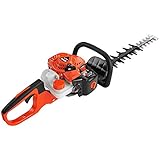
Echo HC-2020
- 20-inch RazorEdge blades
- 21.2cc 2-stroke
- Tool-less air filter
- 5-year consumer warranty

Best Gas Hedge Trimmers for Tall Hedges in 2026
Every tool below is a handheld gas trimmer with a long blade rather than an extended shaft. That single fact shapes this list, and the height framework further down explains which hedge each one can honestly reach.
| Product | Specifications | Action |
|---|---|---|
| Husqvarna 122HD60 21.7cc 24-Inch Dual Action Hedge Trimmer |
|
Check Latest Price |
 Echo HCA-2620 Hedge Trimmer Echo HCA-2620 Hedge Trimmer |
|
Check Latest Price |
 ECHO SHC-225S Commercial Series Hedge Trimmer ECHO SHC-225S Commercial Series Hedge Trimmer |
|
Check Latest Price |
| Echo 20 in. 21.2cc Gas Hedge Trimmer HC-2020 |
|
Check Latest Price |
 Baotree 24-Inch 26cc Dual Sided Gas Hedge Trimmer Baotree 24-Inch 26cc Dual Sided Gas Hedge Trimmer |
|
Check Latest Price |
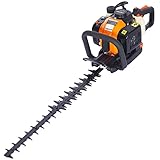 Sybrioka 26cc Gas Hedge Trimmer with 24-Inch Blade Sybrioka 26cc Gas Hedge Trimmer with 24-Inch Blade |
|
Check Latest Price |
| SENIX 4QL 26.5cc 22-Inch Four-Cycle Hedge Trimmer |
|
Check Latest Price |
 JENPECH 26cc 24-Inch Two Stroke Gas Hedge Trimmer JENPECH 26cc 24-Inch Two Stroke Gas Hedge Trimmer |
|
Check Latest Price |
1. Husqvarna 122HD60 – Best Overall for Tall Hedges
Husqvarna 122HD60 21.7cc Gas 23.7-in Dual Action Hedge Trimmer 9665324-02
- Starts on the first few pulls
- Cuts 1-inch branches without much struggle
- Adjustable rear handle used constantly and works well
- Anti-vibration dampeners reduce arm fatigue
- 24-inch blade covers a lot of hedge per pass
- Heavy above waist height
- Carburetor often needs mixture adjustment out of the box
- One owner reported a fuel tank grommet leak
This is the trimmer we would hand someone with a 7-foot privacy hedge and no ladder. The 24-inch double-sided high carbon steel blade is tied for the longest here, and at 21.7cc the engine has enough pull to keep the blades from bogging when they meet old growth. Owners consistently report that branches around an inch thick go through without much drama.
The adjustable rear handle is the detail that matters most for tall work. You can roll the handle to put the blade flat against a hedge face, angle it into a top cut, or pull it back to trim underneath a canopy. It is used constantly, in the review record, and it is the reason a single tool handles both the vertical sides and the flat top of a tall hedge.
Two things to know before you buy. At 16.2 pounds, this is not a light tool overhead, and forearm rests are worth adding for a long hedge row. And several owners report that the carburetor mixture arrives slightly off out of the box, only reaching full RPM once it is adjusted with a mixture tool. That fix takes minutes and the adjustment is not permanent, but expect to do it once.
What to check before you commit
If your hedge is a dense evergreen with a woody interior, the 24-inch blade will cut through the green growth but you will still be chopping at old brown wood underneath, which dulls teeth fast. Keep the blade angled slightly upward on each pass so you are always taking green shoots rather than dead interior branches.
For a hedge under roughly 6 feet, this tool is more than you need, and a lighter machine will be kinder to your arms. It earns its place above shoulder height, where blade length turns into fewer, longer passes and fewer repositioning steps along the row.
Where it falls short
There is no extended shaft here, so total reach is blade length plus arm length, roughly 7 feet of workable height for an average adult. Once your hedge pushes past 8 feet you are looking up into the cut and the balance point moves away from you fast.
It is also a two-stroke, which means premixed fuel and a smell that neighbours will notice. The Smart Start design and carburetor air purge do make starting easy, but the carburetor serviceability is the one owner-reported weakness worth budgeting time for.
2. Echo HCA-2620 – Best Cutting Capacity
- Highest average rating in this group at 4.6 stars
- Build quality described as very well made
- Three sharpened edges per blade side
- Cuts brush and hedges cleanly and efficiently
- Backed by a 5-year consumer warranty
- Front-heavy balance tires out long sweeping strokes without the strap
- No wrap-around or D-handle for two-handed control
- One owner felt the gearbox seems lighter duty than older Echo models
The HCA-2620 posts the highest average rating of anything we tested here, and the reason is the blade. RazorEdge teeth are sharpened on three sides each, which keeps them biting longer between sharpenings, and the magnesium housing takes abuse from brush and stray branches without complaint. Owners call it heavy-duty and efficient in the same breath.
For tall hedges specifically, the 21-inch double-sided cut is a sensible middle ground. It is shorter than the 24-inch blades on three rivals, so more repositioning is needed along a long face, but the shorter bar is noticeably easier to control when the cutting head is above shoulder height and the tool is fully extended.
The balance is the trade-off. Reviews describe it as front-heavy, and long side-to-side passes without the shoulder strap get tiring faster than the weight alone would suggest. Plan on working in shorter bursts with a rest between rather than trying to cut a whole 40-foot face in one go.
What to check before you commit
Check the warranty route before you need it. The HCA-2620 carries a 5-year consumer and 2-year commercial warranty, which is longer than most of this group, and that matters more for a tool you will start twice a year for a decade than the engine size does.
If your hedge has thick established branches, the three-sided tooth geometry is the reason to pick this over a cheaper machine. The teeth hold an edge on green wood that has already been cut once, so the second and third passes down a face stay as fast as the first.
Where it falls short
There is no second handle. On long reaches, one hand on the throttle means the tool can twist, and several buyers mention wishing for a wrap-around or D-handle for two-handed control on the return stroke.
Review volume is thinner than most here at 49 ratings, so the durability story rests on a smaller sample than the 4.6 score suggests. One owner also felt the gearbox seemed lighter duty than older Echo models, which is worth a thought if you are trimming woody, neglected growth rather than maintained hedges.
3. ECHO SHC-225S – Best Commercial Series Build
- Commercial-series positioning for sustained professional duty
- Stainless steel blade resists corrosion on sap-heavy hedges
- Owners rate durability highly
- 20-inch cutting width suits straight hedge faces
- Few customer reviews so long-term durability data is thin
- Weight not listed in the catalog record
- RazorEdge teeth not specified in the listing
The SHC-225S sits in Echo’s commercial line, which means alloy steel construction and a stainless steel double-sided blade rather than the high carbon steel used on homeowner machines. Stainless matters more than most buyers realise on hedges like cherry laurel and yew, where persistent green sap works into the steel and starts corrosion at the tooth line.
For tall hedges the 20-inch blade and 21-inch cutting width give you a bar that is easy to control at full extension. There is no extended shaft, so reach is blade plus arms, but a shorter bar is genuinely easier to keep level when you are cutting a top surface 7 feet off the ground, and level is what makes a straight finish.
We would be honest about the limits of the data here. The 4.5-star score comes from 47 ratings, and the written review text that came back with our analysis was empty, so what we can tell you is the rating distribution and the specification sheet rather than a long account of how these hold up over years.
What to check before you commit
If this is for paid work rather than your own hedge, the commercial series badge is the reason to look here. The 20-inch stainless blade and alloy steel body are specified for daily duty, and Echo builds this class of tool to be serviced rather than replaced.
Confirm the cutting width against your hedge geometry. At 21 inches the swath is a little narrower than the 24-inch blades here, so a long straight face takes a few more passes. On a shaped or topiary section, that shorter pass is easier to control.
Where it falls short
Weight is not published in the record we pulled, and weight is the number that decides whether a 7-foot hedge is comfortable. Ask for it before you commit rather than discovering it at shoulder height.
There is also no stated blade-teeth detail, so we cannot confirm the tooth pattern matches the RazorEdge standard on the HC-2020 and HCA-2620. For a one-property owner the difference is minor, but for daily professional use it is the specification you would want in writing.
4. Echo HC-2020 – Best Value for Thick Growth
- Cuts heavy multi-year evergreen branches without bogging
- Easy to start and easy to learn
- Runs long sessions on two tanks
- Relatively quiet for a gas trimmer
- Tool-less air filter cover and grease fitting simplify maintenance
- Sap binds the cutting jaws until the blades are degreased
- One unit arrived with an idle fault and needed dealer repair
- Two-stroke exhaust smell on residential jobs
The HC-2020 is the pick for a neglected hedge that has been left for several seasons. Owners report it cutting through heavy, years-old evergreen branches without bogging down, which is the single most useful thing a trimmer can do when you are cutting back a face that has grown into itself. At 21.2cc with 20-inch RazorEdge blades there is enough torque behind the cut to keep the strokes moving.
It is also the easiest of the professional-leaning machines here to learn. The tool-less air filter cover means filter access without tools, and a zero-type grease fitting on the bar lets you maintain the blade without hunting for a grease gun. One owner logged an hour and a half of continuous work across two tanks, which tells you the tank size suits a long hedge row.
Noise is worth calling out. Several reviewers describe it as relatively quiet for a gas trimmer, which matters more than it sounds if your hedge sits on a shared boundary or close to neighbours. The warranty is 5 years consumer and 1 year commercial.
One caution on maintenance: sap will bind the cutting jaws if the blade is left dirty, and the fix is regular degreasing rather than a repair. Treat it as a machine that wants wiping down after every session and it will stay sharp indefinitely.
What to check before you commit
Look at the growth you are cutting, not the height. This machine is aimed at woody, thick branches on a tall hedge, and it is the one here we would trust with a face that has deadwood inside it. If your hedge is a soft, fast-growing species with thin green shoots, a lighter machine will be faster.
Confirm you are comfortable with two-stroke fuel. The engine is a 21.2cc two-stroke, so you are mixing oil at 50:1 or buying premix, and the exhaust carries the associated smell on a residential job.
Where it falls short
It has no extended shaft, so a hedge above about 8 feet pushes this tool past its comfortable working range. Above that, a long-reach pole trimmer or a pro with a bucket truck is the sensible answer.
There is also a small reliability note. One unit arrived with an idle fault and needed dealer repair, and the long-term owners we heard from are at three-plus years of use, which is a good sign but not a guarantee on every machine.
5. Baotree 24-Inch 26cc – Best Wide-Blade Coverage
24-Inch 36cc 2 Cycle Gas Powered Dual Sided Hedge Trimmer (Orange, 26cc)
- Starts on the first or second pull and runs consistently
- Strong cutting power on three-quarter inch branches
- Twisting handle adds real versatility at different angles
- Dual-sided 24-inch blade covers a lot of hedge per pass
- Magnesium alloy gearbox with anti-rust coating
- Feels heavier than the listed weight when held overhead
- Blade gap short of the advertised claim
- Seller support was unresponsive to multiple enquiries
The Baotree has one of the widest cuts in the group at 24 inches, and on a long straight face that matters, because each pass covers more than the 20-inch blades and the whole job takes fewer steps. The twisting adjustable handle is the other selling point, letting you set the blade angle for a side cut, a top cut or an angled corner without repositioning your whole body.
Engine options run to 26cc and 36cc variants, and the magnesium alloy gearbox carries an anti-rust coating that stands up well on wet foliage. There is a 3-in-1 safety system here too, combining an instant brake, throttle lock and hand guard, which is more than most of the machines in this price bracket bother with.
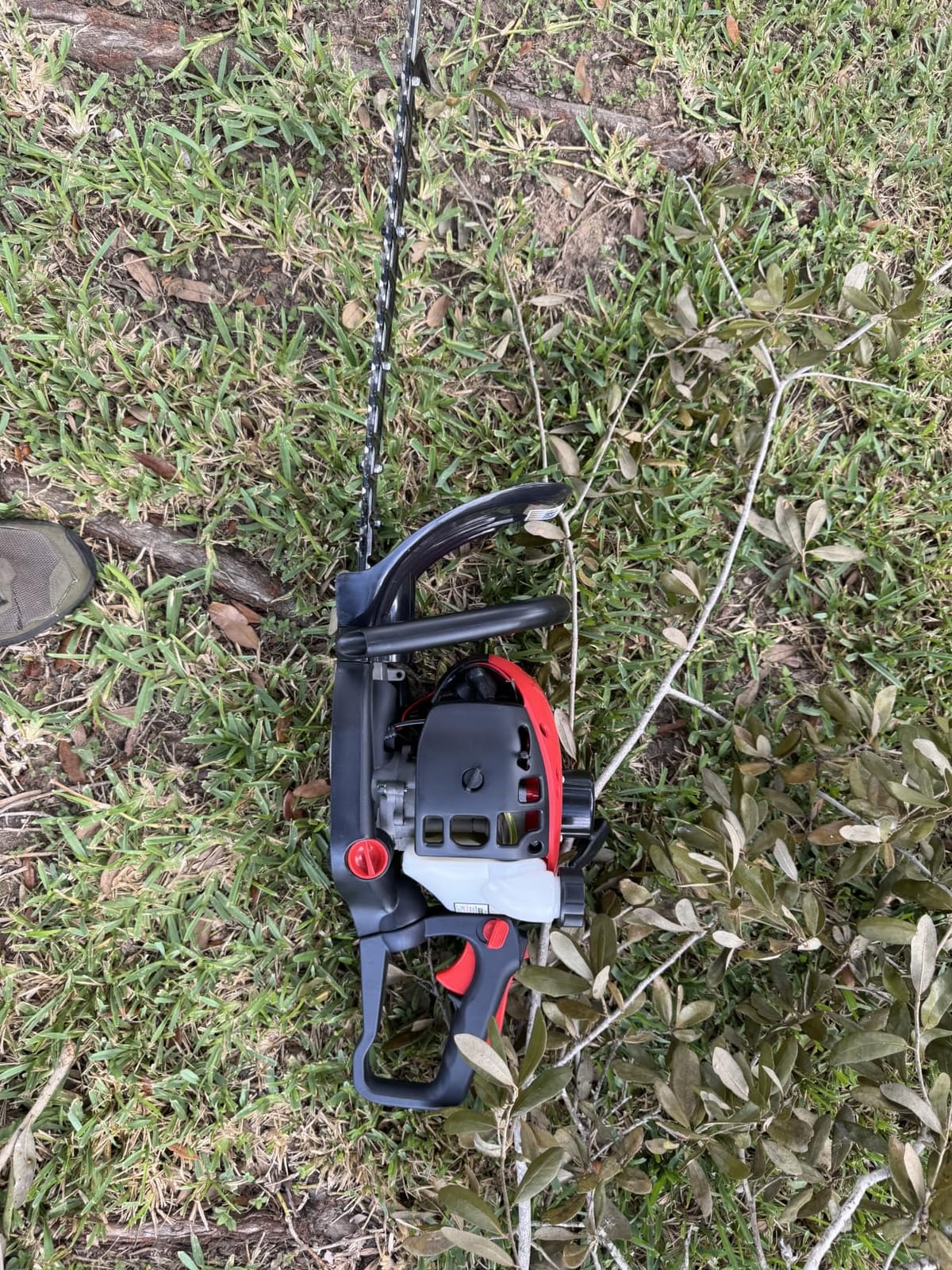
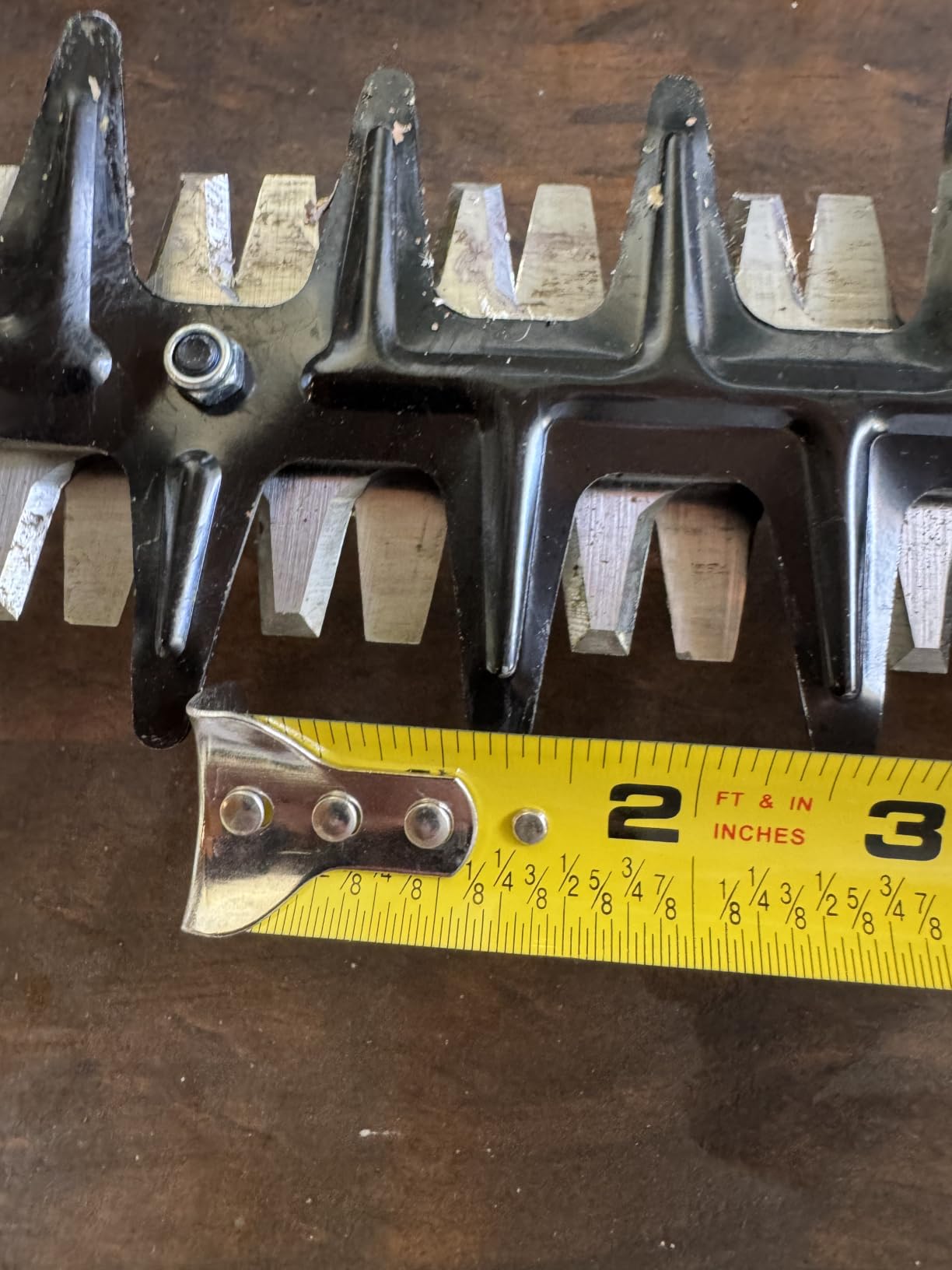
Two real caveats. Owners say the listed 16 pounds understates how it feels above waist height, closer to the experience of a much heavier machine when you are reaching up. And the blade gap measured by users is about an inch, short of what the marketing claims, so treat the cutting capacity as 1 inch rather than the headline figure.
What to check before you commit
Check the support side of the equation. The most common complaint in the review record is not the machine, it is the seller, with multiple emails and a filter enquiry going unanswered. If something arrives damaged or will not start, find out in advance how the return process actually works.
For a tall hedge, the wide blade cuts fast but the weight is a factor. If your hedge is over 6 feet and you will be working above shoulder height for a full row, budget for breaks or plan to work from a stable platform rather than stretching.
Where it falls short
A 1-inch cutting gap limits it on genuinely thick mature hedges. The HC-2020 and HCA-2620 handle older woody growth better, and the SENIX is specified at 1-1/8 inches with a laser-cut blade.
It is also a two-stroke with the fuel mixing and exhaust noise that implies, and the listing states no warranty coverage. On a large property where the trimmer is used all day, that absence matters.
6. Sybrioka 26cc – Best Swivel Handle for Angled Cuts
Hedge Trimmer 26CC Gas Powered Hedge Trimming Tool, Double Sided Blade 24″ Saw Brush Cutter Garden Lawn Grass Tool
- Starts on the first pull
- Swivel handle rotates 180 degrees for angled cutting
- Strong build quality for the tier
- Very economical on fuel and oil mix
- Lighter than comparable 26cc machines at 14 pounds
- Heavy enough to fatigue arms when reaching over tall hedges
- Plastic handle is a weak point on an otherwise metal body
- Exhaust and heat shield run hot enough to burn
- No throttle lockout or rev limiter
The Sybrioka’s distinguishing feature is a handle that swivels a full 180 degrees, which is genuinely useful on a tall hedge where you are cutting a corner or an angled face and do not want to roll your body to get the blade flat. The 24-inch double-sided serrated blade carries 33 teeth, and reviewers report it starting on the first pull and chewing through brush and small branches without complaint.
It is also lighter than you would expect for a 26cc machine at 14 pounds, and owners single out fuel economy as a positive, which matters when you are running the length of a long hedge row. The 0.65L tank and recoil start keep refuelling to a minimum.
Reviewers consistently frame it as a solid homeowner tool rather than a professional one, and the cons explain why. The plastic handle is the weak point on an otherwise metal body, the exhaust and heat shield run hot enough to burn skin if you grip the wrong area, and there is no throttle lockout or rev limiter to protect a new user from their own right thumb.
Note that EPA compliance and a reduced-noise design are both specified here, and reviewers call the low-vibration handling noticeable. On a hedge close to a property line, a quieter machine reduces friction with neighbours, which is one of the few ways to improve the job beyond the cut itself.
What to check before you commit
Decide whether you need the swivel. If your hedges are flat-faced and rectangular, most of the handle articulation goes unused. If you maintain shaped or topiary sections alongside a tall boundary hedge, it earns its place more easily than the extra engine size would suggest.
Confirm you are comfortable around a hot exhaust. On a tall hedge you will often be leaning into the machine, and a heat shield hot enough to burn skin is worth planning your grip around rather than discovering mid-pass.
Where it falls short
Fatigue overhead is the honest limit. Fourteen pounds feels fine at waist height and heavy by the time the blade is at the top of a tall hedge, and owners say exactly that.
It is also not built for daily commercial use, and the lack of a throttle lockout or rev limiter makes it the more demanding machine to hand to someone who has not run a trimmer before.
7. SENIX 4QL – Most Versatile With Straight Gas Convenience
- Four-cycle engine runs on straight gas with no oil mixing
- Cuts fast without needing to rev the engine out
- Blades stay still at idle
- Finished a large hedge job in roughly half the expected time
- Lightest gas option here at 9.4 pounds
- Difficult to start especially when cold
- Some units failed to start again after a couple of years
- Engine-heavy balance pulls the machine down
- Four-cycle layout has no choke to help a cold start
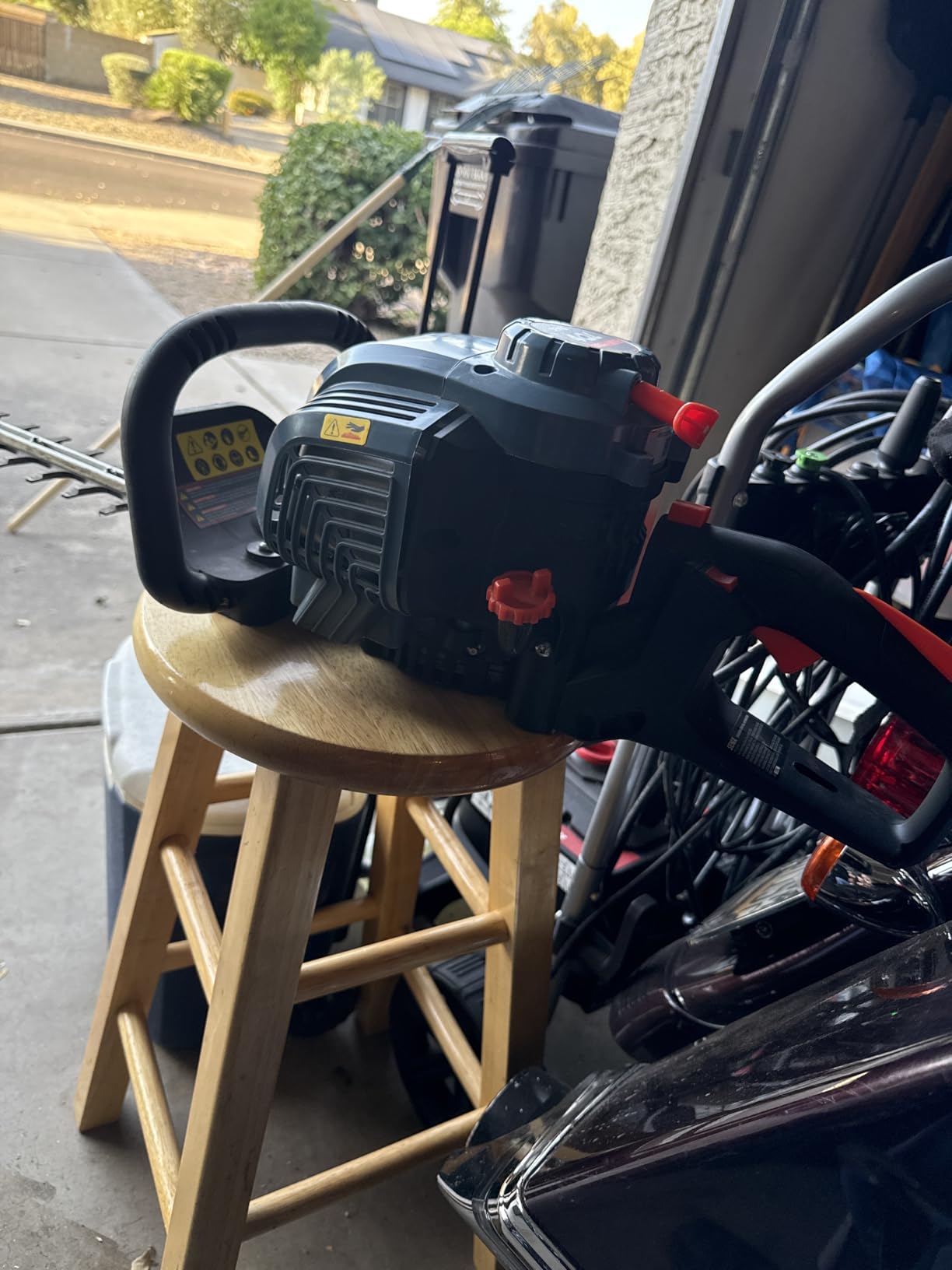
The SENIX 4QL has the largest review base in this group at 527 ratings and the lowest score at 3.9, and both facts matter. The reason it still earns a place is the four-cycle full crank engine that runs on straight gas with no mixing, the 22-inch laser-cut dual-action blade, and a 9.4-pound weight that is by far the lightest gas machine here.
That weight is the tall-hedge argument. On a hedge over 6 feet, every pound is felt above shoulder height, and a 9.4-pound machine lets you work a long face without the forearm burn that heavier machines cause. Owners also report that the blades stay still at idle, which is a real safety advantage over a two-stroke.
The 3.9 score is not a mystery. Sixteen percent of ratings are one star, and the complaints cluster on two things: difficulty starting, particularly when cold, and units that would not restart after a couple of years of use. Several owners needed repeated pulls or called for phone support to get it running.
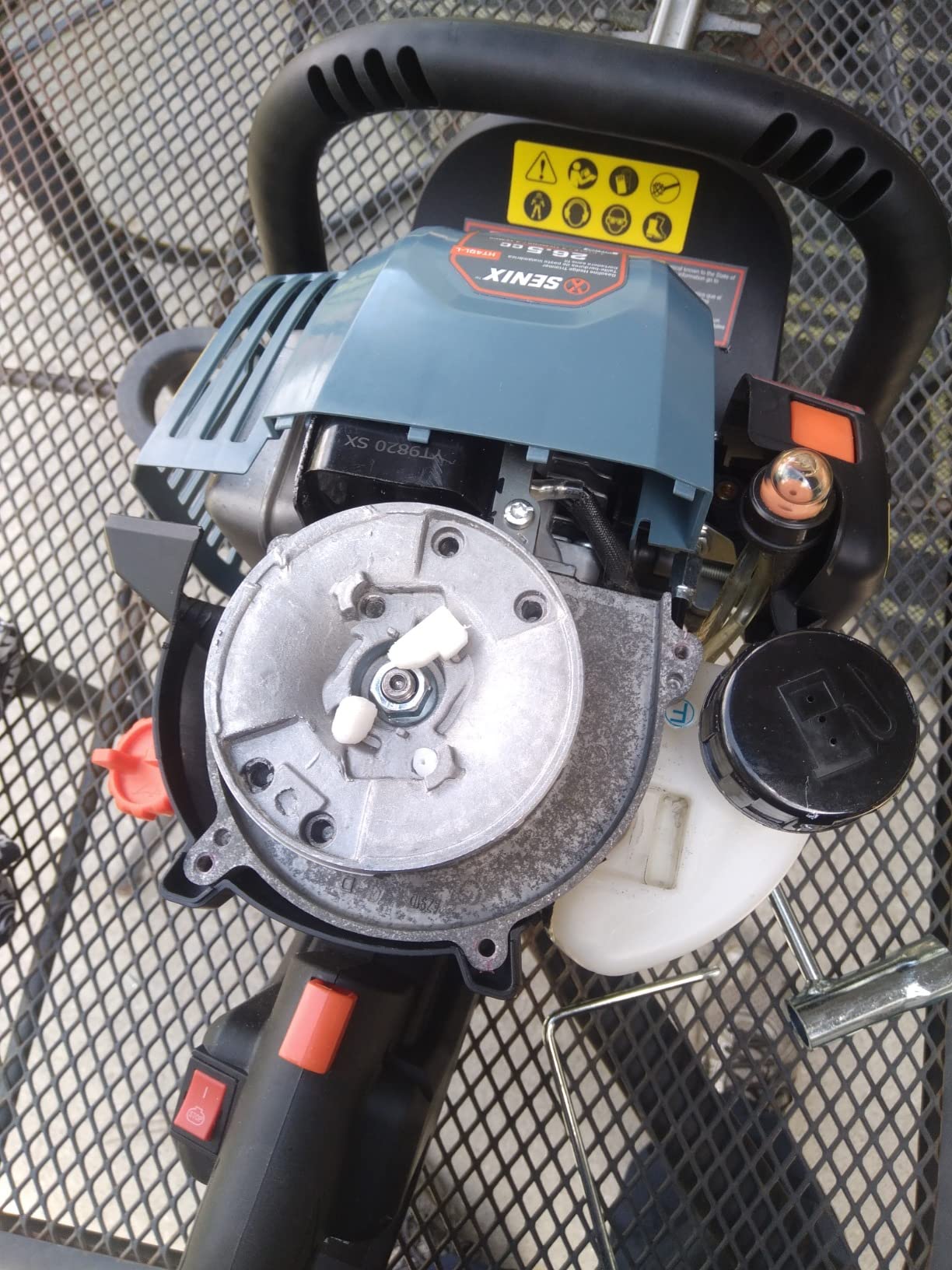
Cutting performance is not the problem. Owners report the 22-inch bar finishing a large hedge job in roughly half the time they expected, cutting fast without needing to rev the engine out, and benefiting from low vibration with none of the two-stroke smell.
What to check before you commit
Check the warranty before you need it. The warranty is a 3-year limited one, shorter than the Echo models at five years, and the package includes a blade cover, spark plug wrench and engine oil.
If cold starts are your normal experience, test it before the season. A four-cycle engine has no choke to help it, and the owner reports of repeated pulls on a cold morning are the single most common complaint in the record.
Where it falls short
Reliability over time is the weak point. The pattern of units failing to restart after a couple of years, and the engine-heavy balance that tends to pull the machine down rather than sit neutrally, are the two things to weigh against the fuel-saving convenience.
It also has no extended shaft, so like every machine here, reach stops around 7 feet of workable height. If your hedge is genuinely tall, this weight advantage is what you are buying, not extra reach.
8. JENPECH 26cc – Best Long-Run Fuel Tank
- Full-crankshaft two-stroke design starts easily
- Large fuel tank gives long single-fill run time
- Rear handle rotates 90 degrees with anti-vibration system
- 24-inch dual-sided blade cuts wide swaths
- Low-noise design suited to residential use
- Listed weight conflicts with the figure in the feature copy
- One-inch cut diameter is modest beside the 24-inch blade
- No written customer review text was available to verify performance
The JENPECH is the machine to consider if your hedge line is long enough that refuelling is a genuine interruption. The large fuel tank is sized for all-day runtime, and on a full row of privacy hedging that means one fill covers the job rather than three or four top-ups. The full-crankshaft two-stroke design is also specified for easy starting.
Handling is handled sensibly, with a rear handle that rotates 90 degrees and an anti-vibration system with an anti-slip grip. The 24-inch double-sided serrated blade gives a 24-inch cut width, and the package is unusually complete, including a tools kit, gas bottle, funnel, back strap, gloves and glasses.
The data here is thinner than the other seven. The score is 3.9 with 16 percent one-star ratings, and no written customer review text came back with our analysis, so the performance claims rest on the specification sheet rather than on owner accounts. The listed weight also conflicts with a lower figure in the feature copy, which is a sign the listing was not carefully checked.
Splash guard, safety flaps and multiple heat sinks are specified, and the low-noise design is worth noting if the hedge is near neighbours. But a 1-inch cut diameter is modest next to a 24-inch blade, so this is a machine for fast coverage of green growth rather than thick woody branches.
What to check before you commit
Weigh the fuel advantage against the cutting capacity. If your hedge is a long row of green, fast-growing growth, the tank size and 24-inch swath will get you round quickly. If it is mature and woody, the 1-inch gap will slow you down and dull the teeth faster.
Ask about support and warranty in writing before purchase. With no written reviews to check and a specification sheet that contains an internal contradiction, this is a machine where a clear return policy matters more than it would for a heavily reviewed product.
Where it falls short
The weight figure is unresolved in the listing, and weight is the number that decides comfort above shoulder height on a tall hedge. Get it from the manufacturer rather than guessing from conflicting figures.
It is a two-stroke, so there is premix fuel to handle and exhaust noise on a residential job, and the 3.9 rating with a 16 percent one-star share is the weakest evidence base in this group. The included back strap, gloves and glasses are a nice touch for someone starting out.
How Tall Is Your Hedge? Pick the Right Tool Class
Under 6 feet, any of these machines will do the job, and reach is not the deciding factor, weight is. Between 6 and 8 feet, blade length and a rotating rear handle matter most, because that is where you start reaching above your head and repositioning becomes the slow part. Past 8 feet, a handheld gas trimmer is the wrong tool class, whatever the blade length.
The honest truth about this list is that none of these eight is a pole trimmer. Total reach here is blade length plus your arm span, which on an average adult puts the workable ceiling around 7 feet. The long-reach and pole category is a different set of machines with a shaft between you and the engine, and if your hedge is genuinely tall that is where your shopping should go. Our cordless hedge trimmer guide covers the battery pole options that now reach competitive distances.
One further threshold, and it comes from trade professionals rather than manufacturers: beyond roughly 12 feet, arborists report that a bucket truck is the tool, because the working angle on a pole trimmer stops being controllable at that height. If your hedge is a mature boundary hedge taller than a two-storey house, budget for a service visit rather than a purchase.
What to Look for in a Gas Hedge Trimmer for Tall Hedges
Blade length and sidedness
Blade length is the reach multiplier and the weight penalty in one number. A 24-inch double-sided blade covers a lot of hedge per pass and suits long straight faces, while a 20-inch blade is easier to keep level when working at full extension overhead. Double-sided blades cut on both the forward and return stroke, which is faster; single-sided designs are lighter and cheaper but take twice as many passes.
Look for dual-action or laser-cut reciprocating blades, where two toothed bars move past each other so each tooth has time to clear debris. This is the standard on the Husqvarna, the two Echos and the SENIX, and it is the difference between a blade that jams in wet growth and one that does not.
Engine type and displacement
Two-stroke engines are lighter and cheaper, run on a 50:1 premix, and produce more power per cubic centimetre. Four-stroke full crank engines run on straight gas, need no mixing, run cooler and quieter, and hold lubrication in any orientation. On a machine you start twice a year, the fuel handling difference is a small daily convenience but a real one.
Displacement in this group runs from 21.2cc to 26.5cc, with 36cc variants available. Above about 22cc you are buying headroom for thick branches rather than speed on green shoots. Cut strokes per minute matters less than displacement for most homeowners, because the binding constraint is usually the blade gap rather than the engine.
Cutting capacity
This is the max cut diameter, and it is the number that tells you whether your hedge is within the machine’s range. A 1-inch capacity handles well-maintained hedges of most species. A 1-1/8 inch capacity, as specified for the SENIX, gives you margin on older growth. Anything thicker than the stated figure and you are asking the gearbox to do a job it was not designed for.
Owners repeatedly report that the practical limit is lower than the published figure on budget machines, so treat the spec sheet as an upper bound and read the owner reviews for the number that actually cuts.
Weight, balance and the harness
Operating weight matters more the higher the cut. The lightest gas machine here is 9.4 pounds and several sit at 16 pounds or above, and on a tall hedge that spread is the difference between a full row of work and a series of breaks. Weight also changes what you notice about balance: an engine-heavy machine pulls forward, which tires your shoulders on long passes.
A shoulder harness is not optional at real reach. Once a shaft or a long reach is involved, the balance point moves away from your centre of gravity and your arms start taking load they were not built for. Check whether a strap is included, not just sold separately.
Fuel, fuel mixing and air filtration
Two-stroke machines need a 50:1 mix, and premixed fuel removes the calculation entirely if you would rather not measure. Four-cycle machines run on straight gas and lubricate in any position, which means less mess in storage. Two-stage air filtration and tool-less filter covers, as specified on the Echo HC-2020, are what keep an engine running reliably year after year.
Look for an air purge on the carburetor for starting, and a translucent fuel tank so you can see what is left without pulling the machine down off the hedge face.
Ladder safety and when to hire a pro
No powered trimmer belongs on a ladder. A reciprocating blade, one hand on the throttle and a ladder is a combination the safety guidance exists to prevent, and the reason extended-reach designs grew out of exactly this problem. If you have been trimming a tall hedge from a step ladder, that is the strongest argument in this guide for buying a different tool class.
Also consider the ground. Wet, uneven or sloped ground under a ladder is a large share of ladder falls, and a pole trimmer removes that variable along with the ladder. Where the hedge is over roughly 12 feet, or where the trunk line sits above reachable height, a professional service with proper equipment is the sensible call.
Frequently Asked Questions
What is the best long-reach gas hedge trimmer?
For a long-reach gas pole trimmer, look at total reach rather than engine size: add shaft length to blade length, and confirm the cutting head rotates through at least 135 degrees so you can level the top and reach underneath the canopy. Use a shoulder harness at full extension, because the balance point moves away from you. Beyond roughly 12 feet of hedge height, trade professionals report that a bucket truck is the correct tool, not any consumer pole trimmer.
What is the best hedge trimmer for trimming tall hedges?
The best hedge trimmer for tall hedges is a pole or extended-reach model, because a handheld model only reaches about 7 feet of workable height. For hedges between 6 and 8 feet, a 24-inch double-sided blade with a rotating rear handle is the practical minimum. Our top gas pick for that range is the Husqvarna 122HD60 with its 24-inch blade and adjustable rear handle.
What hedge trimmer has the longest reach?
Pole trimmers reach furthest because reach is the shaft length plus the blade length, and only a shaft adds meaningful height to your arm span. A handheld gas trimmer tops out around 7 feet of workable height. Cordless pole trimmers now reach into the same territory as gas pole models, so compare total reach in feet before choosing a power source.
Which petrol extendable hedge trimmer has the best long reach?
A petrol extendable trimmer with a rotating cutting head beats a fixed-head model at height, because the head angle decides whether you can cut a flat top or get underneath the canopy from the ground. Check the rotation range in degrees and the number of lock positions, then confirm a shoulder harness is included. Measure the full shaft plus blade length in feet, not just the blade.
Which brand is best for hedge trimmers?
Husqvarna and STIHL are the standard trade choices and are widely regarded as the most durable, with dealer service and long warranties as the reason for the price. ECHO sits close behind, with RazorEdge blades and a 5-year consumer warranty on several models. SENIX and Poulan-type budget brands cut well for the money but attract more starting and gearbox complaints in owner reports.
Is a gas hedge trimmer worth it?
A gas hedge trimmer is worth it for tall hedges and long rows, because it runs all day without charging pauses and handles thick growth that lighter machines bog down in. For a small hedge under 6 feet used a few times a year, a battery model is quieter, lighter and needs no fuel mixing. The weight difference matters most above shoulder height, which is exactly where tall-hedge work happens.
The Best Gas Hedge Trimmer for Tall Hedges in 2026
The Husqvarna 122HD60 is our pick for the best gas hedge trimmers for tall hedges, with a 24-inch double-sided blade, a 21.7cc two-stroke engine and the adjustable rear handle that owners rely on for sides and tops. Budget for the carburetor adjustment and take forearm rests if the hedge is long.
For thick neglected growth, the Echo HC-2020 handles woody branches without bogging and comes with a 5-year consumer warranty. For cutting capacity and the highest rating here, the Echo HCA-2620 pairs 21-inch three-sided RazorEdge teeth with a magnesium housing. If fuel mixing bothers you and you want the lightest machine for overhead work, the SENIX 4QL runs straight gas at 9.4 pounds, with starting reliability as the thing to test before you commit.
Remember the ceiling. Every machine on this list is a handheld, so plan for hedges up to about 7 feet, and move to a pole trimmer above that. Use the buttons above to check the current price for any of these, and get a service visit rather than a ladder for anything beyond roughly 12 feet.