
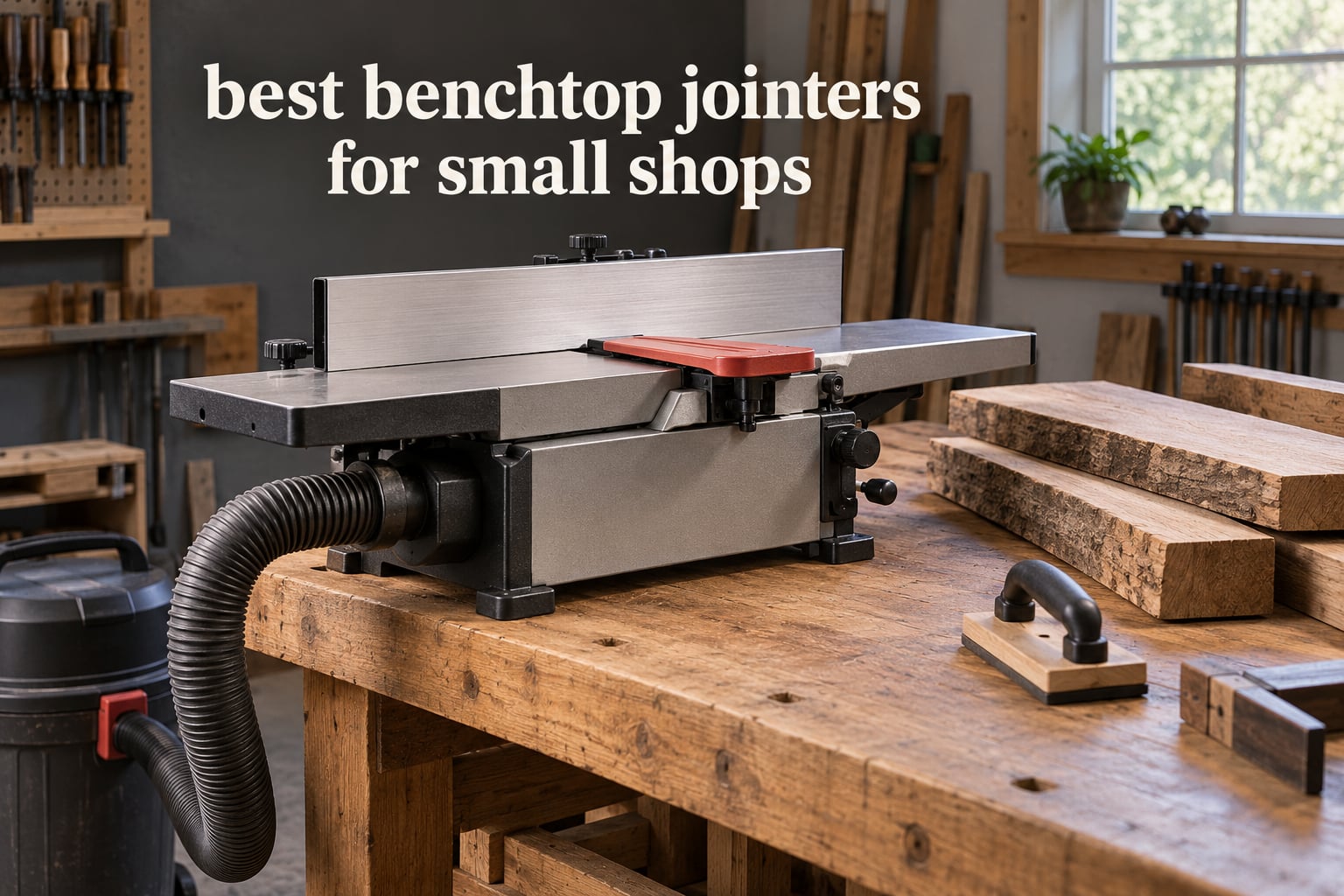
The best benchtop jointers for small shops are the machines that flatten one face and square one edge in a single pass, and nothing else does that job for you. Every other step in a small shop leans on that reference surface. Plane one face, saw one edge, glue up a panel, and every error you skipped shows up later as a wavy tabletop or a drawer that will not close.
A benchtop jointer is the compact version of that machine. It sits on a bench or a heavy stand, weighs roughly 37 to 83 pounds, and plugs into a standard outlet. That is the whole appeal for a small shop: you get the one operation you cannot fake with a planer, a table saw, or a router, without giving up floor space or hiring an electrician for a 220V circuit.
Are they worth it? Yes, if you regularly work with rough-sawn, warped, or resawn lumber and your material is under about 8 inches wide. No, if you already own a quality hand plane and a decent planer and your projects never leave flat, square lumber. We worked through eight strong options in this class and narrowed it down for a small shop footprint.
We also found that most of the noise around benchtop jointers is not about cut quality. Reviewers complain almost entirely about mass, bed length, fence squaring, and dust. All four of those are manageable once you know what you are buying.
Top 3 Benchtop Jointers for Small Shops in 2026
These are the three machines we would put on a bench in a 10-by-10 shed shop. The WEN JT630H leads on proven reliability, the Wahuda 50180CC covers 8-inch capacity, and the CRAFTSMAN CMEW020 handles short small-batch work for the least money.


Quick Comparison: All 8 Benchtop Jointers Side by Side
Almost every pick below runs on a standard 110V household circuit at 10 amps. Cutting width is the number that decides what you can feed through the machine.
| Product | Specifications | Action |
|---|---|---|
| WEN JT630H 6-Inch Spiral Jointer |
|
Check Latest Price |
| CRAFTSMAN CMEW020 Benchtop Jointer |
|
Check Latest Price |
| Wahuda 50180CC 8-Inch Jointer |
|
Check Latest Price |
 WEN JT833H 8-Inch Jointer WEN JT833H 8-Inch Jointer |
|
Check Latest Price |
| WEN JT3062 6-Inch 2-Blade Jointer |
|
Check Latest Price |
 Cutech 40180HI 8-Inch Jointer Cutech 40180HI 8-Inch Jointer |
|
Check Latest Price |
 Cutech 40160HB 6-Inch Jointer Cutech 40160HB 6-Inch Jointer |
|
Check Latest Price |
 JET JJ-6HHBT 6-Inch Jointer JET JJ-6HHBT 6-Inch Jointer |
|
Check Latest Price |
1. WEN JT630H: Best Overall Benchtop Jointer for Small Shops
- Clean finish from 12 staggered HSS blades
- Tables arrive coplanar needing little adjustment
- Easy to carry and store between sessions
- Quiet and does not bog at shallow depths
- Aluminum tables mark and burnish with rough lumber
- Fence takes work to square and can drift
- 2-1/2 inch dust port needs an adapter
The 12 staggered HSS spiral blades leave a surface you can glue immediately on maple and purpleheart, both of which tear out badly on a two-blade head. That cut quality at this level of build is the reason it leads our list.
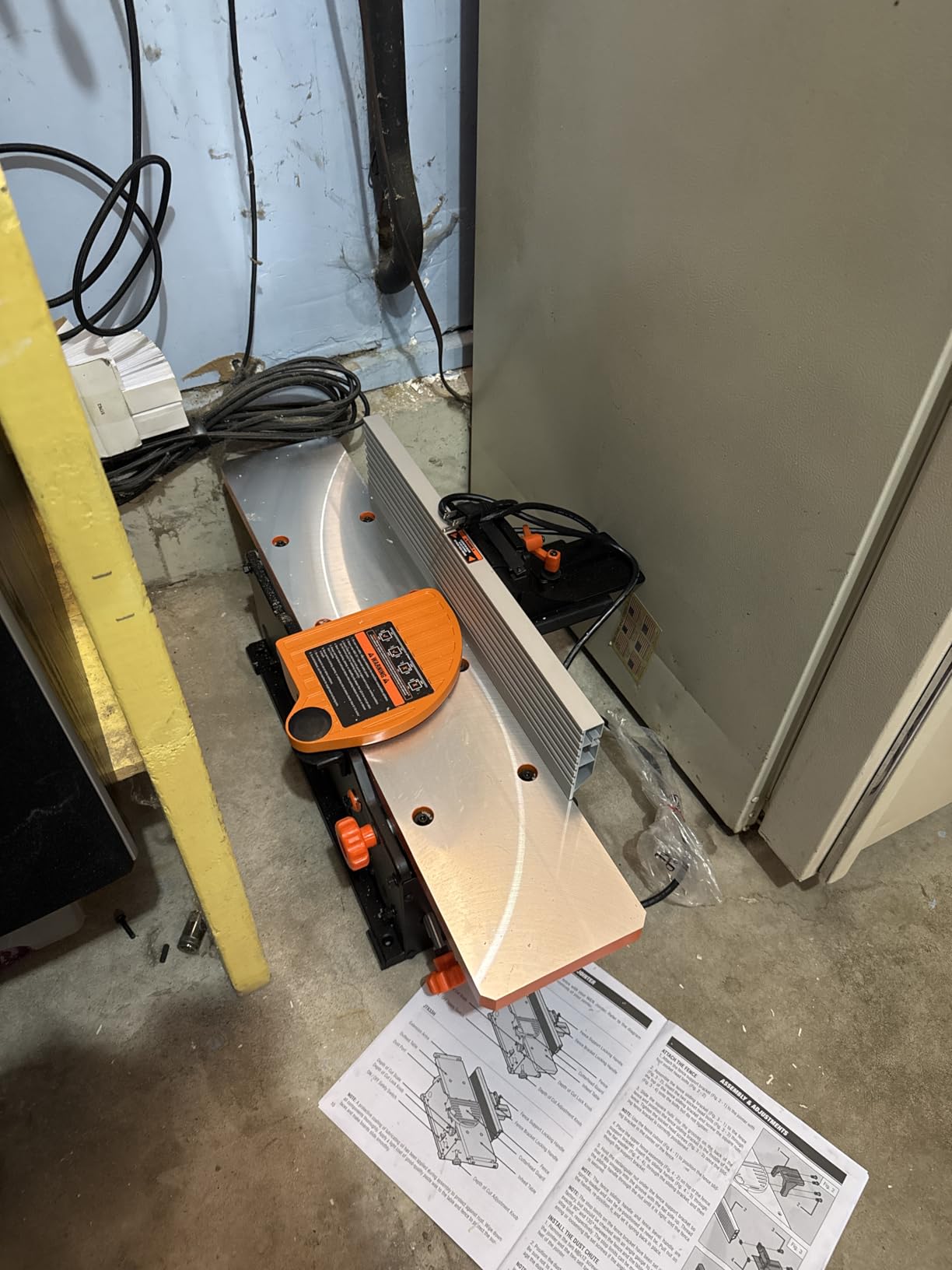
Out of the box the tables were nearly coplanar, and the infeed table needed only a fraction of an inch of adjustment before the first pass looked right. Two push blocks and an onboard depth-of-cut scale are included, so nothing else needs buying to get started.
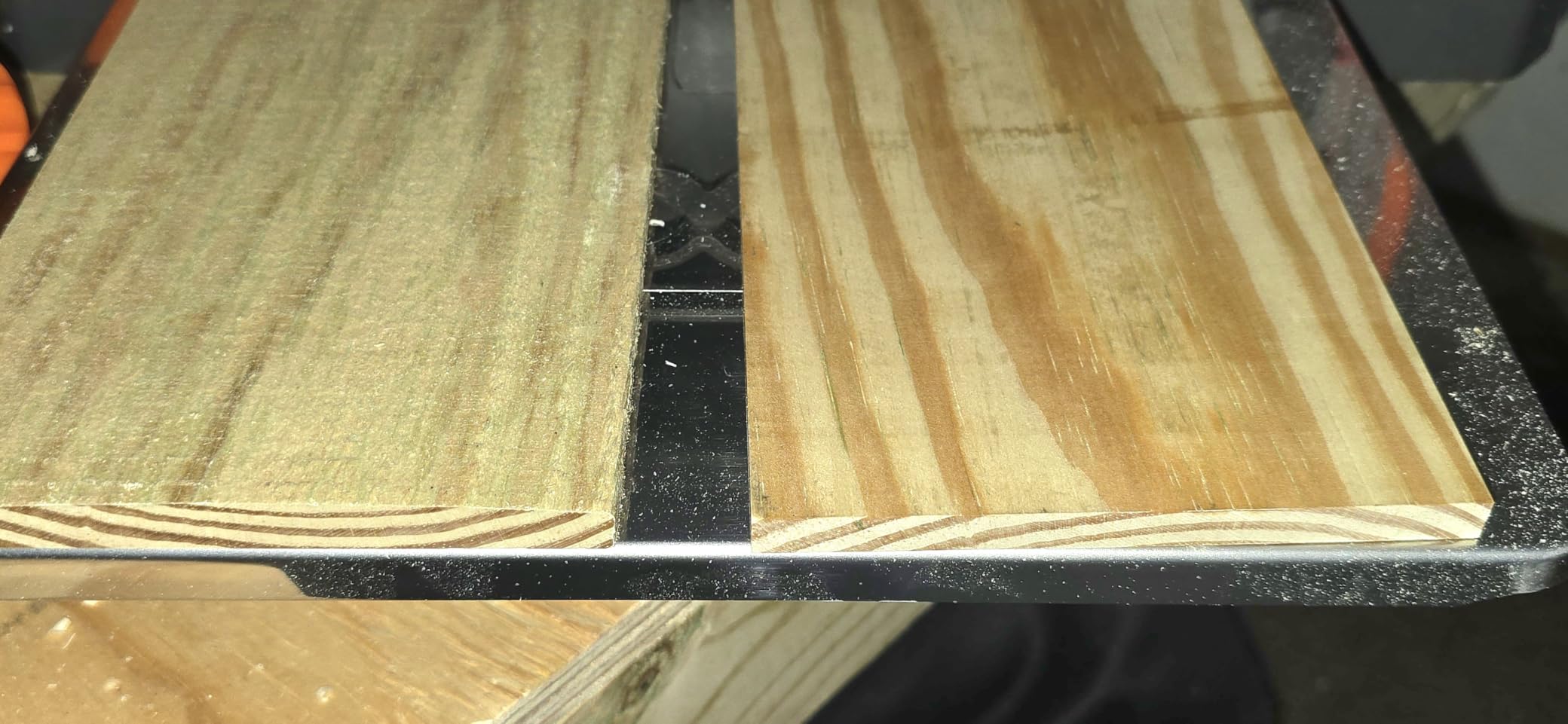
The tables are a full 30 by 6 inches and the fence bevels up to 45 degrees, which covers beveled edge work as well as standard 90 degree glue-ups. Each pass takes off up to 1/8 inch, though keeping it under that except for heavy flattening gives a better finish.
It measures 30 by 12.5 by 17.5 inches and weighs 36.8 pounds, which makes it one of the easiest machines here to carry between the bench and the floor. In a small shop that means you can use it, put it back on a shelf, and stop giving up a corner of the floor year round.
One thing to know: the 2-1/2 inch dust port is smaller than what most shop vacuums come with. Plan on an adapter before your first dusty session.
Who this jointer suits
This is the pick for a hobbyist or small-shop builder working with rough-sawn boards up to 6 inches wide and roughly 3 to 4 feet long. Owners making cutting boards, trays, small tables, and shop furniture fall squarely in range.
It is also among the easiest machines here to store between sessions, which matters more than most spec sheets admit. A tool that is awkward to move is a tool you will avoid.
Who should skip it
If your material regularly runs full 8-inch rough-sawn boards or longer than about 4 feet, move up to the Wahuda or the WEN JT833H instead. Both give you more capacity and more bed length.
Buyers who work wet, sap-heavy softwood daily should expect the aluminum tables to show wear. It is cosmetic, but it is permanent.
2. CRAFTSMAN CMEW020: Best Budget Benchtop Jointer for Short Small-Batch Projects
CRAFTSMAN Benchtop Jointer, Up to 22,000 cuts per Minute, 10 Amp, Corded (CMEW020)
- Variable speed matches hardwoods and softwoods
- Center-mounted fence supports the cut
- Jackscrew leveling makes setup simple
- Solid feel for the money
- 4-1/4 inch width is narrower than the rest
- Short tables limit board length to about 4-5 feet
- Aluminum tops scratch readily
- Some owners report motor failure
The variable speed control is what separates this from the other budget machines. Running 6,000 RPM on softwood and 11,000 RPM on hardwood lets you slow down for tear-out-prone material instead of fighting the cut at full speed.
Knife setup is refreshingly simple. The two-knife cutterhead uses a jackscrew leveling arrangement, so you set two screws rather than indexing a spiral head, and a beginner can service it with the tools in a drawer.
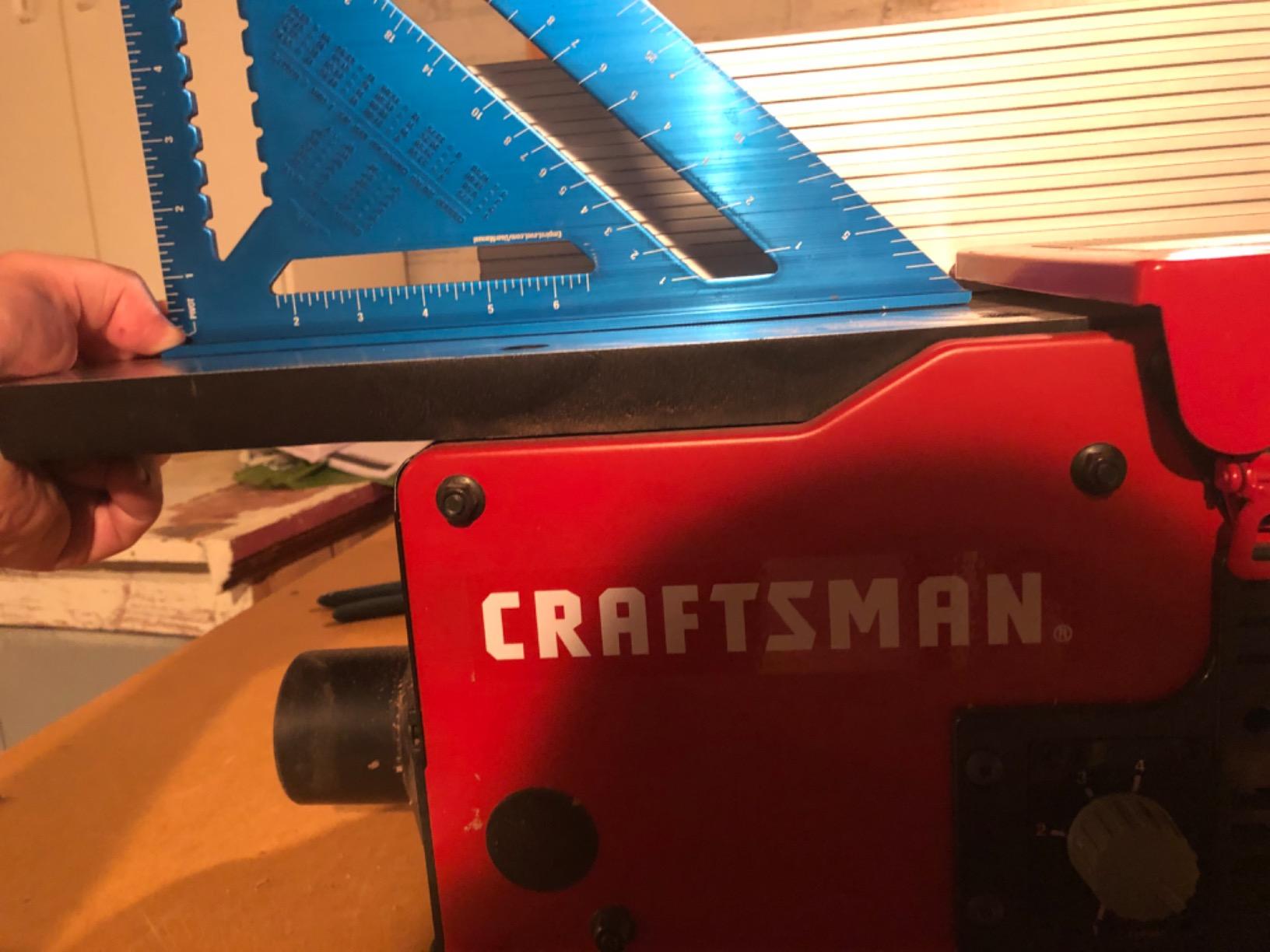
The center-mounted 4-1/4 inch fence sits directly over the cutterhead, so it supports the workpiece through the whole pass. That support is what keeps thin material from chattering, and reviewers consistently single it out as the reason cuts come out accurate.
At 120V and 10 amps, it runs anywhere a shop light does. No dedicated circuit, no panel work, and no dedicated corner of the shop.
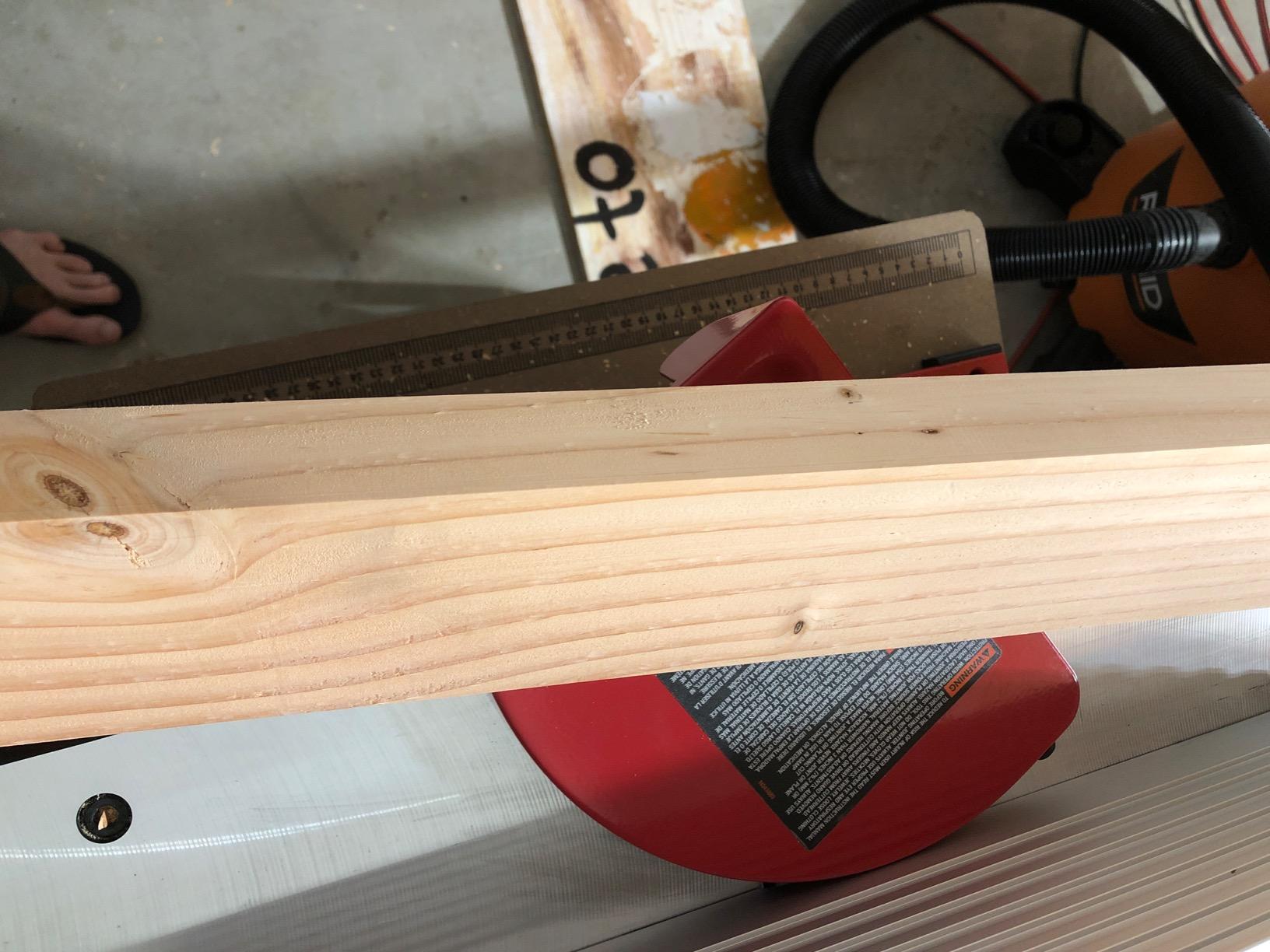
The trade-off is capacity. Four and a quarter inches of cutting width is narrower than every other jointer in this roundup, and the infeed and outfeed tables are short. Plan on a practical length limit of about 4 to 5 feet.
Who this jointer suits
Cutting boards, trays, small trim, and short panels are the sweet spot. If your projects rarely use material wider than 4 inches, this machine covers them and nothing is missing.
It is also a sensible first machine for someone who wants a jointer to complement a good hand plane rather than replace one.
Who should skip it
Skip it if you buy dimensional lumber at 6 inches or wider, or if you plan on flattening boards for a workbench top. You will be working one board at a time on the edge.
A small number of owners report the motor stopping within a few years. Treat it as a lower-duty machine and service the brushes rather than running it continuously.
3. Wahuda 50180CC 8-Inch: Best 8-Inch Benchtop Jointer for Small Shops
- Cast iron tables are stiffer than aluminum rivals
- Carbide inserts cut quietly with no snipe
- Low amp draw on a 120V motor
- Fence arrived factory-set and held alignment
- Table leveling takes hours on first setup
- Oil residue on the head must be cleaned before use
- Cast iron tables rust if left wet
- Results diminish past about 40 inches of length
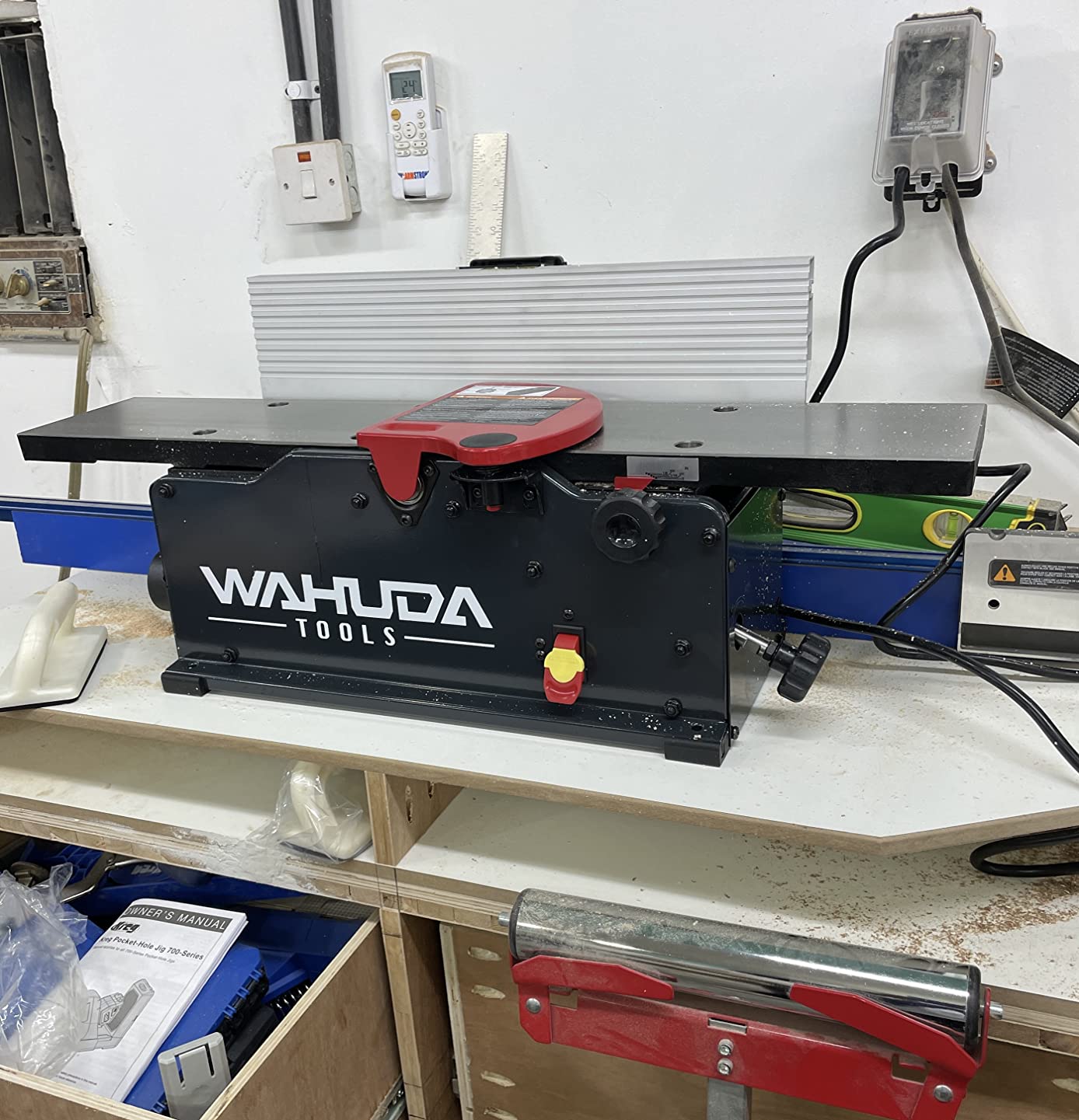
If 8 inches of cutting width is your requirement, this is the machine to buy. The cast iron infeed and outfeed tables with pull-out extensions are noticeably stiffer than the aluminum tops on the budget picks, and that rigidity shows up in the finished surface.
The cutterhead carries 16 four-sided carbide inserts. Carbide holds an edge far longer than HSS, and the four-sided design means you rotate an insert a quarter turn instead of replacing a whole blade. It cuts quietly with essentially no snipe, and it draws less power than a two-blade head doing the same job.
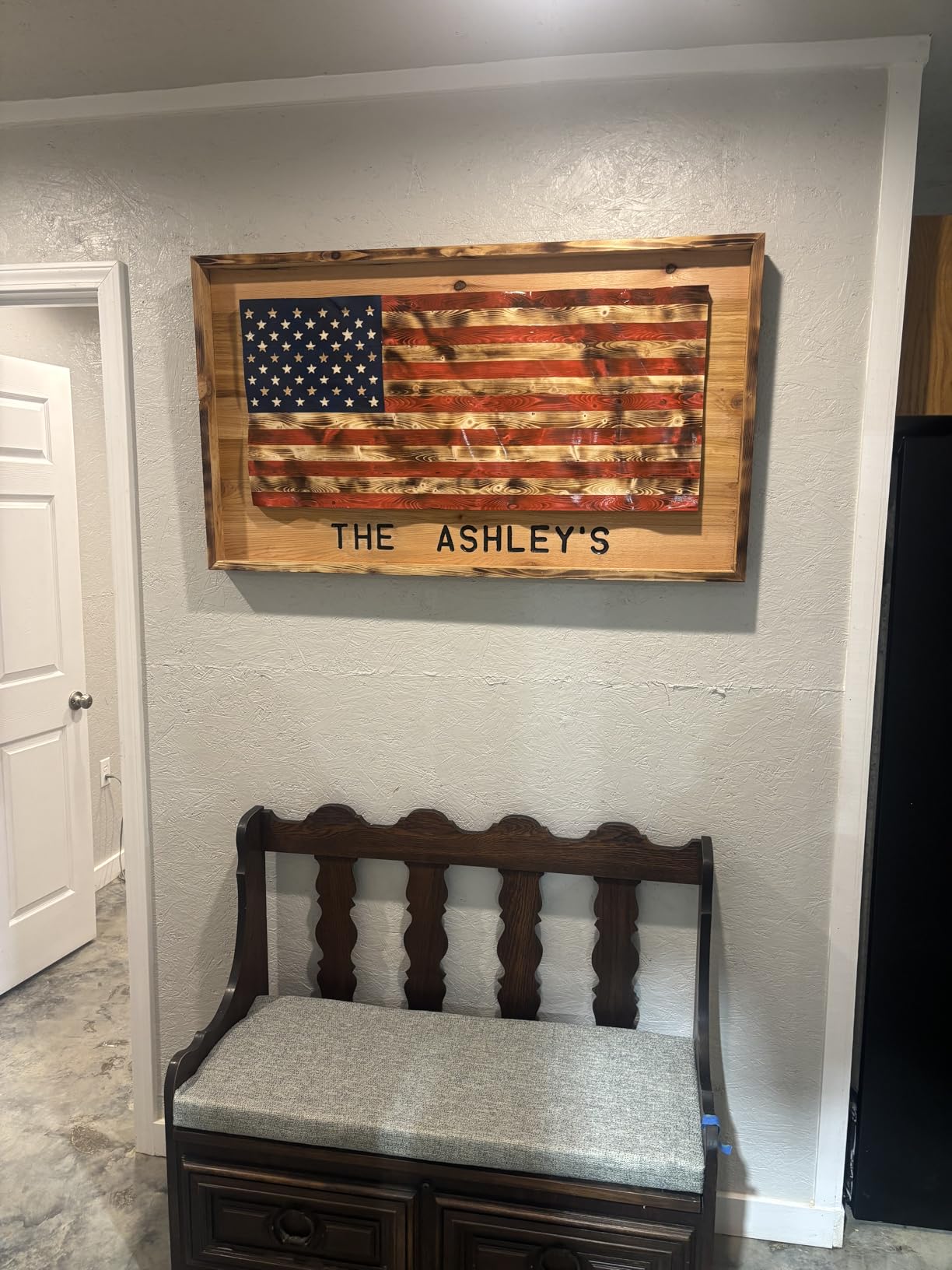
The fence tilts to 90 and 135 degrees and arrived factory-set to 90, which is a genuinely nice surprise at this tier. It held alignment through our testing without the periodic re-squaring that lighter fences need.
At 49.9 pounds and 34 by 14 by 13 inches, it is still light enough to lift onto a bench, though two hands are more realistic than one.
Set aside two hours for the first setup. Table leveling is iterative and slow, and that patience is the reason a few owners rated it lower despite liking the machine once tuned.
Who this jointer suits
Anyone shooting rough-sawn hardwood up to 8 inches wide will find this turns warped lumber into panel-ready material. Hardwood furniture, tabletops, and thick cutting boards are all comfortable territory.
Owners with long-term experience report that 8-inch capacity in a garage shop is the practical sweet spot of the whole category: enough width for real boards, small enough footprint to store between sessions.
Who should skip it
Boards longer than about 40 inches are where the pull-out extensions add less than you would hope. If you routinely joint 6 to 8 foot rough-sawn boards, look at the WEN JT833H, which extends to 51 inches.
Cast iron tables need wiping down after every session. Leave them wet and you will find rust bloom the next morning.
4. WEN JT833H: Best 8-Inch Jointer with an Extendable Table
- Longest bed here at 51 inches
- 16-blade spiral head for a fine finish
- 45 degree fence bevel
- Dual 2-1/2 and 4 inch dust ports
- Fence setup and squaring take practice
- 8 inch width still trails a floor model
- Basic two-year coverage
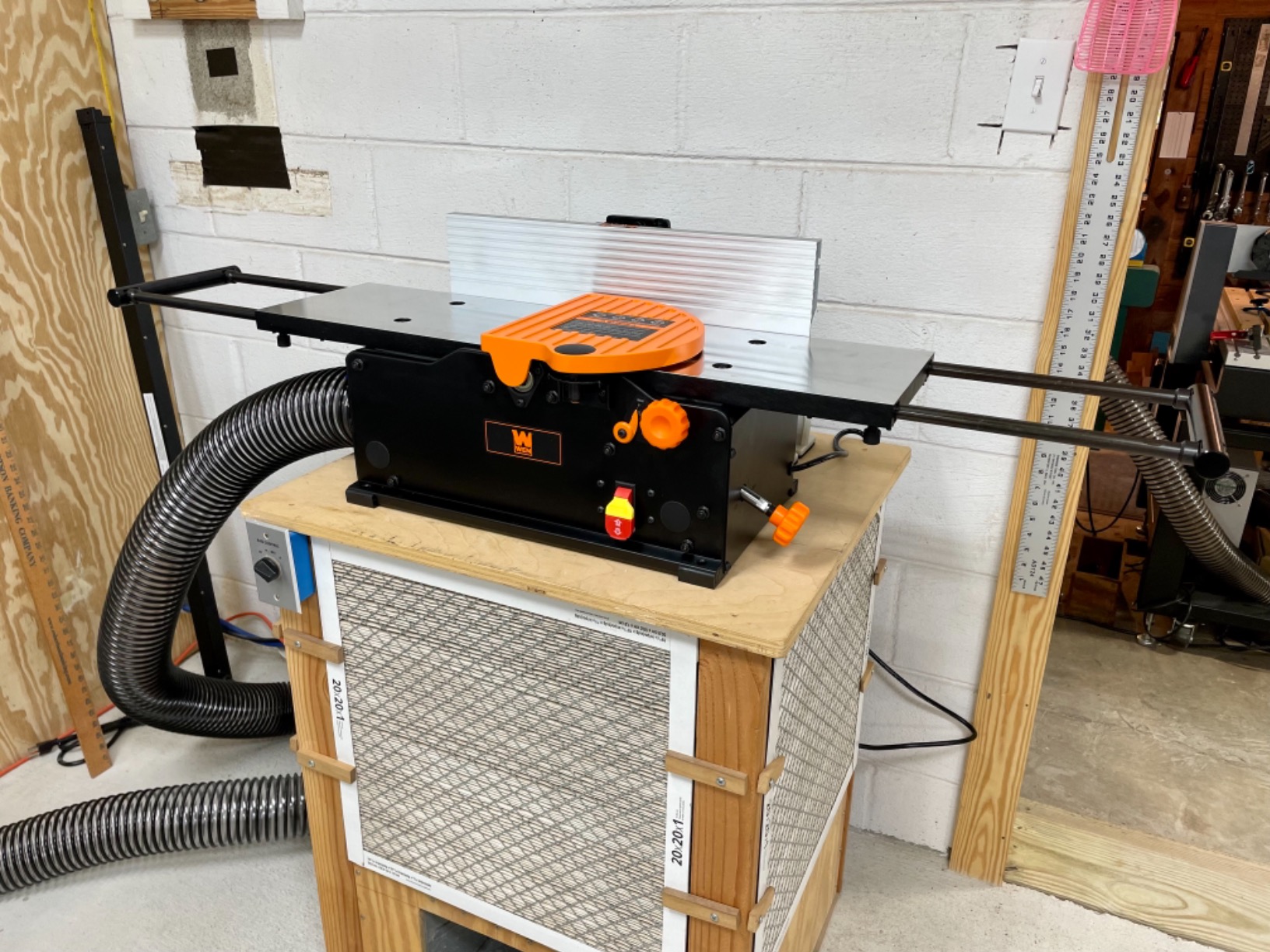
This is the pick when your rough boards are longer than they are wide. The 33-by-8-inch table carries support arms that extend to 51 inches, longer than any other bed in this group, which is the reason to choose it over a shorter 8-inch machine.
The 16-blade HSS spiral head is a step up from the 12-blade version on the six-inch model. More inserts mean a lighter load per edge, a quieter cut, and a surface that needs less sanding before glue-up.
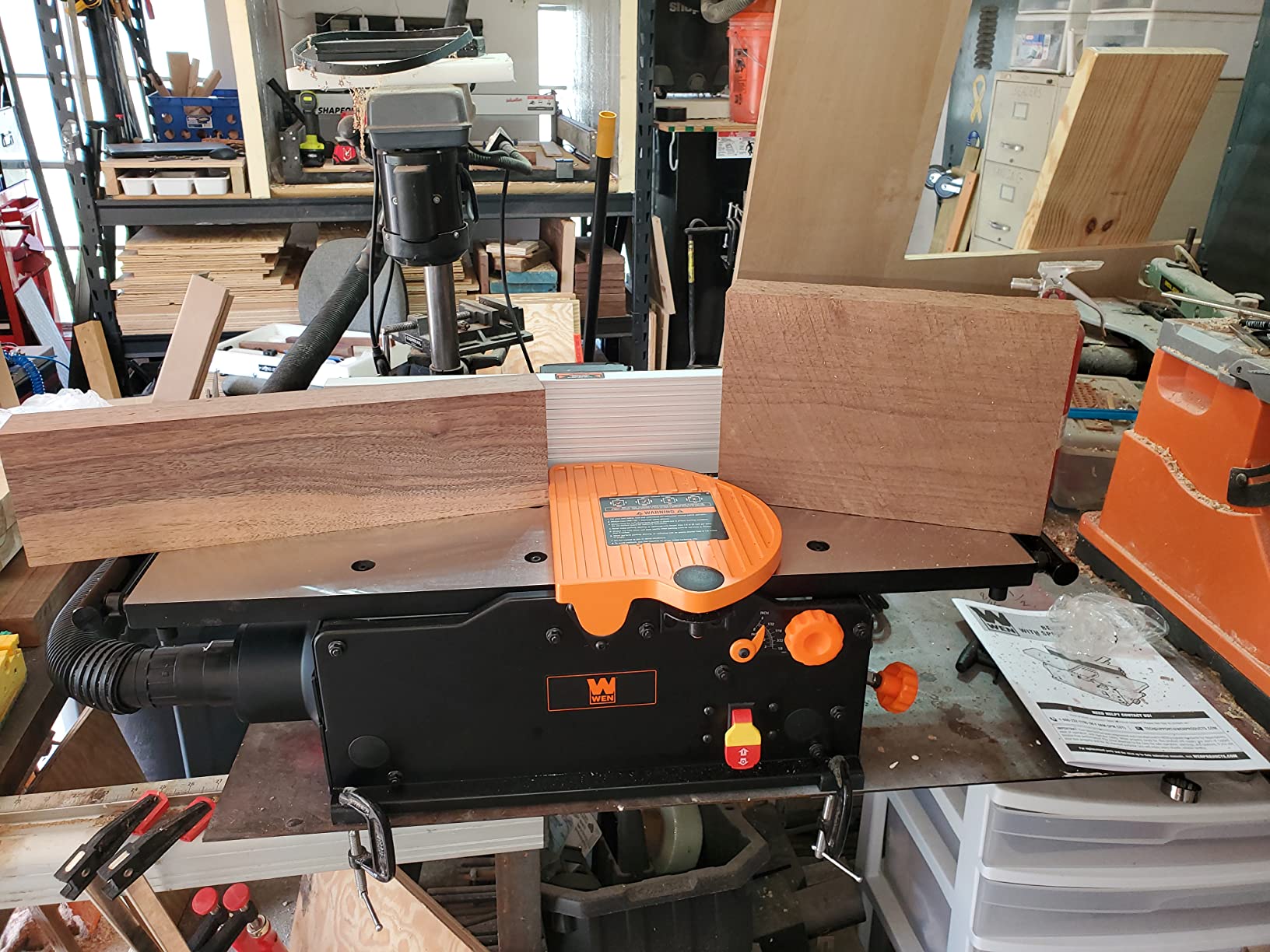
Dual dust ports are a small detail that pays off. Having both a 2-1/2 inch and a 4 inch opening means you can hook up whatever hose you already own instead of hunting for an adapter in the middle of a cut.
The adjustable 19-3/4 by 4-1/4 inch fence bevels up to 45 degrees, and the onboard depth-of-cut scale plus two push blocks are included.
Eight inches of width still caps you well below a floor-standing jointer. Know that going in, and it is rarely a problem for small-shop work.
Who this jointer suits
Builders working long rough-sawn boards for tabletops, doors, or fence pickets get the most from the extension arms. A longer bed means fewer supports under the workpiece and less chatter on the outfeed.
It also suits anyone who wants an 8-inch machine with a spiral head without stepping up to a freestanding machine.
Who should skip it
If your work stays under about 30 inches long, the extension arms are dead weight and a lighter machine is easier to handle. If you want maximum rigidity and a cast iron fence, the Cutech 40180HI is built for that instead.
Expect to spend time squaring the fence on day one, as you would on any jointer in this class.
5. WEN JT3062: Best Benchtop Jointer for a First-Time Buyer
- Level and accurate out of the box
- 10 amp motor handles hardwood and end grain
- Quiet for a two-blade machine
- Dust port works with a standard shop vacuum
- Plastic adjustment knobs feel inexpensive
- Two-blade head needs more setup than a spiral head
- Only 6 inches of width
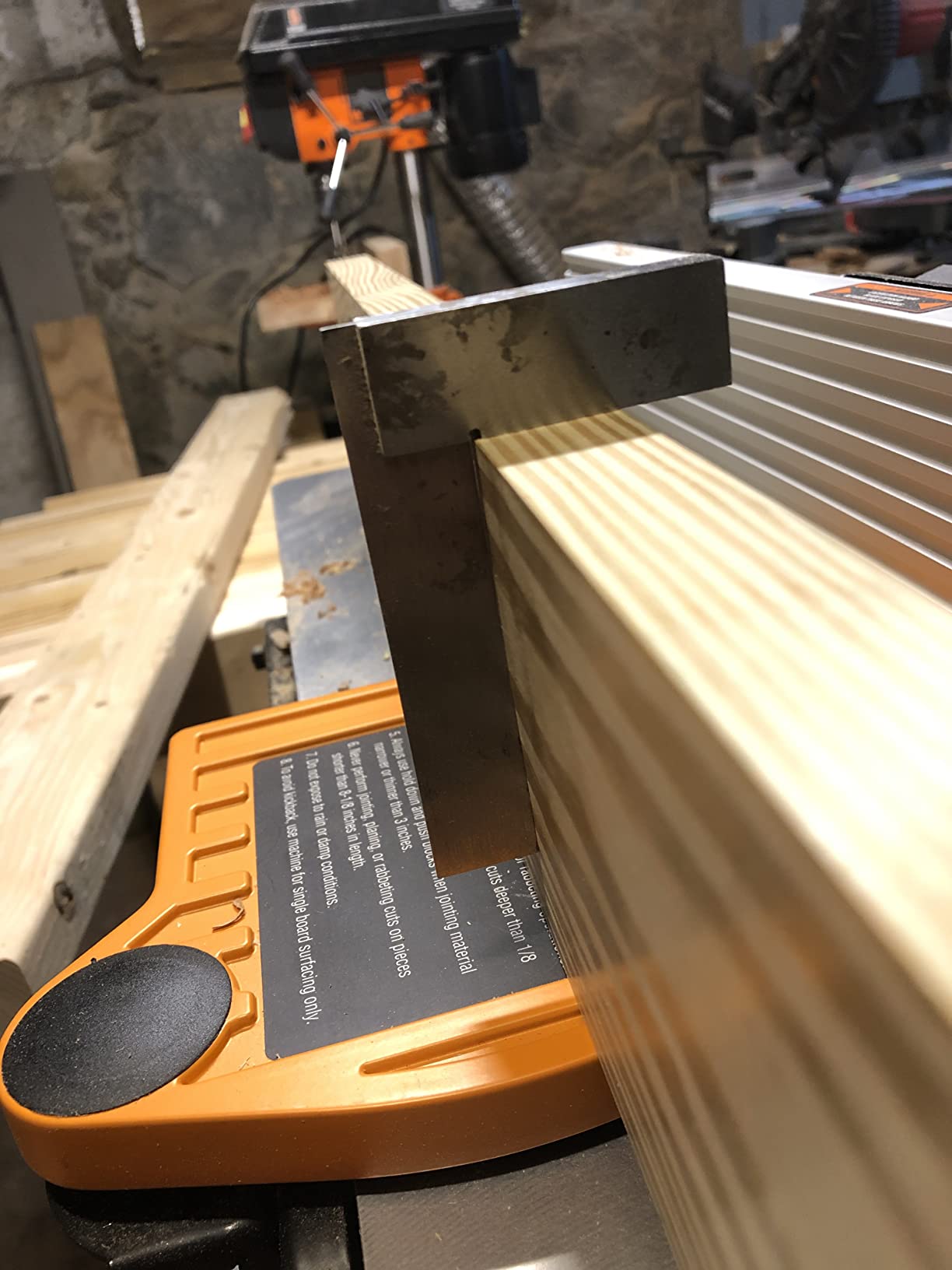
This is one of the simplest machines here to get running. It arrived level and cutting accurately with almost no setup, which for a first jointer removes the most frustrating hour in the process.
Two things give it away as a budget machine. The adjustment knobs are plastic, and a two-blade cutterhead needs more setup time than an indexed spiral head that you rotate rather than set with screws. Two long blades also cut a lot faster in softwood than many small inserts, so that setup time buys you speed as much as it costs you.
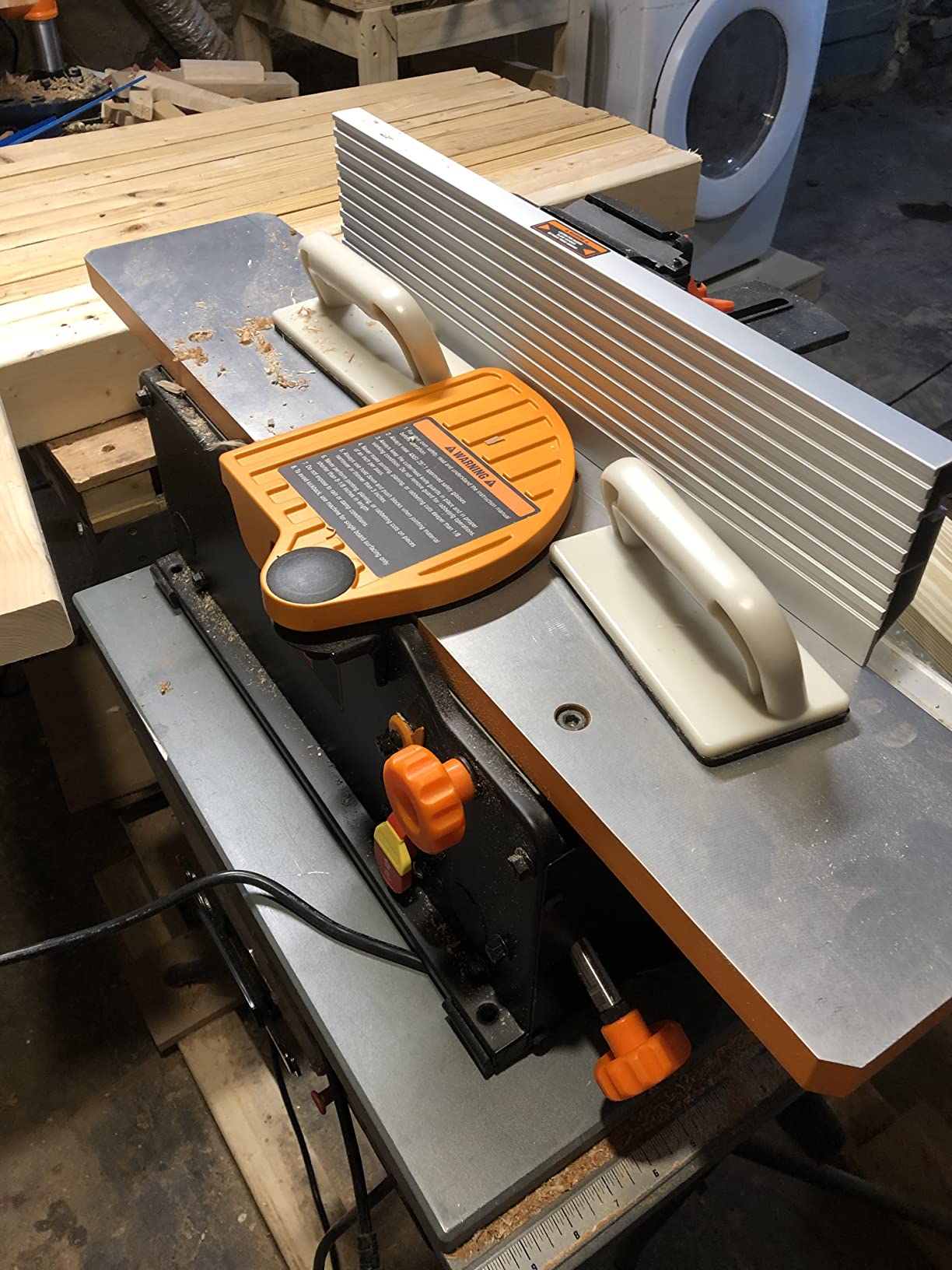
The 30-by-6-3/16-inch table is generous for a six-inch machine, and the onboard depth scale with two push blocks means you can dial in repeatable shallow passes without guessing.
Owners report buying this as an upgrade from a Craftsman benchtop jointer and being happy with the trade. The dust port works with a standard shop vacuum, which removes one of the more common friction points.
The cut stays clean on hardwood with the grain and acceptable on end grain, which is more than many heavier machines manage.
Who this jointer suits
First-time jointer owners who want the reference surface without the setup ritual. It is the machine we would hand someone who has never jointed before and does not want to spend an afternoon aligning tables.
It also works well as a second machine for a shop that mostly handles softwood and short hardwood boards.
Who should skip it
If you work tear-out-prone figured woods often, a spiral or helical head will save you sanding. If your lumber is full-width 8-inch rough boards, this is the wrong width.
Anyone who will run the machine for long stretches should note that two long blades load the motor more heavily than a spiral head where each insert takes only a fraction of the cut.
6. Cutech 40180HI: Most Stable 8-Inch Benchtop Jointer
- Tables arrived calibrated and coplanar
- Bracket system tunes the 24 inch fence
- Heavy base resists shifting during a pass
- Rotate a damaged insert by loosening one screw
- Very loud under no load at 12000 RPM
- Fence alignment mechanism is crude
- 82.8 lb limits portability
- Foam packaging can arrive damaged
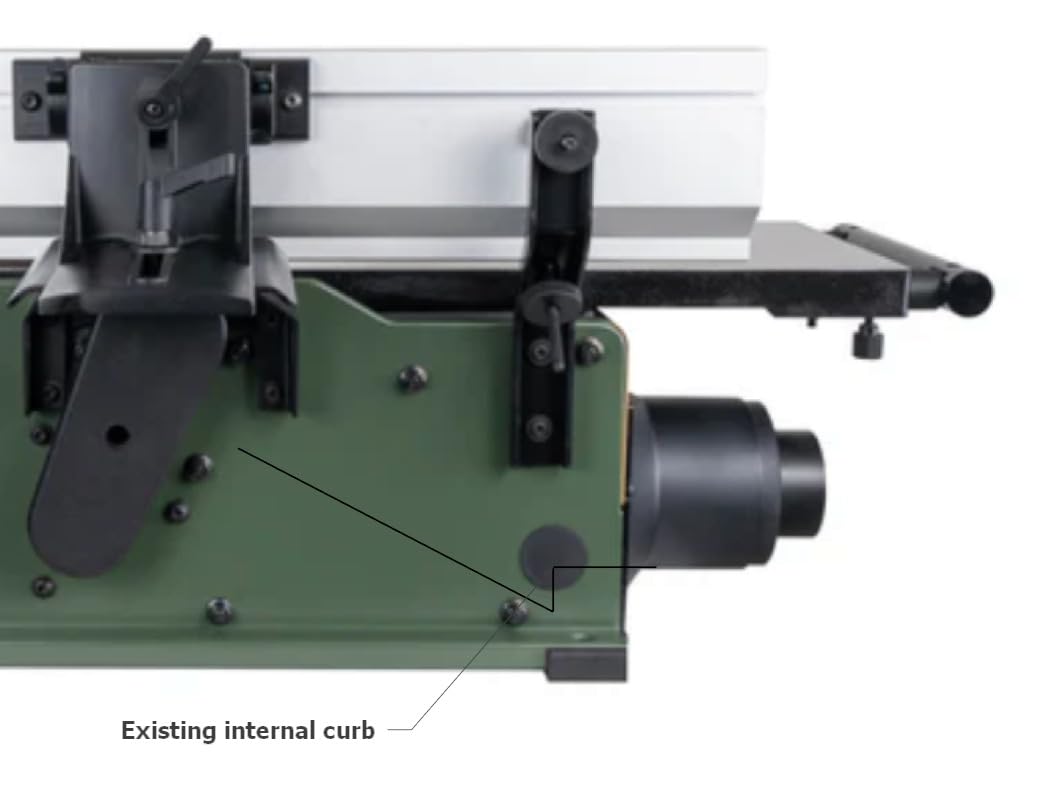
Weight is the feature people underrate. At 82.8 pounds with cast iron tables, this machine does not shift during a pass, and that stability is what lets the spiral head cut accurately with a light feed rate.
The tables arrived factory calibrated and coplanar, so setup was essentially plug and play. That single detail removes the biggest friction point you will hit on the other cast iron option in this group.
The six-row spiral cutterhead uses staggered two-sided tungsten carbide inserts. Rotating a damaged one takes loosening a single screw, so you get a fresh edge immediately and spread the sharpening cost across the whole set.
The 24-inch aluminum fence comes with additional brackets that stabilize both ends and let you tune it to a true 90 degrees, and it has quick stops at 90 and 135.
Two honest drawbacks. The universal motor running at 12,000 RPM is loud under no load, so ear protection is not optional, and at nearly 83 pounds this is the heaviest machine in the roundup.
Who this jointer suits
Anyone who has fought a machine walking across the bench mid-pass will appreciate this one. The base mass is high enough that you can feed hard without bracing the jointer with your hip.
It is also a strong 8-inch option for cutting boards and end-grain work, since the carbide spiral head stays sharp through figured hardwood.
Who should skip it
If you need to move the jointer between a bench and the floor regularly, the weight works against you every time. A workshop or basement with a fixed location suits it far better.
Noise-sensitive users should try one before buying. The no-load whine is a genuine complaint from owners, not a spec-sheet caveat.
7. Cutech 40160HB: Best 6-Inch Jointer for Small Work
- Teflon table coating resists scratching
- Spiral carbide head cuts smoothly at low draw
- Clear depth pointer for repeatable passes
- 19-5/8 inch fence with 90 and 135 stops
- Only 6 inches of cutting width
- Aluminum tops still mark under rough lumber
- Smallest review base means thinner long-term data
The 6H Teflon coating on the aluminum tables is the detail that sets this machine apart. Bare aluminum on the budget picks marks and burnishes under rough lumber, and this coating holds up better to that treatment.
Underneath, the six-row spiral cutterhead carries staggered two-sided carbide inserts with non-cutting edges that prevent the workpiece from skewing as it passes. That skew prevention is what keeps a panel glue-up square.
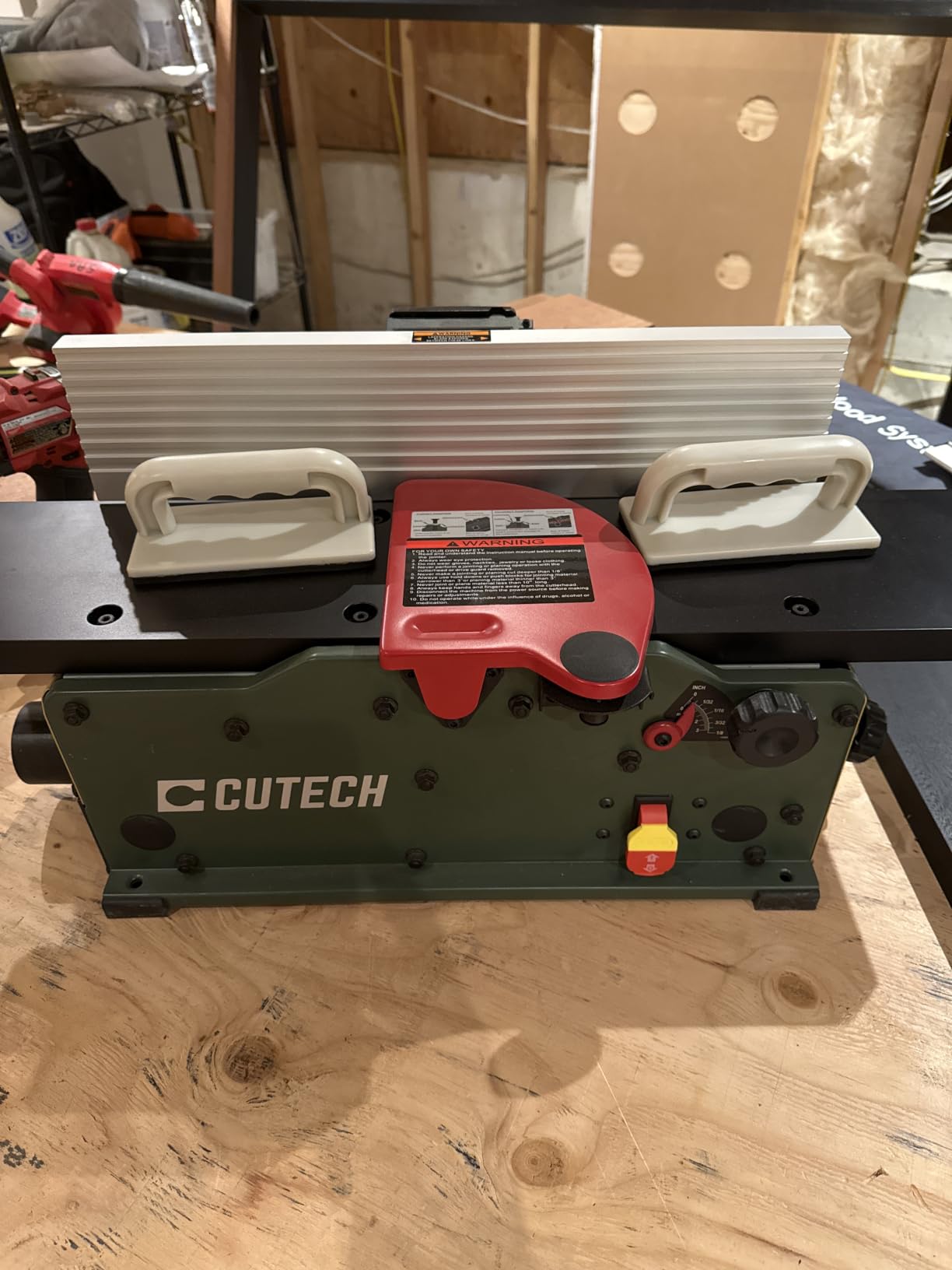
A clear depth-of-cut pointer and scale sit on the machine, which makes repeated shallow passes repeatable instead of a guess. On a spiral head that only bites a fraction of an inch at a time, that scale earns its place.
At 44.2 pounds it is heavier than the 36.8 pound WEN six-inch model but still a two-hand lift, and the 19-5/8 inch fence has quick stops at 90 and 135 degrees.
We would treat the review count as the main caveat. With 59 reviews, the long-term durability picture is thinner than for the machines with a thousand reviews behind them.
Who this jointer suits
Cutting board and charcuterie board makers get the most from it. Carbide inserts hold a crisp edge on end grain, and the coated tables survive maple and walnut better than bare aluminum does.
Anyone working mostly in hardwood strip, small panels, and thin boards will find 6 inches enough, provided the material is 6 inches wide or narrower.
Who should skip it
If you are working with full-width rough-sawn boards, 6 inches will stop you regularly. Move up to the Wahuda or Cutech eight-inch models.
If your shop is hard on tools and you have no patience for a coating that can be scratched through, cast iron tables are the harder-wearing choice.
8. JET JJ-6HHBT: Best Heavy-Duty Benchtop Jointer
JET 6-Inch Benchtop Jointer, Helical Cutterhead, 1 HP, 115V 1Ph (JJ-6HHBT)
- True helical cutting edges
- Cast iron tables and fence
- 15 amp motor with real power in reserve
- Internal blower moves chips off the cutterhead
- 5-year warranty
- 6 inch capacity in the premium tier
- Second-heaviest at 71 pounds
- Lowest rating and smallest review base
This is the one machine here with a true helical cutterhead, where the cutting edges are actually angled to the direction of feed. Most competitors sell inserts arranged helically that still cut square, and on tear-out-prone woods the angled edge shows its advantage.
Fourteen indexable four-sided carbide blades run on a 1 HP 15 amp motor at 10,000 RPM. That is far more power reserve than the 10 amp machines, which matters when you are taking a full 1/8 inch pass out of hard maple.
The cast iron tables and fence are among the most rigid here, and the fence tilts in both directions with locking stops at plus or minus 45 degrees. An internal blower motor moves dust and chips away from the cutterhead and motor, which is real chip management rather than an open port.
It is also the only pick with a 5-year warranty, reduced to 2 years for commercial or industrial use.
Be realistic about the trade-offs. At 71 pounds this is the second-heaviest machine here and needs planning to move, and 6 inches of cutting width caps you no matter how capable the rest of the machine is.
Who this jointer suits
Serious hobbyists and side-hustle furniture makers who want cut quality above all else and already own the electrical and floor space to host it. The true helical head means less sanding on figured and curly-grained lumber.
Shop owners who will run it for hours on end will appreciate the 1 HP motor and the 5-year coverage over the cheaper machines.
Who should skip it
A first jointer in a tight shed shop does not need this. You are paying for rigidity and cutterhead quality that a spiral head delivers well enough on typical small-shop lumber.
Anyone jointing wide boards should note that 6 inches of cutting width caps you regardless of how good the rest of the machine is.
6-Inch vs 8-Inch: Which Width Do You Actually Need?
Buy an 8-inch jointer if you handle full-width rough-sawn boards, thick slabs, or lumber you have not resawn yet. Buy a 6-inch jointer if most of your material is already under 6 inches wide, which covers the majority of cutting board, sign, panel, and small furniture work.
The number that actually limits you is rarely the width. It is the bed length, because a short bed means a long board has nothing supporting it and will chatter or drop.
Is a 6-inch jointer big enough? For most hobby and small-shop jobs, yes, as long as you buy material 6 inches wide or narrower. Many owners who start at 6 inches later wish they had started at 8.
The practical rule we use: measure the widest board you have actually jointed in the last year, then add an inch. That number is your cutting width, and the jointer that matches it is the one you want.
One more thing worth knowing. On 8-inch machines with pull-out or hinged extension arms, there is a small gap between the table sections. Bowed or cupped lumber can drop into that gap at the ends. Owners bridge it with a strip of 1/8 inch plywood laid across the seam, which is a two-minute fix that solves the problem completely.
Do You Even Need a Benchtop Jointer?
Sometimes you do not, and we would rather say so than sell you a machine that will sit unused.
Quality hand planes flatten one face and square one edge beautifully. If your lumber is already flat and square, that covers the operation. A power planer handles wide boards faster than a jointer, but it squares nothing, so you still need another reference edge.
A router and a table saw can produce square panel material, though the workflow is slower and the accuracy depends entirely on your setup.
A benchtop jointer earns its place when you regularly buy rough-sawn, warped, or resawn lumber and want to make it usable. It earns its place when a single face and one square edge per pass saves you a half hour of hand work.
It is the wrong purchase if you have a good hand plane already and work mostly with dimensional lumber. In that case, put the money toward a better planer or a sharpening setup.
Dust and Chip Collection for a Benchtop Jointer
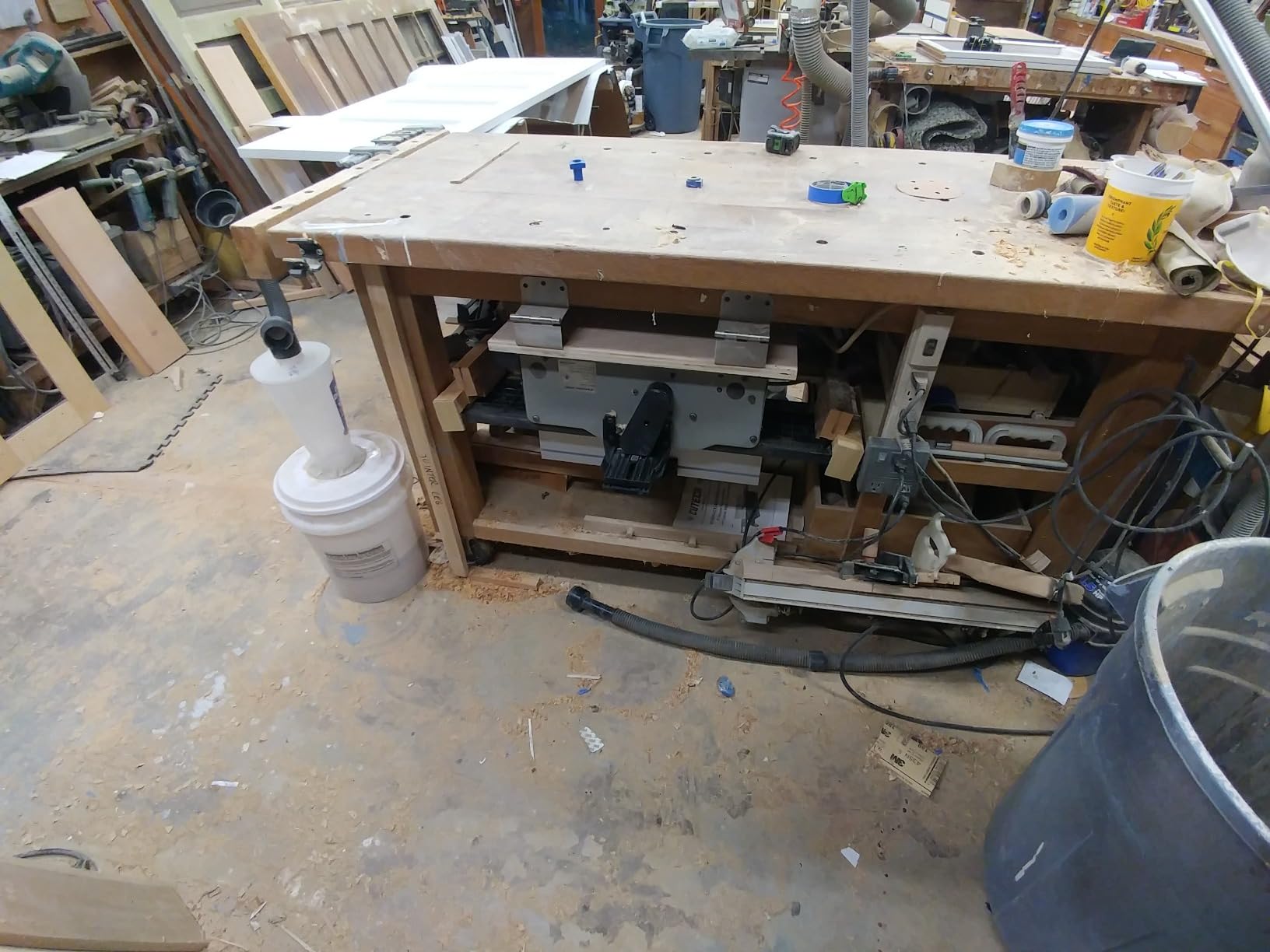
Chip management is the most common complaint we found in owner discussions, and it is more manageable than it sounds. Without extraction, a jointer throws chips across the bench and into your shoes within a few minutes.
A shop vacuum is enough for a 6-inch machine if you attach it to the 2-1/2 inch port or use an adapter for a 4 inch port. The WEN JT833H and the JET both give you port options. The complaint we hear most is a vacuum that jams because fine chips pack the filter.
Adding a separator between the jointer and the vacuum is the fix owners land on. A cyclone-style separator or a simple bucket-and-hose vortex setup catches the bulk of the material before it reaches the filter, and it costs far less than a dedicated collector. Some shops run an entire jointer, planer, and table saw setup on a single hose, a separator, and a drum, which tells you duct diameter and a separator matter more than collector size.
Move up to a small two-stage collector when you regularly joint resinous softwoods like pine. Two stages handle the higher volume without choking, and the second stage keeps your shop vacuum alive.
Two practical notes. Compressed air to clear the tables is a fast way to turn chips into airborne dust and fill your lungs, so wipe or brush instead. And the cast iron tables on the Wahuda and Cutech eight-inch machines need wiping down right after use to avoid rust.
How to Choose a Benchtop Jointer: 9 Things That Matter
Cutting width first, always
Width decides what you can feed through the machine, and it cannot be changed later. Six-inch machines cover most hobby work. Eight inches covers essentially all small-shop work. The CRAFTSMAN CMEW020 at 4-1/4 inches is the narrowest here and suits small pieces only.
Spiral and helical cutterheads beat straight knives
A spiral cutterhead carries many small inserts instead of two long blades. Each insert cuts lighter, the cut is quieter, and a damaged one is fixed with a quarter turn rather than a full blade replacement and set. Straight-knife heads cut faster on softwood but demand far more maintenance.
Know the difference between true helical and helically-arranged inserts
Marketing language is loose here. Several machines advertised as helical have inserts arranged in a helix but with cutting edges square to the feed direction, which means they are not truly helical. The JET JJ-6HHBT has a true helical head with angled cutting edges. Check the edge angle, not the label.
Insert material changes your maintenance schedule
HSS inserts are cheaper and sharpen easily but dull faster on hardwood. Carbide and tungsten carbide inserts cost more and stay sharp far longer, which suits anyone jointing a lot of oak, maple, or walnut. Four-sided inserts also give you four usable edges per blade.
Bed length matters more than most buyers think
Cutting width tells you how wide a board can be; bed length tells you how long it can be supported. The WEN JT833H extends to 51 inches, longer than any other bed here, and that is the difference between jointing a 6-foot rough board in one pass and propping it up.
Fence quality and squareness
A center-mounted fence that sits over the cutterhead supports thin material and reduces chatter. A wider fence gives you more bearing surface. Whatever you buy, expect to check squareness after a few months of use, and keep a machinist square on the bench for the five-minute check.
Power requirements for a garage or shed
Almost every pick here runs on a standard 110V circuit at 10 amps, which is the single biggest practical advantage over a freestanding jointer. One exception in this group: the JET JJ-6HHBT draws 15 amps on 115V. Separately, some Grizzly benchtop jointers are built as 110V or 220V depending on the market they are sold in, so check the label before you buy rather than after.
Dust port diameter
Ports come in 2-1/2 inch and 4 inch sizes. Know which one your vacuum accepts before purchase so you are not making adapters on day one. Dual-port machines are more flexible.
Weight, footprint, and warranty
Weights here run from 36.8 pounds to 82.8 pounds. Lighter means you can store the machine between sessions; heavier means it does not shift during a pass. Neither is automatically better. Warranty coverage is mostly two years, with the JET standing out at 5 years reduced to 2 for commercial use.
If you are still building out the shop around it, our picks for woodworking benches for small shops and benchtop drill presses pair naturally with a jointer of this size, and our guide to jointers for woodworking covers the floor-standing options for when you outgrow benchtop capacity.
Frequently Asked Questions
Are benchtop jointers worth it?
Worth it if you regularly joint rough-sawn, warped, or resawn lumber and your material is under about 8 inches wide and 4 to 6 feet long. Not worth it if a hand plane and a planer already cover your workflow and you work mostly with flat, square dimensional lumber.
What is the best 6-inch jointer for a small shop?
The WEN JT630H is our pick. Its 12-blade HSS spiral cutterhead leaves a surface ready for glue-up on maple and purpleheart, its 30-by-6-inch tables arrived nearly coplanar, and at 36.8 pounds it is one of the easiest machines here to store between sessions. The WEN JT3062 is the alternative if you want almost no setup and do not need a spiral head.
What is the best 8-inch jointer for small shops?
The Wahuda 50180CC is our best 8-inch pick for most small shops. Cast iron tables with pull-out extensions give it real rigidity, and 16 four-sided carbide inserts cut quietly with a low amp draw. If your boards are longer than about 40 inches, the WEN JT833H extends to 51 inches and is the better choice.
Do I need a 6 or 8 jointer?
Choose 8 inches if you handle full-width rough-sawn boards or slabs, and 6 inches if your material is already under 6 inches wide. Measure the widest board you actually jointed in the last year and add an inch. Many owners who start at 6 inches later wish they had started at 8.
Do benchtop jointers need 220V?
Almost all benchtop jointers run on a standard 110V household circuit at 10 amps, which is their biggest advantage over a floor-standing jointer. The JET JJ-6HHBT in this roundup draws 15 amps on 115V. Separately, some Grizzly benchtop jointers are built as 110V or 220V depending on the market, so check the label.
What are people saying about the Grizzly benchtop jointer?
Owners generally praise Grizzly for build quality and US-based parts support. The recurring caveat is electrical: some Grizzly benchtop jointers are built as 110V or 220V depending on the market they were made for, so buyers are advised to check the label before wiring a bench circuit.
Conclusion: Our Best Benchtop Jointers for Small Shops
If you buy only one, buy the WEN JT630H. It has the deepest review history in this group, a 12-blade spiral cutterhead that leaves glue-ready surfaces on hardwood, tables that arrived nearly coplanar, and a 36.8 pound weight that means you will actually use it instead of stepping over it.
Buy the Wahuda 50180CC if 8-inch capacity is your requirement and you value cast iron rigidity. Buy the WEN JT833H if your boards are long. Buy the JET JJ-6HHBT only if true helical cut quality justifies the weight.
Whichever you choose, budget time for fence squaring on day one, keep passes under 1/8 inch, and hook up dust collection before the first board. Those three habits cover most of what people complain about. Here are our other roundups on jointers for woodworking and benches for small shops if you are still setting up.