
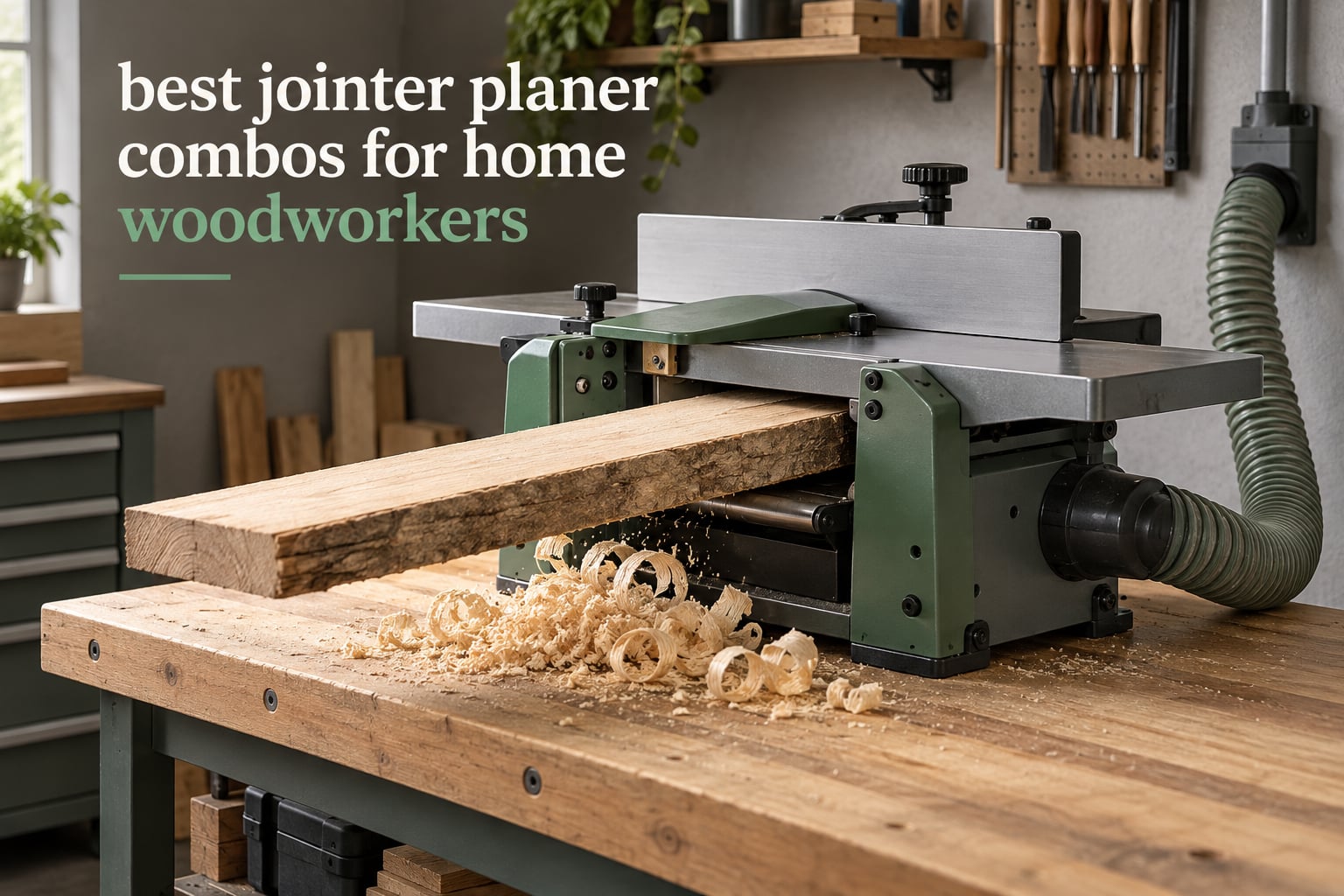
The Scheppach HMS 850 is the best jointer planer combo for most home woodworkers, because it packs a two-function machine, a hand-crank height adjustment and the deepest owner history of any combo we found. We compared eight jointer planer combos for 2026, from 6-inch benchtop units to a 12-inch floor model, and this one earned its place.
A jointer planer combo is the fastest way to turn rough-sawn lumber into flat, square, parallel boards without buying two machines. One cutterhead does both jobs, and you switch between them in under a minute. That matters enormously in a garage or basement shop, because a separate jointer and a separate planer each need board support on the infeed and the outfeed side.
We spent weeks reading specifications, owner feedback and forum threads rather than only spec sheets, because combo machines vary far more in real-world quality than their spec sheets suggest. We also flagged honestly where the numbers are thin: only three of the eight machines here carry enough customer ratings to tell you anything at all, and five are documented entirely by their manufacturers.
If you are still narrowing the field, our picks on the washer and dryer combo roundup follow the same structure, and the buying guide below walks through every spec that actually changes your results.
Table of Contents
What a Jointer Planer Combo Actually Does
A jointer flattens one face and squares one edge to 90 degrees. A planer makes both faces parallel and cuts to a chosen thickness. Neither machine alone can do both jobs on rough material, which is why most home shops that start with one eventually want the other.
A combo machine solves that by sharing one cutterhead and one bed between the two functions. You unlock and raise the jointer table, reposition the dust hood for planing, raise the planer table to your target thickness, and engage the planer drive rollers. On most of the machines in this roundup, that whole changeover takes well under a minute in real use.
The catch is table length. Combo tables are short, so anything past roughly six feet needs support from both ends. That is the single complaint that comes up most often from owners, and it is worth solving with roller stands before you buy rather than after.
Top 3 Picks for Best Home Woodworkers

Scheppach HMS 850
- 1250W motor at 8000 rpm
- 204 mm planing width
- 2 mm per pass
- Hand-crank table height adjustment

WEN PL1337 and JT630H Bundle
- Two-speed 26 and 16 FPM feeds
- 13 inch planing width
- Spiral cutterheads with staggered HSS blades
- 6 inch jointer table

Ridgid JP0610
- 1 HP heavy-duty motor
- 6-1/8 inch cutting width
- Dual bevel fence
- Alloy steel with cast table
All 8 Machines Compared at a Glance
Every machine below is a genuine two-function jointer and planer. Scan the width, the motor and the power requirement first, because those three narrow the field faster than anything else.
| Product | Specifications | Action |
|---|---|---|
| Scheppach HMS 850 Dressing and Thickness Planer |
|
Check Latest Price |
| WEN PL1337 Planer and JT630H Jointer Bundle |
|
Check Latest Price |
| Ridgid JP0610 Planer and Jointer |
|
Check Latest Price |
 FACA 1800W Helical Benchtop Combo Planer Jointer FACA 1800W Helical Benchtop Combo Planer Jointer |
|
Check Latest Price |
 TREEYX 1800W All-Metal Benchtop Jointer TREEYX 1800W All-Metal Benchtop Jointer |
|
Check Latest Price |
 Dxysyldrun STP204 Benchtop Planer Combination Dxysyldrun STP204 Benchtop Planer Combination |
|
Check Latest Price |
 FORESTWEST 10416 12 Inch Planer and Jointer Combo FORESTWEST 10416 12 Inch Planer and Jointer Combo |
|
Check Latest Price |
 JARYANNIX 2.2KW Cast Iron Jointer Planer JARYANNIX 2.2KW Cast Iron Jointer Planer |
|
Check Latest Price |
1. Scheppach HMS 850 – the best jointer planer combo for most home shops
- Deepest owner history in the group with 769 ratings
- Hand-crank table height adjustment is quick and repeatable
- Die-cast aluminium tables damp vibration well
- Dual HSS blades deliver a fine
- consistent finish
- Fence angle reads slightly off at the start of the fence
- Return pass can remove a touch more material than the first pass
- Chip collection capacity is adequate rather than generous
The Scheppach HMS 850 is the machine I keep coming back to, because 769 owner ratings at 4.4 stars is more real-world evidence than anything else in this roundup by a wide margin. Almost every hobbyist will find that combination of capability and track record more useful than a bigger machine with no history.
It is a genuine two-function unit rather than a planer with a jointer attachment. The 1250W induction motor runs the knives at 8000 rpm, and the head turns fast enough to keep a light, chatter-free cut through softwood and most hardwoods without bogging down.
Width is the number to check against your lumber. At 204 mm of planing capacity, you can handle most 1x material comfortably, but you are not surfacing wide panels here. Maximum material height for planing is 120 mm, and maximum chip removal per pass is 2 mm, which is a sensible figure for rough preparation.
What owners consistently praise is the hand-crank height adjustment. You crank the table rather than hunting for a lever, and the die-cast aluminium tables sit on vibration-damping rubber feet, which keeps the machine steady on a garage bench. Reviewers across several countries describe the build quality as well beyond what they expected at this size.
The honest complaints are small but real. The fence reads a fraction off at the very start of its travel, even though finished parts still come out square at 90 degrees, and the return pass sometimes shaves a little more than the first. Neither one has stopped anyone from finishing furniture parts.
This is the pick for you if your shop is a garage or basement, your lumber is mostly standard-width boards, and you want the least guesswork. Our comparison of other two-in-one machines we recommend follows the same value-versus-size logic we apply here.
Who the HMS 850 suits
It suits hobbyists and weekend builders who want both functions in a footprint that fits on a bench, and who will appreciate having a hand crank instead of a fiddly lever. If you mostly work with pre-milled material and only occasionally flatten a rough board, this is more than enough machine.
It also suits anyone nervous about unverified machinery. An established parts supply, seven years of spare part availability listed for the model, and hundreds of owners means replacement blades and service questions have real answers.
Who the HMS 850 does not suit
Skip it if you build wide panels or slabs, because 204 mm of width will not cover them and there is no fence extension that fixes that limit. It is also not the machine to buy if you intend to run it daily for hours on end.
And if your shop wiring is strictly 120V, check the label first. This unit is listed at 220/240V 50Hz, which is a real consideration for North American home shops.
2. WEN PL1337 and JT630H Bundle – two spiral-head machines in one order
WEN Thickness Planer (PL1337) and Jointer (JT630H) Woodworking Machine Bundle
- Two spiral-head machines delivered in a single order
- Two feed speeds for rough dimensioning and finish passes
- Jointer fence bevels to 45 degrees
- Spiral heads with staggered HSS blades reduce tear-out
- Only two customer ratings so far
- No stands or dust collection included in the bundle
- Long-term durability is largely undocumented
Strictly speaking, the WEN bundle is two benchtop machines sold together rather than a single casting with one head. In practice it behaves like a combo set, and for a first shop that is arguably the more useful arrangement, because the two functions never fight over one table.
The thickness planer handles boards up to 13 inches wide and 6 inches thick, which is wider than any other benchtop unit in this roundup. Its two-speed feed is the standout feature: 26 feet per minute for quick dimensioning and 16 feet per minute for a finer finishing pass.
The jointer side has a 30-by-6-inch table and removes up to 1/8 inch per pass. Its fence bevels to 45 degrees, so you can work an angled face as well as a square edge. Both machines run spiral cutterheads with staggered HSS blades, which is unusual at this price level.
That is where the honest caveat sits. The bundle carries only two customer ratings, both of them five stars, which tells you almost nothing about durability after a few years. I would treat the spiral heads as a genuine plus and the review count as a genuine unknown.
Who this bundle suits
It suits someone building a first shop who wants both functions at a modest outlay and does not need production throughput. If you work on narrow parts, trim, small boxes and shelving, the two-speed planer is a genuinely nice tool to own.
It also suits anyone who wants a spiral cutterhead experience without committing to a larger machine. Spiral heads leave a finer surface than straight knives on figured stock, and both machines here have them.
Who this bundle does not suit
Skip it if you need one continuous machine you can walk up to and convert, because the changeover here means walking from one bench to another. It is also a poor match for wide panels, since the jointer table is only 6 inches wide.
And if you already have dust collection infrastructure, note that no hoses or adapters are included. You will need a 4-inch port plan of your own before the first session.
3. Ridgid JP0610 – the rigid small-shop workhorse
- Alloy steel construction with a cast table resists deflection
- 1 HP motor has more torque than most benchtop combos
- Dual bevel fence handles both edges
- Bundled cabinet keeps the machine and hardware together
- Very heavy at 208 lb
- Only 6-1/8 inch of cutting width limits board size
- Costs more than imported alternatives
The Ridgid JP0610 is the choice when rigidity matters more than convenience. At 208 pounds it is by far the heaviest machine in this group, and that weight is not dead mass. It is a cast table and an alloy steel frame, and both are reasons the cut stays true when you are working a wide, twisted board.
Power is the other argument. A 1 HP heavy-duty motor gives it noticeably more pulling force than the 1250W and 1800W benchtop units, and it is the difference you feel when a board has drifted off flat. Maximum cutting depth is 0.13 inches.
The dual bevel fence lets you register a bevel on either edge, which is useful for tapered legs and decorative stock. A convenient dust port on the side handles chip extraction, and the bundle includes a cabinet, push blocks, an angle gauge and a fence assembly.
Owners rate it 4.8 stars, with the strongest positive pattern being exactly what you would hope: solid build, strong motor, and a table that stays flat. The negative pattern is just as consistent. It is heavy, and the 6-1/8 inch cutting width is narrow by modern standards.
Who the JP0610 suits
It suits a one-person shop with floor space to spare and a preference for buying one heavy machine once. Owners who value a cast table that will still be there in fifteen years tend to land here.
It also suits anyone doing tapered or bevelled work, because the dual bevel fence is a real feature rather than a gimmick on a machine this compact.
Who the JP0610 does not suit
Do not buy it if moving machines is part of your routine. At 208 pounds you are looking at a two-person lift and a careful plan for any stairs, which is a common reason people choose a lighter benchtop unit instead.
It is also the wrong pick for wider lumber. Six and an eighth inch will not take a 1×8 board flat, and no amount of tuning will change that.
4. FACA 1800W Helical Benchtop Combo – the one with a spiral cutterhead
- Helical cutterhead cuts figured grain with far less tear-out
- Angle-adjustable blade guard from 90 to 135 degrees
- Overload and thermal cutoff protect the motor
- Light at 10.2 kg and easy to reposition
- Listed at 220V 50Hz
- Engineering plastic body is less rigid than an all-metal cabinet
- No customer ratings yet so field performance is unverified
The FACA unit is the only machine here with a true helical cutterhead in a genuinely small footprint, and that single fact drives everything else about it. A helical head has blades set at an angle, so each cutting edge shears rather than chops. The practical effect is a clean surface on grain that would tear out on a straight-knife head.
The motor is an all-copper 1800W unit running at up to 12000 rpm no-load, with overload protection and a thermal cutoff. Rated for hard and soft woods, it is a strong motor for a machine weighing 10.2 kg.
The blade guard adjusts in two ways, which is unusually flexible. You can set guard height between 0 and 10 mm and change the backing angle from 90 to 135 degrees, which lets you dial the cut for a shaving finish or a heavier rough pass. The table lifts and lowers via a rotating handle to set depth over a 0 to 3 mm range.
Two cautions, and both are real. The body is engineering plastic with an aluminium table, so it is lighter but less rigid than an all-metal cabinet. And it is specified at 220V 50Hz, which in a 120V shop means a dedicated circuit or a step-down transformer.
There are no customer ratings at all on this listing, so every number above comes from the manufacturer sheet. Read it as a spec sheet, not as field evidence.
Who this machine suits
It suits a woodworker working figured or difficult grain who values finish quality over anything else. Resawn walnut, curly maple and birdseye stock all behave very differently through a helical head than through straight knives.
It also suits a small shop where bench weight matters, because at 10.2 kg you can carry it to a workbench yourself instead of scheduling a second pair of hands.
Who this machine does not suit
Skip it if your shop is wired only for 120V, unless you are prepared to add a transformer before the first cut. It is also not the pick for wide panels, since 150 mm of cutting width is narrow.
If you are the kind of buyer who needs owner history before spending, this listing has none. That is a legitimate reason to choose a different machine.
5. TREEYX 1800W All-Metal Benchtop Jointer – built for rough material
TREEYX 1800W Multifunctional Jointers Woodworking 6 Inch Benchtop Jointer,12000 RPM/min Jointer Planer Heavy Duty Benchtop Planer
- All-metal worktable resists flexing under load
- Handles old weathered and rough material as well as bamboo
- Knife guard height adjusts from 1 to 10 cm
- Scale on the fence aids precision work
- No customer ratings yet
- 150 mm planing width limits panel work
- 220V-class import with limited parts support
The TREEYX is built around an all-metal worktable rather than a plastic shell, and that is the detail that matters most on a machine this size. A metal table returns to flat after a pass; a thin plastic body can flex just enough to leave a slight hollow you notice later.
Its stated purpose is unglamorous and useful. The manufacturer lists it for old, weathered, rough and worn wood, and for bamboo and similar dense materials. That is exactly the lumber that defeats a cheap two-knife head, because the edges load up unevenly.
Adjustment range is generous for a benchtop machine. The knife guard adjusts from 1 to 10 cm in height and the backing angle runs from 90 to 135 degrees. The table is 580 by 155 mm with 150 mm maximum planing width and 0 to 3 mm of depth, driven by an 1800W all-copper motor at 12000 rpm no-load.
There is a ruler on the fence for setting depth by hand, which is convenient when you are working one-off pieces rather than production cuts. Net weight is 10.5 kg, or 12 kg packaged.
Like several machines here, this listing carries no customer ratings. Everything above comes from the manufacturer, and parts and service reach for this brand is something you should confirm in your own region before committing.
Who this machine suits
It suits anyone who processes salvaged lumber, pallet stock, barn wood or anything else that has already dried unevenly. The all-metal table is the right answer to warped material.
It also suits a beginner shop on a hard budget who mainly needs a jointing face and a basic thickness pass rather than furniture-grade surface quality.
Who this machine does not suit
Skip it for fine furniture where the surface must come off the machine already finished, because the cutterhead is a straight-knife type and will tear out on figured grain. It is also narrow at 150 mm, so wide panels are out.
And plan on a 220V-class circuit. Budgeting for that before the machine arrives saves a lot of frustration.
6. Dxysyldrun STP204 – the widest benchtop capacity here
Benchtop Electric Wood Planer, 1500W Wood Planer, Planer Combination
- Widest benchtop capacity in the group at 204 mm
- Handles material from 5 mm to 120 mm thick
- Long 770 mm layer table supports longer boards
- Compact benchtop footprint
- No customer ratings or reviews
- Listing gives little detail beyond dimensions and power
- Unknown brand with limited service access
The Dxysyldrun STP204 wins on capacity in a category where capacity usually costs money. Maximum wood width is 204 mm, which is wider than every other benchtop unit in this roundup, and it accepts material from 5 mm all the way to 120 mm thick.
The 5 mm minimum is worth noting on its own. Many thickness planers cannot handle thin stock safely because the rollers crush it, so being able to run trim and thin panels here removes a real limitation from small-shop work.
Table geometry helps too. The layer table is 770 by 212 mm, which is long enough to give reasonable support on a board that would otherwise droop, and the planer table is 270 by 204 mm. Rated power is 1500W, which sits between the smaller Scheppach motor and the 1800W imports.
The problem is transparency. This listing gives you model number STP204, table dimensions, width, thickness range and wattage, and very little else. There are no customer ratings, so nothing here is verified by owners, and the brand name is one most home woodworkers will not have heard of.
I would treat this as a spec-led shortlist candidate rather than a confident recommendation. If the capacity numbers matter most to your work and you can confirm parts support locally, it is worth a look. If you want evidence, choose one of the rated machines.
Who this machine suits
It suits a shop where the work is narrow but varied. Someone cutting thin trim one day and thicker case parts the next will get more range from this machine than from any other benchtop option here.
It also suits anyone whose boards are long but modest in width, since the 770 mm layer table gives more support than a stubby benchtop top.
Who this machine does not suit
Do not buy it if you cannot confirm a local source for blades, bearings or motor service. An unknown brand with no reviews is exactly the situation where parts availability decides whether a machine is a joy or a shelf ornament.
It is also not a finish-quality machine. There is no cutterhead detail in the listing, so treat any expectation of a fine surface on figured wood as unconfirmed.
7. FORESTWEST 10416 – 12 inch capacity with carbide blades
- Widest cutting width in the roundup at 12 inches
- SK5 carbide double-sided blades hold an edge far longer than HSS
- 16.4 amp draw supports sustained passes on hardwood
- Fence quick-locks at 90 and 135 degrees
- Built-in dust chute keeps the bench clear
- No customer ratings yet
- Heavy floor-standing format rather than a benchtop unit
- Straight-knife head is more likely to tear out on figured grain
- Limited parts and service reach in North America
The FORESTWEST 10416 is the machine to buy if board width is your binding constraint. At 12 inches of cutting width it is the only unit here that can take a full 1×12 through the planer, which changes what you can build in a single pass rather than in two.
The blade choice is unusual at this size and worth understanding. Two double-sided SK5 carbide blades run at up to 6700 rpm and remove up to 3.2 mm per pass. Carbide holds an edge dramatically longer than the HSS knives on most of the smaller machines here, which means fewer sharpenings and fewer interruptions.
Because the blades are double-sided, flipping them gives you a second edge before any sharpening. The professional die-cast aluminium table adds rigidity, and the aluminium fence quick-locks at both 90 and 135 degrees, so you are not hunting for a setting each time.
Two things give me pause. There is a 16.4 amp draw to plan for, and the machine is floor-standing rather than a benchtop unit, so it needs real floor space and clearance at both ends. It is also a straight-knife head, so expect tear-out on figured grain and budget a sanding pass.
As with several others here, this listing has no customer ratings. Everything above is manufacturer-supplied, so treat the figures as a starting point for research rather than as tested performance.
Who this machine suits
It suits a woodworker who regularly handles wide boards, shelves, tabletops and door panels, and who would rather make one pass than edge-glue. The 12 inch width is not a spec curiosity, it is a workflow difference.
It also suits anyone who wants to avoid frequent blade sharpening. Carbide blades on a straight head are a practical middle ground between cheap HSS and a premium helical head.
Who this machine does not suit
Skip it for a small garage or a basement shop with a stairway. This is a floor machine with a heavy draw, and both the footprint and the circuit are real commitments.
It is also the wrong choice if your work is mostly figured hardwood at furniture grade, since a straight-knife head will not deliver a finished surface on curly maple or walnut without sanding.
8. JARYANNIX 2.2KW Cast Iron Combo – the heavy mobile machine
- Largest motor in the group at 2.2KW for continuous wide-board work
- Dovetail lift gives precise non-loosening depth adjustment with a clear scale
- Fence slides to internal and external 45 and 90 degree positions
- Locking swivel casters make a heavy machine movable
- Chrome-plated ground table resists wear
- No customer ratings yet
- 220V 2.2KW draw is heavy for a typical home shop circuit
- 72 inch square footprint is far larger than anything else listed
- Premium outlay with no owner track record
The JARYANNIX is the most capable machine in this group and the least forgiving to own. Its 2.2KW pure copper motor on 220V single phase is roughly double the rated output of the smaller benchtop units here, and it is built to keep cutting wide boards without thermal drama.
Build quality is the story. The structure is cast iron with a chrome-plated, precision-ground table, and the dovetail lifting system is the sort of detail you normally see on machines costing far more. It gives precise, non-loosening depth adjustment with a clear scale on the work surface.
The fence design is genuinely useful. It slides on a table structure and locks at internal and external 45 and 90 degree positions, which covers inboard and outboard work without re-setting the whole assembly. Alloy blades are specified for surface smoothness.
Then there are the numbers you have to plan around. The listed footprint is 72.2 by 72.2 inches, which is far larger than anything else in this roundup and will not fit a 10-by-12-foot garage with working room around it. The 2.2KW draw at 220V also means a dedicated circuit.
Locking swivel casters are included, and they genuinely help with a machine this size, but casters are not the same as a lift gate. Getting this into a basement shop is a two-person job with planning, not an afternoon errand. There are no customer ratings, so the owner history is entirely unverified.
Who this machine suits
It suits a dedicated shop with floor space to spare and a real electrical service, where the person using it plans to keep it for years. If you machine wide boards every week, the motor capacity earns its keep quickly.
It also suits a shop where the machine stays on casters between tasks rather than being carried, because that is exactly what the included casters are for.
Who this machine does not suit
Skip it in a garage, a basement or any shop under roughly 200 square feet. The footprint and the weight make it a poor fit for the home woodworker this roundup is written for, despite the attractive feature list.
It is also a poor choice if you cannot commit to a 220V subpanel and the wiring work that goes with it. That decision belongs before the purchase, not after delivery.
Combo vs. Two Separate Machines: When a Combo Is the Wrong Buy
Combos are worth it for most home shops, and the reason is simple arithmetic on floor space and cost. A separate jointer and a separate planer each need board support on the infeed and outfeed sides. A combo needs that clearance once, and in a 10-by-12-foot garage the difference decides whether the machines fit at all.
But there are honest cases against a combo, and we would rather name them than pretend otherwise.
Buy separates instead if your typical material runs past six feet. Combo tables are short by necessity, and long boards droop without roller stands, which shows up as snipe at the board ends. If your work is eight-foot mouldings or long cabinet parts, dedicated machines with extended tables handle it better.
Buy separates if you have two people sharing one shop and they need different functions at the same time. A combo forces a changeover, and even a fast one interrupts the second person’s workflow.
Buy a planer and a sled instead if your shop is very small and you mostly work with pre-milled lumber. A cross sled lets you feed cupped or twisted boards through a thickness planer and flatten them in one pass, which covers most of what a jointer does for cabinet parts. The community consensus we found agrees with this: the planer is the useful first machine, and the jointer is the luxury purchase.
One more case: if you plan to run a lot of figured hardwood at furniture grade, separates let you put a helical head on the planer and a good knife jointer on the other machine, which no single-head combo can do.
As with our washer and dryer combo picks, the answer is rarely about the machine. It is about whether the single-machine format matches the way your shop actually works.
Buying Guide: How to Choose a Jointer Planer Combo
Work through these seven decisions in order. If a machine fails on the first two, no amount of nice features will rescue it.
Cutterhead type decides your finish quality
Two-knife HSS heads are the cheapest and need regular sharpening, but they are perfectly serviceable for softwood and dimensional lumber. Three-knife heads hold an edge a little longer and still need periodic attention.
Helical, or spiral, cutterheads are the big upgrade. Their angled blades shear the fibre instead of chopping it, which cuts tear-out on figured grain dramatically and needs no sharpening, only rotation as edges dull. Two of the machines in this roundup use spiral cutterheads with staggered HSS blades, and one is a pure helical head.
Carbide is a different lever again. The FORESTWEST uses double-sided SK5 carbide blades, which give you two usable edges per blade and a far longer time between sharpenings, at the cost of tear-out on figured grain that a helical head would not produce.
Bed width has to match your longest common lumber
Measure the widest board you expect to surface on a regular basis, then buy capacity beyond it. Every machine here is narrower than the 12-inch maximum some manufacturers advertise for larger stock.
The narrowest machines in this group sit at 150 to 150 mm, which handles most 1×4 and 1×6 material. The Scheppach and the Dxysyldrun reach 204 mm, the WEN planer reaches 13 inches, and the FORESTWEST is the only one that takes a full 1×12.
Do not forget table length. Anything past six feet needs roller stands at both ends regardless of which machine you buy.
120V and 220V is a decision, not an afterthought
Check the rated voltage on every machine before you commit. Four of the eight here are specified at 220V or 220/240V, which in a North American home means a dedicated 20-amp circuit and, in many older houses, a subpanel.
If your shop already has 220V available, this stops being a decision. If it does not, get the electrical work done first. The pattern we hear from owners is unambiguous: an unplanned circuit upgrade is one of the most common regrets people report about buying a larger machine.
Benchtop or floor-standing depends on your floor space
Benchtop units in the 10 to 23 kg range sit on a sturdy bench and move with two hands. That is the right answer for garages with a decent workbench and a machine you may want to relocate.
Floor-standing units with their own cabinets are more rigid and hold more motor, but they are fixed to a patch of floor. The Ridgid at 208 pounds and the JARYANNIX with its 72-inch square footprint sit firmly in that category, and both demand planning around walls and doorways.
Our honest take: if your shop is under roughly 200 square feet, benchtop wins. If you have room and a proper circuit, floor-standing earns its rigidity.
Dust collection is a five-minute job that saves an hour of cleanup
Most machines here have a port of some kind, though sizes differ, so plan for adapters. The Ridgid and the FORESTWEST both include dust handling, and the FORESTWEST has a built-in chute with a collection bag.
Forum owners flag one specific gotcha: on some benchtop combos the dust port sits where it obstructs the planer infeed table. Measure the port location against your hose routing before you commit, because retrofitting collection is much easier before the machine is on the bench.
If you buy used, check these ten things
Used combos are a large part of how hobbyists actually buy, and they are where a careful inspection pays off. Run through this list before you commit to anything.
Turn the cutterhead by hand and look for nicks in the knives.
Check fence squareness against a machinist square at both ends of travel.
Confirm the table is flat across its width, not just along the length.
Run the height adjustment through its full range and listen for slop in the threads or dovetail.
Inspect the drive rollers and feed wheels for glazing or flat spots.
Look under the machine for rust pitting on the table surface.
Confirm the dust hood moves freely between jointer and planer positions.
Verify every guard and push block is present and undamaged.
Ask for the original manual and confirm spare parts are still listed.
Test the electrical on a known-good circuit before the seller unloads it.
The four-step changeover, so you can budget for it
Knowing this in advance makes the combo far less annoying than buyers expect. You unlock and raise the jointer table, reposition the dust hood for planing, raise the planer table to your target thickness, and engage the planer drive rollers. Owners measure roughly 40 seconds for the full changeover on a real combo.
The workflow trick experienced users use is to batch the work. Face-joint and edge-joint every part for a project first, then switch over once and thickness the whole stack. One changeover per project beats eight scattered through the afternoon.
Frequently Asked Questions
What is the best jointer and planer combo for woodworkers?
For most home woodworkers the Scheppach HMS 850 is the strongest pick, because it combines a 1250W motor running knives at 8000 rpm with the deepest owner history of any machine in our roundup at 769 ratings. If your lumber is wider than about eight inches, move up to the 12-inch FORESTWEST 10416 instead.
Are planer jointer combos worth it?
Yes for most home shops, mainly because of floor space. A separate jointer and planer each need infeed and outfeed clearance, while a combo needs it once, which is often the difference between fitting a machine in a 10-by-12-foot garage or not. Buy separates if your lumber regularly runs past six feet or two people need different functions at once.
Is there a planer jointer combo?
Yes, and every machine in this roundup is one. A combo shares a single cutterhead and bed between a jointer and a planer. You unlock and raise the jointer table, reposition the dust hood, raise the planer table to thickness, and engage the drive rollers, which takes well under a minute on most models.
What is the best combination woodworking machine for the money?
The WEN PL1337 and JT630H bundle gives you a 13-inch two-speed thickness planer and a 6-inch spiral-cutterhead jointer in a single order, with feed rates of 26 and 16 feet per minute. Its main caveat is a thin review base, so judge it on features rather than on long-term owner evidence.
Do I need a 220V circuit for a jointer planer combo?
Several machines here require it. Four of the eight are specified at 220V or 220/240V, including the Scheppach HMS 850 and both 1800W helical units, so those need a dedicated circuit and possibly a subpanel. Check the rating label before you buy, because an unplanned electrical upgrade is one of the most common regrets owners report.
Can a planer replace a jointer?
Not on its own with rough lumber, because a thickness planer cannot flatten a cupped or twisted board without leaving it tapered. A cross sled mounted on the planer bed gets you most of the way there for cabinet parts, which is why many hobbyists buy a planer first and treat the jointer as the later purchase.
Conclusion
The Scheppach HMS 850 is our best jointer planer combo for 2026 because it pairs real capability with 769 owner ratings, and that combination of evidence and size is rare in this category. If you need more width, the FORESTWEST 10416 covers 12-inch boards, and if you want a helical head on a small footprint, the FACA unit is the one to look at.
Check the voltage requirement, measure your widest common lumber, and buy roller supports before you buy the machine, not after. Our roundups of other combo machines we recommend follow the same approach: match the machine to the room you actually have.