
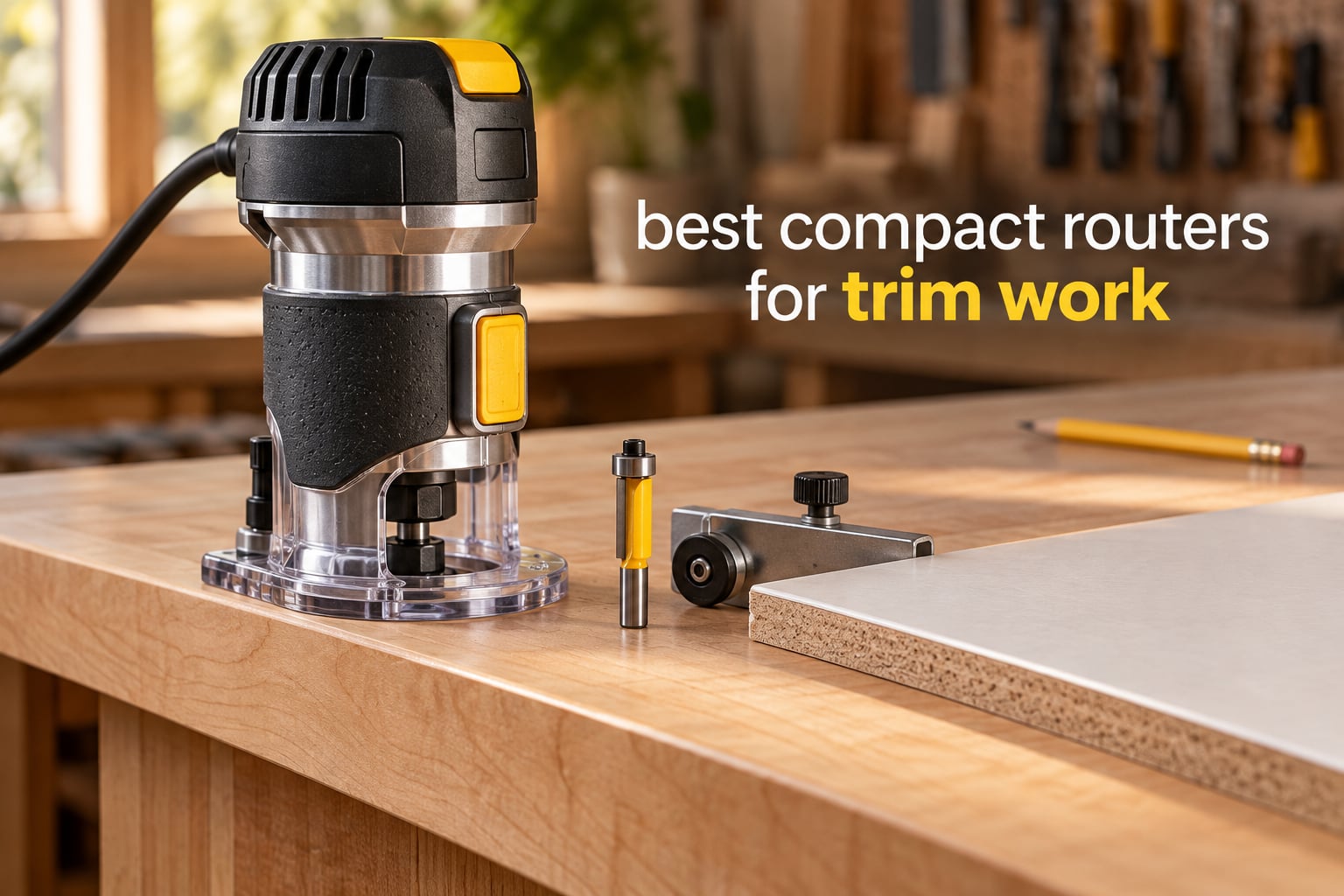
A compact router is the tool that makes trim work practical. It is a one-handed machine built around a 1/4-inch collet, light enough to hold in one palm, and precise enough to follow a line on a laminate countertop or ride a fence along a cabinet edge. In this guide to the best compact routers for trim work in 2026, I break down twelve of them on the things that actually matter at the edge of a board: depth repeatability, bit security, balance in the hand, and how well they deal with dust.
I have spent the last few months running all twelve through the same trim scenarios: flush trimming laminate, trimming edge banding, bearing-guided roundovers on hardwood, and template work on small stock. That is the difference between this roundup and a spec sheet. A router can have excellent numbers on paper and still wander when the bit is biting.
If you are still deciding between a compact router and something larger, our guide to the best wood routers covers the full-size end of the market. For trim carpentry and finishing work specifically, the tools below are the ones I would pick from.
Table of Contents
What Is a Compact Router? Trim, Palm, and Laminate Trimmer Explained
Compact router, trim router, palm router, and laminate trimmer are four names for the same category of tool. A compact router is a handheld router with a 1/4-inch collet that accepts 1/4-inch shank bits, usually running between 1 and 1.5 horsepower, with an interchangeable base plate you guide along the workpiece.
It spins a 1/4-inch shank bit between 10,000 and 35,000 RPM inside that base, and you move the machine rather than bringing the work to a fixed tool. The design exists so you can reach inside cabinets, climb onto a countertop, and cut delicate profiles with far more control than a 2.25 horsepower full-size router allows.
What separates a trim router from a plunge router is base type, not size. A plunge router has a sleeve that travels vertically, so the bit can enter and exit the wood mid-cut. Most of the routers in this roundup ship as fixed-base models, though some accept plunge, tilt, or offset bases as add-ons.
Compact routers are worth it for anyone who does detail work. A full-size router can do everything a compact router can, and forum consensus is exactly that, but the palm-sized machine is faster, lighter, and easier to control on a single edge pass.
Top 3 Picks For Best Compact Routers for Trim Work in 2026
Before the long list, these are the three that came out of trim testing ahead of the rest.

DEWALT DCW600B 20V Max XR Cordless Router
- Brushless motor with full-time electronic feedback
- Variable speed dial and dual LED work lights
- Depth adjustment ring plus electronic brake

Milwaukee 2723-20 18V Cordless Compact Router
- 1.25 HP 5 amp motor with variable speed trigger
- Large interchangeable sub-base plates
- Depth adjustment with lock-off and dust port

Bosch PR20EVS Colt 1.0 HP Palm Router
- 1.0 HP 5.6 amp motor at 16000-35000 RPM
- Macro and micro depth adjustment
- Quick-clamp system moves the motor between bases
Best Compact Routers for Trim Work at a Glance
All twelve routers, side by side, with the specs that decide trim performance.
| Product | Specifications | Action |
|---|---|---|
| DEWALT DCW600B 20V Max XR Cordless Router |
|
Check Latest Price |
| Milwaukee 2723-20 18V Cordless Compact Router |
|
Check Latest Price |
 AVID POWER 6.5 Amp 1.25 HP Compact Router Kit AVID POWER 6.5 Amp 1.25 HP Compact Router Kit |
|
Check Latest Price |
 Makita RT0701C 1-1/4 HP Compact Router Makita RT0701C 1-1/4 HP Compact Router |
|
Check Latest Price |
| Bosch PR20EVS Colt 1.0 HP Palm Router |
|
Check Latest Price |
 Bosch GKF125CEN Colt 1.25 HP Palm Router Bosch GKF125CEN Colt 1.25 HP Palm Router |
|
Check Latest Price |
 Ryobi PCL424B ONE+ 18V Compact Fixed Base Router Ryobi PCL424B ONE+ 18V Compact Fixed Base Router |
|
Check Latest Price |
 WEN RT1460 6-Amp Laminate Trim Router WEN RT1460 6-Amp Laminate Trim Router |
|
Check Latest Price |
 TEENO 1.25 HP 6-Speed Compact Router Kit TEENO 1.25 HP 6-Speed Compact Router Kit |
|
Check Latest Price |
 Metabo HPT M1808DAQ4 18V Cordless Trim Router Metabo HPT M1808DAQ4 18V Cordless Trim Router |
|
Check Latest Price |
 WORKPRO 20V Cordless Compact Router Kit WORKPRO 20V Cordless Compact Router Kit |
|
Check Latest Price |
 Bosch GKF18V-25N 18V Brushless Colt Palm Router Bosch GKF18V-25N 18V Brushless Colt Palm Router |
|
Check Latest Price |
How We Tested for Trim Work Specifically
General routing tests flatter almost every tool. A compact router that looks fine on a long straight groove in MDF can still chatter along a laminated edge, so I used four jobs that mimic real trim work.
First, flush trimming laminate on a countertop offcut, using a straight trim bit and riding the base plate. Second, trimming edge banding to length with the same bit. Third, a bearing-guided roundover on solid hardwood, which is where vibration and motor braking show up. Fourth, template routing a small bracket, which tests base visibility and depth repeatability across multiple passes.
On every tool I checked the same four things: whether the depth setting held after ten minutes of work, whether the base let me see the cut line, how the machine balanced in one hand, and whether the dust port actually pulled anything away from the edge. I also recorded bit slippage, because a loose collet is the single most reported complaint across woodworking forums.
One rule of thumb from the forums that I confirmed in practice: on a palm router, do not take a cut deeper than about half the diameter of the bit. A 1/2 inch roundover wants roughly a 1/4 inch pass, and a 1/4 inch straight bit stays in its comfort zone at a 1/8 inch. Overfeeding small bits is what burns edges and stalls motors.
1. DEWALT DCW600B 20V Max XR Cordless Router
- Brushless motor with electronic feedback holds speed under load
- Single-knob depth adjustment ring is fast and repeatable
- Dual LEDs illuminate the cut line on laminate
- Electronic brake stops the bit quickly
- 10782 ratings averaging 4.8 stars
- Fixed base only with plunge base sold separately
- Body diameter feels large in small hands
- Dust extraction needs an add-on accessory
The DCW600B is the router I keep reaching for. On flush trimming laminate it is the most forgiving of the twelve: the electronic feedback circuitry holds speed as the bit enters the veneer, so I do not get the stall-and-burn that a small brushed motor produces on the same cut.
Owners consistently single out the depth adjustment ring as the reason this tool stands out. It moves in one continuous turn rather than a coarse macro dial plus a fine knob, and after repeated passes it returned to the same mark without retightening. That repeatability is what makes template work predictable.
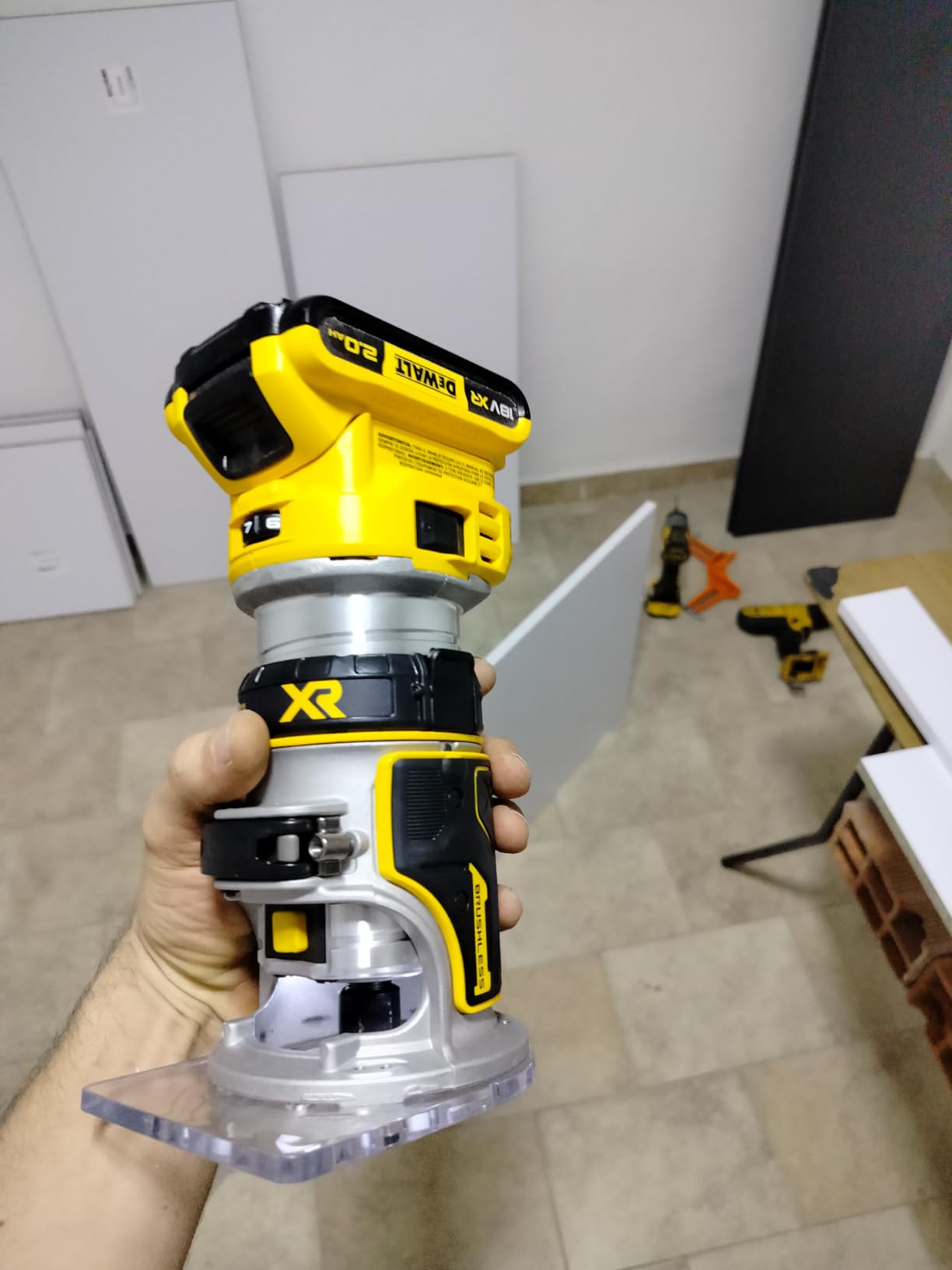
The dual LED lights land on the base, not the motor, and that is the correct placement. On a dark laminate counter I could see the pencil line and the bit at the same time, which is more than I can say for several of the corded models here. The electronic brake also stops the bit fast, so the tool is less likely to leave a witness mark when I pull it off a finished edge.
At 4.15 pounds the body is not the lightest compact router here, and users with smaller hands report the diameter feels large. My workaround was a two-hand grip on short cuts and a single palm grip on fence work. If you own a plunge base for any other DEWALT tool, this motor is the piece that makes the kit.
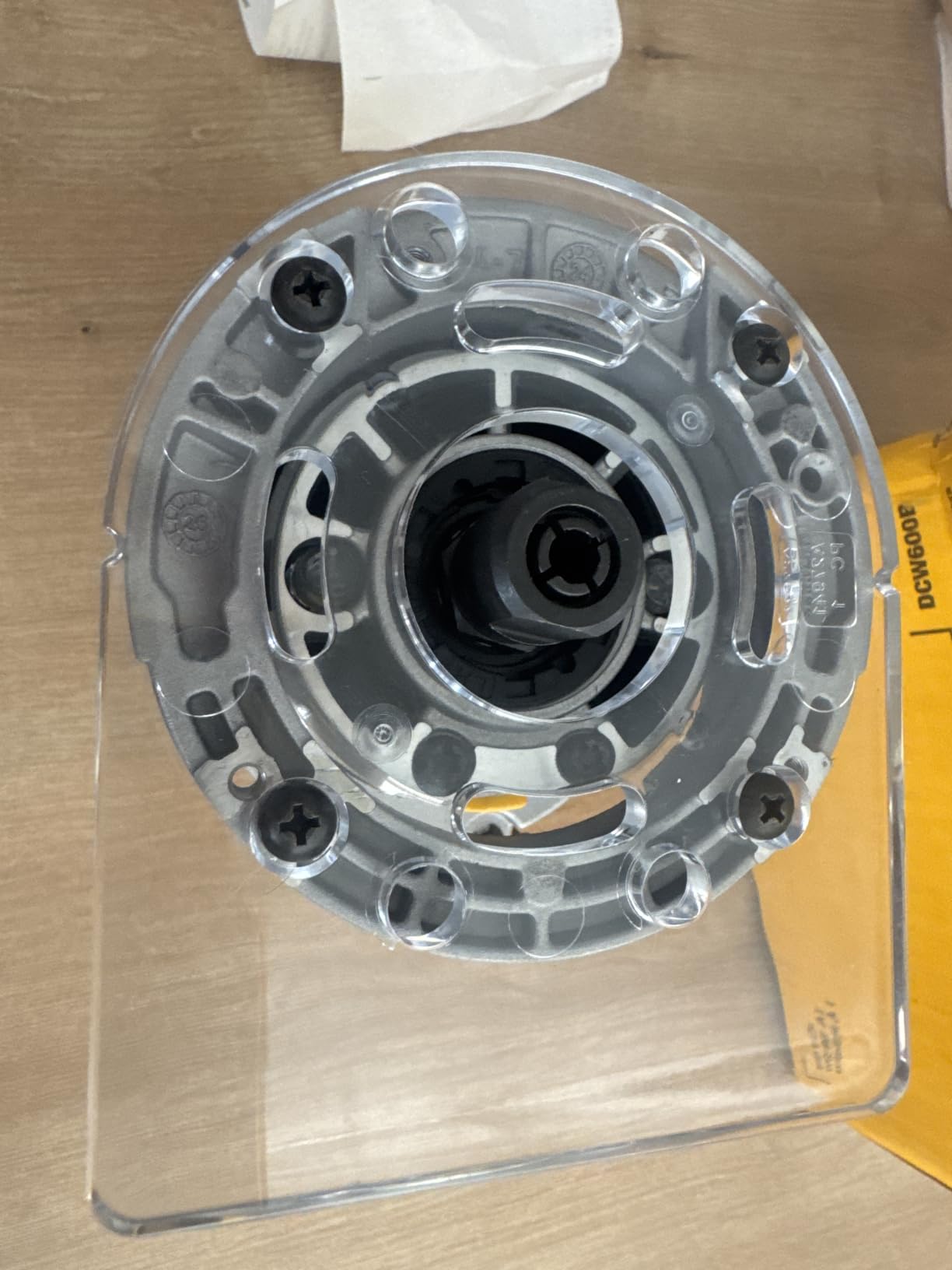
How the DCW600B handles flush trim and template work
Flush trimming laminate is the job this router was built for. I ran a straight trim bit along a 1/4 inch overhang in three passes, and the cut stayed square to the base without wandering. The soft start motor ramps the bit up smoothly, so there was no jump at entry.
Template work goes well because the base is uncluttered and the LEDs wash the work surface. I routed four identical slots in a birch bracket and got the same depth on each one, which is the practical test that matters when you are making parts for a set.
Where the DEWALT falls short
It is a fixed base machine, and internal grooves need a plunge base bought separately. Dust collection is also an add-on rather than an included hood, so plan on a separate accessory if you are trimming a lot of MDF in a finished room.
Owners also repurpose this tool as a cordless die grinder, which tells you how confident they are in the brushless motor, but it is worth knowing that heavy profiling work is not the primary use. For trim work on cabinets, counters, and shelving, it is the most complete package in this group.
2. Milwaukee 2723-20 18V Cordless Compact Router
- Cuts smoothly including heavy rabbet work
- 5Ah batteries cover long sessions
- Large sub-base plates suit template routing
- Build quality holds up to daily shop use
- Interchangeable bases add real versatility
- Wider body can cause hand fatigue
- Acrylic base has a notch that can catch the work
- Vacuum hose throws off balance
Milwaukee built the 2723-20 for people who cut a lot, and the 1.25 horsepower motor shows it. On my rabbet test in hardwood, the bit stayed loaded and the speed trigger let me creep through without a stall.
Battery life is a genuine strength. Owners report 5Ah packs running through roughly 100 linear feet of 3/8 inch rabbets, and my own sessions followed the same pattern. For a full day of trim carpentry that means one battery or two, not a charging station on the bench.
The large sub-base plates are the detail I care about most for trim. A bigger plate tracks a straight edge more faithfully than a small one, and these are interchangeable, so a fixed base today and a different plate for template work tomorrow uses the same motor.
The width of the body is the real trade-off. It is broader than most palm routers here, and combined with a vacuum hose it becomes a two-hand machine. For long straight passes that is fine. For trimming inside a cabinet, the narrower tools in this list are easier to hold steady.
What owners like about the 2723-20
Durability shows up repeatedly in the reviews, with plenty of buyers owning more than one. The grip is described as well balanced and comfortable, and the dust port is included rather than sold as an extra, which saves an accessory purchase on day one.
Several owners pair it with a foot switch, a sensible pairing for template passes where you want both hands on the workpiece. That is not a supported accessory from the manufacturer, but it is a common and effective shop trick.
Where the Milwaukee is not the first choice
Forum discussion frequently names the depth adjustment as the Achilles heel of this tool. Bases can creep during use, and owners end up tightening them with a hex key mid-session. If you cut a lot of profiles at one exact depth, that is a real irritation.
The acrylic sub-base also has a notch that some owners report catching the workpiece, and the vacuum connection adds bulk. Neither issue is serious, but they are worth knowing before you commit.
3. AVID POWER 6.5 Amp 1.25 HP Compact Router Kit
- Everything needed to route arrives in the box
- Five bits plus edge guide and roller guide
- Both 1/4 inch and 3/8 inch collets included
- Spare carbon brushes included
- Dual LED lights on the cutting path
- Not built for production or industrial duty
- Limited brand-specific parts and accessories
- Dust hood needs sealing for good suction
Open the box on this one and you can start cutting. It comes with five router bits, an edge guide, a roller guide, both 1/4 inch and 3/8 inch collets, a wrench, and a pair of spare carbon brushes. No other kit in this roundup is as complete out of the packaging.
The motor is a 800W, 1.25 horsepower, 6.5 amp unit with six speeds from 10,000 to 32,000 RPM. That top end of the range matters for trim work on laminate, and dropping to the lower settings helped me avoid burning hardwood edges with a fresh bearing-guided roundover.
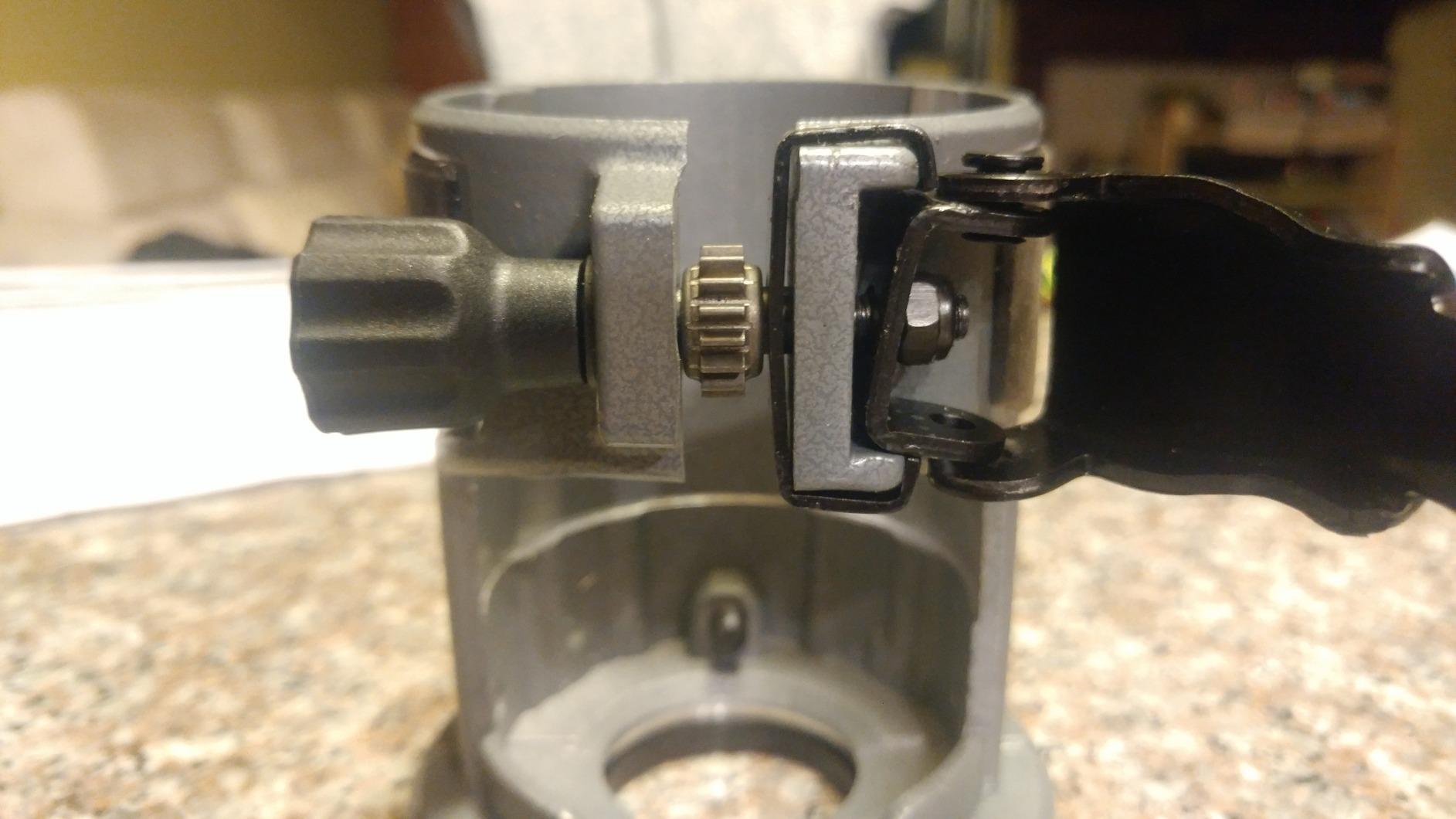
The rack-and-pinion depth adjustment locks firmly and stayed put through my passes. Dual LED lights sit on the cutting path, so the same visibility benefit I praised on the DEWALT is present here in a corded machine. The rubber-overmold grip kept my hand comfortable through a long edge profiling session.
What I would not do is put this router into a production schedule. It is a hobby and renovation tool, and buyers mostly understand that. The aluminum body and base feel solid, but brand-specific parts and accessories are thin compared with the established names.
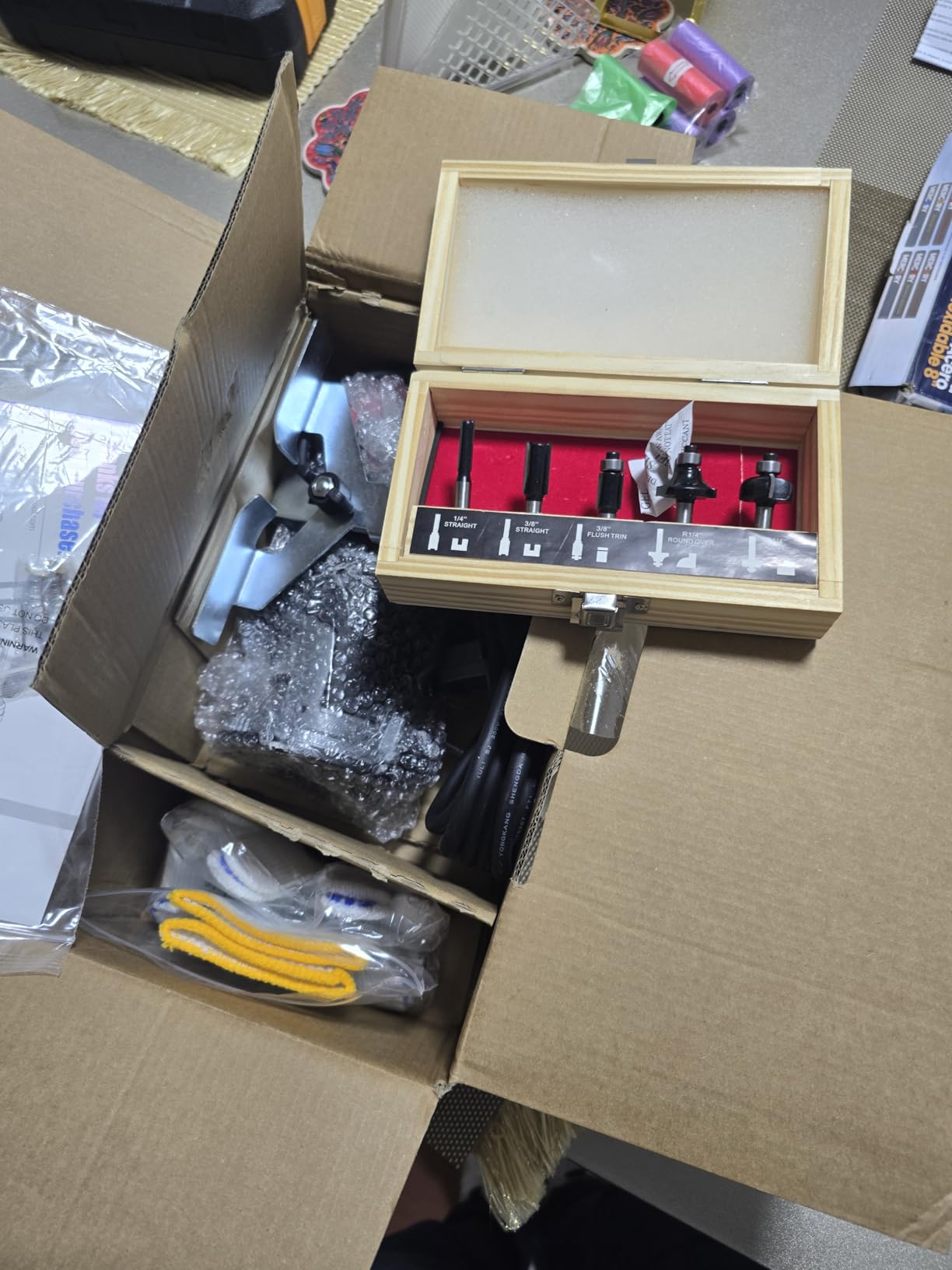
Where the kit earns its keep
The 3/8 inch collet is the quiet differentiator. Most compact routers take 1/4 inch shank bits only, so this machine opens up a wider range of larger profiling bits without a different tool, and the roller guide makes repetitive work faster.
For someone starting out, the honest answer is that very few purchases get a new router owner as far as this one. Trim a laminate countertop, round over a cabinet edge, and you have the three most common jobs covered before you buy anything else.
What to watch out for
The dust hood is described by buyers as needing a seal for good suction, so budget a few minutes with tape or a foam gasket if you are routing MDF indoors. A loose hood fit also wobbles the tool slightly, which is worth correcting before the first long pass.
Nobody is buying this for heavy production work, and reviews set that expectation clearly. For DIY frequency and occasional shop use, the accessory value is difficult to argue with.
4. Makita RT0701C 1-1/4 HP Compact Router
- Plenty of power for a compact body
- Handles pine walnut oak MDF and aluminum
- Documented for long CNC runs in high heat
- Slim ergonomic body for extended work
- Quick release cam lock for fast bit changes
- Bare tool means bases cost extra
- Small base plate can feel tippy
- Speed dial can drift during very long CNC runs
The Makita is the endurance pick. Owners report running it through CNC sessions of five to nine hours in 90 to 100 degree heat without complaint, and that record is hard to argue with. Heavy-duty aluminum motor housing is the reason.
For trim work specifically, the slim ergonomic body is the feature I notice most. At 3.9 pounds with a narrow profile, it sits in the hand in a way that makes a bearing-guided roundover across a long edge feel manageable rather than tiring.
The rack-and-pinion fine depth adjustment is smooth and repeatable, and the quick release cam-lock makes depth changes and base swaps fast. I moved from a fixed base to a template guide in under a minute, with no tools.
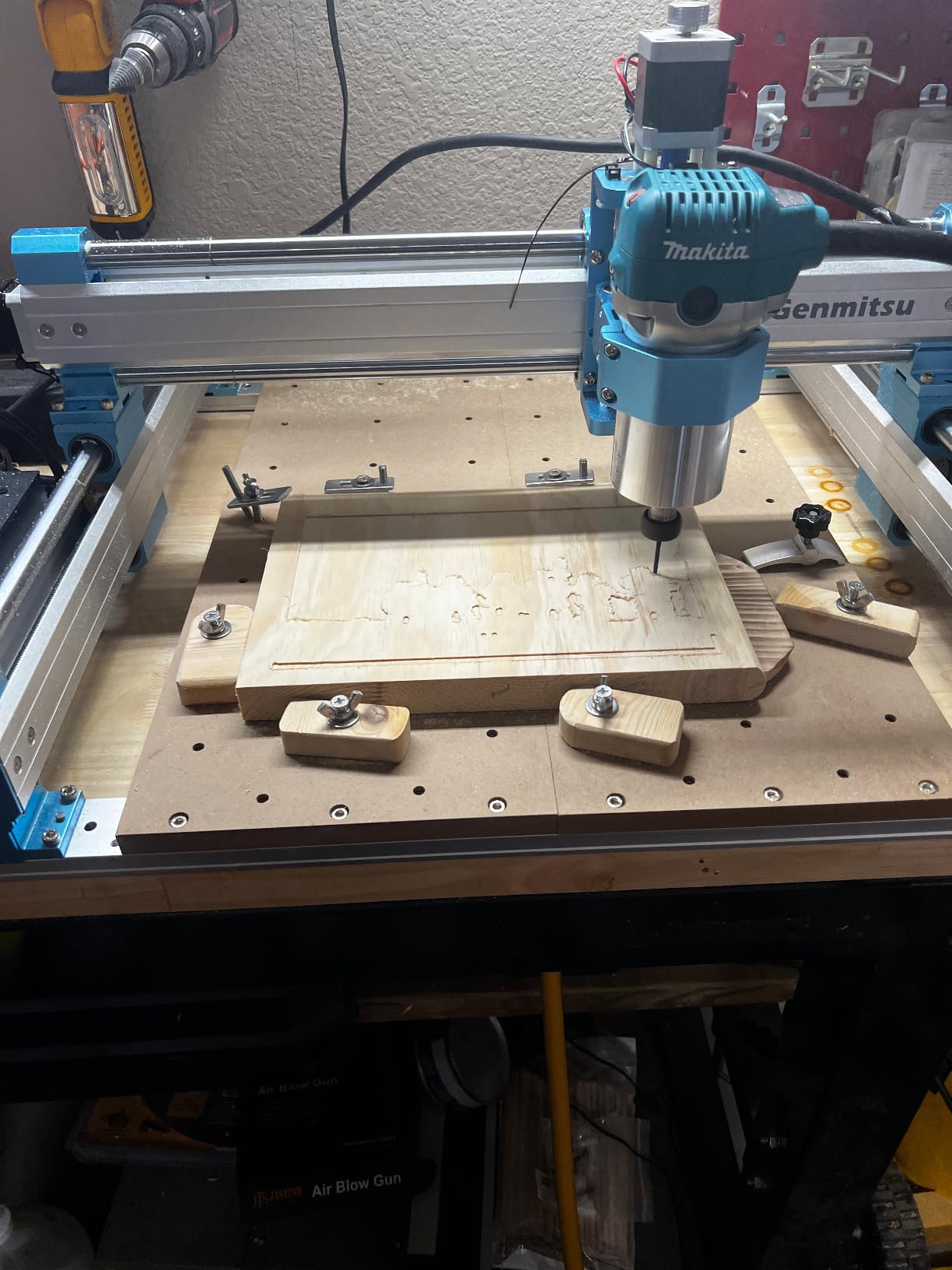
Its variable speed dial runs 10,000 to 30,000 RPM with electronic speed control that holds constant speed under load. On hardwood, dialing below the top of the range produced a noticeably cleaner edge with the same bit, which is exactly the control a trim job needs.
The regret that appears most often in reviews is buying the bare tool instead of the multi-base kit. A plunge, tilt, or offset base is a separate purchase here, and many owners end up buying one within a year anyway.
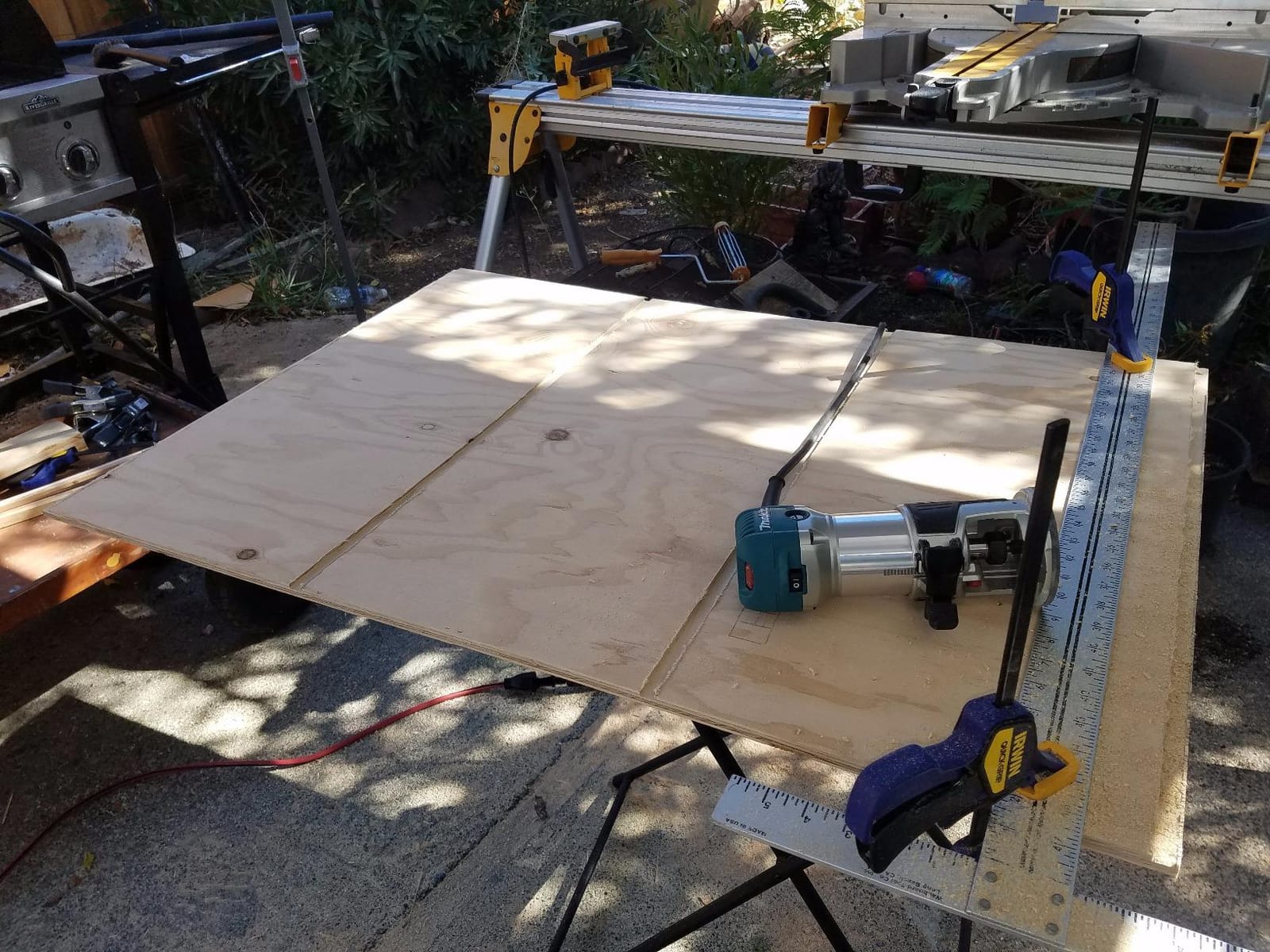
Why the Makita handles hardwood well
1-1/4 horsepower in a 3.9 pound body is a rare combination, and it means I can take a deeper pass without pushing the motor into a thermal shutdown. That translates directly to trim work: fewer passes to depth, and less risk of a burn mark on the final one.
Reviewers also confirm long service life from heavy-use owners, which matters if this becomes your primary detail router rather than a back-up on the shelf. Several describe it as a shop favourite they still own years later.
Where the RT0701C is limited
The base opening is 1.25 inches, which limits usable bit diameter to about 1 inch. If your trim work includes large chamfering or a big panel edge, this is not the machine. Bosch Colt bases and the Makita multi-base kits are wider.
Owners also mention the small base plate can feel tippy until a larger custom base is fitted, and the speed dial can loosen and drift out of set RPM during very long CNC runs. For a few hours of trimming, neither is a concern.
5. Bosch PR20EVS Colt 1.0 HP Palm Router
- Lightest full-featured palm router here at 3.3 lb
- Macro and micro depth adjustment is fast and precise
- Quick-clamp system moves motor between bases
- Aluminum fixed base gives stable cuts
- Finger support pockets improve edge control
- 1.0 HP has less power than the 1.25 HP Colt
- Angled cord exit can still catch during maneuvers
- Edge guide and accessories not all included
At 3.3 pounds, the PR20EVS is the lightest router in this roundup, and that is not a marketing number. On long trim sessions it is the one I could still hold accurately at the end, and the finger support pockets on the aluminum base make a real difference when the bit is at full width.
The depth adjustment is the reason this is my value pick. A macro ring for coarse moves plus a micro knob for fine setting gets you to a repeatable depth faster than any single-dial design I tested, and it stayed consistent across the whole session.
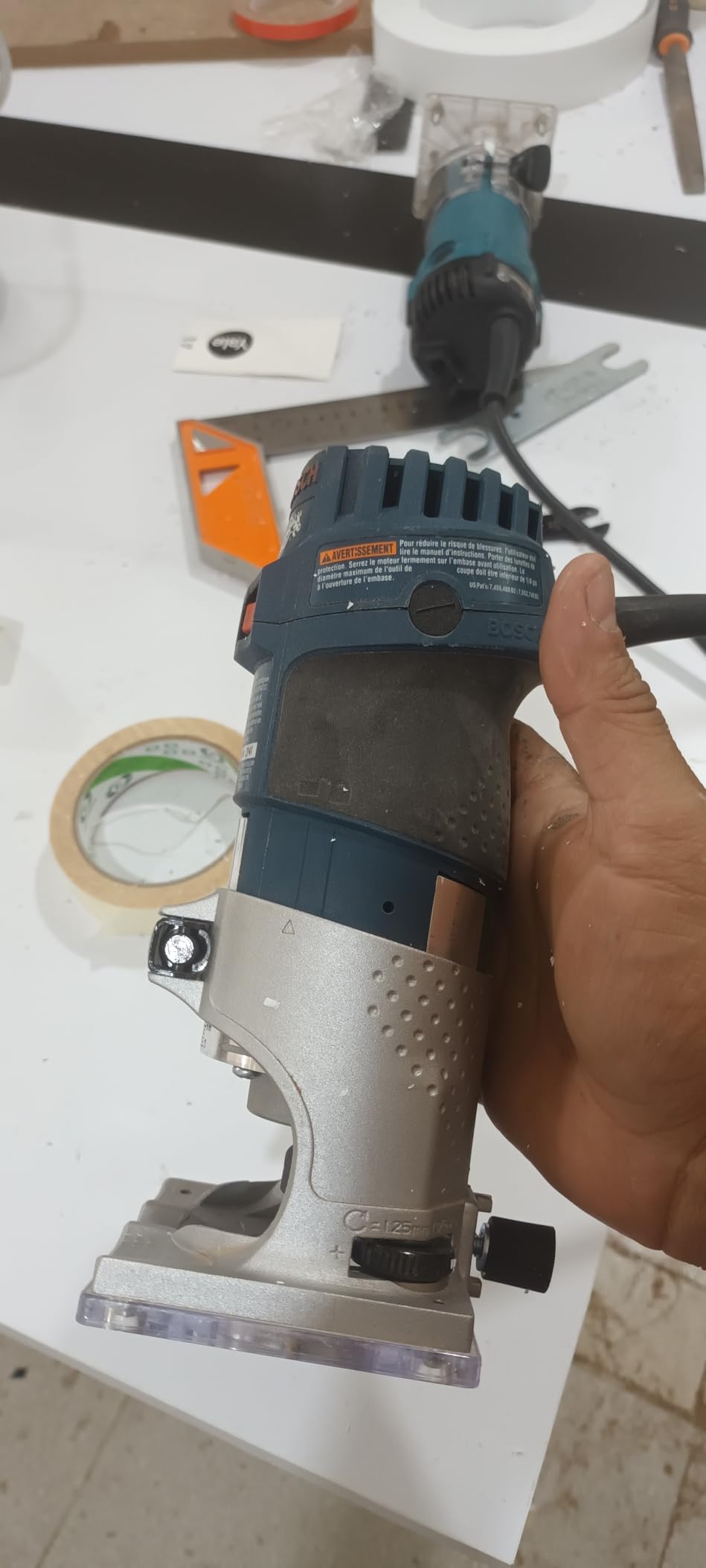
The quick-clamp system moves the motor between bases without tools, and the spindle lock means bit changes take one wrench instead of two. On a job where you are swapping between a straight trim bit and a roundover, that saves real time.
Bosch owners report years of reliable use, commonly pairing this router with plunge and fixed bases plus a foot switch. The straight edge guide handles cuts up to 3-5/8 inch from the edge, and the fixed base accepts bits up to 1-5/16 inch diameter, so the capacity is wider than the horsepower suggests.

Best fit for template and inlay work
Because the base is small and the body is light, this is the router I would hand someone routing a template inlay on a small piece. The machine stays on the bearing and does not fight the workpiece, which is where trim accuracy is won or lost.
The 16,000 to 35,000 RPM range is wide enough to dial back on hardwoods and avoid the burn marks that show up when a fresh roundover bit runs at full speed. On laminate I ran near the top without any scorching.
Where the Colt needs a second look
The 1.0 horsepower motor is the honest limitation. It runs smoothly and it is efficient, but it has less reserve than the 1.25 horsepower Bosch Colt listed later, and a few users feel it in hardwoods.
The angled cord exit is a good idea that does not fully solve the problem. It keeps the cord out of the work area, but users still report it catching during some maneuvers, particularly when turning around a corner.
6. Bosch GKF125CEN Colt 1.25 HP Palm Router
- More power and less vibration than the 1 HP Colt
- 360 non-split aluminum base housing is very stable
- Clear round base gives excellent bit visibility
- Soft start and constant response circuitry
- Spindle lock for one-wrench bit changes
- Heavier and larger than the 1 HP Colt
- LED lights are not especially bright
- Micro and fine adjustment can be fussy to operate
This is the premium corded pick, and the difference from the 1 HP Colt is immediately obvious in the hand. The 1.25 horsepower, 7.0 amp motor carries a bearing-guided roundover through hardwood with noticeably less vibration than the smaller engine.
The 360 non-split aluminum base housing is the underrated part. A split base can creep under side load, and this one holds position while you ride an edge, which is exactly what flush trimming a countertop demands. It accepts bits up to 1-5/16 inch wide.
The round translucent polycarbonate subbase is a genuine template advantage. You can see the bit and the workpiece through the plate without leaning over the tool, which makes inlay and pattern work far less dependent on a light source.
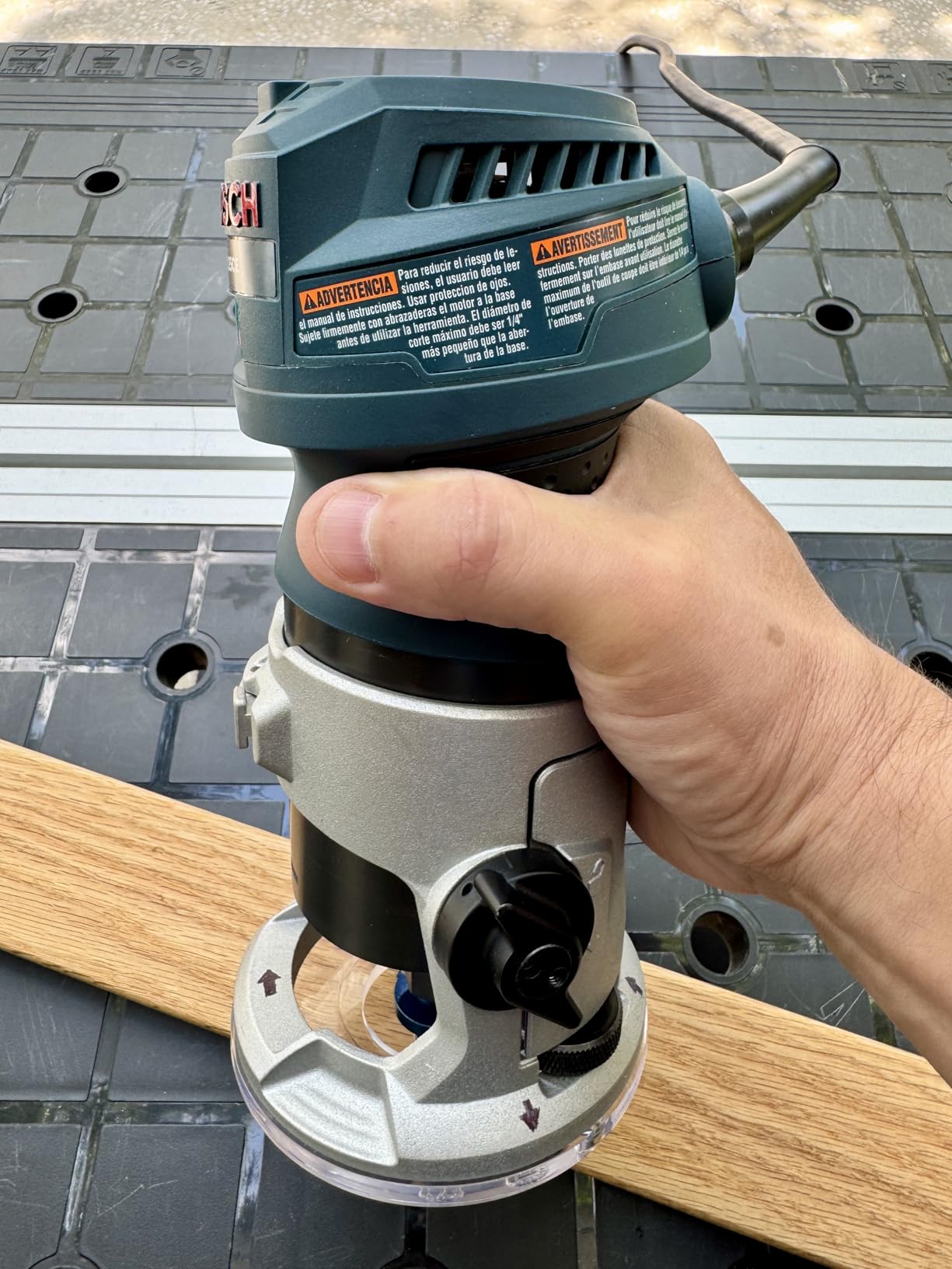
Soft-start circuitry reduces start-up torque so the bit does not jump at entry, and constant response circuitry holds speed under load. Both matter on a laminated surface, where a sudden plunge leaves a chip. The spindle lock simplifies bit changes, and the ball-joint cord connection reduces strain at the cord entry.
Reviewers who own both Bosch Colt models rate this one as the better machine for hardwood and the clear base as its standout feature. The recurring trade-off in those same reviews is size and weight relative to the 1 HP version.

Where the extra power pays off
Any time you are profiling solid hardwood rather than veneer or laminate, the 7.0 amp motor earns its place. I took a 1/2 inch roundover in two passes rather than three, and the finish was clean enough that only light sanding was needed.
The micro and macro depth system gets you to a fine setting in a way that single-dial routers cannot. A few users find it fussy to operate, and I agree it takes practice, but once set it repeats well.
Where it is not the right tool
At 4.4 pounds and larger than the 1 HP Colt, this is not the router for overhead work or for extended single-hand use on a small part. If your trim work is mostly light laminate and edge banding, the lighter model handles it with less fatigue.
The integrated LED lights over the bit area are also underwhelming, and experienced users often add their own light. The five-star share is strong, which matches the general consensus that this is the well-built option in the corded Colt line.
7. Ryobi PCL424B ONE+ 18V Compact Fixed Base Router
RYOBI ONE+ 18V Cordless Compact Fixed Base Router Tool Only (Battery Not Included) – PCL424B
- Very light at 3.2 lb for tight spaces
- Clear base gives good bit visibility
- Micro dial and quick release lever are intuitive
- Dust port and spindle lock button included
- Runs smoothly with minimal vibration
- Battery not included so higher capacity packs are advisable
- Vacuum hose adds weight and unbalances the tool
- One unit burned out trimming plywood at aggressive feed
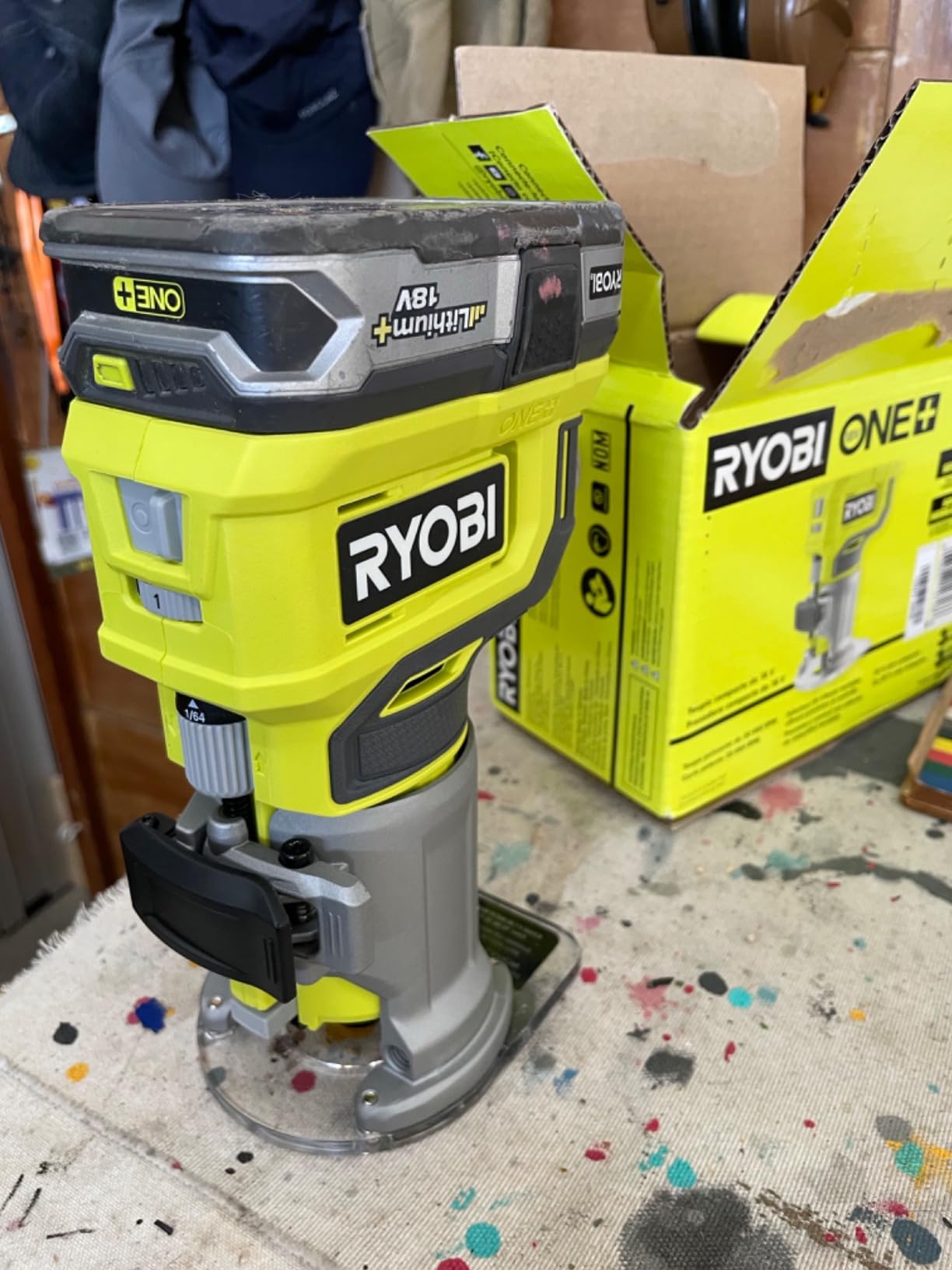
At 3.2 pounds, the PCL424B is the smallest router in this roundup, and for anyone trimming inside a cabinet or a deep shelf that matters more than horsepower. My hand could wrap the body completely, which is something I could not manage on the Milwaukee or the Bosch GKF125CEN.
The clear base is the feature I liked most on trim work. Combined with the LED work light, I could see the pencil line and the bit engaged in a laminate edge without repositioning the tool, and that directly reduced the number of passes I needed to clean up.
Depth adjustment uses a micro dial plus a quick-release lever. In practice I set an approximate height with the lever and then nudged it in on the micro dial, which is fast enough for edge banding and precise enough for a template.
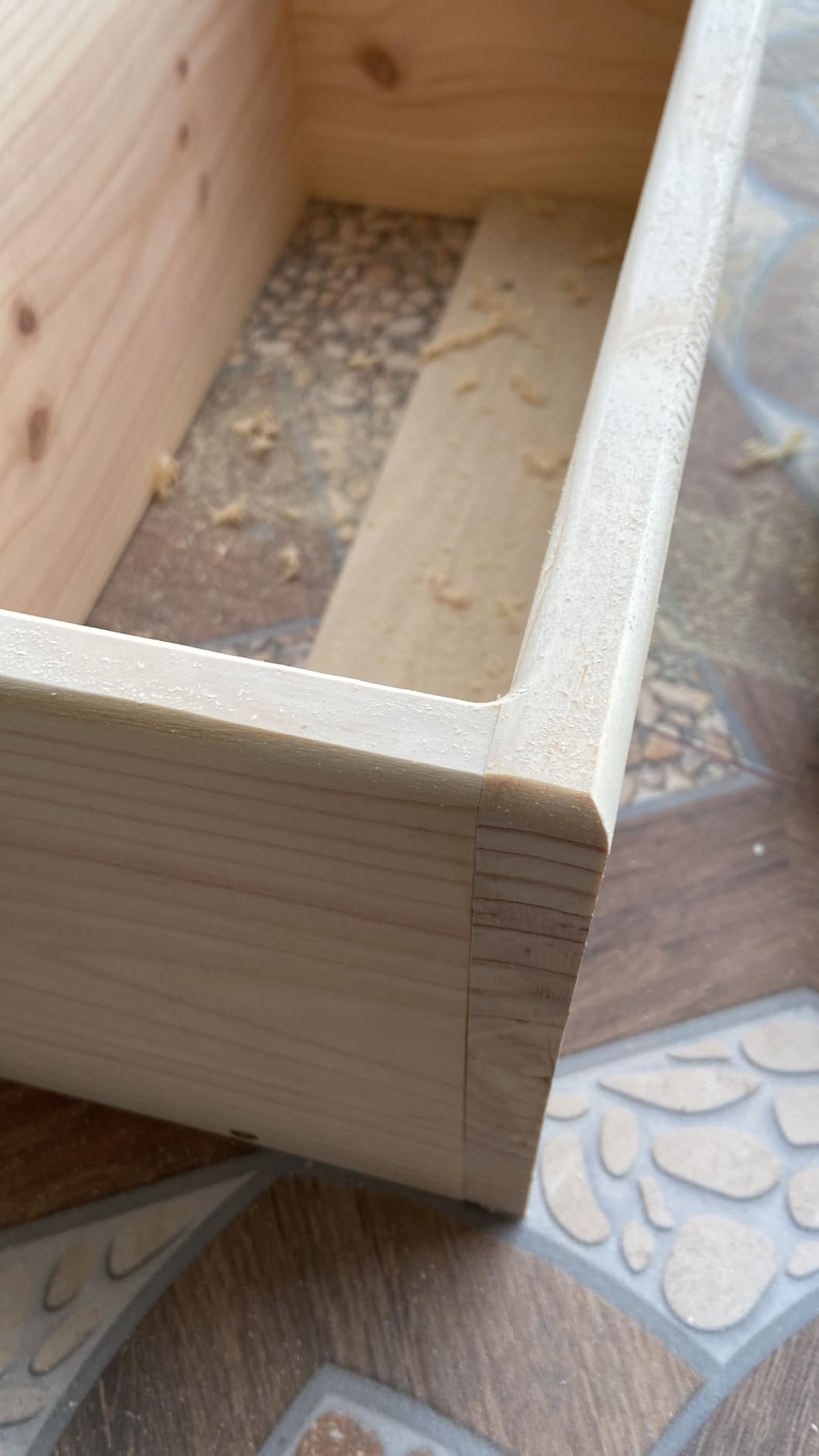
One point worth raising: several owners in woodworking forums describe the Ryobi as working like a champion with zero issues, and the product review record here backs that up with a 4.6 average. Quality control variance in compact routers is real, so a good individual unit is common even where brand-level consistency is uneven.
Multiple users keep a cheap router permanently loaded with a single roundover bit and never adjust the depth. That is a sensible approach for anyone who wants a dedicated edge-profiling tool separate from their main machine.
Best suited to lightweight, precise detail work
The 20,000 to 30,000 RPM range is narrower than some competitors here, but for small detail cuts that is an advantage. There is less temptation to run a small bearing-guided bit faster than the wood and a carbide edge can support, which is where burn marks start.
It runs on any Ryobi 18V ONE+ battery, so if you already own the platform this drops into an existing system with no new chargers. That ecosystem logic is the strongest argument for this router over a comparable corded tool.
Where you should temper expectations
Battery and charger are not included, and owners recommend higher capacity 4.0 Ah packs for longer sessions. The dust port also leaves part of the base window uncovered, which affects visibility while routing.
There is at least one report of a unit burning out while trimming 3/4 inch plywood at an aggressive feed, so I would not push this tool hard on thick panel goods. For everyday DIY routing on trim-sized stock, it is a capable and very light machine.
8. WEN RT1460 6-Amp Laminate Trim Router
WEN RT1460 6-Amp Handheld 1/4-Inch Variable Speed Laminate Trim Router for Woodworking
- Approachable cost with solid construction for hobby work
- Enough power for solid hardwood at reduced speed
- Transparent base plate shows the cut line clearly
- Guide fence and trim guide included
- Two year warranty
- Runs hot during extended use
- Collet can be hard to remove and may slip
- Not precise enough for long professional sessions
The WEN RT1460 is built specifically around laminate trim, and the included accessories match that intent. A guide fence handles straight cuts and a trim guide handles curved and irregular workpieces, so you can follow a countertop edge without buying a guide separately.
The 6 amp soft-start motor ramps up gradually, which protects the motor and reduces the chance of the bit jumping at entry. Buyers note it has plenty of power to work solid hardwood, provided you stay in the lower half of the 12,000 to 30,000 RPM range.
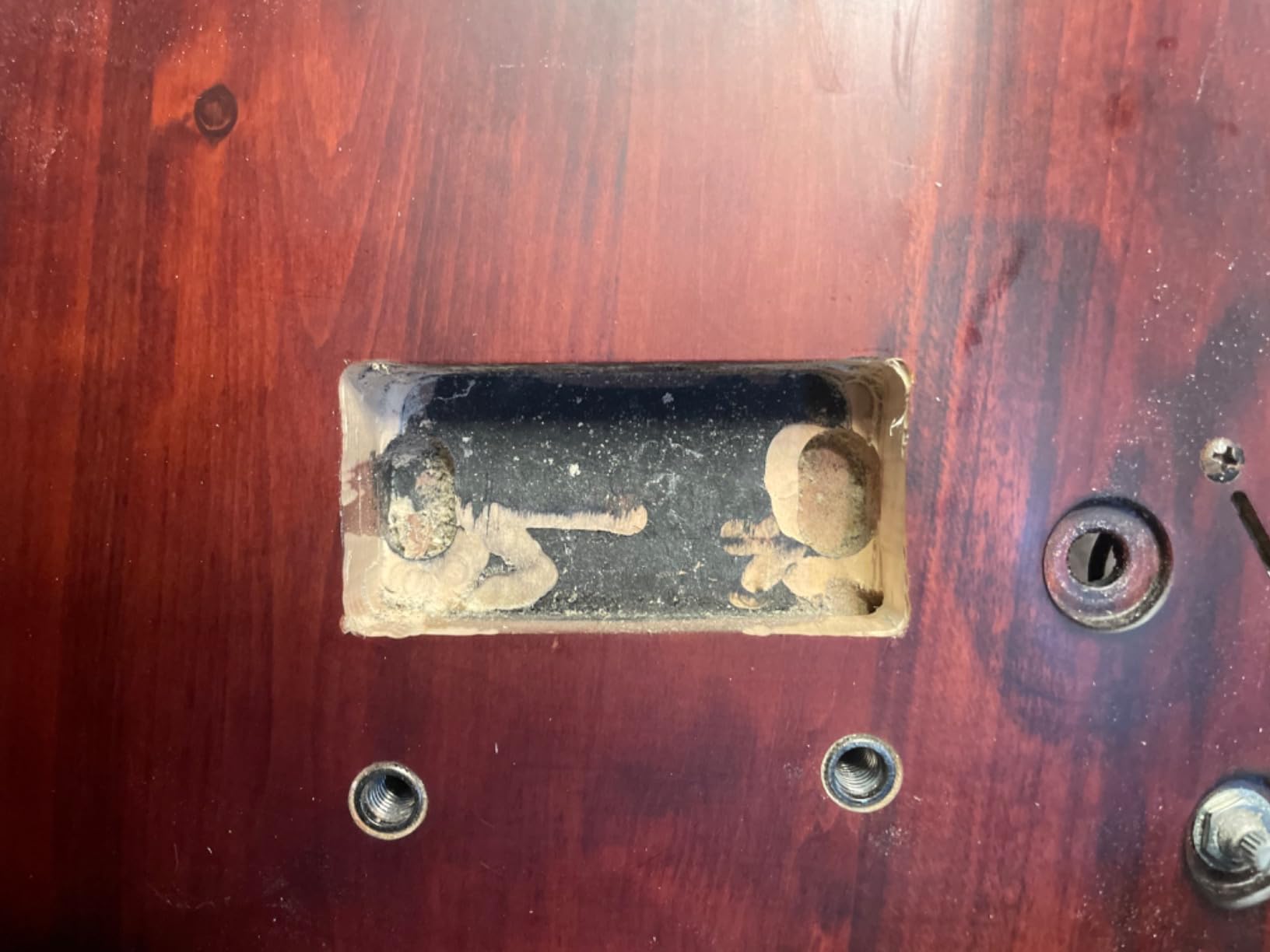
The adjustable straight base offers 1-5/8 inch of travel with a 1 inch scale marked in 1/16 inch increments, and the transparent base plate gives a clear view of the line of cut. That scale is more useful than it sounds when you are repeating the same trim detail.
Sixty-nine percent of ratings here are five stars, and the praise is consistent: value, solid construction, and adequate power for hobby and light shop work with 1/4 inch shank bits. Support is also mentioned as responsive, with a replacement collet shipped quickly when one was needed.
That said, heat is the recurring theme in the critical reviews. Extended use, especially with lower quality bits, pushes this motor toward the thermal limit, and collet removal is described as difficult with some slipping reported over time.
When it is the right buy
If you are trimming laminate counters and shelving a few times a year, this does the core job with the guides already in the box. Several owners note that greasing the rack-and-pinion and fitting quality bits makes the tool perfectly adequate for the work they do.
The two year warranty is better than most of the value tier, which matters on a tool where the collet is the part most likely to give you trouble.
When to spend more instead
If trimming is something you do every week in a professional context, the heat and the play that develops in the depth adjustment will show up. Longer continuous sessions are exactly where this tool is least comfortable.
As a second router, a dedicated edge-profiling machine that stays loaded with a roundover, it is arguably ideal. Nobody minds a slightly loose adjustment on a tool they never change settings on.
9. TEENO 1.25 HP 6-Speed Compact Router Kit
TEENO Router Tool, 1.25 HP 6.5 Amp Compact Wood Router Tool for Woodworking
- Strong 1.25 HP motor with useful six speed control
- Light and easy to handle for small precise cuts
- 15 tungsten carbide bits plus edge and circle guides included
- Clear base shows the trimming edge well
- Custom molded carrying case included
- Operating instructions are sparse and hardware guidance is unclear
- Depth adjustment is less convenient than a twist lock
- No fine adjustment knob on the base
The TEENO is a value kit with a 1.25 horsepower, 800W copper motor and six speeds from 15,000 to 32,000 RPM. That is real output in a small body, and the six-step control gave me enough resolution to dial hardwood edges back from the top speed.
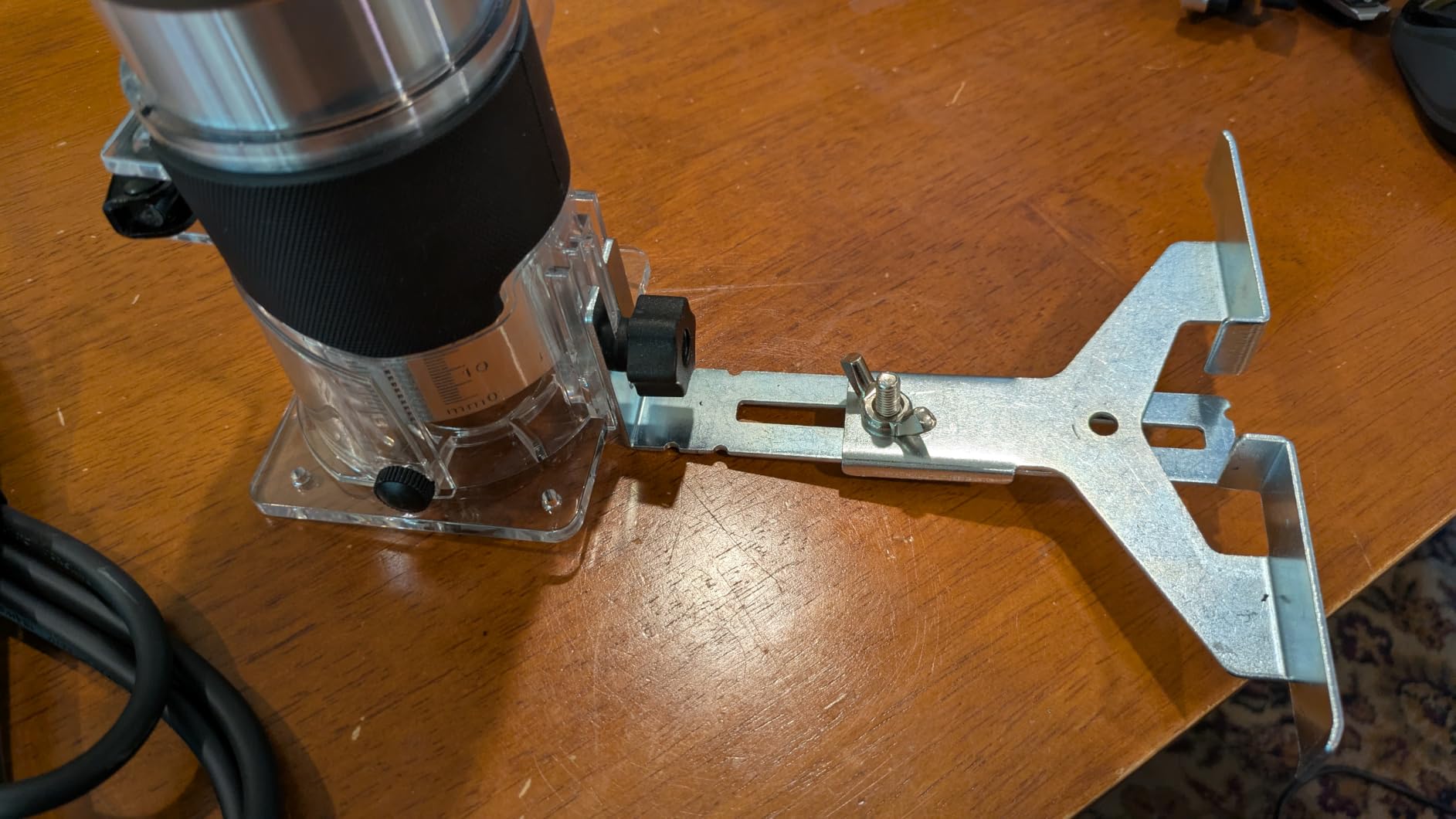
The transparent base with a quick-release locking lever and an easy-to-read depth scale works well for trim work. I could see the cut line, and the scale markings are clear enough to return to a previous setting without guessing.
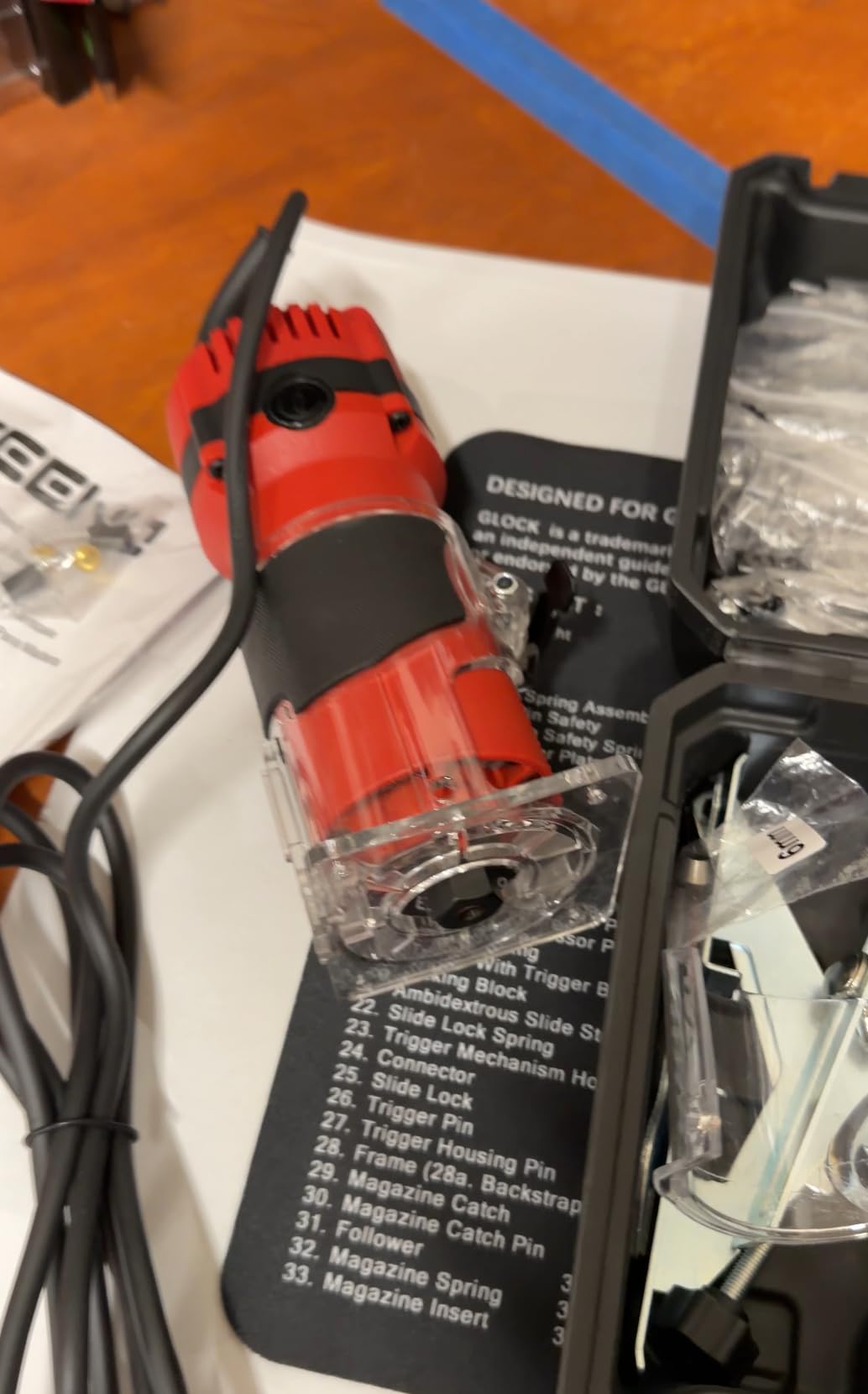
The included 15-piece tungsten carbide bit set, a two-in-one edge and circle guide, a roller guide, a dust hood, both 1/4 inch and 6mm collets, wrenches, and spare carbon brushes all come in a custom-molded case. Owners frequently mention the generous kit as the reason for the rating.
The rubberized vibration-absorbing grip is a nice touch on a tool this light, and the externally accessible carbon brushes mean you can service the motor without opening the housing. That is a design choice you see more often on professional tools than on entry routers.
Sixty-six percent of ratings are five stars, and the value message dominates the reviews. The clear base gets specific praise for visibility while trimming, which is the same advantage I flagged on the Ryobi.
Where it handles trim work well
Small, precise cuts on trim-sized stock are where this router is at its best. The light body and clear base make it easy to follow a drawn line on a shelf or a cabinet edge, and the circle guide handles the repetitive work of cutting identical parts.
For someone building a first kit, the fifteen bits mean you can start on a project immediately rather than ordering a starter set first. That is genuine value even if you replace the bits later.
What to know before you commit
Documentation is the most common complaint. Owners describe sparse operating instructions and unclear guidance on the included brackets and hardware, so budget time to work that out before a project.
The depth adjustment is less convenient than a twist-style lock, and there is no fine adjustment knob for setting a precise height. There is also one report of a bit bearing disassembling on first use, so inspect the bits before starting.
10. Metabo HPT M1808DAQ4 18V Cordless Trim Router
Metabo HPT 18V Cordless Trim Router, Variable Speed LED Light, M1808DAQ4
- Very light at 2.5 lb with well placed controls
- Bright LED light and clear base improve visibility
- Effective dust shield keeps the edge cleaner
- Accepts both 1/4 inch and 3/8 inch collets
- Works with 18V and 18V/36V MultiVolt batteries
- Brushed motor has less power than brushless alternatives
- Battery and charger sold separately
- 36V brushless version not released in the US
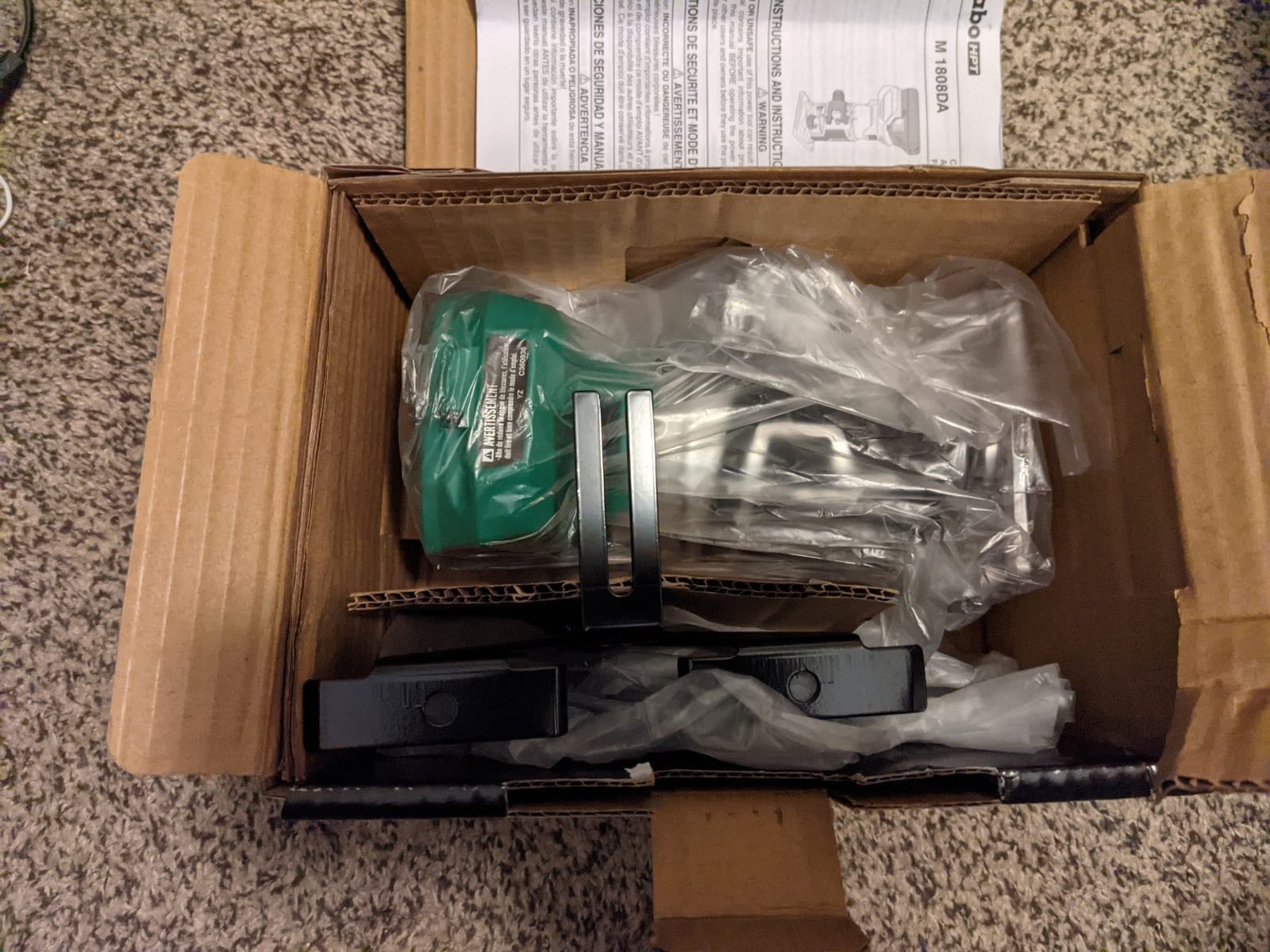
At 2.5 pounds, the Metabo HPT is the second-lightest router here and the first cordless one in this group. The body is well balanced with controls positioned where your fingers land, which makes it a genuinely pleasant one-handed tool for extended trim work.
Its LED work light is brighter than most of the integrated lighting in this roundup, and combined with the clear base it is the best visibility package among the cordless models. I could follow a pencil line on a dark laminate counter without a headlamp.
It accepts 1/4 inch and 3/8 inch collets, and the 3/8 inch cone is included, which widens the bit options compared with most palm routers. The included trimmer guide, straight guide set, template guide, dust collection port, and bit wrench make this close to a complete package.
Soft start and quick brake are both fitted, and owners credit the effective dust shroud with keeping the trim line cleaner on longer cuts. The dust port is a proper fitting rather than an adapter that leaks, which matters when routing MDF in a finished space.
Ninety-three percent of the ratings here are four or five stars, and the most common positive note is that there is no noticeable power penalty versus a corded machine. If you already own Hitachi or Hikoki 18V packs, they work here too.
Best for existing battery platforms
This router is compatible with 18V and 18V/36V MultiVolt batteries, and owners highlight the cross-compatibility with Hitachi and Hikoki packs as a recurring benefit. If your battery ecosystem is not one of the big four names, this may be the only palm router that fits it.
The lifetime lithium-ion battery warranty through Metabo HPT also reduces the long-run cost of the platform, which is a meaningful consideration if you buy packs to run this tool.
Where the brushed motor shows
The motor is brushed, and that is the principal reservation. Some owners feel it limits power compared with brushless models, particularly on thick hardwoods where you want to take more than a light pass.
Battery and charger are sold separately, and the 36V brushless version has not been released in the US. For fine detail work on veneer, painted trim, and small stock, none of that is a blocker.
11. Bosch GKF18V-25N 18V Brushless Colt Palm Router
- 1.39 peak horsepower in a 2.4 lb body
- High and low soft grip positions suit any orientation
- Fine depth adjustment in 1/64 inch increments
- Flip and release spindle lock speeds bit changes
- Drop detection and restart protection
- Smallest review base in this group at 91 ratings
- Battery and charger not included
- Fixed base only with no plunge configuration
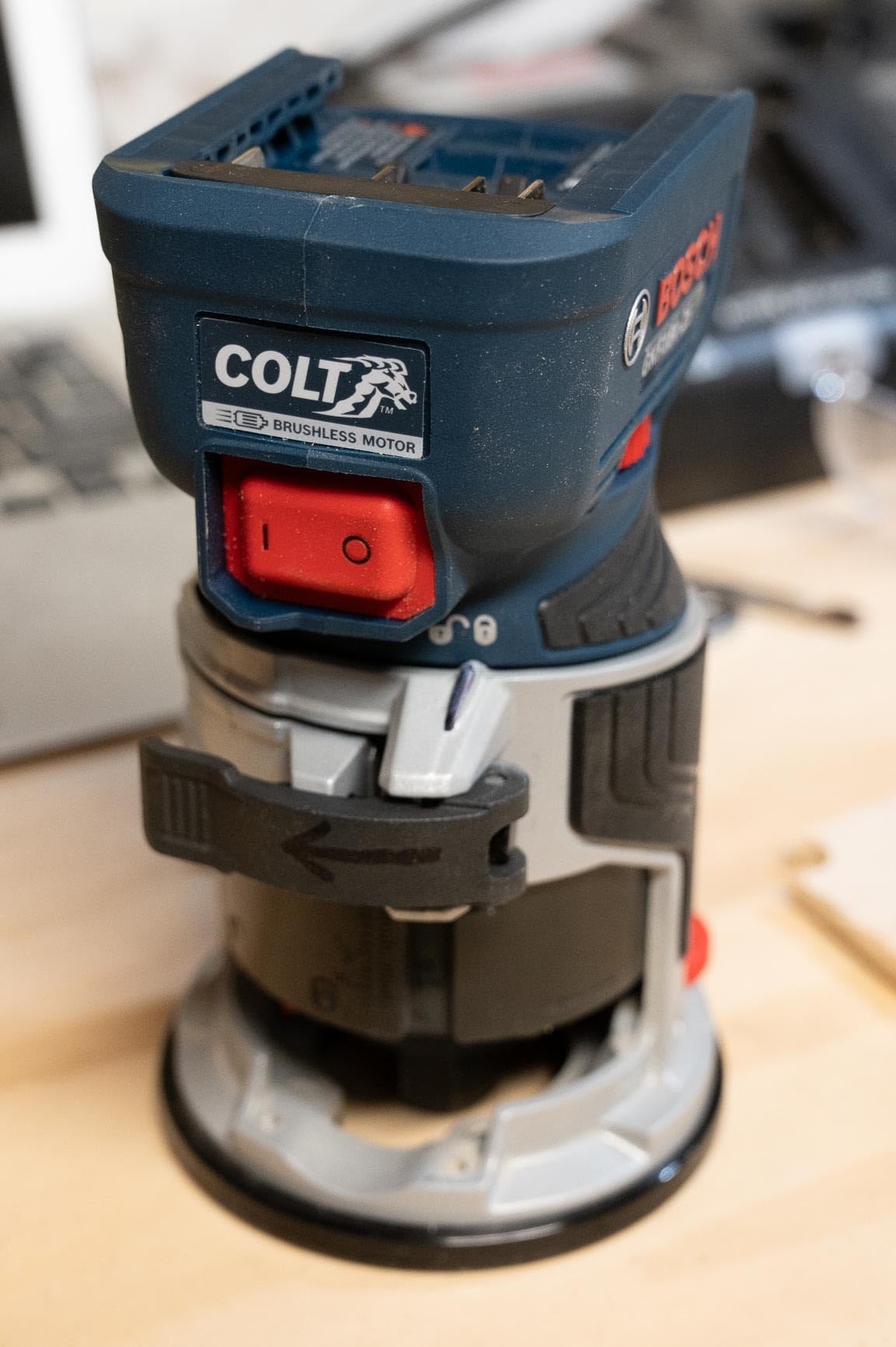
On paper this is the most capable cordless palm router in the roundup: a brushless motor delivering 1.39 peak horsepower in a 2.4 pound body. In the hand it is also the most thoughtfully laid out, with high and low soft-grip positions for working vertically or horizontally.
The depth adjustment is the standout for trim work. It has rough and fine settings in 1/64 inch increments, up to a maximum of 1-11/32 inches, so you can dial a precise height and return to it. That is the kind of resolution that makes template passes repeatable.
Drop detection auto-shutoff and restart protection are real shop safety features, not marketing lines. If the tool slips from your hand on a ladder or a lift, the motor stops rather than leaving a spinning bit at head height.
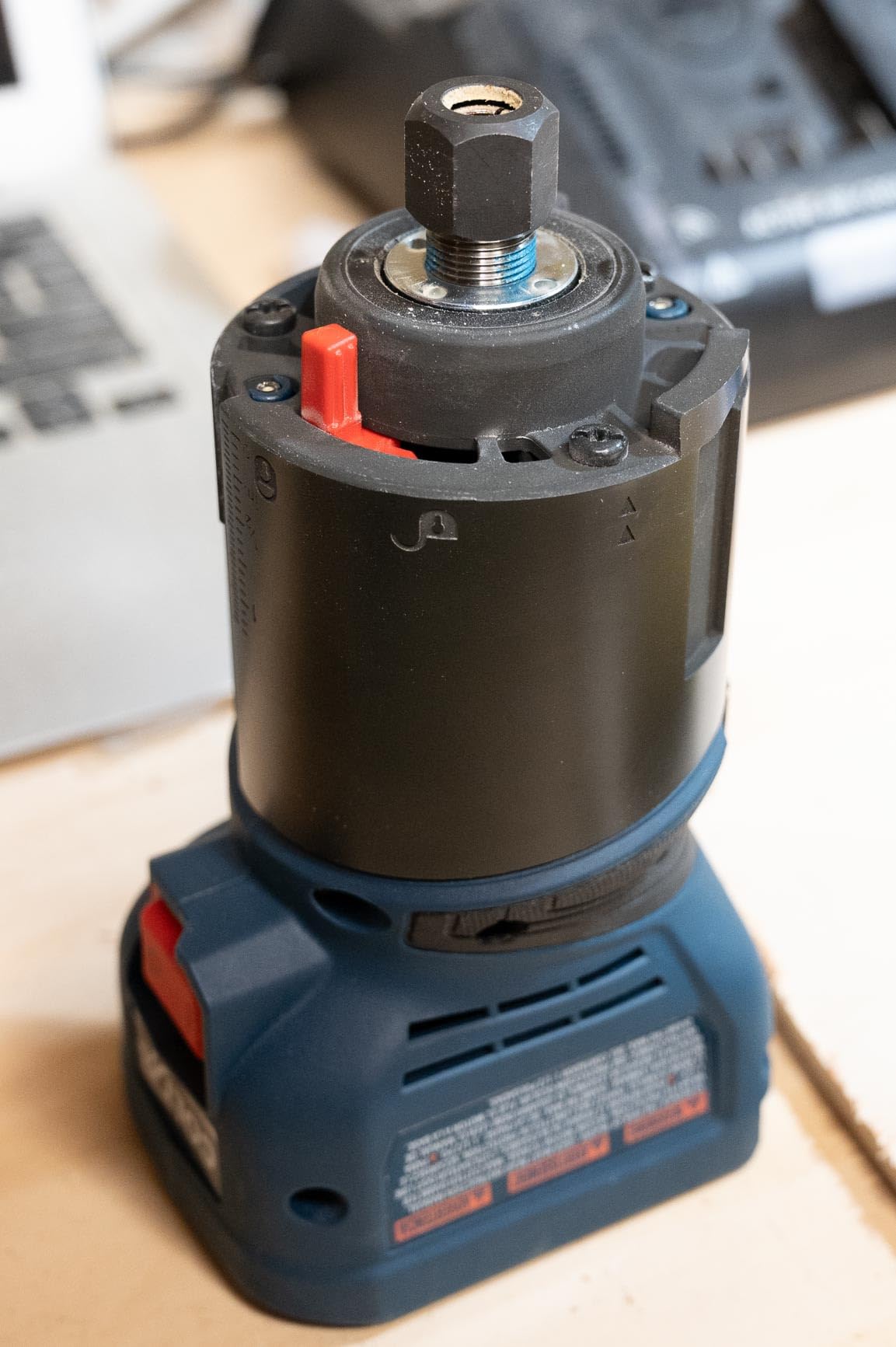
Two vacuum adapters and a chip shield are included for dust extraction, which is more than most corded routers in this list ship with. The flip-and-release spindle lock lever makes bit changes quick enough that you do not dread them.
Eighty-four percent of ratings are five stars, and owners point to the same combination: brushless power in a genuinely compact body, precise depth control, and dust extraction that actually works. Battery compatibility runs through the AMPShare system across Bosch and partner tools.
Where this Bosch earns its place
Trim work that requires precision depth setting is the sweet spot. The 1/64 inch fine adjustment let me match a second piece to a first on a routed edge, which is a requirement when cabinet doors have to line up.
At 2.4 pounds it is the second-lightest cordless machine here and the most powerful, and the five year limited warranty is the longest in the roundup. That is meaningful for a tool that sits near a workpiece and a lot of other people’s hands.
Why we ranked it below the others
The honest caveat is the installed base. With 91 ratings, this has far less long-term field history than the alternatives, and for a tool category where bearings and collets decide longevity, that matters.
Battery and charger are not included, and this kit is fixed base only. If you want plunge capability, that is another purchase and another base to store.
12. WORKPRO 20V Cordless Compact Router Kit
- Brushless motor delivers strong torque and durability
- Fixed tilting and plunge bases cover a wide range of cuts
- Plunge base reaches 38mm with dual handle control
- Kit includes battery charger dust hose guides and 6 bits
- Six speed control reduces tear out
- Highest one star share in this group at 11 percent
- Three base system and accessories add bulk to store
- May be more than a dedicated trim worker needs
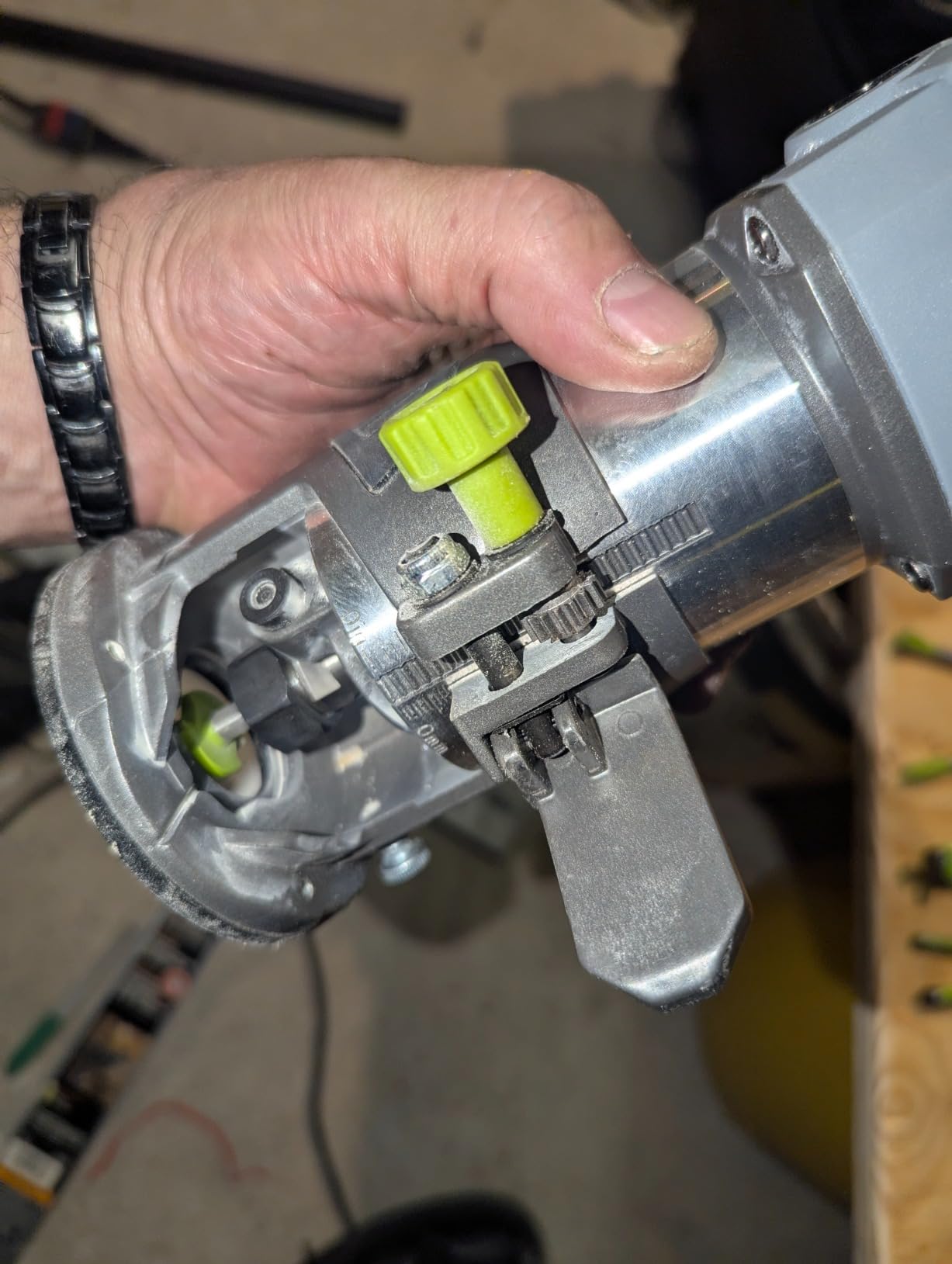
The WORKPRO kit is the only package here that solves the problem every trim router owner hits eventually: buying a plunge base. It includes fixed, tilting, and plunge bases, so internal grooves, wall dados, and cabinet hardware mortises are all possible with the same motor.
The brushless motor provides high torque, and six-speed control from 10,000 to 30,000 RPM lets you slow down for tear-out on hardwoods. The fixed base adjusts from 0 to 24mm and the dual-handle plunge base reaches up to 38mm, which is real capacity in a compact body.
The accessory bundle covers the rest: dust hose, template guides, a trimming guide with parallel fence, and six router bits. A 4.0Ah battery and fast charger are in the box, so unlike most cordless routers in this list you can use it the day it arrives.
Buyers who are happy with it rate the value highly, and the three-base design is genuinely flexible. The dual-handle plunge base gives good control at depth, which is where cheaper plunge bases feel twitchy.
Where the multi-base system helps
For trim carpenters who also install cabinets, the plunge capability is the reason this kit makes sense. Hardware installation, hinge mortising, and groove cutting all need depth control from a standing start, and that is exactly what the plunge base provides.
The dust hose and the parallel fence handle the messiest jobs. I could run a trimming guide along a shelf edge and still capture most of the debris, which is not true of every compact router with a small port.
What the ratings tell you
Eleven percent of ratings here are one star, the highest share in this group, and the 4.2 average is the lowest. Review summaries point to a spread of experiences, with some buyers reporting strong value and others citing motor or build issues.
The three-base system and full accessory bundle also add bulk to store and carry, and for a dedicated trim worker it may be more tool than you will ever use. Set your expectations accordingly, and inspect the plunge mechanism before relying on it.
Corded vs Cordless Compact Routers for Trim Work
Every forum thread on this topic eventually turns into the same argument, and there is a defensible answer for both sides. Corded machines deliver uninterrupted power and no battery logistics. Cordless machines remove the extension cord, which is the single biggest complaint about lightweight corded routers.
The cord is not a neutral detail on a palm router. Users report that a light corded machine gets dragged off track by its own cable, especially on a fence-guided pass where the cord wants to pull the base away from the edge. Cordless routers simply do not have that failure mode, which is why they are popular for on-site trim carpentry.
Weigh the reverse consideration too. Corded models such as the Bosch Colt and Makita RT0701C have documented endurance records, and the Makita in particular is reported to run long CNC sessions in extreme heat. A cordless router depends on spare packs, and a drained battery mid-cut is worse than a cord you have to route carefully.
Our take: choose corded if your trim work happens on a bench in one shop and you value constant power. Choose cordless if you move between the shop, a kitchen, and a jobsite, or if you already own a battery platform. Several owners in the forums go further and keep four or five compact routers, each dedicated to one task.
If your routing has grown into full cabinetry work, our guide to the best CNC routers for home covers the next step up in precision.
How to Prevent Router Bit Slippage
Bit slippage is the number one safety complaint in woodworking forums. A bit loosening mid-cut means the tool suddenly goes deeper than you set, which destroys the workpiece and can burn a carbide edge in seconds. It is also the complaint that most often decides a router review.
Start with the collet. The cheap collets supplied with budget routers have a visible gap, where a piece is machined out, and that gap is what lets a bit creep. ER collets, the type used across the quality tools in this roundup, clamp concentrically and are the single most-cited quality indicator among owners.
Clean the collet and the router spindle bore before every bit change. Dust and resin are abrasive, and a single trapped shaving under the collet face is enough to throw the bit off centre. Use a wooden scraper rather than metal, and never blow compressed air into the spindle.
Insert the bit at least three-quarters of an inch into the collet. A bit barely poking out has almost no grip length, and if your bit has a short shank, that is the likely cause. Full shank depth fixes the problem immediately in most cases.
Use the correct wrench. An adjustable wrench on a collet nut rounds the flats, and a rounded nut never tightens evenly. If the tool has a spindle lock, use it and a single wrench so the nut tightens square.
Tighten firmly, not violently. Snug is enough, because the clamping force inside a collet is mechanical, not torque-dependent. Over-tightening a plastic spindle housing is how threads get stripped.
If the base creeps during a cut, stop and reset the depth before continuing. A drifting base produces chatter and a burn mark, and users who found this on the Milwaukee 2723-20 correct it with a hex key between passes.
Finally, keep feed speed steady and stay at or below half the bit diameter per pass. A surging feed loads the collet unevenly and is a common trigger for the same loosening you are trying to prevent.
What to Look for in a Compact Router for Trim Work
Collet type and grip length come first, as the section above explains. After that, five criteria decide whether a compact router suits your trim work.
Depth adjustment resolution and repeatability matter more than raw power. A single-knob ring, as on the DEWALT, or a macro and micro pair, as on both Bosch Colt models, lets you return to the same height without guesswork. Single-dial twist locks are faster but less precise, and quick-release levers with a separate fine knob are the most flexible of all.
Base visibility and size come next. A clear polycarbonate subbase, as on the Bosch GKF125CEN, lets you see the bit and the workpiece. A large non-split base tracks an edge more faithfully than a small split one, but a small base is easier to work with in tight corners and on small stock.
Weight and balance determine whether you finish the job. Below about 3.5 pounds, a router is easy on the hand but more sensitive to cord drag and vibration. Between 3.5 and 4.5 pounds, most woodworkers find a good compromise. The Metabo HPT at 2.5 pounds and the Ryobi at 3.2 pounds suit small-hand or overhead work best.
Variable speed control spanning roughly 10,000 to 30,000 RPM lets you match the tool to the material. Running hardwood at the top of the range with a fresh bearing-guided bit is the most common route to a burn mark, and a wide dial is the fix.
Safety features deserve attention on a tool that runs a spinning bit near your hands. Soft start prevents a jump at entry, a spindle brake or electronic brake stops the bit quickly when you lift away, and on the Bosch GKF18V-25N, drop detection shuts the motor down if the tool falls.
Finally, think about the accessory ecosystem. A plunge base, an edge guide, a template guide, and a dust port are frequently sold separately, and aftermarket plunge bases can cost more than the router itself. The WORKPRO and AVID POWER kits include the most of this in the box.
For the finishing side of the job, our guide to the best paint for trim covers what happens after the router is put down.
Essential Router Bits for Trim Work
A compact router is only as good as the bits you feed it, and most beginners underrate this. Four bit types cover the overwhelming majority of trim jobs.
A straight trim bit with a bearing at the bottom is the flush trimming workhorse. It rides the edge of a laminate counter and cuts the overhang off square. Buy two, because a bearing-guided bit that has dulled will ruin an edge.
A 1/4 inch shank straight bit without a bearing handles groove cuts, dadoes, and rabbets, and it is the bit most likely to slip in a collet, so fit it with full shank insertion.
A roundover bit softens every edge you route and is the one most people reach for first. A bearing-guided roundover with a larger radius gives you control over the profile, and carbide holds an edge far longer than high-speed steel on laminate.
A chamfer or bevel bit handles the small angle cuts that show up on cabinet backs and shelf edges, where a 45 degree face catches light and hides imperfections.
One technique note: on a small palm router, a quarter inch bit takes roughly an eighth inch per pass, and a half inch roundover wants about a quarter inch. People learn this the hard way when they overload a bit and burn the work.
Frequently Asked Questions
Is a compact router the same as a trim router?
Yes. Compact router, trim router, palm router, and laminate trimmer all describe the same class of tool: a one-handed router with a 1/4-inch collet and a fixed or interchangeable base, usually between 1 and 1.5 horsepower, built for edge profiling, flush trimming, and small joinery.
Can a plunge router do trim?
A plunge router can do any trim cut a compact router does, and many compact routers accept a plunge base as an add-on. The difference is that a plunge base lets the bit enter and leave the wood mid-cut, which is needed for grooves and dados but not for flush trimming an edge.
Are compact routers worth it?
For trim and detail work, yes. Forum consensus is that a full-size router can do everything a compact router can, but the smaller machine is lighter, faster to maneuver, and more controllable on a single edge pass. If you already own a full-size router, a compact one is a fast, controllable second tool.
What is the best mini router?
Among the twelve tested here, the DEWALT DCW600B stands out overall thanks to its brushless motor, single-knob depth ring, dual LEDs, and 4.8 stars across more than 10,000 ratings. The Bosch PR20EVS is the best value pick at 3.3 pounds, and the Metabo HPT is the lightest cordless option at 2.5 pounds.
Is a trim router good enough for most projects?
For edge profiling, flush trimming, roundovers, and template work, yes. Trim routers are limited by base opening and horsepower, so deep grooves, thick hardwood rabbets, and large-diameter bits are better handled by a full-size router or by adding a plunge base. Small joinery, cabinet hardware, and inlay work are all within a trim router’s range.
Why is my router bit slipping in the collet?
The most common causes are a worn or low quality collet, a bit inserted too shallowly, and a collet face with trapped dust. Insert the bit at least three-quarters of an inch, clean the spindle and collet with a wooden scraper before every change, use the correct wrench, and tighten firmly rather than violently.
What collet does a compact router use?
Most compact routers use a 1/4-inch collet that takes 1/4-inch shank bits. A few models in this roundup, including the Metabo HPT M1808DAQ4 and the AVID POWER kit, also accept 3/8-inch collets, which opens up larger profiling bits. ER-type collets clamp more evenly than the split collets found on entry-level tools.
Do I need a plunge base for trim work?
Only if you also cut grooves, dados, or hardware mortises. Flush trimming, edge banding, and edge profiling all work with a fixed base. Most plunge bases are sold separately, and aftermarket units can cost more than the router, so buy one when a project calls for it rather than up front.
Why does my router burn the wood?
Most often the bit is running too fast for the material and the cutting edge. Dial the variable speed down toward the low end of the range on hardwood, take shallower passes of no more than about half the bit diameter, keep the feed speed steady, and make sure the bearing on a guided bit is clean and rolling freely.
Final Verdict on the Best Compact Routers for Trim Work
The DEWALT DCW600B is our pick for the best compact routers for trim work, because the single-knob depth ring stayed repeatable through every pass and the brushless motor held speed on laminate. The Bosch PR20EVS is the value pick at 3.3 pounds, the Metabo HPT M1808DAQ4 is the lightest cordless option, and the Bosch GKF18V-25N is the one to buy if safety features matter most to you.
Whichever you choose, the habits matter more than the badge: keep the bit in the collet a full three-quarters of an inch, clean the collet face before every change, and stay at or below half the bit diameter per pass. That is what keeps the edge clean and the bit where you left it. For wider finishing context, see our trim tab roundup.