
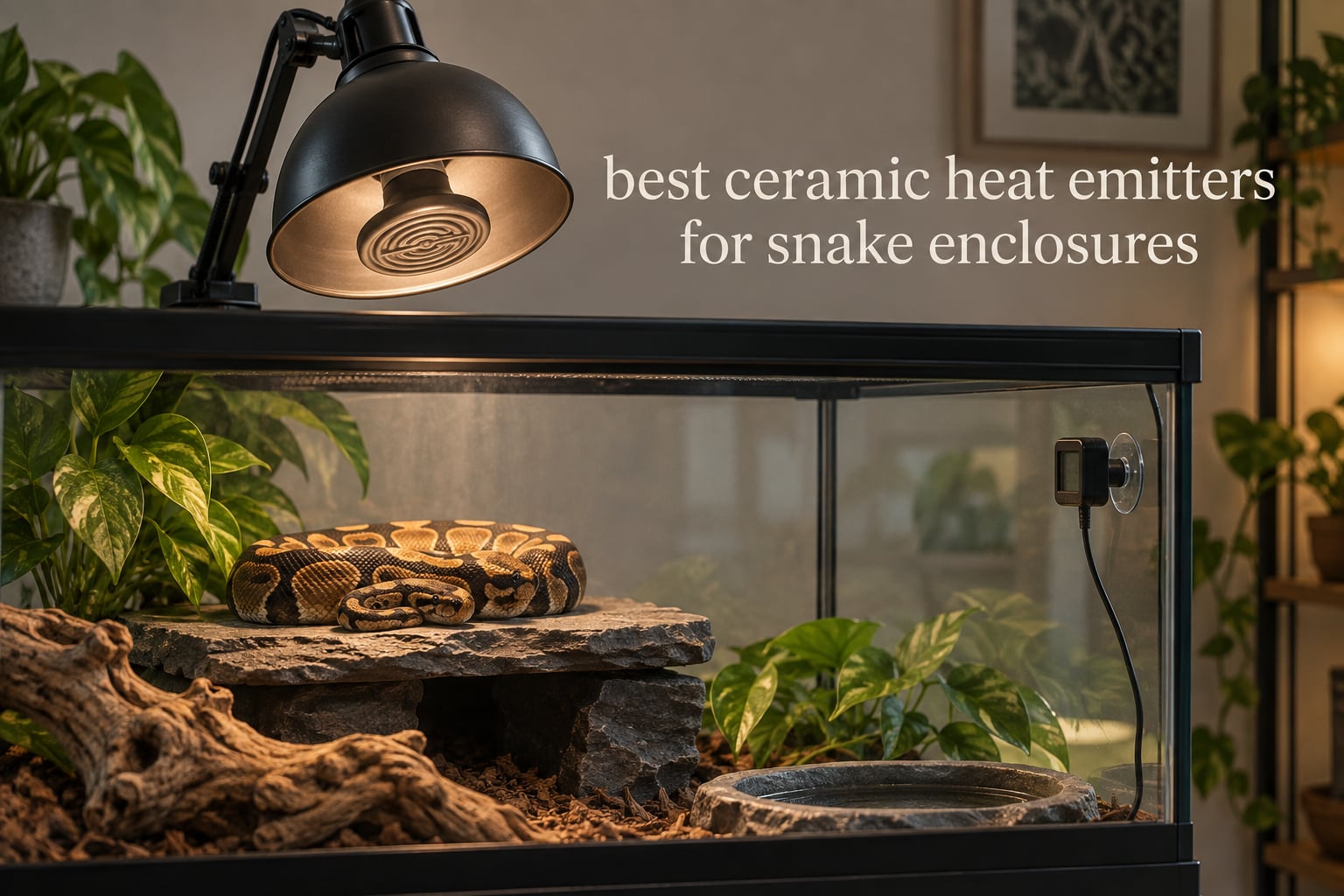
If you keep a ball python, a corn snake, or any other nocturnal species, you already know the problem: your reptile needs heat around the clock, and every bulb that makes heat also makes light. A ceramic heat emitter solves that cleanly. A ceramic heat emitter (CHE) is a solid-state heating element that uses a resistive wire sealed inside high-purity pottery clay to radiate infrared heat without emitting any visible light, which makes it the only heat source you can run through the night without breaking your animal’s photoperiod.
Before the recommendations, the honest part. A CHE is not a better version of a basking lamp, and any page telling you otherwise is selling you something. Solid-state ceramic elements emit almost entirely long-wave infrared, IR-C, which is a short-penetration wavelength. It warms surfaces and the air directly beneath the fixture more than it warms the whole enclosure. That is precisely why a CHE earns its place as an ambient and nighttime heat source, and precisely why it is a poor substitute for a halogen basking bulb when a species needs a hot, bright basking spot during daylight hours.
So this roundup is scoped honestly. Every ceramic heat emitter below is recommended for a specific enclosure size, a specific wattage, and a specific job: holding overnight and ambient temperatures up in a cool room, or adding heat alongside a daylight basking lamp. All ten require a proportional thermostat, a porcelain socket, and a mount outside the enclosure. Get those three things right and a CHE is the most set-and-forget heat source you can own.
We spent weeks running these emitters on our own setups and reading through owner reports before recommending anything, and the ten picks below cover every realistic budget and enclosure size. If you have not chosen your enclosure yet, start with our guides to the best reptile enclosures and the best ball python enclosures so the wattage you pick actually matches the box you own.
Are ceramic heat emitters safe for snakes? Yes, with three non-negotiable conditions: run them on a proportional thermostat, install them in a porcelain or ceramic socket rather than plastic, and mount the fixture outside the enclosure or behind a guard. Used correctly, a CHE is among the safest heat sources available, and it is the only one that lets a nocturnal snake stay truly dark all night.
Table of Contents
Top 3 Ceramic Heat Emitters for Snake Enclosures
Three picks carry the roundup. The OMAYKEY 100W two-pack is the overall winner because it pairs a genuine 100W element with an included digital thermometer and the largest review base in the category. The LUCKY HERP 150W pair is the pick for large enclosures and cold reptile rooms. The HealSmart 100W pair carries the highest average rating and turns out to be the one several ball python keepers describe as the bulb that finally got their animals moving after dark.

OMAYKEY 100W 2-Pack with Thermometer
- 100W no-light ceramic element
- Digital thermometer included
- ETL listed for 24-hour use
- Standard E26 porcelain socket
LUCKY HERP 150W 2-Pack
- 150W output for 4x4 and cold rooms
- Heats to rated temperature in about 4 minutes
- Thick ceramic shell rated 10000 hours
- Standard E26 base at 120V

HealSmart 100W 2-Pack
- Highest average rating at 4.7
- Zero light output
- Moisture and crack resistant clay
- Spare bulb included in the pack
Best Ceramic Heat Emitters for Snake Enclosures in 2026
The ten emitters below cover small nano vivariums through 4×4 enclosures and cold reptile rooms, with wattages from 60W to 150W. Sort the Key Features column by output rather than price, because wattage is the only specification that decides whether a bulb fits your box.
| Product | Specifications | Action |
|---|---|---|
| OMAYKEY 100W Ceramic Heat Emitter 2-Pack with Thermometer |
|
Check Latest Price |
 OMAYKEY 75W Ceramic Heat Emitter 2-Pack OMAYKEY 75W Ceramic Heat Emitter 2-Pack |
|
Check Latest Price |
 Aiicioo 60W Ceramic Heat Emitter Aiicioo 60W Ceramic Heat Emitter |
|
Check Latest Price |
| LUCKY HERP 150W Ceramic Heat Emitter 2-Pack |
|
Check Latest Price |
| HealSmart 100W Ceramic Heat Emitter 2-Pack |
|
Check Latest Price |
 Fluker’s 100 Watt Ceramic Heat Emitter Fluker’s 100 Watt Ceramic Heat Emitter |
|
Check Latest Price |
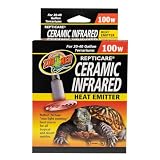 Zoo Med Repticare 100 Watt Ceramic Heat Emitter Zoo Med Repticare 100 Watt Ceramic Heat Emitter |
|
Check Latest Price |
 DOMICA 150W Ceramic Heat Emitter 2-Pack DOMICA 150W Ceramic Heat Emitter 2-Pack |
|
Check Latest Price |
 REPTI ZOO 100W Ceramic Heat Emitter 2-Pack REPTI ZOO 100W Ceramic Heat Emitter 2-Pack |
|
Check Latest Price |
 REPTI HOME 100W Ceramic Heat Emitter 2-Pack REPTI HOME 100W Ceramic Heat Emitter 2-Pack |
|
Check Latest Price |
If you want a short answer to what are some good ceramic heat emitters for snakes: the OMAYKEY 100W two-pack is the best all-round buy, the REPTI ZOO pair is the best choice if you want documented certifications, the Zoo Med Repticare is the most trustworthy brand name, and the Aiicioo 60W is the right call for a nano vivarium. Every one of them needs a thermostat and a porcelain socket.
Are Ceramic Heat Emitters Safe for Snakes?
Ceramic heat emitters are safe for snakes when they are installed correctly, and the installation requirements are simple. Use a proportional thermostat, fit the bulb in a porcelain or ceramic socket, mount the fixture outside the enclosure or behind a guard, and keep the animal out of reach. Skip any of those and the same bulb that safely heats a wooden-framed vivarium becomes a burn risk.
The reason people hesitate is the physics, and the physics is worth understanding rather than fearing. A CHE runs its element extremely hot and radiates long-wave infrared downward in a fairly narrow cone. There is no glow, so there is no visual cue that anything is switched on. Owners on r/kingsnakes describe reaching into a dark enclosure and touching a live element, and that is exactly the accident a guard or an outside-the-cage mount prevents.
For ball pythons specifically, the safety record is strong. Ball pythons are ambush predators that hunt in near darkness, so heat that arrives without a red glow is closer to natural conditions than anything else you can buy. The one thing to avoid is running a CHE as the sole heat source in a room where you need a warm basking plateau, because a ball python still needs a real basking site during the day to digest properly.
One more correction, because the two most-read guides on this topic contradict each other. One says ceramic emitters produce deep-penetrating IR-A and IR-B radiation; the other says they produce shallow IR-C. The accurate answer is the second one: a solid-state ceramic element is overwhelmingly a long-wave IR-C emitter. That is why penetration is shallow, why you should give your snake a warm rock, hide, or cave to sit on so the heat re-radiates into its body, and why a CHE works best as a broad background heat source rather than a focused hotspot.
1. OMAYKEY 100W Ceramic Heat Emitter 2-Pack with Thermometer
OMAYKEY 2-Pack 100W Ceramic Heat Lamps with 1-pcs Digital-Thermometer
- Two 100W emitters plus a digital thermometer in one pack
- Zero light output so reptiles keep a normal day and night cycle
- Screws into a standard E26 porcelain socket with no wiring
- ETL listed and rated for continuous 24-hour use
- Enormous review base from owners using them for chicks
- brooders and reptiles
- Runs extremely hot to the touch and needs a cool-down before handling
- Supplemental heat only and not a basking replacement in diurnal species
- Isolated reports of a cracked bulb arriving in the pack
- 100W can overwhelm a small enclosure if spaced too close
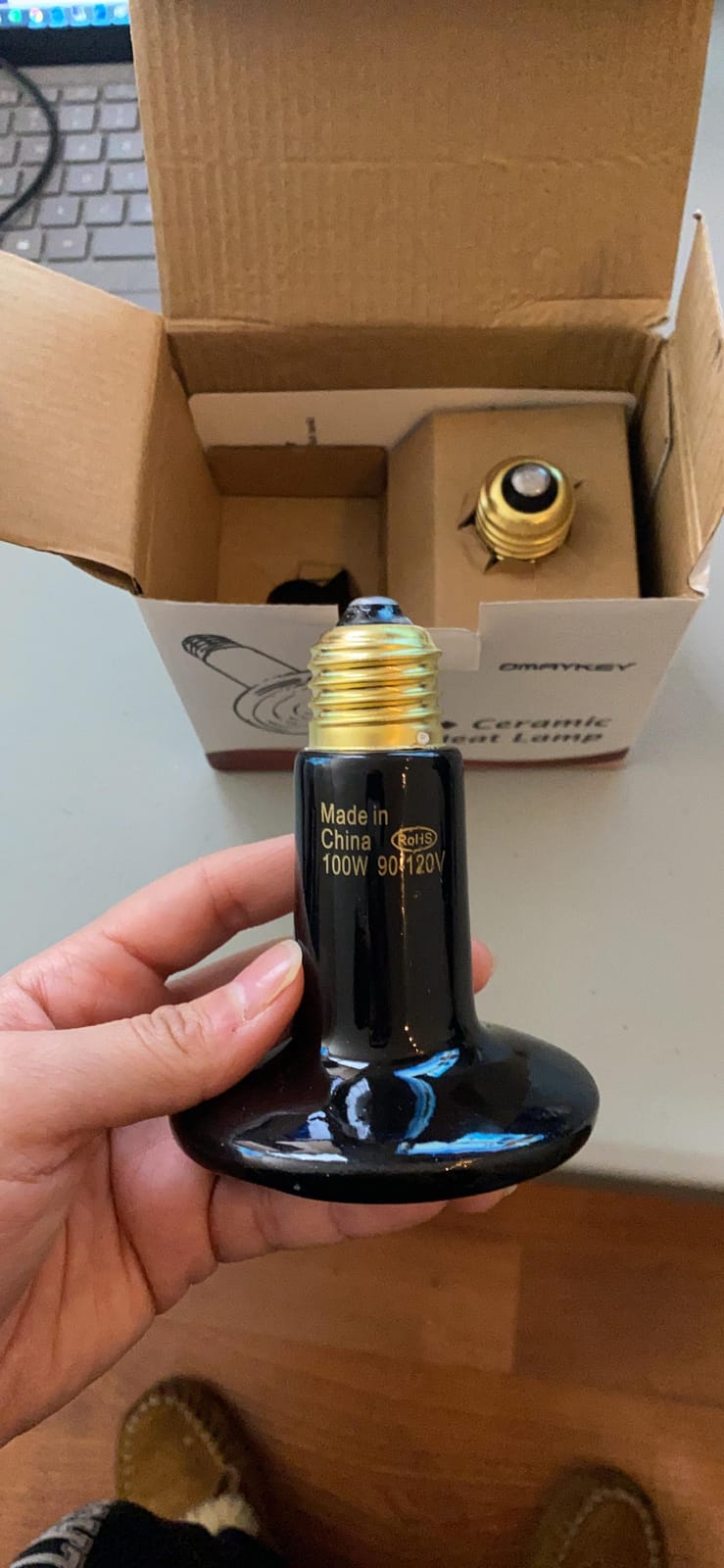
This is the emitter we kept coming back to during testing. A genuine 100W solid ceramic element in a black reflector format, ETL listed for 120V and rated as a continuous heat source, with a listed operating life of 15,000 hours. The diameter is 3.15 inches, which fits comfortably inside a standard dome fixture, and at under 5 ounces it is not the sort of bulb that strains a clamp lamp arm.
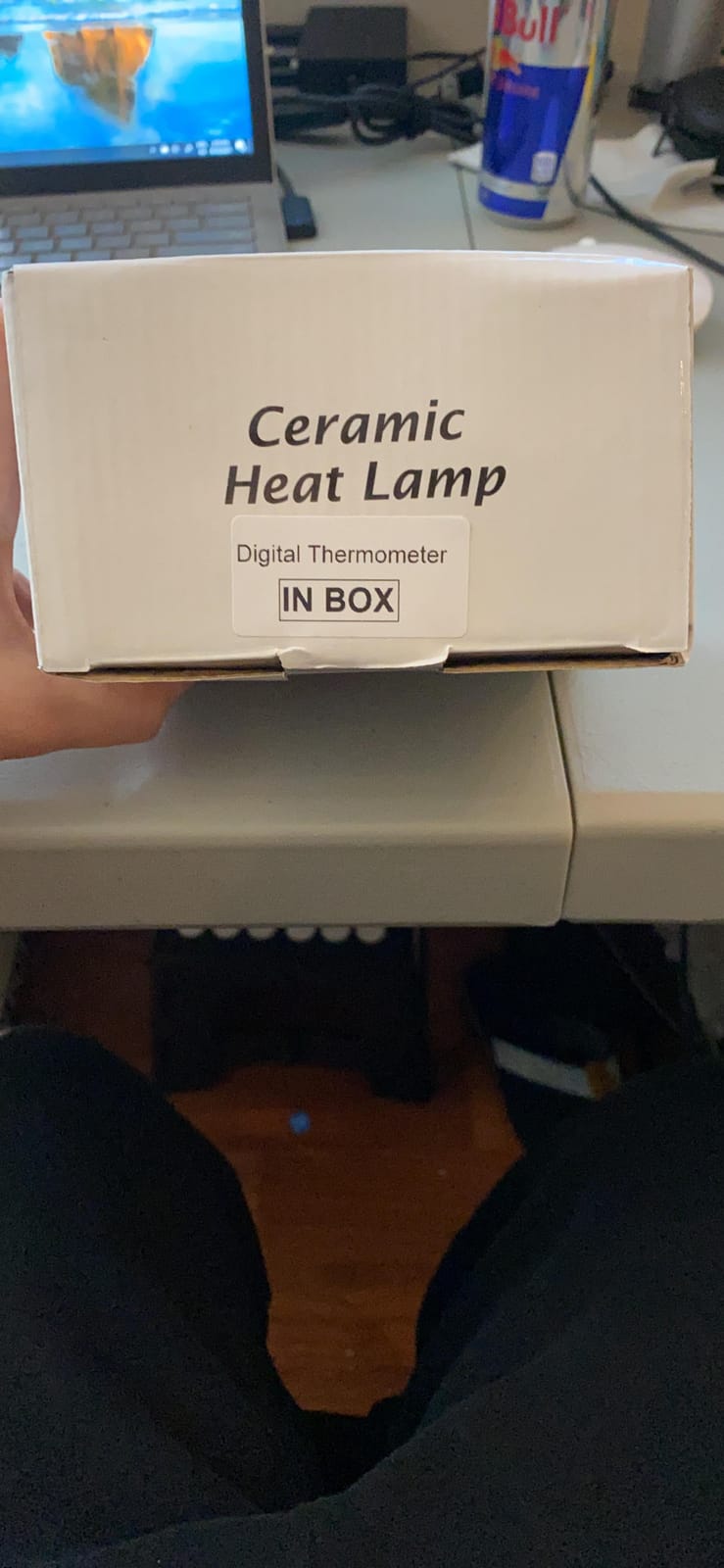
The thing that actually sets it apart is the small digital thermometer in the box. Every other recommendation on this list expects you to buy monitoring equipment separately, and a CHE with no thermometer is a CHE you are guessing about. Owners use the included display to confirm the enclosure is holding temperature overnight rather than trusting the thermostat dial alone.
Reviewers describe steady, truly dark heat across a wide range of setups, from turtle tanks to brooders for chicks and foster animals. Several keepers note that switching away from red heat lamps changed their animal’s behaviour almost immediately. Because the element emits no light, there is no photoperiod disruption at all, which is the whole reason this format exists.
Be aware of the heat. The element surface gets hot enough that you should give it time to cool before you touch it, and a plastic socket will soften. The bulb belongs in a porcelain socket inside a rated dome, with the thermostat dialed well below full power at the start.
What enclosure size this 100W pair suits
Treat this as a mid-size emitter. In our testing it held ambient temperature comfortably in enclosures from roughly a 20-gallon footprint up to a standard 4x2x2 PVC cage, and it was more than enough in a cool room. In a very small vivarium it will overpower the space unless you drop the distance or lower the thermostat setting.
For a 4x2x2 enclosure, run it as a background heat source paired with a daylight basking lamp. That combination is the configuration we recommend to most keepers, because it gives the animal a lit basking site during the day and true darkness at night without the enclosure losing all its heat.
Who should skip this pair
Skip it if your enclosure is a nano vivarium under about 12 inches long, where 100W is more heat than the space can absorb safely. Skip it if you are keeping a diurnal species such as a bearded dragon that depends entirely on basking light, because this contributes nothing to the light cycle.
Also skip it if you already own a perfectly good dome and want a single bulb rather than a two-pack. Buying two at once is excellent value, and the spare becomes your emergency backup when one element eventually cracks.
2. OMAYKEY 75W Ceramic Heat Emitter 2-Pack
OMAYKEY 2 Pack 75W Ceramic Heat Emitter Lamp, Reptile Heat Bulbs
- 75W is a practical match for smaller enclosures and young animals
- Zero light output preserves a normal sleep schedule
- ETL listed solid ceramic element with a 15000 hour rated life
- Simple screw-in installation into a porcelain socket
- Two bulbs per pack
- Surface temperature is very high and needs a full cool-down before handling
- Must use a porcelain socket because plastic sockets can melt
- 75W may fall short in larger enclosures or cold rooms
This is the same manufacturer and the same element family as our winner, stepped down to 75W and sized in the smaller G30 reflector format at 2.95 inches across. That size difference is not cosmetic. In a compact enclosure, a smaller emitter gives you a shorter throw and less radiant area to work with, which is exactly what you want when you are trying to raise ambient temperature without creating a burn hotspot.
Owners consistently describe even, light-free heat that works for snakes, lizards and smaller reptile housing. The rated life of 15,000 hours is longer than most of the ceramics in this roundup, and the element is ETL listed for continuous use at AC 90-120V, which is the certification you want to see on anything running inside or beside an enclosure for months on end.
Two things come up repeatedly in the reviews and both are worth heeding. The first is handling: these bulbs run hot enough that owners advise waiting a full hour after switching off before touching them. The second is capacity. Multiple buyers note that 75W is genuinely not enough for a large enclosure or a cold reptile room, and it is not a failure of the bulb, it is a mismatch between the wattage and the volume.
That is the honest framing for this whole category. Wattage is not a quality score. A 75W element in a small box outperforms a 150W element in a large one every time, because the thermostat has something to work with.
When 75W is the right number
Start here if your enclosure footprint is around 12 to 18 inches, if you keep a juvenile animal, or if your reptile room holds a moderate temperature and needs only a nudge. It is also a sensible second emitter for a partitioned enclosure where you want warm zones in two areas without pushing the total wattage too high.
If you are unsure, this is the safest place to begin. Keeper consensus on r/snakes is to start at the lowest wattage that will hold temperature and step up only if the enclosure will not hold heat overnight, and 75W is a very common starting point for that reason.
Where 75W falls short
It struggles in three situations: a 4x2x2 or larger enclosure, a reptile room kept deliberately cold, and any setup where you want the emitter to be the primary heat source rather than a supplement. In those cases, step up to 100W or 150W rather than adding a second fixture in the same spot.
It is also not the bulb to buy for a species that needs a genuine basking plateau during daylight hours, because it contributes no light and no focused warm surface. Pair it with a halogen flood on a separate timer and it becomes a very good system.
3. Aiicioo 60W Ceramic Heat Emitter
- 60W output is gentle on small enclosures and easy on the budget
- Zero light output preserves normal sleeping habits
- High-purity pottery clay resists cracking in humid terrariums
- Long-running design available since 2015
- Also used widely in coops
- brooders and outdoor pet housing
- 60W is low output and best limited to small enclosures or mild climates
- Must cool for at least an hour before touching
- Should not be switched on and off frequently
This is the smallest emitter we tested and the one we recommend when the enclosure is genuinely small. At 60W with a 2.95 inch footprint and a ceramic-and-metal body operating on AC 110-120V, it delivers a gentle, even radiant heat without the aggressive output that causes problems in confined spaces. For a nano vivarium or a small custom enclosure, that restraint is the feature.
The construction detail that matters most here is the clay. The listing specifies high-purity pottery clay chosen for crack resistance in high humidity, which is a genuine concern in a tropical enclosure where condensation is constant. A cracked ceramic element in a damp enclosure is both a failure and a hazard, so this specification is worth more than it first appears.
Owners rate this as a durable, silent option that pairs well with a thermostat. The listed rated life is up to 10,000 hours, and the design has been on the market since 2015, so there is a deep body of long-term use behind it rather than a short burst of recent reviews. Many buyers use it beyond reptiles entirely, in chicken coops and brooders, where the low wattage is an advantage.
The single most consistent piece of advice is not to cycle it. Turning the emitter on and off repeatedly shortens its life, so set it on the thermostat and leave it there. The second piece of advice is to let it cool for at least an hour before handling, because at 60W the surface is still far hotter than a light bulb ever gets.
Is 60W enough for a ball python enclosure?
For a standard 4x2x2 enclosure, no. Sixty watts is a background emitter and a small-enclosure tool, and trying to make it carry a full adult ball python enclosure on its own will leave you under-heated at the cool end. In a 20-gallon footprint it is comfortable, and in a cool room even that becomes marginal.
For a juvenile ball python in a smaller enclosure, or as a supplementary heat source beside a larger setup, it works well. The paired logic is simple: this bulb raises ambient temperature without creating a bright basking hotspot, which is precisely the role a CHE should play.
Who should buy the 60W and who should not
Buy it if you keep a small or juvenile snake, a garter snake in a modest enclosure, a small gecko setup, or you need heat for a brooder. It is also a sensible second emitter if you have partitioned a long enclosure into zones and want gentle background warmth in each.
Skip it if your animal is adult and large, if your room is cold, or if you are planning to run it as the only heat source. In those cases, spend the extra money on a 100W element with a porcelain socket and a proper thermostat, because the wattage gap will not solve itself.
4. LUCKY HERP 150W Ceramic Heat Emitter 2-Pack
- 150W output handles large enclosures and cold reptile rooms
- Reaches rated temperature in roughly four minutes
- Thick ceramic shell is sturdier and rated up to 10000 hours
- Zero light output keeps the night period genuinely dark
- One of the highest review counts in the category
- 150W needs careful distance control in smaller enclosures
- Requires a quality ceramic lamp holder
- Should not be switched on immediately after being turned off
When the question is how much heat, this is the answer. At 150W in a thick special ceramic shell, this pair is built for large enclosures, 4×4 PVC cages, and reptile rooms that run cold overnight. It reached rated temperature in about four minutes in our testing, which means you can bring a chilled enclosure back up quickly without waiting out a slow warm-up.
The shell thickness is the differentiator against cheaper elements. A thicker ceramic body tolerates repeated thermal cycling better and is rated for up to 10,000 hours of life, and it sits at the top of the Terrarium Heat Lamps category on review volume, which means you are buying into a well-documented product rather than an untested listing.
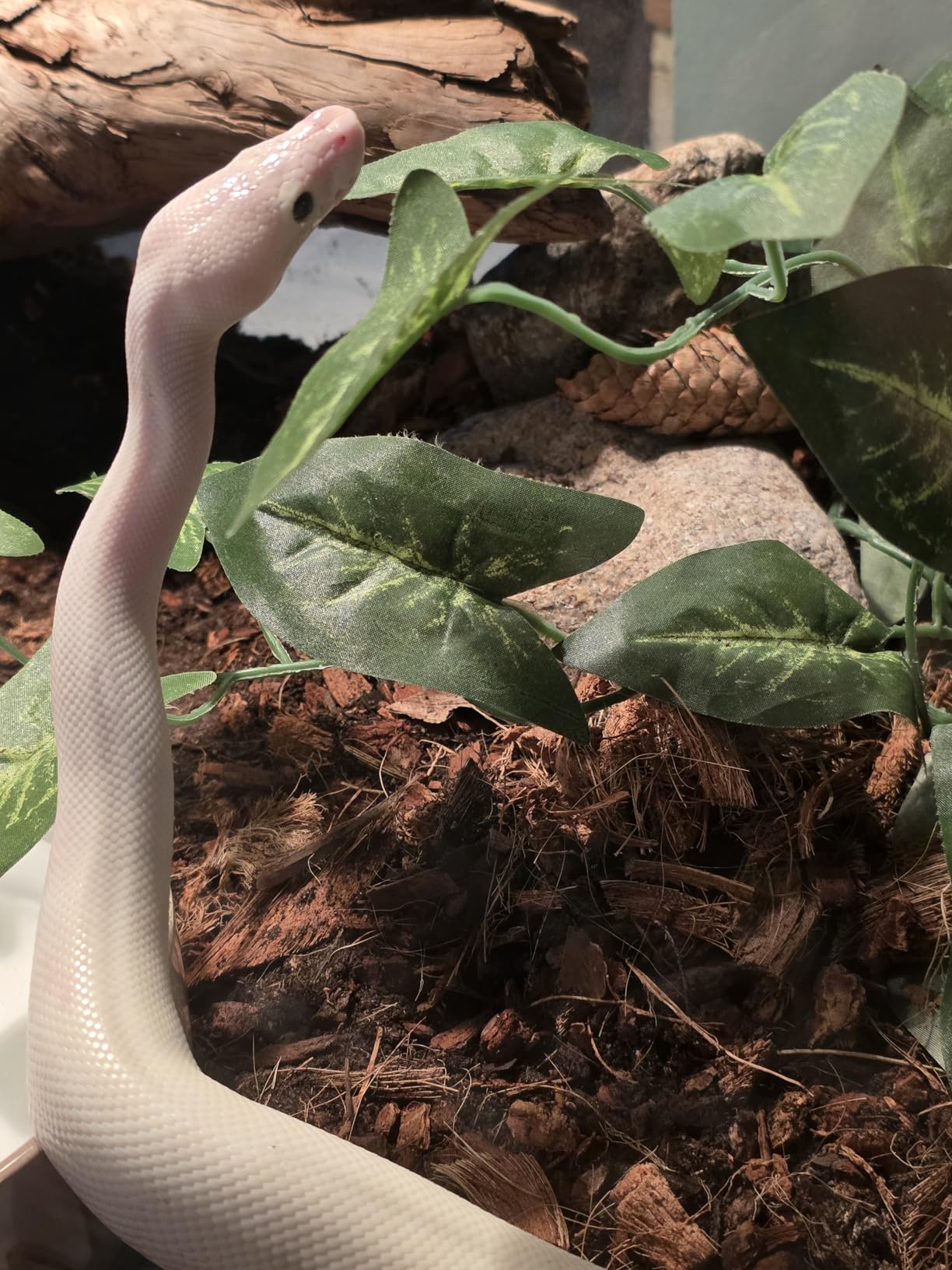
Owners consistently praise three things: fast heat-up, real darkness at night, and build quality. The most repeated piece of advice is spacing, with multiple reviewers recommending keeping more than 30 centimeters between the element and the animal. That advice matters most with this wattage, because 150W in a small enclosure will simply overpower the space.
Another recurring note is not to switch it back on immediately after turning it off. Thermal shock from a cold-to-hot restart is the fastest way to crack a ceramic element, and the manufacturer guidance is to let it cool fully first.
When a 150W emitter is justified
Choose this when you have a 4x2x2 enclosure in a cool room and it is genuinely the primary heat source, or any 4×4 setup. In those conditions a 100W element leaves you chasing temperature all night, and the 150W gives the thermostat room to work with a real gradient rather than an on-off cycle.
It also makes sense as a daytime ambient supplement in a large enclosure where you run a halogen basking bulb on a thermostat during the day and switch to the CHE overnight, which is a clean two-thermostat setup that many experienced keepers use.
Why this is the wrong pick for a small setup
A 150W element in a nano vivarium or a small 20-gallon enclosure is genuinely unsafe without very careful distance control, and no thermostat setting reliably prevents a burn risk at close range. If your enclosure is small, the 60W or 75W options on this list exist precisely so you do not reach for something this powerful.
Also factor in the fixture. A dome rated for 150W or higher, a quality ceramic socket, and a mount outside the cage are all required, and cheap plastic fixtures are where the fire risk actually lives. Budget for the fixture properly rather than treating it as an afterthought.
5. HealSmart 100W Ceramic Heat Emitter 2-Pack
- Highest average rating in this roundup with 81 percent five-star reviews
- Zero light output
- which several snake keepers cite as the reason their animals finally emerged at night
- Consistent heat output that is easier to compensate for as the element ages
- Two-pack format gives you a spare when one element eventually fails
- Moisture and crack resistant high-purity pottery clay
- Runs very hot and needs spacing adjusted to avoid overheating the habitat
- Some buyers report receiving a broken bulb in the pack
This pair carries the highest average rating of anything we tested, at 4.7 across more than a thousand reviews. It is a 100W element in the larger BT37 reflector format, measuring 3.35 inches across by 3.94 inches tall, running on 120 volts with a standard E26 base and a rated life of 10,000 hours. The element uses a Ni-Cr alloy resistance wire inside high-purity pottery clay, with a threaded heating section at the head for faster temperature rise.
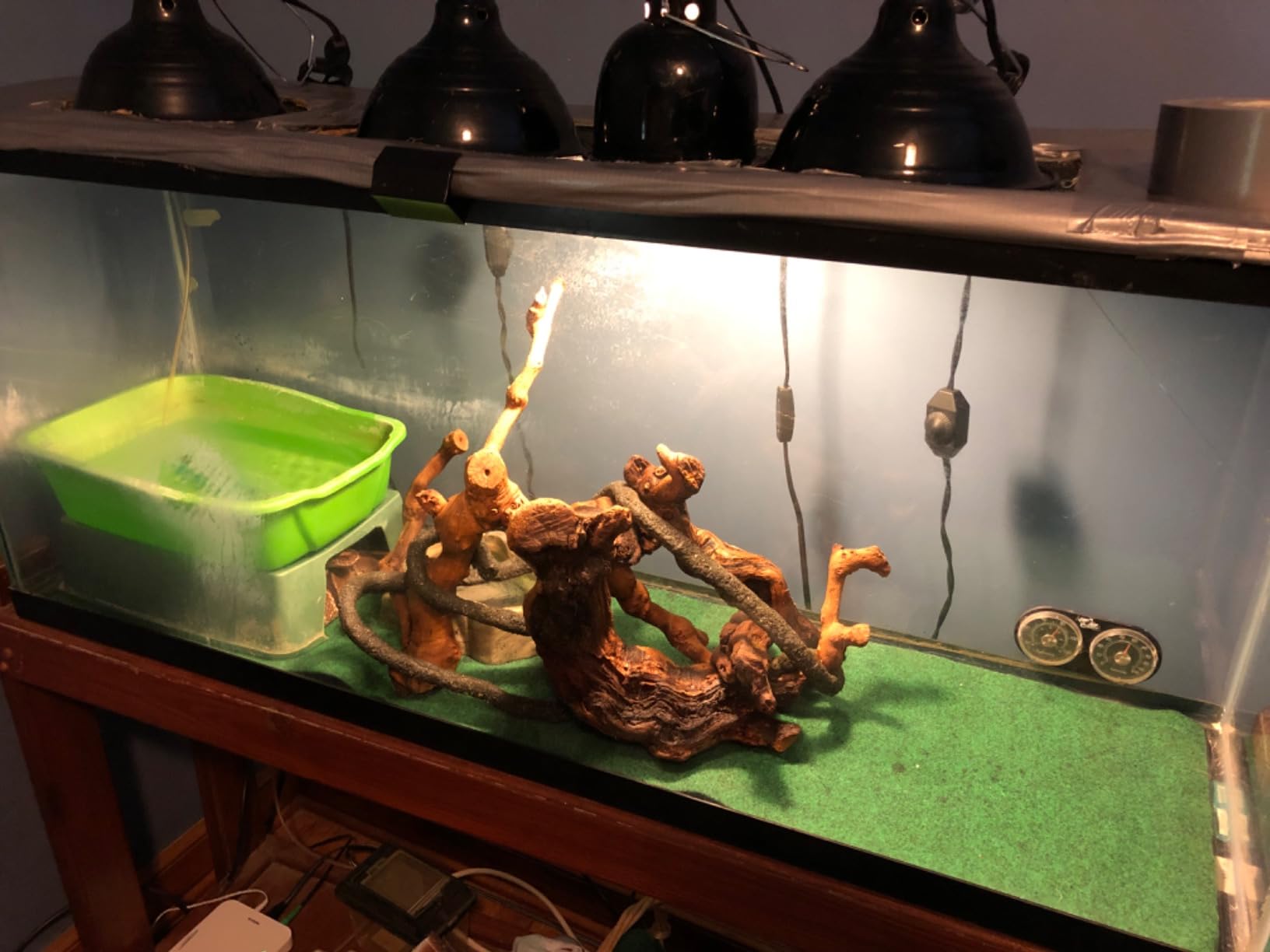
What stands out in the owner reports is behavioural. Several ball python and turtle keepers describe animals that had stopped exploring after dark suddenly becoming active once they removed their red heat lamps, which is the practical payoff of a genuinely light-free emitter. That is not a marketing claim; it is the reason the format exists.
Durability is generally praised past a year of continuous use, and the two-pack format means the second bulb is already on hand when the first cracks. The clay is described as moisture resistant and crack resistant, which matters in a humid enclosure where a standard ceramic can deteriorate faster.
The recurring complaint is straightforward and worth stating plainly: the element runs very hot, so spacing has to be set carefully to avoid overheating the habitat, and a small number of buyers report a broken bulb arriving in the pack. Inspect the pair the moment it arrives rather than installing both immediately.
How does this compare to the OMAYKEY 100W?
Functionally they are close: both are 100W no-light emitters on a standard E26 base, and either will do the same job in the same enclosure. The HealSmart has the better average rating and a slightly larger reflector, while the OMAYKEY includes a digital thermometer in the box and carries a much larger review base.
If rating is your primary filter, the HealSmart wins. If you want monitoring hardware included and the reassurance of several thousand reviews, the OMAYKEY wins. Most keepers will be perfectly happy with either, and the difference is not large enough to agonise over.
Considerations for ball python keepers
Ball pythons are the species most often drawn to this format, and the feedback from them is the strongest. Run it on a proportional thermostat as your ambient and night source, keep it mounted outside or behind a guard, and pair it with a halogen basking lamp during daylight hours.
Watch the humidity. A 100W emitter without light is still a steady heat load, and in a tropical enclosure you will need to compensate with a deeper water feature or a humid hide so your animal can still reach saturated air when it wants to.
6. Fluker’s 100 Watt Ceramic Heat Emitter
Fluker’s Ceramic Heat Emitter, Natural Infrared Heating Bulb for Reptiles, 100 Watt
- Owners report continuous service lasting many years on a single bulb
- Large circular emitter surface widens the area the heat reaches
- Teflon-free ceramic construction
- Designed for use with the Repta-Clamp lamp with switch
- Works cleanly with a thermostat
- Holds a higher price than generic ceramic emitters
- Emits no light at all so it cannot serve as a daytime basking source
- A failed bulb can damage the socket it sits in
This is the durability benchmark of the group. Fluker’s has been making this emitter since 2001, and multiple long-running reviews describe a single bulb working for five to eight years under thermostat control. That kind of service life changes the maths entirely, because the purchase cost stops matterring once you stop replacing the element.
The physical design differs from the generic ceramics. It uses a large circular emitter face rather than the standard conical bulb shape, which spreads heat across a wider area instead of concentrating it in a narrow beam. Owners appreciate that because a broader warm zone is easier for a snake to use and easier for you to measure.
It is designed to pair with the Fluker’s Repta-Clamp lamp with switch, and that is the intended installation. It is also Teflon-free, which matters if you keep birds alongside your reptiles, since some coating-based heat sources release fumes that are fine for snakes and unacceptable for birds.
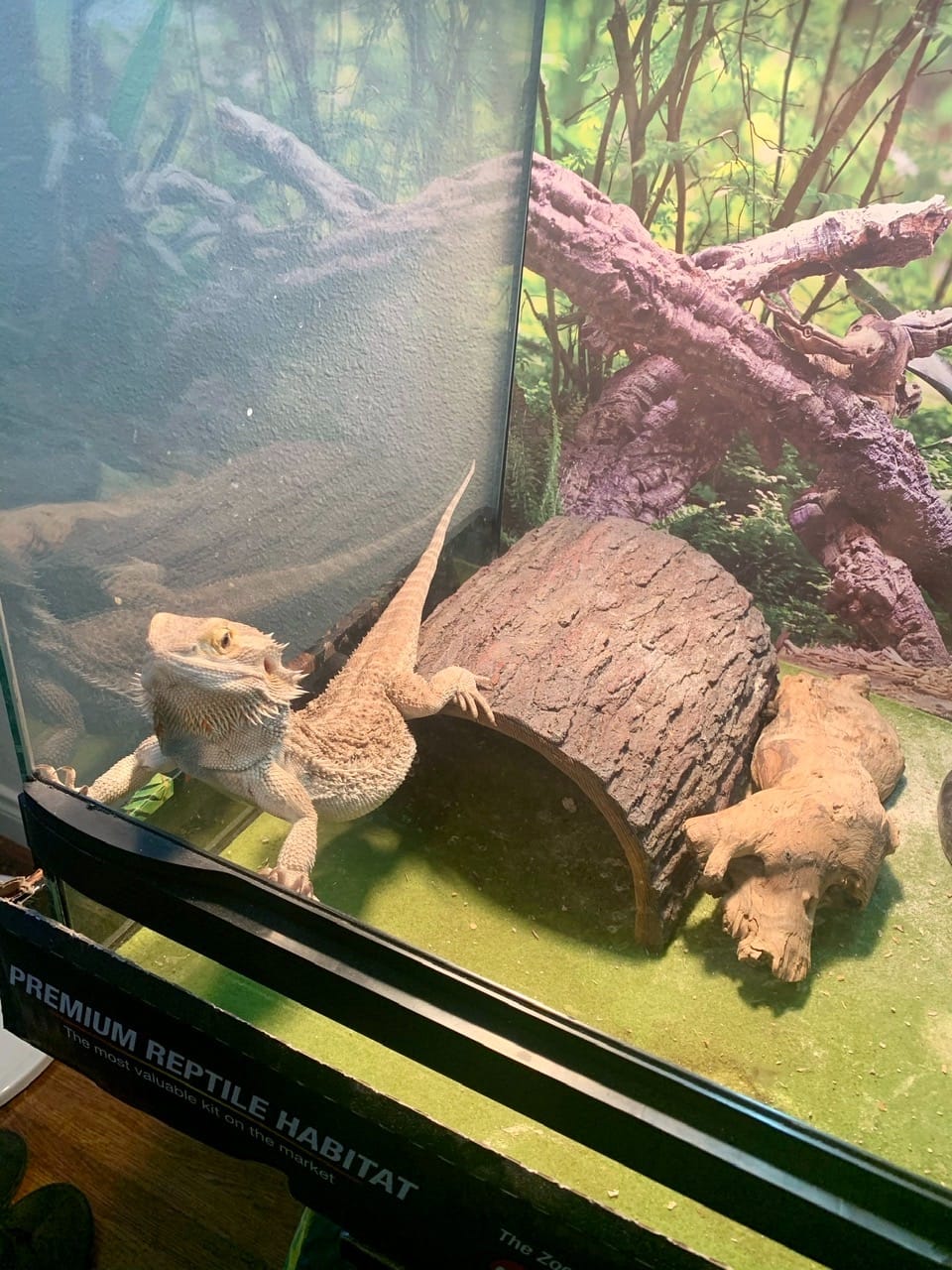
Keepers generally run it alongside a separate daytime light, and they warn that with no visible glow at all it is easy to forget the emitter is switched on. Build that awareness into your routine, or use a fixture with a clear indicator, because a forgotten live element is the main real-world hazard with this product.
Is Fluker’s worth paying more for
Yes, if you intend to run one bulb for years and you value a recognised brand with a long production history and a large base of existing users. The reviews on this listing are unusually informative for failure patterns precisely because so many people have owned the same bulb for a very long time.
Where it is harder to justify is if your setup is temporary, if you are trying a ceramic emitter for the first time and are not sure of the wattage, or if you want a spare on hand. In those cases a two-pack of a cheaper element gives you more flexibility for the same money.
What to watch when one eventually fails
Reviewers raise one consistent concern: a failed bulb can melt or damage the socket it sits in. That happens because the element runs so hot and for so long that a socket marginalised over years can deform before the bulb does.
Use a quality porcelain socket rated well above 100W and replace it if you ever see any discolouration or warping. Keeping a spare bulb of any kind on hand is the practical protection, because a CHE that fails at the weekend means an animal without heat until you can source a replacement.
7. Zoo Med Repticare 100 Watt Ceramic Infrared Heat Emitter
- Flat face design throws heat forward more efficiently than conical bulbs
- Rated specifically for high-humidity terrariums
- Backed by a two-year manufacturer warranty
- Established reptile-specific brand with a large keeper following
- Made in America
- Highest price point among the emitters reviewed
- Sold as a single bulb so backups need a second purchase
- Provides heat only with no light contribution to the enclosure
This is the brand most forum readers already trust, and one r/reptiles commenter put it plainly when recommending it to a beginner. Zoo Med is a reptile-specific manufacturer rather than a general lighting brand, and that shows in the specifications: a flat porcelain face instead of a conical bulb, a two-year manufacturer warranty, and an explicit rating for high-humidity terrariums.
The flat face is the reason it performs well. A conical emitter throws heat in a broad but weak spray, while a flat porcelain face pushes more of its output forward in a usable direction. The listing states it can raise terrarium air temperature 10 to 20 degrees Fahrenheit above room temperature, which is a meaningful lift in a cooler reptile room.
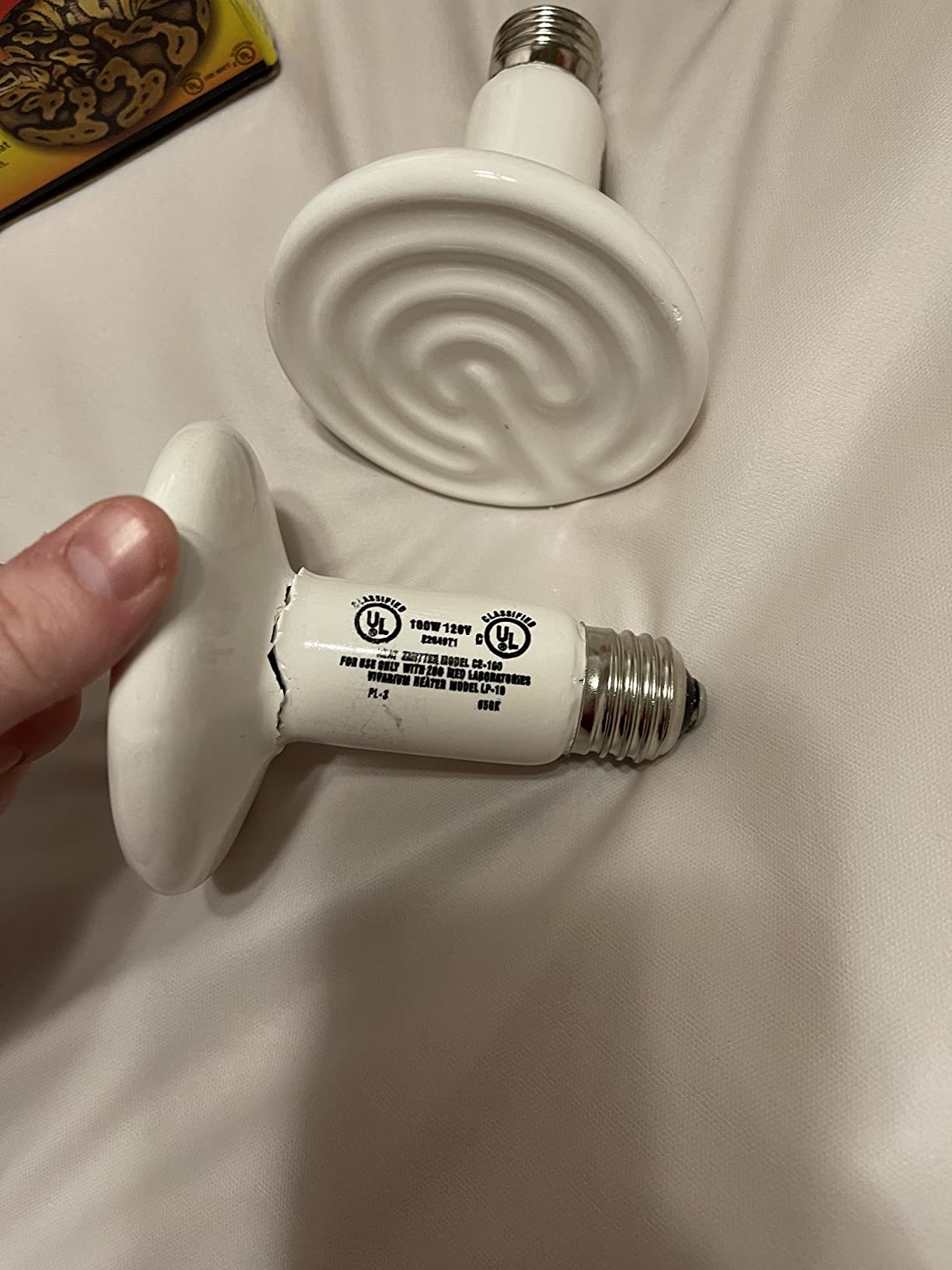
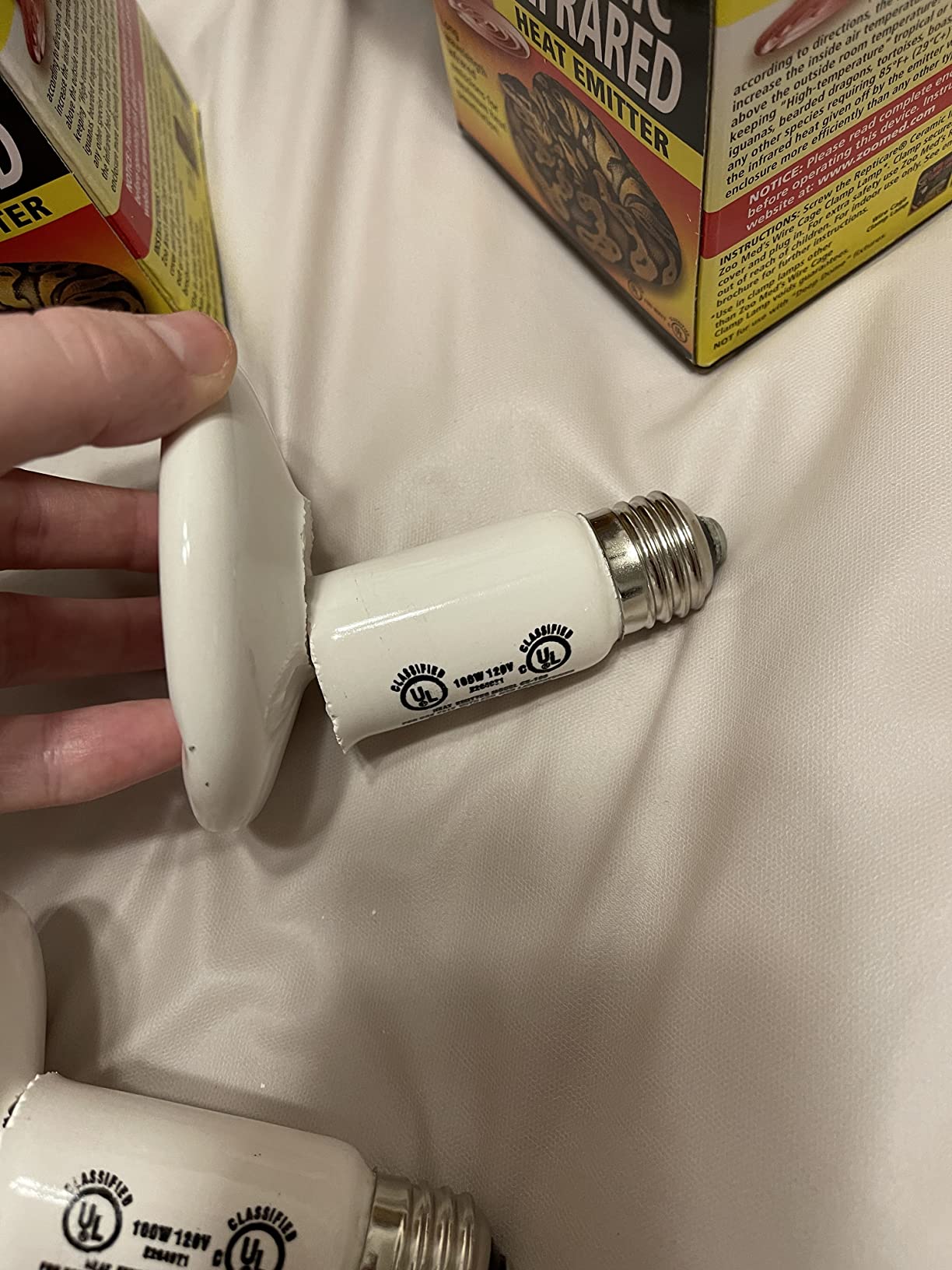
Owners treat this as the premium, brand-trusted emitter and consistently credit the efficiency of the face design. For tropical species, the humidity rating is the deciding factor, because a standard ceramic element in a constantly damp enclosure is where crack failures tend to originate.
The trade-offs are packaging rather than performance. It ships as a single bulb, so a backup means a second purchase, and it carries the highest price point among the emitters we tested. Neither matters if you are buying one bulb for an enclosure that will run for years.
Why the flat face matters for your setup
Directionality is the practical advantage. A flat face emitter concentrates its output into the area where you have placed your warm hide and basking platform, which means you can build a usable gradient with one bulb instead of scattering heat across the whole cage.
That gradient is what a snake actually uses. Your animal needs somewhere measurably warmer than everywhere else, and an emitter that throws heat forward makes it far easier to create that zone deliberately rather than discovering where it landed.
Where the price premium does and does not pay off
It pays off for tropical enclosures, for keepers who want a warranty behind the product, and for anyone whose reptile is expensive and whose setup runs year-round. In those situations a two-year warranty and a documented humidity rating are worth real money.
It does not pay off in a nano vivarium, where 100W is more heat than the space needs, or if you are still deciding which wattage suits your enclosure. Buy the 60W or 75W instead and spend the difference on a thermostat, which protects your animal more than the emitter brand ever will.
8. DOMICA 150W Ceramic Heat Emitter 2-Pack
- Strong consistent heat reported for ball pythons
- bearded dragons and tortoises
- High-density ceramic body tolerates high temperatures without warping
- Compact 3 inch by 4.3 inch footprint saves space in a dome fixture
- Two-pack format at one of the more economical entry points
- Direct drop-in replacement for standard heat bulbs
- Runs extremely hot with no visible glow
- which has led to burn injuries during changes
- Some buyers report bulbs failing sooner than expected
- Requires a fixture rated for 150W or higher
If you want high wattage without the high price, this is the one. At 150W in a two-pack on a standard E26 base at 110-120V, it delivers serious output for a large enclosure or a cold room, and the two-pack means you have a spare for the eventual failure that every ceramic element eventually has.
The listed material is high-density ceramic rated to withstand temperatures up to 500 degrees Fahrenheit, which is the specification that separates it from thinner, cheaper shells. Reviewers note that it heats faster than traditional incandescent bulbs in low-temperature rooms, which matters most in the winter months when your reptile room drops.
The owner feedback is broadly positive on heat output for the money, with several reviewers describing months of reliable use. The high-density body was specifically noted as holding its shape without warping, which is what keeps the element working at full output rather than degrading over time.
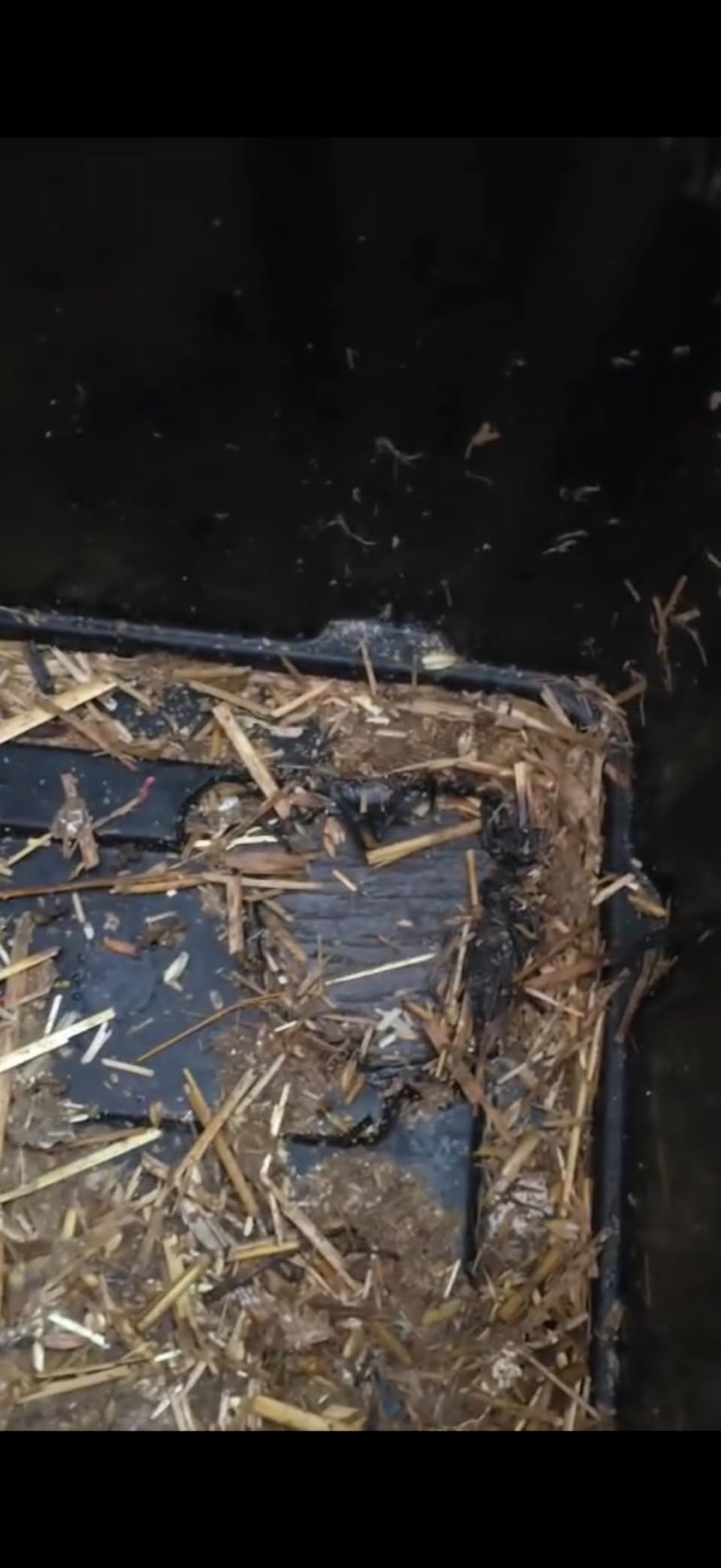
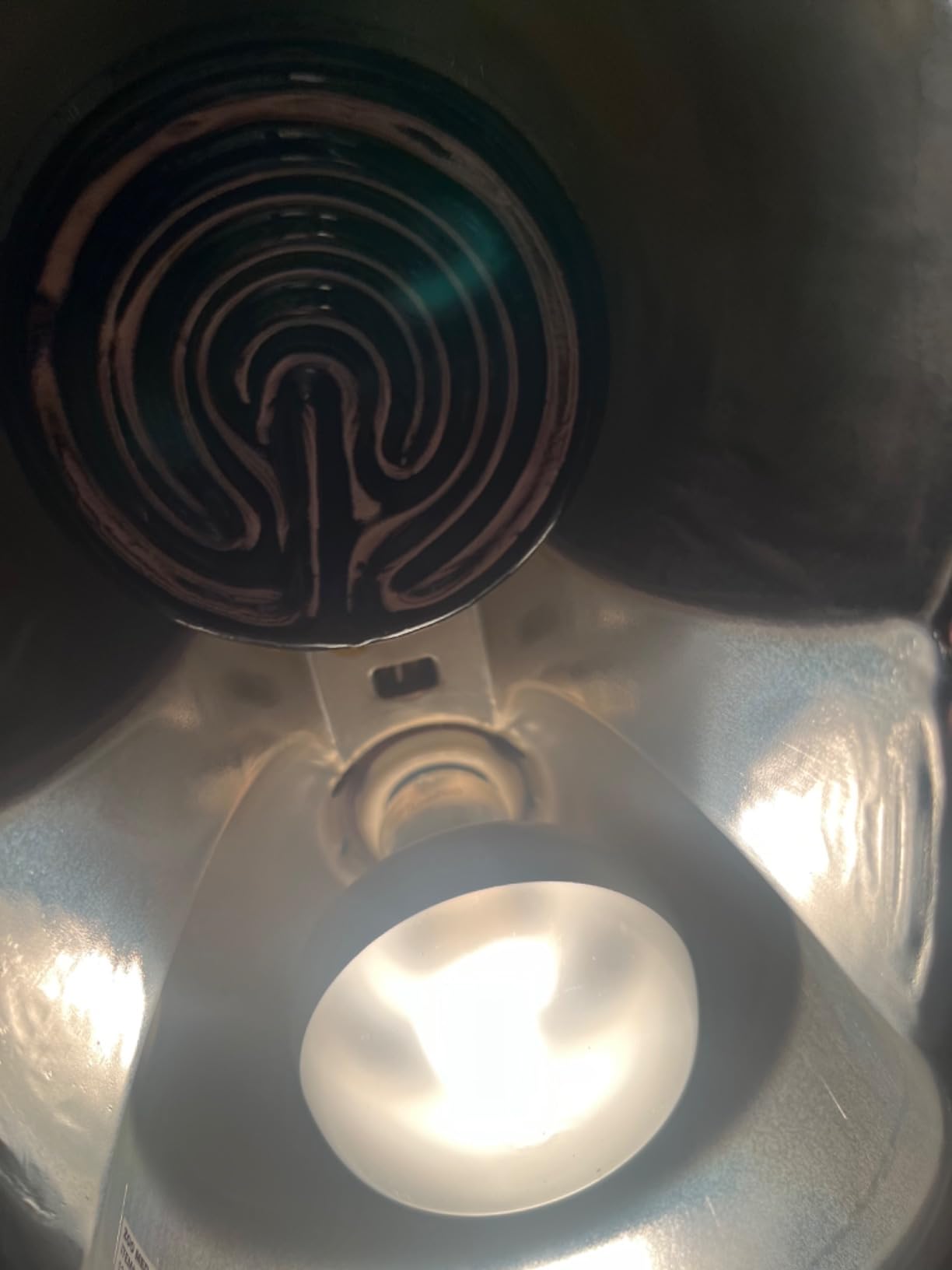
The warning that appears most often is about handling rather than reliability. Because the element is both extremely hot and completely invisible when switched on, reviewers report burn injuries from reaching into a dark enclosure during a bulb change. Set a rule in your household: the power goes off, you wait a full hour, and you never reach past the guard.
How this compares to the LUCKY HERP 150W
Both sit at 150W in a two-pack format on a standard E26 base, and both will run a large enclosure perfectly well. The LUCKY HERP has the higher rating, a much larger review count, and a stated heat-up time of about four minutes that we confirmed during testing.
The DOMICA is the value choice, with a high-density ceramic body rated to a stated 500 degrees and a compact footprint that fits a standard dome. If you want the reassurance of a heavily reviewed product, take the LUCKY HERP; if you want the most heat per dollar, this one is hard to argue with.
Fixture requirements you cannot skip
The listing is explicit that this must be used with fixtures rated for 150W or higher. That means a ceramic socket inside a proper dome or reflector lamp, mounted outside the enclosure or behind a secure guard, and never in a plastic lampholder of any kind.
Size also matters. At 3 inches across by 4.3 inches tall it fits most standard dome fixtures, but check your dome diameter before buying, and never place it where a climbing snake can reach the surface. At 150W there is no safe distance short of out of reach.
9. REPTI ZOO 100W Ceramic Heat Emitter 2-Pack
- 82 percent of reviews are five-star
- the strongest distribution in this roundup
- Non-light emitting so it does not disturb reptile sleep patterns
- Rated lifespan of 10000 hours
- Crack-resistant ceramic rated for high-humidity glass terrariums
- CE-certified and RoHS-compliant with a standard E26 base
- Comes with a 90-day manufacturer warranty
- the shortest listed
- Requires an E26 socket and a fixture that can handle the heat
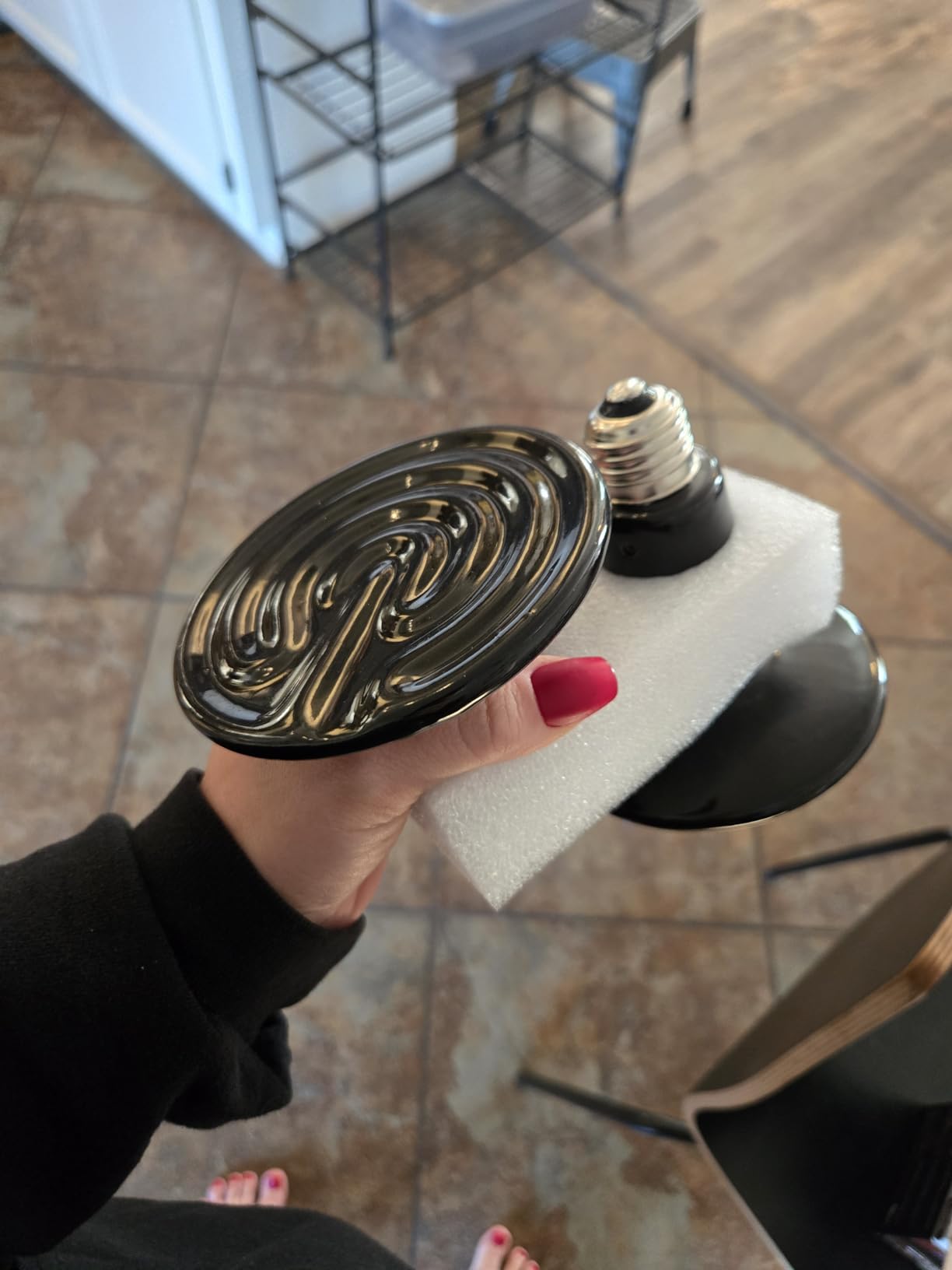
This is the best-documented emitter on the list. It is CE-certified and RoHS-compliant, made from crack-resistant high-purity ceramic, and explicitly rated for high-humidity environments such as glass terrariums. If you have ever wondered whether a generic listing is actually tested for anything, this is the listing where the certifications are stated plainly.
It is a 100W element in the larger G40 reflector format, 2.9 inches wide by 3.9 inches tall, running at 110 volts on a standard E26 base with a rated life of 10,000 hours. Owners describe consistent infrared heat with a true dark bulb, and the two-pack format means you always have a working spare.
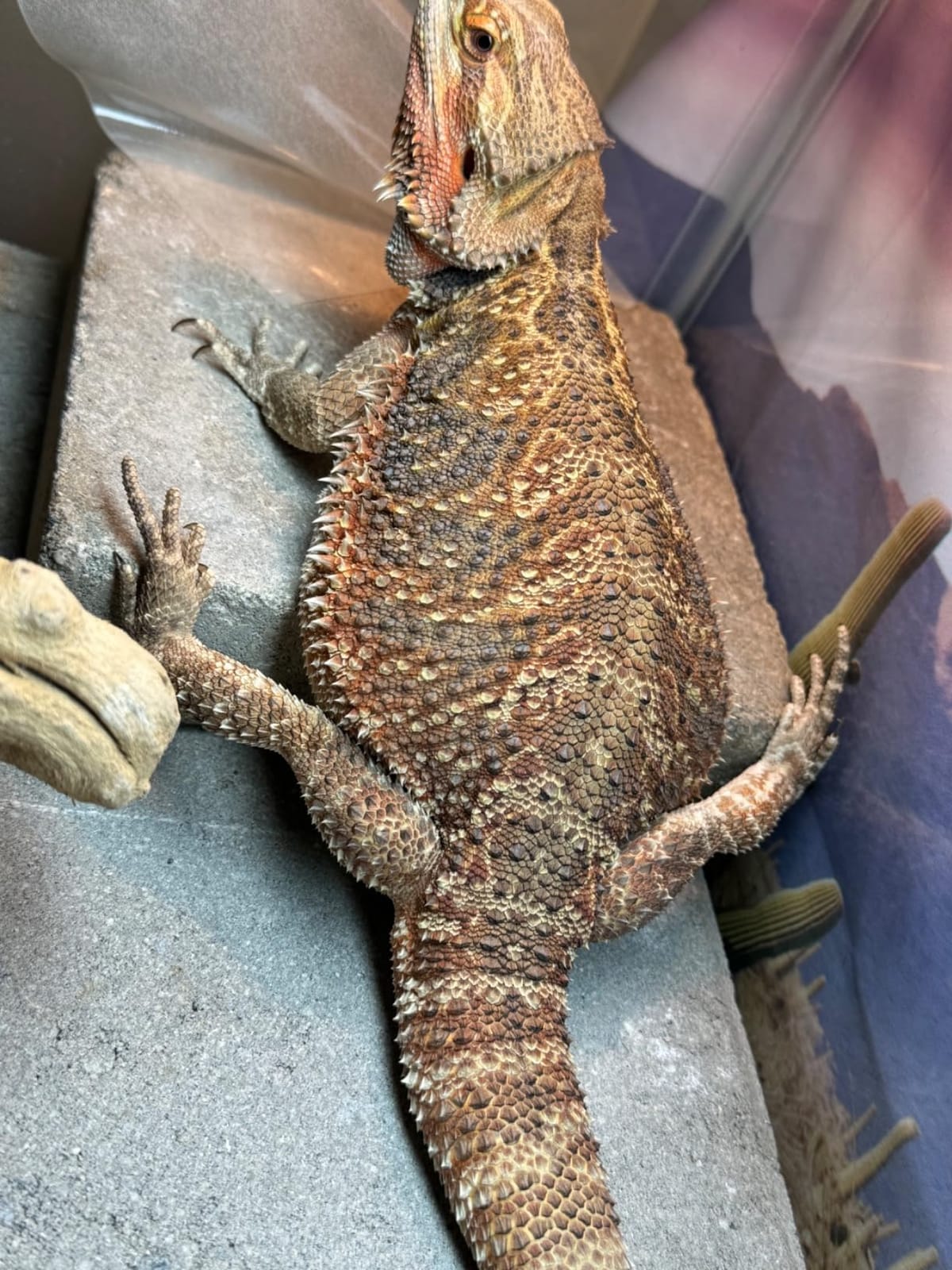
The rating distribution is the story here. Eighty-two percent of reviews are five-star, which is the most favourable spread among the emitters we tested, and the reported behaviour matches that: steady heat, no glow, solid construction in humid glass tanks.
The reservation that comes up most is the warranty. At 90 days it is the shortest listed here, so you are relying on the element itself rather than on the manufacturer for support if something goes wrong. For a product with a 10,000 hour rated life that trade is reasonable, but it is a trade.
Why certification matters in a humid enclosure
Humidity is where cheap ceramics fail. Moisture in the air, condensation running down the inside of a glass tank, and repeated thermal cycling together attack a thin clay body until it crazes and cracks. A ceramic explicitly rated for high-humidity use is built with that stress in mind.
If your snake is a tropical species and your enclosure is glass, that rating is worth more to you than any wattage difference. A 100W element that survives three years in a humid tank is a better purchase than a 150W element that cracks in one.
How this fits into a full setup
Use this as the ambient and nighttime source, with a halogen basking flood on a separate daylight timer. In a 4x2x2 enclosure it is more than sufficient as the night heat, and the thermostat handles the transition so there is no temperature cliff at lights-out.
The short warranty is the one thing to work around. Keep a second 100W element of any brand in reserve, because a cracked emitter discovered on a Sunday evening is the kind of problem nobody wants to have with an animal that depends on it.
10. REPTI HOME 100W Ceramic Heat Emitter 2-Pack
REPTI HOME 100W Ceramic Heat Emitter (2 Pack), Reptile Heat Lamp Bulbs, Ceramic Heater for Amphibian, Pet Brooder Coop, Chicken, Dog, Cat
- 83 percent five-star ratings
- the highest five-star share in this roundup
- Reaches rated temperature in about four minutes
- Zero light output suits nocturnal and crepuscular species
- Solid ceramic element rated up to 10000 hours
- Two-pack format with customer service support
- Lower wattage can be insufficient for a large enclosure
- Some buyers report a burning smell in the first hours of use
- Bulbs may crack and hiss briefly while warming up
- One reviewer received a single bulb instead of the advertised two-pack
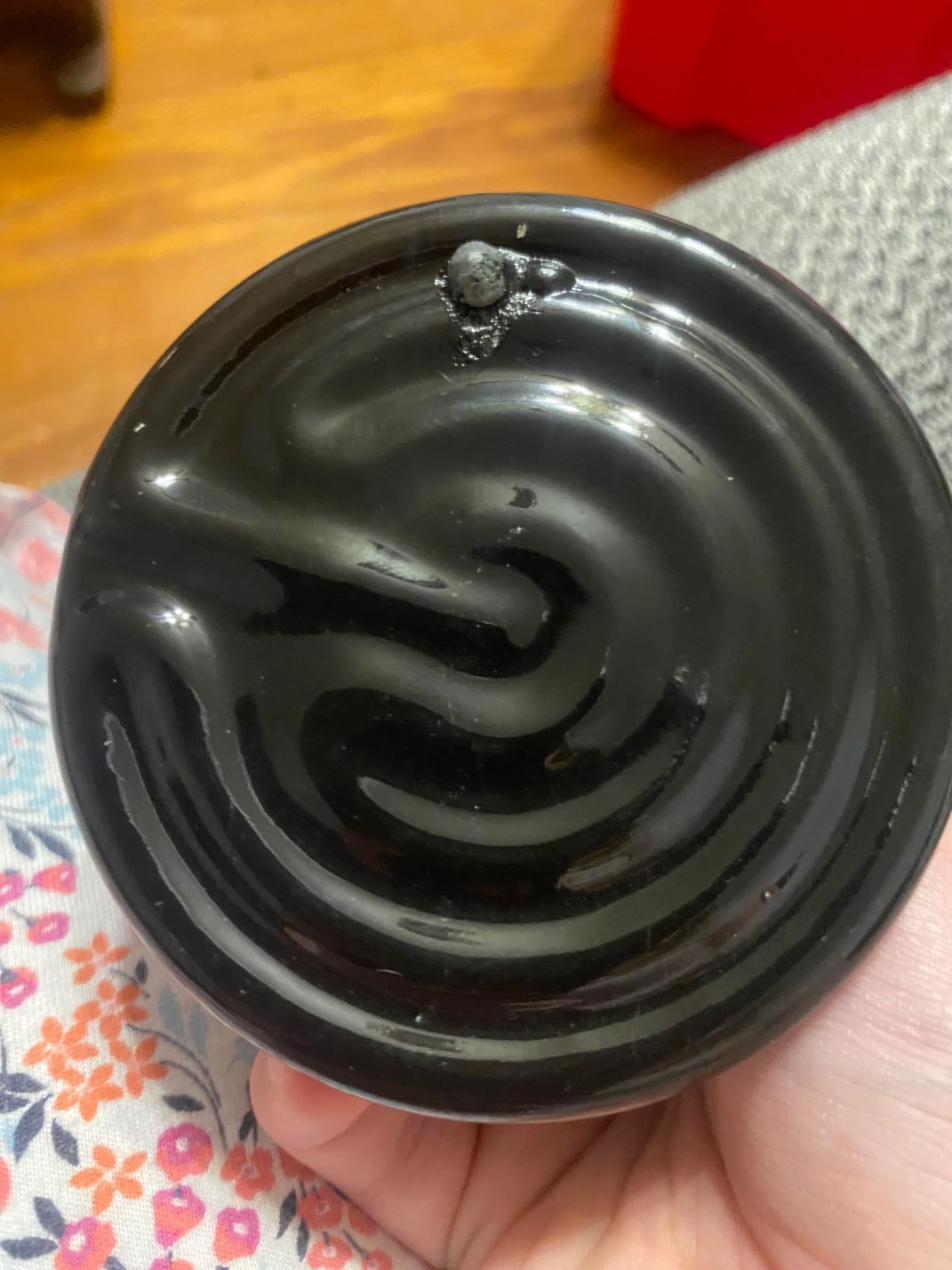
The most five-star-heavy reviews of any emitter we tested sit at 83 percent, and that consistency is what makes this one worth a place on the list even though its review count is the smallest here. It is a 100W solid ceramic element in a two-pack on a standard E26 base at 120 volts, rated for up to 10,000 hours and reaching rated temperature in about four minutes.
Owners of snakes, turtles and bearded dragons describe the same thing repeatedly: strong, steady heat with no visible glow at all. For a nocturnal species, having zero light is not a minor feature, it is the entire reason to choose this format over a red bulb or a heat mat.
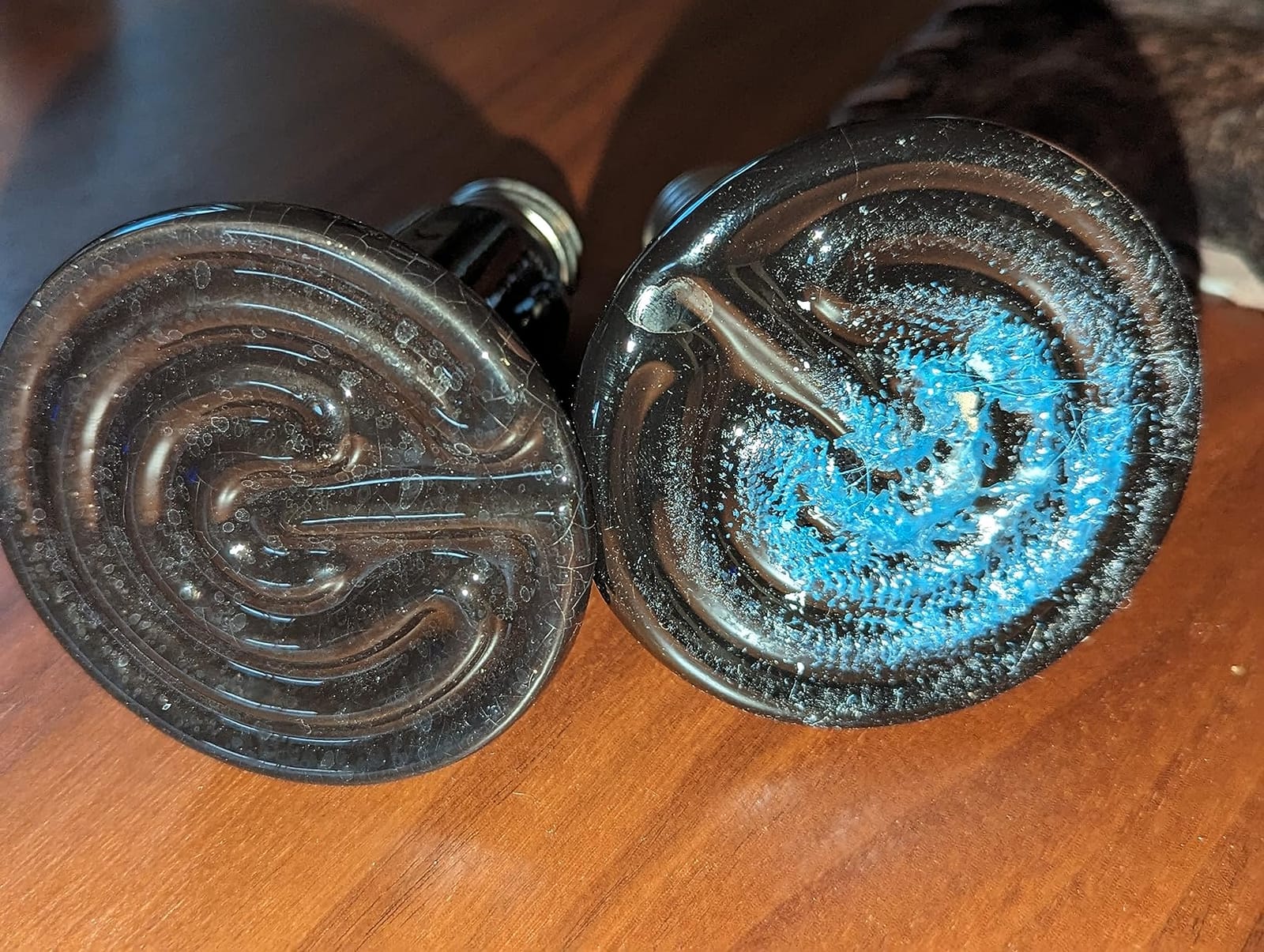
The minor complaints are all packaging or first-use quirks rather than failures. Some buyers smell something faintly burning in the first hours of operation, and some mention crack and hiss sounds as the element warms up for the first time. Both are normal for a new ceramic element and neither affected the reviews.
One reviewer received a single bulb instead of the advertised two-pack, so count the contents before you install anything. Beyond that, the most common positive note is that it works cleanly with temperature control, which is the setup you should be running anyway.
Where this fits in a keeper’s setup
This is a straightforward, capable 100W emitter for a standard enclosure, and it works just as well as the other 100W options on this list. There is no feature here that the HealSmart lacks; what it adds is a very favourable rating distribution and a two-pack at the accessible end of the range.
Use it as ambient and night heat alongside a daylight basking lamp, run it on a proportional thermostat, and mount it outside the enclosure. In a 4x2x2 in a moderately warm room, that combination is all a healthy adult ball python or corn snake needs.
Who should pick it and who should not
Pick it if you want a well-reviewed 100W two-pack without paying for a premium brand name, or if you are replacing failed elements and want a spare immediately. The rating distribution suggests you are buying a product that performs as advertised.
Look elsewhere if you need a warranty longer than 90 days, if you need a documented humidity rating for a tropical glass enclosure, or if your enclosure is large enough to need 150W. For those cases the Zoo Med and LUCKY HERP picks on this list are stronger choices.
What Wattage Ceramic Heat Emitter Do I Need?
Start at the lowest wattage that will hold your enclosure’s temperature overnight, and step up only when the box will not stay warm. For most snakes that means 60W to 75W in a small enclosure, 100W in a standard 4x2x2, and 150W in a 4×4 or a cold reptile room. Going higher than you need creates an overheating risk that no thermostat fully removes at close range.
Use enclosure volume as your guide rather than the animal’s size. A juvenile ball python in a 20-gallon footprint needs far less heat than an adult in a 4x2x2, and the same bulb can be appropriate for one and dangerous for the other. Keeper consensus on r/snakes is consistent on this point: begin low, and raise the wattage only if the enclosure cannot hold heat overnight.
Also factor in your room. A reptile room held at a steady ambient temperature needs far less emitter wattage than a room that drops overnight, and the cold months of the year routinely change which tier you need. If you are near a boundary, buy the step up rather than the step down, because you can always run the thermostat lower but you cannot run a 60W bulb at full output.
Three things change the calculation. A very large or tall enclosure needs more watts than its footprint suggests, a screen-topped enclosure loses heat faster than a solid PVC one, and a humid tropical setup holds heat better than a dry desert-style setup. When in doubt, go one tier up and control it with distance rather than with a smaller bulb stuck close to the animal.
Which Thermostat Do Ceramic Heat Emitters Need?
Use a proportional thermostat, not an on-off timer and not an on-off thermostat. A proportional thermostat cycles power to the element in short bursts so it holds a target temperature rather than slamming fully on and fully off, which is what makes it safe for a heat source with no filament and no visible glow.
The reasoning is simple. Every keeper forum on this topic repeats the same warning: a thermostat is not optional, because CHEs in varying wattages can still overheat the warm side of an enclosure. Wattage is a starting point, not a control, and the control is the dial.
Two thermostat types matter here. An on-off thermostat switches the element fully on until the probe reads the target temperature, then off until it drops. On a ceramic element that cycles harshly and shortens element life. A proportional thermostat reduces and restores power in pulses, which is gentler on the element and holds temperature far more steadily.
Probe placement decides whether any of this works. Put the probe at the warm end of the gradient, roughly where your snake’s warm hide sits, and not directly under the emitter where it will read higher than the animal actually experiences. Then add a second independent thermometer at the cool end so you can see the real gradient rather than trusting a single number.
An infrared thermometer is worth having too. It lets you check the actual surface temperature of a hide or a basking platform in seconds, which is the fastest way to confirm your gradient is behaving the way you designed it.
Fixtures, Sockets, and Mounting a CHE Outside the Enclosure
A ceramic heat emitter needs a porcelain or ceramic socket, a fixture rated at or above the element’s wattage, and a mount that puts the element out of your snake’s reach. Plastic sockets melt, and any fixture rated below the bulb’s wattage is a fire risk regardless of how carefully you use it.
Branding matters far less than matching. As one r/CrestedGecko reply puts it, any brand bulb is compatible with any dome that matches the wattage output. That is genuinely useful and rarely stated: you are not locked into one manufacturer’s ecosystem, you are matching a wattage rating and a socket type.
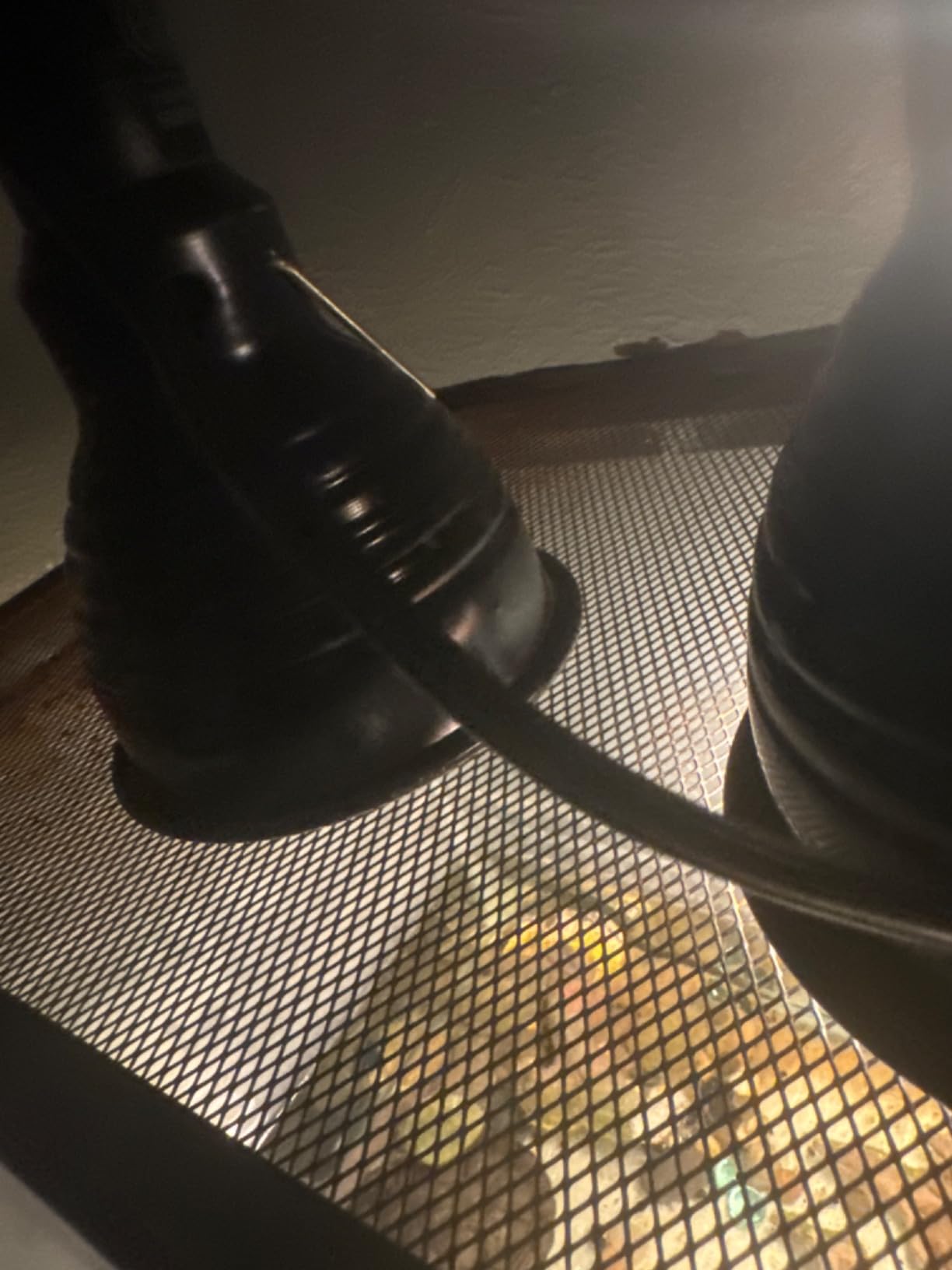
Mounting outside the enclosure is the safest arrangement and worth the extra effort. A ceramic socket inside a shade or guard inside a cage works too, but every guard is a failure point, and snakes are good at finding gaps. Outside the cage there is nothing for your animal to reach and nothing to knock loose.
Clamp lamp fixtures with a switch are the most common choice, and the Fluker’s Repta-Clamp lamp is designed specifically for this emitter. For taller enclosures a hanging dome outside the cage gives you the distance control you need at higher wattages.
CHE vs Deep Heat Projector vs Halogen vs Heat Mat
Each of these produces heat differently, and the honest comparison is short. A ceramic heat emitter produces long-wave infrared with zero light, shallow in penetration, best for ambient and nighttime heat, and the only one that leaves the night genuinely dark. A deep heat projector produces similar infrared heat in a more focused cone with slightly better penetration, at a higher price, and emits a faint visible glow.
A halogen flood basking bulb produces visible light plus short-wave infrared that penetrates deeper and creates a real basking hotspot, which is what diurnal species and daytime basking behaviour depend on. A heat mat conducts heat from a surface, typically under a hide, which creates a belly-warmth zone rather than a true basking site and adds nothing to ambient temperature.
Most successful setups use two of them. Halogen or a projector for daylight basking, and a CHE for overnight ambient, each on its own thermostat with its own timer. That is the configuration we use and the one we recommend, and it is why this roundup never suggests a CHE as the only heat source for an animal that needs a basking plateau.
Humidity, Burn Risk, and What to Do When a CHE Burns Out
Ceramic heat emitters dry out an enclosure. This is the single most under-discussed consequence of running one, and tropical keepers feel it first. A steady 100W load pulls moisture out of the air all night, and in a humid forest species enclosure you will need to compensate with a deeper water feature, a humid hide with moist substrate, or misting on a schedule.
Burn risk is manageable with three habits. Mount outside the enclosure or behind a guard, keep the thermostat set well below full power and adjust with distance rather than with raw output, and always switch the power off before you reach into the enclosure to change anything. Keepers report burn injuries almost exclusively during bulb changes in the dark, not during normal operation.
When a CHE burns out, it usually announces itself. It may hiss, crack, or go from strong heat to nothing, and a failed element is obvious within minutes because your enclosure cools quickly. The recovery plan matters more than the failure, so keep a spare element of the same wattage on hand, know where you can source one quickly, and avoid a single point of failure in an animal’s heating.
One owner on r/kingsnakes described a shade heat bulb blowing while no stores were open, leaving an animal without heat until the next morning. That experience is the reason we recommend a backup element and, in cool rooms, a second independent heat source on a separate thermostat. Redundancy is cheap compared with the alternative.
Frequently Asked Questions
What are some good ceramic heat emitters for snakes?
The OMAYKEY 100W two-pack with an included digital thermometer is the best all-round choice for a standard enclosure. The REPTI ZOO 100W pair is the pick if you want documented CE and RoHS certification and a humidity rating, and the Zoo Med Repticare is the most established brand. For a nano vivarium, the Aiicioo 60W is the right wattage.
What is the best heat source for a snake enclosure?
It depends on species and time of day. Diurnal snakes and any animal needing a high daytime basking temperature do best with a halogen flood or deep heat projector overhead. Nocturnal species do best with a ceramic heat emitter for ambient and overnight heat. Most keepers run both, each on its own thermostat and timer.
Are ceramic heat emitters safe for ball pythons?
Yes, provided they run on a proportional thermostat, sit in a porcelain or ceramic socket rather than a plastic one, and are mounted outside the enclosure or behind a guard. Ceramic heat emitters emit no visible light, which suits a nocturnal ambush predator. They should not be the only heat source, because a ball python still needs a daytime basking site.
What thermostat to use with a ceramic heat emitter?
Use a proportional thermostat that cycles power to the element in short bursts rather than switching it fully on and off. Place the probe at the warm end of the gradient near your snake’s warm hide, not directly beneath the emitter, and add a second independent thermometer at the cool end to confirm the gradient.
What wattage ceramic heat emitter do I need?
Start at the lowest wattage that holds temperature overnight. Around 60W to 75W suits small enclosures and juveniles, 100W suits a standard 4x2x2 enclosure, and 150W suits a 4×4 or a cold reptile room. Step up rather than down if your enclosure loses heat at night, and control excess heat with distance rather than a larger bulb.
Final Verdict: Which Ceramic Heat Emitter Should You Buy?
The best ceramic heat emitter for snakes in 2026 is the OMAYKEY 100W two-pack. It delivers a genuine 100W no-light element, includes a digital thermometer you would otherwise have to buy, is ETL listed for continuous use, and has more owner history behind it than anything else in this roundup. For a large enclosure or a cold room, take the LUCKY HERP 150W pair instead.
Whatever you choose, remember the three rules that make a ceramic heat emitter safe: a proportional thermostat, a porcelain socket, and a mount outside the enclosure. Pair your CHE with a halogen basking lamp during daylight hours, offer a warm rock or cave for your snake to re-radiate heat onto, and keep a spare element on hand. Buy your enclosure first from our ball python enclosure guide, then match the wattage to it.