
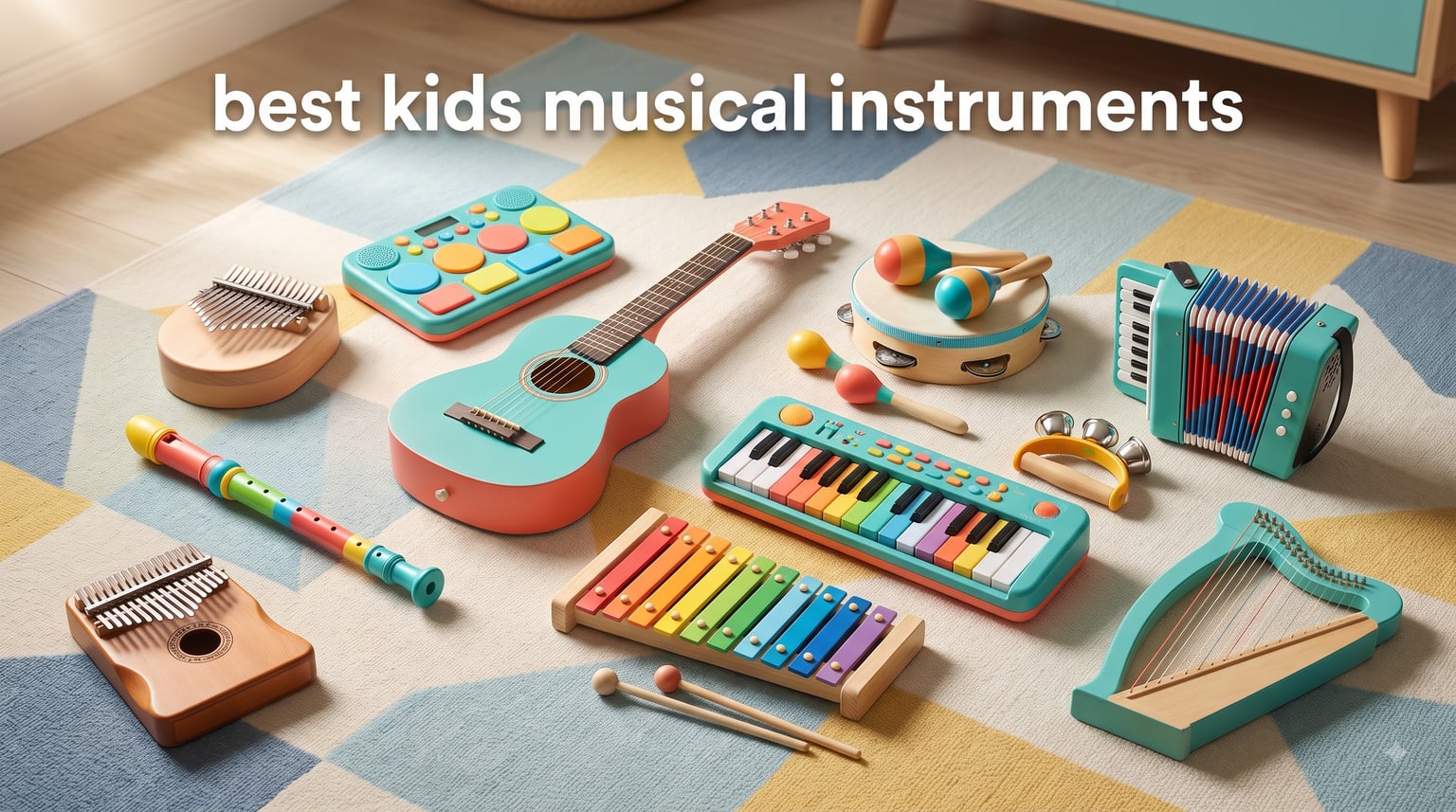
The best kids musical instruments meet a child where they are right now: small enough to hold comfortably, engaging enough to invite repeat play, and suitable for the noise, space, and budget your home can support. I look for instruments that build rhythm, coordination, pitch recognition, confidence, and a genuine wish to make music again tomorrow.
This roundup covers ten real products for children from toddler discovery through elementary-school practice. It also answers the questions I hear most from parents: whether piano, percussion, recorder, kalimba, guitar, or ukulele makes the best starter instrument, how to judge fit before buying, and when an inexpensive toy is enough.
Music education for children works best when practice feels like play. Parent discussions consistently favor letting children try several instruments before committing, because a toy can be excellent for exploration without being the right long-term instrument. I considered documented ratings, review volume, age guidance, materials, accessories, portability, and the practical limits parents mentioned most.
Table of Contents
Top 3 Picks for the Best Kids Musical Instruments
The Best Kids Musical Instruments in 2026
| Product | Specifications | Action |
|---|---|---|
 Taimasi 33-Piece Percussion Set Taimasi 33-Piece Percussion Set |
|
Check Latest Price |
 Newlam 17-Key Kalimba Newlam 17-Key Kalimba |
|
Check Latest Price |
 Yamaha YRS-24B Recorder Yamaha YRS-24B Recorder |
|
Check Latest Price |
 VTech KidiBeats Drum Set VTech KidiBeats Drum Set |
|
Check Latest Price |
 VTech Kidi Star DJ Mixer VTech Kidi Star DJ Mixer |
|
Check Latest Price |
 LeapFrog Strum and Count Guitar LeapFrog Strum and Count Guitar |
|
Check Latest Price |
 Melissa & Doug 10-Piece Band Set Melissa & Doug 10-Piece Band Set |
|
Check Latest Price |
 YEZI Mini Ukulele Toy YEZI Mini Ukulele Toy |
|
Check Latest Price |
 Dollox 37-Key Keyboard Dollox 37-Key Keyboard |
|
Check Latest Price |
 Melissa & Doug Caterpillar Xylophone Melissa & Doug Caterpillar Xylophone |
|
Check Latest Price |
1. Taimasi 33-Piece Percussion Set: The Best for Trying Many Sounds
- Huge variety
- CPC and ASTM certified
- Backpack included
- Lead-free paint
- Early-learning focus
- Small metal parts
- Check edges before toddler use
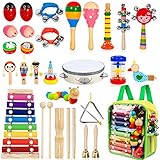
I would use this set to answer the first question every young child asks: “Which one should I try?” It gathers 18 types of shaking, tapping, beating, and blowing instruments into one collection, so a child can compare rhythm and pitch before anyone chooses a path.
The pieces arrive in a compact backpack, which I appreciate because 33 small instruments otherwise migrate under furniture. The non-toxic, lead-free finish and CPC/ASTM certifications add reassurance, although I would inspect metal edges and supervise children who still mouth toys.
Its strength is breadth rather than deep instruction. The collection is excellent for preschool music activities, sibling play, and music therapy sessions, but families seeking a single instrument to study for years may find the smaller pieces less satisfying.
In family use, the variety also reduces the risk of one loud instrument overwhelming the room. Children can alternate shakers, wood tones, and quieter percussion instead of striking the same item at full volume.
I would set out three or four pieces at a time and rotate the rest. That keeps cleanup manageable and gives repeat sessions a clear starting point.
Who benefits most from the Taimasi set?
This set suits preschoolers, homeschool groups, and families who want a low-commitment way to test interest across rhythm, melody, and noise-making. It is especially useful when siblings need different sound sources at once.
A parent who dislikes loose parts should count the full set before play and store it in the supplied backpack.
What should families check before play?
Reviewers specifically flagged the small size of some components and possible sharp edges on metal pieces. I would inspect the clapper, beaters, and any parts a toddler could reach to the mouth before the first session.
The age listing is broad, so supervision matters more than the toy label.
2. Newlam 17-Key Kalimba: The Easiest Path to a First Melody
- Easy first songs
- Letter-marked keys
- Book and bag included
- Lightweight
- Works for adults too
- May need tuning
- Bare keys are easy to bump
The kalimba is my pick when a child wants a real melody without wrestling with a bow, mouthpiece, or six guitar strings. A beginner can pluck one key at a time, follow the printed letters, and hear a clear pattern almost immediately.
I like the natural air-dried wood body because it gives the small instrument a warmer, more musical character than many plastic toys. At 11.52 ounces, it is light enough for a child to steady with both hands.
The box includes an instruction book, tuning hammer, finger guards, flannelette bag, and cleaning fabric. Those accessories make a thoughtful introduction because the child is not left guessing how to begin or care for the instrument.
Some units may need tuning on arrival, so I would test it before a lesson and adjust gently with the supplied hammer. I would also teach the child to rest both thumbs near the keys instead of waving fingers across the soundboard.
Its quiet volume makes it easier to enjoy in an apartment than a recorder or full drum kit. Headphones are unnecessary for practice, which helps the family hear whether the child is playing evenly.
Who benefits most from the Newlam kalimba?
This is one of the best starter instruments for a child who likes gentle sounds, individual melodies, and learning at a self-directed pace. Its compact size also suits families that lack room for a keyboard.
Children with limited hand strength may find the thumb-plucking motion easier than gripping guitar chords, though an occupational therapist or teacher can confirm individual fit.
What should families know about tuning?
The 17 steel bars are labeled with notes and letters, but reviewers report that some instruments arrive slightly out of tune. A parent can handle initial tuning or use a music shop if the child is too young to manage the hammer safely.
I would avoid promising a complete song after five minutes; the product feature does, but real progress still depends on listening and short daily practice.
3. Yamaha YRS-24B Recorder: The Best Low-Cost School Starter
- Soft clear tone
- Durable resin body
- Straight windway
- Cotton case included
- School standard
- Three cleaning sections
- Bag is not protective
For a child who is ready to learn written notes and breath control, the Yamaha recorder is a disciplined but manageable choice. Its C key and Baroque fingering match the familiar school-recorder format many teachers use.
I would recommend it over a generic recorder because the tone is clear and soft rather than piercing, while the ABS resin body tolerates ordinary handling. The straight windway is forgiving enough for a beginner developing consistent airflow.
At 12.88 inches long, it should fit many school-age children comfortably. A younger player may still need a teacher to confirm hand position and make sure small fingers cover the holes without strain.
One practical lesson I learned long ago is to teach cleaning from day one. The recorder comes apart in three pieces, so saliva and crumbs can collect at the joints if it goes straight into a bag.
The cotton case is useful for school storage but not hard enough to protect the instrument in a crowded backpack. I would add a small rigid sleeve if the recorder will travel daily.
Who benefits most from the Yamaha recorder?
It suits elementary-age children who can follow fingering charts and enjoy a visible school tradition. It also works for a parent who wants a durable first instrument without a large commitment.
Children sensitive to high or loud sounds may prefer the kalimba, because recorder practice can carry farther than the product’s soft tone suggests.
What makes the recorder harder than a kalimba?
Breath control, tongue position, and covering several holes at once take coordination. A child may produce a squeak at first, so I would praise steady air rather than demand a perfect note immediately.
Short, structured sessions are more useful than repeating a frustrating scale until interest disappears.
4. VTech KidiBeats Drum Set: The Best Electronic Drum Toy for Ages 2-5
VTech KidiBeats Kids Drum Set, Orange
- LED guidance
- Letters and numbers
- 9 melodies
- Sturdy toy build
- Sticks included
- Background music persists
- Compact playing surface
Among children’s musical instruments, this is a strong choice for a toddler who responds to lights, repetition, and game-like praise. The three pads and cymbal trigger different sounds, while LEDs give a visual cue for where to strike.
I would begin in Free Play so the child can explore cause and effect before Letters, Numbers, or Follow-Along modes take over. Those three learning modes connect rhythm practice with early academic concepts without requiring a formal lesson.
It comes with two sticks and three AA batteries, so play can start quickly. The set weighs 1.4 pounds, which makes moving it between rooms simple but does not anchor it during especially enthusiastic playing.
Volume is the main home-compatibility question. Electronic pads are easier on nearby adults than an acoustic drum, but the nine melodies can make it difficult to create a completely quiet freestyle session in some modes.
The compact surface is enough for a preschooler and may be too small for siblings striking together. I would reserve one drum per child during shared play.
Who benefits most from KidiBeats?
The documented age range of 2-5 makes this a focused choice for toddlers and preschoolers. It is a good fit for short sessions, sensory play, and children who learn better when a task is colorful and guided.
A seven-year-old ready for real drumming may outgrow the small pads and built-in activities quickly.
Is it a real drum set?
It is an electronic learning toy, not a substitute for an acoustic drum kit or sustained drum lessons. I would treat it as a gateway that reveals whether the child wants more rhythm practice before investing in a larger instrument.
That trial role is exactly where I find it most useful.
5. VTech Kidi Star DJ Mixer: The Best for Beat-Making and Recording
VTech Kidi Star DJ Mixer
- Record sound effects
- Headphone jack
- Built-in academy game
- Light effects
- Good sound variety
- Four AA batteries required
- Quick auto-shutoff
- No full manual beat mode
This mixer stands out because it lets a child behave like a music producer rather than simply press instrument keys. The 15 songs and more than 2,000 sound combinations create room for quick experiments, while custom effects can be recorded and saved.
I value the Bluetooth and audio-cable inputs because a child can connect a family playlist and hear how simple changes affect a familiar track. The headphone jack also offers a better shared-home experience than forcing every effect through the built-in speaker.
Academy mode gives the controls a learning path, but the interface still emphasizes fun. That balance works well for an older child who has lost interest in a basic toddler instrument but is not yet ready for production software.
The controls can turn the toy off after a short idle period, which protects batteries but interrupts a child who pauses to think. Four AA batteries are required, so rechargeable cells would be a sensible household add-on.
Reviewers also noted the lack of a complete manual mode for building beats from scratch. I would present it as a playful introduction to sequencing and cause and effect, not a junior production console.
Who benefits most from the DJ mixer?
It is best for school-age children who enjoy technology, recording, patterns, and mixing familiar songs. It can also make a lively choice for music therapy or group activities led by an adult.
A child who prefers an acoustic instrument and very quiet play will probably engage more with the kalimba or xylophone.
How can parents keep play creative?
I would challenge the child to make three versions of one sound: slow, fast, and quiet. Recording the results turns a button exercise into a small composition with an obvious beginning, middle, and ending.
The built-in game can then supply technique prompts without taking over every session.
6. LeapFrog Strum and Count Wooden Guitar: The Best Toddler Guitar
- FSC-certified wood
- Small-child fit
- Colors and numbers
- Animal sounds
- Included batteries
- Can be loud
- Check battery compartment
- Toddler toy format
This wooden guitar is the right kind of first instrument for a toddler because it translates the familiar strumming motion into immediate light, color, and sound. Eight fret keys introduce an octave while the neck lights up to guide little hands.
I would start with acoustic-guitar mode and invite the child to strum while watching one key at a time. The electric-guitar and barnyard-animal modes are useful for attention, though I would return to the guitar sound so play still builds musical memory.
The body uses FSC-certified wood and measures about 14.4 inches long. That size is far more manageable for a preschooler than a full-size guitar, while the wood construction feels more like a household instrument than a throwaway electronic gadget.
The 639-review record gives it a 4.8 rating, and parents repeatedly praise its durability and learning content. The main household complaints concern volume and a battery compartment that should be checked if the toy is dropped or thrown.
Because it is listed for ages 18 months to 5 years, I would treat it as guided musical play rather than guitar instruction. It does not provide the fretting and chord practice needed for formal lessons.
Who benefits most from this toddler guitar?
It suits a child who loves pretend singing, rhythmic strumming, colors, numbers, and cause-and-effect toys. The child-size shape is also useful for families who want a guitar-like object without giving a toddler a full-scale instrument.
For real beginner chords, move to a properly sized ukulele or classical guitar with adult guidance.
How loud is the LeapFrog guitar?
Parents report that it can be loud, so I would test each sound mode before bringing it into a quiet home. Lower-volume use is more comfortable when the child sits beside an adult rather than across a room.
That simple test can prevent the toy from becoming a source of family conflict.
7. Melissa & Doug Band-in-a-Box: The Best Classic Preschool Band
- Ten distinct sounds
- Small-hand friendly
- Organized crate
- Sturdy construction
- Coordinated play
- Crate has no lid
- Triangle string can slip
- Inspect metal edges
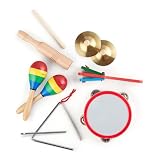
The Band-in-a-Box set is one of the simplest ways I know to turn a kitchen into a small family orchestra. It includes a tambourine, cymbals, maracas, clapper, tone blocks, and triangle, giving several children different jobs at once.
Each instrument produces a clearly different tone or rhythm, which supports auditory perception and color recognition. The wooden crate is sturdier than a fabric bag and keeps the collection visible enough that children can choose without dumping everything onto the floor.
The documented recommendation begins at age 3, which aligns with the set’s small parts and independent play. An adult should still inspect the triangle, beater, and metal edges before the first preschool session.
With 5,705 reviews and a 4.7 rating, this is a proven preschool favorite. Parents often mention the variety, crate, and durable wooden components more than any one instrument in the box.
I would use a call-and-response game: an adult taps two beats, then waits for the child to copy them. Later, let the child lead while the family follows.
Who benefits most from the 10-piece band set?
It works especially well for siblings, play dates, preschool groups, and families who want several instruments without buying many separate toys. The manual operation also needs no charging, cables, or batteries.
One adult may need to set a gentle volume rule because cymbals and clappers can become intense during group play.
Is the wooden crate sufficient for storage?
It is convenient, but it has no lid, so dust and small fingers can reach inside. I would store the set on a high shelf or add a washable cover when it is not in use.
The triangle string can also slip out of place, but it is easy to check before each session.
8. YEZI Kids Ukulele: The Best Low-Cost Ukulele-Style Toy
- Very lightweight
- Small-hand friendly
- Wood-look finish
- Affordable trial
- Nylon-string design
- String durability concerns
- Imprecise tuning
- Toy-level quality
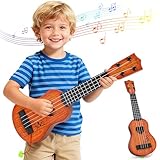
I would choose this mini ukulele to test whether a young child enjoys chord shapes and singing along, not to supply a student instrument for years. It is lightweight, easy to hold, and visually familiar enough for pretend performances.
The four carbon nylon strings are gentler on small fingers than steel strings, and the coated surface is designed to reduce discomfort. That makes short exploratory sessions more approachable for toddlers and preschoolers.
Its 4.0 rating across 14,128 reviews is lower than most of this list, and the reason is clear in the feedback. String failures, tuning concerns, and rough-play durability mean families should supervise and treat it as a toy first.
The plastic body will not react dramatically to small spills, and the mini scale suits children who cannot yet reach around a full-size instrument. I would still test the tuning before a song so the child learns the difference between a real pattern and a loose imitation.
If the child repeatedly chooses it, asks to tune it, and tries to learn actual chords, that is a good signal to move to a better student model. If it ends up as a prop, the product has still served its purpose.
Who benefits most from the YEZI ukulele?
It suits young children in pretend play, music-themed classrooms, travel, and low-cost trial use. Families with several children may also appreciate an instrument that is easy to pass around.
It is not my first choice for a child with a teacher waiting to begin structured lessons.
When should a family upgrade?
Move to a quality student ukulele when the child shows sustained interest, can hold the instrument comfortably, and wants accurate tuning. Signs include voluntary practice, asking for songs, and frustration when the toy does not stay in tune.
That transition prevents a promising interest from being held back by toy-level hardware.
9. Dollox 37-Key Keyboard: The Best Feature-Packed Beginner Setup
- Eight tones
- Rhythm and percussion modes
- Record and playback
- Audio input
- Easy assembly
- Short stool
- May tip if pulled
- Batteries not included
- Heavy-use concerns
The Dollox keyboard gives a child more ways to experiment than a toy piano with only a few oversized keys. Its 37 keys support simple melodies, while eight instrument tones, eight accompaniment styles, and eight percussion effects make sound selection part of play.
I would use record and playback as the first lesson: play a two-note pattern, listen together, then repeat it with one change. The 22 demos are better treated as listening material than songs a beginner must master immediately.
The included microphone adds singing and language play, and the audio input can connect a phone, tablet, or computer. Those features make it useful for a child who wants singing, songwriting, and keyboard exploration in one footprint.
The included stool is shorter than some parents expect, and the lightweight keyboard can be pulled or tipped. I would place it against a wall or in a supervised play zone, and I would not let a child climb on the stool to reach the keys.
Four AA batteries are required but not included. Rechargeable batteries can reduce interruptions and keep the toy ready for a predictable home routine.
Who benefits most from the Dollox keyboard?
This keyboard suits school-age beginners who want more keys and recording features than a toddler piano provides. It also works for children who enjoy singing through a microphone or playing along with media.
A family seeking acoustic sound and no batteries may prefer a xylophone or kalimba.
What should parents check before assembly?
Confirm that the stand is locked, the keyboard sits securely, and cables cannot create a trip hazard. A parent should also test the microphone jack and all controls before presenting it as a ready-to-play station.
Its 2.52-kilogram weight makes it less portable than the small drum and ukulele choices.
10. Melissa & Doug Caterpillar Xylophone: The Best Compact Melody Toy
- Quiet enough for apartments
- Mallets store onboard
- Bright octave
- Durable basic build
- Fine-motor practice
- Paint may chip
- Occasional tuning concerns
The caterpillar xylophone is my compact pick for a preschooler who is ready to explore an actual octave. Its eight color-coded bars make high, middle, and low notes visible, while the two mallets encourage controlled tapping.
I would begin by asking the child to find the same color as the adult, then alternate between the two ends. That turns pitch recognition and color recognition into one game without requiring note names first.
The wooden mallets store in the design as the caterpillar’s antennae, which solves a small but real problem: the beaters are easy to find when the next session begins. The indoor design is also much more apartment-friendly than a drum.
It has 5,661 reviews and a 4.7 rating, with recurring praise for the sturdy build, friendly appearance, and mallet storage. Reviewers also mention occasional tuning issues and paint chipping on the mallets, so I would inspect both before continued use.
It offers a cleaner pitch layout than a large mixed-percussion box, making it a sensible bridge from free tapping toward melody and music theory.
Who benefits most from the caterpillar xylophone?
It suits children ages 3-6 who enjoy sorting colors, tapping patterns, and making short songs. It is a strong option for homes where a recorder’s tone or a drum’s volume would be difficult.
The painted body should be checked periodically if the child is a forceful player.
Is it quiet enough for apartment practice?
Parents describe it as apartment-friendly, but wood on wood still makes sound. I would place it on a towel or rug to reduce vibration and choose daytime practice if the child strikes with unusual force.
Soft-headed or soft-tipped mallets can further limit impact noise, provided the child still gets clear musical feedback.
How to Choose the Right Instrument for Your Child
Start with age and physical fit, not a fixed career plan.
Toddlers usually benefit from instruments that reward shaking, striking, pressing, or strumming with immediate sound. Preschoolers can begin simple patterns and melodies, while many school-age children have the finger control and attention for recorder, keyboard, kalimba, and beginner strings.
The best instrument for a 3-year-old may be the LeapFrog guitar, a xylophone, or one drum from a percussion set. A 5-year-old can often manage the same instruments plus simple supervised keyboard patterns, and a 7-year-old may be ready for recorder lessons, a full 37-key keyboard, or a more serious ukulele.
Check hand size, finger reach, instrument weight, and whether the child can produce a clear sound without contorting. Full-size instruments can be resized for some lessons, but a proper fit makes daily practice easier.
Follow interest through a short trial.
Use a two-week experiment with two or three different sounds: rhythm on a drum, melody on a xylophone, and a string or wind instrument. Watch what the child chooses without prompting, because voluntary return is stronger evidence than a one-time novelty response.
Forum experiences repeatedly recommend trying several options before committing. A parent can create that trial with the mixed percussion set, a small keyboard, and one quieter melodic option rather than buying a full acoustic setup.
Plan for noise, space, and maintenance.
Electronic drums, the VTech mixer, keyboard, and kalimba offer the easiest volume control. Acoustic recorders are soft-toned but can still carry, while drums and cymbals need a shared-home agreement or a sound-reduced practice area.
Before ordering, measure the permanent footprint and a safe practice path. Keyboards need a stable surface and room for the stool, drums need clearance for sticks, and full instruments need storage that protects them from temperature changes and accidental damage.
Match the product to the child’s actual learning goal.
Choose a percussion collection or toddler guitar for sound exploration, a xylophone for early pitch and fine-motor work, and a kalimba for self-guided melodies. Choose a recorder for a clear elementary music curriculum, a keyboard for broad electronic features, and a proper ukulele or guitar when the child is ready for structured chord practice.
Cheap musical instruments can be worth it when their job is a short interest test. They are less suitable when inaccurate tuning, loose parts, or unstable construction prevents a child from hearing correct musical patterns.
Account for attention, sensory needs, and accessibility.
Children who respond to movement and visual prompts may gravitate toward the LED drum, light-up guitar, or DJ mixer. Children sensitive to sound may prefer the kalimba or xylophone, while a child who benefits from predictable repetition may enjoy the kalimba’s labeled keys or the keyboard’s record-and-playback loop.
For ADHD, autism, physical limitations, or learning differences, prioritize one-step rewards, adjustable volume, manageable weight, and a clear storage routine. An occupational therapist, music therapist, or inclusive music teacher can help adapt grips, seating, and practice length to the individual child.
Check lessons and teacher access before upgrading.
A good teacher can make a simple recorder sing to a motivated child, while a poor fit can sour interest in an excellent instrument. Ask whether local instruction is available for the chosen instrument and whether the teacher works with the child’s age and developmental needs.
Do not let price alone decide the choice. A properly sized student instrument with reliable tuning can be a better long-term value than a flashy toy that frustrates the child after the first month.
Use a seven-day success test.
Set the instrument where the child can see it but where family members can supervise safely. Hold three short sessions, invite the child to choose the activity, and end while the experience still feels enjoyable.
Keep the instrument if the child returns to it, handles it carefully, and invents songs or patterns. If not, rotate another option before deciding that the child is “not musical.”
Frequently Asked Questions
What is the best musical instrument for kids to learn?
For most beginners, piano or a keyboard is a strong first choice because the notes are easy to see and children can play melody and rhythm immediately. A child who dislikes piano may prefer a compact kalimba, recorder, xylophone, or percussion set, so the best instrument is the one that matches the child’s interest, physical fit, and access to lessons.
What are the 10 easiest instruments to play?
In kid-friendly form, the easiest options are often electronic drum pads, a xylophone, shaker or percussion set, toddler guitar, kalimba, recorder, beginner keyboard, ukulele, DJ mixer, and a small hand drum. Simplicity does not equal quality: recorders and ukuleles still need correct technique, while electronic toys are often better for exploration than formal instruction.
What instrument should a 7 year old play?
A 7-year-old can learn recorder, piano or keyboard, percussion, ukulele, violin, guitar, or many other instruments with proper sizing and teaching. Recorder is practical for elementary music classes, keyboard offers a clear visual layout, and ukulele suits small hands when the family can move beyond a toy model to a reliably tunable instrument.
What instrument should kids start with?
Kids should start with the instrument they can comfortably hold and genuinely want to try. Toddlers often begin with shakers, drums, xylophones, or sound-based toys; preschoolers can explore simple melodies on a keyboard, kalimba, or recorder; school-age beginners can add structured lessons when their hands, attention, and interest are ready.
Our Final Recommendation
After comparing these ten products, I would choose the Newlam kalimba for a child ready to learn a first melody because it combines labeled keys, a compact footprint, and a gentle sound. The Taimasi set is the better value for a younger child whose musical interests are still forming, while the Yamaha recorder is my pick when school lessons and note-reading are the goal.
Use this best kids musical instruments guide as a starting point, not a test your child must pass. The right choice is the instrument they ask to play again, hear accurately, and can store safely in 2026.