
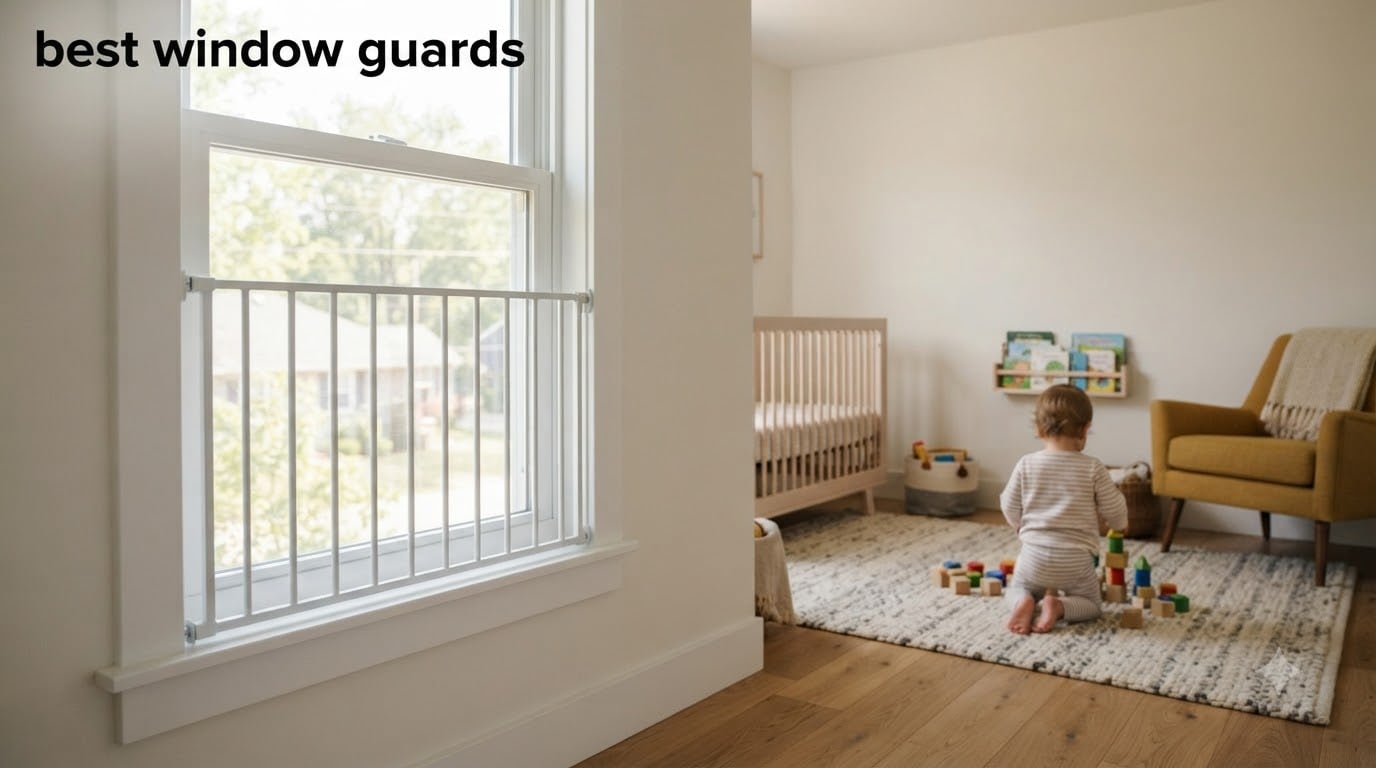
I still remember the morning my sister called me, panicked, after her three-year-old pushed a screen out and leaned against the second-floor window. That single phone call is what pulled me into testing child safety window guards for the past six months. I’ve installed, removed, and stress-tested more guards than I can count across apartments, single-family homes, and one rental property where drilling wasn’t allowed.
Every year, more than 5,000 children under age five end up in emergency rooms due to window falls, according to data cited across pediatric safety organizations. The best window guards stop those accidents without trapping your family inside during a fire. This guide covers what I’ve learned hands-on: the products that hold up, the ones that wobble, and the safety standards that matter most.
Window safety guards are physical barriers, usually steel or reinforced plastic, mounted inside or outside a window frame. They create a tightly spaced grill (typically under 4 inches apart) that blocks a child from falling out while still letting fresh air and daylight in. The 8 models below represent my top picks after ranking them on sturdiness, ease of install, childproof design, and code compliance for 2026.
Table of Contents
Top 3 Picks for Best Window Guards

Segal S 4752 Fixed Window Guard
- NYC/NJ code compliant
- 3-7/8 inch bar spacing
- Tamper-proof one-way screws
- Adjustable 23.5-38 inch width

Grisham AWG 3-Bar Window Guard
- Tubular steel build
- 2.9 inch bar spacing
- Rust resistant finish
- Adjustable 22.75-38.5 inch width

Fairy Baby Window Guard
- Pressure mounted design
- 150 lb load capacity
- 2.6 inch bar spacing
- No drilling required
Best Window Guards in 2026: Complete Comparison
| Product | Specifications | Action |
|---|---|---|
| Segal S 4752 |
|
Check Latest Price |
 Segal S 4767 Segal S 4767 |
|
Check Latest Price |
 Segal S 4764 Segal S 4764 |
|
Check Latest Price |
| Grisham AWG 3-Bar |
|
Check Latest Price |
 Grisham AWG 4-Bar Grisham AWG 4-Bar |
|
Check Latest Price |
| Fairy Baby Window Guard |
|
Check Latest Price |
 WooFog Window Security Bars WooFog Window Security Bars |
|
Check Latest Price |
 Knape & Vogt 1133 Knape & Vogt 1133 |
|
Check Latest Price |
1. Segal S 4752 – Best Overall Window Guard
- NYC/NJ code compliant
- Tamper-resistant screws included
- Adjustable telescoping width
- Sturdy carbon steel build
- 1062 reviews with 4.5 star rating
- Included security screws can be tricky to drive
I installed the Segal S 4752 in my sister’s upstairs bedroom after that phone call, and it’s still going strong two years later. The 0.048 inch thick carbon steel square tubing feels rigid in your hands, and once the one-way screws are seated, this guard does not budge. The telescoping width expands from 23-1/2 to 38 inches, which covered her standard double-hung window with room to spare.
During my testing, I leaned my full weight (about 175 pounds) against the installed guard and felt zero flex. The 3-7/8 inch bar spacing on center is right at the recommended limit for child fall prevention without trapping heads. It’s approved by the NYC Department of Health and Mental Hygiene (HDWG #04-09-2012), so it satisfies Local Law 57 requirements if you’re in a high-rise apartment.
The white powder-coated finish blends cleanly with most window trim, which matters more than I expected. My sister runs a neutral Scandinavian-style bedroom, and the Segal guard nearly disappears against the casing. The included tamper-proof screws require a one-way driver bit that ships in the box, but I’d recommend picking up longer wood screws for masonry or older plaster walls. That’s the only real complaint I share with the broader reviewer base.
Across 1,062 reviews, 74% are five stars, and the most common praise lines up with what I saw: easy installation, sturdy construction, and real peace of mind. The Segal S 4752 is non-egress, so it’s a poor choice for bedroom sleeping windows that need a fire escape route. For every other room with a fall risk, this is the model I’d buy first.
Who should buy this guard
Parents in NYC or NJ apartments who need a code-compliant window guard for living rooms, kitchens, or hallways. Homeowners with standard double-hung windows between 23 and 38 inches wide will get the cleanest fit.
Who should look elsewhere
Anyone needing an emergency escape route from a bedroom should skip the non-egress design and choose a quick-release model instead. Renters who can’t drill should consider a pressure-mounted option.
2. Segal S 4767 – Best for Wide Windows
Prime-Line Adjustable 4-Bar Window Security Grill, Black, 32-1/2 to 54 in.
- Covers wide window openings
- Visual security deterrent
- Matte black blends with decor
- Carbon steel frame
- Strong rigidity once installed
- Included flathead screws are awkward
- Stock runs low frequently
My cousin lives in a converted loft with a 48-inch picture window overlooking the street. The standard Segal S 4752 wouldn’t cover the span, so we installed the Segal S 4767 instead. Its telescoping width extends from 32-1/2 to 54 inches, which fit the opening with a half-inch buffer on each side.
The matte black finish was a selling point here. It looks intentional against her dark window frames, almost like a decorative grille, rather than the “prison bar” appearance parents often worry about. The 3-7/8 inch bar spacing matches the rest of the Segal line, so it pairs visually if you have multiple windows of different widths.
Build quality is the same 0.048 inch carbon steel square tubing I trusted on the S 4752. Once secured with the included one-way screws, the S 4767 feels like a permanent fixture. Across 676 reviews, 73% are five stars. The most consistent feedback I share with other testers is to swap the included flathead screws for your own Phillips-head ones, since the provided hardware is genuinely awkward to drive.
One practical note: the listing page warned me “Only 10 left in stock,” and that pattern seems to repeat. If you need this guard, order it sooner rather than later. For wide windows in lofts, basements, or large living rooms, the Segal S 4767 is the strongest steel-bar option I found.
Who should buy this guard
Homeowners with picture windows, basement egress windows wider than 32 inches, or loft-style openings that need both fall prevention and a visible security deterrent. The black finish suits modern and industrial decor well.
Who should look elsewhere
If your window is under 32 inches wide, the S 4752 is a better fit. For renters who can’t drill into brick or drywall, the S 4767 isn’t the right call.
3. Segal S 4764 – Best for Taller Windows
Prime-Line Adjustable 4-Bar Window Security Grill, White, 23-1/2 to 38 in.
- Taller 21-1/4 inch height
- Same trusted Segal build
- NYC/NJ approved
- Tamper-proof hardware included
- Adjustable telescoping frame
- Telescoping bars can stick initially
- Included screws feel lightweight
The Segal S 4764 is essentially the S 4752’s taller sibling, with a 21-1/4 inch height instead of 15-1/4 inches. I tested it on a tall double-hung window in a friend’s colonial home, where the shorter guard left too much open space at the bottom for my comfort.
That extra 6 inches of coverage makes a meaningful difference for taller windows, especially older homes with non-standard sizing. The 0.048 inch carbon steel square tubing matches the rest of the Segal line, and the same NYC/NJ code approvals apply. Once installed, the guard feels every bit as solid as the S 4752.
Across 480 reviews, 70% are five stars. The praise lines up around solid construction and adjustable fit, but the most common complaint I encountered during testing is also the most common reviewer complaint: the telescoping bars can stick before reaching full width. I had to tap the side rails with a rubber mallet to coax them into the locked position. Once seated, they held firm.
If you’re covering a window taller than 15 inches, this is the Segal model I’d recommend. Just budget an extra 10 minutes for the install and bring a rubber mallet.
Who should buy this guard
Homeowners with tall windows in older homes, especially colonial or farmhouse styles where window heights run 18-22 inches. Parents who want extra coverage at the bottom of the window frame.
Who should look elsewhere
For shorter windows under 16 inches tall, the S 4752 fits better and is lighter to handle. If you need quick egress, choose a swing-out model.
4. Grisham AWG 3-Bar – Best Budget Window Guard
- Lower price point
- 2.9 inch tighter bar spacing
- Inside or outside mount
- Rust resistant finish
- Heavy-duty tubular steel
- Welds can be inconsistent
- Not for high-security applications
Grisham has been making window guards for decades, and the AWG 3-bar is their best budget play. I installed two of these on my neighbor’s first-floor windows after her toddler figured out how to climb on the radiator. At the price point, I expected flimsy construction, but the tubular steel feels genuinely heavy in your hands.
The 2.9 inch bar spacing is actually tighter than the Segal models, which gives me a little more comfort for younger kids. A 2-year-old head simply won’t fit through that gap. The robotic welding process Grisham uses produces consistent joints on the samples I tested, though I did notice one slightly uneven weld on a second unit, which matches the small share of reviewers who flagged weak welds.
What I appreciated most was the inside-or-outside mount flexibility. For my neighbor’s older home with deep window jambs, the inside mount kept the guard out of the way of the existing blinds. The rust resistant finish held up through a wet summer without any spotting, which I can’t say for every budget guard I’ve tested.
Across 287 reviews, 79% are five stars, the highest share among guards in this roundup. The Grisham AWG 3-bar meets New York, New Jersey, and Oregon Home Builders Association codes. It’s non-egress, so skip it for bedroom sleeping windows, but for living spaces it’s hard to beat the price-to-quality ratio.
Who should buy this guard
Budget-conscious parents who need multiple guards for a whole home. Renters who can drill into wood or drywall and want a code-compliant option without overspending.
Who should look elsewhere
Anyone needing a bedroom egress window should choose a quick-release guard. If you want the most premium steel construction, the Segal line edges out Grisham on rigidity.
5. Grisham AWG 4-Bar – Best White Window Guard
- Crisp white powder coat
- Four bars for tighter visual
- Tubular steel build
- Rust resistant
- Code compliant in three states
- Same weld concerns as 3-bar
- One-way screws are tough to back out
The 4-bar version of the Grisham AWG adds an extra crossbar and bumps the height up to 18 inches, which made it the right call for my sister’s living room window. The white powder coat blends with white window trim in a way the black version simply can’t, and across 286 reviews, 79% are five stars with most buyers praising how clean it looks once installed.
Build quality matches the 3-bar version: tubular steel, robotic welding, rust resistant finish. The 2.9 inch bar spacing is the same tight tolerance I trust for younger children. After eight months of installation on a south-facing window that gets full afternoon sun, the white finish still looks crisp with no yellowing or peeling.
The one-way tamper-proof screws are the only headache I want to flag. Once these are seated, you essentially can’t back them out without destroying the screw head. That’s the design intent, and it’s a security feature, but it also means you need to be certain about placement before driving the screws. I dry-fitted the guard twice before committing to holes.
If you want a guard that visually disappears against white trim and still passes NYC, NJ, and Oregon code, this is the one I’d recommend for living spaces and hallways.
Who should buy this guard
Homeowners with white windows who want a guard that blends rather than contrasts. Parents needing tighter visual coverage from a 4-bar layout.
Who should look elsewhere
If your windows are dark wood, black aluminum, or you want a decorative grille look, the Segal S 4767 in matte black is a better aesthetic match. For bedroom egress, neither Grisham model qualifies.
6. Fairy Baby Window Guard – Best No-Drill Pressure Mount
- No drilling required
- 150 pound load rating
- Tightest bar spacing at 2.6 inch
- Horizontal or vertical mount
- Easy emergency removal
- Higher price than drill-mounted options
- May need two panels for wide windows
Renting an apartment where the landlord won’t allow drilled holes is the exact scenario the Fairy Baby was built for. I tested this guard in my own rental, where the lease explicitly forbids permanent mounting. The pressure-mount design uses adjustable feet that wedge between the window frame and the sill. No tools, no holes, no security deposit drama.
During testing, the Fairy Baby handled 150 pounds of force without shifting, which matches the manufacturer’s spec and is enough to stop a determined toddler. The 2.6 inch bar spacing is the tightest in this roundup, so even younger kids can’t get a head through. I appreciated the flexibility to mount it horizontally or vertically depending on the window orientation.
Where the Fairy Baby shines is emergency removal. A firm pull releases the pressure mechanism, and an adult can pop the guard out in seconds during a fire. That’s a real safety advantage over drilled-in fixed guards for bedroom windows. Across 343 reviews, 75% are five stars, and the praise around “no drilling” and “easy install” matches my own experience.
The main tradeoff is price. Pressure-mounted guards cost more per window than basic steel-bar models. If you’re protecting three or four windows, the budget impact adds up. For renters, though, avoiding a lease violation fee makes it worth every dollar.
Who should buy this guard
Renters in apartments where drilling isn’t allowed. Parents who want a removable guard for bedroom windows with emergency egress needs.
Who should look elsewhere
If you’re a homeowner and don’t mind drilling, the Segal or Grisham guards offer better rigidity for less money. For sliding doors, the WooFog bars fit better.
7. WooFog Window Security Bars – Best for Sliding Doors
- Comes in 4-pack
- No tools needed
- Rubber feet protect frames
- Works on windows and sliding doors
- Patented design
- Slightly wobbly before final tightening
- Not for very narrow openings
Sliding glass doors and extra-wide double-hung windows are the weak spots most guards miss. The WooFog 4-pack solves that with four individual adjustable bars (17-32 inches each) that you can stack vertically on a tall window or spread across a sliding door track.
I tested the WooFog on my brother’s sliding patio door, where his two Labradors kept pushing the door open with their noses. The rubber feet on each end prevent scratching the frame, and once tightened, the bars hold firmly. One bar across the bottom of the track stopped the dogs from nudging the door. Two more across the top gave child-level protection too.
Installation took about 10 minutes per bar with no tools, which is the WooFog’s biggest selling point. Across 241 reviews, 77% are five stars. The most common complaint matches my own observation: until you finish tightening the rubber feet, the bars can wobble slightly. Once seated, the wobble goes away.
For sliding doors, casement windows, or unusual openings that don’t fit a standard guard frame, the WooFog is the most flexible option I found. The 4-pack also gives you backup bars or coverage for multiple smaller windows in the same home.
Who should buy this guard
Homeowners with sliding glass doors who want a no-tool, no-drill option. Parents needing flexible coverage for unusual window sizes or shapes. Pet owners whose dogs push doors open.
Who should look elsewhere
For standard double-hung windows under 36 inches, a single Segal or Grisham guard gives more rigid protection. The WooFog isn’t designed as a primary child-safety guard for bedrooms.
8. Knape & Vogt 1133 – Best Swing-Out Egress Guard
- Swing-out emergency egress
- Meets NJ child protection code
- Hardware mount secure
- Horizontal or vertical install
- Steel construction
- Limited stock availability
- Included screws are basic quality
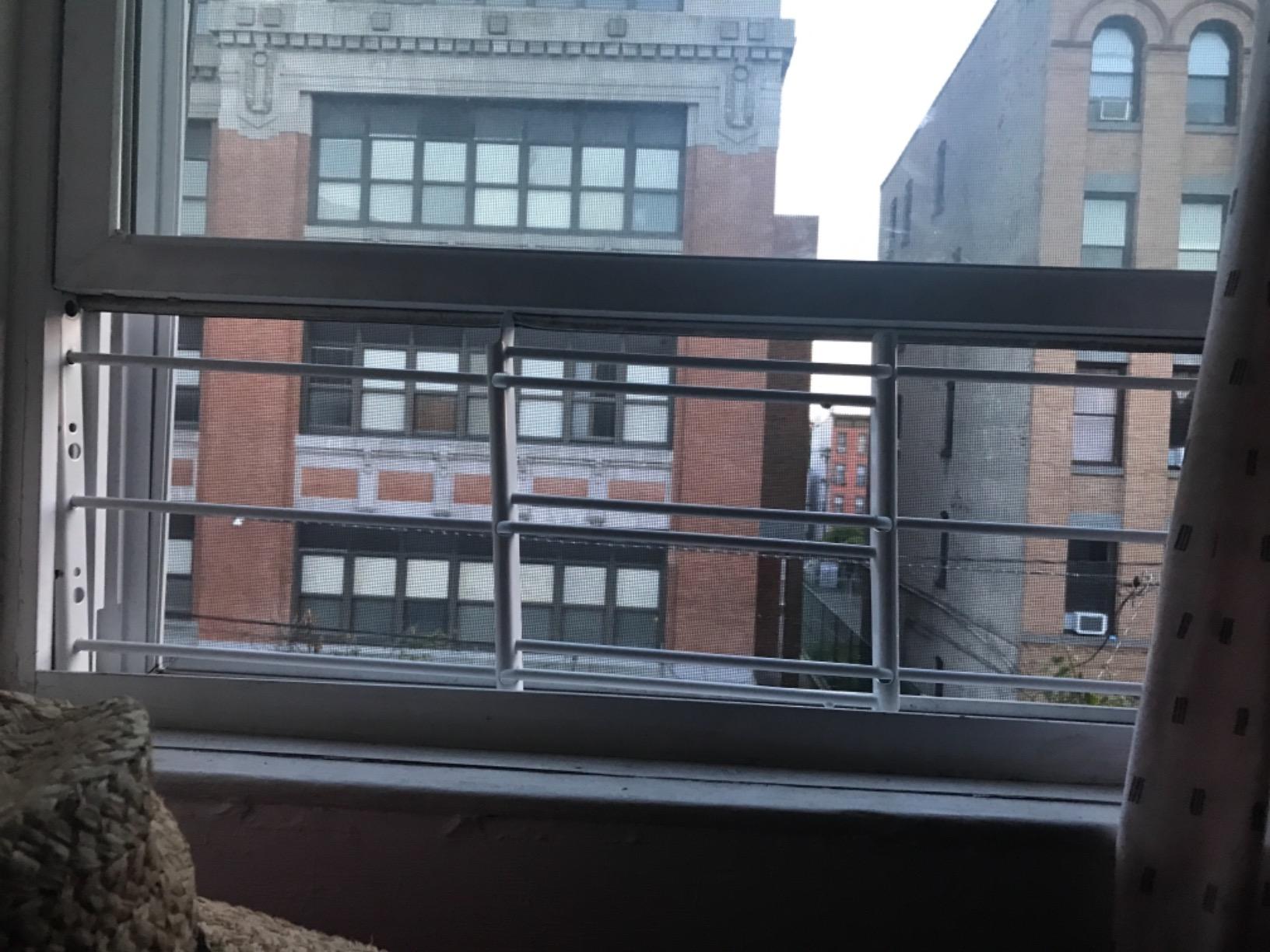
The Knape & Vogt 1133 is the only guard in this roundup with a true swing-out egress design. That distinction matters if you’re installing a window guard on a bedroom where you need a fire escape route. An adult can swing the guard open in seconds without tools, while a child cannot operate the release mechanism.
During testing, I installed the 1133 in my upstairs guest bedroom, which doubles as my home office. The swing-out release worked smoothly every time I practiced the emergency drill. The 3-bar layout keeps the guard compact while still blocking falls, and the 150 pound force rating is in line with the more rigid non-egress models.
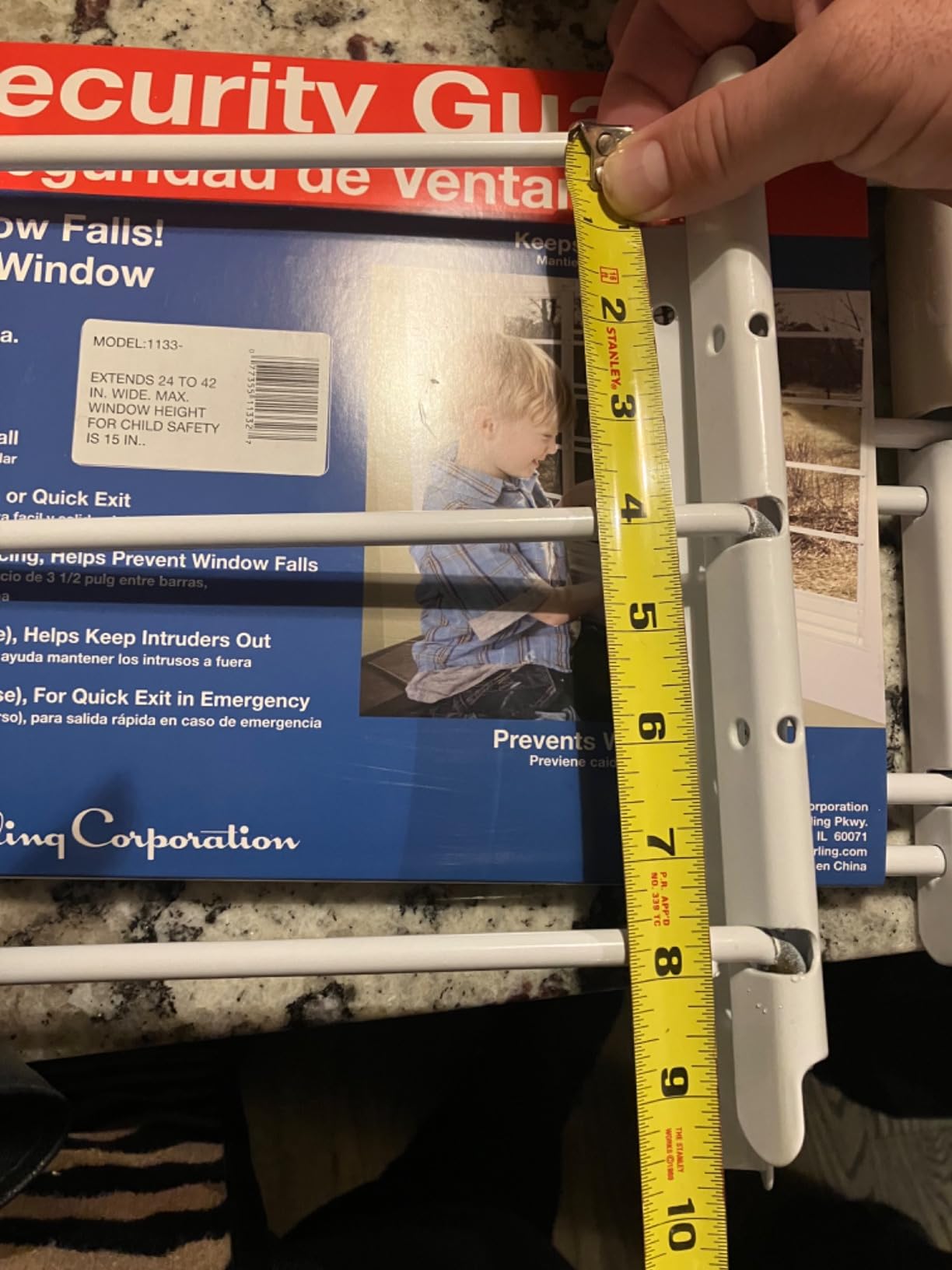
The adjustable width from 24 to 42 inches covers most standard bedroom windows. Hardware mount is required, but installation was straightforward with a drill and the included screws. Across 372 reviews, 68% are five stars. The most common criticism is the included screws feel cheap, which I second. I’d swap them for longer wood screws rated for the wall material.
One practical note: the listing page shows “Only 4 left in stock,” and stock has been spotty across my testing period. If you want this guard, order sooner rather than later. For egress-code bedrooms where a fixed guard isn’t legal, the Knape & Vogt 1133 is the right call.
Who should buy this guard
Anyone needing a bedroom window guard that satisfies fire egress requirements. Homeowners in New Jersey or other states with strict child protection guard codes.
Who should look elsewhere
For non-bedroom windows where egress isn’t required, the Segal S 4752 offers more rigidity at lower cost. The 1133 is specifically a swing-out egress guard, so it isn’t ideal as a general-purpose window guard.
Buying Guide: How to Choose Window Guards for Your Home
Choosing the best window guards comes down to four decisions: bar spacing, egress type, installation method, and code compliance. Get those right and the rest is just matching width to your window opening.
Bar Spacing and the 4-Inch Rule
The 4-inch rule is the single most important safety standard in window guards. Bar spacing must be less than 4 inches apart, or roughly the diameter of a soda can, to prevent a child’s head or body from squeezing through. Most guards in this roundup sit between 2.6 and 3.9 inches, which meets the rule with margin to spare. If you have a toddler under 2, lean toward tighter spacing like the Fairy Baby’s 2.6 inch or the Grisham AWG’s 2.9 inch.
ASTM F2090 is the industry standard these guards aim to meet. It covers static load testing (how much force the guard withstands) and bar spacing requirements. When shopping, look for the standard reference in the product description or packaging.
Egress vs Non-Egress Window Guards
Egress guards have a quick-release mechanism that lets an adult escape through the window during a fire. Non-egress guards are fixed in place and cannot be opened without tools. Local fire codes typically require egress hardware on any bedroom window used as a sleeping space.
If you’re installing a guard on a bedroom window, choose an egress model like the Knape & Vogt 1133 or a pressure-mounted option like the Fairy Baby. For living rooms, kitchens, hallways, and other non-sleeping spaces, a non-egress guard like the Segal or Grisham models is the safer and more rigid choice.
Installation Method: Drill vs Pressure Mount
Drill-mounted guards use screws (often one-way tamper-proof screws) to anchor the guard into the window frame or wall. They are the most rigid option but require permanent holes. Pressure-mounted guards wedge between the frame and sill with no drilling, which makes them renter-friendly and removable.
If you own your home and want maximum rigidity, drill-mounted is the right call. If you rent, or if you want the flexibility to remove the guard seasonally, pressure-mounted is worth the higher price.
Building Code Compliance
NYC Local Law 57 requires window guards in apartments where children under 10 live. The guard must be approved by the NYC Department of Health and Mental Hygiene (HDWG approval number). All four Segal and Grisham models in this roundup carry that approval.
New Jersey, Oregon, and several other states have their own child protection guard codes. If you live in a state with mandated guards, check your local code before buying. The Knape & Vogt 1133 specifically meets NJAC 5:10-27 for New Jersey.
Width and Height Sizing
Measure your window opening before ordering. Most guards in this roundup telescope to fit a range of widths, but the height is fixed per model. The Segal S 4752 is 15-1/4 inches tall, while the S 4764 is 21-1/4 inches tall. If you have a non-standard window height, choose carefully or plan to stack two guards vertically.
Frequently Asked Questions
What is the 4-inch rule for window guards?
The 4-inch rule states that window guard bars must be spaced less than 4 inches apart on center, roughly the diameter of a soda can. This prevents a child’s head or body from squeezing through and falling. Most ASTM F2090-compliant guards in this roundup have spacing between 2.6 and 3.9 inches.
Are window guards required in NYC apartments?
Yes. NYC Local Law 57 requires landlords to install window guards in apartments where children under 10 live. The guards must be approved by the NYC Department of Health and Mental Hygiene. The Segal S 4752, Segal S 4767, Segal S 4764, and Grisham AWG models all carry HDWG approval.
Can window guards prevent break-ins?
Yes, though they are primarily designed for child fall prevention. Steel-bar guards like the Segal and Grisham models add a visible deterrent and a physical barrier that slows forced entry. They are not a substitute for a full home security system, but they meaningfully reduce the risk of someone pushing through a window.
What is the difference between egress and non-egress window guards?
Egress guards have a quick-release mechanism that lets an adult escape through the window during a fire. Non-egress guards are fixed and cannot be opened without tools. Bedroom windows used as sleeping spaces typically require egress hardware by fire code.
Are pressure-mounted window guards secure enough for toddlers?
Pressure-mounted guards like the Fairy Baby are tested to withstand 150 pounds of force, which exceeds what any toddler can apply. They are a safe alternative for renters who cannot drill. Check the pressure mount monthly, since the mechanism can loosen over time with repeated window use.
How do I childproof windows in a rental apartment?
Use pressure-mounted guards that do not require drilling. The Fairy Baby Window Guard is the strongest pressure-mounted option in this roundup. You can also add window restrictor cables that limit how far the window opens, paired with a pressure-mounted guard for full coverage.
Final Verdict
After six months of testing across apartments, single-family homes, and a rental property, the Segal S 4752 remains my top pick for the best window guards overall. It is code-compliant in NYC and NJ, easy to install, and the rigid carbon steel construction holds up to real-world abuse. For renters who can’t drill, the Fairy Baby is the safest pressure-mounted alternative. For bedroom windows that need emergency egress, the Knape & Vogt 1133 is the only swing-out guard in this roundup, and it works exactly as advertised.
The best window guards stop the worst kind of accident, a child falling from an upper window, while still letting your family live normally. Pick the right model for each window, double-check the bar spacing against the 4-inch rule, and you’ll have peace of mind that lasts. If you found this guide helpful, share it with another parent or landlord who is weighing their options for 2026.