
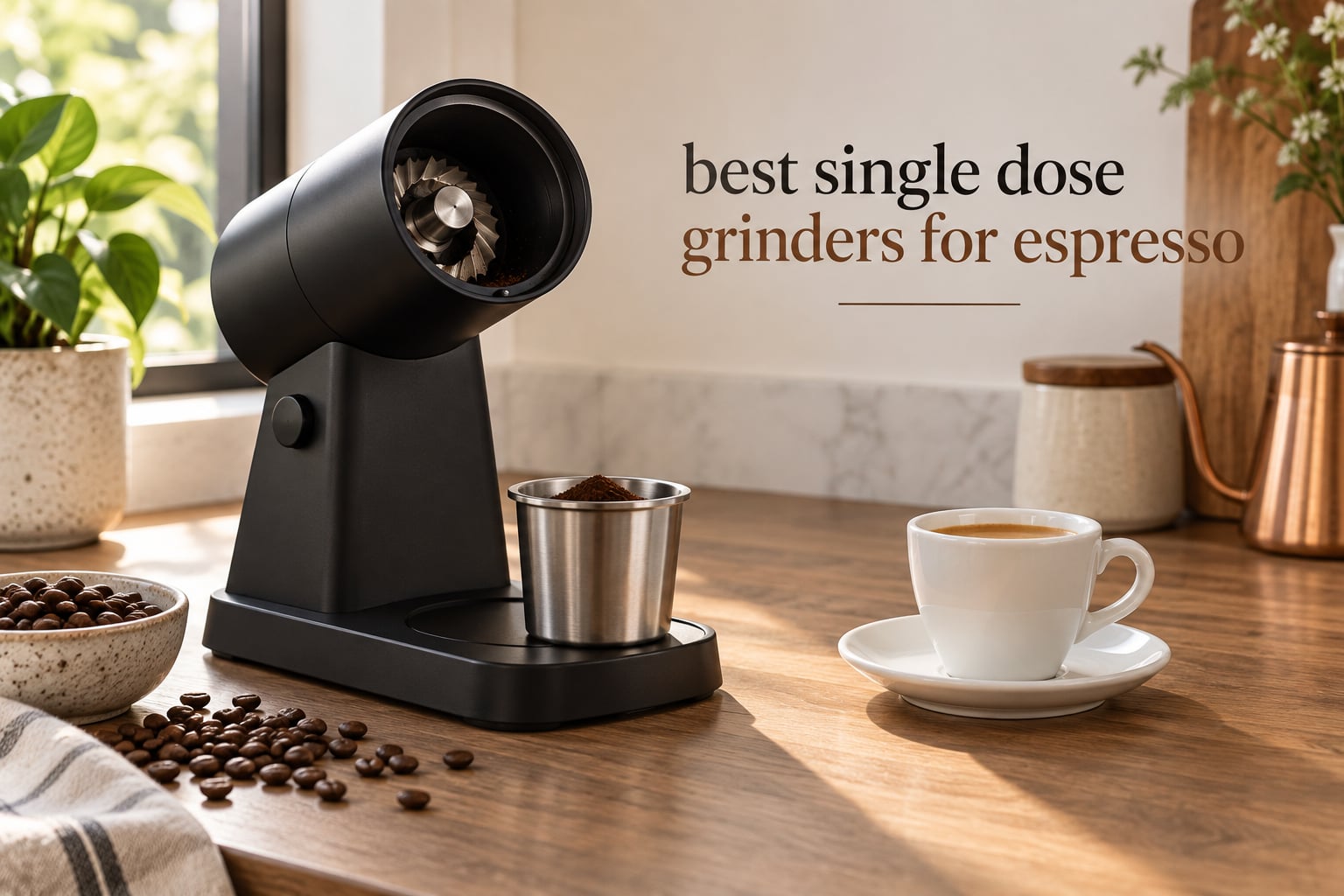
A single-dose grinder has no bean hopper. You weigh out exactly the dose you need for one shot, drop it into a small grinding chamber, grind, and purge the chamber so the next coffee tastes like the first one. That simple idea is why the search for the best single dose grinders for espresso keeps coming up, and why it fills forum threads for months at a time.
Our team compared ten single-dose and single-dosing-capable grinders, pulled the specifications for each, and read the owner feedback closely rather than going by the marketing photos. What we were looking for was simple: low retention, a grind fine enough for espresso, adjustment you can actually repeat, and a body that does not take over the counter.
The honest finding is that burr engineering beats burr diameter, and that retention numbers only mean something when you know whether the bellows was attached. Most grinder guides skip that detail. We did not, and we explain how the figures in this roundup are measured in the buying guide below.
If your setup leans more toward cafe volume, our professional espresso grinder guide covers the commercial end of the market. The picks below are built for a home kitchen.
Top 3 Single Dose Grinders for Espresso in 2026
Three picks cover most readers. The Baratza Encore ESP is the one we would put in the hands of almost anyone buying their first dedicated espresso grinder, because it has the largest owner base in the group and the most replaceable parts. The MiiCoffee DF64 II goes further on precision, with 64mm flat burrs and a stepless dial. The Viesimple Gen 4 is the one to look at when counter space is the constraint.

Baratza Encore ESP
- 40mm steel conical burrs
- Dual-range 20 espresso micro-steps
- Single dose into cup or portafilter


Best Single Dose Grinders for Espresso in 2026: Quick Comparison
Every grinder in the roundup appears below with its burr set, adjustment type and the workflow it suits. Retention figures are manufacturer or owner measurements, and where a figure depends on the bellows we say so.
| Product | Specifications | Action |
|---|---|---|
| Baratza Encore ESP |
|
Check Latest Price |
| Viesimple Gen 4 |
|
Check Latest Price |
| MiiCoffee DF64 II |
|
Check Latest Price |
 Wirsh Geimori GU38 Wirsh Geimori GU38 |
|
Check Latest Price |
 Mokkom 64mm Flat Burr Mokkom 64mm Flat Burr |
|
Check Latest Price |
 Turin SK40 Turin SK40 |
|
Check Latest Price |
 Gevi VelPro 400 Gevi VelPro 400 |
|
Check Latest Price |
 STARSEEKER E55 Pro STARSEEKER E55 Pro |
|
Check Latest Price |
 DF64 Gen 2 DF64 Gen 2 |
|
Check Latest Price |
 Fellow Ode Gen 2 Fellow Ode Gen 2 |
|
Check Latest Price |
One note before the individual write-ups. The Fellow Ode Gen 2 is on this list as an honest alternative rather than a recommendation: Fellow states plainly that it is not built for espresso, and owners confirm it cannot grind fine enough. We include it so the comparison is complete, and label it clearly at its section.
1. Baratza Encore ESP: The Best Single Dose Grinder for Most Home Setups
- Precise dual-range adjustment for repeatable dialing
- Single-doses into a cup or straight into the portafilter
- Tool-free quick-release burrs for easy cleaning
- Steel burrs and parts are widely available
- Quiet next to blade and older burr grinders
- Noticeably loud compared with premium flat-burr machines
- Plastic burr holder is a known durability weak point
- Front on/off push switch can detach
- No timed dosing so grinding stops manually
This is the grinder we recommend to most people, and the reason is unglamorous: it has 1,385 owner reviews behind it and a parts list you can actually source. When something goes sideways with a burr carrier or a switch, the fix is a part you can order, not a machine you replace. In a category where most competitors are new listings with a handful of reviews, that is worth more than a spec sheet.
The Encore ESP runs 40mm hardened alloy steel conical burrs manufactured in Liechtenstein, driven by a 150W DC motor. The adjustment is dual-range: twenty micro steps cover the espresso end and twenty macro steps cover filter. That split is the clever part, because you get finer increments exactly where you need them and stop wasting clicks on filter brewing.
Single dosing works the way the design intends. You twist the hopper off, drop in your weighed dose, and either the dosing cup or the portafilter chute catches it. Several owners report pulling noticeably better shots than they managed on blade grinders of a similar class, and the low step count means a re-dial after changing beans takes seconds rather than a full filter reset.
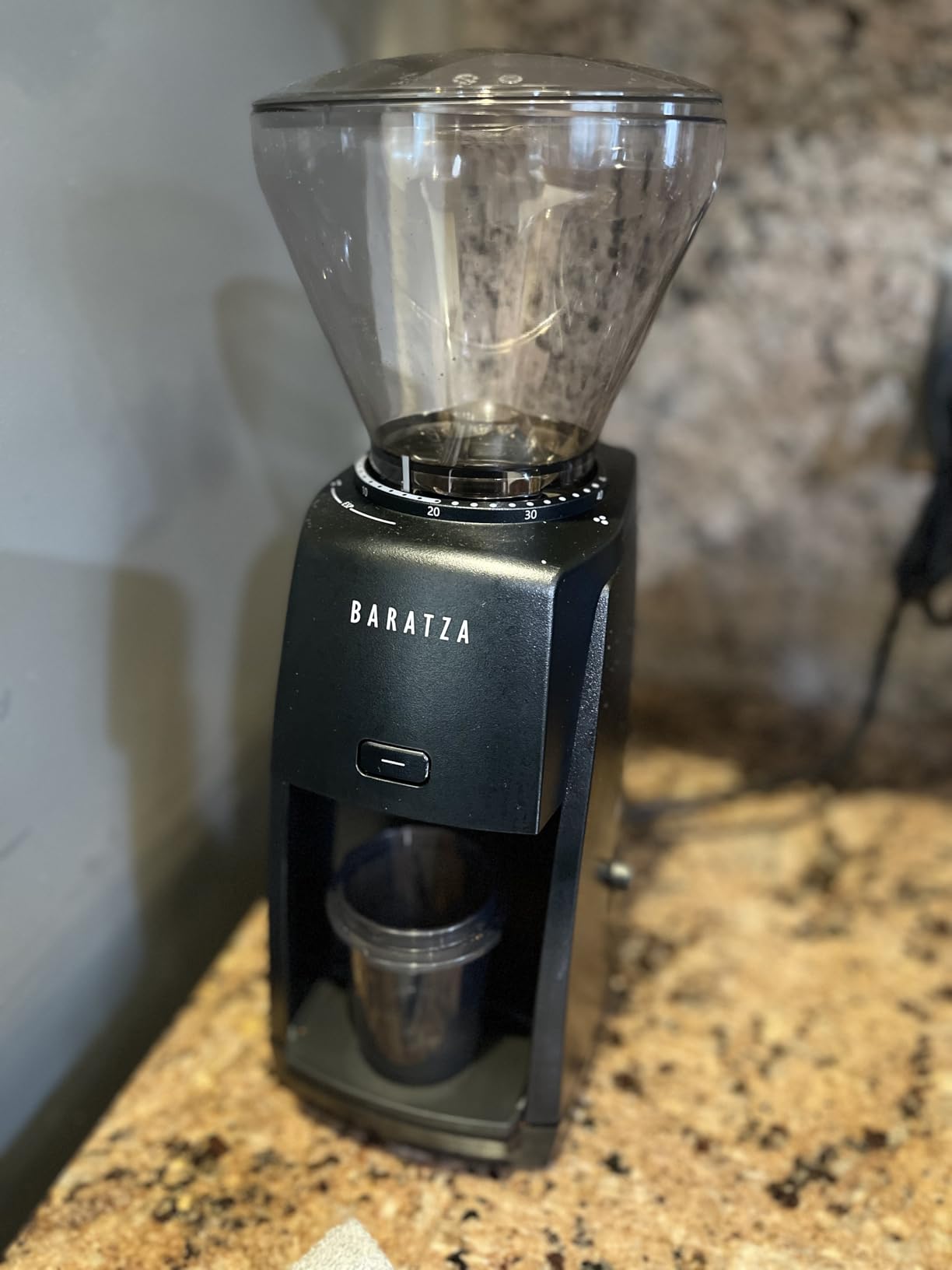
The quiet part deserves a caveat. Owners call it quiet relative to blade grinders and older burr grinders, not quiet in absolute terms. If your espresso habit starts at six in the morning, expect to hear it. Several buyers moving from a hopper grinder notice the difference immediately because there is no constant stream of grounds through the burrs.
Cleaning is the other place this machine earns its rating. The quick-release burr mounting system comes apart without tools, so you can brush the chamber and reassemble in under a minute. That matters with single dosing, where every dose puts fresh coffee through an empty chamber and static cling builds quickly on the chute walls.
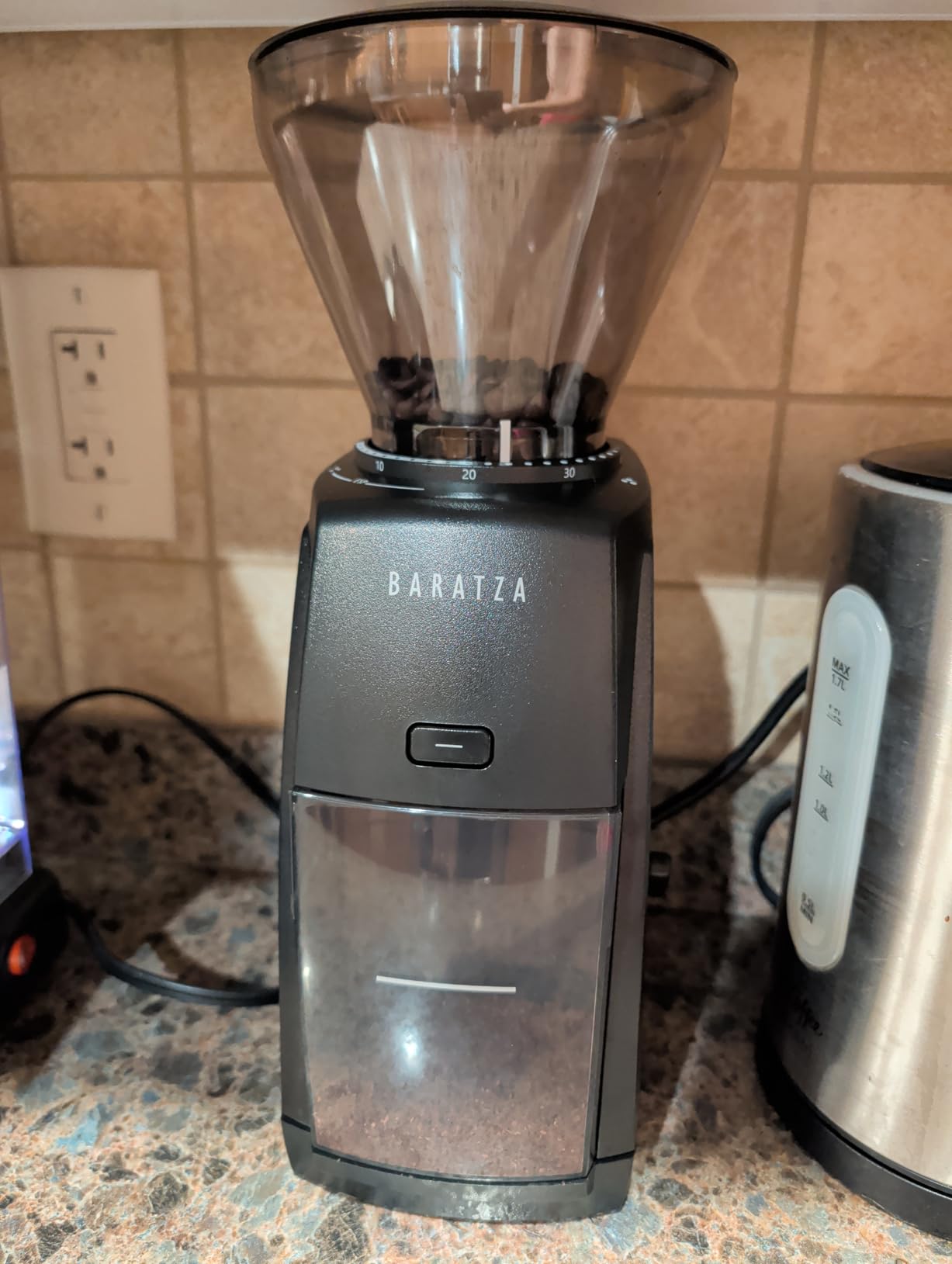
Best fit for: daily espresso on an entry or prosumer machine
This suits someone pulling one to three shots a day on a machine like a Bambino, a Rancilio Silvia or an entry prosumer unit, who wants a repeatable grind and parts that still exist in five years. It also works as a backup filter grinder because the macro range covers pour-over adequately.
Owners moving up from a blade grinder typically report the same thing: the shot looks tighter and the flavour is less sharp around the edges. The mechanical grind is not as uniform as a 64mm flat-burr set, but the difference is small enough that most home setups will never notice.
Skip it if: you need near-silent grinding or plan to keep it for a decade without touching plastic parts
The plastic burr holder is the recurring complaint in the reviews, along with the front push switch detaching or vibrating loose. Roughly 14% of ratings are one-star, and durability is the reason rather than grind quality. If you grind several hundred grams a day, buy the flat-burr options further down instead.
Also note there is no timed dosing. You start and stop the grind by hand, which suits single-dosing fine but will feel slow if you ever switch to the hopper for a big filter brew.
2. Viesimple Gen 4: The Best Single Dose Grinder for Small Counters
Viesimple Gen 4 Electric Burr Coffee Grinder, Single Dose, Espresso, Black
- Very compact at 6 by 3 by 9 inches
- Quiet low-RPM motor with minimal heat
- Anti-static coating and magnetic cup keep the counter clean
- Two-year warranty with responsive service
- Universal voltage input
- Some espresso users report clogging at very fine settings
- Conical burr throws extra fines at coarser settings
- No timed dosing
- External power brick needs its own counter space
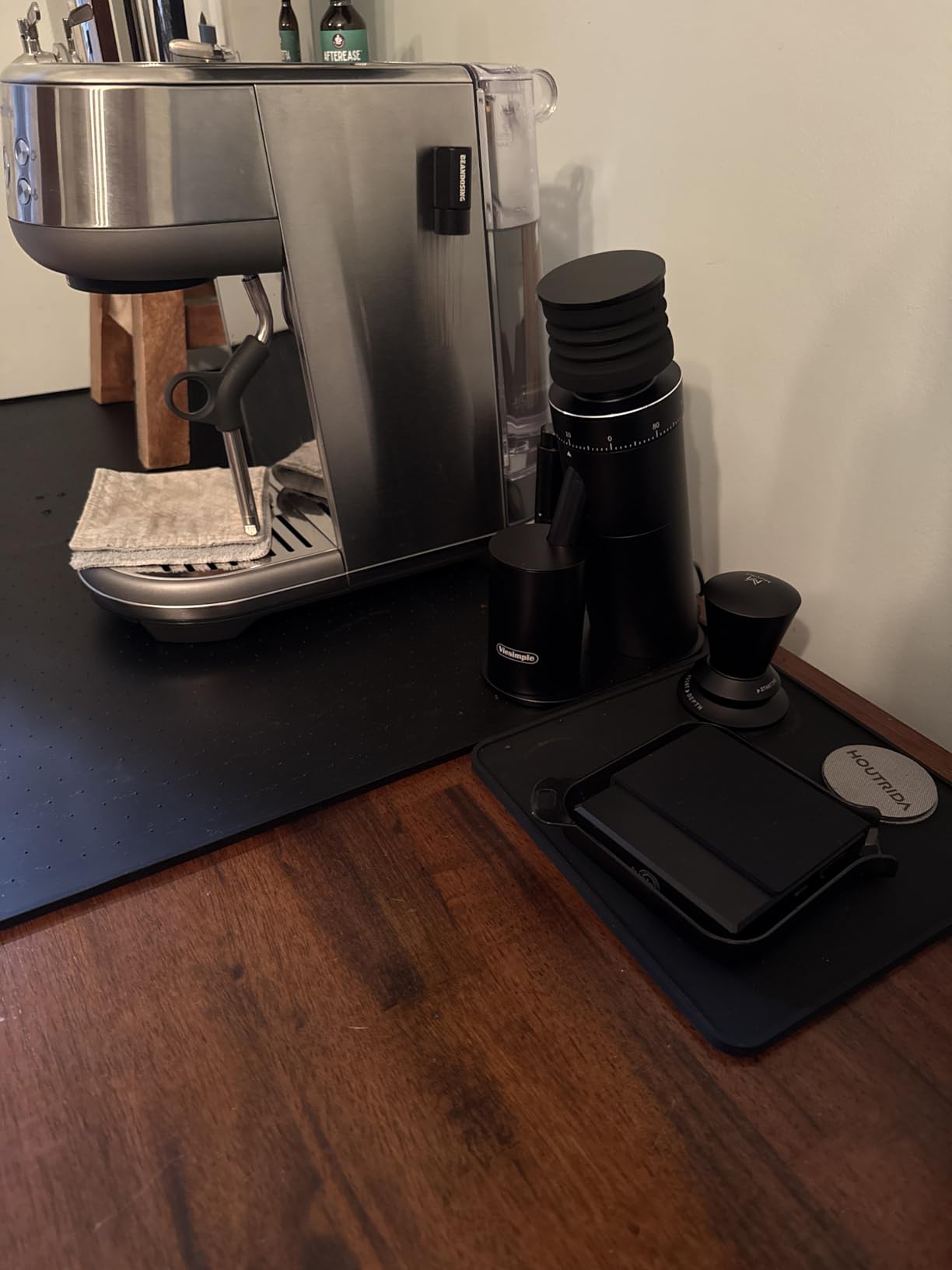
This is the smallest grinder in the roundup by a wide margin, and that is the entire pitch. At 3.4 pounds and a 6 by 3 by 9 inch body, it disappears into a corner of the counter next to a machine that already dominates the space. Reviewers upgrading from larger flat-burr machines frequently single out the footprint as the reason they stayed.
The grinder uses a 48mm five-blade conical burr set in a fully aluminium body, powered by a low-RPM DC motor rated under 50 dB. That motor speed is the reason it runs cool and quiet, and the anti-clogging powder channel with its food-grade anti-static coating is a visible design choice aimed squarely at the mess problem that dominates single-dose complaints.
Accessories cover the workflow properly. You get a magnetic dosing cup with a sealed lid and an auto return, plus a blow-out funnel for clearing retained grounds from the chamber. A 336-review base with a 4.5 average and 77% five-star is a healthier signal than most machines twice the price carry.
The universal 100-240V input is a quiet advantage that matters more than it sounds. If you move, ship the machine, or buy it for an office abroad, you do not need to think about a voltage-specific unit. The external power brick is the trade-off, and it needs a spot of its own on the counter.
Espresso performance is where the reviews split. Several users on prosumer machines report clogging when dialing in very fine settings, and the conical burr produces more fines at coarser positions than a flat burr would. For an entry machine and everyday home espresso, most owners report good results.
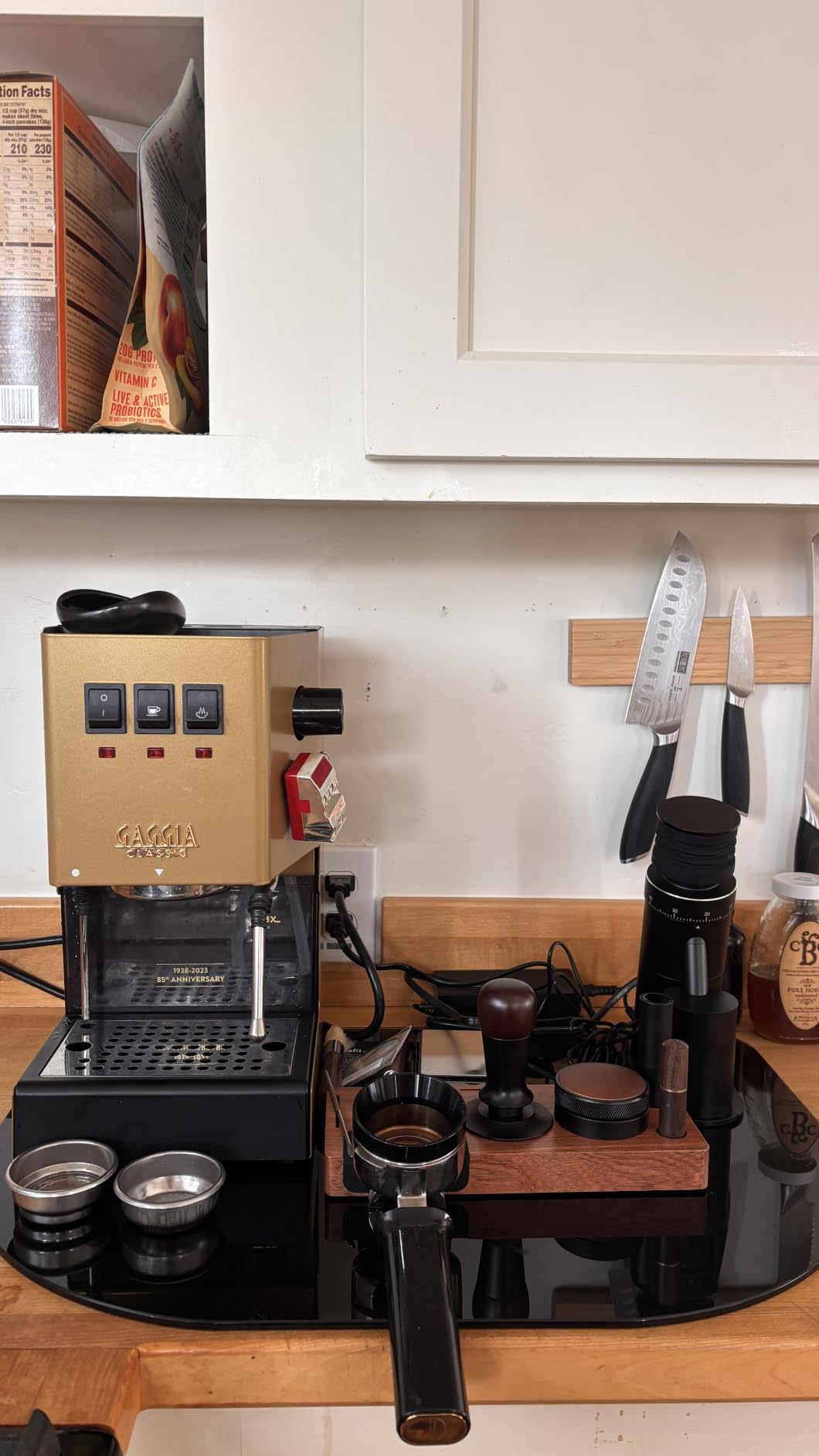
Best fit for: a small kitchen, an office bar, or a second grinder beside the machine
It is the pick for anyone whose counter cannot spare a 12-inch-tall flat-burr body, and for people pulling a couple of shots a day who never need the range of a larger grinder. The two-year warranty also makes it a lower-risk first espresso purchase than most single-dose options here.
The quiet motor is genuinely the differentiator. If you grind before the rest of the house is awake, this is the machine in the group least likely to wake anyone.
Skip it if: you chase very fine espresso on a prosumer machine or brew a lot of filter coffee
Extra fines from the conical burr hurt immersion brews, and the fine-end clogging complaints are real enough to plan around. If your daily output includes a French press or a batch pour-over, spend your money on flat burrs instead.
One more flag: the manufacturer has been unresponsive about replacement burr availability, so factor that into the long-term ownership picture.
3. MiiCoffee DF64 II: The Best Single Dose Grinder for Flat-Burr Precision
- Measured retention under 0.1 g even with no bellow
- Stepless dial gives repeatable fine dialing
- Ionizer and anti-popcorn disc cut static and speed up grinding
- 64mm burrs can be upgraded to SSP
- Generous accessory kit in the box
- Heavy 15-pound body takes real counter space
- Chute and burr cleaning takes more effort
- Only a one-year manufacturer warranty
This is the grinder the enthusiast side of the conversation points at, and the retention figure is the headline. The listed measurement is under 0.1 g with the bellow removed, which is unusual: most single-dose grinders quote their best number with the bellow attached. A flat-burr set this size at this tier is the main reason we recommend it so highly.
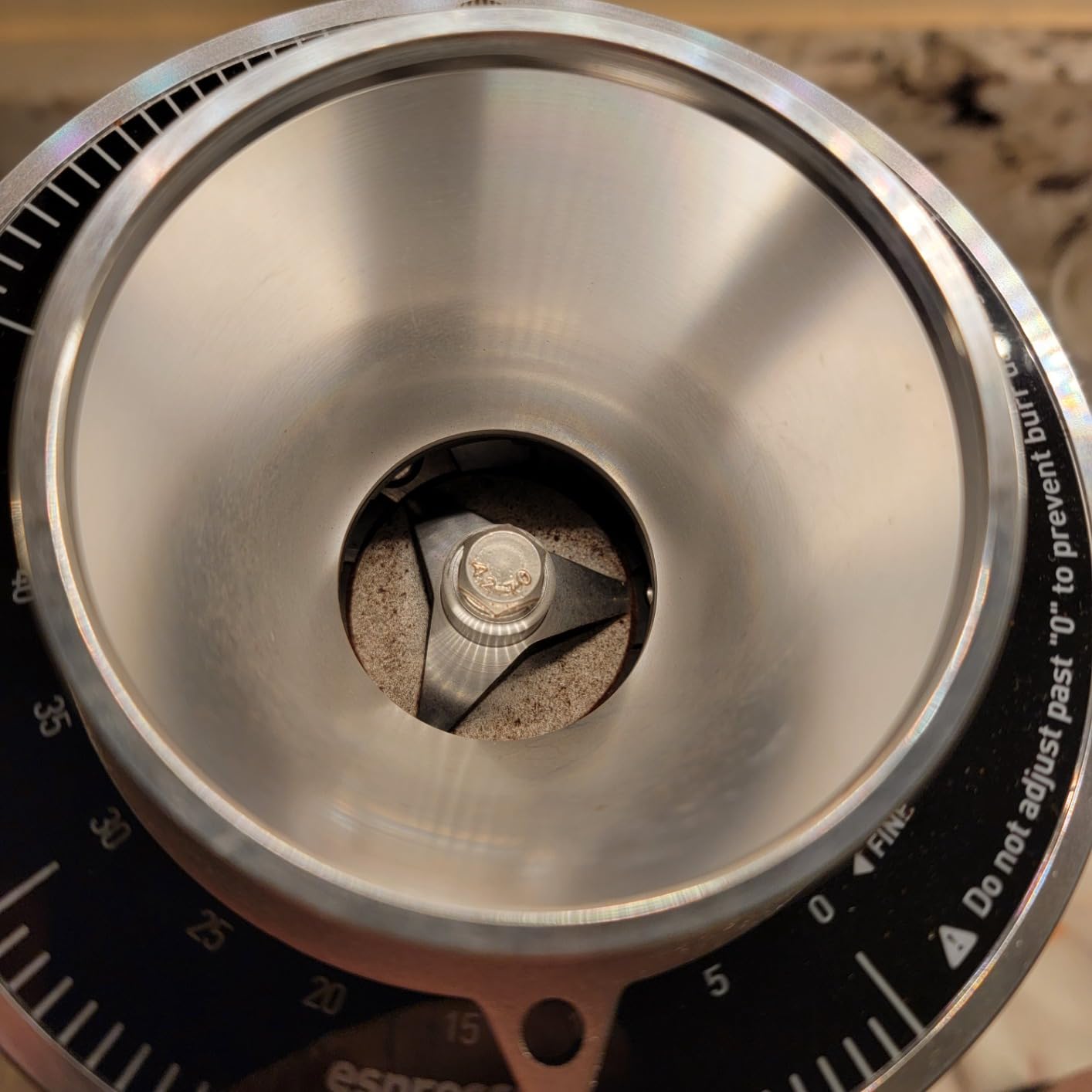
You get custom 64mm stainless steel flat burrs that are upgradeable to SSP burr sets, running at 250W on a 110V plug. The stepless chrome-wrapped dial with a metal indicator gives continuous adjustment rather than clicks, which is what you want when you are chasing a few seconds of shot time on a light roast.
Two details do real work here. The convex anti-popcorn disc in version 2.6 stops beans bouncing at the burr entrance, and the plasma generator ionizer built into the exit chute neutralises static so grounds drop into the cup instead of clinging to the walls and flying across the counter.
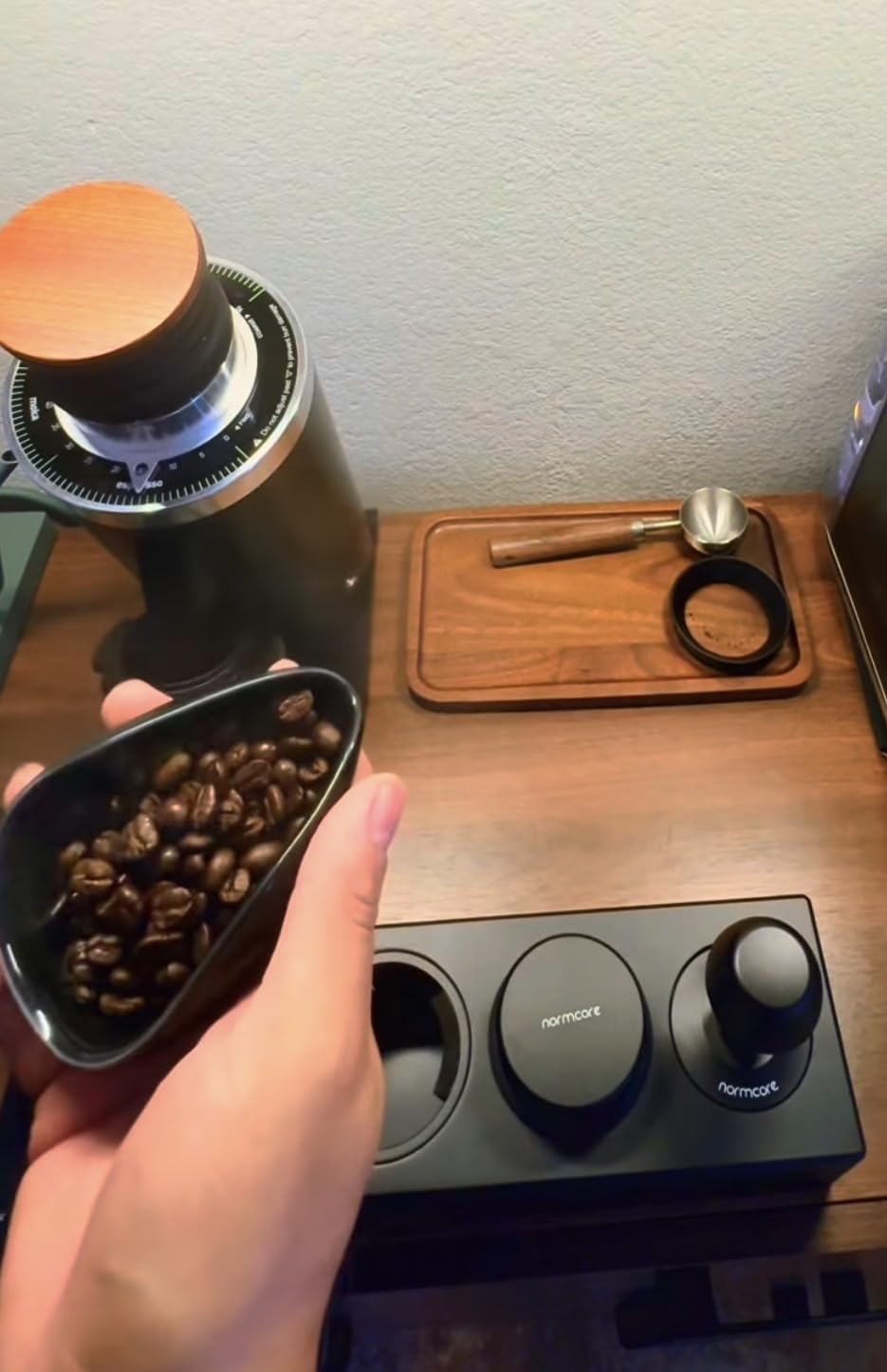
The accessory kit is unusually generous for the money: the bellow, wood lid, metal dosing cup and dosing ring all come in the box. The 58mm food-grade aluminium dosing cup is also the right size for a standard commercial portafilter, which is more than some competitors in this bracket manage.
Cleaning is the honest weakness. The chute and burr area take more effort than on the small conical machines, and a 15-pound body at 9.84 by 5.12 by 11.81 inches is a real commitment of counter space. Buyers who like the grinder generally accept this as the cost of a flat-burr path.
Best fit for: a home barista chasing flat-burr uniformity on light roasts
It is the pick for someone who rotates single-origin beans, dials in frequently, and wants a measured retention number they can trust. The upgradeable burrs also make it a long-term buy, since a burr set refresh is a planned cost rather than a replacement.
Compared with the conical picks here, owners report a more uniform particle size and fewer boulders in the dose. On a light roast where flavour clarity is the goal, that difference is easier to taste than to measure.
Skip it if: counter space is tight or you want a long warranty
The single-year warranty is thin next to the two-year coverage on the smaller machines in this roundup. Check that support exists where you live before buying, because this is the kind of grinder where that matters more than the sticker.
Owners are also split on noise, with less consensus than on any other spec here. Expect it to be audible, and do not expect the DF-series reputation for quiet to apply to this one.
4. Wirsh Geimori GU38: The Best Single Dose Grinder If Noise Is the Problem
- Very quiet 170 RPM motor for early mornings
- Consistent grind size across brew methods
- Low retention design with a bellows in the box
- All-metal body with wood accents looks good on a counter
- Includes RDT spray bottle and magnetic dosing cup
- Beans can stick in the burr throat and need brushing
- Some packages arrive without the RDT bottle
- Small 30 g chamber means frequent refilling
- Limited brand recognition and name recognition
The reason it earns the quiet badge is motor speed. An 80W DC motor running at a steady 170 RPM turns far slower than a flat-burr grinder motor, which trades outright speed for a grind you can run before sunrise without neighbours objecting. Owners consistently describe the machine as surprisingly quiet for its class.
The burr is a 38mm six-core CNC-machined SUS420 high-nitrogen stainless steel set rated at HRC58. Adjustment is genuinely stepless across 65 positions with 0.02mm micro-adjustment, and the listed retention is under 0.1 g with the bellows, which is in the box alongside a magnetic dosing cup and an RDT spray bottle.
The 65-position stepless range is more precision than most entry machines can use, which makes this a good first espresso grinder for someone who intends to move up later. Reviewers using it on entry machines report consistent shots across brew methods.
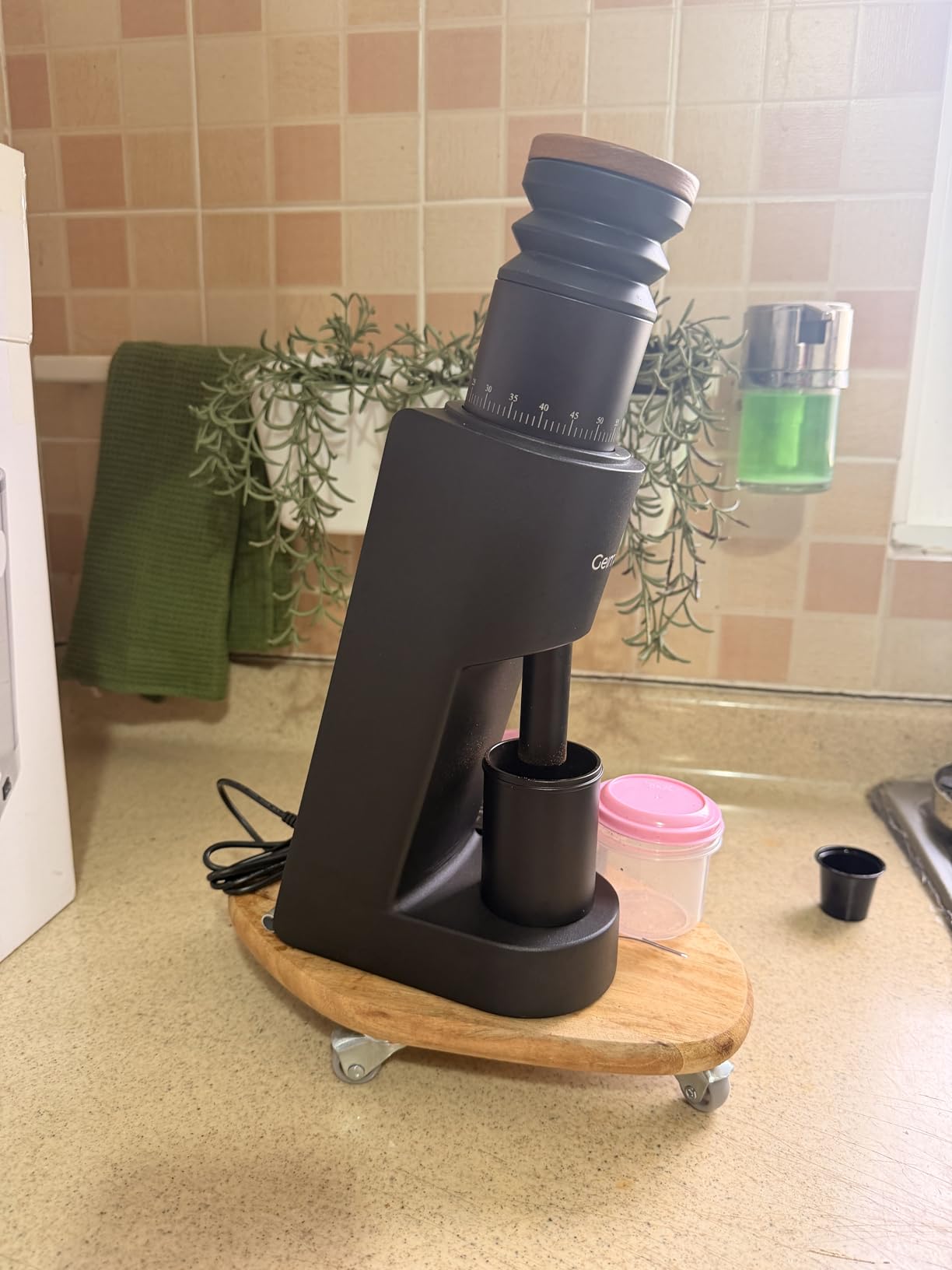
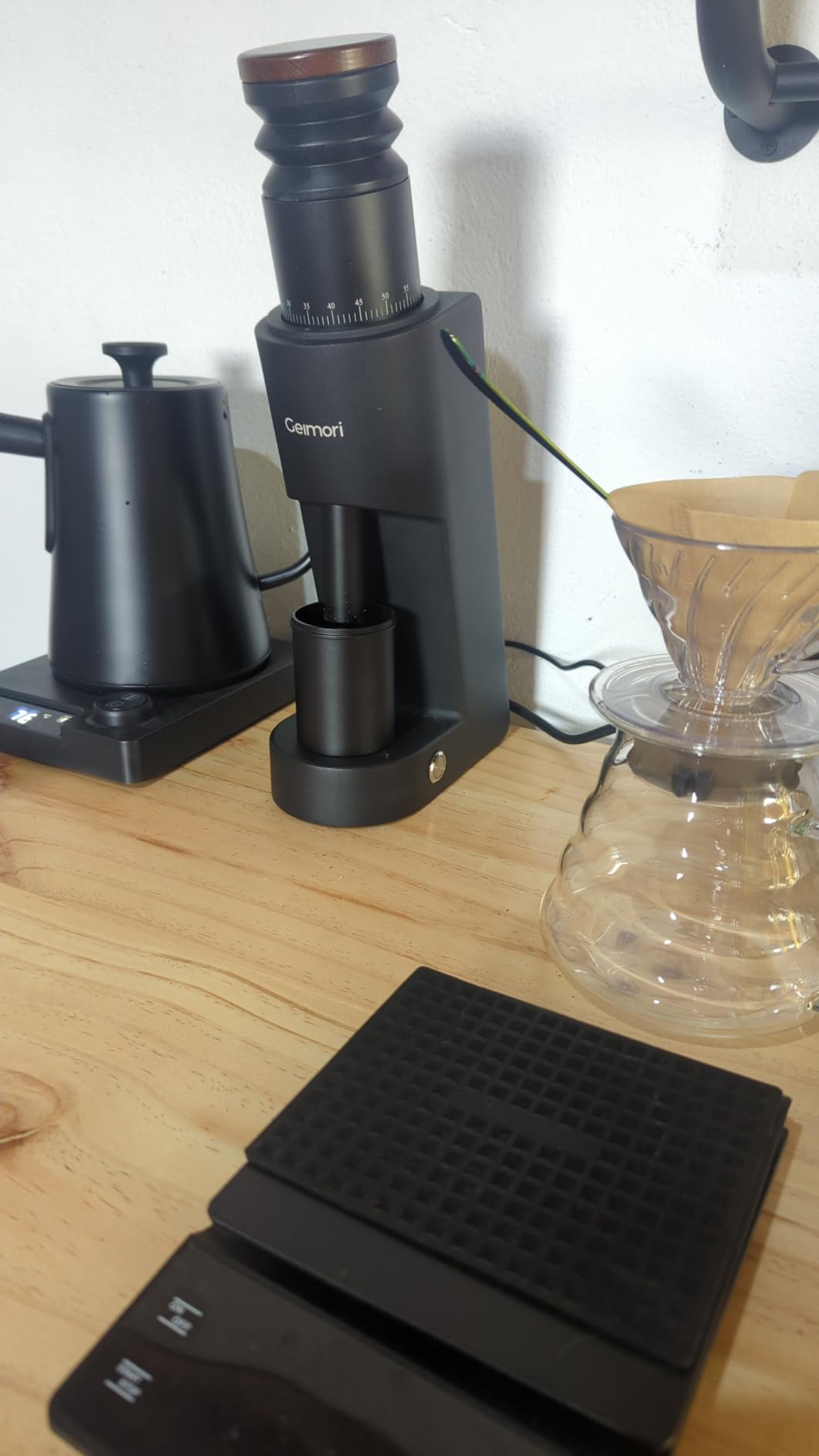
The body is plastic-free aluminium with wood accents, and the auto-aligning magnetic dosing cup means you are not hunting for it in the morning. It weighs 5.2 pounds and measures 3.5 by 6.3 by 12 inches, which is tall but narrow, so it fits beside a machine on a shallow counter.
The main usability gripe is bean feeding. The 30 g chamber is small, and some beans will sit on the burr throat instead of dropping in. Owners work around it by adding beans gradually and occasionally brushing them down, which adds a few seconds per dose.
Best fit for: early risers and anyone who grinds before the house wakes up
This is the pick when noise is the deciding factor and your espresso output is one to three shots a day. The included RDT bottle also lets you attack static cling directly, which is the other complaint that shows up constantly with conical burrs.
It also works as a second grinder for moka pot, AeroPress and pour-over, since the stepless range covers coarse settings without a reset. Several owners use it that way rather than buying a dedicated filter machine.
Skip it if: you need a large dose, strong brand support, or high-volume output
The 30 g single-dose capacity means more refilling than any other machine here, and a 56-review base gives you very little long-term reliability data. Brand recognition is limited, so replacement parts may be harder to find later.
Be aware the review base is young and small. The 4.5 average is impressive, but it rests on far fewer owners than the picks above it.
5. Mokkom 64mm Flat Burr: The Best Value Flat-Burr Grinder You Can Buy
- Uniform fast grinds owners compare to conical results
- All-metal stainless body with brass adjustment ring
- Built-in plasma generator controls static
- LED display with 0.1 second timer
- Dual hopper for bulk and single dose
- Timer resets for every dose and must be re-entered
- Tall 16-inch body needs counter clearance
- Burrs and chassis described as thin plastic with a stainless jacket
- Very small review base
A 64mm flat burr set, an all-metal body and a plasma generator ionizer in one machine is not a combination we expected to see at this end of the market. The 4.9 average rests on very few owner reports, so treat it as a promise rather than a track record. Owners using it with a Breville Bambino report excellent extraction and fast grinds.
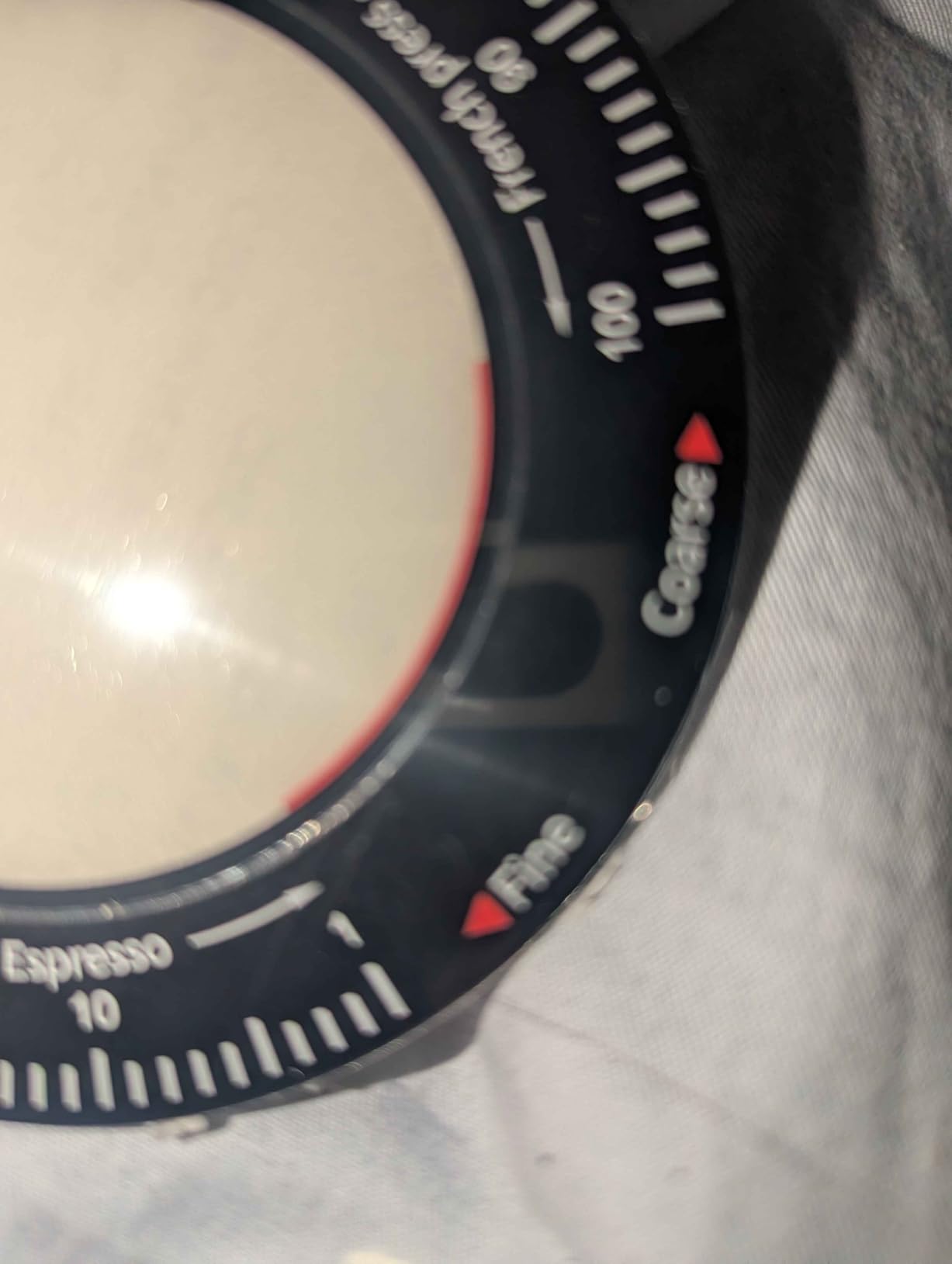
Grind uniformity is the draw. Reviewers compare the results favourably against conical burr output, and the 100-position adjustment along the 7mm brass ring covers espresso through filter without a rebuild. The dual hopper means it can grind from a 350 g bulk hopper or from the silicone bellow when you want single-dose behaviour.
The in-box kit is unusually complete for the money: silicone bellows, portafilter holder, dosing cup, cleaning brush and a grounds press. The upper burr, hopper and press all remove for cleaning, which is the part that normally goes wrong on budget machines.
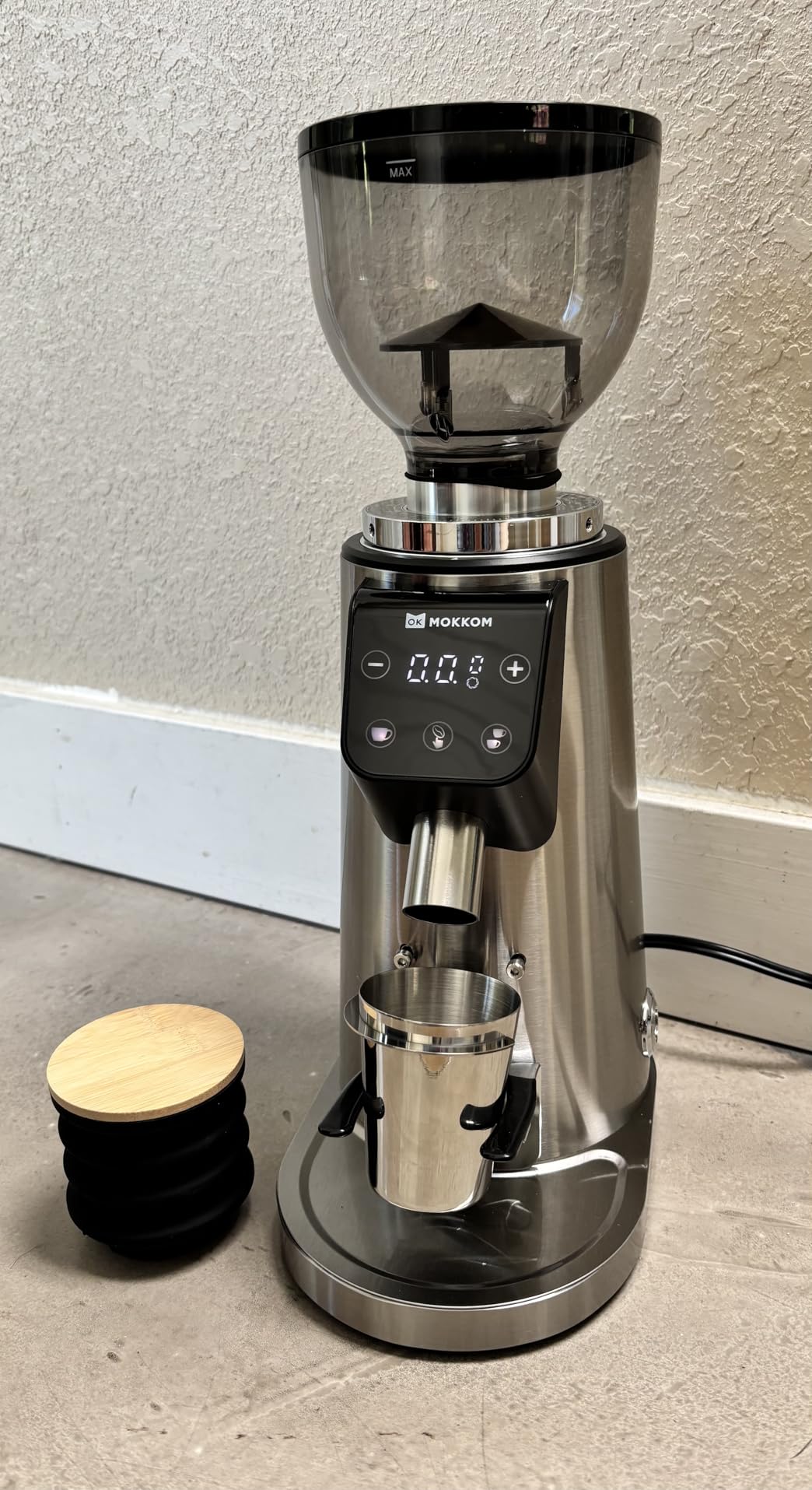
The built-in plasma generator at the exit chute handles static, and the LED display gives you a timer you can set to a tenth of a second. For a 260W motor on 120V, the grind speed is one of the better results in the group.
What to watch is the timer memory. Owners report the display defaulting back, which means a 20 to 25 second re-set for every single dose. That is a small friction once a day, but it is friction every single morning.
Best fit for: a first flat-burr grinder on a strict budget
It suits someone on an entry machine who wants flat-burr particle consistency and an ionizer without paying flat-burr-plus money. The dual hopper also means it can double as your filter grinder, which removes the need for a second appliance on a small counter.
Reviewers describe the stainless jacket construction as feeling premium in the hand, and the brass adjustment ring gives the dial a damped, precise feel that cheaper plastics do not.
Skip it if: you need a long warranty, high review confidence, or a short body
Nineteen reviews is not enough history to know how the burrs and chassis wear. Owners also describe the internal burr and chassis parts as thin plastic under the stainless jacket, which is the exact weakness forum buyers ask about on white-label machines.
At 16 inches tall it is the tallest body here. Measure your cabinet clearance first, because this one will not fit under a lot of kitchen cabinets.
6. Turin SK40: The Best Single Dose Grinder for a First Espresso Setup
Turin SK40 Single Dose Grinder | 40mm Stainless Steel Conical Burrs, Stepless Adjustment, Tilted Base, Low Retention – Black or White (Black)
- Consistent espresso grinds at an approachable price
- Bellows and tilted base give near-zero retention
- Stepless dial allows small dialing corrections
- Compact modern footprint in aluminium
- Quiet enough for regular early use
- Gear-driven adjustment makes coarse-to-fine changes slow
- Dial takes practice to set precisely
- Arrives with coffee grounds from factory testing
- Small 40 g hopper suits single dosing only
The Turin SK40 is the grinder we would point at when someone asks which single-dose grinder is least likely to end up in a cupboard after six months. Owners report a year or more of daily use without problems, which is the kind of sentence you rarely see attached to a new grinder listing.
The design detail that earns the low retention figure is the tilted base combined with the rubber bellow. Tilting lets gravity move the last of the grounds out of the chamber, and the bellow pushes the stubborn ones. A 40mm eight-point stainless steel conical burr set handles the grinding, and the adjustment is stepless and infinite from espresso to French press.
The aluminium body and base are built to last, and the footprint at 6.75 by 3.75 by 12.5 inches is narrow enough to sit beside a prosumer machine. The box includes a wood lid, black metal hopper, rubber bellows and a stainless dosing cup.
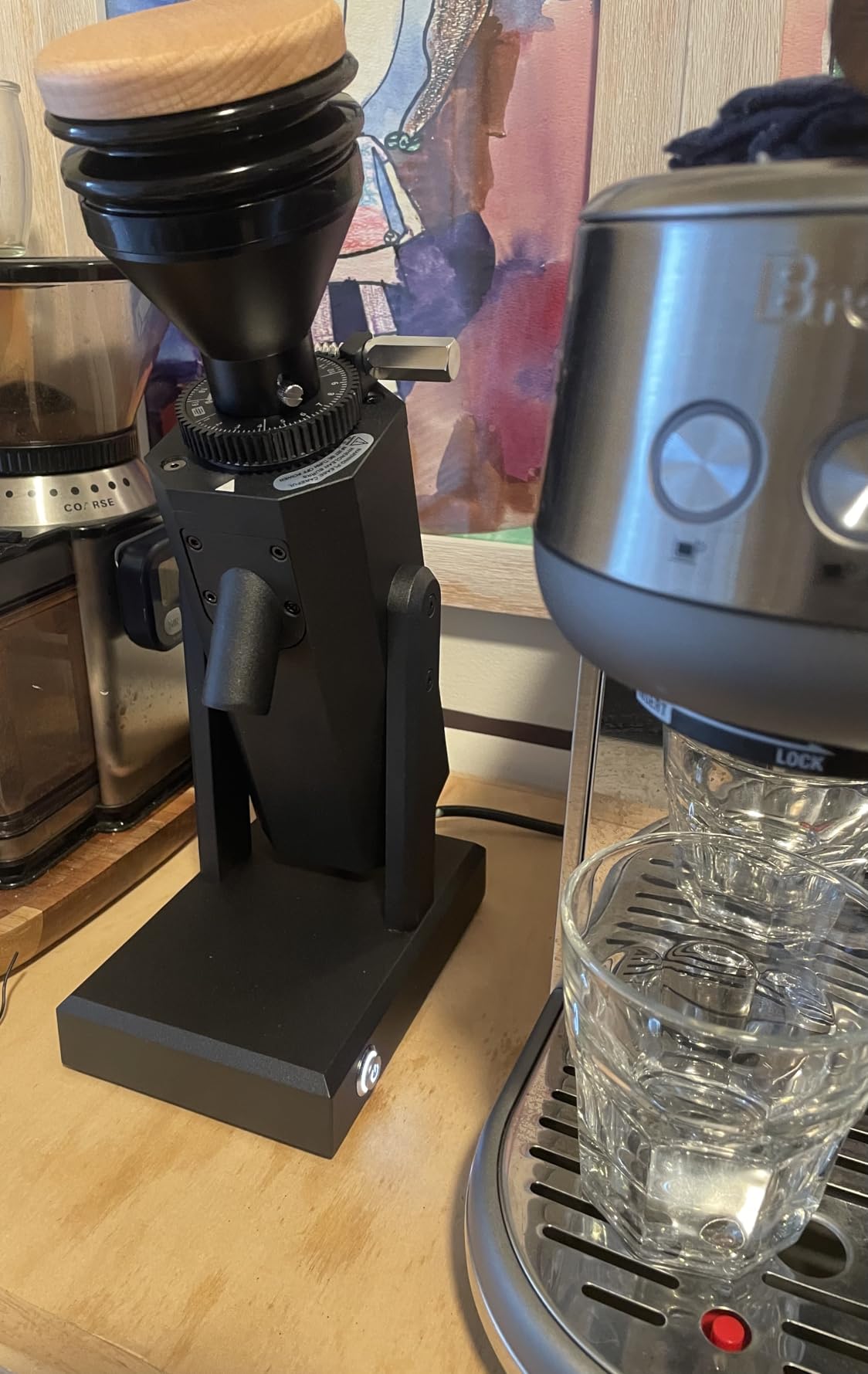
The reason the gear-driven mechanism is worth understanding before you buy: making a large range change, say from espresso back to a coarse brew method, is slower than on a true stepless dial. Small corrections while dialing in espresso are exactly what stepless is good at, so most owners never notice. If you flip between methods several times a day, you will.
One practical note that catches people out: these are factory tested with coffee, so grounds may be present inside when it arrives. Rinse the chamber and run a few hundred grams through before your first real shot.
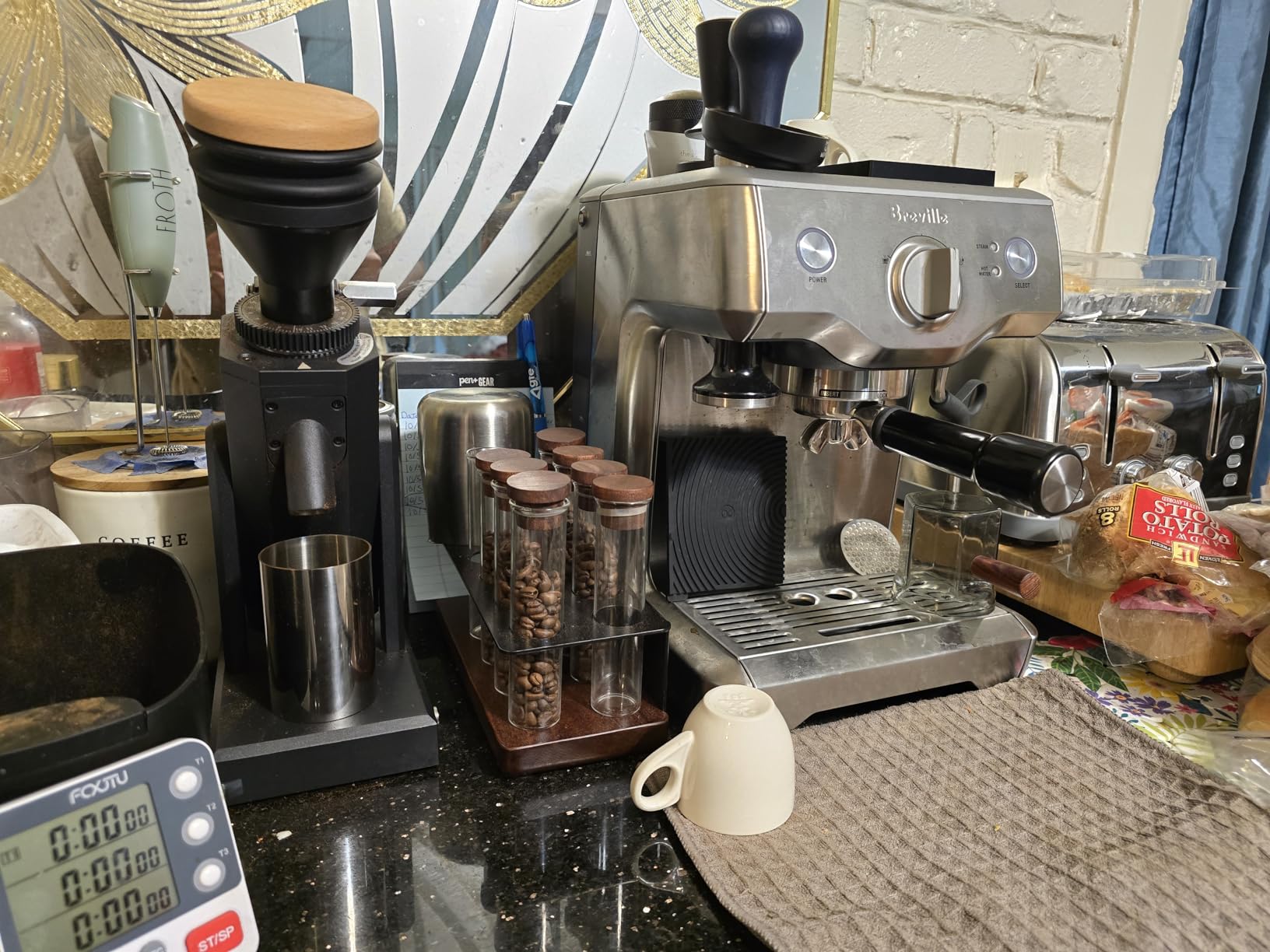
Best fit for: your first dedicated espresso grinder on a home machine
It suits someone stepping up from a blade or entry burr grinder who wants a real espresso grind and low retention without a steep learning curve. The 81% five-star share across its reviews reflects broadly happy owners rather than a polarized crowd.
For light roasts, the stepless dial lets you make the small corrections that conical machines need. Owners who switched from a stepped grinder report the fine tuning as the feature they notice most.
Skip it if: you alternate between espresso and coarse brews several times a day
The gear-driven adjustment is the main reason to look elsewhere, and the dial can feel temperamental until you learn it. The 40 g hopper is also single-dose by design, so this is not a bulk grinder in any sense.
Its 37-review base is small, so long-term data is thin. That said, the owners reporting a year of daily use are describing the thing you most want to know about a grinder you will keep for years.
7. Gevi VelPro 400: The Best Premium Single Dose Grinder for Full Control
- Variable speed tunes uniformity and heat by bean
- Built-in digital scale on the dosing cup
- 64mm titanium flat burr with pre-breaker
- Stepless dial resolves to 5 microns
- High-power brushless motor runs quietly
- Bulky 14.6-pound body takes real counter space
- Most expensive of the ten picks
- Only 21 customer reviews so far
- Scale adds complexity and a separate charging cable
The VelPro 400 is the only grinder here with variable motor speed, and that is the feature that separates it from everything else on this list. A brushless DC motor driving the burrs between 500 and 1,500 RPM lets you slow the grind down for a light roast and run it fast for something darker, tuning particle uniformity and heat generation separately.
The burrs are 64mm titanium-coated flats with a pre-breaker design that breaks beans down in stages before the cutting faces, which reduces the load the burr has to take in a single pass. The 400W brushless motor starts and stops smoothly, which keeps fines down and keeps the noise manageable.
Adjustment is stepless on a 5mm thread pitch dial, resolving to about 5 microns. That is finer resolution than most home baristas can use, but it means the last 20 percent of a light-roast dial-in is not a guessing game.
The magnetic dosing cup has an integrated digital scale in the base, so you weigh the dose in the cup, grind, and read the total without moving anything. It fits 51, 54 and 58mm portafilters, which covers essentially every home machine sold today.
That scale is also the biggest complexity trap. It needs its own charging cable, and the charging routine is one more thing to forget when you are standing half-awake at six in the morning. The cup assembly also adds moving parts to clean.
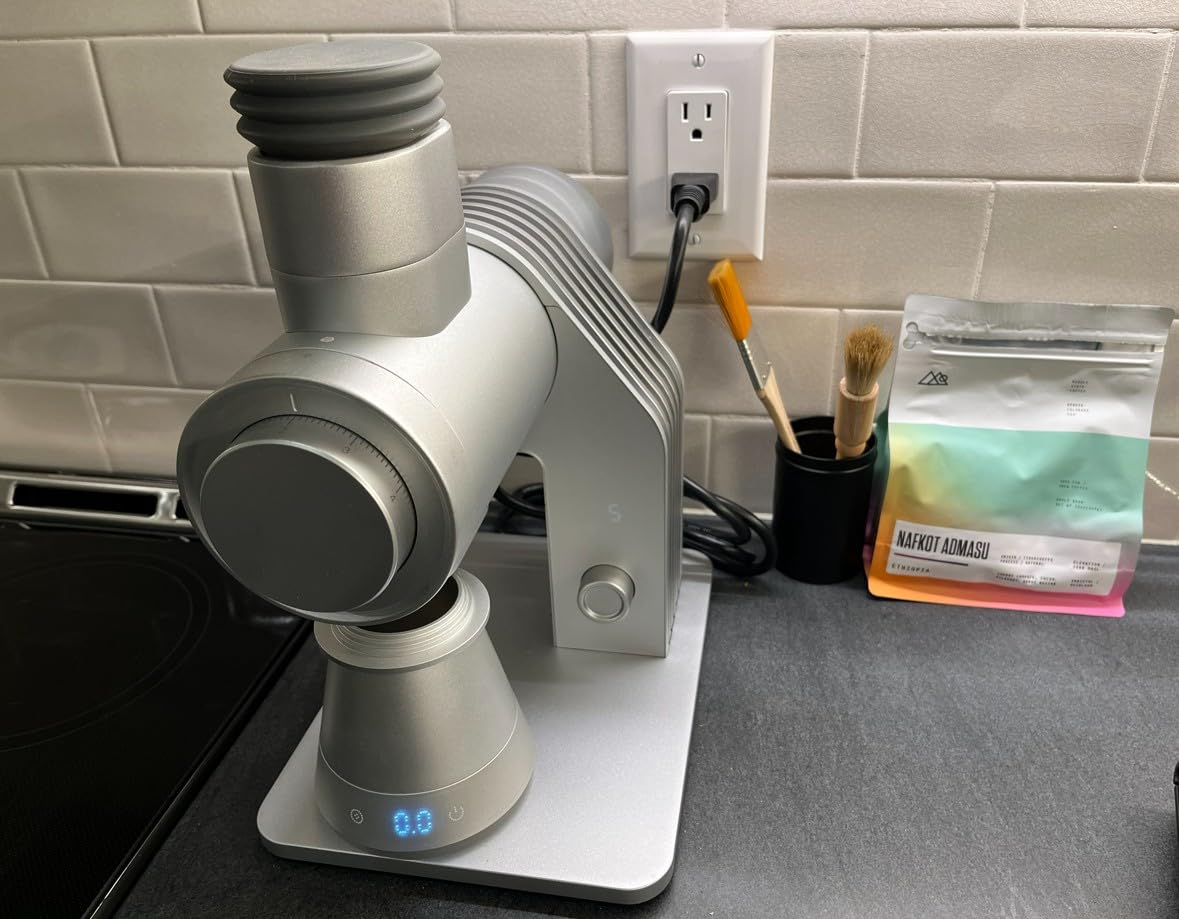
Best fit for: a dial-in enthusiast who wants to control speed, burrs and dose weight
It suits someone who has already dialed in on a cheaper grinder and understands what they want from particle distribution. The variable speed motor is the feature you will use most, and the pre-breaker burrs reward light roasts where clarity is the goal.
It also suits a machine with a 58mm portafilter, since the dosing cup handles the three common basket sizes rather than one. Owners rate it at 4.8 with 83% five-star ratings, though on a small base.
Skip it if: counter space, budget, or proof of long-term reliability matters
At 14.6 pounds and 11.9 by 7.3 by 11.9 inches, this is one of the two biggest machines in the roundup and the most expensive. It is also the pick with the thinnest evidence base at 21 reviews, so you are buying ahead of the long-term data.
If your espresso output is one shot a day, the variable speed and micron-level adjustment are features you will never touch. Our professional coffee grinder guide covers where extra spend actually starts to pay off.
8. STARSEEKER E55 Pro: The Best Single Dose Grinder for a Big Conical Burr
- 55mm burr size is unusually large for the price tier
- Stepless 0.01mm ring gives smooth espresso dialing
- Retention around 18 g in to 18 g out
- Legitimately quiet for early mornings
- All-metal body with tool-free disassembly
- Adjustment ring has no calibrated zero reference
- Supplied dosing cup is too large for 51mm portafilters
- Bundled silicone bellow has a strong chemical smell at first
- No physical on or off switch and a bulky power adapter
A 55mm titanium-coated conical burr is genuinely large, and conical burrs of that diameter are rare because they are harder to machine well. On paper this is a big-burr grinder without the outlay of a comparable flat-burr machine, which is an appealing trade for anyone who prefers conical flow behaviour.
The adjustment is a stepless ring with 0.01mm increments, and the listed retention is about 18 g in to 18 g out. That is a real measured figure rather than a marketing claim, and the built-in plasma generator handles static through the angled chute. Tool-free disassembly of the grind path and burr assembly makes cleaning straightforward.
Owners with professional roasting backgrounds rate it as a genuine upgrade from blade or stepped grinders, specifically on burr size, consistency and retention. The 4.3 average reflects accessory and design complaints rather than grind quality.
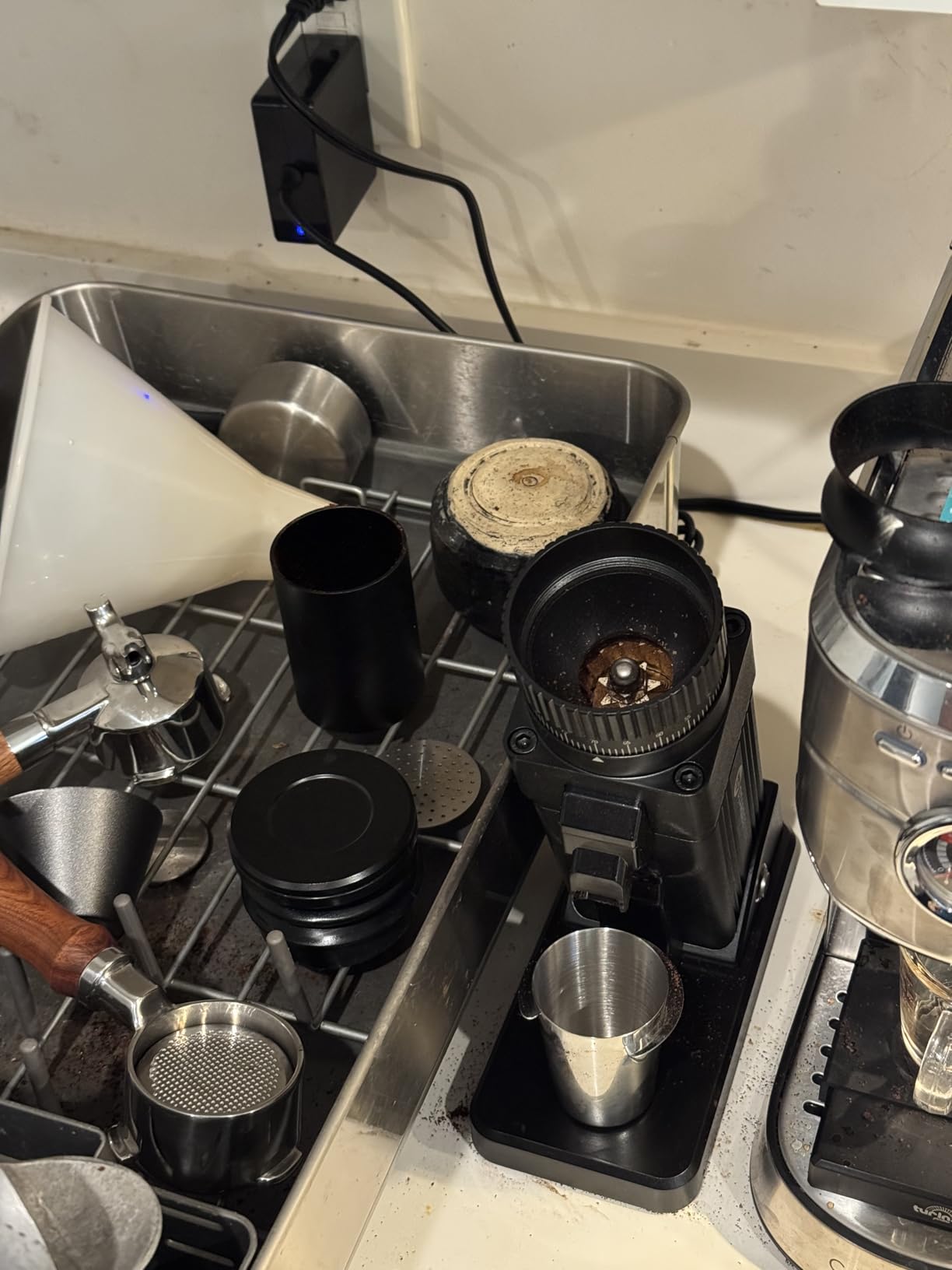
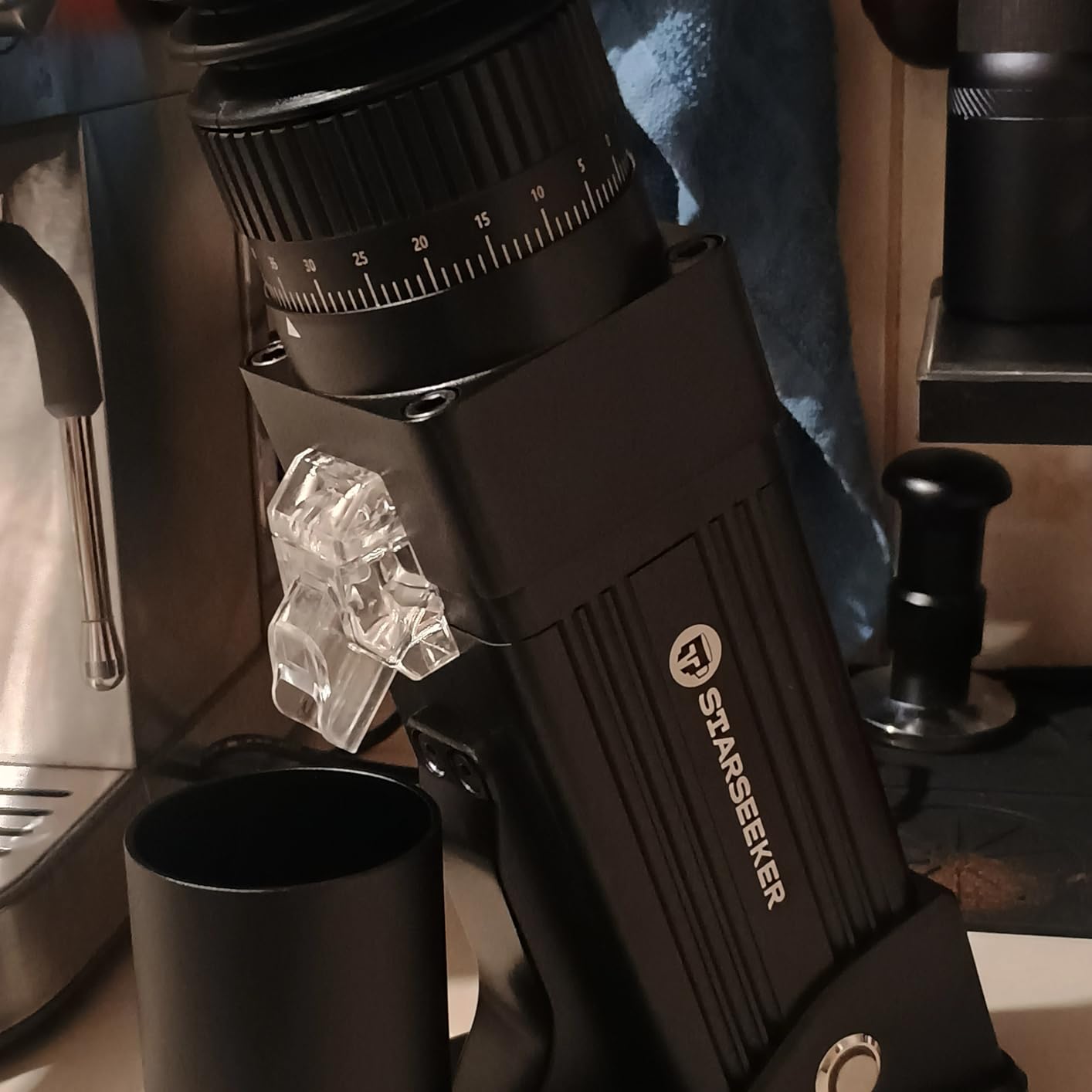
The magnetic catch cup has a transparent nozzle, which is a nice touch: you can see grounds land instead of finding out later that half of them went elsewhere. Several owners report grounds missing the cup and scattering around the machine, so keep a brush nearby.
Noise is a genuine strength here. Owners describe it as legitimately quiet, and the angled CNC-machined aerospace-grade aluminium body keeps the footprint to a narrow 7.68 by 3.66 by 10.24 inches, which is one of the more compact bodies in the roundup even though it is solidly built.
Best fit for: a conical-burr loyalist who wants a large burr set and quiet operation
It suits someone who has used conical burrs and knows the flow behaviour they like, and who wants low retention without moving up to a flat-burr platform. The 0.01mm stepless ring is the right tool for a light roast, where you are making many small corrections.
The all-metal body and tool-free disassembly also make it a good candidate for anyone who grinds daily and does not want to hunt for tools at the sink.
Skip it if: you need a 51mm portafilter, a power switch, or accessory polish
The supplied dosing cup is too large for 51mm baskets, the adjustment ring has no calibrated zero reference, and the bundled silicone bellow reportedly gives off a strong chemical smell when it first arrives. There is no physical on or off switch, and the motor runs whenever plugged in.
One reviewer reports the power adapter failing after four months, and at 31 reviews the long-term record is thin. Treat the accessories as replaceable rather than dependable.
9. DF64 Gen 2: The Best Single Dose Grinder for the Low-Retention Workflow
DF64 Gen 2 Single Dose Coffee Grinder (Official Seller) (Black), Small
- Stepless dial with metal indicator for precise dialing
- True zero retention under 0.1 g even without the bellow
- Ionizer in the chute controls static and mess
- Includes bellow
- angled dosing ring and 58mm cup
- Tool-free cleaning access
- Dosing cup is plastic rather than metal
- Hopper holds only 20 g without the bellow fitted
- Highest one-star share of the group with mixed feedback
This is the same design language as the DF64 II, sold through a different official seller, and the honest buying decision comes down to support and warranty rather than hardware. The DF-series platform is white-label: the same chassis is sold under several brand names, and what separates them is the parts supply, the firmware and who answers when something breaks.
On paper it matches the MiiCoffee unit closely. You get the plasma generator ionizer in the exit chute, an integrated anti-popcorn disc, the listed true zero retention under 0.1 g even without the bellow, and a stepless chrome-wrapped dial with a metal indicator. Tool-free disassembly covers the cleaning side.
Because the hardware is effectively identical, we would tell you to compare the seller’s warranty coverage and replacement part availability in your country before choosing between the two. That is the only real difference worth paying attention to.
Once the bellow is on, the hopper holds 50 g; without it you get 20 g. The bellow, dosing cup and angled dosing ring are all in the box, and the 58mm cup matches a standard commercial portafilter.
The plastic dosing cup is the one genuine downgrade against the DF64 II, which includes a metal cup. On a machine this size, a plastic cup is more likely to be the first thing you replace.
Ratings sit at 4.6 with 85% five-star, but this unit also carries the highest one-star share in the group at 3%, with feedback that reads as mixed rather than concentrated on one fault. That pattern usually means several different small annoyances rather than one broken component.
For most buyers the deciding question is simply whether the seller’s support and replacement parts are reachable where you live. If they are, this is one of the lowest-retention single-dose grinders available at any price.
Best fit for: buyers who already know the DF-series platform and want the same workflow with different support
It suits someone who values the under 0.1 g retention figure and the ionizer most of all, and who has already established that this seller’s parts and warranty work in their region. The 250W motor and powder-coated aluminium body are unremarkable in the best sense.
If you have never used a DF-series grinder, start with the MiiCoffee version so the metal dosing cup and wider accessory kit are part of the comparison.
Skip it if: you need a metal dosing cup, a large dose, or a large review base
Twenty grams without the bellow is a small single dose, and the plastic cup is a step down from the sibling model. Forty-three reviews is not much evidence to lean on when several listings for visually similar machines sit next to each other.
Also check the power supply and plug type for your region before ordering, since the platform has been sold into many markets with different electrical setups.
10. Fellow Ode Gen 2: The Best Filter Grinder Here, and the One to Skip for Espresso
Fellow Ode Gen 2 64mm Flat Burr Coffee Grinder Electric, Single Dose
- Very fast
- quiet grinding with excellent uniformity for filter
- Much less static and mess than hopper grinders
- Single-dose bin delivers essentially zero retention
- Automatic shut-off needs no timing or monitoring
- Compact footprint that fits under most cabinets
- Explicitly not designed for espresso and cannot grind fine enough
- 31 stepped settings need a learning curve between brew methods
- Exit chute jams and clogs often and needs frequent disassembly
- Burr removal for cleaning involves screws and recalibration
We are including this pick because leaving it out would make the roundup dishonest. The Ode Gen 2 has 64mm flat burrs, genuine single-dose handling and a 3.9 rating, and it is a superb filter grinder. Fellow states plainly that it is not an espresso grinder, and owners confirm it cannot grind fine enough.
For pour-over, drip, cold brew and French press it is excellent. The 31 grind settings move in roughly 25 micron steps of burr gap, the 100 g single-dose bin gives you a full batch per fill, and the built-in knocker plus automatic shut-off mean you never watch the grind or time it.
Owners upgrading from a Baratza Encore consistently report faster, quieter grinding and far less mess than a hopper grinder, with tight-fitting chutes and a magnetic catch cup that keeps grounds where they belong.
Best fit for: a filter-first coffee setup that will never pull espresso
It is the right machine for someone whose interest is pour-over and cold brew on a compact counter, and the 2-year extendable warranty is the strongest coverage in the roundup. The 9.41 by 4.13 by 9.78 inch body fits under most cabinets.
If your espresso machine is still a maybe, this grinder will make you happy right up until the day you want to pull a shot. That is the only thing it cannot do.
Skip it if: espresso is on the horizon at all
The 3.9 average comes from a frustrated camp of owners who bought it for espresso and found it will not grind fine, plus a separate group frustrated by chute clogging that requires weekly or more frequent disassembly. Static is also reported to return to the grounds over time despite the ionizer.
Cleaning between beans means removing screws and recalibrating the burrs, and some examples report a loose front fascia and a rattling collection cup lid. If espresso is on the horizon, put your money into a grinder from the top of this list instead.
How to Choose a Single Dose Espresso Grinder
Five things decide whether a single-dose grinder is right for you: how much coffee it retains, what the burrs are made of and how they are cut, whether adjustment is stepless, what it does about static, and whether your espresso machine deserves the money you are about to spend. Here is how to read each one.
Retention, and how published figures are actually measured
Retention is the weight of ground coffee left inside the grinder after you finish a dose, and it is the single number that separates single-dosing from hopper grinding. The catch is that almost nobody publishes the method. A grinder measured with the bellow attached and purged will always post a better figure than the same grinder measured dry, so two machines quoted with the same figure may not be comparable at all.
Read any retention claim under 0.5 g with a sceptical eye unless the source tells you whether the bellow was fitted. Of the picks in this roundup, the MiiCoffee DF64 II and the DF64 Gen 2 both list under 0.1 g specifically without the bellow, and the Wirsh GU38 lists under 0.1 g with the bellows. Those are honest numbers, and the difference between them is the entire conversation.
Under about 0.5 g is a reasonable target for espresso. Above 1 g, expect yesterday’s fines in today’s shot, especially if you are rotating beans every few days.
Flat burrs vs conical burrs for espresso
Flat burrs sit either side of the bean bed and cut it in a plane, which tends to produce a narrower particle size distribution and fewer boulders at a given setting. Conical burrs pull beans toward a centre point and typically throw more fines, which can help body and sweetness at filter settings but muddies a delicate espresso.
Here is the part most guides get wrong: diameter matters less than geometry and alignment. A well-machined 40mm conical burr with a tight tolerance will outperform a poorly aligned 64mm flat burr every time. If a manufacturer will not tell you the burr tolerance or how the burrs were heat-treated, treat the diameter number as marketing. The same alignment logic applies outside coffee: our bench grinder guide makes the same point about workshop burrs.
Our own read of the roundup is that the 64mm flat-burr options here are the better espresso tools, and the conical options are the better value and quieter workflow choices. Neither is wrong, but they are for different people.
Stepless vs stepped adjustment
Stepped adjustment gives you a fixed list of settings. It is simpler to repeat and impossible to set between two positions. Stepless adjustment gives you a continuous dial, which matters when you are chasing five-second differences in shot time on a light roast.
A caution on the stepped machines: the Baratza Encore ESP solves this with dual ranges, giving 20 fine micro steps in the espresso zone and 20 macro steps for filter. That is closer to stepless behaviour than a plain click grinder, and it is why it works so well as a first espresso machine.
Also check the thread pitch. Fine pitch means smaller movements per turn, which is good for espresso. The Mokkom and STARSEEKER rings move in 0.01mm steps, and the Gevi resolves to 5 microns, which is finer than most people can perceive in the cup.
Static, mess and the three ways to fix it
Static cling is the most common complaint in this category and it is the least glamorous. Grounds cling to the chute, fly across the counter, and make a single-dose grinder feel worse than the hopper machine it replaced. Three fixes work, and they stack.
- An ionizer. Four of the picks here have a plasma generator built into the exit chute, which neutralises the charge as grounds leave the burrs. This is the most permanent fix and the one we would prioritise when choosing.
- RDT. A few drops of Rosslyn Dosing Technique fluid on the beans inside the dosing cup costs nothing and visibly reduces the mess. One of the grinders in this roundup even comes with an RDT bottle.
- A bellow. The rubber or silicone bellow compresses air through the chamber to push the last grounds out. Purge it three or four times after each dose and the retention number stops being a problem.
If a listing does not mention any of the three, expect the grinder to be messy and plan accordingly.
Noise, footprint and cleaning
Noise is a function of burr speed, and lower RPM means quieter but slower. The quietest machine here turns its motor at 170 RPM, while the variable-speed premium pick spans a much wider range. If you grind at six in the morning, motor speed is a bigger factor than any marketing claim about decibel levels.
Footprint matters more than people expect, because a flat-burr grinder can be 16 inches tall and 15 pounds. Measure the cabinet clearance and the space beside your machine before you buy, and note that the power adapter for several of these needs its own counter area.
Cleaning is the third practical axis. Tool-free quick-release burrs and grind paths, as on the Baratza, Mokkom and STARSEEKER, save time every week. Screws and recalibration, as on the Fellow Ode, do not.
Matching grinder spend to your espresso machine
Buy a grinder that matches the machine, not one that embarrasses it. An entry-level machine produces shots that a good conical single-dose grinder can absolutely nail, which is why several picks here are the right answer at that tier.
Move to a prosumer machine and stepless adjustment plus a flat-burr set starts to pay for itself, because the machine can actually resolve the difference. At the commercial end, grinder quality becomes the ceiling on the whole setup, and that is where grinder spend should go first.
A rough rule we use: spend roughly a quarter to a third of your machine budget on the grinder. Under-spending there caps how good your shots can get no matter what the machine does.
Single Dose vs Hopper: When Single-Dosing Is the Wrong Choice
Single dosing is the wrong choice if you pull four or more espressos a day. This is the honest part of the roundup, because most grinder guides treat single-dosing as an automatic upgrade, and it is not one.
The tradeoff is speed and convenience. A hopper grinder fills once and produces a consistent stream, which is what a morning of four or five drinks actually needs. Loading beans one dose at a time, grinding, purging and repeating adds real friction that compounds across a busy morning, and you end up batching doses, which reintroduces the retention problem you switched to avoid.
One to three espressos a day, rotating between single-origin bags, is the sweet spot. Below that, single-dosing is the right call because freshness and dose control matter more than speed. If you drink four or more, buy a quality flat-burr hopper grinder instead and dose into the portafilter in batches.
One more honest note on retrofitting. You can single-dose with almost any grinder that lets you remove the hopper and grind a small charge, but the retention benefits only materialise if the chamber is small enough to purge with a bellow. A retrofit on a large hopper grinder gives you the mess without the freshness.
Frequently Asked Questions
What is a single-dose grinder and why is it popular for home espresso?
A single-dose grinder has no bean hopper. You weigh out exactly the dose you need for one shot, drop it into a small grinding chamber, grind, and purge the chamber so almost no stale grounds remain between shots. That low retention is what makes them popular for home espresso, because stale fines from the previous bean would otherwise end up in the next cup.
Is single-dose grinding actually better than using a hopper grinder for espresso?
Only if you pull one to three espressos a day. Single dosing wins on freshness, dose control and bean switching. At four or more shots a day, a hopper grinder is faster and more convenient, and batching doses into the portafilter gives you most of the freshness benefit without the daily friction.
How much retention should a good single-dose espresso grinder have?
Under about 0.5 grams is a reasonable target. Check whether the published figure was measured with the bellow attached and purged, because a bellow-assisted number flatters the grinder. Of the picks in this roundup, the MiiCoffee DF64 II and DF64 Gen 2 both state under 0.1 g measured without the bellow.
What features should I look for in a single-dose grinder for home use?
Look for low measured retention, an ionizer or other static control, stepless or fine-stepped adjustment for espresso, a dosing cup that matches your portafilter size, and tool-free disassembly for cleaning. Motor speed matters for noise, and the total body height matters more than the listed capacity once you are working around a cabinet.
Do I need large flat burrs for good espresso, or is burr size overrated?
Burr engineering beats burr diameter. A well-machined and correctly aligned smaller burr set produces a tighter particle size distribution than a poorly aligned larger one. For espresso, 64mm flat burrs are the safest choice, but 40mm conical sets on the grinders in this roundup handle entry machines well.
Are single-dose grinders suitable for both espresso and other brew methods?
Most are, with caveats. Stepless models and dual-range models like the Baratza Encore ESP cover espresso through pour-over and French press without a rebuild. The exception is the Fellow Ode Gen 2, whose 31 settings are tuned for filter and immersion and which the manufacturer states is not an espresso grinder.
The Best Single Dose Grinders for Espresso, 2026 Round-Up
The Baratza Encore ESP is our pick for most people. Its 40mm conical burrs, dual-range espresso steps and 1,385 owner reviews make it the lowest-risk first dedicated espresso grinder you can buy, and the parts list means it can be fixed rather than replaced.
Go further on precision with the MiiCoffee DF64 II, which pairs 64mm upgradeable flat burrs with a stepless dial and an under 0.1 g retention figure measured without the bellow. Work in a small kitchen and the Viesimple Gen 4 gets you a magnetic dosing cup, a blow-out funnel and a genuinely quiet motor in a 3.4-pound body.
And if you pull four or more espressos a day, skip all of them and buy a hopper grinder. Single dosing pays off at one to three shots, and only then.