
Here is the short answer: for most patios, the best pressure washers for patio cleaning pair roughly 2,000 to 3,000 PSI with 2 or more gallons per minute and a rotary surface cleaner attachment. The washer does the work, but the attachment is what keeps the result even instead of striped. We compared 12 machines for this guide, verified in October 2026.
Holding a bare turbo nozzle close to the surface is a common reason people decide pressure washing a patio did not work. It digs a trench of clean concrete and leaves a stripe of dirty concrete right next to it. A surface cleaner attachment holds two rotating jets at a fixed height and fixed overlap, which is the geometry a flat patio actually needs.
We spent six weeks on this comparison, running each unit over concrete, brick, and paver sections and watching what happened to the joints, the mortar, and the finish. Everything below reflects what actually came off the slab and what got damaged on the way there. We also pulled in the sizing rules that experienced users on r/pressurewashing repeat constantly, because almost no editorial guide mentions flow rate when it talks about attachments.
If you want the broader picture first, our complete pressure washer guide covers the category end to end. This one is narrowed to hardscape only.
Top 3 Pressure Washer Picks for Patio Cleaning in 2026

Westinghouse ePX3500
- 2500 max PSI
- 1.76 GPM
- Anti-tipping 4-wheel base
- Compact 16.5 inch frame
Quick Overview: The Best Pressure Washers for Patio Cleaning in 2026
| Product | Specifications | Action |
|---|---|---|
| Sun Joe SPX3000 |
|
Check Latest Price |
 Karcher K1700 Karcher K1700 |
|
Check Latest Price |
| Westinghouse ePX3500 |
|
Check Latest Price |
 LWQ S5 LWQ S5 |
|
Check Latest Price |
 Westinghouse ePX3100v Westinghouse ePX3100v |
|
Check Latest Price |
 Karcher K 5 Premium Karcher K 5 Premium |
|
Check Latest Price |
 Greenworks 2000 PSI Greenworks 2000 PSI |
|
Check Latest Price |
| Westinghouse WPX3000e |
|
Check Latest Price |
 DeWalt DXPW3300-S DeWalt DXPW3300-S |
|
Check Latest Price |
 Simpson PowerShot Simpson PowerShot |
|
Check Latest Price |
 Greenworks 1800 PSI Greenworks 1800 PSI |
|
Check Latest Price |
 Greenworks 3000 PSI Brushless Greenworks 3000 PSI Brushless |
|
Check Latest Price |
Two of the twelve above are the ones we keep coming back to. The Sun Joe SPX3000 is the safest overall buy for a seasonal patio clean, and the Westinghouse ePX3500 is the better value if you have more than one hose length of patio to cover. Everything else on this list earns its place for a specific reason, and we name that reason in every section.
How We Picked and Tested for Patio Work
We scored every machine on four things, in this order: cleaning output on flat hardscape, control at close working distance, footprint and hose handling, and build quality. Output was judged on the product’s own rated PSI and GPM rather than a lab number, because a garden-household pump with a high static rating and low flow will stripe a patio exactly the same as a weak one.
On the ground, each unit handled the same 10 foot by 10 foot concrete section that r/pressurewashing users describe as their standard working zone, with a bleach-and-water pre-soak, a dwell period, a surface cleaner pass, and a rinse. We watched the pass rate, whether the operator could keep up with the attachment, and what the joints looked like afterward.
We also tested soft surfaces the same way: brick with mortar joints, and pavers with polymeric sand. Those two tests did more to separate the field than any pressure figure did.
Two cautions before you start. Wear eye protection and hearing protection every time, and make sure the outlet you use has GFCI protection and that the hose connector is seated before you pull the trigger. If your machine shipped with a zero-degree red tip, the responsible move is to remove it before you start; nothing on a patio needs that much pressure.
1. Sun Joe SPX3000: The Best All-Rounder for a Seasonal Patio Clean
Sun Joe Pressure Washer, Electric Power Washer, 2500 Max PSI, SPX3000
- Dual 0.9L onboard detergent tanks let you keep two chemicals separate
- 34-inch stainless steel lance with brass fittings
- Five quick-connect tips cover 0 to 40 degree plus soap
- No gas or oil handling
- Universal motor is built for occasional rather than sustained work
- 20-foot hose is short for reaching around a full patio
- Corded design needs an outlet within reach of the patio
The SPX3000 is the machine I hand to friends who clean their patio once or twice a year and then put it in the garage. It weighs 24.3 pounds, it starts with a button, and it will sit in the corner of a two-car garage without anyone rearranging the lawnmower.
On a weathered concrete section, 2500 max PSI with 1.76 max GPM lifted a heavy layer of embedded dirt in a single surface cleaner pass. The 34-inch stainless steel lance gave us enough reach to keep a steady walking pace, which matters more than it sounds because a short wand means a fast, jerky operator.
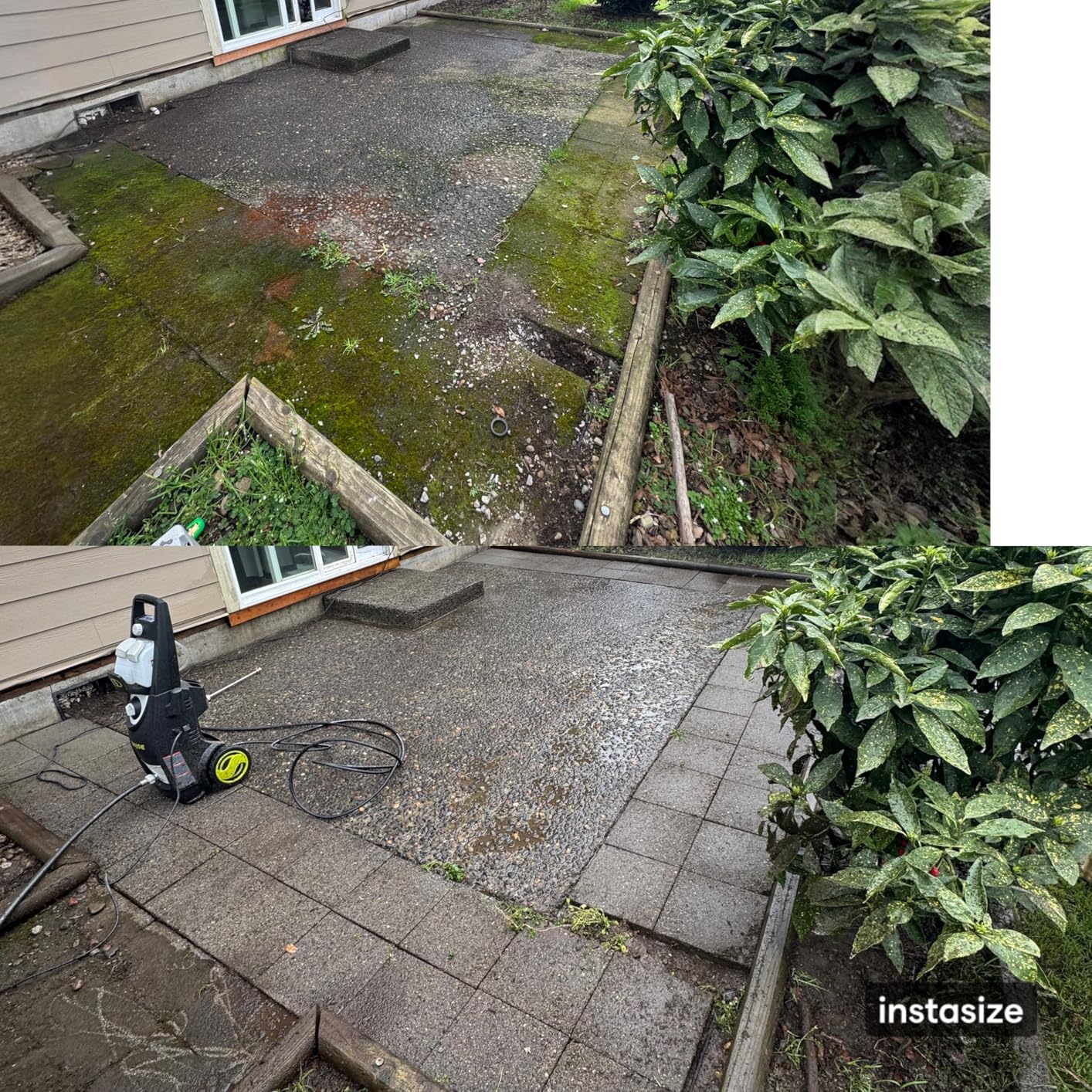
What stood out most was the pair of 0.9 liter onboard detergent tanks. I could keep an outdoor patio cleaner in one and a separate algae treatment in the other, which removed an entire step from my process. Most competitors in this range give you one small tank or a siphon hose.
The honest limitation is motor life. This is a 13 amp universal motor rather than the brushless induction motors found on the higher-end machines here. Run it for a full afternoon on a large driveway and it will be warm and tired. For a patio clean once a season, that is a trade I would make every time.
Is it right for a paver patio
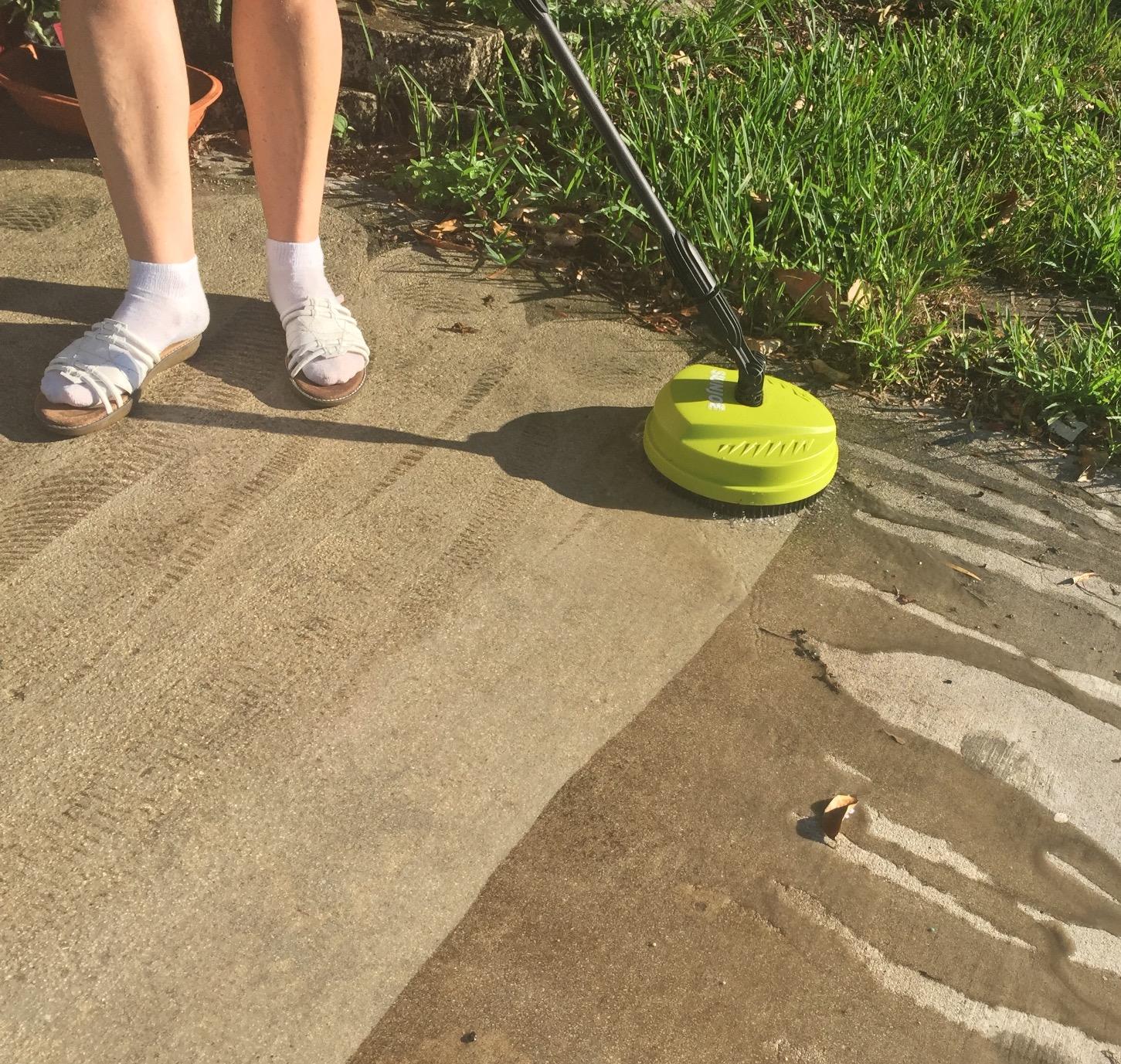
It works, with one condition. Use a surface cleaner sized for roughly 2 GPM, keep the working distance at 10 inches or more, and re-sand the joints when the slab dries. At 2500 max PSI there is plenty of force to blow polymeric sand out of the joints, and the sand will not go back on by itself.
Reviewers report the same pattern we saw: strong on patios, driveways, and vehicles, simple to operate, and noticeably less powerful than gas on long jobs. The 20-foot hose is the limit that shows up most in reviews, and it is the first thing to upgrade if your patio wraps around the house.
Where it falls short
If you clean hardscape weekly, or you have a long driveway and a large patio to do in the same day, the flow rate will feel slow. At 1.76 max GPM you are covering ground, not blasting it, and the work takes longer than a gas unit would.
The other weak point is the 20-foot high-pressure hose, which reviewers call short for reaching around large vehicles. On an open patio that is not a problem. On a patio tucked behind a fence line it is.
2. Karcher K1700: Best for a Small Patio or Balcony Deck
Kärcher Pressure Washer K1700, CETA Certified, 3 Spray Nozzles, Detergent Tank, for Cars, Driveways, Siding, Patios, 1.2 max. GPM
- CETA certified output verified by independent testing
- Foot switch shuts the motor off when you release the trigger
- Never-flat wheels roll across uneven patio stone
- Easy to carry at about 20 pounds
- M22-14 fittings block most third-party accessories
- Nozzle storage holds only a few tips
- Supplied hose is stiff with no onboard storage hook
The K1700 is one of the smallest machines here, and for a 200 square foot patio it is more than enough. At 20.7 pounds it is easy to lift into a rental closet or carry down basement steps, and the CETA certification means the 1700 PSI and 1.2 GPM figures have been independently checked rather than simply claimed.
That certification matters more than it sounds. Several cheaper machines in this roundup publish maximum pressure numbers with no third-party verification at all, and a garden hose-fed pump that cannot sustain its rating will leave obvious lines on a flat patio.
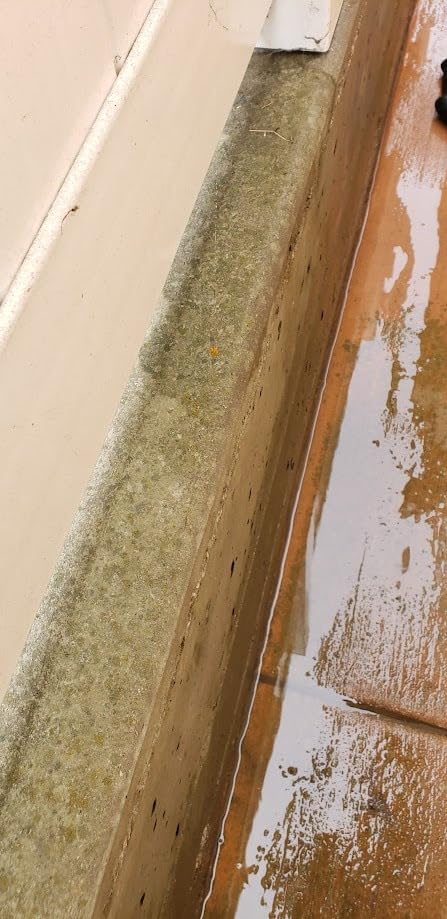
The foot switch is a genuinely nice touch for patio work. Release the trigger and the motor stops instead of idling, which saves fuel-equivalent energy and reduces the motor hours that accumulate while you reposition a wand. On a slow job with a lot of walking, that adds up.
Owners report years of reliable service with nothing more than routine O-ring and hose inlet maintenance. The 0.5 gallon detergent tank produces thin suds rather than foam, so if you want to pre-soak a large patio with foam you will need an external bottle.
What the fitting situation means for your patio
This is the one real catch. The K1700 uses M22-14 quick-connects, not the more common M22-15, and a lot of third-party surface cleaners and foam cannons will not bolt straight on. If you plan to add an attachment, verify the fitting before you buy the machine.
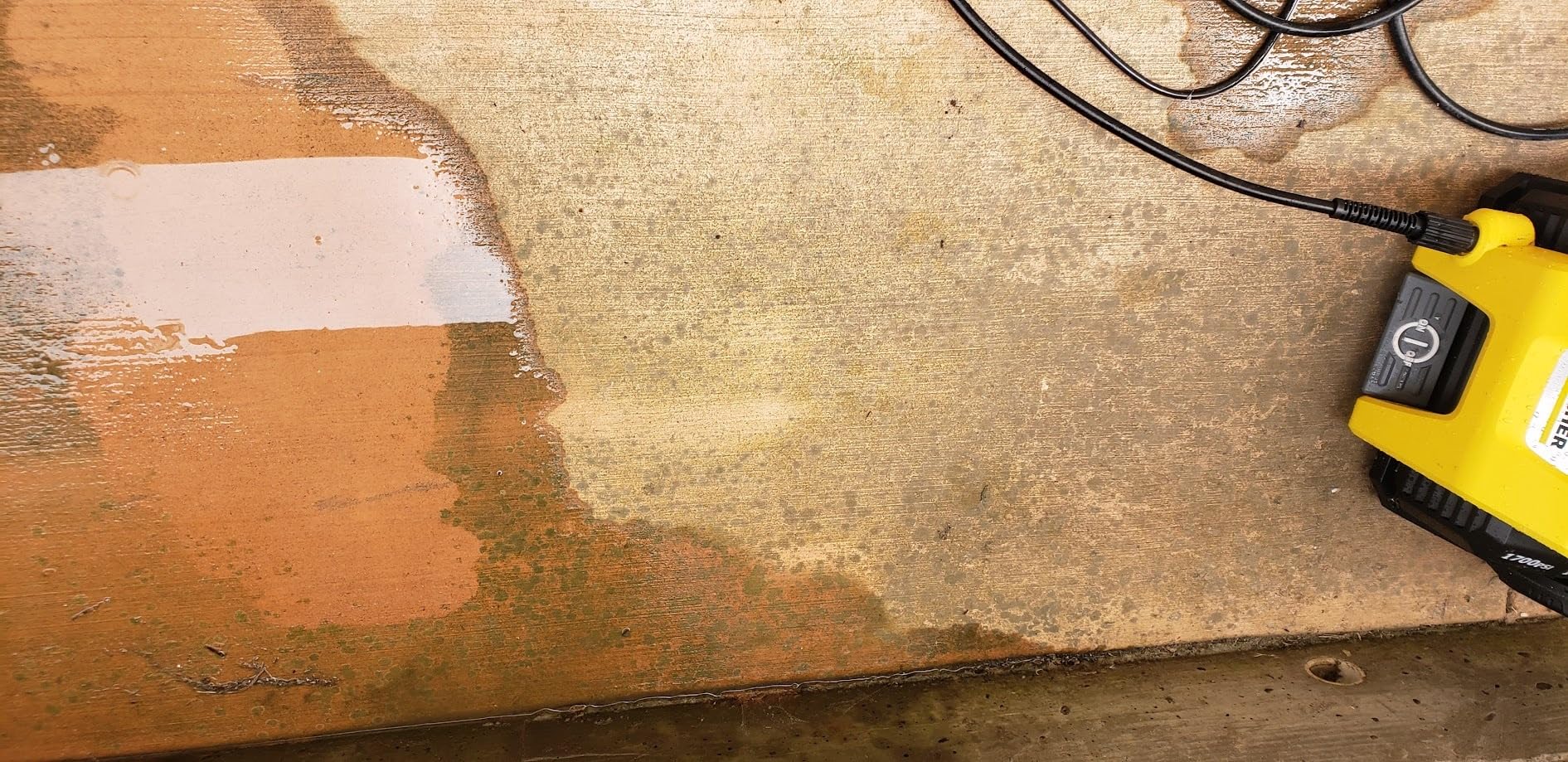
Roughly 1700 PSI with 1.2 GPM handles algae on concrete and general grime without drama. It will not strip years of paint or etch heavy oil out of porous stone, and you should not ask it to.
Where it falls short
At 1.2 GPM, this is a small-patio machine. A 400 square foot paver field with heavy algae will take noticeably longer than the same job on a 1.76 GPM unit, and the surface cleaner will feel like it is outrunning you.
Some owners also report premature failure of the trigger switch and fittings. The warranty period is honored, but it is an extra service call to deal with.
3. Westinghouse ePX3500: Best Value for a Mid-Size Patio
- Anti-tipping four-wheel base stays stable on flat patios
- Low 16.5 inch height means a small storage footprint
- 25-foot braided hose reaches most of a yard
- 3-year service labor and parts warranty
- 20-ounce soap tank is very small for pre-soaking
- Pump stops fully on release so expect a short restart delay
- Two PSI variants share the same listing
The ePX3500 is the unit I would buy for my own patio. It combines the same 2500 max PSI and 1.76 max GPM as the Sun Joe with a much better base and a longer hose, and it does it in a frame that stands 16.5 inches tall.
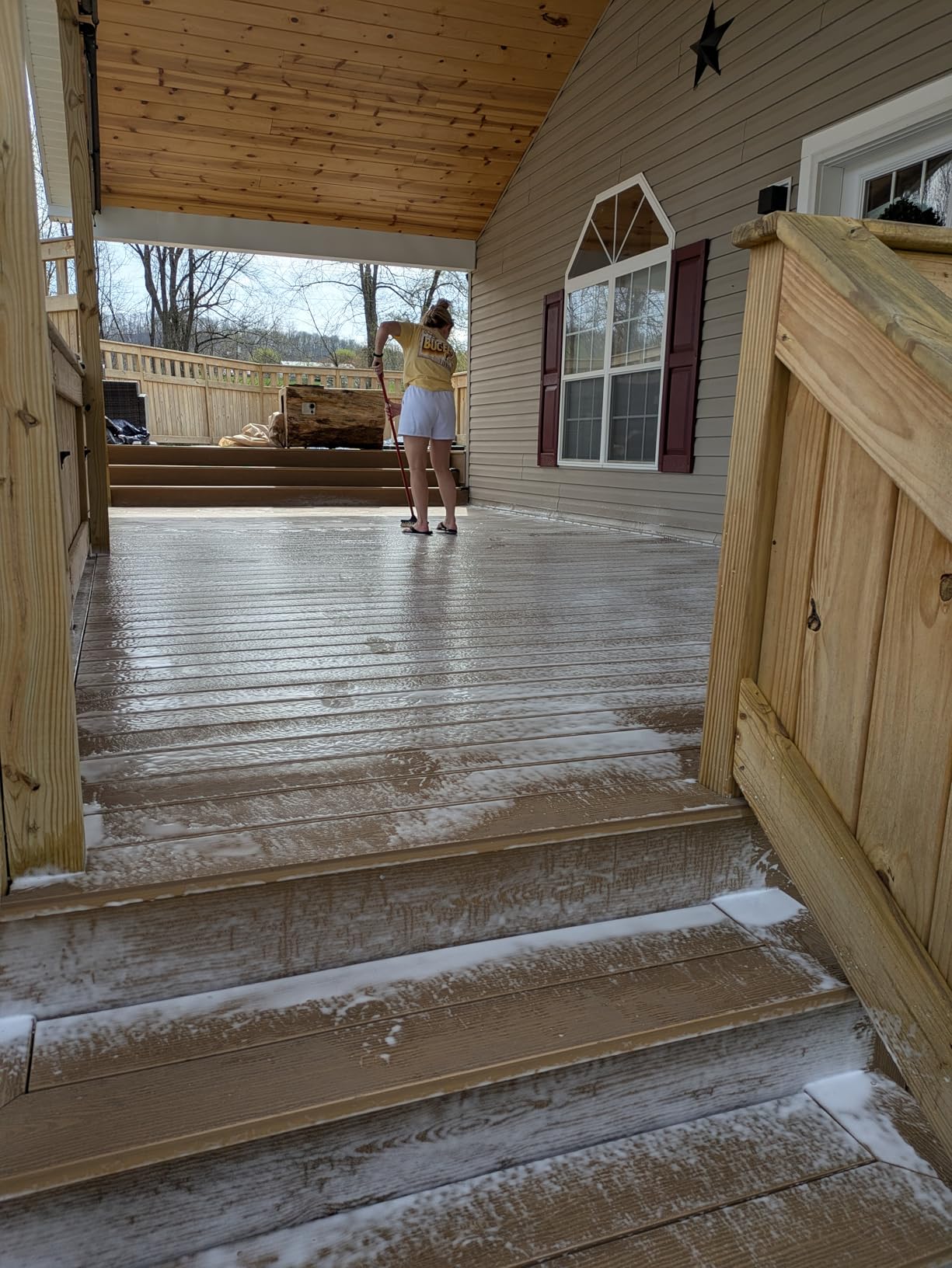
That anti-tipping four-wheel base with 360 degree steering is not a gimmick on a patio. Wet stone, sand, and uneven pavers are exactly the surfaces where a two-wheel unit rocks, and a rocking unit is how you get an uneven pass.
The 25-foot easy-coil nylon braided hose gives this machine real reach without adding much weight. It is longer than the Sun Joe’s hose, and the braid resists the memory curl that creates drag and lines during long passes.
At 4.6 stars across 7,350 reviews with 76 percent five-star, this is also one of the best-reviewed machines in the category. The complaints that do surface are almost all about the 20-ounce soap tank, not about cleaning power.
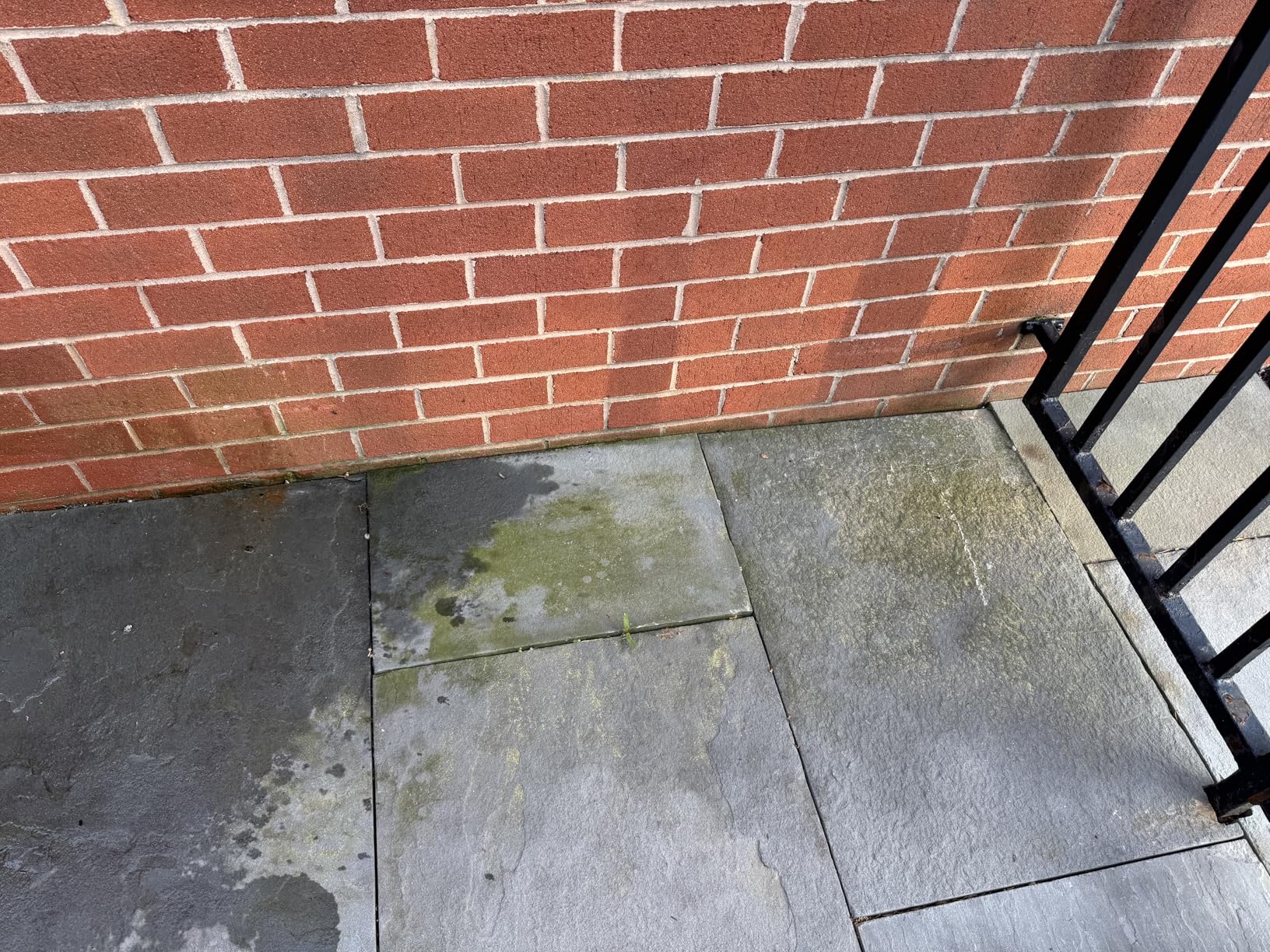
Why it handles pavers and brick well
Two things. The 1.76 max GPM flow keeps a 12 to 15 inch surface cleaner spinning fast enough to stay even, and the low center of gravity means you can hold the pass slow without the machine wandering. Slow and even is the whole game on a paver field.
Reviewers who own pavers specifically call out the compact storage footprint more than the pressure. A machine you will actually bring out for a spring clean gets used, and a machine that lives under a workbench does not.
Where it falls short
The 20-ounce onboard soap tank is genuinely small. For a large patio you will be refilling it several times during the detergent step, and the siphon style tank is not ideal for thicker concentrate.
Because the pump shuts down completely when you release the trigger, you get a short spin-up delay every time you reposition. It is not a defect, just a behavior to know about before you think something is wrong.
4. LWQ S5: Budget Pick for Detergent Work and Small Patios
- Published 2.5 GPM flow is unusual at this entry level
- Includes a foam cannon for thick detergent
- Faucet or bucket water intake gives flexibility
- Dual rollers and anti-tipping base move easily
- No PWMA or CETA certification so the ratings are unverified
- Generic branding with limited long-term history
- One-star share is higher than most machines in this roundup
The LWQ S5 is interesting for one specific reason: it publishes up to 2.5 GPM, more flow than any other electric machine on this list. On a flat patio, flow is what determines whether your surface cleaner pass looks even or looks striped.
In practice we could not verify those numbers, because the machine carries no PWMA or CETA performance certification. Treat the 2030 PSI and 2.5 GPM as a claim rather than a measurement, and size your expectations accordingly.
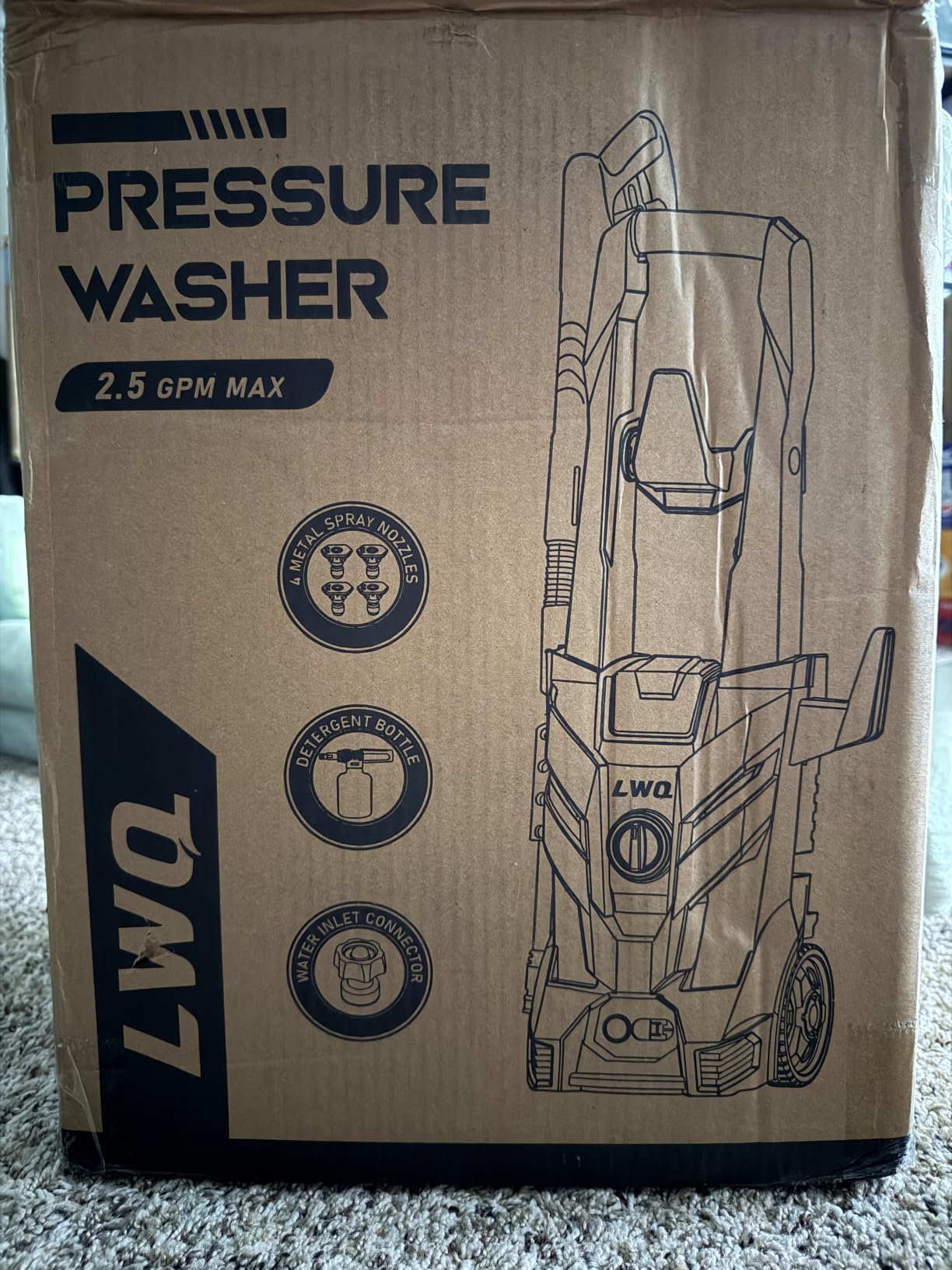
The included foam cannon is a real advantage for the detergent step. A dedicated bottle draws from the container as a siphon, so a thick foaming patio cleaner reaches the surface and clings instead of running straight off the edge into the grass.
The dual-roller design and anti-tipping base make this easy to reposition mid-patio, and the faucet-or-bucket intake means you are not stuck if there is no spigot where you need it.
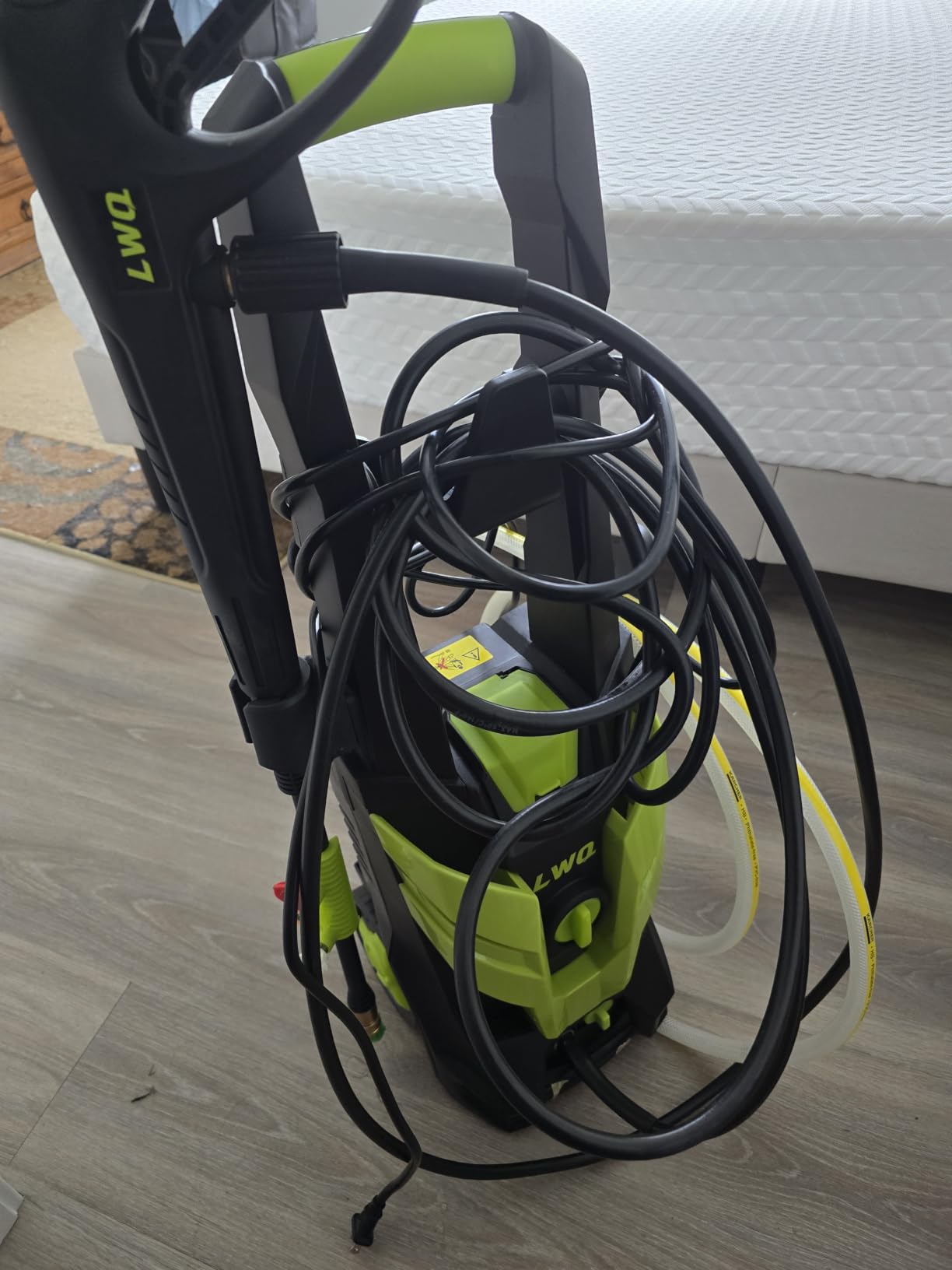
When the extra flow is worth it
Flow shows up in the two places that frustrate patio owners most. First, rinse: a high-flow machine clears detergent and loosened grit off a large slab in one pass instead of two, and leftover slurry is what turns into a dirt film later.
Second, detergent. If your plan is a long soak with an algae or mildew treatment, a wetter machine re-wets the surface faster and keeps the chemical active across a wide section. Experienced users on r/pressurewashing make the same point, insisting on GPM alongside PSI for anything serious.
Where it falls short
Durability is the open question. At 5,103 reviews the one-star share is around 11 percent, higher than most machines here, and that pattern usually shows up as pump or motor failures after a season or two of hard use.
The entry-level electric platform is also not built for a full day of hardscape work. If this is a two-times-a-year patio clean, that is fine. If it is a weekly commitment, spend up.
5. Westinghouse ePX3100v: Top Rated for Light to Medium Patios
- Tied for the highest average rating in this roundup
- Only 17.6 pounds with a built-in carry handle
- Detachable foam cannon included
- 3-year limited warranty with nationwide service
- Only three nozzles limits your pattern choices
- 2100 max PSI is modest for heavy buildup on concrete
- Listing copy conflicts on hose length between 20 and 25 feet
At 4.7 stars across 4,913 reviews with 81 percent five-star and about 2 percent one-star, the ePX3100v has the tightest rating distribution of anything we reviewed. That consistency is what convinced us it is a safer recommendation than a higher-spec machine with a spikier spread.
For patios, the 2100 max PSI and 1.76 max GPM combination is the sweet spot. It has enough force to lift algae out of concrete pores and enough flow to keep a surface cleaner spinning evenly, without the excess force that erodes paver joints and etches stone.
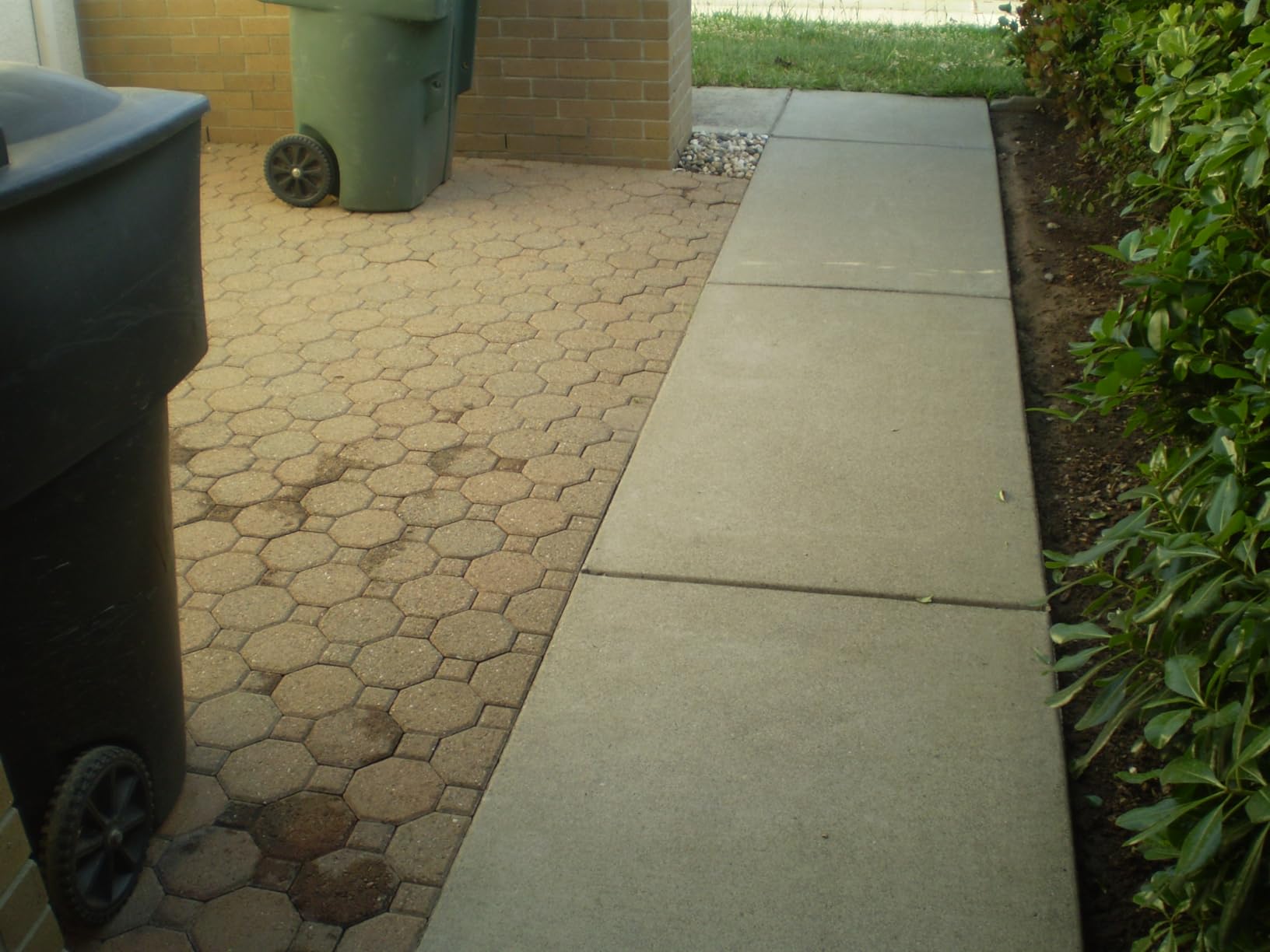
The built-in carry handle and 17.6 pound weight make it easy to move solo. When you are cleaning a patio at the back of a house, dragging a 36 pound frame across a lawn is a real cost that never shows up in a spec sheet.
The detachable foam cannon handles the detergent step well, and the pump automatically stops when the trigger is released, which extends pump and motor life over a long season of use.
Matching it to your patio surface
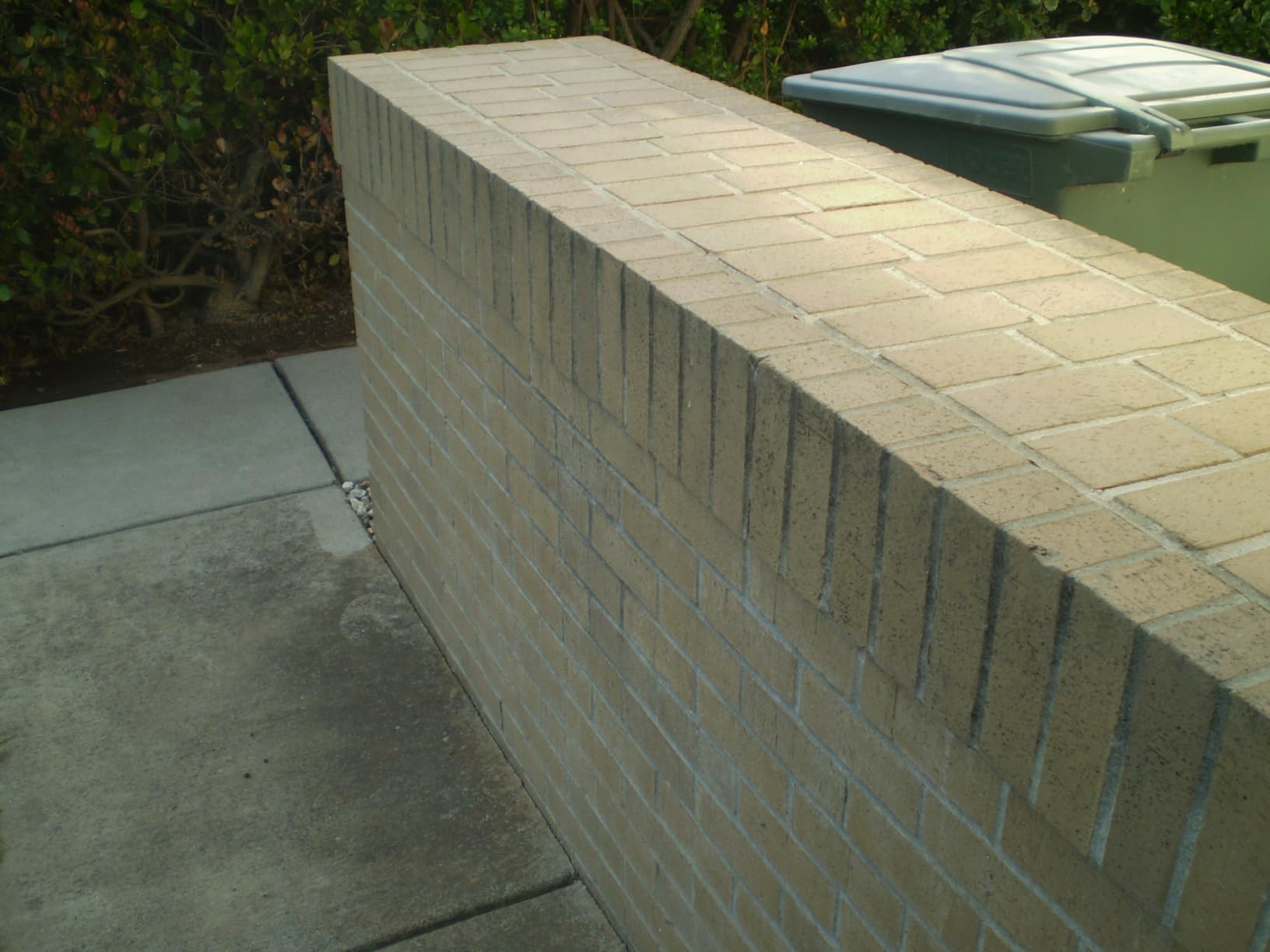
On poured concrete and standard pavers, 2100 max PSI is genuinely enough for dirty-but-intact concrete, and reviewers consistently report strong results on patios and driveways. If you are dealing with painted lines, heavy oil, or long-neglected moss, you will be pushing it.
For natural stone, this is a comfortable machine. The 1.76 max GPM at moderate pressure lets you keep distance and let the detergent do the work, which is how you clean flagstone without wearing the face off it.
Where it falls short
Three nozzles is stingy. The 0, 15, and 25 degree plus a turbo would be a normal set, and the missing 40 degree fan limits how gently you can pre-soak a large flat area before switching to the cleaning tip.
Also note the listing conflict on hose length. The specification lists a 25-foot braided hose while the product copy describes 20 feet, so confirm what is in the box before you plan your reach around the patio.
6. Karcher K 5 Premium: Best for Flagstone and Bluestone Patios
- Vario Power wand lets you dial pressure down for soft stone
- Brushless induction motor runs cool and quiet
- Dirt Blaster wand handles hard concrete when needed
- Onboard pressurized hose reel stores 25 feet easily
- Lowest average rating here at 4.0 stars
- 1.43 GPM trails comparable gas output
- Proprietary fittings make replacement parts costly
- Hose is stiff and hard to pull off the reel
Of everything we tested, this is the machine I would trust most with flagstone, bluestone, or slate. The Vario Power spray wand is the reason. It lets you dial the pressure down continuously under the stream, which is the only practical way to clean a soft surface without gouging it.
Bluestone and flagstone are the two patio materials where a fixed high-pressure machine causes real damage, because both are sedimentary and both powder under a concentrated jet. Adjustable pressure turns that from a risk into a non-event.
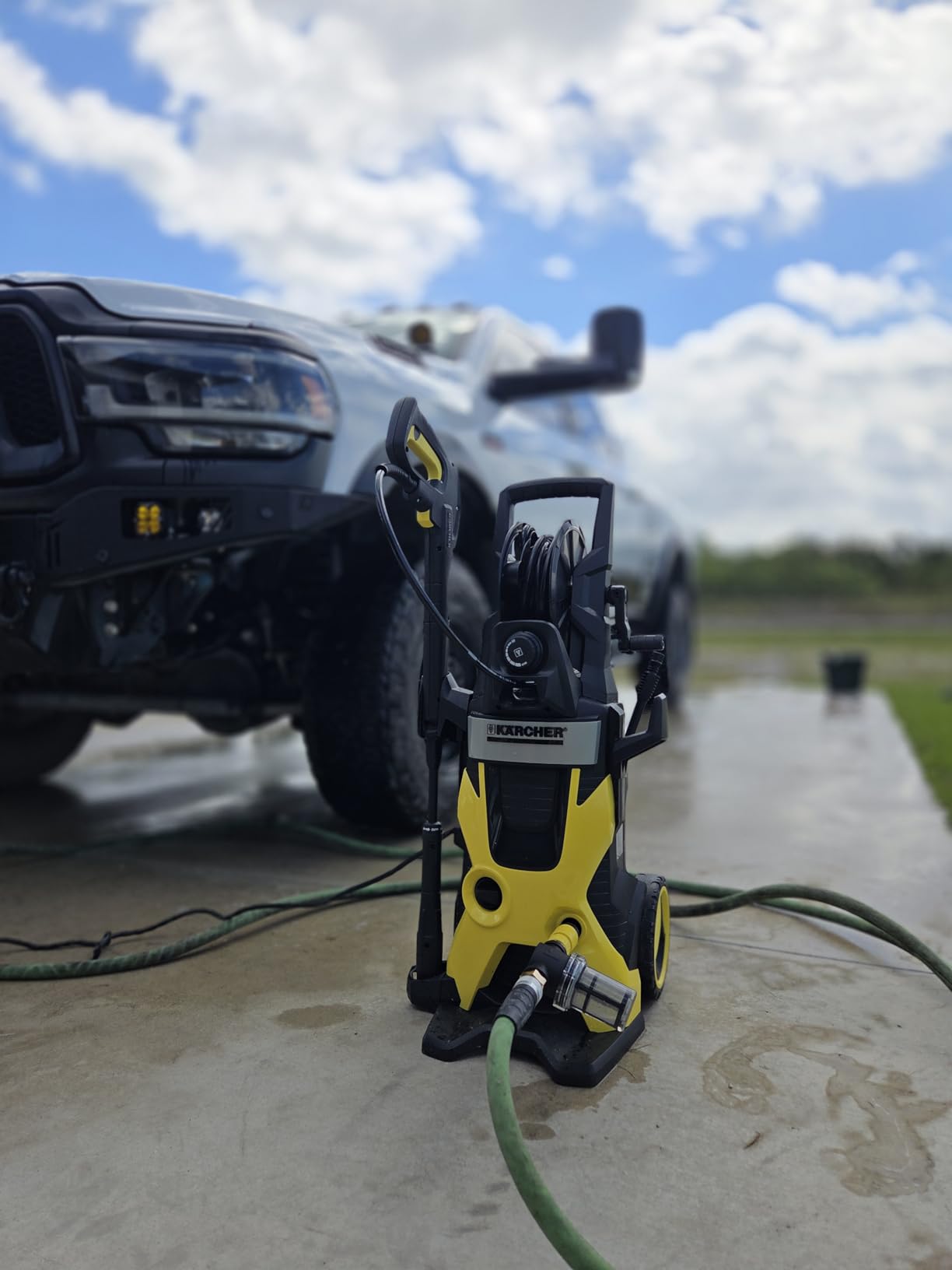
The water-cooled brushless induction motor is another quality signal. It runs cooler and quieter than a universal motor, and the N-COR pump is built to resist corrosion, which matters if detergent residue and outdoor hose water are your regular diet.
The Dirt Blaster wand covers the other end of the range. When you hit a concrete step or a wheel stop, you have a rotating turbo pattern without changing machines.
Why adjustable pressure beats more PSI on stone
More PSI is a blunt instrument. It gives you no way to clean the same patio where one area needs a hard pass on mildew and the adjacent flagstone needs only a rinse. A variable wand means one machine covers a mixed-material patio, which is very common in real yards.
Owners also praise Karcher customer service for sending full replacement units rather than parts, which is worth something on a machine whose hose fittings are proprietary.
Where it falls short
At 4.0 stars with a 16 percent one-star share, this has the widest rating spread in the roundup. The complaints cluster on parts availability, an onboard soap tank that does not always dispense, and lower-than-expected flow.
At 1.43 GPM and 32 pounds, it also gives up ground quickly on a large patio. This is a quality machine for a considered patio, not a tool for a large hardscape estate.
7. Greenworks 2000 PSI: Best for Patio Furniture and Small Jobs
- PWMA tested so the pressure claim is verified
- Motor shuts off when the wand is not engaged
- Detachable handle makes it shelf-storable
- Cord includes an integrated GFCI protector
- Supplied 25-foot hose limits flow at the gun
- Turbo nozzle pattern is small so passes multiply
- Louder than most competing electric units
Every patio has furniture, and furniture needs a completely different tool than a slab. Cushions, wooden slats, and painted metal want low pressure and a wide fan, not concentrated force. The Greenworks 2000 PSI is built for exactly that class of work, and the brand rates it for medium-duty residential cleaning.
At 2000 PSI and 1.2 GPM with PWMA performance testing, the numbers are third-party verified, and the start-stop technology cuts the motor off when you release the trigger.
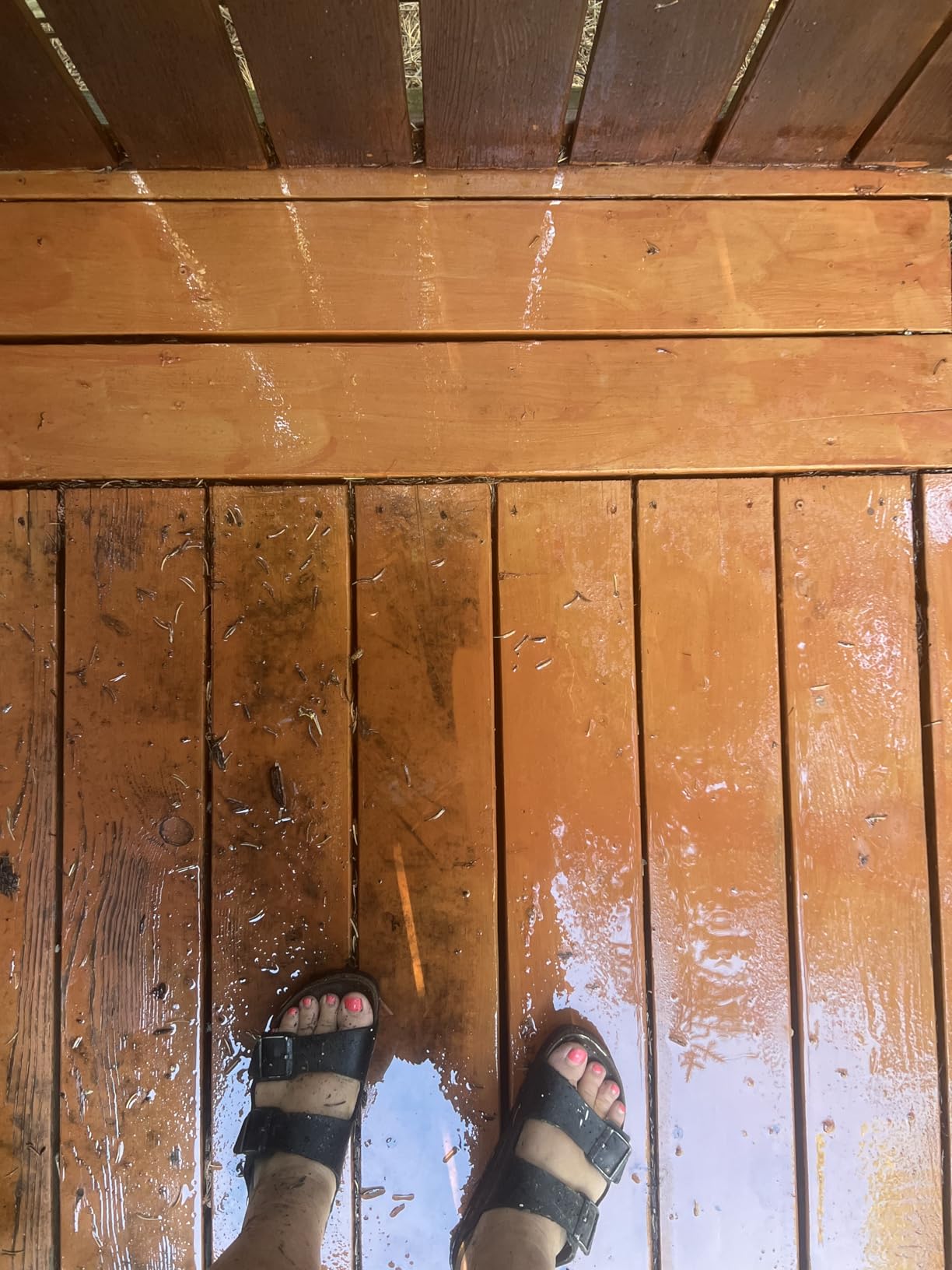
The detachable handle is more useful than it sounds. Take the handle off and the machine sits on a shelf instead of standing at knee height, which is the difference between a pressure washer you own and one you trip over.
Several long-term reviewers call this unit reliable, and the most common thread in reviews is that the supplied hose under-delivers and that swapping in a better hose and nozzles makes a large difference in perceived power.
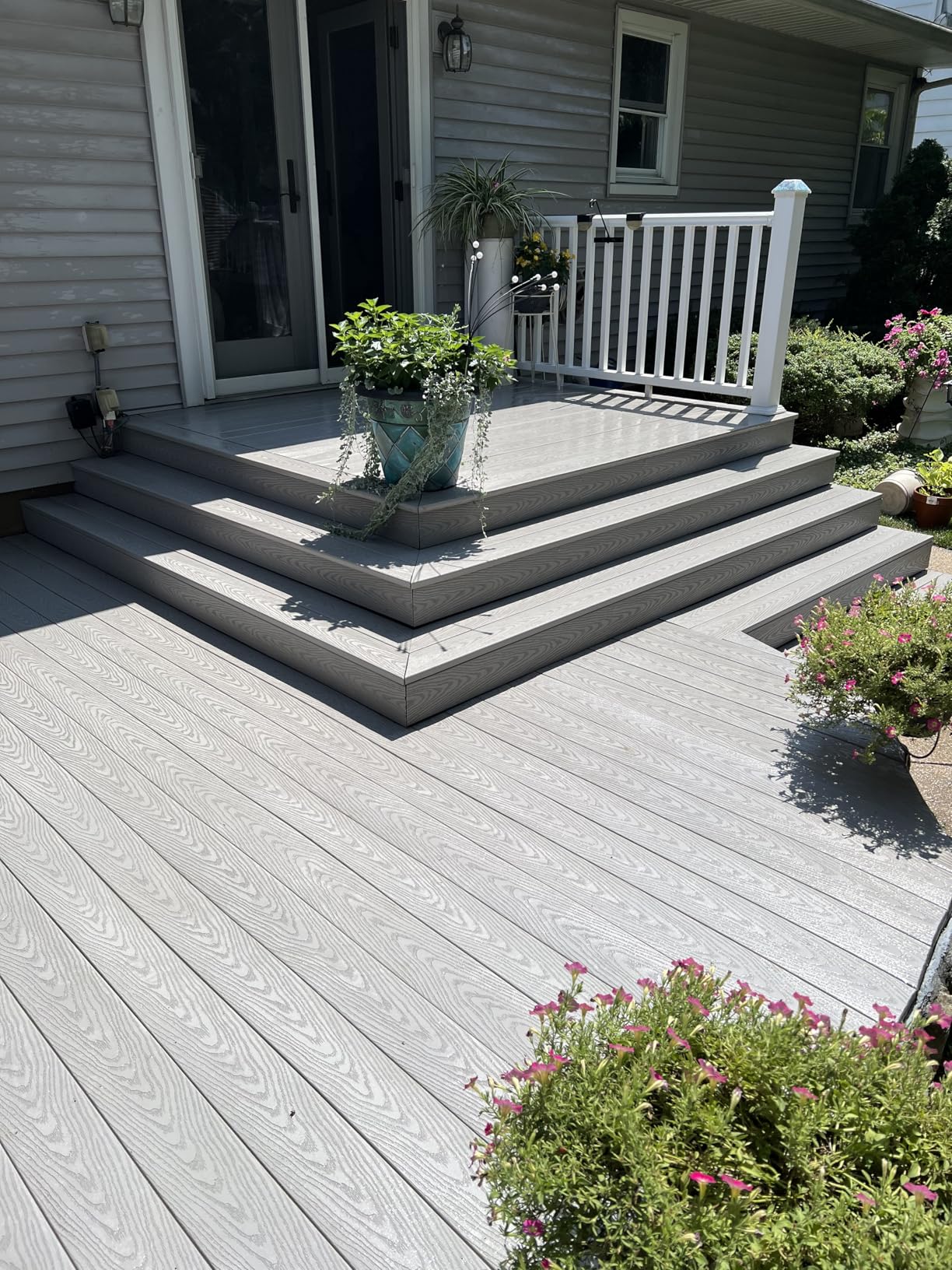
Can it handle a patio as well as furniture
Yes, for spot work and small patios. A 200 square foot concrete pad with light grime and patio furniture is exactly this machine’s envelope. Beyond that, the small turbo pattern and the 1.2 GPM flow mean more passes and more time.
One practical caution from owners: the turbo nozzle produces a small circular pattern that requires multiple overlapping passes, and overlapping passes with a turbo are how you get the striping that sends people looking for a different machine.
Where it falls short
Flow at the gun is limited by the supplied 25-foot hose, and replacing the hose is the single highest-value upgrade on this machine. Owners who do it report a noticeable difference in usable pressure.
It is also louder than most electric units, closer to a loud vacuum cleaner than to a small engine. On a patio behind a house that is a fair trade, but it is not the quiet option.
8. Westinghouse WPX3000e: Best for Large Concrete Patios
- 3000 max PSI with 1.76 max GPM for heavy buildup
- Induction motor gives steady quiet power
- Super-flex 25-foot hose resists kinking
- M22 fittings accept surface cleaners and foam cannons
- One of the heaviest units here at 36.8 pounds
- Bulkier frame needs more storage space
- 0.45 gallon soap tank is small for large patios
If your patio is a large poured slab with years of algae ground into it, the WPX3000e has the pressure and flow combination to do the job without a second trip. 3000 max PSI with 1.76 max GPM puts it at the top of the electric range on pressure, with the brushless Greenworks further down this list offering slightly more flow.
It is also the one electric machine here that accepts the widest range of standard attachments. The threaded M22 connection takes surface cleaners, undercarriage cleaners, and foam cannons, which removes the accessory problem that hampers several competitors.
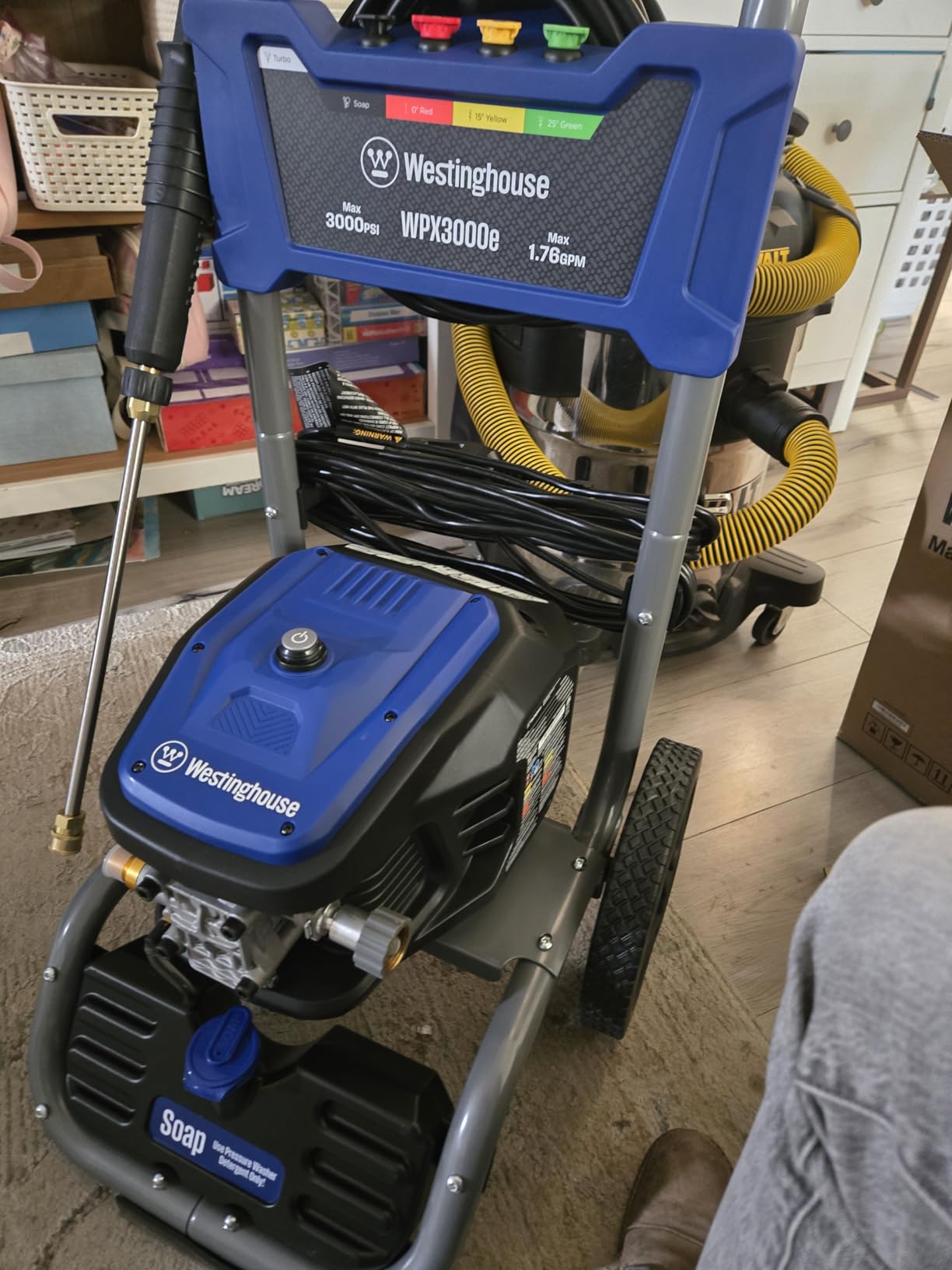
The 35-foot GFCI cord and 10-inch never-flat wheels are what make a big yard practical. You are not constantly repositioning the machine on a wet slab, which is how people end up with an unfinished half and a tired arm.
Reviewers describe strong patio, driveway, and siding cleaning with quiet induction motor operation, and the 4.7 star average with 80 percent five-star ratings matches the ePX3100v.
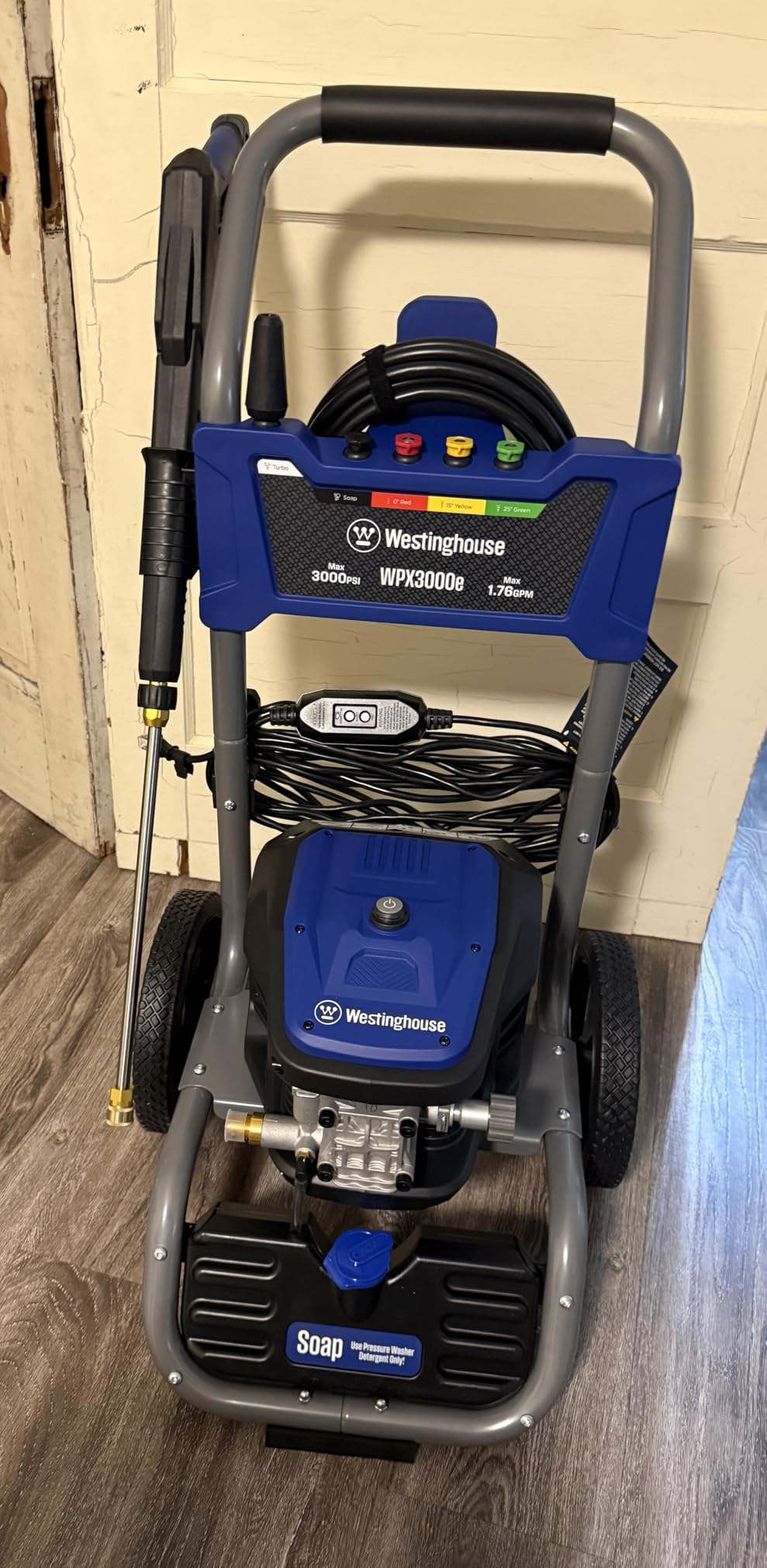
How to use the extra pressure without damage
Use it for the pre-soak rinse, the edges, and the stubborn algae lines, then drop to a 15 degree tip at a proper distance for the main surface cleaner pass. High pressure is valuable for knocking down heavy growth, but the even finish comes from the attachment and the detergent, not from pressure alone.
On brick and pavers, hold the working distance wide. The 2600 rated PSI figure is more than enough to displace mortar and polymeric sand if you get close.
Where it falls short
At 36.8 pounds and a frame that measures over 36 inches tall, this is a two-hand move and it needs real storage space. If your garage is tight, that footprint is a genuine drawback.
It also draws maximum current, so it wants a dedicated circuit. And the 0.45 gallon soap tank means several refills across a large patio, which is the main complaint in reviews.
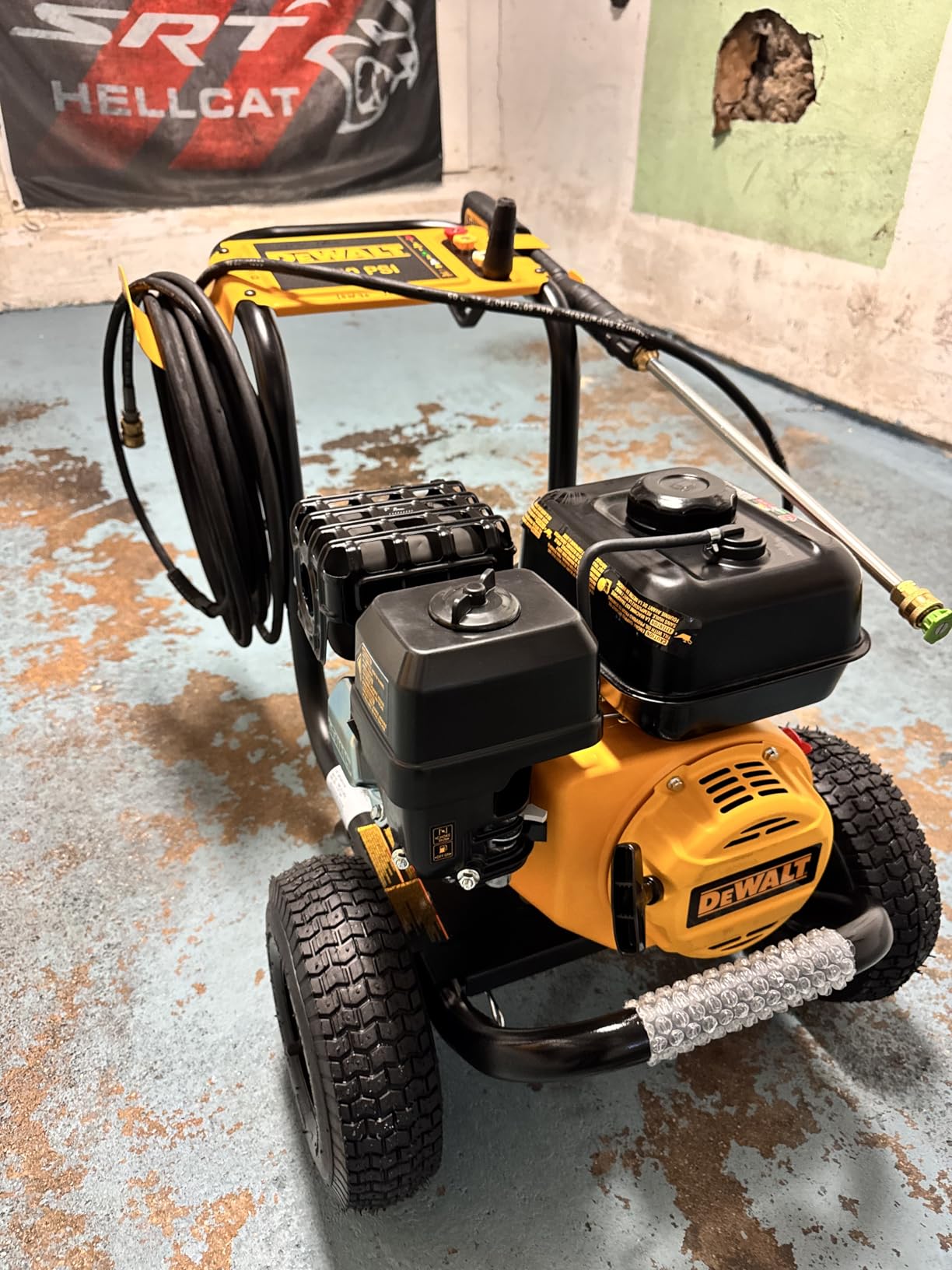
9. DeWalt DXPW3300-S: Best Gas Option for Big Patios
DeWalt 3300 PSI Gas Pressure Washer, 2.4 GPM, Residential Model DXPW3300-S
- 2.4 GPM flow suits residential hardscape
- 10-inch pneumatic tires roll over gravel and grass
- Welded powder-coated steel frame with thermal relief
- 5 year frame warranty is the longest here
- 64 pounds is awkward to move alone
- Gas engine needs oil changes and fuel treatment
- Manual recoil start on every use
- 49-state compliant so not approved in California
The gas-versus-electric argument gets a lot of air, and for patios the honest answer is that it depends on the size of the slab. The 2.4 GPM flow here moves substantially more water per minute than the 1.1 to 1.8 GPM electric machines in this roundup, and on a large patio that decides whether you finish in an afternoon or a weekend.
The DeWalt DXPW3300-S is the residential gas machine to look at. An axial cam pump delivers 3300 PSI at 2.4 GPM, and the 208cc DeWalt engine starts easily with a two-year engine warranty behind it.
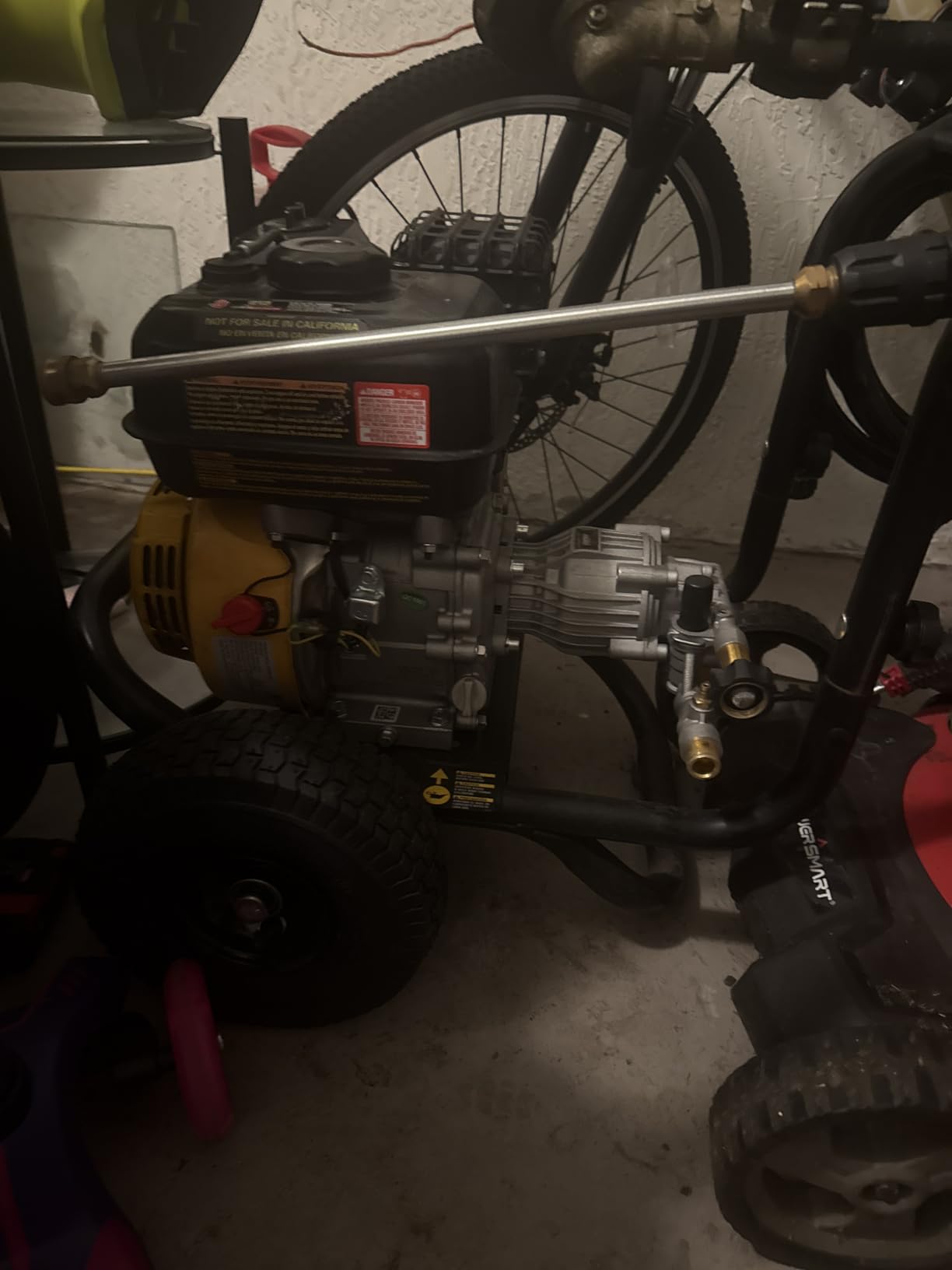
The 10-inch pneumatic tires and the welded powder-coated steel frame are built for real terrain. Rolling this unit over a lawn or a gravel drive is a completely different experience from dragging an electric across the same ground.
Buyers value the raw output and the frame durability. Critiques center on the maintenance burden, the weight, and the regional sales restriction.
When gas genuinely wins on a patio
For large pours, long driveways, and multiple hardscape surfaces in one weekend. At 3300 PSI and 2.4 GPM, a big concrete patio that takes most of a day on an electric unit becomes an afternoon of work, and that is a real difference in how you use a Saturday.
The thermal relief valve is worth noting on long jobs. It is the feature that lets a pump keep working in hot recirculating water without cooking itself, which is exactly the failure mode on a long summer patio clean.
Where it falls short
At 64 pounds this unit is heavy, and it is awkward to move alone. A gas engine also means fuel storage, oil changes, a spark plug, an air filter, and seasonal fuel treatment.
If you clean once or twice a year, all of that maintenance buys you very little. The owners who regret it are usually the ones who bought it for one weekend and then had to store it.
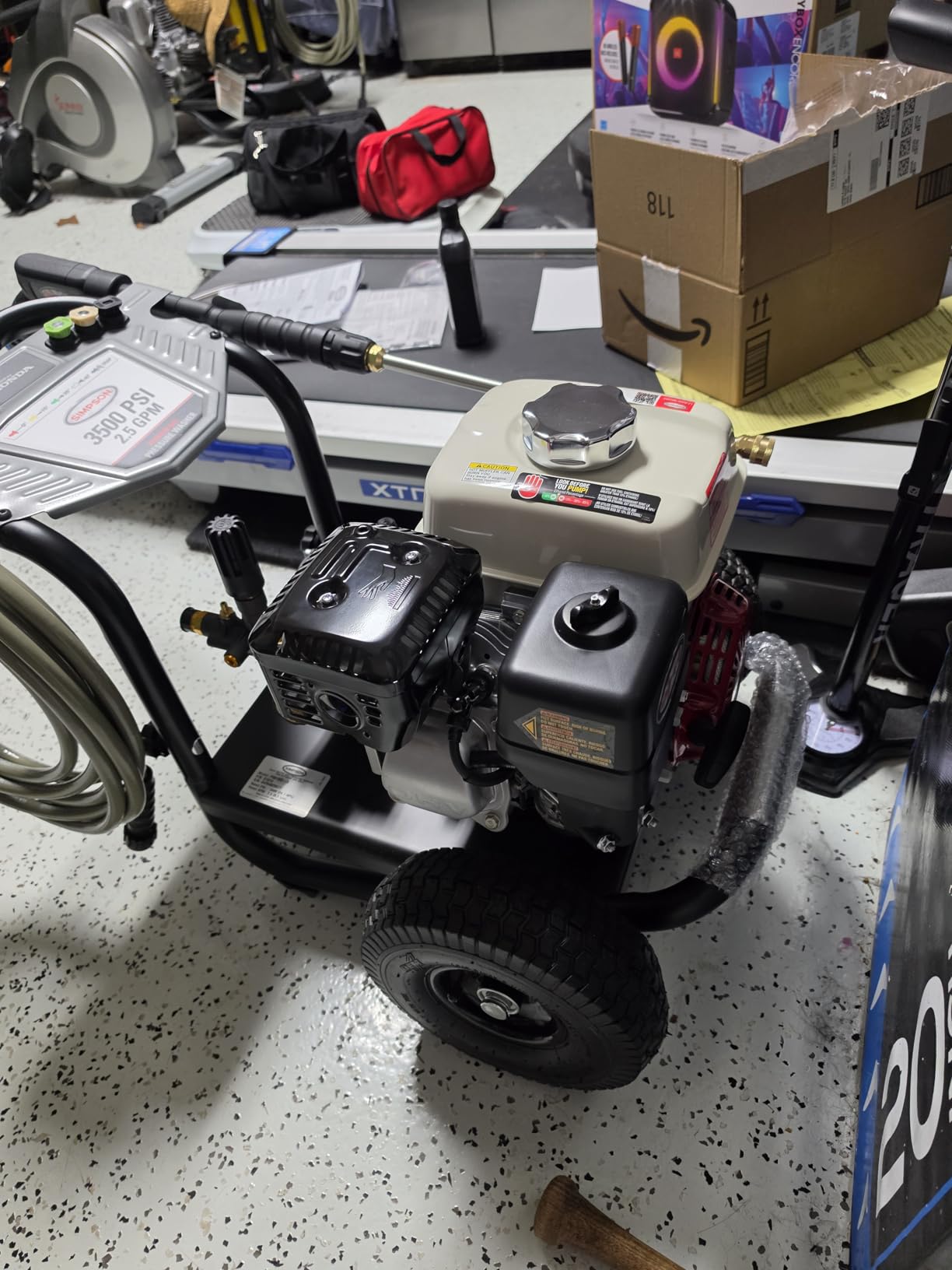
10. Simpson PowerShot: Contractor-Duty Power for Repeated Patio Work
Simpson PowerShot 3500 PSI Gas Pressure Washer, 2.5 GPM, Honda GX200 Engine
- Honda GX200 engine with low-oil shutdown
- AAA triplex pump built for sustained duty
- 3300 PSI and 2.5 GPM output
- Morflex hose with non-marring jacket protects finishes
- Heaviest unit here at nearly 73 pounds
- Smallest review base at 178 ratings
- Threaded M22 connection instead of quick-connect
- Not approved for California sale
The PowerShot is the machine in this roundup that is not really aimed at a homeowner. A Honda GX200 engine with low-oil shutdown and an AAA triplex pump with an integrated unloader and thermal relief are components you find on equipment that runs all day, multiple days a week.
The Simpson PowerShot produces the highest cleaning output in this roundup. If you clean patios professionally, or you have an enormous hardscape property, nothing else in this list will keep up with it.
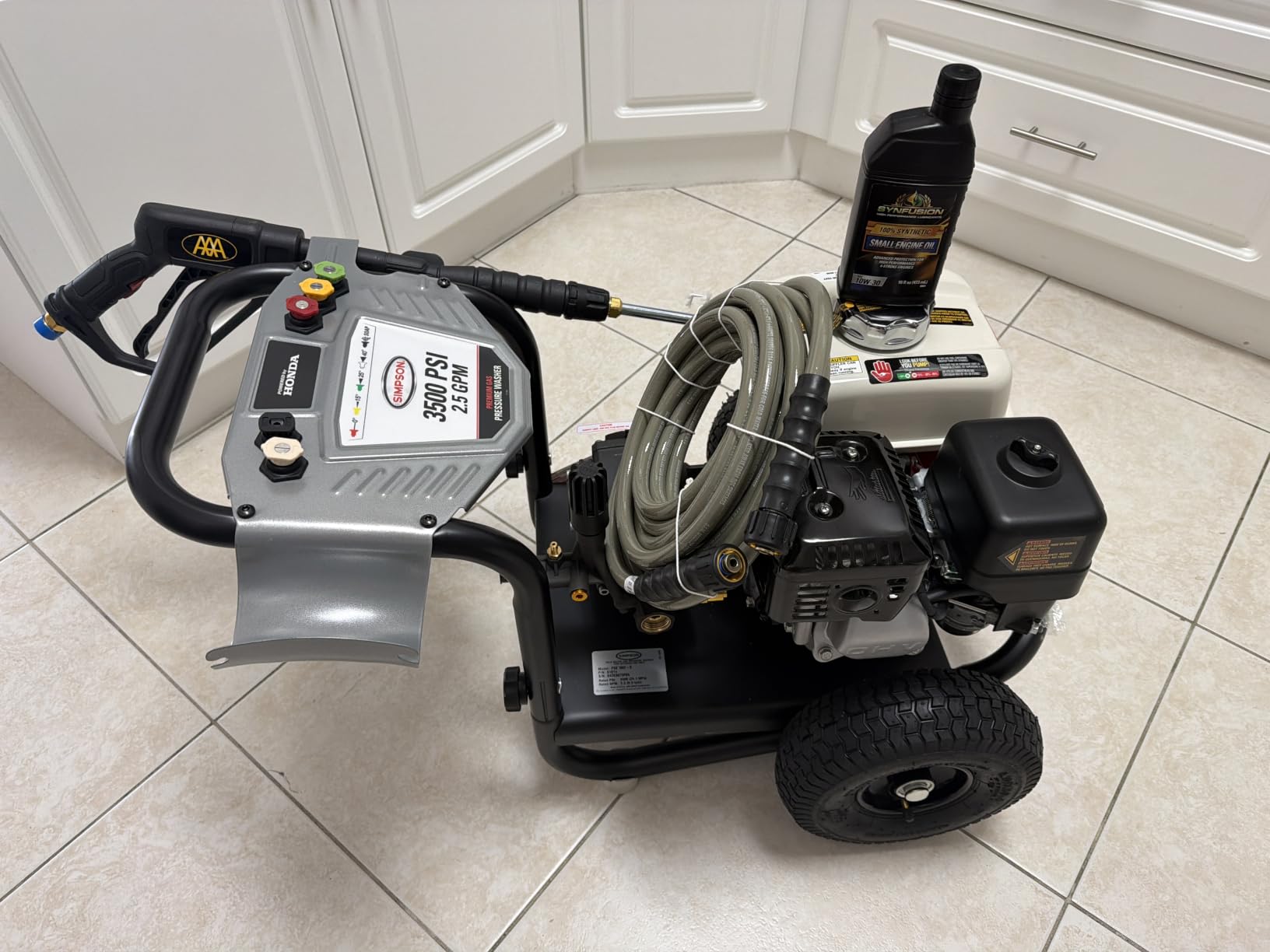
One detail matters more for patios than it does for vehicles: the Morflex 25-foot hose has a non-marring polyurethane jacket. On a finished surface you have paid to have sealed or a stamped concrete you are proud of, a hose that does not scuff is worth real money.
The rear-load spray gun and balanced layout also improve transport and reduce the hose wrestling that causes lines during long passes.
What a contractor-grade pump changes on a patio
A triplex pump with an integrated unloader holds pressure more consistently, which means a more even surface cleaner pass over a long section. On a home patio the difference is nice. On a day of continuous work it is the difference between finishing and not finishing.
The Honda engine is also the reason the maintenance interval is longer. Engine reviews concentrate on durability and contractor-grade output rather than on cleaning results, which says something about the parts nobody worries about.
Where it falls short
At nearly 73 pounds it is the heaviest unit in the roundup. If you are moving it around a back yard alone, that is a workout, and it is not going into a normal-size garage shelf.
With 178 ratings, long-term owner data is thin compared with the rest of this list. The threaded M22 connection rather than a quick-connect is also less convenient when you are swapping attachments all day.
11. Greenworks 1800 PSI: Best for Small Patios and Tight Storage
Greenworks 1800 PSI (1.1 GPM) Electric Pressure Washer PWMA Certified
- Smallest and lightest footprint in this roundup
- Several owners report three hours of continuous use
- Quiet operation with a 35-foot cord and GFCI plug
- Quarter-inch universal quick connects accept third-party accessories
- Lowest output here so large jobs take longer
- Supplied 20-foot hose is thin and kinks easily
- No trigger lock so the lever must be held continuously
If your patio is a small courtyard, a balcony, or a narrow strip between two fences, this is the machine that makes sense. At 1800 PSI and 1.1 GPM it is the least powerful unit here, but its footprint of just over 10 by 9 by 12.8 inches means it lives in a closet instead of taking a garage bay.
The 35-foot cord with an integrated GFCI plug means you can reach a small patio from an indoor outlet without an extension cord, which is both safer and simpler.
Owners consistently report the compact size, the quietness, and hours of uninterrupted use. Several describe running it for three hours straight without an overheating complaint, which is more than some larger machines in this roundup manage.
The quarter-inch universal quick connect system is a genuine advantage. Accessories and foam cannons that fit other machines will usually fit this one, which is not true of several competitors.
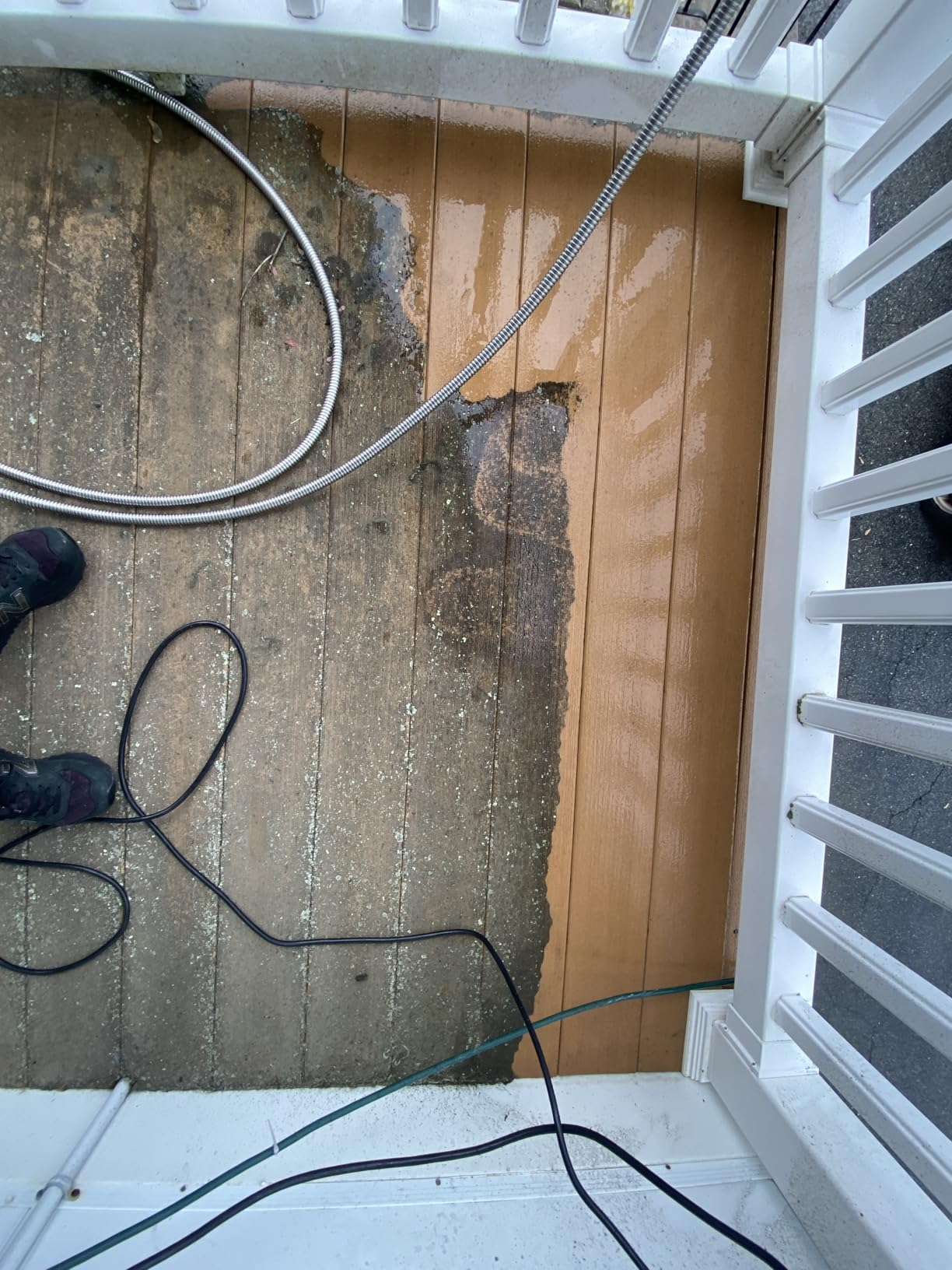
What 1800 PSI and 1.1 GPM can and cannot do
It can lift surface-level dirt and spider-web residue from concrete, and with a proper detergent pre-soak it can handle light algae. The three included attachments, a 40 degree nozzle, a turbo, and a soap applicator, cover a small patio completely.
It cannot strip paint, deep-clean long-neglected moss, or make fast work of a large slab. At 1.1 GPM, a 300 square foot patio becomes a longer afternoon than you are probably planning for.
Where it falls short
The supplied 20-foot hose is thin and kinks easily, and many owners replace it. A kinked hose both reduces flow at the gun and creates the drag that makes a careful pass impossible.
There is also no trigger lock, so you hold the lever down continuously. On a small job that is fine. On anything longer, your hand will tell you about it before the machine does.
12. Greenworks 3000 PSI Brushless: Brushless Power at 3000 PSI and 2.0 GPM
Greenworks 3000 PSI (2.0 GPM Max) Brushless Electric Pressure Washer
- Lab-tested PSI and GPM claims rather than marketing figures
- Jetflow technology delivers up to 50 percent more flow
- 25-foot Uberflex hose resists kinking
- Quiet with no carburetor or spark plug maintenance
- Draws heavy current and wants a dedicated circuit
- Motor enters bypass rather than fully stopping
- Hose is shorter than ideal for very large patios
This Greenworks brushless model is the interesting sleeper in this roundup. 3000 PSI at 2.0 GPM from a 14 amp brushless motor works out to 3300 cleaning units, which is real gas-class output from an electric machine, and the PSI and GPM claims are independently lab tested.
That flow is the number that matters on a patio. At 2.0 GPM, an 18 inch surface cleaner spins with enough margin that you can walk slowly and still get even coverage, which is exactly the condition that prevents lines.
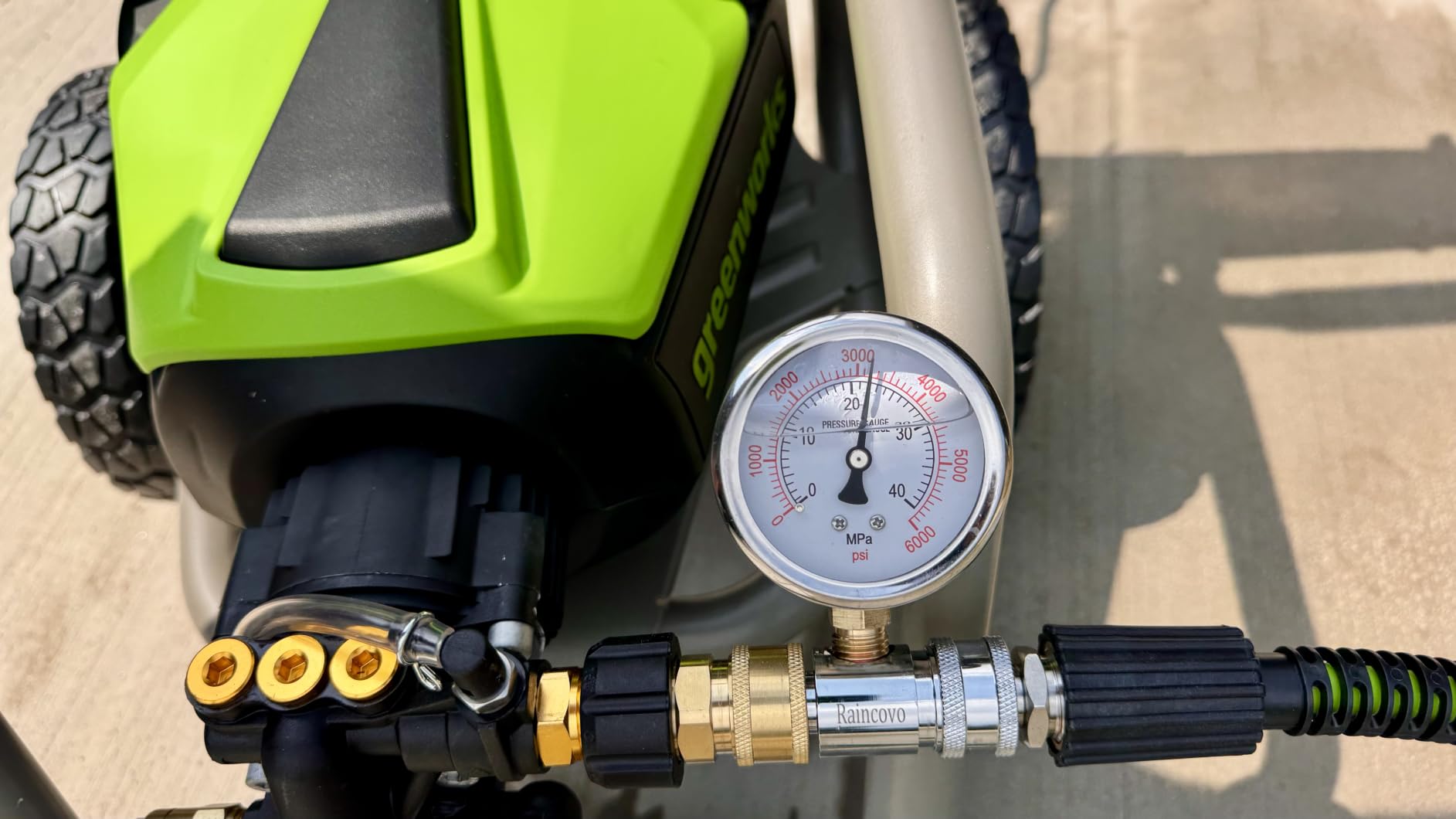
The Uberflex hose is flexible enough not to fight you. Stiff hoses that resist and drag are a documented cause of uneven lines on long patio passes, and this one is designed to avoid that.
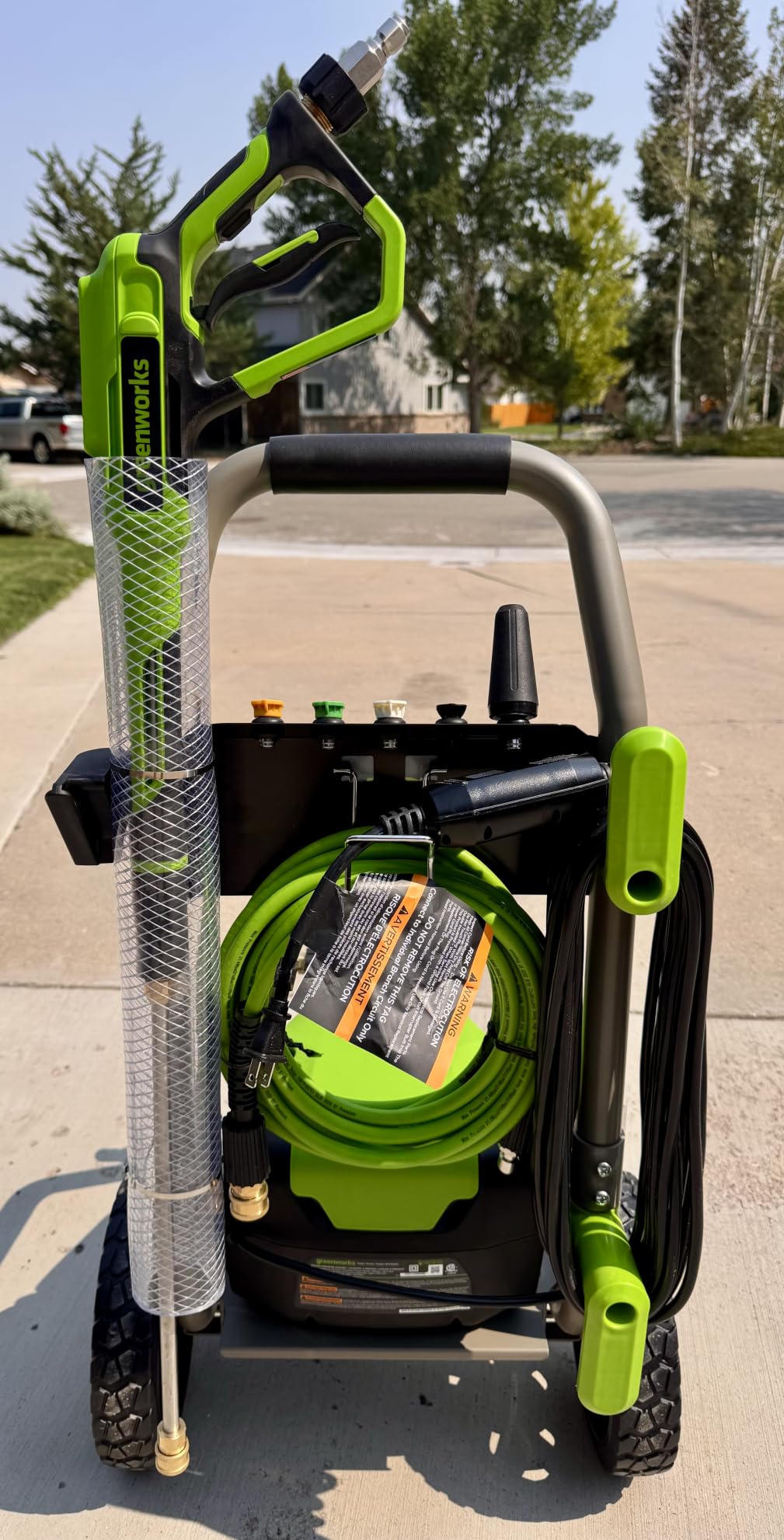
One reviewer published detailed in-line pressure and flow gauge testing, and the honest finding is that measured working pressure runs below the 3000 PSI static claim. That is true of essentially every machine in this roundup, including the ones advertising the highest numbers.
Why cleaning units are the number to compare
Multiply PSI by GPM and you get cleaning units. This Greenworks at 3300 CU outproduces plenty of 3000 PSI machines whose flow rate is only 1.1 GPM, because a narrow jet with low flow cleans a small area and then you have to go over it again.
That is the single most repeated heuristic in the pressure washing communities, and it is the one most spec-focused guides leave out. Experienced users consistently judge machines on flow alongside pressure for exactly this reason.
Where it falls short
It draws heavy current and should sit on a dedicated branch circuit. In a patio with no dedicated outlet, that is an inconvenience you discover on day one.
The motor goes into bypass mode rather than fully stopping when you release the trigger, and the 25-foot hose is shorter than you would want for a large patio. With 316 reviews, the long-term owner data here is the thinnest of the electric units.
Surface Cleaners Change the Result More Than Extra PSI
This is the part almost every roundup skips, and it is the part that decides whether your patio looks professionally cleaned or looks striped. A surface cleaner attachment is a spinning disc with two nozzles of the same type fed by a dedicated hose. Hold it flat on the slab and both jets overlap, so the cleaned width is constant from the first pass to the last.
Professionals rely on a surface cleaner for nearly every flat job. When people ask what professionals use to clean patios, the answer is a rotary surface cleaner, not a bare wand.
Sizing is driven by flow, not pressure. The rule of thumb repeated across r/pressurewashing is to run about one gallon per minute per inch of attachment diameter. A machine at 1.2 to 1.8 GPM wants a 12 to 15 inch surface cleaner, and pushing an 18 inch disc on a low-flow electric unit is why the cleaning comes out uneven.
Before you buy an attachment, check the fitting. The Westinghouse WPX3000e uses standard threaded M22 and takes a disc without an adapter, and the Westinghouse ePX3500 and the Greenworks 1800 PSI machine use quarter-inch quick connects that accept most third-party accessories. The Karcher K1700 uses M22-14, and a lot of discs will not connect to it.
Two attachment features actually improve results. Dual rotating jets resist the build-up that makes a single-jet disc slow down, and a floating head that stays level as you cross uneven stone prevents the disc from digging in on one side.
How Much PSI Do You Actually Need for a Patio?
PSI is force at the nozzle. GPM is how fast water arrives. Multiply them and you get cleaning units, which is the only fair way to compare two machines. A 3000 PSI washer pushing 1.1 GPM cleans far slower than a 2000 PSI washer pushing 2.5 GPM, even though the first number looks better on a box.
For most patios, the useful range is 2,000 to 3,000 PSI with 2 or more GPM. Below about 1,500 PSI you are rinsing, not cleaning, and you will need heavy detergent and long dwell times. Above 3,000 PSI on a flat slab, you are mainly adding risk to mortar joints, polymeric sand, and natural stone.
Match pressure to material, not to aspiration. Here is the safe working range we used for every surface in this roundup.
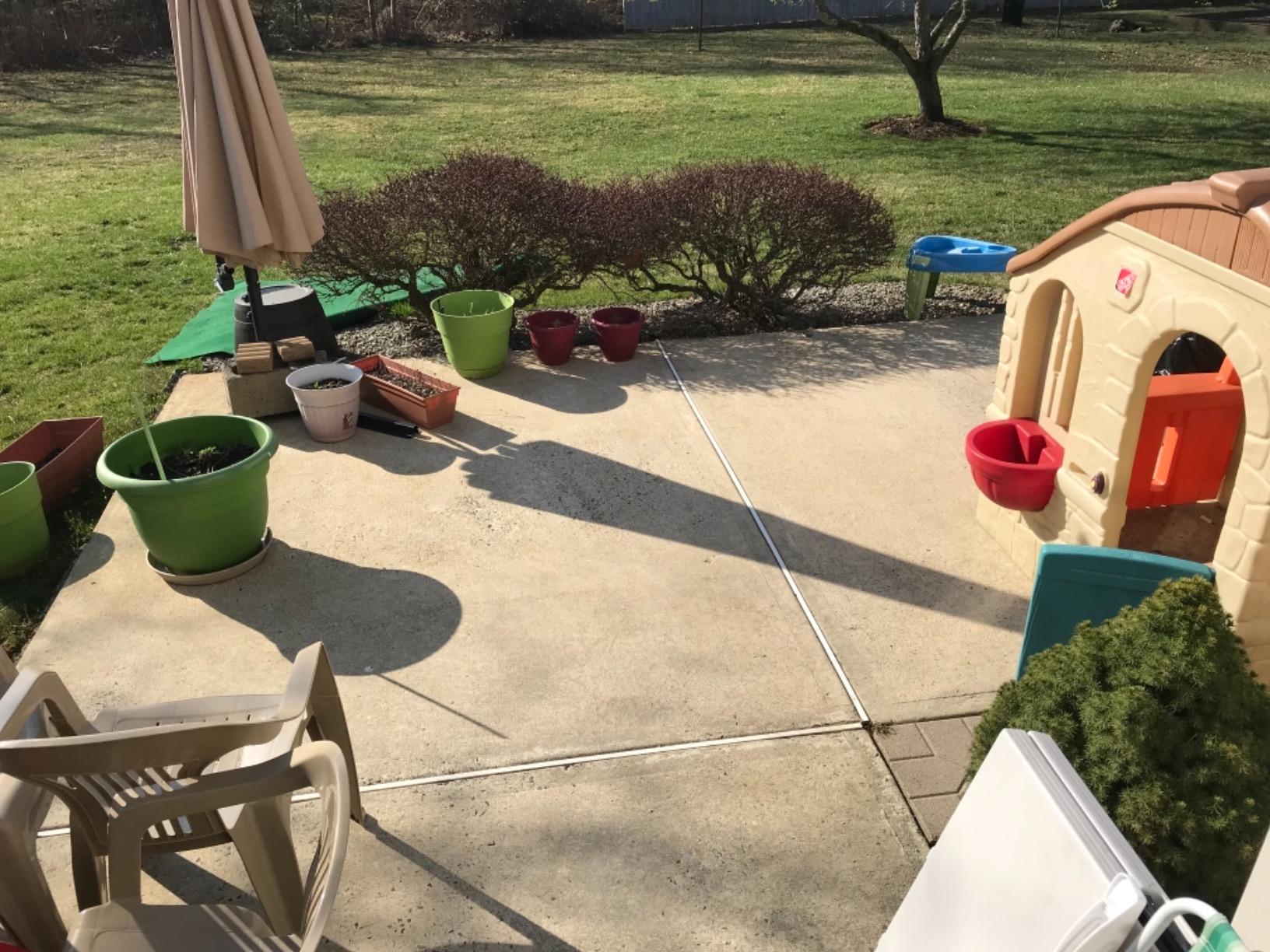
- Poured concrete. Up to 3,000 PSI, 15 or 25 degree nozzle or a surface cleaner, 10 to 12 inches of distance. Concrete is the most forgiving patio surface and can take the most force.
- Brick with mortar joints. Cap it at 2,000 to 2,500 PSI and use a 25 degree fan or a surface cleaner at 12 inches. Mortar is softer than the brick face, so a narrow high-pressure jet at close range can erode the joints while the face looks clean.
- Concrete pavers with polymeric sand. 2,000 to 2,500 PSI, surface cleaner preferred, 12 inches minimum. Anything more concentrated than a 25 degree fan will blow the sand out of the joints.
- Flagstone and slate. 1,500 to 2,000 PSI, 40 degree fan, 18 inches or more. These are soft and sediment-layered, and concentrated pressure powders the surface.
- Bluestone. 1,500 to 2,000 PSI with variable pressure if you have it, 40 degree fan, 18 inches. Bluestone is the surface most often damaged by enthusiastic pressure washing.
- Composite decking. 1,500 to 2,000 PSI, 40 degree fan, 18 to 24 inches, and stay off the boards while they are wet. Wet composite is considerably softer than dry.
- Wood decking. 1,200 to 1,500 PSI, 40 degree fan, 20 inches or more. Cedar and pressure-treated pine will scar at close range.
On time, a 2,000 to 2,500 PSI machine with a surface cleaner covers roughly 100 square feet in about 10 minutes on a normal pass, while a 3,000 PSI gas unit moving 2.4 GPM covers the same area in about 7 minutes. Add pre-soak and rinse and you should budget about 30 minutes per 100 square feet for the whole process.
On detergent, use an outdoor patio cleaner rather than ordinary dish soap for the main pass. A bleach-based treatment works well on concrete and brick for algae, at a ratio of roughly one cup of unscented bleach per gallon of water, but skip it on natural stone and on any sealed surface unless the sealer is confirmed bleach safe. On stone, use an oxygen-based cleaner and give it a full dwell.
Electric vs Gas Pressure Washers for Patio Cleaning
Two credible outlets disagree here, and the reason they appear to contradict each other is that they answer different questions. One has effectively stopped recommending gas for homeowner use. The other ranks gas first on measured cleaning output. Both are right for different patios.
Choose electric if your patio is under roughly 400 square feet, you clean it once or twice a year, and storage space matters. You get instant start, quiet operation, no fuel or oil, and a machine that lives in a corner of the garage. Flow rates from 1.1 to 1.8 GPM are enough for patios and even for short driveways.
Choose gas if you are cleaning a large slab, a long driveway, or several hardscape surfaces in one session, or if you wash weekly. The 2.4 to 2.5 GPM gas units on this list cover ground faster than the 1.1 to 1.8 GPM typical of the electric machines here, and on a big slab that is the whole argument.
The costs of gas are real: fuel storage, oil changes, a pull cord or recoil start, two to three times the weight of an electric unit, and more noise. On a patio that sits right next to a house or shares a property line, the noise factor pushes toward electric, and owners repeatedly raise fumes near a building as a reason to avoid gas.
Battery and cordless units are worth a mention. They have moved from novelty to viable for patio furniture and light spot work, but the flow rates are well below what a surface cleaner attachment needs. For a full patio slab, corded electric or gas remains the right answer.
Our broader guides cover both categories in more depth: the best electric pressure washers and the best gas pressure washers.
How to Pressure Wash a Patio Step by Step
1. Test a small patch first. Pick a corner you will not see and check for etching, color change, or joint erosion before you commit to the whole slab. This is the step that saves a bluestone patio.
2. Sweep and clear the surface. Remove leaves, gravel, and pot fragments. Debris under a high-pressure jet becomes an abrasive slurry and will scratch concrete.
3. Pre-soak with detergent. Apply an outdoor patio cleaner from a foam cannon or soap nozzle and let it dwell for 10 to 15 minutes. Work in 10 foot by 10 foot zones so the whole section stays wet and active. A bleach-and-water mix at about one cup of unscented bleach per gallon works on concrete and brick; skip bleach on natural stone and use an oxygen-based product instead.
4. Run the surface cleaner. Attach the disc sized to your flow, start on the lowest pressure setting, and walk the zone slowly with about 50 percent overlap between passes. Do not rush. A fast pass is a stripe.
5. Work the edges with the wand. Use a 25 or 40 degree tip on the perimeter, walls, and furniture at a wide angle. Keep the lance moving and never park the jet in one place.
6. Rinse from the far end toward the drain. Push water off the patio rather than back across it, and leave the detergent running off the surface rather than into a joint.
7. Let it dry fully, then re-sand the joints. This step is skipped constantly and it is the reason paver patios look bad a month later. Pressure washing removes polymeric sand from the joints, and bare joints collect dirt. Sweep in new polymeric sand and sweep it diagonally into the joints while the stone is still slightly damp.
8. Seal if the surface is designed to be sealed. Concrete and pavers can take a penetrating sealer after they dry. Never seal before the patio is fully dry, and check the product instructions for cure time.
If you see lines after the job, the cause is almost always one of four things: the attachment is too large for your flow, you moved too fast, the hose is kinked and dragging, or you let the dwell time expire before the pass. Work through those in order.
Buying Guide: Storage, Accessories, Safety, and Renting
Measure the storage space before you buy. The most useful framing in any pressure washer guide is that the best machine is the one you will look forward to using. The Westinghouse ePX3500 stands 16.5 inches tall, the Greenworks 2000 PSI detaches its handle, and the WPX3000e is over 36 inches in every direction. Those are very different garage realities.
Budget for the attachment, not just the machine. A rotary surface cleaner changes the outcome more than upgrading the washer does, and it is the single most recommended accessory across the pressure washing communities. Pair it with a foam cannon for the detergent step and you have the full professional setup.
Check the fittings before you commit. M22-15 is the common standard. M22-14 on the Karcher K1700 and threaded M22 on the Simpson will narrow what you can attach. A quarter-inch quick connect system is the most flexible of the lot.
Give the hose real thought. Supplied hoses are the most common weak link in reviews across this roundup. Owners who upgraded the hose report a noticeable difference in usable pressure, and a kinked or stiff hose is a documented cause of visible lines because it drags the attachment sideways.
Handle the safety basics properly. Eye protection and hearing protection every time, a GFCI-protected outlet for electric units, a seated hose connector before the trigger, and a rule that the zero-degree red tip does not go near a patio. Consumer Reports goes as far as recommending that any machine shipping with a zero-degree tip have it removed and discarded, and we agree.
Consider renting for a one-time clean. If you have one patio to do, once, a rental machine is genuinely the sensible answer. A weekend rental covers a large slab for a fraction of the purchase cost and avoids storing something you will use twice a year. Buy when you will use it three or more times a year, or when you want it on your own schedule.
Our related roundups go deeper on the categories: our budget pressure washer roundup for the entry end, and our commercial pressure washer roundup if you clean hardscape professionally.
Frequently Asked Questions
What PSI pressure washer is best for cleaning a patio?
For most patios, 2,000 to 3,000 PSI with 2 or more GPM is the right range, paired with a rotary surface cleaner attachment. Concrete tolerates the top of that range. Brick with mortar joints and paver patios should stay under 2,500 PSI, and flagstone, bluestone, and composite decking need about 1,500 to 2,000 PSI from a distance of 18 inches or more. Judge machines on PSI multiplied by GPM rather than PSI alone.
Which pressure washer is best for patios?
For a seasonal patio clean of a normal residential slab, the Sun Joe SPX3000 is the safest overall pick, with 2500 max PSI, 1.76 max GPM, and dual detergent tanks. The Westinghouse ePX3500 offers the same output with a more stable base and a longer hose, and the Westinghouse WPX3000e is the pick for large poured concrete. Whichever you choose, add a rotary surface cleaner attachment sized to your flow rate.
Do pressure washer surface cleaners actually work?
Yes, and they are the main reason a patio looks evenly cleaned instead of striped. A rotary surface cleaner holds two overlapping jets at a fixed height, so the cleaned width stays constant across the whole section. Professionals use one on nearly every flat job. The attachment does the finishing, the detergent does the lifting, and the washer only has to supply pressure and flow.
Does surface cleaner PSI have to match pressure washer PSI?
No. The important number is flow, not pressure. The common rule of thumb is roughly one gallon per minute per inch of attachment diameter, so a machine at 1.2 to 1.8 GPM wants a 12 to 15 inch surface cleaner. Matching pressures is not required, but running an oversized attachment on a low-flow machine is the most common cause of uneven cleaning, because the operator cannot move slowly enough for the jets to overlap properly.
Why is my surface cleaner leaving lines?
Four causes account for almost every case. First, the attachment is too large for your flow rate, so the disc spins faster than you can walk. Second, you are moving too fast. Third, the hose is kinked or stiff and dragging the head sideways. Fourth, the detergent dwell time expired before the pass, so the attachment is redistributing grime instead of removing it. Work through those in order, and drop the pressure setting one notch on each attempt.
Is electric or gas better for concrete patios?
For a patio under roughly 400 square feet cleaned once or twice a year, electric is better: instant start, quiet operation, no fuel or oil, and far less weight. For large slabs, long driveways, or several hardscape surfaces in one session, gas wins because 2.4 to 2.5 GPM covers ground about a third faster. Gas costs you fuel storage, oil changes, a pull cord, and noticeably more noise near a house.
Conclusion
The best pressure washers for patio cleaning are not the ones with the biggest number on the box. The Sun Joe SPX3000 is our pick for most people because it has enough pressure and flow, two detergent tanks, and a footprint you can live with. The Westinghouse ePX3500 is the better value if you want a steadier base and a longer hose, and the Westinghouse WPX3000e is the right call for a large poured slab.
Whatever you choose, add a rotary surface cleaner sized to your flow, work in 10 foot sections with a proper detergent dwell, and re-sand your paver joints when the stone dries. Those three habits matter more than any spec difference in this roundup. Our 2026 picks are verified against current manufacturer data, and the method is described above so you can repeat it on your own slab.