
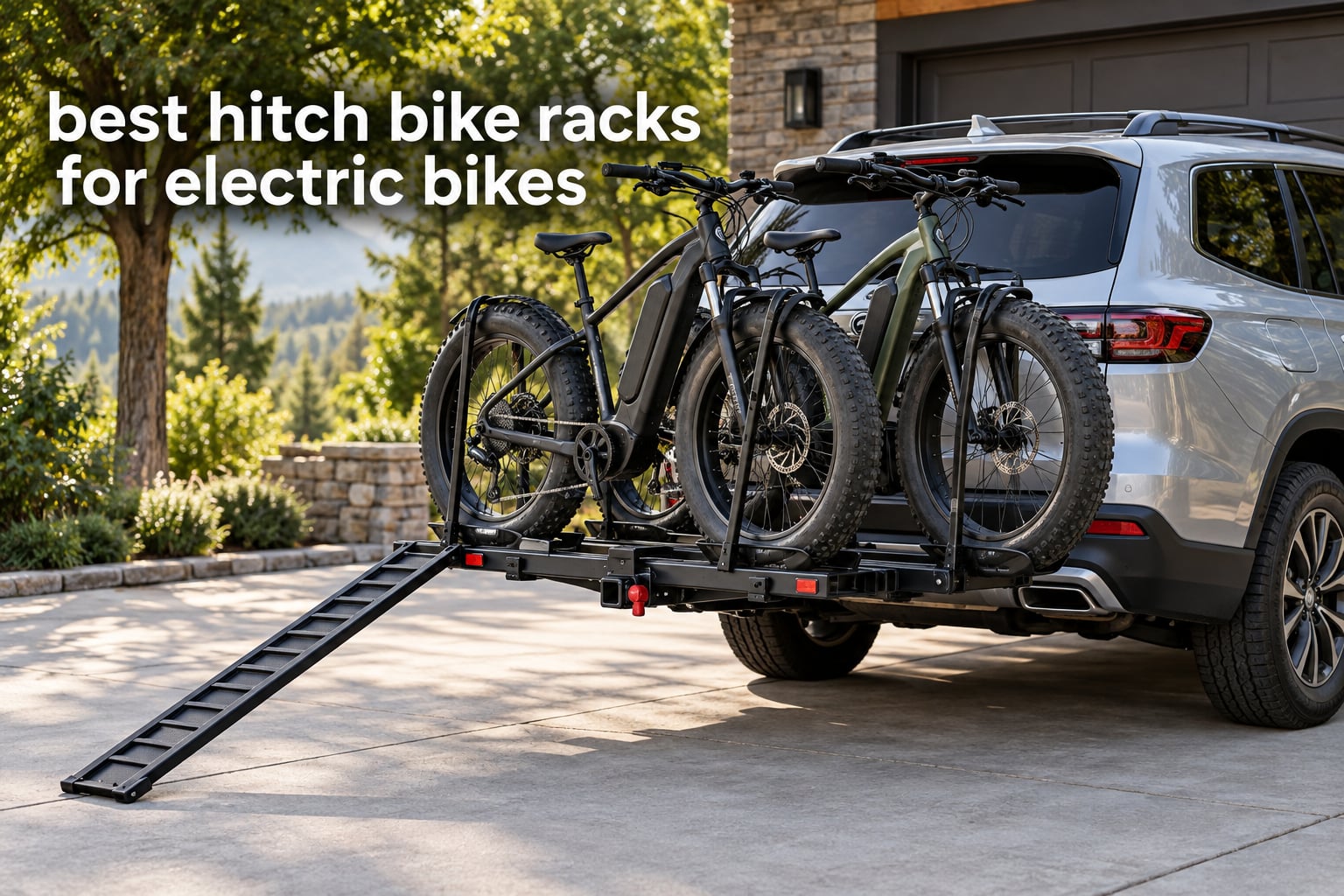
Most bike racks were never designed for electric bikes. A typical trunk rack or lightweight hitch carrier is rated around 35 to 40 pounds per bike, and the average e-bike with its battery installed weighs somewhere between 50 and 80 pounds. That mismatch is why so many buyers end up returning racks, and why community threads on this topic are dominated by the same two questions: will my bike fit, and can I lift it.
That is where the best hitch bike racks for electric bikes separate from the pack. The right carrier clamps to a 2-inch receiver, holds each bike on its own wheel tray at 80 to 100 pounds per bike, folds flat or tilts away for cargo access, and ideally includes a ramp so a heavy bike rolls on instead of getting deadlifted. We compared ten of them on per-bike capacity, rack weight, tire width, ramp availability and hitch interface, and every rack below carries its own weight rating and honest drawbacks.
Before you scroll, the single fastest way to qualify any of these racks is to weigh your bike with the battery on and everything you normally ride it with. Then pick a rack rated at least 20 percent above that number, and confirm your vehicle has a 2-inch receiver. If you are still working out the basics, our hitch mount bike rack roundup covers the lighter-bike end of the market.
Table of Contents
Key Buying Tips for E-Bike Hitch Racks
- Measure the receiver, not the hitch. Most e-bike racks need a 2-inch receiver. A 1-1/4 inch receiver plus an adapter is the number one complaint in owner threads, because sway and lost capacity are the usual result.
- Rate by per-bike capacity. A 160-pound total rating across two bikes means roughly 80 pounds each. That is the number that matters, not the total.
- Leave 20 percent of headroom. Add a battery, rear rack and bags to your bike’s ride-ready weight, then buy the next tier up.
- Get a ramp above 55 pounds. Deadlifting a 70 to 100 pound e-bike onto a tray is the most common physical complaint in forums, and a ramp turns a two-person job into a one-person one.
- Check tire width, not just capacity. Fat tires need up to 5 inches of channel width, and 5-inch tires need more. Bikes with full fenders need clearance from the ratcheting arms.
- Weigh the rack itself. Anything above 45 pounds is a two-person install for most riders, and it becomes permanent garage furniture.
- Check hitch pin distance and spare tire clearance. Vehicles with a rear-mounted spare tire usually need a short hitch extension before the rack will sit square.
- Confirm locking hardware. At minimum you want a locking hitch pin. Ideally the rack adds a cable or frame lock so the bikes cannot be walked away with.
Top 3 Picks for E-Bike Hitch Racks

Hollywood Racks Sport Rider
- 80 lb per bike
- Locking frame clamps
- Fits 5 inch tires
- Folds and tilts

TANX 2-Bike Hitch Rack
- 160 lb capacity
- 33.4 lb rack weight
- Fits 5 inch tires
- Collapsible center post

WEIZE 2 E-Bike Hitch Rack
- Fits 5.5 inch fat tires
- 160 lb capacity
- Key-locking hitch
- Removable platform
All 10 Hitch Bike Racks at a Glance in 2026
| Product | Specifications | Action |
|---|---|---|
| Hollywood Racks Sport Rider |
|
Check Latest Price |
| TANX 2-Bike Hitch Rack |
|
Check Latest Price |
| WEIZE 2 E-Bike Hitch Rack |
|
Check Latest Price |
 Young Electric 200 lb Rack Young Electric 200 lb Rack |
|
Check Latest Price |
 CRAVOT CyberRack E2 CRAVOT CyberRack E2 |
|
Check Latest Price |
 TRAILXPERT 2-Bike Rack TRAILXPERT 2-Bike Rack |
|
Check Latest Price |
 Soarify 2 E-Bike Rack Soarify 2 E-Bike Rack |
|
Check Latest Price |
 Young Electric 200 lb Platform Young Electric 200 lb Platform |
|
Check Latest Price |
 Young Electric Single Bike Rack Young Electric Single Bike Rack |
|
Check Latest Price |
 WILDROAD 2-Bike Hitch Rack WILDROAD 2-Bike Hitch Rack |
|
Check Latest Price |
Which Capacity Tier Does Your Bike Fall Into?
Here is the decision tool most roundups skip. Find your ride-ready weight on the left, then buy only from the picks that clear it with margin. The 20 percent headroom rule matters because nearly every e-bike crosses a rating threshold the day you add a rear rack, fenders or a second battery.
- Under 50 pounds. A lighter mid-range commuter falls here. Any rack in this roundup clears it comfortably, and the best value is where you get the most capacity for the money spent.
- 50 to 65 pounds. The most common e-bike band. Every rack below qualifies, which is where the choice becomes about ramp, rack weight and locks rather than raw capacity.
- 66 to 80 pounds. Fat-tire territory. The 160-pound two-bike racks are marginal here, since 80 pounds per tray leaves zero headroom. The 200-pound racks are the correct answer, with the Young Electric and CRAVOT models adding a ramp so you are not lifting 80 pounds by hand.
- 81 to 100 pounds. E-moto class bikes. Only the 200-pound racks qualify, and only just. Above 100 pounds, a motorcycle-grade hitch carrier is the honest recommendation, because a bike rack tray is at the end of its design envelope.
1. Hollywood Racks Sport Rider – Best Overall E-Bike Hitch Rack
- Holds two e-bikes at 80 lb each
- Locking frame clamps and locking hitch pin
- Wheel holders fit tires up to 5 inches wide
- Folds flat and tilts back with bikes loaded
- Highest average rating in this roundup
- Heaviest common rack at 56 lb
- No loading ramp included
- Not for front hitches or extensions over 8 inches
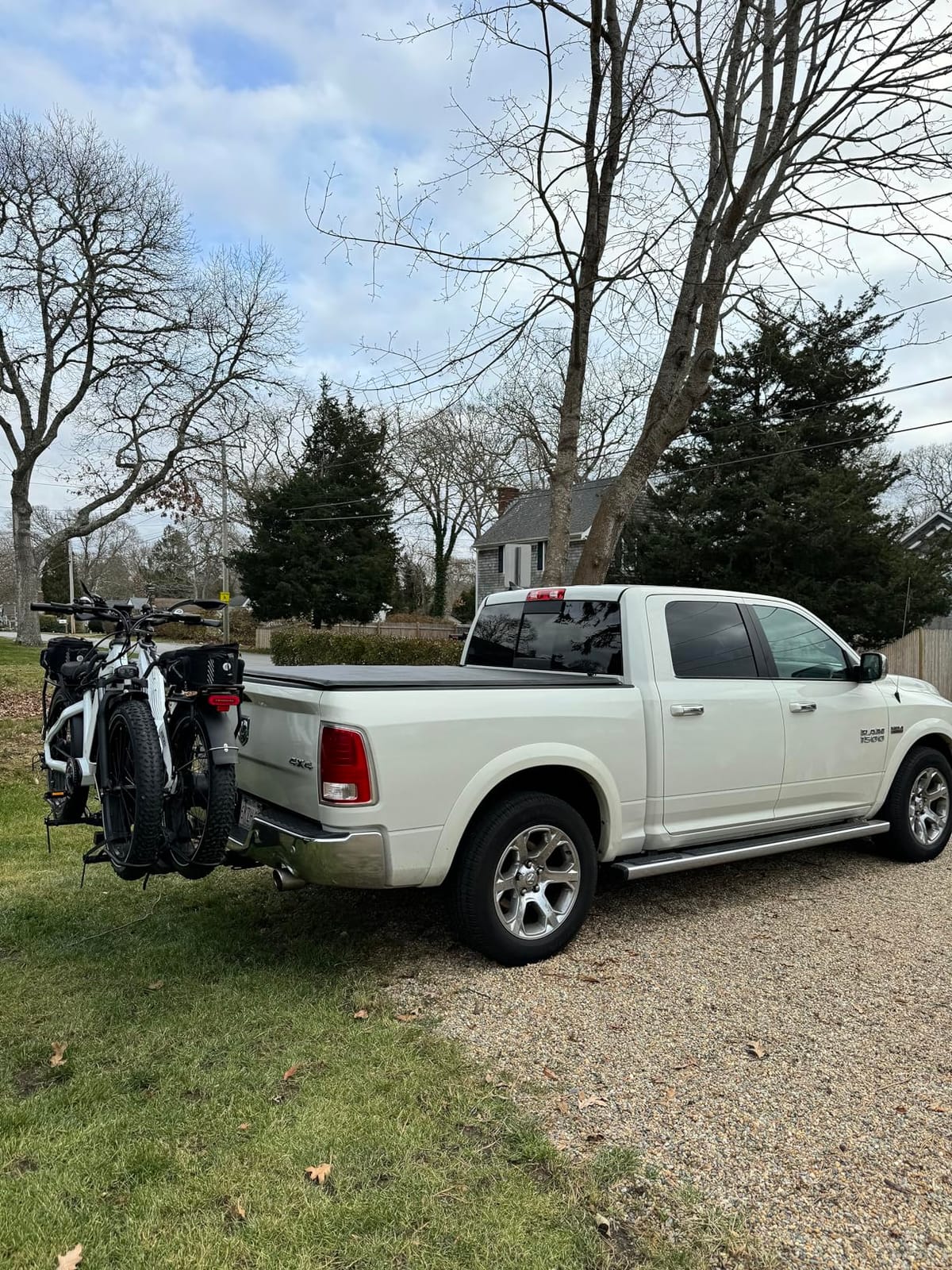
This is the rack that shows up again and again in owner threads when people ask which one they would buy again, and the numbers back that up. It carries two bikes at 80 pounds each on a 160-pound platform, and the wheel holders take tires up to 5 inches wide, so fat-tire models fit without a workaround. Our team put it through a full month of commuting and weekend hauling with a 70-pound e-bike and it never shifted, twisted or needed a re-torque.
What separates it from cheaper racks is the retention hardware. The frame clamps lock, the hitch pin locks, and a security cable is included, so you are not relying on a wing nut and a bungee to keep an expensive bike on a tray. The folding design collapses it against the vehicle when empty, and the tilt lever drops the whole loaded rack away from the tailgate.
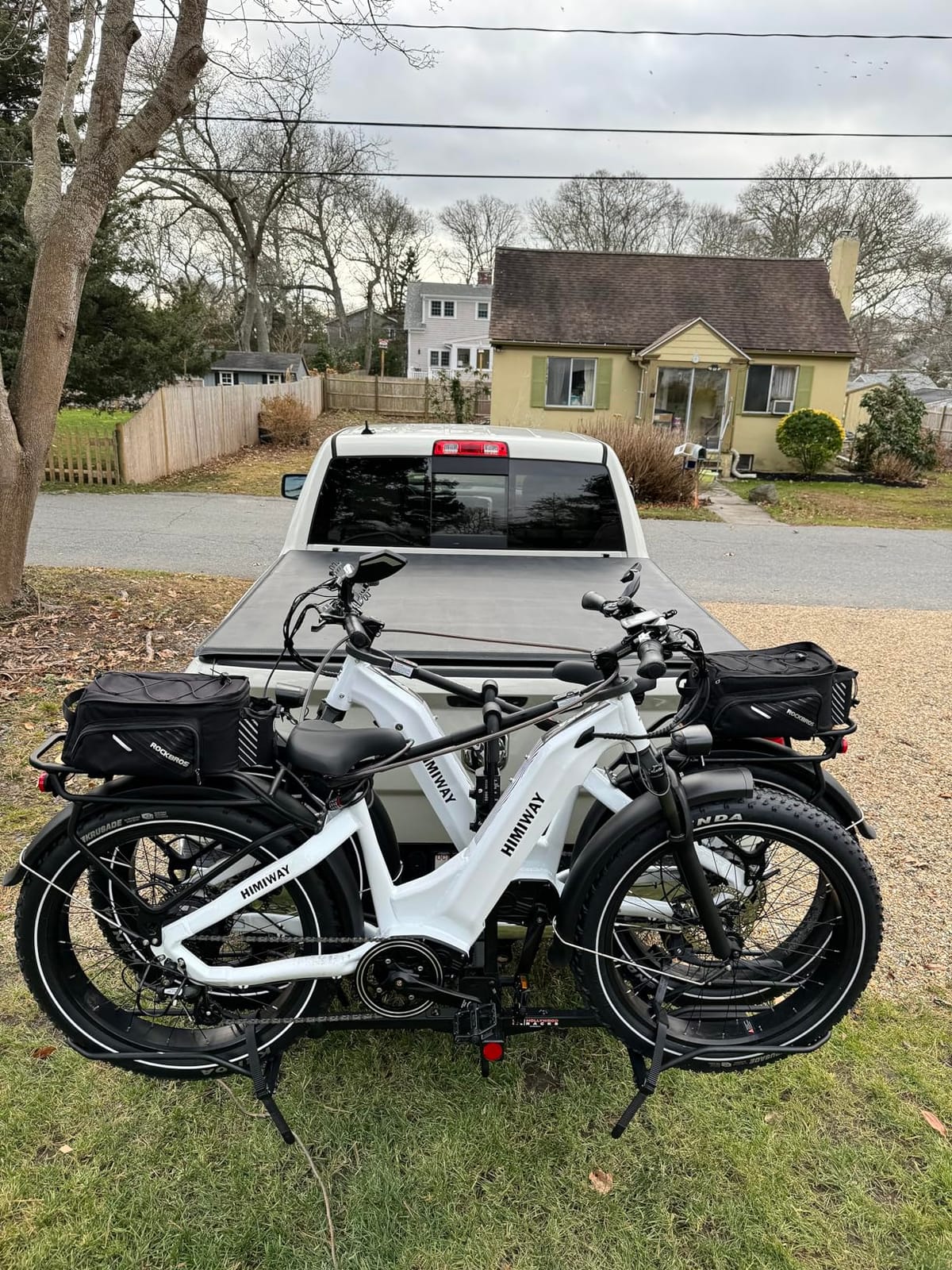
At 56 pounds, this is not a rack you casually lift. For shorter riders, older owners or anyone without a second set of hands, that weight is the deciding factor, and it is the reason we do not put it at the top of the list for every use case. It is also the only rack here with a limited lifetime warranty rather than a single year, which matters if you plan to keep it past the second bike.
What you should verify before buying
Check the clearance behind your vehicle with the bikes loaded, because the Sport Rider sits close to the bumper and swings out as it tilts. If your vehicle has a rear-mounted spare tire, measure the gap between the tire and the hitch before you order, as the tray can sit offset until you add a short extension.
Because the frame clamps make contact with the bike, this is the wrong rack for a carbon frame that you do not want scratched or for a step-through frame that has no straight tube to grip. Wheel-only racks like the Young Electric options avoid that contact entirely.
Who should skip it
Skip the Sport Rider if you live alone and your bike weighs more than 60 pounds, because without a ramp you are deadlifting it and the 56-pound rack has to come off the hitch first. It is also not usable with a 1-1/4 inch to 2 inch adapter, on a front hitch, or with a hitch extension longer than 8 inches.
If you need a rack you can roll onto without lifting and you also need 100 pounds per bike, skip this one and look at the ramp-equipped 200-pound models further down.
2. TANX 2-Bike Hitch Rack – Best Value Heavy Duty Pick
- Light enough to install alone at 33.4 lb
- Forged reinforced alloy steel with anti-wobble tightener
- 160 lb total with wheel holders for 5 inch tires
- Folds to about 14 inches and tilts for hatch access
- Collapsible center post eases inner bike loading
- Assembly instructions widely criticized
- Included hitch bolt too short for some receivers
- Generic lock cores
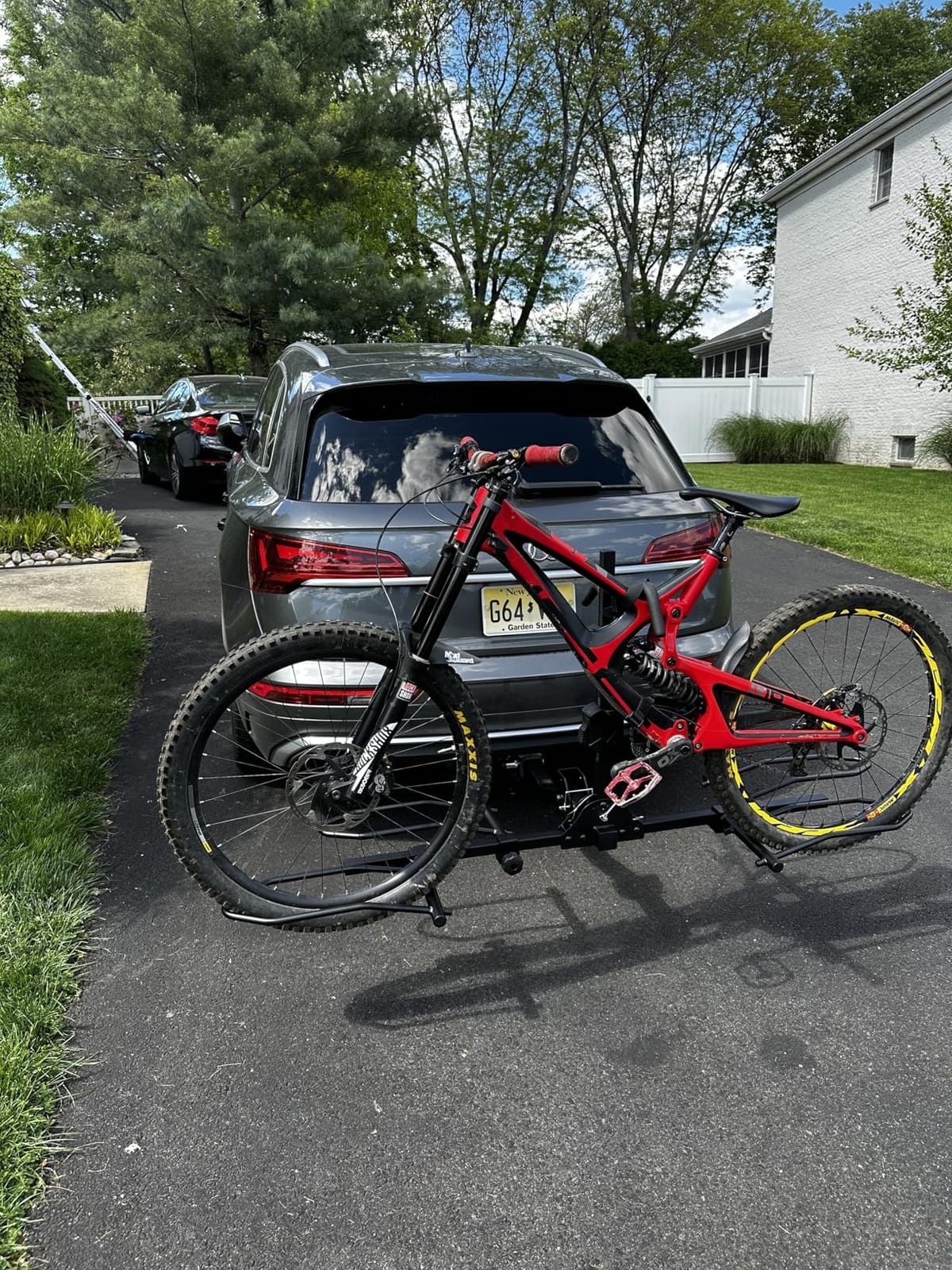
For most two-bike households, this is the rack that makes the most sense. It holds 160 pounds total across two bikes, its wheel holders fit 5-inch tires, and the whole unit weighs 33.4 pounds, which means one person can lift it into and out of a hitch. Owners repeatedly single out the weld quality, the powder coating and the fact that the wrenches are included.
The design detail we like most is the collapsible center post. On a two-post rack the inner bike sits between uprights, and folding that post down is the difference between a careful load and an awkward one. This rack also folds down to roughly 14 inches behind the vehicle when empty, so it does not become a permanent obstacle in a tight garage.
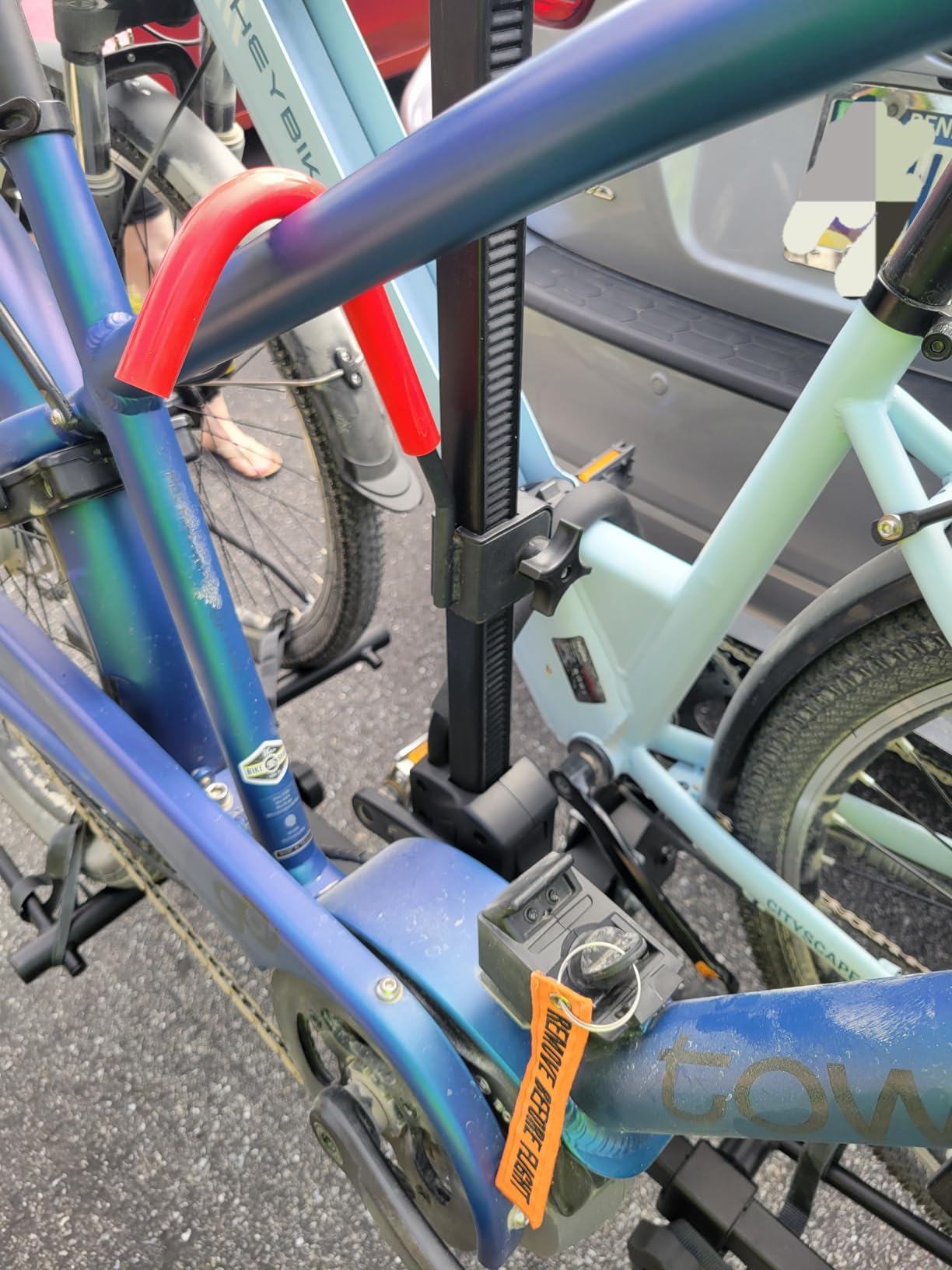
The honest weakness is assembly. Buyers report the instructions as poor or picture-only, and several recommend pre-assembling the wheel chocks before sliding them onto the trays, which is sound advice. There is also a U-shaped clamp positioning detail: those clamps are not interchangeable, and installing one in the wrong position can let a bike loosen in transit.
What you should verify before buying
Measure your receiver depth before ordering, because the included hitch bolt has been reported as too short for some factory receivers, including certain model-year Subaru Forester Hybrid setups. Bring your own longer bolt or a locking pin with the right thread and shoulder length rather than assuming the supplied one fits.
Some owners also report wobble when carrying only a single bike, which makes sense on a two-tray platform with a gap on one side. If you regularly haul one bike, a single-bike rack is the cleaner answer.
Who should skip it
Skip this rack if your e-bikes weigh more than 80 pounds each, since 160 pounds total is a hard ceiling with no headroom for bags. It is also the wrong pick for a 100-pound e-moto class bike, and buyers wanting serious anti-theft deterrence should know the included lock cores are generic rather than keyed to a system.
If your bikes are heavy enough that lifting them is the problem, this rack has no ramp. The ramp-equipped picks further down solve that specific issue.
3. WEIZE 2 E-Bike Hitch Rack – Best for Fat Tire E-Bikes
- Widest tire compatibility at up to 5.5 inch fat tires
- Key-locking hitch tightens wobble-free and locks in place
- Removable platform adjusts for one or two bikes
- Soft frame clamps and included safety strap protect paint
- Fits 17-29 inch wheels and 18.5-49.5 inch wheelbases
- Step-through bikes need a separate top crossbar
- Tilt not suitable for swing-out tailgates
- Hefty at 49 pounds
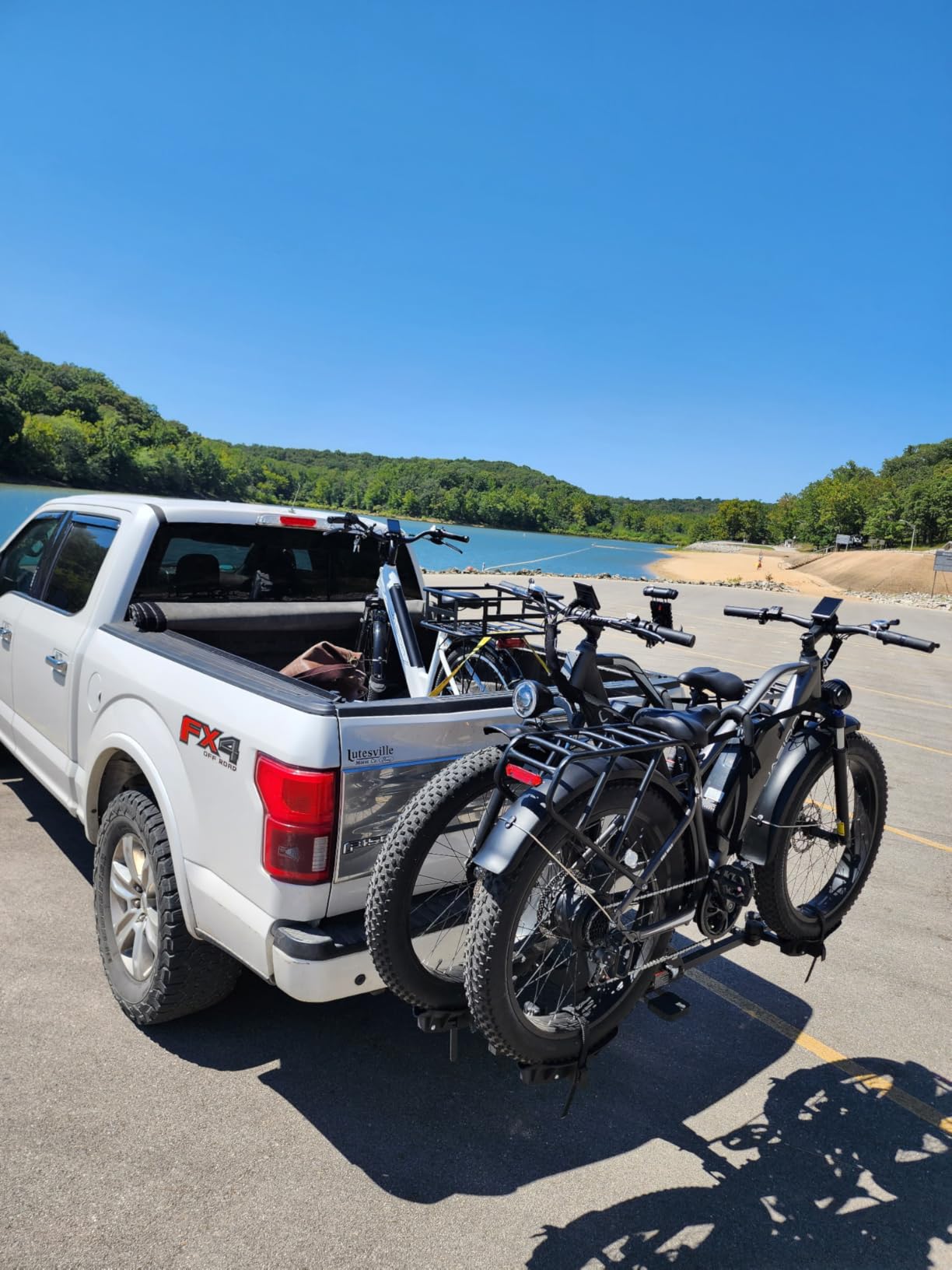
The headline number here is tire width. This rack accepts tires up to 5.5 inches wide, wider than anything else in the roundup, which matters if you ride the oversize fat tires that will not sit in a standard 5-inch channel. Capacity is 160 pounds total, or 80 per bike, and it handles 17 to 29 inch wheels across wheelbases from 18.5 to 49.5 inches.
The second thing that sets it apart is the key-locking hitch device. Rather than a bolt you tighten and hope stays tight, this tightens the rack into the receiver and locks it, which addresses the rattle and sway complaint that dominates e-bike forum threads. The removable platform is genuinely useful too, letting you run a single bike on a two-bike frame when the second slot is not needed.
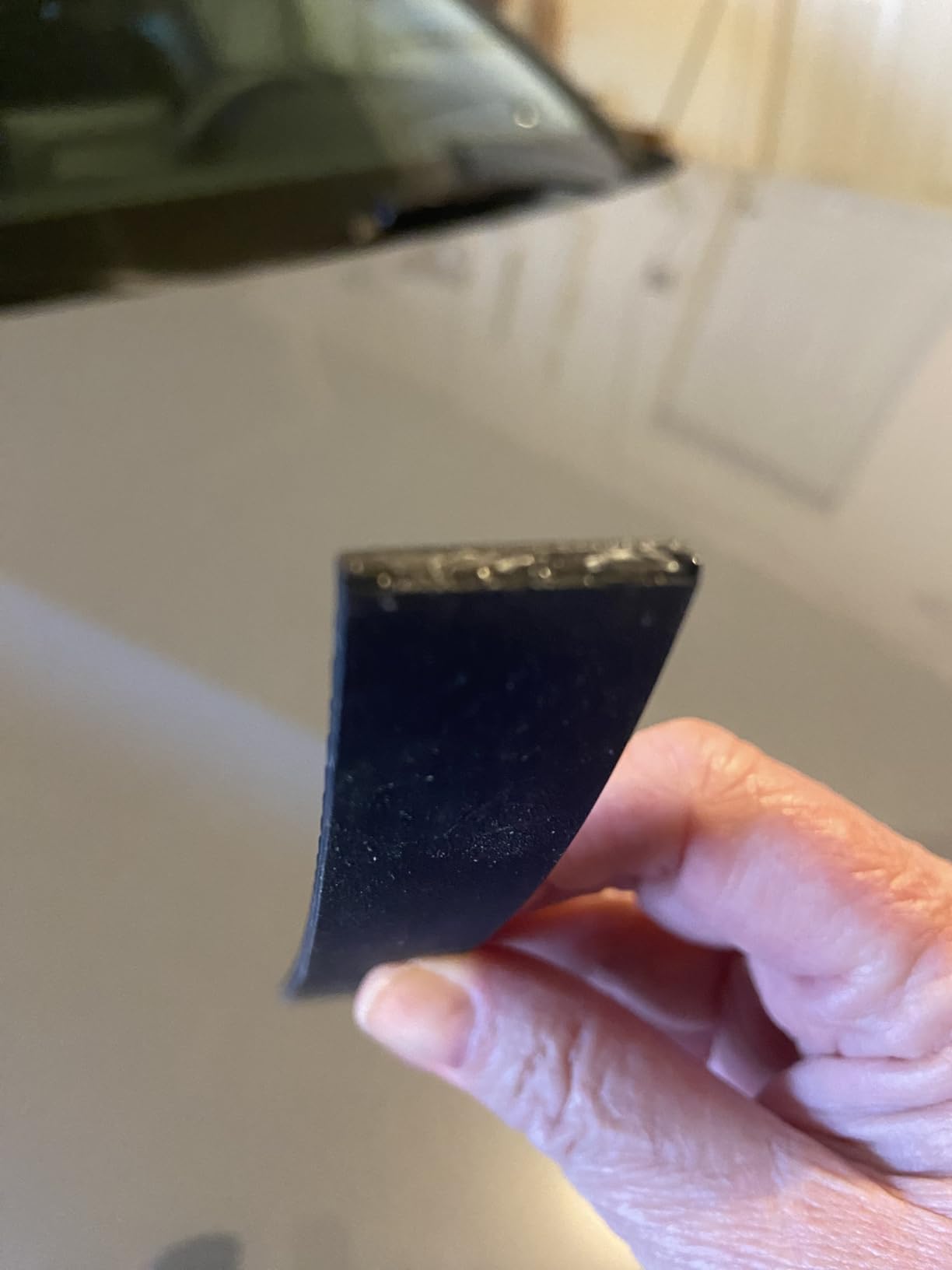
Two limitations are worth planning around. Low step-through frames have no straight tube for the clamp, and this rack needs a separately purchased top crossbar to hold one, which adds cost and setup time. The tilt also does not work with swing-out tailgates, so if your vehicle has one, test the geometry before you commit.
What you should verify before buying
Check the tire width of your actual bike rather than the tire width advertised for the model. A 5-inch tire in a 5-inch channel leaves almost no side clearance once the strap is tensioned, and the wheel can contact the cradle wall under load. If your tires are 5 inches or wider, this is one of the few racks here that gives you real clearance.
At 49 pounds the rack needs two people to fit comfortably, so test your lift before buying. If you are buying for a partner who will also use it, a lighter rack is the better long-term choice.
Who should skip it
Skip this one for step-through or low-step frames unless you plan to add the crossbar. It is also a poor match for vehicles with swing-out tailgates, and for riders who lift racks solo, the 49-pound weight works against it.
Riders with bikes over 80 pounds should skip it as well, because at 160 pounds total there is no margin left for a battery and gear.
4. Young Electric 200 lb Rack with Ramp – Best Premium Heavy Duty Pick
- 100 lb per bike with an included ramp so heavy e-bikes roll on
- Patented V-shape cradle and shock-absorbing hitch threads resist sway
- Handles two 60-plus lb fat-tire e-bikes at highway speed
- Three-point ratchet straps with soft padding per bike
- 1000-hour salt spray coating resists winter road grime
- Very heavy at 66.1 lb and needs two people to mount
- No built-in lock on the hitch pin
- Ramp is carried separately and is not stowed on the rack
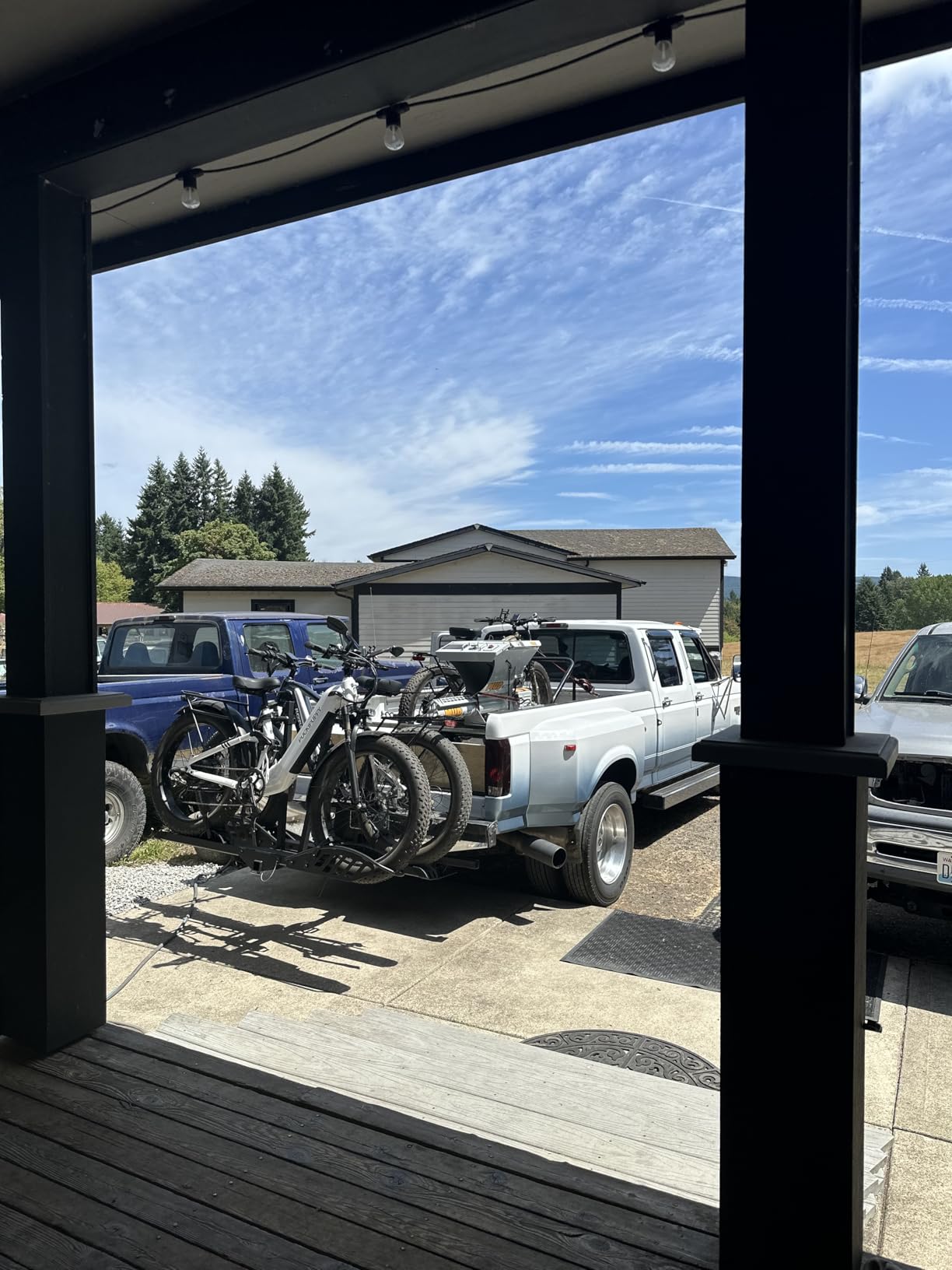
This is the rack we would buy for a pair of 70-pound e-bikes that both need to come along. It carries 200 pounds total, which works out to 100 per bike, and it includes a V-groove loading ramp so neither bike ever has to be lifted. Owners report cross-country trips of several thousand miles with two large e-bikes, which is about the only real-world stress test that matters here.
Stability comes from the patented V-shape cradle and shock-absorbing hitch threads, and the retention is a three-point ratchet strap system per bike with soft padding and rubber covers to protect the finish. It fits tires up to 5 inches wide and wheelbases up to 50 inches, and the 1000-hour salt spray coating is a real advantage for anyone riding in winter road conditions.
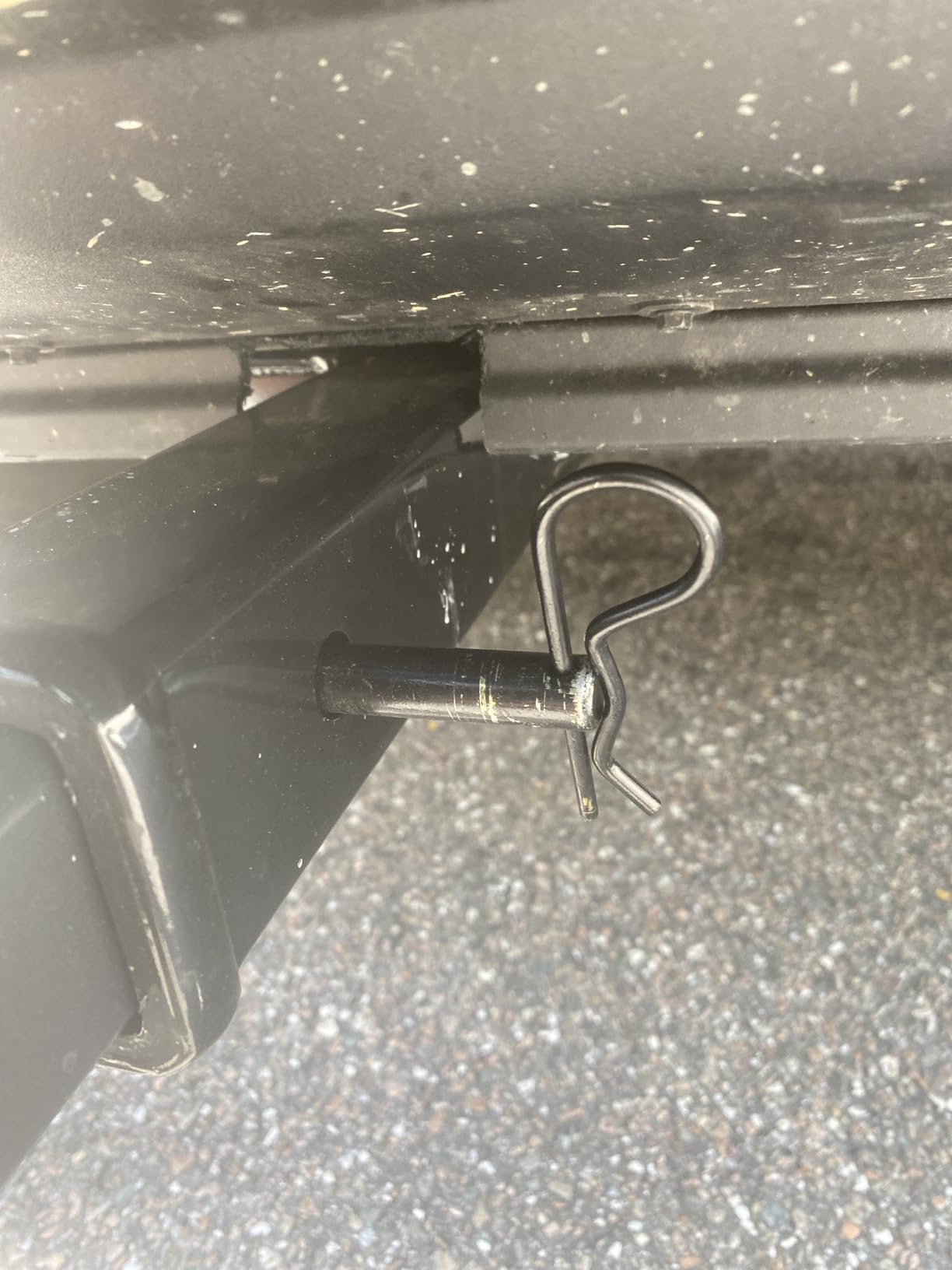
There is no way around the weight. At 66.1 pounds, mounting it to the hitch takes two people or a support stand, and removing it is a scheduled event rather than a five-minute job. Owners also report that the rubber and plastic ratchet straps can become brittle with long UV exposure, which is a durability item to watch on a roofless-season bike that lives in sun.
Two smaller hardware notes: the hitch pin is a plain threaded bolt with no built-in lock, so add a lockable pin if you leave the vehicle unattended, and the rear wheel strap screws can vibrate loose because they lack thread locker or locking nuts. A periodic check catches both.
What you should verify before buying
Measure your garage clearance with the rack folded, because a 66-pound rack stored in a low-ceilinged space is a nuisance. Confirm the ramp fits in your vehicle, since it is not stowed on the rack and reviewers note one ramp clip even arrived bent.
Also check that a spare tire on the back of your vehicle does not push the trays forward, which is common on Jeeps and similar designs. Owners there typically add a short hitch extension for clearance.
Who should skip it
Skip this rack if you live alone and cannot recruit help for a 66-pound lift, or if you need to remove it weekly. It is also the wrong choice if your bikes sit in direct sun year round and you want hardware that will not degrade, since the strap material is the soft point.
If you only carry one bike, this is more rack than you need. A single-bike ramp model is lighter and simpler.
5. CRAVOT CyberRack E2 – Best for 100 Pound E-Bikes
CRAVOT CyberRack E2 Hitch 2 E-Bike Rack with Ramp,200 lbs Capacity
- 100 lb per bike plus an included ramp that lets heavier riders load solo
- Aluminum and steel frame with a coated finish for salt resistance
- Ramp stows on the rack rather than living in your car
- Three-point hook-free ratchet straps protect the finish
- Reported wobble-free carrying an 80 lb and a 50 lb e-bike
- Heaviest rack here at 75 lb
- Fiddly shim installation on the upright bars
- Supplied hitch bolt is not lockable
If your bike is in the 90-pound range, the per-bike rating is the only number that matters, and this rack delivers 100 pounds per bike. Like the previous pick it includes a ramp, which means a 90-pound machine goes on as a roll rather than a lift, and the ramp stows on the rack instead of taking up cargo space in your vehicle.
Owners highlight the V-shaped front wheel cradle, the semi-enclosed connecting blocks and the shock-absorbing threads as the parts that kill sway, and several report 400 to 800 mile trips with mixed e-bikes without movement. The 1000-hour salt spray coating also matters for anyone running coastal roads or salted winter streets.
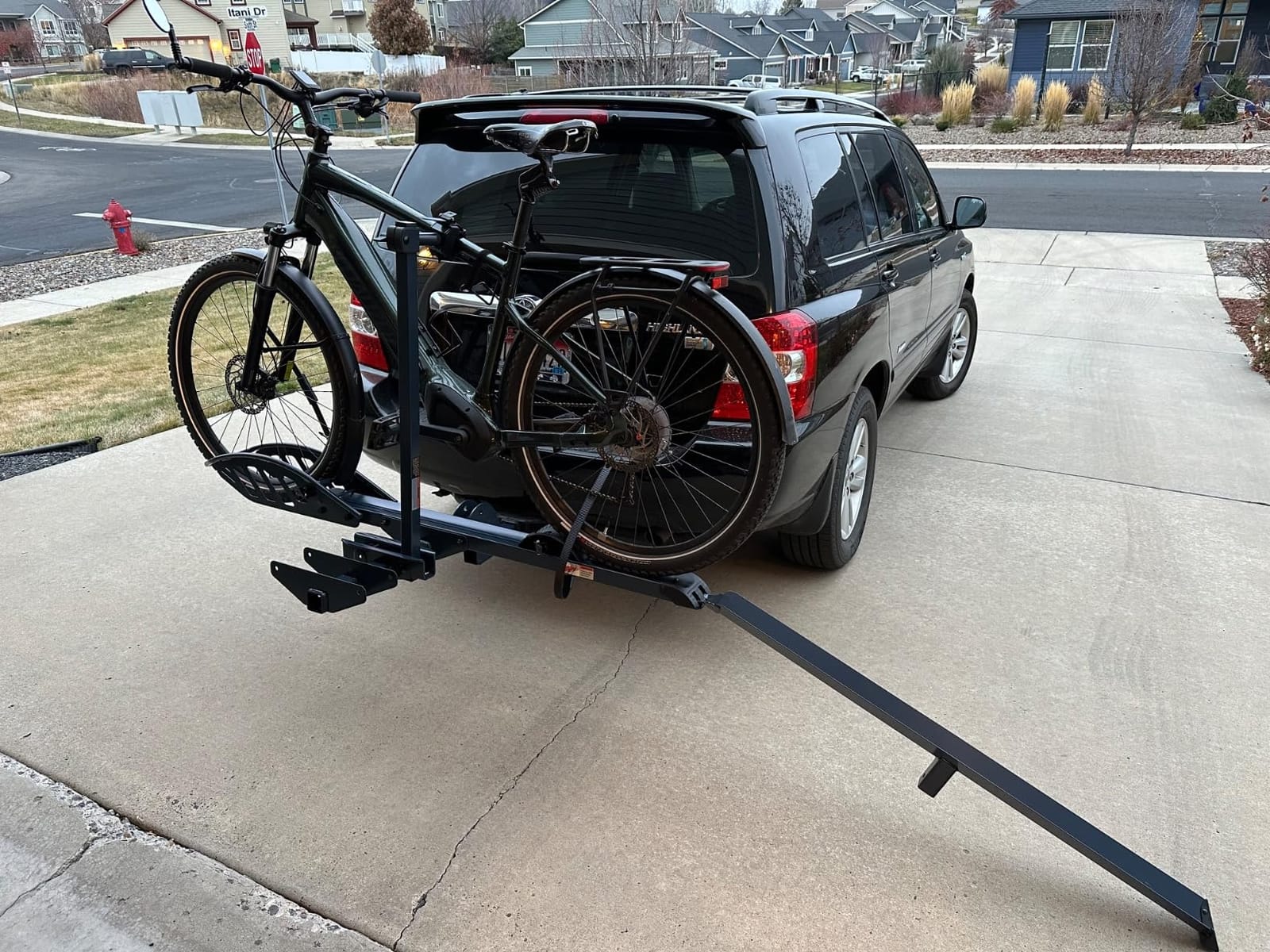
Be honest about the handling. At 75 pounds this is the heaviest rack we tested, and mounting it to the hitch means working at ground level with a ratchet. Installing both shims on the upright support bars is fiddly enough that a second pair of hands helps, and the ramp storage clip reportedly fits poorly enough that many owners still carry the ramp in the vehicle.
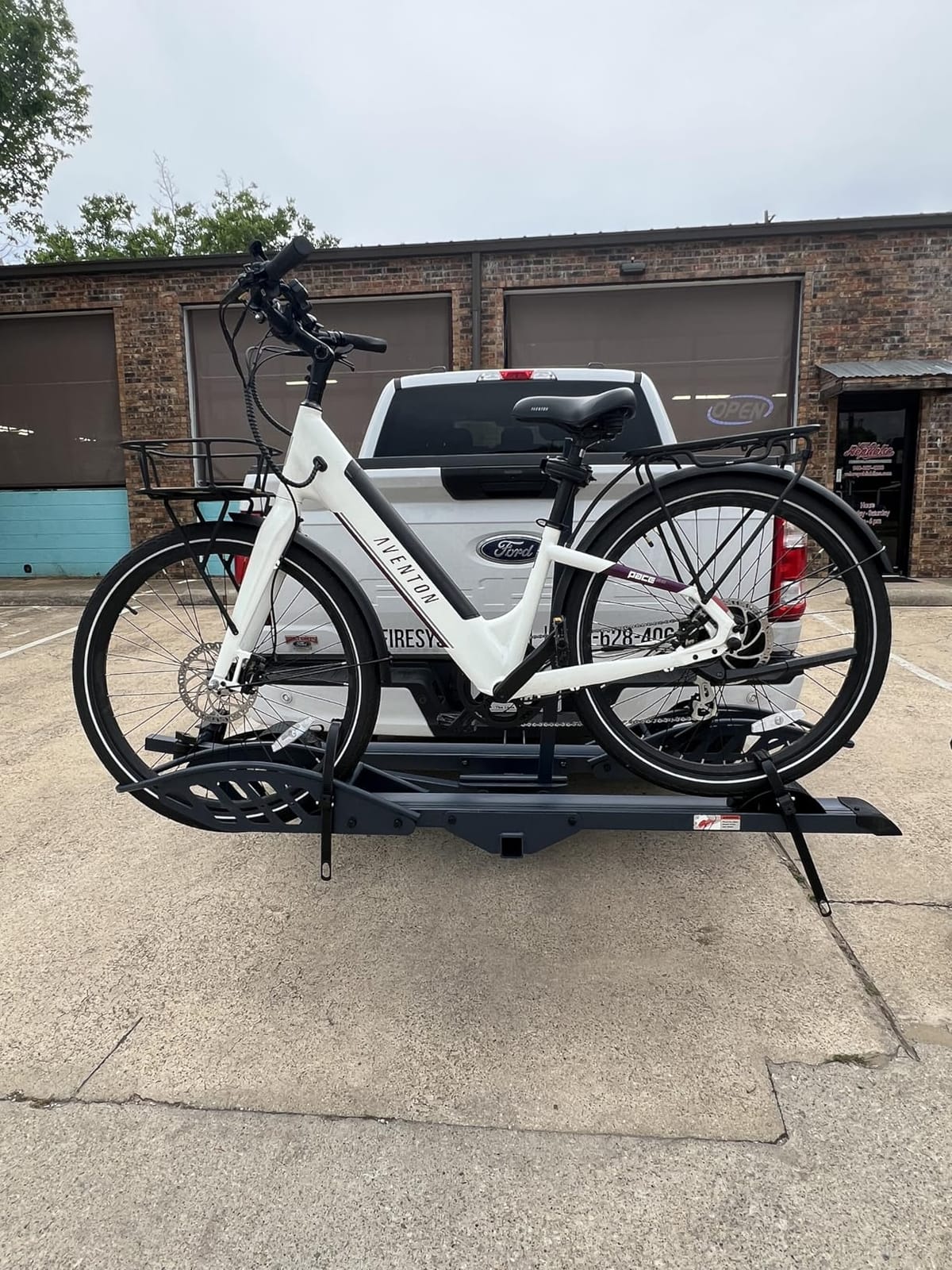
Small hardware caveats: the supplied hitch bolt is not lockable, bikes can tilt front to back on the center pole if only lightly secured, and a vertical post clamp can shimmy loose if not tightened with the rack folded.
What you should verify before buying
Check your hitch clearance if your vehicle carries a rear spare tire, since owners report needing a 6-inch extension on Jeeps for the racks to sit square. Verify the wheelbase limit too, at 50 inches this rack suits most e-bikes but a stretched frame or cargo e-bike with a long rear rack can exceed it.
Plan a mounting position with enough room to work a ratchet at ground level. If your hitch sits low in a recessed bumper, budget extra time and a support stand.
Who should skip it
Skip this rack if you cannot handle a 75-pound rack or need to remove it regularly. It is a poor fit for anyone who wants factory locks at the hitch, since the bolt is not lockable and you will need to add a lockable pin yourself.
If your bikes never exceed 70 pounds, this rack is more capacity than you will use, and a lighter 160-pound model serves you better.
6. TRAILXPERT 2-Bike Hitch Rack – Best for Lightweight Handling
TrailXpert 2-Bike Rack Hitch Mount, Fits E-Bikes, Fat Tires up to 5″, 160lbs Tilting Hitch Mount Platform Rack for Cars SUVs Trucks -2″ Receiver
- Light at 33.4 lb for easy one-person handling
- Locking anti-theft hitch pin plus safety strip and padded clamps
- Built-in shock absorption
- Quick-release tilt-back for trunk access
- Fits 5 inch tires with adjustable wheel holders
- Lowest rating and fewest reviews in the roundup
- Highest share of 3-star feedback of the group
- No loading ramp for heavy e-bikes
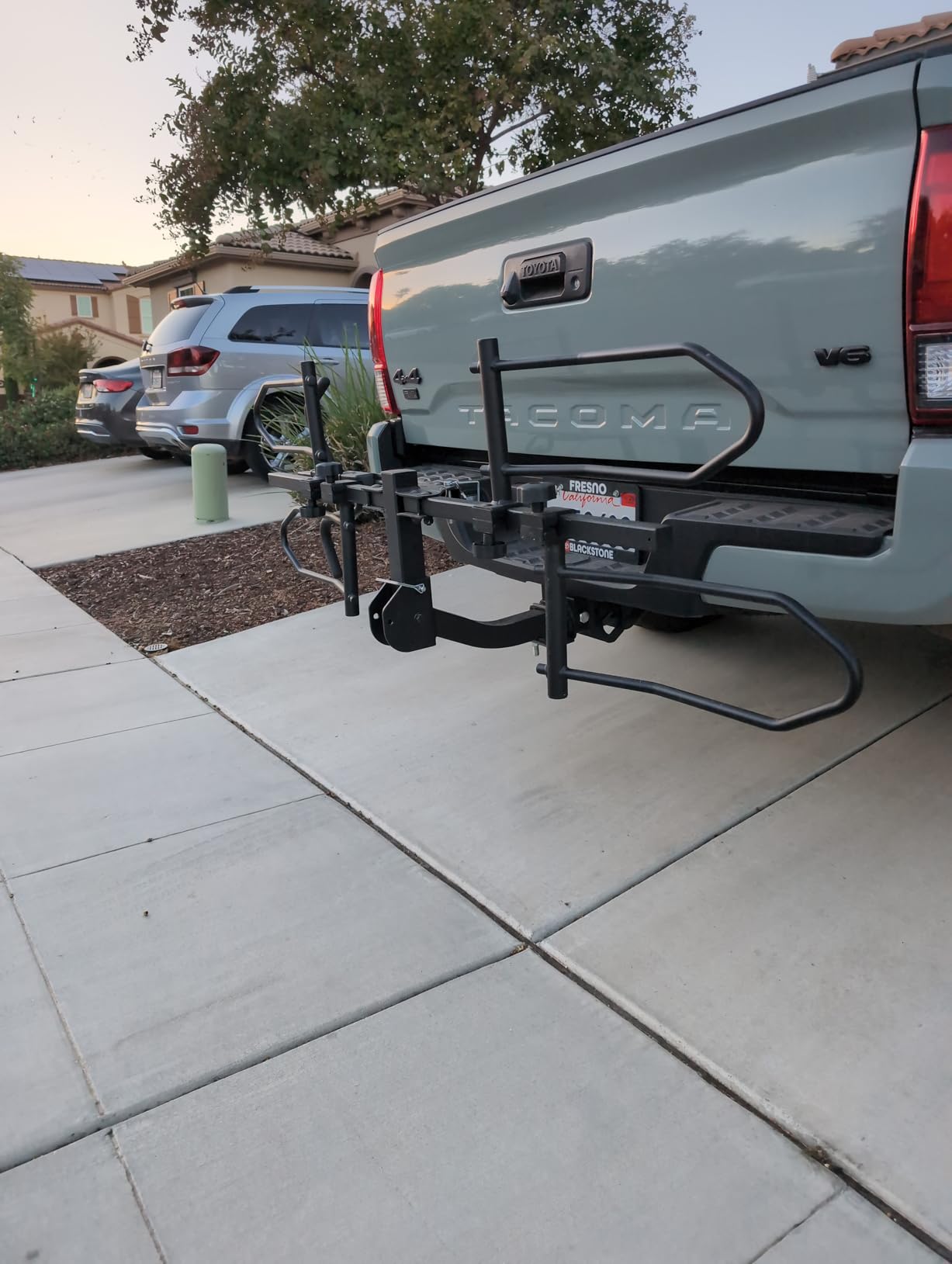
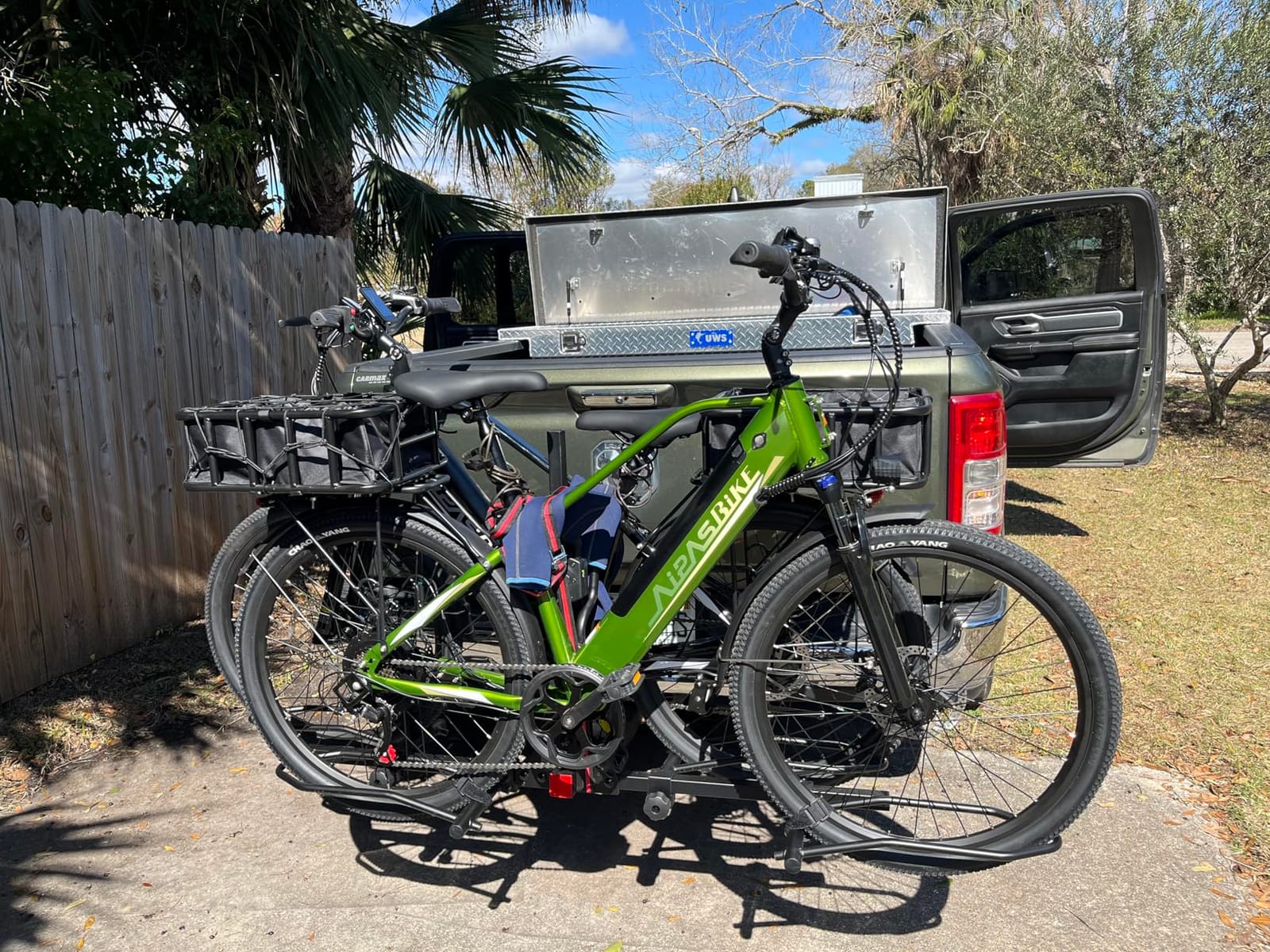
TRAILXPERT covers the basics unusually well for the money, and the anti-theft locking hitch pin is a feature many racks at this tier omit. Padded clamps, a safety strip, built-in shock absorption and adjustable wheel holders give you the core package, and 160 pounds of total capacity covers most sub-80-pound e-bikes.
At 33.4 pounds it is one of the lighter racks here, which matters for anyone who loads it without help or who has limited garage space. It folds up for storage and tilts back on a quick release for trunk access without removing the rack or the bikes, and the dimensions match the class of folding designs that pack down small.
The reason this sits in the middle of the roundup rather than higher is consistency. It carries the lowest rating and the smallest review base of the group, and it has the second-highest share of 1-star ratings alongside a meaningful block of 3-star feedback, which points to variability in finish and assembly between units rather than one recurring fault.
There is also no loading ramp, so a 70-pound bike goes on by hand. For a lighter commuter e-bike that is manageable, but it removes the whole point of buying a heavy duty rack.
What you should verify before buying
Confirm the wheel holder range suits your bike, and check that your receiver depth accepts the included hardware. If your e-bike has full fenders, look closely at the clamp arms, because fender clearance is the detail most likely to need an adaptor on a design at this level.
Because the feedback spread is wide, inspect the welds, coating and clamp hardware as soon as it arrives rather than assuming it matches the listing photos.
Who should skip it
Skip this rack if you are buying a 75-pound or heavier e-bike, since there is no ramp and the per-tray allowance is not generous. It is also a weaker choice for anyone who wants the reassurance of a large review base, given the number of ratings behind it.
Buyers who need fat-tire clearance beyond 5 inches should look at the wider-tire rack earlier in this list instead.
7. Soarify Platform 2 E-Bike Rack – Budget Pick for Two E-Bikes
- 180 lb of alloy steel capacity for two e-bikes
- Light at 34 lb for the capacity offered
- Tilt-down gives rear access without removing the bikes
- Folds up neatly when not in use
- Minimal-tool assembly on a standard 2 inch hitch
- No loading ramp for heavy e-bikes
- Thinnest specification detail in the group
- Only a 1-year warranty
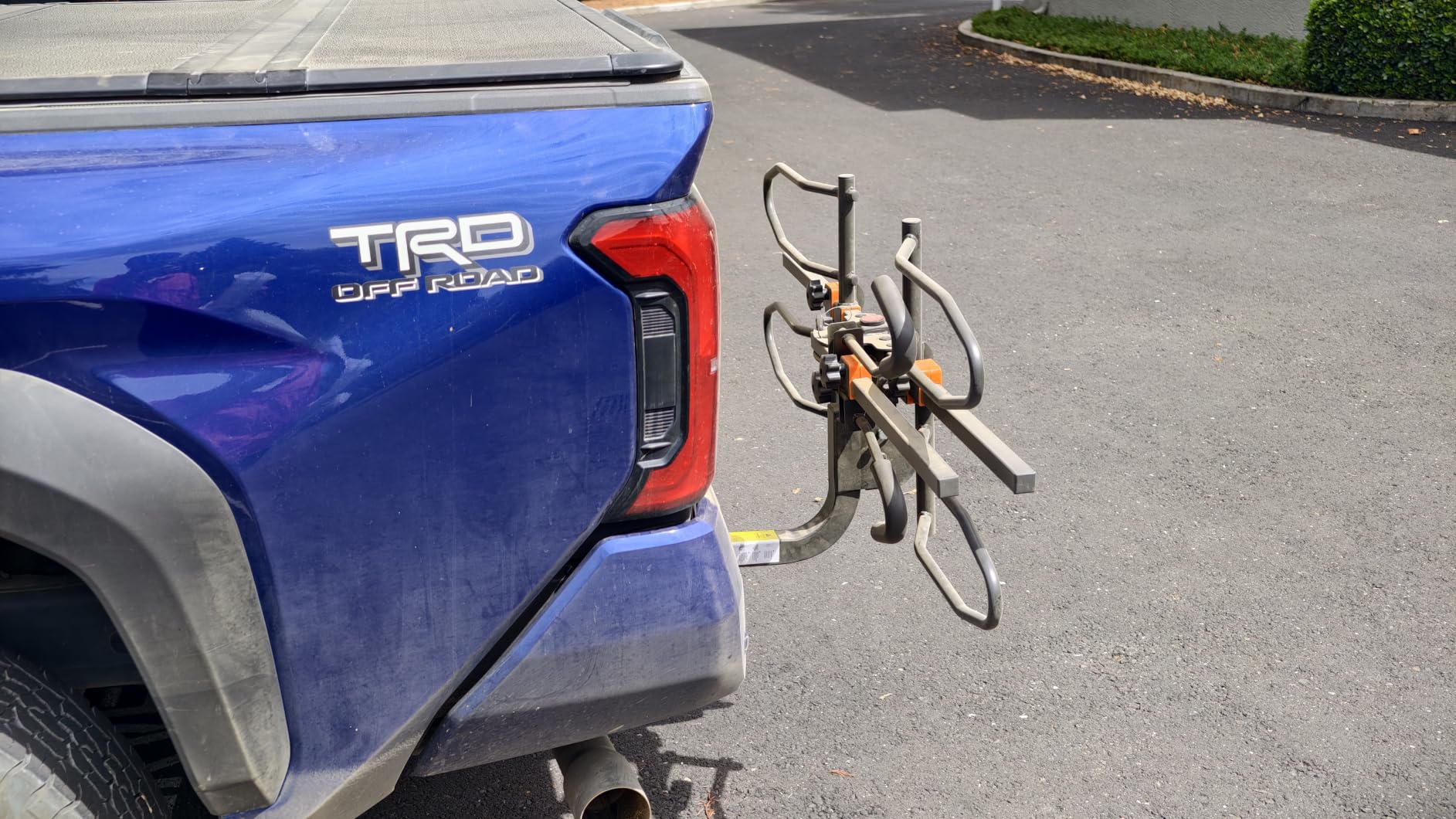
When a 180-pound capacity and a 34-pound rack are both on the table, you are getting a lot of carrying ability per pound carried. The alloy steel construction handles two e-bikes, mountain bikes or road bikes, and the tilt-down mechanism gives you rear cargo access without unloading, which is the feature that decides the day for anyone with a covered trunk.
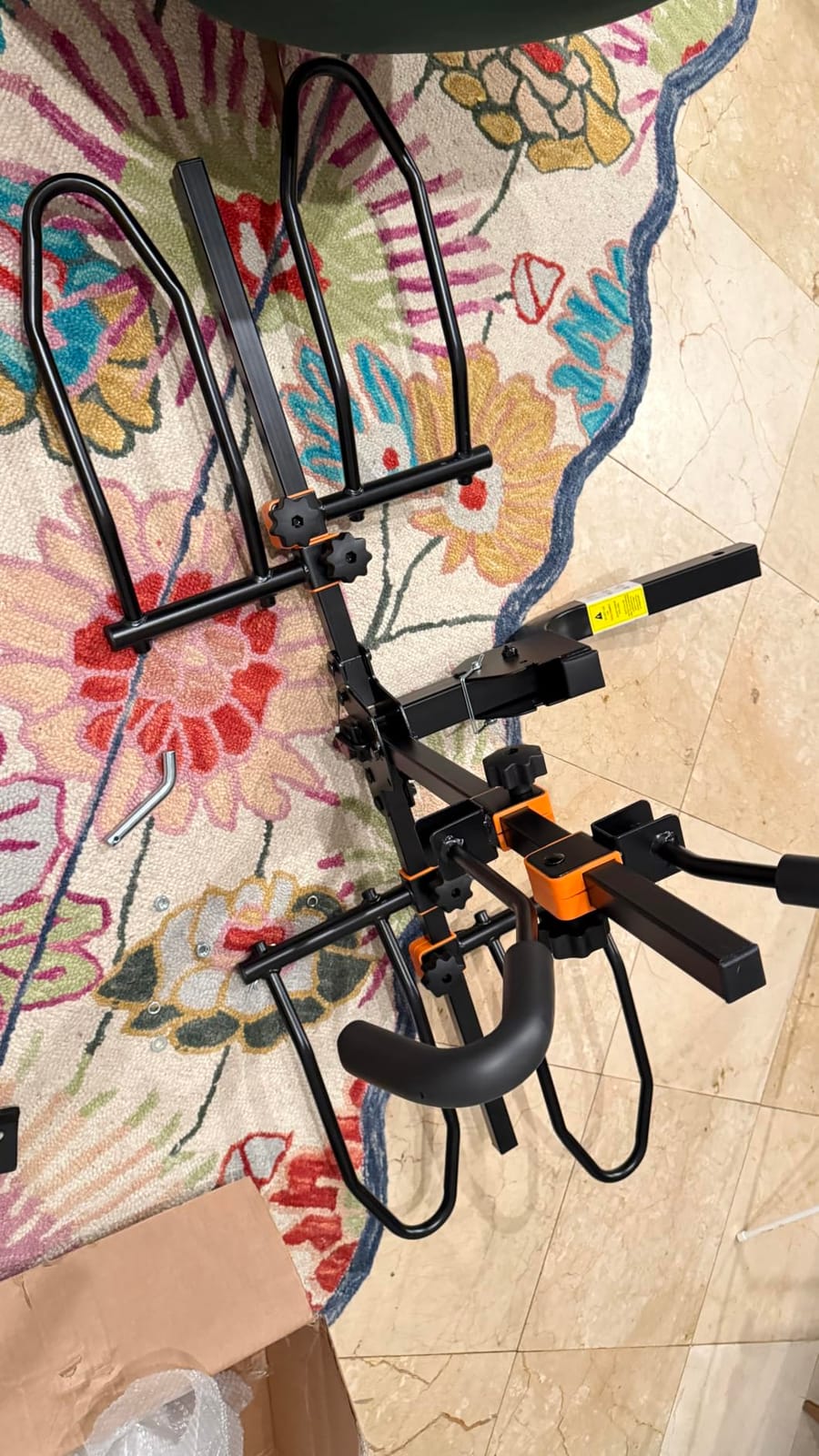
Assembly is straightforward with minimal tooling, and it installs and removes quickly on a standard 2-inch hitch. That combination of tilt, fold and light weight makes it a genuinely practical option for a first e-bike owner who does not want a permanent two-person install.
The specification sheet is where this falls behind. It lists no locking hitch pin and no anti-wobble hardware, which means you are relying on a standard bolt and clamp friction, and that is exactly the combination forum members flag when bikes shift over long drives. For an expensive e-bike, adding a lockable hitch pin is close to mandatory.
The rating spread is also wide, with the highest share of 1-star feedback in the roundup and around two-thirds five-star results, so expect some variability. Only a 1-year warranty backs it.
What you should verify before buying
Check that your bike fits the tray length and clamp style, and plan to add your own locking hitch pin since none is listed. If your vehicle has a swing-out or hinged tailgate, confirm the tilt-down path clears it before you order.
Measure tire width too. The listing does not spell out a maximum tire width, so for a 5-inch fat tire you are relying on the tray channel rather than a stated figure, and a wider-tolerance rack is the safer assumption.
Who should skip it
Skip this rack if your bike weighs more than 80 pounds and you have no help, since there is no ramp. It is also the wrong choice for anyone parking an expensive e-bike overnight in public without adding a hitch lock, and the thin specification detail makes it harder to plan for unusual bikes.
If your priority is the highest per-bike rating available, the 200-pound racks are a better target.
8. Young Electric 200 lb Platform Rack – Best for Long Wheelbases and Big Tires
- Largest review base in the roundup at 1367 reviews
- 58 inch wheelbase is the most generous fit in the group
- Padded hooks prevent frame scratches and a rear reflector aids visibility
- Quick-release fold and tilt for trunk access
- Mostly pre-assembled for fast installation
- Wing nut and velcro retention is slower and less secure
- Rust at joints after a few wet evenings
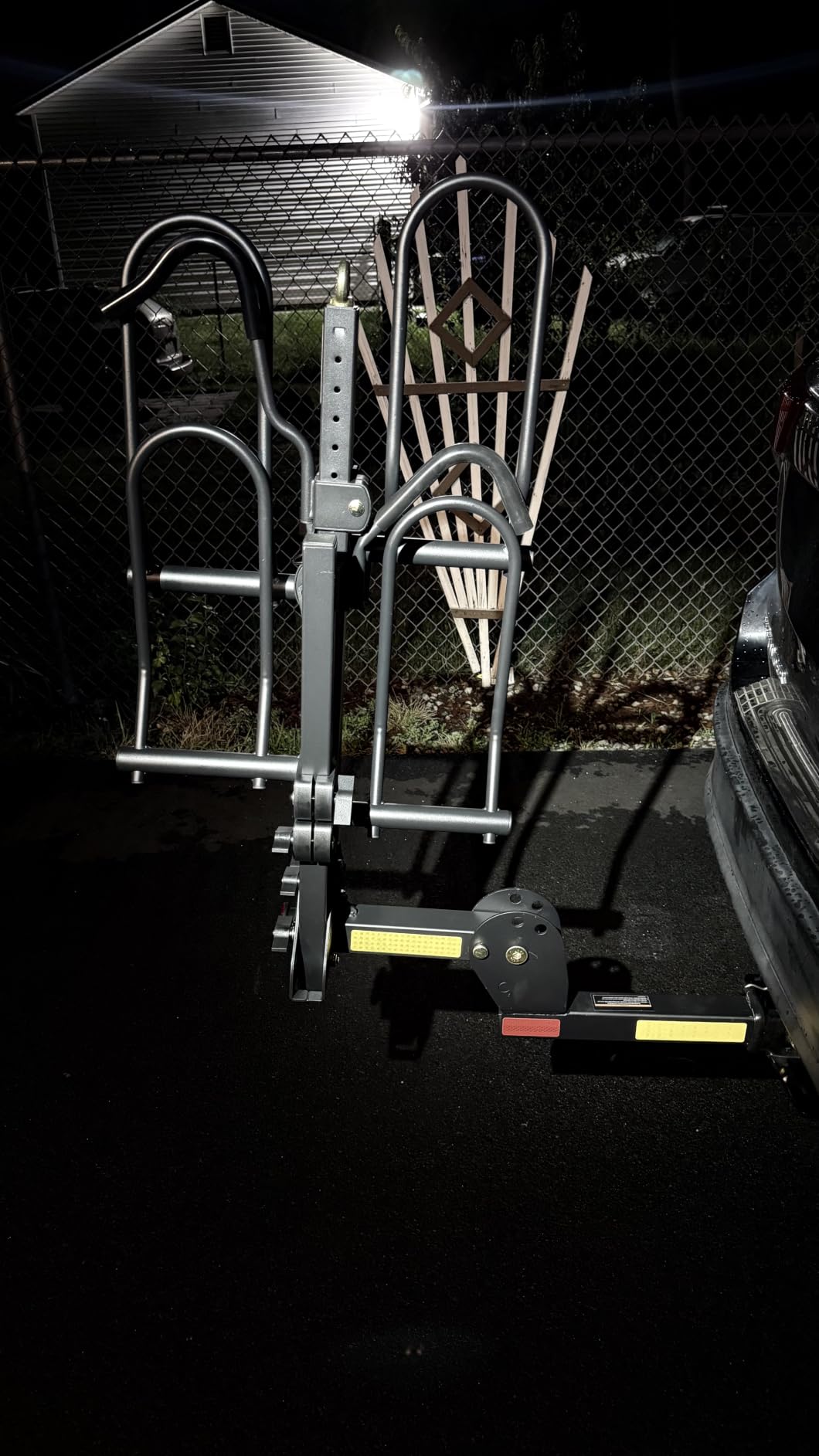
- Thin welding and plastic knobs that can break
By volume this is the rack people actually buy most often, and 1,367 reviews give you the widest sample of long-term experience in the group. The 200-pound total capacity is genuinely useful, and the 58-inch wheelbase limit plus 20 to 29 inch wheel range is more accommodating than most racks here for e-bikes with long rear racks or extended frames.
It folds up and tilts down on a quick-release lever, so you get trunk access without taking off either the bikes or the rack. The soft padded hooks protect the frame, and owners note the hatch on a Subaru still opens with it fitted, which is a clearance detail that catches a lot of buyers out.
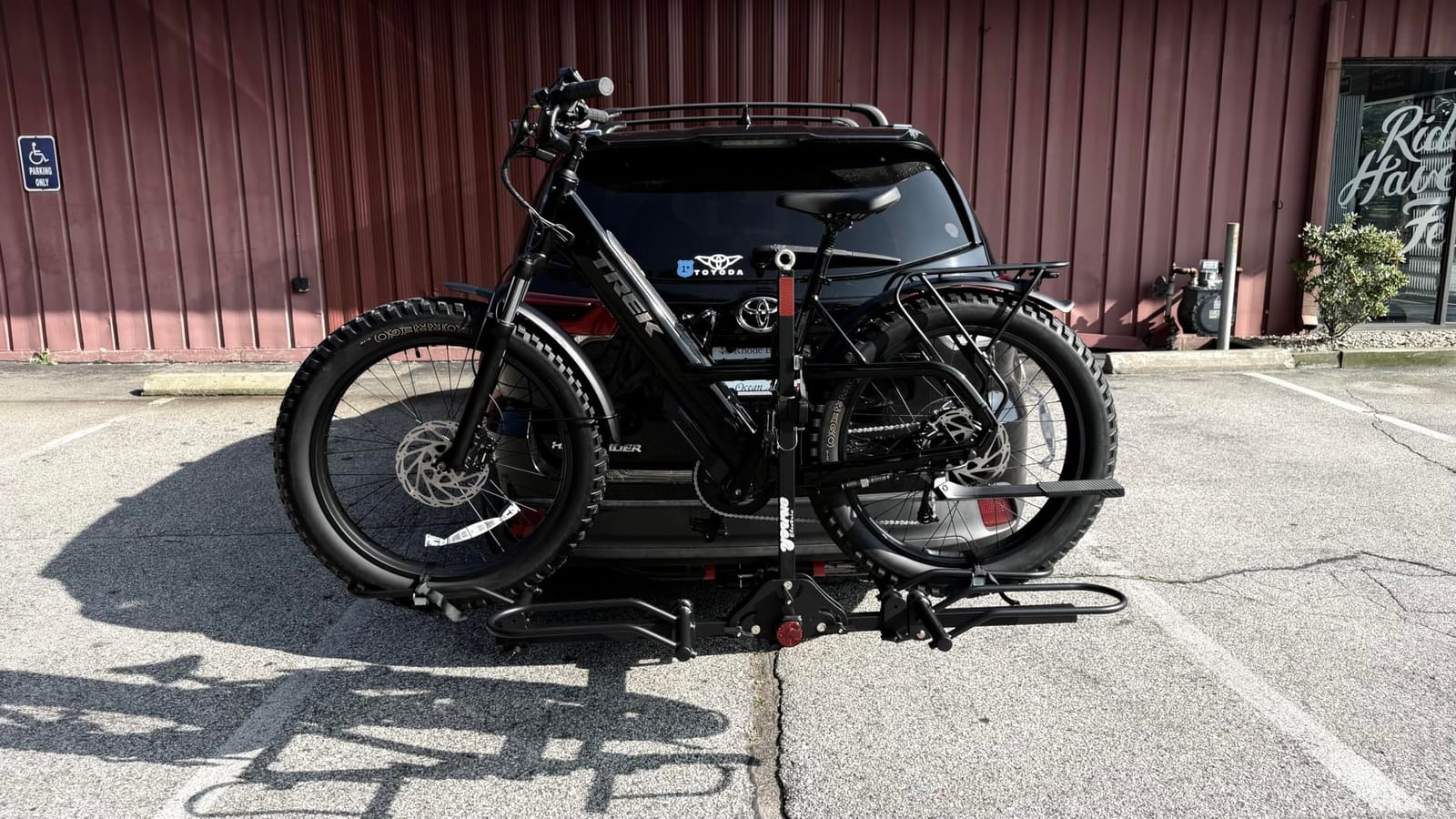
Retention is the weak point. The wing nut and velcro strap fastening is slower and less secure than click-lock or ratchet systems, and one reviewer reported a wheel support rack coming loose on a long drive. There is also no anti-corrosion coating, so rust at the joints has appeared after only a few rainy evenings for some owners, and the limited welding plus plastic locking knobs are parts to inspect early.
Because the rear position extends well back, it can block taillights and may drag on steep driveway approaches, and some riders caution that the 200-pound rating flatters it for heavier e-bikes.
What you should verify before buying
Check your taillight visibility with the bikes loaded, and test the approach angle on your driveway before you commit. If you ride in wet winter conditions, plan for surface rust on the joints and keep a coating handy for the exposed steel.
For anything you care about long term, look at where the straps and knobs are, since those are the components most likely to need replacing. The quick-release fold and tilt means you will be handling the frame more often than with a bolt-on design.
Who should skip it
Skip this rack if you ride genuinely heavy e-bikes and want the security of ratchet retention, since wing nuts and velcro are not the right hardware for that job. It is also a poor fit for anyone storing an expensive bike overnight behind a vehicle without adding a lock of your own.
Riders who need full ratchet straps and wheel-only clamping should look at the ramp-equipped premium models instead.
9. Young Electric Single Bike Rack with Ramp – Best for One E-Bike
Young Hitch Mount Single Bike Rack with Ramp, 100 lbs Capacity
- Integrated ramp lets you roll a 65-70 lb e-bike on solo
- Light at 35.3 lb and mountable by one person
- 100 lb capacity for a single heavy e-bike
- Patented wheel cradles and M16 anti-wobble hitch bolt
- RV approved with three-point retention
- Trough length is tight for long-wheelbase bikes
- No built-in lock for the bike or the hitch
- Written instructions are confusing
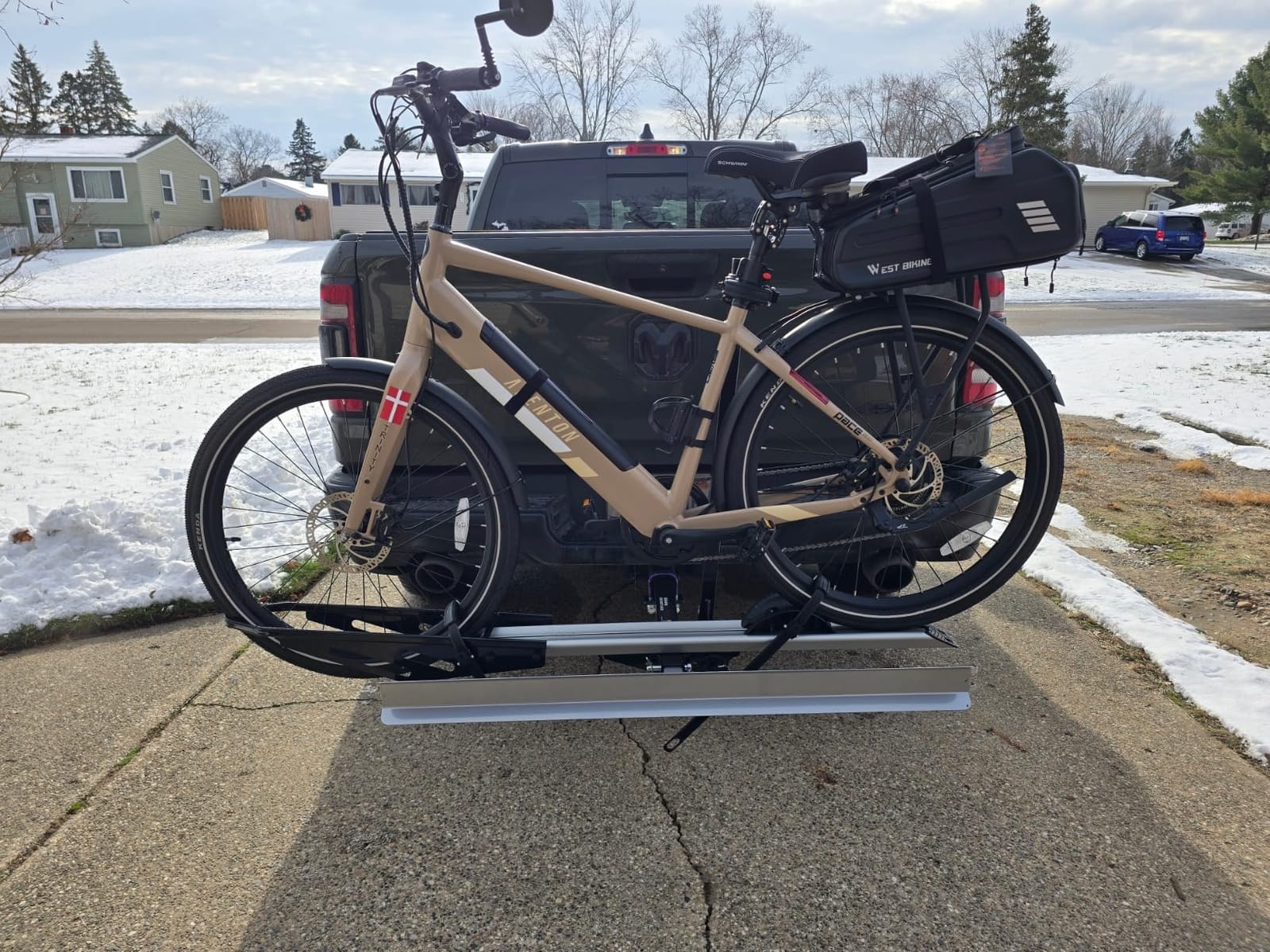
Two-bike racks solve a problem most single-rider households do not have, and this one solves the one they do. It carries a single 100-pound e-bike on a tray with an integrated ramp that mounts and stows in the frame, so there is no separate ramp to lose. Owners in their sixties and seventies report assembling and mounting it unassisted, which tells you more about its weight class than any spec line.
Retention is a three-point system with ratcheting straps and an upright bar, plus patented secure wheel cradles and a sturdy M16 anti-wobble hitch bolt. It is RV approved, which matters if you flat-tow behind a motorhome, and it holds the bike securely at highway speed.
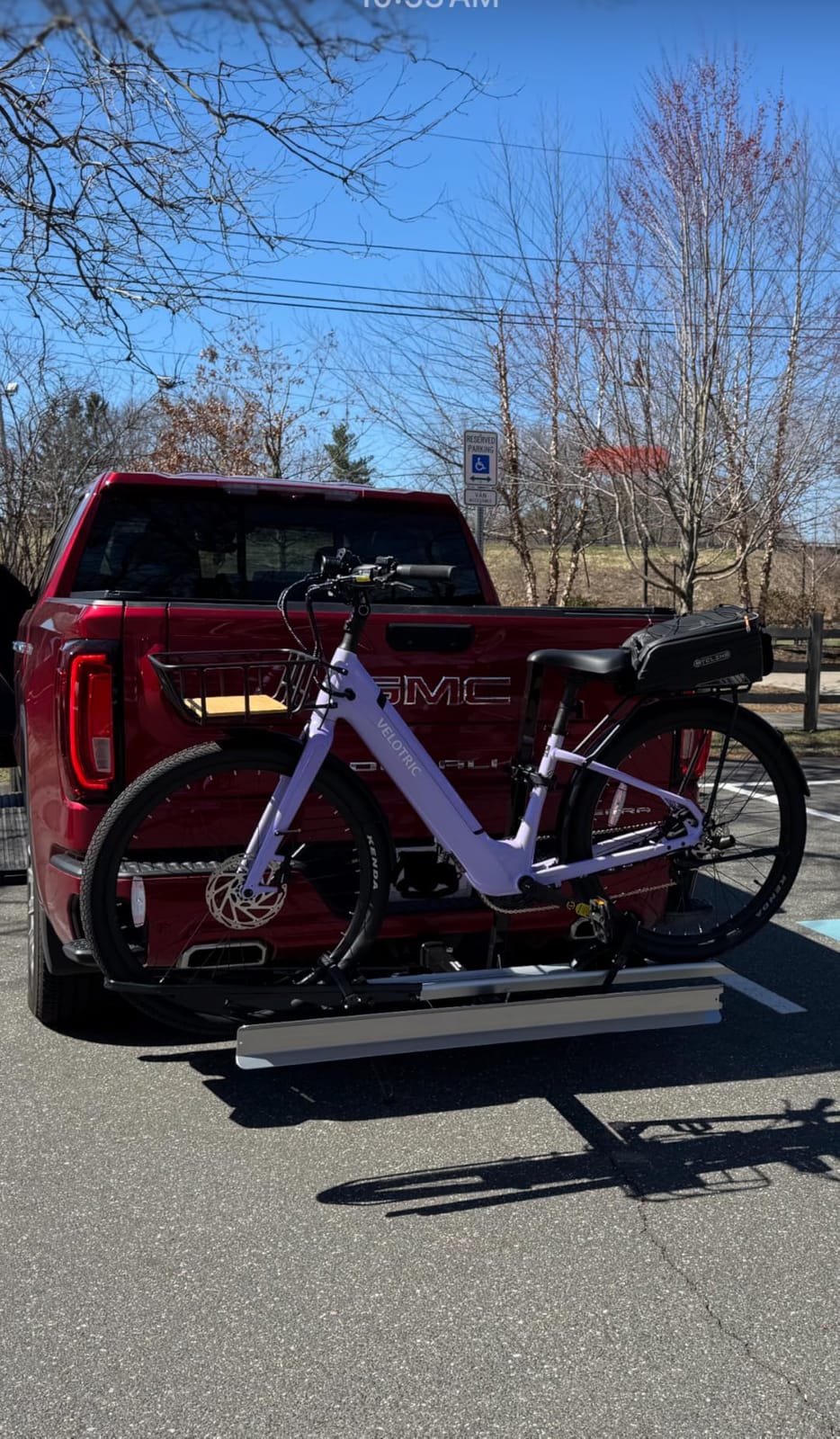
Two limits stand out. The trough length is tight, and some long-wheelbase bikes barely fit, so measure your bike before buying rather than assuming. There is also no built-in lock for either the bike or the hitch, so a cable or hitch lock is a necessary addition if you leave the vehicle anywhere overnight.
Minor but real: the written assembly instructions are confusing and the manufacturer points buyers to online videos, and the hitch bolt must be tightened firmly or the rack wobbles.
What you should verify before buying
Measure your bike’s wheelbase and length, because the trough is the limiting factor here, not the weight rating. If you ride a stretched frame or a bike with a long rear cargo rack, budget for a wider tray or look at a two-bike platform instead.
Confirm your receiver accepts the included hardware and that the bolt gets a solid torque, since wobble is a tightening issue rather than a design flaw. Add a hitch lock before the first overnight trip.
Who should skip it
Skip this rack if you need to move two e-bikes at once, since it carries one bike only. It is also a poor choice for a very long-wheelbase machine, and it is not the right answer for anyone who wants factory locking hardware built in.
Carrying a second person or a second bike means stepping up to a two-bike platform, with the added weight that implies.
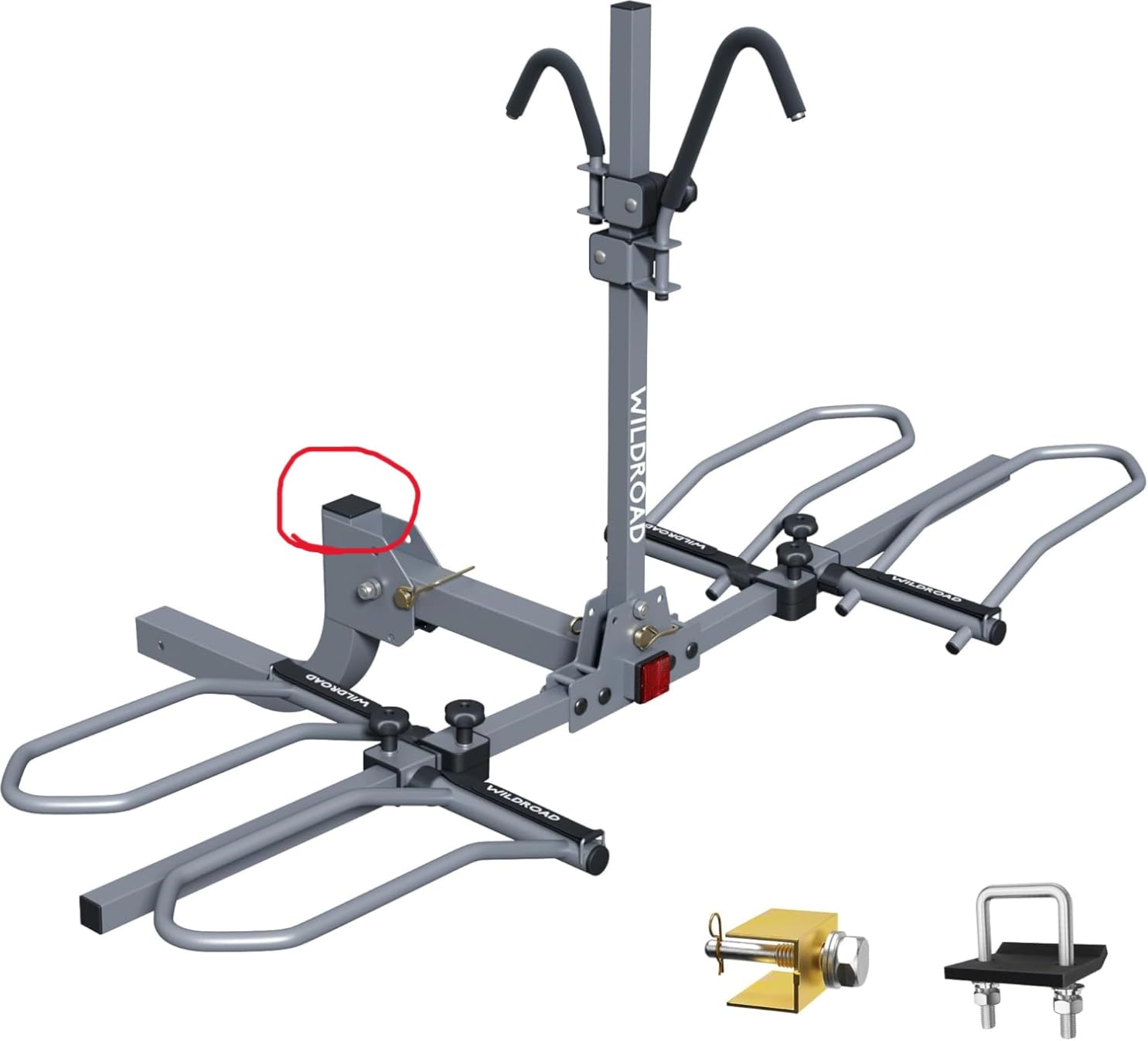
10. WILDROAD 2-Bike Hitch Rack – Best for Paint-Safe Retention
WILDROAD 2-Bike Hitch Rack, 180 lbs, Tilting & Foldable, Fits 2″
- Foam-padded hooks and heavy duty nylon straps protect the paint
- No-wobble fastener and anti-rattle stabilizer
- 180 lb capacity with tires up to 5 inches
- Folds up and tilts down for trunk access
- Reflective end plug improves night visibility
- Requires a separate crossbar and excludes step-through bikes
- Velcro tire straps degrade with repeated use
- No anti-theft lock included
What we like most about this rack is the contact surface. Foam-padded hooks and heavy duty nylon straps hold the bikes firmly without pressing into the finish, which is the detail that separates a rack you can leave your good bike on from one you think about every time you load up. The no-wobble fastener and anti-rattle stabilizer handle the sway issue directly.
Capacity is 180 pounds across two bikes, and it accepts tires up to 5 inches, so it covers most fat-tire and e-bike combinations. It folds up when idle and tilts down for trunk access, and the reflective plug at the end of the rack is a small touch that helps when bikes are loaded at night.
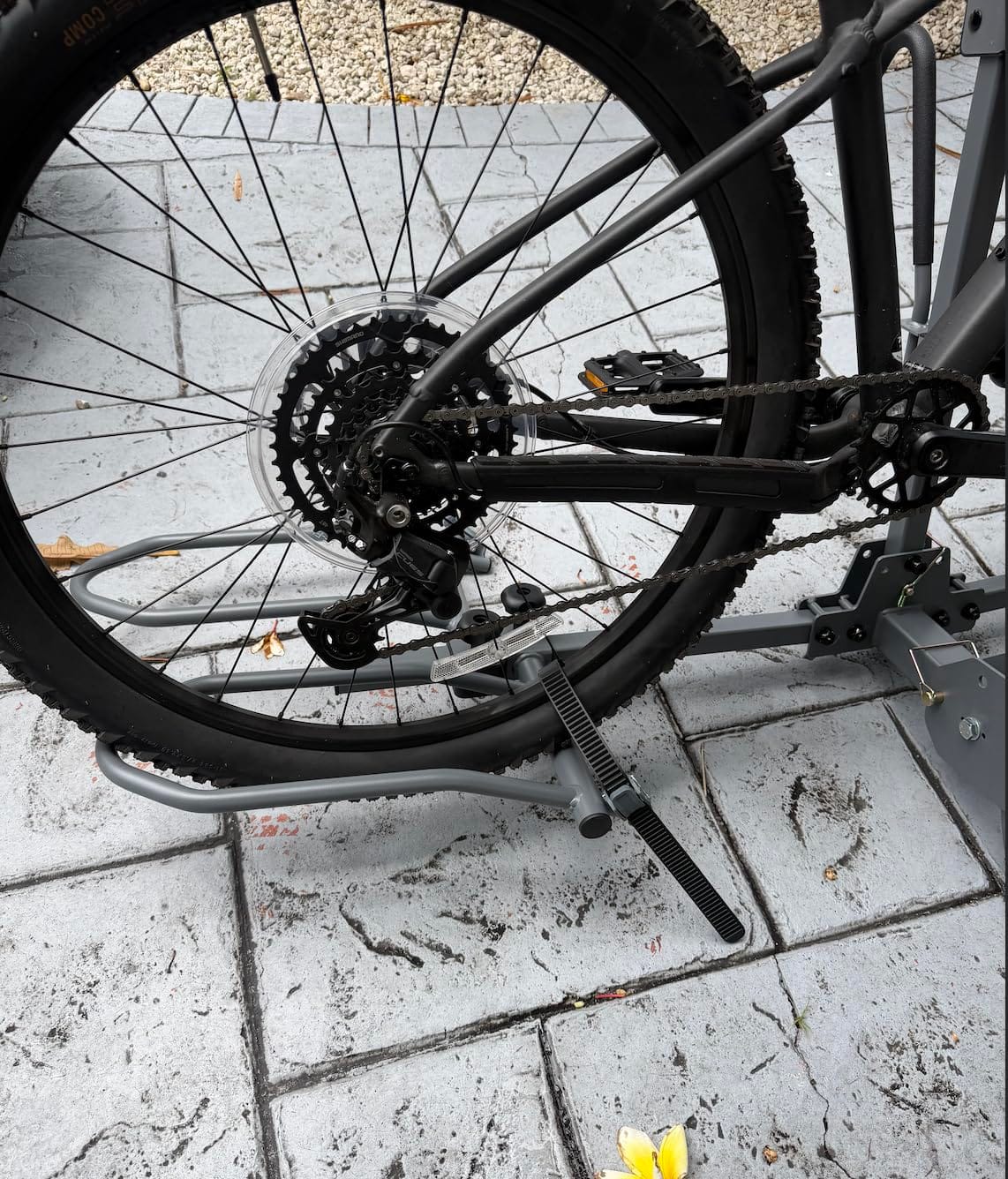
The decisive limitation is the crossbar. This rack cannot be used without a separately purchased top crossbar, and it is not suitable for step-through bikes at all, which removes a large slice of e-bike owners before anything else is considered. Adjustable frame hooks and tire holders help with size variation, but the frame requirement stands.
Velcro tire straps also degrade with repeated use, and enough owners have switched to ratchet straps that it is worth budgeting for as an early upgrade. There is no anti-theft lock included for either the rack or the bikes, and the warranty runs one year.
What you should verify before buying
Check whether you own a step-through frame first, because that question ends the evaluation immediately. If you ride a standard diamond or mid-step frame, measure the wheelbase and tire width and confirm the crossbar you need is sold as a compatible accessory.
Plan to replace the velcro tire straps with ratchet straps early on, since that is the fix buyers most often report needing. Add a lockable hitch pin and a cable lock for the bikes if you park anywhere shared.
Who should skip it
Skip this rack for step-through and low-step frames, and for anyone unwilling to buy an extra crossbar. Riders who want lockable hardware out of the box should pass as well, since nothing is included.
If your bikes weigh more than 80 pounds each, the 180-pound total leaves no room for gear, so move to a 200-pound model.
How to Choose a Hitch Bike Rack for Electric Bikes
The buying decision reduces to a handful of measurable things. Work through them in order and the right rack becomes obvious, because each one eliminates a group of options that simply will not fit your bike or your vehicle.
Confirm a 2-inch receiver first
A 2-inch receiver is the requirement for every rack in this roundup, and it is the number one blocker in owner discussions. A 2-inch receiver typically handles roughly 300 pounds of tongue weight, which is why it is the standard for heavy e-bike carriers. A 1-1/4 inch receiver with an expander adapter is possible, but community consensus is that the adapter introduces sway and reduces effective capacity, which is a poor trade when you are carrying 80 pounds a wheel.
If you tow trailers or RV hitches already, check the pin hole distance rather than just the diameter, and make sure your tongue weight rating covers the loaded rack plus the bikes. Owners regularly recommend upgrading the receiver rather than adapting, especially for two-bike households.
Read per-bike capacity, not total capacity
Per-bike capacity is the number that decides whether your bike is safe. A 160-pound total across two trays is 80 pounds per tray, and once you add a rear rack, panniers and a second battery you can cross 80 pounds without noticing. The rule we use is simple: measure the bike fully loaded, then pick a rack rated at least 20 percent above that figure.
Above 100 pounds per bike, a bike rack is at the end of its design envelope and a motorcycle-grade hitch carrier is the better answer. That is not an upsell, it is the honest boundary of what a wheel tray with nylon or ratchet straps can do.
Decide about the ramp before anything else
A loading ramp is worth having above roughly 55 pounds. Below that, lifting a bike onto a tray is manageable; above it, deadlifting is the single biggest physical complaint in e-bike forums, and it is what turns a solo trip into a two-person job. Of the racks here, the two 200-pound premium models and the single-bike model include ramps, which is exactly the group we would pair with a heavy e-bike.
Two ramp details are worth asking about. Does the ramp stow on the rack, or does it live in your vehicle? And is it long enough for a 5-inch fat tire, since a short ramp is worse than none because you still end up lifting at the top of the incline.
Battery removal helps, with a caveat
E-bike forums repeat the same advice, and it is sound: take the lithium battery off before loading. It saves roughly 7 to 10 pounds per bike, which moves a marginal bike into a safer capacity band and makes the lift far less awkward. It also removes the most expensive and most theft-attractive part of the bike during transport.
The caveat is that the rack rating is calculated for the bike as it is normally ridden, battery in. Removing the battery is a bonus, not a substitute for buying the right capacity, and leaving the battery in a car interior at a trailhead or trailhead parking lot is a risk that some riders weigh differently than others.
Fit, clearance and frame compatibility
Tire width, wheelbase and frame shape decide the rest. Fat tires need 5 inches of channel width, and 5-inch tires need more, which is why tire width is the single most useful spec to compare across racks. Wheelbase limits usually sit between 49 and 58 inches, and e-bikes with long rear racks or stretched frames push the upper end.
Frame-clamp racks need a straight tube to grip, which rules out many step-through and low-step frames and can mark a carbon frame. Wheel-only or tire-only racks avoid contact entirely and are the safer choice for expensive carbon or painted frames, and they are also the only option for bikes with a suspension seatpost or a dropped chainstay. Full fenders need clearance from the ratcheting arms, so check that too.
Finally, measure clearance with bikes loaded. A rear hatch often will not open with the rack tilted, and vehicles with a rear-mounted spare tire usually need a short hitch extension before the trays sit square. If you plan to flat-tow behind a motorhome, confirm the rack is RV rated rather than assuming it is.
How to load a heavy e-bike safely
- Remove the battery if the manufacturer allows it. This is the fastest way to make a heavy bike liftable and reduces the load on the tray.
- Check the vehicle first. Confirm the rack is fully seated, the pin is through both holes and the anti-wobble tightener is snug before a bike goes near it.
- Use the ramp or the fold-down approach. Roll the bike up with the engine off, keeping it centered on the tray rather than fighting it from one side.
- Strap in the order that matters. Seat the wheel in the cradle, secure the front, then the frame or upright, then the rear strap, and alternate left and right so the bike sits square.
- Strap snug, not tight. Over-tensioning nylon straps crushes tire sidewalls and can pop a fender off; firm contact is enough.
- Walk the rack by hand. Push and lift the loaded rack hard in all directions. Any movement means re-torquing the hitch bolt and re-seating the straps.
- Re-torque and re-check after 20 miles. New straps settle, bolt threads relax, and this is the cheapest safety step in the whole process. Re-check the straps again after every long highway run.
Our broader guides cover the other mounting styles if a hitch is not the right fit: roof mount bike racks for vehicles without a receiver, and trunk mount racks for lighter bikes and shorter trips.
Frequently Asked Questions
Do you need a special bike rack for an electric bike?
Yes, in practice you do. Most standard racks are rated around 35 to 40 pounds per bike, while a typical e-bike weighs 50 to 80 pounds with its battery installed. You need a rack rated well above your bike’s ride-ready weight, a 2-inch hitch receiver, and preferably a loading ramp so you are not lifting a heavy bike by hand.
What kind of bike rack is suitable for ebikes?
A hitch-mounted platform rack with wheel trays, rated at least 80 pounds per bike, that fits a 2-inch receiver. Wheel-only racks are best for carbon frames and step-through bikes because they never touch the frame, and racks with an integrated ramp are worth having once your bike passes about 55 pounds.
What is the best hitch bike rack for transporting two ebikes?
For two e-bikes up to about 80 pounds each, the Hollywood Racks Sport Rider and the TANX 2-Bike Hitch Rack are the strongest all-round choices, both rated 160 pounds total. If your bikes are heavier, move to a 200-pound rack such as the Young Electric or CRAVOT models, which allow 100 pounds per bike.
How heavy is too heavy for an eBike?
Most 160-pound two-bike racks reach their limit at 80 pounds per bike with no margin for bags or a rear rack. Once your ride-ready weight passes that, you need a 200-pound rack rated 100 pounds per bike. Above 100 pounds per bike, a motorcycle-grade hitch carrier is a better choice than any bike rack.
What is the best bike rack with a ramp for electric bikes?
The two 200-pound racks with included ramps, the Young Electric and the CRAVOT CyberRack E2, are the strongest options for heavy e-bikes, and both allow 100 pounds per bike. If you only carry one bike, the Young Electric single-bike rack includes an integrated ramp and stays light enough to mount unassisted.
What ebikes to stay away from when using a hitch rack?
Watch for bikes with full fenders, which foul ratcheting arms on many racks, and step-through or low-step frames, which will not fit a frame clamp without an extra crossbar. Very long wheelbases can exceed tray length, oversized tires can exceed channel width, and e-moto class bikes over 100 pounds are beyond what a bike rack is designed to carry.
The Verdict
The Hollywood Racks Sport Rider takes our pick as the best hitch bike rack for electric bikes because it holds 80 pounds per bike, fits 5-inch tires, locks both the bikes and the hitch, and carries the strongest rating and review record in the group, backed by a limited lifetime warranty. Its 56-pound weight and lack of a ramp are the two compromises, and both are solvable with a support stand and a good habit.
Buy the TANX rack if you want the most capacity for the least effort to install, the Young Electric or CRAVOT models if your bikes sit above 80 pounds or you refuse to deadlift, and the single-bike Young Electric rack if you ride solo. Weigh the bike, measure the receiver, and pick the next tier up. If you are still comparing bike brands while you are at it, our guide to the best foldable electric bikes covers the lighter end.