
Every serious pour over recipe is written in grams. A 1:16 brew is 18 g of coffee and 288 g of water, a 1:17 is 20 g and 340 g, and neither number survives being eyeballed with a scoop. Coffee density shifts with roast level and grind setting, so a tablespoon of one bean can be three grams lighter than a tablespoon of another.
A scale is how you turn a good cup into a repeatable one. It is also how you learn. Change one variable at a time, keep notes, and the next bag of beans becomes a dial-in problem instead of a guessing game. Most of the pour over coffee stations we have tested come back to the same conclusion: the brewer matters less than the measurement.
We spent weeks running these ten scales through the same routine: a 22 g dose into a cone, a 45 g bloom, two slow pours to a target, and one Chemex batch in a 600 g server. This is our guide to the best coffee scales for pour over brewing, and it covers everything from a 190 g travel size to a 7 x 5.9 in bench scale with ratio guidance built into the display.
Table of Contents
Best Coffee Scale for Pour Over: The Short Answer
The RENPHO is the best coffee scale for pour over brewing overall, because it reads to 0.1 g, locks a weight in 0.2 seconds and carries a 3 kg capacity on a rechargeable battery. For the tightest budget, the KitchenTour gets you accurate dosing under 500 g for very little money, and the Fellow Tally Pro is the pick when you want the scale to do the ratio maths for you.
- Best overall: RENPHO Espresso Scale with Timer — fastest settling, flow rate readout, three brew modes
- Best for a V60: Hario V60 Drip Scale — slim body purpose-built to sit under a server
- Best value: BAGAIL Coffee Scale with Timer — large 6.7 x 5.1 in platform and USB-C charging
- Best budget: KitchenTour Coffee Scale with Timer — 0.1 g accuracy in the pour over range
- Best for ratio guidance: Maestri House S3 — adjustable 1:1 to 1:18 targets with an audible alert
- Best built and simplest to read: Fellow Tally Pro — Brew Assist mode, OLED screen, glass pan
- Best battery life: CULIKEM Pour-Over Scale — one charge covers up to 100 days of daily brewing
- Best for a travel kit: Cozy Blue Digital Coffee Scale — 190 g and slim
Top 3 Picks for Pour Over Brewing
These are the three we keep on the counter. Each one solves a different problem, and the right answer depends on how many brews you make a week.

RENPHO Espresso Scale with Timer
- 0.1g accuracy to 3kg
- 0.2s weight lock
- Flow rate indicator
- Pour-Over and Espresso modes
BAGAIL Coffee Scale with Timer
- Large 6.7 x 5.1 in platform
- 0.1g to 3000g
- USB-C rechargeable
- Auto and manual timing

Maestri House S3 Coffee Scale
- Adjustable 1:1 to 1:18 ratios
- Flow rate display
- 0.1g to 3000g
- IPX4 display panel
All 10 Pour Over Coffee Scales Compared in 2026
Every scale below measures to 0.1 g, so the real differences are how quickly the reading settles, how big the platform is, and what the display does while you are pouring. Those three things decide whether a scale is pleasant to brew on or merely accurate on paper.
| Product | Specifications | Action |
|---|---|---|
| RENPHO Espresso Scale with Timer |
|
Check Latest Price |
 KitchenTour Coffee Scale with Timer KitchenTour Coffee Scale with Timer |
|
Check Latest Price |
| BAGAIL Coffee Scale with Timer |
|
Check Latest Price |
 Hario V60 Drip Scale Hario V60 Drip Scale |
|
Check Latest Price |
 Cozy Blue Digital Coffee Scale Cozy Blue Digital Coffee Scale |
|
Check Latest Price |
| Maestri House S3 Coffee Scale |
|
Check Latest Price |
 MHW-3BOMBER Mini Coffee Scale MHW-3BOMBER Mini Coffee Scale |
|
Check Latest Price |
 Fellow Tally Pro Coffee Scale Fellow Tally Pro Coffee Scale |
|
Check Latest Price |
 Normcore Pocket Coffee Scale V3 Normcore Pocket Coffee Scale V3 |
|
Check Latest Price |
 CULIKEM Pour-Over Coffee Scale CULIKEM Pour-Over Coffee Scale |
|
Check Latest Price |
1. RENPHO Espresso Scale with Timer — Best Overall for Pour Over
- Weight locks in within 0.2 seconds
- Real-time flow rate indicator
- Separate Pour-Over and Espresso modes with auto timer
- Portafilter memory tare saves setup steps
- Rechargeable USB-C battery
- Compact footprint will not fit under larger espresso machines
- Touch buttons are finicky with wet hands
Pour over is a timing problem disguised as a weighing problem. You are not just adding water, you are controlling how fast it leaves the bed, and the RENPHO is the only scale in this group that shows you both numbers at once. Weight, timer and a live flow rate indicator sit on the same LED panel, so you can watch grams per second climb during a pour instead of guessing.
That 0.2 second weight lock is the detail that changed how I brew. When the reading settles that fast you can actually pour in stages and hit a target, rather than starting the next pour while the display is still chasing the last one. Three modes cover Basic, Pour-Over and Espresso, and the Espresso mode carries a portafilter memory tare that recalls your basket weight so you do not re-tare every shot.
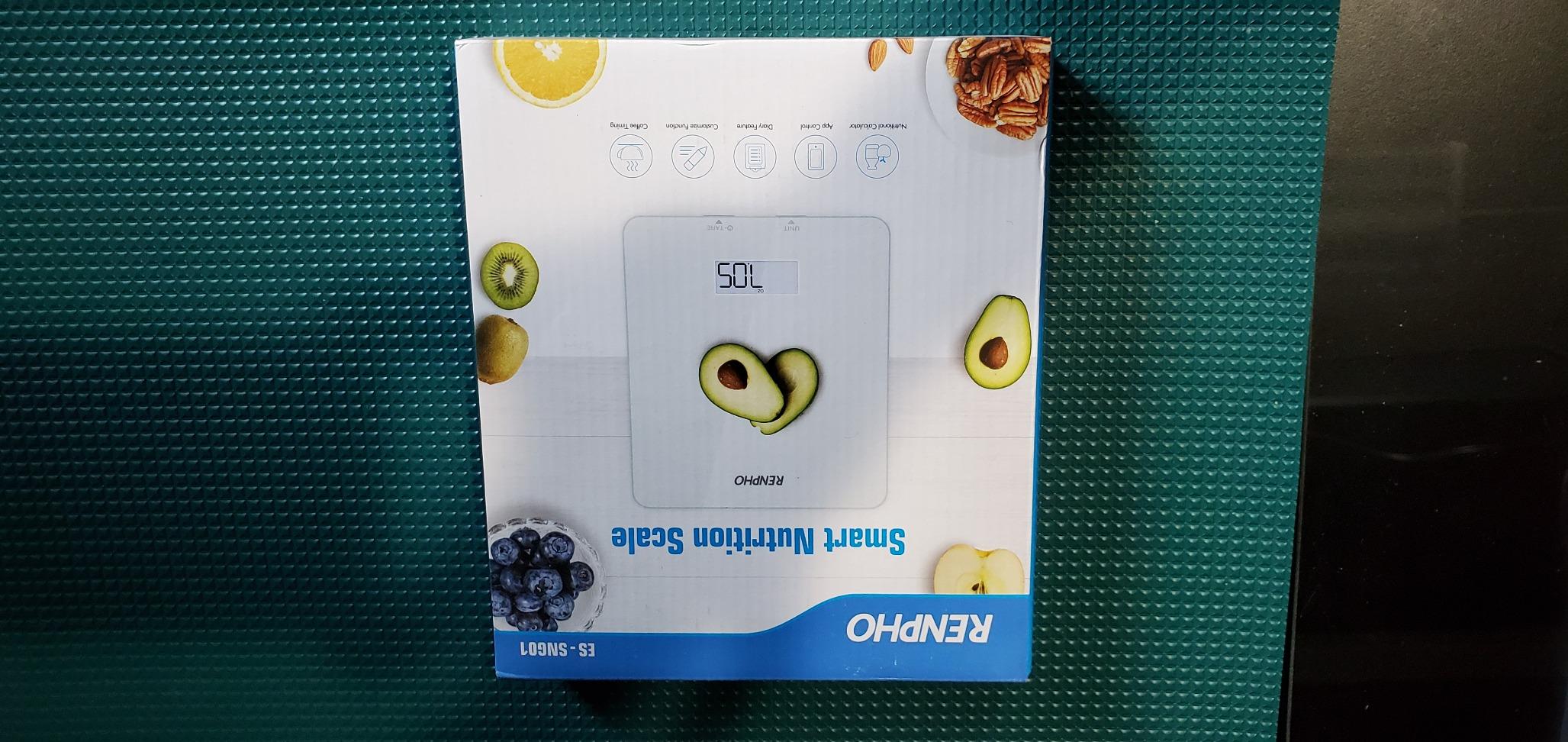
The capacity is 3000 g with 0.1 g divisions across the whole range, which means one scale covers a 12 g espresso dose and a 600 g Chemex batch without switching units. It converts between grams, ounces and pounds, runs on a 1000mAh lithium battery over Type-C, and includes a detachable waterproof silicone pad that lifts out for washing.
With 8343 ratings averaging 4.5 stars, this is the most thoroughly reviewed scale we tested, and the volume of feedback matters here. Reports of drift during fast pours or touch controls misfiring with damp hands show up repeatedly, which tells you exactly where the weak points are before you buy.
What gets right for a daily V60 or Chemex
The combination of a 3 kg ceiling, a 0.2 second settle and a flow rate readout covers everything a filter brew asks of a scale. A 22 g dose, a 45 g bloom, a pour to 150 g and a finish to 330 g all happen on the same screen without a mode change, and the rechargeable battery means you are not hunting for cells mid-recipe.
The footprint measures 5.12 x 5.91 x 0.79 in, which clears a carafe base comfortably while staying narrow enough for a small drip tray. The detachable silicone pad is a genuine help, because it is the part that takes the splash, and rinsing it under a tap is the whole cleaning routine.
Where it frustrates you
Touch buttons and wet hands do not mix. Midway through a brew your hand is damp, and a misfire means you have to dry off, tap, and find your place again. The auto timer in Espresso mode is also flow-triggered rather than ratio-guided, so it will not tell you that you have hit 1:16.
Anyone who wants the scale to sit under a full-size espresso machine will find 5.12 in of width is not enough. For a pure pour over setup that is a non-issue, but for a dual-station bar this is a pour over scale with espresso ambitions rather than a shared tool.
2. Hario V60 Drip Scale — Best for Brewing a V60 Specifically
- Purpose-built footprint that sits correctly with a V60 and server
- 0.1g increments match V60 brewing needs
- Slim profile stores easily and tucks under a carafe
- Improved start-up and reaction rate over earlier versions
- Anti-slip rubber feet stay planted during swirling
- 2000g capacity limits batch size
- Timer only with no flow rate or ratio guidance
Hario has been making drip scales for the V60 since the early days, and this updated black model is the current version. At 120 x 190 x 29 mm and 265 g it is the smallest, lightest thing here, and the shape is designed around one brewer: a V60 sitting over a server.
That narrow design is the whole argument. A cone dripper and a glass carafe both need to stay centred, and a slim platform lets you slide the server on after the first pour without shifting anything. The 0.1 g increments cover dosing comfortably, and the built-in timer repeats recipes without you tracking anything.
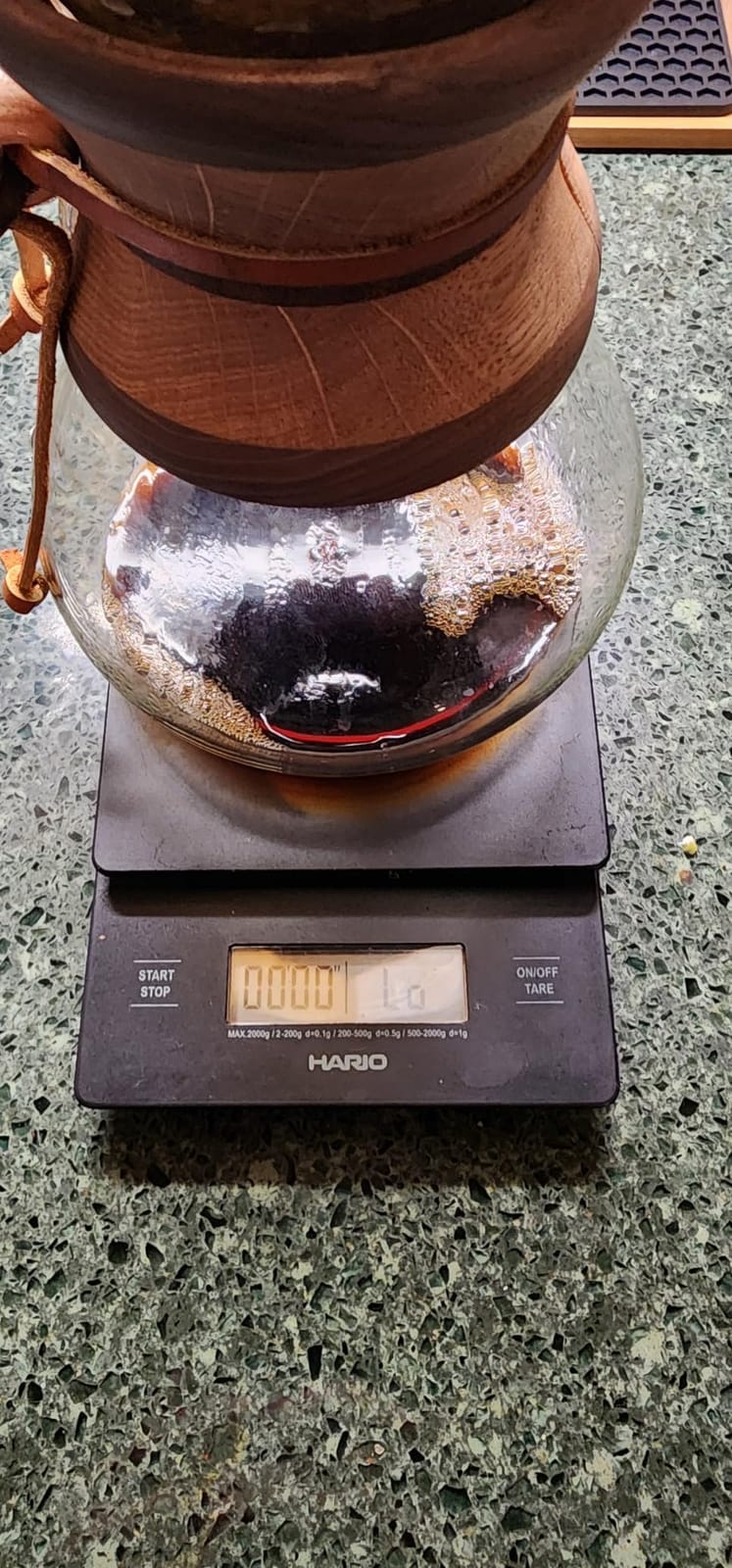
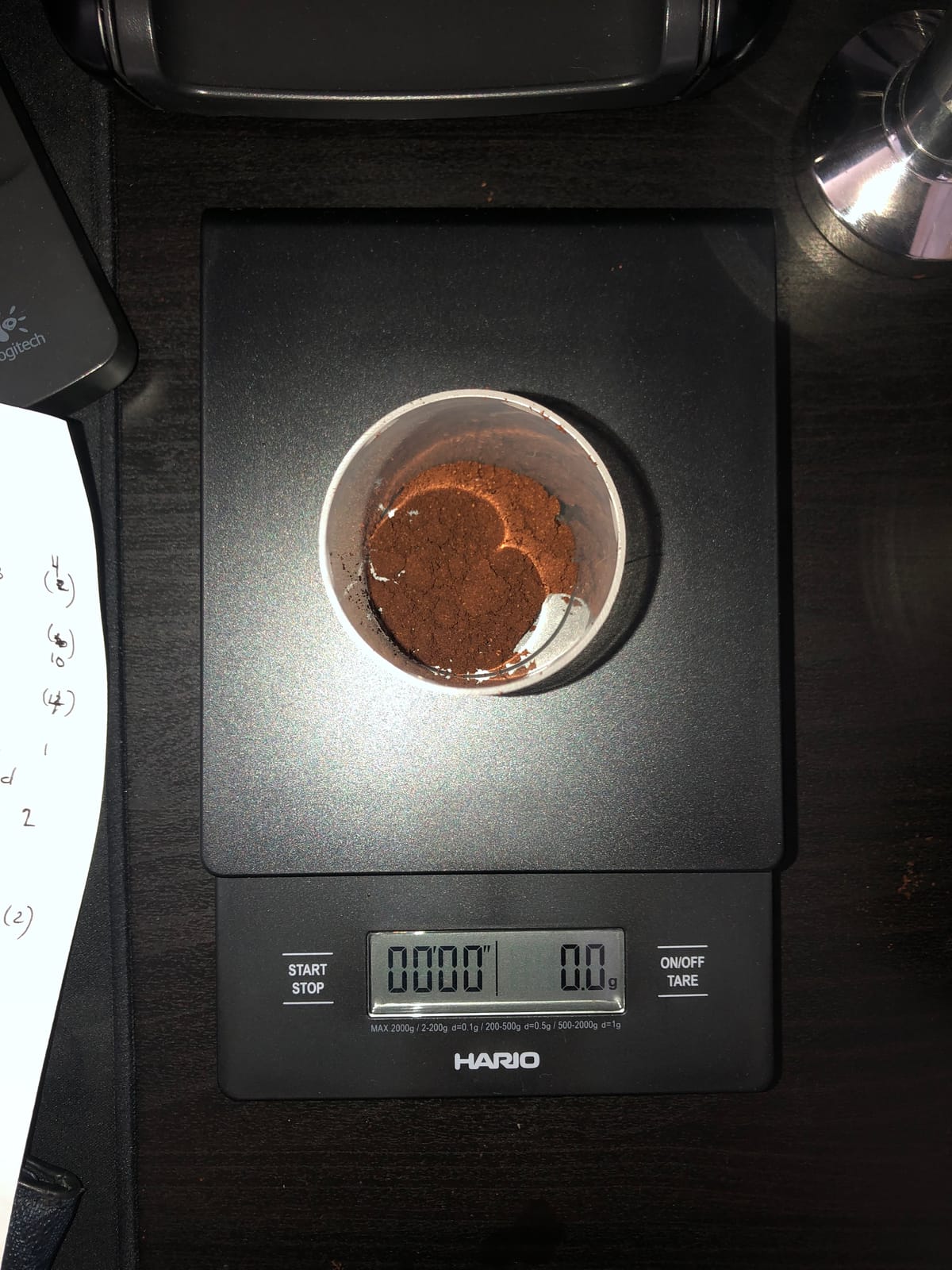
Hario refreshed the internals on this model: quicker start-up times, a faster reaction rate, anti-slip rubber feet and better water resistance than the versions it replaced. It runs on two AAA batteries and measures in grams and kilograms, with a five minute auto-off that is suspended while the timer runs so it never cuts out mid-brew.
Its 4.2 star average across 2424 ratings is the second lowest here, and the reason is consistent across reviews rather than random. People who brew V60 daily love the footprint, and people who want a bigger batch or live flow data find it limiting.
What gets right for a single-cone workflow
If your setup is a V60 on a stand over a 600 ml server, this scale disappears into the workflow. The width matches the brewer base, so the cone stays put, and the 29 mm height clears the dripper’s foot while the timer runs.
For anyone who also wants to weigh roasted beans for a single origin bag, the 2000 g maximum covers 200 g doses twice over. It is also the easiest of the ten to pack away, which matters if the scale lives in a drawer between brews.
Where it frustrates you
There is no flow rate, no ratio mode and no target weight, so you are running the recipe entirely from the timer and the total weight. That is fine if you have internalised a recipe and frustrating if you are still learning what a slow pour should look like.
The 2000 g ceiling also rules out the larger Chemex batch sizes and any serious baking on the same platform. And a fixed-width platform shaped for a cone looks odd under a Chemex or a Kalita Wave, which are wider at the base.
3. BAGAIL Coffee Scale with Timer — Best Value for Large Platform Pour Over
- Large platform suits V60 and Chemex brewing
- Fast-stabilising 0.1g readings
- USB-C battery lasts weeks between charges
- Heat-resistant silicone pad for hot water
- Auto-start timer mode
- Display can fade after extended daily use
- Readings fluctuate with vibration from an espresso machine
- Touch sensors are overly sensitive with damp hands
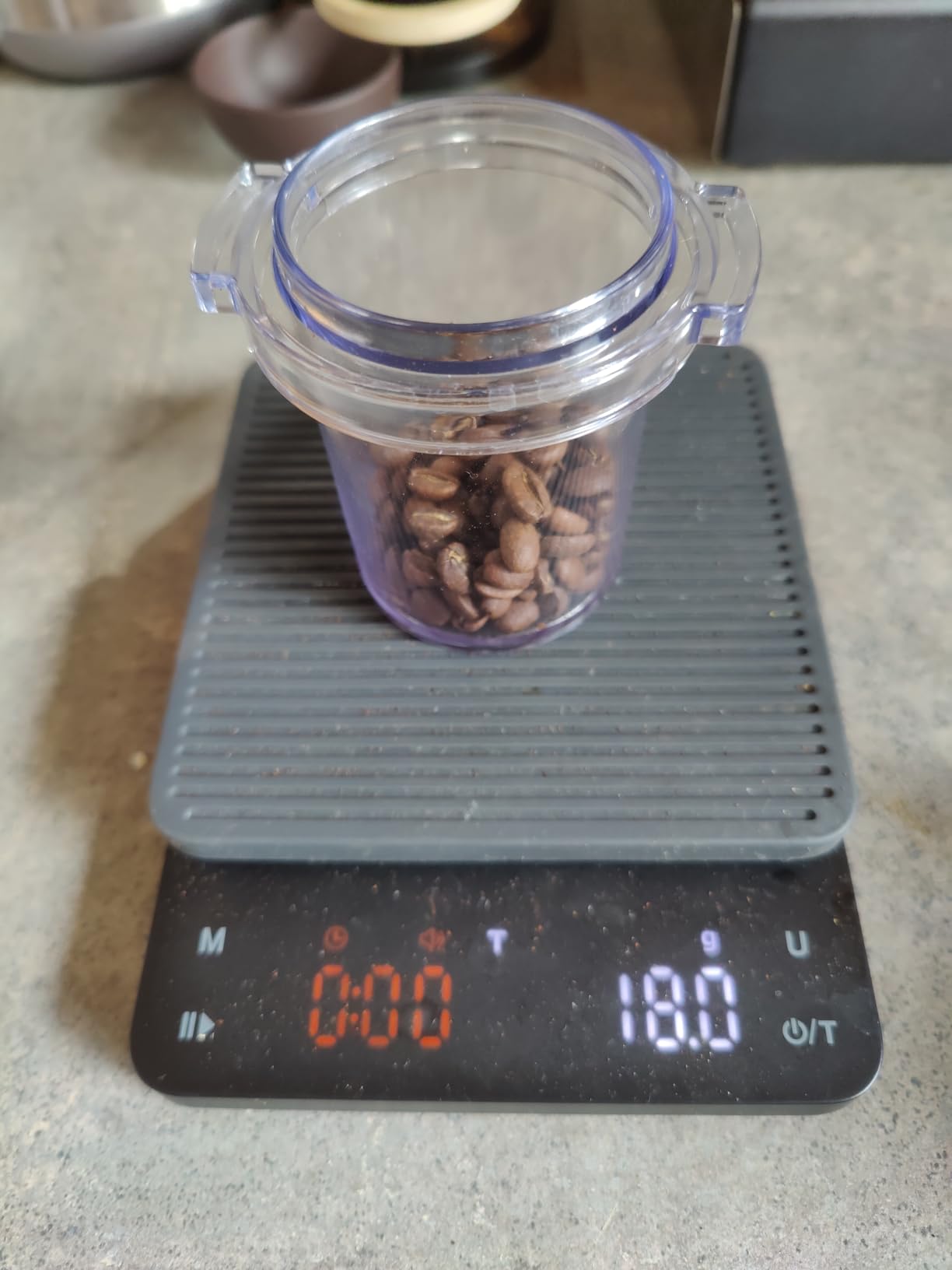
Platform size is the quiet reason this one stands out for filter work. At 6.7 x 5.1 in it is the widest platform in the group, which means a Chemex, a Kalita Wave or a batch brew carafe all sit flat with room to spare, and you stop holding one edge on to keep it balanced.
Accuracy is 0.1 g from 0.3 g to 3000 g, and reviewers describe the readings as fast-stabilising, which is what you want during drawdown. Timing can be automatic or manual, so you can start the clock with a tap or let the scale handle it while you pour.
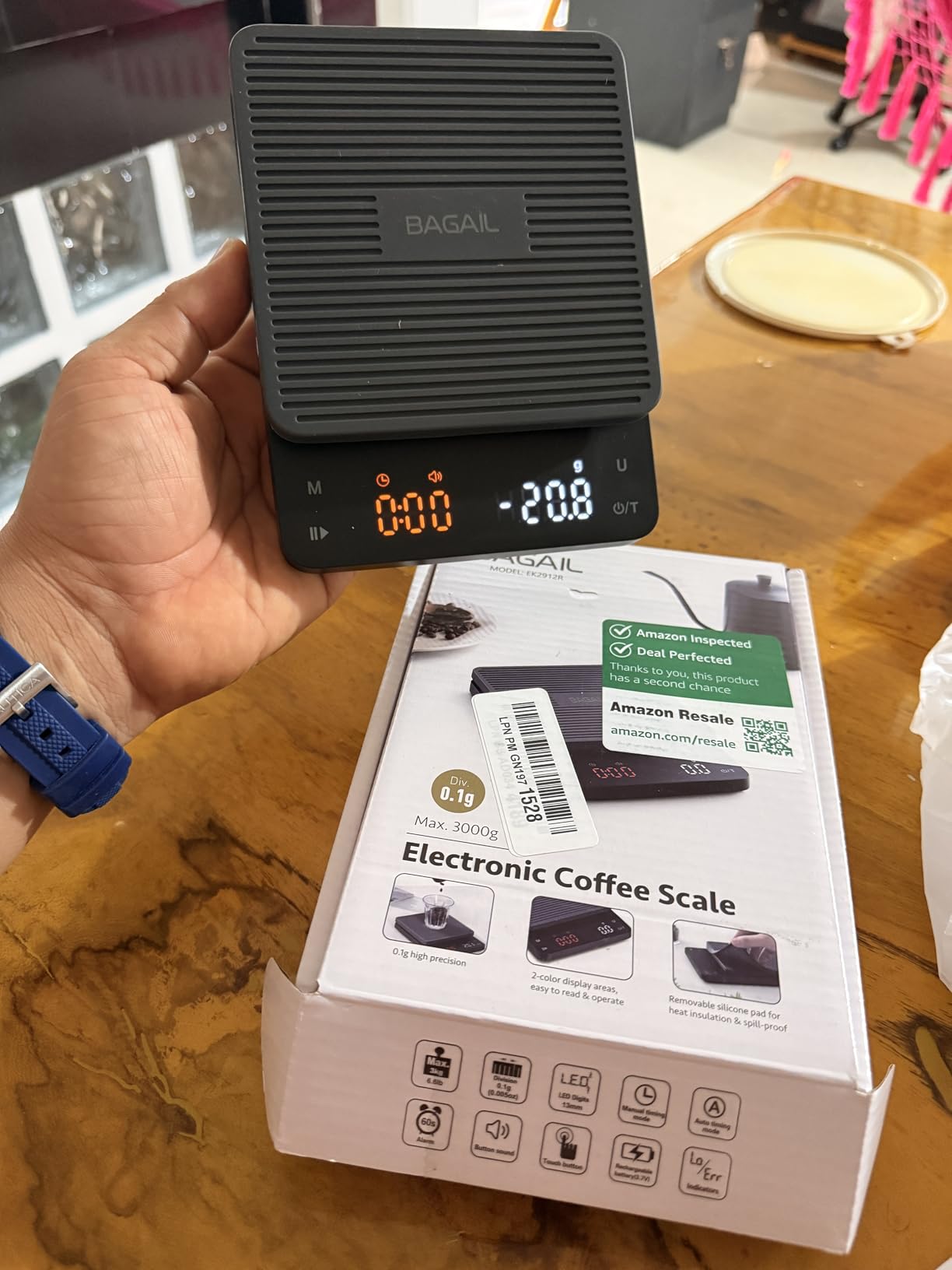
The 600mAh rechargeable lithium battery takes about three hours to fill and runs for up to 30 days per charge, and the USB Type-C cable is in the box. The removable waterproof silicone pad is heat resistant and scratch resistant, and the platform comes with an 18-month warranty, which is longer than most rivals offer.
One practical note before first use: four transport plugs sit under the platform and need removing, and several reviews mention display bloom or fading after months of daily brewing. Vibration from a nearby espresso machine can also nudge the reading, so keep this on a quiet corner of the counter.
What gets right for carafe brewing
The wide platform solves the sizing problem that stops people buying a small scale for a Chemex. Nothing overhangs, so the load stays centred and the reading stays honest through a 500 g pour, which is exactly the batch size people shy away from on a narrow platform.
Auto timing plus a removable heat-resistant pad means the brewer can go straight on and come straight off, with no pad to wash separately. The six measurement formats including pound and ounce and fluid ounce cover beans, water and baked goods on one device.
Where it frustrates you
There is no flow rate and no ratio guidance, so this is a fast accurate scale rather than a teaching tool. And while the platform size is a strength for pour over, it rules the scale out for any espresso machine with a shallow drip tray.
The touch sensors register easily, which is a problem with wet hands during a pour, and there is no physical on/off button to fall back on. Display longevity is the one to watch over a multi-year horizon.
4. Maestri House S3 Coffee Scale — Best for Ratio Guidance and Flow Rate
- Ratio alerts let you watch the pour instead of the display
- Real-time flow rate display
- Accurate to 0.1g against calibration weights
- Does not auto-shut-off mid-brew
- Moderate beeper volume
- Silicone mat slides around
- Pour-over auto-timer cancels if you lift the brewer
- Touch buttons give little feedback
- Footprint too large for shallow espresso drip trays
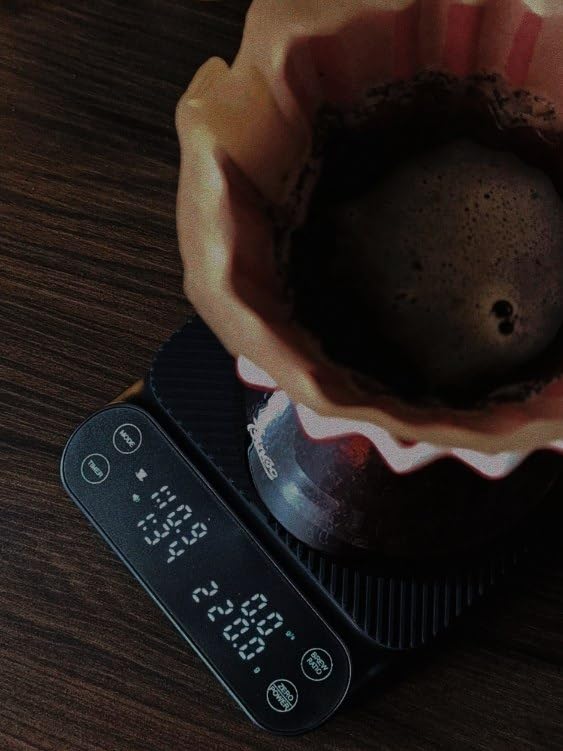
This is the most instructive scale here. Enter your dose and a ratio between 1:1 and 1:18, and the scale works out the water target for you, then beeps when you arrive. During the pour you still get a live flow rate readout, so you are learning both the target and the pace that gets you there.
Three modes cover auto-timer pour over, auto-timer espresso and standard weighing, and the platform is roughly 16 x 13 cm, which clears a standard cone dripper and most carafes. Accuracy holds at 0.1 g up to 3000 g.
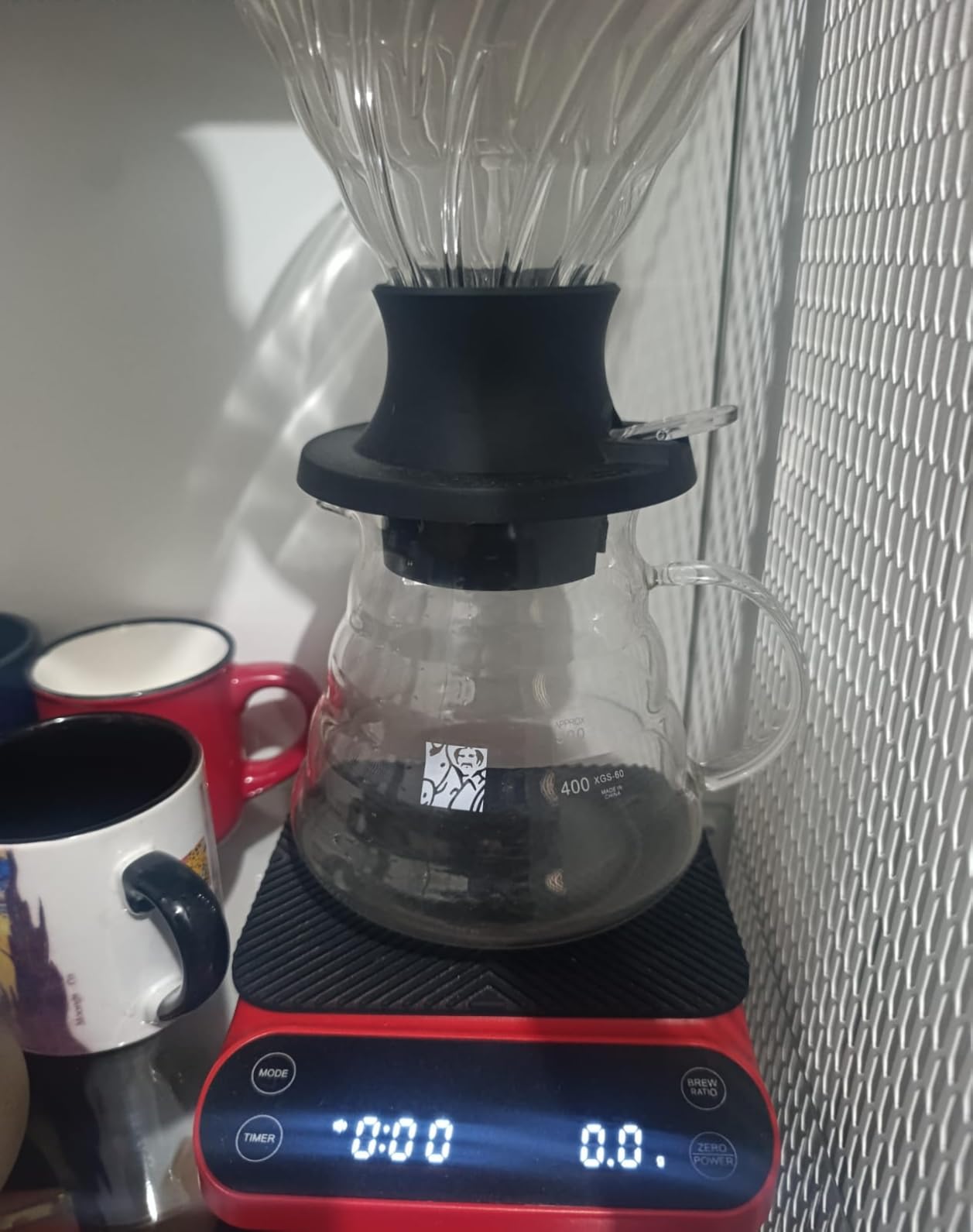
Battery life is the quiet strength. A 500mAh lithium cell charges over USB-C and runs for up to 90 days of daily brewing, and the display panel carries an IPX4 water resistance rating, which addresses the splash anxiety that shows up in almost every forum thread about coffee scales.
The one-piece matte body is splash resistant and heatproof, and the dual-zone LED interface separates brew controls from weighing controls. A heat-resistant silicone pad is included, and reviewers like that it does not auto-shut-off partway through a brew.
What gets right for learning a new recipe
Setting a ratio once and getting an audible alert at the target is the feature that turns a scale into a coach. You can stop watching the display and watch the coffee instead, which is where most of the technique lives during the middle pour.
The flow rate display gives you the other half of the picture. If a target weight arrives but the flow rate is too fast, you know to pour thinner next time, and that is a lesson a plain timer cannot teach.
Where it frustrates you
The pour over auto-timer cancels if you lift the brewer to swirl, and swirling mid-brew is standard technique for most recipes. The silicone mat is not well affixed and slides around, which adds a wobble you did not ask for.
Ratios can only be set in whole-number increments despite the 0.1 g display, so a 1:16.5 recipe is out of reach, and the touch buttons give very little feedback and can register accidental double taps. The body is also too wide for shallow espresso drip trays.
5. Fellow Tally Pro Coffee Scale — Best Built with Brew Assist
Fellow Tally Pro Coffee Scale with Timer, Espresso Scale, Brew Assist Mode
- Near-instant response time for slow controlled pours
- Brew Assist removes the ratio maths from brewing
- Large sharp bright OLED display
- Tactile metal dial and solid controls
- Removable glass top wipes clean in seconds
- 2500g capacity is low for large-batch baking
- Body size makes it unsuitable as an espresso scale
- Glass surface shows marks and smudges
The Tally Pro is the one that feels like equipment rather than a kitchen gadget. Readings settle in under a second, the OLED panel is bright and sharp in daylight, and the metal dial is the kind of control you would expect on a professional piece. It is also the highest rated scale in this group at 4.6 stars, though from a much smaller pool of 211 reviews.
Brew Assist is the headline. You set a water-to-bean ratio once and the screen shows the target to the last gram, updating as you pour. Two further weighing modes cover beans and baking, so the same device handles the whole chain from green to cup.
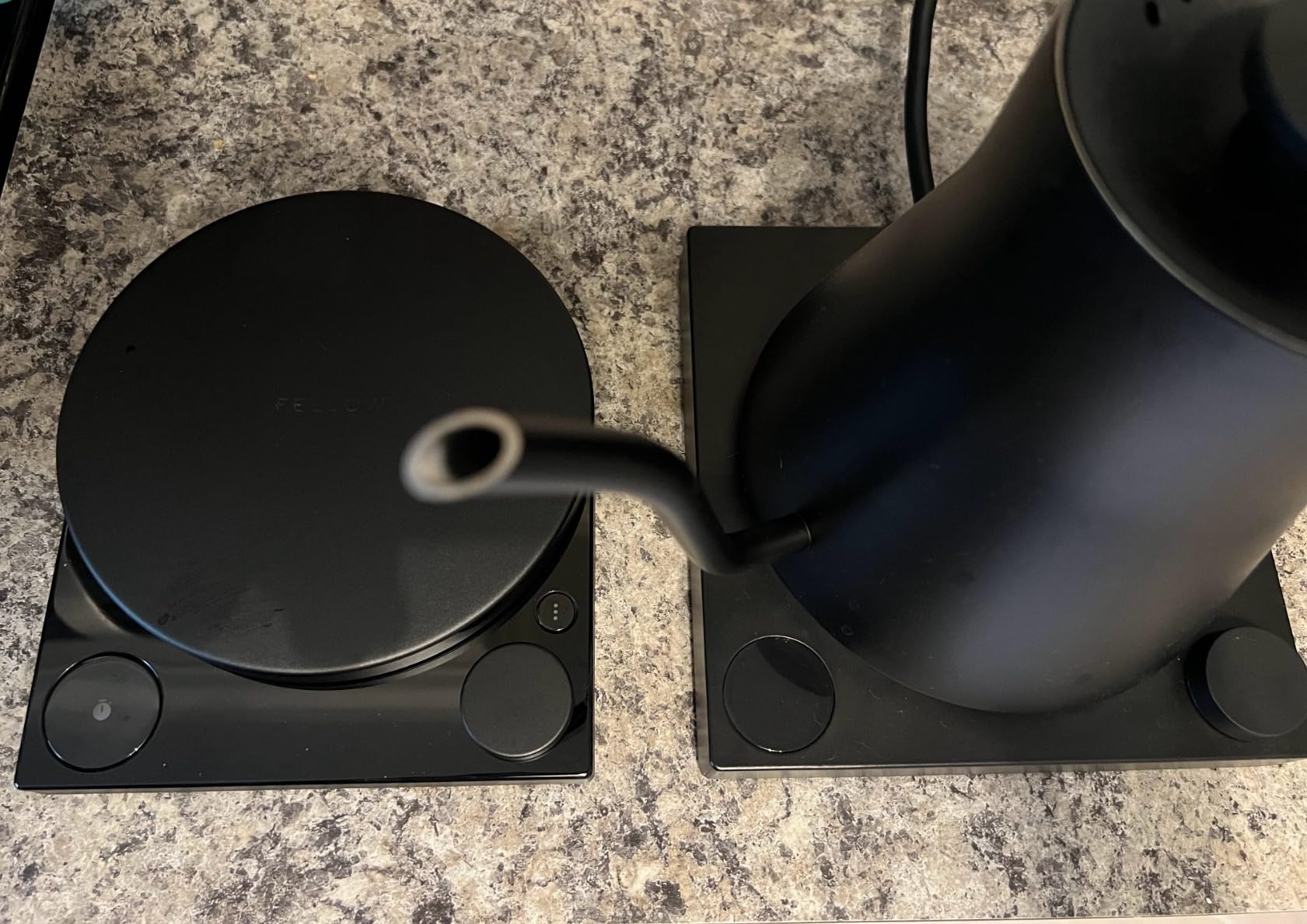
The platform is 7 x 5.9 in with a 1.3 in profile, and the weigh pan is removable glass, which wipes clean in seconds and survives boiling water being poured straight onto it. Capacity is 2500 g at 0.1 g resolution.
Battery life is up to 13 hours of continuous use, which reviewers translate to roughly one to two months of daily sessions before a USB-C charge. That figure depends on the display staying awake through a full brew, which owners confirm it does.
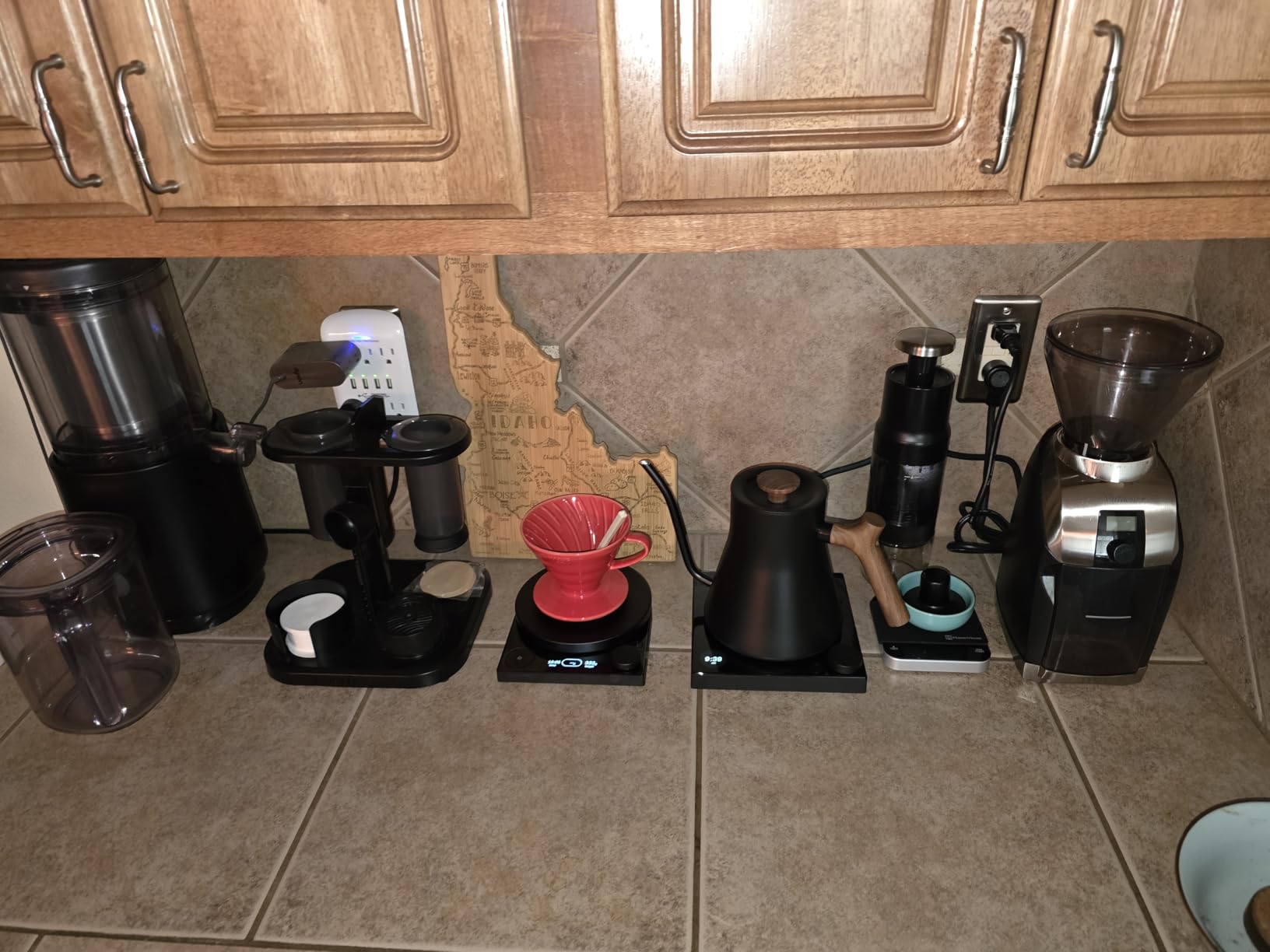
What gets right for controlled slow pouring
Response time is the reason this scale exists. A thin pour takes several seconds to register on a scale that settles slowly, and a fast one is the only way to trust a narrow pour cone without overshooting the target.
Glass is a better brewing surface than plastic or coated steel for a pour over station, because coffee oils and scale water wipe off rather than sit in a texture. Brew Assist also means the ratio math stops being something you do mid-pour.
Where it frustrates you
The price is the first thing anyone mentions, and reviewers are candid that the cost needs justifying. Against a mid-range scale doing the same 0.1 g job, you are paying for the display, the dial and the response time.
The 2500 g ceiling is low for large-batch cooking or baking, and the 7 in body is far too deep to serve as an espresso scale. The glass shows marks and smudges under direct light, and one owner reported a unit that would not power on after its first charge.
6. KitchenTour Coffee Scale with Timer — Best for Travel
- Accurate to 0.1g within the first 500g
- Back-lit reverse LCD is readable in any lighting
- Removable washable silicone mat
- Batteries included and simple touch controls
- Compact enough to stow away
- Timer reset needs a power cycle
- Readings drift during fast dynamic pouring
- Silicone mat slides around
- No lb format
Here is the honest arithmetic behind budget coffee scales. The KitchenTour resolves to 0.1 g from 0.3 g to 500 g, steps to 0.5 g from 501 to 1000 g, and to 1 g from 1001 to 3000 g. A 22 g dose and a 330 g brew both sit inside the accurate band, which is why it works for pour over.
Everything above 500 g is where entry-level scales give up, and that is the honest limitation to plan around. If your recipe stays within half a litre of water, you lose nothing. If you routinely brew a large batch, check the step change before you commit.
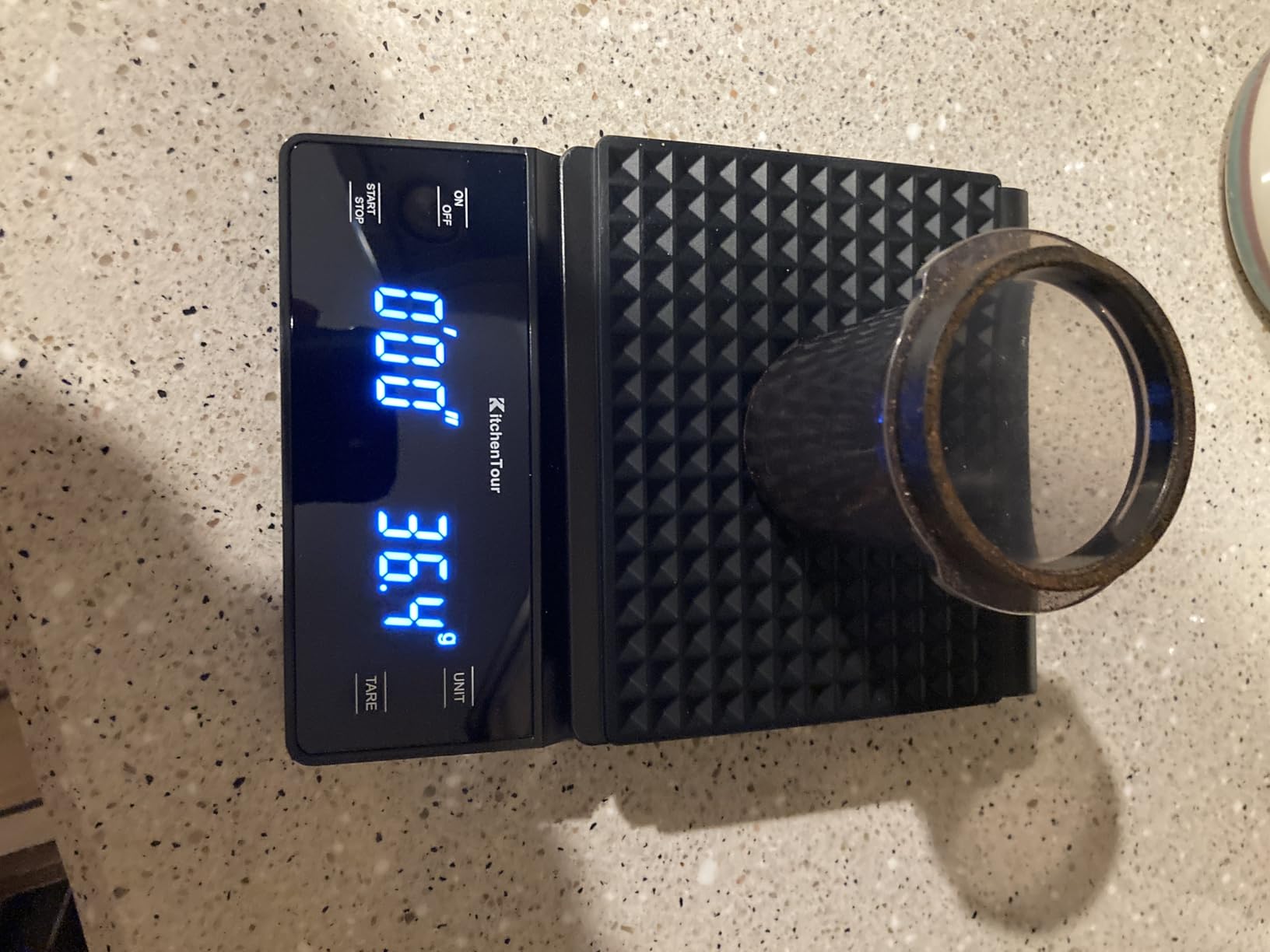
The back-lit reverse LCD is easy to read in any lighting, and the body is ABS with a waterproof silicone non-slip pad that lifts out for washing. The built-in timer starts and stops with a tap, tare is one touch, and a 120 second auto-off keeps the batteries alive between sessions. There is a low battery reminder and a hidden calibration mode behind a four-button press.
At 4.4 stars across 3631 ratings it is one of the most re-purchased budget scales available, and the review pattern is stable: accuracy gets praised, timer reset friction and drift during fast pours get criticised.
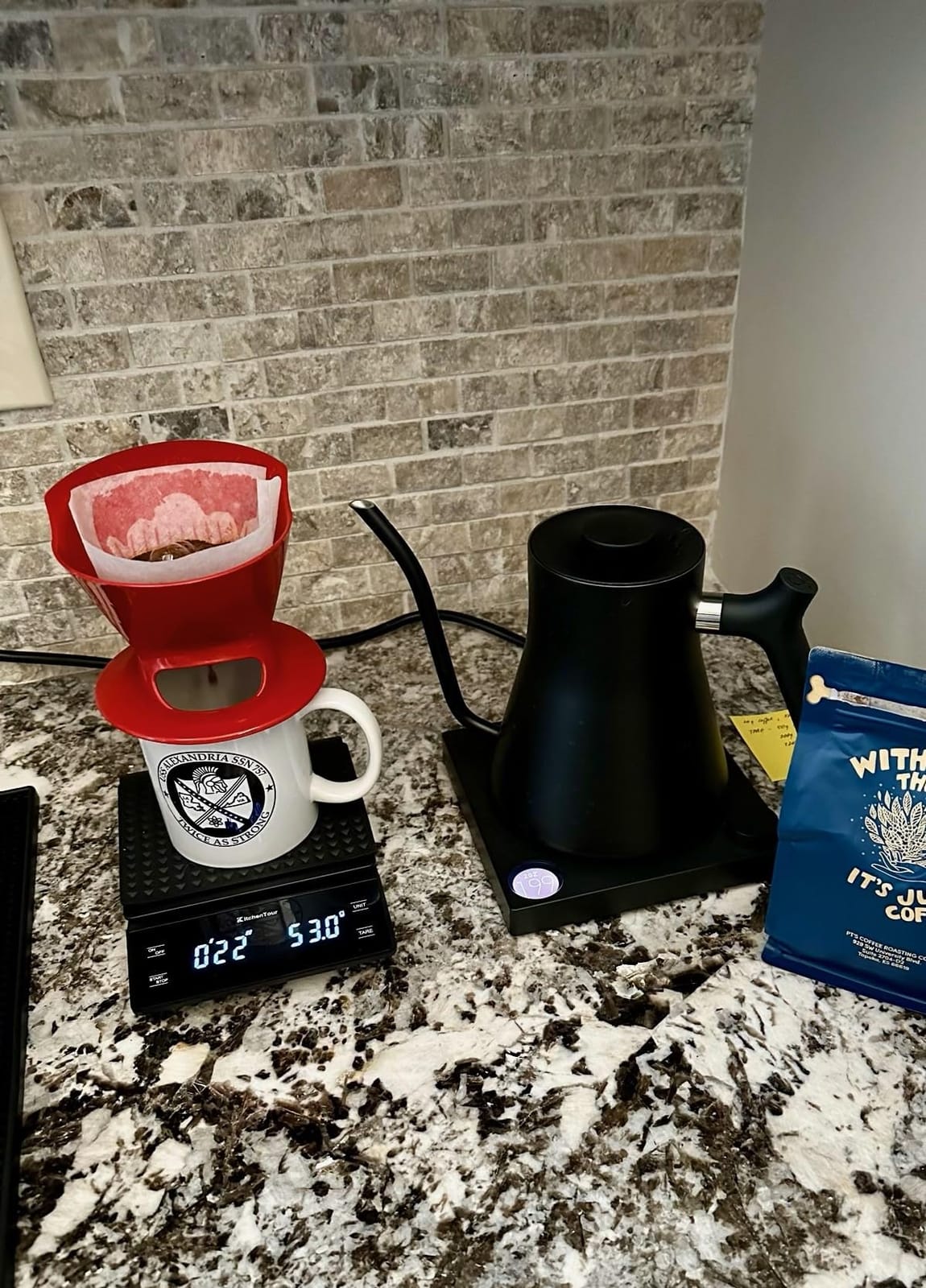
What gets right for a first scale
Nothing in this list makes repeatable dosing more affordable, and the reverse LCD is far more legible than most displays at this level. The measurement range starts low enough for espresso dosing experiments, so it is not a single-purpose tool.
Batteries are included, so you can brew immediately, and the silicone pad takes the splash that ends most budget scales. Compact and slim enough to store away, which matters if counter space is tight.
Where it frustrates you
Resetting the timer means powering the unit off and back on, which is a real annoyance when you are running the same recipe twice in a row. Readings also drift while water is being poured quickly, so slow pours give the better number.
The silicone mat slides during use, there is no pound format, and a number of owners report failing buttons or units that stop powering on within weeks. Treat it as a first scale you will eventually replace rather than a keeper.
7. CULIKEM Pour-Over Coffee Scale — Best for Battery Life and Easy Cleaning
CULIKEM Pour-Over Coffee Scale with Timer, 100-Day USB-C Rechargeable
- Glass platform wipes clean and looks minimal on the counter
- One charge powers up to 100 days of daily brewing
- Works out of the box with no calibration needed
- Silent mode is a long press of the tare button
- Simple feature set with no menu complexity
- Footprint too large for espresso machine drip trays
- No flow rate or ratio assistance
- Smaller review base and limited brand recognition
One USB-C charge powers this for up to 100 days of daily brewing, which is a different order of magnitude from the coin cells and AAA batteries used by most competitors. If you hate batteries in your coffee corner, that headline figure is the entire pitch.
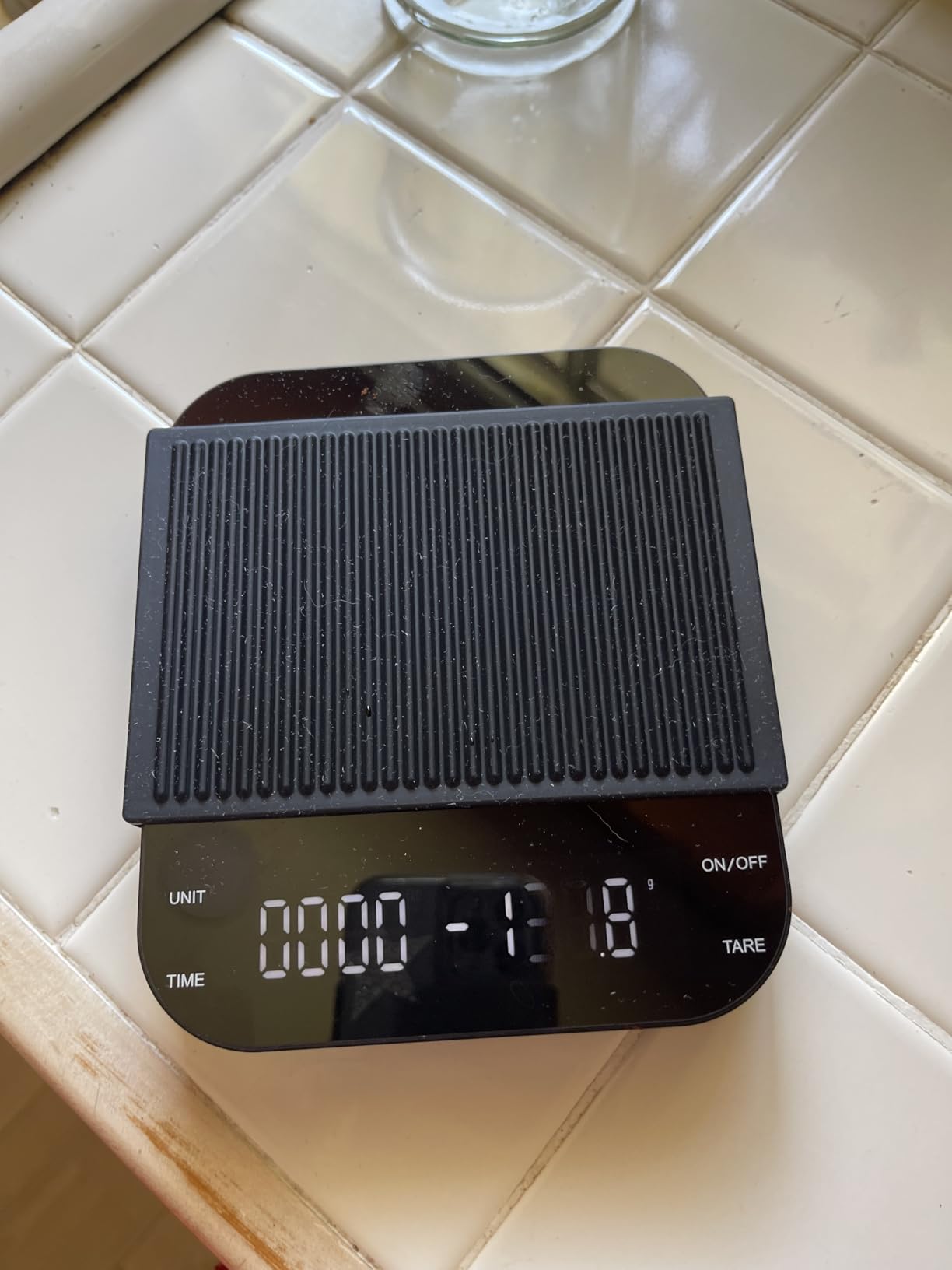
The 5.9 x 5.1 in platform is a glass mirror surface, and glass is genuinely the easiest material to keep clean on a brewing scale. Coffee oils, scale water and a stray bloom rinse off with a cloth instead of sinking into a texture.
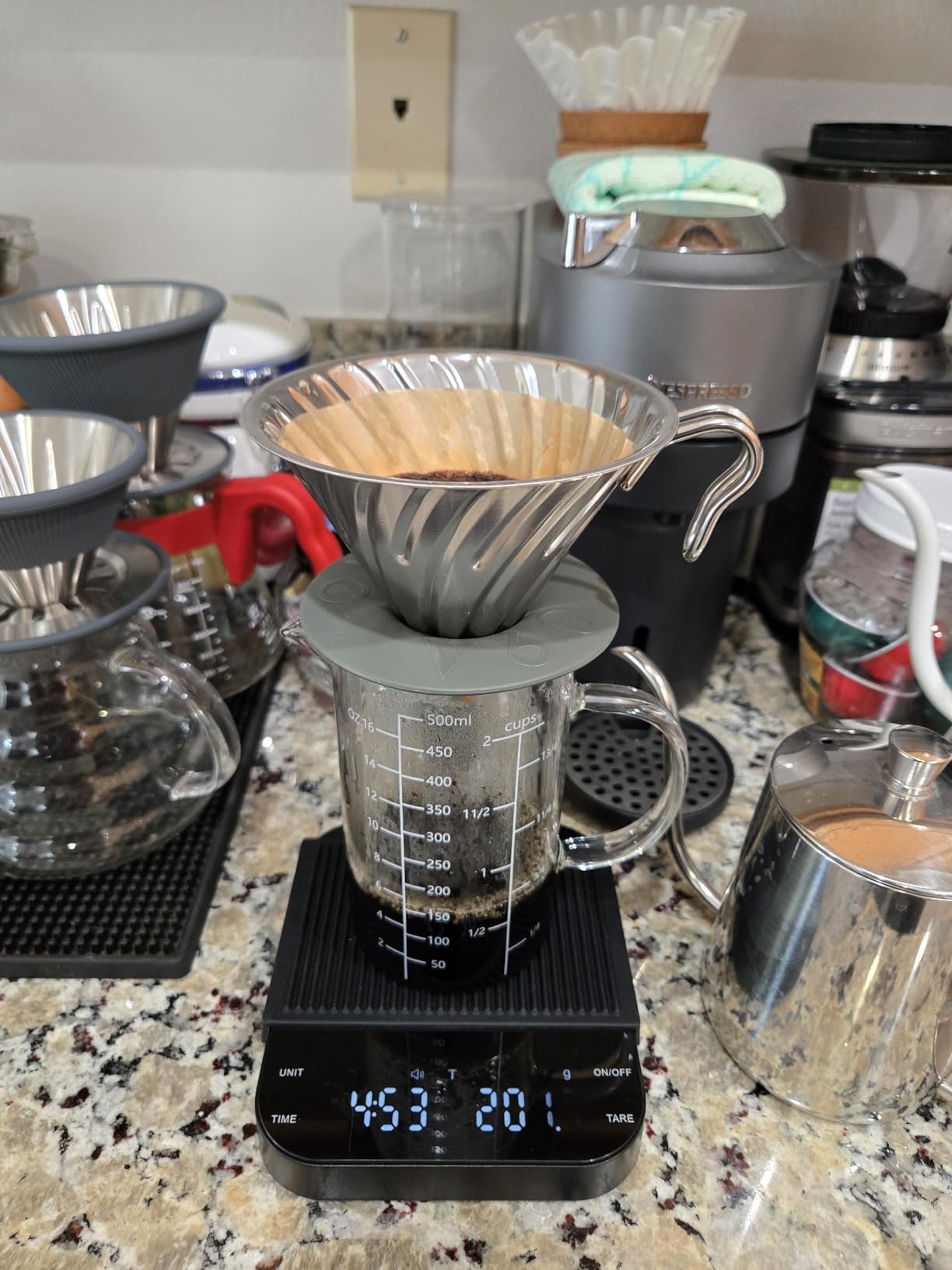
Accuracy is 0.1 g across a 0.3 to 3000 g range, and unlike several scales in this group it needs no calibration out of the box. A built-in timer and tare function cover the basics, six measurement formats handle beans, water and dry goods, and a long press of the tare button toggles silent mode for early mornings.
It scores 4.5 stars from 203 ratings with 78 percent five-star, and reviewers single out the battery figure, the glass surface and the simple setup. The smaller review base is the main caveat, along with the total absence of guidance features.
What gets right for a low-maintenance setup
A glass platform and a rechargeable cell remove the two chores people complain about most: scrubbing a textured mat and hunting for spare batteries. There is nothing in the menu system to mispress, so it is quick to pick up and quick to hand to a guest.
At 5.9 in wide it clears a cone dripper and most carafes, and the 3000 g capacity covers a full batch brew without switching formats.
Where it frustrates you
There is no flow rate display, no ratio target and no auto-timing, so this scale reports numbers and nothing more. If you are learning, you are doing the thinking yourself.
The footprint is deliberately too wide for espresso drip trays, which makes it a dedicated pour over and baking tool. And with only 203 reviews there is less long-term field data on the electronics than the bigger names carry.
8. MHW-3BOMBER Mini Coffee Scale — Best for Small Espresso Drip Trays
- Mini footprint fits a Breville Bambino Plus drip tray
- Gravity sensing wakes and tares the scale automatically
- Solid-liquid detection starts the timer on first pour
- 0.1g readings stay locked rather than drifting
- Waterproof silicone cover over the charging port
- Battery life limited by the always-on touch power button
- Some units report declining consistency over time
- Mute setting is easy to trigger if water reaches the controls
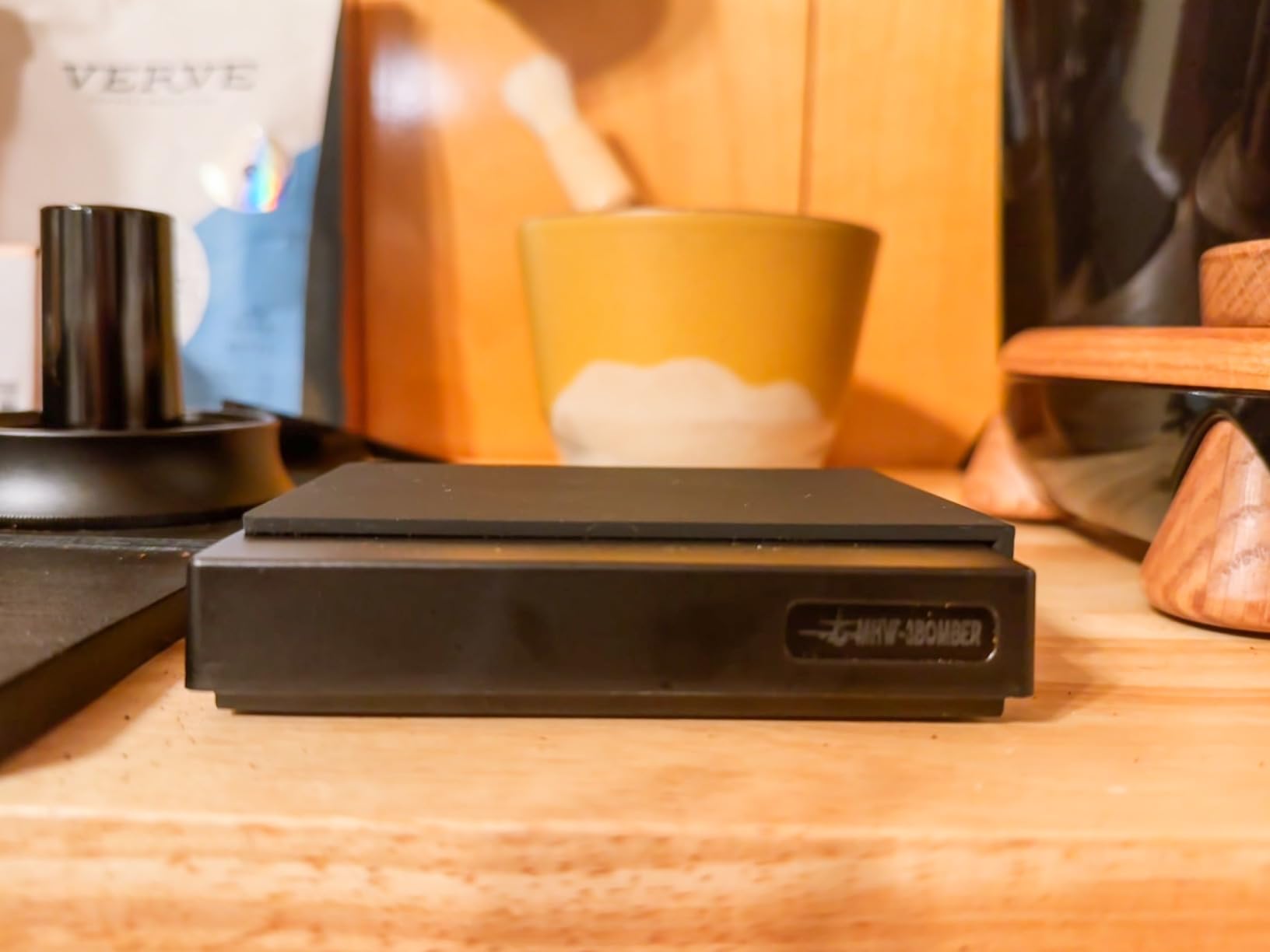
This is the one to buy if you want one device for both a V60 and a small espresso machine. At 4.1 x 4.1 x 0.7 in and 0.6 lb it is compact enough to slide under a Bambino Plus drip tray, and it still accepts a full-size 58 mm portafilter on top of the small platform.
Gravity sensing is the clever part. Placing something heavier than 100 g on the platform wakes the scale, weighs the object and resets to zero on its own, so a new dose of beans needs no button press. Solid-liquid detection starts the timing only once liquid is actually detected, rather than at the moment you set the brewer down.
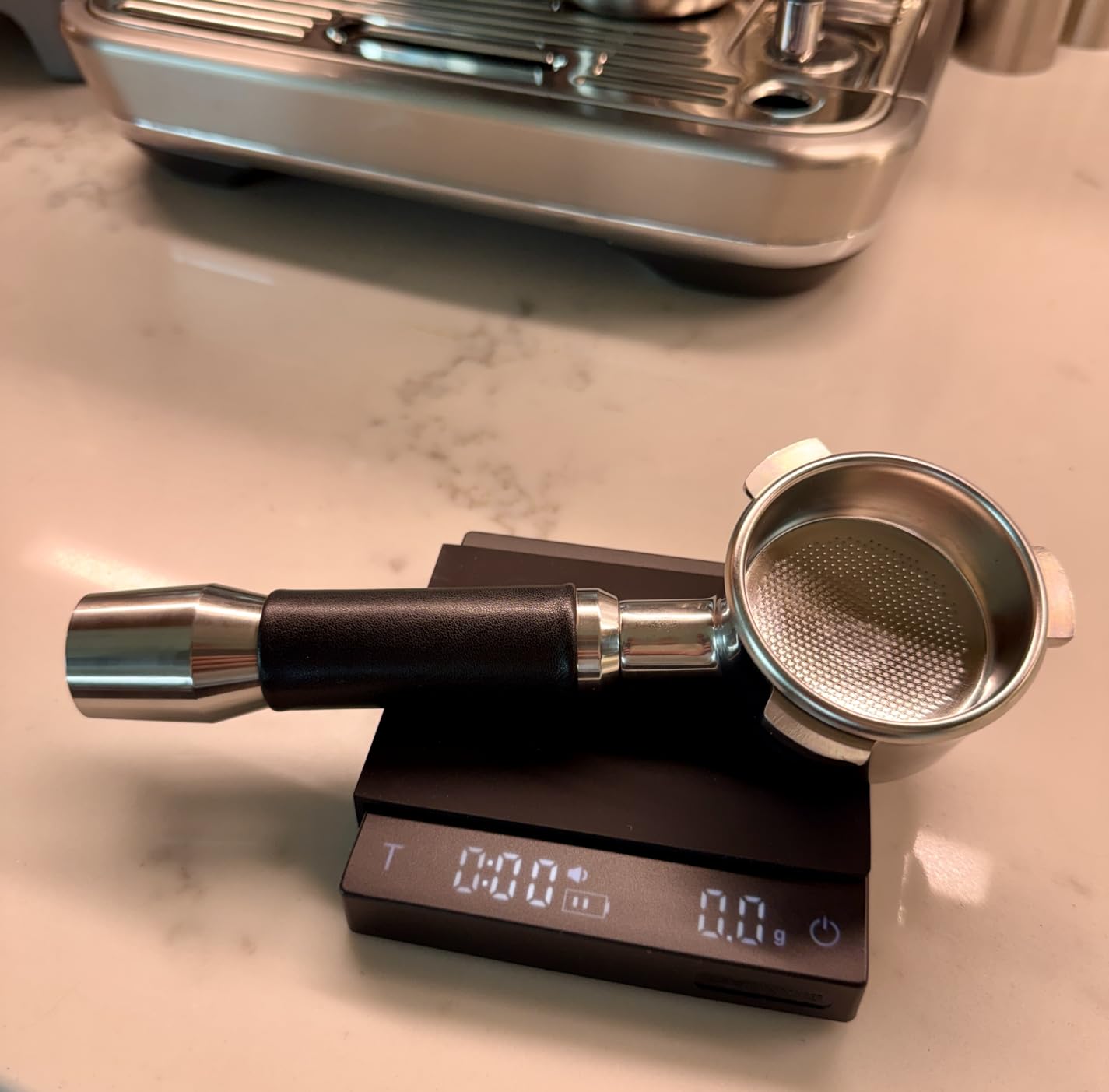
Readings stay locked rather than drifting during a pour, which is what reviewers mean when they compare it to generic scales that jump. The range is 0.3 to 2000 g in 0.1 g increments, timing works manually or automatically, and it switches between grams and ounces mid-extraction.
Charging is over USB-C with a silicone-protected port, which matters more on a scale that lives under a machine where splashes happen. The 700mAh battery, waterproof heat-resistant silicone pads, mute function and auto shut-off round out the feature set, with one year of after-sales service.
What gets right for a shared station
The mini footprint is the whole point. Most pour over scales are unusable under an espresso machine purely on width, and this one is designed for exactly that gap, so you do not need two scales on the same counter.
Auto-tare on placement and timer start on first liquid both remove taps from the workflow, and the silicone port cover addresses the water damage fear that dominates forum discussions about cheap scales.
Where it frustrates you
The always-on touch power button is the most common complaint, and it costs battery life over a year of daily use. Nothing in the design is wrong, but you will charge it more often than the 700mAh figure suggests.
Some owners report measurement consistency declining over time, and if water reaches the touch controls the mute setting can trigger by accident, which is confusing mid-brew. It is also a pour over scale for small brewers rather than a large one.
9. Normcore Pocket Coffee Scale V3 — Best Metal Build for Travel
- Anodized aluminum feels substantial against plastic scales
- Angled display is easy to read while brewing
- Mechanical wheel and physical buttons stay where you set them
- Includes a 100g calibration weight and travel case
- Three-sided silicone cover reduces vibration drift
- Not fully waterproof despite the silicone cover
- Rear switches have failed for some owners within a year
- Calibration drift and corner readings can diverge
- Small platform limits which brewers fit
The Normcore Pocket V3 is the only anodized aluminum body in this group, and at 0.79 in thick and 11 oz it is built to go in a bag. The angled back-lit LCD faces the brewer rather than the ceiling, which is a small decision that makes a real difference while you pour.
Controls are a mechanical mode wheel and physical buttons, not touch. That sounds old-fashioned until you remember how often damp fingers misfire a capacitive panel, and it is why this scale keeps the mode you set it to instead of resetting behind your back.
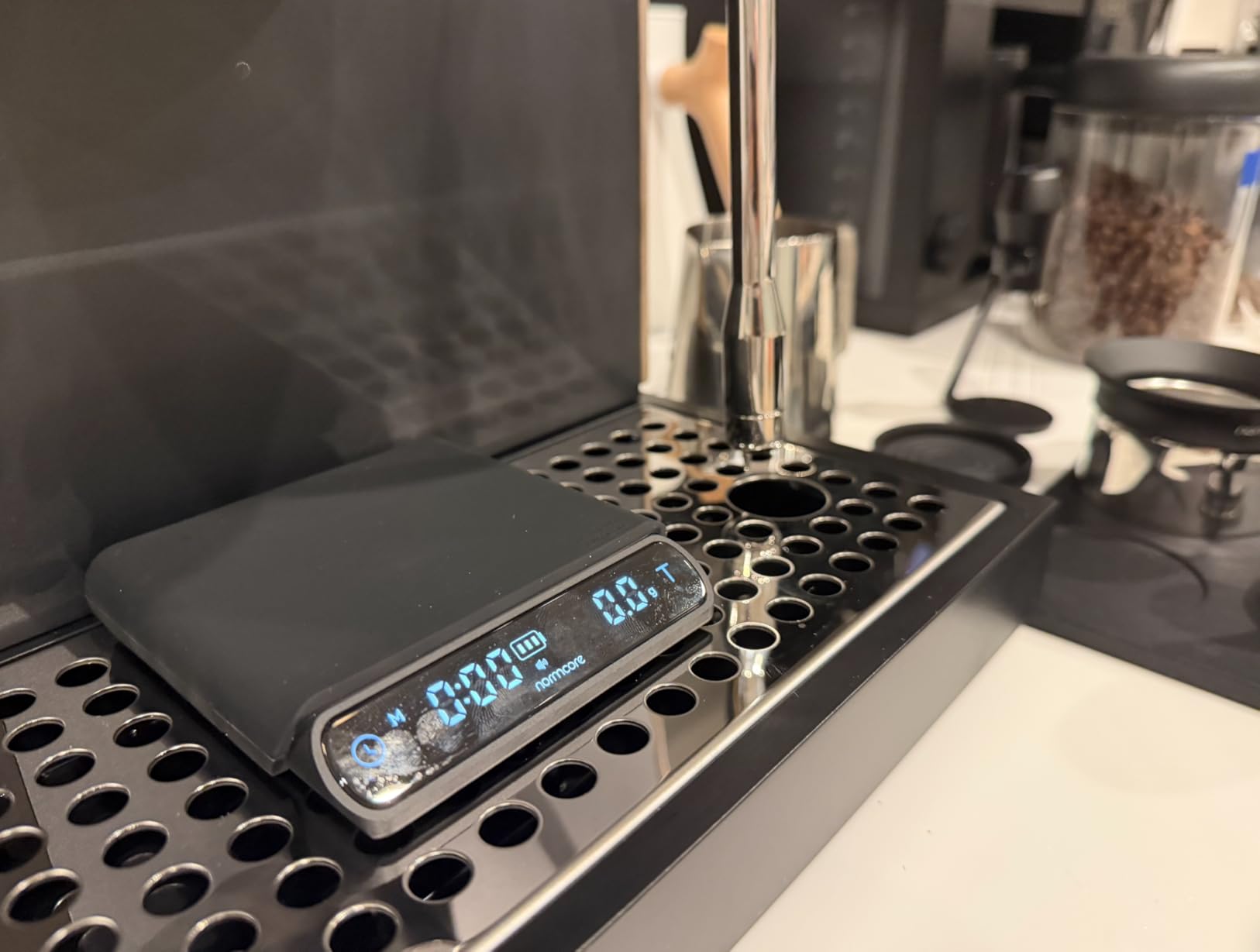
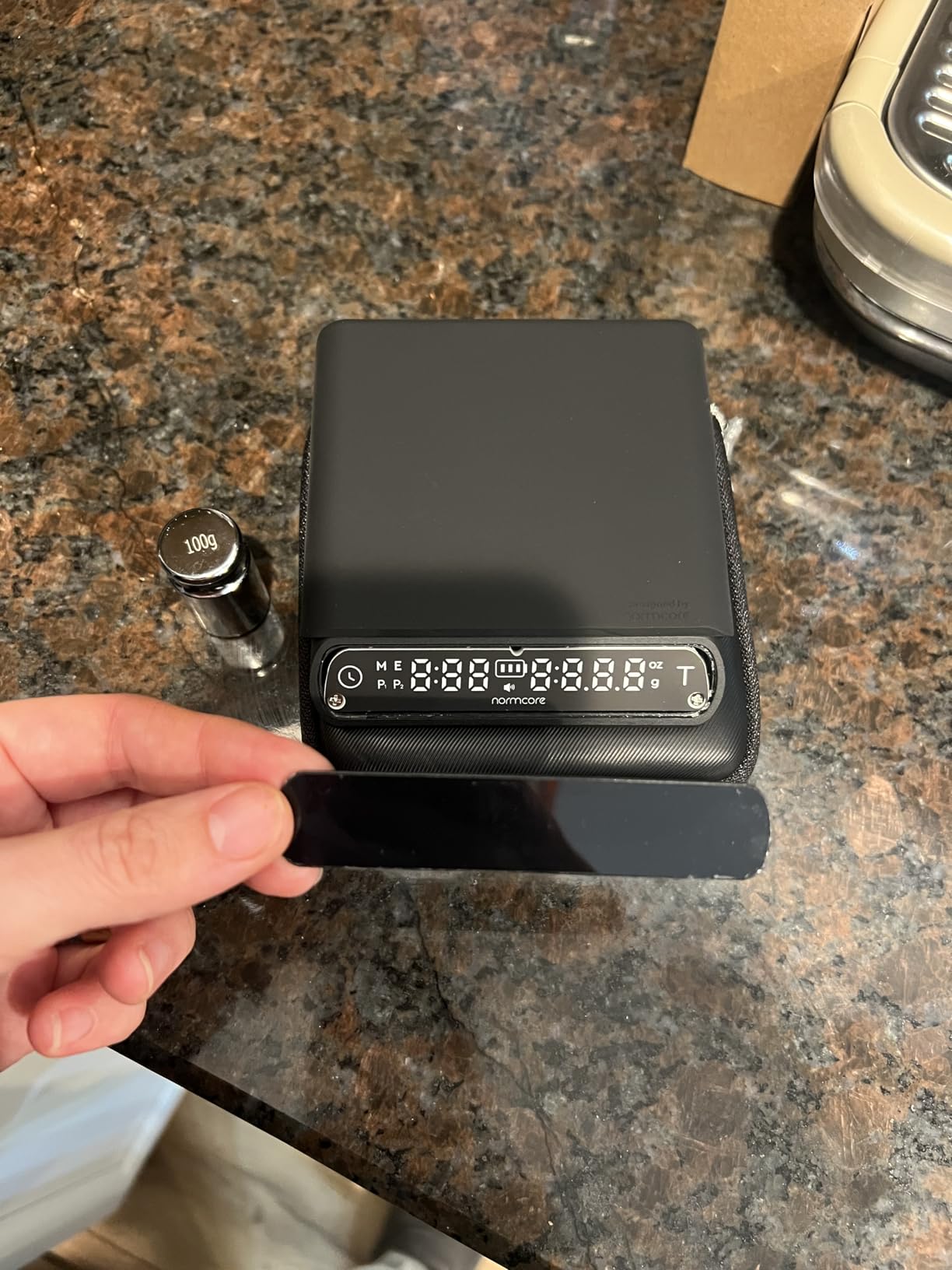
The range is 0.1 g to 2000 g in 0.1 g increments, the lithium-ion battery runs up to 15 hours, and auto shut-off kicks in after five minutes of inactivity. In the box you get a 100 g calibration weight, a three-sided silicone cover, a zip-up travel case and a USB-A to USB-C cable, which is the most complete kit here.
It carries a one year manufacturer warranty, and the silicone cover cuts vibration drift by damping the platform. It is also the model most often named in r/pourover threads when people ask for one scale that handles both espresso and filter, with the usual caveat that the platform is small for a large carafe.
What gets right for a metal, portable build
Anodized aluminum does not flex, does not feel warm in the hand after a hot pour, and survives being dropped into a rucksack. The included travel case and calibration weight make it a genuinely complete kit rather than a bare device.
Physical controls and an angled screen are the two things you will appreciate most after a year of daily use, because neither depends on your hands being dry or the display being at the right angle.
Where it frustrates you
Its 4.0 star average is the lowest in this group, and the 16 percent one-star share is not random noise. Owners report rear switch failures inside a year, loosening internal screws and calibration drift where corner readings diverge from the centre.
The silicone cover reduces splashes but does not make the scale waterproof, the auto timer has roughly a two second start delay, and the beep setting resets to on after every power cycle. The small platform is the limit that most affects pour over work.
10. Cozy Blue Digital Coffee Scale — Lightest Pick for Travel Brewing
- Lightest body here at 190g
- Removable washable tray is easy to keep clean
- Tare works well with different vessels
- Long-lived units reported working after two years of daily use
- Timer is not interrupted by short idle periods
- Platform is too narrow to support a V60 on a stand
- Reading refresh can lag while water is poured
- Back-lit display dims after the timeout
- Snap buttons can shift the scale
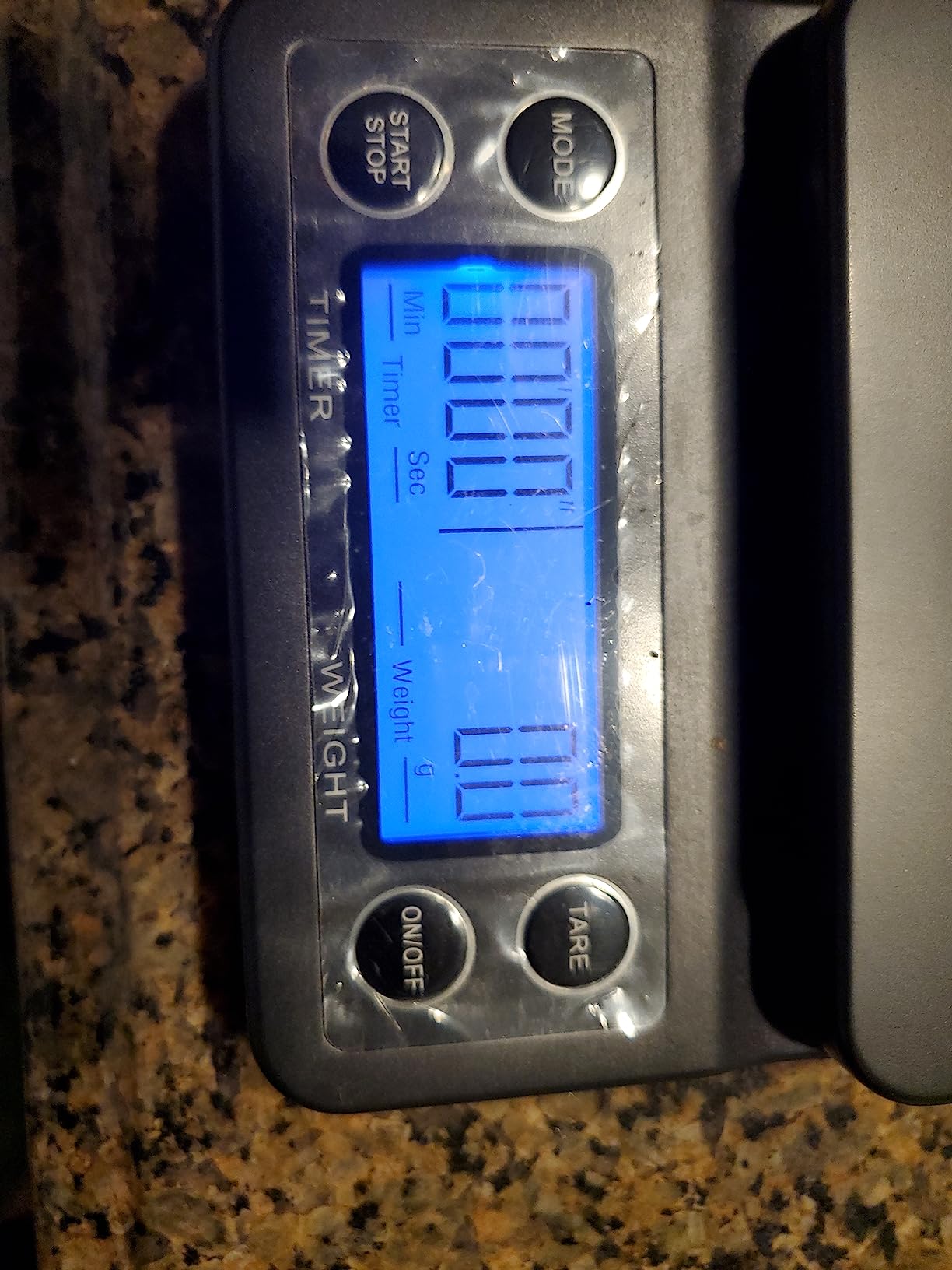
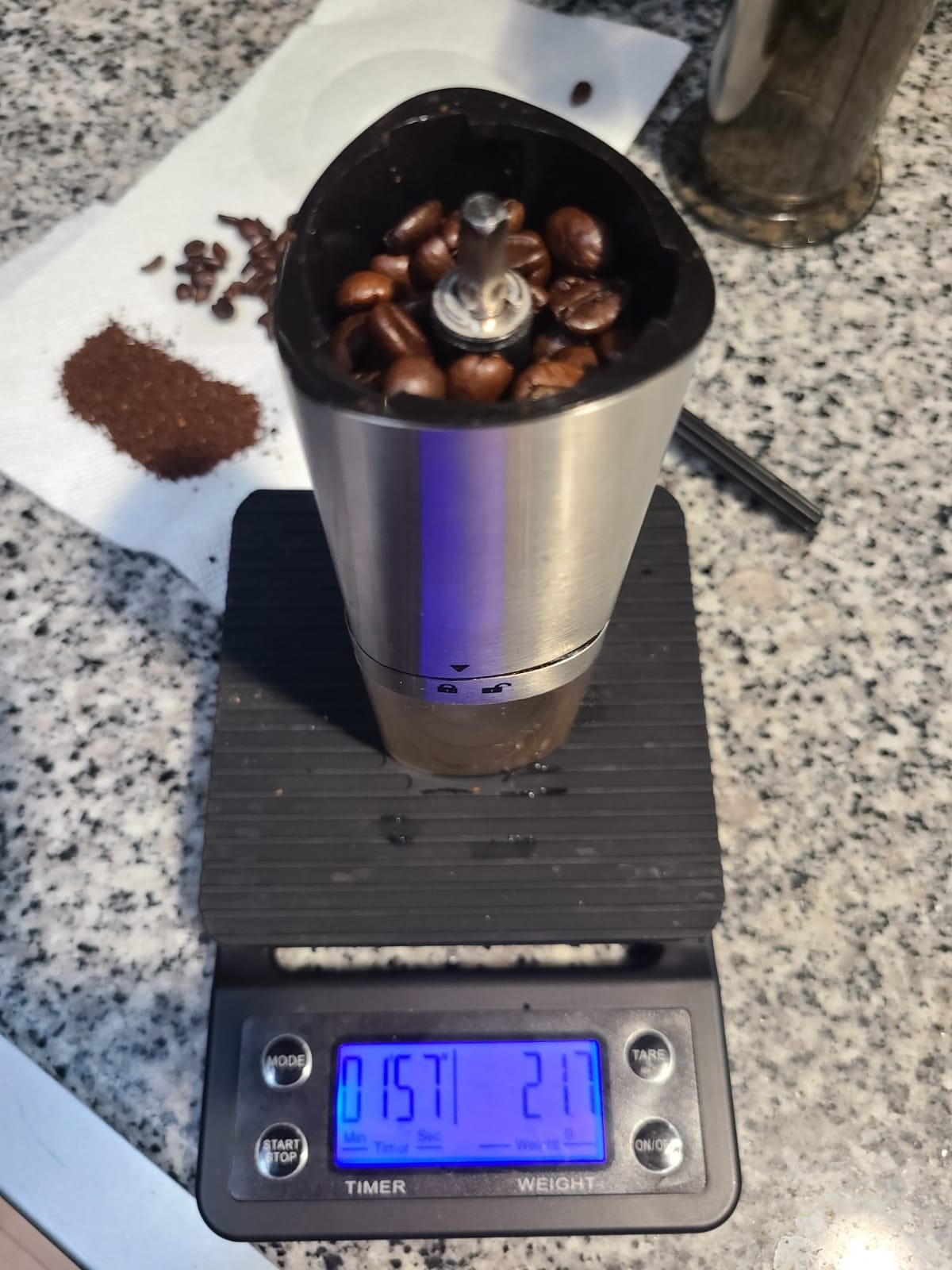
At 190 g this is the scale you forget is in your bag. It measures weight in ounces, grams and pounds plus volume in fluid ounces and millilitres, and the timer is not interrupted by short idle periods, which matters when you stop to chat mid-pour at a campsite.
The removable heat-resistant silicone mat and non-slip rubber base do the job of protecting the platform from boiling water and spillage, and both lift out for cleaning. Batteries are included, so it works on the first trip out.
Roughness matters more than features here, and owners report units still running after two years of daily use. The tare function handles different vessels well, which is exactly what you need when your brewer changes between a travel cone and a mug.
At 4.4 stars from 2043 ratings, roughly 71 percent are five-star, and the criticism is consistent rather than scattered. The platform is too narrow to support a Hario V60 on a stand, which produces a wobble, and the display dims and becomes hard to read after the timeout.
What gets right for camping and travel brewing
Weight, size and a battery in the box are the whole brief for a travel scale, and this one meets all three without a carry case. The five measurement formats cover a 20 g dose and a 300 g pour without converting anything.
A timer that survives idle gaps is a genuine advantage outdoors, where you stop pouring to deal with a wind or a fire and do not want to lose the brew clock.
Where it frustrates you
The narrow platform is the decisive drawback. It cannot properly support a V60 on a stand, so the cone wobbles while you swirl, and the reading refresh lags when water is poured in quickly.
Snap-style buttons need firm pressure and can shift the whole scale on a wobbly camp table. The back-lit display dims after the timeout, which is unhelpful in a dim kitchen, and readings can vary by a few tenths of a gram.
How to Choose a Pour Over Coffee Scale
Ignore resolution first and buy settling speed. Every scale here claims 0.1 g, but the difference between a reading that locks in 0.2 seconds and one that drifts for two seconds decides whether you can pour in stages. Fast settling turns a scale into a brewing instrument; slow settling turns it into a number you check afterwards.
Next comes platform size, and it is the question most often asked in forum threads without a clear answer. The practical rule is that the brewer base should sit fully on the platform with the load centred. A mini scale around 4 in across is built for a drip tray, not a carafe. A mid-size platform near 5 to 6 in handles a cone dripper and a small server. Anything approaching 6.5 in or wider takes a Chemex, a Kalita Wave or a batch carafe without overhang.
Display placement decides whether you can read the scale at all. A wide carafe on a narrow platform sits in front of the display and blocks it, which is why the angled screen on the Normcore and the low profile of the Hario matter more than their specifications suggest. Before buying, put the brewer where it will live and check you can see the numbers from standing height.
Auto-timer modes deserve scepticism. Flow-triggered timing, which starts when liquid is detected, can end a brew you did not mean to end, and one scale here cancels its pour over timer if you lift the brewer to swirl. A manual timer that you start yourself is slower but never surprises you. Auto power-on, which just wakes the display when you set something down, is the version we actually want.
Finally, check the charging port. A silicone-covered USB-C port has survived years of brewing better than an open micro-USB socket, and a rechargeable battery with a covered port removes both the battery aisle and the water-damage anxiety. For anyone weighing larger quantities, our shipping scale picks cover the far end of the capacity range, though nothing you need for a single V60.
Do You Really Need a Scale for Pour Over Coffee?
Yes, if you want to change one thing at a time. Brewing is dominated by ratio, and ratio cannot be eyeballed because coffee density shifts with roast level, moisture and grind size. A 1:16 brew is 18 g of coffee to 288 g of water, and a 1:17 is 20 g to 340 g, which is a meaningful difference in a 300 ml cup.
The scale also turns brewing into a repeatable process. Yesterday’s 22 g dose at 1:15 can be repeated exactly with new beans, and when the cup tastes flat you can raise the dose by a gram or lower the grind by a click and see which one changed it. Volume measures cannot do that.
What a scale does not do is fix bad technique. If the pour is too fast, the water hits the grounds unevenly and the display will still show your target weight, just with a worse cup. The numbers track the process; they do not correct it.
Matching a Scale to Your Brewer
Match the platform to the brewer, and the brewer to the batch size. A scale with a 4.1 in square platform, like the MHW-3BOMBER Mini, is built to slide under an espresso drip tray and is documented as fitting a Breville Bambino Plus. It is a fine platform for a small AeroPress or a single cone, and a poor one for a carafe.
A platform near 5 to 6 in, which covers the RENPHO at 5.12 x 5.91 in and the CULIKEM at 5.9 x 5.1 in, sits under a standard cone dripper and a small server without overhang. The Cozy Blue is the cautionary case: at the lightweight end of the range its platform is documented as too narrow to support a Hario V60 on a stand, so the cone wobbles.
For a Chemex or a large batch carafe, aim for the widest platform here. The BAGAIL at 6.7 x 5.1 in and the Fellow Tally Pro at 7 x 5.9 in both clear a wide base comfortably, and the 3000 g capacity on the BAGAIL means a 500 g brew reads at 0.1 g the whole way rather than stepping down.
Display readability follows from width. A wide brewer on a narrow platform overhangs the screen, so the number you need at 150 g is hidden exactly when you are pouring toward it. This is the single most common frustration in pour over scale discussions, and it is solved by platform width rather than by a better display.
Cleaning and Care for a Coffee Scale
Water is the enemy, and the simple rule is that the platform gets wet and the electronics do not. Wipe the brewing surface after every brew, lift out the silicone pad where one is provided, and wash that separately with warm water and a drop of dish soap.
Where a scale has a covered USB-C port, as the MHW-3BOMBER Mini and the BAGAIL both do, the cover is doing real work. Keep it seated, and treat an exposed port on a scale that lives near a kettle as a future repair. Never rinse the whole unit, and avoid running water across the display glass.
Scales that ship with a calibration weight, such as the Normcore Pocket V3, are worth checking once a year against a known 100 g mass. If the centre reading matches but the corners drift, the load cell is settling unevenly and the platform needs levelling. The CULIKEM needs no such check out of the box, which is a quiet reliability advantage.
What the r/pourover Crowd Actually Buys
Search r/pourover threads and a pattern emerges. Normcore comes up repeatedly when people want one scale for espresso and filter, always with the same caveat that the platform is small for a large carafe. The recurring question is whether an inexpensive scale is accurate enough, and the answer from owners is that accuracy to 0.1 g in the pour over range is what matters, not the badge.
The other consistent theme is fear of water. Scales dying from splashes is the most common source of buyer anxiety in those threads, which is why a covered charging port, a removable silicone pad and a stated water resistance rating rank higher than they otherwise would.
Broader brewing setups are covered separately in our guides to the home brewing kits and beer brewing kits, where gram precision matters just as much and the scale tends to be a larger platform model.
Frequently Asked Questions
Which coffee scale is best for pour over?
The RENPHO is the best overall for pour over. It reads to 0.1 g, locks a weight in 0.2 seconds, shows a live flow rate indicator and carries 3 kg of capacity on a rechargeable USB-C battery. If you want the ratio arithmetic removed entirely, the Fellow Tally Pro uses Brew Assist to set a water-to-bean target once and show it on screen.
Do you really need a scale for pour over coffee?
Yes, if you want to change one variable at a time. A 1:16 brew is 18 g of coffee to 288 g of water and a 1:17 is 20 g to 340 g, and those numbers cannot be eyeballed because coffee density changes with roast level and grind size. A scale makes yesterday’s cup repeatable with new beans. It does not fix a bad pour technique, though.
What coffee scales are recommended on Reddit?
In r/pourover threads the Normcore is named most often for people who want one scale that handles espresso and filter, with the usual caveat that the platform is small for a large carafe. Other repeated questions are whether an inexpensive scale is accurate enough, and whether a wide carafe blocks the display. Accurate readings in the pour over range and a covered charging port come up as the deciding factors.
How accurate does a pour over coffee scale need to be?
0.1 g resolution is the useful target, but settling speed matters more than the printed resolution. A scale that locks in 0.2 seconds lets you pour in stages and hit a target. Entry-level models often resolve to 0.1 g only up to 500 g, then step to 0.5 g and then 1 g, which is fine for a 330 g brew and not fine for a large batch.
Is flow rate actually useful for pour over brewing?
Yes, as a coaching tool rather than a number to chase. A live flow rate readout shows whether your pour is running faster than the recipe intends, so you can thin the stream and arrive at the target weight at the right pace. The RENPHO and the Maestri House S3 both display it, and the S3 pairs it with an audible alert at your chosen ratio.
Should I buy a pour over scale with a timer?
Yes, but treat the timer as a manual tool. Flow-triggered auto-timers can start or stop a brew you did not intend to, and one scale here cancels its pour over timer if you lift the brewer to swirl. A timer you start yourself is slower and completely predictable. Auto power-on, which simply wakes the display when you set the brewer down, is the feature worth having.
Final Verdict on the Best Coffee Scales for Pour Over Brewing
The RENPHO is the best coffee scale for pour over brewing overall, and the gap to the rest is about settling speed rather than headline accuracy. A 0.2 second weight lock, a live flow rate readout, three brew modes and 3 kg of capacity on a rechargeable battery cover every filter workflow we tested, and 8343 ratings make its weak points easy to see in advance.
Buy the Hario if your setup is one cone and a server. Buy the BAGAIL if a wide carafe has to sit centred on the platform. Buy the Fellow if you would rather the scale held your target than the other way round, and buy the KitchenTour if you are starting out and want repeatable dosing for the least commitment.
Whichever one you choose, use it for the same recipe three times before you change anything. Consistency first, then dial in. You can check the latest price on each of these through the buttons above.