

A cabinet table saw is the one machine that turns a pile of rough lumber into furniture. If you have spent any time building cabinets, cutting face frames, or breaking down sheet goods, you already know how quickly a wobbly fence or a drifting blade height turns a clean cut into a sanding job. The best cabinet table saws for woodworking solve that problem by pairing a heavy cast-iron table with a powerful motor, a rigid steel cabinet, and a fence that holds its setting under load.
We spent weeks reading spec sheets, warranty terms, and thousands of lines of owner reviews on the seven cabinet saws below, then compared them on the things that actually change your cuts: fence rigidity, motor power and voltage, rip capacity, safety systems, dust collection, and shop footprint. What we found is that the class splits neatly into two groups. Some are 110V machines that work in a two-car garage right out of the crate. The rest are 230V single-phase machines that need a dedicated circuit before they will run at all.
Below you will find the short version of our findings, the full reviews, and a buying guide that explains the electrical and space requirements nobody mentions in a product photo. We also link to our other saw roundups if a full-size cabinet saw is more machine than your shop can host yet.
Top 3 Cabinet Table Saw Picks for 2026
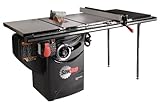
SawStop PCS175-TGP236
- Stops blade in under 5 ms
- 36 inch T-Glide fence
- 0.010 inch diagonal table gap
- 110V so no electrician
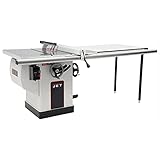
JET Xacta JTAS-10XL50-1DX
- 50 inch XACTA fence II
- 3HP 230V single phase
- 11 inch cast iron wings
- Poly-V belt drive

Laguna F2 Fusion
- 1.75HP TEFC on 110V
- Cast iron table and wings
- Built-in casters
- 4 inch dust port
Best Cabinet Table Saws at a Glance in 2026
| Product | Specifications | Action |
|---|---|---|
| SawStop PCS175-TGP236 |
|
Check Latest Price |
| JET Deluxe Xacta JTAS-10XL50-1DX |
|
Check Latest Price |
| Laguna F2 Fusion |
|
Check Latest Price |
 SawStop Industrial ICS51230-TGI236 SawStop Industrial ICS51230-TGI236 |
|
Check Latest Price |
 Grizzly Industrial G0651 Grizzly Industrial G0651 |
|
Check Latest Price |
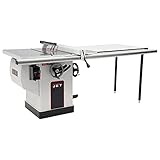 JET Deluxe Xacta JTAS-10XL50-5/1DX JET Deluxe Xacta JTAS-10XL50-5/1DX |
|
Check Latest Price |
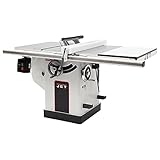 JET Deluxe Xacta JTAS-10XL30-5/1DX JET Deluxe Xacta JTAS-10XL30-5/1DX |
|
Check Latest Price |
What Is a Cabinet Table Saw and Why It Beats a Jobsite Saw
The difference is mass, and mass is why a cabinet saw stays accurate. A jobsite saw folds down, rides on folding legs, and is built to be carried between jobs. A cabinet table saw weighs between 330 and 700 pounds in the group we reviewed, built around a cast-iron top, a welded steel cabinet, and a motor bolted to that cabinet. Heavier machines resist vibration, hold blade height, and stay square when a hardwood board or a full sheet of plywood is pushed through them.
Two practical differences follow from that weight. First, rip capacity: a cabinet saw usually rips 30 to 50 inches, which means a 4×8 sheet of plywood breaks down without a seam down the middle. Second, safety: cabinet saws carry riving knives, anti-kickback pawls, and on the SawStop models an electronic blade brake that stops and drops the blade in under five milliseconds. If you are still shopping for a lighter machine, our guide to the best table saws overall covers the whole category, and the best portable table saws roundup covers the folding-saw end of the market.
There is a cost to that mass. Cabinet saws are heavy to move, they usually arrive by freight and need to be uncrated in place, and the 230V versions need real electrical work before the first cut. Plan the floor space and the circuit before you plan the saw.
How We Chose These Cabinet Table Saws
We compared every saw on the same checklist: motor horsepower and voltage, current draw, rip capacity, fence type and adjustability, safety systems, dust collection port size, table material, machine weight, warranty length, and the availability of replacement parts. We also read the owner reviews closely, because a spec sheet cannot tell you that a fence rail was never aligned to the cabinet, or that a washer can drop into a dust duct during a blade change.
Where the review base is thin, we say so. Some of these saws have only a handful of reviews, and a 4.7 rating built on five reviews tells you far less than a 4.4 built on seventy-six. We weighed the size of the sample every time we made a call.
1. SawStop Professional PCS175-TGP236 – Best Overall Cabinet Table Saw
SAWSTOP 10-Inch Professional Cabinet Saw, 1.75-HP, 36-Inch Professional TGlide Fence System (PCS175-TGP236)
- Blade stops and drops in under 5 milliseconds
- Heavy-gauge steel T-Glide fence resists deflection
- Gas piston elevation makes height changes smooth
- Table flatness verified diagonally
- 110V power needs no circuit upgrade
- TSG-DC dust guard and overarm collection sold separately
- Control box is a single point of failure if the self-check computer faults
This is the saw we keep coming back to, and the reason is simple: it is the only machine in this group that combines an electronic blade brake with a 110V plug. The PCS175-TGP236 runs a 1.75HP motor on 110 volts, so a homeowner with existing household branch circuits can put it to work without calling an electrician. That single detail removes the most common reason buyers walk away from a cabinet saw.
Everything else about it is serious. The 36-inch T-Glide fence and rail are heavy-gauge steel, which is exactly what you want when you are resawing or cutting thick hardwood. Blade height runs on a gas piston elevation, so the blade moves smoothly instead of dropping in increments, and the table is verified diagonally at a 0.010 inch maximum gap before it leaves the factory. A control box on the machine carries the on-off switch, a power paddle, and an onboard self-diagnostic computer.
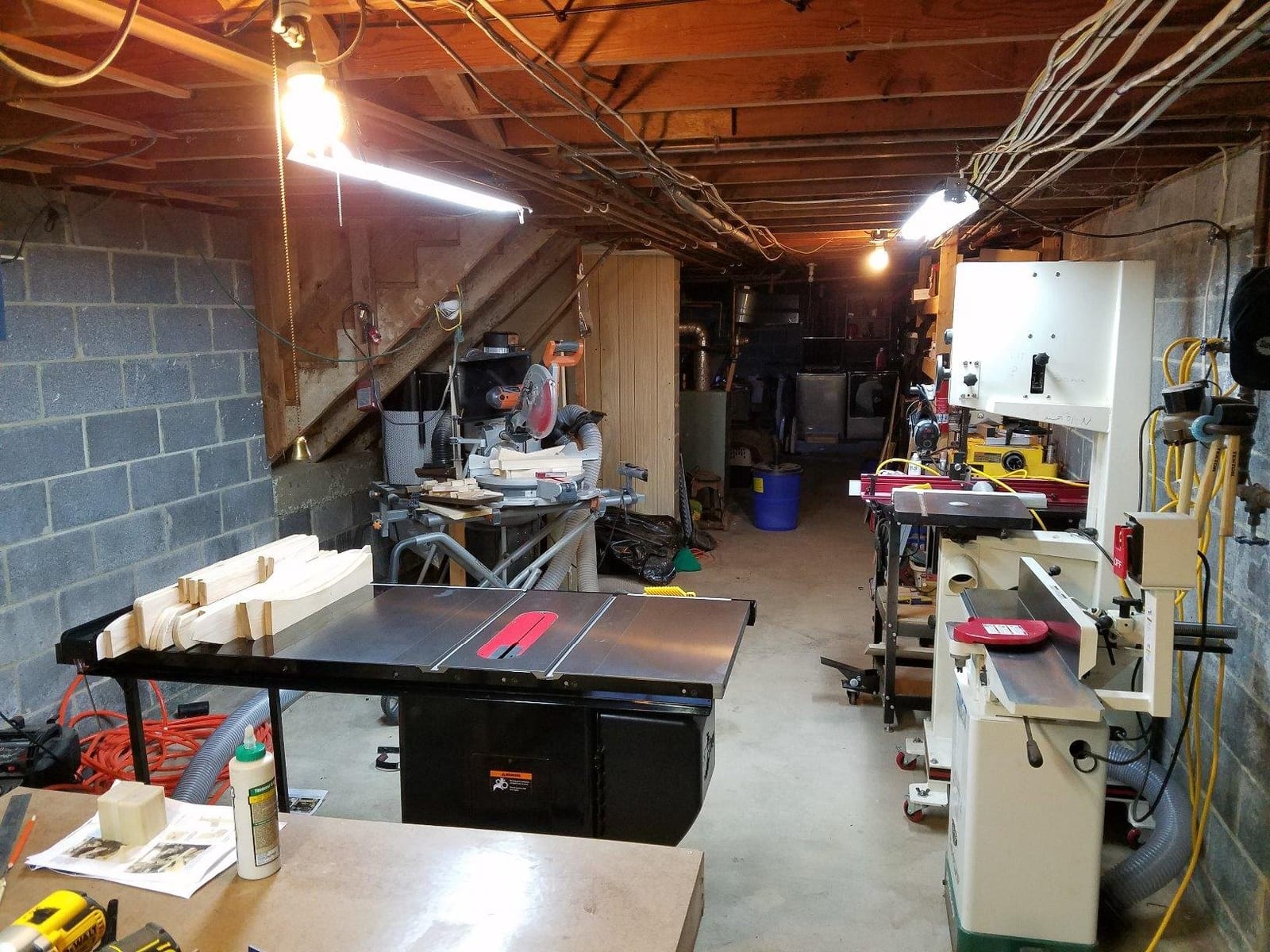
The SawStop safety system is the headline feature and the reason the brand has a following. Contact between the spinning cartridge and skin brings the blade to a stop in less than five milliseconds and drops it below the table, so the most common table saw injury becomes a non-event. Owners on r/woodworking are unreserved about the SawStop switch, describing the move to a SawStop cabinet saw as a change they would not go back from, and one long-term owner on LumberJocks reported five years of trouble-free use after replacing a Bosch jobsite saw with a SawStop cabinet model.
Two caveats are worth planning around. The TSG-DC dust collection guard and the overarm dust collection assembly are sold separately, so the 99 percent collection figure the brand advertises assumes you add them. And the control box, which houses the diagnostics and the power paddle, is a single component that takes the whole electrical system offline if it fails.
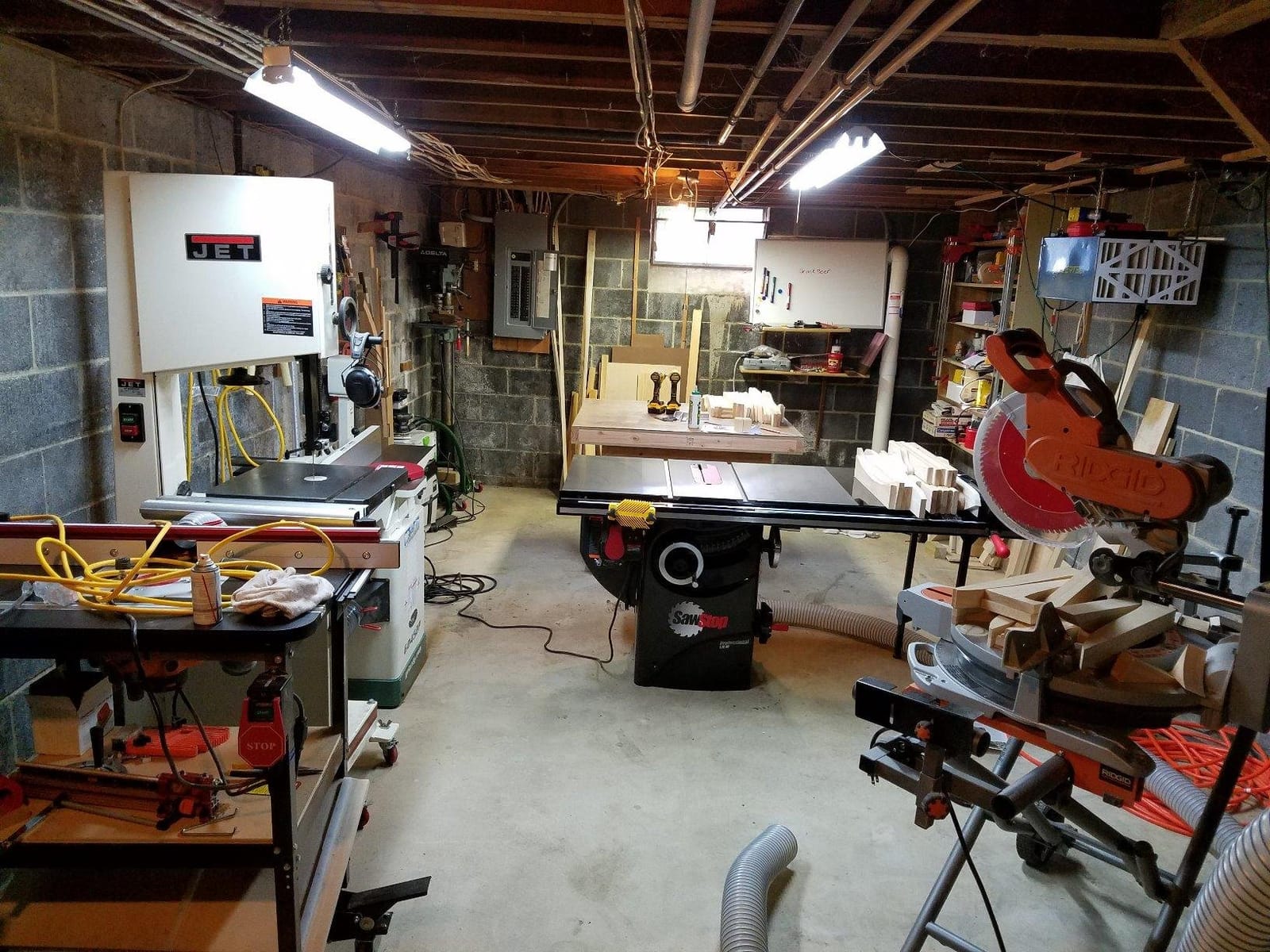
How the SawStop PCS175 Handles Sheet Goods and Hardwood
The 36-inch T-Glide fence reaches far enough right to break down most cabinet components and cabinet backs. Owners working in hardwood report stable cuts with no vibration or binding, and the 40-tooth stainless steel blade that ships specified handles crosscut and rip work well for general cabinetry. For full 4×8 sheet goods you will still want outfeed support on both sides, and the fence rail is what makes the difference between a supported cut and a twisted one.
Who Should Skip the SawStop PCS175
Skip it if your shop already has a 230V subpanel and you intend to run heavy production work every day. At 1.75HP you are giving up the reserve that a 3HP or 5HP machine holds, and a serious production shop will feel the difference on thick stock. You also want to skip it if dust collection is high on your list, because the guard and overarm assembly are add-on purchases rather than standard equipment.
2. JET Deluxe Xacta JTAS-10XL50-1DX – Best Value Cabinet Table Saw
JET 10-Inch Deluxe XACTA Table Saw, 50-Inch Rip, 3 HP, 230V 1Ph (JTAS-10XL50-1DX)
- 50 inch commercial XACTA Fence II breaks down full sheet goods
- 11 inch cast iron wings on both sides
- Quiet Poly-V belt drive
- Quick-release riving knife cuts binding
- Push-button arbor lock speeds blade changes
- 230V single phase needs a dedicated circuit
- Arrives without a power cord connected at the junction box
At 3 horsepower with a 50-inch fence, this Xacta is the volume machine of the group, and the fence makes short work of full panels. The 50-inch rip capacity means a full 4×8 sheet breaks down into two clean halves without a seam, and the 11-inch cast iron extension wings on each side give you one of the largest support surfaces among the saws here. If your work is a wall of cabinet boxes, that combination is worth more than another brand badge.
Mechanically, the details are right. The Poly-V belt drive runs quietly, a quick-release riving knife lets you clear a binding cut without reaching into the blade path, and the push-button arbor lock makes blade changes fast. A wide-stance heavy-duty trunnion keeps blade positioning smooth through the whole height range.
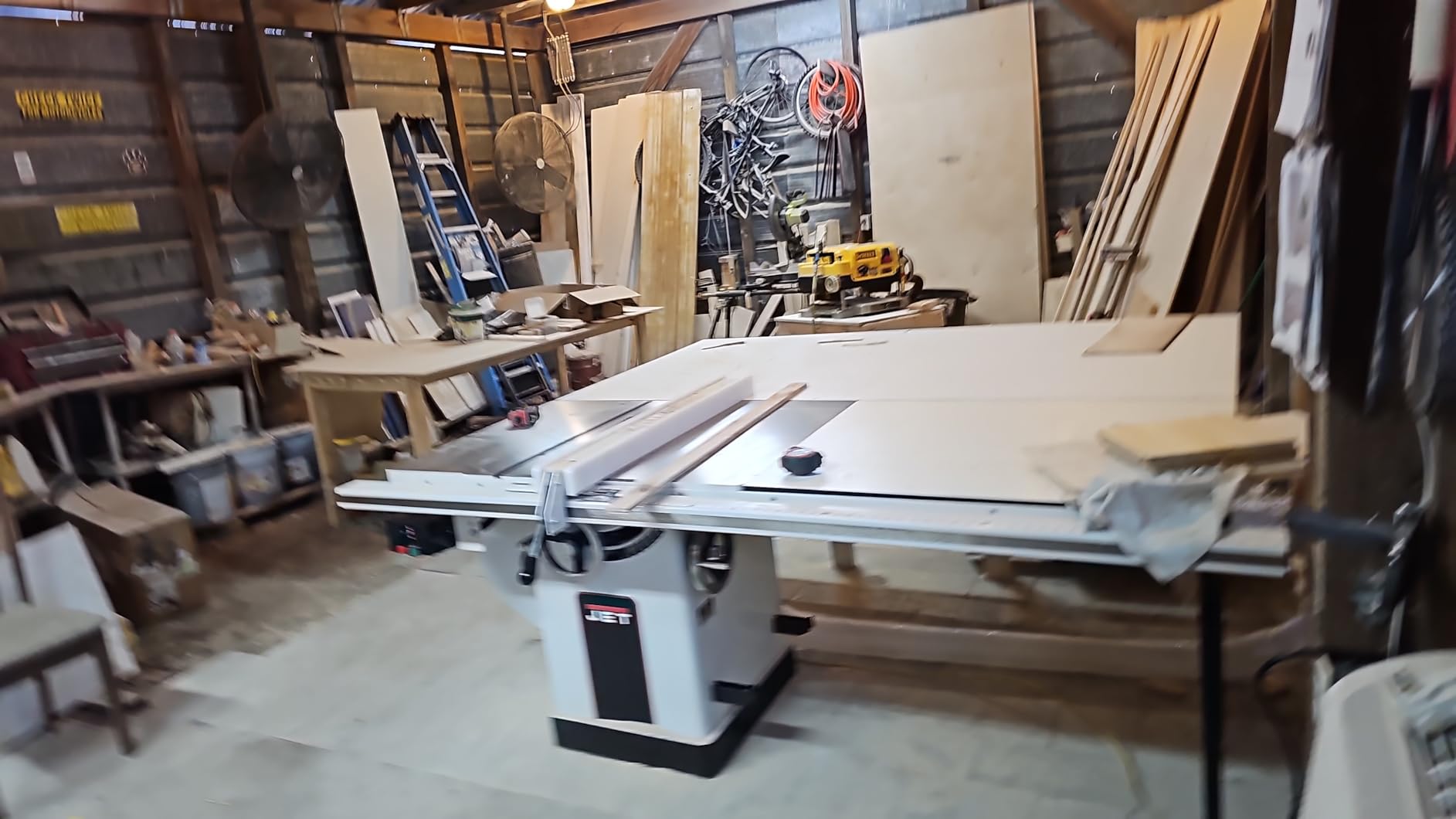
The most common owner complaint is not about the machine at all. It arrives unwired, meaning you terminate your own power cord at the junction box, and for most people that is where the setup anxiety comes from. On the upside, buyers consistently rate the machine highly once it is running. The stated cutting angle in the product data is 45 degrees with a 4300 rpm blade speed, and the included parts list covers the saw, fence, rails, miter gauge, riving knife, blade guard, push stick, extension table, and both cast iron wings. The warranty runs five years for residential use, two for commercial or industrial use.
The Xacta is also the saw that made us reconsider the footprint question. Its listed dimensions run 85 inches long by 36 inches wide, which means it eats floor space in a two-car garage faster than the 330-pound weight suggests. Measure the room before you commit, and our roundup on the best table saws overall covers smaller-footprint alternatives.
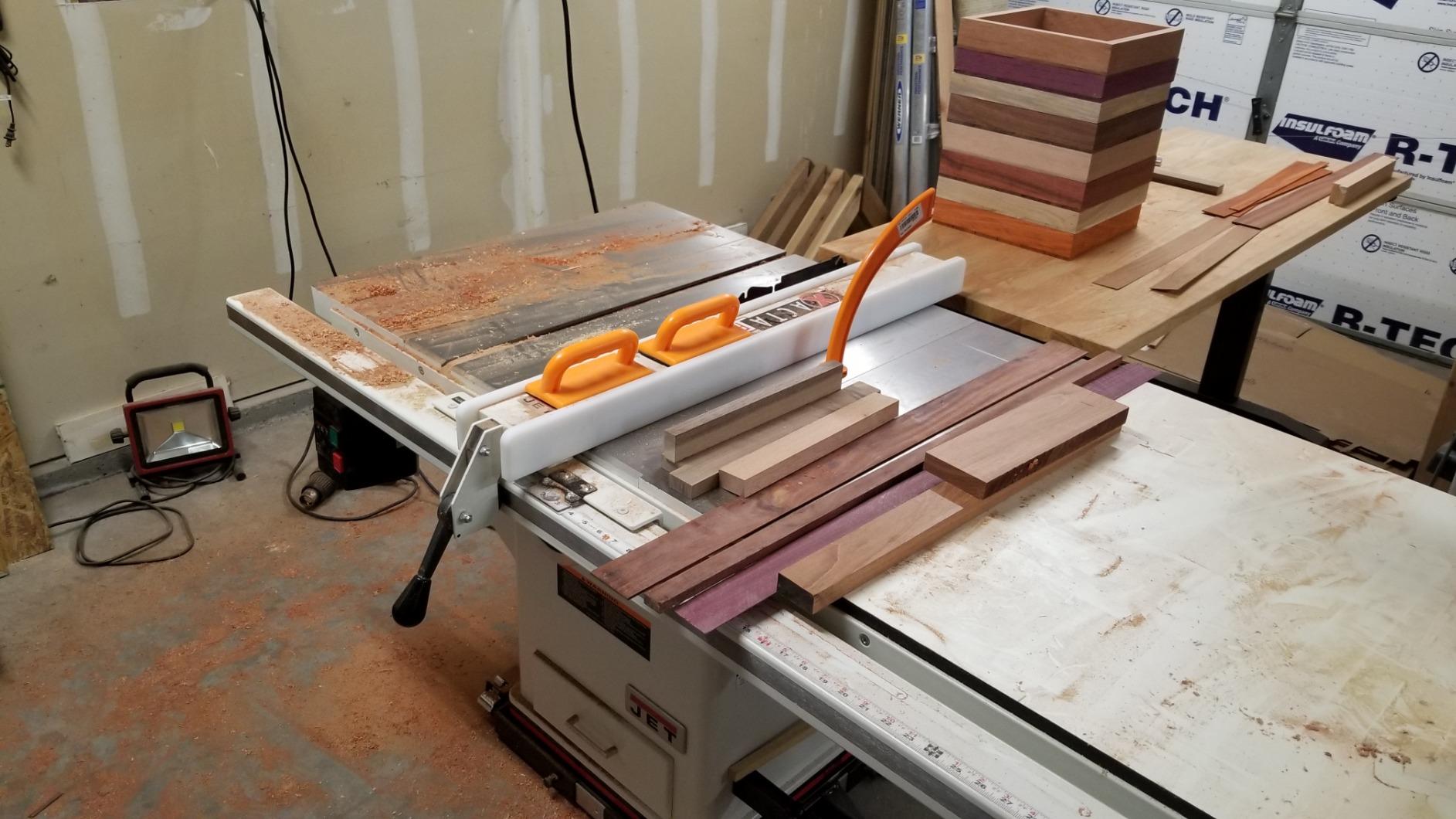
Why the 50-Inch Fence Changes Your Sheet Goods Workflow
Ripping capacity is the number that changes how you work rather than just how you cut. At 50 inches you break a 96-inch sheet into two 48-inch halves in a single pass, which saves a seam, saves a second setup, and keeps panel edges matched. The trade-off is real, though: the same fence length means a longer rail, a longer cabinet, and a wider turning circle around the saw. If you mostly cut solid wood and rarely break down sheet, a 30-inch fence leaves you more floor.
Who Should Look Elsewhere Instead
Look elsewhere if your shop is on 110V service and you are not prepared to run new electrical. A 3HP single-phase motor is not a tool-and-strip job, and the wiring step means hiring a qualified electrician in most regions. If you are set up for 230V but work in a tight room, the 30-inch Xacta in section seven does the same job with a much smaller footprint.
3. Laguna F2 Fusion – Best Cabinet Table Saw for Small Shops on 110V Power
- Runs on standard 110V yet cuts dense hardwoods
- Cast iron table and wings
- Built-in casters make a 359 lb saw easy to move
- 10 inch 60T carbide blade included
- Tool storage integrated into the cabinet
- Dust collection leaves residue inside the cabinet
- Stabilizing washer can drop into the dust ducting
- 220V conversion kit is physically awkward
- Two people or a hoist needed to unload the crate
The F2 Fusion is the answer to the question that comes up constantly on woodworking forums: which cabinet saw works in a two-car garage with no electrical work. It runs a 1.75HP TEFC motor on 110 volts, sits on casters built into the base, and weighs 359 pounds, which is far lighter than the 471-pound SawStop and far lighter than the roughly 700-pound industrial SawStop. Owners report cutting dense hardwoods such as mesquite, eucalyptus, red gum, and rosewood without complaint, and one of them specifically calls out having no vibration or kickback problems at all, which is a marked step up from contractor saws.
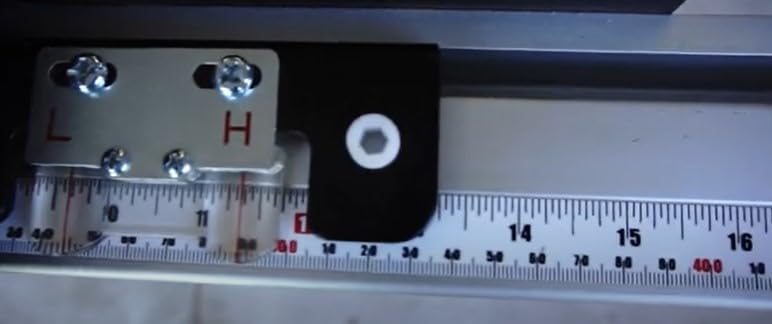
The build quality comes as standard. You get a cast iron table and wings, a European hi-lo fence, a full cabinet body with a cabinet-mounted arbor, and a 10-inch 60-tooth carbide-tipped blade already in the box, which is not something you can say for most machines in this class. A hi-lo dust collection system with a 4-inch port handles collection from above the blade, and the cabinet includes tool storage and easy interior access for maintenance.
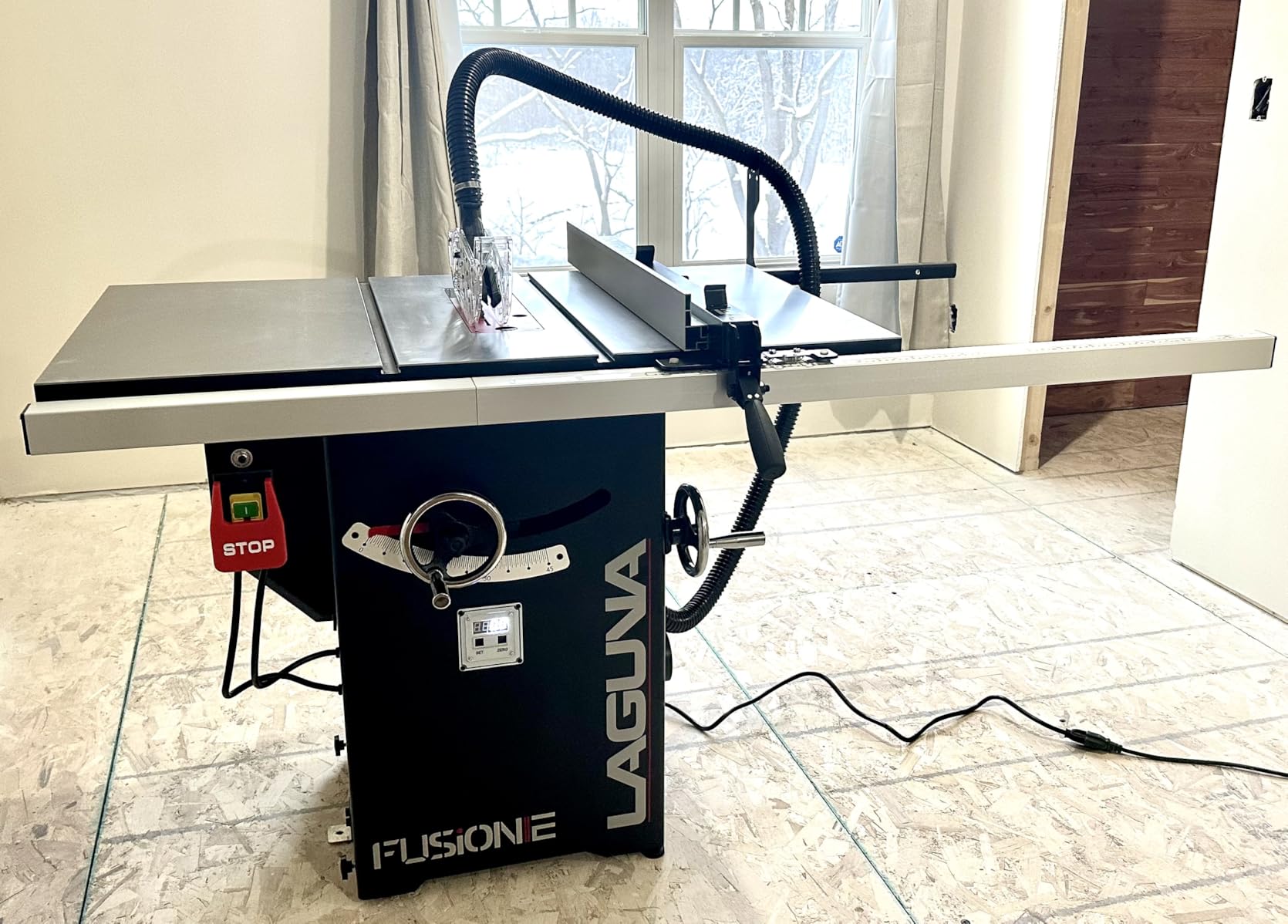
Two design details come up often in owner feedback and are worth knowing before you buy. The dust collection captures sawdust, but residue still settles inside the cabinet in places that are hard to reach, so you will want to open the doors periodically. And the stabilizing washer used during a blade change can drop down the dust ducting, which is an annoying failure to retrieve. If you decide later that you want more power, a 220V conversion kit exists from the factory, though owners describe it as simple in principle and awkward in practice.
One practical note on arrival: this machine moves by freight and comes heavy enough that two people or a hoist are needed to unload it. That is normal for the class, but worth planning a day for.
Why 110V Changes What You Can Build
The reason the F2 earns its place here is that 110V power changes the list of what you can make, not just the list of what you can buy. A 2-car garage shop with no subpanel is closed to almost every other cabinet saw on this page. The 1.75HP TEFC motor covers the cabinetry, trim, and general hardwood work that fills that space, and the cast iron table means the blade height holds as the machine warms up. If your ambitions eventually reach thick slab work, the conversion kit is the upgrade path rather than a full replacement.
Who Should Skip the Laguna F2 Fusion
Skip it if you are already set up for 230V and plan to run production work. You would be buying a machine that is a full horsepower short of what high-volume cutting wants. Skip it if dust collection is your top priority, since the residue complaint is repeated often enough to plan around. And skip it if you have no help and no hoist available on arrival day.
4. SawStop Industrial ICS51230-TGI236 – Best for Heavy Production Work
SAWSTOP 10-Inch Industrial Cabinet Saw, 5-HP, 36-Inch Industrial T-Glide Assembly (ICS51230-TGI236)
- 5HP motor for sustained industrial duty
- Roughly 700 lbs of iron and steel
- Lock-out tag-out plus door interlock switches
- 99 percent dust collection guard included
- Two-year saw and five-year motor warranty
- Overarm dust collection assembly sold separately
- 230V configuration needs circuit capacity checked
- Larger machine that needs a planned move into place
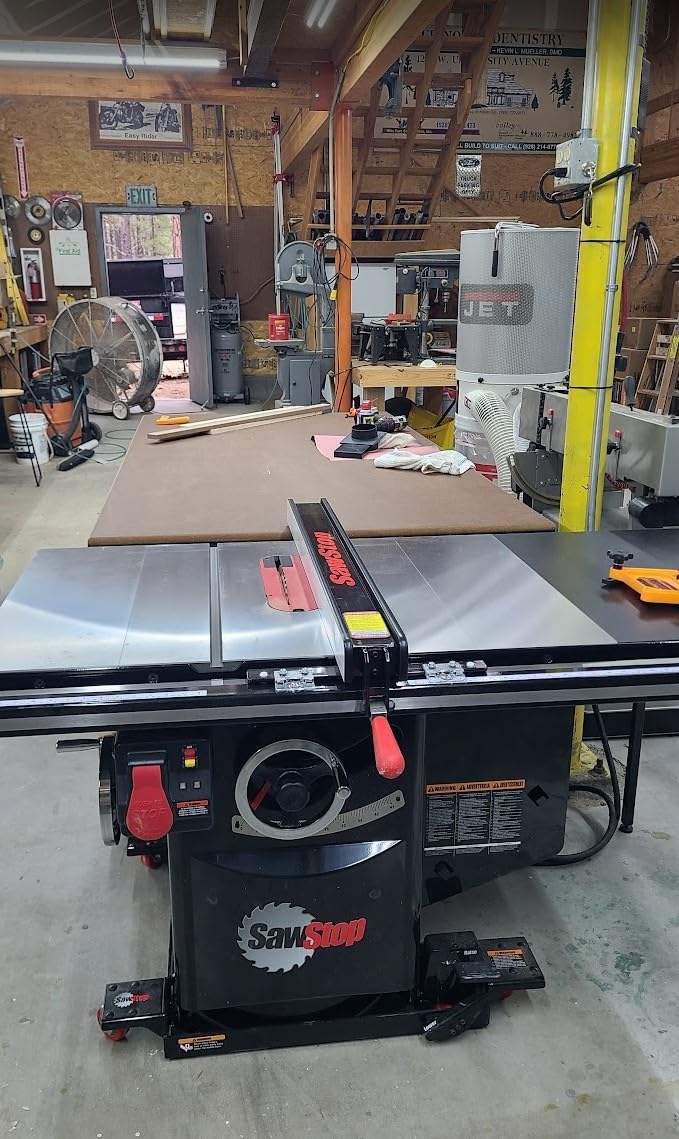
This is the machine for someone who cuts all day and does not want to watch the motor bog. The 5HP single-phase motor is built into roughly 700 pounds of iron and steel, and the listed dimensions of just under 70 inches square tell you how much floor it claims. The 36-inch industrial T-Glide advance fence and rail are heavy-gauge steel, so a heavy board or a thick panel does not push the fence out of square.
The safety package goes a step beyond the Professional model. An integrated lock-out tag-out switch and interlock switches on the motor access panels will block operation if any door is unlatched, which matters in a shop with more than one person working. The dust collection blade guard is included here rather than sold separately, so the 99 percent above-table collection figure is achievable out of the box. The specified blade is a 60-tooth high speed steel model, and the warranty is two years on the saw and five on the motor.
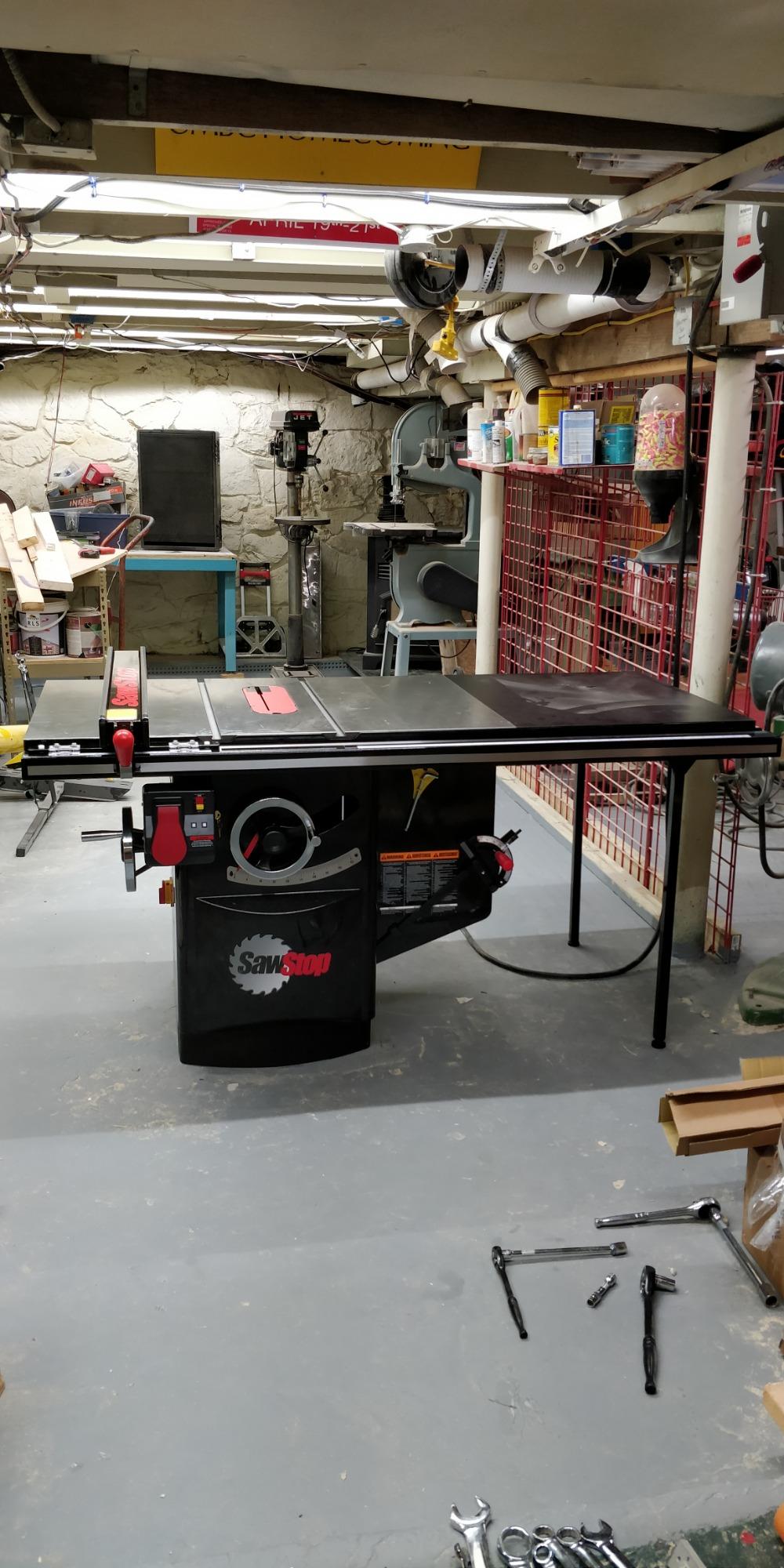
Where owners push back, it is on finish and arrival condition. With only a handful of reviews, the one-star share reflects isolated problems with paint finish or damage in transit, and the review base is thin enough that you should treat the 4.4 rating as directional rather than precise. At this weight, getting the saw into a basement or a shop through a door is an operation you plan for in advance, and the electrical side needs a genuine 230V single-phase circuit with adequate capacity.
It is worth noting the range of configurations this model family covers. The listing shows variants with a 3HP single-phase 230V motor, a 5HP three-phase 230V motor, a 5HP single-phase 230V motor, and a 52-inch T-Glide fence, all sharing the same cabinet and safety architecture. That range is useful if you are planning growth in motor power later, because the saw body stays the same.
When 5 Horsepower Actually Pays for It
Horsepower matters when you are pushing a wide blade through thick stock repeatedly rather than when you are making one clean cut. A 5HP motor holds blade speed under load on thick hardwood, wide dado work, and repeated rips of dense hardwood, where a smaller motor bogs and slows the cut. The lock-out and interlock system also earns its place in a shared shop. For a one-person hobby shop cutting cabinet parts, this is far more machine than you will ever use, and the difference in the review base between this saw and the Professional model reflects how few buyers put it to work in a home shop.
What It Costs You to Choose This Saw
You are paying for capacity you may not use, and there are three specific costs. Electrical work at 230V with a heavy motor load is the first. The overarm dust collection assembly is a separate purchase, so collection is not complete. And a machine of this mass needs a plan for the day it arrives, including help at the door and a clear path to its final position. If any of those three are unresolved, the Professional SawStop or the Xacta is the better buy.
5. Grizzly Industrial G0651 – Best for Sheet Goods Capacity
Grizzly Industrial G0651-10″ 3 HP 220V Heavy Duty Cabinet Table Saw
- Rip capacity plus side and back tables support full panels
- Easy to assemble
- Plenty of power for solid hardwood
- Digital readout for angle settings
- Under-table storage for sleds and jigs
- Finish and fit vary from unit to unit
- Lukewarm warranty service reported by some owners
- Large 91.5 inch listed footprint
- One owner reported early motor failure
The G0651 is the sheet goods specialist of this group. Its table measures 27 by 75-3/4 inches with the extensions, and owners credit the combination of ripping capacity plus the side and back tables with making full sheet goods a one-person job. That is the practical test that matters: can you support a full panel through the cut without a helper holding the offcut? On this saw, the answer is usually yes.
Under the hood it is a straightforward 3HP 220V single-phase motor drawing 13 amps, with a 45-degree blade tilt and a table height of 34-7/8 inches from the floor. A digital readout handles angle settings, and under-table storage keeps sleds and jigs out of your walking path. The stated blade is a 50-tooth high speed steel model, and the machine weighs 435 pounds.
The reviews are split, and we think that split is about fit and finish on arrival rather than design. Owners describe the saw as easy to assemble and powerful enough to rip solid hardwoods, with an accurate fence and a well-liked angle readout. The complaints cluster around units arriving with a dented cabinet, a bubbling tape measure strip, and support legs that leave the end of the table riding high. Warranty responsiveness has also been described as lukewarm, and one owner reported a motor failure within six months of light use. On a 4.0 rating with a 15-review sample, that split is the story.
When the Extra Table Surface Changes Your Process
Sheet goods work is about support, not just capacity. When the table and its extensions can carry the full width of a 4×8 sheet, the panel stays flat through the cut and you stop fighting twist. That also means fewer helper hands, fewer sacrificial runners, and a cleaner edge on the parts you will later edge-band or shoot with a screw. If your shop is a one-person operation that builds cabinet runs, that support area is the argument for this saw over a smaller machine.
Who Should Pick a Different Saw
Pick something else if you have no patience for inspecting the machine on arrival, because the fit and finish reports are frequent enough to matter. Pick something else if you cut mostly solid wood in a small room, since the listed 91.5 inch length makes this the largest listed footprint among the saws here. Pick something else if you want an electronic blade brake, since this saw relies on the riving knife, pawls, and a blade guard rather than a braking cartridge.
6. JET Deluxe Xacta JTAS-10XL50-5/1DX – Best for High-Throughput Cutting
JET 10-Inch Deluxe XACTA Table Saw, 50-Inch Rip, 5 HP, 230V 1Ph (JTAS-10XL50-5/1DX)
- Ample power for thick stock
- Cuts reported as accurate and smooth
- Thorough manual with staged hardware packages
- Chrome-plated heavy-duty handwheels
- Independent leaf guard works at 45 degree tilt
- Small and awkward on-off switch
- Arrives on a flimsy pallet with finish defects reported
- Rear rail support reported misaligned with the base
- Motor cover latch does not fully close
- Arrives unwired so the owner must terminate the cord
This is the same 50-inch Xacta cabinet as section two with a 5HP motor in place of the 3HP, drawing 14.5 amps at 230 volts and running the blade at 4300 rpm. If your work is thick hardwood and you want the reserve to keep blade speed up under load, that is the entire argument. Owners report accurate, smooth cuts and plenty of power, and the deluxe miter gauge with adjustable positive stops and large soft grip handles is a real upgrade for crosscut work.
The deluxe specification also includes heavy-duty chrome-plated handwheels that make trunnion and arbor movement smooth, and an independent leaf safety guard that protects the operator even with the blade tilted to 45 degrees. The manual is thorough, with clear photos and all hardware packed in staged packages, which matters when you are assembling a saw in a shop rather than a factory.
What holds the rating down is fit, finish, and assembly alignment, and we want to be direct about it. This saw carries the lowest rating of the seven at 3.5, and the reasons are specific: units arriving on a flimsy pallet with cosmetic finish defects, a rear rail support reported as not aligning with the saw base and requiring rework, a motor cover latch that does not fully close, and a small on-off switch that is awkward to reach. It also arrives unwired, so a cord has to be terminated at the junction box. With only seven reviews behind the score, we would inspect the machine on arrival rather than accept it as shipped.
Whether the 5HP Upgrade Is Worth the Extra Setup Work
Going from 3HP to 5HP is a two-horsepower jump, and whether it helps depends on your material and your hours. If you are cutting cabinet parts, face frame stock, and general hardwood, the 3HP Xacta has more than enough and this saw buys you nothing you will feel. If you are resawing thick lumber, cutting wide boards, or running long production days, the 5HP holds blade speed where the smaller motor would bog. Against that, you accept the alignment rework risk and the awkward switch placement that come with this particular unit.
Alternatives With Better Owner Feedback
Two options make more sense for most buyers. The 3HP version of the same saw is the stronger all-round pick, with the same fence and the same 50-inch capacity at a lower current draw and a higher rating. Or the 30-inch Xacta in the next section, which is the same motor with the smallest footprint among the 230V models here and a uniformly positive, if very small, review base. Choose this saw only when you specifically need 5HP and you have time to check the rail alignment on arrival day.
7. JET Deluxe Xacta JTAS-10XL30-5/1DX – Best for Small Garage Shops
JET 10-Inch Deluxe XACTA Table Saw, 30-Inch Rip, 5 HP, 230V 1Ph (JTAS-10XL30-5/1DX)
- Quiet Poly-V belt drive
- 11 inch cast iron wings on both sides
- Push-button arbor lock and quick-release riving knife
- Rail-mounted magnetic switch with overload protection
- Smallest listed footprint among the 230V models
- Only five reviews behind the rating
- 30 inch rip will not handle a full 4x8 sheet in one pass
- 230V configuration needs a dedicated circuit
This saw is the one we would point a 230V shop with a tight floor at. The listed dimensions of 65 by 36 by 34 inches are the smallest footprint of any 230V machine here. It carries the same 5HP single-phase motor and the same 11-inch cast iron extension wings as the 50-inch model, so you give up fence length and nothing else in the family. For a solid wood shop that never breaks down full panels, that is exactly the right trade.
Owners rate it highly. It holds a 4.7 with no reviews below four stars, the Poly-V belt drive keeps the machine quiet, the push-button arbor lock and quick-release riving knife handle blade changes and reduce binding, and the rail-mounted magnetic switch is easy to reach and provides overload protection. A caveat on the numbers: this rating rests on five reviews, so treat it as a promising signal rather than a settled verdict.
The 25-amp current rating means it wants a dedicated high-voltage circuit, which is the same electrical conversation as the other 230V models here. Its 30-inch rip capacity is the limiting spec. A 96-inch sheet will not break down in one pass, so plan on a seam or a different machine for panel work.
How Much Rip Capacity Do You Actually Need
Rip capacity should be sized to the job you repeat, not to the biggest number available. If you cut solid lumber, face frame stock, and drawer parts, 30 inches covers nearly all of it and the saw stays out of your way. If your business is cabinet boxes and you live with 4×8 sheet goods, 30 inches means a seam in the middle of every panel, and a 50-inch fence is worth the extra floor space. Our buying guide section on rip capacity walks through the arithmetic.
Who This Saw Is and Is Not For
It suits a one-person shop with 230V service that is short on floor and long on solid wood work. It is not for a panel-goods operation, and it is not for a shop still on 110V power. If the electrical work is the blocker, the Laguna F2 Fusion runs on 110 volts and is the more sensible first cabinet saw for most hobbyists. If you also need a matching crosscut saw for the miters that follow, our roundup of the best miter saws covers that side of the bench.
How to Choose a Cabinet Table Saw: Seven Things That Matter
1. Motor Power, Voltage and the Circuit You Already Have
Start here, because it eliminates options. Two saws in this group run on 110 volts: the SawStop PCS175 and the Laguna F2 Fusion, both with 1.75HP motors. The other five run on 220V or 230V single phase, and their current draw ranges from 13 amps on the Grizzly G0651 to 25 amps on the 30-inch Xacta. Anything in that range wants a dedicated circuit, not a shared one with a shop vac and a radio. The JET models arrive unwired, so you or your electrician terminate the cord at the junction box. If a subpanel is not already in your shop, the electrical work can cost more than a saw upgrade would, which is why 110V options exist.
2. Rip Capacity and Sheet Goods Math
Rip capacity is the distance from the blade to the fence at full extension, and it is the number that decides whether panel work is a one-pass job. A 4×8 sheet is 96 inches long. Crosscut it into two halves and each half is 48 inches, so you need at least 48 inches of rip to break a sheet down without a seam. A 50-inch fence clears that comfortably. A 36-inch fence means working in thirds, and a 30-inch fence means the seam stays. Hold the sheet flat with extension wings and outfeed support on both sides so the panel does not twist mid-cut.
3. Fence System: Rack-and-Pinion, T-Style and Hi-Lo
Three fence styles show up here. T-style, used on the SawStop T-Glide rails and the JET Xacta, uses a flat steel face that slides on a square post, so the face stays square to the table over the whole travel. Rack-and-pinion fences use toothed racks and gears, which are precise and very heavy. European hi-lo fences, on the Laguna, use a lower rail for rough positioning and an upper face for final setting, which speeds up setup. Whatever the style, look for a heavy-gauge rail and a way to lock the fence down under pressure.
4. Safety Systems: Riving Knife, Pawls and Braking
Look for a riving knife and anti-kickback pawls on any saw in this class. The three Xacta models list a quick-release riving knife so you can clear a binding cut without reaching into the blade path, and both 5HP Xacta models add an independent leaf guard that works at a 45-degree tilt. The SawStop models add the most protection available: a cartridge that stops the blade in under five milliseconds and drops it below the table on contact. Of the group, the industrial SawStop adds a lock-out tag-out switch and door interlocks that stop the machine if any access panel is unlatched. On saws without braking, prompt compliance and a full workshop are doing the work instead.
5. Table Material, Weight and Shop Footprint
A heavy cast-iron table is the norm at this level. The Laguna, JET, and SawStop machines all list cast iron tops or wings, and the G0651 pairs its table with large left and right extension tables plus under-table storage. The real difference between saws is mass. Weight in this group runs from 330 pounds on the Xacta models to roughly 700 pounds on the industrial SawStop, and the listed footprint ranges from 65 inches long on the 30-inch Xacta to 91.5 inches on the Grizzly G0651. Measure the room with the infeed and outfeed space included, then plan how two people will get it through the door and down any stairs. A mobile base helps only if the base is rated for the weight.
6. Dust Collection Ports and What Really Gets Captured
Port size matters less than what the system actually captures. The Laguna lists a 4-inch port on its hi-lo system, and the SawStop models rely on under-table shrouding plus an above-table guard. Published collection figures generally mean above-table collection with a specific guard, and guards are often separate purchases. On the Professional SawStop, the TSG-DC guard and the overarm assembly are both sold separately; on the industrial SawStop the guard is included but the overarm is not. Even a well-designed system leaves residue in the cabinet, so plan on opening the doors periodically rather than expecting a sealed system.
7. Blades, Dadoes and What Arrives in the Crate
Blades are inconsistent. The Laguna F2 Fusion includes a 10-inch 60-tooth carbide-tipped blade, which is generous in this class. The Grizzly is listed as a bare tool and the JET machines arrive without a blade, while the Xacta parts list covers fence, rails, miter gauge, riving knife, blade guard, push stick, extension table, wings, and hardware. Blade brake systems add another layer: check that your blade is compatible with the cartridge, keep spare cartridges and blades on hand, and confirm that any dado blade you plan to use is approved for the safety system before you buy it.
Before You Buy: The Real Cost of Getting a Cabinet Saw Running
The saw is the smaller half of the commitment. On a 230V machine, the electrical work is the item owners are least prepared for, and it is the reason forum threads about cabinet saws so often turn into stories about subpanels. Woodworking shops are full of people who measured the floor and forgot the circuit. Budget for the circuit, the electrician, and the permitting, and confirm the required amperage for your chosen model before anything is ordered.
Then add the accessories. A dust collector and ducting, outfeed and infeed support tables, a good crosscut sled, a set of blades, and for the SawStop models spare brake cartridges. For the G0651, allow time and patience for a full inspection on arrival, since the review record shows assembly and alignment issues coming from the factory. For all of them, allow helpers on arrival day, because a crate holding 330 to 700 pounds is not a one-person job.
Used and refurbished cabinet saws are a genuine value lever for a purchase at this level, and owner forums consistently recommend them to buyers who know what to look for. Inspect the cast-iron table for cracks and check it for flatness, run the blade height up and down and listen for bearing noise, test the fence lock under pressure, check the trunnion and elevation for smooth movement, and confirm the arbor and blade collars are not warped. Verify the wiring and the dust collection path, and ask for a dated photo of the machine powered on. A saw that passes those checks can be the smartest buy in the class.
Frequently Asked Questions
What is the difference between a table saw and a cabinet saw?
A cabinet saw is the largest class of table saw, built around a cast-iron table and a welded steel cabinet that typically weighs 330 to 700 pounds. That mass is the point: it holds blade height and fence alignment under load, rips 30 to 50 inches so sheet goods break down cleanly, and carries safety systems like riving knives, anti-kickback pawls, and on SawStop models a blade brake. A jobsite saw folds down, weighs far less, and drifts out of square when hardwood or full panels push through it.
What is the best cabinet saw on the market right now?
The SawStop PCS175-TGP236 is the best all-round cabinet table saw for most home shops. It pairs a blade brake that stops the spinning blade in under five milliseconds with a 36-inch heavy-gauge T-Glide fence, gas piston elevation, and a table verified diagonally at 0.010 inch. It also runs on 110 volts, so no electrical upgrade is needed. If you need a 50-inch fence for full sheet goods, the JET Xacta JTAS-10XL50-1DX is the stronger choice.
Do I need a 220V circuit to run a cabinet table saw?
It depends on the saw. The SawStop PCS175 and the Laguna F2 Fusion run on standard 110V service with 1.75HP motors, so they need no new circuit. The five higher-voltage models here draw between 13 and 25 amps and belong on a dedicated circuit, and the JET models arrive unwired so a cord has to be terminated at the junction box. If your shop has no 230V subpanel, factor the electrical work into the decision before you buy.
Which table saw is most likely to cause kickback?
Kickback risk comes from the design and the setup, not one brand. Anti-kickback pawls, a properly adjusted riving knife, and a blade running parallel to the fence are what prevent a board from being pulled back toward you, which is why every saw here includes them. The highest-risk situation is any saw without an electronic blade brake, loaded in a rising cut with a dull blade, no push stick, or free hands near the workpiece. The SawStop models reduce that exposure further by stopping the blade in under five milliseconds.
What is the best table saw blade for cabinet making?
For cabinet work, a 10-inch blade with roughly 40 to 60 teeth and carbide tips is the practical range: enough teeth to leave a smooth face on hardwood edges without bogging the motor. A 60-tooth blade like the one included with the Laguna F2 Fusion suits ripping and general crosscut finish work on cabinet parts. Wider blades cut deeper but need more horsepower, so match blade width to the motor and check that any blade is approved for your saw’s brake cartridge or dado system before buying.
Our Verdict on the Best Cabinet Table Saws
For most home shops, the SawStop Professional PCS175-TGP236 is the right buy, and it wins our Editor’s Choice for one reason above all: it runs on 110 volts while carrying a blade brake that stops the spinning blade in under five milliseconds. The 36-inch heavy-gauge T-Glide fence holds its setting, the gas piston elevation makes blade height changes smooth, and the 0.010 inch diagonal table flatness is verified before the saw ships. It also carries the largest review base in this roundup, which matters on a machine this heavy and this permanent.
Match your pick to your constraints rather than to horsepower. In a two-car garage with no subpanel and no interest in full panels, the Laguna F2 Fusion runs on 110 volts, rides on built-in casters, and includes a blade. If you break down 4×8 sheet goods every week and already have 230V service, the JET Xacta JTAS-10XL50-1DX gives you 50 inches of rip, a 3HP motor, and a quiet Poly-V belt drive. If you are doing heavy daily production, the SawStop Industrial ICS51230-TGI236 adds a 5HP motor, lock-out tag-out controls, and door interlocks. Check your circuit, measure your floor with the infeed and outfeed space included, and get help on delivery day.